Article

Dynamic Analysis of the Mooring System Installation Process for Floating Offshore Wind Turbines

1
PowerChina Zhongnan Engineering Corporation Limited, Changsha 410014, China
2
Key Laboratory of High-Performance Ship Technology of Ministry of Education, Wuhan University of Technology, Wuhan 430063, China
3
School of Naval Architecture, Ocean and Energy Power Engineering, Wuhan University of Technology, Wuhan 430063, China
*
Authors to whom correspondence should be addressed.
Sustainability 2026, 18(3), 1199; https://doi.org/10.3390/su18031199 (registering DOI)
Submission received: 7 December 2025 / Revised: 9 January 2026 / Accepted: 20 January 2026 / Published: 24 January 2026
(This article belongs to the Special Issue Renewable Energy and Sustainable Energy Systems—2nd Edition)

Abstract

Floating offshore wind turbines (FOWTs) constitute a pivotal offshore renewable energy technology, offering a sustainable and eco-friendly solution for large-scale marine power generation. Their low-carbon emission characteristics are highly aligned with global sustainable development goals, playing a crucial role in promoting energy structure transformation and reducing reliance on fossil fuels. This paper presents a numerical study on the coupled dynamic behavior of a semi-submersible FOWT during its mooring system installation. The proposed methodology incorporates environmental loads from incident waves, wind, and currents. Those forces act on not only the floating platform but also on the three tugboats employed throughout the installation procedure. Detailed evaluations of forces and motion responses are conducted across successive stages of the operation. The findings demonstrated the feasibility of the proposed mooring installation process for FOWTs while offering critical insights into suitable installation weather windows and motion responses of both the platform and tugboats. Furthermore, the novel installation scheme presented herein offers practical guidance for future engineering applications.

1. Introduction

The advancement of offshore wind energy is of paramount importance for meeting carbon peak and neutrality targets in alignment with international environmental protocols. China, in particular, driven by strong national policies support, has been spearheading the rapid development of this technology. For instance, in 2021 alone, China accounted for 80% of the global newly installed offshore wind capacity [1]. Currently, it leads the world in the production of offshore wind turbine nacelle, and also possesses a robust supply chain sufficient to meet domestic demand [2].
As suitable sites for bottom-fixed wind turbines become increasingly scarcer, floating offshore wind solutions are gaining competitiveness in the energy market [3]. This shift has positioned the construction of FOWTs as a focal point in ocean engineering. However, compared with their bottom-fixed counterparts, FOWTs involve more complex construction processes and higher installation costs, which are the main restrictions to the further expansion of the offshore wind energy sector in China.
As a case in point, the construction and installation of the WindFloat 2 MW prototype in Portugal, one of the first full-scale FOWTs commissioned for operation, revealed that the installation cost around 10% of the total capital expenditures, while fabrication constituted around 35% [4]. This underscores the significant cost-reduction potential in the mooring installation phase, especially given that installation occupies only a brief period relative to the operational lifetime of FOWTs. To mitigate costs, one promising approach involves the integrated wet towing of the fully assembled FOWT to the installation site, followed by the subsequent deployment of the mooring system.
Based on extensive research on mooring systems [5,6,7] by many scholars, these mooring components have been established as essential for the stable operation of FOWTs. Brommundt et al. [8] proposed an optimization approach for a catenary mooring system based on a semi-submersible floating wind turbine. Their approach employed frequency-domain analysis to examine the platform’s linear dynamic response. Environmental loads were considered via a spectral load matrix, enabling systematic evaluation and optimization of the mooring configuration. Masciola et al. [9] studied the influence of mooring cable dynamics on the dynamic response of a coupled semi-submersible FOWT by a coupled analysis using FAST and OrcaFlex. To more accurately capture the cable dynamics, the study replaced FAST’s wave force and quasi-static mooring model with an equivalent subsea fluid-structure representation and a lumped-mass cable model. Zhu [10] employed MOSES to compute and compare the dynamic responses of a fully submersible tension leg wind turbine with water injection and cable sinking installation. Antonutti et al. [11] conducted a dynamic analysis of a catenary mooring system using Code_Aster, an open-source finite element tool developed within EDF R&D’s framework. Their numerical model was validated against wave basin tests of the DeepCwind OC4 semi-submersible platform carried out at MARIN, as part of a research initiative led by the University of Maine. The result indicates that Code_Aster can accurately forecast the fairlead tensions under both regular waves and irregular waves. Xu et al. [12] proposed a mooring system design for a 5MW-CSC semi-submersible FOWT in water depths of 50 m and 100 m, referencing a baseline system configured for a depth of 200 m. A fully coupled time-domain dynamic analysis under extreme environmental conditions was performed using an integrated model combining Simo, Riflex, and AeroDyn. Pham et al. [13] developed a numerical model using nylon mooring cables to analyze the dynamic response of a semi-submersible FOWT mooring system, with particular consideration given to the axial dynamic stiffness of the nylon ropes. The reliability of the model was validated through a comparative analysis of experimental and numerical results, confirming that the tension amplitude had a significant influence on the dynamic stiffness of nylon ropes. Qingquan et al. [14] proposed a method to constrain the dynamic responses of a semi-submersible FOWT during mooring installation and removal by using auxiliary cables. Their study (grounded in the three-dimensional potential flow theory, lumped-mass method, and time-domain coupling theory) provides a valuable reference for optimizing construction schemes related to the installation and removal of semi-submersible FOWTs. Xu et al. [15] evaluated the performance of seven mooring concepts for a semi-submersible FOWT in 50 m water depth, comparing key parameters such as mooring line characteristics, response amplitude operators (RAOs), ultimate limit state utilization factors, and associated costs. Hallak et al. [16,17] showed that a straightforward calibration of the damping forces acting on a spar-type FOWT can be achieved by applying nonlinear Morison drag, with the mooring system modeled as a spring component. Yang et al. [18] computed the dynamic responses of a mooring cable in a three-catenary mooring system of a semi-submersible FOWT.
While the existing literature extensively examines mooring systems and FOWTs, in-depth investigation on the exact stages of mooring system installation and removal remain scarce. It has been noted that such marine operations must be analyzed through time-domain simulations, as transient responses are intrinsic to these engineering problems. Ma [19], for instance, investigated the dynamic responses of an FPSO mooring system during installation. Within FOWT installation procedures, critical steps include temporary positioning and the subsequent deployment of mooring system. Qiao et al. [20] explored how to improve positioning capabilities by applying Dynamic Positioning Assisted Mooring (DPAM) systems—originally developed for offshore oil and gas systems—to FOWT installations.
In this paper, a coupled time-domain dynamic model is established using ANSYS AQWA 2025 R1 to simulate the towing phase and, in particular, the mooring system installation process. These simulations account for the environmental loads from incident waves, wind, and current, as well as the effects of the temporary positioning system and mooring system itself. The resulting force and motion responses during the installing operation are analyzed for both the FOWT and the three tugboats, with mooring forces are also evaluated. Collectively, these analyses provide valuable guidance for the future towing and installation of FOWTs employing catenary mooring system in deep waters.
It should be noted that the analyses performed are based on the assumption of stationary processes at each stage of mooring installation. Furthermore, the mooring configuration considered here comprises a simplified three-line mooring system, in contrast to the more common 3 × 2 or 3 × 3 arrangements typically used for FOWTs. Despite these simplifications, the methodology outlined in this study offers valuable guidance for future engineering applications, particularly given the current scarcity of the scientific literature dedicated to FOWT mooring installation processes. The remainder of this paper is structured as follows: Section 2 details the mathematical and the numerical models. Section 3 describes the systems under evaluation, including FOWTs, tugboats, and mooring configurations. Section 4 presents the results from both frequency domain and time domain. Finally, Section 5 draws the concluding remarks.

2. Mathematical and Numerical Models

2.1. Methodology Overview

This study investigates the dynamic response analysis of the temporary positioning and mooring system installation of a semi-submersible FOWT using AQWA. Additional damping parameters are sourced from official IEA documents [21]. To consider the aerodynamic elasticity of the turbine superstructure, OpenFAST is compiled as a dynamic link library and called in AQWA through the user force function, which mainly inputs the forces and moments generated by the wind turbine superstructure response calculated by OpenFAST at the tower base into AQWA in real time for hydrodynamic calculation. This coupling enables the application of real-time external loads, thereby realizing a fully coupled analysis of aerodynamics–elasticity–structural dynamics–hydrodynamics–mooring for the floating platform mooring installation.

2.2. Aerodynamic Load Theory

2.2.1. Blade Element Momentum Theory

The blade element momentum (BEM) theory is used to describe the relationship between the forces acting on the rotor and the incoming flow velocity. It is assumed that the system consisting of the wind and the rotor satisfies the law of momentum conservation. As wind passes through the rotor, the rotor extracts energy, resulting in a reduction in wind speed downstream. This decrease in wind speed is referred to as the induced velocity, and the ratio of the downstream wind speed to the upstream wind speed is defined as the induction factor, as shown in Figure 1.
The relationship between v and v d can be expressed by means of the induction factor a as follows:
v d = v ( 1 a ) v d = v ( 1 a ) .
The change in gas flow momentum can be expressed as
T = ( v v w ) ρ v d A d = ( p d + p d ) A d ,
where T denotes the rate of momentum change, A d is the rotor area, and p + and p represent the pressures upstream and downstream of the rotor rotation plane, respectively.
The rate of momentum change arises from the pressure difference across the rotor rotation plane, which can be derived using Bernoulli’s equation and the law of momentum conservation as follows:
v w = ( 1 2 a ) v .
In the blade element theory, the blade is divided into N equal parts, assuming each blade element has a uniform airfoil profile. The airflow over each blade element is treated as a two-dimensional flow, with no mutual interference between adjacent elements. Meanwhile, the aerodynamic loads on the blade depend on the lift and drag coefficients of the blade element’s airfoil. The rotational angular velocity of any blade element’s airfoil is the sum of the wind turbine’s operating angular velocity and the induced angular velocity. That is, the relative resultant velocity W on the airfoil can be expressed as
W = v 2 ( 1 a ) 2 + Ω 2 r 2 ( 1 + a ) 2 .
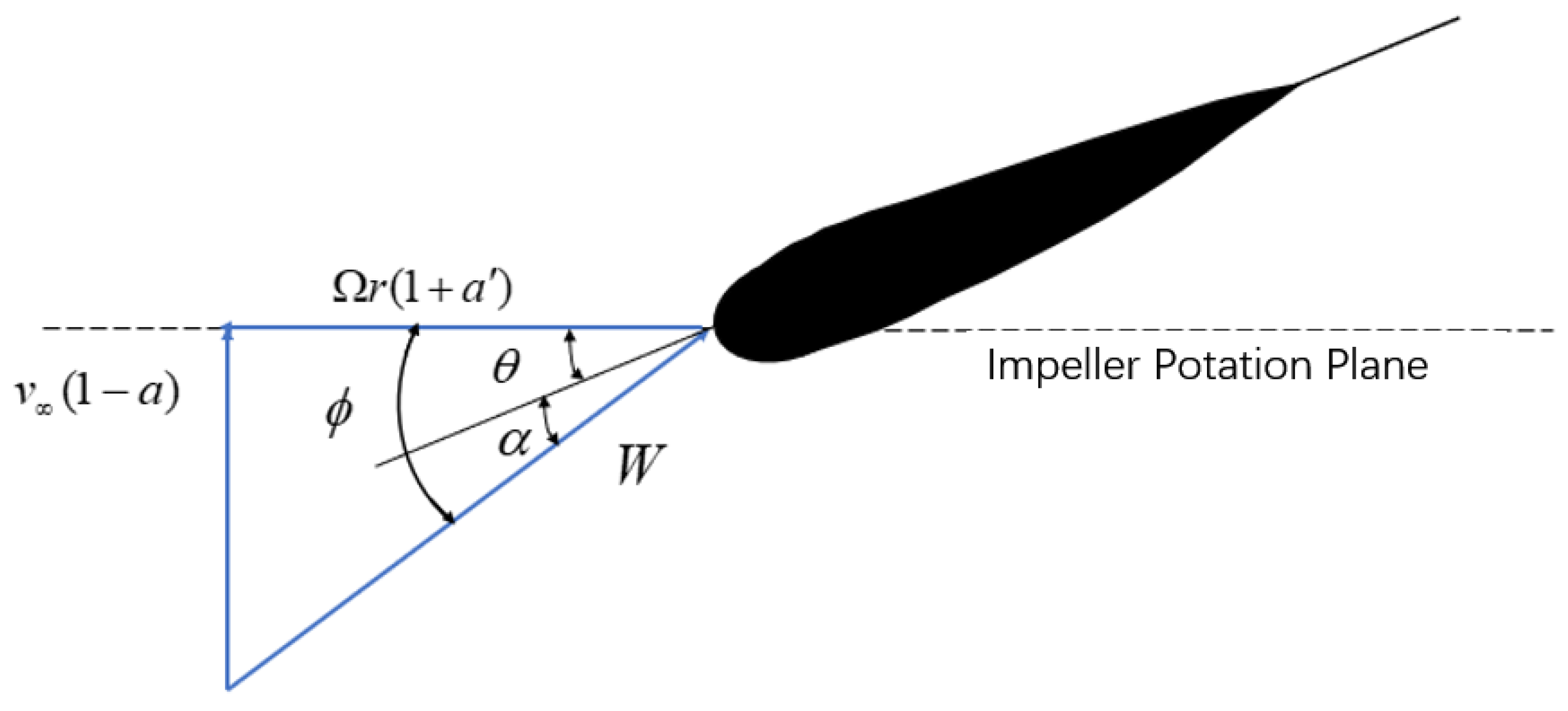
In the equation, Ω denotes the blade rotational angular velocity, v is the incoming flow velocity, r is the radius of the circular ring where the blade element is located, and v ( 1 a ) is the effective wind speed of the blade element; a and a are the axial and tangential induction factors, respectively (Figure 2).
The angle of attack ϕ between the relative velocity W of the blade element and the rotor rotation plane can be expressed as
tan   ϕ = ( 1 a ) v ( 1 + a ) Ω r ,
α = ϕ θ
where θ is the local pitch angle of the blade element’s airfoil, and α is the local angle of attack of the blade element’s airfoil.
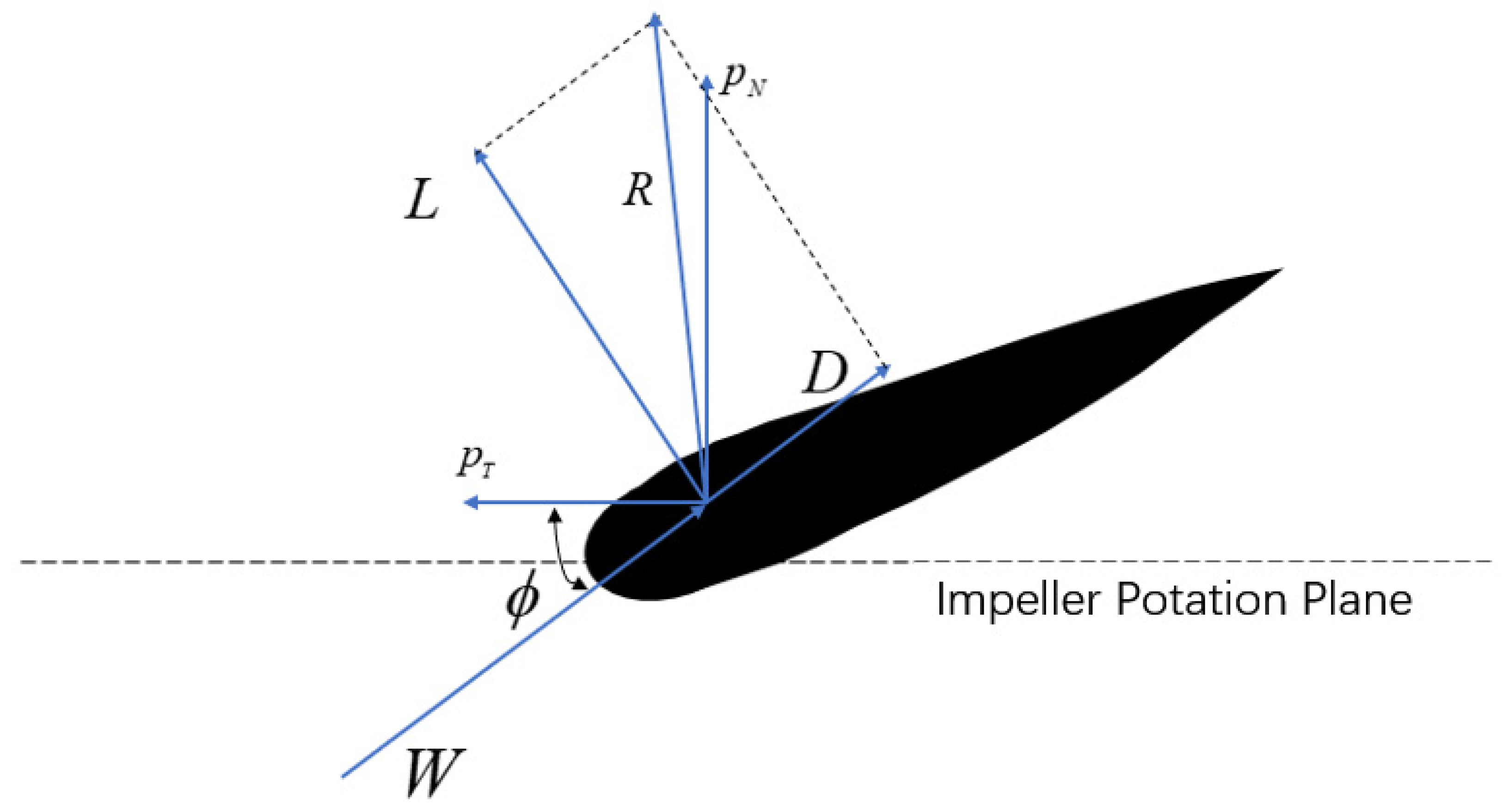
The lift of the airfoil is perpendicular to the W direction, and the drag is parallel to the W direction. Using the airfoil lift coefficient C L and drag coefficient C D , the lift L and drag D per unit length of the blade element are shown in Figure 3, with calculation formulas as follows:
L = 1 2 ρ W 2 c C L ,
D = 1 2 ρ W 2 c C D ,
where c is the chord length of the blade element.
For the rotating blade, the thrust P N is perpendicular to the rotor and the traction force P T is parallel to the rotor. The lift and drag are projected onto the corresponding directions to obtain
p N = L   cos   ϕ + D   sin   ϕ ,
p T = L   sin   ϕ D   cos   ϕ ,
In the BEM theory, the aerodynamic force on a blade element is determined by the change in gas momentum in the circular ring swept by the blade element. Then, the axial thrust and torque of the blade element ring at radius r are
d T = B p N d r ,
d M = B p T d r ,
where B is the number of blades. Furthermore, the thrust d T and torque d Q extracted by each ring in the rotor plane are
d T = 4 π r 3 ρ v Ω ( 1 a ) a d r ,
d Q = 4 π r 3 ρ v Ω ( 1 a ) a d r .

2.2.2. Tip Stall Correction Model

The vortex system in the wake of a finite-length wind turbine blade differs from the assumption of an infinite blade length in the BEM theory. Therefore, a tip stall correction model needs to be introduced to correct the interference of vortex shedding from the tip and hub on the calculation of induction factors. This paper adopts the Prandtl tip and hub loss factor correction, and those correction factors are added to the thrust d T and torque d Q :
d T = 4 F π r 3 ρ v Ω ( 1 a ) a d r ,
d Q = 4 F π r 3 ρ v Ω ( 1 a ) a d r .
The expression of F is
F = F tip · F hub = { F hub = 2 π cos 1 e B ( r R k ) 2 R i   sin   ϕ F tip = 2 π cos 1 e B ( R r ) 2 R   sin   ϕ ,
where F t i p and F h u b are the loss factors for the tip and hub, respectively. R is the vertical distance from the tip node to the rotor axis after considering rotor deformation.

2.3. Current and Wind Loads

Towing operations require evaluation of the environmental loads acting on the tugboats and FOWT when forward speed is substantial. Referring to the Guidelines for Towage at Sea [22,23,24], the total drag resistance is calculated by the following equation:
R T = 1.15 ( R f + R B ) ,
R f = 1.67 A 1 V 1.83 × 1 0 3 ,
R B = 0.147 δ A 2 V 1.74 + 0.15 V ,
where R f and R B are, respectively, the friction resistance and residual resistance of the tugboat in kN; A 1 denotes the wetted surface area under the waterline of the tugboat; δ is the block coefficient; A 2 is the submerged transverse section area amidship; and V is the towing speed.
For structures characterized by large wind surfaces, the significant influence of wind resistance must be accounted for. In this case, the towing resistance is increased and should be considered:
R = 0.7 ( R f + R B ) + R w ,
R w = 0.5 ρ V 2 C s A i 1 0 3 ,
where R w is the wind resistance; ρ is the air density; A i stands for the sectional area of the towed FOWT influenced by wind; and C S is the shape coefficient related to A i .
Following the characteristics of offshore drilling platforms and practical engineering experience, Li [25] proposed an estimation method for the towing resistance of the drilling platforms. The total resistance contains friction resistance, pressure resistance, eddy current resistance, and wind resistance:
R T = R f + R x + R c + R w ,
R f = 0.033 C f S V 1.825 ,
R x = 4.9 μ ω A 2 V 2 / g ,
R c = 20 % R f ,
where R f , R x , and R c correspond to the friction resistance, pressure resistance, and eddy current resistance, respectively; the value of C f and μ are normally taken as 0.481 and 0.8–1.0, respectively; S denotes the waterline area; ω is the salt water density, g represents gravity acceleration; and R w is the wind resistance, which can be derived from the following equation:
R w = 0.0098 K ρ V 2 ( A L s i n 2 θ + A T c o s 2 θ ) ,
where K is normally taken as 0.6; ρ is the air density; A L and A T are the longitudinal and horizontal projection areas of the towed structure above waterline, respectively; and θ stands for the windward angle.

2.4. Wave Force

The wave forces are evaluated based on linear potential flow theory. Thus, the first-order wave force on the structure can be expressed as
F w a v e = F E + F R ,
where F E and F R are the wave excitation force and the wave radiation force, respectively.
The wave excitation force consists of the Froude–Krylov force and diffraction force:
F E = F F K + F D = ρ i ω e S 0 Φ I n i d S + ρ i ω e S 0 Φ D n i d S + ρ U 0 S 0 Φ I x n i d S + ρ U 0 S 0 Φ D x n i d S   ( i = 1,2 , , 6 ) ,
where ω e is the encounter frequency; Φ I is the incident wave potential; and Φ D is the diffraction potential.
The wave radiation force is given by
F R = x ¨ o j A i j x ˙ o j B i j ,
where x ¨ o j and x ˙ o j are the acceleration and velocity of the floating structure, respectively; A i j and B i j are the hydrodynamic added mass and the radiation damping, respectively; and i and j stand for the global motion modes.
Numerical methods employed to evaluate the wave loads on FOWTs (Equations (5)–(7)) are typically based on the potential flow theory. It is justified by the negligible forward speed of the structure and the validation of the linearization assumptions for large displacement floating structures [26].
The Morison equation can be employed for the first estimate of viscous effects. In a time-domain analysis, taking the pontoons and cross braces of the FOWT as Morison elements, the Morison equation reads as
F w a v e = 1 2 ρ D C d | u f u s | ( u f u s ) + ρ A C m u ˙ f ρ A ( C m 1 ) u ˙ s
where C d denotes the drag coefficient, obtained in this investigation by a CFD solver; D is the characteristic diameter the Morison element; C m is the inertia coefficient; and u f and u s are the fluid particle velocity and structure velocity, respectively.

2.5. Mooring Force

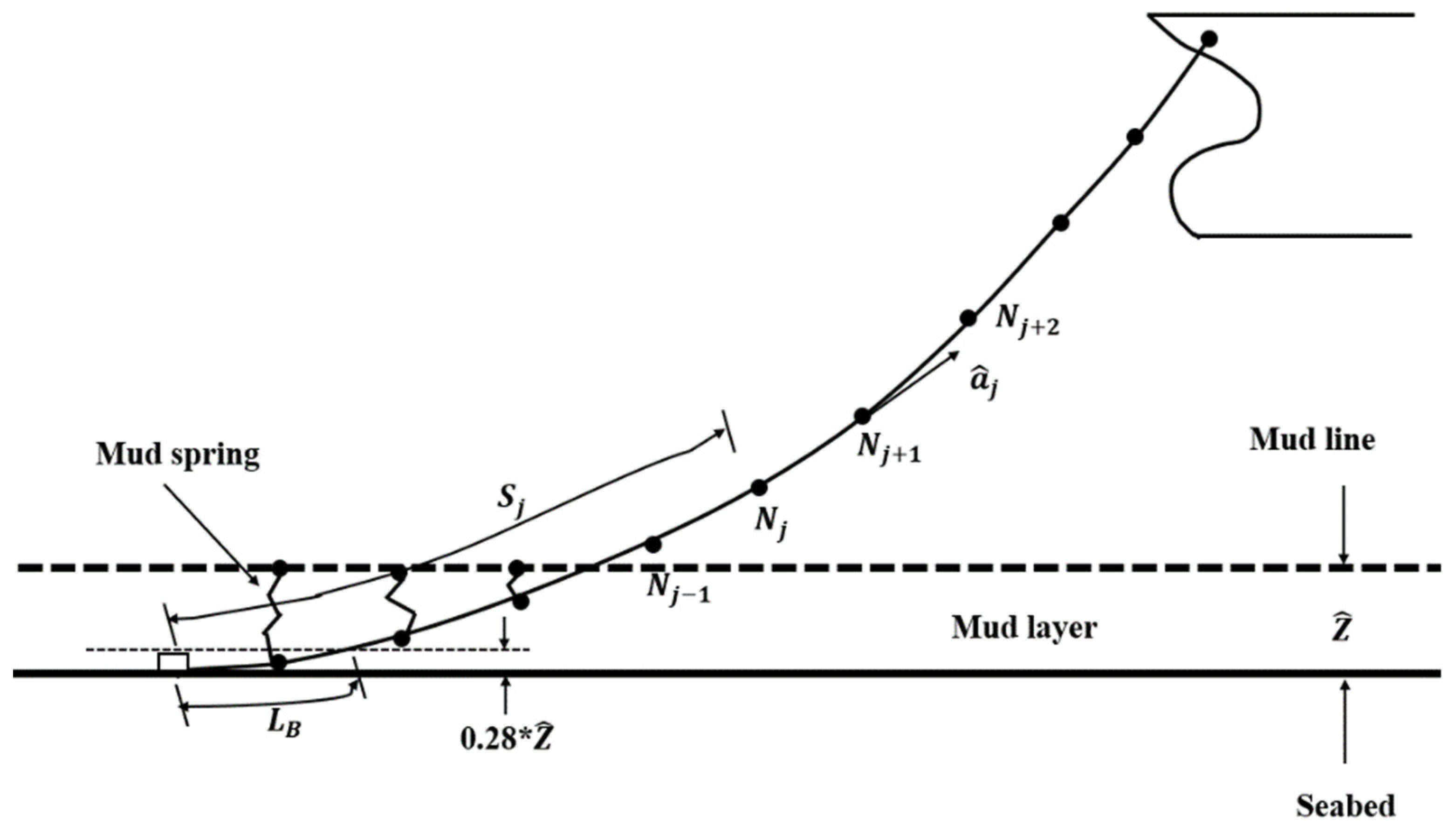
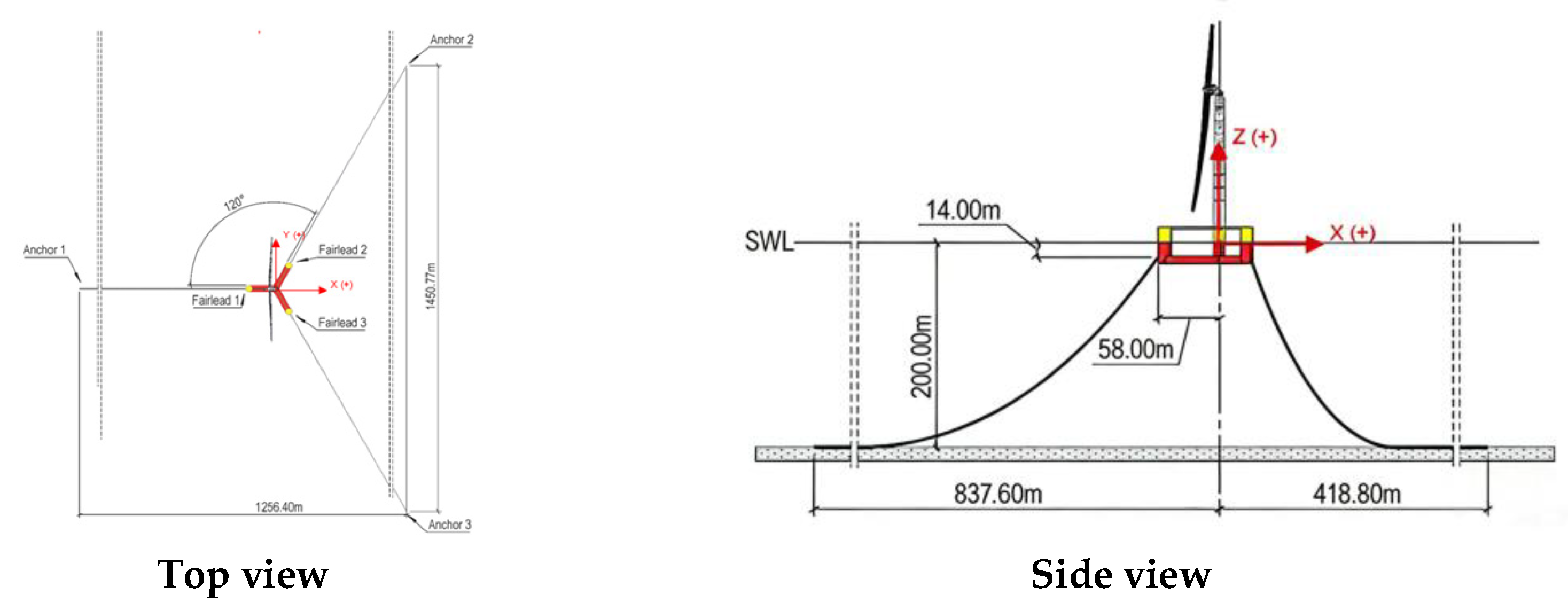
This study adopts a composite catenary mooring configuration [7,27,28,29] for the semi-submersible FOWT. Unlike static and quasi-static analyses typically applied to moored platforms, the mooring installation process necessitates a fully dynamic approach [11]. To this end, the dynamics of mooring lines are computed in Ansys AQWA using a lumped-mass model.
Figure 4 illustrates the dynamics of mooring lines considering a discrete distribution of masses along the length of the line and fixed reference axes (FRAs) [26,30]. Each segment of the dynamic mooring line is modeled as a Morison element subject to various external forces. In Figure 4, L B is the laid length of the line on the seabed, i.e., the distance between the anchor point and the touchdown point, whose heights are defined at 0.28 z ^ above the seabed, where z ^ is the height of the mud layer; S j is the total length of the line from the anchor point to the j -th element; and a ^ j = ( a 1 , a 2 , a 3 ) stands for the axial unit vector from the j point to j + 1 point.
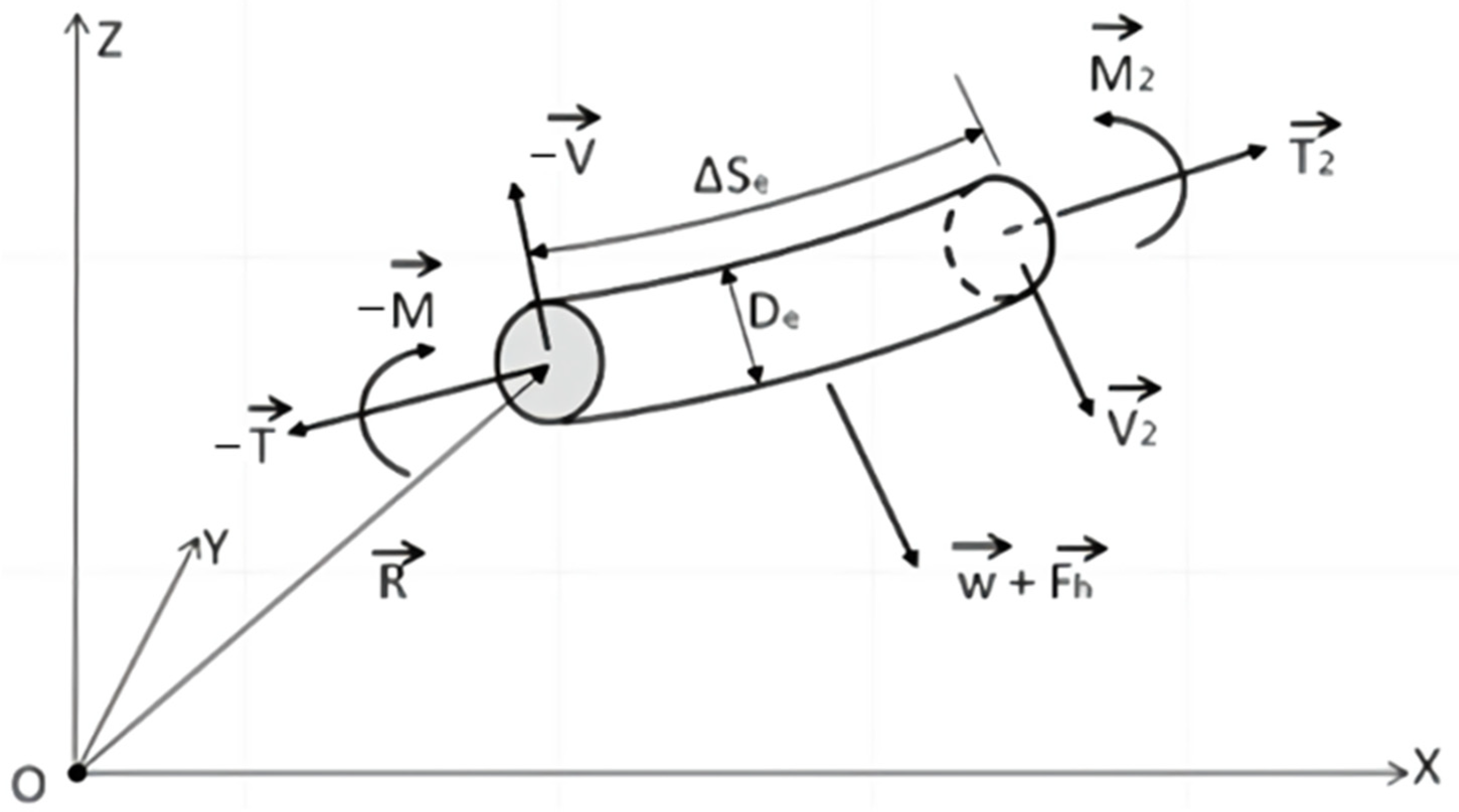
A Morison element with a circular section is shown in Figure 5. It is subject to external hydrodynamic loads as well as structural inertial loads. Though bending moments are taken into account, torsional deformation is neglected in our simulations.
The bending moment and tension are related to the bending stiffness E I and the axial stiffness E A of the cable through the following relations:
M = E I R S e × 2 R S e 2 ,
T = E A ε
where ε is the axial strain of the element.

2.6. Frequency-Domain Analysis

Given the large distance between the FOWT and the tugboats during the mooring system installation process, the hydrodynamic interactions between the different hulls are disregarded. Then, the equation of motion of the FOWT written in the first-order frequency domain is
[ ω 2 ( M p + M m + M a ) i ω ( B p + B m ) ] X = F E + F t o w ,
where ω is the wave frequency; M p is the mass–inertia matrix of the rigid body evaluated from the panel method; M m is the mass–inertia matrix of the Morison elements; M a is the combined added mass matrix from both panel elements and Morison elements; B p is the radiation damping; B m is the viscous damping from Morison equation; and F E and F t o w denote the wave exciting force and the drag force, respectively.
Experiment analysis has demonstrated that the wave frequency has a negligible impact on the viscous effects [31], so the calculation of additional viscous damping can be estimated as [32,33]
B v = B v i s B n
where B v is the term B p + B m in Equation (34), representing the sum of the added damping calculated in the frequency domain; B n is the radiation damping under the natural period.
A practical method to involve viscous effects is to calibrate the additional linear damping represented in Equation (35) through free-decay tests. These tests relate the system’s motion decay to empirical damping ratios, from which the corresponding damping values are derived. While the calibration of the damping matrix using high-fidelity CFD solvers is a more recent development [34,35], it is highly recommended when empirical or experimental results are not available. Taking a free-decay curve, the attenuation coefficient can be obtained directly from
κ = ln X 1 ln X N + 1 2 π N ,
where N stands for the number of cycles; and X 1 is the amplitude of the heave in the first cycle.
For the heave motion, the total damping coefficient is given by
B v i s = 2 κ C 33 [ M F + A 33 ( ω n ) ] ,
where C 33 is the heave hydrostatic restoring coefficient; M F is the mass of the FOWT; and A 33 ( ω n ) is the frequency-dependent added mass in heave.
The viscous damping correction of the tugboats is given by an empirical method that has been verified with real data [36]. Taking the viscous damping correction in heave as an example, the additional viscous damping of the tugboat can be determined by
B v = 2 n C 33 [ M T + A 33 ( ω n ) ] ,
where n is calibrated according to actual engineering experience—it is normally within the range 5–10% and often taken as 8% if there is no a priori knowledge. The remaining parameters are analogous to Equation (37), though corresponding to the tugboat instead of a floating platform.
Then, the frequency-domain motion response is given by the solution to Equation (34),
x R A O ( t ) = A ω Re [ x ^ ( i ω ) e i ω t ] ,
where x R A O ( t ) denotes the RAO-based motion, corresponding to X in Equation (34); A ω refers to the amplitude of the incident wave.

2.7. Time-Domain Model

A time-domain hydrodynamic model is established to capture key nonlinear effects, including viscous drag and the nonlinear dynamics of the mooring system, as detailed in the preceding sections [37,38]. The first-order wave loads described earlier can be easily transformed into the time domain. Model verification is typically achieved by comparing the RAO-based frequency-domain response with the simulated time-domain responses in a free-floating condition, which is a well-established practice widely adopted in the literature [39]. In most studies, the wave radiation forces are evaluated using the convolution integral introduced by Cummins [40]. However, recent advancements have increasingly utilized state-space models to replace the convolution integral by more time-efficient linear parameters [41]. Following with the Cummins equation, the motion of both the FOWT and tugboats is expressed as follows [42,43]:
[ M + A i j ( ) ] x ¨ 0 j ( t ) + B v x ˙ 0 j ( t ) + 0 t K ( t τ ) x ˙ 0 j ( τ ) d τ + C i j x 0 j ( t ) = F E ( t ) + F c a b l e ( t ) + F o t h e r s ( t ) ,
where F E ( t ) , F c a b l e ( t ) , and F o t h e r s ( t ) are the wave excitation force, cable forces, and other forces, respectively; the kernel of the convolution integral K ( t ) represents the impulse response function and is obtained through Ogilvie relations and the hydrodynamic coefficients from frequency-domain analysis [41,44,45]:
K ( t ) = 2 π 0 B ( ω ) cos ( ω t ) d ω .
Although Equation (41) is widely adopted for computing the impulse response function towing to its rapid convergence, the finite panel resolution in AQWA restricts the accurate evaluation of time-domain radiation forces at very high frequencies. A common solution to solve this limitation is the polynomial fitting method, expressed as follows:
K i , j ( t ) = 2 π 0 σ B i , j ( ω ) cos ( ω t ) d ω + 2 π σ B ~ i , j ( ω ) cos ( ω t ) d ω
where σ is the upper frequency limit of the panel method; and B i , j ( ω ) is the polynomial fit of B ~ i , j ( ω ) for frequencies higher than σ . Based on the calculated retardation functions, the infinite-frequency added mass coefficient A i j ( ) is given by
A i j ( ) = A ( ω n ) + 1 ω n 0 K ( t ) sin   ω n t d t .

3. Description of the Systems

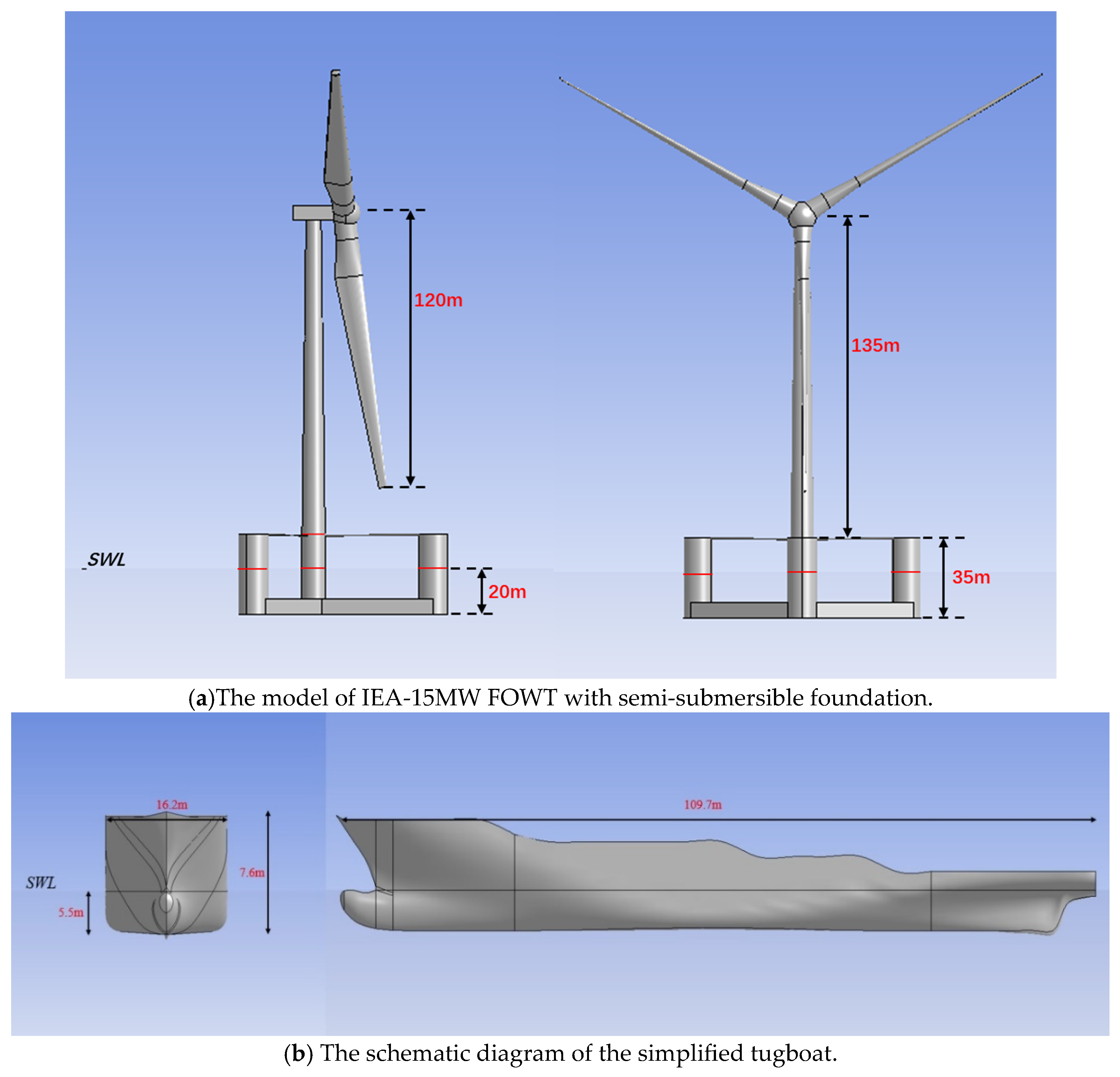
The FOWT examined in this study consists of the IEA 15MW wind turbine mounted on a semi-submersible foundation, whose dimensions have been suitably adapted to the 15 MW wind turbine [46,47,48]. The tugboat is modeled on a professional rescue ship selected from the available AQWA object library, as shown in Figure 6. Principal parameters of the FOWT, floating foundation, and tugboat are detailed in Table 1, Table 2 and Table 3. In the hydrodynamic model, large-volume components such as the platform columns are represented using a panel model, while slender structural elements—including cross braces and pontoons—are modeled via Morison elements.
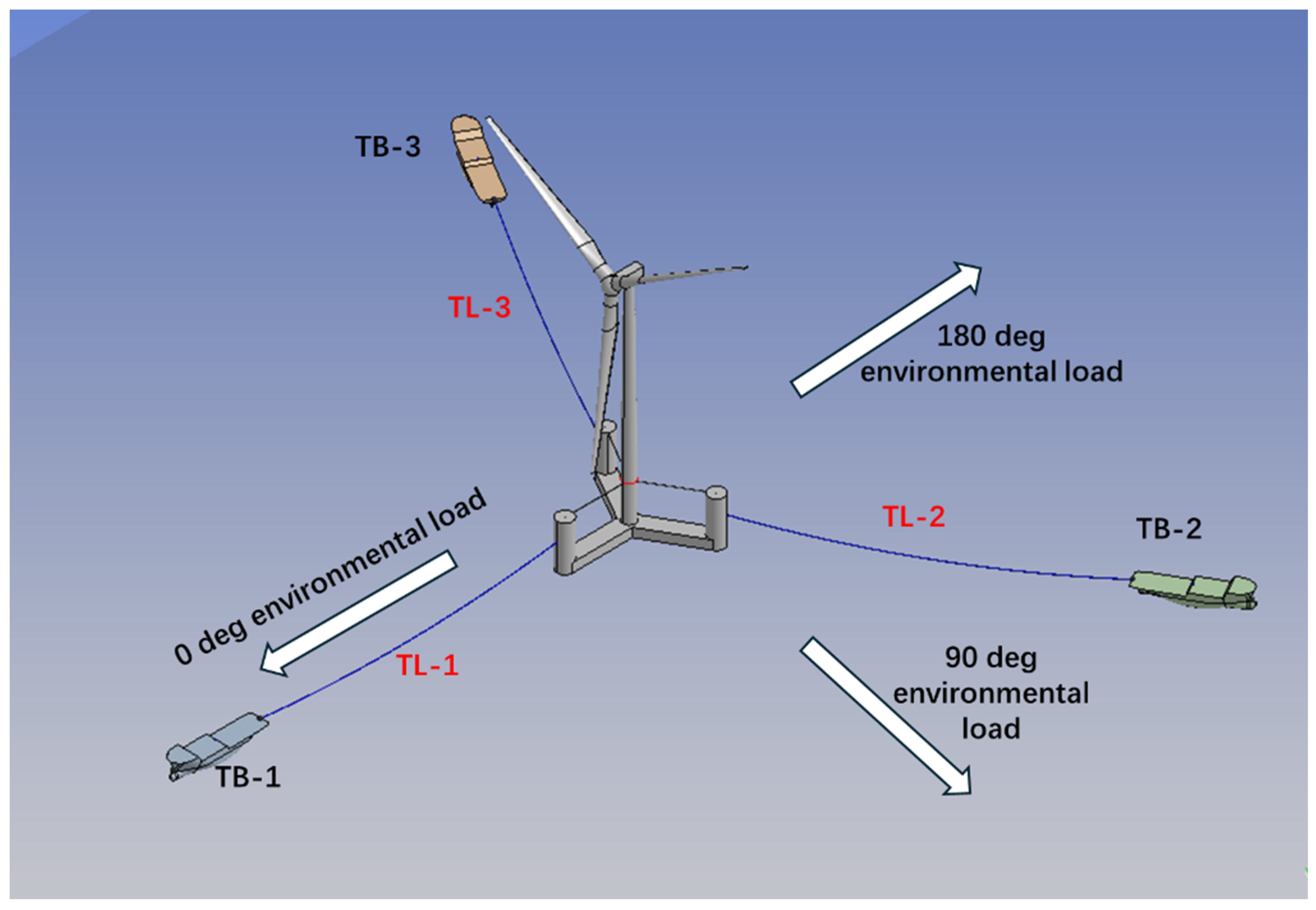
For the simulations, two coordinate systems are defined: a global coordinate system with its origin fixed at the waterline and a local coordinate system fixed at the floating platform and centered at its center of gravity (CoG). The axes of the two reference frames remain parallel throughout the analysis. During the mooring installation process, the CoG of the FOWT is vertically aligned with the origin of the GCS. Figure 7 illustrates the mooring installation layout using three tugboats. The tugboats are evenly distributed around the FOWT, with a heading angle of 120 deg between each adjacent pair. In Table 4, the key geometric parameters of the mooring installation process are presented.
Table 5 presents the parameters of the temporary positioning system that maintains station-keeping for the FOWT, a practical engineering methodology used especially when dynamic positioning systems are not available.

4. Results

4.1. Verification of Model Damping Correction

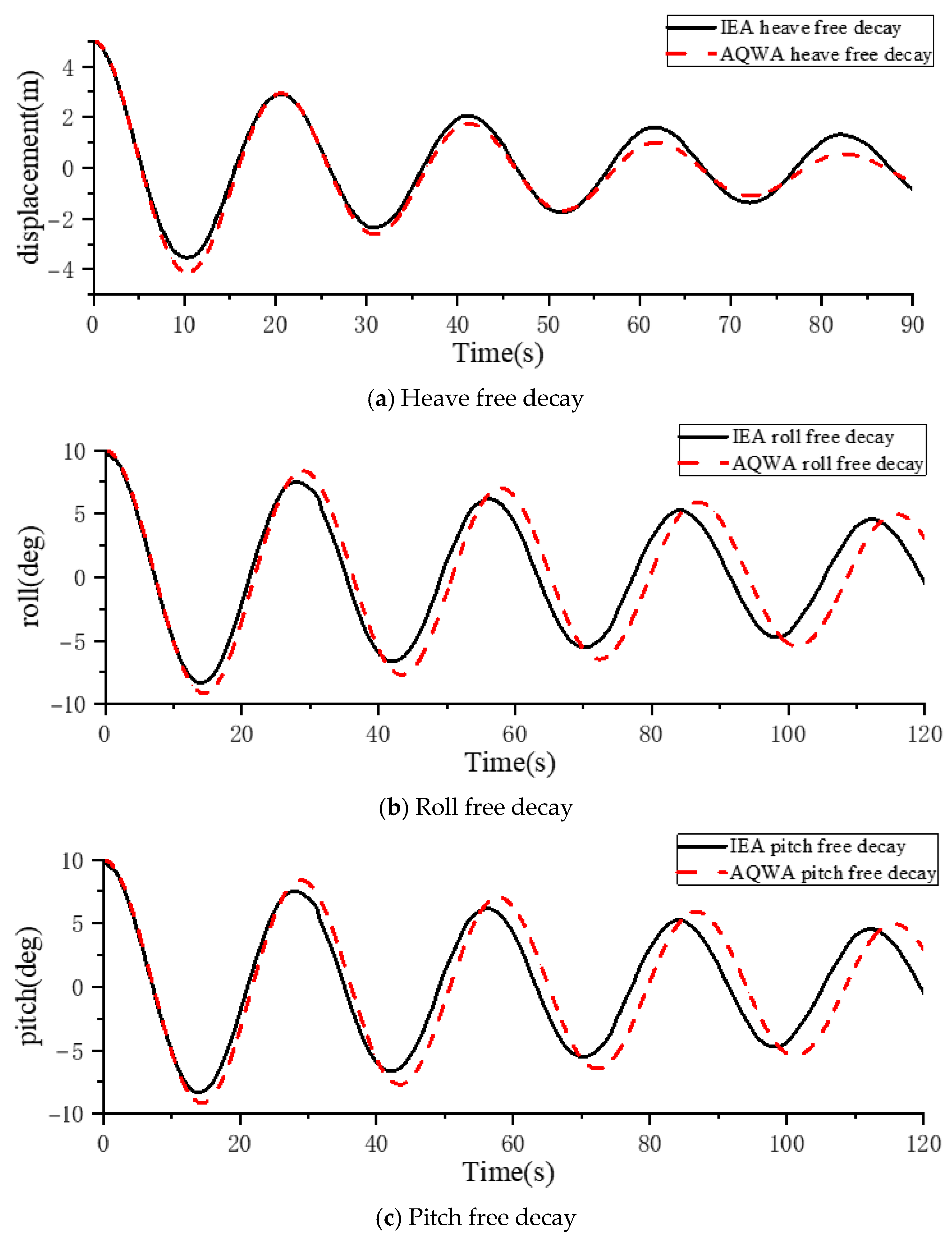
The inherent limitations of the potential flow theory often lead to overpredicted motion responses of floating structures if viscous damping effects are neglected. To achieve more realistic predictions, it is therefore essential to incorporate empirical viscous damping corrections. Damping corrections are applied to the three degrees of freedom (heave, roll, pitch) of the wind turbine, since these motions are highly sensitive to viscous effects. The critical damping of the wind turbine is calculated according to Equation (37), and a reasonable damping ratio is adopted to determine the damping correction coefficient. The accuracy of the damping correction is verified by comparing the free-decay simulation results with the free-decay curves presented on Page 22 of the IEA document Definition of the UMaine VolturnUS-S Reference Platform Developed for the IEA Wind 15-Megawatt Offshore Reference Wind Turbine.
Figure 8 serves to compare the results derived from the IEA document with those from AQWA. The comparison demonstrates that the viscous damping correction proposed in this study exhibits high reliability. This study applies a correction using a critical damping ratio of 4%.

4.2. Frequency-Domain RAOs

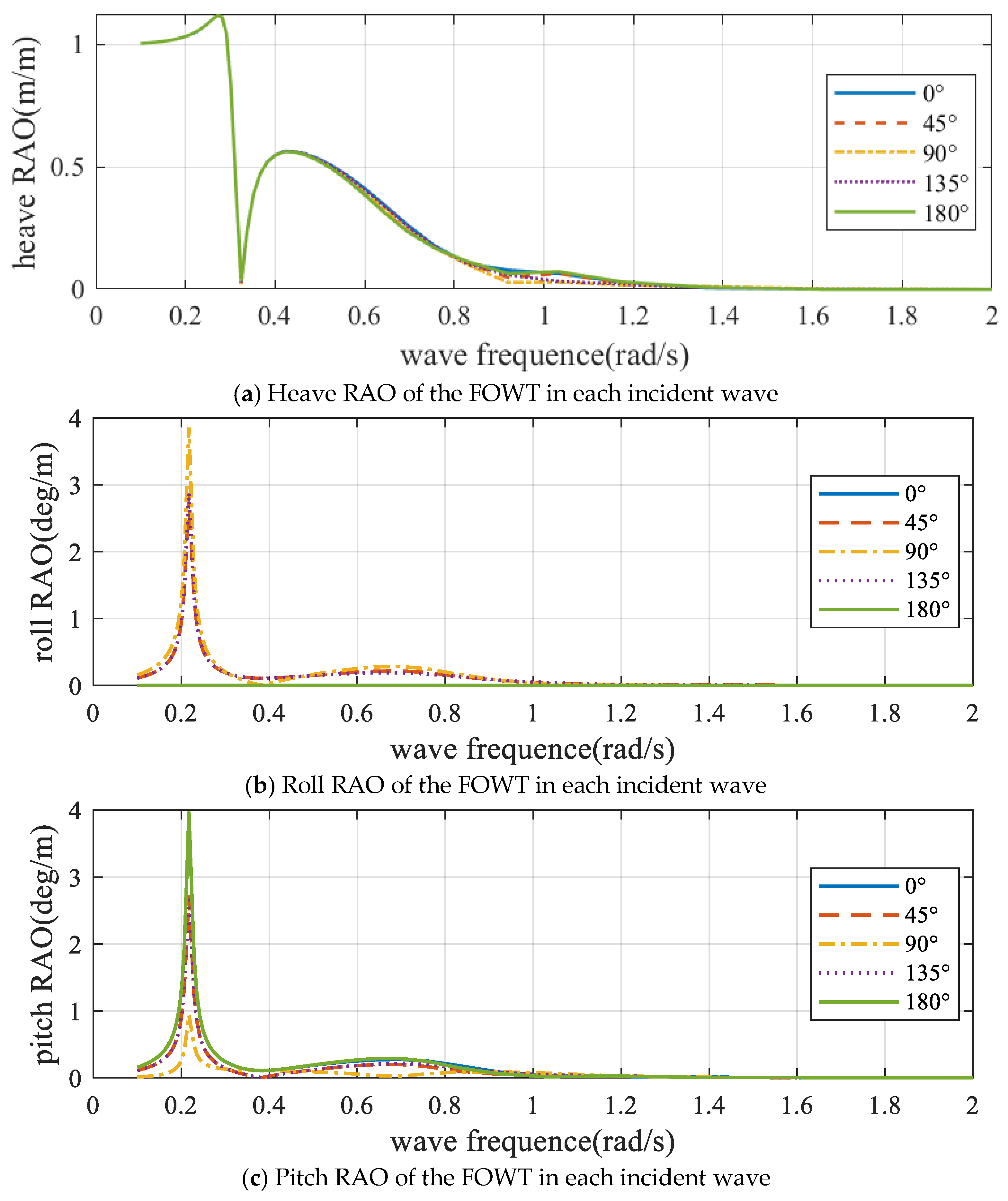
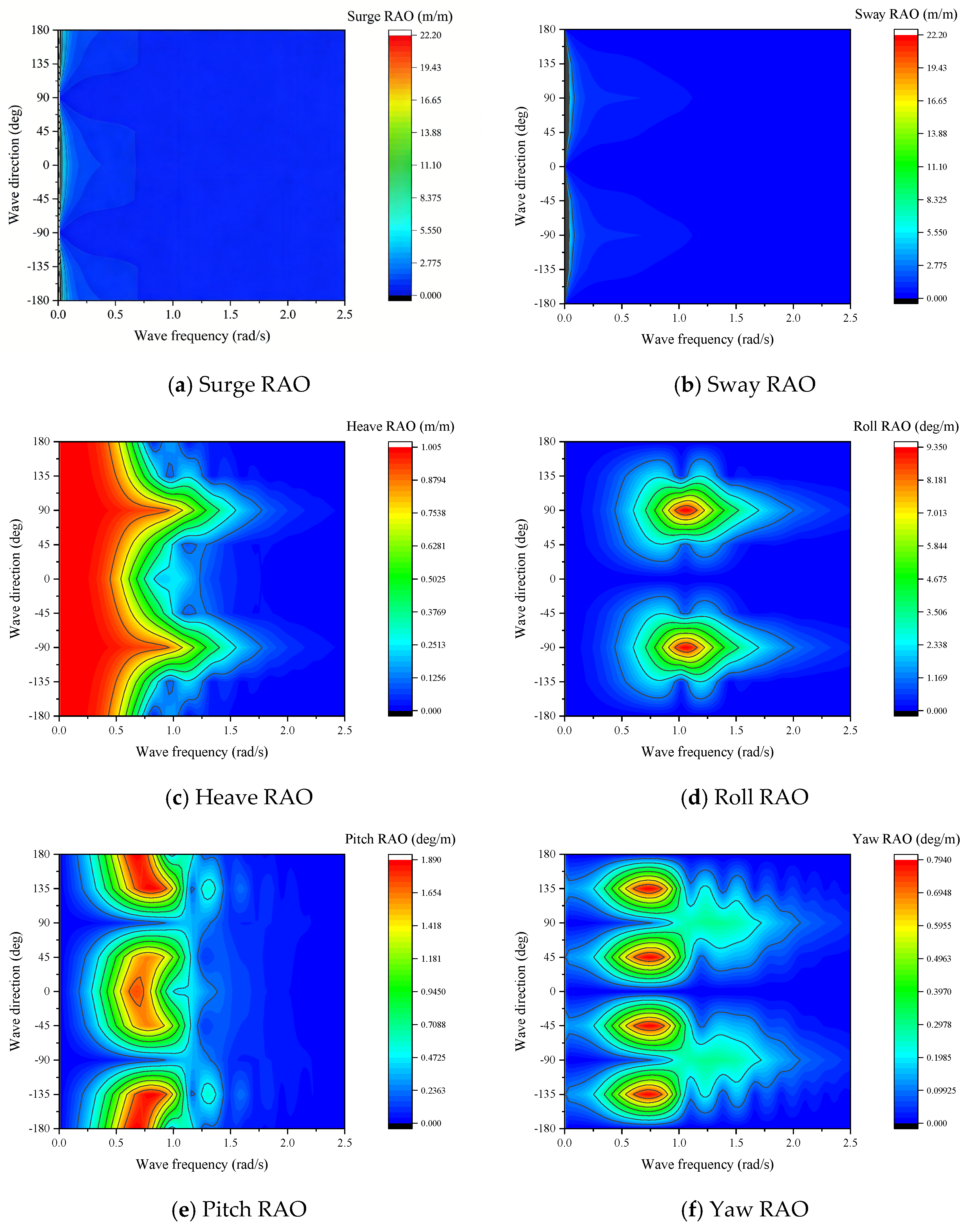
Following the damping correction described in Section 4.1, the heave, roll, and pitch RAOs of the damping-corrected IEA-15MW wind turbine model in 200 m water depth is presented in Figure 9.
As shown, the RAOs of the wind turbine are significantly affected by wave direction. The wind turbine exhibits pronounced responses to low-frequency waves, while the RAOs approach zero for waves with frequencies exceeding 1.2 rad/s. Specifically, the heave RAO shows distinct peaks near frequencies of 0.25 rad/s and 0.4 rad/s, with a trough approaching zero at a frequency of 0.3 rad/s. In contrast, the roll and pitch RAOs follow closely aligned trends: both increase initially with wave frequency, reach a maximum at about 0.22 rad/s, and subsequently decrease.
Figure 10 presents the RAOs of the tugboat in the heave, roll, and pitch. While tugboat speed is found to have negligible influence on the RAOs, a pronounced peak in the roll RAO is observed near 90 deg of wave incidence (beam waves), exceeding 5 deg/m and approaching 10 deg/m, as list in Table 6.

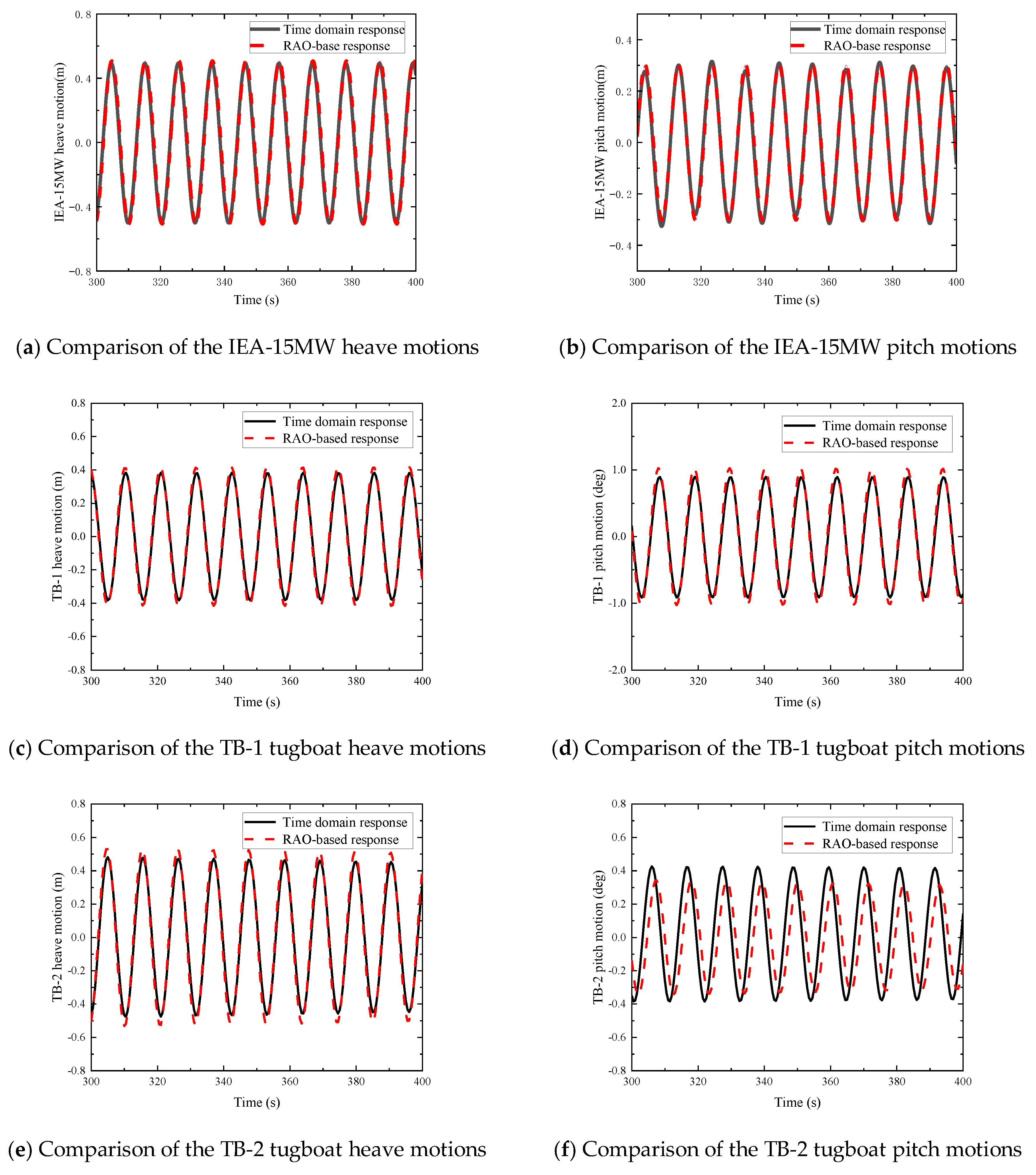
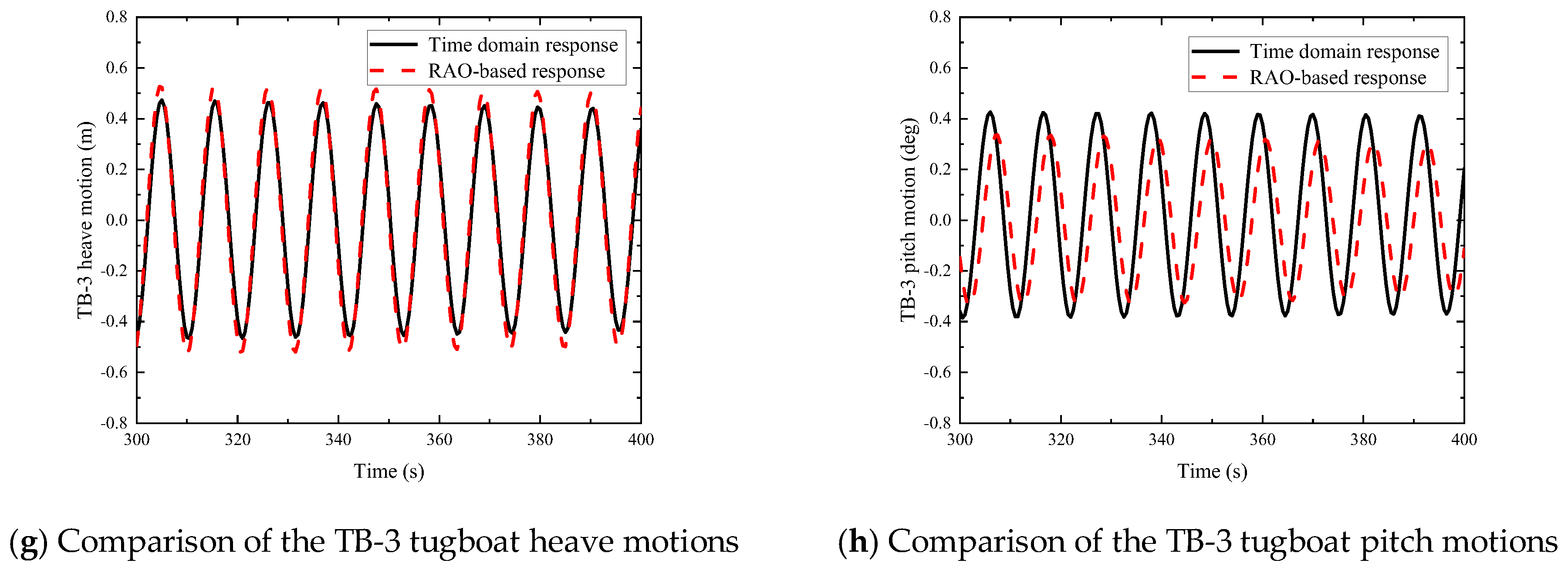
4.3. Time-Domain Verification

The time-domain wave-induced motions derived from Equation (40) are compared with the time-domain responses derived from the frequency-domain RAO Equation (39) under free-floating conditions. The comparison is performed for a regular wave with a height of 1.2 m, period of 10.5 s, and direction of 0 degrees, prior to the full installation-phase simulation. As shown in Figure 11, the heave and pitch motions of the FOWT mooring installation system show strong agreement between the direct time-domain simulations and the frequency-domain RAO-based conversions. The only minor deviation is observed in the pitch period of tugboats TB-2 and TB-3. This consistency validates the reliability of the numerical model developed for the FOWT mooring installation system.

4.4. Coupled Analysis in Time Domain

The mooring cable configuration of the FOWT is illustrated in Figure 12. The mooring system design refers to the IEA-15MW design established by IEA document, whose detailed parameters are provided in Table 7.
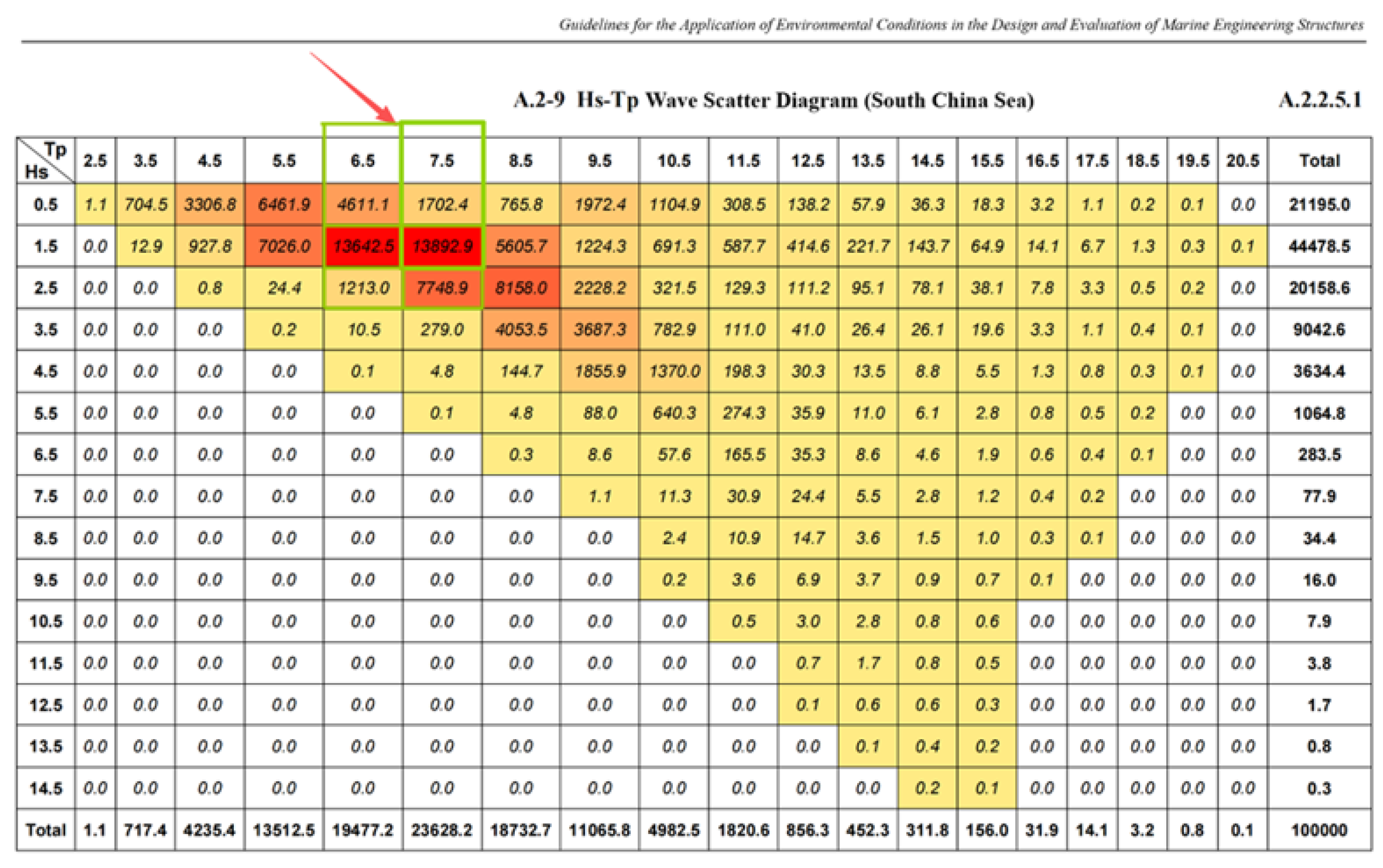
The simulations in this paper adopt common environmental loads in the South China Sea. According to Figure 13, the wave scatter diagram provided in the China Classification Society (CCS) guideline, Guidelines for the Application of Environmental Conditions in the Design and Evaluation of Marine Engineering Structures, wave load heights of 1.5 m and 2.5 m, corresponding to wave periods of 6.5 s and 7.5 s, respectively, have a relatively high occurrence probability. Meanwhile, this paper investigates the impact of wind on the system during the mooring installation process, which is considered by adopting a turbulent wind model with a wind speed of 11.4 m/s. The parameters of the environmental loads relevant to the mooring system installation are listed in Table 8.
A full-scale model was adopted for the AQWA solution, with a mesh size of 1 m and a time step of 0.05 s. The irregular waves were modeled using the JONSWAP spectrum, with a spectral peak factor of 1.4. In OpenFAST, the reference height for the turbulent wind profile was set to the hub height of 135 m, corresponding to a wind speed of 11.4 m/s.
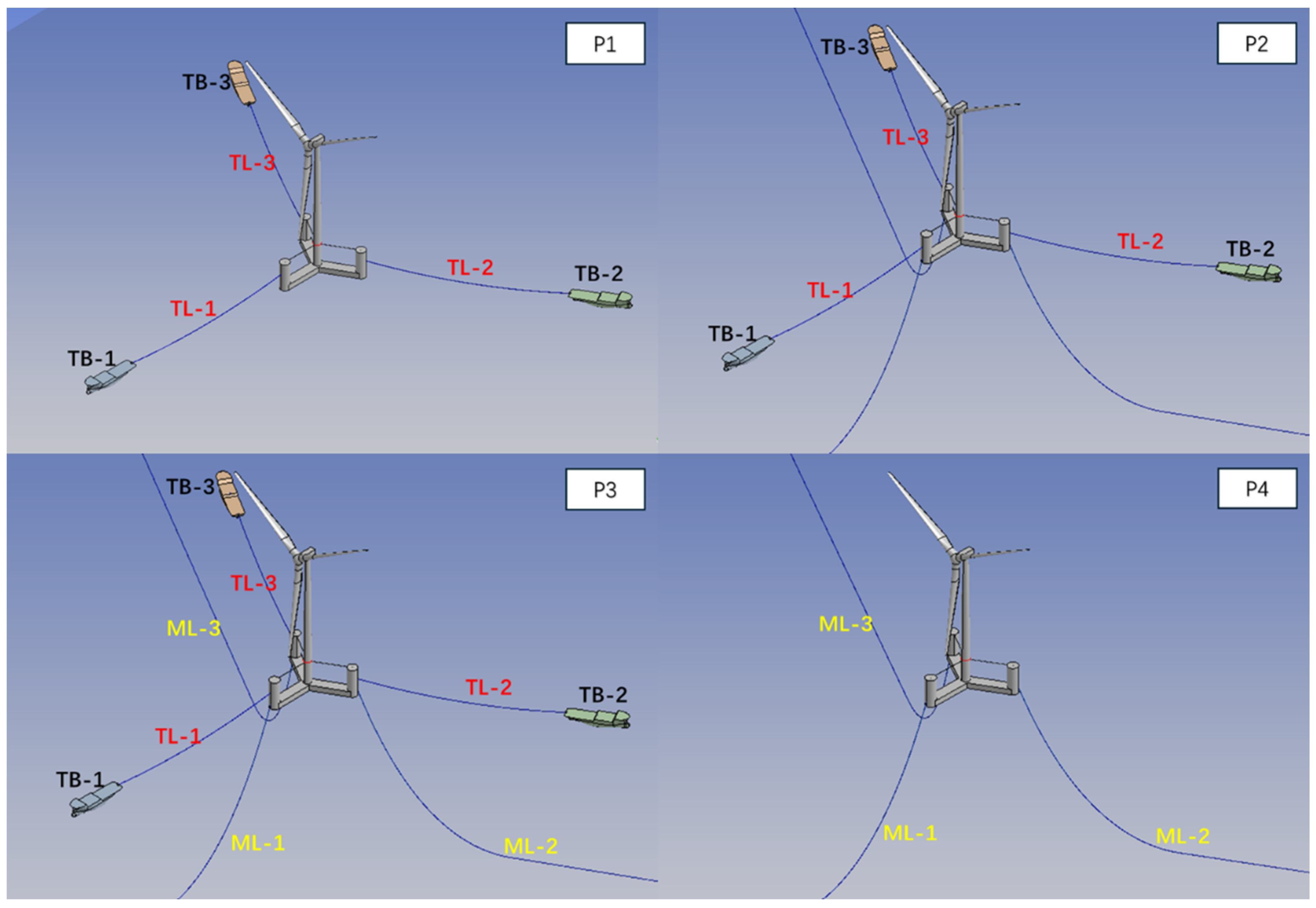
Figure 14 illustrates the four-stage installation phases for the FOWT mooring system under the specified environmental conditions. The towing lines from the three tugboats (TB-1, TB-2, and TB-3) are designated as TL-1, TL-2, and TL-3, respectively.
Stage P1: This initial phase focuses on station-keeping the FOWT. TB-1 provides the primary towing force, while TB-2 and TB-3 supply supplementary, lower-magnitude forces.
Stage P2: In this subsequent phase, the three mooring lines (ML-1, ML-2, and ML-3) are deployed, each with an initial anchor chain length of 875 m.
Stage P3: Each mooring line is tensioned to its target pretension with the assistance of the tugboats, resulting in a final anchor chain length of 850 m.
Stage P4: The final stage involves the sequential disconnection and withdrawal of the three tugboats, completing the mooring system installation.
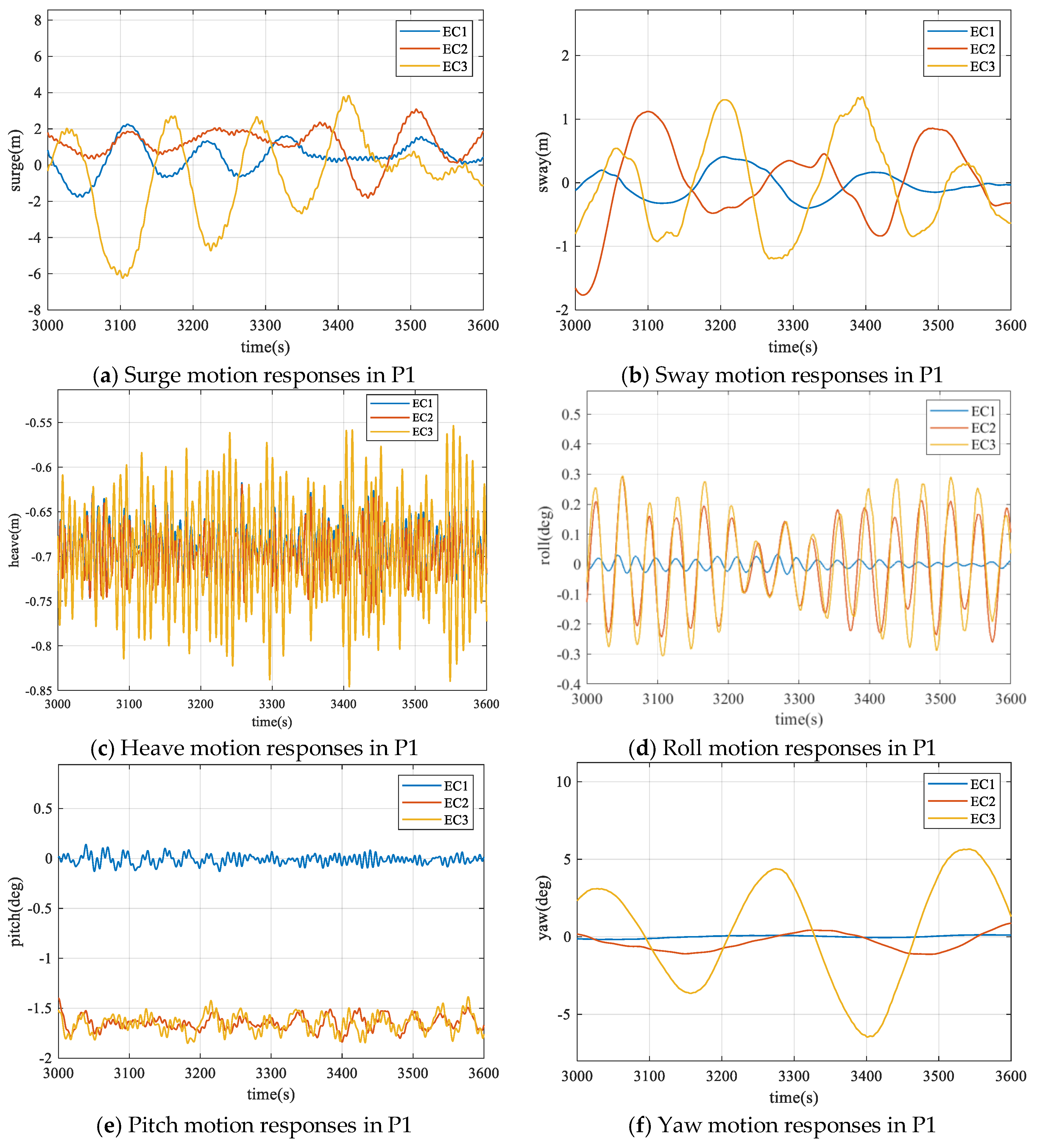
At Stage P1, the three tugboats provide towing force to maintain the FOWT at its designated installation position, thereby enabling subsequent deployment of the anchor chains. The motion responses of the FOWT under various environmental loads are depicted in Figure 15. Analysis of the results between 3000 s and 3600 s reveals that wind loads have a significant impact on the pitching of the wind turbine. As shown in Figure 15e, the presence of wind shifts the pitch equilibrium position and markedly increases the pitch motion amplitude. In contrast, variations in wave conditions exhibit a comparatively minor effect on pitch response. Regarding the heave motion, wind loads show negligible impact under identical wave conditions (EC1 and EC2). Conversely, wave heights have a significant impact on the translational response of the FOWT. Under 2.5 m waves, the surge, sway, and heave motions are significantly larger than those under 1.5 m waves, whereas the roll and pitch responses remain similar between the two wave conditions.
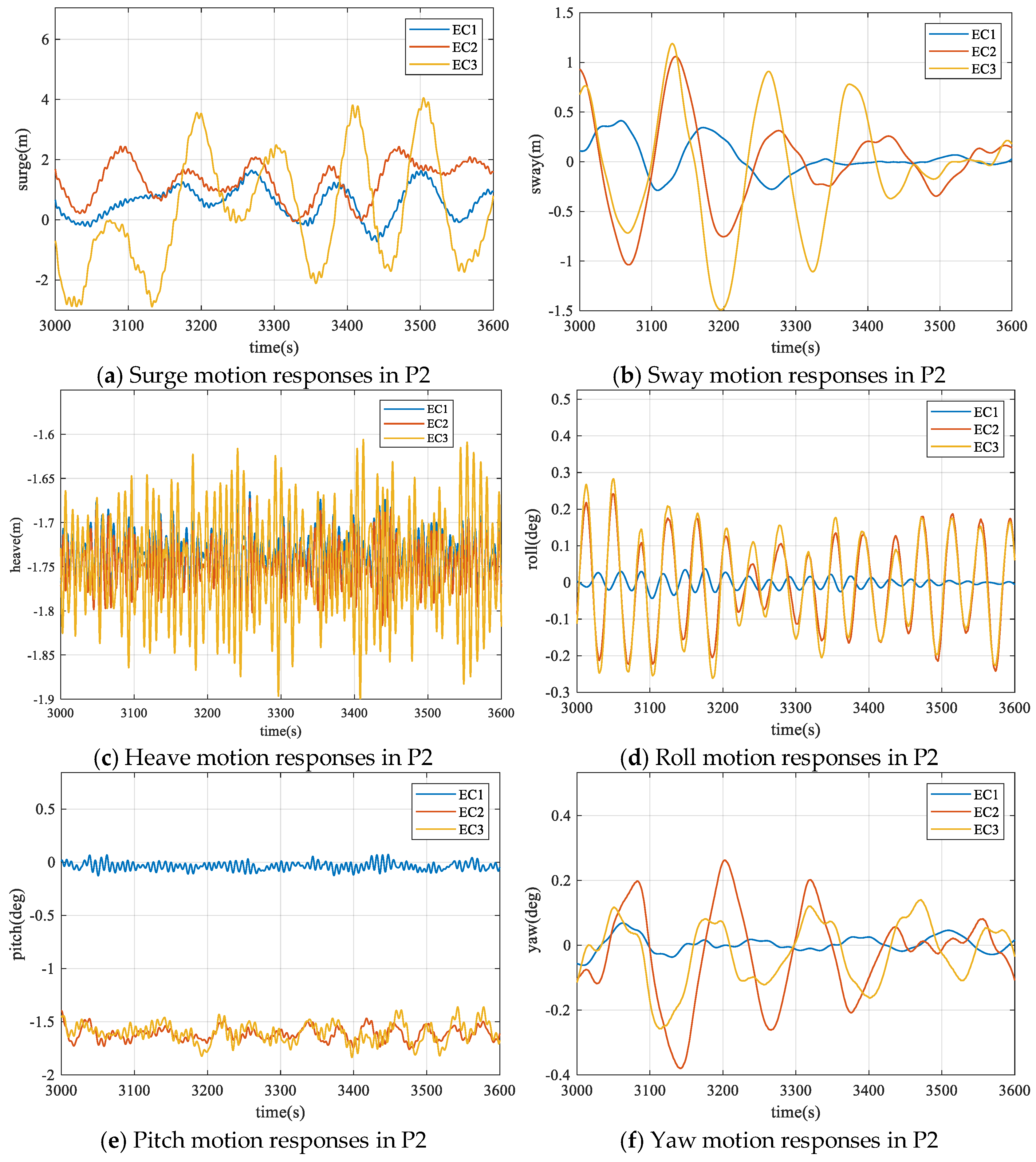
At Stage P2, with all anchor chains installed while the tugboats remain connected, the FOWT motions are examined, as shown in Figure 16. The installation of the anchor chains leads to a significant reduction in the surge, sway, heave, and yaw motion responses compared with Stage P1, whereas the roll and pitch motion responses show no substantial changes under the same load conditions.
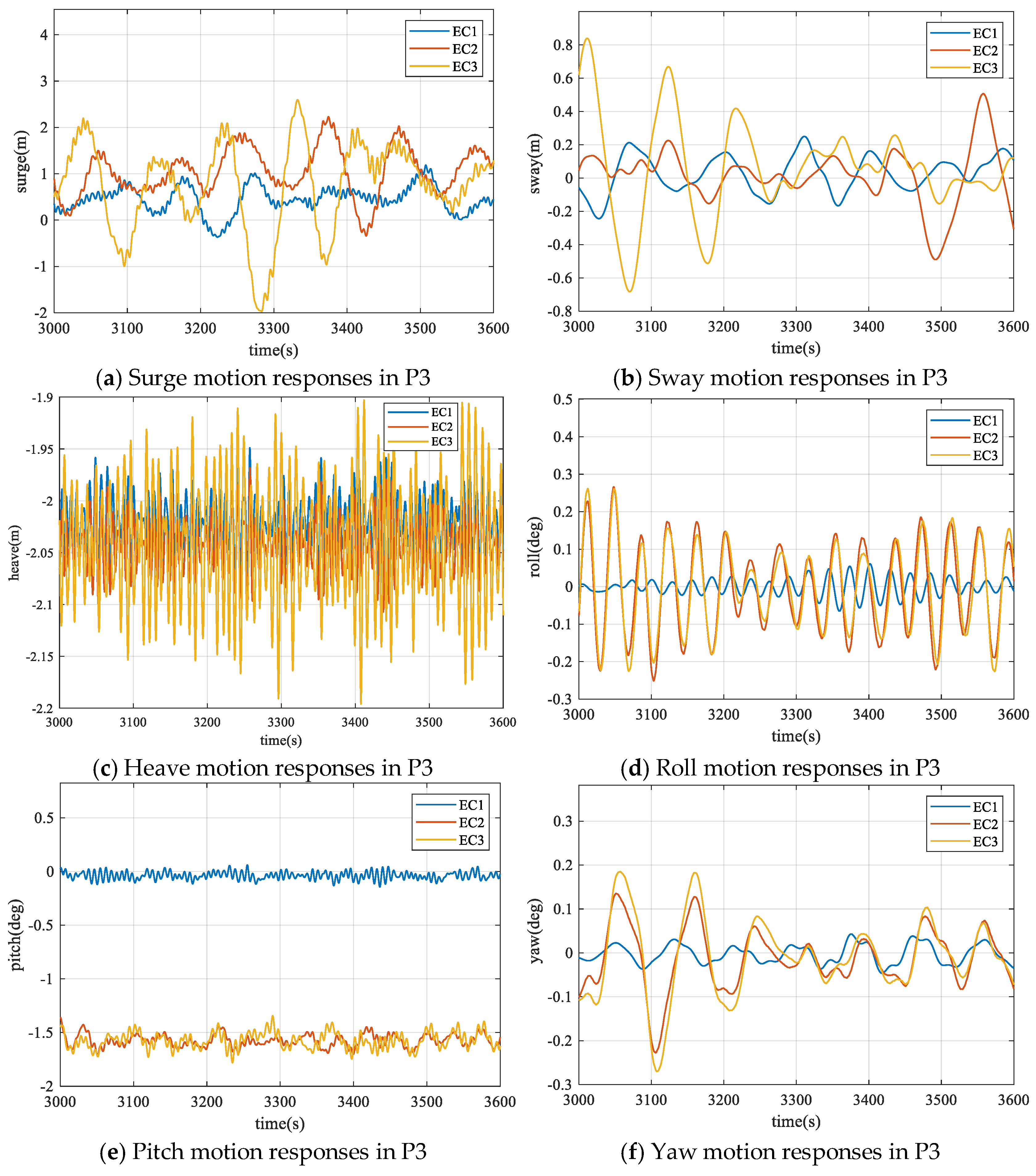
Stage P3 involves the tensioning of the FOWT’s anchor chains. The corresponding motion responses, presented in Figure 17, exhibit minimal deviation from those observed in Stage P2.
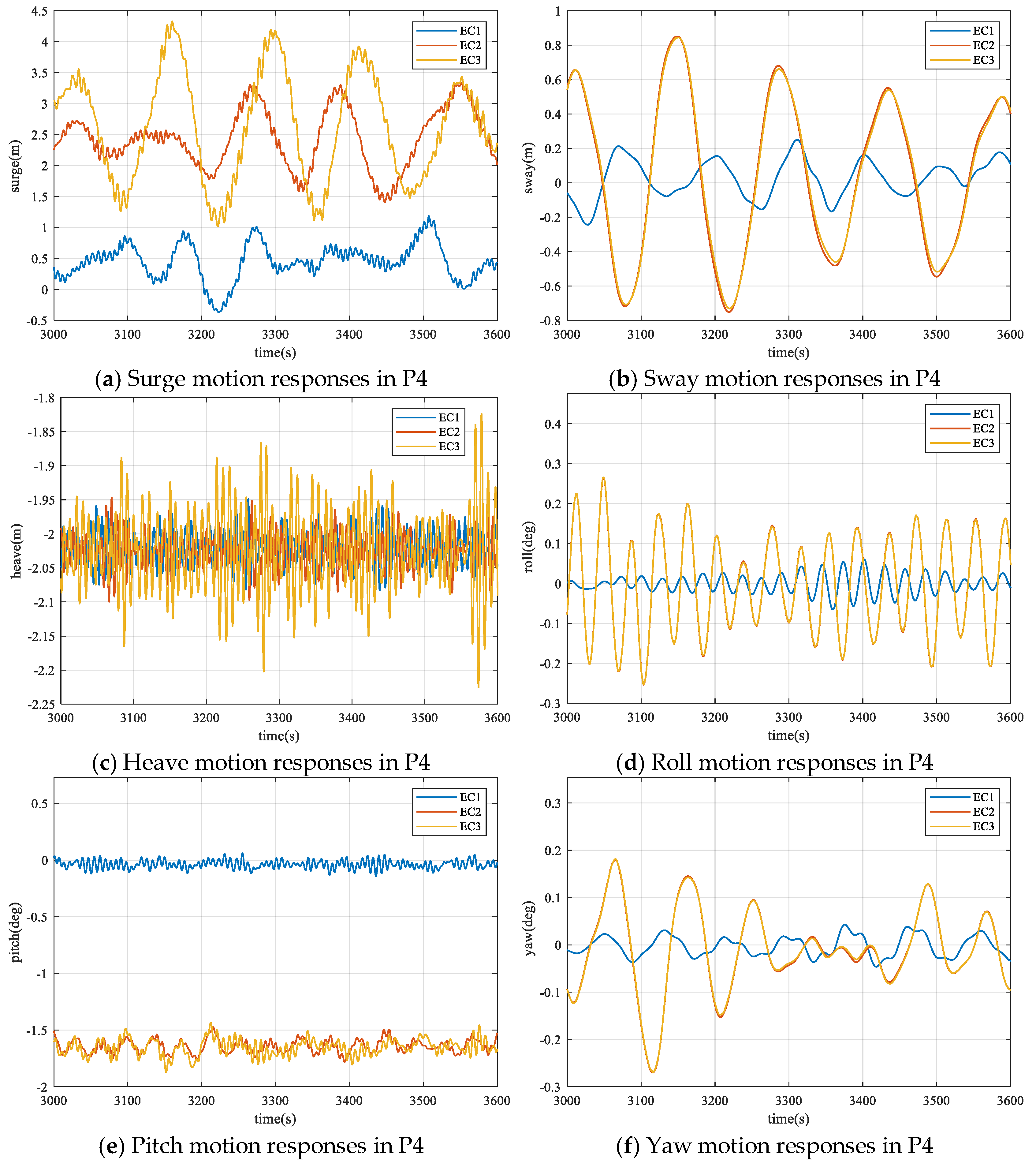
The final Stage P4 begins with the departure of all tugboats, marking the completion of the mooring system installation. Analysis at this stage focuses solely on the responses of the moored FOWT. As shown in Figure 18, the roll and pitch motions are notably lower than in all previous stages. This reduction in motion is attributed to the restraint by the fully engaged mooring system, which effectively replaces the tugboats and offers more resilience to environmental loads.
Table 9 summarizes the maximum, minimum, and mean values of the motion responses of the FOWT under various environmental conditions during the entire mooring installation process (Stages P1 to P4). The maximum motion amplitudes for the entire construction phase under the same working conditions are highlighted in red. Analysis of these results indicates that Stage P3 is the safest phase, characterized by the smaller fluctuations in the FOWT’s heave motion. In contrast, Stage P1 exhibits the largest pitch and yaw responses compared with all subsequent stages.
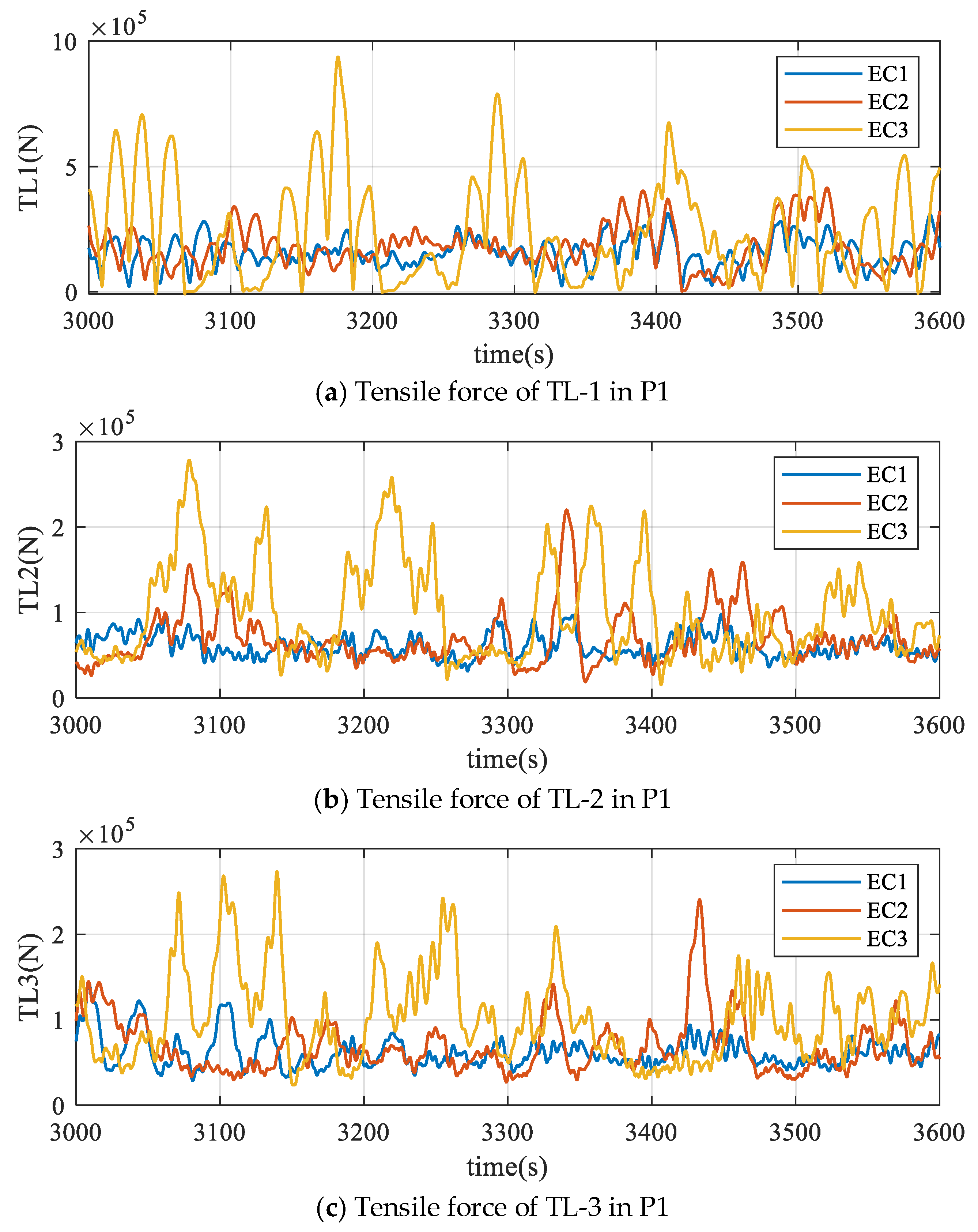
The statistical data and pronounced fluctuations in motion responses, particularly in surge, sway, and yaw, clearly identify the initial stage (P1) as the most critical. This is primarily due to the absence of mooring restraint, and the FOWT is held in position only by the three tugboats, whose towing capacity is insufficient to fully constrain the platform under the applied environmental loads. Figure 19 presents the tensile forces in the towing cables during Stage P1 under different environment conditions. At this stage, tugboat TB-1, which is more exposed to head waves, generates a substantially higher towing force to stabilize the FOWT. The tensile in TL-1 exhibits considerable fluctuation, periodically dropping to near-slack conditions that must be avoided in practice. In contrast, the tensions in TL-2 and TL-3 remain relatively stable.
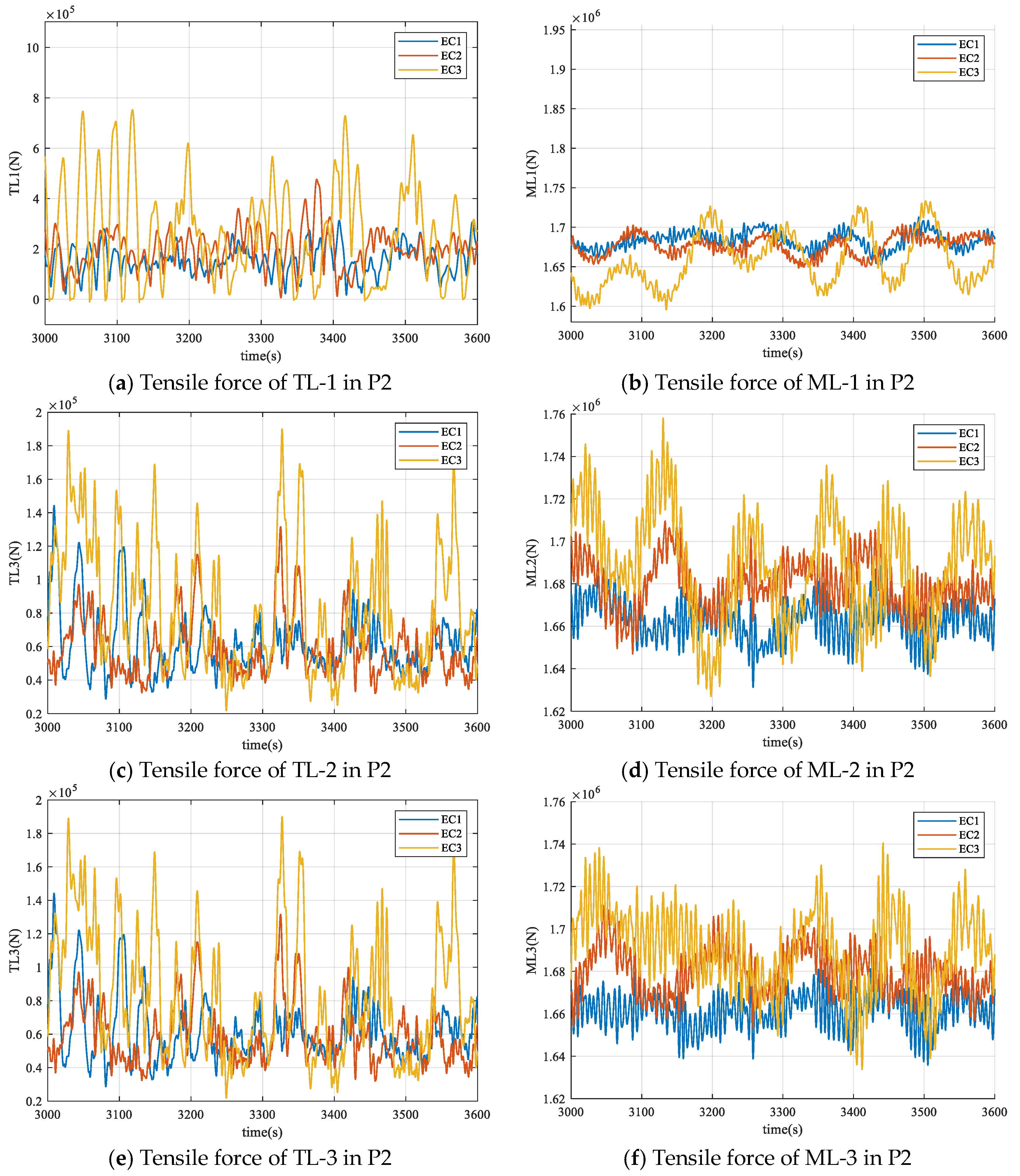
Figure 20 presents the tensile forces on the towing cables and anchor chains under different environmental conditions during Stage P2. Once the anchor chains are installed, the tension of the main towing cable (TL-1) decreases, though its tension fluctuation remains pronounced. The tension changes in towing cables TL-2 and TL-3 are not obvious. The tension of the intentioned anchor chain is approximately 1.6 × 10³ kN, with small fluctuations.
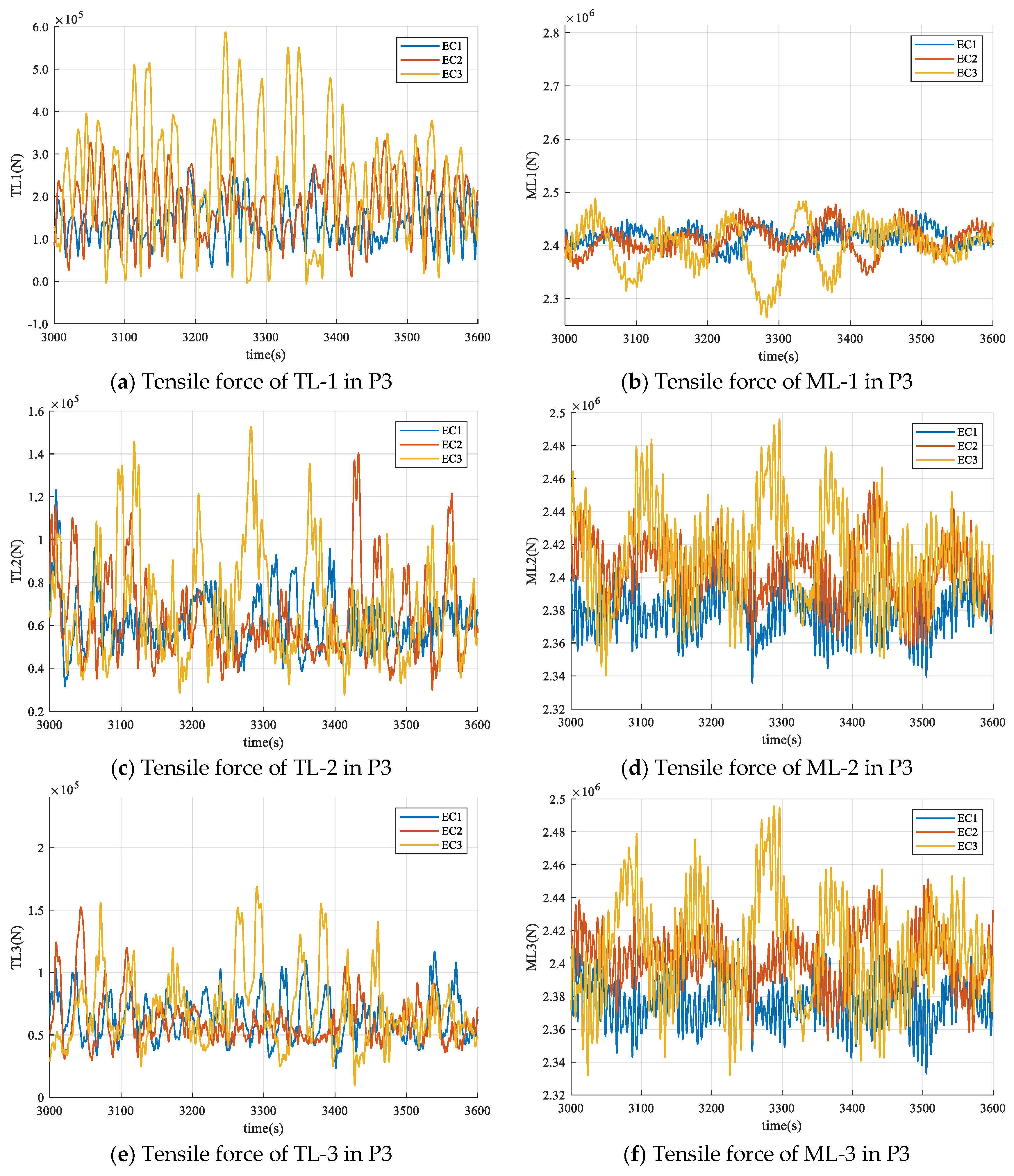
Figure 21 presents the tensile forces on the towing cables and anchor chains under different environmental conditions during Stage P3. After the anchor chains are tensioned, the anchor chain tension increases to 2.4 × 10³ kN. Correspondingly, the towing cable tensions further decrease, and their tension fluctuations become more subdued.
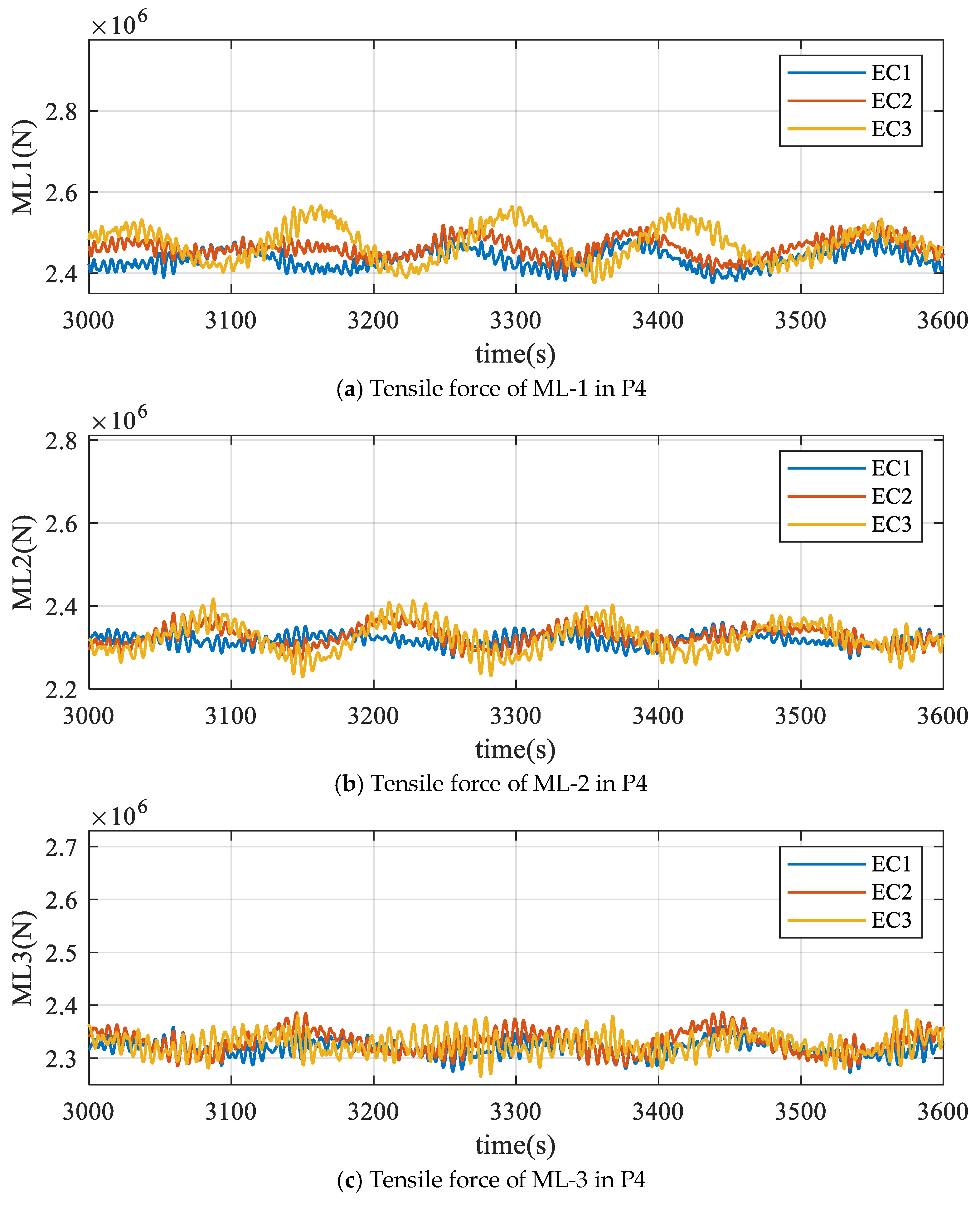
At the final Stage P4, the mooring system installation is completed with the tugboats disconnecting and departing, leaving the FOWT operating stably with the three catenary cables. As shown in Figure 22, the tensile force at the fairlead of each mooring line is approximately 2.4 × 10³ kN, with negligible fluctuation. Compared with Stage P3, the tensions in ML-2 and ML-3 show a decrease.
Throughout the installation, During the anchor chain connection process, the towing cable aligned with the prevailing environmental direction (upstream) sustains significantly higher tension than those of the other two cables. During Stage P1, the tension in TL-1 can exceed those in TL-2 and TL-3 by three times, whereas the tensions of the three anchor chains are relatively close. After the anchor chains are installed at Stage P2, the towing cable tension drops by nearly 20%, while the tensions of the three anchor chains are all around 1.6 × 10³ kN in the intentioned state. After the anchor chains are tensioned at Stage P3, the towing cable tension further decreases, and the anchor chain tension increases. Throughout the process, the towing cable tension changes significantly, even after the anchor chains are installed or even tensioned.

5. Concluding Remarks

This study established a numerical model to simulate the mooring system installation of a semi-submersible FOWT equipped with the IEA 15MW wind turbine, incorporating towing cables, catenary cables, and three tugboats. The nonlinear motion responses throughout the four installation stages (P1 to P4) were comprehensively analyzed under various environment conditions, including the dynamic behavior of the FOWT and the tension evolution in both the towing and mooring cables. Hydrodynamic responses were first evaluated in the frequency domain, incorporating a viscous damping correction based on the data from the IEA document. Subsequently, a fully coupled time-domain analysis in AQWA was conducted to assess the motion responses of the FOWT and tugboats across all installation stages under various environment conditions. Analysis of the statistical response data and cable tensions reveals that the initial stage (P1) poses the greatest operational challenge, necessitating enhanced monitoring and control. This stage is characterized by significant motion fluctuations due to the absence of mooring restraint and the limited station-keeping capacity of the tugboats alone. The influence of environmental loads on system response and the identification of the most critical phase have been substantiated, providing guidance for ensuring safety during the mooring installation of FOWTs employing a temporary tugboat-assisted positioning system.
The following conclusions can be drawn from this research:
  • This study introduced an innovative coupled simulation methodology by integrating the aerodynamic–hydrodynamic–elastic-mooring module FAST into the AQWA-based temporary positioning simulations. Through the F2A method, this approach enabled a fully coupled assessment of the platform’s motion responses and cable tension safety under multi-dynamic coupling, providing a numerical foundation for optimizing the design of temporary positioning and mooring installation schemes for FOWTs.
  • Based on the wave scatter diagram of the South China Sea, simulations of the wind turbine’s temporary positioning were conducted under real marine environmental conditions with high occurrence probabilities. Compared with 1.5 m waves, 2.5 m waves induce significantly larger surge, sway, heave, and yaw responses of the FOWT. Roll and pitch responses are mainly affected by wind loads, which substantially shift the oscillation equilibrium position of the FOWT.
  • A time-domain analysis of cable tension confirms that Stage P1 presents critical challenges. The upstream towing line (TL-1) experiences high tension with severe fluctuations. The restraining effect of towing cables on the temporary positioning of the wind turbine is considerably less effective than that of mooring chains, even in their untensioned state. Under severe sea conditions, the installation of mooring chains should be completed as soon as possible to avoid keeping the wind turbine at Stage P1.
We should acknowledge the limitations of the present methodology in this study. Further investigation is required for different FOWT designs or a broader range of environmental scenarios. Future work should also consider the application of a dynamic-positioning-assisted mooring (DPAM) system to explore more efficient and low-cost methodologies for FOWT mooring system installation.

Author Contributions

Conceptualization, Y.Z., J.W., Y.C., N.Y., M.C. and Y.T.; Methodology, Y.Z., J.W., Y.C., N.Y., M.C. and Y.T.; Software, Y.Z., J.W., Y.C., N.Y. and Y.T.; Validation, Y.Z., J.W., N.Y., M.C. and Y.T.; Formal analysis, Y.Z., J.W., N.Y. and Y.T.; Investigation, J.W. and Y.C.; Resources, Y.C.; Writing—original draft, Y.Z. and N.Y.; Writing—review & editing, Y.C., M.C. and Y.T.; Visualization, Y.C.; Supervision, M.C.; Funding acquisition, M.C. All authors have read and agreed to the published version of the manuscript.

Funding

The authors gratefully acknowledge financial support from the National Natural Science Foundation of China (Grant No. 52171275).

Institutional Review Board Statement

Not applicable.

Informed Consent Statement

Not applicable.

Data Availability Statement

The original contributions presented in this study are included in the article. Further inquiries can be directed to the corresponding author.

Conflicts of Interest

Author Yao Zhong, Jinguang Wang and Yingjie Chen were employed by the company PowerChina Zhongnan Engineering Corporation Limited. The remaining authors declare that the research was conducted in the absence of any commercial or financial relationships that could be construed as a potential conflict of interest.

References

  1. Global Wind Energy Council (GWEC). Global Wind Report 2022. 2022. Available online: https://klimaatweb.nl/wp-content/uploads/po-assets/747206.pdf (accessed on 19 March 2024).
  2. Global Wind Energy Council (GWEC). Global Wind Report 2023. 2023. Available online: https://gwec.net/globalwindreport2023/ (accessed on 19 March 2024).
  3. Díaz, H.; Soares, C.G. Review of the current status, technology and future trends of offshore wind farms. Ocean Eng. 2020, 209, 107381. [Google Scholar] [CrossRef]
  4. Roddier, D.; Cermelli, C.; Aubault, A.; Peiffer, A. Summary and conclusions of the full life-cycle of the WindFloat FOWT prototype project. In International Conference on Offshore Mechanics and Arctic Engineering, Proceedings of the ASME 2017 36th International Conference on Ocean, Offshore and Arctic Engineering, Trondheim, Norway, 25–30 June 2017; American Society of Mechanical Engineers: New York, NY, USA, 2017; p. V009T12A048. [Google Scholar]
  5. Ma, K.-T.; Luo, Y.; Kwan, C.-T.T.; Wu, Y. Mooring System Engineering for Offshore Structures; Gulf Professional Publishing: Houston, TX, USA, 2019. [Google Scholar]
  6. Villa-Caro, R.; Carral, J.C.; Fraguela, J.Á.; López, M.; Carral, L. A review of ship mooring systems. Brodogr. Int. J. Nav. Archit. Ocean Eng. Res. Dev. 2018, 69, 123–149. [Google Scholar] [CrossRef]
  7. Davidson, J.; Ringwood, J.V. Mathematical modelling of mooring systems for wave energy converters—A review. Energies 2017, 10, 666. [Google Scholar] [CrossRef]
  8. Brommundt, M.; Krause, L.; Merz, K.; Muskulus, M. Mooring system optimization for floating wind turbines using frequency domain analysis. Energy Procedia 2012, 24, 289–296. [Google Scholar] [CrossRef]
  9. Masciola, M.; Robertson, A.; Jonkman, J.; Coulling, A.; Goupee, A. Assessment of the importance of mooring dynamics on the global response of the DeepCwind floating semisubmersible offshore wind turbine. In Proceedings of the 23rd International Offshore and Polar Engineering Conference, Anchorage, AK, USA, 30 June–4 July 2013; ISOPE: Mountain View, CA, USA, 2013; p. ISOPE-I-13-129. [Google Scholar]
  10. Zhu, Y. Analysis on a New Type of Fully Submerged Floating Foundation and the Installation Technology of the Whole Wind Turbine System. Master’s Thesis, Tianjin University, Tianjin, China, 2017. [Google Scholar]
  11. Antonutti, R.; Peyrard, C.; Incecik, A.; Ingram, D.; Johanning, L. Dynamic mooring simulation with Code_Aster with application to a floating wind turbine. Ocean Eng. 2018, 151, 366–377. [Google Scholar] [CrossRef]
  12. Xu, K.; Gao, Z.; Moan, T. Effect of hydrodynamic load modelling on the response of floating wind turbines and its mooring system in small water depths. In Proceedings of the EERA DeepWind’2018, 15th Deep Sea Offshore Wind R&D Conference, Trondheim, Norway, 17–19 January 2018; Journal of Physics: Conference Series; IOP Publishing: Bristol, UK, 2018; p. 012006. [Google Scholar]
  13. Pham, H.-D.; Cartraud, P.; Schoefs, F.; Soulard, T.; Berhault, C. Dynamic modeling of nylon mooring lines for a floating wind turbine. Appl. Ocean Res. 2019, 87, 1–8. [Google Scholar] [CrossRef]
  14. Qingquan, L.; Nianxin, R.; Daocheng, Z. Dynamic Analysis of the Removal Process of A Semi-submersible Wind Turbine Platform. Nat. Sci. Hainan Univ. 2020, 38, 277–282. [Google Scholar]
  15. Xu, K.; Larsen, K.; Shao, Y.; Zhang, M.; Gao, Z.; Moan, T. Design and comparative analysis of alternative mooring systems for floating wind turbines in shallow water with emphasis on ultimate limit state design. Ocean Eng. 2021, 219, 108377. [Google Scholar] [CrossRef]
  16. Hallak, T.; Soares, C.G.; Sainz, O.; Hernández, S.; Arévalo, A. Time domain analysis of the WIND-bos SPAR in regular waves. In Trends in Renewable Energies Offshore; CRC Press: Boca Raton, FL, USA, 2022; pp. 559–566. [Google Scholar]
  17. Hallak, T.S.; Guedes Soares, C.; Sainz, O.; Hernández, S.; Arévalo, A. Hydrodynamic analysis of the WIND-bos spar floating offshore wind turbine. J. Mar. Sci. Eng. 2022, 10, 1824. [Google Scholar] [CrossRef]
  18. Yang, R.-Y.; Chuang, T.-C.; Zhao, C.; Johanning, L. Dynamic response of an offshore floating wind turbine at accidental limit states—Mooring failure event. Appl. Sci. 2022, 12, 1525. [Google Scholar] [CrossRef]
  19. Ma, R. Research on Time-domain Coupling Dynamic Response of Single Point Mooring System Installation. Master’s Thesis, Harbin Engineering University, Harbin, China, 2021. [Google Scholar]
  20. Qiao, D.; Li, H.; Liang, H.; Wang, B.; Zhang, W.; Ou, J. Evaluation of the positioning capability of a novel concept design of dynamic positioning-assisted mooring systems for floating offshore wind turbines. Ocean Eng. 2024, 299, 117286. [Google Scholar] [CrossRef]
  21. Allen, C.; Viscelli, A.; Dagher, H.; Goupee, A.; Gaertner, E.; Abbas, N.; Hall, M.; Barter, G. Definition of the UMaine VolturnUS-S Reference Platform Developed for the IEA Wind 15-Megawatt Offshore Reference Wind Turbine; National Renewable Energy Lab. (NREL): Golden, CO, USA; University of Maine: Orono, ME, USA, 2020. [Google Scholar]
  22. CCS. Guidelines for Towage at Sea; CCS: Beijing, China, 2012. [Google Scholar]
  23. Iijma, K.; Wang, X.; Sielski, R.; Rizzuto, E.; Ogawa, Y.; de Hauteclocque, G.; Fang, C.-C.; Fonseca, N.; Johannessen, T.B.; Mumm, H. Measurements and theoretical methods. Uncertainties in load estimations shall be highlighted. The committee is encouraged to cooperate with the corresponding ITTC committee. In Proceedings of the 20th International Ship and Offshore Structures Congress (ISSC 2018), Amsterdam, The Netherlands, 9–14 September 2018; IOS Press: Amsterdam, The Netherlands, 2020; Volume 3, p. 13. [Google Scholar]
  24. Deng, J.; Chen, S.; Zhang, B. Analysis of Ship Surf-Riding/Broaching Motion Considering the Influence of Wave Drift Force. In Advances in Machinery, Materials Science and Engineering Application X; IOS Press: Amsterdam, The Netherlands, 2024; pp. 460–466. [Google Scholar]
  25. Li, Y. Discussion on the selection of main tugboat for towing drilling equipment. China Offshore Oil Gas 1995, 7, 20–26. [Google Scholar]
  26. Trubat, P.; Molins, C.; Gironella, X. Wave hydrodynamic forces over mooring lines on floating offshore wind turbines. Ocean Eng. 2020, 195, 106730. [Google Scholar] [CrossRef]
  27. Triantafyllou, M.S. Preliminary design of mooring systems. J. Ship Res. 1982, 26, 25–35. [Google Scholar] [CrossRef]
  28. Benassai, G.; Campanile, A.; Piscopo, V.; Scamardella, A. Optimization of mooring systems for floating offshore wind turbines. Coast. Eng. J. 2015, 57, 1550021. [Google Scholar] [CrossRef]
  29. Altuzarra, J.; Herrera, A.; Matías, O.; Urbano, J.; Romero, C.; Wang, S.; Guedes Soares, C. Mooring system transport and installation logistics for a floating offshore wind farm in Lannion, France. J. Mar. Sci. Eng. 2022, 10, 1354. [Google Scholar] [CrossRef]
  30. Campanile, A.; Piscopo, V.; Scamardella, A. Mooring design and selection for floating offshore wind turbines on intermediate and deep water depths. Ocean Eng. 2018, 148, 349–360. [Google Scholar] [CrossRef]
  31. Tom, N.M. Design and Control of a Floating Wave-Energy Converter Utilizing a Permanent Magnet Linear Generator. Doctoral Dissertation, University of California, Berkeley, CA, USA, 2013. [Google Scholar]
  32. Sun, K.; Xie, G.; Zhou, B. Type selection and hydrodynamic performance analysis of wave energy converters. J. Harbin Eng. Univ. 2021, 42, 8–14. [Google Scholar]
  33. Chen, M.; Zou, M.; Zhu, L. Frequency-domain response analysis of adjacent multiple floaters with flexible connections. J. Ship Mech. 2018, 22. [Google Scholar]
  34. Chen, M.; Zou, M.; Zhu, L.; Ouyang, M.; Liang, Q.; Zhao, W. A fully coupled time domain model capturing nonlinear dynamics of float-over deck installation. Ocean Eng. 2024, 293, 116721. [Google Scholar] [CrossRef]
  35. Zhang, X.; Li, B.; Hu, Z.; Deng, J.; Xiao, P.; Chen, M. Research on size optimization of wave energy converters based on a floating wind-wave combined power generation platform. Energies 2022, 15, 8681. [Google Scholar] [CrossRef]
  36. Han, X.; Sævik, S.; Leira, B.J. A sensitivity study of vessel hydrodynamic model parameters. In Proceedings of the ASME 2020 39th International Conference on Ocean, Offshore Mechanics and Arctic Engineering, Virtual, 3–7 August 2020; American Society of Mechanical Engineers: New York, NY, USA, 2020; p. V001T01A039. [Google Scholar]
  37. Ren, N.; Li, Y.; Ou, J. Coupled wind-wave time domain analysis of floating offshore wind turbine based on Computational Fluid Dynamics method. J. Renew. Sustain. Energy 2014, 6, 023106. [Google Scholar] [CrossRef]
  38. Zheng, T.; Chen, N.-Z. Time-domain fatigue assessment for blade root bolts of floating offshore wind turbine (FOWT). Ocean Eng. 2022, 262, 112201. [Google Scholar] [CrossRef]
  39. Hallak, T.; Kamarlouei, M.; Gaspar, J.; Soares, C.G. Time domain analysis of a conical point-absorber moving around a hinge. In Trends in Maritime Technology and Engineering; CRC Press: Boca Raton, FL, USA, 2022; pp. 401–409. [Google Scholar]
  40. Cummins, W. The impulse response function and ship motions. In Proceedings of the Ymposium on Snip Theory Institut für Schiffbau Deruniversität Hamburg, Hamburg, Germany, 25–27 January 1962. [Google Scholar]
  41. Ogilvie, T.F. Recent progress toward the understanding and prediction of ship motions. In Proceedings of the Fifth Symposium on Naval Hydrodynamics, Bergen, Norway, 10–12 September 1964; pp. 3–79. [Google Scholar]
  42. Tang, Y.; Chen, M.; Yuan, Z.; Jiang, X.; Yu, N.; Li, T.; Choo, Y.S. Advancing Floating Offshore Wind Turbine Construction from the Perspective of Wet Towing Using a Tugboat with Autonomous Control. Mar. Struct. 2026, 107, 103973. [Google Scholar] [CrossRef]
  43. Tao, T.; Yang, Y.; Yang, T.; Liu, S.; Guo, X.; Wang, H.; Liu, Z.; Chen, W.; Liang, C.; Long, K. Time-domain fatigue damage assessment for wind turbine tower bolts under yaw optimization control at offshore wind farm. Ocean Eng. 2024, 303, 117706. [Google Scholar] [CrossRef]
  44. Zou, M.; Chen, C.; Chen, M.; Xiao, P.; Ouyang, M.; Tang, Y.; Zhao, W.; Tian, X. Development of a coupled time-domain model for complexly moored multi-body system with application in catamaran float-over deck installation. Mar. Struct. 2025, 103, 103849. [Google Scholar] [CrossRef]
  45. Tang, Y.; Chen, X.; Huang, G.; Chen, M.; Zhang, K.; Jiang, Y.; Li, T.; Tao, T.; Yang, Y. Dynamic analysis of multi-module floating photovoltaic platforms with composite mooring system by considering tidal variation and platform configuration. Ocean Eng. 2024, 312, 119243. [Google Scholar] [CrossRef]
  46. Roddier, D.; Cermelli, C.; Weinstein, A. WindFloat: A floating foundation for offshore wind turbines—Part I: Design basis and qualification process. In Proceedings of the ASME 2009 28th International Conference on Ocean, Offshore Mechanics and Arctic Engineering, Honolulu, HI, USA, 31 May–5 June 2009; pp. 845–853. [Google Scholar]
  47. Aubault, A.; Cermelli, C.; Roddier, D. WindFloat: A floating foundation for offshore wind turbines—Part III: Structural analysis. In Proceedings of the ASME 2009 28th International Conference on Ocean, Offshore Mechanics and Arctic Engineering, Honolulu, HI, USA, 31 May–5 June 2009; pp. 213–220. [Google Scholar]
  48. Cermelli, C.; Roddier, D.; Aubault, A. WindFloat: A floating foundation for offshore wind turbines—Part II: Hydrodynamics analysis. In Proceedings of the ASME 2009 28th International Conference on Ocean, Offshore Mechanics and Arctic Engineering, Honolulu, HI, USA, 31 May–5 June 2009; pp. 135–143. [Google Scholar]
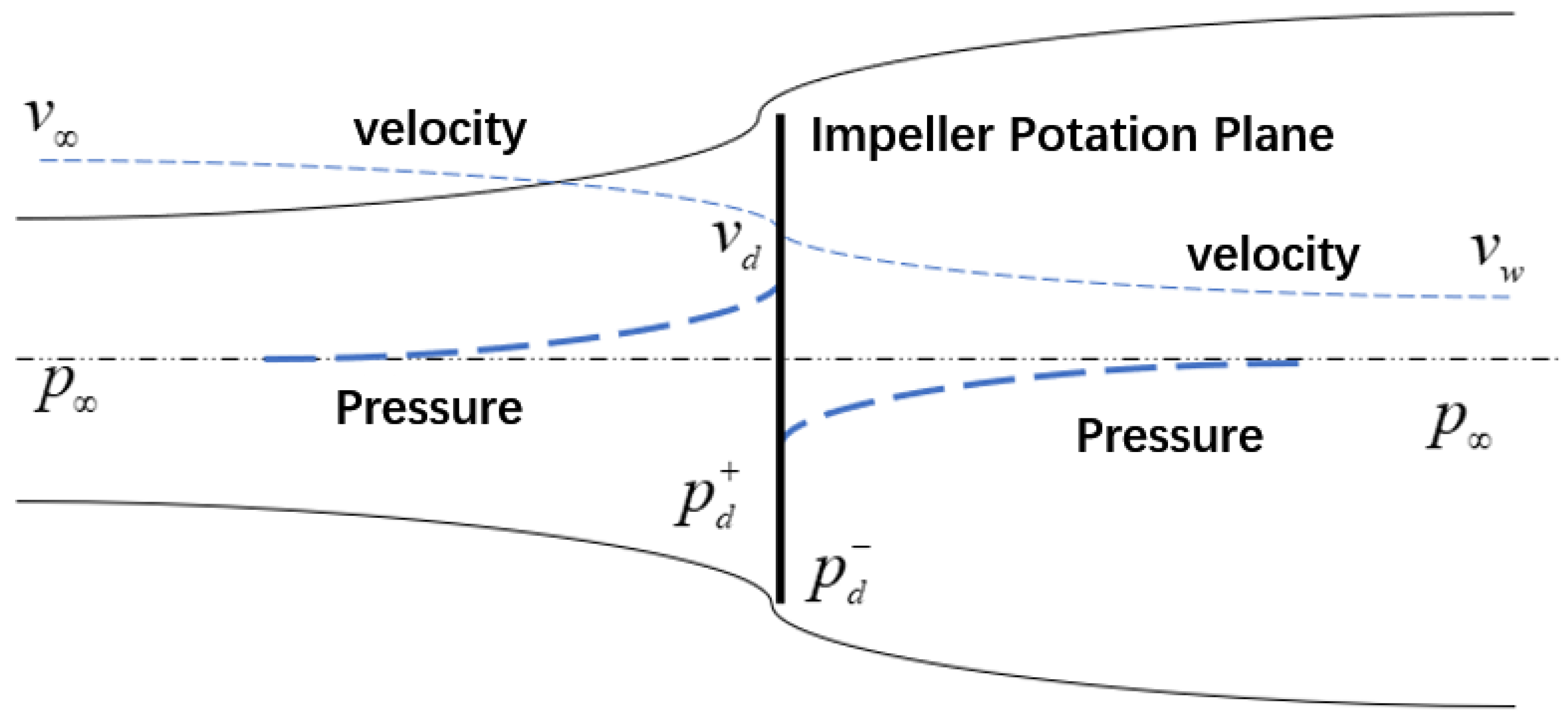
Figure 1. Momentum theory model.
Sustainability 18 01199 g001
Figure 2. Velocity diagram of the blade element airfoil plane.
Sustainability 18 01199 g002
Figure 3. Aerodynamic force diagram in the airfoil plane of the blade element.
Sustainability 18 01199 g003
Figure 4. Schematic diagram of a dynamic catenary cable.
Sustainability 18 01199 g004
Figure 5. Forces and moments acting on a Morison element in dynamic mooring analysis.
Sustainability 18 01199 g005
Figure 6. The established models of FOWT and tugboat in AQWA.
Sustainability 18 01199 g006
Figure 7. FOWT mooring installation process in various load conditions.
Sustainability 18 01199 g007
Figure 8. Free-decay time–history curves of the IEA-15WM.
Sustainability 18 01199 g008
Figure 9. FOWT RAOs in different wave directions.
Sustainability 18 01199 g009
Figure 10. Tugboat RAOs in different wave directions.
Sustainability 18 01199 g010
Figure 11. Comparison of the time-domain responses and the RAO-based responses.
Sustainability 18 01199 g011aSustainability 18 01199 g011b
Figure 12. Schematic diagram of the moored FOWT.
Sustainability 18 01199 g012
Figure 13. Wave scatter diagram.
Sustainability 18 01199 g013
Figure 14. Installation phases of the FOWT mooring system.
Sustainability 18 01199 g014
Figure 15. Motion responses of the FOWT during Stage P1.
Sustainability 18 01199 g015
Figure 16. Motion responses of the FOWT during Stage P2.
Sustainability 18 01199 g016
Figure 17. Motion responses of the FOWT during Stage P3.
Sustainability 18 01199 g017
Figure 18. Motion responses of the FOWT during Stage P4.
Sustainability 18 01199 g018
Figure 19. The tension of catenary and towing cables during Stage P1.
Sustainability 18 01199 g019
Figure 20. The tension of catenary and towing cables during Stage P2.
Sustainability 18 01199 g020
Figure 21. The tension of catenary and towing cables during Stage P3.
Sustainability 18 01199 g021
Figure 22. The tension of catenary and towing cables during Stage P4.
Sustainability 18 01199 g022
Table 1. Main parameters of the IEA 15MW FOWT.
ParameterValue
Rotor diameter (m)240
Hub diameter (m)3.97
Hub height (above waterline) (m)150
Nacelle mass (t)675,175
Tower height (m)135
Tower mass (t)1483.41
Bottom diameter of tower (m)10
Top diameter of tower (m)6.5
Table 2. Main parameters of the IEA-15MW semi-submersible foundation.
ParameterValue
Distance between offset columns (m)102.13
Diameter of column (m)12.5
Diameter of cross braces between pontoons (m)0.9
Table 3. Main parameters of the tugboat.
ParameterValue
Total length (m)109.7
Breadth (m)16.2
Depth (m)7.6
Design draft (m)5.5
Square coefficient0.611
Maximum towing force (kN)4000
Table 4. Geometric parameters of the mooring installation process.
ItemFOWTTugboat-1Tugboat-2Tugboat-3
Coordinates of center of mass (m)(0, 0, −14.4)(−333.65, 0, −3.5)
(166.83, −288.96, −3.5)
(166.83, 288.96, −3.5)
Designed displacement (m3)20,2065379.975380.165379.69
Ixx (kg.m2)4.396 × 10101.67 × 1081.67 × 1081.67 × 108
Iyy (kg.m2)4.385 × 10103.5 × 1093.5 × 1093.5 × 109
Izz (kg.m2)2.396 × 1093.53 × 1093.5 × 1093.5 × 109
Table 5. Parameters of temporary positioning system with the towing force of tugboats.
ItemValue
Mass of unit length (kg/m)47.89
Equivalent diameter (m)0.088
Stiffness of catenary (towing cable) (kN)3.13 × 10⁵
Breaking force (kN)4.165 × 10³
Length of TL-1/2/3 (m)240/240/240
Coordinates of WFXLD-1/2/3 (m)(−58, 0, 1)
(29, −50.23/50.23, 1)
Coordinates of TB-1/2/3XLD-1 (m)(−298, 0, 1),
(149, −257.8/257.8, 1)
Coordinates of TB-1/2/3XLD-2 (m)(−368, 0, 0)
(166.83, −288.96/288.96, 0)
Stiffness of cable winch (linear cable) (kN/m)1.0 × 104
Table 6. FOWT natural frequencies.
FreedomNatural Frequencies (Rad/s)
heave0.3049
roll0.2158
pitch0.2173
Table 7. IEA-15MW mooring system parameters.
ParameterValue
Mass of unit length (kg/m)685
Equivalent diameter (m)0.088
Stiffness of mooring cables (catenary) (kN)3.27 × 10⁶
Breaking force (kN)2.23 × 10⁴
Length of ML-1/2/3 (m)850
Coordinates of WFDLK-1/2/3 (m)(−58.25, 0, −14),
(29, −51.07/51.07, −14)
Coordinates of MD-1/2/3 (m)(−837.6, 0, −200),
(418.8, −725.4/725.4, −200)
Table 8. The environmental load in the simulation of the mooring system installation.
ParameterEC1EC2EC3
Wind velocity (m/s)011.411.4
Significant wave height (m)1.51.52.5
Peak-spectra period (s)6.56.57.5
Current velocity (m/s)0.50.50.5
The load direction (deg)000
Table 9. Statistical value of the FOWT motion during the mooring system installation.
The FOWT with Different Environmental ConditionsEC1EC2EC3
StagesMotionsMaxMinMeanMaxMinMeanMaxMinMean
P1Surge/(m)2.257−1.7590.3362.856−1.8151.0873.837−6.240−0.668
Sway/(m)0.407−0.400−0.0201.120−1.765−0.0311.351−1.194−0.019
Heave/(m)−0.618−0.755−0.691−0.620−0.763−0.696−0.559−0.846−0.696
Roll/(deg)0.032−0.034−0.0010.291−0.242−0.0080.294−0.305−0.004
Pitch/(deg)0.139−0.129−0.012−1.400−1.838−1.651−1.424−1.850−1.657
Yaw/(deg)0.095−0.175−0.0190.428−1.127−0.4224.383−6.462−0.388
P2Surge/(m)1.643−0.7220.5592.442−0.0541.2073.814−2.8860.194
Sway/(m)0.413−0.2880.0391.059−1.037−0.0291.189−1.489−0.086
Heave/(m)−1.665−1.800−1.738−1.673−1.816−1.748−1.606−1.903−1.749
Roll/(deg)0.037−0.044−0.0010.242−0.223−0.0090.283−0.261−0.009
Pitch/(deg)0.073−0.127−0.038−1.397−1.760−1.617−1.390−1.835−1.607
Yaw/(deg)0.069−0.0620.0030.263−0.380−0.0330.140−0.257−0.023
P3Surge/(m)1.036−0.3660.4492.230−0.3411.0392.598−1.9710.738
Sway/(m)0.250−0.2440.0140.226−0.4900.0100.840−0.6830.078
Heave/(m)−1.949−2.083−2.020−1.968−2.107−2.042−1.903−2.196−2.042
Roll/(deg)0.061−0.065−0.0010.266−0.251−0.0080.262−0.225−0.005
Pitch/(deg)0.061−0.143−0.038−1.357−1.712−1.578−1.344−1.781−1.578
Yaw/(deg)0.043−0.046−0.0020.135−0.227−0.0130.185−0.270−0.009
P4Surge/(m)1.036−0.3660.4493.3071.4092.3564.3281.0222.630
Sway/(m)0.250−0.2440.0140.850−0.7510.0440.844−0.7310.053
Heave/(m)−1.949−2.083−2.020−1.947−2.100−2.025−1.866−2.202−2.025
Roll/(deg)0.061−0.065−0.0010.264−0.253−0.0070.266−0.253−0.007
Pitch/(deg)0.061−0.143−0.038−1.473−1.781−1.642−1.435−1.872−1.656
Yaw/(deg)0.043−0.046−0.0020.180−0.270−0.0120.181−0.269−0.011
Disclaimer/Publisher’s Note: The statements, opinions and data contained in all publications are solely those of the individual author(s) and contributor(s) and not of MDPI and/or the editor(s). MDPI and/or the editor(s) disclaim responsibility for any injury to people or property resulting from any ideas, methods, instructions or products referred to in the content.