Article

Developing Human Resource Sustainability: The Importance of Organizational Culture, Organizational Career Growth and Career Competences

1
Department of Industrial Engineering and Management, Faculty of Technical Sciences, University of Novi Sad, 21000 Novi Sad, Serbia
2
Department of Management, Faculty of Economics in Subotica, University of Novi Sad, 24000 Subotica, Serbia
*
Author to whom correspondence should be addressed.
Sustainability 2026, 18(3), 1192; https://doi.org/10.3390/su18031192
Submission received: 30 November 2025 / Revised: 17 January 2026 / Accepted: 21 January 2026 / Published: 24 January 2026

Abstract

Organizational culture is widely recognized as an important contextual factor shaping career development and long-term human resource sustainability. Although prior research has examined organizational culture, career development, and sustainable HRM, these constructs have often been studied separately and predominantly within Western contexts. This study addresses this gap by analyzing their interrelationships within a transitional economy. Grounded in sustainable human resource management and sustainable careers perspectives, the study examines how organizational culture typologies influence career development and HR sustainability. Career development is operationalized through organizational career growth and career competences. Survey data were collected from 542 employees across 23 IT and manufacturing companies in Serbia and analyzed using factor analysis and multiple regression. The findings show that organizational culture significantly shapes career growth opportunities and career competences and is also directly related to HR sustainability. Person-oriented cultures are associated with more favorable career development conditions and higher levels of HR sustainability, while power- and role-oriented cultures are linked to weaker outcomes. Career growth and career competences further emerge as key mechanisms supporting long-term workforce sustainability. This study contributes to the literature by integrating organizational culture, career development, and HR sustainability into a single analytical framework within a transitional economy context and provides practical insights for managers aiming to foster sustainable careers and long-term HR sustainability.

1. Introduction

For more than half a century, organizational culture has been recognized as a phenomenon that significantly shapes the management of organizations, particularly employee career development [1]. Career progression is strongly influenced by organizational support and the development of individual capabilities, with culture permeating these processes. Recent studies emphasize that organizational culture functions as a key contextual mechanism through which HRM practices shape employee development, engagement, and long-term organizational outcomes [2,3]. In this study, organizational culture is examined through different typologies and its interrelationships with other dynamics such as career growth, career competences, and HR sustainability.
Organizations in both the IT and manufacturing sectors face major challenges in ensuring the long-term sustainability of their workforce. High employee turnover, constant demand for new skills, and rapid technological change force companies to adopt sustainable HR practices to attract and retain talent. Culture is seen as a central enabler of sustainable development practices, providing organizations with the ability to remain competitive and resilient [4,5]. Within the sustainable human resource management (SHRM) framework, workforce sustainability is increasingly associated with long-term employee development, well-being, and retention rather than short-term performance outcomes [4,6].
The focus on organizational culture and employee career progression is closely tied to advancing sustainable HRM practices [7,8]. Career growth opportunities and the development of career competences have been identified as critical mechanisms through which organizations translate sustainability-oriented values into tangible employee outcomes [9,10]. A strong perception of organizational responsibility and commitment to sustainability is crucial for attracting and retaining employees, while culture-driven career advancement is essential for workforce sustainability and organizational success. This process must also account for external pressures, including globalization, digitalization, AI, and volatile business environments [5].
This research therefore examines three interconnected components: organizational culture, career development, and HR sustainability. While prior studies have largely treated these as separate constructs, there is limited evidence on how they interact, particularly in transitional economies. Most literature has been developed in Western contexts, leaving a gap in understanding these relationships in countries such as Serbia, especially in industries undergoing intense technological transformation.
Existing empirical studies on organizational culture, career development, and sustainable HRM have predominantly focused on Western economies, often examining these constructs in isolation rather than as an integrated system [6,11]. Empirical evidence from transitional and emerging economies remains fragmented, with limited research examining how organizational culture, career development, and HR sustainability jointly shape workforce outcomes [12,13].
Accordingly, this study explores the types of organizational culture as a foundation for employee values and behaviors, the role of career growth and competences in shaping career development, and the combined influence of these factors on HR sustainability. To date, no comprehensive research in Serbia has analyzed these dimensions together. This paper therefore addresses the gap by combining theoretical perspectives with empirical evidence. By integrating these constructs into a single analytical framework, the study responds to recent calls for more integrative and context-sensitive approaches in sustainable HRM and career research [9,11].
The guiding research question is: How do organizational culture, career growth, and career competences interact to influence HR sustainability in IT and manufacturing firms in Serbia? The contribution is twofold. Theoretically, the paper integrates three distinct but related concepts into a single analytical framework. Practically, it offers guidance to managers on designing organizational environments that foster career development and long-term workforce sustainability. Theoretically, this study extends sustainable HRM and sustainable career perspectives by empirically examining their interrelationships within a transitional economy context [4,9].
The remainder of the paper is organized as follows. Section 2 develops the theoretical framework and hypotheses. Section 3 details the methodology and data. Section 4 presents the empirical results. Section 5 discusses implications, outlines limitations, and suggests avenues for future research.

2. Literature Review and Hypothesis Development

This study is grounded in the theoretical perspectives of sustainable human resource management (SHRM) and sustainable careers, which jointly emphasize the long-term alignment between organizational structures, employee development, and workforce sustainability. From a sustainable careers’ perspective, careers are not viewed as isolated individual trajectories but as dynamic processes shaped by organizational, social, and cultural contexts [9]. Similarly, SHRM highlights the role of organizational culture as a foundational mechanism through which human resource practices support employee well-being, employability, and long-term organizational resilience [4,6].
Within these frameworks, organizational culture provides the normative and structural context that shapes career growth opportunities and the development of career competences, which in turn contribute to HR sustainability outcomes such as retention, engagement, and workforce adaptability. Accordingly, this study conceptualizes career growth and career competences as key developmental pathways through which organizational culture influences HR sustainability.

2.1. Organizational Culture

In the last 20 years, authors have intensively researched organizational culture and its impact on the operations of organizations [14,15,16,17,18,19,20]. Organizational culture can be characterized as a phenomenon with a profound, unconscious, and silent effect on other phenomena in the organization’s operations [15]. Thus, it should be at the center of human resources management because it strategically improves expertise, performance, innovation, and communication development of people in organizations.
According to Schein, “organizational culture is a pattern of shared values, beliefs, and norms that shapes employees’ behaviors and attitudes within an organization” [21]. Similarly, more recent work argues that organizational culture encompasses shared values, beliefs, attitudes, and behaviors that guide employees’ daily actions and interactions in the workplace [18]. It is determined by how employees describe where they work, understand the way of doing business, and see themselves as part of the organization. Culture serves as the driving force behind decision-making, actions, and overall performance. Crawford and Lock [14] added that culture is one of the main factors influencing individuals in an organization. In contemporary settings, organizational culture is also viewed as a driver of innovation, learning, and employee development, especially in digital transformation contexts [16].
Various elements of organizational culture have been analyzed. For example, the role of organizational support in creating a safe working environment [17], the impact of design thinking on cultural development [22], the role of emotional culture in shaping communication and supportive behaviors [23], and the influence of internal communication and employee engagement on workforce happiness [23,24].
Research on organizational culture in the age of Industry 4.0 and the global presence of organizations has also expanded. Studies examine digital-cultural training and intercultural competencies [25], as well as the importance of developing a global culture in organizations [26]. All these studies are crucial from the perspective of sustainable human resources and overcoming cultural barriers in business.
This research aims to discern positive associations between organizational culture, career growth, and HR sustainability, particularly in a developing context such as Serbia.

2.1.1. The Role of Organizational Culture in Organizational Career Growth and Career Competences

Organizational culture has been widely discussed in the literature [27,28,29,30]. Harrison [30] distinguishes employee perception of current and preferred organizational culture, highlighting the importance of harmonizing these perceptions to enhance performance.
Schein [21] defined organizational culture as a set of assumptions that members of an organization develop through shared learning and experience. New hires are socialized into this culture, learning to model behavior and comply with organizational norms [19].

2.1.2. Typologies of Culture

This study adopts Harrison’s cultural typology, further developed by Handy, as an analytical framework for examining organizational culture in relation to career outcomes and HR sustainability. The typology distinguishes between power, role, task, and person cultures, reflecting different distributions of authority, coordination mechanisms, and orientations toward individual development [27,30].
This typology is particularly relevant for the present study because it explicitly links cultural configurations to employee autonomy, development opportunities, and alignment between individual and organizational goals. Rather than providing a detailed descriptive account of each cultural type, the typology is used here as a comparative framework to examine how different cultural orientations shape career growth opportunities, career competences, and HR sustainability outcomes.

2.1.3. Career Growth and Competences

Research links organizational culture with work–life balance support programs, cultural preferences, and conflict resolution [19,20]. Human resource development relies heavily on organizational culture as a key mechanism for shaping employees’ skills and competencies [31]. Career development is commonly defined as the increase in individual abilities within an organization, whereby career growth opportunities depend on organizational support and contextual conditions [32]. In this regard, Weng et al. [33] conceptualize organizational career growth (OCG) through four core dimensions: career goal progress, professional ability development, promotion speed, and remuneration growth. The success of an individual’s career further depends on the alignment between personal career aspirations and organizational opportunities [32,34], while career growth is increasingly shaped by environmental and technological changes [35].
From a sustainable careers’ perspective, career growth reflects not only upward mobility but also the continuous development of skills, employability, and adaptability over time [9]. Organizational career growth is thus embedded in structural opportunities such as promotion pathways and professional development, which are themselves strongly influenced by the prevailing organizational culture [33]. Beyond structural growth opportunities, organizational culture also plays a crucial role in supporting the development of career competences, including reflection, networking, self-profiling, and career control [36]. These transferable meta-competences enable individuals to proactively manage their careers across changing organizational and labor market contexts [36], and are fostered by supportive and development-oriented cultures that provide learning opportunities, feedback, and social capital [37].
Empirical studies further confirm that organizational culture mediates talent support, job satisfaction, and organizational commitment [38], and influences employee stress through communication climates. Importantly, both career growth opportunities and career competences have been identified as critical antecedents of HR sustainability, as they enhance employee commitment, reduce turnover intentions, and strengthen long-term employability [9,36]. Accordingly, organizational culture is expected to foster career growth and career competences, which together represent key mechanisms through which sustainable HR outcomes are achieved.
Given this evidence, we propose:
Hypothesis H1.
Organizational culture is positively associated with employees’ career development, reflected in greater career growth opportunities and the development of career competences.

2.2. Organizational Culture and HR Sustainability

Organizational culture plays a foundational role in shaping HR sustainability by embedding long-term social and developmental values into organizational practices [4,16,39]. Within the sustainable human resource management framework, culture provides the normative context that guides how organizations balance economic objectives with employee well-being, employability, and long-term workforce stability [4].
Sustainability-oriented cultures promote fairness, participation, learning, and mutual commitment, which are essential for maintaining a resilient and engaged workforce over time. Empirical studies indicate that such cultures are positively associated with core HR sustainability outcomes, including employee engagement, organizational commitment, retention, and reduced turnover intentions [40,41].
Importantly, culture not only shapes HR policies and practices but also influences how employees perceive organizational responsibility and long-term career prospects. When sustainability values are embedded in everyday organizational norms, employees are more likely to perceive alignment between personal goals and organizational objectives, thereby strengthening HR sustainability [42].
Based on this theoretical and empirical evidence, organizational culture is expected to exert a direct positive influence on HR sustainability.
Hypothesis H2.
Organizational culture is positively associated with HR sustainability by fostering long-term employee engagement, retention, and workforce adaptability.

2.3. Career Growth & Competences and HR Sustainability

Career growth represents a critical pathway through which organizations achieve HR sustainability [33]. From a sustainable careers perspective, sustainable HR systems depend on employees’ continuous learning, adaptability, and long-term employability rather than short-term performance outcomes. Career growth opportunities—such as professional development, promotion prospects, and skill enhancement—strengthen employees’ commitment to the organization and reduce turnover intentions, thereby contributing to workforce sustainability [43,44,45,46,47,48,49].
Beyond structural career opportunities, career competences play an equally important role in sustaining HR outcomes [44]. Competences such as career reflection, networking, and career control enable employees to proactively manage their careers in dynamic organizational environments and respond effectively to technological and structural changes [36]. Organizations that actively support the development of these competences enhance employees’ resilience and long-term employability, which are central dimensions of HR sustainability [37].
Prior empirical research suggests that employees who perceive strong career growth opportunities and possess well-developed career competences are more likely to remain engaged, committed, and adaptable, thereby supporting sustainable HR outcomes at the organizational level [11]. Accordingly, career development is conceptualized in this study as a key driver of HR sustainability.
Hypothesis H3.
Employees’ career development—through career growth opportunities and career competences—is positively associated with HR sustainability.
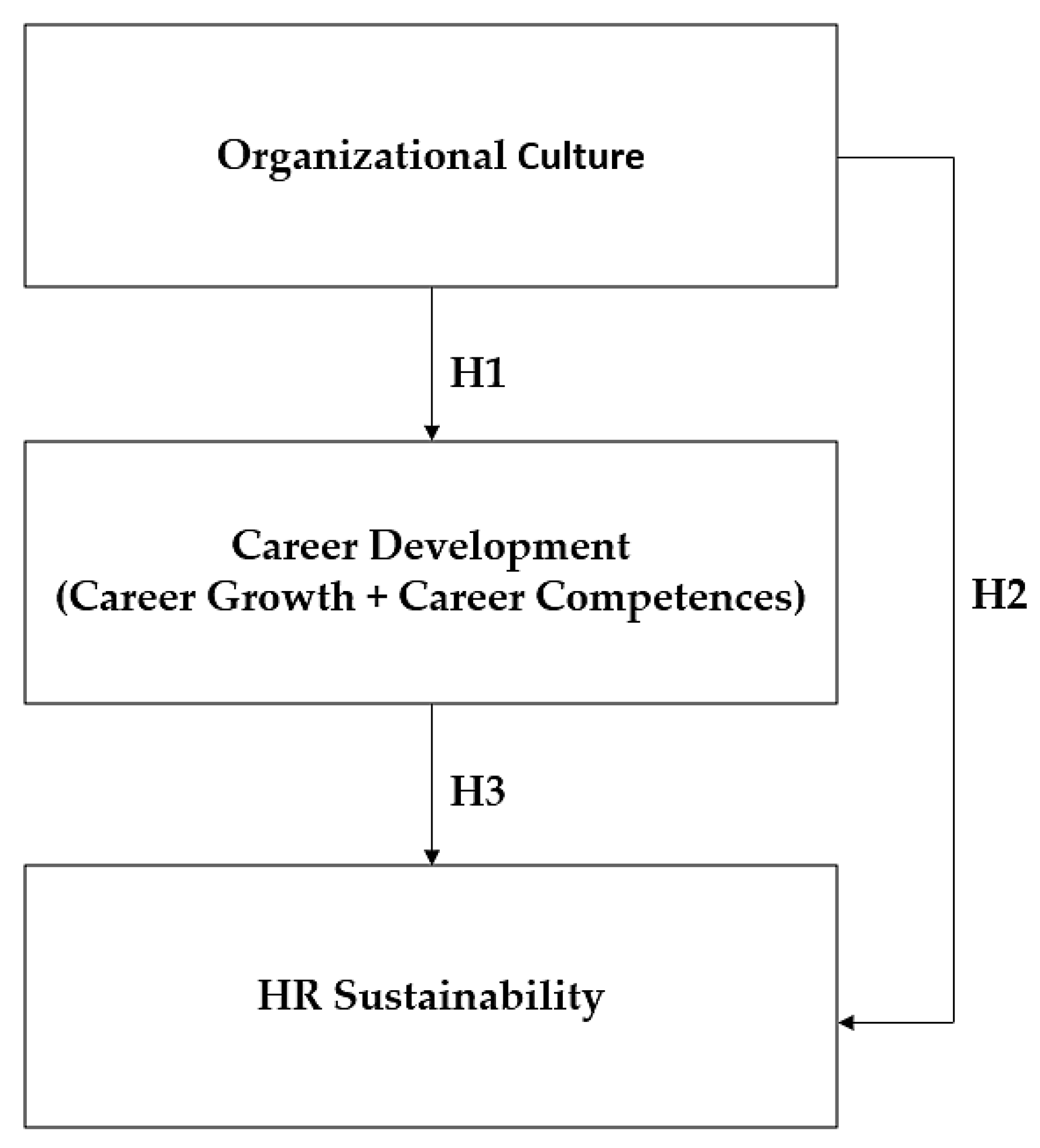
Figure 1 presents the conceptual framework guiding this study. The model illustrates the hypothesized relationships between organizational culture, career development, and HR sustainability. Organizational culture is conceptualized as a foundational contextual factor that directly influences career development—reflected in career growth opportunities and career competences—as well as HR sustainability. Career development is further positioned as a key mechanism linking organizational culture to HR sustainability, highlighting both direct effects and potential indirect pathways through which cultural orientations shape long-term workforce sustainability outcomes, and is reflected in employees’ career growth opportunities and career competences.

3. Research Methodology

3.1. Measurement and Variables

To determine the dominant organizational culture, we utilized the Organizational Culture Questionnaire originally developed by Harrison [30] and later expanded by Handy [27]. This questionnaire comprises 15 questions designed to identify one of four types of organizational culture (Role culture, Task culture, Power culture, and Person culture), measured through nominal responses.
Organizational career growth (OCG) was assessed using a scale developed by Spagnoli and Weng [34], consisting of 14 Likert-type items evaluating several dimensions. Since prior studies have shown divergent dimensional structures (four dimensions [32] or three dimensions [33]), we conducted principal component analysis to examine dimensionality. Items with weak psychometric properties were removed, resulting in a final OCG scale comprising 8 items.
Career competences were measured using the Career Competences Questionnaire (CCQ) developed by Akkermans et al. [36]. This Likert-type scale includes six dimensions: Reflection on motivation (3 items, α = 0.83), Reflection on quality (4 items, α = 0.92), Networking (4 items, α = 0.87), Self-profiling (3 items, α = 0.836), Work exploration (3 items, α = 0.86), and Career control (3 items, α = 0.88). The CCQ consisted of 20 items in total.
HR sustainability was measured using a Likert-type instrument adapted for this study, based on Eccles et al. [50]. The original instrument contained 27 items, of which 16 were selected as a basis and then expanded to include context-relevant items. After psychometric refinement, 12 items remained in the final scale.
Although the literature often recommends removing items that weaken internal consistency [51,52], only items with clearly problematic loadings were excluded in this study. Items were removed due to low factor loadings or cross-loadings, in line with standard psychometric guidelines aimed at improving construct validity and ensuring a clear factor structure. The retained items adequately captured the conceptual meaning of the constructs, as indicated by satisfactory reliability coefficients.
All remaining items were retained based on their theoretical relevance and comparability with previous studies [9,36], and their validity was confirmed through principal component analysis. While Cronbach’s alpha values above 0.70 are generally preferred, values above 0.60 are widely accepted in applied organizational research and exploratory field studies [52].
The questionnaire was adapted using the double-translation method following Brislin [53]. Items were translated into Serbian by a certified translator and subsequently back-translated into English by bilingual experts to ensure conceptual equivalence.
In total, the initial questionnaire consisted of 68 items across four measurement instruments, of which 55 items were retained for the final analysis.
Table 1 presents variables with sample items from each scale.

3.2. Data Collection and Sample Characteristics

The sample included 542 employees from 16 IT and 7 production organizations. The sample was balanced by gender and predominantly comprised individuals aged 21–40. Organizational tenure varied, with many employees having fewer than 5 years of service, while total work experience ranged from several years to over two decades. Most participants held managerial positions.
The data were collected using a convenience sampling approach. Participants were contacted through organizational networks and professional contacts within IT and manufacturing companies in Serbia. This approach was considered appropriate given the study’s focus on organizational culture, career development, and HR sustainability, as these topics require respondents with sufficient organizational insight and decision-making experience.
The study was conducted using both online and printed surveys. Online surveys were distributed using Google Forms, requiring respondents to complete all items. Due to the nature of online administration, dropout rates could not be tracked. Printed questionnaires were included only if all items were completed.
Data collection was conducted between May 2021 and August 2022, a period characterized by accelerated digital transformation and organizational change. These conditions remain highly relevant for contemporary organizations, particularly in the IT and manufacturing sectors. To reduce potential temporal bias, data were collected across multiple organizations and over an extended period, capturing stable organizational practices rather than short-term fluctuations.
The high proportion of respondents in managerial positions reflects the study’s emphasis on organizational-level perceptions of culture and HR sustainability. While this may limit generalizability to non-managerial employees, managers are particularly well positioned to assess career development opportunities and sustainability-oriented HR practices.
Table 2 provides detailed sample demographics.

3.3. Data Analysis

The data were analyzed using IBM SPSS Statistics 26. Descriptive statistics were first computed to examine the basic characteristics of the sample and study variables. Scale reliability was assessed using Cronbach’s alpha coefficients.
Construct validity was examined through principal component analysis (PCA). Data suitability for factor analysis was evaluated using the Kaiser–Meyer–Olkin (KMO) measure and Bartlett’s test of sphericity. Items with low or cross-loadings were removed in line with established psychometric guidelines, resulting in clear factor structures. The number of retained factors was determined based on eigenvalues greater than one and scree plot inspection.
To assess potential common method bias, Harman’s single-factor test was conducted using an unrotated PCA. The results indicated that no single factor accounted for the majority of the variance, suggesting that common method bias is unlikely to be a serious concern.
Finally, multiple regression analyses were performed to test the proposed hypotheses and examine the relationships between organizational culture, career development, and HR sustainability. Standardized coefficients, explained variance (R2 and adjusted R2), and F-statistics were used to assess the strength and significance of the relationships.

4. Results

4.1. Common Method Bias

To assess the potential impact of common method bias resulting from the use of self-reported data, Harman’s single-factor test was conducted. The unrotated principal component analysis showed that the first factor explained 28.8% of the total variance, indicating that common method bias is unlikely to pose a serious concern.

4.2. Principal Component Analysis

To determine the factor structure of the Organizational Career Growth and HR Sustainability scales, an exploratory factor analysis was conducted using the principal components method. After confirming that all requirements for conducting the principal components analysis were met, the collected data were analyzed and represented in Table 3 and Table 4.
After repeated analyses of the HR sustainability scale, it was determined that items SUS_13 to SUS_19 did not contribute to an increase in internal consistency and posed potential problems; therefore, they were removed from further analysis. The analysis continued with 12 items, forming a one-factor solution. This was further confirmed by examining the correlation coefficients between the items (r = 0.242–0.733). The one-factor solution was also supported by the obtained scree plot. The resulting solution explained approximately 67% of the variance in the HR sustainability construct, with factor loadings ranging from 0.611 to 0.841. The Cronbach’s alpha coefficient for this one-factor solution with 12 items was 0.938.
Table 4 presents the results of the exploratory factor analysis for the Organizational Career Growth scale. The initial analysis indicated that items previously identified in the literature as belonging to the dimensions Professional Ability Development (OCG_PAD_1, OCG_PAD_2, OCG_PAD_3), Remuneration Growth (OCG_RG_1 and OCG_RG_2), and Promotion Speed (OCG_PS_4) showed problematic psychometric properties, as they decreased internal consistency indicators and had negative factor loadings. Therefore, these items were excluded from further analysis. The analysis continued with the remaining eight items, which formed a one-factor solution confirmed by the scree plot and inter-item correlation values (r = 0.499–0.826). The final solution explained 57.69% of the variance in the OCG construct, with factor loadings ranging from 0.748 to 0.882.

4.3. Correlation Analysis

To further investigate the nature of the relationship between predictors of the HR sustainability variable, a correlation analysis was conducted using Pearson’s product-moment coefficient (Table 5).
The results indicate that the HR sustainability variable exhibits a statistically significant (p = 0.000) positive correlation with the Organizational Career Growth variable and all dimensions of career competences. The strongest correlation was found between HR sustainability and Organizational Career Growth (r = 0.722), which represents the highest value in the correlation matrix. Among the career competence dimensions, the highest correlations were observed with Reflection on motivation (r = 0.571) and Networking (r = 0.537), while the weakest correlation was found with Self-profiling (r = 0.352). All correlations were positive.

4.4. Linear Regression

To test the proposed hypotheses, we conducted linear regression analyses, estimating three separate regression models (Table 6, Table 7 and Table 8). Since Organizational Culture was measured at the nominal level, dummy variables were created, with Person culture chosen as the reference category based on theoretical grounds.
When examining the relationship between organizational culture type and organizational career growth (Table 6), the results show that Power culture and Role culture, compared to Person culture as the reference category, were associated with a statistically significant decrease in organizational career growth (R2 = 0.129; p < 0.001).
Further analyses examined the relationship between organizational culture type and individual career competences (Table 7).
Compared to Person culture, Power culture and Role culture were associated with statistically significant decreases in several career competences, including reflection on motivation (R2 = 0.046; p < 0.001), networking (R2 = 0.223; p < 0.001), work exploration (R2 = 0.129; p < 0.01), self-profiling (R2 = 0.153; p < 0.01), and career control (R2 = 0.127; p < 0.05). No statistically significant relationship was found between organizational culture type and reflection on quality.
In the next step, the impact of organizational culture type on HR sustainability was examined. The results are presented in Table 8.
Compared to Person culture, Power culture and Role culture were associated with a statistically significant decrease in HR sustainability (R2 = 0.135; p < 0.001). Task culture did not show a statistically significant association with HR sustainability. Subsequent regression analyses assessed the relationship between career development variables and HR sustainability. Organizational career growth was found to be a statistically significant predictor of HR sustainability (p < 0.05). Career competences also demonstrated a statistically significant association with HR sustainability, with reflection on motivation and networking emerging as significant predictors (p < 0.05). Reflection on quality showed a statistically significant negative association with HR sustainability.

5. Conclusions and Further Discussion

The research results indicate the interconnectedness of the examined variables: types of organizational culture, organizational career growth, career competences, and HR sustainability. This study contributes to a clearer understanding of how organizational culture shapes employees’ career development and the long-term sustainability of human resources.
The hypotheses were tested and supported as follows:
The findings related to Hypothesis H1 indicate that organizational culture plays an important role in shaping employees’ career development [38]. The results suggest partial support for this hypothesis, as differences were observed across culture types. In particular, when compared to person culture as the reference category, power and role cultures were associated with lower levels of career growth opportunities and career competences, whereas task culture did not exhibit statistically significant differences. These findings align with previous research emphasizing the importance of employee-centered and autonomy-supportive cultural environments for fostering career development [32,36].
With regard to Hypothesis H2, the findings confirm that organizational culture is directly related to HR sustainability [4,16]. The negative coefficients observed for power and role cultures should be interpreted relative to person culture, which served as the reference category. This suggests that cultures characterized by higher levels of control and formalization are comparatively less supportive of sustainable HR outcomes. In contrast, person-oriented cultures, which emphasize individual development and employee well-being, appear to provide a more favorable context for long-term HR sustainability [39,42,43].
The results related to Hypothesis H3 provide strong support for the role of career development in promoting HR sustainability. Both organizational career growth opportunities and career competences were positively associated with HR sustainability, highlighting career development as a key mechanism through which organizations can enhance long-term workforce sustainability. This finding reinforces sustainable career perspectives, which emphasize continuous learning, employability, and adaptability as central elements of sustainable HR systems [33,38,45,46].
The negative regression coefficients observed for power and role cultures should be interpreted in relative terms, as person culture served as the reference category in the regression models. These findings do not indicate that power or role cultures inherently undermine HR sustainability; rather, they suggest that, in comparison to person-oriented cultures, such environments provide fewer opportunities for career development and sustainable HR outcomes. Person cultures emphasize individual autonomy, professional growth, and employee-centered values, which are particularly relevant for fostering sustainable careers and long-term human resource sustainability, especially in knowledge-intensive and transitional economic contexts.
Although the mediating effects were not formally tested, the findings suggest that career development may function as a potential mediating mechanism through which organizational culture influences HR sustainability. Specifically, organizational culture shapes career growth opportunities and career competences, which in turn are associated with HR sustainability outcomes. Future research could explicitly test these mediating relationships using longitudinal or structural equation modeling approaches.

5.1. Theoretical and Practical Implications

From a theoretical perspective, this paper jointly examines organizational culture, career growth, and career competences as elements associated with HR sustainability. While these constructs are often treated separately, this study highlights their interdependence. The study integrates Handy’s typology of organizational culture [27] with career development models [32,36] and sustainability-oriented HR frameworks [39]. Person culture—characterized by empowerment, trust, and individual-centered development—emerged as a key enabler of career progression, competence development, and HR sustainability.
From a practical perspective, the findings provide managers in the IT and manufacturing sectors with guidance on designing organizational environments that retain talent, encourage career growth, and strengthen workforce resilience. In particular, fostering supportive cultures, ensuring visible development opportunities, and systematically investing in employee competences can significantly enhance HR sustainability. These practices may include the introduction of structured mentoring and coaching programs, the development of transparent career pathways and promotion criteria, and the creation of internal networking opportunities that facilitate knowledge sharing and social capital. In addition, individual career planning initiatives, such as regular career development discussions and personalized development plans, can help align organizational opportunities with employees’ career aspirations and support long-term workforce sustainability.

5.2. Limitations and Future Research

This study has several limitations. First, a limitation of this study concerns the sampling procedure. The data were collected using a convenience sample from Serbia, which may limit the generalizability of the findings. In addition, the sample was restricted to employees from IT and manufacturing firms in Serbia, which may not fully capture variability across other sectors or national contexts. Future research could address these limitations by employing probabilistic sampling methods, larger and more diverse samples, and cross-national comparisons.
Second, although principal component analysis was applied, future research should include confirmatory factor analysis and composite reliability testing. Pilot testing could ensure greater cultural and contextual validity.
Third, further investigation is needed to clarify which aspects of career advancement—organizational career growth or individual competences—contribute more strongly to HR sustainability. Expanding sustainability indicators (e.g., green HRM, ESG integration) would also enrich understanding.
Additionally, future research may explore how cultural typologies operate across different sectors, particularly in transitional economies. It may further examine whether specific career competencies have stronger predictive value for sustainability outcomes or whether longitudinal and intervention-based studies can reveal dynamic causality among the examined constructs.
Overall, this study contributes to the growing body of literature on sustainable HRM by confirming the mutual influence of organizational culture, career development, and HR sustainability.

Author Contributions

Conceptualization, B.S., I.K., K.M., N.B. and I.Š.; methodology, B.S., I.K., K.M., N.B. and I.Š.; formal analysis, B.S., I.K., K.M., N.B. and I.Š.; investigation, B.S., I.K., K.M., N.B. and I.Š.; data curation, B.S., I.K., K.M., N.B. and I.Š.; writing—original draft preparation, B.S., I.K., K.M., N.B. and I.Š.; writing—review and editing, B.S., I.K., K.M., N.B. and I.Š.; visualization, B.S., I.K., K.M., N.B. and I.Š.; supervision, B.S., I.K., K.M., N.B. and I.Š.; project administration, B.S., I.K., K.M., N.B. and I.Š. All authors have read and agreed to the published version of the manuscript.

Funding

This research received no external funding.

Institutional Review Board Statement

Ethical review and approval were waived for this study by Institution Committee due to Legal Regulations (https://ftn.uns.ac.rs/wp-content/uploads/2024/08/Kodeks_-1.pdf, accessed on 15 August 2024).

Informed Consent Statement

Participation in the survey was voluntary and anonymous; therefore, written informed consent was not required.

Data Availability Statement

The data presented in this study are available on request from the corresponding author. The data are not publicly available due to organizational privacy restrictions.

Acknowledgments

The authors would like to thank the participating organizations and employees for their time and contribution to the data collection process. No additional support beyond regular academic duties was received.

Conflicts of Interest

The authors declare no conflicts of interest.

Abbreviations

The following abbreviations are used in this manuscript:
AIArtificial Intelligence
OCGOrganizational Career Growth
HRMHuman Resource Management
CCQCareer Competences Questionnaire
PCAPrincipal Component Analysis

References

  1. Marnisah, L.; Kore, J.R.R.; Ora, F.H. Employee performance based on competency, career development, and organizational culture. J. Apl. Manaj. 2022, 20, 632–650. [Google Scholar] [CrossRef]
  2. Denison, D.R.; Nieminen, L.; Kotrba, L. Diagnosing organizational cultures: A conceptual and empirical review of culture effectiveness surveys. Eur. J. Work Organ. Psychol. 2014, 23, 145–161. [Google Scholar] [CrossRef]
  3. Schein, E.H. Organizational Culture and Leadership, 4th ed; Jossey-Bass: San Francisco, CA, USA, 2010. [Google Scholar]
  4. Kramar, R. Beyond strategic human resource management: Is sustainable human resource management the next approach? Int. J. Hum. Resour. Manag. 2014, 25, 1069–1089. [Google Scholar] [CrossRef]
  5. Pinzone, M.; Albè, F.; Orlandelli, D.; Barletta, I.; Berlin, C.; Johansson, B.; Taisch, M. A framework for operative and social sustainability functionalities in human-centric cyber-physical production systems. Comput. Ind. Eng. 2020, 139, 105132. [Google Scholar] [CrossRef]
  6. Ehnert, I.; Parsa, S.; Roper, I.; Wagner, M.; Müller-Camen, M. Reporting on sustainability and HRM: A comparative study of sustainability reporting practices by the world’s largest companies. Int. J. Hum. Resour. Manag. 2016, 27, 88–108. [Google Scholar] [CrossRef]
  7. Boudreau, J.W.; Ramstad, P.M. Talentship, talent segmentation, and sustainability. Hum. Resour. Manag. 2005, 44, 129–136. [Google Scholar] [CrossRef]
  8. Jabbour, C.J.C.; Santos, F.C.A. The central role of human resource management in the search for sustainable organizations. Int. J. Hum. Resour. Manag. 2008, 19, 2133–2154. [Google Scholar] [CrossRef]
  9. De Vos, A.; Van der Heijden, B.; Akkermans, J. Sustainable careers. J. Vocat. Behav. 2020, 117, 103196. [Google Scholar] [CrossRef]
  10. Wang, S.; Long, L.; Zhang, Y.; He, W. A social exchange perspective of employee–organization relationships and employee career development. Int. J. Hum. Resour. Manag. 2014, 25, 2337–2360. [Google Scholar]
  11. Akkermans, J.; Kubasch, S. Trending topics in careers: A review and future research agenda. Career Dev. Int. 2017, 22, 586–627. [Google Scholar] [CrossRef]
  12. Cooke, F.L.; Dickmann, M.; Parry, E. Important issues in human resource management: Introduction to the 2019 review. Hum. Resour. Manag. J. 2019, 29, 179–183. [Google Scholar]
  13. Festing, M.; Schäfer, L. Generational challenges to talent management: A framework for talent retention based on the psychological-contract perspective. J. World Bus. 2014, 49, 262–271. [Google Scholar] [CrossRef]
  14. Crawford, J.; Lock, P. Commitment and organizational culture in organizational change. Leadersh. Organ. Dev. J. 1999, 20, 365–373. [Google Scholar]
  15. Ionescu, M.A.; Bratosin, Ş. Desirable typologies of organizational culture in quality management implementation: Communicational findings. Manag. Mark. 2009, 4, 3–20. [Google Scholar]
  16. Linnenluecke, M.K.; Griffiths, A. Corporate sustainability and organizational culture. J. World Bus. 2010, 45, 357–366. [Google Scholar] [CrossRef]
  17. Wressell, J.A.; Rasmussen, B.; Driscoll, A. Exploring the workplace violence risk profile for remote area nurses and the impact of organisational culture and risk management strategy. Collegian 2018, 25, 601–606. [Google Scholar] [CrossRef]
  18. Sheridan, J.E. Organizational culture and employee retention. Acad. Manag. J. 1992, 35, 1036–1056. [Google Scholar] [CrossRef][Green Version]
  19. Kaouache, R.; Brewer, G.A.; Kaouache, D.E. Existing and preferred organizational culture. J. Transnatl. Manag. 2020, 25, 133–154. [Google Scholar] [CrossRef]
  20. Brown, H.; Kim, J.S.; Faerman, S.R. The influence of societal and organizational culture on the use of work-life balance programs: A comparative analysis of the United States and the Republic of Korea. Soc. Sci. J. 2021, 58, 62–76. [Google Scholar] [CrossRef]
  21. Schein, E.H. Coming to a new awareness of organizational culture. Sloan Manag. Rev. 1984, 25, 3–16. [Google Scholar]
  22. Elsbach, K.D.; Stigliani, I. Design thinking and organizational culture: A review and framework for future research. J. Manag. 2018, 44, 2274–2306. [Google Scholar] [CrossRef]
  23. Men, L.R.; Yue, C.A. Creating a positive emotional culture: Effect of internal communication and impact on employee supportive behaviors. Public Relat. Rev. 2019, 45, 101764. [Google Scholar] [CrossRef]
  24. Lalić, D.; Milić, B.; Stanković, J. Internal communication and engagement. In Joy: Using Strategic Communication to Improve Well-being and Organizational Success; Somerville, B., Ed.; Emerald Publishing: Leeds, UK, 2021; Volume 5, pp. 75–92. [Google Scholar]
  25. Degens, N.; Hofstede, G.J.; Beulens, A.; Krumhuber, E.; Kappas, A. Don’t be a stranger – Designing a digital intercultural sensitivity training tool that is culture general. IEEE Trans. Learn. Technol. 2016, 9, 120–132. [Google Scholar] [CrossRef]
  26. Lo, K.D.; Waters, R.D.; Christensen, N. Assessing the applicability of Hofstede’s cultural dimensions for Global 500 corporations’ Facebook profiles and content. J. Commun. Manag. 2017, 21, 51–67. [Google Scholar] [CrossRef]
  27. Handy, C. Understanding Organizations, 4th ed.; Penguin Books: London, UK, 1993. [Google Scholar]
  28. Dubey, R.; Gunasekaran, A.; Childe, S.J.; Papadopoulos, T.; Hazen, B.; Giannakis, M.; Roubaud, D. Examining the effect of external pressures and organizational culture on shaping performance measurement systems (PMS) for sustainability benchmarking: Some empirical findings. Int. J. Prod. Econ. 2017, 193, 63–76. [Google Scholar] [CrossRef]
  29. Carvalho, C.R.S.P.; Castro, M.A.R.; Silva, L.P.; Carvalho, L.O.P. The relationship between organizational culture, organizational commitment and job satisfaction. REBRAE 2018, 11, 201–215. [Google Scholar]
  30. Harrison, R. Understanding your organisation’s character. Harv. Bus. Rev. 1972, 50, 119–128. [Google Scholar]
  31. Mihalcea, A. Employer branding and talent management in the digital age. Manag. Dyn. Knowl. Econ. 2017, 5, 289–306. [Google Scholar] [CrossRef]
  32. Weng, Q.; McElroy, J.C. Organizational career growth, affective occupational commitment and turnover intentions. J. Vocat. Behav. 2012, 80, 256–265. [Google Scholar] [CrossRef]
  33. Weng, Q.; McElroy, J.C.; Morrow, P.C.; Liu, R. The relationship between career growth and organizational commitment. J. Vocat. Behav. 2010, 77, 391–400. [Google Scholar] [CrossRef]
  34. Spagnoli, P.; Weng, Q. Factorial validity, cross-cultural equivalence, and latent means examination of the organizational career growth scale in Italy and China. Int. J. Hum. Resour. Manag. 2019, 30, 2951–2970. [Google Scholar] [CrossRef]
  35. Robertson, P.J.; Egdell, V. A capability approach to career development: An introduction and implications for practice. Aust. J. Career Dev. 2018, 27, 119–126. [Google Scholar] [CrossRef]
  36. Akkermans, J.; Brenninkmeijer, V.; Huibers, M.; Blonk, R.W. Competencies for the contemporary career: Development and preliminary validation of the career competencies questionnaire. J. Career Dev. 2013, 40, 245–267. [Google Scholar] [CrossRef]
  37. Van der Heijde, C.M.; Van der Heijden, B.I.J.M. A competence-based and multidimensional operationalization and measurement of employability. Hum. Resour. Manag. 2006, 45, 449–476. [Google Scholar] [CrossRef]
  38. Kim, E.-J.; Park, S. Talent support, culture, commitment, and job satisfaction. J. Career Dev. 2019, 47, 686–700. [Google Scholar] [CrossRef]
  39. Seyhan, M.; Çiğdem, Ş.; Meidute-Kavaliauskiene, I. Evaluating the nexus of HRM and sustainability in green supply chains: A comprehensive literature review. Strateg. Manag. 2025, 30, 43–65. [Google Scholar] [CrossRef]
  40. Mohiuddin, M.; Hosseini, E.; Faradonbeh, S.B.; Sabokro, M. Achieving human resource management sustainability in universities. Int. J. Environ. Res. Public Health 2022, 19, 928. [Google Scholar] [CrossRef] [PubMed]
  41. Jena, L.K.; Pradhan, R.K. Deliverables towards HR sustainability: A conceptual review. Eur. J. Bus. Manag. 2014, 6, 95–102. [Google Scholar]
  42. Baumgartner, R.J. Organizational culture and leadership: Preconditions for the development of a sustainable corporation. Sustain. Dev. 2009, 17, 102–113. [Google Scholar] [CrossRef]
  43. De Vos, A.; Forrier, A.; Van der Heijden, B.; De Cuyper, N. Keep the expert! Occupational expertise, perceived employability and job search: A study across age groups. Career Dev. Int. 2017, 22, 318–332. [Google Scholar] [CrossRef]
  44. Akkermans, J.; Tims, M. Crafting your career: How career competencies relate to career success via job crafting. Appl. Psychol. 2017, 66, 168–195. [Google Scholar] [CrossRef]
  45. Katić, I.; Berber, N.; Slavić, A.; Ivanišević, A. The relations between investment in employees’ development and organizational productivity and service quality. Teh. Vjesn. 2020, 27, 1077–1083. [Google Scholar]
  46. Sokolović, B.; Šiđanin, I.; Duđak, L.; Kokotović, S. Professional training of employees in media organizations in Serbia and its implications on career development. Sustainability 2023, 15, 4105. [Google Scholar] [CrossRef]
  47. Lam, L.; Nguyen, P.; Le, N.; Tran, K. The relation among organizational culture, knowledge management, and innovation capability: Its implication for open innovation. J. Open Innov. Technol. Mark. Complex. 2021, 7, 66. [Google Scholar] [CrossRef]
  48. Jo, H.; Park, M.; Song, J.H. Career competencies: An integrated review of the literature. Eur. J. Train. Dev. 2024, 48, 805–832. [Google Scholar] [CrossRef]
  49. Laužikas, M.; Miliūtė, A. Liaisons between culture and innovation: Comparative analysis of South Korean and Lithuanian IT companies. Insights Into Reg. Dev. 2020, 2, 562–579. [Google Scholar] [CrossRef] [PubMed]
  50. Eccles, R.G.; Ioannou, I.; Serafeim, G. The Impact of a Corporate Culture of Sustainability on Corporate Behavior and Performance; National Bureau of Economic Research; NBER: Cambridge, MA, USA, 2012. [Google Scholar]
  51. Cortina, J.M. What is coefficient alpha? An examination of theory and applications. J. Appl. Psychol. 1993, 78, 98–104. [Google Scholar] [CrossRef]
  52. Tavakol, M.; Dennick, R. Making sense of Cronbach’s alpha. Int. J. Med. Educ. 2011, 2, 53–55. [Google Scholar] [CrossRef] [PubMed]
  53. Triandis, H.C.; Brislin, R.W. Cross-cultural psychology. Am. Psychol. 1984, 39, 1006–1016. [Google Scholar] [CrossRef]
Figure 1. Conceptual framework of the study.
Sustainability 18 01192 g001
Table 1. Variable description *.
VariableSample Item
Organizational culture
A good member of the organization gives first priority to the:
 Power culture
 -
Personal demands of the boss.
 Role culture
 -
Duties, responsibilities and requirements of his/her own role and to the customary standard of personal behaviour.
 Task culture
 -
Requirements of the task for skill, ability, energy and material resources.
 Person culture
 -
Personal needs of the individuals involved.
Organizational career growthI have made progress toward achieving my career goals in this organization.
Career competence
 Reflection on motivationI can clearly see what passions are in my work.
 Reflection on qualityI am aware of my talents in my work.
 NetworkingI am able to approach the right persons to help me with my career
 Self-profilingI am able to show other what my strengths are in my work.
 Work explorationI am able to explore my possibilities on the labour market.
 Career controlI can make clear career plans.
HR sustainabilityMy company has a work-life balance policy.
* In the ‘Sample item’ column, only one illustrative example per scale is provided.
Table 2. Sample demographics.
VariableCategoryN%
GenderFemale28151.8%
Male26148.2%
Age<20 yrs.152.8%
21–30 yrs.13625.1%
31–40 yrs.22942.3%
41–50 yrs.10218.8%
51–60 yrs.5510.1%
>60 yrs.50.9%
Current organization tenure<5 yrs.37769.6%
6–10 yrs.12422.9%
11–15 yrs.295.4%
16–20 yrs.50.9%
>20 yrs.71.3%
Total work experience<2 yrs.5510.1%
2–5 yrs.9317.2%
5–10 yrs.15528.6%
10–15 yrs.10519.4%
15–20 yrs.6612.2%
>20 yrs.6812.5%
Work positionManagerial43480.1%
Non-managerial10819.9%
Table 3. Principal component analysis for HR sustainability *.
Principal Component Analysis
EigenvaluesSampling Adequacy
ComponentTotal%
Variance
Cumulative
%
KMOBartlett’s Testp
15.35666.95%66.95%0.9073339.0290.000
Factor loadings
Items1
SUS_4—My organization implements fair and transparent reward systems.0.841
SUS_6—Diversity and inclusion are promoted in my organization.0.818
SUS_10—My organization takes into account social responsibility in HR practices.0.799
SUS_7—Employees are encouraged to participate in decision-making processes.0.798
SUS_12—The company integrates sustainability values into HR policies.0.783
SUS_5—Employee development is seen as an investment rather than a cost in my company.0.783
SUS_9—Employee retention is supported by providing attractive career opportunities.0.770
SUS_11—Flexible working arrangements are available to employees.0.748
SUS_2—My organization provides training opportunities that help me adapt to future changes.0.737
SUS_3—Employee health and well-being are actively supported in my company.0.732
SUS_8—My organization provides opportunities for continuous learning.0.664
SUS_1—My company has a work-life balance policy.0.611
* Loadings below 0.40 are not displayed.
Table 4. Principal component analysis for Organizational career growth *.
Principal Component Analysis
EigenvaluesSampling Adequacy
ComponentTotal%
Variance
Cumulative
%
KMOBartlett’s Testp
16.92257.69%57.69%0.9464030.960.000
Factor loadings
Items1
OCG_CGP_4—I have made progress toward achieving my career goals in this organization.0.882
OCG_CGP_3—I am meeting or exceeding the goals I set for myself in my present job.0.862
OCG_CGP_2—My present job moves me closer to my career goals.0.856
OCG_CGP_1—My job provides me with good opportunities to get closer to my career goals.0.849
OCG_PAD_4—My job provides me with opportunities to practice what I have learned.0.799
OCG_PS_3—Based on my performance, I will be considered for promotion.0.774
OCG_PS_2—My job provides me with good opportunities for promotion in the organization.0.764
OCG_PS_1—My job provides me with opportunities to be promoted.0.748
* Loadings below 0.40 are not displayed.
Table 5. Results of the Correlation analysis *.
MeanSDOCGROMROQNETSPWECC
Org. career growth (OCG)3.280.860
Reflection on motivation (ROM)3.190.9530.571
Reflection on quality (ROQ)3.381.0110.3000.565
Networking (NET)3.560.8150.5370.5680.467
Self-profiling (SP)3.900.7280.3520.5440.5430.512
Work exploration (WE)3.840.7690.4390.5730.5430.6010.642
Career control (CC)3.820.8290.4130.4840.4610.5140.5630.705
HR sustainability3.530.8520.7220.4690.2160.4210.2400.3330.270
* All correlations are significant at the 0.01 level (2-tailed).
Table 6. Regression results for organizational career growth by organizational culture *.
VariableExp (Beta)CoefficientStd.
Error
tp
Power culture−0.479−1.1110.192−5.7940.000
Role culture−0.283−0.5250.181−2.8960.004
Task culture−0.112−0.2220.285−1.2020.230
* Person culture was used as the reference category. Only statistically significant coefficients (p < 0.05) are interpreted in the text.
Table 7. Regression results for career competences by organizational culture *.
VariableExp (Beta)CoefficientStd.
Error
tp
Reflection on motivation
 Power culture−3.844−0.6190.145−3.8440.000
 Role culture−2.436−0.3710.152−2.4360.015
 Task culture−1.439−0.2230.155−1.4390.151
Reflection on quality
 Power culture−0.167−0.2420.128−1.8960.058
 Role culture−0.102−0.1180.121−0.9800.328
 Task culture−0.053−0.0660.123−0.5390.590
Networking
 Power culture−0.286−0.5880.177−3.3130.001
 Role culture−0.229−0.3760.168−2.2420.025
 Task culture−0.067−0.1170.171−0.6850.494
Self-profiling
 Power culture−0.226−0.4160.161−2.5890.010
 Role culture−0.256−0.2290.152−1.5070.132
 Task culture−0.082−0.1280.155−0.8270.409
Work exploration
 Power culture−0.270−0.5240.170−3.0900.002
 Role culture−0.247−0.3830.160−2.3880.017
 Task culture−0.166−0.2740.162−1.6770.094
Career control
 Power culture−0.165−0.3450.183−1.8810.060
 Role culture−0.082−0.1370.173−0.7920.429
 Task culture−0.035−0.0620.177−0.3490.727
* Person culture was used as the reference category. Only statistically significant coefficients (p < 0.05) are interpreted in the text.
Table 8. Regression results for HR sustainability *.
VariableExp (Beta)CoefficientStd.
Error
tp
Power culture−0.485−1.0880.185−5.8950.000
Role culture−0.233−0.4170.175−2.3860.017
Task culture−0.114−0.2180.178−1.2260.221
Organizational Career Growth0.7220.6980.02924.2800.000
Reflection on motivation0.3990.4810.0627.7830.000
Reflection on quality−0.119−0.1830.075−2.4400.015
Networking0.2500.2730.0545.1020.000
Self-profiling−0.090−0.1100.064−1.7140.087
Work exploration0.0760.0870.0711.2300.219
Career control0.0010.0010.0580.0090.992
* Person culture was used as the reference category. Only statistically significant coefficients (p < 0.05) are interpreted in the text.
Disclaimer/Publisher’s Note: The statements, opinions and data contained in all publications are solely those of the individual author(s) and contributor(s) and not of MDPI and/or the editor(s). MDPI and/or the editor(s) disclaim responsibility for any injury to people or property resulting from any ideas, methods, instructions or products referred to in the content.