Article

How Can “New Infrastructure” Promote the Sustainable Development Level of a Low-Carbon Economy? Evidence from Provincial Panel Data in China


1
School of Economics, Capital University of Economics and Business, Beijing 100070, China
2
School of Labor Economics, Capital University of Economics and Business, Beijing 100070, China
3
Agricultural Engineering Information Institute, Academy of Agricultural Planning and Engineering, Beijing 100125, China
4
Key Laboratory of Technology and Model for Cyclic Utilization from Agricultural Resources, Ministry of Agriculture and Rural, Beijing 100125, China
*
Author to whom correspondence should be addressed.
Sustainability 2026, 18(3), 1164; https://doi.org/10.3390/su18031164
Submission received: 26 November 2025 / Revised: 20 January 2026 / Accepted: 21 January 2026 / Published: 23 January 2026

Abstract

A low-carbon economy serves as a core pathway and pivotal engine for advancing the SDGs. Drawing on provincial panel data across 30 Chinese administrative regions spanning 2011–2023, the present study empirically examines how new infrastructure interacts with low-carbon economic development levels and their underlying transmission mechanisms by building an econometric model. Empirical results demonstrate that “new infrastructure” generates a notably positive facilitating impact on low-carbon economic development, with this influence being more pronounced in the central and western regions of China and policy pilot zones, while a rebound effect is identified in eastern China. Among various types of new infrastructure, information infrastructure and innovation infrastructure play particularly prominent roles, while integrated infrastructure shows a positive yet statistically insignificant impact. Mechanism analysis reveals that new infrastructure advances low-carbon economic progress primarily by curbing capital factor misallocation, while the elevation of the population urbanization level can amplify the facilitative impact of new infrastructure on the low-carbon economy. On this basis, it is imperative to raise investment in new infrastructure and enhance its systematic coordination with traditional infrastructure; implement differentiated layout strategies aligned with regional features; rationally steer the population urbanization process; and effectively facilitate the decoupling of carbon emissions from economic growth, thereby furnishing a robust underpinning for the full attainment of SDGs.

1. Introduction

Global climate change is severely impairing economic stability and social welfare, accompanied by escalating risks including extreme meteorological incidents and ecological deterioration, thus rendering the shift toward a low-carbon economy a widely acknowledged international consensus [1]. Nevertheless, this transition is beset by multiple constraints. At the global level, the pursuit of economic growth and poverty alleviation stands in contradiction to resource and environmental limitations [2]. In the Chinese context, while notable progress has been made in improving energy efficiency, substituting clean energy for fossil fuels, and promoting carbon market development, ongoing economic growth, accelerated urbanization, and upgraded consumption patterns still drive up the overall energy demand and total carbon emissions. Consequently, China’s “dual carbon” targets and the pursuit of high-quality development are now confronted with structural hurdles: the inertia of extensive growth has not been fundamentally reversed [3], resource and environmental costs remain exorbitant, and bottlenecks persist in technological pathways and governance capacity [4], including rising marginal abatement costs [5], sluggish diffusion of green technologies, misallocation of factor resources [6], and the intractable deep-seated “carbon lock-in” dilemma that cannot be resolved by traditional development paradigms.
Against this backdrop, the UN’s 2030 Sustainable Development Agenda and its 17 associated SDGs present a systemic resolution. Among them, SDG 7, SDG 9, SDG 11, and SDG 13 are highly synergistic, emphasizing infrastructure as the carrier, technological innovation as the driver, and just transition as the safeguard to achieve the integration of environmental, economic, and social objectives. China’s dedication to the “dual carbon” targets serves as a crucial response to this global framework, signifying a transformation in China’s economic development paradigm from a focus on scale and speed toward a dual trajectory of high-quality efficiency and ecological security [7].
“New infrastructure” provides a novel approach to boosting low-carbon economic development. Rather than a digital replica of traditional infrastructure such as railways, highways, and ports, new infrastructure represents a next-generation digital infrastructure system that takes 5G and the Internet of Things as the connectivity foundation, data centers and artificial intelligence as the computing core, and deeply integrates with and empowers various sectors [8]. Its low-carbon value manifests in three dimensions: First, efficiency enhancement and consumption reduction—real-time perception and intelligent analysis optimize the operation of energy, transportation, industrial, and other systems, significantly lowering resource consumption and emission intensity per unit of output. Second, accelerated innovation—a digital ecosystem for green technology verification, iteration and large-scale application is built, reducing the costs and risks of technology commercialization. Third, guided factor restructuring—improved information transparency and market liquidity drive the efficient allocation of capital, talent, and other factors from high-carbon sectors to green and low-carbon activities, alleviating transition financing constraints and structural misallocation.
In this sense, new infrastructure acts as the “digital cornerstone” and “smart engine” underpinning the green, low-carbon, and circular economy system. An in-depth inquiry into its impacts and implementation mechanisms on low-carbon development is not only pivotal to China’s timely attainment of the dual carbon targets and fostering new growth drivers for high-quality development, but also delivers a valuable reference with theoretical profundity and practical applicability for the global community, particularly developing nations, in advancing green and sustainable economic progress.

2. Literature Review

From the perspective of the multidimensional impacts of sustainable development, academic circles have carried out in-depth discussions around economic, social, technological, and other aspects. It is widely recognized in relevant research that sustainable development emphasizes meeting the needs of the present generation without compromising the ability of subsequent generations to meet their own needs, and its central tenet resides in balancing the interactions among the economy, society, population, and natural ecosystems [9]. In this analytical context, a low-carbon economy is identified as a pivotal approach and tangible modality for attaining sustainable development objectives [10]. Through technological innovation, industrial restructuring, and energy system optimization, it drives the synergistic advancement of economic growth, social progress, ecological integrity, and environmental protection [11]. As a modern infrastructure system characterized by information networks and integrated innovation, new infrastructure empowers industrial upgrading through digital technologies and enhances the intelligence level of energy systems. It provides technical foundations and systematic support for a low-carbon economy, thus emerging as a vital enabler to drive the low-carbon transition. Therefore, a coherent logic of “tool path goal” has been formed among the three, jointly promoting the formation of a high-quality, inclusive, and resilient new development paradigm. In-depth research has been conducted on this topic both domestically and internationally, mainly reflected in the following aspects:

2.1. The Conceptualization of Low-Carbon Economy

Amid the mounting challenges posed by global climate change, a low-carbon economy has emerged as an innovative growth paradigm that balances economic development and environmental protection. Its philosophical underpinnings can be traced back to the international climate governance process facilitated by the Kyoto Protocol [12]. Yet, the concept was first explicitly articulated in the Energy White Paper released by the UK government in 2003 [13]. In the Stern Review of 2006, economist Nicholas Stern further characterized it as a novel economic form integrated with a low-carbon industrial and technological framework, one that is triggering systemic transformations in global production modes and value systems.
In essence, a low-carbon economy embodies the core principles of sustainable development. Rooted in the notions of low energy consumption, low pollution, and low emissions, it seeks to propel the restructuring of economic structures [14]. From a macro-perspective, certain scholars argue that it constitutes an economic structure that takes shape when carbon productivity and human development progress reach an advanced stage. Its primary goal is to realize the common aspiration of global greenhouse gas emission reduction, covering four key dimensions: development phase, low-carbon technical advancement, consumption mode, and resource endowment conditions [15].
While this concept has garnered widespread recognition across the international community and has been put into practice in numerous countries, discrepancies persist in the interpretation of its connotations [16]. Developed nations tend to set their targets primarily from the perspective of fulfilling emission reduction obligations, whereas developing countries place greater emphasis on exploring pathways to harmonize emission reduction with economic growth [17]. On the whole, a low-carbon economy endeavors to maximize economic returns while minimizing energy usage and environmental expenses, with the ultimate aim of establishing a low-carbon society. Its core lies in enhancing energy efficiency, optimizing the energy mix, guiding rational consumption, and propelling the entire society toward the adoption of low-carbon lifestyles [18].

2.2. Development Level of Low-Carbon Economy

Research on the evaluation and measurement of low-carbon economy development level, both domestically and internationally, has predominantly revolved around measurement methodologies and indicator systems. Regarding methodological approaches, academics typically adopt tools including the Entropy Method and TOPSIS [12] to develop comprehensive evaluation metrics. Alternatively, methodologies such as DEA are applied to assess the efficiency levels of low-carbon economies [3].
Regarding the construction of indicator systems, the absence of a standardized definition for low-carbon economies, coupled with the diversity of development models, has prompted scholars to establish a wide array of analytical frameworks. First, guided by the vision of green, low-carbon, and circular development, some frameworks incorporate four dimensions: low-carbon, green development, circular economy, and economic growth [19]. Second, certain systems focus on carbon source control and carbon sink construction, selecting closely related indicators and integrating them with carbon emission metrics for evaluation [20]. Third, drawing on the “Driving Force-State-Response” model, indicator systems have been established from four aspects: low-carbon output, consumption, resources, and policies [21]. Fourth, with the goal of measuring efficiency, some frameworks are built by screening input–output variables associated with low-carbon economy development [22]. Fifth, adhering to the principle of coordinating low-carbon development with economic and social progress, scholars decompose the overall system into subsystems such as economic development, energy resources, ecological conservation, and environmental governance, while incorporating emission reduction-related indicators [9]. The research objects of such studies range from case studies of specific regions, such as provinces and cities [10], to macro-level analyses based on national or provincial panel data [7], providing empirical evidence to inform subsequent policy formulation.

2.3. Pathways to Achieving a Low-Carbon Economy

Governments can effectively advance the low-carbon economy agenda by setting rational targets and allowing for diversified implementation pathways [23]. Confronted with the environmental pressures accompanying economic growth, it is imperative to conduct assessments of environmental policies and dynamically adjust policy portfolios in accordance with the characteristics of different development stages, so as to facilitate the coordinated advancement of economic growth and environmental conservation [24]. In the context of high-quality economic advancement, synergistic advancement can be achieved among regional economies, energy consumption, and low-carbon targets [5].
Technological innovation in low-carbon sectors, energy efficiency improvement, and energy system restructuring are identified as pivotal approaches to low-carbon development [25]. Advancing low-carbon transition requires integrating the specific realities of each country and conducting systematic analyses of technologies, markets, and governance structures [26]. Among these, structural adjustment, technological R&D, energy optimization, and enhancement of carbon sinks constitute the critical directions [27].
From a medium-to-long-term perspective, building bottom-up energy system models can facilitate low-carbon advancement in the transportation domain [28], while the application of biomass fuels can reduce the carbon intensity of this field [29]. The advancement of low-carbon technologies should be grounded in national realities to formulate corresponding roadmaps [30]; compared with energy structure transformation, retrofitting existing industries with low-carbon technologies may represent a more expedient approach [31].

2.4. Research on Infrastructure and Low-Carbon Economy

Studies conducted both domestically and internationally have explored the role of infrastructure in advancing toward a low-carbon economy. Urban infrastructure construction can serve as a new pathway to drive low-carbon development, as it enhances climate governance capacity through mechanisms such as optimized resource allocation [32]. Specifically, it promotes urban green innovation via information dissemination and policy advocacy, reduces carbon emission intensity [33], and strengthens the implementation effectiveness of low-carbon city pilot policies [34].
Digital infrastructure not only facilitates knowledge spillovers but also acts as a mediator in the dissemination of green technological innovations [35]. Taking the “Broadband China” strategy as an example, by enhancing information transmission capabilities and through two channels—optimizing resource allocation and intensifying market competition—it has significantly boosted the green and high-quality development of cities [36,37,38]. However, certain studies have indicated that although the “Broadband China” initiative enhances carbon emission efficiency in pilot cities, it might impose adverse spatial spillover impacts on neighboring areas [39]. The optimized layout of traditional infrastructure, such as transportation networks, also provides critical hardware support for industrial restructuring and low-carbon development [40].
Notably, against the backdrop of the “dual carbon” targets, the absence of systematic understanding and digital tools necessitates in-depth theoretical exploration of the functional pathways of new-type digital infrastructure [41]. Meanwhile, vigilance is required regarding the “rebound effect” of energy consumption growth that may occur in the initial phase of “new infrastructure” development due to the energy demands of construction [42].
In summary, domestic academics have carried out comprehensive investigations into low-carbon economy development and attained notable accomplishments. However, drawing on a holistic synthesis of existing research outcomes, this paper argues that several aspects still require further in-depth exploration. First, most existing studies focus on defining the connotations as well as measuring and assessing low-carbon economies. Although a subset of studies explores its development pathways, the overall perspective remains relatively limited. In particular, while some scholars have noted the impact of infrastructure (such as information facilities and transportation networks) on a low-carbon economy, their research is mostly confined to a single type of facility or a one-dimensional perspective, failing to regard “new-type infrastructure” as an integrated system. Consequently, it proves challenging to fully unpack its complete mechanism of action. Second, existing studies often overlook the pivotal role of resource factor allocation when analyzing the influence pathways of low-carbon economies. In fact, the upgrading and integration of infrastructure can break the spatial constraints on factor flows and exert profound structural impacts on the low-carbon transition. Furthermore, the continuous agglomeration of population in urban areas provides impetus for infrastructure construction. This process not only reshapes energy consumption and land use patterns but also profoundly affects the environment for technology diffusion and policy response. Overlooking its function as a moderating variable may readily induce inaccuracies in assessing the practical effectiveness of “new infrastructure”. Finally, regarding methodological designs, most existing empirical analyses are confined to static or one-way causality tests, and there remains a dearth of thorough and systematic investigation into the potential non-linear correlations, spatial interaction effects, and dynamic evolutionary traits between “new infrastructure” and the low-carbon economy.
This study seeks to offer marginal contributions in the following dimensions: Firstly, based on the overall conceptual framework of new infrastructure, it constructs a comprehensive evaluation index system covering information infrastructure, integrated infrastructure, and innovation infrastructure, to systematically examine the development level of new infrastructure as well as its overall impact and structural differences on the low-carbon economy. Secondly, centering on the resource allocation lens and fully integrating the realistic background of population urbanization, this paper identifies the mediating effects and threshold effects of resource misallocation and population urbanization in the process of new infrastructure affecting the low-carbon economy through theoretical analysis and empirical testing. Thirdly, it proposes systematic countermeasures and suggestions based on the results to provide a reference for promoting the achievement of the “dual carbon” goals and sustainable development.

3. Theoretical Analysis and Research Hypothesis

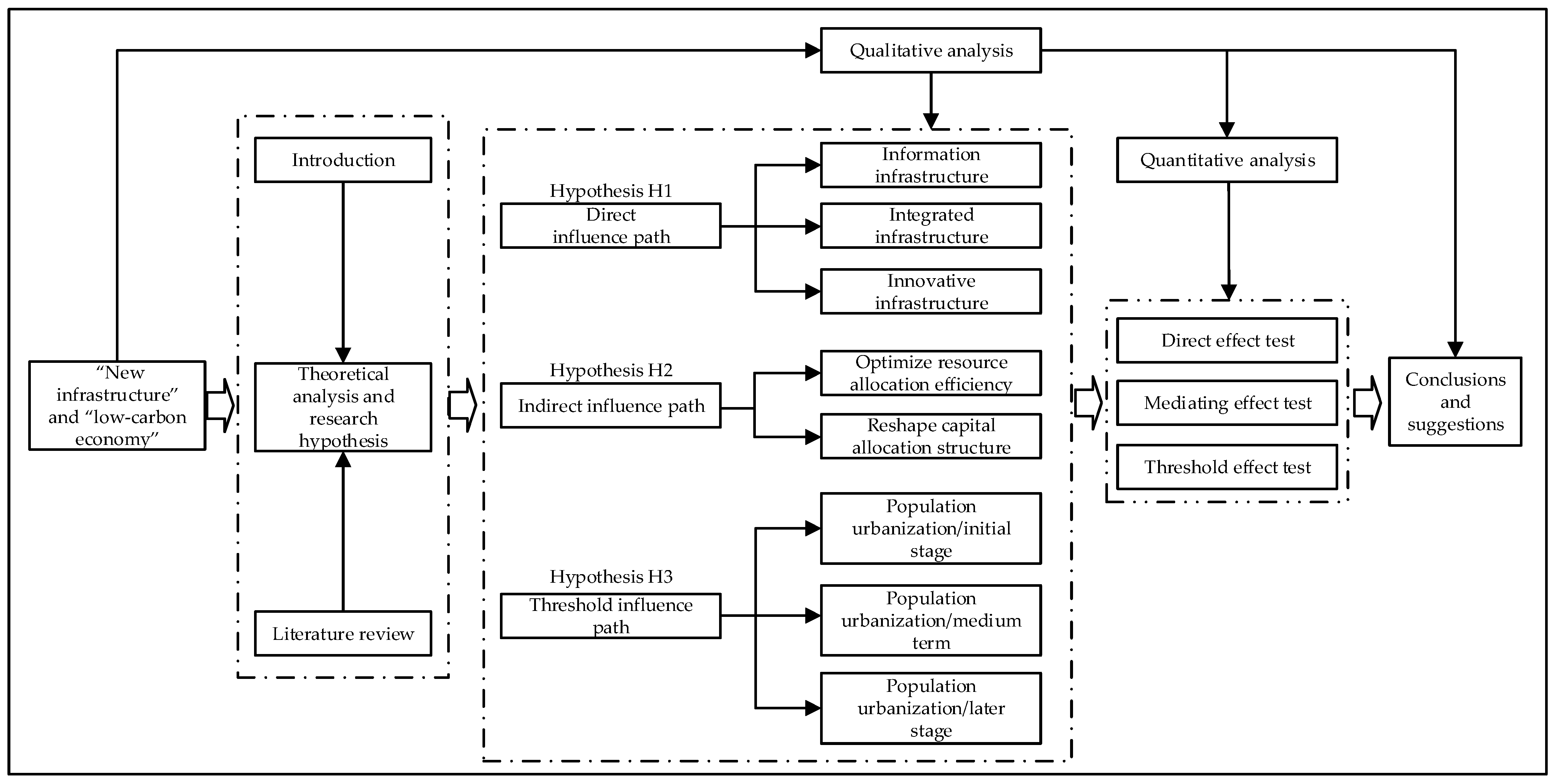
This section not only examines the direct impact of “new infrastructure” on the low-carbon economy, but also further introduces capital factor distortion and population urbanization level as mediating variables and threshold variables, respectively, to discuss their indirect and threshold impact effects. The article structure path diagram is shown in Figure 1.

3.1. Direct Impact Effect Analysis

This article systematically reveals the promoting mechanisms of a low-carbon economy by focusing on three dimensions: information, integration, and innovative infrastructure.
Firstly, information infrastructure features rapid advancement, broad radiation scope, and profound influence [43], and delivers fundamental technical backing for the operation of low-carbon economic systems by enhancing information transmission efficiency and data processing capabilities. The core technologies of information infrastructure consist of 5G networks, artificial intelligence, cloud computing, data centers, Internet of Things (IoT) [44], which enhance the accuracy of information collection, transmission, and processing, and optimize the operational efficiency of energy management systems and carbon emission monitoring systems. For instance, State Grid has achieved lean dispatching of power grid operation by deploying a nationwide power data collection and monitoring system. According to its 2022 social responsibility report, this system has helped enhance the capacity for clean energy consumption, with a total of over 200 billion kilowatt-hours of alternative electricity generated throughout the year, equivalent to reducing standard coal consumption by approximately 64 million tons. Information infrastructure effectively breaks the inherent closed and isolated characteristics among factors through the application of information resources and technologies, enables the circulation and interconnection of energy factors, lowers factor flow costs, and thereby achieves the dual outcomes of carbon emission abatement and efficiency enhancement [45]. Furthermore, the consolidation of information infrastructure has enhanced the transparency and traceability of carbon emission data, providing data support for the operation of carbon trading market mechanisms and thereby improving the allocation efficiency of market-based carbon resources. For instance, China’s carbon emissions trading market has utilized big data and blockchain technology to establish a unified national emissions data reporting system, ensuring the accuracy and immutability of data from over 2000 key emission units, providing guarantees for the effective allocation and payment of carbon quotas.
Secondly, integrated infrastructure encompasses intelligent transportation and smart energy infrastructure [46], with its central objective being to enhance the energy efficiency ratio and operational flexibility of existing infrastructure via digital and intelligent means. By optimizing the scale, technology, grade, and other structures, the structure of infrastructure can be adapted to its layout, function, and system integration [47]. During this process, integrated infrastructure achieved dynamic regulation of energy flow, information flow, and carbon emission flow through system integration and collaborative optimization, effectively reducing carbon emissions during infrastructure operation. Taking the “Intelligent Connected Demonstration Road” jointly built by Baidu Apollo and Cangzhou City, Hebei Province, as an example, through the coordination of roadside perception devices and intelligent signal lights, the average travel time of vehicles has been reduced by 20%. According to the project evaluation report, the carbon emissions of motor vehicles on the relevant road sections have decreased by about 7%. Moreover, integrated infrastructure has strengthened the coordination capacity across diverse energy systems [48]. This not only facilitates the seamless integration of renewable energy but also supports the development of multi-energy complementary frameworks, ultimately raising the cleanliness standard of the energy mix. For instance, the smart energy infrastructure built by the National Energy Group in Changzhou, Jiangsu Province, uses underground salt caverns to store compressed air for power generation, effectively smoothing the volatility of wind and photovoltaic power. The project has a scale of 60 megawatts and can save 35,000 tons of coal and reduce 100,000 tons of carbon dioxide emissions annually.
Lastly, as a core vehicle for advancing the breakthroughs and real-world use of low-carbon technologies, innovative infrastructure serves dual roles: it not only facilitates technological upgrading and model innovation within the low-carbon economy, but also elevates the overall supply quality and efficiency of “new infrastructure”, thanks to its strategic placement at the leading edge of the innovation chain (in contrast to information and integrated infrastructure). This type of infrastructure prioritizes tightening the collaboration mechanism between fundamental and applied research, elevating research and development efficiency and commercialization levels of low-carbon technology, and accelerating technological progress in core fields, including energy efficiency upgrading and carbon capture and storage (CCS). Additionally, innovative infrastructure offers institutional and platform backing for the development of a low-carbon industrial ecosystem, driving the clustering and coordinated growth of low-carbon industrial chains.
Hypothesis 1.
“New infrastructure” facilitates the advancement of low-carbon economic development.

3.2. Indirect Impact Effect Analysis

“New infrastructure” curbs the distortion of capital factors by optimizing the efficiency of resource allocation and reshaping the structure of capital allocation. From the first dimension, “new infrastructure” is characterized by the integrated iteration of new-generation information technologies [49], which enhances information processing capabilities and resource allocation accuracy, reduces market transaction costs, and thereby helps the flow of factors fully overcome the physical constraints of time and space. Accelerating the sharing and transmission of elements such as talents and capital in the form of networks can effectively alleviate the mismatch of capital among industries and regions [50]. For instance, the intelligent logistics platform developed by “Transfar Smart Link” integrates freight logistics resources through digital technology, reducing the average logistics costs of the multiple manufacturing park enterprises it serves by 15%. It has shortened the average vehicle loading time from the traditional 72 h to 6–9 h, significantly enhancing the efficiency of capital turnover and utilization. From the second dimension, “new infrastructure” enhances the forward-looking and scientific nature of capital allocation by establishing a data-driven decision-making mechanism and an intelligent financial system, and eliminates the problem of capital misallocation caused by breaking institutional segmentation or administrative intervention [51]. Meanwhile, “new infrastructure” has driven the digital transformation of the financial system, enhancing the ability to identify and price risks for green and low-carbon projects, thereby stimulating capital injection into the low-carbon sector [52].
Capital factor distortion drives the growth of low-carbon economies by boosting resource allocation efficiency and refining incentive frameworks. When focusing on optimizing resource deployment, improved capital allocation lessens dependence on carbon-intensive fossil fuels, helping to escape the trap of carbon lock-in [53]. It has accelerated the aggregation of capital toward low-carbon sectors, including green manufacturing and clean energy, thereby fostering the transformation of industrial structure toward low-carbon development and high added value. Meanwhile, the improvement in capital allocation efficiency has also enhanced enterprises’ investment capacity in low-carbon technological innovation, stimulating the diffusion of green technologies. Take the photovoltaic industry as an example. With more effective capital investment support, leading enterprise Longi Green Energy invested as much as 7.72 billion yuan in research and development in 2023. The conversion efficiency of its silicon heterojunction cells has been certified by authoritative authorities and has repeatedly broken the world record, reaching 26.81%. The rapid iteration of technology has consistently driven down photovoltaic power generation costs and expedited the low-carbon restructuring of the energy structure. From the lens of refining incentive frameworks, the rational allocation of capital factors has reshaped the long-term development incentive mechanism of enterprises, which helps to enhance their independent innovation capabilities and achieve “technological catch-up” [54], and pay attention to environmental externalities and sustainable development goals. Due to the improved efficiency of capital allocation, financial market expectations for returns on low-carbon projects have strengthened, further guiding social capital to form stable green investment preferences, thereby constructing an endogenous capital support framework underpinning low-carbon economic development.
Hypothesis 2.
“New infrastructure” indirectly fosters low-carbon economic development by curbing the distortion of capital factors.

3.3. Threshold Impact Effect Analysis

New infrastructure’s influence on low-carbon economic development will exhibit stage-specific variations across distinct phases of population urbanization advancement. In the initial stage, a large number of rural people gathered in towns and cities. The urbanization process mainly relied on the expansion and improvement of traditional infrastructure, such as the construction of basic facilities like transportation, energy, and water supply. Due to the limited development level and narrow coverage of new infrastructure (e.g., smart grids, new energy facilities) at this stage, its facilitative effect on low-carbon economic development has yet to be fully manifested.
With the continuous advancement of population urbanization, traditional infrastructure is facing an urgent need for renewal, transformation, and intelligent upgrading. Against this backdrop, although “new infrastructure”, as an extension and upgrade of traditional infrastructure, has not changed the basic attributes of infrastructure, it has significantly enhanced the intelligence level and operational efficiency of infrastructure by means of its technological advancement and modernized methods [55], especially through the deepening application in the field of information infrastructure. At this stage, the integration of new and traditional infrastructure is constantly strengthening, optimizing the energy structure and enhancing its supporting capacity for low-carbon economic development.
In the later stage of population urbanization, the population agglomeration effect has stimulated consumption upgrading and promoted economic growth [56]. Meanwhile, the “siphon effect” triggered by urbanization [57] has accelerated the aggregation of a high-quality labor force, significantly enhanced regional technological innovation capabilities, and provided a solid foundation for the in-depth research and development and wide application of “new infrastructure”. At this stage, “new infrastructure” gradually replaces traditional high-carbon emission infrastructure and becomes the dominant force in urban operation and industrial development. For instance, as a highly urbanized megacity, Shenzhen’s “new urban construction” pilot project has deeply integrated new infrastructure such as the CIM (City Information Modeling) platform, intelligent transportation, and online monitoring of building energy consumption. According to relevant data, the average energy consumption of public buildings in Shenzhen has decreased by more than 15% compared to before the renovation. Meanwhile, relying on a dense network of over 50,000 5G base stations, intelligent dispatching of new energy vehicle charging facilities throughout the city has been achieved, significantly enhancing the efficiency of clean energy utilization.
Hypothesis 3.
A non-linear impact nexus exists between new infrastructure and low-carbon economic development. Raising the population urbanization level serves to amplify the influence of new infrastructure on low-carbon economic development.

4. Materials and Methods

4.1. Model Design

4.1.1. Baseline Regression Model

Based on Hypothesis 1, this paper constructs the following panel regression model:
Y i , t   =   α 0   +   α 1 X i , t   +   α 2 C i , t   +   μ i   +   τ t   +   ε i , t
Here, i represents a province, and t signifies a time period. Yi,t stands for the low-carbon economy development level (denoted as Low-car), while Xi,t corresponds to “new infrastructure” (denoted as New-inf). Ci,t captures the complete array of control variables; μi and τt indicate individual and time fixed effects, respectively; εi,t denotes the stochastic error term; α0 is a constant term; α1 and α2 denote the estimated coefficients of the model.

4.1.2. Mediating Effect Model

Based on Hypothesis 2 and referencing the findings of extant scholars [58], a mediating effect model is constructed to test the mechanism path, as shown below:
M i , t   =   β 0   +   β 1 X i , t   +   β 2 C i , t   +   μ i   +   τ t   +   ε i , t
Y i , t = γ 0   +   γ 1 X i , t   +   γ 2 M i , t + γ 3 C i , t + μ i   +   τ t   +   ε i , t
Here, Mi,t serves as the mediating variable, corresponding to capital factor distortion (denoted as Capi).

4.1.3. Threshold Effect Model

Based on Hypothesis 3, the present study develops a double-threshold effect model to identify the impacts of population urbanization, as specified below:
Y i , t   = κ 0   +   κ 1 C i , t   + η 1 X i , t I ( N i , t     ν 1 )   + η 2 X i , t I ( ν 1   <   N i , t     ν 2 )   +   η 3 X i , t I ( N i , t   >   ν 2 )   +   μ i   +   τ t   +   ε i , t
Here, Ni,t acts as the threshold variable, corresponding to population urbanization (denoted as Popu); ν1 and ν2 stand for the first and second threshold values; I(·) represents the indicator function; κ 0 represents the constant term, and κ 1 is the coefficient for C i , t .

4.2. Variable Settings

4.2.1. Dependent Variable

Low-carbon economy (denoted as Low-car). For the measurement of this indicator, based on existing research, it starts from five dimensions [59] and adopts a combined method of AHP and DEA for calculation [21] (For detailed indicators, please refer to the Supplementary Materials File S1). Among them, the low-carbon output indicator prioritizes energy processing and conversion efficiency, which reflects the advancement of energy processing equipment and technologies. Enhancing this efficiency entails generating greater secondary energy output with reduced primary energy input, a pivotal link to energy conservation and carbon emission abatement.
The low-carbon consumption indicator requires a shift from the production side to the consumption side for a comprehensive assessment of carbon emission liabilities. Two composite indicators—residential consumption-based carbon emissions and government consumption-based carbon emissions—are adopted to gauge the overall impacts of natural consumption patterns and social organizational forms on carbon emissions, respectively, thereby defining the role of consumption patterns more holistically.
The low-carbon resource indicator focuses on natural background conditions and includes three core metrics: the proportion of zero-carbon energy, which gauges the cleanliness of the energy structure; the energy carbon emission coefficient, which reflects the overall carbon intensity of the energy consumed; and carbon sink density (e.g., carbon sequestration per unit area), the natural foundation for offsetting carbon emissions and addressing climate change.
The low-carbon policy indicator captures the institutional impetus for low-carbon transition, aiming to assess the efforts of nations and regions, including the formulation of low-carbon development strategies, the construction of carbon emission monitoring, statistical and regulatory systems, the cultivation of public low-carbon awareness, the implementation of environmental protection norms, and the exploration and application of policy tools such as carbon tax.
The low-carbon environment indicator underscores the synergistic advancement of low-carbon economic growth and environmental quality enhancement. Metrics such as waste carbon emission intensity and the industrial three-waste remediation index are employed to measure the synergistic effects of low-carbon development on pollutant reduction and environmental governance.

4.2.2. Independent Variable

“New infrastructure” (denoted as New-inf). Drawing on existing literature, the evaluation index system for this indicator is mainly constructed from three dimensions: information infrastructure (denoted as Info-inf), integrated infrastructure (denoted as Inte-inf), and innovative infrastructure (denoted as Inno-inf) [60], and the entropy method is adopted for calculation (as Table 1 displays). Among them, the information infrastructure indicators reflect the capabilities of data collection, transmission and processing; represent the level of digital foundation; and consist of six evaluation indicators. The integrated infrastructure indicators reflect the degree of integration between traditional industries and information technology, and consist of eight evaluation indicators. The innovation infrastructure indicators reflect the capacity for technological research and development and the transformation of achievements, and consist of four evaluation indicators. In the calculation process of the entropy method, standardization processing (dimensionless) is required before measurement, and the type of each indicator should be clearly specified. This is because the subsequent standardized formula will vary according to whether the indicator is “positive” or “negative”, so as to ensure that all standardized indicator data share a unified comparison direction—namely, the standardized values all conform to the principle that a higher value corresponds to better performance. If the direction of the indicators is confused, it will directly lead to the final calculated weights and comprehensive scores losing their scientific significance, and even result in opposite conclusions.

4.2.3. Mediating Variable

Distortion of capital factors (denoted as Capi). Mainly drawing on the methodological practices of extant scholars, the relative price approach is adopted to calculate the capital misallocation index, which is used to proxy capital factor distortion [61,62].

4.2.4. Threshold Variable

Population urbanization (denoted as Popu) is measured as follows: urbanization rate = (urban permanent population divided by total population at the end of the year) × 100%, in units of 10,000 people.

4.2.5. Control Variables

To mitigate bias from unaccounted variables, we incorporate key control variables: economic development level (denoted as Econ), fiscal intervention intensity (denoted as Fisc), environmental regulation stringency (denoted as Envi), social consumption scale (denoted as Cons), and industrial structure upgrading (denoted as Stru). Econ is measured as the natural log of regional per capita gross domestic product (computed as regional GDP divided by year-end resident population) [63]. Fisc is proxied by the logarithm of total general government expenditure. Envi is captured by the logarithm of aggregate completed investment in industrial pollution abatement. Cons is the natural logarithm of total retail sales of consumer goods in the social sector. Stru (reflecting high-level industrial structure upgrading) is calculated via: Stru i , t   =   m 3 s i , m , t   ×   m , where s i , m , t denotes the share of the mth industry (for m = 1, 2, 3) in region i’s GDP during period t [64].

4.3. Data Sources

This empirical study draws on annual provincial panel data spanning 2011–2023, covering 30 Chinese provinces (excluding Xizang, Hong Kong, and Macau due to substantial data shortages). The 2023 endpoint aligns with the most recent statistical releases currently available. Meanwhile, data related to mediating variables, threshold variables, and control variables are primarily retrieved from the official database of the National Bureau of Statistics. Table 2 presents the descriptive statistical results.

5. Empirical Result Analysis

5.1. Baseline Test Results Analysis

To further analyze the influence effects between the two, an empirical test was conducted by constructing a linear regression model. Before the test, a collinearity test needs to be conducted on the model. We tested the model’s variance inflation factor (VIF), obtaining a mean value of 5.4400, which falls below 10, confirming the absence of multicollinearity across variables. A Hausman test was conducted on the model, which yielded an F-test p-value of 0.0000 and thus confirmed the fixed-effects model as the appropriate specification. The BP test also returned a p-value of 0.0000, further verifying the fixed-effects model as the optimal specification. The Hausman test produced a p-value of 0.053, which is below 0.1, demonstrating that the two-way fixed-effects model is applicable for estimation.
As Table 3 displays, when no control variables are included, the independent variable’s coefficient is 1.1126 and highly significant, signaling a positive association between “new infrastructure” and low-carbon economies, and initially verifying its promotional role. However, once control variables are added, this coefficient falls to 0.2856 and loses significance, implying the initial relationship may be confounded by other factors. This could stem from unaccounted-for individual and temporal heterogeneities, which might obscure how regional or enterprise-level variations affect new infrastructure investment and low-carbon economic performance, introducing bias into the estimates. Moreover, when employing a fixed effects model, without control variables, the independent variable’s coefficient is 0.4013; with control variables added, it is 0.3726. Both coefficients register positive significance at the 1% statistical level, validating the promotional effect of new infrastructure. These results suggest that after accounting for the individual and temporal variability of variables, the causal link between the dependent and independent variables can be more accurately identified. Thus, Hypothesis 1 is supported.
In addition, with the inclusion of control variables, fiscal intervention intensity and industrial structure upgrading exert a facilitative effect. This is primarily because fiscal intervention can steer the advancement of low-carbon technologies to a certain extent and drive the growth of eco-friendly industrial sectors via resource allocation effects and externality internalization mechanisms. Meanwhile, industrial structure upgrading effectively curbs carbon emission intensity by rationalizing factor allocation and elevating energy use efficiency, thereby markedly boosting low-carbon economic development. The inhibitory effect of social consumption level may stem from the fact that rising consumption intensity exacerbates energy usage and carbon emission levels. Especially in the current situation where the green consumption system has not yet been fully established, the expansion of consumer demand is prone to cause dependence on traditional high-carbon products, thereby exerting a restraining effect on the low-carbon economy.

5.2. Robustness and Endogeneity Tests Results Analysis

The main approaches for robustness checks include excluding centrally administered municipalities, lagging the core variable by different periods, conducting quantile regression, and incorporating additional control variables for robustness verification. The endogeneity testing approach primarily employs system GMM (Generalized Method of Moments) estimation to mitigate reverse causality among variables and deploys instrumental variables to address the issue of omitted variables within the regression specification. Table 4 reports findings from the robustness and endogeneity test.
First, we interpret the robustness test outcomes: when excluding centrally administered municipalities, the independent variable’s coefficient is 0.6588 and highly significant. To examine the persistence of the effect, we lagged both the dependent and independent variables by one period. The test shows the lagged independent variable’s coefficient is 0.2901; when the dependent variable is lagged by one period, the independent variable’s coefficient is 0.3623. Both are reasonably significant, suggesting “new infrastructure” exerts a sustained impact on low-carbon economies. We further implemented quantile regression at the 25th, 50th, and 75th quantile points, with the independent variable’s estimates at 0.4215, 0.6456, and 0.5461, respectively, all of which are highly statistically significant. Additionally, we expanded the control variable set: given that marketization and financial development levels may affect low-carbon economies, these factors were incorporated into the model. Marketization is gauged using the “Fan Gang Marketization Index”, while financial development is proxied by the ratio of financial institutions’ deposits and loans to GDP. Regression results yield an independent variable coefficient of 0.3421, verifying that the initial conclusion is highly robust.
Secondly, we assess the endogeneity test findings: a reverse causality issue may exist between “new infrastructure” and low-carbon economic development. On one side, new infrastructure supplies technical backing and operational safeguards for low-carbon economic growth; on the other, green demand-driven low-carbon economies, in turn, push new infrastructure upgrades. This reciprocal causal link could compromise model precision. Thus, empirical analyses typically employ approaches like instrumental variables for identification and adjustment to ensure reliability. This paper primarily uses system GMM estimation to tackle this concern. Regarding unobserved variable bias: while the model controls for some confounding factors, it cannot fully account for unobservable elements tied to new infrastructure that impact low-carbon economic development, creating endogeneity stemming from missing variables. To rectify this issue, we follow the approach of prior studies: in addition to employing the first-order lag of the independent variable as an instrumental variable to mitigate endogeneity in the model [65], we further selected the interaction term between the 1984 fixed-line telephone penetration per 100 people and the independent variable as a plausible instrumental variable. Through systematic GMM regression, with the inclusion of a first-order lagged term of the dependent variable, the independent variable yielded a coefficient of 0.8193 that was statistically significant, which further corroborates the robustness of the baseline findings. In the instrumental variable test, the F value was 47.4949 > 10, the partial R2 was 0.7088, and the minimum eigenvalue was 379.736, which was significantly greater than the critical values of each interval. The p value of the over-identification test was 0.7943 > 0.1, which passes the original unidentified hypothesis, indicating that the selected variables met the requirements of the instrumental variable test. After conducting a two-stage regression, the independent variable yielded a coefficient of 0.3978 with high statistical significance, indicating that Hypothesis 1 still holds after alleviating the endogeneity problem.

5.3. Heterogeneity Test Results Analysis

The regional economic attributes focus on variations in effects across eastern, central, and western China. The regional policy factors mainly divide pilot areas and non-pilot areas for sample comparison. The system composition factors primarily explore the differential impacts of three components on low-carbon economic advancement. Table 5 and Table 6, respectively, present the results of heterogeneity test (1) and heterogeneity test (2).
  • Regional economic heterogeneity test. Table 5 shows that the coefficients of “new infrastructure” for low-carbon economic development across China’s three major regions are −0.2979, 0.3343, and 1.0609, respectively. Notably, the eastern region’s coefficient is significantly negative (in contrast to the other two regions), revealing regional variations in economic impacts. This can be attributed to the economically developed eastern region with a high concentration of manufacturing industries. After the introduction of new infrastructure, its mature production system can enhance energy efficiency and production capacity. However, improved energy efficiency also tends to spur greater energy demand scale, thereby inducing a “rebound effect” whereby aggregate energy usage and carbon emission levels rise rather than fall, ultimately hampering the advancement of low-carbon economic development. By contrast, central and western China feature comparatively underdeveloped industrial structures and substantial potential for industrial restructuring. Here, new infrastructure drives low-carbon growth by optimizing resource distribution, accelerating technology spread, and advancing industrial upgrading. Additionally, policy benefits (via institutional innovation, financial guidance, and market incentives) have sustained momentum for new infrastructure’s low-carbon transition.
  • Regional policy heterogeneity test. Table 5 also documents the influence of regional policy disparities. The coefficients for pilot and non-pilot areas are 0.4628 and 0.3043, respectively, both positive and significant, but the pilot areas show stronger significance. These results indirectly validate that state-led pilot policies in designated regions have a marked promotional effect. The rationale is that pilot regions typically receive prioritized, targeted policy support (e.g., tax breaks, streamlined green approval processes, and dedicated financial subsidies), which optimizes resource allocation and thus amplifies new infrastructure’s energy efficiency contribution during low-carbon transformation. In contrast, non-pilot regions lack such policy preferences and institutional safeguards, leading to constrained resource distribution and underutilized development potential.
  • System composition heterogeneity test. Table 6 reveals distinct variations in how different new infrastructure components affect low-carbon economic development. For information infrastructure (Info-inf), the coefficient is 0.3051 (significantly positive), reflecting its positive contributions to boosting data flow, elevating resource allocation efficiency, and advancing intelligent energy management. By contrast, integrated infrastructure (Inte-inf) has a coefficient of just 0.0230 and fails the significance test. This stems from weak coordination between new and traditional infrastructure, paired with insufficient system adaptability, factors that restrict resource integration efficiency and hinder the formation of a cohesive collaborative promotion mechanism. Innovative infrastructure (Inno-inf) yields a highly significant coefficient of 0.3546, highlighting its key role in driving green tech R & D, fostering low-carbon emerging industries, and strengthening independent innovation capacity.

5.4. Mechanism Path Verification Results Analysis

As Table 7 displays, first, the regression coefficient for “new infrastructure” (on capital factor distortion) is −0.5389 and statistically significant, demonstrating that new infrastructure exerts a notable restraining impact on capital factor misallocation. This is mainly because the independent variable promotes the flow of information and the diffusion of technology, enhances the competitiveness of the market and the Pareto optimality of resource allocation, thereby reducing the misallocation of resources caused by government intervention or institutional obstacles. Furthermore, the distortion of capital factors was added to the model for regression, with a coefficient of −0.0745, which was also significant, indicating that the mismatching of capital factors had an inhibitory effect on the dependent variable. The primary cause lies in the misallocation of capital factors leading to a deviation of resource allocation from the optimal structure, lowering production efficiency and the capacity for technological innovation, and thus impeding the uptake and diffusion of low-carbon technologies. Meanwhile, the independent variable coefficient in column (2) is 0.3325 and very significant, indicating that capital factor distortion plays a mediating role. “New infrastructure” promotes a low-carbon economy by curbing the misallocation of capital factors. Therefore, Hypothesis 2 is valid.

5.5. Threshold Effect Test Results Analysis

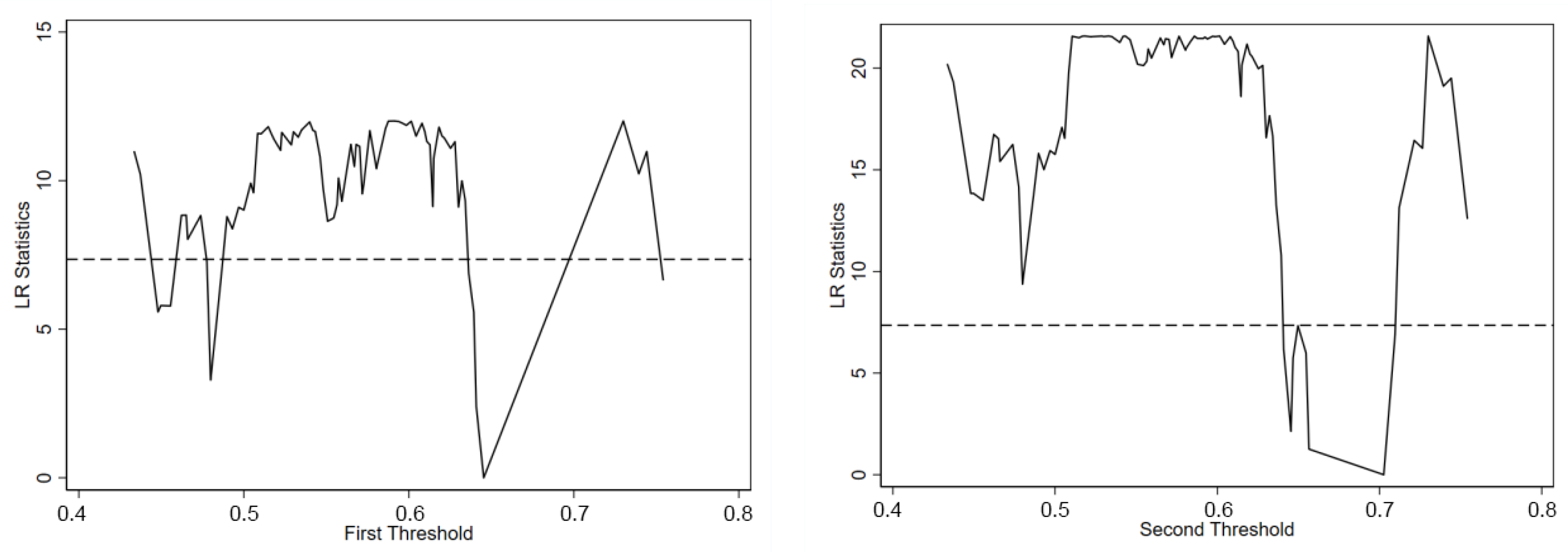
As Table 8 displays, after sampling 200 times using the Bootstrap method, the first threshold value of population urbanization was 0.6454, and the second threshold value was 0.7026, which satisfied the 5% and 1% statistical significance tests, respectively. The third threshold value failed the test with its F-statistic exceeding the respective critical value, demonstrating that population urbanization exerts a double-threshold effect. This causes new infrastructure to generate phased heterogeneity in low-carbon economic advancement.
To further verify the authenticity of the two threshold values for population urbanization, this paper also depicts the threshold value and likelihood ratio function graph of “new infrastructure” for a low-carbon economy. As shown in Figure 2, the two threshold values stand at 0.6454 and 0.7026, respectively, both falling within the 95% confidence interval (below the dashed line), indicating that the threshold value of population urbanization has passed the true value test.
As Table 9 displays, when population urbanization falls below the 0.6454 threshold, the coefficient is 0.1319, a positive but statistically negligible effect. Between the 0.6454 and 0.7026 thresholds, the coefficient rises to 0.2979, making the impact clearly noticeable. After crossing the 0.7026 threshold, the coefficient rises further to 0.4725 and achieves statistical significance at the 1% level. Such findings illustrate that the new infrastructure’s effect on low-carbon economic development intensifies progressively with the advancement of population urbanization. Firstly, the improvement of the population urbanization level means that more people are gathering in cities, driving the growth of urban infrastructure demand and promoting the investment and upgrading of “new infrastructure” in areas such as information networks, energy structures, and transportation systems, thereby improving energy utilization efficiency and resource optimization. Secondly, highly urbanized areas have a stronger capacity for technology absorption and an innovation diffusion effect, which can help green technologies be practically applied and promoted in their respective regions. Finally, as the process of urbanization progresses, residents’ environmental awareness and the intensity of policy implementation have increased, further amplifying the low-carbon effect of “new infrastructure”. The above results indicate that Hypothesis 3 has been verified.
Furthermore, in this paper, taking the “Hu Huanyong Line” as the critical boundary, the area to the east is a province with a higher population density, while the area to the west is a region with a lower population density. Table 10 presents findings from the threshold effect heterogeneity test. Following the sample regression, each region exhibits a single population urbanization threshold effect, with threshold values of 0.5727 and 0.5874 in sequence. Although the two values are relatively close, the impact of new infrastructure is not significant in densely populated areas below the threshold, while it shows significance above the threshold, indicating that urbanization has a strengthening effect. However, in sparsely populated areas, the effects of both below and above the threshold are not obvious. This difference mainly stems from the different levels of economies of scale and factor agglomeration that the new infrastructure of the two types of regions relies on to exert its effectiveness at different stages of urbanization. For the densely populated eastern regions, once urbanization reaches the threshold level, this signifies that population and economic activity density have hit the critical threshold to underpin the emergence of network effects and economies of scale stemming from new infrastructure. At this time, the coverage breadth and usage depth of new infrastructure are fully released, and its promoting effect on low-carbon development is thus statistically significant. When it is below the threshold, the urbanization level has not yet formed a sufficient agglomeration effect, and the collaborative efficiency of new infrastructure is difficult to break through cost constraints and coverage bottlenecks, so the impact is not significant. In contrast, in the sparsely populated western regions, even if the urbanization rate exceeds the threshold, due to the relatively low overall population and economic activity density, the original investment cost of infrastructure is high, and the returns to scale decline significantly. New infrastructure is difficult to form effective demand support and network linkage, resulting in its impact remaining insignificant. This reflects that in low-density areas, relying solely on the improvement of urbanization levels may not be sufficient to activate the efficiency of new infrastructure. It is also necessary to promote it in combination with structural conditions such as industrial cultivation and cross-regional connectivity.

6. Conclusions

The SDGs establish a common framework for global development, with their core emphasis on synergistically driving inclusive progress in the economic, social, and environmental dimensions. Research on new infrastructure and the low-carbon economy represents a crucial pathway toward achieving SDGs 7, 9, 11, and other related objectives, highlighting the importance and urgency of advancing systemic transformation through infrastructure innovation. The main findings are summarized in the following aspects:
At the level of direct impact effects, “new infrastructure” significantly promotes the development of the low-carbon economy. For every one percentage point increase in its level, the low-carbon economy advances by 0.3726 units. This empirical result remains reliable following a battery of robustness checks and endogeneity tests. Compared to existing studies that predominantly focus on specific types of new infrastructure, this research validates the positive influence of “new infrastructure” on the low-carbon economy from a holistic perspective. It thereby addresses the lack of systematic discussions in this field and provides a new pathway reference for advancing the SDGs.
Regarding heterogeneity analysis, regional disparities show that the influence coefficients of “new infrastructure” on low-carbon economic development in the central and western regions stand at 0.3343 and 1.0609, respectively, whereas the corresponding coefficient for the eastern region is −0.2979. This shows that the facilitating impact of “new infrastructure” on low-carbon economic development is notably more marked in the central and western regions, while a restraining impact is detected in the eastern region. Although existing studies generally recognize that the maturity level of “new infrastructure” follows a pattern of “eastern region > central region > western region”, its influence on low-carbon economic advancement has not yielded consistent conclusions. The empirical findings of this research suggest that in the eastern region, “new infrastructure” may hinder the progress of the low-carbon economy due to development saturation, traditional industrial lock-in, and potential “rebound effects”.
Regarding policy differences, the influence coefficient of “new infrastructure” within policy pilot zones stands at 0.4682, while that in non-pilot zones reaches 0.3043, which demonstrates that the facilitating impact is notably more potent in pilot regions. This conclusion aligns with existing research on policy effects, such as the “Broadband China” initiative, confirming the critical role of institutional coordination and policy synergy in amplifying the green benefits of “new infrastructure”.
From the lens of system structure, the impact coefficients of information infrastructure and innovation infrastructure stand at 0.3051 and 0.3546, respectively, while the influence of integrated infrastructure, though positive, lacks statistical significance. This empirical outcome indicates that concentrating exclusively on individual categories of new infrastructure may neglect the synergistic impact of “new infrastructure” as an integrated system on the low-carbon economy. By taking a holistic systemic approach, this study addresses the limitation of most current research, which tends to center on individual infrastructure categories.
In terms of mediation mechanism testing, capital factor distortion is identified as the primary pathway through which “new infrastructure” influences the low-carbon economy. Specifically, “new infrastructure” indirectly promotes low-carbon development by inhibiting capital factor distortion. This finding not only supports the existing consensus that factor distortions are a key contributor to economic and environmental issues but also further reveals that, compared to traditional infrastructure, “new infrastructure” possesses a more distinct mechanism advantage in optimizing capital allocation and alleviating resource misallocation.
Moreover, population urbanization exhibits a dual-threshold effect between “new infrastructure” and the low-carbon economy (with thresholds of 0.6454 and 0.7026). As urbanization levels increase, the promoting effect of “new infrastructure” on the low-carbon economy significantly strengthens. This indicates that population agglomeration does not inevitably lead to negative outcomes. Instead, after reaching a certain urbanization threshold, it can enhance the low-carbon promoting function of “new infrastructure” through scale effects, technology diffusion, and governance upgrading. This provides important empirical evidence for the coordinated advancement of new urbanization and regional sustainable development.
Based on this, we propose some policy recommendations to promote the sustainable development of a low-carbon economy:
First, implement a differentiated regional layout strategy and optimize the path for unleashing the effectiveness of new infrastructure. Given the differential characteristics of strong effects in the central and western regions and weak effects in the eastern region, policies should be implemented to avoid a one-size-fits-all approach. In the central and western regions, relying on their clean energy endowments and infrastructure gaps, priority should be given to deploying new infrastructure projects that directly drive clean energy substitution and industrial upgrading, such as renewable energy grid integration and green computing centers. In the eastern region, it is necessary to shift from scale expansion to stock optimization, strictly control inefficient and redundant construction, prioritize supporting the digital and intelligent transformation of traditional high-carbon infrastructure, and eliminate backward production capacity through market mechanisms, to create structural space for the release of green benefits of new infrastructure.
Second, improve the classified support and pilot promotion mechanism, and strengthen policy coordination and standard alignment. The research shows that policy pilot areas have achieved remarkable results, and the low-carbon contribution of information and innovation infrastructure is more explicit. It is recommended to systematically refine the effective experience of pilot regions in fiscal incentives, green finance, and cross-departmental collaboration; develop standardized policy tools; and promote them to non-pilot regions, with a focus on improving their implementation capacity and resource coordination efficiency. When advancing the deployment of information infrastructure, regions with a population coverage rate of 5G base stations ranging from 70% to 90% can be designated as the key scope for policy support and performance evaluation, guiding the precise allocation of resources to the critical development stage of network coverage. Meanwhile, investment in projects with explicit low-carbon benefits, such as 5G, the Internet of Things, and green technology R & D platforms, should be increased, and efforts should be made to break down the barriers of technical standards, data protocols, and operation mechanisms faced by integrated infrastructure, to promote the effective connection between old and new systems.
Third, improve the capital guidance and urbanization coordination mechanism, and systematically enhance the effectiveness of green transition. New infrastructure indirectly promotes low-carbon development by alleviating the distortion of capital factors, which requires policies to guide capital allocation to efficient and synergistic green new infrastructure sectors, innovatively utilize tools such as green credit and special bonds, and improve investment transparency through digital technologies. Furthermore, the population urbanization threshold effect demonstrates that new infrastructure delivers markedly amplified low-carbon dividends in regions with a high urbanization level. Therefore, in urban planning and construction, forward-looking layout of smart energy networks, digital governance platforms, and other facilities should be carried out to promote the in-depth integration of new-type urbanization and new infrastructure at the spatial, functional, and institutional levels, and realize a synergistic development pattern of “boosting emission reduction through construction and scaling up benefits through urbanization”.
Yet, this research has certain limitations, primarily manifested in the failure to examine the spatial spillover impact of new infrastructure on neighboring regions within the core analysis. Constrained by the research framework and manuscript length, the present study centers on the direct effects of new infrastructure on local low-carbon economic development and its mediating channels, without undertaking an in-depth exploration of the spatial spillover mechanism through which new infrastructure acts on contiguous regions. Future research can further develop a spatial econometric model to unpack the spatial correlation and radiation effects of new infrastructure across regions, thereby providing a more comprehensive basis for the cross-regional coordinated advancement of low-carbon development.

Supplementary Materials

The following supporting information can be downloaded at: https://www.mdpi.com/article/10.3390/su18031164/s1, File S1: Supplementary Materials. Reference [66] are cited in the Supplementary Materials.

Author Contributions

Conceptualization, H.Z.; Methodology, Y.L.; Software, Y.L., F.W. and K.L.; Validation, H.Z.; Formal analysis, Y.L., F.W. and K.L.; Investigation, Y.L., F.W. and K.L.; Resources, K.L.; Data curation, Y.L., F.W. and K.L.; Writing—original draft, Y.L., F.W. and K.L.; Writing—review & editing, Y.L., F.W. and K.L.; Visualization, Y.L., F.W. and K.L.; Supervision, H.Z.; Project administration, K.L.; Funding acquisition, K.L. All authors have read and agreed to the published version of the manuscript.

Funding

This research was funded by the National Social Science Foundation of China Major Project (24VRC003).

Institutional Review Board Statement

Not applicable.

Informed Consent Statement

Not applicable.

Data Availability Statement

The data presented in this study are openly available in National Bureau of Statistics at https://www.stats.gov.cn/.

Conflicts of Interest

The authors declare no conflict of interest.

References

  1. Gallagher, K.P.; Liu, R.L.; Lu, J.Q.; Yin, R.Y.; Yu, M.J.; Bandara, P. China’s low-carbon technology trade: Facts and implications. China Econ. Rev. 2025, 92, 102445. [Google Scholar] [CrossRef]
  2. Gou, F.; Liang, W.; Liu, Y.; Fu, B.J.; Wang, Z.G.; Zhang, W.B.; Chen, Z.G.; Yan, J.W.; Li, J.Y.; Lv, Y.H. Large-scale ecological infrastructures enhance the productivity of agro-socio-ecological systems by reducing soil erosion in the Loess Plateau. J. Environ. Manag. 2025, 373, 123751. [Google Scholar] [CrossRef]
  3. Zhang, Y.; Shen, L.Y.; Shuai, C.Y.; Tan, Y.T.; Ren, Y.T.; Wu, Y. Is the low-carbon economy efficient in terms of sustainable development? A global perspective. Sustain. Dev. 2019, 27, 130–152. [Google Scholar]
  4. Li, Q.G. Philosophical Analysis of Industrial Technology and the Construction of a “Two-Oriented Society”. Master’s Thesis, Hunan Normal University, Changsha, China, 2009. [Google Scholar]
  5. Ning, Y.D.; Chen, K.K.; Zhang, B.Y.; Ding, T.; Guo, F.; Zhang, M. Energy conservation and emission reduction path selection in China: A simulation based on Bi-level multi-objective optimization model. Energy Policy 2020, 137, 111116. [Google Scholar] [CrossRef]
  6. Ma, G.C.; Yang, X.Z.; Xu, J. Coordinated development of two-way FDI and green total factor productivity: Theoretical mechanism and Chinese experience. Inquiry Econ. Issues 2022, 43, 173–190. [Google Scholar]
  7. Price, L.; Zhou, N.; Fridley, D.; Ohshita, S.; Lu, H.Y.; Zheng, N.; Fino-Chen, C. Development of a low-carbon indicator system for China. Habitat Int. 2013, 37, 4–21. [Google Scholar] [CrossRef]
  8. Tao, F.; Zhang, H.; Liu, A.; Nee, A.Y.C. Digital twin in industry: State-of-the-art. IEEE Trans. Ind. Inform. 2019, 15, 2405–2415. [Google Scholar] [CrossRef]
  9. Wang, Y.N.; Fang, X.L.; Yin, S.W.; Chen, W. Low-carbon development quality of cities in China: Evaluation and obstacle analysis. Sustain. Cities Soc. 2020, 64, 102553. [Google Scholar] [CrossRef]
  10. Wu, W.W. Modern urban planning and design based on low-carbon economy concept. Open House Int. 2019, 44, 108–111. [Google Scholar] [CrossRef]
  11. Li, F.M.; Zhao, X.J.; Ma, S. A low-carbon economy and new energy. In Proceedings of the 2010 International Conference on Agricultural Engineering, Shanghai, China, 18 September 2010; pp. 154–157. [Google Scholar]
  12. Jia, J.S.; Fan, Y.; Guo, X.D. The low-carbon development (LCD) levels’ evaluation of the world’s 47 countries (areas) by combining the FAHP with the TOPSIS method. Expert Syst. Appl. 2012, 39, 6628–6640. [Google Scholar] [CrossRef]
  13. Department of Trade and Industry (DTI). Energy White Paper: Our Energy Future—Creating a Low-Carbon Economy; DTI: London, UK, 2003.
  14. Lin, B.Q.; Sun, C.W. How can China achieve its carbon reduction targets while ensuring sustained economic growth? Soc. Sci. China 2011, 32, 64–76+221. [Google Scholar]
  15. Chen, S.Y. Low-carbon economy. Econ. Res. J. 2022, 57, 12–18. [Google Scholar]
  16. Wu, C.X. Research on the synergistic effects of China’s low-carbon economic development. J. Manag. World 2021, 37, 105–117. [Google Scholar] [CrossRef]
  17. Pan, J.H.; Zhuang, G.Y.; Zheng, Y.; Zhu, S.X.; Xie, Q.Y. Concept identification and core element analysis of low-carbon economy. Int. Econ. Rev. 2010, 33, 88–101+5. [Google Scholar]
  18. Li, Y.N.; Zhu, S.L.; Luo, L.J.; Yang, D.P. Theoretical exploration of low-carbon development as a macroeconomic goal: Based on the Chinese situation. J. Manag. World 2017, 33, 1–8. [Google Scholar] [CrossRef]
  19. Lu, Z.R.; Shao, C.F.; Wang, F.; Dong, R.Y. Evaluation of green and low-carbon development level of Chinese provinces based on sustainable development goals. Sustainability 2023, 15, 15449. [Google Scholar] [CrossRef]
  20. Feng, B.M. Research on the construction of low-carbon economic evaluation index system in Hubei Province. China Popul. Resour. Environ. 2011, 21, 54–58. [Google Scholar]
  21. Fu, J.F.; Zhuang, G.Y.; Gao, Q.X. Concept identification of low-carbon economy and construction of evaluation index system. China Popul. Resour. Environ. 2010, 20, 38–43. [Google Scholar]
  22. Xie, Z.X.; Qin, Y.C.; Shen, W.; Rong, P.J. Evaluation of low-carbon economic development performance and influencing factors in China. Econ. Geogr. 2017, 37, 1–9. [Google Scholar] [CrossRef]
  23. Johnson, O.W.; Mete, G.; Sanchez, F.; Shawoo, Z.; Talebian, S. Toward climate-neutral heavy industry: An analysis of industry transition roadmaps. Appl. Sci. 2021, 11, 5375. [Google Scholar] [CrossRef]
  24. Grassetti, F.; Sanchez Carrera, E.J.; Seegmuller, T. The role of government intervention in balancing economic growth and environmental sustainability: A global dynamics approach across economies. Macroecon. Dyn. 2025, 29, 144. [Google Scholar] [CrossRef]
  25. Nordhaus, W. Climate change: The ultimate challenge for economics. Am. Econ. Rev. 2019, 109, 1991–2014. [Google Scholar] [CrossRef]
  26. Wu, X.F.; Xu, Y.C.; Lou, Y.T.; Chen, Y. Low-carbon transition in a distributed energy system regulated by localized energy markets. Energy Policy 2018, 122, 474–485. [Google Scholar] [CrossRef]
  27. Jia, L.F. Measures and suggestions for China’s low-carbon economic development. Rev. Econ. Res. 2017, 26, 20–22. [Google Scholar] [CrossRef]
  28. Liu, J.L.; Xiahou, Q.R.; Wang, K.; Kong, Y. Research on the medium and long-term low-carbon development path of China’s industrial sector. China Soft Sci. 2019, 34, 31–41+54. [Google Scholar]
  29. Ebadian, M.; Van Dyk, S.; Mcmillan, J.D.; Saddler, J. Biofuels policies that have encouraged their production and use: An international perspective. Energy Policy 2020, 147, 111906. [Google Scholar] [CrossRef]
  30. Xu, D.F. Enlightenment of international experience in low-carbon technology selection on China’s low-carbon technology route. Sci. Technol. Econ. 2010, 23, 73–75. [Google Scholar]
  31. Lei, M.; Yin, Z.H.; Yu, X.W.; Deng, S.J. Carbon-weighted economic development performance and driving force analysis: Evidence from China. Energy Policy 2017, 111, 179–192. [Google Scholar] [CrossRef]
  32. Wei, J.X.; Song, Y.; Wang, Y.C.; Xiang, W.N. Construction of green infrastructure network in rapid urbanization areas based on spatial priority—A case study of Pukou District, Nanjing City. Acta Ecol. Sin. 2019, 39, 1178–1188. [Google Scholar]
  33. Chen, B.; Xu, H.G.; Ni, C.X. New infrastructure construction and urban green low-carbon development—Empirical evidence based on the “Broadband China” strategy. Lanzhou Acad. J. 2023, 44, 31–47. [Google Scholar]
  34. Wang, Y.Q.; Liu, C.K.; Wang, H. The employment creation effect of urban green transformation—Evidence from low-carbon city pilot projects. J. Zhongnan Univ. Econ. Law 2024, 68, 45–57. [Google Scholar] [CrossRef]
  35. Ma, R.Y.; Lin, B.Q. Digital infrastructure construction drives green economic transformation: Evidence from Chinese cities. Hum. Soc. Sci. Commun. 2023, 10, 460. [Google Scholar] [CrossRef]
  36. Rao, B.Y. Does digital infrastructure construction serve as a new engine for green sustainable innovation? A quasi-natural experiment based on the “Broadband China” pilot policy. Pol. J. Environ. Stud. 2025, 34, 4363–4376. [Google Scholar] [CrossRef]
  37. Wei, R.R.; Xia, Y.M.; Yu, Z.P. The impact of digital infrastructure on corporate carbon emissions: Evidence from the “Broadband China” pilot. Pol. J. Environ. Stud. 2024, 33, 6409–6421. [Google Scholar] [CrossRef]
  38. Dong, Y.M.; Zhou, Y.M. Exploring the coupling coordination of green transformation of industry and novel infrastructure in the context of low-carbon economy. Sustainability 2023, 15, 4872. [Google Scholar] [CrossRef]
  39. Liu, W.F.; Lu, X.F. Spatial effect and mechanism of the digital economy on carbon emission efficiency—A quasi-natural experiment based on the “Broadband China” pilot policy. Stat. Decis. 2024, 40, 28–33. [Google Scholar] [CrossRef]
  40. Wang, B.Z.; He, L.C.; Li, Z.M. Research on the optimization of regional industrial layout under the background of low-carbon economy. Econ. Rev. J. 2013, 29, 100–104. [Google Scholar] [CrossRef]
  41. Nie, Y.Y.; Yin, X.M.; Lin, Z.Y.; Zhang, C.J.; Chen, J. The dynamic process mechanism of data infrastructure empowering carbon peaking and carbon neutrality. Sci. Technol. Manag. Res. 2022, 42, 182–189. [Google Scholar]
  42. Zhan, Y.H. Research on the deepening impact of new infrastructure networks on energy consumption. Southeast Acad. Res. 2023, 36, 147–161. [Google Scholar] [CrossRef]
  43. Liu, J.M.; Ma, X.Y. Information infrastructure construction and digital intelligence innovation: “Empowerment” or “negative energy”—Empirical evidence from the “Broadband China” strategy. J. Technol. Econ. 2025, 44, 43–57. [Google Scholar]
  44. Hu, M.; Shao, X.F. The impact of new information infrastructure construction on China’s economic transformation: An analysis based on the dynamic recursive CGE model. On Econ. Probl. 2022, 44, 12–18. [Google Scholar] [CrossRef]
  45. Song, H.T.; Chen, W. A digital blueprint for sustainability: Can digital infrastructure policies promote renewable energy innovation? Renew. Energy 2025, 224, 122727. [Google Scholar] [CrossRef]
  46. Liu, Y.H.; Huang, X.T.; Shi, B.H. China’s “New Infrastructure”: Concept, current situation, and problems. J. Beijing Univ. Technol. (Soc. Sci. Ed.) 2020, 20, 1–12. [Google Scholar]
  47. Ma, D.L. Optimize the infrastructure structure and improve the infrastructure system. Macroecon. Manag. 2025, 41, 24–31. [Google Scholar] [CrossRef]
  48. Sun, P.; Sun, Y. The spatial pattern and influencing factors of the coordinated development of information infrastructure and converged infrastructure. Inquiry Econ. Issues 2022, 43, 94–104. [Google Scholar]
  49. Chen, G.B.; Shen, Y.Y. How can new infrastructure empower the improvement of new quality productivity? Mod. Econ. Res. 2025, 32, 1–13. [Google Scholar] [CrossRef]
  50. Huang, J.; Zheng, B.B.; Liu, N.; Chen, X. Unveiling the dynamic coupling and driving mechanisms among digital infrastructure, economic resilience and carbon productivity. PLoS ONE 2025, 20, 333309. [Google Scholar] [CrossRef]
  51. Huang, M.Y.; Wang, H.Y. The construction of digital infrastructure and the formation of a unified national market: Also on the synergistic effects of the expansion of transportation networks. Public Financ. Res. 2024, 45, 53–68. [Google Scholar] [CrossRef]
  52. Xue, Z.X.; Chao, X.J.; Du, Y. Digital infrastructure construction and cross-regional capital flow: Empirical evidence based on cross-regional mergers and acquisitions of enterprises. J. Bus. Econ. 2024, 44, 32–51. [Google Scholar]
  53. Tian, X.X.; Guo, K.S. The impact of green manufacturing technology innovation on the green development of the manufacturing industry. Econ. Theory Bus. Manag. 2023, 43, 4–17. [Google Scholar]
  54. Chen, J.W.; Jiang, N.P. The impact of capital factor market distortions on enterprise technological innovation: Mechanism, heterogeneity, and sustainability. Econ. Perspect. 2020, 61, 106–124. [Google Scholar]
  55. Hu, X.Z.; Liu, H.J. Inclusive and prudent regulation: On the transitional and open nature of the regulatory framework construction for new infrastructure. J. Manag. World 2022, 38, 116–128+168+8. [Google Scholar] [CrossRef]
  56. Wang, Y.F.; Wang, R.; Xu, L.X. Measurement of the economic effects of the consumption potential of the floating population in the background of the domestic large circulation. Chin. J. Popul. Sci. 2022, 36, 74–87+127–128. [Google Scholar]
  57. Lun, Y.C.; Liu, T.B.; Han, Z.L. Analysis of the spatio-temporal interactive coupling relationship between urbanization and basic public services in China and its driving forces. Geogr. Geo-Info. Sci. 2022, 38, 124–132. [Google Scholar]
  58. Wen, Z.L.; Zhang, L.; Hou, J.T.; Liu, H.Y. The mediating effect test procedure and its application. Acta Psychol. Sin. 2004, 49, 614–620. [Google Scholar]
  59. Yu, T.T.; Wei, F.L.; Zhang, H. Integration of digital economy and real economy and the transition toward a low-carbon economy: The case of Chinese provincial regions, 2006–2023. Sustainability 2026, 18, 202. [Google Scholar] [CrossRef]
  60. Wu, X.F.; Huang, J.; Zhong, P. Measurement of the coupled and coordinated development of new infrastructure construction and strategic emerging industries and its coupling mechanism. Geogr. Sci. 2021, 41, 1969–1979. [Google Scholar] [CrossRef]
  61. Bai, J.H.; Liu, Y.Y. Can outward direct investment improve China’s resource misallocation? China Ind. Econ. 2018, 35, 60–78. [Google Scholar] [CrossRef]
  62. Chen, Y.W.; Hu, W.M. Price distortion, factor misallocation and efficiency loss: Theory and application. China Econ. Q. 2011, 10, 1401–1422. [Google Scholar] [CrossRef]
  63. Sun, G.L.; Fang, J.M.; Li, J.N.; Wang, X.L. Research on the impact of the integration of digital economy and real economy on enterprise green innovation. Technol. Forecast. Soc. Change 2024, 200, 123097. [Google Scholar] [CrossRef]
  64. Yuan, H.; Zhu, C.L. Has the National High-Tech Zone promoted the transformation and upgrading of China’s industrial structure? China Ind. Econ. 2018, 35, 60–77. [Google Scholar] [CrossRef]
  65. Li, Y.Y.; Zhang, F. The formation mechanism and incentive effect of vertical fiscal imbalance. J. Manag. World 2019, 35, 43–59. [Google Scholar] [CrossRef]
  66. Zhang, X.; Yang, Y.L.; Wen, J. Are ICT and CO2; emissions always a win-win situation? Evidence from universal telecommunication service in China. J. Clean. Prod. 2023, 428, 139262. [Google Scholar] [CrossRef]
Figure 1. Article structure path diagram.
Sustainability 18 01164 g001
Figure 2. Threshold value and likelihood ratio function graph.
Sustainability 18 01164 g002
Table 1. “New infrastructure” evaluation index system.
First-Level IndicatorSecond-Level IndicatorThird-Level Indicator/UnitsAttributeWeight
Development level of “new infrastructure”Information infrastructure1. Optical fiber cable length per square kilometer (10,000 km)+0.1010
2. Per capita Internet ports (10,000/10,000)+0.0785
3. Mobile phone base stations per square kilometer (10,000/m2)+0.3409
4. Mobile internet penetration rate (%)+0.0516
5. Proportion of Internet access users (%)+0.0806
6. Per capita domain names (ten thousand/ten thousand people)+0.3474
Integrated infrastructure7. Per capita operation length of public trams (10,000 km/10,000 people)+0.2520
8. Per capita railway business mileage (10,000 km/10,000 people)+0.3368
9. Per capita road length (10,000 km/10,000 people)+0.1251
10. Per capita expressway mileage (10,000 km/10,000 people)+0.2861
11. Proportion of e-commerce enterprises (%)+0.0615
12. Proportion of information industry personnel (%)+0.1924
13. Per capita sales volume of e-commerce (10,000 yuan/10,000 people)+0.3168
14. Per capita software business revenue (10,000 yuan/10,000 people)+0.4293
Innovative infrastructure15. Proportion of R & D personnel (%)+0.2589
16. Share of spending allocated to scientific and technological initiatives (%)+0.2250
17. R & D expenditure intensity (/)+0.1587
18. Patent applications per individual (units per person)+0.3574
Note: This indicator is primarily computed using SPSS 27 software. All indicators in the table can be found in the Statistical Yearbook of the National Bureau of Statistics. “+” represents the positive attribute.
Table 2. Descriptive statistical results.
Variable DefinitionVariable NameNMeanStdMinMax
Dependent variableLow-car3900.52000.28100.08921.0140
Independent variableNew-inf3900.19300.14600.02810.7700
Mediating variableCapi3900.31500.23400.00351.2220
Threshold variablePopu3900.60600.12000.37200.8930
Control variableEcon3909.33600.46308.660010.7600
Fisc3908.46600.60006.81509.7660
Envi39011.74001.07407.971013.9400
Cons3908.94100.96606.309010.7000
Stru3902.40300.12302.16402.8340
Table 3. Benchmark test results.
Variable NameLow-Carbon Economy
Random Effects ModelFixed Effect Model
New-inf1.1126 ***
(0.0754)
0.2856
(0.1609)
0.4013 ***
(0.0918)
0.3726 ***
(0.0967)
Econ 0.2536 ***
(0.0313)
0.0151
(0.0458)
Fisc −0.2148 ***
(0.0383)
0.0989 *
(0.0400)
Envi −0.0687 ***
(0.0102)
0.0026
(0.0048)
Cons 0.3046 ***
(0.0224)
−0.0456 *
(0.0191)
Stru −0.5470 ***
(0.1614)
0.1965 *
(0.0975)
Intercept term0.3054 ***
(0.0190)
−0.6860
(0.5034)
0.5939 ***
(0.0508)
−0.5155
(0.4717)
Obs390
Note: * and *** denote statistical significance at the 10% and 1% thresholds, respectively, with parenthetical values indicating cluster-robust standard errors computed via STATA 16. We have controlled for individual and time effects in the regression model.
Table 4. Robustness and endogeneity tests results.
Variable NameEliminate the SampleLag PeriodGMMIVQuantile (25%, 50%, 75%)
Low-CarLow-CarL. Low-CarLow-CarLow-Car
New-inf0.6588 ***
(0.1643)
0.3623 ***
(0.1044)
0.8193 *
(0.4053)
0.3978 ***
(0.1125)
0.4215 ***
(0.0996)
0.6456 ***
(0.0934)
0.5461 ***
(0.1040)
L. New-inf 0.2901 **
(0.0934)
L. Low-car 0.8813 ***
(0.1113)
Econ0.0004
(0.0452)
0.0301
(0.0489)
−0.0372
(0.0490)
−0.0320
(0.1580)
0.0280
(0.0451)
0.0540
(0.0555)
0.0230
(0.0494)
−0.0072
(0.0572)
Fisc0.1271 **
(0.0481)
0.1015 *
(0.0444)
0.1386 **
(0.0456)
0.3315
(0.3127)
0.0853 *
(0.0405)
0.0839 **
(0.0291)
0.0358
(0.0301)
0.0271
(0.0362)
Envi0.0006
(0.0054)
0.0019
(0.0052)
0.0034
(0.0050)
0.0043
(0.0401)
0.0014
(0.0046)
−0.0031
(0.0049)
0.0005
(0.0056)
−0.0001
(0.0066)
Cons−0.0748 ***
(0.0199)
−0.0481 *
(0.0201)
−0.0345
(0.0210)
−0.1315
(0.1029)
−0.0499 **
(0.0187)
−0.0516 *
(0.0236)
−0.0448
(0.0235)
−0.0403
(0.0270)
Stru0.2109 *
(0.1013)
0.1316
(0.1143)
0.3379 **
(0.1143)
−0.9634
(0.6335)
0.1518
(0.1030)
0.2217
(0.1214)
0.0698
(0.0991)
0.2434
(0.1439)
Intercept term−0.2765
(0.4747)
−0.4424
(0.5124)
−0.7979
(0.5183)
0.8968
(1.2917)
−0.4061
(0.4874)
−0.8341
(0.7093)
0.1377
(0.5955)
0.1056
(0.6911)
Obs338360360360360390390390
Note: *, **, and ***, denote statistical significance at the 10%, 5%, and 1% thresholds respectively. We have controlled for individual and time effects in the regression model. Here, “L.” denotes a one-period lag, and the instrumental variable regression results correspond to the second-stage estimation. For the control variable addition approach, the estimated coefficient for new infrastructure is 0.3421 (significant at 1%), the marketization level’s coefficient is −0.0124 (significant at 10%), while the financial development indicator yields an insignificant coefficient of 0.0006.
Table 5. Heterogeneity test results (1).
Variable NameRegional Economic Heterogeneity TestRegional Policy Heterogeneity Test
EasternCentralWesternPilotNon-Pilot
New-inf−0.2979 *
(0.1348)
0.3343 **
(0.1027)
1.0609 **
(0.3346)
0.4682 **
(0.1752)
0.3043 *
(0.1204)
Econ0.1320
(0.0803)
0.0523
(0.0562)
0.0704
(0.0674)
0.0682
(0.0738)
−0.0353
(0.0558)
Fisc0.0873
(0.0547)
0.0707
(0.0417)
−0.0007
(0.0493)
0.0741
(0.0584)
0.1364 *
(0.0596)
Envi0.0038
(0.0079)
0.0016
(0.0050)
−0.0033
(0.0058)
0.0064
(0.0081)
0.0011
(0.0057)
Cons−0.0673
(0.0507)
−0.0444
(0.0227)
−0.0294
(0.0245)
−0.0865 *
(0.0338)
−0.0429
(0.0226)
Stru−0.4162
(0.2738)
0.4042 ***
(0.1095)
0.1989
(0.1450)
0.3164 *
(0.1547)
0.0352
(0.1382)
Intercept term0.4998
(1.0541)
−1.2316 *
(0.5934)
−0.7817
(0.6319)
−0.9552
(0.7668)
−0.1469
(0.5984)
Obs143286143208182
Note: *, **, and ***, denote statistical significance at the 10%, 5%, and 1% thresholds respectively. We have controlled for individual and time effects in the regression model.
Table 6. Heterogeneity test results (2).
Variable NameSystem Composition Heterogeneity Test
Low-Carbon Economy
Info-inf0.3051 **
(0.0945)
Inte-inf 0.0230
(0.1504)
Inno-inf 0.3546 ***
(0.1014)
Econ0.0207
(0.0464)
0.0527
(0.0453)
0.0275
(0.0448)
Fisc0.1112 **
(0.0410)
0.1049 *
(0.0420)
0.0912 *
(0.0401)
Envi0.0025
(0.0049)
0.0033
(0.0052)
0.0032
(0.0049)
Cons−0.0507 **
(0.0193)
−0.0532 **
(0.0197)
−0.0431 *
(0.0190)
Stru0.2384 *
(0.0985)
0.2313 *
(0.1005)
0.1799
(0.0977)
Intercept term−0.6566
(0.4686)
−0.8130
(0.4790)
−0.5286
(0.4740)
Obs390
Note: *, **, and ***, denote statistical significance at the 10%, 5%, and 1% thresholds respectively. We have controlled for individual and time effects in the regression model.
Table 7. Mechanism path verification results.
Variable Name(1)(2)
CapiLow-Car
New-inf−0.5389 **
(0.1882)
0.3325 ***
(0.0966)
Capi −0.0745 *
(0.0327)
Econ−0.0904
(0.0714)
0.0083
(0.0474)
Fisc−0.0016
(0.0583)
0.0988 *
(0.0392)
Envi−0.0092
(0.0094)
0.0019
(0.0048)
Cons−0.0168
(0.0220)
−0.0469 *
(0.0191)
Stru0.0425
(0.1238)
0.1996 *
(0.0968)
Intercept term1.7843 *
(0.7119)
0.3825
(0.4894)
Obs390
Note: *, **, and ***, denote statistical significance at the 10%, 5%, and 1% thresholds respectively.
Table 8. Threshold value test results.
Variable NameThreshold ValueF Valuep ValueCritical Value
10%5%1%
Poputhe first threshold0.645412.72000.035010.770011.774916.0975
the second threshold0.702630.95000.000012.515214.418617.4163
Table 9. Threshold effect test results.
Variable NameLow-CarStd95% CI
Popu < 0.64540.1319(0.1356)−0.13470.3986
0.6454 ≤ Popu < 0.70260.2979 *(0.1179)0.06610.5298
Popu > 0.70260.4725 ***(0.1153)0.24570.6994
Intercept term−0.9931 *(0.4478)−1.8739−0.1123
Obs390
Note: * and *** denote statistical significance at the 10% and 1% thresholds, respectively.
Table 10. Threshold effect difference test results.
Variable NameDensely Populated AreasVariable NameSparsely Populated Areas
Low-CarStdLow-CarStd
Popu < 0.57270.0579(0.1388)Popu < 0.58740.0275(0.4017)
Popu ≥ 0.57270.3061 *(0.1227)Popu ≥ 0.58740.4382(0.3468)
Econ0.0100(0.0520)Econ−0.1291(0.0880)
Fisc0.1150 **(0.0430)Fisc0.0848(0.0723)
Envi−0.0009(0.0054)Envi0.0006(0.0070)
Cons−0.0410(0.0245)Cons0.0188(0.0393)
Stru0.0589(0.1318)Stru−0.1628(0.1573)
Intercept term−0.2688(0.5476)Intercept term0.8342(0.6554)
Obs299 Obs91
Note: * and ** denote statistical significance at the 10% and 5% thresholds, respectively.
Disclaimer/Publisher’s Note: The statements, opinions and data contained in all publications are solely those of the individual author(s) and contributor(s) and not of MDPI and/or the editor(s). MDPI and/or the editor(s) disclaim responsibility for any injury to people or property resulting from any ideas, methods, instructions or products referred to in the content.