Reconfiguring Strategic Capabilities in the Digital Era: How AI-Enabled Dynamic Capability, Data-Driven Culture, and Organizational Learning Shape Firm Performance


Abstract
1. Introduction
- How does AIDC directly influence firm performance?
- To what extent does a DDC mediate the relationship between AIDC and firm performance?
- How does OL mediate the relationship between AIDC and firm performance?
2. Theoretical Background, Literature Review and Hypothesis
2.1. Underpinning Theories
2.2. AI-Enabled Dynamic Capability and Firm Performance
2.3. The Mediating Role of Organizational Data-Driven Culture
2.4. The Mediating Role of Organizational Learning
2.5. Serial Mediation of Data-Driven Culture and Organizational Learning
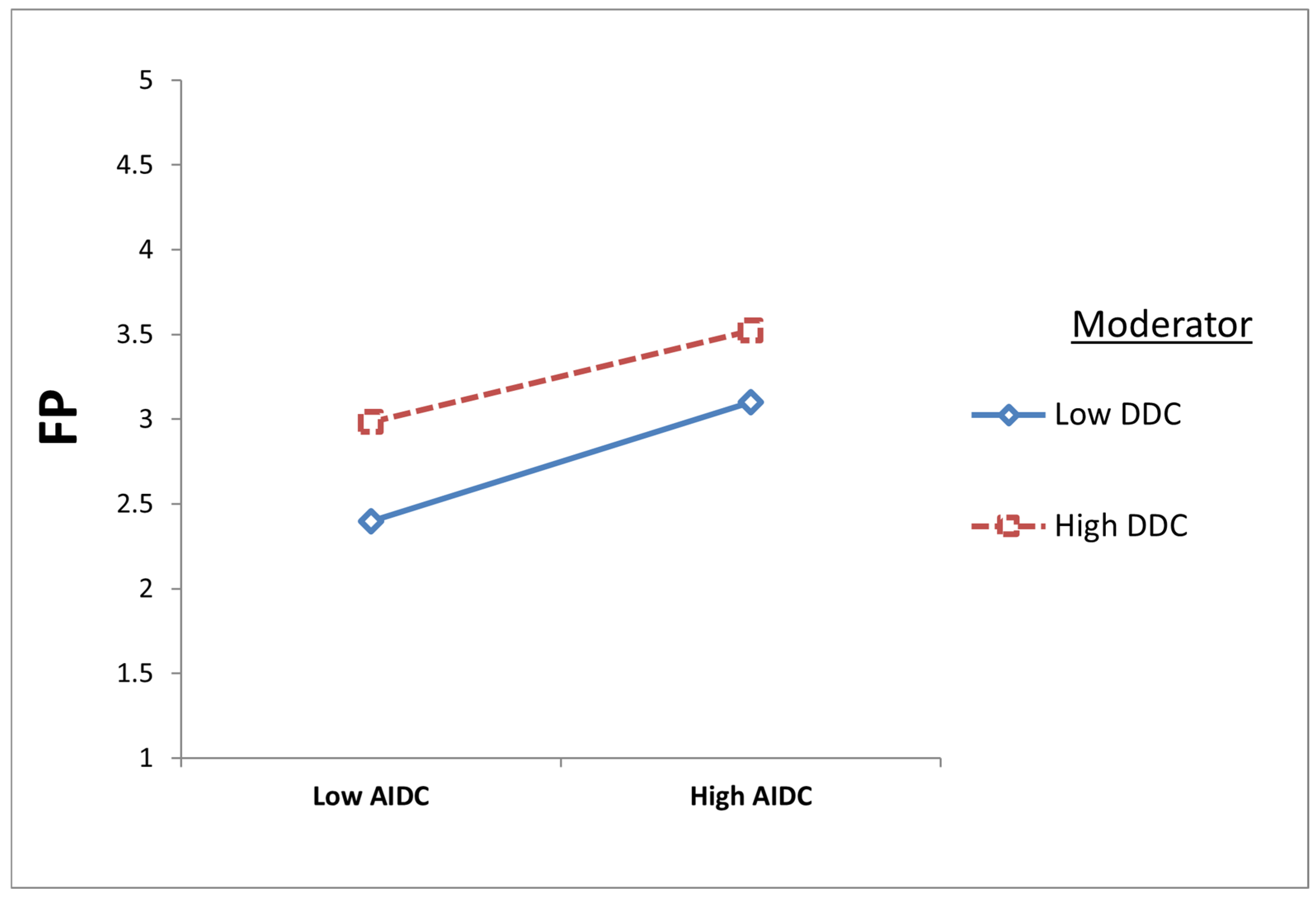
2.6. Moderating Role of Organizational Data-Driven Culture
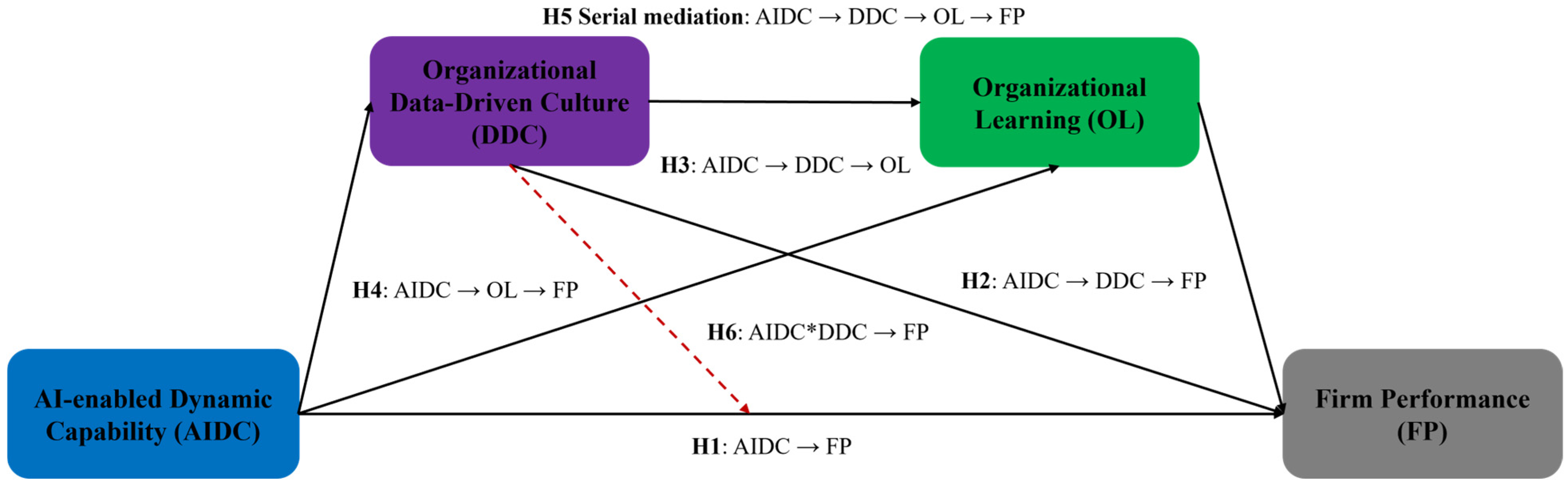
2.7. Conceptual Model
3. Methods
3.1. Research Design and Sample
3.2. Measures
3.3. Common Method Bias
3.4. Data Analysis Technique
4. Results
4.1. Measurement Model Assessment
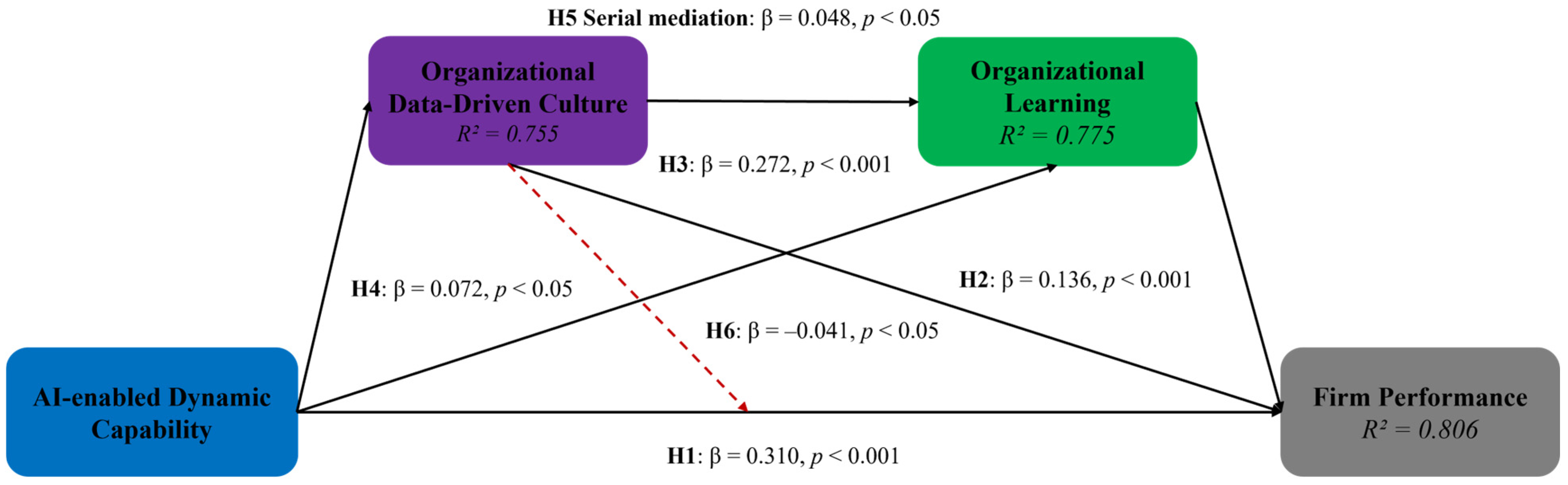
4.2. Structural Model Assessment
5. Discussion and Implications
5.1. Discussion of Findings
5.2. Theoretical Implications
5.3. Practical Implications
5.4. Limitations and Future Research Directions
Author Contributions
Funding
Institutional Review Board Statement
Informed Consent Statement
Data Availability Statement
Conflicts of Interest
Abbreviations
| AI | Artificial Intelligence |
| AIDC | AI-Enabled Dynamic Capability |
| DDC | Organizational Data-Driven Culture |
| OL | Organizational Learning |
| FP | Firm Performance |
| RBV | Resource-Based View |
| DCT | Dynamic Capabilities Theory |
| PLS-SEM | Partial Least Squares Structural Equation Modeling |
| ISIC | International Standard Industrial Classification |
| TMT | Top Management Team |
References
- Kalenyuk, I.; Riashchenko, V.; Uninets, I. Smart Marketing and Global Logistics Networks. Balt. J. Econ. Stud. 2024, 10, 113–122. [Google Scholar] [CrossRef]
- Chatterjee, S.; Chaudhuri, R.; Gupta, S.; Sivarajah, U.; Bag, S. Assessing the Impact of Big Data Analytics on Decision-Making Processes, Forecasting, and Performance of a Firm. Technol. Forecast. Soc. Change 2023, 196, 122824. [Google Scholar] [CrossRef]
- Mikalef, P.; Gupta, M. Artificial Intelligence Capability: Conceptualization, Measurement Calibration, and Empirical Study on Its Impact on Organizational Creativity and Firm Performance. Inf. Manag. 2021, 58, 103434. [Google Scholar] [CrossRef]
- Neiroukh, S.; Emeagwali, O.L.; Aljuhmani, H.Y. Artificial Intelligence Capability and Organizational Performance: Unraveling the Mediating Mechanisms of Decision-Making Processes. Manag. Decis. 2025, 63, 3501–3532. [Google Scholar] [CrossRef]
- Kuzmin, E.; Bondareva, V.S.; Shodiyev, A.; Ochilov, I. Digitalization, Innovation, and Competitiveness: Insights from a Cross-Country Analysis of Labor Productivity Effects. In Artificial Intelligence and Digital Transformation: From Innovation to Implementation; Tao, F., Gadekallu, T.R., Kumar, V., Akberdina, V., Kuzmin, E., Eds.; Springer Nature: Cham, Switzerland, 2025; pp. 307–329. ISBN 978-3-032-00118-4. [Google Scholar]
- Akter, S.; Hossain, M.A.; Sajib, S.; Sultana, S.; Rahman, M.; Vrontis, D.; McCarthy, G. A Framework for AI-Powered Service Innovation Capability: Review and Agenda for Future Research. Technovation 2023, 125, 102768. [Google Scholar] [CrossRef]
- Kindström, D.; Kowalkowski, C.; Sandberg, E. Enabling Service Innovation: A Dynamic Capabilities Approach. J. Bus. Res. 2013, 66, 1063–1073. [Google Scholar] [CrossRef]
- Sjödin, D.; Parida, V.; Kohtamäki, M. Artificial Intelligence Enabling Circular Business Model Innovation in Digital Servitization: Conceptualizing Dynamic Capabilities, AI Capacities, Business Models and Effects. Technol. Forecast. Soc. Change 2023, 197, 122903. [Google Scholar] [CrossRef]
- Aydiner, A.S.; Tatoglu, E.; Bayraktar, E.; Zaim, S. Information System Capabilities and Firm Performance: Opening the Black Box through Decision-Making Performance and Business-Process Performance. Int. J. Inf. Manag. 2019, 47, 168–182. [Google Scholar] [CrossRef]
- Dess, G.G.; Robinson, R.B. Measuring Organizational Performance in the Absence of Objective Measures: The Case of the Privately-Held Firm and Conglomerate Business Unit. Strateg. Manag. J. 1984, 5, 265–273. [Google Scholar] [CrossRef]
- Cheng, B.; Lin, H.; Kong, Y. Challenge or Hindrance? How and When Organizational Artificial Intelligence Adoption Influences Employee Job Crafting. J. Bus. Res. 2023, 164, 113987. [Google Scholar] [CrossRef]
- Hossain, S.; Fernando, M.; Akter, S. Digital Leadership: Towards a Dynamic Managerial Capability Perspective of Artificial Intelligence-Driven Leader Capabilities. J. Leadersh. Organ. Stud. 2025, 32, 189–208. [Google Scholar] [CrossRef]
- Ayoub, H.S.; Aljuhmani, H.Y. Artificial Intelligence Capabilities as a Catalyst for Enhanced Organizational Performance: The Importance of Cultivating a Data-Driven Culture. In Achieving Sustainable Business Through AI, Technology Education and Computer Science: Volume 2: Teaching Technology and Business Sustainability; Hamdan, A., Ed.; Springer Nature: Cham, Switzerland, 2024; pp. 345–356. ISBN 978-3-031-71213-5. [Google Scholar]
- Barney, J. Firm Resources and Sustained Competitive Advantage. J. Manag. 1991, 17, 99–120. [Google Scholar] [CrossRef]
- Teece, D.J.; Pisano, G.; Shuen, A. Dynamic Capabilities and Strategic Management. Strateg. Manag. J. 1997, 18, 509–533. [Google Scholar] [CrossRef]
- Mikalef, P.; Lemmer, K.; Schaefer, C.; Ylinen, M.; Fjørtoft, S.O.; Torvatn, H.Y.; Gupta, M.; Niehaves, B. Examining How AI Capabilities Can Foster Organizational Performance in Public Organizations. Gov. Inf. Q. 2023, 40, 101797. [Google Scholar] [CrossRef]
- Gupta, M.; George, J.F. Toward the Development of a Big Data Analytics Capability. Inf. Manag. 2016, 53, 1049–1064. [Google Scholar] [CrossRef]
- Miron-Spektor, E.; Gino, F.; Argote, L. Paradoxical Frames and Creative Sparks: Enhancing Individual Creativity through Conflict and Integration. Organ. Behav. Hum. Decis. Process. 2011, 116, 229–240. [Google Scholar] [CrossRef]
- Ao, J. Research on the Impact of Artificial Intelligence on Corporate Sustainability Performance and Its Mechanisms: An Empirical Analysis Based on Text Analysis. Discov. Artif. Intell. 2025, 5, 122. [Google Scholar] [CrossRef]
- Giang, N.P.; Loan, C.H.; Thi Tam, H. From Measurement to Impact: How Resource Efficiency Accounting Strengthens Corporate Environmental Performance and Social Responsibility. J. Open Innov. Technol. Mark. Complex. 2025, 11, 100636. [Google Scholar] [CrossRef]
- Billi, A.; Bernardo, A. The Effects of Digital Transformation, IT Innovation, and Sustainability Strategies on Firms’ Performances: An Empirical Study. Sustainability 2025, 17, 823. [Google Scholar] [CrossRef]
- Sanz-Valle, R.; Naranjo-Valencia, J.C.; Jiménez-Jiménez, D.; Perez-Caballero, L. Linking Organizational Learning with Technical Innovation and Organizational Culture. J. Knowl. Manag. 2011, 15, 997–1015. [Google Scholar] [CrossRef]
- Tabatabaei, S. A New Model for Evaluating the Impact of Organizational Culture Variables on the Success of Knowledge Management in Organizations Using the TOPSIS Multi-Criteria Algorithm: Case Study. Comput. Hum. Behav. Rep. 2024, 14, 100417. [Google Scholar] [CrossRef]
- Chatterjee, S.; Ghosh, S.K.; Chaudhuri, R. Knowledge Management in Improving Business Process: An Interpretative Framework for Successful Implementation of AI–CRM–KM System in Organizations. Bus. Process Manag. J. 2020, 26, 1261–1281. [Google Scholar] [CrossRef]
- Elragal, A.; Elgendy, N. A Data-Driven Decision-Making Readiness Assessment Model: The Case of a Swedish Food Manufacturer. Decis. Anal. J. 2024, 10, 100405. [Google Scholar] [CrossRef]
- Vafaei-Zadeh, A.; Madhuri, J.; Hanifah, H.; Thurasamy, R. The Interactive Effects of Capabilities and Data-Driven Culture on Sustained Competitive Advantage. IEEE Trans. Eng. Manag. 2024, 71, 8444–8458. [Google Scholar] [CrossRef]
- Wernerfelt, B. A Resource-Based View of the Firm. Strateg. Manag. J. 1984, 5, 171–180. [Google Scholar] [CrossRef]
- Dubey, R.; Bryde, D.J.; Blome, C.; Dwivedi, Y.K.; Childe, S.J.; Foropon, C. Alliances and Digital Transformation Are Crucial for Benefiting from Dynamic Supply Chain Capabilities during Times of Crisis: A Multi-Method Study. Int. J. Prod. Econ. 2024, 269, 109166. [Google Scholar] [CrossRef]
- Luo, T.; Qu, J.; Cheng, S. Digital Transformation, Dynamic Capability and Total Factor Productivity of Manufacturing Enterprises. Ind. Manag. Data Syst. 2025, 125, 921–944. [Google Scholar] [CrossRef]
- Sollosy, M. A Contemporary Examination of the Miles and Snow Strategic Typology Through the Lenses of Dynamic Capabilities and Ambidexterity. Doctoral Dissertation, Kennesaw State University, Kennesaw, GA, USA, 2013. [Google Scholar]
- Gupta, S.; Malhotra, N. Marketing Innovation: A Resource-based View of International and Local Firms. Mark. Intell. Plan. 2013, 31, 111–126. [Google Scholar] [CrossRef]
- Aldoseri, A.; Al-Khalifa, K.N.; Hamouda, A.M. AI-Powered Innovation in Digital Transformation: Key Pillars and Industry Impact. Sustainability 2024, 16, 1790. [Google Scholar] [CrossRef]
- Chen, H.; Li, L.; Chen, Y. Explore Success Factors That Impact Artificial Intelligence Adoption on Telecom Industry in China. J. Manag. Anal. 2021, 8, 36–68. [Google Scholar] [CrossRef]
- Mikalef, P.; Krogstie, J. Examining the Interplay between Big Data Analytics and Contextual Factors in Driving Process Innovation Capabilities. Eur. J. Inf. Syst. 2020, 29, 260–287. [Google Scholar] [CrossRef]
- Garrido-Moreno, A.; Martín-Rojas, R.; García-Morales, V.J. The Key Role of Innovation and Organizational Resilience in Improving Business Performance: A Mixed-Methods Approach. Int. J. Inf. Manag. 2024, 77, 102777. [Google Scholar] [CrossRef]
- Fosso Wamba, S.; Queiroz, M.M.; Pappas, I.O.; Sullivan, Y. Artificial Intelligence Capability and Firm Performance: A Sustainable Development Perspective by the Mediating Role of Data-Driven Culture. Inf. Syst. Front. 2024, 26, 2189–2203. [Google Scholar] [CrossRef]
- Raina, K.; Sharma, G.D.; Taheri, B.; Dev, D.; Chavriya, S. Artificial Intelligence-Driven Management: Bridging Innovation, Knowledge Creation, and Sustainable Business Practices. J. Innov. Knowl. 2026, 11, 100860. [Google Scholar] [CrossRef]
- Neiroukh, S.; Aljuhmani, H.Y.; Alnajdawi, S. In the Era of Emerging Technologies: Discovering the Impact of Artificial Intelligence Capabilities on Timely Decision-Making and Business Performance. In Proceedings of the 2024 ASU International Conference in Emerging Technologies for Sustainability and Intelligent Systems (ICETSIS), Manama, Bahrain, 28–29 January 2024; pp. 1–6. [Google Scholar]
- Gao, Y.; Liu, S.; Yang, L. Artificial Intelligence and Innovation Capability: A Dynamic Capabilities Perspective. Int. Rev. Econ. Financ. 2025, 98, 103923. [Google Scholar] [CrossRef]
- Chen, Y.; Liu, L.; Li, J.; Singh, S.K. AI-Driven Dynamic Capabilities in International Marketing: Framework, Gaps and Research Directions. Int. Mark. Rev. 2025, 1–30. [Google Scholar] [CrossRef]
- Mohapatra, H.; Mishra, S.R. Unlocking Insights: Exploring Data Analytics and AI Tool Performance Across Industries. In Data Analytics and Machine Learning: Navigating the Big Data Landscape; Singh, P., Mishra, A.R., Garg, P., Eds.; Springer Nature: Singapore, 2024; pp. 265–288. ISBN 978-981-97-0448-4. [Google Scholar]
- Wang, Y.; Xi, Y.; Liu, X.; Gan, Y. Exploring the Dual Potential of Artificial Intelligence-Generated Content in the Esthetic Reproduction and Sustainable Innovative Design of Ming-Style Furniture. Sustainability 2024, 16, 5173. [Google Scholar] [CrossRef]
- Barreto, L.S.; Freitas, V.; Freitas de Paula, V.A. Sustainable Supply Chain Innovation and Market Performance: The Role of Sensing and Innovation Capabilities. Clean. Responsible Consum. 2024, 14, 100199. [Google Scholar] [CrossRef]
- Okhota, Y.; Chikov, I.; Bilokinna, I. Conceptual Polycomponent Model of an Innovative Mechanism for Improving the Competitiveness of Agro-Industrial Complex Enterprises. Balt. J. Econ. Stud. 2024, 10, 196–210. [Google Scholar] [CrossRef]
- Kumar, V.; Ashraf, A.R.; Nadeem, W. AI-Powered Marketing: What, Where, and How? Int. J. Inf. Manag. 2024, 77, 102783. [Google Scholar] [CrossRef]
- Dwivedi, Y.K.; Hughes, L.; Ismagilova, E.; Aarts, G.; Coombs, C.; Crick, T.; Duan, Y.; Dwivedi, R.; Edwards, J.; Eirug, A.; et al. Artificial Intelligence (AI): Multidisciplinary Perspectives on Emerging Challenges, Opportunities, and Agenda for Research, Practice and Policy. Int. J. Inf. Manag. 2021, 57, 101994. [Google Scholar] [CrossRef]
- Tariq, A.; Khan, S.A.; But, W.H.; Javaid, A.; Shehryar, T. An IoT-Enabled Real-Time Dynamic Scheduler for Flexible Job Shop Scheduling (FJSS) in an Industry 4.0-Based Manufacturing Execution System (MES 4.0). IEEE Access 2024, 12, 49653–49666. [Google Scholar] [CrossRef]
- Wamba-Taguimdje, S.L.; Fosso Wamba, S.; Kala Kamdjoug, J.R.; Tchatchouang Wanko, C.E. Influence of Artificial Intelligence (AI) on Firm Performance: The Business Value of AI-Based Transformation Projects. Bus. Process Manag. J. 2020, 26, 1893–1924. [Google Scholar] [CrossRef]
- Lo, W.; Yang, C.-M.; Zhang, Q.; Li, M. Increased Productivity and Reduced Waste with Robotic Process Automation and Generative AI-Powered IoE Services. J. Web Eng. 2024, 23, 53–87. [Google Scholar] [CrossRef]
- Chatterjee, S.; Chaudhuri, R.; Vrontis, D. Does Data-Driven Culture Impact Innovation and Performance of a Firm? An Empirical Examination. Ann. Oper. Res. 2024, 333, 601–626. [Google Scholar] [CrossRef]
- Ghafoori, A.; Gupta, M.; Merhi, M.I.; Gupta, S.; Shore, A.P. Toward the Role of Organizational Culture in Data-Driven Digital Transformation. Int. J. Prod. Econ. 2024, 271, 109205. [Google Scholar] [CrossRef]
- Ngcobo, K.; Bhengu, S.; Mudau, A.; Thango, B.; Lerato, M. Enterprise Data Management: Types, Sources, and Real-Time Applications to Enhance Business Performance—A Systematic Review 2024. SSRN. pp. 1–66. Available online: https://papers.ssrn.com/sol3/papers.cfm?abstract_id=4968451 (accessed on 19 January 2026).
- Pitelis, C.N.; Teece, D.J.; Yang, H. Dynamic Capabilities and MNE Global Strategy: A Systematic Literature Review-Based Novel Conceptual Framework. J. Manag. Stud. 2024, 61, 3295–3326. [Google Scholar] [CrossRef]
- Gupta, K.; Mane, P.; Rajankar, O.S.; Bhowmik, M.; Jadhav, R.; Yadav, S.; Rawandale, S.; Chobe, S.V. Harnessing AI for Strategic Decision-Making and Business Performance Optimization. Int. J. Intell. Syst. Appl. Eng. 2023, 11, 893–912. [Google Scholar]
- Chen, D.; Esperança, J.P.; Wang, S. The Impact of Artificial Intelligence on Firm Performance: An Application of the Resource-Based View to e-Commerce Firms. Front. Psychol. 2022, 13, 884830. [Google Scholar] [CrossRef] [PubMed]
- Wong, D.T.W.; Ngai, E.W.T. The Effects of Analytics Capability and Sensing Capability on Operations Performance: The Moderating Role of Data-Driven Culture. Ann. Oper. Res. 2025, 350, 781–816. [Google Scholar] [CrossRef]
- Thanabalan, P.; Vafaei-Zadeh, A.; Hanifah, H.; Ramayah, T. Big Data Analytics Adoption in Manufacturing Companies: The Contingent Role of Data-Driven Culture. Inf. Syst. Front. 2025, 27, 1061–1087. [Google Scholar] [CrossRef]
- Awad, J.A.R.; Martín-Rojas, R. Digital Transformation Influence on Organisational Resilience through Organisational Learning and Innovation. J. Innov. Entrep. 2024, 13, 69. [Google Scholar] [CrossRef]
- Chiva, R.; Alegre, J. Emotional Intelligence and Job Satisfaction: The Role of Organizational Learning Capability. Pers. Rev. 2008, 37, 680–701. [Google Scholar] [CrossRef]
- Huang, L.; Wang, C.; Chin, T.; Huang, J.; Cheng, X. Technological Knowledge Coupling and Green Innovation in Manufacturing Firms: Moderating Roles of Mimetic Pressure and Environmental Identity. Int. J. Prod. Econ. 2022, 248, 108482. [Google Scholar] [CrossRef]
- Teece, D.J. Explicating Dynamic Capabilities: The Nature and Microfoundations of (Sustainable) Enterprise Performance. Strateg. Manag. J. 2007, 28, 1319–1350. [Google Scholar] [CrossRef]
- Gagné, M. From Strategy to Action: Transforming Organizational Goals into Organizational Behavior. Int. J. Manag. Rev. 2018, 20, S83–S104. [Google Scholar] [CrossRef]
- Haq, B.; Ali Jamshed, M.; Ali, K.; Kasi, B.; Arshad, S.; Khan Kasi, M.; Ali, I.; Shabbir, A.; Abbasi, Q.H.; Ur-Rehman, M. Tech-Driven Forest Conservation: Combating Deforestation With Internet of Things, Artificial Intelligence, and Remote Sensing. IEEE Internet Things J. 2024, 11, 24551–24568. [Google Scholar] [CrossRef]
- Teece, D.J. Dynamic Capabilities and Entrepreneurial Management in Large Organizations: Toward a Theory of the (Entrepreneurial) Firm. Eur. Econ. Rev. 2016, 86, 202–216. [Google Scholar] [CrossRef]
- Liu, Y.; Guo, M.; Han, Z.; Gavurova, B.; Bresciani, S.; Wang, T. Effects of Digital Orientation on Organizational Resilience: A Dynamic Capabilities Perspective. J. Manuf. Technol. Manag. 2023, 35, 268–290. [Google Scholar] [CrossRef]
- Asiri, A.M.; Al-Somali, S.A.; Maghrabi, R.O. The Integration of Sustainable Technology and Big Data Analytics in Saudi Arabian SMEs: A Path to Improved Business Performance. Sustainability 2024, 16, 3209. [Google Scholar] [CrossRef]
- Nwagwu, W.E. Mapping the Field of Global Research on Data Literacy: Key and Emerging Issues and the Library Connection. IFLA J. 2024, 50, 491–510. [Google Scholar] [CrossRef]
- Zong, Z.; Guan, Y. AI-Driven Intelligent Data Analytics and Predictive Analysis in Industry 4.0: Transforming Knowledge, Innovation, and Efficiency. J. Knowl. Econ. 2024, 16, 864–903. [Google Scholar] [CrossRef]
- Atobishi, T.; Moh’d Abu Bakir, S.; Nosratabadi, S. How Do Digital Capabilities Affect Organizational Performance in the Public Sector? The Mediating Role of the Organizational Agility. Adm. Sci. 2024, 14, 37. [Google Scholar] [CrossRef]
- Bharadwaj, A.S. A Resource-Based Perspective on Information Technology Capability and Firm Performance: An Empirical Investigation. MIS Q. 2000, 24, 169–196. [Google Scholar] [CrossRef]
- Li, L.; Tong, Y.; Liu, Y.; Yang, S. Artificial Intelligence-Enabled Customer Value Proposition Capability and Market Performance: The Moderating Role of Environmental Heterogeneity. IEEE Trans. Eng. Manag. 2024, 71, 5588–5599. [Google Scholar] [CrossRef]
- Basukie, J.; Wang, Y.; Li, S. Big Data Governance and Algorithmic Management in Sharing Economy Platforms: A Case of Ridesharing in Emerging Markets. Technol. Forecast. Soc. Change 2020, 161, 120310. [Google Scholar] [CrossRef]
- Pugna, I.B.; Duțescu, A.; Stănilă, O.G. Corporate Attitudes towards Big Data and Its Impact on Performance Management: A Qualitative Study. Sustainability 2019, 11, 684. [Google Scholar] [CrossRef]
- Zhao, G.; Xie, X.; Wang, Y.; Liu, S.; Jones, P.; Lopez, C. Barrier Analysis to Improve Big Data Analytics Capability of the Maritime Industry: A Mixed-Method Approach. Technol. Forecast. Soc. Change 2024, 203, 123345. [Google Scholar] [CrossRef]
- Joussen, T.P.; Quiel, J.; Schwaeke, J.; Kanbach, D.K.; Kraus, S. The Role of Artificial Intelligence in Entrepreneurial Decision-Making under Uncertainty: A Corporate Entrepreneurship Perspective. Int. J. Entrep. Behav. Res. 2025, 1–27. [Google Scholar] [CrossRef]
- van de Wetering, R. Artificial Intelligence as an Enabler of Dynamic Capabilities: A ‘Sense–Shape–Shift’ Perspective on Digital Transformation During Disruption. In Proceedings of the Pervasive Digital Services for People’s Well-Being, Inclusion and Sustainable Development; Achilleos, A., Forti, S., Papadopoulos, G.A., Pappas, I., Eds.; Springer Nature: Cham, Switzerland, 2026; pp. 248–262. [Google Scholar]
- Dillman, D.A.; Smyth, J.D.; Christian, L.M. Internet, Phone, Mail, and Mixed-Mode Surveys: The Tailored Design Method, 4th ed.; Wiley: Hoboken, NJ, USA, 2014; ISBN 978-1-118-45614-9. [Google Scholar]
- Hambrick, D.C.; Geletkanycz, M.A.; Fredrickson, J.W. Top Executive Commitment to the Status Quo: Some Tests of Its Determinants. Strateg. Manag. J. 1993, 14, 401–418. [Google Scholar] [CrossRef]
- Armstrong, J.S.; Overton, T.S. Estimating Nonresponse Bias in Mail Surveys. J. Mark. Res. 1977, 14, 396–402. [Google Scholar] [CrossRef]
- Tatoglu, E.; Bayraktar, E.; Golgeci, I.; Koh, S.C.L.; Demirbag, M.; Zaim, S. How Do Supply Chain Management and Information Systems Practices Influence Operational Performance? Evidence from Emerging Country SMEs. Int. J. Logist. Res. Appl. 2016, 19, 181–199. [Google Scholar] [CrossRef]
- Podsakoff, P.M.; MacKenzie, S.B.; Lee, J.-Y.; Podsakoff, N.P. Common Method Biases in Behavioral Research: A Critical Review of the Literature and Recommended Remedies. J. Appl. Psychol. 2003, 88, 879–903. [Google Scholar] [CrossRef]
- Chang, S.-J.; van Witteloostuijn, A.; Eden, L. From the Editors: Common Method Variance in International Business Research. J. Int. Bus. Stud. 2010, 41, 178–184. [Google Scholar] [CrossRef]
- Kock, N. Common Method Bias in PLS-SEM: A Full Collinearity Assessment Approach. IJeC 2015, 11, 1–10. [Google Scholar] [CrossRef]
- Hair, J.F.; Risher, J.J.; Sarstedt, M.; Ringle, C.M. When to Use and How to Report the Results of PLS-SEM. Eur. Bus. Rev. 2019, 31, 2–24. [Google Scholar] [CrossRef]
- Lindell, M.K.; Whitney, D.J. Accounting for Common Method Variance in Cross-Sectional Research Designs. J. Appl. Psychol. 2001, 86, 114–121. [Google Scholar] [CrossRef]
- Sarstedt, M.; Hair, J.F.; Cheah, J.-H.; Becker, J.-M.; Ringle, C.M. How to Specify, Estimate, and Validate Higher-Order Constructs in PLS-SEM. Australas. Mark. J. 2019, 27, 197–211. [Google Scholar] [CrossRef]
- Chin, W.; Cheah, J.-H.; Liu, Y.; Ting, H.; Lim, X.-J.; Cham, T.H. Demystifying the Role of Causal-Predictive Modeling Using Partial Least Squares Structural Equation Modeling in Information Systems Research. Ind. Manag. Data Syst. 2020, 120, 2161–2209. [Google Scholar] [CrossRef]
- Hair, J.; Hult, G.T.M.; Ringle, C.M.; Sarstedt, M. A Primer on Partial Least Squares Structural Equation Modeling, 3rd ed.; SAGE Publications, Inc.: Los Angeles, CA, USA, 2021; ISBN 978-1-5443-9640-8. [Google Scholar]
- Akter, S.; Fosso Wamba, S.; Dewan, S. Why PLS-SEM Is Suitable for Complex Modelling? An Empirical Illustration in Big Data Analytics Quality. Prod. Plan. Control 2017, 28, 1011–1021. [Google Scholar] [CrossRef]
- Hair, J.; Hollingsworth, C.L.; Randolph, A.B.; Chong, A.Y.L. An Updated and Expanded Assessment of PLS-SEM in Information Systems Research. Ind. Manag. Data Syst. 2017, 117, 442–458. [Google Scholar] [CrossRef]
- Becker, J.-M.; Klein, K.; Wetzels, M. Hierarchical Latent Variable Models in PLS-SEM: Guidelines for Using Reflective-Formative Type Models. Long Range Plan. 2012, 45, 359–394. [Google Scholar] [CrossRef]
- Fornell, C.; Larcker, D.F. Evaluating Structural Equation Models with Unobservable Variables and Measurement Error. J. Mark. Res. 1981, 18, 39–50. [Google Scholar] [CrossRef]
- Henseler, J.; Ringle, C.M.; Sarstedt, M. A New Criterion for Assessing Discriminant Validity in Variance-Based Structural Equation Modeling. J. Acad. Mark. Sci. 2015, 43, 115–135. [Google Scholar] [CrossRef]
- Cohen, J. Statistical Power Analysis for the Behavioral Sciences, 2nd ed.; Routledge: Hillsdale, NJ, USA, 1988; ISBN 978-0-8058-0283-2. [Google Scholar]
- Benitez, J.; Henseler, J.; Castillo, A.; Schuberth, F. How to Perform and Report an Impactful Analysis Using Partial Least Squares: Guidelines for Confirmatory and Explanatory IS Research. Inf. Manag. 2020, 57, 103168. [Google Scholar] [CrossRef]
- Shmueli, G.; Sarstedt, M.; Hair, J.F.; Cheah, J.-H.; Ting, H.; Vaithilingam, S.; Ringle, C.M. Predictive Model Assessment in PLS-SEM: Guidelines for Using PLSpredict. Eur. J. Mark. 2019, 53, 2322–2347. [Google Scholar] [CrossRef]
- Sabol, M.; Hair, J.; Cepeda, G.; Roldán, J.L.; Chong, A.Y.L. PLS-SEM in Information Systems: Seizing the Opportunity and Marching Ahead Full Speed to Adopt Methodological Updates. Ind. Manag. Data Syst. 2023, 123, 2997–3017. [Google Scholar] [CrossRef]
- Kassa, B.Y.; Worku, E.K. The Impact of Artificial Intelligence on Organizational Performance: The Mediating Role of Employee Productivity. J. Open Innov. Technol. Mark. Complex. 2025, 11, 100474. [Google Scholar] [CrossRef]
- Han, S.; Zhang, D.; Zhang, H.; Lin, S. Artificial Intelligence Technology, Organizational Learning Capability, and Corporate Innovation Performance: Evidence from Chinese Specialized, Refined, Unique, and Innovative Enterprises. Sustainability 2025, 17, 2510. [Google Scholar] [CrossRef]
- Szukits, Á.; Móricz, P. Towards Data-Driven Decision Making: The Role of Analytical Culture and Centralization Efforts. Rev. Manag. Sci. 2024, 18, 2849–2887. [Google Scholar] [CrossRef]



| Constructs | Items | Outer Loadings | VIF | CA | CR | AVE |
|---|---|---|---|---|---|---|
| AI-Enabled Dynamic Capability (AIDC) | ||||||
| Technical Skills (TSK) | 0.932 | 0.945 | 0.710 | |||
| TSK1 | 0.823 | 2.005 | ||||
| TSK2 | 0.840 | 2.044 | ||||
| TSK3 | 0.865 | 1.936 | ||||
| TSK4 | 0.833 | 1.682 | ||||
| TSK5 | 0.863 | 2.496 | ||||
| TSK6 | 0.825 | 2.983 | ||||
| TSK7 | 0.847 | 2.170 | ||||
| Business Skills (BSK) | 0.940 | 0.951 | 0.735 | |||
| BSK1 | 0.856 | 1.871 | ||||
| BSK2 | 0.842 | 1.981 | ||||
| BSK3 | 0.848 | 2.616 | ||||
| BSK4 | 0.850 | 2.299 | ||||
| BSK5 | 0.858 | 1.913 | ||||
| BSK6 | 0.877 | 2.104 | ||||
| BSK7 | 0.872 | 2.750 | ||||
| Inter-Departmental Coordination (IDC) | 0.891 | 0.915 | 0.605 | |||
| IDC1 | 0.787 | 2.659 | ||||
| IDC2 | 0.768 | 1.706 | ||||
| IDC3 | 0.765 | 1.931 | ||||
| IDC4 | 0.767 | 2.039 | ||||
| IDC5 | 0.801 | 2.266 | ||||
| IDC6 | 0.771 | 2.029 | ||||
| IDC7 | 0.783 | 1.605 | ||||
| Organizational Change Capacity (OCC) | 0.868 | 0.901 | 0.604 | |||
| OCC1 | 0.804 | 2.929 | ||||
| OCC2 | 0.710 | 2.888 | ||||
| OCC3 | 0.751 | 2.722 | ||||
| OCC4 | 0.799 | 1.883 | ||||
| OCC5 | 0.805 | 2.491 | ||||
| OCC6 | 0.790 | 2.132 | ||||
| Risk Proclivity (RP) | 0.829 | 0.897 | 0.745 | |||
| RP1 | 0.859 | 1.889 | ||||
| RP2 | 0.863 | 2.486 | ||||
| RP3 | 0.867 | 2.240 | ||||
| Data-Driven Culture (DDC) | 0.853 | 0.895 | 0.630 | |||
| DDC1 | 0.742 | 2.228 | ||||
| DDC2 | 0.793 | 2.583 | ||||
| DDC3 | 0.788 | 1.831 | ||||
| DDC4 | 0.820 | 1.782 | ||||
| DDC5 | 0.823 | 2.560 | ||||
| Organizational Learning (OL) | 0.838 | 0.892 | 0.673 | |||
| OL1 | 0.826 | 2.840 | ||||
| OL2 | 0.837 | 2.032 | ||||
| OL3 | 0.795 | 1.786 | ||||
| OL4 | 0.824 | 2.386 | ||||
| Operational Performance (OP) | 0.902 | 0.923 | 0.630 | |||
| OP1 | 0.791 | 2.012 | ||||
| OP2 | 0.802 | 2.639 | ||||
| OP3 | 0.827 | 2.719 | ||||
| OP4 | 0.810 | 2.114 | ||||
| OP5 | 0.730 | 1.958 | ||||
| OP6 | 0.776 | 2.522 | ||||
| OP7 | 0.818 | 2.978 | ||||
| Financial Performance (FP) | 0.935 | 0.944 | 0.607 | |||
| FP1 | 0.825 | 2.890 | ||||
| FP2 | 0.774 | 2.283 | ||||
| FP3 | 0.785 | 1.937 | ||||
| FP4 | 0.787 | 2.124 | ||||
| Constructs | 1 | 2 | 3 | 4 | 5 | 6 | 7 | 8 |
|---|---|---|---|---|---|---|---|---|
| 1. Business skills | 0 | |||||||
| 2. Data Driven Culture | 0.688 | 0 | ||||||
| 3. Financial performance | 0.524 | 0.653 | 0 | |||||
| 4. Inter-departmental Coordination | 0.607 | 0.480 | 0.580 | 0 | ||||
| 5. Organizational Change Capacity | 0.617 | 0.600 | 0.608 | 0.723 | 0 | |||
| 6. Organizational learning | 0.489 | 0.774 | 0.637 | 0.578 | 0.626 | 0 | ||
| 7. Operational Performance | 0.599 | 0.609 | 0.806 | 0.467 | 0.675 | 0.708 | 0 | |
| 8. Risk Proclivity | 0.601 | 0.431 | 0.614 | 0.546 | 0.777 | 0.609 | 0.599 | 0 |
| 9. Technical Skills | 0.735 | 0.582 | 0.519 | 0.679 | 0.680 | 0.568 | 0.506 | 0.707 |
| First-Order | Items | Weight | p-Values | VIF |
|---|---|---|---|---|
| Data Resources | DR1 | 0.157 | 0.008 | 1.874 |
| DR2 | 0.192 | 0.000 | 1.872 | |
| DR3 | 0.192 | 0.000 | 2.345 | |
| DR4 | 0.168 | 0.000 | 1.920 | |
| DR5 | 0.391 | 0.000 | 1.973 | |
| DR6 | 0.148 | 0.003 | 2.329 | |
| Technology Resources | TR1 | 0.172 | 0.000 | 2.354 |
| TR2 | 0.249 | 0.000 | 2.619 | |
| TR3 | 0.124 | 0.000 | 1.912 | |
| TR4 | 0.232 | 0.000 | 2.368 | |
| TR5 | 0.183 | 0.016 | 2.187 | |
| TR6 | 0.115 | 0.000 | 2.345 | |
| TR7 | 0.246 | 0.000 | 2.967 | |
| Basic Resources | BR1 | 0.355 | 0.000 | 1.968 |
| BR2 | 0.421 | 0.000 | 2.108 | |
| BR3 | 0.399 | 0.000 | 2.544 |
| Relationships | Path Coefficient | t-Statistics | CIs | p-Values | Decision | |
|---|---|---|---|---|---|---|
| 2.5% | 97.5% | |||||
| Direct Effect | ||||||
| AIDC → FP | 0.310 | 4.821 | [0.176, 0.427] | 0.000 | Accepted | |
| AIDC → DDC | 0.538 | 9.326 | [0.419, 0.647] | 0.000 | ||
| AIDC → OL | 0.411 | 7.629 | [0.308, 0.519] | 0.000 | ||
| DDC → OL | 0.506 | 9.087 | [0.396, 0.611] | 0.000 | ||
| DDC → FP | 0.252 | 4.310 | [0.139, 0.370] | 0.000 | ||
| OL → FP | 0.176 | 2.883 | [0.061, 0.301] | 0.004 | ||
| Indirect effect | ||||||
| AIDC → DDC → FP | 0.136 | 3.917 | [0.072, 0.207] | 0.000 | Accepted | |
| AIDC → DDC → OL | 0.272 | 6.622 | [0.200, 0.356] | 0.000 | Accepted | |
| AIDC → OL → FP | 0.072 | 2.547 | [0.024, 0.134] | 0.011 | Accepted | |
| Serial mediation effect | ||||||
| AIDC → DDC → OL → FP | 0.048 | 2.799 | [0.017, 0.083] | 0.005 | Accepted | |
| Interaction effect | ||||||
| AIDC × DDC → FP | −0.041 | 2.231 | [−0.078, −0.006] | 0.026 | Accepted | |
| Indicator | Predicted Q2 | RMSE (PLS-SEM) | MAE (PLS-SEM) | RMSE (LM) | MAE (LM) |
|---|---|---|---|---|---|
| FP1 | 0.438 | 0.627 | 0.498 | 0.650 | 0.504 |
| FP2 | 0.438 | 0.693 | 0.537 | 0.731 | 0.550 |
| FP3 | 0.458 | 0.652 | 0.519 | 0.707 | 0.550 |
| FP4 | 0.432 | 0.702 | 0.527 | 0.771 | 0.560 |
| OP1 | 0.440 | 0.719 | 0.543 | 0.767 | 0.554 |
| OP2 | 0.441 | 0.679 | 0.531 | 0.716 | 0.532 |
| OP3 | 0.465 | 0.666 | 0.521 | 0.696 | 0.530 |
| OP4 | 0.393 | 0.683 | 0.528 | 0.698 | 0.534 |
| OP5 | 0.297 | 0.831 | 0.647 | 0.869 | 0.680 |
| OP6 | 0.354 | 0.745 | 0.590 | 0.794 | 0.610 |
| OP7 | 0.423 | 0.698 | 0.544 | 0.732 | 0.555 |
Disclaimer/Publisher’s Note: The statements, opinions and data contained in all publications are solely those of the individual author(s) and contributor(s) and not of MDPI and/or the editor(s). MDPI and/or the editor(s) disclaim responsibility for any injury to people or property resulting from any ideas, methods, instructions or products referred to in the content. |
© 2026 by the authors. Licensee MDPI, Basel, Switzerland. This article is an open access article distributed under the terms and conditions of the Creative Commons Attribution (CC BY) license.
Share and Cite
Ayoub, H.S.; Sopuru, J.C. Reconfiguring Strategic Capabilities in the Digital Era: How AI-Enabled Dynamic Capability, Data-Driven Culture, and Organizational Learning Shape Firm Performance. Sustainability 2026, 18, 1157. https://doi.org/10.3390/su18031157
Ayoub HS, Sopuru JC. Reconfiguring Strategic Capabilities in the Digital Era: How AI-Enabled Dynamic Capability, Data-Driven Culture, and Organizational Learning Shape Firm Performance. Sustainability. 2026; 18(3):1157. https://doi.org/10.3390/su18031157
Chicago/Turabian StyleAyoub, Hassan Samih, and Joshua Chibuike Sopuru. 2026. "Reconfiguring Strategic Capabilities in the Digital Era: How AI-Enabled Dynamic Capability, Data-Driven Culture, and Organizational Learning Shape Firm Performance" Sustainability 18, no. 3: 1157. https://doi.org/10.3390/su18031157
APA StyleAyoub, H. S., & Sopuru, J. C. (2026). Reconfiguring Strategic Capabilities in the Digital Era: How AI-Enabled Dynamic Capability, Data-Driven Culture, and Organizational Learning Shape Firm Performance. Sustainability, 18(3), 1157. https://doi.org/10.3390/su18031157