Article

Assessing the Early Impact of InvestEU on Romanian SME Financial Performance

1
Doctoral School of Business Administration II, Faculty of Business Administration in Foreign Languages, Bucharest University of Economic Studies, 010731 Bucharest, Romania
2
Faculty of Business Administration in Foreign Languages, Bucharest University of Economic Studies, 010731 Bucharest, Romania
*
Author to whom correspondence should be addressed.
Sustainability 2026, 18(2), 982; https://doi.org/10.3390/su18020982 (registering DOI)
Submission received: 10 December 2025 / Revised: 12 January 2026 / Accepted: 14 January 2026 / Published: 18 January 2026
(This article belongs to the Section Economic and Business Aspects of Sustainability)

Abstract

This article examines how European funding enhances the financial performance of Romanian SMEs, a sector facing growing regulatory pressure, market volatility, and resource constraints. The study combines a thematic analysis of InvestEU indicators and national SME financing data (2021–2023) with a firm-level difference-in-differences model comparing InvestEU-funded SMEs to a matched control group over 2023–2024. The qualitative evidence shows that InvestEU operates at the EU level as a multidimensional policy instrument fostering competitiveness, social inclusion, and long-term economic and environmental development, while Romanian SMEs continue to rely predominantly on their own funds and national co-financing, a conservative pattern that ensures stability but limits access to external capital and transformative investments. Econometric results indicate that funded SMEs record, on average, higher turnover and net profit growth than comparable non-funded firms and confirm a strong positive association between firm size and financial performance; however, the interaction term capturing the specific InvestEU effect is positive but not statistically significant at the 95% confidence level. The findings suggest that InvestEU has the potential to act as a catalyst for structural change but also highlight the need for longer observation periods, larger samples, and more comprehensive development indicators to assess its medium-and long-term impact on SME competitiveness.

1. Introduction

According to the European Union SME Center, small and medium-sized enterprises (SMEs) constitute the backbone of the European economy, representing 99.8% of all enterprises, accounting for 63.1% of employment [1]. In 2024, they made a significant contribution in sectors such as retail, construction, transportation, and the automotive industry. However, some areas such as renewable energy, power intensive industries, electronics and textiles faced challenges, reporting negative growth rates ranging from −0.1% to −7.2% [1]. Despite this, SMEs remain an essential driver of real added value growth across various industrial ecosystems, reaffirming their central role in the economic development of the European Union.
As reported in the Annual report on European SMEs 2024/2025, in the case of Romania, 2024 has been marked by some of the highest growth rates in the EU [1]. The number of employees in SMEs has increased by values ranging from 2.8% to 6.2%, while the dynamic increase in the total number of enterprises, over 5% compared to the previous year, reflects an expanding entrepreneurial environment strongly influenced by digital transformation. This development underscores the capability of Romanian SMEs to rapidly adapt to new technologies and the demands of the digital economy, reinforcing their central role in employment and economic development [1].
However, these positive developments have taken place in a challenging economic context, marked by the prolonged effects of the COVID-19 pandemic and Russia’s aggressive war against Ukraine. These crises have generated strong inflationary pressures and heightened volatility in energy prices. Small and medium-sized enterprises have been directly affected by dramatic increases in energy costs, including record levels for natural gas, as well as by the widespread increase in production costs, which has significantly reduced profit margins.
In addition to these challenges, global inflation, driven by supply chain disruptions, geopolitical tensions and adjustments in monetary policy, has compelled SMEs to rapidly adapt to a constantly changing economic environment. They have faced rising production costs, a decrease in consumer purchasing power and intensified competition for resources. To support the business environment, the European Central Bank has lowered the monetary policy interest rate, a measure aimed at relaxing lending conditions and facilitating SMEs’ access to necessary financing for investment and economic growth. This support is critical for overcoming traditional barriers, especially for newly established firms or those in the process of expansion. Evidence on how such monetary policy measures affect SMEs’ financing constraints is provided by Finnegan and Kapoor, whose study “ECB Unconventional Monetary Policy and SME Access to Finance” demonstrates that accommodative monetary policy, including reductions in policy interest rates, has a measurable impact on the availability and cost of credit for SMEs ultimately shaping their capacity to obtain external financing and pursue growth opportunities [2].
Furthermore, SMEs are facing increased pressure to integrate sustainability strategies [3]. A challenge also lies in the difficult and costly process that requires resources and expertise that are often lacking in the transition. The smaller a business is, the more limited its resources are, making it more vulnerable to internal and external events, such as the departure of a key employee, reductions in financing options or a decline in demand following the emergence of a new competitor in the market [4].
In Romania, however, these challenges have manifested in the continued increase in tax arrears for SMEs, which, as indicated by National Bank of Romania, rose by 10% in June 2024, compared to 26% previously [5]. Small and medium-sized enterprises remain the primary contributors to these delays, accounting for over half of the total, which highlights the persistent pressures on liquidity and the financial difficulties they face. These liquidity shortages limit SMEs’ capacity to invest in productivity-enhancing and resilience-oriented measures. EU-backed credit facilities, which provide long-term funding on favorable terms, are also designed to address such market failures by mitigating credit risk and supporting liquidity-constrained firms. By gaining easier access to finance, firms can stabilize operations, meet fiscal obligations, and gradually invest in strategic modernization and enhance competitiveness.
In this context, SMEs are compelled to reassess their business models, optimize their operations and develop new strategies to mitigate the impact of external shocks and ensure their competitiveness in an extremely volatile and uncertain economic environment [6]. Moreover, they can no longer compete solely through economic efficiency but must do so through their ability to respond to climate risks, the stricter regulations of the European Union and the increasing demands of consumers; sustainability has thus becoming a strategic factor for long-term competitiveness [7].
This research paper examines how European financing instruments, particularly InvestEU, impact the economic performance of Romanian SMEs, with a particular emphasis on the role of EU-level funding mechanisms in shaping firms’ financing structures and investment capacity.
The research combines quantitative and qualitative approaches to examine the role of InvestEU funding in supporting Romanian SMEs. A Difference-in-Differences (DiD) analysis is employed to evaluate the causal impact of funding on key performance indicators, while a qualitative approach, supported by thematic analysis, explores how InvestEU policies translate into concrete opportunities for Romanian SMEs by providing access to favorable funding and support for sustainable and green business practices. This mixed approach offers insights into both measurable economic effects and the practical implications for SMEs and policymakers.
The remainder of this paper is organized as follows: the next section introduces the conceptual framework and the methodological aspects are clearly explained. In the next section the empirical findings and discussions are revealed. Finally, the paper concludes with a dedicated section that brings together its main contributions, acknowledges its limitations, and outlines directions for future research.

2. Theoretical Framework

2.1. Driven Growth and Financial Strategies for Competitive SMEs

In an increasingly innovation and competitiveness driven context, SMEs must identify efficient ways to improve their financial and operational performance while ensuring sustainable economic growth. Corporate social responsibility (CSR) has emerged as a strategic management approach that enables firms to integrate economic, social, and environmental objectives into their core business activities, thereby supporting sustainable development and long-term competitiveness [8]. It is essential for these enterprises to develop strategies based on the knowledge economy, to be flexible in adopting best practices, and to stimulate the generation, dissemination, and transformation of innovations into products, services, and processes that enhance their competitiveness and resilience in the market [9].
Innovative SMEs are recognized as essential elements of economic growth and industrial transformation and firms with high levels of innovation generally exhibit a strong orientation towards development. Empirical results show that a higher level of innovation contributes to improved financial performance, highlighting the importance of innovation directed at meeting customer needs [10]. At the same time, findings indicate that, for SMEs, the technological level utilized in the innovation process does not significantly influence financial performance [11]. Due to the lack of internal financial resources, a situation frequently encountered by young firms, the growth prospects of SMEs can only be realized through access to external financing, which enables them to invest in technology and develop the necessary capabilities to address economic and environmental challenges [12]. Access to external finance is also critical for the effective implementation of CSR strategies, as socially and environmentally responsible initiatives often require upfront investments whose benefits materialize over the long term [8]. Even when they possess sufficient internal resources, companies often prefer to turn to financial institutions to support innovative processes, thereby avoiding the liquidity constraints generated by using their own capital [13]. Despite these findings, for SMEs to transform innovation into economic and sustainable performance, access to financial instruments tailored to their needs has become essential [14]. EU support not only bolsters revenue growth but also facilitates the implementation of sustainable practices and green projects, which enhance long-term competitiveness and ease adaptation to new market requirements. Such funding mechanisms play a central role in the EU’s green transition agenda by incentivizing businesses to integrate environmental considerations into strategic decision-making and operational processes [15]. While prior studies have examined the effects of EU funding and financial instruments on SME innovation and performance in new member states [16], there is still a lack of firm-level, causal, and process-oriented evidence on how newly established EU funding programs affect the economic performance and sustainability integration of Romanian SMEs [17,18]-gap this paper seeks to address.
Hence, the competitiveness of enterprises depends on the size and diversity of investment projects and European funds represent an accessible source of financing that supports the initiation, expansion and improvement of these projects, making them essential for SMEs that recognize investments as fundamental elements of their development strategies. These SMEs are encouraged to develop green projects, innovate sustainably and penetrate emerging markets focused on sustainability, transforming compliance obligations into real competitive advantages. Previous papers demonstrate that SMEs which access funds achieve superior results compared to scenarios in which they do not benefit from these funds [16]. Furthermore, these firms have a higher likelihood of attracting additional financing from other sources, including private investments.
The role of the public sector is essential in supporting SMEs and facilitating their access to financial resources, with the aim of reducing the gaps relative to large enterprises. European and national policies should prioritize improving SMEs’ access to funding, considering that many of them cannot rely on traditional sources. Public support for SMEs, both at the EU level and nationally, must be tailored to meet the specific needs of each company, considering size, age, sector of activity and region, as well as their diversity and potential not only to survive in the market, but also to expand their operations [19].
The essential role of the public sector in facilitating access for SMEs to financing, using financial instruments, has been highlighted in previous research papers [19]. In most countries, private banks are also involved in this mechanism, having a decisive role in the design and implementation of debt—or loan-based financing instruments. Researchers raise the question of who exerts dominant influence in this area, the public sector or banking institutions, emphasizing that this issue remains open and requires a more detailed academic analysis [20].
In the case of Romania, the banking sector, although concentrated around a few major institutions such as: Banca Transilvania, ING Bank, UniCredit and BCR, offers lending products in partnership with various European funding programs. Certain SMEs are not eligible for financing through debt, either due to a lack of guarantees, insufficient cash flows, the need for longer repayment periods for investments and capital expenditures or due to other barriers related to debt servicing, such as irregular cash flow generation. These constraints further highlight the importance of public-backed financial instruments in enabling SMEs to adopt CSR and ESG practices that support sustainable growth [8]. Thus, the expansion and enhancement of these instruments could have a significant impact on supporting companies with the greatest potential for growth and job creation [21]. In this context, existing studies show that absorptive capacity reflects the firms’ ability to adopt innovation and plays a crucial role in effective corporate governance, facilitating the optimal implementation of Environment Social, and Governance practices [22]. The research particularly highlights the size, diversity, and independence of the board of directors as key factors in these capabilities [22].
SMEs in Romania benefit from funding opportunities through various European programs aimed at supporting their development and innovation. Studies indicate that the effects of European funding vary depending on the level of innovation and economic development of each country: in less developed economies, both national public programs and those of the European Union generate lower economic additionality furthermore, inefficiencies in fund utilization are particularly observed in member states that have recently joined the EU [23]. These findings underscore the importance of implementing programs tailored to the local context, providing Romanian SMEs with a framework for access to financing that enables them to grow, innovate, and strengthen their competitiveness. Investment opportunities are accompanied by collaborative interventions between funders and entrepreneurs, which can bring significant advantages to expanding companies. Firms are not only attracted by access to new forms of financing, such as grants or subsidies, but also by the potential for holistic support through mentoring programs and/or the organization of networking activities [24].
Based on the general context presented earlier, regarding the importance of funding for SMEs, the impact of various European programs and the necessity of an efficient public policy tailored to local characteristics, a concrete example of an instrument designed to support high-growth potential enterprises is highlighted: the InvestEU program. The program is aligned with the EU’s green transition agenda, supporting investments that enhance environmental performance, innovation capacity, and long-term economic resilience of SMEs [25]. This program was specifically selected as the focal point of this study because it is considered by numerous researchers and institutions to be a central pillar of the Union’s post-pandemic recovery and green–digital transition [26,27,28]. Furthermore, this program was selected owing to the authors’ access to proprietary internal data associated with it. This represents a key mechanism through which the European Investment Fund (EIF) facilitates access to financing for SMEs, offering financial instruments and guarantees that reduce risks and stimulate strategic investments. The InvestEU data provide the necessary foundation for assessing the impact of the program, allowing for the measurement of its contribution to sustainable development goals and the modernization of the European economy. Although the InvestEU program is not exclusively dedicated to small and medium-sized enterprises, but instead supports a wide range of beneficiaries, from start-ups and large companies to social organizations, public institutions, and financial intermediaries, this analysis focuses on how the European funding mechanisms are strategically integrated into the business operations of Romanian SMEs to enhance financial performance amid growing regulatory pressures and resource constraints. The financial support granted under InvestEU is characterized by a strong alignment with the strategic objectives of the European Union, prioritizing green and digital transitions, enhancing competitiveness and innovation capacity, as well as promoting social inclusion and economic resilience.

2.2. Supporting Romanian SMEs Through InvestEU Program

The InvestEU program, launched in 2021 and active until 2027, brings together the EU’s financial instruments into a single framework, simplifying and streamlining the financing of investment projects across Europe. The program targets strategic priorities such as the European Green Deal, digital transformation, and a fair social Europe, allocating at least 30% of funds to climate objectives and up to 60% to resilient infrastructure. Thus, InvestEU supports sustainable investments across all sectors of the economy and promotes best practices in both the public and private sectors [29].
For SMEs in Romania, InvestEU provides a major opportunity to access favorable financing for green projects and responsible business models, contributing to the green transition and the development of a resilient and enduring economy. The InvestEU Guarantee Mechanism allows financial institutions that are partners of the European Investment Fund (EIF) to offer loans with reduced interest rates, lower collateral requirements and smaller down payments, facilitating long-term loans and higher financing volumes, including for start-ups and SMEs with limited access to credit. Non-repayable grants can be combined with bank loans and equity, leveraging traditional financing mechanisms [19]. In Romania, the program is implemented through an uncapped direct guarantee mechanism amounting to 672 million EUR, structured around two main pillars: the Sustainability Guarantee and the SME Competitiveness Guarantee [30]. The sustainability component of the InvestEU program supports green projects and the ecological transition, targeting companies with European certifications or awards, emissions/consumption reductions, the use of recycled materials and technological innovations. The targeted areas include renewable energy, energy efficiency, green mobility, resilient Information and Communications Technology, circular economy, water, nature and modern agriculture.
The implementation of the program in Romania is based on collaboration between the Government of Romania, the European Commission, the European Investment Fund, and the local banking sector. The experience gained through the Initiative for SMEs in 2016 has facilitated the success of InvestEU, and Marjut Falkstedt, CEO of the EIF, emphasized that agreements between Romania and the EIF will enhance SMEs’ access to financing, supporting economic growth, competitiveness, and the green transition [31]. The financing conditions offered by InvestEU include a guarantee of up to 70% applicable at the national level (including Bucharest/Ilfov), access to financing in RON or EUR, a maximum limit of 7.5 million EUR per client and loans with a minimum duration of 12 months.
InvestEU is not limited to financing individual projects. The program contributes to the development of a dynamic entrepreneurial ecosystem, in which SMEs are encouraged to integrate sustainability and innovation directly into their business strategies, generating both economic advantages and social and environmental benefits. Furthermore, access to guarantees and long-term loans enables companies to develop and implement high-impact projects without compromising liquidity or financial stability, thereby increasing their capacity to respond swiftly to market changes and climate challenges. InvestEU also facilitates the creation of networks and collaborations between SMEs, financial institutions, and public authorities, providing opportunities for mentoring, sharing best practices, and professional networking. This collaborative dimension contributes to strengthening the Romanian entrepreneurial ecosystem and enhances the efficiency of investments, enabling SMEs to access financial resources and knowledge that would otherwise be difficult to obtain.

3. Data and Methods

This research analyzes the impact of the InvestEU program on Romanian SMEs, using a mixed approach that combines quantitative and qualitative methods. As part of the quantitative analysis, the Difference-in-Differences (DiD) method is used to evaluate the causal effects of InvestEU support on key performance indicators such as turnover, profit, and number of employees [32,33]. In support of the analysis, graphs and diagrams are utilized to highlight trends and to perform statistical comparisons. The visual observations of data variations enable a clear understanding of the evolution of indicators, both at national and European levels. The analysis assumes that the data provided by the official EU databases are consistent and accurate among member states, although there may be variations in reporting standards. Official sources ensure the integrity and objectivity of the information, thereby enhancing the reliability of the obtained results. The logic of DiD is well illustrated through an example with two groups and two periods: in the first period, neither group receives the treatment, while in the second period, only one of the groups is exposed to the intervention [34]. The intervention is considered effective if the differences in outcomes between the treated group and the control group are significant. The method is widely used in economics to evaluate the effects of reforms, programs, and public policies, including areas such as minimum wage, taxation, transportation policies or subsidy programs [35,36,37,38]. A possible issue in the use of DiD models is that treatment and control groups may exhibit differences that influence their evolution over time or may undergo changes in composition during the analyzed period. Thus, selection biases may arise, either temporally (due to changes in group structure) or between groups (due to initial differences) [39].
This research aims to provide a rigorous assessment of the impact of the InvestEU program on Romanian SMEs through the Difference-in-Differences (DiD) method, combined with qualitative analysis, specifically, thematic analysis. The approach allows for the isolation of causal effects on economic performance and seeks to ensure that the estimates obtained faithfully reflect the real impact of the intervention, thereby enhancing the validity and reliability of the results.
Thematic analysis is included to systematically examine and interpret official InvestEU documents and indicators, providing contextual evidence on the program’s scale, sectoral focus, and macroeconomic relevance in Romania that complements and helps explain the firm-level DiD results. Thematic analysis represents one of the most used analyses for “identification of recurring patterns that are presented by researchers as overarching statements or themes” [40]. The NVivo 15 software provides researchers with tools to independently and methodically manage, analyze, and visualize qualitative information and documentation [41].
In the current analysis, DiD compares changes in outcome variables before and after the implementation of the InvestEU program between the treatment group (fund beneficiaries) and the control group (unfunded companies). This allows for the isolation of treatment effect on the performance of companies. Two binary variables are defined within the context of the study: Treatment ( T g ) = 1 for firms that benefited from InvestEU funding and 0 for control firms. Moment ( P t ) = 0 for the reference year 2023 and 1 for the post-intervention period of 2024. The variable of interest is the interaction T r e a t m e n t   X   M o m e n t , which takes the value of 1 only for treatment firms during the post-intervention period and allows for the estimation of the net effect of funding on company outcomes.
Within this framework, the potential outcome in the absence of treatment can be expressed as follows:
Y g t 0 = β 0 + β 1 T r e a t m e n t g + β 2 M o m e n t t + ε g t
And the observed outcome is given by
Y g t = β 0 + β 1 T r e a t m e n t g + β 2 M o m e n t t + β 3 T r e a t m e n t g   X   M o m e n t t +   β 4 E m p l o y e e s g t + ε g t
where:
  • Y g t —Firm performance indicator (turnover, net profit or number of employees) for firm g in year t.
  • T r e a t m e n t g —Treatment dummy; equals 1 if firm g received InvestEU funding (treated SME) and 0 if firm g belongs to the matched control group (non-funded SME).
  • M o m e n t g —Time dummy; equals 0 for the pre-intervention year 2023 and 1 for the post-intervention year 2024.
  • T r e a t m e n t g X M o m e n t t —Interaction term between treatment status and time.
  • E m p l o y e e s g t —no of employees.
  • β 0 —Intercept.
  • β 1 —Regression coefficient associated with T r e a t m e n t g .
  • β 2 —Regression coefficient associated with M o m e n t t .
  • β 3 —Regression coefficient associated with the interaction term T r e a t m e n t g   X   M o m e n t t .
  • β 4 —Regression coefficient associated with employees.
  • ε g t —Error term.
The coefficient β 3 captures the causal effect of the InvestEU program on firm performance, conditioned on the validity of the parallel trends assumption.
A non-probability purposive sampling technique was used, to allow for selection of companies that are relevant for the main hypothesis [42]. The analyzed sample consists of 40 active SMEs in Romania, observed over two consecutive years (2023 and 2024), resulting in a total of 80 firm-year observations, in a context where Romania’s effective participation in InvestEU began in 2022 and comparable post-intervention data are available only from 2023 onward ( u n i t s   o f   a n a l y s i s : f i r m   X   y e a r ) . Out of these 40 companies, 20 have received funding through the InvestEU program, while the other 20 have not received any funding. The inclusion criteria for selecting these 20 companies into the analysis were to have complete financial and operational data and not to have benefited from other major forms of public financial support, except for the InvestEU program for the treatment group. Furthermore, 20 companies with similar characteristics in terms of dimension and employees were selected for the analysis. For the construction of these groups, the nearest neighbor matching method was used, with the number of employees as the main criterion for comparability. The temporal size was captured through the variable Moment (0 = 2023, 1 = 2024) and the net effect of funding was estimated through the interaction term T r e a t m e n t   X   M o m e n t . The observation period is limited to two years, as data are available starting from 2023, following the approval of the relevant legislation in Romania.
The analysis uses a matched panel of 40 SMEs observed over 2023–2024, reflecting the current availability of comparable post-intervention data and restricted access to program-linked firm information. The DiD framework provides an early estimate of InvestEU-associated performance differences. Given the sample size, we emphasize effect magnitudes and uncertainty bounds alongside conventional significance metrics. The matched treated-control design strengthens comparability and supports credible within-sample inference. Accordingly, the findings are presented as indicative for Romanian SMEs comparable to those in the matched sample, particularly in terms of size profile and access to bank-intermediated InvestEU-supported financing rather than as population-wide estimates. We use these results to motivate future extensions based on longer panels and broader coverage, enabling more precise estimation and a more comprehensive assessment of InvestEU’s effects. Thus, based on the foregoing panel data the following hypotheses were tested:
Hypothesis (H0):
Romanian SMEs that receive InvestEU funding did not a record higher growth in turnover, net profit and number of employees between 2023 and 2024 than comparable non-funded SMEs, i.e., β 3 = 0 .
Hypothesis (H1):
Romanian SMEs that receive InvestEU funding recorded a higher growth in turnover, net profit and number of employees between 2023 and 2024 than comparable non-funded SMEs, i.e., β 3 > 0 .

4. Results

4.1. Analysis of InvestEU Potential for Strategic Growth

Based on the data and information extracted, thematic analysis was applied to official documents provided by the European Commission, Invest EU official website and documents and the National Romanian Institute of Statistics. The analysis was conducted using the Braun & Clarke (2006) methodology of applying thematic analysis [43]. The content of these official documents in the form of reports was examined using NVivo 15 software. Based on this software, two themes were created: the first one refers to InvestEU as a Driver of Sustainable and Inclusive Growth and the second one to Dominance Funds and the Contingent Effect of InvestEU on Romanian SMEs. For each theme, a series of codes were generated which represent specific aspects or dimensions of the program. For the first theme, 8 codes were generated and for the second theme, 9 codes were generated and for each one of them specific number of references as described in Figure 1.
The first theme, groups codes related to job creation, digitalization and industrial modernization, green transition, social inclusion, sectoral diversification and strategic investments, each appearing in several distinct passages, which shows the multidimensional role of InvestEU at EU level. The second theme brings together codes on the predominant use of own funds, dependence on the Member State Compartment, limited use of loans and external capital, sectoral differences, and the need for diversification of funding sources, institutional capacity and high value-added investments. The number of references attached to each code reflects how frequently these ideas recur in the text, indicating both the consistency of the conservative financing pattern of Romanian SMEs and the conditional, policy-dependent impact of InvestEU in supporting their sustainable transformation. As shown in Figure 1, InvestEU is most frequently associated with a cluster of sustainability-relevant priorities: green transition and climate neutrality, modernization/digitalization, and employment and social cohesion indicating that these objectives are central in the program’s official narrative. At the same time, the prominence of codes related to funding structure and SME financing behavior under the second theme suggests that the program’s impact is not only policy-driven but also conditional on national implementation arrangements and firms’ willingness and ability to leverage external capital. Together, these findings reveal both the program’s strategic intent and the key transmission conditions shaping firm-level outcomes.
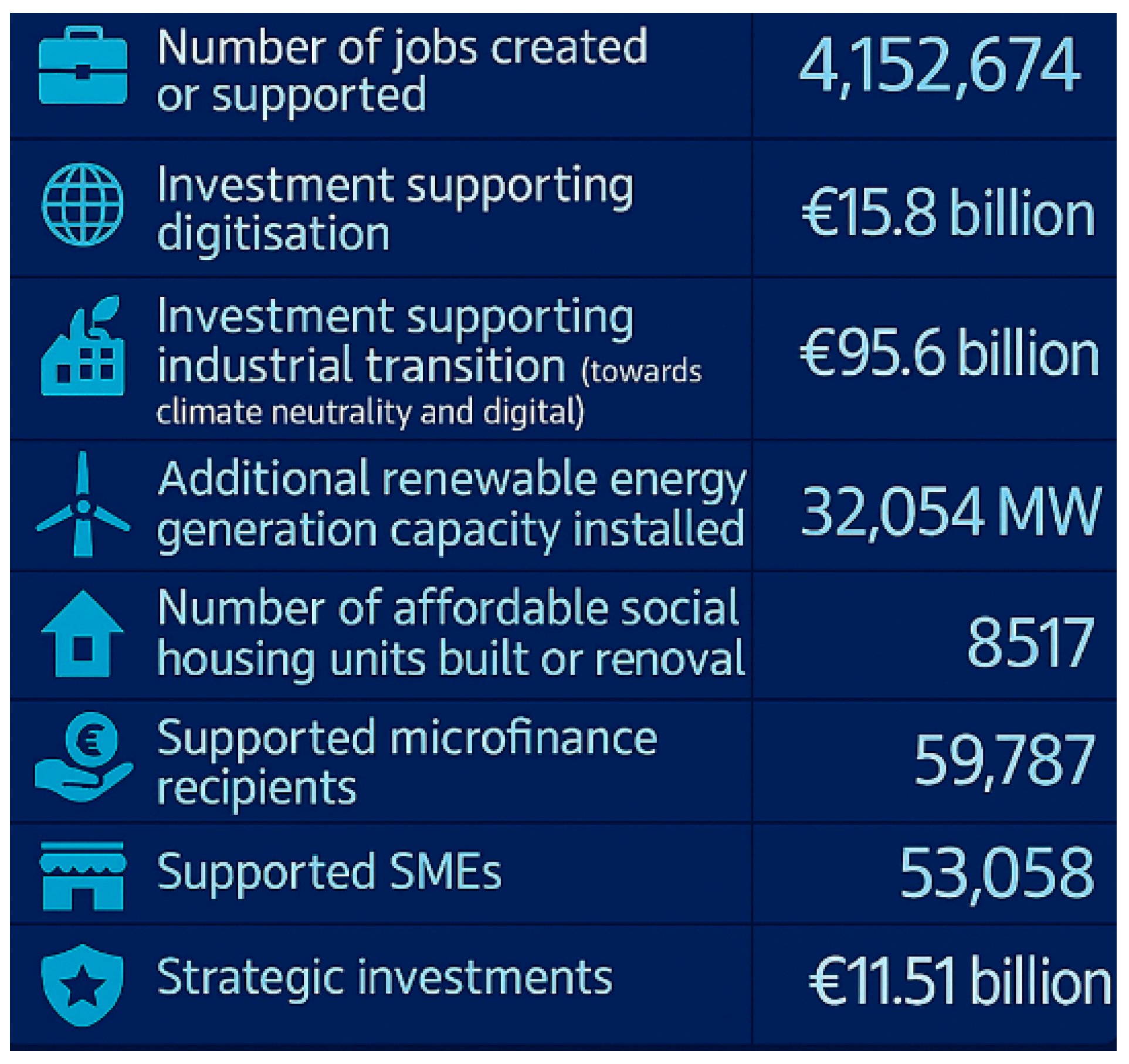
The data from Figure 2, reported at the European level as of December 2024, highlights the complex impact of InvestEU, which goes beyond mere fund allocation and provides a strategic framework for sustainable development.
A primary indicator is the creation and maintenance of over 4.1 million jobs, demonstrating the social dimension of the program. Through the financial support provided, InvestEU stimulates competitiveness, contributes to the strengthening of human capital and reduces vulnerabilities in the labor market.
Investments directed towards digitization (€15.8 billion) and industrial transition (€95.6 billion) reflect the strategic priorities of the European Union and support the modernization of production processes and integration into competitive value chains. The ecological dimension of the program, highlighted by the installation of 32,054 MW of additional renewable energy capacity, marks an important step towards climate neutrality and creates opportunities for green technologies and energy services.
The social impact of InvestEU is manifested through the support of microfinancing (59,787 beneficiaries) and the construction or renovation of 8517 social housing units, contributing to social inclusion and the reduction in economic disparities.
At a structural level, the program has directly supported over 53,000 economic entities, strengthening their role in the development of the European economy. Furthermore, the strategic investments of €11.51 billion in critical infrastructure, cybersecurity, space and defense underscore the multidimensional nature of the InvestEU program. Thus, InvestEU not only mobilizes capital, but also outlines an integrated strategy in which economic competitiveness, sustainability and social inclusion mutually support each other.
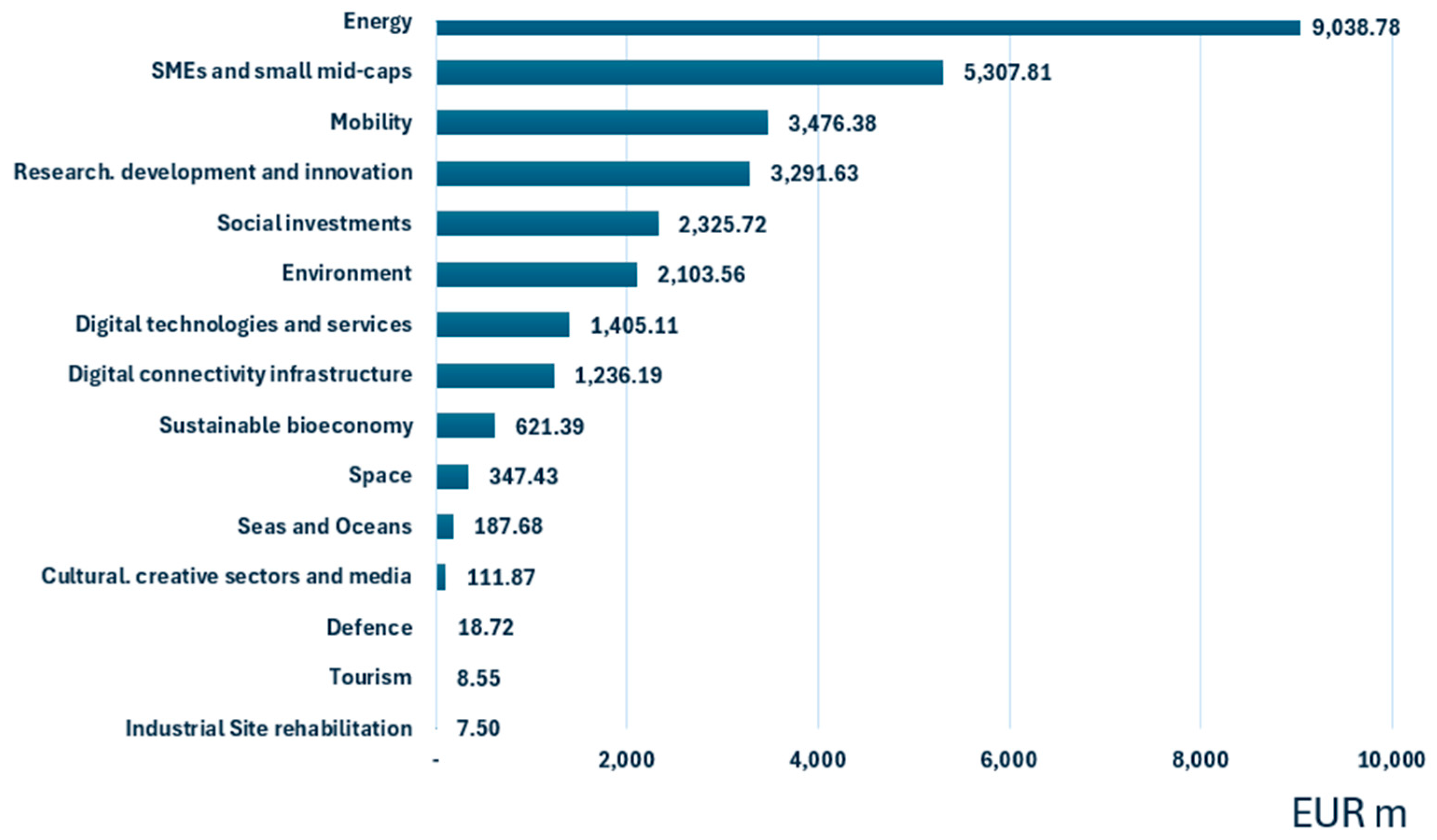
Figure 3 illustrates how European funds, through the InvestEU program, are directed towards sectors with the greatest transformative impact on the European economy. Energy dominates allocations, with over 9 billion euros, clearly reflecting the priority of the green transition and the goal of climate neutrality. SMEs and mid-cap companies follow with 5.3 billion euros, confirming their central role in boosting competitiveness, innovation, and economic resilience. The fields of mobility and research-development, each with over 3 billion euros, demonstrate support for modern infrastructure and technological advancement.
Investments in sectors such as social, environmental, and digital (ranging from 1.2 to 2.3 billion euros) highlight the commitment to inclusion and sustainability, while tourism and the rehabilitation of industrial sites, with allocations of less than 10 million euros, are at the periphery of InvestEU priorities, likely receiving more consistent funding through other European programs.
This distribution of funds highlights the catalytic nature of InvestEU: through the diversity of eligible sectors, the program supports the energy transition, strengthens SMEs and contributes to the modernization of the European economy.
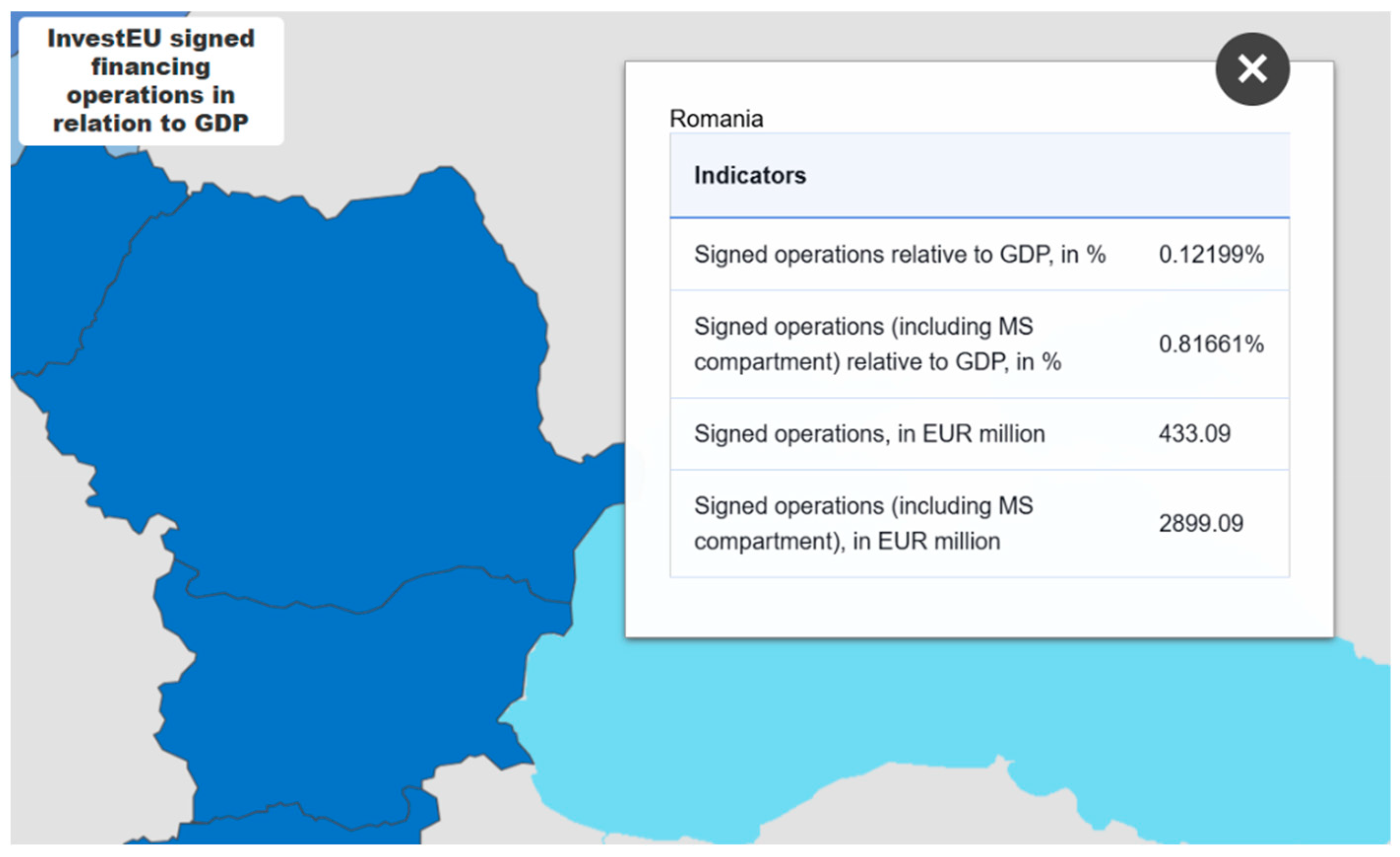
The data presented in Figure 4 indicates that the implementation of InvestEU in Romania is overwhelmingly reliant on the Member States compartment, highlighting a strong dependence on national co-financing. While the general component of the program has signed financing agreements amounting to 433.09 million euros (0.12% of GDP), the total volume rises to 2899.09 million euros (0.82% of GDP) with the involvement of Member States. Consequently, approximately 85% of the resources are generated through the combination of the European guarantee and Romania’s contribution.
This structure has direct implications for SMEs. On one hand, it provides strategic flexibility; funding can be tailored to national priorities, including business modernization. In contrast, it highlights a reduced capacity to attract exclusive resources at the European level, which may limit SMEs’ direct access to non-repayable funding or more favorable conditions. In this regard, Romania faces a dual risk: on one hand, the risk of excessive dependence on internal resources, and, on the other hand, the underutilization of competitive European opportunities.
From the perspective of long-term development and resilience, InvestEU acts as a catalyst: by combining European and national resources, SMEs can access low-risk loans and finance projects related to energy efficiency, circular economy, digital transformation, among other strategic priorities. Thus, the program becomes not only a source of capital, but also a mechanism for strategically directing investments towards long-term economic, environmental, and social objectives. However, for this potential to be fully realized, an active policy to integrate sustainability criteria into the selection of funded projects is necessary, so that national co-financing does not merely maintain the economic status quo but is directed towards structural transformation.
For the impact of InvestEU to be fully realized, it is essential that public policies encourage SMEs to utilize this mechanism not only for working capital, but, more importantly, for high value-added investments. Furthermore, it would be necessary to strengthen the institutional and financial capacity of SMEs through training, technical assistance, and the development of hybrid financial instruments (blended finance) that reduce access barriers and stimulate innovative investments. Additionally, partnerships among financial institutions, the state and the private sector can amplify the leveraging effects of InvestEU, transforming it into a strategic tool for repositioning Romanian SMEs on a path toward competitive development.
The data presented in Table 1 highlights a predominant self-financing model for the funding sources of net investments made, with notable variations across sectors. This pronounced dependence on internal capital reflects a conservative approach oriented towards self-financing and financial autonomy, but it also indicates limitations regarding access to external capital sources.
Own funds represent the main source of financing in each sector and year, consistently exceeding 88% of total net investments. The Construction sector exhibits the highest dependence on internal resources (94.31–94.93%), indicating a minimal level of indebtedness and a high degree of confidence in self-financing. The Industry sector shows the lowest proportion of own funds (88–89%), suggesting a more flexible financial strategy and openness to loans. Trade and Services follow a similar pattern, with predominant own funds (approximately 91–94%) and minimal variations between years.
Bank loans constitute the second source of financing, albeit with much lower weights than equity capital. The Industry sector utilizes loans more intensively (10.06% in 2023), which reflects greater capital investment or a strategy for optimizing the financial structure. The Construction and Services sectors maintain a low and stable use of loans, while the Trade sector records intermediate values (6.27–7.71%).
Both budget subsidies and foreign capital play a minor role, generally accounting for less than 1%. In the Industry and Services sectors, a slight increase in foreign capital can be observed in 2023 (0.43% and 0.31%, respectively), but these figures do not represent strategic sources of financing. In the Construction and Trade sectors, these sources remain insignificant, confirming a predominant reliance on own funds.
The data suggests that Romanian SMEs adopt a conservative financing model for net investments, predominantly based on their own funds, which grants financial autonomy and self-financing capacity, but limits access to external sources. However, European financing mechanisms, which include covenant packages and guidance programs for the implementation of EU-engaged policies, enable SMEs to pursue responsible development to align with current trends.
The industrial sector is distinguished by a more intensive use of bank credit, indicating greater flexibility in its capital structure.
The marginal role of subsidies and foreign capital highlights the underutilization of public and European funds and the need for proactive policies to facilitate access to external financing and non-repayable programs.

4.2. Funding Effect on Turnover with DiD

To validate the applicability of the DiD model, the parallel trends hypothesis was tested by comparing the evolution of revenue and net income during the pre-intervention period. The results indicated that the two groups followed similar trajectories, thereby supporting the validity of the analytical framework.
The data collected on turnover, net profit, and number of employees were taken directly from the financial statements submitted to the Ministry of Finance, supplemented by financial reporting platforms (e.g., Termene.ro, Confidas), without additional transformations, to maintain the economic interpretability of the results. Other control variables (e.g., sector of activity, region) were not included, as the small sample size could have led to model over-specification and would have reduced the statistical power of the tests. Furthermore, the main objective of the research was to isolate the effect of InvestEU, not to exhaustively model all determinants of firm performance. The matched treated-control design supports credible within-sample inference for 2023–2024, although time-varying sectoral or regional shocks may still affect outcomes. With larger, longitudinal datasets, future work will incorporate sector × year and region × year fixed effects and test heterogeneity by sector, region, and firm size
This data structure allows for capturing the dynamics of company performance before and after intervention and provides the necessary premises for identifying the impact of funding on the evolution of turnover, profitability, and human resources with potential for expansion and consolidation in the following years. DiD design is not a perfect substitute for randomized experiments, but it often represents a feasible way to learn about causal relationships.
Among the companies that have benefited from InvestEU funding, the revenue dynamics between 2023 and 2024 show an overall positive trend. Most companies recorded growth, suggesting an enhancement of production capacity, market expansion or increased efficiency in commercial activities. Extreme growth rates, exceeding +800%, indicate effective utilization of invested capital, possibly through the acquisition of equipment, expansion of the distribution network or the launch of new products. Conversely, a few companies reported decreases in revenue, some exceeding −30%, reflecting difficulties in post-intervention adaptation or exogenous factors, such as market volatility.
Net profit exhibited a similar dynamic: most treatment firms experienced significant increases, with some transitioning from losses or marginal profits in 2023 to substantial gains in 2024, showing variations of over +1000%. These increases suggest that financial intervention was leveraged effectively, either through cost optimization or an increase in operating revenues. Exceptionally, a few firms recorded declines in net profit; however, these did not compromise the overall sustainability of the treatment sample.
The number of employees has generally remained constant or has seen a slight increase, indicating the maintenance of operational capacity. In a few instances, minor staff reductions have been offset by significant increases in revenue and net profit, suggesting an optimization of human resources.
Compared to the control group, treatment firms recorded a more favorable evolution in the post-intervention period, both in terms of turnover and net profit. The DiD interaction term (Treatment × Time) confirms this difference, indicating a positive impact of InvestEU financing, although statistical significance may be limited by the relatively small sample size and short observation period.
These observations support the assumption that financial assistance has contributed to improving economic performance and optimizing human resources in the treatment firms. The results also suggest that the effects of the program may manifest gradually and require long-term monitoring to capture the complete impact on the sustainability and growth of the firms.
The estimates of the coefficients presented in Table 2 were obtained through multiple linear regression, using treatment status, the analyzed period, the interaction term (DiD) and the number of employees as explanatory variables. The analysis was conducted using the Data Analysis tool in Microsoft Excel, which allowed for testing the statistical significance of the coefficients and calculating the goodness-of-fit indicators (R2 and F-statistic) for the Difference-in-Differences (DiD) model. The significance threshold used was α = 0.05.
The estimated regression model for the variable turnover (CA), with explanatory factors including treatment status, analysis period, interaction term (Difference-in-Differences) and number of employees, demonstrated good explanatory power. The value of the coefficient R2 = 0.674 indicates that approximately 67% of the variation in turnover is explained by the variables included in the model and the ANOVA test confirms the overall significance of the regression (F = 38.78, p < 0.001).
The analysis of the coefficients shows the following results: the intercept is not statistically significant (p = 0.39), suggesting that the baseline level does not have a robust interpretation in the absence of other factors. The treatment variable has a positive coefficient (5.72 million RON), but is statistically insignificant (p = 0.458), indicating that financially supported firms tend to have a higher turnover than those in the control group; however, the difference is not consistent when controlling for other factors. Regarding the temporal effect, the coefficient for the period 2024 versus 2023 is negative (−1.32 million RON) and insignificant (p = 0.862), indicating that, independent of the treatment, the differences between years do not reflect a strong common trend. The interaction term (DID) has a positive value (6.65 million RON) but is not statistically significant (p = 0.540), which means there is no robust evidence for a clear causal effect of funding on revenue during the analyzed period. However, the positive sign suggests a favorable trend for treatment firms. In contrast, the variable number of employees is strongly and significantly associated with revenue (p < 0.001), with each additional employee correlated with an average increase of approximately 765,893 RON. This has the most robust effect on the model and confirms the direct relationship between workforce size and financial performance.
Based on the estimation of the difference-in-differences model with firm size (number of employees) as a control, the fitted regression equation for firm performance is given by:
Y g t = 4,943,217.43 + 5,726,915.11 T r e a t m e n t g + 1,328,476.80 M o m e n t t                                                                                                             + 6,650,178.98 T r e a t m e n t g   X   M o m e n t t +   765,893.10 E m p l o y e e s g t + ε g t
At the 5% significance level (95% confidence level), the coefficient of the interaction term β 3 – which measures the difference-in-differences effect of InvestEU funding—is positive but not statistically significant (Estimate ≈ 6.65 million, p-value = 0.54, 95% CI includes 0). This means we cannot reject the null hypothesis H 0 : β 3 = 0 in favor of the alternative H 1 : β 3 > 0 . In other words, based on this sample and one year after the intervention, we do not find statistically robust evidence that Romanian SMEs receiving InvestEU funding experienced higher growth in the analysis performance indicator (relative to comparable non-funded SMEs). The regression model is significant (F-test p < 0.001), and the number of employees is strongly associated with firm performance, but the specific incremental effect of InvestEU captured by β 3 is not statistically distinguishable from zero at the 5% level.

5. Discussion

The transition to an innovative and resilient economic model is emerging as a key condition for the long-term competitiveness of Romanian SMEs, which are increasingly exposed to regulatory pressure, volatile markets and changing consumer expectations.
The diversification of funding sources, including the integration of European funds into the capital mix for net investments, is essential for sustainable growth, automation, smart infrastructure and environmental protection. The industrial sector can serve as a model for the strategic use of credit as a tool for expansion and modernization. In this context, specific European funding mechanisms such as Horizon Europe, InvestEU, and the National Recovery and Resilience Plan facilitate access to capital and the modernization of SMEs. These initiatives not only represent a vital source of non-reimbursable funding or low-cost capital but also create the framework and incentives necessary for SMEs to access emerging resource-efficient markets. While the study does not directly investigate the determinants of this conservative financing model, prior research on Romanian SMEs highlights factors such as limited access to external finance, underdeveloped financial infrastructure, and the complexity of navigating funding applications. These insights provide a framework for understanding SMEs’ reliance on internal resources and underscore the importance of policy measures, such as technical assistance and simplified application procedures, to improve the uptake of EU funding programs [45].
To deepen the regional context, recent evidence suggests that conservative financing patterns and limited uptake of external funding are not unique to Romania but are also present in other post-accession EU member states. In Poland, SMEs face significant structural financing constraints, reflected in restricted access to credit, rising borrowing costs, and limited use of alternative financing instruments. These constraints hinder innovation, scaling-up, and integration into global value chains, mirroring challenges documented for Romanian firms [46]. In Hungary, although survey evidence points to a relatively high proportion of SMEs with access to external funding, barriers such as high interest rates and the need for supportive programs persist [47]. Overall, this regional evidence suggests that Romania’s conservative SME financing patterns are part of a broader post-accession phenomenon, reinforcing the need for EU-level instruments such as InvestEU to address persistent structural constraints, improve access to external finance, and support SMEs’ strategic investment and innovation, thereby accelerating progress toward the green transition.
The thematic analysis shows, on the one hand, that InvestEU operates at the EU level as a multidimensional instrument that combines competitiveness, the green transition, and social inclusion, and, on the other hand, that Romanian SMEs still rely overwhelmingly on a conservative self-financing model based on own funds and national co-financing. This pattern ensures short-term stability and autonomy but restricts access to external capital and slows down structural transformation, making European mechanisms such as InvestEU, Horizon Europe or the NRRP particularly important as vehicles for guiding strategic transformation and for opening access to emerging, resource-efficient markets.
The econometric analysis, based on a Difference-in-Differences model, complements these qualitative findings. Among the sampled SMEs, firms benefiting from InvestEU funding recorded, on average, higher revenues and net profits between 2023 and 2024 than comparable non-funded firms, and the fitted equation confirms a strong and statistically significant association between firm size (number of employees) and performance. However, the interaction coefficient capturing the specific InvestEU effect (β3) is positive but not statistically significant at the 5% level, and its 95% confidence interval includes zero. Importantly, the sustainability-oriented priorities highlighted in the thematic results, particularly the green transition/climate neutrality and social inclusion often translate into firm-level investments with implementation lags and front-loaded costs. In an early post-intervention window (2023–2024), these adjustments may not yet be fully reflected in standard financial indicators such as turnover or net profit, even when the estimated InvestEU-associated effect is directionally positive. Longer-term monitoring through extended panels, complemented by richer performance and sustainability indicators and mixed-methods evidence, will be essential to capture the structural effects of these sustainability investments on SMEs’ sustainable competitiveness and resilience. This means that, in the short run and for the limited sample analyzed, the data do not allow us to reject the null hypothesis that funded SMEs did not grow significantly more than their peers, even though the sign of the coefficient is consistent with a favorable impact on economic performance and human-resource retention. Overall, the results point to InvestEU’s potential as a strategic catalyst, but also underline the need for medium-and long-term monitoring (3–5 years), larger and more diverse samples, and the inclusion of explicit innovation and sustainability indicators, as well as cross-country comparisons, in order to fully capture the structural, regional and dynamic effects of the InvestEU program on the sustainable growth and resilience of Romanian SMEs.
Moreover, the results underscore the importance of human resources as a major determinant of economic performance. Although the DiD coefficient is not statistically significant, the positive value suggests that firms that benefited from financing recorded a more pronounced upward trend in turnover compared to those in the control group, even though the difference cannot be considered robust based on this limited sample and timeframe. The direct impact of financing on turnover remains, therefore, limited in the short term; however, there are indications of a positive trend that could become clearer through analyses conducted over a multi-year horizon or with an extended sample.
The results also highlight that the effects of the funding program may be gradual and may manifest with a delay.

6. Conclusions

This study examines how European financing instruments, particularly InvestEU, impact the economic performance of Romanian SMEs. Building on a thematic analysis of InvestEU indicators and SME financing structures, the paper highlights a dual reality: at the EU level, InvestEU operates as a multidimensional instrument that jointly fosters competitiveness, social inclusion, and long-term economic and environmental development, while in Romania SMEs continue to rely predominantly on their own funds and national co-financing, which ensures short-term stability but constrains access to external capital and slows structural transformation.
The findings are presented through both qualitative and quantitative analyses. The qualitative results, derived from the thematic analysis, show that InvestEU provides a framework and incentives for SMEs to access emerging resource-efficient markets and to pursue strategic modernization, while Romanian SMEs largely maintain a conservative self-financing approach. The quantitative results, obtained through a Difference-in-Differences model comparing funded and non-funded SMEs over 2023–2024, indicate that InvestEU-beneficiary firms recorded, on average, higher turnover and net profit growth than their matched peers. The analysis also confirms a strong positive association between firm size and performance. However, the interaction term capturing the specific InvestEU effect was positive but not statistically significant at the 95% confidence level, suggesting that measurable performance gains may still be in an early phase of materialization. Nevertheless, the magnitude of the estimated coefficients indicates meaningful economic significance; funded firms display superior liquidity and investment capacity, enhancing their ability to pursue strategic modernization or sustainability-oriented projects.
Overall, while the present study provides early evidence on the role of InvestEU for Romanian SMEs and highlighted the persistence of a conservative self-financing model, the results must be interpreted with caution given the short time horizon, limited sample and restricted outcome set. Using the available 2023–2024 post-intervention window and a closely matched sample, our estimates provide an initial, credible indication of InvestEU-associated performance differences. The positive but statistically non-significant DiD interaction term is best understood as reflecting bounded precision in an early-stage dataset rather than evidence of no impact. These findings therefore offer informative early evidence that can be refined as additional post-intervention observations accrue. Building on this baseline, future research will extend the analysis to larger, longitudinal datasets with broader SME coverage, enabling tighter confidence intervals, the identification of delayed or cumulative effects, and robust assessment of heterogeneity by sector and firm size. Longer panels, richer performance and sustainability indicators, and mixed-methods designs will also be essential to fully assess the structural impact of InvestEU and similar EU instruments on the sustainable competitiveness and resilience of SMEs. In addition, future studies should examine the synergy between national co-financing priorities and EU sustainability objectives, alongside the potential of blended finance instruments to de-risk ESG transitions. Such analysis is pivotal to understanding how targeted EU instruments foster SME growth, catalyze innovation, and accelerate their integration into resource-efficient markets.

Author Contributions

Conceptualization, E.C. and A.-M.T.; methodology, E.C. and A.-M.T.; software, E.C.; validation, C.P.; formal analysis, E.C., A.-M.T. and I.P.; investigation, E.C., A.-M.T. and I.P.; resources, E.C.; data curation, E.C.; writing—original draft preparation, E.C., A.-M.T. and I.P.; writing—review and editing, C.P.; visualization, E.C. and A.-M.T.; supervision, C.P.; project administration, E.C. and A.-M.T.; funding acquisition, E.C., A.-M.T. and I.P. All authors have read and agreed to the published version of the manuscript.

Funding

This paper was co-financed by The Bucharest University of Economic Studies for the three students during the PhD program.

Institutional Review Board Statement

Not applicable.

Informed Consent Statement

Not applicable.

Data Availability Statement

All research data are stored on secure servers and can be provided upon demand.

Conflicts of Interest

The authors declare no conflicts of interest.

Abbreviations

The following abbreviations are used in this manuscript:
EUEuropean Union
SMEsSmall and medium-sized enterprises
DiDDifference-in-Differences
EIFEuropean Investment Fund
CSRCorporate Social Responsibility
ESGEnvironmental, Social, Governance

References

  1. Schulze Brock, P.; Katsinis, A.; Lagüera González, J.; Di Bella, L.; Odenthal, L.; Hell, M.; Lozar, B.; Secades Casino, B. Annual Report on European SMEs 2024/2025; SME Performance Review; Publications Office of the European Union: Luxembourg, 2025. [Google Scholar] [CrossRef]
  2. Finnegan, M.; Kapoor, S. ECB unconventional monetary policy and SME access to finance. Small Bus. Econ. 2023, 61, 1253–1288. [Google Scholar] [CrossRef]
  3. Tyler, B.B.; Lahneman, B.; Cerrato, D.; Cruz, A.D.; Beukel, K.; Spielmann, N.; Minciullo, M. Environmental practice adoption in SMEs: The effects of firm proactive orientation and regulatory pressure. J. Small Bus. Manag. 2024, 62, 2211–2246. [Google Scholar] [CrossRef]
  4. Eggers, F. Masters of disasters? Challenges and opportunities for SMEs in times of crisis. J. Bus. Res. 2020, 116, 199–208. [Google Scholar] [CrossRef] [PubMed]
  5. Romanian National Bank. Financial Report. 2025. Volume 18, Issue 10. Available online: https://www.bnr.ro/uploads/2025-06raportasuprastabilit%C4%83%C8%9Biifinanciare-iunie2025_documentpdf_545_1751378181.pdf (accessed on 15 November 2025).
  6. Bianchini, M.; Lucas, M.; Cusmano, L.; Kauffmann, C. SME Digitalisation to Build Back Better Digital for SMEs Global Initiative; OECD: Paris, France, 2021; Available online: https://www.oecd.org (accessed on 15 November 2025).
  7. Sapsanguanboon, W.; Faijaidee, W.; Potasin, L. Strategic integration of sustainability for competitive advantage: A framework for balancing the triple bottom line. Corp. Gov. Sustain. Rev. 2025, 9, 110–119. [Google Scholar] [CrossRef]
  8. Hutsaliuk, O.; Yakusheva, O.; Miroshnychenko, I.; Taburets, I. Corporate Social Responsibility Management and Business Strategies in Sustainable Economic Development. Econ. Ecol. Socium 2025, 9, 97–108. [Google Scholar] [CrossRef]
  9. OECD. Financing SMEs and Entrepreneurs 2024: An OECD Scoreboard; OECD Publishing: Paris, France, 2024. [Google Scholar] [CrossRef]
  10. Becerra-Vicario, R.; Ruiz-Palomo, D.; León-Gómez, A.; Santos-Jaén, J.M. The Relationship between Innovation and the Performance of Small and Medium-Sized Businesses in the Industrial Sector: The Mediating Role of CSR. Economies 2023, 11, 92. [Google Scholar] [CrossRef]
  11. Kearney, C.; Hisrich, R.D.; Antoncic, B. The Mediating Role of Corporate Entrepreneurship for External Environment Effects on Performance. J. Bus. Econ. Manag. 2013, 14, S328–S357. [Google Scholar] [CrossRef]
  12. Mina, A.; Minin, A.D.; Martelli, I.; Testa, G.; Santoleri, P. Public funding of innovation: Exploring applications and allocations of the European SME Instrument. Res. Policy 2021, 50, 104131. [Google Scholar] [CrossRef]
  13. AnnSpoz, A. Significance of the EU Funds in Investments of Small and Medium-Sized Enterprises. Oeconomia Copernic. 2014, 5, 61–74. [Google Scholar] [CrossRef]
  14. Aliano, M.; Cestari, G.; Madonna, S. Financial Instruments for Green Finance Tailored to SMEs. In Sustainable Finance for SMEs; Sustainable Finance; Springer: Cham, Switzerland, 2024. [Google Scholar] [CrossRef]
  15. Sileniece, L. A Review of Green Business Negotiations and the Development of Sustainable Business Transitions. Econ. Ecol. Socium 2024, 8, 14–24. [Google Scholar] [CrossRef]
  16. Cuckovic, N.; Vuckovic, V. The effects of EU R&I funding on SME innovation and business performance in new EU member states: Firm-level evidence. Econ. Ann. 2021, 66, 7–41. [Google Scholar] [CrossRef]
  17. OECD. Financing SMEs for sustainability: Drivers, Constraints and Policies. In OECD SME and Entrepreneurship Papers; No. 35; OECD Publishing: Paris, France, 2022. [Google Scholar] [CrossRef]
  18. Pop, G.; Iootty, M.; Bruhn, M.; Ortega, C.R. Design for Impact: A State Aid Evaluation for Romani; The World Bank: Washington, DC, USA, 2021. [Google Scholar] [CrossRef]
  19. Rekkas, T. EU Funding Instruments for SMEs; Palgrave Macmillan: Cham, Switzerland, 2024; pp. 323–338. [Google Scholar] [CrossRef]
  20. Rekkas, T. Financial Instruments as a Public Policy Mechanism. Acad. Lett. 2021, 2, 4. [Google Scholar] [CrossRef]
  21. Boschmans, K.; Pissareva, L. Fostering Markets for SME Finance; OECD Publishing: Paris, France, 2018. [Google Scholar] [CrossRef]
  22. Ismail, A.M.; Adnan, Z.H.M.; Fahmi, F.M.; Darus, F.; Clark, C. Board Capabilities and the Mediating Roles of Absorptive Capacity on Environmental Social and Governance (ESG) Practices. Int. J. Financ. Res. 2019, 10, 11. [Google Scholar] [CrossRef]
  23. Radas, S.; Mervar, A.; Škrinjarić, B. Regional Perspective on R&D Policies for SMEs: Does Success Breed Success? Sustainability 2020, 12, 3846. [Google Scholar] [CrossRef]
  24. Brown, R.; Mason, C.; Mawson, S. Increasing “The Vital 6 Percent”: Designing Effective Public Policy to Support High Growth Firms; National Endowment for Science Technology and Arts: London, UK, 2014; Available online: https://www.researchgate.net/publication/259946280_Increasing_the_‘vital_6_per_cent’_designing_effective_public_policy_to_support_high_growth_firms (accessed on 15 November 2025).
  25. Stoyanov, P. Corporate Social Responsibility and Strategic Management of Business Development in Small and Medium-Sized Enterprises. Econ. Ecol. Socium 2025, 9, 1–15. [Google Scholar] [CrossRef]
  26. Nicoleta Vâlcu, E. “EU INVEST PROGRAM”—Financing Union Mechanism of Member States for Post-Pandemic Economic Recovery. 2025. Available online: https://www.ceeol.com/search/article-detail?id=1103102 (accessed on 15 November 2025).
  27. Militaru, I.-N.; Moțatu, A. EUROPEAN INVESTMENT BANK. Valahia Univ. Law Study 2024, 43, 69–79. [Google Scholar] [CrossRef]
  28. EPRS; Alfonso, A.D. BRIEFING EU Legislation in Progress. European Parliamentary Research Service: Brussels, Belgium, 2021; Available online: https://fondazionecerm.it/wp-content/uploads/2021/02/Europarl-EPRS_BRI2020659364_EN.pdf (accessed on 15 November 2025).
  29. InvestEU. Contribution to the Green Deal and the Just Transition Scheme. EU: Brussels, Belgium. Available online: https://Investeu.Europa.Eu/Contribution-Green-Deal-and-Just-Transition-Scheme_en (accessed on 15 November 2025).
  30. Ministry of Investments European Projects. Over 600 Million Euros Have Reached SMEs Through the InvestEUGuarantee Financed via the, PNRR; Ministerul Investițiilor și Proiectelor Europene: București, Romania, 2025; Available online: https://Mfe.Gov.Ro/Peste-600-Milioane-Euro-Au-Ajuns-La-Imm-Uri-Prin-Garantia-Investeu-Finantata-Prin-Pnrr/ (accessed on 22 July 2025).
  31. European Investment Fund. Romanian Banks to Get An Additional €500 Million in Financing Under New EIF Guarantee Agreements; European Investment Fund: Luxembourg, 2024; Available online: https://business-review.eu/money/finance/romanian-banks-to-get-an-additional-e500-million-in-financing-under-new-eif-guarantee-agreements-272597 (accessed on 10 November 2025).
  32. Babu, S.C.; Gajanan, S.N.; Hallam, J.A. Methods of Program Evaluation. In Nutrition Economics; Elsevier: Amsterdam, The Netherlands, 2017; pp. 205–230. [Google Scholar] [CrossRef]
  33. Dunbar, K.; Treku, D.; Sarnie, R.; Hoover, J. What does ESG risk premia tell us about mutual fund sustainability levels: A difference-in-differences analysis. Financ. Res. Lett. 2023, 57, 104262. [Google Scholar] [CrossRef]
  34. Polsky, D.; Baiocchi, M. Observational Studies in Economic Evaluation. In Encyclopedia of Health Economics; Elsevier: Amsterdam, The Netherlands, 2014; pp. 399–408. [Google Scholar] [CrossRef]
  35. Lechner, M. The Estimation of Causal Effects by Difference-in-Difference MethodsEstimation of Spatial Panels. Found. Trends® Econom. 2010, 4, 165–224. [Google Scholar] [CrossRef]
  36. Daw, J.R.; Hatfield, L.A. Matching and Regression to the Mean in Difference-in-Differences Analysis. Health Serv. Res. 2018, 53, 4138–4156. [Google Scholar] [CrossRef] [PubMed]
  37. Li, H.; Graham, D.J.; Majumdar, A. The effects of congestion charging on road traffic casualties: A causal analysis using difference-in-difference estimation. Accid. Anal. Prev. 2012, 49, 366–377. [Google Scholar] [CrossRef] [PubMed]
  38. Greene, W.H.; Liu, M. Review of Difference-in-Difference Analyses in Social Sciences: Application in Policy Test Research. In Handbook of Financial Econometrics, Mathematics, Statistics, and Machine Learning; World Scientific: Singapore, 2020; pp. 4255–4280. [Google Scholar] [CrossRef]
  39. Stuart, B.; Loh, F.E.; Roberto, P.; Miller, L. Incident User Cohorts for Assessing Medication Cost-Offsets. Health Serv. Res. 2014, 49, 1364–1386. [Google Scholar] [CrossRef] [PubMed]
  40. Lochmiller, C. Conducting Thematic Analysis with Qualitative Data. Qual. Rep. 2021, 26, 2029–2044. [Google Scholar] [CrossRef]
  41. Dhakal, K. NVivo. J. Med. Libr. Assoc. 2022, 110, 270–272. [Google Scholar] [CrossRef] [PubMed]
  42. Campbell, S.; Greenwood, M.; Prior, S.; Shearer, T.; Walkem, K.; Young, S.; Bywaters, D.; Walker, K. Purposive sampling: Complex or simple? Research case examples. J. Res. Nurs. 2020, 25, 652–661. [Google Scholar] [CrossRef]
  43. Braun, V.; Clarke, V. Using thematic analysis in psychology. Qual. Res. Psychol. 2006, 3, 77–101. [Google Scholar] [CrossRef]
  44. European Commission. Available online: https://investeu.europa.eu/investeu-programme/investeu-fund/investeu-indicators_en (accessed on 10 November 2025).
  45. Bozintan, I.-C.; Crespai, M.; Bădulescu, D. Access to finance in the Romanian entrepreneurial ecosystem: Insights from financial professionals. MEST J. 2025, 14, 72–80. [Google Scholar] [CrossRef]
  46. OECD. Strengthening FDI and SME Linkages in Poland; OECD Publishing: Paris, France, 2025. [Google Scholar] [CrossRef]
  47. European Investment Bank and Ipsos Public Affairs. EIB Investment Survey 2024: Hungary Overview; Publications Office of the European Union: Luxembourg, 2025. [Google Scholar] [CrossRef]
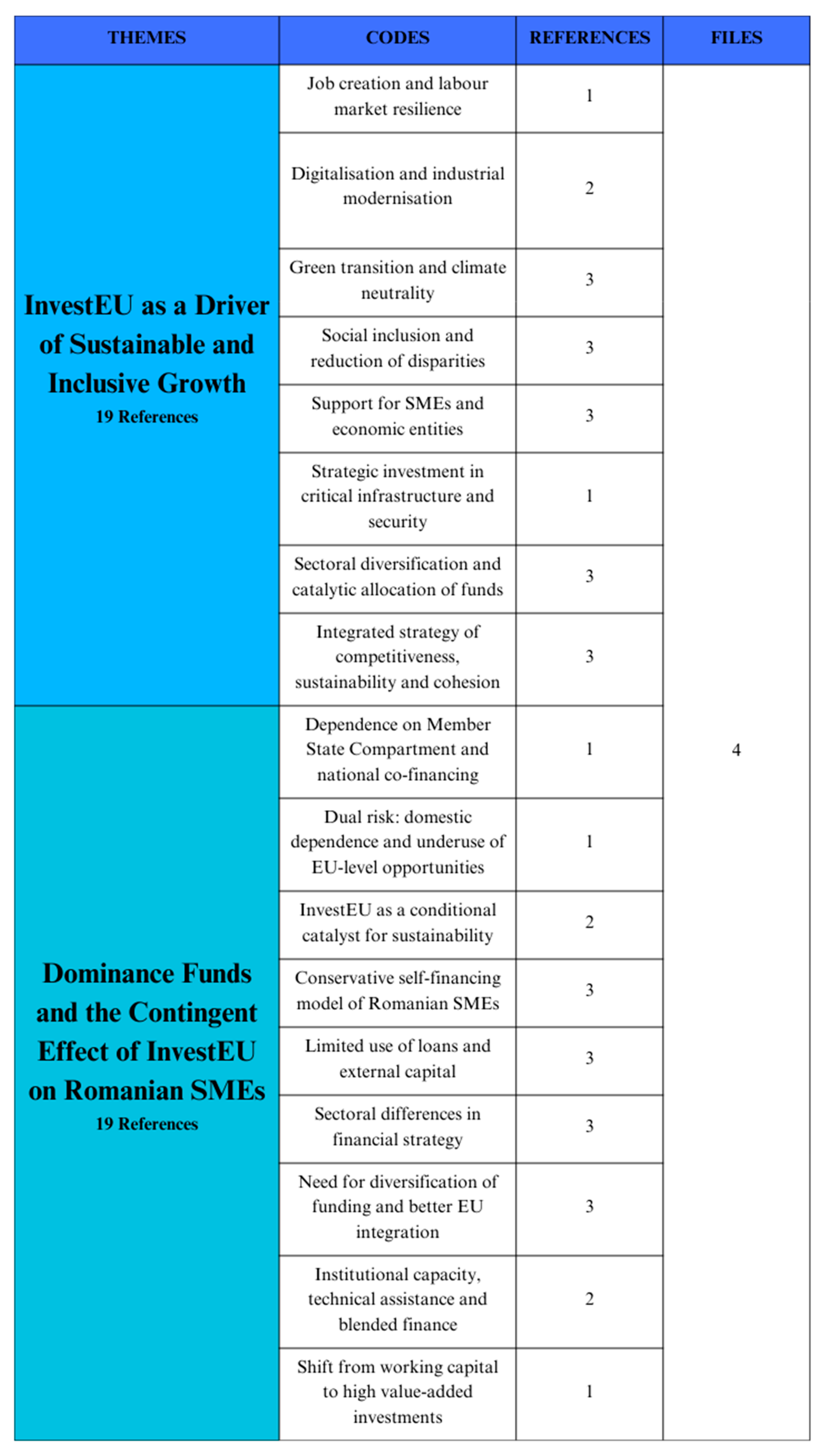
Figure 1. Thematic Distribution using NVivo Analysis.
Sustainability 18 00982 g001
Figure 2. Overview of Key InvestEU Indicators. Source: https://investeu.europa.eu/investeu-programme/investeu-fund/investeu-indicators_en (accessed on 10 November 2025) [44].
Sustainability 18 00982 g002
Figure 3. Volume of Signed Operations by Eligible Area. Source: https://investeu.europa.eu/investeu-programme/investeu-fund/investeu-indicators_en (accessed on 10 November 2025) [44].
Sustainability 18 00982 g003
Figure 4. InvestEU Financing Operations as a Share of Romania’s GDP in 2025. Source: https://investeu.europa.eu/investeu-programme/investeu-fund/investeu-indicators_en (accessed on 10 November 2025) [44].
Sustainability 18 00982 g004
Table 1. Sectoral Breakdown of SMEs Financing (2021–2023).
SectorYearOwn FundsLoansBudget SubsidiesForeign Capital
Industry202189.19%9.65%0.22%0.08%
202289.18%9.08%0.43%0.36%
202388.26%10.06%0.21%0.43%
Construction202194.61%4.16%0.06%0.06%
202294.31%4.40%0.01%0.15%
202394.93%4.28%0.01%0.09%
Commerce202192.55%6.27%0.01%0.12%
202290.93%7.71%0.03%0.04%
202391.99%6.98%0.04%0.06%
Services202194.42%4.46%0.11%0.20%
202293.72%5.32%0.07%0.02%
202393.31%5.10%0.23%0.31%
Source: Own processing, based on data from the National Institute of Statistics, Romania.
Table 2. Estimating the effect of funding on turnover using a Difference-in-Differences model.
ANOVA
CoefficientsStandard Errorp-ValueLower 95%Upper 95%
Intercept4,943,217.435,729,462.980.3916,356,892.976,470,458.11
Treatment5,726,915.117,677,396.850.469,567,243.6821,021,073.91
Time1,328,476.807,639,869.230.8616,547,876.7613,890,923.15
Interaction6,650,178.9810,804,006.260.5414,872,505.1628,172,863.12
Employees765,893.1063,961.160.00638,475.93893,310.27
REGRESSION STATISTICS
R Square0.674127755
Adjusted R Square0.656747902
Observations80
Disclaimer/Publisher’s Note: The statements, opinions and data contained in all publications are solely those of the individual author(s) and contributor(s) and not of MDPI and/or the editor(s). MDPI and/or the editor(s) disclaim responsibility for any injury to people or property resulting from any ideas, methods, instructions or products referred to in the content.