

Article

Consumer Attitudes, Buying Behaviour, and Sustainability Concerns Toward Fresh Pork: Insights from the Black Slavonian Pig


1
Faculty of Agrobiotechnical Sciences Osijek, Josip Juraj Strossmayer University of Osijek, Vladimira Preloga 1, 31000 Osijek, Croatia
2
Department of Agricultural and Food Sciences, Alma Mater Studiorum University of Bologna, Viale Fanin 50, 40126 Bologna, Italy
*
Author to whom correspondence should be addressed.
Sadly, Maurizio Canavari passed away in January 2025. As this research began with him, the remaining authors have decided to complete the study and submit the paper with his name as co-author. This is our sincere tribute to a beloved friend and mentor.
Sustainability 2026, 18(2), 980; https://doi.org/10.3390/su18020980 (registering DOI)
Submission received: 1 December 2025 / Revised: 12 January 2026 / Accepted: 15 January 2026 / Published: 18 January 2026

Abstract

This study examined Croatian consumer attitudes towards fresh pork from the Black Slavonian pig, focusing on the following sustainability dimensions: environmental, social, economic sustainability, and animal welfare. A survey of 410 consumers was conducted in June 2021, using an online questionnaire assessing consumption habits, breed knowledge, and socio-demographic characteristics. Factor analysis identified four key dimensions: attention to animal welfare, support for local production and biodiversity, origin and information, and price and intrinsic quality. Cluster analysis revealed three distinct consumer segments: conscious consumers (32.4%), value-oriented consumers (37.3%), and uninvolved meat consumers (30.2%). Multinomial logistic regression showed that age, region, family economic status, and place of purchase significantly predicted cluster membership (Nagelkerke R2 = 0.251, classification accuracy = 52.9%), while gender, education level, and household composition did not. Conscious consumers were characterised by older age, higher income, and a preference for direct purchasing channels, while value-oriented consumers favoured supermarkets and mid-range pricing. These findings highlight the need for improved consumer education, transparent labelling, targeted marketing strategies, and enhanced policy support to promote sustainable indigenous pig breed production and conservation.

1. Introduction

1.1. Sustainability Concerns in Pig Farming

The Food and Agriculture Organization defines sustainable food consumption as dietary practices that minimise environmental harm whilst supporting food security and health for current and future generations. Such dietary patterns maintain biodiversity and ecosystem integrity, align with cultural values, remain financially accessible for diverse socioeconomic groups, meet nutritional requirements, and ensure food safety and health benefits through efficient use of natural and human resources. Within this framework, consumers should consider environmental and social factors in their food purchasing decisions, although fundamental factors including individual needs, taste preferences, and practical constraints remain important determinants of behaviour [1,2]. Food sustainability involves many interlinked factors such as nutrition, environmental impact, cultural preferences, security, and food systems [2].
Consumer environmental and social concerns drive the pursuit of more sustainable pig production practices that achieve economic, social, environmental, and ethical goals [3]. Sustainability concerns in livestock production encompass societal perceptions, including the impact of production systems on animal welfare and environmental sustainability. Since the mid-1970s, societal organisations have expressed concerns about the negative impacts of intensive farming, such as environmental pollution, biodiversity decline, and poor animal welfare [4].
Pigs are an important source of meat worldwide and have great cultural significance in various regions. Most pork comes from commercial breeds that are raised for efficiency, but their rapid growth and high lean meat content often compromise the meat’s quality and flavour [5,6,7]. While the global pig industry relies on a few commercial breeds, Europe maintains substantial indigenous breed diversity, including the Black Slavonian pig in Croatia. These indigenous breeds are characterised by unique coat colours, disease resistance, longevity, strong maternal traits, slower growth rates, and higher intramuscular fat content. Although less productive than commercial hybrids, they provide superior meat quality, adapt well to local conditions, and are prized for traditional products with rich flavour and nutritional value [7,8,9,10,11,12].
Indigenous pig breeds in Europe represent an extremely important genetic resource, which is adapted to specific local conditions and extensive production systems. Of the 566 local pig breeds worldwide, 194 are found in Europe and the Caucasus [13]. However, agricultural intensification has led to dramatic genetic erosion: 48 pig breeds have become extinct in Europe and the Caucasus, and 42 breeds are currently considered to be endangered [7]. Understanding this broader European context is essential for developing effective conservation strategies and market development approaches that are applicable to the Black Slavonian pig.
Despite this decline, significant breed diversity remains across European regions. The Mediterranean region contains over 20 documented breeds and varieties, with the Ibérico pig exemplifying successful heritage breed conservation and commercialisation: a model that is relevant for other indigenous breeds. In the Balkans and Southeastern Europe, at least 10 indigenous breeds are found across Serbia, Croatia, Slovenia, Greece, and Bulgaria, including the Black Slavonian pig. These breeds typically exhibit fatty or dual-purpose (meat-fat) phenotypes, exceptional longevity, and robust adaptation to extensive outdoor production systems. Central Europe also maintains numerous indigenous breeds with distinctive characteristics [7].
Across Europe, these indigenous breeds share key attributes—adaptation to local environments, disease resistance, and meat quality prioritisation—making them valuable for sustainable production, rural development, and cultural landscape maintenance [7].
The preservation of genetic diversity in indigenous pig breeds is essential for multiple sustainability objectives. This genetic variability enables livestock production to adapt to changing climatic conditions, evolving consumer demands, and emerging disease challenges, thereby contributing to long-term food security. Indigenous breeds thrive with minimal external resources while supporting traditional agriculture, environmental sustainability, and biodiversity conservation [7,14].
Recognising this importance, genetic erosion has prompted national and international conservation efforts to preserve biodiversity, including genetic variability within species, breeds, and ecosystems. In the EU, intensive pig farming continues to pressure both environmental resources and genetic diversity, despite increasing consumer demand for traditionally reared, high-quality pork [7]. Under the EU’s Common Agricultural Policy, conservation programmes now prioritise the protection of indigenous breeds through multiple mechanisms: maintaining genetic diversity, stabilising populations, preserving desirable traits for sustainable livestock production, and supporting farmers who maintain these breeds [7]. Sustainable production requires a comprehensive approach that integrates genetic, economic, and social components within conservation programmes, ensuring that indigenous breeds remain viable both as genetic resources and as foundations for rural livelihoods [14].

1.2. Consumer Preferences and Market Potential for Sustainable Meat

Consumers consider various sustainability aspects when buying food, including animal welfare, fair labour conditions for farm workers, sustaining family-owned farming enterprises, preservation of regional heritage landscapes, regional and local production, protection of biodiversity, fair prices for farmers, revitalisation of traditional processing methods, and fair product prices [15,16]. In pig production, environmental objectives are closely linked to ensuring a fair income and a decent standard of living for producers while maintaining reasonable prices for consumers. The social dimension of sustainability in this sector is to harmonise production practices with societal priorities and needs, which in turn promotes public appreciation and political support. Meanwhile, consumers’ environmental concerns about pig production focus primarily on the impact on natural resources, including the degradation of water, air and soil, as well as the wider impact on human quality of life [17,18].
Kallas et al. [18] note that consumer interest in conventional products derived from autochthonous pig breeds plays an important role in their conservation. Čandek-Potokar et al. [19] claim that the integration of local pig breeds into production systems based on regional food sources results in products with desirable characteristics that form the basis for sustainable supply chains. However, realising the commercial viability of indigenous breeds requires strategic market development. Research emphasises the importance of product labelling, niche market development, and transparent traceability systems to increase product value and support smallholder production [20]. Consumer demand for such products is growing, particularly for niche items with high added value, as demonstrated by the successful commercialisation of Spain’s Ibérico pig through effective collaboration between public institutions, producers, and scientists [21].
Animal welfare has emerged as a significant consumer concern in meat purchasing decisions. Although animal welfare lacks a universally accepted definition, the livestock sector operates under certain recognised principles and agreements. The most used indicators include animal health, productivity, physiology, and ethology [22]. However, interpretations of animal welfare vary considerably between stakeholders and are influenced by personal beliefs, values, norms, knowledge, and interests [23,24]. Tomasevic et al. [25] found that almost half of EU consumers believe that animal welfare is better in the EU than in other regions, and they favour the idea that imported products should meet similar animal welfare standards.
Liljenstolpe [22], Fiebig et al. [26], and Mayfield et al. [27] found that while consumers are willing to pay more for products that come from animals raised under higher welfare standards, actual purchasing behaviour often remains price-sensitive.
The demand for clear labelling of animal-welfare-certified products is growing. Heerwagen et al. [28] emphasised that transparent animal welfare labelling has a positive influence on consumers’ purchasing decisions compared to conventionally produced alternatives. However, animal welfare attributes are often intertwined with other quality indicators. Verbeke [29] emphasised that consumers recognise and value farm animal welfare when it is integrated into broader quality assurance schemes, such as animal welfare and sustainability programmes. Similarly, research by Tawse [30] and Yang et al. [31] found that UK consumers have a limited knowledge of pig production methods. Kehlbacher et al. [32] argued that certification schemes are essential, as labelling products with certified logos benefits consumers, producers, the agricultural industry, and society as a whole [32,33]. These certification programmes can increase consumer confidence by providing transparent welfare guarantees.
Despite growing academic interest in sustainable livestock production and consumer preferences for traditional food products, limited research has examined consumer attitudes towards indigenous pig breeds in Central and Eastern Europe. While studies have explored consumer preferences for animal welfare attributes in Western European contexts, and segmentation studies exist for organic or welfare-labelled meat, these typically focus on single attributes (e.g., animal welfare alone) or Western European markets. Little is known about how Croatian consumers perceive and value sustainability concerns related to indigenous pig breed production. Moreover, existing segmentation studies rarely integrate multiple sustainability dimensions (environmental, social, animal welfare, economic) simultaneously into consumer profiles for indigenous breed products. This study addresses these gaps by advancing the literature in three key ways. First, it moves beyond the single-attribute studies that dominate the existing literature. Second, it applies a comprehensive framework to an under-researched Eastern European context, providing comparative insights for regions with similar agricultural structures and indigenous breed conservation challenges. Third, it employs a multi-method segmentation approach to identify not only consumer segments but also their socio-demographic and behavioural predictors, enabling targeted policy and marketing interventions.
The aim of this study was to obtain an overview of consumers’ attitudes and beliefs on some aspects related to sustainability, biodiversity, rural development, and animal welfare and to investigate what consumer segments exist in the Croatian pork market and what socio-demographic characteristics and behavioural factors characterise these segments. Following this, the study addresses the following research questions:
  • What are the key dimensions of consumer pork-purchasing attitudes?
  • What distinct consumer segments exist based on these dimensions?
  • What demographic and behavioural factors predict segment membership?
To our knowledge, no studies have investigated the effects of sustainability concerns on the Black Slavonian pig. The results of this study provide valuable insights for producers, retailers, and policy makers and provide a basis for the development of effective marketing strategies to promote Black Slavonian pig meat and meat products.

2. Materials and Methods

2.1. Questionnaire Development and Data Collection

The questionnaire was developed through a multistage process. First, an extensive literature review identified the relevant dimensions of consumers’ attitudes towards sustainable meat production and indigenous breeds [34,35,36,37]. Second, the preliminary version was reviewed by three experts in the field. Third, two pilot studies (n = 69 and n = 100) were conducted to assess clarity and comprehension. The final questionnaire included 78 questions divided into five sections. For the purposes of this paper, only items related to socio-demographic characteristics, purchasing and consumption behaviour, and attitudes towards sustainability concerns associated with Black Slavonian pig production were used. The questionnaire assessed consumer attitudes across four sustainability dimensions: (1) environmental sustainability (outdoor production, biodiversity conservation), (2) social sustainability (support for local farmers, rural development, cultural heritage), (3) animal welfare (natural behaviour, housing conditions, welfare standards), and (4) economic sustainability (willingness to pay, price–quality relationships). These attitudes were measured using 21 statements rated on a 5-point Likert scale (1 = strongly disagree to 5 = strongly agree).
The survey was conducted using online software, which offers advantages over traditional methods of face-to-face, telephone, or postal data collection, such as greater geographical reach, faster response times, lower costs, and fewer errors [38,39,40]. However, online surveys also have some limitations, including limited access to computers and the internet, issues with sample representativeness, coverage, potential non-response, and the tendency of participants to read questions too quickly or become impatient [40,41]. To minimise sample bias, a post hoc quality check excluded responses completed in less than five minutes, as these likely reflected insufficient engagement with the questionnaire items [42]. This five-minute threshold was established based on the questionnaire length (78 items) and cognitive load requirements: completing the survey in under five minutes would require an average response time of less than four seconds per question, which is insufficient for reading and thoughtfully responding to Likert-scale attitude items. This approach aligns with established data quality protocols for online surveys [42]. Additionally, responses showing straight-line patterns (identical responses across all Likert items) were reviewed, and those combined with rapid completion times were excluded. The final analytical sample of 410 respondents met all quality criteria, ensuring data reliability.
Participants were recruited in June 2021 via the Qualtrics survey panel, with distribution administered by Qualtrics (Qualtrics Inc., Provo, UT, USA). The selection process was based on gender, age, and geographical region to ensure representativeness of the Croatian population. The required sample size was determined in advance in discussions with Qualtrics. to ensure a proportional distribution of participants. Selection was randomised within a closed panel and recruitment continued until the predefined quotas for age, gender, and region were met. Before participating, respondents had to answer three questions to confirm that they were at least 18 years old, consumed pork, and were at least partially responsible for household food purchases. The survey took approximately 15 min to complete.
Participants were informed about the voluntary nature of the survey and assured of the confidentiality and anonymity of their responses. They were explicitly notified that they could withdraw at any time without their personal data being recorded. The study adhered to ethical standards for online research established by the European Society for Opinion and Market Research [43].

2.2. Data Analysis

The collected data included descriptive statistics (including frequency analysis, arithmetic mean, mode, median, and standard deviations), multivariate analyses (factor, cluster, and discriminant analysis), a non-parametric test (chi-square test), and predictive analysis (multinomial logistic regression).
Descriptive statistics were used to characterise the socio-demographic profile of respondents, their consumption and purchasing habits, and perceptions of societal concerns. Factor analysis was used to reduce the number of consumer attitude variables to a more manageable set of uncorrelated principal component factors. In particular, it helped to summarise the variables relating to consumer attitudes to shopping, local production, biodiversity, and animal welfare into a smaller group of meaningful components. The Kaiser–Meyer–Olkin (KMO) measure of sampling adequacy and Bartlett’s test for sphericity were performed to assess the suitability of the data set for factor analysis. The principal component analysis (PCA) method was applied, retaining factors with eigenvalues greater than 1, while Varimax rotation was performed to improve interpretability. The cluster analysis was performed using extracted factor scores from principal component analysis to group consumers with similar attitudes. A two-stage clustering approach was employed: hierarchical cluster analysis with Ward’s method (squared Euclidean distance) determined the optimal number of clusters, followed by K-means cluster analysis to refine cluster membership. To validate cluster differentiation, canonical discriminant analysis was applied. A two-stage analytical approach was adopted. First, chi-square tests of independence were used to identify which demographic and behavioural variables differed significantly across the three consumer clusters, providing an initial assessment of potential discriminating factors. Second, multinomial logistic regression was used to examine demographic and behavioural predictors of consumer cluster membership. The dependent variable was cluster membership, with the low involvement cluster as the reference category. Independent variables included demographic characteristics (gender, age, residence, region, occupation, education), household composition (household size, number of children, number of elders), family economic status, and purchasing behaviours (usual place of purchase, usual paying price for fresh pig meat, breed knowledge). Model fit was evaluated by using the likelihood ratio test, pseudo-R2 statistics (Nagelkerke R2 and McFadden R2), and classification accuracy. Prior to regression analysis, multicollinearity among predictor variables was assessed by using variance inflation factors (VIF) and tolerance statistics. VIF values below 10 and tolerance values above 0.10 are considered acceptable. The data were analysed using the IBM SPSS Statistics V26 (IBM Corp., Armonk, NY, USA) [44] statistical software package.

3. Results

3.1. Sample Description

The characteristics of the survey sample are consistent with those described in our previously published study [11], where a full methodological explanation is provided. The sample consisted of 51.0% female and 49.0% male respondents, with 41.0% aged between 25 and 44 and 26.8% aged 55 or older. The majority (78.5%) were from urban areas. The respondents were evenly distributed across geographical regions of Croatia (central Croatia, north-western Croatia, eastern Croatia, northern Adriatic and Lika, central and south Adriatic). The majority (62.0%) were employed, and 75.4% had a higher education (university or professional degree, master’s or doctorate), while 24.6% had a secondary or lower education (primary or lower secondary school). The higher proportion of respondents with higher education levels in the sample could be due to the online data collection, in which mostly urban respondents participated, which is consistent with the data from the Croatian Bureau of Statistics [45] showing that 22.9% of the Croatian urban population is highly educated, compared to 8.5% in rural areas. Most respondents lived in households with two to four members (82.7%), without children under the age of 15 (68.8%) or elderly members over the age of 60 (63.4%). They reported their monthly household income as average, which is consistent with data from the [46]. We also asked respondents their usual place of purchase for fresh boneless pork ham and 48.0% of them stated that they usually buy it in butcher shops and supermarkets (44.6%). Respondents stated that they are usually willing to pay between €3.30 and €5.94/kg (53.2%) or €6.08 and €9.90/kg (37.3%) for fresh boneless ham, and the majority do not know from which pig breed the meat comes when they buy fresh pork ham.

3.2. Consumer Perceptions of Fresh Pork from the Black Slavonian Pig: Purchasing and Sustainability Concerns

Croatian consumers who participated in the study were asked to give their opinion on twenty-one statements related to the multidimensional sustainability benefits of Black Slavonian pig production, encompassing environmental (biodiversity, extensive production), social (support for indigenous breeds, local production), and ethical (animal welfare) dimensions. These statements, listed in Table 1, were rated using a 5-point Likert scale ranging from one (strongly disagree) to five (strongly agree). The Cronbach’s alpha coefficient for internal reliability was calculated to be 0.910. Based on the respondents’ answers, the average rating of all statements was 3.92, indicating a general tendency towards agreement. As shown in Table 1, consumers most strongly supported the statement that freshness and appearance are the most important factors when buying pork (M = 4.28). Slightly lower, but still high, agreement rates were observed for statements emphasising that rearing local pig breeds promotes sustainability and provides support to local farmers (M = 4.26) and that local food production contributes to preserving traditional breeds and production methods (M = 4.22). Regarding product labelling, 190 respondents (46.3%) agreed with the statement that the breed of origin should be clearly indicated on pork products, while 191 (46.6%) agreed with the statement that rearing Black Slavonian pigs outdoors is a more environmentally friendly production. The lowest mean score was recorded for the statement addressing the price premiums that consumers would accept for pork meeting higher animal welfare criteria (M = 3.51). However, a significant proportion of respondents still expressed ethical concerns: 35.6% agreed that indoor pig farming is cruel and 34.6% expressed concern for farm animals. Overall, these results suggest that consumers have a positive attitude towards the benefits of rearing indigenous pig breeds. This is particularly evident in the relatively high average scores for the statements reflecting sustainability concerns.

3.3. Consumer Perspectives on Fresh Black Slavonian Pig Pork: Segmentation and Predictive Analysis of Buying Behaviour and Sustainability Concerns

A factor analysis was conducted to identify a smaller set of factors representing the relationships between all twenty-one statements on purchasing behaviour, local production, sustainability, biodiversity conservation, and animal welfare (Table 2). Each of the 21 items was included in the analysis to capture the full range of sustainability concerns without any a priori exclusions. Factor extraction followed the Kaiser criterion (eigenvalues > 1), while Varimax rotation with Kaiser normalisation improved interpretative clarity. Excellent sampling adequacy was confirmed by a Kaiser–Meyer–Olkin (KMO) value of 0.929, validating the dataset’s suitability for factor analysis. In addition, Bartlett’s test of sphericity (χ2 = 4745.022, p < 0.01) confirmed that the data met the conditions for factor analysis. The analysis revealed four different factors’ attention to animal welfare, supporting local production and biodiversity, origin and information, and price and intrinsic quality, which together explained 64.0% of the total variance. The reliability and consistency of the principal component analysis was further confirmed by Cronbach’s alpha coefficients, which ranged from 0.875 to 0.668. Three factors exceeded the 0.70 acceptability threshold, while F4 (α = 0.668) was slightly lower, but acceptable, given its three-item length, as Cronbach’s alpha is sensitive to scale length [47].
Several items showed secondary loadings above 0.40, indicating that sustainability attitudes are empirically overlapping constructs. The retained structure reflects consumer cognition rather than measurement inadequacy, as sustainability-oriented consumers integrate animal welfare, environmental, and social concerns simultaneously. Despite these cross-loadings, the four-factor solution shows clear interpretability and conceptual coherence. As shown in Table 2, the primary factor accounted for 41.4% of the variance. As the variable with the highest association relates to animal welfare, this factor was labelled ‘attention to animal welfare’ and represents the largest proportion of explained variance. The second factor, explaining 10.5% of the variance, includes variables related to sustainable production, biodiversity conservation, and local production. It was therefore named ‘supporting local production and biodiversity’. The third factor, ‘origin and information’, accounted for 7.3% of the variance. It includes variables such as the willingness to pay more for locally produced food, the relationship between meat quality and geographical origin, and the importance of product information and labelling. The fourth factor, ‘price and intrinsic quality’, explained 4.8% of the total variance. This factor summarises variables related to price, meat taste, appearance, and freshness.
K-means cluster analysis identified three distinct consumer segments based on factor scores (n = 410). The algorithm converged after 16 iterations, producing well-separated clusters with significant differences across factors. One-way ANOVA results demonstrate the discriminatory capacity of variables in a cluster formation. F-statistics quantify the extent of between-cluster variation. The variable supporting local production and biodiversity produced the strongest differentiation effect (F = 223.770). Distinctive traits characterising each cluster are shown in Table 3. Final centroids correspond to mean scores across variables for each cluster segment. The first cluster (n = 133, 32.4%) was labelled conscious consumers, characterised by the highest scores for animal welfare concern (M = 0.64) and support for local production and biodiversity (M = 0.72), coupled with low price sensitivity (M = −0.43). The second cluster represents consumers who pay more attention to price and intrinsic quality (M = 0.44); they prioritise value for money and meat quality and are less driven by ethical or sustainability concerns (n = 153, 37.3%). The third group (n = 124, 30.2%) are rather uninterested or inattentive meat consumers, attaching below-average importance to the attributes when buying fresh boneless ham (Table 3).
Canonical discriminant analysis confirmed the distinctiveness of the cluster groups. Linear discriminant analysis was conducted to assess the extent to which the four latent factors differentiated the three consumer clusters obtained by K-means clustering. Discriminant function analysis showed that the extracted factors had a statistically significant influence (p < 0.01) on cluster separation. Low Wilks’ lambda coefficients were observed (function 1 = 0.228; function 2 = 0.497), and chi-square statistics indicated significance at the p < 0.01 level for all functions. Two significant discriminant functions were extracted (canonical correlations 0.736 and 0.709), together accounting for 100% of the between-group variability. The first function was primarily associated with support for local production and biodiversity and, to a lesser extent, animal welfare, whereas the second function contrasted animal welfare orientation with price and quality considerations. The group centroids showed that Cluster 1 scored high on the first function (conscious consumers), Cluster 2 scored high on the second function (value-oriented consumers), while Cluster 3 scored low on both functions (uninvolved consumers). Overall, 99.5% of respondents were correctly reclassified into their original clusters, confirming that the three segments are strongly separated in the factor space.
Figure 1 presents the key discriminating variables that significantly differentiate the three consumer clusters. The radar chart displays only statistically significant variables (p < 0.05) identified through chi-square analysis. The analysis reveals distinct cluster profiles: conscious consumers are characterised by high rates of direct purchasing (46.7%), strong breed knowledge (43.8%), and above-average income (41.4%). In contrast, value-oriented consumers predominantly shop at supermarkets (48.1%) and show moderate representation across other variables. Uninvolved consumers demonstrate below-average representation across most key discriminating variables, particularly in direct purchasing (23.3%) and high income (23.0%).
The multinomial logistic regression model showed a statistically significant improvement over the null model (Model χ2 = 103.211, p < 0.001) and explained a moderate proportion of the variance in consumer cluster membership (Nagelkerke R2 = 0.251) (Table 4). The likelihood ratio tests identified age, region, family economic status, and place of purchase as significant predictors, indicating that these factors meaningfully differentiate consumers across clusters. In contrast, variables such as gender, education, household composition, breed knowledge, and willingness to pay did not significantly contribute to the classification. Overall, the model achieved a 52.9% correct classification rate, suggesting a reasonable but not perfect predictive capacity.
Table 5 presents the parameter estimates, standard errors, Wald statistics, and odds ratios for all predictors. The multinomial logistic regression results presented in Table 5 reveal distinct socio-demographic and behavioural profiles for the two consumer clusters compared with the uninvolved meat consumers. Conscious consumers are significantly less likely to be found among younger age groups (18–34 years), in several inland regions, and among lower-income households, indicating that this cluster is more strongly associated with older, economically secure consumers from the Adriatic areas. Value-oriented consumers also display region-specific patterns and are less likely to come from central and north-western Croatia. Lower income consumers are also less likely to be in this cluster. Regarding purchasing behaviour, buying meat at a butcher’s shop reduces the likelihood of being value-oriented, whereas buying directly from producers has no effect. Importantly, while the global test indicated that the price paid is not a significant predictor across all consumer clusters, the pairwise comparisons show that price does play a role for the price- and quality-oriented segment; consumers paying mid-range prices (€6.08–9.90) have significantly higher odds of belonging to this cluster compared with those paying the highest prices (Table 5). This pattern suggests that although the price paid does not distinguish consumers across all clusters simultaneously, it is an important factor for understanding the behaviour of this specific consumer segment. Therefore, the effect of price is cluster-specific rather than universal.
Classification accuracy varied by clusters, with the value-oriented consumers most accurately classified (64.1%), followed by uninvolved consumers (47.6%) and conscious consumers (45.1%).

4. Discussion

4.1. Overview of Consumers’ Attitudes

Croatian consumers showed generally positive attitudes towards societal concerns related to Black Slavonian pig production, with mean agreement scores ranging from 3.51 to 4.28 on a 5-point scale. Freshness and appearance were the most important purchasing criteria (M = 4.28), which is consistent with the fundamental quality expectations for fresh meat products. However, sustainability concerns received notably high ratings: support for indigenous breed production as promoting sustainability (M = 4.26), preservation of indigenous breeds and production methods (M = 4.22), and the environmental benefits of outdoor production (M = 4.12) all exceeded the midpoint by more than one standard deviation. Consumers agreed that keeping pigs indoors is cruel, expressed concern about animal welfare, and supported the idea that pigs should be able to display their natural behaviour on farms, which is in line with common sustainability concerns.
These attitudes are consistent with findings from Tomasevic et al. [25], who surveyed 13 Eastern European countries (including Croatia, Bosnia and Herzegovina, Bulgaria, Czech Republic, North Macedonia, Hungary, Moldova, Poland, Romania, Serbia, Slovakia, Slovenia, and Ukraine) and found that consumers generally believe that animals raised for food should be treated with dignity. Similarly, Mayfield et al. [27] reported comparable concerns in the UK, Italy, and Sweden, where consumers prioritise housing conditions, feed quality, and humane treatment during transport and slaughter.
While Croatian consumers express concern for pig welfare, they lack sufficient information about actual rearing conditions and the relationship between animal welfare and product quality [10,11,12,48,49]. This pattern reflects broader European trends documented by Font i Furnols et al. [50], who found that most European consumers have limited knowledge of livestock housing conditions but show strong interest in welfare-related aspects such as housing systems, climate control, natural behaviour expression, animal health, transport, slaughter methods, and stress levels, particularly because they associate better animal welfare with higher meat quality.
The moderate willingness to pay for welfare-enhanced pork (M = 3.51) highlights a persistent challenge in sustainable food marketing: consumers express ethical concerns but remain price-sensitive in their actual purchasing decisions. Grunert et al. [37] observed similar patterns in Germany and Poland, concluding that individual benefits, particularly safety and health, continue to outweigh sustainability concerns related to animal welfare and environmental impact when consumers purchase pork. While Akaichi et al. [51] found more favourable consumer ratings for animal welfare and organic and locally produced meat in Edinburgh, the gap between positive attitudes and economic commitment remains evident across European markets.
These findings provide a positive foundation for producers and policymakers aiming to develop markets for indigenous breed products. High consumer recognition of the sustainability and biodiversity benefits, along with concern for animal welfare, indicates market potential for Black Slavonian pig products. However, realising this potential requires addressing the information gap through consumer education and implementing clear labelling systems that communicate welfare standards, breed origin, and production methods, thereby helping consumers to translate their ethical concerns into informed purchasing decisions [28,32,33].

4.2. Consumers’ Segments

The identification of three consumer segments—conscious, value-oriented, and uninvolved meat consumers—revealed meaningful heterogeneity in the Croatian pork market. Conscious consumers represent a core target market for Black Slavonian pig products, demonstrating high concern for animal welfare and strong support for local production and biodiversity preservation. Their preferences for direct purchasing channels and high breed knowledge indicate active engagement with the product’s region and production methods. This segment aligns with the ethical consumer profile identified in Western European studies [52,53], suggesting that similar consumer segments exist across European markets despite economic and cultural differences. However, it is evident that in Croatia and Eastern Europe [25], welfare attitudes reflect economic capacity constraints, rather than value differences.
Value-oriented consumers, the largest segment, present a more complex profile. While they show moderate engagement with ethical concerns, they prioritise tangible product attributes (price, quality, origin information) over intangible values when making purchasing decisions. Their preference for supermarkets and mid-range pricing (€6.08–9.90/kg) suggests they seek optimal value rather than simply minimising cost. This finding challenges simple assumptions about price-conscious consumers and indicates opportunities for mainstream retail positioning of indigenous breed products if value propositions emphasise quality for price, rather than purely ethical premiums.
Uninvolved consumers show below-average engagement across all dimensions, representing both a challenge and an opportunity for market development. This segment’s younger consumers and more diverse economic backgrounds suggest they may become more engaged as their income increases and food purchasing responsibilities expand, consistent with life-cycle theories of consumer development [54]. However, their current low engagement indicates that indigenous breed products have not yet captured their attention, which is likely due to limited exposure, unfamiliarity, or competing priorities.
While this study adopts an applied segmentation approach, rather than testing specific theoretical frameworks, the identified consumer segments align with established research on sustainable food choices and ethical consumption [37,52,53]. Conscious consumers reflect value–identity consistency in ethical purchasing: value-oriented consumers demonstrate the tension between abstract sustainability concerns and concrete price–quality trade-offs and uninvolved consumers correspond to convenience-focused segments identified across food markets [54]. This empirical foundation provides actionable market insights and establishes a basis for future theory-testing research examining the causal mechanisms underlying indigenous breed purchasing behaviour.

4.3. Predictors of Consumer Segment Membership

Multinomial logistic regression identified several significant predictors distinguishing conscious and value-oriented consumers from uninvolved consumers. The model demonstrated adequate fit and correctly classified 52.9% of cases, indicating moderate predictive power. Likelihood ratio tests confirmed that region, economic status, place of purchase, and age significantly predicted cluster membership, while gender, residence, occupation, education, and household composition did not.
Age emerged as a key differentiator between conscious and uninvolved consumers, with younger respondents (18–24 and 25–34 years) being significantly less likely to belong to the conscious segment. This finding aligns with previous research indicating that older consumers show greater concern for food quality, origin, and traditional production methods [29,55]. The age effect was particularly marked in distinguishing conscious from uninvolved consumers, while no significant age differences emerged between value-oriented and uninvolved segments. This suggests that engagement intensity, rather than value-seeking orientation, varies with age.
Regional location was the strongest predictor of cluster membership, with substantial variation across Croatian regions. Compared to the middle and south Adriatic reference region, central Croatia consumers had significantly lower odds of being classified as conscious (OR = 0.26, p < 0.01) or value-oriented (OR = 0.15, p < 0.001), rather than uninvolved. Similarly, residents of north-western Croatia showed reduced odds of conscious (OR = 0.36, p < 0.05) and value-oriented (OR = 0.26, p < 0.01) membership. Northern Adriatic and Lika consumers also had a lower likelihood of conscious classification (OR = 0.31, p < 0.05). Notably, eastern Croatia, the primary Black Slavonian pig production region, showed no significant difference from the reference region.
This finding suggests that proximity to production does not automatically lead to higher consumer engagement. Several factors may explain eastern Croatia’s alignment with the Adriatic regions. First, the region’s geographic and climatic conditions are uniquely suited to Black Slavonian pig production, with traditional extensive rearing systems deeply embedded in the regional agricultural landscape [9,10]. This production infrastructure ensures the local availability of indigenous breed products, supporting conscious consumption patterns. Second, as a predominantly livestock-focused region, consumers in eastern Croatia have greater familiarity with livestock regulations and traditional production practices. This regional familiarity may normalise quality-seeking behaviour and prevent the emergence of a largely uninvolved consumer base, which is consistent with Sinclair et al. [48] and Sabolek et al. [56], who found that regional attitudes toward animal welfare reflect cultural variations across Croatia.
In contrast, central Croatia’s high concentration of uninvolved consumers reflects its urban retail environment, where supermarket chains dominate and convenience and price outweigh concerns about provenance. The middle and south Adriatic region’s stronger engagement likely stems from its Mediterranean food culture, which emphasises quality and origin, reinforced by tourist-driven demand for authentic local products.
Beyond regional effects, economic capacity emerged as a critical determinant of segment membership. Family economic status significantly constrained conscious consumption, with lower-income consumers being substantially less likely to engage in quality-oriented pork purchasing. Consumers reporting a significantly below-average economic status had 90% lower odds (OR = 0.10, 95% CI [0.02, 0.56], p < 0.01) of being conscious consumers, while those with below-average status had 71% reduced odds (OR = 0.29, p < 0.05). This economic gradient was also evident, though less pronounced, in the value-oriented versus uninvolved comparison (OR = 0.24 for significantly below average, p < 0.01).
These economic patterns have important implications for market development. Premium indigenous breed pork commands higher prices due to slower growth rates, lower feed conversion efficiency, higher labour requirements, and smaller processing volumes, effectively excluding lower-income consumers from conscious consumption patterns. Consequently, market development for traditional pork production systems may remain limited to higher-income segments unless price premiums decrease or economic conditions improve. These patterns are consistent with previous research [23,25,33,52], which demonstrates that income and economic security significantly increase consumers’ willingness to pay premiums for welfare, sustainability, or quality certifications.
Place of purchase significantly differentiated value-oriented consumers from uninvolved consumers, though it did not significantly distinguish conscious consumers from the uninvolved group in the multivariate model. Value-oriented consumers had 61% lower odds (OR = 0.39, 95% CI [0.22, 0.71], p < 0.01) of purchasing from butcher shops compared to supermarkets. This appears counterintuitive, as butcher shops are traditionally associated with a specialised service and higher-quality products. However, this pattern suggests that value-oriented consumers prioritise price and convenience available at large retailers over the personalised service or perceived quality premiums of butcher shops. The non-significance of direct-from-producer purchasing in distinguishing value-oriented consumers (OR = 0.38, p > 0.05) further supports this interpretation, indicating that this segment seeks value within conventional retail channels, rather than through alternative supply chains.
This behaviour contrasts with previous research findings showing that consumers who purchase meat directly from the producer or butcher have better access to information about the rearing system, pig feed, breed, and animal welfare [57].
The tendency of value-oriented consumers to favour supermarkets aligns with broader Croatian market patterns. Renko [58] found that Croatian consumers prefer one-stop shopping at large retailers due to the wide variety of products. However, purchasing preferences vary by socio-demographic characteristics and health concerns. Renko’s findings show that younger consumers and those with a higher employment status tend to prefer hypermarkets, while older consumers and those with a lower employment status prefer traditional butchers. Additionally, consumers from Mediterranean and mountain regions favour butchers, trusting them to provide fresher, higher-quality meat.
Similar income-related patterns emerge internationally. Chiru and Thölke [59] found that higher-income German consumers are more likely to purchase pork from local butchers or directly from producers than lower-income consumers.
The lack of significant purchase place effects for conscious versus uninvolved consumers in the multivariate model, despite the strong bivariate association observed in the chi-square analysis (χ2 = 18.13, p = 0.001), suggests that regional and economic factors may mediate the relationship between shopping channel and consumer orientation. Specifically, the preference of conscious consumers for direct purchasing may largely be explained by their greater economic capacity to afford premium channels.
Value-oriented consumers demonstrated an unexpected pattern for price tolerance. Compared to those paying premium prices (≥€10.04/kg), value-oriented consumers were significantly more likely (OR = 3.51, 95% CI [1.21, 10.19], p < 0.05) to pay mid-range prices (€6.08–9.90/kg). These findings suggest that value-oriented consumers seek an optimal balance between price and quality, avoiding both the cheapest products (which may indicate inferior quality) and premium-priced options (which may exceed their perceived value threshold).
Several variables that theory and prior research suggested would influence consumer segmentation showed no significant effects. Gender, education level, and household composition, frequently cited as determinants of food purchasing behaviour, did not significantly predict cluster membership. This indicates that engagement with pork quality and provenance attributes transcends traditional demographic boundaries and is instead primarily shaped by geographic context, economic capacity, and age.
The non-significance of breed knowledge (χ2 = 2.46, p = 0.292) is particularly noteworthy, given its strong bivariate association with conscious consumption (43.8% of conscious consumers compared to 27.4–28.8% of other segments possessing breed knowledge). This suggests that product knowledge develops as a result of conscious consumption through interaction with speciality retailers, direct producers, and marketing materials, rather than as a prerequisite for segment membership. Consumers become knowledgeable about breeds after they begin purchasing indigenous breed products, not beforehand. This temporal pattern has important implications for education strategies. Providing knowledge alone may be insufficient to shift consumers into conscious segments if underlying values, economic constraints, and channel access barriers remain unaddressed. Education strategies must be segment-specific: detailed breed information enhances loyalty among conscious consumers that are already purchasing from speciality channels, while value-oriented consumers require brief quality messaging at the point of purchase, and uninvolved consumers need structural barrier reduction (economic access, retail availability) before education becomes effective. Producers should prioritise strategies that enable an initial product trial, such as sampling programmes and retail partnerships, over mass education campaigns.

4.4. Impact on Policy Makers, Retailers, and Producers

4.4.1. Policy Recommendations

The findings of this study have important implications for agricultural and food production decision-making, particularly within the Croatian pork industry. Given the high consumer interest in sustainability, animal welfare, and biodiversity conservation, policymakers, retailers, and producers can strategically benefit from these insights. Consumers place great importance on information about origin and production. Therefore, policymakers should require clearer and more detailed labelling for fresh pork products, including breed, rearing conditions, and compliance with environmental and animal welfare standards. Such transparency meets consumer demand for production information and enables informed purchasing choices. As Croatian consumers also recognise the sustainability benefits of indigenous pig breed production, policy should support programmes that encourage local farmers to practise traditional, environmentally friendly pig farming.
The Croatian Ministry of Agriculture, Forestry and Fisheries currently implements IACS measure 10.1.9 (Conservation of endangered native and protected domestic animal breeds) through measure 70.03, which aims to preserve indigenous domestic animal breed populations. Under this initiative, farmers receive €267.69/LU for breeding Black Slavonian pigs [60,61]. However, this support level has remained unchanged for several years, despite increasingly challenging production conditions. Croatian pig producers faced severe difficulties during 2022–2024 due to rising feed and energy prices following the Ukraine war and African swine fever outbreaks [62].
Policymakers should increase subsidies for farmers breeding indigenous breeds to promote sustainable agricultural practices and conservation. Additionally, expanded education initiatives targeting both farmers and consumers regarding indigenous breed preservation are essential. Policies should support direct-to-consumer sales through farmers’ markets, butcher shops, and cooperatives, as this study’s segmentation analysis demonstrates that sustainability-oriented consumers prefer these purchasing channels. Financial and logistical support for small- and medium-sized meat producers can help maintain these traditional supply chains.

4.4.2. Retail and Producer Strategies

Building on these policy recommendations, the study has significant implications for retailers and producers seeking to align their supply with consumer preferences and market demand. Black Slavonian pig meat has been granted the status of a protected designation of origin (PDO) [12]. The Ministry of Agriculture, Forestry and Fisheries and the Croatian Agency for Agriculture and Food label the products with “certified quality” and “meat from Croatian farms” labels [63,64,65]. This non-mandatory labelling system aims to provide consumers with clear information on the origin and proven quality of fresh meat and meat products from the Republic of Croatia, while enhancing recognition and promotion of agricultural and food products. However, consumer recognition of these labels remains insufficient, necessitating further educational initiatives.
Awareness campaigns, workshops, and educational materials should be developed to inform consumers about the benefits of ethically sourced pork and the link between animal welfare and product quality, as well as the importance of product labelling. Specifically, Croatian retailers and producers should ensure that meat product packaging clearly indicates the origin, breed, rearing conditions, and compliance with animal welfare standards.
Providing QR codes leading to detailed information about the farm and production could further increase consumer confidence and engagement. Retailers and producers can benefit from categorising meat according to sustainability factors, such as “ethically reared”, “biodiversity friendly” or “locally sourced pork”. As consumers favour these attributes, premium pricing strategies may be justified. Retailers and producers should invest in marketing campaigns that emphasise the benefits of locally and ethically sourced pork.
Retailers should also consider placing ethically sourced pork products in premium sections or dedicated supermarket aisles to appeal to environmentally conscious consumers. Partnerships with upscale restaurants and speciality shops can also increase demand for sustainable pork products. As demonstrated in Section 4.3, there is substantial regional variation in consumer segment distribution, with the Adriatic regions showing significantly higher representation of conscious consumers. Consequently, marketing strategies should be regionally differentiated, adapting positioning and channels to match local consumer profiles. Through the implementation of these measures, policy makers, retailers, and producers can better fulfil consumer expectations, promote sustainable food systems, and increase confidence in the pork supply chain.

4.5. Strengths and Limitations of the Study

This study provides valuable insights into Croatian consumers’ attitudes towards fresh boneless ham from the Black Slavonian pig. The segmentation approach identifies actionable consumer groups with distinct characteristics, offering practical guidance for market development. The relatively large sample (n = 410) and quota sampling ensure representativeness across age, gender, and regional dimensions, while rigorous quality controls enhance data reliability.
However, there are some limitations. First, online panel sampling introduces potential bias. The use of an online survey panel, while providing advantages in geographic reach and cost-efficiency, systematically excludes non-internet users who may differ in demographic characteristics, technological literacy, and consumption patterns. Although quota sampling by age, gender, and region improved representativeness, the online format likely overrepresents urban, educated consumers. This demographic bias may inflate the proportion of conscious consumers, as internet access and participation in online surveys are associated with the socioeconomic factors that predict conscious segment membership (income, education, information-seeking). Future research should use mixed-mode methodologies (online, telephone, face-to-face) to include consumers that are underrepresented in online panels: particularly rural, older, and lower-income groups, who may make up larger proportions of uninvolved consumers.
Second, the study relies on self-reported consumer opinions, which may be subject to social desirability bias. This could affect the accuracy of the results. Stated preferences do not necessarily translate to actual purchasing decisions when faced with real trade-offs between sustainability attributes, price, convenience, and availability. Observational studies using scanner data, choice experiments with real monetary stakes, and field experiments would provide more robust evidence of actual purchasing behaviour. Future research should combine stated preference data with revealed preference methodologies to validate segment classifications and predictive models.
Third, willingness to pay (WTP) was measured using Likert-scale agreement statements, rather than experimental elicitation methods. While attitudinal WTP offers insights into general price sensitivity, it does not quantify the specific monetary premiums consumers would accept for sustainability attributes. Discrete choice experiments or experimental auctions would provide more precise WTP estimates and allow for examination of trade-offs between multiple attributes simultaneously.
Furthermore, the study is limited to Croatian consumers, making it difficult to generalise the results to wider European or global markets. Future studies could benefit from investigating consumer preferences by incorporating cross-cultural comparisons to clarify which patterns reflect Croatian consumer characteristics versus broader regional consumer characteristics.
Although the overall classification accuracy of 52.9% is modest, it is above chance level and typical for segmentation models based on demographic and behavioural variables. This substantially exceeds baseline models: random chance (33.3%), proportional chance (33.5%), and maximum chance (37.3%). The model outperforms these by 15.6–19.6 percentage points, which is typical for demographic-behavioural segmentation. However, the pseudo-R2 values (Nagelkerke R2 = 0.251) indicate that 75% of variance remains unexplained. This suggests that demographic and behavioural variables alone are insufficient to explain sustainability consumption. The unexplained variance likely reflects psychological factors that are not measured here: personal values regarding animal welfare and environmental protection, degree of food involvement, trust in local producers and certification systems, and habitual purchasing patterns. Additionally, situational factors such as product availability and promotional activities influence purchasing but were not captured. Future research should incorporate these psychological constructs alongside demographics to improve explanatory power. Mixed-methods approaches, particularly interviews with segment representatives and observation of actual shopping behaviour, could reveal the decision-making processes underlying our statistical patterns, especially for value-oriented consumers whose behaviour appears to be more complex than simple price minimisation.
Despite these limitations, this study provides a valuable foundation for understanding consumer segments in the Croatian indigenous pig breed market and for developing targeted strategies for conservation and market development.

5. Conclusions

This study examined Croatian consumer attitudes towards fresh pork from the Black Slavonian pig through a sustainability lens, focusing on four interconnected dimensions: environmental sustainability (biodiversity conservation, extensive production), social sustainability (rural development, cultural heritage, local production), animal welfare, and economic viability. The results show that consumers consider freshness and appearance (colour, marbling, drip loss) as the most important attributes when choosing fresh pork from this breed. Sustainability concerns received the second highest approval rating. Respondents believe that rearing the Black Slavonian pig is more environmentally friendly than the conventional production of hybrid pigs. In contrast, attributes such as flavour and price received lower ratings. To streamline the analysis, a factor analysis was carried out to reduce the number of variables. Four key factors emerged: attention to animal welfare, support for local production and biodiversity, origin and information, and price and intrinsic quality. Based on these factors, three distinct consumer segments were identified: conscious consumers, value-oriented consumers, and uninvolved meat consumers. These segments differ in their socio-demographic characteristics (such as age and family economic status), their preferred places of purchase, and their awareness of the pig breed when buying fresh meat. Furthermore, multinomial logistic regression revealed that age, region, family economic status, and place of purchase are significant predictors, indicating that these variables meaningfully differentiate consumers across clusters. The study confirmed that consumers value meat quality, sustainable rearing systems, animal welfare, environmental protection, and local traditions, all of which align with broader sustainability concerns. Black Slavonian pig meat is widely recognised and valued by consumers, and this research demonstrates that consumer demand exists. They associate it with traditional, high-quality products of significant economic, environmental, and social value. However, realising this potential requires coordinated action across policy, retail, and production sectors to overcome economic barriers, information gaps, and infrastructure limitations.

Author Contributions

Conceptualisation, S.J.M., R.L. and M.C.; methodology, S.J.M. and L.P.; validation, R.L. and M.C.; formal analysis, S.J.M. and L.P.; investigation, S.J.M.; data curation, S.J.M.; writing—original draft preparation, S.J.M.; writing—review and editing, S.J.M., L.P., J.K., A.C. and D.K.; visualisation, S.J.M., L.P., J.K. and A.C.; supervision, R.L., I.K. and M.C. All authors have read and agreed to the published version of the manuscript.

Funding

This research received no external funding.

Institutional Review Board Statement

Ethical review and approval were waived for this study by the Institution Committee, due to Regulation (EU) 2016/679—the General Data Protection Regulation (GDPR) and the ESOMAR International Code on Market.

Informed Consent Statement

Informed consent was obtained from all subjects involved in the study. The study adhered to the ethical standards for online research established by the European Society for Opinion and Market Research. These included obtaining the explicit consent of all participants prior to their participation and ensuring the confidentiality and anonymity of their personal data. Participants were fully informed about the purpose of the survey and how their responses would be used. Before starting the survey, participants gave their explicit consent and all data were collected anonymously, with the option to select “I do not wish to answer”. Participants also had the right to withdraw from the survey at any time without their personal data being recorded.

Data Availability Statement

The data presented in this study are available on request from the corresponding author. Due to the nature of the data and the need to protect respondent confidentiality, the dataset cannot be publicly shared.

Conflicts of Interest

The authors declare no conflicts of interest.

References

  1. The Food and Agriculture Organization of the United Nations. Sustainable diets and biodiversity: Directions and solutions for policy, research and action. In Proceedings of the International Scientific Symposium on Sustainable Diets and Biodiversity: Directions and Solutions for Policy, Research and Action (No. RESEARCH), Rome, Italy, 3–5 November 2010; FAO: Rome, Italy, 2012. Available online: https://www.fao.org/4/i3004e/i3004e00.htm (accessed on 9 December 2025).
  2. Śmiglak-Krajewska, M.; Wojciechowska-Solis, J.; Viti, D. Consumers’ Purchasing Intentions on the Legume Market as Evidence of Sustainable Behaviour. Agriculture 2020, 10, 424. [Google Scholar] [CrossRef]
  3. Krystallis, A.; Dutra de Barcellos, M.; Kügler, J.O.; Verbeke, W.; Grunert, K.G. Attitudes of European citizens towards pig production systems. Livest. Sci. 2009, 126, 46–56. [Google Scholar] [CrossRef]
  4. Boogaard, B.K.; Boekhorst, L.J.S.; Oosting, S.J.; Sørensen, J.T. Socio-cultural sustainability of pig production: Citizen perceptions in the Netherlands and Denmark. Livest. Sci. 2011, 140, 189–200. [Google Scholar] [CrossRef]
  5. Budimir, K.; Margeta, V.; Kralik, G.; Margeta, P. Silvopastoral keeping of the Black Slavonian Pigs. Krmiva Časopis o Hranidbi Zivotinj. Proizv. i Tehnol. Krme 2013, 55, 151–157. [Google Scholar]
  6. Senčić, Đ.; Samac, D. Preserving biodiversity of Black Slavonian pigs through production and evaluation of traditional meat products. Poljoprivreda 2017, 23, 53–58. [Google Scholar] [CrossRef]
  7. Kasprzyk, A.; Walenia, A. Native Pig Breeds as a Source of Biodiversity—Breeding and Economic Aspects. Agriculture 2023, 13, 1528. [Google Scholar] [CrossRef]
  8. Bovo, S.; Ribani, A.; Muñoz, M.; Alves, E.; Araujo, J.P.; Bozzi, R.; Candek-Potokar, M.; Charneca, R.; Di Palma, F.; Etherington, G.; et al. Whole-genome sequencing of European autochthonous and commercial pig breeds allows the detection of signatures of selection for adaptation of genetic resources to different breeding and production systems. Genet. Sel. Evol. 2020, 52, 33. [Google Scholar] [CrossRef]
  9. Lukić, B.; Ferenčaković, M.; Šalamon, D.; Čačić, M.; Orehovački, V.; Iacolina, L.; Curik, I.; Cubric-Curik, V. Conservation Genomic Analysis of the Croatian Indigenous Black Slavonian and Turopolje Pig Breeds. Front. Genet. 2020, 11, 261. [Google Scholar] [CrossRef] [PubMed]
  10. Kušec, G.; Komlenić, M.; Gvozdanović, K.; Sili, V.; Krvavica, M.; Radišić, Ž.; Kušec, I.D. Carcass Composition and Physicochemical Characteristics of Meat from Pork Chains Based on Native and Hybrid Pigs. Processes 2022, 10, 370. [Google Scholar] [CrossRef]
  11. Jelić Milković, S.; Lončarić, R.; Kralik, I.; Kristić, J.; Crnčan, A.; Djurkin Kušec, I.; Canavari, M. Consumers’ Preference for the Consumption of the Fresh Black Slavonian Pig’s Meat. Foods 2023, 12, 1255. [Google Scholar] [CrossRef]
  12. Jelić Milković, S.; Crnčan, A.; Kristić, J.; Kralik, I.; Djurkin Kušec, I.; Gvozdanović, K.; Kušec, G.; Kralik, Z.; Lončarić, R. Consumer Preferences for Cured Meat Products from the Autochthonous Black Slavonian Pig. Foods 2023, 12, 3666. [Google Scholar] [CrossRef]
  13. Taniguchi, M. Utilizing Indigenous Animal Genetic Resources—Based on Research into Indigenous Cattle Breeds in the Basque Country in Northern Spain and Indigenous Pig Breeds in Vietnam. Anim. Sci. J. 2025, 96, E70046. [Google Scholar] [CrossRef] [PubMed]
  14. Cerjak, M.; Faletar, I.; Šmit, G.; Ivanković, A. Breeding Motives and Attitudes Towards Stakeholders: Implications for the Sustainability of Local Croatian Breeds. Agriculture 2025, 15, 321. [Google Scholar] [CrossRef]
  15. Tempesta, T.; Vecchiato d Nassivera, F.; Bujgatti, M.; Torquati, B. Consumers Demand for Social Farming Products: An Analysis with Discrete Choice Experiments. Sustainability 2019, 11, 6742. [Google Scholar] [CrossRef]
  16. Gunnarsson, S.; Arvidsson Segerkvist, K.; Wallgren, T.; Hansson, H.; Sonesson, U. A Systematic Mapping of Research on Sustainability Dimensions at Farm-level in Pig Production. Sustainability 2020, 12, 4352. [Google Scholar] [CrossRef]
  17. Petit, J.; Van der Werf, H.M.G. Perception of the environmental impacts of current and alternative modes of pig production by stakeholder groups. J. Environ. Manag. 2003, 68, 377–386. [Google Scholar] [CrossRef]
  18. Kallas, Z.; Vitale, M.; Gil, J.M. Health Innovation in Patty Products. The Role of Food Neophobia in Consumers’ Non-Hypothetical Willingness to Pay, Purchase Intention and Hedonic Evaluation. Nutrients 2019, 11, 444. [Google Scholar] [CrossRef]
  19. Čandek-Potokar, M.; Fontanesi, L.; Lebret, B.; Gil, J.H.; Ovilo, C.; Nieto, R.; Fernandez, A.; Pugliese, C.; Oliver, M.A.; Bozzi, R. Introductory Chapter: Concept and Ambition of Project TREASURE. In European Local Pig Breeds—Diversity and Performance. A Study of Project TREASURE; Intechopen: London, UK, 2019. [Google Scholar]
  20. Marsoner, T.; Vigl, L.E.; Manck, F.; Jaritz, G.; Tappeiner, U.; Tasser, E. Indigenous livestock breeds as indicators for cultural ecosystem services: A spatial analysis within the Alpine Space. Ecol. Indic. 2018, 94, 55–63. [Google Scholar] [CrossRef]
  21. Pugliese, C.; Sirtori, F. Quality of meat and meat products produced from southern European pig breeds. Meat Sci. 2012, 9, 511–518. [Google Scholar] [CrossRef] [PubMed]
  22. Martelli, G. Consumers’ perception of farm animal welfare: An Italian and European perspective. Ital. J. Anim. Sci. 2009, 8, 31–41. [Google Scholar] [CrossRef]
  23. Liljenstolpe, C. Valuing animal welfare with choice experiments: An application to Swedish pig production. In Proceedings of the 11th Congress of the EAAE (European Association of Agricultural Economists), Copenhagen, Denmark, 24–27 August 2005; pp. 1–13. [Google Scholar]
  24. Vanhonacker, F.; Verbeke, W.; Van Poucke, E.; Tuyttens, F.A.M. Segmentation based on consumers’ perceived importance and attitude toward farm animal welfare. Int. J. Sociol. Food Agric. 2007, 15, 84–100. [Google Scholar] [CrossRef]
  25. Tomasevic, I.; Bahelka, I.; Ćitek, J.; Čandek-Potokar, M.; Djekić, I.; Getya, A.; Guerrero, L.; Ivanova, S.; Kušec, G.; Nakov, D.; et al. Attitudes and Beliefs of Eastern European Consumers Towards Animal Welfare. Animals 2020, 10, 1220. [Google Scholar] [CrossRef] [PubMed]
  26. Fiebig, D.G.; Keane, M.P.; Louviere, J.; Wasi, N. The Generalised Multinomial Logit Model: Accounting for Scale and Coefficient Heterogeneity. Mark. Sci. 2010, 29, 393–421. [Google Scholar] [CrossRef]
  27. Mayfield, L.E.; Bennett, R.M.; Tranter, R.B.; Wooldridge, M.J. Consumption of welfare-friendly food products in Great Britain, Italy and Sweden, and how it may be influenced by consumer attitudes to, and behaviour towards, animal welfare attributes. Int. J. Sociol. Food Agric. 2007, 15, 59–73. [Google Scholar] [CrossRef]
  28. Heerwagen, L.R.; Mørkbak, M.R.; Denver, S.; Sandøe, P.; Christensen, T. The Role of Quality Labels in Market-Driven Animal Welfare. Agric Environ. Ethics 2014, 28, 67–84. [Google Scholar] [CrossRef]
  29. Verbeke, W. Stakeholder, citizen, and consumer interests in farm animal welfare. Anim. Welf. 2009, 18, 325–333. [Google Scholar] [CrossRef]
  30. Tawse, J. Consumer attitudes towards farm animals and their welfare: A pig production case study. Biosci. Horiz. 2010, 3, 156–165. [Google Scholar] [CrossRef]
  31. Yang, R.; Curry Raper, K.; Lusk, J.L. The Impact of Hormone Use Perception on Consumer Meat Preference. In Proceedings of the Southern Agricultural Economics Association Annual Meeting, Mobile, AL, USA, 4–7 February 2017. [Google Scholar]
  32. Kehlbacher, A.; Bennett, R.; Balcombe, K. Measuring the consumer benefits of improving farm animal welfare to inform welfare labelling. Food Policy 2012, 37, 627–633. [Google Scholar] [CrossRef]
  33. Wang, J.; Ge, J.; Ma, Y. Urban Chinese Consumers’ Willingness to Pay for Pork with Certified Labels: A Discrete Choice Experiment. Sustainability 2018, 10, 603. [Google Scholar] [CrossRef]
  34. Santos Silva, J.; Tirapicos Nunes, J.L. Inventory and characterisation of traditional Mediterranean pig production systems. Advantages and constraints towards its development. Acta Agric. Slov. 2013, 4, 61–67. [Google Scholar] [CrossRef]
  35. Sahelices, A.; Mesías, F.H.; Escribano, M.; Gaspar, P.; Elghannam, A. Are quality regulations displacing PDOs? A choice experiment study on Iberian meat products in Spain. Ital. J. Anim. Sci. 2017, 16, 9–13. [Google Scholar] [CrossRef]
  36. Wu, L.; Gong, X.; Qin, S.; Chen, X.; Zhu, D.; Hu, W.; Li, Q. Consumer preferences for pork attributes related to traceability, in-formation certification, and origin labeling: Based on China’s Jiangsu Province. Agribusiness 2017, 33, 424–442. [Google Scholar] [CrossRef]
  37. Grunert, K.G.; Sonntag, W.I.; Glanz-Chanos, V.; Forum, S. Consumer interest in environmental impact, safety, health, and animal welfare aspects of modern pig production: Results of a cross-national choice experiment. Meat Sci. 2018, 137, 123–129. [Google Scholar] [CrossRef] [PubMed]
  38. Dillman, D.; Smyth, J.; Christian, L.M. Internet, Phone, Mail, and Mixed-Mode Surveys, 4th ed.; Wiley: Hoboken, NJ, USA, 2014; Available online: https://www.perlego.com/book/997936/internet-phone-mail-and-mixedmode-surveys-the-tailored-design-method-pdf (accessed on 20 June 2021).
  39. Khachatryan, H.; Rihn, A.; Wei, X. Consumers’ Preferences for Eco-labels on Plants: The Influence of Trust and Consequentiality Perceptions. J. Behav. Exp. Econ. 2021, 91, 101659. [Google Scholar] [CrossRef]
  40. Mariel, P.; Hoyos, D.; Meyerhoff, J.; Czajkowski, M.; Dekker, T.; Glenk, K.; Jacobsen, B.; Liebe, U.; Olsen, S.B.; Sagebiel, J.; et al. Environmental Valuation with Discrete Choice Experiments, Guidance on Design, Implementation and Data Analysis; Springer: Cham, Switzerland, 2021. [Google Scholar]
  41. Bonnichsen, O.; Olsen, S.B. Correcting for non-response bias in contingent valuation surveys concerning environmental non-market goods: An empirical investigation using an online panel. J. Environ. Plan. Manag. 2016, 59, 245–262. [Google Scholar] [CrossRef]
  42. Vecchio, R.; Caso, G.; Cembalo, L.; Borrello, M. Is respondents’ inattention in online surveys a major issue for research? Econ. Agro-Aliment. 2020, 22, 1–18. [Google Scholar] [CrossRef]
  43. ESOMAR. ICC/ESOMAR International Code on Market, Opinion and Social Research and Data Analytics; ESOMAR & GRBN: Amsterdam, The Netherlands, 2016. [Google Scholar]
  44. IBM SPSS IBM Corp. IBM SPSS Statistics for Windows; IBM Corp: Armonk, NY, USA, 2019; (Licensed to Faculty of Economics in Osijek). [Google Scholar]
  45. Croatian Bureau of Statistics. Census of Population, Households and Dwellings 2011. Available online: https://dzs.gov.hr/UserDocsImages/657 (accessed on 6 September 2019).
  46. Croatian Bureau of Statistics. Croatia in Figures, Zagreb, 2020. Available online: https://podaci.dzs.hr/media/5locv4mx/croinfig_2020.pdf (accessed on 6 September 2021).
  47. Lin, W.; Ortega, D.L.; Caputo, V.; Lusk, J.L. Personality traits and consumer acceptance of controversial food technology: A cross-country investigation of genetically modified animal products. Food Qual. Prefer. 2019, 76, 10–19. [Google Scholar] [CrossRef]
  48. Sinclair, M.; Lee, N.; Hötzel, M.; de Luna, M.; Sharma, A.; Idris, M.; Derkley, T.; Li, C.; Islam, M.; Iyasere, O.; et al. International perceptions of animals and the importance of their welfare. Front. Anim. Sci. 2022, 3, 960379. [Google Scholar] [CrossRef]
  49. Jelić Milković, S.; Lončarić, R.; Crnčan, A.; Kristić, J.; Canavari, M. Consumer segments and preferences for PDO-labelled fresh pork: A choice experiment on the black Slavonian pig in Croatia. Meat Sci. 2025, 232, 110002. [Google Scholar] [CrossRef]
  50. Font i Furnols, M.; Skrlep, M.; Aluwé, M. Attitudes and beliefs of consumers towards pig welfare and pork quality. In Proceedings of the 60th International Meat Industry Conference MEATCON2019, Kopaonik, Serbia, 22–25 September 2019; pp. 1–8, IOP Conference Series: Earth and Environmental Science, Volume 333. [Google Scholar]
  51. 51; Akaichi, F.; Glenk, K.; Revoredo-Giha, C. Substitutes or Complements? Consumers’ Preferences and Willingness to Pay for Animal Welfare, Organic, Local and Low-Fat Food Attributes. In Proceedings of the 90th Annual Conference of the Agricultural Economics Society, University of Warwick, Coventry, UK, 4–6 April 2016; pp. 1–19. [Google Scholar]
  52. Zanoli, R.; Scarpa, R.; Napolitano, F.; Piasentier, E.; Naspetti, S.; Bruschi, V. Organic label as an identifier of environmentally related quality: A consumer choice experiment on beef in Italy. Renew. Agric. Food Syst. 2012, 28, 70–79. [Google Scholar] [CrossRef]
  53. Velčovská, Š.; Del Chiappa, G. The food quality labels: Awareness and willingness to pay in the context of the Czech Republic. Acta Univ. Agric. et Silvic. Mendel. Brun. 2015, 63, 647–658. [Google Scholar] [CrossRef]
  54. Merlino, V.M.; Borra, D.; Verduna, T.; Massaglia, S. Household Behavior with Respect to Meat Consumption: Differences between Households with and without Children. Vet. Sci. 2017, 4, 53. [Google Scholar] [CrossRef]
  55. Font i Furnols, M.; Guerrero, L. Consumer preference, behavior and perception about meat and meat products: An overview. Meat Sci. 2014, 98, 361–371. [Google Scholar] [CrossRef] [PubMed]
  56. Sabolek, I.; Miikuš, T.; Pavičić, Ž.; Matković, K.; Antunović, B.; Mesić, Ž. Regional differences in the attitudes of veterinary students in Croatia towards welfare of farm and companion animals. Vet. Stanica 2021, 52, 65–71. [Google Scholar] [CrossRef]
  57. Crovato, S.; Pinto, A.; Di Martino, G.; Mascarello, G.; Rizzoli, V.; Marcolin, S.; Ravarotto, L. Purchasing Habits, Sustainability Perceptions, and Welfare Concerns of Italian Consumers Regarding Rabbit Meat. Foods 2022, 11, 1205. [Google Scholar] [CrossRef]
  58. Renko, S. How New Consumers’ Consumption Patterns Caused Changes in Food Distribution Channels in Croatia. J. Food Prod. Mark. 2014, 20, 533–547. [Google Scholar] [CrossRef]
  59. Chiru, C.; Thölke, H. Buying behaviour insights regarding animal welfare and environmental factors in North Western Germany. In Proceedings of the 5th International Conference on Contemporary Marketing Issues (ICCMI), Thessaloniki, Greece, 21–23 June 2017. [Google Scholar]
  60. Narodne Novine. Pravilnik o Provedbi Izravne Potpore Poljoprivredi i IAKS Mjera Ruralnog Razvoja za 2022. Godinu [Regulation on the Implementation of Direct Payments in Agriculture and IAKS Rural Development Measures in 2022]. NN 27/2022. Available online: https://narodne-novine.nn.hr/clanci/sluzbeni/2022_03_27_352.html (accessed on 21 February 2025).
  61. Narodne Novine. Pravilnik o Provedbi Izravne Potpore Poljoprivredi i IAKS Mjera Ruralnog Razvoja za 2024. Godinu., 2023. [Regulation on the Implementation of Direct Payments in Agriculture and IAKS Rural Development Measures in 2022]. NN 157/2023. Available online: https://narodne-novine.nn.hr/clanci/sluzbeni/2023_12_157_2415.html (accessed on 21 February 2025).
  62. HAPIH-Croatian Agency for Agriculture and Food. Pig Breeding, Annual Report for 2023, 2024. Available online: https://www.hapih.hr/wp-content/uploads/2025/06/Svinjogojstvo-Godisnje-izvjesce-2024.pdf (accessed on 12 June 2024).
  63. Zakon o Poljoprivredi (”Narodne novine”, br. 118/18, 44/20, 127/20.—Odluka Ustavnog suda RH, 52/21 i 152/22). Pravilnik o Izmjenama i Dopunama Pravilnika o Provedbi Intervencija za Potporu Ulaganjima u Primarnu Poljoprivrednu Proizvodnju i Preradu Poljoprivrednih Proizvoda iz Strateškog Plana Zajedničke Poljoprivredne Politike Republike Hrvatske 2023–2027. [Regulation Amending the Regulation on the Implementation of Interventions to Support Investments in Primary Agricultural Production and Processing of Agricultural Products from the Strategic Plan of the Common Agricultural Policy of the Republic of Croatia 2023–2027]. NN 7/2024. Available online: https://narodne-novine.nn.hr/clanci/sluzbeni/2024_01_7_134.html (accessed on 21 February 2025).
  64. Dokazana Kvaliteta [Certified Quality], 2025. Available online: https://poljoprivreda.gov.hr/istaknute-teme/hrana-111/oznake-kvalitete/dokazana-kvaliteta/4226 (accessed on 21 February 2025).
  65. Croatian Agency for Agriculture and Food. Meat from Croatian Farms, 2025. Available online: https://hhfp.hapih.hr/meso/ (accessed on 21 February 2025).
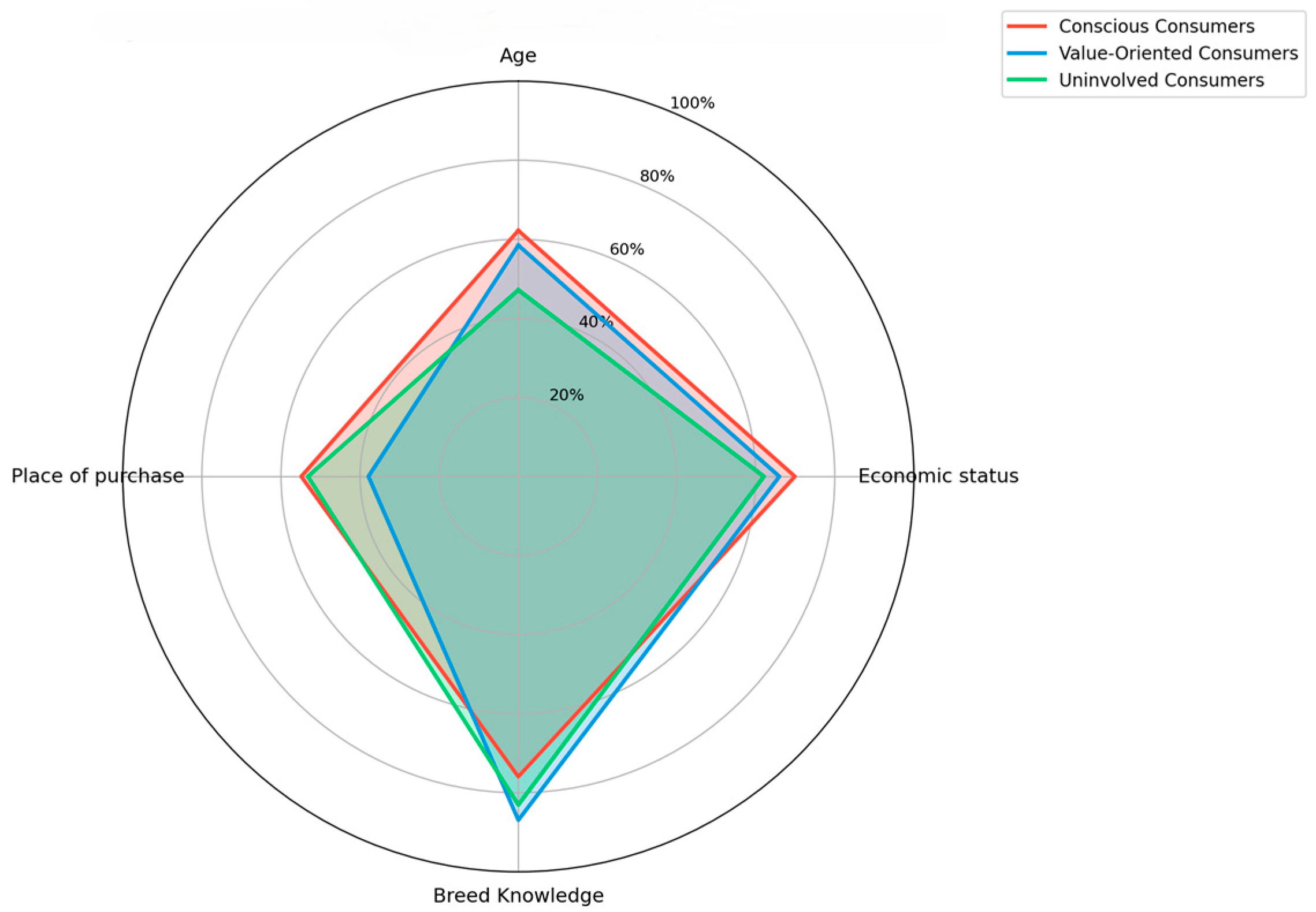
Figure 1. Comparison of three consumer segments across significant discriminating variables identified through chi-square analysis (p < 0.05). Note: Values represent within-segment representation: age (% aged 55+), economic status (% with above average income), breed knowledge (% knowing pig breed when purchasing), and place of purchase (% buying directly from producer or in supermarkets). Larger polygons indicate stronger representation of these characteristics. Only statistically significant discriminating variables (χ2 test, p < 0.05) are displayed.
Sustainability 18 00980 g001
Table 1. Sustainability considerations in consumer decision-making for fresh pork purchases.
MMeMoSD
Freshness and meat appearance (colour, marbling, drip loss) are important factors when I purchase fresh pork.4.28440.840
Breeding indigenous pig breeds (such as Black Slavonian pig) promotes sustainability and provides support to local farmers.4.26450.846
Local food production contributes to preserving traditional breeds and production methods.4.22440.821
Products should clearly indicate whether the meat comes from an indigenous breed (such as Black Slavonian pig) or from modern pig breeds.4.14440.851
Outdoor rearing of Black Slavonian pigs represents a more environmentally friendly production system.4.12440.819
I consider the taste of meat to be the most important factor.4.07440.785
Products should indicate whether pigs were reared according to higher welfare standards.4.03440.863
I consistently check the price when purchasing fresh boneless pork ham.4.02441.031
Locally produced food is healthier and more natural (produced using traditional methods).3.95440.898
Pigs should have the opportunity to express natural behaviours on the farm (rooting, wallowing in mud, etc.).3.94440.838
Meat from indigenous pig breeds (such as the Black Slavonian pig) has superior taste, juiciness, tenderness, and overall quality.3.90440.849
Higher animal welfare standards result in better meat quality.3.88440.913
Knowing the production location and methods for pork is important to me.3.87440.851
Product labels and information are very important as they indicate quality and food safety.3.87440.884
Indoor (intensive) pig farming leads to environmental problems (e.g., high water consumption, energy use, greenhouse gas emissions).3.74440.897
I prefer purchasing locally produced food even when it costs more.3.74440.934
I believe intensive (indoor) pig farming is cruel.3.63440.985
I link meat quality with the geographical origin of the breed.3.57440.939
Farm animal welfare is a concern of mine.3.57430.954
The rearing conditions of pigs are unimportant because they are unaware of better alternatives.3.51431.079
I am willing to pay a premium for pork produced under higher animal welfare standards.3.51431.033
Note: M = arithmetic mean, Me = median, Mo = mode, and SD = standard deviation.
Table 2. Exploratory factor analysis of consumers’ opinions on purchasing behaviour and sustainability concerns related to fresh pork from the Black Slavonian pig.
F1F2F3F4
Farm animal welfare is a concern of mine.0.8420.0790.1630.089
I believe intensive (indoor) pig farming is cruel.0.7870.1150.0540.061
Higher animal welfare standards result in better meat quality.0.7420.1660.1810.180
I am willing to pay a premium for pork produced under higher animal welfare standards.0.7220.1520.413−0.052
Pigs should have the opportunity to express natural behaviours on the farm.0.7000.2350.1340.115
Products should indicate whether pigs were reared according to higher welfare standards.0.6820.3260.2520.082
Indoor (intensive) pig farming leads to environmental problems.0.5010.4780.181−0.029
The rearing conditions of pigs are unimportant because they are unaware of better alternatives.0.4500.171−0.3710.120
Breeding indigenous pig breeds (such as the Black Slavonian pig) promotes sustainability and provides support to local farmers.0.1760.7830.1690.307
Outdoor rearing of Black Slavonian pigs represents a more environmentally friendly production system.0.2930.7810.0880.030
Local food production contributes to preserving traditional breeds and production methods.0.1810.7210.2210.402
Products should clearly indicate whether the meat comes from an indigenous breed (such as the Black Slavonian pig) or from modern pig breeds.0.2470.6010.3950.154
Meat from indigenous pig breeds (such as Black Slavonian pig) has superior taste, juiciness, tenderness, and overall quality.0.1340.5980.4870.168
Locally produced food is healthier and more natural (produced using traditional methods).0.1370.5640.4350.303
I link meat quality with the geographical origin of the breed.0.1630.2770.7460.030
Knowing the production location and methods for pork is important to me.0.2920.2070.6990.262
Product labels and information are very important as they indicate quality and food safety.0.2140.3650.5860.127
I prefer purchasing locally produced food even when it costs more.0.3240.4320.551−0.152
I consistently check the price when purchasing fresh boneless pork ham.−0.0100.123−0.1790.782
Freshness and meat appearance (colour, marbling, drip loss) are important factors when I purchase fresh pork.0.2270.2410.2370.719
I consider the taste of meat to be the most important factor.0.1370.1860.4230.629
% Variance Explained41.36710.4747.3004.812
Eigenvalues8.6872.2001.5331.011
Cronbach’s Alpha0.7720.8750.8070.668
KMO = 0.929, Bartlett’s χ2 = 4745.022, p = 0.000. Extraction method: principal component analysis. Rotation method: Varimax with Kaiser normalisation. Note: attention to animal welfare (F1), supporting local production and biodiversity (F2), origin and information (F3), price and intrinsic quality (F4).
Table 3. Final cluster profiles regarding consumers’ opinions about purchasing behaviour of fresh pork from the Black Slavonian pig and sustainability concerns.
Cluster 1
(n = 133)
Conscious Consumers
Cluster 2
(n = 153)
Value-Oriented Consumers
Cluster 3
(n = 124)
Uninvolved Consumers
Attention to animal welfare0.63692−0.769260.26602
Supporting local production and biodiversity0.718950.22839−1.05293
Origin and information−0.430280.44339−0.08557
Price and intrinsic quality0.12743−0.111440.00082
Table 4. Model fit statistics and likelihood ratio tests for predictors of consumer cluster membership.
Model Fit Statistics
StatisticValue
−2 Log Likelihood791.689
Model χ2 (df = 60)103.211 ***
Nagelkerke R20.251
McFadden R20.115
Classification Accuracy (%)52.9
Likelihood ratio tests
Predictorχ2dfp
Gender1.02820.598
Age17.90780.022 *
Residence0.21220.899
Region25.65880.001 ***
Occupation3.56880.894
Education7.46940.113
Household size 1.03840.904
Number of children in the household2.77840.596
Number of elders in the household0.94940.917
Family economic status19.93260.003 **
Purchase place15.94940.003 **
Paying price6.27040.180
Breed knowledge2.46220.292
Note: Reference category: uninvolved consumers, *** p < 0.01, ** p < 0.01, and * p < 0.05.
Table 5. Multinomial logistic regression parameter estimates for significant predictors of consumer cluster membership.
BSEWaldOR95% CI
Conscious Consumers vs. Uninvolved Meat Consumers
Age (Reference: 55+)
18–24 years−1.690.715.63 *0.18[0.05, 0.75]
25–34 years−1.240.486.60 **0.29[0.11, 0.75]
35–44 years−0.860.522.750.42[0.15, 1.17]
45–54 years0.120.510.051.12[0.42, 3.02]
Region (Reference: Middle and South Adriatic)
Central Croatia−1.330.516.90 **0.26[0.10, 0.71]
Central Croatia North-Western Croatia−1.030.504.17 *0.36[0.13, 0.96]
Eastern Croatia−0.400.540.570.67[0.23, 1.91]
Northern Adriatic and Lika−1.180.544.74 *0.31[0.11, 0.89]
Economic Status (Reference: Above Average)
Significantly Below Average−2.280.876.88 **0.10[0.02, 0.56]
Below Average−1.250.506.30 *0.29[0.11, 0.76]
Average−0.690.373.480.50[0.24, 1.04]
Value-Oriented Consumers vs. Uninvolved Meat Consumers
Region (Reference: Middle and South Adriatic)
Central Croatia−1.920.5213.68 ***0.15[0.05, 0.41]
Central Croatia North-Western Croatia−1.350.517.17 **0.26[0.10, 0.70]
Eastern Croatia−0.320.530.360.73[0.26, 2.06]
Northern Adriatic and Lika−1.030.533.750.36[0.13, 1.01]
Economic Status (Reference: Above Average)
Significantly Below Average−0.751.199.94 **0.24[0.00, 0.24]
Below Average−0.760.482.520.47[0.18, 1.20]
Average−0.620.382.670.54[0.25, 1.13]
Purchase Place (Reference: Supermarket)
Direct From Producer−0.980.612.590.38[0.11, 1.24]
Butcher Shop−0.930.309.42 **0.39[0.22, 0.71]
Price Paid (Reference: ≥€10.04)
€3.30–5.940.910.552.762.47[0.85, 7.20]
€6.08–9.901.260.545.34 *3.51[1.21, 10.19]
Note: B—regression coefficient (positive = higher odds of being in the cluster; negative = lower odds), SE—standard error, OR = odds ratio; and CI = confidence interval. Only significant predictors shown. *** p < 0.01, ** p < 0.01, and * p < 0.05.
Disclaimer/Publisher’s Note: The statements, opinions and data contained in all publications are solely those of the individual author(s) and contributor(s) and not of MDPI and/or the editor(s). MDPI and/or the editor(s) disclaim responsibility for any injury to people or property resulting from any ideas, methods, instructions or products referred to in the content.


