Article

Sustainable Mixed-Traffic Micro-Modeling in Intelligent Connected Environments: Construction and Simulation Analysis

1
College of Transportation Engineering, Chang’an University, Xi’an 710064, China
2
Proton Automotive Technology Co., Ltd., Xi’an 710021, China
3
School of Automobile, Chang’an University, Xi’an 710064, China
*
Author to whom correspondence should be addressed.
Sustainability 2026, 18(2), 960; https://doi.org/10.3390/su18020960 (registering DOI)
Submission received: 9 November 2025 / Revised: 28 December 2025 / Accepted: 13 January 2026 / Published: 17 January 2026

Abstract

Sustainable urban mobility necessitates traffic regimes that enhance operational efficiency and improve traffic safety and flow stability; the rise in intelligent connected vehicles (ICVs) provides a salient mechanism to meet this imperative. This paper aims to investigate the mixed traffic flow characteristics in an intelligent connected environment, using one-way single-lane, double-lane, and three-lane straight highways as modeling objects. Combining the different driving characteristics of human-driven vehicles (HDVs) and ICVs, a single-lane mixed traffic flow model and a multi-lane mixed traffic flow model are established based on the intelligent driver model (IDM) and flexible symmetric two-lane cellular automata model (FSTCAM). The mixed traffic flow in the intelligent connected environment is then simulated using MATLAB R2021a. The research results indicate that the integration of ICVs can improve the speed, flow, and critical density of traffic flow. The increase in the proportion of ICVs can reduce the congestion ratio and speed difference between front and rear vehicles at the same density. As the proportion of ICVs increases, the frequency of lane-changing for HDVs gradually increases, while the frequency of lane-changing for ICVs gradually decreases. The overall lane-changing frequency shows a trend of first increasing and then decreasing. In addition, with the continuous infiltration of ICVs, the area of road congestion gradually decreases, and congestion is significantly alleviated. The speed fluctuation of following vehicles gradually decreases. When the infiltration rate reaches a high level, vehicles travel at a stable speed and remain in a relatively steady state. The findings substantiate the potential of ICV-enabled operations to advance efficiency-oriented and stability-enhancing urban mobility and to inform evidence-based traffic management and policy design.

1. Introduction

The development of China’s transportation industry has been a significant factor in the country’s economic growth. The increase in motor vehicles has led to the expansion of the road network, facilitating enhanced mobility and accessibility. Furthermore, the advancement of transportation services has contributed to the improvement of living standards and the ease of conducting business. Nevertheless, issues such as traffic accidents, traffic pollution, and urban road congestion persist, exerting a dual impact: endangering the safety and convenience of car owners while impeding the sustainable growth of cities. It is evident that external measures, such as the continuous investment in road construction and traffic planning that is customary in traditional industries, are incapable of providing a fundamental solution to the problems at hand. Intelligent connected technology integrates vehicles and infrastructure into an organic, data-driven system through information perception, real-time communication, and cooperative control. By enhancing traffic safety and efficiency, it fosters the transition of transportation systems toward efficient and reliable transportation development. In this study, sustainable transportation is considered from the perspectives of traffic efficiency and flow stability. The paper analyzes the mixed-traffic flow characteristics under different levels of intelligent connected vehicle penetration, thereby providing support for the sustainable development of urban transportation.
In recent years, the rapid development of intelligent networking technology has provided new sustainable solutions to the aforementioned problems. However, according to research in this field, intelligent connected vehicle technology is still in its early stages of development. The level of intelligence has not yet reached a mature stage, and relevant laws and regulations are not yet perfect. Consequently, it is projected that intelligent connected vehicles (ICVs) will require a considerable period of time to fully supplant human-driven vehicles (HDVs) [1]. In the future, road systems will be characterized by the coexistence of both HDVs and ICVs over an extended period, resulting in the formation of a complex mixed traffic flow state. Drawing upon the aforementioned background, this article undertakes a comprehensive investigation into the domain of road traffic systems, with a particular focus on the integration of ICV. The study offers invaluable reference material for the construction, development, and operation management of future intelligent road networks.
Traffic flow models provide mathematical descriptions and explanations for complex traffic phenomena. Existing research on mixed traffic flow at the microscopic level can generally be categorized into car-following models and lane-changing models.
Several studies have developed advanced car-following frameworks. For instance, an intelligent vehicle car-following model based on cyber–physical systems was proposed to enhance traffic stability through cyber-layer information optimization [2]. A multi-leading and single-following information fusion car-following model was designed to integrate headway, velocity, and acceleration data from multiple leading and single following vehicles, improving mixed traffic stability [3]. A hybrid car-following control model combining linear feedback and deep reinforcement learning was developed to capture interactive coupling effects between different vehicle types, thereby enhancing both stability and efficiency [4]. Furthermore, an adaptive cruise control framework under cut-in scenarios was formulated using linear feedback control to analyze longitudinal safety and stability disturbances, with validation through simulations and field data [5]. A distributed cascade proportional–integral–derivative (DCPID) control algorithm was proposed to integrate longitudinal platoon control and cooperative lane-changing, enabling safe and efficient operations under various speeds and emergency conditions [6]. In addition, a CARLA (Car Learning to Act)-based mixed traffic simulation platform was developed, incorporating discretionary and mandatory lane-changing models as well as multi-predecessor platoon control, to evaluate the safety, efficiency, and environmental impacts of dedicated lanes and cooperative control strategies [7].
In the field of traffic safety assessment, a collision risk measurement framework integrating car-following and lane-changing behaviors was established to evaluate the influence of connected vehicle penetration rates and driver perception–reaction times on collision probability [8]. A multi-dimensional analytical framework for surrogate safety measures (SSMs) was introduced to better represent longitudinal interaction dynamics in mixed traffic [9]. At the network level, the safety impacts of dedicated lanes for connected automated vehicles (CAVs) were explored, highlighting how lane-changing behavior and inter-vehicle interactions affect overall safety and efficiency [10]. A comprehensive behavioral modeling framework combining car-following and lane-changing processes was also proposed, incorporating a novel safety metric to quantify interaction risks across varying CAV penetration rates [11].
Recent studies have shown that psychological and behavioral heterogeneity in human driving behavior plays a crucial role in mixed-traffic dynamics. For example, classifying drivers into aggressive, normal, and conservative types reveals significant impacts on merging interactions and conflict patterns [12]. Other findings indicate that subjective comfort, uncertainty about automation, and attention level may cause hesitation or unsafe maneuvers during HDV–ICV interactions [13]. In addition, psychological responses such as caution or stress when interacting with automated vehicles can noticeably modify lane-changing behavior [14]. However, despite these valuable insights, psychological factors have not yet been quantitatively incorporated into microscopic mixed-traffic models. Therefore, this study integrates fear-level-based reaction times and driving-style parameters into the IDM framework to more realistically capture human–automation interaction mechanisms.
For specific traffic scenarios, a cellular automaton–based model was established to simulate car-following and lane-changing behaviors in highway maintenance zones, accounting for differences between passenger vehicles, trucks, and CAVs, and proposing improved control strategies to enhance safety and efficiency [15]. A combined driving and microscopic simulation approach was applied to investigate the impacts of mixed heterogeneous platoons, where leader driver behavior was integrated into car-following dynamics to evaluate system stability and operational performance under different market penetration rates [16]. Furthermore, a multiclass dynamic traffic assignment model was developed to represent system-optimal routing for CAVs and user-equilibrium routing for HDVs, incorporating the effects of CAV penetration on road capacity at both micro and mesoscopic levels [17].
While domestic and international scholars have achieved certain results in mixed traffic flow modeling and simulation, existing studies still exhibit the following shortcomings: first, in car-following modeling, the coupled effects of driver psychological factors and vehicle reaction time are rarely considered comprehensively; second, in multi-lane-changing modeling, the systematic characterization of behavioral differences between connected and automated vehicles and human-driven vehicles remains insufficient; third, in simulation analysis, there is a lack of comprehensive evaluation of mixed traffic flow characteristics across multiple dimensions such as fundamental diagrams, lane-changing frequency, congestion status, and stability. Based on this, the main innovations of this paper are as follows:
(1)
An improved IDM car-following model integrating fear degree and reaction time is proposed. Building upon the traditional IDM, a “fear degree” parameter reflecting drivers’ psychological response to connected and automated vehicles is introduced and quantified using the Wundt psychological curve. Additionally, the reaction times of human-driven vehicles and connected and automated vehicles under different car-following modes (HDC, ACC, CACC) are differentiated, making microscopic car-following behavior more aligned with actual driving psychology and vehicle characteristics.
(2)
A multi-lane lane-changing rule system categorized by vehicle type is constructed. To address the fundamental differences in lane-changing decision logic between connected and automated vehicles and human-driven vehicles, this paper modifies the classical two-lane cellular automata model (TCAM) by categorizing vehicle types. It clarifies distinctions in lane-changing motivation judgment, safety condition assessment, and lane-changing probability settings, and further extends the framework to three-lane scenarios, systematically depicting the cooperative and competitive lane-changing behaviors of vehicles in mixed traffic flow.
(3)
Multi-dimensional simulation and comprehensive evaluation of mixed traffic flow characteristics are conducted. Using the Matlab platform, simulation environments for single-lane, double-lane, and three-lane scenarios are constructed. The impact of connected and automated vehicle penetration rates on traffic flow efficiency, safety, and stability is comprehensively analyzed based on multiple indicators such as fundamental diagrams, lane-changing frequency, congestion degree, and speed fluctuations, providing a quantitative basis for formulating traffic control strategies in connected and automated environments.
The structure of this paper is arranged as follows. Section 2 constructs the single-lane mixed traffic flow model in an intelligent connected environment. Section 3 extends the modeling framework to multi-lane traffic, and Section 4 develops a three-lane lane-changing model to capture more complex interactions. Section 5 presents simulation analyses of mixed traffic flow characteristics under different penetration rates of intelligent connected vehicles. Section 6 summarizes the main findings and outlines future research directions.

2. Construction of Single-Lane Mixed Traffic Flow Model in Intelligent Connected Environment

Adaptive Cruise Control (ACC) and Cooperative Adaptive Cruise Control (CACC) are typical car-following control methods for ICV. ACC is a driving assistance system for automobiles, used to maintain a safe distance between the vehicle and the preceding vehicle on highways and other roads, and automatically adjust the speed of the vehicle based on the speed of the preceding vehicle. For clarity, the variables used in the model are listed in Table 1.

2.1. Analysis of Car-Following Mode

ACC systems typically use sensors such as radar, lasers, or cameras to detect vehicles ahead and maintain a safe following distance through automatic braking and acceleration. CACC is based on ACC and communicates and collaborates with other vehicles to achieve more efficient and safer traffic flow. The CACC system can coordinate speed and driving routes through communication between vehicles, thereby achieving fleet driving and minimizing congestion and collision risks to the greatest extent possible. When a certain intelligent connected vehicle is in the CACC state, due to the vehicle’s lane-changing behavior, if the HDV changes to the position in front of the intelligent connected vehicle, the CACC will automatically degrade to ACC, but the vehicle will still achieve vehicle-to-vehicle (V2V) communication with the following intelligent connected vehicle. Therefore, in the mixed traffic flow mixed with ICV, there are three control modes: human-driving control (HDC), ACC, and CACC [18], as shown in Figure 1.
Regarding the three following modes mentioned above, the IDM can present real traffic flow phenomena such as oscillations, delays, and failures. Considering the different accuracy of the three following modes in obtaining preceding vehicle information, different safe following time intervals are used to distinguish the three following modes. Based on the latest research results, it is recommended to set the HDC mode at 1.6 s, the ACC mode at 1.1 s, and the CACC mode at 0.6 s.

2.2. Establishment of IDM Based on Fear Level and Reaction Time

In order to make the simulation closer to the actual situation, this study considers the familiarity of HDVs with intelligent networking technology and the different reaction times under different car-following modes, under the premise of setting different safe headway intervals. The IDM is improved and an IDM based on fear level and reaction time is established.
(1)
HDC mode
When a human-driven vehicle follows a human-driven vehicle or an intelligent connected vehicle in HDC mode, the response time is the same. If the reaction time of the human driver is γ1, the minimum safe parking distance (S) in HDC mode can be expressed as
S = S 0 + v γ 1
where S0 is minimum parking distance (m); v is the vehicle speed (m/s).
① Establishment of a model for following an HDV
In summary, the expression of the IDM for following an HDV is:
v ˙ = a 1 v v f 4 S 0 + v γ 1 + T H D C + v v 2 a b h L 2
where v ˙ is expected acceleration (m/s2); a is maximum acceleration (m/s2); vf is free-flow speed (m/s); THDC denotes the safe headway under HDC mode (s); ∆v is the relative speed to the preceding vehicle (m/s); b is comfort deceleration (m/s2); h is headway (s); and L is the vehicle length (m).
② Modeling an HDV following an ICV
Due to the varying levels of familiarity of drivers with intelligent connected technology, there are certain differences in their behavior when following ICV. Therefore, introducing the headway of this following vehicle into a fear parameter β. We have conducted a fitting based on results from approximately 20 participants, the headway of an HDV following an intelligent connected vehicle can be expressed as
T 0 = 1 + β T H D C
Considering the correlation between the level of driver safety trust and their subjective perception of ICV, the quantification of driver fear of ICV is conducted. When conducting quantitative analysis, it is necessary to consider the psychological and physiological characteristics of drivers, as well as the relationship between personal attributes and driving environment factors, in order to establish an accurate “fear level” quantitative model.
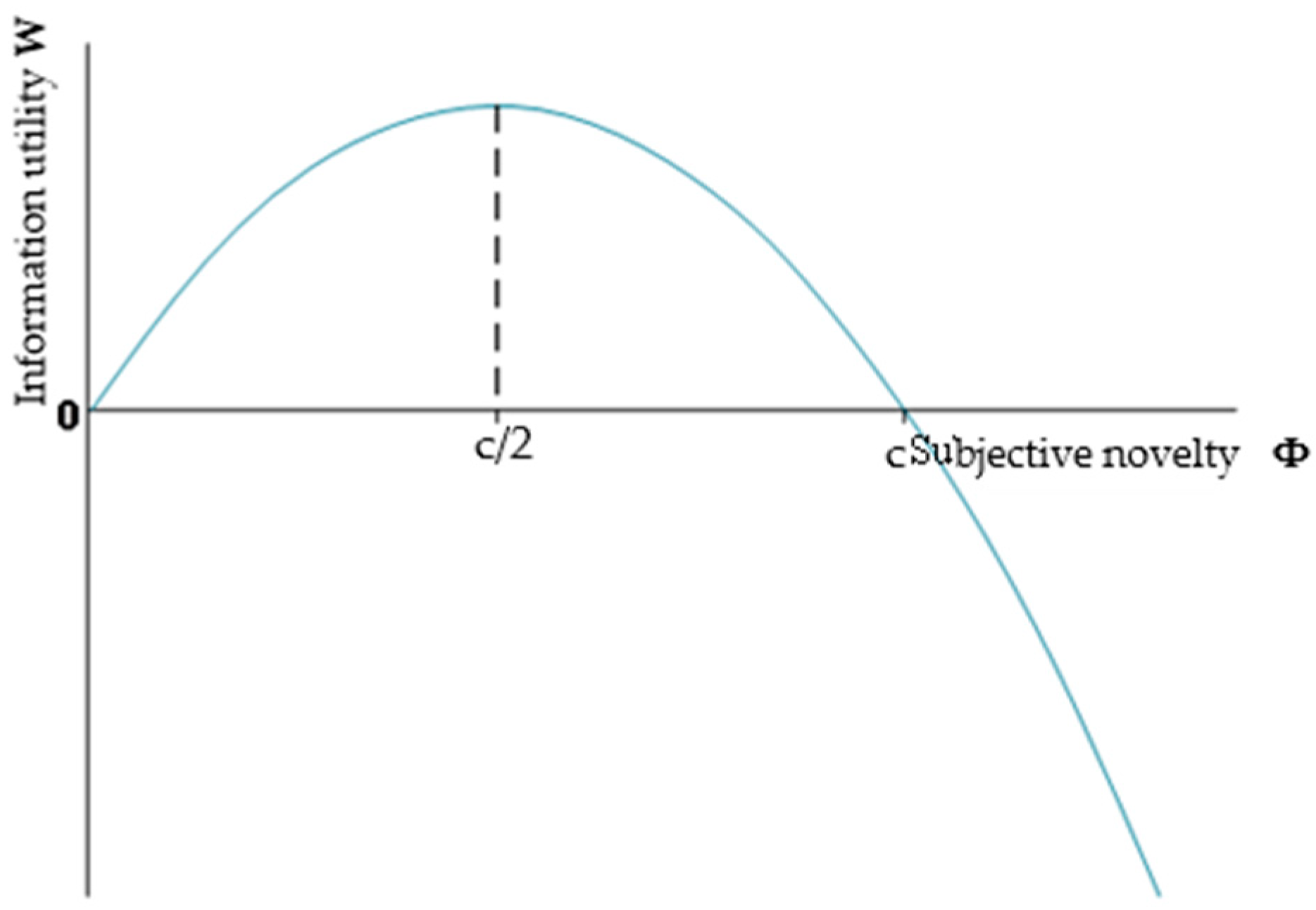
According to the theory of renowned psychologist Wilhelm Max Wundt, people often develop a fear mentality due to unfamiliarity with new things. From the beginning of exposure to new things, the fear mentality will continue to increase with increasing familiarity, but as familiarity with new things increases, the fear mentality gradually decreases and eventually disappears, even producing negative effects [19].
Figure 2 shows the relationship between “subjective novelty” and “information utility”, presenting an inverted “u”—shaped parabola known as the Wundt curve.
Wundt’s psychological law is as follows:
W = ϕ 2 + c ϕ
In the formula, W represents information utility; Φ expressing subjective novelty; c represents a deterministic preference for subjective novelty within a given empirical framework.
This Wundt’s psychological theory has been widely applied in fields such as economics to describe the psychological laws of people when facing new things, and its effectiveness has been proven [20]. Building on this theory, the present study employs it to characterize drivers’ psychological responses to ICVs. When drivers begin using ICVs, their low level of familiarity with the technology induces a fear response. As drivers gain a higher degree of understanding of ICV technology, this fear gradually diminishes with increasing familiarity. Moreover, given that drivers are unlikely to make negative decisions—such as reducing the following distance—under the influence of fear, this study adopts only the positive-value segment of the Wundt curve.
The range of driver subjective understanding (i.e., familiarity) with intelligent connected driving technology is divided into 0 to 1. When the driver is completely unfamiliar with intelligent connected driving technology, the value is 0, and a value of 1 corresponds to full familiarity with ICV technology [21]. Let θ represents the driver’s subjective understanding of the performance of ICV, the coefficient of model is obtained through fitting experimental data, the formula for calculating fear level is as follows:
β = θ 2 + θ
where β represents the driver’s fear of ICV.
Therefore, taking IDM in HDC mode as an example, the mapping from psychological constructs (subjective novelty and information utility) to traffic flow parameters is reflected in subjective understanding (i.e., level of familiarity) → fear level → safe headway → traffic flow parameters. The expression of the IDM in HDC mode is
v ˙ = a 1 v v f 4 S 0 + v γ 1 + 1 θ 2 + θ T H D C + v v 2 a b h L 2
It can be observed that when the mean value of θ lies in the range 0–0.5, increasing θ leads to a decrease in capacity; whereas when the mean value of θ lies in the range 0.5–1, increasing θ results in an increase in capacity.
(2)
ACC mode
When an intelligent connected vehicle follows an HDV in ACC mode, assuming the time required for the intelligent connected vehicle to recognize changes in the driving behavior of the preceding vehicle is γ2, the minimum safe parking distance in ACC mode is
S = S 0 + v γ 2
Therefore, the expression of the IDM in ACC mode is
v ˙ = a 1 v v f 4 S 0 + v γ 2 + T A C C + v v 2 a b h L 2
where TACC denotes the safe headway under ACC mode (s).
When the intelligent connected vehicle follows the intelligent connected vehicle in CACC mode, assuming the delay (reaction time) in communication and control between the ICV is γ3, the minimum safe parking distance in CACC mode is
S = S 0 + v γ 3
Therefore, the expression of the IDM in CACC mode is
v ˙ = a 1 v v f 4 S 0 + v γ 3 + T C A C C + v v 2 a b h L 2
Referring to existing research [22] on the values of different reaction times for traffic stability, the reaction time γ1 for manual drivers is taken as 0.4 s; the communication delay between ICV is very small, taken γ3 as 0. In the mode of ICV following HDVs, due to the inability to achieve real-time communication between vehicles, the recognition response time is between the two mentioned above, taking γ2 as 0.2 s.
The values of other parameters in the IDM are taken from Reference [23], as shown in Table 2.

2.3. Establishment of IDM Following Rules Based on Fear Level and Reaction Time

On the basis of the improved IDM, this study establishes a single-lane mixed traffic flow following rule in an intelligent connected environment through a cellular automaton model, expressing the speed and position evolution of vehicles during following.
According to the IDM expression, the model takes the vehicle acceleration as the output, and the speed update of the vehicle during the following process is as follows:
v n t + T = v n t + a n T
where t represents the current simulation time; ∆T represents the unit simulation step size; an represents the acceleration of the nth vehicle calculated by IDM based on the vehicle following mode; vn represents the speed of the nth vehicle.
On the basis of speed updates, the vehicle position is updated as follows:
x n t + T = x n t + v n t + T T
where xn represents the position of the nth vehicle.
In addition, in order to be closer to the actual traffic flow, considering the uncertainty of drivers during the driving process, random slowing down is introduced in the evolutionary rules, and a certain number of vehicles are selected on the road according to a certain probability to perform deceleration operations. Because the perception of ICV is more accurate, the slowing down probability is much smaller compared to manual driving. Therefore, the slowing down probability of the manual driving model is set to 0.2, and the slowing down probability of intelligent driving vehicles is set to 0.05. When the random number is less than the slowing down probability, the vehicle decelerates.

3. Construction of Dual-Lane Mixed Traffic Flow Model in Intelligent Connected Environment

In the rule-based model, the cellular automaton lane-changing model has the advantages of easy expression, strong scalability, flexibility, and wide applicability. Based on the classic TCAM, this study constructs lane-changing models for two-lane and three-lane mixed traffic flow by improving lane-changing rules by vehicle type.

3.1. Rules for Changing Lanes for HDVs

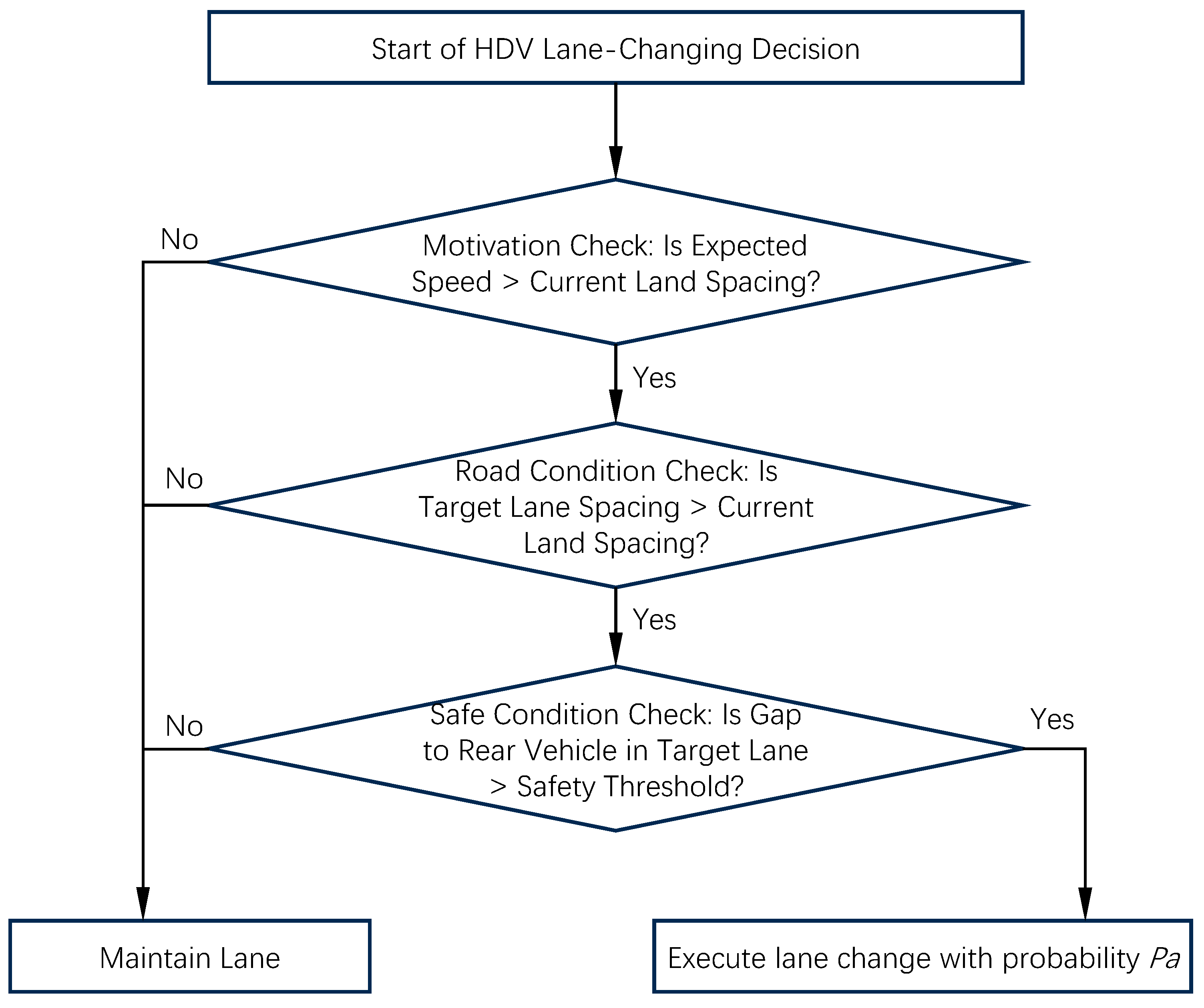
The traditional human-driven vehicle (HDV) lane-changing rules based on the cellular automaton communication model with elastic safety lane-changing spacing are as follows:
Step 1: Based on the previously constructed car-following model, different car-following models will be used to calculate vn(t + 1) for the situation where the vehicle in front of this lane is an HDV or an intelligent connected vehicle.
Step 2: Determine whether the vehicle intends to change lanes. When the expected speed of the target vehicle in the next step is greater than the distance between it and the vehicle in front of the lane, the vehicle intends to change lanes, that is
G a p n < m i n v n t + 1 , v m a x
Step 3: Determine if the road conditions on the adjacent lane are better than those on the current lane, that is
G a p n , f r o n t > G a p n
Equation (14) is used to determine whether the longitudinal distance between the target vehicle and the preceding vehicle in the adjacent lane is greater than the distance between the target vehicle and the preceding vehicle in this lane, that is, whether the adjacent lane has superior driving conditions. If it meets the requirements, proceed to Step 4; otherwise, it indicates that the target lane does not meet the road conditions and the target vehicle cannot change lanes.
Step 4: Determine safety conditions to ensure that the target vehicle does not collide with vehicles in the adjacent lane when changing lanes, i.e.,:
G a p n , b a c k > 1 + v m a x m i n v n t + 1 , v m a x
Equation (15) represents the condition that the distance between the target vehicle and the following vehicle in the adjacent lane must meet in order to avoid collision when the target vehicle needs to change lanes to the adjacent lane.
When the target vehicle intends to change lanes and meets the road and safety conditions, it will change lanes with a probability of Pa (See Figure 3).

3.2. Intelligent Connected Vehicle Lane-Changing Rules

In an intelligent connected environment, the lane-changing rules differ from those of traditional HDV in the following two aspects:
(1)
By analyzing the following mode in the intelligent connected environment, it can be concluded that when both the preceding and following vehicles are ICV, the driving behavior change information of the preceding vehicle can be transmitted to the following vehicle through vehicle-to-vehicle communication. Therefore, when in CACC following mode, the following vehicle can travel at a higher speed and maintain a smaller distance from the preceding vehicle. In this case, even if the distance between the preceding and following vehicles is less than the expected speed of the target vehicle, the target vehicle will not have the intention to change lanes. Therefore, when the target vehicle is an intelligent connected vehicle, the conditions for the generation of lane-changing intention need to be discussed on a case-by-case basis.
(2)
When the type of vehicle behind the adjacent lane is the same as that of the target vehicle, which is an intelligent networked vehicle, the vehicle behind the adjacent lane can obtain real-time status information of the target vehicle through vehicle-to-vehicle communication and quickly make changes based on the target vehicle’s status. In this case, when the target vehicle changes lanes, it only needs to meet the requirements of having a speed greater than the vehicle behind the adjacent lane and a longitudinal distance greater than 0 from the vehicle behind the adjacent lane.
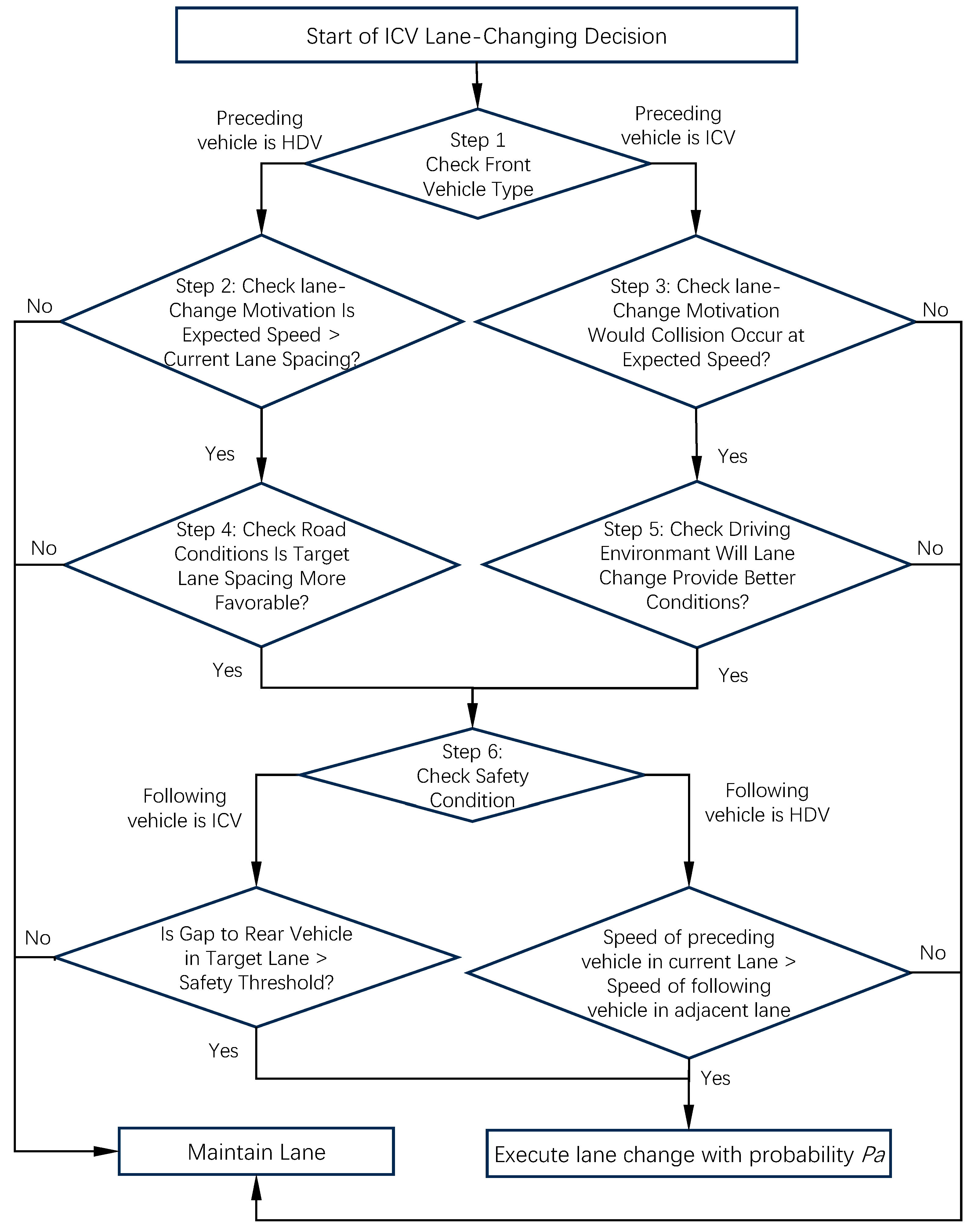
Therefore, when the target vehicle is an intelligent connected vehicle, by discussing the lane-changing rules of the improved model based on different situations, the lane-changing rules of the intelligent connected vehicle are as follows:
Step 1: Based on the car-following model constructed in this article, different car-following models will be used to calculate vn(t + 1) for the situation where the vehicle in front of this lane is an HDV or an intelligent connected vehicle. Next, determine whether the preceding vehicle of the target vehicle is an intelligent connected vehicle. If it is an intelligent connected vehicle, proceed to Step 3; if the vehicle is driven manually, proceed to Step 2;
Step 2: Determine whether the vehicle intends to change lanes. When the expected speed of the target vehicle in the next step is greater than the distance between it and the vehicle in front of the lane, the vehicle intends to change lanes, represented by Equation (13). If it meets the requirements, proceed to Step 4; otherwise, it indicates that the target vehicle can travel normally at the expected speed without changing lanes.
Step 3: Determine if there is a plan to change lanes when the preceding vehicle is an intelligent connected vehicle, that is
m i n v n t + 1 , v m a x > G a p n + v n , f r o n t
Equation (16) represents whether the target vehicle will collide with the preceding vehicle when traveling at the expected speed. If Equation (16) is satisfied, it indicates that the target vehicle cannot travel on the current lane at the expected speed and therefore has the intention to change lanes. Step 5 is executed. Otherwise, it indicates that the vehicle can continue to travel at the expected speed without changing lanes.
Step 4: Determine the road conditions and whether the driving conditions on adjacent lanes are better than those on the current lane, represented by Equation (14). If it meets the requirements, proceed to Step 6; otherwise, it indicates that the adjacent lane does not meet the road conditions and the target vehicle cannot change lanes.
Step 5: Determine whether the target vehicle has a better driving environment after changing lanes, that is
G a p n , f r o n t > G a p n + v n , f r o n t
If it meets the requirements, proceed to Step 6; otherwise, it indicates that the target lane does not meet the road conditions and the target vehicle cannot change lanes.
Step 6: Determine the safety conditions to ensure that the target vehicle does not collide with the vehicle behind the adjacent lane when changing lanes. Determine the type of vehicle behind the adjacent lane. When the vehicle behind the adjacent lane is an intelligent connected vehicle, it must meet the following requirements:
v n t v b a c k t , G a p n , b a c k > 0
When the type of vehicle behind the target lane is an HDV, the safety condition for changing lanes must meet Equation (15).
In the formula, represents the speed of the preceding vehicle in this lane, and represents the speed of the following vehicle in the adjacent lane at that time.
When the target vehicle intends to change lanes and meets road and safety conditions, it will change lanes with probability Pb. Due to the fact that ICVs are not affected by the driver’s personal factors, they tend to choose to change lanes when the conditions for changing lanes are met, in order to improve the driving environment. The lane-changing probability Pb of ICV will be higher than the lane-changing probability Pa of HDVs. The above is the lane-changing rule for ICV, which can change lanes if all conditions are met (See Figure 4).
Based on the above two-lane vehicle type lane-changing rules and car-following models, a two-lane mixed traffic flow model is constructed in an intelligent networked environment.

4. Construction of Three-Lane Mixed Traffic Flow Model in Intelligent Connected Environment

In actual traffic behavior, multiple lanes (greater than two lanes) often exist in most cases. Based on the above research, establish lane-changing models on three different lanes to form the overall vehicle lane-changing model.
Unlike the two-lane-changing model mentioned above, under multi-lane conditions, vehicles may have multiple assumed target lanes. Taking a one-way three-lane road as an example, vehicles in the inner and outer lanes have only one lane-change option, while vehicles in the middle lane have two lane-change options, which means there are two assumed target lanes. The lane-change rule for different vehicle types is now introduced into the three-lane road.

4.1. Left Lane Change Model

When a vehicle is in the left lane and intends to change lanes, it can only consider whether the middle lane meets the lane-changing conditions. If it meets the conditions, it will change lanes to the middle lane. Otherwise, it will not change lanes. In the intelligent networked environment, based on the improved dual-lane vehicle type changing rules mentioned above, the left lane-changing model will be divided into two scenarios to illustrate this.
The target vehicle is an HDV. Under the condition of meeting the lane-changing rules for HDVs, the vehicle will choose to change lanes to the middle lane. The update rules for vehicle speed and position are
M n t + 1 = M n t + 1 v n t + 1 = v n t x n t + 1 = x n + v n t + 1
where M represents the Mth lane, and M + 1 represents the adjacent right lane.
The target vehicle is an intelligent connected vehicle. Under the conditions of meeting the lane-changing rules for ICV, the vehicle will choose to change lanes to the middle lane. The update rules for vehicle speed and position are shown in Equation (19).

4.2. Middle-Lane Lane Change Model

When a vehicle is driving in the middle lane, due to the symmetry of the three lanes, when the vehicle intends to change lanes, it can consider changing lanes to the left or right simultaneously. If the left lane meets the conditions for changing lanes but the right lane does not, then the vehicle will change lanes to the left; if the left lane does not meet the conditions for changing lanes and the right lane meets the conditions for changing lanes, then the vehicle will change lanes to the right lane; if both left and right lanes meet the conditions for lane change, it will analyze the longitudinal distance between the preceding vehicles in the adjacent lanes of the target vehicle to determine the direction of the lane change. The middle lane-changing model is analyzed in two scenarios based on the different types of target vehicles.
(1)
The target vehicle is an HDV
When the target vehicle intends to change lanes for an HDV, according to the lane-changing rules for HDVs, if the left lane meets the lane-changing conditions, that is, the longitudinal distance between the target vehicle and the preceding vehicle in the left lane is greater than the distance between the target vehicle and the preceding vehicle in the current lane, and the longitudinal distance between the target vehicle and the following vehicle in the left lane meets the safety conditions of the established lane-changing model, but the longitudinal distance between the target vehicle and the preceding vehicle in the right lane is less than the distance between the target vehicle and the preceding vehicle in the current lane or the distance between the target vehicle and the following vehicle in the right lane does not meet the safety conditions of the model, then the right lane does.
At this point, the vehicle can only change lanes to the left, and the vehicle will change lanes to the left with a probability Pa of changing lanes. The update rules for vehicle speed and position are
M n t + 1 = M n t 1 v n t + 1 = v n t x n t + 1 = x n + v n t + 1
When the right lane meets the lane-changing conditions, that is, the longitudinal distance between the target vehicle and the vehicle in front of the right lane is greater than the distance between the target vehicle and the vehicle in front of the current lane, and the distance from the vehicle behind the right lane meets the safety conditions of the model. If the longitudinal distance between the target vehicle and the vehicle in front of the left lane is less than the distance between the target vehicle and the vehicle in front of the current lane or the longitudinal distance between the target vehicle, and the vehicle behind the left lane does not meet the safety conditions of the model, then the left lane does not meet the lane-changing conditions.
At this time, the vehicle can only change lanes to the right, and the vehicle will change lanes to the right with a probability Pa of changing lanes. The update rules for vehicle speed and position are
M n t + 1 = M n t + 1 v n t + 1 = v n t x n t + 1 = x n + v n t + 1
When the vehicles on the middle lane meet both the left and right lane-changing conditions mentioned above, that is, when the vehicles can change lanes to both left and right lanes at the same time, then the driving environment after the vehicle changes lanes is judged, and the lane with a larger longitudinal distance from the preceding vehicle is selected for lane changing. Therefore, there are
G a p n , l e f t f r o n t > G a p n G a p n , l e f t b a c k > 1 + v m a x m i n v n t + 1 , v m a x
G a p n , r i g h t f r o n t > G a p n G a p n , r i g h t b a c k > 1 + v m a x m i n v n t + 1 , v m a x
When Gapn,leftfront > Gapn,rightront, the vehicle will change lanes to the left lane with a probability of changing lanes Pa.
When Gapn,leftfront = Gapn,rightront, vehicles will consider choosing any lane for lane change with the same probability Pa/2.
When Gapn,leftfront < Gapn,rightront, the vehicle will change lanes to the right lane with a probability Pa of changing lanes.
(2)
The target vehicle is an intelligent connected vehicle.
When the target vehicle is an intelligent connected vehicle and intends to change lanes, in this scenario, if only the left lane meets the lane-changing conditions or only the right lane meets the lane-changing conditions, the speed and position update rules are the same as in the scenario where the target vehicle is an HDV, but the lane-changing probability is Pb.
When the vehicles on the middle lane meet both the conditions for changing lanes on the left and right sides, that is, when the vehicles can change lanes to both sides of the lane at the same time, the direction of lane change can be selected according to the different types of vehicles in front of the two lanes in the following four scenarios.
① ICVs are located in front of the left lane, while HDVs are located in front of the right lane.
Due to the ability of ICV to communicate with each other, they tend to form queues with vehicles of the same type to improve overall driving efficiency. When both left and right lanes meet the lane-changing conditions, if the vehicle recognizes that the adjacent lanes are both ICV in front of it, the vehicle will choose to change lanes to the left lane based on the lane-changing probability Pb.
② ICVs are located in front of the left lane, and ICVs are located in front of the right lane.
When there are ICVs in front of both the left and right lanes, the driving conditions of the left and right lanes are judged, and the lane change is selected to the lane with a larger longitudinal distance from the vehicle in front. Therefore, there are
G a p n , l e f t f r o n t > G a p n + v n , f r o n t     G a p n , l e f t b a c k > 1 + v m a x m i n v n t + 1 , v m a x T h e   v e h i c l e   b e h i n d   t h e   l e f t   l a n e   i s   M V v n t v l e f t b a c k t , G a p n , l e f t b a c k > 0 T h e   v e h i c l e   b e h i n d   t h e   l e f t   l a n e   i s   I C V  
G a p n , r i g h t b a c k > G a p n + v n , f r o n t     G a p n , r i g h t b a c k > 1 + v m a x m i n v n t + 1 , v m a x T h e   v e h i c l e   b e h i n d   t h e   r i g h t   l a n e   i s   M V v n t v r i g h t b a c k t , G a p n , r i g h t b a c k > 0 T h e   v e h i c l e   b e h i n d   t h e   r i g h t   l a n e   i s   I C V  
When Gapn,leftfront > Gapn,rightront, the vehicle will change lanes to the left lane with a probability of Pb.
When Gapn,leftfront = Gapn,rightront, vehicles will consider choosing any lane for lane change with the same probability Pb/2.
When Gapn,leftfront < Gapn,rightront, the vehicle will change lanes to the right lane with a probability of Pb.
③ The front of the left lane is an HDV, and the front of the right lane is an HDV.
When there are HDVs in front of both the left and right lanes, the driving conditions of the left and right lanes are judged, and the lane change is selected to the lane with a larger longitudinal distance from the vehicle in front. Therefore:
G a p n , l e f t f r o n t > G a p n     G a p n , l e f t b a c k > 1 + v m a x m i n v n t + 1 , v m a x T h e   v e h i c l e   b e h i n d   t h e   l e f t   l a n e   i s   M V v n t v l e f t b a c k t , G a p n , l e f t b a c k > 0 T h e   v e h i c l e   b e h i n d   t h e   l e f t   l a n e   i s   I C V  
G a p n , r i g h t b a c k > G a p n     G a p n , r i g h t b a c k > 1 + v m a x m i n v n t + 1 , v m a x T h e   v e h i c l e   b e h i n d   t h e   r i g h t   l a n e   i s   M V v n t v r i g h t b a c k t , G a p n , r i g h t b a c k > 0 T h e   v e h i c l e   b e h i n d   t h e   r i g h t   l a n e   i s   I C V  
When Gapn,leftfront > Gapn,rightront, the vehicle will change lanes to the left lane based on the probability of changing lanes Pb.
When Gapn,leftfront = Gapn,rightront, vehicles would consider choosing any lane for lane change with the same probability Pb/2.
When Gapn,leftfront < Gapn,rightront, the vehicle will change lanes to the right lane based on the probability of changing lanes Pb.
④ In front of the left lane is an HDV, and in front of the right lane is an intelligent connected vehicle
This scenario follows the same lane-changing rules as the first scenario, where the vehicle chooses to change lanes towards the right lane based on the lane-changing probability Pb.

4.3. Right Lane Change Model

When a vehicle is in the right lane and intends to change lanes, it can only consider whether the middle lane meets the lane-changing conditions. If it meets the conditions, it will change lanes to the middle lane. Otherwise, it will not change lanes. In the intelligent networked environment, based on the improved dual-lane vehicle type lane-changing rules mentioned above, the lane-changing model for the right lane will be divided into two scenarios to illustrate this.
The target vehicle is an HDV. Under the condition of meeting the lane-changing rules for HDVs, the vehicle will choose to change lanes to the middle lane. The update rules for vehicle speed and position are
M n t + 1 = M n t 1 v n t + 1 = v n t x n t + 1 = x n + v n t + 1
The target vehicle is an intelligent connected vehicle. Under the conditions of meeting the lane-changing rules for ICV, the vehicle will choose to change lanes to the middle lane. The update rules for vehicle speed and position are shown in Equation (28).
Based on the above three-lane vehicle type lane-changing rules and car-following model, a three-lane mixed traffic flow model is constructed in an intelligent networked environment.

5. Simulation Analysis of Mixed Traffic Flow Characteristics in an Intelligent Connected Environment

Based on the single-lane model and multi-lane model of mixed traffic flow, this article will use MATLAB software to establish simulation scenarios for mixed traffic flow on three straight highways: one-way single-lane, two-lane, and three-lane. The characteristics of mixed traffic flow will be analyzed from four aspects: basic diagram, lane-changing frequency, congestion situation, and stability.

5.1. Simulation Parameter Settings

The design of simulation experiment parameters includes the setting of basic parameters such as simulation duration, road length, and lane-changing probability for different vehicle types. The road length is set to 1200 m and the simulation duration is set to 3600 s. The parameters used in the simulation experiment are shown in Table 3. In the simulation experiments, the driver’s subjective understanding of ICV performance (θ) is assumed to follow a uniform distribution over the interval [0, 1], which implies that each driver is assigned a random θ value drawn from U(0,1) at the start of the simulation.
Model Description:
(1)
The discrete spatiotemporal characteristics of this model (time step τ = 1 s, spatial resolution 0.5 m) ensure high computational efficiency while maintaining the accuracy of microscopic behaviors.
(2)
During model iteration, the state of each cell is updated independently. The state transition rules are deterministic, and the updates of speed and position are based on physical formulas without iterative solving processes, resulting in stable computational efficiency.
(3)
The core rules of the model (car-following and lane-changing) involve local interactions. The algorithmic complexity increases linearly with the number of vehicles, meaning computational complexity grows as the network scale expands.

5.2. Basic Diagram Analysis

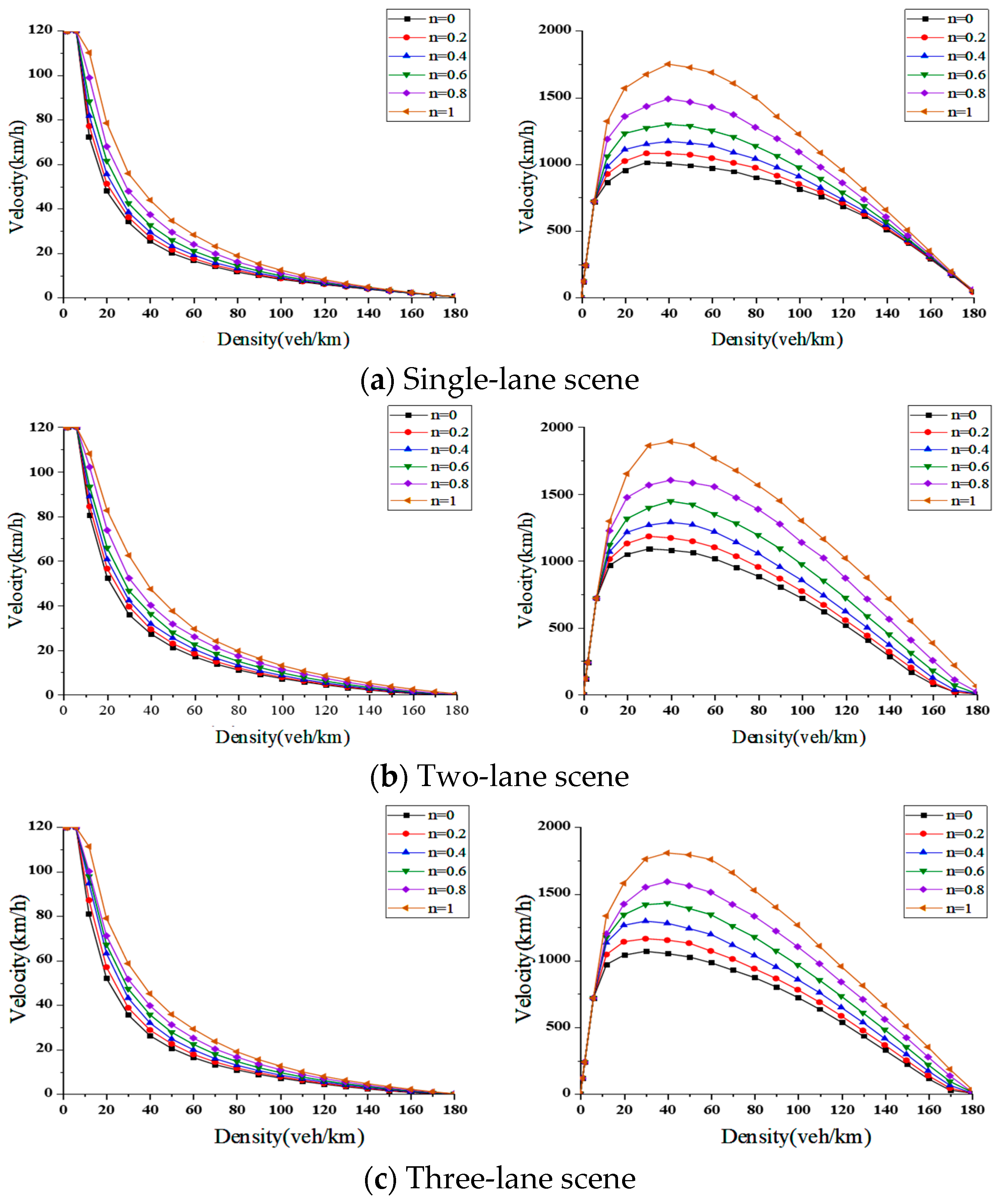
Simulate the speed density and flow density relationships of ICV under different penetration rates in intelligent connected environments with different numbers of lanes, as shown in Figure 5, where n represents the proportion of ICV.
From Figure 5, it can be concluded that the integration of ICV has increased the speed, flow rate, and critical density of traffic flow; the traffic capacity of pure ICV is about 1.7 times that of pure human-driven vehicles.
Continuing to compare the traffic capacity of different proportions of ICV in various scenarios, it can be seen that the traffic capacity of multi-lane roads is slightly higher than that of single-lane roads, and the traffic capacity of three-lane roads is slightly lower than that of two-lane roads. Two-lane roads have the best effect on improving road traffic capacity.

5.3. Analysis of Lane-Changing Frequency

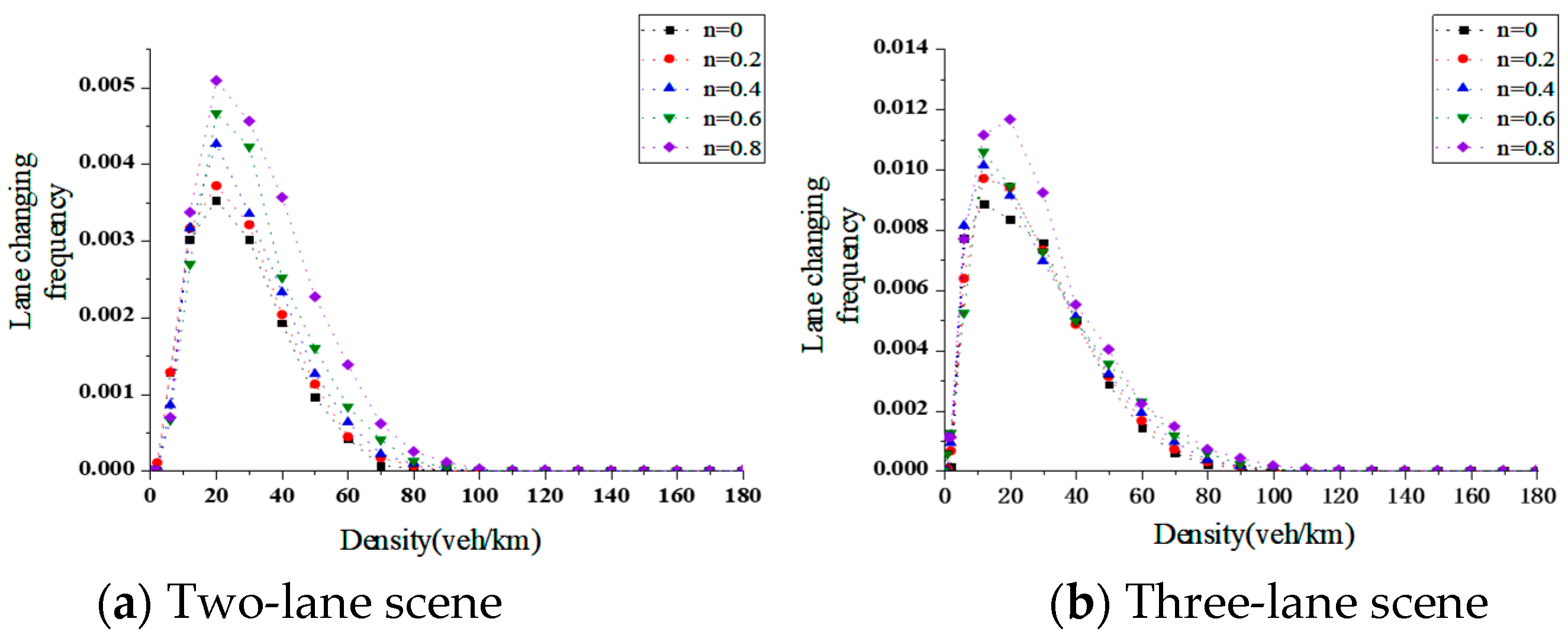
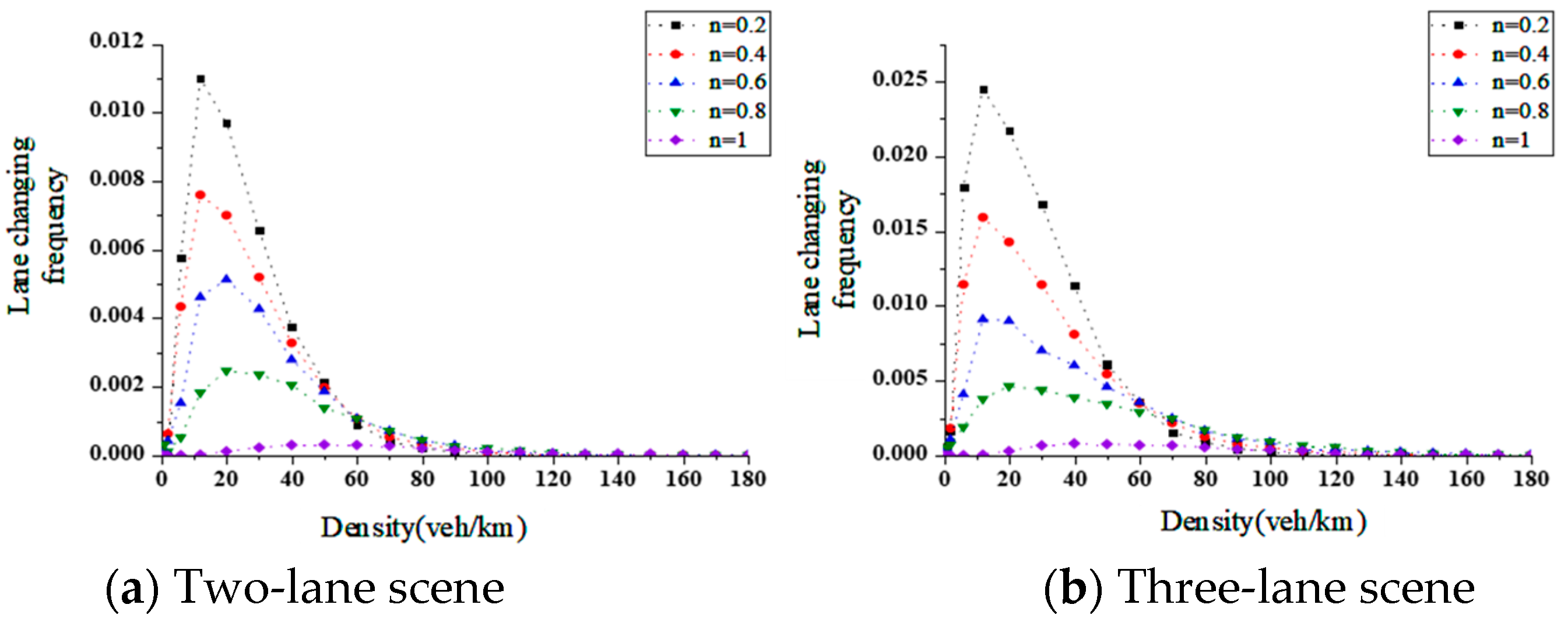
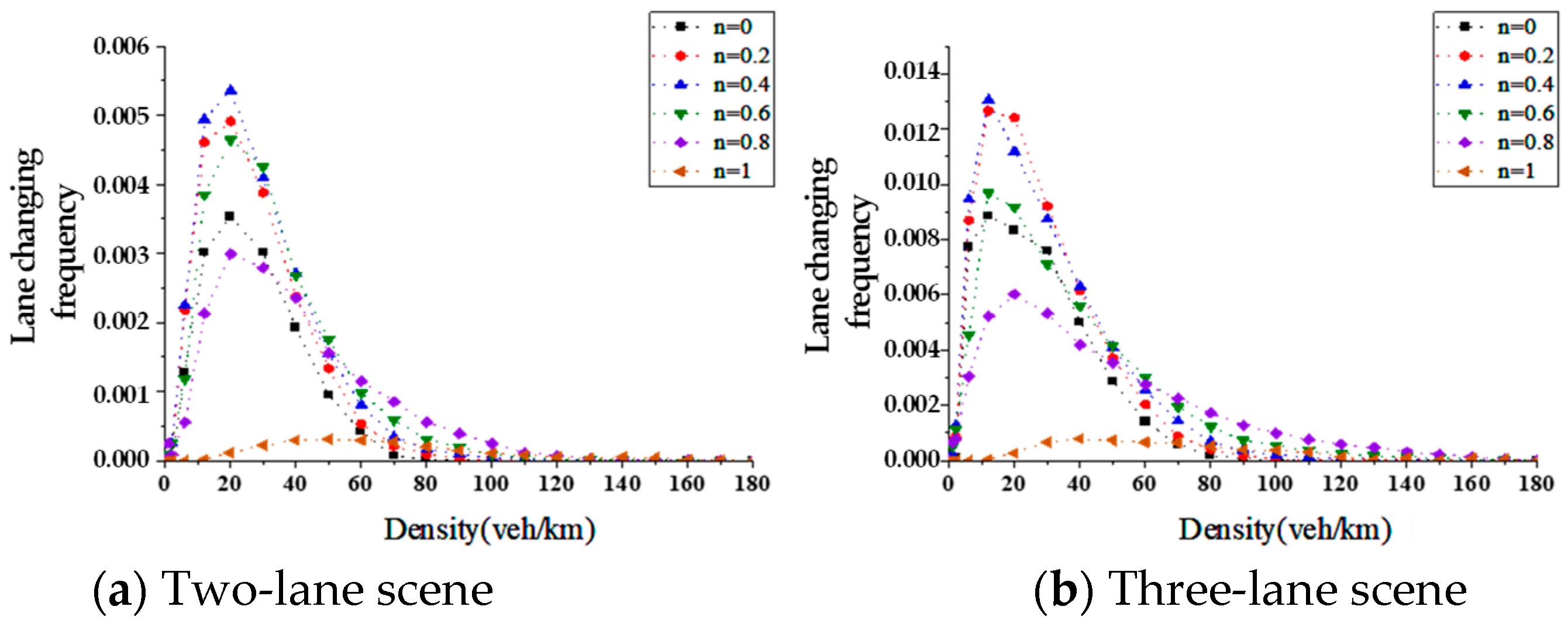
In order to investigate the lane-changing behavior of different types of vehicles in mixed traffic flow and the impact of their interaction on the overall lane-changing situation, the lane-changing frequency of HDVs, ICV, and the overall lane-changing situation in multi-lane scenarios were analyzed separately, as shown in Figure 6, Figure 7 and Figure 8.
From Figure 6, it can be seen that the frequency of manual lane-changing in the two-lane scenario (a) and the three-lane scenario (b) increases with the increasing proportion of ICV; from the frequency charts of lane-changing for ICV in the two-lane scenario in Figure 7a and the three-lane scenario in Figure 7b, it can be seen that at low-to-medium densities, the lane-changing frequency of ICV gradually decreases as the mixing rate of ICV increases. When the proportion of ICV is 1, that is, in pure intelligent connected vehicle traffic flow, vehicles rarely adopt lane-changing operation queues. According to the probability maps of overall lane-changing for mixed traffic flow in the two-lane scenario in Figure 8a and the three-lane scenario in Figure 8b, it can be seen that as the proportion of ICV increases, the overall lane-changing frequency of mixed traffic flow shows a trend of first increasing and then decreasing. In summary, a medium-to-high market penetration rate of ICVs can effectively reduce the overall lane-changing frequency in mixed traffic flow, thereby potentially enhancing traffic safety.

5.4. Crowding Analysis

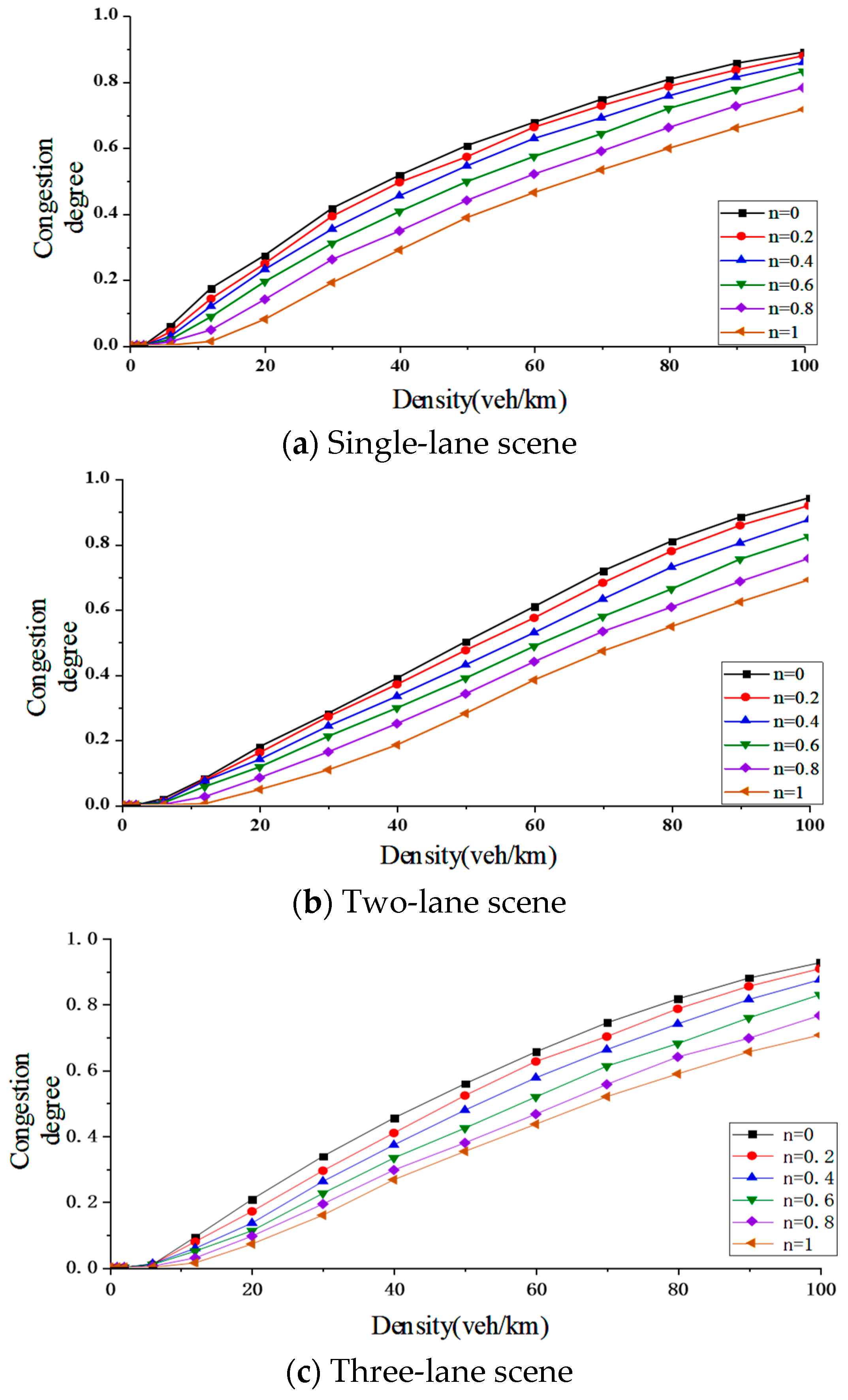
Vehicles with a speed less than 5 m/s in the traffic flow are considered to be in a congested state. The degree of traffic congestion can be described by the proportion of congested vehicles. The relationship between congestion and density in mixed traffic flow under different lane scenarios and different proportions of ICV is shown in Figure 9.
As shown in Figure 9, with the increase in density, the congestion level of the road shows a curve increasing trend from 0. Comparing the congestion level curves under different proportions of ICV, it can be seen that as the proportion of ICV increases, the congestion rate under the same density gradually decreases, causing the congestion level of vehicles on the road to slow down or stop later. When the density is low, the crowding ratio can be reduced to 0. In summary, ICV can significantly improve the congestion of traffic flow and enhance the operational efficiency of traffic flow. The higher the proportion of ICV, the better the operational condition of traffic flow and the less likely congestion occurs. In addition, comparing the congestion maps under different lane numbers, it can be seen that under medium- and low-density, the two-lane scene has the best effect on alleviating road congestion compared to the other two scenes.

5.5. Analysis of Speed Fluctuations in Following State

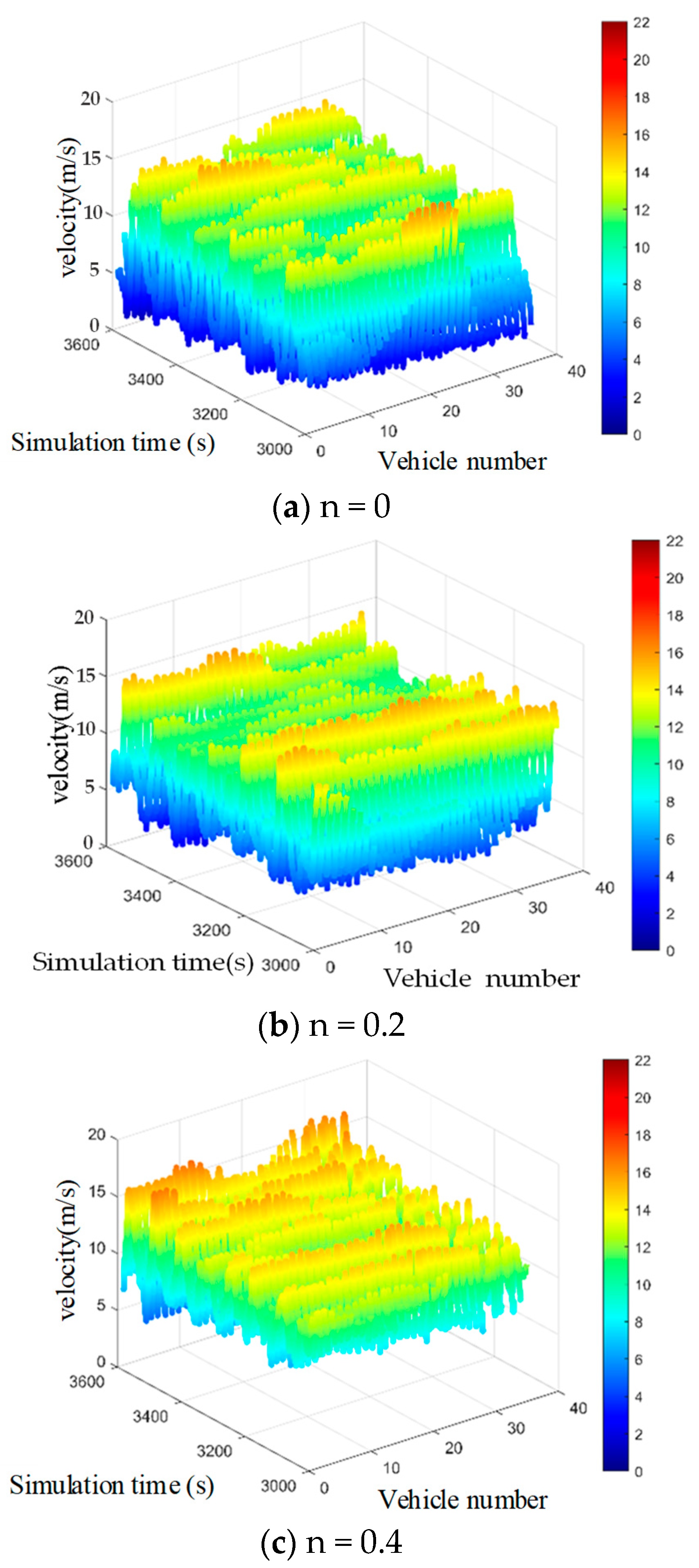
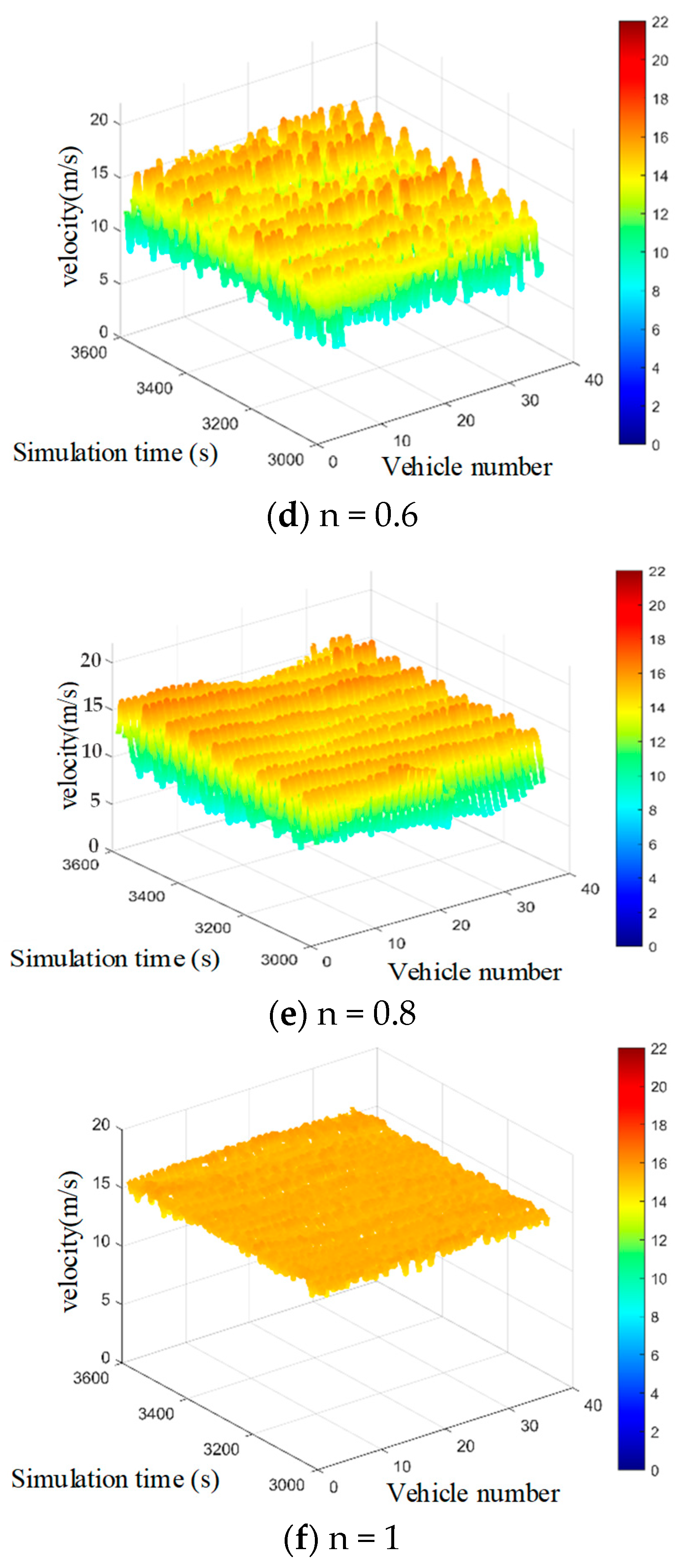
To study the impact of ICV on the stability of vehicle following in traffic flow, a single-lane scenario was selected with a traffic flow density of 33 veh/km. The speed of each vehicle was analyzed under different proportions of ICV. The simulation results are shown in Figure 10.
From Figure 10, it can be seen that the speed of each vehicle varies in time and space under different proportions of ICV. When n = 0, that is, pure manual driving traffic flow, the speed fluctuation amplitude of vehicles is large, and the simulated 40 vehicles show various speed fluctuation trends; When n = 0.2, the fluctuation amplitude of the vehicle’s speed is still high, but the downward fluctuation amplitude is slightly reduced; when n = 0.4, the fluctuation amplitude of the vehicle’s speed both increases and decreases; when n = 0.6, the speed fluctuation of the vehicle continues to decrease, and the mixed traffic flow shifts from an unstable state to a stable state; when n = 0.8, the overall trend of vehicle speed fluctuations tends to be flat, and the traffic flow is relatively stable; when n = 1, the speed of all vehicles is basically in the same state, and the traffic flow reaches a stable state.
In summary, as the proportion of ICVs increases, the speed fluctuation amplitude of vehicle following gradually decreases, indicating that the mixing of ICV can improve the stability of mixed traffic flow to a certain extent.

6. Research Summary

With the popularization of 5G technology and the rapid development of intelligent connected technology, ICVs will gradually become the mainstream trend in the future. In this context, this article focuses on the mixed traffic flow of HDVs and ICV that will occur in the process of popularizing ICV. Combining the different driving characteristics of HDVs and ICV, a micro-model of mixed traffic flow is constructed and simulated to explore the traffic flow characteristics in the intelligent connected environment.
(1)
Research on the Mixed Traffic Flow Model of Single-Lane in Intelligent Connected Vehicle Environment. This article analyzes the car-following patterns in mixed traffic flow, using vehicle pairs under different car-following patterns as modeling objects. The IDM is selected as the car-following model for mixed traffic flow and improved. On the basis of the IDM, this article considers the different accuracy of obtaining preceding vehicle information for different following modes and adopts different safe headway intervals; on the other hand, considering the different reaction times under different car-following modes and the impact of driver psychological effects on driving behavior, an IDM based on fear level and reaction time was constructed, and a single-lane mixed traffic flow model was constructed based on the cellular automaton model. By setting different random slowing probabilities, the driving characteristics of the two types of vehicles were further distinguished.
(2)
Research on Multi-Lane Mixed Traffic Flow Model in Intelligent Connected Environment. This article fully considers the differences in lane-changing intentions, conditions, and choices between ICVs and HDVs, and it improves the classic TCAM by classifying vehicle types to construct a mixed traffic flow lane-changing model. Specifically, based on the car-following model, differentiated lane-changing rules are formulated for the two types of vehicles. At the same time, the established two-lane lane-changing rules are introduced into the three-lane model, and a three-lane lane-changing model is constructed for different vehicle types. Different lane-changing probabilities are set according to the different types of changing vehicles in the two-lane and three-lane lane-changing models.
(3)
Research on the Characteristics of Mixed Traffic Flow. Based on the constructed mixed traffic flow car-following and lane-changing models, we established simulation scenarios for mixed traffic flow on single-lane, double-lane, and three-lane straight road segments using Matlab. The characteristics of the mixed traffic flow were analyzed in four aspects: fundamental diagrams, lane-changing frequency, congestion conditions, and stability. From the analysis of the fundamental diagrams, it can be observed that as the proportion of connected and automated vehicles (CAVs) increases, both the average speed and traffic flow volume on the road show a clear upward trend, and the critical density of the road gradually increases. Taking the single-lane scenario as an example, under pure human-driven conditions (n = 0), the average speed was 15 m/s, the peak traffic flow volume reached 1000 veh/h, and the critical density was approximately 18.5 veh/km. When n = 1, the average speed increased to about 25 m/s, the peak traffic flow volume reached 2000 veh/h, and the critical density rose to approximately 22.2 veh/km. The traffic capacity of the pure CAV flow (n = 1) is approximately 1.7 times that of the pure human-driven traffic flow (n = 0). Furthermore, examining the traffic capacity across different CAV proportions in various scenarios, the double-lane scenario showed a traffic capacity increase of about 59% at n = 0.6 compared to n = 0, demonstrating the most significant improvement in road capacity among all scenarios. The results from the lane-changing frequency analysis indicate that as the proportion of CAVs increases, the lane-changing frequency of human-driven vehicles gradually rises, while that of CAVs gradually decreases. The overall lane-changing frequency exhibits a trend of initially increasing and then decreasing, with the three-lane scenario showing higher lane-changing frequencies than the double-lane scenario. For instance, at n = 0.2, the overall lane-changing frequency in the double-lane scenario was 0.003, while in the three-lane scenario it was 0.006. Regarding congestion conditions, an increase in the proportion of CAVs reduces the congestion proportion under the same density. The double-lane scenario demonstrates the best mitigation effect on road congestion at low-to-medium densities (e.g., 50 veh/km), with a congestion degree of 0.51. The stability results show that as the proportion of CAVs increases, the speed difference between leading and following vehicles gradually decreases, and the speed fluctuation amplitude during car-following also diminishes. When the proportion of CAVs reaches a high level, vehicles maintain a stable speed (v ∈ [14, 16]) and remain in a relatively stable state, thereby enhancing the overall stability of the traffic flow.
It should be noted that the proposed model has several limitations. First, the fear parameter β currently lacks empirical calibration for specific regional or demographic groups, which may affect the generalizability of results. Second, while the Wundt curve effectively captures the “novelty—utility” relationship in psychological contexts, its direct interpretation as “fear” in traffic scenarios needs experimental or field data for calibration. Third, from a theoretical research perspective, the multi-lane lane-changing rules, especially for the three-lane scenario, are highly necessary. However, this inevitably increases the complexity of the algorithm. When considering the practical application of the algorithm, simplifying planning and improving efficiency are the most important factors for engineering implementation. These limitations are acknowledged in the Conclusion and Future Work section, where ongoing data collection and model refinement are outlined as essential next steps.
This study did not follow the principle of the left lane being the fast lane, so there may be some differences from the actual situation. The current model is only applicable to the simulation of mixed traffic flow on straight highways, and can be extended in future work by adjusting the number of cells, the proportion of intelligent vehicles merging, and the desired speed. In addition, several factors such as simplified driver behavior, unmodeled weather, or incident conditions, and failure in the comparison with real-world trajectory data are also limitations of this study. The author will conduct further in-depth research and detailed consideration in future studies.

Author Contributions

Conceptualization, M.X. and Y.Z.; Methodology, X.Z.; Software, H.Z.; Validation, X.L. and J.W.; Formal analysis, H.Z.; Investigation, X.Z.; Resources, M.X.; Data curation, Y.Z.; Writing—original draft preparation, Y.Z. and X.Z.; Writing—review and editing, M.X.; Visualization, H.Z.; Supervision, M.X.; Project administration, M.X.; Funding acquisition, M.X. All authors have read and agreed to the published version of the manuscript.

Funding

This research is supported by the Ministry of Science and Technology of the People’s Republic of China (Grant No. 2020YFB1600400); Henan Provincial Department of Transportation (Grant No. 2019G-2-11); Shaanxi Provincial Department of Science and Technology (Grant No. 2025JC-YBMS-513, 2023-JC-YB-588); Shaanxi Social Science Foundation (Grant No. 2022F021); and Ministry of Education of the People’s Republic of China (Grant No. B20035).

Institutional Review Board Statement

Not applicable.

Informed Consent Statement

Not applicable.

Data Availability Statement

No new data were created or analyzed in this study. Data sharing is not applicable to this article.

Conflicts of Interest

One author is affiliated with Proton Automotive Technology Co., Ltd. This company has no commercial interests related to this study. All authors declare no conflicts of interest.

References

  1. Chen, D.; Srivastava, A.; Ahn, S.; Li, T. Traffic dynamics under speed disturbance in mixed traffic with automated and non-automated vehicles. Transp. Res. C Emerg. Technol. 2020, 113, 293–313. [Google Scholar] [CrossRef]
  2. Li, H.; Jin, S. Intelligent vehicle car-following model based on cyber–physical system and its simulation under mixed traffic flow. Physica A 2024, 634, 129518. [Google Scholar] [CrossRef]
  3. Chen, Y.; Cheng, G. A car-following model of CAVs integrating state information from multiple leading and single following vehicles. Sci. Rep. 2025, 15, 33867. [Google Scholar] [CrossRef]
  4. Yue, X.; Shi, H.; Zhou, Y.; Li, Z. Hybrid car-following control for CAVs: Integrating linear feedback and deep reinforcement learning to stabilize mixed traffic. Transp. Res. C Emerg. Technol. 2024, 167, 104773. [Google Scholar] [CrossRef]
  5. Li, Z.; Zhou, Y.; Chen, D.; Zhang, Y. Disturbances and safety analysis of linear adaptive cruise control for cut-in scenarios: A theoretical framework. Transp. Res. C Emerg. Technol. 2024, 168, 104576. [Google Scholar] [CrossRef]
  6. Hou, K.; Zheng, F.; Liu, X.; Fan, Z. Cooperative vehicle platoon control considering longitudinal and lane-changing dynamics. Transp. A Transp. Sci. 2024, 20, 325–342. [Google Scholar] [CrossRef]
  7. Xiong, Z.; Hu, P.; Li, N.; Chen, X.; Chen, W.; Wang, H.; Xie, N.; Li, Y.; Dong, C. Modelling and simulation of mixed traffic flow with dedicated lanes for connected automated vehicles. Expert Syst. Appl. 2025, 274, 127027. [Google Scholar] [CrossRef]
  8. Zhang, M.; Yang, J.; Yang, X.; Duan, X. Measuring collision risk in mixed traffic flow under the car-following and lane-changing behavior. Appl. Sci. 2024, 14, 11400. [Google Scholar] [CrossRef]
  9. Li, S.; Anis, M.; Lord, D.; Zhang, H.; Zhou, Y.; Ye, X. Beyond 1D and oversimplified kinematics: A generic analytical framework for surrogate safety measures. Accid. Anal. Prev. 2024, 204, 107649. [Google Scholar] [CrossRef] [PubMed]
  10. Sha, H.; Singh, M.; Haouari, R.; Papazikou, E.; Quddus, M.; Quigley, C.; Chaudhry, A.; Thomas, P.; Weijermars, W.; Morris, A. Network-wide safety impacts of dedicated lanes for connected and autonomous vehicles. Accid. Anal. Prev. 2024, 195, 107424. [Google Scholar] [CrossRef]
  11. Hou, K.; Zheng, F.; Liu, X. Enhancing mixed traffic safety assessment: A novel safety metric combined with a comprehensive behavioral modeling framework. Accid. Anal. Prev. 2024, 208, 107766. [Google Scholar] [CrossRef] [PubMed]
  12. Li, Y.; Zhang, H.; Wang, Q.; Wang, Z.; Yao, X. Study on driver behavior pattern in merging area under naturalistic driving conditions. J. Adv. Transp. 2024, 2024, 7766164. [Google Scholar] [CrossRef]
  13. Ma, Z.; Zhang, Y. Driver–automated vehicle interaction in mixed traffic: Types of interaction and drivers’ driving styles. Hum. Factors 2024, 66, 544–561. [Google Scholar] [CrossRef] [PubMed]
  14. Huang, P.; Ding, H.; Sun, Z.; Chen, H. A game-based hierarchical model for mandatory lane change of autonomous vehicles. IEEE Trans. Intell. Transp. Syst. 2024, 25, 11256–11268. [Google Scholar] [CrossRef]
  15. Chen, L.; Jia, N.; Li, Q.; Zhao, Y. Modeling and simulation of mixed traffic flow in maintenance operation zone considering the impact of trucks in an intelligent connected environment. Transp. Res. Rec. 2025, 2679, 683–705. [Google Scholar] [CrossRef]
  16. Ren, W.; Zhao, X.; Li, H.; Fu, Q. Traffic flow impact of mixed heterogeneous platoons on highways: An approach combining driving simulation and microscopic traffic simulation. Physica A 2024, 643, 129803. [Google Scholar] [CrossRef]
  17. Mehrabani, B.; Erdmann, J.; Sgambi, L.; Seyedabrishami, S.; Snelder, M. A multiclass simulation-based dynamic traffic assignment model for mixed traffic flow of connected and autonomous vehicles and human-driven vehicles. Transp. A Transp. Sci. 2025, 21, 1–32. [Google Scholar] [CrossRef]
  18. Shan, X.; Wan, C.; Li, Z.; Zhang, X.; Cao, C. Modeling and simulation of multi-lane heterogeneous traffic flow in intelligent and Connected Vehicle environment. Transp. Syst. Eng. Inf. 2022, 22, 74–84. [Google Scholar]
  19. Dai, C.; Zhang, J. Walter curve, information utility, and their applications in economic management. Nankai Econ. Res. 1987, 3, 33–38. [Google Scholar]
  20. Dai, C.; Liu, G. Information utility and its application in decision-making behavior. Proc. Annu. Conf. Chin. Soc. Inf. Econ. 2007, 2007, 16–18. [Google Scholar]
  21. Wang, X. Construction of Microscopic Traffic Model and Simulation Analysis of Traffic Flow Characteristics Under Human–Machine Hybrid Driving Conditions. Ph.D. Thesis, Hebei University of Technology, Tianjin, China, 2021. [Google Scholar]
  22. Xu, T.; Yao, Z.; Jiang, Y.; Yang, T. Fundamental Diagram Model of Considering Reaction Time in Environment of Intelligent Connected Vehicles. J. Highw. Transp. Technol. 2020, 37, 108–117. [Google Scholar]
  23. Qin, Y.; Wang, H.; Wang, W.; Wan, Q. Heterogeneous traffic flow fundamental diagram model with mixed CACC and ACC vehicles. China J. Highw. Transp. 2017, 30, 127–136. [Google Scholar]
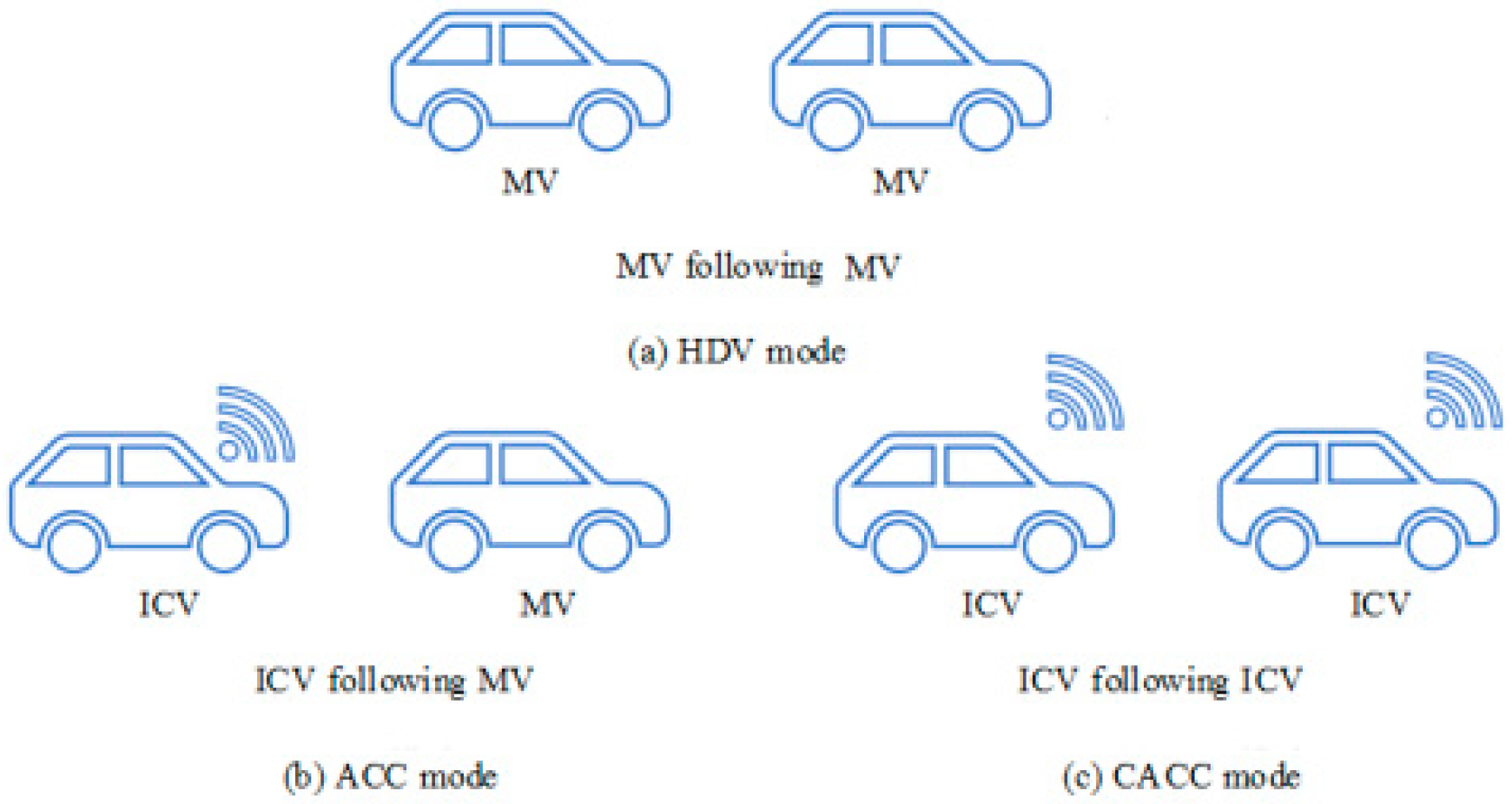
Figure 1. Vehicle following modes in mixed traffic flow.
Sustainability 18 00960 g001
Figure 2. Wundt curve.
Sustainability 18 00960 g002
Figure 3. Lane-changing rules for HDV.
Sustainability 18 00960 g003
Figure 4. Lane-changing rules for ICV.
Sustainability 18 00960 g004
Figure 5. Basic diagram of mixed traffic flow.
Sustainability 18 00960 g005
Figure 6. Probability of manual driving lane change.
Sustainability 18 00960 g006
Figure 7. Frequency of lane-changing for ICV.
Sustainability 18 00960 g007
Figure 8. Overall lane-changing frequency.
Sustainability 18 00960 g008
Figure 9. Congestion level of mixed traffic flow.
Sustainability 18 00960 g009
Figure 10. Speed variation chart under different proportions of ICV.
Sustainability 18 00960 g010aSustainability 18 00960 g010b
Table 1. Notation.
Table 1. Notation.
VariablesDescriptionsUnits
aMaximum accelerationm/s2
anAcceleration of the n-th vehiclem/s2
bComfortable decelerationm/s2
cPreference coefficient for subjective novelty
GapnGap to the preceding vehicle in the current lanem
Gapn,backGap to the following vehicle in the adjacent lanem
Gapn,frontGap to the preceding vehicle in the adjacent lanem
Gapn,leftbackGap to the following vehicle in the left lanem
Gapn,leftfrontGap to the preceding vehicle in the left lanem
Gapn,rightbackGap to the following vehicle in the right lanem
Gapn,rightfrontGap to the preceding vehicle in the right lanem
hTime headways
LVehicle lengthm
Mn(t)Lane index of the n-th vehicle at time
PaProbability of changing lanes in the basic lane-changing rule
PbProbability of changing lanes in the ICV/HDV mixed lane-changing rule
sActual spacing between two vehiclesm
s0Minimum parking distancem
T0Safe headway of an HDV following an ICVs
TSimulation time steps
THDCSafe headway in HDC modes
TACCSafe headway in ACC modes
TCACCSafe headway in CACC modes
vVehicle speedm/s
vRelative speed to the preceding vehiclem/s
v ˙ Expected accelerationm/s2
vfFree-flow speedm/s
vmaxMaximum allowable speedm/s
vn(t)Speed of the n-th vehicle at timem/s
vback(t)Speed of the following vehicle in the adjacent lanem/s
vleftback(t)Speed of the following vehicle in the left lanem/s
vrightback(t)Speed of the following vehicle in the right lanem/s
WInformation utility in Wundt’s psychological law
xn(t)Position of the n-th vehicle at timem
γ1Reaction time of a human-driven vehicles
γ2Recognition time of an ICV following an HDVs
γ3Communication delay of an ICV in CACC mode (set to 0)s
θDriver’s subjective understanding of ICV performance
βFear parameter of the driver when following an ICV
ΦSubjective novelty in Wundt’s psychological law
Table 2. Different parameter values of IDM.
IDM Car-Following Model ParametersSymbolValue
Maximum acceleration (m/s2)a1
Comfort deceleration (m/s2)b2
Free flow speed (m/s)vf33.3
Minimum parking distance (m)S02
Vehicle length (m)L5
Table 3. Simulation experiment parameters.
Scene ParametersSymbolValue
Cell length (m)cell0.5
Vehicle length (m)L5
Lane length (m)La1200
Lane speed limit (km/h)Vmax120
Simulation time step (s)τ1
Simulation time (s)T3600
Driver’s level of understanding of connected vehiclesθvalues in [0, 1]
Probability of lane change for HDV modelsPa0.3
Random slowing probability of HDVsP10.2
Probability of lane change in intelligent connected vehicle modelPb0.5
Random slowing probability of ICVP20.05
Disclaimer/Publisher’s Note: The statements, opinions and data contained in all publications are solely those of the individual author(s) and contributor(s) and not of MDPI and/or the editor(s). MDPI and/or the editor(s) disclaim responsibility for any injury to people or property resulting from any ideas, methods, instructions or products referred to in the content.