Article

Spatiotemporal Differentiation Characteristics and Meteorological Driving Mechanisms of Soil Moisture in Soil–Rock Combination Controlled by Microtopography in Hilly and Gully Regions

1
Desert Management College, Inner Mongolia Agricultural University, Hohhot 010018, China
2
Key Laboratory of State Forest Administration for Desert Ecosystem Protection and Restoration, Hohhot 010018, China
3
Inner Mongolia Academy of Forestry Sciences, Hohhot 010018, China
*
Authors to whom correspondence should be addressed.
Sustainability 2026, 18(2), 959; https://doi.org/10.3390/su18020959 (registering DOI)
Submission received: 5 December 2025 / Revised: 9 January 2026 / Accepted: 13 January 2026 / Published: 17 January 2026

Abstract

Soil erosion in the hilly and gully region of the middle reaches of the Yellow River is severe, threatening regional ecological security and the water–sediment balance of the Yellow River. The area features fragmented topography and significant spatial heterogeneity in soil thickness, forming a unique binary “soil–rock” structural system. The soil in the study area is characterized by silt-based loess, and the underlying bedrock is an interbedded Jurassic-Cretaceous sandstone and sandy shale. It has strong weathering, well-developed fissures, and good permeability, rather than dense impermeable rock layers. However, the spatiotemporal differentiation mechanism of soil moisture in this system remains unclear. This study focuses on the typical hilly and gully region—the Geqiugou watershed. Through field investigations, soil thickness sampling, multi-scale soil moisture monitoring, and analysis of meteorological data, it systematically examines the cascade relationships among microtopography, soil–rock combinations, soil moisture, and meteorological drivers. The results show that: (1) Based on the field survey of 323 sampling points in the study area, it was found that soil samples with a thickness of less than 50 cm accounted for 85%, which constituted the main structure of soil thickness in the region. Macrotopographic units control the spatial differentiation of soil thickness, forming a complete thickness gradient from erosional units (e.g., Gully and Furrow) to depositional units (e.g., Gently sloped terrace). Based on this, five typical soil–rock combination types with soil thicknesses of 10 cm, 30 cm, 50 cm, 70 cm, and 90 cm were identified. (2) Soil–rock combination structures regulate the vertical distribution and seasonal dynamics of soil moisture. In thin-layer combinations, soil moisture is primarily retained within the shallow soil profile with higher dynamics, whereas in thick-layer combinations, under conditions of substantial rainfall, moisture can percolate deeply and become notably stored within the fractured bedrock, sometimes exceeding the moisture content in the overlying soil. (3) The response of soil moisture to precipitation is hierarchical: light rain events only affect the surface layer, whereas heavy rainfall can infiltrate to depths below 70 cm. Under intense rainfall, the soil–rock interface acts as a rapid infiltration pathway. (4) The influence of meteorological drivers on soil moisture exhibits vertical differentiation and is significantly modulated by soil–rock combination types. This study reveals the critical role of microtopography-controlled soil–rock combination structures in the spatiotemporal differentiation of soil moisture, providing a scientific basis for the precise implementation of soil and water conservation measures and ecological restoration in the region.

1. Introduction

The Yellow River Basin, as an important ecological security barrier and a core area for China’s economic and social development, holds significant national strategic importance in terms of ecological conservation and high-quality development [1]. However, the basin faces severe ecological and environmental challenges, with soil erosion in the midstream hilly and gully regions being particularly prominent [2]. Located in the transitional zone between the Loess Plateau and the Ordos Plateau, this area is characterized by fragmented terrain and dramatic undulations. Influenced by long-term erosion, the spatial variation in soil thickness is significant, forming a typical spatial pattern of thin layers on hilltops and thick layers at the foot of slopes. This severe soil erosion not only leads to land degradation but also exacerbates sedimentation in the Yellow River, directly impacting the safety of downstream water conservancy projects and regional ecological security [3,4].
In 2019, ecological conservation and high-quality development in the Yellow River Basin were elevated to a national strategy, explicitly calling for enhanced comprehensive management of soil erosion in the middle reaches. Due to its unique soil–rock structure and severe erosion characteristics, the hilly and gully region has become a critical challenge in this effort [5]. Driven by the complex topography of the area, the spatial variation in soil thickness and bedrock exposure further regulates moisture transport pathways and the distribution of erosion hotspots [6,7]. According to monitoring data, this region contributes a significant amount of sediment to the Yellow River annually, posing a severe threat to the sustainable use of regional water resources and ecological security. The geological structure of the region is complex, with rock layers primarily composed of interbedded Jurassic-Cretaceous sandstone and sandy shale. After prolonged weathering, denudation, and fluvial incision, a typical erosional landform has developed. The rock layers are loosely cemented and have a high calcium content, making them prone to physical disintegration and chemical dissolution upon contact with water, which is the fundamental reason for their extremely low erosion resistance [8]. Combining remote sensing technology with field studies, it has been found that the gully density in this region can reach 1.3 to 1.8 km/km2, with over 600,000 erosion gullies, covering more than 80% of the total area [9]. The development of various macrotopographic units shows a significant coupling relationship with soil thickness distribution: hilltops and steep slopes have shallow soils with exposed bedrock, while gentle terraces and valleys have thicker soils due to deposition [10,11,12]. This spatial heterogeneity in the “soil–rock” dual-layer system profoundly influences hydrological processes at the soil–bedrock interface by regulating the characteristics of soil–rock combinations and moisture transport pathways [13,14].
Located in an arid to semi-arid climate zone, the region receives relatively low annual precipitation, which is concentrated during the flood season and frequently includes short-duration, high-intensity rainfall events [15]. This unique climatic condition, combined with the spatial heterogeneity of the “soil–rock” dual-layer system, further influences hydrological processes at the soil–bedrock interface by regulating the characteristics of rock–soil combinations and moisture transport pathways. Variations in soil thickness across different slope positions lead to differences in water infiltration capacity: areas with thin soil layers are prone to runoff generation, while areas with thick soil layers prioritize infiltration and storage. Such differences exacerbate concentrated runoff erosion and gully development [16,17]. Additionally, climatic factors such as high temperatures, strong evaporation, and brief rainfall periods contribute to soil drought, hinder vegetation recovery, and weaken ecosystem stability in the study area [18]. Spatial variation in soil thickness also affects vegetation root development and water-use efficiency, forming a vicious cycle of “soil thickness-vegetation cover-erosion feedback.”
The complex topography and unique rock–soil properties jointly shape the typical “soil–bedrock” binary structural system in this area [19]. In international research, the soil–bedrock interface has been regarded as a key structural unit regulating slope hydrological processes. The abrupt changes in its physical properties, such as permeability and porosity, often lead to significant heterogeneity in water movement and varied response patterns. This interface may exhibit two opposing hydrological functions: above bedrock with low permeability, it can form a capillary barrier, promoting lateral water migration or temporary retention [20,21]; whereas in areas with well-developed bedrock fractures, the interface tends to become a dominant pathway for preferential flow, significantly accelerating vertical infiltration [22]. The spatial gradient of soil thickness in hilly and gully regions further complicates these processes: in areas with thin soil layers, water easily enters bedrock fractures quickly, while in areas with thick soil layers, transient saturated zones may form near the interface. The bedrock fracture network provides preferential pathways for rapid water infiltration, while the abrupt changes in physical properties at the interface may lead to water retention [23,24]. Together, these factors regulate slope runoff and erosion processes.
In summary, micro-topography, rock–soil combination, soil moisture and meteorological drive constitute a cascade control system: micro-topography controls the spatial differentiation of soil thickness through erosion–deposition process, and then shapes different rock–soil combination types; the differences in hydraulic properties between soil and bedrock in different combinations, especially the structure and location of rock–soil interface, directly regulate the vertical distribution and seasonal dynamics of soil moisture. The meteorological drive activates the water migration process in different intensities and ways through the key node of the interface, and its effect is significantly regulated by the type of rock and soil combination. Therefore, revealing the synergistic mechanism of ‘topographic structure process driving’ is the core of understanding the hydrological process and erosion response in hilly and gully regions. This study selects the typical hilly and gully region in the middle reaches of the Yellow River Basin—the Geqiugou watershed—as the research area. Through field in situ observation experiments, this study aims to address the following three core scientific questions: (1) How microtopography controls the spatial variation in soil thickness and forms different soil–rock combination types; (2) The spatiotemporal differentiation characteristics of soil moisture under different soil–rock combinations; (3) The synergistic driving mechanisms of soil–rock combination structures and meteorological factors on soil moisture transport. The research findings will provide a scientific basis for the precise allocation of soil and water conservation measures and offer theoretical support for deepening the study of soil erosion mechanisms in fragile lithological regions.

2. Materials and Methods

2.1. Overview of the Research Area

This study selects the Geqiugou watershed, a typical hilly and gully region in the middle reaches of the Yellow River Basin, as the research area (Figure 1). The watershed is located in Jungar Banner, Ordos City, Inner Mongolia Autonomous Region (39°46′ N, 110°36′ E), with a total area of approximately 96 km2, belonging to a typical arid to semi-arid continental monsoon climate zone. The geomorphology of the watershed is characterized by typical hilly and gully landforms, with elevations ranging between 1012 and 1380 m above sea level. The gully density is as high as 3.2–4.1 km/km2, which is significantly higher than the average level of the hilly and gully region in the middle reaches of the Yellow River. The study area features well-developed microtopography, primarily including six typical macrotopographic units: Gully, Furrow, Scarp, Collapse, Gently sloped terrace, and Undisturbed slope. The combination of these macrotopographic units forms a complex terrain sequence [25]. The climatic characteristics of the area include an average annual precipitation of 350–480 mm, with extremely uneven intra-annual distribution—over 68% of the total annual precipitation occurs from July to September. The average annual potential evaporation ranges from 1800 to 2200 mm, which is 4–5 times the precipitation, resulting in severe water deficit. The hydrological processes exhibit typical features of “storm-induced runoff and no-flow during dry periods.” Vegetation coverage is generally low. The vegetation community is primarily composed of drought-tolerant species. Specifically, on steep slopes with thin soil layers in erosional areas, the dominant vegetation consists of herbaceous plants such as Thymus mongolicus and Artemisia frigida. In contrast, on gentle slopes and valley bottoms with deep soil layers in depositional areas, shrub communities such as Hippophae rhamnoides and Caragana korshinskii are locally established. As one of the main sources of coarse sediment in the Yellow River Basin, the basin has unique topography and geomorphology, typical soil–rock combination structure and significant water stress environment, which provides a site for studying the spatial and temporal variation characteristics of soil moisture in soil–rock combination controlled by microtopography.

2.2. Soil Thickness Survey and Monitoring Sample Plot Layout

2.2.1. Investigation of Soil Thickness

A combined strategy of stratified random sampling and representative site selection based on typical microtopography was employed for the soil thickness survey. Using high-precision DEM data, remote sensing imagery, and field reconnaissance, the study area was divided into several geomorphological units based on key topographic features such as slope gradient, aspect, and topographic relief. Subsequently, typical macrotopographic types, such as gullies, steep slopes, and gentle terraces, were identified and classified. Within each micro-topographic unit, preset sample points were established using a spatially balanced random distribution method: regular grids were generated across the unit, and one sampling coordinate was randomly determined within each grid. This approach ensured that the spatial distribution of sample points was uniform and representative of various micro-topographic conditions, while minimizing subjective selection bias. All preset sample points were verified through field investigation. If a point could not be sampled due to terrain constraints or vegetation cover, an alternative location with similar topographic characteristics was selected within a 30-m horizontal radius.
The field investigation adopted a combined approach of shallow excavation and deep probe penetration. For shallow soils with an estimated thickness of ≤30 cm, a spade was used to excavate the profile to the parent material layer, and the actual thickness was measured directly (accuracy: ±1 cm). For deeper soils (>30 cm), a specialized soil probe with a diameter of 12 mm made of high-strength alloy steel was employed for penetration testing. The penetration procedure followed a standardized protocol: initial penetration was attempted by applying uniform hand pressure vertically; when hand pressure could no longer advance the probe, a standard geological hammer was used to strike the probe head with consistent force to allow gradual downward movement. Penetration was terminated when hammering resistance increased sharply upon encountering a distinct, continuous bedrock surface. The probe depth at this point was recorded as the effective soil thickness. This method is operationally simple, offers strong penetration capability, and significantly reduces the time required per sampling point, thereby enabling efficient large-area surveys while maintaining data accuracy. Through these procedures, 323 valid soil-thickness sampling points were obtained, constituting a spatially representative and efficient field dataset.

2.2.2. Moisture Monitoring Plot Layout

Based on the soil thickness survey results, a soil moisture monitoring network was systematically established. Fixed monitoring sites were set up at macrotopographic locations representative of five typical soil layer thicknesses: 10 cm, 30 cm, 50 cm, 70 cm, and 90 cm.
To ensure that the monitoring sites strictly conformed to the predefined soil–rock combination types, a combined method of probe penetration and profile observation was employed. Soil profiles were excavated at the selected locations to precisely measure the actual soil thickness from the surface to the bedrock, ensuring the error was controlled within ±2 cm of the target thickness. The selection of monitoring sites followed these principles: ① Representativeness of macrotopographic units, accurately reflecting the typical topographic features of the target soil–rock combinations; ② Consistency in vegetation cover, avoiding interference in soil moisture due to vegetation differences; ③ Minimization of human disturbance, ensuring that the monitoring data reflect soil moisture dynamics under natural conditions.
After completing the profile surveys, three neutron probe access tubes were installed in a triangular arrangement as replicates within each monitoring site, totaling 15 fixed monitoring sites.
Neutron Probe Monitoring
Neutron probe monitoring was conducted across all five soil–rock combination types. At each monitoring site, three aluminum alloy access tubes, each 1.1 m in length, were pre-installed using professional drilling equipment. This installation method ensured tight contact between the access tubes and the soil while minimizing disturbance to the surrounding soil structure. The top of each access tube extended 10 cm above the ground surface to effectively prevent surface water inflow.
The monitoring depth range spanned from 0 to 100 cm, with observations conducted at 10-cm intervals, resulting in a total of 10 layers. Monitoring was performed once every ten days during the period from July 2024 to September 2025. This monitoring schedule was designed to fully cover one complete hydrological year, thereby capturing soil moisture dynamics across different soil–rock combinations under varying seasonal conditions.
In order to ensure the accuracy of the monitoring data of the neutron instrument, the neutron instrument was calibrated on-site before the start of monitoring. Typical locations covering the main soil types (loess) and bedrock (sandstone) were selected in the study area, and undisturbed soil samples and bedrock samples were collected simultaneously. In the laboratory, the actual volumetric water content of the sample was measured by the drying method (105 ° C to constant weight), and the relationship was established with the instrument count of the neutron meter at the same position and at the same time.
The calibration results show that,
the calibration equation for soil is: y = 45.65x − 0.7456 (R2 = 0.98);
the calibration equation for bedrock is: y = 46.76x − 0.2232 (R2 = 0.96).
y represents the volumetric water content (%), and x represents the neutron probe count ratio (the ratio of the instrument count to the standard count). The coefficients of determination (R2) for both equations are above 0.96, indicating a reliable calibration relationship. Subsequently, all raw count data monitored by the neutron probe were converted into volumetric water content based on the above equations.
HOBO Data Logger
The HOBO data logger monitoring scheme specifically focuses on the 30 cm soil layer as a representative soil–rock combination type. This selection is based on preliminary surveys indicating that the 30 cm soil layer is widely distributed in the study area and demonstrates significant representativeness. This soil layer thickness falls within a sensitive range of erosion-deposition processes, exhibits high responsiveness to moisture variations, and accurately reflects the moisture dynamics characteristic of hilly and gully regions. Moreover, as a critical transitional type from thin to moderately thick soil layers, the moisture transport patterns in the 30 cm soil layer provide important insights into the hydrological processes of the entire soil–rock combination system.
During implementation, based on the actual soil thickness and interface characteristics determined through preliminary profile surveys, S-SMD-M005 sensors (Zhejiang Yuankong Electric Co., Ltd., Wenzhou, China) were installed vertically along the profile within the 30 cm soil layer monitoring site at 10 cm intervals. Considering the potential for deep infiltration in the study area, the monitoring depth range was set from 0 to 100 cm, encompassing a total of 10 monitoring layers. The monitoring system utilized an automatic data logger, with data collected automatically at 30-min intervals. The monitoring period, synchronized with the neutron probe measurements, spanned from July 2024 to September 2025.

2.3. Meteorological Data Collection

This study employed an integrated meteorological monitoring scheme, with various sensors connected to a HOBO U30-NRC automatic data logger (Onset Computer Corporation, Bourne, MA, USA). The system integrated an S-RGB-M002 rain gauge (Zhejiang Yuankong Electric Co., Ltd., Wenzhou, China), an S-THB-M008 temperature and humidity probe (Zhejiang Yuankong Electric Co., Ltd., Wenzhou, China), and an S-LIB-M003 photosynthetically active radiation sensor (Zhejiang Yuankong Electric Co., Ltd., Wenzhou, China) to simultaneously monitor key meteorological parameters including precipitation, air temperature, relative humidity, and solar radiation intensity. The meteorological station was established in an open, flat area at the center of the study watershed. Its altitude (approximately 1150 m) was consistent with the average elevation of the main soil moisture monitoring sites (1120–1180 m), which maximized the representativeness of the meteorological observations for each site and avoided microclimatic differences caused by topography. All sensors automatically recorded data at 30-min intervals through the data logger, with the monitoring period fully synchronized with the soil moisture monitoring (July 2024 to September 2025). To address the issue of temporal scale matching with the 10-day interval neutron probe data, in subsequent analyses, the 30-min raw meteorological data were aggregated into daily-scale indicators and aligned with the soil moisture monitoring dates to analyze the cumulative response of soil moisture.

2.4. Research Methods

2.4.1. Soil Profile Moisture Calculation

The soil water storage in the soil profile from 0 to 100 cm depth is calculated using the following formula [26]:
S W = i = 1 n θ i × D i ,
In the formula, S W is the water storage capacity of the soil profile at a specific time; θ is the volumetric water content monitored by the soil moisture probe at a specific time; D i is the soil layer; n is the number of soil layers.
The increase in soil moisture represents the recharge amount of rainfall to the soil, and the recharge rate can be expressed as the ratio of soil moisture increment to the time taken for soil moisture to reach its peak [27]. The calculation formula is as follows:
S W r = S W m a x S W 0 ,
In the formula: S W m a x is the peak value of soil moisture after rainfall; S W 0 is soil moisture before rain; S W r is the increment of soil moisture after rainfall.

2.4.2. Spearman’s Rank Correlation Coefficient

To quantify the degree of association between meteorological factors and soil moisture under different soil–rock combinations, Spearman’s rank correlation coefficient was employed for analysis. It is a non-parametric statistical method suitable for data that do not meet normal distribution assumptions or contain outliers, effectively evaluating the strength of monotonic relationships between two variables [28,29]. The calculation formula is as follows:
ρ = 1 n i = 1 n R x i R x ¯ · R y i R y ¯ 1 n i = 1 n R x i R x ¯ 2 · 1 n i = 1 n R y i R y ¯ 2 ,
R x i and R y i are the ranks of the i-th observed value of variables x and y, respectively. R x ¯ and R y are the mean values, respectively.

3. Results

3.1. Soil Thickness and Soil-Rock Combination Characteristics

3.1.1. Spatial Differentiation Characteristics of Soil Thickness in Different Microtopography

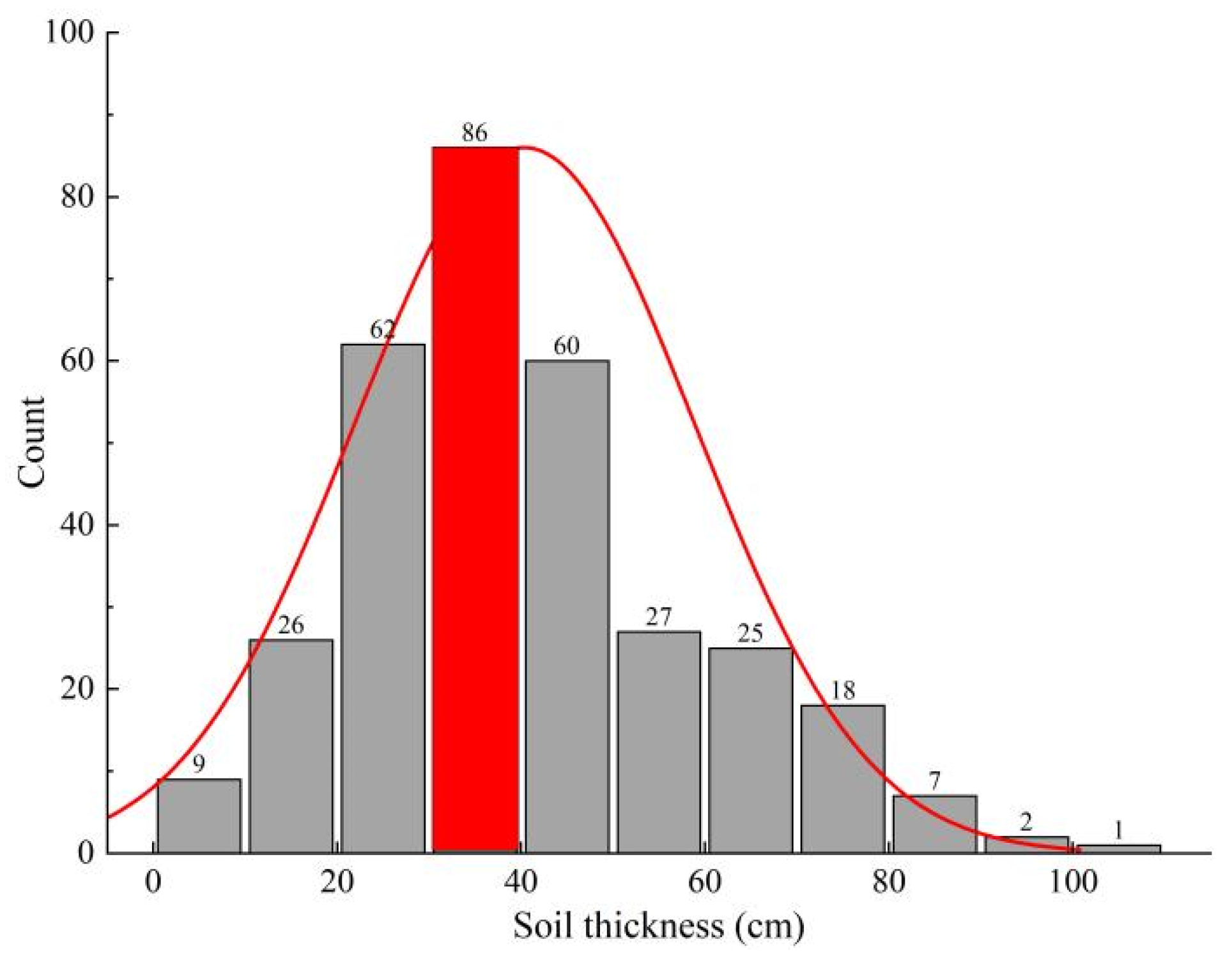
Based on field measurements from 323 sampling points, the soil thickness in the study area ranges from 4 cm to 100 cm. The frequency distribution histogram reveals a significant asymmetry in soil thickness data, with the distribution predominantly concentrated in the lower range (Figure 2). Statistical analysis shows that samples with soil thickness ≤ 50 cm account for 85.1% of the total, constituting the main body of soil thickness in the study area. Among these, the 20–40 cm thickness interval represents 46.1% of all samples, forming the highest frequency band among all 20-cm graded intervals and showing a notable distribution peak. This confirms that this thickness range is the most representative soil profile structure in the region. In contrast, extremely thin soil layers (≤10 cm) and thick soil layers (>80 cm) are extremely limited, accounting for only 2.8% and 3.7% of the samples, respectively. In order to clarify the statistical distribution characteristics of soil thickness, the Kolmogorov–Smirnov (K-S) test was used to analyze the data of 323 sampling points. The results showed that the K-S statistic D = 0.092, p < 0.01, indicating that the soil thickness data significantly deviated from the normal distribution.
Soil thickness across different macrotopographic units in the study area exhibits significant spatial differentiation (Table 1). As a typical depositional unit, Gently sloped terrace demonstrates the greatest soil thickness, with an average of 69 cm and a coefficient of variation (CV) of 0.12, indicating the most uniform and stable distribution. In contrast, Gully and Furrow, representing intense erosional units, have average soil thicknesses of 13 cm and 24 cm, respectively, with coefficients of variation as high as 0.46 and 0.33, reflecting high variability under erosive conditions. Among transitional unit types, Scarp, Collapse, and Undisturbed slope show average soil thicknesses ranging from 34 to 40 cm. The skewness of Undisturbed slope is −0.69, indicating a left-skewed distribution where thinner soil layers are more prevalent. In terms of kurtosis, Scarp, Furrow, and Collapse all exhibit negative values, with steep slopes showing the flattest distribution (kurtosis = −1.18). In contrast, Undisturbed slope and Gently sloped terrace display positive kurtosis, suggesting a more concentrated thickness distribution. The soil thickness across macrotopographic units ranges from 13 cm in Gully to 69 cm in Gently sloped terrace, forming a complete erosion-deposition sequence. This gradient pattern clearly demonstrates the controlling role of microtopography on the spatial distribution of soil thickness. One-way analysis of variance showed that there were significant differences in soil thickness between micro-topographic units (p < 0.005), and the thickness was further divided into five significant gradient groups. This statistical result quantitatively confirms the dominant control effect of micro-topography on soil thickness.

3.1.2. Classification and Characteristics of Typical Soil-Rock Combinations

In hilly and gully regions, intense erosion-deposition dynamics and unique lithological combinations jointly shape a highly heterogeneous soil–rock structural pattern. Based on a systematic investigation of sampling points across different macrotopographic units in the Geqiugou watershed, and through the integrated assessment of measured data and spatial prediction models of soil thickness, this study uses soil thickness as the core classification criterion to systematically identify and summarize five typical soil–rock combination types that are significantly distinct and widely distributed: 10 cm soil thickness, 30 cm soil thickness, 50 cm soil thickness, 70 cm soil thickness, and 90 cm soil thickness. This classification system objectively reflects the spatial configuration relationships between soil and parent rock formed under varying erosion intensities, topographic positions, and depositional environments, while also revealing the evolutionary stages and stability states of the “soil–rock” system under the influence of different external forces [30]. The basic characteristics of each soil–rock combination type are presented in Table 2 below:

3.2. Spatiotemporal Distribution Patterns of Soil Moisture Under Different Soil-Rock Combinations

3.2.1. Vertical Distribution Structure of Soil Moisture

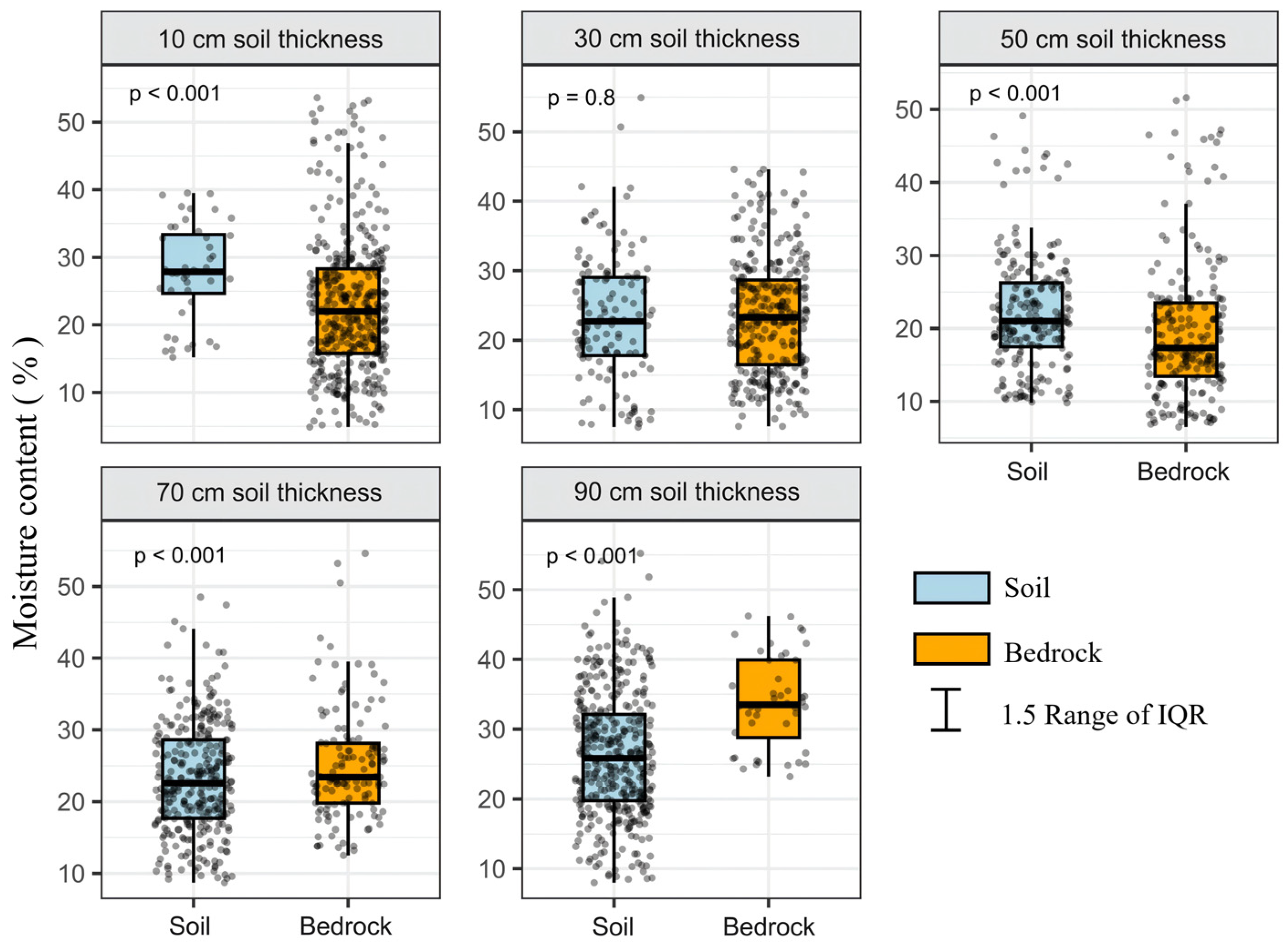
Statistical analysis of soil moisture content in different soil–rock combinations and their bedrock layers (Figure 3) shows that the soil–rock combination structure influences moisture storage and distribution. Overall, the S90 combination exhibited the highest average soil profile moisture content at 27%, while the S50 combination showed the lowest at 21%. Moisture content did not exhibit a simple linear increase with soil layer thickness. In terms of structural characteristics, in the thin-layer combinations S10 and S30, the average moisture content of the soil layers was 28% and 21%, respectively, both higher than that of their bedrock layers (23% and 21%). In contrast, in the thick-layer combinations S70 and S90, the moisture content of the bedrock layers reached 25% and 34%, significantly higher than that of their overlying soil layers (23% and 26%). These results indicate that as the soil layer thickens, the moisture enrichment zone shifts from the soil layer to the bedrock layer. Under thick soil layer conditions, the soil–bedrock interface becomes a significant zone of moisture accumulation.
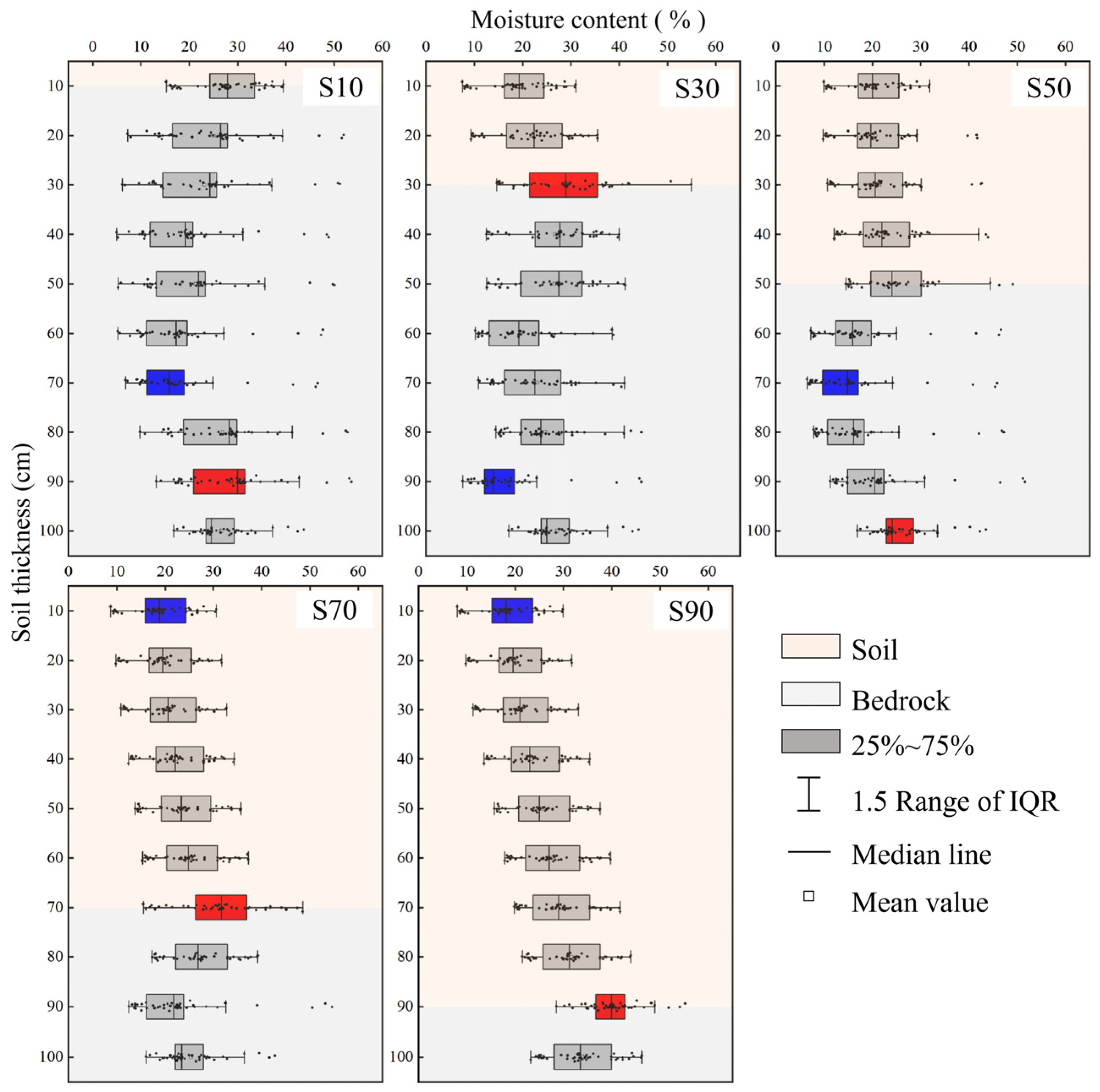
The vertical distribution characteristics of soil moisture in different soil–rock combinations reveal that the soil–bedrock interface is a critical zone governing moisture transport and storage (Figure 4). In the S10 combination, due to the shallow soil layer, the soil–bedrock interface is located near the surface, leading to active moisture exchange between the soil and bedrock. The moisture profile exhibits an “S”-shaped fluctuation, indicating high instability in moisture distribution. As soil layer thickness increases, the soil–bedrock interface gradually shifts downward, resulting in significant changes in its hydrological function. In the S30 to S50 combinations, the interface is situated at a transitional depth, where moisture undergoes redistribution nearby, forming localized high-moisture zones. In contrast, in the S70 to S90 combinations, the deeper soil–bedrock interface acts as an effective moisture barrier, promoting significant moisture accumulation in the soil layer above the interface and forming a stable high-moisture zone. This pattern indicates that the spatial location of the soil–bedrock interface and its configuration relative to soil layer thickness are core factors determining the vertical structure of soil moisture distribution.
As a key hub for water migration and redistribution, the role of the rock–soil interface is due to the significant difference in physical properties between the upper and lower media. This study found that the average bulk density of the soil layer was 1.35 g·cm3, and the average porosity was 42%. The average bulk density of the underlying weathered sandstone bedrock is 2.18 g·cm3, and the porosity is only 9%. This significant difference in bulk density and pore structure leads to a sudden change in the migration path and rate of water at the interface: in the thin layer soil area, water is easy to accumulate at the interface and infiltrate rapidly along the bedrock fracture network; in the thick soil area, the interface forms a capillary barrier due to the discontinuous pore structure, which promotes the retention and lateral migration of water in the overlying soil.

3.2.2. Seasonal Dynamics of Soil Moisture

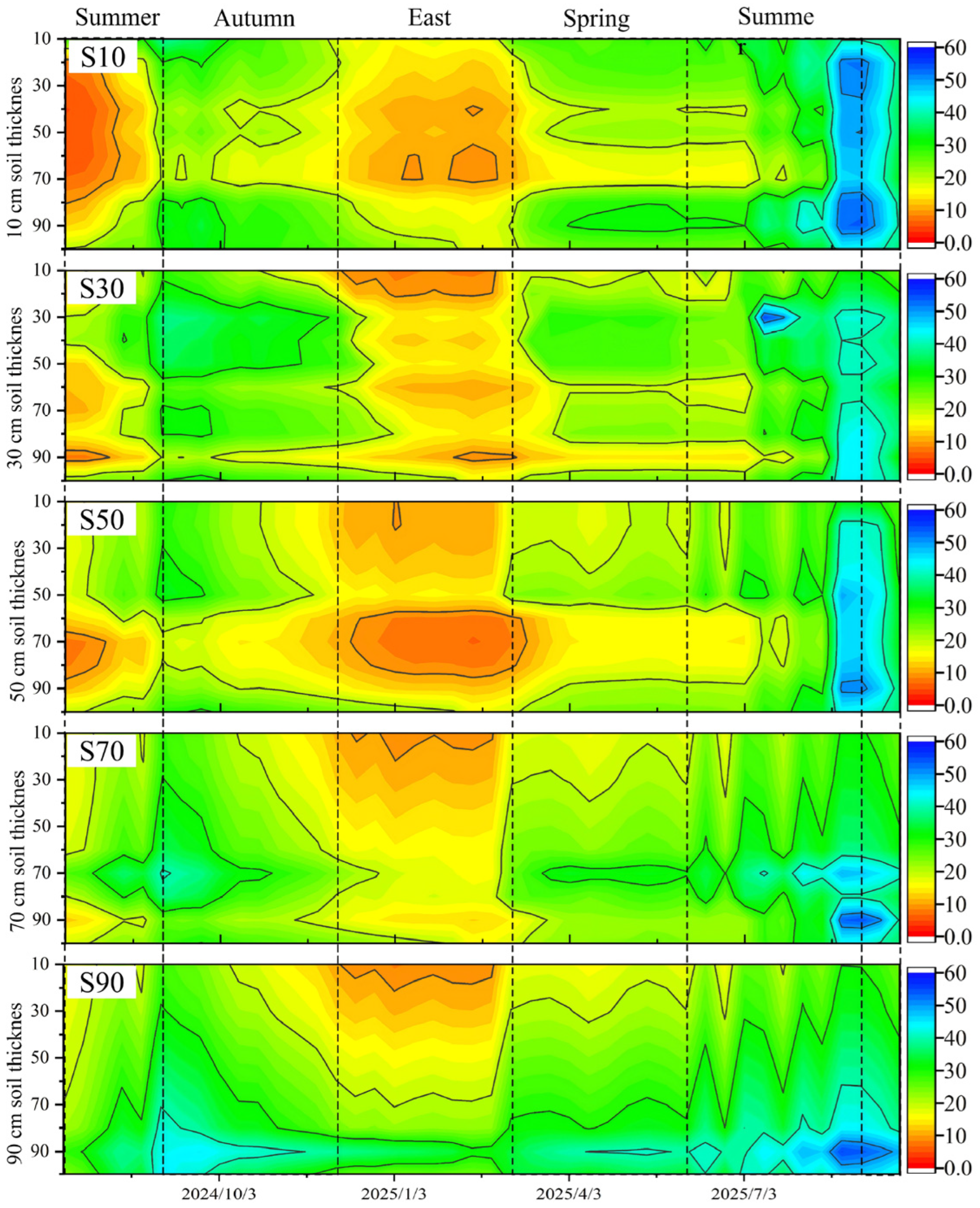
Based on neutron probe monitoring data at ten-day intervals, the soil moisture dynamics of the five typical soil–rock combinations exhibited significant differences (Figure 5). S10 displayed a pattern of “active surface layer, stable deep layer.” Surface soil moisture responded rapidly to precipitation with drastic fluctuations, rising to 39.5% after rainfall on 23 August 2025, but dropping to as low as 16.3% during the dry winter period. Moisture in the bedrock layer remained relatively stable, consistently exceeding 30% below 70 cm depth. S30 showed a “three-layer spatial differentiation” pattern. Moisture in the 0–30 cm surface soil layer exhibited pronounced seasonal fluctuations. The 30–60 cm intermediate layer maintained relatively high moisture content with significant variations, reaching an extreme high of 55% at the 30 cm soil–bedrock interface during summer. Moisture changes below 60 cm depth were gradual, demonstrating strong seasonal stability. S50 exhibited relatively balanced vertical moisture distribution, with comparable moisture content between the soil and bedrock layers. Moisture redistribution at the 50 cm soil–bedrock interface showed seasonal characteristics, with the deep bedrock layer demonstrating strong water retention capacity after heavy summer rainfall (e.g., 52% moisture content at 90 cm depth). S70 was characterized primarily by moisture enrichment in the intermediate layer. The 30–70 cm intermediate soil layer maintained stable moisture retention. Moisture dynamics at the 70 cm soil–bedrock interface varied seasonally, with moisture content at 90 cm depth surging to 55% after heavy summer rainfall but remaining relatively stable during winter. S90 demonstrated the most effective moisture retention capacity, with gradual seasonal variations. The thick soil layer maintained high moisture content across all depths, with minimal vertical gradients. A stable high-moisture zone persisted at 90 cm depth throughout the year. This combination responded rapidly to summer precipitation and exhibited substantial water storage capacity, with the thick soil layer effectively buffering hydrological shocks at the soil–bedrock interface.

3.3. Temporal Dynamic Characteristics of Soil Moisture in the S30 Combination

3.3.1. Analysis of Meteorological Elements Evolution

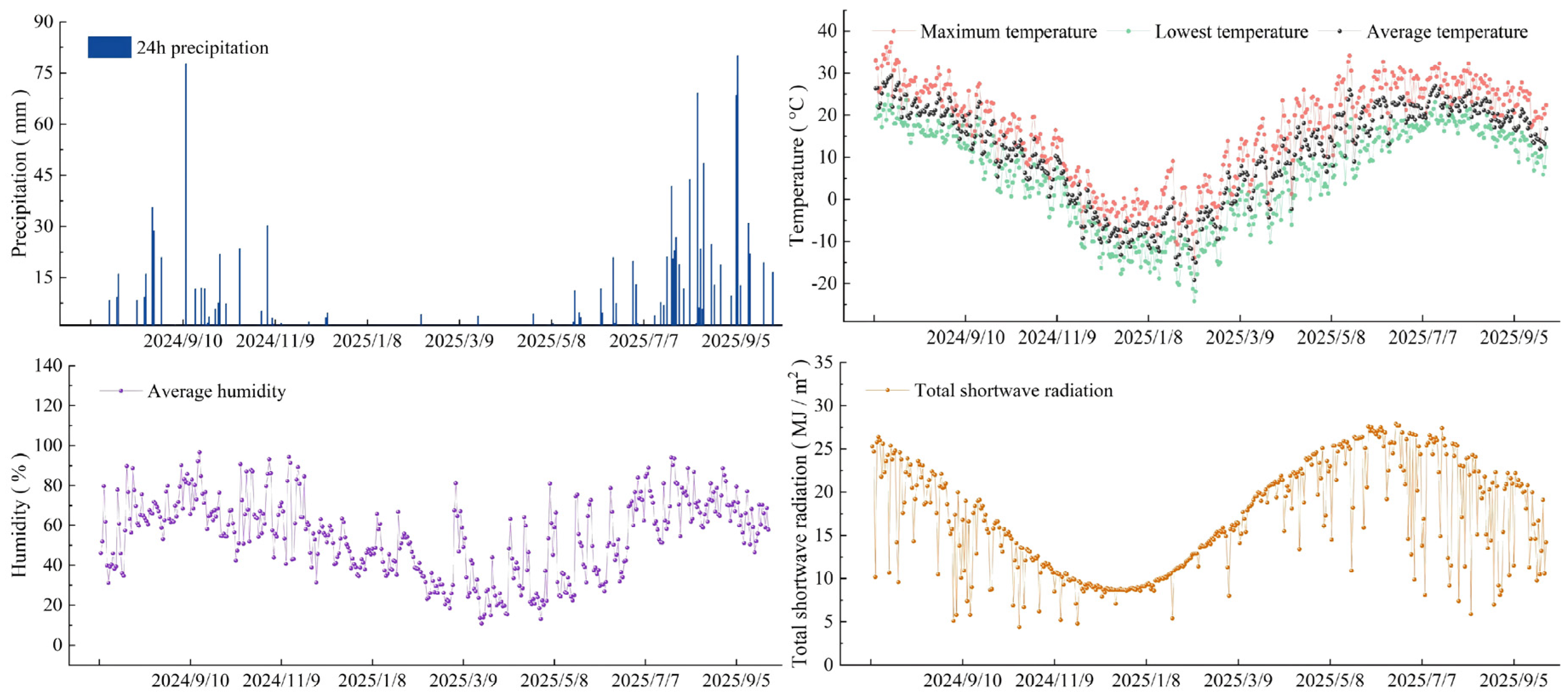
The meteorological observation data during the study period are shown in Figure 6, revealing distinct seasonal dynamic characteristics across all meteorological elements. Precipitation processes in the study area exhibited clear seasonal variations and uneven intensity distribution. According to the precipitation classification standards of the China Meteorological Administration, daily precipitation events were categorized into four levels: light rain (0.1–10 mm), moderate rain (10–25 mm), heavy rain (25–50 mm), and rainstorm (≥50 mm). Temporally, precipitation was concentrated primarily during the summer flood seasons of July–September 2024 and May–August 2025, during which multiple heavy rain and rainstorm events occurred, such as on 24 July 2025 (69.1 mm) and 25 August 2025 (77.7 mm). In contrast, winter precipitation was sparse, with moisture replenishment relying mainly on sporadic snowfall and snowmelt processes. In terms of precipitation intensity structure, light rain events were the most frequent; moderate rain events occurred 26 times in total; heavy rain events occurred 14 times; and rainstorms or above, although the least frequent with only 8 occurrences, contributed significantly to the total precipitation volume.
Regarding temperature, the variations in maximum, minimum, and average temperatures followed typical seasonal patterns. During summer (June–August), temperatures were relatively high, with maximum temperatures mostly ranging between 25–35 °C, and the extreme maximum reaching 37.3 °C. In winter (December–February), temperatures dropped significantly, with minimum temperatures generally below −10 °C and the extreme minimum reaching −24.2 °C. Spring and autumn served as transitional periods, characterized by more pronounced temperature fluctuations.
The variations in average air humidity and shortwave radiation were closely related to precipitation and temperature processes. Humidity levels were generally higher in summer, particularly around precipitation events, where average humidity could exceed 80%. Winter humidity was relatively lower, though periodic high humidity still occurred during snowfall events. Shortwave radiation exhibited a pattern of high values in summer and low values in winter, with daily total radiation often exceeding 25 MJ/m2 in summer, while generally remaining below 10 MJ/m2 in winter, highlighting the significant influence of solar radiation on surface energy balance.

3.3.2. Daily-Scale Dynamic Characteristics of Soil Moisture in the S30 Combination

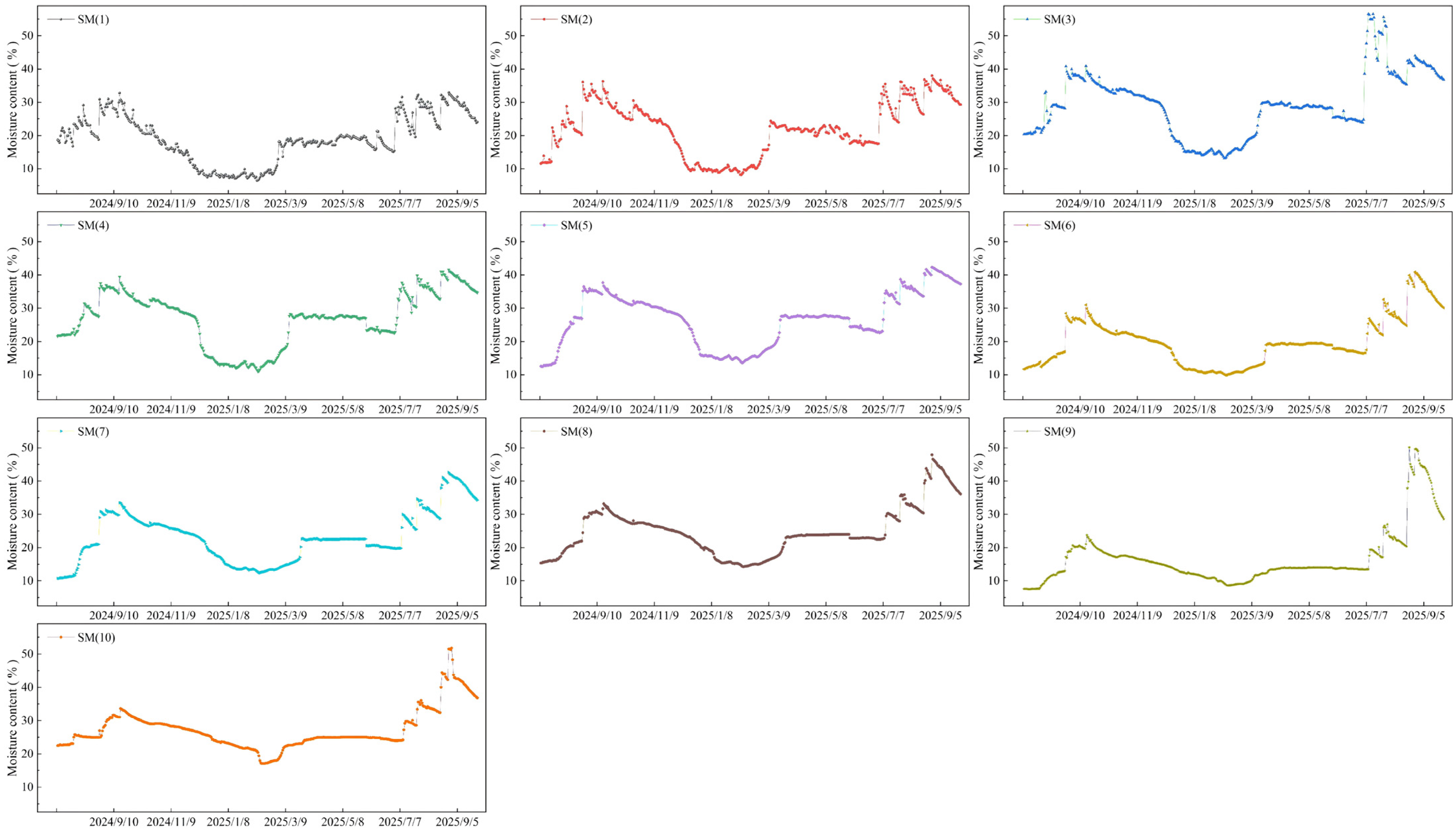
Based on daily monitoring data collected by the HOBO data logger, the soil moisture dynamics of the S30 combination exhibit complex diurnal-scale variation characteristics (Figure 7). Through continuous observations of ten monitoring layers from SM(1) to SM(10), it was found that soil moisture at different depths displays regular fluctuations over time. Surface soil moisture (SM(1), SM(2)) exhibits the most pronounced fluctuations, with variation amplitudes reaching 25.5% and 28.5%, respectively, indicating high sensitivity to environmental changes. The soil–bedrock interface at a depth of 30 cm (SM(3)) shows unique wet-dry alternation characteristics, with a moisture variation amplitude as high as 41.7%. During summer wetting events, it can rise by 12.7% within 48 h, while during winter drought periods, it consistently declines by 15.8%, reflecting the critical role of this interface as a key node in moisture transport. The moisture dynamics in the middle soil layers (SM(4)–SM(8)) are relatively stable but still exhibit seasonal fluctuations, such as the 28.4% variation amplitude observed for SM(4). The deep-layer sensors (SM(9), SM(10)) show the gentlest changes, with SM(10) largely remaining within the range of 22.5–51.8%, indicating strong moisture retention capacity.
The response timing and rates of different soil layers to moisture changes exhibit distinct vertical differentiation. During precipitation events, surface soil layers respond rapidly, with SM(1) capable of increasing by 12.1% within 24 h, while deep layers (SM(10)) exhibit delayed and weak responses. During moisture attenuation phases, the average daily water loss rate of surface soil layers (0.15%/day) is also significantly higher than that of deep layers (0.03%/day), revealing systematic differences in the hydrological functions of soil layers at different depths.

3.3.3. Precipitation Events and Their Impact on the Vertical Distribution of Soil Moisture

Light Rain Events
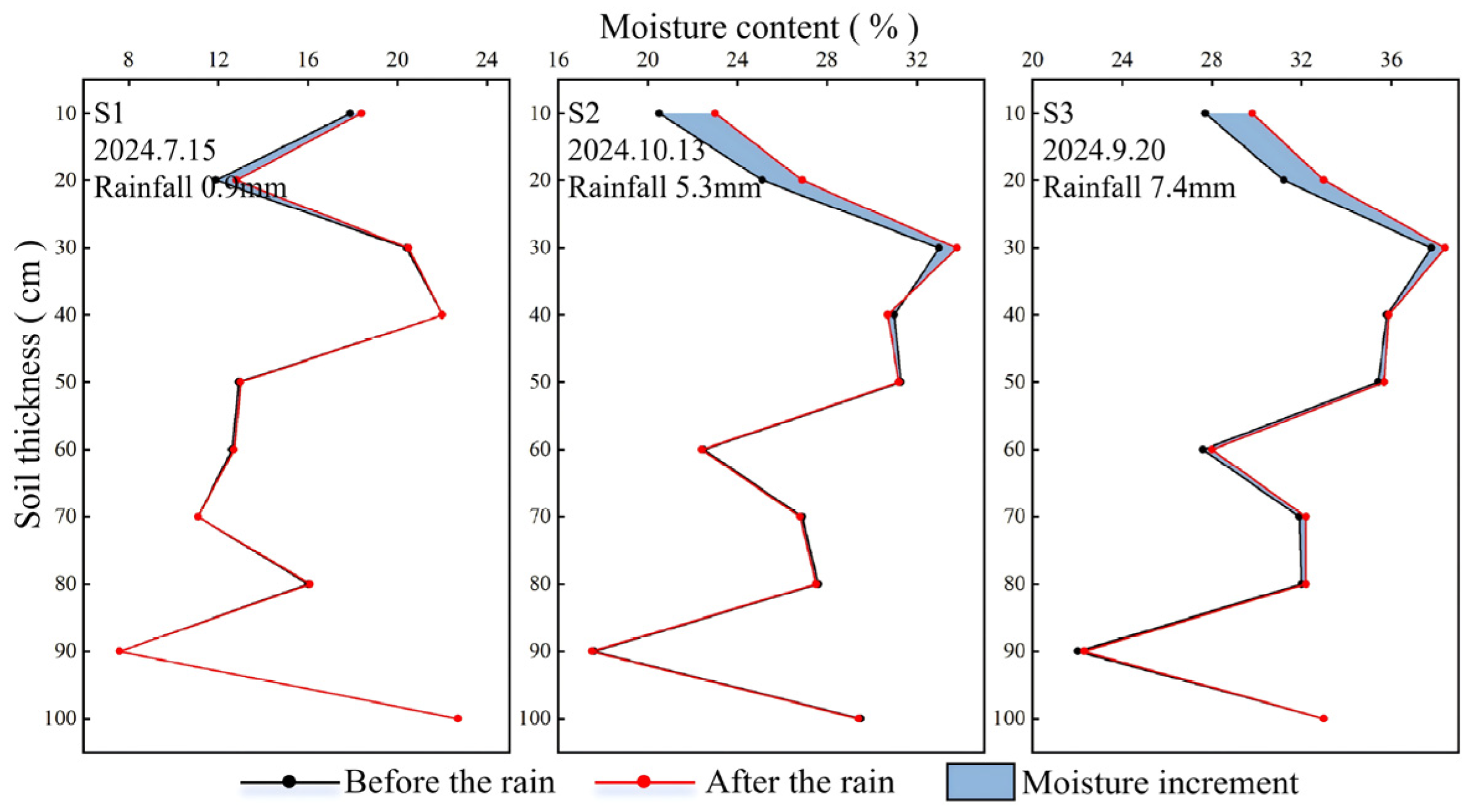
Based on monitoring data of soil moisture vertical distribution before and after three typical light rain events (precipitation amounts of 0.9 mm, 5.3 mm, and 7.4 mm), the study found that the impact of light rain events on soil moisture exhibits distinct surface-layer characteristics (Figure 8). Across all three events, the influence of precipitation was primarily confined to the 0–30 cm surface soil layer, with the most pronounced moisture responses observed at depths of 10 cm and 20 cm. During the 0.9 mm precipitation event, the moisture content at 10 cm and 20 cm depths increased from 17.9% to 18.4% and from 11.9% to 12.8%, respectively, representing increments of 0.5% and 0.9%. In the 5.3 mm event, the moisture content at these depths rose by 2.5% and 1.8%, respectively. In the 7.4 mm event, the increments expanded to 2.1% and 1.8%.
As precipitation increased, the depth of moisture influence slightly extended. In the 0.9 mm event, detectable moisture changes were observed only within the top 20 cm of soil. However, in the 5.3 mm and 7.4 mm events, responses began to appear at a depth of 30 cm, with moisture content increasing by 0.8% and 0.6%, respectively. No significant changes were observed in soil layers at 40 cm or deeper during any of the light rain events.
Moderate Rain Events
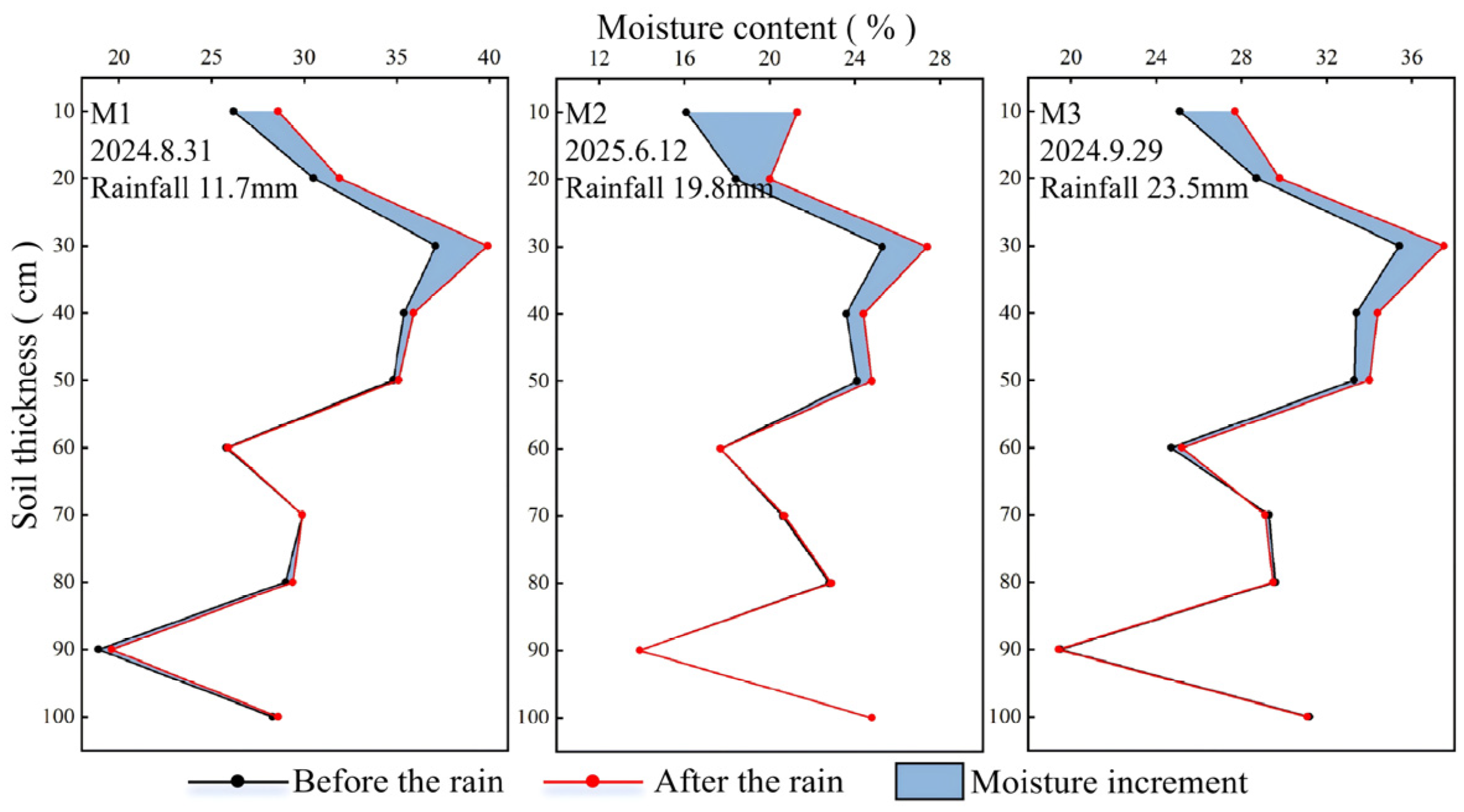
Monitoring data from three moderate rain events (with precipitation amounts of 11.7 mm, 19.8 mm, and 23.5 mm) indicate that moderate rain exerts a greater influence on both the depth and intensity of soil moisture compared to light rain, primarily affecting the surface and middle soil layers (Figure 9).
Across the three events, the response of soil moisture exhibited clear stratification. The changes in moisture content were most pronounced in the surface soil layer (10–20 cm). At a depth of 10 cm, the increments in the three events were 2.4%, 5.2%, and 2.6%, respectively, while at 20 cm depth, the increments were 1.4%, 1.6%, and 1.1%. Compared to light rain events, moderate rain demonstrated a more significant wetting effect on the surface soil layer. The 30 cm depth, located at the soil–rock interface, showed a strong response during moderate rain events. In the three events, the moisture content at this depth increased by 2.8%, 2.1%, and 2.1%, respectively, significantly higher than the variations observed during light rain events. This suggests that moderate rain intensity is sufficient to effectively wet the soil–rock interface, although downward moisture transport remains limited.
Heavy Rain Events
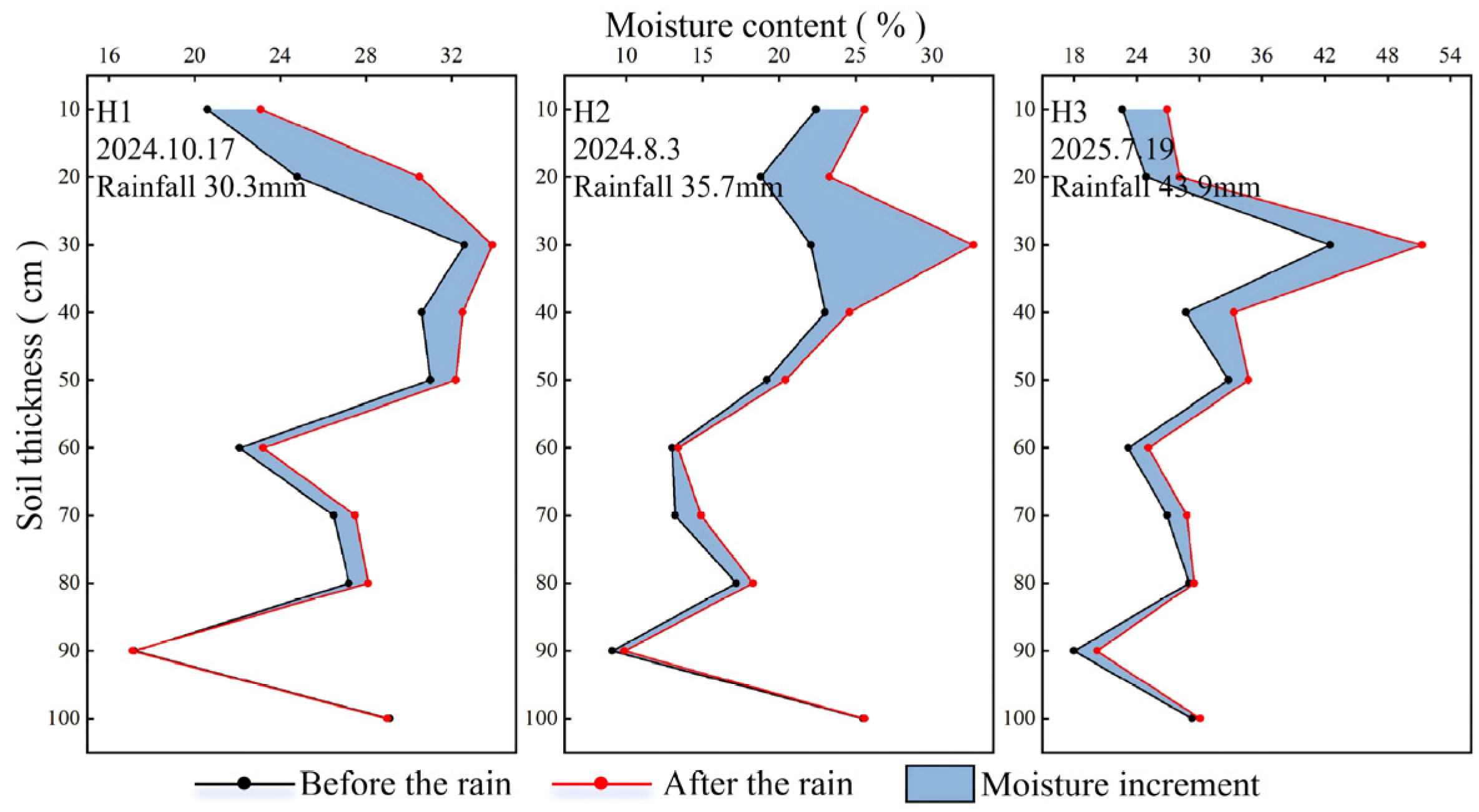
Monitoring data from three heavy rain events (with precipitation amounts of 30.3 mm, 35.7 mm, and 43.9 mm) indicate that heavy rain significantly enhances both the wetting depth and intensity of soil moisture, beginning to exert a noticeable impact on deeper soil layers (Figure 10).
Moisture content in the surface soil layer (10–20 cm) increased substantially. At a depth of 10 cm, the increments in the three events were 2.5%, 3.2%, and 4.3%, respectively, while at 20 cm depth, the increments were even more pronounced, reaching 5.7%, 4.5%, and 3.2%. Compared to moderate rain events, heavy rain demonstrated a significantly stronger wetting effect on the surface soil layer. Simultaneously, the response at the soil–rock interface (30 cm depth) was particularly notable. In the three events, the moisture content at this depth increased by 1.3%, 10.6%, and 8.8%, respectively. Especially during the event on August 3, the moisture content at 30 cm depth rose sharply from 22.1% to 32.7%, indicating significantly enhanced moisture transport at the soil–rock interface under heavy rain conditions. Heavy rain events began to exert a noticeable influence on the middle to deep soil layers at depths of 40–60 cm. The increments at 40 cm depth were 1.9%, 1.6%, and 4.6%, respectively, while at 50 cm depth, the increments were 1.2%, 1.2%, and 1.9%. Increases of 0.5% to 1.9% were also observed at 60 cm depth. This suggests that the infiltration depth of heavy rain can reach approximately 60 cm.
Rainstorm Events
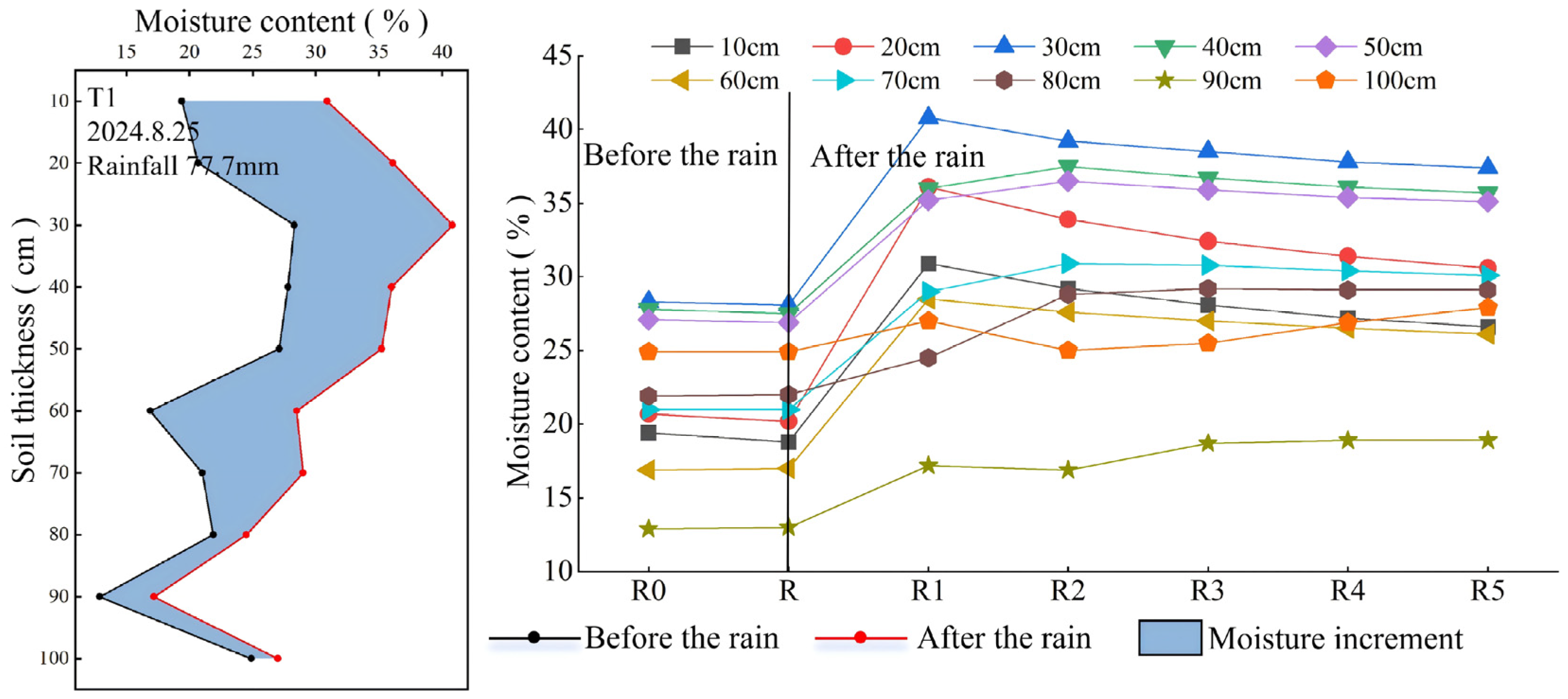
The rainstorm event on 25 August 2024 (precipitation: 77.7 mm) had a sustained impact on the soil moisture profile (Figure 11). Monitoring data revealed that this rainstorm not only significantly increased the moisture content across all soil layers but also maintained the wetting effect with notable stability over time within the profile. In terms of moisture increment, the surface soil layer (10–20 cm) exhibited the most intense response, with moisture content increases of 11.5% and 15.4%, respectively. At the soil–rock interface (30 cm), moisture content rose by 12.5%, indicating a strong interfacial response. Simultaneously, soil moisture content in the 60–70 cm depth range showed particularly significant increases, reaching 11.6% and 8.0%, respectively. This suggests that under rainstorm conditions, moisture could rapidly penetrate the soil–rock interface and effectively recharge deeper soil layers. Regarding the moisture response process, soil moisture content across all layers peaked on the first day after the rainstorm (R1). The surface soil layer (10–20 cm) showed the most pronounced increases, rising by 11.5% and 15.4%, respectively. At the soil–rock interface (30 cm), moisture content increased by 12.5%, demonstrating a strong interfacial response. In the 60–70 cm depth range, soil moisture content increased by 11.6% and 8.0%, respectively, indicating that under rainstorm conditions, moisture could rapidly traverse the soil–rock interface and effectively replenish deeper soil layers.

3.4. Influence of Meteorological Factors on Soil Moisture

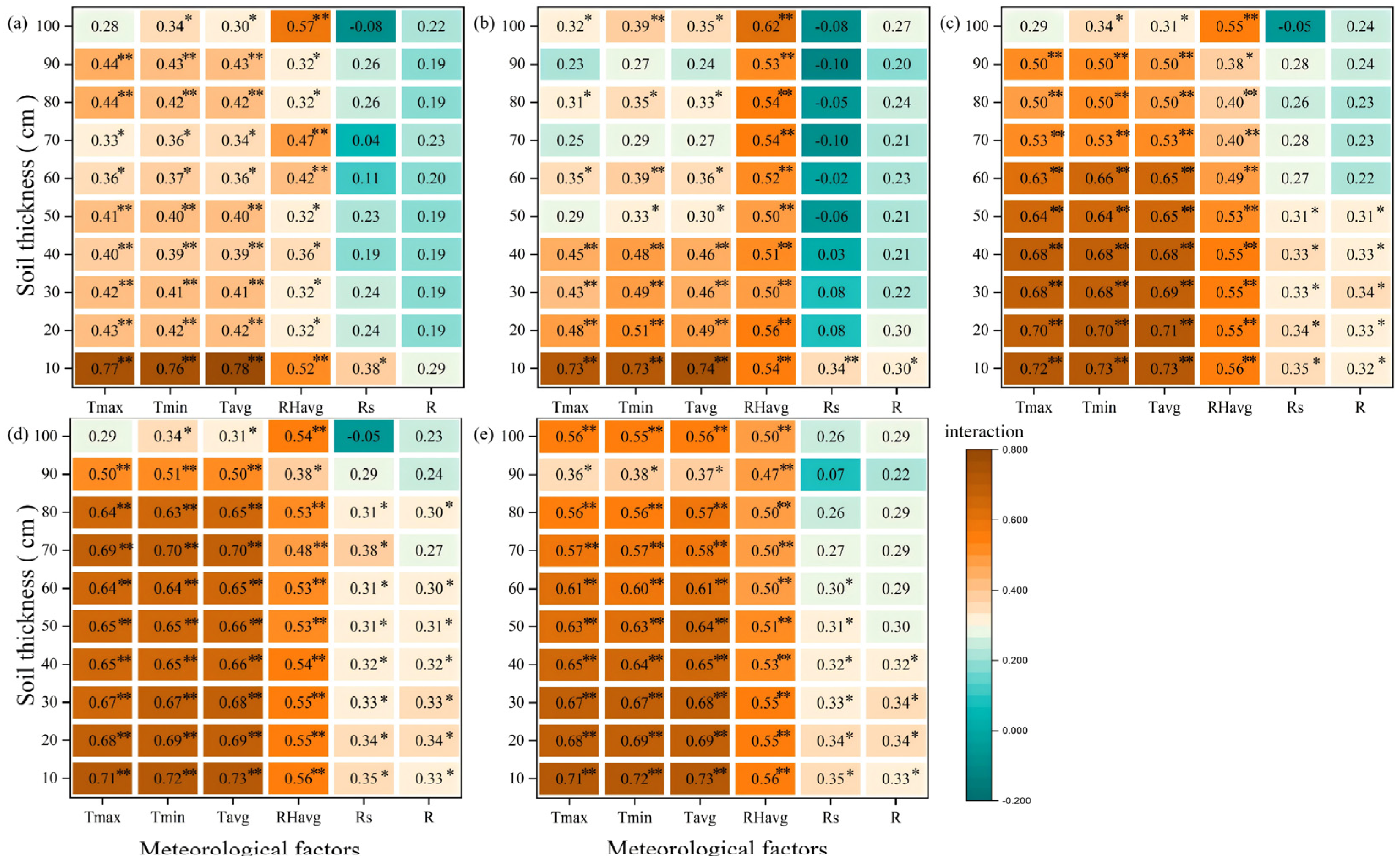
Through Spearman correlation analysis between soil moisture in five soil–rock combinations and meteorological factors, it was found that the influence of different meteorological elements on soil moisture exhibits significant vertical differentiation and variations among combinations (Figure 12). The influence of temperature factors on soil moisture demonstrates a clear vertical gradient. Across all combinations, the correlation between surface soil moisture and temperature factors is the strongest, with correlation coefficients with Tavg ranging from 0.73 to 0.78. As soil depth increases, the correlation with temperature gradually weakens, dropping to between 0.28 and 0.56 at a depth of 100 cm.
In contrast to temperature factors, the average relative humidity (RHavg) shows a pattern where its correlation with deeper soil layers is higher than with surface layers in thin-soil combinations (10 cm, 30 cm). In the 10 cm combination, the correlation coefficient at 100 cm depth reaches 0.57. In thick-soil combinations (70 cm, 90 cm), the correlation with average humidity is relatively evenly distributed across depths, with coefficients ranging from 0.47 to 0.56. The influence of solar radiation (Rs) on soil moisture is relatively weak and varies significantly among different soil–rock combinations. In the 30 cm soil combination, the correlation between radiation and soil moisture at all depths is negative or close to zero, whereas in other combinations, the correlation in the middle soil layers can exceed 0.30. The correlation coefficient for precipitation (R) remains relatively stable across combinations, ranging from 0.19 to 0.34, without showing obvious vertical patterns. This indicates that the influence of precipitation on soil moisture is relatively evenly distributed along the vertical profile.

4. Discussion

4.1. Mechanisms of Microtopography in Controlling Soil Thickness and Soil-Rock Combinations

This study, based on a survey of 323 sampling points in the Geqiugou watershed, reveals a spatial differentiation pattern of soil thickness across different macrotopographic units. From intensely eroded gullies to stable depositional terraces, a complete erosion-deposition sequence is formed.
Microtopography directly influences the distribution of soil thickness by regulating erosion and deposition dynamics. Gully and Furrow, as active erosion units, exhibit the thinnest average soil thickness (13–24 cm) and the highest coefficients of variation (0.33–0.46), reflecting the intensity and spatiotemporal heterogeneity of erosion processes such as hydraulic scouring and gravitational collapse [31]. In contrast, Gently sloped terraces, as typical depositional units, have the greatest average soil thickness (69 cm) and the most uniform distribution (coefficient of variation 0.12), indicating a relatively stable “sink area.” Transitional units such as Scarp, Collapse, and Undisturbed slope (average thickness 34–40 cm) represent “transfer zones” where erosion and deposition processes are relatively balanced. This soil thickness gradient based on microtopography aligns with the “geomorphic filter” theory proposed by Higgins et al., which posits that topography shapes the spatial pattern of soil properties by altering the flux of surface materials and energy [32,33,34]. Compared with the study of other hilly and gully regions in the middle reaches of the Yellow River Basin, the spatial differentiation of soil thickness in this study is consistent with the results of Zhu et al.’s study in the Shanxi-Shaanxi Gorge area, both of which show a complete soil thickness gradient from erosion units such as gullies and ephemeral gullies to sedimentary units such as gentle platforms [9]. However, different from the previous qualitative classification based on terrain parts (such as slope top, slope middle, slope toe) or vegetation coverage types, this study proposes five types of quantitative geotechnical combination types based on field-measured thickness (4–100 cm). Compared with the terrain unit classification used by Liu et al.in the soil quality evaluation based on the minimum data set, this classification system is directly related to the key structural attribute of soil thickness, which can better reveal the hydrological function differences in geotechnical systems under different thickness gradients [35].

4.2. Regulatory Role of Soil-Rock Combinations on Spatiotemporal Differentiation of Soil Moisture

The findings indicate that the distribution characteristics of soil moisture are closely related to the soil–rock combination structure. Across different soil–rock combinations, significant differences exist in the moisture-enriched layers. In thin-soil combinations (S10, S30), moisture is primarily stored in the soil layer, while in thick-soil combinations (S70, S90), moisture is significantly enriched in the bedrock. This phenomenon is associated with the unique physical properties of the bedrock in the region, where its developed fissures and loose structure provide favorable conditions for moisture storage and transport [36].
This study found that the fundamental mechanism of the phenomenon of water migration to the underlying bedrock in the thick layer combination is the significant difference in the hydraulic properties of the soil and the bedrock and the resulting interface water migration dominant path. The saturated hydraulic conductivity of the soil layer in the study area is relatively low, while the equivalent hydraulic conductivity of the underlying weathered sandstone can be 1–2 orders of magnitude higher due to the development of fissures, which is consistent with the phenomenon of ‘bedrock priority water storage’ observed by Rempe & Dietrich in the study of water in fractured rock mass. After low-intensity or short-duration rainfall, the infiltration flux is small, and the water is mainly accumulated in the soil layer. Under the condition of heavy rainfall or continuous rainfall, the soil layer tends to be saturated, the infiltration flux increases, and the water quickly enters the bedrock fracture network with high water conductivity at the interface to form preferential flow, thus showing that the water content of bedrock is significantly higher than that of overlying soil layer [24]. Therefore, the difference in water patterns caused by different soil thicknesses essentially reflects the transformation of the balance between soil water storage capacity and bedrock water storage capacity: thin-layer soil has limited water storage, and water is mainly stored in soil; the thick soil has sufficient water storage. Driven by heavy rainfall, water is more likely to enter and be stored in the bedrock through the dominant fracture channel.
The spatial location of the soil–rock interface plays a crucial role in shaping the vertical distribution pattern of moisture. In the S10 combination, the shallow soil–rock interface facilitates moisture exchange between the soil and bedrock, resulting in an unstable moisture distribution profile. As the soil layer thickens, the interface gradually shifts downward, and its hydrological function transforms. In the S30 to S50 combinations, a localized high-moisture zone forms near the interface, while in the S70 to S90 combinations, the deep interface acts as an effective moisture regulation zone, promoting moisture accumulation and stability in the soil layer above the interface.
The seasonal dynamics of soil moisture in different soil–rock combinations further underscore the importance of structural control [37]. The S10 combination exhibits intense fluctuations in the surface layer and relative stability in the deep layer, reflecting the high sensitivity of thin-soil systems to meteorological conditions. In contrast, the S90 combination demonstrates strong moisture retention capacity, with high moisture content and gradual seasonal variations across all soil layers, highlighting the hydrological buffering function of thick-soil systems. The occurrence of extremely high moisture values at 30 cm in the S30 combination suggests that this interface may act as a preferential flow pathway under heavy rainfall conditions.

4.3. Hierarchical Response of Soil Moisture to Precipitation Driving and the Role of the Soil-Rock Interface

Based on high-frequency monitoring data from the S30 combination, it is evident that precipitation events of varying intensities induce distinct hierarchical responses in soil moisture. Light rain events primarily moisten the surface soil layer (0–30 cm), with limited impact on deeper layers; moderate rain events effectively wet the soil–rock interface at 30 cm depth; heavy rain events can influence depths up to 60 cm; while rainstorm events rapidly infiltrate into deeper soil layers below 70 cm and produce sustained recharge effects. This study further reveals that even within the same precipitation level, the gradient change of rainfall intensity will significantly regulate the soil moisture response. In light rain events, the increase in rainfall from 0.9 mm to 7.4 mm can extend the wetting depth from 20 cm to 30 cm. Similar rules are also shown in moderate rain and heavy rain events.
The soil–rock interface exhibits active hydrological behavior during precipitation infiltration. In all precipitation events of moderate intensity or higher, the soil–rock interface at 30 cm depth showed significant moisture increment responses, with a maximum increase of 12.5%. Particularly during the rainstorm event on 25 August 2025, the moisture content at the interface peaked on the first day after the rainfall, demonstrating a pronounced interfacial response. This phenomenon indicates that the soil–rock interface not only serves as a critical node for vertical moisture transport but may also act as a source for preferential flow or lateral flow [38].
The function of the soil–rock interface undergoes notable transformation under different precipitation intensities. Under light rain conditions, the interface primarily acts as a “temporary storage” zone for moisture; however, under moderate to rainstorm conditions, it transforms into a “conduit” for rapid moisture infiltration. This functional shift is likely related to differences in hydraulic conductivity between the media above and below the interface. When the infiltration flux is small, moisture accumulates at the interface; when the infiltration flux exceeds the soil matrix flow capacity, the fissure system at the interface is activated, forming rapid infiltration pathways [39].

4.4. Vertical Differentiation Driven by Meteorological Factors and the Modulating Effects of Soil-Rock Combinations

Based on Spearman’s rank correlation analysis, this study revealed that the effects of meteorological driving factors on soil moisture have significant vertical heterogeneity, and the process is systematically regulated by the soil–rock combination types controlled by high-cut terrain [40]. The intensely fragmented landscape shaped by a gully density as high as 3.2–4.1 km/km2 in the study area forms the macro-framework for water redistribution and energy transfer. Topography directly regulates local hydrothermal conditions on one hand, and on the other hand, shapes a continuous gradient of soil thickness from erosional units to depositional units through erosion and deposition processes. The five typical soil–rock combinations identified based on this, as direct products of topographic influence, further modulate the transmission efficiency and response characteristics of meteorological drivers within the soil profile.
As the primary input for soil moisture, precipitation exhibits distinct topographic heterogeneity and hierarchical response in its driving effect. In thin-layer combination areas dominated by erosion, such as steep slopes and gully heads, characterized by steep terrain and shallow soil bodies, precipitation infiltration capacity is limited. Moisture recharge from light rain events is mainly concentrated in the 0–30 cm surface layer, with limited effective deep infiltration. Conversely, in thick-layer combination areas dominated by deposition, such as gentle slopes and gully bottoms, the gentle terrain facilitates moisture convergence. Only when precipitation intensity reaches moderate rain or higher levels can moisture sufficiently infiltrate to depths below 70 cm, activating the rapid water-conducting function of the soil–rock interface. This process aligns with the observed phenomenon in thick-layer combinations where bedrock moisture content exceeds that of the overlying soil layer, indicating that the depth and intensity of precipitation recharge to soil moisture are essentially controlled by the corresponding topographic position and the resulting water retention and conduction structure of the soil–rock combination.
As an energy driver, temperature exhibits typical vertical attenuation and surface coupling characteristics. Across all soil–rock combinations, surface soil moisture shows the strongest correlation with Tavg, with correlation coefficients ranging from 0.73 to 0.78, primarily due to the direct involvement of surface soil in solar radiation, evapotranspiration, and turbulent exchange processes. The deeply incised topography further exacerbates the spatial heterogeneity of temperature-driven effects through topographic factors such as aspect and slope. As soil depth increases to 100 cm, the correlation between temperature and moisture weakens significantly, with coefficients dropping to 0.28–0.56, indicating that deep soil moisture dynamics are more dominated by seepage processes and medium properties.
The influence of RHavg on soil moisture demonstrates a dependence on combination type. In thin-layer combinations, deeper soil moisture shows a stronger correlation with RHavg, reflecting the higher sensitivity of the underlying bedrock in thin-layer systems to near-surface atmospheric humidity fluctuations. As the dominant driver, the correlation between R and soil moisture is relatively stable across combinations and exhibits a more uniform vertical distribution, suggesting the universality of its recharge role, although its specific effects are locally buffered by soil–rock structures.
A comprehensive comparison of response patterns across different soil–rock combinations reveals that in thick-layer combinations (S70, S90), the distribution of correlations between soil moisture at various depths and meteorological factors is relatively balanced, reflecting stronger system stability and hydrological buffering capacity. In contrast, thin-layer combinations (S10, S30) exhibit more pronounced surface sensitivity and meteorological dependence, indicating higher system vulnerability. This suggests that the soil–rock combination structure, directly shaped by the deeply incised topography, ultimately determines the expression and intensity of meteorological drivers in hillslope hydrological processes by regulating soil moisture storage space, vertical connectivity, and interface hydrological behavior [41]. Consequently, it influences the disturbance resistance and resilience of hydrological systems at different geomorphic positions.

5. Conclusions

This study, through integrated field surveys and multi-scale monitoring analyses, elucidates the coupling mechanisms among microtopography, soil–rock combinations, soil moisture, and meteorological drivers in hilly and gully regions. The findings are summarized as follows:
(1) Macrotopographic units control the spatial gradient of soil thickness, forming a continuum from erosion-dominated gullies (13 cm) and shallow gullies (24 cm) to deposition-dominated gentle terraces (69 cm), which defines five quantitative soil–rock combination types.
(2) The soil–rock combination structure regulates the vertical distribution pattern of soil moisture. In the thin layer combinations (such as S10, S30), the water content of the soil layer tends to be higher than that of the underlying bedrock layer, which reflects the characteristics of limited infiltration depth and active surface water dynamics. In the thick layer combination (such as S70, S90), the deep soil layer provides a larger storage space and a deeper migration path. Under the condition of heavy rainfall or continuous rainfall, sufficient infiltration flux can lead to significant accumulation of water in fractured bedrock, so that the water content of the bedrock layer exceeds that of its overlying soil layer under such scenarios.
(3) Precipitation responses are hierarchical: light rain wets the surface (0–30 cm), while heavy rain infiltrates beyond 70 cm, transforming the soil–rock interface from a temporary storage zone into a preferential flow pathway during intense rainfall.
(4) The influence of meteorological drivers on soil moisture shows marked vertical differentiation, which is significantly modulated by soil–rock combination type; thick-layer combinations exhibit greater hydrological buffering capacity and system stability.
The research conclusions are applicable to the hilly and gully areas in the middle reaches of the Yellow River Basin with similar environmental characteristics to the Geqiugou Basin, that is, areas with high gully density, fractured sandstone bedrock and arid and semi-arid climate. For regions with significantly different lithology, climate or terrain characteristics, the quantitative parameters (such as thickness classification threshold and water response time) of this study need to be localized, but the framework of the ‘topography-structure-process-drivers’ synergy mechanism revealed by this study still has universal methodological reference value.

Author Contributions

Conceptualization, X.D.; Methodology, L.L.; Formal analysis, Y.S.; Resources, F.Q.; Writing—original draft, L.L.; Writing—review & editing, L.L.; Visualization, X.D.; Supervision, F.Q.; Funding acquisition, Y.S. All authors have read and agreed to the published version of the manuscript.

Funding

This work was supported by the Natural Science Foundation of Inner Mongolia Autonomous Region [grant numbers 2024QN03062, RZ2500002382, 2025MS04040].

Institutional Review Board Statement

Not applicable.

Informed Consent Statement

Not applicable.

Data Availability Statement

The original data presented in the study are available upon reasonable request from the corresponding author. The data are not publicly available due to them being part of an ongoing longitudinal monitoring research program.

Conflicts of Interest

The authors declare no conflict of interest.

References

  1. Wohlfart, C.; Kuenzer, C.; Chen, C.; Liu, G. Social-ecological challenges in the Yellow River basin (China): A review. Environ. Earth Sci. 2016, 75, 1066. [Google Scholar] [CrossRef]
  2. Zhang, G.; Huang, J.; Liu, X.; Guan, X.; Wei, Y.; Ding, L.; Han, D. The evolution of ecological security and its drivers in the Yellow River Basin. Environ. Sci. Pollut. Res. 2023, 30, 47501–47515. [Google Scholar] [CrossRef]
  3. Liang, Z.; Wu, Z.; Yao, W.; Noori, M.; Yang, C.; Xiao, P.; Deng, L. Pisha sandstone: Causes, processes and erosion options for its control and prospects. Int. Soil Water Conserv. Res. 2019, 7, 1–8. [Google Scholar] [CrossRef]
  4. Ma, W.; Zhang, X. Effect of Pisha sandstone on water infiltration of different soils on the Chinese Loess Plateau. J. Arid Land 2016, 8, 331–340. [Google Scholar] [CrossRef]
  5. Wang, R.; Yan, F.; Wang, Y. Vegetation growth status and topographic effects in the pisha sandstone area of China. Remote Sens. 2020, 12, 2759. [Google Scholar] [CrossRef]
  6. Penna, D.; Borga, M.; Norbiato, D.; Dalla Fontana, G. Hillslope scale soil moisture variability in a steep alpine terrain. J. Hydrol. 2009, 364, 311–327. [Google Scholar] [CrossRef]
  7. Sulebak, J.R.; Tallaksen, L.M.; Erichsen, B. Estimation of areal soil moisture by use of terrain data. Geogr. Ann. Ser. A Phys. Geogr. 2000, 82, 89–105. [Google Scholar] [CrossRef]
  8. Geng, K.; Chai, J.; Qin, Y.; Li, X.; Zhou, H. Collapse inhibition mechanism analysis and durability properties of cement-stabilized Pisha sandstone. Bull. Eng. Geol. Environ. 2022, 81, 144. [Google Scholar] [CrossRef]
  9. Zhu, R.; Yu, Y.; Liu, D.; Wang, J.; Gao, Z.; Liu, J.; Rodrigo-Comino, J. Vegetation pattern and topography determine erosion characteristics in a semi-arid sandstone hillslope-gully system. Eur. J. Soil Sci. 2024, 75, e13498. [Google Scholar] [CrossRef]
  10. Wang, Y.; Li, X.S.; Zheng, B.; Mao, T.Q.; Hu, R.L. Investigation of the effect of soil matrix on flow characteristics for soil and rock mixture. Géotech. Lett. 2016, 6, 226–233. [Google Scholar] [CrossRef]
  11. Yang, W.; Peng, X.; Dai, Q.; Li, C.; Xu, S.; Liu, T. Storage infiltration of rock-soil interface soil on rock surface flow in the rocky desertification area. Geoderma 2023, 435, 116512. [Google Scholar] [CrossRef]
  12. Li, Y.; Wang, S.; Peng, T.; Zhao, G.; Dai, B. Hydrological characteristics and available water storage of typical karst soil in SW China under different soil-rock structures. Geoderma 2023, 438, 116633. [Google Scholar] [CrossRef]
  13. Wang, K.; Hui, Y.; Zhou, C.; Li, X.; Rong, Y. Soil-water characteristic surface model of soil-rock mixture. J. Mt. Sci. 2023, 20, 2756–2768. [Google Scholar] [CrossRef]
  14. Liu, J.; Deng, Z.; Chen, L.; Huang, Y.; Peng, X. Quantifying the influence of soil-rock interfaces on water infiltration rate in karst landscapes. Geoderma 2025, 460, 117432. [Google Scholar] [CrossRef]
  15. Zhang, P.; Xiao, P.; Yao, W.; Liu, G.; Sun, W. Analysis of complex erosion models and their implication in the transport of Pisha sandstone sediments. Catena 2021, 207, 105636. [Google Scholar] [CrossRef]
  16. Fu, Z.; Li, Z.; Cai, C.; Shi, Z.; Xu, Q.; Wang, X. Soil thickness effect on hydrological and erosion characteristics under sloping lands: A hydropedological perspective. Geoderma 2011, 167, 41–53. [Google Scholar] [CrossRef]
  17. dos Santos, K.F.; Barbosa, F.T.; Bertol, I.; de Souza Werner, R.; Wolschick, N.H.; Mota, J.M. Study of soil physical properties and water infiltration rates in different types of land use. Semin. Ciênc. Agrár. 2018, 39, 87–97. [Google Scholar] [CrossRef]
  18. Zhang, K.; Xu, M.; Wang, Z. Study on reforestation with seabuckthorn in the Pisha Sandstone area. J. Hydro-Environ. Res. 2009, 3, 77–84. [Google Scholar] [CrossRef]
  19. Pedrazas, M.A.; Hahm, W.J.; Huang, M.H.; Dralle, D.; Nelson, M.D.; Breunig, R.E.; Rempe, D.M. The relationship between topography, bedrock weathering, and water storage across a sequence of ridges and valleys. J. Geophys. Res. Earth Surf. 2021, 126, e2020JF005848. [Google Scholar] [CrossRef]
  20. Bonfatti, B.R.; Hartemink, A.E.; Vanwalleghem, T.; Minasny, B.; Giasson, E. A mechanistic model to predict soil thickness in a valley area of Rio Grande do Sul, Brazil. Geoderma 2018, 309, 17–31. [Google Scholar] [CrossRef]
  21. Patton, N.R.; Lohse, K.A.; Godsey, S.E.; Crosby, B.T.; Seyfried, M.S. Predicting soil thickness on soil mantled hillslopes. Nat. Commun. 2018, 9, 3329. [Google Scholar] [CrossRef]
  22. Guo, J.; Ding, G.; Wang, H.; Li, S.; Dai, Z. Study on the dynamic development law of fissure in expansive soil under different soil thickness. Arch. Civ. Eng. 2023, 69, 519–534. [Google Scholar] [CrossRef]
  23. Zhao, Z.; Zhang, H.; Zhang, J. Impacts of rock-soil interface on soil infiltration and spatio-temporal water distribution during ecosystem succession in karst areas. Catena 2025, 260, 109474. [Google Scholar] [CrossRef]
  24. Sohrt, J.; Ries, F.; Sauter, M.; Lange, J. Significance of preferential flow at the rock soil interface in a semi-arid karst environment. Catena 2014, 123, 1–10. [Google Scholar] [CrossRef]
  25. Liu, L.; Qin, F.; Sheng, Y.; Li, L.; Dong, X.; Zhang, S.; Shen, C. Soil quality evaluation and limiting factor analysis in different microtopographies of hilly and gully region based on minimum data set. Catena 2025, 254, 108973. [Google Scholar] [CrossRef]
  26. Starks, P.J.; Heathman, G.C.; Jackson, T.J.; Cosh, M.H. Temporal stability of soil moisture profile. J. Hydrol. 2006, 324, 400–411. [Google Scholar] [CrossRef]
  27. Subin, Z.M.; Koven, C.D.; Riley, W.J.; Torn, M.S.; Lawrence, D.M.; Swenson, S.C. Effects of soil moisture on the responses of soil temperatures to climate change in cold regions. J. Clim. 2013, 26, 3139–3158. [Google Scholar] [CrossRef]
  28. Zar, J.H. Significance testing of the Spearman rank correlation coefficient. J. Am. Stat. Assoc. 1972, 67, 578–580. [Google Scholar] [CrossRef]
  29. Headrick, T.C. A note on the relationship between the Pearson product-moment and the Spearman rank-based coefficients of correlation. Open J. Stat. 2016, 6, 1025–1027. [Google Scholar] [CrossRef]
  30. Eltner, A.; Maas, H.G.; Faust, D. Soil micro-topography change detection at hillslopes in fragile Mediterranean landscapes. Geoderma 2018, 313, 217–232. [Google Scholar] [CrossRef]
  31. Hu, J.; He, Y.; Huang, K.; Li, P.; Li, S.; Yan, L.; Tang, B. Spatio-Temporal Characteristics of the Morphological Development of Gully Erosion on the Chinese Loess Plateau. Remote Sens. 2025, 17, 2710. [Google Scholar] [CrossRef]
  32. Higgins, C.G. Drainage systems developed by sapping on Earth and Mars. Geology 1982, 10, 147–152. [Google Scholar] [CrossRef]
  33. Bracken, L.J.; Croke, J. The concept of hydrological connectivity and its contribution to understanding runoff-dominated geomorphic systems. Hydrol. Process. 2007, 21, 1749–1763. [Google Scholar] [CrossRef]
  34. Saco, P.M.; Moreno-de las Heras, M. Ecogeomorphic coevolution of semiarid hillslopes: Emergence of banded and striped vegetation patterns through interaction of biotic and abiotic processes. Water Resour. Res. 2013, 49, 115–126. [Google Scholar] [CrossRef]
  35. Merrill, S.D.; Smith, S.J.; Power, J.F. Effect of disturbed soil thickness on soil water use and movement under perennial grass. Soil Sci. Soc. Am. J. 1985, 49, 196–202. [Google Scholar] [CrossRef]
  36. Rempe, D.M.; Dietrich, W.E. Direct observations of rock moisture, a hidden component of the hydrologic cycle. Proc. Natl. Acad. Sci. USA 2018, 115, 2664–2669. [Google Scholar] [CrossRef] [PubMed]
  37. Zhang, Y.; Feng, S.; Wang, J.; Chen, M.; Wang, K.; Liu, C.; Shangguan, Z. Assessing the change in soil water deficit characteristics from grassland to forestland on the Loess Plateau. Ecol. Indic. 2024, 167, 112616. [Google Scholar] [CrossRef]
  38. Hopp, L.; McDonnell, J.J. Connectivity at the hillslope scale: Identifying interactions between storm size, bedrock permeability, slope angle and soil depth. J. Hydrol. 2009, 376, 378–391. [Google Scholar] [CrossRef]
  39. Vidon, P. Towards a better understanding of riparian zone water table response to precipitation: Surface water infiltration, hillslope contribution or pressure wave processes? Hydrol. Process. 2012, 26, 3207–3215. [Google Scholar] [CrossRef]
  40. Jin, Z.; Guo, L.; Lin, H.; Wang, Y.; Yu, Y.; Chu, G.; Zhang, J. Soil moisture response to rainfall on the Chinese Loess Plateau after a long-term vegetation rehabilitation. Hydrol. Process. 2018, 32, 1738–1754. [Google Scholar] [CrossRef]
  41. Feng, Q.; Zhao, W.; Qiu, Y.; Zhao, M.; Zhong, L. Spatial heterogeneity of soil moisture and the scale variability of its influencing factors: A case study in the Loess Plateau of China. Water 2013, 5, 1226–1242. [Google Scholar] [CrossRef]
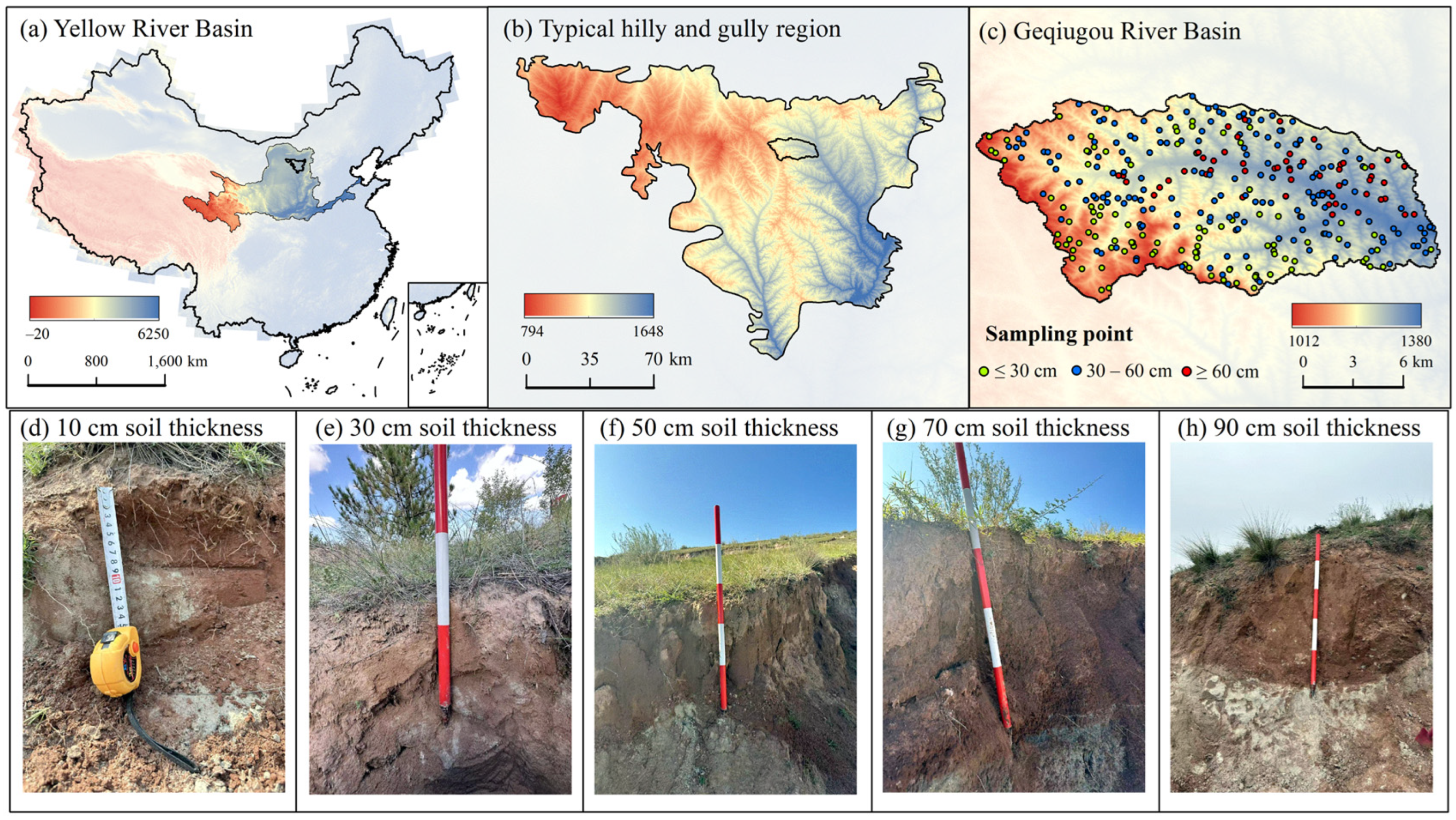
Figure 1. The location of the study area, the distribution of sampling points and the combination of rock and soil. (ac) the location of the study area and sampling points; (dh) Field photographs of different rock and soil combinations.
Sustainability 18 00959 g001
Figure 2. Histogram of soil thickness frequency distribution. The red bar identifies the class interval with the highest frequency.
Sustainability 18 00959 g002
Figure 3. Moisture content in soil layers and bedrock under different soil–rock combinations.
Sustainability 18 00959 g003
Figure 4. Vertical distribution characteristics of moisture in different soil–rock combinations. IQR, Interquartile Range. Red and blue stripes highlight the highest and lowest values, respectively.
Sustainability 18 00959 g004
Figure 5. Characteristics of the temporal evolution of soil moisture profiles in different soil–rock combinations.
Sustainability 18 00959 g005
Figure 6. Temporal evolution characteristics of meteorological elements.
Sustainability 18 00959 g006
Figure 7. Daily dynamics of soil moisture at different depths for the S30 combination. SM(1) to SM(10) represent the volumetric soil moisture content at depths of 10 cm to 100 cm, respectively, with a monitoring depth interval of 10 cm.
Sustainability 18 00959 g007
Figure 8. Characteristics of soil moisture increment in light rain events.
Sustainability 18 00959 g008
Figure 9. Characteristics of soil moisture increment in moderate rain events.
Sustainability 18 00959 g009
Figure 10. Characteristics of soil moisture increment in heavy rain events.
Sustainability 18 00959 g010
Figure 11. Characteristics of soil moisture increment and dynamic response in rainstorm event. R0: 1 day before rain; R: On the day of rainfall; R1: 1 day after rain; R2: 2 days after rain; R3: 3 days after rain; R4: 4 days after rain; R5: 5 days after rain.
Sustainability 18 00959 g011
Figure 12. Spearman correlation analysis between soil moisture and meteorological factors across different soil–rock combinations. (a) S10; (b) S30; (c) S50; (d) S70; (e) S90. Tmax denotes maximum temperature; Tmin denotes minimum temperature; Tavg denotes average temperature; RHavg denotes average relative humidity; Rs denotes total shortwave radiation; R denotes daily (24 h) precipitation. * p < 0.05, ** p < 0.01.
Sustainability 18 00959 g012
Table 1. Descriptive statistics of soil thickness in different macrotopographic units.
Macrotopographic CountMean (cm)SD (cm)CVMin (cm)Max (cm)Median (cm)SkewnessKurtosis
Scarp5940 b90.232457390.09−1.18
Furrow4924 d80.3393825−0.18−0.98
Gully1613 e60.46424120.44−0.74
Gently sloped terrace6669 a80.1249101680.540.22
Undisturbed slope6534 c90.2695836−0.690.35
Collapse6837 bc70.192356360.21−0.87
Note: Different letters in the Mean column indicate significant differences among units (p < 0.05). Same letters = no significant difference.
Table 2. Typical soil–rock combination types and their characteristics.
Soil–Rock CombinationPrimary Distribution Geomorphic UnitsMain
10 cm soil thickness
(S10)
Severely eroded gully heads, rill heads, and steep gully slopes.The soil cover is extremely thin. The soil layer structure is very discontinuous, mostly in sporadic patchy shape, and the underlying bedrock is mainly strongly weathered Jurassic sandstone. The rock–soil interface is clear and irregular, the soil preservation conditions are very poor, and the bedrock is generally exposed, which is a typical erosion ‘source area’.
30 cm soil thickness
(S30)
Upper and middle sections of furrows and scarps, which are erosion-dominated areas.It can form a preliminary but fragile continuous soil layer, which provides basic conditions for vegetation planting. The underlying bedrock is mostly sandstone and sand shale interbedded, moderately weathered, and the weathered gravel transition zone is common at the rock–soil interface. This layer is still disturbed by strong erosion, and the stability of soil layer is poor, which is the key sensitive zone for the transition of erosion process to stability.
50 cm soil thickness
(S50)
Lower sections of undisturbed slopes and collapse landforms, representing transitional zones of erosion and deposition.The soil layer is relatively deep and continuous, and the soil nutrient preservation capacity and water holding capacity are significantly improved. The underlying bedrock is mainly sandy shale, moderately weathered, and the rock–soil interface is relatively flat. It usually corresponds to higher vegetation coverage and biomass, reflecting strong soil accumulation capacity.
70 cm soil thickness
(S70)
Lower and middle parts of gentle slopes and certain valley depositional areas.The soil layer is deep and continuous, and has excellent nutrient and water retention functions. The underlying bedrock is dominated by weakly weathered argillaceous sandstone, and the rock–soil interface is clear and flat. It is the main distribution area of high-quality forest and grass vegetation, representing the obvious soil deposition process.
90 cm soil thickness
(S90)
Gently sloping terraces and valley bottoms, which are stable depositional zones.The soil layer is deep, the structure is complete, and the soil resource endowment is superior. The underlying bedrock is dominated by thick mudstone or complete sandstone, weakly weathered, and the rock–soil interface is clear and flat. It is the core area of soil and water conservation function, and also the concentrated area of human agricultural activities, representing the ‘sink area’ of regional soil conservation.
Disclaimer/Publisher’s Note: The statements, opinions and data contained in all publications are solely those of the individual author(s) and contributor(s) and not of MDPI and/or the editor(s). MDPI and/or the editor(s) disclaim responsibility for any injury to people or property resulting from any ideas, methods, instructions or products referred to in the content.