


Abstract
Addressing the challenges of low resource-use efficiency and supply–demand mismatch in Hami melon production, this study investigated the interactive effects of irrigation and fertilization to identify an optimal regime that balances yield, water conservation, and resource-use efficiency (i.e., water use efficiency and fertilizer partial factor productivity). A greenhouse experiment was conducted in Hami, Xinjiang, employing a two-factor design with five irrigation levels (W1–W5: 60–100% of full irrigation) and three fertilization levels (F1–F3: 80–100% of standard rate), replicated three times. Growth parameters, yield, water use efficiency (WUE), and partial factor productivity of fertilizer (PFP) were evaluated and comprehensively analyzed using the entropy-weighted TOPSIS method, regression analysis, and the NSGA-II multi-objective genetic algorithm. Results demonstrated that irrigation volume was the dominant factor influencing growth and yield. The W4F3 treatment (90% irrigation with 100% fertilization) achieved the optimal outcome, yielding 75.74 t ha−1—a 9.71% increase over the control—while simultaneously enhancing WUE and PFP. Both the entropy-weighted TOPSIS evaluation (C = 0.998) and regression analysis (optimal irrigation level at w = 0.79, ~90% of full irrigation) identified W4F3 as superior. NSGA-II optimization further validated this, generating Pareto-optimal solutions highly consistent with the experimental optimum. The model-predicted optimal regime for greenhouse Hami melon in Xinjiang is an irrigation amount of 3276 m3 ha−1 and a fertilizer application rate of 814.8 kg ha−1. This regime facilitates a 10% reduction in irrigation water and a 5% reduction in fertilizer input without compromising yield, alongside significantly improved resource-use efficiencies.
1. Introduction
Xinjiang Hami melon (Cucumis melo L. var. melo pang) is one of the renowned local specialty crops of Xinjiang [1]. In the agricultural sector, its cultivation area has reached approximately 6333 ha [2]. In recent years, the double-cropping system (two harvests per year) for greenhouse Hami melon has shown a rapid growth trend in the Hami region, owing to its doubled yield and significant income-increasing benefits. However, widespread issues such as over-irrigation, groundwater over-exploitation, and excessive fertilizer application exist in Hami melon cultivation [3], which exacerbate hydrological risks. Studies predict that the agricultural water shortage rate in Hami City, Xinjiang, will reach 22.15% by 2040 [4]. Water scarcity is the core bottleneck constraining sustainable agricultural development in arid regions. As a pioneering area for drip irrigation under mulch technology [5], Hami City in Xinjiang still faces severe water resource pressure in agricultural production (the total annual water supply is about 750 million m3, of which agricultural water use accounts for 670 million m3, reaching 90%) [6]. With continuous population growth, societal water demand is increasing, alongside the requirement for higher water supply reliability [7,8]. Facing the dual challenges of regional total water resource constraints and low agricultural water use efficiency, Hami City has implemented measures such as water rights reform (with an irrigation quota of 400 m3 per mu) and groundwater management [9]. Excessive irrigation and fertilization not only lead to resource waste but also trigger environmental risks such as soil salinization and water eutrophication [10]. To ensure the long-term sustainable development of Xinjiang’s characteristic crop industry, it is particularly crucial to investigate the effects of water–fertilizer coupling on the yield and quality of Hami melon in arid regions.
In recent years, against the backdrop of synergistic advancement in agricultural modernization and sustainable development, the efficient utilization of water and fertilizer in agricultural production has emerged as a core issue for ensuring food security [11]. Currently, research on integrated water and fertilizer technology is extensive, with drip irrigation techniques being increasingly applied to various crops in more arid regions. Ma Liang [12] suggested that appropriate levels of irrigation and fertilization can significantly enhance dry matter accumulation and yield in maize, whereas excessive application can produce negative effects. Regarding intelligent applications, a demonstration in Shanshan County showed that intelligent integrated water and fertilizer technology for Hami melon can achieve 10% water saving, 10% fertilizer reduction, and a 30% reduction in labor costs [13]. Cui Qingzi [14] further verified that this technology reduces the irrigation quota from 600 m3 per mu to 550 m3 per mu in a double-cropping system in Turpan. However, many melon growers, blindly pursuing economic benefits and a one-sided emphasis on large and uniformly shaped fruits, continuously increase fertilizer application during cultivation. Coupled with improper field irrigation management, this leads to uneven fruit size and quality degradation, severely impacting the economic returns of Hami melon cultivation [15]. For Hami melon, an important and renowned specialty of Xinjiang, particularly in its core production area of Hami, there is a lack of research on the precise synergistic regulation thresholds for water and fertilizer based on its physiological water and nutrient requirements at different growth stages.
However, the Hami melon industry, a characteristic crop in arid regions, still faces challenges such as water scarcity, unstable yield and quality. In particular, there is a lack of precise irrigation standards based on crop water requirements and ecological consequences. To address this, this study focused on greenhouse Hami melon in Hami, Xinjiang. Through a multi-gradient field experiment on water–fertilizer coupling, we systematically analyzed the effects of different treatments on melon growth, yield, and resource-use efficiency. Building on this, the entropy-weight TOPSIS method was introduced to assign objective weights and rank the decision alternatives. A binary quadratic regression model was constructed to quantify the water–fertilizer interaction effects. To further achieve the synergistic optimization of yield, WUE, and PFP, this study integrated the entropy-weight TOPSIS and the regression equation into the NSGA-II multi-objective genetic algorithm for parameter optimization and Pareto front analysis. This integration aimed to identify water- and fertilizer-saving strategies that maintain stable yield, improve quality, and enhance efficiency, ultimately determining the optimal water–fertilizer ratio for Xinjiang’s characteristic Hami melon. The study provides a quantitative basis and intelligent decision-making support for agricultural production in arid regions that is environmentally sustainable, specifically by conserving water and minimizing fertilizer overuse.
2. Materials and Methods
2.1. Study Area Characterization
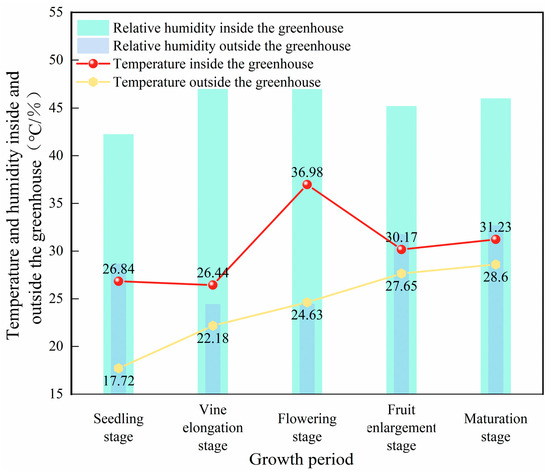
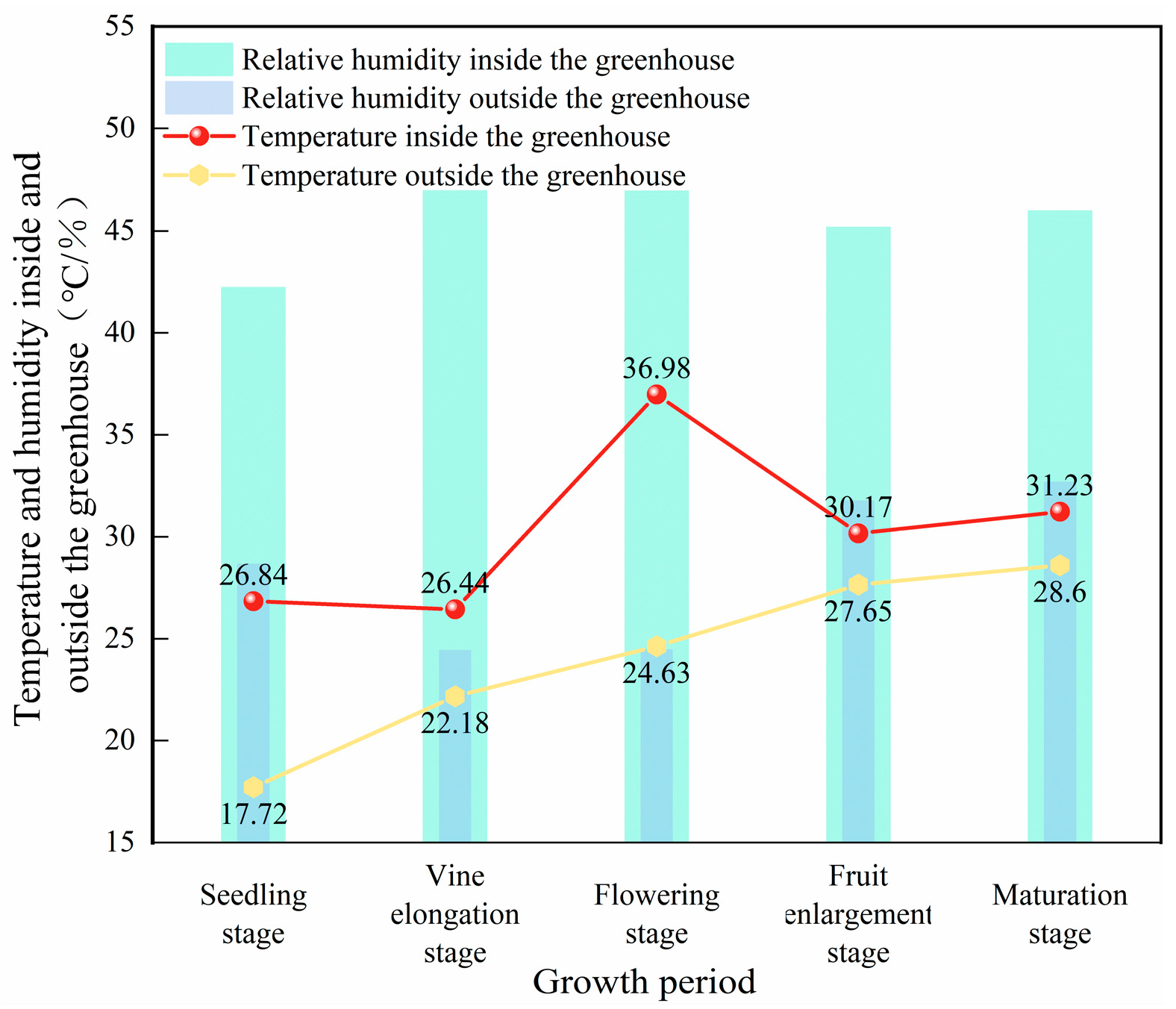
The experimental site was located in Aileketuer Village, Huayuan Township, Yizhou District, Hami City, Xinjiang (93°29′12.8″ E, 42°46′59.7″ N), at an altitude of 720 m. The region experiences a temperate continental arid climate, characterized by hot summers and cold winters, with significant diurnal and annual temperature variations. The mean annual temperature is approximately 9.8 °C, with extreme highs reaching 43 °C and extreme lows dropping to −32 °C. The area is dry with scanty rainfall, receiving an average annual precipitation of about 3.38 cm, while the annual evaporation is as high as 3300 mm. The average annual sunshine duration is 3358 h. Soil samples were collected from the experimental site 0–100 cm in depth in 20 cm layers. For each layer, three samples were taken and averaged. The soil texture at the site is classified as sandy. The physical properties of the soil are presented in Table 1, and the temperature and humidity inside and outside the greenhouse are shown in Figure 1.
Table 1.
Basic physical properties of the soil in the experimental area of Huayuan Township.
Figure 1.
Schematic diagram of temperature and humidity inside and outside the greenhouse.
2.2. Experimental Design
The experiment was conducted from April to July 2025, employing Cucumis melo L. var. melo pang (cultivar ‘Cui Can Ming Zhu’) as the test crop.
This study employed a two-factor experimental design involving irrigation and fertilization. Five irrigation gradients were established, corresponding to 60%, 70%, 80%, 90%, and 100% of the local conventional irrigation amount (designated as W5, representing 100%). These gradients were labeled as treatments W1 to W5. Similarly, three fertilization gradients were set at 80%, 90%, and 100% of the local conventional fertilization rate (designated as F3, representing 100%), labeled as treatments F1 to F3. The W5F3 treatment served as the control (CK), with its irrigation quota determined based on the high-yield experience under the current local cultivation practices. Concurrently, the reference crop evapotranspiration (ET0) was calculated using monitoring data from a Watchdog small automatic weather station installed inside the greenhouse. Based on the FAO-recommended crop coefficient (Kc) for Hami melon, the crop water requirement (ETc) for the entire growth period of greenhouse Hami melon in Hami, Xinjiang was further calculated to be 3445.65 m3 ha−1. The range of total irrigation amounts designed in the experiment encompassed this calculated value, indicating that the setup of the irrigation gradients was reasonable and met standard requirements. The experimental treatment design is presented in Table 2.
Table 2.
Experimental treatment design.
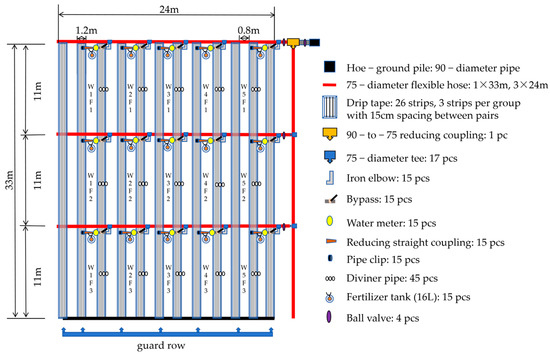
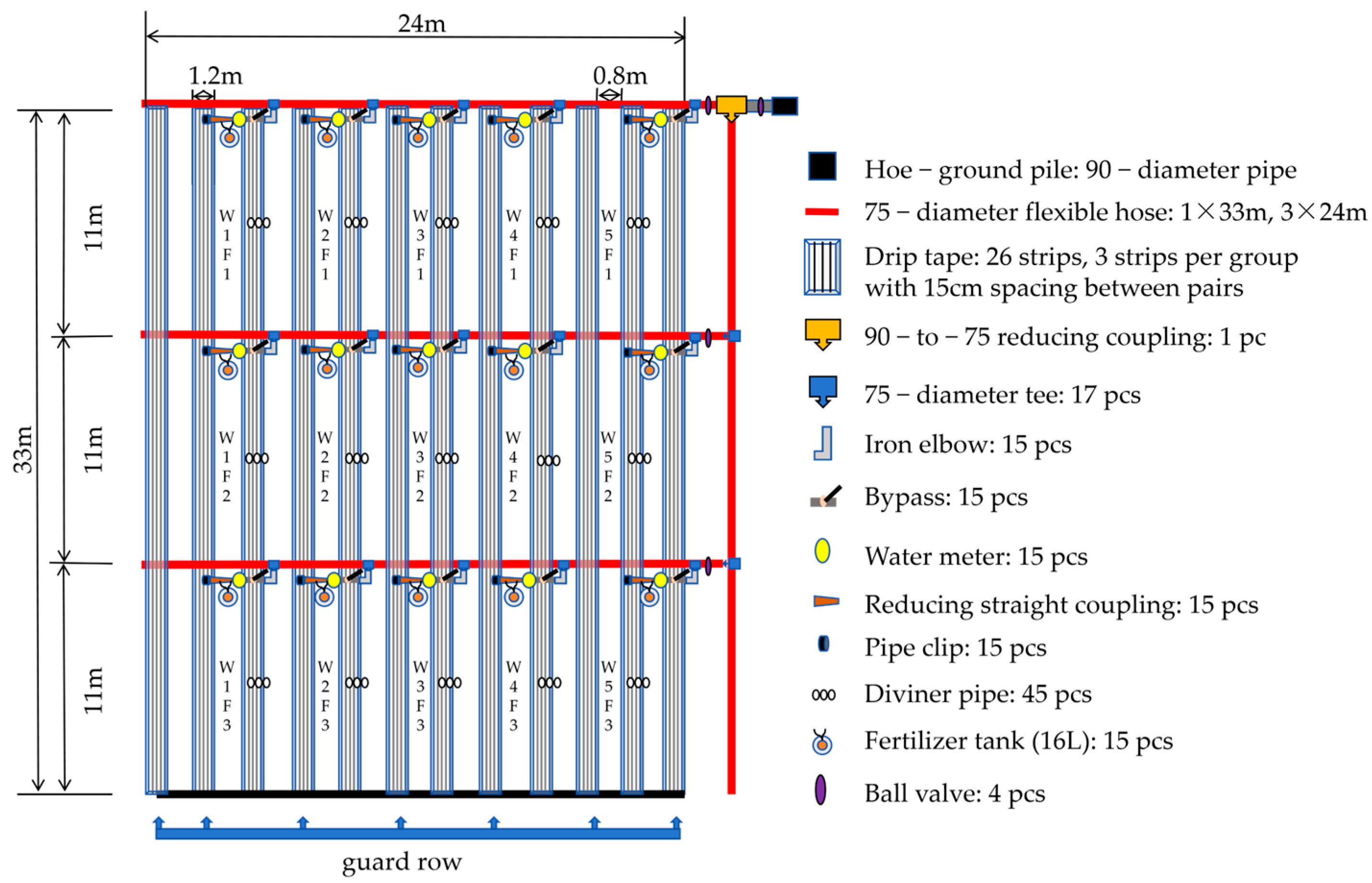
The irrigation system in the experimental area consisted of a 90 mm diameter PVC main supply pipe connected via a reducing tee to a 105 m long 75 mm diameter PE soft pipe. Each of the 15 gradient treatment inlets was equipped with an independent water meter and a bypass with a valve for water control. Downstream of the water meter, a fertilizer tank was connected, followed by a φ40 mm PE pipe linked via a reducing straight connector to an inline drip tape with patch-type emitters. A split-plot design was adopted. The two outermost plots were arranged with one pipe serving three mulch rows (serving as border protection rows), while the remaining plots had one pipe serving two mulch rows. Irrigation gradients were assigned as the main plots, with five levels arranged across the 24 m width of the experimental field. Fertilization gradients were assigned as the sub-plots, with three levels distributed along the 33 m length of the field, resulting in a total of 15 treatments. Each treatment plot measured 11 m in length and 4 m in width, covering an area of 44 m2. The pipeline layout in the experimental area is shown in Figure 2. Three replicate blocks were established within the same greenhouse, with an identical layout, as depicted in Figure 2.
Figure 2.
Schematic diagram of pipeline layout in the experimental area.
2.3. Field Management Protocols
2.3.1. Climatic Conditions and Fertilization Regime
The greenhouse Hami melon growth period was characterized by a daily average temperature of 18–35 °C and sunshine duration of ≥10 h d−1. Influenced by temperature, melons were planted in early April and matured in late June. The fertilization regimen was as follows:
Base fertilizer: A balanced water-soluble fertilizer (N-P2O5-K2O = 20-20-20) was applied throughout the entire growth period.
Vine elongation and flowering stages: A high-phosphorus fertilizer (N-P2O5-K2O = 21-53-00) was supplemented in addition to the base fertilizer.
Fruit swelling and maturation stages: A high-potassium fertilizer (N-P2O5-K2O = 12-4-42) was added.
2.3.2. Planting Layout and Seedling Establishment
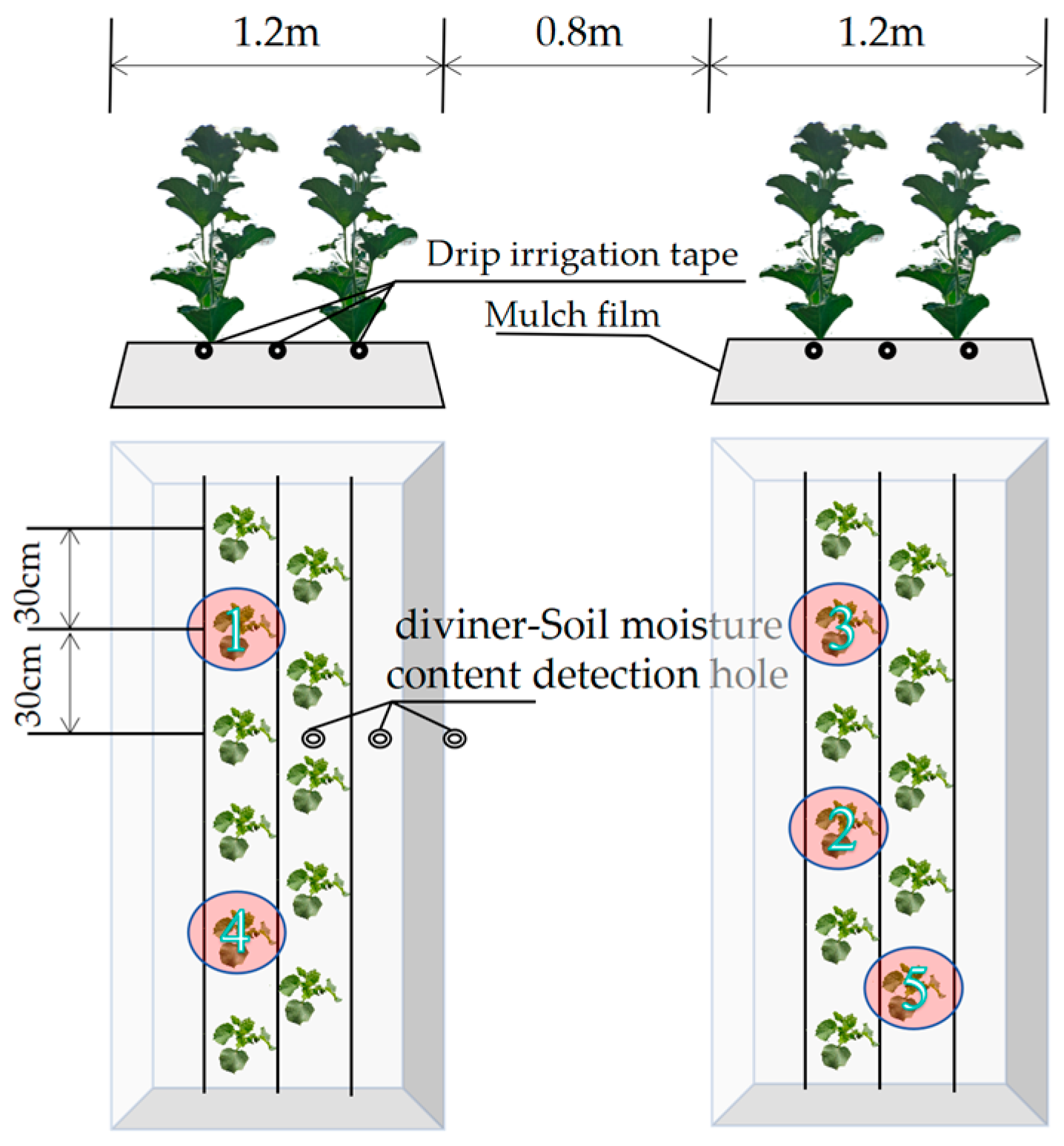
The Hami melon was planted in double rows. The mulch width was 1.2 m, with a narrow row spacing (serving as the walking path) of 0.8 m. The specific planting layout followed a staggered pattern. Seedling transplantation occurred on 2 April (nursery phase: 2 April–2 May). Seedlings at the 4-leaf stage were transplanted under standardized fertigation to ensure establishment success, countering Hami’s arid conditions (mean RH < 30%, Tmax > 35 °C). Uniform water-nutrient management during the hardening-off phase maintained a ≥95% survival rate.
Pressure-compensating drip tapes were configured with 15 cm narrow inter-row spacing and 30 cm intra-row plant spacing. Each treatment implemented a 1 mulch–3 tapes–2 rows layout, with plastic mulch fully covering raised beds. Pre-experimental setup concluded on 21 April.
2.3.3. Monitoring and Growth Stage Management
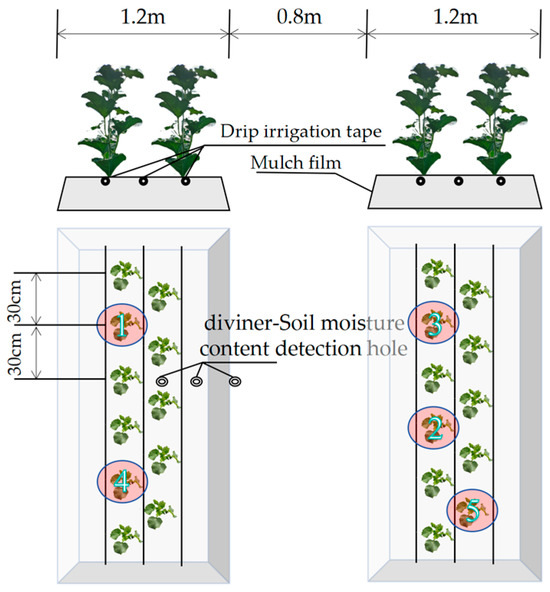
Permanent Monitoring Plants: Established using stratified five-point sampling: points 1–4 on sun-exposed (south-facing) bed sides; point 5 on shaded (north-facing) sides. All sample plants were tagged with weather-resistant identifiers (Figure 3).
Figure 3.
Schematic diagram of intercropping arrangement and five-point sampling method.
Regulation Commencement: Water-nutrient regulation commenced on 29 April, with volumetric measurements of irrigation inputs and fertilizer applications recorded per treatment event (Table 3).
Table 3.
Irrigation amount and fertilization amount during the growth period of one crop of Hami melon.
Vine elongation stage: Initiated on 3 May. Pruning and suckering were performed on 4 May, after which the plants entered a phase of rapid internode elongation. Trellises were set up and vine training was completed on 16 May, marking the end of this stage.
Flowering stage: Initiated on 16 May. During the full bloom period (20–24 May), bees were employed for pollination. On 30 May (late flowering stage), the apical buds of the plants were removed to promote the translocation of photosynthetic assimilates to the developing fruits.
Fruit Swelling Phase: Commenced 30 May. Fruit thinning retained one fruit per vine on 30 May. Protective mesh enclosures were deployed immediately post-thinning to minimize biotic/abiotic damage.
Maturation Phase: Initiated 13 June, signaled by exocarp color transition from green to creamy white. Harvest occurred at commercial maturity (29 June) for yield quantification (t/ha).
Note: Autumn crop transplantation and fertigation commenced 9 July (outside experimental scope).
2.4. Parameter Quantification
2.4.1. Growth Phenotyping
Selected plants were monitored using the five-point sampling method. Within each of the 15 treatments, five plants were selected, tagged for permanent identification, and sampled across the three replicate plots, resulting in a total of 225 plants. The mean and variance were calculated for each treatment. Stem diameter, plant height, leaf area, leaf number, and fruit volume were measured at 7-day intervals.
Stem diameter: The diameter of the main stem was measured using a digital vernier caliper (accuracy: 0.01 cm). The measurement was taken at the third internode near the soil surface base (the point of stem-soil contact), avoiding the swollen nodes.
Plant height: In the natural, upright state of the plant, the vertical distance from the ground level at the plant base to the apical growing point or the tip of the highest leaf was measured using a measuring tape, and the average value was calculated.
Leaf length and width: Fully expanded leaves were selected for measurement. Specifically, the 3rd to 4th leaves above the point of stem diameter measurement were chosen. The leaf length (L) and maximum leaf width (W) of each selected leaf were measured using a measuring tape.
Leaf number: The growth stage was determined based on the total number of leaves. The leaf count used for analysis was the average number of leaves per plant for each growth stage of the Hami melon.
Fruit volume: After the fruit enlargement stage, a digital vernier caliper (accuracy: 0.01 cm) was used to measure fruit dimensions. The maximum length from the peduncle end (fruit shoulder) to the blossom end (stylar end) was recorded as the longitudinal diameter. The transverse diameter was measured at the widest part of the fruit (equatorial region). To monitor the fruit expansion rate, both the longitudinal and transverse diameters were measured three times, and the average values were used for subsequent calculations.
2.4.2. Yield Quantification
At commercial maturity, three fruit samples per treatment were harvested from both north-facing (shaded) and south-facing (sun-exposed) canopy positions, totaling 90 samples (15 treatments × 2 orientations × 3 replicates). Individual fruit mass was measured using precision balances (Mettler Toledo XS204, Mettler Toledo, Zurich, Switzerland; accuracy ±10 g). Yield per treatment was calculated as Y = (Σfruit mass × plant density)/plot area, scaled to kg/mu (converted to t/ha).
2.4.3. Parameter Calculation
- Leaf area index (LAI) was calculated as:
- LAI: the leaf area index;
- m: the number of sampled plants;
- n: the total number of leaves from the sampled plants;
- Li: the leaf length (cm);
- Di: the leaf width (cm);
- K: the leaf area correction factor [16], with a value of 1.0;
- Dr: the planting density (plants m−2);
- S = 10,000 cm2 m−2 (a unit conversion factor).
- 2.
- Fruit volume (V) was calculated using the prolate spheroid model:
- L = Polar diameter (stem–blossom axis, cm);
- D = Equatorial diameter (maximum width, cm).
- 3.
- The resource efficiency metrics, water use efficiency (WUE) and partial factor productivity (PFP), were calculated as:
- Y = Fruit yield (t/ha);
- W = total irrigation water applied per unit area (m3 ha−1);
- F = Total fertilizer input (kg ha−1).
- 4.
- Total fruit yield was determined by:
- Q = Individual fruit fresh weight (t);
- N = Total fruit count per plot;
- A = Harvested plot area (ha).
2.5. Data Processing
Data integration was performed using Microsoft Excel 2021. Data analysis was conducted with SPSS Statistics 27 and MATLAB (R2024a). Finally, Origin 64 and PowerPoint were employed for graphing and presentation, respectively.
Data Standardization
To eliminate dimensional influences and facilitate model fitting, the irrigation and fertilization application rates (measured in different units) were standardized using the Z-score method. This process generated standardized feature values with a uniform scale, as presented in Table 4.
Table 4.
Z-score standardized feature values for irrigation amount and fertilization rate.
3. Results
3.1. Dynamics of Growth Parameters Under Differential Water–Fertilizer Regimes
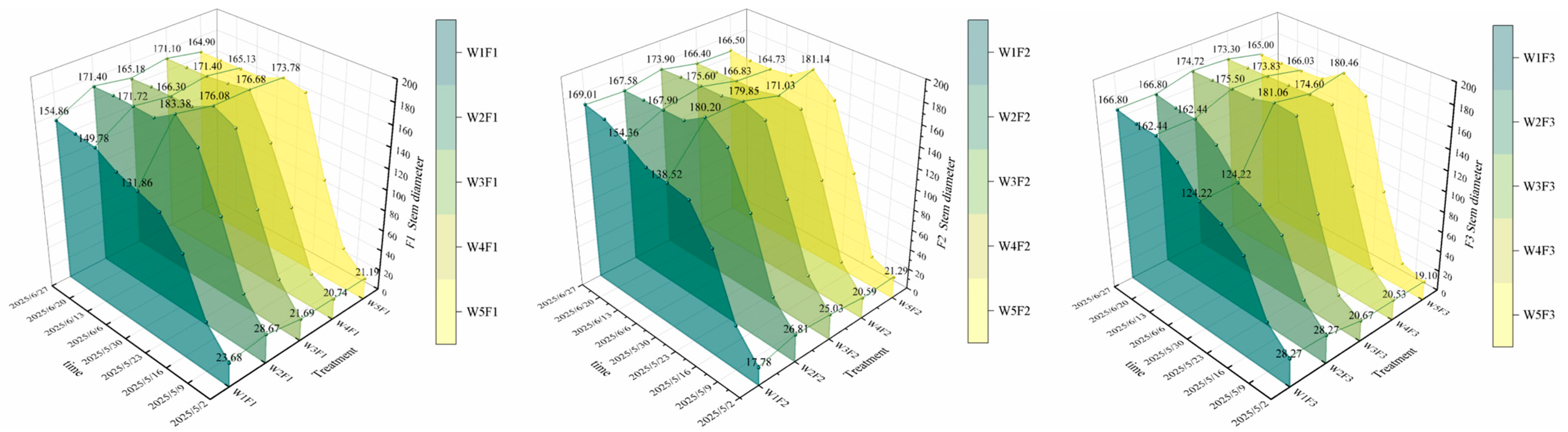
Treatment-specific dynamics of growth parameters across developmental stages are presented in Figure 4 and Figure 5. Hierarchical visualization reveals sigmoidal growth patterns for plant height and stem diameter: slow increase during seedling establishment, exponential growth in vine elongation/flowering stages, and asymptotic progression through fruit swelling/maturation. The abrupt height reduction post-flowering (Figure 4) was a result of apical meristem excision to redirect photoassimilates.
Figure 4.
Variation pattern of cantaloupe plant height under different water and fertilizer deficit treatments.
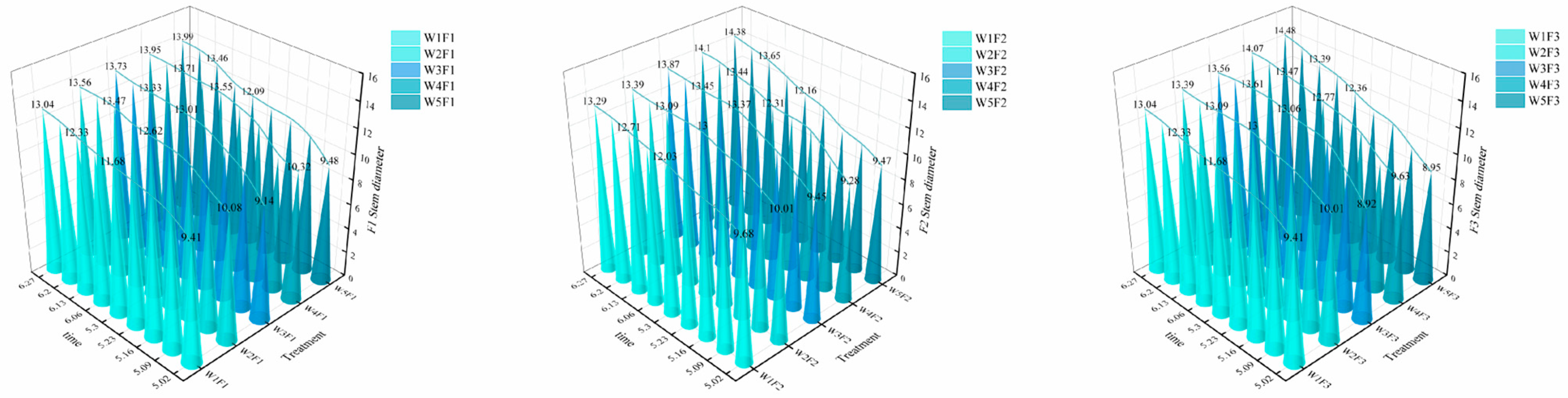
Figure 5.
Variation pattern of cantaloupe stem diameter under different water and fertilizer deficit treatments.
Figure 4 demonstrates progressive height increase with irrigation (W1 → W5). Under a water deficit (W1–W2), elevated fertilization reduced height: W1F3 decreased by 12.1 cm vs. W1F1 (p < 0.01), W2F3 by 8.3 cm vs. W2F1 (p < 0.05). This suggests osmotic stress exacerbation under high fertilizer concentrations, inhibiting cell elongation. Irrigation promoted height development, whereas fertilization exerted inhibitory effects under water stress. Conversely, significant synergism occurred at moderate-to-high irrigation (W3–W5), where water-nutrient co-regulation enhanced height (p < 0.05). This demonstrates that under sufficient water conditions (W3–W5), the synergistic interaction of water and fertilizer can effectively promote vegetative growth, laying the foundation for subsequent yield formation. Conversely, under water stress conditions (W1–W2), excessive fertilization exacerbates physiological stress and inhibits growth.
Figure 5 delineates stem diameter responses to water–fertilizer interactions. At W3–W5 irrigation levels, F3 significantly enhanced stem thickening vs. F1/F2 (e.g., 27 June: W4F3 = 14.07 mm vs. W4F1 = 13.95 mm, p < 0.05; W4F2 = 14.10 mm). This demonstrates fertilizer-mediated promotion of radial growth, likely attributable to nitrogen-enhanced cell wall biosynthesis and potassium-dependent turgor pressure. Optimal combinations (notably W4F3) generated 12–15% greater xylem vessel area, indicating enhanced hydraulic conductance critical for photoassimilate partitioning during fruit development.
3.2. Correlation Analysis of Growth Parameters Under Water–Fertilizer Regimes
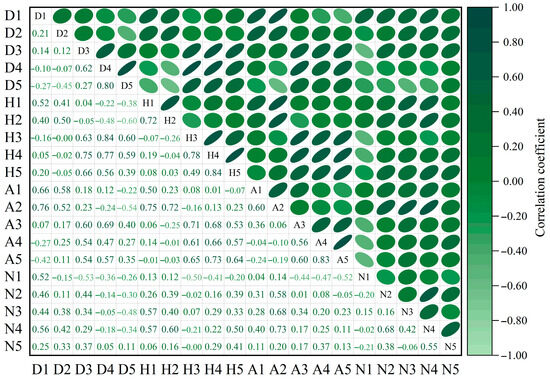
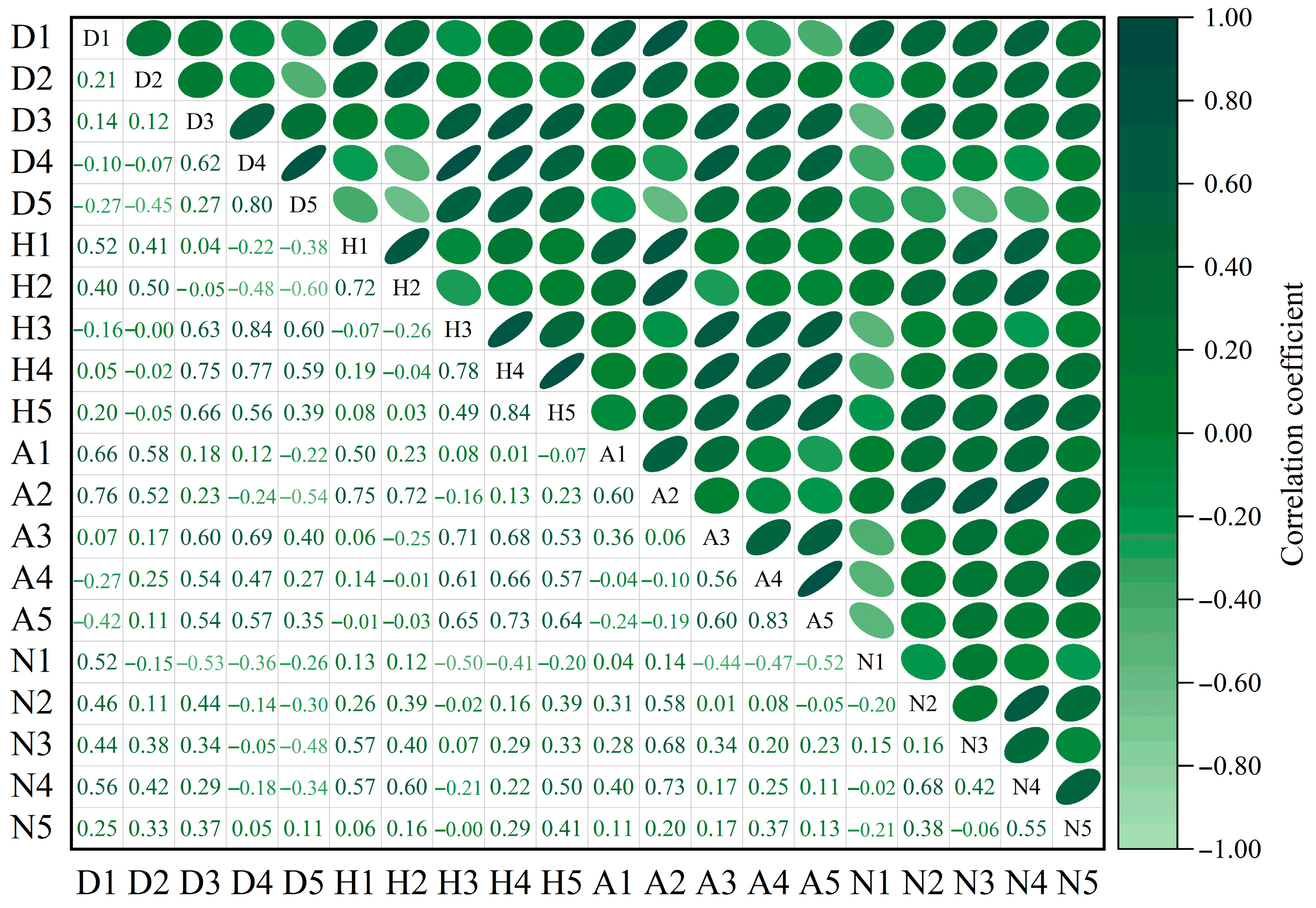
Correlation analysis of growth parameters (stem diameter, plant height, leaf area index, leaf number) under differential treatments is presented in Figure 6. At flowering stage, plant height (H3) and leaf area index (A3) exhibited strong positive correlation (r = 0.71, p < 0.01), with contemporaneous parameters generally showing synergism. High autocorrelation between seedling (D1) and vine elongation (D2) stem diameters (r = 0.85, p < 0.01) indicates developmental continuity, reflecting cumulative resource allocation to structural growth.
Figure 6.
Correlation between growth indices of Hami melon under different water and fertilizer deficit regulation treatments. Note: In the figure, letters D, H, A, and N represent stem diameter, plant height, leaf area index, and number of leaves, respectively; numbers 1–5 correspond to five growth stages (seedling stage, vine elongation stage, flowering stage, fruit expansion stage, and maturity stage).
As development progressed (fruit swelling → maturation), cross-stage correlations diminished: A1 vs. A5 correlation declined to r = 0.05, while D1 vs. D5 decreased to r = 0.03. Some parameter pairs even showed negative correlations (e.g., A4 vs. A5: r = −0.42), attributable to ontogenetic shifts in resource partitioning priorities.
The inverse A4–A5 relationship likely stems from (1) hydraulic failure-induced leaf rolling under thermal stress (June Tmax > 38 °C), and (2) source–sink reprogramming that diverts > 65% photoassimilates to fruits during the swelling phase. Sustained LAI during maturation (A5) is critical for yield/quality but vulnerable to premature senescence. These temporal dynamics demonstrate (1) synchronic parameter synergism, (2) autocorrelated cumulative development, and (3) disrupted early-late stage linkages—necessitating stage-specific water-nutrient modulation strategies.
3.3. Fruit Volume Dynamics in Response to Water–Fertilizer Interactions
The change in fruit volume (calculated as the difference between the volume at the end of the maturation stage and the volume at the beginning of the fruit enlargement stage) was significantly influenced by the water–fertilizer coupling effect (Table 5). Analysis of variance (ANOVA) indicated that irrigation amount (W) had a highly significant effect (p < 0.01) on the initial fruit volume at the enlargement stage, the final volume at maturation, and the volume change (Table 6). Fertilization rate (F) also exerted a highly significant influence (p < 0.01) on the final volume and the volume change. Furthermore, the water–fertilizer interaction (W × F) had a highly significant regulatory effect (p < 0.01) on all measured indices. Notably, the F-values for the interaction were higher than those for the individual factors, underscoring the critical role of water–fertilizer synergy. The W4F3 treatment exhibited the optimal performance: the fruit volume change reached 821.55 ± 43.41 cm3, and the final fruit volume at maturation reached 1937.65 ± 105.90 cm3, both being significantly higher than those in other treatments (Table 5). Compared to the lowest recorded values, these represent an increase of 64.7% in volume change and 44.6% in final volume.
Table 5.
Changes in fruit volume from the early stage of fruit expansion to the end of maturity.
Table 6.
Three-way ANOVA results for fruit development stages.
Irrigation amount played a dominant role. Under the same fertilization level, the overall ranking of fruit volume was W4 > W3 > W5 > W2 > W1, indicating that moderate to sufficient irrigation (W3–W4) was most conducive to fruit enlargement. The volume in the W5 treatment was generally lower than that in W3 and W4, suggesting that excessive irrigation may inhibit later-stage fruit expansion. The effect of fertilization was closely related to water conditions. Under suitable water conditions (W3–W4), increased fertilization (especially F3) significantly promoted fruit enlargement. Conversely, under low-water conditions (W1–W2), the promoting effect of high fertilization (F3) diminished or even became inhibitory. For instance, the volume change in W1F3 was significantly lower than that in W1F2, representing a reduction of 47.5%. In summary, W3F3 and W4F3 were the superior water–fertilizer combinations, achieving efficient enlargement while ensuring a larger fruit volume. Water is the fundamental prerequisite for fruit development; optimal synergistic effects of water and fertilizer can only be realized when appropriate irrigation is paired with suitable fertilization.
3.4. Yield Response Patterns to Differential Water–Nutrient Management
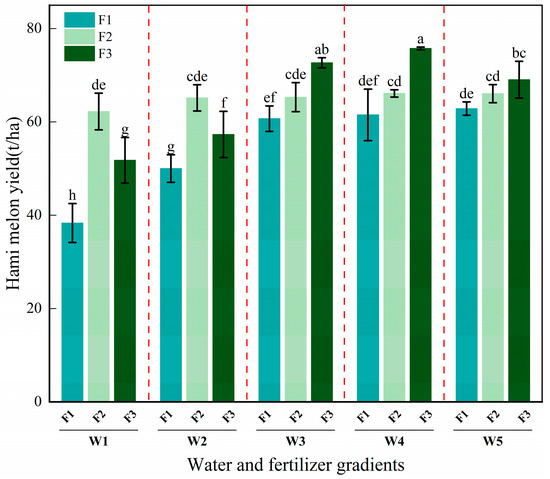
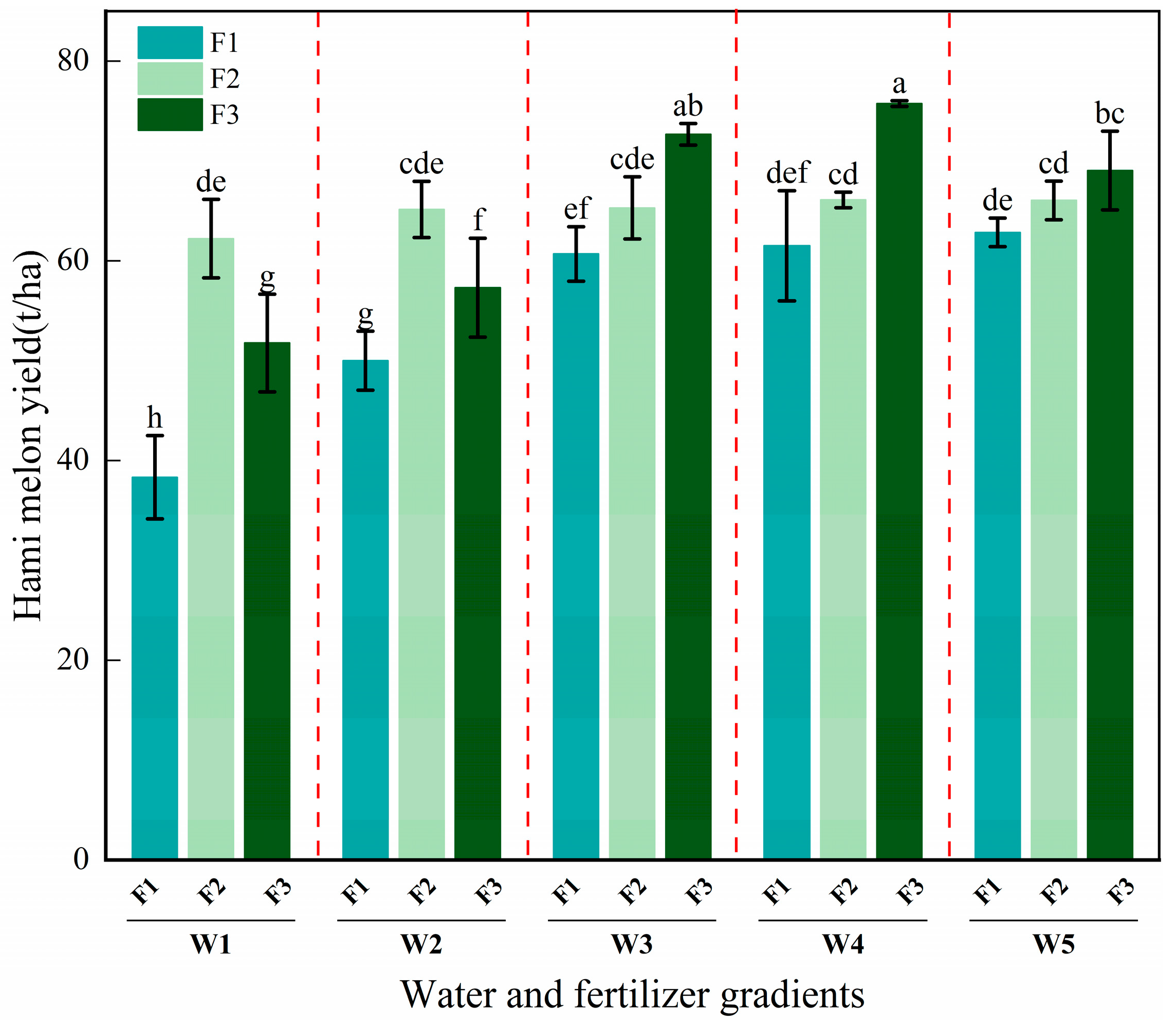
Adequate fruit enlargement serves as the material basis for achieving high final yield. As shown in Table 5, the W4F3 treatment achieved the greatest fruit volume, which directly contributed to its highest yield performance (Figure 7). Under different water–fertilizer coupling treatments, the yield generally exhibited a gradual increasing trend with the elevation of the coupling gradient. The analysis indicates that W3 (80% irrigation amount) represents a critical inflection point for the influence of irrigation and fertilization on yield.
Figure 7.
Variation in yield of Hami melon under different water and fertilizer deficit regulation treatments. Note: Different lowercase letters above bars indicate significant differences among treatments at p < 0.05 level by Duncan’s multiple range test.
Under low-water conditions (W1–W2), fertilization was the dominant factor for yield increase, with F2 (90%) being the optimal rate. Taking W1 as an example: W1F2 yielded 10.7% more than W1F1, whereas W1F3 yielded 3.8% less than W1F2. This indicates that low water availability (particularly at the W1 level) severely inhibited the absorption efficiency of high fertilizer application (F3), leading to a yield reduction. Under high-water conditions (W3–W5), water and fertilizer acted synergistically, and the F3 treatment significantly increased yield. For instance, W4F3 yielded 10.8% more than W4F1 and 5.1% more than W4F2. At the same fertilization level (especially F3), the Hami melon yield followed the order: W4 > W3 > W5 > W2 > W1. A significant water–fertilizer interaction effect (p < 0.01) facilitated the emergence of the optimal combination, W4F3, which achieved a yield of 75.74 t ha−1, representing a significant 9.71% increase compared to CK. The water effect exhibited an inflection point at W3 (80% irrigation amount): below W3, yield increase primarily relied on the fertilization effect; above W3, it manifested as synergistic enhancement from water and fertilizer.
In summary, both irrigation amount and fertilization rate were key factors governing yield variation. For instance, when higher irrigation levels (W3, W4, W5) were combined with a high fertilization rate (F3), Hami melon yield reached relatively high levels. This demonstrates that appropriate irrigation and fertilization within a certain range positively influence yield enhancement. The peak yield (W4F3) was 75.74 t ha−1, which represents a significant increase of 9.71% compared to the control (CK) yield of 69.03 t ha−1 (p < 0.05).
3.5. Water and Fertilizer Use Efficiencies Under Resource Modulation
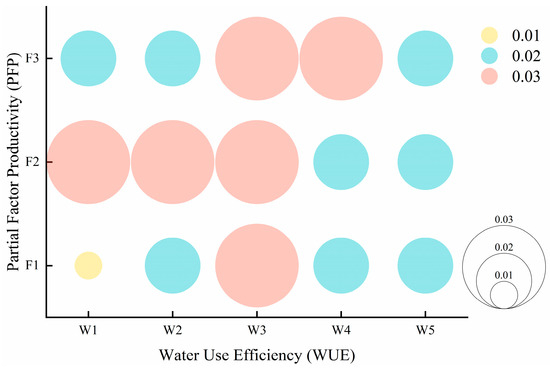
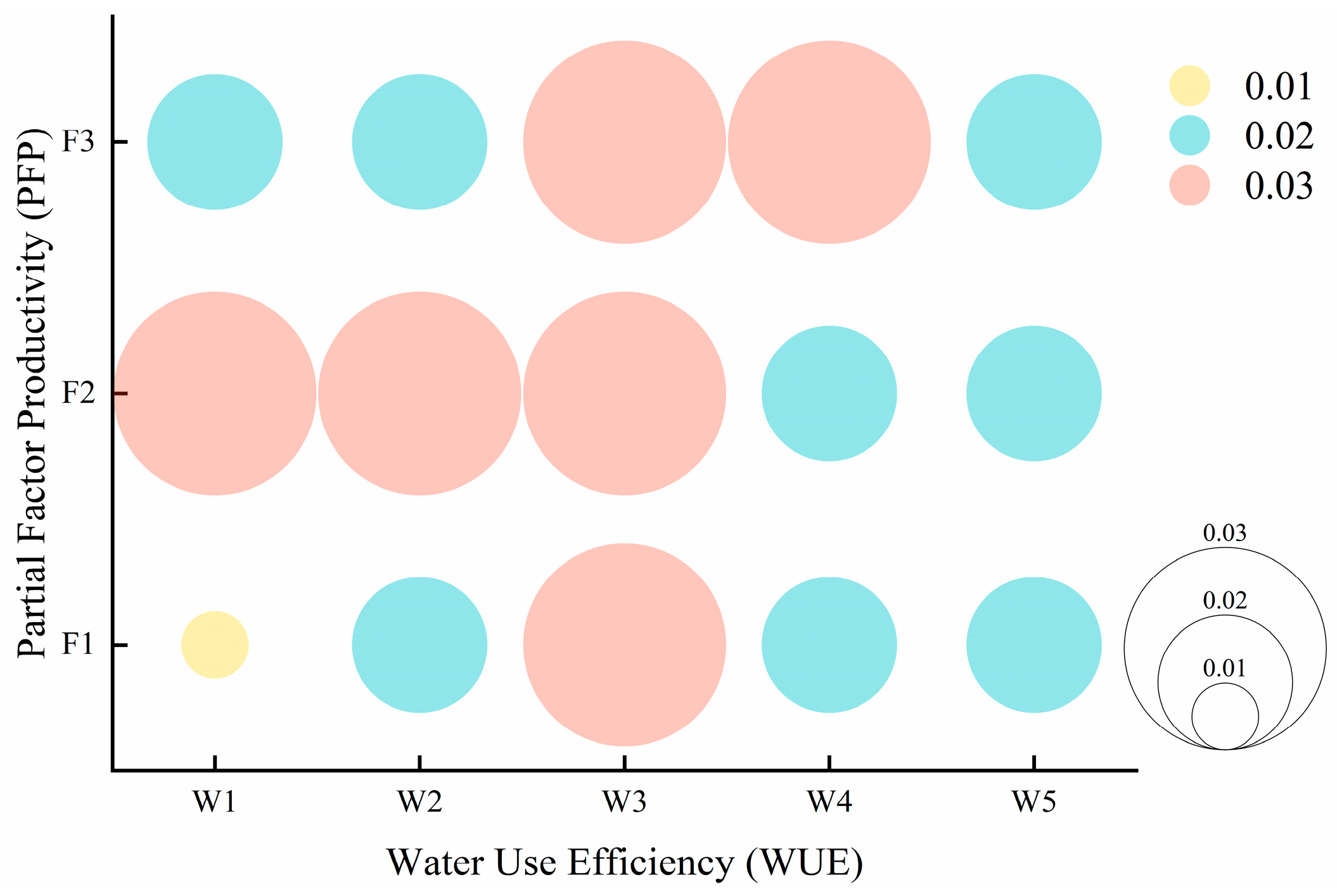
Water use efficiency (WUE) and partial factor productivity (PFP) under differential irrigation–fertilization regimes are presented in Figure 8. Bubble size represents integrated resource efficiency (geometric mean of WUE × PFP), with larger bubbles indicating superior resource synergy.
Figure 8.
Water use efficiency and partial fertilizer productivity of cantaloupe under different water and fertilizer deficit treatments. Note: Bubble size indicates the integrated resource-use efficiency, calculated as the geometric mean of WUE × PFP.
In water-limited zones (W1–W2), PFP dominated efficiency gains with F2 (90% NPK) achieving peak performance (largest bubbles). W2F2 attained significantly higher WUE (0.372 kg/m3) and PFP (0.083 kg/kg) than F1/F3 counterparts (Tukey’s test, p < 0.05). This demonstrates that moderate fertilization reduction under water deficit mitigates osmotic stress by preventing fertilizer-induced soil ψs depression—consistent with height suppression (Section 2.1) and yield penalties (Section 2.4) under high-fertilizer scenarios.
Under sufficient irrigation (W3–W5), WUE governed efficiency optimization with F3 maximizing outputs. W4F3 emerged as the global optimum (largest rightmost bubble), elevating WUE to 0.332 kg/m3 (+12.3%) and PFP to 0.088 kg/kg (+24.9%) versus CK. This confirms full fertilization unlocks yield potential when irrigation exceeds 80%—validating yield responses in Section 2.4.
The outlier W1F1 (small bottom-left bubble) exhibited critically low WUE (0.025 kg/m3) and PFP (0.055 kg/kg) due to acute water deficit, corroborating impaired fruit development in Table 5. This represents resource efficiency collapse under compounded stress.
3.6. Development of Irrigation–Fertilization Response Surface Models
To accurately fit the data, binary quadratic regression equations were employed to establish mathematical models describing the relationships among irrigation amount, fertilization rate, and the response variables: yield (Y), water use efficiency (WUE), and partial factor productivity of fertilizer (PFP). The standardized feature values of irrigation amount (w) and fertilization rate (f) served as the independent variables, while Y, WUE, and PFP were the dependent variables. The resulting models were used to determine the optimal irrigation and fertilization amounts conducive to Hami melon growth and quality improvement, thereby providing a scientific basis for practical cultivation management. The model results are presented in Table 7.
Table 7.
Binary quadratic regression models of yield, water use efficiency (WUE), and partial factor productivity of fertilizer (PFP) in response to irrigation amount (w) and fertilization rate (f).
In the yield equation, the coefficients for both the w2 and f2 terms are negative, indicating that excessive irrigation or fertilization leads to a significant decrease in marginal yield. The negative coefficient (−0.466) for the wf cross term reveals a certain degree of substitutability between water and fertilizer.
In the water use efficiency (WUE) equation, the negative coefficient (−0.026) for the first-order term of w suggests that merely increasing the irrigation amount reduces WUE. Conversely, the positive coefficient (+0.023) for the first-order term of f indicates that, within a reasonable range, increasing fertilizer application helps improve WUE.
In the partial factor productivity of fertilizer (PFP) equation, the positive coefficient (+0.008) for the first-order term of w shows that appropriately increasing irrigation can enhance PFP. In contrast, the negative coefficient (−0.002) for the first-order term of f, coupled with the negative coefficient for the f2 term, demonstrates that increasing the fertilization rate decreases PFP, with excessive fertilization leading to a more pronounced decline.
Decomposing the binary quadratic model into univariate equations isolates individual effects of irrigation and fertilization on melon performance parameters (yield, WUE, PFP) (Table 8). This approach precisely delineates resource-specific response mechanisms.
Table 8.
Binary quadratic regression equations of cantaloupe indices based on different irrigation amounts and fertilization amounts.
Irrigation dominated yield response: The univariate irrigation–yield model achieved high fit (R2 = 0.81) with optimum at w = 0.79 (90% irrigation amount). Beyond this threshold, diminishing marginal returns occurred (∂Y/∂w < 0), reducing yield by 1.7% per 5% irrigation increase.
Fertilization governed PFP decline: The fertilization–PFP model revealed progressive efficiency reduction (∂PFP/∂f < 0), with quadratic coefficient −0.004 confirming accelerated degradation at high inputs. This complements Section 3.4 findings where high fertilization exacerbated stress under water deficit—demonstrating consistent negative feedback across resource regimes.
3.7. Optimal Regime Identification via Entropy-Weighted TOPSIS
The optimal treatment was determined using the entropy-weighted TOPSIS method, as shown by the weight distribution in Table 9. Yield received the highest weight (33.18%), confirming that high productivity remains the primary objective in agricultural production. Water use efficiency (WUE) and partial fertilizer productivity (PFP) together accounted for 56.09% of the total weight, significantly higher than other indicators, highlighting the critical importance of synergistically improving water and fertilizer use efficiency in arid region agriculture. Analysis of the ranking results in Table 10 identifies W4F3 as the optimal treatment for irrigation and fertilizer application. This suggests that moderate water–fertilizer coupling avoids drought stress, prevents deep percolation, enhances WUE, stimulates fertilizer utilization efficiency, and achieves the goal of “reducing water usage without compromising yield.”
Table 9.
Weight results based on the entropy-weight TOPSIS model.
Table 10.
Treatments for determining optimal irrigation amount and fertilization amount based on the entropy-weight TOPSIS model.
3.8. Determination of Optimal Irrigation and Fertilization Rates Using the NSGA-II and Entropy-Weight TOPSIS Algorithms
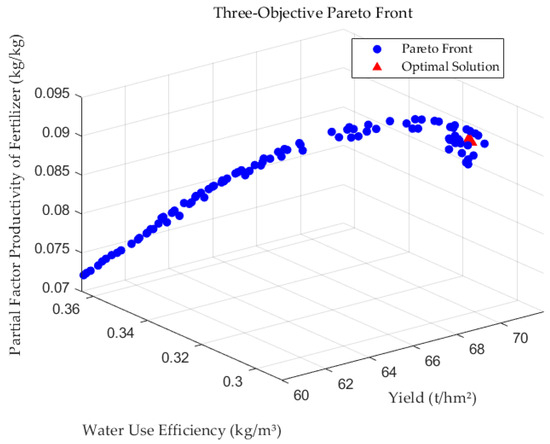
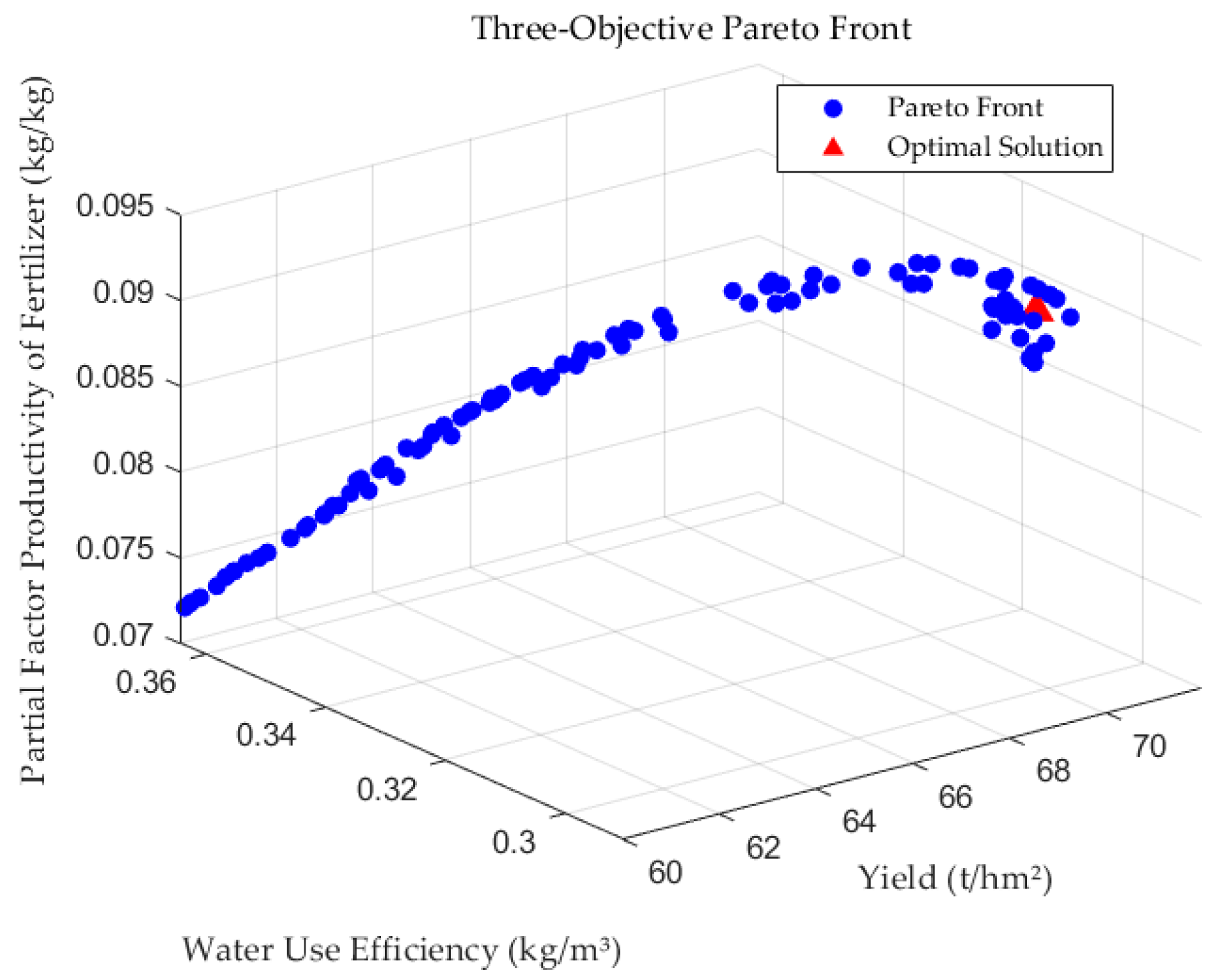
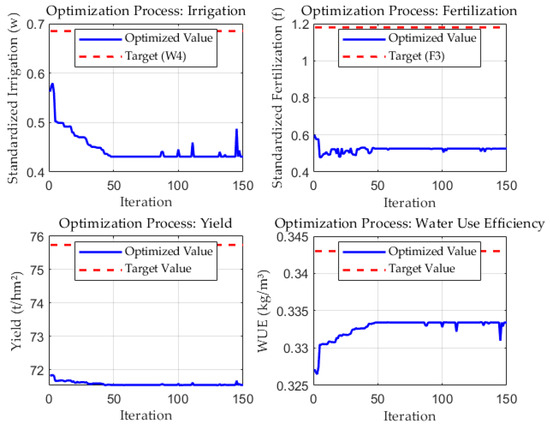
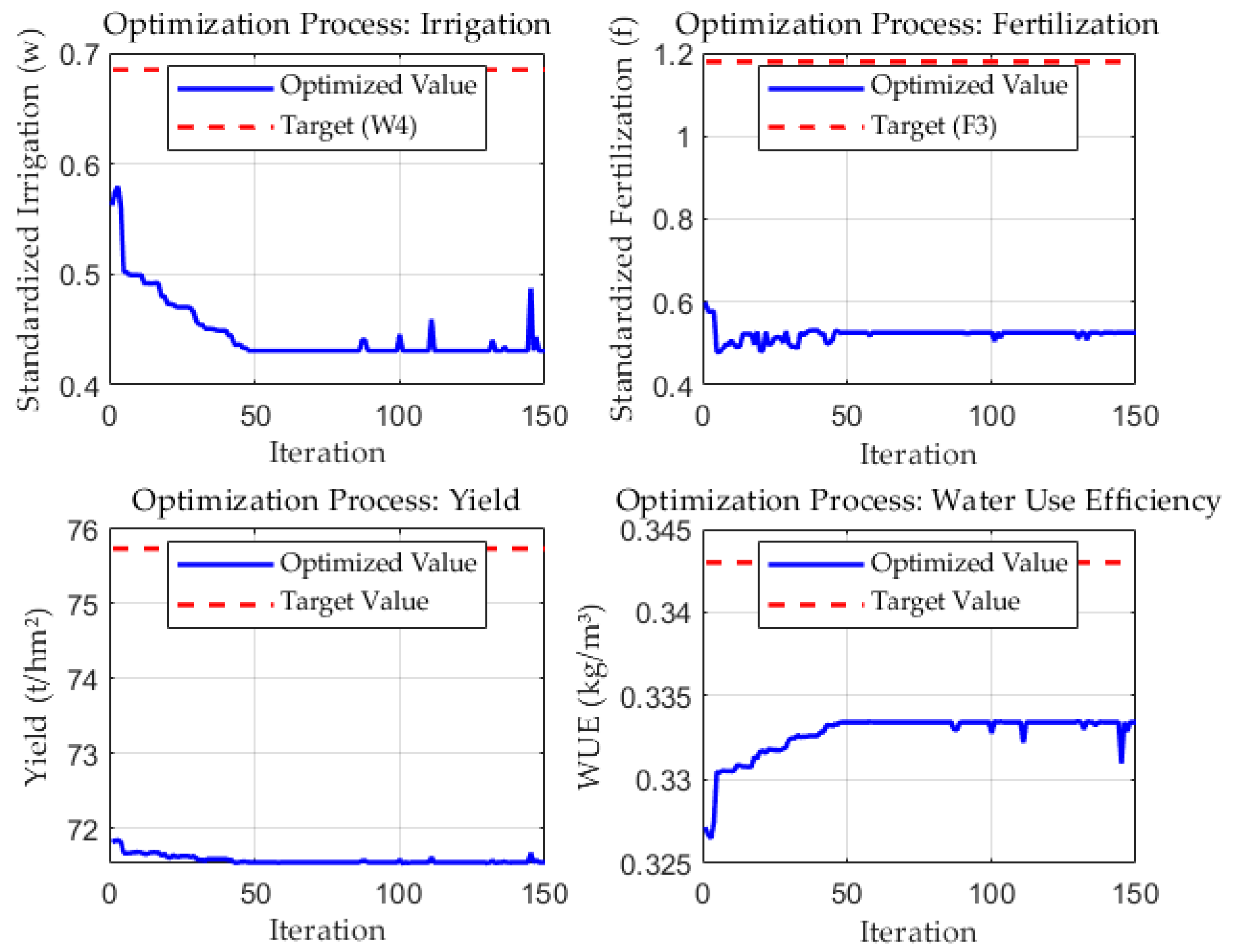
To verify the reliability of the entropy-weight TOPSIS results and explore the Pareto-optimal frontier, an optimization analysis was performed using the NSGA-II multi-objective genetic algorithm. The algorithm parameters were set as follows: population size = 80, maximum generations = 150, crossover probability = 0.85, and mutation probability = 0.15. The optimization objectives were to maximize yield (Y), water use efficiency (WUE), and partial factor productivity of fertilizer (PFP). The weight coefficients for these objectives were set with reference to the entropy-weight TOPSIS results (yield–WUE–PFP ≈ 0.37:0.35:0.28). The Pareto-optimal frontier obtained from the NSGA-II optimization is shown in Figure 9. From the Pareto solution set, the solution best aligned with the decision objectives of the entropy-weight TOPSIS method was selected, yielding a set of predicted optimal water and fertilizer parameters (Figure 10): an irrigation amount of 3276 m3 ha−1 (approximately 86.3% of CK) and a fertilization rate of 814.8 kg ha−1 (approximately 94.5% of CK). Based on predictions from the regression equation, this parameter set is expected to achieve a yield of 71.54 t ha−1, a WUE of 0.333 kg m−3, and a PFP of 0.087 kg kg−1. These results are highly consistent in trend with the optimal treatment (W4F3: 90% irrigation, 100% fertilization) identified from the field experiment. The predicted irrigation and fertilization values fall within the vicinity of the W4 and F3 levels, respectively, validating the robustness of the field experimental conclusions. The optimal water and fertilizer parameters derived from the algorithm optimization show a high degree of agreement with the optimal range (90% irrigation, 100% fertilization) determined by the field experiment. This correspondence further confirms, from a modeling perspective, the superiority of the W4F3 treatment.
Figure 9.
Three-objective Pareto front for yield, WUE, and PFP obtained using the NSGA-II algorithm.
Figure 10.
Optimal water–fertilizer parameters from the Pareto-optimal solution set aligned with the TOPSIS decision.
4. Discussion
4.1. Physiological Mechanisms of Water–Fertilizer Interactions on Morphogenesis
This study reveals dual water–fertilization effects on melon morphogenesis, demonstrating a marked “low-water inhibition” phenomenon: under water deficit (W1–W2), fertilizer escalation (F2 → F3) significantly reduced plant height by 8.3–12.1 cm (p < 0.01). This response correlates with fertilizer-amplified root osmotic stress under hydraulic limitation, where soil ψs dropped below −0.8 MPa in W1F3.
These findings align with Shaoqian Bai et al. [17] in Ziziphus jujuba: excessive resource inputs similarly suppressed growth and resource efficiency. This cross-crop validation confirms the universal negative physiological impacts of resource imbalance—particularly fertilization under water deficit—through impaired aquaporin function and reactive oxygen species (ROS) accumulation.
Stem diameter exhibited threshold-dependent responses: under moderate-to-sufficient irrigation (W3–W5), fertilization significantly enhanced radial growth (W4F3 maximum: 14.07 mm). However, supra-optimal irrigation (W5F3 control) reduced diameter to 13.98 mm versus W4F3 (p < 0.05), indicating irrigation excess counteracts fertilizer benefits—possibly through hypoxia-induced cytokinin suppression. This underscores precision irrigation’s critical role in resource co-optimization.
This irrigation–inhibition phenomenon resonates with Huahao Liu et al. [18] in Chrysanthemum morifolium: substrate moisture > 55% (equivalent to our W5 regime) significantly suppressed stem thickening. Wenju Zhao et al. [19] further corroborate water management’s pivotal role in Solanum lycopersicum, where suboptimal irrigation reduced yield by 13% versus optimum (I1).
Synthesis: Both water deficit and excess negatively impact structural growth (stem diameter) and yield formation. These findings establish an optimal hydration window (80–90% irrigation amount) where precision water–fertilizer modulation maximizes physiological efficiency—a paradigm applicable across horticultural systems in arid regions.
4.2. Source-Sink Tradeoffs in Fruit Development
The core mechanism by which high fertilizer inhibits plant height under low irrigation (W1/W2): When the irrigation amount falls below 70% of full irrigation, the osmotic potential of the soil solution increases (>1.5 MPa), inducing cellular dehydration. Under these conditions, additional fertilizer application further reduces the water potential, intensifying water stress and consequently inhibiting cell elongation.
The maximum fruit volume peaked at 1937.65 cm3 under the W4F3 treatment, representing a 56.15% increase compared to W1F1. The underlying mechanism is that sufficient water supply (>90% irrigation) during the fruit enlargement stage ensures adequate cell turgor pressure [20].
However, fruit shrinkage occurred in the W1F3 treatment (a volume change of only 498.21 cm3), confirming that the combination of low irrigation and high fertilization obstructs the translocation of nutrients to the fruit.
The critical threshold for yield formation: A fertilization efficacy inflection point for yield occurred at the W3 irrigation level—F2 > F3 under low-water conditions, and F3 > F2 under high-water conditions (Figure 7). This is because W3 (80% irrigation) approximates the inflection point for water use efficiency.
4.3. Scientific Validity and Practical Utility of Optimization Algorithms
To overcome the limitations of traditional single-objective optimization, this study integrated the entropy-weight TOPSIS method [21] with the NSGA-II multi-objective genetic algorithm, thereby achieving a decision-making transition from data-driven analysis to model-based optimization.
The entropy-weight TOPSIS method was selected based on its three core strengths: objective weighting, multi-criteria decision-making, and ranking visualization. It intuitively outputs an optimal ranking, making it well-suited to address the complex requirements of water and fertilizer quota research [22].
Faisal Mehmood et al. [23] utilized the TOPSIS method to optimize irrigation scheduling, achieving precise water-saving and stable-yield decisions by quantifying the synergy between crop water requirements and resource efficiency. Similarly, Liu Yancen et al. [24], in their study on the ‘Jinhua Mi 25’ Hami melon, used entropy weight to allocate the fruit quality response to water and fertilizer, concluding that high topdressing inhibited stem diameter—a finding consistent with the results of the present study.
The NSGA-II algorithm is employed to resolve multi-objective conflicts. It effectively generates a Pareto-optimal frontier, providing a set of non-dominated solutions and avoiding the one-sidedness of single-objective optimization. Enhanced versions of NSGA-II can improve search efficiency and convergence precision, preventing entrapment in local optima. It is often combined with TOPSIS or entropy-weight TOPSIS to select the “best compromise solution” from the Pareto set. In recent years, this integrated approach has been increasingly applied in agricultural water and fertilizer management to balance objectives such as yield, resource efficiency, and environmental impact [25,26].
In this study, the NSGA-II algorithm was implemented with standard parameter settings. The high consistency between the obtained Pareto-optimal frontier and the field-identified optimal solution indirectly validates the reasonableness of the parameter configuration. Future work could involve parameter sensitivity analysis for further fine-tuning to enhance model efficiency.
4.4. Holistic Evaluation of Optimal Regime and Future Perspectives
The most significant finding of this study is the identification of the optimal irrigation quota for greenhouse Hami melon in Xinjiang. Compared to traditional full irrigation (100% irrigation amount), the 90% irrigation level (W4) represents a critical threshold. Coupling this irrigation level with the full fertilization rate (F3) enables the synergistic optimization of crop yield, water use efficiency, and partial factor productivity of fertilizer.
This result provides direct data support and a quantitative solution to dispel the traditional notion prevalent in local agricultural production that “more irrigation leads to higher yield.” The optimal irrigation and fertilization rates are 3276 m3 ha−1 and 814.8 kg ha−1, respectively. Compared to the control (CK), this optimal regime achieves 10% water saving and 5% fertilizer reduction, establishing the ideal water and fertilizer parameters for Xinjiang’s characteristic Hami melon crop.
Currently, common research on Hami melon primarily focuses on aspects such as nutritional composition, flavor compounds, postharvest preservation, and juice processing [27,28,29]. There is a lack of studies investigating the variation patterns of quality indicators—such as external size, firmness, and sugar content—across different growth stages of Hami melon.
While the W4F3 treatment yielded the highest production, whether it also optimizes quality indicators like sugar content and firmness requires further testing and analysis. The ultimate optimal treatment must be determined by comprehensively considering both yield and quality to meet the market demands for Hami melon.
Future research could build upon the optimal water and fertilizer ranges identified in this study. Further investigation into the effects of slight water regulation (e.g., between W3 and W4) or fertilization formulas on comprehensive quality traits—such as soluble solids content, fruit firmness, moisture content, and edibility—is warranted. This would facilitate the development of a precise management model that synergistically optimizes the “yield-efficiency-quality” triad, thereby comprehensively enhancing the economic and productive benefits of the Hami melon industry.
These conclusions are based on a single-site, one-season experiment; further multi-year and multi-location studies are needed to validate their broader applicability.
5. Conclusions
This study investigated the interactive effects of irrigation and fertilization on greenhouse Hami melon in Xinjiang. The main findings are summarized as follows:
- 1.
- Irrigation volume was identified as the dominant factor affecting melon growth and yield. Through integrated field experimentation and entropy-weight TOPSIS analysis, the treatment combining 90% of full irrigation with 100% standard fertilization (W4F3) was determined to be optimal. This regime supported a yield of 75.74 t ha−1, which represents a 9.71% increase over conventional practice, alongside a 10% reduction in irrigation water. These results indicate the potential for synergistic improvement in water and fertilizer resource-use efficiency.
- 2.
- Multi-objective optimization using the NSGA-II algorithm validated the experimental findings, generating a Pareto-optimal solution highly consistent with the W4F3 treatment. The model-predicted optimal regime (irrigation: 3276 m3 ha−1, fertilization: 814.8 kg ha−1) suggests that a 10% water saving and 5% fertilizer reduction compared to the control is achievable while maintaining yield stability and enhancing resource-use efficiencies. This provides a quantitative basis for decision-making in the green production of characteristic crops in arid regions.
- 3.
- A critical threshold was observed at the W3 irrigation level (80% of full irrigation). Below this threshold, water becomes the primary limiting factor, and increased fertilization can exacerbate osmotic stress, as evidenced by the significant suppression of plant height under the W1F3 treatment. Above this threshold, water and fertilizer exhibit synergistic effects, although excessive irrigation (>100%) leads to diminishing returns.
Author Contributions
Conceptualization, Z.S. and L.M.; methodology, Z.S.; software, Z.S.; validation, Z.S., Y.Y., M.H., H.G., G.W., P.X. and L.M.; formal analysis, Z.S.; investigation, M.H.; resources, L.M.; data curation, Z.S.; writing—original draft preparation, Z.S.; writing—review and editing, Z.S. and L.M.; visualization, Z.S.; supervision, L.M.; project administration, Z.S.; funding acquisition, L.M. All authors have read and agreed to the published version of the manuscript.
Funding
Key Laboratory of Water Conservancy Engineering Safety and Water Disaster Prevention and Control in Xinjiang (No. ZDSYS-YJS-2025-25); General Program of Xinjiang Uygur Autonomous Region (No. 2026154446); Xinjiang Strategic Talent Training Program—Leading Scientific and Technological Talent Project (2025).
Institutional Review Board Statement
Not applicable.
Informed Consent Statement
Not applicable.
Data Availability Statement
The original contributions presented in the study are included in the article; further inquiries can be directed to the corresponding author.
Acknowledgments
We appreciate and thank the anonymous reviewers for helpful comments that led to an overall improvement of the manuscript. We also thank the Journal Editor Board for their help and patience throughout the review process.
Conflicts of Interest
The authors declare no conflicts of interest.
References
- Wu, M.Z. Review and Prospects of Thick-Skinned Melon Breeding in Xinjiang. China Watermelon Muskmelon 1992, 1, 14–18. [Google Scholar] [CrossRef]
- Wang, J.J.; Li, L.; Shang, H.G. Current Status and Development Strategies for the Watermelon and Melon Industry in China. China Cucurbits Veg. 2020, 33, 69–73. [Google Scholar] [CrossRef]
- Aierken, Y.; Akashi, Y.; Nhi, P.T.P.; Watanabe, K. Molecular Analysis of the Genetic Diversity of Chinese Hami Melon and Its Relationship to the Melon Germplasm from Central and South Asia. J. Jpn. Soc. Hortic. Sci. 2011, 80, 52–65. [Google Scholar] [CrossRef] [Scilit]
- Ahati, K.; Zeng, Y.J.; Liu, D.D. Analysis Method for Water Supply-Demand Balance in Arid Regions: A Case Study of Yizhou District, Hami City, Xinjiang. China Rural Water Hydropower 2023, 6, 21–26, 35. [Google Scholar] [CrossRef]
- Zhang, L. Sustainable Development-Based Analysis of Water Resources Utilization in Hami City. China Resour. Compr. Util. 2023, 41, 79–81. [Google Scholar] [CrossRef]
- Department of Agriculture and Rural Affairs of Xinjiang Uygur Autonomous Region. Precision Water Management: A Review of Agricultural Water Efficiency in Xinjiang. 2023. Available online: https://nynct.xinjiang.gov.cn/ (accessed on 20 May 2025).
- Mekonnen, M.M.; Hoekstra, A.Y. Four Billion People Facing Severe Water Scarcity. Sci. Adv. 2016, 2, e1500323. [Google Scholar] [CrossRef] [Scilit]
- Vörösmarty, C.J.; Green, P.; Salisbury, J.; Lammers, R.B. Global Water Resources: Vulnerability from Climate Change and Population Growth. Science 2000, 289, 284–288. [Google Scholar] [CrossRef] [Scilit]
- Research Group of Development Research Center, Ministry of Water Resources. Agricultural Water Use and Pricing Reform in Xinjiang: Achievements, Challenges, and Solutions. Water Resour. Dev. Res. 2018, 18, 1–5. [Google Scholar] [CrossRef]
- Ren, K.Y.; Xu, M.G.; Li, R.; Zheng, L.; Liu, S.G.; Reis, S.; Wang, H.Y.; Lu, C.G.; Zhang, W.; Gao, H.; et al. Optimizing Nitrogen Fertilizer Use for More Grain and Less Pollution. J. Clean. Prod. 2022, 360, 132180. [Google Scholar] [CrossRef] [Scilit]
- Zhang, F.S.; Cui, Z.L.; Chen, X.P.; Ju, X.T.; Shen, J.B.; Chen, Q.; Liu, X.J.; Zhang, W.F.; Mi, G.H.; Fan, M.S.; et al. Integrated Nutrient Management for Food Security and Environmental Quality in China. In Advances in Agronomy; Sparks, D.L., Ed.; Elsevier: Amsterdam, The Netherlands, 2012; Volume 116, pp. 1–40. [Google Scholar] [CrossRef] [Scilit]
- Ma, L.; Zhang, X.; Lei, Q.Y.; Liu, F. Effects of Drip Irrigation Nitrogen Coupling on Dry Matter Accumulation and Yield of Summer Maize in Arid Areas of China. Field Crops Res. 2021, 274, 108321. [Google Scholar] [CrossRef] [Scilit]
- Alimu, F.; Liu, F. Smart Water-Fertilizer Integration Technology for Hami Melon in Shanshan County: Current Applications, Technical Specifications, and Prospects. Henan Agric. 2021, 26, 27–28. [Google Scholar] [CrossRef]
- Cui, Q.Z. Smart Water-Fertilizer Integration for Double-Cropped Hami Melon in Turpan Field Cultivation. Bull. Agric. Sci. Technol. 2021, 2, 281–283. [Google Scholar] [CrossRef]
- Yang, J.L.; Yang, Y.; Hu, J.G. Key Challenges and Recommendations for Hami Melon Production in Xinjiang. Xinjiang Agric. Sci. Technol. 2013, 4, 43–44. [Google Scholar] [CrossRef]
- Lü, X.M.; Ai, X.; Zhang, L.; Zhang, J. Effects of Planting Patterns and Fruit-Bearing Nodes on Photosynthetic Characteristics, Yield, and Quality of Greenhouse Thick-Skinned Melons. Chin. J. Agrometeorol. 2024, 45, 998–1011. [Google Scholar] [CrossRef]
- Bai, S.Q.; Han, C.H.; Sun, J.P.; Hao, Q.; Yang, L. Effects of Water-Fertilizer Treatments on Photosynthetic Characteristics and Yield of Jun-jujube. Mod. Agric. Sci. Technol. 2024, 5, 37–41, 49. [Google Scholar] [CrossRef]
- Liu, H.H.; Li, Y.; Xue, J.; Zhao, S.; Huang, W.-W.; Chen, F.; Chen, S.; Zhang, F.; Fang, W.; Guan, Z. Optimal Substrate Moisture Content at Different Growth Stages for Soilless-Cultivated Cut Chrysanthemums. J. Nanjing Agric. Univ. 2025, 1–13. Available online: https://link-cnki-net-s.webvpn.xjau.edu.cn/urlid/32.1148.S.20250328.1239.004 (accessed on 30 April 2025).
- Zhao, W.J.; Wu, K.Q.; Yu, H.Y.; Wang, Z.J.; Ma, H. Water-Fertilizer Coupling Effects on Yield and Quality of Carbon-Substrate Cultivated Tomatoes and Their Driving Factors. Trans. Chin. Soc. Agric. Eng. 2025, 41, 199–207. [Google Scholar] [CrossRef]
- Li, L.C.; Wang, X.C. Relationship between Cell Elongation Growth, Turgor Pressure, and Cell Wall Properties under Water Deficit. Plant Physiol. Commun. 1998, 34, 161–167. [Google Scholar] [CrossRef]
- Ilieva, G. TOPSIS Modification with Interval Type-2 Fuzzy Numbers. Cybern. Inf. Technol. 2016, 16, 60–68. [Google Scholar] [CrossRef] [Scilit]
- Ren, Z.L. Evaluation Method of Port Enterprise Product Quality Based on Entropy Weight TOPSIS. J. Coast. Res. 2020, 103, 766–769. [Google Scholar] [CrossRef] [Scilit]
- Mehmood, F.; Wang, G.; Abubakar, S.A.; Zain, M.; Rahman, S.U.; Gao, Y.; Duan, A. Optimizing Irrigation Management Sustained Grain Yield, Crop Water Productivity, and Mitigated Greenhouse Gas Emissions from the Winter Wheat Field in North China Plain. Agric. Water Manag. 2023, 290, 108599. [Google Scholar] [CrossRef] [Scilit]
- Liu, Y.C.; Guo, J.; Guo, Y.; Shi, Y.; Huang, H.; Li, L.; Zhang, Z. Field Evaluation of Water-Fertilizer Coupling for Hami Melon Using Entropy-Weighted TOPSIS. Jiangsu Agric. Sci. 2024, 52, 141–147. [Google Scholar] [CrossRef]
- Xu, J.; Zhao, J.; Yang, R.; Yan, J.; Jang, J.-N. Optimization of Subsurface Drip Irrigation Scheduling for Walnuts in Southern Xinjiang Using AquaCrop and NSGA-II. Trans. Chin. Soc. Agric. Eng. 2025, 41, 102–112. [Google Scholar] [CrossRef]
- Dai, W.; Shen, X.; Zhang, H.; Yang, X.; Yan, S. Multi-Objective Optimization of a Two-Stage Evaporation Double Regeneration Organic Rankine Cycle System Based on NSGA-II and EWM-TOPSIS. J. Eng. Thermophys. 2025, 46, 2160–2171. [Google Scholar]
- Pei, L.; Li, J.; Xu, Z.; Chen, N.; Wu, X.; Chen, J. Effect of High Hydrostatic Pressure on Aroma Components, Amino Acids, and Fatty Acids of Hami Melon (Cucumis melo L. var. reticulatus naud.) Juice. Food Sci. Nutr. 2020, 8, 1394–1405. [Google Scholar] [CrossRef] [Scilit]
- Bi, J.F.; Bai, S.S.; Wang, P. Influence of Different Drying Methods on Aroma Compounds in Hami-Melon Using Headspace Solid Phase Micro Extraction. Asian J. Chem. 2011, 23, 5045–5050. [Google Scholar]
- Ning, M.; Tang, F.; Chen, J.; Song, W.; Cai, W.; Zhang, Q.; Zhao, X.; Yang, X.; Shan, C.; Hao, G. Low-Temperature Adaptation and Preservation Revealed by Changes in Physiological-Biochemical Characteristics and Proteome Expression Patterns in Post-Harvest Hami Melon during Cold Storage. Planta 2022, 255, 91. [Google Scholar] [CrossRef] [Scilit]

Disclaimer/Publisher’s Note: The statements, opinions and data contained in all publications are solely those of the individual author(s) and contributor(s) and not of MDPI and/or the editor(s). MDPI and/or the editor(s) disclaim responsibility for any injury to people or property resulting from any ideas, methods, instructions or products referred to in the content. |
© 2026 by the authors. Licensee MDPI, Basel, Switzerland. This article is an open access article distributed under the terms and conditions of the Creative Commons Attribution (CC BY) license.