Article

Nanosilver Modified Concrete as a Sustainable Strategy for Enhancing Structural Resilience to Flooding


by
Marta Sybis
1,
Justyna Staninska-Pięta
2,
Agnieszka Piotrowska-Cyplik
2 and
Emilia Konował
3,*
1
Department of Construction and Geoengineering, Poznan University of Life Sciences, Piatkowska 94 E, 60-649 Poznan, Poland
2
Department of Food Technology of Plant Origin, Poznan University of Life Sciences, Wojska Polskiego 31, 60-624 Poznan, Poland
3
Institute of Chemistry and Technical Electrochemistry, Poznan University of Technology, Berdychowo 4, 60-965 Poznan, Poland
*
Author to whom correspondence should be addressed.
Sustainability 2026, 18(2), 945; https://doi.org/10.3390/su18020945
Submission received: 3 December 2025 / Revised: 10 January 2026 / Accepted: 13 January 2026 / Published: 16 January 2026

Abstract

Due to the heightened flood risk resulting from climate change, innovative and advanced green building materials are required to enhance the durability and biological resistance of concrete structures exposed to persistent moisture. This study investigates the use of nanosilver-enriched plasticizers as a novel modification of concrete for applications in flood-prone environments. The findings demonstrate that the incorporation of nanosilver enhances the mechanical strength of concrete by reducing surface tension and porosity, thereby enhancing durability and extending service life. Moreover, nanosilver-modified concrete exhibits significant antimicrobial activity, effectively limiting microbial-induced corrosion. Preliminary microbiological analyses showed a reduction of sulfur-oxidizing bacteria (SOB) and sulfate-reducing bacteria (SRB) by 85–92%, as well as a decrease of over 80% in potentially pathogenic microbial genera. This study also highlights the importance of skilled labor and adequate training to ensure the responsible implementation of nanosilver-based technologies in sustainable construction. Overall, nanosilver-enriched plasticizers represent an innovative green building material that supports flood-resilient, durable, and sustainable concrete construction.

1. Introduction

1.1. The Impact of Flooding on Concrete Infrastructure

Floods are among the most destructive and unpredictable natural phenomena, and their impact on engineering structures is increasing due to global climate change, intensive urbanization of riverine areas, and often inadequate flood protection infrastructure [1,2,3]. Concrete, a material with high strength and durability, is particularly vulnerable to the effects of flooding. Sudden flooding can lead to mechanical damage caused by hydrodynamic forces and water pressure. Additionally, long-term degradation processes can result from persistent moisture and chemical and biological contamination [4,5]. The process of floodwaters penetrating concrete is facilitated by the material’s inherent porosity and the presence of microcracks. These microcracks, in the weeks and months following the receding of river or rainwater levels, can initiate a series of destructive reactions [6,7].
The impact of water has been shown to cause the leaching of certain components of the cement matrix, particularly calcium hydroxides. This phenomenon contributes to increased porosity, thereby weakening the internal structure of concrete [1,8]. Floodwater has been shown to carry aggressive ions, such as chlorides and sulfates. These ions, when present in high concentrations, have been observed to cause rapid corrosion of reinforcement and the formation of salts that expand pores, such as gypsum or ettringite. Organic contaminants, such as municipal sewage, pose a significant threat due to the favorable conditions they provide for the proliferation of microorganisms in the nooks and crannies of concrete. In conditions characterized by elevated levels of humidity and restricted ventilation, microorganisms such as bacteria and fungi proliferate rapidly. This proliferation can lead to a process known as microbiological corrosion, which is defined as the deterioration of materials caused by the action of microorganisms [9,10]. The problem is exacerbated by recurrent flooding, with each successive occurrence of moisture intensifying the ongoing processes, thereby inducing a systematic decline in strength parameters [11,12].
From economic and social perspectives, the loss of concrete durability during flooding is associated with elevated renovation and repair costs. In extreme cases, the integrity of buildings is compromised, necessitating evacuation and even demolition when flooding occurs regularly [6,13]. Existing countermeasures, including the utilization of waterproof coatings and sealed casings, may prove inadequate in circumstances involving protracted water accumulation, particularly in the presence of substantial biological contamination [4,5]. There is an increasing call for the introduction of additives into cement matrices that would contribute to enhanced tightness and limit the growth of microflora causing microbial corrosion. In this regard, the employment of nanomaterials, particularly nanosilver (AgNPs), in conjunction with biopolymers, such as modified starches, which function as plasticizers and stabilizers, holds considerable promise [14,15].

1.2. The Role of Microorganisms in Concrete Degradation Under Flooding Conditions

Floodwaters can serve as a reservoir for a wide range of microorganisms, with origins including sewage and flooded sewage systems [16]. Prolonged contact between floodwater and concrete, particularly in areas with inadequate drainage (e.g., basements, sewers, foundation zones), can result in the colonization of porous structures and the rapid proliferation of microorganisms. This phenomenon is referred to as biological corrosion [9,10,17]. The predominant microorganisms identified in this environment include sulfur bacteria (Thiobacillus sp., Desulfovibrio sp.), nitrifying bacteria (Nitrosomonas sp., Nitrobacter sp.), and fungi (Aspergillus, Penicillium). The basic mechanism of their destructive action is the production of acids (sulfuric, nitric, organic) that lower the pH in the local microenvironment and lead to the dissolution of key cement minerals [18]. Depending on the environmental characteristics, sulfur bacteria may initially reduce sulfates to hydrogen sulfide in anaerobic layers and subsequently oxidize it to sulfuric acid in layers closer to the concrete surface [19,20,21]. The acids that are thus formed cause the gradual decomposition of the hydrated phases of cement, generating cracks and structural weakening.
Conversely, fungi exhibit robust growth in the presence of organic matter supplied by floodwater, including river sediments and sewage.
The mycelium of these organisms has been observed to penetrate along microcracks, and the enzymes and acids it secretes have been shown to dissolve calcium carbonate and other components [22,23]. The formation of microbial biofilm has been demonstrated to further increase the resistance of these organisms to pH fluctuations or potential biocidal agents used on an ad hoc basis [18,24]. Consequently, even after water is removed from a flooded structure, biological corrosion may continue in the deeper layers of concrete, leading to further internal degradation of a structure that appears dry [7,25].
Within a comprehensive health framework, the presence of fungi and bacteria in damp environments can serve as a source of allergens and toxins. This phenomenon has the potential to exacerbate living conditions and impact the well-being of residents [22,23].
Consequently, effective measures to combat microbial corrosion in concrete subjected to flooding must encompass mechanisms that extend beyond the application of surface waterproofing coatings. These measures must penetrate the material to impede the colonization and proliferation of microorganisms [8,10]. A growing body of research is focusing on the incorporation of biologically active particles into cement mixtures. These particles are designed to inhibit microorganism growth over an extended period, thereby prolonging the life cycle of structures in floodplains [5,26].

1.3. The Use of Nanosilver and Natural Plasticizers in the Protection of Concrete Exposed to Flooding

Nanosilver (AgNPs) has garnered significant attention due to its remarkable antibacterial and antifungal properties. It is regarded as one of the most promising innovations in protecting concrete against microbial corrosion [27,28]. The capacity to embed AgNPs within the cement matrix ensures that their efficacy extends beyond the surface layers, enabling them to penetrate and eradicate microorganisms residing in the deeper regions of the microstructure [25]. Nanosilver has been demonstrated to possess the capacity to compromise the integrity of cell membranes within microorganisms. In addition, nanosilver has been observed to inhibit the activity of enzymes essential for metabolic processes. Moreover, the generation of reactive oxygen species by nanosilver has been shown to substantially reduce the populations of sulfur bacteria and fungi involved in concrete degradation associated with flooding [29,30].
Nevertheless, the application of nanosilver in isolation is not a sufficient solution to the problem, provided that it is not distributed evenly and stabilized in concrete [31,32,33]. Consequently, natural plasticizers and modified starches are employed, thereby serving a dual purpose. Firstly, they enhance the workability of the mixture and reduce water demand, leading to reduced porosity and improved grain compaction [34,35,36]. Secondly, they stabilize AgNP particles, preventing them from agglomerating into larger clusters that lose their antimicrobial properties [14,37]. Consequently, concrete with the incorporation of nanosilver and modified starch may demonstrate augmented mechanical resistance (i.e., a reduction in free air bubbles and an enhancement in microstructure) and, concomitantly, a conspicuously diminished rate of microorganism proliferation, even during protracted flooding [7,31,38,39].
Experimental studies have confirmed that such concrete, when subjected to simulated flood conditions (cyclical flooding with water containing microorganisms of the Thiobacillus sp. or Aspergillus gen.), exhibits a reduced rate of decrease in compressive strength. Microscopic observations have revealed a diminished number of bacterial and fungal clusters [21,24]. Notwithstanding the documented technical benefits, the challenge persists in selecting nanosilver doses that will ensure biocidal effectiveness without generating excessive production costs or posing a threat to the aquatic ecosystem [31,40]. Long-term field studies in flood-prone areas are essential to verify the stability of silver in concrete and to assess its potential leaching over several years [15,30].
In the context of protecting the health of occupants in flood-affected buildings, inhibiting fungal growth (e.g., Aspergillus sp., Penicillium sp.) and limiting biofilm formation by sulfur bacteria can significantly reduce the risk of infections and allergic reactions [22,23]. The potential reduction in mycotoxin secretion translates into greater comfort in rooms previously affected by flooding. Consequently, the incorporation of nanosilver into concrete has the potential to facilitate a more expeditious and secure resumption of normal operations for facilities affected by flooding [41].
The advantages of incorporating nanosilver and natural plasticizers in materials engineering are manifold. These include the prolongation of the service life of structures, the reduction in renovation costs, and the enhancement of health conditions. This makes them a significant field of research, particularly in the context of adapting to progressive climate change and the increasing scale of flooding [13,26]. Despite the prevailing skepticism surrounding environmental and financial considerations, the emergence of methodologies for stabilizing AgNPs within a cement matrix provides a compelling prospect for harmonizing biocidal functions with environmental safety [14,31,42]. Consequently, nanosilver-modified concrete emerges as a promising avenue for innovation, particularly in scenarios where conventional flood control measures prove inadequate in the face of intense biological corrosion [2,4].
The objective of this study was to evaluate the effectiveness of nanosilver-modified plasticizers in enhancing the resistance of concrete structures to flood-related biodeterioration, using a multidisciplinary approach that combined materials engineering and microbiological analyses. We hypothesize that the integration of nanosilver and natural plasticizers into concrete enhances its mechanical strength and confers long-term antimicrobial protection against flood-induced biodeterioration.

2. Materials and Methods

2.1. Portland Cement

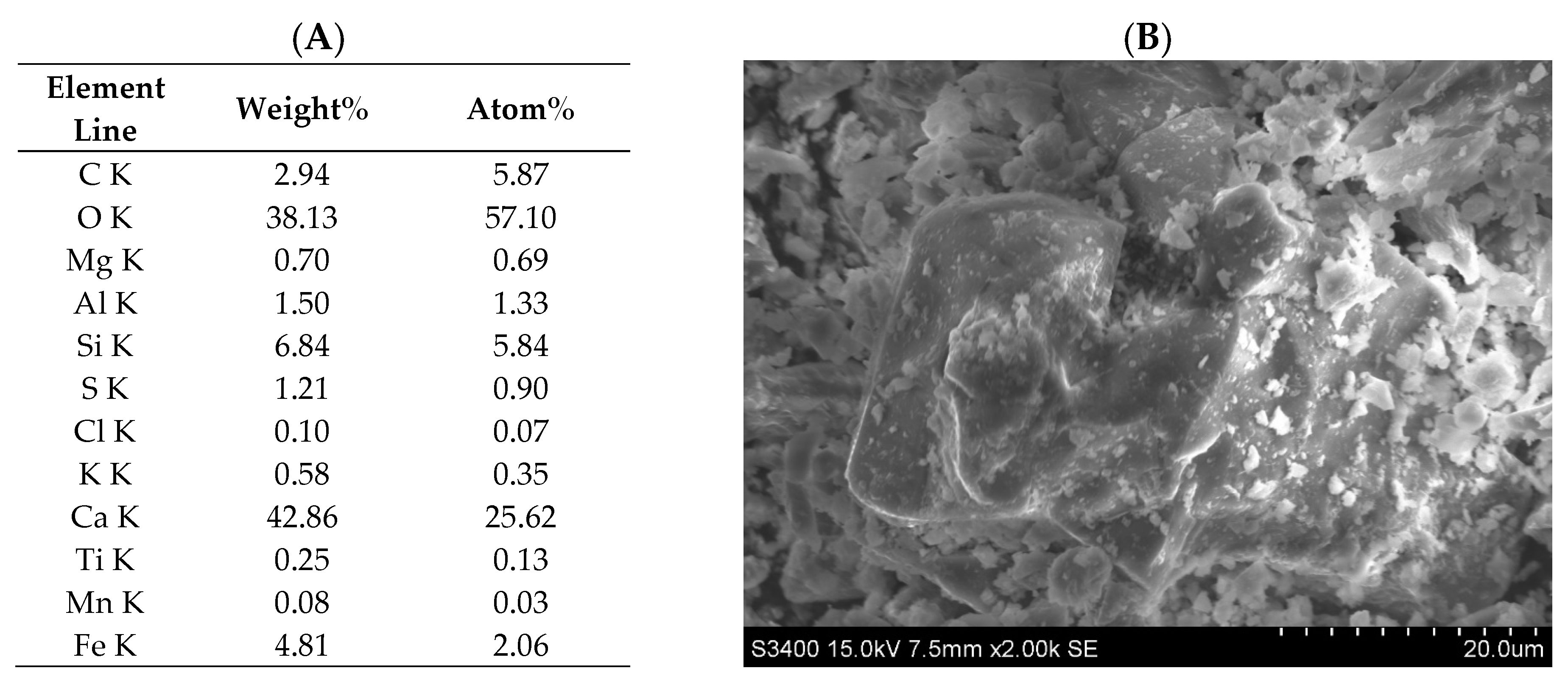
The tests were carried out using Portland cement class CEM I 42.5N obtained from the international HeidelbergCement (Heidelberg, Germany) concern. This cement conforms to all the standards specified in European standard EN 197-1 [43]. The elemental composition and SEM image of the specimen are presented in Figure 1.
SEM and EDS analyses were conducted using a Hitachi S-3400N microscope (Tokyo, Japan) equipped with an UltraDry EDS detector (Thermo Scientific, Waltham, MA, USA). SEM observations (Figure 1B) show irregular, angular cement grains and agglomerates with rough, heterogeneous surfaces and adhered finer particles, suggesting a broad particle-size distribution typical of Portland cement. The EDS analysis (Figure 1A) indicates a Ca–O-dominated composition with contributions from Si, Al, and Fe and minor amounts of Mg, S, K, Ti, Mn, and trace Cl. This baseline characterization of the starting binder confirms a typical Portland-cement composition and supports the interpretation that the differences observed later in the study arise from the applied admixtures and exposure conditions rather than from variability in cement chemistry.
The aggregate, defined as sand with fractions ranging from 0.125 to 2.00 mm, met the requirements stipulated in EN 196-1 [44]. The mixing water utilized in the samples was tap water, in accordance with building standards, deemed suitable for the cement hydration process.
The experimental design entailed the utilization of two distinct groups of admixtures, each modifying the rheological and mechanical properties of cement mortars. The first group comprised a commercially available polycarboxylate superplasticizer (PCE), while the second group incorporated a bio-based starch plasticizer (PS). Additionally, the study incorporated silver nanoparticles (AgNPs) as an antibacterial additive.
The PCE superplasticizer was utilized at concentrations of 0.3% and 0.5% by weight of cement. The dosages of the starch-/dextrin-based admixtures (0.3% and 0.5% by weight of cement) were selected as an optimal range based on the authors’ previous studies, in which higher dosages caused setting-related issues and a decrease in mechanical performance [15,35]. This high-performance chemical admixture exerts a dispersing effect, thereby reducing the water demand of the cement mixture. Consequently, it enhances the workability and density of the grout structure. The use of PCE enables the production of high-strength mixtures without the need to increase the amount of mixing water. Starch biopolymer (PS) was identified as an alternative natural liquefying admixture, with usage levels ranging from 0.3% to 0.5% of the cement weight. The plasticizer in question was derived from modified potato starch, and its function is to enhance the distribution of cement particles and to partially reduce the surface tension of the liquid component in the mixture. Consequently, PS exerts a comparable plasticizing effect to synthetic superplasticizers, while concurrently attenuating its environmental impact.
Silver nanoparticles (AgNPs) were added to specific mixtures as an innovative component to increase the resistance of concrete to biological degradation. The synthesis of AgNPs was carried out by chemical reduction from an ammoniacal silver complex, using modified starch as a reducing and stabilizing agent. A silver colloid with a concentration of 4 g/L was obtained, which was then added to the mixtures. The incorporation of silver into the cement matrix is intended to limit the spread of microorganisms in conditions of increased humidity, which is particularly important in the context of the durability of structures exposed to periodic flooding and biodegradation.

2.2. Production of Nanostructured Silver and Its Characteristics

A multi-stage process was carried out to synthesize colloidal nanosilver. This process involved the preparation of an ammoniacal silver complex solution and a modified starch solution. These solutions were then combined to obtain a stable dispersion of nanoparticles.
The initial step entailed the formulation of an ammoniacal silver complex solution, characterized by a silver ion concentration of 4 g/L. To this end, 1.575 g of silver nitrate was meticulously weighed and dissolved in a small volume of deionized water. Subsequently, minute quantities of a 25% aqueous ammonia solution (NH3 aq) were incorporated, leading to the transient precipitation of silver(I) oxide (Ag2O). This compound subsequently dissolved in an excess of ammonia, thereby forming a silver diamine complex [Ag(NH3)2]+. This solution was then augmented with deionized water, bringing the volume to 250 milliliters. The mixture was subjected to vigorous stirring until a transparent liquid with a slightly opalescent hue was obtained, thereby confirming the stability of the silver complex.
The subsequent step in the experimental process involved the preparation of a stabilizing solution using modified starch. To this end, 5 g of starch derivative was meticulously weighed and dissolved in a modest quantity of hot distilled water. The solution was then brought to a final volume of 250 mL. The mixing process was carried out continuously under controlled temperature conditions, ensuring complete hydration and homogeneous dispersion of the biopolymer. In this system, the modified starch functions as a stabilizer, impeding the aggregation of nanoparticles, and as a silver ion reducer, facilitating their conversion into a metallic nanoform.
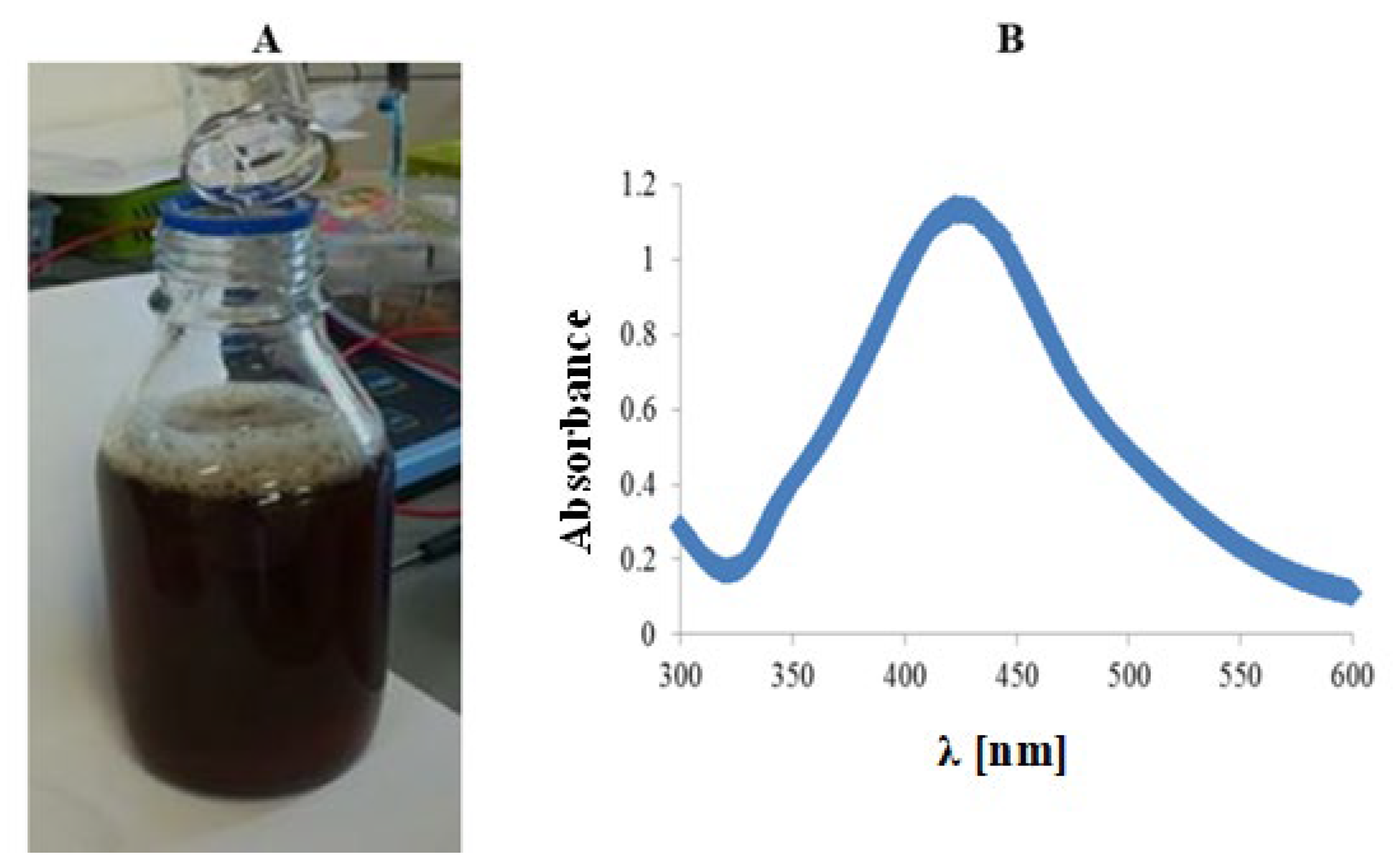
The synthesis of nanosilver was carried out by a controlled combination of silver complex solutions and modified starch under intensive mixing. The reduction reaction was conducted at ambient temperature, and its progress was monitored through both visual observation and spectrophotometric analysis. UV–vis spectrophotometry (OceanOptics USB4000, Orlando, FL, USA) was employed to characterize the optical properties of the resulting silver nanostructures. The change in the solution’s color from colorless to yellow-brown is indicative of the formation of silver nanoparticles with plasmonic properties. (Figure 2A). The final concentration of silver nanoparticles in the colloid, assuming complete reduction, was 2000 μg·mL−1.
To confirm the presence and stability of the obtained nanoparticles, the sample was subjected to UV-Vis spectrophotometric analysis at a 200-fold dilution (Figure 2B). A characteristic maximum in the absorption spectrum was obtained at a wavelength of 430 nanometers, which clearly indicated the presence of silver nanostructures, in accordance with the extant literature on the optical properties of noble metal nanoparticles.
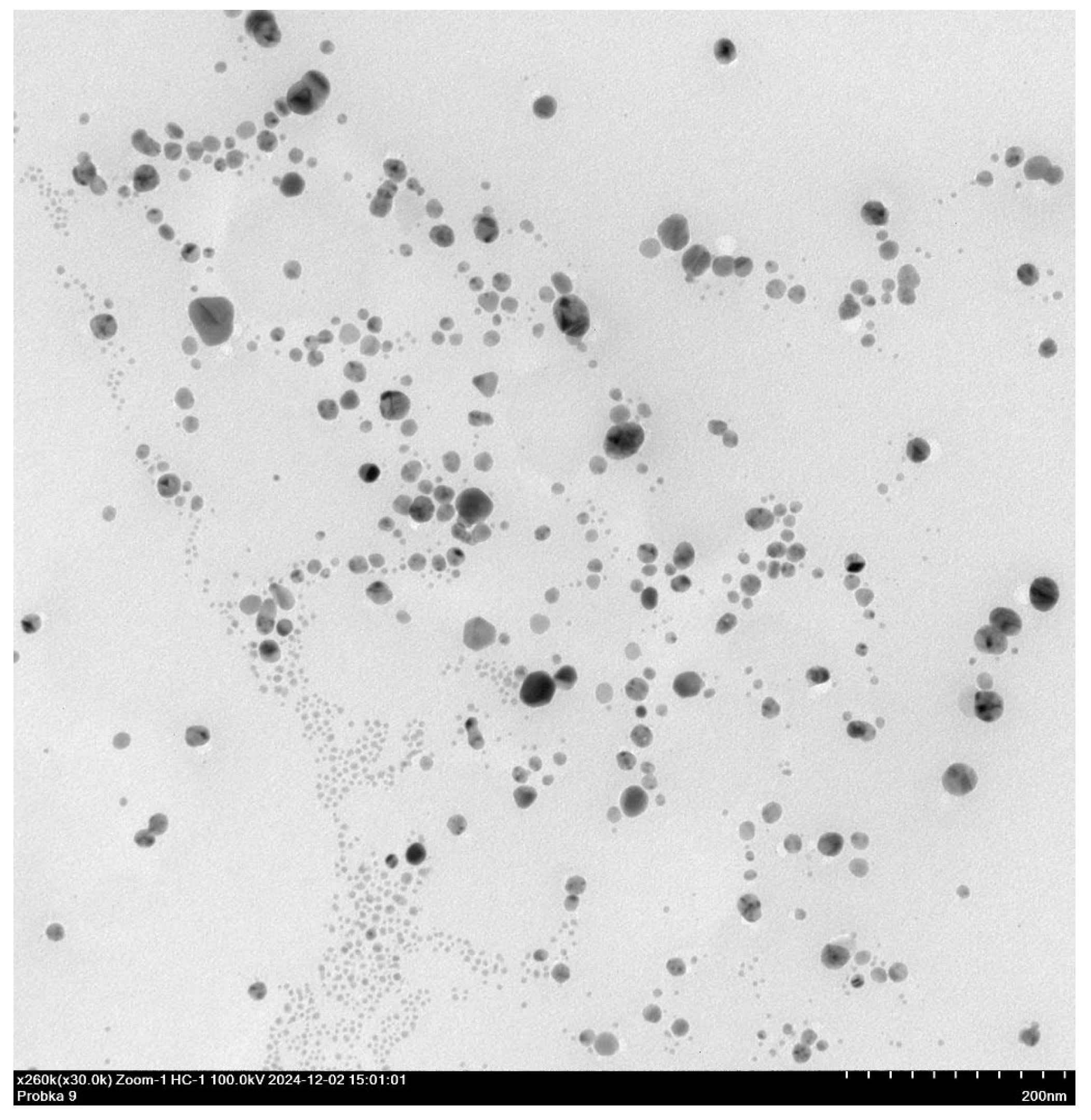
Subsequent structural characterization was performed using transmission electron microscopy (TEM). The obtained images (Figure 3) revealed that the silver nanoparticles were well dispersed and predominantly exhibited a quasi-spherical morphology. No particles larger than 40 nm were observed in the analyzed TEM micrographs, confirming the effectiveness of the applied reduction and stabilization process. The particle size was evaluated based on TEM analysis. For quantitative assessment, fifteen individual nanoparticles with clearly defined contours and minimal overlap were selected from different regions of the micrograph. The particle diameters were determined using the scale bar provided in the TEM image. The average particle diameter was calculated to be 14.6 ± 2.6 nm. Inspection of the TEM micrographs indicates that the dominant particle size fraction lies within the 10–20 nm range, with the highest population density corresponding to particles of approximately 12–15 nm in diameter. A smaller fraction of nanoparticles below 10 nm was also observed, while only a limited number of larger particles with diameters in the range of 20–30 nm were detected, which may be attributed to local aggregation effects. Based on the overall size distribution observed in the TEM images, the average particle size for the entire sample was estimated to be 13–15 nm, in good agreement with the mean diameter obtained from direct measurements. According to existing literature, starch, acting as a stabilizer and reducing agent, allows for the synthesis of AgNPs with diameters ranging from a few nanometers (<10 nm) up to ~50 nm, depending on the synthesis conditions and the form of starch. It is worth noting, however, that the core of AgNPs stabilized with starch derivatives typically measures 5–30 nm, while the hydrodynamic size (DLS) can be significantly larger (50–150 nm) due to the polysaccharide coating [45,46,47,48,49].
The lack of extensive agglomeration indicates the high stabilizing efficiency of the modified starch employed in the synthesis. Furthermore, additional TEM micrographs revealed the presence of non-spherical nanoparticles, including triangular and hexagonal morphologies. The occurrence of such shape diversity may be advantageous for antibacterial applications, as suggested in the literature, and indicates potential for further utilization of the synthesized nanoparticles in the modification of cementitious materials.
The antibacterial properties and stable structure of the nanosilver colloid ensure its effectiveness as an additive to the cement matrix. The colloid has been shown to improve the resistance of concrete to microorganisms, a critical property in construction that is particularly important in contexts where exposure to flood water is a concern.

2.3. Production of Beams from Cement Mortar

The tests were conducted in accordance with EN 196-1, employing the following proportions of cement mortar components: The mixture consisted of one part cement, two parts standard sand, and 0.5 parts water, resulting in a water-to-cement ratio (w/c) of 0.5.
Silver nanoparticles (AgNPs) were dosed exclusively as an aqueous suspension in an amount ensuring a final nanosilver concentration of 10 ppm in the cement mortar. The water-to-cement ratio was maintained at w/c = 0.50 for all mixtures. The water contained in the AgNP suspension was considered part of the mixing water; therefore, the amount of deionized mixing water was reduced accordingly to keep the total water content constant (i.e., no additional water was added). The mixture was modified with various plasticizers and nanosilver additives to enhance its mechanical properties and augment its resistance to moisture and microbial contamination. The water used in the mixture was pre-mixed with selected plasticizers and nanosilver before being added to the mixer. In this study, commercial polycarboxylate superplasticizers (PCE) and modified starch biopolymers (hereinafter referred to as PS) were utilized at concentrations of 0.3% and 0.5% by weight of cement.
The preparation of the cement mortar involved multiple stages. First, water containing the plasticizer and nanosilver was added to the mixer, followed by the gradual incorporation of cement. The cement and water were then mixed at low speed for 30 s, allowing them to initially combine. Subsequently, standard sand with a grain size ranging from 0.125 to 2.00 mm, as specified in EN 196-1, was systematically incorporated. The sand was subsequently amalgamated with the other ingredients for an additional 30 s at a low speed, a process that permitted thorough mixing without excessive dusting. Subsequent to the incorporation of all constituent elements, the mixture underwent thorough agitation at an elevated velocity for a duration of 30 s, to achieve a uniform consistency and thereby activate the plasticizers. The mixing process was then interrupted for a period of 90 s to collect the mortar from the edges of the bowl, thereby ensuring that all ingredients were once again combined equitably. The final stage entailed a final mixing process conducted at an elevated velocity for a duration of 60 s. This step was instrumental in ensuring the optimal amalgamation of the ingredients and the preparation of the mortar for the subsequent steps in the process.
Fresh cement mortar was meticulously placed in three-part molds, with dimensions of 40 mm × 40 mm × 160 mm. The molds were filled in stages, and the mixture was compacted using a shaker to eliminate air bubbles and achieve proper compaction. The samples were left in the molds for 24 h, after which they were removed and placed in water at a temperature of 20 ± 1 °C. The samples were stored in this environment for 28 days. After this curing period, the compressive strength of the beams was evaluated using a strength press, in accordance with the requirements of PN-EN 196-1.

2.4. Analysis of Antimicrobial Properties

Following a procedure analogous to that described previously, selected cement mortar beams were further exposed to microorganisms naturally present in the sewage environment. These microorganisms, together with the surrounding infrastructure, constitute an important microbial reservoir in floodwaters. Therefore, the experimental approach was based on the natural and complex microbiome of the sewage environment. For this purpose, representative beams containing nanosilver (PS0.5–AgNPs variant) and control beams without silver nanoparticles (Reference variant) were placed in an operational sewer inspection chamber (manhole) and exposed in the headspace above the wastewater surface (i.e., not immersed) for six months. After the six-month exposure period, the specimens were removed from the chamber and subjected to the laboratory analyses described below. Subsequently, a genetic analysis of the slats’ microbiome was conducted, and a quantitative assessment was made of the most abundant genera involved in sulfur metabolism, and thus in the process of biological corrosion, as well as the most numerous genera potentially pathogenic to humans. The selection of these microbial groups was based on bioinformatic analyses and their relevance to the scope of the study, rather than on a comprehensive characterization of the entire microbial community.
The isolation of DNA from concrete samples was performed using the Genomic Mini AX Bacteria Spin kit (A&A Biotechnology, Gdańsk, Poland). The V2–V9 region of the bacterial 16S rRNA gene was subjected to sequencing on an Ion Torrent PGM device, employing the Ion 16S™ Metagenomics Kit (Life Technologies, Waltham, MA, USA). The data were analyzed using CLC Genomics Workbench 23.0 software with CLC Microbial Genomics Module 23.0.2 (Qiagen, Venlo, The Netherlands).

3. Results

3.1. Testing the Mechanical Properties of Cement Composites

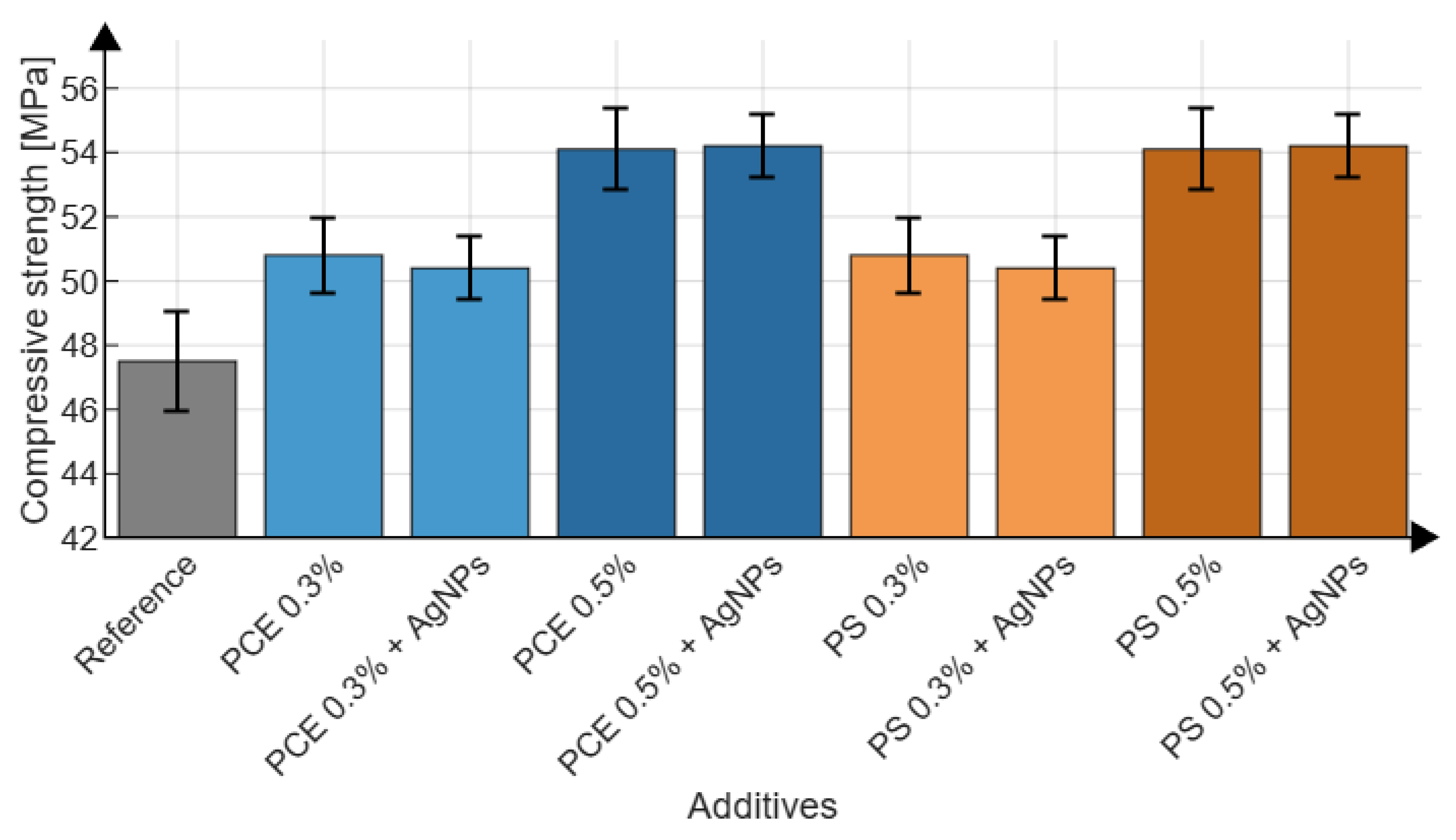
As part of the research initiative aimed at assessing the impact of admixtures on the mechanical properties of cement mortars, a series of compressive strength tests was conducted on samples following a 28-day curing period. The effects of two types of admixtures were analyzed: a commercial polycarboxylate superplasticizer (designated as PCE) and a modified starch biopolymer (designated as PS), as well as their combinations with silver nanoparticles (AgNPs). The results of this study are summarized in Figure 4.
The reference sample, composed exclusively of cement without additives, demonstrated a strength of 47.5 MPa, thereby establishing a benchmark for the evaluation of the other mixtures. The incorporation of PCE admixture at a proportion of 0.3% by weight of cement alone led to an augmentation in strength to 50.8 MPa. Increasing the admixture content to 0.5% resulted in a further increase in compressive strength to 54.1 MPa, highlighting the effectiveness of the plasticizer in enhancing workability and reducing the water-to-cement ratio without compromising the material’s structural integrity. Furthermore, equally promising results were obtained for mixtures containing a modified starch biopolymer (PS). The incorporation of 0.3% of this admixture yielded a strength comparable to that of PCE, i.e., 50.8 MPa. Notably, increasing the admixture’s proportion to 0.5% resulted in an enhanced strength of 54.1 MPa. The values obtained from this study indicate that natural biopolymers, when properly modified, can successfully replace commercial plasticizers in engineering applications. Silver nanoparticles (AgNPs) were also incorporated into the analyzed mixtures to assess the impact of this innovative additive on the mechanical properties of the composite. The incorporation of AgNPs into mixtures with PCE and PS did not result in substantial alterations in strength when compared to samples devoid of nanosilver. For PCE (0.3%) with AgNPs, 50.4 MPa was obtained, while for PCE (0.5%) with AgNPs, 54.2 MPa was obtained. Analogous values were documented for PS admixtures, with measurements of 50.4 MPa and 54.2 MPa recorded for concentrations of 0.3% and 0.5%, respectively. The findings indicate that the presence of nanosilver in the mixture does not have a detrimental effect on the development of the cement structure and the hydration process. In contrast to numerous biocidal additives, AgNPs do not disrupt cement bonding and do not compromise its strength. It is noteworthy that all samples with the incorporation of a plasticizer—both synthetic and natural—exhibited superior mechanical parameters in comparison to the reference sample. Additionally, the strength level of 54–54.2 MPa for the highest admixture dosages (0.5%) indicates that not only the type but also the amount of admixture used has a significant impact on the final mechanical properties of the composite. The findings substantiate the efficacy of contemporary polycarboxylate plasticizers and natural modified biopolymers in enhancing the durability of cementitious materials. While the incorporation of nanosilver did not lead to a significant improvement in mechanical strength, it did not compromise the effectiveness of the admixtures. It is conceivable that this substance could play a significant role in augmenting the resilience of concrete to microbiological agents and the development of biofilms, as will be elaborated upon in the subsequent sections of this paper.

Statistical Analysis of Compressive Strength Results

To assess whether the observed differences in compressive strength between the tested mixtures were statistically significant, a one-way analysis of variance (ANOVA) was performed (Table 1). The factor was the type of mixture (nine levels): reference sample, PCE, and PS at two dosage levels (0.3% and 0.5% by cement mass), each with and without AgNPs. For every mixture, six prismatic specimens were tested after 28 days of curing, giving a total of 54 measurements.
The null hypothesis assumed that all mixtures share the same mean compressive strength, while the alternative hypothesis stated that at least one mixture differs. The ANOVA results (Table 1) showed a highly significant effect of mixture type on compressive strength (F = 25.90, p < 0.001), indicating that the choice of admixture and its dosage has a pronounced influence on the mechanical performance of the cementitious composites.
Since the global ANOVA was significant, post hoc Tukey HSD tests were applied to identify which mixtures differed from each other. The homogeneous groups identified by Tukey’s test are summarized in Table 2. The reference mixture (without any admixtures) formed a separate group with the lowest mean compressive strength (47.5 MPa). Mixtures containing either PCE or PS at 0.3% (with or without AgNPs) formed an intermediate group, with mean strengths around 50.4–50.8 MPa. The highest strengths were obtained for mixtures with 0.5% PCE or PS, again both with and without AgNPs (≈54.1–54.2 MPa), which formed the top homogeneous group.
These results confirm that increasing the dosage of both commercial PCE superplasticizer and starch-based biopolymer (PS) to 0.5% significantly improves compressive strength compared to the reference sample, while the presence of AgNPs at the applied dosage does not reduce the mechanical performance of the composites. Instead, AgNPs can be introduced to provide additional antimicrobial functionality without compromising the strength class of the material.
The statistical grouping into three clearly separated strength classes (C—reference, B—0.3% admixtures, A—0.5% admixtures) is consistent with the expected effect of water reduction and matrix densification induced by both PCE and PS. The fact that AgNPs-modified mixtures remained in the same homogeneous groups as their counterparts without nanosilver confirms that the incorporation of AgNPs at the applied dosage does not compromise the mechanical performance, which is particularly important in the context of designing flood-resistant concretes that must simultaneously provide enhanced durability and antimicrobial protection.

3.2. Evaluation of Antimicrobial Activity

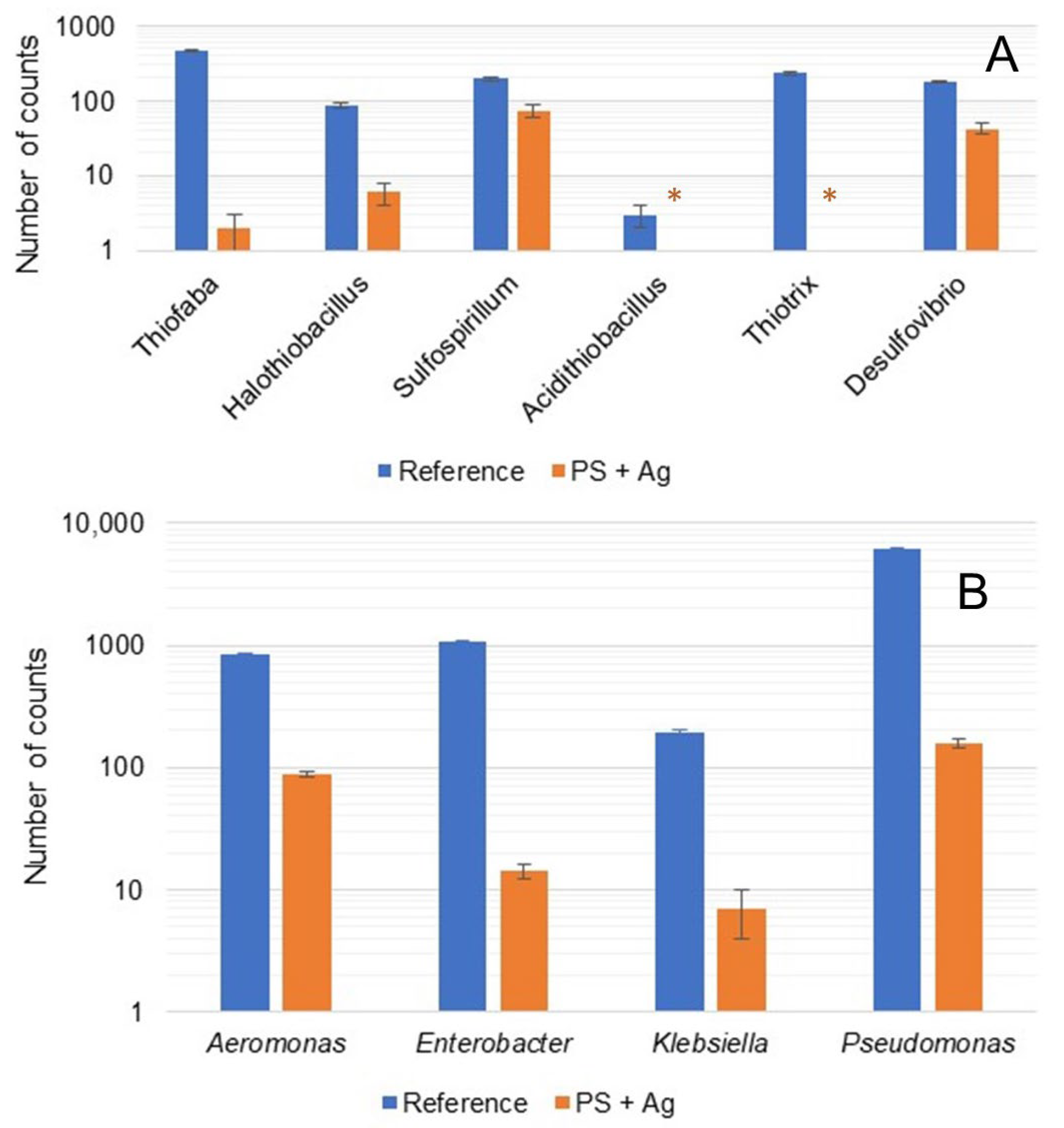
A comprehensive analysis of the sequencing results and published literature was conducted to identify the most prevalent bacterial genera with strong biodeterioration potential in flooded concrete structures. Six genera belonging to the sulfate-reducing bacteria (SRB): Thiofaba, Halothiobacillus, Sulfospirillum, Acidithiobacillus, Thiotrix, and sulfur-oxidizing bacteria (SOB): Desulfovibrio were selected for analysis (Figure 5A). Additionally, four types of pathogenic microorganisms were included in the further study (Figure 5B). For all genera examined in this study, a significant decrease in the number of genus counts in the metagenome was observed in the variant with the addition of silver nanoparticles (p < 0.05). A reduction of up to 85–92% in the abundance of SOB and SRB was observed (p < 0.05). Similarly, the abundance of potentially pathogenic genera was reduced by more than 80% compared to the control (p < 0.05).

4. Discussion

Floods represent a primary threat to building infrastructure, leading to long-term moisture damage to structures and fostering the proliferation of microorganisms that contribute to biological corrosion [10]. The advent of innovative solutions, such as concrete fortified with nanosilver-stabilized plasticizers, offers a contemporary approach to safeguarding building materials, thereby enhancing their durability and resilience against biological degradation. This technological advancement improves the mechanical strength of concrete and inhibits the proliferation of harmful microorganisms that could compromise both structural integrity and the safety of its occupants [29,50].
The impact of combining plasticizers with nanosilver on the mechanical performance of cementitious composites depends on the admixture system and dispersion conditions. Plasticizers can facilitate a more uniform distribution of cement particles, while AgNP-containing systems are reported to be mechanically compatible and, in some formulations, associated with strength-related benefits; however, these effects are formulation-dependent and should be interpreted in the context of the investigated mix design [30]. The present study focuses on a combined admixture approach that integrates two complementary functions: (i) a starch-based plasticizer contributing to improved mixture performance and strength-related behavior, and (ii) AgNPs providing antimicrobial functionality relevant to sewer-atmosphere exposure. The compressive-strength results indicate that the starch-based component governs the strength trends in the investigated mixes, whereas the incorporation of AgNPs does not compromise mechanical performance. From an application standpoint, this is important because it demonstrates that antimicrobial modification can be introduced while maintaining (and, in combination with the plasticizer, improving) mechanical properties.
A salient property of nanosilver is its ability to counteract microbial corrosion, which is critical for the long-term durability of concrete and for minimizing the costs associated with flood damage remediation. Preliminary microbiological studies have shown that nanosilver can inhibit the proliferation of bacteria with biodeterioration potential on concrete surfaces, particularly in high-humidity environments, such as flood-prone regions. The reduced abundance of selected sulfate-reducing (SRB) and sulfur-oxidizing bacteria (SOB) in the metabiome indicates a mitigation of sulfate-induced corrosion, which is essential for the long-term performance of concrete [10].
Although the antimicrobiological effect observed in this study is promising, it is important to consider potential long-term risks associated with the use of nanosilver-based solutions. In particular, the observed reduction in the relative abundance of pathogenic bacteria and those involved in concrete biodeterioration does not preclude the possibility that long-term exposure to silver nanoparticles may act as a selective factor for the development of adaptive resistance mechanisms. Several studies have reported that microorganisms can develop resistance to heavy metals, including silver nanoparticles, through phenotypic and genetic adaptations. Long-term exposure of Escherichia coli and Pseudomonas aeruginosa to silver nanoparticles induced flagellin production, leading to nanoparticle aggregation and reduced antimicrobial activity. Moreover, clinically relevant pathogens such as Acinetobacter baumannii have been identified as a concern due to emerging silver resistance linked to intrinsic and co-selected metal resistance mechanisms [51,52]. More recent studies have further elucidated genetic and transcriptomic adaptations associated with silver nanoparticle exposure, including the upregulation of stress response genes in A. baumannii and potential plasmid-associated mechanisms that may mitigate silver toxicity [53]. To address this potential risk, future research should include longitudinal studies tracking both phenotypic and genomic changes in microbial populations exposed to silver nanoparticles, ideally under environmentally relevant conditions. Additionally, employing combinatorial antimicrobial strategies, such as coupling nanosilver with other biocidal agents or coatings that minimize selection pressure, may help reduce the likelihood of resistance development. Strategies that avoid sub-lethal exposures and ensure adequate nanoparticle dispersion and stability should also be considered to preserve long-term antimicrobial efficacy.
The innovation of nanosilver plasticizers is predicated on the integration of two distinct yet complementary properties: enhanced strength and antibacterial functionality. In contrast to conventional protective coatings, which necessitate maintenance and are susceptible to deterioration, nanosilver plasticizers offer a long-lasting biological protection that is integrated into the concrete structure itself. Such concrete increases mechanical strength and reduces the diversity of microorganisms, thereby reducing the complexity and aggressiveness of biofilms. It has been previously established through taxonomic studies that nanosilver has the capacity to reduce the occurrence of pioneer bacteria that possess strong adhesive properties. These bacteria are typically classified under the Alphaproteobacteria class. This finding suggests that the use of nanosilver may potentially mitigate the risk of chemical corrosion caused by biofilms [54,55].
The utilization of plasticizers in conjunction with nanosilver is of particular significance within the framework of health protection. In the event of a flood, buildings that become inundated can serve as a breeding ground for pathogenic microorganisms, thereby posing a health risk to individuals in the vicinity. Concrete with nanosilver has been shown to act as a natural preventive measure, limiting the number of pathogenic microorganisms, whose occurrence has previously been linked to flooding [56].
The genera Aeromonas, Klebsiella, Enterobacter, and Pseudomonas comprise well-known opportunistic pathogens associated with gastrointestinal, respiratory, urinary tract, wound, and bloodstream infections, particularly in immunocompromised individuals and hospital settings. They pose a concern for public health, and increasing attention is being paid to monitoring their presence in environments [57,58,59,60]. This type of strategy can reduce infrastructure maintenance costs and limit the need for chemical disinfectants—aligning with the principles of sustainable construction.
It is important to note that the successful implementation of this approach requires careful technological control during mixture preparation. The use of plasticizers in conjunction with nanosilver should follow well-defined procedures, including accurate dosage control and consistent mixing conditions, to ensure reproducible performance and durability of the resulting composites. Further long-term studies should evaluate the persistence of antimicrobial performance together with quantitative silver release (leaching/Ag+ release) under relevant exposure scenarios (e.g., long-term immersion, cyclic wetting–drying, and acidic conditions).
In summary, concrete modified with plasticizers and nanosilver represents a comprehensive approach to protecting structures exposed to flood-related conditions. By enhancing mechanical performance and providing antimicrobial functionality, this combined system may facilitate the design and maintenance of infrastructure resilient to increasingly challenging environmental conditions.

Impact of Silver Nanoparticles on The Environment

Although direct studies quantifying the release of silver nanoparticles (AgNPs) from cementitious composites are still limited, available evidence from other building products indicates that silver-containing nanomaterials can be mobilized from exposed surfaces under weathering and runoff conditions. Kaegi et al. [61] demonstrated measurable silver release from a façade paint during one year of outdoor exposure, and similar trends have been reported for coated wooden façades, where release was related to coating erosion and surface aging [62]. These studies provide an important methodological reference; however, their results should be interpreted cautiously when extrapolating to concrete, because cementitious matrices are structurally different, typically more alkaline, and can immobilize additives within a mineral binder phase.
In the case of nanosilver-modified concrete, the expected environmental exposure is strongly influenced by (i) the low dosing levels of silver used for functional modification, (ii) the degree of encapsulation/immobilization of AgNPs within the hydrated cement matrix, and (iii) surface condition and degradation processes (e.g., abrasion, cracking, carbonation, cyclic wetting–drying). Importantly, silver nanoparticles introduced into complex environmental media may undergo transformations that can reduce their mobility and bioavailability. Levard et al. [63] highlighted that AgNPs can react with sulfur-containing compounds and other ligands in natural waters and wastewater, leading, for example, to sulfidation processes that generally decrease solubility and, in many cases, mitigate toxicity relative to more bioavailable ionic forms. Such transformations are relevant for risk assessment because the form of released silver (particulate vs. ionic vs. transformed species) largely determines environmental behavior and biological effects.
It should also be noted that much of the ecotoxicological literature refers to free AgNPs introduced directly into aquatic or soil test systems, often under controlled laboratory conditions [64,65,66,67,68,69,70]. These studies consistently show that silver can affect sensitive organisms and microbial processes, through mechanisms involving both nanoparticle interactions and Ag+ release [64,65]. At the same time, the environmental relevance of these findings depends on realistic exposure scenarios, including actual release rates from solid building materials, speciation of silver in receiving environments, and the extent of transformation/immobilization processes [63,70]. Therefore, while the broader literature supports the need for environmental caution with nanosilver, it does not yet provide a definitive basis for quantifying risk specifically for low-dose, matrix-bound AgNPs in concrete.
Against this broader background of environmental behavior and ecotoxicity, the potential risks associated with silver release from cementitious composites must also be considered. International guidelines indicate that both the total silver content and the amount of leachable silver should be controlled in materials that may come into contact with water. The World Health Organization proposes a provisional guideline value of 0.1 mg/L for silver in drinking water, primarily to prevent argyria, and notes that typical environmental concentrations are usually much lower [71]. This value is therefore often used as a reference threshold when assessing silver leaching from construction products intended for use in humid, flood-prone, or water-contact environments.
From a waste management perspective, the US EPA Toxicity Characteristic Leaching Procedure (TCLP) [72] includes silver among the regulated metals, with a regulatory limit of 5 mg/L in the leachate for classification of hazardous waste. Although this procedure was developed mainly for bulk silver rather than engineered nanoparticles, it highlights the broader regulatory expectation that silver release from solid materials should remain within defined limits over their service life.
In Europe, the leaching behavior of construction products is typically assessed using standardized laboratory procedures, including batch compliance tests such as EN 12457 [73] and diffusion-controlled tests for monolithic materials, such as CEN/TS 16637 [74]. These methods enable the determination of cumulative metal release under defined liquid-to-solid ratios, exposure times, and boundary conditions. The resulting eluates can then be assessed against groundwater and surface-water quality criteria or ecotoxicological benchmarks for aquatic organisms.
Reported ecotoxicity thresholds for ionic silver and nanosilver towards freshwater organisms are often in the low-µg/L range, for example, for Daphnia magna and other aquatic invertebrates [64,75]. This sensitivity underscores the importance of designing nanosilver-modified cementitious materials in such a way that silver leaching remains minimal throughout their entire service life, particularly in applications where prolonged water exposure may occur.
Although leaching behavior was not the primary focus of the present study, the relatively low nanosilver dosage applied and its stabilization by biopolymer-based admixtures, suggest that silver release is likely to be strongly limited. This effect can be attributed to a combination of physical encapsulation within the cement matrix and chemical interactions occurring during cement hydration, as previously reported for nano-Ag–modified cementitious systems. In future work, systematic leaching studies using standardized methods (e.g., EN 12457 [73] or CEN/TS 16637 [74]), combined with quantitative analysis of silver in eluates and comparison with drinking-water guideline values and ecotoxicity thresholds, will be essential to confirm that the proposed approach not only enhances flood-related durability and microbiological safety, but also remains environmentally compliant over the full service life of the structure.
From an engineering and sustainability perspective, a pragmatic approach is to couple performance benefits with responsible implementation and verification. Future studies should prioritize (i) standardized leaching tests and silver speciation (AgNP/Ag+/transformed forms) under relevant scenarios (long-term immersion, cyclic wetting–drying, acidic exposure), (ii) assessment of release under mechanical wear/abrasion, and (iii) life-cycle-informed evaluation of potential emissions during service life and end-of-life processing. Such data would allow a robust comparison with other environmentally relevant releases from concrete (including heavy metals), which have been discussed in relation to regulatory frameworks and immobilization mechanisms [76,77]. Overall, given the limited direct evidence for concrete, the current state of knowledge supports a cautious but not alarmist assessment: nanosilver is a functional additive with documented antimicrobial activity, whereas its environmental profile in cementitious matrices requires targeted, exposure-relevant validation.

5. Conclusions

The incorporation of nanosilver plasticizers into concrete offers significant advantages for structures subjected to flooding and moisture. Research substantiates the initial premise, demonstrating that this technology not only enhances the mechanical strength of concrete but also protects against biocorrosion and may positively affect public health over time. Nevertheless, it is important to carefully assess the potential long-term effects of sustained environmental microbiome exposure to nanosilver-based materials.
The following conclusions were drawn from the analysis:
  • Mechanical strength: The PCE superplasticizer and the modified starch-based plasticizer (PS) increased compressive strength relative to the reference mix, and the 0.5% dosage for both admixtures formed the highest homogeneous strength group in the Tukey analysis. Importantly, incorporating AgNPs into the PCE- and PS-modified mixes did not reduce compressive strength or alter the Tukey grouping, supporting the mechanical compatibility of the admixture–AgNP system. These results indicate that antimicrobial functionality can be introduced without compromising mechanical performance.
  • Protection against microbial corrosion: Nanosilver has been demonstrated to impede the proliferation of specific categories of SOB and SRB, which are implicated in the biodeterioration of concrete, particularly within humid flood environments.
  • Potential hygiene-related co-benefits after flooding: By limiting the abundance of selected potentially pathogenic genera in the tested exposure scenario, nanosilver-modified concrete may contribute to improved hygienic conditions in flood-affected environments, complementing conventional remediation measures.
  • Reduced need for protective coatings: Because antimicrobial functionality is integrated into the cementitious matrix, nanosilver plasticizers may help reduce reliance on additional surface coatings that require maintenance and can degrade over time, potentially lowering lifecycle maintenance demands.
  • Multifunctional performance: Overall, nanosilver plasticizers provide a combined strategy that maintains enhanced mechanical strength while adding antibacterial functionality, supporting the development of flood-resilient cementitious materials.
These findings highlight the potential of nanosilver plasticizer technology as an effective, contemporary approach for flood mitigation that also supports public health. Nevertheless, further long-term studies focusing on microbial adaptation and resistance mechanisms are required to ensure the sustained safety and effectiveness of this approach.

Author Contributions

Conceptualization, M.S., J.S.-P., A.P.-C. and E.K.; methodology, M.S., J.S.-P., A.P.-C. and E.K.; software, M.S. and J.S.-P.; validation, M.S., J.S.-P., A.P.-C. and E.K.; formal analysis, M.S., J.S.-P., A.P.-C. and E.K.; investigation, M.S., J.S.-P., A.P.-C. and E.K.; resources, M.S., J.S.-P., A.P.-C. and E.K.; data curation, M.S., J.S.-P., A.P.-C. and E.K.; writing—original draft preparation, M.S., J.S.-P., A.P.-C. and E.K.; writing—review and editing, M.S., J.S.-P., A.P.-C. and E.K.; visualization, M.S. and J.S.-P.; supervision, M.S., and A.P.-C.; project administration, M.S.; funding acquisition, M.S., J.S.-P., A.P.-C. and E.K. All authors have read and agreed to the published version of the manuscript.

Funding

This research was partially funded by the Polish Ministry of Science and Higher Education (no. 0911/SBAD/2507).

Institutional Review Board Statement

Not applicable.

Informed Consent Statement

Not applicable.

Data Availability Statement

The data presented in this study are available on request from the corresponding author.

Conflicts of Interest

The authors declare no conflicts of interest.

References

  1. Kelman, I.; Spence, R. An Overview of Flood Actions on Buildings. Eng. Geol. 2004, 73, 297–309. [Google Scholar] [CrossRef]
  2. Pistrika, A.K.; Jonkman, S.N. Damage to Residential Buildings Due to Flooding of New Orleans after Hurricane Katrina. Nat. Hazards 2010, 54, 413–434. [Google Scholar] [CrossRef]
  3. Gautam, D.; Adhikari, R.; Gautam, S.; Pandey, V.P.; Thapa, B.R.; Lamichhane, S.; Talchabhadel, R.; Thapa, S.; Niraula, S.; Aryal, K.R. Unzipping Flood Vulnerability and Functionality Loss: Tale of Struggle for Existence of Riparian Buildings. Nat. Hazards 2023, 119, 989–1009. [Google Scholar] [CrossRef]
  4. Chen, D.; Zou, J.; Zhao, L.; Xu, S.; Xiang, T.; Liu, C. Degradation of Dynamic Elastic Modulus of Concrete under Periodic Temperature-Humidity Action. Materials 2020, 13, 611. [Google Scholar] [CrossRef]
  5. Lin, C.-C.; Xiao, P.-C. Comparison of Resistance Improvement to Aspergillus brasiliensis Growth on Recycled Building Materials by Nano-Metal Impregnation and Ozone Treatment. E3S Web Conf. 2023, 396, 01115. [Google Scholar] [CrossRef]
  6. Nadal, N.C.; Zapata, R.E.; Pagán, I.; López, R.; Agudelo, J. Building Damage Due to Riverine and Coastal Floods. J. Water Resour. Plan. Manag. 2010, 136, 327–336. [Google Scholar] [CrossRef]
  7. Nasim, M.; Setunge, S. Damage Estimation of a Concrete Pier When Exposed to Extreme Flood and Debris Loading. J. Mar. Sci. Eng. 2022, 10, 710. [Google Scholar] [CrossRef]
  8. Susilorini, R.M.R.; Iskandar, I.; Santosa, B. Long-Term Durability of Bio-Polymer Modified Concrete in Tidal Flooding Prone Area: A Challenge of Sustainable Concrete Materials. Sustainability 2022, 14, 1565. [Google Scholar] [CrossRef]
  9. Yonathan, K.; Mann, R.; Mahbub, K.R.; Gunawan, C. The Impact of Silver Nanoparticles on Microbial Communities and Antibiotic Resistance Determinants in the Environment. Environ. Pollut. 2022, 293, 118506. [Google Scholar] [CrossRef]
  10. Wang, D.; Guan, F.; Feng, C.; Mathivanan, K.; Zhang, R.; Sand, W. Review on Microbially Influenced Concrete Corrosion. Microorganisms 2023, 11, 2076. [Google Scholar] [CrossRef]
  11. Duvnjak, I.; Klepo, I.; Serdar, M.; Damjanović, D. Damage Assessment of Reinforced Concrete Elements Due to Corrosion Effect Using Dynamic Parameters: A Review. Buildings 2021, 11, 425. [Google Scholar] [CrossRef]
  12. Rincon, L.F.; Moscoso, Y.M.; Hamami, A.E.A.; Matos, J.C.; Bastidas-Arteaga, E. Degradation Models and Maintenance Strategies for Reinforced Concrete Structures in Coastal Environments under Climate Change: A Review. Buildings 2024, 14, 562. [Google Scholar] [CrossRef]
  13. Kubiak, J.; Laks, I.; Sroka, Z.; Walczak, Z. Application of a Multi-Criteria Decision Support System for Assessing Development Potential in Flood Risk Areas—Case Study of the Warta River. Sci. Total Environ. 2024, 947, 174513. [Google Scholar] [CrossRef] [PubMed]
  14. Konował, E.; Sybis, M.; Modrzejewska-Sikorska, A.; Milczarek, G. Synthesis of Dextrin-Stabilized Colloidal Silver Nanoparticles and Their Application as Modifiers of Cement Mortar. Int. J. Biol. Macromol. 2017, 104, 165–172. [Google Scholar] [CrossRef] [PubMed]
  15. Sybis, M.; Konował, E. Influence of Modified Starch Admixtures on Selected Physicochemical Properties of Cement Composites. Materials 2022, 15, 7604. [Google Scholar] [CrossRef]
  16. ten Veldhuis, J.A.E.; Clemens, F.H.L.R.; Sterk, G.; Berends, B.R. Microbial Risks Associated with Exposure to Pathogens in Contaminated Urban Flood Water. Water Res. 2010, 44, 2910–2918. [Google Scholar] [CrossRef]
  17. Taylor, J.; Lai, K.M.; Davies, M.; Clifton, D.; Ridley, I.; Biddulph, P. Flood Management: Prediction of Microbial Contamination in Large-Scale Floods in Urban Environments. Environ. Int. 2011, 37, 1019–1029. [Google Scholar] [CrossRef]
  18. Flemming, H.-C.; Wingender, J. The Biofilm Matrix. Nat. Rev. Microbiol. 2010, 8, 623–633. [Google Scholar] [CrossRef]
  19. Pawlak, T.; Szymczak-Graczyk, A.; Garbowski, T. Three-Layer Repair Coating System for Manholes, Pump Stations, and Tanks in Aggressive Sulfate Environment. Civ. Environ. Eng. Rep. 2025, 35, 1–19. [Google Scholar] [CrossRef]
  20. Huber, B.; Hilbig, H.; Drewes, J.E.; Müller, E. Evaluation of Concrete Corrosion after Short- and Long-Term Exposure to Chemically and Microbially Generated Sulfuric Acid. Cem. Concr. Res. 2017, 94, 36–48. [Google Scholar] [CrossRef]
  21. Yousefi, A.; Allahverdi, A.; Hejazi, P. Accelerated Biodegradation of Cured Cement Paste by Thiobacillus Species under Simulation Condition. Int. Biodeterior. Biodegrad. 2014, 86, 317–326. [Google Scholar] [CrossRef]
  22. Gutarowska, B. Metabolic Activity of Moulds as a Factor of Building Materials Biodegradation. Pol. J. Microbiol. 2010, 59, 119–124. [Google Scholar] [CrossRef] [PubMed]
  23. Roguet, A.; Newton, R.J.; Eren, A.M.; McLellan, S.L. Guts of the Urban Ecosystem: Microbial Ecology of Sewer Infrastructure. mSystems 2022, 7, e00118-22. [Google Scholar] [CrossRef] [PubMed]
  24. Zhang, P.; Wittmann, F.H.; Haist, M.; Müller, H.S.; Vontobel, P.; Zhao, T.J. Water Penetration into Micro-Cracks in Reinforced Concrete. Restor. Build. Monum. 2014, 20, 85–94. [Google Scholar] [CrossRef]
  25. Zhang, R.; Cheng, X.; Hou, P. Synergistic Effects of Nano-SiO2 and Nano-Ag on the Anti-Bacterial and Mechanical Properties of Cementitious Materials. Constr. Build. Mater. 2015, 98, 198–205. [Google Scholar]
  26. Rodrigues, A.S.; Batista, J.G.; Rodrigues, M.Á.; Thipe, V.C.; Minarini, L.A.; Lopes, P.S.; Lugão, A.B. Advances in Silver Nanoparticles: A Comprehensive Review on Their Potential as Antimicrobial Agents and Their Mechanisms of Action Elucidated by Proteomics. Front. Microbiol. 2024, 15, 1440065. [Google Scholar] [CrossRef]
  27. Rai, M.; Yadav, A.; Gade, A. Silver Nanoparticles as a New Generation of Antimicrobials. Biotechnol. Adv. 2009, 27, 76–83. [Google Scholar] [CrossRef]
  28. Pal, S.; Tak, Y.K.; Song, J.M. Does the Antibacterial Activity of Silver Nanoparticles Depend on the Shape of the Nanoparticle? A Study of the Gram-Negative Bacterium Escherichia coli. Appl. Environ. Microbiol. 2007, 73, 1712–1720. [Google Scholar] [CrossRef]
  29. Nam, K.Y. Characterization and Antimicrobial Efficacy of Portland Cement Impregnated with Silver Nanoparticles. J. Adv. Prosthodont. 2017, 9, 217–223. [Google Scholar] [CrossRef]
  30. Pehlivan, A.O.; Sanrı Karapınar, I.; Karakuş, S.; Özsoy Özbay, A.E.; Yazgan, A.U. Evaluation of the Microstructure and Mechanical Properties of Biopolymer-Based Cementitious Composites with Silver Nanoparticles. J. Mater. Civ. Eng. 2023, 35, 04022473. [Google Scholar] [CrossRef]
  31. Akter, M.; Sikder, M.T.; Rahman, M.M. A Systematic Review on Silver Nanoparticles: Mechanism, Toxicity and Future Directions. J. Adv. Res. 2018, 9, 1–16. [Google Scholar] [CrossRef] [PubMed]
  32. Suthar, M.; Sata, S.; Vyas, K.M.; Mungule, M. Investigation on Strength Enhancement of Cement Paste Using Biogenic Nanoparticles. Mater. Today Proc. 2022, 65, 1831–1838. [Google Scholar] [CrossRef]
  33. Paciejewski, M.; Lange, A.; Jaworski, S.; Kutwin, M.; Bombalska, A.; Siwiński, J.; Olkowicz, K.; Mierczyk, J.; Narojczyk, K.; Bogdanowicz, Z.; et al. Effect of Doping Cement Mortar with Triclosan, Hypochlorous Acid, Silver Nanoparticles and Graphene Oxide on Its Mechanical and Biological Properties. Materials 2024, 17, 6288. [Google Scholar] [CrossRef] [PubMed]
  34. Sybis, M.; Konowal, E. The Effect of Cement Concrete Doping with Starch Derivatives on Its Frost Resistance. Przemysł Chem. 2019, 98, 1738–1740. [Google Scholar]
  35. Sybis, M.; Konował, E.; Prochaska, K. Dextrins as Green and Biodegradable Modifiers of Physicochemical Properties of Cement Composites. Energies 2022, 15, 4115. [Google Scholar] [CrossRef]
  36. Märkl, V.; Pflugmacher, S.; Stephan, D.A. Leaching of PCE-Based Superplasticiser from Microfine Cement: A Chemical and Ecotoxicological Point of View. Water Air Soil Pollut. 2017, 228, 217. [Google Scholar] [CrossRef]
  37. Chen, B.; Xu, J.; Fu, C.; She, W.; Dong, B. Synergistic Effects of Nano-Silver and Nano-Silica on Strength, Electrical Conductivity and Corrosion Resistance of Portland Cement Paste. Constr. Build. Mater. 2025, 502, 144233. [Google Scholar] [CrossRef]
  38. Wei, S.; Jiang, Z.; Liu, H.; Zhou, D.; Sanchez-Silva, M. Microbiologically Induced Deterioration of Concrete: A Review. Braz. J. Microbiol. 2013, 44, 1001–1007. [Google Scholar] [CrossRef]
  39. Gunawan, C.; Teoh, W.Y.; Marquis, C.P.; Amal, R. Induced Adaptation of Bacillus sp. to Antimicrobial Nanosilver. Small 2013, 9, 3554–3560. [Google Scholar] [CrossRef]
  40. McGillicuddy, E.; Murray, I.; Kavanagh, S.; Morrison, L.; Fogarty, A.; Cormican, M.; Dockery, P.; Prendergast, M.; Rowan, N.; Morris, D. Silver Nanoparticles in the Environment: Sources, Detection and Ecotoxicology. Sci. Total Environ. 2017, 575, 231–246. [Google Scholar] [CrossRef]
  41. Habash, M.B.; Reid, G. Microbial Biofilms: Their Role in the Development of Nosocomial Infections and Approaches for Prevention. Microbiol. Immunol. 2018, 62, 485–498. [Google Scholar]
  42. Noeiaghaei, T.; Dhami, N.; Mukherjee, A. Nanoparticles Surface Treatment on Cemented Materials for Inhibition of Bacterial Growth. Constr. Build. Mater. 2017, 150, 880–891. [Google Scholar] [CrossRef]
  43. EN 197-1:2011; Cement—Part 1: Composition, Specifications and Conformity Criteria for Common Cements. European Committee for Standardization (CEN): Brussels, Belgium, 2011.
  44. EN 196-1:2016; Methods of Testing Cement—Part 1: Determination of Strength. European Committee for Standardization (CEN): Brussels, Belgium, 2016.
  45. Vigneshwaran, N.; Nachane, R.P.; Balasubramanya, R.H.; Varadarajan, P.V. A novel one-pot ‘green’ synthesis of stable silver nanoparticles using soluble starch. Carbohydr. Res. 2006, 341, 2012–2018. [Google Scholar] [CrossRef] [PubMed]
  46. Cheviron, P.; Gouanvé, F.; Espuche, E. Green synthesis of colloid silver nanoparticles and resulting biodegradable starch/silver nanocomposites. Carbohydr. Polym. 2014, 108, 291–298. [Google Scholar] [CrossRef] [PubMed]
  47. Demchenko, V.; Riabov, S.; Sinelnikov, S.; Radchenko, O.; Kobylinskyi, S.; Rybalchenko, N. Novel approach to synthesis of silver nanoparticles in interpolyelectrolyte complexes based on pectin, chitosan, starch and their derivatives. Carbohydr. Polym. 2020, 242, 116431. [Google Scholar] [CrossRef]
  48. Kumar, S.V.; Bafana, A.P.; Pawar, P.; Rahman, A.; Dahoumane, S.A.; Jeffryes, C.S. High conversion synthesis of <10 nm starch-stabilized silver nanoparticles using microwave technology. Sci. Rep. 2018, 8, 5106. [Google Scholar] [CrossRef]
  49. Karbowska, B.; Modrzejewska-Sikorska, A.; Skowron, A.W.; Konował, E. Silver nanostructures stabilized by starch derivatives for the determination of thallium in environmental samples. Arch. Environ. Prot. 2025, 51, 118–126. [Google Scholar] [CrossRef]
  50. Ceran, Ö.B.; Şimşek, B.; Doruk, S.; Uygunoğlu, T.; Şara, O.N. Effects of Dispersed and Powdered Silver Nanoparticles on the Mechanical, Thermal, Electrical and Durability Properties of Cementitious Composites. Constr. Build. Mater. 2019, 222, 152–167. [Google Scholar] [CrossRef]
  51. Panáček, A.; Kvítek, L.; Smékalová, M.; Večeřová, R.; Kolář, M.; Röderová, M.; Dyčka, F.; Šebela, M.; Prucek, R.; Tomanec, O.; et al. Bacterial resistance to silver nanoparticles and how to overcome it. Nat. Nanotechnol. 2018, 13, 65–71. [Google Scholar] [CrossRef]
  52. McNeilly, O.; Mann, R.; Hamidian, M.; Gunawan, C. Emerging concern for silver nanoparticle resistance in acinetobacter baumannii and other bacteria. Front. Microbiol. 2021, 12, 652863. [Google Scholar] [CrossRef]
  53. McNeilly, O.; Mediati, D.G.; Pittorino, M.J.; Mann, R.; Söderström, B.; Hamidian, M.; Gunawan, C. Molecular insights into silver nanoparticle resistance in Acinetobacter baumannii and unique adaptations to ionic silver. Npj Antimicrob. Resist. 2025, 3, 92. [Google Scholar] [CrossRef]
  54. Gruca, A. A Brief Review of Microbial Induced Corrosion Research. Ann. Univ. Paedagog. Cracoviensis. Stud. Naturae 2018, 3, 152–161. [Google Scholar] [CrossRef]
  55. Sybis, M.; Staninska-Pięta, J.; Paluch, E.; Konował, E.; Cyplik, P.; Wolko, Ł.; Wiglusz, R.J.; Czarny, J.; Piotrowska-Cyplik, A. Microbiome Analysis of Novel Cement Composites Admixed with Biopolymer and Silver Nanoparticles. Int. Biodeterior. Biodegrad. 2025, 202, 106084. [Google Scholar] [CrossRef]
  56. Płoneczka-Janeczko, K.; Rypuła, K.; Rohm, W.; Magdziarz, M.; Zielak-Steciwko, A. Epidemiological Insight into Bacterial Risk Associated with Flooded Areas of City Agglomeration (Wrocław, Poland 2024). Sci. Rep. 2025, 15, 18182. [Google Scholar] [CrossRef] [PubMed]
  57. Carusi, J.; Kabuki, D.Y.; De Seixas Pereira, P.M.; Cabral, L. Aeromonas spp. in drinking water and food: Occurrence, virulence potential and antimicrobial resistance. Food Res. Int. 2024, 175, 113710. [Google Scholar] [CrossRef]
  58. Chang, D.; Sharma, L.; Dela Cruz, C.S.; Zhang, D. Clinical epidemiology, risk factors, and control strategies of klebsiella pneumoniae infection. Front. Microbiol. 2021, 12, 750662. [Google Scholar] [CrossRef]
  59. Salimiyan Rizi, K.; Ghazvini, K.; Farsiani, H. Clinical and pathogenesis overview of Enterobacter infections. Rev. Clin. Med. 2019, 6, 146–154. [Google Scholar] [CrossRef]
  60. Qin, S.; Xiao, W.; Zhou, C.; Pu, Q.; Deng, X.; Lan, L.; Liang, H.; Song, X.; Wu, M. Pseudomonas aeruginosa: Pathogenesis, virulence factors, antibiotic resistance, interaction with host, technology advances and emerging therapeutics. Signal Transduct. Target. Ther. 2022, 7, 199. [Google Scholar] [CrossRef]
  61. Kaegi, R.; Sinnet, B.; Zuleeg, S.; Hagendorfer, H.; Mueller, E.; Vonbank, R.; Boller, M.; Burkhardt, M. Release of silver nanoparticles from outdoor facades. Environ. Pollut. 2010, 158, 2900–2905. [Google Scholar] [CrossRef]
  62. Künniger, T.; Gerecke, A.C.; Ulrich, A.; Huch, A.; Vonbank, R.; Heeb, M.; Wichser, A.; Haag, R.; Kunz, P.; Faller, M. Release and environmental impact of silver nanoparticles and conventional organic biocides from coated wooden façades. Environ. Pollut. 2014, 184, 464–471. [Google Scholar] [CrossRef]
  63. Levard, C.; Hotze, E.M.; Lowry, G.V.; Brown, G.E. Environmental transformations of silver nanoparticles: Impact on stability and toxicity. Environ. Sci. Technol. 2012, 46, 6900–6914. [Google Scholar] [CrossRef]
  64. Fabrega, J.; Luoma, S.N.; Tyler, C.R.; Galloway, T.S.; Lead, J.R. Silver nanoparticles: Behaviour and effects in the aquatic environment. Environ. Int. 2011, 37, 517–531. [Google Scholar] [CrossRef] [PubMed]
  65. Ihtisham, M.; Noori, A.; Yadav, S.; Sarraf, M.; Kumari, P.; Brestic, M.; Imran, M.; Jiang, F.; Yan, X.; Rastogi, A. Silver nanoparticle’s toxicological effects and phytoremediation. Nanomaterials 2021, 11, 2164. [Google Scholar] [CrossRef] [PubMed]
  66. Park, S.-Y.; Chung, J.; Colman, B.P.; Matson, C.W.; Kim, Y.; Lee, B.-C.; Kim, P.-J.; Choi, K.; Choi, J. Ecotoxicity of bare and coated silver nanoparticles in the aquatic midge, Chironomus riparius. Environ. Toxicol. Chem. 2015, 34, 2023–2032. [Google Scholar] [CrossRef]
  67. Navarro, E.; Piccapietra, F.; Wagner, B.; Marconi, F.; Kaegi, R.; Odzak, N.; Sigg, L.; Behra, R. Toxicity of Silver Nanoparticles to Chlamydomonas reinhardtii. Environ. Sci. Technol. 2008, 42, 8959–8964. [Google Scholar] [CrossRef] [PubMed]
  68. Tończyk, A.; Niedziałkowska, K.; Lisowska, K. Ecotoxic effect of mycogenic silver nanoparticles in water and soil environment. Sci. Rep. 2025, 15, 10815. [Google Scholar] [CrossRef]
  69. Nam, S.-H.; Il Kwak, J.; An, Y.-J. Quantification of silver nanoparticle toxicity to algae in soil via photosynthetic and flow-cytometric analyses. Sci. Rep. 2018, 8, 292. [Google Scholar] [CrossRef]
  70. Courtois, P.; Rorat, A.; Lemiere, S.; Guyoneaud, R.; Attard, E.; Levard, C.; Vandenbulcke, F. Ecotoxicology of silver nanoparticles and their derivatives introduced in soil with or without sewage sludge: A review of effects on microorganisms, plants and animals. Environ. Pollut. 2019, 253, 578–598. [Google Scholar] [CrossRef]
  71. World Health Organization (WHO). Guidelines for Drinking-Water Quality, 4th ed.; WHO: Geneva, Switzerland, 2017. [Google Scholar]
  72. United States Environmental Protection Agency (US EPA). SW-846 Test Method 1311: Toxicity Characteristic Leaching Procedure (TCLP); US EPA: Washington, DC, USA, 1992. [Google Scholar]
  73. EN 12457-2; Characterisation of Waste—Leaching—Compliance Test for Leaching of Granular Waste Materials and Sludges—Part 2: One Stage Batch Test at a Liquid to Solid Ratio of 10 L/kg. European Committee for Standardization (CEN): Brussels, Belgium, 2002.
  74. CEN/TS 16637-2; Construction Products—Assessment of Release of Dangerous Substances—Part 2: Horizontal Dynamic Surface Leaching Test. European Committee for Standardization (CEN): Brussels, Belgium, 2014.
  75. Lead, J.R.; Batley, G.E.; Alvarez, P.J.J.; Croteau, M.-N.; Handy, R.D.; McLaughlin, M.J.; Judy, J.D.; Schirmer, K. Nanomaterials in the environment: Behavior, fate, bioavailability, and effects—An updated review. Environ. Toxicol. Chem. 2018, 37, 2029–2063. [Google Scholar] [CrossRef]
  76. Konował, E.; Modrzejewska-Sikorska, A. Special issue “Metal nanoparticles: From fundamental studies to new applications”. Int. J. Mol. Sci. 2026, 27, 7. [Google Scholar] [CrossRef]
  77. Szymańska, A.; Wyrwas, B.; Bluszcz, M.; Posadzy, P. Immobilization of environmentally harmful elements in concrete. Tech. Sci. 2025, 28, 249–264. [Google Scholar] [CrossRef]
Figure 1. Elemental analysis (A) and SEM image (×2000) of Portland cement class CEM I 42.5N (B).
Sustainability 18 00945 g001
Figure 2. Silver colloid: (A) sample appearance, (B) UV-vis analysis, ×200 dilution.
Sustainability 18 00945 g002
Figure 3. TEM image of silver nanoparticles synthesized with modified starch as a reducing and stabilizing agent.
Sustainability 18 00945 g003
Figure 4. Compressive strength of beams made of cement mortars with the addition of various analyzed plasticizers or mixtures of plasticizers with nanosilver.
Sustainability 18 00945 g004
Figure 5. Number of counts of top bacterial genera participating in sulphur (A) and pathogenic (B) metabolism in the analyzed metabiomes. The asterisk (*) indicates a value of zero. Statistically significant differences between the reference sample and PS + AgNP were observed for all analyzed genera (p < 0.05).
Sustainability 18 00945 g005
Table 1. One-way ANOVA for compressive strength.
Source of VariationSS (MPa2)dfMS (MPa2)Fp
Between groups
(mixture type)
279.0834.8825.90<0.001
Within groups (error)60.6451.35--
Total339.653---
Table 2. Tukey HSD post hoc test–homogeneous groups for compressive strength.
MixtureMean Compressive Strength [MPa]Tukey Group *
Reference sample47.5C
PCE (0.3%)50.8B
PCE (0.3%) + AgNPs50.4B
PS (0.3%)50.8B
PS (0.3%) + AgNPs50.4B
PCE (0.5%)54.1A
PCE (0.5%) + AgNPs54.2A
PS (0.5%)54.1A
PS (0.5%) + AgNPs54.2A
* Mixtures sharing the same letter do not differ significantly at α = 0.05 (Tukey HSD).
Disclaimer/Publisher’s Note: The statements, opinions and data contained in all publications are solely those of the individual author(s) and contributor(s) and not of MDPI and/or the editor(s). MDPI and/or the editor(s) disclaim responsibility for any injury to people or property resulting from any ideas, methods, instructions or products referred to in the content.