Article

Beyond Forests: A Strategic Framework for Climate-Positive Development from Thailand’s Net-Negative Provinces


by
Sate Sampattagul
1,2,
Shabbir H. Gheewala
3,4 and
Ratchayuda Kongboon
2,*
1
Department of Industrial Engineering, Faculty of Engineering, Chiang Mai University, Chiang Mai 50200, Thailand
2
Research Unit for Energy, Economic and Ecological Management, Multidisciplinary Research Institute, Chiang Mai University, Chiang Mai 50200, Thailand
3
Center of Excellence on Energy Technology and Environment, Ministry of Higher Education, Science, Research and Innovation, Bangkok 10140, Thailand
4
The Joint Graduate School of Energy and Environment (JGSEE), King Mongkut’s University of Technology Thonburi, Bangkok 10140, Thailand
*
Author to whom correspondence should be addressed.
Sustainability 2026, 18(2), 942; https://doi.org/10.3390/su18020942
Submission received: 12 November 2025 / Revised: 6 January 2026 / Accepted: 12 January 2026 / Published: 16 January 2026
(This article belongs to the Section Sustainable Management)

Abstract

As the global climate discourse shifts from mitigation to achieving net-negative emissions, there is a critical need for replicable, real-world models of climate-positive development at a regional scale, particularly in the Global South. This study addresses this gap by conducting a detailed greenhouse gas (GHG) inventory of four diverse provinces in Thailand and analyzing the results through the newly proposed Climate-Positive Pathways Framework (CPPF). Our findings reveal that all four provinces function as significant net-negative GHG sinks. They achieve this status through three distinct archetypes: a Conservation-Dependent pathway, an Agricultural Frontier pathway, and a novel Agro-Sink pathway. Most significantly, in the Agro-Sink model, we find that in specific economic contexts, managed agricultural landscapes can surpass natural forests as the primary driver of regional carbon removal. This typology provides a new, landscape-scale paradigm for cleaner production, proposing these three archetypes as transferable, evidence-based models for regional policymakers. This underscores that effective climate action requires context-specific regional planning that strategically leverages both natural and agricultural capital.

1. Introduction

The global imperative to address climate change, as crystallized by the Paris Agreement, has spurred the development of roadmaps for rapid decarbonization and accelerated efforts toward carbon neutrality [1,2,3]. While numerous studies have reviewed strategies and technologies for achieving this neutrality across various sectors [4], a growing body of research suggests that carbon neutrality alone may be insufficient [5], necessitating a shift towards the more ambitious goal of net-negative emissions [6,7]. Nevertheless, the feasibility and scalability of the technologies required to achieve net-negative greenhouse gas (GHG) emissions are the subject of intense scientific and ethical debate [8]. This highlights the urgent need to better understand and quantify existing, large-scale land-based carbon removals, which are the focus of this study. This paradigm requires not only mitigating emissions but also enhancing carbon sinks, with forests representing the largest and most dynamic terrestrial component of the global carbon cycle [9]. Achieving this requires replicable, evidence-based models of climate-positive development, yet real-world examples remain scarce.
The dominant focus of climate research and policy has overwhelmingly concentrated on mitigating emissions from urban and industrial centers, largely because cities are considered primary drivers of global emissions [10]. This urban-centric approach, while reflected in global research priorities [11], often treats non-urban landscapes passively—as reservoirs of carbon to be protected.
However, this static perspective is flawed because vast landscapes are actively losing significant amounts of carbon due to widespread forest degradation [12]. While the Agriculture, Forestry, and Other Land Use (AFOLU) sector is a recognized pillar of global mitigation strategies, there is a significant research gap in implementing these frameworks at the sub-national level to pinpoint specific regional archetypes for net-negative development, especially in the Global South [13], where land-based economies are common. This study directly addresses this gap by providing an empirical analysis of real-world pathways to achieve net-negative emissions at a regional scale. This gap underscores a failure to adopt a whole-landscape approach [14] to sustainable land use, which is essential for developing effective climate solutions.
To investigate these pathways, this research focuses on Thailand, a nation committed to ambitious climate targets [15]. We conduct a comparative analysis of four provinces—Mae Hong Son (MSN), Tak (TAK), Loei (LEI), and Surat Thani (SNI)—which together serve as a compelling “natural experiment.” These provinces were selected for their diversity, as they span different geographic contexts, from mountainous borders to coastal plains, and their economies range from subsistence agriculture and ecotourism to international trade and large-scale commodity production. This heterogeneity presents a unique opportunity to identify the various strategies and conditions that enable a net-negative status.
This study aims to outline a clear and repeatable plan for regional climate action. The specific objectives are: (1) to measure the full GHG balance for the four provinces; (2) to propose and implement the “Climate-Positive Pathways Framework” (CPPF) —a systematic diagnostic tool designed to identify regional strategies for achieving net-negative emissions— to examine the systemic factors behind their net-negative status; and (3) to develop a typology of the key pathways: the Conservation-Dependent, Agricultural Frontier, and Agro-Sink archetypes, the latter representing landscapes where managed perennial agriculture functions as a primary carbon removal engine. Ultimately, this paper offers important, evidence-based lessons for regional planners and policymakers worldwide on how to leverage both natural and agricultural capital to promote climate-positive development [16], a fundamental principle of effective nature-based solutions [17].

2. Materials and Methods

2.1. Study Area

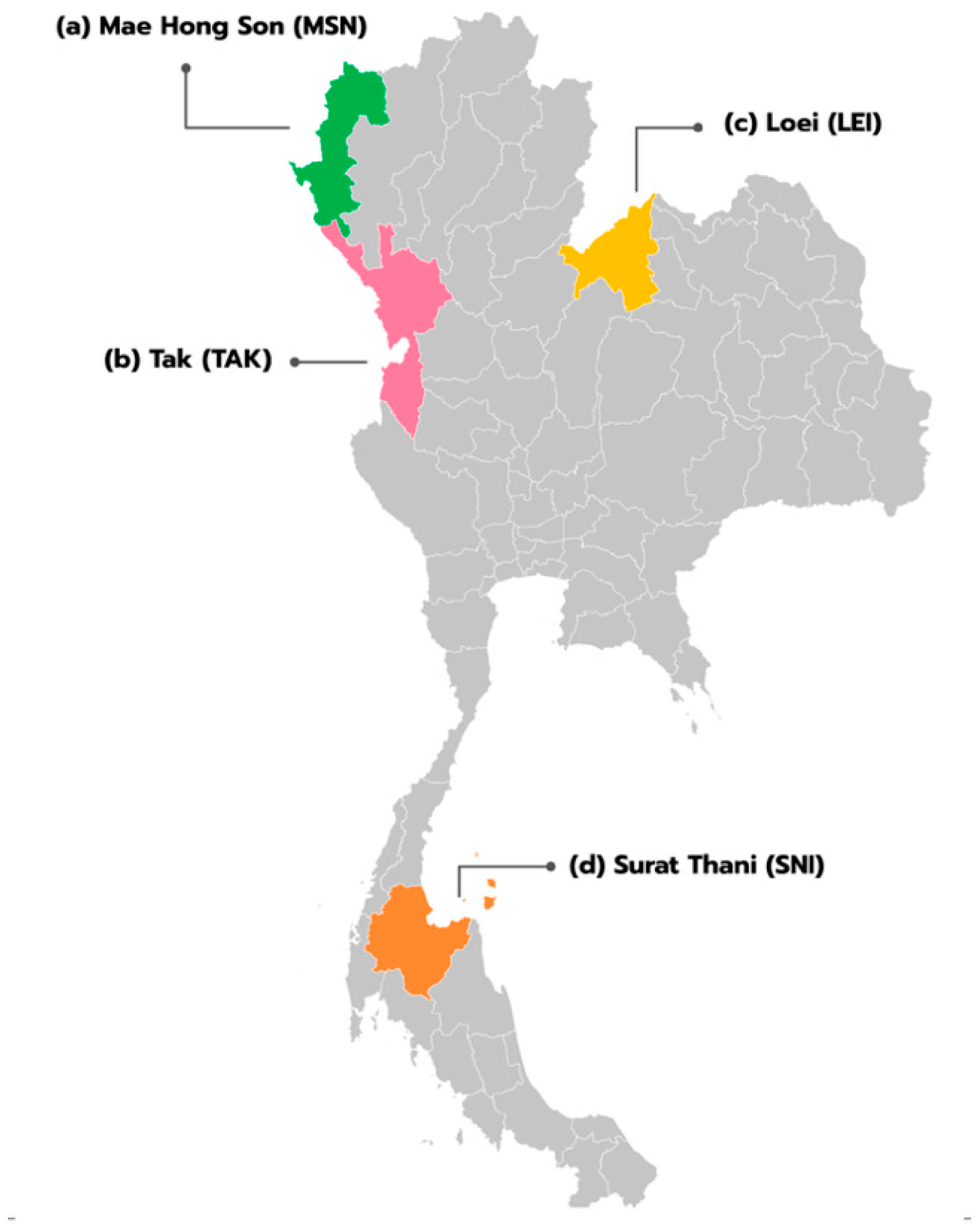
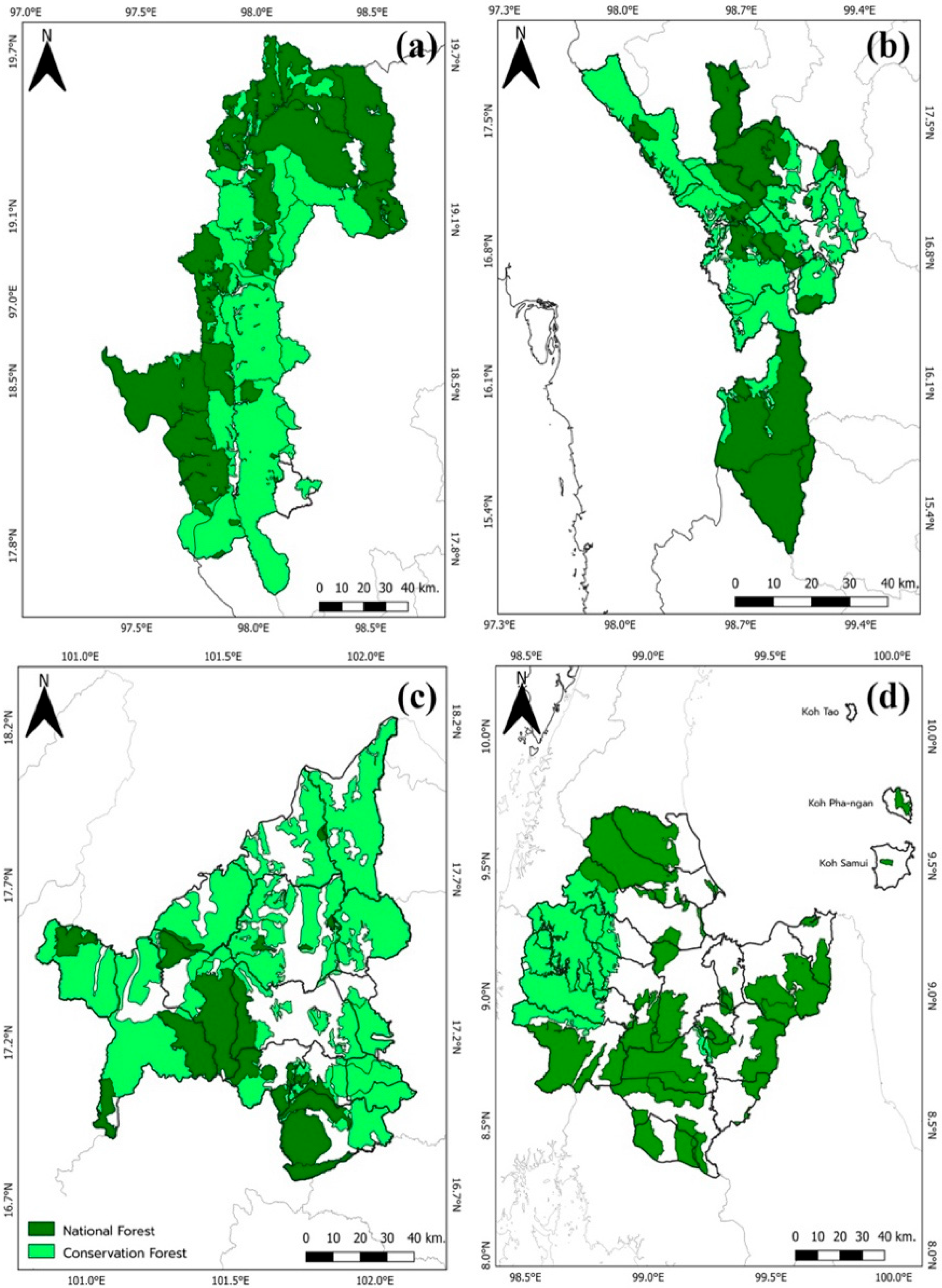
This research undertakes a comparative analysis of four Thai provinces—Mae Hong Son (MSN), Tak (TAK), Loei (LEI), and Surat Thani (SNI)—selected to represent diverse regional contexts (Figure 1 and Figure 2). As detailed in Table 1, MSN and TAK are in the Northern region, LEI in the Northeastern region, and SNI in the Southern region.
Geographically, the provinces show sharp differences despite all having significant forest cover. MSN and LEI are characterized by mountain terrain, which explains the very high forest coverage in MSN, accounting for 86% of its total area. In contrast, TAK and SNI have mixed landscapes of mountains and alluvial or coastal plains. These fundamental geographical differences not only affect land-use patterns and sequestration potential but also create distinct development archetypes central to this study’s analysis.
The provinces show significant socio-economic differences, as detailed in Table 1. MSN, with the smallest population (284,138) and Gross Provincial Product (GPP) per capita (66,300 baht), relies on ecotourism and subsistence farming. LEI is a more developed version of this model, with a similar economic base but a much larger population (642,950) and GPP per capita (100,839 baht). TAK’s economy is mainly based on agriculture, boosted by considerable border trade. In stark contrast, SNI emerges as a major economic center, with the largest population (1,068,010) and a GPP per capita (181,698 baht) nearly triple that of MSN. Its strong economy is fueled by international tourism and SNI’s role as a national hub for palm oil and rubber production.
These quantified differences in geography, economic structure, and population density make these four provinces ideal case studies. They provide a natural experiment for analyzing the divergent drivers of GHG emissions and sequestration, enabling an in-depth examination of various pathways to achieve climate-positive development at a regional level.

2.2. GHG Inventory Quantification

2.2.1. Guiding Frameworks and Scope

The provincial GHG inventory was calculated in accordance with the 2006 IPCC Guidelines for National Greenhouse Gas Inventories [19], supplemented by the reporting principles of the Global Protocol for Community-Scale Greenhouse Gas Emission Inventories (GPC) [20]. This provincial-level focus is important, as sub-national authorities are increasingly seen as key contributors to national climate goals [21,22], supported by GPC’s reporting principles, which are consistent with established methods for urban and regional carbon accounting [23]. The assessment included five sectors: Energy, Transportation, Industrial Processes and Product Use (IPPU), Waste, and Agriculture, Forestry, and Other Land Use (AFOLU).
A key methodological step in this study was splitting the AFOLU sector into two parts: Agriculture and Land Use, Land-Use Change, and Forestry (LULUCF). This split was intentionally planned to clearly identify and report important GHG removals within the LULUCF sector, which is crucial for the main goal of this paper—analyzing pathways to net-negative emissions.
The quantification was conducted using the 2006 IPCC Guidelines at a Tier 1 level. This method was intentionally chosen not only because it aligns with established national reporting but also because it ensures scalability and reproducibility. A primary goal of this study’s Climate-Positive Pathways Framework (CPPF) is to develop a model that other regional governments, especially in the Global South, can easily adopt, where highly localized Tier 2 or Tier 3 data may be very limited. Given the data constraints common in developing countries like Thailand, consistent localized emission factors are often unavailable at the sub-national level. Therefore, this study uses a Tier 1 approach to focus on creating a practical and replicable framework. This ensures that the model remains accessible for regional planners in the Global South, while its scientific validity is confirmed through a rigorous Monte Carlo uncertainty analysis (Section 2.4). While we acknowledge that Tier 1 default factors may not fully capture the high-resolution variability of Thailand’s specific vegetation types, their use allows for a standardized diagnostic model. To address concerns regarding parameter applicability, a sensitivity analysis of key local parameters was conducted, revealing that while absolute values may shift, the relative rankings and the resulting climate-positive archetypes remain robust and consistent across different calibrations. Therefore, this approach emphasizes a practical and accessible framework for regional diagnostics rather than the precision of a data-intensive inventory.

2.2.2. Data Collection and Sources

Activity data for this research were collected from official annual reports and databases maintained by key Thai government agencies and public organizations. For the Energy and Transportation sectors, data on fuel and electricity consumption were obtained from the Department of Energy Business (DOEB), Provincial Electricity Authority (PEA), Energy Regulatory Commission (ERC), and Department of Mineral Fuels (DMF). This was supplemented by transportation-specific data from the Civil Aviation Authority of Thailand (CAAT), the Department of Land Transport (DLT), the Port Authority of Thailand (PAT), the State Railway of Thailand (SRT), and the Marine Department (MD). Industrial production data for the IPPU sector were gathered from the Office of Industrial Economics (OIE) and the Federation of Thai Industries (FTI). For the Waste sector, statistics on municipal solid waste, industrial waste, and wastewater were collected from the Pollution Control Department (PCD), the Department of Local Administration (DLA), the Provincial Public Health Office (PPHO), and the Wastewater Management Authority (WMA).
The comprehensive data needed for the AFOLU sector, which is central to this study, was collected from various specialized sources. Agricultural statistics, such as livestock numbers and crop production, were obtained from the Office of Agricultural Economics (OAE). Importantly, land use and land-use change data were gathered from satellite analysis conducted by the Geo-Informatics and Space Technology Development Agency (GISTDA). This follows methods that enhance the accuracy of carbon emission estimates from tropical deforestation by combining multi-sensor satellite data (e.g., LiDAR, MODIS) with ground-based measurements [24], along with data from the Department of National Parks, Wildlife and Plant Conservation (DNP). Additionally, emission and removal factors were sourced from country-specific values provided by the Thailand Greenhouse Gas Management Organization (TGO) and default values from the 2006 IPCC Guidelines. A summary of these data types and their sources is shown in Table 2.

2.2.3. LULUCF Sector Analysis

The analysis of the LULUCF sector used the Gain-Loss Method as outlined in the 2006 IPCC Guidelines (Volume 4, AFOLU). Quantification was carried out at a Tier 1 level, focusing on the two main carbon pools: above-ground biomass and below-ground biomass. Changes in litter, deadwood, and soil organic carbon pools were assumed to be zero, as carbon stocks in these pools are not expected to change significantly with forest management under a Tier 1 approach [25]. The analysis was broken down into carbon stock changes on land remaining in the same category and changes on land that underwent conversion.
To accurately capture the different carbon dynamics in agricultural lands, a key methodological step was to separate the ‘Cropland Remaining Cropland’ category into two distinct sub-categories. The first, perennial cropland, includes long-term woody crops such as oil palm, rubber, and fruit orchards that build biomass over many years; for this sub-category, biomass gains (∆CG) were calculated using a similar approach to that for forests (Equation (1)). The second, annual cropland, includes crops harvested yearly, such as rice, maize, and cassava; for these lands, the net change in biomass carbon stocks over one year is assumed to be zero, following IPCC good practice.
  • Carbon stock changes on land remaining in the same category:
For Forest Land Remaining Forest Land, the net annual change in carbon stocks ( C F L ) is the difference between gains from growth ( C G , F L ) and losses from removals and disturbances ( C L , F L ). The gain is calculated as:
C G , F L =   i [ A i ×   G W i   ×   1 +   R i ×   C F i
And the loss is calculated as:
C L , F L =   L w o o d r e m o v a l s +   L f u e l w o o d +   L d i s t u r b a n c e
where
i = represents each stratum or forest type;
A i = Area of land, ha;
G W i = Mean annual above-ground biomass growth, tonnes d.m. ha−1 yr−1;
R i = Ratio of below-ground to above-ground biomass;
C F i = Carbon fraction of dry matter for stratum i ;
L w o o d r e m o v a l s = Carbon loss due to wood removals, tonnes C yr−1;
L f u e l w o o d = Carbon loss due to fuel wood removals, tonnes C yr−1;
L d i s t u r b a n c e = Carbon loss due to disturbance, tonnes C yr−1.
  • Carbon stock changes from land conversion:
For Land Converted to Cropland, the change in carbon stock ( C C O N V ) includes the immediate, one-time loss of biomass from the previous land use. This loss is calculated as:
C C O N V =   ( B B E F O R E ×   A C O N V E R T E D ×   C F )
where
B B E F O R E = Biomass stock of the land before conversion, tonnes d.m. ha−1;
A C O N V E R T E D = Area of land converted annually to another category, ha yr−1;
C F = Carbon fraction of dry matter, tonne C (tonne d.m.) −1.
  • Total net change and conversion to CO2eq:
The total net carbon change for the entire LULUCF sector ( C T o t a l ) is the sum of all gains and losses from all land-use categories and conversions analyzed above. This value was then converted to GHG emissions or removals ( G H G L U L U C F ) as shown in Equation (4):
G H G L U L U C F   =   C × ( 44 / 12 )
The negative sign ensures that a net gain in carbon stocks (a positive C T o t a l ) results in a net removal (negative emissions), while a net loss of carbon (a negative C T o t a l ) results in a net emission (positive emissions).

2.3. Analytical Framework: The Climate-Positive Pathways Framework (CPPF)

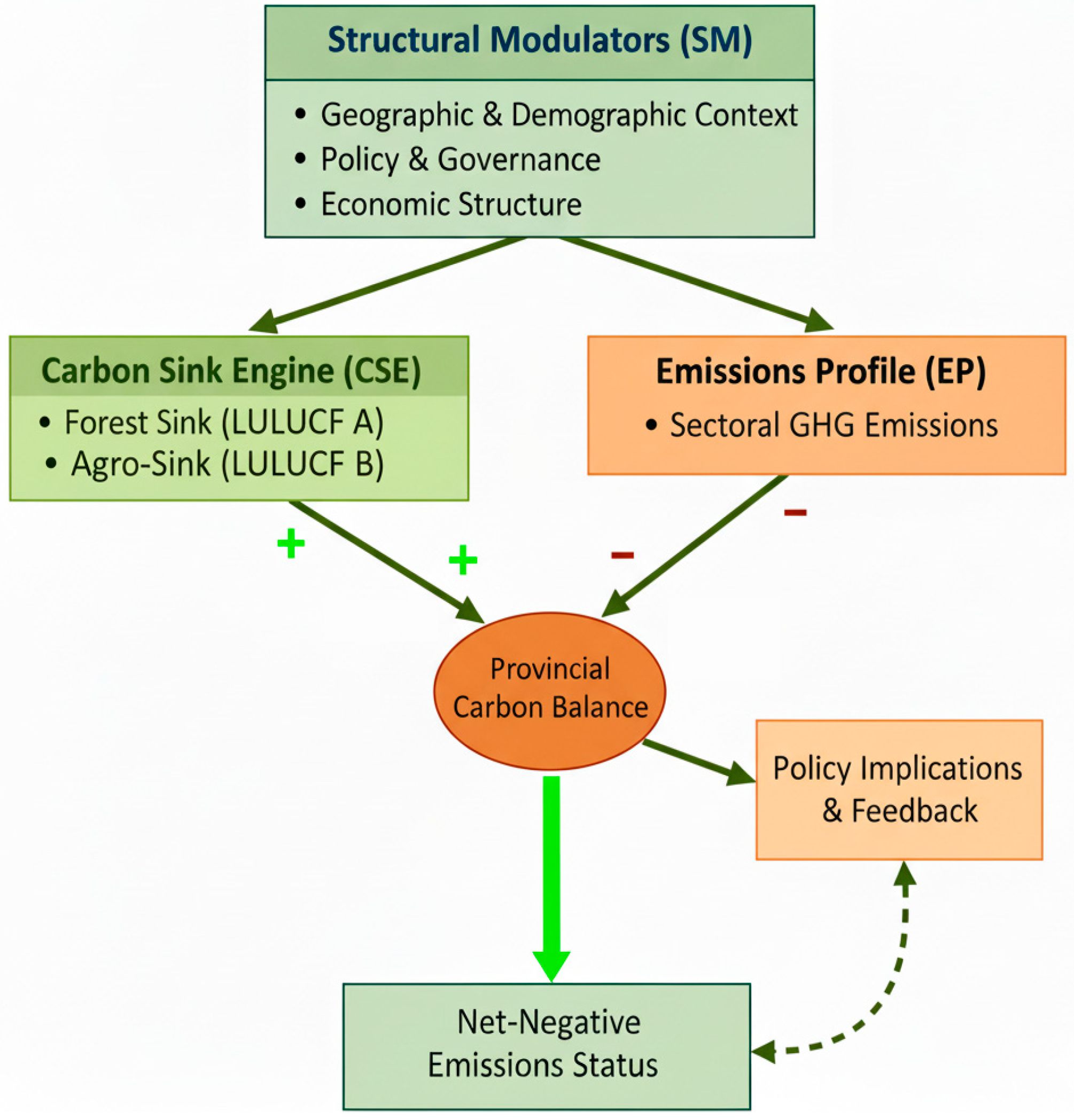
Moving beyond simply quantifying GHG emissions, this research introduces the Climate-Positive Pathways Framework (CPPF) (Figure 3) as an analytical tool to systematically examine the causal mechanisms that allow provinces to reach a net-negative status.
The CPPF is designed as a systems framework. Its foundation consists of the Structural Modulators (SM)—the external geographic, demographic, policy, and economic factors that influence the regional landscape. These modulators define the main components: the Carbon Sink Engine (CSE) and the Emissions Profile (EP). The carbon sink engine represents the total carbon removal capacity, including both the Forest Sink (LULUCF Category A) and the Agro-Sink (LULUCF Category B). Meanwhile, the EP covers all GHG emissions resulting from socio-economic activities.
The interaction between the carbon sink engine (a positive input representing removals) and the emissions profile (a negative input representing sources) determines the overall Provincial Carbon Balance. When the magnitude of the carbon sink engine exceeds that of the emissions profile, the system’s outcome is a Net-Negative Emissions Status. This result, in turn, creates a Feedback Loop, generating policy implications that can influence and change the initial Structural Modulators over time.
A key application of the CPPF in this research is to develop a typology of pathways to a net-negative status. Based on the interaction between the carbon sink engine, the emissions profile, and the structural modulators, we propose three distinct archetypes. These archetypes, introduced as a novel contribution of this study, include: the Conservation-Dependent Archetype, characterized by a low-intensity emissions profile that is easily offset by a large Carbon Sink Engine dominated by natural forests; the Agricultural Frontier Archetype, marked by a conflict between a large, forest-based carbon sink engine and an emissions profile that includes significant emissions from land conversion for agriculture; and the Agro-Sink Archetype, marked by a high-intensity emissions profile that is offset by strong structural modulators, dominated not by forests but by managed agricultural landscapes.

2.4. Uncertainty Analysis

To address the uncertainties inherent in applying IPCC Tier 1 default factors to Thailand’s specific context, a quantitative uncertainty analysis was conducted. The analysis focused on the categories ‘Forest Land Remaining Forest Land’ and ‘Cropland Remaining Cropland,’ as these were identified as the primary drivers of the overall net GHG balance for the provinces.
A Monte Carlo Simulation was used to propagate these uncertainties and produce a probability distribution for net GHG emissions/removals. The main input parameters and their uncertainties are shown in Table 3. Each parameter’s uncertainty was modeled with a triangular probability distribution, defined by a minimum, maximum, and most likely value.
For each parameter, the most likely value was set to the IPCC default used in the main analysis. The minimum and maximum values were then determined based on the uncertainty ranges provided in the IPCC 2006 Guidelines (Volume 4). For example, a default value with a specified uncertainty of ±50% was used to establish the lower and upper bounds of the distribution. This approach to explicitly quantify parameter uncertainty aligns with best practices for improving the robustness of GHG inventories in the AFOLU sector, where the importance of such analyses has been highlighted in the recent literature [26].

3. Results

3.1. Overall GHG Balance Confirms Net-Negative Status

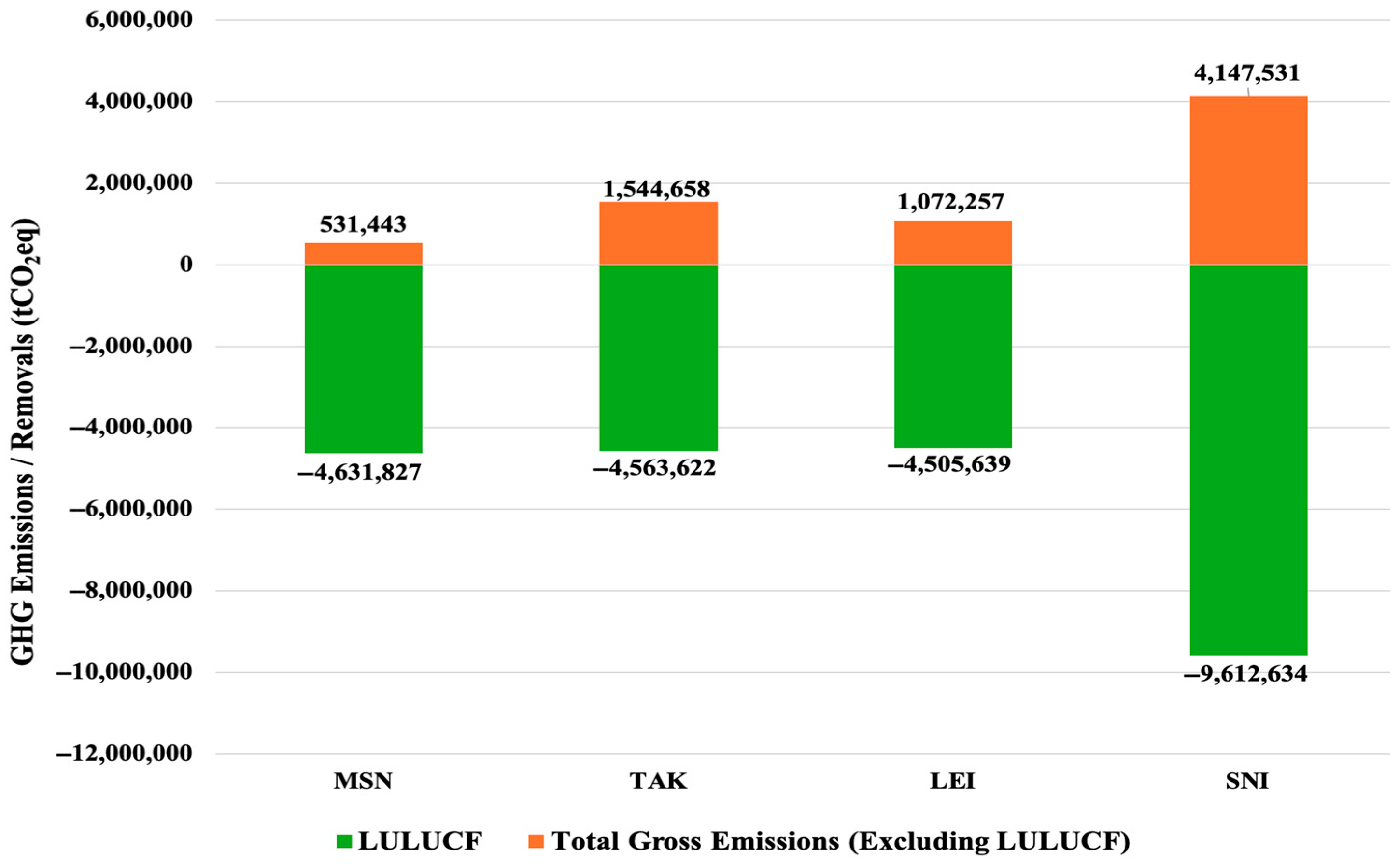
The main finding of this study is that all four provinces acted as significant net GHG sinks during the baseline year. This result, that regional carbon removals exceed all human-made emissions, underscores the potential for climate-positive growth. The dynamics of this balance are illustrated in Figure 4, which displays the two opposing forces for each province: total gross emissions and LULUCF removals.
On the emissions side, the scale of economic activity varied significantly. SNI was the largest emitter, producing 4.15 million tCO2eq. TAK followed with 1.54 million tCO2eq, and LEI emitted 1.07 million tCO2eq. MSN had the smallest emissions profile, generating only 0.53 million tCO2eq, roughly an eighth of SNI’s.
On the removals side, the LULUCF sector in all provinces served as a strong carbon sink. Surat Thani’s landscape demonstrated an exceptional ability to remove −9.61 million tCO2eq—about three times more than the other provinces. This exceptional removal capacity is primarily attributed to the province’s extensive perennial agricultural landscapes, specifically large-scale oil palm and rubber plantations, which function as significant carbon sinks. A detailed disaggregation of these drivers and their implications is provided in Section 3.3 and further explored in the Agro-Sink archetype discussion (Section 4.3). The other three provinces had significant and similarly sized removal capacities: MSN at −4.63 million tCO2eq, TAK at −4.56 million tCO2eq, and LEI at −4.51 million tCO2eq.
Crucially, when these two forces are combined, the magnitude of LULUCF removals significantly exceeds the gross emissions in every case. This results in a substantial climate-positive net balance for each province, reaffirming their status as regional net sinks.

3.2. Contrasting Sectoral Emissions Profiles

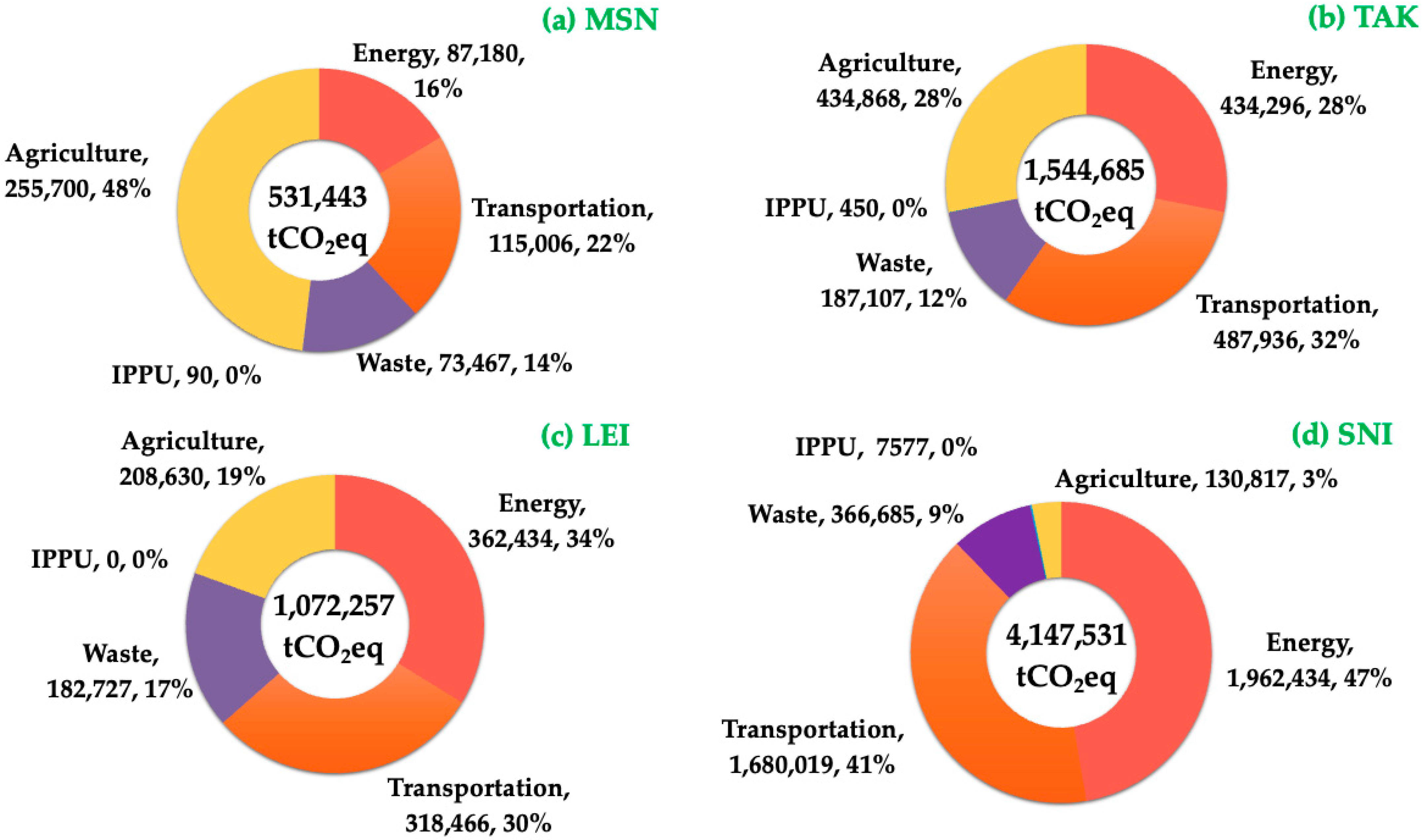
The sectoral breakdown of gross emissions, shown in Figure 5, highlights different economic drivers and activity levels among the four provinces. SNI clearly stands out with the highest emissions, totaling 4.15 million tCO2eq. Its economic structure, heavily dependent on international tourism and transportation logistics, is directly reflected in its emissions profile. The majority of emissions come from the Energy sector (1.96 million tCO2eq, 47%) and the Transportation sector (1.68 million tCO2eq, 41%). Together, these two sectors represent 88% of the province’s total gross emissions, aligning SNI’s emissions pattern with regional trends that identify energy and transport as primary targets for climate mitigation in Southeast Asia [27]. In contrast, the agricultural sector contributes only 3%. In stark contrast, MSN represents a fundamentally different, land-based economic model with the lowest overall emissions at 0.53 million tCO2eq. Its profile is the inverse of SNI’s; the agriculture sector is the single largest contributor (0.26 million tCO2eq, 48%), primarily from livestock and crop cultivation. Emissions from Transportation (22%) and Energy (16%) in MSN are significant but secondary, indicating a smaller-scale, lower-intensity economy.
The provinces of TAK and LEI present intermediate and more diversified emissions profiles, with gross emissions of 1.54 and 1.07 million tCO2eq, respectively. In TAK, emissions are led by the Transportation sector (0.49 million tCO2eq, 32%), reflecting its role as a border trade hub, followed closely by Agriculture (28%) and Energy (28%). Loei’s profile is also mixed, with the Energy (34%) and Transportation (3%) sectors being the primary sources, but with a still-significant contribution from Agriculture (19%). These varied profiles provide quantitative evidence that the provinces operate under fundamentally different development pathways.

3.3. Disaggregation of the Carbon Sink Engine (CSE)

A detailed disaggregation of the LULUCF sector, presented in Table 4, reveals that the provinces achieve their sink status through fundamentally different land-based mechanisms, which can be classified into three distinct archetypes.
The most notable finding originates from the Agro-Sink Archetype, best exemplified by SNI, where the landscape functions as a significant, human-managed carbon reservoir. The province’s large removal capacity is primarily driven not by its forests but by its agricultural lands. The ‘Cropland Remaining Cropland’ (Category C) alone sequesters a substantial −5.8 million tCO2eq, making it more than 3.5 times as effective as the entire forest sink in the province (Category A, −1.6 million tCO2eq). Additionally, ‘Land Converted to Cropland’ (Category D) acts as a significant net sink, absorbing −2.2 million tCO2eq. It is important to recognize that the current net removal capacity of these agricultural landscapes does not include the historical carbon debt from the initial forest-to-cropland conversion. However, in mature systems like those in SNI, decades of biomass accumulation in perennial stands have largely offset these initial losses. While natural forests provide better long-term carbon stability, the high rates of annual sequestration in these managed perennial landscapes demonstrate strong carbon performance during their productive life cycles. This is directly explained by the land-use dynamics shown in Table 5. SNI uniquely shows an increasing trend in forest area (+0.130 per year) and overall cropland area (+0.01% per year). This indicates a strategic shift toward highly productive, high-biomass perennial crops, forming the core of its Agro-Sink. The climate mitigation benefit of these ‘Agro-Sinks’ stems from the continuous accumulation of woody biomass. Unlike annual crops, most of the carbon stored in rubber and oil palm resides in the standing trunk and roots, which remain intact for 25–30 years. The yearly harvest of latex or fruit accounts for only a small part of the total net primary production; therefore, the net ecosystem carbon budget remains positive throughout the plantation’s productive lifespan until the final harvest and replanting. LEI shows a similar, though less pronounced, pattern, where its combined cropland sink (approximately −3.04 million tCO2eq) is also the main removal component, greatly surpassing its forest sink (−1.55 million tCO2eq).
In direct contrast, the Conservation-Dependent Archetype, represented by MSN, follows a more conventional pathway. Its carbon sink is unequivocally dominated by its extensive, intact forests. ‘Forest Land Remaining Forest Land’ (Category A) accounts for nearly all of its net removals at −4.9 million tCO2eq, while its agricultural lands play a negligible role in sequestration. However, this reliance on forests is precarious. The province’s forest area is decreasing at a rate of 0.22% per year (Table 5), which underscores the vulnerability of this Conservation-Dependent pathway.
Finally, the Agricultural Frontier Archetype, exemplified by TAK, illustrates a third, more precarious pathway characterized by an underlying conflict between conservation and development. While the province boasts the largest absolute forest sink in the study (−5.6 million tCO2eq from Category A), this powerful removal engine is being actively counteracted by the single largest source of land-use change emissions. ‘Land Converted to Cropland’ (Category D) in Tak generated over +0.95 million tCO2eq. This conflict is quantitatively confirmed by the data in Table 5, which shows Tak having the highest rate of cropland expansion (+1.39% per year) among the four provinces. This demonstrates a precarious balance between a powerful natural sink and intense pressure from agricultural expansion.
The data in Table 6 quantifies the composition of agricultural landscapes and directly explains the mechanism behind the “Agro-Sink” phenomenon. In SNI, the landscape is overwhelmingly dominated by perennial cropland, which remained stable throughout the six-year period. This dominance provides the quantitative basis for its powerful cropland sink, which was found to be 3.5 times larger than its forest sink. It is important to clarify that this sink capacity is derived from net annual carbon flux calculations using the IPCC Gain-Loss Method, not merely from land area measurements. This flux-based approach specifically accounts for the annual biomass increment (growth) while subtracting annual losses from harvesting (e.g., latex and oil palm fruit) and natural mortality. The resulting net-negative values confirm that the annual sequestration in the structural woody biomass of these perennial systems significantly outweighs the carbon exported through harvest.
LEI shows a similar, though less intense, pattern. Its notable cropland sink,1.7 times larger than its forest sink, is also caused by perennial agriculture. Importantly, Table 6 highlights a dynamic land-use change in LEI, with a clear trend of increasing perennial cropland (+0.37% per year) happening alongside a decrease in annual cropland (−0.11% per year). This indicates an ongoing shift in agricultural practices toward perennial cultivation in the province.
To verify the stability of the identified climate-positive pathways and account for potential inter-annual fluctuations, a dynamic analysis of multi-year land-use data (2014–2019) was conducted (see Table 5 and Table 6). This longitudinal data reveals consistent land-use trends across all four provinces, suggesting that the identified archetypes—particularly the Agro-Sink in SNI and LEI—are not the result of single-year anomalies but are driven by stable, multi-decadal perennial agricultural systems. The steady growth of perennial cropland area in LEI (+0.37% per year) and the sustained dominance of oil palm and rubber in SNI provide evidence of the long-term sequestration potential and the robustness of these regional pathways.

3.4. Uncertainty Analysis Results

The net GHG emissions and removals for the LULUCF sector across the four provinces are presented in Table 7. The results from the Monte Carlo simulation confirmed the deterministic calculations across all four provinces, identifying each as a significant net sink for GHG emissions. MSN and TAK were found to be the largest sinks, with mean annual removals of approximately −5.0 and −5.7 million tCO2eq/yr, respectively. LEI and SNI also demonstrated substantial carbon removal capacities, with mean values of approximately −4.1 and −7.4 million tCO2eq/yr, respectively. The consistency between the deterministic results and the mean values from the Monte Carlo simulation demonstrates the robustness of the finding that all four provinces act as significant net sinks in the LULUCF sector, even when the uncertainties of the IPCC Tier 1 default factors are considered.

3.5. Comparative Synthesis of the Provincial Climate-Positive Pathways

To synthesize the findings, all inventory results and socio-economic data were consolidated and analyzed through the CPPF, as detailed in Table 8. The analysis provides quantitative confirmation of the existence of distinct archetypes of regional climate-positive development.
The analysis of the carbon sink engine reveals a fundamental dichotomy in sequestration mechanisms. The pathways in MSN and TAK are unequivocally dependent on their vast forests; the ‘Forest Sink’ (LULUCF A) is the primary driver of removals in both. In stark contrast, the sequestration capacity of SNI and LEI is dominated by the ‘Agro-Sink’ (LULUCF B). This effect is most pronounced in SNI, where the Agro-Sink (−5.8 million tCO2eq) is nearly 3.5 times more powerful than its forest sink.
The emissions profile also shows significant variation. SNI’s gross emissions (4.1 million tCO2eq) are an order of magnitude larger than MSN’s (0.53 million tCO2eq), reflecting their disparate economic scales. The Sink-to-Source Ratio, defined here as the ratio of forest sink capacity (LULUCF A) to gross emissions, further highlights these differences. MSN’s forests are powerful enough to offset its emissions 8.4 times over. Conversely, SNI’s forests can only offset 40% (a 0.4 ratio) of its massive emissions profile, underscoring its critical reliance on the Agro-Sink to achieve a net-negative balance.
These divergent pathways are strongly correlated with the structural modulators. The high GPP per capita (181,698 baht) and population density (83 persons/km2) in SNI are consistent with its service-driven, high-emission profile. Conversely, MSN’s low GPP and population density align with its conservation-dependent model. Furthermore, land-use pressure is evident in TAK, which exhibits the highest rate of cropland expansion (+1.39%), corresponding to its significant emissions from land conversion. Collectively, these results provide a quantitative evidence base for the three distinct archetypes of climate-positive development.

4. Discussion

The analysis from the Climate-Positive Pathways Framework (CPPF) (Table 8) does not present a single solution for regional climate action. Instead, it reveals a typology of three distinct, real-world archetypes for achieving net-negative emissions, each occurring in a different development context. Each archetype is the result of a unique interplay between its landscape (the carbon sink engine), economic structure (the emissions profile), and its underlying geographic and policy context (the structural modulators).

4.1. The Conservation-Dependent Archetype

This pathway represents the most conventional model. MSN achieves its climate-positive status by leveraging a powerful and vast Forest Sink (−4.5 million tCO2eq), which easily outweighs a small Emissions Profile (0.53 million tCO2eq) resulting from its low-intensity, agriculture-based economy. This model is enabled by the favorable structural modulators, such as the province’s lowest population density (22 persons/km2) and mountainous terrain that naturally limits intensive development. However, this model is inherently vulnerable as it relies on a single asset, its forests. The observed trend of continuous forest area decline (−022% per year) is a critical warning sign. Without robust conservation policies and the creation of sustainable economic alternatives for local communities, this pathway may not be resilient to future development pressures. This pathway may not be resilient to future development pressures, a known vulnerability of tropical forest protected areas worldwide [28].

4.2. The Agricultural Frontier Archetype

A province’s net-sink status is directly threatened by massive emissions from land conversion to cropland, reflecting a global trend where tropical forests are the primary source of new agricultural land [29]. TAK represents a pathway defined by a “conflict” between conservation and development. The province possesses the most potent Forest Sink in this study (−5.5 million tCO2eq), yet this powerful engine is simultaneously being eroded by the very economic activities it supports. The province’s Emissions Profile is driven by both transportation (from border trade) and agriculture, and its net-sink status is directly threatened by massive emissions from land conversion to cropland (approximately 0.95 million tCO2eq).
This archetype signifies a critical point in regional development. The highest cropland expansion rate (+1.39% annually)—mainly driven by the growth of annual crops—demonstrates a model that is depleting its natural resources, fueled by the economic pressures of global land use change [30]. The main policy question for this pathway is not just about conservation but about how to achieve Sustainable Agricultural Intensification [31]—boosting yields on current land to prevent further expansion into forested areas.

4.3. The Agro-Sink Archetype

This is the most novel and most significant pathway identified in this study, exemplified by both SNI and, to a lesser extent, LEI. In this archetype, the primary engine of carbon removal is not a natural forest, but a human-managed agricultural landscape, a phenomenon supported by global assessments of carbon stocks on agricultural land [32].
The phenomenon is most evident in SNI, where the Agro-Sink is enormous. Its ‘Cropland Remaining Cropland’ category alone removes −9.6 million tCO2eq, a sink large enough to easily counterbalance the province’s significant Emissions Profile (4.1 million tCO2eq), driven by a high-GPP, service- and tourism-based economy, a finding consistent with studies on the net carbon balance of perennial plantations like oil palm [33,34]. This net-negative status is especially notable in mature perennial systems. While annual harvesting of products like latex or palm oil fruit exports carbon, it accounts for only a small share of the overall net primary production. Most of the sequestered carbon is stored long-term in the structural woody biomass and extensive root systems of these species. However, it is important to address the issue of carbon permanence in these managed systems. Unlike natural forests, which provide long-term stable storage, economic crops like rubber and oil palm have a fixed rotation cycle (e.g., 20–25 years). While the annual flux (sequestration rate) of these crops might be high during their growth phase, they do not offer the same long-term carbon storage stability as natural forests due to harvest and replanting cycles. Therefore, the landscape-level sink stability of the Agro-Sink depends on staggered replanting and sustainable management to prevent large-scale carbon release during harvest. Beyond biomass accumulation, the sustainability of the Agro-Sink is deeply linked to soil organic carbon (SOC) stocks and crop management practices. In perennial systems like rubber and oil palm, the absence of annual tilling allows for the stabilization of soil carbon pools. Furthermore, specific management practices common in these mature plantations—such as the application of organic mulch from pruned fronds and the maintenance of ground cover crops—enhance SOC sequestration and improve soil structure. While our current Tier 1 inventory focuses on biomass, these management-driven soil carbon benefits represent a significant, additional carbon pool that strengthens the long-term climate-mitigation potential of the Agro-Sink archetype. In these established landscapes, the annual increase in standing biomass consistently exceeds operational losses and natural mortality, resulting in a positive net ecosystem carbon budget. In SNI, the landscape is characterized by stable, long-standing perennial plantations. While the initial conversion of natural forests to agriculture historically incurred a ‘carbon debt,’ the current net-negative balance indicates that these mature systems have surpassed the compensation point, where ongoing annual sequestration now exceeds any residual emissions from historical land-use change. This is further supported by our data showing minimal recent forest-to-cropland conversion in the province (Table 5). LEI reinforces this finding, albeit on a different scale; its cropland sink (−2.6 million tCO2eq) is also the dominant component of its carbon removal engine, substantially outweighing its forest sink (−1.5 million tCO2eq). This demonstrates that the Agro-Sink model can manifest even in provinces with more traditional, agriculture-focused economies.
The transition between these three climate-positive pathways depends on specific critical points and policy interventions. A province may shift from a precarious Agricultural Frontier to a stable Agro-Sink when the rate of perennial crop expansion consistently outweighs the conversion of natural forests, effectively ‘closing’ the frontier through intensified, high-biomass agriculture. Key interventions to facilitate this transition include land-use zoning that protects remaining primary forests while providing financial incentives for farmers to switch from annual crops (e.g., maize) to long-term perennial stands (e.g., rubber or fruit trees). Conversely, a Conservation-Dependent province faces a ‘tipping point’ if forest loss exceeds a critical threshold where the remaining sink engine can no longer offset local emissions. To prevent this, interventions must focus on community-based forest management and payment for ecosystem services (PES) to stabilize the natural sink before the province regresses into a net-emissions status.
This pathway challenges the traditional paradigm that agriculture is purely an emissions source. It suggests that a strategic shift towards high-biomass perennial agriculture can be a powerful climate mitigation tool, representing a real-world application of the Bio-Circular-Green (BCG) economy model. The land-use transition observed in provinces like Loei, where perennial cropland is expanding at the expense of annual cropland (Table 5), provides empirical evidence of this ongoing shift towards crops like rubber. This climate-positive pathway, however, is not without significant ecological caveats. A fundamental trade-off of the Agro-Sink model is the low biodiversity inherent in large-scale perennial monocultures (e.g., oil palm, rubber) compared to the natural forest ecosystems they often replace. Reconciling the goals of carbon sequestration and biodiversity conservation is therefore the central sustainability challenge for this pathway [35]. A stronger policy recommendation regarding biodiversity safeguards is needed here. Promoting monoculture plantations purely for carbon benefits as a ‘cleaner production’ strategy risks significant biodiversity loss. The Agro-Sink model should not be seen as a justification for converting natural forests to agricultural land, which cannot be accepted as a positive climate strategy. Instead, regional policies must prioritize polyculture, agroforestry, or the integration of native species within agricultural landscapes to mitigate these ecological trade-offs. Therefore, the challenge for this model is to manage these Agro-Sinks to optimize benefits across both carbon and biodiversity dimensions. These results show that an effective regional climate strategy must expand beyond traditional forest management to include the active management of perennial croplands. This means recognizing crops like oil palm and rubber not only as key economic drivers but also as significant, human-managed carbon sinks.

4.4. Implications for Cleaner Production and Regional Sustainability

The findings of this study necessitate a significant expansion of the traditional cleaner production concept, moving its application from the conventional scale of a firm or factory to the broader scale of a regional landscape. Historically, Cleaner production has focused on source reduction and process efficiency to minimize negative outputs (e.g., waste, pollution, GHG emissions) per unit of product. Our results demonstrate how the cleaner production principles can be applied at a systemic level to design entire regional economies that are not just “less polluting” but fundamentally climate-positive. This requires a shift towards a systems approach to sustainability and resilience [36,37].
The Agro-Sink Archetype offers a paradigm-shifting example of this expanded approach, representing a distinct pathway of sustainability transition [38]. In this model, the “production system” is the provincial agricultural economy itself. The strategic choice to cultivate high-biomass perennial crops represents a systemic cleaner production strategy where the landscape is intentionally managed for both economic production and the co-benefit of massive carbon sequestration. This directly integrates the economy with a crucial ecosystem service, embodying the principles of a Bio-Circular-Green (BCG) economy and challenging the paradigm that agricultural landscapes are solely sources of emissions.
In contrast, the Conservation-Dependent Archetype represents a cleaner production strategy of systemic avoidance and integration with natural capital. The “cleanest” form of production is the development that is foregone to preserve the forest sink, with the economy leveraging the value of the intact ecosystem through services like ecotourism. Conversely, the Agricultural Frontier Archetype illustrates a failure of systemic cleaner production, where short-term production gains (cropland expansion) lead to the degradation of the natural capital (the forest sink) that underpins long-term regional sustainability.
Ultimately, this research redefines what a “sustainable region” can be. It moves beyond the goal of simply mitigating local environmental impacts and provides real-world evidence of regions that function as net providers of a global public good: carbon removal. This presents a new frontier for regional sustainability planning, but one that requires careful management of its inherent trade-offs, particularly the optimization of landscapes for both carbon sequestration and biodiversity conservation.

4.5. Policy Recommendations for Each Pathway

The clear differentiation between the three archetypes underscores that a one-size-fits-all climate policy would be ineffective. Instead, interventions must be tailored to the specific opportunities and vulnerabilities inherent in each pathway.
For the Conservation-Dependent Pathway (e.g., MSN), the primary challenge is to create economic value from intact forests to counter the pressures of gradual deforestation. Therefore, policy should focus on monetizing the ecosystem services provided by the landscape. Implementing international and national mechanisms such as REDD+ (Reducing Emissions from Deforestation and Forest Degradation) and developing formal Payments for Ecosystem Services (PES) schemes are critical [39,40,41]. These programs can provide direct financial incentives to provincial and local communities for their role as stewards of a globally significant carbon sink, a role reinforced by Thailand’s long history with community forestry legislation and strongly aligned with national strategies linking community-based management to net-zero goals under the BCG model. However, we explicitly state a limitation regarding the use of IPCC Tier 1 default factors in this framework. While acceptable for a general diagnostic tool, using these defaults to propose specific financial interventions like PES schemes or carbon markets carries inherent risks. Site-specific emission factors (Tier 2) would be necessary before implementing actual financial mechanisms, as tropical biomass growth rates can vary significantly from global defaults. Furthermore, policies should aim to enhance and scale up sustainable, forest-friendly livelihoods, such as certified ecotourism and the marketing of non-timber forest products [42], to create a diversified local economy that is synergistic with conservation goals, while ensuring that benefits are equitably shared among local communities.
For the Agricultural Frontier Pathway (e.g., TAK), the core issue is the direct conflict between agricultural expansion and forest preservation. Policy interventions must therefore focus on decoupling agricultural production from deforestation. The most urgent priority is to promote Sustainable Agricultural Intensification. This involves providing technical and financial support for farmers to adopt practices—such as agroforestry, precision agriculture, and higher-yield crop varieties—that increase productivity on existing farmland, thereby reducing the economic imperative to clear new land. This “push” strategy must be complemented by a “pull” strategy of strengthened land-use zoning and enforcement. Establishing clear, legally binding boundaries for agricultural expansion, monitored with remote sensing technologies, is essential to protect remaining forest areas.
For the Agro-Sink Pathway (e.g., SNI and LEI), the challenge is to maintain and enhance the carbon sequestration benefits of its agricultural landscapes while mitigating the negative externality of low biodiversity. Policies should be designed to optimize plantations for both carbon and ecological co-benefits. This could include incentivizing practices such as intercropping with native species, maintaining forest corridors between plantation blocks, and protecting riparian zones. Critically, there is a major opportunity to develop a Verified Carbon Standard for Perennial Crops. Establishing a formal Measurement, Reporting, and Verification (MRV) system would allow these “agro-sinks” to participate in national or international carbon markets. Critically, the transition from this regional diagnostic toward formal financial participation requires a shift from Tier 1 to Tier 2 or Tier 3 data. High-precision, localized monitoring is essential to ensure that the carbon credits generated are scientifically robust and reflect the actual sequestration performance of specific tropical plantations. This would create a direct financial incentive for plantation owners to adopt management practices that maximize long-term carbon storage, transforming a conventional agricultural product into a dual-yield climate solution. Critically, for provinces like SNI with a large transport and energy emission profile, a parallel policy track focusing on aggressive technological decarbonization must complement the land-use strategy. This includes implementing strong fiscal incentives for the adoption of electric mobility and updating urban planning to promote less car-dependent travel, mirroring strategies found in cities committed to urban net-zero transport [43].

4.6. Limitations and Future Research

While this study provides a novel framework and a crucial provincial-level GHG baseline, several limitations that open up important avenues for future research should be acknowledged [44]. Firstly, the quantification was conducted using a Tier 1 methodology, which relies on default factors and thus has a greater degree of uncertainty than higher-tier methods. Secondly, this research provides a static snapshot from a single baseline year and does not capture inter-annual variability. Finally, the scope of this study is primarily focused on the technical and biophysical assessment. It does not deeply analyze the socio-political challenges of implementation, particularly the alignment of abstract climate goals with the concrete livelihood priorities of local communities. Securing community participation for maintaining these carbon sinks is contingent upon demonstrating clear economic benefits, effectively linking conservation to household incomes.
Building upon these limitations, we propose several key directions for future research. First, a longitudinal study is essential to understand the resilience of these climate-positive pathways over time. Second, future work should aim to refine the inventory using Tier 2 or Tier 3 methods to reduce uncertainty. Third, a detailed economic valuation of the sequestration services is needed to properly design the PES and Thailand Voluntary Emission Reduction Program (T-VER) schemes previously discussed. This reflects the practical challenges of transition management [45]. Lastly, and crucially, research should employ socio-political and participatory methods to explore viable models for community-based carbon management. Investigating how financial mechanisms can be designed to ensure equitable benefit-sharing is essential for the long-term social acceptance and sustainability of these “Carbon Sink Engines.”

5. Conclusions

This research shows that reaching a regional-scale, net-negative emissions status involves multiple pathways instead of a single approach. By introducing the Climate-Positive Pathways Framework (CPPF), this study highlights three transferable archetypes: the Conservation-Dependent model, the Agricultural Frontier, and the innovative Agro-Sink model. Most importantly, the Agro-Sink pathway demonstrates that managed agricultural landscapes can serve as a key driver for carbon removal, challenging the traditional view that agriculture is only a source of emissions.
The clear distinction between these pathways clearly shows that effective climate policies and cleaner production methods need to be specific to each context. Moving away from one-size-fits-all approaches, regional planners must customize interventions—from monetizing ecosystem services in areas dependent on conservation to resolving land-use conflicts on agricultural frontiers. However, these strategies must be applied carefully; the long-term success of agricultural sinks relies on balancing sequestration objectives with biodiversity protection and ensuring carbon permanence. Ultimately, the CPPF allows regions, especially in the Global South, to strategically utilize their unique natural and agricultural resources, transforming their landscapes into global assets for carbon removal.

Author Contributions

Conceptualization, R.K. and S.S.; Methodology, R.K. and S.S.; Software, R.K. and S.S.; Formal Analysis, R.K.; Investigation, R.K.; Data Curation, R.K.; Writing—Original Draft Preparation, R.K.; Writing—Review and Editing, S.H.G.; Visualization, R.K.; Supervision, S.S. All authors have read and agreed to the published version of the manuscript.

Funding

This research received no external funding.

Institutional Review Board Statement

Not applicable.

Informed Consent Statement

Not applicable.

Data Availability Statement

The data presented in this study are available within the article.

Acknowledgments

The authors would like to express their gratitude to the Thailand Greenhouse Gas Management Organization (Public Organization), the Research Unit for Energy Economic & Ecological Management, and Chiang Mai University for their valuable support and for providing essential data for this study.

Conflicts of Interest

The authors declare no conflicts of interest.

References

  1. Rockström, J.; Gaffney, O.; Rogelj, J.; Meinshausen, M.; Nakicenovic, N.; Schellnhuber, H.J. A roadmap for rapid decarbonization. Science 2017, 355, 1269–1271. [Google Scholar] [CrossRef]
  2. Intergovernmental Panel on Climate Change. Climate Change 2023: Synthesis Report. Contribution of Working Groups I, II and III to the Sixth Assessment Report of the Intergovernmental Panel on Climate Change; Lee, H., Romero, J., Eds.; IPCC: Geneva, Switzerland, 2023; Available online: https://www.ipcc.ch/report/ar6/syr/ (accessed on 12 November 2025).
  3. United Nations Framework Convention on Climate Change. The Paris Agreement; UNFCCC: Bonn, Germany, 2015; Available online: https://unfccc.int/process-and-meetings/the-paris-agreement (accessed on 12 November 2025).
  4. Al Khaffaf, I.; Tamimi, A.; Ahmed, V. Pathways to carbon neutrality: A review of strategies and technologies across sectors. Energies 2024, 17, 6129. [Google Scholar] [CrossRef]
  5. Rogelj, J.; den Elzen, M.; Höhne, N.; Fransen, T.; Fekete, H.; Winkler, H.; Schaeffer, R.; Sha, F.; Riahi, K.; Meinshausen, M. Paris Agreement climate proposals need a boost to keep warming well below 2 °C. Nature 2016, 534, 631–639. [Google Scholar] [CrossRef]
  6. Fuss, S.; Lamb, W.F.; Callaghan, M.W.; Hilaire, J.; Creutzig, F.; Amann, T.; Minx, J.C. Negative emissions—Part 2: Costs, potentials and side effects. Environ. Res. Lett. 2018, 13, 063002. [Google Scholar] [CrossRef]
  7. Intergovernmental Panel on Climate Change. Global Warming of 1.5 °C. An IPCC Special Report on the Impacts of Global Warming of 1.5 °C Above Pre-Industrial Levels and Related Global Greenhouse Gas Emission Pathways, in the Context of Strengthening the Global Response to the Threat of Climate Change, Sustainable Development, and Efforts to Eradicate Poverty; IPCC: Geneva, Switzerland, 2018; Available online: https://www.ipcc.ch/sr15/ (accessed on 12 November 2025).
  8. Anderson, K.; Peters, G. The trouble with negative emissions. Science 2016, 354, 182–183. [Google Scholar] [CrossRef]
  9. Harris, N.L.; Gibbs, D.A.; Baccini, A.; Birdsey, R.A.; de Bruin, S.; Farina, M.; Fatoyinbo, L.; Hansen, M.C.; Herold, M.; Houghton, R.A.; et al. Global maps of twenty-first century forest carbon fluxes. Nat. Clim. Change 2021, 11, 234–240. [Google Scholar] [CrossRef]
  10. Satterthwaite, D. Cities’ contribution to global warming: Notes on the allocation of greenhouse gas emissions. Environ. Urban. 2008, 20, 539–549. [Google Scholar] [CrossRef]
  11. Bai, X.; Dawson, R.J.; Ürge-Vorsatz, D.; Delgado, G.C.; Barau, A.S.; Dhakal, S.; Dodman, D.; Leonardsen, L.; Masson-Delmotte, V.; Roberts, D.C.; et al. Six research priorities for cities and climate change. Nature 2018, 555, 23–25. [Google Scholar] [CrossRef] [PubMed]
  12. Tyukavina, A.; Hansen, M.C.; Potapov, P.; Krylov, D.V.; Stehman, S.V.; Tucker, C.J. Aboveground carbon loss in globally significant forest degradation landscapes. Environ. Res. Lett. 2015, 10, 074002. [Google Scholar] [CrossRef]
  13. Meyfroidt, P.; Lambin, E.F.; Erb, K.H.; Hertel, T.W. Globalization of land use: Distant drivers of land change and geographic displacement of land use. Curr. Opin. Environ. Sustain. 2013, 5, 438–444. [Google Scholar] [CrossRef]
  14. DeFries, R.S.; Rosenzweig, C. Toward a whole-landscape approach for sustainable land use in the tropics. Proc. Natl. Acad. Sci. USA 2010, 107, 19627–19632. [Google Scholar] [CrossRef]
  15. Liu, R.; Liao, F.; Qin, Q. China’s provincial long-term carbon emissions reduction planning considering fairness, efficiency and gradualness: A multi-objective programming approach. J. Environ. Manag. 2025, 387, 125856. [Google Scholar] [CrossRef]
  16. Li, H.; Yang, S.; Chen, A.; Li, F.; Gao, W.; Cui, J.; Chen, Y. Unlocking the carbon emission reduction potential of organic agriculture: Insights from multi-crop organic production in Yunnan Province, China. J. Environ. Manag. 2025, 391, 126418. [Google Scholar] [CrossRef]
  17. Seddon, N.; Smith, A.; Smith, P.; Key, I.; Chausson, A.; Girardin, C.; House, J.; Srivastava, S.; Turner, B. Getting the message right on nature-based solutions to climate change. Glob. Change Biol. 2021, 27, 1518–1546. [Google Scholar] [CrossRef]
  18. The World Bank. Official Exchange Rate (LCU Per US$, Period Average) for Thailand. The World Bank Data. Available online: https://data.worldbank.org/indicator/PA.NUS.FCRF?locations=TH (accessed on 29 September 2025).
  19. IPCC. 2006 IPCC Guidelines for National Greenhouse Gas Inventories; Eggleston, H.S., Buendia, L., Miwa, K., Ngara, T., Tanabe, K., Eds.; Institute for Global Environmental Strategies: Hayama, Japan, 2006; Available online: https://www.ipcc-nggip.iges.or.jp/public/2006gl/ (accessed on 12 November 2025).
  20. World Resources Institute; C40 Cities Climate Leadership Group; ICLEI—Local Governments for Sustainability. Global Protocol for Community-Scale Greenhouse Gas Emission Inventories (GPC); World Resources Institute, WRI: Washington, DC, USA, 2014; Available online: https://ghgprotocol.org/sites/default/files/standards/GPC_Full_MASTER_RW_v7.pdf (accessed on 12 November 2025).
  21. Ridolfi, R.; Kneller, M.; Donati, A.; Pulselli, R.M. The greenhouse gas balance of the Province of Siena. J. Environ. Manag. 2008, 86, 365–371. [Google Scholar] [CrossRef]
  22. Chazdon, R.L.; Lindenmayer, D.; Guariguata, M.R.; Crouzeilles, R.; Benayas, J.M.R.; Chazdon, E.L. Fostering natural forest regeneration on former agricultural land through economic and policy interventions. Environ. Res. Lett. 2020, 15, 043002. [Google Scholar] [CrossRef]
  23. Dhakal, S. Urban energy use and carbon emissions from cities in China and policy implications. Energy Policy 2009, 37, 4208–4219. [Google Scholar] [CrossRef]
  24. Baccini, A.; Goetz, S.J.; Walker, W.S.; Laporte, N.T.; Sun, M.; Sulla-Menashe, D.; Hackler, J.; Beck, P.S.A.; Dubayah, R.; Friedl, M.A.; et al. Estimated carbon dioxide emissions from tropical deforestation improved by carbon-density maps. Nat. Clim. Change 2012, 2, 182–185. [Google Scholar] [CrossRef]
  25. Kiat, P.E.; Malek, M.A.; Shamsuddin, S.M. Net carbon stocks change in biomass from wood removal of tropical forests in Sarawak, Malaysia. J. King Saud Univ. Sci. 2020, 32, 1096–1099. [Google Scholar] [CrossRef]
  26. Mahmood, A.; Ghani, H.U.; Leinonen, I.; Gheewala, S.H. Modeling Soil Organic Carbon Dynamics and Uncertainty in Life Cycle Assessment of Agricultural Systems. Sust. Prod. Consum. 2025, 59, 393–407. [Google Scholar] [CrossRef]
  27. Fulton, L.; Mejia, A.; Arioli, M.; Dematera, K.; Lah, O. Climate change mitigation pathways for Southeast Asia: CO2 emissions reduction policies for the energy and transport sectors. Sustainability 2017, 9, 1160. [Google Scholar] [CrossRef]
  28. Laurance, W.F.; Useche, D.C.; Rendeiro, J.; Kalka, M.; Bradshaw, C.J.A.; Sloan, S.; Laurance, S.G.; Campbell, M.; Abernethy, K.; Alvarez, P.; et al. Averting biodiversity collapse in tropical forest protected areas. Nature 2012, 489, 290–294. [Google Scholar] [CrossRef]
  29. Gibbs, H.K.; Brown, S.; Niles, J.O.; Foley, J.A. Monitoring and estimating tropical forest carbon stocks: Making REDD a reality. Environ. Res. Lett. 2007, 2, 045023. [Google Scholar] [CrossRef]
  30. Lambin, E.F.; Meyfroidt, P. Global land use change, economic globalization, and the looming land scarcity. Proc. Natl. Acad. Sci. USA 2011, 108, 3465–3472. [Google Scholar] [CrossRef]
  31. Garnett, T.; Appleby, M.C.; Balmford, A.; Bateman, I.J.; Benton, T.G.; Bloomer, P.; Burlingame, B.; Dawkins, M.; Dolan, L.; Fraser, D.; et al. Sustainable intensification in agriculture: Premises and policies. Science 2013, 341, 33–34. [Google Scholar] [CrossRef]
  32. Zomer, R.J.; Neufeldt, H.; Xu, J.; Ahrends, A.; Bossio, D.; Trabucco, A.; van Noordwijk, M.; Wang, M. Global tree cover and biomass carbon on agricultural land: The contribution of agroforestry to global and national carbon budgets. Sci. Rep. 2016, 6, 29987. [Google Scholar] [CrossRef]
  33. Germer, J.; Sauerborn, J. Estimation of the impact of oil palm plantation establishment on greenhouse gas balance. Environ. Dev. Sustain. 2008, 10, 697–716. [Google Scholar] [CrossRef]
  34. Guillaume, T.; Kotowska, M.M.; Hertel, D.; Knohl, A.; Krashevska, V.; Murtilaksono, K.; Scheu, S.; Kuzyakov, Y. Carbon costs and benefits of Indonesian rainforest conversion to plantations. Nat. Commun. 2018, 9, 2388. [Google Scholar] [CrossRef]
  35. Phalan, B.; Onial, M.; Balmford, A.; Green, R.E. Reconciling Food Production and Biodiversity Conservation: Land Sharing and Land Sparing Compared. Science 2011, 333, 1289–1291. [Google Scholar] [CrossRef] [PubMed]
  36. Fiksel, J. Sustainability and resilience: Toward a systems approach. Sustain. Sci. Pract. Policy 2006, 2, 14–21. [Google Scholar] [CrossRef]
  37. Ostrom, E. A general framework for analyzing sustainability of social-ecological systems. Science 2009, 325, 419–422. [Google Scholar] [CrossRef]
  38. Geels, F.W.; Sovacool, B.K.; Schwanen, T.; Sorrell, S. A socio-technical perspective on sustainability transitions. Environ. Innov. Soc. Transit. 2017, 24, 1–31. [Google Scholar]
  39. Angelsen, A. (Ed.) Realising REDD+: National Strategy and Policy Options; CIFOR: Bogor, Indonesia, 2009; Available online: https://www.cifor-icraf.org/publications/pdf_files/Books/BAngelsen0902.pdf (accessed on 12 November 2025).
  40. Sovacool, B.K.; Furszyfer Del Rio, D.; Zhang, W. The political economy of net-zero transitions: Policy drivers, barriers, and justice benefits to decarbonization in eight carbon-neutral countries. J. Environ. Manag. 2023, 347, 119154. [Google Scholar] [CrossRef] [PubMed]
  41. Wunder, S. The efficiency of payments for environmental services in tropical conservation. Conserv. Biol. 2007, 21, 48–58. [Google Scholar] [CrossRef] [PubMed]
  42. Primaningtyas, A.; Gheewala, S.H. Life cycle assessment of non-timber forest products production systems. J. Sustain. Energy Environ. 2023, 14, 1–15. [Google Scholar]
  43. Black, J.; Nakanishi, H. Towards Net-Zero Emissions from Urban Transport: Ex Post Policy Evaluation in Canberra, the Australian Capital Territory. Sustainability 2024, 16, 8656. [Google Scholar] [CrossRef]
  44. Zhu, M.; Yu, Z.; Wang, J.; Wang, M.; Tian, L. Regional carbon emission accounting and spatiotemporal characteristics analysis in small and medium scale—A case study of Jiangsu Province. J. Environ. Manag. 2025, 339, 127150. [Google Scholar] [CrossRef]
  45. Loorbach, D.; Rotmans, J. The practice of transition management: Examples and lessons from four distinct cases. Futures 2010, 42, 237–246. [Google Scholar] [CrossRef]
Figure 1. Map of Thailand indicating the location of the four study provinces: Mae Hong Son, Tak, Loei, and Surat Thani within Thailand.
Sustainability 18 00942 g001
Figure 2. Forest classification maps for the four study provinces: (a) Mae Hong Son, (b) Tak, (c) Loei, and (d) Surat Thani. The legend differentiates between National Forest and Conservation Forest.
Sustainability 18 00942 g002
Figure 3. The Climate-Positive Pathways Framework (CPPF), showing the systemic links between structural drivers, carbon sinks, emission sources, and policy feedback. The arrows indicate the direction of carbon flows and policy feedback loops, while the colors distinguish between emission sources (orange) and carbon sinks or sequestration (green).
Sustainability 18 00942 g003
Figure 4. Comparison of gross GHG emissions and LULUCF removals by province.
Sustainability 18 00942 g004
Figure 5. Sectoral breakdown of total gross GHG emissions for (a) MSN, (b) TAK, (c) LEI, and (d) SNI.
Sustainability 18 00942 g005
Table 1. Key physical, socio-economic, and demographic characteristics of the study provinces in 2019.
CharacteristicMSNTAKLEISNI
RegionNorthernNorthernNortheasternSouthern
TopographyMountainousMountain/Plain MixMountainousCoastal Plain/Basin
Key EconomyEcotourism,
Agriculture
Border Trade, Agri.Ecotourism, AgricultureInt’l Tourism, Palm/Rubber
Total Area (km2)12,68116,40711,42512,891
Forest Area (km2)10,915 (86%)12,455 (76%)3382 (30%)3764 (29%)
Population284,138665,620642,9501,068,010
GPP (Million THB) *15,716
(~507 M USD)
69,043
(~2227 M USD)
54,612
(~1762 M USD)
207,523
(~6694 M USD)
GPP per Capita (THB/yr) *66,300
(~2139 USD)
129,383
(~4174 USD)
100,839
(~3253 USD)
181,698
(~5861 USD)
* Note: Monetary values are converted to USD based on the 2019 average exchange rate of approximately 31 THB = 1 USD [18].
Table 2. Summary of data sources for the GHG inventory.
GHG SectorActivity DataPrimary Data Sources
EnergyFuel Consumption, Electricity UsageDOEB, PEA, ERC, DMF
TransportationFuel ConsumptionDOEB, CAAT, DLT, PAT, SRT, MD
WasteMunicipal solid waste, Industrial waste, Hazardous waste and infected waste, WastewaterPCD, DLA, PPHO, WMA
IPPUIndustrial Production DataOIE, FTI
AFOLULivestock, Crop Production, Land Use Change, Burning AreaDNP, OAE, GISTDA
Table 3. Parameters and associated uncertainties.
ParameterTypeDefaultMinMax
G W i Tropical moist deciduous forest > 20y1.770.8852.655
Tropical moist deciduous forest < 20y2.661.333.99
Mangrove forest < 20y2.001.003.00
Slow-growing species2.611.3053.915
R i Tropical moist deciduous forest > 20y0.240.120.36
Tropical moist deciduous forest < 20y0.240.120.36
Mangrove forest < 20y0.490.2450.735
Slow-growing species0.260.130.39
C F i Tropical moist deciduous forest > 20y0.520.260.78
Tropical moist deciduous forest < 20y0.520.260.78
Mangrove forest < 20y0.550.2750.825
Slow-growing species0.47330.23670.7100
Note: The parameters are assumed to follow the triangular distribution.
Table 4. Disaggregation of Net GHG Emissions and Removals from the LULUCF Sector (tCO2eq).
GHG Source and Sink CategoryMSNTAKLEISNI
A. Forest Land Remaining Forest Land−4,930,367−5,629,027−1,548,753−1,645,798
B. Land Converted to Settlements463,129173,64177,18519,759
C. Cropland Remaining Cropland−23,123−83,676−2,590,860−5,795,882
D. Land Converted to Cropland−154,976955,930−450,165−2,192,185
E. Biomass Burning13,50919,51069541473
Total Net LULUCF Balance−4,631,827−4,563,622−4,505,639−9,612,634
Note: Category A: Forest Land; Category B: Cropland; Category C: Grassland; Category D: Land Converted to Cropland; Category E: Settlements; LULUCF: Land Use, Land-Use Change, and Forestry.
Table 5. Trends in Forest Land and Cropland Area (2014–2019).
YearMSNTAKLEISNI
Forest Land (ha)Cropland
(ha)
Forest Land (ha)Cropland
(ha)
Forest Land (ha)Cropland
(ha)
Forest Land (ha)Cropland
(ha)
20141,113,37848,5951,246,812224,656344,527433,492372,111587,456
20151,110,39348,5891,245,827224,638339,321434,125373,581587,598
20161,104,80048,5871,244,844224,628339,472434,231374,099587,669
20171,104,20548,6081,246,901224,707339,110434,256374,792587,732
20181,097,69848,6171,247,602251,816338,975434,095376,546587,770
20191,091,48948,6261,245,525254,390338,175434,218376,377587,793
Annual Growth Rate−0.22%0.01%−0.01%1.39%−0.21%0.02%0.13%0.01%
Table 6. Trends in Perennial Land and Annual Cropland Area (2014–2019).
YearMSNTAKLEISNI
Perennial Cropland (ha)Annual Cropland
(ha)
Perennial Cropland (ha)Annual Cropland
(ha)
Perennial Cropland (ha)Annual Cropland
(ha)
Perennial Cropland (ha)Annual Cropland
(ha)
2014199846,59814,641210,015116,004317,488559,73827,718
2015204746,54214,648209,990119,811314,314559,82427,774
2016204546,54214,640209,988119,947314,284559,91827,751
2017204346,56514,678210,029119,903314,353559,83227,901
2018204246,57614,666237,150119,839314,256559,88027,890
2019204746,57914,667239,724119,902314,316559,89227,900
Annual Growth Rate0.27%0.00%0.02%1.48%0.37%−0.11%0.00%0.07%
Table 7. Net GHG emissions/removals from the LULUCF sector by province. The table shows deterministic results alongside the mean and 95% confidence interval from Monte Carlo simulations (1000 iterations). All values are in tCO2eq/yr.
Land Use CategoryDeterministic Monte Carlo Simulation
Mean
MSN
Forest Land−4,930,367−4,961,545
Cropland−23,123−23,287
Total Net−4,953,489−4,984,832
TAK
Forest Land−5,629,027−5,605,648
Cropland−83,676−83,313
Total Net−5,712,703−5,688,962
LEI
Forest Land−1,548,753−1,543,944
Cropland−2,590,860−2,596,179
Total Net−4,139,613−4,140,123
SNI
Forest Land−1,645,798−1,647,712
Cropland−5,795,882−5,797,800
Total Net−7,441,681−7,445,512
Table 8. Comparative Analysis of the CPPF.
Component/IndicatorMSNTAKLEISNI
OUTCOME: Net Carbon Balance (tCO2eq)−4,100,384−3,018,964−3,433,383−5,465,102
I. Carbon Sink Engine (CSE)
- Forest Sink (LULUCF A)−4,930,367−5,629,027−1,548,753−1,645,798
- Agro-Sink (LULUCF B)−23,123−83,676−2,590,860−5,795,882
- Land Conversion Emissions (LULUCF C)−154,976955,930−450,165−2,192,185
II. Emissions Profile (EP)
- Total Gross Emissions531,4431,544,6581,072,2574,147,531
- Primary Emission SectorsAgriculture, TransportTransport,
Agriculture
Energy, TransportEnergy, Transport
- Sink-to-Source Ratio9.2:13.6:11.4:10.4:1
III. Structural Modulators (SM)
- Population Density (persons/km2)22415683
- GPP per Capita (THB/yr)66,300
(~2139 USD)
129,383
(~4174 USD)
100,839
(~3253 USD)
181,698
(~5861 USD)
- Agricultural Pressure (% Cropland Growth/yr)0.01%1.39%0.02%−0.25%
- Pathway/ArchetypeConservation-DependentAgricultural FrontierMixed Agro-ForestService/Tourism-Driven
Disclaimer/Publisher’s Note: The statements, opinions and data contained in all publications are solely those of the individual author(s) and contributor(s) and not of MDPI and/or the editor(s). MDPI and/or the editor(s) disclaim responsibility for any injury to people or property resulting from any ideas, methods, instructions or products referred to in the content.