Article

Constructing Ecological Security Patterns Using Remote Sensing Ecological Index Multi-Scenario Simulation and Circuit Theory: A Case Study of Xishuangbanna, a Border City


1
College of Landscape and Horticulture, Southwest Forestry University, Kunming 650224, China
2
Yunnan Key Laboratory of Plateau Wetland Conservation, Restoration and Ecological Services, Southwest Forestry University, Kunming 650224, China
*
Author to whom correspondence should be addressed.
Sustainability 2026, 18(2), 894; https://doi.org/10.3390/su18020894
Submission received: 5 December 2025 / Revised: 28 December 2025 / Accepted: 31 December 2025 / Published: 15 January 2026
(This article belongs to the Section Sustainable Urban and Rural Development)

Abstract

Driven by the globalization tide, urbanization and cross-border economic cooperation have intensified challenges to ecological conservation, with border regions increasingly confronting irreversible habitat degradation risks. As a globally recognized biodiversity hotspot, Xishuangbanna acts as a strategic hub for cross-border ecological security between China and Southeast Asia, having long been confronted with dual pressures from economic development and ecological conservation. By analyzing the spatiotemporal evolution of the Remote Sensing Ecological Index (RSEI) during 2003–2023, this study simulates its multi-scenario dynamics, develops the “RSEI-ESP-PLUS” framework, presents a novel assessment mechanism for ecological security patterns (ESP), and provides a scientific basis for regional sustainable development. Results indicate that integrating RSEI improves the accuracy of ecological source identification. Over the past two decades, regional Ecological Environmental Quality has exhibited an overall improvement trend, yet persistent ecological pressures remain—including vegetation degradation and climate warming. Concurrently, high-quality ecological areas have contracted while moderate-quality ones have expanded. In the 2033 simulation, the ecological conservation scenario delivered the most favorable ecological network assessment outcomes, identifying 16 stable and 15 potential ecological sources. Accordingly, this study establishes an ecological security pattern centered on the core structure of the “One Axis, Two Corridors, and Three Zones”, which provides a spatial planning scheme for regional sustainable development.

1. Introduction

The world is currently grappling with the complex challenges posed by ecological crises and Sustainable Development Goals. Issues such as extreme weather events triggered by climate change, biodiversity loss, and habitat fragmentation are intertwined, which may lead to non-linear changes in Earth’s life-support functions [1,2]. The cascading effects of ecosystem degradation are gradually undermining Earth’s life-support functions, posing systemic threats to transboundary ecosystem connectivity, food security, and geopolitical stability [3,4]. The latest assessment data from the United Nations Intergovernmental Science-Policy Platform on Biodiversity and Ecosystem Services (IPBES) indicates that over one million species globally are at risk of extinction. Habitat fragmentation and diminished ecological connectivity have emerged as the primary drivers of biodiversity loss [5,6]. The Kunming-Montreal Global Biodiversity Framework explicitly mandates the restoration of at least 30% of degraded ecosystems by 2030, the enhancement of ecological connectivity, and the advancement of ecological sustainability goals through ecological restoration.
From a regional sustainable development perspective, biodiversity hotspots and transboundary ecologically sensitive areas constitute the core focuses of this study. Typical regions, such as the Mekong River Basin in Southeast Asia, the European Alpine Mountains, and the Amazon periphery in South America, harbor immense ecological value yet confront substantial ecological conservation pressures. Xishuangbanna Dai Autonomous Prefecture is situated in the upper reaches of the Mekong River. Within its jurisdiction lies the best-preserved tropical rainforest ecosystem on the Tropic of Cancer, harboring a rich diversity of rare and endangered wildlife species. As a critical implementation area for the Kunming-Montreal Global Biodiversity Framework and a key ecological security barrier in the Chain-Southeast Asia cross-border region, Xishuangbanna’s ecological conservation efforts have long transcended the confines of a single administrative jurisdiction. The stability of its ecological sources directly influences the migratory success rate of transboundary species, while the connectivity of ecological corridors determines the cross-border provision capacity of ecosystem services in the Upper Mekong River Basin. Therefore, ecological security is the precondition of sustainable development. However, capital construction, such as the expansion of commercial rubber plantations and the construction of cross-border highways, continues to intensify habitat fragmentation and ecological connectivity loss, upsetting the development-conservation balance and emerging as a bottleneck for regional sustainable development [7,8].
The effective implementation of international policy frameworks urgently calls for appropriate technical approaches. Establishing an ecological security pattern constitutes the key pathway to safeguarding the integrity and stability of regional ecosystems [9,10], and its scientific construction serves as a vital foundation for achieving sustainable regional development. Reliance upon precise ecological quality assessments and quantitative analysis of ecological connectivity is a core requirement for developing an ecological security pattern [11,12]. This study develops an ecological security pattern model via multi-scenario simulations integrating RSEI with circuit theory, establishing a comprehensive research cycle comprising “assessment–simulation–planning”. The introduction of RSEI shifts the focus of ecological source identification from land use type-based regional delineation to ecological quality-driven precise screening, significantly enhancing the scientific rigor and accuracy of core ecological source delineation [13]. However, current research still faces critical challenges that demand urgent addressing: (1) Traditional ecological source identification relies heavily on land use classification, and the precise identification of core ecological sources based on ecological quality remains a challenge and (2) Research on Ecological Security Patterns in ecologically sensitive areas lacks multi-scenario dynamic simulation capabilities, thereby failing to provide effective support for forward-looking ecological conservation planning.
This study aims to propose an “RSEI-ESP-PLUS” framework to precisely identify ecological sources, predict future changes in ecological quality, and uncover potential risks. Specifically, (1) establish an ESP framework that integrates the Remote Sensing Ecological Index (RSEI), circuit theory, and the PLUS model, addressing the limitations of traditional methods that rely heavily on Land Use and Cover Change (LUCC) data to enable the precise identification of core ecological sources based on ecological quality; (2) employ the PLUS model to perform multi-scenario simulations of ecological quality evolution, thereby uncovering future trends in ecological quality and associated potential risks in Xishuangbanna; (3) Develop an optimized ESP and targeted spatial management strategies aligned with Xishuangbanna’s ecological conservation requirements, providing a scientific basis for regional Sustainable Development Goals and the local implementation of the Kunming-Montreal Global Biodiversity Framework.

2. Literature Review

2.1. Research Progress on Ecological Security Patterns

From a global perspective, the evolution of Ecological Security Pattern (ESP) construction has exhibited a trend from isolated analysis toward systemic coupling. Current research on ESP generally adheres to the core framework of “ecological sources—resistance surfaces—ecological corridors” [14,15]. Within this framework, ecological sources and their core ecological values constitute the fundamental foundation for ESP development. Early identification of ecological sources primarily depended on LUCC data, with forests, wetlands, and nature reserves frequently designated as ecological sources [16]. With the advancement of landscape ecology, the identification of ecological sources is no longer confined to simplistic classifications based on single land-use types. Instead, it involves morphologically classifying landscape patches via Morphological Spatial Pattern Analysis (MSPA), followed by screening core ecological patches through the integration of structural integrity and functional importance, thereby formalizing them as ecological sources [17]. Resistance surfaces represent a core component of ESP construction, employed to simulate the degree of obstruction to the diffusion of ecological flows between ecological sources. Traditional methods typically assign resistance values directly based on land-use types [18,19], but such approaches often overlook quality variations within the same land-use type and the interference of human activities with ecological flow processes. Ecological corridors form the third key component of ESP. Methods including the least-cost path approach, buffer zone analysis, network analysis, and the Minimum Cumulative Resistance (MCR) model have been widely applied to identify optimal ecological corridors [20,21]. However, these approaches face challenges in accurately capturing the random movement characteristics of species. In 2007, McRae first introduced circuit theory into the field of ecology, using analogies to the current conduction process in electronic circuits to simulate the multi-path distribution characteristics of ecological flows [22]. Subsequently, the integrated technical system of MSPA, MCR, and circuit theory has gradually emerged as the mainstream approach for ESP construction. In case studies such as China’s urban clusters and Pan-European Ecological Network (Natura 2000) [23,24,25,26], researchers utilized the MSPA to identify ecological sources. By integrating the MCR model with circuit theory, they extracted ecological corridors and key ecological nodes, providing scientifically rigorous technical support for regional ecological restoration and urban spatial planning. This approach has not only demonstrated applicability across multiple scales, including densely populated urban agglomerations and transboundary watersheds, but also effectively alleviated the disturbances and damages induced by human activities such as hydropower development and agricultural expansion on ecosystems. These practices illustrate that constructing an ecological security pattern serves as an effective technical tool and spatial regulatory mechanism for coordinating regional economic development with ecological conservation.

2.2. Research Progress on Remote Sensing Ecological Index and Simulation Models

The Remote Sensing Ecological Index (RSEI) capitalizes on the advantages of extensive coverage and long-term observations inherent to multispectral remote sensing data [27,28]. By integrating four core ecological parameters—Normalized Difference Vegetation Index (NDVI), Wetness Index (WET), Normalized Difference Built-up and Soil Index (NDBSI), and Land Surface Temperature (LST)—it enables rapid and accurate assessment of ecological quality [29]. This strength renders it an important tool for ecological quality monitoring, particularly in regions where tropical rainforests and transboundary mountainous areas [30], and provides crucial technical support for identifying large-scale ecological sources centered on ecological quality [31]. Simultaneously, analyzing long-term trends in RSEI changes allows prediction of future ecological quality succession trajectories, facilitating the identification of potential ecological risk zones and potential ecological restoration zones. Current studies employ the CA-Markov model [32] and GeoSOS FLUS model [33] to predict the dynamic evolutionary characteristics of RSEI under natural development scenarios. However, multi-scenario simulation research on RSEI remains in the preliminary exploratory stage. This study adopts the PLUS model [34] for multi-scenario simulations of RSEI. The core advantage of this model lies in its two-stage simulation framework—specifically the Land Expansion Analysis Strategy (LEAS) and the Cellular Automaton with Multiple Random Seeds (CARS). Among these components, the LEAS module extracts newly formed cross-category patches using two-phase data, employing algorithms to analyze category-specific driving factors and their relative contributions to category-specific expansion. The CARS module integrates multi-type random patch seeding with a diminishing threshold probability mechanism [35,36], first generating new patches randomly before undergoing a gradient expansion process to ultimately form patch morphologies consistent with natural patterns. In terms of the realism and spatial compactness of simulated outcomes, the PLUS model exhibits superior adaptability compared to traditional CA-Markov models while achieving higher spatial resolution than the FLUS model. Notably, the PLUS model effectively captures the nonlinear, dynamic, and systemic nature of RSEI evolution. By comprehensively accounting for dual drivers, including socioeconomic factors and natural environmental conditions, it is applicable to multiple simulation scenarios. This enables more objective and scientific predictions of future ecological quality trends, providing technical support for the forward-looking planning of ecological security patterns.

2.3. Research Limitations and Research Hypotheses

The construction of traditional ecological security patterns faces the following limitations, which constrain their effectiveness in the context of globalization. On the one hand, the MSPA remains overly reliant on LUCC data. This approach typically incorporates all forests and wetlands into the scope of ecological source identification but fails to distinguish between variations in ecological quality within the same land use category, thereby compromising the scientific rigor and specificity of core ecological source selection [37]. On the other hand, existing research is predominantly restricted to assessing the current state of ecological security and lacks multi-scenario projections and dynamic simulations of future ecosystem evolutionary trajectories. This makes it difficult to support forward-looking ecological conservation and spatial planning initiatives. Although some scholars have developed ESPs by integrating multi-scenario LUCC simulations and evaluated ecological network structures [38] and landscape metrics [39] under different scenarios, comprehensive investigations into the future evolutionary trends of ecological quality remain insufficient.
The maturation of remote sensing technology and its interdisciplinary integration with landscape ecology offer a critical technical pathway for addressing the aforementioned challenges. Based on the above-stated research limitations, this study proposes the following hypotheses: (1) Compared to traditional LUCC-based ecological source identification methods, RSEI-based ecological source identification can more accurately reflect variations in ecological quality within Xishuangbanna’s tropical rainforest region, and the delineated core ecological sources possess higher ecological functional representativeness; (2) Under different development scenarios, the ecological network in Xishuangbanna exhibits substantial variations, where the ecological conservation scenario will yield the optimal ecological connectivity of the region, and the region will have the lowest ecological risk.

3. Materials and Methods

3.1. Study Area

Xishuangbanna Dai Autonomous Prefecture, located in southwestern China and bordering Southeast Asia, serves as the core ecological region connecting the Lancang River to the Mekong River Basin (Figure 1). Characterized by a tropical monsoon rainforest climate, it preserves the only intact tropical rainforest along the Tropic of Cancer. With a forest coverage rate of 74.05%, its well-conserved rainforest ecosystem provides critical habitats for rare and endemic flora and fauna. The region hosts six nature reserves, and its vegetation types and species composition maintain strong connectivity with the rainforests of Southeast Asia.

3.2. Data Sources and Processing

The Landsat 5/7/8 remote sensing imagery used in this study was obtained from Google Earth Engine; Population data were derived from the results of China’s Seventh National Population Census [40]; LUCC were obtained from China’s Land-Use/Cover Datasets [41]; Road networks, water systems, administrative boundaries, nature reserves, and elevation data were sourced from open platforms, as detailed in Table 1. To ensure the accuracy of research findings, all data were standardized to a uniform resolution (30 m) and a projection coordinate system (WGS_1984_UTM_Zone_47N).

3.3. Methods

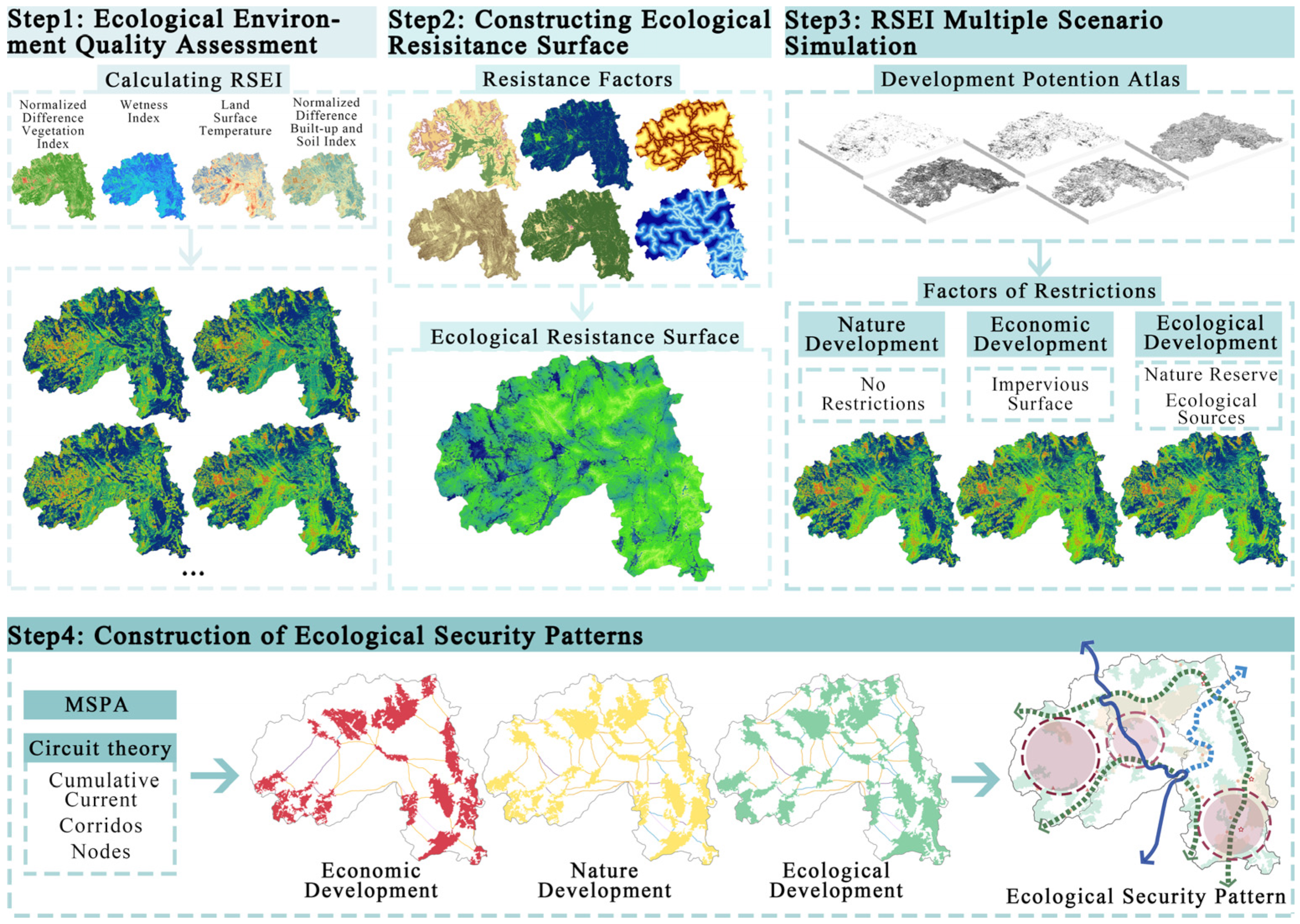
This study integrates the RSEI, Morphological Spatial Pattern Analysis (MSPA), circuit theory, and the PLUS model to develop a multi-model ensemble ecological security model. First, multi-year RSEI values and ecological resistance surfaces were calculated. Second, the PLUS model was employed to simulate RSEI dynamics under three scenarios (Natural Development, Economic Development, and Ecological Conservation) to quantify ecological environmental quality. Subsequently, MSPA was combined with the simulated RSEI results to identify key ecological source areas under different scenarios. Third, circuit theory was applied to extract potential ecological corridors, identify critical ecological bottlenecks, and assess barriers that hinder ecological connectivity. Finally, an ecological security pattern for Xishuangbanna was constructed, and ecological restoration zones were delineated (Figure 2).

3.3.1. Calculate the RSEI

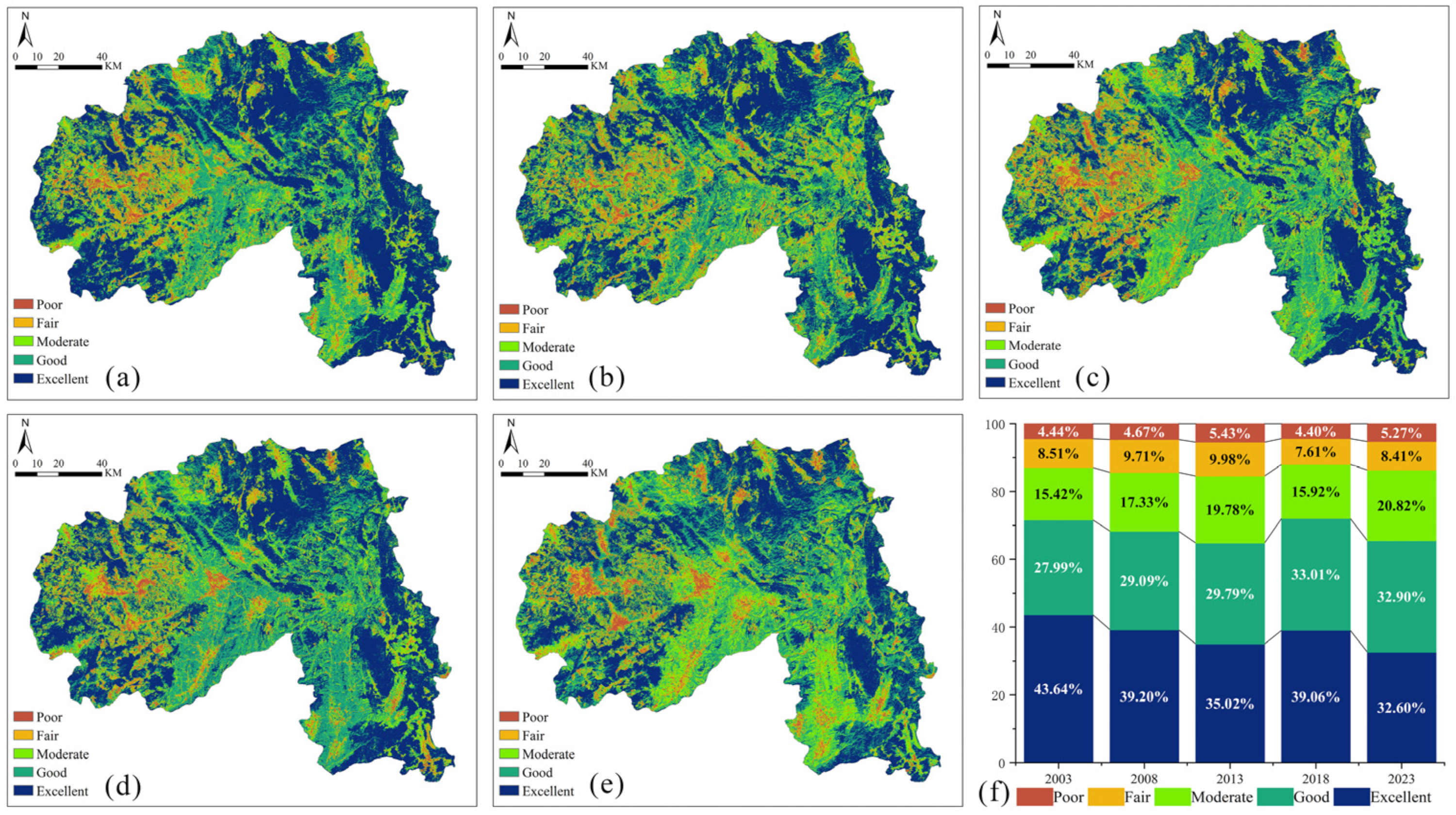
The RSEI quantifies ecological quality by integrating four indicators: Normalized Difference Vegetation Index (NDVI), Wetness Index (WET), Land Surface Temperature (LST), and Normalized Difference Built-up and Soil Index (NDBSI) [29,42]. Given the missing annual image bands in the Landsat datasets, this study calculated RSEI values for Landsat 5/7/8 datasets covering 2003, 2008, 2013, 2018, 2023, and the two years adjacent to each target year. Corresponding calculations were performed using the code editor of the Google Earth Engine (GEE) platform to obtain the pixel-wise mean and sum of the required images within the target time periods. Calculations showed that the first principal component contribution rates for 2008 and 2013 were only 68.66% and 66.46%, respectively. Due to striping and salt-and-pepper noise in the original datasets, 2009 and 2014 were selected as replacement years. To identify ecological source areas, regions with excellent ecological quality were extracted. In ArcGIS 10.7, the RSEI was classified into five tiers using the natural breaks classification: Poor (0–0.2), Fair (0.2–0.4), Moderate (0.4–0.6), Good (0.6–0.8), and Excellent (0.8–1) [25,29].

3.3.2. Constructing Ecological Resistance Surface

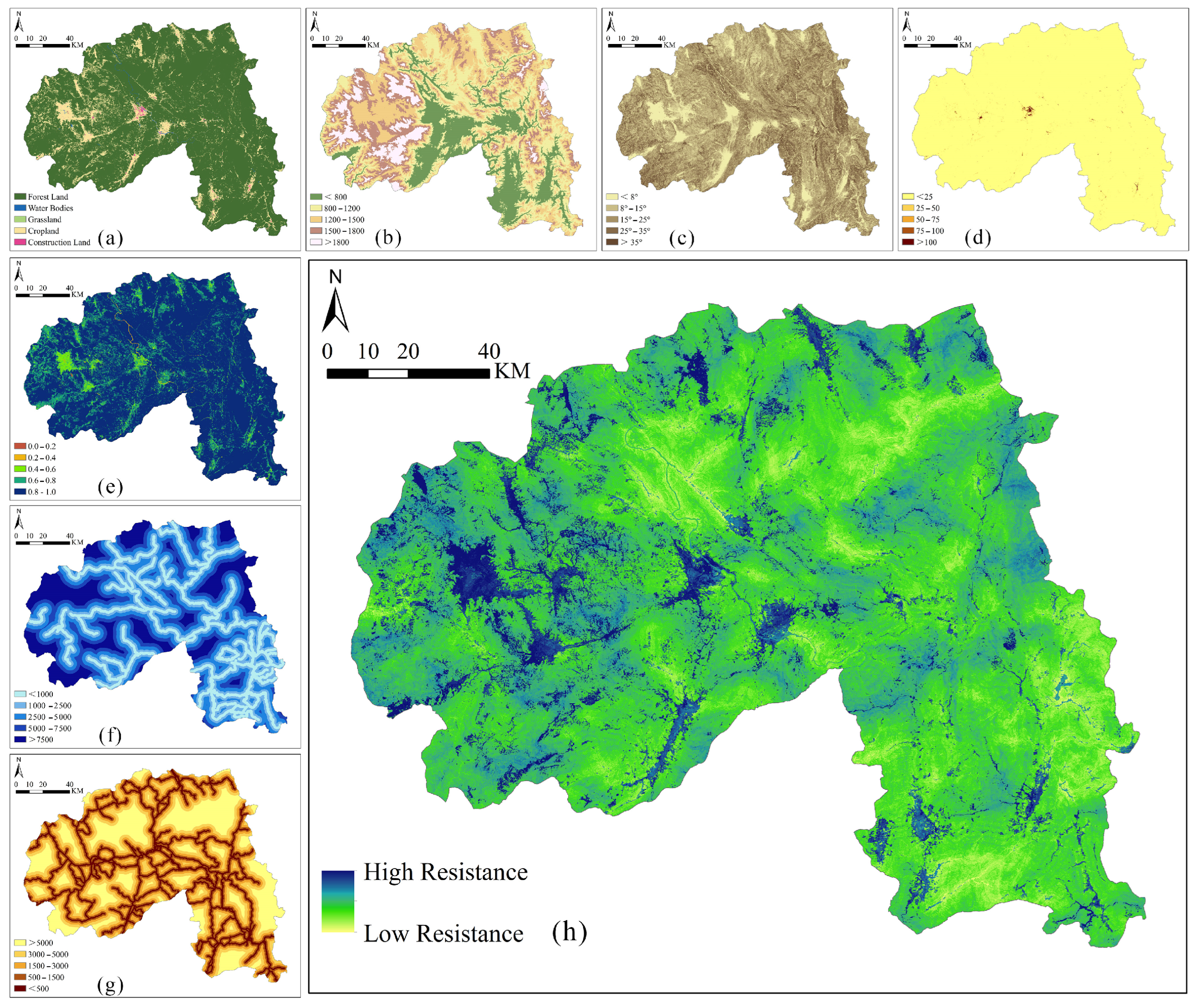
Ecological resistance surfaces quantify the impedance degree of landscapes to ecological processes. Essentially, they convert landscape patterns, which include land use types, topography, and human disturbances, into quantifiable resistance values [32,38]. This provides an intuitive characterization of the spatial constraints faced by ecological processes, laying a scientific foundation for conservation planning. Ecological resistance surfaces are not directly observable; instead, they are constructed through a process involving indicator quantification and spatial overlay analysis, typically implemented via ArcGIS 10.7 software. Based on the natural conditions and economic development status of Xishuangbanna, seven resistance factors were selected: LUCC, NDVI, distance to rivers, distance to major roads (railways, national highways, and provincial highways), DEM, slope and population density [43,44]. Each resistance factor was classified into five levels, with Level 1 representing minimum resistance and Level 5 maximum resistance. Resistance values were assigned by referencing relevant studies [45,46] and applying the Analytic Hierarchy Process (AHP), where the consistency ratio (CR) = 0.021 < 0.1 (passing the consistency test). The calculation method of resistance factor weight is as follows:
AHP: The components at each level are ranked according to their importance levels (1–9) through pairwise comparisons to construct a judgment matrix C. The maximum eigenvalue λmax of the matrix C and its corresponding eigenvector W satisfy the equation CW = λmaxW. The components of eigenvector W represent the weights of each evaluation factor. The formula is as follows:
C I = λ max n n 1
C R = C I R I
where n denotes the order of the judgment matrix. The average Random Consistency Index (RI) is employed to quantify the Consistency Index (CI). RI values are derived from a standard table based on the matrix order n. When the Consistency Ratio (CR) < 0.1, the judgment matrix is deemed to satisfy the consistency requirement; otherwise, the matrix requires adjustment.
In ArcGIS 10.7, the Raster Calculator tool was used to perform spatial overlay analysis using the weights of the seven resistance factors (Table 2), resulting in the generation of a comprehensive ecological resistance surface.

3.3.3. Multiple Scenario Simulations

Establishing multiple scenario simulations and predictions lays a scientific foundation for decision-making in fields such as urban development and ecological conservation [47,48]. Based on ecological quality demands derived from the 2003 and 2013 RSEI data, NDVI, annual average temperature, elevation, slope, population density, distance to road and distance to river were selected to conduct expansion analysis of ecological quality changes, generating a probability map of five ecological quality types. Using 2013 as the baseline year, the 2023 RSEI was simulated, and the simulated data were validated against the actual 2023 RSEI data (Kappa coefficient = 0.813 > 0.75, meeting accuracy requirements). Finally, spatial simulations of future ecological environmental quality were performed. Detailed settings for Neighborhood Weights (NW) and Conversion Probabilities (CP) are provided in Table 3. Nature reserves and ecological sources were designated as ecological conservation constraints, while impervious surfaces and roads served as economic development constraints. The PLUS model was employed to simulate RSEI values for Xishuangbanna in 2033 under three development scenarios: Natural Development Scenario (NDS), Economic Development Scenario (EDS), and Ecological Conservation Scenario (ECS). Land use requirements are adjusted in line with different development scenarios. In the EDS, aligned with regional policies and development conditions, the probability of converting construction land to cropland, forest land, grassland, water bodies, and other land types decreases by 30%, while that of converting cropland, forest land, and grassland to construction land increases by 20%. In the ECS, nature reserves are designated as restricted land conversion areas, and the probability of converting forest land and grassland to construction land decreases by 20%, while that of converting water bodies to construction land decreases by 30% [34,35,37].

3.3.4. Determination of Ecological Sources

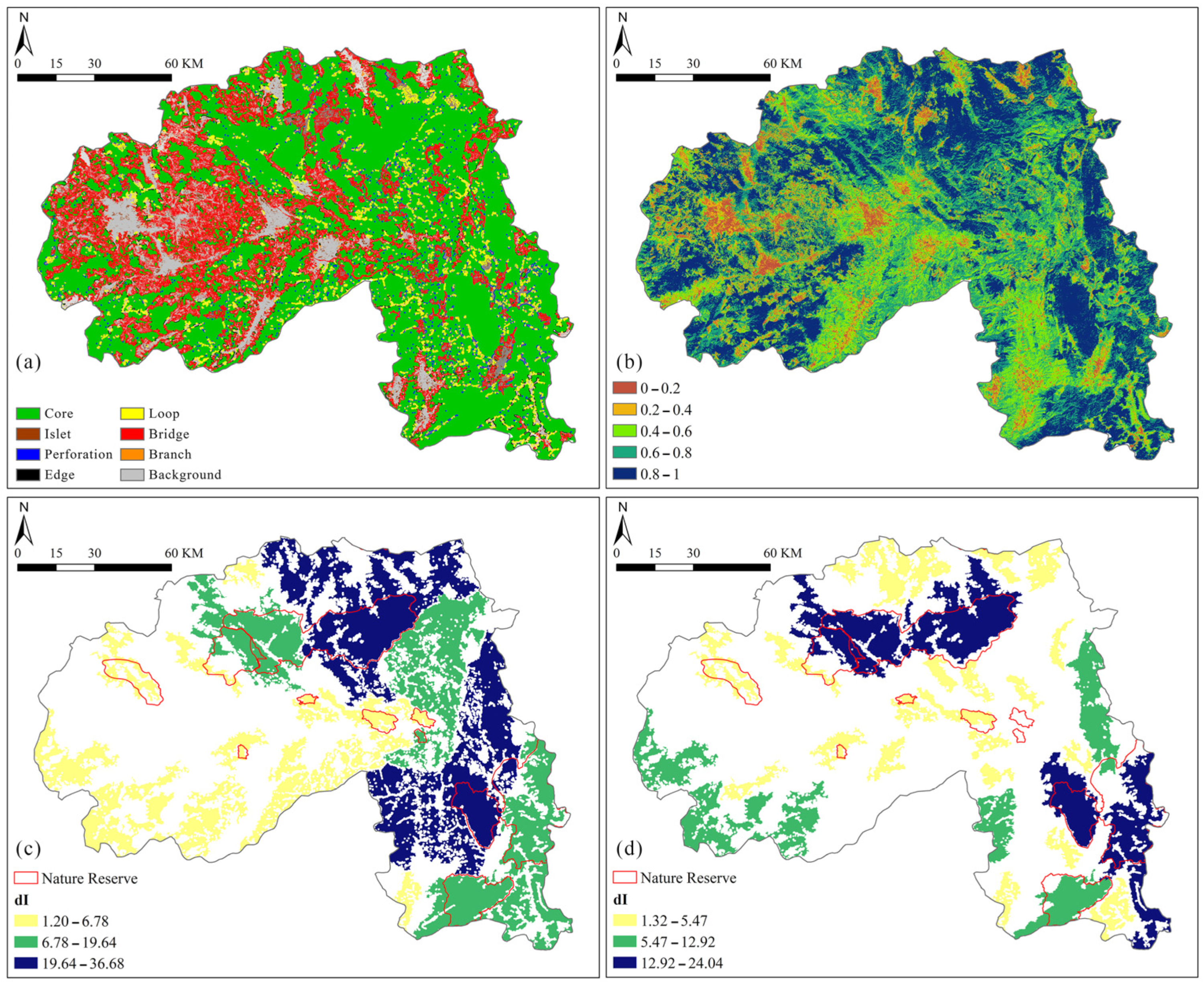
Ecological sources are patches or regions that play a core supportive role in maintaining regional ecosystem stability, preserving biodiversity, and supporting key ecological functions [18,49]. They serve as starting points or refuges for ecological processes and form the foundation for constructing regional ecological security patterns. Using the 2023 LUCC dataset, forests, shrubs, grasslands, and water bodies were designated as foreground classes, while croplands, impervious surfaces, and unutilized lands were designated as background classes. MSPA was performed using Guidos Toolbox 3.0 to extract core area patches. Considering the forest coverage of the study area and the habitat conservation requirements of local endangered species [50], this study designated source area patches larger than 50 km2 as core ecological sources. The relative importance index (dI), which is defined as the average of the change rate of potential connectivity and that of overall connectivity, serves to quantify the importance of each ecological source [51].
Using ArcGIS 10.7, excellent-grade areas from the RSEI-based ecological quality assessment were extracted. These areas were then overlaid with the core areas identified by MSPA, ultimately delineating the ecological source areas within the study region. Using the Pinch Points plugin in Circuitscape 4.0 software, cumulative flux values were calculated for each ecological source area. As a key indicator for evaluating the spatial distribution of landscape connectivity, cumulative flux represents the sum of all flux pathways between habitat patches at any given point. Areas with higher cumulative flux values act as convergence points for multiple species dispersal pathways, indicating highly connected landscape corridors. Higher cumulative flux values signify that these areas play a more critical role in maintaining overall landscape connectivity and hold greater conservation value [52,53]. Ecological source areas were classified into three tiers based on their overall importance for landscape connectivity within the study region.

3.3.5. Extract Ecological Elements

Ecological corridors are linear or belt-shaped ecological units to alleviate landscape fragmentation and maintain ecosystem connectivity. Their core function is to serve as transmission pathways for ecological flows, linking isolated ecological sources or ecological patches [49,54], thereby ensuring the structural integrity and functional stability of regional ecosystems. Ecological nodes consist of ecological barriers and ecological pinch points. Ecological barriers are high-resistance zones that impede ecological flows; the removal of these barriers significantly improves landscape connectivity, making them priority targets for ecological restoration. Ecological pinch points refer to areas within ecological corridors with extremely high current density. As critical pathways for biological migration or ecological flows, these areas are indispensable for maintaining landscape connectivity—their degradation will directly disconnect ecological source areas and are irreplaceable [25,55]. Based on circuit theory [22], this study used Circuitscape software and the Linkage Mapper plugin to extract ecological corridors, ecological pinch points, and ecological barriers [56]. Drawing on relevant studies [57] the study area’s natural conditions, and multiple pre-tests, the cost-weighted distance threshold for identifying ecological corridors was set to 1000 m. For ecological barriers, the maximum search radius was 1000 m, the minimum was 500 m, and the search step size was 500 m. Following the research findings of Huang et al. [58], ecological corridors were classified into three tiers using the ratio of cost-weighted distance to least-cost path length. The natural breaks classification method was adopted to grade ecological pinch points and barriers into five levels. Narrow regions with high current density were identified as ecological pinch points, while high-resistance blocking areas were designated as ecological barriers.

3.3.6. Evaluation of Ecological Network Structure

The Ecological Network Structure Analysis method [59] is an effective tool for analyzing the internal structure of ecosystems. Specifically, this study employs graph theory and network analysis to evaluate the constructed ecological corridor network, using three key network indices: the network closure index (α), line-point ratio index (β), and network connectivity index (γ). The α index reflects the degree of loop formation within the network; higher values indicate smoother material circulation and energy flow. The β index represents the number of connections per node, with higher values indicating more robust node connectivity. The γ index quantifies the overall connectivity level among all nodes in the network, where higher values signify stronger network integration. The calculation formulas for each index are as follows:
α = l v + 1 2 v 5
β = l v
γ = l l max = l 3 ( v 2 )
l denotes the number of corridors; v denotes the number of nodes.

4. Results

4.1. RSEI Feature Analysis

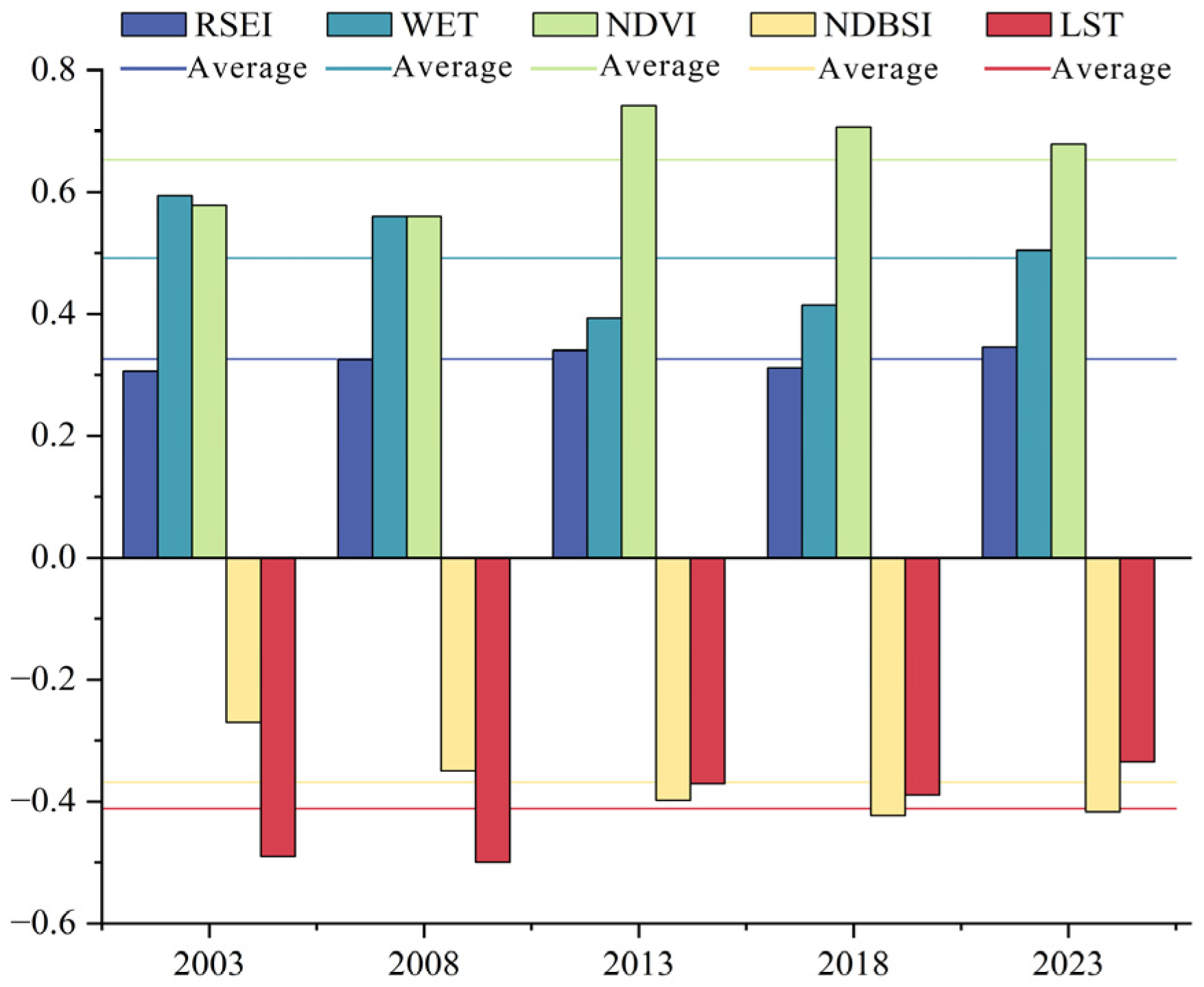
As shown in Figure 3, the contribution rate of RSEI features in the first principal component was 73.28%, 75.65%, 87.93%, 81.95%, and 80.36% (corresponding to the years 2003, 2013, 2018, 2020, and 2023, respectively). This high contribution rate indicates the suitability of these features for constructing the RSEI model. Regarding annual variations, the average NDVI value was 0.653, which increased from 0.578 to 0.741 before declining to 0.678, showing an overall upward trend. This suggests that vegetation conditions in the study area have improved compared to 2003 but may face degradation pressures in recent years. The average WET value was 0.439, which first decreased from 0.594 to 0.393 and then increased to 0.504. This indicates that humidity conditions in the study area have deteriorated relative to 2003, potentially threatening ecosystem stability. The average LST value was −0.417, which increased from −0.490 to −0.335 with a consistent annual upward trend. This may be associated with factors such as the urban heat island effect amid global warming, human activities that alter surface thermal properties, and reduced cooling effects resulting from subsequent vegetation loss. The average NDBSI value was −0.372, which consistently decreased from −0.270 to −0.417. This reflects an increase in vegetation coverage in the study area. The average RSEI value was 0.325, with annual values of 0.306, 0.325, 0.340, 0.311, and 0.345 for 2003, 2008, 2013, 2018, and 2023, respectively. It first increased, then decreased, but maintained an overall upward trend. While ecological quality has generally improved over the past two decades, recent pressures such as vegetation degradation and rising temperatures warrant vigilance regarding the combined impacts of climate change and human activities. Fluctuations in RSEI reflect the nonlinear characteristics of ecological recovery, necessitating targeted interventions in the future to sustain ecological development.

4.2. RSEI Temporal and Spatial Variation Analysis

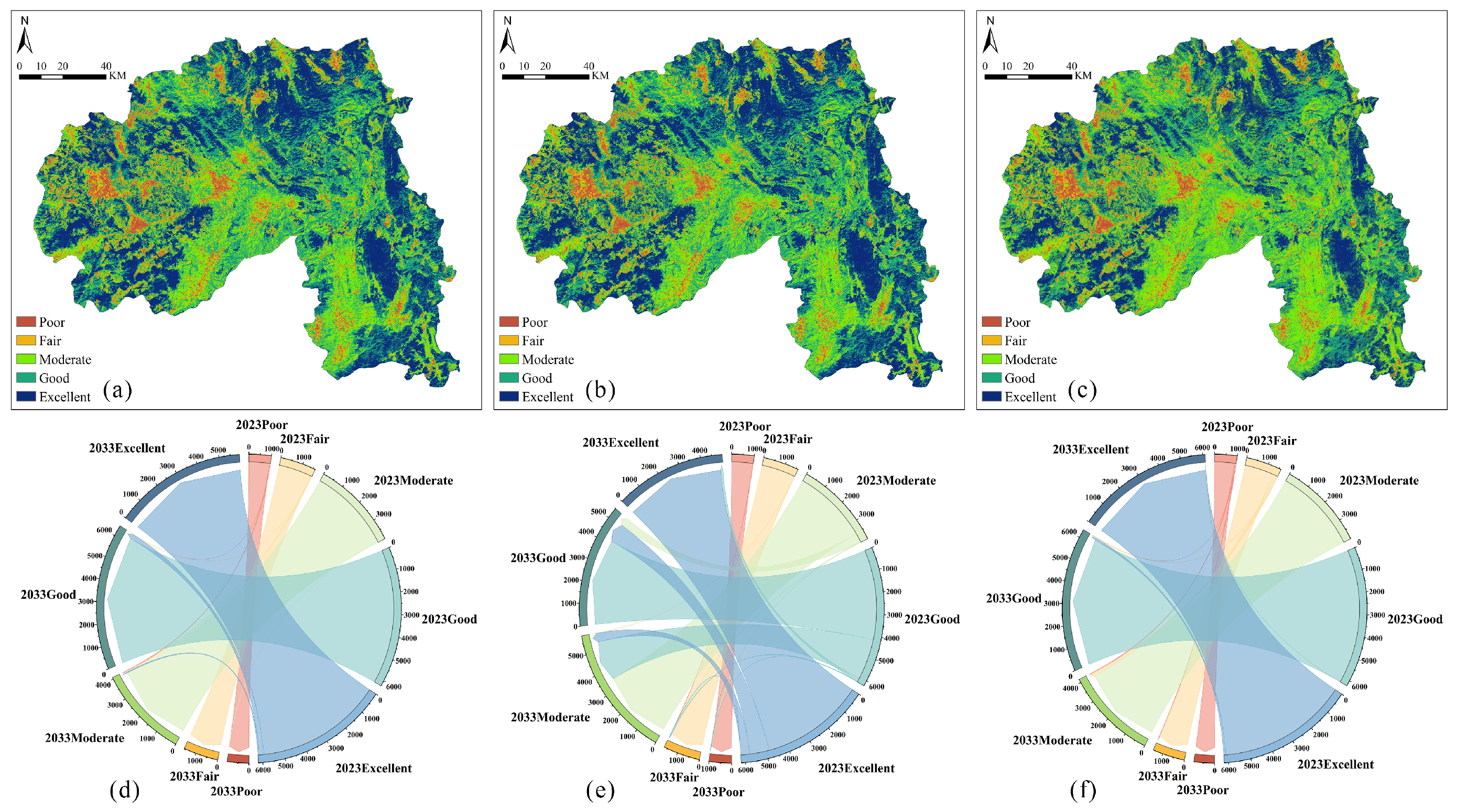
From the spatiotemporal changes in RSEI across the study area (Figure 4), the area of Excellent-grade regions decreased by 2096.14 km2 between 2003 and 2023; the area of Good-grade regions increased by 931.75 km2; the area of Moderate-grade regions expanded by 1024.82 km2; the area of Fair-grade regions decreased by 17.63 km2; and the area of Poor-grade regions increased by 157.21 km2. Core high-quality ecological regions shrank significantly, while Moderate-grade and Fair-grade regions expanded—with Good-grade and Moderate-grade regions showing the most substantial growth—indicating an overall trend of ecological degradation. This not only alters landscape patterns but also leads to the decline of ecosystem services and the aggravation of the biodiversity crisis.
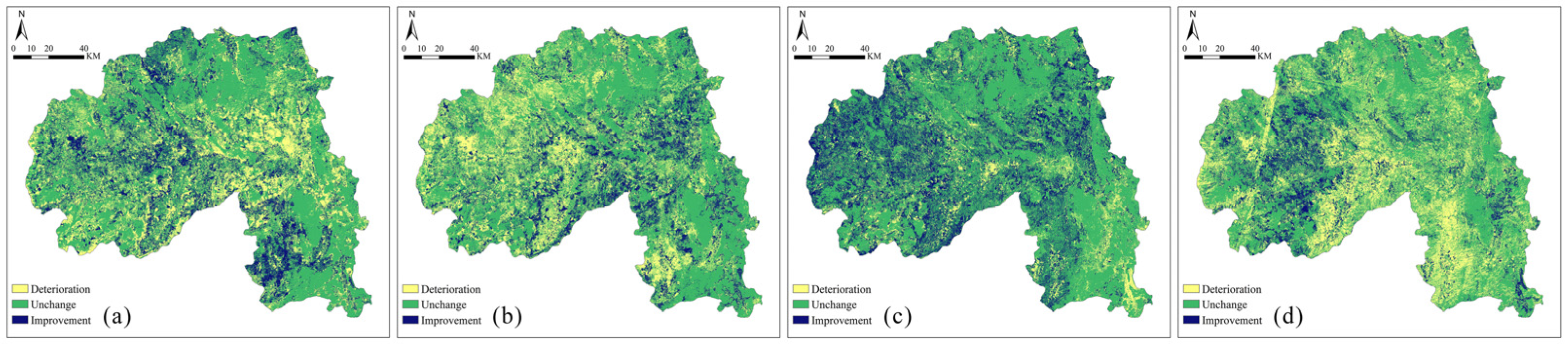
Based on the changes in RSEI levels across the study area (Figure 5), the area of ecological deterioration was 4226.75 km2 from 2003 to 2008, mainly distributed in the central part of Mengla County; the area of unchange was 11,400.41 km2; and the area of ecological improvement was 3360.45 km2, scattered across the prefecture. From 2008 to 2013, the area of ecological deterioration was 4309.29 km2, primarily concentrated in Menghai County; the area of unchange was 11,720.76 km2; and the area of ecological improvement was 2957.56 km2, focused on the central part of Mengla County and the southern part of Jinghong City. From 2013 to 2018, the area of ecological deterioration was 1904.20 km2, concentrated in the southern border region of the prefecture; the area of unchange was 12,435.42 km2; and the area of ecological improvement was 4648.00 km2, centered in Menghai County. From 2018 to 2023, the area of ecological deterioration was 5096.72 km2, distributed in small patches along the southern border of Mengla County; the area of unchange was 11,406.95 km2; and the area of ecological improvement was 2483.97 km2, indicating an overall improvement trend in the region. Areas with significant ecological deterioration are mainly concentrated along the border areas adjacent to Myanmar and Laos, as well as urban development centers, exhibiting a scattered but extensive distribution pattern. The development of ports, cross-border transportation infrastructure, and industrial parks in border areas directly removes surface vegetation and permanently modifies land use types. Ecological deterioration in the China-Myanmar and China-Laos border regions may form a “cross-border ecological fragile zone”. Future efforts must balance economic development with ecological conservation, prioritizing cross-border collaborative governance and green urban transformation.

4.3. Ecological Resistance Surface Analysis

The comprehensive ecological resistance surface was obtained through overlay analysis of the spatial distribution of resistance factors from seven categories (Figure 6). The spatial distribution of overall ecological resistance exhibits a pattern of higher resistance in the west and lower resistance in the east. Areas with higher resistance values are primarily concentrated across Menghai County, the northern and southern regions of Jinghong City, and the central part of Mengla County. In contrast, areas with lower resistance values are mainly distributed within nature reserves in the study region. The western region comprises hilly terrain formed by the Nujiang Mountains, characterized by undulating ridges and steep slopes. The native vegetation here is highly susceptible to disturbance and hard to restore. In contrast, the southeastern part (eastern Mengla County) features gentler topography with relatively continuous rainforest cover. Menghai County launched large-scale agricultural activities (primarily rubber cultivation) earlier than Mengla County, leading to more severe cumulative ecological degradation—one key reason why resistance in the west is higher than in the southeast. High-resistance areas exhibit a high degree of overlap with farmland, rubber plantations, and urban built-up areas, posing significant barriers to ecological connectivity. Low-resistance zones closely correspond to nature reserve boundaries, indicating that these areas retain pristine vegetation cover and maintain intact food web structures and ecological processes.

4.4. Comparison of Ecological Source Identification Analysis

By comparing the ecological source identification results obtained via traditional methods and the “RSEI-ESP-PLUS” framework (Table 4 and Figure 7), it is evident that the advantages of this framework lie in its enhanced identification accuracy and emphasis on key ecological functions. (1) The identification of ecological sources is more precise and exhibits better alignment with nature reserves: core ecological sources delineated by this framework account for 59.08% of the total area of nature reserves, which is significantly higher than the 22.31% identified via traditional methods. The number of core ecological sources increased from 2 to 4, indicating that the framework has improved capacity to accurately capture ecologically high-value areas and prioritize core ecological spaces within nature reserves as primary sources. (2) The framework achieves more comprehensive coverage of ecological sources and identifies additional potential ecological nodes: the total number of ecological source areas identified increased from 20 to 33, while their total area decreased slightly, effectively addressing the redundancy in ecological source delineation associated with traditional methods. Simultaneously, the number of tertiary ecological sources identified rose from 14 to 23, providing sufficient nodal support for establishing a stable ecological network.

4.5. Multi-Scenario Simulation Analysis

By 2033, all three scenarios predict changes in the area of ecological quality grade regions within the study area (Figure 8). Under the Natural Development Scenario, Moderate-grade areas will expand by 3.07%, while Excellent-grade areas will decrease by 4.52%. Ecological quality will remain largely stable, reflecting a state in which ecosystem self-regulation coexists with gradual degradation in the absence of human intervention. Under the Economic Development Scenario, the proportion of Moderate-grade areas will increase to 48.11%, while Good-grade and Excellent-grade areas will decrease significantly by 12.15% and 19.72%, respectively. The sharp decline in Excellent-grade areas reflects the development pressures on ecologically sensitive zones and the trend of sustained ecological quality deterioration. Under the Ecological Conservation Scenario, Excellent-grade areas will remain stable, while Poor-grade and Fair-grade areas will decrease significantly by 8.20% and 9.80%, respectively. Ecological quality will show an upward trend, with overall optimization of ecosystem structure and function. An economic development model oriented solely toward growth will lead to overall degradation of ecosystem quality, whereas proactive conservation strategies can not only preserve high-quality ecosystems but also effectively improve ecologically fragile areas.

4.5.1. Comparative Analysis of Ecological Sources Under Multi-Scenario Simulations

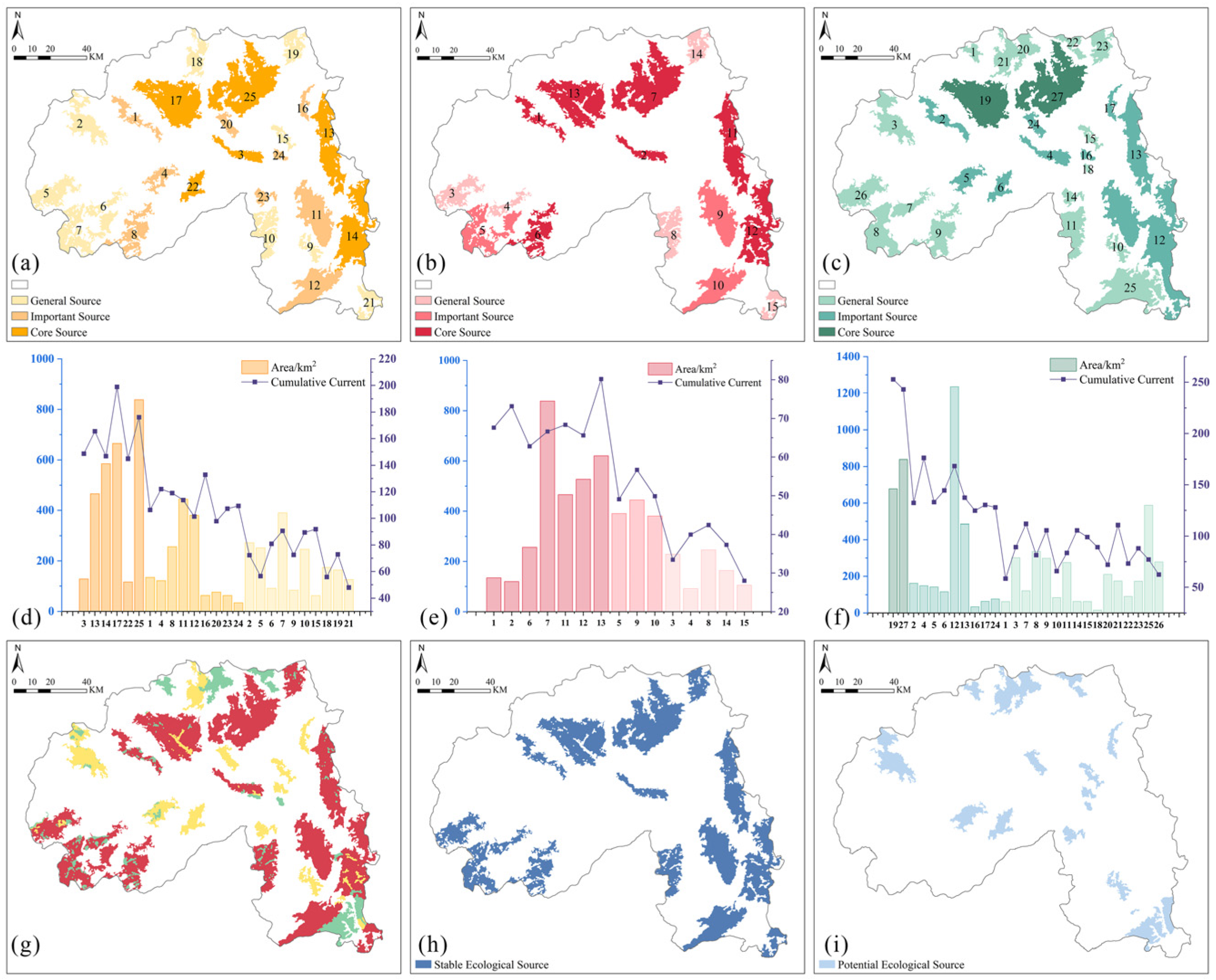
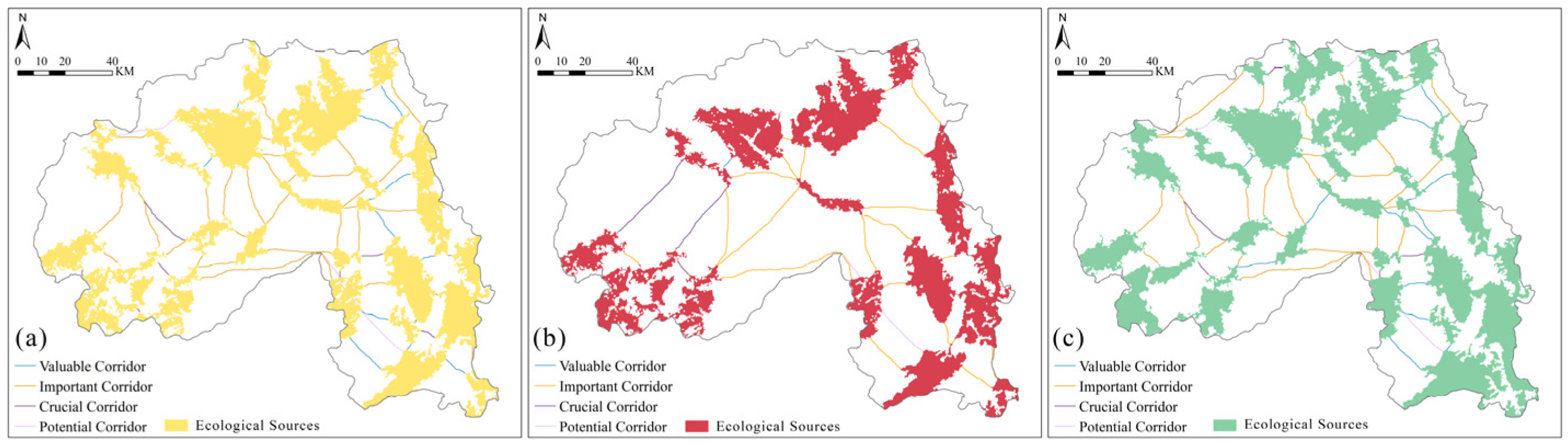
Through RSEI multi-scenario simulation, the core areas extracted by MSPA was overlaid with the excellent areas derived from RSEI to obtain ecological sources under the three scenarios (Figure 9). Based on the cumulative connectivity current value, ecological sources were classified into core ecological sources, important ecological sources, and general ecological sources. Ecological sources that remained stable across all three scenarios were designated as stable ecological sources, while those that degraded under the Economic Development Scenario but improved under the Ecological Conservation Scenario were defined as potential ecological sources.
Under the Natural Development Scenario, 25 ecological source areas totaling 6231.79 km2 were identified. Including 6 core ecological sources (2797.72 km2), 9 important ecological sources (1573.51 km2), and 10 ordinary ecological sources (1860.58 km2). Under the Economic Development Scenario, 15 ecological source areas totaling 5009.70 km2 were identified. Including 7 core ecological sources (2960.93 km2), 3 important ecological sources (1214.67 km2), and 5 ordinary ecological sources (834.10 km2). Under the Ecological Conservation Scenario, 27 ecological source areas totaling 7113.18 km2 were identified. Including 2 core ecological sources (1516.42 km2), 9 important ecological sources (2461.81 km2), and 16 ordinary ecological sources (3134.94 km2). Across all three scenarios, 16 stable ecological sources were identified, totaling 1812 km2 and 15 potential ecological sources were identified, totaling 4902.72 km2.
From the perspective of the composition and evolution of ecological sources, development models directly shape the quality and scale of ecological foundations. Under the Economic Development Scenario, the total number of ecological sources is the smallest, their total area is the most limited, and core ecological sources dominate in quantity and scale. This reflects how high-intensity human disturbance leads to the islandization of ecological landscapes, whereby only a few strictly protected core areas (e.g., the nature reserves) maintain their ecological functions, while vast peripheral habitats degrade or even disappear. In stark contrast, the Ecological Conservation Scenario yields the highest number of ecological sources and the largest total area, with a significant increase in ordinary ecological sources. This demonstrates that this scenario effectively preserves the organic integrity of the landscape, not only protecting core habitats but also cultivating and sustaining extensive high-quality ecological spaces. Comparative analysis reveals that ecological sources under the Ecological Conservation Scenario maintain higher integrity than those under the Economic Development Scenario, whereas ecological sources under the Economic Development Scenario exhibit greater fragmentation. These data indicate that under the dual pressures of economic development and ecological conservation, the ecological structure of Xishuangbanna is contingent upon human development decisions. The quantity, area, and stability of ecological sources are not fixed but undergo significant changes as the balance between development and conservation shifts. Stable ecological sources form the foundation of regional ecosystems, while the majority of potential ecological sources have become core targets for ecological conservation and restoration.

4.5.2. Comparative Analysis of Ecological Corridors Under Multi-Scenario Simulations

Based on the ecological source results derived from multi-scenario simulations, ecological corridors and potential ecological corridors within the study area were identified using the Linkage Pathways module in the circuit theory model. Different development strategies exert substantial impacts on the structure and function of the ecological corridor network (Table 5 and Figure 10). From the Economic Development Scenario to the Ecological Conservation Scenario, the total number of ecological corridors increased from 31 to 66, and their total length expanded from 6358.20 km to 8973.80 km. This transformation demonstrates that ecological conservation measures effectively enhance landscape connectivity, forming a denser and more complex ecological network. Under the Economic Development Scenario, the corridor network structure is simplistic and highly dependent on a few critical corridors (5 corridors, accounting for 13.5% of the total corridor length), exhibiting low system redundancy and high vulnerability. In contrast, under the Ecological Conservation Scenario, not only does the number of critical corridors remain stable (8 corridors), but their linkage pathways also become shorter, straighter, and more efficient; more importantly, the number of important and ordinary corridors increases substantially (from 25 to 55), enhancing network complexity and stability. This structure provides species with more migration pathway options, significantly improving ecosystem resilience. The identification of potential ecological corridors points to spatial directions for ecological restoration. Their consistent presence across scenarios and considerable lengths indicate substantial potential to significantly improve landscape connectivity through targeted restoration measures.

4.5.3. Comparative Analysis of Ecological Nodes Under Multi-Scenario Simulations

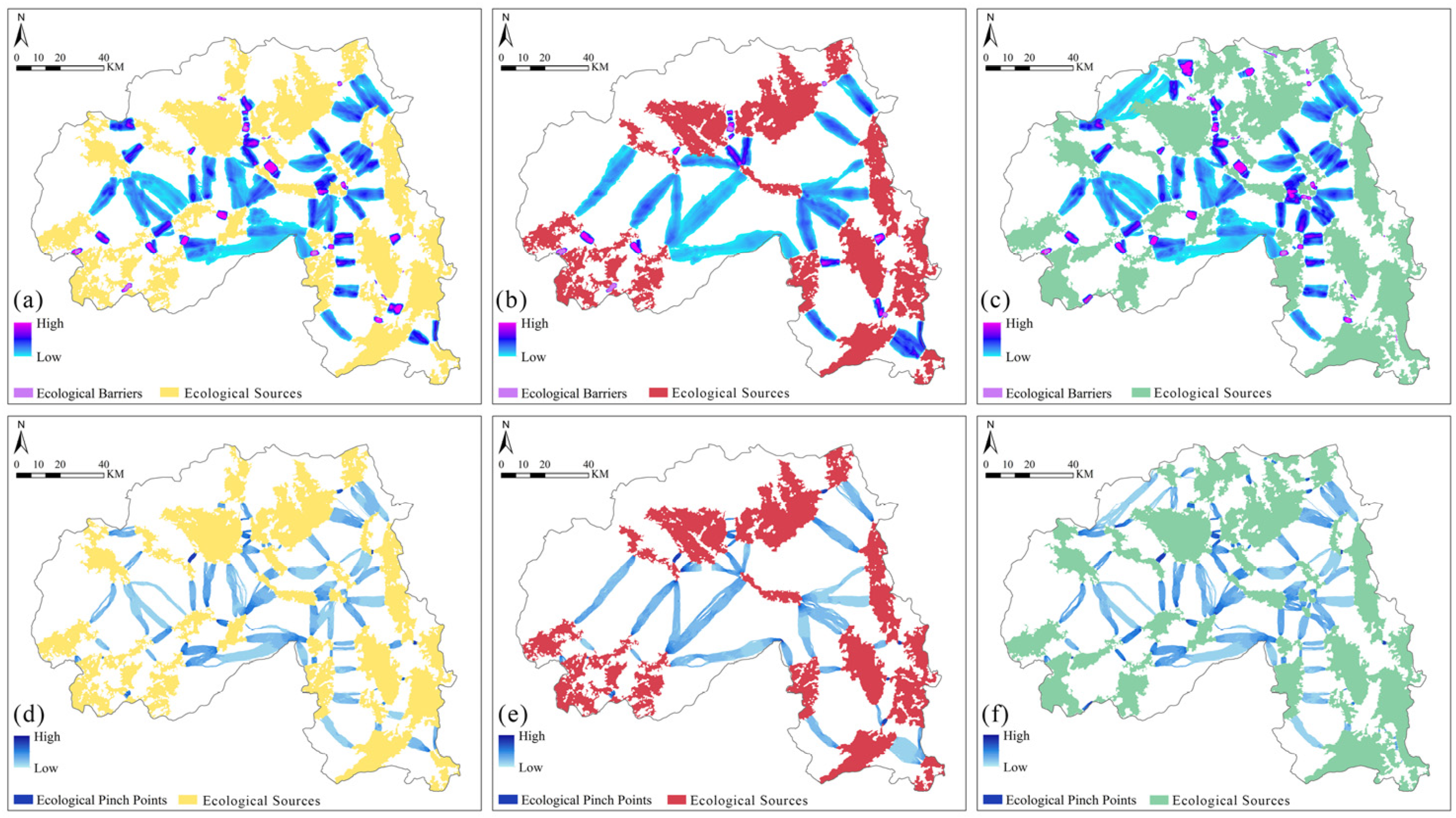
Based on the ecological source results derived from multi-scenario simulations, ecological barriers and ecological pinch points within the study area were identified using the Barrier Mapper and Pinchpoint Mapper modules from circuit theory (Table 6 and Figure 11). Under the Natural Development Scenario, the number of ecological barrier areas increased while their total area decreased. Pinch points were the most numerous but had the smallest total area. The high number of small-scale pinch points indicates they are more prone to being overlooked and disturbed, necessitating more targeted conservation and planning under the Natural Development Scenario. Under the Economic Development Scenario, the number of ecological barrier areas was the smallest, yet their total area was the largest; pinch points were fewer in number but had the largest total area. This reflects a severely fragmented landscape pattern with isolated ecological patches, rendering ecosystems vulnerable, increasing species extinction risks, and resulting in extremely poor adaptability to climate change. Under the Ecological Conservation Scenario, ecological barrier areas were the most numerous but had the smallest total area, while pinch points were intermediate in both number and total area. This indicates that under ecological conservation measures, large-scale, high-resistance ecological barrier areas were effectively restored, reducing overall landscape resistance. The intermediate number and area of pinch points reflect a relatively uniform distribution of ecological flows. Landscape connectivity has reached a stable, efficient, and manageable state—species have sufficient migration pathways, and key nodes are distinct and robust, facilitating targeted conservation interventions.

4.5.4. Analysis of Ecological Network Structure

According to the calculated results of ecological network structure evaluation method (Table 7), a higher α index indicates smoother material cycling and flows within the network. The α index follows the order: Ecological Conservation Scenario > Natural Development Scenario > Economic Development Scenario, demonstrating that under the Ecological Conservation Scenario, material cycling and flows in ecological networks are relatively unimpeded, offering more pathways for species dispersal. The β index reflects the number of connections per node. An β index < 1 indicates a tree-like network structure; an β index = 1 denotes a single-cycle network structure; and an β index > 1 indicates a complex network with multiple connections per node. The β index ranking is Ecological Conservation Scenario > Natural Development Scenario > Economic Development Scenario, suggesting that under the Ecological Conservation Scenario, high connectivity is maintained among ecological source areas. In contrast, the Economic Development Scenario exhibits a single-cycle structure, rendering ecosystem balance highly vulnerable to disturbances. The γ index reflects the overall connectivity of all nodes in a network, ranging between 0 and 1: when γ = 0, network nodes are disconnected; when γ = 1, all nodes are fully interconnected. The γ index follows Ecological Conservation Scenario > Natural Development Scenario > Economic Development Scenario, indicating higher connectivity among ecological nodes under the Ecological Conservation Scenario. Simulation results under the Ecological Conservation Scenario indicate that ecological processes can shift from “single-path dependency” to “multi-path options”, enhancing the efficiency and reliability of ecological connectivity. This strengthens the stability of ecological networks.

4.6. Construction of Ecological Security Pattern

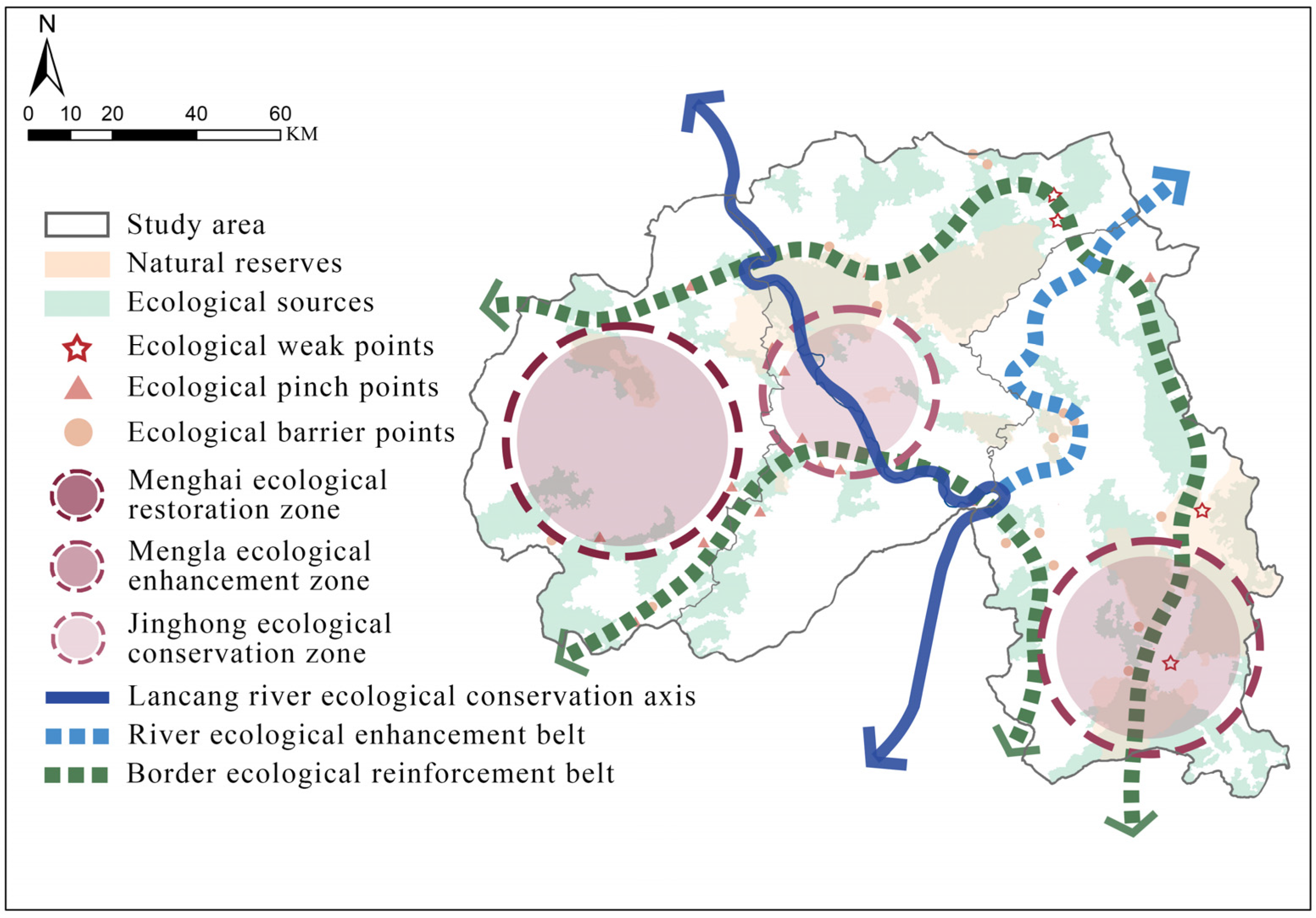
Based on the spatial distribution characteristics of ecological sources, ecological corridors, and ecological nodes under the Ecological Conservation Scenario, an ecological spatial planning framework entitled “One Axis, Two Corridors, and Three Zones” was established (Figure 12). This framework takes the Lancang River as the main axis, connecting the eastern and western regions along the Nanban River and Nana River while linking three key county-level administrative divisions. By delineating key ecological restoration zones, ecological enhancement zones, and ecological conservation zones, differentiated and targeted regional management strategies are implemented, thereby enhancing the overall connectivity of the ecological network.

4.6.1. “One Axis”—Lancang River Ecological Conservation Axis

The Lancang River serves as the primary ecological corridor and a critical freshwater source within the study area. This axis naturally connects multiple core ecological sources and nature reserves, strengthening connectivity between core habitats while simultaneously providing potential north–south migration routes for species. Prioritizing its protection as the “central axis” serves to anchor the stability of the entire ecological network.

4.6.2. “Two Corridors”—Two Border Ecological Enhancement Belts and One River

Ecological Reinforcement Belt
By establishing border ecological enhancement belts, concentrated efforts can be directed toward mitigating ecological fragmentation caused by border infrastructure development and road construction, and preventing the further expansion of “cross-border ecological fragile zones”. In addition, river ecological reinforcement belts serve as critical supplements and extensions to the mainstem axis of the Lancang River. These tributary watersheds harbor critical habitats for numerous endemic species. Improving their ecological integrity directly enhances the ecological health of the Lancang River mainstem, forming a nested protection network linking mainstreams and tributaries.

4.6.3. “Three Zones”—Menghai Ecological Restoration Zone, Mengla Ecological

Enhancement Zone, Jinghong Ecological Conservation Zone
Menghai Ecological Restoration Zone: Menghai County exhibits the highest ecological resistance, the densest concentration of ecological barriers, and the most severe ecological degradation as indicated by the RSEI across the county. Precisely identifying core high-resistance areas, prioritizing the conversion of rubber plantations to forestland, restoring fragmented ecological networks, and mitigating critical ecological barriers are key measures to remedy the most prominent ecological deficits.
Mengla Ecological Enhancement Zone: Mengla County harbors the largest area of core ecological sources and exhibits a relatively low overall ecological resistance, making it the primary ecological advantage area of the study region. However, as indicated by the RSEI, the county also faces ecological degradation pressures. As a core hub of the Pan-Asia Railway and a national-level border port, the development and construction of Mohan Town in southern Mengla County inevitably exerts substantial and complex ecological pressures on the local environment. Therefore, Mengla County should prioritize maintaining the integrity of ecological source areas, preserving key ecological corridors, restoring potential ecological corridors, strictly delineating ecological development boundaries, and protecting important ecological spaces.
Jinghong Ecological Conservation Zone: As the economic hub of Xishuangbanna, Jinghong City exhibits the densest concentration of ecological pinch points and faces the most severe urban expansion pressure. Its core mission is to safeguard existing ecological spaces, prevent unauthorized encroachment on ecological corridors, mitigate the urban heat island effect by enhancing urban self-healing capacity, and maintain regional ecological stability.

5. Discussion

5.1. Proactive Management Is Crucial for Addressing Ecological Degradation

This study reveals the structural degradation and spatial restructuring of ecosystems in Xishuangbanna from 2003 to 2023. Research indicates that regional ecological environmental quality exhibits complex characteristics of overall degradation and spatial heterogeneity. A critical ecological warning is that the area of Excellent-grade regions decreased by 2096.14 km2, while Good-grade and Moderate-grade regions increased by 931.75 km2 and 1024.82 km2, respectively. This change pattern is far more than a simple land cover conversion; its deeper ecological implication lies in Ecological Quality Downgrading [60,61]. This is manifested in the widespread replacement of large areas of intact primary tropical rainforests with rubber plantations, secondary forests, and disturbed patches, leading to a systematic decline in key ecosystem services such as carbon sequestration, water conservation, and biodiversity conservation [62,63]. These declining trends are corroborated by the RSEI multi-scenario simulation results.
In the research findings, the RSEI has shown significant improvement after 2018. Since 2015, Yunnan Province has intensified its ecological compensation efforts, introducing policies such as the Yunnan Provincial Ecological Environment Construction Plan and the Xishuangbanna Ecological Development Strategy Action Plan. Through initiatives such as returning farmland to forests and managing steep slopes, forest vegetation has been restored. Through the introduction of native tree species into some rubber plantations, a multi-layered vegetation structure has been established, driving the ecological transformation of rubber plantations and enhancing ecosystem functionality.

5.2. Complementing and Confirming Existing Research

The core findings of this study align closely with the current trends in ESP research. In cross-border ecological research on the Mekong River Basin, Xu et al. [64] identified habitat fragmentation as a key factor limiting transboundary species migration. The enhanced connectivity of ecological corridors observed in this study under ecological conservation scenarios provides direct empirical support for this conclusion in the upstream region. Regarding the application of RSEI, this study confirms that the RSEI is applicable to long-term ecological quality monitoring in tropical rainforest regions. This finding aligns with the conclusions of Ran et al. and Jiang et al. [32,43] in subtropical mountain regions, while this study further expands the application of the RSEI in multi-scenario simulations.
In the integrated application of circuit theory and ESP, this study verified the effectiveness of this integrated approach in quantifying ecological connectivity by constructing a complete technical chain consisting of “ecological sources-resistance surfaces-corridors-nodes”. This approach aligns with the theoretical framework proposed by McRae et al. [22] and the practical application demonstrated by Qiao et al. [18] in urban agglomerations. Additionally, this study accounts for the unique characteristics of border cities, filling the gap in existing research that has paid inadequate attention to border conservation, thereby providing a referenceable framework for constructing similar border ecological security patterns.
Furthermore, the phenomenon identified in this study—in which core ecological sources shrink while secondary ecological sources expand under ecological conservation scenarios—offers cross-validation of Kotlov et al.’s [65,66] theory that “fragmentation of ecological symbiotic communities diminishes the correlation between ecosystem structure and function”. This finding demonstrates that enhancing landscape matrix quality contributes more to ecosystem resilience than does the sole protection of isolated core patches. Proactive conservation measures can facilitate the transition of ecological networks from core-dependent to regionally collaborative systems, thereby enriching the existing theoretical framework for ESP optimization.

5.3. Hypothesis Verification Analysis

Hypothesis 1.
Incorporating RSEI-Identified Ecological Sources Enhances Precision and Functionality.
Compared to traditional LUCC-based identification methods, the integration of the RSEI into ecological source identification facilitates the precise capture of regional variations in ecological quality, with the delineated core ecological sources exhibiting greater representativeness of ecological functions. This framework enables the targeted identification of core areas of high ecological quality, thus overcoming the limitations of traditional methods that indiscriminately classify all forests and wetlands as ecological sources while neglecting internal quality variations [29]. In terms of quantity and structure, the total number of ecological sources identified under the new framework increases from 20 to 33, with secondary ecological sources rising from 14 to 23. This approach not only eliminates redundant areas of low ecological quality identified by traditional methods but also identifies additional nodes with potential ecological functions, thereby providing more comprehensive support for the stability of the ecological network. This finding aligns with the conclusions of Zhang et al. [13] in their research on ESP—that identifying ecological sources based on ecological quality indices can significantly enhance the functional specificity of core patches. This study also expands upon the research by Ran et al. [32], who only validated the applicability of RSEI in ecological quality assessment. Furthermore, this study confirms that integrating RSEI with MSPA and circuit theory can effectively mitigate the lack of specificity in traditional LUCC-based identification methods, particularly in tropical rainforest regions.
Hypothesis 2.
Under Ecological Conservation Scenarios, Optimal Ecological.

Connectivity and Minimal Ecological Risk

Under different development scenarios, the ecological quality evolution trajectories and ecological network characteristics in the Xishuangbanna region exhibit significant differences. Among the three scenarios, the ecological conservation scenario exhibits the optimal regional ecological connectivity and the lowest ecological risk. Results presented in Section 4.5 indicate that the ecological conservation scenario has the highest number and total area of ecological sources among the three scenarios. The significant increase in the number of secondary ecological sources suggests an overall enhancement of the landscape matrix, thus avoiding the isolation of core ecological sources observed under the economic development scenario [4,64]. Regarding ecological corridors, the total number and length of corridors under the ecological conservation scenario are significantly higher than those under the economic development scenario. Key corridors realize more efficient connectivity, while the increased diversity of peripheral corridors enhances network redundancy, thereby reducing the impact of damage to a single corridor on overall connectivity. Analysis of ecological nodes reveals that under the ecological conservation scenario, the total area of ecological barriers is the smallest, with ecological bottlenecks evenly distributed and of moderate scale. This indicates smooth ecological connectivity and strong resilience to disturbances. Conversely, the economic development scenario is characterized by large and concentrated ecological barriers and bottlenecks, confirming the cumulative ecological risks associated with an economic-centric development model [16]. The assessment of ecological network structure further corroborates this conclusion: under the ecological conservation scenario, the α-index, β-index, and γ-index are all significantly higher than those under the natural development and economic development scenarios. Notably, a β-index value > 1 indicates the formation of a complex multi-node interconnected network, whereas a β-index value = 1 in the economic development scenario indicates a simple loop structure that is highly susceptible to disruption and collapse. This finding aligns with the findings of Luo et al. [38] in their research on ecological security in transboundary watersheds—that development models that prioritize ecological conservation can effectively mitigate habitat fragmentation. However, this study further quantifies the differences in ecological network structures among different scenarios and clearly demonstrates the core advantages of the ecological conservation scenario in enhancing connectivity and reducing risks. It provides empirical support for the local implementation of the objective of “Enhancing Ecological Connectivity” stipulated in the Kunming-Montreal Global Biodiversity Framework.

5.4. Future Prospects for Constructing an ESP Against the Backdrop of Human-Nature Synergy

Xishuangbanna Dai Autonomous Prefecture is a multi-ethnic region, with the Dai people being the largest and most widely distributed ethnic group. Each Dai village designates a section of the mountainous area behind the village as a “Longlin” (Dai Sacred Forest), which serves as the abode of the village deity. The traditional culture of the Dai people has internalized the belief in spiritual retribution by the village deity, cultivating a spontaneous awareness of conservation [67]. Individual Longlin plots range in size from 1 to 20 hectares, yet their widespread distribution makes them vital stepping stones and ecological corridors linking land use categories to national nature reserves [68].
The concept of indigenous stewardship emphasized in the IUCN’s Sacred Natural Lands: A Guide for Protected Area Managers has been domestically enshrined in the Forest Law of the People’s Republic of China (2020 Revised Edition) via the clause: “Encouraging the use of traditional ecological knowledge for conservation”. Xishuangbanna’s provincial-level local regulations further elaborate on this by stipulating that “Longlin rituals shall be legally protected” and “traditional taboos shall be incorporated into ecological conservation standards”. This has established a complete policy transmission chain that ranges from international initiatives to national legislation to local regulations, providing multi-level institutional support for the construction of an ecological security pattern. Longlin’s conservation practices are deeply embedded in the requirements of the Initiative for Ecological Conservation and Restoration in Southwest China, as outlined in the National Master Plan for Major Projects on the Protection and Restoration of Key Ecosystems (2021–2035). Xishuangbanna has incorporated Longlin restoration into the Lancang River Basin Ecological Corridor Construction Project. Through a funding mechanism combining special funds from the National Forestry and Grassland Administration with provincial matching funds, the region has been advancing the restoration of 33 hectares of rubber plantations on Jinuo Mountain back to their original Longlin condition. The ecological services provided by Longlin have been converted into community economic benefits through fiscal transfers. This approach safeguards the developmental rights of indigenous communities while reinforcing their intrinsic motivation to participate in conservation via economic incentives. With the implementation of the Xishuangbanna Prefecture Forest Resources Protection Regulations in 2024, portions of Longlin have been incorporated into unified forest resource management systems. By 2025, 286 Longlin conservation units had been established, with a registered area of 5466 hectares. These protected areas have become the key focus of ongoing monitoring and restoration efforts. In Pei Shengji’s report submitted to the United Nations, the highlight of the Longlin management model resides in its bidirectional empowerment: national policies provide legal protection for traditional ecological knowledge, while traditional ecological knowledge offers local solutions to national ecological governance [69]. Longlin, together with nature reserves and ecological corridors, forms an integrated point-line-area ecological security network. The community-led voluntary restoration model addresses the limitations of traditional engineering-driven restoration approaches that prioritize construction over operation and maintenance [70], shifting the ecological security system from anthropogenic construction to a human-nature collaborative governance system.
Regrettably, no comprehensive prefecture-wide survey data on Longlin resources currently exist. Existing information primarily derives from academic research and records of local conservation practices. Based on the RSEI-PLUS-ESP methodological framework, this study has effectively revealed changes in macro-scale patterns. However, to further improve the assessment accuracy, it is necessary to integrate systematic ground-based ecological surveys into the assessment system. Following the completion of the future Longlin Special Survey, designating Longlin as ecological nodes or ecological corridors within the ecological security framework may provide a low-cost, highly adaptable approach to addressing challenges related to ecological connectivity and functional stability.

6. Conclusions

This study systematically evaluated the spatiotemporal evolution characteristics of ecological quality in Xishuangbanna during 2003–2023. Based on the Remote Sensing Ecological Index, Morphological Spatial Pattern Analysis, Circuit Theory, and the PLUS model, this study developed ecological security patterns via multi-scenario simulations. This study further provides a scientific practical pathway for regional sustainable development.
Research findings indicate that the RSEI rose from 2003 to 2013, declined from 2013 to 2018, and increased again from 2018 to 2023. Over the past two decades, the area of Excellent-grade ecological regions has decreased, while that of Moderate-grade ecological regions has continued to expand, which indicates a trend of local ecosystem structure degradation. Ecological resistance exhibits spatial heterogeneity, forming a spatial pattern characterized by “high resistance in the west and low resistance in the southeast”. Multi-scenario simulation results show that under the Ecological Conservation Scenario, ecological processes transition from single-path dependence to multi-path connectivity, thereby enhancing the stability of ecological networks and significantly improving ecological environmental quality. This underscores the importance of proactive conservation strategies. Ultimately, an ecological spatial planning framework entitled “One Axis, Two Belts, and Three Zones” was proposed, providing pathways to sustainable development.
The RSEI–ESP–PLUS framework integrated in this research not only serves as a diagnostic tool for assessing current ecological quality but also has predictive capacity for simulating future scenarios. This study enhances our understanding of the intrinsic relationship between the mechanisms underlying ecological quality evolution and regional sustainable development, providing a scientific foundation for regional ecological conservation and high-quality development.

Supplementary Materials

The following supporting information can be downloaded at: https://www.mdpi.com/article/10.3390/su18020894/s1, Table S1: RSEI and the loadings and contribution rates of four indicators on the first principal component; Table S2: RSEI temporal variation and area proportion; Table S3: Distribution of RSEI area change; Table S4: Resistance surface factors and ecological resistance surfaces; Table S5: Changes in RSEI and grade area under multiple scenarios; Table S6: Multi-scenario ecological source comparison.

Author Contributions

Conceptualization, J.Y. and J.P.; methodology, J.Y. and L.H.; validation, J.Y. and L.H.; formal analysis, J.Y.; investigation, J.Y. and L.H.; resources, J.P.; data curation, J.Y.; writing—original draft preparation, J.Y.; writing—review and editing, J.Y. and J.P.; visualization, J.Y. and L.H.; supervision, J.P.; project administration, J.P.; funding acquisition, J.P. All authors have read and agreed to the published version of the manuscript.

Funding

This research received no external funding.

Institutional Review Board Statement

Not applicable.

Informed Consent Statement

Not applicable.

Data Availability Statement

Data is contained within the article or Supplementary Materials.

Conflicts of Interest

The authors declare no conflicts of interest.

Abbreviations

The following abbreviations are used in this manuscript:
RSEIRemote Sensing Ecological Index
LUCCLand Use and Land Cover Change
MSPAMorphological Spatial Pattern Analysis
NDSNatural Development Scenario
EDSEconomic Development Scenario
ECSEcological Conservation Scenario

References

  1. Zhang, X.Q. The trends, promises and challenges of urbanisation in the world. Habitat Int. 2016, 54, 241–252. [Google Scholar] [CrossRef]
  2. Pimm, S.L.; Jenkins, C.N.; Abell, R.; Brooks, T.M.; Gittleman, J.L.; Joppa, L.N.; Raven, P.H.; Roberts, C.M.; Sexton, J.O. The biodiversity of species and their rates of extinction, distribution, and protection. Science 2014, 344, 1246752. [Google Scholar] [CrossRef] [PubMed]
  3. Fu, B.; Liu, Y.; Meadows, M.E. Ecological restoration for sustainable development in China. Natl. Sci. Rev. 2023, 10, nwad033. [Google Scholar] [CrossRef] [PubMed]
  4. Chase, J.M.; Blowes, S.A.; Knight, T.M.; Gerstner, K.; May, F. Ecosystem decay exacerbates biodiversity loss with habitat loss. Nature 2020, 584, 238–243. [Google Scholar] [CrossRef] [PubMed]
  5. Di Giulio, M.; Holderegger, R.; Tobias, S. Effects of habitat and landscape fragmentation on humans and biodiversity in densely populated landscapes. J. Environ. Manag. 2009, 90, 2959–2968. [Google Scholar] [CrossRef]
  6. Ahern, J. Planning for an extensive open space system: Linking landscape structure and function. Landsc. Urban Plan. 1991, 21, 131–145. [Google Scholar] [CrossRef]
  7. Liu, C.L.; He, D.M.; Wang, H.; Zhong, R.H.; Duan, X.W.; Deng, B.W.; Zhang, E.W.; Li, Y.W. Water yield service in the Lancang-Mekong River Basin: Cross-border changes and driving factors. Ecol. Indic. 2025, 176, 113725. [Google Scholar] [CrossRef]
  8. Xiao, C.W.; Wang, Y.; Yan, M.Y.; Chiaka, J.C. Impact of cross-border transportation corridorsonchanges of land use and landscape pattern: A case study of the China-Laos railway. Landsc. Urban Plan. 2024, 241, 104924. [Google Scholar] [CrossRef]
  9. Hui, T.; Jian, P.; Hong, J.; Yifan, L.; Dongmei, X. Trade-off between comprehensive and specific ecosystem characteristics conservation in ecological security pattern construction. Glob. Ecol. Conserv. 2024, 49, e02776. [Google Scholar] [CrossRef]
  10. Hodson, M.; Marvin, S. ‘Urban ecological security’: A new urban paradigm? Int. J. Urban Reg. Res. 2009, 33, 193–215. [Google Scholar] [CrossRef]
  11. Liu, L.; Long, J.; Zhang, W.; Yang, J.T. Spatiotemporal evolution and driving factors of eco-environmental quality in the Beijing-Tianjin-Hebei urban agglomeration in China. Sci. Rep. 2025, 15, 25631. [Google Scholar] [CrossRef]
  12. Dong, X.Y.; Xu, K.J.; Li, W.; Tian, Q.J.; Fan, Q.C.; Fang, S.W.; Shen, J.Y.; Jia, M.Y.; Tian, J. Spatiotemporal evolution and influencing mechanism of urbanization and ecological environmental quality between 2000 and 2020 in Henan Province, China. Remote Sens. Appl. Soc. Environ. 2025, 37, 101492. [Google Scholar] [CrossRef]
  13. Zhang, L.L.; Liu, Q.Y.; Wang, J.; Wu, T.; Li, M.Y. Constructing ecological security patterns using remote sensing ecological index and circuit theory: A case study of the Changchun-Jilin-Tumen region. J. Environ. Manag. 2025, 373, 123693. [Google Scholar] [CrossRef]
  14. Miao, Z.; Pan, L.; Wang, Q.; Chen, P.; Yan, C.; Liu, L. Research on urban ecological network under the threat of road networks—A case study of wuhan. ISPRS Int. J. Geo-Inf. 2019, 8, 342. [Google Scholar] [CrossRef]
  15. Wang, T.; Li, H.; Huang, Y. The complex ecological network’s resilience of the Wuhan metropolitan area. Ecol. Indic. 2021, 130, 108101. [Google Scholar] [CrossRef]
  16. Huang, X.; Wang, H.; Shan, L.; Xiao, F. Constructing and optimizing urban ecological network in the context of rapid urbanization for improving landscape connectivity. Ecol. Indic. 2021, 132, 108319. [Google Scholar] [CrossRef]
  17. Ye, H.; Yang, Z.; Xu, X. Ecological Corridors Analysis Based on MSPA and MCR Model—A Case Study of the Tomur World Natural Heritage Region. Sustainability 2020, 12, 959. [Google Scholar] [CrossRef]
  18. Qiao, E.; Reheman, R.; Zhou, Z.; Tao, S. Evaluation of landscape ecological security pattern via the “pattern-function-stability” framework in the Guanzhong Plain Urban Agglomeration of China. Ecol. Indic. 2024, 166, 112325. [Google Scholar] [CrossRef]
  19. Liu, X.; Liang, X.; Li, X.; Xu, X.; Ou, J.; Chen, Y.; Li, S.; Wang, S.; Pei, F. A future land use simulation model (FLUS) for simulating multiple land use scenarios by coupling human and natural effects. Landsc. Urban Plan. 2017, 168, 94–116. [Google Scholar] [CrossRef]
  20. Thayn, J.B.; Sampeck, K.; Spaccapaniccia, M. Refining Hernando de Soto’ s Route Using Electric Circuit Theory and CircuitScape. Prof. Geogr. 2016, 68, 595–602. [Google Scholar] [CrossRef]
  21. Kong, F.H.; Yin, H.W.; Nobukazu, N.; Zong, Y.G. Urban green space network development for biodiversity conservation: Identification based on graph theory and gravity modeling. Landsc. Urban Plan. 2009, 95, 16–27. [Google Scholar] [CrossRef]
  22. McRae, B.H.; Dickson, B.G.; Keitt, T.H.; Shah, V.B. Using circuit therory to model connectivity in ecology, evolution, and conservation. Ecology 2008, 89, 2712–2724. [Google Scholar] [CrossRef] [PubMed]
  23. Li, L.; Huang, X.; Wu, D.; Wang, Z.; Yang, H. Optimization of ecological security patterns considering both natural and social disturbances in China’s largest urban agglomeration. Ecol. Eng. 2022, 180, 106647. [Google Scholar] [CrossRef]
  24. Rincón, V.; Velázquez, J.; Gutiérrez, J.; Hernando, A.; Khoroshev, A.; Gómez, I.; Herráez, F.; Sánchez, B.; Luque, J.P.; García-abril, A.; et al. Proposal of new Natura 2000 network boundaries in Spain based on the value of importance for biodiversity and connectivity analysis for its improvement. Ecol. Indic. 2021, 129, 108024. [Google Scholar] [CrossRef]
  25. Zhang, F.Y.; Liu, X.L.; Jia, Y.Y. Construction and evolution of river basin ecological network based on circuit theory and MSPA: A case study of Dawen River Basin. Ecol. Model. 2025, 510, 111364. [Google Scholar] [CrossRef]
  26. Gurrutxaga, M.; Rubio, L.; Saura, S. Key connectors in protected forest area networks and the impact of highways: A transnational case study from the Cantabrian Range to the Western Alps (SW Europe). Landsc. Urban Plan. 2011, 101, 310–320. [Google Scholar] [CrossRef]
  27. Willis, K.S. Remote sensing change detection for ecological monitoring in united states protected areas. Biol. Conserv. 2015, 182, 233–242. [Google Scholar] [CrossRef]
  28. Xiong, Y.; Xu, W.H.; Lu, N.; Huang, S.D.; Wu, C.; Wang, L.G.; Dai, F.; Kou, W.L. Assessment of spatial-temporal changes of ecological environment quality based on RSEI and GEE: A case study in Erhai Lake Basin, Yunnan province, China. Ecol. Indic. 2021, 125, 107518. [Google Scholar] [CrossRef]
  29. Xu, H.Q. A remote sensing urban ecological index and its application. Acta Ecol. Sin. 2013, 33, 7853–7862. Available online: https://www.researchgate.net/publication/287524109_A_remote_sensing_urban_ecological_index_and_its_application (accessed on 4 December 2025).
  30. Firozjaei, M.K.; Fathololoumi, S.; Weng, Q.; Kiavarz, M.; Alavipanah, S.K. Remotely Sensed Urban Surface Ecological Index (RSUSEI): An Analytical Framework for Assessing the Surface Ecological Status in Urban Environments. Remote Sens. 2020, 12, 2029. [Google Scholar] [CrossRef]
  31. Hu, X.S.; Xu, H.Q. A new remote sensing index for assessing the spatial heterogeneity in urban ecological quality: A case from Fuzhou City, China. Ecol. Indic. 2018, 89, 11–21. [Google Scholar] [CrossRef]
  32. Ran, H.L.; Xiang, N.; Lv, C.Y.; Hu, P.; Cai, C.Y.; Li, J. Dynamic assessment and prediction of ecological environment quality in Tongren based on RSEI and CA-Markov—Taking Tongren, Guizhou Province as an example. Environ. Prot. Sci. 2025, 51, 158–167. [Google Scholar] [CrossRef]
  33. Atiyeh, A.; Thomas, B.; Mojgan, B.; Narges, S.; Omid, G.; Hamid, R.P. Leveraging GEE and machine learning algorithm in dynamic modeling of eco-environmental quality. Environ. Sustain. Indic. 2025, 27, 100818. [Google Scholar] [CrossRef]
  34. Wang, Q.Z.; Guan, Q.Y.; Sun, Y.F.; Du, Q.Q.; Xiao, X.; Luo, H.P.; Zhang, J.; Mi, J.M. Simulation of future land use/cover change (LUCC) in typical watersheds of arid regions under multiple scenarios. J. Environ. Manag. 2023, 335, 117543. [Google Scholar] [CrossRef]
  35. Liang, X.; Guan, Q.; Clarke, K.C.; Liu, S.; Wang, B.; Yao, Y. Understanding the drivers of sustainable land expansion using a patch-generating land use simulation (PLUS) model: A case study in Wuhan, China. Comput. Environ. Urban Syst. 2021, 85, 101569. [Google Scholar] [CrossRef]
  36. Gao, L.; Tao, F.; Liu, R.; Wang, Z.; Leng, H.; Zhou, T. Multi-scenario simulation and ecological risk analysis of land use based on the PLUS model: A case study of Nanjing. Sustain. Cities Soc. 2022, 85, 104055. [Google Scholar] [CrossRef]
  37. Zhang, Z.X.; Li, X.T.; Du, S.J.; Liu, C.; Shi, Z.W.; Yan, C. Spatial-temporal evolution analysis of multi-scenario land use and ecosystem services base on PLUS-Invest model: A case study in Beijing-Tianjin-Hebei region, China. Sustain. Futures 2025, 10, 101154. [Google Scholar] [CrossRef]
  38. Luo, P.; Song, Y.; Hsu, W.-L. Integrating Ecosystem Services and Key Species Distribution to Construct a Sustainable Ecological Security Pattern in a Plateau Urban Agglomeration. Sustainability 2025, 17, 9670. [Google Scholar] [CrossRef]
  39. Wang, Y.Z.; Liang, Z.; Yu, H.R.; Zhang, Q.; Fan, X. Spatial-temporal differentiation and multi-scenario simulation of landscape ecological risk assessment in Fenhe River Basin based on PLUS model. Ecol. Sci. 2024, 43, 35. Available online: http://www.ecolsci.com/CN/Y2024/V43/I1/35 (accessed on 4 December 2025).
  40. Chen, Y.; Xu, C.; Ge, Y.; Zhang, X.; Zhou, Y. A 100 m gridded population dataset of China’s seventh census using ensemble learning and big geospatial data. Earth Syst. Sci. Data 2024, 16, 3705–3718. [Google Scholar] [CrossRef]
  41. Yang, J.; Huang, X. The 30 m annual land cover dataset and its dynamics in China from 1990 to 2019. Earth Syst. Sci. Data 2021, 13, 3907–3925. [Google Scholar] [CrossRef]
  42. Zhang, H.B.; Wang, W.; Song, Y.J.; Miao, L.G.; Ma, C. Ecological index evaluation of arid inflow area based on the modified remote sensing ecological index: A case study of Tabu River Basin at the northern foot of the Yin Mountains. Acta Ecol. Sin. 2024, 44, 523–543. [Google Scholar] [CrossRef]
  43. Jiang, R.; Zhang, X.; Li, G.H.; Wang, R.X. Construction of ecological corridor in Xishuangbanna Prefecture, Yunnan Province of southwestern China. J. Beijing For. Univ. 2024, 46, 113–123. [Google Scholar] [CrossRef]
  44. Wei, W.; Tamg, A.Q. Evaluaton of Asian elephant habitat network in Xishuanebanna based on InVEST-GraphTheory model. Acta Eoologica Sin. 2024, 44, 5206–5218. [Google Scholar] [CrossRef]
  45. He, P.; Chen, K. Analysis of Blue Infrastructure Network Pattern in the Hanjiang Ecological Economic Zone in China. Water 2022, 14, 1234. [Google Scholar] [CrossRef]
  46. Wei, Z.; Liu, T.; Liang, H.; Zhang, Z.; Wang, C.; Lv, Y.; Sun, J.; Wang, Q. Uncovering the impacts of LUCC on ecological connectivity in suburban open-pit mining concentration areas: A pattern collection of changing relationships between ecological resistance and ecological network elements. Ecol. Model. 2024, 496, 110815. [Google Scholar] [CrossRef]
  47. Wang, L.Y.; Jiang, H.L.; Zhang, S.H. Spatial and Temporal Evolution of Vegetation Cover and Multiscenario Simulation Prediction in Shenyang from 2000–2020. Remote Sens. Technol. Appl. 2024, 39, 1555–1564. Available online: http://www.rsta.ac.cn/EN/10.11873/j.issn.1004-0323.2024.6.1555 (accessed on 4 December 2025).
  48. Fu, S.T.; He, C.X.; Ma, J.K.; Wang, B.; Zhen, Z.L. Ecological environment quality of the Shanxi section of the Yellow River Basin under different development scenarios. Chin. J. Appl. Ecol. 2023, 35, 1337–1346. [Google Scholar] [CrossRef]
  49. Fan, F.; Liu, Y.; Chen, J.; Dong, J.Q. Scenario-based ecological security patterns to indicate landscape sustainability: A case study on the Qinghai-Tibet Plateau. Landsc. Ecol. 2021, 36, 2175–2188. [Google Scholar] [CrossRef]
  50. Baste, I.A.; Watson, R.T. Tackling the climate, biodiversity and pollution emergencies by making peace with nature 50 years after the Stockholm Conference. Glob. Environ. Change 2022, 73, 102466. [Google Scholar] [CrossRef]
  51. Chen, W.; Liu, H.; Wang, J. Construction and optimization of regional ecological security patterns based on MSPA-MCR-GA Model: A case study of Dongting Lake Basin in China. Ecol. Indic. 2024, 165, 112169. [Google Scholar] [CrossRef]
  52. Bleyhl, B.; Baumann, M.; Griffiths, P.; Heidelberg, A.; Manvelyan, K.; Radeloff, V.C.; Zazanashvili, N.; Kuemmerle, T. Assessing landscape connectivity for large mammals in the Caucasus using Landsat 8 seasonal image composites. Remote Sens. Environ. 2017, 193, 193–203. [Google Scholar] [CrossRef]
  53. McLean, A.; Rubio, X. Beyond Least Cost Paths: Circuit theory, maritime mobility and patterns of urbanism in the Roman Adriatic. J. Archaeol. Sci. 2022, 138, 105534. [Google Scholar] [CrossRef]
  54. Peng, J.; Liu, Y.; Wu, J.; Lv, H.; Hu, X. Linking ecosystem services and landscape patterns to assess urban ecosystem health: A case study in Shenzhen City, China. Landsc. Urban Plan. 2015, 143, 56–68. [Google Scholar] [CrossRef]
  55. Wei, J.Y.; Li, C.; Wu, Z.F.; Zhang, L.; Ji, D.Q.; Cheng, J. Identifying Ecological Security Patterns and Prioritizing Ecological Corridors in the Guangdong-Hong Kong-Macao Greater Bay Area. Ecol. Environ. Sci. 2022, 31, 652–662. [Google Scholar]
  56. Xiang, A.M.; Yue, Q.F.; Zhao, X.Q.; Huang, P.; Ran, Y.J.; Gu, Z.X.; Shi, X.Y. Identification and restoration zoning of key areas for ecological restoration of territorial space in southwestern karst mountainous areas: A case study of Kaiyuan City in karst mountainous area of Southwest China. China Environ. Sci. 2023, 43, 6571–6582. [Google Scholar] [CrossRef]
  57. Zhang, T.Y.; Chen, W.B.; Sheng, Z.Y.; Wang, P.Q.; Guan, F.Y. Ecological network construction and identification of important elements based on morphological spatial pattern analysis and circuit theory in Pingxiang City. J. Nat. Conserv. 2025, 86, 126902. [Google Scholar] [CrossRef]
  58. Li, Z.; Liu, J.; Ma, R.; Xie, W.; Zhao, X.; Wang, Z.; Zhang, B.; Yin, L. Construction of Ecological Security Pattern Based on Ecosystem Services, Sensitivity, Connectivity, and Resistance—A Case Study in the Huang-Huai-Hai Plain. Land 2024, 13, 2243. [Google Scholar] [CrossRef]
  59. Chen, X.P.; Chen, W.B. Construction and evaluation of ecological network in Poyang Lake Eco-economic Zone, China. Chin. J. Appl. Ecol. 2016, 27, 1611–1618. Available online: https://www.cjae.net/CN/10.13287/j.1001-9332.201605.016 (accessed on 4 December 2025).
  60. Estes, J.A.; Terborgh, J.; Brashares, J.S.; Power, M.E.; Berger, J.; Bond, W.J.; Carpenter, S.R.; Essington, T.E.; Holt, R.D.; Jackson, J.B.C. Trophic Downgrading of Planet Earth. Science 2011, 333, 301–306. [Google Scholar] [CrossRef]
  61. Mukesh, S.B.; Komal, C.; Rustam, P.; Alexander, K. Eco-environmental quality assessment based on pressure-state-response framework by remote sensing and GIS. Remote Sens. Appl. Soc. Environ. 2021, 23, 100530. [Google Scholar] [CrossRef]
  62. Tölgyesi, C.; Csikós, N.; Temperton, V.M.; Buisson, E.; Silveira, F.A.O.; Lehmann, C.E.R.; Török, P.; Bátori, Z.; Bede-Fazekas, Á. Limited carbon sequestration potential from global ecosystem restoration. Nat. Geosci. 2025, 18, 761–768. [Google Scholar] [CrossRef]
  63. Huang, J.P.; Yu, H.P.; Han, D.L.; Zhang, G.L.; Wei, Y.; Huang, J.P.; An, L.L.; Liu, X.Y.; Ren, Y. Declines in global ecological security under climate change. Ecol. Indic. 2020, 117, 106651. [Google Scholar] [CrossRef]
  64. Xu, S.P.; Zhang, Y.J. Transboundary Ecological Network Communities based on natural protected areas: A case study of the Mekong River Basin, Asia. Glob. Ecol. Conserv. 2024, 55, e03216. [Google Scholar] [CrossRef]
  65. Kotlov, I.; Chernenkova, T.; Belyaeva, N. Vegetation Response Patterns to Landscape Fragmentation in Central Russian Forests. Land 2025, 14, 2441. [Google Scholar] [CrossRef]
  66. Li, D.K.; He, P.; Xu, J.; Hou, L.P. Research basis of ecological thresholds and regime shifts in China. Chin. J. Appl. Ecol. 2020, 31, 2015–2028. [Google Scholar] [CrossRef]
  67. Fan, X.; Zhou, B. Study on the Modern Change and Protection of “Long Forest” of Dai Nationality. J. Anhui Agric. Sci. 2024, 45, 255–258. Available online: https://ahny.cbpt.cnki.net/portal/journal/portal/client/paper/d0e4b1aa19f73e069b31201026936701 (accessed on 4 December 2025).
  68. Huang, Q.; Nan, C.F.; Bao, C.H.; Li, W.; Li, G.C. Ecological Value of the Natural Worship of Dai People in Xishuangbanna. J. Yunnan Agric. Univ. (Soc. Sci). 2017, 11, 67–71. [Google Scholar] [CrossRef]
  69. Pei, S.J. Traditional Culture and Biodiversity Conservation. Bull. Chin. Acad. Sci. 2011, 26, 190–196. [Google Scholar] [CrossRef]
  70. Shaker, R.R.; Aversa, J.; Papp, V.; Serre, B.M.; Mackay, B.R. Showcasing Relationships between Neighborhood Design and Wellbeing Toronto Indicators. Sustainability 2020, 12, 997. [Google Scholar] [CrossRef]
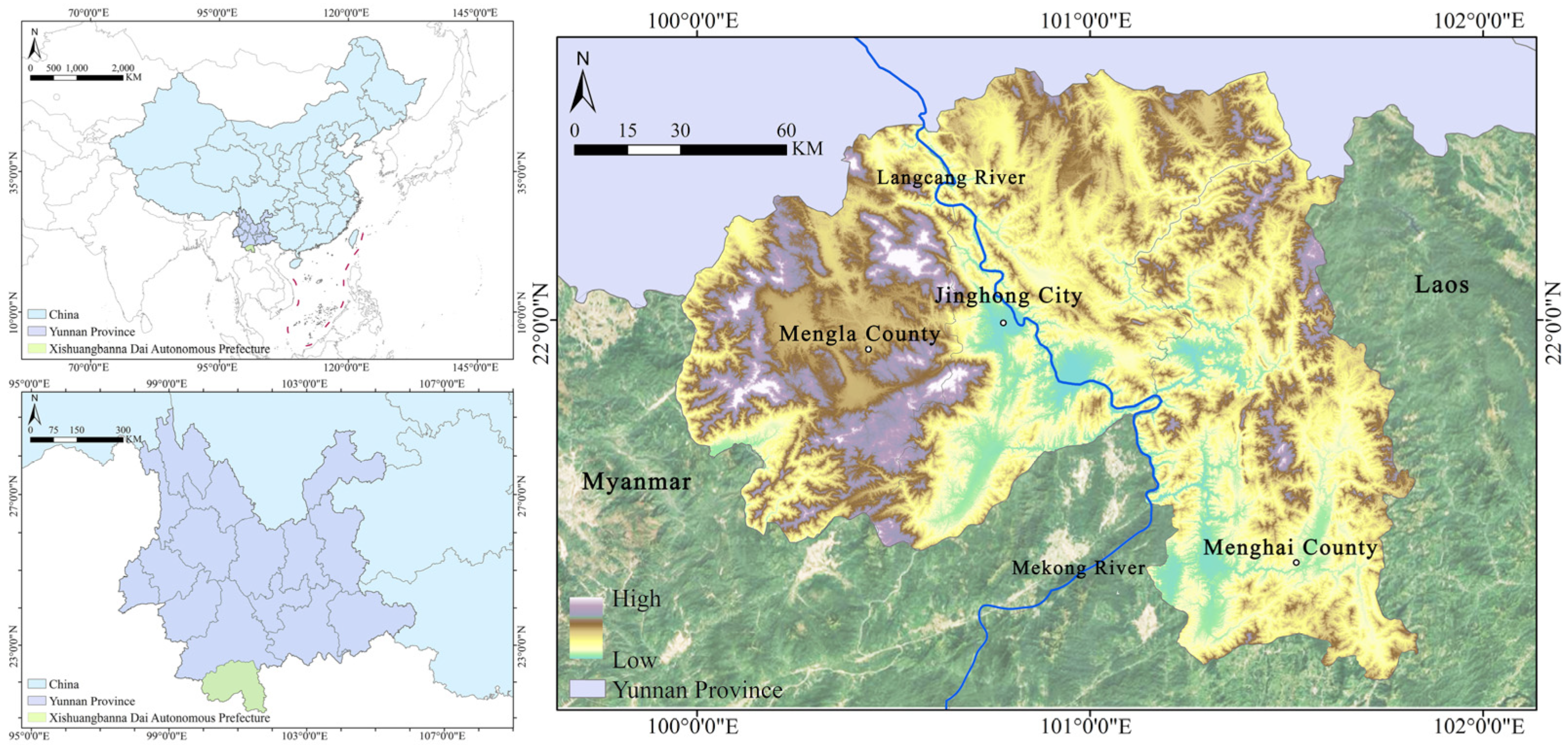
Figure 1. Location map of study area. (Results are based on the authors’ calculations).
Sustainability 18 00894 g001
Figure 2. Research framework. (Results are based on the authors’ calculations).
Sustainability 18 00894 g002
Figure 3. RSEI and the loadings and contribution rates of four indicators on the first principal component. (Results are based on the authors’ calculations. For specific values, please refer to the Supplementary Materials: Table S1).
Sustainability 18 00894 g003
Figure 4. RSEI temporal variation and area proportion. (a) 2003; (b) 2008; (c) 2013; (d) 2018; (e) 2023; (f) The proportion of area at ecological grade level. (Results are based on the authors’ calculations. For specific values, please refer to the Supplementary Materials: Table S2).
Sustainability 18 00894 g004
Figure 5. Distribution of RSEI area change. (a) 2003–2008; (b) 2008–2013; (c) 2013–2018; (d) 2018–2023. (Results are based on the authors’ calculations. For specific values, please refer to the Supplementary Materials: Table S3).
Sustainability 18 00894 g005
Figure 6. Resistance surface factors and ecological resistance surfaces. (a) LUCC; (b) DEM; (c) Slope; (d) Population density; (e) NDVI; (f) Distance to river; (g) Distance to road; (h) Ecological resistance surface. (Results are based on the authors’ calculations. For specific values, please refer to the Supplementary Materials: Table S4).
Sustainability 18 00894 g006
Figure 7. Comparison of ecological source identification results. (a) Result of MSPA. (b) Result of RSEI. (c) Ecological source identification result based on traditional methods. (d) Ecological source identification result based on RSEI-ESP-PLUS. (Results are based on the authors’ calculations).
Sustainability 18 00894 g007
Figure 8. Changes in RSEI and grade area under multiple scenarios. (a) Nature development scenario. (b) Economic development scenario. (c) Ecological conservation scenario. (d) Transfer situation of Natural Development Scenario. (e) Transfer situation of Economic Development Scenario. (f) Transfer situation of Ecological Conservation Scenario. (Results are based on the authors’ calculations. For specific values, please refer to the Supplementary Materials: Table S5).
Sustainability 18 00894 g008
Figure 9. Multi-scenario ecological source comparison. (a) Ecological sources under the Natural Development Scenario. (b) Ecological sources under the Economic Development Scenario. (c) Ecological sources under the Ecological Conservation Scenario. (d) The area of ecological sources and cumulative current value under the Natural Development Scenario. (e) The area of ecological sources and cumulative current value under the Economic Development Scenario. (f) The area of ecological sources and cumulative current value under the Ecological Conservation Scenario. (g) Multi-scenario simulation comparison of ecological sources. (h) Stable ecological sources. (i) Potential ecological sources. (Results are based on the authors’ calculations. For specific values, please refer to the Supplementary Materials: Table S6).
Sustainability 18 00894 g009
Figure 10. Ecological corridor comparison. (a) Ecological corridors under the Natural Development Scenario. (b) Ecological corridors under the Economic Development Scenario. (c) Ecological corridors under the Ecological Conservation Scenario. (Results are based on the authors’ calculations).
Sustainability 18 00894 g010
Figure 11. Ecological corridor comparison. (a) Ecological barriers under the Natural Development Scenario. (b) Ecological barriers under the Economic Development Scenario. (c) Ecological barriers under the Ecological Conservation Scenario. (d) Ecological pinch points under the Natural Development Scenario. (e) Ecological pinch points under the Economic Development Scenario. (f) Ecological pinch points under the Ecological Conservation Scenario. (Results are based on the authors’ calculations).
Sustainability 18 00894 g011
Figure 12. Ecological security pattern. (Results are based on the authors’ calculations).
Sustainability 18 00894 g012
Table 1. Data Sources.
DataResolutionDatabase SourcesLink
Landsat5/7/830 mGoogle Earth Enginehttps://developers.google.com/earth-engine/datasets (accessed on 4 December 2025)
Population Density100 mFigsharehttps://doi.org/10.6084/m9.figshare.24916140.v1 (accessed on 4 December 2025)
LUCC30 mEarth System Science Datahttps://zenodo.org/records/15853565 (accessed on 4 December 2025)
RoadN/AOpen Street Maphttp://www.openstreetmap.org (accessed on 4 December 2025)
RiverN/A
BoundaryN/ANational Catalogue Service for Geographic Informationhttp://www.webmap.cn (accessed on 4 December 2025)
Nature ReserveN/A
DEM30 mGeospatial Data Cloudhttp://www.gscloud.cn/ (accessed on 4 December 2025)
Table 2. Assessment index system of ecological resistance. (Results are based on the authors’ calculations).
FactorsWeightLevel
12345
LUCC0.303Forest LandWater BodiesGrasslandCroplandConstruction Land
NDVI0.2070.8–1.00.6–0.80.4–0.60.2–0.40–0.5
Distance to River (km)0.107<11–2.52.5–55–7>7.5
Distance to Road (km)0.103>53–51.5–35–1.5<5
DEM (km)0.101<0.80.8–1.21.2–1.51.5–1.8>1.8
Slope (°)0.101<88–1515–2525–35>35
Population Density
(persons/km2)
0.066<2525–5050–7575–100>100
Table 3. Conversion probability and neighborhood weights for different scenarios. (Results are based on the authors’ calculations).
TypeNatural Development ScenarioEconomic Development ScenarioEcological Conservation Scenario
PFMGEPFMGEPFMGE
P0.4050.2860.1870.0930.0290.5590.4410000.9520.0270.0110.0070.003
F0.1450.2850.3410.1880.0410.0740.3850.5410000.5550.1460.1570.142
M0.0510.1370.4490.3180.0450.0660.0270.5890.318000.1000.5490.2480.103
G0.0190.0390.2430.5640.1350.0290.0430.3490.5190.060000.2580.4940.248
E0.0020.0040.0070.2120.7750.0140.0390.0600.1120.7750000.3230.677
NW0.2550.3060.1550.1870.0960.2090.2910.1950.1990.1060.0270.2510.2540.2850.182
Table 4. Comparison of ecological source identification results.
QuantityTotal Area/km2Area Within
the Nature Reserve/km2
Proportion/%
Traditional Methods209939.342334.4423.49
Core23876.90864.8622.31
Secondary43393.281256.8137.04
Tertiary142669.16212.777.97
RSEI-ESP-PLUS337237.05212429.35
Core42804.291656.7259.08
Secondary62061.85286.4913.89
Tertiary232370.9180.797.63
Table 5. Ecological corridor comparison.
TypeCrucialImportantGeneralPotential
QualityLength/kmQualityLength/kmQualityLength/kmQualityLength/km
NDS8608.92345096.06161237.8421379.86
EDS5860.23234314.30259.9211123.75
ECS8598.19355176.95201723.5231475.13
Table 6. Ecological node comparison.
TypeEcological BarriersEcological Pinch Points
QualityArea/km2QualityArea/km2
Nature Development Scenario1821.112917.09
Economic Development Scenario1224.851927.63
Ecological Conservation Scenario2419.072222.85
Table 7. Comparison of ecosystem network metrics. (Results are based on the authors’ calculations).
MetricEconomic DevelopmentNature DevelopmentEcological Conservation
α0.0180.1580.242
β11.2771.435
γ0.3560.4440.500
Disclaimer/Publisher’s Note: The statements, opinions and data contained in all publications are solely those of the individual author(s) and contributor(s) and not of MDPI and/or the editor(s). MDPI and/or the editor(s) disclaim responsibility for any injury to people or property resulting from any ideas, methods, instructions or products referred to in the content.