1. Introduction
Innovation and quality of life represent two foundational dimensions of Europe’s long-term socio-economic transformation. Over the past decade, European societies have navigated successive and overlapping crises—including financial instability, the COVID-19 pandemic, energy and inflation shocks, climate risks and accelerated demographic aging—that have reshaped living conditions and tested societal resilience. Evidence from the OECD well-being framework shows that progress across well-being dimensions has been uneven: while employment and household income indicators have improved, persistent challenges remain in public health, mental well-being, civic trust, and perceived future security [
1]. At the same time, Eurostat has operationalized a multidimensional approach to measuring quality of life in the EU, capturing material conditions, productive activity, health, education, leisure, safety, governance, environmental quality and life satisfaction [
2]. Together, these frameworks highlight a growing consensus that traditional economic indicators such as GDP are insufficient for assessing societal progress and must be complemented by broader measures of well-being [
3].
Parallel to these developments, innovation has become a central driver of Europe’s transition toward sustainability. The Global Innovation Index (GII), published by the World Intellectual Property Organization, provides one of the most comprehensive assessments of innovation performance, integrating institutions, human capital, research capacity, infrastructure, business sophistication, and knowledge and technology outputs [
4]. The 2024 GII report underscores the crucial role of innovation in addressing global challenges—aging populations, climate change, ecosystem degradation, and digital transformation—emphasizing that innovation outcomes increasingly depend on mission-oriented strategies and robust public–private cooperation [
4]. Within the EU, the European Innovation Scoreboard (EIS) shows sustained progress in innovation performance, yet significant disparities persist between “innovation leaders” in Northern and Western Europe and “emerging innovators” in Central and Eastern Europe [
5]. These gaps raise important questions about whether innovation systems deliver benefits that extend beyond competitiveness toward broader societal well-being.
Understanding how innovation influences well-being is, therefore, an essential concern for policymakers, researchers, and sustainability scholars. The OECD “How’s Life?” framework and Eurostat’s indicators converge in recognizing that well-being is multidimensional and shaped by social, environmental, institutional, and subjective factors, rather than income alone [
1,
2,
3,
6]. Innovation has the potential to enhance many of these domains: it can increase productive efficiency and incomes, improve healthcare capabilities, reduce pollution through clean technologies, support digital mobility and transportation systems, and strengthen public service delivery. Yet innovation may also produce uneven outcomes, including skill polarization, unequal access to digital tools, inflated housing markets in innovation hubs, and job displacement linked to automation [
7]. These divergent impacts underscore the need to examine whether innovation systems promote sustainable and inclusive well-being, particularly in economies undergoing structural convergence.
This question is especially salient for emerging EU Member States such as Bulgaria, Croatia, Czechia, Estonia, Hungary, Lithuania, Poland, Romania, Slovakia, and Slovenia. These countries have experienced rapid structural change since EU accession, integrating into European value chains and gradually improving GDP per capita. However, EIS classifications continue to categorize them as moderate or emerging innovators, with innovation intensity often below the EU average [
5]. Simultaneously, Eurostat well-being indicators reveal that these countries remain more vulnerable to economic downturns and external shocks than innovation-leading Member States [
2]. This juxtaposition raises a fundamental policy-relevant question: To what extent do innovation systems support improvements in quality of life in emerging EU economies, and do innovation gains translate into systemic societal benefits rather than isolated technological advancements?
Despite increased scholarly interest, research linking innovation performance and well-being remains fragmented. Many cross-country studies focus primarily on economic outcomes such as productivity, export specialization, or GDP growth, rather than multidimensional well-being [
8]. Conversely, studies on quality of life tend to emphasize income, inequality, employment, environmental conditions, or life satisfaction without integrating comprehensive innovation metrics [
9]. Where innovation is examined, analyses frequently rely on narrow proxies such as R&D expenditures, patent counts, or high-technology exports [
10], overlooking the systemic and ecosystem-based nature of innovation. As a result, the relationship between aggregated innovation capacity and multidimensional quality-of-life outcomes remains insufficiently explored, particularly in post-transition EU economies.
The period examined in this study—2013 to 2024—provides a uniquely informative context. These years encompass recovery from the global financial crisis, accelerated digitalization, and the profound disruptions created by the COVID-19 pandemic. OECD evidence shows steep declines in mental well-being, institutional trust, and social cohesion during the pandemic, with uneven recovery trajectories across Europe [
1]. In parallel, GII and EIS data reveal continued investment in R&D, digital technologies, and green innovation, supported by major EU strategies such as the European Green Deal and the Digital Decade [
4,
5]. Yet, despite these strategic commitments, it remains unclear to what extent innovation-driven transformations in emerging EU economies have translated into measurable improvements in quality of life.
This study addresses this gap by providing a system-oriented empirical assessment of the relationship between the Global Innovation Index and a composite Quality of Life Index across ten emerging EU economies. Unlike previous research, it integrates two comprehensive and internationally comparable multidimensional indicators: GII as a measure of national innovation ecosystems, and a Quality of Life Index incorporating purchasing power, housing affordability, cost of living, safety, healthcare, commuting time, pollution, and climate. This approach aligns with EU and OECD recommendations to adopt whole-of-society analytical models in evaluating socio-economic progress [
2,
3,
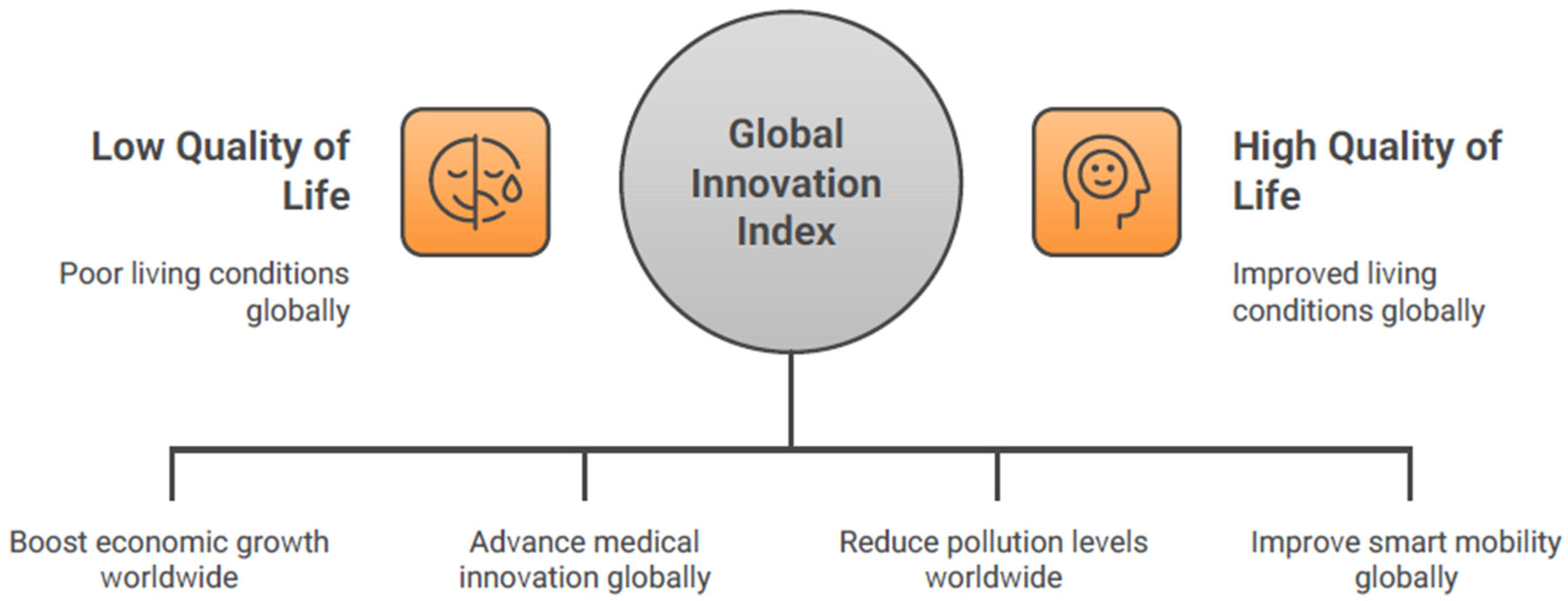
6]. It is grounded in the premise that innovation may influence well-being through four interlinked pathways: economic productivity and income, healthcare and biomedical innovation, environmental innovation and pollution reduction, and smart mobility and digital transformation.
This study advances the literature in four key ways. First, it provides updated empirical evidence encompassing both pre- and post-pandemic dynamics. Second, it focuses explicitly on emerging EU Member States, a group underrepresented in innovation–well-being research despite their importance for EU cohesion. Third, it employs panel econometric techniques that account for macroeconomic performance and demographic pressures, enhancing internal validity. Fourth, its findings directly inform EU innovation and sustainability policies, contributing to evidence-based implementation of the New European Innovation Agenda, the European Green Deal, and the European Pillar of Social Rights [
11,
12,
13].
Ultimately, this study investigates whether innovation systems in emerging EU economies generate broad societal benefits and contribute to sustainable improvements in quality of life. Its findings are intended to support policymakers, researchers, and international institutions in understanding the conditions under which innovation promotes well-being and how national innovation systems can be more effectively aligned with long-term social sustainability objectives.
2. Literature Review
The relationship between innovation and quality of life in European countries has been frequently discussed in recent empirical research. Balcerzak and Pietrzak demonstrated that investments in research and development (R&D) positively influence welfare levels, although this effect is more pronounced in highly developed EU Member States [
14]. Complementing this work, Puertas et al. found that innovation efficiency in the health sector does not necessarily depend on the amount of spending, as countries with lower expenditures sometimes generate better quality-of-life outcomes through more effective transformation of resources [
15]. Similar conclusions were reached by Migala-Warchol and Pasternak-Malicka, who observed that education and innovation are significant determinants of living standards across the EU [
16].
A related stream of research explores the connection between technological progress and subjective well-being. Aldieri et al. showed that innovation, measured through patent activity, is positively associated with happiness, although diminishing returns may appear once a saturation threshold is reached [
17]. Additionally, Pot and Koningsveld highlighted that improvements in quality of working life often accompany organizational performance gains, though outcomes vary depending on implementation approaches [
18]. Greenan et al. earlier observed that despite technological progress, working conditions in the EU-15 deteriorated in some dimensions between 1995 and 2005, emphasizing the complex and multidimensional nature of quality-of-life dynamics [
19].
Several studies examine the role of innovation in health outcomes and overall living standards. Lichtenberg found that access to innovative prescription drugs significantly reduced disability rates and improved well-being across eleven European countries [
20]. Similarly, policy-oriented initiatives, such as the European Code of Cancer Practice, have emphasized innovation and equitable access to treatment as fundamental rights supporting better quality of life for cancer patients [
21]. Apolone and Brunelli, using evidence from the EUonQoL project, highlighted ongoing efforts to establish standardized measures of quality of life for oncology patients across Europe [
22].
Research also shows that environmental and energy innovation can improve living standards. Sadiq et al. argued that renewable-energy-based policies contribute to environmental quality in polluted European economies, although effects may follow nonlinear patterns [
23]. Kuzminski et al. used cluster analysis to classify EU countries based on their achievements in renewable energy production and air pollution reduction, illustrating how environmental innovation policies differentiate sustainability outcomes [
24]. Ulman et al. further noted that while economic progress in Central and Eastern European countries sometimes negatively affects environmental well-being, innovation-driven economies improve social conditions and basic needs satisfaction [
25].
Digital transformation has also emerged as a driver of quality-of-life improvements. Hospodková et al. identified substantial opportunities for digital health innovation, although hospitals still face challenges in change management and systemic implementation [
26]. Fedyshyn et al. reported strong FinTech development trends across Europe, supporting consumer-centered digital services and expanding access to financial tools [
27]. Moreover, Lobont et al. found that digitalization significantly contributes to economic growth and long-term prosperity in EU Member States, thus indirectly affecting quality of life [
28].
The literature also emphasizes the territorial dimension of innovation outcomes. According to Kucera and Fil’a, R&D expenditure strongly affects innovation performance, which in turn shapes economic development levels in EU countries, although regional disparities persist [
29]. Bal-Domanska showed that progress associated with knowledge-based economic transition is uneven across Europe, reflected in persistent income inequality and poverty patterns despite innovation-driven policies [
30].
Finally, energy transition, smart cities, and emerging sustainable business models have been identified as innovation channels enhancing living conditions. Tantau and Santa demonstrated that smart-city development, supported by digital and energy policies, improves citizen well-being and environmental sustainability [
31]. Zekanovic-Korona and Grzunov similarly argued that ICT adoption raises satisfaction and living conditions in urban areas when implemented effectively [
32]. Grigorescu et al. highlighted that renewable-energy technology specialization may also form the basis for competitive advantages and improved living conditions across European regions [
33].
Building on the empirical and theoretical insights discussed in the previous section, this study develops a conceptual framework to examine the impact of innovation performance on the Quality of Life Index (QoLI) across emerging European Union economies. The model posits that higher levels of innovation capacity—captured through the Global Innovation Index (GII)—improve societal welfare by enabling more efficient production systems, better public services, and enhanced technological and institutional capabilities. These mechanisms reflect the view that innovation is a driver of sustainable prosperity and living standards in advanced and transition economies [
14,
15,
16,
17].
In line with prior research, innovation may influence quality of life through multiple transmission channels, including healthcare technologies, digital transformation, environmental innovation, and productivity dynamics that affect income, well-being, and social conditions [
18,
19,
20,
21,
22,
23,
24]. However, innovation outcomes may differ across Member States due to structural disparities in institutional capacity, policy support, and absorptive capabilities [
25,
26,
27,
28]. To isolate this relationship, the model incorporates two macro-level control variables: real GDP growth rate, reflecting the economic cycle and income dynamics, and population size, accounting for scale effects, demographic pressures, and public service demand.
Figure 1 presents the conceptual structure guiding the empirical analysis.
While a substantial body of literature assumes a positive association between innovation performance and societal well-being, several theoretical strands suggest that this relationship may become negative once structural and demographic constraints are jointly accounted for, particularly in emerging and post-transition economies.
First, theories of uneven development and structural transition emphasize that innovation-led growth may generate significant short- and medium-term adjustment costs, including labor market polarization, spatial concentration of high-value activities, and unequal access to digital and technological infrastructure [
34,
35]. In such contexts, innovation benefits tend to accrue disproportionately to specific sectors, regions, or skill groups, while large segments of the population experience transitional welfare losses.
Second, the absorptive capacity perspective highlights that the welfare effects of innovation depend critically on institutional quality, governance effectiveness, and social diffusion mechanisms [
36,
37]. When these institutional frameworks are insufficiently developed, higher aggregate innovation inputs may fail to translate into broad-based improvements in living conditions and may instead coexist with rising inequality and perceived declines in quality of life.
Third, demographic scale effects suggest that in countries facing significant population pressure, innovation-driven productivity gains may be offset by increased demand for public services, housing, healthcare, and urban infrastructure [
38,
39]. When innovation capacity expands faster than the institutional ability to manage these pressures, the conditional long-run association between innovation performance and perceived quality of life may become negative once economic development and demographic factors are jointly controlled for.
Taken together, these theoretical mechanisms imply that the innovation–quality-of-life relationship is conditional rather than uniformly positive in emerging EU Member States. While unconditional associations may appear positive in bivariate settings, the conditional long-run effect of innovation performance may turn negative when structural and demographic constraints are explicitly incorporated into the analytical framework.
The conceptual model assumes that increases in GII will be associated with improvements in QoLI, holding other determinants constant. Thus, the central causal proposition is as follows:
H1: Innovation performance (GII) is associated with the Quality of Life Index (QoLI) in emerging EU Member States; however, the sign and magnitude of this relationship are expected to be conditional on economic development and demographic pressure.
Given the strong theoretical basis for the role of economic growth in shaping welfare outcomes, we further hypothesize the following:
H2: Real GDP growth rate is positively associated with the Quality of Life Index (QoLI).
Considering demographic and resource allocation perspectives, we additionally test the following:
H3: Population size is significantly associated with the Quality of Life Index (QoLI), although the direction of this effect may differ depending on country-specific conditions.
4. Results and Discussion
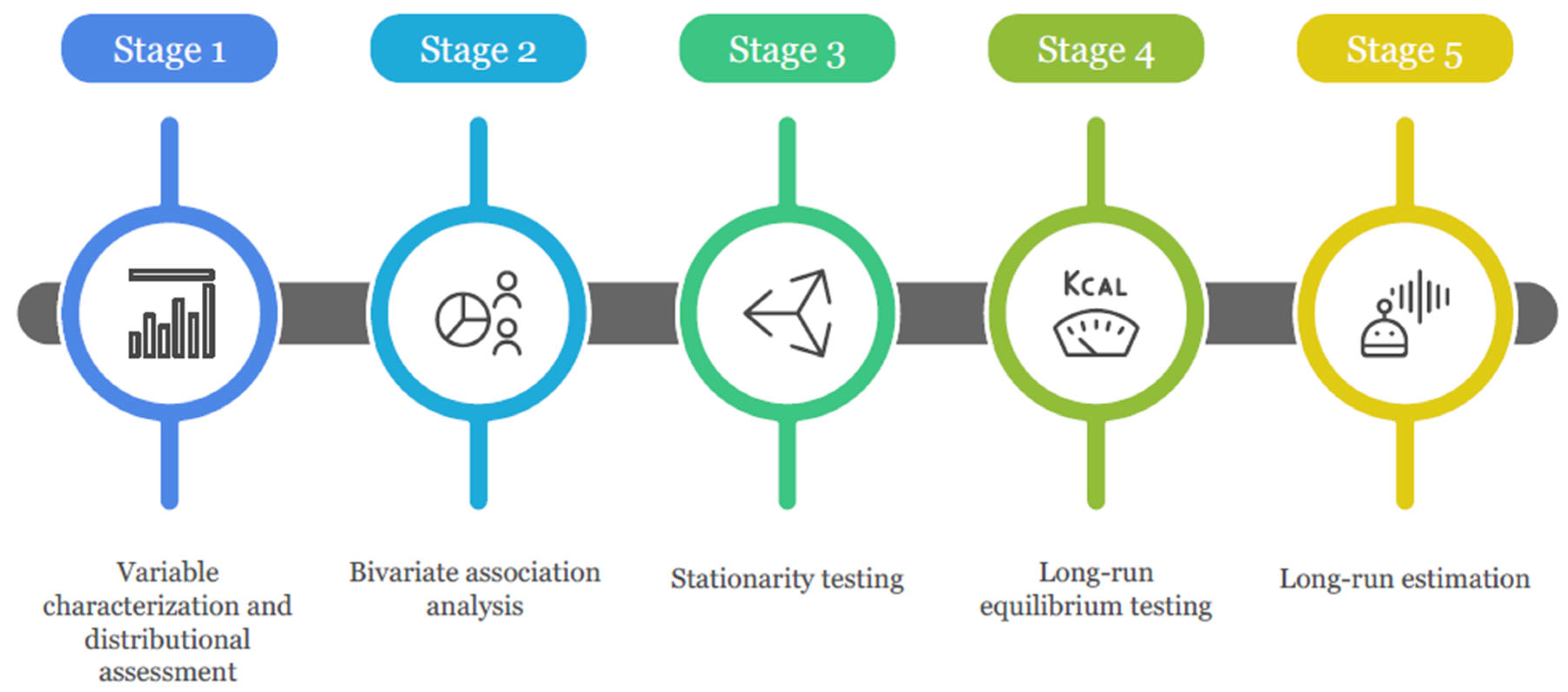
The present section reports the empirical findings derived from the panel data analysis conducted to examine the long-run relationship between the Quality of Life Index (QoLI) and its proposed determinants in emerging European Union economies.
Before presenting the detailed descriptive statistics, it is important to outline the analytical purpose of this section. The descriptive analysis provides an initial overview of the central tendency, dispersion, and distributional properties of the variables, offering preliminary insights into cross-country heterogeneity and supporting the selection of appropriate panel econometric techniques for subsequent hypothesis testing.
Table 2 provides an overview of the descriptive statistics for the variables included in the analysis. The Quality of Life Index (QoLI) registers a mean value of 140.30 and a median of 143.50, indicating that the central tendency is slightly above the average, while the minimum and maximum values (53.70 and 180.90, respectively) reveal substantial cross-country differences among the emerging EU economies. The variable displays negative skewness (−1.02) and a kurtosis level of 3.84, suggesting a left-skewed and leptokurtic distribution. The Jarque–Bera test confirms that QoLI significantly departs from normality (
p < 0.001), indicating that further econometric analysis should rely on methods robust to distributional irregularities. A similar pattern of non-normality is observed for the population variable (POP), which has a very large standard deviation (over 10.5 million) and a strong right-skewed distribution, reflecting the pronounced demographic heterogeneity across the sample.
With respect to the Global Innovation Index (GII), the mean value of 42.40 and the median of 41.60 suggest a fairly balanced distribution, supported by moderate skewness (0.51) and a kurtosis below the threshold of mesokurtosis (2.56), indicating a slightly platykurtic shape. While the dispersion of innovation performance is smaller than that of the other variables, the Jarque–Bera statistic still indicates a statistically significant deviation from normality at the 5% level (p ≈ 0.046). GDP per capita (GDP) shows considerable variability, with values ranging from −7.49 to 13.65 and a standard deviation of 3.15, highlighting pronounced differences in economic development among emerging EU countries. Furthermore, the positive kurtosis value (4.53) and Jarque–Bera test (p < 0.001) confirm that GDP also departs from normality.
The descriptive statistics reveal meaningful variation in quality of life, innovation capacity, economic performance, and demographic size across the selected economies. These results justify the use of panel econometric approaches capable of handling data heterogeneity and non-normality. The substantial disparities captured in mean values, distribution shapes, and dispersion measures substantiate the importance of conducting unit root and cointegration analyses before estimating the long-run effects through FMOLS. Consequently, the descriptive evidence supports the suitability of a longitudinal, cross-country framework for examining the structural determinants of the Quality of Life Index in emerging EU member states.
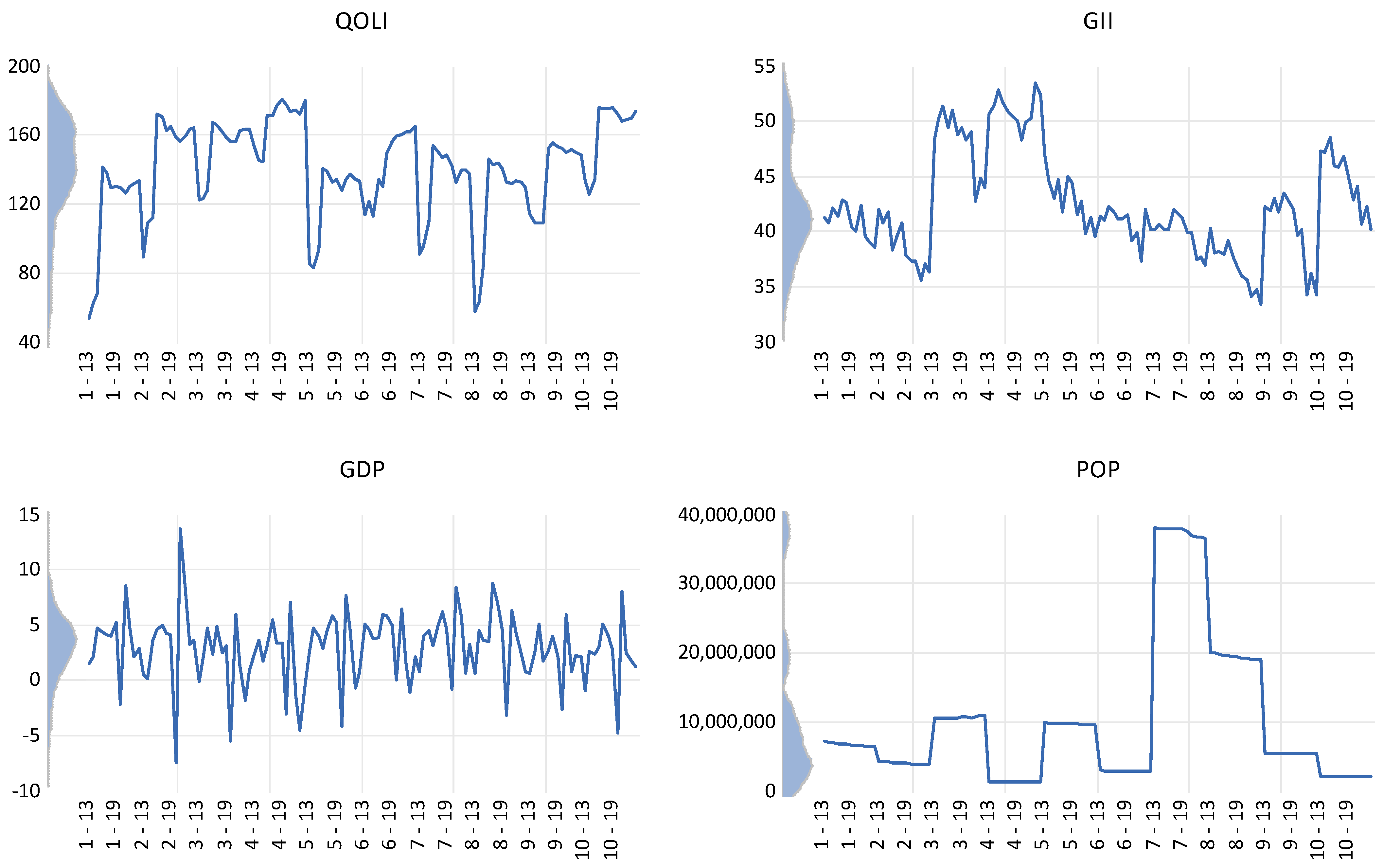
The kernel density and time-distribution patterns of the four variables reveal distinct dynamics and heterogeneous evolution across emerging EU economies (
Figure 3). The Quality of Life Index (QoLI) exhibits relatively high and recurrently clustered values over time, with visible downward corrections but a generally stable trend concentrated around the upper segment of its distribution, supporting the left-skewness identified in the descriptive statistics.
The Global Innovation Index (GII) shows higher variability and a gradual decline throughout the observed period, marked by intermittent peaks associated with periods of stronger innovation performance, while the density curve suggests a moderately right-skewed distribution. GDP per capita demonstrates substantial dispersion and frequent oscillations around zero, reflecting economic volatility and asymmetric growth patterns across the sample, consistent with the excess kurtosis previously reported. Population (POP) displays strong right-skewness and large structural jumps, indicating pronounced demographic disparities between countries and relatively stable population levels within each unit over time. Taken together, these visual patterns reinforce the presence of non-normality and cross-sectional heterogeneity, thus justifying the use of robust panel econometric procedures and the subsequent implementation of unit root and cointegration tests before estimating the long-run relationships.
The correlation analysis aims to explore the direction and relative strength of the bivariate associations between the Quality of Life Index and its potential determinants. This step serves as an exploratory diagnostic, helping to identify preliminary relationships and possible multicollinearity concerns prior to the multivariate long-run estimations. The correlation results presented in
Table 3 indicate a positive and statistically significant relationship between the Quality of Life Index (QoLI) and the Global Innovation Index (GII), with a correlation coefficient of 0.2324 (
t = 2.5957;
p = 0.0106). Although the magnitude of this relationship is moderate, the significance level suggests that higher innovation capacity is systematically associated with improvements in quality of life across emerging EU economies. This finding aligns with the premise that innovation-driven environments tend to enable better access to technology, improved public services, and enhanced social and economic opportunities, which cumulatively contribute to higher living standards. The direction and significance of the correlation support the theoretical argument that innovation acts as a long-term catalyst for socio-economic development and may represent a critical policy lever for improving well-being outcomes in countries still progressing through post-transition institutional consolidation.
The remaining correlation coefficients provide additional insights into the structure of relationships among the variables. GDP per capita shows only a weak and statistically insignificant correlation with QoLI (r = −0.0493; p = 0.5926), suggesting that economic growth, in isolation, may not be sufficient to directly improve quality of life in the observed economies, which is consistent with literature noting that gains in output may not always translate into equitable welfare improvements. Population size, expressed as lnPOP, exhibits a relatively strong and negative association with QoLI (r = −0.4272; p < 0.001), implying that more populous countries tend to face greater challenges in sustaining high levels of well-being, potentially due to increased pressure on infrastructure, public services, and resource distribution. Together, these results justify a multivariate and longitudinal approach to estimating the determinants of QoLI, confirming that innovation, economic performance, and demographic factors interact in complex ways that cannot be fully captured by simple bivariate correlations.
Given the panel structure of the dataset and the time dimension of the variables, unit root tests are conducted to assess their stochastic properties. Establishing stationarity is a necessary precondition to avoid spurious regression and to justify the application of panel cointegration techniques. The results of the panel unit root tests presented in
Table 4 provide consistent evidence that all variables included in the analysis—Quality of Life Index (QoLI), Global Innovation Index (GII), GDP per capita (GDP), and the natural logarithm of population (lnPOP)—are stationary in levels. Under the null hypothesis of a common unit root, the Levin, Lin and Chu (LLC) test yields significantly negative test statistics for each variable (QoLI: −6.0594; GII: −2.6463; GDP: −7.1056; lnPOP: −8.7166), all associated with probability values below 0.01, leading to the rejection of the unit root hypothesis. Similarly, when allowing for heterogeneous autoregressive roots across countries, the Im, Pesaran and Shin (IPS) W-statistic confirms stationarity for all variables, with test statistics ranging from −2.9563 to −4.2419 and corresponding
p-values below 0.01. These results indicate that the stochastic processes governing the panel data are mean-reverting and do not require first differencing prior to further long-run analysis.
Additional robustness is provided by the Fisher-type tests, both ADF-Fisher and PP-Fisher, which combine individual unit root tests across cross-sections. For all variables, the ADF-Fisher Chi-square values are statistically significant (p < 0.01), confirming level stationarity, while the PP-Fisher Chi-square test shows consistent results, although lnPOP presents a slightly higher p-value (0.0058), still well below conventional significance thresholds. Taken together, the convergence of evidence across all four testing procedures demonstrates that the series does not exhibit unit root behavior, thereby validating the use of cointegration techniques in subsequent empirical stages. The confirmed stationarity of the variables ensures that the long-run relationships estimated through FMOLS are not affected by spurious regression issues, supporting the econometric reliability of the model specification.
Given the strong institutional, economic, and policy linkages among European Union Member States, the possibility of cross-sectional dependence was explicitly addressed by applying a second-generation panel unit root test (
Table 5). Specifically, the Pesaran Cross-sectionally Augmented IPS (CIPS) test was employed, as it accounts for unobserved common factors and cross-sectional dependence across panel units. The results indicate that all variables—Quality of Life Index (QoLI), Global Innovation Index (GII), GDP per capita growth (GDP), and the natural logarithm of population (lnPOP)—are stationary at levels. These findings reinforce the validity of the stationarity conclusions obtained from first-generation panel unit root tests and support the subsequent cointegration-based estimation strategy.
After confirming the time-series properties of the variables, cointegration analysis is employed to examine whether a stable long-run equilibrium relationship exists among quality of life, innovation performance, economic growth, and population size. The subsequent FMOLS estimation allows the quantification of long-run effects while correcting for endogeneity and serial correlation. The Kao residual cointegration test, displayed in
Table 6, provides strong evidence of a long-run equilibrium relationship among the variables included in the model: Quality of Life Index (QoLI), Global Innovation Index (GII), GDP per capita (GDP), and the natural logarithm of population (lnPOP). The test rejects the null hypothesis of no cointegration, as indicated by the ADF t-statistic of −4.5052 with a corresponding probability of 0.0000, well below the 1% significance threshold. This outcome suggests that although the variables may fluctuate in the short run, they move together over time, converging toward a stable long-run equilibrium. The result aligns with theoretical expectations that innovation, economic performance, and demographic structure jointly shape long-term quality of life outcomes in emerging EU economies, reinforcing the relevance of a cointegrated modeling strategy.
The estimated residual and HAC variances (228.70 and 242.56, respectively) indicate a consistent distribution of long-run residual dynamics after accounting for serial correlation and heteroskedasticity using the Newey–West automatic bandwidth selection procedure and Bartlett kernel weighting. These adjustments increase the robustness of inference and ensure that the identified cointegration relationship is not driven by model misspecification or unaccounted variance clustering. Overall, the Kao test confirms the suitability of proceeding with the Fully Modified Ordinary Least Squares (FMOLS) estimation to obtain efficient long-run coefficients, thereby eliminating concerns of spurious regression and strengthening the econometric validity of the empirical investigation.
To assess the robustness of the cointegration results under heterogeneous long-run relationships, the Pedroni panel cointegration test was additionally applied (
Table 7). Unlike the Kao test, which assumes homogeneous cointegrating vectors, the Pedroni framework allows for heterogeneity across cross-sectional units. The results from both within-dimension (panel statistics) and between-dimension (group statistics) tests strongly reject the null hypothesis of no cointegration at the 1% significance level. This provides robust evidence of a stable long-run equilibrium relationship among the Quality of Life Index, innovation performance, economic growth, and population size, thereby reinforcing the validity of the subsequent FMOLS estimation.
The FMOLS results in
Table 8 show that all three explanatory variables exert statistically significant long-run effects on the Quality of Life Index (QoLI) in emerging EU economies. At first glance, the positive Pearson correlation between the Global Innovation Index and the Quality of Life Index suggests that innovation capacity is associated with higher levels of well-being. However, this bivariate relationship does not account for the simultaneous influence of economic development and demographic pressure. Once these structural factors are jointly controlled for in the multivariate FMOLS framework, the long-run effect of innovation becomes negative and statistically significant. This divergence highlights the importance of distinguishing between simple associations and conditional long-run effects. In emerging EU economies, innovation systems may generate growth and technological upgrading, but without sufficiently inclusive institutions and absorptive capacity, innovation gains may coexist with social polarization, regional disparities, and unequal access to public services, ultimately reducing average quality-of-life outcomes. The coefficient for the Global Innovation Index (GII) is negative and precisely estimated (−3.1509; t = −33.86;
p < 0.01), indicating a strong inverse association between innovation performance and quality of life. By contrast, GDP per capita has a positive and significant coefficient (0.6643; t = 4.80;
p < 0.01), suggesting that higher levels of economic development are associated with improved QoLI. The log of population (lnPOP) displays a very large negative coefficient (−417.39) with an extremely high absolute t-statistic, implying that more populous countries tend to experience structurally lower levels of quality of life. These estimates should be interpreted as conditional long-run associations within the specified model, as unobserved institutional, distributive, and social factors—such as governance quality, income inequality, educational attainment, or healthcare investment—may simultaneously affect innovation performance and quality-of-life outcomes and are not explicitly controlled for in the present specification.
The magnitude of the lnPOP coefficient reflects the scaling properties of the population variable rather than numerical instability or collinearity issues. Population enters the model in logarithmic form, while the dependent variable (QoLI) is measured on an index scale. As a result, the estimated coefficient captures a semi-elasticity effect, whereby relatively small proportional changes in population are associated with sizable level changes in QoLI. Importantly, diagnostic checks confirm that this result is not driven by multicollinearity or numerical instability. Variance Inflation Factors (VIFs) for all regressors remain well below conventional thresholds (VIF < 2), indicating the absence of harmful multicollinearity. Moreover, the FMOLS estimator corrects for serial correlation and endogeneity in cointegrated panels, ensuring numerical stability of long-run coefficients. Consequently, while the magnitude of the lnPOP coefficient is large, its sign and statistical significance should be interpreted as evidence of strong demographic pressure effects rather than as an estimation artifact. It should be noted that the extremely large absolute t-statistic reported for lnPOP reflects numerical scaling effects rather than an economically meaningful degree of statistical certainty. Specifically, the combination of a logarithmically transformed population variable, an index-scaled dependent variable, and the FMOLS correction in a relatively small macro-panel can generate inflated test statistics. Therefore, inference should focus on the sign, stability, and robustness of the coefficient across specifications rather than on the absolute magnitude of the t-statistic itself.
At the model level, an R2 of approximately 0.51 and an adjusted R2 of 0.44 indicate that about half of the variation in QoLI is explained by the three regressors, while the standard error of the regression (18.96) is significantly lower than the standard deviation of QoLI (25.32), confirming a reasonably good fit for a macro-panel specification.
From a statistical standpoint, the very high absolute t-values and
p-values effectively equal to zero for all coefficients allow a clear rejection of the null hypothesis of no long-run effect for GII, GDP and LNPOP. The use of the FMOLS estimator, combined with Newey–West long-run covariance corrections and Bartlett kernel weighting, supports the robustness of these estimates to potential endogeneity and serial correlation in the cointegrated system [
65,
66]. The reported long-run variance and the relatively moderate sum of squared residuals suggest a well-behaved error structure, strengthening the reliability of inference. Overall, the estimates point to a complex configuration in which economic development has a beneficial effect on quality of life, demographic pressure exerts a persistent negative influence, and innovation—as captured by the composite GII—appears to be associated with lower average QoLI in the long run for emerging EU member states.
To assess whether the sign reversal between the bivariate correlation and the multivariate FMOLS estimates may be driven by multicollinearity, variance inflation factors (VIFs) were computed for all explanatory variables (
Table 9). The results indicate very low VIF values for GII (1.17), GDP (1.10), and lnPOP (1.12), well below conventional thresholds associated with multicollinearity concerns. These findings suggest that multicollinearity is not a relevant issue in the estimated model. Consequently, the negative long-run coefficient of GII obtained in the FMOLS estimation reflects a conditional relationship that emerges once economic development and demographic pressure are jointly accounted for, rather than a statistical artifact driven by collinearity among regressors.
Although the empirical framework of this study focuses on identifying long-run equilibrium relationships, it is important to acknowledge that the strength and sign of the innovation–quality-of-life linkage may vary over time due to macroeconomic shocks and structural transitions. The period 2013–2024 encompasses several major disturbances, including post-crisis recovery dynamics, the COVID-19 pandemic, energy price shocks, and accelerated digitalization, all of which may have generated short-term fluctuations in both innovation performance and perceived quality of life. In particular, the COVID-19 pandemic period (2020–2021) may have introduced structural breaks that temporarily altered the relationships among innovation, economic performance, and quality of life. As such, the cointegration and FMOLS results should be interpreted as reflecting average long-run associations over the full sample period, rather than stable relationships holding uniformly across all sub-periods.
The FMOLS estimator captures average long-run associations and is not designed to model short-term volatility or regime-specific dynamics. Consequently, the estimated coefficients should be interpreted as reflecting structural long-run tendencies rather than time-varying causal effects. Investigating volatility patterns, structural breaks, or time-varying coefficients would require alternative econometric approaches (e.g., rolling regressions, panel VAR, or regime-switching models), which fall beyond the scope of the present study but represent a relevant avenue for future research.
With respect to Hypothesis 1, which posited that the relationship between innovation performance (GII) and quality of life is conditional on structural and demographic factors rather than uniformly positive, the negative and statistically significant FMOLS coefficient indicates that, once economic development and population pressure are jointly controlled for, innovation performance is associated with lower long-run quality-of-life outcomes in emerging EU economies. This result contrasts with a substantial body of empirical literature documenting positive welfare effects of innovation and adaptation technologies—such as improvements in environmental quality, reductions in energy poverty, and enhanced health and care outcomes—primarily in advanced economies [
72,
73,
74,
75,
76]. Rather than providing direct evidence of specific causal mechanisms, the present findings point to a macro-level misalignment between aggregate innovation capacity and multidimensional quality-of-life outcomes in emerging EU Member States. Accordingly, the observed negative long-run association should be interpreted as a systemic and conditional outcome reflecting incomplete diffusion, institutional frictions, and uneven absorptive capacity, rather than as evidence that innovation per se deteriorates well-being. The concept of an “innovation–well-being gap” is introduced here as an interpretative framework, intended to contextualize the observed conditional long-run association between innovation performance and quality of life in light of existing theoretical and empirical literature, rather than as a directly tested or independently validated empirical construct [
77]. Given the aggregate nature of the data and the absence of country- or sector-specific heterogeneity tests, this interpretation remains indicative rather than conclusive. Consequently, the findings suggest that innovation capacity, as measured by the composite GII, may not yet be sufficiently inclusive or socially embedded to generate broad-based improvements in QoLI in emerging EU economies, despite well-documented positive effects of targeted technological interventions at the micro level [
72,
73,
74,
75,
76,
77].
Thus, consistent with Hypothesis 1—which conceptualized the relationship between innovation performance and quality of life as conditional rather than uniformly positive—the empirical results reveal a negative long-run coefficient for the Global Innovation Index in the FMOLS estimation once economic development and demographic pressure are jointly accounted for. This outcome can be interpreted through several complementary mechanisms. First, innovation processes in emerging EU economies may entail short- to medium-term adjustment costs—such as labor market polarization, spatial concentration of high-tech activities, and unequal access to digital and technological infrastructure—that adversely affect aggregate quality-of-life outcomes. Second, innovation capacity as captured by the composite GII may reflect institutional and technological inputs whose social diffusion remains incomplete, thereby generating benefits that are unevenly distributed across the population. Third, potential reverse causality cannot be excluded, as countries facing persistent quality-of-life challenges may intensify innovation policies as a corrective response, which could influence the observed long-run association. Finally, measurement limitations inherent in composite innovation and well-being indices may also contribute to divergence between theoretical expectations and empirical outcomes. Taken together, these results indicate that, in emerging EU contexts, innovation performance alone is insufficient to ensure improvements in quality of life unless accompanied by inclusive institutional frameworks, effective redistribution mechanisms, and targeted social policies.
Hypothesis 2, which expected a positive relationship between GDP per capita and QoLI, is clearly supported by the FMOLS results, as the coefficient of 0.6643 is positive and highly significant. This finding is consistent with studies that emphasize the role of economic development and ICT-driven productivity gains in enhancing education, health and general living standards in developing and emerging contexts [
78,
79,
80]. In particular, evidence that ICT investments contribute to improving education indices [
78] and that digital infrastructure can reduce energy poverty and social exclusion [
79] supports the view that higher income levels create fiscal and institutional space for social policies and public investment, which eventually translate into better quality of life. Hypothesis 3, which posited a negative effect of population size on QoLI, is strongly confirmed by the large and negative LNPOP coefficient. This outcome aligns with research showing that demographic pressure and unbalanced urbanization can strain public health systems, infrastructure and social services, thereby lowering average well-being if not matched by adequate policy responses [
81,
82]. Studies on active and healthy aging in Europe also emphasize that ageing societies require targeted innovation and governance reforms to prevent declines in QoL among older adults [
8,
76]. Taken together, the three hypotheses and their empirical testing suggest that, for emerging EU countries, innovation-led strategies must be better aligned with inclusive economic growth and demographic management in order to translate innovation capacity into tangible, widespread improvements in quality of life. Although the bivariate correlation between QoLI and GDP per capita growth is small and statistically insignificant (
Table 3), the long-run multivariate FMOLS estimates indicate a positive and significant coefficient for GDP. This apparent discrepancy is expected because Pearson correlations capture unconditional contemporaneous associations, while FMOLS identifies conditional long-run effects within a cointegrated framework after controlling for other determinants (notably lnPOP). In our sample, lnPOP is negatively correlated with QoLI and also correlated with GII, and such interrelationships can mask the marginal contribution of GDP in a bivariate setting (suppression effect). Therefore, the FMOLS coefficient should be interpreted as the long-run association between economic growth and QoLI, conditional on innovation performance and demographic scale, rather than as a direct causal effect.
The empirical findings reveal that innovation performance, as measured by the Global Innovation Index (GII), exerts a significant yet counterintuitive negative long-run effect on the Quality of Life Index (QoLI) in emerging EU economies. This suggests that innovation-driven growth does not automatically translate into broad improvements in well-being and calls for policies aimed at ensuring that innovation is socially inclusive and aligned with human-centered development priorities. First, policymakers should reconsider the allocation of innovation resources, prioritizing sectors with direct social and environmental spillovers—such as public health, digital social care, active aging solutions, and environmental adaptation technologies—consistent with evidence that technological and green innovation can generate welfare improvements when properly targeted [
70,
71,
72,
73]. National innovation strategies should therefore incorporate explicit social impact criteria, encouraging research and development that strengthens education, healthcare access, environmental resilience, and the support infrastructure for vulnerable groups.
Second, the positive relationship between GDP per capita and QoLI highlights the continued importance of economic development for living standards. This finding supports policies that stimulate sustainable economic expansion through digitalization, productivity-enhancing investment, and labor market inclusion, in line with research showing that ICT and human capital investment contribute to educational and welfare improvements in developing and emerging contexts [
74,
75]. To avoid widening inequalities as the economy grows, governments should integrate redistributive mechanisms and regional cohesion instruments, especially in countries with significant territorial disparities. Structural funds and Just Transition mechanisms may be particularly effective frameworks for supporting balanced development in less competitive regions.
Third, the strong and negative effect of population size on QoLI indicates that countries with larger demographic pressures face increased strain on welfare systems, infrastructure, and essential services. Policy responses should therefore include demographic-sensitive welfare reforms, investments in public health capacity, and improved urban and territorial planning strategies, in line with prior evidence showing that population density and aging dynamics strongly influence public service effectiveness and perceived well-being [
77,
78,
79]. This is particularly relevant for Eastern and Southern EU regions experiencing simultaneous ageing, depopulation in rural areas, and overcrowding in major urban centers. Integrated approaches to healthy and active ageing, family support policies, and digital public service delivery should be prioritized.
From a practical perspective, the results suggest three key implementation avenues. (1) Innovation should be governed through social value standards, ensuring that funded technological projects demonstrate measurable improvements in life quality, especially for vulnerable populations. (2) Economic and regional development programs should embed QoLI-oriented evaluation metrics, moving beyond pure growth indicators to assess whether investments enhance well-being and reduce disparities. (3) Public administrations and EU institutions should strengthen demographic impact assessments, anticipating how population dynamics affect long-term welfare systems and designing proactive responses in healthcare, housing, and local infrastructure.
The findings of this study contribute to the theoretical literature on innovation systems and well-being by challenging the implicit assumption that higher aggregate innovation capacity automatically translates into improved societal welfare. While much of the existing literature conceptualizes innovation as a uniformly welfare-enhancing process, the negative long-run association between the Global Innovation Index and the Quality of Life Index in emerging EU economies suggests a more nuanced theoretical relationship.
First, the results support a conditional innovation–well-being framework, in which the welfare effects of innovation depend critically on institutional quality, inclusiveness, and absorptive capacity. Innovation systems that prioritize technological outputs and competitiveness without parallel investments in social diffusion mechanisms may generate growth while failing to improve, or even temporarily reducing, perceived quality of life at the aggregate level.
Second, the findings align with theories of uneven development and structural transition, which posit that innovation-led growth can exacerbate regional, sectoral, and social disparities during convergence phases. In this context, innovation may produce adjustment costs—such as labor market polarization, spatial concentration of high-value activities, and unequal access to digital and health-related technologies—that outweigh short-term welfare gains for large segments of the population.
Third, the observed divergence between bivariate and multivariate results reinforces the importance of theoretical distinctions between unconditional associations and conditional long-run effects. While innovation is positively correlated with quality of life in simple associations, its net long-run effect becomes negative once economic development and demographic pressure are jointly accounted for, highlighting the role of demographic scale and structural constraints in shaping welfare outcomes.
5. Conclusions
This study evaluated whether innovation systems in emerging EU Member States effectively support sustainable well-being by empirically investigating the long-run relationship between innovation capacity and a multidimensional Quality of Life Index. The panel cointegration and FMOLS results confirm the existence of a stable long-run linkage among innovation performance, economic development, demographic pressure, and overall well-being. However, the findings reveal a misalignment between innovation outcomes and societal needs: innovation capacity displays a significant negative long-run association with QoLI, suggesting that innovation systems in these economies are not yet structured to generate broad, socially inclusive or environmentally balanced improvements. Instead, innovation appears concentrated in specific sectors and regions, with limited diffusion toward the wider population. The use of a crowd-sourced Quality of Life Index implies that the results capture perceived living conditions and should, therefore, be interpreted with caution, particularly with respect to rural populations and less digitally connected social groups.
The study also shows that economic development remains a key driver of sustainable well-being, as higher income levels are associated with better living conditions, expanded access to services, and improved social resilience. This reinforces the role of balanced economic growth and convergence policies in enabling welfare improvements. At the same time, the strong negative effect of population size indicates that demographic pressure, infrastructure strain, and unequal service accessibility continue to constrain well-being outcomes. These dynamics highlight structural vulnerabilities that must be addressed to ensure that innovation-led development becomes both inclusive and sustainable.
While the empirical results suggest a statistically significant long-run association between innovation performance and quality of life outcomes in emerging EU economies, the strength and scope of the policy implications should be interpreted with caution. The negative coefficient of innovation capacity reflects an average structural association observed within the estimated specification rather than a definitive causal mechanism. Consequently, the findings should be viewed as indicative signals of potential misalignment between innovation systems and well-being objectives, rather than as conclusive evidence warranting immediate large-scale policy reorientation.
Policy implications derived from this analysis, therefore, emphasize the need for careful reflection rather than prescriptive reform. In particular, policymakers may consider using complementary evidence and country-specific diagnostics when evaluating whether existing innovation strategies sufficiently address social inclusion, territorial cohesion, and environmental sustainability. Further empirical research incorporating additional institutional, social, and sectoral controls is required before drawing strong conclusions regarding the redesign of national or regional innovation policies.
From a practical standpoint, this study shows that innovation efforts concentrated exclusively on competitiveness may not translate into improvements in everyday life unless they are supported by inclusive, sustainability-driven implementation. Public institutions and private organizations should adopt innovation models that explicitly target social and environmental needs, recognizing that economic development remains an enabling factor for sustainable well-being. Expanding digital and green infrastructure—for example, telemedicine, smart mobility, clean technologies, and digitalized administrative services—can mitigate demographic pressures and improve access to essential services. Practitioners working in EU-funded programs, local administration, healthcare, education, and regional development can apply these insights by integrating well-being metrics into innovation projects, co-creating solutions with communities, and ensuring that vulnerable groups benefit from technological advancements. Ultimately, aligning innovation practices with sustainability principles enhances social resilience, reduces inequalities, and ensures that innovation systems become genuine contributors to long-term well-being in emerging EU economies.
Several limitations of the present study should be acknowledged. First, the empirical specification focuses on innovation performance (GII), economic growth, and population size, while other relevant determinants of quality of life—such as institutional quality, income inequality, educational attainment, or healthcare expenditure—are not explicitly included due to data availability constraints and the need to preserve a balanced panel structure. The omission of these variables may give rise to omitted variable bias if they are correlated with both innovation performance and quality of life outcomes. Consequently, the estimated coefficients should be interpreted as capturing average long-run associations rather than fully causal effects. Future research could extend the model by incorporating institutional and social governance indicators, provided sufficiently long and comparable time series become available.
Despite the robustness of the panel cointegration and FMOLS estimation strategy, the empirical results should be interpreted with an appropriate degree of caution. Descriptive statistics indicate relatively high dispersion, skewness, and kurtosis for several variables, while bivariate correlation coefficients explain less than 75% of the variance in quality-of-life outcomes. Although FMOLS estimation mitigates concerns related to non-normality, endogeneity, and serial correlation in cointegrated panels, these distributional characteristics may still affect the precision of average-based inference and the predictive capacity of the estimated long-run relationships. Consequently, the conclusions regarding the direction and magnitude of the tested hypotheses, as well as the predictive interpretation of Equation (2), should be viewed as indicative of long-run structural associations rather than exact point forecasts. Future research may extend the present framework by incorporating multivariate joint normality diagnostics and alternative estimation strategies to further strengthen inference.




 ,
,