Can New Energy Vehicle Promotion Policy Enhance Firm’s Supply Chain Resilience? Evidence from China’s Automotive Industry


Abstract
1. Introduction
2. Policy Background, Theoretical Analysis, and Hypotheses Development
2.1. Policy Background
2.2. Theoretical Analysis and Hypotheses Development
2.2.1. The Direct Effect of NEVPP
2.2.2. The Mechanisms of NEVPP
3. Research Design
3.1. Model Specification
3.2. Variable Selection and Measurement
3.2.1. Dependent Variable
3.2.2. Explanatory Variable
3.2.3. Control Variables
3.3. Data Sources and Description
4. Empirical Results
4.1. Descriptive Statistics
4.2. Baseline Regression
4.3. Robustness Checks
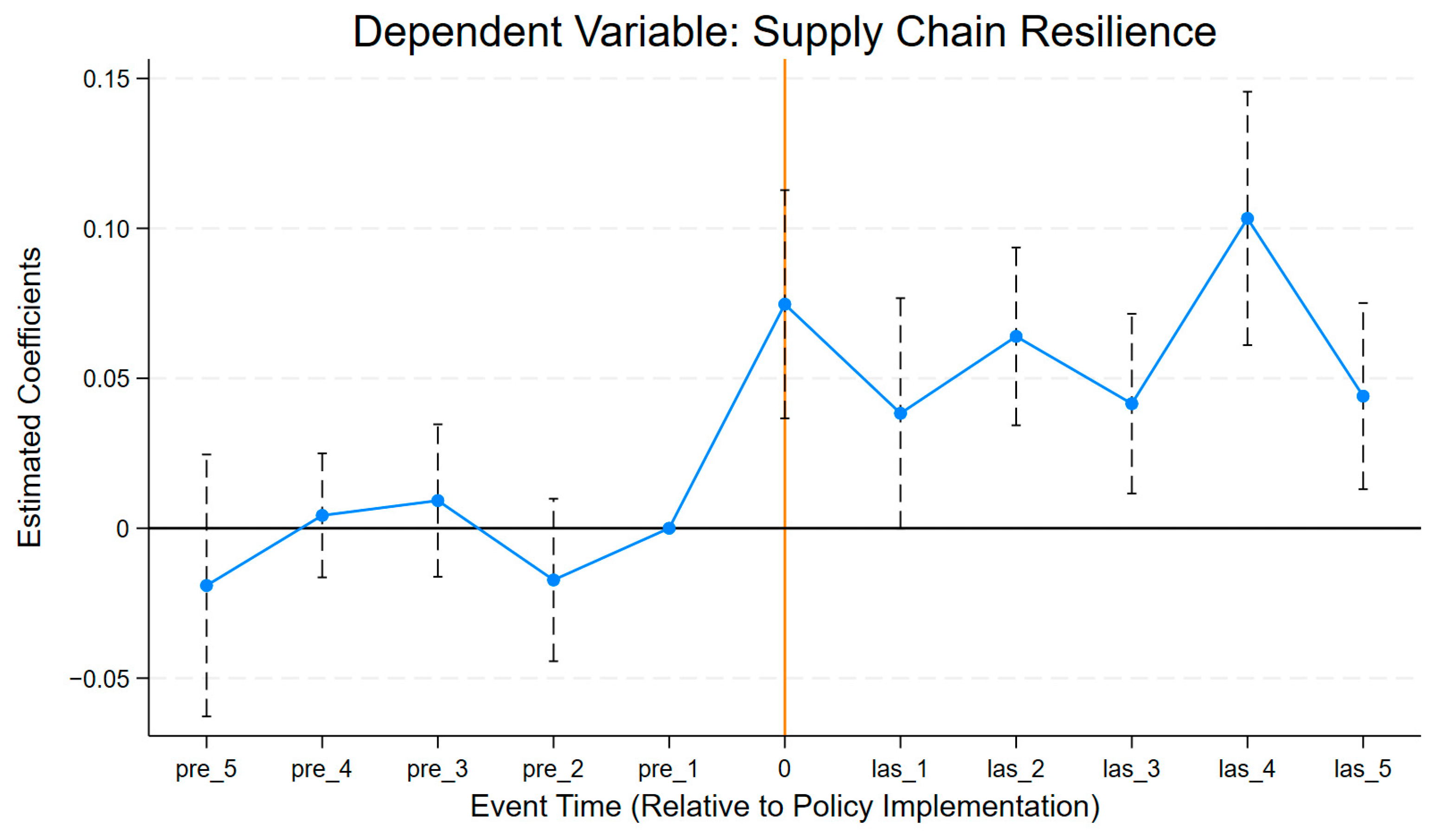
4.3.1. Dynamic Effects Analysis
4.3.2. Placebo Test
- (1)
- A placebo test based on a fictitious policy year. To rule out confounding from unobservable factors, we follow Topalova (2010) [85] and Ruan et al. (2025) [86] by advancing the implementation year of NEVPP by four years and replacing the actual policy year with this fictitious one to perform a counterfactual test. The results are reported in Column (1) of Table 3. The estimated coefficient of the newly constructed dummy variable NEVPP_-4 is 0.012 and statistically insignificant, indicating that firms subject to NEVPP and those not subject to it do not exhibit systematic differences in the time trend of supply chain resilience. This finding corroborates the robustness of the baseline regression results.
- (2)
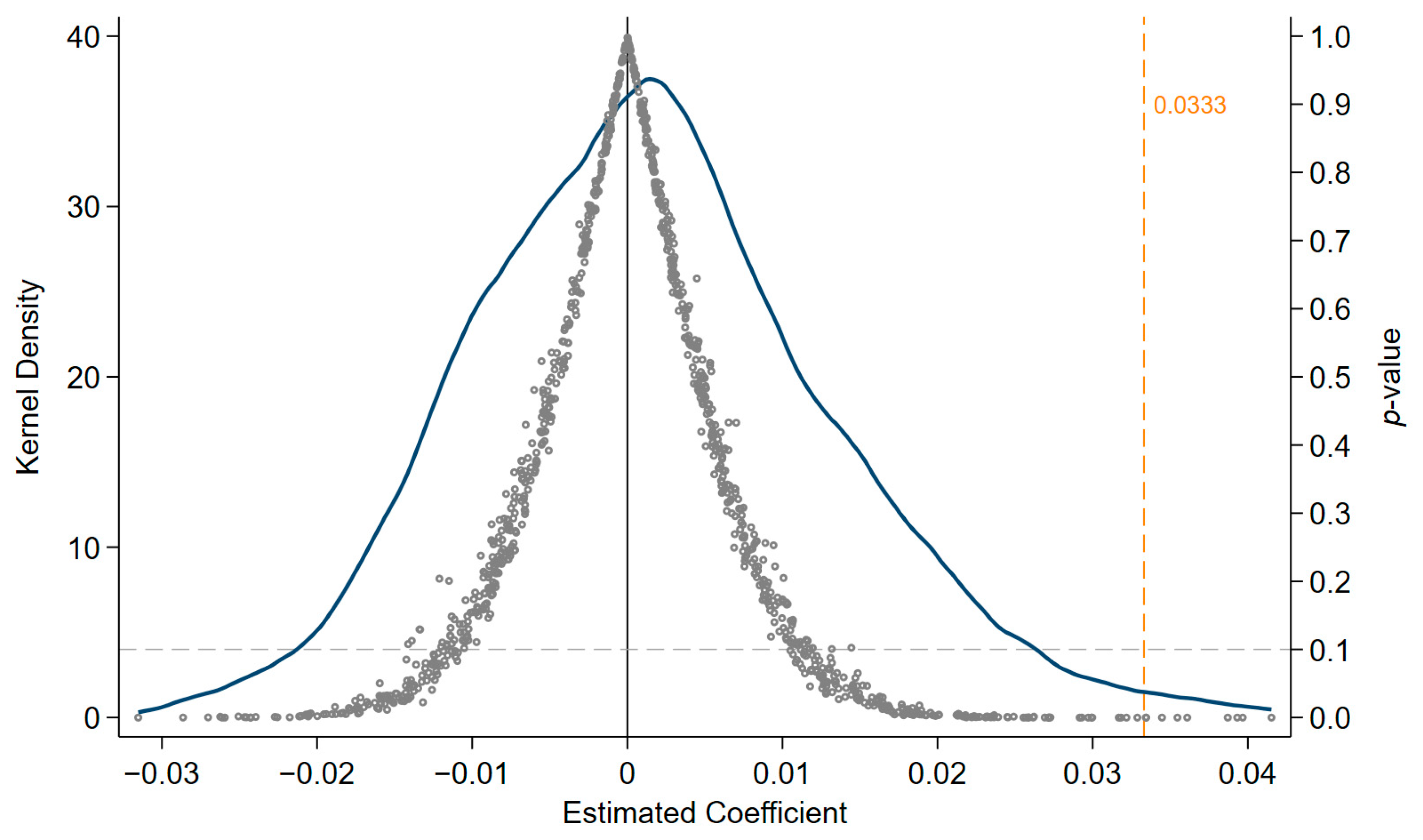
- Mixed placebo test. In the baseline regression, we control for multiple firm characteristics beyond NEVPP that may affect the treatment and control groups, but unobservable firm-year factors may still bias the estimates. To ensure robustness, we follow Ferrara et al. (2012) [87] and Li et al. (2016) [88] and randomly assign firms and years to participate in NEVPP, thereby constructing randomized experiments at both the firm and year levels. We perform 1000 random draws to enhance the reliability of the results. The outcomes of the mixed placebo test are illustrated in Figure 2, where the estimated coefficients of the fictitious interaction terms are concentrated around zero, deviating from the actual baseline coefficient of 0.0333. Moreover, the p-values of most estimated coefficients exceed 0.1. These findings suggest that serious omitted variable problems do not exist in the model specification, and the core conclusion remains robust.
4.3.3. PSM-DID
4.3.4. Heterogeneous Treatment Effect Test
- (1)
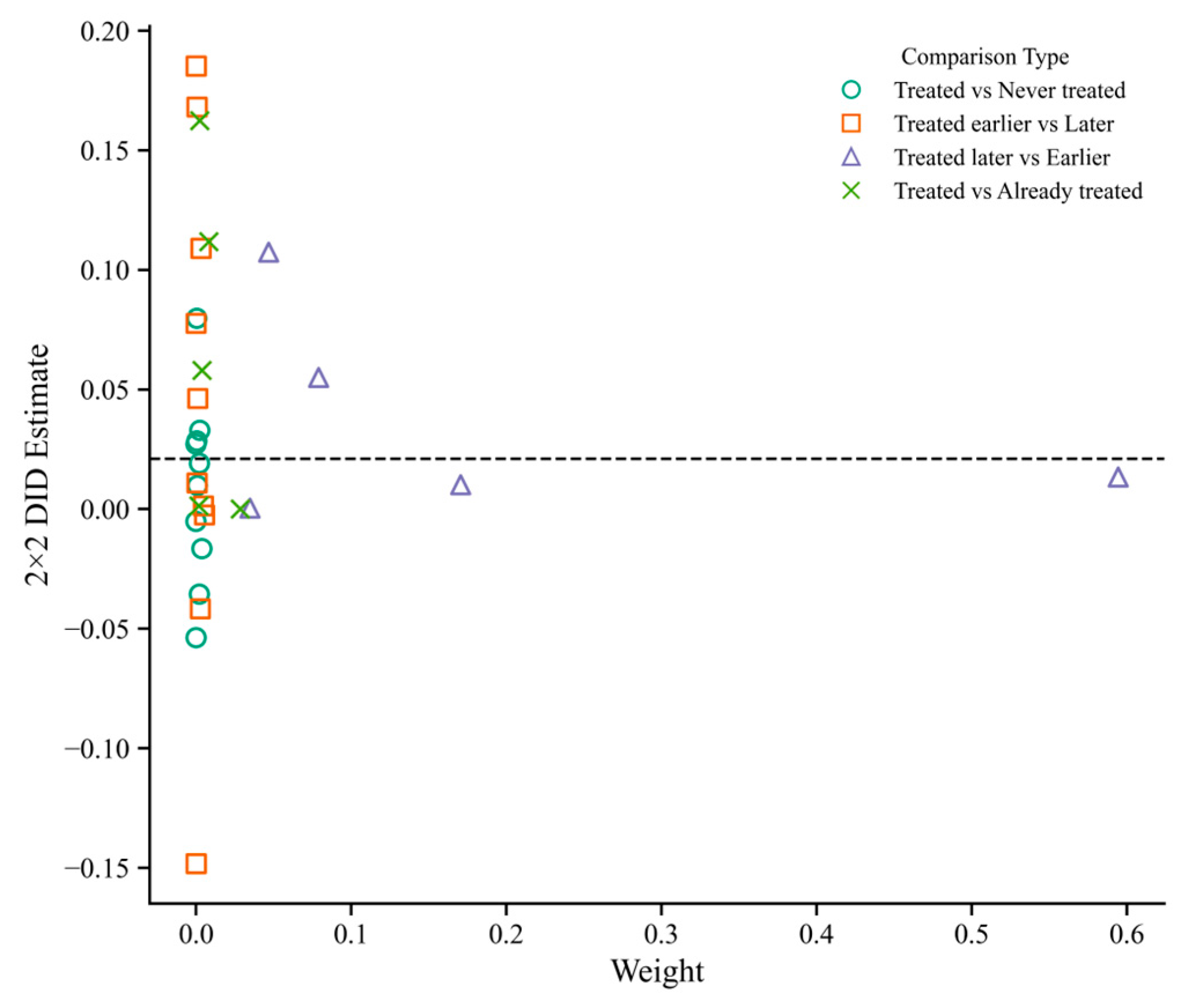
- Goodman-Bacon (2021) [92] DID decomposition method. This method evaluates the extent of bias in multi-period DID estimates under TWFE. As shown in Figure 3 and Table 5, the estimated coefficients across different groups are all greater than zero, indicating that the results are not subject to negative weighting. The decomposition further reveals that the overall DID estimates are primarily driven by comparisons using never-treated firms as the control group, which account for as much as 92.6% of the weight. In contrast, comparisons where early-treated firms serve as controls, which may generate bias, contribute only 1.8% of the weight. This limited influence suggests that the estimates are not materially distorted and do not overstate the impact of NEVPP on supply chain resilience. Hence, the core conclusion of this study remains robust.
- (2)
- The counterfactual imputation method of Borusyak et al. (2024) [93]. This approach addresses estimation bias in the two-way fixed effects (TWFE) model by estimating group fixed effects, time fixed effects, and treatment-control group fixed effects, thereby yielding more accurate estimates. As reported in Column (1) of Table 6, after applying the imputation method to account for heterogeneous treatment effects, the results still show a significantly positive impact, confirming the robustness of the findings in this study.
- (3)
- The weighted difference-in-differences method developed by Callaway and Sant’Anna (2021) [94], hereafter referred to as CSDID. This approach provides unbiased estimates by comparing outcome changes between the treated and never-treated groups across two periods. Based on inverse probability weighted least squares, the results reported in Column (2) of Table 6 continue to show a significantly positive effect, and the absolute value of the estimated coefficient increases markedly relative to the baseline regression.
4.3.5. Indicator Replacement
4.3.6. Changing the Clustering Level
4.3.7. Adjusting the Time Window
5. Future Analyses and Tests
5.1. Mechanism Analysis
5.1.1. Managerial Attention
5.1.2. Financing Constraints
5.1.3. Technological Innovation
5.2. Heterogeneity Analysis
5.2.1. Ownership Type
5.2.2. Geographical Location
5.2.3. R&D Intensity
5.2.4. Analyst Coverage
5.2.5. Institutional Ownership
6. Conclusions
6.1. Policy Implications
6.2. Limitations and Future Research
Author Contributions
Funding
Institutional Review Board Statement
Informed Consent Statement
Data Availability Statement
Conflicts of Interest
Appendix A
Appendix A.1

| Variable Name | Measurement Methods |
|---|---|
| Score | The composite index of supply chain resilience |
| NEVPP | If a company is included in the recommended directory in a specific year, set the variable NEVPP to 1 for that year and subsequent years; otherwise, set it to 0 |
| Lev | The ratio of total liabilities to total assets |
| Size | The natural logarithm of total assets |
| Board | The natural logarithm of the number of board members |
| Dual | If the Chairman and General Manager are the same person, the value is 1; otherwise, the value is 0 |
| Soe | For state-owned enterprises, the value is 1; otherwise, it is 0 |
| Cashflow | The ratio of net cash flows from operating activities to total assets |
| Roe | The ratio of the enterprise’s net profit to shareholders’ equity |
| Atr | The ratio of net sales revenue to average total assets |
| Top10 | The shareholding ratio of the top ten shareholders of the company |
| Growth | The ratio of the increase in revenue to the total revenue from the previous year |
| Age | The natural logarithm of the company’s founding year plus 1 |
Appendix A.2. Chinese Supply Chain Resilience Keywords in Corporate MD&A Reports
References
- Ivanov, D.; Dolgui, A. The Shortage Economy and Its Implications for Supply Chain and Operations Management. Int. J. Prod. Res. 2022, 60, 7141–7154. [Google Scholar] [CrossRef]
- Nepal, R.; Deng, Y.; Dong, K. Going with the Flow: How Does Global Energy Value Chain Adapt to Geopolitical Risks? Energy Econ. 2025, 144, 108288. [Google Scholar] [CrossRef]
- Cui, L.; Yue, S.; Nghiem, X.-H.; Duan, M. Exploring the Risk and Economic Vulnerability of Global Energy Supply Chain Interruption in the Context of Russo-Ukrainian War. Resour. Policy 2023, 81, 103373. [Google Scholar] [CrossRef]
- Hargreaves, L. Gartner: Most Supply Chains Unprepared for Future Challenges. 2025. Available online: https://procurementmag.com/risk-management/gartner-future-of-supply-chain-2025 (accessed on 18 August 2025).
- Kamalahmadi, M.; Shekarian, M.; Parast, M.M. The Impact of Flexibility and Redundancy on Improving Supply Chain Resilience to Disruptions. Int. J. Prod. Res. 2022, 60, 1992–2020. [Google Scholar] [CrossRef]
- Long, X.; Sun, M.; Cheng, F.; Zhang, J. Convergence Analysis of Eco-Efficiency of China’s Cement Manufacturers through Unit Root Test of Panel Data. Energy 2017, 134, 709–717. [Google Scholar] [CrossRef]
- Zhao, M.; Sun, T. Dynamic Spatial Spillover Effect of New Energy Vehicle Industry Policies on Carbon Emission of Transportation Sector in China. Energy Policy 2022, 165, 112991. [Google Scholar] [CrossRef]
- IEA. Global EV Outlook 2025-Expanding Sales in Diverse Markets; IEA: Paris, France, 2025. [Google Scholar]
- Li, P.; Zhang, Z. The Effects of New Energy Vehicle Subsidies on Air Quality: Evidence from China. Energy Econ. 2023, 120, 106624. [Google Scholar] [CrossRef]
- Martin, R.; Sunley, P. On the Notion of Regional Economic Resilience: Conceptualization and Explanation. J. Econ. Geogr. 2015, 15, 1–42. [Google Scholar] [CrossRef]
- Jenn, A.; Azevedo, I.L.; Michalek, J.J. Alternative-Fuel-Vehicle Policy Interactions Increase U.S. Greenhouse Gas Emissions. Transp. Res. Part Policy Pract. 2019, 124, 396–407. [Google Scholar] [CrossRef]
- The Ministry of Industry and Information Technology (MIIT). Road Motor Vehicle Manufacturing Enterprises and Products (280th Batch). 2016. Available online: https://www.miit.gov.cn/zwgk/zcwj/wjfb/gg/art/2020/art_bc8ae7065f474579bdb6cdaa3105bf96.html (accessed on 1 January 2026).
- The Ministry of Industry and Information Technology (MIIT). 31 Million Units, This Scorecard Is Highly Valuable. 2025. Available online: https://www.miit.gov.cn/xwfb/mtbd/twbd/art/2025/art_1e0197e1a47a4f88837b8b5ac2c1b86d.html (accessed on 1 January 2026).
- Sierzchula, W.; Bakker, S.; Maat, K.; van Wee, B. The Influence of Financial Incentives and Other Socio-Economic Factors on Electric Vehicle Adoption. Energy Policy 2014, 68, 183–194. [Google Scholar] [CrossRef]
- Liu, C.; Liu, Y.; Zhang, D.; Xie, C. The Capital Market Responses to New Energy Vehicle (NEV) Subsidies: An Event Study on China. Energy Econ. 2022, 105, 105677. [Google Scholar] [CrossRef]
- Chen, L.; Wang, B. Evaluate the Efficiency of Demand-Side Innovation Policies on New Energy Vehicles. Sci. Sci. Manag. S.&T. 2015, 36, 15–23. [Google Scholar]
- Sun, J.; He, J. An Analysis of the Effect of Fiscal and Tax Policies on the R&D Efficiency of New Energy Automobile Industry. Soft Sci. 2021, 35, 56–61. [Google Scholar] [CrossRef]
- Li, X.; Sun, L.; Li, G. COVID-19 Shock, Fiscal Subsidies, and Consumption Resilience of New Energy Vehicles: Evidence from Shanghai, China. Environ. Sci. Eur. 2024, 36, 43. [Google Scholar] [CrossRef]
- Li, H.; Li, S. Research on the impact of subsidy recession policy on the resilience of new energy automobile enterprises. Manag. Technol. SME 2025, 76–78. [Google Scholar]
- Yuan, X.; Liu, X.; Zuo, J. The Development of New Energy Vehicles for a Sustainable Future: A Review. Renew. Sustain. Energy Rev. 2015, 42, 298–305. [Google Scholar] [CrossRef]
- Hidrue, M.K.; Parsons, G.R.; Kempton, W.; Gardner, M.P. Willingness to Pay for Electric Vehicles and Their Attributes. Resour. Energy Econ. 2011, 33, 686–705. [Google Scholar] [CrossRef]
- Ren, X.; Sun, S.; Ma, Q.; Shao, S. New Energy Vehicle Promotion Policy, Financing Constraints and Green Technology Innovation. Manag. Rev. 2024, 36, 131–148. [Google Scholar] [CrossRef]
- Ministry of Science and Technology of the People’s Republic of China. Notice of the Ministry of Industry and Information Technology, the National Development and Reform Commission, the Ministry of Science and Technology, and the Ministry of Finance on the Issuance of the “Action Plan for Promoting the Development of the Automotive Power Battery Industry”. 2017. Available online: https://www.most.gov.cn/xxgk/xinxifenlei/fdzdgknr/fgzc/gfxwj/gfxwj2017/201703/t20170302_131554.html (accessed on 1 January 2026).
- The State Council of the People’s Republic of China. Notice of the General Office of the State Council on the Issuance of the Development Plan for the New Energy Vehicle Industry (2021–2035) Development Plan for the New Energy Vehicle Industry (2021–2035). 2020. Available online: https://www.gov.cn/gongbao/content/2020/content_5560291.htm (accessed on 1 January 2026).
- China Industry and Information Technology Industry Network. Strengthening and Supplementing Supply Chains Adds New Momentum to the Automotive Industry. 2021. Available online: https://www.cnii.com.cn/cyjj/202111/t20211124_325271.html (accessed on 1 January 2026).
- China Government Network. Guiding Opinions on Quality Infrastructure Assisting the Coordinated Improvement of Quality in Industrial and Supply Chains. 2024. Available online: https://www.gov.cn/zhengce/zhengceku/202401/content_6926534.htm (accessed on 1 January 2026).
- Meyer, J.W.; Rowan, B. Institutionalized Organizations: Formal Structure as Myth and Ceremony. Am. J. Sociol. 1977, 83, 340–363. [Google Scholar] [CrossRef]
- Swaminathan, A.; Wade, J.B. Institutional Environment. In The Palgrave Encyclopedia of Strategic Management; Palgrave Macmillan: London, UK, 2016; pp. 1–7. ISBN 978-1-349-94848-2. [Google Scholar]
- Liedong, T.A.; Peprah, A.A.; Amartey, A.O.; Rajwani, T. Institutional Voids and Firms’ Resource Commitment in Emerging Markets: A Review and Future Research Agenda. J. Int. Manag. 2020, 26, 100756. [Google Scholar] [CrossRef]
- Hitt, M.A.; Tung, R.; Ralston, D. International Strategy and Institutional Environments. Cross Cult. Strateg. Manag. 2016, 23, 206–215. [Google Scholar] [CrossRef]
- Liu, C.-L.; Shang, K.-C.; Lirn, T.-C.; Lai, K.-H.; Lun, Y.H.V. Supply Chain Resilience, Firm Performance, and Management Policies in the Liner Shipping Industry. Transp. Res. Part Policy Pract. 2018, 110, 202–219. [Google Scholar] [CrossRef]
- Ambulkar, S.; Blackhurst, J.; Grawe, S. Firm’s Resilience to Supply Chain Disruptions: Scale Development and Empirical Examination. J. Oper. Manag. 2015, 33–34, 111–122. [Google Scholar] [CrossRef]
- Scott, W.R. Institutions and Organizations: Ideas, Interests, and Identities; Sage Publications: Thousand Oaks, CA, USA, 2013. [Google Scholar]
- Zhao, X.; Li, S. Environmental Uncertainty, Supply Chain, and Stability of Sustainable Green Innovation:Based on Micro Evidence from Energy-Intensive Enterprises. J. Environ. Manag. 2024, 372, 123398. [Google Scholar] [CrossRef]
- Teece, D.J.; Pisano, G.; Shuen, A. Dynamic Capabilities and Strategic Management. Strateg. Manag. J. 1997, 18, 509–533. [Google Scholar] [CrossRef]
- Ponomarov, S.Y.; Holcomb, M.C. Understanding the Concept of Supply Chain Resilience. Int. J. Logist. Manag. 2009, 20, 124–143. [Google Scholar] [CrossRef]
- Ocasio, W. Towards an Attention-Based View of the Firm. Strateg. Manag. J. 1997, 18, 187–206. [Google Scholar] [CrossRef]
- Brielmaier, C.; Friesl, M. The Attention-based View: Review and Conceptual Extension towards Situated Attention. Int. J. Manag. Rev. 2023, 25, 99–129. [Google Scholar] [CrossRef]
- Dai, W.; Si, S. Government Policies and Firms’ Entrepreneurial Orientation: Strategic Choice and Institutional Perspectives. J. Bus. Res. 2018, 93, 23–36. [Google Scholar] [CrossRef]
- Hambrick, D.C.; Mason, P.A. Upper Echelons: The Organization as a Reflection of Its Top Managers. Acad. Manag. Rev. 1984, 9, 193–206. [Google Scholar] [CrossRef]
- Joseph, J.; Ocasio, W. Architecture, Attention, and Adaptation in the Multibusiness Firm: General Electric from 1951 to 2001. Strateg. Manag. J. 2012, 33, 633–660. [Google Scholar] [CrossRef]
- Yadav, M.S.; Prabhu, J.C.; Chandy, R.K. Managing the Future: CEO Attention and Innovation Outcomes. J. Mark. 2007, 71, 84–101. [Google Scholar] [CrossRef]
- Nadkarni, S.; Chen, J. Bridging Yesterday, Today, and Tomorrow: CEO Temporal Focus, Environmental Dynamism, and Rate of New Product Introduction. Acad. Manag. J. 2014, 57, 1810–1833. [Google Scholar] [CrossRef]
- Roxas, B.; Coetzer, A. Institutional Environment, Managerial Attitudes and Environmental Sustainability Orientation of Small Firms. J. Bus. Ethics 2012, 111, 461–476. [Google Scholar] [CrossRef]
- Cho, T.S.; Hambrick, D.C. Attention as the Mediator between Top Management Team Characteristics and Strategic Change: The Case of Airline Deregulation. Organ. Sci. 2006, 17, 453–469. [Google Scholar] [CrossRef]
- Spence, M. Job Market Signaling. In Uncertainty in Economics; Diamond, P., Rothschild, M., Eds.; Academic Press: Cambridge, MA, USA, 1978; pp. 281–306. ISBN 978-0-12-214850-7. [Google Scholar]
- Xu, Z.; Meng, L.; He, D.; Shi, X.; Chen, K. Government Support’s Signaling Effect on Credit Financing for New-Energy Enterprises. Energy Policy 2022, 164, 112921. [Google Scholar] [CrossRef]
- Hadlock, C.J.; Pierce, J.R. New Evidence on Measuring Financial Constraints: Moving beyond the KZ Index. Rev. Financ. Stud. 2010, 23, 1909–1940. [Google Scholar] [CrossRef]
- Huang, Y. Research on the Impact of New Energy Vehicles Promotion Policies on Enterprise Technological Innovation: An Empirical Analysis Based on the Difference-in-Differences Method. Contemp. Econ. 2025, 42, 95–102. [Google Scholar]
- Ersahin, N.; Giannetti, M.; Huang, R. Trade Credit and the Stability of Supply Chains. J. Financ. Econ. 2024, 155, 103830. [Google Scholar] [CrossRef]
- Lamont, O.; Polk, C.; Saá-Requejo, J. Financial Constraints and Stock Returns. Rev. Financ. Stud. 2001, 14, 529–554. [Google Scholar] [CrossRef]
- Wuttke, D.A.; Blome, C.; Foerstl, K.; Henke, M. Managing the Innovation Adoption of Supply Chain FinanceEmpirical Evidence from Six European Case Studies. J. Bus. Logist. 2013, 34, 148–166. [Google Scholar] [CrossRef]
- Myers, S.C.; Majluf, N.S. Corporate Financing and Investment Decisions When Firms Have Information That Investors Do Not Have. J. Financ. Econ. 1984, 13, 187–221. [Google Scholar] [CrossRef]
- Lou, Z.; Xie, Q.; Shen, J.H.; Lee, C.-C. Does Supply Chain Finance (SCF) Alleviate Funding Constraints of SMEs? Evidence from China. Res. Int. Bus. Financ. 2024, 67, 102157. [Google Scholar] [CrossRef]
- Porter, M.E.; Linde, C.V.D. Toward a New Conception of the Environment-Competitiveness Relationship. J. Econ. Perspect. 1995, 9, 97–118. [Google Scholar] [CrossRef]
- Stefan, A.; Paul, L. Does It Pay to Be Green? A Systematic Overview. Acad. Manag. Perspect. 2008, 22, 45–62. [Google Scholar] [CrossRef]
- Jiang, C.; Zhang, Y.; Zhao, Q.; Wu, C. The Impact of Purchase Subsidy on Enterprises’ R&D Efforts: Evidence from China’s New Energy Vehicle Industry. Sustainability 2020, 12, 1105. [Google Scholar] [CrossRef]
- Liu, S.; Wang, Y. Green Innovation Effect of Pilot Zones for Green Finance Reform: Evidence of Quasi Natural Experiment. Technol. Forecast. Soc. Change 2023, 186, 122079. [Google Scholar] [CrossRef]
- Kong, D.; Shi, Z.; Wang, S.; Lin, S. Conflicting or Complementary? Peer Effects on Green Breakthrough Technological Innovation: Evidence from China. Int. Rev. Financ. Anal. 2025, 105, 104441. [Google Scholar] [CrossRef]
- Parast, M.M. The Impact of R&D Investment on Mitigating Supply Chain Disruptions: Empirical Evidence from U.S. Firms. Int. J. Prod. Econ. 2020, 227, 107671. [Google Scholar] [CrossRef]
- Cui, C.; Lonergan, K.E.; Sansavini, G. Policy-Driven Transformation of Global Solar PV Supply Chains and Resulting Impacts. Nat. Commun. 2025, 16, 6742. [Google Scholar] [CrossRef] [PubMed]
- Martens, B.; Zhao, B. Data Access and Regime Competition: A Case Study of Car Data Sharing in China. Big Data Soc. 2021, 8, 20539517211046374. [Google Scholar] [CrossRef]
- Qader, G.; Junaid, M.; Abbas, Q.; Mubarik, M.S. Industry 4.0 Enables Supply Chain Resilience and Supply Chain Performance. Technol. Forecast. Soc. Change 2022, 185, 122026. [Google Scholar] [CrossRef]
- Huang, K.; Wang, K.; Lee, P.K.C.; Yeung, A.C.L. The Impact of Industry 4.0 on Supply Chain Capability and Supply Chain Resilience: A Dynamic Resource-Based View. Int. J. Prod. Econ. 2023, 262, 108913. [Google Scholar] [CrossRef]
- Beck, T.; Levine, R.; Levkov, A. Big Bad Banks? The Winners and Losers from Bank Deregulation in the United States. J. Financ. 2010, 65, 1637–1667. [Google Scholar] [CrossRef]
- Christopher, M.; Peck, H. Building the Resilient Supply Chain. Int. J. Logist. Manag. 2004, 15, 1–14. [Google Scholar] [CrossRef]
- Sheffi, Y.; Rice, J.B. A Supply Chain View of the Resilient Enterprise. MIT Sloan Manag. Rev. 2005, 47, 41–48. [Google Scholar]
- Soni, U.; Jain, V.; Kumar, S. Measuring Supply Chain Resilience Using a Deterministic Modeling Approach. Comput. Ind. Eng. 2014, 74, 11–25. [Google Scholar] [CrossRef]
- Gölgeci, I.; Kuivalainen, O. Does Social Capital Matter for Supply Chain Resilience? The Role of Absorptive Capacity and Marketing-Supply Chain Management Alignment. Ind. Mark. Manag. 2020, 84, 63–74. [Google Scholar] [CrossRef]
- Negri, M.; Cagno, E.; Colicchia, C.; Sarkis, J. Integrating Sustainability and Resilience in the Supply Chain: A Systematic Literature Review and a Research Agenda. Bus. Strategy Environ. 2021, 30, 2858–2886. [Google Scholar] [CrossRef]
- Brandon-Jones, E.; Squire, B.; Autry, C.W.; Petersen, K.J. A Contingent Resource-based Perspective of Supply Chain Resilience and Robustness. J. Supply Chain Manag. 2014, 50, 55–73. [Google Scholar] [CrossRef]
- Jiang, S.; Yeung, A.C.L.; Han, Z.; Huo, B. The Effect of Customer and Supplier Concentrations on Firm Resilience during the COVID-19 Pandemic: Resource Dependence and Power Balancing. J. Oper. Manag. 2023, 69, 497–518. [Google Scholar] [CrossRef]
- Deloof, M. Does Working Capital Management Affect Profitability of Belgian Firms? J. Bus. Financ. Account. 2003, 30, 573–588. [Google Scholar] [CrossRef]
- Park, E.; Kim, W.-H. The Effect of Inventory Turnover on Financial Performance in the US Restaurant Industry: The Moderating Role of Exposure to Commodity Price Risk. Tour. Econ. 2021, 27, 1417–1429. [Google Scholar] [CrossRef]
- Koumanakos, D.P. The Effect of Inventory Management on Firm Performance. Int. J. Product. Perform. Manag. 2008, 57, 355–369. [Google Scholar] [CrossRef]
- George, G. Slack Resources and the Performance of Privately Held Firms. Acad. Manag. J. 2005, 48, 661–676. [Google Scholar] [CrossRef]
- Opler, T.C.; Titman, S. Financial Distress and Corporate Performance. J. Financ. 1994, 49, 1015–1040. [Google Scholar] [CrossRef]
- Campello, M.; Graham, J.R.; Harvey, C.R. The Real Effects of Financial Constraints: Evidence from a Financial Crisis. J. Financ. Econ. 2010, 97, 470–487. [Google Scholar] [CrossRef]
- Opler, T.; Pinkowitz, L.; Stulz, R.; Williamson, R. The Determinants and Implications of Corporate Cash Holdings. J. Financ. Econ. 1999, 52, 3–46. [Google Scholar] [CrossRef]
- Gittell, J.H.; Cameron, K.; Lim, S.; Rivas, V. Relationships, Layoffs, and Organizational Resilience: Airline Industry Responses to September 11. J. Appl. Behav. Sci. 2006, 42, 300–329. [Google Scholar] [CrossRef]
- Xiao, H.; Shen, H.; Zhou, Y. Customer Digitalization, Supplier ESG Performance and Supply Chain Sustainability. Econ. Res. J. 2024, 59, 54–73. [Google Scholar]
- Cheng, D.; Wei, Y.; Zhang, M.; Wang, C. The Smart City Pilot Policy and Corporate Supply Chain Resilience. Int. Rev. Econ. Financ. 2025, 102, 104317. [Google Scholar] [CrossRef]
- Jacobson, L.S.; LaLonde, R.J.; Sullivan, D.G. Earnings Losses of Displaced Workers. Am. Econ. Rev. 1993, 83, 685–709. [Google Scholar]
- Stevenson, B.; Wolfers, J. Bargaining in the Shadow of the Law: Divorce Laws and Family Distress. Q. J. Econ. 2006, 121, 267–288. [Google Scholar] [CrossRef]
- Topalova, P. Factor Immobility and Regional Impacts of Trade Liberalization: Evidence on Poverty from India. Am. Econ. J. Appl. Econ. 2010, 2, 1–41. [Google Scholar] [CrossRef]
- Ruan, L.; Yang, L.; Li, D. The Impact of Green Finance Policies on Supply Chain Resilience. Econ. Anal. Policy 2025, 87, 18–37. [Google Scholar] [CrossRef]
- Ferrara, E.L.; Chong, A.; Duryea, S. Soap Operas and Fertility: Evidence from Brazil. Am. Econ. J. Appl. Econ. 2012, 4, 1–31. [Google Scholar] [CrossRef]
- Li, P.; Lu, Y.; Wang, J. Does Flattening Government Improve Economic Performance? Evidence from China. J. Dev. Econ. 2016, 123, 18–37. [Google Scholar] [CrossRef]
- Brucal, A.; Javorcik, B.; Love, I. Good for the Environment, Good for Business: Foreign Acquisitions and Energy Intensity. J. Int. Econ. 2019, 121, 103247. [Google Scholar] [CrossRef]
- Austin, P.C. Statistical Criteria for Selecting the Optimal Number of Untreated Subjects Matched to Each Treated Subject When Using Many-to-One Matching on the Propensity Score. Am. J. Epidemiol. 2010, 172, 1092–1097. [Google Scholar] [CrossRef]
- Abadie, A.; Imbens, G.W. Bias-Corrected Matching Estimators for Average Treatment Effects. J. Bus. Econ. Stat. 2011, 29, 1–11. [Google Scholar] [CrossRef]
- Goodman-Bacon, A. Difference-in-Differences with Variation in Treatment Timing. J. Econom. 2021, 225, 254–277. [Google Scholar] [CrossRef]
- Borusyak, K.; Jaravel, X.; Spiess, J. Revisiting Event-Study Designs: Robust and Efficient Estimation. Rev. Econ. Stud. 2024, 91, 3253–3285. [Google Scholar] [CrossRef]
- Callaway, B.; Sant’Anna, P.H.C. Difference-in-Differences with Multiple Time Periods. J. Econom. 2021, 225, 200–230. [Google Scholar] [CrossRef]
- Roy, S.; Hidrobo, M.; Hoddinott, J.; Kolt, B.; Ahmed, A. Can Transfers and Complementary Nutrition Programming Reduce Intimate Partner Violence Four Years Post-Program?: Experimental Evidence from Bangladesh. J. Hum. Resour. 2024, 59, 1714–1740. [Google Scholar] [CrossRef]
- Cattaneo, M.D.; Crump, R.K.; Farrell, M.H.; Schaumburg, E. Characteristic-Sorted Portfolios: Estimation and Inference. Rev. Econ. Stat. 2020, 102, 531–551. [Google Scholar] [CrossRef]
- Chan, M.K.; Kwok, S.S. The PCDID Approach: Difference-in-Differences When Trends Are Potentially Unparallel and Stochastic. J. Bus. Econ. Stat. 2022, 40, 1216–1233. [Google Scholar] [CrossRef]
- Cameron, A.C.; Gelbach, J.B.; Miller, D.L. Robust Inference with Multiway Clustering. J. Bus. Econ. Stat. 2011, 29, 238–249. [Google Scholar] [CrossRef]
- Li, F. The Information Content of Forward-Looking Statements in Corporate Filings—A Naïve Bayesian Machine Learning Approach. J. Account. Res. 2010, 48, 1049–1102. [Google Scholar] [CrossRef]
- Hassan, T.A.; Hollander, S.; van Lent, L.; Tahoun, A. Firm-Level Political Risk: Measurement and Effects. Q. J. Econ. 2019, 134, 2135–2202. [Google Scholar] [CrossRef]
- Yang, Y.; Wei, J.; Luo, L. Who Innovate from the Government Subsidies? The Joint Moderate Effects of the Ownership and the Factor Market Distortions. J. Manag. World 2015, 1, 75–86+98+188. [Google Scholar] [CrossRef]
- Dian, J.; Song, T.; Li, S. Facilitating or Inhibiting? Spatial Effects of the Digital Economy Affecting Urban Green Technology Innovation. Energy Econ. 2024, 129, 107223. [Google Scholar] [CrossRef]
- Ding, Y.; Zhang, H.; Zhang, J. Private vs. State Ownership and Earnings Management: Evidence from Chinese Listed Companies. Corp. Gov. Int. Rev. 2007, 15, 223–238. [Google Scholar] [CrossRef]
- Choi, S.B.; Lee, S.H.; Williams, C. Ownership and Firm Innovation in a Transition Economy: Evidence from China. Res. Policy 2011, 40, 441–452. [Google Scholar] [CrossRef]
- Cao, W.; Jia, Y.; Tan, B. Impact of Industrial Policy on Urban Green Innovation: Empirical Evidence of China’s National High-Tech Zones Based on Double Machine Learning. Front. Environ. Sci. 2024, 12, 1369433. [Google Scholar] [CrossRef]
- Zheng, Z.; Zhu, Y.; Pei, Y.; Wang, L. Spatial-Temporal Heterogeneity and Influencing Factors of the Coupling between Industrial Agglomeration and Regional Economic Resilience in China. Environ. Dev. Sustain. 2023, 25, 12735–12759. [Google Scholar] [CrossRef]
- Vanino, E.; Roper, S.; Becker, B. Assessing the Business Performance Effects of Receiving Publicly-Funded Science, Research and Innovation Grants; OECD Publishing: Paris, France, 2017. [Google Scholar]
- Zuniga-Vicente, J.A.; Alonso-Borrego, C.; Forcadell, F.J.; Galan, J.I. Assessing the Effect of Public Subsidies on Firm R&d Investment: A Survey. J. Econ. Surv. 2014, 28, 36–67. [Google Scholar] [CrossRef]
- Howell, S.T. Financing Innovation: Evidence from R&D Grants. Am. Econ. Rev. 2017, 107, 1136–1164. [Google Scholar] [CrossRef]
- Szücs, F. Do Research Subsidies Crowd out Private R&D of Large Firms? Evidence from European Framework Programmes. Res. Policy 2020, 49, 103923. [Google Scholar] [CrossRef]
- Brennan, M.J.; Subrahmanyam, A. Investment Analysis and Price Formation in Securities Markets. J. Financ. Econ. 1995, 38, 361–381. [Google Scholar] [CrossRef]
- Asquith, P.; Mikhail, M.B.; Au, A.S. Information Content of Equity Analyst Reports. J. Financ. Econ. 2005, 75, 245–282. [Google Scholar] [CrossRef]
- Yu, F. (Frank) Analyst Coverage and Earnings Management. J. Financ. Econ. 2008, 88, 245–271. [Google Scholar] [CrossRef]
- Irani, R.M.; Oesch, D. Monitoring and Corporate Disclosure: Evidence from a Natural Experiment. J. Financ. Econ. 2013, 109, 398–418. [Google Scholar] [CrossRef]
- To, T.Y.; Navone, M.; Wu, E. Analyst Coverage and the Quality of Corporate Investment Decisions. J. Corp. Financ. 2018, 51, 164–181. [Google Scholar] [CrossRef]
- He, J.; Tian, X. The Dark Side of Analyst Coverage: The Case of Innovation. J. Financ. Econ. 2013, 109, 856–878. [Google Scholar] [CrossRef]
- Luo, S.; Nagarajan, N.J. Information Complementarities and Supply Chain Analysts. Account. Rev. 2015, 90, 1995–2029. [Google Scholar] [CrossRef]
- Harford, J.; Kecskés, A.; Mansi, S. Do Long-Term Investors Improve Corporate Decision Making? J. Corp. Financ. 2018, 50, 424–452. [Google Scholar] [CrossRef]
- Almeida, H.; Campello, M. Financial Constraints, Asset Tangibility, and Corporate Investment.|EBSCOhost. Available online: https://openurl.ebsco.com/contentitem/doi:10.1093%2Frfs%2Fhhm019?sid=ebsco:plink:crawler&id=ebsco:doi:10.1093%2Frfs%2Fhhm019 (accessed on 13 September 2025).
- Cornett, M.M.; Marcus, A.J.; Saunders, A.; Tehranian, H. The Impact of Institutional Ownership on Corporate Operating Performance. J. Bank. Financ. 2007, 31, 1771–1794. [Google Scholar] [CrossRef]
- Aghion, P.; Van Reenen, J.; Zingales, L. Innovation and Institutional Ownership. Am. Econ. Rev. 2013, 103, 277–304. [Google Scholar] [CrossRef]


| Variables | Observations | Mean | Std. Dev. | Min | Max |
|---|---|---|---|---|---|
| Score | 1509 | 0.365 | 0.094 | 0.178 | 0.717 |
| NEVPP | 1509 | 0.156 | 0.363 | 0.000 | 1.000 |
| Lev | 1509 | 0.442 | 0.180 | 0.097 | 0.874 |
| Size | 1509 | 22.318 | 1.335 | 19.952 | 26.564 |
| Board | 1509 | 2.104 | 0.210 | 1.609 | 2.708 |
| Dual | 1509 | 0.328 | 0.470 | 0.000 | 1.000 |
| Soe | 1509 | 0.250 | 0.433 | 0.000 | 1.000 |
| Cashflow | 1509 | 0.054 | 0.057 | −0.130 | 0.210 |
| Roe | 1509 | 0.055 | 0.130 | −0.755 | 0.280 |
| Atr | 1509 | 0.652 | 0.248 | 0.215 | 1.454 |
| Top10 | 1509 | 0.623 | 0.155 | 0.250 | 0.999 |
| Growth | 1509 | 0.125 | 0.245 | −0.423 | 1.170 |
| Age | 1509 | 3.019 | 0.288 | 2.079 | 3.584 |
| (1) | (2) | (3) | |
|---|---|---|---|
| Without Controls | With Controls | With Lagged Controls | |
| Score | Score | Score | |
| NEVPP | 0.022 *** | 0.033 *** | 0.021 *** |
| (3.422) | (5.129) | (2.885) | |
| Constant | 0.418 *** | −0.282 *** | 0.0362 |
| (69.484) | (−2.656) | (0.295) | |
| Observations | 1509 | 1509 | 1291 |
| Adj-R2 | 0.449 | 0.527 | 0.477 |
| Controls | NO | YES | YES |
| Firm FE | YES | YES | YES |
| Year FE | YES | YES | YES |
| Variables | (1) |
|---|---|
| Score | |
| NEVPP_-4 | 0.012 (0.877) |
| Constant | −0.197 |
| (−1.214) | |
| Observations | 1509 |
| Adj-R2 | 0.518 |
| Controls | YES |
| Firm FE | YES |
| Year FE | YES |
| (1) | (2) | (3) | (4) | |
|---|---|---|---|---|
| 1:1 Nearest Neighbor Matching | 1:3 Nearest Neighbor Matching | Radius Matching | Kernel Matching | |
| Score | Score | Score | Score | |
| NEVPP | 0.090 *** | 0.070 ** | 0.039 ** | 0.037 ** |
| (4.121) | (2.197) | (2.552) | (2.466) | |
| Constant | −0.832 | −0.707 | −0.545 | −0.489 |
| (−1.524) | (−1.658) | (−1.634) | (−1.587) | |
| Observations | 209 | 356 | 698 | 716 |
| Adj-R2 | 0.646 | 0.537 | 0.509 | 0.519 |
| Controls | YES | YES | YES | YES |
| Firm FE | YES | YES | YES | YES |
| Year FE | YES | YES | YES | YES |
| Type of Comparison Group | Weight | 2 × 2 DID Estimate |
|---|---|---|
| Treated vs. Never treated | 0.926 | 0.021 |
| Treated earlier vs. Later | 0.012 | 0.003 |
| Treated later vs. Earlier | 0.018 | 0.020 |
| Treated vs. Already treated | 0.044 | 0.034 |
| Total (TWFE DID estimate) | 1 | 0.021 |
| (1) | (2) | |
|---|---|---|
| DID_Imputation | CSDID | |
| Score | Score | |
| NEVPP_ATT | 0.032 *** (3.012) | 0.156 *** (3.200) |
| Controls | YES | YES |
| Firm FE | YES | YES |
| Year FE | YES | YES |
| (1) | (2) | (3) | (4) | (5) | |
|---|---|---|---|---|---|
| ICW | Rank-Based | PCA | Province-Level | Province-Year Level | |
| Score | Score | Score | Score | Score | |
| NEVPP | 0.093 *** | 0.027 *** | 0.235 *** | 0.033 ** | 0.033 * |
| (4.049) | (2.823) | (6.271) | (2.262) | (1.955) | |
| Constant | −0.035 | 0.202 | −2.026 *** | −0.345 | −0.345 |
| (−0.093) | (1.277) | (−3.298) | (−1.645) | (−1.660) | |
| Observations | 1509 | 1509 | 1509 | 1509 | 1509 |
| Adj-R2 | 0.637 | 0.414 | 0.776 | 0.821 | 0.821 |
| Controls | YES | YES | YES | YES | YES |
| Firm FE | YES | YES | YES | YES | YES |
| Year FE | YES | YES | YES | YES | YES |
| (1) | (2) | |
|---|---|---|
| Score | Score | |
| Excluding 2020–2021 | Excluding 2015 | |
| NEVPP | 0.027 *** | 0.036 *** |
| (2.6994) | (2.9904) | |
| Constant | −0.3732 * | −0.3424 * |
| (−1.9664) | (−1.9081) | |
| Observations | 1212 | 1426 |
| Adj-R2 | 0.8224 | 0.8211 |
| Controls | YES | YES |
| Firm FE | YES | YES |
| Year FE | YES | YES |
| (1) | (2) | (3) | (4) | (5) | (6) | (7) | |
|---|---|---|---|---|---|---|---|
| Score | Attention | Score | SA | Score | Lngp | Score | |
| NEVPP | 0.033 *** (5.129) | 0.044 *** (2.591) | 0.030 *** (3.567) | −0.439 *** (−2.703) | 0.032 *** (4.005) | 0.364 *** (2.864) | 0.024 *** (3.305) |
| Attention | 0.049 *** (3.188) | ||||||
| SA | −0.003 ** | ||||||
| (−2.132) | |||||||
| Lngp | 0.003 ** | ||||||
| (1.974) | |||||||
| Constant | −0.345 *** | 0.350 | −0.267 ** | 12.203 *** | −0.282 ** | −1.575 | −0.219 * |
| (−3.019) | (1.278) | (−2.015) | (4.418) | (−2.097) | (−0.772) | (−1.851) | |
| Observations | 1509 | 1171 | 1171 | 1224 | 1224 | 1369 | 1369 |
| Adj-R2 | 0.820 | 0.512 | 0.836 | 0.840 | 0.812 | 0.827 | 0.847 |
| Controls | YES | YES | YES | YES | YES | YES | YES |
| Firm FE | YES | YES | YES | YES | YES | YES | YES |
| Year FE | YES | YES | YES | YES | YES | YES | YES |
| (1) | (2) | (3) | (4) | (5) | (6) | (7) | |
|---|---|---|---|---|---|---|---|
| SOEs | Non-SOEs | East | Central | West | High R&D | Low R&D | |
| Score | Score | Score | Score | Score | Score | Score | |
| NEVPP | 0.033 ** | 0.025 | 0.019 | 0.054 * | 0.075 *** | 0.005 | 0.049 *** |
| (2.487) | (1.358) | (1.254) | (2.002) | (3.690) | (0.356) | (3.263) | |
| Constant | −0.621 * | −0.226 | −0.295 | −0.545 | −0.323 * | −0.039 | −0.439 * |
| (−1.871) | (−1.108) | (−1.297) | (−1.428) | (−2.075) | (−0.161) | (−1.672) | |
| Observations | 373 | 1124 | 1100 | 181 | 127 | 740 | 731 |
| Adj-R2 | 0.735 | 0.839 | 0.839 | 0.851 | 0.833 | 0.849 | 0.796 |
| Controls | YES | YES | YES | YES | YES | YES | YES |
| Firm FE | YES | YES | YES | YES | YES | YES | YES |
| Year FE | YES | YES | YES | YES | YES | YES | YES |
| (1) | (2) | (3) | (4) | (5) | (6) | |
|---|---|---|---|---|---|---|
| Non Analyst Attention | High Analyst Attention | Low Analyst Attention | Low IO | Mid IO | High IO | |
| Score | Score | Score | Score | Score | Score | |
| NEVPP | 0.083 *** | 0.038 ** | 0.015 | 0.043 *** | 0.026 | 0.031 ** |
| (4.417) | (2.471) | (0.764) | (2.921) | (1.518) | (2.396) | |
| Constant | −0.795 *** | −0.671 ** | −0.286 | −0.542 * | −0.475 * | 0.152 |
| (−3.677) | (−2.190) | (−0.781) | (−1.816) | (−1.861) | (0.567) | |
| Observations | 538 | 409 | 442 | 462 | 460 | 459 |
| Adj-R2 | 0.847 | 0.870 | 0.777 | 0.832 | 0.796 | 0.833 |
| Controls | YES | YES | YES | YES | YES | YES |
| Firm FE | YES | YES | YES | YES | YES | YES |
| Year FE | YES | YES | YES | YES | YES | YES |
Disclaimer/Publisher’s Note: The statements, opinions and data contained in all publications are solely those of the individual author(s) and contributor(s) and not of MDPI and/or the editor(s). MDPI and/or the editor(s) disclaim responsibility for any injury to people or property resulting from any ideas, methods, instructions or products referred to in the content. |
© 2026 by the authors. Licensee MDPI, Basel, Switzerland. This article is an open access article distributed under the terms and conditions of the Creative Commons Attribution (CC BY) license.
Share and Cite
Chen, Y.; Liang, X.; Kang, W. Can New Energy Vehicle Promotion Policy Enhance Firm’s Supply Chain Resilience? Evidence from China’s Automotive Industry. Sustainability 2026, 18, 701. https://doi.org/10.3390/su18020701
Chen Y, Liang X, Kang W. Can New Energy Vehicle Promotion Policy Enhance Firm’s Supply Chain Resilience? Evidence from China’s Automotive Industry. Sustainability. 2026; 18(2):701. https://doi.org/10.3390/su18020701
Chicago/Turabian StyleChen, Yongjing, Xin Liang, and Weijia Kang. 2026. "Can New Energy Vehicle Promotion Policy Enhance Firm’s Supply Chain Resilience? Evidence from China’s Automotive Industry" Sustainability 18, no. 2: 701. https://doi.org/10.3390/su18020701
APA StyleChen, Y., Liang, X., & Kang, W. (2026). Can New Energy Vehicle Promotion Policy Enhance Firm’s Supply Chain Resilience? Evidence from China’s Automotive Industry. Sustainability, 18(2), 701. https://doi.org/10.3390/su18020701