


Abstract
This study investigates the barriers in adopting the Circular Economy (CE) in Saudi Banking under Vision 2030 and using the Resource-Based View and stakeholder theory. This study examined how customer engagement, process innovation, and dynamic capabilities limit the implementation of CE. A quantitative, cross-sectional survey collected 418 responses from bank employees in Riyadh and was collected from January to March 2024. A 29-item Likert scale was analyzed with SmartPLS 4; measurement quality was strong, and confirmatory factor analysis confirmed construct validity. Results highlight the main barriers as customer resistance regulatory constraints and lack of adequate employee training. The construct is highly interconnected (r = 0.758), showing that improvements in customer engagement and process innovation strengthen dynamic capabilities. The study provides practical guidance for banks and policymakers on designing circular finance products, targeted training, and supportive regulations to accelerate the CE transition and achieve measurable sustainability outcomes in financial sectors, aligning with SDG 3, good health and well-being, and SDG 7, affordable and clean energy.
1. Introduction
The move from a linear model (CE) to a closed-loop system is as ultimately responsible as it gets. “Take–make–dispose” means waste of resources; it also generates waste at an accelerated rate and contributes to environmental collapse [1]. Setting up linear production methods is unsustainable because they rely on finite natural resources, and their waste-recovery techniques are not comprehensive enough; this leads to global ecological, economic, and social crises [2]. At the other end of the sustainability spectrum are the circular economy elements, which aim to extend the life of products, materials, and resources for as long as possible. The most fruitful way to achieve this objective often involves recycling traditionally wasted materials that can be used again; reusing products as a matter of course rather than regarding them as “disposable” after one use; or remanufacturing them into new goods with similar but improved performance characteristics [1]. This new model offers the clearest plan so far devised for avoiding pollution, resource depletion, and environmentally unsustainable economic growth.
Saudi Arabia has realized the relevance of a circular economy, especially as it attempts to shift from an oil-based economy through its Vision 2030 strategy [3]. Vision 2030 is a comprehensive plan that aims to transform the Saudi economy by diversifying its sources of income, reducing its dependence on oil, and promoting sustainability [4]. It focuses on economic transformation and aims to orient the country’s development to global sustainable development by encouraging innovation, decreasing waste, and improving resource efficiency.
One of these solutions is the development of a circular economic culture among citizens, companies, and the government. Saudi Arabia has stressed the need to enhance awareness and participation at all community levels to develop a sustainable and resource-management culture [5]. Saudi Arabia has two main imperatives for adopting the circular economy: environmental and economic. However, there are means used in essential sectors of the circular economy, particularly the banking system [6]. Hence, incorporating circular economy principles in Saudi Arabia is important for sustainable development and economic sustainability. Hence, more studies are required to establish the challenges, limitations, and strategies of circular economy adoption.
The banking institutions are well-placed to support the shift to a circular economy. They can also serve as links to fulfill a range of financial, knowledge, and advocacy roles in promoting circularity within the industry [7]. Improved banking offerings can stimulate circular business models, including green loans, sustainability bonds, and other circular economy-related debt instruments. Likewise, they can encourage greater sustainability from businesses and consumers by funding projects that focus on novel approaches to the responsible use of resources, the reduction in waste, and the promotion of regeneration. Still, owing to this potential, circular economy integration into the banking sector has faced several significant challenges [8].
Another challenge is that the industry has limited awareness and adoption of circularity and the role of the circular economy among the industry players in Riyadh and Saudi Arabia [9]. Though many financial institutions currently function in the context of the linear economic model, they are still dominant and function mainly for immediate monetary profit, irrespective of the consequences. Due to these fundamental differences in strategic goals and management incentives, there is more resistance to change across the sector. Moreover, regional banks and financial institutions may lack awareness of how certain circular economic principles can be integrated into banking services.
The legal framework also hinders the realization of a circular economy in the banking sector in the Kingdom of Saudi Arabia [10]. While the government has noted considerable progress in attaining the sustainable development goals outlined in Vision 2030, laws governing the operation of circular finance, which refers to financial services that support circular economy projects, are still in their early stages. The lack of an extensive policy on the circular economy to support the optimization of the circular model means that banks have only recently begun adapting to the circular model. A lack of legal regulations and appropriate stimuli can drastically decrease the willingness of banks to replace linear models with new and fresh circular ones.
While there is sufficient scope for a circular economy among Saudi Arabian customers, especially in the banking domain, many lack information on how this concept can help or which banking materials can assist in the sustainability of products [11]. This leads to a gap between the demand and supply of the services provided by banks and the requirements or desires of the customers who could purchase sustainable banking products.
An understanding of the factors that hinder progress is crucial in the process of narrowing these gaps and advancing the shift toward a circular economy in the banking sector in Saudi Arabia. Consequently, this study seeks to extend the existing literature on the circular economy by establishing and explaining the factors that slow down the implementation in the banking industry. Therefore, policymakers and business executives must be well informed about issues as the banking sector can potentially drive the broader take-up of circular strategies.
The research questions that constituted the starting point in the empirical investigation are:
- RQ1.
- To what extent do customer engagement barriers hinder the implementation of the circular economy in Saudi banks?
- RQ2.
- How do process-related barriers affect the integration of the circular economy?
- RQ3.
- How do dynamic capability barriers influence banks’ ability to adopt circular economy initiatives?
The structure of this article is organized as follows. Section 2 reviews the literature concerning the barriers to a circular economy in the banking sector. Section 3 proposes a theoretical framework, and Section 4 introduces the methodology of the study, followed by the quantitative analysis, and the analysis and discussion of results in Section 5. Conclusions in Section 6 and future research directions and limitations of the empirical data analysis are presented in Section 7.
2. Literature Review
Circular economy (CE) has taken paths in Saudi Arabia, which is aligned with Vision 2030, which represents Saudi Arabia’s ability to use sustainability to combat waste problems and form a regenerative industry. In line with this, industries also turn to further improving the economies of scale and upgrading technology. Then, as it gradually becomes part of the financial establishment’s role to make this transition happen [12]. As a result, Saudi banks are now being pushed to direct their investments in line with the circular economy and to support the creation of circular business ecosystems across the Kingdom [13].
The banks in emerging markets, as highlighted in sustainable finance research, do not merely allocate capital, but are also participants in building markets and shaping investment norms and corporate culture. Especially in Saudi Arabia, too many industries on which the country’s growth depends lack the technology needed for improving environmental conditions in line with international standards. The effect on financial institutions as they go down this path worldwide is to integrate sustainability and circularity into their funding, investment, and risk review processes, thereby transforming production and consumption networks. In keeping with Saudi Vision 2030, the banking sector is expected to help move the national economy away from a linear, traditional model towards one increasingly based on circularity and regulations. Today, the economy is not one in which the system itself creates value; if we take the longer view rather than just focusing on short-term problems, this is not what finance in 2050 will really be about.
2.1. Banking and Circular Economy Integration: A Resource-Based and Stakeholder-Driven
To make the circular economy work effectively, it must end the ‘take-make-dispose’ model and adopt systems that recover and reuse. In moving toward a regenerative and renewing financial system, it will need to balance capital investment with these structural adjustments [14,15]. The paper uses the Resource-Based View (RBV) and Stakeholder Theory to examine how circular concepts are integrated into banking operations. The Resource-Based View, based on a business’s internal advantages and external environment, is well-suited for applications that confer a competitive advantage [16]. In the long run, the banking sector might gain an edge in competitiveness if it were to adopt circular practices and develop circular financial products [17]. Managers should consider solutions that are beneficial to nature and to human society from the standpoint of stakeholder theory [18]. This means that when individual credit, investment, and risk operate in a circular manner, it is beneficial for both shareholders and society. The Ellen MacArthur Foundation’s groundbreaking study on circular models suggests that they could be applied across corporate sectors [19].
This implies that if finance, investment, and risk processes incorporate the above circularity, all players will benefit, including shareholders and society. The Ellen MacArthur Foundation’s pioneering research on circular models and business applications has developed numerous practical examples, which is what the future brings us back to look at. The research also shows that Circular Economic business models will require novel approaches to capital, longer investment horizons, and strategies that blend environmental and financial performance measures [15]. Data on resource efficiency indicates that, with appropriate financial mechanisms, circular practices such as recycling and remanufacturing can substantially increase profits and reduce environmental impact [18]. The survey found that banks can compete more effectively by offering financial products tailored to the circular economy [17].
The financial sector in Saudi Arabia is increasingly important and a strategic direction of the country’s transition to a Circular Economy (CE), consistent with three key environmental goals under Vision 2030: sustainability, resource efficiency, and green diversification. Studying all business models for the circular economy is necessary and has significant implications for the development of management accounting for new entrepreneurs. In Saudi Arabia’s emerging non-oil economy, it is evident that Small and Medium Enterprises (SMEs) are a key force, enabling circular-economy financing models through the rapid expansion of digital and open banking, as well as emerging fintech platforms under SAMA (Saudi Central Bank). For SMEs engaged in recycling, resource recovery, remanufacturing, renewable materials, or waste-to-value business models, fintech innovation is a central approach. The use of digital currencies and blockchains, peer-to-peer loans, and Shariah-compliant digital financing tools has become crucial to improving funds flows for businesses engaged in circular activities. However, as in any international market, there are limited revenue streams for this part of the circular economy. In fact, various circular operations, especially recycling or repair businesses, have low margins. This, hence, calls for Saudi-focused research and innovative financial mechanisms, especially as Saudi Arabia expands its circular economy and sustainability agenda under Vision 2030 [3,4].
Meanwhile, the banks are starting to help and fulfill the requirements. According to [3,4,20], financial institutions across all tiers increasingly participate in green and transition instruments under Vision 2030’s environmental targets, while their traditional businesses slowly decline into a customary bank programme that everyone minds. Going beyond traditional banking, such measures as green diversification, eco-tourism bonds for protected natural spots, and Islamic finance products that are attached to impact produce a return in 30–50 basis points on an annual basis (return but no risk associated) have begun to channel capital into recycling, renewable energy, circular manufacturing, and bio-corridor construction throughout the country [3,4,10]. Similarly, projects that have been directed since the introduction of sustainability-linked loans, blended finance structures supported by the PIF (Public Investment Fund of Saudi Arabia), venture capital for technology enterprises, such as those dedicated to green goals, and impact funds [21]. Before proceeding with these questions, a brief clarification of key terminology related to the circular economy is necessary. At the global level, the EU Circular Economy Action Plan is one of the most comprehensive frameworks, setting out a series of regulatory and financial measures to promote CE investment and accelerate the transition from a linear to a circular economy [22,23].
Furthermore, something similar is happening within Saudi Arabia. As part of its National Environment Strategy, the Saudi Green Initiative (SGI), and national efforts to implement the Waste Management Law, the Ministry of Industry and Mineral Resources is now making national efforts, and even MWAN (National Center for Waste Management) has developed a comprehensive framework for outlining how Saudi Arabia will transform [23,24]. The principles for responsible banking, which incorporate circular-economy objectives over the coming decade, closely align with the aspirations of Saudi banks and their ongoing efforts in ESG management, sustainable portfolio assessment, climate risk governance, and SDG-aligned financing commitments [25]. Together, these frameworks signal the early formation of a sustainable banking model in Saudi Arabia, one of the global trends, while simultaneously responding to national priorities for non-oil economic growth, resources, and circular transformations.
2.2. Barriers to Circular Economy Adoption in the Banking Sector
The identified barriers and opportunities in embedding circular economic principles into financial systems are economic, institutional, and informational. Identify five kinds of barriers, including political and technology-based ones. With circular economy scaling, regulatory uncertainty, data scarcity, and inadequate waste infrastructure, progress is delayed [25,26]. For the banking industry, stresses the pressure to shift circular initiatives away from profit orientation; the circular economy, however, promotes loan diversification, improved CSR performance, increased loan business scale, greater loan numbers, and reputational advantage [27]. With competitive capabilities and sustainability linked, many studies have shown that sustainable finance initiatives can also bring profitability synergies [28].
Circular economy adoption is significantly influenced by risk culture and leadership. Business leaders who are cautious and risk-averse, as well as short-term in their outlook, will have lower interest in innovative models [29]. The original culture, support from the forefront, and ongoing regulatory uncertainty also slow delivery. In banking, research on this topic remains rare, with most studies focusing on manufacturing, construction, or waste management [26]. Service-based industries need to take steps to remove institutional, technological, and behavioral obstacles that emerge across sectors, drawing on overlaps between information from manufacturing and construction and from the waste sector [29,30]. Recent research on the banking-specific back end, meanwhile, emphasizes the importance of organizational learning and company leadership, both of which are crucial to economic efficiency [31].
Research on profitability and sustainability produces complex findings. In the short run, Economic, Social, and Governance (ESG) strategies may reduce profitability, but integrating them with innovation and operational efficiency can create a competitive edge and mitigate long-term effects [28]. However, few studies have examined precisely how the circular strategy, distinct from general ESG, affects bank profitability.
Unfortunately, several obstacles still block the effective commercialization and clearing of circular economy (CE) principles in Saudi Arabia. In order to attain sustainability goals, people are eager for quick payback from a short investment, which is universally the same set of challenges that are revealed in previous global circular economy surveys [30]. In financial circles, this translates into Saudi banks failing to produce CE-specific taxonomies or rules on sustainable finance. This is in contrast with mainland Europe, although it is large enough to overlap with those boundaries, even if it still needs to be fully converted into practical tools [19].
Compounding these problems is the low level of cooperation among various groups, which, in combination, impedes the adoption of the circular economy across Saudi Arabia’s entire business chains [3,11]. When looked at in this context, the impediments to CE in Saudi Arabia’s banking sector can be classified into three main areas: customer engagement, process improvement, and the use of dynamic capabilities all of them combination of internal and external confinements that shape whether or not financial institutions can help push forward the country’s move towards circular economy [32].
2.3. Circular Economy Barriers in Banks
This study employs a mixed approach to addressing the issues. Quantitative surveys assess the occurrence and predict relationships, whereas the qualitative approach is used in the literature survey. In circular economy-related research, mixed approaches are widely appreciated for their ability to reach [29,33]. By doing this, the study is also expected to produce both theoretical insights and practical recommendations.
Despite the specific implementation of the circular economy in banks at the micro level, substantial research gaps remain. At the macro level, policy moves ahead, but little is known about how banks can make ordinary management practices, decision rules, and their own skills support circular results [31,34]. This study aims to close these gaps, promoting both theory and practice, and providing strategies to overcome the obstacles. It identifies three categories of customer engagement, process improvement, and dynamic capability utilization as the barriers found in the literature.
Customer engagement is likely to help drive the circular economy by fostering awareness, demand, and stakeholder alignment [13,35,36]. Similarly, process improvements with circular economy metrics, such as reporting and risk adjustment in the risk model, should better support circular economy implementation [37]. Dynamic capability utilization, along with the commitment of leaders and the rest of the board to innovation capacity and circular economy-specific skills, should also encourage circular economy [31,37].
In addition, the lack of balanced operations among different stakeholders, including banks, investors, enterprises, and policymakers, has implications for the effectiveness of circular economic strategies [11]. This also makes it more challenging to understand circular economic ideas within the banking sector. According to [31], to apply circular economy models to financial strategies and decision-making, financial professionals require a comprehensive understanding of these models and principles.
Table 1 represents the distribution of barriers in the banking sector, categorized according to the approach used, which includes customer engagement, process improvement, and dynamic capacity utilization, based on a list of barriers compiled from the literature review.
Table 1.
Barriers to Circular Economy in the Banking Sector.
In response to these challenges, the banking sector must develop new products and services that align with the circular economy while staying affordable for customers. Effective stakeholder management is a key success factor. To this end, circulatory activities should be conducted in a well-coordinated framework; moreover, the relationship between the banking industry and other parties that participate, both directly and indirectly, in the circulatory system needs to be strengthened.
According to the Vision 2030 initiative, more and more national policies are becoming supportive of the circular economy (CE) goals. What this actually means for Saudi banks in putting circular economy principles into practice on a daily basis is still relatively unknown. There is not enough data to explain how Saudi banks operate within their own decision-making frameworks for circularity, particularly in credit assessments [31].
Bank lending, credit appraisal, and risk models worldwide incorporate circular economy models [17]; however, there is still no empirical evidence on how these practices are being translated into action within Saudi banks [3]. Similarly, although both the Resource-Based View and Stakeholder Theory have been widely used in sustainability research, they have not been tested in Saudi financial institutions regarding circular economy adoption [3]. Furthermore, it is not yet clear how much circular economy products are going to affect Saudi banks’ risk and profitability, and no research has yet examined the new financial instruments required to support low-margin circular SMEs, such as fintech-enabled circular credit lines or Shariah-compliant circular economy financing mechanisms [3].
There is little information on the extent to which Saudi banks assess specific circular economy financial products and how they can be aligned with Vision 2030 priorities, although global markets use instruments such as green bonds and blended finance [11]. Moreover, it remains challenging to translate national policies, such as the SGI and the Waste Management Law, into banking taxonomies, reporting systems, or practical circular models [3,4]. The detail we lack is at the micro level: little is known about organizational learning, capability development, and managerial commitment [31,37]. To bridge this gap, another key issue must be examined: how the implementation of the circular economy in Saudi banks is affected by customer engagement, process improvement, and the use of dynamic capability.
3. Theoretical Framework
The CE has gained global recognition as a pathway toward sustainability; most experimental studies have determined that the manufacturing and industrial sectors, as well as existing service-based industries such as banking, are largely underexplored. This gap in understanding how the financial institutions, key enablers for capital flow and innovation, can contribute to CE transitions. The issue becomes even more critical in the context of Saudi Arabia [11]. Vision 2030 emphasizes economic diversification, sustainable resource management, and environmental responsibility. Nevertheless, this strategic emphasis faces substantial internal and external barriers that obstruct CE implementations, such as incomplete customer awareness, inflexible regulatory environments, inadequate employee training, and insufficient technological innovation.
Focusing on these challenges is crucial for encouraging banks to act as financial channels for circular transformation across industries. Therefore, this research is both timely and necessary to identify, sort, and, through empirical observation, test the barriers that delay the adoption of CE in the Saudi banking sector. Resource-Based View (RBV) and Stakeholder Theory explore how internal capabilities (skills, innovation, and dynamic resources) and external stakeholder pressures (from customers, regulators, and policy frameworks) both influence CE readiness. The primary objective of this study is to develop an empirically validated framework that explains the interrelatedness among administrative, regulatory, and behavioral barriers delaying the implementation of CE in the Saudi banking industry, and to recommend actionable strategies for overcoming.
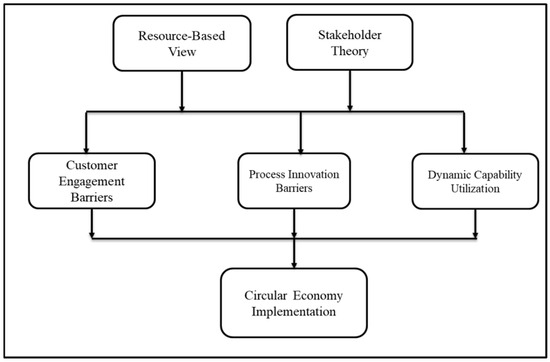
Figure 1 shows the conceptual framework that integrates the Resource-Based View (RBV) and Stakeholder Theory into three core constructs: Customer Engagement Barriers, Process Innovation Barriers, and Dynamic Capability Utilization, collectively influencing the implementation of Circular Economy (CE) practices in the Saudi Arabian banking sector. RBV offers an internal organizational perspective, emphasizing capabilities, resources, and skills that enable or hinder the adoption of CE. On the other hand, Stakeholder Theory offers an external perspective, explaining how pressures from customers, regulators, and policymakers influence the strategic alignment of banks with sustainability objectives. The constructs of internal dynamic capabilities strengthen the capacity to innovate and engage customers, while the external stakeholder influence determines the institutional support and authority of CE efforts. Together, these dimensions explain how internal and external factors interact to affect CE implementation readiness within the financial services sector.
Figure 1.
Conceptual framework for circular economy implementation based on the resource-based view and stakeholder theory.
Based on the framework and to conceptualize the barriers to circular economy, three hypotheses were defined, according to Section 3.1.
3.1. Hypothesis Development
3.1.1. Customer Engagement Barriers to Circular Economy Implementation
Across banks, the main obstacle to recycling adoption is customer-related barriers. So, banks have to rely heavily on customer awareness, demand, and cooperation. Recent studies have shown that low levels of circular economy literacy among customers, reluctance to adopt circular products from the consumer side, and negative impressions of regeneration-type models leave cross-sectoral circular transitions weak [31,35]. Thus, stresses that in the absence of strong client engagement and clear project proposals, it is difficult for most banks to scale up their circular lending business. These demand-side challenges together weaken market assessment and strategic motives for circular economic integration. Therefore, the proposed research hypothesis 1 (H1) is:
H1.
Customer Engagement Barriers have a significant negative effect on circular economy implementation.
3.1.2. Process Improvement Barriers to Circular Economy Implementation
The bank’s ability to support the circular economy across each of the aspects in which it operates is underway. Process improvement barriers come from historical systems that represent linear economic ideas. There is limited quantitative data on circular economy projects, and banks lack a consistent reporting format and struggle to evaluate them thoroughly across their systems [32,34]. It is observed that banks continue to rely on legacy risk models, which are not suited to a circular approach. As a result, the internal process barriers reduce structural readiness towards circular economy adoption.
Therefore, the proposed research hypothesis 2 (H2) is:
H2.
Process Improvement Barriers have a significant negative effect on circular economy implementation.
3.1.3. Dynamic Capability Utilization Barriers to Circular Economy Implementation
Dynamic capability barriers include organizational cultures averse to risk, leadership, a lack of interest in circularity, shortages of circular-economy skills, and weak innovation capacity. Earlier studies have consistently identified internal corporate capability questions as significant barriers to sustainability transformation across industry sectors [34,36]. This points out that banks that lack knowledge of the circular economy and lack a strategic vision for entering this field will find it hard to reorganize their operations to support circular economic finance.
Therefore, the proposed research hypothesis 3 (H3) is:
H3.
Dynamic Capability Barriers have a significant negative effect on circular economy implementation.
4. Methodology
The present research employed a structured questionnaire to assess the factors that delay the implementation of circular economy practices in the banking sector in Riyadh, Saudi Arabia (see Appendix A, Table A1). The questionnaire was formulated based on a literature study of circular economic barriers, identifying constructs that could be applied to the banking sector.
4.1. Research Design and Sampling
The study used a quantitative, cross-sectional design, carried out through a questionnaire (see Appendix A). The reference population consisted of bank employees in Riyadh. The questionnaire comprised two primary sections: personal details, which documented participants’ age, gender, position, and years of working with banks, and circular economy enablers, which measured perceived challenges of the three theoretical pillars of customer engagement, process innovation, and dynamic capability. Responses were analyzed using a five-point Likert scale, from strongly agree (5) to strongly disagree (1). Surveys were distributed via Google Forms, along with a cover letter that explained the research aims and assured confidentiality. Data was collected through Google Forms to maximize response rates and ensure a representative sample. Out of 620 circulated surveys, 418 valid replies were received, resulting in a response rate of 67%. The data collection was conducted over a period of three months, from January to March 2024, ensuring adequate time for follow-up and validation of responses. Due to the difficulties in data collection, the sample was deemed convenience-based, highlighting the practical constraints in accessing individuals.
4.2. Data Analysis
The data analysis was performed in two stages: descriptive and inferential statistics. Descriptive statistics, including frequencies, means, and standard deviations, were employed to summarize the socio-demographic profile of respondents and the distribution of responses about perceived barriers to the circular economy. The following statistical tests were conducted for inferential analysis: a mean ranking analysis to determine the relative importance of each barrier. Cronbach’s alpha was utilized to assess the internal consistency of the constructs, thereby confirming the reliability of the measuring scale. Smart-PLS was used to confirm the factors using the measurement model for the barriers to implementing a CE.
The Confirmatory Factor Analysis (CFA) was performed using SmartPLS version 4, to validate the measurement model prior to structural analysis. The analysis involved evaluating outer loadings, Cronbach’s alpha, Composite Reliability (CR), and Average Variance Extracted (AVE) according to [41,42]. Items with loadings below 0.70 were eliminated to improve model fit. The assessment confirmed adequate convergent and discriminant validity, ensuring that the constructs of Customer Engagement (CE), Process Innovation (PI), and Dynamic Capability (DC) were both statistically and theoretically.
5. Analysis and Discussion of the Results
5.1. Profile of the Respondents
Table 2 shows the demographic analysis of the 418 respondents, providing a comprehensive overview of key characteristics within the studied population.
Table 2.
Demographic Analysis.
Most respondents (89.2%) are affiliated with the Private Sector, comprising 373 individuals. A smaller proportion of respondents work in the Public/Government Sector (8.9%, n = 37) and the Semi-Government Sector (1.9%, n = 8). Respondents are distributed across various age ranges, with the largest group falling within the 26–35 age range, making up 51.9% (n = 217) of the total sample. Subsequent age groups include 20–25 years (17.7%, n = 74), 36–45 years (20.3%, n = 85), 46–56 years (8.4%, n = 35), and those above 56 years (1.7%, n = 7). Gender distribution indicates a near-equal representation within the sample, with 46.7% (n = 195) identified as male and 53.3% (n = 223) as female. A significant proportion of respondents’ report being single (47.4%, n = 198) or married (45.9%, n = 192). Minor proportions indicate divorced (5.3%, n = 22) or separated (1.4%, n = 6) marital statuses. Educational attainment varies among respondents, with the majority holding bachelor’s Degrees (66.3%, n = 277) and master’s Degrees (26.6%, n = 111). A smaller percentage possess High School Diplomas (1.9%, n = 8), Diplomas (1.9%, n = 8), or PhDs (3.3%, n = 14). Work experience distribution within current organizations reveals that most respondents (78.2%, n = 327) have been employed for more than four years. A smaller proportion have 0–1 years (17.9%, n = 75) or 2–4 years (3.8%, n = 16) of experience within their current organizations.
The respondents’ profiles in the table reveal that the target population comprises a private-sector, mid-career, and educated workforce with considerable experience in their respective institutions. Knowing such demographic characteristics is essential for contextualizing the respondents’ answers and drawing insight into the population of focus.
5.2. Barriers to the Circular Economy
The survey results show various barriers encountered in the banking sector when implementing a circular economy. Cronbach’s Alpha coefficient is observed at 0.938. Thus, the 29 items are highly correlated and internally consistent.
According to Table 1, the analysis of the data reveals multiple dimensions of barriers in implementing the Circular Economy (CE). These barriers were classified into three primary constructs: Customer Engagement (CE), Process Innovation (PI), and Dynamic Capability Utilization (DC), which collectively represent the behavioral, procedural, and organizational challenges Saudi banks face in advancing CE adoption. The mean ratings across all dimensions, ranging from 3.56 to 3.32, highlight the significance of these barriers. The identified barriers encompass various aspects, including customer interaction, process innovation, and dynamic capability utilization. They exhibit statistically significant associations, with the lowest p-value of 0.001, as shown in Table 3.
Table 3.
Mean, Standard Deviation, and Factor Loadings.
The mean scores reflect the average level of agreement on a five-point Likert scale, where 5 indicates strong agreement (a significant barrier) and 1 indicates strong disagreement (a minor or non-existent barrier).
The five main barriers identified by the respondents are analyzed as follows. Customer Resistance to Engagement Initiatives (Mean: 3.56|Rank: 1|Std. Deviation: 1.137) is the most significant barrier, indicating that customers in the financial sector often resist engagement initiatives. This resistance could be due to a lack of awareness, trust, or perceived value in the circular economy efforts. Regulatory constraints (CE4) (Mean: 3.54|Rank: 2|Std. Deviation: 1.117) highlight the difficulty of implementing innovative customer engagement strategies within the existing regulatory framework. These constraints can hinder creativity and innovation, making it more challenging for financial institutions to adopt circular economy principles. The third barrier identified by the respondents was Insufficient Training and Skill Development (CE5) (Mean: 3.52|Rank: 3|Std. Deviation: 1.136). The lack of sufficient employee training programs is seen as a significant barrier. Employees may struggle to engage customers effectively or support circular economy initiatives without proper training and skill development, leading to lower organizational effectiveness. Limited Access to Customer Data and Analytics (CE2), ranked fourth (Mean: 3.51|Rank: 4|Std. Deviation: 1.128). Limited access to data and analytics hampers the ability to personalize services, which is crucial for successful customer engagement. This barrier reflects the need for better data infrastructure and analytics capabilities within the financial sector. Underlining the vital role of data-driven strategies in modern business destinations. The difficulty in reaching and engaging with customers due to poor communication channels is another significant barrier to the Ineffective Communication Channels (DC1) (Mean: 3.50|Rank: 5|Std. Deviation: 1.220).
The less significant barriers for the respondents still represent significant challenges but are not considered as critical as the top-ranked issues. These barriers include organizational culture not supporting innovation (CE7) (Mean: 3.32|Rank: 22|Std. Deviation: 1.223), difficulties in setting and tracking sustainability goals (PI13) (Mean: 3.35|Rank: 12|Std. Deviation: 1.236), struggle with evolving customer preferences, and lack of skills and technologies to innovate processes. Policy delays and a lack of government incentives are also moderately important. However, financial institutions seem to focus more on internal barriers, such as customer resistance, communication, and decision-making processes. While these lower-ranked barriers are not seen as the top obstacles, addressing them could further enhance the financial sector’s ability to implement circular economy practices.
The data were further analyzed using confirmatory factor analysis (CFA), a widely used method for data reduction and summarization. In situations where there are numerous factors, each of which could have a high level of intercorrelation, factor analysis reduces these numbers to easily interpretable ones. This study employed confirmatory factor analysis to identify the critical success factors using SmartPLS [41]. A single-factor model was plotted for each latent variable individually, and variables with factor loadings below 0.7 were excluded. Table 3 shows the factor loading of the barriers.
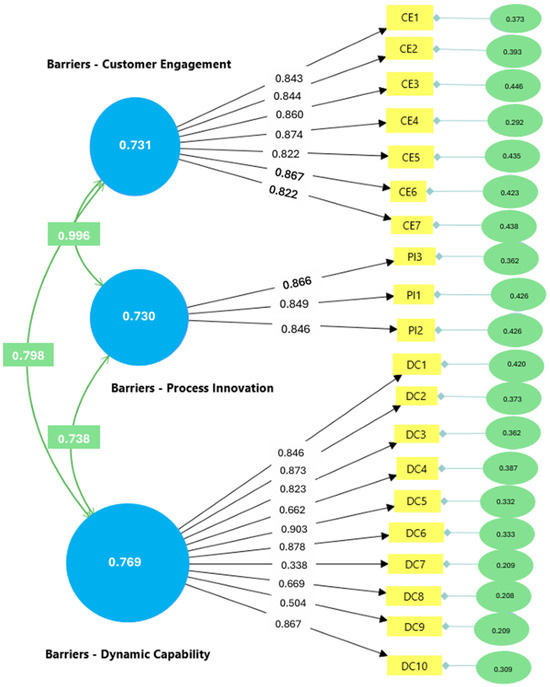
Figure 2 depicts three latent constructs: Barriers—Customer Engagement (CE), Barriers—Process Innovation (PI), and Barriers—Dynamic Capabilities (DC) with their respective factor loadings CE: 0.731, PI: 0.730, DC: 0.769, except the factor loading for lack of policy delay in implementing the circular economy in your organization (DC11) with a factor loading of 0.637.
Figure 2.
Measurement Model.
Figure 2 shows the strength of the relationship between the latent variable and the indicator. Barriers to Customer Engagement (CE) indicators have loadings ranging from 0.822 to 0.874. The loadings of Process Innovation (PI) indicators range from 0.846 to 0.866, and those of Dynamic Capabilities (DC) indicators range from 0.844 to 0.904.
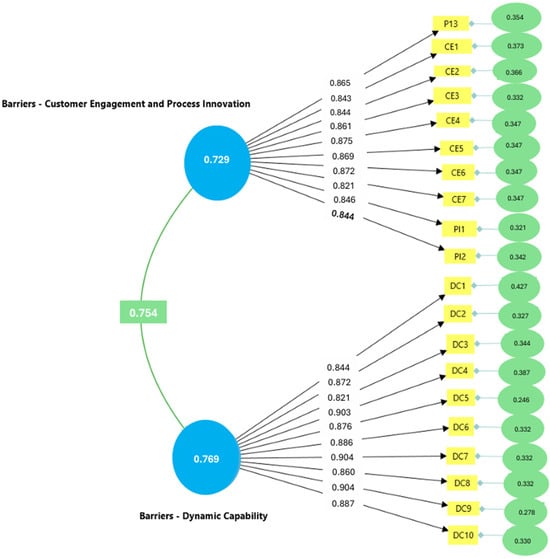
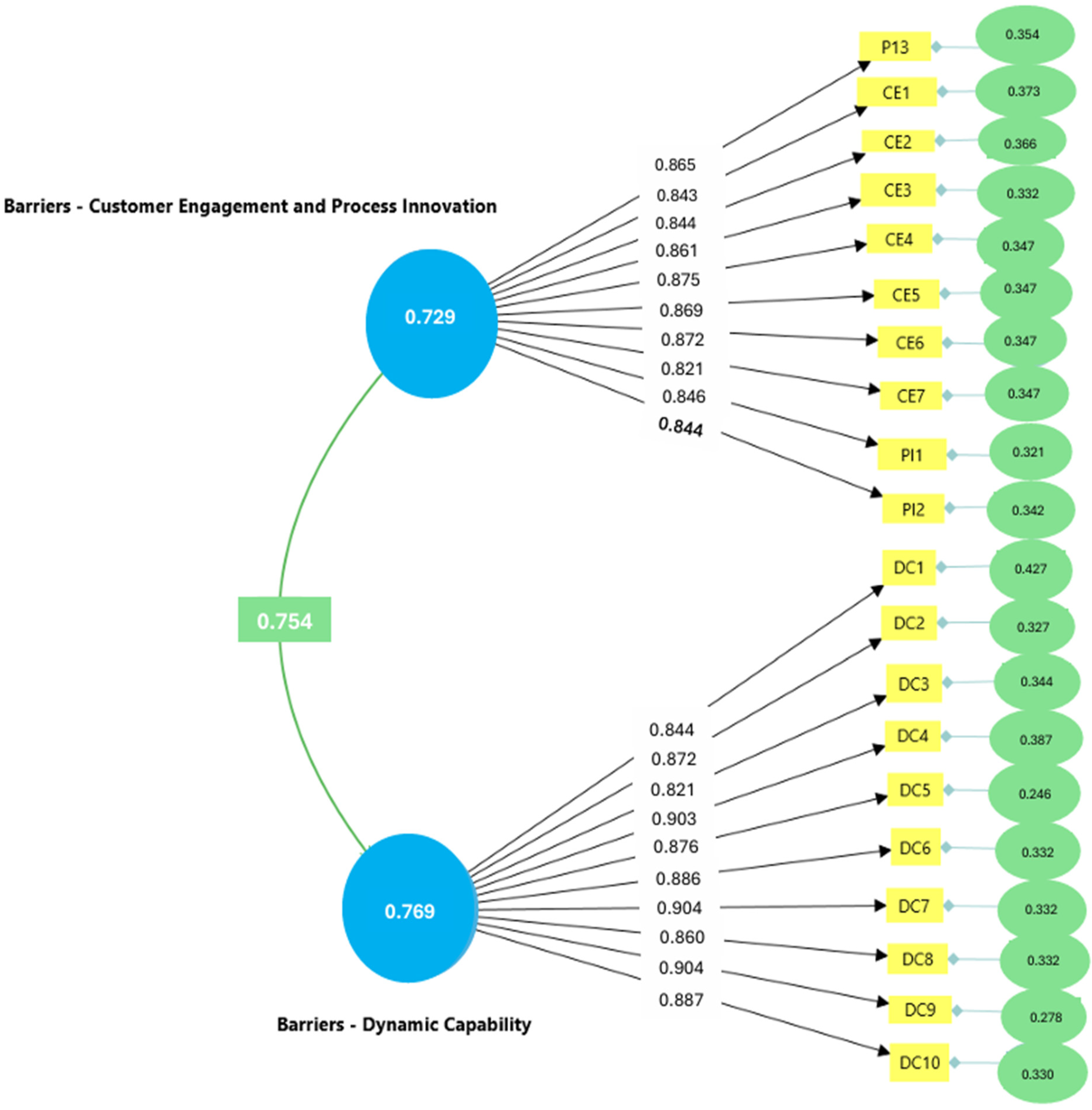
The latent variables show relationships. The correlation between Barriers to Customer Engagement (CE) and Barriers to Process Innovation (PI) is 0.996, indicating that a powerful positive relationship might have a problem with discriminant validity. To address the discriminant validity issues, the construct needs to be merged. Thus, two constructs after the merging are shown in Figure 3 the modified measurement model.
Figure 3.
Modified Measurement Model for Customer Engagement, Process Innovation and Dynamic Capabilities Barriers.
Figure 3 illustrates the modified measurement model of the relationship between two key latent variables: Customer Engagement and Process Innovation (AVE = 0.729) and Dynamic Capabilities (AVE = 0.769). These variables are connected by a strong positive correlation of 0.754, indicating that customer engagement and process innovation challenges are closely linked with those in dynamic capabilities. Higher loadings, such as 0.865 and 0.878, indicate that these challenges have a significant influence on their respective constructs. This structural model suggests that addressing barriers in one area, such as customer engagement and process innovation, may positively impact on the ability to overcome dynamic capability challenges, demonstrating the interconnected nature of these organizational factors.
Table 4 presents reliability and validity measures for two constructs: Barriers—Customer Engagement and Process Innovation, and Barriers—Dynamic Capability. Both constructs exhibit high internal consistency, as reflected by their Cronbach’s alpha values of 0.964 and 0.973, respectively, indicating excellent reliability. These values are above the conventional standard of 0.7, indicating that the items inherent in each construct are significantly related or correlated. Likewise, the composite reliability values for both constructs are equally high (CR = 0.964 and CR = 0.973), which supports that the measurement scales used in this study exhibit high reliability. Lastly, the Average Variance Extracted (AVE) of 0.729 and 0.769 for customer engagement and process innovation, respectively, as well as a dynamic capability, demonstrates acceptable convergent validity since the constructs explain more than 50% of the variance in the items. Taking in a broad sense, these findings suggest that the modified measurement model meets the desirable criteria of reliability and validity.
Table 4.
Construct Reliability and Validity.
Table 5 shows two categories of barriers: Customer Engagement, Process Innovation, and Dynamic Capabilities. All these are elements that need to be embraced by the organization. There is also a numeric value, 0.758, indicating the degree of connection or influence between the two. This indicates that Dynamic Capability has a significant impact on Customer Engagement and Process Innovation barriers, with a correlation coefficient of 0.758.
Table 5.
Discriminant Validity.
5.3. Discussion of the Results
This study examined the barriers to implementing circular economy (CE) practices within the banking sector in Riyadh, Saudi Arabia, revealing significant challenges that can be categorized into two primary constructs: Customer Engagement, Process Innovation, and Dynamic Capability (DC). The results revealed that these barriers are particularly significant, especially where low public awareness and complex market-related regulations are present.
The highest resistance level was observed in the Customer Resistance to Engagement Initiatives (CE1), measuring 3.56 (SD = 1.137). This is similar to previous research, whereby consumer resistance has been attributed to low perception or acceptability of the benefits offered by CE programs [35]. Based on this understanding of customer resistance, this work suggests that it is typical of other cultural and structural barriers in Saudi Arabia, particularly within the oil-funded economic model. However, it shifts the path towards sustainable development based on declarative environmentalism and behavioral demand, whereas the banking sector has not directly faced environmental impacts. Interestingly, according to [33,34], such misconceptions must be corrected to promote actual customer involvement in circular economy efforts.
The following important issue identified was regulatory constraints (CE4), with a mean value of 3.54 (SD 1.117). This study also affirms what is understood in the literature, that the existence of regulatory requirements can slow down the implementation of the circular economy [21]. The laws of Saudi Arabia remain somewhat unsound in the regional economic landscape, posing significant risks to financial institutions seeking to develop new customer relationship approaches. According to [39], a critical degree of institutional support is necessary for more effective and efficient sustainability initiatives. However, the double bind occurs in a way that banks, which are expected to spearhead sustainable efforts, are hindered by regulations that lack comprehensive coverage and a long-term vision.
Insufficient Training and Skill Development (CE5) is also considered a significant barrier, with a mean score of 3.52 and a standard deviation (SD) of 1.136. This specific issue has inherent global issues, but it primarily manifests in the service sector, which is dominated by the banking sector. Some authors have noted that a lack of knowledge can act as a barrier to circular economy implementation [34]; however, the challenges that beset the introduction of circular economy into intangible banking services require the development of complicated training tools in which, in addition to providing senior banking managers with circular economy expertise, the creation of an organizational culture promoting circular economy is extreme [32]. Implications for future research include a widening gap between training and the critical demands for sustainability competencies.
However, this study reveals specific internal factors that hinder the implementation of circular economy practices in the banking sector; therefore, higher-order factors that prevent the application and implementation of circular economy practices in the banking sector need to be considered. Past literature on the circular economy suggests that established circular economy frameworks, predominantly belonging to the manufacturing domain, may be less relevant to service-based industries such as banking [26,34]. The nature of challenges that banking institutions experience requires the formulation of distinct strategic approaches that capture the essence of banking as a sector, focusing on the nature of its services and how it can implement circular economic principles.
The study extends prior work by [2,11,32,33,34] by establishing CE within the financial services sector in the context of Saudi Arabia. The sector is often overlooked in CE literature, which is overlooked by manufacturing and production-oriented research. It also provides evidence that financial institutions can play a transformative role in enabling sustainability financing under Saudi Vision 2030.
As a result, such findings suggest that banks in Riyadh should implement active strategies to overcome the recognized barriers. Avoiding resistance from customers who are targeted to enhance their engagement can be reduced through improved communication and training programs, as acknowledged by [11,35]. Additionally, policymakers’ concerns about updating regulations may lead to engagement strategies that help the organization promote sustainability throughout [20,40].
6. Conclusions
The present study examined the barriers to implementing the CE in the Saudi Arabian banking sector, focusing on how organizational and stakeholder factors jointly influence sustainability transitions. By integrating the Resource-Based View (RBV) and Stakeholder Theory, the research offers both theoretical and practical insights into the understanding of CE adoption in service-oriented institutions. The analysis identified three key interrelated constructs: Customer Engagement Barriers, Process Innovation Barriers, and Dynamic Capability Utilization, which collectively determine the banks’ willingness to implement CE practices effectively.
The findings reveal that CE adoption in the financial sector is hampered not only by technological and regulatory challenges but also by human and cultural factors such as employee skills, awareness, and innovation culture. These dimensions, demonstrating that internal organizational competencies and external stakeholder influences are equally important in facilitating CE transition. These outcomes reinforce the principles of the RBV, which emphasize internal resource capability, and the Stakeholder Theory, which underscores the significance of collaborative engagement and external validity in sustainability-oriented change [40].
The findings highlight the need for integrated strategies that link organizational innovation, stakeholder engagement, and policy frameworks to overcome CE barriers. Banks must enhance their dynamic capabilities through targeted training, process innovation, and technological adaptation, while policymakers should establish clearer regulatory support for green finance and CE investments [39]. Overall, this study contributes to the growing body of CE research by offering a conceptual and empirical framework that explains how internal resources and external pressures jointly shape sustainable business transformation in the financial services industry.
6.1. Practical Implications
Saudi banks enhance customer engagement, regulatory alignment, and internal capabilities to support the adoption of the Circular Economy. Customer resistance and limited awareness require targeted education initiatives and Circular Economy-aligned financial products to help adopt the circular economy. Additional measures include circular-economy guidelines, stronger green finance regulations, and the adoption of circular-economy principles. The adoption of the circular economy is also forward-looking to reduce investment risk. Banks should improve their technology by adopting CE guidelines, stronger green finance regulations, and supportive tools such as regulatory sandboxes. The demand is for technology readiness, achieved by expanding data analytics, AI, and fintech partnerships and by establishing transparent standards for CE project evaluation [42]. The banks must strengthen staff skills and CE awareness internally through structured training and leadership development. Building an innovative-oriented culture and fostering collaboration with regulators and environmental agencies will help close information gaps and support coordinated CE implementation. Collectively, these measures will improve Saudi banks’ readiness for CE integration in line with Vision 2030.
6.2. Policy and Managerial Recommendations
The study’s findings align with the resource-based view (RBV) and stakeholder theory. Table 6 outlines the key actions that can help banking institutions and policymakers overcome the primary barriers to adopting the CE. These recommendations support the Saudi Vision 2030’s focus on sustainability by linking regulatory, organizational, and stakeholder gaps.
Table 6.
Policy and Managerial Recommendations for Overcoming Circular Economy (CE) Barriers in the Saudi Banking Sector.
7. Limitations and Future Research
Despite its theoretical and practical contributions, this study acknowledges limitations that inform the interpretation of its results and identify opportunities for future research. The study was limited to the Riyadh, Saudi Arabian banking sector, which, while offering a rich contextual environment under Vision 2030, may not fully represent the broader financial ecosystem in other GCC or global markets. The findings are therefore context-specific and may vary depending on regulatory maturity, market dynamics, and cultural readiness for sustainability. The use of a cross-sectional quantitative design limits the ability to capture the longitudinal effects of policy change and organizational learning on CE implementation. Although SmartPLS provided robust validation of reliability and discriminant validity, the design does not fully account for dynamic feedback effects or evolving CE strategies over time [11,12]. The study focused on three principal dimensions: customer engagement, process innovation, and dynamic capability utilization, identified from the literature and validated empirically. However, other constructs such as leadership orientation, digital transformation, or institutional pressure could provide further insight into CE integration [42,43]. The study relied on self-reported survey data from banking professionals, which may be sensitive to perceptual or social bias. Triangulation with qualitative methods (interviews or document analysis) could strengthen construct validity and provide deeper contextual interpretation.
To conclude, the respondents were from banking sectors based in Riyadh and thus will not fully reflect the regional diversity across the kingdom. However, these limitations do not diminish the impact of the study’s contributions; instead, they define the boundaries within which the findings should be interpreted.
In the future, the research can expand the understanding of CE adoption in the financial sector through several promising directions. Cross-Country Comparative Analysis: Future studies should examine CE adoption across the Gulf Cooperation Council (GCC) and other emerging markets to evaluate how national culture, regulation, and institutional maturity influence circular finance initiatives.
Longitudinal and Mixed-Method Designs: Encouraged to apply longitudinal designs or mixed-method approaches to track CE implementation over time and capture the evolution of circular practices in the banking sector. Qualitative case studies and interviews could complement quantitative findings by revealing the underlying motivations and strategic adaptations of bank executives. Integration of Digital Transformation and FinTech: Considering the increasing role of digital innovation, future models should include FinTech adoption, artificial intelligence, and blockchain applications as mediators between organizational capabilities and CE readiness. This would help explain how technological advancement can overcome traditional CE barriers in finance. Sectoral Expansion Beyond Banking: The proposed conceptual framework can be extended to insurance, investment management, microfinance, and Islamic banking, where sustainability and ethical finance principles overlap with circular models [43,44]. Comparative sectoral studies can reveal how organizational complexity and stakeholder diversity influence CE integration strategies.
These directions will not only strengthen theoretical linkages between RBV and Stakeholder Theory. However, they will also advance practical understanding of CE transformation pathways in the financial sector, contributing to both academic scholarship and Saudi Arabia’s national sustainability objectives.
Author Contributions
Conception and design: All authors; Manuscript writing and Literature review: A.M.; Data analysis and interpretation: A.M.; Contribution to literature review and data interpretation: L.P.; Data collection: L.P.; Revised manuscript: A.M. and L.P. All authors have read and agreed to the published version of the manuscript.
Funding
This research received no external funding.
Institutional Review Board Statement
IRB approval obtained (approved by Prince Sultan University institutional review board (0160) on 19 November 2023).
Informed Consent Statement
Informed consent was obtained from all participants involved in the study.
Data Availability Statement
The original contributions presented in this study are included in the article. Further inquiries can be directed to the corresponding author.
Acknowledgments
The authors would like to acknowledge the support of Prince Sultan University, Riyadh, KSA, for paying the Article Processing Charges of this publication.
Conflicts of Interest
The authors declare no conflicts of interest.
Appendix A
Table A1.
Questionnaire.
References
- Geissdoerfer, M.; Morioka, S.; de Carvalho, M.; Evans, S. Circular business models: A review. J. Clean. Prod. 2020, 277, 123741. [Google Scholar] [CrossRef] [Scilit]
- Kumar, A. From Linear to Circular: A Comprehensive SWOT Analysis of India’s Circular Economy Potential. Int. J. Innov. Sci. Eng. Manag. 2025, 4, 189–203. [Google Scholar] [CrossRef] [Scilit]
- Akram, M.U.; Ghazanvi, A.I.; Abubakar, M. Saudi Arabia’s Circular Economy Path to Global Leadership. Int. J. Bus. Manag. 2025, 20, 46–56. [Google Scholar] [CrossRef] [Scilit]
- Alfantookh, N.; Osman, Y.; Ellaythey, I. Implications of Transition towards Manufacturing on the Environment: Saudi Arabia’s Vision 2030 Context. J. Risk Financ. Manag. 2023, 16, 44. [Google Scholar] [CrossRef] [Scilit]
- Sulami, S.; Al Sulami, M.; Nasr, J.; Sharawi, H. Circular Economy Analysis as a Tool to Enhance Sustainability of Supply Chains in Kingdom Saudi Arabia and a Means to Achieve Saudi Vision 2030. Mod. Econ. 2024, 15, 566–586. [Google Scholar] [CrossRef]
- Alsaud, K.; Assad, F.; Patsavellas, J.; Salonitis, K. A Comparative Analysis of Circular Economy Practices in Saudi Arabia. Sustainability 2025, 17, 3281. [Google Scholar] [CrossRef] [Scilit]
- Geissdoerfer, M.; Morioka, S.N.; de Carvalho, M.M.; Evans, S. Sustainable business models: An integrative framework. J. Clean. Prod. 2017, 198, 1615–1629. [Google Scholar] [CrossRef] [Scilit]
- Munonye, W.C.; Munonye, D.I. Banking on circularity: Can financial institutions become the engines of a regenerative economy? Front. Environ. Econ. 2025, 4, 1588384. [Google Scholar] [CrossRef] [Scilit]
- Kumar, B.; Kumar, A.; Sassanelli, C.; Kumar, L. Exploring the role of finance in driving circular economy and sustainable business practices. J. Clean. Prod. 2025, 486, 144480. [Google Scholar] [CrossRef] [Scilit]
- Solangi, Y.A.; Alyamani, R.; Almakhles, D. Evaluating challenges and policy innovations for renewable energy development in a circular economy: A path to environmental resilience in Saudi Arabia. J. Environ. Manag. 2024, 335, 121932. [Google Scholar] [CrossRef] [Scilit]
- Abu-Bakar, H.; Almutairi, T. Integrating sustainability and circular economy into consumer-brand dynamics: A Saudi Arabia perspective. Sustainability 2024, 16, 7890. [Google Scholar] [CrossRef] [Scilit]
- Zhelyazkova, V. The role of banks for the transition to circular economy. In Circular Economy: Economy-Recent Advances, New Perspectives, and Applications; IntechOpen: London, UK, 2020; pp. 1–13. [Google Scholar] [CrossRef] [Scilit]
- Almulhim, A.I.; Al-Saidi, M. Circular economy and the resource nexus: Realignment and progress towards sustainable development in Saudi Arabia. Environ. Dev. 2023, 46, 100851. [Google Scholar] [CrossRef] [Scilit]
- Ellen MacArthur Foundation. Towards the Circular Economy: Economic and Business Rationale for an Accelerated Transition; Ellen MacArthur Foundation: Cowes, UK, 2015. [Google Scholar]
- Haukkala, T. The EU Circular Economy Action Plan: Key Assumptions and Strategic Risks. LIEPP Policy Brief 2025, 8, hal-05087218. [Google Scholar]
- Barney, J. Firm Resources and Sustained Competitive Advantage. J. Manag. 1991, 17, 99–120. [Google Scholar] [CrossRef] [Scilit]
- Kumar, K.; Prakash, A. Developing a framework for assessing sustainable banking performance of the Indian banking sector. Soc. Responsib. J. 2019, 15, 689–709. [Google Scholar] [CrossRef] [Scilit]
- Mahajan, R.; Lim, W.M.; Sareen, M.; Kumar, S.; Panwar, R. Stakeholder theory. J. Bus. Res. 2023, 166, 1–16. [Google Scholar] [CrossRef] [Scilit]
- Ellen MacArthur Foundation. Financing the Circular Economy; Ellen MacArthur Foundation: Cowes, UK, 2020. [Google Scholar]
- Taera, E.G.; Lakner, Z. Sustainable Finance: Bridging Circular Economy Goals and Financial Inclusion in Developing Economies. World 2025, 6, 44. [Google Scholar] [CrossRef] [Scilit]
- Pillai, M.; Bennasr, H.; Ben Hassen, T.; Al-Yafei, W.B. Exploring the Circular Economy in International Business: Current Trends and Future Directions—A Systematic Literature Review. Sustainability 2025, 17, 9532. [Google Scholar] [CrossRef] [Scilit]
- Saudi Green Initiative (SGI). About the Saudi Green Initiative and National Programs for Waste Management and Circular Economy; Saudi Green Initiative: Riyadh, Saudi Arabia, 2024. [Google Scholar]
- Islam, M.T.; Ali, A. Sustainable green energy transition in Saudi Arabia: Characterizing policy framework, interrelations and future research directions. Next Energy 2024, 5, 100161. [Google Scholar] [CrossRef] [Scilit]
- Gonçalves, B.d.S.M.; de Carvalho, F.L.; de Camargo Fiorini, P. Circular economy and financial aspects: A systematic review of the literature. Sustainability 2022, 14, 3023. [Google Scholar] [CrossRef] [Scilit]
- Geissdoerfer, M.; Wisdom, K.; Julian, K. Conceptualizing Circular Ecosystems: An Analysis of 45 Definitions. Bus. Strategy Environ. 2025, 1–27. [Google Scholar] [CrossRef] [Scilit]
- Li, Z.; Chen, P. Sustainable Finance Meets FinTech: Amplifying Green Credit’s Benefits for Banks. Sustainability 2024, 16, 7901. [Google Scholar] [CrossRef] [Scilit]
- Banerjee, S.; Mitra, A.; Aggarwal, S. Impact of Environmental, Social, and Governance Parameters on Financial Performance of Firms: A Cross-Country Analysis. J. Risk Financ. Manag. 2025, 18, 666. [Google Scholar] [CrossRef] [Scilit]
- Tan, J.; Tan, F.J.; Ramakrishna, S. Transitioning to a circular economy: A systematic review of its drivers and barriers. Sustainability 2022, 14, 1757. [Google Scholar] [CrossRef] [Scilit]
- Govindan, K.; Hasanagic, M. A systematic review on drivers, barriers, and practices towards circular economy: A supply chain perspective. Int. J. Prod. Res. 2018, 56, 278–311. [Google Scholar] [CrossRef] [Scilit]
- Galvão, G.D.A.; De Nadae, J.; Clemente, D.H.; Chinen, G.; De Carvalho, M.M. Circular economy: Overview of barriers. Procedia Cirp. 2018, 73, 79–85. [Google Scholar] [CrossRef] [Scilit]
- Piila, N.; Sarja, M.; Onkila, T.; Mäkelä, M. Organisational drivers and challenges in circular economy implementation: An issue life cycle approach. Organ. Environ. 2025, 35, 523–550. [Google Scholar] [CrossRef] [Scilit]
- Khan, S.A.R.; Shah, A.S.A.; Yu, Z.; Tanveer, M. A systematic literature review on circular economy practices: Challenges, opportunities and future trends. J. Entrep. Emerg. Econ. 2022, 14, 754–795. [Google Scholar] [CrossRef] [Scilit]
- AlJaber, A.; Martinez-Vazquez, P.; Baniotopoulos, C. Barriers and Enablers to the Adoption of Circular Economy Concept in the Building Sector: A Systematic Literature Review. Buildings 2023, 13, 2778. [Google Scholar] [CrossRef] [Scilit]
- Patwa, N.; Sivarajah, U.; Seetharaman, A.; Sarkar, S.; Maiti, K.; Hingorani, K. Towards a circular economy: An emerging economies context. J. Bus. Res. 2021, 122, 725–735. [Google Scholar] [CrossRef] [Scilit]
- Rizos, V.; Behrens, A.; Van der Gaast, W.; Hofman, E.; Ioannou, A.; Kafyeke, T.; Flamos, A.; Rinaldi, R.; Papadelis, S.; Hirschnitz-Garbers, M.; et al. Implementation of Circular Economy Business Models by Small and Medium-Sized Enterprises (SMEs): Barriers and Enablers. Sustainability 2016, 8, 1212. [Google Scholar] [CrossRef] [Scilit]
- Nguyen, V.H.; Hoang, T.H.; Nguyen, T.A.T.; Võ, X.H.; Nguyen, T.Q.A. Innovation Towards Circular Economy-A Theoretical Perspective. VNU J. Sci. Policy Manag. Stud. 2023, 39, 3. [Google Scholar]
- Hashmi, N.I.; Makhmudov, S.; Ghardallou, W.; Alam, M.M. Does financial sector development mitigate power sector-based carbon dioxide emissions to establish environmental sustainability in BRICS? J. Environ. Manag. 2025, 394, 127527. [Google Scholar] [CrossRef] [Scilit]
- Mhatre, P.; Panchal, R.; Singh, A.; Bibyan, S. A systematic literature review on the circular economy initiatives in the European Union. Sustain. Prod. Consum. 2021, 26, 187–202. [Google Scholar] [CrossRef] [Scilit]
- Duran, I.A.; Saqib, N. Load Capacity Factor and Environmental Quality: Unveiling the Role of Economic Growth, Green Innovations, and Environmental Policies in G20 Economies. Int. J. Energy Econ. Policy 2024, 14, 287–294. [Google Scholar] [CrossRef] [Scilit]
- Ringle, C.M.; Wende, S.; Becker, J.-M. SmartPLS 4; SmartPLS GmbH: Boenningstedt, Germany, 2024. [Google Scholar]
- Carlos, R.L.; de Souza, E.B.; Mattos, C.A. Enhancing circular economy practices through the adoption of digital technologies. Bus. Strategy Dev. 2024, 7, e330. [Google Scholar] [CrossRef] [Scilit]
- Ahmed, S.; Ahsan, N.; Alam, S.S.; Kokash, H.A. Advancing Circular Economy Implementation in Malaysian SMEs: The Role of Financial Resources, Operational Alignment, and Absorptive Capacity. Circ. Econ. Sust. 2025, 5, 2843–2871. [Google Scholar] [CrossRef] [Scilit]
- Khan, S.A.R.; Umar, M.; Asadov, A.; Tanveer, M.; Yu, Z. Technological Revolution and Circular Economy Practices: A Mechanism of Green Economy. Sustainability 2022, 14, 4524. [Google Scholar] [CrossRef] [Scilit]
- Pinto, L. A Qualitative Analysis of Corporate Social Responsibility in Saudi Arabia’s Service Sector-Practices and Company Performance. Sustainability 2023, 15, 9284. [Google Scholar] [CrossRef] [Scilit]

Disclaimer/Publisher’s Note: The statements, opinions and data contained in all publications are solely those of the individual author(s) and contributor(s) and not of MDPI and/or the editor(s). MDPI and/or the editor(s) disclaim responsibility for any injury to people or property resulting from any ideas, methods, instructions or products referred to in the content. |
© 2026 by the authors. Licensee MDPI, Basel, Switzerland. This article is an open access article distributed under the terms and conditions of the Creative Commons Attribution (CC BY) license.