Article

Capacity Optimization Configuration of a Highway Ring Multi-Microgrid System Considering the Coordination of Fixed and Mobile Energy Storage

1
North China Electric Power Test and Research Institute, China Datang Group Science and Technology Research Institute, Beijing 100040, China
2
School of Control and Computer Engineering, North China Electric Power University, Beijing 102206, China
3
China Institute of Energy and Transportation Integrated Development, North China Electric Power University, Beijing 102206, China
*
Author to whom correspondence should be addressed.
Sustainability 2026, 18(2), 629; https://doi.org/10.3390/su18020629
Submission received: 4 December 2025 / Revised: 29 December 2025 / Accepted: 5 January 2026 / Published: 7 January 2026

Abstract

To mitigate the mismatch between fluctuating renewable generation and load demand in highway service area multi-microgrid systems, this paper develops a day-ahead capacity optimization model based on the coordinated operation of fixed and mobile energy storage. A ring-structured multi-microgrid architecture is established, incorporating a “one-to-many” interaction mode of mobile storage stations. A coordinated control strategy is then proposed to enable flexible power dispatch and resource sharing among microgrids. The objective function minimizes both investment and operating costs of energy storage on a day-ahead timescale, and the model is solved using an optimization approach. Case study results demonstrate that introducing mobile energy storage significantly reduces the required capacity of local fixed storage, enhances energy interconnection among microgrids, and improves overall storage utilization and system economy.

1. Introduction

The implementation of China’s dual-carbon strategy has significantly accelerated the adoption of distributed renewable energy, increasing its penetration in the national energy mix, while the level of transportation electrification continues to rise. However, high levels of renewable integration introduce considerable uncertainty into microgrid power supply reliability, including potential shortages and even large-scale outages. At present, robust optimization is commonly adopted to address uncertainties in microgrid planning. Reference [1] proposed a mixed-integer linear programming model based on robust optimization, which optimizes generation output and energy storage decisions while accounting for electricity price uncertainty. Reference [2] proposed a robust mixed-integer linear programming model to effectively address uncertainty and predict day-ahead operating costs, thereby obtaining optimal operational decisions. Reference [3] developed a two-stage robust optimization approach to handle uncertainties associated with renewable energy generation and load demand. The spatiotemporal mismatch among generation, load, and storage within microgrids has become increasingly severe, and traditional solutions that rely solely on Stationary Energy Storage and grid interconnection are facing growing limitations in flexibility and investment efficiency. Moreover, conventional Stationary Energy Storage suffers from drawbacks such as high procurement costs, immobility, and expensive maintenance. In contrast, mobile energy storage features high flexibility and shared utilization, effectively addressing the deficiencies of large-scale fixed storage deployment while avoiding the high construction and maintenance costs of power lines in the complex terrain of northwestern regions.
Due to its mobility, mobile energy storage (MES) has become an effective tool for improving the resilience of distribution networks, providing on-site support to essential loads when outages occur [4]. Reference [5] introduces mobile energy storage into the distribution system, and the proposed bilevel optimization model can effectively reduce voltage deviation during the system restoration process while simultaneously minimizing load curtailment. Reference [6] considers the temporal logic of mobile energy storage vehicles participating in service restoration and embeds fault-sequence-based reliability indices into the distribution network planning model. Reference [7] proposes an optimal allocation model for mobile energy storage in distribution networks, considering arbitrage and voltage regulation revenues to enhance economic performance. Reference [8] proposes a joint post-disaster restoration optimization scheme and compares the recovery capability of distribution systems with mobile energy storage to that of conventional stationary storage. Reference [9] developed vehicle-road-network coupling models, demonstrating that mobile energy storage can enhance both the reliability and economic performance of distribution networks.
Subsequently, mobile energy storage has gradually been integrated into microgrid systems to achieve large-scale spatiotemporal energy transfer and capacity sharing at a lower cost. Regarding capacity allocation and optimal scheduling with mobile storage, Reference [10] developed a two-stage scheduling method for highway service area microgrids, showing that mobile energy storage enhances reliability and economic performance under extreme conditions. Reference [11] proposed a life-cycle benefit evaluation method for mobile energy storage and analyzed the economic performance of different investors. Reference [12] indicates that coordinating fixed and mobile storage within an integrated energy system can significantly improve PV utilization without reducing economic performance. Reference [13] proposed a two-timescale solar–storage capacity configuration model for islanded DC microgrids and enhanced system adaptability to PV and load fluctuations using an improved particle swarm algorithm. Reference [14] modeled mobile storage under time-varying traffic congestion, exploring its economic operation in coupled transport–power networks. Reference [15] developed a rolling optimization–based MES dispatch model that updates grid and traffic conditions in real time to minimize load curtailment. Reference [16] employs mobile energy storage to enhance the liquidity of the integrated energy market between transmission and distribution system operators, thereby reducing system operational costs. Reference [17] proposes a mobile energy storage management system and employs a particle swarm optimization algorithm to adjust the scheduling time of the mobile storage units. Reference [18] proposes an enhanced coordinated energy dispatching scheme that introduces mobile energy storage systems to replace traditional centralized power scheduling, and further investigates and evaluates the appropriate selection and cost of mobile storage systems. Reference [19] characterized the spatiotemporal behavior of mobile energy storage using a dynamic traffic network model and proposed a highway microgrid scheduling method to improve economic performance and renewable energy utilization. Reference [20] designed a dynamic scheduling method integrating transportation route optimization with charging–discharging strategies, increasing PV penetration levels.
In summary, domestic and international research teams have conducted several studies on microgrid capacity configuration and operational scheduling considering mobile energy storage. However, the following gaps remain:
(1)
Existing research on mobile energy storage systems mainly focuses on their effectiveness in post-disaster power restoration and their ability to enhance the resilience and economic performance of distribution networks. Although the effectiveness of mobile energy storage in enhancing microgrid power supply stability under special scenarios has been widely investigated, its potential has not yet been fully explored in highway energy systems characterized by spatially dispersed wind and photovoltaic resources and highly uncertain load demand. In such scenarios, mobile energy storage offers a promising pathway to improve storage investment flexibility by avoiding the high costs of long-distance power line construction in weak-grid or off-grid regions of western China, while enabling resource sharing among multiple microgrids. However, the performance advantages and investment benefits of mobile energy storage in highway-oriented multi-microgrid systems remain insufficiently quantified and lack systematic validation. This gap motivates the present study to investigate the coordinated deployment and operation of mobile energy storage in a ring-structured highway multi-microgrid system.
(2)
Most existing studies primarily focus on the economic evaluation of overall microgrid operational costs, while targeted comparative and mechanism-oriented investigations on hybrid stationary–mobile energy storage systems remain limited. In particular, under multi-microgrid coordinated operation scenarios, mobile energy storage has the potential to significantly reduce the required capacity of stationary storage within individual microgrids through flexible cross-microgrid dispatch and shared support, thereby mitigating redundancy in stationary storage investment and improving system-wide economic efficiency. However, the synergistic role of mobile energy storage in alleviating stationary storage overcapacity and optimizing storage investment structures in multi-microgrid systems has not yet been sufficiently explored or systematically validated.
To overcome these challenges, this paper proposes a ring-structured multi-microgrid capacity configuration method based on the coordinated operation of fixed and mobile energy storage for weak-grid and off-grid areas in western regions. First, according to the “source-load” matching characteristics of highway service area microgrids under islanded operation, a self-consistent ring-type microgrid system architecture is established considering fixed–mobile energy storage coordination. Second, with the aim of lowering both the capital and operational costs on a day-ahead timescale, a system control strategy incorporating the “one-to-many” interaction mode of mobile storage stations is formulated, and the model is solved using the Gurobi optimizer. Finally, a case study of a ring-structured highway service area microgrid cluster is conducted, integrating local meteorological data and operational parameters of system components to validate and verify the effectiveness of the proposed planning approach.

2. System Architecture

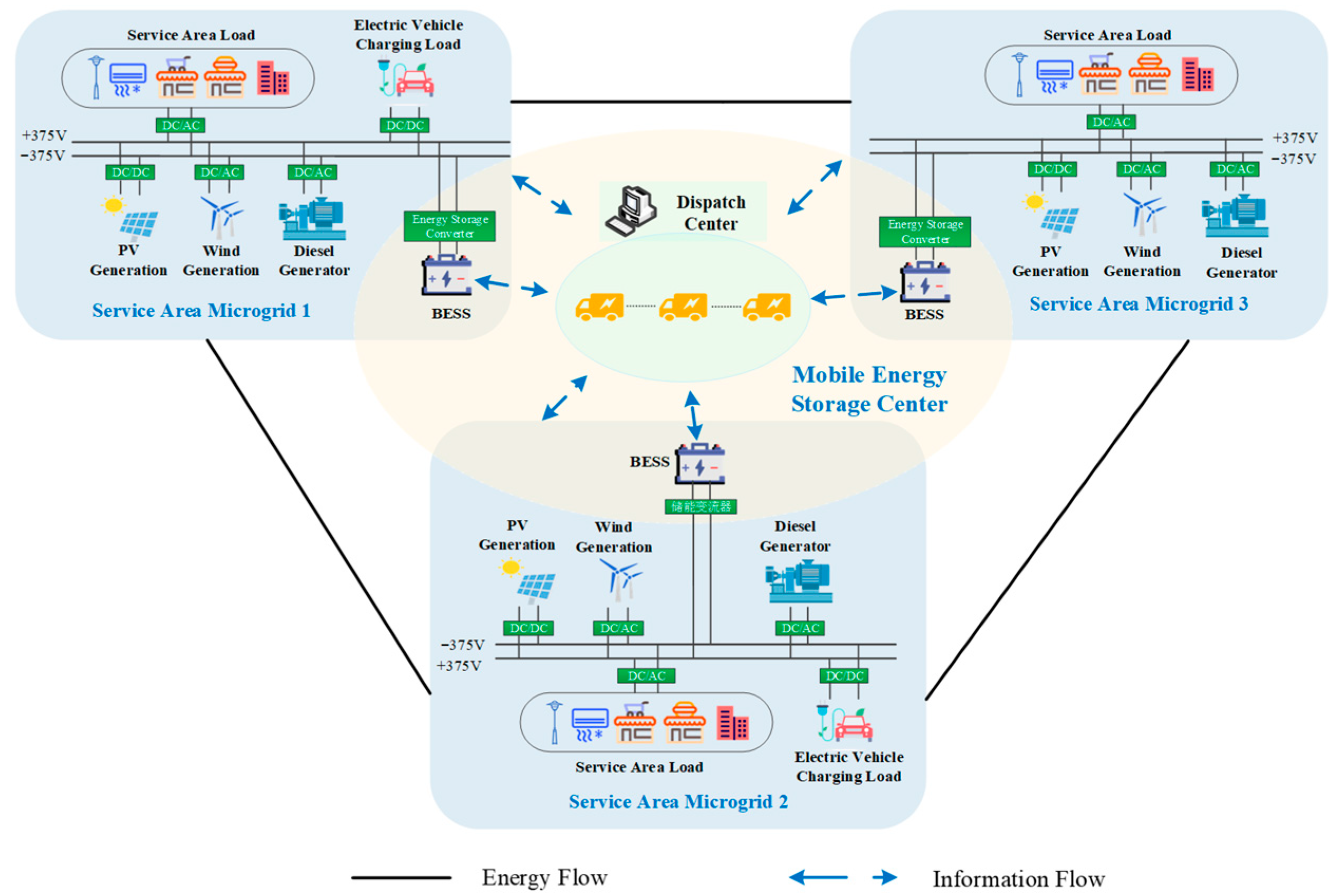
As presented in Figure 1, the proposed system consists of three ring-structured service-area microgrids and a mobile energy storage station. Each microgrid can operate independently and possesses a certain degree of self-sufficiency through local renewable generation. Meanwhile, cross-regional energy coordination and information exchange are achieved via the dispatch center and mobile storage units. Each service-area microgrid comprises PV generation, wind power generation, diesel generators, Stationary Energy Storage devices, and multiple types of load units.
Inter-regional energy transfer is supported by a transportable storage module that can be moved across service areas via mobile storage vehicles. The mobile storage units can dock at supply-type microgrids during periods of wind–solar surplus to charge and then travel to demand-type microgrids during peak-load periods to discharge, thereby balancing energy across both spatial and temporal dimensions. Their operating status, charging and discharging power, and scheduling routes are centrally coordinated by the dispatch center.

3. System Model

3.1. Energy-Side Model

3.1.1. Photovoltaic (PV) Array Model

The power output characteristics of PV generator units are influenced by the coupling of multiple physical fields, including solar irradiance, module temperature, and ambient humidity, among which solar irradiance is the dominant factor. The output power of the PV system ( P p v ) can be expressed as [21]:
P p v = E S η
η = η c E E k , 0 E E k η c , E > E k
where S is the total area of the PV panels (m2); η is the photoelectric conversion efficiency; η c represents the conversion efficiency of a monocrystalline silicon cell, which is typically set to 15%; E denotes the actual solar irradiance (W/m2); and E k is the irradiance at which the photoelectric conversion efficiency reaches saturation, generally taken as 150 W/m2.

3.1.2. Wind Turbine Power (WP) Output Model

The power output characteristics of wind turbine generator units exhibit strong meteorological dependence, with their randomness and volatility mainly resulting from the spatiotemporal variation in wind speed. The wind speed–power output relationship can be represented by [22]:
P s i = 0 , 0 < v < v i n , v > v o f f P w , r = v v i n v r v i n , v i n v < v r P w , r , v r v < v o f f
where v is the average wind speed ( m s 1 ); v i n and v o f f correspond to the cut-in and cut-out wind speeds ( m s 1 ); v r is the reference wind speed ( m s 1 ); and P w , r is the rated active power output of the wind turbine (kW).

3.1.3. Backup Generator

Diesel generators are employed as emergency backup power sources within each microgrid system to ensure the running of essential safety equipment under extreme scenarios. The fuel consumption characteristics of a diesel engine during operation are related to its output power and can be approximated using a quadratic polynomial [23]:
V D ( t ) = a D P D 2 ( t ) + b D P D ( t ) + c D
In the equation, V D ( t ) refers to the generator’s fuel consumption at time t ; P D ( t ) represents the output power of the diesel generator at time t; a D is the quadratic coefficient in the fuel–power characteristic expression of the diesel generator; b D is the linear coefficient in the fuel–power characteristic expression of the diesel generator; and c D is the constant term in the fuel–power characteristic expression of the diesel generator.

3.2. Load-Side Model

3.2.1. Service Area Load Model

The load of a highway service area mainly consists of functional facilities that provide services for passengers. Based on actual operating data, an equivalent load density model is established in this study. Assuming that the total daily energy consumption of the service area is denoted as A s e r , the service area load model can be expressed as follows:
Q S e r = A s e r T n f w i s h ( t )
where Q S e r is the load value required to maintain normal operation of the service area (kWh); f w i s h ( t ) represents the specific curve corresponding to the daily energy consumption pattern of the service area; and T n denotes the duration of the load period (h).

3.2.2. Electric Vehicle (EV) Charging Load Model

In this study, a parameter normalization approach is adopted to establish a unified charging parameter assumption model. By combining Monte Carlo probabilistic sampling, the spatiotemporal distribution of vehicle driving routes and charging demand is simulated. It is assumed that when electric vehicles enter the highway, their remaining state of charge (SOC) follows a uniform distribution within the range of [50%, 90%]. The probability model of the initial SOC is expressed as follows [24,25]:
S O C e v 0 = ( r a n d ( 0 , 1 ) × 0.4 + 0.5 ) × E e v
where S O C e v 0 denotes the initial SOC of the electric vehicle when entering the highway; E e v represents the rated battery capacity of the electric vehicle (kWh).
The SOC of an electric vehicle when it arrives at the service area for charging is given by:
S O C e v = S O C e v 0 E b S e v 100 E e v
where S O C e v indicates the EV SOC at the time it reaches the service area to charge; E b represents the amount of energy consumed by the electric vehicle per 100 km of driving (kWh); and S e v is the driving distance of the electric vehicle from the highway entrance to the service area charging station (km).
Based on extensive empirical data, it has been verified that, under highway operating conditions, the EVs’ daily travel distance and initial charging start time are modeled as normally distributed. The function for the probability density is written as:
f ( S e v ) = 1 2 π σ 1 S e v e x p ( ( ln S e v μ 1 ) 2 2 σ 1 2 ) f ( T s ) = 1 2 π σ 2 e x p ( ( T s μ 2 ) 2 2 σ 2 2 )
where f ( S e v ) and f ( T s ) are the probability density functions of the daily driving distance of electric vehicles to the charging facility in the service area and the initial charging start time, respectively; σ 1 is the standard deviation of ln S e v , and μ 1 is the mean of ln S e v ; T s represents the initial charging start time of the electric vehicle arriving at the service area; σ 2 is the standard deviation of T s , and μ 2 is the mean value of T s .
Thus, the charging duration of an electric vehicle can be calculated as:
T c = ( 1 S O C e v ) E e v p c η c
where T c is the charging duration of the electric vehicle (h); p c is the rated power of the service area charging pile (kW); and η c is the charging efficiency of the electric vehicle. Accordingly, the charging end time of the electric vehicle can be calculated as follows:
T e = T s + T c
where T e represents the charging end time of the electric vehicle.
By performing multiple simulation runs and taking the average value, the charging load power of electric vehicles on highways can be obtained.

3.3. Energy Storage Model

3.3.1. Stationary Energy Storage (SES) Model

Assuming that the battery pack consists of N b a t individual batteries, the total stored energy can be expressed as [26]:
E b a t = N b a t C b a U b a / 10 3
where E b a t is the total energy capacity of the battery pack (kWh); N b a t is the number of batteries in the pack; C b a is the rated capacity of a single battery (Ah); and U b a is the rated voltage of a single battery (V).
According to the maximum depth of discharge of the battery, the minimum remaining energy capacity of the battery pack can be calculated as:
E b a t min = ( 1 D O D ) E b a t
where E b a t min is the minimum remaining energy capacity of the battery pack (kWh), and D O D is the maximum depth of discharge of the battery [27]. When the battery discharges at the C10 rate, the rated output power of the battery pack can be expressed as:
P b a t r a t e d = N b a t C b a U b a / 10 4
where P b a t r a t e d is the rated output power of the battery pack (kW). The stored energy of the battery pack varies with time and can be expressed as follows:
E b a t c h ( t + 1 ) = E b a t ( t ) + P b a t c h ( t ) t η b a t c h ( Charge ) E b a t dis ( t + 1 ) = E b a t ( t ) P b a t d i s ( t ) t η b a t d i s ( Discharge )
where E b a t ( t ) is the stored energy of the battery pack at time t (kWh); E b a t c h ( t + 1 ) is the stored energy of the battery pack at time ( t + 1 ) during charging (kWh); P b a t c h ( t ) is the charging power of the battery pack at time t (kW); η b a t c h is the charging efficiency of the battery pack; E b a t dis ( t + 1 ) is the stored energy of the battery pack at time ( t + 1 ) during discharging (kWh); P b a t d i s ( t ) is the discharging power of the battery pack at time t (kW); and η b a t d i s is the discharging efficiency of the battery pack.

3.3.2. Mobile Energy Storage (MES) Output Power Model

S e p s v t = S e p s v t 1 P e p s v t η e p s v Δ t
S e p s v 0 = C e p s v
S e p s v t represents the energy capacity of the mobile energy storage vehicle at time t (kWh); η e p s v is the discharge loss coefficient of the mobile energy storage vehicle; S e p s v 0 denotes the initial SOC, which is assumed to be fully charged at the beginning of operation; and C e p s v is the maximum storage capacity of the mobile energy storage vehicle (kWh).

4. System Optimization Configuration Model

Based on the ring-structured multi-microgrid architecture, a self-consistent highway multi-microgrid planning model is established, incorporating the coordinated operation of fixed and mobile energy storage systems. The model simultaneously minimizes the investment and operating costs of local Stationary Energy Storage within each service-area microgrid. It is solved using the Gurobi optimizer, and its effectiveness is verified through simulation analysis of a representative ring-type multi-microgrid case.

4.1. Objective Function

The optimization model targets the minimization of daily storage configuration and microgrid operating costs. The operating cost component represents the daily electricity consumption cost of service-area microgrids supplied by mobile energy storage. Two sub-objective functions are defined, respectively, for the Stationary Energy Storage and the mobile energy storage components. In this study, the multi-objective problem is reformulated as a single-objective one using a linear weighted sum method. The overall objective function is expressed as follows:
min C = α C 1 + β C 2

4.1.1. Stationary Energy Storage Component

C 1 = C inv + C rep + C op
(1)
Stationary Energy Storage Investment Cost
C inv = k p P fn + k e E fn
where C inv is the power cost coefficient of the Stationary Energy Storage system; k p is the capacity cost coefficient; k e is the rated charge and discharge power of the Stationary Energy Storage system; and E fn is the installed capacity of the Stationary Energy Storage system.
(2)
Stationary Energy Storage Replacement Cost
C rep = U rep E fn / 365
where U rep corresponds to the annualized unit-capacity replacement expense of the Stationary Energy Storage system.
(3)
Stationary Energy Storage Daily Operation and Maintenance Cost
The Stationary Energy Storage system’s daily operation and maintenance expenses include both fixed and variable components, which can be expressed as follows:
C op = C opl + C op 2
C opl corresponds to the fixed cost component, including maintenance costs related to capacity and power.
C op 1 = μ p P fn + μ e E fn
C op 2 represents the variable component, which refers to the operation and maintenance cost incurred by the charging and discharging activities of the energy storage system within a single day. This cost is directly proportional to the total amount of energy charged and discharged during the daily operation cycle.
C op 2 = t = 1 T k c P fc t + k d P fd t Δ t
where k c is the charging-related operation and maintenance cost factor; k d is the discharging operation and maintenance cost coefficient; P fc t is the charging power of the Stationary Energy Storage system at hour t ; and P fd t is the discharging power of the Stationary Energy Storage system at hour t .

4.1.2. Operating Cost Component

The operating expenditure of the microgrid primarily includes the interaction cost with the mobile energy storage system and the cost associated with the use of local diesel generators. The detailed composition is as follows:
C 2 = C rent + C sup + C t C sale + F c
The mobile energy storage component includes the leasing cost, transportation cost, and the costs associated with charging and discharging operations.
(1)
Mobile Energy Storage Leasing Cost
C rent = f v E vn ( t )
where f v is the rental fee per unit capacity of the mobile energy storage system per hour, and E vn ( t ) is the rated capacity of the mobile energy storage allocated at hour t .
(2)
Mobile Energy Storage Power Supply Cost
When the mobile energy storage system discharges electricity to the microgrid, a power supply fee is charged based on the amount of discharged energy.
C sup = f sup t = 1 T P vd ( t ) Δ t
where f sup is the unit electricity price for power supplied by the mobile energy storage system, and P vd ( t ) is the discharging power of the mobile energy storage system during hour t .
(3)
Mobile Energy Storage Transportation Cost
During the scheduling process, the mobile energy storage system travels between the energy storage station and the microgrids, incurring transportation costs. The transportation cost can be expressed as follows:
C t = K 1 t = 1 T λ ( t ) E vn ( t )
where λ ( t ) is the transportation distance of the mobile energy storage system at time t , and K 1 is the unit cost per kilometer of transportation.
(4)
Electricity Selling Cost from Microgrid to Mobile Energy Storage
When the microgrid charges the mobile energy storage system, a charging fee is collected based on the total amount of energy supplied.
C sale = f sale t = 1 T P vc ( t ) Δ t
where f sale is the unit electricity price for charging the mobile energy storage system, and P vc ( t ) is the charging power supplied to the mobile energy storage system during hour t.

4.2. Constraints

4.2.1. Energy Storage Capacity Constraint

Due to constraints such as capital investment, geographical conditions, and construction feasibility, the maximum construction capacity of Stationary Energy Storage has an upper limit, and the dispatchable capacity of mobile energy storage within each time period of the day is also limited. Therefore, the upper capacity constraint of the energy storage system is defined as follows:
0 E fn E fmax 0 E vn ( t ) E vmax ( t )
where E fmax is the maximum installed capacity of Stationary Energy Storage, and E vmax ( t ) is the maximum dispatchable capacity of mobile energy storage at time t .

4.2.2. System Power Shortage Rate Constraint

It is imperative to ensure that the power shortage rate at each hour remains below the maximum allowable threshold, expressed as follows:
f LPSP ( t ) L h
where f LPSP ( t ) denotes the maximum allowable hourly power shortage rate.

4.2.3. Energy Storage Operation Constraint

(1)
Constraint on the Storage SOC
The energy storage SOC must remain within specified bounds: the upper bound reflects the system’s rated capacity, while the lower bound is set by the maximum depth of discharge, as follows:
E min = E N ( 1 D od )
Accordingly, the Constraint on the Storage SOC is defined as follows:
E fmin E f ( t ) E fn E vmin ( t ) E v ( t ) E vn ( t )
where E f ( t ) and E v ( t ) represent the energy levels of the fixed and mobile energy storage systems at hour t , respectively.
(2)
Constraint on Storage Charging and Discharging
At any given time, the energy storage system cannot perform charging and discharging simultaneously, which can be expressed as:
0 P fd ( t ) P fn 0 P vd ( t ) P vn ( t ) 0 P fc ( t ) P fn 0 P vc ( t ) P vn ( t )
0 e c + e d 1
where P fd ( t ) , P vd ( t ) , P fc ( t ) , and P vc ( t ) denote the discharging and charging power of the fixed and mobile energy storage systems at hour t, respectively. P fn and P vn represent the rated power of the fixed and mobile energy storage systems, respectively, and e c , e d is a binary variable indicating whether the energy storage system is in the charging or discharging state.
(3)
Energy Storage Dynamic Constraint
The constraint on the stored energy between adjacent time periods applies only to Stationary Energy Storage, as the capacity of mobile energy storage is updated hourly and its SOC between consecutive time steps is independent. The constraint can therefore be expressed as follows:
E f ( t ) = E f ( t 1 ) + [ e c η fc P fc ( t ) e d ( η fd ) 1 P fd ( t ) ] Δ t
where η fc and η fd represent the charging and discharging efficiencies of the Stationary Energy Storage system, respectively.
(4)
Mobile energy storage power constraint
0 P e p s v t P e p s v max
where P e p s v t is the output power of the mobile energy storage vehicle at time t (kW); P e p s v max is the maximum output power of the mobile energy storage vehicle (kW).

4.3. System Operation Control Strategy

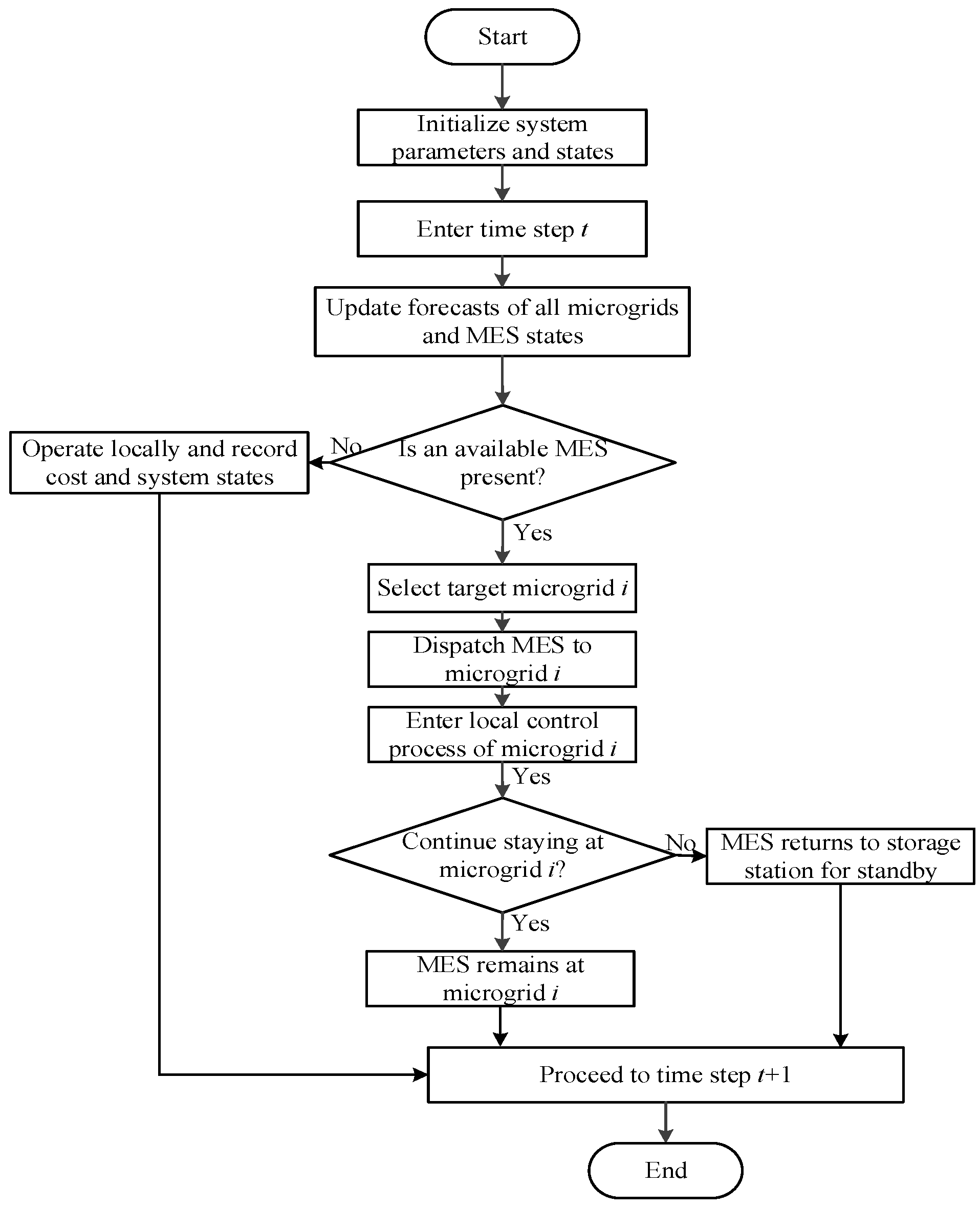
To maximize the renewable energy utilization rate and overall storage efficiency, and to enhance the energy performance and power supply stability of the ring-structured multi-microgrid system, this study adopts a hybrid fixed–mobile energy storage model. Considering that mobile energy storage features fast charging and discharging rates but relatively high discharge costs, each microgrid follows a ‘fixed-storage-dominant and mobile-storage-assisted’ strategy. No additional power lines are laid between microgrids; instead, energy dispatch within the ring-type multi-microgrid system is achieved through the operation of a mobile energy storage station. In this configuration, the mobile energy storage station consistently operates in a ‘one-to-many’ mode, enabling indirect energy exchange among microgrids via mobile storage units. When a mobile storage vehicle arrives at microgrid i for charging or discharging based on forecasted data, it determines whether to remain at the service-area microgrid for subsequent operations according to the local renewable generation and load demand. If no further action is required, the vehicle returns to the mobile energy storage station. The overall system-level control flowchart is shown in Figure 2.
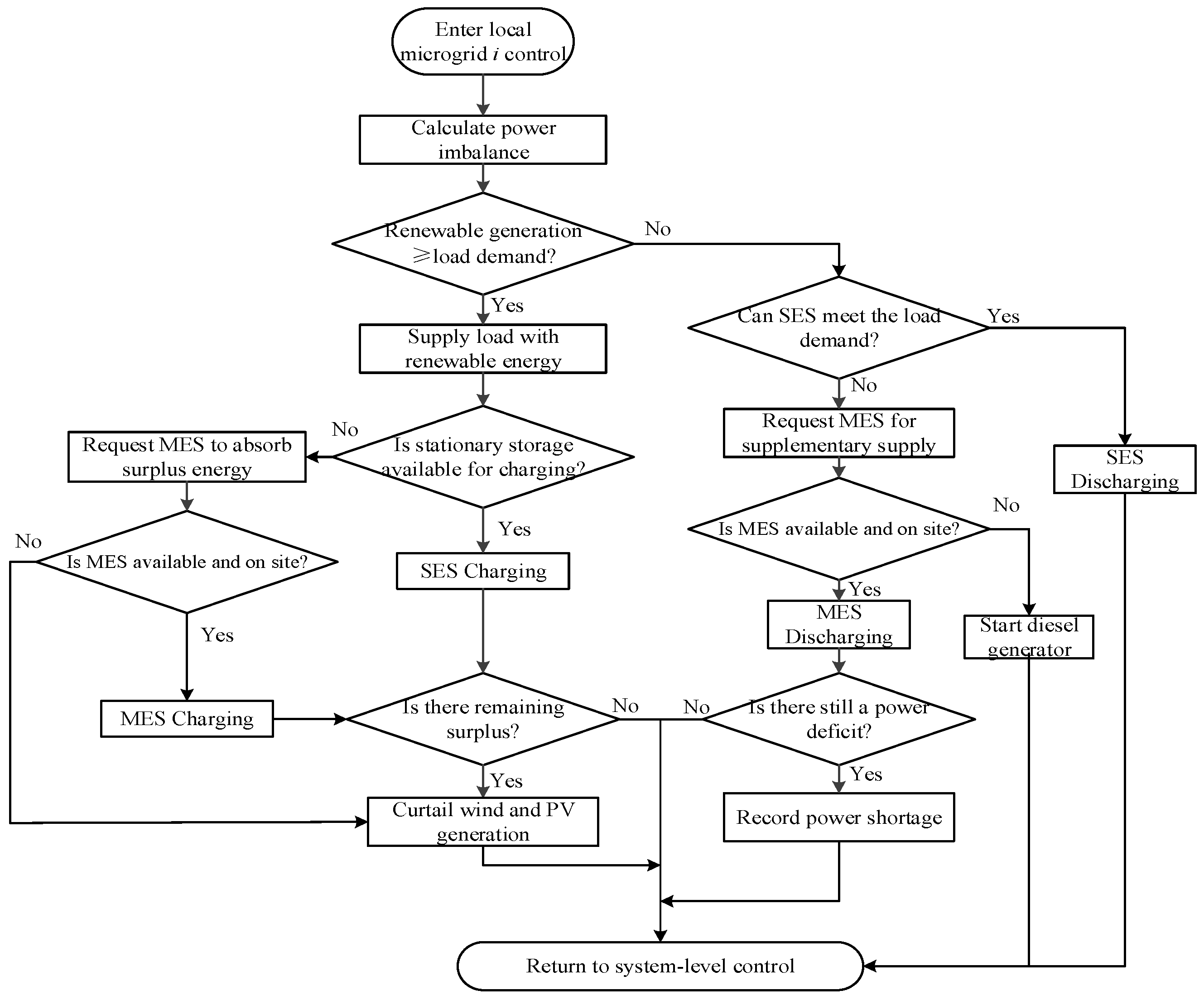
The detailed steps of the internal energy operation control strategy for each microgrid are as follows. The control priorities are executed according to the hierarchical strategy; however, considering the “one-to-many” interaction mode between the ring-structured multi-microgrid system and the mobile energy storage station, the overall economic efficiency of the multi-microgrid system takes precedence over the internal control strategies of individual microgrids. As shown in Figure 3.
(1)
When the renewable generation of microgrid i exceeds its load demand
Priority is given to charging the local Stationary Energy Storage system. If the fixed storage reaches full capacity, the remaining energy is transferred to the mobile energy storage system, and any further surplus energy is curtailed.
(2)
When the renewable generation of microgrid i is lower than its load demand
The local Stationary Energy Storage system is given priority for discharging to meet the load demand. If the fixed storage cannot fully satisfy the load, the mobile energy storage system is utilized to provide supplementary power. In cases where the remaining energy deficit persists, the diesel generator is activated as an emergency backup power source. The system power shortage rate is calculated as follows:
f L P S P ( t ) = [ P L ( t ) P s i P P V ( t ) ( P v d ( t ) + P f d ( t ) ) ] Δ t P L ( t )

5. Case Study Analysis

To test the performance of the proposed modeling framework, a ring-structured system consisting of three microgrids is selected for validation and analysis. Taking the Yuli, Yanqi, and Tiemenguan highway service areas in Xinjiang, China as examples (hereinafter referred to as Microgrid 1, Microgrid 2, and Microgrid 3, respectively).

5.1. Experimental Scheme

To verify the effectiveness and application potential of the mobile energy storage system in the highway ring-type self-consistent microgrid, the following comparative experimental schemes are designed for analysis:
  • Scheme 1: Each microgrid is equipped with an independent battery energy storage system for internal energy regulation.
  • Scheme 2: A mobile energy storage system is integrated into the ring-structured microgrid network to perform unified energy regulation for the entire system.

5.2. Parameter Settings

In the planned highway ring-type self-consistent multi-microgrid system, the parameters of the distributed PV and wind power generation units are presented in the Table 1 and Table 2.

5.2.1. Stationary Energy Storage System Parameters

The parameters of the local Stationary Energy Storage units individually configured in each microgrid are listed as Table 3:

5.2.2. Mobile Energy Storage System Parameters

The relevant parameters of the mobile energy storage system are presented as Table 4:

5.3. Results Analysis

5.3.1. Wind and Solar Power Output Scenario

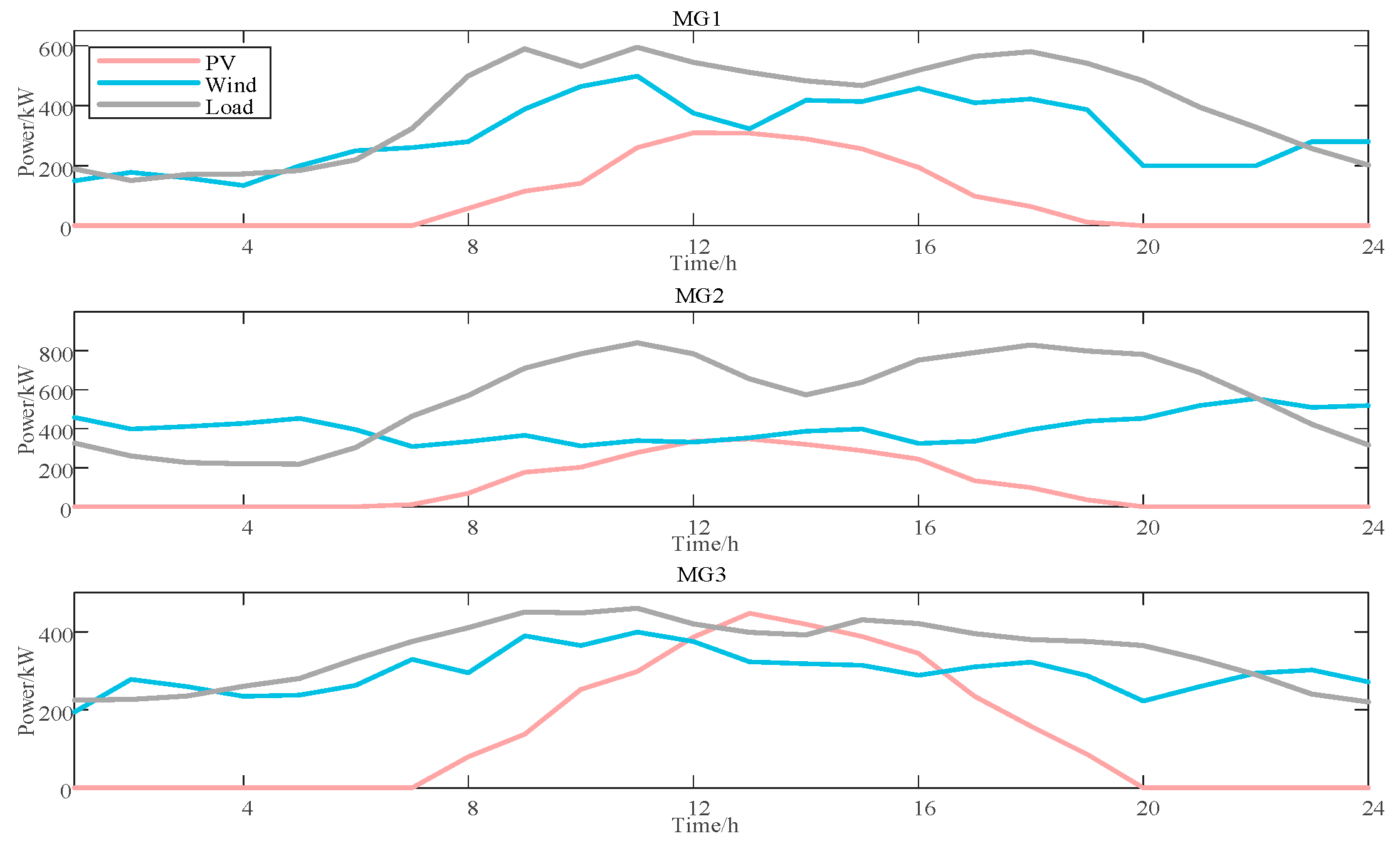
Based on the historical data of Microgrids 1, 2, and 3, a typical day scenario is selected. The wind and PV power output, as well as the load profiles of the three microgrids, are shown in Figure 4.
As shown in the figure, the wind, photovoltaic (PV) output, and load profiles of the three service-area microgrids exhibit distinct diurnal variations and complementary wind–solar characteristics, though differences are observed in both scale and timing.
Microgrid 1 displays a “morning-evening peak” load pattern, with maximum demand of approximately 600 kW occurring during 10:00–12:00 and 17:00–18:00. PV generation peaks between 12:00 and 14:00, while wind generation remains relatively stable at around 350 kW. Renewable generation aligns well with the load from 10:00 to 15:00; however, power shortages arise during nighttime periods.
Microgrid 2 has the highest overall load, reaching nearly 900 kW. PV output peaks at about 350 kW during 11:00–14:00, and wind power remains stable between 300 and 400 kW. The load generally exceeds renewable generation, forming a “net-importing” pattern that depends heavily on energy storage to maintain balance.
Microgrid 3 exhibits the smallest load, approximately 400 kW. PV generation peaks at around 250 kW near noon, while wind output is stronger in the morning. Be-tween 11:00 and 16:00, renewable generation surpasses demand, whereas deficits ap-pear during nighttime hours-indicating a “surplus-type” microgrid.
Overall, Microgrids 1 and 3 present relatively balanced supply–demand characteristics, whereas Microgrid 2 remains demand-dominant due to higher electric vehicle charging loads during 10:00–15:00 and 17:00–21:00, requiring active energy storage regulation to ensure stability.

5.3.2. Energy Storage Configuration Results Analysis

To evaluate the logical soundness and economic effectiveness of the proposed model in a multi-microgrid system, the initial SOC of Stationary Energy Storage was set to 30%, and the maximum hourly power shortage rate was limited to 0.01. Based on the optimization results, the day-ahead energy storage capacity configuration of the ring-structured multi-microgrid system is obtained, as shown in the corresponding table.
As indicated by the results in Table 5, significant differences are observed be-tween Scheme 1 and Scheme 2 in terms of capacity configuration and cost composition. In Scheme 1, where only Stationary Energy Storage is deployed, the system requires a large storage capacity to satisfy energy balance and supply reliability, resulting in a total daily cost of ¥19,650. In contrast, with the introduction of mobile energy storage in Scheme 2, the required capacity of stationary storage system is significantly reduced to 2415 kWh, accounting for only about 24.6% of the original configuration. Although additional in-vestment in mobile storage is incurred, the total cost drops to ¥14,105.77, representing a reduction of approximately 28.2%, thereby improving the overall investment efficiency.
The flexibility of mobile energy storage enables dynamic dispatching among different microgrids according to time-varying renewable generation and load conditions. This allows cross-regional energy transfer and temporal–spatial coordination, effectively reducing the independent configuration demand for fixed storage in each microgrid. Particularly during periods of strong renewable fluctuations or peak load, mobile storage provides energy support and system balancing, lowering redundant construction of fixed systems. Moreover, its multi-scenario reusability allows participation in energy optimization across multiple time intervals, enhancing asset utilization.
Therefore, introducing mobile energy storage not only ensures reliable system operation but also significantly reduces fixed storage capacity and overall investment cost, demonstrating the economic and operational flexibility advantages of mobile storage in multi-microgrid systems. These results validate the effectiveness of the proposed model in optimizing storage configuration and improving system economic performance.

5.3.3. Operational Results Analysis

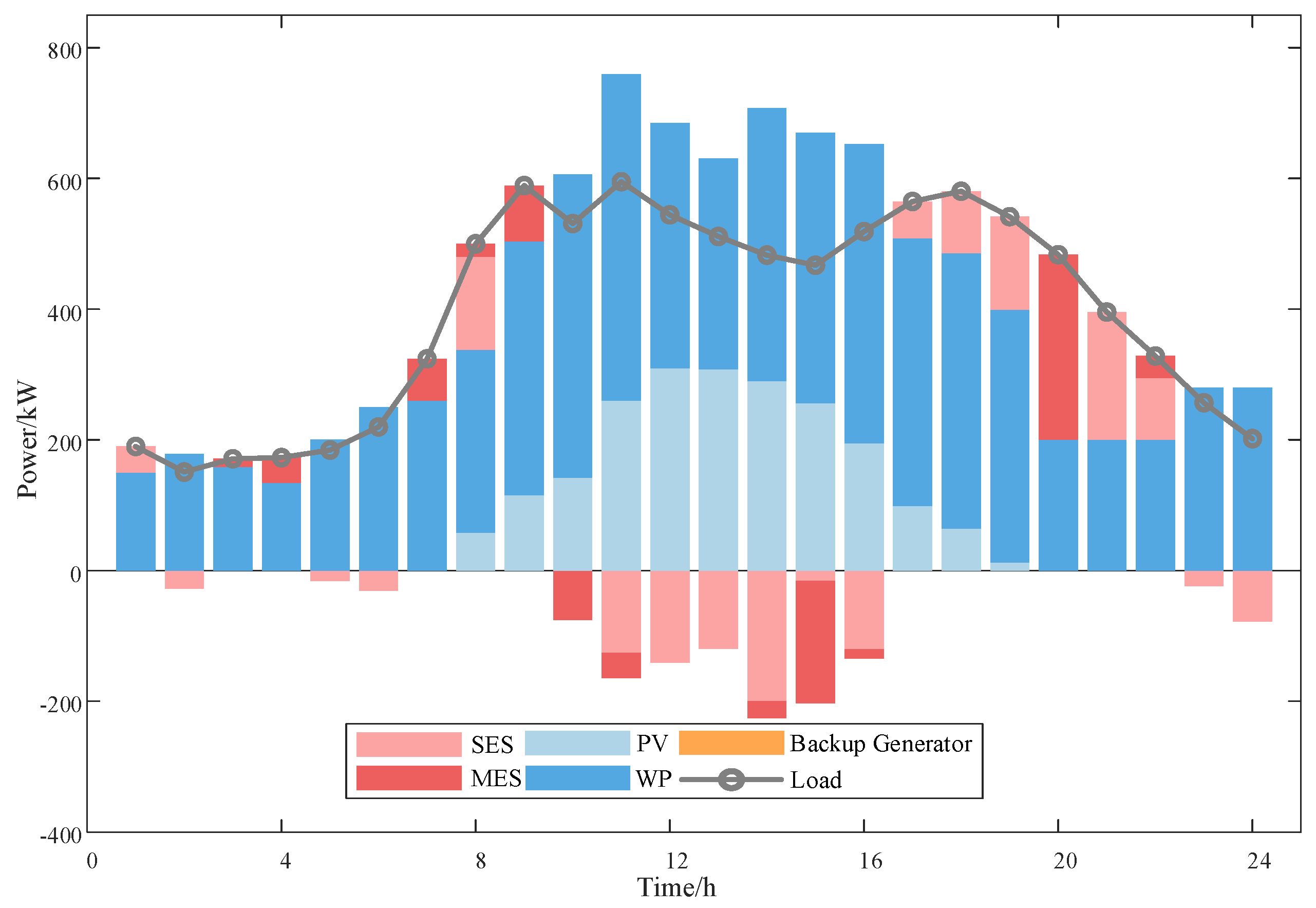
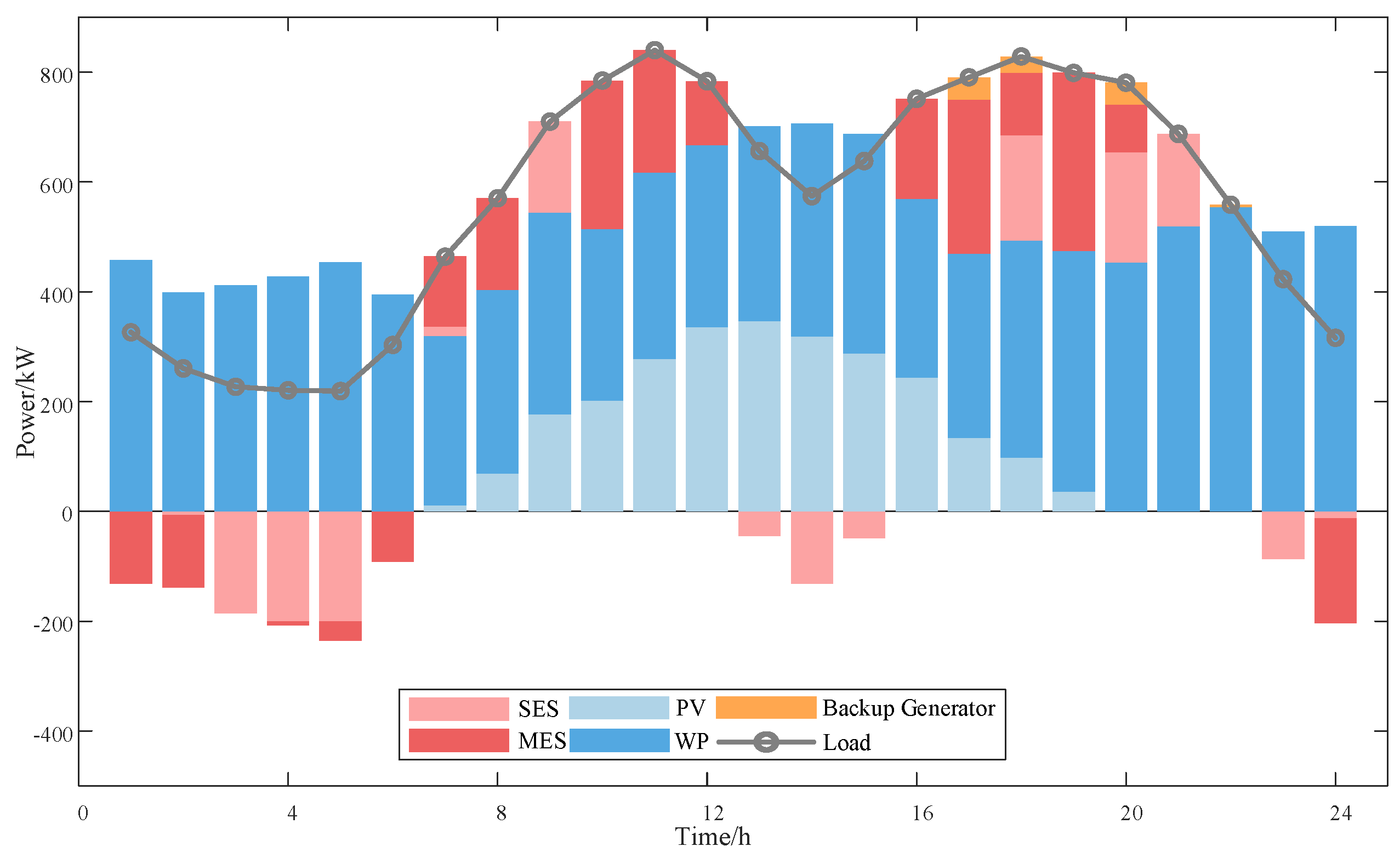
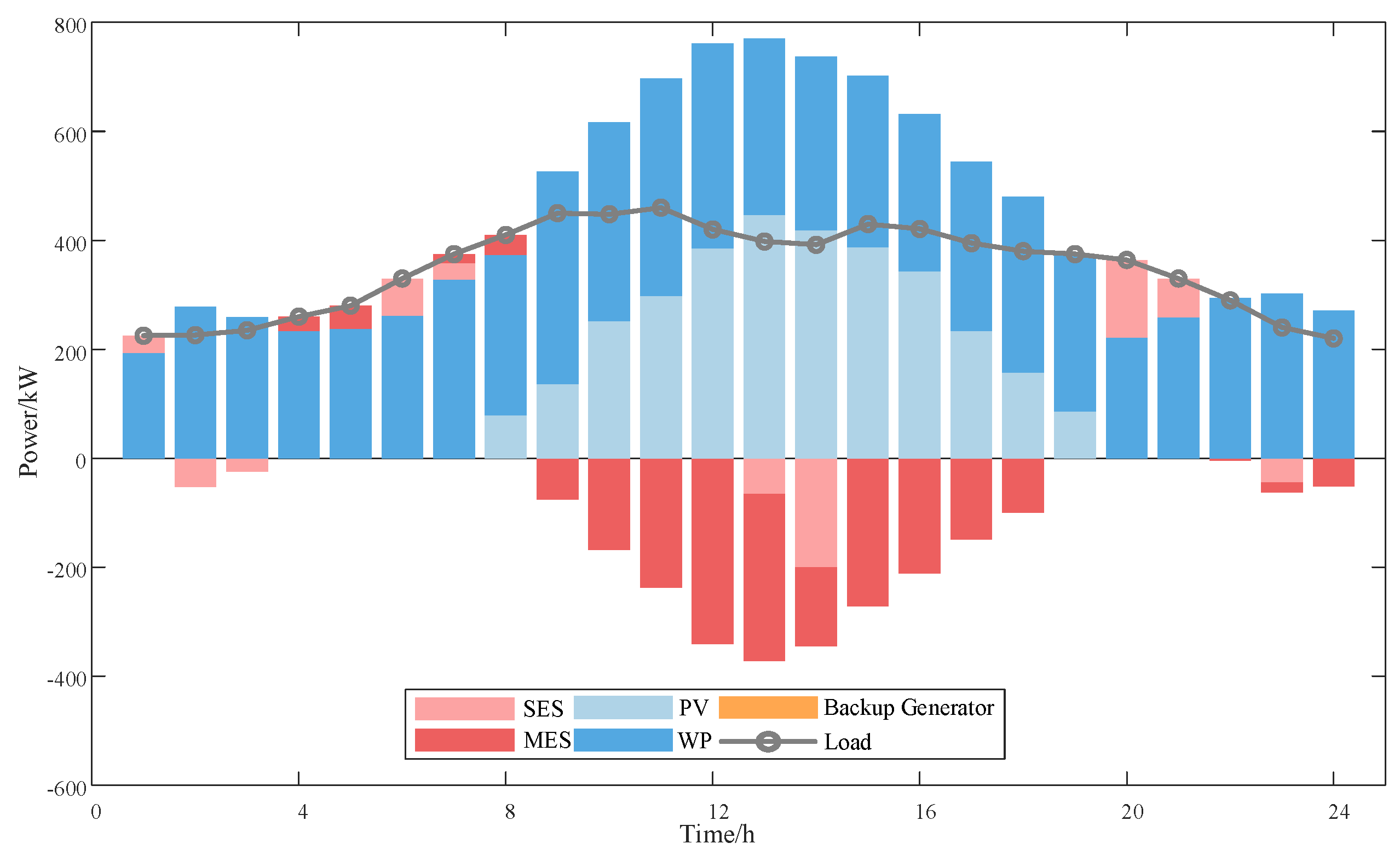
To illustrate the coordination mechanisms of the system under the optimal operational strategy on a typical day, representative days from the entire year are selected for analysis. The power balance of the three service-area microgrids (denoted as MG1, MG2, and MG3) is examined over a full 24 h period. Figure 5, Figure 6 and Figure 7 present the stacked power balance diagrams for MG1–MG3, respectively. In these figures, positive bars represent power supplied to the loads, while negative bars indicate energy absorption. The gray curves denote the load profiles of each microgrid.
Figure 5 shows that MG1 operates as a “locally balanced” microgrid, characterized by midday charging and evening discharging. Between 10:00 and 15:00, wind and PV generation peak, prompting both stationary and mobile storage systems to charge and absorb excess energy. From 17:00 to 21:00, as renewable output declines and load increases, storage discharges to mitigate the power deficit. Intermittent discharging between 1:00 and 7:00 maintains balance, with no significant curtailment observed, indicating effective utilization of midday surplus.
As shown in Figure 6, MG2 functions as a “demand-centered” microgrid, featuring high load levels from 9:00 to 20:00 and a net power-importing profile. During the day, both storage systems mainly discharge to meet demand with renewables, while brief charging occurs in the early morning and late night to store excess wind power. Limited backup generation appears at dusk for emergency support. MG2 remains the primary recipient of mobile storage discharge at night.
Figure 7 indicates that MG3 is a “supply oriented” microgrid with midday surplus and nighttime compensation. From 11:00 to 16:00, renewable generation exceeds load, and both storage systems charge continuously. From 18:00 to 24:00, they discharge to support local and neighboring microgrids. Occasional minor curtailment under extreme surplus suggests marginal absorption limits, yet overall renewable utilization remains high.
Collectively, Figure 5, Figure 6 and Figure 7 reveal that mobile storage exhibits a clear “daytime charging, nighttime discharging, and inter-area transfer” pattern: charging on surplus sides (mainly MG3) to absorb excess renewable energy and discharging on deficit sides (mainly MG2) to cover evening peaks. Stationary storage focuses on intra-microgrid smoothing, while mobile storage enables inter-microgrid and intertemporal energy transfer, achieving spatial resource sharing under limited interconnection capacity. With coordinated mobile storage, the ring-structured tri-microgrid system maintains full-time power balance. MG2’s peak deficits are compensated by mobile storage and limited backup generation; MG3’s and MG1’s midday surpluses are absorbed, with minimal curtailment. MG1 and MG3 follow a “midday charging–night discharging” pattern, whereas MG2 follows a “day discharging–night charging” mode, effectively smoothing the system load. Mobile storage transfers energy from low-load to high-load periods, reducing external power purchases and curtailment losses while ensuring supply reliability and minimizing daily operating costs.
On the representative day, MG3 acts as a supply oriented microgrid, MG2 as a demand-oriented one, and MG1 as a locally balanced system. By charging at surplus periods and discharging at deficit periods, mobile storage achieves temporal and spatial coordination between renewable output and demand. This reduces curtailment, narrows load fluctuations, and enhances both renewable utilization and supply reliability, demonstrating the effectiveness and cost-efficiency of coordinated stationary–mobile storage planning in ring-type multi-microgrid systems.

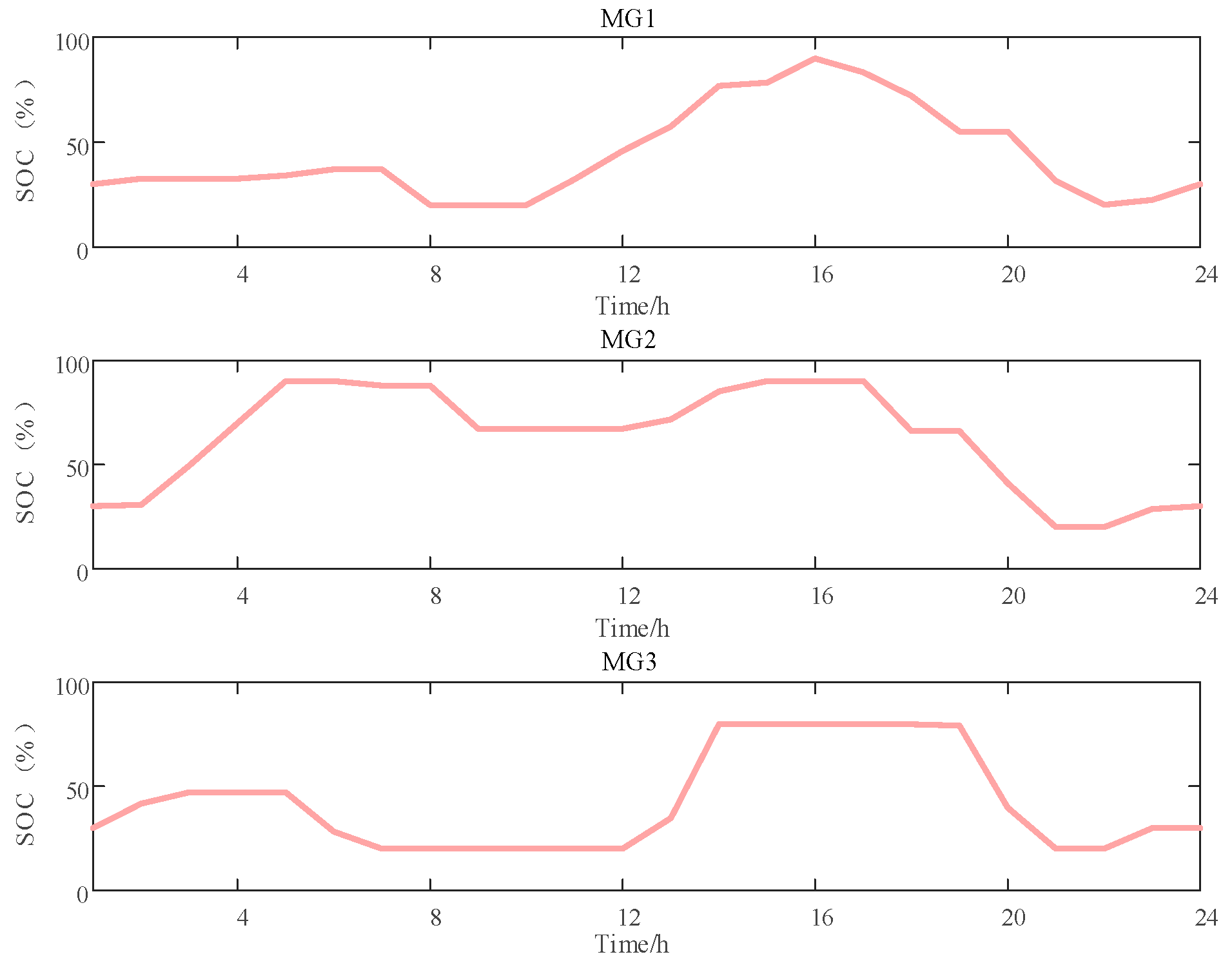
5.3.4. SOC of Stationary Energy Storage

Figure 8 shows the SOC variations in stationary storage in MG1-MG3. All units operate within limits, with SOC at the start and end of the day nearly identical, ensuring energy balance and avoiding long-term drift. The SOC profiles align with the mismatch between renewable output and load, following a “midday charging–evening discharging” pattern, with distinct roles among the microgrids.
Figure 8 shows the SOC variations in stationary storage in MG1-MG3. MG1 displays a “midday charging-evening discharging” pattern. After a slight early-morning rise, SOC reaches its lower limit around 8:00–10:00, then increases with solar output from 10:00 to 16:00, approaching the upper limit. Between 17:00 and 21:00, SOC drops rapidly as load peaks and stabilizes at a medium level overnight. This reflects MG1’s local surplus absorption and evening support role, featuring one deep cycle with minor shallow cycles that enhance peak shaving and internal smoothing.
MG2 operates under high load as a “demand-assured” microgrid. SOC increases quickly before dawn, then alternates between charging and discharging during the day, dropping to near the lower limit from 17:00 to 21:00 before slightly recharging to meet inter-day balance. Frequent boundary operation indicates capacity designed for deep evening discharge. Consistent with its “net importing” nature, MG2’s stationary storage ensures supply reliability and, together with mobile storage, supports peak reduction.
MG3 shows a “surplus absorption–nighttime supply” pattern. After shallow morning charging, SOC stays near the lower limit until noon, then rises rapidly with PV generation to a high level from 12:00 to 18:00. It discharges between 18:00 and 21:00 and slightly recharges afterward. This matches MG3’s midday surplus profile: storage absorbs excess renewables and supplies local and neighboring loads at night, reserving upper-limit margin for uncertainty and curtailment reduction.
All units remain within limits. MG2 frequently reaches boundaries, while MG3 retains upper-margin flexibility. SOC evolution corresponds to the mismatch between renewables and load-MG1 emphasizes local balance, MG2 demand assurance, and MG3 surplus absorption. Coordinated with mobile storage, they achieve “midday storage–nighttime release,” maintaining power balance under SOC constraints and supporting overall system efficiency.

6. Conclusions

The research proposes a capacity configuration strategy for a ring-type multi-microgrid system with coordinated stationary and mobile energy storage, targeting highway energy scenarios in western regions without large grid support. A system architecture considering the “one-to-many” interaction mode of mobile energy storage stations is established, and a case study is conducted based on three ring-connected service-area microgrids in Xinjiang, China. The primary conclusions can be outlined as follows:
(1)
Compared with schemes where each microgrid in the ring system is equipped solely with stationary storage, the proposed ring-type multi-microgrid system based on coordinated stationary–mobile energy storage offers superior cost-effectiveness. It not only avoids the high cost of power line installation in the complex terrain of northwestern regions but also mitigates redundant capacity allocation in service-area microgrids when deploying fixed storage individually.
(2)
This study validates, at the intraday investment scale for highway multi-microgrid systems, the advantages of mobile energy storage in enhancing system flexibility and optimizing storage investment.
(3)
Compared with the conventional single fixed-storage mode, mobile energy storage enables multi-scenario utilization through cyclic scheduling across multiple microgrids and time periods within a single day, thereby enhancing storage utilization efficiency. This approach achieves the co-optimization of investment cost and operational economy, while simultaneously ensuring power supply reliability and system stability.
In summary, mobile energy storage demonstrates comprehensive advantages of flexibility, efficiency, and cost-effectiveness within multi-microgrid systems. Nevertheless, this study is subject to several limitations, and future work may further address the following issues:
(1)
This study focuses exclusively on the coordinated operation of mobile energy storage within a ring-type multi-microgrid structure. Future research may further investigate control strategies and system performance of mobile energy storage operating in linear-type multi-microgrid configurations or more complex coupled system architectures. For example, in linear multi-microgrid structures, it remains to be explored how mobile energy storage dispatch strategies should be designed and how the overall system architecture can be optimally configured to enhance system-wide benefits;
(2)
This study does not explicitly incorporate traffic conditions, and the dispatch accuracy of mobile energy storage has not been examined in detail. Future research may integrate transportation network models and conduct more realistic simulations by considering practical traffic dynamics and constraints.
(3)
This study analyzes system operation based only on a randomly selected typical day and does not conduct a detailed seasonal analysis over a full year. Future research may perform year-round, seasonally differentiated simulations to capture the impacts of seasonal meteorological variations on system operation.

Author Contributions

L.W.: Writing—Original Draft, Writing—Review and Editing, Methodology, Investigation, and Conceptualization; J.W.: Writing—Original Draft, Writing—Review and Editing, Software, Methodology, and Formal Analysis; Y.W.: Software, Data Curation, and Validation; F.L.: Writing—Review and Editing, Methodology, and Conceptualization; X.Z.: Writing—Review and Editing, C.J.: Writing—Review and Editing, R.S.: Writing—Review and Editing, Funding and Supervision. All authors have read and agreed to the published version of the manuscript.

Funding

This research was funded by the National Key R&D Plan Foundation of China (Grant No. 2021YFB2601300) and the Fundamental Research Funds for the Central Universities (Grant No. 2025JC005).

Institutional Review Board Statement

Not applicable.

Informed Consent Statement

Not applicable.

Data Availability Statement

The data presented in this study are available on request from the corresponding author due to some commercial requirement.

Conflicts of Interest

Authors Lulu Wang, Jinsong Wang and Xianran Zhu was employed by the company North China Electric Power Test and Research Institute, China Datang Group Science and Technology Research Institute. The remaining authors declare that the research was conducted in the absence of any commercial or financial relationships that could be construed as a potential conflict of interest.

References

  1. Vidan, M.; D’Andreagiovanni, F.; Pandžić, H. Individual thermal generator and battery storage bidding strategies based on robust optimization. IEEE Access 2021, 9, 66829–66838. [Google Scholar] [CrossRef]
  2. Haider, H.; Jun, Y.; Rashed, G.I.; Peixiao, F.; Kamel, S.; Li, Y. A robust optimization model for microgrid considering hybrid renewable energy sources under uncertainties. Environ. Sci. Pollut. Res. 2023, 30, 82470–82484. [Google Scholar] [CrossRef]
  3. Yang, J.; Su, C. Robust optimization of microgrid based on renewable distributed power generation and load demand uncertainty. Energy 2021, 223, 120043. [Google Scholar] [CrossRef]
  4. Dugan, J.; Mohagheghi, S.; Kroposki, B. Application of mobile energy storage for enhancing power grid resilience: A review. Energies 2021, 14, 6476. [Google Scholar] [CrossRef]
  5. Shen, Y.; Qian, T.; Li, W.; Zhao, W.; Tang, W.; Chen, X.; Yu, Z. Mobile energy storage systems with spatial–temporal flexibility for post-disaster recovery of power distribution systems: A bilevel optimization approach. Energy 2023, 282, 128300. [Google Scholar] [CrossRef]
  6. Ju, Y.; Zhou, W.; Yu, Z. A distribution network planning approach considering mobile energy storage vehicles to enhance system power supply reliability. Power Syst. Prot. Control 2024, 52, 128–138. [Google Scholar]
  7. Cai, R.; Ling, K.; Jiang, H. Research on optimal allocation of movable energy storage in distribution network. Adv. Technol. Electr. Eng. Energy 2019, 38, 26–32. [Google Scholar]
  8. Yao, S.; Wang, P.; Zhao, T. Transportable energy storage for more resilient distribution systems with multiple microgrids. IEEE Trans. Smart Grid 2018, 10, 3331–3341. [Google Scholar] [CrossRef]
  9. Yang, W.; Wang, D.; Guo, J.; Zhang, Y.; Zhang, J.; Bian, Z. Reliability Assessment of Distribution Network Considering Mobile Energy Storage Vehicles and Dynamic Zonal Coupling. J. Electr. Eng. Technol. 2024, 19, 1–15. [Google Scholar] [CrossRef]
  10. Hu, J.; Qu, J.; Liu, X.; Gui, J. Two-stage Optimal Scheduling Method for Highway Service Area Microgrid Considering Emergency Power Vehicles. Electr. Power Constr. 2025, 46, 150–159. [Google Scholar]
  11. Gong, C.; Wu, M.; Sun, L.J. Economic benefit analysis of mobile energy storage based on improved genetic algorithm. Electr. Eng. 2022, 10–14. [Google Scholar]
  12. Zhang, Y.; Wang, H.; Feng, B.; Song, Y.; Han, G.; Zhang, B. Study on photovoltaic consumption capacity of integrated energy system considering stationary/mobile energy storage. J. Eng. Therm. Energy Power 2025, 40, 113–120. [Google Scholar]
  13. Ye, Q.; Wu, X.; Yang, X.; Xiang, J.; Liao, H.; Huang, Y. Capacity Configuration Strategy of Photovoltaic and Mixed Stationary-mobile Energy Storage for DC Microgrids Based on Dual-timescale. Mod. Electr. Power 2023, 41, 747–754. [Google Scholar]
  14. Sun, W.; Liu, W.; Zhang, J.; Tian, K. Bi-level optimal operation model of mobile energy storage system in coupled transportation-power networks. J. Mod. Power Syst. Clean Energy 2022, 10, 1725–1737. [Google Scholar] [CrossRef]
  15. Ma, S.; Xiang, T.; Hou, K.; Liu, Z.; Tang, P.; Qi, N. Spatial–temporal optimal dispatch of mobile energy storage for emergency power supply. Energy Rep. 2022, 8, 322–329. [Google Scholar] [CrossRef]
  16. Habibi, M.; Vahidinasab, V.; Sepasian, M.S. Application of mobile energy storage to facilitate energy transfer between TSO and DSO networks. In Proceedings of the 2020 10th Smart Grid Conference (SGC), Kashan, Iran, 16–17 December 2020; pp. 1–3. [Google Scholar]
  17. Abdeltawab, H.H.; Mohamed, Y.A.R.I. Mobile energy storage scheduling and operation in active distribution systems. IEEE Trans. Ind. Electron. 2017, 64, 6828–6840. [Google Scholar] [CrossRef]
  18. Niu, M.B.; Wang, H.C.; Li, J.; Liu, H.; Yin, R. Coordinated energy dispatch of highway microgrids with mobile storage system based on DMPC optimization. Electr. Power Syst. Res. 2023, 217, 109119. [Google Scholar] [CrossRef]
  19. Xia, S.; Zhang, X.; Yuan, L.; Wu, T.; Li, G.; Shahidehpour, M. An energy scheduling scheme for highway microgrids virtually networked by electric operation and maintenance vehicles. IEEE Trans. Ind. Appl. 2023, 60, 1010–1022. [Google Scholar] [CrossRef]
  20. Lu, Z.; Xu, X.; Yan, Z.; Shahidehpour, M. Multistage robust optimization of routing and scheduling of mobile energy storage in coupled transportation and power distribution networks. IEEE Trans. Transp. Electrif. 2021, 8, 2583–2594. [Google Scholar] [CrossRef]
  21. Shang, H.; Liu, T.; Bu, T.; He, C.; Yin, Y.; Ding, L. Operational risk assessment of power system considering wind power and photovoltaic grid connection. Mod. Electr. Power 2020, 37, 358–367. [Google Scholar]
  22. Che, B.; Li, X.; Zheng, J.; Fu, H.; Ding, Q. Scenario analysis of wind power output based on LHS and BR. Electr. Power Eng. Technol. 2020, 39, 213–219. [Google Scholar]
  23. Xiao, H.; Pei, W.; Kong, L.; Sun, J.; Wang, C.; Jia, D. Optimal operational scheduling method for integrated energy microgrids. Adv. Technol. Electr. Eng. Energy 2016, 35, 1–11. [Google Scholar]
  24. Chen, W. Research on the Layout of Highway Charging Stations Based on Electric Vehicle Charging Demand. Ph.D. Thesis, School of Transportation Engineering, Southwest Jiaotong University, Chengdu, China, 2021. [Google Scholar]
  25. Xie, R.; Wei, W.; Khodayar, M.E.; Wang, J.; Mei, S. Planning fully renewable powered charging stations on highways: A data-driven robust optimization approach. IEEE Trans. Transp. Electrif. 2018, 4, 817–830. [Google Scholar] [CrossRef]
  26. Lopes, P.P.; Stamenkovic, V.R. Past, present, and future of lead–acid batteries. Science 2020, 369, 923–924. [Google Scholar] [CrossRef] [PubMed]
  27. Iqbal, M.Z.; Aziz, U. Supercapattery: Merging of battery-supercapacitor electrodes for hybrid energy storage devices. J. Energy Storage 2022, 46, 103823. [Google Scholar] [CrossRef]
Figure 1. Architecture of a Ring-type Multi-microgrid Cooperative System with Fixed and Mobile Energy Storage for Highway Transportation.
Sustainability 18 00629 g001
Figure 2. System-level control flowchart.
Sustainability 18 00629 g002
Figure 3. Intra-microgrid control flowchart.
Sustainability 18 00629 g003
Figure 4. Figure of Wind-Solar Power Output and Load Variations in Microgrids 1, 2, and 3.
Sustainability 18 00629 g004
Figure 5. Power Balance Diagram of Microgrid 1 System.
Sustainability 18 00629 g005
Figure 6. Power Balance Diagram of Microgrid 2 System.
Sustainability 18 00629 g006
Figure 7. Power Balance Diagram of Microgrid 3 System.
Sustainability 18 00629 g007
Figure 8. SOC Variation in Stationary Energy Storage in MG 1, 2, and 3.
Sustainability 18 00629 g008
Table 1. Photovoltaic Power Generation Equipment Parameters.
ModelParameters
SPP405QHFHRated Output Power (kW)Optimum Operating Voltage (V)Optimum Operating Current (A)Open-Circuit Voltage (V)Short-Circuit Current (A)
40537.310.8645.111.35
Table 2. Wind Turbine Equipment Parameters.
ModelParameters
FD5-5Maximum Power (W)Rotor Diameter (m)Rated Wind Speed (m/s)Cut-in Wind Speed (m/s)Cut-out Wind Speed (m/s)Tower Height (m)
55.11132512
Table 3. Stationary Energy Storage System Parameters.
ParametersValue
Rated Capacity (kWh)15
Rated Power(kW)5
Charging and Discharging Efficiency0.85
Maximum Depth of Discharge0.8
Service Life(years)5
Capacity Cost Coefficient (¥·kW·h−1)500
Power Cost Coefficient (¥·kW−1)2000
Annualized Replacement Cost (¥·kW·h−1)900
Daily Capacity Maintenance Cost Coefficient (¥·kW·h−1)0.321
Daily Power Maintenance Cost Coefficient (¥·kW·h−1)0.791
Charging Maintenance Cost Coefficient (¥·kW·h−1)0.098
Discharging Maintenance Cost Coefficient (¥·kW·h−1)0.098
Table 4. Mobile Energy Storage System Parameters.
ParametersValue
Rated Capacity (kWh)10
Rated Power (kW)8
Maximum Depth of Discharge0.9
Charging and Discharging Efficiency0.85
Hourly Rental Cost (¥·kW·h−1)2.00
Transportation Cost (¥·kWh−1 km−1)0.045
Power Supply Cost (¥·kW·h−1)1.500
Table 5. Configuration Results.
Configuration ResultsScheme 1Scheme 2
Total Stationary Energy Storage Capacity (kWh)98212415
Total Cost on the Stationary Energy Storage Side (¥)19,6509076.08
Cost on the Mobile Energy Storage Side (¥)05029.69
Total Cost (¥)19,65014,105.77
Disclaimer/Publisher’s Note: The statements, opinions and data contained in all publications are solely those of the individual author(s) and contributor(s) and not of MDPI and/or the editor(s). MDPI and/or the editor(s) disclaim responsibility for any injury to people or property resulting from any ideas, methods, instructions or products referred to in the content.