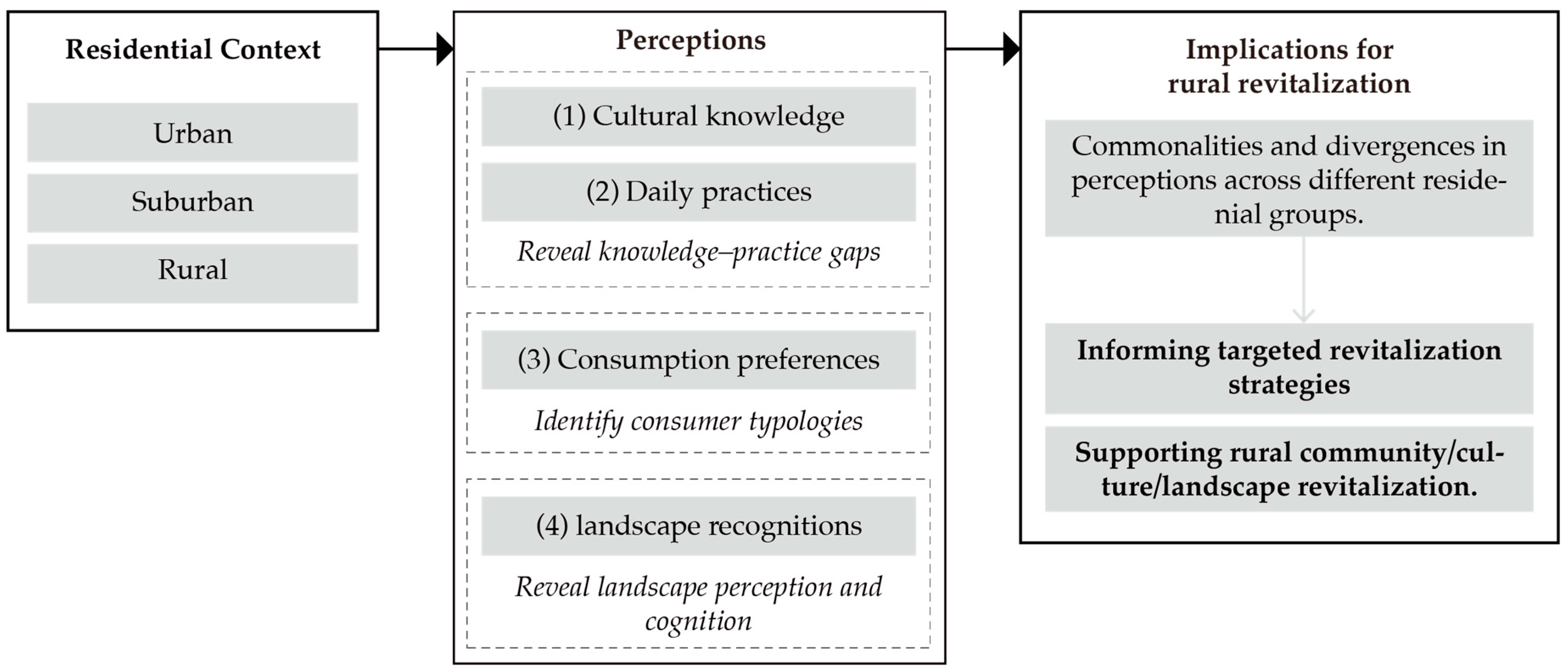

Perceptual Differences Across Urban, Suburban, and Rural Residents: A Residential-Context-Based Study on the Recognition of Tea Culture and Landscapes


Abstract
1. Introduction
2. Materials and Methods
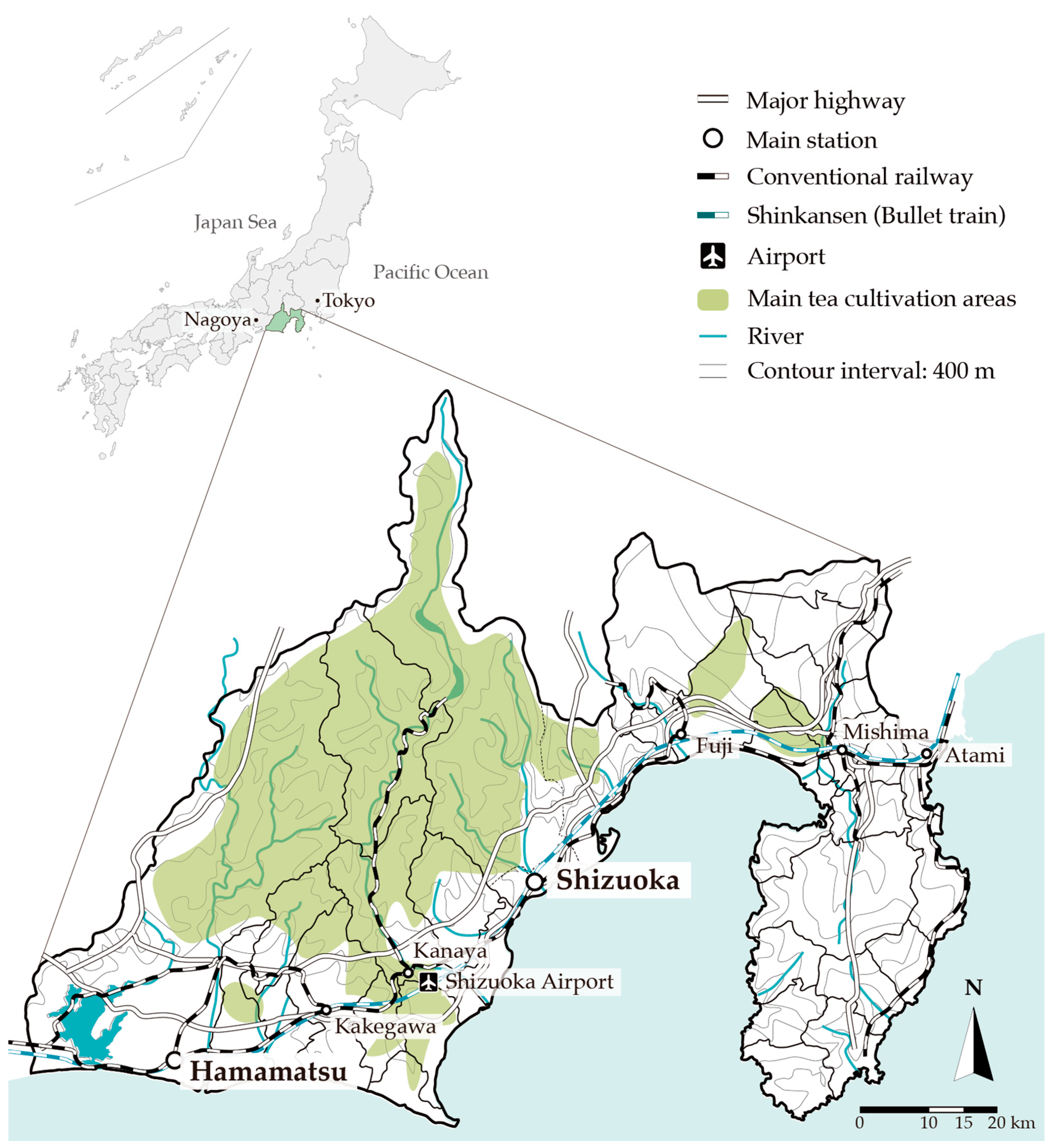
2.1. Study Area
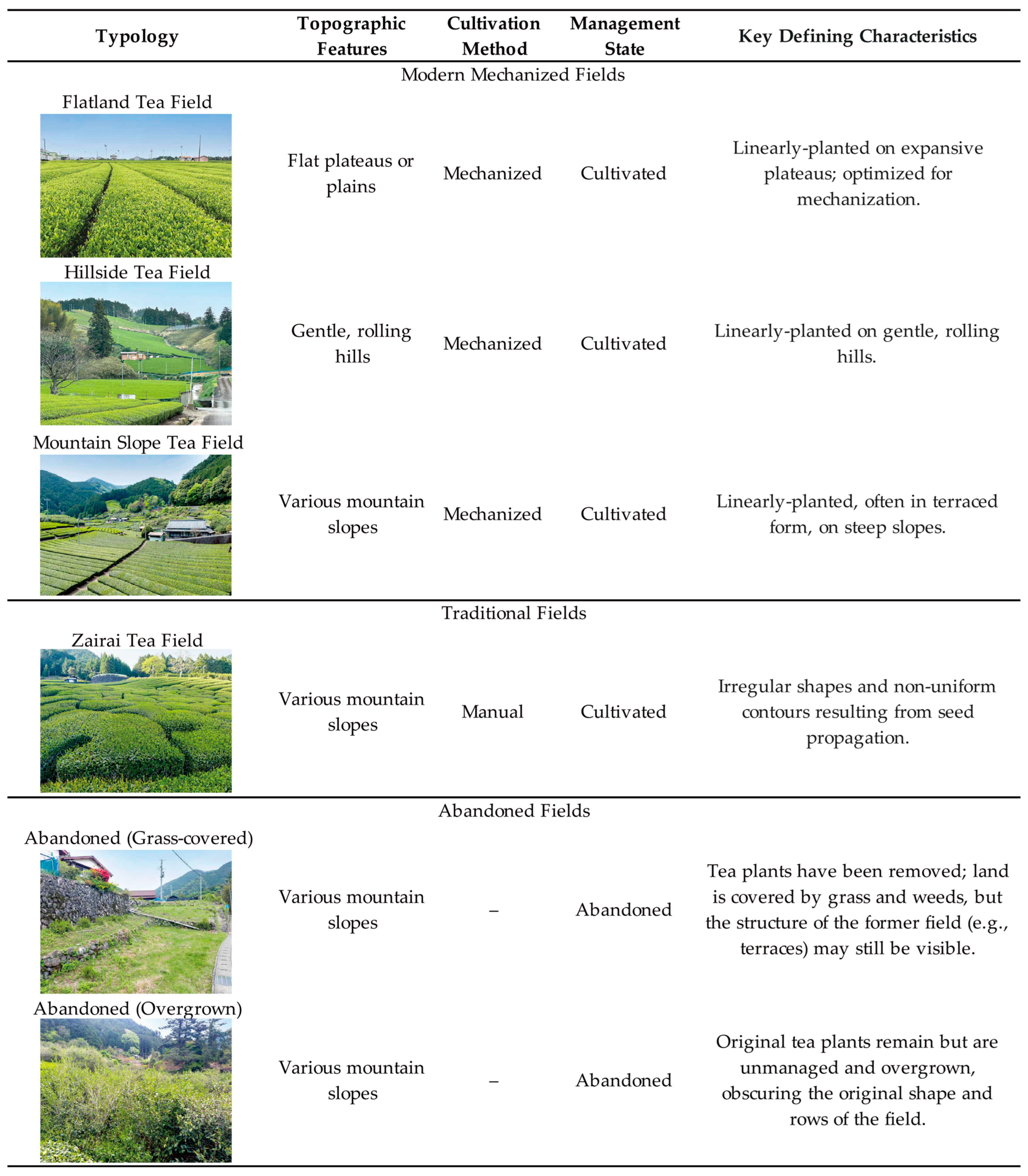
2.2. Definition of Tea Field Typologies
2.3. Questionnaire Design
2.4. Data Collection and Participants
2.5. Data Analysis
3. Results
3.1. Descriptive Statistics of Tea-Related Perceptions Across Residential Areas
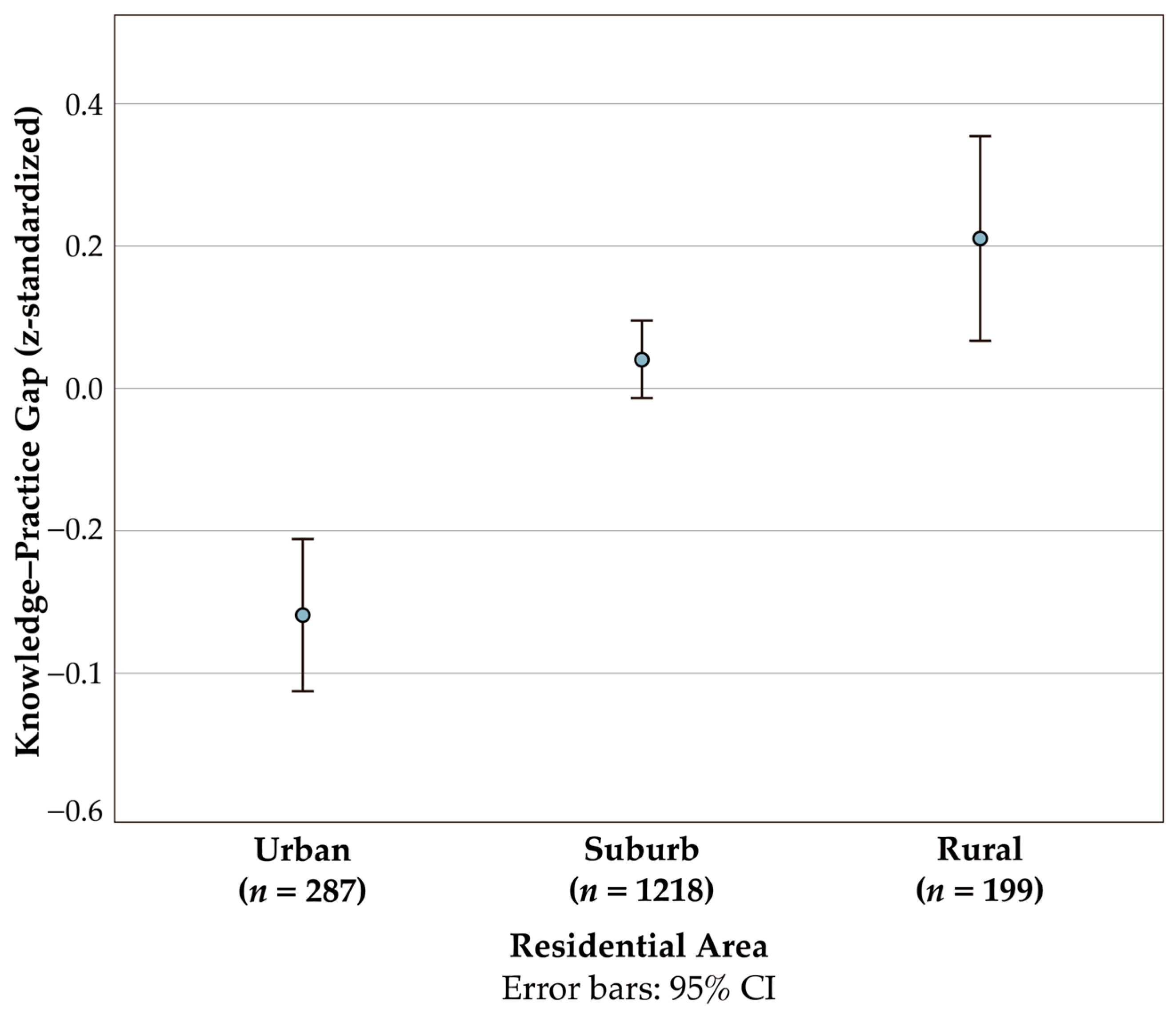
3.2. The Differences Between Conceptions and Daily Practice Across Residential Contexts: Multivariate Analysis of Variance
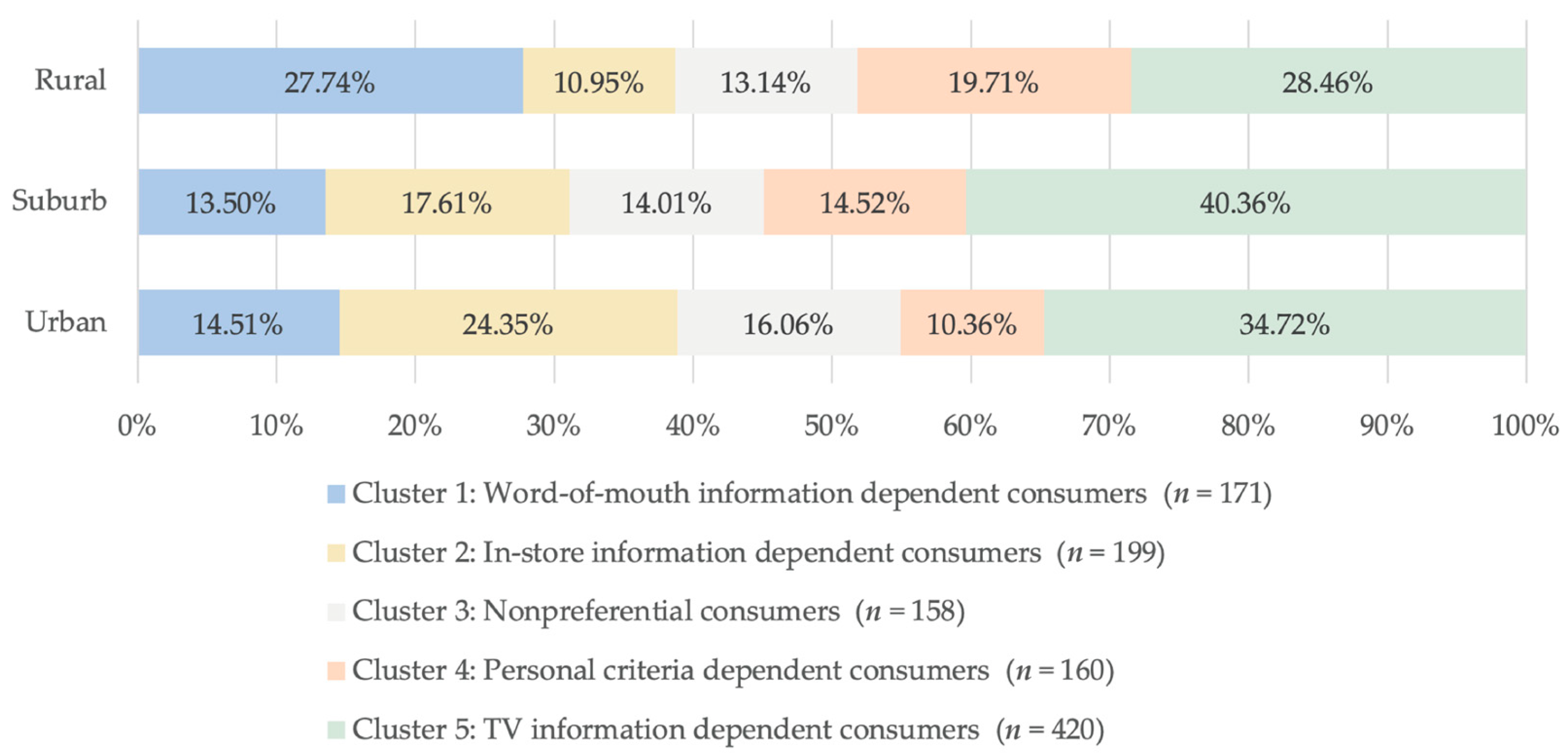
3.3. Regional Distribution of Tea Consumer Typologies
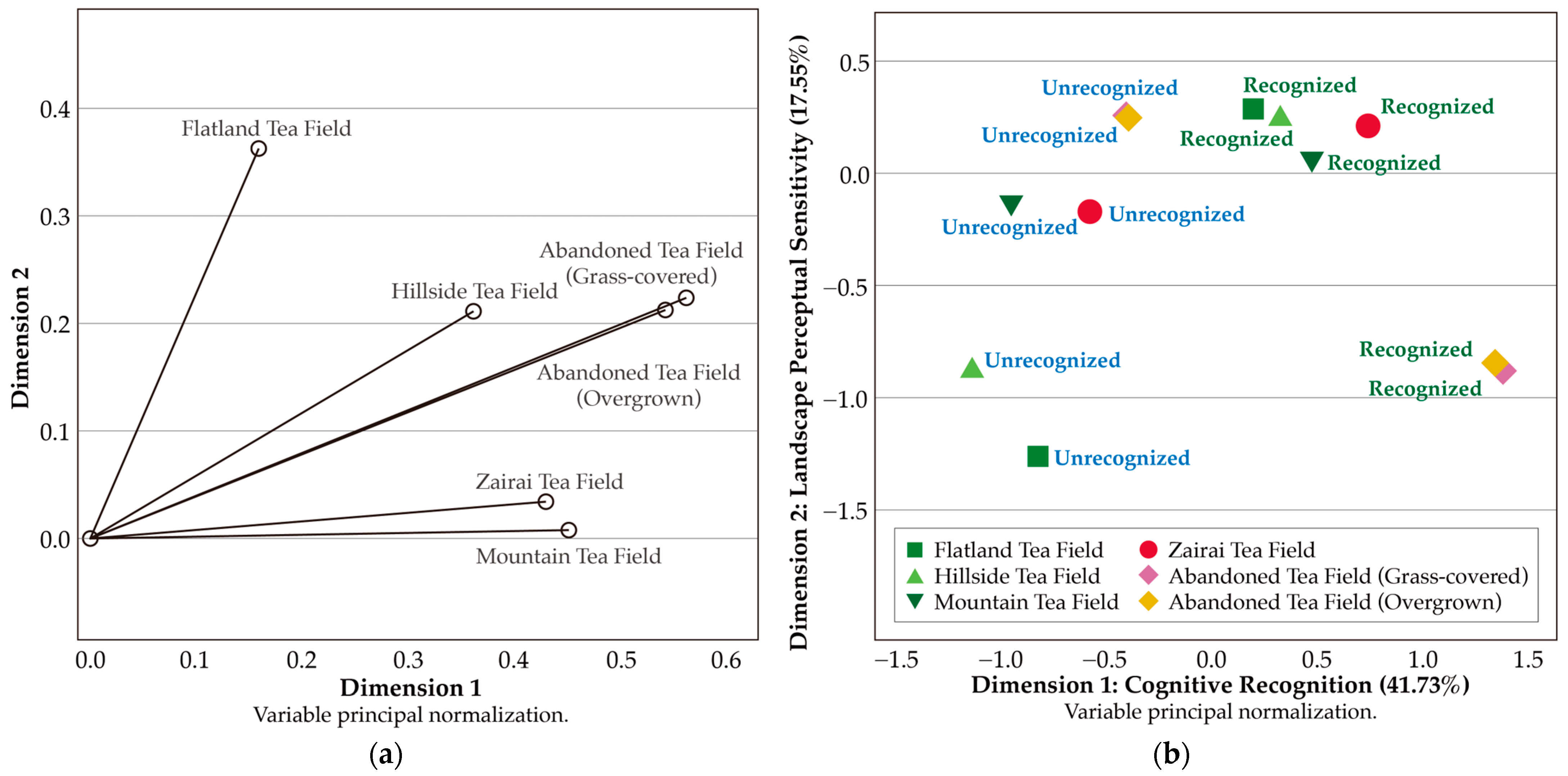
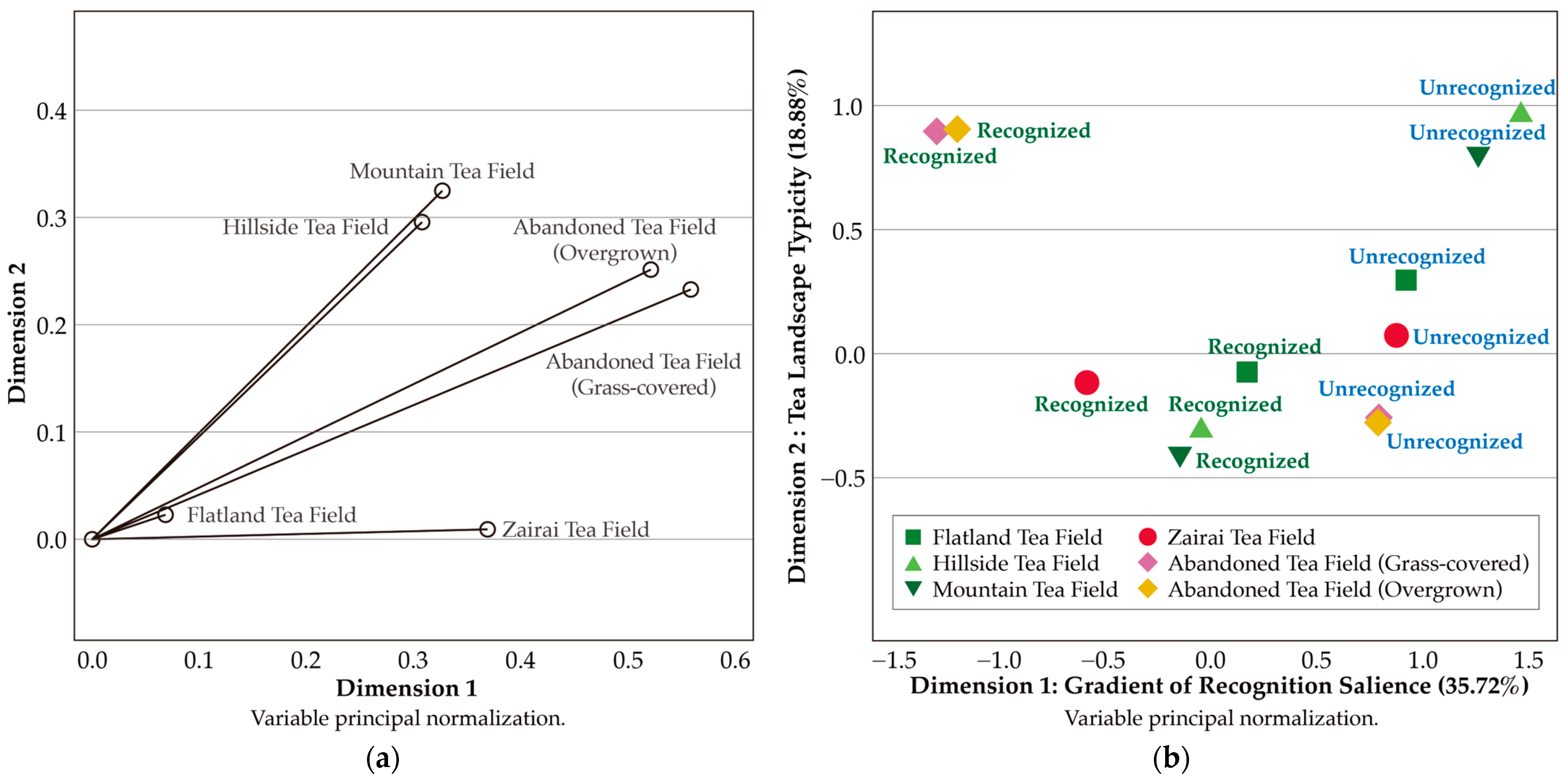
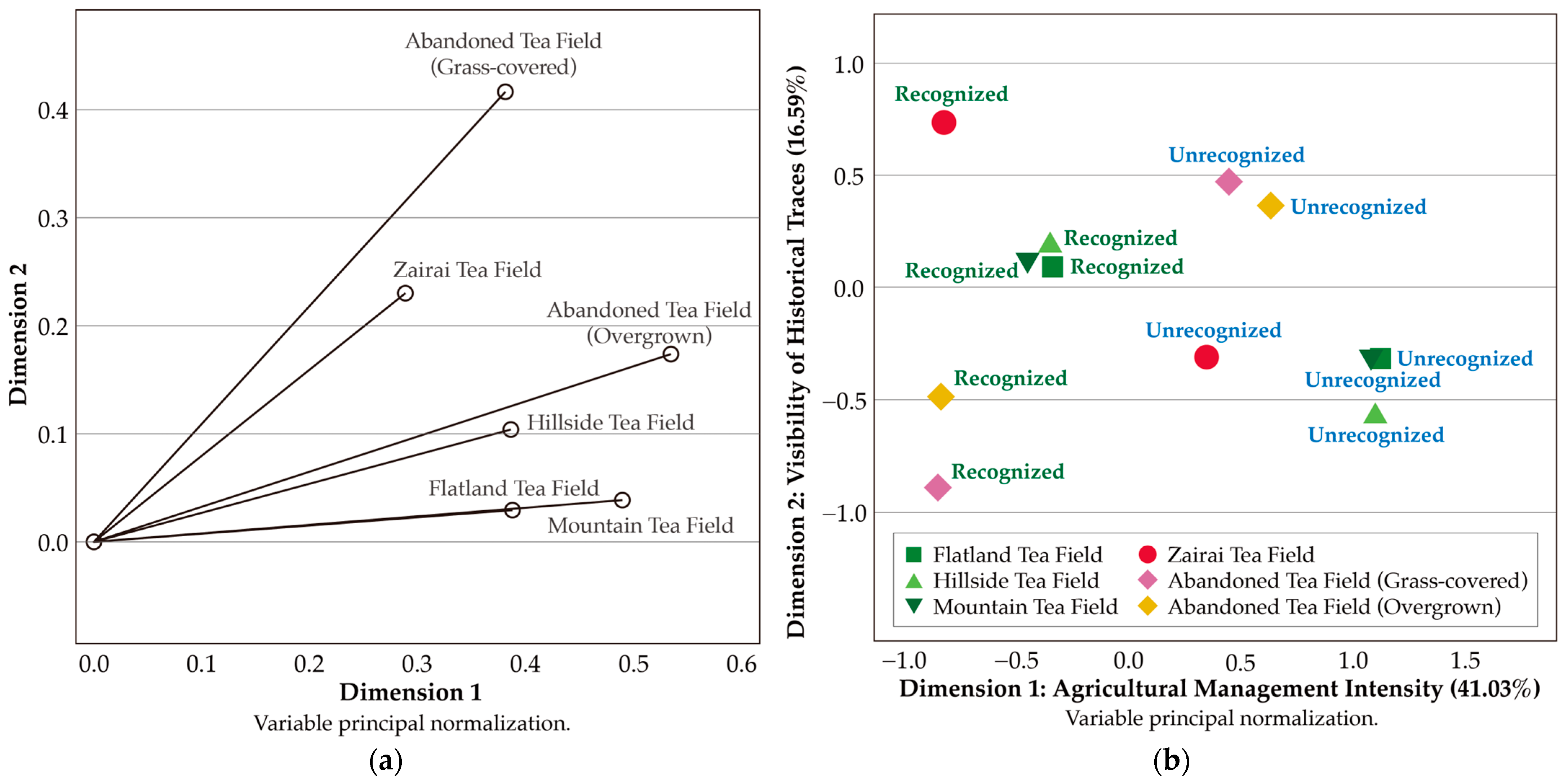
3.4. The Structure of Perception: Cognitive Recognition of Tea Landscapes
3.4.1. Urban Residents: Conceptual Cognition and Limited Practical Awareness
3.4.2. Suburban Residents: Visual Familiarity and Limited Understanding
3.4.3. The Rural Perceptual Map: A Functional and Differentiated View
4. Discussion
4.1. Shared Interest, Divergent Foundations: Cognitive Patterns Across Urban, Suburban, and Rural Residents
4.2. From Recognition to Participation: Potential Rural Revitalization
4.3. Differentiation as Strategy: Revitalizing Zairai Tea Amidst Landscape Homogenization
4.4. Limitations and Future Perspectives
5. Conclusions
Author Contributions
Funding
Institutional Review Board Statement
Informed Consent Statement
Data Availability Statement
Conflicts of Interest
Abbreviations
| TRLs | Traditional rural landscapes |
| UNESCO | The United Nations Educational, Scientific and Cultural Organization |
| GIAHS | Globally Important Agricultural Heritage Systems |
| FAO | The Food and Agriculture Organization of the United Nations |
| MANOVA | Multivariate Analysis of Variance |
| ANOVA | Analyses of Variance |
| MCA | Multiple Correspondence Analysis |
Appendix A

| Source | Sum of Squares | df | Mean Square | F | p | Partial η2 |
|---|---|---|---|---|---|---|
| Between Groups | 39.928 | 2 | 19.964 | 21.695 | <0.001 | 0.025 |
| Within Groups | 1565.254 | 1701 | 0.92 | |||
| Total | 1605.182 | 1703 |
| Residential Area | n | Mean (SD) | Comparison | Mean Difference (I–J) | Standard Error | p |
|---|---|---|---|---|---|---|
| Urban | 287 | −0.32 (0.91) | Suburban | −0.36 | 0.06 | <0.001 |
| Rural | −0.53 | 0.09 | <0.001 | |||
| Suburban | 1218 | 0.04 (0.96) | Urban | 0.36 | 0.06 | <0.001 |
| Rural | −0.17 | 0.08 | 0.077 | |||
| Rural | 199 | 0.21 (1.03) | Urban | 0.53 | 0.09 | <0.001 |
| Suburban | 0.17 | 0.08 | 0.077 |
| Number of the Cluster | Schwarz’s Bayesian Criterion (BIC) | BIC Change | Ratio of BIC Changes | Ratio of Distance Measures |
|---|---|---|---|---|
| 1 | 9013.046 | |||
| 2 | 7836.477 | −1176.57 | 1 | 1.843 |
| 3 | 7252.449 | −584.029 | 0.496 | 1.038 |
| 4 | 6694.487 | −557.962 | 0.474 | 1.005 |
| 5 | 6139.88 | −554.607 | 0.471 | 2.823 |
| 6 | 6020.351 | −119.529 | 0.102 | 1.106 |
| 7 | 5923.716 | −96.635 | 0.082 | 1.044 |
| 8 | 5836.082 | −87.634 | 0.074 | 1.238 |
| 9 | 5788.225 | −47.857 | 0.041 | 1.022 |
| 10 | 5743.99 | −44.235 | 0.038 | 1.046 |
| 11 | 5706.876 | −37.114 | 0.032 | 1.105 |
| 12 | 5684.675 | −22.201 | 0.019 | 1.015 |
| 13 | 5664.578 | −20.096 | 0.017 | 1.02 |
| 14 | 5647.195 | −17.383 | 0.015 | 1.275 |
| 15 | 5659.253 | 12.058 | −0.01 | 1.336 |
References
- Agnoletti, M.; Emanueli, F.; Corrieri, F.; Venturi, M.; Santoro, A. Monitoring Traditional Rural Landscapes. The Case of Italy. Sustainability 2019, 11, 6107. [Google Scholar] [CrossRef]
- Santoro, A. Why Traditional Rural Landscapes Are Still Important to Our Future. Landsc. Ecol. 2024, 39, 135. [Google Scholar] [CrossRef]
- Torreggiani, D.; Ludwiczak, Z.; Dall’Ara, E.; Benni, S.; Maino, E.; Tassinari, P. TRuLAn: A High-Resolution Method for Multi-Time Analysis of Traditional Rural Landscapes and Its Application in Emilia-Romagna, Italy. Landsc. Urban Plan. 2014, 124, 93–103. [Google Scholar] [CrossRef]
- Globally Important Agricultural Heritage Systems (GIAHS). Food and Agriculture Organization of the United Nations. Available online: https://www.fao.org/giahs/en (accessed on 15 April 2025).
- Cultural Landscapes, UNESCO World Heritage Centre. Available online: https://whc.unesco.org/en/culturallandscape/ (accessed on 22 April 2025).
- Qingwen, M. Agri-Cultural Heritage: An Interdisciplinary Field with Development Prospects. J. Resour. Ecol. 2021, 12, 437–443. [Google Scholar] [CrossRef]
- Skokanová, H.; Netopil, P.; Havlíček, M.; Šarapatka, B. The Role of Traditional Agricultural Landscape Structures in Changes to Green Infrastructure Connectivity. Agric. Ecosyst. Environ. 2020, 302, 107071. [Google Scholar] [CrossRef]
- Carneiro, M.J.; Lima, J.; Silva, A.L. Landscape and the Rural Tourism Experience: Identifying Key Elements, Addressing Potential, and Implications for the Future. J. Sustain. Tour. 2015, 23, 1217–1235. [Google Scholar] [CrossRef]
- Simoncini, R. Governance Objectives and Instruments, Ecosystem Management and Biodiversity Conservation: The Chianti Case Study. Reg. Environ. Change 2011, 11, 29–44. [Google Scholar] [CrossRef]
- Daugstad, K. Negotiating Landscape in Rural Tourism. Ann. Tour. Res. 2008, 35, 402–426. [Google Scholar] [CrossRef]
- Torquati, B.; Tempesta, T.; Vecchiato, D.; Venanzi, S.; Paffarini, C. The Value of Traditional Rural Landscape and Nature Protected Areas in Tourism Demand: A Study on Agritourists’ Preferences. Landsc. Online 2017, 53, 1–18. [Google Scholar] [CrossRef]
- Randelli, F.; Romei, P.; Tortora, M. An Evolutionary Approach to the Study of Rural Tourism: The Case of Tuscany. Land Use Policy 2014, 38, 276–281. [Google Scholar] [CrossRef]
- Jezierska-Thöle, A.; Gonia, A.; Podgórski, Z.; Gwiaździńska-Goraj, M. Wine Tourism as a Tool for Sustainable Development of the Cultural Landscape—A Case Study of Douro Wine Region in Portugal. Sustainability 2025, 17, 1494. [Google Scholar] [CrossRef]
- Nozawa, C.; Malingan, M.; Plantilla, A.; Ong, J. Evolving Culture, Evolving Landscapes: The Philippine Rice Terraces. In Protected Landscapes and Agrobiodiversity Values; Kasparek Verlag: Heidelberg, Germany, 2008; pp. 71–93. [Google Scholar]
- Jenkins, T.N. Putting Postmodernity into Practice: Endogenous Development and the Role of Traditional Cultures in the Rural Development of Marginal Regions. Ecol. Econ. 2000, 34, 301–313. [Google Scholar] [CrossRef]
- Sharpley, R. Rural Tourism and the Challenge of Tourism Diversification: The Case of Cyprus. Tour. Manag. 2002, 23, 233–244. [Google Scholar] [CrossRef]
- Brian, I.; Ian, B.; Gordon, C.; Alastair, C.; Alastair, S. Farm-Based Tourism as an Alternative Farm Enterprise: A Case Study from the Northern Pennines, England. Reg. Stud. 1998, 32, 355–364. [Google Scholar]
- Kneafsey, M. Tourism, Place Identities and Social Relations in the European Rural Periphery. Eur. Urban Reg. Stud. 2000, 7, 35–50. [Google Scholar] [CrossRef]
- Golobič, M. Transformation Processes of Alpine Landscapes and Policy Responses: Top-Down and Bottom-Up Views. Soc. Nat. Resour. 2010, 23, 269–280. [Google Scholar] [CrossRef]
- Shone, M.C.; Simmons, D.G.; Dalziel, P. Evolving Roles for Local Government in Tourism Development: A Political Economy Perspective. J. Sustain. Tour. 2016, 24, 1674–1690. [Google Scholar] [CrossRef]
- Tödtling, F. Regional Development, Endogenous. In International Encyclopedia of Human Geography (Second Edition); Kobayashi, A., Ed.; Elsevier: Oxford, UK, 2020; pp. 303–308. [Google Scholar]
- Bosworth, G.; Annibal, I.; Carroll, T.; Price, L.; Sellick, J.; Shepherd, J. Empowering Local Action through Neo-Endogenous Development; The Case of LEADER in England. Sociol. Rural. 2016, 56, 427–449. [Google Scholar] [CrossRef]
- Vazquez-Barquero, A. Endogenous Development: Networking, Innovation, Institutions and Cities; Routledge: London, UK, 2002. [Google Scholar]
- Korcelli-Olejniczak, E.; Witeska-Chmielewska, K. On Inducing Innovation in Endogenous Rural Development. A Living Lab Experiment. Eur. Plan. Stud. 2025, 33, 1936–1955. [Google Scholar] [CrossRef]
- Ettlinger, N. Local Economic Development. In International Encyclopedia of the Social & Behavioral Sciences; Smelser, N.J., Baltes, P.B., Eds.; Pergamon: Oxford, UK, 2001; pp. 9004–9008. [Google Scholar]
- Odakiri, T.; Hashiguchi, T. Neo-Endogenous Rural Development: Theory and Practice; Norin Tokei Publishing: Tokyo, Japan, 2018. [Google Scholar]
- Bramson, A.; Hori, M.; Zha, B.; Inamoto, H. Social and Economic Flows across Multimodal Transportation Networks in the Greater Tokyo Area. Appl. Netw. Sci. 2020, 5, 7. [Google Scholar] [CrossRef]
- Buhnik, S. The Dynamics of Urban Degrowth in Japanese Metropolitan Areas: What Are the Outcomes of Urban Recentralisation Strategies? Town Plan. Rev. 2017, 88, 79–92. [Google Scholar] [CrossRef]
- Tani, Y.; Hashimoto, S.; Ochiai, M. What Makes Rural, Traditional, Cultures More Sustainable? Implications from Conservation Efforts in Mountainous Rural Communities of Japan. Landsc. Res. 2016, 41, 892–905. [Google Scholar] [CrossRef]
- Wirth, P.; Elis, V.; Müller, B.; Yamamoto, K. Peripheralisation of Small Towns in Germany and Japan—Dealing with Economic Decline and Population Loss. J. Rural Stud. 2016, 47, 62–75. [Google Scholar] [CrossRef]
- Goodwin-Hawkins, B.; Oedl-Wieser, T.; Ovaska, U.; Morse, A. Rural Service Hubs and Socially Innovative Rural-Urban Linkages: A Conceptual Framework for Nexogenous Development. Local Econ. 2021, 36, 551–568. [Google Scholar] [CrossRef]
- Halfacree, K. Sedentary No Longer Seems Apposite: Internal Migration in an Era of Mobilities. In Internal Migration in the Developed World; Routledge: London, UK, 2017; pp. 272–284. [Google Scholar]
- Calabrò, F.; Cassalia, G. Territorial Cohesion: Evaluating the Urban-Rural Linkage Through the Lens of Public Investments. In Proceedings of the Smart and Sustainable Planning for Cities and Regions, Bolzano, Italy, 22–24 March 2017; Bisello, A., Vettorato, D., Laconte, P., Costa, S., Eds.; Springer International Publishing: Cham, Switzerland, 2018; pp. 573–587. [Google Scholar]
- Tacoli, C. Rural-Urban Interactions: A Guide to the Literature. Environ. Urban. 1998, 10, 147–166. [Google Scholar] [CrossRef]
- Streifeneder, T.P.; Gramm, V.; Dellantonio, S.; Omizzolo, A.; Cattivelli, V. The Diversity of Urban-Rural Exchange: Is There Still Space for Further Developments? In The Regions of Europe Among Local Identities, New Communities and Territorial Disparities; FrancoAngeli: Milano, Italy, 2019. [Google Scholar]
- Gebre, T.; Gebremedhin, B. The Mutual Benefits of Promoting Rural-Urban Interdependence through Linked Ecosystem Services. Glob. Ecol. Conserv. 2019, 20, e00707. [Google Scholar] [CrossRef]
- Zhou, Z.; Zheng, X. A Cultural Route Perspective on Rural Revitalization of Traditional Villages: A Case Study from Chishui, China. Sustainability 2022, 14, 2468. [Google Scholar] [CrossRef]
- Liu, M. An Analysis of the Inheritance and Development Path of Rural Culture in Rural Revitalization. J. Humanit. Arts Soc. Sci. 2024, 8, 1684–1688. [Google Scholar] [CrossRef]
- Kollmuss, A.; Agyeman, J. Mind the Gap: Why Do People Act Environmentally and What Are the Barriers to pro-Environmental Behavior? Environ. Educ. Res. 2002, 8, 239–260. [Google Scholar] [CrossRef]
- Ajzen, I. The Theory of Planned Behavior. Organ. Behav. Hum. Decis. Process. 1991, 50, 179–211. [Google Scholar] [CrossRef]
- Ingold, T. The Perception of the Environment: Essays on Livelihood, Dwelling and Skill; Psychology Press: London, UK, 2000; ISBN 978-0-415-22831-2. [Google Scholar]
- Bourdieu, P. Outline of a Theory of Practice; Cambridge Studies in Social and Cultural Anthropology; Cambridge University Press: Cambridge, UK, 1977; ISBN 978-0-521-29164-4. [Google Scholar]
- Schatzki, T.R. Social Practices: A Wittgensteinian Approach to Human Activity and the Social; Cambridge University Press: Cambridge, UK, 1996; ISBN 978-0-521-56022-1. [Google Scholar]
- Sugiyama, K. Youthful Senses of Place in Suburban Rural Area: An Analysis of the Narratives of High School Students Living in the East Part of Hamamatsu Metropolitan Area. Geogr. Sci. 2008, 63, 239–259. [Google Scholar] [CrossRef]
- Murota, A. Research on the Declining and the Characteristic of Local Cities. Transp. Policy Stud. Rev. 2003, 6, 4–14. [Google Scholar] [CrossRef]
- Shizuoka Prefecture, Digital Strategy Bureau, Statistics Division. Overview of Industry in Shizuoka Prefecture, 2020—Manufacturing Sector; Shizuoka Prefecture: Shizuoka, Japan, 2022. [Google Scholar]
- Shizuoka Prefecture Agricultural Data, Kanto Regional Agricultural Administration Office, Shizuoka Prefecture, Japan. Available online: https://www.maff.go.jp/kanto/chiikinet/shizuoka/tiiki/shizuoka.html (accessed on 22 August 2025).
- Tea—Fujinokuni Agricultural Products, Shizuoka Prefecture, Japan. Available online: https://www.pref.shizuoka.jp/sangyoshigoto/norinjimusho/shidahaibaranorin/1004202/1034171.html (accessed on 21 August 2025).
- Shizuoka Tea Capital Map and Related Materials on Tea Industry in Shizuoka, Shizuoka Prefecture, Japan. Available online: https://www.pref.shizuoka.jp/_res/projects/default_project/_page_/001/027/288/chanomiako_map1.pdf (accessed on 16 August 2025).
- History of Shizuoka Tea and Yabukita Tea, Japan Agricultural Cooperative Shizuoka City, Japan. Available online: https://ja-shizuokashi.or.jp/speciality/green-tea/rekishi_yabukita (accessed on 21 August 2025).
- Globally Important Agricultural Heritage Systems Chagusaba in Shizuoka, Council for the Promotion of “Chagusaba in Shizuoka” as a GIAHS Site, Japan. Available online: https://www.chagusaba.jp/english/ (accessed on 14 August 2025).
- Shizuoka Prefecture. Comprehensive Survey Report on Cultural Landscapes in Shizuoka Prefecture; Shizuoka Prefecture Cultural Property Survey Report; Shizuoka Prefecture: Shizuoka, Japan, 2022. [Google Scholar]
- Cheng, Y.; Wang, W.; Kinoshita, T.; Ikebe, K. Fostering Sustainable Livelihoods and Community Resilience in a Depopulated Japanese Mountainous Settlement: Connecting Local Culture and Ikigai-Zukuri Through the Ōsawa Engawa Café. Sustainability 2025, 17, 5174. [Google Scholar] [CrossRef]
- Abe, T.; Ochiai, K.; Tanimoto, M.; Asai, Y. Production and Distribution; Asahi Shoten: Tokyo, Japan, 2020. [Google Scholar]
- Current Situation of the Tea Industry in Shizuoka Prefecture, Shizuoka Prefecture Department of Agriculture, Japan. Available online: https://www.pref.shizuoka.jp/_res/projects/default_project/_page_/001/027/288/chagyounogenjou_page_kai.pdf (accessed on 12 August 2025).
- Shizuoka Prefecture, Digital Strategy Bureau, Statistics Division. Population of Shizuoka Prefecture (Preliminary Report), 2020 National Census; Shizuoka Prefecture: Shizuoka, Japan, 2021. [Google Scholar]
- A Signs of Revival for Rare Indigenous Tea Varieties, Asahi News, Japan. Available online: http://www.asahi.com/area/shizuoka/articles/MTW20160127230250001.html (accessed on 11 August 2025).
- Shizuoka Prefecture Tea Industry Promotion Plan, Shizuoka Prefecture Department of Agriculture, Japan. Available online: https://www.pref.shizuoka.jp/sangyoshigoto/nogyo/1040633/1027277.html (accessed on 20 November 2025).
- Weaver, D.B.; Lawton, L.J. Resident Perceptions in the Urban–Rural Fringe. Ann. Tour. Res. 2001, 28, 439–458. [Google Scholar] [CrossRef]
- Swanwick, C. Society’s Attitudes to and Preferences for Land and Landscape. Land Use Policy 2009, 26, S62–S75. [Google Scholar] [CrossRef]
- Berenguer, J.; Corraliza, J.A.; Martín, R. Rural-Urban Differences in Environmental Concern, Attitudes, and Actions. Eur. J. Psychol. Assess. 2005, 21, 128–138. [Google Scholar] [CrossRef]
- Huddart-Kennedy, E.; Beckley, T.M.; McFarlane, B.L.; Nadeau, S. Rural-Urban Differences in Environmental Concern in Canada. Rural Sociol. 2009, 74, 309–329. [Google Scholar] [CrossRef]
- Tilt, J.H.; Kearney, A.R.; Bradley, G. Understanding Rural Character: Cognitive and Visual Perceptions. Landsc. Urban Plan. 2007, 81, 14–26. [Google Scholar] [CrossRef]
- Sewell, W.H. The Concept(s) of Culture. In Practicing History; Routledge: London, UK, 2004. [Google Scholar]
- DeNora, T. Making Sense of Reality: Culture and Perception in Everyday Life; SAGE Publications: Thousand Oaks, CA, USA, 2014. [Google Scholar]
- Ministry of Agriculture, Forestry and Fisheries, Statistics Department. Survey on Awareness and Attitudes Toward Food, Agriculture, Forestry, and Fisheries in 2020: Results of Awareness and Attitudes Toward Green Tea Consumption; Ministry of Agriculture, Forestry and Fisheries (MAFF): Tokyo, Japan, 2021. [Google Scholar]
- Highlights of the 2021 White Paper on Information and Communications, Ministry of Internal Affairs and Communications (MIC), Japan. Available online: https://www.soumu.go.jp/johotsusintokei/whitepaper/ja/r03/html/nb000000.html (accessed on 26 August 2025).
- Hayashi, K.; Aikoh, T. Influence of Agricultural Experiences on Attachment and Conservational Attitude toward Agricultural Landscape and Understanding Farmland Amenity. J. Jpn. Inst. Landsc. Archit. 2021, 84, 571–574. [Google Scholar] [CrossRef]
- Qi, J.; Zhou, Y.; Zeng, L.; Tang, X. Aesthetic Heterogeneity on Rural Landscape: Pathway Discrepancy between Perception and Cognition. J. Rural Stud. 2022, 92, 383–394. [Google Scholar] [CrossRef]
- Huang, J.L.; Curran, P.G.; Keeney, J.; Poposki, E.M.; DeShon, R.P. Detecting and Deterring Insufficient Effort Responding to Surveys. J. Bus. Psychol. 2012, 27, 99–114. [Google Scholar] [CrossRef]
- Warne, R. A Primer on Multivariate Analysis of Variance (MANOVA) for Behavioral Scientists. Pract. Assess. Res. Eval. 2014, 19, 17. [Google Scholar] [CrossRef]
- Overview (MANOVA: Univariate Command), IBM Corporation. Available online: https://www.ibm.com/docs/en/spss-statistics/31.0.0?topic=manova-overview-command (accessed on 26 August 2025).
- Nurjannah; Darmanto; Solimun; Astuti, A.B.; Rinaldo Fernandes, A.A.; Amaliana, L.; Yanti, I.; Isaskar, R. Two Step Cluster Analysis for Tourist Segmentation Coastal Object for Green Marketing Strategy. IOP Conf. Ser. Earth Environ. Sci. 2019, 239, 012019. [Google Scholar] [CrossRef]
- TwoStep Cluster Analysis, IBM Corporation. Available online: https://www.ibm.com/docs/en/spss-statistics/cd?topic=features-twostep-cluster-analysis (accessed on 19 August 2025).
- Khangar, N.V.; Kamalja, K.K. Multiple Correspondence Analysis and Its Applications. Electron. J. Appl. Stat. Anal. 2017, 10, 432–462. [Google Scholar] [CrossRef]
- Multiple Correspondence Analysis, IBM Corporation. Available online: https://www.ibm.com/docs/en/spss-statistics/30.0.0?topic=edition-multiple-correspondence-analysis (accessed on 20 August 2025).
- Greenacre, M.J. Correspondence Analysis. In The Oxford Handbook of Quantitative Methods in Psychology: Vol. 2: Statistical Analysis; Little, T.D., Ed.; Oxford University Press: Oxford, UK, 2013; pp. 142–153. [Google Scholar]
- Norušis, M.J. IBM SPSS Statistics 19 Advanced Statistical Procedures Companion; Prentice Hall: Hoboken, NJ, USA, 2012. [Google Scholar]
- Hair, J.F.; Gabriel, M.; Patel, V. AMOS Covariance-Based Structural Equation Modeling (CB-SEM): Guidelines on Its Application as a Marketing Research Tool. Braz. J. Mark. 2014, 13, 44–55. [Google Scholar]
- Holt, D.B. How Brands Become Icons: The Principles of Cultural Branding; Harvard Business Press: Brighton, MA, USA, 2004. [Google Scholar]
- Erwen, I.V.; Shielline, P.; Poluan, R.C.; Wangsa, V.; Pratama, W.; Widyawan, I. Cultural Commodification and Its Implication in Tourism: Systematic Literature Review. Kepariwisataan J. Ilm. 2025, 19, 188–199. [Google Scholar] [CrossRef]
- Hasumi, O.; Okuda, M. Theory of Regional Communities: Residents’ Lives and Local Organizations; Yuhikaku Publishing: Tokyo, Japan, 1980. [Google Scholar]
- Littek, W. Labor, Division Of. In International Encyclopedia of the Social & Behavioral Sciences; Smelser, N.J., Baltes, P.B., Eds.; Pergamon: Oxford, UK, 2001; pp. 8220–8226. [Google Scholar]
- Kruger, J.; Dunning, D. Unskilled and Unaware of It: How Difficulties in Recognizing One’s Own Incompetence Lead to Inflated Self-Assessments. J. Personal. Soc. Psychol. 1999, 77, 1121–1134. [Google Scholar] [CrossRef]
- Applbaum, K. The Endurance of Neighborhood Associations in a Japanese Commuter City. Urban Anthropol. Stud. Cult. Syst. World Econ. Dev. 1996, 25, 1–39. [Google Scholar]
- Neitzel, L.L. Living Modern: Danchi Housing and Postwar Japan; Columbia University: New York, NY, USA, 2003. [Google Scholar]
- Bernard, J.; Steinführer, A.; Klärner, A.; Keim-Klärner, S. Regional Opportunity Structures: A Research Agenda to Link Spatial and Social Inequalities in Rural Areas. Prog. Hum. Geogr. 2023, 47, 103–123. [Google Scholar] [CrossRef]
- Ramkissoon, H.; Uysal, M.S. Authenticity as a Value Co-Creator of Tourism Experiences. In Creating Experience Value in Tourism; CAB International: Wallingford, UK, 2018; pp. 98–109. [Google Scholar] [CrossRef]
- Jelinčić, D.A.; Senkić, M. Chapter 4: The Value of Experience in Culture and Tourism: The Power of Emotions. In A Research Agenda for Creative Tourism; Edward Elgar Publishing: Cheltenham, UK, 2019. [Google Scholar]
- Klien, S. Post-Pandemic Developments in Lifestyle Migration in Japan: From Back-to-the-Land to Urbanrural? J. Rural Stud. 2025, 114, 103505. [Google Scholar] [CrossRef]
- Wang, J.F.; Xia, L. Revenge Travel: Nostalgia and Desire for Leisure Travel Post COVID-19. J. Travel Tour. Mark. 2021, 38, 935–955. [Google Scholar] [CrossRef]
- Åberg, H.E.; Tondelli, S. Escape to the Country: A Reaction-Driven Rural Renaissance on a Swedish Island Post COVID-19. Sustainability 2021, 13, 12895. [Google Scholar] [CrossRef]
- Aoki, T.; Kojima, M.; Hayashi, K.; Yamamoto, S. What Is the New Neighbor Connectivity of Suburbanites with Villages Around? Urban Reg. Plan. Rev. 2025, 12, 44–65. [Google Scholar] [CrossRef]
- Barata, F.T.; de Mascarenhas, J.M.; Capelo, S. How Important Is Social Cohesion to Heritage Landscape Preservation and Interpretation? In ECLAS 2014, Landscape: A Place of Cultivation; University of Porto: Porto, Portugal, 2014; pp. 381–385. [Google Scholar]
- Fazey, I.; Fazey, J.A.; Salisbury, J.G.; Lindenmayer, D.B.; Dovers, S. The Nature and Role of Experiential Knowledge for Environmental Conservation. Environ. Conserv. 2006, 33, 1–10. [Google Scholar] [CrossRef]
- Šūmane, S.; Kunda, I.; Knickel, K.; Strauss, A.; Tisenkopfs, T.; des Ios Rios, I.; Rivera, M.; Chebach, T.; Ashkenazy, A. Local and Farmers’ Knowledge Matters! How Integrating Informal and Formal Knowledge Enhances Sustainable and Resilient Agriculture. J. Rural Stud. 2018, 59, 232–241. [Google Scholar] [CrossRef]
- Hart, A.K.; McMichael, P.; Milder, J.C.; Scherr, S.J. Multi-Functional Landscapes from the Grassroots? The Role of Rural Producer Movements. Agric. Hum. Values 2016, 33, 305–322. [Google Scholar] [CrossRef]
- Monova-Zheleva, M.; Zhelev, Y.; Stewart, R. An Approach for Valorisation of the Emerging Tacit Knowledge and Cultural Heritage in Rural and Peripheral Communities. Digit. Present. Preserv. Cult. Sci. Herit. 2019, 9, 367–374. [Google Scholar] [CrossRef]
- Bruckmeier, K.; Hilary, T. Knowledge in Sustainable Rural Development: From Forms of Knowledge to Knowledge Processes. Sociol. Rural. 2008, 48, 313–329. [Google Scholar] [CrossRef]
- Kawakami, K. Postwar Changes in Cultivated Land and Crop Cultivation in Mountain Villages in the Ikawa Area of Shizuoka City. SOKENDAI Rev. Cult. Soc. Stud. 2023, 19, 165–198. [Google Scholar]
- Toraya, T.; Takeda, Y.; Matsushita, S.; Ieyasu, J.; Kondo, N. Geographic Variation and Adaptability of Native Tea Varieties in Japan. In Bulletin of the National Research Institute of Vegetables, Ornamental Plants and Tea, Series B; Rural Culture Association Japan: Tokyo, Japan, 1996; pp. 1–29. [Google Scholar]
- Qu, H.; Kim, L.H.; Im, H.H. A Model of Destination Branding: Integrating the Concepts of the Branding and Destination Image. Tour. Manag. 2011, 32, 465–476. [Google Scholar] [CrossRef]
- Benhaida, S.; Safaa, L.; Perkumienė, D.; Labanauskas, G. Creative Tourism: Two Decades of Conceptual Evolution and Characterization. Adm. Sci. 2024, 14, 172. [Google Scholar] [CrossRef]
- de Aranzabal, I.; Schmitz, M.F.; Pineda, F.D. Integrating Landscape Analysis and Planning: A Multi-Scale Approach for Oriented Management of Tourist Recreation. Environ. Manag. 2009, 44, 938–951. [Google Scholar] [CrossRef]
- Su, Y.; Li, R.; Ma, H.; Huang, L. Adaptive Change of Institutions and Dynamic Governance of the Tragedy of the Tourism Commons: Evidence from Rural China. J. Hosp. Tour. Manag. 2022, 53, 32–49. [Google Scholar] [CrossRef]


| Questions | Description and Scale Type | Analytical Purpose |
|---|---|---|
| Section 1: Context | ||
| Q1. Residential area | Identification as urban, suburban, or rural resident. | Categorize respondents into urban, suburban, and rural groups, forming the basis for comparative analysis [59,60,61,62]. |
| Section 2: Tea-related recognition | ||
| Q2. Interest in tea culture | General interest level. (5-point Likert scale: 1 = Not at all to 5 = Very high) | Capture respondents’ self-assessed cultural knowledge and recognition of traditional tea, reflecting levels of cultural awareness [63]. |
| Q3. Awareness of Zairai tea | Conceptual knowledge of traditional varieties. (5-point Likert scale: 1 = Not aware to 5 = Know very well) | |
| Q4. Tea-drinking frequency | Frequency of brewing and drinking tea. (5-point ordinal: 1 = Not at all to 5 = Almost every day) | Record respondents’ daily practice of drinking brewed tea and encountering tea fields, indicating behavioral engagement [64,65]. |
| Q5. Tea field encountering frequency | Frequency of encountering tea fields. (5-point ordinal: 1 = Not at all to 5 = Almost every day) | |
| Section 3: Consumption behavior and resource | ||
| Q6. Information sources | Use of 9 sources (Television, internet, word-of-mouth, etc.); multiple-response available | Understand respondents’ tea consumption behaviors, including sources of information and decision-making factors when purchasing tea [66,67]. |
| Q7. Tea selection preferences | Importance of 8 criteria (Origin, Variety, Price, etc.). (5-point Likert: 1 = Not important to 5 = Very important) | |
| Section 4: Perceptions of tea fields | ||
| Q8. Importance of agroecosystem functions | Perceived importance of 8 public good functions. (5-point Likert scale: 1 = Not important to 5 = Very important) | Assess respondents’ perception levels of tea fields as multifunctional landscapes, covering agricultural, ecological, and cultural values [68]. |
| Q9. Recognition of tea field types | Recognition of 6 tea field landscape typologies. (Multiple-response available) | Assess respondents’ abilities to distinguish tea field typologies, including mechanized, traditional and abandoned tea fields, from their on-site experiences, thereby revealing their cognitive perceptions of tea field landscapes [69]. |
| Demographic Characteristics | Frequency (n) | Percentage (%) | |
|---|---|---|---|
| Q1. Residential Area | Urban | 287 | 16.8% |
| Suburban | 1218 | 71.5% | |
| Rural | 199 | 11.7% | |
| Variable | Residential Area | Category 5 n (%) | Category 4 n (%) | Category 3 n (%) | Category 2 n (%) | Category 1 n (%) |
|---|---|---|---|---|---|---|
| Q2. Interest in tea culture | Very high interest | Somewhat interested | Neither | Not very interested | Not interested at all | |
| Urban (n = 287) | 67 (23.3%) | 136 (47.4%) | 53 (18.5%) | 21 (7.3%) | 10 (3.5%) | |
| Suburban (n = 1218) | 190 (15.6%) | 610 (50.1%) | 246 (20.2%) | 137 (11.2%) | 35 (2.9%) | |
| Rural (n = 199) | 30 (15.1%) | 102 (51.3%) | 44 (22.1%) | 16 (8.0%) | 7 (3.5%) | |
| Total (n = 1704) | 287 (16.8%) | 848 (49.8%) | 343 (20.1%) | 174 (10.2%) | 52 (3.1%) | |
| Q3. Awareness of Zairai Tea | Know very well | Know to some extent | Know a little | Heard the name only | Not aware at all | |
| Urban (n = 287) | 18 (6.3%) | 67 (23.3%) | 60 (20.9%) | 62 (21.6%) | 80 (27.9%) | |
| Suburban (n = 1218) | 40 (3.3%) | 204 (16.7%) | 274 (22.5%) | 262 (21.5%) | 438 (36.0%) | |
| Rural (n = 199) | 10 (5.0%) | 39 (19.6%) | 49 (24.6%) | 41 (20.6%) | 60 (30.2%) | |
| Total (n = 1704) | 68 (4.0%) | 310 (18.2%) | 383 (22.5%) | 365 (21.4%) | 578 (33.9%) | |
| Q4. Tea drinking frequency | Almost every day | A few times a week | A few times a month | A few times a year | Not at all | |
| Urban (n = 287) | 115 (40.1%) | 48 (16.7%) | 40 (13.9%) | 45 (15.7%) | 39 (13.6%) | |
| Suburban (n = 1218) | 502 (41.2%) | 197 (16.2%) | 178 (14.6%) | 192 (15.8%) | 149 (12.2%) | |
| Rural (n = 199) | 98 (49.2%) | 31 (15.6%) | 29 (14.6%) | 26 (13.1%) | 15 (7.5%) | |
| Total (n = 1704) | 715 (42.0%) | 276 (16.2%) | 247 (14.5%) | 263 (15.4%) | 203 (11.9%) | |
| Q5. Tea field encountering frequency | Almost every day | A few times a week | A few times a month | A few times a year | Not at all | |
| Urban (n = 287) | 38 (13.2%) | 46 (16.0%) | 25 (8.7%) | 66 (23.0%) | 112 (39.0%) | |
| Suburban (n = 1218) | 220 (18.1%) | 188 (15.4%) | 190 (15.6%) | 262 (21.5%) | 358 (29.4%) | |
| Rural (n = 199) | 37 (18.6%) | 25 (12.6%) | 73 (36.7%) | 29 (14.6%) | 35 (17.6%) | |
| Total (n = 1704) | 295 (17.3%) | 259 (15.2%) | 288 (16.9%) | 357 (21.0%) | 505 (29.6%) |
| Thematic Category | Tea Field Type/Source of Information |
Urban n (%) |
Suburban n (%) |
Rural n (%) |
Total n (%) |
|---|---|---|---|---|---|
| Q9: Recognition of Tea Field Types | n = 241 | n = 1030 | n = 174 | n = 1445 | |
| Modern mechanized tea fields | Flatland Tea Field | 196 (81.3%) | 822 (79.8%) | 133 (76.4%) | 1151 (79.7%) |
| Hillside Tea Field | 189 (78.4%) | 780 (75.7%) | 132 (75.9%) | 1101 (76.2%) | |
| Mountain Slope Tea Field | 162 (67.2%) | 685 (66.5%) | 123 (70.7%) | 970 (67.1%) | |
| Traditional tea fields | Zairai Tea Field | 106 (44.0%) | 391 (38.0%) | 52 (29.9%) | 549 (38.0%) |
| Abandoned Tea Fields | Abandoned (Overgrown) | 56 (23.2%) | 243 (23.6%) | 75 (43.1%) | 374 (25.9%) |
| Abandoned (Grass-covered) | 55 (22.8%) | 233 (22.6%) | 60 (34.5%) | 348 (24.1%) | |
| Q6: Sources of Tea-Related Information | n = 208 | n = 830 | n = 144 | n = 1182 | |
| Mass media | Television and Commercials | 150 (72.1%) | 616 (74.2%) | 84 (58.3%) | 850 (71.9%) |
| Newspaper/Magazine | 64 (30.8%) | 217 (26.1%) | 31 (21.5%) | 312 (26.4%) | |
| Pamphlets | 42 (20.2%) | 174 (21.0%) | 34 (23.6%) | 250 (21.2%) | |
| Digital media | Internet News/Website | 57 (27.4%) | 233 (28.1%) | 34 (23.6%) | 324 (27.4%) |
| Social Networking Services (SNS) | 26 (12.5%) | 81 (9.8%) | 22 (15.3%) | 129 (10.9%) | |
| Interpersonal-based media | Word-of-Mouth | 49 (23.6%) | 157 (18.9%) | 47 (32.6%) | 253 (21.4%) |
| Place-based media | In-store Information/Staff | 50 (24.0%) | 144 (17.3%) | 17 (11.8%) | 211 (17.9%) |
| Other | Other | 4 (1.9%) | 11 (1.3%) | 9 (6.3%) | 24 (2.0%) |
| Thematic Category | Item | Urban | Suburban | Rural | Total |
|---|---|---|---|---|---|
| Q7: Tea selection preferences | n = 248 | n = 1069 | n = 184 | n = 1501 | |
| Intrinsic quality attributes | Origin | 3.29 (1.18) | 3.15 (1.04) | 2.99 (1.12) | 3.16 (1.07) |
| Variety | 3.12 (1.06) | 3.03 (1.01) | 2.96 (1.16) | 3.04 (1.04) | |
| Processing | 3.11 (1.10) | 3.03 (1.02) | 3.02 (1.15) | 3.04 (1.05) | |
| Extrinsic quality | Brand | 2.97 (0.98) | 2.96 (0.94) | 2.87 (0.99) | 2.95 (0.95) |
| Organic | 2.86 (1.01) | 2.75 (0.97) | 2.77 (0.99) | 2.77 (0.98) | |
| Review | 2.81 (1.00) | 2.72 (1.00) | 2.73 (0.98) | 2.74 (1.00) | |
| Aesthetic and convenience | Packaging | 2.71 (0.92) | 2.65 (0.88) | 2.68 (0.91) | 2.66 (0.89) |
| Economic constraint | Price | 3.79 (0.91) | 3.85 (0.82) | 3.80 (0.88) | 3.84 (0.84) |
| Q8: Importance of agroecosystem functions | n = 287 | n = 1218 | n = 199 | n = 1704 | |
| Agricultural function | Production | 3.69 (1.01) | 3.69 (0.93) | 3.63 (0.93) | 3.68 (0.94) |
| Ecological functions | Climate and air regulation | 3.68 (0.93) | 3.65 (0.91) | 3.66 (0.91) | 3.66 (0.91) |
| Biodiversity | 3.48 (0.92) | 3.45 (0.91) | 3.50 (0.92) | 3.46 (0.91) | |
| Disaster prevention | 3.64 (1.01) | 3.69 (0.93) | 3.74 (0.89) | 3.69 (0.94) | |
| Socio-cultural functions | culture | 3.78 (1.01) | 3.83 (0.93) | 3.83 (0.91) | 3.82 (0.94) |
| Scenic beauty | 3.65 (1.00) | 3.69 (0.93) | 3.66 (0.93) | 3.68 (0.94) | |
| Healing | 3.64 (0.96) | 3.66 (0.92) | 3.65 (0.96) | 3.66 (0.93) | |
| Education | 3.60 (0.95) | 3.60 (0.92) | 3.59 (0.91) | 3.60 (0.92) | |
| Source | Dependent Variable | Urban (n = 287) | Suburban (n = 1218) | Rural (n = 199) | F | p | Partial η2 | Post-Hoc (Games–Howell) | |
|---|---|---|---|---|---|---|---|---|---|
| M (SD) | M (SD) | M (SD) | Significant Pairwise Comparisons | p | |||||
| Knowledge dimension | |||||||||
| Multivariate | (Wilks’ Λ = 0.990) | 4.07 | 0.003 | 0.005 | |||||
| Univariate | Q2. Interest in tea culture | 3.80 (0.99) | 3.64 (0.97) | 3.66 (0.95) | 2.97 | 0.052 | 0.003 | Not Significant | – |
| Q3. Awareness of Zairai tea | 2.59 (1.28) | 2.30 (1.21) | 2.49 (1.25) | 7.39 | 0.001 | 0.009 | Urban > Suburban | 0.002 | |
| Practice dimension | |||||||||
| Multivariate | (Wilks’ Λ =0 0.967) | 14.34 | <0.001 | 0.017 | |||||
| Univariate | Q4. Frequency of drinking tea | 3.54 (1.48) | 3.58 (1.46) | 3.86 (1.35) | 3.49 | 0.031 | 0.004 | Rural > Urban | 0.038 |
| Rural > Suburban | 0.024 | ||||||||
| Q5. Frequency of encountering tea fields | 2.60 (1.16) | 2.89 (1.31) | 3.49 (1.45) | 28.47 | <0.001 | 0.032 | Rural > Urban | <0.001 | |
| Rural > Suburban | <0.001 | ||||||||
| Suburban > Urban | 0.001 | ||||||||
| Selection Criterion/Information Source | Cluster 1: Word-of-Mouth Information Dependent Consumers | Cluster 2: In-Store Information Dependent Consumers | Cluster 3: Nonpreferential Consumers | Cluster 4: Personal Criteria Dependent Consumers | Cluster 5: TV Information Dependent Consumers | Predictor Importance | |
|---|---|---|---|---|---|---|---|
| Size n (%) | 171 (15.4) | 199 (18.0) | 158 (14.3) | 160 (14.4) | 420 (37.9) | ||
| Information source use n (%) | |||||||
| Uses in-store information | Yes | 0 (0.0) | 199 (100.0) | 3 (1.9) | 0 (0.0) | 0 (0.0) | 1.00 |
| No | 171 (100.0) | 0 (0.0) | 155 (98.1) | 160 (100.0) | 420 (100.0) | ||
| Uses word-of-mouth | Yes | 171 (100.0) | 67 (33.7) | 1 (0.6) | 0 (0.0) | 0 (0.0) | 0.77 |
| No | 0 (0.0) | 132 (66.3) | 157 (99.4) | 160 (100.0) | 420 (100.0) | ||
| Uses television and commercials | Yes | 98 (57.3) | 130 (65.3) | 150 (94.9) | 0 (0.0) | 420 (100.0) | 0.58 |
| No | 73 (42.7) | 69 (34.7) | 8 (5.1) | 160 (100.0) | 0 (0.0) | ||
| Tea selection preferences M (SD) | |||||||
| Variety | 3.19 (1.10) | 3.29 (1.05) | 1.89 (0.59) | 3.29 (0.98) | 3.46 (0.75) | 0.30 | |
| Origin | 3.38 (1.10) | 3.53 (1.02) | 2.01 (0.68) | 3.41 (0.99) | 3.54 (0.82) | 0.28 | |
| Brand | 3.05 (0.91) | 3.10 (0.90) | 2.03 (0.76) | 3.23 (0.89) | 3.33 (0.76) | 0.24 | |
| Processing | 3.19 (1.08) | 3.33 (1.10) | 1.98 (0.77) | 3.22 (1.03) | 3.41 (0.79) | 0.23 | |
| Organic | 2.89 (0.99) | 3.02 (1.01) | 2.01 (0.84) | 3.01 (1.05) | 3.04 (0.76) | 0.14 | |
| Review | 2.96 (1.00) | 3.02 (1.00) | 2.06 (0.96) | 2.93 (0.98) | 2.98 (0.85) | 0.11 | |
| Packaging | 2.64 (0.89) | 2.88 (0.94) | 2.13 (0.88) | 2.94 (0.87) | 2.89 (0.77) | 0.09 | |
Disclaimer/Publisher’s Note: The statements, opinions and data contained in all publications are solely those of the individual author(s) and contributor(s) and not of MDPI and/or the editor(s). MDPI and/or the editor(s) disclaim responsibility for any injury to people or property resulting from any ideas, methods, instructions or products referred to in the content. |
© 2026 by the authors. Licensee MDPI, Basel, Switzerland. This article is an open access article distributed under the terms and conditions of the Creative Commons Attribution (CC BY) license.
Share and Cite
Cheng, Y.; Wang, W.; Kinoshita, T.; Ikebe, K. Perceptual Differences Across Urban, Suburban, and Rural Residents: A Residential-Context-Based Study on the Recognition of Tea Culture and Landscapes. Sustainability 2026, 18, 628. https://doi.org/10.3390/su18020628
Cheng Y, Wang W, Kinoshita T, Ikebe K. Perceptual Differences Across Urban, Suburban, and Rural Residents: A Residential-Context-Based Study on the Recognition of Tea Culture and Landscapes. Sustainability. 2026; 18(2):628. https://doi.org/10.3390/su18020628
Chicago/Turabian StyleCheng, Yumeng, Wanqing Wang, Takeshi Kinoshita, and Konomi Ikebe. 2026. "Perceptual Differences Across Urban, Suburban, and Rural Residents: A Residential-Context-Based Study on the Recognition of Tea Culture and Landscapes" Sustainability 18, no. 2: 628. https://doi.org/10.3390/su18020628
APA StyleCheng, Y., Wang, W., Kinoshita, T., & Ikebe, K. (2026). Perceptual Differences Across Urban, Suburban, and Rural Residents: A Residential-Context-Based Study on the Recognition of Tea Culture and Landscapes. Sustainability, 18(2), 628. https://doi.org/10.3390/su18020628