1. Introduction
The sustainability of human capital, defined as the ability of organisations to maintain, develop, and effectively utilise their skilled workforce over time, is a key determinant of organisational competitiveness and adaptability, particularly in service-intensive sectors such as tourism and hospitality, where human resources directly impact service quality and customer satisfaction [
1,
2,
3]. This perspective goes beyond the simple accumulation of technical skills, emphasising the need to maintain, develop and retain qualified talent, as well as to guarantee their physical and psychological well-being over time [
4,
5]. Despite their strategic importance, the literature still mostly focuses on isolated dimensions, such as professional training, motivation or perceptions of organisational justice, offering a fragmented view of how these variables interact to sustain staff stability and resilience [
6,
7,
8]. As a result, there is limited understanding of how different organisational and motivational resources operate jointly to influence employees’ decisions to remain in tourism organisations. This lack of integration highlights a critical gap: few studies have jointly explored how organisational conditions, development opportunities, employee engagement and psychological well-being interact to ensure talent retention and knowledge continuity in the tourism sector [
9,
10]. Moreover, existing research rarely examines these processes in peripheral contexts with specific structural and demographic constraints, where the scarcity of skilled talent is a relevant challenge for business sustainability [
11].
In this study, we adopt the Job Demands-Resources (JD-R) theory as an integrative theoretical framework to analyse how the balance between job demands and available resources influences employee motivation, well-being and retention [
1,
2,
4,
5,
6,
7,
8]. According to JD-R theory, job resources are those physical, psychological, social, or organisational aspects of work that are functional in achieving work goals, reduce job demands and the associated costs, and stimulate personal growth and development [
12]. Importantly, job resources encompass both organisational and motivational elements; these resources activate a motivational process that enhances employee engagement and reduces turnover intentions [
13,
14]. Organisational resources refer to structural, procedural and contextual supports provided by the employer, such as professional training, organisational trust, leadership support, and career development mechanisms, which help employees manage demands and pursue work goals [
8]. Motivational resources, in contrast, denote psychological experiences and attitudes, such as job satisfaction and value-based commitment, that foster intrinsic motivation and strengthen employees’ emotional and cognitive attachment to the organisation [
13,
15]. By distinguishing these resource types, the JD-R framework clarifies how workplace conditions and individual motivational states interact to shape retention outcomes.
Previous research in diverse contexts has shown that when employees perceive adequate resources, they are more likely to experience work engagement, well-being, and organisational commitment, which in turn reduces turnover intentions [
16]. However, few studies in the tourism and hospitality literature have systematically differentiated between organisational and motivational resources or investigated their joint effects on talent retention, particularly in structurally constrained peripheral regions, leaving open questions about how these mechanisms operate under conditions of limited external opportunities and high job demands.
Under these circumstances, Extremadura represents a particularly difficult case, with a GDP per capita of €23,600, well below the European average, and an unemployment rate of 17.4%, combined with phenomena of depopulation and ageing that aggravate the shortage of qualified personnel [
17,
18]. In this scenario, ensuring the continuity, motivation and development of workers is not only an organisational challenge, but an essential condition for the sustainability of the regional tourism sector and the competitiveness of its destinations [
19,
20]. In peripheral regions such as Extremadura, where external labour mobility is constrained, internal organisational resources acquire greater explanatory power in shaping employees’ retention decisions [
21]. Consequently, analysing these resources offers a valuable opportunity to understand how tourism firms can stabilise their workforce and preserve critical knowledge under structural limitations.
Although the structural and demographic challenges of Extremadura are well documented, the rationale for this study goes beyond contextual description. Employee retention remains a pressing challenge in the hospitality and tourism sector globally, with high turnover and limited career development opportunities negatively affecting service quality, organisational performance, and competitiveness [
3]. Despite recognition of these issues, research remains fragmented, and few studies examine how organisational and motivational resources jointly influence retention in structurally constrained peripheral regions. In particular, previous European studies tend to focus on urban or economically dynamic settings, leaving a gap in understanding retention dynamics under conditions of labour scarcity and limited external mobility [
22].
This study therefore addresses a clear theoretical and practical gap. Theoretically, it applies the Job Demands-Resources (JD-R) framework to explore how organisational resources (e.g., professional training, leadership support, and organisational trust) and motivational resources (e.g., job satisfaction and sustainability commitment) interact to influence employee retention in a peripheral tourism economy. Practically, findings from this research can inform management strategies aimed at stabilising the workforce and sustaining human capital in regions where external recruitment options are limited, contributing to both organisational resilience and regional economic sustainability [
3].
Evidence suggests that organisations that integrate strategies aimed at professional development, interpersonal trust, emotional well-being and employee engagement achieve greater job stability and operational efficiency, building resilient and committed human capital [
23,
24,
25]. Without approaches that consider these dimensions together, talent retention and staff sustainability remain persistent challenges, with direct impacts on service quality, organisational reputation and sector resilience [
7,
26]. This reinforces the need for empirical models that examine the combined effect of organisational and motivational resources on retention, rather than addressing them separately.
In this context, this study focuses on analysing how professional training, organisational trust, job satisfaction and commitment to sustainability directly influence talent retention, operationalised as employees’ intention to remain in the organisation. The proposed model, grounded in JD-R theory, examines these relationships in the hotel sector of Extremadura, providing empirical evidence on how labour resources shape retention in a peripheral tourism economy. By adopting a territorial perspective, the study responds to calls for context-sensitive applications of JD-R and contributes to current debates on regional sustainability and human capital preservation, without claiming a direct measurement of human capital sustainability itself [
10,
27].
Although prior hospitality research has examined training, organisational trust, job satisfaction and sustainability-related orientations in relation to retention and other work outcomes, these factors are often analysed in isolation or without an explicitly integrative framework. This study advances the discussion in three ways. First, it tests the simultaneous contribution of four organisational resources—professional training, organisational trust, job satisfaction and commitment to sustainability—within a single Job Demands–Resources-based model of talent retention. Second, it provides evidence from Extremadura, a peripheral European region where structural and demographic constraints (e.g., depopulation, ageing and a restricted labour market) intensify retention challenges and increase the practical relevance of organisational resources. Third, it explicitly links talent retention to the human capital sustainability perspective, conceptualising retention as an observable manifestation of continuity and stability of human capital in tourism-related employment.
2. Literature Review
Human capital sustainability is defined as the ability of organisations to maintain, develop and retain the competencies, motivation and well-being of their employees over time [
2]. This concept constitutes the theoretical framework of this study, although it is not measured directly, as the aim is to identify the factors that favour it. The literature indicates that this sustainability depends on the interaction between organisational and motivational resources that reduce turnover and strengthen staff resilience [
1,
5]. From the perspective of the Job Demands–Resources (JD-R) model, human capital sustainability can be interpreted as the balance between job demands and available resources, where the latter not only mitigate the demands of work, but also promote psychological well-being, professional development and employee [
28,
29].
In this context, recent research highlights that sustainable human resource management is a critical factor in retaining talent and generating lasting employment relationships, especially in service-intensive sectors such as tourism [
6,
10]. Evidence suggests that organisations that integrate strategies aimed at professional development, interpersonal trust, job satisfaction and commitment to sustainability succeed in building resilient and engaged human capital [
7,
9]. These components act synergistically as key resources that reduce turnover, contributing to organisational stability and long-term value creation [
20,
26].
Therefore, this review is structured around five key factors that the literature identifies as determinants for the sustainability of human capital: (1) professional training, which enhances employability and adaptation to changing contexts; (2) organisational trust, which reinforces internal cohesion and the perception of fairness; (3) job satisfaction, linked to psychological well-being and motivation; (4) commitment to sustainability, which reflects the alignment between corporate and personal values; and (5) talent retention, considered the most tangible manifestation of human capital continuity [
8,
30]. Each of these factors is discussed in the following subsections, highlighting their role as an organisational resource within the JD-R model and their contribution to the resilience and competitiveness of the tourism sector [
31,
32].
2.1. Professional Training
The sustainable development of human capital requires continuous investment in training, understood as the fundamental means to maintain and renew the skills that guarantee the competitiveness of the tourism sector [
33]. Several authors agree that professional training strengthens both productivity [
30] and the employability of workers [
1,
2]. In this context, training is not limited to the acquisition of technical skills, but acts as an integral development process that has an impact on motivation, well-being and talent retention [
34,
35], training in areas such as customer service, conflict resolution or effective communication has been associated with improvements in service quality and visitor loyalty, contributing directly to the sustainability of the tourism model [
7,
25,
33].
Moreover, training directly influences the psychological well-being and involvement of workers, reducing emotional exhaustion and the risk of burnout in high-pressure tourism contexts [
16,
23,
36]. Tailoring training to local needs favours talent retention in regions with limited job opportunities, contributing to social sustainability [
11,
37]. When it incorporates sustainability criteria, training connects business objectives with employee well-being, strengthening the cohesion and resilience of human capital [
26,
38].
In line with the JD-R model, professional training functions as a key organisational resource that enhances employees’ employability, psychological well-being, and capacity to cope with job demands, particularly in high-pressure tourism environments. By fostering professional growth, perceived support and future career opportunities, training reduces turnover intentions and strengthens employees’ willingness to remain within the organisation.
Accordingly, the following hypothesis is proposed:
H1. Professional training has a positive effect on talent retention in tourism organisations.
2.2. Organisational Trust
The sustainability of human capital requires not only technical competencies, but also a relational environment that promotes cooperation and emotional stability among employees [
26,
36]. In this sense, organisational trust reflects the perception of fairness, integrity and credibility that employees attribute to management and internal company practices [
39]. In the tourism sector, characterised by intense work dynamics and high interdependence between teams, trust promotes cohesion and commitment, reducing turnover and reinforcing the sense of belonging [
7].
In this line, there is empirical evidence that shows that trust acts as an internal sustainability mechanism. Thus, Boadi et al. [
40] point out that it mediates the relationship between shared value creation and service behaviours, stimulating proactive attitudes and a stronger customer orientation. Similarly, Giousmpasoglou and Pegler [
6] underline that trust derived from internal social responsibility policies increases employee loyalty, while Ravina-Ripoll et al. [
41] show that the perception of fairness in performance evaluation strengthens self-efficacy and service quality. Beyond its interpersonal dimension, organisational trust plays a structural role by strengthening cooperation and co-knowledge networks that, in turn, generate higher levels of job satisfaction and consolidate the permanence of human capital in the long term [
8,
9].
Likewise, from the perspective of the JD-R model, organisational trust is a critical resource that allows employees to mobilise their competencies and cope with professional demands without an excessive increase in emotional exhaustion, reducing the risk of burnout and strengthening psychological resilience [
32,
42]. This resource facilitates active involvement at work by increasing the perception of support and security within the organisation, which translates into greater commitment and job stability. In high-pressure tourism contexts and in regions with limited employment opportunities, organisational trust acts as a mechanism that sustains talent retention and knowledge continuity, contributing to the social and organisational sustainability of human capital [
43].
From a JD-R perspective, organisational trust represents a critical organisational resource that enhances perceptions of fairness, support and psychological safety. In tourism contexts characterised by high interdependence and emotional demands, trust strengthens employees’ attachment to the organisation, reduces emotional exhaustion and fosters long-term employment relationships. These dynamics suggest a direct relationship between organisational trust and employees’ intention to remain.
Therefore, the following hypothesis is proposed:
H2. Organisational trust has a positive and significant effect on talent retention in tourism organisations.
2.3. Job Satisfaction
Job satisfaction is understood as employees’ appraisal of the relational and organisational conditions of their work environment [
6,
36]. It is a fundamental factor in the sustainability of human capital, as it directly influences psychological well-being and the willingness to stay in the organisation. From the perspective of the JD-R model, job satisfaction acts as a motivational resource that helps to cope with work demands, reducing emotional exhaustion and favouring active involvement [
32,
42]. It is also associated with the perception of support, cooperation and psychological security within the organisation, influencing both emotional well-being and quality of performance [
23,
44]. A high level of satisfaction contributes to staff stability and favours talent retention, reinforcing organisational resilience in the face of the intensity and demands of daily tasks [
23,
44]. It also mediates between talent management policies and employee retention: perceived fair working conditions and participative leadership reduce turnover intention [
33], while top management support and improved quality of life strengthen organisational sustainability [
26]. In this sense, job satisfaction not only enhances loyalty and commitment, but also amplifies the effects of other organisational resources, such as trust and development opportunities, consolidating a human capital strengthening cycle [
43,
45]. Likewise, satisfaction reinforces trust in management, generating a positive cycle that strengthens human capital [
7].
Within the JD-R framework, job satisfaction operates as a motivational resource that promotes work engagement, psychological well-being and emotional attachment to the organisation. Higher levels of satisfaction reduce turnover intentions by reinforcing employees’ sense of stability, recognition and quality of work life, particularly in service-intensive sectors such as tourism.
Based on this reasoning, the following hypothesis is formulated:
H3. Job satisfaction has a positive and significant effect on talent retention in tourism organisations.
2.4. Commitment to Sustainability
Commitment to sustainability is conceived as the conscious adherence of employees to practices and values aimed at the economic, social and human continuity of the organisation [
1,
24]. This commitment is reflected in attitudes and behaviours that integrate social responsibility, cooperation and continuous improvement into daily work activities [
20,
26]. From the perspective of the JD-R model, it functions as a motivational resource that strengthens work meaning and engagement by aligning personal and organisational value [
7].
The literature shows that high levels of satisfaction lead to more stable and resilient work environments, which is critical in tourism sectors characterised by high pressure and seasonality [
23,
44]. In addition, job satisfaction is closely linked to the perception of organisational support and team cooperation, factors that increase psychological safety and improve performance quality [
23,
46]. When talent management policies are perceived as fair and leadership is participatory, turnover decreases and organisational sustainability is enhanced [
34].
This resource also enhances the effect of other factors, such as trust and training, creating a positive cycle that strengthens human capital [
43]. Furthermore, job satisfaction acts as a barrier to burnout and promotes mental health, which are essential conditions for maintaining sustainable work environments [
16,
23,
36].
Commitment to sustainability reflects the alignment between organisational values and employees’ personal beliefs, functioning as a motivational resource that enhances work meaning and organisational identification. When employees perceive their organisation as socially and ethically responsible, their emotional attachment increases, reinforcing long-term commitment and reducing intentions to leave, especially in regions with limited external employment opportunities.
Thus, the following hypothesis is proposed:
H4. Commitment to sustainability has a positive and significant effect on talent retention in tourism organisations.
2.5. Talent Retention
Talent retention can be understood as the ability of an organisation to retain qualified and committed employees over time, reducing turnover and ensuring the continuity of internal knowledge [
9]. In the hotel management literature, this concept is closely associated with quality of work life, career development and the perception of organisational support [
26]. Employee retention depends not only on financial incentives, but also on the trust, training and sense of belonging that the company is able to generate [
6]. The combination of organisational and motivational resources, such as trust, continuous training, perceived support and emotional well-being, enables employees to cope with work demands without excessive burnout, reducing the intention to quit and strengthening the resilience of the workforce [
28,
42].
Several studies underline that retention is a tangible manifestation of sustainable organisational commitment. When employees perceive consistency between corporate values and their personal expectations, it reinforces their intention to stay [
7,
36]. Continuous professional development also increases satisfaction and reduces turnover by providing opportunities for growth and recognition [
30,
34].
The literature also highlights that sustainable career paths strengthen individual resilience in the face of uncertainty in the tourism sector. According to Slavković, Ognjanović and Bugarčić [
10], retaining experienced employees contributes to improving organisational efficiency and service quality. Kim, Lee and Jin [
47] emphasise that sustainable career paths strengthen individual resilience in the face of uncertainty in the tourism sector.
The literature reviewed shows that staff retention in tourism organisations is based on a network of organisational and motivational resources, among which professional training, organisational trust, job satisfaction and commitment to sustainability stand out. These resources act as protective mechanisms in the face of the intense demands and seasonality of the tourism sector, as they increase employability, psychological well-being, perception of fairness and identification with corporate values [
1,
5,
6].
From the JD-R model, these four factors can be interpreted as job resources that reduce emotional burnout and enhance engagement, strengthening the stability of teams and favouring the continuity of internal knowledge [
6]. Thus, talent retention is the observable result of this interaction of resources and is the most consistent indicator of the strength of human capital in contexts of high operational pressure.
It should be noted that, in line with the scope of the present study, human capital sustainability is not operationalised as an independent construct. Instead, following the Job Demands–Resources perspective, it is approached through talent retention as an observable and empirically tractable outcome that reflects the continuity of skills, motivation and organisational knowledge over time. This approach is consistent with previous research that considers retention and intention to remain as key empirical manifestations of sustainable human capital in high-pressure service contexts.
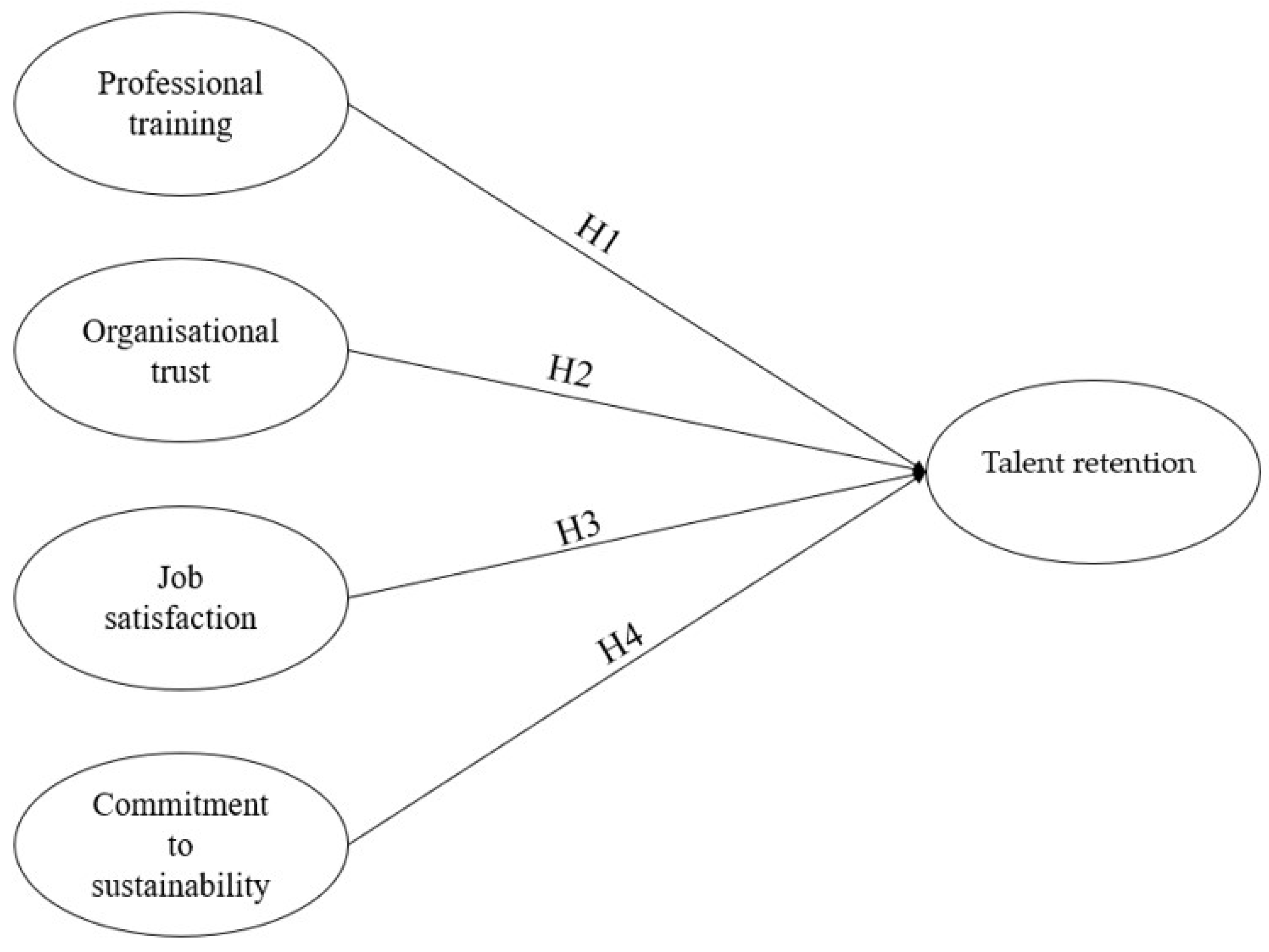
On this basis, this study proposes an explanatory model that analyses how each organisational resource directly influences Talent Retention (TR), integrating previous evidence into a framework consistent with the JD-R. The model considers four main relationships: the influence of Professional Training (PT), Organisational Trust (OT), Job Satisfaction (JS) and Commitment to Sustainability (CS) on talent retention.
The proposed hypotheses are integrated into the conceptual model shown in
Figure 1.
3. Methods
Study context (Extremadura). Extremadura is an inland region in south-west Spain that can be characterised as a peripheral European territory in socio-economic terms. Recent indicators show a GDP per capita of €23,600 (below the European average) and an unemployment rate of 17.4%, together with persistent depopulation and ageing dynamics that constrain the local labour market. In this context, the hotel sector faces additional difficulties in attracting and retaining qualified personnel, which makes it an appropriate setting for examining how organisational resources contribute to talent retention and, by extension, to the sustainability of human capital.
3.1. Procedure and Measures
This research used a structured questionnaire to collect quantitative data and test the hypotheses. Its design focused on capturing hotel employees’ perceptions of various factors related to the sustainability of human capital. Prior to its final application, a preliminary validation phase was carried out through a pilot study or pretest, the purpose of which was to ensure the clarity, validity and appropriateness of the questionnaire to the specific research context. This exploratory stage included the formation of focus groups composed of a total of 22 experts with extensive experience in areas related to the object of study, such as tourism managers, hotel accommodation managers and specialised academics. The groups were organised in two independent sessions, composed of 10 and 12 participants, respectively.
During the evaluation sessions, the experts analysed in depth the structure, wording and conceptual relevance of each item, issuing observations and suggestions aimed at improving the accuracy and relevance of the questions. After incorporating the recommendations made, satisfactory levels of internal consistency were obtained, as evidenced by Cronbach’s alpha coefficients [
48], which exceeded the minimum threshold of 0.70 in all cases. This result confirmed the reliability, clarity and stability of the instrument.
The final questionnaire was structured in three clearly differentiated sections. The first section corresponded to an introduction in which the general objective of the study was briefly stated and the guarantees of anonymity and confidentiality in the treatment of the data obtained were emphasised. The second section focused on the measurement of the constructs included in the proposed theoretical model. In particular, the following variables were assessed: professional training (PT), aimed at measuring the degree of professional training perceived by employees; organisational trust (OT), designed to assess the perception of credibility, support and reliability that employees attribute to their company; job satisfaction (JS), aimed at capturing employees’ overall assessment of their well-being in the work environment; commitment to sustainability (CS), focused on identifying the employee’s personal involvement with sustainable practices promoted by the organisation; and talent retention (TR), considered as the outcome variable, and referring to the employee’s intention to remain with the company in the long term. In line with previous survey-based research, this construct captures employees’ perceptions of organisational retention practices (e.g., career development opportunities, managerial support and compensation conditions) together with their self-reported intention to stay. Therefore, it does not represent actual turnover behaviour or objective retention rates, but rather perceived retention conditions and intentions, which are widely recognised as strong antecedents of effective retention. Each of these constructs was assessed by four items, all of which were adapted from scales validated in previous studies (
Table 1). The third section of the questionnaire collected information on the socio-demographic profile of the respondents (age, gender, level of education attained and monthly salary), as well as situational variables (current job position, years of professional experience and length of service in the company). The variables related to the constructs of the model were measured using a seven-point Likert scale (1 = strongly disagree; 7 = strongly agree), while the sociodemographic and situational variables were treated as categorical or quantitative depending on their nature [
49].
A non-probability purposive sampling strategy was used for data collection, selecting only hotel employees who met certain inclusion criteria. Participants had to be over 18 years of age, be employed in any category or position within the hotel and include both permanent staff and trainees. The inclusion of the minimum age criterion responded to the need to ensure sufficient judgement, autonomy and maturity to provide valid and consistent responses.
The application of the surveys was carried out in hotel establishments of different categories (from one to five stars), distributed throughout the Autonomous Community of Extremadura and with a minimum of five employees on staff, which made it possible to ensure a broad and representative coverage of the sector. The administration process combined face-to-face and online modalities. In the face-to-face mode, the survey was supported by a team of three qualified interviewers, who were responsible for facilitating access to the questionnaire and offering personalised assistance to resolve any doubts that might arise. The administration was carried out autonomously and confidentially through the use of QR codes, which participants scanned from their own mobile devices. This methodology optimised both accessibility and response rate, reducing application times and minimising intervention bias. In the online modality, the managers of the participating hotels were contacted directly and acted as intermediaries to distribute the link to the questionnaire among their employees.
The fieldwork took place between September and October 2025. As a result of the collection process, a total of 265 surveys were obtained. After filtering out incomplete or invalid questionnaires, the final sample consisted of 255 participants. This sample size allowed for a margin of error of 5% and a confidence level of 95%, meeting the methodological standards for studies of this type.
As presented in
Table 2, the respondents were a heterogeneous group in terms of personal and professional characteristics. The gender distribution was balanced, with 57.6% men and 41.6% women. In terms of educational level, a majority had a bachelor’s degree or higher education (41.2%), and monthly income was predominantly between 1000 and 3000 euros (69.0%). With regard to their current employment status, participants had a variety of roles within the hotel establishments, with the majority having less than 5 years of professional experience in the sector and 1–3 years working in their current company.
3.2. Data Analysis
The data analysis was carried out following a two-stage approach. In the first, the validation of the measurement model was carried out using confirmatory factor analysis (CFA); in the second, a structural equation model (SEM) was estimated to assess the causal relationships between the constructs. The estimation of the parameters was carried out using the maximum likelihood method, according to the procedure proposed by Anderson and Gerbing [
53]. SPSS 26 and AMOS 28.0 were used to perform the statistical analyses.
The model fit was assessed using various statistical indicators: the chi-square statistic (χ
2), the degrees of freedom (gL), the χ
2/gL ratio, the root mean squared error of approximation (RMSEA), as well as the incremental (IFI), comparative (CFI), normalised (NFI), Tucker–Lewis (TLI) and goodness-of-fit (GFI) indices. According to the reference criteria [
54,
55], the model has an acceptable fit when the χ
2/gL ratio is less than 5, the fit indices are between 0.9 and 1.0, and the RMSEA is in the range of 0.05 to 0.08.
The internal reliability of the scales was checked using Cronbach’s alpha (α), while the composite reliability (CR) and average variance extracted (AVE) were used to assess internal consistency and convergent validity, respectively. Furthermore, discriminant validity was tested by applying the criterion of Fornell and Larcker [
56], which compares the square root of the AVE with the correlations between constructs. Finally, the structural relationships between variables were examined on the basis of standardised coefficients (β), significance levels (
p-values) and coefficients of determination (R
2), in order to identify the magnitude and direction of the effects proposed in the theoretical model.
5. Discussion, Theoretical and Management Implications
5.1. Discussion
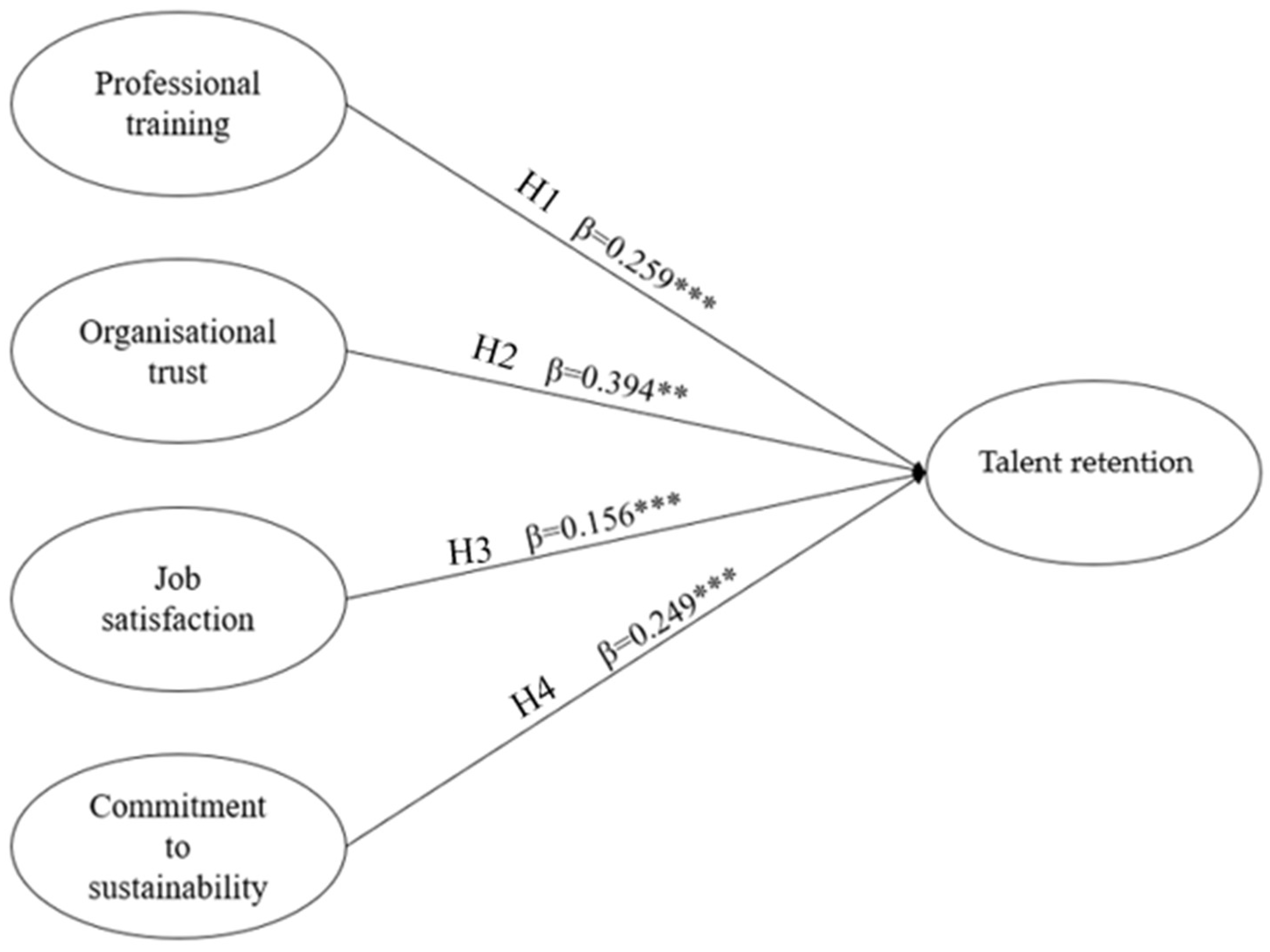
The results of the study provide insight into the mechanisms through which organisational and motivational resources contribute to team stability in peripheral tourist destinations, where seasonality, limited labour supply and economic vulnerability intensify turnover risks. The model, based on the JD-R framework, explains 65.2% of the variance in talent retention (operationalised in this study as intention to remain), which confirms the usefulness of this approach to understand how available resources buffer job demands and favour the continuity of human capital, as reflected through employees’ reported retention intentions and perceived organisational support mechanisms in structurally fragile contexts.
From a comparative perspective, the patterns observed in Extremadura align with dynamics previously identified in other peripheral European tourist regions, where attracting and retaining qualified staff remains a persistent challenge. In these territories, geographical isolation, fragmented demand and high levels of contractual temporariness have been identified as structural factors that hinder the consolidation of stable teams [
58]. Recent studies show, for example, that in rural areas of northern Italy, organisational conditions, opportunities for professional development and the sector’s image are associated with the decision to remain in tourism businesses [
59]. Similarly, in other territories such as the island of El Hierro (Spain) and Pico (Portugal), tourism development is intertwined with employment and mobility trajectories in which job stability takes on strategic value in sustaining life projects rooted in the territory, especially among new residents and seasonal workers seeking to settle [
60]. Moreover, in regions that are highly dependent on tourism, such as Portugal’s Algarve, regional governance and “smart region” strategies place job quality and the consolidation of human capital at the centre of policies aimed at sustaining the local socio-economic structure [
61]. In the light of this background, the case of Extremadura reinforces the idea that, in peripheral tourist destinations, talent retention depends to a large extent on how the available organisational resources are configured and managed to offer stable employment and sustainable career pathways.
With regard to the findings, our results show that organisational trust emerges as the strongest predictor of retention (β = 0.394), reinforcing the importance of perceptions of fairness, integrity and consistency in internal management. In territories where opportunities for labour mobility are limited, trust acts as a relational anchor that reduces uncertainty and strengthens the bond with the organisation [
38]. These results are consistent with previous research linking trust to longer-term employment relationships and greater job stability [
6,
8,
9]. Moreover, they align with recent studies showing how the quality of internal communication and perceived organisational support reduce turnover intention and strengthen work attachment [
62].
Professional training, for its part, also shows a notable effect (β = 0.259). This result suggests that ongoing training acts as a resource that enhances employability, facilitates adaptation to the environment and strengthens a sense of belonging. As shown in previous studies, beyond technical upskilling, training geared towards holistic development strengthens motivation and signals opportunities for growth—factors associated with sustainable career trajectories and lower turnover levels in sectors characterised by intensive human interaction [
1,
2,
33,
34,
36]. In territories where career opportunities are often perceived as limited, the articulation of clear training pathways and internal progression opportunities has been shown to reduce intentions to leave and to foster sustainable careers within the territory itself [
3,
59].
In relation to job satisfaction, its significant but more moderate effect (β = 0.156) suggests that it operates primarily as a psychological resource that helps to stabilise employees’ intention to remain, rather than as a stand-alone factor capable of explaining talent retention on its own. Satisfaction appears to function as a facilitator that amplifies the effects of other resources—particularly trust and perceived support—in contexts characterised by high operational pressure and a degree of structural uncertainty [
38]. This aligns with the literature linking job satisfaction to the maintenance of emotional wellbeing, while emphasising its dependence on broader relational and organisational conditions [
16,
23,
44,
46]. Likewise, research on turnover intention in tourism and hospitality consistently identifies satisfaction as a relevant antecedent of the decision to stay or leave, while clearly distinguishing between intention and actual behaviour [
63]. In line with recent reviews, it is more appropriate to interpret satisfaction as a predictor or correlate of intention to stay rather than as a single or directly causal determinant of leaving [
64].
Finally, commitment to sustainability (β = 0.249) emerges as a relevant factor in explaining retention. Employees’ identification with the organisation’s sustainable values and objectives strengthens internal cohesion and a sense of belonging [
6,
19]. When organisational values and personal convictions are aligned, involvement increases and the company is perceived as an ethically coherent environment. This result suggests that sustainability practices function as an intangible resource that reinforces organisational identity and strengthens loyalty [
7,
20,
26,
30]. Along the same lines, recent reviews indicate that the most effective retention strategies combine working conditions, opportunities for professional development and components linked to purpose and values, which is associated with lower turnover intentions [
3].
Taken together, these findings show that talent retention in peripheral regions is not driven by isolated factors, but by a combination of technical, relational, psychological and value-based resources that enable employees to cope with job demands without emotional deterioration. The validation of the JD-R model in this context confirms its explanatory capacity in tourism sectors subject to structural pressures and highlights the importance of managing organisational resources as an integrated system oriented towards the sustainability of human capital.
5.2. Theoretical Implications
From a theoretical perspective, this study contributes to the literature on human capital sustainability in the tourism sector by proposing and contrasting an integrated model, based on the JD-R in which professional training, organisational trust, job satisfaction and commitment to sustainability are configured as essential labour resources to explain talent retention. By applying this framework to the hotel sector in a peripheral region, this paper reinforces and contextually applies the traditional scope of the JD-R—focused on burnout, engagement or individual performance—by empirically demonstrating that the joint configuration of structural (professional training), relational (organisational trust), psychological (job satisfaction) and axiological or ethical (commitment to sustainability) resources constitute an integrated system that helps explain talent retention (R2 = 65.2%). in peripheral tourism contexts. Thus, retention is no longer understood as an isolated human resource management phenomenon, but as a key and observable indicator of the sustainability of human capital in highly demanding tourism contexts with structural and demographic constraints.
Second, the results allow us to clarify the relative hierarchy of resources within the JD-R framework. The evidence that organisational trust emerges as the strongest predictor of talent retention, above even job satisfaction or training, underlines the theoretical weight of relational and perceived fairness resources over purely instrumental ones. This finding qualifies previous approaches in the hospitality literature, often focused on financial incentives or technical training [
65,
66], and suggests that theoretical models of turnover and retention should explicitly integrate trust as a central resource, especially in contexts of high operational pressure and limited job opportunities.
Thirdly, this research makes a significant theoretical contribution by incorporating commitment to sustainability as a motivational resource within the JD-R framework. The results show that employees’ identification with organisational sustainability goals not only reinforces social responsibility and institutional legitimacy but also acts as a psychological mechanism that increases their intention to remain in the organisation. This establishes a clear link between the literature on sustainability and that on human resource management, demonstrating that the sustainable orientation of the organisation can be conceptualised as an intangible resource that strengthens the configuration and maintenance of human capital, especially in sectors where experience and tacit knowledge are decisive for competitiveness.
Finally, this work enriches the literature on peripheral and demographically vulnerable regions by showing that resources that favour talent retention at the organisational level also operate as levers for territorial sustainability. By confirming the importance of talent retention in human capital sustainability, this study builds a bridge between the micro models of JD-R and the meso/macro approaches to regional development. The sustainability of human capital in hotels in peripheral regions not only guarantees organisational resilience but also contributes to retaining population and specialised knowledge in contexts at risk of depopulation. Importantly, these findings should be interpreted as an applied validation of key JD-R mechanisms rather than as a theoretical extension of the model. The contribution lies in empirically linking JD-R-based labour resources with debates on regional sustainability and human capital continuity in peripheral tourism economies.
5.3. Management Implications
On a practical level, this study offers relevant information for human capital management in the hotel sector in peripheral regions such as Extremadura. First, given its significant effect on talent retention, organisational trust places internal justice and management credibility at the centre of the management agenda. This means ensuring that promotion and shift assignment processes are based on clear, accessible criteria that are applied consistently, and that performance evaluations are carried out transparently and with real opportunities for dialogue [
67]. It is also key to consolidate a leadership style that is consistent between discourse and practice. In contexts with few job alternatives, the perception of fair and predictable treatment becomes a decisive factor for employees to choose to stay and develop their careers in the territory.
For its part, professional training, identified as the second most important predictor, should be viewed as a strategic investment rather than a temporary cost. Hotels that design continuing education plans geared toward comprehensive development—beyond immediate technical skills—tend to generate a greater sense of belonging and strengthen the internal employability of their workers. In operational terms, this involves articulating training itineraries linked to clear professional trajectories, facilitating face-to-face and online modalities that allow training to be compatible with the seasonality of the sector, and incorporating content related to sustainability, such as efficient resource management, responsible customer service, and the social impact of tourism [
68]. In this way, training simultaneously contributes to improving service quality and consolidating the sustainability of human capital.
The commitment to sustainability, which has a significant influence on retention, must be translated into visible and consistent policies that connect the organisation’s purpose with the expectations of the workforce. Integrating environmental and social objectives into job descriptions, performance evaluations and recognition systems, as well as facilitating staff participation in specific projects—waste reduction, circular economy initiatives or community programmes—reinforces the perception that the hotel makes a real contribution to the sustainable development of the region [
69]. When this perception is consolidated, identification with the organisation increases and the intention to leave decreases.
Although job satisfaction has a lower coefficient, its significant effect confirms that working conditions remain an essential component of human capital sustainability [
70]. Management must intervene in specific areas such as shift scheduling to reduce unpredictability and excessive hours, adequate staffing during peak demand periods, improvement of rest areas, and implementation of work–life balance measures adapted to regional realities, for example, by coordinating schedules with public or school transport. Decisions on work organisation have a direct impact on the quality of working life and, consequently, on the willingness to remain in employment.
Finally, the findings also have direct implications for sustainable territorial development policies. In a peripheral region with structural and demographic constraints, the ability of hotels to retain skilled workers helps to stabilise the population, maintain specialised knowledge and sustain the local economic base. Therefore, public administrations and tourism stakeholders should align their support instruments (sectoral training programmes, incentives for stable and quality employment, among others) with those human resource practices that have been shown to promote retention [
71]. In this way, human resource management takes on a clearly strategic role within sustainable territorial development policies, linking everyday decisions about people with the economic and social resilience of peripheral tourist destinations.
6. Conclusions
The results of this study offer an in-depth view of the mechanisms that sustain human capital in peripheral tourist destinations, taking Extremadura as a case study. This region, characterised by a fragile economic structure, limited productive diversification, persistent depopulation and a small labour market, is particularly sensitive to turnover and the loss of organisational knowledge. In this scenario, the sustainability of human capital becomes a strategic element not only for the competitiveness of the hotel sector, but also for territorial cohesion and population retention in rural and semi-urban areas subject to demographic vulnerability.
The results show that talent retention—a key variable in this study—does not depend on isolated incentives, but rather on a structured set of organisational resources capable of strengthening staff resilience and commitment. Organisational trust appears to be the most decisive predictor, underscoring the critical role of managerial credibility and the perception of internal justice in areas where job alternatives are scarce and stability takes on a differential value. Professional training is consolidated as an indispensable resource for increasing employability, promoting adaptation to the demands of the sector and generating career paths with future prospects, thus reinforcing the sense of belonging. For its part, commitment to sustainability adds an ethical and community dimension that enhances identification with the organisation, which is especially relevant in regions where tourism is linked to local development. Job satisfaction also contributes to permanence, albeit to a lesser extent, acting as a psychological resource that stabilises, rather than determines, the intention to remain.
Overall, the proposed model confirms that the availability of consistent and sustained organisational resources is a key element in mitigating turnover in peripheral environments. At the same time, the findings suggest that the sustainability of human capital, although not measured directly, can be inferred through the positive interaction between these resources and the observed levels of permanence. This inference should be understood as a theoretically grounded interpretation rather than a direct measurement, based on employees’ perceptions of organisational resources and their reported intention to remain, which constitute early and relevant indicators of human capital continuity.
From a management and public policy perspective, the results indicate the need to adopt comprehensive strategies that combine organisational transparency, training programmes aligned with professional development, systematic mechanisms for staff participation in sustainability initiatives, and measures to strengthen internal justice. In regions such as Extremadura, these actions not only improve retention, but also contribute to anchoring a young and qualified population, curb human decapitalisation and strengthen the socio-economic sustainability of the territory. Thus, talent management takes on a territorial dimension that transcends the organisational sphere and is directly linked to the structural challenges of Europe’s peripheral regions.
Limitations and Future Research
Despite the robustness of the model and the relevance of the results, this study has several limitations that should be acknowledged.
First, the cross-sectional design prevents the establishment of firm causal relationships. Although the links identified are consistent with JD-R and previous literature, longitudinal studies would allow for the analysis of the evolution of human capital and retention over longer periods, especially in destinations affected by seasonal tourism.
Secondly, the sustainability of human capital was not assessed using a specific scale, but was inferred theoretically from the resources analysed. Future research should develop and validate instruments that measure this construct directly, incorporating dimensions such as employability, professional continuity, psychological health and knowledge transfer.
Thirdly, the sample is limited to the hotel sector in Extremadura. Extending the analysis to other tourism subsectors (catering, intermediation, cultural and heritage leisure) and other peripheral regions would allow patterns to be compared and the influence of different structural conditions to be assessed.
Finally, future research may extend the proposed model by incorporating mediating and/or moderating mechanisms (e.g., engagement/burnout, job demands, or employment conditions) to further examine the boundary conditions under which organisational resources translate into talent retention and could incorporate additional contextual variables—such as community satisfaction, attachment to the territory, local quality of life, or availability of public services—to explore how the socioeconomic environment conditions the retention of talent in vulnerable destinations.


_Li.png)