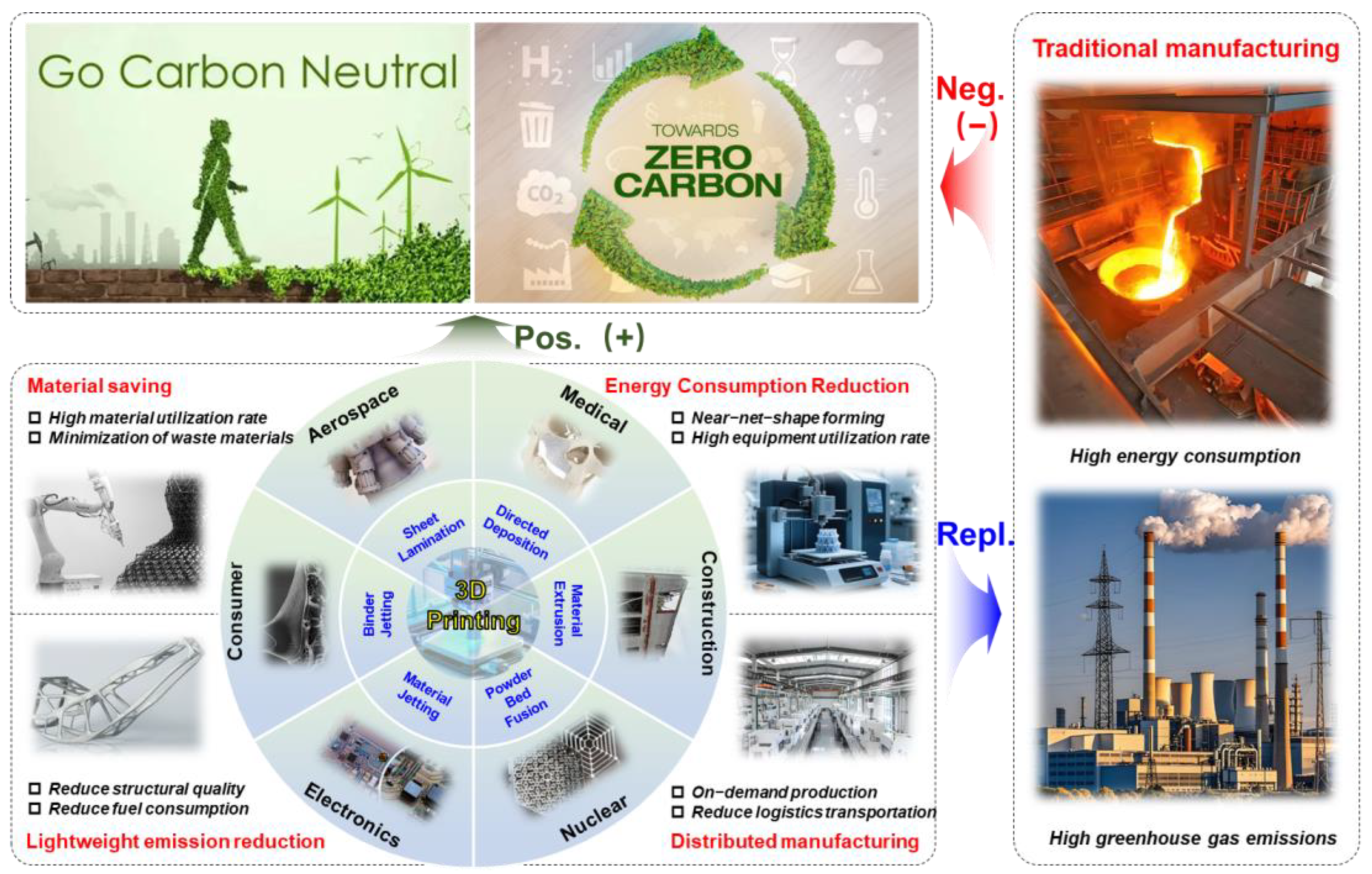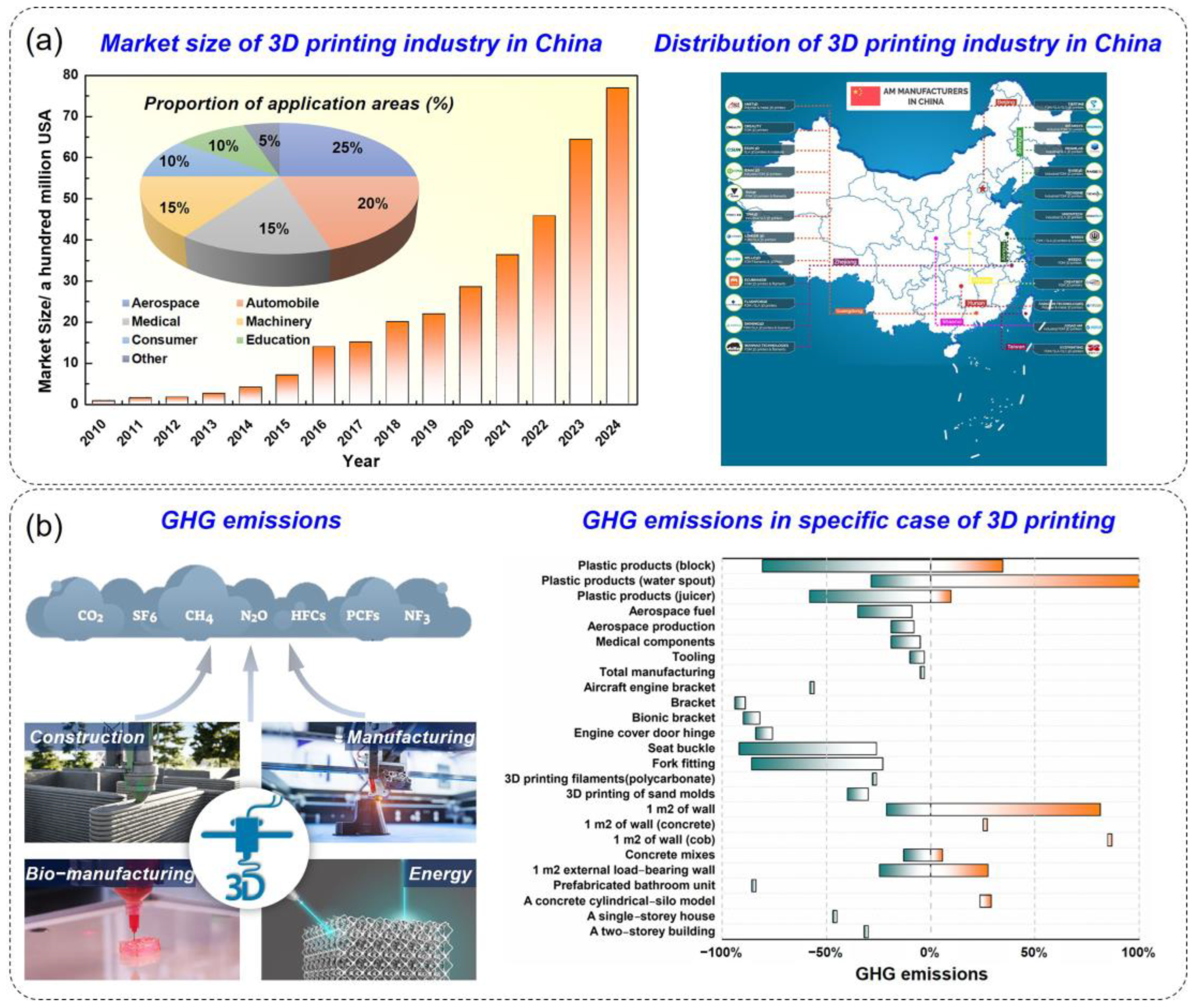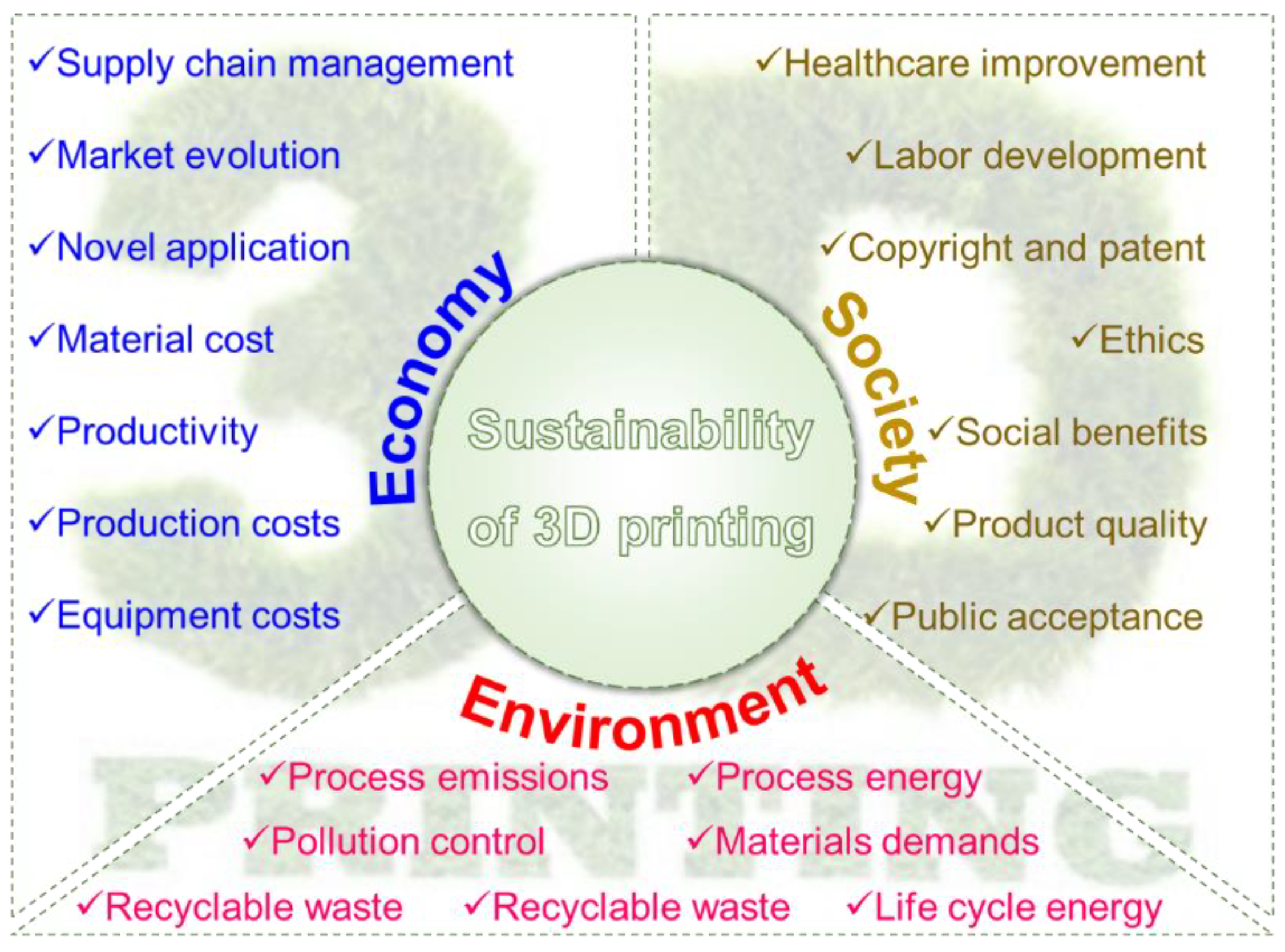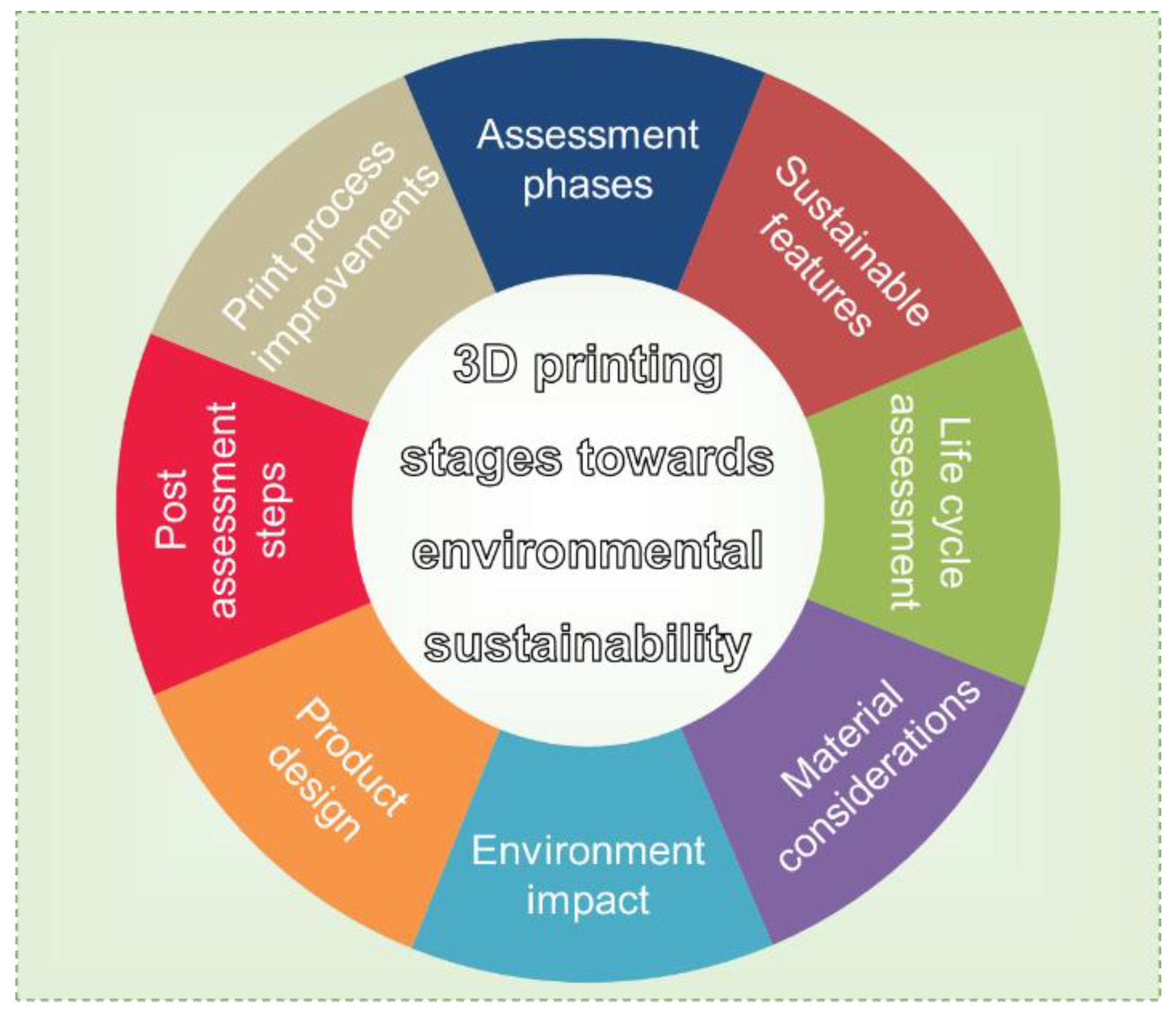
Implementation Pathways for the Sustainable Development of China’s 3D Printing Industry Under the “Dual Carbon” Goals: Policy Optimization and Technological Innovation

Abstract
1. Introduction
2. Methodology
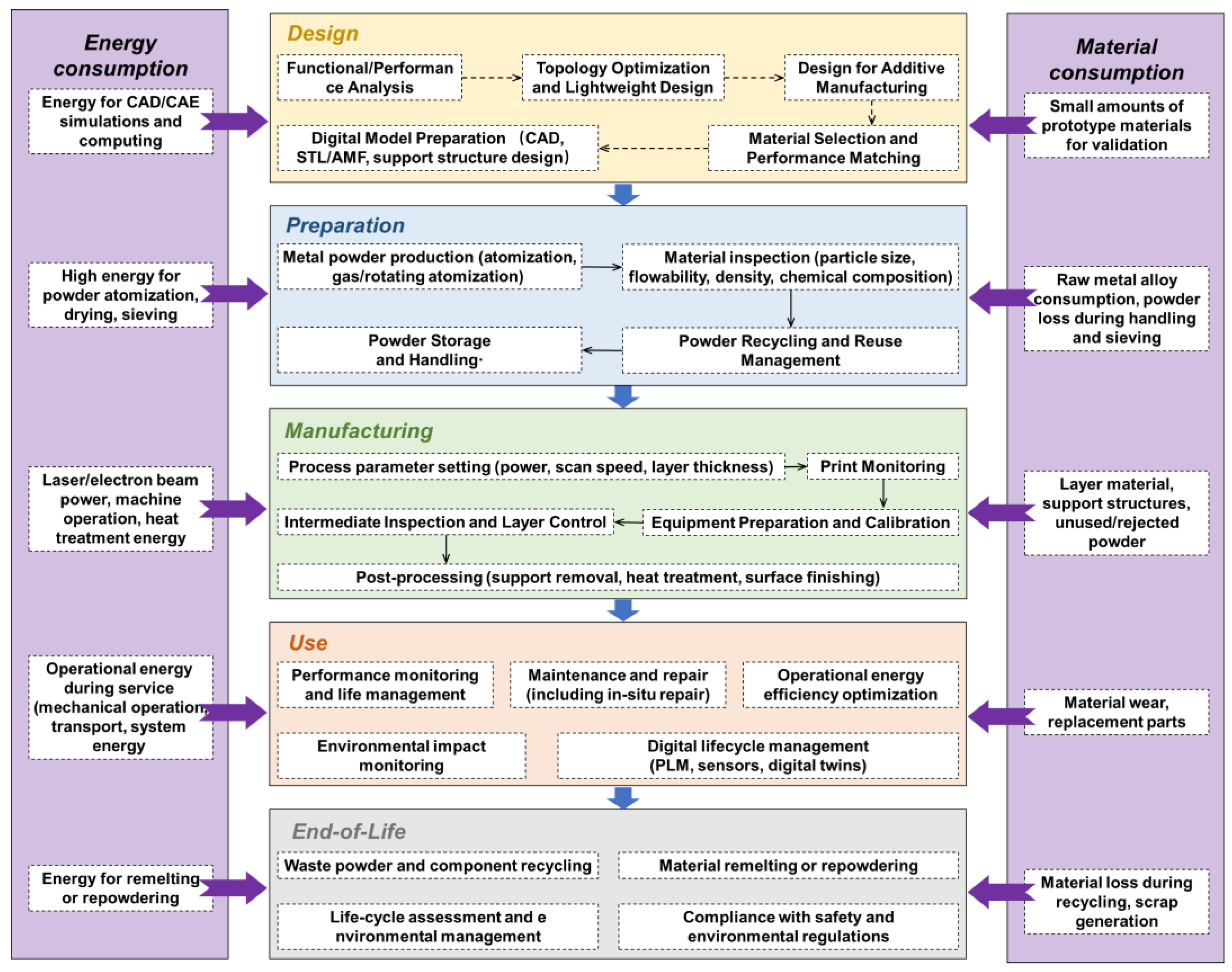
3. Embedding Sustainability into 3D Printing: A Process Flow Perspective
3.1. Sustainability Pillars for 3D Printing
- (i)
- Resource efficiency pillar
- (ii)
- Environmental performance pillar
- (iii)
- Socio-economic pillar
3.2. Enriching 3D Printing Sustainability: Process Flow
- (i)
- Design
- (ii)
- Material preparation
- (iii)
- Printing fabrication
- (iv)
- Post-processing and integration
- (v)
- Product use and service
- (vi)
- Recycling and reuse
4. Comparative Analysis of Domestic and International Development of 3D Printing Industry Under the “Dual Carbon” Goal
4.1. Policy Optimization and Institutional Support
4.1.1. China: Strategic Guidance and Industrial Support
4.1.2. The European Union: Integrated Regulation Centered on Green Transition
4.1.3. United States: Balancing Technological Research and Development with Environmental Safety Regulation
4.2. Technological Innovation and Emission Reduction Benefits
4.2.1. Material and Process Innovation
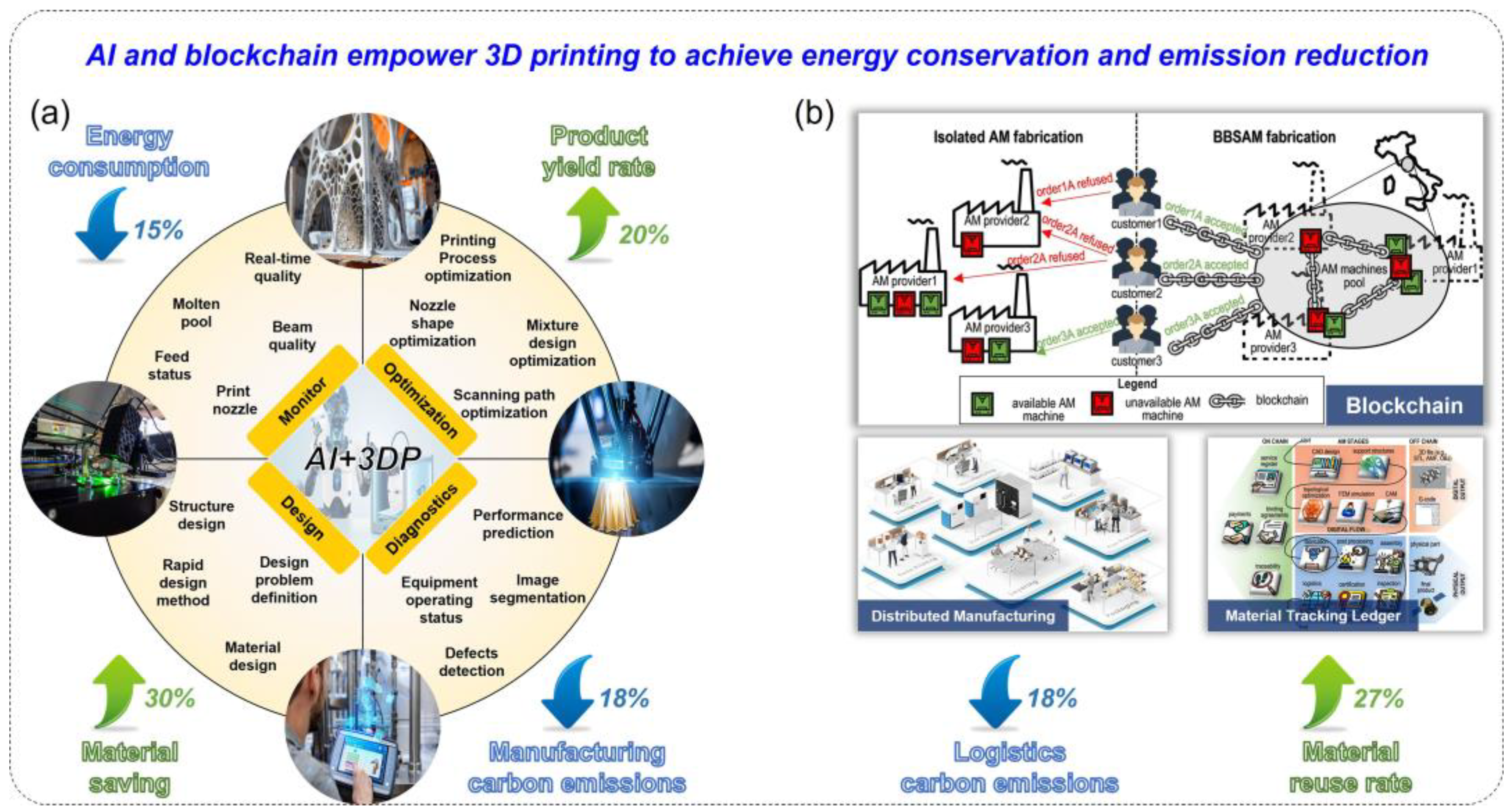
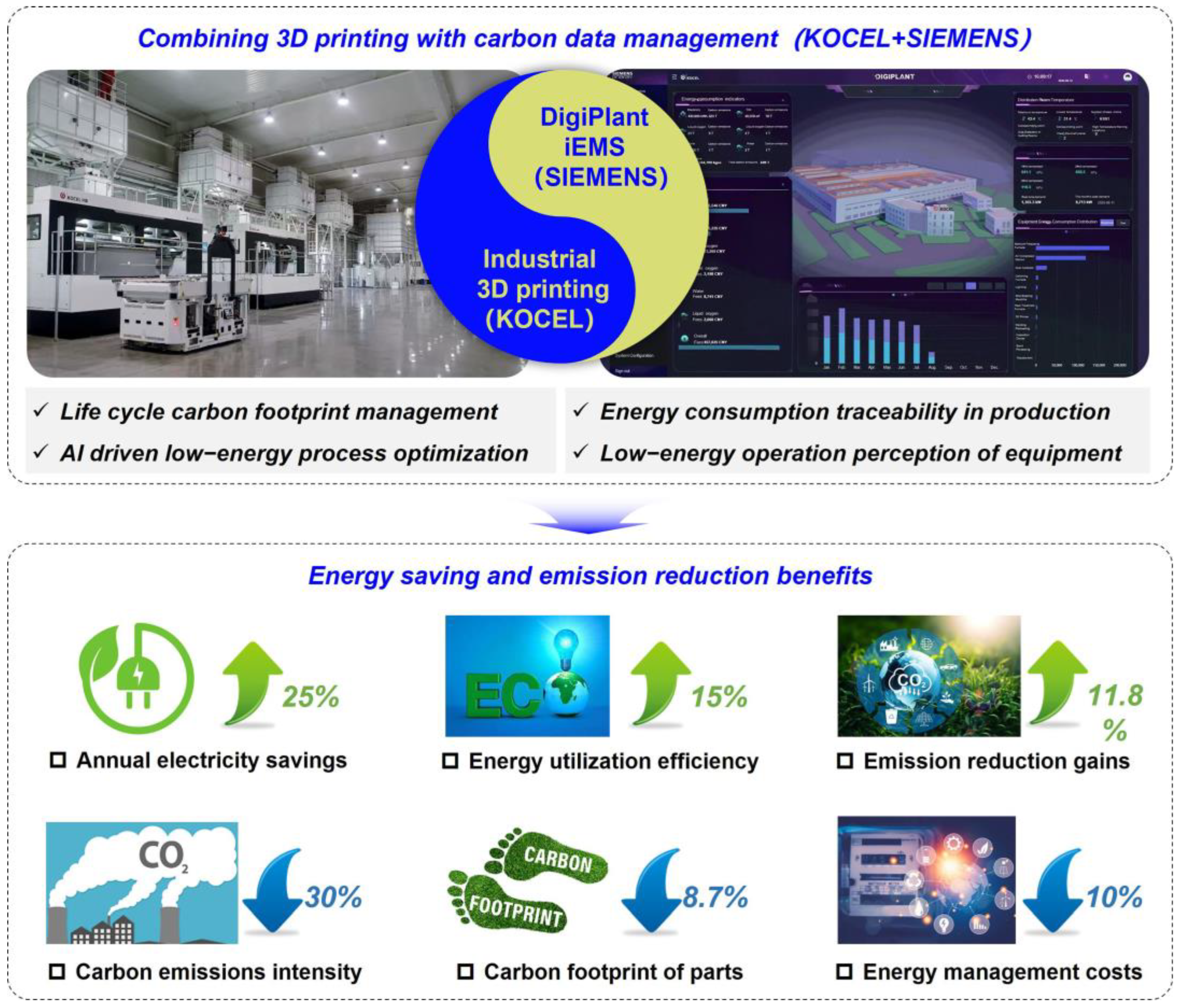
4.2.2. Intelligent and Digital Innovation
5. Key Challenges Facing the Sustainable Development of China’s 3D Printing Industry Under the “Dual Carbon” Goals
5.1. Perspective of Policies and Institutions
5.2. Perspective of Technological Innovation
5.3. Legal Enforcement Challenges and Institutional Barriers
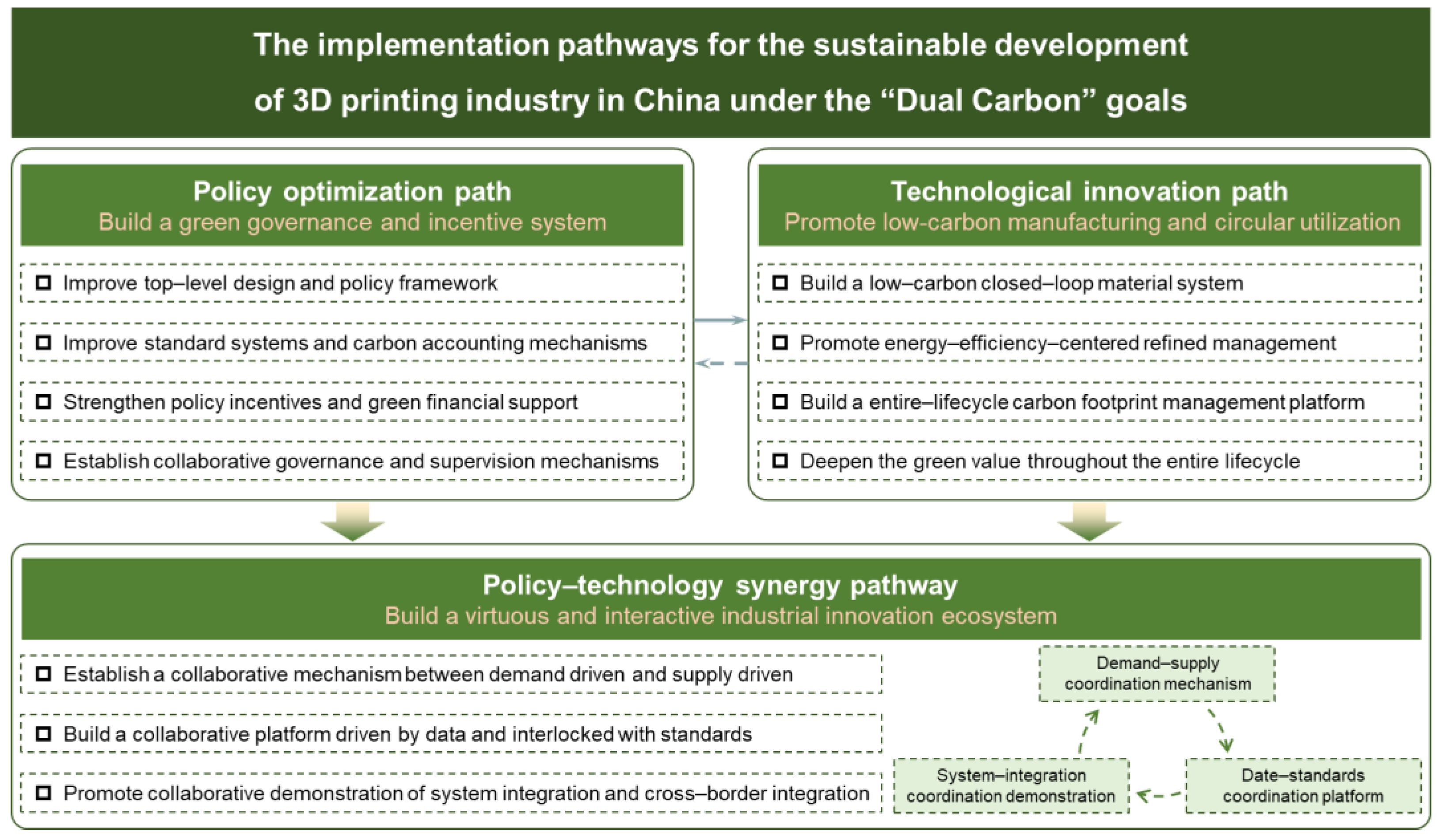
6. Implementation Pathways for Sustainable Development of China’s 3D Printing Industry Under the “Dual Carbon” Goals
6.1. Policy Optimization Pathway: Building a Green Governance and Incentive System
6.1.1. Improving Top-Level Design and Policy Framework
6.1.2. Improving Standard Systems and Carbon Accounting Mechanisms
6.1.3. Strengthening Policy Incentives and Green Financial Support
6.1.4. Establishing a Collaborative Governance and Supervision Mechanism
6.2. Technological Innovation Path: Advancing Low-Carbon Manufacturing and Circular Utilization
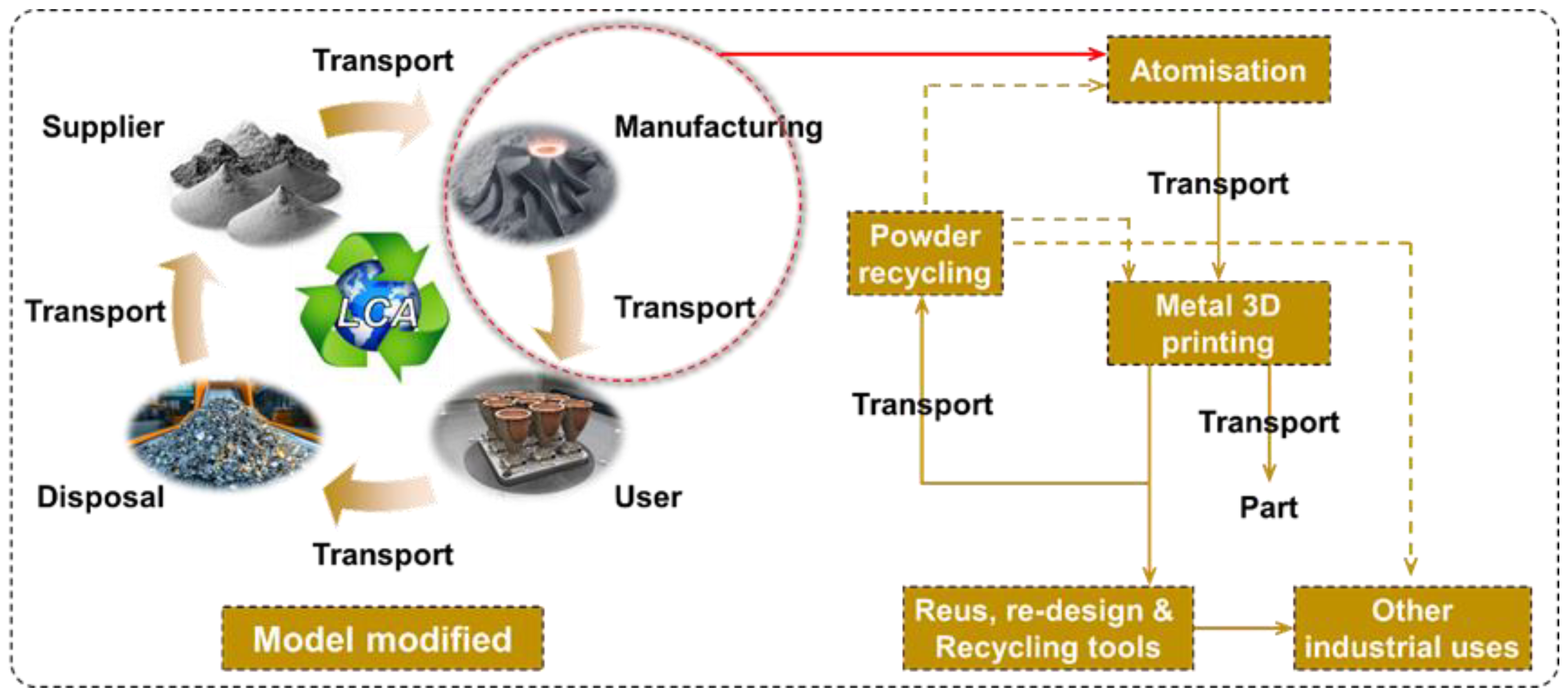
6.2.1. Constructing a Low-Carbon and Closed-Loop Material System
6.2.2. Promoting Energy-Efficiency-Oriented Precision Management
6.2.3. Establishing a Life-Cycle Carbon Footprint Management Platform
6.2.4. Enhancing Green Value Across the Entire Life Cycle
6.3. Synergistic Pathways of Policy and Technology: Building a Virtuous and Interactive Industrial Innovation Ecosystem
6.3.1. Establishing a Coordinated Mechanism of Demand Pull and Supply Push
6.3.2. Building a Data-Driven and Standards-Linked Synergistic Platform
6.3.3. Promoting Synergistic Demonstration Through System Integration and Cross-Sector Collaboration
7. Conclusions and Outlook
7.1. Conclusions
7.2. Outlook
Author Contributions
Funding
Institutional Review Board Statement
Informed Consent Statement
Data Availability Statement
Conflicts of Interest
Abbreviations
| GHG | Greenhouse gases |
| AM | Additive manufacturing |
| Pos. | Positive |
| Repl. | Replace |
| Neg. | Negative |
| LCA | Life cycle assessment |
| CID | Clean Industrial Deal |
| EU | European Union |
| CBAM | Carbon Border Adjustment Mechanism |
| DOE | Department of Energy |
| DoD | Department of Defense |
| NASA | National Aeronautics and Space Administration |
| TSCA | Toxic Substances Control Act |
| PCB | Printed circuit board |
| FDM | Fused deposition modeling |
| DIW | Direct ink writing |
| IJP | Inkjet printing |
| AJP | Aerosol-jet printing |
| TPMS | Triply periodic minimal surface |
| CFRTC | Carbon fiber-reinforced thermoset composites |
| AI | Artificial intelligence |
| VOCs | Volatile organic compounds |
| PLA | Polylactic acid |
| PHA | Polyhydroxyalkanoates |
| SMEs | Small and medium-sized enterprises |
References
- Zhang, P.; Jin, L.; Wang, Y. Optimizing Mechanisms for Promoting Low-Carbon Manufacturing Industries towards Carbon Neutrality. Renew. Sust. Energ. Rev. 2023, 183, 113516. [Google Scholar] [CrossRef]
- Bolan, S.; Padhye, L.P.; Jasemizad, T.; Govarthanan, M.; Karmegam, N.; Wijesekara, H.; Amarasiri, D.; Hou, D.; Zhou, P.; Biswal, B.K.; et al. Impacts of Climate Change on the Fate of Contaminants through Extreme Weather Events. Sci. Total Environ. 2024, 909, 168388. [Google Scholar] [CrossRef] [PubMed]
- Bhatti, U.A.; Bhatti, M.A.; Tang, H.; Syam, M.S.; Awwad, E.M.; Sharaf, M.; Ghadi, Y.Y. Global Production Patterns: Understanding the Relationship between Greenhouse Gas Emissions, Agriculture Greening and Climate Variability. Environ. Res. 2024, 245, 118049. [Google Scholar] [CrossRef] [PubMed]
- Dong, L.; Miao, G.; Wen, W. China’s Carbon Neutrality Policy: Objectives, Impacts and Paths. East Asian Policy 2021, 13, 5–18. [Google Scholar] [CrossRef]
- Sun, Q.; Ma, L.; Fan, M.; Wang, X.; Zhao, Z.; Shi, Y. Lessons from the Development and Operational Experiences of International Carbon Markets for the Construction of China’s Carbon Market. Glob. Energy Interconnect. 2025, 8, 188–204. [Google Scholar] [CrossRef]
- Van de Ven, D.-J.; Mittal, S.; Gambhir, A.; Lamboll, R.D.; Doukas, H.; Giarola, S.; Hawkes, A.; Koasidis, K.; Köberle, A.C.; McJeon, H.; et al. A Multimodel Analysis of Post-Glasgow Climate Targets and Feasibility Challenges. Nat. Clim. Change 2023, 13, 570–578. [Google Scholar] [CrossRef]
- Cheng, Z.; Ding, C.J.; Zhao, K. Energy Use Rights Trading and Carbon Emissions. Energy 2025, 315, 134360. [Google Scholar] [CrossRef]
- Wang, H.; Lockett, M.; He, D.; Lv, Y. Enhancing Green Total Factor Productivity through Manufacturing Output Servitization: A Case Study in China. Heliyon 2024, 10, e23769. [Google Scholar] [CrossRef]
- Alam, M.M.; Aktar, M.A.; Idris, N.D.M.; Al-Amin, A.Q. World Energy Economics and Geopolitics amid COVID-19 and Post-COVID-19 Policy Direction. World Dev. Sustain. 2023, 2, 100048. [Google Scholar] [CrossRef]
- Cao, H.J.; Li, H.C.; Du, Y.B.; Li, X.G. Current Situation and Development Trend of Low-Carbon Manufacturing. Aeronaut. Manuf. Technol. 2012, 9, 26–31. [Google Scholar]
- Zhang, N.; Wang, Z.; Zhao, Z.; Zhang, D.; Feng, J.; Yu, L.; Lin, Z.; Guo, Q.; Huang, J.; Mao, J.; et al. 3D Printing of Micro-Nano Devices and Their Applications. Microsyst. Nanoeng. 2025, 11, 35. [Google Scholar] [CrossRef] [PubMed]
- Alarifi, I.M. Revolutionising Fabrication Advances and Applications of 3D Printing with Composite Materials: A Review. Virtual Phys. Prototy. 2024, 19, e2390504. [Google Scholar] [CrossRef]
- Andreozzi, M.; Bianchi, I.; Di Pompeo, V.; Forcellese, A.; Mancia, T.; Mignanelli, C.; Simoncini, M.; Verdini, T.; Vita, A. Sustainability assessment of autoclave and 3D printed composites with thermosetting and thermoplastic matrices. Int. J. Adv. Manuf. Tech. 2025, 138, 3221–3237. [Google Scholar] [CrossRef]
- Srivastava, M.; Aftab, J.; Tyll, L. The Influence of Artificial Intelligence and Additive Manufacturing on Sustainable Manufacturing Practices and Their Effect on Performance. Sustain. Futures 2025, 10, 100820. [Google Scholar] [CrossRef]
- Nur, I.N.; Guo, P.; An, X.; Zhang, H. Flow Characteristics in the Fused Filament Fabrication 3D Printing Process of Thermoplastic Materials. Carbon Neutral Technol. 2025, 1, 100008. [Google Scholar] [CrossRef]
- Ngo, T.D.; Kashani, A.; Imbalzano, G.; Nguyen, K.T.Q.; Hui, D. Additive Manufacturing (3D Printing): A Review of Materials, Methods, Applications and Challenges. Compos. Part B Eng. 2018, 143, 172–196. [Google Scholar] [CrossRef]
- Li, J.; Wang, C.; Wu, Y.; Fan, E.; Zhu, G.; Zhang, X.; Zou, Y.; Shi, S. Advances in Inside-Laser Material Feeding Additive Manufacturing Technology. Int. J. Adv. Manuf. Technol. 2025, 140, 5713–5736. [Google Scholar] [CrossRef]
- Kang, J.; Shangguan, H.; Peng, F.; Xu, J.; Deng, C.; Hu, Y.; Yi, J.; Huang, T.; Zhang, L.; Mao, W. Cooling Control for Castings by Adopting Skeletal Sand Mold Design. China Foundry 2021, 18, 18–28. [Google Scholar] [CrossRef]
- Favi, C.; Murgese, L.; Villazzi, N.; Gallozzi, S.; Mandolini, M.; Marconi, M. Integrating Life Cycle Engineering into Design for Additive Manufacturing: A Review. J. Manuf. Syst. 2025, 82, 599–631. [Google Scholar] [CrossRef]
- Hua, X. Siemens Energy Deepens Ties with Chinese Partners amid Green Policy Push. Available online: https://english.news.cn/20250818/d2ecc550ddfd4311b7d4cb30a02c1771/c.html (accessed on 18 November 2025).
- Elhadad, A.A.; Rosa-Sainz, A.; Cañete, R.; Peralta, E.; Begines, B.; Balbuena, M.; Alcudia, A.; Torres, Y. Applications and Multidisciplinary Perspective on 3D Printing Techniques: Recent Developments and Future Trends. Mater. Sci. Eng. R Rep. 2023, 156, 100760. [Google Scholar] [CrossRef]
- Gartner, L. 3D Printing Enables Compact Force Sensors for Humanoid Robotic Systems. Available online: https://www.3printr.com/ (accessed on 29 November 2025).
- Zhu, L.; Li, N.; Childs, P.R.N. Light-Weighting in Aerospace Component and System Design. Propuls. Power Res. 2018, 7, 103–119. [Google Scholar] [CrossRef]
- Jha, D.; Sawant, R.; Mukherjee, S.; Ashvinbhai, A.; Upadhyay, R.K. Redefining Supply Chain and Related Aspects through Integration of 3D Printing Technology. Sustain. Manuf. Serv. Econ. 2025, 4, 100030. [Google Scholar] [CrossRef]
- Muhammad, M.S.; Kerbache, L.; Elomri, A. Potential of Additive Manufacturing for Upstream Automotive Supply Chains. Supply Chain. Forum Int. J. 2022, 23, 1–19. [Google Scholar] [CrossRef]
- Wang, D.; Zhang, T.; Guo, X.; Ling, D.; Hu, L.; Jiang, G. The Potential of 3D Printing in Facilitating Carbon Neutrality. J. Environ. Sci. 2023, 130, 85–91. [Google Scholar] [CrossRef] [PubMed]
- Choudhary, N.; Sharma, V.; Kumar, P. Sustainability Assessment Framework of Biomedical Scaffolds: Additive Manufacturing versus Traditional Manufacturing. J. Clean. Prod. 2023, 418, 138118. [Google Scholar] [CrossRef]
- Ghobadian, A.; Talavera, I.; Bhattacharya, A.; Kumar, V.; Garza-Reyes, J.A.; O’Regan, N. Examining Legitimatisation of Additive Manufacturing in the Interplay between Innovation, Lean Manufacturing and Sustainability. Int. J. Prod. Econ. 2020, 219, 457–468. [Google Scholar] [CrossRef]
- Cardeal, G.; Höse, K.; Ribeiro, I.; Götze, U. Sustainable Business Models–Canvas for Sustainability, Evaluation Method, and Their Application to Additive Manufacturing in Aircraft Maintenance. Sustainability 2020, 12, 9130. [Google Scholar] [CrossRef]
- Gopal, M.; Lemu, H.G.; Gutema, E.M. Sustainable Additive Manufacturing and Environmental Implications: Literature Review. Sustainability 2022, 15, 504. [Google Scholar] [CrossRef]
- Ribeiro, I.; Matos, F.; Jacinto, C.; Salman, H.; Cardeal, G.; Carvalho, H.; Godina, R.; Peças, P. Framework for life cycle sustainability assessment of additive manufacturing. Sustainability 2020, 12, 929. [Google Scholar] [CrossRef]
- Javaid, M.; Haleem, A.; Singh, R.P.; Suman, R.; Rab, S. Role of Additive Manufacturing Applications towards Environmental Sustainability. Adv. Ind. Eng. Polym. Res. 2021, 4, 312–322. [Google Scholar] [CrossRef]
- Bello, K.A.; Maladzhi, R.W. Innovative and Best Practices in Sustainable Strategies for Waste Reduction in Additive Manufacturing. Hybrid. Adv. 2025, 11, 100527. [Google Scholar] [CrossRef]
- Cruz Sanchez, F.A.; Boudaoud, H.; Camargo, M.; Pearce, J.M. Plastic Recycling in Additive Manufacturing: A Systematic Literature Review and Opportunities for the Circular Economy. J. Clean. Prod. 2020, 264, 121602. [Google Scholar] [CrossRef]
- Al-Meslemi, Y.; Anwer, N.; Mathieu, L. Environmental Performance and Key Characteristics in Additive Manufacturing: A Literature Review. Procedia CIRP 2018, 69, 148–153. [Google Scholar] [CrossRef]
- Klenam, D.E.P.; McBagonluri, F.; Asumadu, T.K.; Osafo, S.A.; Bodunrin, M.O.; Agyepong, L.; Osei, E.D.; Mornah, D.; Soboyejo, W.O. Additive Manufacturing: Shaping the Future of the Manufacturing Industry—Overview of Trends, Challenges and Opportunities. Appl. Eng. Sci. 2025, 22, 100224. [Google Scholar] [CrossRef]
- Gutierrez-Osorio, A.H.; Ruiz-Huerta, L.; Caballero-Ruiz, A.; Siller, H.R.; Borja, V. Energy Consumption Analysis for Additive Manufacturing Processes. Int. J. Adv. Manuf. Technol. 2019, 105, 1735–1743. [Google Scholar] [CrossRef]
- Peng, T.; Kellens, K.; Tang, R.; Chen, C.; Chen, G. Sustainability of Additive Manufacturing: An Overview on Its Energy Demand and Environmental Impact. Addit. Manuf. 2018, 21, 694–704. [Google Scholar] [CrossRef]
- Ford, S.; Despeisse, M. Additive Manufacturing and Sustainability: An Exploratory Study of the Advantages and Challenges. J. Clean. Prod. 2016, 137, 1573–1587. [Google Scholar] [CrossRef]
- Zhang, S.; Wang, X.; Xu, J.; Chen, Q.; Peng, M.; Hao, J. Green Manufacturing for Achieving Carbon Neutrality Goal Requires Innovative Technologies: A Bibliometric Analysis from 1991 to 2022. J. Environ. Sci. 2024, 140, 255–269. [Google Scholar] [CrossRef]
- Rehman, M.U. Advancing Sustainable Development and Circular Economy in Emerging Economies: The Transformative Role of Additive Manufacturing. Int. J. Eng. Energy Electron. 2023, 1, 1–13. [Google Scholar]
- Schädler, M. China’s Standardisation Strategy: Emergence and Contents. In Standardization Strategies in China and India: Industrial Policy and Geopolitics and Implications for Europe; Freimuth, J., Kaiser, S., Schädler, M., Eds.; Springer Fachmedien: Wiesbaden, Germany, 2024; pp. 151–166. ISBN 978-3-658-45583-5. [Google Scholar]
- Gao, M.; Li, L.; Wang, Q.; Ma, Z.; Li, X.; Liu, Z. Integration of Additive Manufacturing in Casting: Advances, Challenges, and Prospects. Int. J. Precis. Eng. Manuf.-Green Technol. 2022, 9, 305–322. [Google Scholar] [CrossRef]
- Zhu, L.; Li, X.M.; Huang, Y.; Liu, F.Y.; Yang, C.J.; Li, D.Y.; Bai, H.P. Digital Technology and Green Development in Manufacturing: Evidence from China and 20 Other Asian Countries. Sustainability 2023, 15, 12841. [Google Scholar] [CrossRef]
- Ahmad, H.; Yaqub, M.; Lee, S.H. Global Trends in Carbon Neutrality: A Scientometric Review on Energy Transition Challenges, Practices, Policies, and Opportunities. Environ. Dev. Sustain. 2025, 1–26. [Google Scholar] [CrossRef]
- Peltola, T.; Saarela, S.-R.; Kotilainen, J.M.; Litmanen, T.; Lukkarinen, J.; Pölönen, I.; Ratamäki, O.; Saarikoski, H.; Salo, M.; Vikström, S. Researcher Roles in Collaborative Governance Interventions. Sci. Public Policy. 2023, 50, 871–880. [Google Scholar] [CrossRef]
- Hummel, K.; Jobst, D. An Overview of Corporate Sustainability Reporting Legislation in the European Union. Acc. Eur. 2024, 21, 320–355. [Google Scholar] [CrossRef]
- Veugelers, R.; Tagliapietra, S.; Trasi, C. Green Industrial Policy in Europe: Past, Present, and Prospects. J. Ind. Compet. Trade. 2024, 24, 4. [Google Scholar] [CrossRef]
- Pavlova, M. Fostering Inclusive, Sustainable Economic Growth and “Green” Skills Development in Learning Cities through Partnerships. Int. Rev. Educ. 2018, 64, 339–354. [Google Scholar] [CrossRef]
- Gu, R.; Guo, J.; Huang, Y.; Wu, X. Impact of the EU Carbon Border Adjustment Mechanism on Economic Growth and Resources Supply in the BASIC Countries. Resour. Policy 2023, 85, 104034. [Google Scholar] [CrossRef]
- Tassey, G. Competing in Advanced Manufacturing: The Need for Improved Growth Models and Policies. J. Econ. Perspect. 2014, 28, 27–48. [Google Scholar] [CrossRef]
- Peters, M.A. Semiconductors, Geopolitics and Technological Rivalry: The US CHIPS & Science Act, 2022. Educ. Philos. Theory 2023, 55, 1642–1646. [Google Scholar] [CrossRef]
- Gao, W.; Zhang, Y.; Ramanujan, D.; Ramani, K.; Chen, Y.; Williams, C.B.; Wang, C.C.L.; Shin, Y.C.; Zhang, S.; Zavattieri, P.D. The Status, Challenges, and Future of Additive Manufacturing in Engineering. Comput.-Aided Des. 2015, 69, 65–89. [Google Scholar] [CrossRef]
- Attaran, M. The Rise of 3-D Printing: The Advantages of Additive Manufacturing over Traditional Manufacturing. Bus. Horiz. 2017, 60, 677–688. [Google Scholar] [CrossRef]
- Georgantzinos, S.K.; Papadopoulou, E.; Kostopoulos, G.; Voulgaris, S.; Tseni, A.; Bakalis, P.; Gkara, M.; Mitropoulou, C.C.; Lagaros, N.D. A Comprehensive Review of Additive Manufacturing for Space Applications: Materials, Advances, Challenges, and Future Directions. Adv. Eng. Mater. 2025, 27, e202501082. [Google Scholar] [CrossRef]
- Bours, J.; Adzima, B.; Gladwin, S.; Cabral, J.; Mau, S. Addressing Hazardous Implications of Additive Manufacturing: Complementing Life Cycle Assessment with a Framework for Evaluating Direct Human Health and Environmental Impacts. J. Ind. Ecol. 2017, 21, S25–S36. [Google Scholar] [CrossRef]
- Shanmugam, V.; Das, O.; Neisiany, R.E.; Babu, K.; Singh, S.; Hedenqvist, M.S.; Berto, F.; Ramakrishna, S. Polymer Recycling in Additive Manufacturing: An Opportunity for the Circular Economy. Mater. Circ. Econ. 2020, 2, 11. [Google Scholar] [CrossRef]
- Gu, D.D.; Meiners, W.; Wissenbach, K.; Poprawe, R. Laser Additive Manufacturing of Metallic Components: Materials, Processes and Mechanisms. Int. Mater. Rev. 2012, 57, 133–164. [Google Scholar] [CrossRef]
- Yang, B.; Ni, T.; Wu, J.; Fang, Z.; Yang, K.; He, B.; Pu, X.; Chen, G.; Ni, C.; Chen, D.; et al. Circular 3D Printing of High-Performance Photopolymers through Dissociative Network Design. Science 2025, 388, 170–175. [Google Scholar] [CrossRef]
- Ke, Y.; Gu, F.; Lv, J.; Guo, J. Assessing the Environmental and Economic Performances of 3D Printing Processes for Manufacturing Printed Circuit Boards. Environ. Impact Asses. Rev. 2025, 115, 108057. [Google Scholar] [CrossRef]
- Vijayan, D.S.; Gopalaswamy, S.; Sivasuriyan, A.; Koda, E.; Sitek, W.; Vaverková, M.D.; Podlasek, A. Advances and Applications of Carbon Capture, Utilization, and Storage in Civil Engineering: A Comprehensive Review. Energies 2024, 17, 6046. [Google Scholar] [CrossRef]
- Yu, K.-H.; Teng, T.; Nah, S.H.; Chai, H.; Zhi, Y.; Wang, K.-Y.; Chi, Y.; Psarras, P.; Akbarzadeh, M.; Yang, S. 3D Concrete Printing of Triply Periodic Minimum Surfaces for Enhanced Carbon Capture and Storage. Adv. Funct. Mater. 2025, 35, 2509259. [Google Scholar] [CrossRef]
- Deng, K.; Zhang, C.; Fu, K. Additive Manufacturing of Continuously Reinforced Thermally Curable Thermoset Composites with Rapid Interlayer Curing. Compos. Part B-Eng. 2023, 257, 110671. [Google Scholar] [CrossRef]
- Faludi, J.; Baumers, M.; Maskery, I.; Hague, R. Environmental Impacts of Selective Laser Melting: Do Printer, Powder, or Power Dominate? J. Ind. Ecol. 2017, 21, S144–S156. [Google Scholar] [CrossRef]
- Godina, R.; Ribeiro, I.; Matos, F.; Ferreira, B.T.; Carvalho, H.; Peças, P. Impact Assessment of Additive Manufacturing on Sustainable Business Models in Industry 4.0 Context. Sustainability 2020, 12, 7066. [Google Scholar] [CrossRef]
- Habib, M.A.; Subeshan, B.; Kalyanakumar, C.; Asmatulu, R.; Rahman, M.M.; Asmatulu, E. Current Practices in Recycling and Reusing of Aircraft Materials and Equipment. Mater. Circ. Econ. 2025, 7, 12. [Google Scholar] [CrossRef]
- Dojan, C.F.; Ziaee, M.; Masoumipour, A.; Radosevich, S.J.; Yourdkhani, M. Additive Manufacturing of Carbon Fiber-Reinforced Thermoset Composites via in-Situ Thermal Curing. Nat. Commun. 2025, 16, 4691. [Google Scholar] [CrossRef]
- Zhu, Z.; Ng, D.W.H.; Park, H.S.; McAlpine, M.C. 3D-Printed Multifunctional Materials Enabled by Artificial-Intelligence-Assisted Fabrication Technologies. Nat. Rev. Mater. 2021, 6, 27–47. [Google Scholar] [CrossRef]
- Goh, G.D.; Sing, S.L.; Yeong, W.Y. A Review on Machine Learning in 3D Printing: Applications, Potential, and Challenges. Artif. Intell. Rev. 2021, 54, 63–94. [Google Scholar] [CrossRef]
- Mandolla, C.; Petruzzelli, A.M.; Percoco, G.; Urbinati, A. Building a Digital Twin for Additive Manufacturing through the Exploitation of Blockchain: A Case Analysis of the Aircraft Industry. Comput. Ind. 2019, 109, 134–152. [Google Scholar] [CrossRef]
- Westphal, E.; Leiding, B.; Seitz, H. Blockchain-Based Quality Management for a Digital Additive Manufacturing Part Record. J. Ind. Inf. Integr. 2023, 35, 100517. [Google Scholar] [CrossRef]
- Guerra-Zubiaga, D.; Kuts, V.; Mahmood, K.; Bondar, A.; Nasajpour-Esfahani, N.; Otto, T. An Approach to Develop a Digital Twin for Industry 4.0 Systems: Manufacturing Automation Case Studies. Int. J. Comput. Integ. Manuf. 2021, 34, 933–949. [Google Scholar] [CrossRef]
- Grida, M.; Mostafa, N.A. Are Smart Contracts Too Smart for Supply Chain 4.0? A Blockchain Framework to Mitigate Challenges. J. Manuf. Technol. Manag. 2023, 34, 644–665. [Google Scholar] [CrossRef]
- Lupi, F.; Cimino, M.G.C.A.; Berlec, T.; Galatolo, F.A.; Corn, M.; Rožman, N.; Rossi, A.; Lanzetta, M. Blockchain-based shared additive manufacturing. Comput. Ind. Eng. 2023, 183, 109497. [Google Scholar] [CrossRef]
- Han, L.; Du, W.; Xia, Z.; Gao, B.; Yang, M.; Han, L.; Du, W.; Xia, Z.; Gao, B.; Yang, M. Generative Design and Integrated 3D Printing Manufacture of Cross Joints. Materials 2022, 15, 4753. [Google Scholar] [CrossRef]
- Pokorný, P.; Sobrino, D.R.D.; Václav, Š.; Petru, J.; Gołębski, R.; Pokorný, P.; Sobrino, D.R.D.; Václav, Š.; Petru, J.; Gołębski, R. Research into Specific Mechanical Properties of Composites Produced by 3D-Printing Additive Continuous-Fiber Fabrication Technology. Materials 2023, 16, 1459. [Google Scholar] [CrossRef] [PubMed]
- Major-Gabryś, K.; Halejcio, D.; Fijołek, A.; Marosz, J.; Górny, M.; Major-Gabryś, K.; Halejcio, D.; Fijołek, A.; Marosz, J.; Górny, M. The Influence of Furfuryl Resin Type—Classical and Designed for Sand 3D Printing—On Cast Iron Casting Microstructure and Surface Roughness. Polymers 2025, 17, 2920. [Google Scholar] [CrossRef]
- Liu, Q. Evaluating the Impact of 3D Printing Technology Innovations on Industrial Production Efficiency and Economic Growth in the Automotive Sector in China. Innov. Sci. Technol. 2024, 3, 60–66. [Google Scholar] [CrossRef]
- Huang, H.; Wang, G. Comparison Study on the Industrial Policies of Additive Manufacturing in U.S. and China. In Proceedings of the 2016 International Conference on Industrial Economics System and Industrial Security Engineering (IEIS), Sydney, Australia, 24–27 July 2016; IEEE Xplore: Piscataway, NJ, USA, 2016; pp. 1–6. [Google Scholar]
- Huo, J.; Yin, J.; Zhang, J.; Liu, Y.; Ye, X. The Evolution of China’s 3D Printing Technology Policy from the View of Policy Tool. In Proceedings of the 2017 Portland International Conference on Management of Engineering and Technology (PICMET), Portland, OR, USA, 9–13 July 2017; IEEE Xplore: Piscataway, NJ, USA, 2017; pp. 1–7. [Google Scholar]
- Huang, Y.; Leu, M.C.; Mazumder, J.; Donmez, A. Additive Manufacturing: Current State, Future Potential, Gaps and Needs, and Recommendations. J. Manuf. Sci. Eng.-Trans. Asme. 2015, 137, 14001. [Google Scholar] [CrossRef]
- ISO 14040:2006l; Environmental Management—Life Cycle Assessment—Principles and Framework. International Organization for Standardization (ISO): Geneva, Switzerland, 2006.
- Le Bourhis, F.; Kerbrat, O.; Dembinski, L.; Hascoet, J.-Y.; Mognol, P. Predictive Model for Environmental Assessment in Additive Manufacturing Process. Procedia CIRP 2014, 15, 26–31. [Google Scholar] [CrossRef]
- Parvanda, R.; Kala, P. Trends, Opportunities, and Challenges in the Integration of the Additive Manufacturing with Industry 4.0. Prog. Addit. Manuf. 2023, 8, 587–614. [Google Scholar] [CrossRef]
- Rejeski, D.; Zhao, F.; Huang, Y. Research Needs and Recommendations on Environmental Implications of Additive Manufacturing. Addit. Manuf. 2018, 19, 21–28. [Google Scholar] [CrossRef]
- Divakara Shetty, S.; Shetty, N. Investigation of Mechanical Properties and Applications of Polylactic Acids—A Review. Mater. Res. Express 2019, 6, 112002. [Google Scholar] [CrossRef]
- Daraban, A.E.O.; Negrea, C.S.; Artimon, F.G.P.; Angelescu, D.; Popan, G.; Gheorghe, S.I.; Gheorghe, M.; Daraban, A.E.O.; Negrea, C.S.; Artimon, F.G.P. A Deep Look at Metal Additive Manufacturing Recycling and Use Tools for Sustainability Performance. Sustainability 2019, 11, 5494. [Google Scholar] [CrossRef]
- Harding, O.J.; Griffiths, C.A.; Rees, A.; Pletsas, D. Methods to reduce energy and polymer consumption for fused filament fabrication 3D printing. Polymers 2023, 15, 1874. [Google Scholar] [CrossRef]
- May, G.; Psarommatis, F.; May, G.; Psarommatis, F. Maximizing Energy Efficiency in Additive Manufacturing: A Review and Framework for Future Research. Energies 2023, 16, 4179. [Google Scholar] [CrossRef]
- Maniewski, P.; Wörmann, T.J.; Pasiskevicius, V.; Holmes, C.; Gates, J.C.; Laurell, F. Advances in Laser-Based Manufacturing Techniques for Specialty Optical Fiber. J. Am. Ceram. Soc. 2024, 107, 5143–5158. [Google Scholar] [CrossRef]
- Liu, P.Y.L.; Liou, J.J.H.; Huang, S.W. Exploring the barriers to the advancement of 3D printing technology. Mathematics 2023, 11, 3068. [Google Scholar] [CrossRef]
- Liu, Y.; Wang, Q.; Huang, B.; Zhang, X.; Wang, X.; Long, Y. Status and Challenges of Green Manufacturing: Comparative Analysis of China and Other Countries. Resour. Conserv. Recycl. 2023, 197, 107051. [Google Scholar] [CrossRef]
- ISO 14067: 2018; Greenhouse Gases—Carbon Footprint of Products—Requirements and Guidelines for Quantification. International Organization for Standardization (ISO): Geneva, Switzerland, 2018.
- Landi, D.; Zefinetti, F.C.; Spreafico, C.; Regazzoni, D. Comparative Life Cycle Assessment of Two Different Manufacturing Technologies: Laser Additive Manufacturing and Traditional Technique. Procedia CIRP 2022, 105, 700–705. [Google Scholar] [CrossRef]
- Assunção, J.; Chadha, K.; Vasey, L.; Brumaud, C.; Escamilla, E.Z.; Gramazio, F.; Kohler, M.; Habert, G. Contribution of Production Processes in Environmental Impact of Low Carbon Materials Made by Additive Manufacturing. Autom. Constr. 2024, 165, 105545. [Google Scholar] [CrossRef]
- Gao, C.; Wolff, S.; Wang, S. Eco-Friendly Additive Manufacturing of Metals: Energy Efficiency and Life Cycle Analysis. J. Manuf. Syst. 2021, 60, 459–472. [Google Scholar] [CrossRef]
- Rupp, M.; Buck, M.; Klink, R.; Merkel, M.; Harrison, D.K. Additive Manufacturing of Steel for Digital Spare Parts—A Perspective on Carbon Emissions for Decentral Production. Clean. Environ. Syst. 2022, 4, 100069. [Google Scholar] [CrossRef]
- Tang, Y.; Mak, K.; Zhao, Y.F. A Framework to Reduce Product Environmental Impact through Design Optimization for Additive Manufacturing. J. Clean. Prod. 2016, 137, 1560–1572. [Google Scholar] [CrossRef]
- Jiang, R.; Kleer, R.; Piller, F.T. Predicting the Future of Additive Manufacturing: A Delphi Study on Economic and Societal Implications of 3D Printing for 2030. Technol. Forecast. Soc. Change 2017, 117, 84–97. [Google Scholar] [CrossRef]
- Peron, M.; Panza, L.; Demiralay, E.; Srinivas, T. Additive Manufacturing for Spare Parts Management: Is Decentralized Production Always Environmentally Preferable? IEEE Trans. Eng. Manag. 2025, 72, 634–650. [Google Scholar] [CrossRef]



| Countries/Regions | Policy Mainlines | Key Measures | Key Features |
|---|---|---|---|
| China | Strategic guidance and standard support | Establish integrated carbon accounting standards Designate 3D printing as a key transformative technology Advance green/digital standardization | Top-down design Standard-driven Policy-industry synergy |
| European Union | Legal Regulation and Green transition | Simplify compliance for SMEs Promote low-carbon standards and material recycling Implement Carbon Border Adjustment Mechanism (CBAM) | Rule-oriented governance Standard unification Regulation-market balance |
| United States | Innovation driven and environmental regulation | Provide federal R&D funding for clean manufacturing Leverage defense/aerospace demand Enhance material safety and carbon accounting | Technology innovation-led Multi-level policy coordination Concurrent regulation and incentive |
| Process Type | CO2 Emissions | Cost Comparison | Environmental Impact Reduction | Key Influencing Factors |
|---|---|---|---|---|
| Traditional subtractive manufacturing process | 100% (benchmark) | 100% (benchmark) | 0% (benchmark) | High energy/chemical waste |
| FDM | 40% | 20% | 74.43% | Simplify processes and reduce consumables |
| DIW | >100% | 200–400% | Negative | Silver ink dependency |
| IJP | >100% | 200–400% | Negative | Use silver ink and specialized equipment |
| AJP | >100% | 200–400% | Negative | Use silver ink and specialized equipment |
| Evaluation Dimension | China | European Union | United States |
|---|---|---|---|
| Policy completeness and long-term strategic coherence | 4 | 5 | 4 |
| Standardization maturity (LCA, carbon accounting, safety norms) | 3 | 5 | 4 |
| Technological innovation capacity (patents, R&D, industrial output) | 5 | 4 | 5 |
| Environmental performance (carbon intensity, renewable share) | 3 | 5 | 4 |
| Industrial ecosystem coordination (supply chain, cluster synergy) | 3 | 4 | 5 |
| Challenge Area | Specific Challenge | Policy Optimization Pathway | Technological Innovation Pathway |
|---|---|---|---|
| Policies and Institutions | Weak top-level design Poor industrial synergy Underdeveloped standards system Weak environmental regulation | Enhance top-level design Foster industrial synergy Develop standards and carbon accounting Strengthen environmental regulation | Build life-cycle carbon platforms Enhance green value creation |
| Technological Innovation | Lagging low-carbon materials Low energy efficiency Import-dependent core components | Support research and development incentives | Develop low-carbon materials Advance precision energy management Innovate core components |
| Policy-Technology Synergy | Lack of coordinated mechanism | Foster policy-tech synergy | Build synergistic platforms |
Disclaimer/Publisher’s Note: The statements, opinions and data contained in all publications are solely those of the individual author(s) and contributor(s) and not of MDPI and/or the editor(s). MDPI and/or the editor(s) disclaim responsibility for any injury to people or property resulting from any ideas, methods, instructions or products referred to in the content. |
© 2026 by the authors. Licensee MDPI, Basel, Switzerland. This article is an open access article distributed under the terms and conditions of the Creative Commons Attribution (CC BY) license.
Share and Cite
Xuan, L.; Zhao, Y. Implementation Pathways for the Sustainable Development of China’s 3D Printing Industry Under the “Dual Carbon” Goals: Policy Optimization and Technological Innovation. Sustainability 2026, 18, 591. https://doi.org/10.3390/su18020591
Xuan L, Zhao Y. Implementation Pathways for the Sustainable Development of China’s 3D Printing Industry Under the “Dual Carbon” Goals: Policy Optimization and Technological Innovation. Sustainability. 2026; 18(2):591. https://doi.org/10.3390/su18020591
Chicago/Turabian StyleXuan, Liuyu, and Yu Zhao. 2026. "Implementation Pathways for the Sustainable Development of China’s 3D Printing Industry Under the “Dual Carbon” Goals: Policy Optimization and Technological Innovation" Sustainability 18, no. 2: 591. https://doi.org/10.3390/su18020591
APA StyleXuan, L., & Zhao, Y. (2026). Implementation Pathways for the Sustainable Development of China’s 3D Printing Industry Under the “Dual Carbon” Goals: Policy Optimization and Technological Innovation. Sustainability, 18(2), 591. https://doi.org/10.3390/su18020591