You are currently on the new version of our website. Access the old version .
SustainabilitySustainability
  • Article
  • Open Access

7 January 2026

Implementation Pathways for the Sustainable Development of China’s 3D Printing Industry Under the “Dual Carbon” Goals: Policy Optimization and Technological Innovation

and
1
School of Law, Nanjing Normal University, Nanjing 210023, China
2
School of Mechanical and Aerospace Engineering, Jilin University, Changchun 130025, China
*
Author to whom correspondence should be addressed.

Abstract

This study systematically examines the policy and technological pathways for the sustainable development of China’s 3D printing industry under the “Dual Carbon” goals. A three-dimensional sustainability framework is developed, integrating resource efficiency, environmental performance, and socio-economic value. Based on this framework, the study conducts a full-process analysis covering design, material preparation, manufacturing, post-processing, use, and recycling stages. The analysis identifies key carbon-reduction mechanisms of 3D printing, including material savings, reduced energy consumption, lightweight-enabled emission reduction, and distributed manufacturing. A comparative analysis of China, the European Union, and the United States reveals major constraints in China’s 3D printing sector, particularly in top-level policy design, standardization systems, legal frameworks, industrial coordination, and low-carbon core technologies. Based on these findings, the study proposes a dual-driven development pathway integrating policy optimization and technological innovation. From an institutional perspective, this pathway emphasizes green policy incentives, including strategic planning, standard setting, green finance, and collaborative governance. From a technological perspective, it highlights the importance of low-carbon material development, refined energy-efficiency management, life-cycle carbon accounting platforms, and value creation across the product life cycle. Overall, the study demonstrates that effective policy–technology synergy is essential for transforming theoretical carbon-reduction potential into scalable and practical outcomes, providing a systematic analytical framework for academic research and actionable guidance for policymakers and industry stakeholders.

1. Introduction

With the rapid development of the global economy and accelerating industrialization, the exploitation of natural resources and overall energy consumption have continued to increase [1]. Consequently, environmental degradation and climate change have become the focus of global attention. Among these, global warming represents one of the most urgent challenges. Over the past century, the persistent rise in global average temperatures has resulted in accelerated glacier retreat, rising sea levels, and more frequent extreme weather events, all of which pose severe threats to the sustainability of the human living environment [2]. The primary cause of these phenomena is the massive emission of greenhouse gases (GHG), particularly carbon dioxide, which mainly originates from the combustion of fossil fuels, industrial production, and changes in land use. How to effectively reduce carbon emissions and curb global warming has become a long-term and formidable challenge faced by the international community. Therefore, controlling carbon emissions and developing a low-carbon economy have become a common concern of the international community [3].
During the 75th session of the United Nations General Assembly in 2020, China officially announced its goals of achieving peak carbon emissions by 2030 and carbon neutrality by 2060, namely the “Dual Carbon” goals [4]. Inspired by these commitments, countries worldwide have since proposed specific requirements and timelines for achieving carbon neutrality. This global momentum is widely regarded as the most crucial step toward addressing increasingly severe challenges such as climate change, environmental degradation, and resource depletion [5]. In 2021, nearly 200 countries adopted the “Glasgow Climate Pact”, a global agreement aimed at limiting temperature rise to within 1.5 °C above pre-industrial levels and reducing greenhouse gas emissions [6]. To achieve the “Dual Carbon” goals, reducing fossil fuel use has become a global priority, as fossil fuel combustion remains the primary source of GHG emissions. This transition introduces new challenges across industrial restructuring, transportation development, ecological conservation, and energy utilization [7]. Manufacturing, which accounts for approximately 20–30% of China’s industrial sector, is a cornerstone of national development and a key indicator of technological and economic competitiveness. However, it is also a major contributor to energy consumption and environmental pollution [8]. In the wake of the COVID-19 pandemic, the rapid recovery and expansion of the manufacturing sector will inevitably demand higher levels of energy consumption. This, in turn, will accelerate carbon emissions, particularly in traditional manufacturing industries such as casting and forging. Consequently, the manufacturing sector represents a critical battlefield for achieving China’s “Dual Carbon” targets [9]. Identifying innovative alternatives to traditional manufacturing technologies is therefore essential for advancing low-carbon manufacturing. The development of low-carbon manufacturing provides an effective pathway to harmonize energy policy, economic growth, and carbon neutrality strategies. It represents a sustainable development paradigm that simultaneously enhances manufacturing competitiveness and environmental performance [10]. In recent years, several emerging manufacturing technologies have contributed to energy savings and waste reduction. These include green cutting technology (mirror milling), green casting and forging (liquid forging), and electrochemical machining (electrochemical etching). They achieve this through process optimization, digital monitoring, and cleaner production strategies. Despite these advances, such technologies fundamentally remain within the paradigm of subtractive or deformation-based manufacturing. Consequently, resource efficiency remains constrained by material removal, tooling dependence, and centralized production, limiting the potential for deep decarbonization. This underscores the need for manufacturing approaches that move beyond traditional process logic and enable systemic improvements in resource utilization.
3D printing, also known as additive manufacturing (AM), provides such a transformative alternative. Integrating material preparation, structural design, and integrated manufacturing, it has been widely applied across various fields, including aerospace, automotive, construction, and healthcare [11]. Compared with traditional design and manufacturing processes, 3D printing offers inherent advantages such as design and manufacturing flexibility, multi-material integration within a single build, and modularized fabrication [12]. More importantly, its additive, tool-free, and geometry-agnostic manufacturing approach enables near-net-shape fabrication, high material utilization, lightweight structures via topology optimization, and distributed production close to end-users. These characteristics not only reduce material consumption and pollutant emissions at the source but also generate system-level carbon-reduction benefits throughout the product life cycle.
While these advantages underscore the low-carbon potential of 3D printing, its resource efficiency must be assessed within a full life-cycle framework. Concerns have been raised that high-performance requirements, such as high-purity powder production, laser melting of advanced alloys, or post-processing treatments, may increase energy consumption. From a full life-cycle perspective, additional resource inputs also occur in upstream and downstream stages, including powder or wire production, energy-intensive melting and sintering, and post-processing such as heat treatment or surface finishing. However, life-cycle assessments show that these localized increases are typically offset by reduced material waste, eliminated tooling needs, lower transportation emissions, and energy savings achieved through lightweight, topology-optimized designs. Compared to conventional manufacturing, 3D printing not only saves material but also reduces the energy needed during a product’s use. This leads to lower overall carbon emissions, particularly in demanding applications like aerospace and transportation [13]. This demonstrates that 3D printing can simultaneously achieve superior mechanical performance and net carbon reduction, with current challenges focused on optimizing low-carbon materials, energy-efficient printing, and greener post-processing technologies.
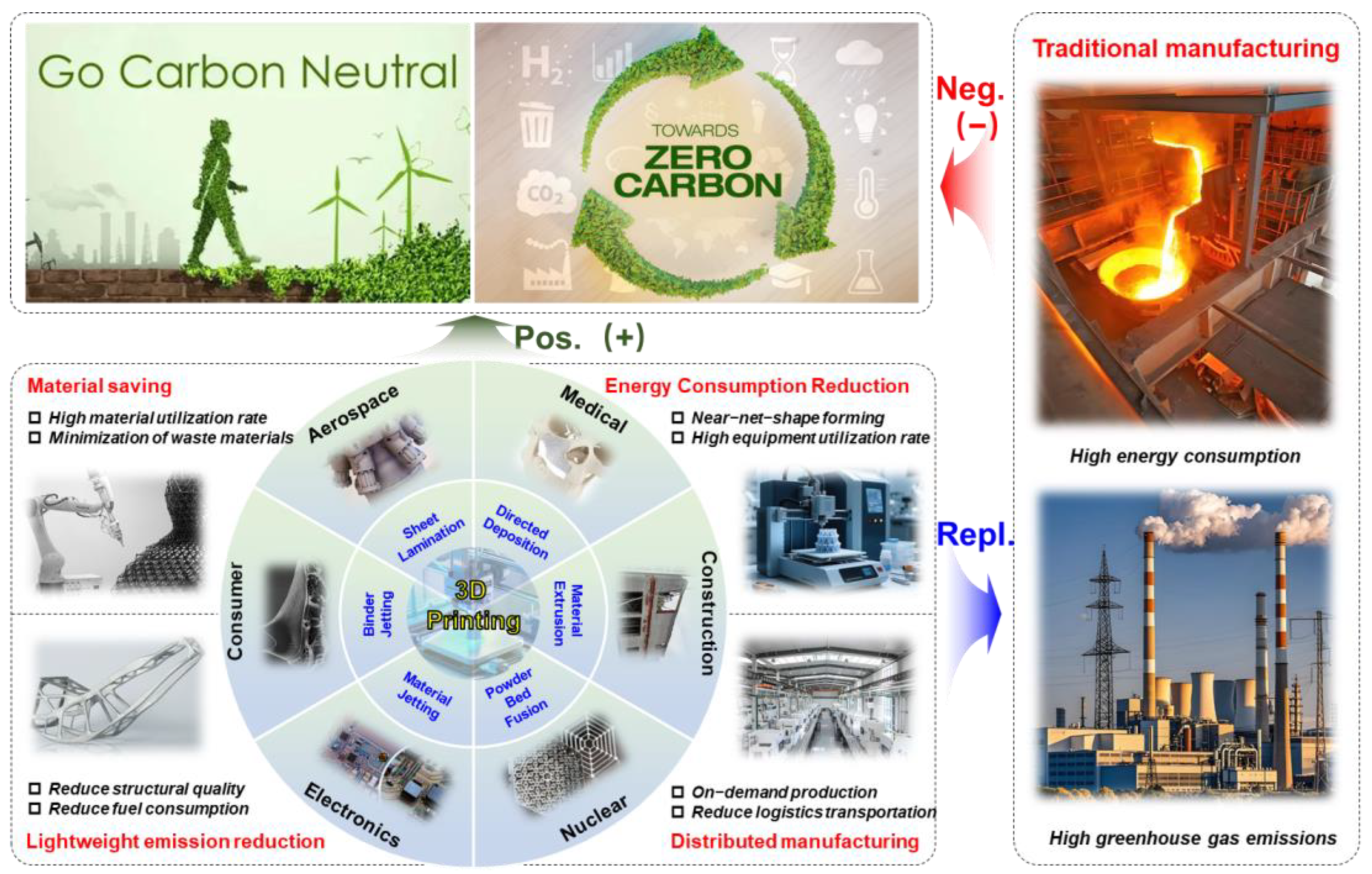
3D printing has rapidly emerged as an environmentally friendly manufacturing technology. It supports coordinated economic and ecological development, enhances sustainability performance, and promotes high-quality growth in the manufacturing sector [14]. Therefore, the 3D printing industry aligns closely with the core principles of the “Dual Carbon” goals [15], which can be reflected in the following four aspects, as shown in Figure 1.
Figure 1. Overview of 3D printing classification, applications, and their advantages for achieving “Dual Carbon” goals. (Note: Pos., positive effect; Repl., replacement of traditional processes; Neg., negative effect.).
(i) Material-saving effect: As an AM technology, 3D printing follows precise digital instructions to deposit material exactly where required. This eliminates the inherent waste of subtractive methods, which remove substantial material to form a part [16]. Taking metal 3D printing as an example, companies such as Xi’an Bright Laser Technologies Co., Ltd. (BLT) (Xi’an, China) have improved powder utilization rates to over 95% through integrated forming processes. This significantly exceeds the 60–70% material utilization typical of traditional manufacturing [17]. In another case, KOCEL group, Ltd. (KOCEL) has employed sand mold 3D printing technology to replace conventional wooden or lost-foam patterns, shortening the model fabrication cycle by 30 days and significantly reducing material consumption [18].
(ii) Energy consumption reduction effect: 3D printing reduces energy consumption by streamlining production processes and optimizing process parameters. On one hand, its near-net-shape manufacturing capability minimizes the need for subsequent machining requirements, thereby lowering overall energy usage. On the other hand, energy efficiency can be further enhanced by optimizing printing paths and process parameters [19]. For instance, a collaborative case between KOCEL and SIEMENS Energy demonstrated that algorithmic optimization of printing paths achieved a 21.8% reduction in total emissions for the production of a single complex component. Additionally, the retrofitting of waste heat recovery systems in microwave drying equipment reduced the carbon footprint of each batch of sand cores by approximately 8.7% [20].
(iii) Lightweight emission reduction effect: 3D printing enables the fabrication of complex lightweight structures that are difficult to produce with traditional manufacturing processes. Through topological optimization to eliminate redundant material, it achieves significant weight reduction of 3D printing components [21]. For example, in a collaboration between BLT and Haptron Scientific (Shenzhen) Co., Ltd., topological optimization reduced the weight of robotic parts by 20–30%, thereby lowering production energy consumption and associated carbon emissions [22]. In aerospace, lightweight components cut fuel consumption during use, thereby achieving carbon reduction benefits over the product’s full life cycle [23].
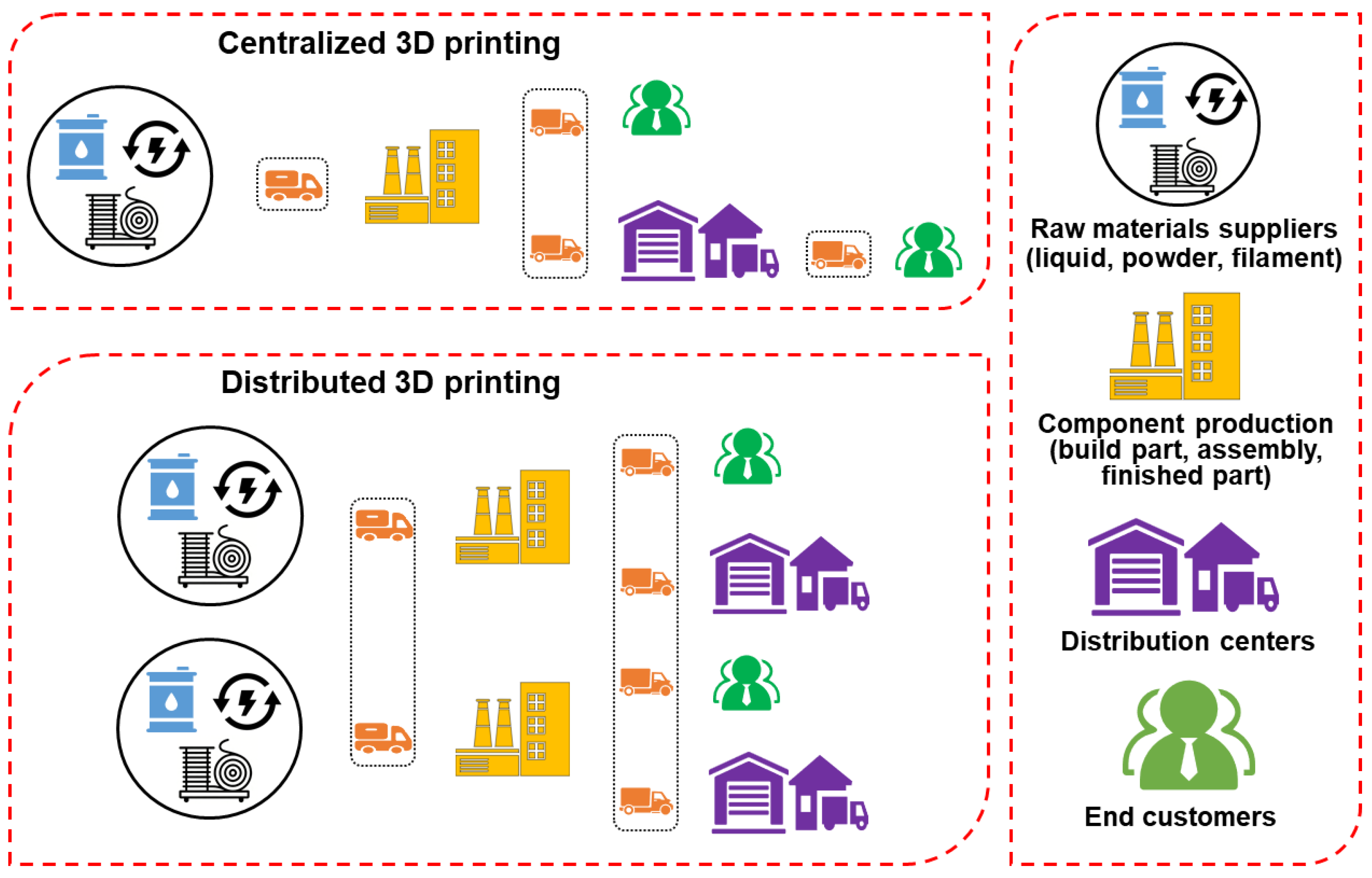
(iv) Emission reduction effect through distributed manufacturing: 3D printing is transforming manufacturing, shifting it from centralized, large-scale production to localized, flexible, and collaborative green systems. Firstly, on-demand production reduces inventory stockpiling and resource waste. Secondly, distributed manufacturing enables components to be printed locally near end-users, significantly reducing transportation energy consumption and associated carbon emissions. Concurrently, remote collaboration based on digital twin and cloud manufacturing platforms diminishes energy consumption associated with prototype trial production and mold development [24]. For example, the ‘Digital Parts Warehouse’ system, co-established by Hewlett-Packard (HP) and Daimler, enables on-demand production and zero-inventory supply of automotive components through 3D printing. This approach reduces carbon emissions from production processes by approximately 25% [25].
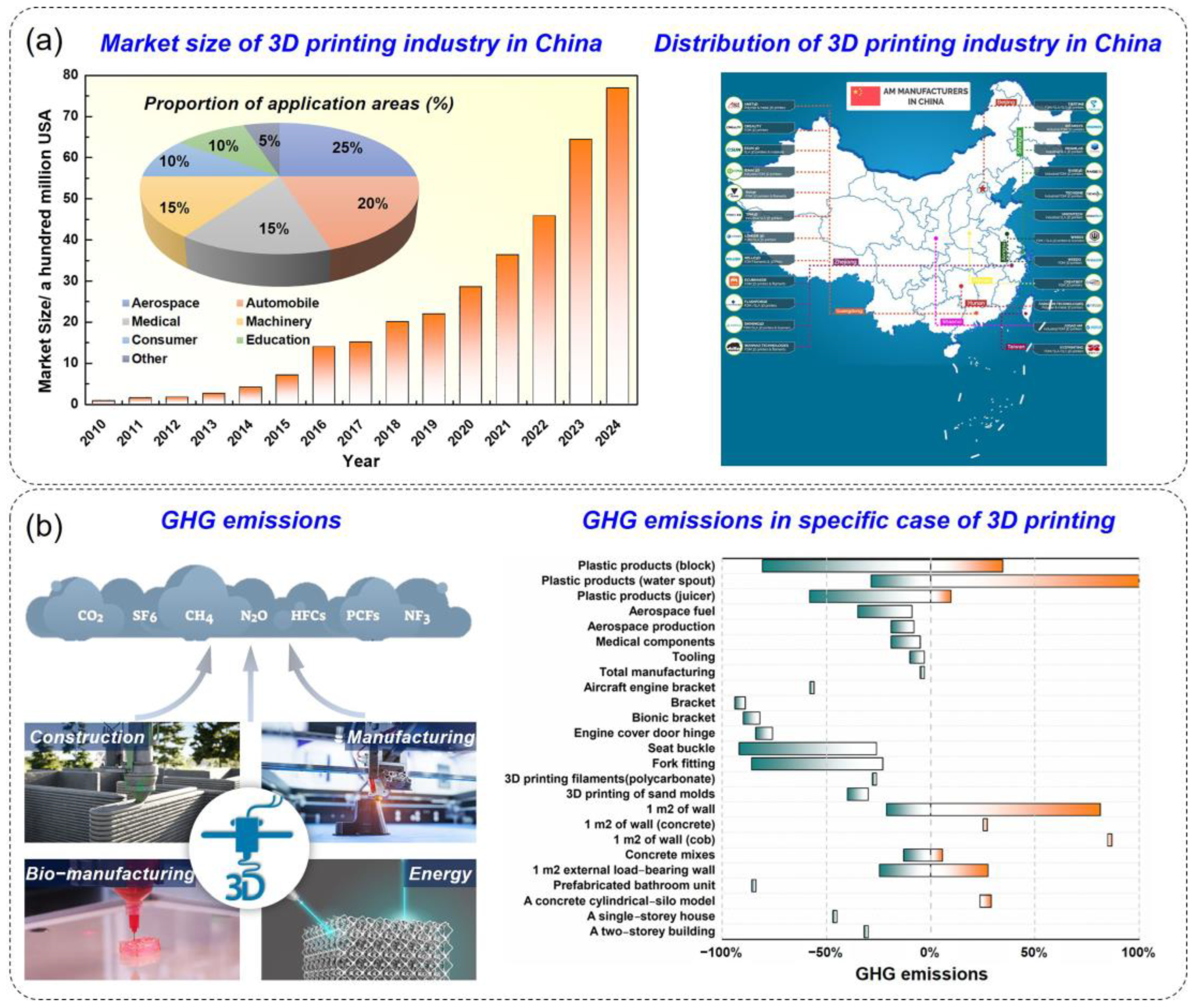
Currently, China’s 3D printing industry is experiencing a period of rapid expansion. Market analyses indicates that the global 3D printing market reached US $28.5 billion in 2024 and is projected to exceed US $88 billion by 2030, suggesting that the industry is entering a golden period of accelerated growth. Although China entered the field relatively late, it has expanded rapidly, with the market size surpassing US $7 billion in 2024. The industry activity is predominantly concentrated in China’s eastern regions (Figure 2a). Furthermore, 3D printing has been identified as a key development priority at the national policy level. In 2013, 3D printing was included for the first time in the “National High-Tech Research and Development Program of China (863 Program)” and the “2014 Candidate Project Guide for Manufacturing Sector” in “National Sci-Tech Support Plan of China”. Moreover, starting in March 2025, the ‘Catalogue of Imported Crucial High-Tech Equipment and Products Not Exempted from Tax’ included industrial-grade 3D printing equipment for the first time. This reflects the national commitment to strengthening independent innovation in the 3D printing industry.
Figure 2. (a) Market size (unit: billion USD) and geographical distribution of China’s 3D printing industry in 2024. (b) Comparative greenhouse gas emissions (CO2 equivalent) from the application of 3D printing in manufacturing and construction sectors.
However, the large-scale expansion of the 3D printing industry and its green transition are not inherently synchronized. Currently, the carbon savings from 3D printing in these areas are largely evidenced at the level of technological validation and exemplary industry cases. Therefore, these benefits remain most apparent in the foundational principles of the technology and the benchmark applications pioneered by leading firms. In fact, previous studies [26] have shown that the application of 3D printing technology in the manufacturing and construction sectors can also generate significant carbon emissions (Figure 2b). To transform the theoretical green potential of 3D printing into a practical advantage that supports China’s “Dual Carbon” strategy, the entire industrial ecosystem still faces considerable challenges. On one hand, the explosive market growth, if lacking guidance from green standards, carries the risk of being accompanied by low-level redundant construction and inefficient use of energy and materials. On the other hand, current policy support mainly targets technological research and development and market promotion. Complementary systems, such as full life-cycle carbon footprint assessment, green material certification standards, and environmental supervision frameworks, remain underdeveloped. As a result, the current development of the 3D printing industry is largely driven by market dividends rather than by an inherent, self-sustaining momentum for sustainable development.
Therefore, under the “Dual Carbon” goals, China’s 3D printing industry still faces numerous challenges on its path toward sustainable development. From a policy perspective, the top-level design for guiding green industrial transformation remains insufficient. There is a lack of scientific and unified methods and standards for assessing the full life cycle carbon footprint. Moreover, a comprehensive legal framework for environmental supervision is not yet in place. From a technological perspective, the development of low-carbon material systems lags behind, and breakthroughs in energy efficiency optimization technologies and key core components remain difficult to achieve. Accordingly, this study systematically explores the sustainable development pathways and low-carbon strategies of China’s 3D printing industry. It focuses on two dimensions: policy optimization and technological innovation. The study aims to provide both theoretical insights and practical guidance for promoting the industry’s green transition. The main contribution of this study is to provide theoretical insights and practical guidance for facilitating the green transition of 3D printing industry.

2. Methodology

This study employed a systematic review approach. Source selection was conducted across multiple databases, such as Web of Science, Scopus, ScienceDirect, SpringerLink, IEEE Xplore, and Google Scholar, for documents published between 2010 and 2025. Publisher platforms such as Nature and Elsevier were also accessed to verify or supplement information when necessary. A set of keywords, combined with Boolean operators (AND/OR), was utilized to retrieve the most pertinent literature in the field. Key terms included “3D printing”, “additive manufacturing”, “carbon neutrality”, “dual carbon”, “low-carbon manufacturing”, “sustainability”, “policy analysis”, “life cycle assessment”, and “environmental performance”. Two reviewers independently screened articles by evaluating titles and abstracts against predefined inclusion criteria. From an initial pool of 316 records, 92 articles were identified for full-text review. Eligible materials consisted of peer-reviewed journal papers, official policy documents, standards, and authoritative industry reports. Publications were required to address sustainability, low-carbon development, or policy frameworks related to 3D printing, and to provide empirical evidence, comparative analysis, or methodological contributions concerning emission reduction or industrial transition. Non-academic commentary, news articles, promotional content, studies unrelated to sustainability aspects of 3D printing, or sources lacking methodological clarity were excluded.
Employing a qualitative approach, a thorough thematic analysis was performed on the selected literature to derive key findings and insights, facilitating a deeper understanding of the current state of research in the field. The process involved identifying recurring themes, such as energy efficiency, material recycling, carbon footprint assessment, policy incentives, and ecosystem coordination. These themes are integrated into broader categories corresponding to the three pillars of sustainability: resource efficiency, environmental performance, and socio-economic value. Cross-regional patterns were then synthesized to develop an integrated analytical model describing the green transition of the 3D printing industry.
Subsequently, the extracted information was logically structured into coherent sections, and connections among the various concepts were mapped and articulated. Each included article underwent a critical quality assessment, examining its relevance to the research focus, methodological rigor, and the reliability of referenced sources. To ensure the authenticity of the results, a thorough validation procedure was used, which included cross-referencing data from several sources, depending on credible journals and conference proceedings, and carefully examining and addressing any differences.
To construct the comparative policy–technology mapping, a structured comparative framework was developed. This framework allowed the evaluation of national policies and technological developments in terms of their strategic orientation, level of standardization, innovation trajectory, and degree of industrial ecosystem coordination. This systematic approach enables cross-country comparison in a traceable and reproducible manner.

3. Embedding Sustainability into 3D Printing: A Process Flow Perspective

3.1. Sustainability Pillars for 3D Printing

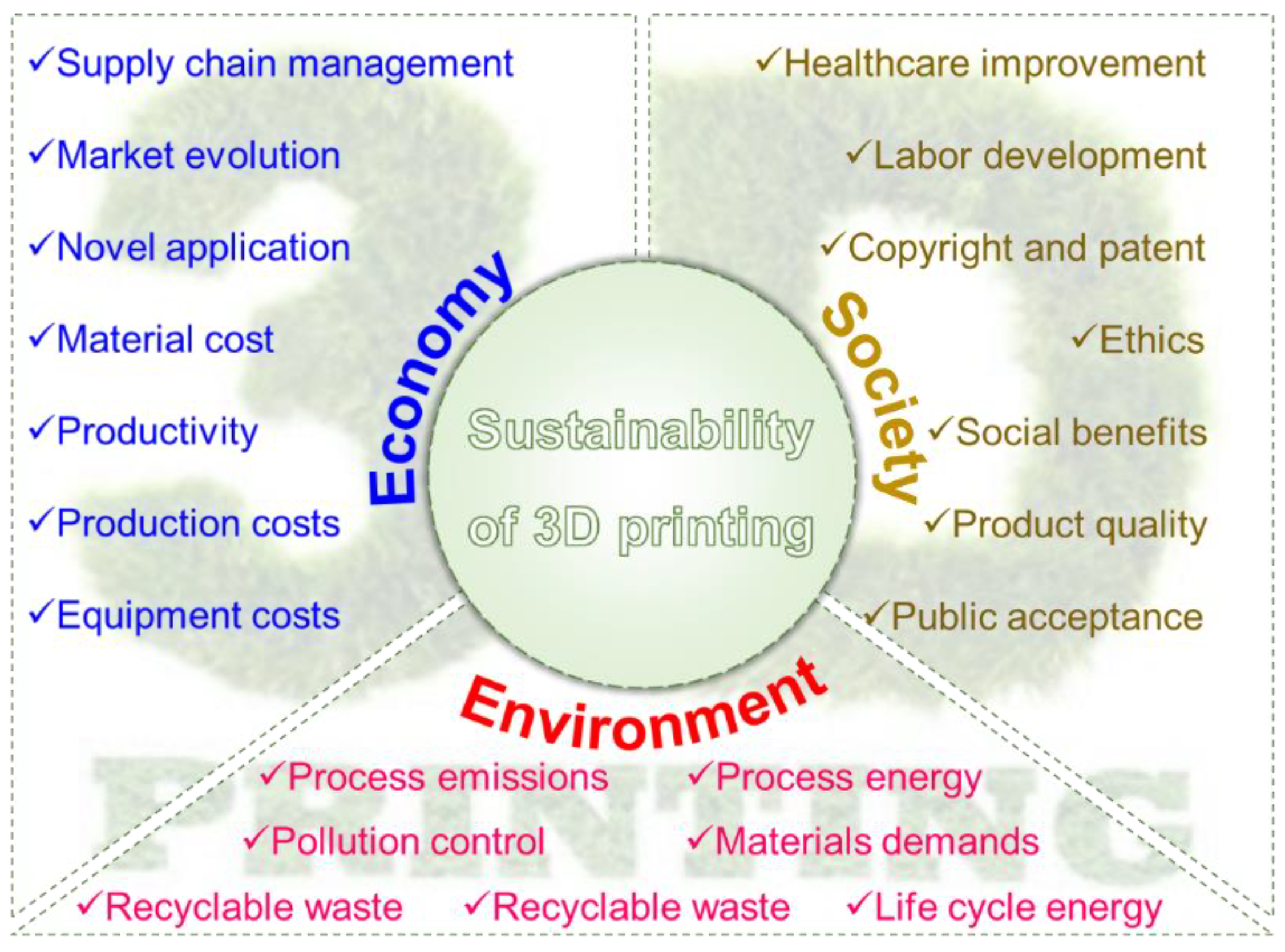
Under the industrial transition guided by the ‘Dual Carbon’ goals, 3D printing serves as a representative green manufacturing technology. It embodies a multifaceted concept of sustainability, which can be understood through three key pillars: the resource efficiency pillar, the environmental performance pillar, and the socio-economic pillar [27]. These three pillars are interdependent and mutually reinforcing. Together, they form a systematic framework that guides the 3D printing industry toward low-carbon, circular, and high-quality sustainable development (Figure 3).
Figure 3. Sustainability assessment system for 3D printing based on economic, social, and environmental dimensions.
(i)
Resource efficiency pillar
The resource efficiency pillar emphasizes the optimization of resource utilization across materials, energy, and logistics [27]. In the 3D printing process, precise digital design and deposition-based manufacturing place material only where necessary. This significantly improves material utilization and reduces the embodied carbon emissions from raw material extraction and processing. Three-dimensional printing enables distributed manufacturing, on-demand production, and localized printing. This approach minimizes the resource waste and emissions associated with long-distance transport, inventory maintenance, and scrap material processing. Fundamentally, the resource efficiency pillar embodies the principle of “using less, using appropriately, and using precisely,” providing a pathway for the manufacturing industry to achieve the goal of reduced material usage.
(ii)
Environmental performance pillar
The environmental performance pillar assesses the impacts of both the manufacturing process and the product’s full life cycle. It covers energy use, carbon emissions, as well as waste and emissions management [28]. In 3D printing applications, near-net-shape fabrication, fewer post-processing steps, lightweight structural design, and the use of recycled and reusable materials all help lower carbon emission intensity. They also enhance environmental benefits per unit of output. Furthermore, the carbon reduction contributions from 3D printing can be quantified using methods like carbon footprint accounting and Life Cycle Assessment (LCA). This involves evaluating impacts at each stage: raw material acquisition, manufacturing, product use, and recycling. This renders environmental performance serving as a key indicator for assessing the degree of green transition in the 3D printing industry.
(iii)
Socio-economic pillar
The socio-economic pillar emphasizes that industrial development must be not only environmentally sustainable but also economically viable and socially acceptable [29]. This involves promoting the structural optimization and upgrading of the industry, enhancing enterprise competitiveness. It also fosters employment and skill development, and promoting industrial chain collaboration and regional manufacturing ecosystems. In the 3D printing industry, an excessive focus on carbon reduction without considering cost, quality, or market adaptability may lead to a “green but ineffective” dilemma. Therefore, the socio-economic pillar requires that 3D printing technologies demonstrate feasibility in terms of cost-effectiveness, quality reliability, industrial scalability, and ecosystem coordination. Genuine sustainable development for the 3D printing industry under the “Dual Carbon” goals can only be achieved when industrial policies, technological innovation, and market applications form a virtuous, interactive cycle.
In summary, these three pillars constitute the three-dimensional framework of the green transition of the 3D printing industry [30]. They are distinct yet deeply interconnected. Resource efficiency provides the foundation for environmental performance. Environmental performance, in turn, reinforces socio-economic value. Socio-economic success creates institutional and market incentives that further enhance both resource efficiency and environmental performance. Integrating this three-pillar system into the development pathway of the 3D printing industry facilitates the identification of coupling mechanisms among technological evolution, policy design, and market application from a macro perspective. Under the dual forces of policy optimization and technological innovation, this framework drives synergistic improvements in resource efficiency, environmental performance, and socio-economic development. It enables the low-carbon, circular, and intelligent transformation of the 3D printing industry.

3.2. Enriching 3D Printing Sustainability: Process Flow

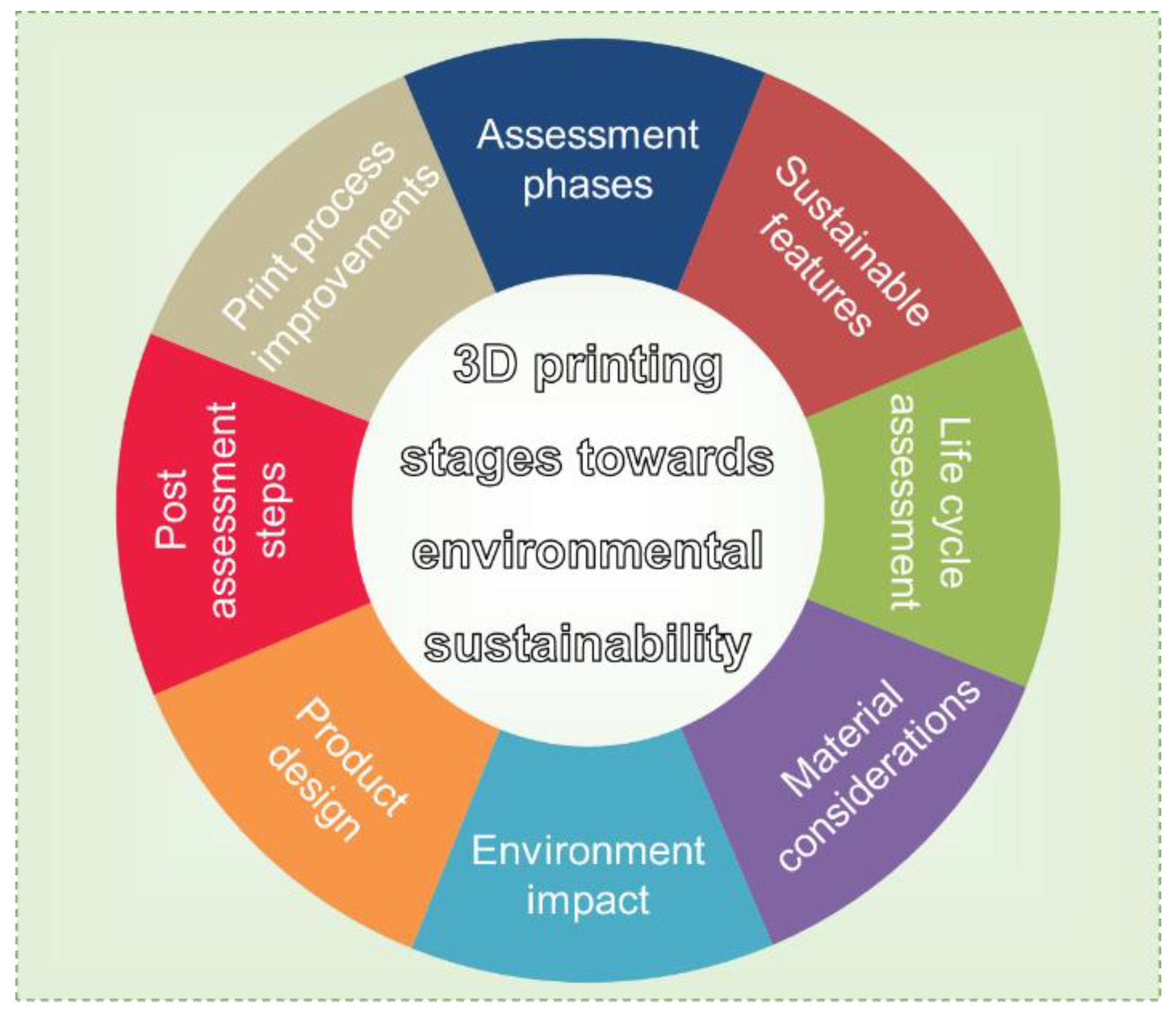
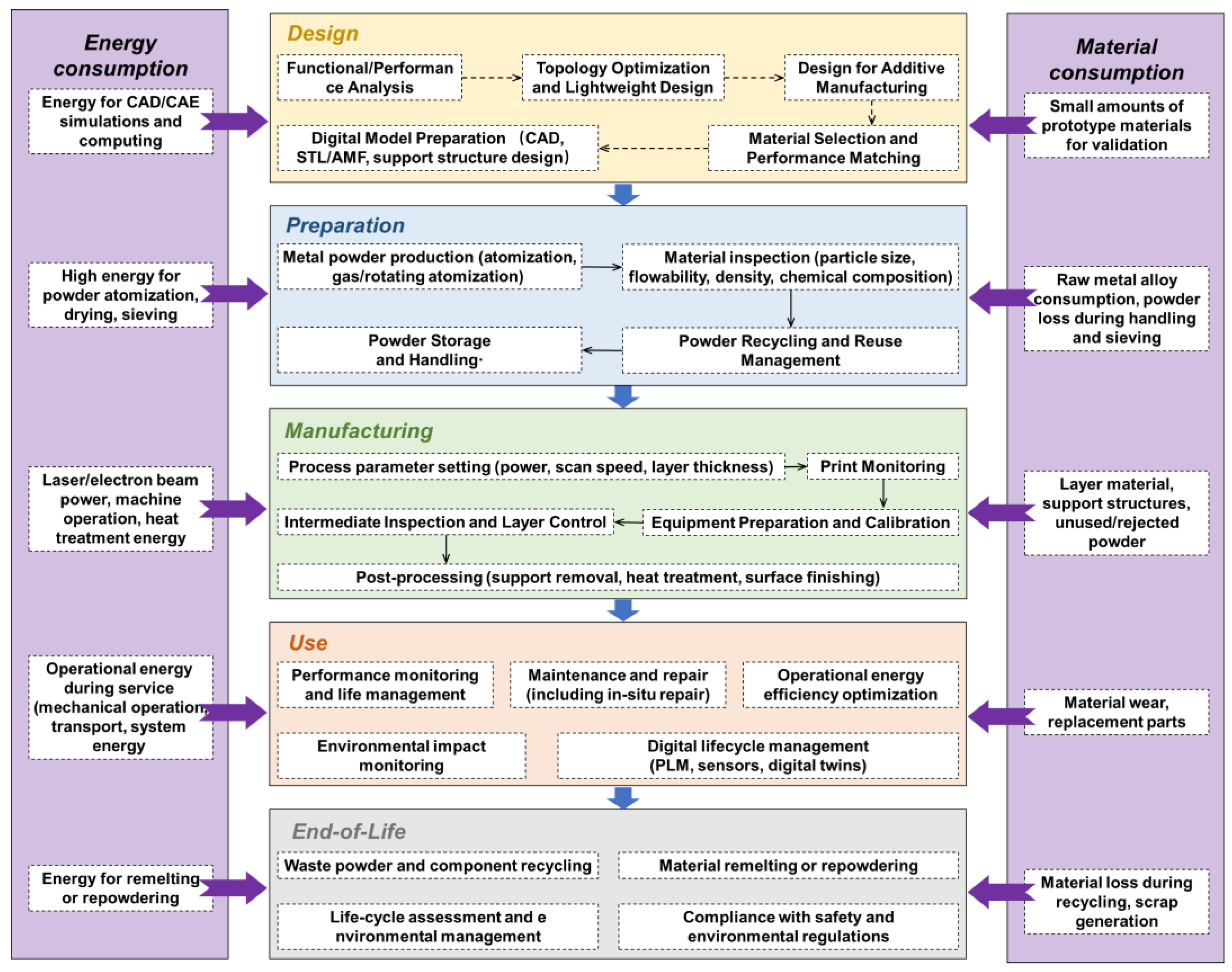
To further implement the aforementioned three-dimensional framework, it is essential to examine the 3D printing process from technological and procedural perspectives. This involves identifying critical stages in typical 3D printing workflows and embedding sustainability mechanisms into each stage [31]. This approach highlights the systemic value of 3D printing technology in achieving the “Dual Carbon” goals. Based on the typical process flow illustrated in Figure 4, the 3D printing life cycle can be divided into six major stages: design → material preparation → printing fabrication → post-processing and integration → product use and service → recycling and reuse [32]. The following sections elaborate on how each stage embodies the three sustainability pillars.
Figure 4. The main process flow of 3D printing for practicing environmental sustainability.
(i)
Design
In the design stage, technologies such as digital modeling, topology optimization, and generative design enable structural lightweighting and minimization of material redundancy at the conceptual stage [33], thereby directly enhancing the resource efficiency. Meanwhile, digital simulation enables the prediction of energy consumption, carbon emissions, and product life cycle. This embeds environmental performance considerations into the design phase. From a socio-economic perspective, integrating internet-based platforms, digital twins, and collaborative design tools facilitates interaction across the industrial chain. It also lowers barriers to entry, thereby contributing to socio-economic development.
(ii)
Material preparation
The material preparation stage encompasses the supply of powders or raw materials (metal, polymer, or composite), as well as the crushing, cleaning, and reprocessing of recycled materials. By adopting high-utilization powders and recycling–reuse systems, this stage can significantly enhance material efficiency and reduce the consumption of virgin resources [34], thereby increasing the resource efficiency. Furthermore, employing low-carbon powder production processes and utilizing biodegradable or bio-based materials can directly improve environmental performance [35]. If this stage establishes localized or distributed supply chains at this stage cuts the carbon emissions associated with transportation and storage. From a socio-economic perspective, it also increases the flexibility and resilience of manufacturing networks.
(iii)
Printing fabrication
In the printing stage, digital control ensures that material is deposited only where needed, thereby avoiding the substantial waste typical of traditional subtractive manufacturing and enhancing resource efficiency. At the same time, techniques such as print path optimization, algorithmic control [36], and energy-efficiency monitoring can reduce energy consumption and carbon emissions during the printing process, improving environmental performance. From a socio-economic perspective, 3D printing allows for small-batch, on-demand, and customized production. This approach opens new growth opportunities for small and medium-sized enterprises, while driving employment restructuring and industrial upgrading.
(iv)
Post-processing and integration
As 3D printing is completed, the products usually require post curing, heat treatment, surface treatment, assembly, and other post-processes. Optimizing these post-processing workflows, such as waste heat recovery, microwave drying, and automated cleaning, can further reduce energy consumption and material waste [37], thereby enhancing environmental performance. In terms of resource efficiency, minimizing rework, improving yield rates, and using easily recyclable support structures helps reduce material losses. From a socio-economic perspective, automation and process integration in post-processing can improve overall production efficiency, shorten cycles, reduce costs, and enhance industrial competitiveness.
(v)
Product use and service
Although product use and service belong to the usage phase, they are closely related to the manufacturing process. Lightweight design and functional integration implemented during manufacturing can reduce energy consumption during the product’s service life (e.g., in vehicles, aerospace components, and machinery) [19], thereby enhancing environmental performance across the full life cycle. Resource efficiency is also reflected in this process; lighter and more efficient products imply reduced energy consumption and lower material usage. From a socio-economic perspective, user customization and servitization models (e.g., on-demand printing, replacement of components instead of entire products) can extend product lifespan, reduce resource consumption, and promote a circular economy.
(vi)
Recycling and reuse
Recycling and reuse represents the final stage of the product life cycle, focusing on product disposal, recovery, and remanufacturing [38]. If 3D printing establishes a closed-loop material recycling system and achieves a high proportion of remanufacturing, it can significantly enhance resource efficiency. Moreover, reusing modules, reprocessing powder waste, and reprinting components reduces the carbon emissions associated with the extraction and smelting of virgin materials. These practices improve environmental performance. From a socio-economic perspective, this stage creates value in multiple ways. It fosters new business models within the recycling supply chain, extends maintenance services, and promotes circular practices. Together, these initiatives drive the diversified growth of both employment and industries.
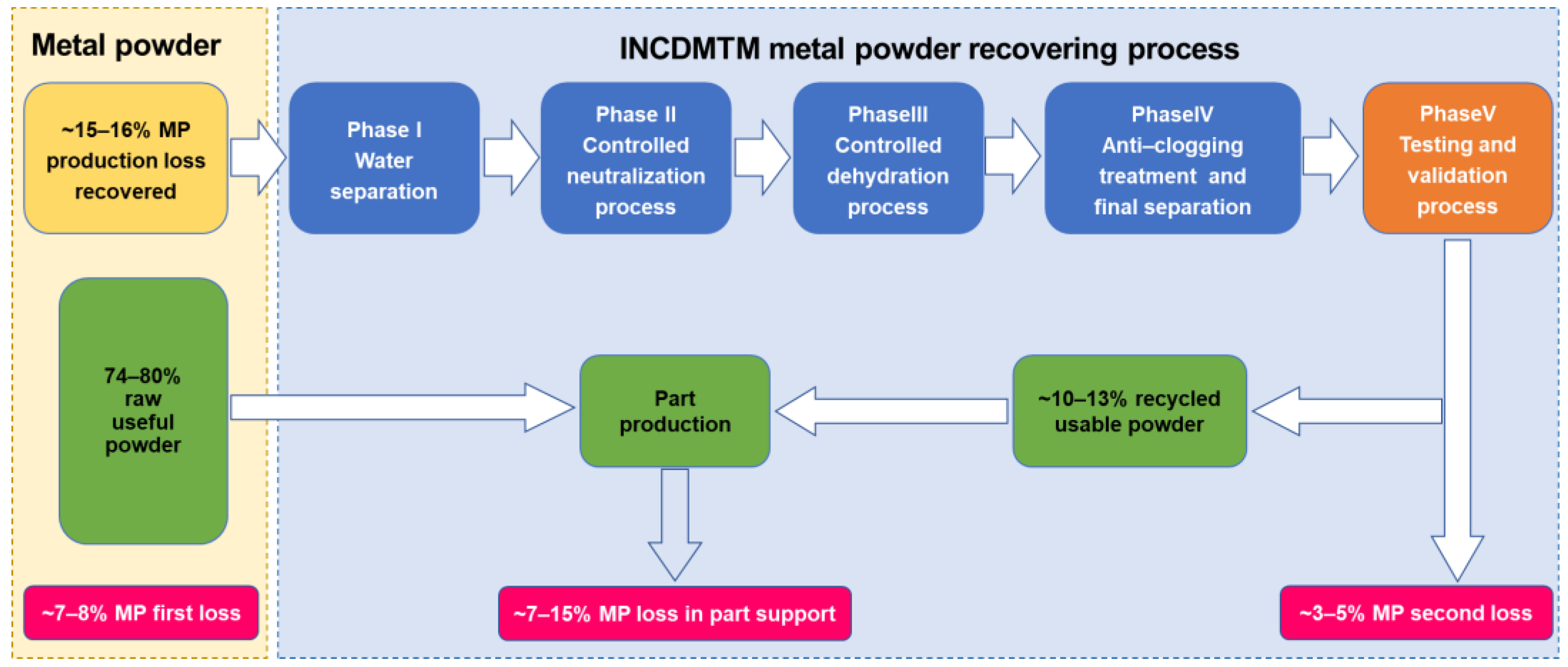
Accordingly, the most significant environmental burdens arise during three specific phases. The material preparation stage, particularly metal powder atomization and alloy refining, generates the highest level of embodied emissions due to its energy-intensive metallurgical processes. During the fabrication stage, laser- and electron-beam-based melting further contribute substantial energy consumption, making the printing process itself another major hotspot. Post-processing operations, including heat treatment, machining, and surface finishing, introduce additional energy requirements and thus amplify the overall environmental impact. In contrast, the design and end-of-life recycling stages typically impose comparatively low burdens.
The workflow constructed through the six stages described above represents not merely a sequence of technical operations but also the pathway for 3D printing to practice the concept of green manufacturing principles and achieve the “Dual Carbon” goals. Resource efficiency is embedded from the design and preparation stage and extends throughout the material selection, manufacturing, and post-processing stages. Environmental performance is systematically reflected in material choice, process optimization, product lifespan extension, and closed-loop recycling. Socio-economic value is continuously generated across the process via industrial structure upgrading, on-demand production and service models, and new circular economy business models. Consequently, this “3D printing process–pillar mapping” model provides a clear procedural reference for policy optimization and technological innovation. Governments can establish policy incentives, standards, and financial support at each stage. Enterprises and research institutions can invest in technological innovation, digital management, and ecosystem coordination across materials, equipment, processes, and recycling. By clearly delineating this workflow, policy gaps and technological bottlenecks can be directly identified at each stage, thereby providing targeted recommendations for implementation pathways.
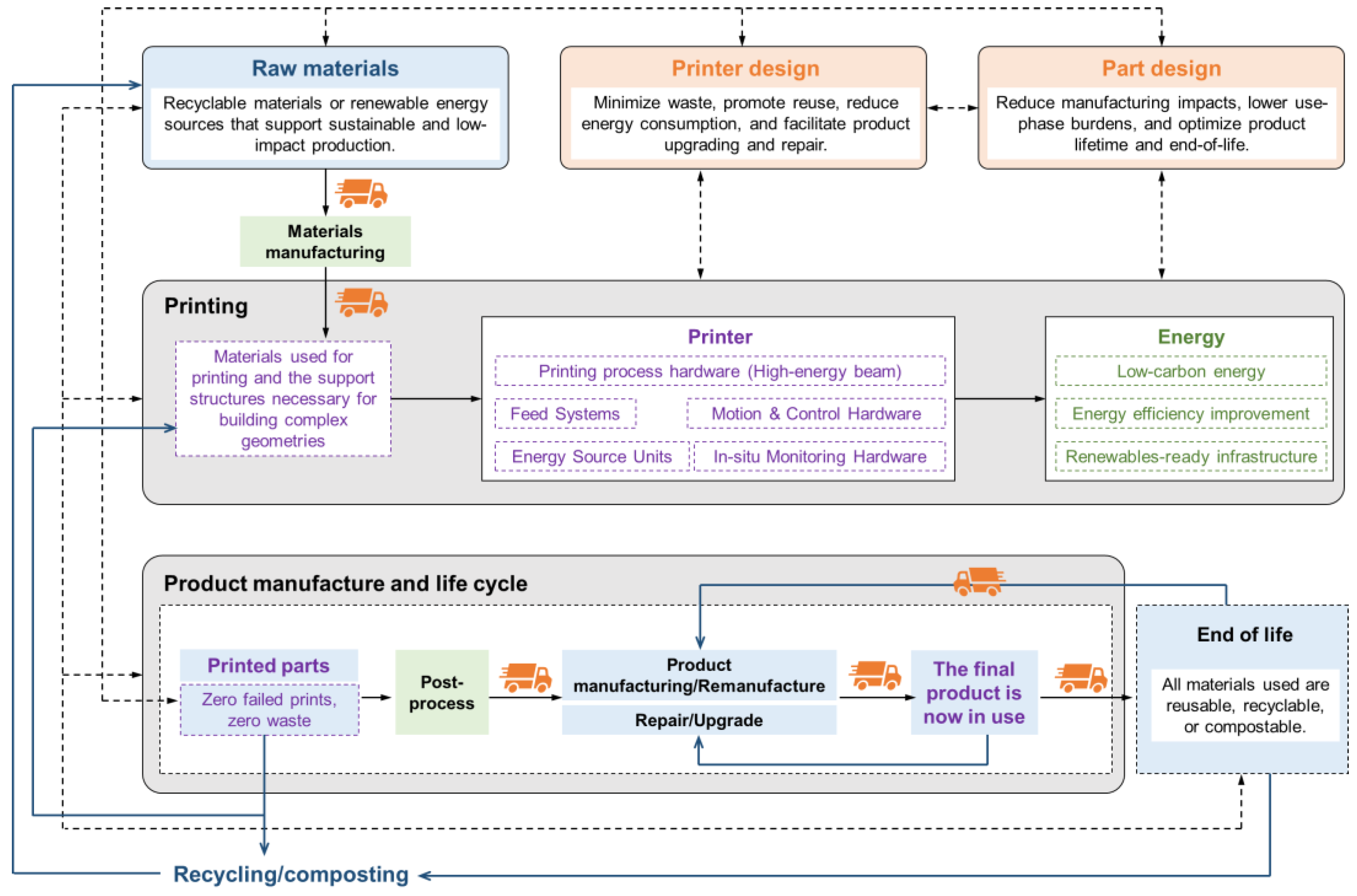
Taking metal 3D printing as an illustrative case, Figure 5 maps the environmental and resource impacts across the entire life cycle. This includes product design, metal powder and wire production, component fabrication, post-processing, part assembly, product use, recycling, and end-of-life management. By visualizing the flows of material inputs and multi-source energy consumption at each stage (shown on the left and right side of Figure 5), the diagram highlights the material efficiency, energy demand patterns, and waste generation. This life-cycle view reinforces the earlier analysis. Three-dimensional printing provides benefits in material utilization, near-net-shape fabrication, and lightweight design. Yet, environmental performance depends heavily on material preparation, energy-intensive melting and post-processing, logistics, and recycling pathways. Consequently, evaluating the long-term energy and environmental impacts of 3D printing technologies requires a holistic and standardized life-cycle framework, rather than process-level comparisons alone [38]. Such a full-spectrum assessment is essential for accurately identifying the carbon-reduction potential of AM and for guiding policy design, technological innovation, and industrial ecosystem coordination under China’s “Dual Carbon” goals.
Figure 5. A life-cycle perspective on metal 3D printing.

4. Comparative Analysis of Domestic and International Development of 3D Printing Industry Under the “Dual Carbon” Goal

Under the “Dual Carbon” goal, countries worldwide have incorporated 3D printing into national green industrial development strategies. As the three major global economies, China, the European Union, and the United States link their carbon neutrality commitments with strategies to enhance manufacturing competitiveness. They integrate 3D printing technologies into their green industrial policy frameworks [39]. However, differences in political systems, economic structures, and environmental governance philosophies have led these three economies to adopt distinct pathways for promoting sustainable 3D printing [40]. These varied policy and technology approaches affect not only domestic sustainable development but also global green technology competition and climate governance [41].

4.1. Policy Optimization and Institutional Support

4.1.1. China: Strategic Guidance and Industrial Support

China has adopted a systematic strategy combining national strategic guidance, standard system support, and industrial integration to steer the green transition of the 3D printing industry. (i) Construction of a carbon standard measurement system. China has intensively rolled out a series of standardization policies, such as the “Action Plan for the Establishing a Standard and Measurement System for the Carbon Peak and Carbon Neutrality” [42]. This initiative aims to establish a unified carbon accounting framework encompassing enterprises, projects, and products. The value of this system lies in providing a standardized benchmark. It supplies a basis for quantifying the carbon benefits of 3D printing and for comparing the environmental performance across different manufacturing processes. (ii) Policy guidance and industrial coordination. At the national level, policies such as the “Guiding Opinions on Promoting High-Quality Development of the Casting and Forging Industries” explicitly identify sand-based 3D printing as a key technology for driving green transition and set concrete emission reduction targets [43]. At the local level, policies such as demonstration projects, equipment subsidies, and green finance instruments encourage enterprises to adopt low-carbon, sustainable 3D printing technologies. These measures create a coordinated policy environment that facilitates industry-wide adoption. (iii) Promote the establishment of mandatory standards. In 2024, four ministries and commissions, including the Ministry of Industry and Information Technology, the Ministry of Ecology and Environment, the Ministry of Emergency Management, and the Standardization Administration of the People’s Republic of China, jointly issued the “Action Plan for Standards Advancement to Guide the Optimization and Upgraded of the Raw Materials Industry (2025–2027)” (hereinafter referred to as the “Plan”). This plan aims to guide the raw materials industry towards high-end development, structural rationalization, greening, digitalization, and safe development through standard enhancement [44]. Notably, advanced 3D printing materials, as one of the frontier new materials, are included in the new material’s standard innovation project. According to the Plan, during the 2025–2027 period, the raw materials industry will issue and implement over 200 digital transformation standards and more than 100 green low-carbon standards. By 2027, the initiative aims to promote more than 10 mandatory national standards projects and revise over 500 foundational and general and quality-improvement standards. The formulation and implementation of these standards will provide clear guidance and regulatory requirements for the green and low-carbon development of 3D printing materials [45].

4.1.2. The European Union: Integrated Regulation Centered on Green Transition

To drive the green transition of the 3D printing industry, the European Union has established a policy framework that balances regulation and incentives. Its core objective is to achieve synergy between environmental goals and industrial competitiveness through precise policy adjustments [46]. (i) Simplified Compliance and Targeted Exemptions. The “EU Omnibus Simplification Package” proposed by the European Commission serves as a key initiative [47]. The scheme raises the threshold for mandatory corporate sustainability reporting, exempting about 80% of small and medium-sized enterprises (SMEs). This significantly reduces the compliance burden on SMEs in the 3D printing sector. Meanwhile, through phased implementation with transitional relief measures and voluntary disclosure requirements, the EU seeks to strike a balance between maintaining environmental objectives and reducing pressure on businesses. (ii) Standard Development and Institutional Framework. Under the “Clean Industrial Deal (CID)” framework [48]. The European Union is establishing standards and labeling systems for climate-neutral products. This enhances market recognition and access for low-carbon 3D-printed products. The “Circular Economy Act” aims to promote the recycling and reuse of raw materials (such as metal powders) within the 3D printing industry. In addition, the EU has advanced the harmonization of carbon accounting methodologies at both national and international levels. Through the enactment of the “Industrial Decarbonization Acceleration Act”, the European Union seeks to make the carbon footprint of 3D-printed products measurable and comparable, thereby addressing the problem of multiple standards faced by enterprises. (iii) Green Procurement and Talent Development. Based on the “Green Public Procurement (GPP)” policy [49], the EU gives priority to climate-neutral products, including low-carbon 3D-printed items, in public tenders. This creates a stable initial market. Simultaneously, initiatives such as the ‘Union of Skills’ cultivate professionals skilled in both digitalization and sustainability, providing essential human capital for industrial transformation. (iv) Carbon Management Mechanisms: The European Union has established a landmark legal framework through its Carbon Border Adjustment Mechanism (CBAM). Serving as the European Union’s primary policy instrument against carbon leakage, CBAM is designed to prevent companies from relocating production to jurisdictions with less stringent climate regulations [50]. According to the latest provisions, CBAM’s charge implementation has been postponed from 2026 to 2027, including the carbon credit offset mechanism. The mechanism for offsetting carbon quotas purchased by enterprises has also been postponed until 2027. CBAM initially focuses on high carbon emitting industries such as steel and aluminum, but its scope of application will expand, which will have significant legal implications for companies using these materials for 3D printing.

4.1.3. United States: Balancing Technological Research and Development with Environmental Safety Regulation

Under the context of carbon neutrality, the United States has adopted a dual strategy that emphasizes both technological innovation and market-driven mechanisms to promote the sustainable development of 3D printing [51]. The policy framework emphasizes strong federal–state coordination and integrates technological research with market application. It focuses on guiding technological innovation through funding and incentives to achieve green, low-carbon manufacturing [52]. (i) Federal funding driving technological research and development. Federal agencies, such as the Department of Energy (DOE), serve as key enablers indirectly promoting the application of 3D printing technology in the clean energy field through large-scale research and development funding (such as approximately $780 million to support clean energy technologies). The Advanced Research Projects Agency–Energy (ARPA-E) supports frontier technologies such as bio-based materials, laying the groundwork for reducing the carbon footprint of 3D printing from the source [53]. (ii) Demand-Pull from Defense and Aerospace Sectors. Federal agencies such as the Department of Defense (DoD) and National Aeronautics and Space Administration (NASA) have implemented targeted procurement policies that create high-end demand for lightweight and high-performance 3D-printed components [54]. In defense applications, the demand for on-site, deployable 3D printing systems emphasizes not only portability and reliability but also energy efficiency and environmental adaptability. This demand pull encourages 3D printing equipment manufacturers to optimize energy use and develop more sustainable production processes. In the aerospace sector, 3D-printed lightweight components contribute directly to fuel savings during launch phases, achieving carbon reduction benefits across the product life cycle [55]. (iii) Environmental and safety regulation. The United States regulates chemical substances used in 3D printing materials through laws like the “Toxic Substances Control Act (TSCA)” and promotes the development of bio-based and recyclable materials [56]. Several states have introduced bans on toxic polymer powders [57]. Environmental organizations actively advocate for establishing recycling standards and closed-loop production models to address waste from support materials and failed printed products. At the federal level, tax incentives encourage companies to adopt energy-efficient equipment and renewable energy sources. Meanwhile, organizations such as ASTM and ISO are advancing the carbon accounting standardization for 3D printing, facilitating its integration into emerging carbon trading markets. Table 1 summarises the policies and institutional pathways for sustainable development of 3D printing industry in major countries (regions).
Table 1. Comparison of policies and institutional pathways for sustainable development of 3D printing industry in major countries (regions).

4.2. Technological Innovation and Emission Reduction Benefits

Driven by carbon neutrality goals, technological innovations in 3D printing are advancing across multiple dimensions, including materials, processes, digitalization, and industrial applications [15]. China, the European Union, and the United States have each achieved a series of breakthrough developments in these areas. By comparing global trends in green innovation within the 3D printing industry across multiple dimensions, this analysis provides insights for industrial policy and technological development strategies.

4.2.1. Material and Process Innovation

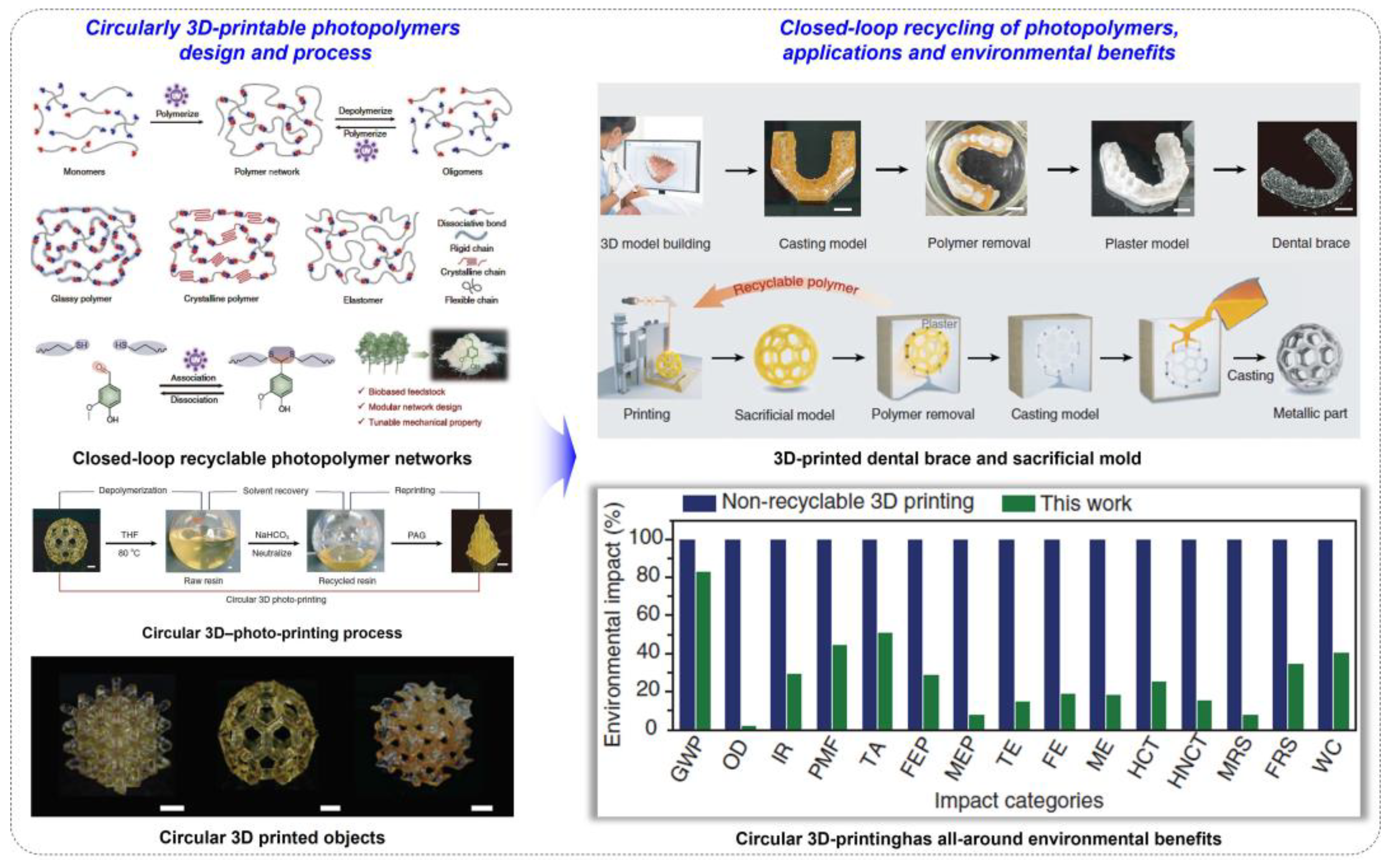
Material and process innovation serves as the core driving force for the sustainable development of 3D printing technology. Globally, China, the United States, and the European Union have developed distinctive research pathways in this field. Supported by programs such as the National Natural Science Foundation of China, Chinese research focuses on recyclable materials and green manufacturing processes [58]. Xie Tao et al. [59] at Zhejiang University developed a recyclable photocurable resin based on thiol-aldehyde click reaction, enabling full recyclability of 3D-printed polymers and significantly reducing both production costs and environmental burdens (Figure 6). Similarly, Fu Gu et al. [60] quantitatively analyzed the environmental performance of different 3D printing processes in PCB manufacturing. They found that CO2 emissions from the fused deposition modeling (FDM) process were only 40% of those from traditional PCB fabrication, while production costs dropped by 80%. This highlights FDM’s potential in energy conservation, emission reduction, and cost efficiency (Table 2).
Figure 6. Circular 3D printing of a recyclable photocurable resin based on thiol-aldehyde click reaction reducing both production costs and environmental burdens [59].
Table 2. Comparison of environmental and economic performance of different PCB manufacturing processes.
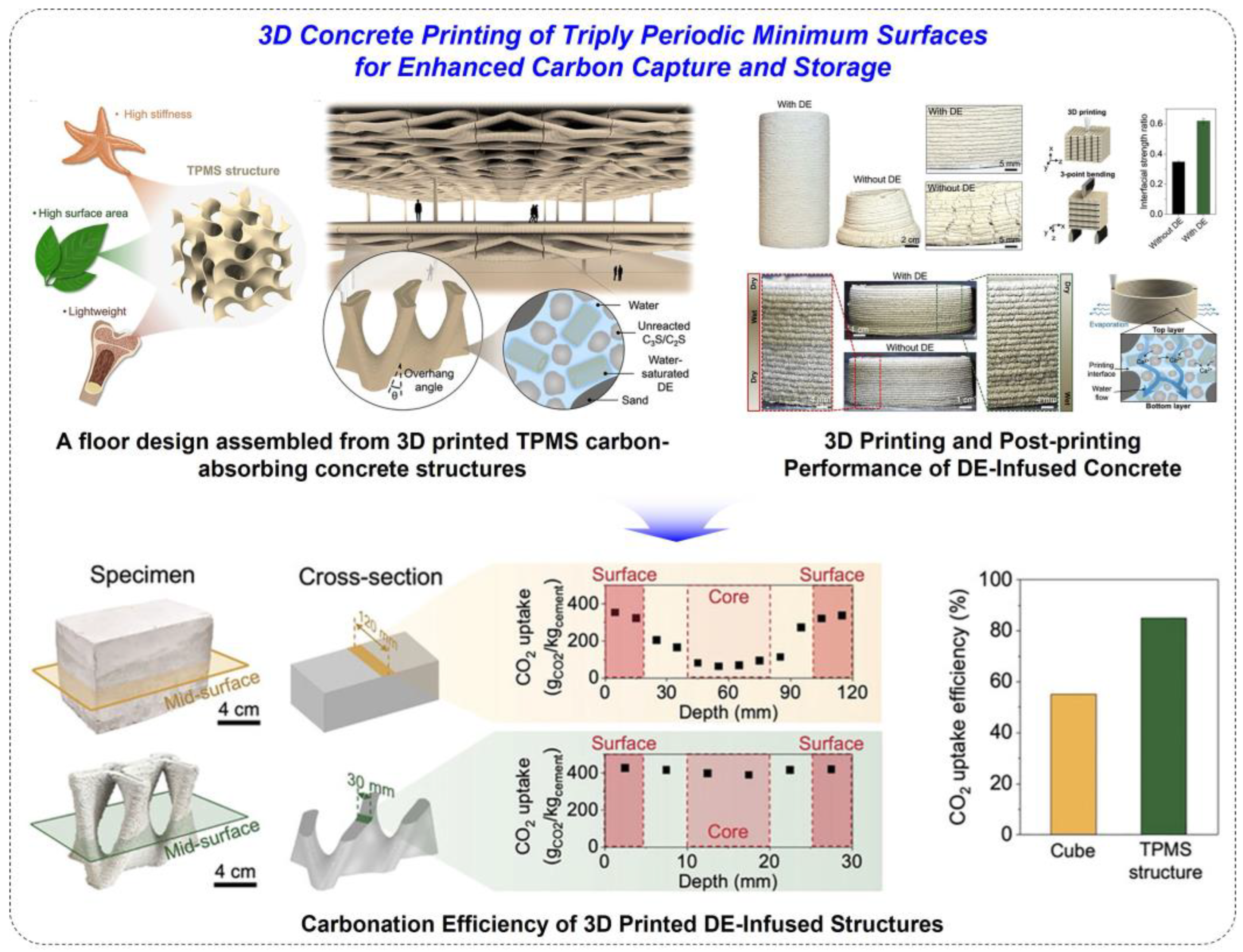
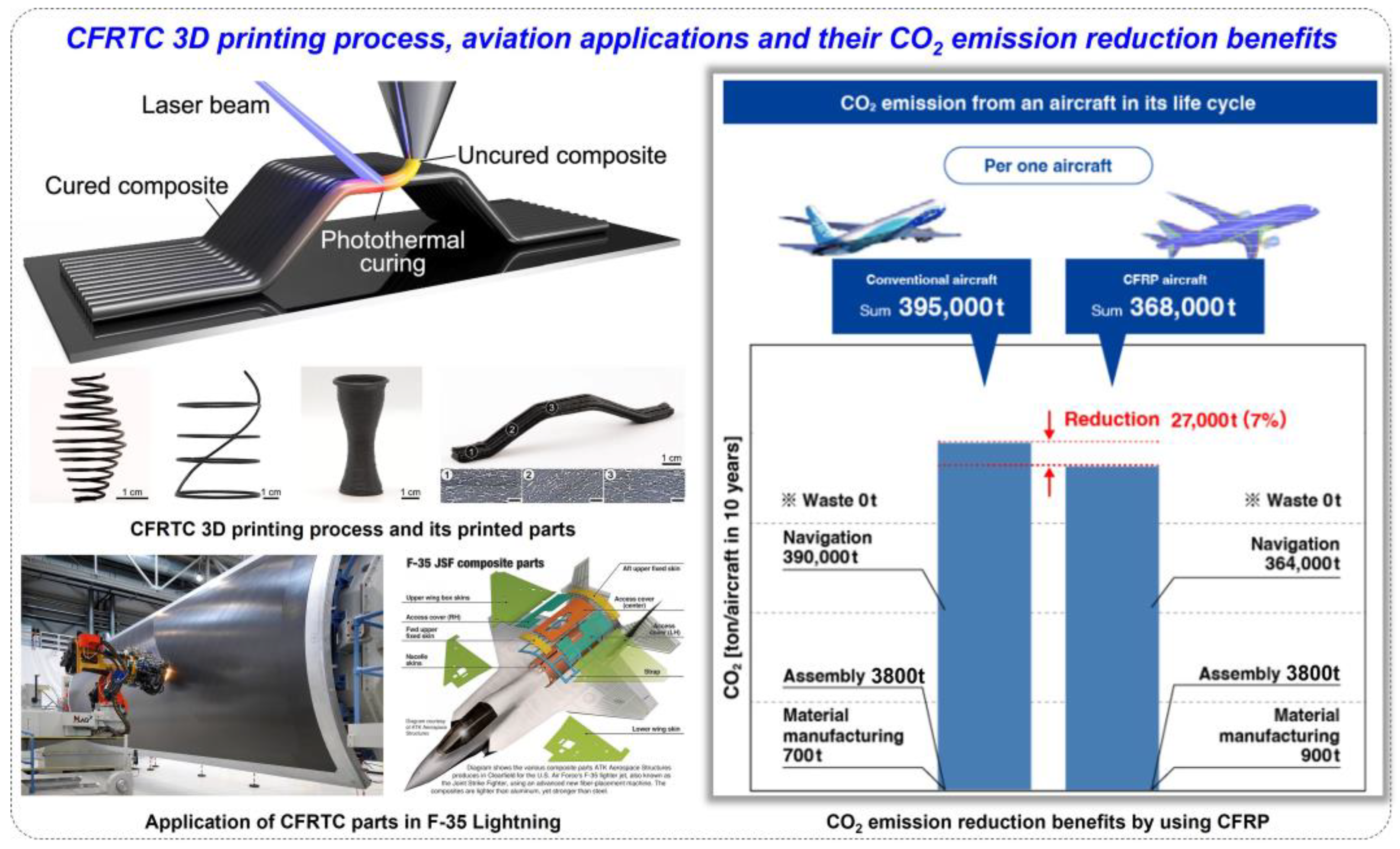
The United States, leveraging its globally recognized research institutions, has prioritized breakthroughs in the development of carbon-capturing construction materials and revolutionary 3D printing processes for carbon fiber composites [61]. Shu Yang et al. [62] at University of Pennsylvania developed 3D-printed diatomaceous earth-based concrete with triply periodic minimal surface (TPMS) structures, which significantly enhance carbon capture capacity (Figure 7). Meanwhile, Mostafa Yourdkhani et al. [63] proposed 3D printing of carbon fiber-reinforced thermoset composites (CFRTC) via in situ thermal curing that reduces production time from six hours to just 100 s, significantly reducing energy consumption. Furthermore, the “AM Forward” plan has promoted the adoption of carbon fiber composite in the manufacturing of components for the F-35 fighter jet, achieving a 30% weight reduction (Figure 8). 3D-printed components may start with a slightly higher carbon footprint, but weight reduction reduces fuel use and emissions by 19% over an aircraft’s lifetime, outweighing initial production emissions [64]. The European Union focuses on developing bio-based biodegradable materials and closed-loop recycling technologies for metal powders based on the “Horizon Europe” framework and the “Circular Economy Action Plan” [65]. The AIMEN Technology Center in Spain has developed bio-based and fully recyclable 3D printing composites to replace conventional petroleum-based polymers. These bio-based materials significantly reduce the carbon footprint compared to traditional petroleum-based alternatives. Meanwhile, Progresja in Poland has established a titanium recycling supply chain, enabling aerospace-grade reuse by precisely controlling oxygen content and reducing reliance on virgin ores. Through its innovative “Recycling-as-a-Service” model, the company has also built recycling centers near large manufacturing hubs, significantly cutting transportation-related carbon emissions [66]. Overall, these material and process innovations are reshaping the synergy among materials, manufacturing processes, and the environmental ecosystem. They propel the 3D printing industry toward a resource-closed-loop and low-carbon transformation.
Figure 7. A highly sustainable and 3D-printed carbon capturing and storage concrete [62].
Figure 8. Three-dimensional printing of CFRTC as well as its application and CO2 emission reduction performance [67].

4.2.2. Intelligent and Digital Innovation

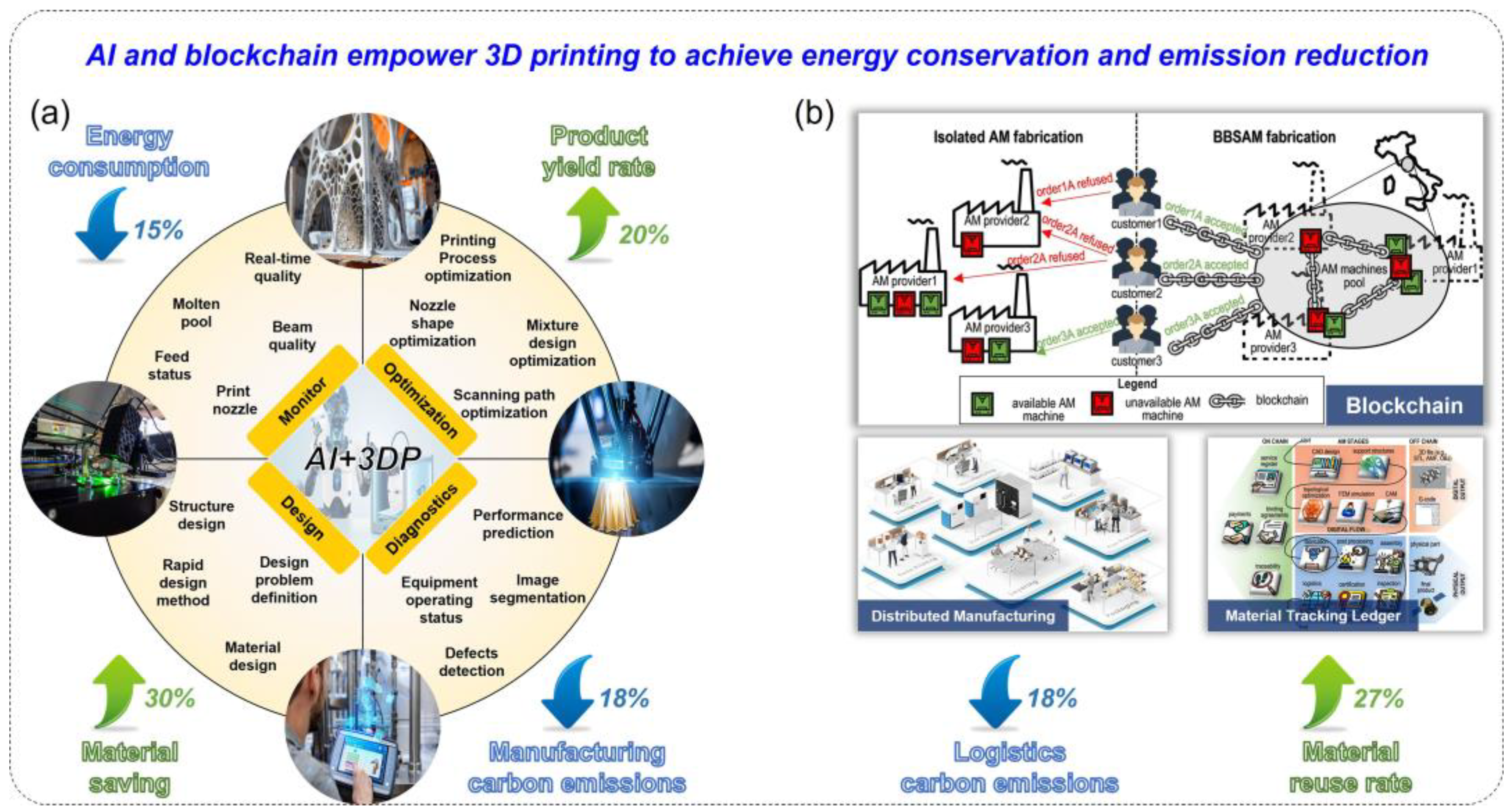
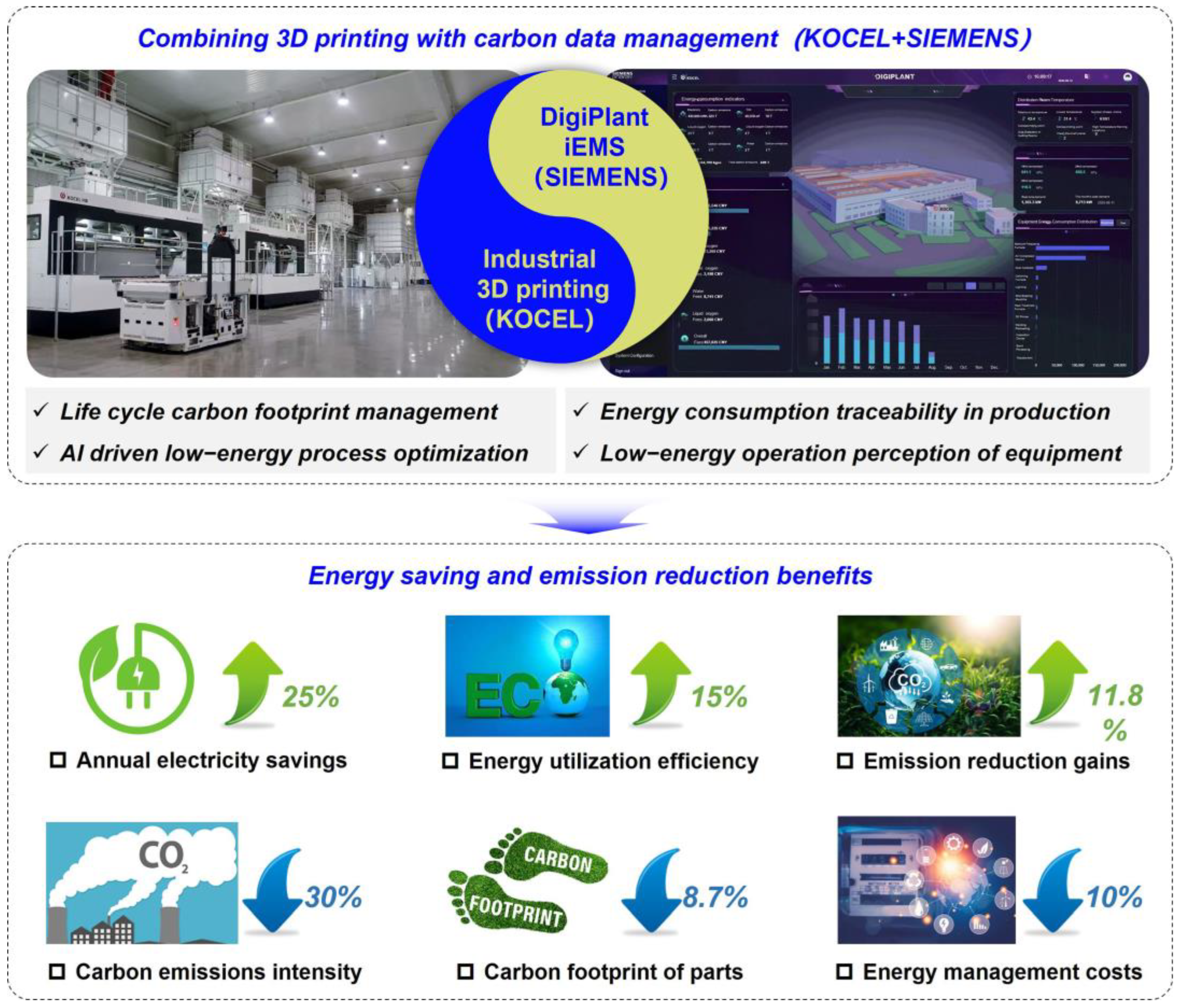
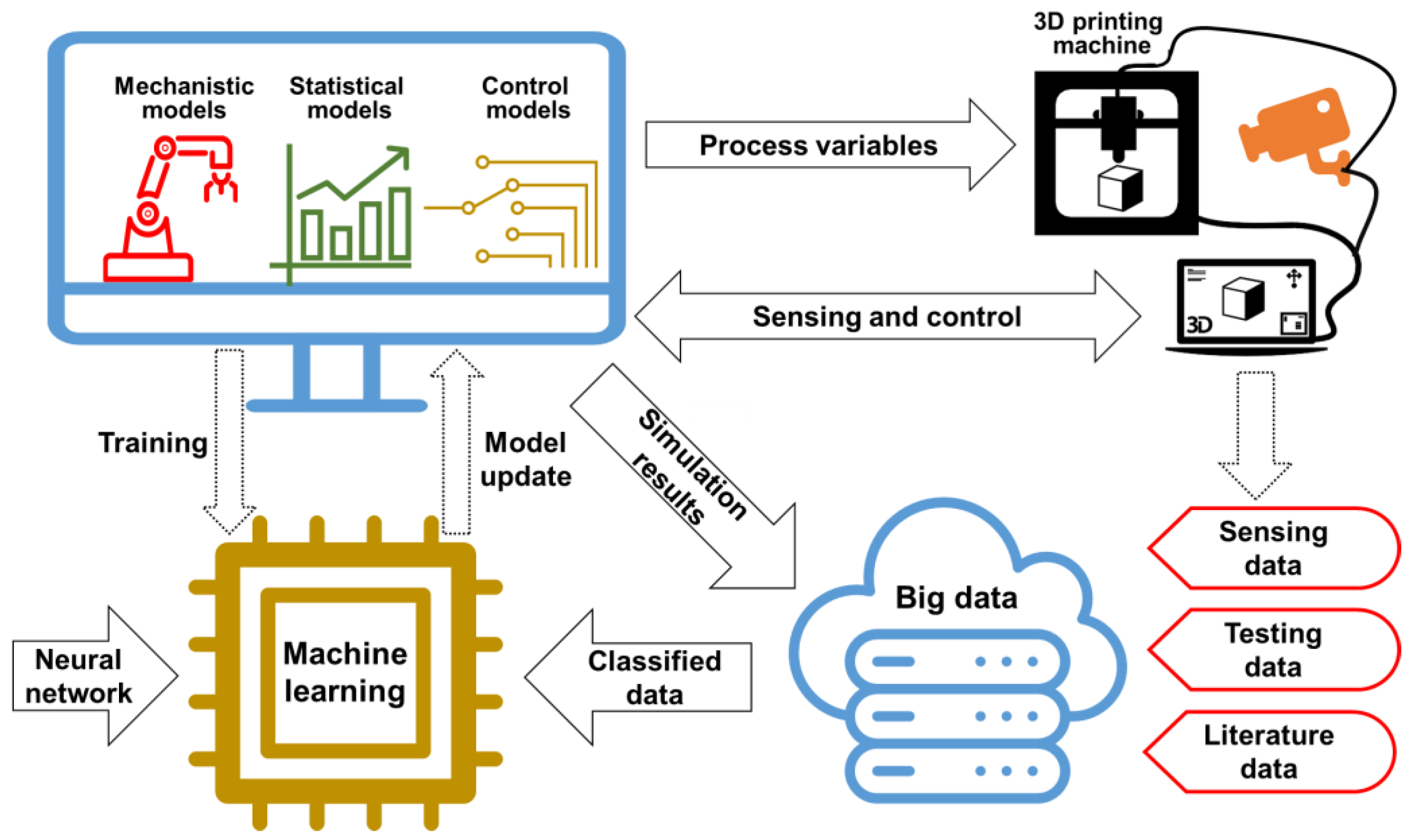
The integration of intelligence and digitalization follows distinct developmental pathways across different regions. The European Union deeply integrates Industry 4.0 technologies, leveraging artificial intelligence (AI) [68,69] to optimize printing processes and establishing blockchain-based carbon footprint traceability systems [70,71] to comply with stringent environmental regulations (Figure 9). SIEMENS (Germany) launched the “Additive Manufacturing Process Studio” [72], which utilizes machine learning to dynamically adjust laser power and scanning paths, reducing print failure rates to below 5%. Meanwhile, Dassault Systèmes (France) developed a blockchain-based life-cycle management platform for aerospace components [73], enabling the tracking of material sources, energy consumption, and carbon footprint data to comply with the EU CBAM. In contrast, the United States emphasizes innovation in distributed manufacturing and cloud-based collaboration models (Figure 9b) [74]. It leverages AI-driven generative design tools to create high-performance, lightweight components and establishes cloud manufacturing networks that significantly reduce carbon emissions from logistics. The Generative Design Algorithm General of Electric automatically generates lightweight structures; its 3D-printed fuel nozzles achieve a 25% weight reduction and a 15% improvement in fuel efficiency [75]. The Digital Source platform developed by Markforged enables global distributed production, where customers upload digital models to be printed at the nearest factory, cutting logistics-related carbon emissions by up to 60% [76]. China, leveraging its vast industrial ecosystem, focuses on developing industrial internet platforms and digital twin technologies. It promotes the application of energy and carbon data management platforms in 3D printing processes. The management platforms effectively improve energy efficiency and achieve precision emission reduction by enabling large-scale production coordination and real-time production control. As demonstrated by KOCEL, a smart energy management platform enables real-time monitoring of energy consumption and carbon emissions across the 3D printing process. It generates ‘dynamic carbon footprint maps’ and ‘digital slicing’ data for each product (Figure 10) [77]. This innovative carbon traceability mechanism allows every product’s carbon footprint to be traced back to specific processes and equipment, providing a robust data foundation for targeted carbon reduction.
Figure 9. Overview of the main identified uses for AI (a) and blockchain (b) in 3D printing and their impact on energy conservation and emission reduction effects [74].
Figure 10. The application of energy and carbon data management platforms in 3D printing processes, which is jointly developed by KOCEL and SIEMENS.
Current evidence suggests that AI-driven optimization can bring significant benefits, including techniques like generative design, defect prediction, and adaptive laser control. These technologies can drastically cut material waste, lower failure rates, and reduce energy use. The result is clear: measurable gains for both the environment and the economy. Blockchain-based traceability systems improve life-cycle carbon footprint transparency and compliance efficiency, though they introduce moderate additional energy demand for data processing. These emerging technologies thus offer net positive sustainability gains, particularly when integrated with renewable-energy data centers and lightweight digital infrastructures.
To strengthen the analytical depth of the comparative study, several measurable indicators were adopted to characterize differences in technological innovation, policy investment, and environmental outcomes among China, the European Union, and the United States.
(i) Innovation capacity indicators. Innovation capacity is reflected primarily in 3D printing-related patent filings. China leads with approximately 18,900 patents (55% of the global share), far exceeding the United States (~9700; 28%) and the European Union (~6200; 17%). These differences indicate China’s rapid technology diffusion and industrial scaling, while the United States and European Union emphasize stable, high-quality innovation ecosystems.
(ii) Public research and development investment in green and 3D printing technologies. Public research and development investment reveals distinct strategic priorities across regions. China allocates USD 2.5–3.0 billion annually to 3D printing and green manufacturing via national programs; the European Union invests roughly USD 3.2 billion under Horizon Europe with a focus on digital–green integration; and the United States provides about USD 780 million per year through DOE, NSF, and DoD, reflecting targeted support for strategic advanced manufacturing.
(iii) Environmental performance indicators. Environmental performance was assessed using carbon-intensity reduction and renewable electricity penetration. From 2010 to 2023, the European Union achieved a 32% reduction in carbon intensity, followed by the United States (18%) and China (4.6%, with rapid improvement in recent years). Renewable energy shares further differentiate the regions: European Union (41%), China (30%), and the United States (22%), demonstrating varying speeds of energy-transition progress.
(v) Industrial ecosystem indicators. Ecosystem maturity was evaluated using green-manufacturing certifications and supply-chain localization. China has more than 4000 certified green manufacturing enterprises but maintains only 35–40% localization for high-end 3D printing components. In contrast, the United States and European Union exceed 75% localization and exhibit more integrated 3D printing clusters, reflecting advanced coordination among equipment suppliers, material producers, and end-use industries.
To enable a systematic comparison of policy effectiveness, a multi-criteria evaluation matrix was developed using five key evaluation dimensions. Each dimension was scored using a 1–5 scale (1 = weak; 3 = average; 5 = very strong), based on quantitative indicators, policy documents, and industrial reports.
From the Table 3, the multi-criteria evaluation matrix results indicate that the European Union leads in standardization and environmental performance, benefitting from early regulatory integration and strong cross-border governance. The United States demonstrates high innovation capacity and ecosystem coordination, driven by defense/aerospace demand and mature supply chains. China excels in innovation output but lags in standardization and systemic coordination, reflecting its rapid industrial expansion but insufficient system-level maturity. These differentiated strengths offer mutually transferable lessons. China could benefit from European Union-style regulatory rigor and United States-style supply-chain integration. The United States and European Union can draw from China’s scale-driven innovation and rapid commercialization capabilities.
Table 3. Multi-criteria evaluation matrix of policy effectiveness for 3D printing sustainability across major economies.
China’s 3D printing industry has achieved remarkable progress in terms of industrial scale expansion and practical application deployment. However, compared with the United States and Europe, a structural gap remains. China still faces challenges in establishing a sustainable development system driven by original innovation, supported by forward-looking regulations, and energized by a dynamic market ecosystem. To fully harness the emission reduction potential of 3D printing technology under the “Dual Carbon” goals, China must draw upon the experiences of developed countries. This requires continued policy support, breakthroughs in fundamental research, stronger legal and regulatory frameworks, and deep optimization of the technological innovation ecosystem. Together, these measures advance the green and sustainable transformation of the 3D printing industry.

5. Key Challenges Facing the Sustainable Development of China’s 3D Printing Industry Under the “Dual Carbon” Goals

5.1. Perspective of Policies and Institutions

(i) Inadequate top-level policy design. Despite the introduction of several supportive policies at both national and local levels, such as the “Action Plan for Upgrading and Optimizing the Raw Materials Industry through Standards Enhancement (2025–2027)”, which incorporates 3D printing materials into the standards innovation program [78], these policies lack systematic coherence and coordination. Thus, it is difficult to generate synergistic effects. Moreover, existing policies primarily focus on technological research and industrialization, providing insufficient incentives for low-carbon development. There is a notable absence of a green policy framework that consistently emphasizes low-carbon emissions throughout the entire chain from technology development to product manufacturing and market application [79]. Furthermore, policies specifically targeting the low-carbon development of 3D printing are still scarce. In particular, the fiscal and taxation support mechanisms are underdeveloped. The costs associated with 3D printing equipment, materials, and services are relatively high, with notable cost premiums for green materials and energy-efficient equipment. Current fiscal policies are insufficient to effectively reduce the adoption cost of low-carbon 3D printing technologies. Although industrial-grade 3D printing equipment is now included in the ‘Catalogue of Imported Crucial High-Tech Equipment and Products Not Exempted from Tax’, support for domestic companies remains incomplete. Targeted tax incentives and subsidy mechanisms for energy-saving and low-emission 3D printing technologies are still lacking [80].
(ii) Insufficient Industrial Ecosystem Coordination. Three-dimensional printing is not a standalone technology. Realizing its carbon neutrality potential requires coordinated innovation across the entire chain, including in materials, energy, logistics, and recycling. However, there is a significant deficiency in stimulating synergistic innovation throughout the industrial chain [81]. Currently, a disconnect exists between upstream material suppliers and downstream application industries. The limited variety and high cost of specialized low-carbon materials have become bottlenecks for industry development. Integration of 3D printing with traditional manufacturing remains low. An effective, networked, distributed production ecosystem has yet to be established. Most enterprises use 3D printing mainly for prototyping or small-batch production. Its distributed, on-demand, and localized manufacturing model, however, has not yet entered the mainstream. Moreover, a lack of top-level design hinders the coordination of manufacturing resources across regions and sectors, leading to fragmented production capacity and an inability to achieve economies of scale. Consequently, two critical issues arise: (a) Inability to achieve systemic carbon reduction. The potential of distributed manufacturing lies in optimizing production and logistics networks to reduce carbon emissions at the system level. Current isolated applications prevent 3D printing from achieving macro-level carbon reduction benefits. These include value chain restructuring, reduced redundant inventory, and minimized long-distance transportation. (b) Hindrance to deep decarbonization of manufacturing. While the manufacturing industry faces pressures for energy savings and emission reduction, 3D printing offers a way to reconcile the conflict between carbon reduction and output growth. However, because it has not been integrated into mainstream production industry, 3D printing cannot widely substitute for high-carbon traditional processes like casting and forging.
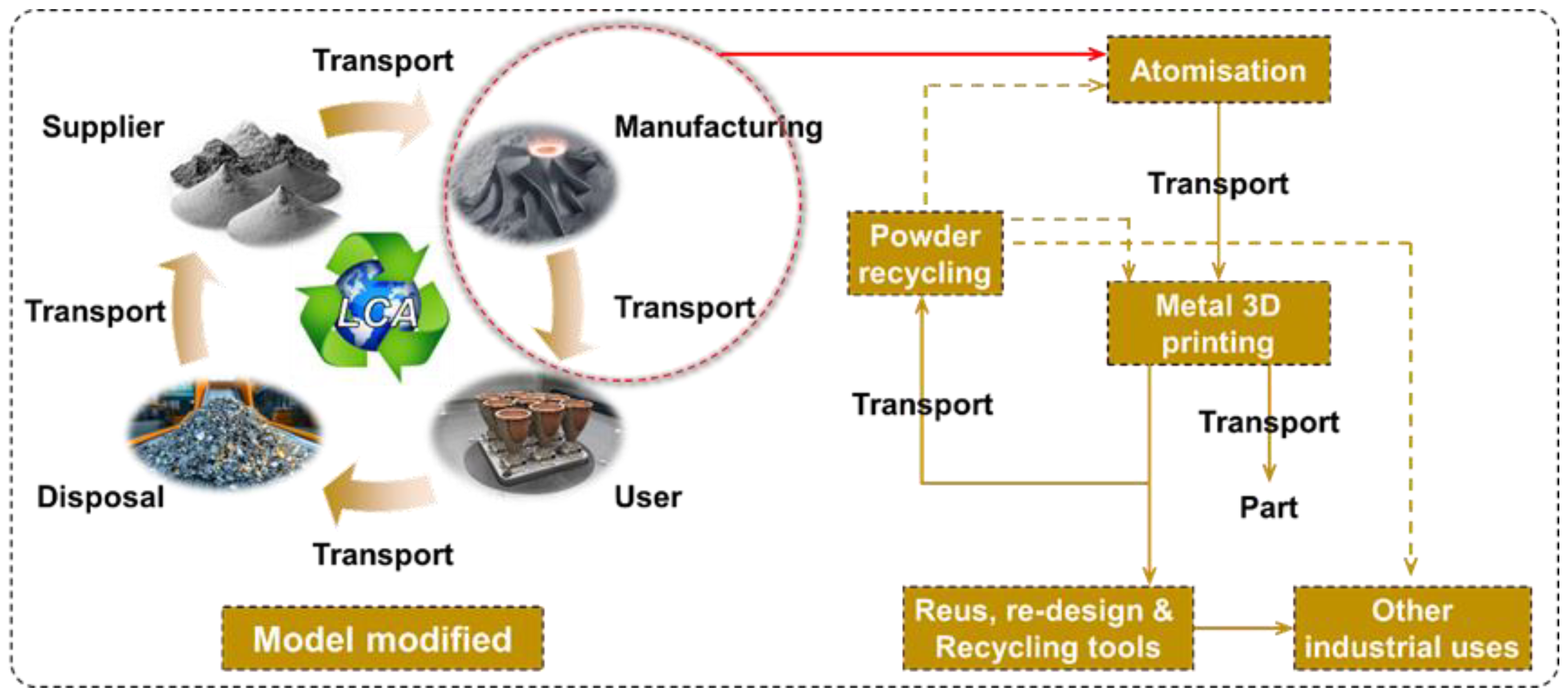
(iii) Weak capacity in standardization development. International standardization organizations have established ISO 14040: 2006 [82]-compatible LCA standards, providing methodological guidance for 3D printing carbon footprint accounting, like the LCA model (Figure 11) proposed by Bourhis et al. [83]. The European Union and other countries promote Extended Producer Responsibility (EPR) policy frameworks to balance technological innovation with ecological responsibility [84]. However, China still lags behind developed countries in terms of standard system completeness and participation in international rule-making. Currently, there is a lack of unified national or industry standards for carbon footprint accounting methodologies and system boundary definitions specific to 3D printing technologies and products. Relying on international carbon accounting and LCA standards makes it difficult for China to accurately compare the carbon footprints of 3D printing and traditional manufacturing. This hinders effective industry carbon management, potentially leads to unclear reduction outcomes, and ultimately obstructs targeted policies like green finance. Although some enterprises have begun experimenting with energy and carbon data management, these practices remain voluntary and pioneering within the industry. A standardized, industry-wide carbon accounting methodology has not yet been established. As a result, emission data across enterprises are not directly comparable, making it difficult to develop strategies based on accurate information. The Chinese government is promoting carbon emission accounting and carbon market development, and plans to establish product-specific carbon footprint standards. However, effectively integrating these standards with 3D printing characteristics and promoting their widespread adoption will require considerable time and effort.
Figure 11. Example of metal 3D printing LCA.
(iv) Weak environmental regulatory framework. The potential environmental and safety risks associated with the production phase of 3D printing represent a critical regulatory focus [85], particularly evident in the following aspects. (a) Environmental and safety oversight of the production process. The environmental impact of 3D printing is debated. On one hand, 3D printing offers advantages such as reduced logistics requirements and less material waste. On the other hand, industrial 3D printers may emit hazardous gases during operation, and even desktop or home 3D printers can release volatile organic compounds (VOCs) and nanoparticles that pose potential health hazards. “Law of the People’s Republic of China on the Prevention and Control of Atmospheric Pollution” provides a regulatory basis for emissions control, but it requires modification and refinement to address the specific characteristics of the 3D printing industry. Moreover, current legislation such as the “Law on Pollution Prevention and Control of Solid Waste” and “Regulation on the Safety Management of Hazardous Chemicals” do not explicitly define standards for classification, recycling, and disposal of 3D printing materials, creating regulatory gaps. Additionally, certain 3D printing processes, particularly those involving metal powders or specific resin materials, carry risks such as dust explosions and harmful gas emissions, leading to high levels of pollution. For instance, in the notice issued by the Shanghai Emergency Management Bureau in 2025, 3D printing enterprises were classified as a new business model with “high risk and hidden dangers” for the first time. This underscores the urgent need to establish and improve relevant safety production standards, occupational health protection norms, and environmental emission requirements for the industry.

5.2. Perspective of Technological Innovation

(i) Lagging development of low-carbon material systems. Currently, there is a significant gap between China and the developed countries in the development of low-carbon material systems suitable for high-performance 3D printing. Firstly, the performance of bio-based and biodegradable materials remains inadequate. For instance, polylactic acid (PLA) lacks sufficient heat resistance and mechanical strength for high-end applications. Meanwhile, the development and industrialization of higher-performance bio-based materials, like advanced polyhydroxyalkanoates (PHA), have been slow [86]. Consequently, industries such as aerospace and medical devices still rely on high-carbon-emission petroleum-based materials. Secondly, closed-loop recycling technologies in metal 3D printing are still immature. Metal powders often oxidize or become contaminated during printing, leading to degraded performance upon recycling. Partial reuse is possible, but recycling cycles and performance retention remain low, generating significant waste powder [87]. Companies like BLT have implemented powder recycling loops, reportedly reducing CO2 emissions per kilogram of powder by 56.5%. However, not all materials can undergo multiple recycling cycles. Furthermore, the lag in the development of low-carbon material systems has led to high carbon emissions from the source. On one hand, continued consumption of virgin petroleum-based materials and primary metals perpetuates the high embodied carbon emissions from upstream raw material smelting and processing. On the other hand, substantial amounts of non-recyclable printing waste, often disposed of through landfilling or incineration, directly generate GHG (e.g., CH4) and harmful substances, causing secondary pollution. This seriously contravenes the circular economy principles and constrains the industry’s ability to achieve carbon and resource reduction at the source.
(ii) Weak energy efficiency optimization technologies and management capabilities. Energy consumption is another major obstacle to low-carbon 3D printing. The technology is not inherently low carbon in all scenarios, and the energy intensity of some processes can exceed that of traditional manufacturing methods. The optimization of energy efficiency in 3D printing faces both technical and managerial challenges [88]. At the technical level, some processes have high energy intensities. Examples include laser scanning, UV curing, and post-curing in stereolithography (SLA), high-power laser melting in metal 3D printing, and thermal treatments such as hot isostatic pressing or annealing. In some cases, the energy consumption per single part can reach several tens of times that of conventional processing methods. At the management level, there is a lack of carbon-efficiency-oriented process parameter optimization models and sophisticated, widely applicable energy consumption and carbon emission management systems. This deficiency leads to substantial ineffective energy consumption during production. Consequently, the high energy consumption of manufacturing directly translates into significant CO2 emissions [89]. Furthermore, China’s energy structure relies heavily on high-carbon electricity. As a result, carbon reductions achieved through topology optimization and lightweighting in 3D printing can be offset by the high energy consumption of the printing process. This diminishes 3D printing’s life-cycle carbon reduction benefits. In contrast, some 3D printing facilities in Europe and the United States use distributed photovoltaic systems or renewable electricity. In China, the share of green electricity in 3D printing enterprises remains below 10%.
(iii) Dependence on imported key low-carbon core components. High-performance core components represent a critical bottleneck for China’s 3D printing industry. Core devices such as high-power, high-beam-quality fiber lasers and high-speed, high-precision galvanometer scanners are predominantly imported from developed countries in Europe and the United States. Although domestic manufacturers are striving to overcome these limitations, Chinese-made lasers and scanners still lag behind top imported products in terms of stability, lifespan, and energy conversion efficiency [90]. Consequently, domestic equipment often consumes higher energy to achieve equivalent 3D printing performance. Furthermore, the long-distance international transportation of these core components adds to the overall carbon emissions across the entire industrial chain. The carbon footprint from producing these high-precision components in their countries of origin is included in the LCA of Chinese products. This increases both the implicit carbon emissions and the overall supply chain carbon footprint. Moreover, domestic equipment manufacturers lack the underlying technology and intellectual property for these core components. This makes it difficult to implement targeted energy-saving designs, such as efficient laser modulation algorithms or coordinated galvanometer motion control to reduce non-printing time. As a result, China’s 3D printing industry is effectively limited to the technological framework of upstream suppliers, forfeiting autonomy in pursuing deep, fundamental energy-saving design innovations.
To address the challenges to construct a virtuous industrial innovation ecosystem, this study proposes a dual-driven implementation pathway that integrates policy optimization and technological innovation. The overall framework and the specific correspondence between the key challenges and the proposed pathways are summarized in Table 4. The following subsections will elaborate on these pathways in detail.
Table 4. Key challenges and corresponding implementation pathways for the sustainable development of China’s 3D printing industry under the “Dual Carbon” goals.

5.3. Legal Enforcement Challenges and Institutional Barriers

(i) Legal and regulatory enforcement challenges. China has enacted several laws and standards relevant to 3D printing, including the Environmental Protection Law, the Energy Conservation Law, and emerging process-specific standards. However, their effective enforcement faces significant systemic challenges. First, compliance costs for small and medium-sized 3D printing enterprises are high, particularly for carbon accounting, hazardous material handling, and equipment energy-efficiency upgrades, which limits full compliance. Second, regulatory fragmentation and overlapping jurisdiction among the Ministry of Industry and Information Technology, the Ministry of Ecology and Environment, and the State Administration for Market Regulation create inconsistent enforcement across regions, leading to uneven quality control and environmental oversight. Third, regulatory gaps remain in areas such as nanoparticle emission limits, powder reuse safety, and life-cycle-based carbon disclosure, resulting in limited legal accountability for environmental impacts. Collectively, these issues weaken the enforceability of existing regulations and pose significant barriers to realizing the sustainability goals of the 3D printing sector [91].
(ii) Institutional conflicts and governance barriers. Several institutional contradictions hinder effective regulation of China’s 3D printing sector. Local governments often prioritize industrial growth, which can conflict with environmental compliance. This tension is particularly evident when 3D printing firms supply strategic sectors like aerospace or medical devices. Furthermore, enterprise incentives for adopting low-carbon practices remain insufficient due to internalized compliance burdens and the lack of mandatory carbon-footprint disclosure mechanisms. Additionally, the current regulatory framework does not adequately address 3D printing-specific risks, such as powder oxidation, recycling quality assurance, and cross-facility traceability. This has created a gap between regulatory intent and practical enforcement. These structural issues suggest that strengthening 3D printing governance requires more than issuing new regulations; it demands integrated institutional design.

6. Implementation Pathways for Sustainable Development of China’s 3D Printing Industry Under the “Dual Carbon” Goals

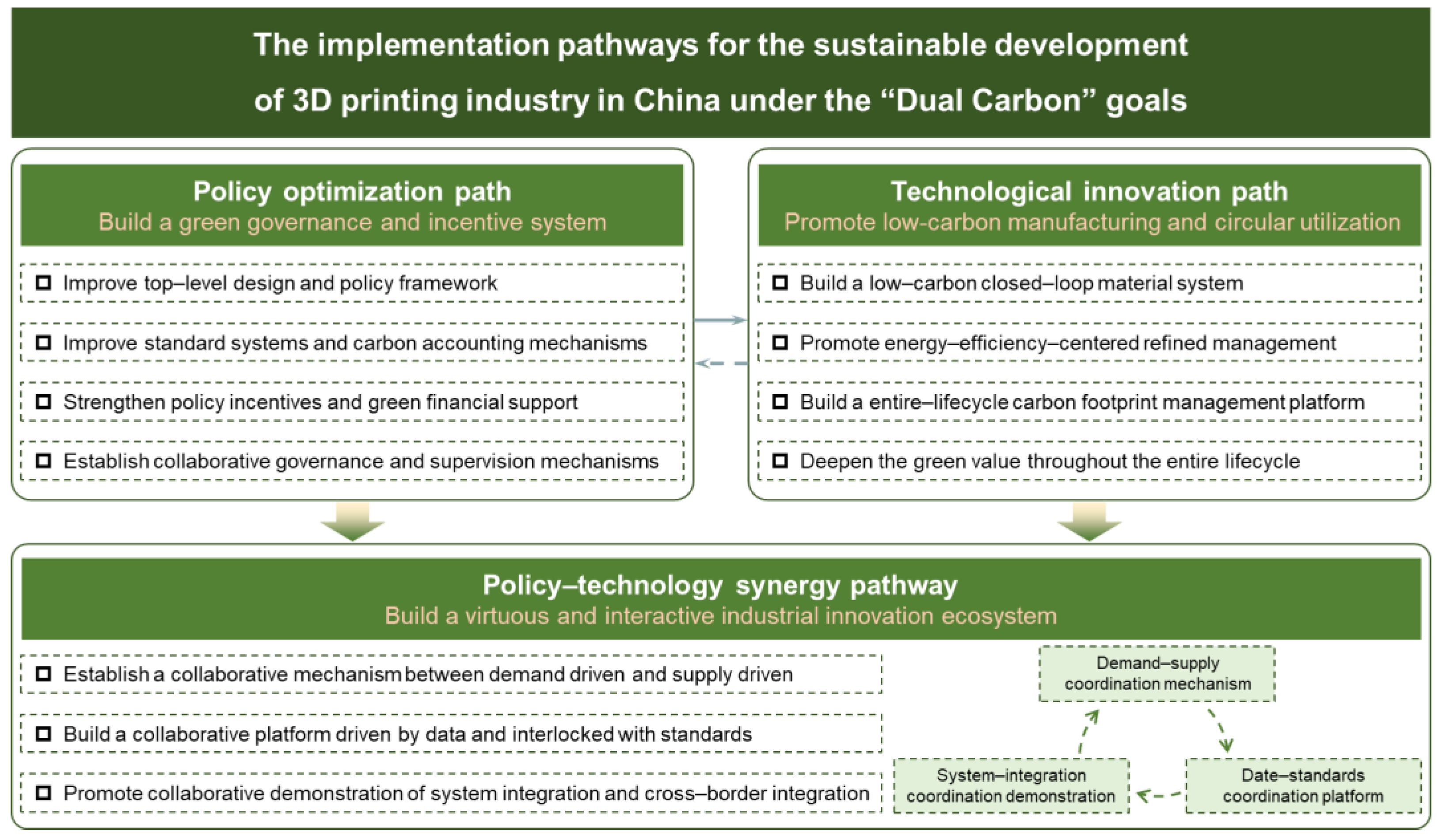
Under the guidance of the “Dual Carbon” goals, the sustainable development of China’s 3D printing industry should be driven by the dual engines of policy optimization and technological innovation. The objectives are to enhance resource efficiency, improve environmental performance, and achieve socioeconomic co-benefits. To this end, a closed-loop system of “policy orientation–technological innovation–industrial transformation–carbon reduction feedback” should be established. This system emphasizes synergistic advancement from top-level design to industrial implementation, promoting coordinated low-carbon transformation across policy, technology, market, and societal dimensions. The overall implementation pathway can be structured into three levels as below (Figure 12). Macro level: Building a governance system for green development, guided by policy systems, standard specifications, and industrial planning. Meso level: Centering on collaborative innovation between enterprises and industrial chains as the core, and promoting digitalization, intelligence, and low-carbon upgrading. Micro level: Taking the optimization of materials, processes, equipment, and product life cycle as the starting point, thereby achieving refined management and circular utilization of carbon emissions.
Figure 12. Summary of the implementation pathways for the sustainable development of China’s 3D printing industry.

6.1. Policy Optimization Pathway: Building a Green Governance and Incentive System

6.1.1. Improving Top-Level Design and Policy Framework

The policy system is the foundational driver of industrial green transition. In the context of carbon neutrality, China should establish a multi-level, cross-departmental coordination system for green manufacturing to improve top-level design and ensure policy implementation from central to regional levels. Within the frameworks of “Made in China 2025” and the “14th Five-Year Plan development plan on smart manufacturing”, a dedicated “Additive Manufacturing Carbon Neutrality Action Plan” should be integrated to set phased targets for energy consumption, carbon emissions, and material recycling, and formulating a systematic low-carbon manufacturing strategic plan. A comprehensive legal and regulatory framework should be developed to guide and monitor green transition across the entire 3D printing value chain from material supply to end-use products. Drawing on international best practices such as the “Industrial Emissions Directive (IED)” in European Union and “Green Manufacturing Act” in Japan, China should refine the implementation provisions of its Cleaner Production Promotion Law and Circular Economy Promotion Law in the context of AM [92]. This would facilitate the establishment of a green regulatory chain ensuring environmental responsibility throughout design, production, and product life-cycle stages. Drawing on international best practices such as the “Industrial Emissions Directive (IED)” in European Union and “Green Manufacturing Act” in Japan, China could refine the implementation guidelines of its “Cleaner Production Promotion Law” and “Circular Economy Promotion Law”. Thus, a comprehensive legal and regulatory framework should also be developed to improve environmental governance throughout the 3D printing life cycle, from material supply and production to product utilization and recycling. Moreover, the establishment of regional collaborative governance models can provide the institutional flexibility needed for innovation and localized experimentation. Local governments are encouraged to create “Low-Carbon Additive Manufacturing Pilot Zones” tailored to regional industrial characteristics, promoting policy pilot programs, innovations in carbon management, and resource sharing. For instance, provinces such as Jiangsu and Guangdong can use their existing high-end equipment manufacturing parks to pilot low-carbon certification and carbon information disclosure systems.
Given the structural enforcement challenges outlined in Section 5.3, the implementation pathways must integrate legal reforms with policy coordination to ensure feasible and enforceable outcomes. Accordingly, a legal–policy governance model is proposed. To enhance enforceability and ensure alignment with China’s governance context, an integrated legal–policy model consisting of three components should be proposed. First, harmonized regulatory frameworks should be developed to unify environmental, safety, and industrial standards, thereby reducing institutional fragmentation and clarifying responsibilities among Ministry of Industry and Information Technology, the Ministry of Ecology and Environment, State Administration for Market Regulation, and local regulatory bodies. Second, establishing a multi-stakeholder consultation platform, including industry alliances, manufacturing clusters, research institutions, and regulators, would help refine legal instruments, reduce compliance burdens, and identify realistic enforcement pathways. Third, a tiered compliance system should be implemented, combining mandatory carbon accounting for large enterprises, incentive-based compliance for SMEs, and digital monitoring tools (e.g., 3D printing process traceability, powder life-cycle tracking) to strengthen transparency and regulatory capacity. This integrated framework ensures that legal requirements are not only well-formulated but also actionable, enforceable, and aligned with long-term sustainability goals.

6.1.2. Improving Standard Systems and Carbon Accounting Mechanisms

Standardization is a fundamental pillar for the sustainable development of 3D printing. It is essential to accelerate the establishment of a green manufacturing standard system that spans the entire product life cycle from design and material preparation to manufacturing and recycling. (i) Green design and carbon footprint standards. The ISO 14067: 2018 [93] carbon footprint assessment framework should be adopted to develop benchmarks for unit energy consumption and emissions corresponding to various 3D printing technologies (e.g., laser powder bed fusion, fused deposition modeling, and stereolithography) [94]. (ii) Remanufacturing and recycling standards. Industry-specific standards should be formulated to define the reuse ratio and performance retention rate of metallic powders and polymer materials. Such standards would ensure material circularity and quality stability throughout multiple printing and reprocessing cycles, promoting a closed-loop AM ecosystem. (iii) Standards of equipment energy efficiency and environmental management. The implementation of an energy efficiency grading and certification system for 3D printing equipment should be promoted, together with the establishment of a “China Green Manufacturing Certification” labeling scheme. In addition, it is recommended to build a national 3D printing carbon data management platform, leveraging the industrial internet to achieve real-time monitoring and traceability of carbon emissions. This platform would serve as the digital infrastructure for enterprise-level carbon asset management and green performance evaluation.

6.1.3. Strengthening Policy Incentives and Green Financial Support

A multi-tiered policy incentive system aligned with the national “Dual Carbon” goals should be established to accelerate the low-carbon transformation of the 3D printing industry. Firstly, leveraging the carbon trading market and carbon tax mechanisms to guide enterprises in internalizing environmental costs. The 3D printing sector should be gradually incorporated into the national carbon emissions trading system, enabling firms to gain carbon revenues through energy-saving and emission-reduction practices. Secondly, green finance mechanisms, including green credit, green bonds, and carbon-linked financial instruments, should be actively promoted to stimulate enterprise investment in low-carbon equipment and processes. This includes establishing a “3D Printing Green Manufacturing Special Fund” to provide targeted financial support for SMEs undertaking green transition projects. Thirdly, local governments should be encouraged to explore regional pilots, such as “Low-Carbon 3D Printing Demonstration Zones”. These pilot zones can serve as laboratories for policy innovation. Finally, China should encourage social capital and private investment institutions to join green manufacturing projects. This will help build a multi-stakeholder, co-governance financial ecosystem and support the long-term sustainable development of 3D printing under the carbon-neutrality framework.

6.1.4. Establishing a Collaborative Governance and Supervision Mechanism

A multi-stakeholder collaborative governance framework, involving government, industry, research institutions, and the public, should be established to promote green and sustainable development in the 3D printing industry. The government should play a leading role in strategic planning, policy guidance, and resource coordination, ensuring the effective implementation of standards and regulatory mechanisms. Industry associations should take the lead in disseminating standards, promoting self-regulation, and facilitating third-party certification. They can thereby build a supervisory and information-sharing platform to enhance transparency and accountability. Research institutions should provide technical evaluation, data analytics, and life-cycle assessment support, serving as the scientific foundation for policy refinement and technological upgrading. Meanwhile, the public and media can participate in green product evaluation and consumer behavior guidance through opinion supervision and awareness campaigns, fostering social recognition and behavioral transformation. Ultimately, this integrated governance approach aims to build an open, transparent, and participatory sustainability supervision ecosystem.
To facilitate practical implementation, policymakers could pilot the proposed pathways through targeted demonstration zones or pilot programs. For instance, selected industrial parks or manufacturing clusters could be designated as low-carbon 3D printing pilot zones, where integrated policies on green materials, energy-efficient equipment, and carbon accounting mechanisms are tested in a phased manner. Such pilot initiatives would enable policymakers to assess policy effectiveness under real-world conditions, optimize regulatory instruments through iterative feedback, and gradually scale up successful practices at the national level.

6.2. Technological Innovation Path: Advancing Low-Carbon Manufacturing and Circular Utilization

6.2.1. Constructing a Low-Carbon and Closed-Loop Material System

The 3D printing industry should prioritize the establishment of a low-carbon material system that enables a closed-loop flow from source substitution to end-of-life recycling [95]. Efforts should focus on the development of high-performance bio-based and biodegradable materials to reduce dependence on fossil-based raw materials. In particular, there should be a focus on overcoming the performance bottlenecks of bio-based polymers, such as PLA and PHA, and developing functional bio-materials suitable for 3D printing in sectors like aerospace and medical devices. Meanwhile, research into next-generation carbon-sequestering materials should be intensified to achieve “negative-carbon” manufacturing at the material source. A comprehensive life-cycle management and closed-loop recycling system for metal powders (referring to a metal powder recovering process in Figure 13 proposed by the National Institute of Research and Development in Mechatronics and Measurement Technique Bucharest-INCDMTM Bucharest [87]) must be established It also requires rigorous standards for powder reuse and quality control. The goal is to raise powder reutilization rates to exceed 95%, thereby significantly reducing the embodied carbon emissions associated with virgin material production. In parallel, the industry should actively develop low-carbon composite materials based on industrial solid wastes and recycled feedstocks, promoting the rational design of material performance to avoid “overengineering.” Through such strategies, sustainability attributes can be embedded at the material design stage, ensuring that products carry low-carbon characteristics from the outset.
Figure 13. Phases and preliminary results of metal powder recovering process.

6.2.2. Promoting Energy-Efficiency-Oriented Precision Management

Energy efficiency optimization should be treated as a core strategic priority in the 3D printing industry [96]. A data-driven and multi-objective optimization framework should be implemented to systematically refine printing parameters, achieving the optimal balance between energy consumption and production efficiency while ensuring product quality. Both equipment manufacturers and end users must act in concert to invest in and develop high-efficiency core components as well as printing systems integrated with energy-saving modules. Manufacturers should focus on overcoming technological bottlenecks in high-power, high-beam-quality laser sources and related optoelectronic components to enhance energy conversion efficiency. Additionally, incorporating smart energy-saving functions, such as intelligent standby modes and waste-heat recovery systems, should become standard practice. End-users should adopt energy-productivity indicators (energy output per unit of energy consumed) as key performance metrics in equipment procurement and operation. Meanwhile, disruptive process innovations, such as support-free design and large-layer-thickness rapid printing, should be promoted to fundamentally restructure 3D printing workflows and realize intrinsic energy savings.

6.2.3. Establishing a Life-Cycle Carbon Footprint Management Platform

Digitalization should serve as the cornerstone of precise carbon management, enabling real-time monitoring and data-driven optimization throughout the entire production process [97]. By deploying intelligent energy–carbon management systems, manufacturers can continuously track energy consumption and convert it into carbon emissions metrics, achieving a transition from coarse energy monitoring to accurate carbon quantification. This enables each product to be accompanied by a transparent and quantifiable carbon footprint map. The deep integration of digital twin and AI technologies (Figure 14) can further construct a comprehensive virtual–physical system that spans the full product life cycle from design and manufacturing to use and recycling. In the digital environment, carbon emissions can be predicted, simulated, and optimized before production begins. This enables “optimization before fabrication” and, through intelligent process control, significantly cuts waste and rework.
Figure 14. The deep integration of digital twin and AI technologies in 3D printing process.
Moreover, industry consortia and leading enterprises should explore the application of blockchain-enabled carbon traceability frameworks to establish trustworthy and tamper-proof “carbon passports” for 3D-printed products. This will not only enhance transparency in environmental performance but also strengthen market credibility and international competitiveness across the 3D printing value chain.

6.2.4. Enhancing Green Value Across the Entire Life Cycle

The creation of 3D printing industrial value should transition from focusing solely on manufacturing output to achieving green performance across the full product life cycle. Lightweight design and topology optimization should be mandatory principles. They should be combined with functional integration to reduce material consumption in production. These measures also lower energy demand during product use. Together, they maximize life-cycle carbon reduction benefits [98]. Significant emphasis should be placed on the development of high-value component remanufacturing and repair services based on 3D printing technologies. Extending product lifespan not only opens new service-oriented business models but also provides a direct and efficient pathway to implement circular economy principles, reducing resource depletion and waste generation. Furthermore, the 3D printing industry should strategically advance toward distributed and on-demand manufacturing networks (Figure 15). Leveraging cloud manufacturing platforms, production paradigms can be restructured from “centralized production and global distribution” to “distributed design and localized fabrication.” This transformation fundamentally reduces carbon emissions associated with excessive inventory and long-distance logistics.
Figure 15. Comparation of centralized and distributed 3D printing.

6.3. Synergistic Pathways of Policy and Technology: Building a Virtuous and Interactive Industrial Innovation Ecosystem

Under the “Dual Carbon” goals, isolated advancements in either policy optimization or technological innovation are insufficient to realize the full emission-reduction potential of the 3D printing industry. These two dimensions are not independent but form a mutually driven and interdependent collaborative system. Policies define the strategic direction for technological innovation, provide initial momentum, and remove institutional or market barriers. Conversely, technological breakthroughs supply feedback and support for more precise and more efficient policy instruments [99]. Policy–technology synergy is crucial. It accelerates the creation and diffusion of low-carbon manufacturing systems. It also fosters a mutually reinforcing innovation ecosystem where governance, technology, and markets interact dynamically. This synergistic mechanism is essential to ensure that China’s 3D printing industry achieves sustainable and scalable growth under the guidance of the “Dual Carbon” goals.

6.3.1. Establishing a Coordinated Mechanism of Demand Pull and Supply Push

(i) Green public procurement to guide technological direction. The government should serve as a lead user in green manufacturing. It should mandate or prioritize the procurement of low-carbon-certified 3D-printed products and services. Public projects, such as building components or municipal facilities that meet carbon-footprint standards, are required to adopt these low-carbon solutions. This policy instrument can create a stable initial market for low-carbon materials, such as bio-based materials and closed-loop recycled metal powders, as well as for energy-efficient manufacturing processes. In doing so, it reduces the market risks faced by enterprises during early-stage research and development.
(ii) Incentivizing the adoption of green technologies through carbon markets and fiscal policies. China should integrate the 3D printing industry into the national carbon emissions trading market. It can also offer carbon allowance rewards, tax reductions, or dedicated subsidies to enterprises that adopt certified low-carbon 3D printing technologies, such as printing centers using green electricity or companies achieving over 95% powder recycling rates. Such incentive policies can directly translate environmental benefits into economic gains. They motivate enterprises to adopt energy-efficiency optimization technologies and digital carbon management platforms, thereby addressing firms’ reluctance to adopt low-carbon technologies due to high upfront costs.
(iii) Technological Breakthroughs Supporting More Ambitious Policy Targets. As material innovations (e.g., carbon-sequestering materials) or process breakthroughs (e.g., 50% energy reduction) achieve major milestones, policymakers should respond by tightening industry carbon benchmarks and shortening compliance timelines to incentivize further innovation. This creates a virtuous cycle in which technological advancements actively drive higher policy ambitions.

6.3.2. Building a Data-Driven and Standards-Linked Synergistic Platform

(i) Integration of carbon accounting standards with digital twin platforms. The unified national carbon accounting standards must be seamlessly integrated with enterprise-level digital twin and carbon footprint management platforms. Policies should mandate the use of standardized data interfaces by enterprises. This ensures that real-time, verifiable carbon data from their digital platforms can flow directly into compliance reporting and carbon market transactions. This approach not only significantly reduces the accounting burden on enterprises but also ensures the accuracy and transparency of the data, maximizing the policy value of technological investments.
(ii) Synergy between product digital passports and life-cycle oversight. Key 3D-printed products should be required to carry blockchain-based ‘digital product passports.’ These passports record full life-cycle data, including material sourcing, manufacturing energy consumption, usage-phase emissions, and end-of-life recycling. These technological tools create an immutable data foundation. This underpins both collaborative governance and the evolving environmental regulatory system, enabling a shift from “end-point supervision” to “process transparency.”

6.3.3. Promoting Synergistic Demonstration Through System Integration and Cross-Sector Collaboration

(i) Establishing “Low-carbon 3D printing demonstration zones” as collaborative testbeds. Within these demonstration zones, integrated policy and technology experiments can be conducted. For instance, in the demonstration zone, policies integrate incentives such as direct supply of green electricity, cross enterprise carbon quota trading, and accelerated depreciation of equipment. Meanwhile, technological measures involve mandatory deployment of park-level energy management systems, distributed manufacturing cloud platforms, and the large-scale application of localized material closed-loop systems. The core function of these zones is to test the practical effectiveness of emission-cutting measures and the economic viability of combined policy and technology solutions. Success here provides a replicable template for scaling up implementation across the country.
(ii) Supporting industry–academia–research–finance-association consortia to overcome systemic bottlenecks. For common technological challenges, such as core components or low-carbon materials, policies should support the formation of innovation consortia. These consortia should include leading enterprises, top universities, research institutes, financial institutions, and industry associations. Green finance resources should be targeted to these consortia to jointly tackle systemic issues that are difficult for individual enterprises to address but are critical for emission reductions across the entire industrial chain. These include developing next-generation low-energy-consumption printing technologies or establishing a nationwide 3D printing waste powder recycling network.
While existing studies [100] on 3D printing, such as those focusing on the optimization of decentralized production systems, provide valuable quantitative insights into specific operational scenarios, the present study contributes a complementary, higher-level perspective. Rather than optimizing individual production decisions, this research offers a systematic framework that helps practitioners identify strategic pathways for integrating 3D printing into broader industrial and policy contexts. The framework developed in this study provides a structured lens for practitioners to assess and prioritize interventions for low-carbon transformation in 3D printing operations. Practitioners, including manufacturing managers, technology adopters, and policy implementers, can use this framework to identify key leverage points, assess potential pathways under different operational constraints, and plan phased technology or policy adoption strategies. For example, by mapping existing capabilities against the framework’s dimensions, companies can clarify whether to focus first on material substitution, energy efficiency improvements, or process optimization. Furthermore, the framework supports decision making for pilot initiatives, such as demonstration projects within industrial parks or testbeds for process innovation, enabling practitioners to iteratively refine practices based on real operational feedback. This aligns with application-oriented research in additive manufacturing, where practitioners assess practical performance, cost, and integration challenges in real contexts.
In summary, the synergy between policy and technology essentially involves precisely applying policy levers to key nodes of technological innovation and using technological innovation achievements to feedback the iterative upgrading of policy tools. By creating a ‘demand–supply’ synergy, building a ‘data–standards’ coordination platform, and promoting ‘system-integration’ demonstration projects, a positive feedback loop can be established. Stronger policies stimulate greener technologies, and greener technologies, in turn, enable more ambitious policy agendas (Figure 16). Together, these dynamics can drive China’s 3D printing industry toward a stable and sustainable trajectory under the “Dual Carbon” framework.
Figure 16. A scenario for sustainable 3D printing driving sustainable development.

7. Conclusions and Outlook

7.1. Conclusions

Under the macro backdrop of the “Dual Carbon” strategy, this study systematically analyzes the sustainable development pathways of China’s 3D printing industry from the dual perspectives of policy optimization and technological innovation, yielding the following key conclusions:
(i) The inherent green advantages of 3D printing technology, such as material-saving effects and lightweight-induced emission reductions, position it as a critical enabling technology for the low-carbon transformation of the manufacturing sector.
(ii) Although China’s 3D printing industry is developing rapidly, its sustainable development is deeply constrained by both policy shortcomings and technological immaturity. The former is manifested in a lack of policy systematization, lack of carbon accounting standards, and weak industrial ecosystem coordination. The latter is reflected in the slow development of low-carbon materials, inadequate energy efficiency optimization, and reliance on imported core components.
(iii) Promoting a green industrial transition requires the synergistic advancement of policy optimization and technological innovation. The implementation pathway framework shows that guiding technology research and development through policy incentives, and supporting policy goals with technological achievements, is essential. This approach establishes a virtuous cycle of “policy–technology–industry–emission reduction”.
These findings carry important practical implications. For policymakers, the analysis provides a structured roadmap for regulating, incentivizing, and coordinating the low-carbon transition of emerging 3D printing technologies. For industry stakeholders, it highlights the technological priorities, particularly low-carbon materials, energy-efficient equipment, and digital life-cycle management, necessary to enhance competitiveness under carbon constraints. For researchers, the study offers an integrated analytical framework that supports systematic evaluation of policy–technology interactions in sustainable manufacturing.
This study extends existing research on sustainable manufacturing and 3D printing in three key ways. First, it advances current knowledge by integrating policy analysis, technological innovation, and sustainability assessment into a unified analytical framework, moving beyond isolated evaluations of production efficiency or environmental impact. Second, it complements existing quantitative and optimization-based studies, such as those analyzing centralized versus decentralized production strategies, by providing a macro-level conceptual structure that explains why and under what institutional conditions different technological pathways become viable. Finally, by embedding 3D printing within a broader sustainability transition framework, this study enriches theoretical discussions on how emerging manufacturing technologies can support long-term systemic transformation rather than isolated efficiency gains.

7.2. Outlook

To avoid an overly optimistic perspective and to more realistically situate the proposed pathways, this section incorporates a forward-looking assessment that acknowledges risks, uncertainties, and alternative future trajectories.
(i) Deepening and integrating policy and regulatory frameworks. Future policymaking should prioritize greater coherence, precision, and enforceability. However, several risks, such as regulatory fragmentation, uneven regional enforcement, and potential policy reversals under economic pressure, may weaken implementation effectiveness. To mitigate these uncertainties, adaptive and performance-based regulatory mechanisms are recommended, alongside systematic integration of 3D printing’s emission-reduction benefits into national carbon trading. The establishment of low-carbon 3D printing demonstration zones should also be advanced. Pilot programs in these zones should incorporate regular evaluation cycles to prevent premature technological lock-ins.
(ii) Frontier technological breakthroughs and cross-disciplinary integration. Technological progress toward intelligent and sustainable 3D printing remains subject to uncertainties related to material cost trajectories, digital infrastructure readiness, and long-term technology diffusion risks. Efforts to develop frontier material systems, such as bio-based composites, fully recyclable resins, and carbon-sequestering engineered materials, should therefore follow a diversified and modular research and development strategy. This approach mitigates the risk of depending too heavily on any one technological solution. Meanwhile, integrating 3D printing with AI, digital twins, and blockchain can enhance life-cycle carbon-footprint traceability, but must be supported by robust data governance and cybersecurity frameworks to ensure reliability under uncertain conditions.
(iii) Industrial ecosystem synergy and value-chain restructuring. Although ecosystem-wide collaboration and full-cycle value-chain restructuring offer substantial sustainability potential, challenges such as supply-chain vulnerability, uneven cluster maturity, and financial risks for SMEs may hinder progress. To address these risks, contingency strategies, such as diversified supplier networks, tiered compliance systems, and risk-sharing mechanisms involving industry alliances and financial institutions, should be incorporated into policy design. Transitioning toward “product-as-a-service” business models will also require safeguards against market volatility and demand uncertainty.
(iv) Alternative development scenarios. Looking ahead, three possible trajectories should be considered: a conservative scenario, in which incremental improvements dominate and sustainability outcomes progress slowly due to market inertia or delayed technological breakthroughs. A policy-fragmentation scenario, where inconsistent regulation undermines alignment between industrial expansion and low-carbon objectives. A technology-acceleration scenario, characterized by rapid breakthroughs in materials, energy systems, and digital integration, enabling more substantial decarbonization. Recognizing these scenarios helps avoid overstating feasibility and provides a more balanced projection of future outcomes.
(v) Future research directions. To enhance empirical grounding and long-term validity, future studies should focus on three areas. These include longitudinal evaluations of pilot programs, multi-regional comparative assessments of governance effectiveness, and deeper integration of scenario-based modeling with real-world market data. Further empirical research into life-cycle environmental impacts, behavioral responses of firms, and the dynamics of 3D printing-enabled circular-economy systems will be crucial for refining and validating the proposed dual-driver framework.
In sum, while 3D printing holds substantial potential to support China’s “Dual Carbon” goals, realizing this potential requires acknowledging systemic risks and uncertainties, strengthening multi-layered governance structures, and sustaining scientific inquiry. Through coordinated efforts among government, industry, academia, and society, China’s 3D printing sector can move toward a more resilient, adaptive, and genuinely sustainable development trajectory—ultimately contributing a robust “Chinese solution” to the global green industrial transition.
Although this study provides a systematic framework for understanding the low-carbon transition pathways of the 3D printing industry, it is primarily based on qualitative analysis and comparative policy review. Future research should incorporate quantitative modeling, life cycle assessment data, and empirical case studies to validate the proposed framework and evaluate its effectiveness under different industrial and regional contexts.

Author Contributions

Conceptualization, L.X.; methodology, L.X.; software, L.X.; validation, L.X. and Y.Z.; investigation, L.X. and Y.Z.; resources, Y.Z.; data curation, Y.Z.; writing—original draft preparation, L.X.; writing—review and editing, L.X. and Y.Z.; supervision, L.X.; project administration, Y.Z.; funding acquisition, Y.Z. All authors have read and agreed to the published version of the manuscript.

Funding

This research was funded by General Research Project of Philosophy and Social Sciences in Jiangsu Provincial Universities, grant number Grant No. 2024SJYB1649; Special Financial Aid to China Postdoctoral Science Foundation, grant number Grant No. 2022TQ0116; General Program of Chongqing Natural Science Foundation, grant number Grant No. CSTB2022NSCQ-MSX1623.

Institutional Review Board Statement

Not applicable.

Data Availability Statement

The original contributions presented in this study are included in the article. Further inquiries can be directed to the corresponding author.

Conflicts of Interest

The authors declare no conflicts of interest.

Abbreviations

The following abbreviations are used in this manuscript:
GHGGreenhouse gases
AMAdditive manufacturing
Pos.Positive
Repl.Replace
Neg.Negative
LCALife cycle assessment
CIDClean Industrial Deal
EUEuropean Union
CBAMCarbon Border Adjustment Mechanism
DOEDepartment of Energy
DoDDepartment of Defense
NASANational Aeronautics and Space Administration
TSCAToxic Substances Control Act
PCBPrinted circuit board
FDMFused deposition modeling
DIWDirect ink writing
IJPInkjet printing
AJPAerosol-jet printing
TPMSTriply periodic minimal surface
CFRTCCarbon fiber-reinforced thermoset composites
AIArtificial intelligence
VOCsVolatile organic compounds
PLAPolylactic acid
PHAPolyhydroxyalkanoates
SMEsSmall and medium-sized enterprises

References

  1. Zhang, P.; Jin, L.; Wang, Y. Optimizing Mechanisms for Promoting Low-Carbon Manufacturing Industries towards Carbon Neutrality. Renew. Sust. Energ. Rev. 2023, 183, 113516. [Google Scholar] [CrossRef]
  2. Bolan, S.; Padhye, L.P.; Jasemizad, T.; Govarthanan, M.; Karmegam, N.; Wijesekara, H.; Amarasiri, D.; Hou, D.; Zhou, P.; Biswal, B.K.; et al. Impacts of Climate Change on the Fate of Contaminants through Extreme Weather Events. Sci. Total Environ. 2024, 909, 168388. [Google Scholar] [CrossRef] [PubMed]
  3. Bhatti, U.A.; Bhatti, M.A.; Tang, H.; Syam, M.S.; Awwad, E.M.; Sharaf, M.; Ghadi, Y.Y. Global Production Patterns: Understanding the Relationship between Greenhouse Gas Emissions, Agriculture Greening and Climate Variability. Environ. Res. 2024, 245, 118049. [Google Scholar] [CrossRef] [PubMed]
  4. Dong, L.; Miao, G.; Wen, W. China’s Carbon Neutrality Policy: Objectives, Impacts and Paths. East Asian Policy 2021, 13, 5–18. [Google Scholar] [CrossRef]
  5. Sun, Q.; Ma, L.; Fan, M.; Wang, X.; Zhao, Z.; Shi, Y. Lessons from the Development and Operational Experiences of International Carbon Markets for the Construction of China’s Carbon Market. Glob. Energy Interconnect. 2025, 8, 188–204. [Google Scholar] [CrossRef]
  6. Van de Ven, D.-J.; Mittal, S.; Gambhir, A.; Lamboll, R.D.; Doukas, H.; Giarola, S.; Hawkes, A.; Koasidis, K.; Köberle, A.C.; McJeon, H.; et al. A Multimodel Analysis of Post-Glasgow Climate Targets and Feasibility Challenges. Nat. Clim. Change 2023, 13, 570–578. [Google Scholar] [CrossRef]
  7. Cheng, Z.; Ding, C.J.; Zhao, K. Energy Use Rights Trading and Carbon Emissions. Energy 2025, 315, 134360. [Google Scholar] [CrossRef]
  8. Wang, H.; Lockett, M.; He, D.; Lv, Y. Enhancing Green Total Factor Productivity through Manufacturing Output Servitization: A Case Study in China. Heliyon 2024, 10, e23769. [Google Scholar] [CrossRef]
  9. Alam, M.M.; Aktar, M.A.; Idris, N.D.M.; Al-Amin, A.Q. World Energy Economics and Geopolitics amid COVID-19 and Post-COVID-19 Policy Direction. World Dev. Sustain. 2023, 2, 100048. [Google Scholar] [CrossRef]
  10. Cao, H.J.; Li, H.C.; Du, Y.B.; Li, X.G. Current Situation and Development Trend of Low-Carbon Manufacturing. Aeronaut. Manuf. Technol. 2012, 9, 26–31. [Google Scholar]
  11. Zhang, N.; Wang, Z.; Zhao, Z.; Zhang, D.; Feng, J.; Yu, L.; Lin, Z.; Guo, Q.; Huang, J.; Mao, J.; et al. 3D Printing of Micro-Nano Devices and Their Applications. Microsyst. Nanoeng. 2025, 11, 35. [Google Scholar] [CrossRef] [PubMed]
  12. Alarifi, I.M. Revolutionising Fabrication Advances and Applications of 3D Printing with Composite Materials: A Review. Virtual Phys. Prototy. 2024, 19, e2390504. [Google Scholar] [CrossRef]
  13. Andreozzi, M.; Bianchi, I.; Di Pompeo, V.; Forcellese, A.; Mancia, T.; Mignanelli, C.; Simoncini, M.; Verdini, T.; Vita, A. Sustainability assessment of autoclave and 3D printed composites with thermosetting and thermoplastic matrices. Int. J. Adv. Manuf. Tech. 2025, 138, 3221–3237. [Google Scholar] [CrossRef]
  14. Srivastava, M.; Aftab, J.; Tyll, L. The Influence of Artificial Intelligence and Additive Manufacturing on Sustainable Manufacturing Practices and Their Effect on Performance. Sustain. Futures 2025, 10, 100820. [Google Scholar] [CrossRef]
  15. Nur, I.N.; Guo, P.; An, X.; Zhang, H. Flow Characteristics in the Fused Filament Fabrication 3D Printing Process of Thermoplastic Materials. Carbon Neutral Technol. 2025, 1, 100008. [Google Scholar] [CrossRef]
  16. Ngo, T.D.; Kashani, A.; Imbalzano, G.; Nguyen, K.T.Q.; Hui, D. Additive Manufacturing (3D Printing): A Review of Materials, Methods, Applications and Challenges. Compos. Part B Eng. 2018, 143, 172–196. [Google Scholar] [CrossRef]
  17. Li, J.; Wang, C.; Wu, Y.; Fan, E.; Zhu, G.; Zhang, X.; Zou, Y.; Shi, S. Advances in Inside-Laser Material Feeding Additive Manufacturing Technology. Int. J. Adv. Manuf. Technol. 2025, 140, 5713–5736. [Google Scholar] [CrossRef]
  18. Kang, J.; Shangguan, H.; Peng, F.; Xu, J.; Deng, C.; Hu, Y.; Yi, J.; Huang, T.; Zhang, L.; Mao, W. Cooling Control for Castings by Adopting Skeletal Sand Mold Design. China Foundry 2021, 18, 18–28. [Google Scholar] [CrossRef]
  19. Favi, C.; Murgese, L.; Villazzi, N.; Gallozzi, S.; Mandolini, M.; Marconi, M. Integrating Life Cycle Engineering into Design for Additive Manufacturing: A Review. J. Manuf. Syst. 2025, 82, 599–631. [Google Scholar] [CrossRef]
  20. Hua, X. Siemens Energy Deepens Ties with Chinese Partners amid Green Policy Push. Available online: https://english.news.cn/20250818/d2ecc550ddfd4311b7d4cb30a02c1771/c.html (accessed on 18 November 2025).
  21. Elhadad, A.A.; Rosa-Sainz, A.; Cañete, R.; Peralta, E.; Begines, B.; Balbuena, M.; Alcudia, A.; Torres, Y. Applications and Multidisciplinary Perspective on 3D Printing Techniques: Recent Developments and Future Trends. Mater. Sci. Eng. R Rep. 2023, 156, 100760. [Google Scholar] [CrossRef]
  22. Gartner, L. 3D Printing Enables Compact Force Sensors for Humanoid Robotic Systems. Available online: https://www.3printr.com/ (accessed on 29 November 2025).
  23. Zhu, L.; Li, N.; Childs, P.R.N. Light-Weighting in Aerospace Component and System Design. Propuls. Power Res. 2018, 7, 103–119. [Google Scholar] [CrossRef]
  24. Jha, D.; Sawant, R.; Mukherjee, S.; Ashvinbhai, A.; Upadhyay, R.K. Redefining Supply Chain and Related Aspects through Integration of 3D Printing Technology. Sustain. Manuf. Serv. Econ. 2025, 4, 100030. [Google Scholar] [CrossRef]
  25. Muhammad, M.S.; Kerbache, L.; Elomri, A. Potential of Additive Manufacturing for Upstream Automotive Supply Chains. Supply Chain. Forum Int. J. 2022, 23, 1–19. [Google Scholar] [CrossRef]
  26. Wang, D.; Zhang, T.; Guo, X.; Ling, D.; Hu, L.; Jiang, G. The Potential of 3D Printing in Facilitating Carbon Neutrality. J. Environ. Sci. 2023, 130, 85–91. [Google Scholar] [CrossRef] [PubMed]
  27. Choudhary, N.; Sharma, V.; Kumar, P. Sustainability Assessment Framework of Biomedical Scaffolds: Additive Manufacturing versus Traditional Manufacturing. J. Clean. Prod. 2023, 418, 138118. [Google Scholar] [CrossRef]
  28. Ghobadian, A.; Talavera, I.; Bhattacharya, A.; Kumar, V.; Garza-Reyes, J.A.; O’Regan, N. Examining Legitimatisation of Additive Manufacturing in the Interplay between Innovation, Lean Manufacturing and Sustainability. Int. J. Prod. Econ. 2020, 219, 457–468. [Google Scholar] [CrossRef]
  29. Cardeal, G.; Höse, K.; Ribeiro, I.; Götze, U. Sustainable Business Models–Canvas for Sustainability, Evaluation Method, and Their Application to Additive Manufacturing in Aircraft Maintenance. Sustainability 2020, 12, 9130. [Google Scholar] [CrossRef]
  30. Gopal, M.; Lemu, H.G.; Gutema, E.M. Sustainable Additive Manufacturing and Environmental Implications: Literature Review. Sustainability 2022, 15, 504. [Google Scholar] [CrossRef]
  31. Ribeiro, I.; Matos, F.; Jacinto, C.; Salman, H.; Cardeal, G.; Carvalho, H.; Godina, R.; Peças, P. Framework for life cycle sustainability assessment of additive manufacturing. Sustainability 2020, 12, 929. [Google Scholar] [CrossRef]
  32. Javaid, M.; Haleem, A.; Singh, R.P.; Suman, R.; Rab, S. Role of Additive Manufacturing Applications towards Environmental Sustainability. Adv. Ind. Eng. Polym. Res. 2021, 4, 312–322. [Google Scholar] [CrossRef]
  33. Bello, K.A.; Maladzhi, R.W. Innovative and Best Practices in Sustainable Strategies for Waste Reduction in Additive Manufacturing. Hybrid. Adv. 2025, 11, 100527. [Google Scholar] [CrossRef]
  34. Cruz Sanchez, F.A.; Boudaoud, H.; Camargo, M.; Pearce, J.M. Plastic Recycling in Additive Manufacturing: A Systematic Literature Review and Opportunities for the Circular Economy. J. Clean. Prod. 2020, 264, 121602. [Google Scholar] [CrossRef]
  35. Al-Meslemi, Y.; Anwer, N.; Mathieu, L. Environmental Performance and Key Characteristics in Additive Manufacturing: A Literature Review. Procedia CIRP 2018, 69, 148–153. [Google Scholar] [CrossRef]
  36. Klenam, D.E.P.; McBagonluri, F.; Asumadu, T.K.; Osafo, S.A.; Bodunrin, M.O.; Agyepong, L.; Osei, E.D.; Mornah, D.; Soboyejo, W.O. Additive Manufacturing: Shaping the Future of the Manufacturing Industry—Overview of Trends, Challenges and Opportunities. Appl. Eng. Sci. 2025, 22, 100224. [Google Scholar] [CrossRef]
  37. Gutierrez-Osorio, A.H.; Ruiz-Huerta, L.; Caballero-Ruiz, A.; Siller, H.R.; Borja, V. Energy Consumption Analysis for Additive Manufacturing Processes. Int. J. Adv. Manuf. Technol. 2019, 105, 1735–1743. [Google Scholar] [CrossRef]
  38. Peng, T.; Kellens, K.; Tang, R.; Chen, C.; Chen, G. Sustainability of Additive Manufacturing: An Overview on Its Energy Demand and Environmental Impact. Addit. Manuf. 2018, 21, 694–704. [Google Scholar] [CrossRef]
  39. Ford, S.; Despeisse, M. Additive Manufacturing and Sustainability: An Exploratory Study of the Advantages and Challenges. J. Clean. Prod. 2016, 137, 1573–1587. [Google Scholar] [CrossRef]
  40. Zhang, S.; Wang, X.; Xu, J.; Chen, Q.; Peng, M.; Hao, J. Green Manufacturing for Achieving Carbon Neutrality Goal Requires Innovative Technologies: A Bibliometric Analysis from 1991 to 2022. J. Environ. Sci. 2024, 140, 255–269. [Google Scholar] [CrossRef]
  41. Rehman, M.U. Advancing Sustainable Development and Circular Economy in Emerging Economies: The Transformative Role of Additive Manufacturing. Int. J. Eng. Energy Electron. 2023, 1, 1–13. [Google Scholar]
  42. Schädler, M. China’s Standardisation Strategy: Emergence and Contents. In Standardization Strategies in China and India: Industrial Policy and Geopolitics and Implications for Europe; Freimuth, J., Kaiser, S., Schädler, M., Eds.; Springer Fachmedien: Wiesbaden, Germany, 2024; pp. 151–166. ISBN 978-3-658-45583-5. [Google Scholar]
  43. Gao, M.; Li, L.; Wang, Q.; Ma, Z.; Li, X.; Liu, Z. Integration of Additive Manufacturing in Casting: Advances, Challenges, and Prospects. Int. J. Precis. Eng. Manuf.-Green Technol. 2022, 9, 305–322. [Google Scholar] [CrossRef]
  44. Zhu, L.; Li, X.M.; Huang, Y.; Liu, F.Y.; Yang, C.J.; Li, D.Y.; Bai, H.P. Digital Technology and Green Development in Manufacturing: Evidence from China and 20 Other Asian Countries. Sustainability 2023, 15, 12841. [Google Scholar] [CrossRef]
  45. Ahmad, H.; Yaqub, M.; Lee, S.H. Global Trends in Carbon Neutrality: A Scientometric Review on Energy Transition Challenges, Practices, Policies, and Opportunities. Environ. Dev. Sustain. 2025, 1–26. [Google Scholar] [CrossRef]
  46. Peltola, T.; Saarela, S.-R.; Kotilainen, J.M.; Litmanen, T.; Lukkarinen, J.; Pölönen, I.; Ratamäki, O.; Saarikoski, H.; Salo, M.; Vikström, S. Researcher Roles in Collaborative Governance Interventions. Sci. Public Policy. 2023, 50, 871–880. [Google Scholar] [CrossRef]
  47. Hummel, K.; Jobst, D. An Overview of Corporate Sustainability Reporting Legislation in the European Union. Acc. Eur. 2024, 21, 320–355. [Google Scholar] [CrossRef]
  48. Veugelers, R.; Tagliapietra, S.; Trasi, C. Green Industrial Policy in Europe: Past, Present, and Prospects. J. Ind. Compet. Trade. 2024, 24, 4. [Google Scholar] [CrossRef]
  49. Pavlova, M. Fostering Inclusive, Sustainable Economic Growth and “Green” Skills Development in Learning Cities through Partnerships. Int. Rev. Educ. 2018, 64, 339–354. [Google Scholar] [CrossRef]
  50. Gu, R.; Guo, J.; Huang, Y.; Wu, X. Impact of the EU Carbon Border Adjustment Mechanism on Economic Growth and Resources Supply in the BASIC Countries. Resour. Policy 2023, 85, 104034. [Google Scholar] [CrossRef]
  51. Tassey, G. Competing in Advanced Manufacturing: The Need for Improved Growth Models and Policies. J. Econ. Perspect. 2014, 28, 27–48. [Google Scholar] [CrossRef]
  52. Peters, M.A. Semiconductors, Geopolitics and Technological Rivalry: The US CHIPS & Science Act, 2022. Educ. Philos. Theory 2023, 55, 1642–1646. [Google Scholar] [CrossRef]
  53. Gao, W.; Zhang, Y.; Ramanujan, D.; Ramani, K.; Chen, Y.; Williams, C.B.; Wang, C.C.L.; Shin, Y.C.; Zhang, S.; Zavattieri, P.D. The Status, Challenges, and Future of Additive Manufacturing in Engineering. Comput.-Aided Des. 2015, 69, 65–89. [Google Scholar] [CrossRef]
  54. Attaran, M. The Rise of 3-D Printing: The Advantages of Additive Manufacturing over Traditional Manufacturing. Bus. Horiz. 2017, 60, 677–688. [Google Scholar] [CrossRef]
  55. Georgantzinos, S.K.; Papadopoulou, E.; Kostopoulos, G.; Voulgaris, S.; Tseni, A.; Bakalis, P.; Gkara, M.; Mitropoulou, C.C.; Lagaros, N.D. A Comprehensive Review of Additive Manufacturing for Space Applications: Materials, Advances, Challenges, and Future Directions. Adv. Eng. Mater. 2025, 27, e202501082. [Google Scholar] [CrossRef]
  56. Bours, J.; Adzima, B.; Gladwin, S.; Cabral, J.; Mau, S. Addressing Hazardous Implications of Additive Manufacturing: Complementing Life Cycle Assessment with a Framework for Evaluating Direct Human Health and Environmental Impacts. J. Ind. Ecol. 2017, 21, S25–S36. [Google Scholar] [CrossRef]
  57. Shanmugam, V.; Das, O.; Neisiany, R.E.; Babu, K.; Singh, S.; Hedenqvist, M.S.; Berto, F.; Ramakrishna, S. Polymer Recycling in Additive Manufacturing: An Opportunity for the Circular Economy. Mater. Circ. Econ. 2020, 2, 11. [Google Scholar] [CrossRef]
  58. Gu, D.D.; Meiners, W.; Wissenbach, K.; Poprawe, R. Laser Additive Manufacturing of Metallic Components: Materials, Processes and Mechanisms. Int. Mater. Rev. 2012, 57, 133–164. [Google Scholar] [CrossRef]
  59. Yang, B.; Ni, T.; Wu, J.; Fang, Z.; Yang, K.; He, B.; Pu, X.; Chen, G.; Ni, C.; Chen, D.; et al. Circular 3D Printing of High-Performance Photopolymers through Dissociative Network Design. Science 2025, 388, 170–175. [Google Scholar] [CrossRef]
  60. Ke, Y.; Gu, F.; Lv, J.; Guo, J. Assessing the Environmental and Economic Performances of 3D Printing Processes for Manufacturing Printed Circuit Boards. Environ. Impact Asses. Rev. 2025, 115, 108057. [Google Scholar] [CrossRef]
  61. Vijayan, D.S.; Gopalaswamy, S.; Sivasuriyan, A.; Koda, E.; Sitek, W.; Vaverková, M.D.; Podlasek, A. Advances and Applications of Carbon Capture, Utilization, and Storage in Civil Engineering: A Comprehensive Review. Energies 2024, 17, 6046. [Google Scholar] [CrossRef]
  62. Yu, K.-H.; Teng, T.; Nah, S.H.; Chai, H.; Zhi, Y.; Wang, K.-Y.; Chi, Y.; Psarras, P.; Akbarzadeh, M.; Yang, S. 3D Concrete Printing of Triply Periodic Minimum Surfaces for Enhanced Carbon Capture and Storage. Adv. Funct. Mater. 2025, 35, 2509259. [Google Scholar] [CrossRef]
  63. Deng, K.; Zhang, C.; Fu, K. Additive Manufacturing of Continuously Reinforced Thermally Curable Thermoset Composites with Rapid Interlayer Curing. Compos. Part B-Eng. 2023, 257, 110671. [Google Scholar] [CrossRef]
  64. Faludi, J.; Baumers, M.; Maskery, I.; Hague, R. Environmental Impacts of Selective Laser Melting: Do Printer, Powder, or Power Dominate? J. Ind. Ecol. 2017, 21, S144–S156. [Google Scholar] [CrossRef]
  65. Godina, R.; Ribeiro, I.; Matos, F.; Ferreira, B.T.; Carvalho, H.; Peças, P. Impact Assessment of Additive Manufacturing on Sustainable Business Models in Industry 4.0 Context. Sustainability 2020, 12, 7066. [Google Scholar] [CrossRef]
  66. Habib, M.A.; Subeshan, B.; Kalyanakumar, C.; Asmatulu, R.; Rahman, M.M.; Asmatulu, E. Current Practices in Recycling and Reusing of Aircraft Materials and Equipment. Mater. Circ. Econ. 2025, 7, 12. [Google Scholar] [CrossRef]
  67. Dojan, C.F.; Ziaee, M.; Masoumipour, A.; Radosevich, S.J.; Yourdkhani, M. Additive Manufacturing of Carbon Fiber-Reinforced Thermoset Composites via in-Situ Thermal Curing. Nat. Commun. 2025, 16, 4691. [Google Scholar] [CrossRef]
  68. Zhu, Z.; Ng, D.W.H.; Park, H.S.; McAlpine, M.C. 3D-Printed Multifunctional Materials Enabled by Artificial-Intelligence-Assisted Fabrication Technologies. Nat. Rev. Mater. 2021, 6, 27–47. [Google Scholar] [CrossRef]
  69. Goh, G.D.; Sing, S.L.; Yeong, W.Y. A Review on Machine Learning in 3D Printing: Applications, Potential, and Challenges. Artif. Intell. Rev. 2021, 54, 63–94. [Google Scholar] [CrossRef]
  70. Mandolla, C.; Petruzzelli, A.M.; Percoco, G.; Urbinati, A. Building a Digital Twin for Additive Manufacturing through the Exploitation of Blockchain: A Case Analysis of the Aircraft Industry. Comput. Ind. 2019, 109, 134–152. [Google Scholar] [CrossRef]
  71. Westphal, E.; Leiding, B.; Seitz, H. Blockchain-Based Quality Management for a Digital Additive Manufacturing Part Record. J. Ind. Inf. Integr. 2023, 35, 100517. [Google Scholar] [CrossRef]
  72. Guerra-Zubiaga, D.; Kuts, V.; Mahmood, K.; Bondar, A.; Nasajpour-Esfahani, N.; Otto, T. An Approach to Develop a Digital Twin for Industry 4.0 Systems: Manufacturing Automation Case Studies. Int. J. Comput. Integ. Manuf. 2021, 34, 933–949. [Google Scholar] [CrossRef]
  73. Grida, M.; Mostafa, N.A. Are Smart Contracts Too Smart for Supply Chain 4.0? A Blockchain Framework to Mitigate Challenges. J. Manuf. Technol. Manag. 2023, 34, 644–665. [Google Scholar] [CrossRef]
  74. Lupi, F.; Cimino, M.G.C.A.; Berlec, T.; Galatolo, F.A.; Corn, M.; Rožman, N.; Rossi, A.; Lanzetta, M. Blockchain-based shared additive manufacturing. Comput. Ind. Eng. 2023, 183, 109497. [Google Scholar] [CrossRef]
  75. Han, L.; Du, W.; Xia, Z.; Gao, B.; Yang, M.; Han, L.; Du, W.; Xia, Z.; Gao, B.; Yang, M. Generative Design and Integrated 3D Printing Manufacture of Cross Joints. Materials 2022, 15, 4753. [Google Scholar] [CrossRef]
  76. Pokorný, P.; Sobrino, D.R.D.; Václav, Š.; Petru, J.; Gołębski, R.; Pokorný, P.; Sobrino, D.R.D.; Václav, Š.; Petru, J.; Gołębski, R. Research into Specific Mechanical Properties of Composites Produced by 3D-Printing Additive Continuous-Fiber Fabrication Technology. Materials 2023, 16, 1459. [Google Scholar] [CrossRef] [PubMed]
  77. Major-Gabryś, K.; Halejcio, D.; Fijołek, A.; Marosz, J.; Górny, M.; Major-Gabryś, K.; Halejcio, D.; Fijołek, A.; Marosz, J.; Górny, M. The Influence of Furfuryl Resin Type—Classical and Designed for Sand 3D Printing—On Cast Iron Casting Microstructure and Surface Roughness. Polymers 2025, 17, 2920. [Google Scholar] [CrossRef]
  78. Liu, Q. Evaluating the Impact of 3D Printing Technology Innovations on Industrial Production Efficiency and Economic Growth in the Automotive Sector in China. Innov. Sci. Technol. 2024, 3, 60–66. [Google Scholar] [CrossRef]
  79. Huang, H.; Wang, G. Comparison Study on the Industrial Policies of Additive Manufacturing in U.S. and China. In Proceedings of the 2016 International Conference on Industrial Economics System and Industrial Security Engineering (IEIS), Sydney, Australia, 24–27 July 2016; IEEE Xplore: Piscataway, NJ, USA, 2016; pp. 1–6. [Google Scholar]
  80. Huo, J.; Yin, J.; Zhang, J.; Liu, Y.; Ye, X. The Evolution of China’s 3D Printing Technology Policy from the View of Policy Tool. In Proceedings of the 2017 Portland International Conference on Management of Engineering and Technology (PICMET), Portland, OR, USA, 9–13 July 2017; IEEE Xplore: Piscataway, NJ, USA, 2017; pp. 1–7. [Google Scholar]
  81. Huang, Y.; Leu, M.C.; Mazumder, J.; Donmez, A. Additive Manufacturing: Current State, Future Potential, Gaps and Needs, and Recommendations. J. Manuf. Sci. Eng.-Trans. Asme. 2015, 137, 14001. [Google Scholar] [CrossRef]
  82. ISO 14040:2006l; Environmental Management—Life Cycle Assessment—Principles and Framework. International Organization for Standardization (ISO): Geneva, Switzerland, 2006.
  83. Le Bourhis, F.; Kerbrat, O.; Dembinski, L.; Hascoet, J.-Y.; Mognol, P. Predictive Model for Environmental Assessment in Additive Manufacturing Process. Procedia CIRP 2014, 15, 26–31. [Google Scholar] [CrossRef]
  84. Parvanda, R.; Kala, P. Trends, Opportunities, and Challenges in the Integration of the Additive Manufacturing with Industry 4.0. Prog. Addit. Manuf. 2023, 8, 587–614. [Google Scholar] [CrossRef]
  85. Rejeski, D.; Zhao, F.; Huang, Y. Research Needs and Recommendations on Environmental Implications of Additive Manufacturing. Addit. Manuf. 2018, 19, 21–28. [Google Scholar] [CrossRef]
  86. Divakara Shetty, S.; Shetty, N. Investigation of Mechanical Properties and Applications of Polylactic Acids—A Review. Mater. Res. Express 2019, 6, 112002. [Google Scholar] [CrossRef]
  87. Daraban, A.E.O.; Negrea, C.S.; Artimon, F.G.P.; Angelescu, D.; Popan, G.; Gheorghe, S.I.; Gheorghe, M.; Daraban, A.E.O.; Negrea, C.S.; Artimon, F.G.P. A Deep Look at Metal Additive Manufacturing Recycling and Use Tools for Sustainability Performance. Sustainability 2019, 11, 5494. [Google Scholar] [CrossRef]
  88. Harding, O.J.; Griffiths, C.A.; Rees, A.; Pletsas, D. Methods to reduce energy and polymer consumption for fused filament fabrication 3D printing. Polymers 2023, 15, 1874. [Google Scholar] [CrossRef]
  89. May, G.; Psarommatis, F.; May, G.; Psarommatis, F. Maximizing Energy Efficiency in Additive Manufacturing: A Review and Framework for Future Research. Energies 2023, 16, 4179. [Google Scholar] [CrossRef]
  90. Maniewski, P.; Wörmann, T.J.; Pasiskevicius, V.; Holmes, C.; Gates, J.C.; Laurell, F. Advances in Laser-Based Manufacturing Techniques for Specialty Optical Fiber. J. Am. Ceram. Soc. 2024, 107, 5143–5158. [Google Scholar] [CrossRef]
  91. Liu, P.Y.L.; Liou, J.J.H.; Huang, S.W. Exploring the barriers to the advancement of 3D printing technology. Mathematics 2023, 11, 3068. [Google Scholar] [CrossRef]
  92. Liu, Y.; Wang, Q.; Huang, B.; Zhang, X.; Wang, X.; Long, Y. Status and Challenges of Green Manufacturing: Comparative Analysis of China and Other Countries. Resour. Conserv. Recycl. 2023, 197, 107051. [Google Scholar] [CrossRef]
  93. ISO 14067: 2018; Greenhouse Gases—Carbon Footprint of Products—Requirements and Guidelines for Quantification. International Organization for Standardization (ISO): Geneva, Switzerland, 2018.
  94. Landi, D.; Zefinetti, F.C.; Spreafico, C.; Regazzoni, D. Comparative Life Cycle Assessment of Two Different Manufacturing Technologies: Laser Additive Manufacturing and Traditional Technique. Procedia CIRP 2022, 105, 700–705. [Google Scholar] [CrossRef]
  95. Assunção, J.; Chadha, K.; Vasey, L.; Brumaud, C.; Escamilla, E.Z.; Gramazio, F.; Kohler, M.; Habert, G. Contribution of Production Processes in Environmental Impact of Low Carbon Materials Made by Additive Manufacturing. Autom. Constr. 2024, 165, 105545. [Google Scholar] [CrossRef]
  96. Gao, C.; Wolff, S.; Wang, S. Eco-Friendly Additive Manufacturing of Metals: Energy Efficiency and Life Cycle Analysis. J. Manuf. Syst. 2021, 60, 459–472. [Google Scholar] [CrossRef]
  97. Rupp, M.; Buck, M.; Klink, R.; Merkel, M.; Harrison, D.K. Additive Manufacturing of Steel for Digital Spare Parts—A Perspective on Carbon Emissions for Decentral Production. Clean. Environ. Syst. 2022, 4, 100069. [Google Scholar] [CrossRef]
  98. Tang, Y.; Mak, K.; Zhao, Y.F. A Framework to Reduce Product Environmental Impact through Design Optimization for Additive Manufacturing. J. Clean. Prod. 2016, 137, 1560–1572. [Google Scholar] [CrossRef]
  99. Jiang, R.; Kleer, R.; Piller, F.T. Predicting the Future of Additive Manufacturing: A Delphi Study on Economic and Societal Implications of 3D Printing for 2030. Technol. Forecast. Soc. Change 2017, 117, 84–97. [Google Scholar] [CrossRef]
  100. Peron, M.; Panza, L.; Demiralay, E.; Srinivas, T. Additive Manufacturing for Spare Parts Management: Is Decentralized Production Always Environmentally Preferable? IEEE Trans. Eng. Manag. 2025, 72, 634–650. [Google Scholar] [CrossRef]
Disclaimer/Publisher’s Note: The statements, opinions and data contained in all publications are solely those of the individual author(s) and contributor(s) and not of MDPI and/or the editor(s). MDPI and/or the editor(s) disclaim responsibility for any injury to people or property resulting from any ideas, methods, instructions or products referred to in the content.

Article Metrics

Citations

Article Access Statistics

Multiple requests from the same IP address are counted as one view.