Review

Spatial Patterns and Drivers of Ecosystem Service Values in the Qinghai Lake Basin, Northwestern China (2000–2020)


1
College of Geographical Sciences, Qinghai Normal University, Xining 810008, China
2
Key Laboratory of Natural Geography and Environmental Processes of Qinghai Province, Xining 810008, China
3
National Positioning Observation and Research Station of Qinghai Lake Wetland Ecosystem in Qinghai, National Forestry and Grassland Administration, Haibei 812300, China
4
College of Ecological Environmental and Resources, Qinghai Minzu University, Xining 810007, China
*
Author to whom correspondence should be addressed.
Sustainability 2026, 18(2), 1141; https://doi.org/10.3390/su18021141
Submission received: 18 December 2025 / Revised: 13 January 2026 / Accepted: 20 January 2026 / Published: 22 January 2026

Abstract

As a vital ecological security barrier and climate regulator in northwestern China, the spatial patterns and evolving formation mechanisms of ecosystem services within the Qinghai Lake basin hold significant strategic value for ecological conservation and national park development in the region. This study selected land use data during 2000–2020, integrating the equivalent factor method, spatial correlation analysis, and the geodetector approach to systematically investigate the spatial heterogeneity characteristics of ESV in the Qinghai Lake basin and its corresponding driving mechanisms. The results indicate the following: (1) During the period 2000–2020, grassland consistently constituted the primary land cover category within the Qinghai Lake Basin, accounting for over 60% of the total area; water bodies (16.67%) and unused land (16.56%) represented the secondary land use categories. Over this twenty-year period, the total ESV exhibited a slight increasing trend, rising from USD 30.30 × 10⁸ to USD 30.75 × 10⁸, representing a growth of 0.31%. Regulating services constituted the primary component of ESV. The highest contribution to ESV originated from water bodies, with grassland ranking second. (2) ESV displayed a spatial arrangement marked by “high values in the lake center and low values in the surrounding areas” and “higher values in the southeast and lower values in the northwest.” Its spatial correlation exhibits a pronounced positive relationship. The number of units classified as high-high clusters (primarily water bodies at low elevations) and low-low clusters (mainly grasslands and unused land at high elevations) both increased over the study period, indicating a continuous intensification of ESV spatial agglomeration. (3) Results from the geographical detector reveal that both natural and anthropogenic factors collectively drive the spatial variation in ESV, with natural factors exhibiting stronger explanatory capacity. Among these, elevation and temperature are identified as the dominant drivers of ESV spatiotemporal differentiation. The combined effect of two interacting factors surpasses the influence exerted by any single factor in isolation. This research clarifies that the spatial distribution of ESV in the Qinghai Lake Basin, which features “high values in the lake center and low values in the surrounding areas” as well as “higher values in the southeast and lower values in the northwest,” is jointly shaped by the combined control of vertical zonality governed by topographic and climatic factors and the spatial differentiation of human activities. In low-altitude lakeshore zones, ESV rose as a consequence of water body expansion and the enforcement of ecological conservation measures, leading to the emergence of high-value clusters. In contrast, ESV improvement in high-elevation regions remained limited, constrained by fragile natural conditions and minimal human intervention. The insights derived from this research offer a scientific foundation for refining the “one core, four zones, one ring, multiple points” functional zoning framework of the Qinghai Lake National Park, as well as for developing tailored management approaches suited to distinct elevation-based regions.

1. Introduction

Functioning as a crucial ecological safeguard within the northeastern Qinghai–Tibet Plateau, the Qinghai Lake Basin holds irreplaceable strategic value in mitigating the eastward spread of desertification, moderating regional climate, and maintaining ecological security in western China [1]. In recent decades, the spatial and functional arrangement of ecosystem services (ESs) within the basin has undergone significant and complex changes driven by the dual pressures of global warming and intensified human activities. In response, China initiated the formal establishment of the Qinghai Lake National Park in June 2022, with the goal of creating a flagship zone for ecological civilization on the Qinghai–Tibet Plateau [2]. This national initiative places heightened and more immediate requirements on gaining a systematic understanding of the basin’s ecological baseline, precisely tracking its dynamic processes, and implementing science-based and effective management practices. Consequently, accurately evaluating the spatial differentiation patterns of ES in the Qinghai Lake Basin and rigorously elucidating the underlying driving mechanisms carry substantial practical relevance and theoretical significance.
Ecosystems serve as the fundamental material basis for human survival and development, delivering a range of benefits that support life, enhance well-being, and advance sustainable progress [3]. However, the Qinghai–Tibet Plateau in southwestern China, which features a fragile ecological base compounded by unsustainable anthropogenic pressures, is now confronting multiple serious challenges such as grassland degradation, declining biodiversity, and landscape fragmentation [4,5]. These problems threaten ecological security at local, regional, and national scales, significantly altering the capacity and spatial configuration of ES supply. Situated within the northeastern sector of the plateau, the Qinghai Lake Basin represents a core geographical unit endowed with high ecosystem service value (ESV) and diverse ecological functions, holding an irreplaceable position within both China’s and the global ecological security framework [6]. Consequently, accurately identifying the mechanisms driving the spatial variation in ecosystem services in this region has become a critical research priority within the fields of ecology, geography, and sustainability science [7,8,9,10,11].
Land Use and Land Cover Change (LUCC) is broadly acknowledged to be among the most immediate and potent human-induced factors shaping the dynamics of regional ecosystem services [12]. By altering surface cover, LUCC directly affects ecological processes and the provisioning of ecosystem services [13]. Concurrently, natural factors, including temperature, precipitation, and elevation fundamentally shape the baseline functions and spatial patterns of ecosystems through their influence on hydrothermal conditions and topographic features [14]. Research focusing on the Qinghai–Tibet Plateau region has demonstrated that terrain and precipitation are key natural drivers governing the supply of ecosystem services, while population density and GDP significantly drive the spatial differentiation of service demand [15]. Accordingly, this study comprehensively selected multi-dimensional factors, including LUCC, climate (precipitation and temperature), topography (elevation), and socio-economic indicators (GDP per unit area and population density), with the goal of comprehensively uncovering the factors driving the spatial distribution of ESV in the Qinghai Lake Basin. This approach aligns with the current research trend emphasizing multi-factor integrated analysis [16].
Since the groundbreaking work by Costanza et al. (1997) [17] on global ESV assessment, the theoretical frameworks and methodological paradigms in this research field have been continuously refined. Xie Gaodi et al. (2003) [18] revised the equivalent value table of ecosystem services based on China’s national conditions, significantly advancing its localized application and laying a methodological foundation for a series of subsequent studies [19,20,21,22,23,24,25,26,27,28,29]. Scholars worldwide have conducted extensive research on LUCC and ESV, with a predominant focus on estimating ESV across various land use categories [30] and examining the effects of land use changes on ESV [31,32]. However, current research still has limitations in revealing the intrinsic driving mechanisms of ES spatial differentiation. Most studies emphasize temporal evolution patterns at a single timescale [33,34] and quantitative assessment of service values [35,36], while systematic investigations into the interactive effects between natural and anthropogenic drivers remain relatively limited. This limitation impedes a thorough comprehension of the spatial variation patterns in ecosystem services, undermines the capacity to inform location-specific ecological management strategies, and compromises the efficacy and long-term viability of ecological restoration initiatives, thereby affecting the effectiveness and sustainability of ecological restoration projects. The geographic detector model, as an effective analytical tool, can both quantitatively characterize the explanatory capacity of various factors on the target variable and effectively reveal the interactive effects between pairs of factors, playing an irreplaceable role in deepening the understanding of complex driving mechanisms [37]. Compared with traditional methods, geographic detectors do not rely on linear assumptions, have no strict requirements on variable types, and can intuitively illustrate the spatial heterogeneity of driving forces [38]. In studies conducted in karst mountainous areas [39] and the Yangtze River Delta region [40], this model has successfully revealed trade-offs or synergistic relationships between natural and anthropogenic factors influencing ESV, demonstrating the significant advantages of multi-factor collaborative interaction mechanisms. To remedy this shortcoming, the present study evaluates the ESV of the Qinghai Lake Basin, innovatively integrates multi-scale geospatial analysis methods (such as elevation gradient classification and spatial autocorrelation) with multi-factor statistical modeling (geographic detector), based on the application of standard value-equivalent assessment. This methodology enables the delineation of both the spatial heterogeneity patterns and aggregation features of ESV within the Qinghai Lake Basin, along with the intricate mechanisms governing the interactions among multiple driving factors. Such a multidimensional, multi-method integrated research framework helps overcome the limitations of single-method approaches, enabling more precise identification of key ecological functional zones and ecologically vulnerable areas, thereby providing more actionable scientific support for differentiated ecological management in alpine inland basins.
Therefore, this study aims to take the Qinghai Lake Basin as a case study area, integrating multi-source spatial data analysis with the geographic detector model to accurately characterize the spatial heterogeneity patterns of its ESV and conduct quantitative analysis on the driving mechanisms behind natural factors and anthropogenic elements. The findings are expected to provide a scientific basis for optimizing territorial spatial planning and formulating differentiated ecological protection and restoration policies in the Qinghai Lake Basin, support the high-standard development of the Qinghai Lake National Park, and offer a transferable theoretical framework and practical case for the sustainable management of similar alpine fragile ecological regions worldwide.

2. Data and Methods

2.1. Overview of the Study Area

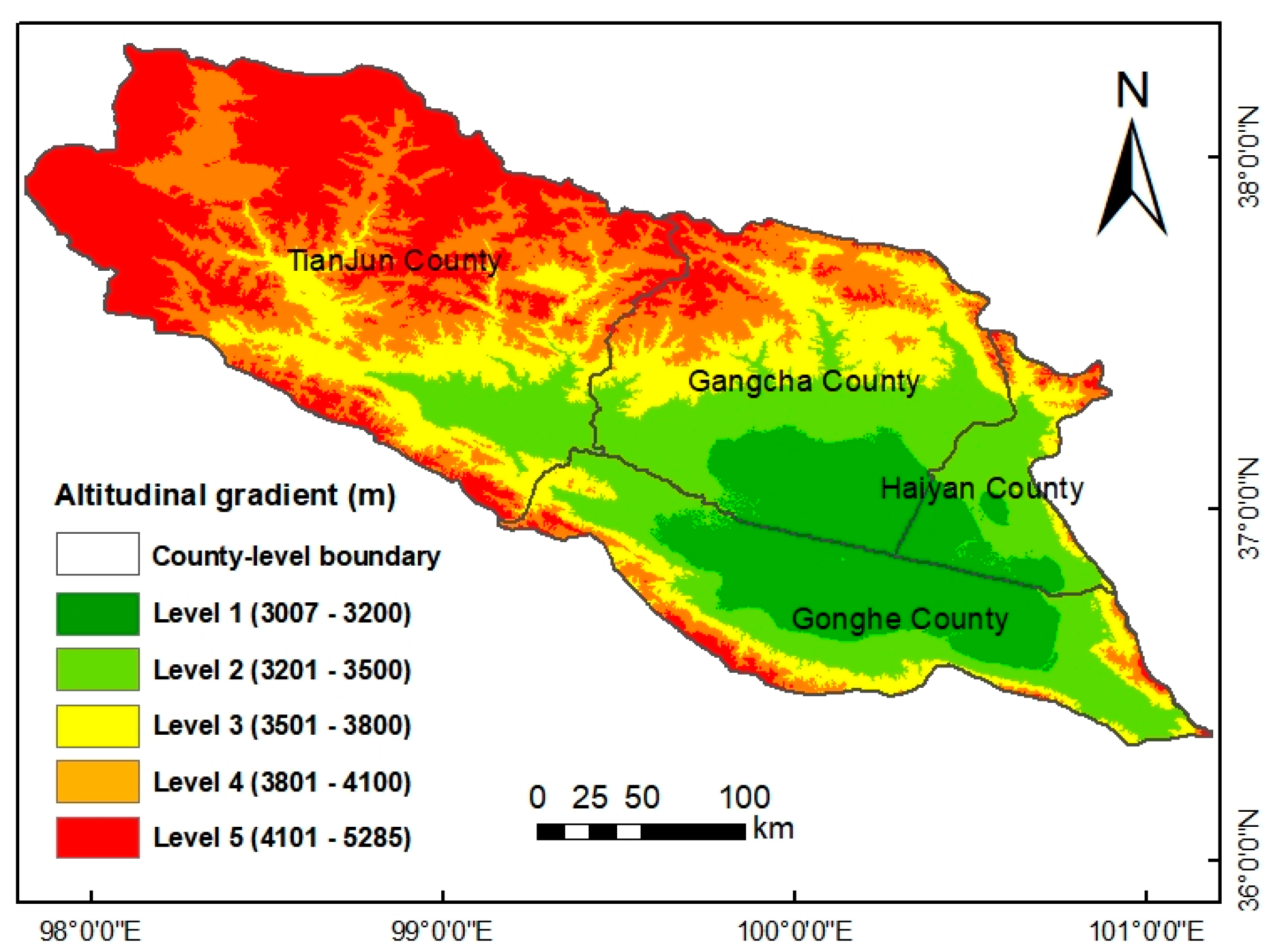
Situated in the northeastern Qinghai–Tibet Plateau, the Qinghai Lake Basin extends between latitudes 36°15′ N and 38°20′ N, and longitudes 97°50′ E and 101°20′ E. Administratively, it spans Gangcha, Haiyan, Tianjun, and Gonghe Counties, covering a total area of 29,661 km2, of which the water area accounts for approximately 14.70% [41]. The basin lies at the transitional junction of the arid northwest region, the Loess Plateau, and the Qinghai–Tibet cold zone, characterized by high-altitude terrain and a typical semi-arid plateau continental climate. The annual mean temperature varies between −1.0 °C and 4.0 °C, with precipitation between 291 and 579 mm per year, concentrated mainly in summer. The region experiences abundant sunshine, intense solar radiation, and high evaporation rates. The basin supports diverse ecosystem types, including grassland, wetland, desert, farmland, and forest [42]. As a closed inland plateau lake, Qinghai Lake primarily relies on precipitation and snowmelt for water supply, which contributes to over 90% of its annual runoff. The primary riverine inputs to the lake are delivered by the Buha, Shaliu, and Haergai rivers. Due to its unique geographical context, the Qinghai Lake Basin demonstrates intrinsic ecological fragility, making it especially vulnerable to global climate change and anthropogenic disturbances. This susceptibility manifests as a spectrum of environmental challenges, including grassland degradation, soil erosion, and biodiversity loss (Figure 1).
The Qinghai Lake Basin was chosen as the case study region principally due to the representative nature of its ecosystem and the pressing demand for related research. As a critical climate regulator and air humidifier in northwestern China [43], the spatial heterogeneity in its ESs distinctly mirrors the intricate human–land interactions characteristic of fragile alpine zones. The significant gradients in topography and climate [44] and the spatial heterogeneity of human activities within the basin [41] jointly constitute the core driving forces behind the spatial variation in ESV. Therefore, a thorough investigation into the spatiotemporal dynamics of ESV within this area and the associated natural and human-induced driving mechanisms [45] holds significant scientific value for formulating targeted ecological protection strategies, particularly in supporting the functional zoning and differentiated management of the ongoing Qinghai Lake National Park initiative.

2.2. Data Sources

The research data employed in this paper primarily include elevation, land use, precipitation, temperature, GDP per unit area, road density, population density, grain yield, and grain price (Table 1). All datasets utilized in this study underwent spatial coordinate system standardization, with a unified projection set to GCS_WGS_1984.

2.3. Research Methods

2.3.1. Land Use Transition Matrix

This method enables the quantitative assessment of the conversion processes and evolution intensity of land use types in the study area across different time periods [46,47], systematically presenting the area transitions between various land categories and providing strong support for land research and planning practices. Based on this approach, the present study specifically analyzed the areal transitions between various land cover types in the basin across the 20-year period. The calculation formula [48] is as follows:
S i j = S 12 S 1 n S n 1 S n n
where S denotes total area; Sij indicates the area of land conversion from category i to category j within the study timeframe; n signifies the total count of land categories (n = 6); and i and j correspond to the land use types at the initial and terminal stages of the study, respectively.

2.3.2. ESV Assessment

Based on the ESV equivalent system established by Xie Gaodi et al. [8], this research established the monetary value standard per unit area associated with the equivalent factor of ESV. To enhance the applicability of the assessment results in the Qinghai Lake Basin, we referred to the ESV coefficient adjustment methods proposed by Li Rongjie and Sun Xueying et al. [12,49] to modify the ESV equivalent factors for the basin. The specific adjustments are as follows: cultivated land was valued using dryland as the accounting standard; forest land was represented by shrubland; grassland ESV was calculated as the average of steppe, shrub-grassland, and meadow; water bodies were assigned the average equivalent factor of rivers/lakes and glaciers/snow cover; built-up land ESV was assigned a value of zero following the approach by Xiong Lüying et al. [50]; and unused land was valued using the desert coefficient. (Table 2)
The definition of key economic parameters constitutes the fundamental prerequisite for conducting monetary assessments of ESV. Following the methodology of Xie Gaodi et al. [8], the monetary value for a single standard equivalent was defined in this study as one-seventh of the per-unit-area market price of the nationally averaged grain output during the research period [51]. For adapting this nationwide standard to the Qinghai Lake Basin, the mean annual grain productivity per unit area in Qinghai Province across the 2000–2020 period was computed using data from the Qinghai Statistical Yearbook resulting in 3.58 × 10³ kg/hm2. According to the China Agricultural Product Cost and Revenue Statistical Yearbook (2021), the national average grain price in 2020 was 3.51 × 10⁻¹ USD/kg. Selecting the 2020 grain price as the calculation index ensures that the monetary valuation of ESV reflects the economic level at the end of the study period, enhancing comparability with socio-economic data from the same time. Given the interannual fluctuations and uncertainties in both grain market prices and regional yields, this study will discuss the impact of such uncertainties on the assessment results in the relevant section. Based on the above yield and price values and referring to related literature [12], the unit area equivalent factor value was calculated to be 1.85 × 10² USD/(hm2·a); correspondingly, the ESV coefficients for all land use categories were determined. Finally, the ESV of the Qinghai Lake Basin during 2000–2020 was quantified using the evaluation model developed by Costanza et al. [7] and was employed to quantify the ESV of the Qinghai Lake Basin from 2000 to 2020. The calculation formula is as follows:
E S V = i = 1 n A i × V c i
In the formula, ESV denotes the total of ecosystem services value within a watershed (USD); Ai denotes the area of land category i (hm2); and Vci is the ESV equivalent corresponding to land category i (USD·hm−2·a−1).

2.3.3. Grid-Cell Method

The grid approach serves as a key methodological tool for examining the spatial variation in land use transitions. Following the research by Li Yue et al. [52] and considering the area range and spatial heterogeneity of the Qinghai Lake Basin, this study selected 2000 m × 2000 m grid cells as the basic analytical units. This scale effectively captures the spatial details of ESV within the basin while ensuring computational efficiency, avoiding homogenization effects from overly coarse scales and noise interference from overly fine scales. Using ArcGIS, a total of 7715 valid grid cells covering the entire basin were generated. For each grid unit defined in the research, the calculation formula [53] for the ESV of a single land cover type inside it is as follows:
V E S V j = A p j × C j V E S V = A E S V j
In the formula, VESVj represents the ecosystem service value (USD) of land category j in each grid cell; Apj indicates the actual area (hm2) of land cover type j within grid p; and Cj stands for the ESV coefficient corresponding to land category j.

2.3.4. Spatial Correlation Analysis

Employing these two indices, the spatial dependency and clustering patterns of ESV were quantified at both the entire watershed and local pixel levels, respectively [54].
(1)
Global Moran’s I Index
To investigate the spatial heterogeneity and its changes in ESV within the Qinghai Lake Basin, this study utilized the global Moran’s I index to evaluate basin-wide spatial correlation of ESV, reflecting whether the spatial distribution of ESs across the entire study area exhibits clustering characteristics [23]. The range of the Moran’s I index is [−1, 1]. A value above zero signifies positive spatial correlation, a value below zero signifies negative spatial correlation and a value equal to zero represents spatial independence corresponding to a random distribution [55]. The computational formula is provided below:
I = k = 1 n l = 1 n W k l X k X ¯ X l X ¯ S 2 k = 1 n l = 1 n W k l
In the equation, Xk represents the actual observed value in region k; Xl represents the actual observed value in region l; X ¯ represents the mean of all observed data; and Wkl represents the spatial weight, where Wkl = 1 if regions k and l are spatially adjacent, and Wkl = 0 if they are not adjacent.
(2)
Local Moran’s I Index
At the local scale, the LISA index is frequently employed to quantify the spatial clustering characteristics of ESs [23]. This index can more clearly reveal the distribution patterns of ESV and its changes within local spaces in the Qinghai Lake Basin. A LISA value greater than 0 indicates a trade-off relationship between two types of ES, manifested as “high-high” or “low-low” clustering in spatial distribution. Conversely, a LISA value less than 0 suggests a synergistic relationship, reflected as “high-low” or “low-high” patterns, indicating that while a region excels in certain services, it may be deficient in others [55]. It is calculated using the following equation:
I k = Z k t t = 1 n W k l Z l t
In the equation, Z k t and Z l t represent the standardized results of observations in regions k and l; Wkl denotes the spatial weight, t = 1 n W kl = 1 .

2.3.5. Geographic Detector

This model serves as a statistical instrument extensively applied in geospatial studies for spatial heterogeneity detection and driving factor quantification [56]. As an effective analytical method, it can not only quantitatively characterize the explanatory capacity of individual factors regarding the dependent variable but also effectively reveal the interactive patterns between paired factors [37], which contributes to understanding the synergistic or antagonistic effects among drivers. This study employs this model to quantitatively elucidate how natural and anthropogenic drivers influence the spatial heterogeneity of ESV. The explanatory power of different factors on the dependent variable is assessed using the q-value (range 0–1). A q-value nearer to 1 reflects greater explanatory strength of the factor, indicating its heightened influence on ESV spatial variation [37]. This study selected multidimensional factors, including elevation, precipitation, temperature, GDP per unit area, road density, and population density. All continuous variables were discretized using the natural breaks method before input into the model to meet its requirements for categorical data.
q = 1 1 N σ 2 h = 1 L N h σ h 2
In the equation, q indicates the detection capability of the driving factor of ESV; L denotes the stratified regions; N refers to the total sample count across the study region; σ2 is the overall variance within the study region; Nh indicates the sample quantity in region h; and σh2 signifies the variance localized to zone h.

3. Results and Discussion

3.1. Spatiotemporal Changes in Land Use and ESV

3.1.1. Spatiotemporal Changes in Land Use

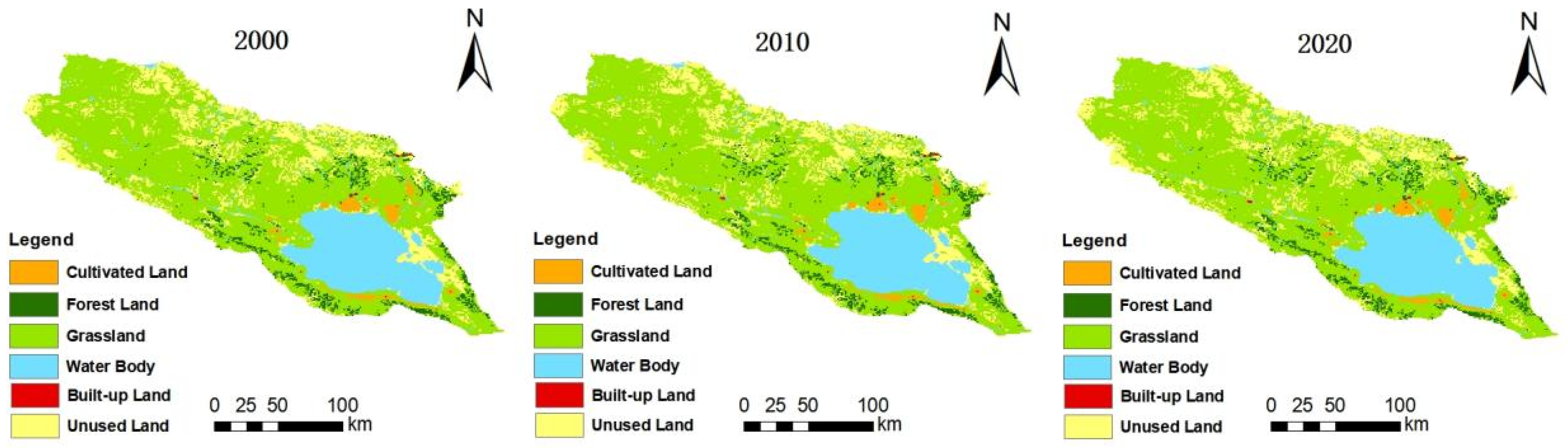
Regarding land use composition (Figure 2), grassland remained the dominant land type in the Qinghai Lake Basin during 2000–2020, exceeding 60% of the total area. This was followed by water bodies and unused land, comprising 16.67% and 16.56%, respectively. During the study period, cultivated land and forest land were primarily converted to built-up land and grassland. Grassland underwent substantial conversion to water bodies (35.21 km2) and cultivated land (21.62 km2). Water bodies were largely transformed into unused land and grassland. Built-up land showed limited conversion, mainly to grassland and cultivated land, while unused land was predominantly converted to water bodies and grassland, with the conversion to water bodies being particularly significant (115.94 km2).
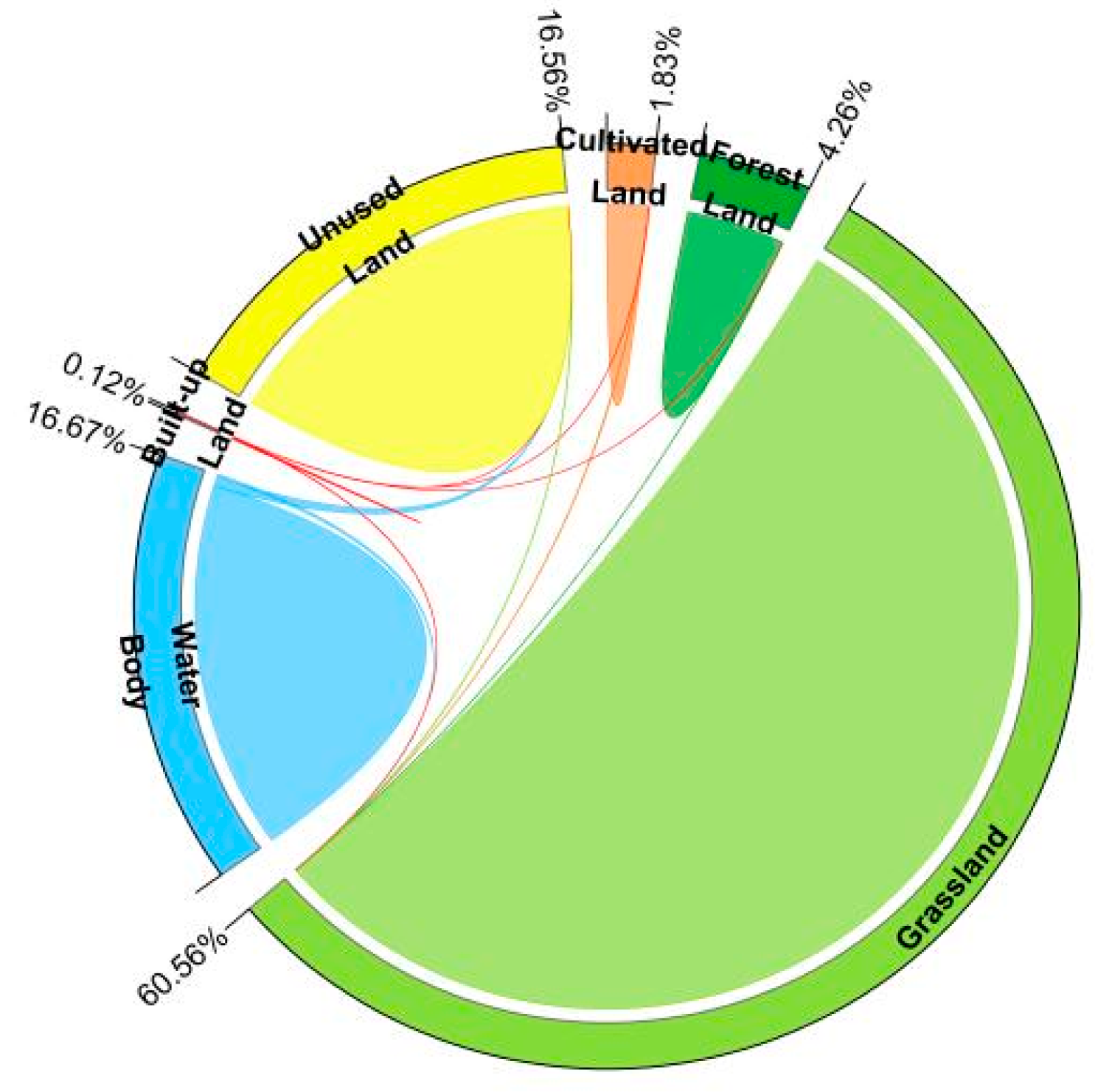
During 2000–2020, land use changes in the Qinghai Lake Basin exhibited an overall trend of “four decreases and two increases” (Figure 3). The areas of cultivated land, forest land, grassland, and unused land all decreased, with reductions of 1.16% (3.62 km2), 0.22% (0.68 km2), 11.08% (34.65 km2), and 37.59% (117.57 km2), respectively. Among these, the decrease in unused land was the most pronounced. In contrast, the areas of water bodies and built-up land increased by 46.56% (145.64 km2) and 3.39% (10.61 km2), respectively, with water bodies showing the most substantial and sustained growth. This expansion was driven on the one hand by the conversion of unused land and grassland, with respective contributions of 115.94 km2 and 35.21 km2. On the other hand, since 2005, influenced by global warming, a pronounced warming and moistening climate on the Qinghai–Tibet Plateau has significantly enhanced both precipitation inputs and snow/ice melt recharge. Combined with anthropogenic interventions such as ecological protection and restoration projects, these factors have collectively resulted in both a steady rise in the lake’s water level and the expansion of its water-covered area.

3.1.2. Spatiotemporal Variations in ESV

The total ESV of the Qinghai Lake Basin was USD 30.30 × 10⁸ in 2000, USD 30.29 × 10⁸ in 2010, and USD 30.75 × 10⁸ in 2020, showing a slight overall increasing trend with a growth of 0.31%. In terms of the four ecosystem service functions (Table 3), regulating services contributed the most to ESV, accounting for over 67.42%, followed by supporting services > cultural services > provisioning services, with respective shares of 13.54%, 9.98%, and 8.79%. The contributions of the latter three to the ESV of the study area were relatively low.
Regarding the proportion of ESV contributed by the six land use types (Table 4) reveals the following descending order: water bodies > grassland > forest land > unused land > cultivated land, while built-up land contributed nothing. Consequently, water bodies show the highest contribution rate to ESV, accounting for over 53.66%, followed by grassland with a contribution rate exceeding 40.56%. The remaining land use types contribute at relatively low levels, each accounting for less than 4%.

3.2. Spatial Pattern Evolution of ESV

3.2.1. Spatial Heterogeneity of ESV

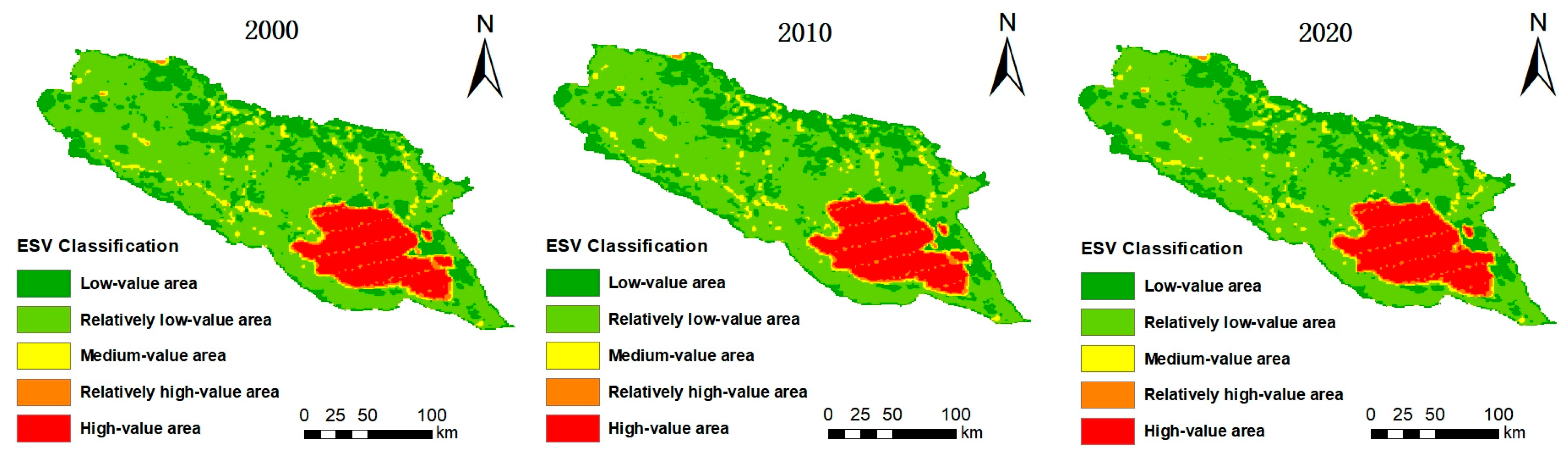
A fishnet was created using ArcGIS 10.8 software, and interpolation analysis was performed based on the natural neighbor method. The ESV was classified at a grid resolution of 2000 m × 2000 m as the analytical unit. As shown in Figure 4, the spatial distribution of ESV across the basin is marked by “high values in the lake center and low values in the surrounding areas” as well as “higher values in the southeast and lower values in the northwest.” Using the natural breaks method—which automatically identifies optimal classification breakpoints based on the statistical distribution of ESV data, minimizing subjective interference from manually set thresholds while accurately capturing intrinsic spatial differentiation patterns, thereby enhancing the objectivity and interpretability of the classification results—the ESV within the basin was classified into five grades: low-value area (USD 0–19.20 × 10⁸), relatively low-value area (USD 19.20 × 10⁸–38.40 × 10⁸), medium-value area (USD 38.40 × 10⁸–76.80 × 10⁸), relatively high-value area (USD 76.80 × 10⁸–119.80 × 10⁸), and high-value area (USD 119.80 × 10⁸–168.70 × 10⁸).
Among these, high-value areas were primarily concentrated in the main water bodies of Qinghai Lake. Over the past two decades, they gradually expanded from the lake outward, mainly covering the Naren Wetland, the northwestern part of Sand Island, the southern area of Heima River, the northwestern section of Buha River, and the vicinity of the Quanji River estuary. Areas of relatively high value are primarily distributed along the shores of Qinghai Lake, the Ganzi River’s eastern region, the northwestern region of Tianjun, and small sections of the Buha River basin. Medium-value areas were concentrated along riverine zones (including the Buha, Shaliu, Haergai, and Quanji rivers) and the Qinghai Lake shoreline, mostly distributed in the northwestern and northern sectors of the Basin, exhibiting a comparatively restricted areal coverage. Relatively low-value areas were widely distributed, interspersed among other zones, and covered the largest area, characterized primarily by grassland and unused land. Low-value zones were largely clustered in northern Gangcha together with the northern and southwestern sectors of Tianjun, with minor portions located in the northern and eastern areas of Qinghai Lake. Tianjun County is predominantly characterized by grassland and unused land. Over the investigation period, no large-scale reclamation, conversion, or degradation occurred in this region, and land use types remained stable over the long term. Additionally, owing to factors including low population density and minimal human disturbance, ESV in this area remained relatively stable overall.

3.2.2. ESV Altitude Gradient Variatio

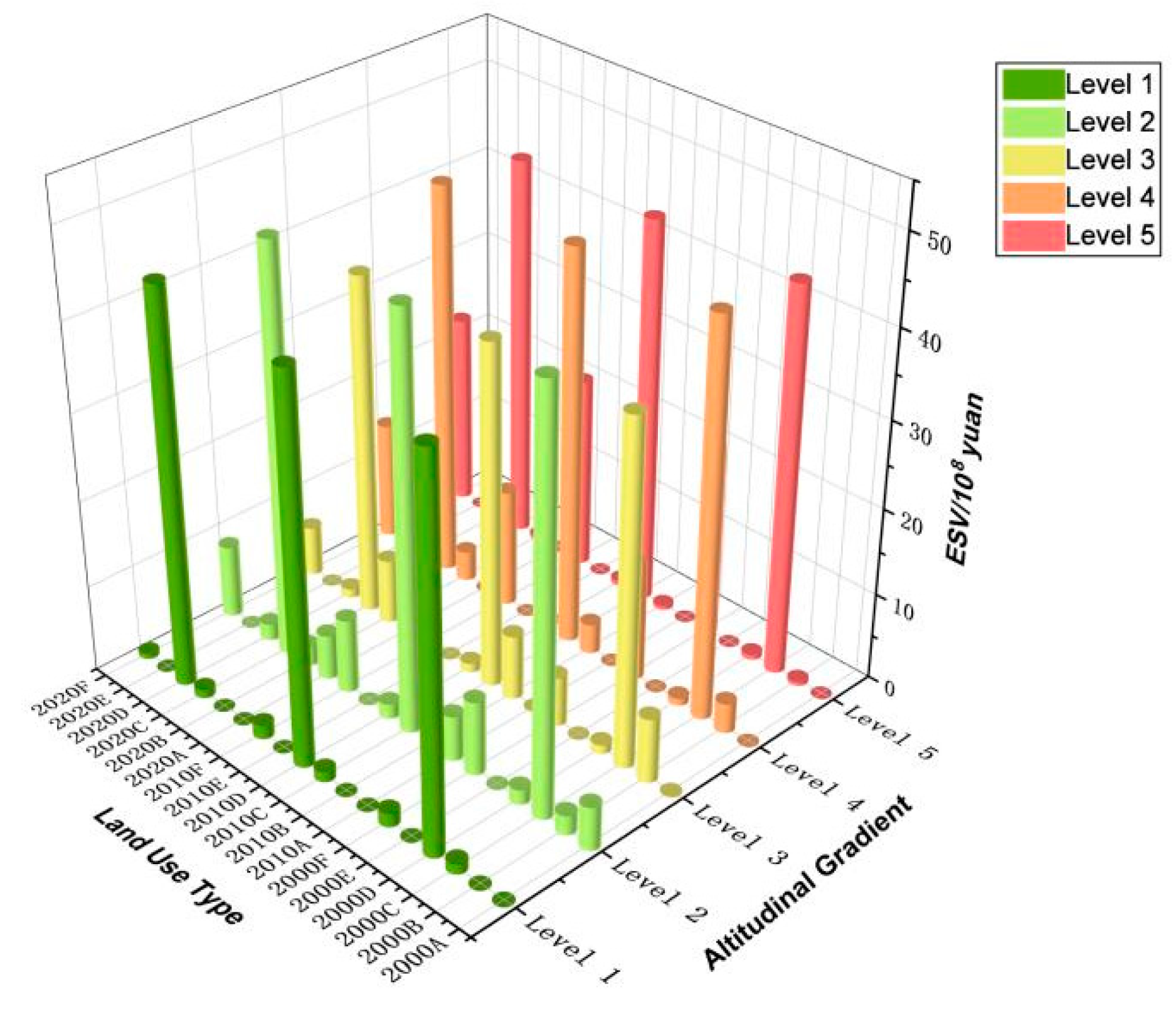
Firstly, based on the geographical conditions of the Qinghai Lake Basin, five elevation gradient levels were established, with the specific classification criteria illustrated in Figure 1. Subsequently, the ESV variation characteristics corresponding to different land use types across elevation gradients were systematically analyzed (Figure 5). The study revealed that from 2000 to 2020, in the first elevation gradient (3007–3200 m), water bodies accounted for the largest share of ESV: their mean value was USD 6.39 × 10⁸. In all other elevation gradients, grassland exhibited the greatest contribution to ESV, with mean ESV values of USD 6.77 × 10⁸, USD 5.64 × 10⁸, USD 6.49 × 10⁸, and USD 6.33 × 10⁸ for the second, third, fourth, and fifth gradients, respectively. Over the investigation period, the contribution rates of land types to ESV in the first gradient had the following order: water bodies > unused land > grassland > cultivated land. The contribution of water bodies showed a significant increasing trend, rising from USD 6.32 × 10⁸ to USD 6.50 × 10⁸. In the second gradient (3201–3500 m), the order was grassland > unused land > cultivated land > forest land > water bodies, with grassland’s contribution decreasing slightly from USD 6.80 × 10⁸ to USD 6.76 × 10⁸. In the third gradient (3501–3800 m), the sequence was grassland > forest land > unused land > water bodies > cultivated land. For the fourth gradient (3801–4100 m) and fifth gradient (4101–5285 m), the order was grassland > unused land > forest land > water bodies. Notably, in the third, fourth, and fifth gradients, the ESV contribution rates of the dominant land types exhibited minimal changes. Built-up land exhibited zero ESV at every elevation gradient.

3.2.3. Spatial Correlation Analysis of ESV

(1)
Global Spatial Correlation Changes
Using GeoDa software, the global Moran’s I indices for the spatial distribution of ESV in the case area for the years 2000, 2010, and 2020 were computed as 0.883, 0.883, and 0.889, respectively. These values are all close to 1, indicating that the ESV of land types in the Qinghai Lake Basin displayed a significant overall positive spatial correlation; clusters primarily comprise two categories: high-high values and low-low values. Over the two decades, the Moran’s I index generally showed an upward trend, and the Z-values continuously increase. The p-values were all 0.001, passing the significance test, which suggests that the degree of spatial clustering of ESV in the Qinghai Lake Basin has gradually increased, and its spatial association effect has strengthened over time. (Table 5).
(2)
Local Spatial Correlation Variations
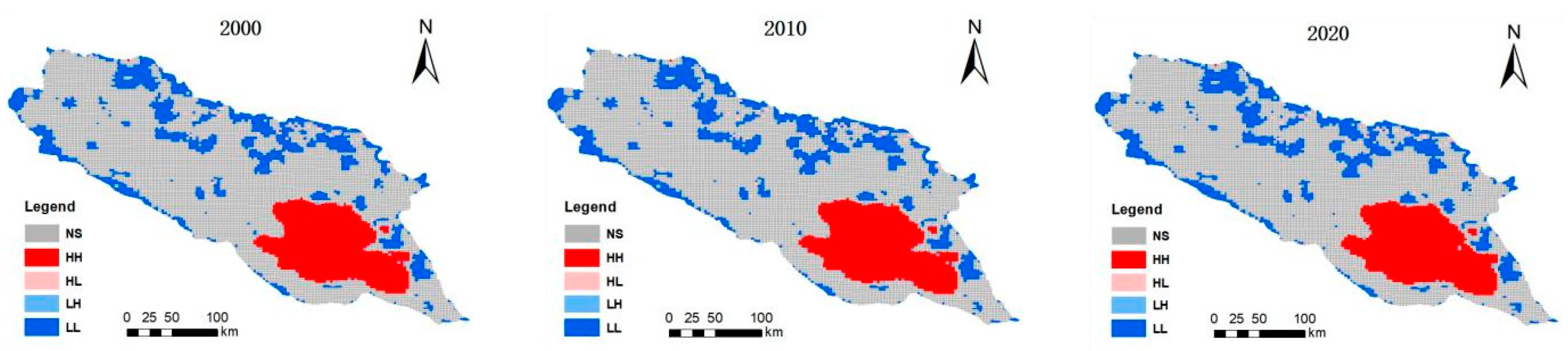
To further explore the local spatial correlation characteristics of ESV in the Qinghai Lake Basin, LISA spatial association maps based on 7715 ESV grid units were used to identify and classify high-high (HH), high-low (HL), low-high (LH), low-low (LL) clusters, and statistically non-significant (NS) areas, examining the spatial aggregation patterns of ESV during the 2000–2020 period. Over these two decades, the spatial clustering of ESV in the Qinghai Lake Basin exhibited significant regional differentiation. HH clusters were mainly concentrated in the southeastern part of the basin and showed an expanding trend, while LL clusters were predominantly distributed in the northwestern part with relatively small growth, indicating that the spatial agglomeration of both types strengthened continuously. In contrast, the number of LH and HL clusters was minimal and scattered, showing no pronounced clustering pattern. The number of units in both HH and LL clusters increased over time, suggesting a continuous enhancement of ESV spatial agglomeration. Meanwhile, the number of units in statistically non-significant areas decreased, further demonstrating a trend toward stronger spatial clustering. The spatial clustering characteristics of ESV in the Qinghai Lake Basin align closely with the spatial pattern of ecological conservation functional zoning within the basin (Figure 6).

3.3. Driving Factors Analysis of ESV

Employing the geographical detector, an analysis was conducted on the drivers and their impact magnitudes underlying the spatial variation in ESV in the Qinghai Lake Basin (Table 6). The single-factor detection results demonstrated that over the past two decades, the various driving factors exhibit the following sequence in explaining ESV: X6 (elevation) > X4 (temperature) > X1 (precipitation) > X2 (GDP per unit area) > X5 (population density) > X3 (road density). Elevation, temperature, and precipitation were identified as the key determinants of ESV within the basin. Among these, elevation and temperature had q-values greater than 0.05, indicating that they constitute central drivers of ES dynamics and significantly influence the spatial differentiation pattern of ESV. In contrast, GDP per unit area, population density, and road density were secondary driving factors, with relatively limited impacts on ESV. Natural factors demonstrated a substantially higher average q-value relative to anthropogenic factors; this implies that the former demonstrates superior explanatory capability for ESV compared to the latter.
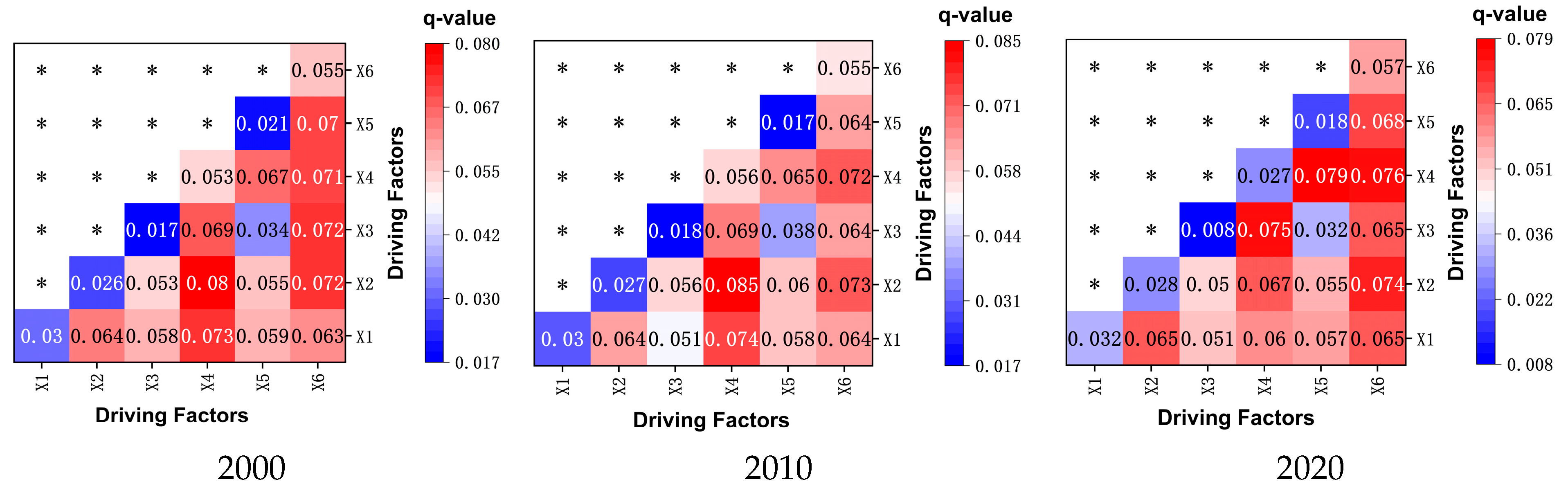
The interaction detection results (Figure 7) revealed that in 2010, the single-factor q-values for X3 (road density) and X5 (population density) were 0.018 and 0.017, respectively, while the two-factor interaction q-value for X3 ∩ X5 was 0.038, indicating that their interaction increased the explanatory power for ESV by 8.57% compared to their independent effects. In 2020, the single-factor q-values for X1 (precipitation) and X2 (GDP per unit area) were 0.032 and 0.028, respectively, whereas the two-factor interaction q-value for X1 ∩ X2 was 0.065, reflecting an 8.33% enhancement in explanatory power relative to their independent contributions. Multiple analyses showed that the q-value derived from the two-factor interaction exceeds that obtained from the single-factor assessment, indicating synergistic enhancement effects among the factors. Moreover, over the past two decades, these interaction effects exhibited a steady and continuous strengthening trend. In summary, the spatial heterogeneity of ESV within the Qinghai Lake results from both natural and anthropogenic drivers, among which natural factors serving as the primary driving element. The explanatory power of two-factor interactions consistently surpasses those of individual factors, thus revealing that the superposition of multiple factors significantly reinforces ESV spatiotemporal distribution patterns. Future research should prioritize the quantitative expression of multi-factor synergistic effects and further investigate spatial differentiation patterns, thereby deepening the understanding of ESV driving mechanisms and advancing dynamic simulations of factor superposition effects under different scenarios.

3.4. Discussion

The equivalent factor approach has been extensively applied for ESV from regional to global extents; it facilitates a clear delineation of the spatiotemporal patterns of ESV within the study area. However, this method’s core parameter, namely, the monetary value per unit area equivalent factor relies on grain yield per unit area and market prices, a key economic parameter that is sensitive and subject to uncertainty [57]. If the grain price in 2020 fluctuates within a range of ±20%, the total ESV calculated in this study would change proportionally. This outcome highlights the limitation of relying on static market prices for valuation. Future research should incorporate long-term grain price fluctuation series or adopt diverse valuation approaches such as shadow pricing and replacement cost methods to enhance the robustness of ESV monetization assessments.
Despite the parametric uncertainties noted above, this study refined the ESV equivalent coefficients to better align with the specific ecological characteristics of the alpine fragile zone, thereby improving the congruence of the assessment results with the actual ecological baseline of the Qinghai Lake Basin. Moreover, this research innovatively integrates three analytical techniques: elevation-gradient classification, spatial autocorrelation analysis, and the geographic detector model. The integrated approach serves to clarify the spatial heterogeneity of ESV along the basin’s elevational gradients while further detecting prominent “high-high” and “low-low” spatial clustering characteristics. By moving beyond the previous emphasis on temporal-evolution analysis, the study provides a more detailed and intuitive theoretical foundation for understanding the driving mechanisms behind ESV spatial heterogeneity.
By employing the geographical detector model, this study comprehensively analyzes the roles of both natural and anthropogenic factors in shaping the spatial differentiation of ESV, clarifies the synergistic enhancement effects resulting from multi-factor interactions, and scientifically reveals the underlying driving mechanisms behind the spatial patterns of ESV. The application of this analytical framework can be integrated with the functional zoning plan of the Qinghai Lake National Park—summarized as “one core, four zones”—providing a quantitative basis for formulating differentiated and targeted ecological protection policies. It should be noted that the discretization methods applied to independent variable data in the detection analysis may introduce certain biases in the evaluation of factor explanatory power (q-value) [58]. Future research should focus on exploring and establishing improved discretization standards based on the inherent distribution characteristics of the data, thereby reducing uncertainties arising from manual processing and enhancing the accuracy of driving mechanism interpretation.

4. Conclusions

This study offers a scientific basis for optimizing the functional zoning summarized as “one core, four zones, one ring, multiple points” of the Qinghai Lake National Park and for formulating differentiated management strategies across different elevation zones.
(1)
During 2000–2020, the total ESV of the Qinghai Lake Basin increased from USD 30.30 × 10⁸ to USD 30.75 × 10⁸, representing a growth of 0.31%. The significant expansion of water area served as the key driver of this slight overall increase in ESV. The composition of ESV was dominated by regulating services (accounting for >67.42%) and was highly concentrated in two ecosystem types: water bodies (contribution rate > 53.66%) and grassland (contribution rate > 40.56%). This confirms the core role of water bodies as the “blue gem of the plateau” and grassland as the “ecological foundation” in maintaining regional ecological security.
(2)
The spatial differentiation of ESV within the Qinghai Lake Basin displays a pronounced pattern typified by “high values in the lake center and low values in the surrounding areas,” suggesting that the lake body and its riparian zones should be prioritized as the “core area” for focused conservation to promote the continuous enhancement of basin-wide ESV. Meanwhile, the spatial characteristics of ESV, which shows “higher values in the southeast and lower values in the northwest” and is strongly correlated with elevation, provides a quantitative basis for the differentiated functional zoning of the “four zones” within the national park. The vertical zonality driven by topography and climate, combined with the spatial differentiation of human activities, serves as the core driver shaping this spatial pattern. It is recommended that, on the basis of strict protection, scientific planning be implemented for the high-high ESV clusters in low-elevation southeastern areas (such as the lakeside regions of Gonghe County) to develop ecotourism, while ecological restoration and conservation projects should be prioritized in the low-low ESV clusters in high-elevation northwestern areas (such as parts of Tianjun County), aiming to achieve differentiated management across varying elevation zones.
(3)
Given the significant synergistic enhancement effect of natural and anthropogenic factors on the spatial differentiation of ESV, the complexity of ESV driving mechanisms is highlighted. An active effort should be made to establish a watershed monitoring belt around the core area of the national park as an ecological buffer zone, which, through this “one-ring”, will systematically monitor and mitigate anthropogenic pressures from peripheral areas on the ecosystem. On this basis, the vertical management system of “administration bureau—sub-management bureaus—conservation stations” (the “multiple points”) should be further improved to support the high-quality development of the Qinghai Lake National Park and promote regional ecological conservation and sustainable development.
(4)
To deepen the understanding of ES mechanisms in alpine inland basins and enhance the foresight of management decisions, future research should focus on the following directions: first, developing a dynamic assessment framework that integrates future climate change scenarios and land cover change models (FLUS) to simulate the evolution trends of ESV and ecological security patterns under different development pathways; second, founded on the spatial differentiation characteristics of ESV revealed in this research, conducting research on priority zoning for ecological compensation and quantitative compensation standards, thereby providing scientific grounds for formulating accurate and effective ecological compensation schemes for river basins.

Author Contributions

Framework, Y.M. and K.C.; Data collection, Y.H.; Investigation, X.L. and S.Z. (Shijia Zhou); Software, S.Z. (Shuchang Zhu) and H.Z.; Drafting the initial manuscript, Y.M.; Manuscript review and editing, Y.M. and K.C. All authors have read and agreed to the published version of the manuscript.

Funding

This study was supported by the National Natural Science Foundation of China (Grant No. 42461018) and the Central Government Guidance Fund for Local Science and Technology Development of Qinghai Province (Grant No. 2025-ZY-043).

Institutional Review Board Statement

Not applicable.

Informed Consent Statement

Not applicable.

Data Availability Statement

The datasets generated and analyzed during the current study are included in this published article.

Conflicts of Interest

The authors declare no conflicts of interest.

Abbreviations

The following abbreviations are used in this manuscript:
ESEcosystem service
ESVEcosystem service value
LUCCLand use and land cover change

References

  1. Wang, Z.; Xie, J.; Liu, X.; Li, Q.; Li, X. Study on the Relationship between Vegetation Cover and Water Area in the Qinghai Lake Basin. Environ. Sci. Bull. 2019, 38, 10–14. [Google Scholar]
  2. Shi, X. Qinghai National Park Development Continues to Lead Nationally; Xining Evening News: Xining, China, 2025. [Google Scholar] [CrossRef]
  3. Jiang, H.; Wu, Q. Assessment of Ecosystem Service Values and Spatiotemporal Evolution Characteristics in Jiangsu Province Based on LUCC. Resour. Environ. Yangtze Basin 2021, 30, 2712–2725. [Google Scholar]
  4. Liu, R.; Cheng, J. Geographical Definition and Major Ecological Issues of the Yellow River “Ji-Zi-Wan” Bend. Chin. J. Appl. Ecol. 2025, 36, 383–394. [Google Scholar] [CrossRef]
  5. Li, Q.; Wang, Y.; Zhang, H.; Chai, Z.; Xiong, B. Types, Characteristics, and Ecological Restoration Strategies of Fragile Eco-geological Environments in the Yunnan Plateau. Carsologica Sin. 2024, 43, 1261–1274. [Google Scholar] [CrossRef]
  6. Liu, J. Research on the Ecological Value and Environmental Protection of Qinghai Lake. Water Resour. Econ. 2007, 4, 1–2+6+81. [Google Scholar]
  7. Costanza, R.; Groot, R.; Sutton, P.; Ploeg, S.; Anderson, S.; Kubiszewski, I.; Farber, S.; Turner, R.K. Changes in the Global Value of Ecosystem Services. Glob. Environ. Change 2014, 26, 152–158. [Google Scholar] [CrossRef]
  8. Xie, G.; Zhang, C.; Zhang, L.; Chen, W.; Li, S. Improvement of the Evaluation Method for Ecosystem Service Value Based on Per Unit Area. J. Nat. Resour. 2015, 30, 1243–1254. [Google Scholar] [CrossRef]
  9. Gao, Y.; Shen, Z.; Zhang, Z.; Xiong, J. Research Progress on Socio-Ecosystem Coupling Simulation from an Ecosystem Services Perspective. Acta Geogr. Sin. 2024, 79, 134–146. [Google Scholar]
  10. Zheng, H.; Wu, T.; Ouyang, Z.; Polasky, S.; Ruckelshaus, M.; Wang, L.; Xiao, Y.; Gao, X.; Li, C.; Daily, G.C. Gross Ecosystem Product (GEP): Quantifying Nature for Environmental and Economic Policy Innovation. Ambio 2023, 52, 1952–1967. [Google Scholar] [CrossRef] [PubMed]
  11. Liu, Y.; Fu, B.; Zhao, W.; Wang, S. Ecological Asset Accounting and Ecosystem Service Assessment: Conceptual Convergence and Key Directions. Acta Ecol. Sin. 2018, 38, 8267–8276. [Google Scholar]
  12. Li, R.; Li, H.; Wu, F.; Zhao, M.; Wang, S.; Sun, X. Spatial Patterns and Driving Forces of Ecosystem Services in the Qinghai Lake Basin. Acta Ecol. Sin. 2024, 33, 301–309. [Google Scholar] [CrossRef]
  13. Wang, R.; Pan, H.; Liu, Y.; Tang, Y.; Zhang, Z.; Ma, H. Spatiotemporal Evolution and Driving Forces of Ecosystem Service Values in Leshan City Based on Dynamic Equivalent. Acta Ecol. Sin. 2022, 42, 76–90. [Google Scholar]
  14. Yan, Y.; Zhu, J.; Wu, G.; Zhan, Y. Research Progress on Demand, Supply, and Consumption of Ecosystem Services. Acta Ecol. Sin. 2017, 37, 2489–2496. [Google Scholar]
  15. Wang, X.; Yao, W.; Feng, X.; Jia, Z.; Zhang, X.; Ma, J.; Zhou, J.; Tu, Y.; Sun, Z. Changes in Ecosystem Service Supply and Demand and Their Driving Factors on the Qinghai-Tibet Plateau. Acta Ecol. Sin. 2023, 43, 6968–6982. [Google Scholar] [CrossRef]
  16. Zhang, B.; Shi, Y.; Wang, S. Research Progress on Driving Mechanisms of Ecosystem Service Changes. J. Resour. Ecol. 2022, 13, 68–79. [Google Scholar]
  17. Costanza, R.; d’Arge, R.; de Groot, R.; Farber, S.; Grasso, M.; Hannon, B.; Limburg, K.; Naeem, S.; O’Neill, R.V.; Paruelo, J. The Value of the World’s Ecosystem Services and Natural Capital. Nature 1997, 387, 253–260. [Google Scholar] [CrossRef]
  18. Xie, G.; Lu, C.; Leng, Y.; Zheng, D.; Li, S. Ecological Assets Valuation of the Tibetan Plateau. J. Nat. Resour. 2003, 18, 189–196. [Google Scholar]
  19. Chen, W.; Li, J.; Zhu, L. Spatial Heterogeneity and Sensitivity Analysis of Ecosystem Services Value in the Middle Yangtze River Region. J. Nat. Resour. 2019, 34, 325–337. [Google Scholar] [CrossRef]
  20. Zhang, J.; Yang, W.; Li, J.; Shen, S.; Ma, L.; Chen, L. Spatiotemporal Variations in Ecosystem Service Values and Their Driving Forces in Beijing. Acta Ecol. Sin. 2025, 45, 306–318. [Google Scholar] [CrossRef]
  21. Shou, F.; Li, Z.; Huang, L.; Huang, S.; Yan, L. Spatial Differentiation Characteristics and Ecological Pattern Classification Based on Ecosystem Service Supply and Demand Evaluation: A Case Study of the Yangtze River Delta Urban Agglomeration. Acta Ecol. Sin. 2020, 40, 2813–2826. [Google Scholar]
  22. Chen, L.; Mu, Z.; Yang, R.; Zhu, X.; Song, Z.; Wang, T. Spatiotemporal Evolution and Driving Factors of Ecosystem Service Values in the Mainstream Tarim River Basin. Environ. Sci. 2025, 1–17. [Google Scholar] [CrossRef]
  23. Deng, C.; Zhong, X.; Xie, B.; Wan, Y.; Song, X. Spatial and Temporal Changes of Land Ecosystem Service Value in Dongting Lake Area in 1995–2015. Geogr. Res. 2019, 38, 844–855. [Google Scholar]
  24. Lin, X.; Xu, W.; Liao, Y.; Shao, E. Spatiotemporal Variation of Farmland Compensation in Fujian Province and Its Impact on Ecosystem Service Value. Acta Ecol. Sin. 2024, 33, 1837–1848. [Google Scholar] [CrossRef]
  25. Liu, G.; Zhang, L.; Zhang, Q. Spatial and Temporal Dynamics of Land Use and Its Influence on Ecosystem Service Value in Yangtze River Delta. Acta Ecol. Sin. 2014, 34, 3311–3319. [Google Scholar] [CrossRef]
  26. Liu, X.; Zhang, X.; Tian, H.; Yuan, M.; He, L. Trade-offs/Synergies and Driving Factors of Ecosystem Service Values in the Wuhan Metropolitan Area. J. Soil Water Conserv. 2025, 33, 1–13. [Google Scholar] [CrossRef]
  27. Wang, Y.; Liu, C. Spatial Effects of Changsha Tourism Development on Ecosystem Service Values. J. Nat. Sci. Hunan Norm. Univ. 2023, 46, 21–30. [Google Scholar]
  28. Ding, L.; Wang, Q.; Chen, X.; Tang, J. The Responses of Ecosystem Services to Land-Use Change in Dianshan Lake Area from 1984 to 2014. Acta Ecol. Sin. 2019, 39, 2973–2985. [Google Scholar] [CrossRef]
  29. Zhang, N. Dynamic Changes in Land Use and Ecosystem Service Values in the Altai Mountains from 2000 to 2020. Bull. Soil Sci. 2022, 53, 1286–1294. [Google Scholar] [CrossRef]
  30. Hu, Y.; Zhang, M. Research on Ecological Value Assessment and Ecological Compensation Standards for Wetlands in China. Ecol. Econ. 2024, 40, 135–142. [Google Scholar]
  31. Lang, Y.; Song, W. Quantifying and Mapping the Responses of Selected Ecosystem Services to Projected Land Use Changes. Ecol. Indic. 2019, 102, 186–198. [Google Scholar] [CrossRef]
  32. Li, J.; Yang, D.; Yang, F.; Zhang, Y.; Wang, H. Impact of Landscape Patterns on the Matching of Ecosystem Service Supply and Demand in Tianjin under Urbanization. Acta Ecol. Sin. 2024, 44, 4987–5002. [Google Scholar]
  33. Sun, D.; Liang, Y.; Liu, L. Impact of Land Use Change in Guizhou Province from 2000 to 2020 on Ecosystem Service Values. Resour. Environ. Yangtze Basin 2024, 33, 547–560. [Google Scholar]
  34. Tian, C.; Zheng, R.; Li, Z.; Yao, L. Analysis of Trade-off Synergies and Driving Mechanisms of Ecosystem Services in the Shaanxi Section of the Yellow River Basin. Environ. Sci. 2025, 1–25. [Google Scholar] [CrossRef]
  35. Qian, M.; Su, X.; Li, Y.; Wen, C. Ecosystem Service Value Effects of Land Use Transformation in the Upper Yangtze River Basin from a “Three Lives” Spatial Perspective. Three Gorges Ecol. Environ. Monit. 2025, 1–19. [Google Scholar]
  36. Li, X.; Zou, Y.; Li, F.; Xie, Y.; Zeng, J.; Hou, Z. Changes in Wetland Area and Ecosystem Service Value in Changsha City from 1991 to 2020 and Their Driving Factors. Wetl. Sci. 2025, 23, 435–446. [Google Scholar] [CrossRef]
  37. Wang, J.; Xu, C. Geodetector: Principle and Prospective. Acta Geogr. Sin. 2017, 72, 116–134. [Google Scholar]
  38. Zhang, C.; Li, Y. Regional Ecosystem Service Coupling Situation and Its Driving Forces: An Integrated Analysis Based on GeoDetector and fsQCA. Acta Ecol. Sin. 2025, 45, 3849–3861. [Google Scholar] [CrossRef]
  39. Chen, T.; Huang, Q.; Wang, Q. Differentiation Characteristics and Driving Force Analysis of Ecosystem Service Relationships in Karst Mountainous Areas Based on Geodetector: A Case Study of Guizhou Province. Acta Ecol. Sin. 2022, 42, 6959–6972. [Google Scholar]
  40. Huang, Y.; Cao, Y.; Wu, J.; Zhou, Z. Interactive Effects and Thresholds of Driving Factors for Ecosystem Services in the Yangtze River Delta. Acta Ecol. Sin. 2024, 44, 9956–9973. [Google Scholar] [CrossRef]
  41. Li, H.; Li, R.; Yan, X.; Wu, F.; Gao, Z.; Tan, Y. Ecological Risk Assessment and Ecological Function Zoning in the Qinghai Lake Basin. Acta Ecol. Sin. 2023, 32, 1185–1195. [Google Scholar]
  42. Li, D.; Jiang, Z.; Wang, Z. Spatial Characteristics and GAP Analysis of Biodiversity in the Qinghai Lake Region. J. Nat. Resour. 1999, 14, 48–55. [Google Scholar]
  43. Mei, Z.; Zhang, Y.; Huang, X.; Liu, Z. Ecological Risk Assessment Based on Ecosystem Services and Analysis of Influencing Factors of Spatial Heterogeneity in the Qinghai Lake Basin. Acta Ecol. Sin. 2024, 44, 4973–4986. [Google Scholar] [CrossRef]
  44. Liu, M.; Zhong, J.; Wang, B.; Mi, W. Spatiotemporal Variation and Driving Factors of Water Yield Function in the Qinghai Lake Basin Based on the InVEST Model. Sci. Geogr. Sin. 2023, 43, 411–422. [Google Scholar] [CrossRef]
  45. Han, Y. Impacts of Climate and Landscape Pattern Changes on Ecosystem Services in the Qinghai Lake Basin. Ph.D. Thesis, Qinghai Normal University, Xining, China, 2021. [Google Scholar] [CrossRef]
  46. Wu, J.; Xiang, Y.; Dai, C.; Wan, D. Spatiotemporal Evolution Characteristics of Ecosystem Service Values and Land Use Carbon Emissions in the Dongting Lake Region, Hunan Province. J. Hunan Ecol. Sci. 2025, 12, 73–81. [Google Scholar]
  47. Nagendra, H.; Munroe, D.K.; Southworth, J. From Pattern to Process: Landscape Fragmentation and the Analysis of Land Use/Land Cover Change. Agric. Ecosyst. Environ. 2004, 101, 111–115. [Google Scholar] [CrossRef]
  48. Liu, Q.; Li, H.; Tian, H.; Wei, N.; Wu, Z.; Li, L.; Chang, Q. Land Use/Cover Change and Sustainable Development in the Coastal Zone of Mainland China. Sci. Geogr. Sin. 2024, 44, 1695–1705. [Google Scholar]
  49. Sun, X.; Wang, L. Simulation of Land Use Change and Spatial Response of Ecosystem Service Value under Multiple Scenarios in the Qinghai Lake Basin. Guizhou For. Sci. Technol. 2025, 53, 41–48. [Google Scholar] [CrossRef]
  50. Xiong, L.; Shi, X. Impact of Land Use Change on Ecosystem Service Value in Loess Hills: A Case Study of the Changhe River Basin. Res. Soil Water Conserv. 2018, 25, 335–340. [Google Scholar]
  51. Qi, Q.; Wang, L.; Chen, J.; Wang, B.; He, S.; Han, J.; Li, Z.; Li, K. Interaction between Rapid Urban Expansion and Ecosystem Service Value Trade-off/Synergy in Wuhan City. Sci. Geogr. Sin. 2024, 44, 953–963. [Google Scholar]
  52. Li, Y.; Liu, J.; Bai, X.; Feng, X.; Qiu, L. Multi-scale Spatial Differentiation of Ecosystem Service Values of the Important Water Conservation Area in the Upper Reaches of the Yangtze River: Patterns, Processes and Driving Forces. Acta Ecol. Sin. 2025, 45, 3062–3078. [Google Scholar]
  53. Wang, D.; Jing, Y.; Han, S.; Gao, M. Spatiotemporal Relationship Analysis of Land Use Carbon Emissions and Ecosystem Service Values in the South Four Lakes Basin Based on Grid Modeling. Acta Ecol. Sin. 2022, 42, 9604–9614. [Google Scholar]
  54. Wei, X.; Xin, S.; Zhang, Y.; Long, Y.; Zhang, X. Spatial Difference of Ecological Services and Its Influencing Factors under Different Scales: Taking the Nanchang Urban Agglomeration as an Example. Acta Ecol. Sin. 2023, 43, 7585–7597. [Google Scholar]
  55. Li, T.; Zhi, R.; Zhang, C. Spatiotemporal Evolution Characteristics and Trade-off Synergy Relationships of Ecosystem Services in the Yanhe River Basin. J. Soil Water Conserv. 2025, 1–13. [Google Scholar]
  56. Huang, M.; Yue, W.; Fang, B.; Feng, S. Scale Response Characteristics and Geographic Exploration Mechanism of Spatial Differentiation of Ecosystem Service Values in Dabie Mountain Area, Central China from 1970 to 2015. Acta Geogr. Sin. 2019, 74, 1904–1920. [Google Scholar]
  57. Zhang, C.; Chen, L.; Wang, L.; Song, W.; Yan, Z. Spatiotemporal Heterogeneity and Driving Factors of Ecosystem Service Value in the Yellow River Basin. J. Beijing For. Univ. 2024, 46, 70–81. [Google Scholar]
  58. Fu, D.; Wei, J. Spatio-temporal Synergy between Ecosystem Service Value and Landscape Ecological Risk in Anhui Province. J. Yunnan Agric. Univ. (Soc. Sci.) 2024, 18, 130–140. [Google Scholar]
Figure 1. Elevation schematic of the study area.
Sustainability 18 01141 g001
Figure 2. Land use type map of the Qinghai Lake Basin (2000–2020).
Sustainability 18 01141 g002
Figure 3. Land use change string diagram for the Qinghai Lake Basin (2000–2020).
Sustainability 18 01141 g003
Figure 4. Spatial heterogeneity of ESV across the Qinghai Lake Basin (2000–2020).
Sustainability 18 01141 g004
Figure 5. Altitudinal gradient differentiation of ESV in the Qinghai Lake Basin (2000–2020). Note: The figure denotes cultivated land, forest land, grassland, water bodies, built-up land, and unused land with A, B, C, D, E, and F, respectively.
Sustainability 18 01141 g005
Figure 6. Map of local spatial association (LISA) for ESV in the Qinghai Lake Basin.
Sustainability 18 01141 g006
Figure 7. Results of interaction factor detection. Note: “*” indicates that the interaction factor detection results are statistically significant, enabling rapid identification of the reliable influence of key driving factors.
Sustainability 18 01141 g007
Table 1. Data and sources.
Data TypeData SourceYearSpatial ResolutionUnit
ElevationGeospatial Data Cloud (https://www.gscloud.cn/)
(Accessed: 31 August 2025)
2000–202090 mm
Land UseThe Data Platform for Resources and Environmental Sciences, Chinese Academy of Sciences (http://www.resdc.cn/)
(Accessed: 2 September 2025)
2000–20201 kmkm2
PrecipitationNational Data Center for Earth System Science
(http://www.geodata.cn/) (Accessed: 5 September 2025)
2000–20201 kmmm
TemperatureNational Data Center for Earth System Science
(http://www.geodata.cn/) (Accessed: 5 September 2025)
2000–20201 km°C
GDP per Unit AreaNational Data Center for Earth System Science
(http://www.geodata.cn/) (Accessed: 6 September 2025)
2000–20201 kmUSD/km2
Road DensityNational Platform for Geographic Information Resources and Services (https://www.webmap.cn/)
(Accessed: 2 September 2025)
2000–20201 kmkm/km2
Population DensityWorldPop Global Population Distribution Dataset (https://hub.worldpop.org/) (Accessed: 2 September 2025)2000–20201 kmpersons/km2
Grain YieldQinghai Province Statistical Yearbook
(Accessed: 9 September 2025)
2000–2020/kg/hm2
Grain PriceChina Agricultural Product Cost and Revenue Statistical Yearbook (2021) (Accessed: 9 September 2025)2000–2020/USD/kg
Table 2. Per-unit-area ESV of the Qinghai Lake Basin.
Ecosystem ClassificationSupply ServicesAdjustment ServicesSupport ServicesCultural
Services
Level 1
Classification
Food ProductionRaw Material ProductionWater SupplyGas RegulationClimate ControlPurify the EnvironmentHydrological RegulationSoil ConservationMaintain Nutrient CyclingBiodiversityLandscape Aesthetics
Cultivated land0.850.400.020.670.360.100.271.030.120.130.06
Forest land0.190.430.221.414.231.283.351.720.131.570.69
Grassland0.230.340.191.213.191.052.341.470.111.340.59
Water bodies0.400.125.230.481.422.8654.690.470.041.280.99
Built-up land00000000000
Unused land0.010.030.020.110.100.310.210.130.010.120.05
Table 3. ESV of the Qinghai Lake Basin (2000–2020).
Ecological Service Functions200020102020
ESV/108 USDPercentage/%ESV/108 USDPercentage/%ESV/108 USDPercentage/%
Supply Services2.668.79 2.66 8.80 2.71 8.82
Regulation Services20.43 67.42 20.41 67.42 20.81 67.66
Support Services4.1513.72 4.15 13.72 4.1713.54
Cultural Services3.05 10.07 3.05 10.06 3.06 9.98
Total30.30 10030.29 10030.75100
Table 4. ESV variations across land types in the Qinghai Lake Basin (2000–2020).
YearESV and ProportionCultivated LandForest LandGrasslandWater BodiesBuilt-Up LandUnused LandTotal
2000ESV/108 USD0.131.0912.5216.25 00.3130.30
Percentage/%0.40 3.60 41.29 53.66 0.00 1.04 100
2010ESV/108 USD0.131.0912.50 16.2500.3130.29
Percentage/%0.42 3.60 41.25 53.68 0.00 1.04 100
2020ESV/108 USD0.131.0912.47 16.7500.3130.75
Percentage/%0.41 3.55 40.56 54.48 0.00 1.00 100
Table 5. Significance assessment of global autocorrelation.
Index200020102020
Moran’s I0.8830.8830.889
Z-Value148.328148.339150.136
p-Value0.0010.0010.001
Table 6. Results of single factor detection.
YearX1X2X3X4X5X6
qpqpqpqpqpqp
20000.0300.0000.0260.0000.0170.0470.0530.0000.0210.0030.0550.000
20100.0300.0000.0270.0000.0180.0030.0560.0000.0170.1080.0550.000
20200.0320.0000.0280.0000.0080.3390.0270.0000.0180.1280.0570.000
Note: In this study, X1, X2, X3, X4, X5, and X6 represent precipitation, GDP per unit area, road density, temperature, population density, and elevation, respectively. The q-statistic (q-value) assesses the explanatory strength of a factor, while the p-value reflects its statistical significance.
Disclaimer/Publisher’s Note: The statements, opinions and data contained in all publications are solely those of the individual author(s) and contributor(s) and not of MDPI and/or the editor(s). MDPI and/or the editor(s) disclaim responsibility for any injury to people or property resulting from any ideas, methods, instructions or products referred to in the content.