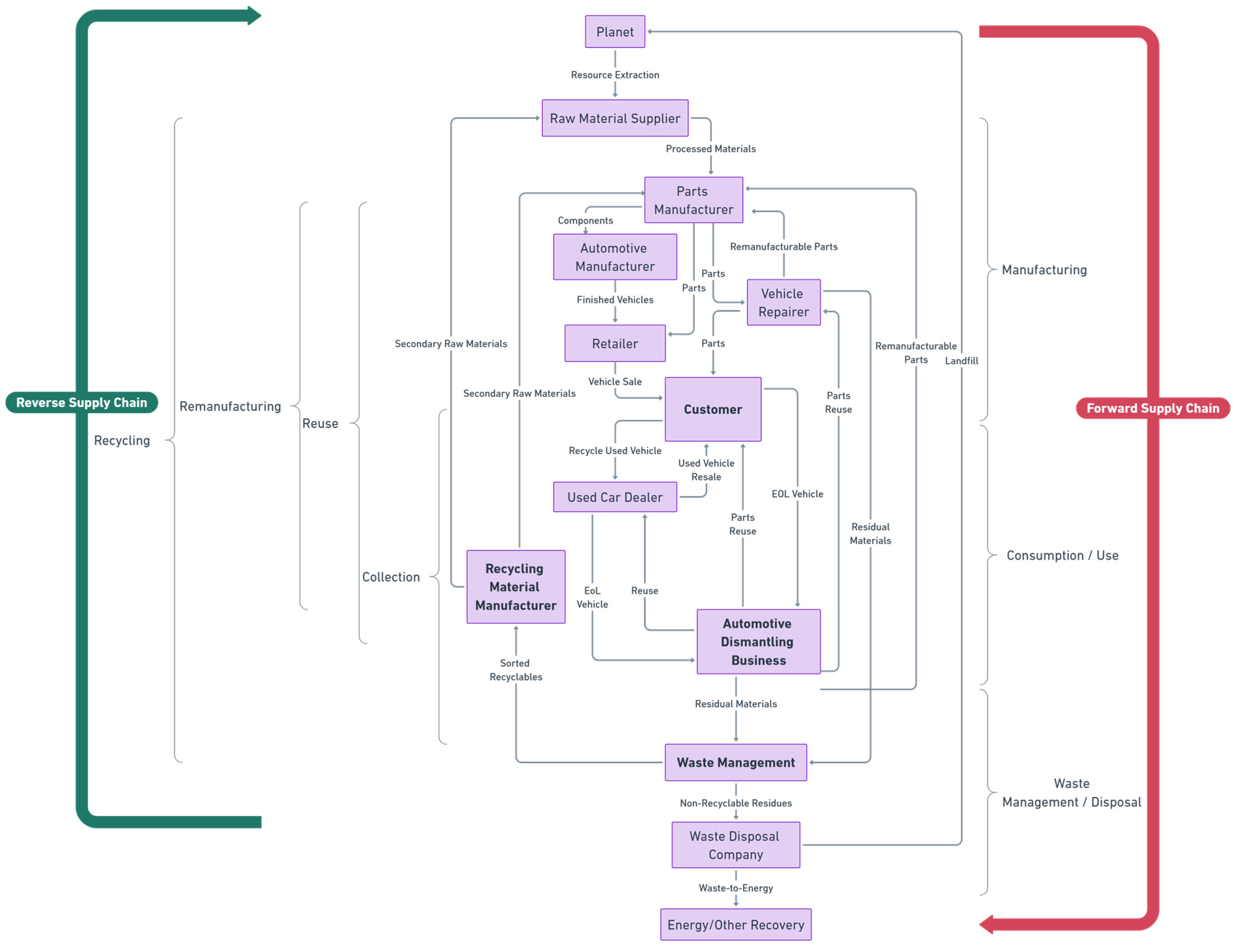
Mapping the Transition to Automotive Circularity: A Systematic Review of Reverse Supply Chain Implementation




Abstract
1. Introduction
2. Materials and Methods
2.1. Searching Strategy
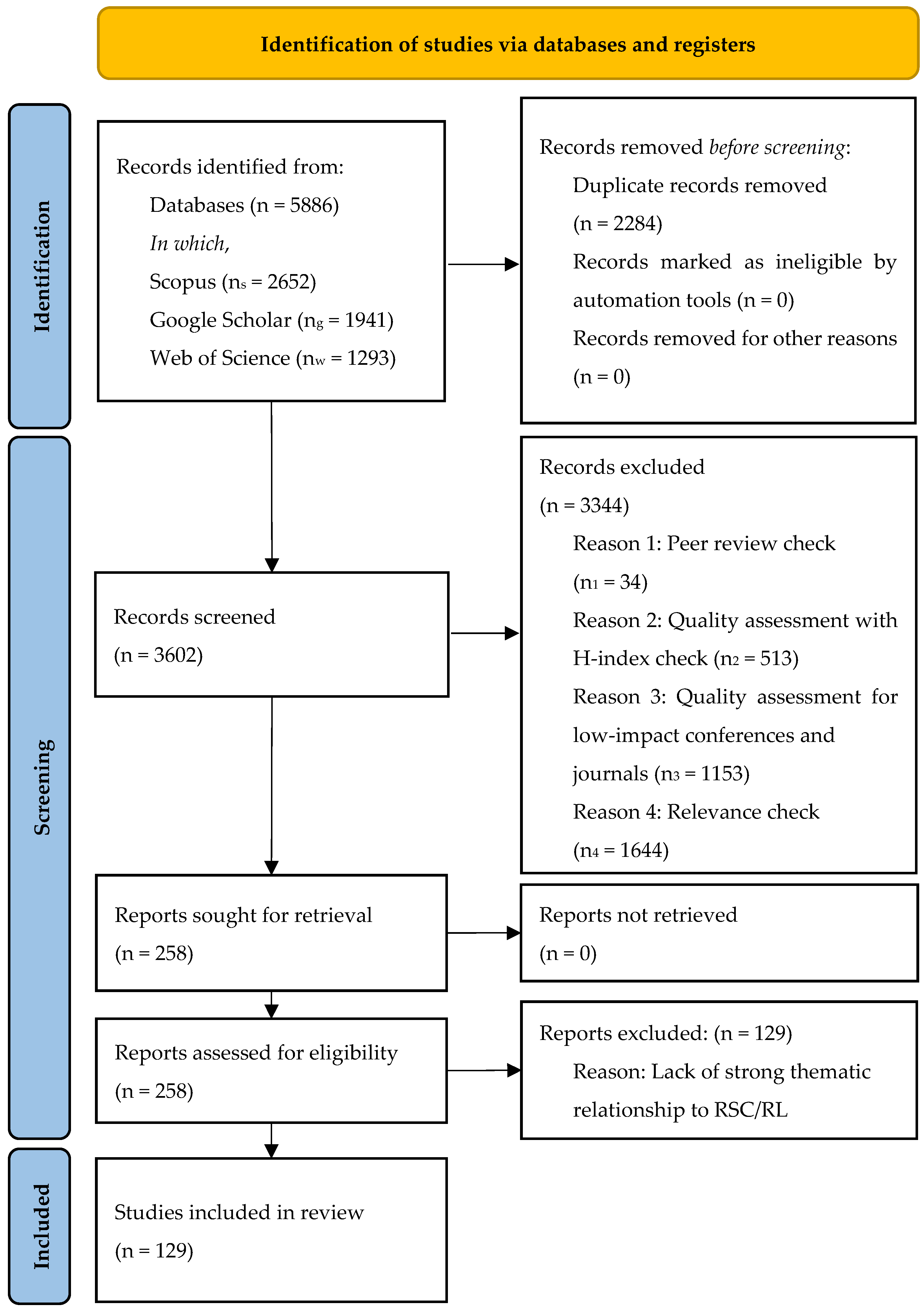
2.2. Screening Process
2.2.1. Peer-Reviewed Assessment
2.2.2. Quality Assessment
2.2.3. Content Relevance Assessment
2.3. Data Extraction Process
3. Results and Analysis
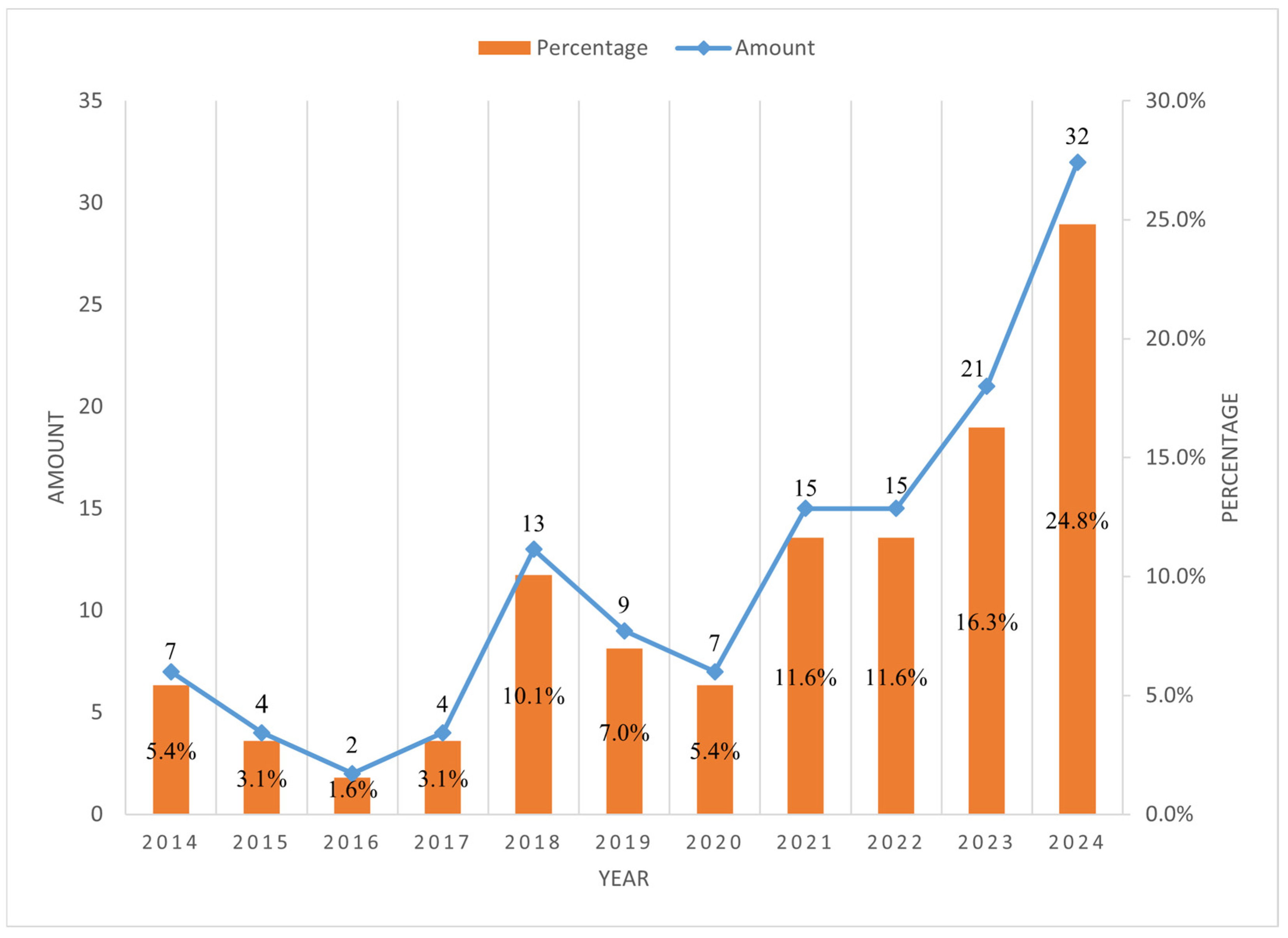
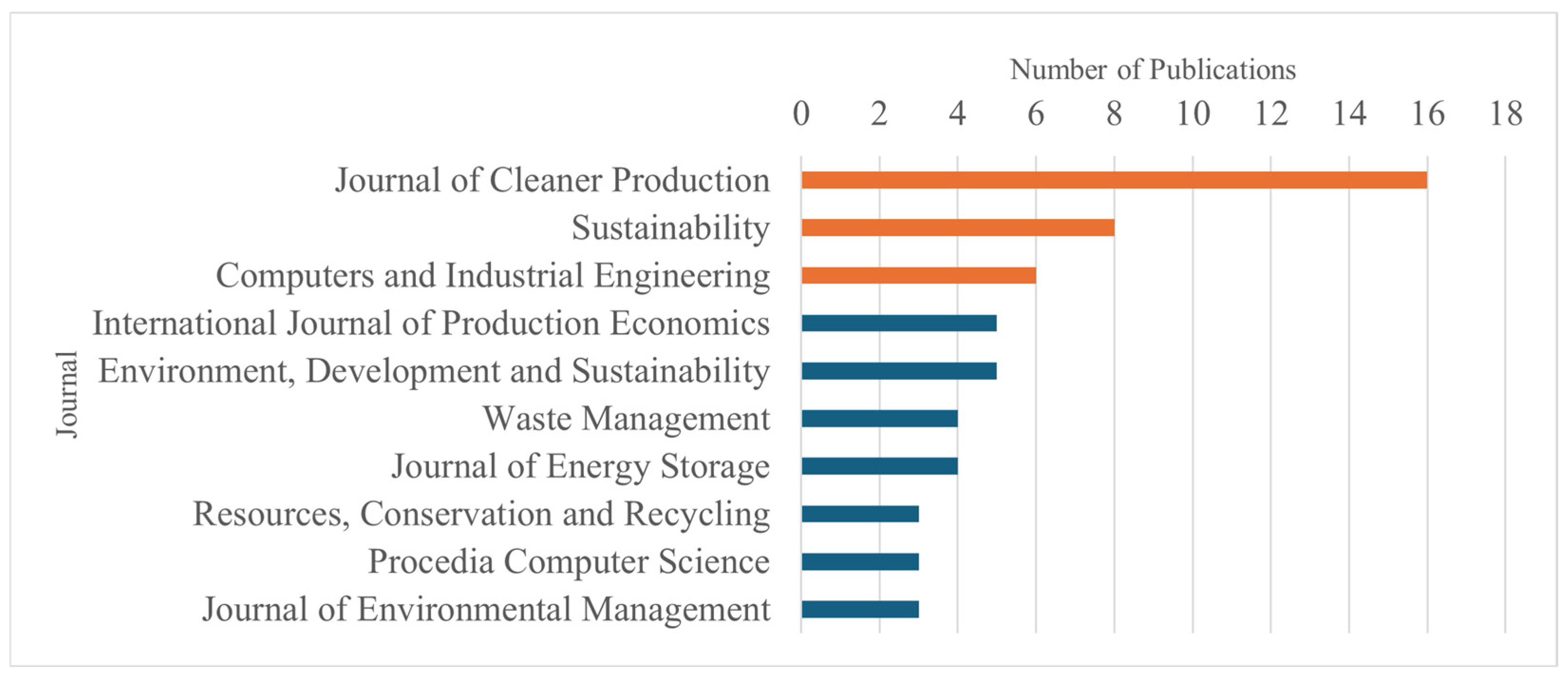
3.1. Descriptive Analysis
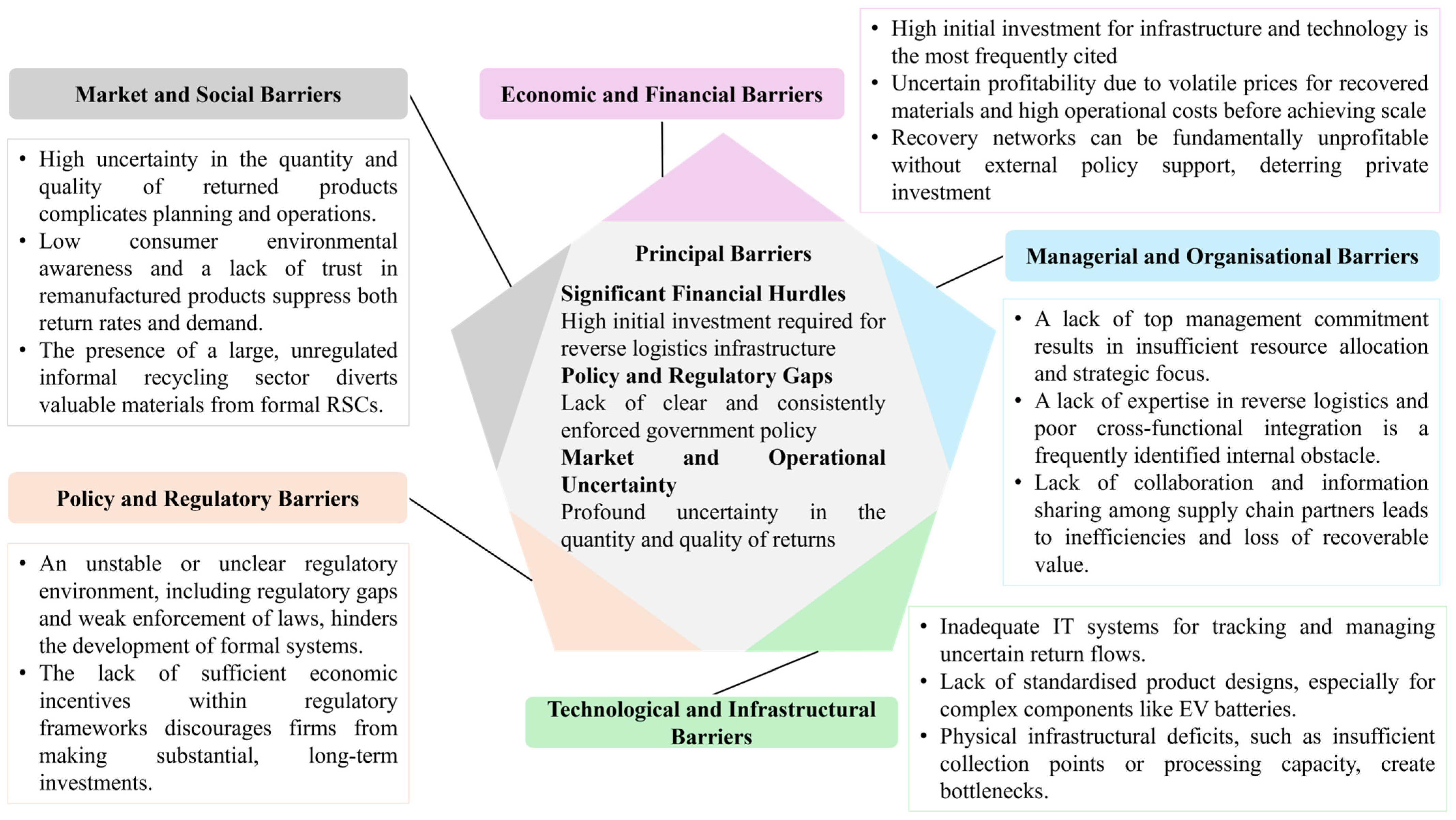
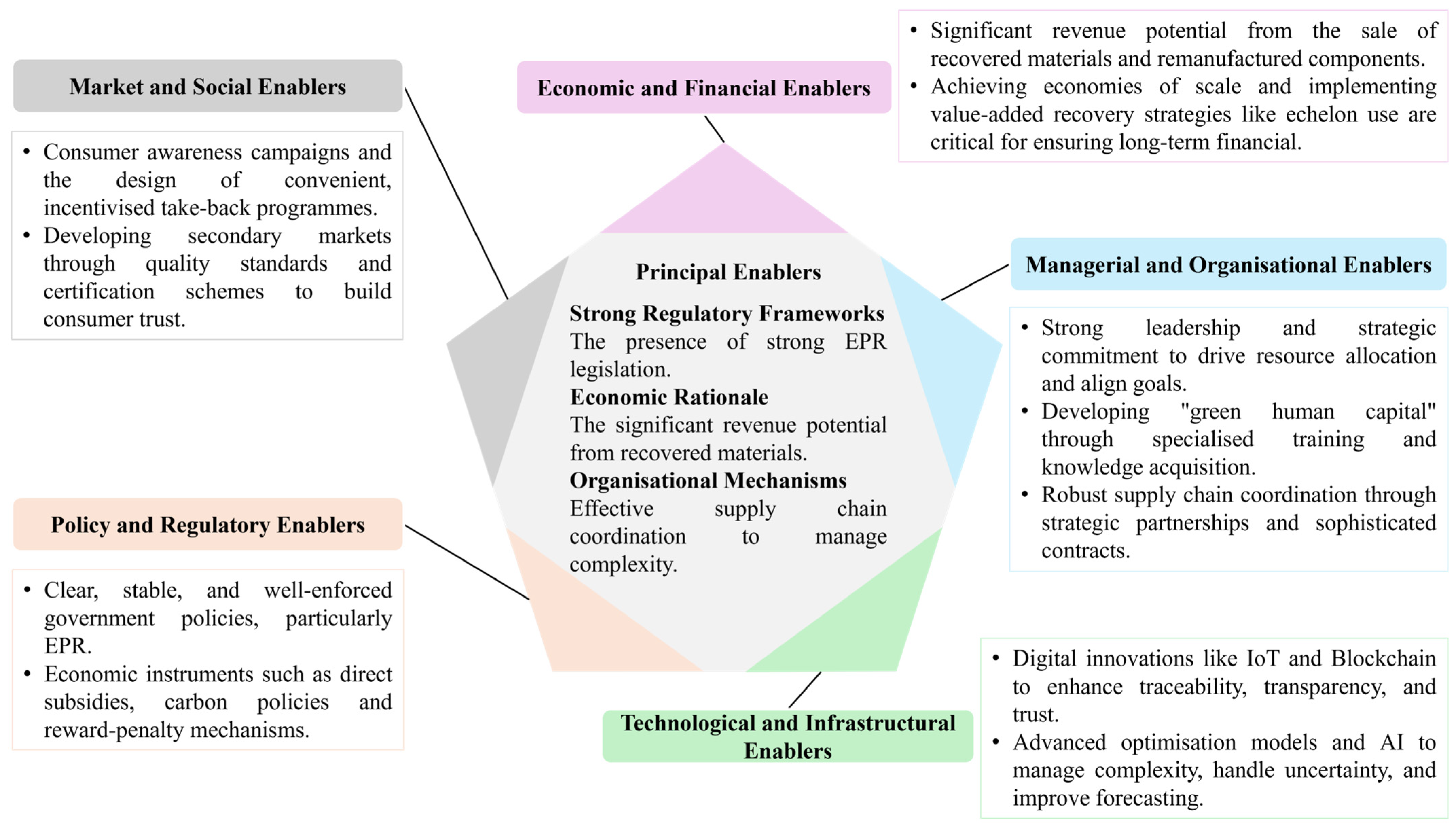
3.2. Thematic Analysis of RSC/RL Implementation: Barriers and Enablers
3.2.1. Economic and Financial Dimension
3.2.2. Managerial and Organisational Dimension
3.2.3. Technological and Infrastructural Dimension
3.2.4. Policy and Regulatory Dimension
3.2.5. Market and Social Dimension
3.3. Systemic Patterns and Evolutionary Dynamics
3.3.1. Overarching Systemic Dynamics
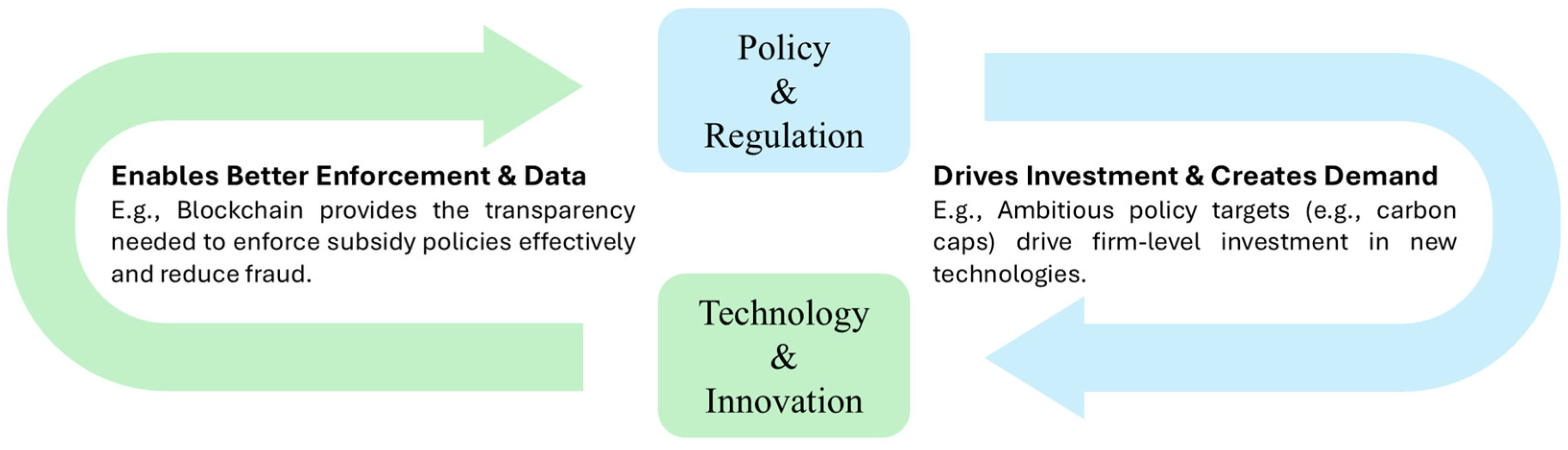
Technology–Policy Interdependence
Scale-Value Recovery Tension
Formal–Informal System Dynamics
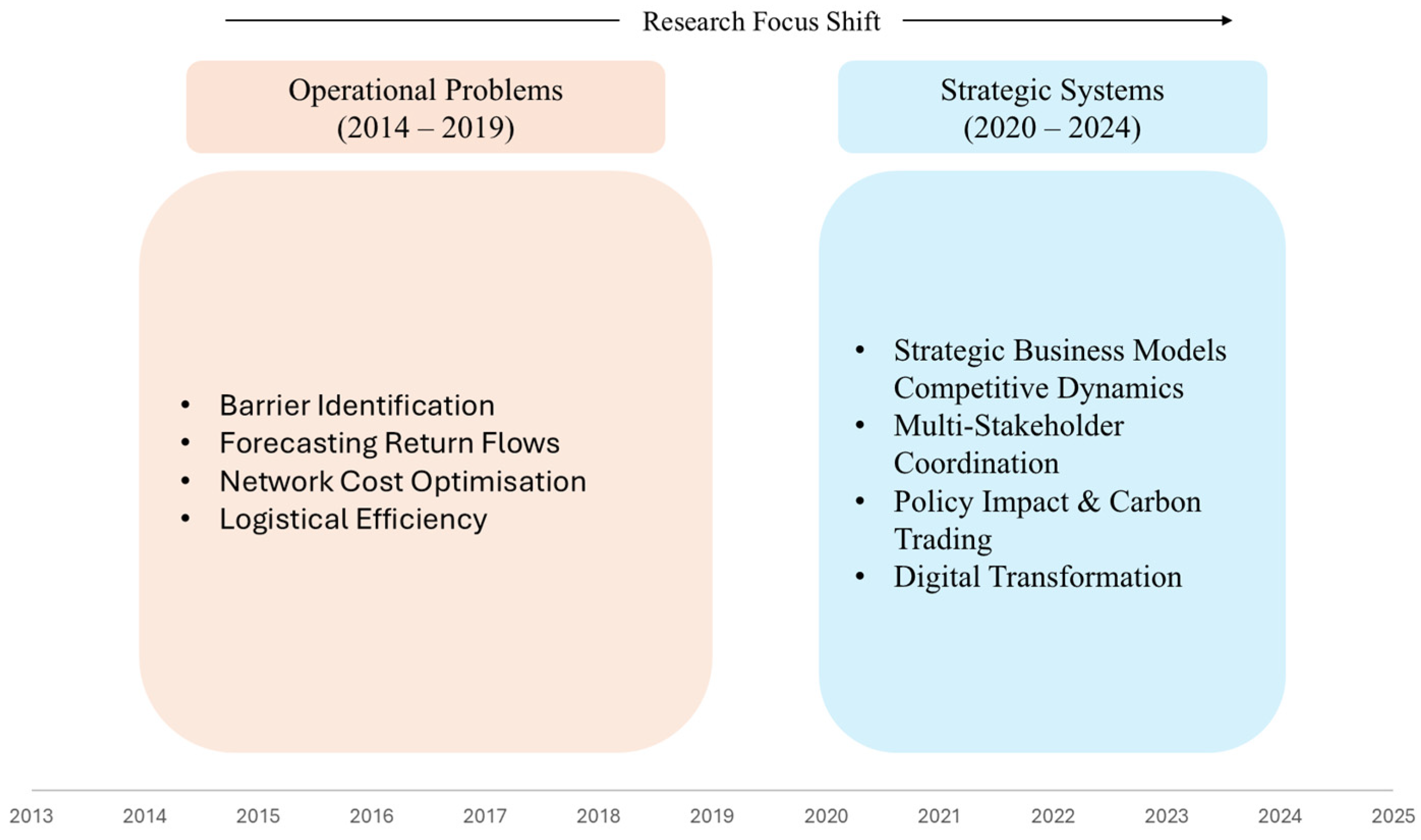
Evolution from Operational to Strategic Focus
3.3.2. Component-Specific Dynamics: The Dominance of EV Batteries
Unique Technical and Quality Uncertainty
Divergent Economic and Value Propositions
A More Complex Stakeholder Ecosystem
Specialised and Granular Policy Instruments
4. Discussion
4.1. Synthesis of Principal Findings
4.2. Interpretation and Contribution to Literature
4.3. Managerial and Policy Implications
4.3.1. Managerial Implications
4.3.2. Policy Implications
4.4. Limitations and Future Research Agenda
4.4.1. Expanding Scope to Neglected Components and Geographies
4.4.2. Investigating the Human and Social Dimension
4.4.3. Bridging the Theory–Practice Gap
4.4.4. Temporal and Journal Limitations
5. Conclusions
Supplementary Materials
Author Contributions
Funding
Institutional Review Board Statement
Informed Consent Statement
Data Availability Statement
Conflicts of Interest
Abbreviations
| CE | Circular economy |
| ELV | End-of-life vehicle |
| RSC | Reverse supply chain |
| RL | Reverse logistics |
| CLSC | Closed-loop supply chains |
| SLR | Systematic literature review |
| RQ | Research question |
| SSC | Sustainable supply chain |
| MRD | Maximum Relative Deviation |
| EV | Electric vehicle |
| SDGs | Sustainable development goals |
| EPR | Extended producer responsibility |
| OEMs | Original equipment manufacturers |
| IoT | Internet of Things |
| NRBV | Natural-Resource-Based View |
Appendix A

References
- Geissdoerfer, M.; Savaget, P.; Bocken, N.M.P.; Hultink, E.J. The Circular Economy—A new sustainability paradigm? J. Clean. Prod. 2017, 143, 757–768. [Google Scholar] [CrossRef] [Scilit]
- Ghisellini, P.; Cialani, C.; Ulgiati, S. A review on circular economy: The expected transition to a balanced interplay of environmental and economic systems. J. Clean. Prod. 2016, 114, 11–32. [Google Scholar] [CrossRef] [Scilit]
- Korhonen, J.; Honkasalo, A.; Seppälä, J. Circular economy: The concept and its limitations. Ecol. Econ. 2018, 143, 37–46. [Google Scholar] [CrossRef] [Scilit]
- Blomsma, F.; Brennan, G. The emergence of circular economy: A new framing around prolonging resource productivity. J. Ind. Ecol. 2017, 21, 603–614. [Google Scholar] [CrossRef] [Scilit]
- Boulding, K.E. The economics of the coming spaceship earth. In Environmental Quality in a Growing Economy; Jarrett, H., Ed.; Johns Hopkins Press: Baltimore, MD, USA, 1966; pp. 3–14. [Google Scholar]
- United Nations Environment Programme. Global Waste Management Outlook 2024: Beyond an Age of Waste—Turning Rubbish into a Resource; UNEP: Nairobi, Kenya, 2024; Available online: https://wedocs.unep.org/handle/20.500.11822/44939 (accessed on 1 August 2025).
- Circle Economy Foundation. The Circularity Gap Report 2020; Circle Economy: Amsterdam, The Netherlands, 2020; Available online: https://www.circle-economy.com/resources/circularity-gap-report-2020 (accessed on 18 March 2025).
- World Economic Forum. Raising Ambitions: A New Roadmap for the Automotive Circular Economy; World Economic Forum: Geneva, Switzerland, 2021; Available online: https://www.weforum.org/reports/raising-ambitions-a-new-roadmap-for-the-automotive-circular-economy/ (accessed on 18 March 2025).
- Zhang, X.; Yu, J.; Yan, W.; Wang, Y. A Comprehensive Review of Reverse Logistics in the Automotive Industry. IEEE Access 2023, 11, 47112–47128. [Google Scholar] [CrossRef] [Scilit]
- Eurostat. End-of-Life Vehicles-Reuse, Recycling and Recovery, Totals (Waste Generated) [Dataset]; Eurostat: Luxembourg, 2025. [Google Scholar] [CrossRef]
- Mayyas, A.; Qattawi, A.; Omar, M.; Shan, D. Design for sustainability in automotive industry: A comprehensive review. Renew. Sustain. Energy Rev. 2012, 16, 1845–1862. [Google Scholar] [CrossRef] [Scilit]
- Ellen MacArthur Foundation. The Circular Economy: A Transformative COVID-19 Recovery Strategy; Ellen MacArthur Foundation: Cowes, UK, 2020; Available online: https://www.ellenmacarthurfoundation.org/a-transformative-covid-19-recovery-strategy (accessed on 15 March 2025).
- Dowlatshahi, S. Developing a theory of reverse logistics. Interfaces 2000, 30, 143–155. [Google Scholar] [CrossRef] [Scilit]
- Rogers, D.S.; Tibben-Lembke, R.S. Going Backwards: Reverse Logistics Trends and Practices; Reverse Logistics Executive Council: Reno, NV, USA, 1998. [Google Scholar]
- Guide, V.D.R., Jr.; Van Wassenhove, L.N. The Evolution of Closed-Loop Supply Chain Research. Oper. Res. 2009, 57, 10–18. [Google Scholar] [CrossRef] [Scilit]
- Govindan, K.; Soleimani, H.; Kannan, D. Reverse logistics and closed-loop supply chain: A comprehensive review to explore the future. Eur. J. Oper. Res. 2015, 240, 603–626. [Google Scholar] [CrossRef] [Scilit]
- Souza, G.C. Closed-Loop Supply Chains: A Critical Review, and Future Research. Decis. Sci. 2013, 44, 7–38. [Google Scholar] [CrossRef] [Scilit]
- Srivastava, S.K. Green supply-chain management: A state-of-the-art literature review. Int. J. Manag. Rev. 2007, 9, 53–80. [Google Scholar] [CrossRef] [Scilit]
- Seuring, S.; Müller, M. From a literature review to a conceptual framework for sustainable supply chain management. J. Clean. Prod. 2008, 16, 1699–1710. [Google Scholar] [CrossRef] [Scilit]
- Thierry, M.; Salomon, M.; Van Nunen, J.; Van Wassenhove, L. Strategic Issues in Product Recovery Management. Calif. Manag. Rev. 1995, 37, 114–135. [Google Scholar] [CrossRef] [Scilit]
- Fleischmann, M.; Bloemhof-Ruwaard, J.M.; Dekker, R.; van der Laan, E.; van Nunen, J.A.E.E.; Van Wassenhove, L.N. Quantitative models for reverse logistics: A review. Eur. J. Oper. Res. 1997, 103, 1–17. [Google Scholar] [CrossRef] [Scilit]
- Tranfield, D.; Denyer, D.; Smart, P. Towards a Methodology for Developing Evidence-Informed Management Knowledge by Means of Systematic Review. Br. J. Manag. 2003, 14, 207–222. [Google Scholar] [CrossRef] [Scilit]
- Page, M.J.; McKenzie, J.E.; Bossuyt, P.M.; Boutron, I.; Hoffmann, T.C.; Mulrow, C.D.; Shamseer, L.; Tetzlaff, J.M.; Akl, E.A.; Brennan, S.E.; et al. The PRISMA 2020 statement: An updated guideline for reporting systematic reviews. BMJ 2021, 372, n71. [Google Scholar] [CrossRef] [Scilit] [PubMed]
- SCImago. SJR—SCImago Journal & Country Rank. Available online: http://www.scimagojr.com (accessed on 14 March 2025).
- Kiesslich, T.; Beyreis, M.; Zimmermann, G.; Traweger, A. Citation inequality and the Journal Impact Factor: Median, mean, (does it) matter? Scientometrics 2021, 126, 1249–1269. [Google Scholar] [CrossRef] [Scilit]
- Bornmann, L.; Leydesdorff, L.; Mutz, R. The use of percentiles and percentile rank classes in the analysis of bibliometric data: Opportunities and limits. J. Informetr. 2013, 7, 158–165. [Google Scholar] [CrossRef] [Scilit]
- Abdulrahman, M.D.; Gunasekaran, A.; Subramanian, N. Critical barriers in implementing reverse logistics in the Chinese manufacturing sectors. Int. J. Prod. Econ. 2014, 147, 460–471. [Google Scholar] [CrossRef] [Scilit]
- Demirel, E.; Demirel, N.; Gökçen, H. A mixed integer linear programming model to optimize reverse logistics activities of end-of-life vehicles in Turkey. J. Clean. Prod. 2016, 112, 2101–2113. [Google Scholar] [CrossRef] [Scilit]
- Yao, J. Optimization of reverse logistics network for end-of-life vehicles: A Shanghai case study. Adv. Prod. Eng. Manag. 2024, 19, 253–267. [Google Scholar] [CrossRef] [Scilit]
- Zhang, C.; Li, J.-C.; Tian, Y.-X.; Li, H.-S. Decisions on blockchain adoption and echelon utilization in the closed-loop supply chain for electric vehicles under carbon trading policy. Inf. Sci. 2024, 681, 121247. [Google Scholar] [CrossRef] [Scilit]
- Xiao, L.; Ouyang, Y.; Lin, Q.; Guo, Y. Cooperative recycling strategy for electric vehicle batteries considering blockchain technology. Energy 2024, 313, 134062. [Google Scholar] [CrossRef] [Scilit]
- Liu, K.; Wang, C. The impacts of subsidy policies and channel encroachment on the power battery recycling of new energy vehicles. Int. J. Low-Carbon Technol. 2021, 16, 770–789. [Google Scholar] [CrossRef] [Scilit]
- Zhu, X.; Li, W. The Pricing Strategy of Dual Recycling Channels for Power Batteries of New Energy Vehicles under Government Subsidies. Complexity 2020, 2020, 3691493. [Google Scholar] [CrossRef] [Scilit]
- Shankar, R.; Bhattacharyya, S.; Choudhary, A. A decision model for a strategic closed-loop supply chain to reclaim End-of-Life Vehicles. Int. J. Prod. Econ. 2018, 195, 273–286. [Google Scholar] [CrossRef] [Scilit]
- He, M.; Lin, T.; Wu, X.; Luo, J.; Peng, Y. A Systematic Literature Review of Reverse Logistics of End-of-Life Vehicles: Bibliometric Analysis and Research Trend. Energies 2020, 13, 5586. [Google Scholar] [CrossRef] [Scilit]
- Forouzanfar, F.; Tavakkoli-Moghaddam, R.; Bashiri, M.; Baboli, A.; Hadji Molana, S.M. New mathematical modeling for a location–routing–inventory problem in a multi-period closed-loop supply chain in a car industry. J. Ind. Eng. Int. 2018, 14, 537–553. [Google Scholar] [CrossRef] [Scilit]
- Xiao, Z.; Sun, J.; Shu, W.; Wang, T. Location-allocation problem of reverse logistics for end-of-life vehicles based on the measurement of carbon emissions. Comput. Ind. Eng. 2019, 127, 169–181. [Google Scholar] [CrossRef] [Scilit]
- Xiao, Q.; Zheng, Y.; Zhang, J. Recycling mode selection for the reverse supply chain of waste power batteries: An environmental responsibility perspective. J. Ind. Prod. Eng. 2024, 42, 127–146. [Google Scholar] [CrossRef] [Scilit]
- Gao, Y.-L.; Gong, B.; Liu, Z.; Tang, J.; Wang, C. The behavioural evolution of the smart electric vehicle battery reverse supply chain under government supervision. Ind. Manag. Data Syst. 2023, 123, 2577–2606. [Google Scholar] [CrossRef] [Scilit]
- Wu, G.; Wang, Y.; Zhang, Z.; Song, H. Recycling mode and strategy of closed-loop supply chain by automotive battery manufacturer led. Procedia Comput. Sci. 2022, 214, 1057–1064. [Google Scholar] [CrossRef] [Scilit]
- Trivyza, N.L.; Rentizelas, A.; Oswald, S.; Siegl, S. Designing reverse supply networks for carbon fibres: Enabling cross-sectoral circular economy pathways. J. Clean. Prod. 2022, 372, 133599. [Google Scholar] [CrossRef] [Scilit]
- Dhouib, D. An extension of MACBETH method for a fuzzy environment to analyze alternatives in reverse logistics for automobile tire wastes. Omega 2014, 42, 25–32. [Google Scholar] [CrossRef] [Scilit]
- Chaabane, A.; Montecinos, J.; Ouhimmou, M.; Khabou, A. Vehicle routing problem for reverse logistics of End-of-Life Vehicles (ELVs). Waste Manag. 2021, 120, 209–220. [Google Scholar] [CrossRef] [Scilit]
- Jindal, A.; Sangwan, K.S. Evaluation of collection methods in reverse logistics by using fuzzy mathematics. Benchmarking 2015, 22, 393–410. [Google Scholar] [CrossRef] [Scilit]
- Ma, Z.; Zhao, C.; Woo, S.; Wang, C. Unlocking the potential of urban EV battery recycling: A dual optimization model. J. Environ. Mange. 2024, 372, 123301. [Google Scholar] [CrossRef] [Scilit] [PubMed]
- Karagoz, S.; Aydin, N.; Simic, V. End-of-life vehicle management: A comprehensive review. J. Mater. Cycles Waste Manag. 2020, 22, 416–442. [Google Scholar] [CrossRef] [Scilit]
- Karagoz, S.; Aydin, N.; Simic, V. A novel stochastic optimisation model for reverse logistics network design of end-of-life vehicles: A case study of Istanbul. Environ. Model. Assess. 2022, 27, 599–619. [Google Scholar] [CrossRef] [Scilit]
- Klenk, F.; Gallei, M.; Wurster, M.; Wagner, M.; Sina, P. Potential assessment of an increased exchange of core information for remanufacturing in automotive reverse supply chains. Procedia CIRP 2022, 105, 446–451. [Google Scholar] [CrossRef] [Scilit]
- Lind, S.; Olsson, D.; Sundin, E. Exploring inter-organizational relationships in automotive component remanufacturing. J. Remanuf. 2014, 4, 5. [Google Scholar] [CrossRef] [Scilit]
- Subramanian, N.; Gunasekaran, A.; Abdulrahman, M.D.; Liu, C.; Su, D. Reverse logistics in the Chinese auto-parts firms: Implementation framework development through multiple case studies. Int. J. Sustain. Dev. World Ecol. 2014, 21, 223–234. [Google Scholar] [CrossRef] [Scilit]
- Kaviani, M.A.; Tavana, M.; Kumar, A.; Michnik, J.; Niknam, R.; Campos, E.A.R.D. An integrated framework for evaluating the barriers to successful implementation of reverse logistics in the automotive industry. J. Clean. Prod. 2020, 272, 122714. [Google Scholar] [CrossRef] [Scilit]
- Lin, J.; Li, X.; Zhao, Y.; Chen, W.; Wang, M. Design a reverse logistics network for end-of-life power batteries: A case study of Chengdu in China. Sustain. Cities Soc. 2023, 98, 104807. [Google Scholar] [CrossRef] [Scilit]
- Ravi, V. Reverse Logistics Operations in Automobile Industry: A Case Study Using SAP-LAP Approach. Glob. J. Flex. Syst. Manag. 2014, 15, 295–303. [Google Scholar] [CrossRef] [Scilit]
- Azadnia, A.H.; Onofrei, G.; Ghadimi, P. Electric vehicles lithium-ion batteries reverse logistics implementation barriers analysis: A TISM-MICMAC approach. Resour. Conserv. Recycl. 2021, 174, 105751. [Google Scholar] [CrossRef] [Scilit]
- Gardas, B.B.; Raut, R.D.; Narkhede, B. Reducing the exploration and production of oil: Reverse logistics in the automobile service sector. Sustain. Prod. Consum. 2018, 16, 141–153. [Google Scholar] [CrossRef] [Scilit]
- Grandjean, T.R.B.; Groenewald, J.; McGordon, A.; Marco, J. Cycle life of lithium ion batteries after flash cryogenic freezing. J. Energy Storage 2019, 24, 100804. [Google Scholar] [CrossRef] [Scilit]
- Ravi, V.; Shankar, R. An ISM-based approach analyzing interactions among variables of reverse logistics in automobile industries. J. Model. Manag. 2017, 12, 36–52. [Google Scholar] [CrossRef] [Scilit]
- Ene, S.; Öztürk, N. Grey modelling based forecasting system for return flow of end-of-life vehicles. Technol. Forecast. Soc. Change 2017, 115, 155–166. [Google Scholar] [CrossRef] [Scilit]
- Marcos, J.T.; Scheller, C.; Godina, R.; Spengler, T.S.; Carvalho, H. Sources of uncertainty in the closed-loop supply chain of lithium-ion batteries for electric vehicles. Clean. Logist. Supply Chain 2021, 1, 100006. [Google Scholar] [CrossRef] [Scilit]
- Scur, G.; Mattos, C.; Hilsdorf, W.; Armelin, M. Lead Acid Batteries (LABs) Closed-Loop Supply Chain: The Brazilian Case. Batteries 2022, 8, 139. [Google Scholar] [CrossRef] [Scilit]
- Trang, N.T.N.; Li, Y. Reverse supply chain for end-of-life vehicles treatment: An in-depth content review. Resour. Conserv. Recycl. Adv. 2023, 17, 200128. [Google Scholar] [CrossRef] [Scilit]
- Daaboul, J.; Le Duigou, J.; Penciuc, D.; Eynard, B. Reverse logistics network design: A holistic life cycle approach. J. Remanuf. 2014, 4, 7. [Google Scholar] [CrossRef] [Scilit]
- Demirel, N.; Özceylan, E.; Paksoy, T.; Gökçen, H. A genetic algorithm approach for optimising a closed-loop supply chain network with crisp and fuzzy objectives. Int. J. Prod. Res. 2014, 52, 3637–3664. [Google Scholar] [CrossRef] [Scilit]
- Kuşakcı, A.O.; Ayvaz, B.; Cin, E.; Aydın, N. Optimisation of reverse logistics network of End of Life Vehicles under fuzzy supply: A case study for Istanbul Metropolitan Area. J. Clean. Prod. 2019, 215, 1036–1051. [Google Scholar] [CrossRef] [Scilit]
- Li, L.; Dababneh, F.; Zhao, J. Cost-effective supply chain for electric vehicle battery remanufacturing. Appl. Energy 2018, 226, 277–286. [Google Scholar] [CrossRef] [Scilit]
- Özceylan, E.; Demirel, N.; Çetinkaya, C.; Demirel, E. A closed-loop supply chain network design for automotive industry in Turkey. Comput. Ind. Eng. 2017, 113, 727–745. [Google Scholar] [CrossRef] [Scilit]
- Ghasemzadeh, Z.; Sadeghieh, A.; Shishebori, D. A stochastic multi-objective closed-loop global supply chain concerning waste management: A case study of the tire industry. Environ. Dev. Sustain. 2021, 23, 5794–5821. [Google Scholar] [CrossRef] [Scilit]
- Omosa, G.B.; Numfor, S.A.; Kosacka-Olejnik, M. Modeling a reverse logistics supply chain for end-of-life vehicle recycling risk management: A fuzzy risk analysis approach. Sustainability 2023, 15, 2142. [Google Scholar] [CrossRef] [Scilit]
- Chavez, R.; Sharma, M. Profitability and environmental friendliness of a closed-loop supply chain for PET components: A case study of the Mexican automobile market. Resour. Conserv. Recycl. 2018, 135, 172–189. [Google Scholar] [CrossRef] [Scilit]
- Guan, Y.; He, T.-H.; Hou, Q. Tripartite Evolutionary Game Analysis of Power Battery Cascade Utilization Under Government Subsidies. IEEE Access 2023, 11, 66382–66399. [Google Scholar] [CrossRef] [Scilit]
- Zhang, X.; Feng, X.; Jiang, Z.; Gong, Q.; Wang, Y. A blockchain-enabled framework for reverse supply chain management of power batteries. J. Clean. Prod. 2023, 415, 137823. [Google Scholar] [CrossRef] [Scilit]
- Zhang, W.; Zhu, L.; Liu, X.; Wang, W.; Song, H. Optimal strategies in electric vehicle battery closed-loop supply chain considering government subsidies and echelon utilization. J. Energy Storage 2024, 99, 113341. [Google Scholar] [CrossRef] [Scilit]
- Zhou, Z.; Cai, Y.; Xiao, Y.; Chen, X.; Zeng, H. The optimization of reverse logistics cost based on value flow analysis—A case study on automobile recycling company in China. J. Intell. Fuzzy Syst. 2018, 34, 807–818. [Google Scholar] [CrossRef] [Scilit]
- Bouvier, L.; Dalle, G.; Parmentier, A.; Vidal, T. Solving a Continent-Scale Inventory Routing Problem at Renault. Transp. Sci. 2024, 58, 131–151. [Google Scholar] [CrossRef] [Scilit]
- Bag, S.; Gupta, S. Examining the effect of green human capital availability in adoption of reverse logistics and remanufacturing operations performance. Int. J. Manpow. 2020, 41, 1097–1117. [Google Scholar] [CrossRef] [Scilit]
- Bajar, K.; Kamat, A.; Shanker, S.; Barve, A. Blockchain technology: A catalyst for reverse logistics of the automobile industry. Smart Sustain. Built Environ. 2024, 13, 133–178. [Google Scholar] [CrossRef] [Scilit]
- da Cruz, M.M.; Caiado, R.G.G.; Santos, R.S. Industrial Packaging Performance Indicator Using a Group Multicriteria Approach: An Automaker Reverse Operations Case. Logistics 2022, 6, 58. [Google Scholar] [CrossRef] [Scilit]
- Wu, K.-J.; Liao, C.-J.; Tseng, M.-L.; Chiu, A.S.F. Exploring decisive factors in green supply chain practices under uncertainty. Int. J. Prod. Econ. 2015, 159, 147–157. [Google Scholar] [CrossRef] [Scilit]
- Pinho Santos, L.; Proença, J.F. Developing Return Supply Chain: A Research on the Automotive Supply Chain. Sustainability 2022, 14, 6587. [Google Scholar] [CrossRef] [Scilit]
- Zhu, X.; Yu, L. Screening Contract Excitation Models Involving Closed-Loop Supply Chains Under Asymmetric Information Games: A Case Study with New Energy Vehicle Power Battery. Appl. Sci. 2019, 9, 146. [Google Scholar] [CrossRef] [Scilit]
- Garrido-Hidalgo, C.; Ramirez, F.J.; Olivares, T.; Roda-Sanchez, L. The adoption of internet of things in a circular supply chain framework for the recovery of WEEE: The case of lithium-ion electric vehicle battery packs. Waste Manag. 2020, 103, 32–44. [Google Scholar] [CrossRef] [Scilit]
- Casper, R.; Sundin, E. Reverse Logistic Transportation and Packaging Concepts in Automotive Remanufacturing. Procedia Manuf. 2018, 25, 154–160. [Google Scholar] [CrossRef] [Scilit]
- Sorooshian, S.; Khiavi, S.F.; Karimi, F.; Mina, H. Link between sustainable circular supply chain and Internet of Things technology in electric vehicle battery manufacturing industry: A business strategy optimisation for pickup and delivery. Bus. Strategy Environ. 2024, 33, 8211–8232. [Google Scholar] [CrossRef] [Scilit]
- Xing, P.; Yao, J. Power Battery Echelon Utilization and Recycling Strategy for New Energy Vehicles Based on Blockchain Technology. Sustainability 2022, 14, 11835. [Google Scholar] [CrossRef] [Scilit]
- Lin, Y.; Jia, H.; Yang, Y.; Tian, G.; Tao, F.; Ling, L. An improved artificial bee colony for facility location allocation problem of end-of-life vehicles recovery network. J. Clean. Prod. 2018, 205, 134–144. [Google Scholar] [CrossRef] [Scilit]
- Zarbakhshnia, N.; Soleimani, H.; Ghaderi, H. Sustainable third-party reverse logistics provider evaluation and selection using fuzzy SWARA and developed fuzzy COPRAS in the presence of risk criteria. Appl. Soft Comput. 2018, 65, 307–319. [Google Scholar] [CrossRef] [Scilit]
- Alkahtani, M.; Ziout, A. Design of a sustainable reverse supply chain in a remanufacturing environment: A case study of proton-exchange membrane fuel cell battery in Riyadh. Adv. Mech. Eng. 2019, 11, 1687814019842997. [Google Scholar] [CrossRef] [Scilit]
- Yang, C.; Wang, Q.; Pan, M.; Hu, J.; Peng, W.; Zhang, J.; Zhang, L. A linguistic Pythagorean hesitant fuzzy MULTIMOORA method for third-party reverse logistics provider selection of electric vehicle power battery recycling. Expert Syst. Appl. 2022, 198, 116808. [Google Scholar] [CrossRef] [Scilit]
- Son, D.-H.; An, S.-B.; Kim, H.-J.; Jang, J.-M. Push and pull disassembly quantity models in a reverse supply chain: The case of an automobile disassembly system in Korea. Int. J. Logist. Res. Appl. 2022, 25, 1287–1312. [Google Scholar] [CrossRef] [Scilit]
- Scheller, C.; Schmidt, K.; Spengler, T.S. Effects of network structures on the production planning in closed-loop supply chains—A case study based analysis for lithium-ion batteries in Europe. Int. J. Prod. Econ. 2023, 262, 108892. [Google Scholar] [CrossRef] [Scilit]
- Zheng, C.; Peng, B.; Zhao, X.; Wei, G.; Wan, A.; Yue, M. Power battery third-party reverse logistics provider selection: Fuzzy evidential reasoning. Energy Environ. 2025, 36, 323–355. [Google Scholar] [CrossRef] [Scilit]
- Tan, K.; Tian, Y.; Xu, F.; Li, C. Research on Multi-Objective Optimal Scheduling for Power Battery Reverse Supply Chain. Mathematics 2023, 11, 901. [Google Scholar] [CrossRef] [Scilit]
- Wang, H.; Hao, H.; Wang, M. Optimization research on multi-trip distribution of reverse logistics terminal for automobile scrap parts under the background of sustainable development strategy. Sci. Rep. 2024, 14, 17305. [Google Scholar] [CrossRef] [Scilit] [PubMed]
- Liao, G.H.W.; Luo, X. Collaborative reverse logistics network for electric vehicle batteries management from sustainable perspective. J. Environ. Manag. 2022, 324, 116352. [Google Scholar] [CrossRef] [Scilit] [PubMed]
- Govindan, K.; Gholizadeh, H. Robust network design for sustainable-resilient reverse logistics network using big data: A case study of end-of-life vehicles. Transp. Res. Part E 2021, 149, 102279. [Google Scholar] [CrossRef] [Scilit]
- Hamidi Moghaddam, S.; Akbaripour, H.; Houshmand, M. Integrated forward and reverse logistics in cloud manufacturing: An agent-based multi-layer architecture and optimisation via genetic algorithm. Prod. Eng. 2021, 15, 801–819. [Google Scholar] [CrossRef] [Scilit]
- Kumar Jauhar, S.; Singh, A.; Kamble, S.; Tiwari, S.; Belhadi, A. Reverse logistics for electric vehicles under uncertainty: An intelligent emergency management approach. Transp. Res. Part E 2024, 192, 103806. [Google Scholar] [CrossRef] [Scilit]
- Sathiya, V.; Chinnadurai, M.; Ramabalan, S.; Appolloni, A. Mobile robots and evolutionary optimisation algorithms for green supply chain management in a used-car resale company. Environ. Dev. Sustain. 2021, 23, 9110–9138. [Google Scholar] [CrossRef] [Scilit]
- Phuc, P.N.K.; Yu, V.F.; Tsao, Y.-C. Optimizing fuzzy reverse supply chain for end-of-life vehicles. Comput. Ind. Eng. 2017, 113, 757–765. [Google Scholar] [CrossRef] [Scilit]
- Hao, H.; Zhang, Q.; Wang, Z.; Zhang, J. Forecasting the number of end-of-life vehicles using a hybrid model based on grey model and artificial neural network. J. Clean. Prod. 2018, 202, 684–696. [Google Scholar] [CrossRef] [Scilit]
- Abdolazimi, O.; Esfandarani, M.S.; Salehi, M.; Shishebori, D. Robust design of a multi-objective closed-loop supply chain by integrating on-time delivery, cost, and environmental aspects, case study of a Tire Factory. J. Clean. Prod. 2020, 264, 121566. [Google Scholar] [CrossRef] [Scilit]
- Shahparvari, S.; Soleimani, H.; Govindan, K.; Bodaghi, B.; Fard, M.T.; Jafari, H. Closing the loop: Redesigning sustainable reverse logistics network in uncertain supply chains. Comput. Ind. Eng. 2021, 157, 107093. [Google Scholar] [CrossRef] [Scilit]
- Hao, H.; Sun, Y.; Mei, X.; Zhou, Y. Reverse Logistics Network Design of Electric Vehicle Batteries considering Recall Risk. Math. Probl. Eng. 2021, 2021, 5518049. [Google Scholar] [CrossRef] [Scilit]
- Dehghani Sadrabadi, M.H.; Makui, A.; Ghousi, R.; Jabbarzadeh, A. Optimal pricing strategy in the closed-loop supply chain using game theory under government subsidy scenario: A case study. J. Energy Storage 2024, 87, 111423. [Google Scholar] [CrossRef] [Scilit]
- Mu, N.; Wang, Y.; Chen, Z.-S.; Xin, P.; Deveci, M.; Pedrycz, W. Multi-objective combinatorial optimization analysis of the recycling of retired new energy electric vehicle power batteries in a sustainable dynamic reverse logistics network. Environ. Sci. Pollut. Res. 2023, 30, 47580–47601. [Google Scholar] [CrossRef] [Scilit]
- Chen, X.; He, Y.; Zhou, L. Assessing the energy efficiency potential of a closed-loop supply chain for household durable metal products in China. Int. J. Prod. Res. 2024, 62, 8952–8969. [Google Scholar] [CrossRef] [Scilit]
- He, M.; Li, Q.; Lin, T.; Fan, J.; Wu, X.; Han, X. Designing a Reverse Logistics Network for End-of-Life Vehicles in an Uncertain Environment. World Electr. Veh. J. 2024, 15, 140. [Google Scholar] [CrossRef] [Scilit]
- Tian, G.; Liu, X.; Zhang, M.; Yang, Y.; Zhang, H.; Lin, Y.; Ma, F.; Wang, X.; Qu, T.; Li, Z. Selection of take-back pattern of vehicle reverse logistics in China via Grey-DEMATEL and Fuzzy-VIKOR combined method. J. Clean. Prod. 2019, 220, 1088–1100. [Google Scholar] [CrossRef] [Scilit]
- Gorji, M.-A.; Jamali, M.-B.; Iranpoor, M. A game-theoretic approach for decision analysis in end-of-life vehicle reverse supply chain regarding government subsidy. Waste Manag. 2021, 120, 734–747. [Google Scholar] [CrossRef] [Scilit]
- Zeng, F.; Lu, Z.; Lu, C. Power Battery Recycling Model of Closed-Loop Supply Chains Considering Different Power Structures Under Government Subsidies. Sustainability 2024, 16, 9589. [Google Scholar] [CrossRef] [Scilit]
- Günther, H.-O.; Kannegiesser, M.; Autenrieb, N. The role of electric vehicles for supply chain sustainability in the automotive industry. J. Clean. Prod. 2015, 90, 220–233. [Google Scholar] [CrossRef] [Scilit]
- Zhao, X.; Peng, B.; Zheng, C.; Wan, A. Closed-loop supply chain pricing strategy for electric vehicle batteries recycling in China. Environ. Dev. Sustain. 2022, 24, 7725–7752. [Google Scholar] [CrossRef] [Scilit]
- Narang, P.; Kanti De, P.; Peng Lim, C.; Kumari, M. Optimal recycling model selection in a closed-loop supply chain for electric vehicle batteries under carbon cap-trade and reward-penalty policies using the Stackelberg game. Comput. Ind. Eng. 2024, 196, 110512. [Google Scholar] [CrossRef] [Scilit]
- Yin, Y.; Liu, F. Carbon Emission Reduction and Coordination Strategies for New Energy Vehicle Closed-Loop Supply Chain under the Carbon Trading Policy. Complexity 2021, 2021, 3720373. [Google Scholar] [CrossRef] [Scilit]
- Qi, Y.; Yao, W.; Zhu, J. Study on the Selection of Recycling Strategies for the Echelon Utilization of Electric Vehicle Batteries under the Carbon Trading Policy. Sustainability 2024, 16, 7737. [Google Scholar] [CrossRef] [Scilit]
- Zhang, W.; Liu, X.; Zhu, L.; Wang, W.; Song, H. Pricing and production R&D decisions in power battery closed-loop supply chain considering government subsidy. Waste Manag. 2024, 190, 409–422. [Google Scholar]
- Xia, H.; Chen, Z.; Milisavljevic-Syed, J.; Salonitis, K. Uncertain programming model for designing multi-objective reverse logistics networks. Clean. Logist. Supply Chain 2024, 11, 100155. [Google Scholar] [CrossRef] [Scilit]
- Liu, H.; Ye, L.; Sun, J. Automotive parts remanufacturing models: Consequences for ELV take-back under government regulations. J. Clean. Prod. 2023, 416, 137760. [Google Scholar] [CrossRef] [Scilit]
- Wang, Z. Recycling Pricing and Government Subsidy Strategy for End-of-Life Vehicles in a Reverse Supply Chain under Consumer Recycling Channel Preferences. Mathematics 2024, 12, 35. [Google Scholar] [CrossRef] [Scilit]
- Wang, Z.; He, C.X. Decision-making of dual-channel reverse supply chain for end-of-life vehicles considering consumer preferences. Environ. Dev. Sustain. 2024, 27, 22475–22499. [Google Scholar] [CrossRef] [Scilit]
- Gong, B.; Gao, Y.; Li, K.W.; Liu, Z.; Huang, J. Cooperate or compete? A strategic analysis of formal and informal electric vehicle battery recyclers under government intervention. Int. J. Logist. Res. Appl. 2024, 27, 149–169. [Google Scholar] [CrossRef] [Scilit]
- Rajabzadeh, H.; Altmann, J.; Rasti-Barzoki, M. A game-theoretic approach for pricing in a closed-loop supply chain considering product exchange program and a full-refund return policy: A case study of Iran. Environ. Sci. Pollut. Res. 2023, 30, 10390–10413. [Google Scholar] [CrossRef] [Scilit]
- Liu, J.; Du, B.; Xue, J.; Zhang, W. Power battery modular innovation investment strategies with government subsidy policies. Heliyon 2024, 10, e38597. [Google Scholar] [CrossRef] [Scilit]
- Latpate, R.; Bhosale, M.; Kurade, S. Green Reverse Supply Chain Models with Fuzzy Stochastic Re-manufacturing Capacity. Int. J. Fuzzy Syst. 2024, 26, 403–417. [Google Scholar] [CrossRef] [Scilit]
- Zhou, F.; Chen, T.; Tiwari, S.; Si, D.; Pratap, S.; Mahto, R.V. Pricing and Quality Improvement Decisions in the End-of-Life Vehicle Closed-Loop Supply Chain Considering Collection Quality. IEEE Trans. Eng. Manag. 2024, 71, 4231–4245. [Google Scholar] [CrossRef] [Scilit]
- Tognetti, A.; Grosse-Ruyken, P.T.; Wagner, S.M. Green supply chain network optimisation and the trade-off between environmental and economic objectives. Int. J. Prod. Econ. 2015, 170, 385–392. [Google Scholar] [CrossRef] [Scilit]
- Chai, J.; Qian, Z.; Wang, F.; Zhu, J. Process innovation for green product in a closed loop supply chain with remanufacturing. Ann. Oper. Res. 2024, 333, 533–557. [Google Scholar] [CrossRef] [Scilit]
- Kalverkamp, M.; Young, S.B. In support of open-loop supply chains: Expanding the scope of environmental sustainability in reverse supply chains. J. Clean. Prod. 2019, 214, 573–582. [Google Scholar] [CrossRef] [Scilit]
- Rentizelas, A.; Trivyza, N.L. Enhancing circularity in the car sharing industry: Reverse supply chain network design optimisation for reusable car frames. Sustain. Prod. Consum. 2022, 32, 863–879. [Google Scholar] [CrossRef] [Scilit]
- Liu, Q.; Zhu, X. Incentive strategies for retired power battery closed-loop supply chain considering corporate social responsibility. Environ. Dev. Sustain. 2024, 26, 19013–19050. [Google Scholar] [CrossRef] [Scilit] [PubMed]
- Li, X.; Bai, X.; Zhang, Z.; Song, H. Dynamic decisions in a closed-loop supply chain with two competitive third-party recyclers under altruistic preference. Procedia Comput. Sci. 2024, 242, 952–959. [Google Scholar] [CrossRef] [Scilit]
- Zhou, Y.; Zhang, Y.; Wahab, M.I.M.; Goh, M. Channel leadership and performance for a closed-loop supply chain considering competition. Transp. Res. Part E 2023, 175, 103151. [Google Scholar] [CrossRef] [Scilit]
- Zhang, W.; Zhang, T. Recycling channel selection and financing strategy for capital-constrained retailers in a two-period, closed-loop supply chain. Front. Environ. Sci. 2022, 10, 996009. [Google Scholar] [CrossRef] [Scilit]
- Yildizbaşi, A.; Calik, A.; Paksoy, T.; Zanjirani Farahani, R.; Weber, G.-W. Multi-level optimization of an automotive closed-loop supply chain network with interactive fuzzy programming approaches. Technol. Econ. Dev. Econ. 2018, 24, 1004–1028. [Google Scholar] [CrossRef] [Scilit]
- Kumar, P.; Singh, R.K.; Paul, J.; Sinha, O. Analyzing challenges for sustainable supply chain of electric vehicle batteries using a hybrid approach of Delphi and Best-Worst Method. Resour. Conserv. Recycl. 2021, 175, 105879. [Google Scholar] [CrossRef] [Scilit]
- Fernando, Y.; Shaharudin, M.S.; Abideen, A.Z. Circular economy-based reverse logistics: Dynamic interplay between sustainable resource commitment and financial performance. Eur. J. Manag. Bus. Econ. 2023, 32, 91–112. [Google Scholar] [CrossRef] [Scilit]
- Akram, M.N.; Abdul-Kader, W. Electric vehicle battery state changes and reverse logistics considerations. Int. J. Sustain. Eng. 2021, 14, 390–403. [Google Scholar] [CrossRef] [Scilit]
- Grandjean, T.R.B.; Groenewald, J.; Marco, J. The experimental evaluation of lithium ion batteries after flash cryogenic freezing. J. Energy Storage 2019, 21, 202–215. [Google Scholar] [CrossRef] [Scilit]
- Alamerew, Y.A.; Brissaud, D. Modelling reverse supply chain through system dynamics for realizing the transition towards the circular economy: A case study on electric vehicle batteries. J. Clean. Prod. 2020, 254, 120025. [Google Scholar] [CrossRef] [Scilit]
- He, M.; Li, Q.; Wu, X.; Izui, K. Designing a multi-level reverse logistics network for waste batteries of electric vehicles under uncertainty—A case study in the Yangtze River Delta Urban Agglomerations of China. J. Clean. Prod. 2024, 472, 143418. [Google Scholar] [CrossRef] [Scilit]
- Makarova, I.; Shubenkova, K.; Buyvol, P.; Shepelev, V.; Gritsenko, A. The role of reverse logistics in the transition to a circular economy: Case study of automotive spare parts logistics. FME Trans. 2021, 49, 173–185. [Google Scholar] [CrossRef] [Scilit]
- Fan, Z.; Luo, Y.; Liang, N.; Li, S. A Novel Sustainable Reverse Logistics Network Design for Electric Vehicle Batteries Considering Multi-Kind and Multi-Technology. Sustainability 2023, 15, 10128. [Google Scholar] [CrossRef] [Scilit]
- Gonzales-Calienes, G.; Yu, B.; Bensebaa, F. Development of a Reverse Logistics Modeling for End-of-Life Lithium-Ion Batteries and Its Impact on Recycling Viability—A Case Study to Support End-of-Life Electric Vehicle Battery Strategy in Canada. Sustainability 2022, 14, 15321. [Google Scholar] [CrossRef] [Scilit]
- Gu, X.; Ieromonachou, P.; Zhou, L.; Tseng, M.-L. Developing pricing strategy to optimise total profits in an electric vehicle battery closed loop supply chain. J. Clean. Prod. 2018, 203, 376–385. [Google Scholar] [CrossRef] [Scilit]
- Li, G.; Lu, M.; Lai, S.; Li, Y. Research on Power Battery Recycling in the Green Closed-Loop Supply Chain: An Evolutionary Game-Theoretic Analysis. Sustainability 2023, 15, 10425. [Google Scholar] [CrossRef] [Scilit]
- Guo, R.; He, Y.; Tian, X.; Li, Y. New energy vehicle battery recycling strategy considering carbon emotion from a closed-loop supply chain perspective. Sci. Rep. 2024, 14, 688. [Google Scholar] [CrossRef] [Scilit] [PubMed]
- Song, H.; Chu, H. Incentive Strategies of Different Channels in an Electric Vehicle Battery Closed-Loop Supply Chain. Procedia Comput. Sci. 2019, 162, 634–641. [Google Scholar] [CrossRef] [Scilit]
- Zhang, C.; Chen, Y.-X.; Tian, Y.-X. Collection and recycling decisions for electric vehicle end-of-life power batteries in the context of carbon emissions reduction. Comput. Ind. Eng. 2023, 175, 108869. [Google Scholar] [CrossRef] [Scilit]
- Daaboul, J.; Le Duigou, J.; Penciuc, D.; Eynard, B. An integrated closed-loop product lifecycle management approach for reverse logistics design. Prod. Plan. Control 2016, 27, 1062–1077. [Google Scholar] [CrossRef] [Scilit]
- Wang, C.; Feng, X.; Woo, S.; Wood, J.; Yu, S. The optimization of an EV decommissioned battery recycling network: A third-party approach. J. Environ. Manag. 2023, 348, 119299. [Google Scholar] [CrossRef] [Scilit]
- Kumar, B.M. Reverse logistic network design for quality reclaimed rubber. Mater. Today Proc. 2023, 72, 2999–3005. [Google Scholar] [CrossRef] [Scilit]
- Yuik, C.J.; Saman, M.Z.M.; Ngadiman, N.H.A.; Hamzah, H.S. Supply chain optimisation for recycling and remanufacturing sustainable management in end-of-life vehicles: A mini-review and classification. Waste Manag. Res. 2023, 41, 554–565. [Google Scholar] [CrossRef] [Scilit] [PubMed]
- He, M.; Li, Q.; Wu, X.; Han, X. A novel multi-level reverse logistics network design optimization model for waste batteries considering facility technology types. J. Clean. Prod. 2024, 467, 142966. [Google Scholar] [CrossRef] [Scilit]
- Gu, X.; Ieromonachou, P.; Zhou, L.; Tseng, M.-L. Optimising quantity of manufacturing and remanufacturing in an electric vehicle battery closed-loop supply chain. Ind. Manag. Data Syst. 2018, 118, 283–302. [Google Scholar] [CrossRef] [Scilit]
- Carter, C.R.; Ellram, L.M. Reverse Logistics: A Review of the Literature and Framework for Future Investigation. J. Bus. Logist. 1998, 19, 85–102. [Google Scholar]
- DiMaggio, P.J.; Powell, W.W. The Iron Cage Revisited: Institutional Isomorphism and Collective Rationality in Organizational Fields. Am. Sociol. Rev. 1983, 48, 147–160. [Google Scholar] [CrossRef] [Scilit]
- Hart, S.L. A natural-resource-based view of the firm. Acad. Manag. Rev. 1995, 20, 986–1014. [Google Scholar] [CrossRef] [Scilit]


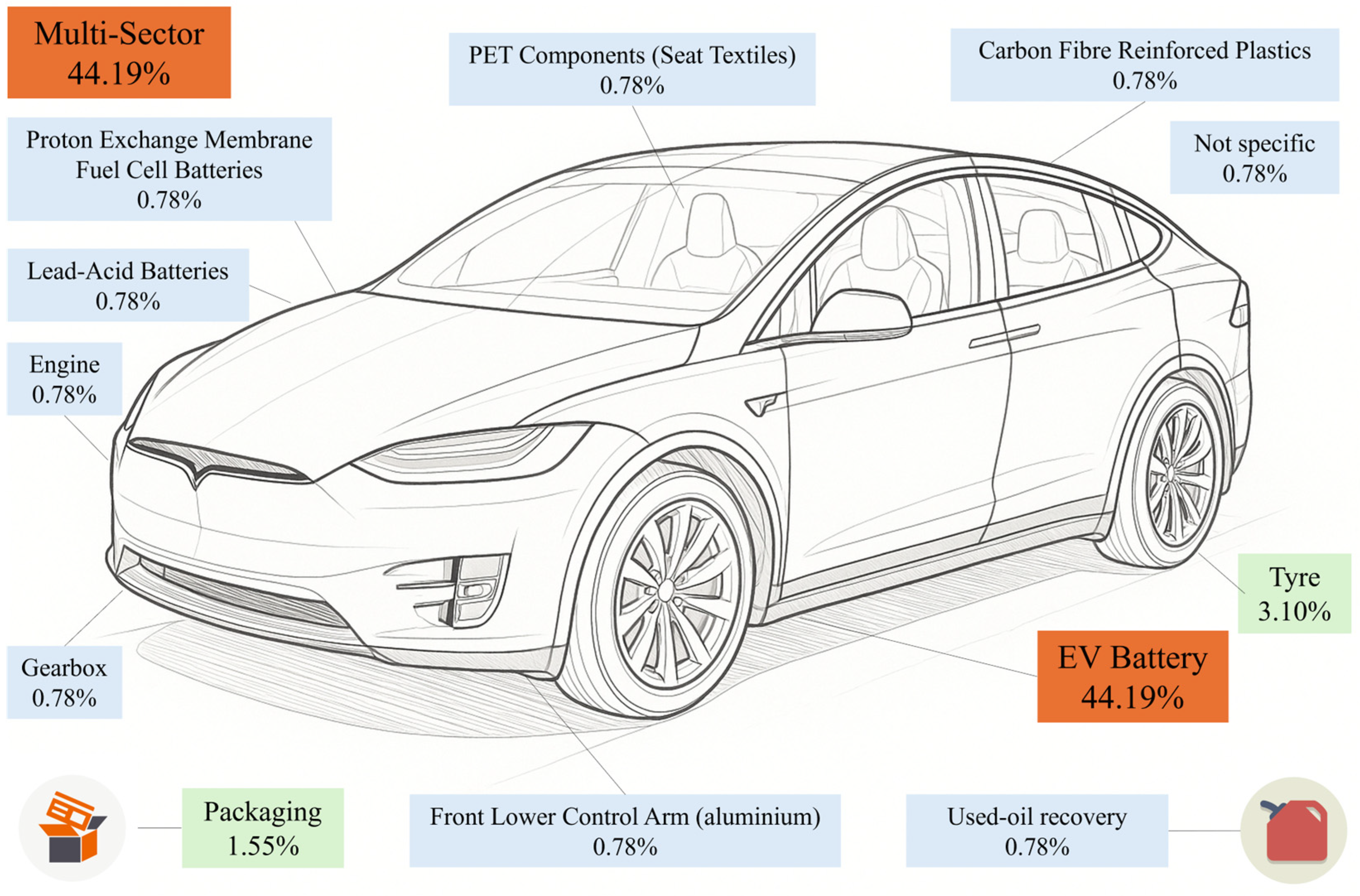



| Study | Country/Region | RSC Sector | Type of Component | Stakeholders Focus | Methodology |
|---|---|---|---|---|---|
| Zhang et al., 2023 [9] | Not specify | Collection, Reuse, Remanufacturing, Recycling, Waste Management/Disposal | Multi-components | Business; Consumer; Government | Systematic literature review |
| Abdulrahman et al., 2014 [27] | China | Collection, Reuse, Remanufacturing, Recycling, Waste Management/Disposal | Multi-components | Business | Quantitative |
| Demirel et al., 2016 [28] | Turkey | Collection, Remanufacturing, Reuse, Recycling, Waste Management/Disposal | Multi-components | Consumer; Business; Government | Quantitative Case study |
| Yao 2024 [29] | China | Collection, Remanufacturing, Recycling, Waste Management/Disposal | Multi-components | Consumer; Business | Quantitative Case study |
| Zhang et al., 2024 [30] | China | Collection, Reuse, Recycling, Remanufacturing | EV batteries | Business; Consumer; Government | Quantitative |
| Xiao et al., 2024 [31] | Not specify | Collection, Recycling, Remanufacturing | EV batteries | Business; Consumer | Quantitative |
| Liu & Wang 2021 [32] | China | Collection, Recycling, Remanufacturing | EV batteries | Government; Business; Consumer | Quantitative |
| Zhu & Li 2020 [33] | China | Collection, Recycling, Remanufacturing | EV batteries | Business; Consumer; Government | Quantitative |
| Shankar et al., 2018 [34] | India | Collection, Remanufacturing, Recycling, Manufacturing | Multi-components | Business; Consumer | Case Study Quantitative |
| He et al., 2020 [35] | Not specify | Collection, Reuse, Remanufacturing, Recycling, Waste Management/Disposal (scope of literature review) | Multi-components | Consumer; Business; Government | Systematic literature review |
| Forouzanfar et al., 2018 [36] | Iran | Manufacturing, Collection, Remanufacturing, Recycling | Multi-components | Business; Consumer | Quantitative |
| Xiao et al., 2019 [37] | China | Collection, Remanufacturing, Recycling, Waste Management/Disposal | Multi-components | Government; Business; Consumer | Quantitative Case study |
| Xiao et al., 2024 [38] | China | Collection, Recycling, Remanufacturing | EV batteries | Business; Consumer; Government | Quantitative |
| Gao et al., 2023 [39] | China, Japan, EU | Collection, Reuse (cascade use implied), Recycling, Remanufacturing | EV batteries | Government; Business | Quantitative |
| Wu et al., 2022 [40] | China | Collection, Reuse, Recycling, Remanufacturing | EV batteries | Business; Consumer; Government | Quantitative |
| Trivyza et al., 2022 [41] | EU | Collection, Recycling, Manufacturing | Carbon Fibre Reinforced Plastics | Business; Government | Quantitative |
| Dhouib 2014 [42] | Tunisia | Recycling, Reuse, Waste Management/Disposal | Tyres | Business; Government; Others | Quantitative Case study |
| Chaabane et al., 2021 [43] | Canada | Collection | Multi-components | Business; Government | Quantitative Case study |
| Jindal & Sangwan 2015 [44] | India | Collection | Multi-components | Business; Consumer | Quantitative Case study |
| Ma et al., 2024 [45] | China | Collection, Reuse, Recycling | EV batteries | Consumer; Business; Government | Quantitative Case study |
| Karagoz et al., 2020 [46] | Not specify | Collection, Reuse, Remanufacturing, Recycling, Waste Management/Disposal (scope of literature review) | Multi-components | Business; Government | Systematic literature review |
| Karagoz et al., 2022 [47] | Turkey | Collection, Reuse/Remanufacturing, Recycling, Waste Management/Disposal | Multi-components | Consumer; Business; Government | Quantitative Case study |
| Klenk et al., 2022 [48] | Turkey | Collection, Remanufacturing | Multi-components | Business | Qualitative Conceptual/Theoretical Analysis |
| Lind et al., 2014 [49] | Germany, Sweden, Spain | Remanufacturing, Collection | Multi-components | Business | Quantitative Case study |
| Subramanian et al., 2014 [50] | China | Collection, Remanufacturing, Recycling, Waste Management/Disposal | Multi-components | Business; Government; Consumer | Qualitative Case Study |
| Kaviani et al., 2020 [51] | Iran | Collection, Reuse, Remanufacturing, Recycling, Waste Management/Disposal (scope of barrier analysis) | Multi-components | Business; Government; Others | Qualitative Quantitative |
| Lin et al., 2023 [52] | China | Collection, Reuse, Remanufacturing, Recycling, Waste Management/Disposal | EV batteries | Business; Government | Quantitative Case study |
| Ravi 2014 [53] | India | Collection (warranty returns), Waste Management/Disposal (current primary outcome), Remanufacturing, Recycling | Multi-components | Business; Consumer | Qualitative Case Study |
| Azadnia et al., 2021 [54] | EU | Collection, Reuse, Remanufacturing, Recycling, Waste Management/Disposal | Batteries | Business; Government; Others | Qualitative |
| Gardas et al., 2018 [55] | Iran | Collection, Recycling | Used-oil recovery | Government; Business; Consumer | Qualitative |
| Grandjean et al., 2019 [56] | UK | Collection, Reuse, Remanufacturing | EV batteries | Business; Government | Quantitative Experimental |
| Ravi & Shankar 2017 [57] | India | Collection, Reuse, Remanufacturing, Recycling, Waste Management/Disposal | Multi-components | Business; Government; Consumer; Others | Qualitative |
| Ene & Öztürk 2017 [58] | Turkey | Collection | Multi-components | Business; Government; Consumer | Quantitative |
| Marcos et al., 2021 [59] | Not specify | Manufacturing, Collection, Reuse, Recycling | EV batteries | Business; Government | Qualitative |
| Scur et al., 2022 [60] | Brazil | Manufacturing, Collection, Recycling | Lead-Acid Batteries | Business; Government | Qualitative Case Study |
| Trang & Li 2023 [61] | Not specify | Collection, Reuse, Remanufacturing, Recycling, Waste Management/Disposal | Multi-components | Business; Government; Consumer | Systematic literature review |
| Daaboul et al., 2014 [62] | EU | Recycling, Collection | Multi-components | Business; Others | Quantitative Case study Conceptual/Theoretical Analysis |
| Demirel et al., 2014 [63] | Not specify | Manufacturing, Consumption/Use, Collection, Remanufacturing, Recycling, Waste Management/Disposal | Not specify | Business | Quantitative |
| Kuşakcı et al., 2019 [64] | Turkey | Collection, Reuse, Recycling, Waste Management/Disposal | Multi-components | Business; Government | Quantitative Case study |
| Li et al., 2018 [65] | US | Remanufacturing, Collection, Recycling, Waste Management/Disposal | EV batteries | Business | Quantitative Conceptual/Theoretical Analysis |
| Özceylan et al., 2017 [66] | Turkey | Manufacturing, Collection, Remanufacturing (component recovery), Recycling, Waste Management/Disposal | Multi-components | Business; Consumer; Government | Quantitative Case study Conceptual/Theoretical Analysis |
| Ghasemzadeh et al., 2021 [67] | Iran | Manufacturing, Collection, Remanufacturing (retreading), Recycling, Waste Management/Disposal | Tyres | Business; Government | Quantitative Case study |
| Omosa et al., 2023 [68] | Malaysia, Poland, Japan, Romania, UK, Kenya, Cameroon | Collection, Remanufacturing (dismantling), Recycling | Multi-components | Business; Government; Consumer; Others | Qualitative Quantitative |
| Chavez & Sharma 2018 [69] | Mexico, Japan | Collection, Recycling | PET Components (seat textiles) | Business; Consumer; Government; Others | Case Study Qualitative Quantitative |
| Guan et al., 2023 [70] | China | Collection, Reuse, Recycling, Remanufacturing | EV batteries | Business; Government | Quantitative |
| Zhang et al., 2023 [71] | China, Japan, EU | Collection, Reuse (repurposing implied), Recycling, Remanufacturing | EV batteries | Consumer; Business; Government | Quantitative Conceptual/Theoretical Analysis |
| Zhang et al., 2024 [72] | China | Collection, Reuse, Remanufacturing | EV batteries | Business; Consumer; Government | Quantitative Case study |
| Zhou et al., 2018 [73] | China | Collection, Remanufacturing, Recycling, Waste Management/Disposal | Multi-components | Business; Government | Quantitative Case study Conceptual/Theoretical Analysis |
| Bouvier et al., 2024 [74] | EU | Collection (packaging), Manufacturing, Consumption/Use (packaging logistics) | Packaging | Business; Others | Quantitative Case study |
| Bag & Gupta 2020 [75] | South Africa | Collection, Remanufacturing, Recycling, Manufacturing (human capital aspect) | Multi-components | Business; Others | Quantitative |
| Bajar et al., 2024 [76] | Not specify | Collection, Remanufacturing, Recycling | Multi-components | Business; Consumer; Government | Quantitative Qualitative |
| da Cruz et al., 2022 [77] | Brazil | Manufacturing, Consumption/Use (Packaging logistics) | Packaging | Business | Quantitative Qualitative |
| Wu et al., 2015 [78] | Vietnam | Recycling, Collection, Manufacturing | Multi-components | Business; Government; Others | Quantitative |
| Pinho Santos & Proença 2022 [79] | Portugal | Collection, Reuse, Remanufacturing, Recycling (Strategic/Policy level) | Multi-components | Business; Government | Qualitative |
| Zhu & Yu 2019 [80] | China | Collection, Recycling, Remanufacturing | EV batteries | Business; Government | Quantitative |
| Garrido-Hidalgo et al., 2020 [81] | Spain | Collection, Reuse, Remanufacturing, Recycling (focus on enabling information systems) | EV batteries | Business; Government | Case Study Qualitative |
| Casper & Sundin 2018 [82] | Germany, France, Sweden | Collection, Remanufacturing | Engine gearboxes | Business; Government | Qualitative Conceptual/Theoretical Analysis |
| Sorooshian et al., 2024 [83] | Asia | Manufacturing, Collection, Remanufacturing, Recycling | EV batteries | Business; Government | Quantitative Case study |
| Xing & Yao 2022 [84] | China | Collection, Reuse, Recycling | EV batteries | Business; Consumer; Government | Quantitative |
| Lin et al., 2018 [85] | China | Collection, Remanufacturing, Recycling | Multi-components | Business | Quantitative |
| Zarbakhshnia et al., 2018 [86] | Iran | Collection, Remanufacturing, Recycling | Multi-components | Business; Government; Others | Quantitative |
| Alkahtani & Ziout 2019 [87] | Saudi Arabia | Collection, Remanufacturing | Proton Exchange Membrane Fuel Cell Batteries | Business; Government; Others | Quantitative Case study |
| Yang et al., 2022 [88] | China | Collection, Remanufacturing, Recycling (as 3PRLP services) | EV batteries | Business; Consumer; Government | Quantitative Conceptual/Theoretical Analysis |
| Son et al., 2022 [89] | Germany | Collection, Remanufacturing | Multi-components | Business; Consumer | Qualitative Conceptual/Theoretical Analysis |
| Scheller et al., 2023 [90] | EU, UK, Turkey | Manufacturing, Collection, Reuse (repurposing), Recycling | EV batteries | Business; Government | Quantitative Case study |
| Zheng et al., 2025 [91] | China | Collection, Remanufacturing, Recycling (as 3PRLP services) | EV batteries | Business; Government | Quantitative Qualitative |
| Tan et al., 2023 [92] | China | Collection, Recycling | EV batteries | Business; Consumer; Government | Quantitative Case study |
| Wang et al., 2024 [93] | China | Collection, Remanufacturing, Recycling (logistics focus) | Multi-components | Business; Government | Quantitative Case study |
| Liao & Luo 2022 [94] | China | Collection, Remanufacturing, Recycling, Waste Management/Disposal | EV batteries | Business; Government | Quantitative |
| Govindan & Gholizadeh 2021 [95] | Iran | Collection, Reuse/Remanufacturing, Recycling, Waste Management/Disposal | Multi-components | Consumer; Business; Government | Quantitative Case Study |
| Hamidi Moghaddam et al., 2021 [96] | Iran | Manufacturing, Collection, Remanufacturing, Waste Management/Disposal | Multi-components | Business; Consumer | Quantitative Conceptual/Theoretical Analysis Case Study |
| Kumar Jauhar et al., 2024 [97] | India | Collection, Recycling, Remanufacturing | EV batteries | Business; Government; Consumer | Quantitative |
| Sathiya et al., 2021 [98] | India | Collection, Reuse/Remanufacturing (repair for resale) | Multi-components | Business | Conceptual/Theoretical Analysis Quantitative Case Study |
| Phuc et al., 2017 [99] | EU, Japan, China | Collection, Reuse, Remanufacturing, Recycling, Waste Management/Disposal | Multi-components | Consumer; Business; Government | Quantitative |
| Hao et al., 2018 [100] | China | Collection | Multi-components | Business; Government | Quantitative |
| Abdolazimi et al., 2020 [101] | Iran | Manufacturing, Collection, Recycling, Waste Management/Disposal | Tyres | Business; Consumer | Quantitative Case study |
| Shahparvari et al., 2021 [102] | Iran | Collection, Recycling, Waste Management/Disposal, Remanufacturing | Multi-components | Business; Government | Quantitative |
| Hao et al., 2021 [103] | China | Collection (recall), Reuse (echelon use) | EV batteries | Business; Government | Quantitative |
| Dehghani Sadrabadi et al., 2024 [104] | Iran | Collection, Recycling, Remanufacturing | EV batteries | Business; Consumer; Government | Quantitative Case study |
| Mu et al., 2023 [105] | China | Collection, Reuse, Remanufacturing, Recycling, Waste Management/Disposal | EV batteries | Business; Consumer; Government | Quantitative |
| Chen et al., 2024 [106] | China | Manufacturing, Collection, Remanufacturing, Recycling | Multi-components | Consumer; Business; Government | Quantitative |
| He et al., 2024 [107] | China | Collection, Reuse, Remanufacturing, Recycling, Waste Management/Disposal | Multi-components | Consumer; Business; Government | Quantitative Case study |
| Tian et al., 2019 [108] | China | Collection | Multi-components | Government; Business; Others | Quantitative |
| Gorji et al., 2021 [109] | Iran | Collection, Reuse/Remanufacturing (repair centre) | Multi-components | Government; Business; Consumer | Quantitative |
| Zeng et al., 2024 [110] | China | Collection, Recycling, Remanufacturing | EV batteries | Business; Consumer; Government | Quantitative |
| Günther et al., 2015 [111] | Not specify | Manufacturing, Consumption/Use, Collection, Recycling | Multi-components | Business; Government; Consumer | Quantitative |
| Zhao et al., 2022 [112] | China | Collection, Remanufacturing, Recycling | EV batteries | Business; Government; Consumer | Quantitative |
| Narang et al., 2024 [113] | India | Collection, Reuse, Recycling, Remanufacturing | EV batteries | Business; Government; Consumer | Quantitative Case study |
| Yin & Liu 2021 [114] | China | Manufacturing, Collection, Remanufacturing, Recycling | Multi-components | Business; Government | Quantitative |
| Qi et al., 2024 [115] | China, EU | Collection, Reuse, Recycling, Remanufacturing | EV batteries | Business; Government; Consumer | Quantitative |
| Zhang et al., 2024 [116] | China | Collection, Reuse, Remanufacturing | EV batteries | Business; Consumer; Government | Quantitative Case study |
| Xia et al., 2024 [117] | China | Collection, Remanufacturing, Waste Management/Disposal | Multi-components | Consumer; Business; Government; Others | Quantitative |
| Liu et al., 2023 [118] | China | Collection, Remanufacturing, Recycling | Multi-components | Business; Government | Quantitative |
| Wang 2024 [119] | China | Collection, Remanufacturing | EV batteries | Business; Government | Quantitative |
| Wang & He 2024 [120] | Not specify | Collection, Remanufacturing | Multi-components | Business; Consumer | Quantitative |
| Gong et al., 2024 [121] | Not specify | Collection, Reuse (second-life), Recycling | EV batteries | Business; Government | Quantitative |
| Rajabzadeh et al., 2023 [122] | Iran | Collection, Reuse (second-hand sales), Remanufacturing, Recycling | Multi-components | Business; Consumer | Quantitative Case study |
| Liu et al., 2024 [123] | China | Manufacturing, Collection, Reuse, Remanufacturing | EV batteries | Business; Consumer; Government | Quantitative Case study |
| Latpate et al., 2024 [124] | India, South Africa, Southeast Asia | Collection, Remanufacturing | Multi-components | Consumer; Business; Government | Quantitative Case study |
| Zhou et al., 2024 [125] | China | Collection, Remanufacturing, Recycling | Multi-components | Business; Consumer; Government | Quantitative Case study |
| Tognetti et al., 2015 [126] | Germany, EU | Manufacturing | Multi-components | Business; Government | Quantitative Case study |
| Chai et al., 2024 [127] | China | Manufacturing, Collection, Remanufacturing | EV batteries | Business; Government; Consumer | Quantitative Case study |
| Kalverkamp & Young 2019 [128] | Japan, Chile, Canada | Reuse (vehicle export), Remanufacturing, Recycling | Multi-components | Business; Government | Qualitative Conceptual/Theoretical Analysis Case study |
| Rentizelas & Trivyza 2022 [129] | UK | Collection, Remanufacturing, Recycling, Manufacturing | Car frames | Business; Government | Quantitative Case study |
| Liu & Zhu 2024 [130] | China | Collection, Recycling, Remanufacturing | EV batteries | Business; Government; Consumer | Quantitative |
| Li et al., 2024 [131] | Not specify | Collection, Recycling, Remanufacturing | EV batteries | Business; Consumer | Quantitative |
| Zhou et al., 2023 [132] | Singapore | Collection, remanufacturing, recycling | EV batteries | Government; Business; Consumer | Quantitative |
| Zhang & Zhang 2022 [133] | China | Collection, Remanufacturing, Recycling | EV batteries | Business; Consumer | Quantitative |
| Yildizbaşi et al., 2018 [134] | Turkey | Manufacturing, Collection, Remanufacturing, Recycling, Waste Management/Disposal | Multi-components | Business; Consumer | Quantitative |
| Kumar et al., 2021 [135] | India | Manufacturing, Collection, Reuse, Recycling | EV batteries | Others; Government | Qualitative Quantitative |
| Fernando et al., 2023 [136] | Malaysia | Collection, Reuse, Remanufacturing | Multi-components | Business | Quantitative |
| Akram & Abdul-Kader 2021 [137] | Canada | Remanufacturing, Reuse (Repurposed), Recycling, Collection | EV batteries | Business; Government | Quantitative Qualitative |
| Grandjeanet al., 2019 [138] | UK | Collection, Reuse, Recycling | EV batteries | Business; Government | Quantitative Experimental |
| Alamerew & Brissaud 2020 [139] | France | Collection, Reuse (repurposing), Recycling, Manufacturing (design influence), Waste Management/Disposal | EV batteries | Business; Government | Conceptual/Theoretical Analysis Qualitative Quantitative |
| He et al., 2024 [140] | China | Collection, Reuse, Remanufacturing, Recycling, Waste Management/Disposal | EV batteries | Consumer; Business; Government | Quantitative Case study |
| Makarova et al., 2021 [141] | Not specify | Manufacturing, Consumption/Use, Collection, Remanufacturing | Multi-components | Business; Consumer | Conceptual/Theoretical Analysis Quantitative Case Study |
| Fan et al., 2023 [142] | China | Collection, Reuse, Remanufacturing, Recycling | EV batteries | Business; Government | Quantitative |
| Gonzales-Calienes et al., 2022 [143] | Canada | Collection, Recycling | EV batteries | Business; Government | Quantitative Case study |
| Gu et al., 2018 [144] | Not specify | Reuse, Remanufacturing, Recycling, Collection | EV batteries | Business; Consumer | Quantitative Conceptual/Theoretical Analysis |
| Li et al., 2023 [145] | China | Collection, Recycling, Remanufacturing | EV batteries | Business; Government | Quantitative |
| Guo et al., 2024 [146] | China | Collection, Recycling, Remanufacturing | EV batteries | Business; Consumer; Government | Quantitative |
| Song & Chu 2019 [147] | China | Collection, Remanufacturing, Recycling | EV batteries | Business; Government; Consumer | Quantitative |
| Zhang et al., 2023 [148] | China | Collection, Reuse, Recycling | EV batteries | Business; Government; Consumer | Quantitative |
| Daaboul et al., 2016 [149] | EU | Recycling, Collection, Manufacturing | Front lower control arm (aluminium) | Business | Quantitative Case study Conceptual/Theoretical Analysis |
| Wang et al., 2023 [150] | China | Collection, Reuse, Remanufacturing, Recycling | EV batteries | Business; Government | Quantitative Case study |
| Manoj Kumar 2023 [151] | India | Collection, Recycling | Tyres | Business | Conceptual/Theoretical Analysis Experimental Case Study |
| Yuik et al., 2023 [152] | Not specify | Collection, Remanufacturing, Recycling | Multi-components | Others | Systematic literature review |
| He et al., 2024 [153] | China | Collection, Remanufacturing, Recycling (logistics focus) | EV batteries | Consumer; Business; Government | Quantitative Case study |
| Gu et al., 2018 [154] | Not specify | Manufacturing, Remanufacturing, Reuse, Collection, Recycling | EV batteries | Business; Consumer | Quantitative |
| Country | Number of Publications | Percentage |
|---|---|---|
| China | 52 | 40.31% |
| Iran | 12 | 9.30% |
| India | 10 | 7.75% |
| Turkey | 8 | 6.20% |
| Japan | 6 | 4.65% |
| United Kingdom | 5 | 3.88% |
| Canada | 4 | 3.10% |
| Germany | 4 | 3.10% |
| Brazil | 2 | 1.55% |
| France | 2 | 1.55% |
| Malaysia | 2 | 1.55% |
| Spain | 2 | 1.55% |
| Sweden | 2 | 1.55% |
| United States (or Others *) | 1 | 0.78% |
| Feature Dimension | Traditional ELV Recovery | EV Battery Recovery (A Distinct Sub-Field) |
|---|---|---|
| Technical Uncertainty |
|
|
| Economic Proposition |
|
|
| Stakeholder Ecosystem |
|
|
| Policy Instruments |
|
|
Disclaimer/Publisher’s Note: The statements, opinions and data contained in all publications are solely those of the individual author(s) and contributor(s) and not of MDPI and/or the editor(s). MDPI and/or the editor(s) disclaim responsibility for any injury to people or property resulting from any ideas, methods, instructions or products referred to in the content. |
© 2026 by the authors. Licensee MDPI, Basel, Switzerland. This article is an open access article distributed under the terms and conditions of the Creative Commons Attribution (CC BY) license.
Share and Cite
Zhang, L.; Ng, E.; Rahman, M.M. Mapping the Transition to Automotive Circularity: A Systematic Review of Reverse Supply Chain Implementation. Sustainability 2026, 18, 1129. https://doi.org/10.3390/su18021129
Zhang L, Ng E, Rahman MM. Mapping the Transition to Automotive Circularity: A Systematic Review of Reverse Supply Chain Implementation. Sustainability. 2026; 18(2):1129. https://doi.org/10.3390/su18021129
Chicago/Turabian StyleZhang, Lei, Eric Ng, and Mohammad Mafizur Rahman. 2026. "Mapping the Transition to Automotive Circularity: A Systematic Review of Reverse Supply Chain Implementation" Sustainability 18, no. 2: 1129. https://doi.org/10.3390/su18021129
APA StyleZhang, L., Ng, E., & Rahman, M. M. (2026). Mapping the Transition to Automotive Circularity: A Systematic Review of Reverse Supply Chain Implementation. Sustainability, 18(2), 1129. https://doi.org/10.3390/su18021129