1. Introduction
The manufacturing sector is increasingly confronted with mounting environmental pressures, as the large volumes of waste generated and the substantial energy required for continuous production cycles, high-temperature treatments, and raw-material processing intensify ecological degradation. The scale and persistence of manufacturing-related impacts are prompting firms and policymakers alike to reconsider traditional production models and to incorporate strategies that enhance resource efficiency and reduce environmental harm.
One such strategy is eco-innovation (EI), which has emerged as a central mechanism through which firms can introduce environmentally beneficial products, processes, and organizational practices. Despite its growing relevance, our understanding of the determinants and dynamics of EI—particularly under varying macroeconomic conditions—remains limited. Existing literature reviews [
1,
2] identify manufacturing as a critical context in which regulatory pressures, competitive forces, and technological demands converge most strongly. Yet empirical work on EI displays important shortcomings. Much of the research remains geographically concentrated, with a predominant focus on China, thereby restricting the generalizability of findings. Moreover, many studies rely on qualitative assessments of policy documents rather than robust, systematic data, while cross-sectional designs dominate empirical analyses. These methodological constraints hinder our ability to understand how environmental regulation, institutional mechanisms, and firm-level capabilities interact to shape EI over time—particularly across different phases of the business cycle, when constraints and incentives may vary markedly [
3,
4,
5,
6,
7].
Existing studies have established that environmental regulation, market pressures, and firm-level capabilities play a central role in shaping firms’ propensity to engage in EI, particularly within manufacturing industries. Despite this accumulated evidence, the literature remains limited in its ability to explain how these drivers interact dynamically over time and across macroeconomic conditions. The predominance of cross-sectional designs constrains inference about persistence, path dependence, and cyclical sensitivity—core mechanisms emphasized by evolutionary and institutional theories of innovation—thereby restricting both theoretical advancement and policy interpretation. This study addresses these limitations by combining a longitudinal panel design, a distinction between eco-efficiency and eco-environmental innovation, and an explicit business-cycle perspective, thereby offering a dynamic and theoretically grounded account of firms’ green behaviour.
Firms’ incentives to undertake EI are not static; rather, they fluctuate according to prevailing economic conditions. During downturns, resource scarcity, weakened demand, and uncertainty often diminish compliance efforts and reduce consumer sensitivity to environmental considerations [
8,
9]. At the same time, crises may prompt firms—particularly those operating in energy-poor contexts—to adopt energy-saving innovations as a means of containing costs [
10]. Nevertheless, the long-term effectiveness of regulatory frameworks and complementary policy tools, such as subsidies, under shifting macroeconomic conditions remains insufficiently understood. The scarcity of longitudinal datasets represents a significant barrier for researchers, thereby reinforcing calls for analyses that span extended periods to capture how environmental regulation interacts with firms’ green behaviour [
3,
4,
5,
7]. Recent literature reviews reiterate this need, emphasizing the importance of panel data for assessing the dynamics and impacts of EI across different phases of the business cycle [
6]. Indeed, Ghisetti and Rennings (2014) [
4] specifically highlight that economic downturns may condition firms’ environmental strategies, thereby warranting more nuanced empirical investigation. In line with these perspectives, the present study adopts a longitudinal approach.
From a theoretical standpoint, both evolutionary and institutional approaches suggest that firms’ green behaviour is shaped by a combination of cumulative learning processes, organizational capabilities, and external pressures that evolve over time. Evolutionary theory emphasizes persistence, path dependence, and the role of firm-specific capabilities—such as size, accumulated knowledge, and prior innovation experience—in shaping innovation trajectories. Institutional theory, in turn, highlights the role of regulatory frameworks and policy incentives as coercive and enabling mechanisms that condition firms’ strategic responses to environmental challenges. Importantly, the influence of these drivers is unlikely to be uniform across macroeconomic conditions, as expansions and contractions reshape resource availability, risk tolerance, and compliance incentives.
Building on these theoretical considerations, the study pursues two interrelated objectives. First, it examines the dynamic effects of environmental regulation and policy support on firms’ propensity to engage in EI over time, with particular attention to periods of economic contraction. Second, it analyses how firm-level determinants—such as prior EI engagement, firm size, knowledge integration capabilities, and strategic orientations—condition EI behaviour across different phases of the business cycle. By adopting a longitudinal perspective, the analysis reveals not only whether these drivers matter, but also when and under which macroeconomic conditions their influence becomes more pronounced.
These objectives are pursued using panel data from Spanish manufacturing firms, encompassing approximately 97,733 observations from 2004 to 2016. This period includes a phase of economic expansion (2004–2007), the global financial crisis (2008–2013), and the subsequent recovery (2014–2016). Spain presents a particularly salient context, given its structural dependence on imported energy and water resources, alongside the severe contraction in public and private R&D investment following the 2008 crisis [
11,
12]. Spain provides an analytically informative setting for examining EI dynamics in a moderately innovative, resource-constrained economy exposed to pronounced macroeconomic fluctuations. According to Eurostat, Spain is classified as a “moderate innovator,” (
https://ec.europa.eu/assets/rtd/eis/2025/ec_rtd_eis-country-profile-es.pdf accessed on 7 December 2025), characterized by a productive structure dominated by small- and medium-sized firms, limited specialization in high-technology sectors, and comparatively weaker innovation diffusion mechanisms [
13,
14]. These features—together with strong dependence on energy and resource imports and a pronounced exposure to macroeconomic shocks—render Spain a particularly informative setting for examining the interplay between institutional drivers and firm capabilities over the business cycle. Importantly, such structural conditions are not idiosyncratic to Spain. Rather, they are shared by several Southern and peripheral European economies, as well as by a number of emerging countries. Consequently, while the empirical analysis is necessarily context-specific, the mechanisms identified in this study—concerning the persistence, path dependence, and cyclical sensitivity of environmental innovation (EI) drivers—are expected to extend beyond the Spanish case to economies characterised by similar innovation-system features. A more detailed discussion of Spain’s institutional and industrial context is provided in
Section 3.
As stated, the study is theoretically grounded in evolutionary and institutional perspectives. In line with Evolutionary Theory [
15,
16], green innovation is conceptualized as the result of cumulative learning, path-dependent routines, and the interplay between firm-specific capabilities and network embeddedness, all of which evolve in response to macroeconomic conditions. Institutional theory further suggests that coercive, normative, and mimetic pressures—ranging from regulatory requirements to social expectations and the emulation of leading firms—shape firms’ environmental strategies [
17]. Together, these frameworks provide a comprehensive analytical foundation for examining EI drivers across varying economic contexts. Accordingly, we posit that while some determinants exert persistent, positive influences on EI irrespective of the business cycle, others function as countercyclical mechanisms that support firms’ environmental resilience during challenging periods. These perspectives jointly inform the empirical strategy adopted in this study, guiding the selection of explanatory variables and motivating the analysis of heterogeneous and potentially countercyclical EI drivers.
Although the dataset covers 2004–2016, it constitutes the most complete panel currently available for Spanish manufacturing firms. European Union (EU)-level data on EI remain largely cross-sectional, as Community Innovation Survey (CIS) instruments seldom offer panel structures; the Spanish PITEC survey represents a notable exception in this regard. Given that innovation activity tends to be procyclical—expanding during favourable economic conditions and contracting during downturns [
18]—the dynamics observed during the Great Recession provide valuable insights for understanding firms’ responses to subsequent crises, including the ongoing energy crisis in Europe. Consequently, the analysis sheds light on how environmental regulation (hereafter, regulation), other policy support tools, and firm capabilities condition EI under adverse economic circumstances, thereby offering important implications for contemporary policy design. While the findings should not be interpreted as universally generalizable, they offer insights into EI dynamics in moderately innovative, resource-constrained economies facing cyclical instability.
Section 2 reviews the relevant literature and develops the theoretical foundations and hypotheses.
Section 3 describes the Spanish context.
Section 4 outlines the econometric methodology and research strategy.
Section 5 presents and discusses the empirical results, and
Section 6 concludes with policy implications and avenues for future research.
2. Literature Review
This section clarifies the key concepts and definitions associated with EI and examines the main determinants identified in the literature, thereby establishing the foundation for the empirical analysis that follows.
2.1. Definitions
In the CIS conducted by the EU, innovation is defined as the introduction of a new or significantly improved product—whether a good or service—or the implementation of a new or significantly improved process within the firm. This definition is particularly relevant, given that the present study draws upon data obtained from a CIS-type survey. Within the academic literature, the concept of EI appears under various labels—including “ecological,” “green,” and “sustainable” innovation—reflecting the field’s breadth and conceptual diversity [
19]. In this article, EI and green innovation are treated as equivalent terms.
Although EI encompasses multiple dimensions, the literature consistently emphasizes two core components: (1) the reduction of negative environmental externalities, particularly through pollution-prevention mechanisms, and (2) the enhancement of resource efficiency, especially regarding energy and water savings. In line with these prevailing conceptualizations, the present study focuses on two types of EI: environmental EI, referring to innovations designed to prevent environmental harm, and efficiency EI, which is associated with technologies and practices that conserve energy and water.
For an extensive synthesis of definitions employed in prior studies, see
[20], while Chaparro-Banegas et al. (2023) [
21], drawing on bibliometric techniques, map the evolution of EI terminology across academic domains.
2.2. Conceptual Framework
Following the evolutionary theory of technological change [
15,
16], green innovation can be interpreted as an outcome of cumulative learning processes, path-dependent routines, and the interaction between firm-specific capabilities and the broader networks in which firms are embedded. Internal capabilities—such as the skills of R&D personnel, accumulated experience, and learning-by-doing—co-evolve with external pressures, shaping firms’ ability to adapt their technological trajectories. Simultaneously, access to diverse knowledge sources and strategic cooperation with external partners serve as additional mechanisms of variation and selection, influencing firms’ innovation paths over time.
Institutional theory offers a complementary viewpoint, highlighting the role of coercive pressures (e.g., regulatory mandates), normative expectations (e.g., societal demands for sustainability), and mimetic behaviours (e.g., imitation of successful environmental leaders) in shaping firms’ green strategies [
17]. These insights underscore the importance of analysing multiple determinants of EI—including regulatory interventions, knowledge-related factors, and firm-level characteristics—across shifting macroeconomic contexts such as periods of expansion and crisis. A longitudinal perspective is, therefore, particularly valuable, enabling the assessment of not only which drivers matter, but also how their influence changes as resource availability, regulatory enforcement, and societal priorities evolve over the business cycle.
While the evolutionary and the institutional perspectives are often treated separately, periods of economic crisis highlight their interdependence. While institutional signals—or a firm’s awareness of signals—may become more salient under crisis conditions [
22], a firm’s ability to respond to these signals is shaped by path-dependent capabilities and network positions. As a result, EI during downturns is triggered not by institutional pressure per se, but by its alignment with pre-existing R&D resources, cooperative learning structures, and selective policy instruments that reduce uncertainty and sustain cumulative innovation trajectories. At the same time, following the dynamic capabilities framework [
23], crises may act as critical junctures that activate firms’ capacity to sense new opportunities, seize them, and reconfigure existing resources. Such capability deployment during downturns is nonetheless rooted in prior experience, R&D investment, and network embeddedness, implying that dynamic adjustment and path dependence are complementary rather than competing mechanisms. Accordingly, the cyclical sensitivity of EI drivers can be understood as the outcome of an interaction between evolving institutional pressures and firms’ heterogeneous capability endowments, whereby only firms equipped with sufficient internal resources and learning networks are able to translate crisis-induced institutional signals into effective innovation responses.
This integrated theoretical framework informs the review of empirical studies in the subsequent subsections and provides the conceptual basis for the hypotheses developed in this article.
2.3. Drivers of Eco-Innovation: Institutional Intervention
Institutional intervention—manifested through regulation and public support for R&D—emerges consistently in the literature as a central driver of firms’ engagement in EI [
6]. Drawing on institutional theory [
17], such interventions operate through coercive pressures (e.g., regulatory mandates), normative expectations (e.g., societal demands for environmental responsibility), and mimetic mechanisms under uncertainty. This perspective underscores the institutional embeddedness of EI and reinforces Horbach’s [
24] argument that, due to the presence of negative environmental externalities, EI is typically less market-driven than other forms of innovation and, therefore, more reliant on policy stimuli.
The role of regulation in fostering EI has been extensively debated. Porter and van der Linde’s [
25] “win–win” hypothesis suggests that stringent environmental regulation can stimulate innovation by inducing efficiency gains and technological upgrading. While influential, this proposition has yielded mixed empirical support. A substantial body of empirical work—particularly in European contexts—finds regulation to be a decisive driver of EI [
5,
7,
24,
26,
27,
28,
29], with similar conclusions reported for China and other Asian economies [
1,
30]. At the same time, other studies identify heterogeneous or conditional effects, suggesting that regulation alone is often insufficient to induce EI and that its effectiveness depends on complementary factors such as policy design, enforcement intensity, and alignment with firms’ internal capabilities [
31].
Institutional theory helps explain this heterogeneity by emphasizing that firms respond not only to formal regulatory constraints but also to broader normative and mimetic pressures. For instance, societal concern—often expressed through environmental activism or pollution complaints—can reinforce regulatory signals [
32], while policy coherence across governance levels may enhance firms’ willingness to invest in green technologies [
33]. Conversely, Kesidou and Demirel [
26] show that firms with strong innovation capabilities may pursue EI independently of regulatory inducement, highlighting potential substitution effects between internal capabilities and external institutional pressure.
Public financial support, particularly subsidies, represents another key institutional instrument, though its impact on EI remains contested [
6]. From an institutional perspective, subsidies not only alleviate financial constraints but also signal policy priorities, thereby enhancing the legitimacy of green investments. Empirical evidence suggests that subsidies can play a crucial enabling role in contexts characterized by financial scarcity, such as Eastern Europe [
34]; they also play a role in Chinese manufacturing [
32]. However, findings for Spain are more ambiguous. While some studies report limited or insignificant effects of subsidies on EI [
5,
35], others show that their influence depends strongly on the type of EI targeted. In particular, Biggi et al. (2023) [
36] find that subsidies significantly foster environmental EI—aimed at preventing environmental harm—but exert no meaningful effect on efficiency EI, which is more closely related to cost-saving strategies.
The source and governance level of financial support further shape these outcomes. Mora-Sanguinetti et al. (2024) [
37] show that national-level renewable energy regulation in Spain stimulates both green and non-green innovation expenditure, whereas regional policies appear less effective, possibly due to fragmentation or differences in implementation quality. Similarly, supranational EU funding introduces an additional institutional layer: García-Sánchez and Rama (2025) [
10] find that EU-level R&D support exerts a stronger positive influence on EI among Spanish firms than national funding, particularly during periods of economic stress. These findings indicate that subsidies are neither homogeneous nor universally effective; rather, their impact depends on institutional scale, policy coherence, and the specific type of EI encouraged.
Beyond regulation and subsidies, other institutional instruments remain comparatively understudied. Caravella and Crespi (2020) [
38] emphasize the importance of distinguishing among financial tools, as their objectives and target firms differ substantially. In this respect, public–private R&D contracts represent a potentially important but underexplored mechanism. By fostering long-term collaboration and facilitating knowledge transfer, such contracts may be particularly relevant for sustaining EI under conditions of heightened uncertainty [
10], a possibility explicitly examined in the present study.
The relevance of institutional intervention is further shaped by macroeconomic conditions. Crises may weaken environmental concern and shift societal and political priorities toward short-term economic recovery, thereby reducing regulatory pressure and firms’ willingness to invest in green innovation [
8,
9,
39]. At the same time, empirical evidence suggests that well-designed regulation can continue to foster EI even during downturns. For example, Jové-Llopis and Segarra-Blasco (2018) [
5] show that regulatory pressure remained an important driver of EI among Spanish manufacturing firms during the 2008–2014 financial crisis, while Triguero et al. (2013) [
7] report similar findings for European SMEs.
Building on institutional theory, we conceptualize regulation and financial support as dynamic institutional pressures—coercive, normative, and mimetic—whose effectiveness varies over the business cycle. A longitudinal perspective is essential to capture these dynamics and to assess how institutional drivers interact with firms’ evolving capabilities across periods of expansion, crisis, and recovery. From an evolutionary perspective, continuous joint product–process innovation additionally reflects cumulative learning and knowledge recombination. This reinforces technological trajectories that enable firms to sustain EI across business cycle phases, particularly when institutional conditions become more uncertain and public financial support contracts during economic downturns. This framework underpins the hypotheses developed below and motivates the empirical analysis that follows.
Based on the preceding discussion, we propose the following hypotheses:
H1. Dynamic Regulation Hypothesis. Regulation positively influences firms’ eco-innovation in boom, crisis, and recovery periods.
H2. Countercyclical Support Hypothesis. Regulation positively influences environmental innovators in boom, crisis, and recovery, while financial support mechanisms become particularly influential during challenging times, with public R&D funding providing countercyclical reinforcement.
H3. Regulatory Dominance Hypothesis. Efficiency EI is primarily driven by regulation and is not significantly influenced by other policy instruments across the business cycle.
Throughout the article, the term challenging times refers to both the crisis and recovery periods. This designation reflects the fact that, in Spain, recovery unfolded more slowly and severely than in many other EU countries, as evidenced by its GDP trajectory [
40].
2.4. Drivers of Eco-Innovation: Knowledge Base
Although EI is often portrayed as a response to regulatory or economic pressures, a growing body of research shows that its underlying drivers are considerably broader. Oltra and Saint-Jean (2009) [
41] argue that EI cannot be reduced to a mechanical reaction to regulation; instead, firms’ knowledge bases—and particularly their access to external knowledge—play a decisive role. Horbach (2016) [
34] similarly contends that while regulation and cost-saving incentives remain central, a wider set of supply-side factors, including technological capabilities, must also be considered.
2.4.1. Internal Knowledge Base and Absorptive Capacity
A key concept in this regard is firms’ absorptive capacity, commonly proxied by R&D investment. Ren and Mia’s (2025) [
1] review indicates that technological resources and the ability to assimilate external knowledge both exert a positive influence on green innovation. Empirical work supports this view: Cai and Li (2018) [
3], studying Chinese firms, finds that strong technological capabilities significantly encourage EI, and Horbach (2008) [
24] likewise reports that R&D engagement fosters EI, though with uneven effects across contexts [
34]. Spanish evidence echoes this pattern: Jové-Llopis and Segarra-Blasco (2018) [
5] show that both internal and external R&D were positively associated with EI during the 2008 crisis and early recovery, a result consistent with Biggi et al. (2023) [
36]. Yet, contrasting findings persist—Cainelli et al. (2015) [
42] and Costa-Campi et al. (2017) [
27] detect no significant link between R&D and EI. Despite these contributions, Chaparro-Banegas et al.’s (2023) [
21] bibliometric analysis highlights that absorptive capacity remains relatively underexplored in the EI literature, a gap also emphasized by Ren & Mia (2025) [
1].
2.4.2. Product–Process Innovation
Relatedly, most studies privilege formal R&D while overlooking alternative innovation pathways. Biggi et al. (2023) [
36] offer an exception, showing that lagged product and process innovations positively affect efficiency EI but not environmental EI. Beyond formal R&D, mechanisms such as learning-by-doing, cumulative experience, and collaborative knowledge exchange may be equally important. Prior EI engagement, for instance, strongly predicts future EI, reflecting path dependency and the development of persistent routines ([
5,
7,
10,
24,
43]; see also [
15,
16]). From an evolutionary perspective, continuous joint product–process innovation reflects cumulative learning and knowledge recombination, reinforcing technological trajectories that facilitate persistent EI across business cycle phases.
2.4.3. External Knowledge and Cooperation
Cooperation with external partners—including clients, suppliers, and universities—emerges as another critical knowledge source. Collaboration often provides access to complementary expertise and reduces the costs associated with technological constraints [
36]. In their review, Araújo and Franco (2021) [
44] find a generally positive effect of cooperation, though outcomes depend on choosing appropriate partners. Ren & Mia’s (2025) [
1] synthesis similarly highlights the consistent benefits of collaboration. Still, empirical findings remain mixed: while Horbach (2008, 2016) [
24,
34] and Cainelli et al. (2015) [
42] report positive effects, Jové-Llopis and Segarra-Blasco (2018) [
5] detect none. Some evidence suggests that specific forms of cooperation matter more than others; Triguero et al. (2013) [
7], for example, find a particularly strong impact of university and research-centre collaboration among European SMEs. These authors also show that the breadth of external information sources significantly increases environmental EI, especially during the severe economic conditions studied. Moreover, during crises, collaborative networks can facilitate the adoption of new technologies, thereby enabling even SMEs to better cope with adverse conditions [
45].
Spillovers represent another potential EI driver frequently cited in theory but seldom validated empirically [
5,
10]. Access to external knowledge can also be reflected in the acquisition of technological inputs. Although the Oslo Manual conceptualizes the acquisition of equipment, software, and external knowledge as legitimate innovation activities, empirical work on their role in EI is scarce (
https://www.oecd.org/en/publications/oslo-manual-2018_9789264304604-en.html accessed on 24 October 2025). Cainelli et al. (2012) [
46] note this gap in their study of Italian firms, while Kesidou and Demirel (2012) [
28] find that investments in machinery recurrently support EI among British firms. This points to a broader issue: several potential EI drivers remain understudied, warranting further empirical attention—an issue this study seeks to address.
Despite offering valuable insights, much of the existing research focuses on “normal” periods of the business cycle or on macroeconomic contexts with similar characteristics, such as crisis and early recovery [
5,
27]. Consequently, little is known about how knowledge-related drivers of EI evolve across distinct macroeconomic environments. Addressing this gap is crucial to understanding the dynamics governing firms’ innovative behaviour across boom, crisis, and recovery.
Based on the previous discussion, we propose the following hypotheses:
H4. Persistence Hypothesis. Firms with prior EI experience are more likely to engage in EI across boom, crisis, and recovery.
H5. Continuous Innovation Hypothesis. Firms engaged in continuous joint product and process innovation are more likely to eco-innovate across boom, crisis, and recovery.
H6. Knowledge Integration Hypothesis. Access to diversified external knowledge and internal R&D-related factors positively influences EI during challenging times, but not necessarily during expansive phases.
2.5. Drivers of Eco-Innovation: Firm Characteristics and Market Dynamics
Beyond institutional and knowledge-related drivers, the literature identifies a range of additional determinants of EI, notably market-related and firm-specific factors. Market-oriented and organizational theories posit that competitive dynamics and a firm’s market position significantly influence EI adoption. For instance, Kesidou and Demirel (2012) [
28], analysing the United Kingdom, find that while regulatory pressure constitutes an important stimulus, market-related factors—particularly the pursuit of cost reduction—serve as strong motivators for EI. Similarly, Horbach (2008) [
24], using German panel data, demonstrates that cost savings constitute a central driver, highlighting the reinforcing role of economic incentives alongside policy measures. In line with these findings, Ren & Mia (2025) [
1], synthesizing prior studies, identify market competition as a recurrent catalyst of green innovation across diverse empirical contexts.
Evidence from Spain, however, paints a more nuanced picture. Jové-Llopis and Segarra-Blasco (2018) [
5] report that demand–pull factors exert limited influence: coefficients capturing the importance of maintaining or expanding market share, or entering new markets, are largely non-significant, suggesting that such factors are not decisive in driving EI adoption. Similarly, Brunnermeier and Cohen (2003) [
47], analysing 146 U.S. industries between 1981 and 1991, observe that market structure—proxied by the concentration ratio of the four largest firms—has only a modest effect on EI once industry fixed effects are accounted for. Horbach (2008) [
24] further reports that competitive pressures play a negligible role in Germany, as firms’ eco-innovative activities rarely aim at market expansion. Arranz et al. (2019) [
48] add that market saturation may act as a constraint on EI. Taken together, these findings suggest that while market incentives such as cost savings and competition can stimulate EI, their influence varies across institutional, sectoral, and national contexts.
Firm-level characteristics, particularly firm size, have also been extensively examined as determinants of EI. Larger firms are often argued to possess superior financial resources, organizational capacities, and absorptive abilities, which facilitate investment in green technologies and processes. Empirical evidence generally supports this claim. Sun et al. (2022) [
32], studying Chinese firms, find that larger firms enjoy a comparative advantage in EI, with economies of scale enabling lower R&D costs. Similarly, Costa-Campi et al. (2017) [
27] and Jové-Llopis & Segarra-Blasco (2018) [
5], focusing on Spanish firms, document a positive association between firm size and EI, a relationship also observed by Triguero et al. (2013) [
7] among European SMEs. Biggi et al. (2023) [
36] report that firm size positively influences efficiency EI but not environmental EI, whereas Arranz et al. (2019) [
48] find that size affects environmental EI but not efficiency EI; both studies draw on Spanish samples. In contrast, Horbach (2008) [
24], examining German data, finds no significant effect of firm size on EI adoption. Collectively, these mixed findings underscore the complexity of the relationship between firm size and EI, suggesting that contextual, sectoral, and institutional factors may moderate this association.
Based on the preceding discussion, we formulate the following hypotheses:
H7. Baseline Size Effect Hypothesis. Larger firms are more likely to engage in eco-innovation in boom, crisis, and recovery.
H8. Cyclical Sensitivity of Smaller Firms Hypothesis. The likelihood of EI among smaller firms increases during economic expansions but diminishes during challenging times.
H9. Market Expansion Hypothesis. Firms pursuing market expansion or entry into new markets are more likely to eco-innovate across boom, crisis, and recovery.
H10. Quality Hypothesis. Firms emphasizing product quality are more likely to eco-innovate across boom, crisis, and recovery.
The hypotheses are intended to guide an explanatory empirical analysis rather than to establish strict causal relationships. Given the observational nature of the data, the hypotheses should be interpreted as theory-informed expectations regarding systematic associations and temporal dynamics in firms’ green behaviour. While directional in formulation, they do not imply causal identification in a strict sense. The empirical strategy adopts a longitudinal perspective, and key explanatory variables are introduced in lagged (and, where appropriate, double-lagged) form to reflect cumulative and path-dependent innovation processes and to strengthen temporal ordering. Further details on variable construction and econometric specification are provided in
Section 4 (Methodology).
3. Context Setting
Following the recommendations of Arranz et al. (2019) [
48] and the bibliometric review by Chaparro-Banegas et al. (2023) [
21], which underscore the value of studying EI within the framework of innovation systems, this section situates Spanish manufacturing in a broader comparative and institutional context. This is critical for interpreting firm-level EI and for drawing lessons applicable to similar economies.
Spanish manufacturing operates within a European environment marked by the long-term decline of industrial activity [
49,
50]. Structural characteristics further shape Spain’s innovative potential. The small average size of firms restricts productivity, international competitiveness, and their ability to generate and absorb new technologies, including environmental innovations [
13]. Foreign participation plays a significant role: subsidiaries of multinational enterprises account for a large share of industrial output and exports, particularly in high-technology sectors (
https://www.ine.es/dynt3/inebase/index.htm?type=pcaxis&path=%2Ft37%2Fp227%2Fp01%2Fa2019%2Fe01%2F&file=pcaxis&L=0 accessed on 20 October 2023). Yet, their presence has not fully delivered expected spillover effects to strengthen domestic technological capabilities [
51,
52,
53].
Relative to the EU average, Spain’s industrial structure shows a lower share of technology-intensive sectors and a predominance of low-technology industries, limiting the diffusion of advanced knowledge and constraining the transition toward innovation-driven and sustainable production models. According to EUROSTAT, Spain is categorized as a “moderate innovator”, a classification that includes those countries whose overall innovation performance reaches 70–100% of the EU average (
https://ec.europa.eu/assets/rtd/eis/2025/ec_rtd_eis-country-profile-es.pdf accessed on 23 December 2025). Within this group, Spain records an innovation performance score of 92.7%. These countries typically have solid human capital and digital capabilities, and their firms often introduce incremental innovations, but they generally show weaker R&D investment, fewer high-tech, and less developed innovation linkages than leading innovators.
Several aspects of the Spanish National Innovation System (NIS) are particularly relevant for understanding firms’ capacity for green innovation [
54]. Innovation intensity remains modest, and the proportion of innovative firms is well below the EU average—33% in Spain versus 57% in the EU and around 70% in leading innovation countries. Spanish companies invest less frequently in R&D, introduce fewer product innovations, and rely minimally on intellectual property mechanisms, including patents. Only 11.8% of firms conduct R&D, compared with 26.6% in the EU. Innovation cooperation is limited, concentrated mainly among domestic partners, with comparatively low engagement with universities and public research organizations.
These structural patterns reflect broader systemic constraints. Gaps in human capital—stemming from mismatches between education and labour-market needs, weak vocational training, and limited continuous professional development—reduce firms’ capacity to adopt and integrate advanced environmental technologies. Financial barriers, including banks’ risk aversion, restricted venture capital, and scarce early-stage funding, further constrain innovation. Complex and fragmented regulation, coupled with slow administrative procedures, increases both the cost and uncertainty associated with new projects. Overall, Spain’s industrial and innovation landscape combines technological, organizational, and institutional limitations that shape the environment in which green innovation emerges. These conditions help explain the challenges faced by Spanish manufacturing firms in pursuing EI and underscore the need for a detailed, context-sensitive analysis.
While the empirical analysis conducted in this study focuses on Spain, the mechanisms under examination are relevant to a wider group of moderately innovative economies characterised by a predominance of SMEs, a limited presence of high-technology sectors, structural dependence on imported energy, and constrained levels of private R&D investment. Several European countries classified as moderate innovators—such as Portugal, Italy, and Slovenia, among others—exhibit similar structural features, alongside a growing engagement in renewable energy and environmental technologies. To the extent that EI in these contexts is shaped by regulatory pressure, cyclical public support, and the accumulation of firm-level capabilities, the dynamics identified here are expected to extend beyond the Spanish case. At the same time, cross-country differences in institutional arrangements, energy mixes, and policy implementation may condition both the magnitude and the timing of these effects. Accordingly, the findings should be interpreted as analytically generalizable to comparable structural contexts, rather than as directly comparable across national settings. Comparative cross-country analyses, therefore, remain an important avenue for future research.
4. Methodology
4.1. Data
The panel structure allows for the observation of technology adoption behaviour over time, facilitating the examination of both the timing and persistence of EI and their interaction with external shocks, including the 2008 financial crisis. The dataset comprises 97,733 firm-year observations, ensuring robust sample coverage. Consistent with the trajectory of Spanish GDP [
39], the study period is divided into three sub-periods: 2004–2007 (boom), 2008–2013 (crisis), and 2014–2016 (recovery). The analysis differentiates between efficiency EI—focused on reducing material and energy use per unit of output—and environmental EI—aimed at minimizing environmental harm.
Within the PITEC survey, innovation is defined broadly, encompassing both innovations that are new to the market and those that are novel only to the firm, even if similar solutions already exist elsewhere. While the latter category may more accurately reflect technology adoption, the term “innovation” is employed here to maintain consistency with the data source.
Although some prior studies on EI exclude micro-firms (≤10 employees) from their analyses [
48], we retain them in the sample, as they represent approximately 9% of our dataset. For micro- and small-sized firms, the PITEC sampling design assigns relatively greater weight to innovative firms, whereas this is not the case for medium-sized and large firms. Nevertheless this feature does not affect the analysis, as the sample includes only innovative firms (see below).
Despite its advantages, the PITEC dataset also presents certain limitations for the analysis of green technology adoption. In particular, information on EI is self-reported and reflects firms’ perceptions of the importance of environmental objectives within their innovation activities, rather than direct measures of environmental technologies or performance outcomes. Consequently, the dependent variables capture innovation orientation and strategic priorities, which may be subject to attitudinal or goal-related bias.
To mitigate this concern and move beyond purely aspirational statements, the analysis is restricted to firms classified as innovators under the PITEC framework—namely, firms that introduced innovations in the previous two years, had ongoing innovation projects, or experienced unsuccessful innovation attempts. This approach is consistent with the Oslo Manual’s definition of innovation, which explicitly recognises both successful and unsuccessful innovation efforts.
Within this subset, eco-innovators are identified as firms reporting that environmental considerations were either very important or moderately important in their innovation processes. By focusing exclusively on active innovators, the analysis excludes firms that express strong environmental intentions in the absence of observable innovation activity, thereby reducing noise and partially addressing concerns related to attitudinal bias. Although this restriction narrows the scope of inference to innovative firms within Spanish manufacturing, it provides a more credible basis for examining the determinants and temporal dynamics of EI, in line with established practice in the literature [
10,
26]. This restriction renders the identification of EI deliberately conservative, as it excludes firms with purely declarative environmental intentions and focuses instead on those exhibiting concrete innovation activity or attempts within the survey window. While this approach moves beyond purely attitudinal indicators by conditioning on observed innovation behaviour, it nonetheless relies on firms’ self-reported assessments and cannot fully capture the environmental performance of specific technologies.
Given the panel structure of the data and the observational nature of the analysis, particular attention is paid to econometric considerations commonly associated with panel-based explanatory models. First, the empirical strategy adopts a longitudinal perspective and introduces key explanatory variables in lagged and, where appropriate, double-lagged form (see
Section 4.2), reflecting the cumulative and path-dependent nature of EI and helping to mitigate concerns related to simultaneity and reverse causality. Second, we acknowledge that the use of survey-based variables may give rise to concerns regarding common method bias, insofar as policy, regulatory, and innovation-related information is collected from a single source. To address this issue and to assess the stability of the results, the main estimations are complemented with a robustness check based on an industry-specific subsample (food and beverages). The results of this robustness analysis are discussed in the Results section, while the corresponding estimates are reported in the Annex. Taken together, these checks confirm the stability and consistency of the core findings and reinforce the empirical credibility of the analysis.
A further challenge, noted by Horbach (2016) [
34], is that CIS-type surveys, including PITEC, do not provide specific information on R&D dedicated to green innovation. Consequently, researchers must rely on general R&D and innovation data, a limitation that applies to the present study as well.
4.2. Variables
4.2.1. Dependent Variables
The PITEC questionnaire captures firms’ prioritization of regulatory compliance, energy and water savings, and the prevention of environmental harm within their innovation activities. Firms’ perceptions of the importance of green innovation are measured on a four-point Likert-type scale (high importance, moderate importance, reduced importance, not relevant). Consistent with the approach outlined in
Section 4.1, we classify innovative firms as eco-innovators if they report that environmental considerations were either very important or moderately important in their innovation processes (corresponding to responses 4 and 3 on the Likert scale).
Two dependent variables are constructed to capture distinct dimensions of EI:
EcoEffic_innov: A dummy variable coded as 1 if the firm’s innovation objectives over the past 2 years were primarily or moderately oriented toward saving energy and water per unit of output. This variable reflects consistent engagement in efficiency EI across both years, rather than in only one.
EcoEnviron_innov: A dummy variable coded as 1 if the firm’s innovation objectives over the past 2 years were primarily or moderately aimed at reducing environmental impact. This variable indicates whether the firm consistently pursued environmental EI across both years.
4.2.2. Independent Variables
Table A1 provides a comprehensive description of all variables. Below, we focus on the independent variables of primary theoretical interest and those requiring further clarification, guided by the conceptual framework developed in the Literature Review.
Regulation. Firms were asked whether environmental, health, and safety regulations were considered in their innovation activities, measured on the same 4-point Likert scale (high, moderate, reduced, not relevant). The econometric models include three variables: high-regul, moderate-regul, and non-relevant regul, with the “reduced” category serving as the reference group. A stronger perception of regulatory importance is expected to positively influence EI, whereas “not relevant” may have a negative effect.
Other Policy Tools:
RD_EU_funding: Dummy variable equal to 1 if the firm received EU funding for R&D in the preceding two years.
RD_GovSubs_funding: Dummy variable equal to 1 if the firm received R&D subsidies from the Spanish central government in the preceding two years.
RD_RegSubs_funding: Dummy variable equal to 1 if the firm received R&D subsidies from regional or local governments in the preceding two years.
RD_GovContr_funding: Dummy variable equal to 1 if the firm received R&D funding through contracts from the Spanish central government in the preceding two years.
RD_RegContr_funding: Dummy variable equal to 1 if the firm received R&D funding through contracts from regional or local governments in the preceding two years.
Persistence Variables
PersistEcoEffic: Dummy variable equal to 1 if the firm engaged in efficiency EI in both t − 1 and t − 2.
PersistEcoEnviron: Dummy variable equal to 1 if the firm engaged in environmental EI in both t − 1 and t − 2.
These persistence variables are also “double-lagged” composites: coded as 1 only when both prior periods indicate active engagement (1) and 0 otherwise, capturing the sustained nature of EI over time. Compared to single-lag variables, the double-lag specification emphasizes continuity over coincidence, at the cost of a more conservative identification of persistent innovators.
Control Variables
Size: Included as a categorical variable to avoid multicollinearity. Firms are classified as micro (≤10 employees), small (11–49 employees), medium (50–249 employees), medium–large (250–999 employees), and large (≥1000 employees), with small firms serving as the reference category.
Ownership: Distinguishes between domestic and foreign capital (multinational).
Group Affiliation: Captured by a dummy variable for independent firms (independent), with domestic business groups (DBG) as the reference category.
Industry effects: Controlled using dummy variables comparing each firm’s data to the two-digit industry average.
4.3. Models
The model specification employs a random-effects panel probit framework that accounts for unobserved firm heterogeneity and allows for the estimation of EI drivers across different business cycle phases. The models are globally significant (Prob > chi2 = 0.000), and the correlation matrix indicates no serious problems of multicollinearity (available upon request). Sample sizes remain robust across sub-samples.
It is important to note that the explanatory variables in the model differ in their measurement scales: some are categorical (e.g., perceived importance of regulation), some are binary (e.g., innovation persistence), and others are intensity-based. Consequently, the purpose of reporting the marginal effects is to indicate the direction and statistical significance of each determinant rather than to establish relative effect sizes between predictors measured on different scales.
The models following seek to identify variations in the influence of drivers across different phases of the business cycle while controlling for other factors. To this end, the sample was segmented into three periods: boom (2004–2007), crisis (2008–2013), and recovery (2014–2016). Six models ((1)–(6)) were then estimated, focusing on efficiency EI and environmental EI during the boom, crisis, and recovery periods, respectively. Each type of EI was examined through three models, corresponding to the three phases of the business cycle.
Our sets of independent variables, denoted as , comprise the full set of drivers in both types of EI. The phases of the business cycle are represented by j = 0, 1, 2, with the corresponding parameters denoted as .
To account for potential autocorrelation and heteroscedasticity, all models employ robust panel standard errors. Additionally, a “persistence adjustment” is applied as an instrument to correct for autocorrelation effects arising from repeated observations of the same firm over time. Alternative model specifications were also tested, including the introduction of lags of the persistence variables and additional lagged independent variables. These robustness checks indicate that the statistical significance of the primary results remains stable, confirming the reliability of the baseline specifications.
4.4. Descriptive Statistics
Table 1 presents the distribution of firms by size, highlighting the predominance of SMEs. This distribution is particularly relevant, as firm size has been identified as a key determinant of how organizations perceive and respond to EI, as discussed in
Section 2.5.
Approximately 54% of firms in the sample regard compliance with regulation as either highly or moderately important (responses 4 and 3 on the Likert scale,
Table 2, Column 1). The chi-square test reported at the bottom of the table confirms a statistically significant association between firm size and the perceived importance of regulation. Additional inferential analyses, including ANOVA and Bonferroni pairwise comparisons, support this interpretation. Overall, smaller manufacturing firms appear to prioritize environmental compliance more strongly than larger firms.
- -
Regulation: χ2 = 857.35, V = 0.0740
- -
Efficiency: χ2 = 1.4 × 10³, V = 0.0853
- -
Avoid Harm: χ2 = 1.6 × 10³, V = 0.1011
Column 2 of
Table 2 presents the importance that sample firms assign to energy and water savings in their innovation activities. Overall, 57% of firms rate this objective as highly or moderately important. Both Pearson and Cramér’s V tests indicate a statistically significant relationship with firm size, reinforced by additional inferential analyses (available upon request). The distribution reveals a negative size gradient: as firm size increases, the mean importance assigned to energy and water efficiency declines. Micro and small firms appear to view efficiency gains as central to their innovation strategies, likely because these gains offer a direct avenue for cost reduction and short-term competitiveness. This pattern is consistent with Spain’s high dependence on imported energy, which may amplify firms’ emphasis on energy-saving measures.
Column 3 reports firms’ perceptions regarding the reduction of environmental impact. Approximately 51% of firms rate this objective as highly or moderately important. The association between firm size and the emphasis on environmental impact reduction is statistically significant. Larger firms demonstrate stronger concern for environmental protection, likely reflecting heightened reputational exposure and broader stakeholder pressures, including regulatory scrutiny, investor expectations, and consumer demand for sustainable practices.
Collectively, these descriptive statistics illustrate that both firm size and strategic priorities influence the relative weight assigned to efficiency and environmental objectives in innovation processes. These patterns provide important context for the subsequent econometric analysis, which examines how regulatory, knowledge, and firm-level factors shape EI across different phases of the business cycle.
5. Results and Discussion
This section presents and interprets the empirical findings of the study. Given the richness of the econometric results and their close connection to the hypotheses and theoretical framework developed in
Section 2, the analysis is organized thematically by groups of determinants. Within each subsection, results are first presented and explicitly linked to the relevant hypotheses, indicating whether they are supported by the data. The subsequent discussion situates these findings within the existing literature and highlights their implications for understanding the cyclical dynamics of EI.
Table 3 reports the marginal effects of statistically significant drivers of EI. As outlined above, the analysis distinguishes between three phases of the business cycle—boom (2004–2007), crisis (2008–2013), and recovery (2014–2016)—and between efficiency EI and environmental EI. A statistically significant coefficient, whether positive or negative, indicates that the corresponding driver either increases or decreases the probability of a firm engaging in EI. The reported marginal effects capture the extent of this likelihood.
Base references: (1) Firm size: small firm (11–49 employees). (2) Regulation: reduced importance. (3) Variables with an “h” prefix indicate high priority of this objective in the firm’s innovative activities. (4) Variables with an “i” prefix indicate intensity compared to the two-digit industry.
5.1. Regulation and Other Policy Tools
Results
Regulatory variables emerge as the most stable and influential determinants of green innovation across both EI types and all phases of the business cycle. The coefficients for high-regul and moderate-regul display consistently strong positive effects, whereas the non-relevant-regul variable is uniformly negative. Firms that assign high importance to regulation are 18–20% more likely to adopt efficiency EI and 48–55% more likely to engage in environmental EI than firms for which regulation is less salient.
The strength of this association varies across EI types and over time. For environmental EI, the marginal effect of high-regul declines slightly during the crisis but rebounds markedly in the recovery phase. By contrast, efficiency EI exhibits increasing marginal effects during the crisis relative to the boom period. Across all phases, regulatory effects are substantially larger for environmental EI than for efficiency EI—by a factor of two to three—underscoring the centrality of regulation for environmental EI.
The longitudinal structure of the analysis further reveals that the positive association between regulation and EI persists across both expansionary and contractionary phases. This finding extends earlier cross-sectional evidence and provides robust support for the Dynamic Regulation Hypothesis (H1), which posits that regulation positively influences firms’ EI in boom, crisis, and recovery periods.
Financial support instruments display more heterogeneous and time-dependent effects. EU-level R&D funding exerts a strong positive influence on environmental EI during the crisis (0.10302 ***), with the effect remaining significant, though weaker, in the recovery phase (0.05608 *). Regional subsidies also positively affect environmental EI during challenging periods, albeit with smaller magnitudes. By contrast, national subsidies do not exhibit statistically significant effects in any phase. Public–private R&D contracts show consistently positive effects on environmental EI during the crisis (0.05712 **) and recovery (0.09742 +) while playing a limited role for efficiency EI.
Taken together, these findings support the Countercyclical Support Hypothesis (H2): financial support mechanisms—particularly EU funding and targeted public–private instruments—become more influential during challenging times. At the same time, the weak role of non-regulatory policy tools for efficiency EI lends support to the Regulatory Dominance Hypothesis (H3), according to which efficiency EI is primarily driven by regulation across the business cycle.
Discussion
The observed pattern for efficiency EI suggests that it is perceived not only as environmentally beneficial but also as economically advantageous. This interpretation resonates with Bowen and Stern (2010) [
8], who argue that economic downturns can create strategic windows for green investment. At first glance, the stronger impact of regulation on efficiency EI during the crisis appears counterintuitive, as regulation is often assumed to weaken during downturns. However, the present analysis captures firms’ perceived importance of regulation rather than changes in regulatory stringency.
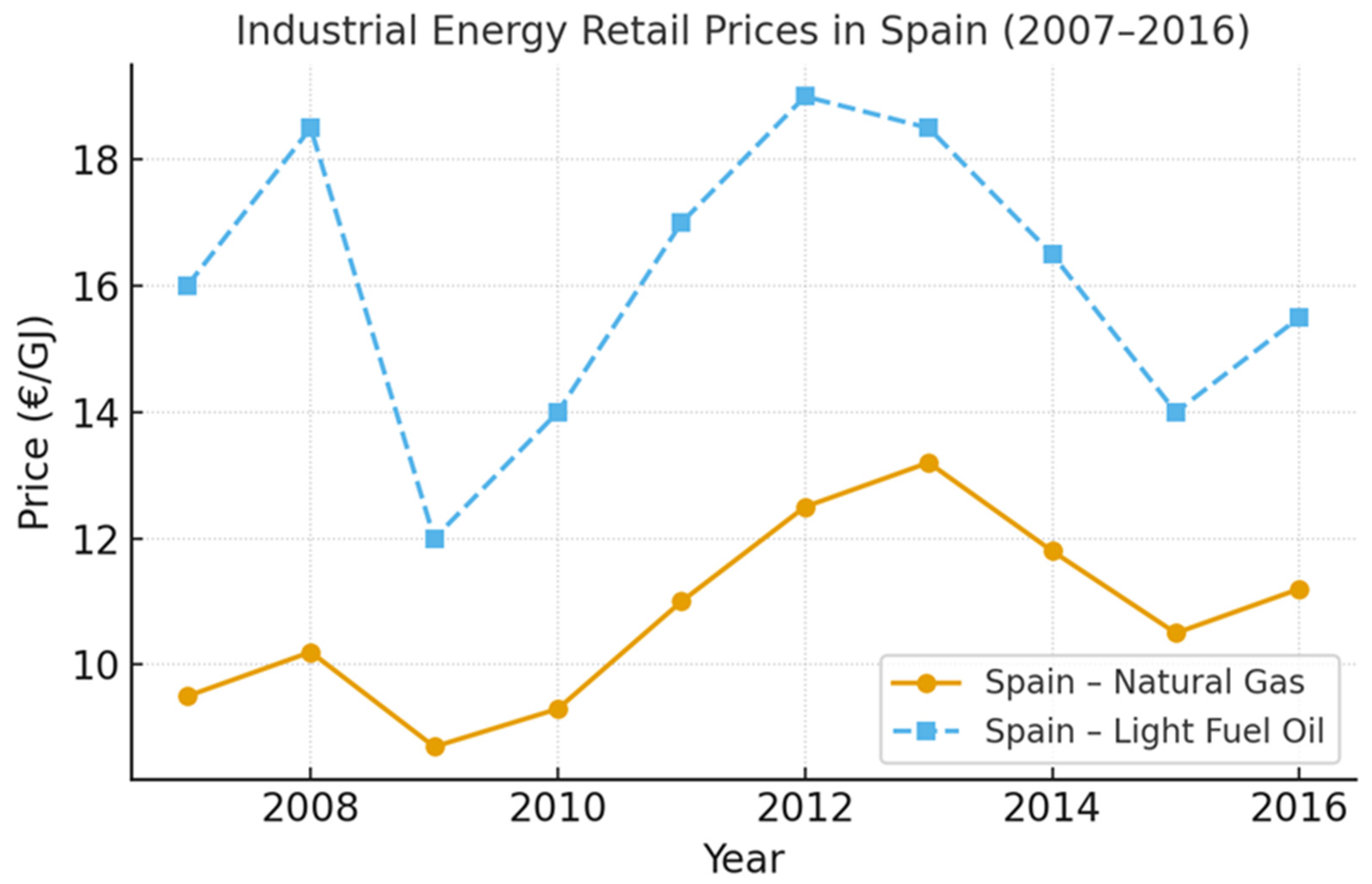
During the crisis period—characterized by sharp increases in energy and material prices—the economic salience of existing environmental regulations may have intensified, particularly those related to resource and energy use. This interpretation is consistent with the evolution of energy prices reported in
Figure A1 and with evidence suggesting that the number and visibility of green regulations in Spain expanded after 2008 [
22], potentially increasing firms’ regulatory awareness. From an institutional perspective, these findings suggest that the perceived relevance of regulatory frameworks may become more pronounced under economic stress, even in the absence of changes in formal stringency or enforcement. From an evolutionary perspective, adverse macroeconomic conditions may accelerate the adoption of adaptive, efficiency-seeking routines, helping to explain not only the resilience but the observed growth of efficiency EI during the crisis.
Regulation thus emerges as a structural driver of EI, shaping firm behaviour consistently over time rather than losing relevance during downturns. This result aligns with prior empirical studies identifying regulation as a central determinant of EI across European contexts (see Literature Review), including Kesidou and Demirel (2011) [
28] and Horbach et al. (2016) [
34].
The differentiated effects of financial support instruments further refine this picture. While generic national subsidies show limited effectiveness, more targeted and mission-oriented instruments—such as EU funding and public–private R&D contracts—play a countercyclical role by sustaining environmental EI during periods of financial constraint. This extends earlier European evidence on the limited impact of non-targeted subsidies [
5,
7] by highlighting the timing and conditional nature of policy effectiveness. A complementary mechanism may involve legitimacy effects: participation in publicly supported programs can signal credibility to lenders, thereby easing access to external finance during periods of heightened uncertainty, as observed in other contexts [
32].
Overall, the Spanish case illustrates a policy-mix innovation model in which regulation acts as a long-term structural anchor for EI, while financial and contractual public interventions operate more cyclically, becoming particularly salient during periods of economic stress. This configuration is especially relevant for moderate-innovator economies such as Spain, where internal financing is limited and market-based funding for innovation remains constrained.
5.2. Knowledge Base and Firms’ External Sources of Information
Results
Persistence and cumulative learning. Both environmental and efficiency EI are significantly more likely among firms with prior experience in EI, and this effect remains robust across all phases of the business cycle. Persistence increases the likelihood of efficiency EI by 24–28% and raises the probability of environmental EI by 11–17%, even during economic downturns. These findings confirm earlier evidence [
5,
10,
24,
43], while extending it by showing that experiential knowledge constitutes a structurally persistent driver of EI rather than one contingent on favourable macroeconomic conditions. Accordingly, the Persistence Hypothesis (H4) is supported.
Moreover, persistent engagement in efficiency EI increases the probability of environmental EI by approximately 3–6%, indicating complementarities between resource-saving strategies and environmentally oriented innovations. By contrast, persistent environmental EI does not systematically translate into efficiency EI and is even negatively associated with efficiency EI during boom and crisis periods.
Firms that engage continuously in both product and process innovation—whether green or non-green—exhibit a higher propensity to undertake environmental EI over time. In contrast, firms focusing exclusively on product innovation are 9–10% less likely to do so. These results support the Continuous Innovation Hypothesis (H5) and underscore the importance of integrated innovation strategies for sustained environmental upgrading.
Internal R&D. Internal R&D personnel and the ability to finance R&D internally exert a positive influence on efficiency EI during the crisis period, while no significant effects are observed during expansion phases or for environmental EI.
External knowledge and cooperation. The diversity of cooperation partners significantly increases the likelihood of environmental EI during the crisis, although this effect is absent in other phases and does not apply to efficiency EI. Similarly, firms with above-average investment in tangible assets are more likely to engage in environmental EI during the crisis and recovery, reflecting both improved access to external finance and a greater capacity to absorb and integrate green technologies. Taken together, these results support the Knowledge Integration Hypothesis (H6), indicating that diversified external knowledge and investment capacity become particularly relevant when institutional and financial conditions tighten.
Knowledge spillovers. Spillovers from professional associations exert a stable and positive influence on both types of EI throughout the period, increasing the probability of EI by 5–6%. This finding corroborates prior evidence from the food and beverage sector [
10,
55] and from non-European contexts [
56]. Supplier spillovers also consistently foster EI—especially efficiency EI—with investments in machinery increasing the likelihood of efficiency EI by 3–4%.
Discussion
Knowledge-related drivers exhibit a clear dual structure, distinguishing mechanisms that are cumulative and path-dependent from those whose relevance emerges primarily under adverse macroeconomic conditions. This distinction provides a coherent explanation for the mixed and context-dependent effects of knowledge-related variables reported in earlier studies on EI.
The asymmetric relationship between efficiency and environmental EI is consistent with Costa-Campi et al. (2017) [
27] and reflects Spain’s high dependence on imported energy and raw materials. Strong incentives for material- and energy-saving innovations generate efficiency gains that simultaneously yield environmental benefits, whereas environmentally motivated initiatives do not necessarily translate into efficiency improvements. Crucially, these patterns persist across the business cycle, underscoring the cumulative and path-dependent nature of efficiency-oriented learning processes.
Joint product–process innovation appears to capture operational learning and incremental capability accumulation rather than highly R&D-intensive activity. Internal R&D personnel and funding, by contrast, display explanatory power mainly during crisis periods. This pattern reinforces the view that capability building in Spanish manufacturing is gradual and path-dependent, while formal R&D investments become particularly salient under conditions of heightened economic stress.
For environmental EI, in particular, experiential knowledge alone proves insufficient once the crisis unfolds. Instead, access to diversified external knowledge becomes critical. Similar results are reported by Jové-Llopis and Segarra-Blasco (2018) [
5] for the crisis period. Our findings indicate that exploratory knowledge recombination becomes increasingly important for environmental EI under adverse macroeconomic conditions, compared with expansionary phases.
The positive role of supplier spillovers and machinery investment for efficiency EI echoes the mechanisms highlighted in Costa-Campi et al. (2017) [
27]. In our sample, spillovers from suppliers and professional associations reflect mimetic and isomorphic processes facilitated by supply-chain and professional networks, reinforcing incremental adoption of efficiency-enhancing technologies.
Prior evidence for Spain suggests that internal R&D capacity supports EI, especially during downturns. For example, Jové-Llopis and Segarra-Blasco (2018) [
5] report a positive association between R&D activity and EI during the crisis and early recovery. Our longitudinal analysis qualifies this finding by showing that the relevance of internal R&D is not structurally persistent across the business cycle but instead concentrated in adverse macroeconomic contexts. R&D capacity thus operates as a contingent, crisis-activated mechanism rather than as a universally operative driver of EI.
Synthesis. Overall, the results reveal a clear distinction between knowledge mechanisms that are structurally persistent—such as prior EI experience, joint product–process innovation, and spillovers from suppliers and professional associations—and mechanisms that are primarily activated during crises, including internal R&D capacity and the diversity of external cooperation. Learning-by-doing and the assimilation of external knowledge provide stable pathways to absorptive capacity, whereas formal R&D and broad collaboration networks become critical under adverse macroeconomic conditions.
The literature on crisis response and collaborative innovation suggests that social capital and network embeddedness become particularly salient under heightened uncertainty, as firms pool knowledge and resources to sustain operations and co-create adaptive solutions [
57,
58,
59]. These mechanisms point to an “insurance function” of networks, whereby firms with broader and more diverse collaborative ties are better positioned to mitigate risk and identify innovation opportunities during downturns. More generally, collaborative networks may lower informational and coordination barriers, facilitating new technology adoption under crisis conditions [
45].
This temporal differentiation helps reconcile mixed findings in the literature and illustrates how Spanish manufacturing firms sustain EI despite systemic constraints. By extending the analysis to periods of expansion and recovery, our results indicate that earlier findings for Spain reflect phase-specific dynamics rather than generalizable relationships.
5.3. Firm Size, Ownership, and Market Orientation
Results
Firm size emerges as a key determinant of EI, though its effect differs markedly across firm categories and phases of the business cycle. Larger firms consistently exhibit a higher likelihood of engaging in environmental EI during boom, crisis, and recovery periods. Foreign ownership further amplifies this effect: multinational firms are 3–7% more likely to engage in environmental EI during the boom and 3–5% more likely during the crisis, likely reflecting superior access to international financing during the 2008 downturn. Given that most foreign subsidiaries in the sample are medium–large or large firms, these results provide strong support for the Baseline Size Effect Hypothesis (H7).
Smaller firms, by contrast, display a distinctly cyclical pattern. Their likelihood of engaging in EI rises during periods of economic expansion, when liquidity constraints ease and demand prospects improve but declines during downturns. The coefficient for micro-enterprises (≤10 employees) is not statistically significant across the business cycle, indicating behaviour broadly comparable to that of small firms (11–49 employees), which serve as the reference category. During boom and recovery phases, small firms exhibit EI levels similar to those of medium-sized firms, whose coefficients are generally non-significant or only marginally significant.
This pattern reverses during the crisis. In contractionary periods, small firms struggle to sustain EI activity, while medium and medium–large firms are approximately 3% and 4–5% more likely, respectively, to engage in EI than small firms. These findings indicate that the influence of firm size on EI is contingent rather than structurally uniform, providing support for the Cyclical Sensitivity of Smaller Firms Hypothesis (H8): small firms’ propensity to eco-innovate increases during expansions but diminishes during challenging times.
Market-oriented factors, by contrast, display remarkable stability. Pursuing market expansion or entry into new markets (h_objectMarket) increases the probability of efficiency EI by 5–7% and environmental EI by 2–3% across all phases of the business cycle, supporting the Market Expansion Hypothesis (H9). Similarly, prioritizing product quality (h_object_qualit) exerts an even stronger influence, raising the likelihood of efficiency EI by 6–11% and environmental EI by 3–5% in all periods. These results provide clear support for the Quality Hypothesis (H10).
Table 4 synthesizes these findings by classifying determinants as either stable—significant across boom, crisis, and recovery—or cyclical, significant primarily during challenging periods. It further distinguishes whether each driver predominantly affects efficiency EI, environmental EI, or both.
As a robustness check, the baseline estimations are replicated for a homogeneous subsample of food and beverage manufacturing firms, a sector characterized by high environmental exposure and regulatory intensity. The results confirm the core findings of the manufacturing-wide analysis: regulatory pressure remains a stable and positive driver of both EI types across the business cycle, while public R&D support exerts a countercyclical influence on environmental—though not efficiency-oriented—EI, particularly during the crisis. Additionally, the estimated effects of the persistence variables remain stable in the subsample analysis, closely replicating the results obtained for the full sample. The corresponding estimates are reported in
Table A2 and are consistent with García-Sánchez and Rama (2025) [
10], here used for robustness rather than sector-specific inference.
Discussion
The size-related patterns identified above are consistent with the literature emphasizing economies of scale in R&D, innovation capacity, and organizational resilience (see Literature Review). Larger firms benefit from superior access to financial resources, technological capabilities, and managerial expertise, which facilitate the integration of environmental objectives into innovation strategies. The pronounced decline in EI among small firms during downturns highlights their vulnerability to financial and operational shocks. Sustained EI under adverse conditions requires capabilities—such as formal R&D structures, internal and external financing, and the ability to absorb and recombine technological knowledge—that smaller firms often lack.
Importantly, these results nuance conventional portrayals of small firms as structurally constrained in EI. Rather than being persistently disadvantaged, small firms appear to engage in EI opportunistically, responding positively when expansionary conditions relax constraints, reduce uncertainty, and improve market prospects. From this perspective, the mixed evidence reported in cross-sectional studies reflects temporal variation rather than contradiction. In the context of the Spanish NIS, EI thus emerges as structurally uneven and strongly conditioned by firm size and foreign ownership, particularly during crises.
Market-oriented drivers present a contrasting picture. Consistent with prior studies [
1,
24,
28], market expansion and quality objectives positively influence EI. The longitudinal evidence provided here further shows that these strategic motivations remain relevant under both favourable and adverse macroeconomic conditions. This suggests that Spanish manufacturing firms adopt a proactive, opportunity-driven approach to EI, using market positioning and quality upgrading to sustain competitiveness.
A plausible interpretation is that, given the limitations of the Spanish innovation system and firms’ scientific knowledge bases, market expansion strategies and quality management partially substitute for more R&D-intensive innovation pathways. The widespread diffusion of quality certifications (e.g., ISO 9001 and ISO 14001) and branding strategies [
13] may compensate for relatively limited internal R&D capabilities, enabling firms to sustain EI despite structural constraints.
In sum, with respect to size, ownership, and market orientation, the apparent “mixed results” in the literature are best understood as temporal rather than contradictory. Firm-level determinants of EI operate differently across the business cycle, reinforcing the importance of a longitudinal perspective for interpreting EI dynamics.
5.4. Towards a Tentative Framework of Eco-Innovation Drivers
All of our hypotheses are supported (
Table 5), providing a coherent pattern of empirical relationships that can inform a preliminary conceptual understanding of EI drivers in Spanish manufacturing. The preceding analysis shows that many apparently well-established drivers of EI are neither universally effective nor uniformly contingent but operate under clearly identifiable macroeconomic boundary conditions.
Based on the evidence, we propose a tentative framework in which EI emerges from the interaction of external guidance, accumulated capabilities, and adaptive resources. Regulation appears as the primary trigger, functioning as an external cognitive scaffold that consistently directs firms toward environmental objectives across macroeconomic conditions. Once activated, EI tends to follow a cumulative trajectory, sustained by prior innovation experience, learning-by-doing, supplier knowledge flows, and mimetic spillovers from professional associations. These mechanisms illustrate how experiential learning and embedded routines foster persistence in innovation activity over time. Similarly, strategic orientations toward product quality and market expansion consistently support EI, embedding environmental innovation within broader competitive and operational goals.
Importantly, our findings also highlight context-dependent contingencies. During periods of economic downturn, firms require additional internal capacities—such as funding for R&D, skilled human capital, and engagement in diverse collaborative networks—to maintain EI under tighter financial and market constraints.
From a theoretical perspective, the framework aligns with evolutionary arguments emphasizing path dependence, cumulative learning, and capability development, as well as institutional theory, in which regulatory pressures, public funding mechanisms, and mimetic influences exert complementary effects. These results suggest that the drivers of EI are both structural and dynamic, with stable mechanisms (e.g., regulation, persistence, cumulative experience) operating alongside cyclical factors that become salient during crises (e.g., internal R&D capacity, collaborative networks, financial resources).
We emphasize that this framework is tentative and context-specific, derived from Spanish manufacturing and moderate-innovator environments. It should be interpreted as a provisional conceptual synthesis that highlights mechanisms and interactions observed over the business cycle, rather than as a definitive or universally generalizable theory. Nonetheless, it offers a useful lens for understanding how firms integrate regulatory, organizational, and market factors to sustain EI over time, and it provides a foundation for future empirical and comparative research.
6. Conclusions
While research on eco-innovation (EI) has expanded considerably, most studies rely on cross-sectional designs, leaving the temporal dynamics of EI and its determinants under varying macroeconomic conditions largely unexplored. By analysing panel data on Spanish manufacturing firms across three phases of the business cycle—economic expansion (2004–2007), the global financial crisis (2008–2013), and recovery (2014–2016)—this study addresses this gap. It advances the debate by examining how environmental regulation, institutional interventions, and firm-level capabilities shape two distinct forms of EI: efficiency EI (energy and material savings) and environmental EI (reduction of environmental harm).
Our findings show that regulation is the most stable and pervasive driver of both types of EI across all phases of the business cycle. Contrary to expectations of regulatory resistance during downturns, regulation operates as an external cognitive guide, providing orientation and incentives when firms’ endogenous innovation capabilities are constrained—a pattern characteristic of moderate innovator economies. Other policy instruments, such as subsidies and public–private collaboration, exhibit more cyclical effects, becoming particularly relevant for sustaining environmental EI during periods of economic stress.
The longitudinal analysis further highlights the cumulative and path-dependent nature of EI. Persistence in eco-innovation and continuous joint product–process innovation constitute foundational capabilities that support EI across all macroeconomic conditions. These internal routines interact with external knowledge sources—such as supplier spillovers and professional associations—to reinforce learning-by-doing and imitation mechanisms over time. However, the crisis period reveals important boundary conditions: while experiential knowledge proves sufficient during expansionary phases, downturns activate additional requirements. Firms with stronger human capital and financial capacity are better positioned to pursue efficiency EI, whereas firms embedded in more diverse collaborative networks are more likely to sustain environmental EI under adverse conditions.
Finally, market-oriented strategies focused on product quality and market expansion emerge as stable anchors of environmental innovation across the cycle. Firm size continues to condition EI engagement: large firms benefit from scale, resources, and reputational incentives, while smaller firms’ eco-innovation is more sensitive to macroeconomic fluctuations. These findings suggest that effective policy mixes should combine stable regulatory guidance with countercyclical support instruments, particularly to enable smaller firms to maintain eco-innovation during economic downturns. Moreover, drivers of eco-innovation differ systematically between efficiency- and environment-oriented strategies, and these differences remain stable over the business cycle, implying distinct underlying mechanisms and policy implications. Policy design—particularly during economic downturns—should distinguish between reinforcing incentives for internal efficiency improvements and maintaining targeted regulatory and financial support for environmental EI.
In synthesis, eco-innovation is shaped by the interaction of institutional pressure, accumulated firm capabilities, and resource-based resilience, with the relative importance of these factors varying across the business cycle. Stable drivers—such as regulatory frameworks, prior innovation experience, market expansion strategies, product quality orientation, and knowledge spillovers—underscore the importance of long-term and predictable policy environments to sustain green innovation, particularly in moderately innovative economies characterized by structural constraints in private R&D and technological capabilities. By contrast, the factors that become critical during economic downturns—including internal R&D funding, the availability of skilled R&D personnel, and firms’ participation in diverse collaborative networks—point to the need for countercyclical policy instruments. In this respect, targeted R&D contracts for small and medium-sized enterprises, combined with supply-chain-based green collaboration platforms that facilitate knowledge exchange and joint experimentation, may be particularly effective in supporting eco-innovation during crisis periods. By explicitly distinguishing between structurally persistent and crisis-activated drivers, this study helps reconcile previously mixed empirical findings in the eco-innovation literature, showing that apparent inconsistencies often reflect unobserved business-cycle dynamics rather than contradictory firm behaviour.
For managers, the results suggest that embedding environmental goals within broader competitiveness strategies enhances resilience and continuity in innovation. Continuous investment in R&D, skilled human capital, and collaborative networks strengthens long-term environmental performance.
Beyond its empirical findings, this study contributes to the eco-innovation literature by clarifying several ambiguities identified in prior research. First, it shows that the widely reported “mixed effects” of eco-innovation drivers are largely the result of temporal aggregation: drivers that appear unstable in cross-sectional studies exhibit clear and systematic differences across phases of the business cycle. Second, the analysis reframes environmental regulation not as a pro-cyclical or crisis-sensitive constraint, but as a stable cognitive and institutional anchor that guides firms’ innovation behaviour even under adverse macroeconomic conditions. Third, by distinguishing between efficiency-oriented and environmental eco-innovation, the study reveals how firm-level heterogeneity—in size, capabilities, and knowledge access—shapes differentiated innovation responses over time. In doing so, the paper advances a dynamic, phase-contingent understanding of eco-innovation that moves beyond static models and contributes to a more nuanced theory of green innovation in moderate innovator economies.
This study is not without limitations. Information on environmental technologies relies on firms’ self-reported assessments of the importance of green innovation within their innovation activities, rather than on direct measures of environmental performance or technology adoption. While restricting the sample to firms classified as innovators increases the likelihood of capturing actual eco-innovative efforts, complete accuracy cannot be guaranteed, and some degree of attitudinal and common method bias cannot be entirely ruled out. As with most studies relying on CIS-type panel data, the analysis is restricted to continuously active enterprises observed across multiple survey waves, which may generate survivor bias. Moreover, CIS-type datasets—including PITEC—do not provide detailed information on R&D specifically devoted to eco-innovation, necessitating reliance on broader R&D indicators, general innovation metrics, and non-targeted support schemes.
From a methodological perspective, although the longitudinal structure of the data, the distinction between business-cycle phases, and the use of lagged covariates help mitigate concerns related to simultaneity and reverse causality, the observational nature of the data does not allow for strong causal inference. Accordingly, the estimated relationships should be interpreted as economically meaningful and robust associations, improving upon much of the existing literature through the use of panel data and dynamic comparisons, while recognizing the inherent limits of causal identification in non-experimental settings.
Despite these limitations, this study offers rare longitudinal evidence on how the drivers of eco-innovation evolve under both favourable and adverse macroeconomic conditions.