Article

Effects of Bike Trails on Roe Deer and Wild Boar Habitat Use in Forested Landscapes

1
Department of Forest Protection and Wildlife Management, Mendel University in Brno, Zemědělská 3, 613 00 Brno, Czech Republic
2
Department of Biology and Ecology, University of Ostrava, 30. Dubna 22, 701 03 Ostrava, Czech Republic
3
Institute of Vertebrate Biology, Czech Academy of Sciences, Květná 8, 603 65 Brno, Czech Republic
*
Author to whom correspondence should be addressed.
Sustainability 2026, 18(2), 1030; https://doi.org/10.3390/su18021030
Submission received: 13 November 2025 / Revised: 12 January 2026 / Accepted: 16 January 2026 / Published: 19 January 2026

Abstract

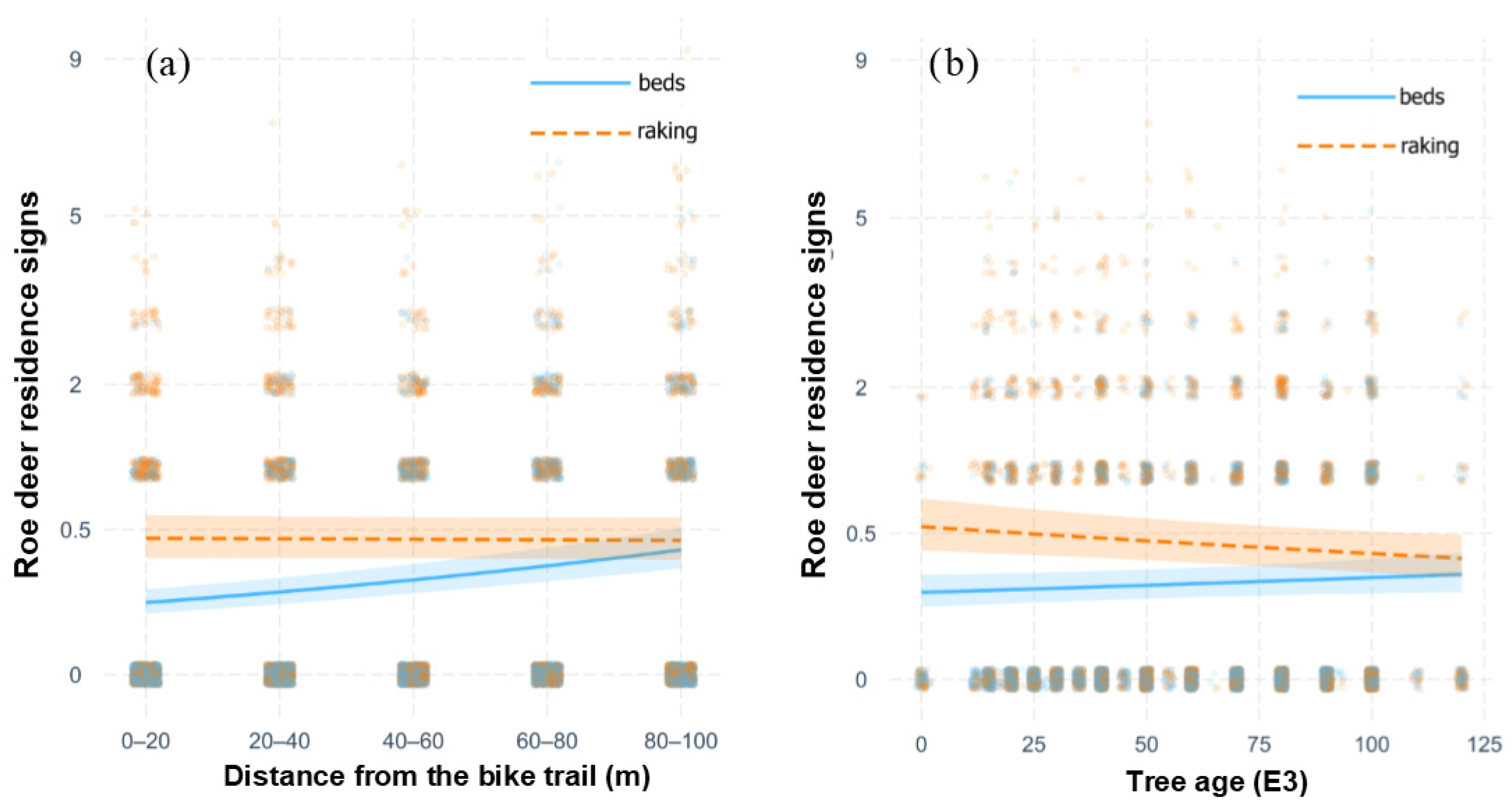
Outdoor recreational activities, particularly cycling and mountain biking, are rapidly expanding in forested landscapes, raising concerns about their effects on wildlife. Although bike trails are increasingly common, their ecological impacts on large mammals remain insufficiently studied. We investigated how bike trail use influences the abundance and spatial behaviour of roe deer (Capreolus capreolus) and wild boar (Sus scrofa) in three contrasting forest environments in the Czech Republic. We surveyed roe deer raking and bedding sites and wild boar rooting along 734 transects positioned perpendicular to bike trails, monitored cyclist activity using automated counters, and recorded habitat characteristics. Generalized linear mixed models were used to evaluate the effects of trail proximity, cycling intensity, and vegetation structure. Cycling intensity did not influence overall species abundance; however, roe deer consistently avoided resting close to trails, leading to a measurable loss of potential resting habitat. Roe deer raking decreased with higher cycling intensity at the most remote site, while wild boar rooting was driven primarily by vegetation structure. These findings demonstrate that even low-intensity recreation can alter wildlife behaviour. We recommend maintaining unmanaged buffer zones along trails to provide refuge and reduce disturbance. Our results offer guidance for sustainable trail planning in forest ecosystems. Our conclusions are based on sign surveys collected during one growing season and quantify spatial responses up to 100 m from trails; diel activity, detectability, and seasonal variation were not directly assessed.
Keywords: roe deer; wild boar; animal behaviour; hiking and cycling trails; mountain biking; recreation impacts roe deer; wild boar; animal behaviour; hiking and cycling trails; mountain biking; recreation impacts