ResQConnect: An AI-Powered Multi-Agentic Platform for Human-Centered and Resilient Disaster Response

 , , , ,
  and
and 
Abstract
1. Introduction
- RQ1—How can a multi-step, agentic RAG workflow be designed to improve retrieval quality and robustness?
- RQ2—What adaptive, event-triggered multi-commodity routing algorithm can allocate resources to evolving demands with minimal re-optimisation and route instability?
- RQ3—How can a SLM deployed on mobile devices provide reliable offline guidance under connectivity constraints?
- 1.
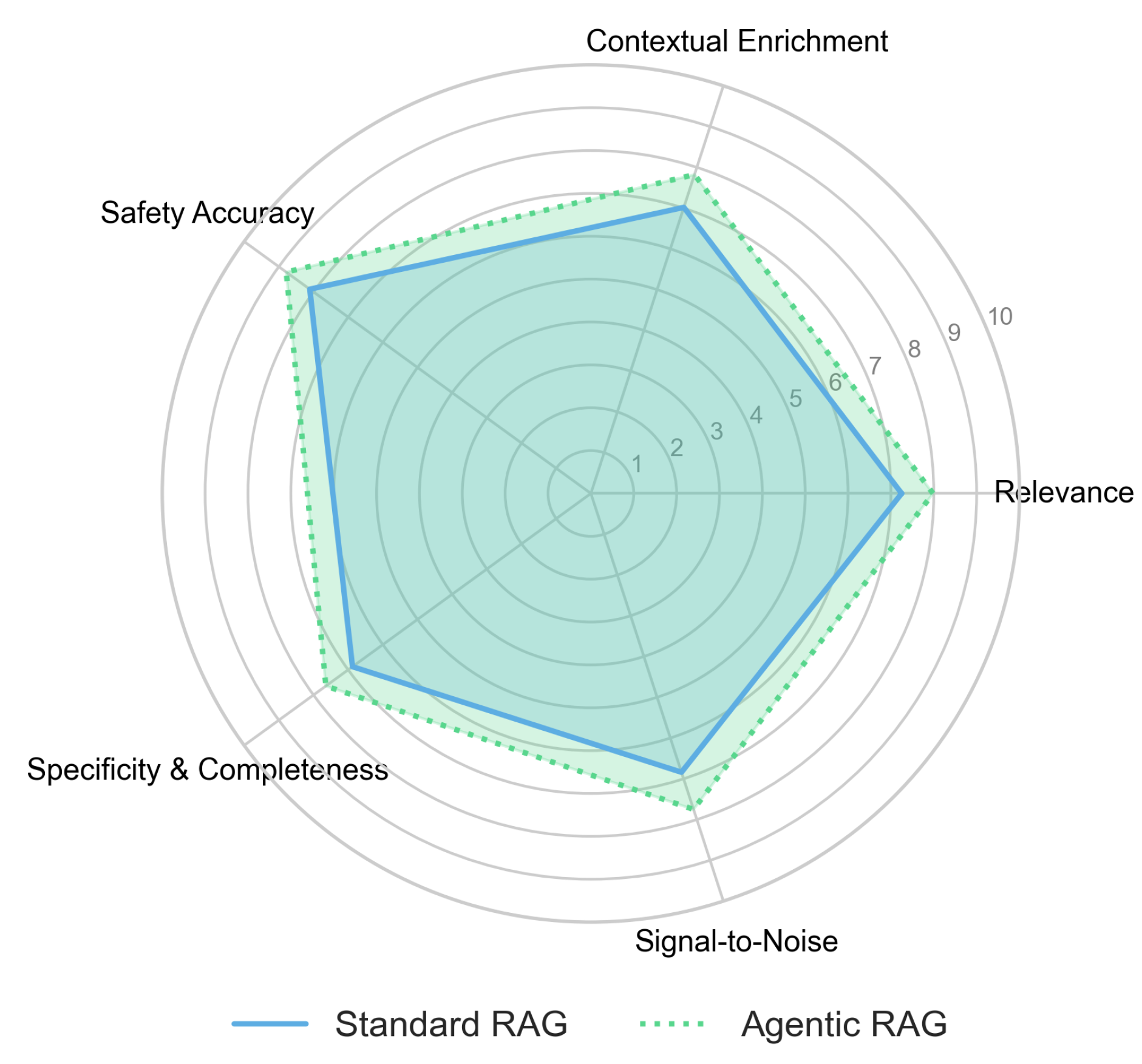
- We design and evaluate an LLM-driven, agentic RAG workflow that performs metadata extraction, adaptive query reformulation, contextual adequacy assessment and task generation over a curated disaster-response knowledge base, improving retrieval relevance and task quality over a Standard RAG baseline.
- 2.
- We develop an AET algorithm for dynamic multi-depot, multi-commodity disaster routing with atomic fulfilment and a route-stability penalty, and show that it achieves a favourable trade-off between priority-weighted response time, solver calls, and route instability compared to greedy and periodic baselines.
- 3.
- We develop and benchmark a compressed, domain-specialised edge LLM for offline disaster guidance, fine-tuning on a structured Q&A dataset and device-level evaluation of latency, memory usage and response quality, demonstrating its feasibility for low- and no-connectivity environments.
2. Background and Related Studies
2.1. Multi-Agent Systems and Agentic RAG in Crisis Domains
2.2. Resource Distribution in Crisis Domains
2.3. Edge and On-Device Deployment of LLMs
2.4. Comparative Analysis of Related Approaches
3. System Design and Methodology
3.1. System Overview
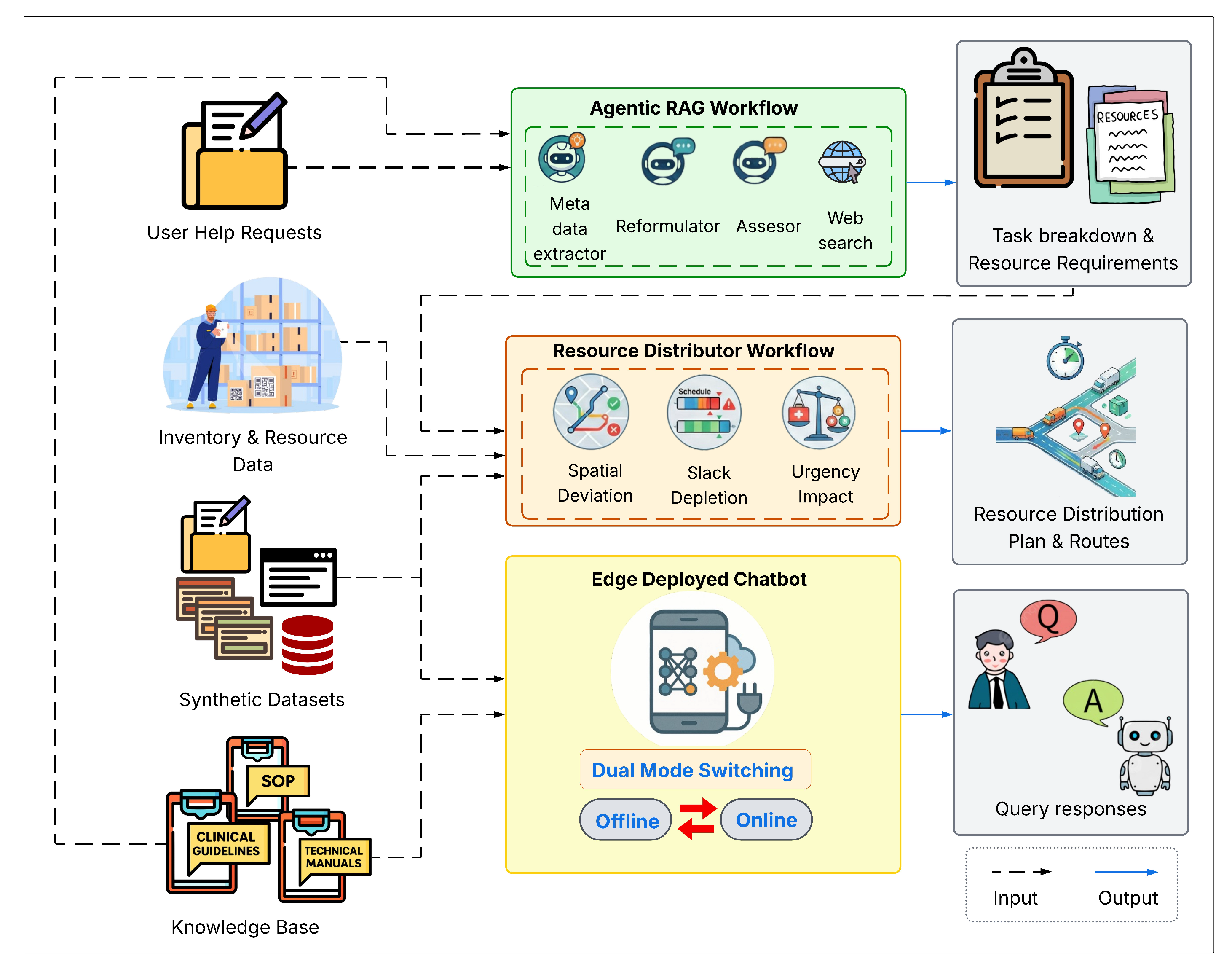
3.2. Agentic RAG Workflow for Task Breakdown
3.2.1. Agentic RAG Architecture
- 1.
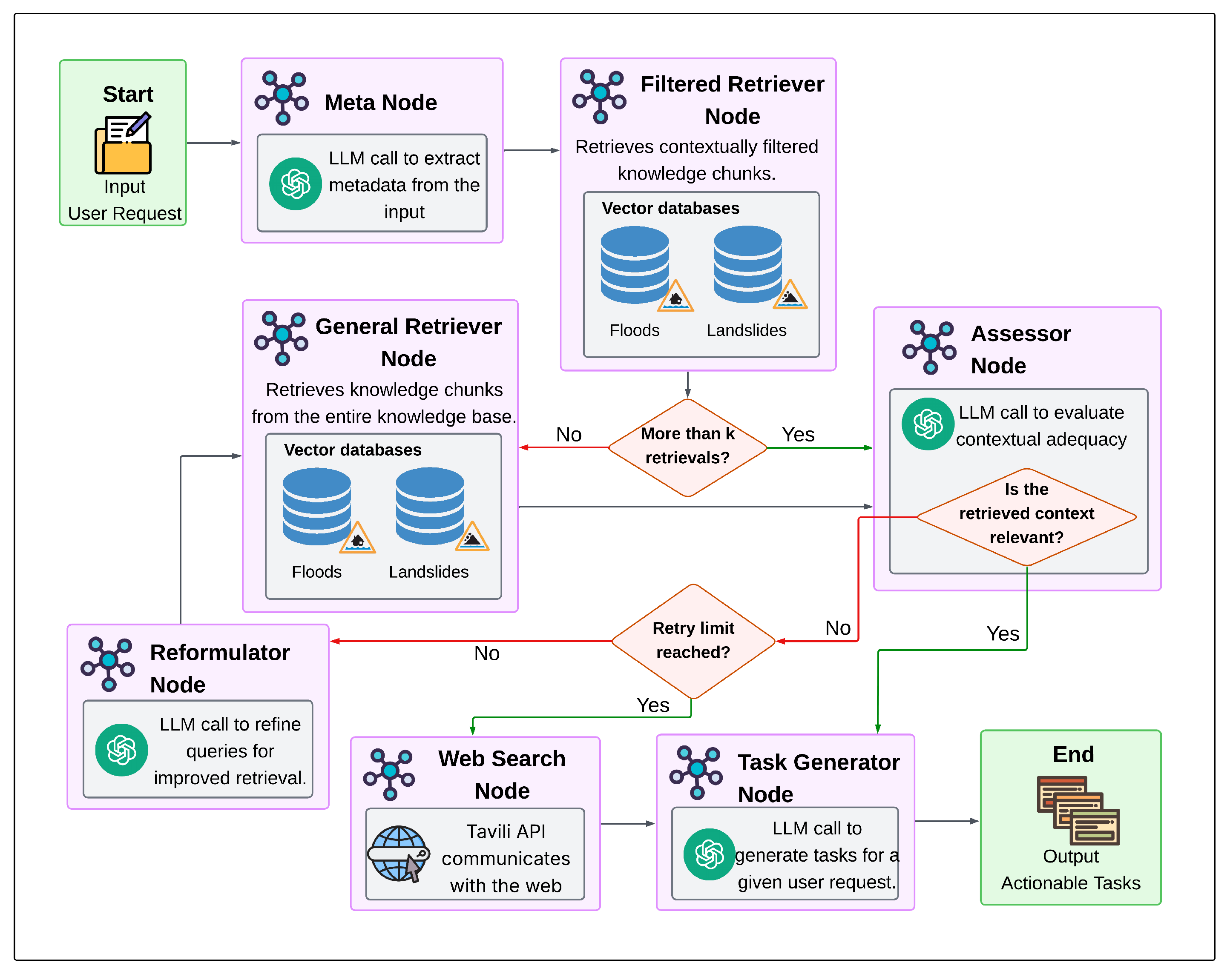
- Meta Node: Upon receiving a help request, the Meta Node employs a LLM to infer structured structured, hazard-aware metadata such as disaster type, location, urgency, and agency. The model selects from a predefined metadata dictionary to standardize downstream retrieval queries. A zero-shot, instruction-based prompt enforces consistent metadata extraction under a normalized schema, ensuring the output strictly conforms to the expected JSON format.
- 2.
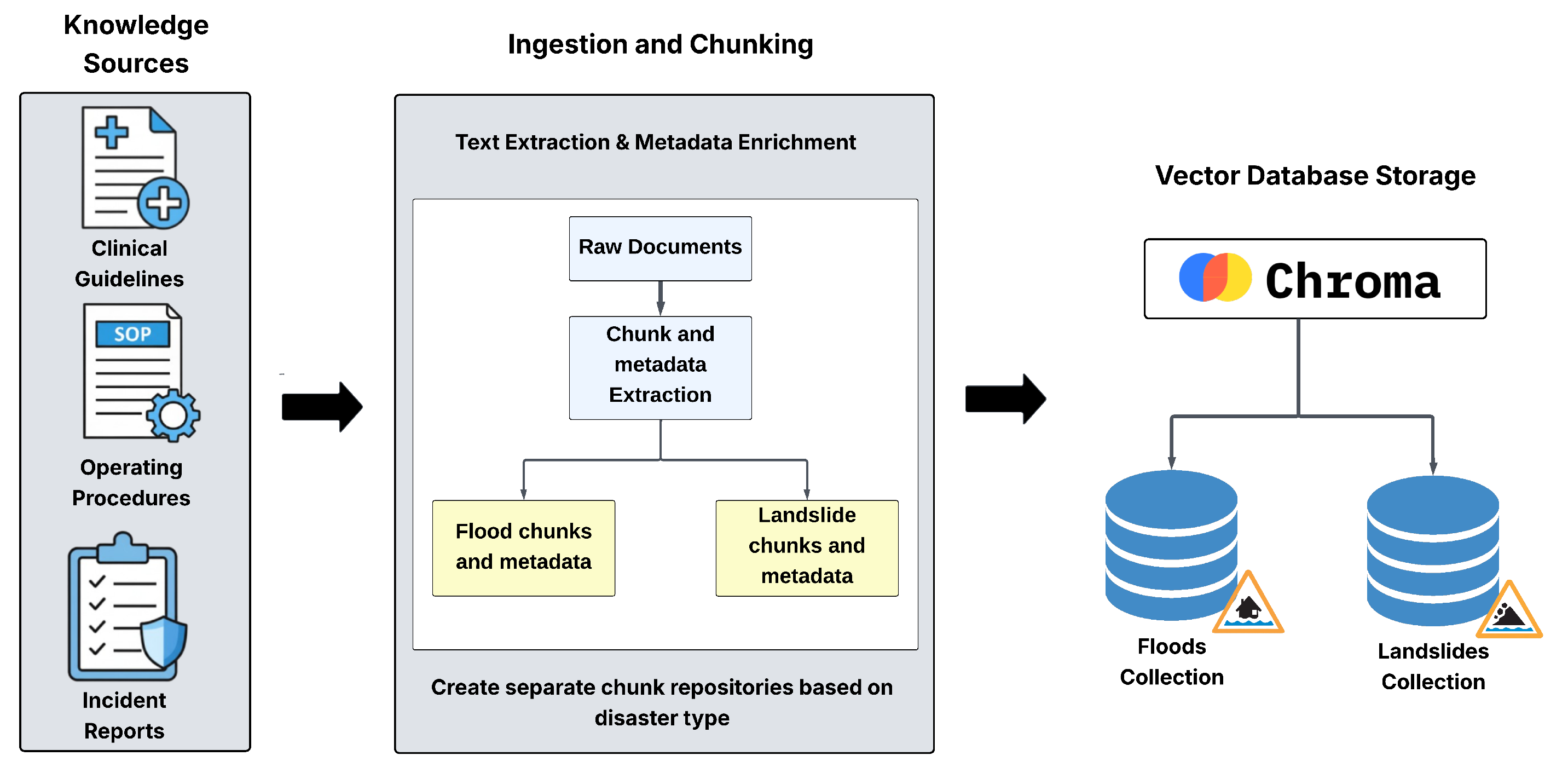
- Filtered Retriever Node: Using the metadata, this node retrieves semantically related knowledge chunks from the curated disaster-response knowledge base described in Section 4.1.1, for context that aligns with the detected disaster type and operational stage. When the filtered search results in fewer than k relevant matches, the workflow automatically falls back to the General Retriever Node.
- 3.
- General Retriever Node: Performs a broader, unconstrained search across all knowledge domains to ensure coverage when metadata is sparse or incomplete.
- 4.
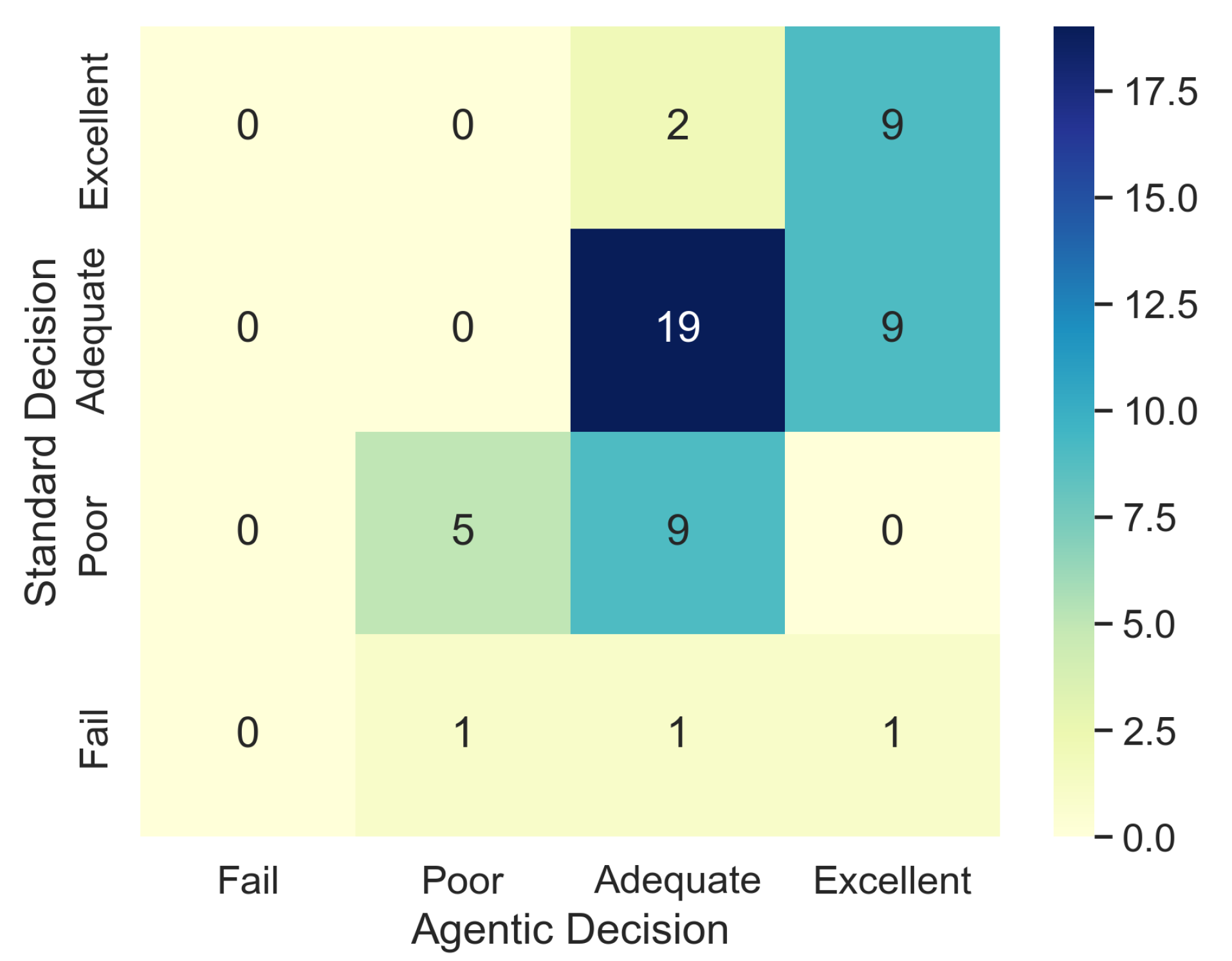
- Assessor Node: Performs a lightweight LLM-based evaluation of contextual adequacy. Using a concise rubric-style prompt, it checks whether the chunks retrieved from the internal knowledge base are both topically relevant and operationally specific enough to support task generation (i.e., they contain concrete “what-to-do” and “how-to-do” instructions). If the context is judged adequate, it is forwarded directly to the Task Generator Node. If the context is vague, off-topic, or missing key procedural details, the Assessor flags it as inadequate and routes control back to the Reformulator Node for another reformulation–retrieval.
- 5.
- Reformulator Node: This node applies an adaptive query-reformulation strategy designed to enhance similarity search performance within the vector database. It rewrites the original user request into a self-contained, guideline-oriented query that explicitly expresses the operational intent as shown below.
- Original request: “We are a group of five tourists. Our bus is stuck in the mud. There are big trees on the road. We have no food or water. My friend is hurt, he fell and his arm looks bad. We need a way to go back to the city.”
- Reformulated query: “How to get help for stranded travelers; how to provide first aid for arm injuries; how to find food and water in emergency situations; how to navigate out of muddy conditions.”
Adaptive reformulation is required because help requests in disaster contexts are often ambiguous, multi-faceted and linguistically noisy, making a single-shot retrieval query insufficient for extracting operationally relevant guidance. - 6.
- Web Search Node: If, after a maximum number of reformulation–retrieval cycles, the Assessor still deems the knowledge-base context inadequate or if the request is classified as out of scope for the curated corpus, the system escalates to the Websearch Node. This node uses the Tavily API to retrieve passages from authoritative disaster-management and humanitarian sources. The returned snippets are normalized into the same chunk format used for the internal corpus and replace the previous knowledge-base context, forming a new evidence set that is passed to the Task Generator Node, with metadata tags indicating that they originate from the web.
- 7.
- Task Generator Node: Once an adequate context is available (either from the knowledge-base or, if that fails, from the Websearch) this node synthesizes a structured Task Breakdown. Guided by a prompt, it translates the provided context into ordered, field-executable subtasks for relevant agencies (e.g., medical triage, evacuation routing, debris clearance).
3.2.2. Objective Formulation
3.2.3. Prompt Engineering Strategy
Conditioned Generation and Contextual Grounding
Constraint Anchoring and Output Validity
Supporting Prompt Engineering Mechanisms
3.3. Adaptive Event-Triggered Multi-Commodity Routing
3.3.1. Problem Formulation
3.3.2. Algorithm Design
| Algorithm 1 Adaptive Event-Triggered MD-CVRP-MCD Algorithm | |
| 1: | Initialize t ← 0,tlast ← 0 |
| 2: | Compute initial plan by solving static MD-CVRP-MCD |
| 3: | while t ≤ T do |
| 4: | Observe next event time tev and event type ω |
| 5: | Update state from S(t−) to S() |
| 6: | if ω is NEW_REQ then |
| 7: | Compute (tev) using urgency, spatial, and slack features |
| 8: | Compute threshold Θ(tev) = Θ0 · e−α(tev−tlast) |
| 9: | end if |
| 10: | if (tev) ≥ Θ(tev) then |
| 11: | Partially solve static problem from S() |
| 12: | Accept re-optimized plan and update committed arcs |
| 13: | tlast ← tev |
| 14: | else |
| 15: | Maintain current plan (insert new node via cheapest insertion) |
| 16: | end if |
| 17: | Advance vehicles and time to next event |
| 18: | t ← tev |
| 19: | end while |
3.3.3. Integration with ResQConnect Workflow
3.4. Edge-Deployed LLM for Offline Inference
3.4.1. Model Selection and Fine-Tuning
3.4.2. On-Device Conversion and Deployment
3.4.3. Role Within ResQConnect
4. Experimental Setup and Evaluation
4.1. Datasets
4.1.1. Datasets for Agentic RAG
4.1.2. Dataset for Resource Distribution Algorithm
- Network Topology: The region is modeled as a directed graph where travel times are dynamic, simulating road degradation and congestion.
- Request Generation: Demand nodes appear stochastically following a Poisson process. Each request contains a multi-commodity demand vector (e.g., food, water), a priority (High, Medium, Low), and a strict time window.
- Experimental Scenarios: To evaluate policy robustness, the dataset is stratified into 13 distinct scenarios across four load conditions, as defined in the experimental configuration:
4.1.3. Dataset for Edge LLM
- 1.
- Reflect the voice of affected individuals, including uncertainty, stress, and incomplete information.
- 2.
- Cover realistic use cases that a citizen might query offline (e.g., “I am not sure if my water is safe to drink—what should I do?”).
- 3.
- Be grounded strictly in authorized operational guidance, ensuring factual accuracy and safety alignment.
4.2. Evaluation Framework and Metrics
4.2.1. Evaluation Setup for Agentic RAG
4.2.2. Evaluation Metrics for Agentic RAG
4.2.3. Evaluation Setup for Resource Distribution Algorithm
- Greedy Insertion: Performs no global re-optimization and inserts new requests using a nearest-fit heuristic. It has very low computational cost but typically poor service quality under higher load.
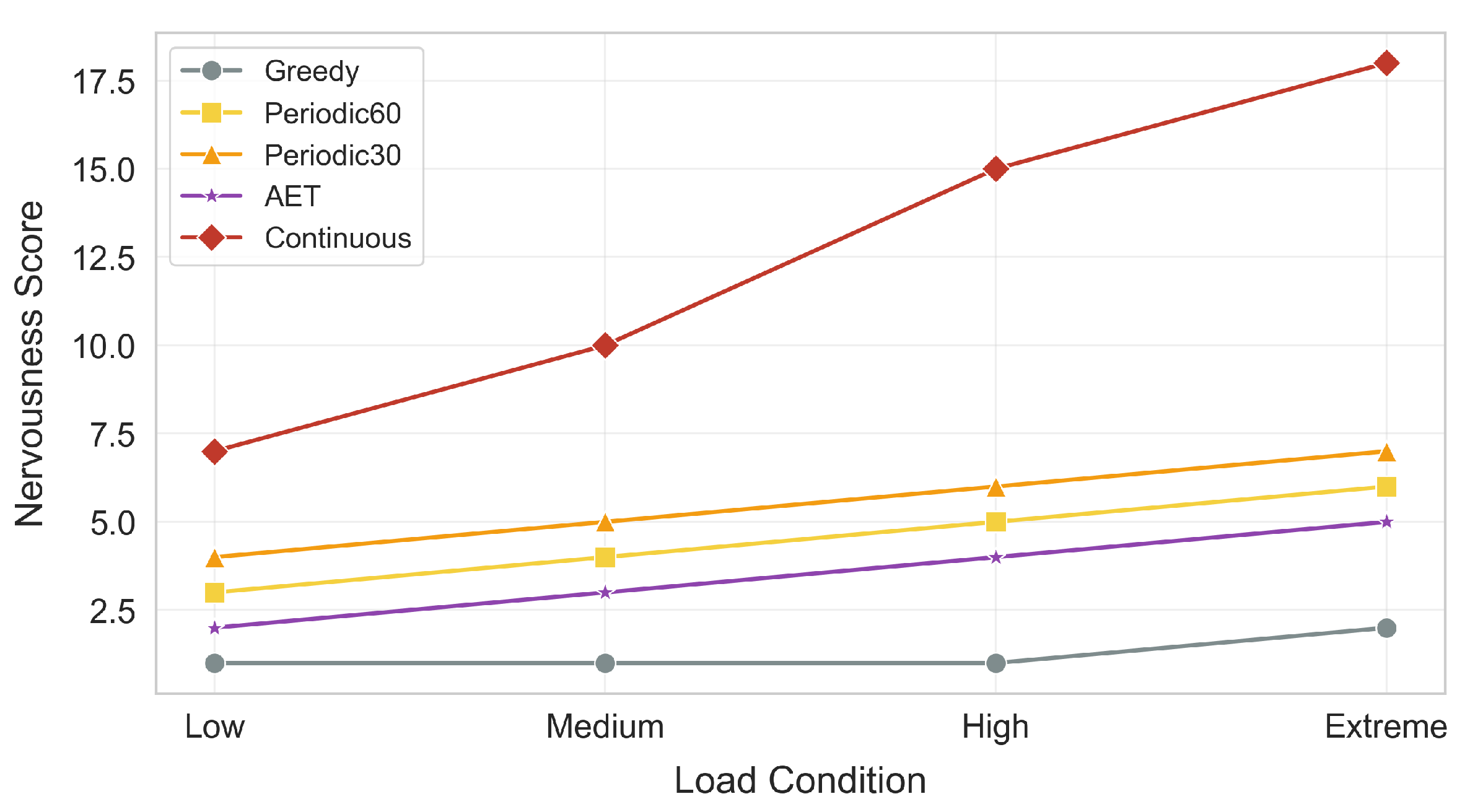
- Continuous Re-Optimization: Re-solves the full static model at every event. It approximates an upper bound on service quality but incurs the highest computational overhead and strong operational instability (“nervousness”).
- Periodic Re-Optimization (30, 60): Re-optimizes at fixed intervals of 30 and 60 time units. These policies offer predictable computational cost but lack situational awareness, potentially re-planning too often in calm periods or too slowly under bursts of urgent demand.
- AET: Uses the disruption-score logic and decaying threshold from Section 3.3.2 to trigger re-optimization only when expected gains justify the cost. Here, AET represents a principled middle ground between fully continuous and purely periodic strategies.
4.2.4. Evaluation Metrics for Resource Distribution Algorithm
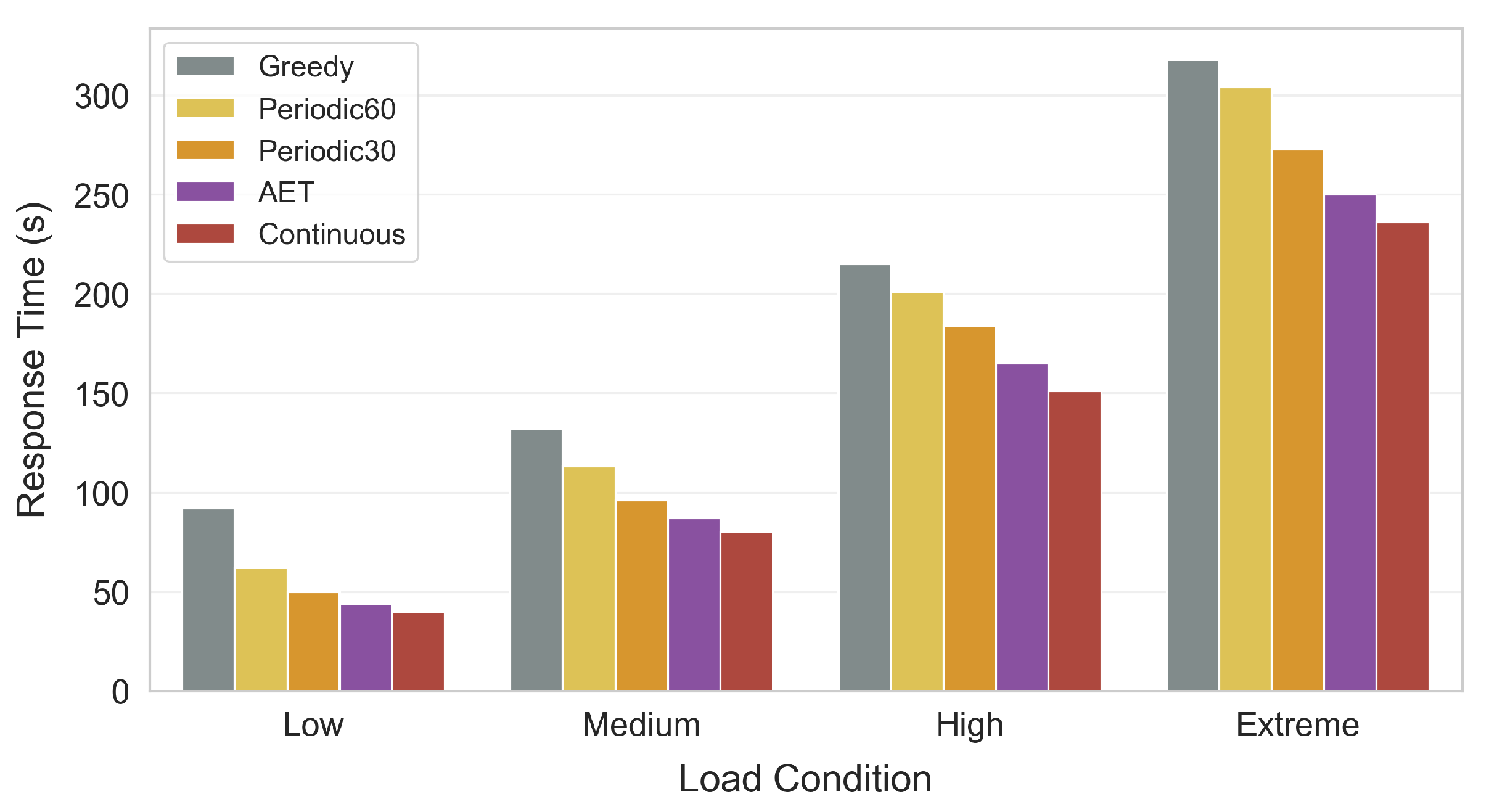
- Priority-Weighted Response Time (↓): Measures the delay in serving each request, weighted by its urgency class. This emphasizes performance for high-priority nodes typical in disaster settings.
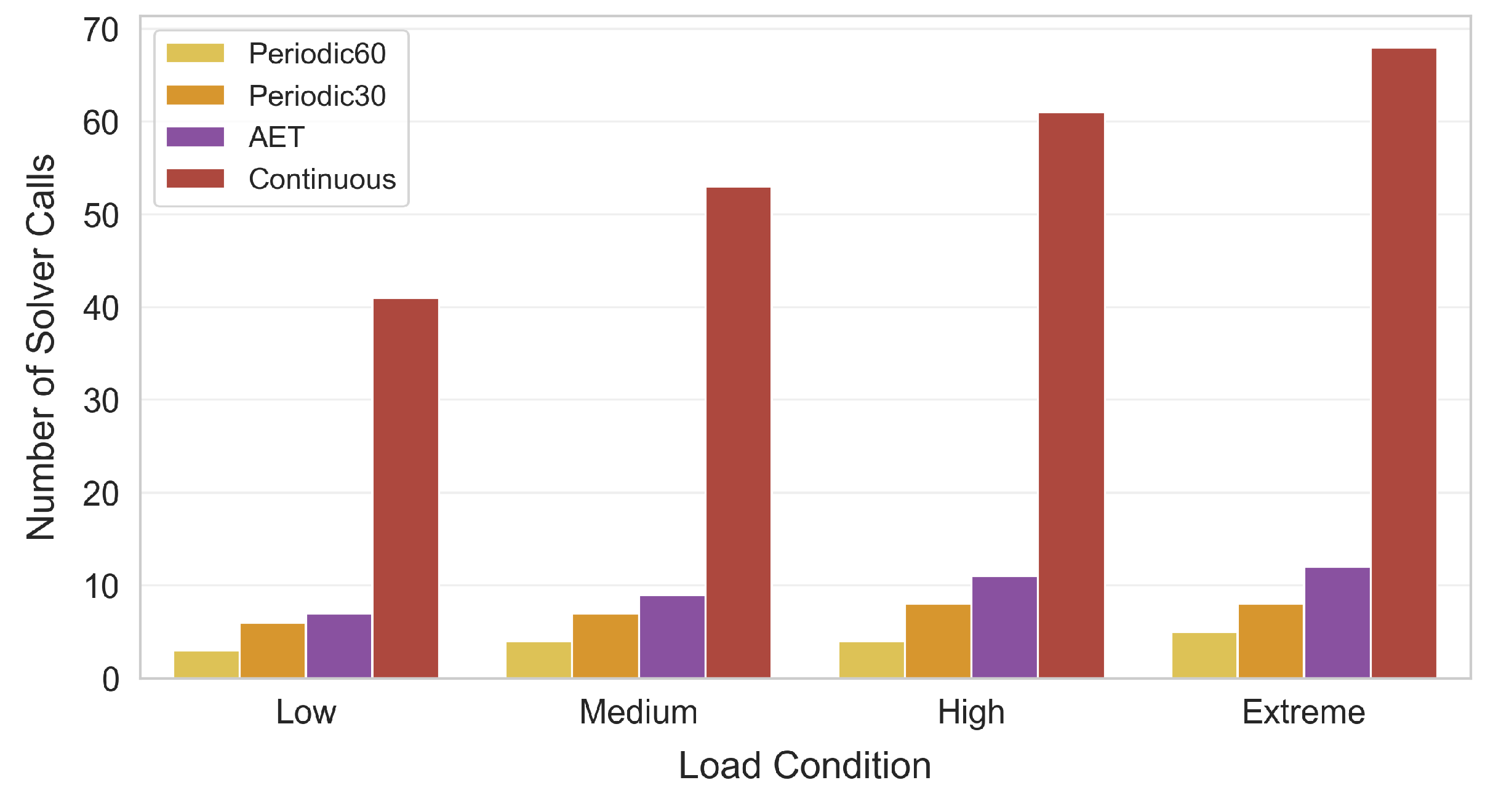
- Solver Calls (↓): Counts how many times the static optimization routine is invoked. This reflects computational burden and helps assess feasibility for real-time deployment.
- System Nervousness (↓): Measures how often a vehicle’s next destination is changed after dispatch. High nervousness indicates frequent mid-route changes, which can be operationally unacceptable even if the solution is mathematically strong.
- Trigger Precision (↑, AET only): For AET, measures the proportion of triggered re-optimizations that yield more than a 5% improvement in objective value. This indicates how selective and effective the triggering mechanism is in practice.
- Scenario diversity: Coverage of under-utilized, balanced, saturated, and overloaded regimes using the common setup in Section 4.1.2 and Section 4.2.3.
- Multi-dimensional metrics: Joint consideration of service quality, computational load, and behavioral stability.
- Reproducibility and fairness: All policies are tested on the same synthetic environment, with shared seeds and fixed parameters as specified in Section 4.1.2.
4.2.5. Evaluation Setup for Edge LLM
4.2.6. Evaluation Metrics for Edge LLM
5. Results Analysis
5.1. Results for Agentic RAG vs. Standard RAG
5.2. Ablation Study: Component-Wise Evaluation of the Agentic RAG Pipeline
5.2.1. Objective and Rationale
5.2.2. Ablation Study: Experimental Setup and Discussion
5.3. Results for Resource Distribution Algorithm
5.4. Results for Edge LLM Performance
6. Discussion
6.1. Discussion for Agentic RAG
6.2. Discussion for Resource Distribution Algorithm
6.3. Discussion for Edge LLM
6.4. System-Level Scalability Under High-Demand Disaster Scenarios
6.5. Human-Centered Design and Sustainability Implications
6.6. Study Limitations and Future Extensions
7. Conclusions
Author Contributions
Funding
Institutional Review Board Statement
Informed Consent Statement
Data Availability Statement
Acknowledgments
Conflicts of Interest
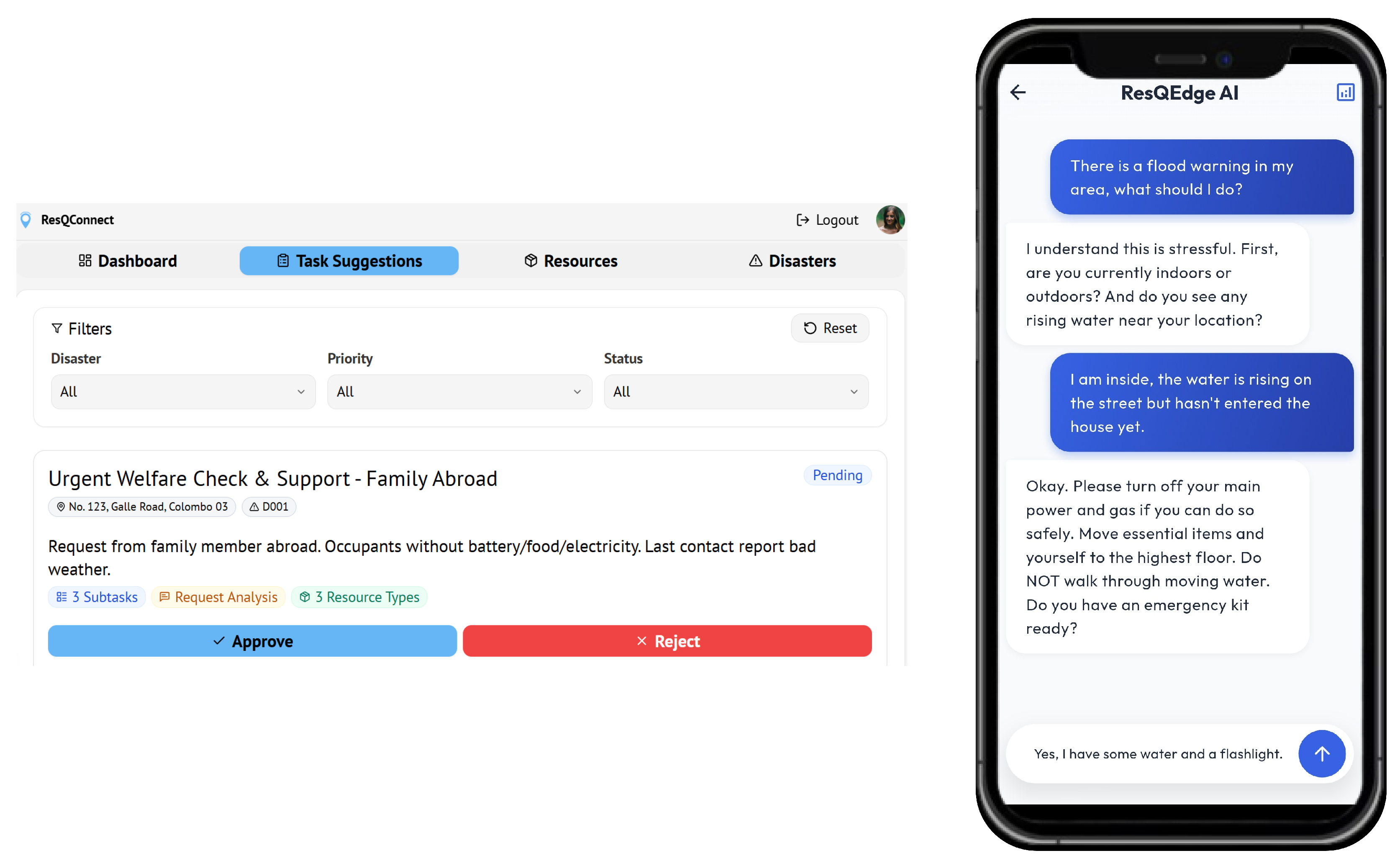
Appendix A. Web and Mobile UIs
Appendix B. Real-World Agentic RAG Outputs
Appendix B.1. Prolonged Loss of Contact
“I haven’t been able to contact my family for about 36 h, and if anyone can provide information, it would be really helpful.”
- Task 1 (High Priority):
- -
- Visit the reported household location to physically confirm the safety and presence of occupants.
- -
- Completion criterion: Safety visually confirmed or inability to confirm is reported.
- Manpower: 1 volunteer (assigned to Task 1)
- Resources: None
Appendix B.2. Food Shortage, Power Outage, and Communication Failure
“I’m abroad last 2 days (my family), their phone is off (confirmed no battery). On last call they mentioned they don’t have enough food and cannot go outside due to very bad weather with heavy wind flow. They don’t have electricity for last 3 days. Kindly please help and if possible arrange one phone call.”
- Task 1 (High Priority):
- -
- Conduct an on-site welfare check to confirm occupant safety and identify immediate food or water shortages.
- -
- Completion criterion: Welfare status confirmed in person.
- Task 2 (Medium Priority):
- -
- Deliver emergency dry food packs and drinking water sufficient for the confirmed household size.
- -
- Completion criterion: Supplies handed over directly.
- Task 3 (Low Priority):
- -
- Facilitate one outbound phone call or message to the reporting individual abroad.
- -
- Completion criterion: Communication succeeds or failure is documented.
- Manpower: 3 volunteers (1 per task)
- Resources:
- -
- Dry food packs: 6
- -
- Drinking water bottles (1 litre): 6
- -
- Battery unit: 1
Appendix B.3. Household with Orthopaedic Patient
“My father is an orthopaedic patient. There are five people in my house and the others are ladies. We need food and medicine.”
- Task 1 (High Priority):
- -
- Visit the household to confirm the presence of occupants and assess food availability and basic medical needs.
- -
- Completion criterion: Needs confirmed in person.
- Task 2 (Medium Priority):
- -
- Deliver emergency dry food packs and provide a basic medikit for short-term household medical needs.
- -
- Completion criterion: Supplies delivered and acknowledged.
- Manpower: 2 volunteers (1 per task)
- Resources:
- -
- Dry food packs: 9
- -
- Medikit: 1
Appendix B.4. Suspected Landslide Impact and Loss of Power
“Called on 27th morning and said no power. Still no contact and don’t know their current situation. Heard there were few landslides around that area. Please help to know information.”
- Task 1 (High Priority):
- -
- Perform physical verification at the household to confirm occupant safety and check for access obstruction.
- -
- Completion criterion: Safety confirmed or access failure reported.
- Task 2 (Low Priority):
- -
- Report verified household status to the coordination team for onward communication.
- -
- Completion criterion: Status documented and relayed.
- Manpower: 2 volunteers (1 per task)
- Resources: None
Appendix C. Judge LLMPrompt
- You are an expert evaluator assessing the performance of a RAG system used for disaster-response information retrieval. Your main goal is to determine how well the retrieved knowledge chunks can support the generation of precise, actionable, safe and field-ready tasks in response to the user request.
- -
- Evaluate only the quality and contextual relevance of the retrieved chunks.
- -
- Reward retrievals that closely match the user’s specific needs, urgency, and hazard context.
- -
- Strongly penalize retrievals that are generic, surface-level, or fail to reflect the actual intent of the request.
- -
- Retrievals that describe general flood safety, equipment lists, or background theory without actionable relation to the user’s problem should receive low relevance scores.
- -
- Retrievals that address only isolated parts of the user request without covering the overall emergency context should receive low scores for relevance and contextual enrichment.
- -
- Penalize unsafe, outdated, or unverifiable content.
- 1.
- Relevance and Hazard Alignment
- -
- How well do the retrieved chunks help in creating actionable tasks that must be carried out to answer the user’s request?
- 1–3:
- Off-topic, general disaster information, or fails to support actionable planning.
- 4–6:
- Some relevance but limited usefulness for actionable task creation.
- 7–10:
- Strongly supports the creation of concrete, field-ready tasks addressing multiple key aspects of the request.
- 2.
- Contextual Enrichment and Utility
- -
- Do the retrieved chunks provide clear, step-by-step guidance or information that can be directly translated into actionable tasks for responders?
- 1–3:
- Adds unrelated or abstract information.
- 4–6:
- Offers partial help or background but lacks field usability.
- 7–10:
- Provides concrete, procedural, or multi-dimensional context that supports response decisions.
- 3.
- Safety and Procedural Accuracy
- -
- Are the retrieved chunks factually correct, safe, aligned with recognized response practices or SOPs, and do they enable creation of actionable, field-ready tasks?
- 1–3:
- Unsafe, incorrect, misleading, or do not support actionable task creation.
- 4–6:
- Generally safe but vague, unverified, or only partially supportive.
- 7–10:
- Verified, operationally sound, and supportive of concrete, actionable tasks.
- 4.
- Specificity and Completeness
- -
- Do the chunks cover who, what, and how clearly enough to guide action?
- 1–3:
- Generic or incomplete.
- 4–6:
- Some specificity but not comprehensive.
- 7–10:
- Detailed, complete, and directly usable for field decisions.
- 5.
- Signal Quality and Deduplication
- -
- How focused, concise, and unique are the retrieved chunks?
- 1–3:
- Mostly filler or redundant.
- 4–6:
- Some redundancy.
- 7–10:
- Clean, relevant, and non-duplicative.
- Excellent: >=85
- Adequate: 60–84
- Poor: 40–59
- Fail: <=39 or any auto-fail triggered
- -
- Retrieved chunks do not help in creating actionable tasks.
- -
- Missing critical procedural steps.
- -
- Hazard misalignment.
- -
- Conflicting or unverifiable instructions.
- -
- Mostly generic or theoretical content.
- -
- Invalid or incomplete YAML.
- relevance_score: <1–10>
- contextual_enrichment_score: <1–10>
- safety_accuracy_score: <1–10>
- specificity_completeness_score: <1–10>
- signal_noise_score: <1–10>
- overall_score: <0–100>
- summary: "<<=25 words>"
- missing_information: "<<=25 words>"
- hazard_type: <flood | landslide | mixed | unknown>
- decision: <Excellent | Adequate | Poor | Fail>
- irrelevant_retrieval: <yes/no>
- unsafe_or_incorrect: <yes/no>
- outdated_content: <yes/no>
- noisy_or_duplicate: <yes/no>
- missing_context: <yes/no>
- keep_ids: [<chunk_index>, …]
- drop_ids: [<chunk_index>, …]
- conditions:
- -
- "Keep chunks that provide clear, actionable guidance."
- -
- "Drop chunks that are generic, theoretical, or non-actionable."
- -
- "Retain only content that enables precise task planning."

Appendix D. Qualitative Comparison Examples for Edge LLM

| Ex. | User Query | Ground Truth | Base Model | Fine-Tuned Model |
|---|---|---|---|---|
| 1 | Where should I keep the water containers so they don’t get contaminated indoors? | Store away from fuel or chemicals, on clean raised surfaces, and keep containers covered. Use food-grade plastic or stainless or enamel containers and avoid direct hand contact. | You should keep your water containers in a dry and well-ventilated area. | Containers should be stored in sealed, dedicated areas off the floor and away from chemicals and moisture. |
| 2 | Who do we call first if someone is injured while heading to the meeting point? | Call 1990 Suwa Seriya for an ambulance and provide your exact location and landmarks. Use 117 for updates and 118 or 119 if police assistance is needed. | First responders or medical professionals should be contacted to assist the injured individual. | Call the 1990 emergency ambulance service immediately for medical assistance. |
| 3 | I can do debris clearing, but the site has no helmets or gloves. Should I still take the job? | No. Basic PPE such as gloves, boots, helmets, and masks must be provided before work begins. Workers have the right to safe conditions. | Protective gear like helmets and gloves is important when working in hazardous environments. | No. Debris clearing should not be undertaken without proper protective equipment. |
References
- Intergovernmental Panel on Climate Change (IPCC). Climate Change 2021: The Physical Science Basis, 1st ed.; Cambridge University Press: Cambridge, UK, 2023. [Google Scholar]
- Pescaroli, G.; Alexander, D. Critical infrastructure, panarchies and the vulnerability paths of cascading disasters. Nat. Hazards 2016, 82, 175–192. [Google Scholar] [CrossRef]
- Krishnan, R.; Dhara, C.; Horinouchi, T.; Gotangco Gonzales, C.K.; Dimri, A.; Shrestha, M.S.; Swapna, P.; Roxy, M.; Son, S.W.; Ayantika, D.; et al. Compound weather and climate extremes in the Asian region: Science-informed recommendations for policy. Front. Clim. 2025, 6, 1504475. [Google Scholar] [CrossRef]
- floodsupport.org. Emergency SOS-Flood Rescue Sri Lanka. 2025. Available online: https://floodsupport.org/ (accessed on 29 November 2025).
- Zhang, C.; Fan, C.; Yao, W.; Hu, X.; Mostafavi, A. Social media for intelligent public information and warning in disasters: An interdisciplinary review. Int. J. Inf. Manag. 2019, 49, 190–207. [Google Scholar] [CrossRef]
- Furin, M.; Freeman, C.L.; Goldstein, S. EMS Incident Command System. 2024. Available online: https://www.ncbi.nlm.nih.gov/books/NBK441863/ (accessed on 29 November 2025).
- Wolbers, J.; Boersma, K.; Groenewegen, P. Introducing a Fragmentation Perspective on Coordination in Crisis Management. Organ. Stud. 2018, 39, 1521–1546. [Google Scholar] [CrossRef]
- Imran, M.; Castillo, C.; Diaz, F.; Vieweg, S. Processing Social Media Messages in Mass Emergency: A Survey. In Proceedings of the Companion Proceedings of the The Web Conference, Lyon, France, 23–27 April 2018; pp. 507–511. [Google Scholar]
- Zhou, Z.; Chen, X.; Li, E.; Zeng, L.; Luo, K.; Zhang, J. Edge Intelligence: Paving the Last Mile of Artificial Intelligence with Edge Computing. Proc. IEEE 2019, 107, 1738–1762. [Google Scholar] [CrossRef]
- Duc, K.N.; Vu, T.T.; Ban, Y. Ushahidi and Sahana Eden Open-Source Platforms to Assist Disaster Relief: Geospatial Components and Capabilities. In Geoinformation for Informed Decisions; Springer: Cham, Switzerland, 2014; pp. 163–174. [Google Scholar]
- United Nations. United Nations: Sustainable Development Goals. Available online: https://sdgs.un.org/goals (accessed on 29 November 2025).
- Luna-Ramirez, W.A.; Fasli, M. Bridging the Gap between ABM and MAS: A Disaster-Rescue Simulation Using Jason and NetLogo. Computers 2018, 7, 24. [Google Scholar] [CrossRef]
- Jayanetti, A.; Meedeniya, D.; Dilini, N.; Wickramapala, M.; Madushanka, H. Enhanced land cover and land use information generation from satellite imagery and foursquare data. In Proceedings of the 6th International Conference on Software and Computer Applications (ICSCA), Bangkok, Thailand, 26–28 February 2017; pp. 5149–5153. [Google Scholar]
- Meedeniya, D.; Jayanetti, A.; Dilini, N.; Wickramapala, M.; Madushanka, H. Land-Use Classification with Integrated Data. In Machine Vision Inspection Systems: Image Processing, Concepts, Methodologies and Applications; Malarvel, M., Nayak, S., Panda, S., Pattnaik, P., Muangnak, N., Eds.; John Wiley and Sons: Hoboken, NJ, USA, 2020; Volume 1, Chapter 1, pp. 1–36. [Google Scholar]
- Lewis, P.; Perez, E.; Piktus, A.; Petroni, F.; Karpukhin, V.; Goyal, N.; Küttler, H.; Lewis, M.; Yih, W.t.; Rocktäschel, T.; et al. Retrieval-augmented generation for knowledge-intensive NLP tasks. In Proceedings of the 34th International Conference on Neural Information Processing Systems, Virtual, 6–12 December 2020; pp. 9459–9474. [Google Scholar]
- Li, X.; Wang, S.; Zeng, S.; Wu, Y.; Yang, Y. A survey on LLM-based multi-agent systems: Workflow, infrastructure, and challenges. Vicinagearth 2024, 1, 9. [Google Scholar] [CrossRef]
- Wu, Q.; Bansal, G.; Zhang, J.; Wu, Y.; Li, B.; Zhu, E.; Jiang, L.; Zhang, X.; Zhang, S.; Liu, J.; et al. AutoGen: Enabling Next-Gen LLM Applications via Multi-Agent Conversations. In Proceedings of the First Conference on Language Modeling, Philadelphia, PA, USA, 7–9 October 2024; pp. 1–46. [Google Scholar]
- Singh, A.; Ehtesham, A.; Kumar, S.; Khoei, T.T. Agentic Retrieval-Augmented Generation: A Survey on Agentic RAG. arXiv 2025, arXiv:2501.09136. [Google Scholar] [CrossRef]
- Chang, C.Y.; Jiang, Z.; Rakesh, V.; Pan, M.; Yeh, C.C.M.; Wang, G.; Hu, M.; Xu, Z.; Zheng, Y.; Das, M.; et al. MAIN-RAG: Multi-Agent Filtering Retrieval-Augmented Generation. In Proceedings of the 63rd Annual Meeting of the Association for Computational Linguistics, Vienna, Austria, 27 July–1 August 2025; pp. 2607–2622. [Google Scholar]
- Hong, L.; Song, X.; Anik, A.S.; Frias-Martinez, V. Dynamic Fusion of Large Language Models for Crisis Communication. In Proceedings of the International ISCRAM Conference, Halifax, NS, Canada, 18–21 May 2025; pp. 1–11. [Google Scholar]
- Otal, H.T.; Stern, E.; Canbaz, M.A. LLM-Assisted Crisis Management: Building Advanced LLM Platforms for Effective Emergency Response and Public Collaboration. In Proceedings of the IEEE Conference on Artificial Intelligence (CAI), Marina Bay Sands, Singapore, 25–27 June 2024; pp. 851–859. [Google Scholar]
- Altay, N.; Green, W.G. OR/MS research in disaster operations management. Eur. J. Oper. Res. 2006, 175, 475–493. [Google Scholar] [CrossRef]
- Holguín-Veras, J.; Jaller, M.; Van Wassenhove, L.N.; Pérez, N.; Wachtendorf, T. On the unique features of post-disaster humanitarian logistics. J. Oper. Manag. 2012, 30, 494–506. [Google Scholar] [CrossRef]
- Lamos Díaz, H.; Aguilar Imitola, K.; Acosta Amado, R.J. OR/MS research perspectives in disaster operations management: A literature review. In Revista Facultad de Ingeniería; Universidad de Antioquia: Medellín, Colombia, 2019; pp. 43–59. [Google Scholar]
- Balcik, B.; Beamon, B.M. Facility location in humanitarian relief. Int. J. Logist. Res. Appl. 2008, 11, 101–121. [Google Scholar] [CrossRef]
- Ahmadi, M.; Seifi, A.; Tootooni, B. A humanitarian logistics model for disaster relief operation considering network failure and standard relief time: A case study on San Francisco district. Transp. Res. Part E Logist. Transp. Rev. 2015, 75, 145–163. [Google Scholar] [CrossRef]
- Rodríguez-Espíndola, O.; Albores, P.; Brewster, C. Disaster preparedness in humanitarian logistics: A collaborative approach for resource management in floods. Eur. J. Oper. Res. 2018, 264, 978–993. [Google Scholar] [CrossRef]
- Sheu, J.B. Dynamic relief-demand management for emergency logistics operations under large-scale disasters. Transp. Res. Part E Logist. Transp. Rev. 2010, 46, 1–17. [Google Scholar] [CrossRef]
- Zhao, J.; Cao, C. Review of Relief Demand Forecasting Problem in Emergency Logistic System. J. Serv. Sci. Manag. 2015, 8, 92–98. [Google Scholar] [CrossRef]
- Prado, A.M. Delivering humanitarian assistance at the last mile of the supply chain: Insights on recruiting and training. In Proceedings of the 26th Production and Operations Management Society Annual Conference (POMS), Washington, DC, USA, 8–11 May 2015; pp. 1–10. [Google Scholar]
- Holguín-Veras, J.; Pérez, N.; Jaller, M.; Van Wassenhove, L.N.; Aros-Vera, F. On the appropriate objective function for post-disaster humanitarian logistics models. J. Oper. Manag. 2013, 31, 262–280. [Google Scholar] [CrossRef]
- Luss, H. On Equitable Resource Allocation Problems: A Lexicographic Minimax Approach. Oper. Res. 1999, 47, 361–378. [Google Scholar] [CrossRef]
- Huang, K.; Rafiei, R. Equitable last mile distribution in emergency response. Comput. Ind. Eng. 2019, 127, 887–900. [Google Scholar] [CrossRef]
- Wang, Y.; Sun, B. Multiperiod Equitable and Efficient Allocation Strategy of Emergency Resources Under Uncertainty. Int. J. Disaster Risk Sci. 2022, 13, 778–792. [Google Scholar] [CrossRef]
- Ghahremani-Nahr, J.; Nozari, H.; Szmelter-Jarosz, A. Designing a humanitarian relief logistics network considering the cost of deprivation using a robust-fuzzy-probabilistic planning method. J. Int. Humanit. Action 2024, 9, 19–35. [Google Scholar] [CrossRef]
- O’Sullivan, L.; Aldasoro, E.; O’Brien, Á.; Nolan, M.; McGovern, C.; Carroll, Á. Ethical values and principles to guide the fair allocation of resources in response to a pandemic: A rapid systematic review. BMC Med. Ethics 2022, 23, 70–81. [Google Scholar] [CrossRef]
- Dutta, L.; Bharali, S. TinyML Meets IoT: A Comprehensive Survey. Internet Things 2021, 16, 100461. [Google Scholar] [CrossRef]
- Wang, X.; Tang, Z.; Guo, J.; Meng, T.; Wang, C.; Wang, T.; Jia, W. Empowering Edge Intelligence: A Comprehensive Survey on On-Device AI Models. ACM Comput. Surv. 2025, 57, 1–39. [Google Scholar] [CrossRef]
- Friha, O.; Ferrag, M.A.; Kantarci, B.; Cakmak, B.; Ozgun, A.; Ghoualmi-Zine, N. LLM-Based Edge Intelligence: A Comprehensive Survey on Architectures, Applications, Security and Trustworthiness. IEEE Open J. Commun. Soc. 2024, 5, 5799–5856. [Google Scholar] [CrossRef]
- Semerikov, S.O.; Vakaliuk, T.A.; Kanevska, O.B.; Ostroushko, O.A.; Kolhatin, A.O. Edge intelligence unleashed: A survey on deploying large language models in resource-constrained environments. J. Edge Comput. 2025, 4, 179–233. [Google Scholar] [CrossRef]
- Qu, G.; Chen, Q.; Wei, W.; Lin, Z.; Chen, X.; Huang, K. Mobile Edge Intelligence for Large Language Models: A Contemporary Survey. IEEE Commun. Surv. Tutor. 2025, 27, 3820–3860. [Google Scholar] [CrossRef]
- Paranayapa, T.; Ranasinghe, P.; Ranmal, D.; Meedeniya, D.; Perera, C. A Comparative Study of Preprocessing and Model Compression Techniques in Deep Learning for Forest Sound Classification. Sensors 2024, 24, 1149. [Google Scholar] [CrossRef]
- Dantas, P.V.; Cordeiro, L.C.; Junior, W.S. A review of state-of-the-art techniques for large language model compression. Complex Intell. Syst. 2025, 11, 1–40. [Google Scholar] [CrossRef]
- Sun, Z.; Yu, H.; Song, X.; Liu, R.; Yang, Y.; Zhou, D. MobileBERT: A Compact Task-Agnostic BERT for Resource-Limited Devices. arXiv 2020, arXiv:2004.02984. [Google Scholar]
- Duan, Q.; Lu, Z. Edge Cloud Computing and Federated–Split Learning in Internet of Things. Future Internet 2024, 16, 227. [Google Scholar] [CrossRef]
- Asai, A.; Wu, Z.; Wang, Y.; Sil, A.; Hajishirzi, H. Self-RAG: Learning to Retrieve, Generate, and Critique through Self-Reflection. In Proceedings of the International Conference on Learning Representations (ICLR), Vienna, Austria, 7–11 May 2024; pp. 1–30. [Google Scholar]
- Yan, S.Q.; Gu, J.C.; Zhu, Y.; Ling, Z.H. Corrective Retrieval Augmented Generation. arXiv 2024, arXiv:2401.15884. [Google Scholar] [CrossRef]
- Jiang, Z.; Xu, F.F.; Gao, L.; Sun, Z.; Liu, Q.; Dwivedi-Yu, J.; Yang, Y.; Callan, J.; Neubig, G. Active Retrieval Augmented Generation. In Proceedings of the Conference on Empirical Methods in Natural Language Processing, Singapore, 6–10 December 2023; pp. 7969–7992. [Google Scholar]
- Chan, C.M.; Xu, C.; Yuan, R.; Luo, H.; Xue, W.; Guo, Y.; Fu, J. RQ-RAG: Learning to Refine Queries for Retrieval Augmented Generation. arXiv 2024, arXiv:2404.00610. [Google Scholar] [CrossRef]
- Gheorghiu, A. Building Data-Driven Applications with LlamaIndex: A Practical Guide to Retrieval-Augmented Generation (RAG) to Enhance LLM Applications, 1st ed.; Packt Publishing Ltd.: Birmingham, UK, 2024; pp. 1–368. [Google Scholar]
- Peric, N.; Begovic, S.; Lesic, V. Adaptive Memory Procedure for Solving Real-world Vehicle Routing Problem. arXiv 2024, arXiv:2403.04420. [Google Scholar] [CrossRef]
- Noyan, N. Risk-averse two-stage stochastic programming with an application to disaster management. Comput. Oper. Res. 2012, 39, 541–559. [Google Scholar] [CrossRef]
- Özdamar, L.; Ekinci, E.; Küçükyazici, B. Emergency Logistics Planning in Natural Disasters. Ann. Oper. Res. 2004, 129, 217–245. [Google Scholar] [CrossRef]
- Lu, Z.; Li, X.; Cai, D.; Yi, R.; Liu, F.; Liu, W.; Luan, J.; Zhang, X.; Lane, N.D.; Xu, M. Demystifying Small Language Models for Edge Deployment. In Proceedings of the 63rd Annual Meeting of the Association for Computational Linguistics, Vienna, Austria, 27 July–1 August 2025; pp. 14747–14764. [Google Scholar]
- Jang, S.; Morabito, R. Edge-First Language Model Inference: Models, Metrics, and Tradeoffs. arXiv 2025, arXiv:2505.16508. [Google Scholar] [CrossRef]
- David, R.; Duke, J.; Jain, A.; Janapa Reddi, V.; Jeffries, N.; Li, J.; Kreeger, N.; Nappier, I.; Natraj, M.; Wang, T.; et al. TensorFlow Lite Micro: Embedded Machine Learning on TinyML Systems. Proc. Mach. Learn. Syst. 2021, 3, 800–811. [Google Scholar]
- Yu, Z.; Liu, S.; Denny, P.; Bergen, A.; Liut, M. Integrating Small Language Models with Retrieval-Augmented Generation in Computing Education: Key Takeaways, Setup, and Practical Insights. In Proceedings of the 56th ACM Technical Symposium on Computer Science Education, Pittsburgh, PA, USA, 26 February–1 March 2025; pp. 1302–1308. [Google Scholar]
- Qwen Team. Qwen2.5: A Party of Foundation Models. 2024. Available online: https://qwenlm.github.io/blog/qwen2.5/ (accessed on 29 November 2025).
- Zhang, P.; Zeng, G.; Wang, T.; Lu, W. TinyLlama: An Open-Source Small Language Model. arXiv 2024, arXiv:2401.02385. [Google Scholar]
- Li, Y.; Bubeck, S.; Eldan, R.; Del Giorno, A.; Gunasekar, S.; Lee, Y.T. Textbooks Are All You Need II: Phi-1.5 technical report. arXiv 2023, arXiv:2309.05463. [Google Scholar] [CrossRef]
- Gemma Team. Gemma 3. 2025. Available online: https://goo.gle/Gemma3Report (accessed on 29 November 2025).
- Clark, C.; Lee, K.; Chang, M.W.; Kwiatkowski, T.; Collins, M.; Toutanova, K. BoolQ: Exploring the Surprising Difficulty of Natural Yes/No Questions. In Proceedings of the Conference of the North American Chapter of the Association for Computational Linguistics, Minneapolis, MN, USA, 2–7 June 2019; pp. 2924–2936. [Google Scholar]
- Rajpurkar, P.; Zhang, J.; Lopyrev, K.; Liang, P. SQuAD: 100,000+ Questions for Machine Comprehension of Text. In Proceedings of the 2016 Conference on Empirical Methods in Natural Language Processing, Austin, TX, USA, 1–5 November 2016; pp. 2383–2392. [Google Scholar]
- Papineni, K.; Roukos, S.; Ward, T.; Zhu, W.J. Bleu: A Method for Automatic Evaluation of Machine Translation. In Proceedings of the 40th annual meeting of the Association for Computational Linguistics, Philadelphia, PA, USA, 6–12 July 2002; pp. 311–318. [Google Scholar]
- Lin, C.Y. Rouge: A package for automatic evaluation of summaries. In Proceedings of the Text Summarization Branches out, Barcelona, Spain, 25–26 July 2004; pp. 74–81. [Google Scholar]
- Aththanayake, S.; Mallikarachchi, C.; Kugarajah, S.; Wickramasinghe, J. ResQConnect: An AI-Powered Multi-Agentic Platform for Human-Centered Disaster Response. 2025. Available online: https://sites.google.com/cse.mrt.ac.lk/resqconnect/ (accessed on 29 November 2025).
- Aththanayake, S.; Mallikarachchi, C.; Kugarajah, S.; Wickramasinghe, J. Synthetic Citizen Help Requests Dataset for Natural Disasters. 2025. Available online: https://docs.google.com/spreadsheets/d/1xW_PqC9sx7Zyyd1zpq_u0mKpywYoesbfMmRJ4ufqajo/ (accessed on 1 January 2026).
- Ahangama, I.; Meedeniya, D.; Pradhan, B. Explainable Image Segmentation for Spatio-Temporal and Multivariate Image Data in Precipitation Nowcasting. Results Eng. 2025, 26, 105595. [Google Scholar] [CrossRef]
- Perera, I.; Meedeniya, D.; Benerjee, I.; Choudhury, J. Educating Users for Disaster Management: An Exploratory Study on Using Immersive Training for Disaster Management. In Proceedings of the IEEE International Conference on MOOC, Innovation and Technology in Education (MITE), Jaipur, India, 20–22 December 2013; pp. 245–250. [Google Scholar]
- Binlajdam, R.; Meedeniya, D.; Jayaweera, K.; Karakus, O.; Rana, O.; Ter Wengel, P.; Goossens, B.; Lertsinsrubtavee, A.; Mekbungwan, P.; Mishra, D.; et al. Review on sustainable forestry with artificial intelligence. ACM J. Comput. Sustain. Soc. 2025, 3, 35. [Google Scholar] [CrossRef]




| Study | Metadata-Aware Retrieval | Iterative Query Reformulation | Adequacy/ Evidence Verification | Multi-Agent Retrieval Pipeline | Domain/SOP Grounding |
|---|---|---|---|---|---|
| Self-RAG [46] | X | Partial | ✓ | X (single agent) | X |
| Corrective RAG [47] | X | ✓ | ✓ | Partial | X |
| ActiveRAG [48]/RQ-RAG [49] | X | ✓ | ✓ | Partial | X |
| MAIN-RAG [19] | X | X | ✓ | ✓ | X |
| LlamaIndex Agentic RAG [50] | X | ✓ | Partial | Partial | X |
| Our Agentic RAG System | ✓ | ✓ | ✓ | ✓ | ✓ |
| Study | Dynamic Requests | Event-Triggered Policy | Multi-Commodity | Priority Weighting/Equity | Stability Control |
|---|---|---|---|---|---|
| Dynamic Relief Demand Model [28] | ✓ | X | X | Partial | X |
| Equitable Last-Mile Distribution [33] | X | X | ✓ | ✓ | X |
| Deprivation Cost Model [23] | Partial | X | X | ✓ | X |
| Stochastic Dynamic Routing [52] | ✓ | X | Partial | Partial | X |
| Emergency Logistics Coordination [53] | ✓ | X | X | Partial | X |
| Rolling Horizon VRP [51] | ✓ | X (time-based) | Partial | Partial | X |
| Proposed System—AET Routing | ✓ | ✓ | ✓ | ✓ | ✓ |
| Study | Mobile Execution | Quantised Model | Offline Operation | Domain Fine-Tuning |
|---|---|---|---|---|
| Demystifying SLMs for Edge Deployment [54] | ✓ | ✓ | Partial | X |
| Edge-First LLM Inference [55] | ✓ | Partial | Partial | X |
| TFLite for TinyML systems [56] | ✓ | ✓ | ✓ | X |
| Embedded SLM + Local RAG Case Studies [57] | ✓ | ✓ | ✓ | X |
| Proposed System | ✓ | ✓ | ✓ | ✓ |
| Load Status | Arrival Rate | System State | Objective |
|---|---|---|---|
| Low Load | 0.03–0.05 | Excess fleet capacity; <50% utilization. | Validate baseline efficiency and prevent over-triggering. |
| Medium Load | 0.10–0.12 | Balanced workload; 50–70% utilization. | Compare AET adaptability vs. periodic schedules. |
| High Load | 0.15–0.20 | Stressed system; 70–90% utilization. | Test handling of tight constraints and congestion. |
| Extreme Load | 0.22–0.30 | Overloaded; demand exceeds service capacity. | Evaluate failure modes and prioritization robustness. |
| Section | Description |
|---|---|
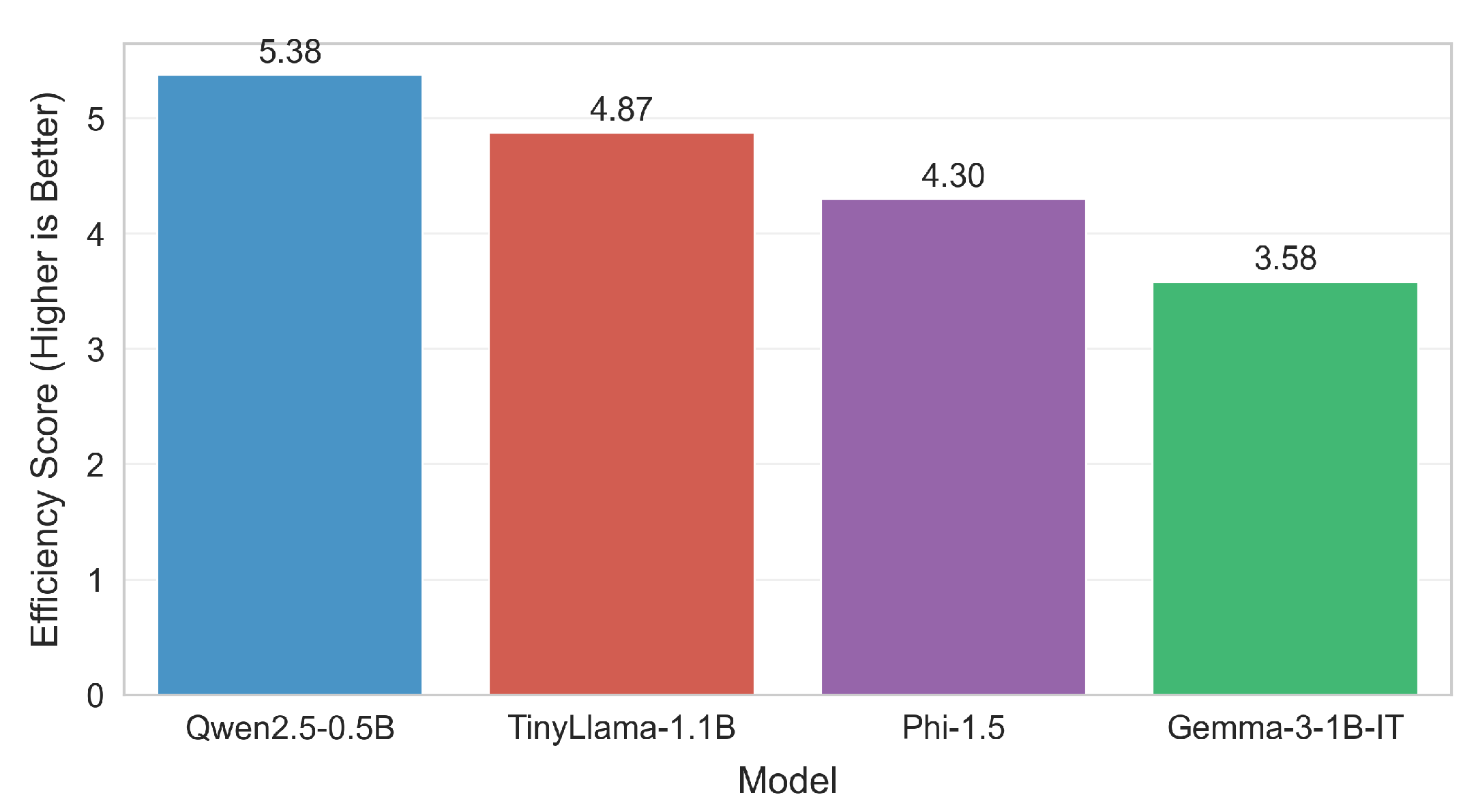
| Models Evaluated | Qwen2.5-0.5B [58] |
| TinyLlama-1.1B-intermediate-step-1431k-3T [59] | |
| microsoft/phi-1.5 [60] | |
| google/gemma-3-1b-it [61] | |
| Latency Evaluation | Runs: 3 |
| Tokens per run: 50 | |
| Prompt: “The disaster response team should” | |
| Perplexity Evaluation | Dataset: WikiText-2 |
| Max samples: 200 | |
| Max sequence length: 512 | |
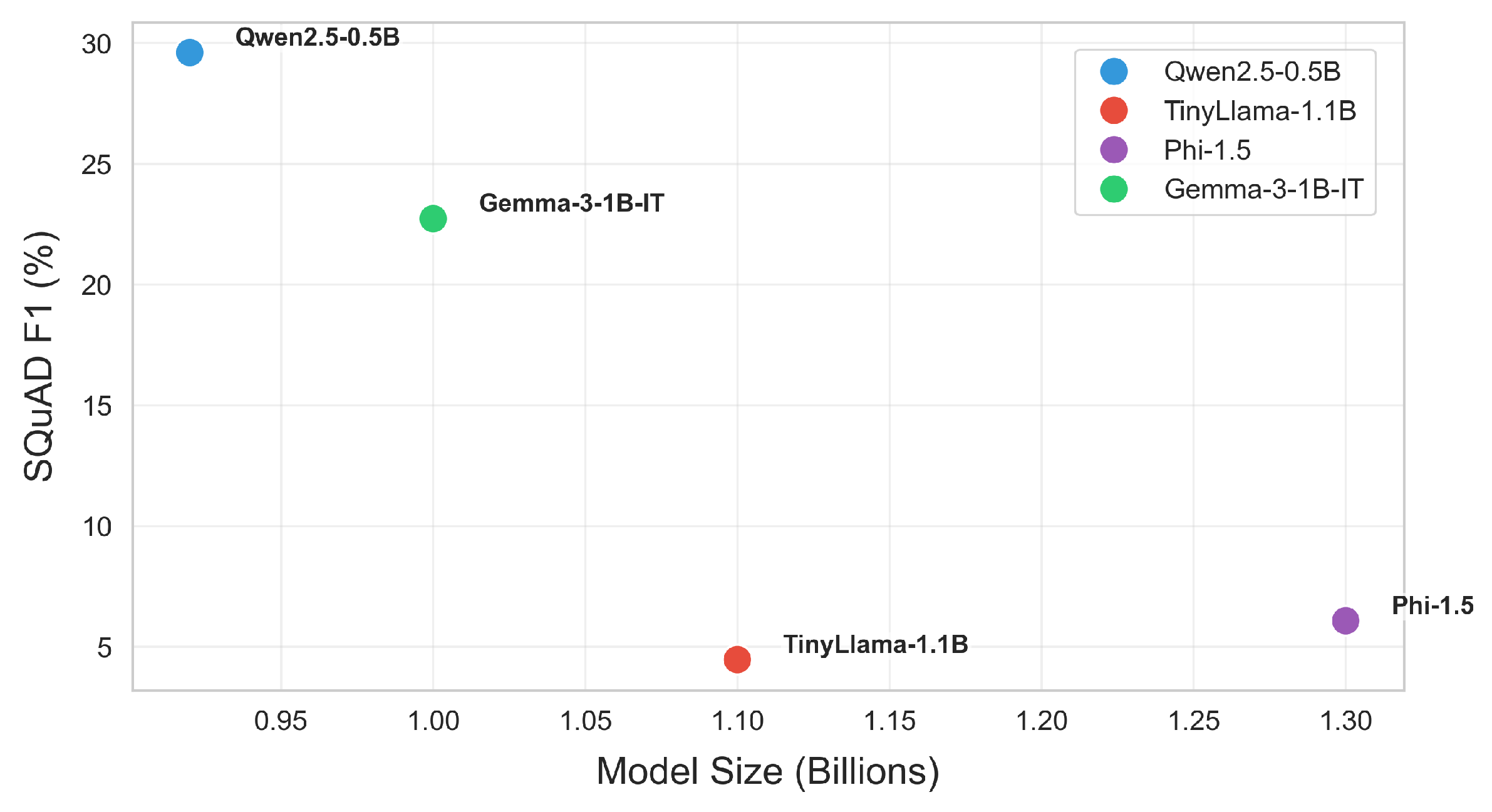
| BoolQ [62] & SQuAD [63] Evaluation | Max samples: 200 |
| Sequence length: 512 | |
| Max new tokens: 5 (BoolQ), 40 (SQuAD) |
| Section | Configuration |
|---|---|
| Train/Test Split | Test size: 0.2, Seed: 42, Shuffle: True |
| Samples | Training: 486, Testing: 122 |
| Max Length | 512 |
| Epochs | 10 |
| Batch Size | 4 |
| Learning Rate | 5 × 10⁻⁵ |
| Component | Specification |
|---|---|
| Chipset | Qualcomm Snapdragon 8 Gen 2 (4 nm) |
| CPU | Octa-core |
| GPU | Adreno 740 |
| RAM | 12 GB LPDDR5X |
| Dataset | Meta | Reformulator | Generator | Assessor | Total Tokens |
|---|---|---|---|---|---|
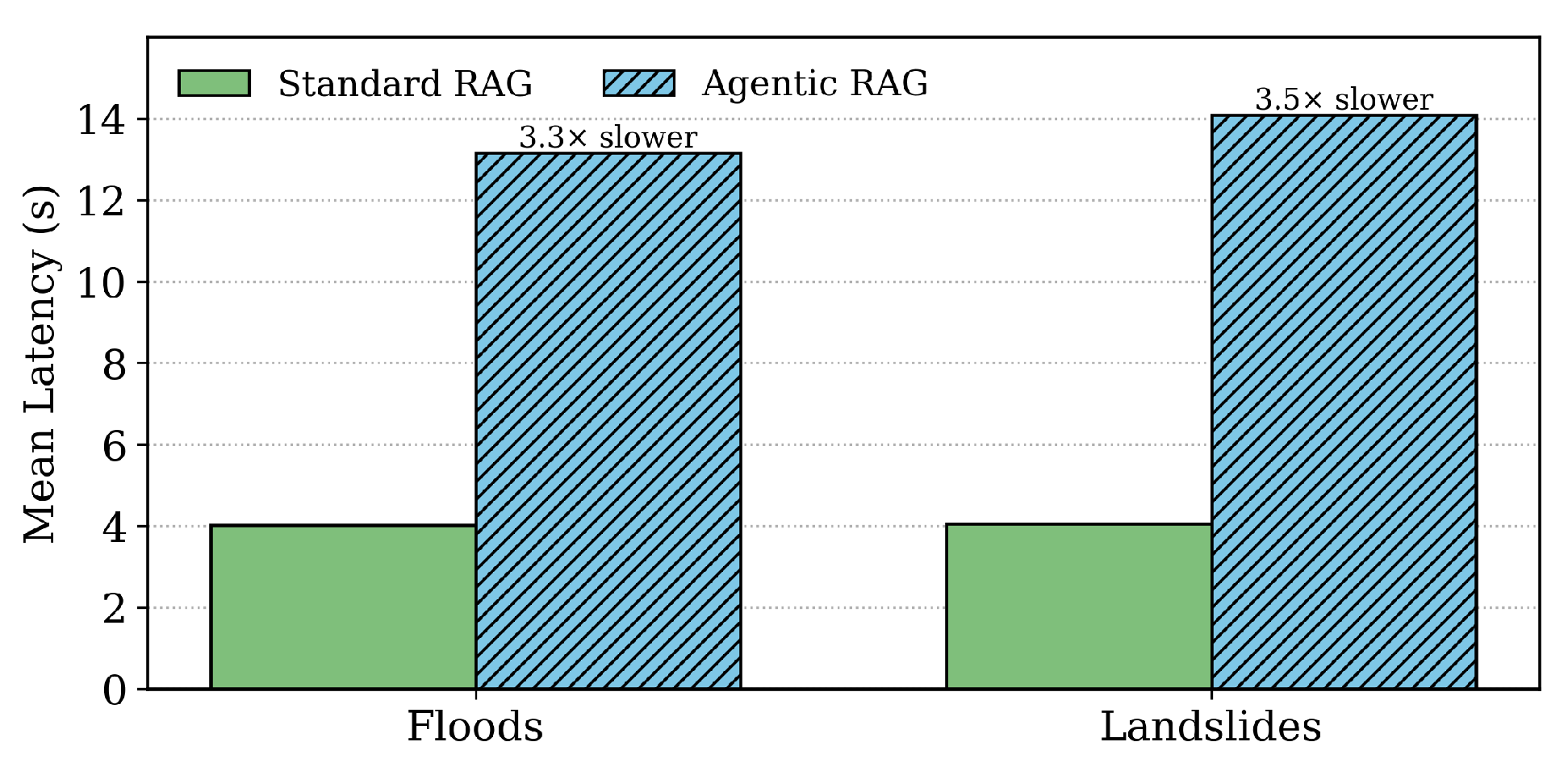
| Flood | 288 | 118 | 1682 | 889 | 2977 |
| Landslide | 285 | 171 | 1923 | 1057 | 3436 |
| Configuration | Relevance | Specificity | Safety | Overall Score |
|---|---|---|---|---|
| Standard RAG (Raw Query + General Retriever + Generator) | 5.8 ± 1.1 | 5.3 ± 1.2 | 6.9 ± 0.8 | 61.4 ± 9.6 |
| Metadata-aware RAG (+Meta Node + Filtered Retriever) | 7.0 ± 0.9 | 6.1 ± 1.0 | 7.0 ± 0.7 | 69.8 ± 8.4 |
| Metadata-aware RAG (+Assessor Loop) | 7.3 ± 0.8 | 6.8 ± 0.9 | 8.1 ± 0.6 | 75.6 ± 7.2 |
| Full Agentic RAG (+Assessor + Reformulation + Web Search) | 8.1 ± 0.7 | 7.5 ± 0.8 | 8.2 ± 0.6 | 82.9 ± 6.5 |
| Configuration | Latency (s) | Tokens/Query |
|---|---|---|
| Standard RAG (Raw Query + General Retriever + Generator) | 4.1 ± 0.6 | 2050 ± 220 |
| Metadata-aware RAG (+Meta Node + Filtered Retriever) | 5.0 ± 0.7 | 2300 ± 260 |
| Metadata-aware RAG (+Assessor Loop) | 8.7 ± 1.3 | 3100 ± 410 |
| Full Agentic RAG (+Assessor + Reformulation + Web Search) | 14.8 ± 2.4 | 3600 ± 760 |
| Load Condition | Greedy | Periodic-60 | Periodic-30 | AET (Proposed) | Continuous |
|---|---|---|---|---|---|
| Low | 92 | 62 | 50 | 44 | 40 |
| Medium | 132 | 113 | 96 | 87 | 80 |
| High | 215 | 201 | 184 | 165 | 151 |
| Extreme | 318 | 304 | 273 | 250 | 236 |
| Load Condition | Greedy | Periodic-60 | Periodic-30 | AET (Proposed) | Continuous |
|---|---|---|---|---|---|
| Low | 0 | 3 | 6 | 7 | 41 |
| Medium | 0 | 4 | 7 | 9 | 53 |
| High | 0 | 4 | 8 | 11 | 61 |
| Extreme | 0 | 5 | 8 | 12 | 68 |
| Load Condition | Greedy | Periodic-60 | Periodic-30 | AET (Proposed) | Continuous |
|---|---|---|---|---|---|
| Low | 1 | 3 | 4 | 2 | 7 |
| Medium | 1 | 4 | 5 | 3 | 10 |
| High | 1 | 5 | 6 | 4 | 15 |
| Extreme | 2 | 6 | 7 | 5 | 18 |
| Metric | Greedy | Periodic-60 | Periodic-30 | AET (Proposed) | Continuous |
|---|---|---|---|---|---|
| Priority-Weighted Response Time ↓ | 215 | 201 | 184 | 165 | 151 |
| Solver Calls ↓ | 0 | 4 | 8 | 11 | 61 |
| System Nervousness ↓ | 1 | 5 | 6 | 4 | 15 |
| Trigger Precision ↑ | – | – | – | 6.3% | – |
| Feasibility Under Peak Load | Low | Medium | Medium | High | High |
| Operational Stability | High | Medium | Medium | High | Low |
| Metric | Baseline Model (Qwen2.5-0.5B [58]) | Fine-Tunned Qwen2.5-0.5B | Improvement |
|---|---|---|---|
| BLEU [64] | 0.70 | 2.35 | +236% |
| ROUGE-L [65] | 9.21 | 16.12 | +74% |
| Exact Match (%) | 0.0 | 0.0 | – |
| F1 (%) | 10.77 | 19.79 | +83% |
| Semantic Similarity (%) | 17.12 | 30.28 | +77% |
| Average Latency (s) | 0.562 | 0.587 | +4% |
| Metric | Value |
|---|---|
| Average Latency per Token (ms/token) | 18.4 ms |
| End-to-End Response Latency (avg per prompt) | 412 ms |
| Memory Delta During Inference | +182 MB |
| Peak RAM Usage (App Total) | 612 MB |
| Tokens per Second (Throughput) | 54.3 tok/s |
Disclaimer/Publisher’s Note: The statements, opinions and data contained in all publications are solely those of the individual author(s) and contributor(s) and not of MDPI and/or the editor(s). MDPI and/or the editor(s) disclaim responsibility for any injury to people or property resulting from any ideas, methods, instructions or products referred to in the content. |
© 2026 by the authors. Licensee MDPI, Basel, Switzerland. This article is an open access article distributed under the terms and conditions of the Creative Commons Attribution (CC BY) license.
Share and Cite
Aththanayake, S.; Mallikarachchi, C.; Wickramasinghe, J.; Kugarajah, S.; Meedeniya, D.; Pradhan, B. ResQConnect: An AI-Powered Multi-Agentic Platform for Human-Centered and Resilient Disaster Response. Sustainability 2026, 18, 1014. https://doi.org/10.3390/su18021014
Aththanayake S, Mallikarachchi C, Wickramasinghe J, Kugarajah S, Meedeniya D, Pradhan B. ResQConnect: An AI-Powered Multi-Agentic Platform for Human-Centered and Resilient Disaster Response. Sustainability. 2026; 18(2):1014. https://doi.org/10.3390/su18021014
Chicago/Turabian StyleAththanayake, Savinu, Chemini Mallikarachchi, Janeesha Wickramasinghe, Sajeev Kugarajah, Dulani Meedeniya, and Biswajeet Pradhan. 2026. "ResQConnect: An AI-Powered Multi-Agentic Platform for Human-Centered and Resilient Disaster Response" Sustainability 18, no. 2: 1014. https://doi.org/10.3390/su18021014
APA StyleAththanayake, S., Mallikarachchi, C., Wickramasinghe, J., Kugarajah, S., Meedeniya, D., & Pradhan, B. (2026). ResQConnect: An AI-Powered Multi-Agentic Platform for Human-Centered and Resilient Disaster Response. Sustainability, 18(2), 1014. https://doi.org/10.3390/su18021014