Article

Education-Driven and Industrial Symbiosis: Empirical Evidence from the Coupling of Higher Education Development and Industrial Upgrading in China

1
School of Government, University of International Business and Economics, Beijing 100029, China
2
Beijing Institute of Economics and Management, Beijing 100102, China
*
Author to whom correspondence should be addressed.
Sustainability 2026, 18(2), 1011; https://doi.org/10.3390/su18021011
Submission received: 15 November 2025 / Revised: 11 January 2026 / Accepted: 13 January 2026 / Published: 19 January 2026
(This article belongs to the Section Sustainable Education and Approaches)

Abstract

Based on the interaction mechanism between higher education and industrial structure, this paper constructs an evaluation index system for the higher education development (HED) and the industrial upgrading (IU) by integrating their core characteristics. Using the entropy weight method, TOPSIS method, and coupling coordination model, as well as Kernel Density Estimation (KDE), it measures the comprehensive development levels and synergistic level of HED and IU in Chinese provinces (cities) from 2009 to 2020 and explores their spatiotemporal evolution characteristics. The findings reveal the following: (1) The overall level of China’s HED and IU shows an upward trend, but the absolute scores remain low, with significant regional disparities, and are divided into Balanced Development, Structural Imbalance, Industry-Supported, and Education-Supported. (2) The interaction between HED and IU is progressing toward a higher level, characterized by a reduction in low-value regions and a narrowing of regional disparities. However, the overall coordination remains in a “running-in stage”. (3) The eastern region has formed a virtuous cycle of interaction. The central region has achieved rapid improvement, benefiting from policy support, while the western region, constrained by resource limitations and policy lag, experiences slower progress in coordination. The northeastern region, lacking coupling momentum, exhibits long-term stagnation at a low level.

1. Introduction

Since the reform and opening-up policy, China has achieved a historic leap in economic strength, leveraging the comparative advantage of its demographic dividend and the latecomer advantage of technological innovation. The remarkable economic achievements are inseparable from the higher education development (HED). Since the 21st century, the expansion of university enrollment, coupled with the transformation of the state-run education system, has highlighted the industrial and investment attributes of higher education. The influx of private capital into the education sector has facilitated the reallocation of higher education resources and the incremental output of related sectors, creating new pathways for industrial restructuring and economic growth. Meanwhile, the emergence of highly skilled talent and scientific research achievements has met the urgent demands of economic development and industrial upgrading(IU), propelling China from an industrial economy toward a knowledge-based economy.
However, constrained by regional, historical, and policy factors, the higher education sector faces significant bottlenecks. These include educational homogenization during institutional expansion, a misalignment between talent cultivation and labor market demands, and a persistently low conversion rate of scientific research outcomes [1]. Most notably, investment in fundamental research remains critically insufficient; for instance, China’s 2024 basic research expenditure accounted for only 6.91% of total R&D spending, far below the 12–23% range typical of developed nations [2]. These issues have exacerbated the regional imbalance between higher education and industrial development, restricting the sustainability of future economic growth. Since the 18th National Congress of the Communist Party of China, a series of landmark and pioneering reforms have been introduced to align HED with the diversified demands of IU, enhancing national productivity. Against this backdrop, clarifying the coordination between HED and IU, and assessing their evolutionary trends are essential for optimizing the allocation of educational resources, adjusting industrial policies, and establishing key mechanisms for socio-economic accumulation. This coordination serves as a strategic driver for building a modern socialist country.
Existing studies primarily focus on the heterogeneous effects of higher education on IU through human capital accumulation, advanced human capital formation, and technological innovation [3,4,5]. In China’s central and western regions, improvements in higher education quality have not effectively curbed talent outflow; instead, they have exacerbated disparities in the effects of IU [6,7,8]. Consequently, academic research has gradually shifted toward exploring the coordinated HED and IU, aiming to reveal their interactive mechanisms, economic effects, and driving forces [9,10]. Scholars generally agree that HED and IU are closely associated with employment restructuring and contribute to economic growth through technological innovation, knowledge spillovers, and entrepreneurship [11,12]. However, current research perspectives in China tend to focus on specific aspects of either HED or IU, including disciplinary structures within higher education [13,14], hierarchical structures [15], talent structures [16], and curriculum adjustments [17], as well as their alignment and interaction with IU [18,19]. Nevertheless, a comprehensive evaluation framework for HED and IU, along with the spatiotemporal differentiation of their coordination, has yet to be systematically examined.
The regional coordinated development strategy is a crucial national initiative for economic development. Analyzing the interactive mechanisms and spatial characteristics of the coupling coordination between HED and IU from a geographical perspective is essential for achieving differentiated regional collaboration and overall progress. Consequently, this study seeks to address the following two key questions:
(1)
What are the relative development patterns of HED and IU across Chinese provinces, and how can the mismatch types be characterized?
(2)
How has the coupling coordination degree evolved spatiotemporally, and what are the distinct regional disparities observed between the four major regions and different time nodes?
Compared with existing studies that primarily focus on unilateral effects or specific channels between higher education and industrial upgrading, this study contributes to the literature by constructing a unified evaluation framework to diagnose the relative development types, examining their coupling coordination from a spatiotemporal perspective, and revealing regional heterogeneity in their co-evolution patterns.
The remainder of this paper is organized as follows: Section 2 elaborates on the theoretical mechanism of the interaction between HED and IU. Section 3 introduces the evaluation index system along with the research methodology and data sources. Section 4 presents the empirical results, analyzing the comprehensive development levels and the spatiotemporal evolution of the coupling coordination degree across Chinese provinces. Section 5 summarizes the key findings, discusses policy implications, and outlines the limitations and directions for future research.

2. The Interactive Mechanism Between Higher Education and Industrial Structure

2.1. The Coupling Logic of the Two Systems

Higher education encompasses all formal higher education institutions, including public and private universities, colleges, technical training institutions, and vocational schools [20]. The level of HED not only reflects a country’s overall strength, core competitiveness, and developmental potential, but also serves as the foundation for socioeconomic innovation and long-term progress. Meanwhile, IU is determined by a country’s mode of production and reflects the proportional allocation of production factors across enterprises, industries, and sectors through economic specialization and social division of labor. IU signifies the advancement of productivity and efficiency within the industrial structure, driving profound economic transformation.
HED and IU together form a highly interdependent system. From a systems perspective, in a knowledge-based society, institutional innovation fosters linkages between higher education and industry [21]. Throughout this process, policies facilitate bidirectional knowledge transfer based on supply and demand, fostering an innovation-oriented interaction through the interactive allocation of resources and research outcomes, thus shaping the complex interactive mechanism between HED and IU.

2.2. Innovation-Driven and Technological Spillover Mechanism

Based on Endogenous Growth Theory, technological innovation is the core source of economic growth. IU relies on the orderly flow of production factors (such as labor, technology, and capital) toward industries with higher returns, productivity, and technological content. It leverages technological innovation to transform traditional industries, develop emerging industries, consolidate leading industries, and lay out future industries.
Higher education plays a crucial role in this process by acting as a reservoir for specialized knowledge, particularly in R&D personnel training, basic research, and technology transfer, making it a key element in the innovation ecosystem [22]. Investment in education fosters high-quality and innovative human capital, promoting the systematic diffusion of knowledge and facilitating the emergence of technological innovation. The combination of the external economic effects of general knowledge and the internal economic effects of specialized knowledge enhances the returns on non-knowledge factors such as capital and labor, which is conducive to improving total factor productivity [23,24].
Rational economic interactions depend on relational networks. The local embeddedness of universities fosters emergent characteristics, functions, and new economic forms that were previously absent in the system, such as co-working spaces and incubator parks. These, in turn, provide support for the specialization of service industries like entertainment, catering, tourism, and elderly care, contributing to the diversification of regional economic structures. Additionally, shared academic and professional backgrounds foster mutual recognition among stakeholders, reducing opportunistic behaviors arising from information asymmetry. This lowers the costs of resource integration and knowledge exchange, generating a self-reinforcing “cumulative causation” effect that is linked to enhanced regional innovation capacity [25]. Consequently, the resulting core-periphery industrial distribution pattern within a region exhibits strong locational lock-in effects, exacerbating regional disparities under an unbalanced growth model.

2.3. Information Transmission and Factor Allocation Mechanism

This mechanism focuses on how HED interacts with the employment structure and disciplinary composition through information matching. The widespread adoption of information technology accelerates knowledge codification and enhances the spillover effects of integrated innovation [26]. As information infrastructure continues to improve, the integration of industry and digitalization becomes increasingly dynamic, fostering the emergence of new business models and technologies that enhance the efficiency of existing manufacturing capacities. Governments act as facilitators by linking higher education with industry through shared technological demands, fostering their organic coupling [27,28].
Within this interaction, both parties develop an implicit mutual understanding through market signaling. On the one hand, the timely exchange of industry information enables universities to adjust disciplinary composition and research focus in response to industrial dynamics [29]. This ultimately facilitates the shift toward flexible production models and dense innovation networks, enhancing productive capacity. On the other hand, as knowledge transfer and industrial technological innovation proliferate, new technologies, products, and markets diffuse via information infrastructure. The improvement of technological progress and factor efficiency generates sustained demand for workers with new skills, positioning higher education as a critical investment in enhancing individual productivity and serving as a fundamental factor for IU.

3. Research Methodology and Data Sources

3.1. Research Methodology

To objectively evaluate the comprehensive development level of HED and IU, this paper adopts the Entropy Weight Method combined with TOPSIS. The former derives weights entirely from data dispersion, effectively avoiding the bias of subjective assignment methods. The latter is chosen for its robustness in ranking multi-attribute decision-making problems by measuring the geometric distance to the ideal solution [30,31]. Furthermore, given the research focus on the symbiotic interaction between the HED and IU, the Coupling Coordination Degree Model is utilized to quantify the consistency and benign interaction between the systems.

3.1.1. Entropy Weight Method

To eliminate the interference of indicator dimensions on the measurement results, the data were normalized to fall within the range of [0, 1]. An improved entropy model was used to avoid null values. The formula is as follows:
X i j = ( X i j     m i n ( i j ) m a x ( x i j )     m i n ( x i j ) )   ×   0.95 + 0.001
where X i j represents the value of the i-th province for the j-th indicator, and X i j is the normalized value of the i-th province for the j-th indicator.

3.1.2. TOPSIS (Technique for Order Preference by Similarity to Ideal Solution)

The basic idea of TOPSIS is that the closer an evaluation object is to the optimal solution and the farther it is from the worst solution, the better it is. The optimal (worst) solution is the value that reaches the best (worst) value of the evaluation indicators. All indicators are processed to have the same trend, and the optimal and worst solutions for each indicator are identified. The maximum and minimum values of each indicator are then selected from the normalized matrix to obtain the optimal value D+ and the worst value D. The distance between each evaluation object and the optimal and worst values is calculated, where Wj represents the weight of the j-th indicator.
D i + = j = 1 n W j ( Z i j Z j + ) 2
D i = j = 1 n W j ( Z i j Z j ) 2
Finally, the sequence D+ = ( D 1 + , D 2 + , D m + ) and D = ( D 1 , D 2 , D m ) is obtained. The comprehensive evaluation value Bi is calculated using the formula Bi = D i / ( D i + + D i ) . A higher B value indicates a better comprehensive evaluation of the object.

3.1.3. Coupling Coordination Model

Coupling refers to the phenomenon where two or more subsystems influence each other through various interactions. This paper regards the HED and IU as two interacting subsystems, introduces the concept of coordination, and uses the coupling coordination model to calculate the coupling coordination degree between them. This reflects the coordination state of the two subsystems and their internal elements. The coordination levels are further classified based on existing research (Table 1).
C 1   ( U 1 ,   U 2 ,   ,   U n ) = n × [ U 1 U 2   U n ( U 1 + U 2 + U n ) n ] 1 n
C 2   ( U 1 ,   U 2 ,   ,   U n ) = 2 × [ U 1 U 2 U n i < j ( U i + U j ) 2 n 1 ]
D = C × T
The coupling coordination model involves the coupling degree C, coordination index T ( T = α U 1 + β U 2 ), and coupling coordination degree D. A value closer to 1 indicates a better coupling coordination degree between the two subsystems in the region (α and β represent the relative weights of the two subsystems; since slight variations in these parameters do not significantly alter the overall trend of coupling coordination, and given that HED and IU are theoretically viewed as equally indispensable drivers in this symbiotic system, we set α = β = 0.5 to reflect their balanced importance). Given n ≥ 2 systems, Ui represents the evaluation value of the system.

3.2. Indicator Selection and Data Sources

3.2.1. Evaluation Indicators for Higher Education Development

The evaluation indicators for HED need to integrate the current status of HED and the important characteristics of the higher education system. The evaluation framework is grounded in the functions of higher education, national macro-policy directions, and existing mature research [32,33]. Specifically, this study evaluates HED through four dimensions, including university scale, disciplinary composition, funding investment, and scientific output (Table 2), where “Patent Applications” and “Patent Transfer & Licensing Income” represent the research capacity and transformation efficiency of higher education, respectively.

3.2.2. Evaluation Indicators for Industrial Upgrading

IU is influenced by the upgrading of consumption structure, the replacement of leading industries, industrial policies, and international industrial transfer. Scholars typically describe IU using the reallocation of production factors across different industries and changes in the proportion of output value across industries [34,35]. From economic and human perspectives, relevant indicators are selected, and the evaluation is conducted from three dimensions: output value structure, employment structure, and structural height (Table 2).

3.2.3. Data Sources

All data in this paper are sourced from the official website of the National Bureau of Statistics of China, the “China Statistical Yearbook”, the “China Educational Finance Statistical Yearbook”, and the “China Statistical Yearbook on Science and Technology” (Tibet is excluded due to data continuity). Considering the availability of data for some scientific output indicators and the impact of COVID-19 on China’s economy and society, the main data collection period is from 2009 to 2020. Missing data for some provinces and cities have been supplemented using linear interpolation (missing values occurred only in isolated instances for a few provinces and account for approximately 1% of the total dataset). Given the minimal volume of missing values and the application of range standardization, any potential impact on the coupling coordination results is considered negligible, thereby ensuring the reliability and robustness of the findings.

4. Empirical Analysis

4.1. Diagnostic Analysis of Relative Development Types

We used Stata 18.0 to calculate the comprehensive evaluation scores for both HED and IU systems using the TOPSIS method. Due to space constraints, the detailed yearly scores are omitted here, and the analysis focuses on the relative development types derived from the score differences. Based on the data from 2009 to 2020, the 30 provinces were categorized into four distinct types, as shown in Table 3.
The result shows that nearly half of the provinces (e.g., Zhejiang, Fujian, Anhui, Chongqing) fall into the “Balanced Development” category. This suggests that for these regions, HED has generally kept pace with IU. Notably, western provinces like Guizhou and Yunnan, previously considered lagging, have achieved a synchronous state in 2020, indicating that their educational inputs are well-matched with their current stage of industrial development.
Apart from these balanced regions, distinct mismatch patterns were identified in the remaining provinces, which can be categorized as follows.
Industry-Supported Regions: Municipalities and resource-rich regions such as Shanghai, Tianjin, and Inner Mongolia are classified as “Industry-Supported”. For Shanghai and Tianjin, this indicates a powerful industrial and service economy that exhibits a “demand-lead” characteristic, where IU significantly outpaces the local HED capacity. For Inner Mongolia and Xinjiang, it reflects an economy driven by natural resources, where higher education support is relatively insufficient.
Education-Supported Regions: A distinct pattern is observed in provinces like Jiangsu, Guangdong, Hubei, and Shaanxi. These regions possess massive higher education resources that currently exceed their industrial structure scores. This represents a strategic “supply-push” model, where a surplus of R&D and talent is accumulated to support future industrial transformation, although a gap currently exists between research output and industrial application.
Structural Imbalance Regions: A critical observation is the “Structural Imbalance” found in Northeast China (Heilongjiang, Liaoning). Unlike other regions, these provinces experienced a decline in scores for both systems from 2009 to 2020. Economic sluggishness has limited the capacity to attract talent, while the loss of population further weakens the HED system, thereby creating a negative feedback loop.

4.2. Analysis of Coupling Coordination Degree

Utilizing the coupling coordination model, this study further examines the interactive level between the HED and IU in China. The results indicate that although the interaction between the two systems improved from 2009 to 2020, it has not yet reached a state of strong synergy, remaining in an adjustment phase.
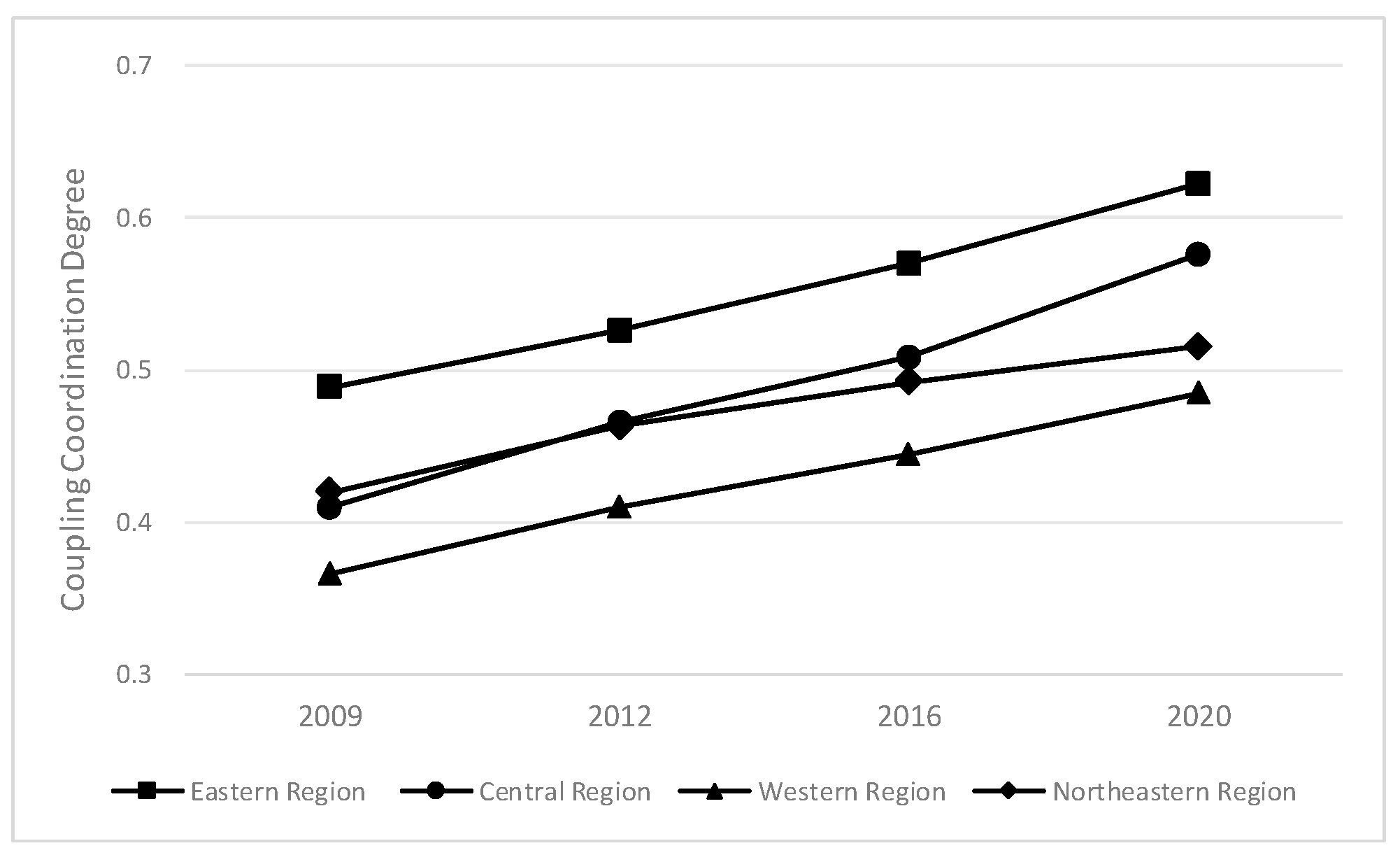
As illustrated in Figure 1, significant regional disparities exist in the coupling coordination degree across China. The central region exhibited a notable increase in coordination after 2016, coinciding with the implementation of regional development strategies. In contrast, the eastern and western regions exhibited relatively similar upward trajectories, characterized by steady progress and continuous improvement. Meanwhile, the northeastern region showed limited growth after 2012, which aligns with the broader context of regional economic restructuring. Despite these differences, the overall trend is characterized by a steady increase in coupling coordination, suggesting that the synchronization between HED and IU is progressively strengthening. The observed regional variations in coupling coordination further validate the trends identified through the TOPSIS analysis.
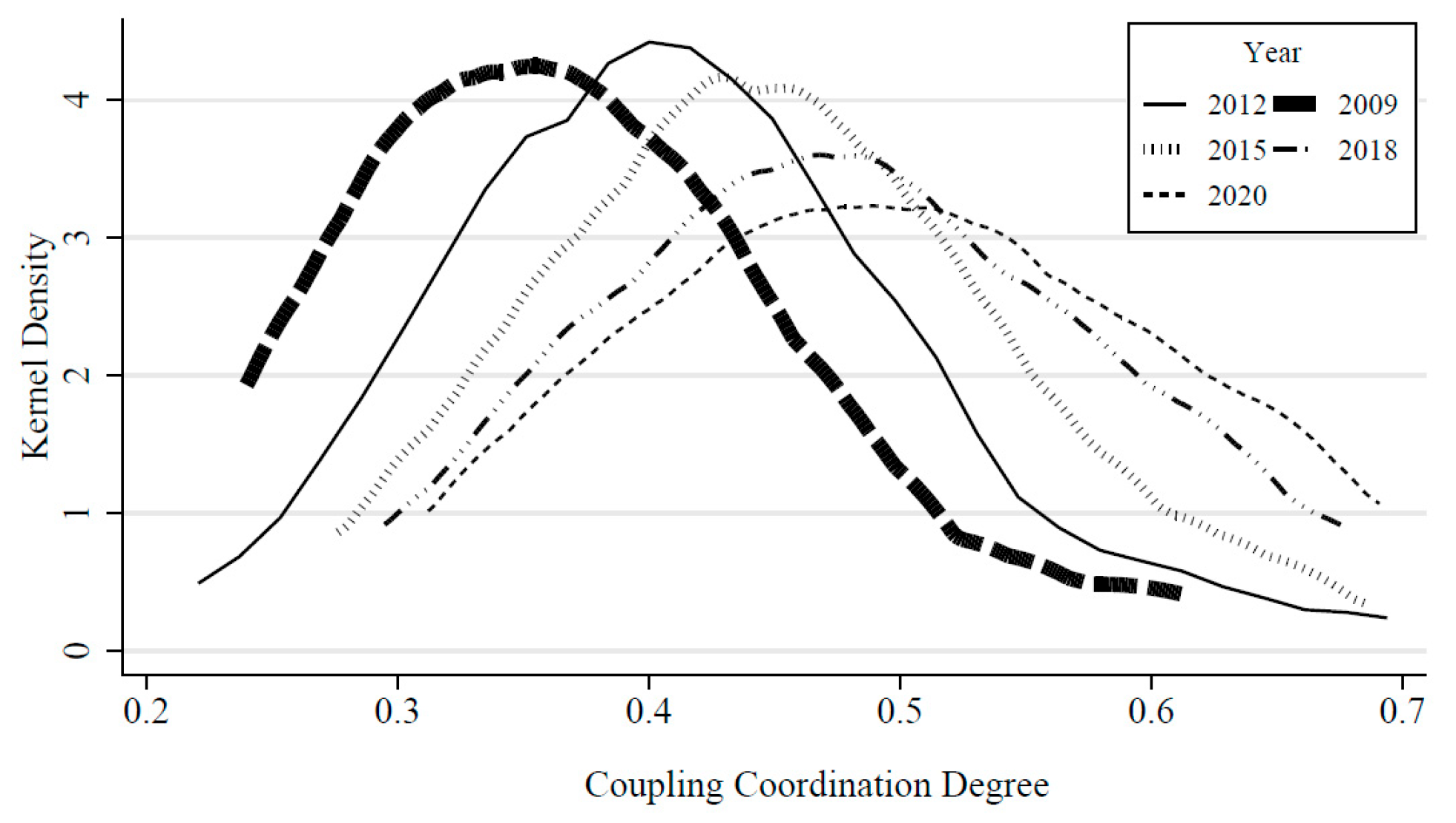
To further clarify the temporal dynamics and disparity evolution, Kernel Density Estimation (KDE) is employed. Technically, the position of the curve’s main peak reflects the overall development level, while the height and width of the peak indicate the degree of regional disparity (sharp peaks imply smaller disparities). The movement of the curve describes the evolutionary trend over time.
From a temporal perspective, the kernel density estimation (Figure 2) reveals a rightward shift in the density curve, indicating a continuous improvement in the coupling coordination degree between HED and IU. Simultaneously, the left tail of the kernel density curve has progressively shortened over the years, suggesting a reduction in regions with extremely low coordination levels. Meanwhile, the right tail has slightly contracted but remains relatively stable, implying that regions with high coordination degrees have maintained their positions.
Regarding the distribution shape, the peak of the density curve has gradually flattened and the width has slightly expanded. While a flatter peak typically indicates a greater dispersion of data, in this context, combined with the significant shortening of the left tail, it reflects a “catch-up effect”: backward regions are improving faster than leading regions, moving away from the low-value cluster. This dynamic suggests that although absolute variance persists, the extreme disparities are being eliminated, marking a shift from asymmetry to symmetry in coupling coordination. This trend signifies an overall advancement toward a higher level of integration between HED and IU.
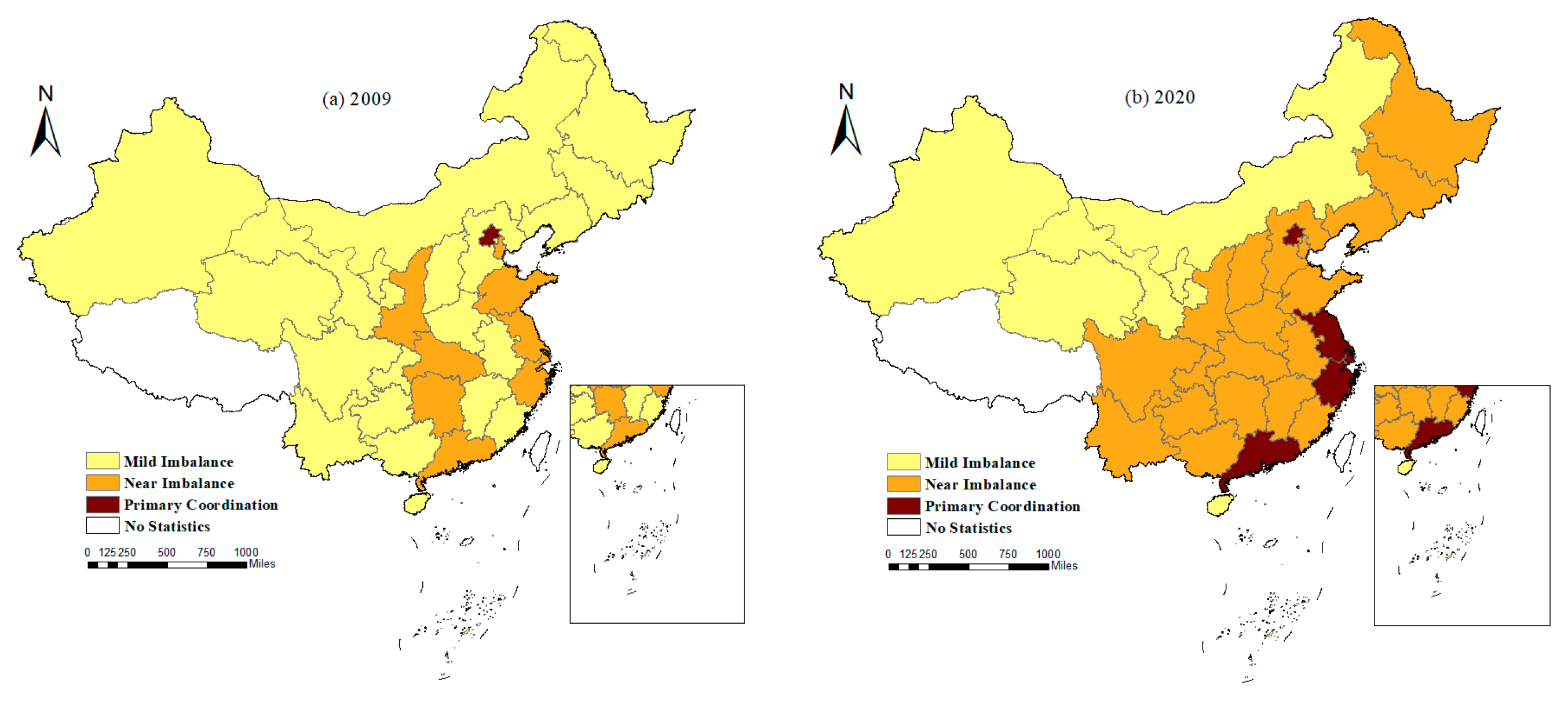
As shown in Figure 3, the regional distribution of coupling coordination was visualized using ArcGIS 10.8. In 2009, apart from Beijing, which had reached the stage of primary coordination, most provinces and municipalities remained in a state of near imbalance or moderate imbalance, with no regions achieving high-quality coordination or experiencing extreme imbalance. By 2020, several coastal provinces, including Guangdong, Shanghai, Zhejiang, and Jiangsu, had advanced to the stage of primary coordination, while the central and northeastern regions also showed improvements in their coupling coordination degree. These regions likely benefited from the development of relatively mature talent supply chains and industry-education integration mechanisms, which were associated with high-quality interactive coordination between HED and IU, thereby accompanying the transition toward a more stable coupling state.
However, constrained by both economic development levels and natural conditions, the western region lagged behind the eastern coastal provinces in terms of capital accumulation and developmental advantages in areas such as technological innovation, cultural infrastructure, and public services. Additionally, policy implementation and feedback mechanisms exhibited certain delays and inconsistencies, further slowing the improvement in coupling coordination. As a result, the western region’s progress remained relatively sluggish, significantly trailing behind other regions.

5. Conclusions and Discussion

5.1. Conclusions

Based on the interactive mechanism between HED and IU, this study constructs an evaluation index system to measure the HED and IU. We employ the TOPSIS method to calculate HED and IU across Chinese provinces (cities) from 2009 to 2020, and combine the coupling coordination model with Kernel Density Estimation to analyze their interaction levels and spatiotemporal evolution patterns. The key findings are as follows:
First, although the absolute levels of HED and IU show an upward trend, distinct mismatch characteristics exist. The 30 provinces are categorized into four types: “Balanced Development”, “Industry-Supported”, “Education-Supported”, and “Structural Imbalance”.
Second, the coupling coordination degree has steadily increased, signifying a progression toward higher-level integration. However, the overall coordination remains in the “running-in stage”, indicating that strong synergy has not yet been fully achieved. Kernel Density Estimation reveals that while regional disparities persist, the number of regions with extremely low coordination is decreasing, leading to a gradual narrowing of the gap between backward and advanced regions.
Third, regarding regional heterogeneity, a distinct “East-strong, Northeast-weak” pattern is observed. The Eastern region, leveraging mature industry-education mechanisms, maintains a leading position. The Central region has achieved the fastest growth rate, coinciding with intensified policy support, acting as a riser. The Western region, constrained by resource endowments and policy lags, shows slower progress. Notably, the Northeastern region faces “coupling stagnation”, struggling at a low coordination level due to structural rigidities and talent outflow.

5.2. Discussion

This study highlights that the Beijing–Tianjin–Hebei region, the Yangtze River Delta, and the Pearl River Delta have achieved relatively high levels of coupling coordination between HED and IU. These regions have established a positive feedback loop between education and industry, benefiting from a strong industrial foundation, well-developed educational resources, and robust innovation networks. Their high level of coordination has significantly enhanced overall competitiveness, making them vital components of China’s high-quality economic growth. Therefore, optimizing the spatial distribution of higher education resources, enhancing regional industrial capacity and innovation capabilities, and fostering a structured, complementary, and closely integrated education-industry interaction system are essential strategies for achieving balanced regional development. Based on the analytical framework and empirical findings of this study, the following policy recommendations and research directions are proposed:
Deepening Industry-Education Integration to Enhance Regional Synergy. The findings indicate that the coupling coordination between HED and IU is closely linked to regional economic development. In the eastern region, the strong alignment between educational resources and industrial demand has fostered a positive interaction mechanism. Moving forward, deeper integration of industry and education should be promoted by encouraging universities and industries to engage in collaborative innovation. Higher education institutions should adapt their academic structures and talent training models to align with the dominant industries in their respective regions, ensuring a precise match between educational resources and industrial demands, thereby enhancing regional synergy in development.
Strengthening Policy Support to Narrow Regional Disparities. Although the coupling coordination degree in central and western China has improved, a significant gap remains compared to the eastern region. Thus, efforts should be intensified to support HED and IU in these regions. Initiatives such as the “Revitalization Plan for Higher Education in Central and Western China” and the “Double First-Class Initiative” should be further advanced to facilitate the redistribution of high-quality educational resources to underdeveloped areas, reducing the “education-industry divide” across regions. National strategic platforms should be leveraged to enhance cross-regional cooperation in education and industry, promoting the mobility of key resources and collaborative innovation. Additionally, specialized industry-education integration demonstration zones should be established in western China, facilitating the transfer of research outputs to less developed regions and fostering stronger synergies between technology and industry.
Enhancing the Evaluation System to Advance Deepened Synergy. To ensure the sustainability of the coupling coordination, it is crucial to establish a multi-dimensional evaluation mechanism that goes beyond simple quantitative metrics. Currently, the evaluation of HED and IU often operates in silos. Moving forward, local governments should establish and incorporate “coupling efficiency” indicators into their performance assessment systems to effectively incentivize the practical translation of academic achievements. By shifting the evaluation focus from “scale expansion” to “structural quality,” this new system will guide universities and industries to prioritize substantive collaboration over superficial growth, thereby fostering a high-quality, symbiotic relationship.

5.3. Limitations and Future Research

This study has certain limitations that offer avenues for future research. First, the coupling coordination model is primarily descriptive, but does not statistically verify causal mechanisms. Future research could employ spatial econometric models to test the specific drivers of this interaction. Second, the analysis is based on provincial data, which may mask intra-provincial heterogeneity. Extending the study to the city level or using micro-data would provide more granular insights. Further exploration is needed to determine how HED can dynamically adapt to these industrial transformations, fostering simultaneous advancements in knowledge innovation and IU.

Author Contributions

Conceptualization, H.L. and H.W. (Huiying Wang); methodology, H.L.; software, H.L.; validation, H.L. and H.W. (Huimin Wang); formal analysis, H.L.; investigation, H.W. (Huiying Wang) and H.W. (Huimin Wang); resources, H.L. and H.W. (Huimin Wang); data curation, H.L. and H.W. (Huimin Wang); writing—original draft preparation, H.L., H.W. (Huiying Wang), and H.W. (Huimin Wang); writing—review and editing, H.W. (Huiying Wang) and H.W. (Huimin Wang); visualization, H.L.; supervision, H.W. (Huiying Wang); project administration, H.W. (Huiying Wang); funding acquisition, H.W. (Huiying Wang). All authors have read and agreed to the published version of the manuscript.

Funding

This research was funded by the Fundamental Research Funds for the Central Universities in the University of International Business and Economics (14YB11), and the National Social Science Fund (19BJY059; 22ZDA055).

Institutional Review Board Statement

Not applicable.

Informed Consent Statement

Not applicable.

Data Availability Statement

The datasets generated during and/or analyzed during the current study are available from the corresponding author upon reasonable request.

Conflicts of Interest

The authors declare no conflicts of interest.

References

  1. Wu, D. Achievements and Early Warnings: Reflections on the Process of Universalization of Higher Education in China. China High. Educ. Res. 2023, 4, 8–18. [Google Scholar]
  2. Dou, X.K. Effectively Enhancing Basic Research and Original Innovation Capabilities. Qiu Shi 2025, 35–38. [Google Scholar] [CrossRef]
  3. Ma, Y.X.; Ma, C.Y. Coupling Coordination and Path Analysis of University Scientific and Technological Innovation and Urban Innovation—A Case of 13 Cities in Beijing, Tianjin and Hebei. J. Tianjin Univ. 2024, 26, 250–258. [Google Scholar]
  4. He, Y.Q.; Wu, Z.B. Higher education development, technological innovation levels and industrial structure upgrading: The research based on spatial effects of the Yangtze River Economic Belt. J. High. Educ. Manag. 2019, 13, 73–88+96. [Google Scholar]
  5. He, X.G.; Luo, Q.; Chen, J.L. High-Quality Human Capital and Upgrading of Urban Industrial Structure in China: Evidence from Enrollment Expansion. Econ. Rev. 2020, 4, 3–19. [Google Scholar]
  6. Zhou, Q.L.; Fan, H.Z. The Nonlinear Impacts of Higher Education Human Capital Agglomeration on Industrial Structure Upgrading: An Empirical Analysis Based on the Panel Data of 287 Cities at and Above the Prefecture Level in China. Chongqing High. Educ. Res. 2021, 9, 43–58. [Google Scholar]
  7. Li, M.; Sun, J.J.; Zhang, T.T. Research on the Impact of Human Capital Structure Upgrading on Industrial Structure Upgrading—Based on Provincial Panel Data. J. Ind. Technol. Econ. 2020, 39, 72–77. [Google Scholar]
  8. Zhang, Y.; Li, Z.L.; Jin, W.H. The Mechanism of Higher Education Quality Influencing the Industrial Structure and Its Evidence. J. High. Educ. 2021, 42, 47–56. [Google Scholar]
  9. Franco, M.; Haase, H. University–industry cooperation: Researchers’ motivations and interaction channels. J. Eng. Technol. Manag. 2015, 36, 41–51. [Google Scholar] [CrossRef]
  10. Figueiredo, N.L.; Ferreira, J.J.M. More than meets the partner: A systematic review and agenda for University-Industry cooperation. Manag. Rev. Q. 2022, 72, 231–273. [Google Scholar] [CrossRef]
  11. Ma, L.; Zhang, L.C. The Relationship of Higher Education Structure, Industry Structure and Employment Structure. Popul. Econ. 2017, 2, 77–89. [Google Scholar]
  12. Geng, M.R.; Tian, H.R. The Coupling and Coordination between Higher Education and Industry and Its Economic Effect: An Empirical Analysis Based on the Provincial Panel Data and Spatial Dubin Model. Chongqing High. Educ. Res. 2023, 11, 64–78. [Google Scholar]
  13. Guo, J.R.; Deng, F. A Study on the Adaptability of the Discipline Structure and the Industrial Structure of Higher Education—Based on the Perspective of College Graduates’ Education-Job Match and Employment Quality. J. Hebei Univ. 2023, 48, 112–122. [Google Scholar]
  14. Ji, Y.; Mi, X.Y.; Wu, Y.Q. The interactive mechanism between discipline structure and industrial structure of Higher Education. J. Southeast Univ. 2020, 22, 111–113. [Google Scholar]
  15. Liu, P. A Research on the Relationship between the Hierarchical Structures of Education and Adjustment and Optimization of Industry Structure—An Empirical Study Based on Henan Province Panel Data. Econ. Surv. 2016, 33, 72–77. [Google Scholar]
  16. Yang, R.W.; Yu, H.S. The Adaptability of Talent Structure and Industrial Demand in Higher Education. Univ. Educ. Sci. 2019, 178, 74–80. [Google Scholar]
  17. Yang, S.G.; Wang, L. Study on the Coordinated Development of Undergraduate Discipline Adjustment and Industrial Structure Evolution in Hunan Province under the Context of High-quality Development. Univ. Educ. Sci. 2022, 192, 64–74. [Google Scholar]
  18. Jiang, L.; Li, Y.Q.; Dong, W.C. Research on the Interaction and Co-variation of China’s Higher Education Structure and Industrial Structure—Based on the perspective of system coupling relationship. Educ. Sci. 2018, 34, 59–66. [Google Scholar]
  19. Laine, K.; Leino, M.; Pulkkinen, P. Open Innovation Between Higher Education and Industry. J. Knowl. Econ. 2015, 6, 589–610. [Google Scholar] [CrossRef]
  20. World Bank. Higher Education Needs to Change to Meet the Demands of a Fast-Changing World, 2021. Available online: https://documents1.worldbank.org/curated/en/610121541079963484/pdf/131635-BRI-higher-PUBLIC-Series-World-Bank-Education-Overview.pdf?utm_source=chatgpt.com (accessed on 5 November 2025).
  21. Etzkowitz, H.; Leydesdorff, L. The dynamics of innovation: From National Systems and “Mode 2” to a Triple Helix of university–industry–government relations. Res. Policy. 2000, 29, 109–123. [Google Scholar] [CrossRef]
  22. Talebzadehhosseini, S.; Garibay, I.; Keathley-Herring, H.; Al-Rawahi, Z.R.S.; Garibay, O.O.; Woodell, J.K. Strategies to enhance university economic engagement: Evidence from US universities. Stud. High. Educ. 2021, 46, 1112–1131. [Google Scholar] [CrossRef]
  23. Cohen, W.M.; Nelson, R.P.; Walsh, J.P. Links and Impacts: The Influence of Public Research on Industrial R&D. Manag. Sci. 2002, 48, 1–23. [Google Scholar] [CrossRef]
  24. Wu, J.Q.; Min, W.F. A Probe into the Impact of Education on Industrial Structure Upgrading. Educ. Res. 2022, 43, 23–34. [Google Scholar]
  25. Akcigit, U.; Pearce, J.; Prato, M. Tapping into talent: Coupling education and innovation policies for economic growth. Rev. Econ. Stud. 2025, 92, 696–736. [Google Scholar] [CrossRef]
  26. Hussain, H.; Jun, W.; Radulescu, M. Innovation Performance in the Digital Divide Context: Nexus of Digital Infrastructure, Digital Innovation, and E-knowledge. J. Knowl. Econ. 2024, 16, 3772–3792. [Google Scholar] [CrossRef]
  27. Santos, E.G.; Garcia, R.; Araujo, V.; Mascarini, S.; Costa, A. Spatial and Non-Spatial Proximity in University-Industry Collaboration: Mutual Reinforcement and Decreasing Effects. Reg. Sci. Policy Pract. 2020, 13, 1249–1262. [Google Scholar] [CrossRef]
  28. Kallo, J.; Välimaa, J. Anticipatory governance in government: The case of Finnish higher education. High. Educ. 2025, 89, 367–385. [Google Scholar] [CrossRef]
  29. Shan, C.Y.; Ouyang, W.D.; Zhang, S. Evidences, Characteristics and Trends of Collaborative Development of Higher Education, Industry and Cities. Mod. Educ. Manag. 2025, 427, 110–119. [Google Scholar]
  30. Phillips, S.J.; Anderson, R.P.; Schapire, R.E. Maximum entropy modeling of species geographic distributions. Ecol. Model. 2006, 190, 231–259. [Google Scholar] [CrossRef]
  31. Olson, D.L. Comparison of weights in TOPSIS models. Math. Comput. Model. 2004, 40, 721–727. [Google Scholar] [CrossRef]
  32. Liu, X.J. On the Guiding Ideology of China Higher Education Development and Their Main Contradictions. J. High. Educ. 2017, 38, 1–7. [Google Scholar]
  33. Huang, R.; Ding, X.C. Study on the Measurement of Higher Education High-quality Development Level in China. J. East China Norm. Univ. 2022, 40, 100–113. [Google Scholar]
  34. Kuznets, S. Quantitative aspects of the economic growth of nations: II. industrial distribution of national product and labor force. Econ. Dev. Cult. Chang. 1957, 5, 1–111. [Google Scholar] [CrossRef]
  35. Gao, Y.D.; Zhang, W.G.; Yang, Q. The Factors Influencing of Industrial Structure Upgrade in China. Econ. Geogr. 2015, 35, 96–101+108. [Google Scholar]
Figure 1. Comparison of Coupling Coordination Degrees between HED and IU in Different Regions of China.
Sustainability 18 01011 g001
Figure 2. Kernel Density Plot of the Overall Coupling Coordination Degree between HED and IU.
Sustainability 18 01011 g002
Figure 3. Distribution of Coupling Coordination Degrees between HED and IU in China (2009 and 2020).
Sustainability 18 01011 g003
Table 1. Coupling Coordination Degree Levels.
Interval[0, 0.2)[0.2, 0.4)[0.4, 0.6)[0.6, 0.8)[0.8, 1]
Coupling Coordination DegreeSevere Imbalance Mild Imbalance Near Imbalance Primary Coordination Good Coordination
Table 2. Comprehensive Indicator System for HED and IU.
Evaluation ThemeIndicator TypeIndicator SystemWeight (%)
Higher Education Development (HED)University ScaleDegrees Awarded (persons)5.443
Higher Education Institutions (units)2.231
R&D Personnel in Higher Education (persons)4.156
Proportion of Enrolled Students per 100k Population (%)2.026
Disciplinary CompositionProportion of Students in 1st Industry Disciplines (%)0.876
Proportion of Students in 2nd Industry Disciplines (%)1.636
Proportion of Students in 3rd Industry Disciplines (%)1.291
Funding InvestmentR&D Project Funding (10k yuan)7.843
Per Student Education Expenditure (yuan)3.434
Scientific OutputR&D Achievements Applied &
Technology Service Projects (units)
7.808
Published Scientific Papers (units)4.279
Published Scientific Books (units)4.246
Patent Transfer & Licensing Income (10k yuan)16.932
Patent Applications (units)8.209
Industrial Upgrading (IU)Output Value Structure1st Industry Output Value in GDP (%)0.858
2nd Industry Output Value in GDP (%)1.002
3rd Industry Output Value in GDP (%)2.469
Employment StructureEmployees with College Education or Above (%)3.147
Ratio of 2nd Industry to First Industry Employment (%)13.509
Ratio of 3rd Industry to 2nd Industry Employment (%)4.047
Structural HeightIndustrial Structure Advanced Index4.559
Table 3. Classification of Relative Development Types between HED and IU in Chinese Provinces (2009–2020).
TypeProvinces
Balanced DevelopmentBeijing, Hebei, Shanxi, Zhejiang, Anhui, Fujian, Jiangxi, Guangxi, Chongqing, Guizhou, Yunnan, Gansu, Qinghai, Ningxia
Structural ImbalanceHeilongjiang, Liaoning
Industry-SupportedTianjin, Inner Mongolia, Jilin, Shanghai, Hainan, Xinjiang
Education-SupportedJiangsu, Shandong, Henan, Hubei, Hunan, Guangdong, Sichuan, Shaanxi
Disclaimer/Publisher’s Note: The statements, opinions and data contained in all publications are solely those of the individual author(s) and contributor(s) and not of MDPI and/or the editor(s). MDPI and/or the editor(s) disclaim responsibility for any injury to people or property resulting from any ideas, methods, instructions or products referred to in the content.