1. Introduction
In recent years, there have been rapid technological developments in the energy and automotive sectors. These include the accelerated roll-out of renewable energies, the ramp-up of e-mobility, and advances in vehicle automation and autonomy. In order for these technologies to develop their full potential, it is advisable to exploit synergistic effects [
1]. As the deployment of renewable energy progresses, storage capacities will be needed to compensate for fluctuations in electricity generation [
2]. Electric passenger vehicles (EVs) can use bidirectional charging (vehicle-to-grid, V2G) to help stabilize grids with a high share of renewable energy [
1]. Bogdanov et al. [
3] found that using EV batteries to supply V2G capabilities reduces the need for stationary battery storage by 50%. Other advantages are reduced electricity costs and high renewable energy self-consumption. These effects were highlighted in a case study by Zhang et al. [
4], where smart charging strategies were employed for a fleet of shared autonomous EVs, resulting in up to a 43% reduction in electricity costs and 99% photovoltaic self-consumption.
A crucial factor in this context is the intelligent management of available resources, as shown by Sultanuddin et al. [
5], who used a reinforcement learning strategy for smart charging to reduce grid load variance by 68%. However, EVs have very different use cases and driving profiles, like commuting, regular long-distance trips, or recurring fleet applications. These profiles must be taken into account when it comes to the V2G capability of each EV.
Progress in the field of autonomous driving [
6] is also leading to the development of automated charging solutions, which are shown in
Section 2. These offer an interface between the vehicle and the charging infrastructure without human interaction. On the one hand, this can increase comfort for non-autonomous vehicles and, on the other hand, enable fully autonomous operation for autonomous vehicles. This raises the question of how automated charging infrastructure can be used in the future to charge and discharge electric passenger vehicle fleets in a grid-friendly manner. Automated charging technologies can increase the sustainability of electric mobility by improving user convenience and enabling higher utilization of charging infrastructure. However, it remains unclear whether these systems can simultaneously support intelligent charging and vehicle-to-grid (V2G) operation or whether conflicts may arise between automation, usability, and grid-supportive charging strategies.
Recent research has significantly advanced individual aspects of automated charging for electric vehicles. Several studies provide comprehensive reviews of automated charging technologies, charging architectures, and their technological maturity, thereby improving the understanding of available charging concepts and their development status [
7,
8]. Other studies investigate smart charging strategies, bidirectional charging, and vehicle-to-grid (V2G) applications with a particular focus on grid integration, charging control, and energy management [
9,
10]. Furthermore, multi-criteria decision-making approaches, including the analytic hierarchy process (AHP), have been successfully applied to support decisions related to charging infrastructure, energy systems, and electric mobility [
11,
12]. While these studies provide valuable contributions, they generally investigate charging technologies, V2G concepts, and decision-support methodologies separately. To the best of the authors’ knowledge, a comprehensive assessment that systematically combines different automated charging technologies with representative vehicle use cases while explicitly considering V2G capability within a unified multi-criteria evaluation framework has not yet been presented.
Therefore, this paper provides an overview of the current developments in automated charging technology and identifies use cases for EV fleets. A grouping of the identified technologies and use cases yields technology–use case pairs. A weighted point rating system based on expert opinions is employed to examine these technology–use case pairs. In this way, each pair receives a score representing its potential for the meaningful application of automated charging infrastructure for grid-supportive charging. Since the study aims to provide an exploratory and comparative assessment of emerging technology combinations, the methodology intentionally follows an expert-based qualitative approach rather than a detailed quantitative simulation framework. The objective is therefore not to precisely quantify system-level impacts but to identify promising technology–use case combinations and key influencing factors at an early stage of technological development.
The focus of this assessment is on a non-trivial technology mix in which the vehicles of a fleet are assumed to not yet be driving fully autonomously, as projected for the next ten years by the World Economic Forum [
6], and only the charging infrastructure is able to employ automated features. In this way, the transition period on the way to fully autonomous driving is included. Therefore, this study bridges the gap between infrastructure needs for the future, such as V2G and autonomous charging, and the use cases of this infrastructure until fully autonomous driving becomes available. This enables the selection of automated charging technologies with respect to future requirements while remaining suitable for applications with today’s vehicle fleets.
The automated charging technologies and representative vehicle use cases considered in this study were identified through a structured selection process. First, the relevant scientific literature, technical reports, and ongoing standardization activities were reviewed to identify currently available and emerging automated charging technologies as well as representative electric vehicle applications. Subsequently, the preliminary selection was refined during internal workshops and brainstorming sessions within the research consortium to ensure practical relevance and technological completeness. Finally, the selected technologies and use cases were validated by six experts from academia and industry with extensive experience in automated charging systems, electric mobility, and vehicle-to-grid applications. The objective of this process was to identify the most relevant technologies and representative application scenarios for a comparative assessment rather than to conduct a formal systematic literature review.
2. Overview of Automated Charging Technologies
The aim of the first section is to give an overview of automated charging technologies that are already available, currently in development, or possible future solutions. All the identified technologies are briefly summarized in
Table 1.
When it comes to automating the charging process of EVs, the first option is a fixed charging robot, which assumes the role of the driver by inserting the charging plug into the vehicle’s charging socket. Technical solutions have been presented by the Hyundai Motor Group [
13] and the company Rocsys [
14]. Notably, Rocsys was part of the ROCIN-ECO project dedicated to standardizing automated charging using a robot [
15].
The above-mentioned charging technology can be expanded using a mobile charging robot. For this, there are two possibilities. The first is a robot on wheels that travels autonomously to the vehicle to be charged. There are technical solutions in which the robot either charges the vehicle by connecting via cable to the grid [
16], is equipped with a battery [
17] or delivers a separate energy storage to the vehicle and only establishes a connection [
18]. The second possibility for a mobile charging robot is a robot on rails. In this case, once there is a charging need, the robot travels on rails to the vehicle and inserts a stationary charging plug into the vehicle’s charging socket. This system has been installed in an underground car park in Seattle, WA, USA [
19]. It is currently being developed by the companies Doosan Robotics and ModernTec [
20].
A fourth option to automate charging EVs is a battery swapping station in which the vehicle’s depleted battery is exchanged for a fully charged battery. In Europe, the vehicle manufacturer NIO offers battery swapping to its customers in its Power Swap Stations [
21]. In addition to NIO, the original equipment manufacturer (OEM) Stellantis is collaborating with the company Ample to fit its EVs with Ample’s swappable batteries for them to use Ample’s battery swapping stations [
22].
Charging EVs can also be automated using wireless power transfer in which electrical energy is transferred between two coils through a magnetic field. One coil is embedded in the pavement and the other is attached to the vehicle’s underbody. Technical solutions have been presented by the companies Electreon [
23], WiTricity [
24], InductEV [
25], and WiPowerOne [
26]. Among OEMs, while BMW [
27] and Mercedes-Benz [
28] have offered vehicles equipped with wireless charging technology in the past, Tesla is currently developing a wireless charging system for its EVs [
29]. Notably, in 2024, a passenger vehicle was charged wirelessly with 270 kW, setting a new world record for charging power in wireless charging of electric passenger vehicles [
30].
A sixth option to automate charging EVs combines elements of charging by robot and wireless power transfer and is called charging by underbody coupler. In this charging setup, a physical connection is established between the underside of the EV and the pavement. The companies Volterio [
31], Easelink [
32], and Schunk Transit Systems [
33] have presented such charging systems.
Finally, with humanoid robots being developed to relieve humans of repetitive and boring tasks, such robots that plug in and unplug EVs become imaginable [
34].
3. Materials and Methods
In order to evaluate different technology–use case combinations regarding their potential for grid-supportive charging, it is necessary to select automated charging technologies and use cases to compare.
In
Section 2, the available, upcoming, and possible automated charging technologies are presented. To evaluate them in combination with different use cases, they are organized into five groups (see
Table 1). It is important to note that the term “autonomous underbody charging unit”, as used in this assessment, refers only to systems based on wireless power transfer. The rationale behind this is the intention to include a non-conductive charging technology in the assessment, as well as the similarity between fixed charging robots and underbody couplers.
To generate use cases for the assessment, expert input was gathered through methods such as brainstorming, leading to the identification of a broad set of potential use cases for automated charging. A list of all the devised use cases can be found in
Appendix A (see
Table A1). The second step is to create clusters based on similarities among the use cases. When considering
Table A1, four potential groups of use cases emerge. First, there are use cases in which vehicles remain parked for extended periods, such as airport long-term parking. Second, there are use cases characterized by limited parking durations, such as employee parking during working hours. Third, there are use cases in which time pressure arises because drivers have little or no time to wait for charging while in transit, such as motorway service stations. Fourth, there are special cases such as taxi stands. The third step involves sorting the collected use cases into the developed groups, which are then used in the assessment (see
Table 2). It should be noted that this study focuses on the taxi stand among the special cases as electrifying taxis and automating taxi charging in urban areas is especially appealing. The key factors include short trip lengths suited to limited battery capacity, the importance of minimizing operation and maintenance costs, well matched by the efficiency and simplicity of EVs, and the significant impact of taxis on urban air quality [
35]. Additionally, automated opportunity charging can ease the burden on taxi drivers [
36]. Consequently, as the assessment only addresses vehicle fleets, the use case home garage is disregarded. The use cases were intentionally defined on an abstract level to support a consistent expert-based evaluation across a broad range of automated charging technologies. Since the objective of this study is a comparative and exploratory assessment rather than a quantitative system simulation, generalized scenario categories were considered appropriate to reduce complexity and facilitate comparability between technology–use case combinations.
For the assessment, the newly developed charging technology and use case groups (see
Table 1 and
Table 2) are combined and then evaluated with respect to their potential for grid-supportive charging using a weighted point rating system according to Wartzack [
38]. The primary rationale for opting for this valuation approach is that a rudimentary understanding of the alternatives is adequate, a premise that holds particularly true in scenarios involving predominantly theoretical technology–use case combinations.
Through the following steps (see
Figure 1), the weighted point rating system obtains a ranking of alternatives [
38].
The individual steps are examined in the following subsections.
3.1. Selection of Assessment Criteria
The technology–use case combinations are assessed with regard to different criteria. These criteria are collected using literature research [
7,
39] and creativity techniques, such as brainstorming, and are displayed along with corresponding descriptions in
Table 3.
3.2. Weighting of Assessment Criteria
The second step is to assign weights to the criteria to include the preferences of the decision-makers in the decision process. To weight the criteria, a group of 6 experts perform pairwise comparisons in which the importance of one criterion over the other is expressed on a scale of 1 to 9 according to the analytical hierarchy process (AHP) developed by Saaty [
40]. These experts include scientists and professionals from the Mobility2Grid research campus (
https://mobility2grid.de/en) in the fields of HPC infrastructure, smart grids, and the adoption of electric vehicles for passenger and logistics applications. The resulting matrix of pairwise comparisons is included in
Appendix A (see
Table A2). Before weights can be derived from said matrix, the consistency of the matrix is checked. For this, the consistency index (CI) of the matrix is calculated as a function of the maximum eigenvalue of the matrix and the number of criteria and then compared with the CI of a randomly generated matrix to obtain the consistency value (CV). After ensuring that the matrix is consistent (CV of 0.02 < 0.1), the weights are derived using the eigenvector method. In line with this method, the matrix of pairwise comparisons is squared, and the sums of the rows are normalized to obtain weights. This process is repeated until the weights of two iterations differ by a predefined small value [
40]. The rounded weights are shown in
Table 4.
In line with the focus of this study, namely the automated charging of the existing vehicle fleet in selected use cases, the greatest emphasis is placed on the criterion “degree of vehicle customization”. Furthermore, the experts prefer to minimize vehicle reworking due to the high costs, great effort, and increased system complexity associated with retrofitting both new and existing vehicles [
7]. As V2G technology has the potential to reduce fluctuations in renewable energy supply [
1] and, therefore, reduce the need for stationary energy storage, lower electricity costs, and increase renewable energy self-consumption, it represents one of the focuses of this study [
3,
4]. Consequently, the respective criterion receives the second strongest weighting. The group of experts place equal emphasis on the criteria “degree of standardization of technology–use case combination”, which expresses usability, and “acquisition costs”, which hints at upfront costs. The waiting time linked to the respective charging technology and use case is considered to be less important in view of the high charging time associated with EVs in general. The least weight is placed on the criterion “operation, maintenance, and repair costs”.
3.3. Assessment of Alternatives Regarding Criteria
The next step is to assess each combination of automated charging technology and use case with respect to the now-weighted criteria. As a basis for the assessment, an underlying scenario is required. This scenario should encompass the assumed number of charging points and parking spaces, average vehicle throughput, type of electric vehicle, average battery capacity, and charging power. However, due to this study’s focus on the influence of the technology–use case combination and the four corresponding groups of use cases, one underlying scenario is not sufficient to suit all the combinations. For instance, a long-term car park at the airport features a larger number of parking spaces and a lower charging power than a motorway service station, meaning that a single scenario with a fixed number of parking spaces and a set charging power is inadequate. By limiting the assessments to one underlying scenario, the effect of the specific use case is diminished. This necessitates at least four underlying scenarios, which, however, differ only qualitatively since, e.g., the number of parking spaces may vary for individual use cases within a scenario (see
Table 5).
In all four underlying scenarios, it is assumed that all the parking spaces are electrified, i.e., the number of charging points equals the number of parking spaces, and that the type of electric vehicle is defined as a passenger vehicle with a battery capacity of 70 kWh [
41]. The number of charging points, i.e., the number of parking spaces, the charging power, and the average vehicle throughput depend on the use case group. It is assumed that, in use cases with no or slight time pressure, a normal charge is sufficient and that, in use cases with intense time pressure and in special cases, a fast charge and/or HPC is necessary.
The qualitative classifications presented in
Table 5 were intentionally selected to facilitate the expert assessment and to ensure a consistent comparison across abstract use case categories. Since the objective of this study is to evaluate representative application classes rather than specific real-world locations, qualitative descriptors such as low, medium, and high were considered to be more appropriate than fixed numerical thresholds. Defining quantitative ranges would introduce an unnecessary level of specificity as the characteristics of individual implementations within the same application class (e.g., different airports, residential areas, or hotel parking facilities) may vary considerably without affecting the general operational characteristics that are relevant to this assessment. For the purpose of the comparative evaluation, the experts therefore assessed the relative operational characteristics that distinguish the different application classes rather than site-specific numerical values. Consequently, the assessment focuses on identifying technology suitability across generalized use cases, ensuring broad applicability and avoiding conclusions that are limited to individual infrastructure configurations.
Once the underlying scenarios are set, the technology–use case combinations are assessed with respect to the criteria. The acquisition costs are estimated based on infrastructure needs and price estimations. The operation, maintenance, and repair costs are assessed with regard to the use case, i.e., the environment, and the charging technology, e.g., the number of moving parts, the degree of wear and tear, and the accessibility. The charging wait time is estimated based on the time spent queuing and/or waiting at the charging infrastructure, and the degree of vehicle customization is determined with respect to the specific charging technology. The degree of standardization of the technology–use case combination takes into account the standardization of the respective charging technology in the specific use case. Finally, the V2G capability is evaluated based on the plugging duration, the charging/discharging power, the number of vehicles connected simultaneously to the grid, and the V2G suitability of the specific use case. To simplify these assessments, each criterion is provided with a number of questions to consider during the assessments (see
Appendix A,
Table A3). The assessments are carried out by the experts, who express the performance of each technology–use case combination regarding each criterion as “very high”, “high”, “medium”, “low”, or “very low”.
3.4. Translation of Assessments into Point Ratings
The fourth step is to transform the verbal assessments of the alternatives into point ratings according to the scale shown in
Table 6. It is important to note that, for the criteria “degree of standardization of technology–use case combination” and “V2G capability”, the scale is opposite to that of the other criteria, so “very high” results in the highest score according to the criteria definitions. To reduce subjective influences, separate expert assessments are combined by calculating the arithmetic mean per technology–use case combination and criterion (see
Appendix A,
Table A4).
3.5. Calculation and Summation of Weighted Point Ratings
The combined point ratings are then multiplied by the corresponding criteria weights to obtain weighted point ratings. The pairwise comparison matrices obtained from the six experts were aggregated using the geometric mean, which is the standard aggregation method for group decision-making within the analytic hierarchy process. As all the participating experts were considered to have comparable expertise in the fields of automated charging technologies, electric mobility, and vehicle-to-grid applications, equal importance was assigned to each expert, and no additional weighting of individual judgments was applied. The resulting aggregated pairwise comparison matrix served as the basis for calculating the final criteria weights and the consistency ratio presented in this study. Subsequently, the weighted point ratings are summed for each technology–use case combination to calculate a final value. In the context of this study, the term “final value” refers to the aggregated overall rating score of an alternative and is used to compare and rank the suitability of the different technology–use case combinations for grid-supportive automated charging.
4. Results
The purpose of the weighted point rating system is to provide a ranking of alternatives based on expert assessments of weighted criteria [
38].
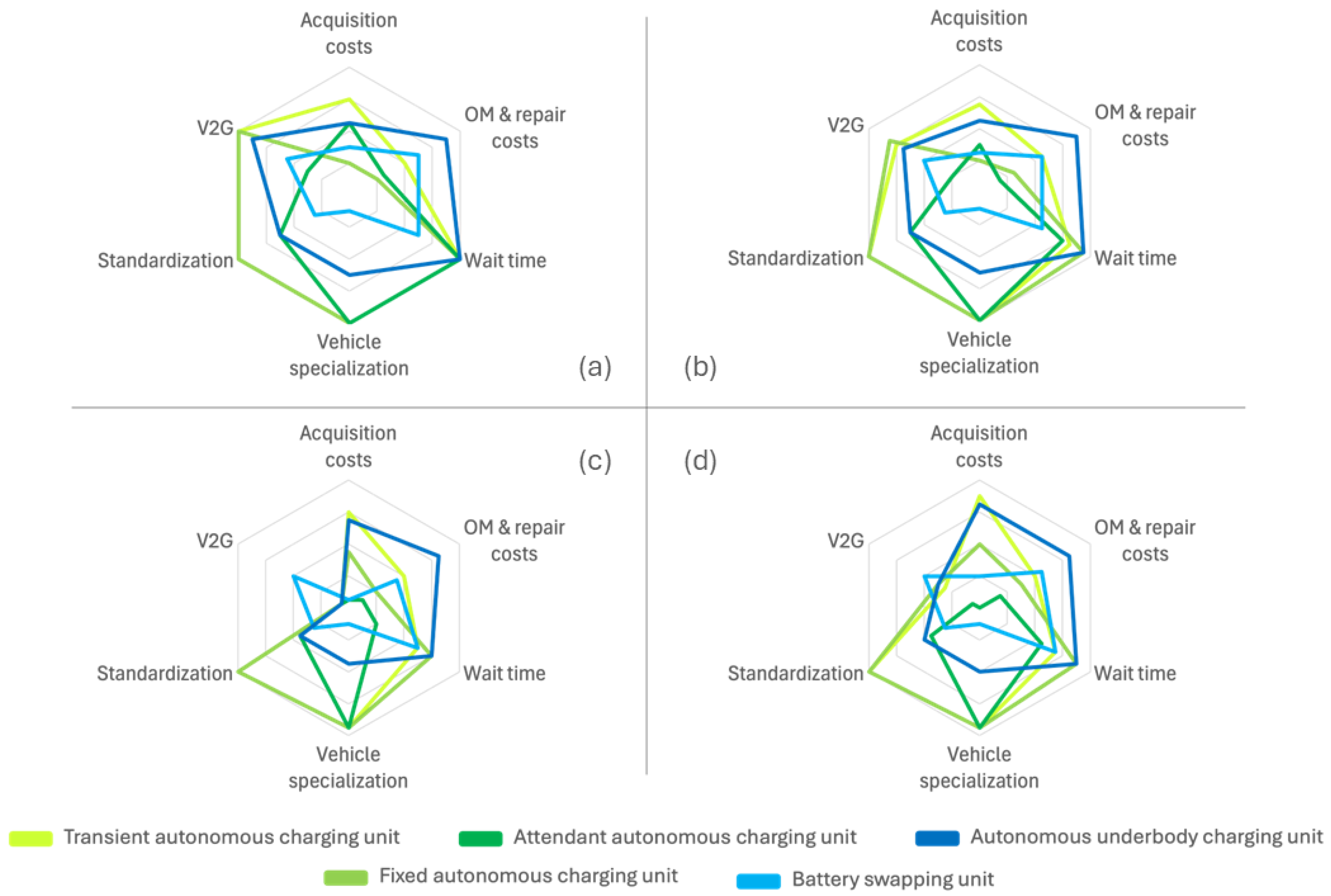
Figure 2 is a graphic representation of the combined expert assessments of the automated charging technologies with respect to the criteria depending on the parking scenario. The alternatives are ranked according to their final values, which, as a result of the introduced scale, range from 0 to 4 (see
Appendix A,
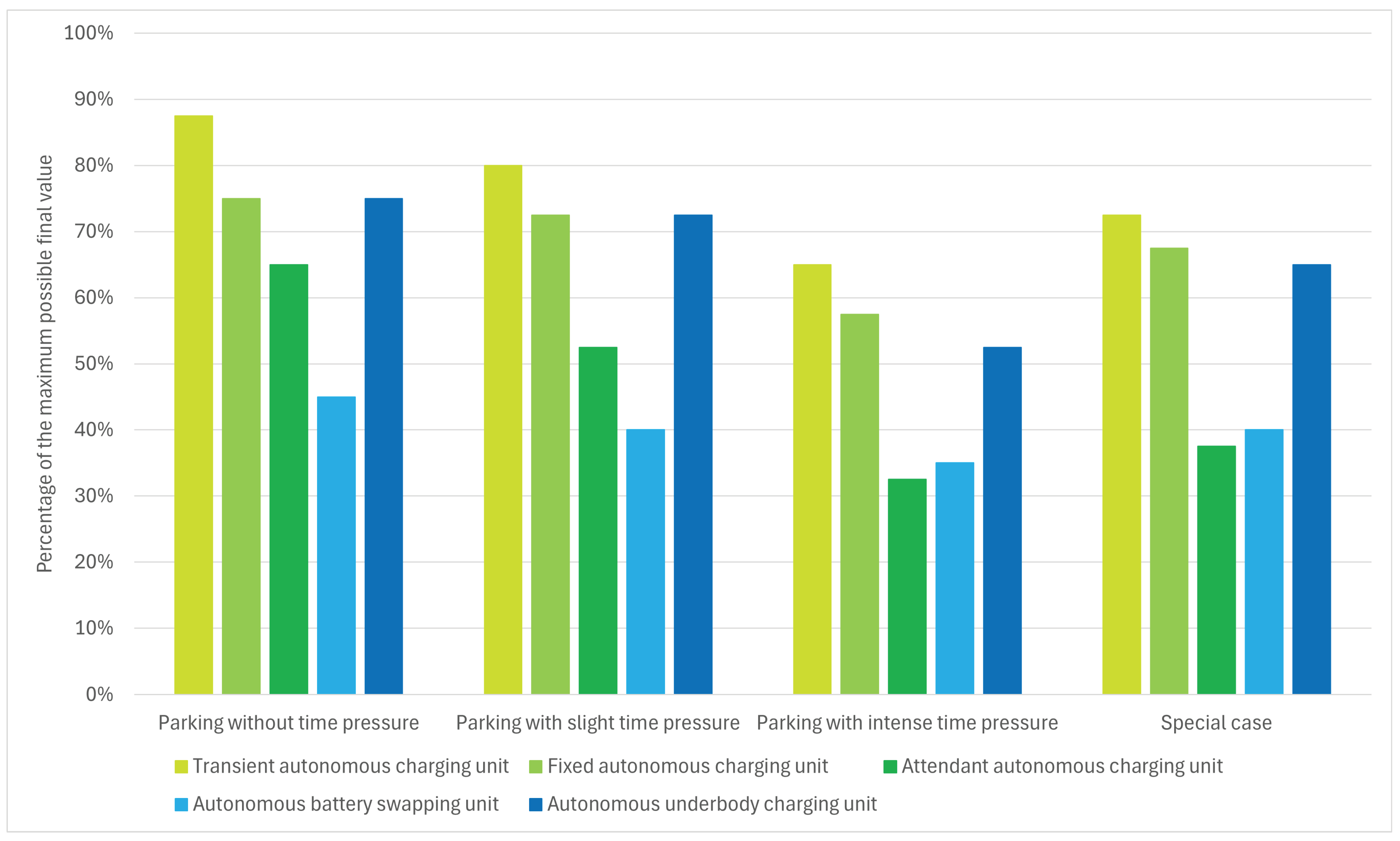
Table A5). A graphic representation of the final values can be seen in
Figure 3. It is important to note that, in
Figure 3, the final values are expressed as percentages of the maximum possible value, i.e., 4.
As can be seen in
Figure 3, the automated charging technologies exhibit the highest final values in use cases without time pressure, such as long-term parking at the airport. Therefore, use cases without time pressure show the highest potential for automated and grid-supportive charging compared to the use cases of the other parking scenarios. Combinations with the highest final values, that is, a performance greater than 80%, are:
Transient autonomous charging units and use cases without time pressure (final value of 3.8);
Fixed autonomous charging units and use cases without time pressure (final value of 3.6);
Transient autonomous charging units and use cases with slight time pressure (final value of 3.5);
Fixed autonomous charging units and use cases with slight time pressure (final value of 3.4).
Also evidenced by
Figure 3 is that, with increasing time pressure, the final values of the technology–use case combinations decrease. The main reason for this is the decreasing suitability of use cases for V2G as time pressure increases coupled with the strong weighting of 29.2% of the corresponding criterion. The less time vehicle batteries are connected to the grid, that is, the higher the time pressure, the less they contribute to stabilizing a grid with a high share of renewable energy. In addition to reduced V2G capability, waiting times increase as time pressure rises due to parking scenarios with fewer spaces and more vehicles needing to charge simultaneously. In use cases with intense time pressure, the automated charging technologies exhibit the lowest final values compared to the other parking scenarios. The combinations with the lowest final values, that is, a performance under 40%, are:
Autonomous underbody charging units and use cases with intense time pressure (final value of 1.5);
Autonomous battery swapping units and use cases without time pressure (final value of 1.4);
Autonomous battery swapping units and the special case (final value of 1.3);
Autonomous battery swapping units and use cases with slight time pressure (final value of 1.3);
Autonomous battery swapping units and use cases with intense time pressure (final value of 1.2).
As can be seen in
Figure 3, transient and fixed autonomous charging units exhibit the highest final values compared to the other charging technologies regardless of the parking scenario. The main reasons for this are that vehicle retrofitting is not required (coupled with the strong weighting of 42% of the corresponding criterion), there is a comparatively high number of international standards available [
7], and, since the vehicles are continuously connected via cable to the grid, charging is possible in a grid-supportive manner. Furthermore, transient autonomous charging units have the potential for low acquisition costs as the number of required robots is comparatively low and the necessary set of wall boxes and rails is comparatively inexpensive. Fixed autonomous charging units have the potential for low waiting times as every parking space is equipped with a charging robot and the waiting time depends solely on the number of vehicles to be charged. These strengths are evidenced by
Figure 2.
Figure 3 also demonstrates that, regardless of the parking scenario, autonomous battery swapping units exhibit the lowest final values compared to the other charging technologies. The reasons for this are the comparatively high need for vehicle retrofitting, the lack of international standards [
7], the high acquisition costs that characterize a swapping station, and the waiting time associated with battery swapping technology (see
Figure 2). Furthermore, in use cases without time pressure, the driver must queue at the swapping station, wait for the battery exchange to be completed, and then park, whereas other charging technologies allow drivers to simply park and leave the vehicle.
Both autonomous underbody charging units and attendant autonomous charging units fall between the above-mentioned groups of automated charging technologies with respect to the potential for grid-supportive charging. Wireless chargers have the potential for comparatively low acquisition costs as no complex robotics is required. Furthermore, the operation, maintenance, and repair costs are the lowest compared to the other charging technologies since the ground unit is embedded in the pavement and does not contain any moving parts (see
Figure 2). In addition, since every parking space is equipped with charging technology, waiting time is reduced to the number of vehicles to be charged. The potential of wireless chargers is limited since vehicle retrofitting is required and only a limited number of standards exist [
7].
The challenge with attendant autonomous charging units is that the vehicles’ V2G potential cannot be exploited because they are not connected to the grid while charging. However, the batteries used to charge the vehicles can perform bidirectional charging when they themselves are being charged from the grid. Attendant autonomous charging units have the advantage that they do not require vehicle retrofitting. However, the number of international standards is low, and, as the robots remain with the vehicles during the charge, the waiting time can be long. Furthermore, attendant autonomous charging units are accompanied by high acquisition and operation, maintenance, and repair costs due to costly batteries, the comparatively high number of necessary robots, many wear parts, and direct exposure to the environment (see
Figure 2).
As a special case, a taxi stand is considered, characterized by taxis waiting in line for customers. It is assumed that customers only approach the taxi at the front of the line. When the taxi leaves the taxi stand, the other taxis move forward. The charging infrastructure is presumed to be installed in parallel to the taxi line at all the parking spaces. Although they require constant plugging as the taxis move toward the start of the line, transient and fixed autonomous charging units exhibit the highest final values (see
Figure 3). As evidenced by
Figure 2 the reasons for this are rooted in vehicle retrofitting and standardization. In the special case, attendant autonomous charging units present two key disadvantages: they necessitate a greater number of robots (and batteries) than vehicles to maintain continuous charging of all the taxis, and their mobility is redundant as the vehicles themselves move between parking spaces. With autonomous battery swapping units, the disadvantage is that the inevitable waiting time of taxis for customers at the taxi stand is not used sensibly, for example, for charging. In the case of autonomous underbody charging units, a limitation lies in the reduced V2G capability due to the continuous movement of vehicles (see
Figure 2).
5. Discussion
Although the purpose of the weighted point rating system is to provide a ranking of alternatives [
38], the established ranking is not the main contribution of this study. Since most final values differ only slightly, the ranking should be interpreted with consideration rather than as an absolute ordering. The focus lies in analyzing the differences between the technology–use case combinations with respect to the criteria in order to identify advantages, disadvantages, opportunities, and challenges. These differences, together with the weights of the criteria, form the basis for deriving conclusions about potential charging technologies and use cases for automated and grid-supportive charging, which represents the main contribution of this study.
It should be noted that the assessment focuses on the technical, operational, and economic suitability of automated charging technologies for different vehicle applications. By identifying the most suitable technologies for reliable vehicle-to-grid (V2G) integration, the presented framework contributes to enabling the environmental and resource-efficiency benefits associated with V2G. A direct assessment of these sustainability impacts is beyond the scope of this study.
Figure 2 compares the performance of the automated charging technologies across the criteria for different parking scenarios and highlights their advantages, disadvantages, opportunities, and challenges. For instance, equipping parking spaces in a long-term airport car park with stationary charging robots offers multiple advantages: no waiting times, no need for vehicle retrofitting, and the application of a comparatively mature and established charging technology. Additionally, there is a chance of high V2G capability. The disadvantages of this technology–use case combination include relatively high acquisition and operation, maintenance, and repair costs. In comparison, charging robots running on rails outperform fixed charging robots by reducing costs while maintaining the same advantages and opportunities.
Besides the differences between the technology–use case combinations regarding the criteria, the performance of a single technology–use case combination with respect to the criteria should be examined to identify weak points. For technology–use case combinations with high final values, it is recommended to address weak points with a resource input that depends on the weights of the respective criteria [
38]. For example, weak points of fixed charging robots in a long-term airport car park include high acquisition as well as operation, maintenance, and repair costs (see
Figure 2a). Efforts should be made to mitigate these weaknesses since the technology–use case combination shows high potential for grid-supportive charging, although always in accordance with the criteria weights. Only examining the final value of an alternative is not sufficient as the weighted point rating system allows poor performance regarding one criterion to be partially offset by good performance regarding another criterion (depending on the weights), which may conceal weak points [
42].
The final values obtained with the weighted point rating system depend on the weights and assessments of the criteria. For example, due to the focus of the study on V2G and the consequent strong weighting of the V2G capability criterion, the final values decrease with increasing time pressure (see
Figure 3). This correlation is clearly observable for transient and fixed autonomous charging units, as well as autonomous underbody charging units. For autonomous battery swapping units and attendant autonomous charging units, the correlation is less pronounced as V2G is performed by batteries in swap stations or at charging points, which reduces both V2G capability and dependency on time pressure. The authors deem the dependency on weights and assessments, that is, the setting of decision-making, reasonable as the weighted point rating system is a method to assist decision-making by individuals with preferences [
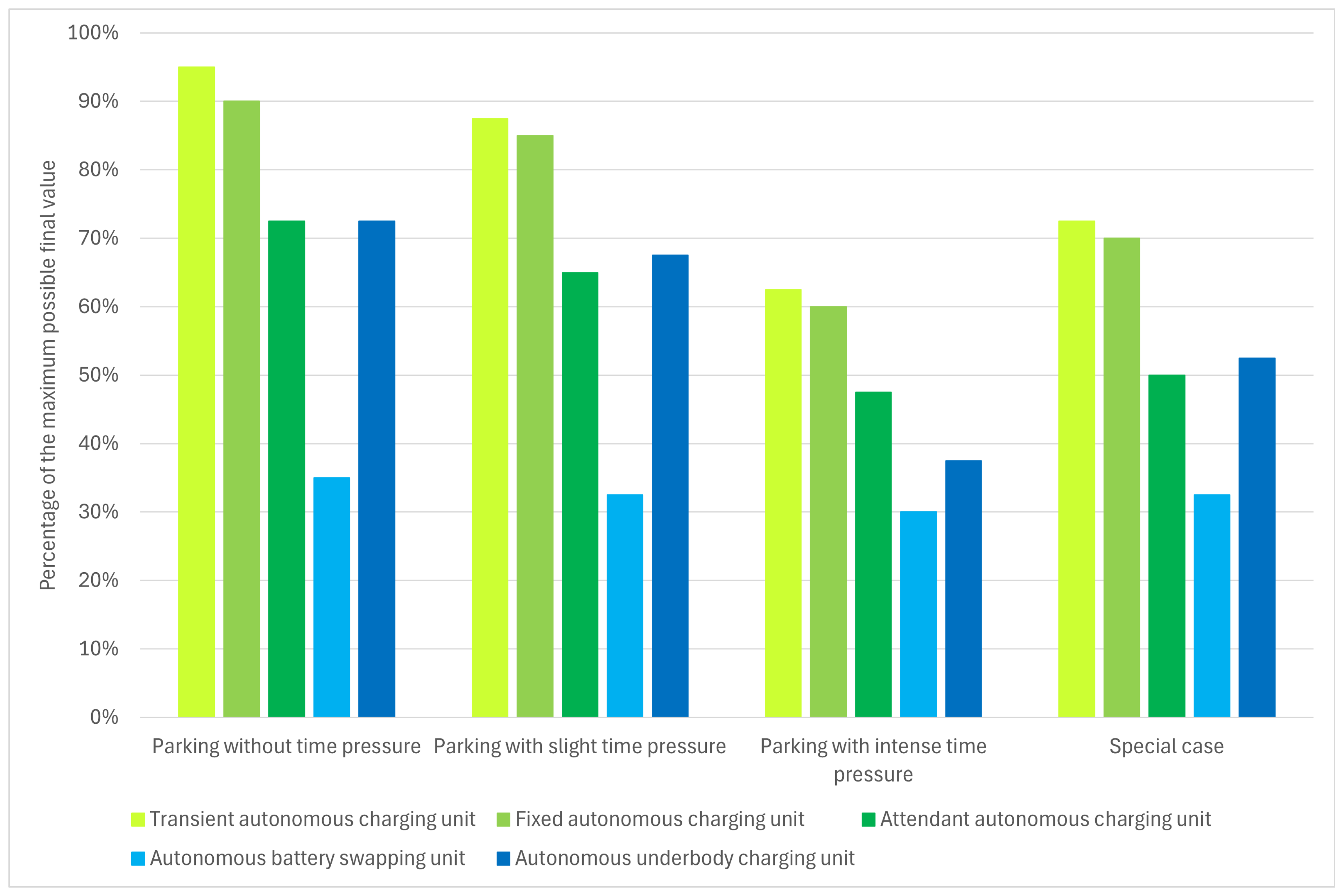
38]. However, as a result, the decision recommendation strongly depends on the individuals, in this case, experts with an academic background. To examine the influence of the criteria weights on the final values and the resulting ranking, the weighted point rating system was nevertheless repeated with identical criteria weights. As shown in
Figure 4, the main trend, namely that the potential of automated charging technologies for grid-supportive charging decreases with increasing time pressure, remains, although it is less pronounced. The automated charging technologies still achieve the highest final values in use cases without time pressure, and transient and fixed autonomous charging units continue to outperform the other charging technologies across all the parking scenarios. At the same time,
Figure 4 indicates that autonomous underbody charging units have considerable potential provided that retrofitting costs can be reduced, whereas mobile charging robots on wheels lose competitiveness if retrofitting is no longer a limiting factor. Finally, although their final values increase across all the parking scenarios, battery swapping units still remain behind the other charging technologies.
Subjective and arbitrary influences on the weighting and assessment of the criteria are reduced by performing pairwise comparisons of criteria according to the AHP to obtain criteria weights [
43] and by combining the separate expert assessments through averaging. It should be noted that the weighted point rating system, in combination with the AHP, does not consider uncertainties regarding the weights and assessments of criteria [
44].
The weighted point rating system facilitates decisions by ranking alternatives [
38]. The quality of the decision depends on the integrity of the list of alternatives. In this study, automated charging technologies and use cases are first generated through literature research and creativity techniques and then grouped for reasons of scope and clarity. As with any summary, information is lost. However, as the aim of this study is to provide a first look at potential technology–use case combinations for automated and grid-supportive charging, we deem the information loss reasonable. Investigating combinations with high potential in more detail can serve as a subject of future research. In addition to a complete set of alternatives, the quality of the decision depends on whether all the relevant criteria are considered in the assessments. Here, experts with different scientific backgrounds generate and select criteria to ensure that all the relevant factors are included in the study [
38]. The criteria considered in this study complement those investigated by Hirz and Lippitsch [
39].
Finally, it is important to note that the final values are based on criteria assessments made at the time of writing and do not represent future projections [
38].
6. Conclusions
The current development efforts in the fields of electric mobility, vehicle automation, and renewable energy highlight the need for studies to investigate potential synergies between these areas of progress. The combination of vehicle electrification and automation inevitably leads to the development of automated charging technologies. The existing solutions include stationary and mobile charging robots, battery swapping systems, wireless power transfer, and underbody couplers. The potential use cases for automated charging technologies can be differentiated based on the level of time pressure involved.
In this study, the combination of automated charging technologies and use cases is investigated with respect to its potential for grid-supportive charging using a weighted point rating system. This methodology provides a ranking of alternatives based on expert assessments of weighted criteria. The evaluated criteria include acquisition costs, operation, maintenance and repair costs, charging wait time, degree of vehicle customization, degree of standardization of the technology–use case combination, and V2G capability. The criterion “V2G capability” arises from combining the fields of e-mobility and renewable energy in search of potential synergies. According to the weighted point rating system, charging technologies employing a robot on rails or a stationary robot perform the best with respect to the evaluated criteria regardless of the parking scenario. Battery swapping, on the other hand, performs the worst compared to the alternative charging technologies across all the parking scenarios. The use cases with the highest potential are those involving little or no time pressure, such as long-term airport parking. The least suitable use cases are scenarios with high time pressure, such as motorway service stations. The ranking provided in this study not only depends on the weighting and assessment of all the relevant criteria and alternatives but should also be interpreted with caution as aggregated rankings may mask specific strengths, weaknesses, opportunities, and challenges of individual alternatives. To reduce subjective and arbitrary influences, the weighted point rating system was combined with the analytic hierarchy process (AHP).
This study demonstrates that the sustainability potential of automated charging strongly depends on the specific combination of charging technology and use case. Technologies requiring extensive vehicle modifications may impede large-scale adoption and negatively affect both economic and environmental sustainability. As expected, the highest potential for V2G applications is identified in long-term parking scenarios. At the same time, the results clearly indicate that technologies enabling a continuous connection between the vehicle and the charging infrastructure provide the greatest potential for grid-supportive operation. Consequently, this study provides a systematic assessment of the combination of automated charging and V2G technologies with respect to their contribution to more sustainable energy and mobility systems. Furthermore, the findings emphasize that the grid-supportive integration of automated charging is only feasible for specific technology–use case combinations. The presented results can therefore serve as a valuable planning and decision-making basis for the future deployment of automated charging solutions. As a next step, the promising technology–use case combinations identified in this study could be evaluated quantitatively through detailed simulation studies incorporating real-world fleet trajectory data, grid constraints, and renewable energy generation profiles.