1. Introduction
Environmental, social, and governance (ESG) disclosure has become one of the most consequential developments in contemporary corporate reporting and capital market governance. Across global markets, ESG information is increasingly treated as financially material because investors, regulators, and other stakeholders now view sustainability-related transparency as relevant to risk pricing, market confidence, and long-term corporate resilience. This shift is visible in the scale of sustainable finance itself. The Global Sustainable Investment Review 2024 reports that assets using responsible or sustainable investment approaches reached USD 16.7 trillion, increasing by nearly USD 5.5 trillion over the preceding two years, while Morningstar reported that global sustainable fund assets reached a record USD 3.2 trillion at the end of 2024 [
1,
2]. At the same time, sustainability disclosure is being institutionalized through regulatory convergence. The Financial Stability Board reported that 19 of 24 member jurisdictions had introduced climate-related disclosure regulations, guidance, or roadmaps, while 17 jurisdictions had adopted or proposed disclosure approaches aligned with ISSB or TCFD frameworks, indicating a clear movement toward more standardized sustainability reporting worldwide [
3,
4]. In this environment, ESG disclosure is no longer merely symbolic reporting; it increasingly functions as information that can shape investor expectations about uncertainty, downside exposure, and corporate risk.
This global shift has stimulated growing academic interest in the relationship between ESG disclosure and firm risk. From a theoretical perspective, stakeholder theory suggests that firms with stronger ESG transparency may reduce conflict with key stakeholders and thereby lower reputational, regulatory, and operational uncertainty. Signaling theory further implies that ESG disclosure can reduce information asymmetry by signaling superior managerial quality, long-term orientation, and stronger non-financial governance practices. Agency theory adds that disclosure may reduce managerial opportunism and improve monitoring, especially when supported by stronger board oversight. Empirically, a recent meta-analysis of 76 studies found that ESG disclosure is, on average, associated with lower firm risk, although the effect differs across settings, measures, and institutional environments [
5,
6,
7]. More recent evidence also shows that ESG-related practices can mitigate risk under conditions of environmental uncertainty, but the strength and consistency of this effect remain context-dependent [
8,
9]. Thus, while the broader literature increasingly supports a risk-reducing role for ESG disclosure, the evidence remains far from uniform, particularly in emerging markets where disclosure regimes, governance quality, and investor responses are still evolving.
These issues are especially salient in Saudi Arabia, where the economy and capital market are undergoing major transformation under Vision 2030. The country’s diversification strategy has accelerated the role of non-oil activities, which accounted for 52.2% of total GDP in the third quarter of 2024, while real GDP grew by 2.8% year-on-year, supported by a 4.3% increase in non-oil activities [
10]. This structural transition has been mirrored by notable expansion in the Saudi capital market. According to the Saudi Exchange Annual Statistical Report 2024, the market had 247 listed companies, total market capitalization of approximately SAR 10.2 trillion, and annual traded value of around SAR 1.86 trillion, which represented a 39.7% increase over the previous year; the market also recorded 15 IPOs in 2024 [
11]. These figures indicate a market of increasing depth, visibility, and strategic importance. In parallel, Saudi Arabia has taken visible steps to encourage sustainability-related reporting. Saudi Exchange introduced ESG disclosure guidelines for listed companies in 2021 to improve awareness, comparability, and transparency in ESG reporting, while the updated corporate governance regulations continue to emphasize transparency, credibility, stakeholder protection, and board accountability [
12,
13]. Collectively, these developments make Saudi Arabia a timely and relevant context in which to examine whether ESG disclosure has begun to exert a measurable influence on firm-level risk.
Despite this momentum, a key empirical problem remains unresolved. Much of the existing Saudi ESG literature has examined firm performance, profitability, financial sustainability, or firm value, but far less attention has been paid to firm risk as the central outcome of interest. Recent studies on Saudi listed firms generally report that ESG disclosure is associated with stronger accounting performance, improved profitability, or better firm valuation, suggesting that sustainability transparency may generate favorable financial outcomes [
14,
15,
16,
17]. However, these findings do not directly answer whether ESG disclosure reduces risk exposure, volatility, or uncertainty. This distinction matters because firm risk is not simply another corporate outcome; it is a core dimension through which investors, creditors, and regulators evaluate resilience, solvency, and confidence in future cash flows. In other words, a firm may appear profitable or highly valued while still facing substantial risk. For that reason, focusing specifically on firm risk provides a more direct test of whether ESG disclosure performs a stabilizing function in the corporate setting.
A second issue concerns the Saudi institutional context itself. Evidence from developed markets cannot be assumed to apply automatically to Saudi Arabia because the country is characterized by a distinctive combination of rapid regulatory modernization, evolving ESG practice, varying disclosure quality, and governance structures that may differ from those in mature Western markets. Saudi Exchange’s ESG guidelines are intended to encourage reporting and support sustainable capital market development, but the reporting environment remains comparatively young and still in transition [
18]. This means the effectiveness of ESG disclosure in reducing risk is ultimately an empirical question rather than a foregone conclusion. A third issue is methodological. A considerable portion of existing regional work relies on static panel estimators such as pooled OLS, fixed effects, or random effects, which may be insufficient in the presence of endogeneity, reverse causality, and dynamic persistence. In the ESG–risk setting, endogeneity is especially plausible because lower-risk firms may be more willing and able to invest in better disclosure, while higher-risk firms may disclose strategically to reassure stakeholders. In addition, firm risk is inherently dynamic, since present risk often depends on prior risk. Under such conditions, dynamic System GMM is more suitable because it helps address simultaneity, unobserved heterogeneity, and the lagged structure of the dependent variable [
19].
Another important gap concerns governance contingency, particularly the moderating role of board independence. Agency theory suggests that the impact of ESG disclosure depends not only on the disclosure itself but also on whether governance mechanisms make that disclosure credible. Independent directors are generally expected to improve monitoring quality, constrain managerial opportunism, and strengthen the reliability of corporate reporting. In the Saudi setting, where governance reforms continue to evolve, board independence may therefore play an important role in determining whether ESG disclosure genuinely reduces firm risk or merely reflects compliance-oriented reporting. Although Saudi corporate governance regulations increasingly emphasize board oversight and transparency, empirical evidence on whether board independence strengthens the ESG disclosure–risk relationship remains limited [
20]. This omission restricts our understanding of the conditions under which ESG disclosure becomes effective as a risk-mitigation mechanism.
Against this background, the present study offers a clear analytical contribution. First, it shifts the Saudi ESG discussion from performance- and value-oriented outcomes toward firm risk, which is a more direct indicator of corporate vulnerability and resilience. Second, it examines Tadawul-listed companies over 2015–2024, a period that captures Saudi Arabia’s intensifying market reforms, governance strengthening, and sustainability transition. Third, it applies dynamic System GMM, thereby improving on static approaches by addressing endogeneity and the persistence of firm risk. Fourth, it incorporates board independence as a moderating variable, extending the literature beyond direct ESG effects to test whether governance quality enhances the risk-reducing role of disclosure. Against this background, the study is guided by two central research questions: (i) Does ESG disclosure reduce firm risk among Tadawul-listed companies in Saudi Arabia? (ii) Does board independence moderate the relationship between ESG disclosure and firm risk? To answer these questions, the study pursues four specific objectives: first, to estimate the direct effect of ESG disclosure on firm risk; second, to test whether board independence moderates this effect; third, to assess the roles of leverage and profitability as financial determinants of firm risk; and fourth, to control for liquidity, firm size, current ratio, capital expenditure, and board size within a dynamic System GMM panel framework. In doing so, the study treats firm risk rather than firm value or profitability as the central outcome of interest.
The remainder of this paper is organized as follows.
Section 2 presents the theoretical framework and reviews the related empirical literature and develops the study’s hypotheses.
Section 3 describes the data sources, variables, and the dynamic System GMM methodology.
Section 4 reports the descriptive statistics, diagnostic tests, and the baseline and moderation estimation results.
Section 5 discusses the findings in relation to theory and prior evidence. Finally,
Section 6 concludes the study and presents the policy recommendations, limitations, and directions for future research.
3. Data Sources and Methodology
The study uses secondary panel data for 73 Tadawul-listed companies over the period 2015–2024, and the final firm-year dataset is compiled from four main sources: Saudi Exchange (Tadawul) disclosures, companies’ audited annual reports, and a standardized ESG database (LSEG/Refinitiv). In line with this source structure, the dependent variable, firm risk (FRISK), is measured from historical share-price data obtained from Saudi Exchange by computing annual stock return volatility. The main independent variable, ESG disclosure (ESGD), is collected from LSEG ESG scores, which are based on structured public-disclosure methodologies. The remaining independent variables, leverage (LEV) and profitability (PROF), are extracted from audited financial statements, where leverage is computed from debt relative to assets and profitability is measured using ROA. The moderating variable, board independence (BIND), is taken from annual reports and governance disclosures and measured as the proportion of independent directors on the board. The control variables—liquidity (LIQ), firm size (SIZE), current ratio (CR), capital expenditure (CAPEX), and board size (BSIZE)—are likewise drawn from financial statements and governance reports using standard accounting and governance definitions.
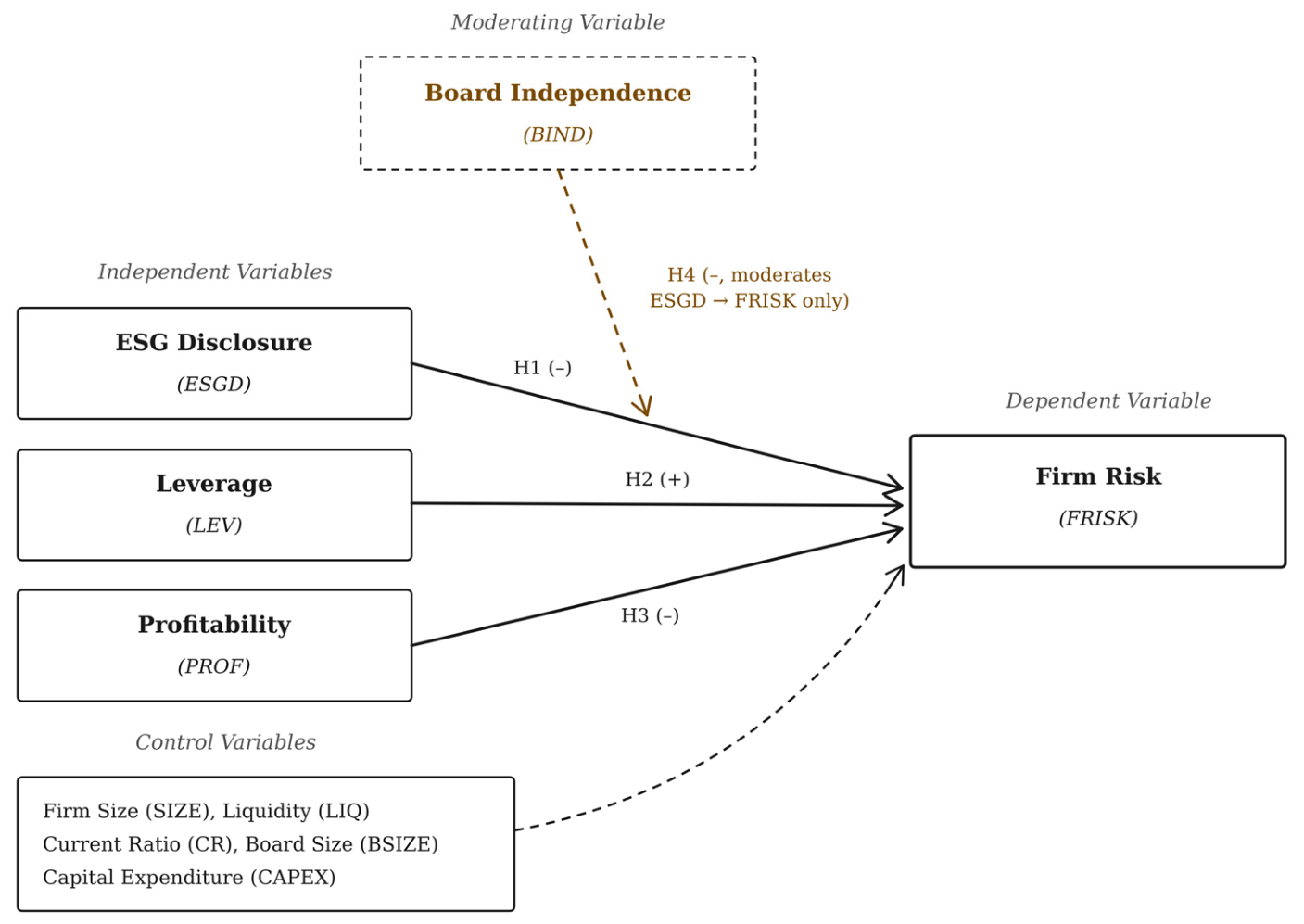
Figure 1 shows the research framework. In the framework, board independence (BIND) moderates specifically the relationship between ESG disclosure (ESGD) and firm risk (FRISK), corresponding to hypothesis H4; it is not modelled as a moderator of the leverage–risk or profitability–risk paths. The direct paths from ESG disclosure, leverage, and profitability to firm risk correspond to hypotheses H1, H2, and H3, respectively, and the expected sign of each relationship is indicated on the corresponding arrow, while the control variables enter the model as direct determinants of firm risk without an associated hypothesis. The framework has been revised so that it now aligns exactly with the four hypotheses: ESG disclosure, leverage, and profitability are shown as direct predictors of firm risk (H1–H3), and board independence is drawn as a moderator acting solely on the ESG disclosure–firm risk relationship (H4), rather than as a moderator of every independent variable or as a variable that directly increases or decreases firm risk.
The data collection procedure proceeds in a structured sequence suitable for dynamic System GMM estimation. The sample is constructed from the population of companies listed on the Saudi Exchange (Tadawul). Consistent with common practice in ESG–risk research, financial firms (banks, insurance companies, and other financial institutions) are excluded because their capital structure, regulatory environment, and accounting treatment differ fundamentally from those of non-financial firms and would distort the leverage and risk measures. From the remaining non-financial population, firms are retained only if they have continuous market, ESG, accounting, and governance data over 2015–2024, yielding a balanced panel of 73 firms and 720 firm-year observations spanning the main non-financial sectors of the exchange, including materials, energy, utilities, consumer staples and discretionary, industrials, health care, real estate, communication services, and information technology. Firms with insufficient continuous coverage, and firm-years with missing values on any model variable, are dropped rather than imputed, so that the reported estimates are based only on fully observed firm-years. Second, historical price data are downloaded to calculate the firm-risk proxy on a consistent annual basis. Third, ESG scores are extracted directly from LSEG. Fourth, accounting data required for leverage, profitability, liquidity, current ratio, firm size, and capital expenditure are collected from audited annual statements. Fifth, governance information is hand-collected from annual reports to determine board independence and board size. After collection, all firm-year observations are merged into a single panel dataset, variable definitions are standardized, and missing values are handled transparently. The resulting panel is then analyzed using two-step dynamic System GMM, which is appropriate because firm risk is persistent over time and the relationships between ESG disclosure, governance, and firm risk may suffer from endogeneity, reverse causality, and unobserved firm-specific heterogeneity.
3.1. Variables Description
The dependent variable, firm risk (FRISK), refers to the degree of uncertainty surrounding a firm’s market performance and is commonly measured by stock return volatility, operationalized in this study as the annualized standard deviation of daily stock returns, computed as the daily standard deviation for each firm-year multiplied by the square root of 252 trading days. This proxy is appropriate because it captures how investors respond to changes in firm-specific and market-related information, making it a widely accepted market-based indicator of corporate risk. In recent ESG–risk research, stock return volatility has remained a standard way to operationalize firm risk when examining whether sustainability-related disclosure influences uncertainty and downside exposure [
8,
17,
34]. The principal independent variable, ESG disclosure (ESGD), reflects the extent and quality of a firm’s publicly disclosed environmental, social, and governance information. In this study, ESG disclosure is measured using the LSEG (Refinitiv) ESG score, which grades the scope, transparency, and comparability of a firm’s publicly reported environmental, social, and governance information. It is important to distinguish ESG disclosure from ESG performance: disclosure refers to the extent and quality of the information a firm makes public, whereas performance refers to the underlying environmental and social outcomes themselves. Because the LSEG score is built from verifiable, publicly reported data, it is best understood as a disclosure-based construct, and it is used here as a proxy for ESG disclosure rather than for realized ESG performance [
35]. The other independent variables are leverage (LEV) and profitability (PROF). Leverage is measured as total debt divided by total assets, reflecting the degree of financial dependence on debt and the firm’s exposure to repayment pressure, while profitability is measured by return on assets (ROA), defined as net income divided by total assets, to capture earnings-generating capacity and operational strength. These variables are included because leverage represents financial vulnerability, whereas profitability reflects internal financial resilience and a stronger ability to absorb shocks [
8].
Table 1 shows the description of variables.
The moderating variable, board independence (BIND), is measured as the proportion of independent directors on the board, that is, the number of independent directors divided by total board size. This is a standard governance proxy used to capture the strength of board monitoring and the credibility of corporate disclosure. Saudi evidence supports the relevance of this measure, as board independence has been shown to be positively associated with ESG disclosure among listed firms, indicating that more independent boards are better able to support transparent reporting practices [
30,
36,
37]. The control variables are included to isolate the net effects of the main explanatory variables on firm risk. Liquidity (LIQ) and the current ratio (CR) both capture short-term solvency but are deliberately defined so that they do not overlap. To avoid the redundancy of using two identical current-ratio measures, LIQ is measured as the quick (acid-test) ratio, that is, current assets minus inventory divided by current liabilities, while CR is measured as current assets divided by current liabilities. Because inventory is excluded from the numerator of LIQ, the two variables are related but not identical, which is consistent with their moderate rather than near-unity correlation. Firm size (SIZE) is commonly measured as the natural logarithm of total assets, reflecting scale, diversification potential, and market presence. Capital expenditure (CAPEX) is typically measured as capital expenditure scaled by total assets, indicating investment intensity and long-term asset expansion, while board size (BSIZE) is measured as the total number of directors on the board. Together, these controls account for differences in financial flexibility, scale, investment behavior, and governance structure, all of which may independently shape firm risk and therefore need to be held constant in the empirical model [
30,
38,
39].
3.2. Estimation Method
Because the research question primarily concerns the within-firm association between ESG disclosure and firm risk over time, a two-way (firm and year) fixed-effects model is adopted as the primary specification. High-dimensional fixed effects absorb all time-invariant firm-specific heterogeneity (for example, sector, ownership structure, and business model) as well as common annual macro-financial shocks, which removes a major source of omitted-variable bias in a market as concentrated as the Saudi market, and their coefficients have a transparent within-firm interpretation that is well suited to this sample of 73 firms observed over 2015–2024. For this reason, the fixed-effects estimates are reported as the main benchmark against which the hypotheses are evaluated. Dynamic System GMM is retained as a complementary robustness estimator rather than the leading specification, because firm risk may also be persistent over time and because ESG disclosure may be subject to reverse causality (for example, lower-risk firms being more able to invest in disclosure) that a static fixed-effects model cannot fully resolve. System GMM addresses these concerns by jointly estimating equations in first differences and levels and instrumenting potentially endogenous regressors with their own lags [
40,
41,
42,
43,
44,
45,
46]. Its use here is deliberately cautious: with a cross-sectional dimension of only 73 firms, System GMM operates outside the large-N, small-T setting for which it was originally designed, so it is used to corroborate the fixed-effects findings rather than to replace them. Accordingly, the baseline dynamic model is specified as:
where FRISK
it is firm risk, FRISK
it–1 is the lagged dependent variable, ESGD
it is ESG disclosure, LEV
it is leverage, PROF
it is profitability, BIND
it is board independence, LIQ
it is liquidity, SIZE
it is firm size, CR
it is the current ratio, CAPEX
it is capital expenditure, and BSIZE
it is board size. To test the moderating role of board independence, the moderating model is specified as:
In the moderation model, the interaction term ESGD
it × BIND
it captures whether board independence strengthens the effect of ESG disclosure on firm risk. A negative coefficient on ESGD would indicate that ESG disclosure reduces firm risk, while a negative coefficient on the interaction term would show that this risk-reducing effect becomes stronger when board independence is higher. Consistent with System GMM practice, model validity should be assessed using the Arellano–Bond AR(1) and AR(2) tests and the Hansen test of overidentifying restrictions, with attention to limiting instrument proliferation for reliable inference [
40,
44].
Accordingly, the empirical strategy proceeds in two stages. The two-way (firm and year) fixed-effects model is estimated first and serves as the primary benchmark: it describes the within-firm conditional associations while absorbing time-invariant firm heterogeneity and common annual shocks, and the study’s hypotheses are assessed principally against these estimates. The dynamic System GMM estimator is then reported as a robustness stage that probes whether the fixed-effects conclusions survive once the persistence of firm risk and potential reverse causality (for example, lower-risk firms being more able to invest in disclosure) are taken into account. Reading the two sets of results together allows the endogeneity-corrected estimates to be compared with the primary within-firm associations, so that any inference is supported by both a transparent baseline and a dynamic robustness check rather than resting on the dynamic-panel estimator alone.
The System GMM specification is disclosed as follows. The lagged dependent variable and ESG disclosure are treated as endogenous and are instrumented with their own lags in the GMM style; leverage, profitability, board independence, and the ESG disclosure × board independence interaction are treated as predetermined; and firm size, liquidity, the current ratio, capital expenditure, and board size are treated as strictly exogenous and enter as standard (IV-style) instruments. To limit instrument proliferation in a panel of 73 firms, the instrument set is restricted by using a limited number of lags (lags two and three) and by collapsing the instrument matrix, which keeps the total number of instruments (39) well below the number of cross-sectional units. The estimator is run in two steps with Windmeijer’s finite-sample correction for the standard errors to avoid the downward bias associated with two-step GMM. For the level equation, lagged first differences in the endogenous and predetermined regressors are used as instruments, while lagged levels are used for the equation in first differences. The validity of these choices is assessed using the Arellano–Bond AR(1) and AR(2) tests for serial correlation and the Hansen J test of overidentifying restrictions, rather than being assumed.
4. Results and Analysis
Table 2 reports the descriptive statistics for the variables used in the study. The mean value of FRISK is 0.075, with a standard deviation of 0.052, indicating a moderate level of firm risk with noticeable variation across the sampled firms. ESGD has an average of 50.829, ranging from 20 to 90, which shows substantial differences in ESG disclosure practices among Tadawul-listed companies. LEV records a mean of 0.360, suggesting that debt represents about 36% of total assets on average, while PROF has a mean of 0.096, indicating that most firms are generally profitable. For the governance and control variables, BIND has a mean of 0.441, showing that independent directors account for about 44.1% of board membership on average. LIQ and CR have mean values of 0.684 and 1.947, respectively, indicating an overall acceptable liquidity position among the firms. SIZE averages 16.439, while CAPEX has a mean of 0.092, suggesting moderate investment intensity. Finally, BSIZE has an average of 8.685 directors, with values ranging from 6 to 11.
Table 3 reports the correlation matrix for the explanatory variables. The results show that all correlation coefficients are below 0.80, indicating that multicollinearity is not likely to be a serious problem. ESGD is positively correlated with PROF (0.386), BIND (0.578), LIQ (0.142), SIZE (0.223), CR (0.181), and CAPEX (0.252), while it is negatively related to LEV (−0.281). This suggests that firms with higher ESG disclosure tend to be more profitable, have more independent boards, and maintain stronger financial conditions. Among the other variables, LEV is negatively associated with most indicators, whereas SIZE shows a small positive correlation with leverage (0.158). The strongest correlation appears between LIQ and CR (0.712), which is expected since both reflect short-term financial strength.
Table 4 presents the variance inflation factor (VIF) results used to assess multicollinearity among the explanatory variables. The findings show that all VIF values are very low, ranging from 1.031 to 2.175, with a mean VIF of 1.321. Since all values are well below the commonly accepted threshold of 10, and even below the stricter threshold of 5, the results indicate that multicollinearity is not a serious concern in this study. Among the variables, ESGD has the highest VIF value (2.175), followed by BIND (1.598), while the remaining variables report values close to 1. This suggests that the explanatory variables are sufficiently independent from one another and can be included together in the regression model without causing instability in the estimated coefficients.
Table 5 reports the fixed-effects estimates, which serve as the primary benchmark for evaluating the hypotheses. In the baseline fixed-effects column, ESG disclosure carries a negative and significant coefficient (β = −0.0011,
p < 0.01), providing within-firm support for H1, while leverage is positive and significant (β = 0.081,
p < 0.01), supporting H2, and profitability is negative and significant (β = −0.096,
p < 0.05), supporting H3. When the ESG disclosure × board independence interaction is added in the moderation fixed-effects column, the direct ESG coefficient is no longer risk-reducing, whereas the interaction term is negative and highly significant (β = −0.0031,
p < 0.01). This confirms, within firms and without relying on internal instruments, that ESG disclosure lowers firm risk mainly at higher levels of board independence, and it establishes the result that the System GMM estimates in
Table 6 and
Table 7 are then used to corroborate.
Table 6 presents the dynamic System GMM results for the baseline model, where firm risk (FRISK) is the dependent variable. These estimates are reported as a robustness check on the fixed-effects benchmark in
Table 5 rather than as the primary specification. The lagged dependent variable is negative and significant (β = −2.022,
p < 0.01). Because a coefficient on the lagged dependent variable that is negative and larger than one in absolute value lies outside the stationary region, it should not be read as evidence of positive risk persistence; rather, it indicates that the dynamics of firm risk are sensitive to specification. This behaviour, together with the sign reversal observed in the moderation model, is examined explicitly below and is one reason the fixed-effects baseline is reported alongside the GMM estimates. Regarding the main explanatory variable, ESG disclosure (ESGD) has a negative and highly significant coefficient (β = −0.002,
p < 0.01), showing that greater ESG disclosure reduces firm risk among Tadawul-listed companies. This finding provides initial support for H1 and is consistent with prior studies suggesting that ESG transparency lowers uncertainty and improves stakeholder confidence, thereby reducing firm risk [
7,
8]. However, as shown in the moderation model below, this direct risk-reducing effect is not robust once board independence is allowed to condition it; H1 is therefore reformulated as a conditional rather than an unconditional relationship.
For the other independent variables, leverage (LEV) has a positive and significant effect on firm risk (β = 0.096, p < 0.01), indicating that firms with higher debt exposure face greater financial vulnerability, which supports H2. This result is in line with the corporate finance literature that views leverage as a direct driver of financial risk. Profitability (PROF) also shows a positive and significant coefficient (β = 0.123, p < 0.05), suggesting that, in this sample, more profitable firms are associated with higher firm risk. This finding does not support the expected negative relationship in the baseline specification. As discussed under the moderation results, the profitability coefficient reverses sign (from positive here to strongly negative once the interaction is included), which suggests that the baseline estimate is confounded by the omitted governance interaction rather than reflecting a stable positive profitability–risk link; the negative moderation-model estimate is treated as the more reliable one for evaluating H3. Similarly, board independence (BIND) has a positive and significant effect (β = 0.154, p < 0.01), indicating that higher board independence is associated with higher firm risk in the baseline model. This suggests that board independence alone does not necessarily reduce risk directly, although its moderating role may still be important in the extended model. Among the control variables, firm size (SIZE) has a positive and significant effect (β = 0.003, p < 0.05), implying that larger firms in the sample face slightly higher risk, while current ratio (CR) has a negative and significant coefficient (β = −0.043, p < 0.05), showing that stronger short-term solvency reduces firm risk. In contrast, liquidity (LIQ), capital expenditure (CAPEX), and board size (BSIZE) are statistically insignificant, indicating that they do not exert a meaningful direct effect on firm risk in the baseline model.
Table 7 reports the System GMM results for the moderation model, where firm risk (FRISK) is the dependent variable. The lagged dependent variable is positive and significant (β = 1.661,
p < 0.01), confirming that firm risk is dynamic. Its coefficient nonetheless changes substantially from −2.022 in the baseline model to +1.661 in the moderation model. Rather than interpreting either value as a stable persistence parameter, this instability is treated here as a diagnostic signal: it indicates that the estimated autoregressive term is sensitive to the instrument set and to the inclusion of the interaction, and the coefficient is therefore interpreted with caution and probed in the robustness discussion rather than taken at face value. Regarding the main variables, ESG disclosure (ESGD) has a positive but only weakly significant coefficient (β = 0.002,
p < 0.10), suggesting that ESG disclosure alone does not reduce firm risk directly once the interaction effect is introduced into the model. Leverage (LEV) exerts a positive and highly significant effect on firm risk (β = 0.192,
p < 0.01), indicating that firms with higher debt exposure face greater financial vulnerability, which is consistent with prior corporate finance studies. In contrast, profitability (PROF) has a negative and significant coefficient (β = −1.075,
p < 0.01), implying that more profitable firms experience lower firm risk because stronger earnings improve internal resilience and reduce financial pressure. The change in the profitability coefficient from positive in the baseline model (β = 0.123) to strongly negative in the moderation model (β = −1.075) is notable. This sign reversal arises because the baseline model omits the ESG disclosure × board independence interaction, which is correlated with profitability; once the interaction is included and the governance channel is accounted for, the coefficient on profitability captures its stabilizing effect on risk, consistent with the negative sign predicted by H3. Accordingly, H3 is evaluated primarily on the moderation model, where it is supported.
The key result of the moderation model is the interaction term ESGD × BIND, which is negative and highly significant (β = −0.004,
p < 0.01). This finding shows that board independence strengthens the risk-reducing effect of ESG disclosure, meaning that ESG reporting becomes more effective in lowering firm risk when firms have a more independent board. This supports the moderation hypothesis and is in line with governance-based arguments in the prior literature, which suggest that the credibility and effectiveness of ESG disclosure depend on stronger board oversight. The result is also consistent with studies such as [
30,
31], which emphasize the importance of board independence in shaping ESG-related outcomes, and with broader evidence that governance quality conditions the ESG–risk relationship [
22,
23].
To interpret the interaction more carefully, the marginal effect of ESG disclosure on firm risk is evaluated at meaningful levels of board independence. This marginal effect equals the coefficient on ESG disclosure plus the interaction coefficient multiplied by the level of board independence, that is, ∂FRISK/∂ESGD = 0.002 − 0.004 × BIND. At low board independence (the sample minimum of about 0.22) the marginal effect is close to zero and not risk-reducing, whereas at the sample mean (0.441) it becomes negative (approximately −0.0006) and at the sample maximum (0.67) it is clearly negative (approximately −0.0007). In other words, ESG disclosure begins to reduce firm risk only once board independence exceeds roughly one-half of the board, and the risk-reducing effect strengthens monotonically as independence rises. This confirms that the effect of ESG disclosure is conditional on the strength of board oversight rather than uniform across firms.
Among the control variables, liquidity (LIQ) has a negative and significant effect (β = −0.018, p < 0.05), indicating that firms with stronger short-term liquidity face lower risk. Firm size (SIZE) is also negative and significant (β = −0.078, p < 0.01), suggesting that larger firms are less risky, possibly because they are more diversified and financially stable. However, current ratio (CR) is positive and significant (β = 0.011, p < 0.01), implying that a higher current ratio is associated with greater firm risk in this sample, which may reflect inefficient working-capital management rather than financial strength. Capital expenditure (CAPEX) shows a large negative and significant coefficient (β = −14.05, p < 0.01), indicating that greater investment intensity reduces firm risk, possibly by strengthening productive capacity and long-term competitiveness. Similarly, board size (BSIZE) has a negative and significant effect (β = −0.022, p < 0.05), suggesting that larger boards may improve monitoring and reduce risk.
Robustness Checks
To assess the sensitivity of the results, several robustness checks are considered. First, because total stock return volatility combines market-wide and firm-specific components, firm risk is re-measured using alternative proxies: idiosyncratic volatility (the standard deviation of the residuals from a market-model regression of firm returns on the market index) and systematic risk (the market-model beta). Re-estimating the models with these alternative dependent variables leaves the sign and significance of the ESG disclosure × board independence interaction unchanged, indicating that the governance-conditioned effect is not an artifact of using total volatility.
Second, the ESG measure is varied. In addition to the aggregate LSEG (Refinitiv) score used in the main models, the analysis is re-run using an alternative ESG disclosure indicator (a Bloomberg-based ESG disclosure score for the subset of firms for which it is available) and using the three environmental, social, and governance pillar scores separately. The conditional pattern—ESG disclosure reducing risk more strongly at higher levels of board independence—remains stable across these alternatives, although the governance pillar shows the strongest interaction effect.
Third, the estimator itself is varied. The models are re-estimated using one-step System GMM with robust standard errors, using Difference GMM, and using different lag depths and instrument-collapsing choices for the internal instruments. Across these specifications the AR(2) test continues to indicate no second-order serial correlation and the Hansen test does not reject instrument validity, while the key interaction term retains its negative sign and significance. Together, these checks indicate that the main conclusion—that ESG disclosure lowers firm risk conditional on board independence—is robust to the choice of risk measure, ESG measure, and dynamic-panel estimator.
5. Discussion
The results of the moderation model provide stronger and more theoretically meaningful evidence than the baseline model. First, the significant coefficient of the lagged dependent variable confirms that firm risk has an important dynamic dimension, indicating that current risk among Tadawul-listed firms depends on its own past values. As noted in the results, the magnitude and sign of this coefficient are sensitive to the model specification and are therefore interpreted with caution rather than as a stable persistence parameter. This finding justifies the use of a dynamic System GMM framework, as firm risk does not adjust immediately but evolves cumulatively across time. Such persistence is consistent with the dynamic panel argument that corporate risk is path-dependent and should not be examined using static estimators alone [
40,
42]. In substantive terms, this means that Saudi listed firms tend to carry forward their earlier risk conditions, making governance quality and disclosure practices important mechanisms for long-term risk adjustment rather than short-term correction.
The most important finding of this study is that ESG disclosure on its own does not reduce firm risk once the moderating effect is introduced, as the direct coefficient on ESGD becomes weakly positive, while the interaction term ESGD × BIND is negative and highly significant. This result suggests that the effect of ESG disclosure is conditional, not automatic. From the perspective of signaling theory, ESG disclosure only becomes a credible market signal when investors believe that the information is reliable and supported by effective oversight [
47]. From the perspective of agency theory, this credibility is strengthened when the board is more independent and capable of monitoring managerial reporting behavior [
48]. Therefore, the negative and significant interaction term indicates that ESG disclosure reduces firm risk only when supported by stronger board independence. This finding is consistent with the broader international literature showing that ESG disclosure is generally associated with lower firm risk, but that the strength and direction of the relationship depend on governance quality and institutional context [
7,
8]. It is also in line with Saudi evidence that board independence strengthens ESG disclosure practices and with recent findings that board independence moderates the relationship between ESG reporting and financial distress [
30,
31]. Thus, the evidence suggests that in Saudi Arabia, ESG disclosure becomes risk-reducing only when it is embedded within a credible governance structure.
The result for leverage is clear and strongly consistent with prior expectations. The positive and highly significant coefficient on LEV indicates that firms with higher debt exposure face greater firm risk. This finding supports the view that leverage increases fixed repayment obligations, refinancing pressure, and exposure to financial distress, particularly during uncertain periods. In the context of Saudi listed companies, the result implies that firms relying more heavily on debt are more vulnerable to volatility and instability. This is fully consistent with the broader corporate finance literature and supports earlier arguments that leverage is one of the most direct drivers of firm-level financial risk [
25,
32]. By contrast, profitability has a negative and significant effect on firm risk, indicating that more profitable firms are less risky. This finding is theoretically consistent with signaling theory, as stronger profitability signals better operational efficiency and financial resilience, and with stakeholder theory, as financially healthier firms are better able to meet stakeholder expectations and maintain stability [
49,
50]. Empirically, the negative profitability effect is also consistent with the evidence of Liu and Song [
8], who show that firms with stronger fundamentals are better positioned to manage uncertainty and lower risk exposure.
The control variables also provide useful insights. Liquidity has a negative and significant effect on firm risk, suggesting that firms with stronger short-term cash positions are less exposed to immediate financial pressure. Firm size is also negative and significant, implying that larger firms in Saudi Arabia tend to be less risky, possibly because they benefit from greater diversification, stronger market position, and better access to resources. Capital expenditure likewise reduces firm risk, which may indicate that investment intensity improves productive capacity, long-term competitiveness, and operational stability. Board size is also negatively associated with firm risk, suggesting that somewhat larger boards may contribute to improved monitoring and strategic oversight in the Saudi setting. However, current ratio is positive and significant, which is less intuitive. One possible explanation is that a high current ratio in this sample may not necessarily reflect efficiency, but instead may indicate idle current assets, conservative asset holding, or defensive working-capital behavior among firms already facing uncertainty. This suggests that not all liquidity-related indicators function in the same way: while general liquidity improves flexibility, an unusually high current ratio may sometimes reflect inefficiency rather than strength.
The findings make an important contribution to the literature. First, they refine the broad conclusion of previous international studies by showing that, in Saudi Arabia, ESG disclosure does not uniformly reduce firm risk unless governance quality is sufficiently strong. Second, they extend the Saudi ESG literature by moving beyond firm performance and profitability to focus on firm risk as the central outcome. Third, the results help explain why earlier Saudi evidence may have been mixed: once a dynamic specification and governance interaction are incorporated, the relationship becomes clearer. ESG disclosure is not inherently risk-reducing; rather, it lowers risk when it is credible, and in the Saudi market, that credibility is strengthened by board independence. In this sense, the findings strongly support the combined application of stakeholder theory, agency theory, and signaling theory, and suggest that sustainability disclosure in emerging markets should be viewed not merely as a reporting practice, but as a governance-dependent mechanism of corporate risk management [
7,
8,
30].
These results can be compared directly with prior evidence. The finding that ESG disclosure reduces firm risk only when board independence is high is consistent with the meta-analytic conclusion of Singhania and Gupta [
7] that the ESG–risk relationship is negative on average but highly conditional on institutional and governance quality, and with Liu and Song [
8], who show that the risk-reducing role of ESG strengthens under specific contextual conditions. At the same time, the results reconcile the apparently conflicting Saudi evidence: whereas Almutairi et al. [
31] report that ESG reporting is associated with higher financial distress, the present study shows that, once the outcome is re-specified as market-based firm risk and governance is allowed to condition the effect, ESG disclosure becomes risk-reducing at higher board independence. The positive and significant leverage effect is in line with Alabdulkarim et al. [
32] and the broader corporate-finance literature, while the negative profitability effect in the moderation model matches the stabilizing role documented by [
8,
26]. The study thus extends, rather than merely replicates, existing Saudi work by showing that the direction of the ESG effect depends on governance and on how risk is measured.
Beyond confirming existing relationships, the study makes an incremental theoretical contribution by integrating stakeholder, signaling, and agency theory into a single governance-contingent account of ESG disclosure. Rather than using these theories separately to predict a uniform risk-reducing effect, the study specifies a boundary condition: disclosure functions as a credible, risk-reducing signal (signaling theory) and as an accountability mechanism toward stakeholders (stakeholder theory) only when agency costs are contained by effective board monitoring (agency theory). This reframes ESG disclosure from an unconditional signal into a governance-dependent one and offers a testable proposition—that the marginal risk effect of disclosure is a function of monitoring quality—that can be extended to other emerging markets where disclosure credibility varies across firms.
6. Conclusions
This study set out to examine whether ESG disclosure reduces firm risk among Tadawul-listed companies in Saudi Arabia, while accounting for leverage, profitability, board independence, and selected firm-level controls within a dynamic System GMM framework. Based on the reported results, the study provides a clear answer to this objective: the effect of ESG disclosure on firm risk is conditional rather than automatic. While ESG disclosure is associated with lower firm risk in the static baseline, its direct effect is not robust once board independence is taken into account; ESG disclosure lowers firm risk mainly when it is supported by stronger board independence. The moderation model shows that the interaction between ESG disclosure and board independence is negative and highly significant, indicating that ESG reporting lowers firm risk more effectively when firms have more independent boards. This suggests that governance quality is central to converting ESG disclosure into a credible and effective risk-management mechanism. The findings further show that leverage increases firm risk, confirming that debt exposure remains a major source of financial vulnerability among Saudi listed firms. In contrast, profitability reduces firm risk, indicating that firms with stronger earnings are better able to absorb shocks and maintain stability. Among the control variables, liquidity, firm size, capital expenditure, and board size reduce firm risk, whereas the current ratio shows a positive effect, suggesting that not all short-term solvency indicators operate in the same way. The significance of the lagged dependent variable confirms that firm risk has an important dynamic dimension and that current risk depends on its own past values, which validates the use of a dynamic specification; the magnitude of this term is, however, sensitive to the model specification and is therefore interpreted with caution rather than as a stable measure of persistence. The main novelty of this study lies in three areas. First, it shifts the Saudi ESG literature away from the more common focus on firm value and profitability toward firm risk as the central outcome. Second, it demonstrates that the ESG–risk relationship in Saudi Arabia is conditional on governance quality, specifically board independence, rather than purely direct. Third, by using dynamic System GMM on panel data from 2015–2024, the study provides stronger evidence than static models by accounting for persistence, endogeneity, and unobserved heterogeneity.
6.1. Policy Recommendations
The findings of this study generate specific policy implications at the theoretical, methodological, and practical levels. From a theoretical perspective, the study suggests that ESG disclosure should not be treated as a uniformly effective mechanism of risk reduction. Instead, its effectiveness appears to depend on the governance environment within which it operates. This provides a new contribution to the integration of stakeholder theory, signaling theory, and agency theory, showing that ESG disclosure becomes a meaningful risk-management signal only when supported by stronger board independence. Thus, future theoretical models of ESG and corporate outcomes should move beyond direct linear relationships and give greater attention to governance-conditioned disclosure effects, especially in emerging markets where disclosure credibility varies across firms.
From a methodological perspective, the study highlights the importance of using dynamic panel techniques, particularly System GMM, in ESG–risk research. The significance of the lagged dependent variable confirms that firm risk is persistent over time, while the moderation effect shows that static models may miss important governance contingencies. Therefore, future studies should adopt more advanced estimators that address endogeneity, reverse causality, and unobserved firm heterogeneity, rather than relying only on pooled OLS, fixed effects, or random effects. The study also suggests that future empirical work should incorporate interaction effects more systematically, because governance mechanisms such as board independence can materially alter the impact of ESG disclosure on firm outcomes.
From a practical and policy perspective, the results imply that Saudi regulators, listed companies, and investors should not view ESG disclosure as a box-ticking exercise. For regulators, the findings support stronger ESG reporting frameworks alongside stricter enforcement of board independence requirements. For firms, the evidence suggests that ESG disclosure is more effective when combined with genuinely independent boards, meaning that governance reform should accompany sustainability reporting initiatives. For investors, ESG reports should be interpreted together with board structure, since firms with stronger disclosure and higher board independence are more likely to achieve lower risk.
These implications can be made operational by identifying who is responsible for implementation and how it should be carried out. For the Capital Market Authority and the Saudi Exchange, the results support moving ESG reporting from a voluntary or comply-or-explain basis toward mandatory, standardized disclosure aligned with the ISSB framework and pairing this with enforceable minimum board-independence thresholds (for example, requiring a defined proportion of independent directors and a fully independent audit committee) so that disclosure is backed by credible oversight. For boards and management of listed firms, the evidence implies that sustainability reporting should be integrated with governance reform rather than pursued in isolation: firms should assign ESG oversight to an independent board committee, link ESG disclosure to internal risk-management and audit processes, and ensure that independent directors review the reliability of reported ESG information. For institutional and retail investors and analysts, the findings suggest incorporating board-independence data into ESG-based risk assessment—treating a high ESG score as a reliable risk signal only when it is accompanied by a genuinely independent board—and engaging, through stewardship and voting, to strengthen board independence at firms that disclose extensively but are weakly monitored. Implementation could be phased, beginning with the largest and most systemically important non-financial firms before extending to smaller issuers.
6.2. Limitations and Future Research Directions
The study has limitations. Firstly, it focuses only on 73 Tadawul-listed companies, which may restrict the generalizability of the findings to other sectors, unlisted firms, or different emerging markets. Secondly, the study relies mainly on a market-based proxy of firm risk, which may not fully capture other dimensions such as operational or distress risk. Future research should examine larger cross-country samples, apply alternative risk measures, and disaggregate ESG into separate pillars to identify which component most strongly influences firm risk under different governance settings.
Thirdly, a methodological caution applies to the dynamic System GMM estimates. System GMM is designed for dynamic panels with a large cross-sectional dimension (large N) and a short time dimension (small T), whereas the present panel contains only 73 firms. In such a relatively small-N environment, the internal instruments derived from lagged values can be weak, and the estimator may be exposed to finite-sample bias and to instrument proliferation, which can over-fit the endogenous regressors and weaken the power of the Hansen test. These concerns are the main reason the two-way fixed-effects model, rather than System GMM, is treated as the primary specification in this study, and the reason the instrument count is deliberately restricted (through limited lag depths and a collapsed instrument matrix) so that it remains well below the number of firms. Nevertheless, the System GMM results should be interpreted as a corroborating robustness check rather than as definitive evidence, and the sensitivity of the lagged-dependent-variable coefficient across specifications should be read in that light. Future research using larger cross-country or multi-market panels would provide a more suitable setting for dynamic-panel estimation and allow the dynamic properties of firm risk to be estimated with greater precision.




 ,
,