1. Introduction
Capital-market liberalization can broaden the investor base, enhance international risk sharing, reduce the cost of equity capital, and support investment and market development [
1,
2,
3,
4,
5]. Foreign institutional participation may also contribute to information production, monitoring, liquidity, corporate governance, and market quality [
6,
7,
8]. These benefits help explain why foreign-investor access remains central to capital-market reform. However, formal market opening does not necessarily produce an immediate increase in participation through the access channel targeted by reform.
Saudi Arabia offers a relevant institutional environment in which to analyze this distinction. Prior to 2015, non-resident foreign investors primarily accessed Saudi-listed equities through swap agreements facilitated by domestically licensed intermediaries. On 15 June 2015, Saudi Arabia implemented the Qualified Foreign Investor (QFI) framework, allowing eligible foreign institutions to acquire and hold listed shares directly. The framework was subsequently liberalized through regulatory amendments effective in September 2016 and January 2018, while the swap-based access channel remained available. This institutional configuration allows a within-market comparison of flows through the amended QFI channel and swap-holder flows.
This institutional setting gives rise to the central research question: Did QFI flows strengthen relative to swap-holder flows during the implementation periods following the 2016 and 2018 amendments? This question is analytically distinct from asking whether overall foreign participation increased. Aggregate foreign investment can expand even if flows through the channel targeted by reform do not strengthen relative to those through an established alternative channel.
The analysis uses 140 weekly observations of investor-category net purchases on the Saudi Exchange from December 2015 to August 2018. QFI and swap-holder flows are compared around the two amendments using a controlled event-window differential regression with heteroskedasticity- and autocorrelation-consistent (HAC) standard errors. The primary outcome is the QFI-minus-swap net-flow differential, scaled by aggregate free-float market capitalization.
The results show that QFI flows did not strengthen relative to swap-holder flows during either eight-week implementation window. The QFI-minus-swap differential is negative and statistically significant following both amendments, with a larger magnitude after the first. The result remains stable across the main short-run specifications and robustness checks.
The underlying flow pattern varies across the two events. Following the first amendment, QFI-related inflows declined, whereas swap-holder inflows increased. Following the second amendment, both channels recorded higher net inflows, but the increase in swap-holder flows was larger. These results indicate relative QFI underperformance arising from different underlying flow patterns across the two amendments.
The findings distinguish formal institutional opening from the immediate participation response through the amended channel. Although the amendments eased direct QFI access, QFI flows did not strengthen relative to swap-holder flows during either eight-week implementation window. The results therefore show that easing formal access was not accompanied by an immediate relative strengthening of flows through the targeted QFI channel.
This paper contributes to the literature on capital-market liberalization in two primary respects. First, it shifts attention from whether a market is formally opened to whether flows through the access channel targeted by reform strengthen after entry barriers are eased. Second, it uses a within-market comparison of QFI and swap-holder flows to assess relative flow performance.
The analysis also has implications for the broader discussion of sustainable financial-market development. The potential informational, monitoring, governance, and liquidity benefits associated with foreign institutional participation depend not only on formal market access and the easing of access restrictions but also on whether the relevant access channel is used in practice [
6,
7,
8,
9,
10].
The remainder of this study proceeds as follows.
Section 2 presents the institutional setting and the two QFI amendments.
Section 3 reviews the relevant literature and develops the hypotheses.
Section 4 describes the data and variables.
Section 5 presents the empirical model and estimation approach.
Section 6 reports the results and robustness analysis.
Section 7 discusses the findings and policy implications.
Section 8 concludes.
3. Literature Review and Hypotheses
3.1. Formal Liberalization and Realized Participation
The literature identifies several channels through which capital-market liberalization and foreign institutional participation may affect market development. These include a broader investor base, improved international risk sharing, a lower cost of equity financing, greater investment, stronger information production and monitoring, higher liquidity, and improved corporate governance [
1,
2,
3,
4,
5,
6,
7,
8,
15,
16]. The relevance of these effects depends not only on formal market access but also on the extent to which foreign investors participate in practice.
Formal liberalization measures do not necessarily produce an immediate or proportional increase in realized market participation. Edison, Klein, Ricci, and Sløk [
17] show that estimates of liberalization effects vary across countries, sample periods, liberalization measures, control variables, and institutional settings. Similarly, Bekaert, Harvey, and Lumsdaine [
18] show that official liberalization dates, investability measures, and de facto market integration may diverge. Regulatory liberalization and realized market participation should therefore be treated as related but analytically distinct outcomes.
The form of liberalization may also affect the timing and nature of the response. Edison and Warnock [
19] find that clearly defined firm-level liberalization events can generate immediate but short-lived inflows, whereas broader reductions in capital controls may affect inflows more gradually. Hargis [
20] shows that the effects of internationalization depend on market structure. Ding, Jin, Koedijk, and Wang [
21] similarly find that the response to China’s RMB Qualified Foreign Institutional Investor program varied with the institutional setting and the firms affected by the reform. Silvers [
22] links regulatory cooperation between security regulators to higher cross-border investment and stronger market integration.
These studies indicate that liberalization outcomes depend on both regulatory change and the institutional setting in which participation occurs. However, the literature largely examines market-level outcomes, aggregate foreign participation, or firm-level responses. It does not examine whether flows through an amended access channel strengthen relative to those through an established channel that remains available. The Saudi setting addresses this gap because the QFI amendments eased requirements for the direct QFI channel while the swap channel remained available.
3.2. Foreign Portfolio Flows and Common Market Conditions
Foreign portfolio flows respond to both global and domestic conditions. Froot, O’Connell, and Seasholes [
23] find that international investor flows are more persistent than returns, while Griffin, Nardari, and Stulz [
24] show that cross-border equity flows respond to local and global return conditions.
The push–pull framework provides a basis for organizing these influences. Capital flows to emerging markets respond to global factors, including international interest rates and risk appetite, and to domestic factors, including market returns, growth prospects, liquidity, and institutional conditions [
19,
25,
26,
27]. Wang and Yan [
28] show that the relative importance of push and pull factors varies across different parts of the flow distribution.
Evidence from emerging markets supports this interpretation. Kumar and Dua [
29] find that foreign portfolio inflows to BRICS economies are shaped by both global and domestic factors. Boonman [
30] shows that the size, composition, and determinants of portfolio flows changed after the global financial crisis, while Zhang and Chen [
31] document the influence of economic uncertainty on cross-border capital flows.
This literature supports controlling for common global and domestic conditions that may influence both QFI and swap-holder flows. The empirical specification therefore accounts for global risk, emerging-market performance, oil-price movements, domestic market returns, liquidity, and interest-rate conditions.
3.3. Regulatory Liberalization and Index-Related Demand
Foreign participation generated by regulatory liberalization differs from demand associated with index inclusion. The QFI framework allowed eligible foreign institutions to invest directly in Saudi-listed shares, whereas index inclusion generates benchmark-related demand from passive and benchmark-aware investors who rebalance portfolios when a market or security is added to an index.
Prior studies show that index changes can affect prices, trading volume, and international portfolio allocations [
32,
33,
34,
35,
36,
37,
38,
39]. This mechanism is distinct from the regulatory easing examined in this study. Index-related demand is tied to index membership and weights, whereas the QFI amendments altered the formal requirements for direct foreign access.
This distinction is relevant because the QFI amendments preceded the implementation of Saudi Arabia’s FTSE Russell and MSCI emerging-market inclusion in 2019. The sample therefore covers the initial liberalization phase before benchmark inclusion was implemented. Index-related announcements occurring during the sample are included as controls because they may affect foreign demand independently of the QFI amendments.
3.4. Saudi Evidence and the Research Gap
Saudi-specific studies have focused mainly on firm selection and market-level outcomes following liberalization. Badawi, Al Qudah, and Rashideh [
40] examine the characteristics of firms preferred by foreign investors. Bajaher, Habbash, and Alborr [
41] study the association between ownership structure, board governance, and foreign ownership. Sharif [
42] reports higher market valuation following the 2015 opening but mixed evidence on liquidity and volatility and links the smaller-than-expected improvement partly to stringent QFI eligibility requirements.
This literature provides evidence on foreign-investor preferences, ownership patterns, and market outcomes following the Saudi market opening. It does not clearly distinguish between QFI and swap-holder flows. Aggregate foreign ownership may increase even when flows through the amended QFI channel do not strengthen relative to those through an established foreign-access category.
The present study addresses this gap by comparing QFI and swap-holder net flows around the two amendments. Its contribution is channel-specific: it evaluates whether flows through the amended QFI channel strengthened relative to swap-holder flows within the same market and implementation windows.
3.5. Theoretical Framework and Hypotheses
The preceding literature establishes three points relevant to this study. First, formal liberalization does not necessarily coincide with an immediate increase in realized participation. Second, foreign portfolio flows respond to common global and domestic conditions. Third, liberalization outcomes depend partly on the institutional setting in which access is provided.
The Saudi setting permits a within-market comparison between QFI and swap-holder flows. Both provide non-resident investors with exposure to the same listed market and are influenced by many of the same market-wide conditions. The amendments, however, directly changed the requirements governing the QFI channel without a corresponding change to the swap channel.
The QFI-minus-swap net-flow differential is used to assess whether QFI flows strengthened relative to swap-holder flows during the post-amendment windows. It provides a within-market measure of relative flow performance between the amended QFI channel and the continuing swap channel.
QFI and swap-holder flows may also differ because the two categories can include institutions with different mandates, investment horizons, intermediation arrangements, and execution requirements. These differences may affect how each category responds to common market conditions and regulatory changes. The empirical controls account for observable global and domestic conditions, while the differential captures their relative flow response during the amendment windows.
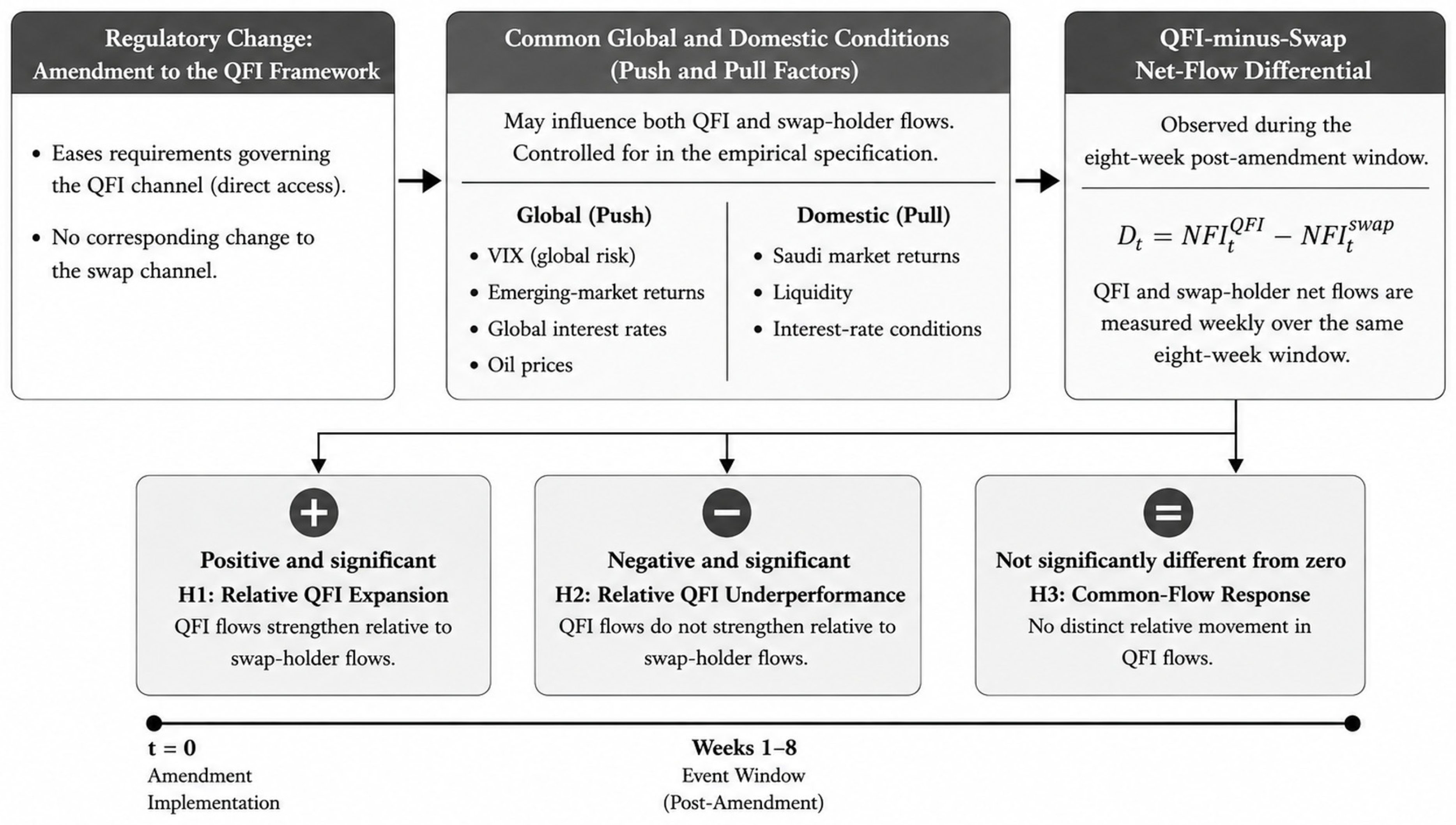
Figure 2 summarizes the theoretical framework and the three predicted outcomes of the QFI-minus-swap differential.
3.5.1. Relative QFI Expansion
The amendments reduced formal barriers to the QFI channel without introducing a corresponding change to the swap channel. If easing direct access is followed by stronger flows through the amended channel, QFI net flows should increase relative to swap-holder net flows.
H1. Relative QFI expansion hypothesis: following an amendment to the QFI framework, the QFI-minus-swap net-flow differential is positive.
A positive and statistically significant differential would indicate that QFI flows strengthened relative to swap-holder flows during the event window.
3.5.2. Relative QFI Underperformance
The QFI channel was newer and developed from a smaller participation base, whereas the swap channel was already established. Formal easing may therefore not be followed by stronger QFI flows during the short implementation window. QFI flows may increase less than swap-holder flows, remain unchanged while swap-holder flows rise, or decline relative to swap-holder flows. Each outcome would produce a negative differential.
Several frictions may contribute to this short-run pattern. Foreign institutions may require time to interpret revised rules, obtain internal approvals, and complete registration, custody, brokerage, and compliance arrangements [
13,
15]. Institutions already using an established access route may also face costs associated with changing counterparties, documentation, execution procedures, and internal systems [
21]. These factors provide potential reasons for slower short-run participation through the QFI channel.
H2. Relative QFI underperformance hypothesis: following an amendment to the QFI framework, the QFI-minus-swap net-flow differential is negative.
A negative and statistically significant differential would indicate that QFI flows did not strengthen relative to swap-holder flows during the event window. It would not identify the reason for the relative difference.
3.5.3. Common-Flow Response
QFI and swap-holder flows may continue to be shaped mainly by common global and domestic conditions. If the amendment is not associated with a distinct relative movement in QFI flows, the difference between the two series should not change significantly.
H3. Common-flow response hypothesis: following an amendment to the QFI framework, the QFI-minus-swap net-flow differential is not significantly different from zero.
An insignificant differential would indicate that the amendment was not associated with a measurable change in the relative position of QFI and swap-holder flows during the event window. It would not imply that aggregate foreign participation remained unchanged.
3.5.4. Empirical Interpretation
The three hypotheses generate distinct predictions for the QFI-minus-swap differential. H1 predicts a positive differential, H2 predicts a negative differential, and H3 predicts no statistically significant differential. The empirical analysis evaluates which prediction is most consistent with the observed event-window pattern.
The estimates are interpreted as event-window associations because the amendments were not randomly assigned and swap-holder flows provide an informative but imperfect within-market comparison. The analysis therefore focuses on relative QFI flow performance during the amendment windows. This distinction can be expressed as two stages of liberalization: institutional opening, the formal easing of market-access requirements, and operational integration, the realized use of the access channel that the reform targets. The hypotheses concern the second stage.
4. Data
4.1. Sample and Variable Construction
The empirical analysis employs an event-window differential regression estimated using Newey–West heteroskedasticity- and autocorrelation-consistent standard errors. This design is well suited to the setting because the two regulatory amendments have precisely identified implementation dates, and the research question focuses on the relative movement of QFI and swap-holder flows within the same market and over identical weekly intervals. The variables described below are constructed specifically for this comparison.
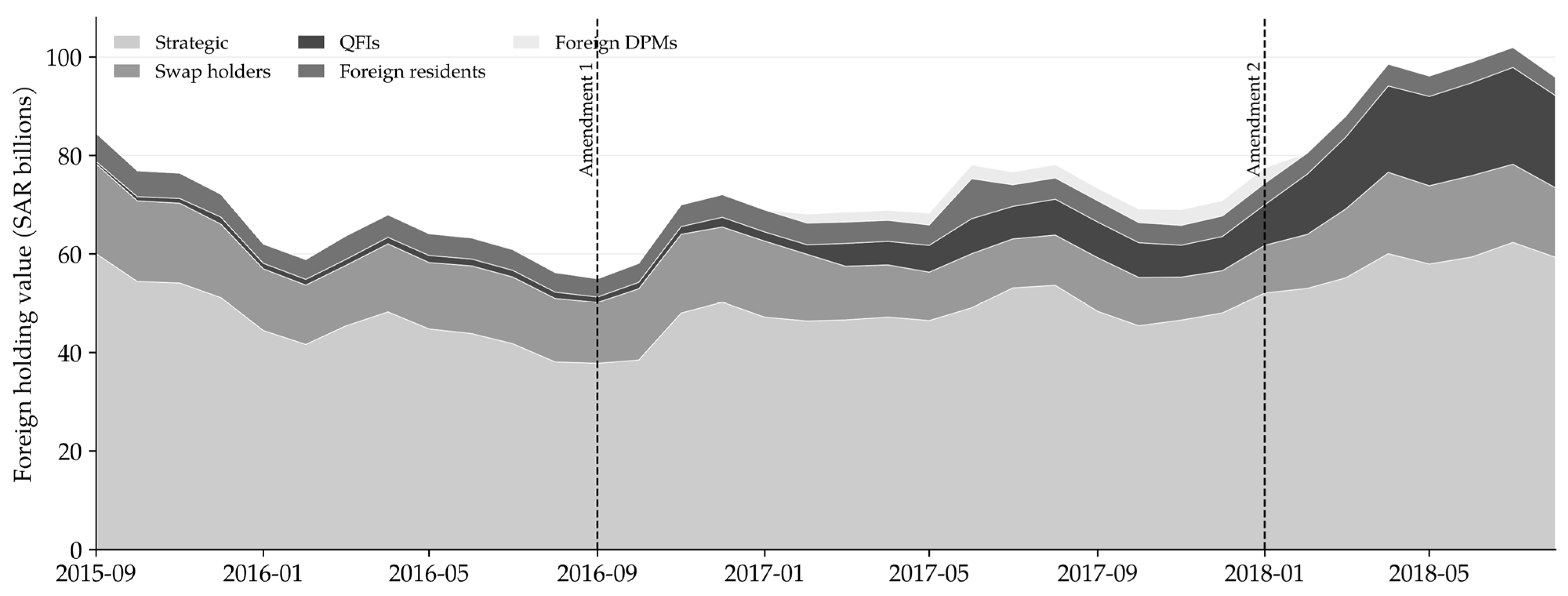
The dataset consists of weekly net purchases on the Saudi Exchange by investor category, where net purchases are defined as purchases minus sales. The Exchange classifies foreign investors into five categories: swap holders, Qualified Foreign Investors (QFIs), Foreign Residents and Others, foreign discretionary portfolio management accounts (Foreign DPMs), and Strategic Investors. Except for the terminology defined above, this study follows the official Saudi Exchange investor classifications.
Unless otherwise specified, investor flows are normalized by aggregate free-float market capitalization and reported in percentage terms. This common scaling factor benchmarks both access channels against the same investable domestic market base, facilitating direct comparison of their flow dynamics. The methodology aligns with prior research on financial liberalization and foreign portfolio flows, which commonly scales capital flows by market capitalization [
1,
18,
43]. As a robustness check, QFI and swap-holder net flows are also scaled by their respective lagged channel-specific holdings. These holdings-normalized measures are reported in the robustness analysis.
The dataset comprises 140 weekly observations from 3 December 2015 to 30 August 2018. Observations correspond to trading weeks ending on Thursday under the Saudi Exchange’s Sunday-to-Thursday trading calendar. Weeks without trading, predominantly around the two Eid holidays, are excluded, so the 140 observations cover 143 calendar weeks. The empirical time index therefore counts trading weeks rather than calendar weeks.
The sample period starts after the initial implementation of direct Qualified Foreign Investor (QFI) access on 15 June 2015, allowing the analysis to focus on the subsequent amendment phase once the QFI channel was operational. The starting date also separates the study window from the early phase of limited QFI participation and the acute oil-price stress around the time of market opening, while ongoing oil-price dynamics are captured through weekly oil returns. The sample ends before the implementation of FTSE Russell and MSCI emerging-market index inclusion in 2019, limiting overlap between the QFI amendment period and the subsequent benchmark-rebalancing phase.
The primary outcome variable is QFI net flow. Swap-holder net flow provides the main within-market comparison, as the swap channel had provided non-resident foreign investors with exposure to Saudi-listed equities before the QFI framework was established. For broader robustness analysis, swap holders, Foreign Residents and Others, Foreign Discretionary Portfolio Managers (DPMs), and Strategic Investors are aggregated into a non-QFI foreign investor block.
Explanatory variables are organized into global “push” factors and domestic market factors [
26,
27]. The global controls comprise the emerging-market equity return, oil-price return, and change in the CBOE Volatility Index (VIX), which proxies for global risk aversion [
29,
44,
45,
46]. The domestic controls include the return and volatility of the Tadawul All Share Index (TASI), market liquidity, and the interest-rate differential [
29,
47,
48]. The interest-rate differential is defined as the spread between the one-month Saudi interbank offered rate and the corresponding one-month US dollar benchmark rate and captures the relative return on riyal-denominated assets. All variables are aligned with the Saudi Exchange trading week. Data are sourced from the Saudi Exchange, the Saudi Central Bank, MSCI, and Bloomberg. Data are sourced from the Saudi Exchange, the Saudi Central Bank, MSCI, and Bloomberg. MSCI and Bloomberg data used in the study were accessed through institutional subscriptions and are not redistributed in the
Supplementary Materials. The publicly redistributable dataset and accompanying documentation are provided in the
Supplementary Materials.
Three eight-week index-related control windows are constructed to account for reclassification and inclusion news occurring within the sample period. The first follows MSCI’s decision to place Saudi Arabia on its review list on 20 June 2017 and begins with the first trading week after the intervening market closure, on 6 July 2017. The second starts in the trading week containing FTSE Russell’s upgrade decision on 28 March 2018 [
49], and the third begins with the trading week containing MSCI’s inclusion decision on 20 June 2018 [
50]. These variables control major index-related announcements, whereas the primary event windows are centered on the two QFI amendments.
Table 2 provides formal definitions of all variables and their empirical roles.
4.2. Descriptive Statistics and Correlations
Table 3 reports descriptive statistics for the foreign-flow channels, the two QFI-based differentials, and the control variables over the 140-week sample. Variables are presented in levels for descriptive purposes.
QFI net flow averages 0.010 percent of free float per week, compared with 0.002 percent for swap-holder flow. Swap-holder flow is more variable, with a standard deviation of 0.037 percent compared with 0.027 percent for QFI flow. The broader non-QFI foreign block records a mean net outflow of 0.007 percent and greater dispersion because it combines several foreign-investor categories. The QFI-minus-swap and QFI-minus-foreign-block differentials average 0.008 and 0.017 percent, respectively.
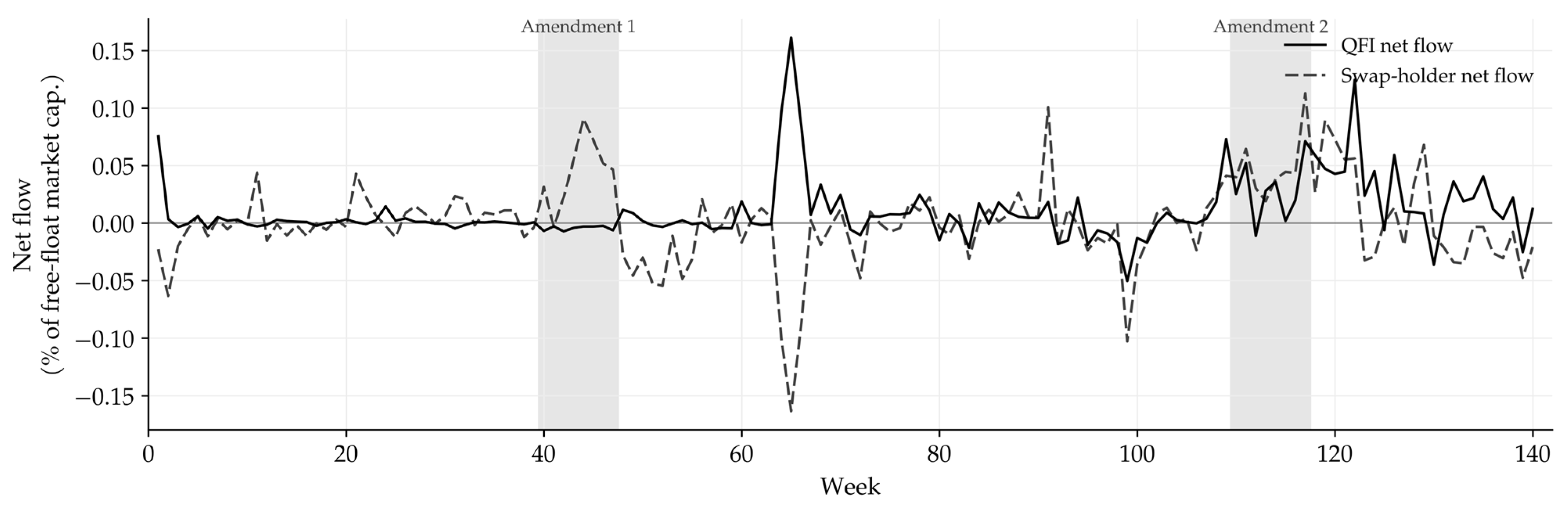
Figure 3 and
Figure 4 present the raw flow patterns.
Figure 3 shows that QFI and swap-holder flows generally remain close to zero but record occasional sharp and non-synchronous movements.
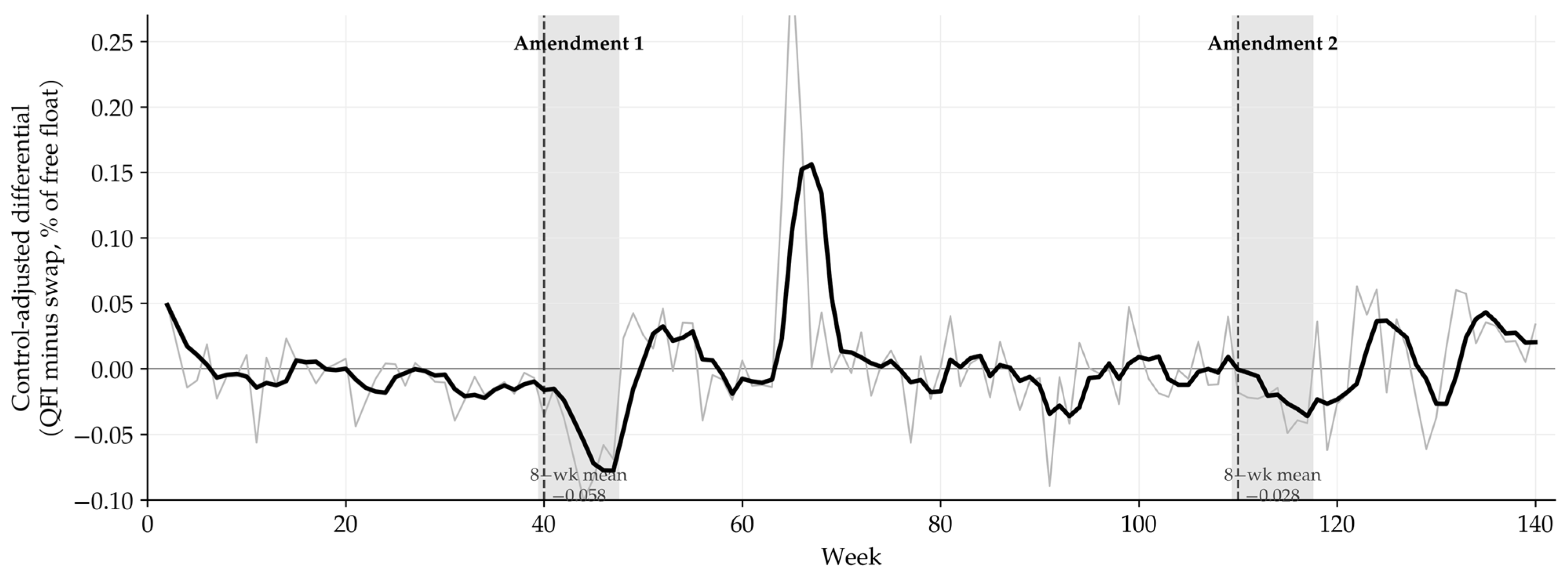
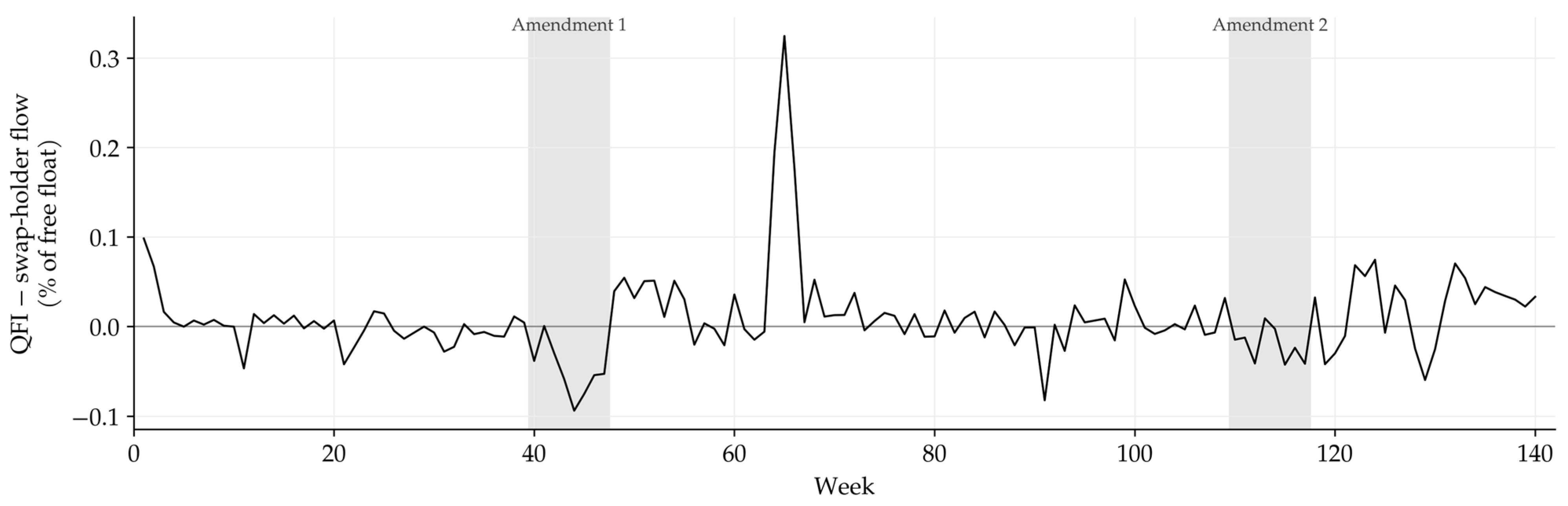
Figure 4 shows that the QFI-minus-swap differential fluctuates around zero over much of the sample and becomes negative within both amendment windows. These raw patterns provide the descriptive basis for the control-adjusted event-window analysis.
Table 4 reports correlations among the control variables. The correlations are generally moderate. The largest in absolute value is the correlation between emerging-market returns and the change in VIX, at −0.57, followed by the correlation between emerging-market and oil returns, at 0.48. The accompanying variance-inflation diagnostics remain below conventional thresholds.
4.3. Stationarity
Table 5 reports augmented Dickey–Fuller (ADF), Phillips–Perron (PP), and Kwiatkowski–Phillips–Schmidt–Shin (KPSS) tests used to determine the form in which each series enters the regressions. The flow variables, differential outcomes, and return-based controls enter in levels. The interest-rate differential, TASI volatility, and market liquidity enter in first differences. The three tests use the same deterministic specification for each variable.
The test results support this treatment of the series. The ADF and Phillips–Perron tests reject a unit root for the variables in the form reported, while the KPSS statistics remain below the 5 percent critical value. QFI net flow is the closest case, with a KPSS statistic of 0.380, while both unit-root tests support its use in levels. The regressions therefore combine level-stationary flow and return variables with first-differenced persistent domestic financial controls.
4.4. Preliminary Dynamics: Granger Causality
Table 6 examines short-run predictive relationships between QFI flows and domestic returns, volatility, and liquidity. Prior studies allow predictive relationships in both directions between foreign portfolio flows and domestic market conditions [
51,
52,
53,
54,
55]. The tests use four weekly lags and the stationary form of each variable.
The results show no statistically significant predictive relationship in either direction between QFI flows and TASI returns, TASI volatility, turnover-based liquidity, or Amihud illiquidity at the four-week horizon. These findings support treating the domestic market variables as contemporaneous conditioning controls in the amendment-window specifications.
5. Research Design: Controlled Event-Window Regression
This study uses controlled event-window regressions to estimate the short-run association between the QFI amendments and foreign-investor flows. The main specification estimates the average QFI-minus-swap differential over each eight-week implementation window. A complementary level-and-slope specification characterizes within-window dynamics by separating the event-time-zero intercept from the subsequent within-window gradient. Both specifications follow the event-study principle of measuring outcome movements within defined windows around identifiable events [
56,
57].
5.1. From the Single Channel to the Within-Foreign Comparison
The empirical analysis begins by assessing whether QFI flows and swap-holder flows move differently around the two amendment windows. As a diagnostic starting point, the level-and-slope single-channel specification relates weekly QFI flows to indicator variables for the amendment windows, a linear time trend, index-related control windows, and a set of global and domestic control variables.
The core analysis then benchmarks QFI flows against swap-holder flows and other non-QFI foreign investor flows observed in the same market and during the same weeks. This within-foreign-investor comparison captures the relative response of the amended QFI channel following regulatory easing that did not affect the swap channel. The primary outcome variable is the differential between QFI and swap-holder flows, while the differential between QFI flows and the foreign block is used as a broader robustness measure.
This within-foreign comparison examines the relative behavior of the amended QFI channel following a regulatory relaxation that left the swap channel unchanged. The specification controls observable global and domestic conditions that may affect the two channels differently, including global risk, oil-price fluctuations, domestic returns, market volatility, liquidity conditions, and interest-rate differentials. The QFI-minus-swap differential remains the central object of inference.
The QFI-minus-swap differential condenses the two-channel comparison into a single estimated coefficient and standard error. Its interpretation relies on both the individual channel estimates and their difference. A positive QFI-minus-swap coefficient indicates that QFI flows strengthen relative to swap-holder flows, consistent with H1. A negative coefficient indicates that QFI flows do not strengthen relative to swap-holder flows, consistent with H2. A coefficient that is not statistically distinguishable from zero is consistent with H3, under which the relative flow positions of the two channels remain broadly unchanged.
Because either constituent channel may drive the sign and magnitude of the differential, the QFI and swap-holder regressions are reported alongside the differential specification. This joint presentation shows the distinct movements in QFI and swap-holder flows underlying the estimated differential.
5.2. Differential Specification
The main empirical model is an event-window differential regression estimated with Newey–West heteroskedasticity- and autocorrelation-consistent inference. It estimates the average QFI-minus-swap differential during each eight-week implementation window. The level-and-slope specification below extends the main specification by allowing both an event-time-zero intercept and a within-window slope; it is reported in
Table 7 and used to characterize within-window dynamics.
The level-and-slope specification is:
where the dependent variable is one of four series:
The dependent variable is QFI net flow, swap-holder net flow, the QFI-minus-swap differential, or the QFI-minus-foreign-block differential. The single-channel specifications estimate movements in each access channel, while the differential specifications estimate relative flow movements.
In this specification, is a linear time trend. is an indicator equal to one during the eight-week window following the effective date of amendment j, and zero otherwise. counts the weeks elapsed within that window. The coefficient represents the event-time-zero intercept of the fitted amendment-window path and captures the weekly change in that path over the eight-week window . denotes the three index-inclusion-related control windows, covering the MSCI review-list announcement, the FTSE Russell upgrade decision, and the MSCI inclusion decision. These variables are included as controls for index-related foreign demand occurring during the sample. is the vector of control variables, and is the corresponding coefficient vector.
The level-and-slope specification distinguishes the event-time-zero intercept from the subsequent within-window gradient. The main specification omits the slope terms and estimates the average movement over the eight-week period. The level-and-slope model therefore allows the short-run association to vary within the event window.
The amendments were not randomly assigned, and the event-window design does not isolate them from all concurrent developments. Changes in domestic market conditions, oil prices, global risk, index-related news, and investor expectations may coincide with the implementation windows. The specification includes observable global and domestic controls and separate index-related control windows, while the pre-event, announcement-date, placebo, and alternative-window tests assess the sensitivity of the estimates. The coefficients are therefore interpreted as event-window associations rather than definitive causal effects.
Weekly foreign-investor flows may exhibit heteroskedasticity and serial correlation. The regressions therefore use Newey–West HAC standard errors [
58], implemented with four lags. For transparency, the lag length follows the conventional rule 4(T/100)^(2/9), which equals approximately 4.3 for T = 139; four lags are used in all reported event-window regressions. The regressions contain 139 observations because first-differencing the persistent controls removes the initial observation.
5.3. Event-Window Length and Robustness Strategy
The main event window covers eight weeks of trading. The window is designed to capture the short-run flow pattern following implementation while limiting overlap with subsequent events. It also provides sufficient weekly observations to estimate the event-time-zero intercept and the within-window slope. Because no single event-window length is definitive, the robustness analysis evaluates alternative windows ranging from four to sixteen weeks [
56,
57].
The robustness analysis also examines adding a linear trend to the main specification, the use of Amihud illiquidity as an alternative liquidity control, separate estimation of the two amendments, normalization by each channel’s lagged holdings, and alternative treatments of influential observations and heavy-tailed flows. These specifications evaluate whether the estimated relative flow pattern remains stable across alternative windows, denominators, controls, and estimators.
6. Results
6.1. The Starting Point: QFI Flows and the Swap Channel
The analysis begins by examining the separate movements of QFI and swap-holder net flows around the two amendment windows.
Table 7 reports the level-and-slope specification for QFI net flow, swap-holder net flow, and the QFI-minus-swap differential. Each regression includes a linear trend, amendment-window intercept and slope terms, the three index-related control windows, and the full set of global and domestic controls.
The QFI intercept and slope coefficients are statistically insignificant in both amendment windows. By contrast, swap-holder flows show positive within-window slopes following both amendments. The second amendment is also associated with a positive swap-holder intercept coefficient. The differential column consequently records a negative and statistically significant slope after the first amendment and negative coefficients for both the intercept and slope terms after the second amendment.
The main-specification estimates reported in
Table 8 clarify the two-channel pattern. Around Amendment 1, QFI net flow falls by 0.011 percentage points of free float per week, while swap-holder net flow rises by 0.051 percentage points. Around Amendment 2, QFI net flow rises by 0.022 percentage points, while swap-holder net flow rises by 0.054 percentage points. All four estimates are statistically significant. The two channels therefore move in opposite directions following the first amendment and in the same direction, but with different magnitudes, following the second.
The QFI-minus-swap differential summarizes this contrast. Its negative sign indicates that QFI flows did not strengthen relative to swap-holder flows during the implementation windows. The separate channel estimates show that the pattern arises from stronger swap-holder flows around both amendments, alongside different QFI movements across the two reforms.
6.2. The Within-Foreign Estimate
Table 8 reports the main eight-week QFI-minus-swap estimates across alternative control sets. The within-foreign specification compares the two access channels over the same trading weeks and focuses on the relative movement of the amended QFI channel.
The differential is negative and statistically significant following both amendments under every control specification. In the main specification, the Amendment 1 coefficient is −0.0627 percentage points of free-float market capitalization per week, with a t-statistic of −4.41 and p < 0.001. The Amendment 2 coefficient is −0.0320 percentage points, with a t-statistic of −3.93 and p < 0.001.
The estimates are stable as global and domestic controls are added. The Amendment 1 differential ranges from −0.0610 to −0.0633 across the reported specifications, while the Amendment 2 differential ranges from −0.0320 to −0.0326. Observable global conditions, domestic market movements, and index-related announcements therefore leave the central relative pattern largely unchanged.
The differential is larger following Amendment 1. A formal equality test gives an Amendment 1-minus-Amendment 2 difference of −0.031, with p = 0.018. The results therefore support separate interpretation of the two reforms, consistent with the broader structural scope of the first amendment and the more procedural character of the second.
The main-specification coefficients closely match the average level-and-slope paths in
Table 7. Evaluating the
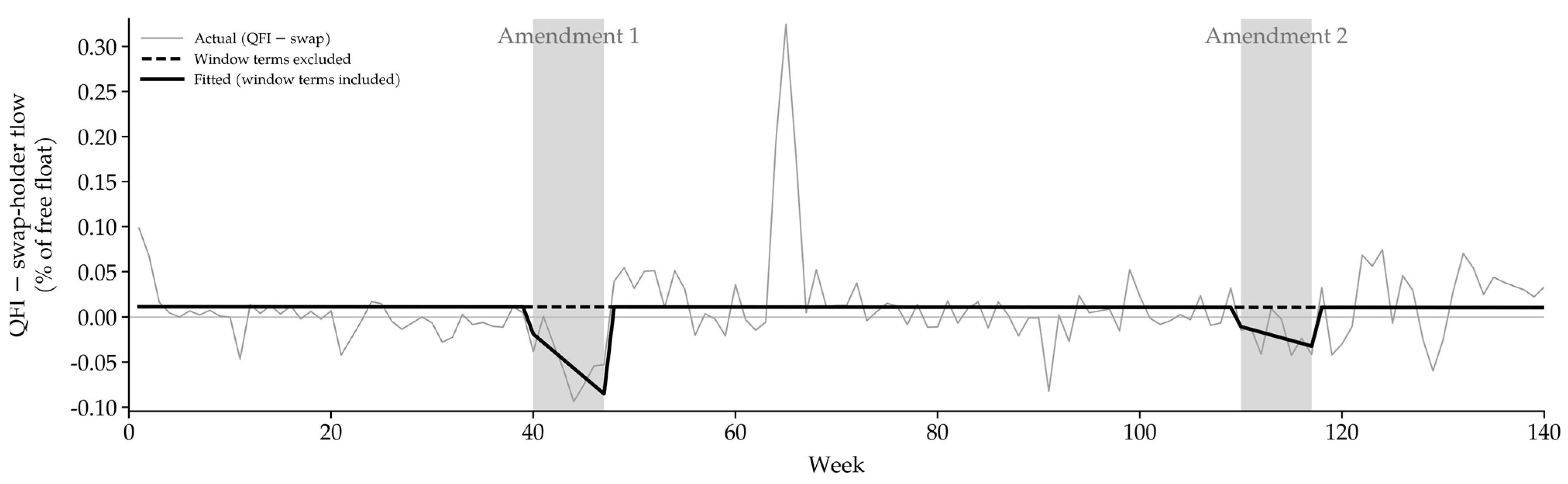
Table 7 differential at the mean event week of 4.5 gives −0.0204 + 4.5 (−0.0094) = −0.063 for Amendment 1 and −0.0182 + 4.5 (−0.0031) = −0.032 for Amendment 2. These values are close to the main-specification estimates of −0.0627 and −0.0320. The intercept coefficients in
Table 7 represent the fitted differential at event time zero, whereas the main-specification coefficients summarize the average differential across all eight post-amendment weeks.
The economic magnitudes are substantial relative to normal QFI activity. The weekly differentials of −0.0627 and −0.0320 percentage points compare with an average weekly QFI net inflow of approximately 0.010 percent of free float. Over the eight-week windows, the relative gaps amount to approximately 0.50 percent of free-float market capitalization after Amendment 1 and 0.26 percent after Amendment 2.
At the sample mean free-float market capitalization of approximately SAR 715 billion, the Amendment 1 estimate corresponds to about SAR 448 million per week and approximately SAR 3.6 billion over the eight-week window. The Amendment 2 estimate corresponds to about SAR 229 million per week and approximately SAR 1.8 billion cumulatively. Average absolute QFI net flows are approximately SAR 117 million per week, making the estimated differentials economically meaningful relative to the normal scale of direct-channel activity.
Figure 5 plots the control-adjusted QFI-minus-swap differential. The series fluctuates around zero over much of the sample and becomes negative within both amendment windows, consistent with the regression estimates.
Figure 6 separates the fitted differential into the component associated with the amendment-window indicators and the component associated with the controls. The fitted and window-excluded paths coincide outside the amendment periods and diverge inside them. The vertical distance between the paths represents the estimated amendment-window differential.
The negative sign is important for interpretation. A positive and statistically significant differential would support H1, while a differential not significantly different from zero would support H3. Instead, the QFI-minus-swap differential is negative and statistically significant following both amendments, supporting H2. Following the first amendment, QFI net flows declined while swap-holder net flows increased. Following the second amendment, both channels recorded higher net flows, but the increase in swap-holder flows was larger. The negative differential therefore reflects different flow patterns across the two amendments, with QFI flows underperforming swap-holder flows in both implementation windows.
6.3. Robustness
Table 9 examines the sensitivity of the QFI-minus-swap differential to alternative event-window lengths, controls, estimation choices, denominators, and treatments of influential observations.
The differential remains negative and statistically significant for both amendments across windows of four to ten weeks. For Amendment 1, the coefficient ranges from −0.0395 in the four-week window to −0.0627 in the eight-week window and −0.0443 in the ten-week window. The estimate becomes smaller and statistically weaker in longer windows, indicating that the strongest relative movement is concentrated within the shorter post-implementation windows.
The Amendment 2 differential remains negative across all reported window lengths. The windows of twelve, fourteen, and sixteen weeks overlap with the FTSE Russell upgrade-decision control period and are shaded in
Table 9 to identify that overlap. The shorter non-overlapping windows provide the clearer basis for interpretation.
Adding a linear trend produces coefficients of −0.0628 and −0.0316 for Amendments 1 and 2. Adding Amihud illiquidity gives −0.0648 and −0.0320. Estimating each amendment separately produces −0.0601 for Amendment 1 and −0.0271 for Amendment 2. These estimates remain close to the main-specification values.
The lagged-holdings specification scales each channel’s weekly flow by its own holdings in the preceding trading week. The resulting QFI-minus-swap coefficients are −6.160 percent of lagged holdings after Amendment 1, with p < 0.001, and −3.141 percent after Amendment 2, with p = 0.005. These coefficients use a different denominator and are therefore interpreted within that specification rather than compared directly with the free-float-scaled magnitudes.
Free-float market capitalization remains the preferred denominator because it places both channels against the same investable domestic market base. Scaling each channel by its own lagged holdings instead measures flows relative to the existing size of that channel. The two specifications address related dimensions of relative flow performance and produce the same negative directional result.
The estimates also remain stable under alternative treatments of the heavy-tailed flow distributions. Winsorizing the flow series produces coefficients of −0.0619 and −0.0297. Excluding the large week-65 flow episode gives −0.0596 and −0.0287. MM robust regression gives −0.0601 and −0.0254, while winsorizing the broader QFI-minus-foreign-block comparison gives −0.0593 and −0.0287. Every reported coefficient remains statistically significant.
Across the main and heavy-tail specifications, the Amendment 1 estimate ranges from −0.0627 to −0.0593, a spread of 0.0034. The Amendment 2 estimate ranges from −0.0320 to −0.0254, a spread of 0.0066. Excluding week 65 increases the absolute t-statistic from 4.41 to 5.05 for Amendment 1 and from 3.93 to 4.47 for Amendment 2. MM estimation raises the absolute Amendment 1 t-statistic to 6.07. The influential observations therefore do not account for the estimated differential.
The robustness evidence consistently identifies a negative short-run QFI-minus-swap differential. The result remains stable across the principal event windows, alternative controls, separate-amendment models, both denominators, alternative comparison groups, and estimators designed to reduce the influence of extreme observations.
6.4. Pre-Amendment Behavior of the Differential
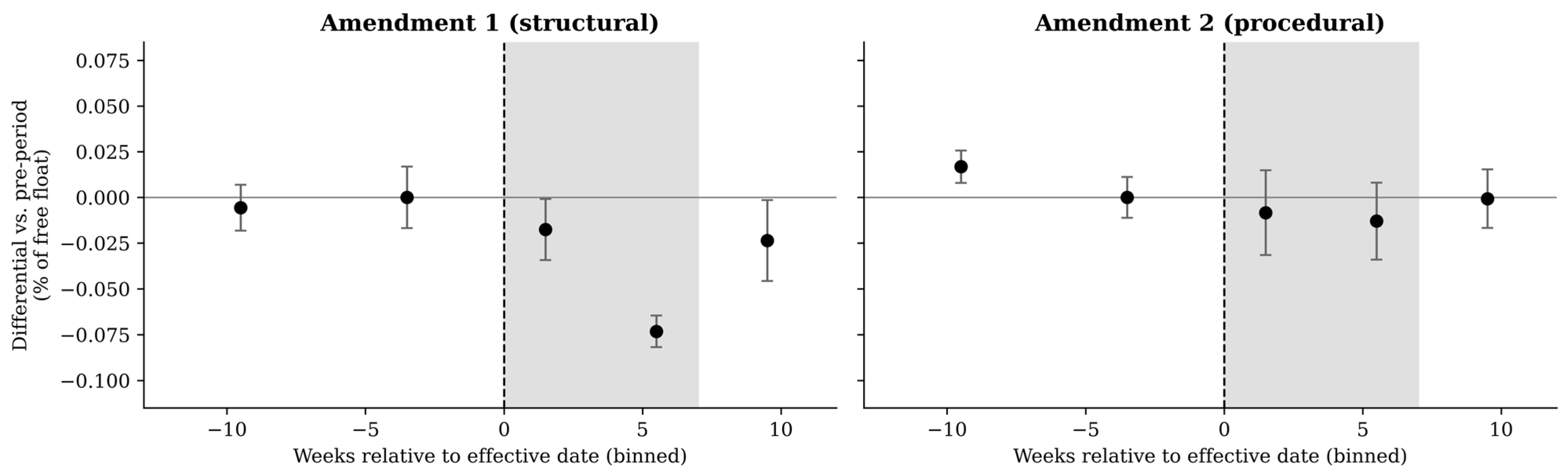
Table 10 examines pre-amendment behavior using two complementary specifications. Panel A estimates a linear slope in the raw QFI-minus-swap differential over the twelve weeks preceding each amendment. Panel B estimates control-adjusted three-week event-time bins, using weeks −6 to −1 as the reference period, matching the reference window used in
Figure 7.
The raw pre-event slopes are statistically insignificant for both amendments. The estimated slope is +0.0011 percentage points per week before Amendment 1, with p = 0.196, and −0.0003 before Amendment 2, with p = 0.821. The estimates remain unchanged under ordinary least squares and Newey–West standard errors using between one and four lags, with Amendment 1 p-values ranging from 0.16 to 0.26 and Amendment 2 p-values ranging from 0.80 to 0.87. The raw differential therefore shows no systematic linear pre-event movement before either implementation date.
The control-adjusted joint tests distinguish between the two amendments. For Amendment 1, the two earlier pre-event bins are jointly insignificant (F = 2.193, p = 0.116). For Amendment 2, the earlier event-time bins are jointly significant relative to the omitted weeks −6 to −1 (F = 5.670, p = 0.004).
For Amendment 2, the earlier event-time bins are jointly significant relative to the omitted weeks −6 to −1. This indicates that the longer pre-event period is not fully stable. No individual Amendment 2 bin is significant at the 5 percent level, so the result reflects the joint configuration of the pre-event coefficients rather than a single identifiable deviation.
Table 11 examines this issue more systematically across alternative pre-event horizons and sensitivity specifications.
The two diagnostics capture different features of the pre-event period. The slope tests assess systematic linear movement in the raw differential, while the event-time specifications compare control-adjusted levels across pre-event intervals. Together, they show a stable pre-event pattern for Amendment 1 and greater sensitivity to event-time specification for Amendment 2. This asymmetry supports separate interpretation of the two reforms.
Table 11 reports formal pre-event diagnostics and sensitivity tests.
The eight-week joint tests do not reject the null of no pre-event movement for either amendment. The longer-horizon tests also do not reject Amendment 1. For Amendment 2, the twelve- and sixteen-week tests indicate some pre-event variation. However, this variation does not take the form of a systematic linear trend. The Amendment 2 pre-event slope is statistically insignificant, excluding the announcement-to-effective interval leaves the estimate almost unchanged, and controlling for the slope makes the post-amendment coefficient slightly more negative. The Amendment 2 estimate is therefore interpreted more cautiously, while the evidence does not indicate that the negative differential is explained by a systematic anticipation trend.
Figure 7 presents the week-by-week differential around each amendment. The pre-event coefficients vary around their reference level, while the post-amendment observations show a more pronounced negative pattern during the shaded eight-week windows.
Figure 7 complements the formal tests by showing how the control-adjusted differential varies across the pre-event intervals. Taken together, the raw-slope and event-time evidence indicate no systematic linear movement before either amendment, while the second amendment shows greater sensitivity to the choice of event-time grouping. The two reforms are therefore interpreted separately.
6.5. Broader Foreign-Flow Decomposition
Table 12 compares average weekly QFI net flows with those of the broader non-QFI foreign block before and after each amendment window.
Around Amendment 1, QFI net flow changes from +0.0001 to −0.0045 percent of free float per week, a decline of 0.0046 percentage points. The non-QFI foreign block changes from −0.0001 to +0.0390 percent, an increase of 0.0391 percentage points.
Around Amendment 2, QFI net flow increases from +0.0134 to +0.0279 percent, a rise of 0.0144 percentage points. The non-QFI foreign block increases from +0.0016 to +0.0419 percent, a rise of 0.0403 percentage points. The negative differential therefore arises from different QFI movements across the two reforms: a small decline around Amendment 1 and a positive but smaller increase around Amendment 2.
Within the broader foreign block, the post-amendment movement is concentrated in swap-holder flows. Swap-holder net flows average approximately 0.046 percent of free float per week after Amendment 1 and 0.049 percent after Amendment 2, while the remaining non-QFI categories are broadly flat or record net outflows.
Table 13 separates the channel-level net-flow coefficients into gross purchases and gross sales.
For Amendment 1, QFI purchases fall by 0.018 percentage points and QFI sales fall by 0.007, producing a net QFI movement of −0.011. Swap-holder purchases rise by 0.054, while sales increase by only 0.003, producing a net increase of 0.051. The negative differential is therefore driven primarily by lower QFI purchases alongside substantially higher swap-holder purchases.
For Amendment 2, QFI purchases rise by 0.039 and sales rise by 0.017, producing a net increase of 0.022. Swap-holder purchases rise by 0.035, while sales fall by 0.019, producing a net increase of 0.054. Both channels record stronger net buying, but the increase is larger for swap holders because higher purchases are combined with lower sales.
The decomposition shows that stronger swap-holder net buying is the principal source of the negative QFI-minus-swap differential. The first amendment combines lower QFI purchases with higher swap-holder purchases, whereas the second combines higher net buying on both channels with a larger increase in swap-holder net flow.
6.6. Date-Timing, Placebo, and Diagnostic Checks
Table 14 compares the main effective-date specifications with windows anchored on the public announcement dates.
The effective-date estimates are larger in absolute value. For Amendment 1, the announcement-date coefficient is −0.0254, with p = 0.013, compared with −0.0627, with p < 0.001, under the effective-date anchor. For Amendment 2, the announcement-date coefficient is −0.0157, with p = 0.129, compared with −0.0320, with p < 0.001, under the effective-date anchor.
The stronger effective-date estimates align the flow pattern with the dates on which the revised eligibility and procedural rules came into force. The timing evidence therefore supports the use of implementation dates as the principal event anchors.
Placebo windows are constructed by applying the same eight-week event-window specification to alternative start weeks. Candidate starts run through week 132. To keep the placebo windows distinct from the true events, starting weeks within eight weeks of either amendment window are excluded. This leaves 84 placebo estimates.
The placebo distribution is wide and right skewed, with a mean of 0.005, a standard deviation of 0.029, and skewness of 2.05. None of the 84 placebo estimates is more negative than the Amendment 1 estimate, while one is more negative than the Amendment 2 estimate. Using a two-sided comparison based on absolute magnitude, seven placebo estimates exceed the Amendment 1 estimate and eleven exceed the Amendment 2 estimate. All seven exceedances for Amendment 1 are positive. Ten of the eleven for Amendment 2 are positive, while the single negative exceedance is the placebo window noted below.
Using the one-sided comparison corresponding to the negative differential predicted by H2 and the standard finite-sample adjustment, the exact randomization-inference p-values are 1/85 = 0.012 for Amendment 1 and 2/85 = 0.024 for Amendment 2. Both estimates remain significant at the 5 percent level. The single negative Amendment 2 exceedance, at −0.033, is the only placebo estimate more negative than the Amendment 2 coefficient. The directional placebo comparison therefore provides additional support for the negative QFI-minus-swap differential observed during the amendment windows.
The institutional chronology provides additional context for the event timing. At the end of 2017, approximately two and a half years after direct QFI access began and fifteen months after Amendment 1, only 118 foreign financial institutions were registered as QFIs [
14]. The relatively limited registration base is consistent with the flow evidence that direct QFI participation had not expanded sharply following the first amendment. Amendment 2 became effective shortly afterward and further simplified qualification and continuing requirements.
The second amendment also integrated qualification more closely with the account-opening process [
14]. Taken together, the registration evidence and weekly flow results indicate that formal easing of the QFI framework was not accompanied by an immediate broadening of participation through the direct-access channel.
Table 15 reports diagnostics for the main QFI-minus-swap specification.
The residual ADF statistic is −4.99, with p < 0.001, while the KPSS statistic is 0.09, below the 5 percent critical value of 0.463. The residual series is therefore stationary. The maximum variance inflation factor is 1.92, and the mean is 1.28. The two amendment indicators and three index-related controls have variance inflation factors between 1.02 and 1.07, indicating limited collinearity among the event and control variables.
The Durbin–Watson statistic is 1.09. The Breusch–Godfrey statistic is 30.49, with p < 0.001, and the four-lag Ljung–Box statistic is 30.95, with p < 0.001. These diagnostics confirm positive residual serial correlation and support the use of Newey–West HAC inference.
Across the effective-date comparison, placebo distribution, institutional chronology, and regression diagnostics, the main result remains consistent. QFI flows did not strengthen relative to swap-holder flows during either implementation window. The channel decomposition shows that this pattern is driven primarily by stronger swap-holder buying, while the robustness and pre-event evidence indicate that the result is concentrated within the shorter post-implementation windows.
7. Discussion and Policy Implications
The QFI-minus-swap differential is negative and statistically significant following both amendments, supporting H2, the relative QFI underperformance hypothesis. This indicates that easing direct QFI access was not accompanied by a relative strengthening of QFI flows during either eight-week implementation window. The pattern is consistent with prior evidence that official liberalization, investability, and realized market integration may not coincide [
18] and that different forms of liberalization can generate different adjustment paths [
19,
20,
21,
22].
The underlying flow composition differs across the two reforms. Following the first amendment, QFI net flows declined while swap-holder flows increased. Following the second amendment, both channels recorded higher net flows, but the increase in swap-holder flows was larger. Thus, the same negative differential reflects different short-run flow patterns across the two amendments.
7.1. Relation to Prior Liberalization Evidence
The findings support a distinction between formal regulatory opening and realized short-run participation. This is consistent with Bekaert, Harvey, and Lumsdaine [
18], who distinguish official liberalization dates, investability, and realized market integration. The Saudi evidence extends this distinction to the access-channel level by showing that easing direct QFI access was not accompanied by a relative strengthening of QFI flows during the implementation windows.
The results also accord with Edison and Warnock [
19], who show that different forms of liberalization can produce different flow responses. Hargis [
20] emphasizes that liberalization outcomes depend on market structure, while Ding et al. [
21] show that the response to the RMB Qualified Foreign Institutional Investor program varies with institutional and firm-level conditions. Silvers [
22] likewise links cross-border participation to the wider regulatory setting. Together, these studies support interpreting liberalization outcomes in relation to the institutional structure through which foreign access is provided.
Venkatesh et al. [
59] show that foreign institutional investors allocate selectively according to firm size, valuation, risk, liquidity, leverage, and other firm characteristics. This evidence reinforces the distinction between formal access and realized participation. Easing entry requirements expands direct investment opportunities but need not generate an immediate relative increase in flows through the amended channel.
The main implication is that capital-market opening should be evaluated through both formal regulatory change and observed participation. The negative short-run QFI-minus-swap differential provides channel-level evidence that the performance of the access route targeted by reform may differ from broader foreign-participation outcomes.
7.2. Differences Between the Two Amendments
The two amendments represent distinct forms of regulatory easing. The first was a broader structural reform that lowered the assets-under-management threshold, widened the range of eligible institutions, and removed the individual QFI investment limit. The second was more procedural, lowering the threshold further while simplifying qualifications and continuing obligations.
The QFI-minus-swap differential is larger in absolute value following the first amendment. The difference between the two coefficients is statistically significant, with an Amendment 1-minus-Amendment 2 estimate of −0.031 and p = 0.018. This result supports separate interpretation of the two reforms, which differed in regulatory scope and produced different relative flow magnitudes.
The extended-window results also distinguish between the two reforms. The first-amendment differential becomes smaller and statistically weaker as the window expands, indicating that its strongest relative movement was concentrated within the shorter post-implementation windows. The second-amendment estimate is more stable across window lengths, although the longer windows overlap with the FTSE Russell upgrade-decision period. The two reforms therefore differ in the magnitude and persistence of their associated flow patterns, while the QFI-minus-swap differential remains negative in the principal short-run windows.
The pre-event diagnostics further distinguish between the two reforms. Amendment 1 does not reject joint stability at the eight-, twelve-, or sixteen-week pre-event horizons. Amendment 2 does not reject at the eight-week horizon but rejects at the twelve- and sixteen-week horizons. This asymmetry supports separate interpretation of the amendments: the first presents the more stable pre-event pattern, whereas the second is more sensitive over longer pre-event horizons.
7.3. Pre-Event Behavior and Empirical Interpretation
The pre-event evidence separates linear movement from variation across event-time intervals. The raw differential shows no statistically significant linear slope before either amendment. In the control-adjusted tests, Amendment 1 does not reject joint stability at the eight-, twelve-, or sixteen-week pre-event horizons, whereas Amendment 2 rejects at the twelve- and sixteen-week horizons but not at the eight-week horizon. The first amendment therefore provides the clearer temporal pattern, while the second is interpreted with greater caution because of its sensitivity over longer pre-event horizons.
These findings inform the interpretation of the amendment-window evidence. The estimates are reported as event-window associations because the amendments may have coincided with changes in oil prices, domestic market conditions, broader reform developments, or investor expectations. These observable conditions are included in the empirical specification where data are available.
The pre-event evidence is more stable for Amendment 1. For Amendment 2, the longer-horizon joint tests indicate some pre-event variation, although the linear pre-event slope is insignificant and the post-amendment estimate remains stable after excluding the announcement-to-effective interval and controlling for the pre-event slope. This pattern supports greater caution in interpreting Amendment 2 but does not indicate a systematic anticipation trend.
The swap channel provides a relevant comparison because it offered foreign exposure to the same listed market during the same trading weeks. The QFI-minus-swap differential therefore captures the relative movement of QFI and swap-holder flows after accounting for common market conditions. Domestic and global controls further account for observable conditions related to returns, risk, oil-price movements, liquidity, and interest rates.
Overall, the pre-event diagnostics provide stronger temporal support for Amendment 1, while the Amendment 2 estimate remains informative but more sensitive to event-time specification.
7.4. Sustainable Capital-Market Development
Capital-market liberalization can support sustainable financial development by widening the investor base, diversifying sources of capital, and strengthening the institutional foundations of market participation [
60,
61,
62,
63,
64,
65,
66,
67,
68]. This connection is relevant to Sustainable Development Goal 8, on sustained and inclusive economic growth, and Goal 17, on mobilizing development finance and strengthening partnerships for development [
63]. The present analysis focuses on whether regulatory opening is followed by stronger participation through the access channel targeted by reform.
Direct foreign institutional participation may support information production, monitoring, governance, liquidity, market depth, and disclosure quality [
6,
7,
8,
9,
10,
15,
16]. The contribution of access reform to these wider objectives therefore depends partly on whether the relevant foreign-access channel is used in practice.
Channel composition is consequently relevant to capital-market development. Direct and intermediated access routes differ in ownership arrangements, intermediation structures, and forms of investor participation. Evaluating liberalization through channel-specific flows provides information that aggregate foreign-participation measures may not reveal.
This issue is particularly relevant to Saudi Arabia’s efforts to deepen and diversify its capital market within a resource-dependent economic setting. Resource dependence may constrain the contribution of financial development to economic growth, while petroleum-price movements continue to influence domestic market conditions [
69,
70]. The channel-level evidence therefore provides a useful perspective for evaluating broader market-development policies in this setting.
7.5. Policy Implications
Capital-market liberalization can broaden the investor base, diversify financing, improve capital allocation, and support financial and economic development [
60,
61,
62,
63,
64,
65,
66,
67,
68]. Policymakers must also remain attentive to risks associated with volatile portfolio flows, sudden reversals, and external financial exposure [
71]. The present findings add a channel-specific consideration: easing an access channel may not immediately strengthen flows through that channel relative to an established alternative.
First, assessments of liberalization should distinguish aggregate foreign participation from the composition of that participation. Aggregate foreign investment may increase even when flows through the channel targeted by reform do not strengthen relative to another foreign-access category. In the Saudi case, the relatively limited QFI registration base by the end of 2017 complements the flow evidence by showing that formal easing occurred while the direct-access investor base was still developing [
14]. Registrations, account openings, holdings, purchases, sales, and net flows therefore provide complementary indicators of realized participation.
Second, investor categories should remain visible in market reporting. Detailed category-level data allow regulators to evaluate whether reforms affect the channel directly targeted by policy and whether changes in aggregate foreign participation are concentrated in other investor categories. This distinction matters because investor categories may differ in mandates, investment horizons, intermediation arrangements, execution requirements, and forms of market participation.
Third, reform evaluation should account for the relationship between access channels. When an established channel remains available, easing a newer channel need not produce an immediate relative increase through the amended route. Policymakers should therefore evaluate reform performance at both the market and access-channel levels.
Fourth, the timing of evaluation matters. The results are strongest within the shorter post-implementation windows and weaken over longer horizons. Early assessments should therefore distinguish the immediate flow response from subsequent developments that may reflect additional reforms, index-related events, or changing market conditions.
A subsequent reform in 2026 changed the foreign-access structure examined in this study by removing the earlier QFI and swap-channel framework [
72]. Because that reform falls outside the sample period, the present analysis does not evaluate its effects. The findings nevertheless provide historical evidence on relative QFI and swap-holder flow performance during the earlier liberalization phase and a benchmark for evaluating the subsequent regime.
7.6. Limitations and Future Research
The event-window design captures short-run associations around the two amendment implementation dates and provides limited evidence on longer-run adjustment. In addition, the pre-event evidence is more stable for Amendment 1 than for Amendment 2, which shows greater sensitivity to the event-time specification. The findings should therefore be interpreted in relation to the Saudi institutional setting and the specific reform period examined.
Future research could extend the analysis in four directions. First, investor-level transaction data could be used to examine heterogeneity across institutions, mandates, and participation strategies. Second, comparative studies could assess whether the relative performance of amended and established access channels differs across regulatory settings. Third, longer-horizon analysis could examine foreign participation during the 2019 index-inclusion phase and subsequent changes to the Saudi foreign-access framework. Fourth, studies using data on contractual exposures, concentration, leverage, and investor behavior during periods of market stress could examine how direct and intermediated access structures relate to counterparty exposure, beneficial ownership, and market resilience.
8. Conclusions
This study examines whether two amendments to Saudi Arabia’s QFI framework strengthened QFI net flows relative to swap-holder flows. Using 140 weekly observations, the analysis estimates QFI-minus-swap differentials around the September 2016 and January 2018 amendments.
The differential is negative and statistically significant during both eight-week implementation windows, at −0.0627 and −0.0320 percentage points of free-float market capitalization per week, respectively. The first differential is larger in absolute value. The underlying flow patterns differ across the two reforms: QFI flows declined while swap-holder flows increased following the first amendment, whereas both channels increased following the second, with a larger rise in swap-holder flows. The findings therefore support H2, the relative QFI underperformance hypothesis.
The result remains stable across the principal short-run specifications and robustness checks, including alternative controls, event windows, comparison groups, holdings normalization, influential-observation treatments, and randomization inference. The pre-event evidence is clearer for the first amendment, while the second is interpreted more cautiously because of greater sensitivity across longer pre-event specifications.
This paper contributes to the capital-market liberalization literature by evaluating whether flows through the access channel directly targeted by reform strengthen relative to an established alternative within the same market. The findings support a two-stage framework for evaluating liberalization: Stage 1, institutional opening, refers to the formal easing of market-access requirements, while Stage 2, operational integration, refers to realized participation through the access channel targeted by reform. In the Saudi case, the amendments advanced institutional opening, but this was not accompanied by an immediate strengthening of QFI flows relative to swap-holder flows during the implementation windows. This highlights the importance of evaluating liberalization through both aggregate foreign participation and the relative flow performance of the amended access channel.