1. Introduction
The transition toward circular, climate-resilient societies has turned the cultivation of sustainability competences into an explicit mission of higher education. The United Nations’ 2030 Agenda and its Sustainable Development Goals (SDGs) frame this expectation, and UNESCO has argued that achieving the goals requires learners equipped with cross-cutting competences such as systems thinking, anticipatory and critical thinking, and a capacity for collaborative, self-aware action [
1]. Universities are therefore asked not only to teach about sustainability, but to develop in their graduates the competences needed to act on complex, value-laden challenges.
To translate this ambition into curricula, the European Commission’s Joint Research Centre has published two complementary reference frameworks. GreenComp, the European sustainability competence framework, articulates twelve competences grouped in four interrelated areas—embodying sustainability values, embracing complexity in sustainability, envisioning sustainable futures, and acting for sustainability [
2]. LifeComp, the European framework for the personal, social and learning-to-learn key competence, describes nine transversal competences—from self-regulation and flexibility to empathy, communication, collaboration, growth mindsets, critical thinking and self-directed learning—that underpin lifelong learning and civic participation [
3]. Together they span the disposition, cognition and agency a graduate needs to engage sustainability challenges, and they provide educators with a shared vocabulary and a common target for programme design and assessment [
4].
A framework, however, does not teach itself, and the empirical base linking specific pedagogies to measured competence gains is still thin. Quantitative assessment of sustainability competences remains methodologically challenging: reviews of the field report a reliance on self-report scales of uneven validity and a scarcity of matched pre–post designs that track the same students over time [
5]. Matched pre-test/post-test evaluations of concrete, replicable modules are therefore exactly what the field needs in order to move from framework advocacy to pedagogical evidence.
Against this background, two gaps remain. First, relatively few studies have evaluated GreenComp competences within existing higher education modules using matched student-level pre–post data. Second, there is limited competence-specific evidence on how an established active-learning pedagogy such as Design Thinking aligns with, and is associated with change across different GreenComp domains rather than with sustainability competence only in aggregate. We evaluate “Sibiu Impact Makers” (SIM), an interdisciplinary, semester-long module at Lucian Blaga University of Sibiu (Romania) in which self-selected, mixed student teams apply a Design Thinking process to a community problem of their choice. An earlier edition of the module was shown to improve students’ entrepreneurship competences [
6]. We therefore ask whether self-reported GreenComp and LifeComp scores differ after participation in SIM, which GreenComp areas show the largest changes, and whether any observed changes vary across student subgroups. Theoretically, the study develops an explicit conceptual alignment between Design Thinking phases and GreenComp competences and uses the resulting competence-specific pattern to examine the relative responsiveness of analytical, futures-, action-, and value-oriented domains. Additionally, the study contributes a matched pre–post GreenComp evaluation of a concrete interdisciplinary challenge-based module embedded in existing curricula. Because the design does not include a comparison group, the contribution is evidence of patterned association rather than causal pedagogical effects.
2. Literature Review
2.1. From the Triple Bottom Line to Competence Frameworks in Education for Sustainable Development
Education for Sustainable Development (ESD) grew out of a conceptual shift in how sustainability itself is understood. Following the Brundtland definition of sustainable development, Elkington’s “triple bottom line” reframed sustainability as the simultaneous pursuit of economic, social and environmental value, insisting that the three dimensions be weighed together rather than traded off [
7]. This integrative view has profound pedagogical consequences: if sustainability is inherently multi-dimensional and contested, then teaching students the facts of any one dimension is insufficient. Learners must instead be able to reason across the economic, social and environmental spheres at once, to handle trade-offs, and to act under uncertainty.
It is precisely this realisation that moved ESD from a content-transmission model toward a competence-based one. A now-canonical body of scholarship converged on a small set of “key competencies in sustainability”—systems thinking, anticipatory, normative, strategic and interpersonal competence—as the learning outcomes that sustainability programmes should target [
4]. Rieckmann’s Delphi study independently identified systemic, anticipatory and critical thinking as the competences most urgently needed for a sustainable future [
8], and subsequent work has argued that these are the competences that enable graduates to advance sustainability transformations rather than merely describe them [
9]. GreenComp can be read as the policy-level synthesis of this tradition, translating the triple-bottom-line logic into an operational set of competences for European education. The remaining—and still open—question is how these competences are actually developed. Reviews connecting competences to pedagogies consistently conclude that sustainability competences are unlikely to emerge from transmissive teaching and instead call for active, learner-centred, challenge-oriented and collaborative approaches [
10].
2.2. The GreenComp Framework and the Development of Sustainability Competences
GreenComp is principally a conceptual reference framework rather than a single standardised psychometric instrument. Its use in empirical evaluation therefore requires transparent operationalisation, including a clear mapping between questionnaire items and the framework’s competences and areas. Self-report measures can provide useful evidence about students’ perceived competence and confidence, but they do not directly capture enacted competence or real-world performance. Accordingly, GreenComp-based questionnaire findings should be interpreted as evidence of change in self-reported competence rather than as direct evidence of behavioural competence development.
GreenComp specifies twelve sustainability competences across four areas: embodying sustainability values (valuing sustainability, supporting fairness, promoting nature); embracing complexity in sustainability (systems thinking, critical thinking, problem framing); envisioning sustainable futures (futures literacy, adaptability, exploratory thinking); and acting for sustainability (political agency, collective action, individual initiative) [
2]. Deliberately learner- and lifelong-oriented, the framework is intended to be embedded across disciplines rather than confined to a standalone “sustainability” course. Efforts to integrate GreenComp into curricula are emerging—particularly in engineering education, where reviews of European projects and roadmaps show how the four competence areas can be mapped onto professional practice and used to structure programme design [
11].
Developing these competences, however, is only half the challenge; the other half is measuring them. Because sustainability competences are latent and partly dispositional, most evaluations rely on validated self-report instruments. The Sustainability Consciousness Questionnaire, for example, distinguishes sustainability knowingness, attitudes and behaviour, and has been widely validated as an evaluation instrument for ESD interventions [
12]. At the programme level, case studies have operationalised competence assessment by aligning learning outcomes with sustainability competences and triangulating multiple evidence sources [
13]. Yet large-scale evidence also reveals an important asymmetry: an analysis of almost 160,000 assessment records across STEM programmes at Tecnológico de Monterrey found that value- and commitment-oriented competences—commitment to sustainability, ethical and citizen commitment, social intelligence—were among the hardest both to develop and to observe, frequently remaining static across successive evaluations [
14]. This distinction between the more tractable analytical competences and the more inertial value competences is central to interpreting the present study, whose gains concentrated in the former.
2.3. Design Thinking as a Pedagogy and the Competences It Develops
Design Thinking (DT) is a human-centred, iterative challenge-solving methodology built around five phases: Empathise, Define, Ideate, Prototype and Test. In the Empathise phase, learners engage users and stakeholders to understand a real need; in Define, they frame that need as an actionable challenge statement; in Ideate, they generate a wide space of possible solutions; in Prototype, they make ideas tangible; and in Test, they gather feedback and iterate. Because each phase demands a different cognitive move—perspective-taking, challenge framing, divergent ideation, experimentation and critical evaluation—DT has attracted attention as a vehicle for developing precisely the higher-order competences that sustainability education seeks.
The empirical literature increasingly supports this link. Studies of DT in sustainability education report growth in the mindsets and creative confidence of “changemakers”, with transformative-learning experiences that reshape how students frame and approach complex problems [
15,
16]. More directly, recent work has positioned DT as a means of fostering GreenComp-aligned competences specifically, connecting its human-centred, futures-oriented cycle to competences such as problem framing, systems thinking and envisioning sustainable futures [
17]. A critical theoretical tension exists between Design Thinking’s origins and the broader demands of Education for Sustainable Development [
16]. Originating within industrial design and commercial innovation, Design Thinking is inherently pragmatic, solution-focused, and anthropocentric. In contrast, sustainability education demands normative deliberation, intergenerational ethics, and ecocentric value frameworks [
11]. Because Design Thinking prioritises actionable, user-centric problem resolution over deep philosophical critique, it is structurally optimised to foster analytical framing and exploratory agency rather than fundamental shifts in environmental worldviews.
Table 1 presents a conceptual mapping between the five Design Thinking phases, the GreenComp competences they are expected to engage most directly, the main SIM learning activities and the illustrative questionnaire indicators used in the present study. The mapping is not intended as causal.
The mapping suggests overlapping rather than one-to-one relationships between DT phases and GreenComp competences. Empathise and Define most directly engage aspects of embracing complexity through perspective integration and problem framing; Ideate foregrounds futures literacy and exploratory thinking; and Prototype and Test extend these processes through experimentation, adaptability and action-oriented application. Critical thinking may recur across phases, while collective action is embedded throughout the team-based process.
2.4. Project- and Challenge-Based Learning for Sustainability Competences
Design Thinking sits within a broader family of active, experiential pedagogies—problem-based learning (PBL), project-based learning (PjBL) and challenge-based learning (CBL)—that frame ill-structured, authentic problems as the engine of competence development. While problem-based learning (PBL) traditionally utilises structured, teacher-defined cases to acquire curriculum knowledge, and Project-Based Learning (PjBL) focuses on producing a predefined end-product, Challenge-Based Learning (CBL) is distinguished by three operational features: (1) learners self-identify open-ended, ill-structured socio-environmental challenges within their immediate communities; (2) solutions require authentic co-creation and iterative validation with external societal stakeholders; and (3) projects demand actionable community engagement linked directly to global frameworks such as the SDGs. The SIM module operationalises precisely these CBL characteristics [
6]. The theoretical case for these approaches in ESD is well established: competences, unlike knowledge, cannot be transmitted but must be acquired through self-directed, situated and collaborative activity, so that competence-oriented ESD requires learning arrangements in which students work on real problems with real stakeholders [
18]. Real-world learning environments, in which students move from the classroom into the community, have long been advocated as the setting in which interpersonal and strategic competences can be practised rather than merely discussed [
19].
Empirical studies bear this out across the PBL family. A problem-based learning intervention with future environmental educators was found to develop a high order of sustainability competences, particularly in the innovation and connections categories, while also revealing that certain complexity dimensions require dedicated instructional attention [
20]. Challenge-based learning organised around real problems explicitly linked to the SDGs has been associated with gains in teamwork, communication and entrepreneurial confidence among interdisciplinary student cohorts [
21]. What these approaches share—interdisciplinarity, authentic and often community-based problems, teamwork, and iterative solution development—maps intuitively onto the analytical and action-oriented competences of GreenComp. The SIM module evaluated here is a concrete instance of this pedagogical family: it combines the DT process with an interdisciplinary, problem-based, community-oriented structure, and thus offers an opportunity to examine whether participation is associated with measurable change in self-reported GreenComp competences.
3. Materials and Methods
3.1. Intervention: Design Thinking in the Sibiu Impact Makers Programme
The Sibiu Impact Makers (SIM) programme is a 14-week (2 contact hours of interactive seminars per week, complemented by an estimated 3–4 h/week of team-based fieldwork) initiative that embeds interdisciplinary, community-oriented project work into the seminar activities of several undergraduate programmes at Lucian Blaga University of Sibiu. SIM is primarily an interdisciplinary challenge-based learning module because students work collaboratively on authentic community challenges. Design Thinking provides the structured problem-solving process through which those challenges are investigated and addressed. Central to its approach is Design Thinking (DT), a human-centred, problem-solving methodology that empowers students to address real-world challenges through creative and innovative solutions [
6,
15,
17]. The edition analysed in the present paper is the seventh (winter semester of the 2025–2026 academic year), which was delivered within sustainability-related seminars and asked students to identify and work on a challenge in their own community rather than on a predefined institutional case. At the end of the module, each team explicitly mapped its chosen challenge onto the United Nations Sustainable Development Goals, linking the local project to the global sustainability agenda.
Design Thinking within the programme follows a structured five-phase process: Empathise, Define, Ideate, Prototype and Test. In the Empathise phase, students engage with community members and stakeholders to understand their needs; in the Define phase, they frame these insights into an actionable challenge statement; in the Ideate phase, they brainstorm potential solutions; in the Prototype phase, they make their ideas tangible; and in the Test phase, they gather feedback and iterate their designs. The schedule was structured as follows: Weeks 1–2: Introduction to challenge-based learning, SDGs, and team formation (interdisciplinary teams of 4–6 students); Weeks 3–5: The Empathise phase (mandatory engagement with at least 3 community stakeholders); Weeks 6–7: The Define phase (synthesis of findings, problem tree construction, challenge statement framing); Weeks 8–9: The Ideate phase (structured divergent brainstorming and scenario development); Weeks 10–11: The Prototype phase (creation of tangible artefacts, service flowcharts, or digital mock-ups); Weeks 12–13: The Test phase (field testing with users and collecting structured feedback); Week 14: Final public exhibition and pitch presentations. Instructors acted as process coaches/facilitators using standardised weekly milestone rubrics. Evaluation was criteria-based and identical across faculties, consisting of continuous milestone deliverables (40%), prototype viability and testing documentation (30%), and the final team presentation and reflective dossier (30%). Teams were interdisciplinary by design: students were drawn from three faculties—Economic Sciences (management and business administration), Engineering (economic engineering) and Social Sciences and Humanities (human resource management, communication and public relations)—and formed mixed, self-selected teams, so that collaboration and communication across disciplinary languages were structural features of the experience rather than incidental to it. Through this combination of a human-centred process, an authentic community challenge and interdisciplinary teamwork, the module engages the perspective-taking, challenge-framing, ideation and testing activities that are conceptually aligned with GreenComp’s “embracing complexity”, “envisioning” and “acting” competences, while the team-based delivery exercises LifeComp’s social and learning-to-learn competences.
3.2. Purpose
The study aimed to evaluate whether participation in the Sibiu Impact Makers programme was associated with pre–post changes in students’ self-reported sustainability competences, operationalised through GreenComp, and transversal competences, operationalised through LifeComp. A secondary exploratory aim was to examine whether the magnitude of these changes differed across student subgroups defined by gender, faculty, study year, and employment status.
3.3. Research Questions
The study was guided by the following research questions:
- (1)
Are students’ self-reported GreenComp sustainability competence scores different after participation in the Sibiu Impact Makers programme than before participation, and which competence areas show the largest changes?
- (2)
Does participation improve students’ LifeComp transversal competences?
- (3)
Are pre–post competence gains moderated by gender, faculty, study year or employment status?
3.4. Research Hypotheses
Building on the literature reviewed in
Section 2—which associates Design Thinking and challenge-based learning with the development of analytical, action-oriented sustainability competences—the following hypotheses were tested:
H1. Students’ overall GreenComp competences are higher after the module than before it.
H2. The largest pre–post increase in self-reported GreenComp scores will occur in the area of embracing complexity in sustainability, which includes systems thinking, critical thinking, and problem framing.
H3. Students’ LifeComp transversal competences are higher after the module than before it.
H4. Student background variables (gender, faculty, study year, employment status) moderate the magnitude of pre–post gains in competence scores.
3.5. Sample
The questionnaire was administered to students who took part in the SIM programme as part of their seminar activities. The pre-test yielded 170 responses (160 unique identifiers) and the post-test 201 responses (183 unique identifiers). Duplicate submissions from the same identifier were resolved by keeping the earliest pre-test submission (the cleanest baseline) and the latest post-test submission (the final state). Matching identifiers across the two waves, and requiring the post-test to follow the pre-test, produced a final analytic sample of
n = 113 complete, fully answered pairs—a follow-up rate of 70.6% relative to unique pre-test respondents. The matched sample was predominantly female (69.0%) and aged 20–22 (82.3%), and most students had no paid employment (65.5%).
Table 2 reports the full profile.
The design is quasi-experimental: it examines change in competences within a real educational setting but does not employ a control group or random assignment, so confounding influences such as maturation and concurrent coursework cannot be fully excluded, and the findings should be interpreted with caution when generalising to broader populations. The single-group structure and the loss of roughly 29% of pre-test respondents to follow-up also mean that the matched sample could, in principle, over-represent more engaged students; this possibility is examined directly through an attrition analysis (
Section 4.4), which found no baseline differences between completers and non-completers. A parallel non-intervention control group within the same academic cohorts was ethically and logistically unfeasible, as university curriculum accreditation mandates identical core seminar learning activities for all enrolled students within these degree specialisations.
3.6. Research Design and Execution
A single-group pre-test/post-test design was used. The same questionnaire was administered online (Google Forms) at the start of the module (October–November 2025, reflecting the staggered start dates of the participating cohorts) and again at the end of the semester (January–February 2026); the median interval between measurements was 97 days (range 71–112). The questionnaire comprised three parts: (1) 30 items operationalising LifeComp; (2) 15 items operationalising GreenComp; and (3) classification questions (gender, age, study year, faculty, employment) together with, at post-test, a question on the SDG addressed by the team’s project. To allow within-person matching while preserving anonymity, respondents entered the last four digits of their mobile telephone number as a pseudonymous key. Participation was voluntary and based on informed consent, and no personally identifying information was collected.
Based on the birthday problem approximation for unique baseline respondents across 10,000 possible 4-digit combinations (), the expected number of accidental identifier collisions is . All matched pairs were cross-verified against baseline demographic metadata (faculty, gender, study year) to confirm unique pair identities.
3.7. Data Collection and Analysis
Data were collected via Google Forms and curated in Minitab 20 and Python 3 (pandas). All 45 competence items used a five-point Likert scale, coded 1 = totally disagree, 2 = partially disagree, 3 = neutral, 4 = partially agree, 5 = totally agree. Composite scores were computed as unweighted item means at the area, competence and framework levels. Items 1–30 formed the LifeComp scales and items 31–45 the GreenComp scales.
Internal consistency was assessed with Cronbach’s α at both waves. Because Shapiro–Wilk tests rejected the normality of the difference scores for all composites, the Wilcoxon signed-rank test (Pratt treatment of zeros, normal approximation) was used as the primary paired test, with the paired t-test reported as a sensitivity check (conclusions were identical). Confidence intervals for mean pre–post differences were computed via the Hodges–Lehmann estimator associated with the Wilcoxon signed-rank test, consistent with the non-parametric primary analysis. Effect sizes are reported as Cohen’s dz (mean difference divided by the standard deviation of the differences) and the matched-pairs statistic r = z/√n. Holm’s step-down correction was applied simultaneously across the family of seven area-level comparisons (3 LifeComp sub-areas and 4 GreenComp sub-areas), whereas the two overarching framework totals were evaluated separately as global primary indicators. Benjamini–Hochberg False Discovery Rate (FDR) corrections were applied across the family of 21 individual competence tests (12 GreenComp and 9 LifeComp) and within-family across the 45 item-level tests. Confidence intervals (95% CI) for paired mean differences were generated using non-parametric percentile bootstrapping with 5000 resamples to prevent distributional bias on ordinal Likert data. Moderation of gain scores was examined with Mann–Whitney U tests (gender, study year, employment) and the Kruskal–Wallis test (faculty), and potential attrition bias was assessed by comparing the baseline composite scores of matched versus unmatched pre-test respondents. Analyses used SciPy and statsmodels; the de-identified matched dataset.
4. Results
4.1. Reliability
Primary inferential conclusions are anchored at the multi-item area level, which demonstrated robust psychometric reliability (
Table 3). Individual competence- and item-level analyses are presented as secondary, exploratory indicators intended to illustrate specific item movements within broader area patterns. The overall LifeComp scale reached α = 0.93 (pre) and 0.94 (post) and the overall GreenComp scale α = 0.93 and 0.95; area scales ranged from 0.70 (embodying sustainability values, a three-item scale, at pre-test) to 0.93 (learning to learn, at post-test). The frameworks therefore supported reliable composite scoring.
4.2. GreenComp: A Small Overall Increase with the Clearest Area-Level Change in Embracing Complexity
The overall GreenComp composite rose significantly over the module, from M = 3.77 (SD = 0.67) to M = 3.93 (SD = 0.71) (Wilcoxon z = −2.47,
p = 0.014, dz = 0.21; paired t(112) = 2.20,
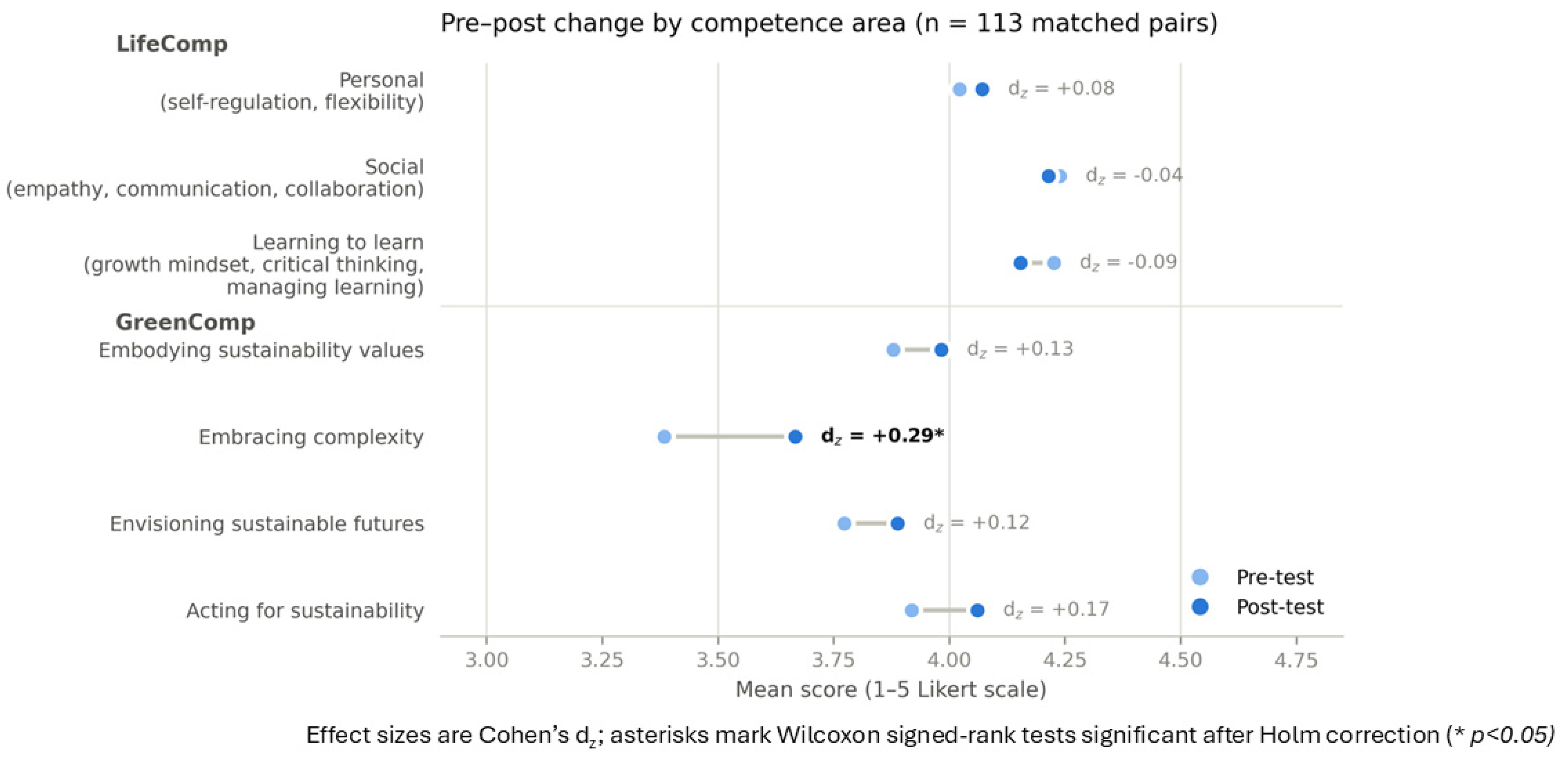
p = 0.030), with 59% of students improving and 36% declining; Hypothesis H1 is therefore supported. Crucially, the improvement was not spread evenly across the framework (
Table 4,
Figure 1). Of the four GreenComp areas, only “embracing complexity in sustainability” survived Holm correction, and it showed the largest effect of any area in either framework: M = 3.38 → 3.67 (Δ = +0.28; z = −3.18,
p = 0.002, Holm-adjusted
p = 0.010, dz = 0.29). “Acting for sustainability” improved nominally (Δ = +0.14, uncorrected
p = 0.026, dz = 0.17) but did not survive correction, while “embodying sustainability values” (
p = 0.213) and “envisioning sustainable futures” (
p = 0.160) did not change reliably. This pattern supports Hypothesis H2: the gains concentrated in the analytical competences most directly exercised by the Design Thinking cycle.
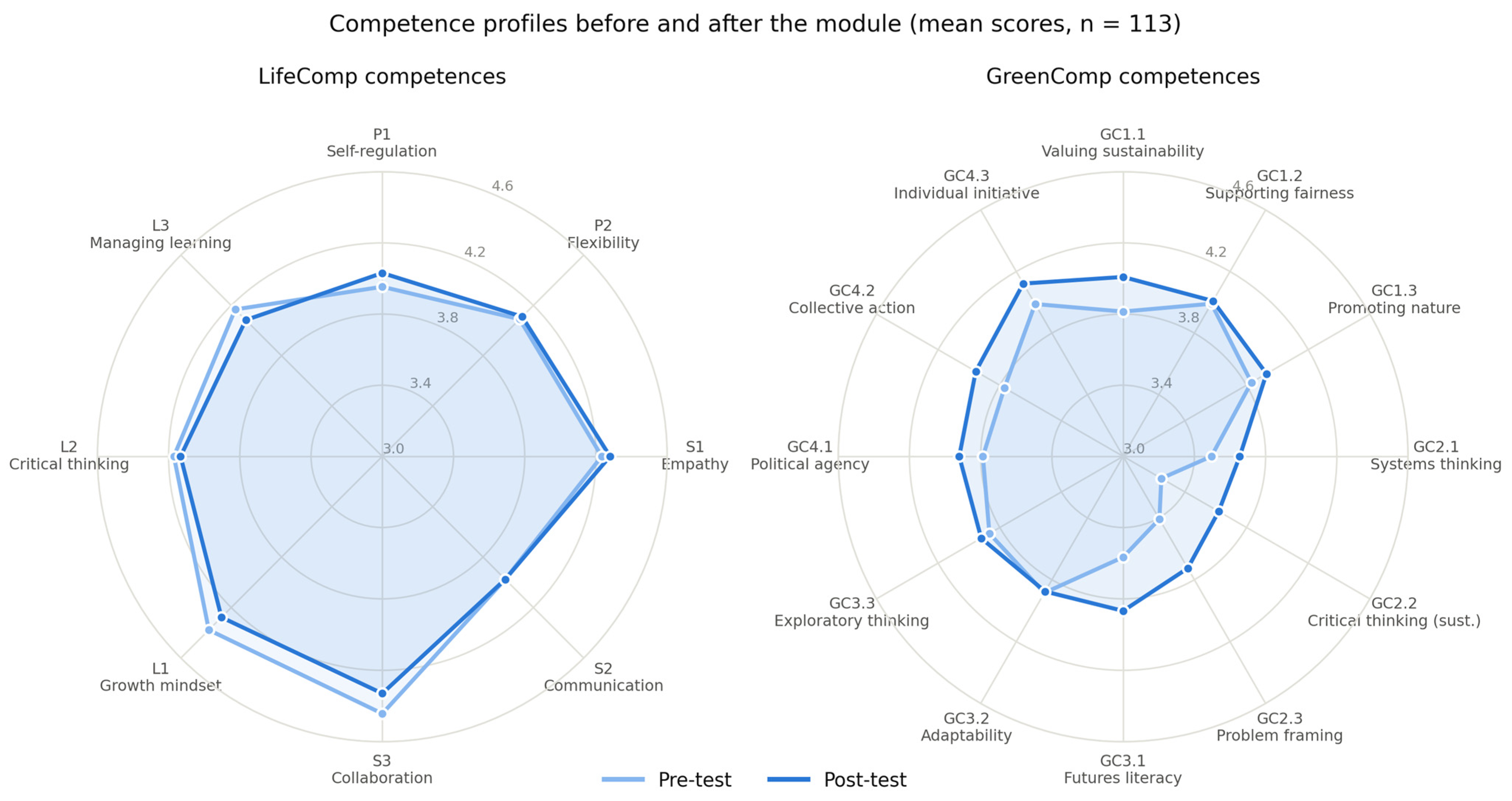
At the exploratory competence-indicator level (
Figure 2), two GreenComp indicators corresponding to critical thinking and challenge framing showed FDR-adjusted pre–post differences; both fall within the embracing-complexity area, for which the area-level composite provides the more reliable primary evidence: critical thinking applied to sustainability information (“I verify sources of environmental information to avoid greenwashing”; M = 3.25 → 3.62, dz = 0.29, FDR-adjusted
p = 0.035) and challenge framing (identifying the causes and actors of a complex sustainability problem; M = 3.41 → 3.73, dz = 0.28, FDR-adjusted
p = 0.035). Futures literacy (M = 3.57 → 3.87, dz = 0.25) and valuing sustainability (M = 3.81 → 4.01, dz = 0.23) improved at the marginal level (FDR-adjusted
p = 0.085 and 0.092). No LifeComp competence changed significantly.
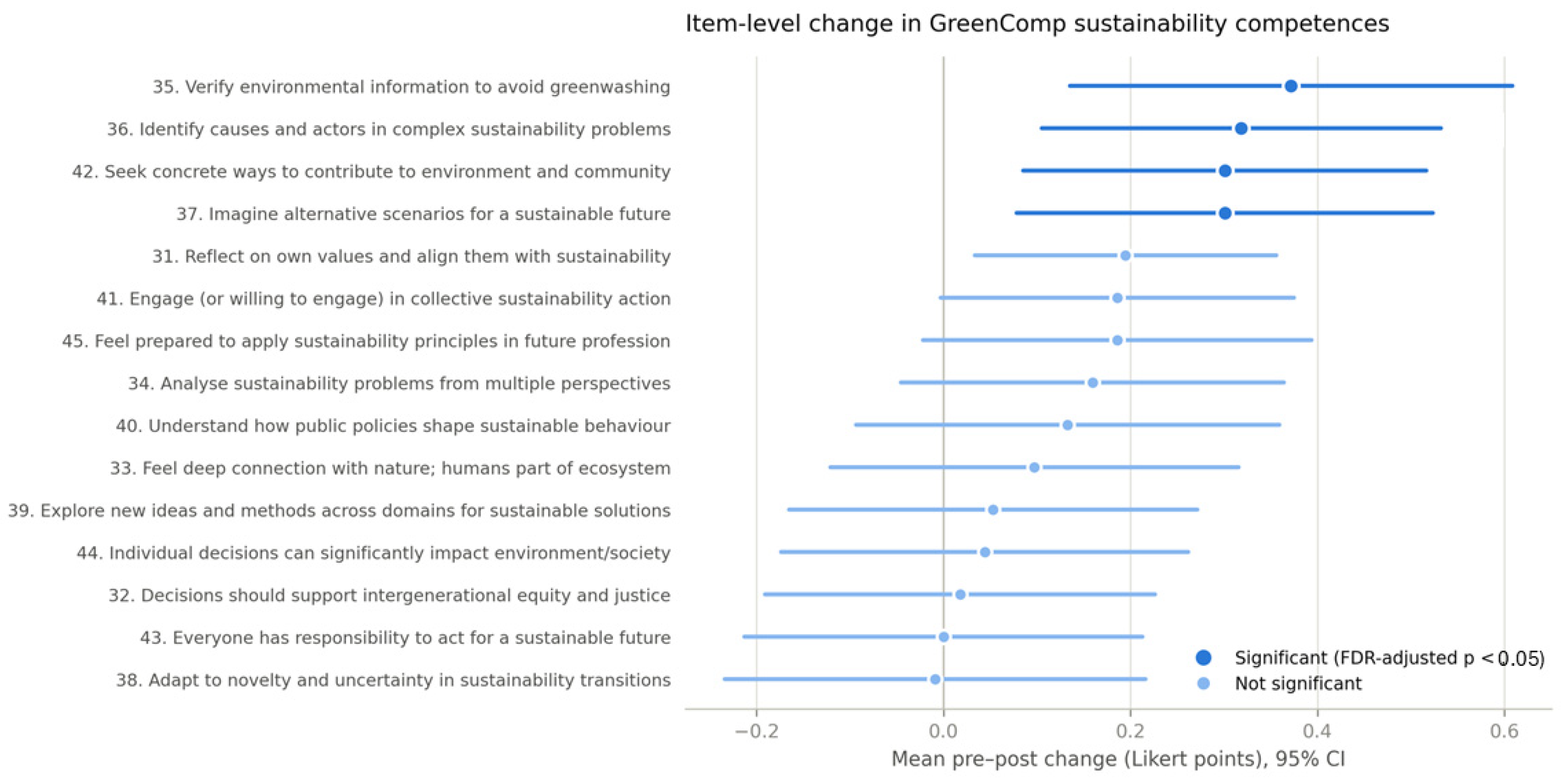
The item-level results localise the effect further (
Figure 3). Within the GreenComp family, four items improved significantly after FDR correction: verifying environmental information against greenwashing (Δ = +0.37, dz = 0.29), identifying causes and actors in a complex sustainability problem (Δ = +0.32, dz = 0.28), seeking concrete ways to contribute to the environment and community (Δ = +0.30, dz = 0.26), and imagining alternative scenarios for a sustainable future (Δ = +0.30, dz = 0.25). Items expressing general pro-sustainability beliefs that were already close to the scale ceiling at baseline—for example, “everyone has a responsibility to act for a sustainable future” (M = 4.30)—did not move.
4.3. LifeComp: A High, Stable Baseline
LifeComp competences did not change over the semester, so Hypothesis H3 was not supported. The overall LifeComp composite moved from M = 4.18 (SD = 0.49) to M = 4.15 (SD = 0.53) (z = −0.48,
p = 0.634, dz = −0.04); none of the three areas changed (all
p ≥ 0.37), and no LifeComp competence or item survived correction (
Table 4). Baseline LifeComp scores were, however, already very high—students rated their social (M = 4.24) and learning-to-learn (M = 4.23) competences above 4 on the 5-point scale on entry—leaving little measurable headroom, a point examined in
Section 4.4.
4.4. Robustness: Distribution, Ceiling and Attrition
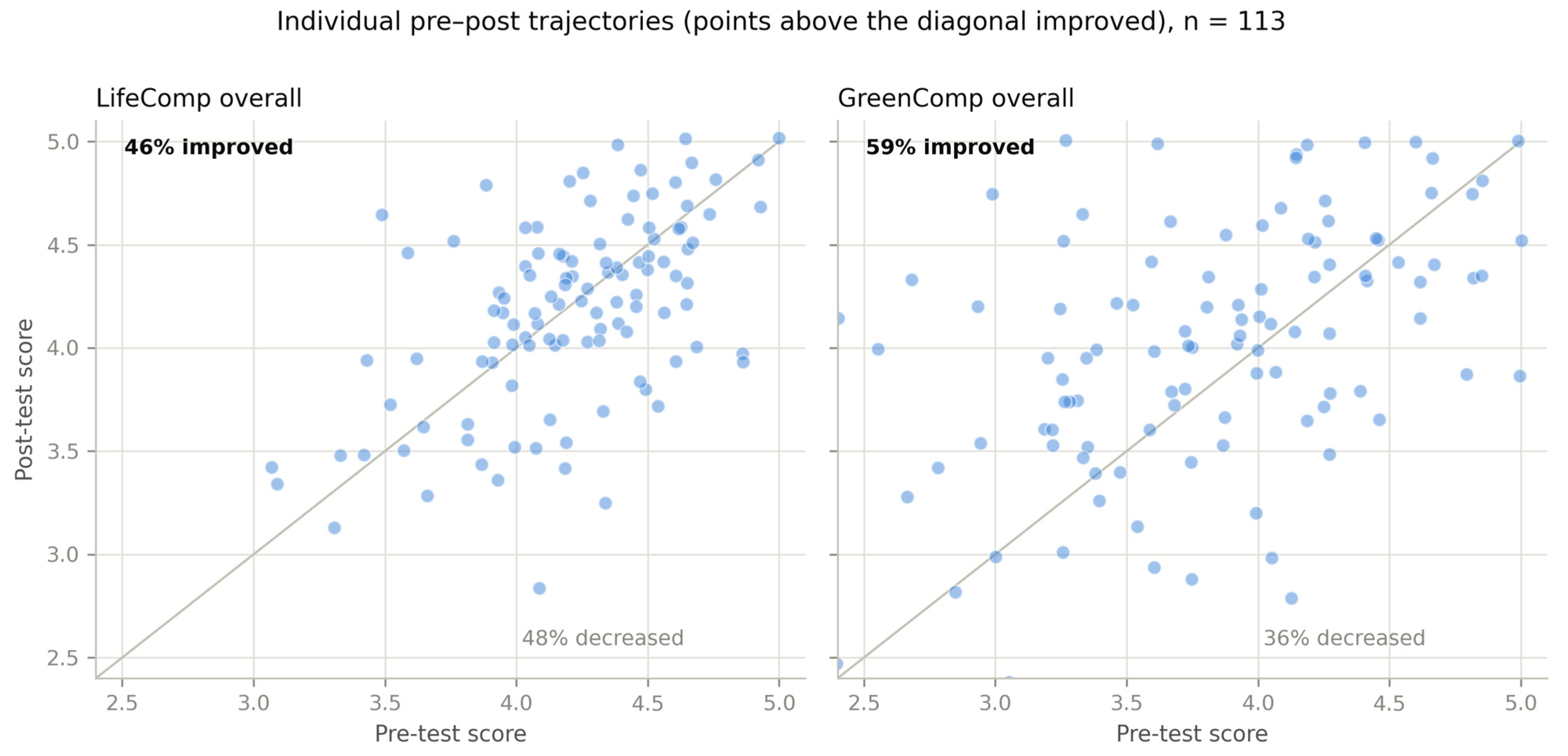
Figure 4 shows the individual pre–post trajectories. For GreenComp, the majority of students lie above the identity line (59% improved). Gains were negatively correlated with baseline scores (Spearman ρ = −0.34 for LifeComp and ρ = −0.50 for GreenComp, both
p < 0.001): students who began lower improved more. This is partly the expected regression to the mean, but it is also consistent with a genuine ceiling constraint, which was more severe for LifeComp: 25.7% of students began with a LifeComp mean of at least 4.5, against 13.3% for GreenComp. The lower, more dispersed GreenComp baseline left greater scope for measurable change, which is also where the largest observed changes occurred.
To understand the trajectory of the 36.3% of participants () who exhibited a numerical decrease on the GreenComp composite, we examined their distribution across baseline score tertiles (Low: ; Moderate: ; High: ). Of the 41 declining students, 28 (68.3%) originated in the highest baseline tertile (mean baseline ), 11 (26.8%) were in the moderate tertile (), and only two (4.9%) were in the lowest tertile. This concentration among initial high scorers confirms that the observed declines were largely driven by ceiling constraints and statistical regression to the mean, alongside potential response-shift effects where students recalibrated their perceived mastery downwards upon encountering authentic project complexity.
No selective attrition was detected. Pre-test respondents who did not complete the post-test had baseline scores statistically indistinguishable from those who did, on both LifeComp (Mann–Whitney U = 2605, p = 0.851) and GreenComp (U = 2498, p = 0.556), so the matched sample is not a biassed subset of the entrants on the measured competences.
4.5. Exploratory Subgroup Analyses
Pre–post gain scores did not differ across student subgroups. There were no significant differences by gender (LifeComp U = 1359.5, p = 0.465; GreenComp U = 1426.0, p = 0.243), faculty (Kruskal–Wallis H = 1.57, p = 0.456; H = 2.92, p = 0.233), study year (p = 0.402; p = 0.130) or employment status (p = 0.151; p = 0.686). Descriptively, the largest GreenComp gains appeared among Social Sciences and Humanities students (+0.38) and women (+0.21), but these differences were not statistically reliable. Within the limits of statistical power available from these subgroup sizes (e.g., n = 21 for Social Sciences and Humanities, n = 4 for Year 4 students), no subgroup differences reached significance; this should be read as an absence of detected moderation rather than confirmed homogeneity of effect. Although descriptive differences were observed, the present exploratory analyses did not provide statistically reliable evidence of subgroup moderation; the unequal and sometimes small subgroup sizes limit the strength of this inference.
4.6. Sustainability Goals Addressed by the Team Challenges
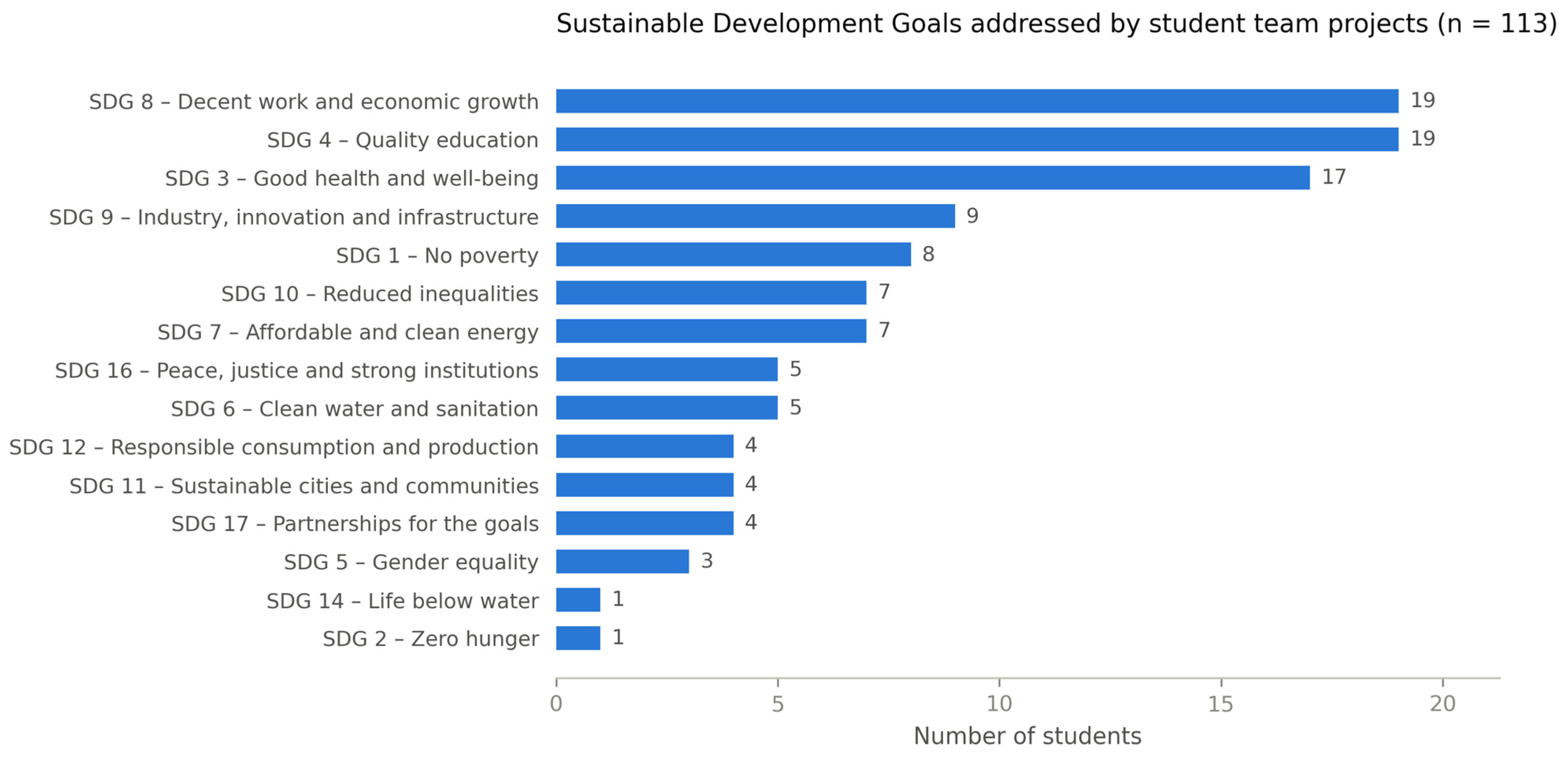
The community problems chosen by the teams mapped onto a wide range of the SDGs (
Figure 5): fifteen of the seventeen goals were represented. The most frequently addressed were decent work and economic growth (SDG 8) and quality education (SDG 4), chosen by 19 students each (16.8%), followed by good health and well-being (SDG 3, 15.0%). Classically “environmental” goals (SDGs 12–15) were each selected by fewer than one student in ten. This thematic profile provides contextual information about the projects undertaken by participants. It may help explain the emphasis on social and economic challenges within the module, although the present data do not test whether project topic was associated with competence change. Given that only 15.0% of teams addressed classically environmental SDGs (12–15), the resulting subgroup is too small to support a statistically powered comparison against socially/economically focused projects; we flag this as a specific direction for future research.
5. Discussion
This matched pre–post study asked whether participation in an interdisciplinary, Design Thinking-based challenge module was associated with changes in students’ self-reported sustainability competences of GreenComp. Overall GreenComp scores increased with a small effect (dz = 0.21), with the clearest change occurring in the analytical competences of the “embracing complexity” area. The following subsections interpret this pattern, situate it in the literature reviewed in
Section 2, and draw out its implications.
5.1. Interpreting the Analytical Pattern of Change
The pattern of change is consistent with the theoretical expectation that the phases of Design Thinking—empathising and researching a real problem, defining it, ideating solutions, and prototyping and testing them—exercise the analytical sustainability competences that improved. This alignment, however, was not measured directly. The study did not track students’ engagement with individual Design Thinking phases, and the absence of a comparison group means that maturation or concurrent coursework cannot be excluded as alternative explanations. The correspondence between pedagogy and outcome should therefore be read as a plausible explanatory account rather than as direct evidence of the intervention’s underlying mechanism. This is consistent with the theoretical claim, central to the competence tradition, that systems, anticipatory and critical thinking are best developed through active engagement with authentic, complex problems rather than through transmission [
4,
10,
18], and with the specific proposition that Design Thinking can foster GreenComp-aligned competences [
17].
5.2. Comparison with the Literature
The magnitude and shape of our findings fit the emerging empirical picture. Studies of challenge- and project-based and Design Thinking pedagogies have generally reported gains in the more cognitive and action-oriented facets of sustainability competence—teamwork, communication, creative confidence, innovation and problem-solving—rather than in deep value change [
15,
20,
21]. Our findings add a matched pre–post, framework-anchored quantitative estimate to a literature that has often relied on qualitative or case-based evidence. At the same time, the findings remain based on self-reported outcomes in a single institutional setting and should therefore be viewed as complementary to, rather than stronger than, studies using comparison groups or performance-based assessments. That asymmetry is not unique to our setting. A large administrative analysis at Tecnológico de Monterrey found that value-oriented competences such as commitment to sustainability, ethical commitment and social intelligence were the hardest both to develop and to observe across programmes and semesters [
14]. Our near-ceiling, unmoved “embodying sustainability values” items are the self-report counterpart of that finding: when students already endorse sustainability values strongly on entry, a single semester adds little measurable change.
The observed pattern should also be interpreted in relation to the disciplinary and thematic context of the cohort. The sample was dominated by economics and social-science students, and the projects disproportionately addressed SDGs 8, 4, and 3, while environmentally focused SDGs were less represented. This composition may have shaped which sustainability dimensions students repeatedly encountered and, consequently, which GreenComp domains had the greatest opportunity for practice. Because SIM was embedded in a single Romanian university and local community context, institutional and regional factors may also have influenced challenge selection and self-perceptions; these contextual influences were not measured, and transferability to cohorts with a stronger ecological or different disciplinary profile remains to be established.
The result also speaks to a persistent methodological concern. Reviews of sustainability-competence assessment have criticised the field’s reliance on undifferentiated self-report and its shortage of longitudinal, matched designs [
5]. By tracking the same 113 students across the semester, correcting for multiplicity, reporting effect sizes and confidence intervals, and checking for attrition and ceiling effects, the present study offers the kind of quantitative evidence that reviewers have called for, while remaining transparent about the limits of self-report (
Section 6). The selective pattern of change is not fully consistent with a simple uniform increase in socially desirable responding, but it should not be interpreted as evidence that self-report bias was absent. Social desirability remains possible, and response-shift bias is particularly relevant in a pre–post self-assessment design. Exposure to the module may have changed students’ internal standards or their conceptual understanding of what sustainability competence entails, meaning that pre- and post-test ratings may not be based on an identical subjective frame of reference. Observed score changes may therefore reflect both changes in perceived competence and changes in how students evaluate that competence. This pattern argues against a pure social-desirability account but does not rule out response-shift bias, whereby students recalibrate their internal standard of what ‘high competence’ means after engaging more deeply with sustainability content over the semester—a mechanism distinct from desirability effects and difficult to distinguish from genuine competence gain in a self-report, single-group design. That validated instruments such as the Sustainability Consciousness Questionnaire deliberately separate sustainability knowingness, attitudes and behaviour [
12] reinforces the value of analysing GreenComp areas separately rather than as a single index, as our area-level results make plain: an aggregate-only analysis would have masked the very effect the module produced.
5.3. Interdisciplinary Challenge-Based Design Thinking as a GreenComp Pedagogy
Taken together, the evidence supports a practical proposition for curriculum designers: interdisciplinary, challenge-based Design Thinking modules of the SIM type are a promising pedagogy for building the cognitive core of GreenComp. The module can be embedded into existing seminars without requiring a dedicated course slot (because teams tackle real community challenges mapped to the SDGs), connecting local action to the global agenda in the way that experiential-learning scholarship has long recommended [
19], and that competence-oriented ESD requires [
18]. Its interdisciplinary team structure operationalises the collaboration across knowledge domains that complex, “wicked” sustainability problems demand, and its authentic-problem focus supplies the complexity on which analytical competences develop [
20,
21]. For programmes seeking to implement GreenComp without redesigning an entire curriculum—an aim increasingly pursued, for instance, in engineering education [
11]—a single, well-structured challenge module may offer a feasible, evidence-informed entry point, subject to evaluation in other curricular contexts. The breadth of SDGs the teams addressed (fifteen of seventeen) further suggests that such a module can carry sustainability content across very different disciplinary starting points.
In the present implementation, one semester of the module was not associated with detectable change in value- and nature-oriented competences—embodying sustainability values, connection with nature, intergenerational justice. This finding does not establish that Design Thinking is generally less suitable for such outcomes; rather, it suggests that value-oriented development may require more explicit reflective, ecological or transformative-learning components and/or a longer period of exposure. In this single intervention at a single institution, interdisciplinary Design Thinking appeared well suited to developing students’ analytical and action-oriented engagement with sustainability challenges, and less effective, as delivered here, at shifting already-high value endorsements—a pattern that should be tested in other institutional settings before being generalised to Design Thinking as a pedagogy [
15].
6. Theoretical and Practical Contributions, Limitations, and Future Research
6.1. Theoretical and Practical Contributions
The main contribution of this study is its competence-specific evaluation of sustainability learning outcomes. Rather than treating GreenComp as a single aggregate construct, the study identifies a differentiated area-level pattern of short-term change, with the clearest and most reliable change in embracing complexity. Exploratory indicator-level results further localise this pattern to critical evaluation of sustainability information and problem framing, whereas value-oriented indicators remained comparatively stable. Theoretically, the conceptual mapping between Design Thinking phases and GreenComp provides a structured basis for interpreting this pattern, suggesting that competences repeatedly exercised through problem inquiry, reframing and iterative solution development may be more responsive within a semester-long intervention than more deeply rooted value-oriented dispositions. This alignment should nevertheless be understood as conceptual rather than causal, since the study did not isolate the effects of individual Design Thinking phases.
Practically, the study illustrates how GreenComp can be operationalised within an existing interdisciplinary challenge-based module, both as a framework for curriculum design and for competence assessment. The SIM format therefore represents a feasible (and promising), evidence-informed approach to embedding sustainability competences into existing teaching, while the competence-specific results may help educators identify where complementary activities are needed, particularly when value- and nature-oriented development is an explicit learning objective.
6.2. Limitations and Future Research
Several limitations qualify these conclusions. First, the design is a single-group pre–post comparison without a control group, so maturation, concurrent coursework and repeated testing cannot be fully excluded, and the observed changes should be interpreted as associated with participation rather than causally attributed to the module. Second, all outcomes are self-reports on Likert scales, which are subject to ceiling effects, response-shift and social-desirability bias; although the selective, analytically focused pattern of gains argues against a simple desirability explanation, behaviourally anchored or performance-based measures would strengthen future work [
5]. After the module, students may have recalibrated the standards used to assess themselves or reconceptualised what particular sustainability competences entail. Future studies should therefore complement self-report measures with behavioural, performance-based, or externally assessed indicators. Third, subgroup analyses were exploratory and based on unequal and, in some cases, small groups. Accordingly, non-significant differences should not be interpreted as evidence of homogeneous or equivalent effects. Larger and more balanced samples would allow adequately powered moderation or equivalence analyses. Fourth, the predominance of SDGs 8, 4, and 3 and the comparatively limited representation of environmentally focused SDGs suggests a useful direction for future research: competence trajectories could be compared a priori between projects centred on environmental sustainability and those focused primarily on social or economic issues. Additional limitations include possible regression to the mean, limited measurement depth for some individual GreenComp competences, the small risk of pseudonym-matching collisions, attrition between waves and the single-institution sample. Minor variation in delivery cadence across study programmes may also have introduced differences in intervention intensity, although the core Design Thinking sequence and assessment structure were maintained. Future research should therefore use controlled comparative designs, stronger multi-item competence measures, more diverse samples and longitudinal follow-up to determine whether the observed changes persist over time.
7. Conclusions
Across 113 matched students, participation in the interdisciplinary Design Thinking-based Sibiu Impact Makers module was associated with a small increase in self-reported GreenComp sustainability competences, with the clearest area-level change in the analytical competences of embracing complexity—particularly critical evaluation of sustainability information and challenge framing. LifeComp transversal competences, already high at entry, remained stable, consistent with ceiling effects. Exploratory subgroup analyses did not detect statistically significant moderation by gender, faculty, study year and employment, but unequal and sometimes small subgroup sizes preclude conclusions of equivalence. Because the study used a single-group pre–post design, self-reported outcomes, and did not track engagement with individual Design Thinking phases, the findings do not establish causal effectiveness or the proposed DT–GreenComp mechanism. Rather, they suggest that an interdisciplinary challenge-based Design Thinking format may be a promising, evidence-informed way to support analytical sustainability competences within an existing university module. Future research should test the approach against a comparison group, add behavioural or performance-based measures, examine response-shift effects, test project thematic orientation as a potential moderator, and follow students beyond a single semester to assess whether these competence gains endure.




 ,
,