Article

Regional Breakthrough Innovation Capacity Drives the Integration of High-End, Intelligent and Green Transformation Toward Industrial Sustainability in China: Mechanisms and Heterogeneity

School of Business (School of Quality), Liaocheng University, Liaocheng 252000, China
*
Author to whom correspondence should be addressed.
Sustainability 2026, 18(17), 8951; https://doi.org/10.3390/su18178951
Submission received: 26 June 2026 / Revised: 7 August 2026 / Accepted: 26 August 2026 / Published: 1 September 2026
(This article belongs to the Section Economic and Business Aspects of Sustainability)

Abstract

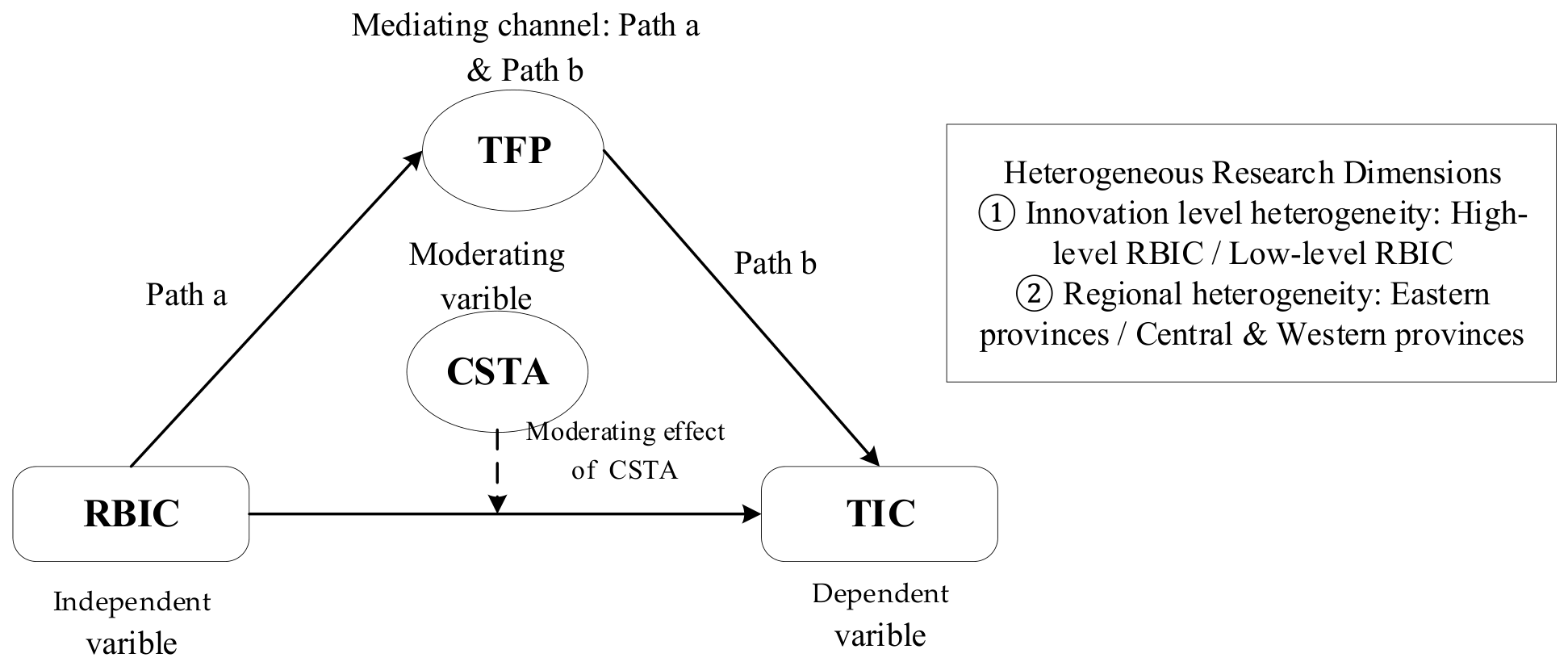
Against the global pursuit of carbon peaking, carbon neutrality, and industrial sustainability goals, the coordinated advancement of high-end, intelligent, and green transformation (the “Three Transformations”) has become an essential pathway for China’s sustainable industrial low-carbon transformation. The integration of the “Three Transformations” addresses China’s long-standing “large but not strong” manufacturing dilemma and serves as the core pathway to high-quality industrial development. As a core driver of technological and industrial upgrading, regional breakthrough innovation capacity (RBIC) strongly facilitates the coordinated advancement of the “Three Transformations.” This paper establishes a three-layer evaluation index system for the integration of the “Three Transformations” using provincial panel data of 30 Chinese provinces spanning 2012–2023. It applies the CRITIC-entropy combined weighting approach to compute dimensional composite indices and a revised coupling coordination model to quantify integrated development levels. RBIC is proxied by the natural log of one plus the number of authorized invention patents. Two-way fixed-effect mediating and moderating panel models are further built to empirically unpack RBIC’s industrial-level mechanisms affecting the integration of the “Three Transformations.” The empirical analysis yields three key findings. (1) Overall, RBIC shows a statistically significant positive association with advancing the integration level of the “Three Transformations.” Heterogeneity analysis shows that high-level RBIC has a strong positive correlation with integrated upgrading, whereas low-level RBIC is significantly negatively associated with integrated upgrading. Furthermore, the positive correlation found in Eastern China is far more pronounced than in Central and Western China. (2) Mechanism tests reveal a statistically significant indirect association consistent with the theoretical logic that total factor productivity (TFP) serves as an intermediate linkage between RBIC and the integration of the “Three Transformations.” Commercialization of scientific and technological achievements (CSTA) accelerates the industrial transformation of RBIC technological outputs and strengthens the positive correlation between RBIC and manufacturing integration in relation to the “Three Transformations.” (3) Local government intervention is negatively correlated with the positive linkage between RBIC and integrated manufacturing upgrading, indicating a significant crowding-out effect. Accordingly, this paper proposes targeted policy measures including tiered cultivation of RBIC, unblocking TFP-related transmission linkages, optimizing government intervention mechanisms, and improving the industrial ecosystem for CSTA. This paper also delivers actionable governance insights derived from China for other developing countries to achieve transformative industrial upgrading of manufacturing industries. This study enriches the theoretical system of sustainable manufacturing upgrading and provides practical support for authorities to formulate sustainable industrial policies.
Keywords: regional breakthrough innovation capacity; integration of the “Three Transformations”; industrial sustainability; low-carbon upgrade; influence mechanism; regional heterogeneity regional breakthrough innovation capacity; integration of the “Three Transformations”; industrial sustainability; low-carbon upgrade; influence mechanism; regional heterogeneity