Article

The House of Sustainable Military Apparel Supply Chain Management (HoSMASC): A Conceptual Model and Preliminary Assessment Matrix


by
Agnieszka A. Tubis
1,*,
Anna Zabłocka-Kluczka
2 and
Justyna Świerczek
1
1
Faculty of Mechanical Engineering, Wroclaw University of Science and Technology, Wyspianskiego 27, 50-370 Wroclaw, Poland
2
Faculty of Management, Wroclaw University of Science and Technology, Wyspianskiego 27, 50-370 Wroclaw, Poland
*
Author to whom correspondence should be addressed.
Sustainability 2026, 18(17), 8940; https://doi.org/10.3390/su18178940
Submission received: 31 July 2026 / Revised: 25 August 2026 / Accepted: 27 August 2026 / Published: 1 September 2026

Abstract

Sustainable apparel supply chain research is dominated by the fashion sector, while the specific operational, technical, institutional, logistics, and security requirements of military apparel supply chains remain insufficiently integrated into existing conceptual frameworks. This study aims to develop a conceptual model for sustainable military apparel supply chain management. A narrative literature review was used to identify source determinants derived from fashion supply chain research, followed by a sectoral analysis of military apparel supply chains. The determinants were then adapted using an adaptation matrix based on four transformation rules: functional, actor-related, restrictive, and extending transformation. The analysis identified six adaptive conditions defining the admissibility of sustainable solutions and nine target determinants grouped into four management pillars. These elements were integrated into the House of Sustainable Military Apparel Supply Chain Management (HoSMASC), in which the adaptive conditions form a qualifying foundation and the target determinants form pillars subject to graded assessment. A preliminary assessment matrix was also developed, combining a binary, conjunctive evaluation of the foundation with a 0–2 assessment of the determinants within the pillars. The model provides a structured framework for preliminary diagnosis and design support but remains conceptual and requires empirical validation through expert assessment and case studies.

1. Introduction

The sustainability of supply chains in the textile and apparel industry constitutes one of the key areas of contemporary research on material flow management and corporate environmental responsibility. However, an analysis of the existing literature indicates that this research focuses primarily on fashion supply chains, addressing, among other issues, the circular economy, supplier management, and ESG and CSR strategies [1]. The limited number of studies concerning other types of apparel indicates that research in this area remains one-sided and concentrated on a single, specific product category.
In this study, sustainable management is understood as the coordinated planning, organising, leading, and controlling of supply chain activities aimed at creating value while remaining within ecological limits and accounting for long-term social, economic, and environmental impacts—commonly framed as the triple bottom line of economic, social, and environmental performance [2]. Within the House of Sustainable Military Apparel Supply Chain Management (HoSMASC) model developed in this study, this general conception is operationalised specifically for the military apparel supply chain context, in which sustainability improvement is pursued within the boundaries defined by the operational, security, and regulatory adaptive conditions identified in Section 4.2. This shift in emphasis between Section 2.1 and the HoSMASC model is not an inconsistency but reflects the conceptual contribution of the present study: the transition from a general, triple-bottom-line conception of sustainability, applicable across commercial sectors, to its conditional operationalisation within a high-risk, security-sensitive sector is precisely the transformation that the HoSMASC model formalises.
The dominance of research on fashion apparel means that mechanisms developed in this sector are often treated as a general point of reference for the entire textile and apparel industry. Such an approach is problematic in the case of military apparel. Although military apparel belongs to the same category of textile products, the supply chains managing material flows related to its production and distribution operate under fundamentally different conditions from commercial fashion supply chains, while the nature of the product itself constitutes one of the criteria differentiating supply chains. Transferring mechanisms developed for the fashion sector without adapting them is therefore methodologically and practically unjustified. This results, in particular, from the different requirements applicable to military supply chains, in which each sustainable solution must be assessed not only in terms of reducing environmental impact, but also with regard to its effects on product functionality, user safety, continuity of supply, data controllability, and the ability to maintain deliveries under disruption conditions.
Despite the relatively well-developed body of knowledge concerning sustainable fashion supply chains, the existing literature does not provide a coherent conceptual basis integrating knowledge on the sustainable management of apparel supply chains with the specific characteristics of the military sector [3]. Individual studies emphasise the need to combine environmental, social, and economic benefits with the maintenance of operational efficiency in military supply chains. However, they do not provide a sufficiently developed framework for explaining how factors identified in fashion-sector research should be transformed into determinants specific to sustainable military apparel supply chains. The problem therefore lies not only in the lack of studies on military apparel supply chains, but primarily in the absence of a conceptual framework explaining how sustainability determinants should be integrated with the requirements characteristic of the defence sector.
Consequently, it is not possible to determine unequivocally which factors developed in the literature on fashion supply chains remain relevant, which require adaptation, and which should be supplemented with determinants resulting from the need to ensure security, resilience, reliability, and operational readiness. This creates cognitive limitations and can be expressed as a research gap operating on three interrelated levels: (1) a theoretical gap, namely the absence of an integrative framework for cross-sectoral sustainable management knowledge; (2) a methodological gap, namely the absence of a standardised procedure for transforming generic sustainability factors into determinants specific to the military sector; and (3) a practical gap, namely the absence of assessment tools capable of supporting the preliminary diagnosis and design of sustainable military apparel supply chains. The identified research gap provided the basis for defining the aim of this article, which is to develop a conceptual House of Sustainable Military Apparel Supply Chain model (HoSMASC), demonstrating how sustainability requirements can be integrated with military-sector requirements in the management of military apparel supply chains.
The article assumes that the fashion literature provides a valuable starting point but cannot be transferred directly to the military sector. It is therefore necessary to apply adaptation requirements resulting from the different conditions governing material flow control in military supply chains.
The article is theoretical and conceptual in nature, and its main contributions include:
  • Extending the discussion on sustainable apparel supply chains beyond the dominant context of the fashion sector;
  • Demonstrating that factors identified in the fashion literature require adaptation to the specific characteristics of military apparel and proposing a formalised adaptation procedure based on four rules;
  • Formulating the concept of the HoSMASC house model, in which adaptive conditions performing a qualifying function constitute the foundation of the model, while the adapted target determinants form its four pillars, thereby enabling a clear distinction between the admissibility conditions of solutions and the areas subject to gradual assessment;
  • Developing a preliminary assessment matrix that transforms the conceptual model into a practical diagnostic tool by combining binary verification of the foundation with a graded assessment of the four-pillar profile and that can be used by representatives of academia and industry in the preliminary assessment of sustainable military apparel supply chain management.
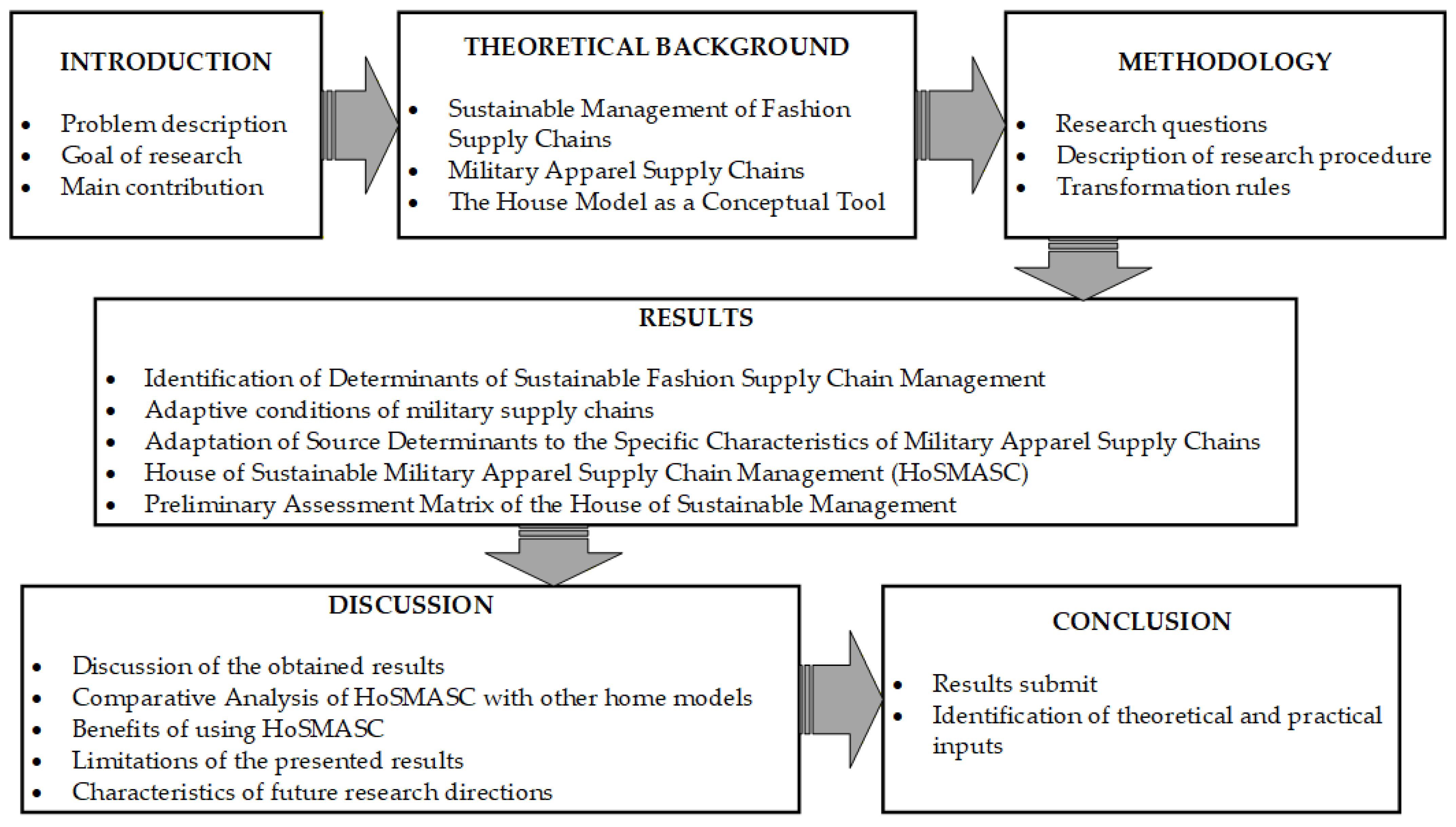
The structure of the article is presented in Figure 1.

2. Theoretical Background

2.1. Sustainable Management of Fashion Supply Chains

The identification of source determinants presented in this section is based on a narrative literature review conducted in the Web of Science and Scopus databases, using the search string TITLE-ABS-KEY (“Fashion” AND “Supply” AND “Chain” AND “Management”), restricted to English-language, Open Access publications (article, proceedings paper, review, book chapter, book, conference paper, and editorial types) published between 2018 and 2025—a period beginning one year before the COVID-19 pandemic, whose disruptive effect on global supply chain management is well-documented. From the identified body of publications, those providing substantive insight into the research area were selected and subjected to thematic synthesis, from which the nine source determinants discussed below were derived. In accordance with the methodological character of a narrative review, the selection and synthesis of the literature relies to a greater extent on the researcher’s expert judgement.
One of the main starting points for research on the sustainable management of fashion supply chains is the criticism of the linear model of production and consumption. Production and logistics processes associated with fashion have a significant impact on people and ecosystems, and this problem is intensified by the fast-fashion model, short product life cycles, and the increasing volume of textile waste [4,5,6,7,8]. The literature emphasises that, despite the existence of recycling processes, only a small proportion of textiles actually returns to the apparel system, indicating the limited effectiveness of current approaches to closing material loops [9,10,11,12]. Therefore, the issue of sustainable management in the fashion sector is closely linked to the need to redesign material, information, and reverse flows throughout the supply chain.
The most extensively developed research stream concerns the circular economy and Circular Supply Chain Management. CE involves a transition from the linear “take–use–dispose” model towards reuse, regeneration, repair, recycling, and product life extension. From a supply chain perspective, CSCM focuses on extending the period during which materials remain in use, including through successive cycles of refurbishment, repair, recycling, or increased product durability [13,14]. In the literature, CE is therefore not treated solely as a waste-management technique, but as a management logic encompassing the entire supply chain, including design, material sourcing, production, distribution, use, returns, and the final management of products.
Reverse logistics and the management of post-consumer textile waste are directly related to the circular economy. The literature on Post-Consumer Textile Waste indicates that textile and apparel waste management has environmental, social, and economic significance because it reduces the amount of waste sent to landfill, enables material reuse, and strengthens consumer awareness [15]. Closed-Loop Supply Chain models generally include several recovery pathways, including product reuse, material recycling, and energy recovery [16]. At the same time, studies indicate significant risks associated with uncertainty regarding the quantity and quality of recovered materials, which complicates the planning of reverse flows and the development of stable circular systems [17]. This research stream gives rise to the first source determinant: the circular economy, CSCM, and reverse logistics.
A second important area of research concerns sustainable materials and product design. The literature indicates that material selection and design-stage decisions determine subsequent opportunities for repair, reuse, recycling, and environmental impact reduction. One example of a material strategy is the use of agroforestry-grown organic cotton, which may reduce chemical use, support biodiversity, and align with both circular economy principles and CSR objectives [18,19]. At the same time, researchers emphasise that changing materials alone is insufficient to achieve circularity. Products must be designed for durability, repairability, recyclability, reduced resource consumption, and waste minimisation. Consequently, product design becomes a key intervention point in the sustainable management of fashion supply chains.
The third research stream encompasses sustainable supplier management and interorganisational collaboration. Studies show that the transition towards sustainability cannot be achieved solely by a fashion brand or an individual enterprise because responsibility for environmental and social impacts is distributed among multiple supply chain participants. Supplier selection, qualification, monitoring, and auditing against environmental, social, quality, and organisational criteria are therefore important. The literature also presents tools for assessing supplier circularity, such as CAoS (Circular Assessment of Suppliers), which aim to help companies balance economic efficiency with circular economy principles and CSR objectives [20]. At the same time, implementing sustainable practices requires information exchange, coordination of activities, joint innovation, and relationship building among brands, suppliers, intermediaries, retailers, consumers, and recovery operators [21,22]. The literature indicates that the transition of fashion companies towards more sustainable management models should be gradual and should include regulatory compliance, internal activities, and the development of the entire supply chain through collaboration and innovation. In addition, relationships based on trust and cooperation can facilitate the transfer of innovation and the development of sustainable practices throughout the supply chain [23,24].
Transparency and traceability constitute another important area of research on the sustainable management of fashion supply chains. The literature indicates that access to data on raw-material origins, material composition, suppliers, and product flows is a prerequisite for a reliable assessment of a supply chain’s environmental and social impacts [25,26]. Transparency supports reporting, verification of the consistency between corporate activities and declarations, and a reduction in greenwashing risk, particularly amid increasing pressure from consumers and stakeholders to disclose information on sustainability practices [27]. The literature also emphasises the importance of digital technologies as tools supporting traceability and flow management in fashion supply chains. Technologies such as IoT, RFID, blockchain, and data analytics enable product tracking, flow monitoring, and the collection of information concerning material origins and production stages [28]. In turn, solutions based on artificial intelligence, robotics, and digital platforms can support sorting, waste management, responsible sourcing, and product authenticity verification [25,26]. From a broader perspective on green logistics and supply chain management, the importance of knowledge management, information transfer, digital platforms, and governance mechanisms in enhancing supply network resilience and sustainability is also emphasized.
CSR, ESG, and the social aspects of Fashion Supply Chain Management also occupy an important place in the literature. The literature indicates that CSR strategies can support business models conducive to economic, social, and environmental balance [29]. Quantitative studies also indicate that CSR can be integrated into distribution decisions and influence profitability, employee motivation, the attractiveness of eco-fashion, and CO2 emissions [30]. The social dimension of sustainable management includes preventing abuse, modern forms of slavery, labour-rights violations, and inequalities within global production networks. The literature indicates that effective CSR requires not only audits but also corrective actions, cooperation with non-governmental organisations, grievance mechanisms, contractual decisions, and pressure from buyers and network partners [31,32,33]. Purchasing intermediaries, merchandisers, NGOs, and public institutions also play an important role by strengthening the capacity to implement social standards in global supply chains [34,35,36]. The contemporary ESG approach extends this logic by integrating sustainability with environmental and social risk management, waste reduction, the use of environmentally friendly materials and renewable energy, improvements in working conditions, and brand reputation building [37].
The determinant of regulation and institutional pressure is associated with CSR and ESG. The literature indicates that the development of sustainable fashion supply chain management is reinforced by the Sustainable Development Goals, reporting mechanisms, waste-related requirements, the European Green Deal, Extended Producer Responsibility, and social regulations such as the Australian Modern Slavery Act 2018 [38,39,40]. Regulations and institutional pressure do not replace corporate activities, but they create formal conditions that enforce greater transparency, the development of auditing, producer responsibility, and the formalisation of supplier requirements.
Another research area concerns sustainable business models and consumer behaviour. The literature indicates that business models in the apparel industry can reduce resource consumption and support closed material loops, but their effectiveness depends on integrating environmental value with customer and organisational value, as well as on innovation, entrepreneurship, and regulatory pressure. The solutions most frequently analysed include rental, subscription, resale, sharing, take-back programmes, repair, reuse, and consumer education [41,42]. Consumers influence the development of sustainability through their acceptance of recycled products, interest in upcycled products, expectations regarding brand transparency and responsibility, and participation in return and recycling initiatives [43]. This means that the literature treats the end user as an active participant in closing the product loop.
At the same time, numerous economic and organisational barriers are emphasised. The implementation of circular and sustainable practices is constrained by high costs, the low value of apparel at the end of its use phase, a lack of data, insufficient infrastructure, competence shortages, coordination difficulties, the absence of standards and implementation frameworks, uncertainty regarding the quality of secondary raw materials, and low demand for circular products [44,45]. Some circular models may also generate additional emissions associated with transport, sorting, and energy consumption. Therefore, the greatest environmental benefits are often attributed to reducing consumption and reusing existing apparel rather than to recycling alone [46]. This group of studies demonstrates that sustainable management requires an assessment not only of environmental intentions but also of economic and organisational feasibility.
The final significant research stream concerns risk management and supply chain resilience. Resilience to disruptions, digitalisation, and institutional support are identified as strategic conditions for the further development of sustainable supply chains [47]. In the context of climate objectives, risk analyses of scenarios for transforming the apparel economy towards circularity and climate neutrality are also important [48]. The importance of sustainable management is further reinforced by the need to reduce risk, uncertainty, and the consequences of unforeseen events in supply chains [28,49].
The identified research streams should be regarded as a means of organising the literature rather than as a rigid division of the issues involved in the sustainable management of fashion supply chains. In practice, the analysed issues overlap because decisions concerning materials, design, suppliers, reverse flows, data, and regulations interact throughout the product life cycle. Therefore, sustainable management cannot be considered from the perspective of an individual practice. It requires a systems approach in which the identified source determinants constitute an interconnected set of elements influencing the organisation, control, and improvement of the fashion supply chain.

2.2. Military Apparel Supply Chains

The sectoral analysis presented in this section draws on a narrative review of the literature in the Web of Science and Scopus databases, using the search string TITLE-ABS-KEY (“military” OR “defense” OR “armed forces” OR “military personnel”) AND TITLE-ABS-KEY (“clothing” OR “apparel” OR “uniform” OR “gear”) AND TITLE-ABS-KEY (“supply chain” OR “logistics” OR “procurement” OR “distribution”), supplemented—owing to the limited number of results—by a search of publicly available reports and documents issued by military agencies, addressing the same subject matter. This review was further informed by the authors’ own field research conducted within a broader research project on the functioning of military apparel supply chains, comprising accompanying observations, documentary analysis, and a case study of a selected supply chain. The academic literature review served to identify general sector-specific themes; publicly available military reports and institutional documents were used primarily to substantiate and specify conditions arising from regulatory and institutional requirements; and the authors’ own field research served both to verify the conditions identified in the literature and to identify additional adaptive conditions not explicitly captured in secondary sources.
The military apparel supply chain differs from the fashion apparel sector in terms of the nature of its material flows. It is not driven by seasonality, market trends, or consumer behaviour [3]. Its primary task is to ensure operational capability by delivering the appropriate equipment to the relevant users in the required quantity and quality, at the right place and time. Sustainable solutions must therefore not reduce the availability, functionality, or reliability of products used in the performance of military tasks. For this reason, the present study requires identifying critical conditions specific to this type of supply chain.
The first critical condition is operational readiness combined with the security of supplies and inventories. Demand for military apparel results, among other factors, from the structure of the armed forces, the number of users, entitlement standards, intensity of use, exercises, missions, and mobilisation requirements. Flow planning must therefore account for both current consumption and the possibility of a sudden increase in demand. Elvemo [50] indicates that military supply chains constitute complex adaptive systems and that their resilience is directly relevant to maintaining operational capability and combat power.
Inventories also perform a different function. In the commercial sector, excessive inventory levels are most often considered a source of costs, markdowns, and waste. In defence systems, part of the inventory may be maintained to secure future or contingency operational requirements. At the same time, inventory levels should be reviewed periodically because stocks that are not justified by current requirements generate storage costs and create the risk of surpluses [51]. GAO studies further indicate the need to balance the timely availability of resources against supply chain operating costs [52]. Although these sources concern defence inventories in general, they confirm the validity of treating inventory as a trade-off between economic efficiency and operational readiness rather than as a category subject to unconditional minimisation.
The second condition concerns technical and functional requirements considered throughout the entire product life cycle. Military apparel may perform protective, camouflage, thermal, ergonomic, identification, and specialist functions. Material selection and product design should therefore account for operating conditions, wear resistance, user safety, comfort, maintenance, and compliance with technical specifications. Within the defence supply system, requirements concerning apparel and textiles are formalised through specifications, statements of work, testing procedures, and quality requirements. Products are assessed, among other aspects, in terms of wear resistance, colour fastness, and user safety [53].
A material regarded as more sustainable in the fashion sector cannot therefore automatically be considered suitable for military applications. Its suitability requires the simultaneous assessment of environmental, technical, and operational parameters. This assessment should cover not only the procurement stage but also use, maintenance, repairability, service life, and end-of-life management. From this perspective, durability is not merely a quality parameter; it also affects product replacement frequency, material demand, and the volume of products withdrawn from use.
Another condition is regulatory and institutional compliance. Military apparel is procured through formalised public procurement procedures and, in specific cases, through defence and security procurement procedures. Directive 2009/81/EC establishes rules for awarding supply, service, and works contracts in these areas [54]. The European Commission emphasises that these procedures must account for the particularly complex and sensitive nature of defence procurement [54]. This means that sustainability criteria should be formally incorporated into technical specifications, supplier qualification rules, tender evaluation criteria, contractual conditions, and mechanisms for monitoring contract performance.
A separate approach is required for material flow control combined with life-cycle cost assessment. Product withdrawal from use should not be equated solely with waste generation. Depending on the product’s condition and category, subsequent handling may include reuse, transfer, sale, material recovery, or controlled disposal. DoD Manual 4160.21 establishes uniform procedures for handling property withdrawn from use and defines the sequence of processes associated with its further disposition [55,56].
In the case of combat uniforms, flow control is additionally linked to product identification and restrictions on subsequent transfer. DLA instructions require, among other measures, the retention of the original National Stock Number (NSN) and prohibit the consolidation of specified batches of camouflage clothing and individual equipment into bulk disposal items [57]. This indicates that circularity in military apparel supply chains must be controlled and must account for product status, traceability, and permitted pathways for further use.
Flow control should also be linked to economic assessment. The purchase price does not reflect the costs incurred during product use, storage, maintenance, repair, replacement, and end-of-life management. Tysseland [58], in an analysis of procurement projects in the Norwegian defence sector, highlights the importance of applying life-cycle costing in decision-making processes. In relation to military apparel, this means that material and design alternatives should be assessed not only on the basis of initial cost but also in terms of expected durability, maintenance intensity, and the costs of withdrawing the product from use.
The specific characteristics of the military sector also affect the interpretation of transparency. Information security and selective data transparency require the traceability of materials, production batches, suppliers, inventories, and reverse flows while simultaneously restricting access to sensitive information. Data are necessary for quality control, risk management, and the organisation of circular flows; however, the extent to which they are shared must comply with confidentiality requirements. The European Defence Agency indicates that data exchange among participants in the circulation system may support service-life extension, repair, and recycling of military equipment, while solutions such as digital product passports should incorporate technical, organisational, and legal mechanisms for protecting sensitive information [59].
The final critical condition is logistics resilience. Military supply chains operate under conditions of geopolitical disruption, limited production capacity, delays, and sudden changes in demand. Their resilience depends, among other factors, on responsiveness, available resources, recovery capability, and the effectiveness of command-and-control mechanisms [50]. The importance of flow visibility and forecasting tools is underscored by DLA Troop Support’s activities in the Clothing and Textiles area. Analytical solutions are used to identify delays at an early stage, improve forecasting, and detect potential shortages before they affect the performance of military users’ tasks [60].
The identified requirements do not constitute separate areas. Operational readiness depends on inventory levels, supply resilience, data quality, and the product’s technical properties. Flow control, in turn, affects both circulation security and life-cycle cost. These conditions therefore define the limits within which solutions derived from the fashion-sector literature can be applied and determine the extent to which they require modification. In the subsequent part of the article, they are treated as adaptive conditions through which the source determinants are transformed into determinants appropriate for the sustainable management of military apparel supply chains.

2.3. The House Model as a Conceptual Tool

The concept of the house model is used in the literature in two complementary senses. First, it functions as a theoretical structure explaining the relationships between different characteristics of the analysed object and its outcomes. In its classical application to the housing market, this concerns relationships between characteristics such as size, quality, or location and outcomes such as price, user well-being, or market dynamics [61,62]. Second, it functions as a practical tool for assessing or improving the quality, safety, and suitability of the analysed object in relation to the needs of its users [63]. This dual understanding—as an explanatory framework and as a diagnostic and design tool—makes the house model a flexible concept that can be adapted beyond its original housing context, thereby justifying its application in this study to supply chain analysis.
The most widely used and formalised variant of the house model is the House of Quality, which is the central tool of the Quality Function Deployment (QFD) methodology [64]. Its purpose is to identify and map the relationships between customer expectations—what customers need—and the capabilities of a product or service—how these needs can be satisfied—as well as to support information processing and decision-making in the design process, particularly in engineering and product development [64,65,66]. Structurally, the House of Quality takes the form of a matrix visualised as a house, in which customer requirements are matched with technical specifications, thereby facilitating communication among stakeholders involved in the design process. Functionally, the tool translates customer needs into measurable design objectives, enables the prioritisation of features and functions according to their importance to the customer, and allows trade-offs and potential conflicts in the design process to be identified [64,65].
Analogous, although less formally established in the literature, structures include the House of Risk [67,68] and the House of Resilience [69]. Although the former concept has not been given a clear and independent definition in the cited sources, by analogy with the House of Quality it can be assumed to constitute a structured framework for identifying, assessing, and prioritising risks within a given process or system, probably by mapping potential risks against their causes and consequences, thereby supporting risk-management decisions. The House of Risk is a structured framework used in supply chain risk management to identify, assess, and prioritize risks, as well as to develop effective mitigation strategies [67]. The House of Resilience, in turn, is understood as a structured framework for assessing and enhancing the adaptability, robustness, and sustainability of energy supply chains [69].
Regardless of their specific application, all variants of the house model—the House of Quality, House of Risk, and House of Resilience—share common structural and functional characteristics that make them a coherent category of analytical tools. Structurally, they are based on a matrix-based and hierarchical arrangement of elements visualised in the form of a house, in which individual components perform different cognitive functions. Functionally, these models support decision-making, organise and prioritise complex relationships, and ensure that relevant factors are comprehensively considered within a single integrated conceptual framework [64,65,67,68]. The structural universality of the house model—irrespective of its original application in quality or risk management—provides the starting point for developing a model that integrates sustainability requirements with the conditions specific to military apparel supply chains. This approach enables sustainability determinants to be systematically organised and linked with requirements concerning security, resilience, operational readiness, and functionality, thereby creating a coherent basis for the design and improvement of sustainable military apparel supply chains.
It should be emphasised that the concept of a sustainable house appears in the literature, but it is used in an entirely different context. It is primarily associated with research on the design and construction of sustainable residential buildings rather than with its use as an analytical tool outside the construction sector [70]. In this context, the sustainable house model refers to a conceptual framework or an approach to designing, constructing, and managing residential buildings in a manner that meets present needs without compromising the ability of future generations to meet their own needs. The model integrates environmental, social, and economic considerations in order to minimise negative impacts and improve users’ quality of life [70,71]. However, it does not refer to the use of this concept as a decision-support tool in sustainable management. This constitutes an important research gap that the present study seeks to address—not by adopting the residential-building conception of the sustainable house, but by adapting the analytical house-model tradition discussed above (House of Quality, House of Risk, and House of Resilience). From that analytical tradition, and from the House of Quality in particular, the present study borrows only the structural metaphor—the hierarchical relationship between a foundation, pillars, and a roof—rather than its functional logic of mapping customer requirements onto technical specifications. In the HoSMASC model presented in Section 4.4, the foundation and pillars instead structure eligibility conditions and target determinants, applying the shared house metaphor to a new purpose: supporting the assessment of sustainable management practices in military apparel supply chains. The method of this adaptation is presented in the subsequent part of the article.

3. Methodology

The research gap identified in Section 2 made it possible to formulate the following research questions:
  • QR1: Which determinants of sustainable apparel supply chain management can be identified based on a review of the literature concerning fashion apparel?
  • QR2: Which conditions resulting from the specific characteristics of the military sector should limit or modify the applicability of sustainable solutions?
  • QR3: How can the determinants of sustainable fashion supply chain management be adapted to the needs of sustainable military supply chain management?
  • QR4: Which management areas should be analysed when designing and assessing sustainable military apparel supply chains, and how can they be organised within a conceptual framework?
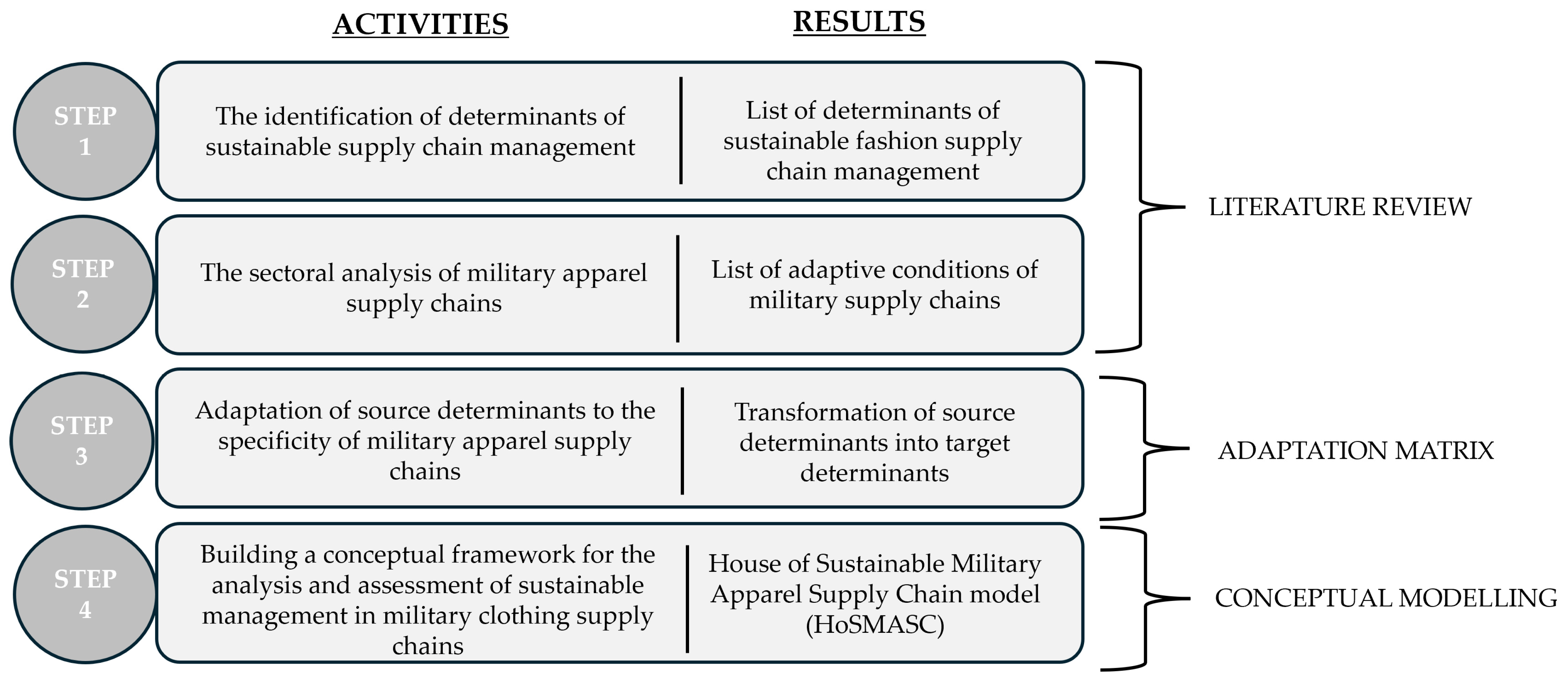
The research questions formulated above enabled the development of a research procedure consisting of four steps, as presented in Figure 2. The methodological approach adopted in this study is grounded in contingency theory, according to which the effectiveness of a management practice is not universal but depends on the situational variables of the context in which it is applied [72]. This perspective underpins the central premise of the research procedure described below: sustainability practices developed under commercial, fashion-sector conditions cannot be assumed to remain effective when transferred to a high-risk, security-sensitive, and heavily regulated military environment, and must instead be examined against the contextual variables—the adaptive conditions—specific to that environment.
Step 1 involves the identification of determinants of sustainable supply chain management. In this article, the determinants of sustainable apparel supply chain management are understood as areas of activity, management mechanisms, and conditions identified in the literature that describe how a supply chain can reduce its environmental and social impacts while maintaining economic efficiency and the effectiveness of material flows. The research method applied in Step 1 is a narrative literature review concerning the concept of Sustainable Supply Chain Management (SSCM). According to the results of the literature review presented in Section 2, research on sustainable apparel supply chain management focuses primarily on fashion supply chains. Therefore, this apparel sector constitutes the starting point for identifying the determinants of sustainable management, hereafter referred to as source determinants. The results obtained in Step 1 provide an answer to research question QR1.
Step 2 concerns a sectoral analysis of military apparel supply chains, which constitute the main research area of the authors. This sector is characterised by requirements concerning supply chain collaboration and material flow characteristics that differ from those of the fashion sector. It is therefore necessary to identify the critical conditions and requirements related to material flow management in military apparel supply chains that may necessitate modifications or limit the applicability of sustainable solutions. These requirements were defined as the adaptive conditions of military supply chains and, in the subsequent parts of the article, are understood as specific operational, technical, institutional, logistics, and security requirements that influence how the determinants of sustainable management identified in fashion supply chains are transformed into determinants appropriate for military apparel supply chains. These conditions were identified based on the characteristics of military supply chains presented in Section 2, which were developed through a narrative review of the literature and industry sources. The adaptive conditions emerged iteratively during the course of the analysis rather than being defined a priori. Some conditions derive directly from the regulatory and institutional requirements of the defence sector (e.g., Directive 2009/81/EC), while others emerged from the authors’ own field research. The process involved compiling an initial, broader list of candidate conditions, which was subsequently consolidated by merging thematically overlapping conditions into the six final categories presented in Section 4.2. All three authors participated in the final classification. The results obtained in Step 2 provide an answer to research question QR2.
The objective of Step 3 is to adapt the determinants of sustainable fashion supply chain management to the specific operating conditions of military apparel supply chains. For the purposes of this transformation, an adaptation matrix was developed to enable a structured transition from source determinants, appropriate for fashion supply chains, to target determinants appropriate for military apparel. Its purpose is to ensure transparency in the adaptation of concepts and mechanisms between two different types of supply chains. Four transformation rules were applied in the adaptation process:
  • Functional transformation, consisting of preserving the general function of a determinant while changing the manner in which it is implemented.
  • Actor-related transformation, referring to a change in the roles of supply chain participants.
  • Restrictive transformation, resulting from security requirements, data confidentiality, technical compliance, and control over product circulation.
  • Extending transformation, consisting of adding military-sector-specific requirements to the source determinant.
For each source determinant identified in Step 1, the function it performs in a fashion supply chain is specified. It is then confronted with the conditions of military supply chains and assessed in terms of the required scope of adaptation. On this basis, and in accordance with the adopted adaptation rules, the required transformation rule is determined in order to formulate the target determinant. The result of Step 3 is a set of determinants of sustainable military apparel supply chain management and an answer to research question QR3. Where a source determinant could plausibly be affected by more than one transformation rule, the dominant rule was assigned on the basis of the principal mechanism differentiating the source determinant from the resulting target determinant. The classification of determinants against the four transformation rules was established jointly by the authors through discussion. Interpretive disagreements were resolved by reference to the empirical material from the authors’ own field research in the selected supply chain (Section 2.2), which served as the basis for classification decisions. The four transformation rules were refined after the analysis of all determinants had been completed.
The objective of Step 4 is to construct a conceptual framework for analysing and assessing the scope of sustainable management in military apparel supply chains. This step involves conceptual modelling and consists of organising the previously identified determinants of sustainable military apparel supply chain management and the adaptation requirements resulting from the specific characteristics of the military sector.
Based on the theoretical review presented in Section 2, the use of a house model is recommended for preliminary and general analysis because it enables the rapid identification of the main sustainability strategies and makes it possible to verify whether sustainable management is implemented systemically. It performs an organising, diagnostic, and preparatory function. The house model enables the assessment process to begin with a structured qualitative and structural analysis, subsequently identifies areas requiring more detailed examination, and provides a basis for later operationalisation in the form of indicators, multi-criteria tools, or a maturity model. In developing the house model, the authors followed the rules presented in Table 1.
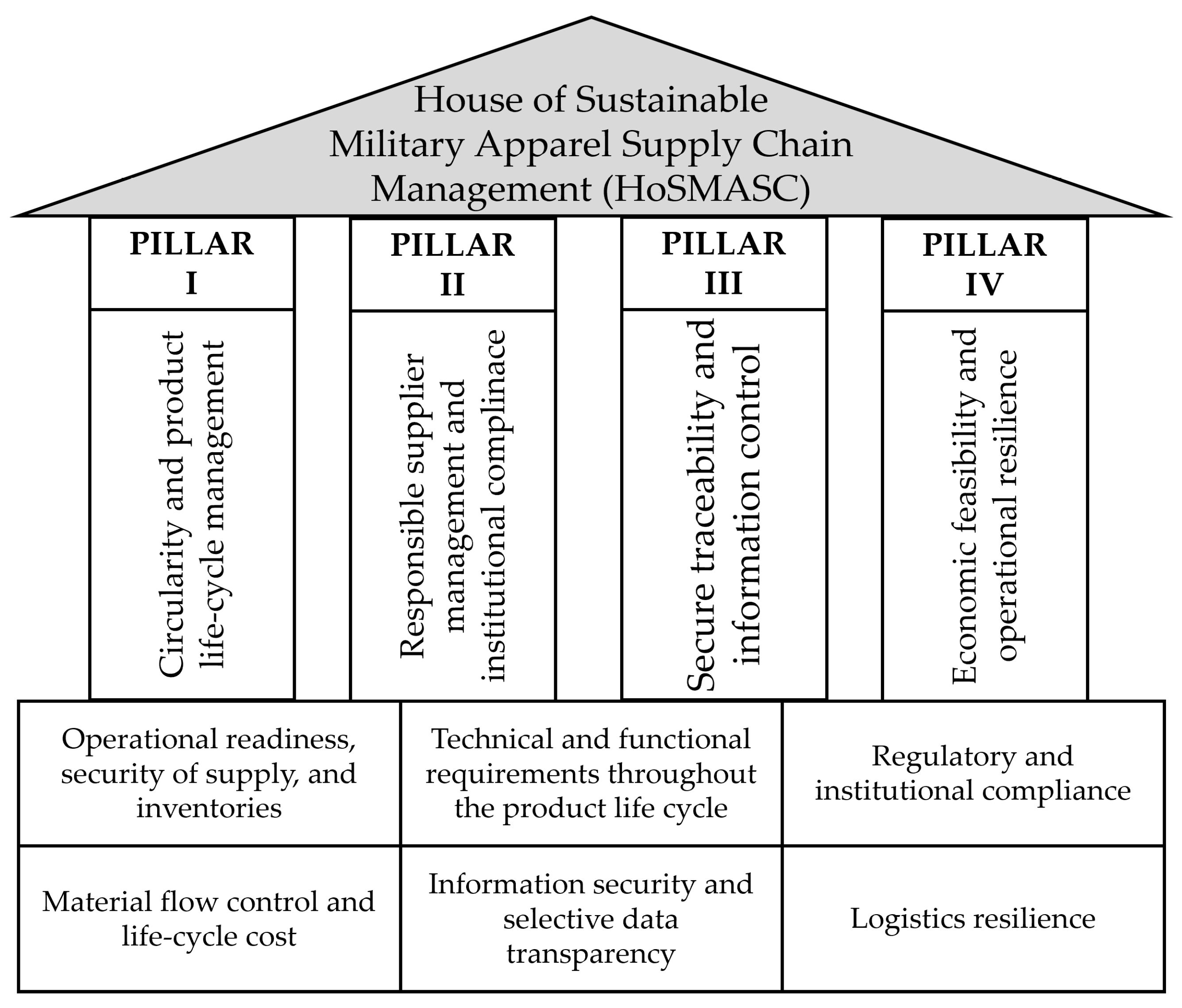
In accordance with the above rules, the foundation of the house is formed by the adaptive conditions resulting from the specific characteristics of the military sector because they define the boundary conditions for the application of sustainable solutions. The pillars of the house are formed by the adapted determinants of sustainable management because they indicate the main areas in which sustainability should be designed, assessed, and improved. The roof of the model represents the outcome of integrating the foundation and the pillars, namely a sustainable military apparel supply chain. The results of Step 4 provide an answer to research question QR4.

4. Results

4.1. Identification of Determinants of Sustainable Fashion Supply Chain Management

The analysis of the literature on sustainable supply chain management in the fashion sector enabled the identification of leading research trends that can be treated as determinants of sustainable fashion supply chain management. These determinants are presented in Table 2.
The analysis of the results of Step 1 indicates that the literature on sustainable apparel supply chain management focuses on several recurring groups of issues. The most strongly emphasised area is the circular economy, including CSCM, reverse logistics, reuse, repair, recycling, and textile waste management. This results from the fact that the fashion sector is particularly strongly associated with overproduction, short product life cycles, a low level of actual material-loop closure, and the increasing volume of waste. Circularity is therefore treated as a fundamental direction for the transformation of apparel supply chains. At the same time, it is emphasised that circularity cannot be limited solely to recycling. It requires the organisation of reverse flows, collaboration among multiple supply chain participants, and product design aimed at extending use and facilitating subsequent management.
A second frequently discussed area concerns sustainable materials and product design. Decisions made at the design stage have a significant impact on subsequent possibilities for repair, reuse, recycling, and a reduction in environmental impacts throughout the apparel life cycle. This shifts the emphasis from end-of-life activities, such as disposal or recycling, towards the earlier stages of the product life cycle. Product design and material selection are therefore presented as prerequisites for the effective implementation of the circular economy.
Supplier management and interorganisational collaboration also occupy an important place in the sustainable management of fashion supply chains. Studies indicate that sustainable management cannot be implemented solely by an individual brand or focal company. It requires the involvement of all supply chain participants. Consequently, increasing importance is attributed to supplier qualification, audits, information exchange, and the coordination of activities throughout the supply chain.
Transparency and traceability constitute another distinct group of issues. Without data concerning the origin of raw materials, material composition, production conditions, suppliers, and reverse flows, it is difficult to assess the actual level of supply chain sustainability. Transparency therefore supports both reporting and the verification of whether practices comply with environmental and social declarations. This is particularly important in the context of greenwashing risk and the difficulty of verifying the actual effects of activities undertaken by enterprises.
CSR, ESG, and the social aspects of supply chain management extend the understanding of sustainability beyond environmental issues and include working conditions, social audits, abuse prevention, supplier responsibility, reputation protection, and compliance with stakeholder expectations. In the literature, CSR and ESG are increasingly regarded not only as elements of corporate image communication but also as mechanisms for formalising responsibility within the supply chain.
Regulation and institutional pressure are also relatively prominent. The development of sustainable management in the apparel sector is supported by the Sustainable Development Goals, the European Green Deal, reporting requirements, producer responsibility mechanisms, and regulations concerning waste and social standards. This means that sustainability is not solely a voluntary corporate strategy but is increasingly becoming a response to regulatory and institutional requirements.
Economic and organisational barriers, as well as risk management and supply chain resilience, constitute less central but important and increasingly visible areas. The implementation of sustainable practices currently encounters constraints related to costs, scalability, data shortages, uncertain quality of secondary raw materials, coordination difficulties, and the risk of supply disruptions. Sustainable management is therefore increasingly analysed not only as an environmental or social issue but also as a problem of economic feasibility, operational stability, and supply chain resilience.

4.2. Adaptive Conditions of Military Supply Chains

The objective of Step 2 was to identify the critical conditions and requirements related to the management of material flows in military apparel supply chains. This step had the character of a sectoral analysis, as it addressed the specific characteristics of military supply chains, which constitute the main research area of the authors. Unlike fashion supply chains, flows related to military apparel are not primarily governed by seasonality, market trends, brand reputation, or consumer behaviour. Their fundamental function is to ensure the availability of clothing and equipment in accordance with defined requirements.
Based on the sectoral analysis, a set of adaptive conditions of military supply chains was identified. In this article, these are understood as specific operational, technical, institutional, logistics, and security requirements that influence the manner in which source determinants are transformed into determinants appropriate for military apparel supply chains. The review of literature and source documents presented in Section 2.2 indicates that the applicability of sustainable solutions in military apparel supply chains is constrained or conditioned by several critical areas. The most important of these are presented in Table 3.
The identified adaptive conditions have the character of boundary conditions, rather than merely descriptive sectoral context, and their formal consideration in the subsequent identification of determinants is therefore necessary. The source determinants (Step 1) emerged under conditions of market competition, voluntary implementation, and low operational risk characteristic of the fashion sector. Their direct transfer to the military apparel supply chain would risk producing determinants inconsistent with—or even contradictory to—the priorities of this sector, namely operational readiness, information security, and contractual requirements. Accounting for the adaptive conditions therefore makes it possible not only to modify the content of individual determinants, but above all to define the boundaries of applicability of sustainable solutions: to indicate which can be implemented directly, which require adaptation, and which are operationally infeasible.

4.3. Adaptation of Source Determinants to the Specific Characteristics of Military Apparel Supply Chains

The identified adaptive conditions provide the basis for transforming the source determinants within Step 3. Table 4 presents the results of the transformation from source determinants to target determinants, together with the relevant adaptive condition and the adopted transformation rule.
The transformation of the nine source determinants shows that none of the transformation rules clearly dominates the others. This confirms the validity of adopting four distinct adaptation mechanisms in the method rather than one universal approach to transforming determinants. Functional transformation, applied to the circular economy, CSR/ESG, and economic and organisational barriers, indicates that some source determinants retain their original function within the supply chain, while the manner in which they are operationalised changes. Circularity remains an objective, but it is implemented as a controlled rather than market-oriented circulation system. Similarly, social responsibility remains an objective, but it is formalised contractually rather than communicated through market reporting. This means that, in many cases, adaptation to the military sector does not invalidate the logic developed in research on the fashion sector but changes the mechanism through which it is implemented.
Actor-related transformation, observed in the case of supplier management and sustainable business models and consumer behaviour, reveals that some determinants primarily require a redefinition of the roles of supply chain participants. The role of the market consumer is assumed by the service user and the supply system, while voluntary interorganisational collaboration is replaced by a formalised regime of supplier qualification and supervision. This indicates that the structure of relationships among participants in military apparel supply chains differs from that of fashion supply chains in a manner that is more fundamental than merely procedural.
Restrictive transformation, applied to sustainable materials and product design as well as transparency and traceability, demonstrates that some source determinants cannot be transferred to the military sector without a substantial narrowing of their scope of application. Design and material flexibility are subordinated to technical and functional requirements, while market transparency is replaced by selective and secure traceability. In both cases, the restriction does not mean abandoning the determinant but defining stricter boundaries for its implementation. This confirms the previously formulated proposition that adaptive conditions are superior to the determinants.
The most substantial modification of content results from extending transformation, applied to regulation and institutional pressure as well as risk management and supply chain resilience. In both cases, the source determinant is not so much transformed as supplemented with requirements absent from the fashion sector: standards and procedures specific to defence procurement in the first case, and risks associated with missions, exercises, and mobilisation in the second. This indicates that the specific characteristics of the military sector not only modify existing sustainable management mechanisms but, in certain areas, also broaden their conceptual scope.
To illustrate this transformation logic in operational terms, the traceability determinant can be traced explicitly through the full adaptation sequence. In the fashion sector, transparency and traceability function as a source determinant aimed at publicly documenting material origins, supplier practices, and production locations in order to satisfy consumer and regulatory demand for accountability (Section 2.1). Confronted with the dominant adaptive condition of information security and selective data transparency (Section 4.2), this determinant is subjected to restrictive transformation: rather than being discarded, its scope of application is narrowed to accommodate the confidentiality requirements of defence supply chains. The resulting target determinant, secure and selective operational traceability (Table 4, Pillar III), retains the underlying management objective—verifiable knowledge of material origins and production pathways—but redefines its mode of implementation: data are collected, verified, and used internally in a controlled manner rather than disclosed publicly. The managerial implication of this transformation is that traceability in military apparel supply chains cannot be operationalised through public reporting mechanisms, such as supplier scorecards or consumer-facing certification, that are common in the fashion sector; instead, it requires a jointly defined data-classification protocol involving procurement, logistics, and information-security units, specifying which traceability data may be shared, with whom, and under what conditions. This example demonstrates how HoSMASC generates new, sector-specific management knowledge rather than merely reclassifying determinants already established in the fashion-sector literature.

4.4. House of Sustainable Military Apparel Supply Chain Management (HoSMASC)

In accordance with the rules adopted in the methodology (Table 1), the house model was constructed on the basis of two separate sets of results obtained in the preceding steps. The foundation of the house was built from the adaptive conditions identified in Step 2. The elements of the foundation, together with their qualifying functions, are presented in Table 5. The role of the qualifying function is to indicate a specific boundary condition assigned to a given adaptive condition, the fulfilment of which determines whether a solution is admissible within a military apparel supply chain. Failure to satisfy this condition means that the solution cannot be considered appropriate, irrespective of its environmental or social benefits.
The pillars of the house were determined on the basis of the adapted target determinants, grouped according to their dominant function in Step 3. These pillars are presented in Table 6.
The above division follows directly from Rule 1, concerning the separation of conditions and determinants, according to which adaptive conditions and determinants perform different cognitive functions and cannot be treated interchangeably. Adaptive conditions describe the boundary conditions governing supply chain operation. They do not specify what should be done but determine what is admissible in the first place. Target determinants, in turn, describe areas of action, namely specific management mechanisms and practices that can be designed, implemented, and improved. Locating adaptive conditions in the foundation and determinants in the pillars therefore reflects the distinction between the question of whether a solution is feasible at all and the question of how well it has been designed.
In accordance with Rule 2, concerning the qualifying function of the foundation, only those elements whose non-fulfilment disqualifies a solution irrespective of its environmental or social benefits were included in the foundation. None of the six conditions is optional. A violation of operational readiness, technical and functional requirements, regulatory compliance, life-cycle cost control, information security, or logistics resilience makes a solution inappropriate for the military sector, regardless of how effectively it fulfils sustainability objectives. This qualitatively distinguishes these conditions from the pillars, within which different maturity levels and gradual improvement are possible.
The determinants were assigned to the four pillars in accordance with Rule 3, concerning grouping according to the dominant function, so that each determinant was allocated to one best-matching area without duplicate or arbitrary assignment:
  • Pillar I comprises determinants associated with the physical circulation of the product throughout its life cycle.
  • Pillar II comprises determinants associated with interorganisational relationships and formal compliance.
  • Pillar III was deliberately distinguished as a separate, narrowly defined pillar because secure traceability constitutes a functionally distinct area that is important from the perspective of military supply chain management.
  • Pillar IV comprises determinants with a conditioning and evaluative character, including cost, feasibility, and resilience.
Finally, in accordance with Rule 4, concerning the hierarchical structure of the model, the foundation is superior to the pillars. None of the four pillars should be developed in a manner that violates the conditions included in the foundation, even if this would generate environmental or social benefits within a particular pillar. For example, a solution belonging to Pillar I, such as extending the return cycle through uniform sharing, cannot be implemented if it violates the operational-readiness requirement included in the foundation. This hierarchy answers research question QB4 and constitutes the outcome of the entire Step 4. The conceptual framework not only organises the areas of analysis but also introduces an explicit sequence of assessment, progressing from admissibility conditions represented by the foundation to the quality and scope of implementation represented by the pillars.
Figure 3 presents the graphical form of the House of Sustainable Military Apparel Supply Chain Management (HoSMASC). Source: Authors’ own elaboration.
The structure of the presented house model is based on a clear distinction between the nature of the foundation elements and the pillars, which is reflected in the concept of the qualifying function. This function defines the minimum necessary condition for the admissibility of a solution within a military apparel supply chain. In contrast to the determinants forming the pillars, whose implementation may vary in its level of advancement, the qualifying function is binary: either the condition is fulfilled, or the solution cannot be considered appropriate for the analysed supply chain, irrespective of its environmental, social, or economic benefits. The qualifying function therefore does not assess the quality or scope of implementation of a sustainable practice but establishes a threshold below which that practice is not subject to further assessment.
This interpretation of the foundation results from the different nature of risk in the military sector compared with the fashion sector. Failure to meet any of the requirements may threaten operational capabilities or user safety rather than merely produce gradual market consequences or reputational losses, as may occur in the case of fashion apparel. For this reason, the foundation elements, together with their assigned qualifying functions, serve in the presented model (Figure 3) as prerequisites that are superior to the subsequent analysis conducted within the four pillars. This reflects the principle of model hierarchy adopted in the methodology.

4.5. Preliminary Assessment Matrix of the House of Sustainable Management

The different nature of the foundation and the pillars of the house requires the application of two distinct assessment logics combined into a single sequential procedure—the HoSMASC assessment matrix (Table 7)—which enables the practical application of the developed model as a diagnostic tool.
The assessment of the foundation is binary and takes the form of a checklist. For each of the six adaptive conditions, it is verified only whether the assigned qualifying function is fulfilled (“yes”/“no”), without differentiating the degree of its fulfilment. In accordance with the principle of model hierarchy adopted in the methodology (Rule 4, Table 1), the foundation assessment has a conjunctive character—it is considered fulfilled only when all six qualifying functions are jointly satisfied. Failure to meet even one of them excludes the solution from further assessment within the pillars, regardless of how well it may be developed in environmental or social terms. The foundation therefore functions as a decision gate rather than as an element subject to gradation.
The conjunctive, binary character of the foundation assessment is justified by the nature of the six adaptive conditions themselves. Each is tied to user safety, regulatory and contractual compliance in defence procurement (cf. Directive 2009/81/EC, discussed in Section 4.2), or the operational readiness of the armed forces. These domains, in which, unlike generic managerial performance criteria, partial fulfilment does not correspond to a proportionally reduced risk. This reasoning is consistent with the contingency-theoretic framing adopted in this study (Section 3): in a high-risk, security-sensitive context, the contextual variables that qualify a solution as admissible operate as threshold conditions rather than as gradually compensable dimensions. It should be emphasised that this uniform, binary treatment of all six conditions is adopted here as a conceptual assumption of the current version of the model, rather than as an empirically established characteristic of military apparel supply chains. In the authors’ further research, however, the possibility of introducing gradable admissibility conditions will be examined.
Only solutions that jointly satisfy all six qualifying functions proceed to the second stage—a graded assessment of the four-pillar profile on a scale of 0–2 (0—no implementation, 1—basic implementation, 2—systemic implementation). The assessment is conducted separately for each of the nine target determinants and subsequently aggregated at the pillar level.
The preliminary assessment matrix thus organises all elements of the model—the six foundation conditions and the nine determinants assigned to the four pillars—by specifying, for each element, the scope of assessment, the adopted scale, and the proposed measurement criterion or indicator. The resulting tool enables a two-stage assessment approach. First, the admissibility of a solution is determined in the context of the specific characteristics of a military apparel supply chain. Subsequently, and only for admissible solutions, the level of advancement of the implemented sustainable management practices is assessed. The proposed indicators and criteria are preliminary and require further validation through empirical research, as acknowledged in the limitations of the study.
The 0–2 scale applied to the pillar determinants follows a general operationalisation rule, consistent with the indicators listed in Table 7:
  • A score of 0 denotes the absence of a documented practice against the relevant indicator;
  • A score of 1 denotes a practice implemented on an ad hoc, non-formalised basis, without systematic monitoring;
  • A score of 2 denotes a practice that is formally established in procedures and is systematically monitored and documented.
The precise quantitative thresholds for individual indicators (e.g., the minimum percentage of traceability coverage required for a score of 2) require expert validation or case-study evidence and remain a direction for future research. The model remains at a preliminary stage, and the indicators presented in the matrix constitute proposals for the direction of assessment rather than a standardised measurement system. The specific numerical values for each indicator should be determined by each supply chain, taking into account its logistics service standards. Similarly, the equal weighting applied when aggregating determinant scores at the pillar level is a simplifying assumption adopted at this preliminary, conceptual stage of the model, intended to facilitate the interpretation of results. It does not reflect an empirically validated ranking of determinant importance. However, future research could apply multi-criteria weighting methods such as AHP, BWM, or FUCOM. Aggregated pillar-level scores should accordingly not be interpreted as implying that all determinants within a pillar are of equal importance. The simple average applied here is a provisional aggregation procedure intended only to illustrate how the preliminary matrix could operate. The indicators presented in Table 7 are likewise illustrative in character, and their full measurement specification—data sources, measurement frequency, and comparability across units and supply systems—requires operationalisation in a future validation study or case study. The foundation indicators listed in Table 7 are illustrative. Their precise reference logic requires empirical operationalisation and validation in future research.
The proposed preliminary assessment matrix constitutes a direct result of integrating the findings obtained in Steps 2–4 of the methodology and completes the construction of the house model as a diagnostic tool. The indicators included in the matrix are examples of parameters that may be used in the assessment and are preliminary in nature. They require empirical verification in further research, and their validation through expert studies or a case study constitutes one of the directions for future work.

5. Discussion

The literature review conducted for this study indicated that the concept of the house model has so far developed within two main, distinct research streams. The first, represented by House of Quality and, by analogy, House of Risk, House of Resilience treats the house model as a formalised matrix-based tool for linking customer requirements with the technical capabilities of a product or service, used primarily in design and in quality and risk management [64,65,67,68,69]. The second stream, associated with the concept of the sustainable house, applies the house model to the design and assessment of sustainable residential buildings, focusing on resource efficiency, low environmental impact, and the socio-economic aspects of housing [70,71]). As indicated in the theoretical section, none of the identified publications employs the house model as a tool supporting managerial decisions within a supply chain—both traditions apply the house model to a single product, service, or building rather than to a complex system encompassing multiple participants, processes, and material flows.
The house of sustainable military apparel supply chain management proposed in this study therefore constitutes, to the best of the authors’ knowledge, the first attempt in the reviewed literature to adapt this structure to the assessment of a supply chain in the context of incorporating sustainability requirements, and this difference gives rise to two further conceptual novelties closely related to it. First, in the House of Quality, House of Risk, and House of Resilience models, the foundation does not appear as a separate, qualitatively distinct layer—the matrix describes relationships between requirements and solutions at a single level of analysis [64,65,67,68,69]. In the proposed model, the foundation performs a function qualitatively different from that of the pillars—a qualifying function, defining the boundary conditions for the admissibility of solutions, rather than constituting a further set of criteria to be graded on a par with the others. This distinction represents a conceptual development relative to classical house models, in which the foundation is metaphorical rather than operational in character, and follows directly from the specificity of the military sector, where failure to satisfy a single condition (e.g., operational readiness) may lead to consequences extending beyond the market- or reputation-related categories characteristic of the sustainable house concept [70,71]. Second, the transformation of source determinants developed for the fashion sector into determinants appropriate for the conditions of the military sector, based on four explicitly defined transformation rules, constitutes a systematic method for adapting knowledge between sectors with different risk characteristics—one that is applicable beyond the domain of military apparel.
The practical benefits of applying the proposed model follow directly from the differences outlined above. The separation of the foundation from the pillars enables a rapid, preliminary assessment of the admissibility of sustainable solutions prior to their in-depth cost or implementation analysis, thereby reducing the effort devoted to analysing solutions that fail to meet the boundary conditions of the military sector. The proposed preliminary assessment matrix further enables a clear maturity profile to be obtained across the four management pillars, which can support the identification of priority areas for further improvement action. The model also has communicative value—analogously to House of Quality, it integrates different categories of stakeholders (e.g., logistics services, public procurement units, information security units) around a single, shared conceptual structure.
The choice of the house model as the structuring device for HoSMASC, rather than a maturity model, a purely hierarchical assessment framework, or a multi-criteria decision-support model, follows directly from the two-stage logic required by the problem addressed in this study. A maturity model or a multi-criteria decision-support model is well-suited to representing gradual improvement, in which a weaker result on one determinant can be offset by a stronger result on another, but does not naturally accommodate an admissibility gate of the kind justified in Section 4.5, in which failing even a single condition cannot be offset by strong performance elsewhere. A purely hierarchical assessment framework, in turn, does not distinguish between qualitatively different assessment logics at different levels. The house model structure—foundation, pillars, and roof—is, by contrast, inherently suited to combining a qualifying layer, in which no result can offset the failure to meet a single condition, with a gradable, multi-dimensional layer, in which weaker and stronger results can be balanced against one another, within a single, visually and conceptually unified structure, which is why it was retained as the organising metaphor for the model (Section 2.3).
The model also brings into focus several tensions between sustainability objectives and military operational requirements that merit explicit discussion. Maintaining safety stock to secure operational readiness, for example, can conflict with waste-reduction and inventory-efficiency objectives pursued elsewhere in the model. Material circularity initiatives, such as extended reverse-logistics flows, may increase information-security exposure if not accompanied by adequate controlled-disposal procedures. Similarly, the transparency expected under ESG-oriented reporting must be reconciled with the confidentiality requirements inherent to defence supply chains, which is precisely why the target determinant identified in Pillar III is framed as controlled and selective disclosure rather than unrestricted transparency (Section 4.4). These tensions indicate that, within HoSMASC, environmental, social, resilience, and security objectives are not always mutually reinforcing, and their reconciliation is itself a management task supported by the model rather than an assumption built into it. In this respect, HoSMASC is not intended to maximise each sustainability dimension independently, but rather to support sustainability improvement within the operational constraints of the military sector.
The presented research results and the model itself are nevertheless subject to several important limitations. First, the adaptive conditions and target determinants were developed on the basis of a literature analysis, without empirical verification involving practitioners from the defence sector. There is therefore a risk that the list of six conditions and nine determinants is not exhaustive, or that the qualifying functions assigned to them require further refinement within a specific institutional context. Second, the indicators and criteria proposed in the preliminary assessment matrix are of an initial, exploratory character. Their operationalisation (e.g., the selection of thresholds, data sources, and measurement frequency) requires further validation, including the definition of appropriate reference periods, measurement frequency, data sources, the level at which assessment should be conducted (organisational, unit, supplier-network, or entire supply chain), and the treatment of missing or confidential data, as data availability may differ significantly across units and supply systems. Third, the three-level scale (0–2) used to assess the pillars, while useful as a preliminary diagnostic tool, is simplified in nature and does not allow for intermediate levels of implementation progress for individual determinants to be captured. Fourth, in its current form, the model applies exclusively to the military apparel supply chain. Its transferability to other categories of defence procurement (e.g., technical equipment, food, armament) has not been verified in this study and requires separate analysis, given the different technical, functional, and regulatory requirements characteristic of these categories. A further limitation concerns the fact that the model was derived from a narrative, rather than a systematic, literature review, combined with the authors’ own interpretive classification of determinants, adaptive conditions, and transformation rules; the selection of sources and this interpretive judgement may consequently have influenced the resulting shape of the model. Finally, the framework has not yet been tested for inter-rater reliability; future validation should examine whether different practitioners applying HoSMASC to the same supply chain arrive at comparable assessments.
These limitations simultaneously define the main directions for further research. A key next step should be an expert study involving representatives of institutions responsible for the procurement and logistics of military apparel, aimed at verifying the completeness and validity of the identified adaptive conditions and target determinants, as well as assessing the usability and clarity of the proposed preliminary assessment matrix in decision-making practice. Such a study could also serve to assign weights to the individual determinants within each pillar, enabling a more precise aggregation of results than the simple average applied in this study. A further avenue for future research is to examine whether the six adaptive conditions should continue to be treated uniformly as binary, non-compensatory gates, or whether a distinction between hard constraints (e.g., regulatory and user-safety requirements) and performance conditions capable of graded assessment (e.g., logistics resilience) would better reflect their differentiated nature; such a revision would, however, require dedicated expert validation before being incorporated into the assessment matrix.
A second, closely related direction for further research is the development of a full maturity model for sustainable management in military apparel supply chains, extending the three-level scale proposed in the preliminary assessment matrix towards a more elaborate, multi-level structure (e.g., a five-level scale), with explicitly defined transition criteria between levels for each of the nine determinants. Such an extended maturity model would enable not only the assessment of the current state but also the definition of a development path for individual supply units, representing a significant extension of the diagnostic function of the house model proposed in this article towards a tool of a developmental and benchmarking nature.

6. Conclusions

The article presents the assumptions of a sustainable military apparel supply chain management model developed by adapting the determinants of sustainable management established for the fashion sector to the specific characteristics of the defence sector. The key result of the study is the introduction of a distinction between adaptive conditions, which perform a qualifying function and form the foundation of the model, and target determinants, which form four pillars subject to graded assessment. Another result is the development of a preliminary assessment matrix integrating both logics into a single coherent diagnostic tool.
The presented results have both cognitive and practical significance. For researchers, the study provides a starting point for the further development of supply chain management theory in sectors characterised by elevated operational risk, particularly through the empirical verification of the proposed conditions and determinants, the development of the assessment matrix into a complete maturity model, and the testing of the proposed determinant transformation method in other pairs of sectors characterised by different risk profiles, for example when adapting solutions from civilian sectors to other areas of defence supply. The model may also provide methodological inspiration for researchers examining sustainable management in other regulated and high-risk domains, such as the medical, energy, or critical infrastructure sectors, where, as in the military sector, overriding boundary conditions constrain the freedom to implement environmental and social solutions.
For industry practitioners, particularly institutions responsible for procurement, logistics, and uniform supply management, the proposed model and preliminary assessment matrix may, at the present stage, structure preliminary discussion and support exploratory diagnosis of sustainability-related and military-specific constraints, and provide a checklist to guide the design of future empirical assessment. Their effectiveness as a managerial decision-support system enabling the rejection of proposals or the setting of improvement priorities has not yet been empirically demonstrated and requires validation. The maturity profile obtained through the assessment of the four pillars may also support the planning of priorities for improving management practices and provide a basis for communication among the different organisational units involved in the supply chain, including logistics, public procurement, and information security. This may facilitate a shared understanding of requirements and priorities in the field of sustainable management.

Author Contributions

Conceptualization, A.A.T., J.Ś. and A.Z.-K.; methodology, A.A.T., J.Ś. and A.Z.-K.; validation, A.A.T., J.Ś. and A.Z.-K.; formal analysis, A.A.T., J.Ś. and A.Z.-K.; investigation, A.A.T., J.Ś. and A.Z.-K.; resources, A.A.T., J.Ś. and A.Z.-K.; data curation, A.A.T., J.Ś. and A.Z.-K.; writing—original draft preparation, A.A.T., J.Ś. and A.Z.-K.; writing—review and editing, A.A.T.; visualization, A.A.T.; supervision, A.A.T. All authors have read and agreed to the published version of the manuscript.

Funding

This research was funded by the Polish Ministry of Science—Implementation Doctorate Program, grant number DWD/8/0258/2024.

Institutional Review Board Statement

Not applicable.

Informed Consent Statement

Not applicable.

Data Availability Statement

The original contributions presented in this study are included in the article. Further inquiries can be directed to the corresponding author.

Conflicts of Interest

The authors declare no conflicts of interest.

References

  1. Tamilarasan, B.S.; Kavitha, R.; Sankari, V.S. Operational research pathways for sustainable fashion supply chains: A comprehensive bibliometric and TCCM review. OPSEARCH 2026. [Google Scholar] [CrossRef] [Scilit]
  2. Chen, C.; Jayaraman, V.; Chen, Y. Pursuing Sustainability: An Interdisciplinary Perspective. In International Series in Operations Research & Management Science; Springer: Berlin/Heidelberg, Germany, 2021. [Google Scholar]
  3. Świerczek, J.; Tubis, A. Comparative Analysis of Fashion and Military Clothing Supply Chains. In The 12th Carpathian Logistics Congress. CLC2024 2024.; Feliks, J., Lenort, R., Straka, M., Eds.; Springer: Berlin/Heidelberg, Germany, 2026; pp. 47–52. [Google Scholar]
  4. de Aguiar Hugo, A.; de Nadae, J.; da Silva Lima, R. Can Fashion Be Circular? A Literature Review on Circular Economy Barriers, Drivers, and Practices in the Fashion Industry’s Productive Chain. Sustainability 2021, 13, 12246. [Google Scholar] [CrossRef] [Scilit]
  5. Kumar, V. Product Recalls in European Textile and Clothing Sector—A Macro Analysis of Risks and Geographical Patterns. Stats 2022, 5, 1044–1061. [Google Scholar] [CrossRef] [Scilit]
  6. de Albuquerque Landi, F.F.; Fabiani, C.; Pioppi, B.; Pisello, A.L. Sustainable Management in the Slow Fashion Industry: Carbon Footprint of an Italian Brand. Int. J. Life Cycle Assess. 2023, 28, 1229–1247. [Google Scholar] [CrossRef] [Scilit]
  7. Matuszak-Flejszman, A.; Preisner, A.; Banach, J.K. Transport-Related Emissions and Transition Strategies for Sustainability—A Case Study of the Fast Fashion Industry. Sustainability 2024, 16, 7749. [Google Scholar] [CrossRef] [Scilit]
  8. Mukherjee, T.; Sangal, I.; Sarkar, B.; Almaamari, Q.; Alkadash, T.M. How Effective Is Reverse Cross-Docking and Carbon Policies in Controlling Carbon Emission from the Fashion Industry? Mathematics 2023, 11, 2880. [Google Scholar] [CrossRef] [Scilit]
  9. Pal, R.; Gander, J. Modelling Environmental Value: An Examination of Sustainable Business Models within the Fashion Industry. J. Clean. Prod. 2018, 184, 251–263. [Google Scholar] [CrossRef] [Scilit]
  10. Vilkaite-Vaitone, N.; Jeseviciute-Ufartiene, L. Predicting Textile Recycling through the Lens of the Theory of Planned Behaviour. Sustainability 2021, 13, 11559. [Google Scholar] [CrossRef] [Scilit]
  11. Pal, R.; Shen, B.; Sandberg, E. Circular Fashion Supply Chain Management: Exploring Impediments and Prescribing Future Research Agenda. J. Fash. Mark. Manag. Int. J. 2019, 23, 298–307. [Google Scholar] [CrossRef] [Scilit]
  12. Charnley, F.; Cherrington, R.; Mueller, F.; Jain, A.; Nelson, C.; Wendland, S.; Ventosa, S. Retaining Product Value in Post-Consumer Textiles: How to Scale a Closed-Loop System. Resour. Conserv. Recycl. 2024, 205, 107542. [Google Scholar] [CrossRef] [Scilit]
  13. Alonso-Muñoz, S.; González-Sánchez, R.; Siligardi, C.; García-Muiña, F.E. Building Exploitation Routines in the Circular Supply Chain to Obtain Radical Innovations. Resources 2021, 10, 22. [Google Scholar] [CrossRef] [Scilit]
  14. Hedegård, L.; Gustafsson, E.; Paras, M.K. Management of Sustainable Fashion Retail Based on Reuse—A Struggle with Multiple Logics. Int. Rev. Retail. Distrib. Consum. Res. 2020, 30, 311–330. [Google Scholar] [CrossRef] [Scilit]
  15. Das, B.; Dwivedi, S. Post-Consumer Textile Waste Management Practices and Challenges in India: A Systematic Literature Review. J. Scientometr. Res. 2024, 13, 419–429. [Google Scholar] [CrossRef] [Scilit]
  16. Dwicahyani, A.R.; Nyoman Pujawan, I.; Widodo, E. Managing the Material Flow in Textile and Clothing Closed-Loop Supply Chain with Product, Material, and Energy Recoveries: A Conceptual Framework. E3S Web Conf. 2023, 465, 02064. [Google Scholar] [CrossRef] [Scilit]
  17. Exalto-Sijbrands, M.; Ravesteijn, P. Information Requirement in the Transition Towards a Circular Fashion Industry. In Proceedings of the 34th Bled eConference Digital Support from Crisis to Progressive Change: Conference Proceedings; University of Maribor Press: Lexington, MA, USA, 2021; pp. 597–610. [Google Scholar]
  18. e Silva, R.C.; de Siqueira Camargo, R.; Medina, G.d.S.; Gatti, M.; Sevigne-Itoiz, E.; Di Lucia, L.; Mwabonje, O.N. Fashion Market Niches for Organic Agroforestry Cotton: Market Potential for Promoting Sustainable Supply Chains. Sustainability 2022, 15, 700. [Google Scholar] [CrossRef] [Scilit]
  19. Warasthe, M.B.R. Sourcing Organic Cotton from African Countries Potentials and Risks for the Apparel Industry Supply Chain. IFAC-PapersOnLine 2018, 51, 297–301. [Google Scholar] [CrossRef] [Scilit]
  20. Corsini, F.; De Bernardi, C.; Gusmerotti, N.M.; Frey, M. Introducing the Circular Assessment of Suppliers (CAoS) Tool: A Kraljic Matrix-Based Tool to Facilitate Circular Procurement in Private Organizations. J. Clean. Prod. 2024, 452, 142085. [Google Scholar] [CrossRef] [Scilit]
  21. Saccani, N.; Bressanelli, G.; Visintin, F. Circular Supply Chain Orchestration to Overcome Circular Economy Challenges: An Empirical Investigation in the Textile and Fashion Industries. Sustain. Prod. Consum. 2023, 35, 469–482. [Google Scholar] [CrossRef] [Scilit]
  22. Bressanelli, G.; Visintin, F.; Saccani, N. Circular Economy and the Evolution of Industrial Districts: A Supply Chain Perspective. Int. J. Prod. Econ. 2022, 243, 108348. [Google Scholar] [CrossRef] [Scilit]
  23. Chen, D.; Su, S.-I.I.; Chen, Z. Quick Response in Fast Fashion Omnichannel: Exploring Cost Sharing Effect. RAIRO-Oper. Res. 2023, 57, 1681–1711. [Google Scholar] [CrossRef] [Scilit]
  24. Brun, A.; Karaosman, H.; Barresi, T. Supply Chain Collaboration for Transparency. Sustainability 2020, 12, 4429. [Google Scholar] [CrossRef] [Scilit]
  25. Ghoreishi, M.; Bhandari, K.; Franconi, A. Smart Fashion Economy through a Data-Driven Circular Ecosystem: A Case Study. IOP Conf. Ser. Earth Environ. Sci. 2022, 1009, 012012. [Google Scholar] [CrossRef] [Scilit]
  26. Munim, Z.H.; Mohammadi, M.; Shakil, M.H.; Ali, S.M. Assessing Measures Implemented by Export-Oriented RMG Firms in an Emerging Economy during COVID-19. Comput. Ind. Eng. 2022, 165, 107963. [Google Scholar] [CrossRef] [Scilit] [PubMed]
  27. Badhwar, A.; Islam, S.; Tan, C.S.L. Exploring the Potential of Blockchain Technology within the Fashion and Textile Supply Chain with a Focus on Traceability, Transparency, and Product Authenticity: A Systematic Review. Front. Blockchain 2023, 6, 1044723. [Google Scholar] [CrossRef] [Scilit]
  28. Rafi-Ul-Shan, P.M.; Grant, D.B.; Perry, P.; Ahmed, S. Relationship between Sustainability and Risk Management in Fashion Supply Chains: A Systematic Literature Review. Int. J. Retail. Distrib. Manag. 2018, 46, 466–486. [Google Scholar] [CrossRef] [Scilit]
  29. Thorisdottir, T.S.; Johannsdottir, L. Corporate Social Responsibility Influencing Sustainability within the Fashion Industry. A Systematic Review. Sustainability 2020, 12, 9167. [Google Scholar] [CrossRef] [Scilit]
  30. Fares, N.; Lloret, J.; Kumar, V.; de Leeuw, S.; Barnes, L. Optimisation of Multi-Tier Supply Chain Distribution Networks with Corporate Social Responsibility Concerns in Fast-Fashion Retail. Corp. Soc. Responsib. Environ. Manag. 2024, 31, 311–330. [Google Scholar] [CrossRef] [Scilit]
  31. Benstead, A.V.; Hendry, L.C.; Stevenson, M. Detecting and Remediating Modern Slavery in Supply Chains: A Targeted Audit Approach. Prod. Plan. Control 2021, 32, 1136–1157. [Google Scholar] [CrossRef] [Scilit]
  32. Choi, T.-M.; Feng, L.; Li, Y. Ethical Fashion Supply Chain Operations: Product Development and Moral Hazards. Int. J. Prod. Res. 2023, 61, 1058–1075. [Google Scholar] [CrossRef] [Scilit]
  33. Fontana, E.; Atif, M.; Heuer, M. Implementing Social Sustainability through Market Pressures: An Inter-Organizational Network Analysis in the Pakistani Apparel Supply Chain. Int. J. Phys. Distrib. Logist. Manag. 2023, 53, 156–180. [Google Scholar] [CrossRef] [Scilit]
  34. Köksal, D.; Strähle, J.; Müller, M. Social Sustainability in Apparel Supply Chains—The Role of the Sourcing Intermediary in a Developing Country. Sustainability 2018, 10, 1039. [Google Scholar] [CrossRef] [Scilit]
  35. Köksal, D.; Strähle, J. Social Sustainability in Fashion Supply Chains—Understanding Social Standard Implementation Failures in Vietnam and Indonesia Using Agency Theory. Sustainability 2021, 13, 2159. [Google Scholar] [CrossRef] [Scilit]
  36. Nguyen, G.N.T.; Mani, V.; Kha, M.K.; Papadopoulos, T. Supply Chain Social Responsibility in Labour- Intensive Industries: A Practitioner’s Perspective. Prod. Plan. Control 2023, 34, 371–390. [Google Scholar] [CrossRef] [Scilit]
  37. Sekaran, A.; Dadwal, S.S.; Ali, A. Industry 5.0 and Environmental, Social, and Governance Initiatives in Supply Chain Sustainability. In Opportunities and Challenges of Business 5.0 in Emerging Markets; IGI Global: Hershey, PA, USA, 2023; pp. 151–171. [Google Scholar]
  38. Khairul Akter, M.M.d.; Haq, U.N.; Islam, M.d.M.; Uddin, M.A. Textile-Apparel Manufacturing and Material Waste Management in the Circular Economy: A Conceptual Model to Achieve Sustainable Development Goal (SDG) 12 for Bangladesh. Clean. Environ. Syst. 2022, 4, 100070. [Google Scholar] [CrossRef] [Scilit]
  39. Ciccullo, F.; Pero, M.; Patrucco, A.S. Designing Circular Supply Chains in Start-up Companies: Evidence from Italian Fashion and Construction Start-Ups. Int. J. Logist. Manag. 2023, 34, 553–581. [Google Scholar] [CrossRef] [Scilit]
  40. Richards, H. Risk, Reporting and Responsibility: Modern Slavery, Colonial Power and Fashion’s Transparency Industry. Int. J. Crime Justice Soc. Democr. 2022, 11, 47–60. [Google Scholar] [CrossRef] [Scilit]
  41. Dragomir, V.D.; Dumitru, M. Practical Solutions for Circular Business Models in the Fashion Industry. Clean. Logist. Supply Chain 2022, 4, 100040. [Google Scholar] [CrossRef] [Scilit]
  42. Henninger, C.E.; Bürklin, N.; Niinimäki, K. The Clothes Swapping Phenomenon—When Consumers Become Suppliers. J. Fash. Mark. Manag. Int. J. 2019, 23, 327–344. [Google Scholar] [CrossRef] [Scilit]
  43. Zimmermann, R.; Inês, A.; Dalmarco, G.; Moreira, A.C. The Role of Consumers in the Adoption of R-Strategies: A Review and Research Agenda. Clean. Responsible Consum. 2024, 13, 100193. [Google Scholar] [CrossRef] [Scilit]
  44. Abdelmeguid, A.; Afy-Shararah, M.; Salonitis, K. Investigating the Challenges of Applying the Principles of the Circular Economy in the Fashion Industry: A Systematic Review. Sustain. Prod. Consum. 2022, 32, 505–518. [Google Scholar] [CrossRef] [Scilit]
  45. Denizel, M.; Schumm, C.Z. Closed Loop Supply Chains in Apparel: Current State and Future Directions. J. Oper. Manag. 2024, 70, 190–223. [Google Scholar] [CrossRef] [Scilit]
  46. Zanjirani Farahani, R.; Asgari, N.; Van Wassenhove, L.N. Fast Fashion, Charities, and the Circular Economy: Challenges for Operations Management. Prod. Oper. Manag. 2022, 31, 1089–1114. [Google Scholar] [CrossRef] [Scilit]
  47. Imran, M.d.T.I.; Karmaker, C.L.; Karim, R.; Misbauddin, S.M.; Bari, A.B.M.M.; Raihan, A. Modeling the Supply Chain Sustainability Imperatives in the Fashion Retail Industry: Implications for Sustainable Development. PLoS ONE 2024, 19, e0312671. [Google Scholar] [CrossRef] [Scilit] [PubMed]
  48. Millward-Hopkins, J.; Purnell, P.; Baurley, S. Scenarios for Reducing the Environmental Impacts of the UK Clothing Economy. J. Clean. Prod. 2023, 420, 138352. [Google Scholar] [CrossRef] [Scilit]
  49. Karaosman, H.; Marshall, D. Impact Pathways: Just Transition in Fashion Operations and Supply Chain Management. Int. J. Oper. Prod. Manag. 2023, 43, 226–237. [Google Scholar] [CrossRef] [Scilit]
  50. Elvemo, L. Supply Chain Resilience in Military Operations: A Case Study Exploring Command and Control. Scand. J. Mil. Stud. 2025, 8, 178–199. [Google Scholar] [CrossRef] [Scilit]
  51. U.S. Government Accountability Office. Defense Inventory: Actions Needed to Improve Inventory Retention Management; Report GAO-06-512; U.S. Government Accountability Office: Washington, DC, USA, 2006. [Google Scholar]
  52. U.S. Government Accountability Office. Defense Inventory: Services Generally Have Reduced Excess Inventory, but Additional Actions Are Needed; Report GAO-15-350; U.S. Government Accountability Office: Washington, DC, USA, 2015. [Google Scholar]
  53. Reece, B. On Spec; Defense Logistics Agency: Fort Belvoir, VA, USA, 2016. [Google Scholar]
  54. Directive 2009/81/EC of the European Parliament and of the Council of 13 July 2009 on the Coordination of Procedures for the Award of Certain Works Contracts, Supply Contracts and Service Contracts by Contracting Authorities or Entities in the Fields of Defence and Security, and Amending Directives 2004/17/EC and 2004/18/EC. Off. J. Eur. Union 2009, L 216, 76–136.
  55. U.S. Department of Defense. Defense Materiel Disposition: Disposal Guidance and Procedures; DoD Manual 4160.21; U.S. Department of Defense: Washington, DC, USA, 2015; Volume 1; Incorporating Change 4, 31 August 2022. [Google Scholar]
  56. U.S. Department of Defense. Defense Materiel Disposition: Reutilization, Transfer, and Sale of Property; DoD Manual 4160.21; U.S. Department of Defense: Washington, DC, USA, 2015; Volume 3, Incorporating Change 4, 18 November 2022. [Google Scholar]
  57. Defense Logistics Agency. Uniforms: Turn-In Instructions. Available online: https://www.dla.mil/Disposition-Services/DDSR/Property-Turn-In/Turn-In-Toolbox/Protective-and-Tactical-Equipment/Uniforms/ (accessed on 1 April 2026).
  58. Tysseland, B.E. Life Cycle Cost Based Procurement Decisions. Int. J. Proj. Manag. 2008, 26, 366–375. [Google Scholar] [CrossRef] [Scilit]
  59. European Defence Agency. Circularity of Military Equipment: EDA Launches Project Focused on Body Armour; European Defence Agency: Brussels, Belgium, 2024. [Google Scholar]
  60. Hayes, J. The Digital Quartermaster: Creating Digital-Powered Supply Chains for a Contested Logistical Era. Defense Logistics Agency Troop Support Public Affairs. 19 March 2026. Available online: https://www.dla.mil/About-DLA/News/News-Article-View/Article/4436406/the-digital-quartermaster-creating-digital-powered-supply-chains-for-a-conteste/ (accessed on 30 March 2026).
  61. Epple, D.; Quintero, L.; Sieg, H. A New Approach to Estimating Equilibrium Models for Metropolitan Housing Markets. J. Political Econ. 2020, 128, 948–983. [Google Scholar] [CrossRef] [Scilit]
  62. Aliu, I.R. Residential Quality and Housing Preference Theories. In Urban Private Housing in Nigeria; Aliu, I.R., Ed.; Springer: Berlin/Heidelberg, Germany, 2024; pp. 31–52. [Google Scholar]
  63. Hua, C. The Factors in Assessing “Good Houses” Are Multidimensional. J. Urban Manag. 2025, 14, 311–313. [Google Scholar] [CrossRef] [Scilit]
  64. Ramírez, Y.; Cisternas, L.A.; Kraslawski, A. Application of House of Quality in Assessment of Seawater Pretreatment Technologies. J. Clean. Prod. 2017, 148, 223–232. [Google Scholar] [CrossRef] [Scilit]
  65. Oddershede, A.M.; Quezada, L.E.; Valenzuela, J.E.; Palominos, P.I.; Lopez-Ospina, H. Formulation of a Manufacturing Strategy Using the House of Quality. Procedia Manuf. 2019, 39, 843–850. [Google Scholar] [CrossRef] [Scilit]
  66. Olewnik, A.; Lewis, K. Can a House Without a Foundation Support Design? In Proceedings of the Volume 2: 31st Design Automation Conference, Parts A and B; ASMEDC: New York, NY, USA, 2005; pp. 165–175. [Google Scholar][Green Version]
  67. Larasati, A.; Ubaidillah, A.D.; Muid, A.; Dwiastuti, A. The Supply Chain Risk Analysis Using the House of Risk (HOR) Method. In Stimulating Economic Growth Through Cultural and Societal Transformations; IGI Global Scientific Publishing: Hershey, PA, USA, 2026; pp. 313–340. [Google Scholar]
  68. Wibowo, Y.; Nurluthfiyadi Ni’maturrakhmat, V. Integrating Fuzzy Logic-House of Risk for Risk Mitigation Analysis of Bondowoso Arabica Coffee Supply Chain (a Case Study in Indonesia). Coffee Sci. 2026, 21, e212397. [Google Scholar] [CrossRef] [Scilit]
  69. Tubis, A.A.; Werbińska-Wojciechowska, S. House of Resilience for Energy Supply Chains: A Digitalization-Based Approach to Enhancing Supply Chain Robustness. Environ. Syst. Decis. 2026, 46, 1. [Google Scholar] [CrossRef] [Scilit]
  70. Mishra, A.; Kautish, P. Exploring the Growth of Sustainable Homes and Sustainability. In Sustainable and Smart Cities; Routledge: London, UK, 2025; pp. 91–112. [Google Scholar]
  71. Akenji, L.; Vergragt, P.J.; Brown, H.S.; Smith, T.S.J.; Wallnöfer, L.M. Vocabulary for Sustainable Consumption and Lifestyles; Routledge: London, UK, 2025; ISBN 9781003584056. [Google Scholar]
  72. Sousa, R.; Voss, C.A. Contingency Research in Operations Management Practices. J. Oper. Manag. 2008, 26, 697–713. [Google Scholar] [CrossRef] [Scilit]
Figure 1. Article’s structure. Source: Authors’ own elaboration.
Sustainability 18 08940 g001
Figure 2. Research procedure. Source: Authors’ own elaboration.
Sustainability 18 08940 g002
Figure 3. House of Sustainable Military Apparel Supply Chain Management (HoSMASC). Source: Authors’ own elaboration.
Sustainability 18 08940 g003
Table 1. Rules for constructing the house of sustainable supply chain management. Source: Authors’ own elaboration.
RulesContent of RuleSignificance for Model
Construction
Rule 1. Separation of conditions and determinantsThe adaptation requirements of the military sector should be distinguished from the determinants of sustainable management.Adaptive conditions form the foundation of the model, whereas the determinants form its pillars.
Rule 2. Qualifying function of the foundationThe foundation should include those elements whose non-fulfilment prevents a solution from being considered appropriate for a military apparel supply chain.The foundation defines the admissibility conditions for sustainable activities.
Rule 3. Grouping determinants according to their dominant functionAdapted determinants should be assigned to pillars based on their main function in supply chain management.This prevents the random or multiple assignment of the same determinants.
Rule 4. Hierarchical structure of the modelThe foundation is superior to the pillars.A solution should not be developed within the pillars if it violates the foundation requirements.
Table 2. Determinants of sustainable fashion supply chain management. Source: Authors’ own elaboration.
Source DeterminantCharacteristics of the DeterminantFunction in Sustainable Management
Circular economy, CSCM, and reverse logisticsIncludes reuse, repair, recycling, regeneration, product life extension, the organisation of returns, sorting, end-of-use apparel management, and textile waste management.Enables a transition away from the linear model, the reduction in textile waste, the closing of material loops, and the retention of product and raw-material value within the supply chain.
Sustainable materials and product designConcerns the use of materials with a lower environmental impact and the design of apparel for durability, repairability, recyclability, reduced resource consumption, and waste reduction.Shifts responsibility for sustainability towards the early stages of the product life cycle, particularly design, material selection, and the specification of apparel performance characteristics.
Sustainable supplier management and interorganisational collaborationIncludes the selection, qualification, monitoring, and auditing of suppliers against environmental, social, quality, and organisational criteria, as well as information exchange, activity coordination, joint innovation, and relationship building among supply chain participants.Extends responsibility for sustainability beyond a single company and enables sustainable solutions to be implemented throughout the supply chain through collaboration among brands, suppliers, intermediaries, retailers, consumers, and recovery operators.
Transparency and traceabilityIncludes tracking the origin of raw materials, material composition, product flows, suppliers, and environmental and social impacts.Increases the capacity to control, report, and assess the compliance of supply chain practices with sustainability principles.
CSR, ESG, and social aspectsInclude social responsibility, ethical working conditions, audits, abuse prevention, reputation protection, reporting, and ESG requirementsExtend sustainable management beyond environmental issues by incorporating social, ethical, reputational, and institutional aspects.
Regulation and institutional pressureConcern standards, public policies, reporting requirements, sustainable development goals, the European Green Deal, and producer responsibility mechanisms.Create external incentives for implementing sustainable practices and strengthen the formalisation of requirements imposed on supply chain participants.
Sustainable business models and consumer behaviourInclude rental, resale, sharing, take-back programmes, repair, conscious consumption, and consumer participation in returns and reuse.Support product life extension and increase the role of the end user in closing the apparel loop.
Economic and organisational barriersInclude high implementation costs, scaling difficulties, a lack of data, uncertain quality of secondary raw materials, the low profitability of certain practices, and coordination difficulties.Indicate constraints that must be considered when assessing the feasibility and effectiveness of sustainable management strategies.
Risk management and supply chain resilienceConcerns supply disruptions, demand variability, supplier dependence, and environmental, social, reputational, and operational risks.Links sustainable management with the need to maintain supply chain stability, continuity, and responsiveness.
Table 3. Adaptive conditions of military supply chains (MSC). Source: Authors’ own elaboration.
Adaptive Condition of MSCCharacteristics of the Condition Significance for the Adaptation of Determinants from the Fashion Sector
Operational readiness, supply and inventory securityEncompasses the need to ensure the availability of military apparel in the required quantity, quality, place, and time, while maintaining supply continuity, procurement stability, and an adequate level of inventory. It takes into account the specific nature of demand resulting from entitlement norms, organisational structures, exercises, missions, mobilisation, and the uniform life cycle.Constrains the applicability of solutions that could reduce availability, functionality, or timeliness of supply. Modifies the approach to inventory reduction, since in the military sector inventory serves a security function rather than being merely a source of cost.
Technical and functional requirements across the product life cycleMilitary apparel must meet requirements concerning durability, protection, ergonomics, comfort of use, camouflage, maintenance, repairability, and compliance with technical specifications throughout the entire product life cycle.Constrains the possibility of simply substituting materials or constructions with ecological solutions if these do not meet functional requirements. Requires that sustainability be analysed from design and procurement through use, repair, return, recycling, and disposal.
Regulatory and institutional complianceThe military apparel supply chain operates within the framework of public and defence procurement procedures, quality standards, technical, contractual, organisational, and security requirements.Requires that sustainability be formalised through technical specifications, procurement criteria, contractual requirements, audits, reporting, and mechanisms for monitoring the fulfilment of deliveries.
Control of material flows and life-cycle costEncompasses oversight of the circulation of apparel from procurement, storage, and issue, through use, maintenance, and repair, to return, reuse, recycling, or disposal. At the same time, it requires accounting for the full costs of design, procurement, use, storage, repair, replacement, returns, and end-of-life management.Transforms the classical approach to circularity and reverse logistics into a controlled product circulation. Modifies the assessment of economic efficiency, since a solution that is cheaper to procure need not be advantageous over the entire product life cycle.
Information security and selective data transparencyData concerning the origin of materials, production batches, suppliers, inventories, flows, and returns are needed for supply chain control, but cannot always be disclosed for reasons of information security.Transforms the market transparency typical of the fashion sector into secure operational traceability. Limits the possibility of full data disclosure but reinforces the need for its controlled collection and use.
Logistics resilienceDenotes the capacity to maintain supply continuity despite disruptions, delays, shortages, production constraints, demand fluctuations, or sudden increases in requirements.Sustainable solutions should be assessed not only in terms of their environmental effects but also their impact on the stability, flexibility, and responsiveness of the supply chain.
Table 4. Adaptation of Source Determinants to the Specific Characteristics of Military Apparel Supply Chains (MASC). Source: Authors’ own elaboration.
Source Determinant (Fashion Sector)Dominant Adaptive Condition Transformation RuleTarget Determinant (MASC)Characteristics of the Target Determinant
Circular economy, CSCM, and reverse logisticsMaterial flow control and life-cycle cost; operational readinessFunctionalControlled closed-loop circulation and reverse logistics throughout the uniform life cycleCircularity is subordinated to continuity of supply and assessment of the total life-cycle cost rather than to the degree of material-loop closure
Sustainable materials and product designTechnical and functional requirements throughout the product life cycleRestrictiveSustainable design within the boundaries of technical and functional requirementsMaterial selection is permissible only if protective, ergonomic, and operational performance parameters are maintained
Sustainable supplier management and interorganisational collaborationRegulatory and institutional complianceActor-relatedSupplier qualification and supervision under the defence procurement regimeAudits and collaboration are replaced by formal contractual procedures specific to public and defence procurement
Transparency and traceabilityInformation security and selective data transparencyRestrictiveSecure and selective operational traceabilityData are collected and used in a controlled manner rather than publicly reported
CSR, ESG, and social aspectsRegulatory and institutional complianceFunctionalFormalised social responsibilityThe function of protecting working conditions and ethical standards is retained but is further implemented
Regulation and institutional pressure
Regulatory and institutional complianceExtendingCompliance with defence regulations and military standardsMarket and EU pressure is supplemented by technical, contractual, and security standards specific to the defence sector
Sustainable business models and consumer behaviourOperational readiness, security of supply, and inventoriesActor-relatedManagement of the uniform use cycle and returns within the supply systemThe role of the consumer is assumed by the service user and the supply system, while market-based models such as rental and resale are replaced by issue, return, and replacement procedures
Economic and organisational barriersMaterial flow control and life-cycle cost; operational readinessFunctionalFeasibility constraints resulting from life-cycle cost and operational-readiness requirementsMarket barriers, including cost and scalability, are reformulated as constraints specific to the defence sector
Risk management and supply chain resilienceLogistics resilience; operational readinessExtendingLogistics resilience and continuity of supply under operational and mobilisation disruptionsRequirements specific to missions, exercises, and mobilisation are added to conventional risk categories
Table 5. Foundation of the house. Source: Authors’ own elaboration.
Foundation ElementQualifying Function
Operational readiness, security of supply, and inventoriesCondition of availability and continuity of supply
Technical and functional requirements throughout the product life cycleCondition of maintaining performance parameters
Regulatory and institutional complianceFormal condition concerning defence procurement and contracts
Material flow control and life-cycle costCondition of controlling circulation and total cost
Information security and selective data transparencyCondition of restricted data disclosure
Logistics resilienceCondition of stability under disruptions
Table 6. Pillars of the house. Source: Authors’ own elaboration.
PillarTarget Determinants of the Military Apparel Supply Chain Included in the Pillar
I. Circularity and product life-cycle managementControlled closed-loop circulation and reverse logistics; sustainable design within the boundaries of technical and functional requirements; management of the uniform use cycle and returns within the supply system
II. Responsible supplier management and institutional complianceSupplier qualification and supervision under the defence procurement regime; social responsibility formalised through contractual requirements; compliance with defence regulations and military standards
III. Secure traceability and information controlSecure and selective operational traceability
IV. Economic feasibility and operational resilienceFeasibility constraints resulting from life-cycle cost and operational-readiness requirements; logistics resilience and continuity of supply under disruption and mobilisation conditions
Table 7. Preliminary assessment matrix of the House of Sustainable Military Apparel Supply Chain Management. Source: Authors’ own elaboration.
ElementScope of AssessmentScaleCharacteristics of the Target Determinant
Model level: FOUNDATION
Operational readiness, security of supply, and inventoriesWhether the availability, continuity, and timeliness of supply are ensuredYes/NoNo interruptions in the supply of key uniform items during the reference period; safety stocks maintained at the prescribed level
Technical and functional requirements throughout the product life cycleWhether the protective, ergonomic, and operational parameters of the apparel are maintainedYes/No100% of products compliant with the applicable defence or military standards for the relevant uniform category
Regulatory and institutional complianceWhether practices comply with the formal requirements of defence procurement and contractsYes/NoNo non-conformities identified during procurement control or audit
Material flow control and life-cycle costWhether material circulation and costs are monitored throughout the entire life cycleYes/NoAn operational system for accounting for or monitoring life-cycle cost (TCO)
Information security and selective data transparencyWhether supply chain data are disclosed in a controlled mannerYes/NoNo incidents of unauthorised data disclosure; an implemented information-classification policy
Logistics resilienceWhether the supply chain remains stable under operational disruptionsYes/NoDefined alternative sources of supply for critical materials
Model level: PILLAR I
Controlled closed-loop circulation and reverse logisticsSystem for the recovery, repair, and recycling of uniforms0/1/2Percentage of returned uniforms subjected to repair or recycling
Sustainable design within the boundaries of technical requirementsEnvironmental criteria applied in material selection without compromising protective parameters0/1/2Percentage of technical specifications containing environmental criteria
Management of the use cycle and returnsProcedures for issue, use, replacement, and return0/1/2Average service life; percentage of items covered by the return procedure
Model level: PILLAR II
Supplier qualification and supervisionSupplier verification against sustainability criteria within contractual procedures0/1/2Percentage of contracts containing environmental or social clauses
Social responsibility formalised through contractual requirementsLabour and ethical standards included and enforced in contracts0/1/2Number of inspections of working conditions at suppliers
Compliance with defence regulations and military standardsCompliance of practices with national and NATO standards0/1/2Number of regulatory non-conformities; response time to regulatory changes
Model level: PILLAR III
Secure and selective operational traceabilityControlled collection and disclosure of data concerning material origins0/1/2Percentage of the supply chain covered by the traceability system
Model level: PILLAR IV
Feasibility constraints related to life-cycle cost and operational readinessAssessment of solutions from a TCO perspective rather than solely on the basis of purchase cost0/1/2Life-cycle cost of sustainable solutions compared with conventional solutions
Logistics resilience and continuity of supplyTesting practices under disruptions, missions, and mobilisation conditions0/1/2Time required to restore continuity of supply following a disruption
Disclaimer/Publisher’s Note: The statements, opinions and data contained in all publications are solely those of the individual author(s) and contributor(s) and not of MDPI and/or the editor(s). MDPI and/or the editor(s) disclaim responsibility for any injury to people or property resulting from any ideas, methods, instructions or products referred to in the content.