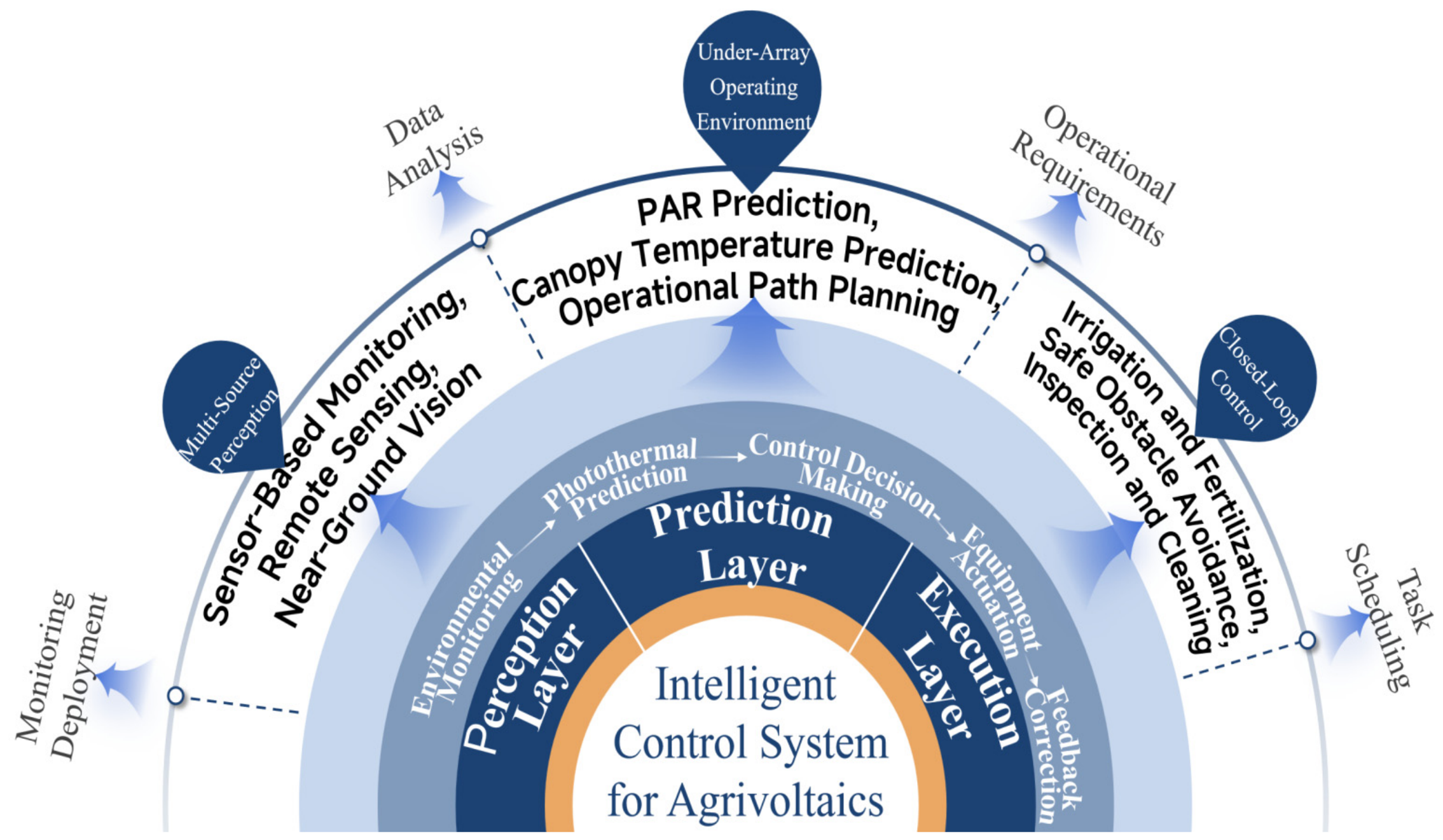
Synergistic Optimization of Agrivoltaic Systems: A Review of Intelligent Equipment Control for Agricultural Production Adaptability

 ,
, 
Abstract
1. Introduction
2. Literature Review and Research Gaps
2.1. Existing Agrivoltaic Reviews
2.2. Evolution Toward Intelligent Agrivoltaic Systems
2.3. Research Gaps and Scope of This Review
3. Materials and Methods
3.1. Literature Search Strategy
3.2. Inclusion Criteria
3.3. Exclusion Criteria
3.4. Literature Screening Process
3.5. Data Extraction and Analysis Framework
4. Reconfiguration of Agricultural Production and Operating Environments by Photovoltaic Arrays
4.1. Types and Application Scenarios of Agrivoltaic Systems
4.1.1. Open-Field Systems
4.1.2. Protected-Horticulture Systems
4.1.3. Livestock-Production Systems
4.1.4. Aquaculture Systems
4.2. Reconfiguration of Light, Thermal, and Water Environments by Photovoltaic Arrays
4.2.1. Reconfiguration of the Light Environment
4.2.2. Reconfiguration of the Thermal and Moisture Environment
4.3. Matching Array Types with Crop Types
4.3.1. Crop Requirements and Spatial Adaptation
4.3.2. Crop-Oriented Regulation Logic for Dynamic Arrays
5. Adaptation and System Evaluation of Agricultural Equipment Under Photovoltaic-Array Constraints
5.1. Matching Array Space with Agricultural-Machinery Dimensions
5.2. Positioning and Navigation in GNSS-Constrained Environments
5.3. Comprehensive Benefit Evaluation of Agrivoltaic Systems
6. Light–Thermal Sensing and Prediction for Adaptive Agricultural-Machinery Operations
6.1. Environmental Sensing Beneath Photovoltaic Arrays
6.2. Near-Ground Multimodal Sensing for Agricultural Equipment
6.3. Prediction Methods for Light–Thermal–Water Environments
6.3.1. Conventional Machine-Learning Prediction
6.3.2. Deep Temporal Prediction
7. Coordinated Operation of Agricultural Equipment Beneath Photovoltaic Arrays
7.1. Coordinated-Optimization Framework and Operation-Task Generation
7.2. Precision Field Operations Beneath Photovoltaic Arrays
7.3. Coordination of Photovoltaic-Module Maintenance and Agricultural Tasks
7.4. Photovoltaic-Powered Energy Supply for Agricultural Equipment
8. Discussion
9. Conclusions and Development Outlook
Author Contributions
Funding
Institutional Review Board Statement
Informed Consent Statement
Data Availability Statement
Acknowledgments
Conflicts of Interest
References
- Nishimoto, R. Global trends in the crop protection industry. J. Pestic. Sci. 2019, 44, 141–147. [Google Scholar] [CrossRef] [Scilit]
- Daszkiewicz, T. Food production in the context of global developmental challenges. Agriculture 2022, 12, 832. [Google Scholar] [CrossRef] [Scilit]
- Ganivet, E. Growth in human population and consumption both need to be addressed to reach an ecologically sustainable future. Environ. Dev. Sustain. 2020, 22, 4979–4998. [Google Scholar] [CrossRef] [Scilit]
- Forster, P.M.; Smith, C.J.; Walsh, T.; Lamb, W.F.; Lamboll, R.; Hauser, M.; Ribes, A.; Rosen, D.; Gillett, N.; Palmer, M.D.; et al. Indicators of Global Climate Change 2022: Annual update of large-scale indicators of the state of the climate system and human influence. Earth Syst. Sci. Data 2023, 15, 2295–2327. [Google Scholar] [CrossRef] [Scilit]
- Yuan, X.; Li, S.; Chen, J.; Yu, H.; Yang, T.; Wang, C.; Huang, S.; Chen, H.; Ao, X. Impacts of global climate change on agricultural production: A comprehensive review. Agronomy 2024, 14, 1360. [Google Scholar] [CrossRef] [Scilit]
- Bathaei, A.; Štreimikienė, D. Renewable energy and sustainable agriculture: Review of indicators. Sustainability 2023, 15, 14307. [Google Scholar] [CrossRef] [Scilit]
- Wolniak, R.; Skotnicka-Zasadzień, B. Development of photovoltaic energy in EU countries as an alternative to fossil fuels. Energies 2022, 15, 662. [Google Scholar] [CrossRef] [Scilit]
- Masson, G.; Bosch, E.; Van Rechem, A.; de l’Epine, M. Snapshot of Global PV Markets 2023; Report IEA-PVPS T1-44:2023; International Energy Agency Photovoltaic Power Systems Programme: Paris, France, 2023. [Google Scholar]
- Weselek, A.; Ehmann, A.; Zikeli, S.; Lewandowski, I.; Schindele, S.; Högy, P. Agrophotovoltaic systems: Applications, challenges, and opportunities. A review. Agron. Sustain. Dev. 2019, 39, 35. [Google Scholar] [CrossRef] [Scilit]
- Dupraz, C.; Marrou, H.; Talbot, G.; Dufour, L.; Nogier, A.; Ferard, Y. Combining solar photovoltaic panels and food crops for optimising land use: Towards new agrivoltaic schemes. Renew. Energy 2011, 36, 2725–2732. [Google Scholar] [CrossRef] [Scilit]
- Niazi, K.A.K.; Victoria, M. Comparative analysis of photovoltaic configurations for agrivoltaic systems in Europe. Prog. Photovolt. Res. Appl. 2023, 31, 1101–1113. [Google Scholar] [CrossRef] [Scilit]
- Asa’a, S.-N.; Ma Lu, S.; Kaaya, I.; Dupon, O.; de Jong, R.; van der Heide, A.; Bouguerra, S.; Radhakrishnan, H.S.; Poortmans, J.; Campana, P.E.; et al. Evaluating the influence of different agrivoltaic topologies on PV energy, crop yields and land productivity in a temperate climate. Renew. Energy 2025, 252, 123528. [Google Scholar] [CrossRef] [Scilit]
- Rahimi Jahangirlou, M.; Pullens, J.W.M.; Lindhardt, M.K.K.; El Khoury, Y.V.; Antoniuk, V.; Manevski, K.; Ottosen, C.-O.; Jørgensen, U. Agrivoltaic systems: Trade-offs on microclimate, physiology, yield and canopy thermal-spectral maps. Agric. Syst. 2026, 232, 104557. [Google Scholar] [CrossRef] [Scilit]
- Gorjian, S.; Bousi, E.; Özdemir, Ö.E.; Trommsdorff, M.; Kumar, N.M.; Anand, A.; Kant, K.; Chopra, S.S. Progress and challenges of crop production and electricity generation in agrivoltaic systems using semi-transparent photovoltaic technology. Renew. Sustain. Energy Rev. 2022, 158, 112126. [Google Scholar] [CrossRef] [Scilit]
- Thompson, E.P.; Bombelli, E.L.; Shubham, S.; Watson, H.; Everard, A.; D’Ardes, V.; Schievano, A.; Bocchi, S.; Zand, N.; Howe, C.J.; et al. Tinted semi-transparent solar panels allow concurrent production of crops and electricity on the same cropland. Adv. Energy Mater. 2020, 10, 2001189. [Google Scholar] [CrossRef] [Scilit]
- Grubbs, E.K.; Gruss, S.M.; Schull, V.Z.; Gosney, M.J.; Mickelbart, M.V.; Brouder, S.; Gitau, M.W.; Bermel, P.; Tuinstra, M.R.; Agrawal, R. Optimized agrivoltaic tracking for nearly-full commodity crop and energy production. Renew. Sustain. Energy Rev. 2024, 191, 114018. [Google Scholar] [CrossRef] [Scilit]
- Asgari, N.; Pearce, J.M. Integration of semi-transparent photovoltaic modules and heat pumps into agrivoltaic tomato greenhouses: Energy, economic, and environmental savings. Energy Build. 2026, 362, 117526. [Google Scholar] [CrossRef] [Scilit]
- Jamil, U.; Alrayes, L.; Fordjour, E.; Thomas, R.; Pearce, J.M. Agrivoltaic Lettuce Production Under Future Climates: A Sustainable Strategy for Optimizing Food and Energy Yields. Sustain. Dev. 2026, 1–20. [Google Scholar] [CrossRef] [Scilit]
- Jamil, U.; Pearce, J.M. Effects of thin-film and wafer-based photovoltaic module transparency and spectral properties on microclimate and turnip yield in agrivoltaic systems. J. Clean. Prod. 2026, 554, 148032. [Google Scholar] [CrossRef] [Scilit]
- Bellone, Y.; Santangelo, E.; Assirelli, A.; Zainali, S.; Impollonia, G.; Croci, M.; Campana, P.E.; Amaducci, S. Agricultural mechanization in agrivoltaic systems: Challenges, adaptation, and possible advancements. Renew. Sustain. Energy Rev. 2026, 229, 116661. [Google Scholar] [CrossRef] [Scilit]
- Zahrawi, A.A.; Aly, A.M. A review of agrivoltaic systems: Addressing challenges and enhancing sustainability. Sustainability 2024, 16, 8271. [Google Scholar] [CrossRef] [Scilit]
- Zhu, Y.; Zhang, S.; Tang, S.; Gao, Q. Research progress and applications of artificial intelligence in agricultural equipment. Agriculture 2025, 15, 1703. [Google Scholar] [CrossRef] [Scilit]
- Ge, C.; Zhang, G.; Wang, Y.; Shao, D.; Song, X.; Wang, Z. Research status and development trends of artificial intelligence in smart agriculture. Agriculture 2025, 15, 2247. [Google Scholar] [CrossRef] [Scilit]
- Zhang, Y.; Zhang, B.; Shen, C.; Liu, H.; Huang, J.; Tian, K.; Tang, Z. Review of the field environmental sensing methods based on multi-sensor information fusion technology. Int. J. Agric. Biol. Eng. 2024, 17, 1–13. [Google Scholar] [CrossRef] [Scilit]
- Vélez, S.; Valente, J.; Bretzel, T.; Trommsdorff, M. Assessing the impact of overhead agrivoltaic systems on GNSS signal performance for precision agriculture. Smart Agric. Technol. 2024, 9, 100664. [Google Scholar] [CrossRef] [Scilit]
- Zhang, L.; Yang, Z.; Wu, X.; Wang, W.; Yang, C.; Xu, G.; Wu, C.; Bao, E. Open-field agrivoltaic system impacts on photothermal environment and light environment simulation analysis in Eastern China. Agronomy 2023, 13, 1820. [Google Scholar] [CrossRef] [Scilit]
- Ding, H.; Tao, S.; Zhang, L.; Li, Y.; Wu, X.; Zhang, J.; Guo, J.; Bao, E.; Cao, K. Optimization design of agrivoltaic systems based on light environment simulation. Agriculture 2025, 15, 2437. [Google Scholar] [CrossRef] [Scilit]
- Zou, Z.; Ding, Q.; Zhou, X.; Yang, P.; Liu, J.; Xu, C.; Yang, W. Leveraging unmanned aerial vehicle images improves vegetation mapping in photovoltaic power plants. Commun. Earth Environ. 2025, 6, 706. [Google Scholar] [CrossRef] [Scilit]
- Zainol Abidin, M.A.; Mahyuddin, M.N.; Mohd Zainuri, M.A.A. Solar photovoltaic architecture and agronomic management in agrivoltaic system: A review. Sustainability 2021, 13, 7846. [Google Scholar] [CrossRef] [Scilit]
- Toledo, C.; Scognamiglio, A. Agrivoltaic systems design and assessment: A critical review, and a descriptive model towards a sustainable landscape vision (three-dimensional agrivoltaic patterns). Sustainability 2021, 13, 6871. [Google Scholar] [CrossRef] [Scilit]
- Omer, A.A.A.; Li, M.; Zhang, F.; Hassaan, M.M.E.; El Kolaly, W.; Zhang, X.; Lan, H.; Liu, J.; Liu, W. Impacts of agrivoltaic systems on microclimate, water use efficiency, and crop yield: A systematic review. Renew. Sustain. Energy Rev. 2025, 221, 115930. [Google Scholar] [CrossRef] [Scilit]
- Zainali, S.; Ma Lu, S.; Fernández-Solas, Á.; Cruz-Escabias, A.; Fernández, E.F.; Zidane, T.E.K.; Honningdalsnes, E.H.; Nygård, M.M.; Leloux, J.; Berwind, M.; et al. Modelling, simulation, and optimisation of agrivoltaic systems: A comprehensive review. Appl. Energy 2025, 386, 125558. [Google Scholar] [CrossRef] [Scilit]
- Cossu, M.; Cossu, A.; Deligios, P.A.; Ledda, L.; Li, Z.; Fatnassi, H.; Poncet, C.; Yano, A. Assessment and comparison of the solar radiation distribution inside the main commercial photovoltaic greenhouse types in Europe. Renew. Sustain. Energy Rev. 2018, 94, 822–834. [Google Scholar] [CrossRef] [Scilit]
- Waller, R.; Kacira, M.; Magadley, E.; Teitel, M.; Yehia, I. Semi-transparent organic photovoltaics applied as greenhouse shade for spring and summer tomato production in arid climate. Agronomy 2021, 11, 1152. [Google Scholar] [CrossRef] [Scilit]
- Weselek, A.; Bauerle, A.; Zikeli, S.; Lewandowski, I.; Högy, P. Effects on crop development, yields and chemical composition of celeriac (Apium graveolens L. var. rapaceum) cultivated underneath an agrivoltaic system. Agronomy 2021, 11, 733. [Google Scholar] [CrossRef] [Scilit]
- Torres, M.A.; Muñoz, D.; Burgos, C.; Casagrande, D.; Ortiz, J.; Reyes, H. Design and performance evaluation of a photovoltaic greenhouse as an energy hub with battery storage and an electric vehicle charger. Sustainability 2024, 16, 981. [Google Scholar] [CrossRef] [Scilit]
- Faria, A.F.P.A.; Maia, A.S.C.; Moura, G.A.B.; Fonsêca, V.F.C.; Nascimento, S.T.; Milan, H.F.M.; Gebremedhin, K.G. Use of solar panels for shade for Holstein heifers. Animals 2023, 13, 329. [Google Scholar] [CrossRef] [Scilit]
- Liao, M.; Long, X.; He, Z.; Zhao, J.; Chen, X.; Zhu, D.; Sun, C. The effect of “Fishery-PV Integration” on Penaeus monodon culture and research on the micro-ecological environment. Front. Mar. Sci. 2022, 9, 963331. [Google Scholar] [CrossRef] [Scilit]
- Schindele, S.; Trommsdorff, M.; Schlaak, A.; Obergfell, T.; Bopp, G.; Reise, C.; Braun, C.; Weselek, A.; Bauerle, A.; Högy, P.; et al. Implementation of agrophotovoltaics: Techno-economic analysis of the price-performance ratio and its policy implications. Appl. Energy 2020, 265, 114737. [Google Scholar] [CrossRef] [Scilit]
- Moretta, M.; Moriondo, M.; Rossi, R.; Carvalho, G.M.D.C.P.; Padovan, G.; Dal Prà, A.; Palchetti, E.; Argenti, G.; Staglianò, N.; Balingit, A.R.; et al. Integrated modelling of shading effects on alfalfa growth across different agrivoltaic systems. Front. Agron. 2025, 7, 1699126. [Google Scholar] [CrossRef] [Scilit]
- Cossu, M.; Sirigu, A.; Deligios, P.A.; Farci, R.; Carboni, G.; Urracci, G.; Ledda, L. Yield response and physiological adaptation of green bean to photovoltaic greenhouses. Front. Plant Sci. 2021, 12, 655851. [Google Scholar] [CrossRef] [Scilit]
- Özdemir, Ö.E.; Bretzel, T.; Gfüllner, L.; Gorjian, S.; Katircioglu, Y.; Dur, B.; Trommsdorff, M. Design, simulation, and experimental evaluation of an agrivoltaic greenhouse in Turkey. Results Eng. 2025, 26, 105278. [Google Scholar] [CrossRef] [Scilit]
- Andrew, A.C.; Higgins, C.W.; Smallman, M.A.; Graham, M.; Ates, S. Herbage yield, lamb growth and foraging behavior in agrivoltaic production system. Front. Sustain. Food Syst. 2021, 5, 659175. [Google Scholar] [CrossRef] [Scilit]
- Wang, L.; Chen, J. Economic and social benefits of aquavoltaics: A case study from Jiangsu, China. Sustainability 2024, 16, 9060. [Google Scholar] [CrossRef] [Scilit]
- Kujawa, A.; Kornas, J.; Hanrieder, N.; Wilbert, S.; Fernández Solas, Á.; González Rodríguez, S.; Alonso-García, M.C.; Polo, J.; Carballo, J.A.; López-Díaz, G.; et al. Tomato yield under different shading levels in an agrivoltaic greenhouse in southern Spain. AgriEngineering 2025, 7, 178. [Google Scholar] [CrossRef] [Scilit]
- Marrou, H.; Guilioni, L.; Dufour, L.; Dupraz, C.; Wery, J. Microclimate under agrivoltaic systems: Is crop growth rate affected in the partial shade of solar panels? Agric. For. Meteorol. 2013, 177, 117–132. [Google Scholar] [CrossRef] [Scilit]
- Tahir, Z.; Butt, N.Z. Implications of spatial-temporal shading in agrivoltaics under fixed tilt and tracking bifacial photovoltaic panels. Renew. Energy 2022, 190, 167–176. [Google Scholar] [CrossRef] [Scilit]
- Ezzaeri, K.; Fatnassi, H.; Bouharroud, R.; Poncet, C.; Bouirden, L. Microclimate and tomato production under Canarian greenhouse equipped with flexible photovoltaic panels. Acta Hortic. 2020, 1271, 63–70. [Google Scholar] [CrossRef] [Scilit]
- Hassanien, R.H.E.; Li, M. Influences of greenhouse-integrated semi-transparent photovoltaics on microclimate and lettuce growth. Int. J. Agric. Biol. Eng. 2017, 10, 11–22. [Google Scholar] [CrossRef] [Scilit]
- Tani, A.; Shiina, S.; Nakashima, K.; Hayashi, M. Improvement in lettuce growth by light diffusion under solar panels. J. Agric. Meteorol. 2014, 70, 139–149. [Google Scholar] [CrossRef] [Scilit]
- Kujawa, A.; Hanrieder, N.; Wilbert, S.; Fernández Solas, Á.; González Rodríguez, S.; Alonso-García, M.C.; Polo, J.; Carballo, J.A.; López-Díaz, G.; Cornaro, C.; et al. A ray-tracing-based irradiance model for agrivoltaic greenhouses: Development and application. Agronomy 2025, 15, 665. [Google Scholar] [CrossRef] [Scilit]
- Benghanem, M.; Mellit, A.; Khushaim, M. Environmental monitoring of a smart greenhouse powered by a photovoltaic cooling system. J. Taibah Univ. Sci. 2023, 17, 2207775. [Google Scholar] [CrossRef] [Scilit]
- Zainali, S.; Qadir, O.; Parlak, S.C.; Ma Lu, S.; Avelin, A.; Stridh, B.; Campana, P.E. Computational fluid dynamics modelling of microclimate for a vertical agrivoltaic system. Energy Nexus 2023, 9, 100173. [Google Scholar] [CrossRef] [Scilit]
- Barron-Gafford, G.A.; Pavao-Zuckerman, M.A.; Minor, R.L.; Sutter, L.F.; Barnett-Moreno, I.; Blackett, D.T.; Thompson, M.; Dimond, K.; Gerlak, A.K.; Nabhan, G.P.; et al. Agrivoltaics provide mutual benefits across the food–energy–water nexus in drylands. Nat. Sustain. 2019, 2, 848–855. [Google Scholar] [CrossRef] [Scilit]
- Marrou, H.; Dufour, L.; Wery, J. How does a shelter of solar panels influence water flows in a soil–crop system? Eur. J. Agron. 2013, 50, 38–51. [Google Scholar] [CrossRef] [Scilit]
- Hassanpour Adeh, E.; Selker, J.S.; Higgins, C.W. Remarkable agrivoltaic influence on soil moisture, micrometeorology and water-use efficiency. PLoS ONE 2018, 13, e0203256. [Google Scholar] [CrossRef] [Scilit]
- Omer, A.A.A.; Liu, W.; Li, M.; Zheng, J.; Zhang, F.; Zhang, X.; Mohammed, S.O.H.; Fan, L.; Liu, Z.; Chen, F.; et al. Water evaporation reduction by the agrivoltaic systems development. Sol. Energy 2022, 247, 13–23. [Google Scholar] [CrossRef] [Scilit]
- Ramos-Fuentes, I.A.; Elamri, Y.; Cheviron, B.; Dejean, C.; Belaud, G.; Fumey, D. Effects of shade and deficit irrigation on maize growth and development in fixed and dynamic agrivoltaic systems. Agric. Water Manag. 2023, 280, 108187. [Google Scholar] [CrossRef] [Scilit]
- Weselek, A.; Bauerle, A.; Hartung, J.; Zikeli, S.; Lewandowski, I.; Högy, P. Agrivoltaic system impacts on microclimate and yield of different crops within an organic crop rotation in a temperate climate. Agron. Sustain. Dev. 2021, 41, 59. [Google Scholar] [CrossRef] [Scilit]
- Zainali, S.; Ma Lu, S.; Stridh, B.; Avelin, A.; Amaducci, S.; Colauzzi, M.; Campana, P.E. Direct and diffuse shading factors modelling for the most representative agrivoltaic system layouts. Appl. Energy 2023, 339, 120981. [Google Scholar] [CrossRef] [Scilit]
- Valle, B.; Simonneau, T.; Sourd, F.; Pechier, P.; Hamard, P.; Frisson, T.; Ryckewaert, M.; Christophe, A. Increasing the total productivity of a land by combining mobile photovoltaic panels and food crops. Appl. Energy 2017, 206, 1495–1507. [Google Scholar] [CrossRef] [Scilit]
- Akbar, A.; Mahmood, F.I.; Alam, H.; Aziz, F.; Bashir, K.; Zafar Butt, N. Field Assessment of Vertical Bifacial Agrivoltaics with Vegetable Production: A Case Study in Lahore, Pakistan. Renew. Energy 2024, 227, 120513. [Google Scholar] [CrossRef] [Scilit]
- Ben Naim, Y.; Ladell, C.; Cohen, Y. Agri-Photovoltaic Technology Allows Dual Use of Land for Tomato Production and Electricity Generation. Sci. Rep. 2025, 15, 43717. [Google Scholar] [CrossRef] [Scilit]
- Amaducci, S.; Yin, X.; Colauzzi, M. Agrivoltaic systems to optimise land use for electric energy production. Appl. Energy 2018, 220, 545–561. [Google Scholar] [CrossRef] [Scilit]
- Libra, M.; Kozelka, M.; Šafránková, J.; Belza, R.; Poulek, V.; Beránek, V.; Sedláček, J.; Zholobov, M.; Šubrt, T.; Severová, L. Agrivoltaics: Dual usage of agricultural land for sustainable development. Int. Agrophys. 2024, 38, 121–126. [Google Scholar] [CrossRef] [Scilit]
- Coşgun, A.E.; Endiz, M.S.; Demir, H.; Özcan, M. Agrivoltaic systems for sustainable energy and agriculture integration in Turkey. Heliyon 2024, 10, e32300. [Google Scholar] [CrossRef] [Scilit]
- Wild, K.; Schueller, J.K. Challenges in the planning, construction and farming practices in agrivoltaic systems with vertically mounted panels. In AgriVoltaics Conference Proceedings: AgriVoltaics World Conference 2023; TIB Open Publishing: Hannover, Germany, 2024; Volume 2. [Google Scholar]
- Lin, J.; Ma, J.; Liu, K.; Huang, X.; Xiao, L.; Ahmed, S.; Dong, X.; Qiu, B. Development and test of an autonomous air-assisted sprayer based on single hanging track for solar greenhouse. Crop Prot. 2021, 142, 105502. [Google Scholar] [CrossRef] [Scilit]
- Velandia, M.; Buschermohle, M.; Larson, J.A.; Thompson, N.M.; Jernigan, B.M. The economics of automatic section control technology for planters: A case study of middle and west Tennessee farms. Comput. Electron. Agric. 2013, 95, 1–10. [Google Scholar] [CrossRef] [Scilit]
- Luck, J.D.; Zandonadi, R.S.; Luck, B.D.; Shearer, S.A. Reducing Pesticide Over-Application with Map-Based Automatic Boom Section Control on Agricultural Sprayers. Trans. ASABE 2010, 53, 685–690. [Google Scholar] [CrossRef] [Scilit]
- Wang, N.; Jin, Z.; Wang, T.; Xiao, J.; Zhang, Z.; Wang, H.; Zhang, M.; Li, H. Hybrid path planning methods for complete coverage in harvesting operation scenarios. Comput. Electron. Agric. 2025, 231, 109946. [Google Scholar] [CrossRef] [Scilit]
- Williams, H.J.; Wang, Y.; Yuan, B.; Gómez, M.I.; Vanden Heuvel, J.; Zhang, K.M. Bringing solar to agriculture: An interdisciplinary design and analysis of a Concord grape agrivoltaic system. Appl. Energy 2025, 393, 126021. [Google Scholar] [CrossRef] [Scilit]
- Donat, M.; Geistert, J.; Grahmann, K.; Bellingrath-Kimura, S.D. Field path optimization to reduce headland and turning maneuvers at regional scales: Automated detection of cultivation direction in the state of Brandenburg, Germany. Precis. Agric. 2023, 24, 2126–2147. [Google Scholar] [CrossRef] [Scilit]
- Folina, A.; Karavas, C.S.; Maraveas, C.; Kakabouki, I.; Bilalis, D. Agrivoltaic Systems as Socio-Ecological Infrastructure for Mitigating Abiotic Stress under Climate Change. Sustainability 2026, 18, 4819. [Google Scholar] [CrossRef] [Scilit]
- Wydra, K.; Vollmer, V.; Busch, C.; Prichta, S. Agrivoltaic: Solar Radiation for Clean Energy and Sustainable Agriculture with Positive Impact on Nature. In Solar Radiation—Enabling Technologies, Recent Innovations, and Advancements for Energy Transition; Aghaei, M., Moazami, A., Eds.; IntechOpen: London, UK, 2023. [Google Scholar]
- Willockx, B.; Reher, T.; Lavaert, C.; Herteleer, B.; Van de Poel, B.; Cappelle, J. Design and evaluation of an agrivoltaic system for a pear orchard. Appl. Energy 2024, 353, 122166. [Google Scholar] [CrossRef] [Scilit]
- Willockx, B.; Lavaert, C.; Cappelle, J. Performance evaluation of vertical bifacial and single-axis tracked agrivoltaic systems on arable land. Renew. Energy 2023, 217, 119181. [Google Scholar] [CrossRef] [Scilit]
- Modi, V.V.; Patel, S.K. Performance evaluation of agrivoltaic system for the synergy among greengram (Vigna radiata L. Wilczek) production and solar electric power generation. Energy Sci. Eng. 2024, 12, 5385–5397. [Google Scholar] [CrossRef] [Scilit]
- Qian, Y.; Quan, L.; Zhu, X.; Xu, L.; Xiang, Z.; Shen, Y. Innovative Configuration Design and Experimental Evaluation of a Distributed Electric Drive System for a Hybrid Combine Harvester. Appl. Eng. Agric. 2026, 42, 177–192. [Google Scholar] [CrossRef] [Scilit]
- Shen, Y.; Yang, F.; Wu, J.; Luo, S.; Khan, Z.; Zhang, L.; Liu, H. Advances and Future Trends in Electrified Agricultural Machinery for Sustainable Agriculture. Agriculture 2025, 15, 2367. [Google Scholar] [CrossRef] [Scilit]
- Jiangyi, H.; Fan, W. Design and Testing of a Small Orchard Tractor Driven by a Power Battery. Eng. Agríc. 2023, 43, e20220195. [Google Scholar] [CrossRef] [Scilit]
- Tang, Z.; Wang, H.; Liu, S.; Lu, D.P.; Tang, Y. Development of Structure and Control System of Self-Propelled Small Green Vegetables Combine Harvester. J. Agric. Sci. Technol. 2023, 25, 1045–1058. [Google Scholar]
- Liu, J.; Xia, C.; Jiang, D.; Sun, Y. Development and Testing of the Power Transmission System of a Crawler Electric Tractor for Greenhouses. Appl. Eng. Agric. 2020, 36, 797–805. [Google Scholar] [CrossRef] [Scilit]
- Trefflich, C. Under the Panels: Where Robots Help Farming and Solar Grow Together. TALOS Project, 24 July 2026. Available online: https://talosproject.eu/news/under-the-panels-where-robots-help-farming-and-solar-grow-together/ (accessed on 30 July 2026).
- Agarwal, A.; Jedmowski, C.; Askin, I.; Chakhvashvili, E.; Meier-Grüll, M.; Neumann, J.; Quarten, M.; Rascher, U.; Steier, A.; Muller, O. Robot-based 3D-multispectral monitoring of soybean in a spatially heterogenous agrivoltaic environment. J. Exp. Bot. 2026. [Google Scholar] [CrossRef] [Scilit]
- Chen, J.; Zhu, F.; Guan, Z.; Zhu, Y.; Shi, H.; Cheng, K. Development of a Combined Harvester Navigation Control System Based on Visual Simultaneous Localization and Mapping-Inertial Guidance Fusion. J. Agric. Eng. 2024, 55, 1583. [Google Scholar] [CrossRef] [Scilit]
- Chen, Z.; Dou, H.; Gao, Y.; Zhai, C.; Wang, X.; Zou, W. Research on an orchard row centreline multipoint autonomous navigation method based on LiDAR. Artif. Intell. Agric. 2025, 15, 221–231. [Google Scholar] [CrossRef] [Scilit]
- Guan, X.; Ge, H.; Nie, S.; Ding, Y. Research on Agricultural Autonomous Positioning and Navigation System Based on LIO-SAM and Apriltag Fusion. Agronomy 2025, 15, 2731. [Google Scholar] [CrossRef] [Scilit]
- Yu, Y.; Li, Z.; Dai, B.; Pan, J.; Xu, L. High-Precision Mapping and Real-Time Localization for Agricultural Machinery Sheds and Farm Access Roads Environments. Agriculture 2025, 15, 2248. [Google Scholar] [CrossRef] [Scilit]
- Alexiou, D.; Tsiakas, K.; Gasteratos, A.; Tzovaras, D.; Giakoumis, D. Semantics-Aware Path Planning for Mobile Robots in PV Installations. In Proceedings of the 2025 IEEE International Conference on Imaging Systems and Techniques (IST), Strasbourg, France, 15–17 October 2025; pp. 1–6. [Google Scholar] [CrossRef] [Scilit]
- Hou, P.; Chen, X.; Chen, J.; Zhao, J. Efficient camera attribute adjustment for improved visual SLAM in extremely changing illumination environment. Meas. Sci. Technol. 2025, 36, 066319. [Google Scholar] [CrossRef] [Scilit]
- Zhong, W.; Yang, W.; Zhu, J.; Jia, W.; Dong, X.; Ou, M. An Improved UNet-Based Path Recognition Method in Low-Light Environments. Agriculture 2024, 14, 1987. [Google Scholar] [CrossRef] [Scilit]
- Gonzalez, A.G.C.; Venture, G.; Mizuuchi, I.; Indurkhya, B. VGG-16-Based Map-Less Navigation Architecture with Temporal Vision Mosaic for Autonomous Ground Robots. Int. J. Autom. Technol. 2025, 19, 651–665. [Google Scholar] [CrossRef] [Scilit]
- Chen, Z.; Yin, J.; Farhan, S.M.; Liu, L.; Zhang, D.; Zhou, M.; Cheng, J. A comprehensive review of obstacle avoidance for autonomous agricultural machinery in multi-operational environment. Artif. Intell. Agric. 2026, 16, 139–163. [Google Scholar] [CrossRef] [Scilit]
- Shen, Y.; Shen, Y.; Zhang, Y.; Huo, C.; Shen, Z.; Su, W.; Liu, H. Research progress on path planning and tracking control methods for orchard mobile robots in complex scenarios. Agriculture 2025, 15, 1917. [Google Scholar] [CrossRef] [Scilit]
- Ma, Z.; Yang, S.; Li, J.; Qi, J. Research on SLAM localization algorithm for orchard dynamic vision based on YOLOD-SLAM2. Agriculture 2024, 14, 1622. [Google Scholar] [CrossRef] [Scilit]
- Yang, T.; Du, X.; Zhang, B.; Wang, X.; Zhang, Z.; Wu, C. Coverage Path Planning Based on Region Segmentation and Path Orientation Optimization. Agriculture 2025, 15, 1479. [Google Scholar] [CrossRef] [Scilit]
- Jiang, Q.; Shen, Y.; Liu, H.; Khan, Z.; Sun, H.; Huang, Y. A Hybrid Path Planning Algorithm for Orchard Robots Based on an Improved D* Lite Algorithm. Agriculture 2025, 15, 1698. [Google Scholar] [CrossRef] [Scilit]
- Wang, X.; Zhang, B.; Du, X.; Chen, H.; Zhu, T.; Wu, C. Self-Adjusting Look-Ahead Distance of Precision Path Tracking for High-Clearance Sprayers in Field Navigation. Agronomy 2025, 15, 1433. [Google Scholar] [CrossRef] [Scilit]
- Li, J.; Wu, Z.; Li, M.; Shang, Z. Dynamic Measurement Method for Steering Wheel Angle of Autonomous Agricultural Vehicles. Agriculture 2024, 14, 1602. [Google Scholar] [CrossRef] [Scilit]
- Syed, T.N.; Zhou, J.; Lakhiar, I.A.; Marinello, F.; Gemechu, T.T.; Rottok, L.T.; Jiang, Z. Enhancing Autonomous Orchard Navigation: A Real-Time Convolutional Neural Network-Based Obstacle Classification System for Distinguishing ‘Real’ and ‘Fake’ Obstacles in Agricultural Robotics. Agriculture 2025, 15, 827. [Google Scholar] [CrossRef] [Scilit]
- Zhou, X.; Chen, W.; Wei, X. Improved Field Obstacle Detection Algorithm Based on YOLOv8. Agriculture 2024, 14, 2263. [Google Scholar] [CrossRef] [Scilit]
- Agostini, A.; Colauzzi, M.; Amaducci, S. Innovative agrivoltaic systems to produce sustainable energy: An economic and environmental assessment. Appl. Energy 2021, 281, 116102. [Google Scholar] [CrossRef] [Scilit]
- Ravilla, A.; Shirkey, G.; Chen, J.; Jarchow, M.; Stary, O.; Celik, I. Techno-economic and life cycle assessment of agrivoltaic system designs. Sci. Total Environ. 2024, 912, 169274. [Google Scholar] [CrossRef] [Scilit]
- Pascaris, A.S.; Schelly, C.; Rouleau, M.; Pearce, J.M. Do agrivoltaics improve public support for solar? A survey on perceptions, preferences, and priorities. Green Technol. Resil. Sustain. 2022, 2, 8. [Google Scholar] [CrossRef] [Scilit]
- Randle-Boggis, R.; Kuria, A.; Cotton, M.; Parkhill, K.; Lamanna, C.; Hartley, S. Techno-economic assessment and stakeholder perspectives on agrivoltaics in East Africa. Appl. Energy 2026, 423, 128450. [Google Scholar] [CrossRef] [Scilit]
- Aira, J.-R.; Gallardo-Saavedra, S.; Eugenio-Gozalbo, M.; Alonso-Gómez, V.; Muñoz-García, M.-Á.; Hernández-Callejo, L. Analysis of the Viability of a Photovoltaic Greenhouse with Semi-Transparent Amorphous Silicon (a-Si) Glass. Agronomy 2021, 11, 1097. [Google Scholar] [CrossRef] [Scilit]
- Pascaris, A.S.; Handler, R.; Schelly, C.; Pearce, J.M. Life cycle assessment of pasture-based agrivoltaic systems: Emissions and energy use of integrated rabbit production. Clean. Responsible Consum. 2021, 3, 100030. [Google Scholar] [CrossRef] [Scilit]
- Shockley, J.M.; Dillon, C.R.; Shearer, S.A. An economic feasibility assessment of autonomous field machinery in grain crop production. Precis. Agric. 2019, 20, 1068–1085. [Google Scholar] [CrossRef] [Scilit]
- Al-Amin, A.K.M.A.; Lowenberg-DeBoer, J.; Franklin, K.; Behrendt, K. Economics of field size and shape for autonomous crop machines. Precis. Agric. 2023, 24, 1738–1765. [Google Scholar] [CrossRef] [Scilit]
- Memon, M.S.; Chen, S.; Guo, J.; Iqbal, B.; Du, Z.; Taha, M.F.; Memon, N. Estimating rice yield under different wheat residue coverage levels using multispectral Gaofen satellite data and remote sensing indices. J. Agric. Eng. 2025, 56, 1698. [Google Scholar] [CrossRef] [Scilit]
- Raza, A.; Hu, Y.; Lu, Y.; Ray, R.L. Comparison of Landsat-8 and Sentinel-2 Imagery for Modeling Gross Primary Productivity of Tea Ecosystem. J. Crop Health 2024, 76, 1585–1605. [Google Scholar] [CrossRef] [Scilit]
- Awais, M.; Li, W.; Hussain, S.; Cheema, M.J.M.; Li, W.; Song, R.; Liu, C. Comparative Evaluation of Land Surface Temperature Images from Unmanned Aerial Vehicle and Satellite Observation for Agricultural Areas Using In Situ Data. Agriculture 2022, 12, 184. [Google Scholar] [CrossRef] [Scilit]
- Zhang, S.; Xue, X.; Chen, C.; Sun, Z.; Sun, T. Development of a low-cost quadrotor UAV based on ADRC for agricultural remote sensing. Int. J. Agric. Biol. Eng. 2019, 12, 82–87. [Google Scholar] [CrossRef] [Scilit]
- Berger, K.; Machwitz, M.; Kycko, M.; Kefauver, S.C.; Van Wittenberghe, S.; Gerhards, M.; Verrelst, J.; Atzberger, C.; van der Tol, C.; Damm, A.; et al. Multi-sensor spectral synergies for crop stress detection and monitoring in the optical domain: A review. Remote Sens. Environ. 2022, 280, 113198. [Google Scholar] [CrossRef] [Scilit]
- Ren, Q.; Wu, Y.; Zeng, Q.; Yang, N. A Review of Deep Learning-Based Agricultural Remote Sensing Image Segmentation. J. Agric. Eng. 2026, 57, 1954. [Google Scholar] [CrossRef] [Scilit]
- Lu, S.; Zhang, T.; Tian, F. Evaluation of Crop Water Status and Vegetation Dynamics For Alternate Partial Root-Zone Drip Irrigation of Alfalfa: Observation With an UAV Thermal Infrared Imagery. Front. Environ. Sci. 2022, 10, 791982. [Google Scholar] [CrossRef] [Scilit]
- Zhang, L.; Zhang, H.; Niu, Y.; Han, W. Mapping Maize Water Stress Based on UAV Multispectral Remote Sensing. Remote Sens. 2019, 11, 605. [Google Scholar] [CrossRef] [Scilit]
- Du, X.; Huang, J.S.; Shi, Q.; Li, T.; Wang, Y.; Liu, H.; Zhang, Z.; Yu, N.; Yang, N. A Remote Strawberry Health Monitoring System Performed with Multiple Sensors Approach. Agriculture 2025, 15, 1690. [Google Scholar] [CrossRef] [Scilit]
- Swaminathan, V.; Thomasson, J.A.; Hardin, R.G.; Rajan, N.; Raman, R. Radiometric calibration of UAV multispectral images under changing illumination conditions with a downwelling light sensor. Plant Phenome J. 2024, 7, e70005. [Google Scholar] [CrossRef] [Scilit]
- He, S.; Yang, X.; Tian, J.; Xu, C.; Tian, Q. Physics-guided unmixing of spaceborne hyperspectral data for effective photovoltaic area estimation. Adv. Eng. Inform. 2026, 76, 104970. [Google Scholar] [CrossRef] [Scilit]
- Marais-Sicre, C.; Queguiner, S.; Bustillo, V.; Lesage, L.; Barcet, H.; Pelle, N.; Breil, N.; Coudert, B. Sun/Shade Separation in Optical and Thermal UAV Images for Assessing the Impact of Agricultural Practices. Remote Sens. 2024, 16, 1436. [Google Scholar] [CrossRef] [Scilit]
- Zhang, W.; Li, K.; Zhang, F.; Li, Y.; Yue, G.; Jiang, J. Triple shadow multilinear unmixing for near-ground hyperspectral vegetation canopy shadow removal. Comput. Electron. Agric. 2024, 219, 108815. [Google Scholar] [CrossRef] [Scilit]
- Li, L.; Zhang, Q.; Huang, D. A Review of Imaging Techniques for Plant Phenotyping. Sensors 2014, 14, 20078–20111. [Google Scholar] [CrossRef] [Scilit]
- Xu, R.; Li, C. A Review of High-Throughput Field Phenotyping Systems: Focusing on Ground Robots. Plant Phenomics 2022, 2022, 9760269. [Google Scholar] [CrossRef] [Scilit]
- Zhang, H.W.; Qin, Y.M.; Wu, A.Q.; Xi, X.; Hu, P.; Wang, R.F. Ground Mobile Robots for High-Throughput Plant Phenotyping: A Review from the Closed-Loop Perspective of Perception, Decision, and Action. Plants 2026, 15, 1218. [Google Scholar] [CrossRef] [Scilit]
- Wang, J.; Zhang, Y.; Gu, R. Research Status and Prospects on Plant Canopy Structure Measurement Using Visual Sensors Based on Three-Dimensional Reconstruction. Agriculture 2020, 10, 462. [Google Scholar] [CrossRef] [Scilit]
- Moretta, M.; Moriondo, M.; Leolini, L.; Padovan, G.; Staglianò, N.; Palchetti, E.; Lanini, G.M.; Bindi, M.; Rossi, R. Towards crop monitoring in agro-photovoltaic systems: An image-driven modeling approach for fAPAR-derived biomass estimation. Eur. J. Agron. 2025, 170, 127748. [Google Scholar] [CrossRef] [Scilit]
- Suh, H.K.; Hofstee, J.W.; van Henten, E.J. Improved vegetation segmentation with ground shadow removal using an HDR camera. Precis. Agric. 2018, 19, 218–237. [Google Scholar] [CrossRef] [Scilit]
- Ilyas, T.; Lee, J.; Won, O.; Jeong, Y.; Kim, H. Overcoming field variability: Unsupervised domain adaptation for enhanced crop-weed recognition in diverse farmlands. Front. Plant Sci. 2023, 14, 1234616. [Google Scholar] [CrossRef] [Scilit]
- Yang, M.; Li, Z.; Cui, J.; Shao, Y.; Zhai, R.; Qiao, W.; Yang, W.; Song, P. PhenoRob-F: An autonomous ground-based robot for high-throughput phenotyping of field crops. Plant Phenomics 2025, 7, 100085. [Google Scholar] [CrossRef] [Scilit]
- Sweet, D.D.; Tirado, S.B.; Springer, N.M.; Hirsch, C.N.; Hirsch, C.D. Opportunities and challenges in phenotyping row crops using drone-based RGB imaging. Plant Phenome J. 2022, 5, e20044. [Google Scholar] [CrossRef] [Scilit]
- Alexopoulos, A.; Koutras, K.; Ali, S.B.; Puccio, S.; Carella, A.; Ottaviano, R.; Kalogeras, A. Complementary Use of Ground-Based Proximal Sensing and Airborne/Spaceborne Remote Sensing Techniques in Precision Agriculture: A Systematic Review. Agronomy 2023, 13, 1942. [Google Scholar] [CrossRef] [Scilit]
- Deery, D.; Jimenez-Berni, J.; Jones, H.; Sirault, X.; Furbank, R. Proximal Remote Sensing Buggies and Potential Applications for Field-Based Phenotyping. Agronomy 2014, 4, 349–379. [Google Scholar] [CrossRef] [Scilit]
- Young, S.N.; Kayacan, E.; Peschel, J.M. Design and field evaluation of a ground robot for high-throughput phenotyping of energy sorghum. Precis. Agric. 2019, 20, 697–722. [Google Scholar] [CrossRef] [Scilit]
- Dandrifosse, S.; Bouvry, A.; Leemans, V.; Dumont, B.; Mercatoris, B. Imaging Wheat Canopy Through Stereo Vision: Overcoming the Challenges of the Laboratory to Field Transition for Morphological Features Extraction. Front. Plant Sci. 2020, 11, 96. [Google Scholar] [CrossRef] [Scilit]
- Cai, J.; Kumar, P.; Chopin, J.; Miklavcic, S.J. Land-based crop phenotyping by image analysis: Accurate estimation of canopy height distributions using stereo images. PLoS ONE 2018, 13, e0196671. [Google Scholar] [CrossRef] [Scilit]
- Nethala, P.; Um, D.; Vemula, N.; Montero, O.F.; Lee, K.; Bhandari, M. Techniques for Canopy to Organ Level Plant Feature Extraction via Remote and Proximal Sensing: A Survey and Experiments. Remote Sens. 2024, 16, 4370. [Google Scholar] [CrossRef] [Scilit]
- Zhao, Y.; Zhang, X.; Sun, J.; Yu, T.; Cai, Z.; Zhang, Z.; Mao, H. Low-Cost Lettuce Height Measurement Based on Depth Vision and Lightweight Instance Segmentation Model. Agriculture 2024, 14, 1596. [Google Scholar] [CrossRef] [Scilit]
- Wang, Y.; Zhang, Z.; Jia, W.; Ou, M.; Dong, X.; Dai, S. A Review of Environmental Sensing Technologies for Targeted Spraying in Orchards. Horticulturae 2025, 11, 551. [Google Scholar] [CrossRef] [Scilit]
- Gao, X.; Gao, J.; Qureshi, W.A. Applications, Trends, and Challenges of Precision Weed Control Technologies Based on Deep Learning and Machine Vision. Agronomy 2025, 15, 1954. [Google Scholar] [CrossRef] [Scilit]
- Yajima, D.; Toyoda, T.; Kirimura, M.; Araki, K.; Ota, Y.; Nishioka, K. Estimation Model of Agrivoltaic Systems Maximizing for Both Photovoltaic Electricity Generation and Agricultural Production. Energies 2023, 16, 3261. [Google Scholar] [CrossRef] [Scilit]
- Cossu, M.; Ledda, L.; Urracci, G.; Sirigu, A.; Cossu, A.; Murgia, L.; Pazzona, A.; Yano, A. An algorithm for the calculation of the light distribution in photovoltaic greenhouses. Sol. Energy 2017, 141, 38–48. [Google Scholar] [CrossRef] [Scilit]
- Gong, W.; Zhang, L.; Gong, J.; Geng, X.; Wang, L.; Deng, L.; Wu, C.; Bao, E. Regulatory effect of agriphotovoltaic systems with different panel heights on the thermal environment. Sci. Rep. 2025, 15, 11196. [Google Scholar] [CrossRef] [Scilit]
- Acquah, S.J.; Yan, H.; Zhang, C.; Wang, G.; Zhao, B.; Wu, H.; Zhang, H. Application and evaluation of Stanghellini model in the determination of crop evapotranspiration in a naturally ventilated greenhouse. Int. J. Agric. Biol. Eng. 2018, 11, 95–103. [Google Scholar] [CrossRef] [Scilit]
- Huang, S.; Yan, H.; Zhang, C.; Wang, G.; Acquah, S.J.; Yu, J.; Li, L.; Ma, J.; Opoku Darko, R. Modeling evapotranspiration for cucumber plants based on the Shuttleworth-Wallace model in a Venlo-type greenhouse. Agric. Water Manag. 2020, 228, 105861. [Google Scholar] [CrossRef] [Scilit]
- Wang, B.; Bao, R.; Yan, H.; Zheng, H.; Wu, J.; Zhang, C.; Wang, G. Study of evapotranspiration and crop coefficients for eggplant in a Venlo-type greenhouse in South China. Irrig. Drain. 2025, 74, 556–568. [Google Scholar] [CrossRef] [Scilit]
- Yan, H.; Zhang, C.; Hiroki, O. Parameterization of canopy resistance for modeling the energy partitioning of a paddy rice field. Paddy Water Environ. 2018, 16, 109–123. [Google Scholar] [CrossRef] [Scilit]
- Yan, H.; Huang, S.; Zhang, J.; Zhang, C.; Wang, G.; Li, L.; Zhao, S.; Li, M.; Zhao, B. Comparison of Shuttleworth–Wallace and Dual Crop Coefficient Method for Estimating Evapotranspiration of a Tea Field in Southeast China. Agriculture 2022, 12, 1392. [Google Scholar] [CrossRef] [Scilit]
- Zheng, H.; Wang, B.; Wang, X.; Yan, H.; Wu, J.; Wang, G.; Bao, R.; Hao, B.; Han, Y. Global sensitivity analysis of SIMDual-Kc for modeling evapotranspiration in maize field under film-mulched and drip irrigation. Irrig. Sci. 2025, 43, 1503–1519. [Google Scholar] [CrossRef] [Scilit]
- Hu, K.; Fu, Z.; Lang, C.; Li, W.; Tao, Q.; Wang, B. Short-Term Photovoltaic Power Generation Prediction Based on Copula Function and CNN-CosAttention-Transformer. Sustainability 2024, 16, 5940. [Google Scholar] [CrossRef] [Scilit]
- Esen, V.; Coban, B.; Kavus, B.Y.; Karaca, T.K.; Dindar, T.; Sarkin, A.S. An interpretable statistical approach to photovoltaic power forecasting using factor analysis and ridge regression. Sci. Rep. 2025, 15, 38947. [Google Scholar] [CrossRef] [Scilit]
- Zhang, W.; Li, Q.; He, Q. Application of machine learning methods in photovoltaic output power prediction: A review. J. Renew. Sustain. Energy 2022, 14, 022701. [Google Scholar] [CrossRef] [Scilit]
- Ahmad, A.; Anderson, T.N.; Lie, T.T. Hourly global solar irradiation forecasting for New Zealand. Sol. Energy 2015, 122, 1398–1408. [Google Scholar] [CrossRef] [Scilit]
- Raza, A.; Hu, Y.; Lu, Y. Improving carbon flux estimation in tea plantation ecosystems: A machine learning ensemble approach. Eur. J. Agron. 2024, 160, 127297. [Google Scholar] [CrossRef] [Scilit]
- Khosravi, A.; Koury, R.N.N.; Machado, L.; Pabon, J.J.G. Prediction of hourly solar radiation in Abu Musa Island using machine learning algorithms. J. Clean. Prod. 2018, 176, 63–75. [Google Scholar] [CrossRef] [Scilit]
- Fidan, M.; Hocaoğlu, F.O.; Gerek, Ö.N. Harmonic analysis based hourly solar radiation forecasting model. IET Renew. Power Gener. 2015, 9, 218–227. [Google Scholar] [CrossRef] [Scilit]
- Chen, S.X.; Gooi, H.B.; Wang, M.Q. Solar radiation forecast based on fuzzy logic and neural networks. Renew. Energy 2013, 60, 195–201. [Google Scholar] [CrossRef] [Scilit]
- Tong, Z.; Zhang, S.; Yu, J.; Zhang, X.; Wang, B.; Zheng, W. A Hybrid Prediction Model for CatBoost Tomato Transpiration Rate Based on Feature Extraction. Agronomy 2023, 13, 2371. [Google Scholar] [CrossRef] [Scilit]
- Li, L.; Chen, S.; Yang, C.; Meng, F.; Sigrimis, N. Prediction of plant transpiration from environmental parameters and relative leaf area index using the random forest regression algorithm. J. Clean. Prod. 2020, 261, 121136. [Google Scholar] [CrossRef] [Scilit]
- Escamilla-García, A.; Soto-Zarazúa, G.M.; Olvera-Olvera, C.A.; López-Martínez, M.J.; Toledano-Ayala, M.; Chandrakasan, G.; Rodríguez-Romero, S.A. Hybrid Recurrent Neural Network in Greenhouse Microclimate Prediction. AgriEngineering 2026, 8, 4. [Google Scholar] [CrossRef] [Scilit]
- Hossain, M.S.; Mahmood, H. Short-Term Photovoltaic Power Forecasting Using an LSTM Neural Network and Synthetic Weather Forecast. IEEE Access 2020, 8, 172524–172533. [Google Scholar] [CrossRef] [Scilit]
- Qing, X.; Niu, Y. Hourly day-ahead solar irradiance prediction using weather forecasts by LSTM. Energy 2018, 148, 461–468. [Google Scholar] [CrossRef] [Scilit]
- Li, L.; Li, W.; Ma, D.; Yang, C.; Meng, F. Prediction Model of Transpiration of Greenhouse Tomato Based on LSTM. Trans. Chin. Soc. Agric. Mach. 2021, 52, 369–376. [Google Scholar]
- Obiora, C.N.; Ali, A. Hourly Photovoltaic Power Forecasting Using CNN-LSTM Hybrid Model. In Proceedings of the 2021 62nd International Scientific Conference on Information Technology and Management Science of Riga Technical University (ITMS), Riga, Latvia, 14–15 October 2021; pp. 1–6. [Google Scholar]
- Cheng, Z.; Wang, L.; Yang, Y. A Hybrid Feature Pyramid CNN-LSTM Model with Seasonal Inflection Month Correction for Medium- and Long-Term Power Load Forecasting. Energies 2023, 16, 3081. [Google Scholar] [CrossRef] [Scilit]
- Yang, G.; Lei, J.; Zhu, Z.; Cheng, S.; Feng, Z.; Liang, R. AFPN: Asymptotic Feature Pyramid Network for Object Detection. In Proceedings of the 2023 IEEE International Conference on Systems, Man, and Cybernetics (SMC), Honolulu, HI, USA, 1–4 October 2023; pp. 2184–2189. [Google Scholar]
- Jakoplić, A.; Franković, D.; Havelka, J.; Bulat, H. Short-Term Photovoltaic Power Plant Output Forecasting Using Sky Images and Deep Learning. Energies 2023, 16, 5428. [Google Scholar] [CrossRef] [Scilit]
- Zhou, H.; Zhang, Y.; Yang, L.; Liu, Q.; Yan, K.; Du, Y. Short-Term Photovoltaic Power Forecasting Based on Long Short Term Memory Neural Network and Attention Mechanism. IEEE Access 2019, 7, 78063–78074. [Google Scholar] [CrossRef] [Scilit]
- Zhang, L.; Gong, J.; Wu, C.; Murchie, E.H.; Gibbs, A.J.; Liu, B.; Yang, C.; Xu, G.; Zhang, J.; Guo, J.; et al. Research on Time Series Prediction of Microclimate in Agrivoltaic Systems Based on the Long Short-Term Memory and Attention Mechanism. Front. Plant Sci. 2026, 17, 1755040. [Google Scholar] [CrossRef] [Scilit]
- Wang, F.; Zhang, Z.; Liu, C.; Yu, Y.; Pang, S.; Duić, N.; Shafie-khah, M.; Catalão, J.P.S. Generative Adversarial Networks and Convolutional Neural Networks Based Weather Classification Model for Day-Ahead Short-Term Photovoltaic Power Forecasting. Energy Convers. Manag. 2019, 181, 443–462. [Google Scholar] [CrossRef] [Scilit]
- Mengi, E.; Samara, O.A.; Zohdi, T.I. Crop-driven optimization of agrivoltaics using a digital-replica framework. Smart Agric. Technol. 2023, 4, 100168. [Google Scholar] [CrossRef] [Scilit]
- Zainali, S.; Ma Lu, S.; Bellone, Y.; Campana, P.E. Optimisation of agrivoltaic systems within the water-energy-food nexus. J. Clean. Prod. 2026, 538, 147275. [Google Scholar] [CrossRef] [Scilit]
- Campana, P.E.; Stridh, B.; Amaducci, S.; Colauzzi, M. Optimisation of vertically mounted agrivoltaic systems. J. Clean. Prod. 2021, 325, 129091. [Google Scholar] [CrossRef] [Scilit]
- Stuhlmacher, A.; Srisuthankul, P.; Mathieu, J.L.; Seiler, P. A model predictive control approach to dual-axis agrivoltaic panel tracking. Renew. Energy 2026, 274, 126155. [Google Scholar] [CrossRef] [Scilit]
- Alam, H.; Butt, N.Z. How does module tracking for agrivoltaics differ from standard photovoltaics? Food, energy, and technoeconomic implications. Renew. Energy 2024, 235, 121151. [Google Scholar] [CrossRef] [Scilit]
- Cao, R.; Li, S.; Ji, Y.; Zhang, Z.; Xu, H.; Zhang, M.; Li, M.; Li, H. Task assignment of multiple agricultural machinery cooperation based on improved ant colony algorithm. Comput. Electron. Agric. 2021, 182, 105993. [Google Scholar] [CrossRef] [Scilit]
- Guo, H.; Miao, Z.; Ji, J.C.; Pan, Q. An effective collaboration evolutionary algorithm for multi-robot task allocation and scheduling in a smart farm. Knowl.-Based Syst. 2024, 289, 111474. [Google Scholar] [CrossRef] [Scilit]
- Zhang, Z.; Zhang, J.; Yu, W.; Liu, B.; Jiang, C.; Liu, L.; Xiao, L.; Zhu, Y.; Cao, W.; Tang, L. Multiple agricultural machinery cooperative operations based on multi-algorithm models and multi-scenario analysis. Comput. Electron. Agric. 2025, 239, 110956. [Google Scholar] [CrossRef] [Scilit]
- Riaz, M.H.; Imran, H.; Alam, H.; Alam, M.A.; Butt, N.Z. Crop-specific optimization of bifacial PV arrays for agrivoltaic food-energy production: The light-productivity-factor approach. IEEE J. Photovolt. 2022, 12, 572–580. [Google Scholar] [CrossRef] [Scilit]
- Li, K.; Shi, J.; Hu, C.; Xue, W. The Intelligentization Process of Agricultural Greenhouse: A Review of Control Strategies and Modeling Techniques. Agriculture 2025, 15, 2135. [Google Scholar] [CrossRef] [Scilit]
- Liu, Y.; Yan, H.; Zhang, C.; Zhang, J.; Wang, G.; Zhang, D.; Bao, R.; Han, Y. Application of Irrigation Decision-Making Methods for Smart Irrigation Systems: A Review. Irrig. Drain. 2026, 75, 1250–1264. [Google Scholar] [CrossRef] [Scilit]
- Wu, X.; Di, M.; Tan, M.; Liu, H. Optimal Design of Photovoltaic Irrigation System with Different Nozzle Numbers. Appl. Eng. Agric. 2021, 37, 1089–1095. [Google Scholar] [CrossRef] [Scilit]
- Wu, X.; Zhu, X.; Tan, M.; Liu, H.; Ge, J. Nozzle structure optimisation in a photovoltaic irrigation system. Irrig. Drain. 2025, 74, 900–914. [Google Scholar] [CrossRef] [Scilit]
- Bernal-Basurco, C.; Sánchez-Piñero, M.; Centeno, A.; Martín-Palomo, M.J.; Hernández-Montes, E.; Castro-Valdecantos, P.; Moratiel, R.; Peco, J.D.; Moriana, A.; Pérez-López, D.; et al. Regulated deficit irrigation based on plant water status and agrivoltaic systems as possible improvements on water resources management in tomato. Agric. Water Manag. 2026, 327, 110281. [Google Scholar] [CrossRef] [Scilit]
- Amadeh, A.; Long, Q.; Williams, H.J.; Zhang, K.M. An integrated control framework for optimal sunlight sharing in agrivoltaic systems. Sol. Energy 2026, 310, 114456. [Google Scholar] [CrossRef] [Scilit]
- Najmi, N.; Rachid, A. A Review on Solar Panel Cleaning Systems and Techniques. Energies 2023, 16, 7960. [Google Scholar] [CrossRef] [Scilit]
- Kishor, I.; Mamodiya, U.; Patil, V.; Naik, N. AI-Integrated autonomous robotics for solar panel cleaning and predictive maintenance using drone and ground-based systems. Sci. Rep. 2025, 15, 32187. [Google Scholar] [CrossRef] [Scilit]
- Amorim, J.S.J.C.; Neto, A.F.S.; Chaves, R.S.; Zachi, A.R.L.; Gouvêa, J.A.; Andrade, F.A.A.; Pinto, M.F. Collaborative Inspection of Solar Panel Farms Using YOLOv5-Based Computer Vision and UGV-UAV Integration. J. Intell. Robot. Syst. 2025, 111, 66. [Google Scholar] [CrossRef] [Scilit]
- De Benedetti, M.M.; Bascetta, L.; Falsone, A.; Prandini, M. Automated photovoltaic power plant inspection via unmanned vehicles. IEEE Trans. Control Syst. Technol. 2024, 32, 399–412. [Google Scholar] [CrossRef] [Scilit]
- Deng, B.; Mao, D.K.; Wu, N.; Xu, L.H.; Yang, J.; Lin, J.H. Task allocation of multi-cleaning robot in photovoltaic power station based on overlapping coalition formation game. Comput. Eng. 2026. [Google Scholar] [CrossRef]
- Liu, L.; Xiao, Y.; Yang, J. Daily optimization of maintenance routing and scheduling in a large-scale photovoltaic power plant with time-varying output power. Appl. Energy 2024, 360, 122793. [Google Scholar] [CrossRef] [Scilit]
- Li, L.X.; Sang, H.Y.; Zhang, D. An Integrated Task and Path Planning Approach for Intelligent Coordination of Agricultural Robots. Expert Syst. Appl. 2026, 302, 130602. [Google Scholar] [CrossRef] [Scilit]
- Antonelli, M.G.; Zobel, P.B.; De Marcellis, A.; Palange, E. Autonomous Robot for Cleaning Photovoltaic Panels in Desert Zones. Mechatronics 2020, 68, 102372. [Google Scholar] [CrossRef] [Scilit]
- Gorjian, S.; Ebadi, H.; Trommsdorff, M.; Sharon, H.; Demant, M.; Schindele, S. The Advent of Modern Solar-Powered Electric Agricultural Machinery: A Solution for Sustainable Farm Operations. J. Clean. Prod. 2021, 292, 126030. [Google Scholar] [CrossRef] [Scilit]
- Azwan, M.B.; Norasikin, A.L.; Sopian, K.; Abd Rahim, S.; Norman, K.; Ramdhan, K.; Solah, D. Assessment of Electric Vehicle and Photovoltaic Integration for Oil Palm Mechanisation Practise. J. Clean. Prod. 2017, 140, 1365–1375. [Google Scholar] [CrossRef] [Scilit]
- Redpath, D.A.G.; McIlveen-Wright, D.; Kattakayam, T.; Hewitt, N.J.; Karlowski, J.; Bardi, U. Battery Powered Electric Vehicles Charged via Solar Photovoltaic Arrays Developed for Light Agricultural Duties in Remote Hilly Areas in the Southern Mediterranean Region. J. Clean. Prod. 2011, 19, 2034–2048. [Google Scholar] [CrossRef] [Scilit]
- Mousazadeh, H.; Keyhani, A.; Javadi, A.; Mobli, H.; Abrinia, K.; Sharifi, A. Evaluation of Alternative Battery Technologies for a Solar Assist Plug-in Hybrid Electric Tractor. Transp. Res. Part D Transp. Environ. 2010, 15, 507–512. [Google Scholar] [CrossRef] [Scilit]
- Chand, A.A.; Prasad, K.A.; Mar, E.; Dakai, S.; Mamun, K.A.; Islam, F.R.; Mehta, U.; Kumar, N.M. Design and Analysis of Photovoltaic Powered Battery-Operated Computer Vision-Based Multi-Purpose Smart Farming Robot. Agronomy 2021, 11, 530. [Google Scholar] [CrossRef] [Scilit]
- Ghobadpour, A.; Cardenas, A.; Monsalve, G.; Mousazadeh, H. Optimal Design of Energy Sources for a Photovoltaic/Fuel Cell Extended-Range Agricultural Mobile Robot. Robotics 2023, 12, 13. [Google Scholar] [CrossRef] [Scilit]
- Lanjekar, P.R.; Dulawat, M.S.; Makavana, J.; Chauhan, P.M. Solar-Powered Farm Rickshaw for Agricultural Transport. Energy Nexus 2023, 9, 100181. [Google Scholar] [CrossRef] [Scilit]
- Schneider, A.K.; Klabunde, F.; Buck, L.; Ohlhoff, M.; Reis, L.; Olvermann, M.; Kauffeld, S.; Engel, B.; Glatzel, G.; Schröder, B.; et al. Drawing Transformation Pathways for Making Use of Joint Effects of Food and Energy Production with Biodiversity Agriphotovoltaics and Electrified Agricultural Machinery. J. Environ. Manag. 2023, 335, 117539. [Google Scholar] [CrossRef] [Scilit]
- Wallander, E.; Frank, B.; Alaküla, M.; Márquez-Fernández, F.J. Full Electric Farming with On-Field Energy Replenishment. Appl. Energy 2025, 377, 124416. [Google Scholar] [CrossRef] [Scilit]
- Goh, H.H.; Huang, C.; Yew, W.K.; Xie, H.; Zhang, D.; Dai, W.; Kurniawan, T.A.; Pang, W.L.; Vaithilingam, C.A.; Phang, S.K. Sowing Watts, Reaping Sustainability: Multi-Dimensional Performance of Agrivoltaic Electric Vehicle Charging Systems. Process Saf. Environ. Prot. 2025, 204, 108053. [Google Scholar] [CrossRef] [Scilit]
- Han, X.; Liu, T.; Cai, Y.; Wang, D.; Wei, X.; Hai, Y.; Shi, R.; Guo, W. Design and Evaluation of an Innovative Thermoelectric-Based Dehumidifier for Greenhouses. Agronomy 2025, 15, 1194. [Google Scholar] [CrossRef] [Scilit]
- Li, D.; Qu, J.; Mo, Y.; Zhu, Q.; Zhu, D. Sizing Optimization of a Stand-Alone Multi-Energy Complementary Water Pumping System for Hose-Drawn Traveler in Typical Regions of China. Agriculture 2025, 16, 90. [Google Scholar] [CrossRef] [Scilit]







| Representative Review | Research Perspective and Main Content | Representative Conclusions | Coverage Boundary Relevant to this Review |
|---|---|---|---|
| Weselek et al. [9] | Agrivoltaic applications, shading effects, crop responses, and land use | System benefits are jointly influenced by crop type, shading degree, and climatic conditions, and require site-specific configuration | Focuses mainly on agronomic effects and application potential, with limited coverage of machinery operations and coordinated control |
| Zainol Abidin et al. [29] | Photovoltaic structures, light environment, crop selection, and irrigation management | Photovoltaic structures and agronomic management should be coordinately designed around crop light and water requirements | Does not systematically discuss machinery passage, navigation and positioning, or operation decision-making |
| Toledo and Scognamiglio [30] | Array spatial design, performance evaluation, and landscape-ecological integration | Agrivoltaic-system design should simultaneously consider energy efficiency, agricultural use, and landscape-ecological impacts | Focuses on planning and design and does not extend to equipment operation or dynamic task coordination |
| Omer et al. [31] | Systematic evaluation of microclimate, water-use efficiency, and crop yield | Agrivoltaic systems can improve water–thermal environments and water-use efficiency, but excessive shading may reduce the yield of light-demanding crops | Mainly explains environmental and crop responses and does not discuss how sensing results are converted into operation instructions |
| Zainali et al. [32] | Modeling, simulation, and optimization of radiation, microclimate, crops, and photovoltaic systems | Multi-model coupling is a basis for coordinated optimization, but standardized data and cross-configuration validation remain insufficient | Focuses on planning and simulation optimization, with limited discussion of real-time task execution and multi-equipment coordination |
| Bellone et al. [20] | Compatibility between photovoltaic arrays and agricultural mechanization | Mismatch among array clearance, row spacing, headland space, and machinery scale reduces field-operation efficiency; both need coordinated design | Focuses on structural–machinery physical adaptation and has not formed a sensing–prediction–scheduling–execution closed loop |
| This review | Integrated analysis of array configuration, light–thermal environment, equipment adaptation, navigation sensing, prediction and decision-making, and task scheduling | Agrivoltaic systems need to shift from spatial co-existence toward coordinated operation jointly constrained by structure, environment, crop, and equipment states | Uses agricultural equipment as the execution carrier and constructs an agrivoltaic technical chain from sensing and decision-making to execution |
| Agricultural Production Scenario | Representative Array Structure | Typical Application Regions and Representative Scale | Main Advantages | Key Constraints | Equipment-Operation Constraints |
|---|---|---|---|---|---|
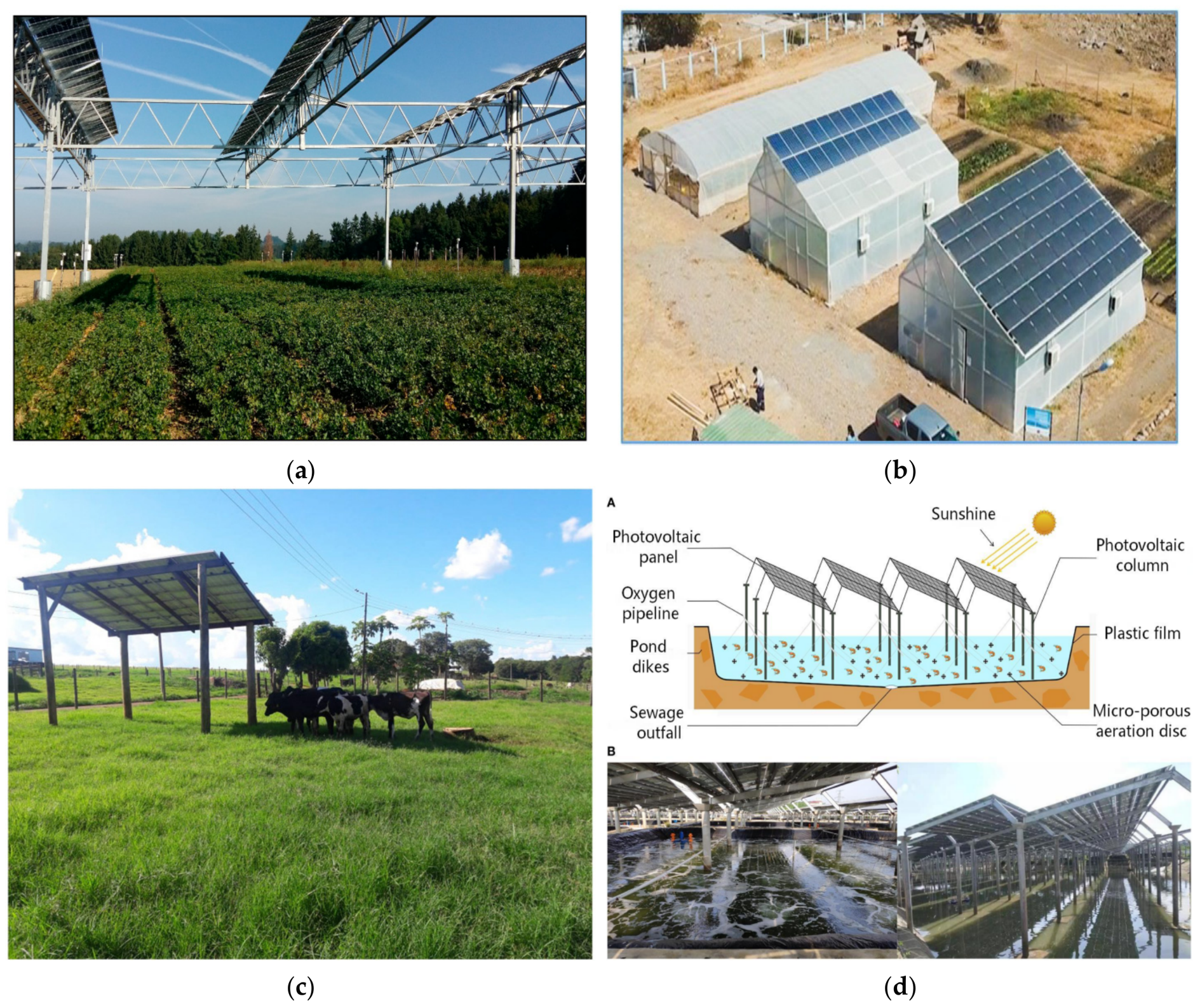
| Open-field | Elevated fixed, inter-row, vertical bifacial, or tracking arrays | Mainly found in temperate agricultural regions of Europe and North America. The Heggelbach project in Germany has a capacity of 194 kWp, and the Borgo Virgilio project in Italy is approximately 2.15 MWp [39,40]. | Improves overall land-use efficiency; alleviates heat and drought stress; retains space for mechanized operations | High support-structure cost; uneven light distribution; restricted passage, turning, and safety distances | Row spacing and clearance restrict passage of large machinery, and headland turning space is insufficient; module obstruction and metal supports interfere with GNSS positioning. |
| Protected horticulture | Rooftop opaque, spaced, semitransparent, or adjustable photovoltaic modules | Mainly found in Mediterranean protected-horticulture regions and high-radiation greenhouse production areas. The photovoltaic greenhouse in Italy has a capacity of 68 kWp, and the photovoltaic greenhouse in Türkiye has a capacity of 48.6 kWp [41,42]. | Supplies facility energy on site; alleviates summer overheating; supports coordinated environmental regulation and power generation | Low light and light patchiness; trade-off between coverage ratio and crop yield; possible insufficient light and heat in winter | Narrow passages and low clearance make equipment turning difficult; indoor GNSS is constrained, and reflections and alternating bright–dark conditions affect visual positioning. |
| Livestock production | Elevated pasture, shade-canopy, or livestock-building rooftop photovoltaic systems | Mainly found in the United States, Australia, and temperate pasture regions of Europe. The photovoltaic grazing project in Oregon, United States, is approximately 1.4 MW [43]. | Improves animal shade and thermal comfort; maintains forage moisture; reduces manual vegetation maintenance | Requirements for fencing and drinking-water facilities; risks of animal gnawing and collisions; manure, dust, and corrosion problems | Fences, drinking-water facilities, and animal activity obstruct passage and turning; canopy obstruction and dynamic obstacles reduce positioning and obstacle-avoidance reliability. |
| Aquaculture | Fixed supports above fishponds, pond-spanning systems, or floating photovoltaics | Mainly concentrated in pond-aquaculture regions along the eastern coast of China and coastal areas of Taiwan. The Jiangsu fishery–photovoltaic project is 50 MW, and the Cixi project in Zhejiang is 200 MW [44]. | Combined use of aquaculture water surfaces; reduces water-surface evaporation; supplies power to aeration, pumping, and monitoring equipment | May alter water temperature, dissolved oxygen, and plankton; restrict feeding, harvesting, and pond patrol; floating-structure and electrical-safety risks | Pond banks, supports, and cables restrict equipment passage, and turning space on the water surface is limited; reflections and module obstruction affect vision and GNSS positioning. |
| Array Configuration and Climatic Conditions | Changes in the Light Environment | Changes in Temperature and Water Conditions | Main Influencing Factors and Applicability Boundaries | Complexity and Economics |
|---|---|---|---|---|
| Elevated fixed; temperate farmland in southwestern Germany | Daily mean PAR decreased by approximately 30% [59] | Daily mean air and soil temperatures decreased by approximately 1.1 °C and 1.2–1.4 °C, respectively, and relative humidity increased by 2% during some periods [59]. | Array geometry shapes light–thermal gradients, and rainfall redistribution determines water conditions beneath the panels. | High structural investment; LCOE is approximately 0.0829 EUR·kWh−1, higher than 0.0603 EUR·kWh−1 for conventional ground-mounted photovoltaics [39] |
| Vertical bifacial; semi-arid field in Pakistan | Annual-scale PAR in similar vertical or tracking configurations decreased by approximately 11% to 34%, with a light-uniformity index of approximately 91% to 95% [60,61] | Air temperature in the vertical bifacial system was approximately 0.5 °C lower than the control, and soil moisture increased by approximately 26% [62]. | Orientation and row spacing determine radiation uniformity, and semi-arid conditions strengthen the water-conservation effect. | Medium complexity; economics are sensitive to row spacing, foundations, and land loss |
| Semitransparent crystalline-silicon greenhouse; naturally ventilated conditions in Kunming, China | Solar radiation decreased by approximately 35% to 40% [49]. | On sunny days, indoor temperature decreased by 1–3 °C, and evapotranspiration decreased from 1.72 to 0.80 mm·d−1 [49]. | Transmittance determines heat load and evapotranspiration; water saving mainly results from radiation reduction rather than increased air humidity. | Complex system integration; economics depend on high-value crops, facility energy savings, and photovoltaic self-consumption |
| Single-axis tracking; tomato field under the Mediterranean climate of Israel | Seasonal cumulative photosynthetic irradiance in the middle of the array decreased by only 1.96%, that in transition rows decreased by approximately 10.2% to 24.9%, and that directly beneath modules decreased by 91.3–92.9% [63] | Daytime air temperature directly beneath the modules was 2.5–3.0 °C lower than in the middle of the array, while nighttime temperature was approximately 0.5 °C higher [63]. | Tracking trajectory and lateral distance jointly shape light–thermal gradients. | High control, maintenance, and failure costs |
| Crop-Adaptation Scenario | Core Physiological and Production Requirements | Main Risks | Array-Adaptation Strategy |
|---|---|---|---|
| Seedling and vegetative growth stages | Maintain appropriate leaf-area expansion and stand establishment, and avoid canopy overheating and water loss | Persistent low light causes seedling etiolation or insufficient biomass accumulation; strong light and high temperature aggravate water stress | Use zoned planting according to seedling light requirements; retain moderate shading during high-temperature periods and reduce prolonged obstruction during low-radiation seasons |
| Flowering and fruit-set stages | Ensure effective radiation and suitable temperature required for floral-organ development, pollination, and fruit set | Excessive shading restricts flower-bud differentiation and causes flower or fruit drop or reduced fruit-set rate | Place crops sensitive during reproductive stages in low-shading zones; reduce module obstruction during critical periods and avoid continuous low light |
| Grain-filling stage | Maintain photosynthate formation and transport to grains or fruits | Insufficient cumulative radiation restricts dry-matter formation and leads to smaller fruits or lower yield | Arrange critical growth stages to avoid high-shading seasons; increase effective light-receiving time through spatial zoning or orientation adjustment |
| Maturity and quality-formation stage | Ensure formation of sugars, color, dry matter, and market quality | Persistent low light at the late stage causes delayed maturity, reduced sugar content, or insufficient coloration | Reduce shading intensity during maturity; preferentially place quality-sensitive crops in areas with more uniform light |
| High-temperature or drought-stress period | Reduce canopy heat load and transpiration consumption and maintain plant water status | Strong radiation and high vapor-pressure deficit cause wilting, stomatal closure, and photosynthetic inhibition | Increase protective shading during periods of high temperature and strong radiation and coordinate it with irrigation timing |
| Regulation Strategy | Main Trigger Basis | Regulation Objective and Adjustment Method | Main Advantages | Main Limitations |
|---|---|---|---|---|
| Fixed-schedule regulation | Preset operating periods, calendar-day progression, and key phenological nodes | Change module tilt or shading duration at preset times | Simple control, stable operation, and low implementation cost | Difficult to respond to abrupt weather changes and actual crop conditions |
| Solar-position tracking | Solar elevation angle and azimuth | Improve photovoltaic radiation capture through single-axis or dual-axis tracking | Mature technology with a clear power-generation objective | The maximum-power orientation may conflict with the crop light-demand objective |
| Weather-threshold regulation | Air temperature, wind speed, and precipitation status | Increase shading during high-temperature and strong-radiation periods and enter a safe orientation under adverse weather | Can respond to high-temperature and extreme-weather events | Thresholds depend on region and crop and are affected by forecast errors |
| Crop-state feedback | Canopy PAR, temperature, soil moisture, leaf water potential, and phenology | Dynamically adjust module orientation according to actual light–thermal–water stress | Can directly respond to crop needs and has strong agronomic targeting | Depends on sensor stability and has high monitoring costs |
| Typical Equipment | Main Dimensional Characteristics | Minimum Clearance Height | Effective Passage or Array Parameters | Safety Margin and Operating Limitations |
|---|---|---|---|---|
| Dryland tractors and seeding/tillage equipment | Maximum tractor width 2.5 m and maximum height 2.8 m; median working widths of seeders and cultivators are both 4.00 m, and that of disc harrows is 4.94 m [20] | Minimum clearance for dryland operations in the Korean elevated system is 3.0 m [20] | Minimum clear distance between supports in the Korean elevated system is 3.3 m [20] | The 3.3 m support clearance was determined by adding 10% to the maximum implement width of 3.0 m [20] |
| Rice transplanters and crawler combine harvesters | Maximum transplanter width 3.0 m; maximum combine-harvester width 2.4 m and maximum height 3.1 m [20] | Minimum clearance for paddy-field operations in the Korean elevated system is 3.4 m [20] | Minimum clear distance between supports is 3.3 m and is matched with rice planting row spacing [20] | Passage width is determined by adding 10% to the maximum implement width [20] |
| Combine harvesters and harvesting headers | Average harvesting-header working width 7.50 m and median width 7.00 m [20] | Minimum clearance height of the German Heggelbach elevated system is 5.0 m [59] | Module-row width is 3.4 m and clear distance between module rows is 6.3 m [59] | A 13.0 m support spacing is determined from two 6.0 m machinery working widths plus a total 1.0 m safety margin. |
| 6 m boom sprayer (German Heggelbach elevated system) | The locally common boom working width used in project design is 6.0 m [20] | Clearance height is 5.0 m [39,59] | Nominal support spacing is 19 m transversely and 12 m longitudinally, corresponding to clear passage widths of approximately 18.4 and 11.75 m [39,59] | The 19 m transverse spacing was determined according to an integer-multiple relationship with the working width of locally common machinery |
| Navigation Scheme | Overall Robustness Beneath Photovoltaic Arrays | Relative Cost and Deployment Complexity | Current Engineering Positioning |
|---|---|---|---|
| Single RTK-GNSS | Sensitive to sky obstruction, module reflection, and multipath from metal supports; errors may vary periodically between array rows, resulting in low robustness. | Moderate cost. No additional environmental sensors are required, but a differential base station, network service, or reference station is needed. | Suitable as a source of global coordinates outside the array; not suitable as the sole positioning method for operations near supports beneath the modules. |
| GNSS–IMU–wheel-speed fusion | Can alleviate short-term obstruction but is difficult to use for continuous long-distance operation beneath the panels; robustness is moderate. | Moderate cost. Sensors are mature and computational load is moderate, but calibration and tire-slip handling are required. | Suitable for array entrances, exits, and transition areas with short-term GNSS degradation; it is an option between single GNSS and autonomous positioning. |
| LiDAR–IMU-coupled SLAM positioning | Essentially unaffected by bright–dark changes but affected by dust, rainfall, crop occlusion, and sparse point clouds; robustness is relatively high. | High cost. Three-dimensional LiDAR and real-time computing platforms are expensive, with high calibration and maintenance requirements. | Can serve as the main relative-positioning scheme for areas beneath modules where GNSS is constrained for long periods. |
| RGB-D semantic visual navigation | Can identify support and passage semantics but is susceptible to hard shadows, glass reflection, exposure lag, and support occlusion; robustness is moderate. | Moderate cost. Cameras are relatively inexpensive, but dedicated datasets, model training, and continuous updates are required. | Suitable for array-structure recognition, row-number determination, and local-path generation; it should not independently undertake safety-critical positioning. |
| Monitoring Scheme | Accuracy and Spatiotemporal Scale | Implementation Cost and Components | Applicability to Agrivoltaics |
|---|---|---|---|
| Fixed sensor network | High single-point accuracy and temporal resolution, but limited spatial representativeness | Single-node purchase cost is relatively low; multi-zone deployment requires data loggers, power supply, communication, and protective facilities, while long-term calibration, fault replacement, and network maintenance increase lifecycle cost | Suitable for continuous monitoring and model calibration; under-panel, inter-panel, and edge zones need to be covered |
| UAV multispectral/thermal infrared | Centimeter-level spatial resolution, but data can only be acquired by flight mission | The flight-platform cost is moderate and multispectral and thermal-infrared payloads are relatively expensive; repeated monitoring also involves route planning, battery maintenance, image mosaicking, and data processing, resulting in relatively high integrated cost for high-frequency aerial surveys | Suitable for fine zoning in open arrays; blind areas exist beneath panels and inside greenhouses |
| Satellite remote sensing | Good regional coverage and long-term continuity, but intra-array accuracy is limited by mixed pixels | Open data such as Landsat and Sentinel have low acquisition costs, while commercial high-resolution imagery requires purchase or subscription; no field deployment is required, but cloud/shadow processing, mixed-pixel correction, and multi-temporal data analysis increase computing and personnel costs | Suitable for regional evaluation of large projects; not suitable for directly judging crop conditions beneath panels |
| Near-ground imaging and LiDAR | High local structural accuracy, but affected by occlusion, low light, and platform passage | RGB and depth cameras are relatively inexpensive, while thermal infrared, hyperspectral, and three-dimensional LiDAR are more expensive; costs also include mobile-platform integration, multi-sensor synchronization and calibration, supplemental lighting, dust/water protection, point-cloud processing, and data storage | Suitable for monitoring canopy structure, crop stress, and remaining clearance |
| Model Type | Typical Models | Advantages | Limitations | Suitable Prediction Targets |
|---|---|---|---|---|
| Physical-mechanism models | Solar geometry, energy balance, CFD | Strong interpretability | Many parameters and relatively high zoning-calibration and computational costs | Shadow distribution and temperature–humidity environment |
| Traditional machine learning | SVM, RF, XGBoost, ANFIS | Suitable for nonlinear regression and relatively fast to train | Depends on feature selection and is insufficient for modeling long-term dependence | Radiation, temperature and humidity, transpiration, and irrigation demand |
| Time-series deep learning | LSTM, RNN, CNN–LSTM | Can extract local fluctuations and long-term temporal dependence | Large data requirements and limited cross-scenario generalization | Radiation, PAR, canopy-temperature, and transpiration sequences |
| Attention models | LSTM-Attention, Transformer | Can focus on critical times and spatial regions | Complex structure and relatively high training and computational costs | Light–thermal prediction under cloudy weather and alternating bright–dark conditions |
| Sensing and Prediction Information | Decision Variable | Generated Agricultural Machinery Instruction | Main Constraints and Feedback |
|---|---|---|---|
| Soil water content, predicted evapotranspiration, and rainfall forecast | Zonal water deficit and irrigation priority | Target area, irrigation amount, and operation sequence | Rainfall probability and soil infiltration capacity; feedback of actual flow and water content |
| Canopy temperature, VPD, and water-stress index | Heat-stress intensity and duration | Local irrigation and cooling operations | Crop growth stage and shading state; feedback of canopy temperature |
| Pest, disease, and weed locations and canopy density | Target confidence and damage level | Spraying location and application rate | Recognition confidence; feedback of pesticide application amount and reinspection results |
| Canopy height, support distance, and obstacle position | Clearance and collision risk | Implement height, local path, speed, and safety boundary | Module orientation and positioning error; feedback of trajectory deviation and minimum distance |
| PAR, shadow trajectory, and anomalous-growth areas | Anomaly duration and need for remeasurement | Inspection area, sampling location, and task priority | Instantaneous-shadow and mixed-pixel interference; feedback of remeasurement results |
Disclaimer/Publisher’s Note: The statements, opinions and data contained in all publications are solely those of the individual author(s) and contributor(s) and not of MDPI and/or the editor(s). MDPI and/or the editor(s) disclaim responsibility for any injury to people or property resulting from any ideas, methods, instructions or products referred to in the content. |
© 2026 by the authors. Licensee MDPI, Basel, Switzerland. This article is an open access article distributed under the terms and conditions of the Creative Commons Attribution (CC BY) license.
Share and Cite
Qiao, Y.; Dong, Y.; He, Q.; Zhang, Z.; Zhang, W.; Ye, T.; Lu, X.; Tang, Z. Synergistic Optimization of Agrivoltaic Systems: A Review of Intelligent Equipment Control for Agricultural Production Adaptability. Sustainability 2026, 18, 8849. https://doi.org/10.3390/su18178849
Qiao Y, Dong Y, He Q, Zhang Z, Zhang W, Ye T, Lu X, Tang Z. Synergistic Optimization of Agrivoltaic Systems: A Review of Intelligent Equipment Control for Agricultural Production Adaptability. Sustainability. 2026; 18(17):8849. https://doi.org/10.3390/su18178849
Chicago/Turabian StyleQiao, Yuyuan, Yuting Dong, Qi He, Zhaoming Zhang, Wenbin Zhang, Tao Ye, Xin Lu, and Zhong Tang. 2026. "Synergistic Optimization of Agrivoltaic Systems: A Review of Intelligent Equipment Control for Agricultural Production Adaptability" Sustainability 18, no. 17: 8849. https://doi.org/10.3390/su18178849
APA StyleQiao, Y., Dong, Y., He, Q., Zhang, Z., Zhang, W., Ye, T., Lu, X., & Tang, Z. (2026). Synergistic Optimization of Agrivoltaic Systems: A Review of Intelligent Equipment Control for Agricultural Production Adaptability. Sustainability, 18(17), 8849. https://doi.org/10.3390/su18178849