Article

Climate Change Impacts, Adaptive Resilience, and Regenerative Livestock Adoption: A Resilience Trap in High-Andean Camelid Agroecosystems


by
Rosa Patricia Larios-Francia
1,*,
Oscar Efraín Cárdenas Minaya
2 and
Andrés Condori Ticona
3
1
Department of Business Administration, Universidad del Pacífico, Lima 15072, Peru
2
Instituto Nacional de Innovación Agraria, Puno 21002, Peru
3
Centro de Innovación Tecnológica de los Camélidos Sudamericanos, Puno 21001, Peru
*
Author to whom correspondence should be addressed.
Sustainability 2026, 18(17), 8822; https://doi.org/10.3390/su18178822 (registering DOI)
Submission received: 20 July 2026 / Revised: 19 August 2026 / Accepted: 21 August 2026 / Published: 28 August 2026
(This article belongs to the Special Issue Sustainable Animal Production and Livestock Practices)

Abstract

Andean livestock agroecosystems depend on grassland and soil functionality to sustain productivity, threatened by climate-driven glacial retreat, pasture degradation, and increasingly frequent frosts, hailstorms, and droughts. Grounded in the Resilience Thinking framework for socio-ecological systems, this study proposes and validates an explanatory model examining how perceived climate change impacts (IMP) drive the adoption of regenerative livestock farming (ADOP) and impact the deterioration of livestock performance (DES), with adaptive capacity and resilience (RES) as a mediating construct. Regenerative livestock farming is operationalized through soil, forage, water, and biodiversity management, animal welfare, and climate adaptation strategies. Survey data from 91 South American camelid producers in the Puno region, Peru, were analyzed using Partial Least Squares Structural Equation Modeling (PLS-SEM) with second-order constructs. Climate impacts emerge as the strongest antecedent of adaptive resilience (β = 0.718) and regenerative adoption (β = 0.604) and have a significant direct effect on performance deterioration (β = 0.292; p = 0.041). However, resilience does not significantly predict adoption (β = 0.075; p = 0.619), revealing institutional, technological, and knowledge-related barriers that disconnect adaptive capacity from ecological transformation. Both adoption (β = 0.327; p = 0.002) and resilience (β = 0.335; p = 0.003) are positively associated with performance deterioration, suggesting reactive containment rather than consolidated restoration. Findings indicate adaptive rather than transformative resilience in high-Andean livestock systems, indicating that an effective regenerative transition requires participatory, context-sensitive approaches supported by policies and technical assistance that strengthen long-term productive sustainability and food security in vulnerable communities.

1. Introduction

Climate change has emerged as one of the greatest challenges facing humanity; its direct effects, including rising global temperatures, extreme weather events, shifts in climatic patterns, and glacier retreat driven by ocean and atmospheric warming, are evident across regions, affecting stability of ecosystems, food security, and the livelihoods of millions of rural producers [1]. The macroeconomic dimensions of this crisis are equally significant: a permanent 1 °C increase in global temperature reduces global GDP by more than 20%, while a 2 °C increase by 2100 is projected to generate welfare losses exceeding 30% in present-day terms [2]. The urgency of addressing these challenges was reaffirmed at the 30th United Nations Climate Change Conference (COP30) with the consolidation of the Climate Action Agenda as a central pillar for driving concrete solutions in key sectors of the real economy, including food systems, agriculture, and livestock farming [3], given their dual role as sectors highly vulnerable to climate variations and, at the same time, as key actors in climate change mitigation and adaptation [4].
In this context, livestock systems are facing increasing pressure to transition to climate-smart models that are compatible with global climate goals, ecosystem services, and human well-being [5,6,7,8]. In response, regenerative livestock farming has emerged as an agroecological approach to livestock management and agricultural production that seeks to imitate the natural feeding and grazing patterns of animals; it proposes integrated management of livestock ecosystems based on practices such as appropriate soil management, forage strategies through rotational grazing and the diversification of plant species, the use of biofertilizers, biodiversity monitoring, animal welfare, water management and the management of microorganisms, thereby strengthening the resilience of production systems in the face of climate-related disturbances [9,10]. Beyond its ecological dimensions, regenerative livestock farming promotes the production of local and sustainable food, improves the long-term profitability of livestock operations, and contributes to rural employment and food security [11].
The Andean highlands are among the region’s most acutely exposed to these dynamics. This ecoregion is the habitat of South American camelids, with a population of approximately 7.5 million alpacas (Vicugna pacos), 4 million llamas (Lama glama), 350,000 vicuñas (Lama vicugna), and 600,000 guanacos (Lama guanicoe), providing livelihoods for approximately 200,000 families across Peru, Bolivia, Argentina, Chile, and Ecuador [12]. Peru concentrates around 87% of the world’s population of South American camelids; their farming is an economic, social, and cultural pillar for nearly 90,000 producers [13], most of whom live in conditions of poverty and extreme poverty, facing territorial exclusion, and suffer from structural gaps in infrastructure, services, and market access. In this context, the South American camelid value chain operates under conditions of high fragmentation, asymmetries, and significant ecological degradation, limiting its capacity to implement technological adaptation measures and sustainable management practices.
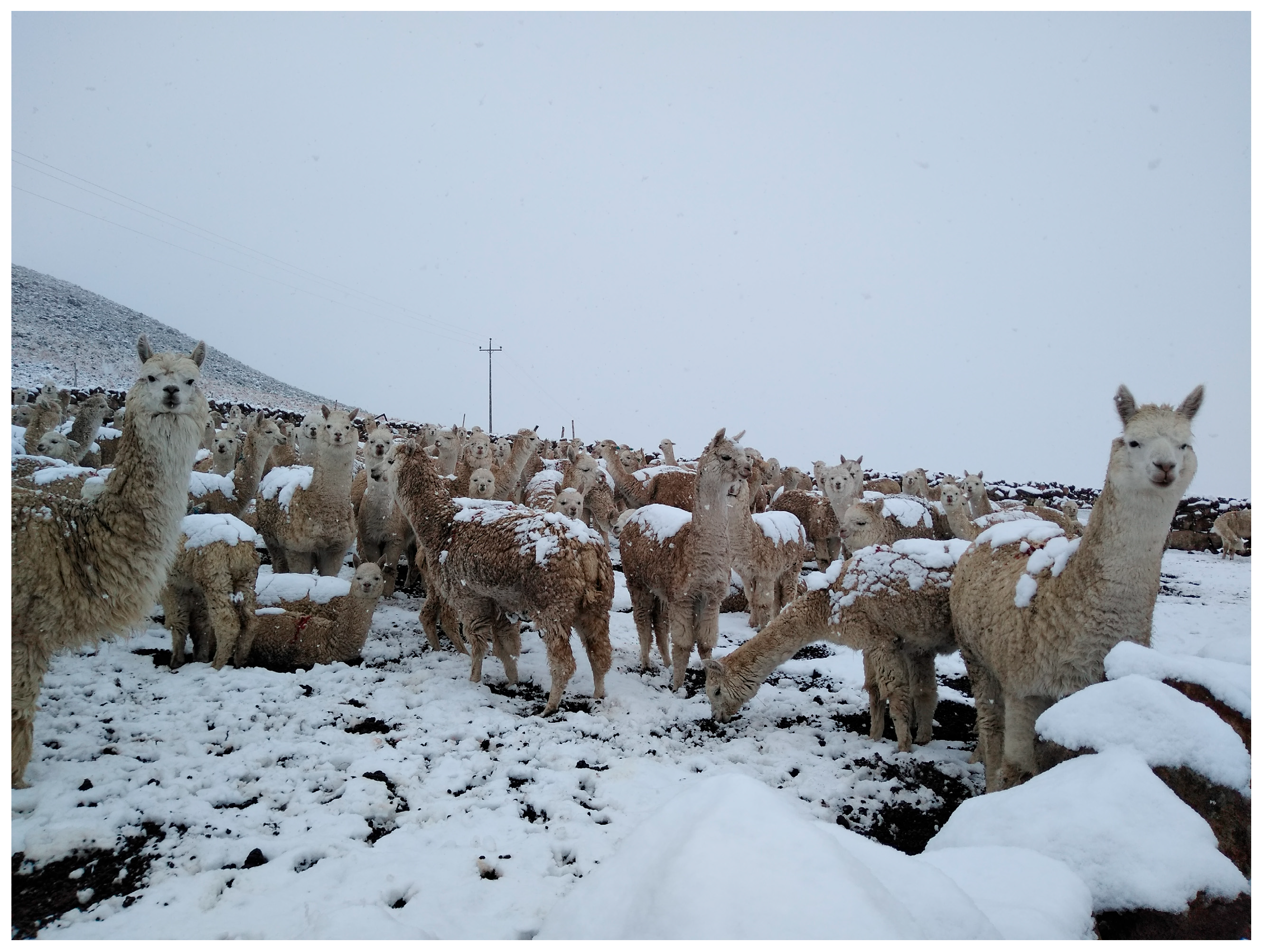
This situation has been exacerbated by extreme weather events, frosts, hailstorms, prolonged droughts, and floods, are intensifying outside their typical seasons, causing glacial retreat, soil degradation through salinization and runoff, and the deterioration of wetlands and natural pastures [14] (Figure 1). These processes directly affect water availability, forage quantity and quality, animal health, and the productive, economic, and operational performance of camelid systems, configuring a scenario of compounded vulnerability in which climate disturbances amplify pre-existing structural fragilities.
Although there is growing academic attention on climate change and climate-smart systems incorporating regenerative livestock practices [15,16], few studies have been identified in regions such as Asia, Africa, and South America, regions that are critical for livestock production [6]. Recent narrative reviews have begun to document regenerative livestock pathways in South America contexts such as Chile, though current evidence remains qualitative, pilot-scale, and focused on temperature-climate cattle and sheep system rather than on camelid agroecosystem in the High Andes [17]. Likewise, there is little contextual research on rural livestock-raising communities and small-scale livestock production systems [18], particularly due to the existence of supply chain asymmetries, heterogeneous populations, and cultural, technological, and institutional barriers [9]. Moreover, comprehensive evidence on the effectiveness of regenerative livestock practices in reducing climate-related impacts remains scarce [19]. Much of the existing literature has focused on ruminants and the contribution of livestock production to greenhouse gas (GHG) emissions, particularly methane (CH4) from enteric fermentation, rather than examining how regenerative practices may simultaneously support climate adaptation, resilience, and mitigation [5,15,20,21].
The literature indicates that future research should prioritize integrated and interdisciplinary approaches that take into account both the environmental and socioeconomic dimensions of livestock systems’ resilience to climate change; this would contribute to the development of effective strategies that support sustainable livestock production in a changing climate [22,23], as suggested by [24], there is a need for participatory modeling and the integration of indigenous knowledge.
To address these gaps, this study proposes and empirically validates an explanatory model grounded in the Resilience Thinking framework for Socio-ecological Systems [25,26], which examines how the perceived impacts of climate change (IMP) drive the adoption of regenerative livestock farming (ADOP) and influence livestock system performance deterioration (DES), with adaptive capacity and resilience (RES) acting as a mediating construct. The model integrates four interrelated constructs organized around two explanatory pathways: IMP → RES → ADOP, examining whether adaptive resilience translates into regenerative transition; and IMP → RES → DES, which examines the role of resilience in shaping livestock system performance deterioration under climate stress.
The study makes three interrelated contributions. From a theoretical perspective, it expands the literature on resilience, adaptation to climate change, and the transformation of livestock agroecosystems by integrating these frameworks into an empirically validated structural model applicable to vulnerable contexts in the Southern Global High Andes. From an applied perspective, the findings generate evidence on the socio-ecological barriers that decouple adaptive capacity from regenerative transition, with direct implications for the design of public policies, rural development programs, and sustainability strategies oriented toward strengthening food security in livestock communities under climate pressure. From an environmental perspective, the study provides empirical evidence on the role of regenerative livestock practices, including soil management, pasture diversification, water management, and biodiversity monitoring, as a potential mechanism to strengthen agroecosystem resilience and support ecological functionality under climate stress, while identifying the institutional and structural conditions that determine whether their adoption translates into effective ecosystem restoration.

2. Theoretical Background

2.1. The Resilience Thinking Framework in Socio-Ecological Systems (SES)

Resilience has been defined as a system’s ability to persist in the face of disturbances without losing its structure and function [26]. In socio-ecological systems (SES), resilience focuses on three aspects: (1) persistence (remaining within the stability domain, while fluctuating within the system’s thresholds); (2) adaptability (the ability to adjust to changes in the external and internal context, allowing the system to develop within the current stability domain and along the current trajectory); and (3) transformability (the ability to create new stability domains for the system’s development, that is, a new stability landscape and the crossing of thresholds toward new trajectories). Thus, resilience can be operationalized as a portfolio of capabilities: anticipation, absorption, recovery, and reconfiguration [25]. Furthermore, the Resilience Thinking framework emerged as a paradigm for understanding and managing the complexity of coupled systems, both human and natural; this approach represents a break with traditional notions of stability and control, emphasizing adaptability, learning, and transformation in the face of uncertainty and change [27].
In livestock systems, resilience is a management asset that requires early warning of climate disturbances and their effects; this is essential for improving the ability to respond and self-organize in the face of internal or external factors influences [19].

2.2. Impacts of Climate Change and Adaptive Capacity and Resilience

The Resilience Thinking framework argues that external disturbances, such as the direct and indirect impacts of climate change function as triggers that activate the adaptive capacity and resilience of socio-ecological systems, mobilizing reorganization processes aimed at ensuring the system’s continuity [25,26]. When perceived risk is high, systems activate routines related to preparedness, learning, and flexibility as fundamental adaptive responses [26,28]. In camelid-rearing systems in the High Andes, this dynamic is particularly acute: producers are exposed to climate disturbances that exacerbate one another, such as glacial retreat, pasture degradation, and increased frequency of frosts, droughts, and hailstorms, which directly compromise the ecological basis of their production systems, creating conditions in which adaptive responses cease to be merely strategic and become essential for survival [14,19].
Adaptive capacity, within the Resilience Thinking framework, refers to a system’s ability to adjust to changes in external and internal conditions, allowing it to function within its current range of stability and along its current trajectory [25]. In livestock systems, this capacity is determined by socioeconomic factors, including access to resources, knowledge, technical assistance, and institutional support, which determine the scope and effectiveness of the adaptation strategies available to producers [26,27]. For camelid producers in the High Andes, who operate under conditions of extreme poverty, territorial exclusion, and structural deficiencies in services and market access [14], the relationship between the perception of climate impacts and the activation of adaptive capacity is mediated by these structural constraints, suggesting that greater exposure to climate disturbances generates more intense adaptive responses precisely in the contexts where such responses are most urgent.
Empirical evidence supports this relationship across various livestock systems: studies document that producers exposed to heat stress, excessive rainfall, and drought activate adaptation strategies that include adjustments to feeding and herd management practices, participatory approaches involving community stakeholders, and the integration of traditional knowledge into adaptation frameworks [19,23,29,30]. Understanding resilience as the capacity to recover, reorganize, and maintain productive continuity is particularly relevant to the High Andes systems, where the decline in pasture quality, water availability, and animal health pose a direct threat to the livelihoods of families dependent on the camelid value chain [14,31]. Based on the theoretical and empirical evidence presented, the following hypothesis is proposed:
H1. 
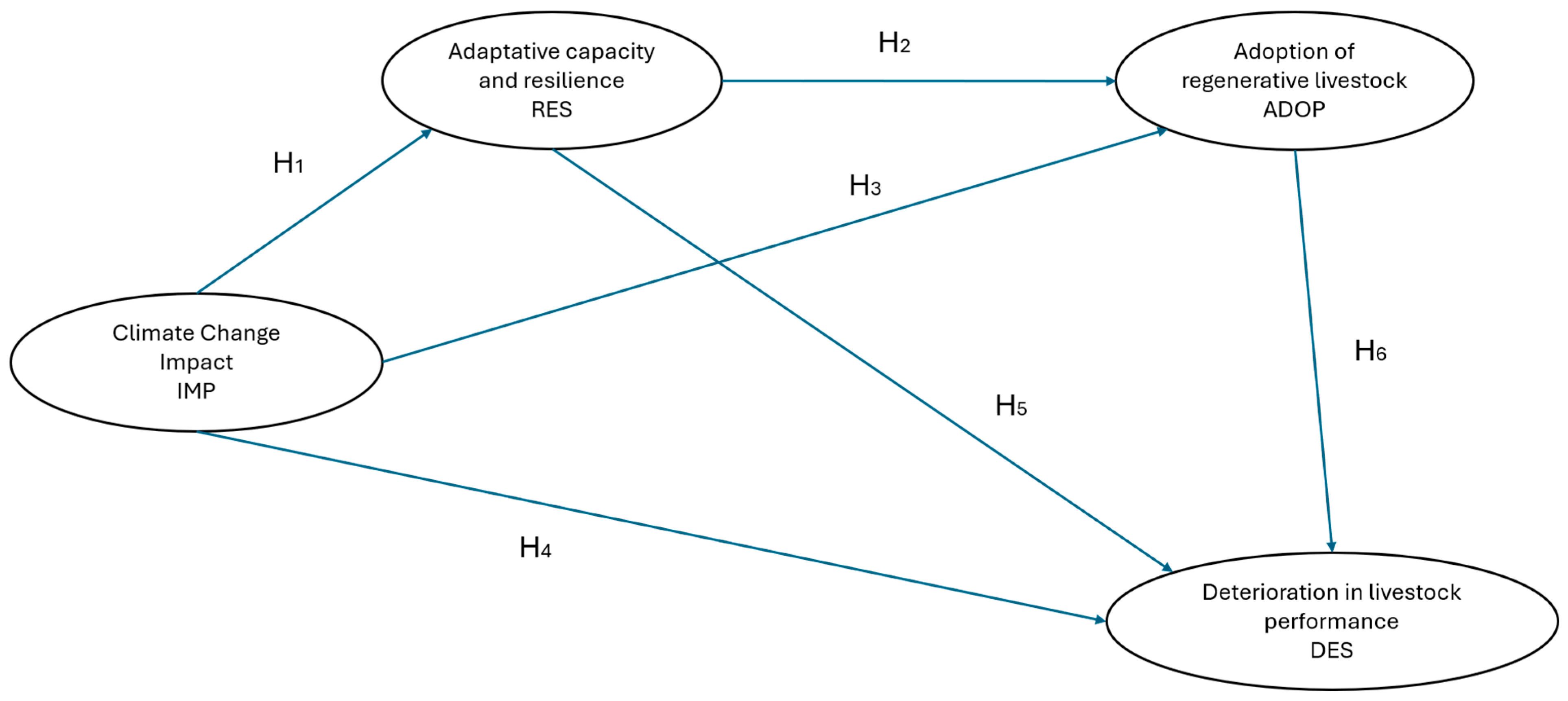
The perceived impacts of climate change (IMP) have a significant positive effect on the adaptive capacity and resilience (RES) of South American camelid producers.

2.3. Impacts of Climate Change, Resilience, and the Adoption of Regenerative Livestock Farming Strategies

Studies provide considerable evidence of the impact of climate change on livestock systems, such as declines in the production of meat, fiber, milk, and other products, making it necessary to adopt resilience strategies; meanwhile, research on climate-smart systems and regenerative practices agrees that climate and environmental shocks can accelerate the adoption of more adaptive and restorative strategies [32]. At the same time, the adoption of regenerative livestock practices is driven by environmental and economic motivations, reinforced by integrated and holistic models that combine adaptation and mitigation strategies.
There is evidence that regenerative systems improve the resilience of ecosystems to the pressures caused by climate change through the diversification of food sources, rotational grazing systems, adaptive management, and genetic selection, thereby restoring key ecological functions, particularly those related to soil, water, biodiversity, and pasture productivity [33,34,35]. They also reduce methane and nitrous oxide emissions by improving forage quality, managing manure, and enhancing soil carbon sinks [36,37]. However, as suggested by Escarcha [6], further research is needed to establish a quantitative relationship between these factors, particularly in livestock and agricultural systems under diverse regional conditions.
Nevertheless, the translation of adaptive capacity into the adoption of regenerative practices is neither automatic nor universal. In contexts characterized by structural poverty, weak institutional frameworks, and limited access to technology, financial resources, and knowledge, adaptive resilience may function primarily as a survival mechanism rather than as a driver of systemic transformation toward regenerative practices [9,38]. The literature on climate change adaptation in smallholder farming and pastoralist systems consistently identifies financial constraints, inadequate technical assistance, resistance to change, and insufficient integration of traditional and indigenous knowledge as barriers that hinder the path from adaptive capacity to the adoption of more sustainable management strategies [16,24]. Therefore, whether adaptive capacity effectively triggers the adoption of regenerative practices may depend on the enabling conditions present in the socio-ecological context, making this relationship an empirical question worthy of investigation in vulnerable camelid systems in the High Andes. It should be clarified that, within the proposed model, RES and ADOP are conceptualized as predominantly reactive responses to climate stress rather than as proactive, anticipatory strategies, consistent with the resilience trap literature [39,40] and with the conditions of extreme structural poverty and weak institutional presence that characterize camelid producers in the Puno region. This reframing does not modify the direction of the hypothesized paths; it clarifies that resilience and adoption are expected to be activated once climate impacts are perceived as threatening, rather than in anticipation of future risk. This distinction is revisited in Section 5 when interpreting the positive association of RES and ADOP with performance deterioration (DES).
Therefore, the following hypotheses are proposed:
H2. 
Adaptive capacity and resilience (RES) have a significant positive effect on the adoption of regenerative livestock farming (ADOP).
H3. 
The perceived impacts of climate change (IMP) have a significant positive effect on the adoption of regenerative livestock farming (ADOP).

2.4. Impacts of Climate Change, Adaptive Capacity and Resilience, and Their Effect on the Deterioration of Livestock System Performance

Climate change has a significant impact on livestock systems, affecting production, economic viability, operational management, and market dynamics. From the perspective of the Resilience Thinking framework, exposure to large-scale disturbances, when not accompanied by adequate management, adaptation, and response capabilities, tends to lead to a deterioration in system performance [25,27].
In terms of productive performance, changes in climate patterns reduce, for example, the availability and quality of forage; droughts can exacerbate feed shortages, and all of this affects livestock nutrition and productivity, resulting in reduced weight and fiber quality; meanwhile, sudden shifts in extreme temperatures contribute to heat stress, causing fertility problems and increased susceptibility to disease, as well as higher morbidity and mortality rates among animals; they also negatively impact reproductive indicators, reducing herd size [30,41,42].
From an economic performance perspective, the frequency and intensity of extreme and less predictable weather events have affected the quality and quantity of natural pastures and water sources for animal consumption, leading to increased feed costs and operating expenses, which is unsustainable, especially in a value chain characterized by extreme poverty, leading to a decline in productivity, which impacts revenue generation from the sale of products and byproducts [41,43,44].
From an operational and commercial perspective, the increased frequency and severity of droughts lead to water shortages, limiting the ability to maintain herd sizes and necessitating the adoption of water management practices and changes in feeding regimes [14]. Climate change disrupts the entire livestock supply chain, from rearing and production to marketing and processing. The indirect effects of climate change, such as the deterioration of transportation and communication infrastructure, affect the marketing of wool, meat, and other products, reducing producers’ ability to generate income. These disruptions can lead to increased costs and reduced market access, especially for small-scale livestock farmers, who may lack the necessary resources to adapt [42,43].
From the perspective of the Resilience Thinking framework, the relationship between adaptive resilience and performance deterioration may not follow a straightforwardly negative direction. In contexts of structural vulnerability, adaptive responses may be activated precisely when performance deterioration is most acute, functioning as reactive containment mechanisms rather than as restorative capacities [19,25]. This suggests that resilience and performance deterioration may coexist, with greater adaptive activation reflecting greater exposure to unmanaged climate disturbances rather than effective performance recovery. Under conditions of extreme poverty and institutional weakness, the activation of resilience may sustain system continuity without reversing underlying degradation, a dynamic consistent with what the literature has begun to theorize as a resilience trap [39,40]. The direction and magnitude of the RES→DES relationship is therefore treated as an empirical question in the present study.
Based on the literature, the following hypotheses are proposed:
H4. 
The perceived impacts of climate change (IMP) have a significant positive effect on livestock system performance deterioration (DES).
H5. 
Adaptive capacity and resilience (RES) have a significant effect on livestock system performance deterioration (DES).

2.5. The Effect of Adopting Regenerative Livestock Farming on the Deterioration of Livestock System Performance

Regenerative livestock farming seeks to restore the ecological functionality of the system through practices associated with soil conservation, improved water management, pasture enhancement, biodiversity, animal welfare, better management decisions, and strategies to reduce greenhouse gas emissions [33,45]. In theory, these practices should reduce the system’s effective exposure to climatic disturbances and strengthen its capacity to sustain productive and economic outcomes over time. Recent evidence suggests that regenerative practices can improve natural capital attributes, promote water retention, and contribute to the system’s productivity and sustainability, although their results depend on the context and the management package implemented [46].
However, the relationship between regenerative adoption and performance outcomes is context-dependent and may not follow the expected negative direction in all socio-ecological settings. In agroecosystems characterized by extreme poverty, limited investment capacity, prices below operating costs, and weak institutional support, regenerative practices may be adopted as reactive responses to climate-induced losses rather than as proactive investments in ecological functionality [6,34]. Under these conditions, adoption and performance deterioration may coexist; producers may implement regenerative strategies precisely when their systems are under greatest stress, without yet having access to the institutional, financial, and knowledge conditions that would enable these practices to reconfigure system trajectories toward improved ecological and productive outcomes [14]. The adoption of climate-smart or regenerative practices in contexts of extreme poverty is often constrained by limited education, limited market access, and insufficient financial resources [6,34], suggesting that the ADOP→DES relationship is an empirical question contingent on the structural conditions of the agroecosystem under study.
H6. 
The adoption of regenerative livestock farming (ADOP) has a significant effect on livestock system performance deterioration (DES).
The research model details the relationship between the variables (constructs) and the hypotheses formulated based on theoretical evidence (Figure 2).

3. Methodology

3.1. Research Design

The study aimed to explain how the impacts of climate change (IMP) have an effect on the deterioration in performance (DES) of the livestock system, with adaptive capacity and resilience (RES) and the adoption of regenerative livestock farming (ADOP) acting as mediating constructs.
The research was conducted from a positivist perspective, using a deductive approach focused on applying theory to structure constructs and formulate hypotheses. It followed a quantitative, explanatory framework and adopted a non-experimental, cross-sectional, and correlational-causal design. Given this cross-sectional design, all structural relationships reported in Section 4 and Section 5, including the terms “effect,” “driver,” “antecedent,” and “mediation,” are used in the statistical sense conventional in PLS-SEM reporting [47] to describe the direction, magnitude, and statistical significance of path coefficients estimated through bootstrapping, without implying verified temporal precedence, confirmed causal mechanisms, or the exclusion of reverse causality. Partial least squares structural equation modeling (PLS-SEM) was used to predict the degree of effect of the construct “impact of climate change” (IMP) on the deterioration of livestock system performance (DES), as well as the mediating effects of “adaptive capacity and resilience” (RES) and the “adoption of regenerative livestock strategies” (ADOP) in the Puno Region, Peru (see Figure 2). The model consists of two stages: in the first, the reflective and formative constructs were evaluated, and in the second, the predictive power of the structural model was evaluated.

3.2. Data Collection and Sampling Strategies

In this study, the unit of analysis was the South American camelid producer, defined as the owner of a camelid farming operation (fundo) located at altitudes between 3600 and 4200 m above sea level (m.a.s.l.) in the Puno Region, Peru. This region was selected because it concentrates approximately 80% of the world’s South American camelid population, with alpacas (Vicugna pacos) representing the most significant species, with a registered population of 4,545,820 animals [13]. The South American camelid value chain is considered one of the most important for producer livelihoods and as a source of raw materials for the textile, meat, and leather sectors [48]. Owners were selected as the unit of analysis because they hold primary decision-making authority over farming management practices, resource allocation, and the adoption of regenerative strategies within the production system, making them the most appropriate informants for the perceptual and behavioral constructs measured in the model. The inclusion criteria were: (a) the owner’s farming operation must be located within the Puno Region; (b) the operation must maintain an active population of South American camelids; and (c) the owner must hold land designated for camelid breeding and management.
Although the South American camelid producer population in the Puno Region is estimated at approximately 90,000 owners [13], three converging structural barriers made a larger, probabilistic sample impracticable within the scope of this study. First, geographic accessibility: camelid-rearing fundos are dispersed across high-Andean rangelands at altitudes between 3600 and 4200 m.a.s.l., often several hours from the nearest road, and no reliable census or cadastral registry exists that could serve as a probabilistic sampling frame; this precludes the construction of a probabilistic sampling frame and rules out random or stratified sampling. Second, linguistic accessibility: a substantial proportion of producers are monolingual speakers of Quechua or Aymara, with limited or no Spanish proficiency, which requires bilingual, community-trusted interviewers administering the survey face-to-face and increases the time and cost per case. Third, literacy: many producers have not completed formal schooling and do not read or write with functional fluency, which rules out self-administered, mailed, telephone, or online modalities and requires oral, one-on-one interviews. These three conditions jointly characterize the target population as hard-to-reach in the methodological sense, distinguishing the present case from instances in which small, non-probabilistic samples are used as a matter of convenience despite a large and readily accessible population, a practice that has been criticized in the PLS-SEM literature.
Data collection was conducted using a structured in-person survey consisting of four sections, developed based on the Resilience Thinking framework literature and empirical studies on climate change adaptation and regenerative livestock practices. Content validity was established through expert judgment, involving five specialists in agricultural systems, agroecology, and rural development, who evaluated item relevance, clarity, and representativeness; items not meeting the established content validity criteria were revised or removed prior to data collection. The first section measured producers’ perceptions of the impacts of climate change (IMP) on the South American camelid value chain, using a five-point Likert scale (1 = “No impact”; 5 = “Very high impact”).
The second section assessed producers’ adaptive capacity and resilience (RES) to climate change using a five-point Likert scale (1 = “Strongly disagree”; 5 = “Strongly agree”).
The eight dimensions used to operationalize ADOP were derived from the regenerative livestock farming literature reviewed in Section 2.3 [9,10,33,45], which characterizes regenerative management as a multidimensional agroecological package rather than a single practice. Because a large number of formative indicators inherently limits how many of them can attain statistically significant weights [49], the eight dimensions were aggregated into a second-order formative construct rather than modeled as a single flat set of indicators, following established guidance for this situation [49].
The third section identified and assessed the degree of adoption of regenerative livestock practices (ADOP) across eight dimensions: soil management, forage strategy and pasture diversification, water management, biodiversity management, animal welfare, economic and social farm management, education and monitoring, and climate adaptation strategies, measured using a five-point Likert scale (1 = “No practice at all”; 5 = “Very high adoption of the practice”).
The fourth section measured the deterioration of the livestock system’s performance (DES) across three dimensions: productive performance, economic performance, and operational and commercial performance, using a five-point Likert scale (1 = “No impact”; 5 = “Very high impact”). Table 1 presents the full operationalization of the constructs and their indicators.
A non-probabilistic sampling strategy was employed, combining purposive and convenience sampling techniques. The sample consisted of 91 South American camelid farm owners (fundos) from the Puno Region, of whom 54% were men and 46% were women. The adequacy of the sample size for PLS-SEM estimation was verified following the ten-times rule, which requires a minimum of ten cases per the largest number of structural paths pointing to any single construct in the model [47]; the present sample exceeds this threshold. Data collection took place between 2024 and 2025.
Partial Least Squares Structural Equation Modeling (PLS-SEM) was selected for data analysis given its suitability for models with small-to-medium sample sizes, its capacity to handle both reflective and formative measurement models, and its orientation toward prediction and explanation of complex structural relationships [47,50]. SmartPLS version 4.1.1.7 was used for all estimations.
The analytical procedure followed a two-stage approach: in the first stage, the reflective measurement model (RES) and the formative measurement models (IMP, ADOP, and DES) were evaluated for reliability, convergent validity, discriminant validity, indicator weights, and collinearity; in the second stage, the structural model was assessed by examining path coefficients, effect sizes (f2), coefficients of determination (R2), and the significance of direct and indirect effects through bootstrapping with 5000 subsamples.

4. Results

4.1. Model Description

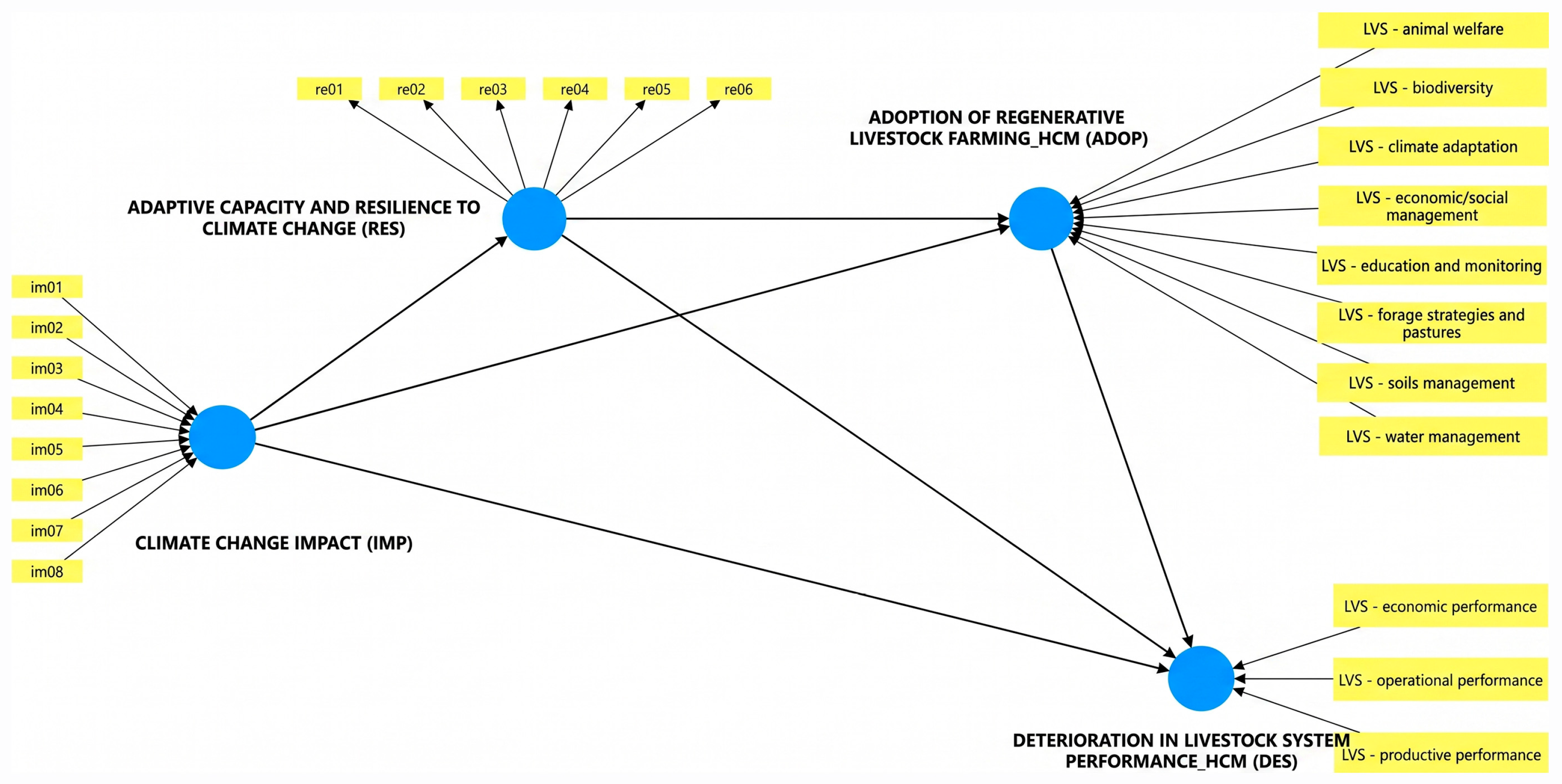
In the model described in Figure 3, there is a latent variable (LV) composed of reflective indicators: adaptive capacity and resilience to climate change (RES). There are three latent variables composed of formative indicators: impact of climate change (IMP); adoption of regenerative livestock farming (ADOP); and deterioration in the performance of livestock systems (DES).

4.2. Reflective Measurement Model

Adaptive capacity and resilience (RES) are reflective mediating construct. To evaluate the reflective measurement model, it is necessary to analyze internal consistency (composite reliability and Cronbach’s alpha); convergent validity (average variance extracted (AVE)); and discriminant validity. Table 2 shows that items re03, re05, and re01 perform acceptably; however, re02 and re04 are weak, and re06 is very weak. Since they fall below the threshold and do not meet the estimated loadings, they were removed, and the simple PLS algorithm was recalculated. Table 3 shows the fit with acceptable loadings for the indicators, with adequate overall performance. Internal reliability and convergent validity are acceptable: α = 0.714, rho_C = 0.842, and AVE = 0.644. As a result of the refinement of the RES reflective construct, adequate levels of reliability and convergent validity were achieved.
The three retained indicators jointly capture two complementary facets of adaptive capacity: behavioral adjustment of individual management practices (re01) and community-level knowledge and collective adaptive capacity (re03, re05). The three items addressing individual access to information, technology, and technical assistance (re02, re04, re06) exhibited weak loadings and were removed during scale purification. This pattern is consistent with the structural conditions of the study population: camelid producers in high-Andean fundos above 3600 m.a.s.l. predominantly live in poverty or extreme poverty, with limited or no access to basic services such as electricity, potable water, and lighting, and negligible internet connectivity. Under these near-uniform conditions of restricted material and informational access, items measuring this dimension display little response variability across the sample, which is reflected statistically in their weak factor loadings rather than in a flaw of item design. Consequently, the refined RES construct emphasizes the behavioral and collective-experiential dimensions of adaptive capacity that remain empirically measurable in this population, with more limited coverage of individual material and informational resources.

4.3. Assessment of the Formative Measurement Model

The formative measurement model is evaluated based on the following aspects: convergent validity, collinearity of indicators, statistical significance, and the relevance of indicator weights. To validate the constructs measured by formative assessment, the Bootstrap model was estimated to use 5000 samples; the climate change impacts (IMP) construct is exogenous and a composite construct; its indicators show external VIF values ranging from 1.239 to 2.038, with no critical collinearity. Regarding the external weights, only im03, im05, im06, and im08 are significant (Table 4).
The adoption of regenerative livestock farming (ADOP) is a mediating construct, a second-order composite construct. Table 5 reports, for each of the eight ADOP dimensions, both the outer weight (with its p-value) and the outer loading, allowing the retention of each dimension to be assessed against two complementary criteria: statistical significance of the weight, and the 0.50 absolute-loading threshold recommended when a weight is non-significant [47,49]. Four of the eight dimensions, economic and social management (the only dimension with a significant weight, β = 0.83, p = 0.001), animal welfare (loading = 0.752), forage strategies and pastures (loading = 0.602), and climate adaptation (loading = 0.599), meet the loading threshold and are retained on both statistical and absolute grounds. The remaining four, soils management (loading = 0.439), education and monitoring (loading = 0.402), water management (loading = 0.391), and biodiversity (loading = 0.205), fall below this threshold on both criteria and are retained here on theoretical grounds alone, pending further validation. This is precisely the scenario for which Cenfetelli and Bassellier [49] recommend, as one of three valid options, aggregating the indicators under a second-order construct that mediates the effects of the first-order dimensions, which is the specification already adopted for ADOP in this study.
Deterioration in livestock system performance (DES) is a final endogenous construct, a second-order composite HCM. At the second-order level, economic performance and productive performance have significant weights and serve as the drivers of the construct (Table 6). The operational and commercial performance dimension, although its weight is non-significant, retains a relevant outer loading (0.696), above the 0.50 retention threshold [47], and is preserved on theoretical grounds because it captures a facet of performance deterioration, market access and supply-chain disruption, not covered by the economic or productive dimensions.

4.4. Structural Model Assessment

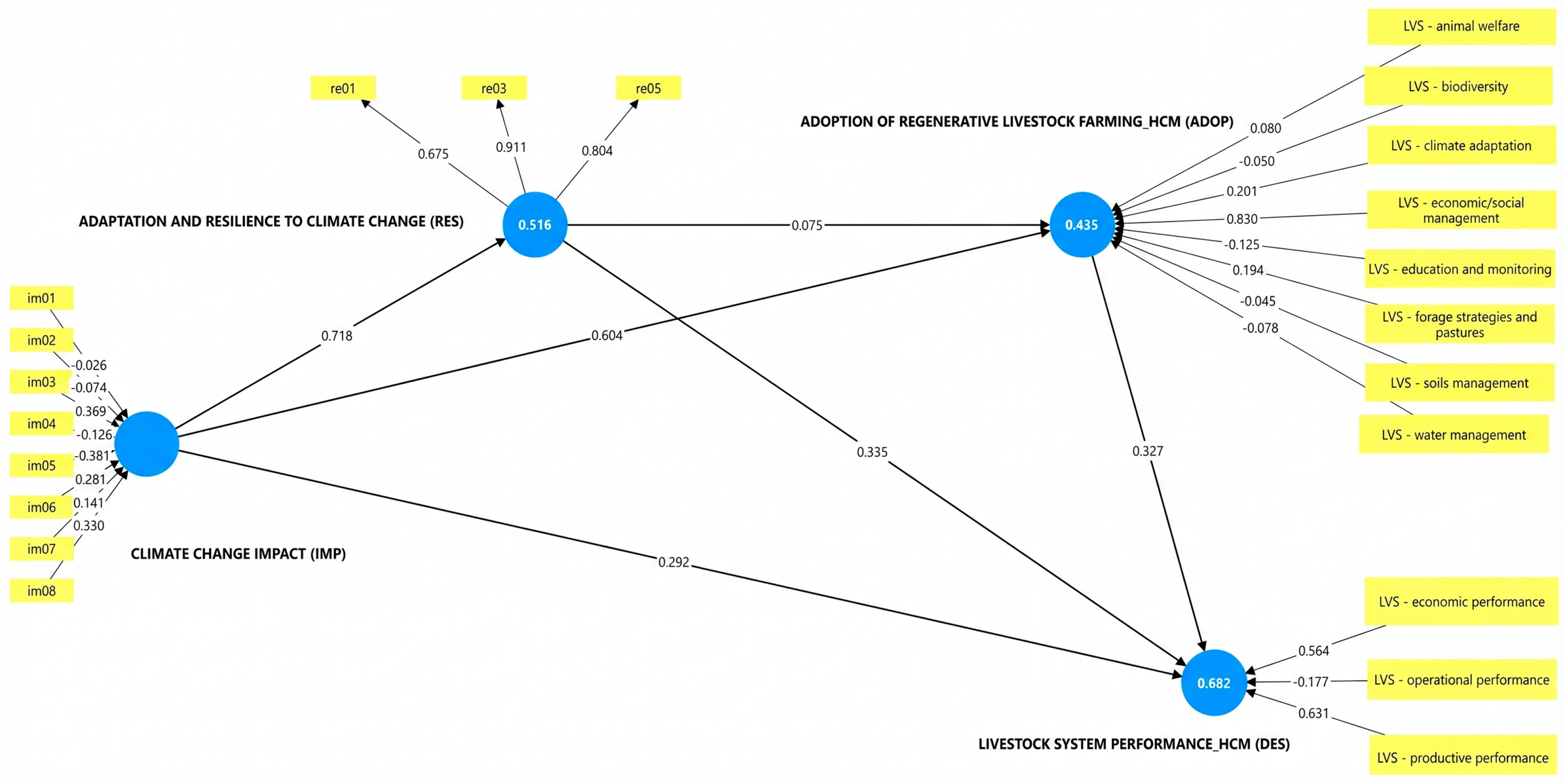
After assessing the validity and reliability of the data, the next step was to determine the relationships between the constructs. Figure 4, Table 7 and Table 8 show the results of the structural equation model, including the path coefficients.
Regarding the coefficients of determination (R2), the model explains 51.6% of the variance in RES, 43.5% of the variance in ADOP, and 68.2% of the variance in DES; thus, the model’s explanatory power is strong for DES.
In Table 9, we observe the effect of the mediating constructs on the model. It is observed that the effect of IMP on DES is transmitted through two mediating routes, via ADOP and RES. Two of the five specific indirect effects reported in Table 9, RES→ADOP→DES and IMP→RES→ADOP, are not statistically significant, consistent with the non-significant RES→ADOP path (H2) documented in Table 8. Rather than indicating a specification problem, these non-significant chains reinforce the study’s central finding that adaptive resilience and regenerative adoption operate as structurally disconnected responses to climate impacts in this context. Likewise, it is evident that the model has no internal multicollinearity issues, with VIF values ranging from 1.0 to 2.712.

5. Discussion

Based on the Resilience Thinking framework, which emphasizes adaptability and transformation within socio-ecological systems [25,26], the PLS-SEM and bootstrapping analyses show high predictive power, explaining 51.6% of the variance in RES, 43.5% in ADOP, and 68.2% in DES. For completeness, the full set of approximate fit statistics estimated in SmartPLS 4.1.1.7 is reported here: SRMR = 0.085, unweighted least squares discrepancy (d_ULS) = 1.827, geodesic discrepancy (d_G) = 1.006, exact-fit chi-square = 401.38, and NFI = 0.739, with identical values for the saturated and the estimated model. Methodologists caution, however, that thresholds proposed for these indices in variance-based PLS-SEM should be treated as tentative, and that the value of the model-fit concept for PLS-SEM applications has itself been questioned [47]; consistent with this guidance, the statistics reported here are interpreted as approximate, exploratory indicators of model tension rather than as strict confirmatory criteria. This boundary condition, related to the complexity introduced by the second-order formative specifications of ADOP and DES, is acknowledged transparently as a limitation in Section 5.8.
These results provide structural evidence of dynamic resilience in South American high-Andean camelid agroecosystems, demonstrating how production systems reorganize and transform their practices in response to extreme climatic disturbances. Specifically, the findings reveal how climate-driven shocks trigger adaptive responses, influence the determinants of regenerative livestock adoption, and encourage the implementation of climate-smart practices. At the same time, they expose the socio-ecological barriers that prevent adaptive capacity from translating into effective ecological transformation and the recovery of productive performance. The following subsections examine each structural relationship, contextualize the findings within the existing literature, and discuss their theoretical and practical implications for future research.

5.1. Climate Change Impacts (IMP) and Adaptive Capacity and Resilience (RES)

The results confirm a strong and significant effect of IMP on RES (β = 0.718; f2 = 1.066), which supports hypothesis H1 and establishes that the impacts of climate change are the main driver of adaptive responses amongst camelid producers. A greater perception of climatic disturbances triggers resilience mechanisms, which is consistent with the proposition within the Resilience Thinking framework that external disturbances mobilize the reorganization of the system [25,26], as well as with empirical studies documenting adaptive responses to heat stress, drought and excessive rainfall in livestock systems [19,30,31].
This finding expands current knowledge by demonstrating that, in contexts of extreme poverty and structural vulnerability, climate pressure acts as a mobilizing rather than a paralyzing disturbance: producers activate available adaptation strategies as a direct response to perceived risk. The Resilience Thinking framework distinguishes between persistence, adaptability and transformability as three interrelated system capacities [25]; the present results suggest that camelid producers in the High Andes operate predominantly within the realm of adaptability, adjusting practices within the limits of the existing system, without having yet accessed the realm of transformability that would allow a reconfiguration towards regenerative agroecosystem trajectories. Future research could examine the thresholds at which adaptability gives way to transformability in the pastoral systems of the High Andes, incorporating longitudinal designs that capture the temporal dynamics of adaptive responses across successive climatic events.

5.2. Adaptive Capacity and Resilience (RES) and the Adoption of Regenerative Livestock Farming (ADOP)

Hypothesis H2 is not empirically supported (β = 0.075; p = 0.619; f2 = 0.005), revealing a structural disconnect between adaptive capacity and the adoption of regenerative livestock practices. This is the most significant finding of the study from a theoretical perspective: although producers demonstrate resilience in the face of climate pressure, operating within the adaptability domain of the Resilience Thinking framework, this capacity does not translate into a regenerative transition, indicating that the path from adaptive capacity to ecological transformation is disrupted by socio-ecological barriers that the framework alone cannot overcome.
This result differs from studies conducted in other regions that document a positive association between resilience and the adoption of sustainable practices [32,33], and provides new empirical evidence by identifying that, in contexts characterized by extreme poverty, supply chain asymmetries, and weak institutional frameworks, resilience functions as a survival mechanism rather than as a driver of transformation. Within the Resilience Thinking framework, transformability requires the capacity to create fundamentally new system configurations [25]; the present findings suggest that this capacity is structurally constrained by barriers including limited access to financial resources, restricted technological infrastructure, inadequate technical assistance, resistance to change, and insufficient integration of traditional and indigenous knowledge into regenerative management frameworks [24,38]. These findings are consistent with calls for participatory approaches that integrate indigenous knowledge and community-based institutional support as necessary prerequisites for regenerative transition in vulnerable pastoral systems [16,24,38]; a parallel case can also be drawn from indigenous livelihood strategies among Adivasi communities in India [51], where community-based institutional support has similarly mediated the translation of adaptive capacity into livelihood transformation among structurally marginalized populations, illustrating this dynamic beyond directly comparable agroecosystems.
A key theoretical implication is that the Resilience Thinking framework, when applied to livestock systems in the Global South, must explicitly account for the structural conditions, institutional, financial, cultural, and knowledge-based, that determine whether adaptability translates into transformability. Future research should develop and empirically evaluate models that identify these enabling conditions in vulnerable agroecosystems of the High Andes, incorporating governance variables and participatory design as integral components of the analytical framework.

5.3. The Impact of Climate Change (IMP) and the Adoption of Regenerative Livestock Farming (ADOP)

The direct effect of IMP on ADOP is strong and significant (β = 0.538; f2 = 0.312), which supports Hypothesis H3 and confirms that climate pressure is the primary antecedent of the adoption of regenerative practices, independent of the pathway through adaptive capacity and resilience. The indirect effect via RES is marginal (β = 0.054; p = 0.631), resulting in a total effect of 0.658, which reinforces the idea that the IMP→ADOP relationship operates predominantly through direct mechanisms: producers adopt regenerative practices as a direct response to perceived climate risk, without going through the mediation of formalized resilience capacities.
From the perspective of the Resilience Thinking framework, this result can be interpreted as a direct disturbance–response dynamic in which the system’s exposure to climate impacts generates an immediate impetus for reorganization; the adoption of regenerative practices, without the intermediate consolidation of adaptive capacity as a stable platform for transformation [25]. This is consistent with evidence that environmental and economic crises accelerate the adoption of adaptation and restoration strategies in various regional livestock contexts [6,32], as well as with the growing body of literature that positions regenerative livestock farming, through its emphasis on soil management, pasture diversification, water management, and biodiversity monitoring in grazing areas, as a promising response to climate-induced agroecosystem degradation [33,34].
However, the absence of meaningful mediation through the RES raises a fundamental question about the quality of adoption: when regenerative practices are adopted out of urgency, rather than through deliberate capacity building, their long-term effectiveness and scalability may be limited. The Resilience Thinking framework suggests that a lasting transformation of the system requires not only the adoption of new practices but also the consolidation of new domains of stability [25,27]; adoption driven exclusively by the pressure of disturbances, without accompanying institutional and knowledge support, may produce adaptive responses that remain within the bounds of the existing system, rather than generating genuine transformative trajectories. Future research should examine whether adoption driven by climate pressure, when not accompanied by institutional support and knowledge transfer, produces sustained regenerative outcomes or constitutes primarily short-term adaptive behavior in pastoral systems of the High Andes.

5.4. The Impact of Climate Change (IMP) and Livestock System Performance Deterioration (DES)

Hypothesis H4 is confirmed, with a direct effect of IMP on DES that is statistically significant, albeit of small magnitude (β = 0.284; p = 0.041; f2 = 0.099). The mediated pathways reveal more pronounced effects: IMP→ADOP→DES (β = 0.197; p = 0.019) and IMP→RES→DES (β = 0.241; p = 0.004), while the complete chain IMP→RES→ADOP→DES is not significant (β = 0.018; p = 0.645). These results indicate that climate impacts on yield decline are transmitted primarily through the activation of reactive responses, resilience, and adaptation, rather than through a direct, unmediated pathway. From the perspective of the Resilience Thinking framework, this pattern is consistent with the proposition that systems exposed to disturbances reorganize their processes before experiencing consequences at the outcome level [25,27]; the adaptive responses triggered by the IMP, both RES and ADOP, mediate the decline effect but do not neutralize it, suggesting that the system is operating within the absorption and adaptation phases of the resilience cycle without reaching the reorganization phase that would restore performance levels [43]. This finding contributes to current understanding by demonstrating that performance decline in South America high-Andean camelid agroecosystems is not a simple linear consequence of climate exposure, but rather a structurally mediated process in which the quality and effectiveness of adaptive responses determine the magnitude of productive and economic losses. Future research could incorporate objective biophysical indicators, soil carbon content, grass cover, water infiltration rates, as outcome variables, along with perceptual measures of adoption, which would allow for a direct assessment of whether adaptive and regenerative responses translate into quantifiable ecological and productive recovery.

5.5. Adaptive Capacity and Resilience (RES) and Livestock System Performance Deterioration (DES)

The direct effect of RES on DES is positive, significant, and of moderate magnitude (β = 0.335; p = 0.003; f2 = 0.170), supporting Hypothesis H5. Although it may seem contradictory, greater resilience is associated with greater performance decline, reflecting the reactive nature of resilience in this context: the production units experiencing the greatest decline are precisely those that are most compelled to activate adaptive responses. Within the Resilience Thinking framework, this result can be interpreted as evidence that the system is trapped in the adaptive phase of the resilience cycle, continuously responding to disturbances without accumulating the transformative capacity necessary to establish new, more stable system configurations [25,27]. Under these conditions, resilience functions as a survival mechanism that maintains the system’s continuity without reversing the underlying decline in performance [10,14,52].
This finding challenges the assumption implicit in much of the literature on resilience, that greater adaptive capacity correlates with better system outcomes [19,29], and offers a more nuanced understanding of resilience in structurally vulnerable contexts: resilience activated under conditions of extreme poverty and institutional weakness may preserve the system at the cost of perpetuating its vulnerability, constituting what could be theorized as a “resilience trap” [39,40], a condition in which adaptive responses stabilize a degraded state of the system rather than enabling its transformation. Future research could examine whether interventions that transform resilience from reactive to anticipatory, through early warning systems, participatory risk mapping, and institutional capacity building, alter the direction and magnitude of the RES→DES relationship in comparable pastoral systems in the high Andes, and whether the concept of the “resilience trap” holds empirical validity across diverse socio-ecological contexts in the Global South.

5.6. Regenerative Livestock Farming Adoption (ADOP) and Livestock System Performance Deterioration (DES)

Hypothesis H6 is confirmed, with a positive, significant, and moderately strong effect of ADOP on DES (β = 0.327; p = 0.002; f2 = 0.189). DES, as a second-order construct, is primarily determined by its dimensions of productive and economic performance, while the operational-commercial dimension does not contribute significantly, which is consistent with the subsistence-oriented management of camelid agroecosystems in the High Andes [48]. The positive direction of this relationship indicates that producers who adopt regenerative strategies coexist with higher levels of performance deterioration, reflecting a dynamic of reactive adoption in precarious environments, where regenerative practices are implemented as emergency responses to climate-induced losses rather than as proactive investments in agroecosystem functionality. This reading, however, is not the only one the cross-sectional design can support: reverse causality cannot be ruled out, since producers experiencing more pronounced deterioration may be more likely to adopt regenerative practices in response rather than adoption driving further decline, and omitted-variable bias, such as unobserved farm-level exposure to extreme weather events, could independently drive both higher adoption and greater deterioration. Reactive-adoption interpretation is offered as the most theoretically consistent reading within the Resilience Thinking framework, but it is treated as one plausible explanation among others that only longitudinal or instrumental-variable designs could adjudicate.
From the perspective of the Resilience Thinking framework, this result suggests that regenerative adoption, as it is currently occurring in the Puno region, has not yet generated a new stable state for the livestock system [25,27,53]: the practices are being adopted within the context of a deteriorating system, without the institutional, financial, and knowledge-based conditions that would allow them to reconfigure the system’s trajectories toward better ecological and productive outcomes. This finding expands the empirical base on regenerative livestock farming in the Global South by demonstrating that adoption under conditions of extreme poverty, low mechanization, prices below operating costs, and limited investment capacity does not automatically translate into a recovery in performance [6,14,34].
This pattern of reactive, non-consolidated adoption is consistent with concerns raised in the broader Latin American literature on regenerative livestock transitions, where the superficial appropriation of regenerative terminology without standardized, outcome-based verification has been identified as a risk that can undermine genuine ecological transformation [17]. In the High Andes, as in other South American pastoral contexts, the absence of official certification systems or measurable ecological indicators may make it difficult to distinguish between adoption driven by the development of institutional and financial capacities and adoption that is limited to the mere appropriation of terminology or an emergency response to climate pressure.
Future research should assess the economic thresholds and enabling policy conditions under which the adoption of regenerative practices in comparable vulnerable contexts yields quantifiable improvements in productive and economic performance, examining whether the ADOP→DES relationship changes direction in favorable institutional environments and whether the transformability domain of the Resilience Thinking framework becomes accessible when structural barriers are systematically reduced.

5.7. Implications for Food Security

The results of this study have direct implications for the food security of livestock-raising communities in the High Andes. The deterioration in the performance of the livestock system, 68.2% of which is explained by the model, manifests itself simultaneously in three interdependent dimensions: the productive dimension, which affects the quantity and quality of available fiber and meat; the economic dimension, which reduces the income and reinvestment capacity of producers living in extreme poverty; and the operational-commercial dimension, which compromises market access and the continuity of the South American camelid value chain. Taken together, these dimensions create a scenario of structural vulnerability in terms of food security, in which climate change acts as an amplifying perturbation, consistent with the characterization provided by the Resilience Thinking framework of aggravated socio-ecological vulnerabilities in pastoral systems subjected to climate stress [25,27].
In this context, the adoption of regenerative livestock farming, identified as a direct response to climate pressure (β = 0.538; p < 0.001) represents a potential pathway to stabilizing the productive base that underpins local food security. Its core components, particularly soil management, pasture diversification, and water management, are aimed at restoring the agroecosystem’s capacity to provide food continuously and sustainably, reducing dependence on external inputs and strengthening communities’ productive self-sufficiency. However, the positive association between ADOP and yield decline (β = 0.282; p = 0.002) indicates that regenerative adoption, under current system conditions, is insufficient on its own to reverse food insecurity: it functions more as an emergency response than as a consolidated transformation, in line with the adaptive, rather than transformative. phase of the Resilience Thinking framework.
These findings are aligned with worldwide calls to develop resilient food systems that integrate agroecological practices, institutional support, and access to resources as necessary conditions for the regenerative transition to effectively translate into sustained food security. The FAO Climate Change Strategy 2022–2031 explicitly recognizes the protection of food security as a key priority of the Paris Agreement and identifies the resilience of agroecosystems as a fundamental pathway to transformative climate adaptation, emphasizing that livestock producers and vulnerable rural communities must play a central role in the design and implementation of climate action [10]. The findings of this study provide empirical evidence from the field that puts this policy call into practice: camelid producers in the High Andes are already adopting regenerative practices as a direct response to climate stress; however, current policy frameworks still fail to address the structural barriers, financial, technological, and institutional, that prevent such adoption from translating into a recovery in productivity and progress toward food security. Without specific interventions to reduce these barriers and strengthen the conditions conducive to a regenerative transition, the potential of regenerative livestock farming to contribute to food security in contexts of extreme poverty will remain underutilized, which contradicts the transformative adaptation agenda called for by international frameworks [3,10].
Operationalizing this agenda does not require new institutional architecture: in Peru, the Ministry of Agricultural Development and Irrigation (MIDAGRI), through its executing units AGRO RURAL and the National Institute for Agricultural Innovation (INIA), together with regional government programs and CONCYTEC-PROCIENCIA funding schemes such as the one supporting this research, already constitute channels through which technical assistance, extension services, and financing for regenerative practices could be scaled up in the Puno region. Policy design should explicitly account for the socioeconomic constraints documented in this study, extreme poverty, limited access to credit, and fragmented value chains, so that regenerative adoption is supported as an institutionally accompanied transition rather than left as an unaccompanied, reactive response to climate stress.
It should be noted that the survey instrument did not include items quantitatively measuring producers’ prior or current participation in MIDAGRI, AGRO RURAL, INIA, or CONCYTEC-PROCIENCIA programs. The identification of these institutional channels is informed by the direct field knowledge of the research team, which included co-investigators affiliated with the National Institute for Agricultural Innovation (INIA) and with institutions linked to the Ministry of Foreign Trade and Tourism (MINCETUR), both of which are directly engaged in primary livestock production activities and in the artisanal (textile) activity of South American camelid producers in the Puno region. Accordingly, the policy recommendations offered here rest on a triangulation between the structural barriers statistically identified in this study and the institutional field knowledge contributed by the research team’s composition, rather than on a formally measured survey variable of program participation. Future research incorporating explicit measures of institutional program participation would allow these recommendations to be validated with quantitative producer-level evidence.

5.8. Limitations and Directions for Future Research

Several limitations should be considered when interpreting the results of this study. First, the cross-sectional design captures the perceptions of livestock producers at a single point in time, which makes it impossible to establish causal inference and limits the assessment of temporal dynamics in the activation of resilience, the adoption of regenerative practices, and the decline in yield. Longitudinal designs would allow us to examine whether adaptive resilience evolves into transformative resilience, as conceptualized within the Resilience Thinking framework, across successive climate events, and whether the adoption of regenerative practices generates cumulative ecological and productive benefits over time.
Second, the non-probabilistic intentional and convenience sampling strategy among ninety-one producers in the Puno region limits the generalizability of the results to other camelid-producing regions and other small-scale pastoral systems in the Global South, although it does not compromise the internal validity of the structural model. This constraint is compounded by the ratio between the number of formative indicators, several dozen across the IMP, ADOP, and DES composites, and the ninety-one valid cases analyzed. Although the sample satisfies the ten-times rule applied to the largest number of structural paths pointing to a single construct [47], indicator-level weight estimates in formative blocks with many indicators are more sensitive to sampling variability than the structural path coefficients themselves.
To respond directly to the concern that weight estimation may be extremely unstable at this sample size, an additional bootstrapping run with 10,000 subsamples was executed on the same adjusted model and compared against the 5000-subsample run reported throughout this article (Table 10). All six structural paths yield the same significance decision under both subsample sizes, with a maximum absolute change in the t-statistic of 0.18, providing direct empirical evidence against severe estimation instability at n = 91 for the structural model.
Third, the adoption of regenerative practices is measured through producers’ self-assessment, without biophysical measurement of ecological outcomes, such as soil organic carbon content, pasture cover, or water infiltration rates. This applies equally to the RES and DES constructs, which rely exclusively on self-reported Likert-scale perceptions without triangulation against objective field indicators, such as household income, pasture cover, or herd records. Future studies should integrate biophysical indicators of agroecosystem functionality alongside perception-based measures of adoption, which would allow for a direct assessment of whether regenerative practices produce quantifiable ecological restoration under High Andes conditions and whether the transformability domain of the Resilience Thinking framework becomes empirically observable at the agroecosystem level.
Fourth, the lack of statistical significance for H2 highlights a structural disconnect between adaptive capacity and the regenerative transition, which warrants more in-depth qualitative and participatory research. Research designs that incorporate indigenous knowledge systems and community-based participatory models could shed light on the cultural, institutional, and cognitive mechanisms through which adaptive resilience may, or may not, translate into the adoption of regenerative practices in pastoral communities and could contribute to the theoretical development of the Resilience Thinking framework in Global South contexts.
A related limitation concerns discriminant and convergent validity assessment for the formative composites. Because IMP, ADOP, and DES are specified as formative (Mode B) composites, standard discriminant validity criteria, including the Fornell–Larcker criterion and the HTMT ratio, presuppose reflective indicators and their application to formatively measured constructs is problematic, since neither the monotrait–heteromethod nor the heterotrait–heteromethod correlations of formative indicators are informative of discriminant validity [54]; these criteria are therefore applicable only to RES, the model’s single reflective construct (HTMT for RES = 0.802, within the conservative 0.85 threshold recommended for conceptually distinct constructs [54]). For formative composites, convergent validity is instead assessed through redundancy analysis against an independent global single-item measure, ideally correlating at 0.70 or higher, which requires this measure to have been incorporated into the research design at the data-collection stage [47]. Because this single-item criterion was not included in the original survey instrument, redundancy analysis could not be performed retrospectively. This is now stated explicitly as a methodological limitation.
Fifth, the psychometric refinement of the RES reflective construct yielded a three-item scale weighted toward behavioral and community-level adaptive capacity, while excluding items addressing individual access to information, technology, and technical assistance. This outcome is consistent with, rather than independent of, the structural living conditions of high-Andean camelid producers, who predominantly face poverty or extreme poverty and lack access to basic services including electricity, potable water, and internet connectivity; the near-uniform absence of such access across the sample limits the discriminative capacity of items intended to measure it. This measurement choice narrows the conceptual breadth of RES as operationalized here relative to the fuller construct described in the theoretical background and underscores that individual-level material and informational capacity remains, in this context, more a structural constraint than a variable dimension of producer heterogeneity. Future studies conducted in less structurally homogeneous populations, or employing objective indicators of infrastructure access, could re-examine whether this dimension of adaptive capacity behaves as a measurable construct under different conditions.
Finally, future research could expand the structural model by incorporating variables such as governance, access to public programs, membership in cooperatives, market certification systems and explicit indicators of food security outcomes as endogenous constructs, analyzing the conditions under which the IMP→ADOP pathway generates sustainable outcomes in terms of production, ecology, and food security at the landscape scale across diverse agroecological contexts in the High Andes.
Future research should also model food security indicators explicitly as endogenous outcome variables within such structural frameworks, assessing the extent to which the adoption of regenerative practices mediates the relationship between climate impacts and household-level food availability across diverse agroecological contexts in the Andean region.

6. Conclusions

This study proposed and empirically validated an explanatory model grounded in the Resilience Thinking framework, demonstrating that perceived climate change impacts (IMP) are the primary antecedent of both adaptive resilience (RES; β = 0.718) and the adoption of regenerative livestock farming (ADOP; β = 0.538) among South American camelid producers in the Puno region, Peru. The model explained 51.6% of the variance in RES, 43.5% in ADOP, and 68.2% in DES, indicating strong explanatory power, particularly for performance deterioration.
The non-significant path between RES and ADOP (β = 0.075; p = 0.619) constitutes the study’s central theoretical contribution: adaptive resilience, on its own, does not translate into a regenerative transition in this high-Andean context, revealing institutional, technological, and knowledge-related barriers that decouple adaptive capacity from ecological transformation. Furthermore, both RES and ADOP were positively associated with performance deterioration (DES), consistent with a “resilience trap” dynamic in which adaptive activation reflects reactive containment rather than consolidated ecosystem restoration.
These findings indicate that regenerative livestock farming, as currently practiced in the Puno region, functions as an emergency response to climate pressure rather than as a proactive, institutionally supported transformation strategy. Effective regenerative transitions in vulnerable camelid agroecosystems therefore require integrated, participatory approaches that combine technical assistance, financial support, and the incorporation of traditional and indigenous knowledge, aligned with policies capable of converting adaptive resilience into transformative, ecologically restorative practices that strengthen long-term productive sustainability and food security in high-Andean livestock-raising communities.

Author Contributions

Conceptualization, R.P.L.-F. and O.E.C.M.; methodology, R.P.L.-F.; validation, R.P.L.-F., O.E.C.M. and A.C.T.; formal analysis, R.P.L.-F.; investigation, R.P.L.-F., O.E.C.M. and A.C.T.; resources, R.P.L.-F. and O.E.C.M.; data curation, R.P.L.-F.; writing—original draft preparation, R.P.L.-F. and O.E.C.M.; writing—review and editing, R.P.L.-F., O.E.C.M. and A.C.T.; visualization, R.P.L.-F.; supervision, R.P.L.-F.; project administration, R.P.L.-F.; funding acquisition, R.P.L.-F., O.E.C.M. and A.C.T. All authors have read and agreed to the published version of the manuscript.

Funding

This research was funded by CONCYTEC through PROCIENCIA as part of the “Social Sciences Research Projects” call for proposals, pursuant to contract [No. PE501087590-2024-PROCIENCIA].

Institutional Review Board Statement

Not applicable.

Informed Consent Statement

Not applicable.

Data Availability Statement

The original contributions presented in this study are included in the article. Further inquiries can be directed to the corresponding author.

Conflicts of Interest

The authors declare no conflicts of interest.

Abbreviations

The following abbreviations are used in this manuscript:
IMPImpact of climate change
ADOPAdoption of regenerative livestock farming
DESLivestock system performance deterioration
RESAdaptative capacity and resilience

References

  1. NASA Science. The Effects of Climate Change. Available online: https://science.nasa.gov/climate-change/effects/ (accessed on 1 March 2026).
  2. Bilal, A.; Känzig, D.R. The Macroeconomic Impact of Climate Change: Global Versus Local Temperature. Q. J. Econ. 2026, 141, 889–944. [Google Scholar] [CrossRef] [Scilit]
  3. United Nations Climate Change. La COP30 ha Acumulado un Impresionante Historial de Acciones Climáticas que se Traducirán en Economías Más Fuertes, Más Empleos y Mejores Condiciones de Vida Para Millones de Personas. Available online: https://unfccc.int/es/news/la-cop30-ha-acumulado-un-impresionante-historial-de-acciones-climaticas-que-se-traduciran-en (accessed on 7 March 2026).
  4. Ghahramani, A.; Bowran, D. Transformative and systemic climate change adaptations in mixed crop-livestock farming systems. Agric. Syst. 2018, 164, 236–251. [Google Scholar] [CrossRef] [Scilit]
  5. Acevedo-Cruz, S.; Leos-Rodríguez, J.A.; Pacheco-Almaraz, V. Current state of research on the climate change-livestock relationship; a bibliometric review. Trop. Subtrop. Agroecosyst. 2025, 28, 136. [Google Scholar]
  6. Escarcha, J.F.; Lassa, J.A.; Zander, K.K. Livestock under climate change: A systematic review of impacts and adaptation. Climate 2018, 6, 54. [Google Scholar] [CrossRef] [Scilit]
  7. Teku, D. Navigating climate uncertainty: A comprehensive review of climatic variabilities and extreme events on environmental, socio-economic, and livelihood dimensions in Ethiopia with adaptation strategies. All Earth 2025, 37, 1–30. [Google Scholar] [CrossRef] [Scilit]
  8. Martin-Collado, D.; Tenza-Peral, A.; Casasús, I.; Joy, M.; Stark, F.; Lurette, A.; Mohamed-Brahmi, A.; Ameur, M.; Aboulnaga, A.; Elshafie, M.; et al. What strategies would sheep farmers implement to respond to climate change? A cross-national comparison of sheep farming systems in the Mediterranean. Small Rumin. Res. 2025, 252, 107576. [Google Scholar] [CrossRef] [Scilit]
  9. Kihoro, E.; Habermann, B.; Crane, T.A.; Gichuki, L.; Worku, T. What constitutes climate change adaptation in Kenyan livestock systems: A systematic review. Clim. Dev. 2026, 18, 96–110. [Google Scholar] [CrossRef] [Scilit]
  10. FAO. Estrategia de la FAO Sobre el Cambio Climático 2022–2031; FAO: Roma, Italy, 2024. [Google Scholar]
  11. Bravo-Peña, F.; Toro-Letelier, J.J.; Cabrera, N.A.; Hargreaves Méndez, M.; Alfaro Rojas, C. Ganadería Regenerativa: Definición, Caracterización y Recomendaciones de Políticas; Comisión Económica para América Latina el Caribe (CEPAL): Santiago, Chile, 2024. [Google Scholar]
  12. FAO. Camelid Biodiversity, Population Trends and Geographic Distribution; FAO: Rome, Italy, 2025; Volume 2. [Google Scholar]
  13. Ministerio de Desarrollo Agrario y Riego. Anuario Estadístico: Producción Ganadera y Avícola 2024; Ministerio de Desarrollo Agrario y Riego: Lima, Peru, 2025.
  14. Larios-Francia, R.P.; Cárdenas Minaya, O. Challenges for the Achievement of the Sustainable Development Goals in the South American Andean Camelid Chain. In Sustainable Textile and Apparel Chain Management Towards the UN Sustainable Development Goals; Springer: Cham, Switzerland, 2025; pp. 105–116. [Google Scholar]
  15. Hossein-Zadeh, N.G. Advancing climate-resilient livestock systems: Next-generation emission mitigation strategies and integrated technological innovations. Vet. Anim. Sci. 2026, 31, 100588. [Google Scholar] [CrossRef] [Scilit]
  16. Munidasa, S.; Cullen, B.; Eckard, R.; Cheng, L.; Doran-Browne, N. Integrating climate-change adaptation and greenhouse-gas mitigation in the livestock industry: A review. Anim. Prod. Sci. 2025, 65, AN24276. [Google Scholar] [CrossRef] [Scilit]
  17. Morales, R.; Martínez, M.E.; Rodríguez, M.; Beltrán, I.; Hepp, C. Sustainable Livestock Farming in Chile: Challenges and Opportunities. Sustainability 2026, 18, 1626. [Google Scholar] [CrossRef] [Scilit]
  18. Zhou, L.; Slayi, M.; Ngarava, S.; Jaja, I.F.; Musemwa, L. A Systematic Review of Climate Change Risks to Communal Livestock Production and Response Strategies in South Africa. Front. Anim. Sci. 2022, 3, 868468. [Google Scholar] [CrossRef] [Scilit]
  19. Singh, R.; Maiti, S.; Garai, S. Rachna Sustainable Intensification—Reaching Towards Climate Resilience Livestock Production System—A Review. Ann. Anim. Sci. 2023, 23, 1037–1047. [Google Scholar]
  20. Gonzales-Gemio, C.; Sanz-Martín, L. Socioeconomic barriers to the adoption of carbon farming in Spain, Italy, Egypt, and Tunisia: An analysis based on the diffusion of innovations model. J. Clean. Prod. 2025, 498, 145155. [Google Scholar] [CrossRef] [Scilit]
  21. Morsy, A.S.; Soltan, Y.A.; Al-Marzooqi, W.; El-Zaiat, H.M. Integrating Technological Innovations and Sustainable Practices to Abate Methane Emissions from Livestock: A Comprehensive Review. Sustainability 2025, 17, 6458. [Google Scholar] [CrossRef] [Scilit]
  22. Hashem, N.M.; Martinez-Ros, P.; Gonzalez-Bulnes, A.; El-Raghi, A.A. Case Studies on Impacts of Climate Change on Smallholder Livestock Production in Egypt and Spain. Sustainability 2023, 15, 13975. [Google Scholar] [CrossRef] [Scilit]
  23. Veysset, P.; Boivent, C. Climatic hazard resilience assessment on livestock farms: Application to organic ruminant farms in the French Massif Central. Agric. Syst. 2025, 222, 104150. [Google Scholar] [CrossRef] [Scilit]
  24. Manyike, J.Z.; Taruvinga, A.; Akinyemi, B.E. Mapping the research landscape of livestock adaptation to climate change: A bibliometric review using Scopus database (1994–2023). Front. Clim. 2025, 7, 1567674. [Google Scholar] [CrossRef] [Scilit]
  25. Folke, C.; Carpenter, S.R.; Walker, B.; Scheffer, M.; Chapin, T.; Rockström, J. Resilience thinking: Integrating resilience, adaptability and transformability. Ecol. Soc. 2010, 15, 20. [Google Scholar] [CrossRef] [Scilit]
  26. Holling, C.S. Resilience and Stability of Ecological Systems. Annu. Rev. Ecol. Syst. 1973, 4, 1–23. [Google Scholar] [CrossRef] [Scilit]
  27. Walker, B.; Salt, D. Resilience Thinking: Sustaining Ecosystems and People in a Changing World; Princeton University Press: Princeton, NJ, USA, 2012; Volume 1. [Google Scholar]
  28. Sanson, A.V.; Masten, A.S. Climate change and resilience: Developmental science perspectives. Int. J. Behav. Dev. 2024, 48, 93–102. [Google Scholar] [CrossRef] [Scilit]
  29. Lamonaca, E.; Bouzid, A.; Caroprese, M.; Ciliberti, M.G.; Cordovil, C.M.S.; Karatzia, M.-A.; Keskin, M.; Lazereg, M.; Lidga, C.; Panniello, U.; et al. A framework towards resilient Mediterranean eco-solutions for small-scale farming systems. Agric. Food Secur. 2022, 11, 65. [Google Scholar] [CrossRef] [Scilit]
  30. Pankaj, P.K.; Prasad, J.V.N.S.; Singh, V.K.; Nirmala, G.; Reddy, K.S. Climate resilient livestock farming systems. In Engineering Applications in Livestock Production; Elsevier: Amsterdam, The Netherlands, 2024; pp. 159–178. [Google Scholar]
  31. Pateiro, M.; Munekata, P.E.S.; Domínguez, R.; Lorenzo, J.M. Extensive livestock farming against climate change in Spain|Ganadería extensiva frente al cambio climático en España. Itea Inf. Tec. Econ. Agrar. 2020, 116, 444–460. [Google Scholar]
  32. Akinyi, D.P.; Ng’ang’a, S.K.; Girvetz, E.H. Trade-offs and synergies of climate change adaptation strategies among smallholder farmers in sub-Saharan Africa: A systematic review. Reg. Sustain. 2021, 2, 130–143. [Google Scholar] [CrossRef] [Scilit]
  33. Gosnell, H.; Charnley, S.; Stanley, P. Climate change mitigation as a co-benefit of regenerative ranching: Insights from Australia and the United States: CC Mitigation and Regenerative Ranching. Interface Focus 2020, 10, 20200027. [Google Scholar] [CrossRef] [Scilit]
  34. Ramana, D.B.V. Livestock Based Production Systems for Climate Adaptation in Dryland Areas; Springer: Singapore, 2022. [Google Scholar]
  35. Slayi, M.; Zhou, L.; Jaja, I.F. Strategies, challenges, and outcomes of heat stress resilience in sub-Saharan African community-based cattle feedlots: A systematic review. Front. Vet. Sci. 2024, 11, 1455917. [Google Scholar] [CrossRef] [Scilit]
  36. Andrade, H.J.; Vega, A.; Martínez-Salinas, A.; Villanueva, C.; Jiménez-Trujillo, J.A.; Betanzos-Simon, J.E.; Pérez, E.; Ibrahim, M.; Sepúlveda L, C.J. The carbon footprint of livestock farms under conventional management and silvopastoral systems in Jalisco, Chiapas, and Campeche (Mexico). Front. Sustain. Food Syst. 2024, 8, 1363994. [Google Scholar] [CrossRef] [Scilit]
  37. Macdonald, A.; Court, J.; Meyer, R.; Wootton, M.; Kantor, E.; Keenan, R.; Stewart, H.; Eckard, R. Can soil and tree carbon sequestration maintain zero net emissions grazing? Anim. Prod. Sci. 2025, 65, AN24346. [Google Scholar] [CrossRef] [Scilit]
  38. Bashiru, H.A.; Oseni, S.O. Simplified climate change adaptation strategies for livestock development in low-and middle-income countries. Front. Sustain. Food Syst. 2025, 9, 1566194. [Google Scholar] [CrossRef] [Scilit]
  39. Kythreotis, A.P.; Bristow, G.I. The ‘resilience trap’: Exploring the practical utility of resilience for climate change adaptation in UK city-regions. Reg. Stud. 2017, 51, 1530–1541. [Google Scholar] [CrossRef] [Scilit]
  40. Rachunok, B.; Nateghi, R. Overemphasis on recovery inhibits community transformation and creates resilience traps. Nat. Commun. 2021, 12, 7331. [Google Scholar] [CrossRef] [Scilit]
  41. Abdal-Wahab, S.T.; Alobaidi, H.M.S.; Jamal, M.; Kadeem, Z.J.; Mustafa, M.A.; Mohsen, K.F.; Hussein, L.A.; Abdullah, H. Impact of Climate Change on Livestock Health and Productivity. J. Anim. Health Prod. 2025, 13, 73–80. [Google Scholar] [CrossRef] [Scilit]
  42. Sejian, V.; Silpa, M.V.; Devaraj, C.; Trivedi, S.; Vadhana, P.E.; Ruban, W.; Suganthi, R.U.; Manimaran, A.; Maurya, V.P.; Bhatta, R. Impact of Climate Change on Animal Production and Welfare. In Climate Change and Livestock Production: Recent Advances and Future Perspectives; Springer Nature: Berlin/Heidelberg, Germany, 2022; pp. 3–14. [Google Scholar]
  43. Godde, C.M.; Mason-D’Croz, D.; Mayberry, D.E.; Thornton, P.K.; Herrero, M. Impacts of climate change on the livestock food supply chain; a review of the evidence. Glob. Food Sec. 2021, 28, 100488. [Google Scholar] [CrossRef] [Scilit]
  44. Shekhar, S.; Sinha, R.R.K.; Nirala, R.; Kumar, K. Livestock Production Under Drought and Heat Stress. In Drought and Heat Stress in Agriculture: Implications, Mitigation and Policy Approaches; Springer Science+Business Media: Berlin/Heidelberg, Germany, 2025; pp. 93–110. [Google Scholar]
  45. Astuti, P.K.; Ayoob, A.; Strausz, P.; Vakayil, B.; Kumar, S.H.; Kusza, S. Climate change and dairy farming sustainability; a causal loop paradox and its mitigation scenario. Heliyon 2024, 10, e25200. [Google Scholar] [CrossRef] [Scilit]
  46. Abramovay, R.; Matte, A.; Sanseverino, E.C.; Ritt, A.L.; Galiano, M.W. Regenerative cattle farming in Latin America and the Caribbean, far beyond the oxymoron. Rev. Econ. Sociol. Rural 2025, 63, e289950. [Google Scholar] [CrossRef] [Scilit]
  47. Hair, J.F.; Risher, J.J.; Sarstedt, M.; Ringle, C.M. When to use and how to report the results of PLS-SEM. Eur. Bus. Rev. 2019, 31, 2–24. [Google Scholar] [CrossRef] [Scilit]
  48. Huanca Mamani, T. Manual Técnico Producción de Alpacas, 1st ed.; Instituto Nacional de Innovación Agraria, Ed.; Ministerio de Agricultura y Riego: Puno, Peru, 2020.
  49. Cenfetelli, R.T.; Bassellier, G. Interpretation of formative measurement in information system research. MIS Q. 2009, 33, 689–708. [Google Scholar] [CrossRef] [Scilit]
  50. Ringle, C.M.; Sarstedt, M.; Mitchell, R.; Gudergan, S.P. Partial least squares structural equation modeling in HRM research. Int. J. Hum. Resour. Manag. 2020, 31, 1617–1643. [Google Scholar] [CrossRef] [Scilit]
  51. Nath, S.; Krishnakumar, J. Livelihoods and skilling for Adivasi: Indigenous Communities in a High Biodiversity Area. In Pathways to Rural Prosperity: Livelihood Interventions and Transformation in India; Routledge: Abingdon, UK, 2026; Volume 1, pp. 238–259. [Google Scholar]
  52. FAO. Supporting the Camelid Sector Is Crucial for Advancing Sustainable Agriculture and Improving Livelihoods: FAO Livestock Expert. Available online: https://www.fao.org/newsroom/detail/supporting-the-camelid-sector-is-crucial-for-advancing-sustainable-agriculture-and-improving-livelihoods-fao-livestock-expert/en (accessed on 19 April 2025).
  53. Walker, B.; Holling, C.S.; Carpenter, S.R.; Kinzig, A. Resilience, adaptability and transformability in social-ecological systems. Ecol. Soc. 2004, 9, 5. [Google Scholar] [CrossRef] [Scilit]
  54. Henseler, J.; Ringle, C.M.; Sarstedt, M. A new criterion for assessing discriminant validity in variance-based structural equation modeling. J. Acad. Mark. Sci. 2015, 43, 115–135. [Google Scholar] [CrossRef] [Scilit]
Figure 1. Andean frost-affected grasslands with grazing alpacas, Puno region, Peru.
Sustainability 18 08822 g001
Figure 2. Conceptual Model.
Sustainability 18 08822 g002
Figure 3. Research model.
Sustainability 18 08822 g003
Figure 4. Result of structural mode.
Sustainability 18 08822 g004
Table 1. Constructs and indicators of measurement models.
IndicatorConstructs
Climate change impact (IMP)
im01Increased frequency and intensity of extreme weather events (frosts, hailstorms, prolonged snowfall, Indian summers)
im02Lack of predictability regarding weather events.
im03Excessive drought
im04Excessive prolonged rainfall
im05Decline in the quantity and quality of pasture available for feeding camelids
im06Decline in water sources for camelid consumption.
im07Impact on the social and cultural sustainability of the pastoral system
im08It destabilizes the High Andean socio-ecological model by reducing pasture, water, animal health, and productivity
Adaptive capacity and resilience (RES)
re01I have adjusted my alpaca management practices to respond to the effects of climate change.
re02 *I have useful information to apply measures that reduce the effects of climate change on alpaca husbandry.
re03The traditional knowledge and practices of my community are useful for addressing the impacts of climate change.
re04 *I am willing to incorporate new practices that strengthen my livestock system’s response capacity to climate change.
re05My community has the capacity to adapt to climate variations and events that affect alpaca husbandry.
re06 *I have sufficient access to technology, technical assistance, and training to address the impacts of climate change.
Adoption of regenerative livestock farming (ADOP)
Soil management (2nd order construct)
su01Conducts periodic soil quality analysis (pH, organic carbon, nutrients).
su02Implement practices to increase organic matter in the soil (use of manure, composting).
su03Maintains plant cover throughout the year to prevent erosion.
su04Applies minimal soil disturbance techniques (avoiding deep plowing or pasture burning).
su05Promotes the use of native plant species that support soil regeneration.
Forage strategy and pasture diversification (2nd order construct)
ef01Plans and implements pasture rotation to avoid overuse/overgrazing and allow pasture regeneration.
ef02Monitors the carrying capacity of grasslands and adjusts the number of alpacas according to forage availability.
ef03Promotes plant diversity in grasslands to improve forage supply and resilience.
ef04Conducts practices to regenerate the soil, such as sowing native species or establishing plant cover.
ef05Use regeneration indicators such as water infiltration rate and permanent plant cover.
ef06Use non-chemical fertilizers to improve the quality of pastures
ef07Uses natural or native pastures to feed alpacas.
ef08Use improved or sown pastures to feed alpacas.
ef09Uses a combination of herbaceous, shrub, and tree species.
Water management (2nd order construct)
ga01Implement systems to capture and store rainwater (channels, reservoirs).
ga02Maintains, restores, and protects peatlands and wetlands as natural water sources.
ga03Designs strategies to improve water infiltration into soils.
ga04Prevents uncontrolled alpaca access to sensitive water sources to avoid contamination.
Biodiversity management (2nd order construct)
bi01Monitors biodiversity in grazing areas (birds, insects, flora).
bi02Integrates trees and shrubs into the grazing system (agro-silvopastoral systems).
bi03Respects biological corridors and conservation areas within the property.
bi04Use non-chemical methods for pest and disease control.
bi05Conducts actions to increase biodiversity in areas and lands used for production.
Animal welfare (2nd order construct)
ba01Provides continuous access to clean, high-quality water for alpacas.
ba02Maintains clean and adequate facilities for shelter during adverse weather conditions.
ba03Implements a health schedule to prevent disease (vaccination, deworming).
ba04Regularly monitors the animals’ health status and body condition.
ba05Ensures that management practices are consistent with animal welfare principles.
ba06Provides specific care to reduce stress and ensure the overall health of alpacas.
ba07Implement practices that promote more natural and respectful alpaca husbandry.
Economic and social management (2nd order construct)
gs01Evaluates the economic costs and benefits of implementing regenerative livestock farming.
gs02Trains staff and producer families in regenerative techniques.
gs03Promotes the use of differentiated and sustainable products (organic fibers, regenerative wool) in specialized markets.
gs04Encourages collaboration among producers to improve marketing and access to resources.
gs05Designs a sustainable financial plan that includes reinvestment in regenerative practices.
Education and monitoring (2nd order construct)
em01Participates in training programs on regenerative livestock farming.
em02Regularly monitors indicators of success (forage production, soil quality, animal condition).
em03Documents of the practices implemented and their results for future improvements.
em04Participates in networks exchanging experiences with other producers.
em05Incorporates gender and inclusion perspectives into decision-making in the production system.
Strategies for adapting to climate change (2nd order construct)
ac01Evaluates the system’s vulnerability to climate change (droughts, intense rains, etc.).
ac02Introduces grass and forage species that are more resistant to extreme climate conditions.
ac03Promotes practices that increase carbon capture in the soil.
ac04Monitors and adjusts stocking rates according to climate variations.
ac05Designs strategies to mitigate climate risks in coordination with other local communities.
ac06Evaluates and minimizes greenhouse gas emissions generated by livestock activity.
Deterioration of performance (DES)
Deterioration of production performance (2nd order)
dp01Increased incidence of and susceptibility to diseases.
dp02Increased morbidity and mortality rates due to extreme climatic events (frosts, droughts)
dp03Affect livestock nutrition
dp04Heat stress causes fertility problems
dp05Affects productivity and reduces both the quality and quantity of fiber and meat production.
dp06Affects the breeding process negatively.
Deterioration of economic performance (2nd order)
de01Affects the quality and quantity of natural pastures, leading to higher feed costs.
de02Affects water sources for animal consumption, increasing risks and operating expenses.
de03Low productivity affects income from the sale of products and byproducts.
Deterioration of operating and commercial performance (2nd order)
do01Water scarcity limits the ability to maintain herd sizes and necessitates the adoption of water management practices.
do02The effects on pasture quality and quantity necessitate changes in feeding regimes.
do03Disrupts the livestock supply chain, from breeding and production to marketing and processing.
do04Leads to changes in animal management and welfare due to disease.
do05Affects the availability of logistics infrastructure for the marketing of camelid products and byproducts.
(*) The removed items are marked with an asterisk.
Table 2. Reflective measurement model.
Latent ConstructItemFactor LoadingAVEComposite
Reliability CR
Cronbach’s Alpha
RESre010.6540.3540.8420.714
RESre020.428
RESre030.886
RESre040.361
RESre050.77
RESre060.062
Table 3. Adjusted reflective measurement model.
Latent ConstructItemFactor LoadingAVEComposite
Reliability CR
Cronbach’s Alpha
RESre010.6750.6440.8420.714
RESre030.911
RESre050.804
Table 4. Assessment of the IMP formative construct.
ItemsOuter WeightspOuter LoadingsVIF
im01−0.0260.8520.41.442
im02−0.0740.554−0.0721.239
im030.3690.0020.5671.366
im04−0.1260.2280.2471.281
im050.3810.0020.7421.617
im060.2810.0390.7561.677
im070.1410.4160.7312.038
im080.330.010.6911.743
Table 5. Assessment of the ADOP formative construct.
DimensionOuter WeightspOuter LoadingsVIF
LVS—animal welfare0.080.7760.7524.94
LVS—biodiversity−0.050.8450.2053.374
LVS—climate adaptation0.2010.1050.5991.911
LVS—economic/social management0.830.0010.983.048
LVS—education and monitoring−0.1250.5550.4022.434
LVS—forage strategies and pastures0.1940.4910.6025.308
LVS—soils management−0.0450.8410.4393.336
LVS—water management−0.0780.7010.3912.54
Table 6. Assessment of the DES formative construct.
DimensionOuter WeightspOuter LoadingsVIF
LVS—Economic performance0.5640.0180.9293.245
LVS—Operational & commercial performance−0.1770.1960.6962.501
LVS—Productive performance0.6310.0070.9492.918
Table 7. Internal collinearity of the structural model.
RelationshipVIFAssessment
RES → ADOP2.066Acceptable
RES → DES2.076Acceptable
ADOP → DES1.771Acceptable
IMP → RES1.000Acceptable
IMP → ADOP2.066Acceptable
IMP → DES2.712Acceptable
Table 8. Quality of the structural model—path coefficient results.
HypothesesHypothetical Relationshipβt-Valuep-Valuef2Decision
H1IMP → RES0.71813.06101.066Supported
H2RES → ADOP0.0750.4980.6190.005Not supported
H3IMP → ADOP0.6044.48000.312Supported
H4IMP → DES0.2922.0460.0410.099Supported
H5RES → DES0.3353.0230.0030.17Supported
H6ADOP → DES0.3273.1250.0020.189Supported
Table 9. Indirect effect.
Indirect Effectβtp
RES → ADOP → DES0.0250.480.631
IMP → RES → ADOP0.0540.480.631
IMP → ADOP → DES0.1972.3490.019
IMP → RES → DES0.2412.8510.004
IMP → RES → ADOP → DES0.0180.460.645
Table 10. Bootstrap robustness check: structural path significance at 5000 vs. 10,000 subsamples.
Patht (5000)p (5000)t (10,000)p (10,000)
IMP → RES13.061<0.00112.882<0.001
RES → ADOP0.4980.6190.5020.616
IMP → ADOP4.48<0.0014.522<0.001
IMP → DES2.0460.0412.0410.041
RES → DES3.0230.0033.0350.002
ADOP → DES3.1250.0023.0790.002
Disclaimer/Publisher’s Note: The statements, opinions and data contained in all publications are solely those of the individual author(s) and contributor(s) and not of MDPI and/or the editor(s). MDPI and/or the editor(s) disclaim responsibility for any injury to people or property resulting from any ideas, methods, instructions or products referred to in the content.