1. Introduction
Agricultural technological innovation plays a foundational role in advancing food security, rural development, and the sustainable modernization of agriculture. For agricultural economies, innovation in seeds, precision agricultural machinery, biological breeding, and digital agricultural tools is not only a source of productivity growth, but also an important policy instrument for supporting rural revitalization and sustainable rural development. However, agricultural technological innovation is widely recognized as one of the most capital-intensive and time-consuming forms of innovation. From the development of improved crop varieties and precision agricultural machinery to the commercialization of biological breeding technologies, agricultural innovation usually requires long development cycles and generates returns that are highly delayed and uncertain, because the development, testing, adoption, and diffusion of agricultural technologies often involve substantial time lags and uncertainty in economic returns [
1,
2]. Such structural features create a fundamental mismatch with conventional financial capital, which tends to impose short investment horizons, strict performance benchmarks, and early exit requirements. As a result, agricultural technology enterprises in China and elsewhere frequently face insufficient R&D investment, commercialization financing gaps, and weak incentives for the diffusion and scaling of novel technologies [
3,
4]. Recent evidence also suggests that digital finance can materially affect agricultural total factor productivity, highlighting the importance of financial digitalization for agricultural resource allocation and productivity dynamics [
5].
The concept of patient capital, which refers to capital that tolerates long investment horizons, high uncertainty, and delayed returns, has gained increasing attention in both policy discourse and academic research as a potential solution to innovation financing gaps [
6,
7]. In China, this policy logic has been reflected in multiple iterations of the Central Document No. 1. Since 2021, these policy documents have repeatedly emphasized strengthening agricultural science and technology support, accelerating seed industry revitalization, and promoting the development and application of biological breeding technologies [
8,
9,
10]. In parallel, recent national-level policy initiatives have highlighted the importance of expanding patient capital, encouraging investment at earlier stages, and supporting hard technologies with long development cycles and uncertain returns [
11]. These policy orientations indicate an increasing recognition that long-duration capital is essential for supporting strategically important innovation activities. From the perspective of agricultural economics and policy, patient capital is not only a financing arrangement, but also a potential policy mechanism to correct market failures in agricultural innovation and promote sustainable agricultural modernization. Related evidence indicates that agricultural fiscal support can strengthen agricultural economic resilience, underscoring the importance of public financial arrangements for long-term agricultural development [
12].
Prior studies have primarily conceptualized patient capital from a temporal perspective, emphasizing characteristics such as extended investment horizons, delayed exit decisions, and tolerance for short-term performance fluctuations [
13,
14]. However, emerging research on long-term investors suggests that patient capital may also involve relational engagement, including strategic support, information provision, and active involvement in firm development [
14,
15]. However, its relational dimension has received much less attention. We argue that for agricultural technology enterprises, the relational characteristics of patient capital may be equally important. RPC, as conceptualized in this study, refers not only to the long duration of capital commitments, but also to stable shareholder relationships, high-quality post-investment engagement, and the continuous provision of resources, networks, and reputational endorsement by long-term institutional investors. Agricultural innovation is often exposed to natural risks, regulatory complexity, long commercialization chains, and severe information asymmetry between firms and external financiers. Under these conditions, RPC can reduce monitoring costs, lower the risk premium attached to research-stage firms, and sustain managerial commitment to long-cycle R&D projects [
16,
17]. Understanding this relational dimension is particularly important for sustainable rural development strategies, because the diffusion of agricultural technologies depends not only on scientific discovery, but also on stable financial and institutional support.
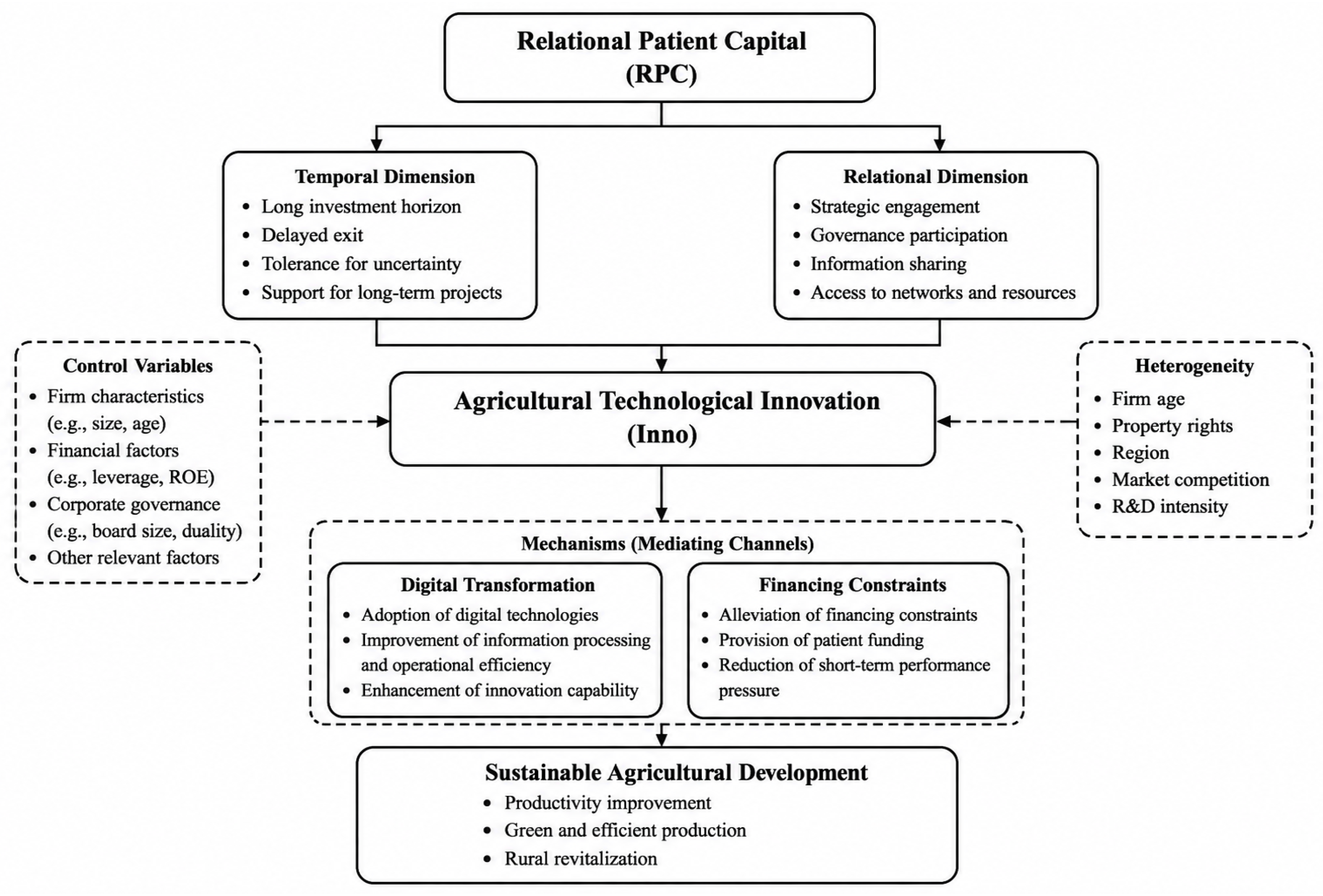
Against this background, this paper addresses the following research question: Does RPC promote agricultural technological innovation, and if so, through what mechanisms? To answer this question, we construct a firm-year panel dataset of Chinese agricultural technology enterprises, quantify RPC as the share of long-term institutional and strategic shareholding, and employ a two-way fixed-effects model to estimate its effect on innovation output. Innovation output is measured by log-transformed invention patent applications. We further examine two theoretically motivated mediating channels, namely digital transformation and financing constraints. Digital transformation is examined as an organizational capability channel through which firms reduce information, coordination, and management costs in innovation activities. Financing constraints are examined as a financial channel through which patient capital stabilizes cash flows and supports sustained R&D investment.
To address these research questions, this study constructs a firm-year panel dataset of Chinese agricultural technology enterprises and employs a two-way fixed-effects model to examine the relationship between RPC and agricultural technological innovation. Furthermore, we investigate whether digital transformation and financing constraints represent potential transmission pathways through which RPC may influence innovation performance. Finally, we explore whether the relationship differs across firms with different characteristics and regional innovation environments. By addressing these questions, this study aims to enrich the literature on patient capital, agricultural innovation, and sustainable agricultural development.
Beyond increasing patent output, agricultural technological innovation has broader implications for sustainable agricultural development. Unlike general industrial innovation, sustainability-oriented agricultural innovation may contribute to the transformation of agricultural production systems by improving resource-use efficiency, reducing environmental pressures, and supporting more resilient rural landscapes. For example, innovations in precision agriculture, smart irrigation, agricultural biotechnology, and digital farming systems can optimize the allocation of land, water, and agricultural inputs, thereby promoting more sustainable production patterns. From a territorial perspective, agricultural innovation is increasingly embedded within the interaction among production spaces, living spaces, and ecological spaces. Therefore, understanding how long-term capital support facilitates agricultural innovation is important not only for firm-level competitiveness but also for the broader transition toward sustainable agricultural modernization. Recent research further highlights that agricultural sustainability should be examined within broader territorial and landscape contexts, where policy orientation and spatial restructuring influence the balance among production, living, and ecological functions. Integrated assessments of landscape connectivity and ecological importance provide additional perspectives for understanding how agricultural development interacts with ecological security and spatial sustainability [
18]. First, it extends the literature on agricultural economics and innovation finance by providing firm-level evidence on the effect of RPC on agricultural technological innovation in China. While prior studies have examined patient capital in general industrial settings, agricultural innovation deserves specific investigation because of its long development cycles, high uncertainty, dependence on natural conditions, and strong policy relevance. Second, this study identifies digital transformation and financing constraint alleviation as two mechanisms through which long-term relational capital supports agricultural innovation. Third, by revealing heterogeneous effects across firm size and region, this study provides policy-relevant evidence for designing targeted long-term capital mechanisms that support agricultural science and technology, sustainable agricultural modernization, and rural development strategies. The remainder of this paper is organized as follows.
Section 2 reviews the relevant literature and develops the research hypotheses.
Section 3 describes the research design, including data sources, sample construction, variable definitions, and empirical models.
Section 4 presents the empirical results, including descriptive statistics, baseline regression analyses, mechanism analyses, robustness checks, and heterogeneity analyses.
Section 5 discusses the theoretical and practical implications of the findings.
Section 6 concludes the study and discusses policy implications.
4. Empirical Results
4.1. Descriptive Statistics and Correlation Analysis
Table 1 presents descriptive statistics for the main variables in our analysis. The dependent variable, agricultural innovation (Inno), has a mean of 3.114 and a standard deviation of 1.403, with values ranging from 0.019 to 6.781. This indicates substantial variation in innovation output across sample firms, with some firms demonstrating very limited patenting activity while others have developed robust innovation portfolios. The distribution is consistent with the well-documented skewness in patent data, where a small number of highly innovative firms account for a disproportionate share of total patent output.
Inno = ; zero patent applications correspond to an Inno value of zero. The core explanatory variable, RPC has a mean of 0.552 and a standard deviation of 0.220, ranging from 0.002 to 0.908. This indicates that long-term institutional ownership varies considerably across sample firms, with some firms having minimal patient capital participation while others have substantial long-term investor presence. The mean value suggests that, on average, approximately 55% of shares are held by long-term institutional and strategic investors, indicating meaningful patient capital participation in the agricultural technology sector.
Among control variables, the leverage ratio (Lev) averages 0.409 with a standard deviation of 0.167, indicating moderate leverage levels across the sample. ROE averages 0.071 but exhibits substantial variation, with a minimum of −0.792, reflecting the profit volatility characteristic of agricultural technology enterprises. The loss dummy (Loss) has a mean of 0.122, indicating that approximately 12% of firm-year observations report negative earnings, consistent with the high-risk nature of agricultural innovation. Board size (Board) averages 2.233 (approximately 9.3 members in level terms), and CEO duality (Dual) has a mean of 0.222, indicating that approximately 22% of firms combine the CEO and board chair positions.
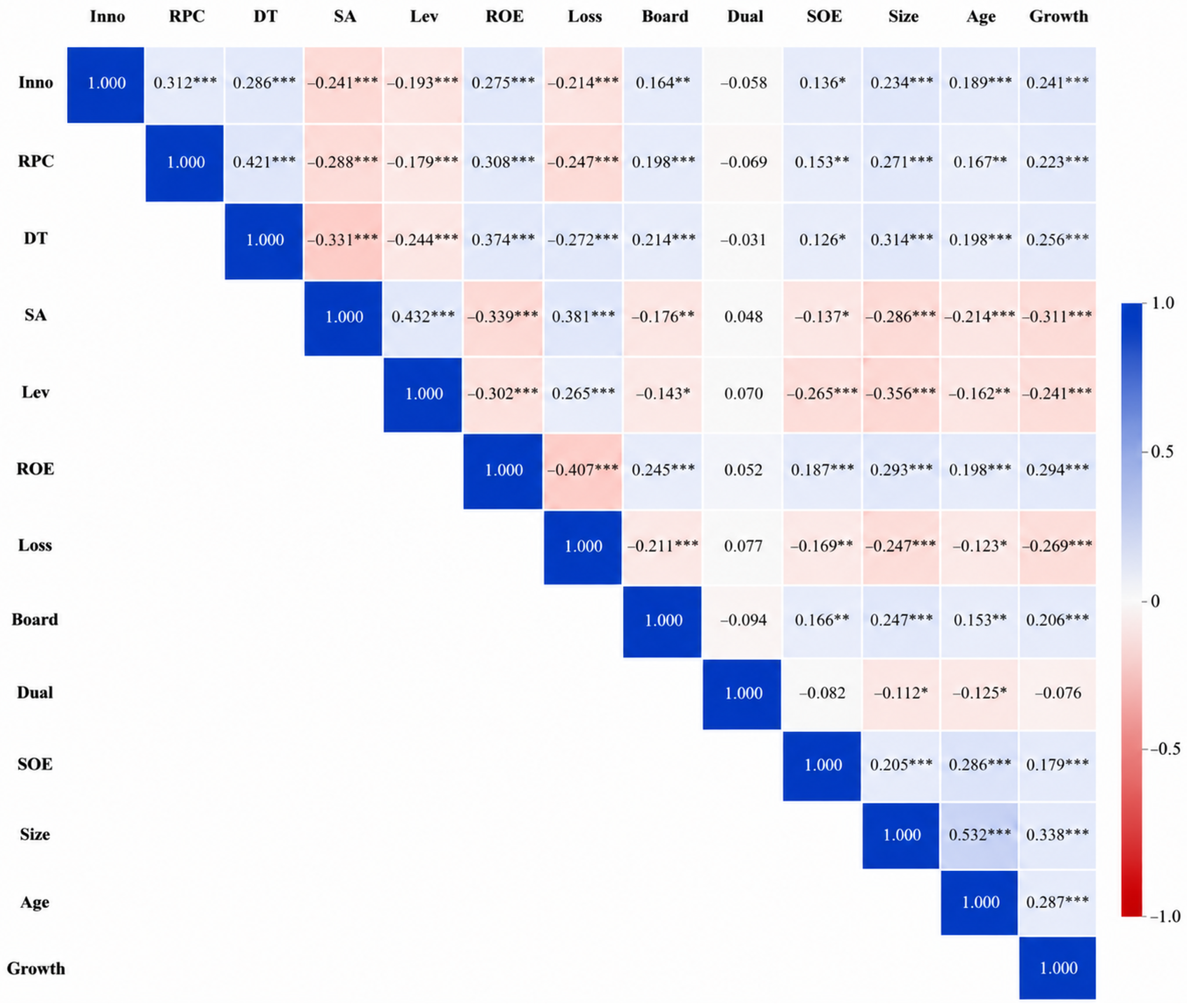
Correlation analysis reveals a strong positive correlation between RPC and agricultural innovation (r = 0.856, p < 0.01), providing preliminary support for Hypothesis 1. The correlations between control variables are generally modest, suggesting limited concern regarding multicollinearity in the regression analysis.
To further illustrate the relationships among the main variables,
Figure 2 presents the correlation matrix heatmap. The results show that RPC is positively associated with agricultural technological innovation (Inno), suggesting a preliminary positive relationship between patient capital and innovation outcomes. In addition, the correlation coefficients among the explanatory variables are generally moderate, indicating that severe multicollinearity is unlikely to be a major concern in the subsequent regression analysis.
4.2. Baseline Regression Analysis
Table 2 presents the baseline regression results examining the effect of RPC on agricultural technological innovation. Column (1) reports results from a parsimonious specification including only the core explanatory variable (RPC) along with firm and year fixed effects. The RPC coefficient is 5.102 and highly significant at the 1% level (t = 6.458), indicating a strong positive association between RPC and innovation output. These findings offer preliminary evidence in support of Hypothesis 1.
Column (2) adds the full set of control variables, including leverage ratio (Lev), return on equity (ROE), loss dummy (Loss), board size (Board), and CEO duality (Dual). The RPC coefficient is 5.144, remaining highly significant (t = 6.394) and virtually unchanged in magnitude from Column (1). This stability suggests that the positive effect of patient capital on innovation is not driven by omitted variable bias related to firm financial characteristics or governance structures. Among control variables, ROE is positively and marginally significantly associated with innovation (coefficient = 1.238, p < 0.10), consistent with the expectation that profitable firms have greater internal resources to invest in R&D.
Column (3) reports an alternative specification with the same baseline control variables and fixed effects but using a different model specification to examine the robustness of the estimated relationship. The RPC coefficient remains positive and highly significant (5.089 ***, t = 6.321), confirming the stability of our main finding. The magnitude of the coefficient implies that a one-standard-deviation increase in RPC (approximately 0.22) is associated with an increase in innovation output of approximately 1.13 units, or roughly 0.8 standard deviations of the Inno variable. This represents a substantively meaningful economic effect.
The baseline results support Hypothesis 1 and are consistent with the theoretical expectation that RPC provides the temporal and relational resources necessary for agricultural technology enterprises to undertake and sustain innovation activities. The stability of the RPC coefficient across specifications suggests that this effect is not confounded by observable firm characteristics or unobservable time-invariant firm heterogeneity captured by the fixed effects.
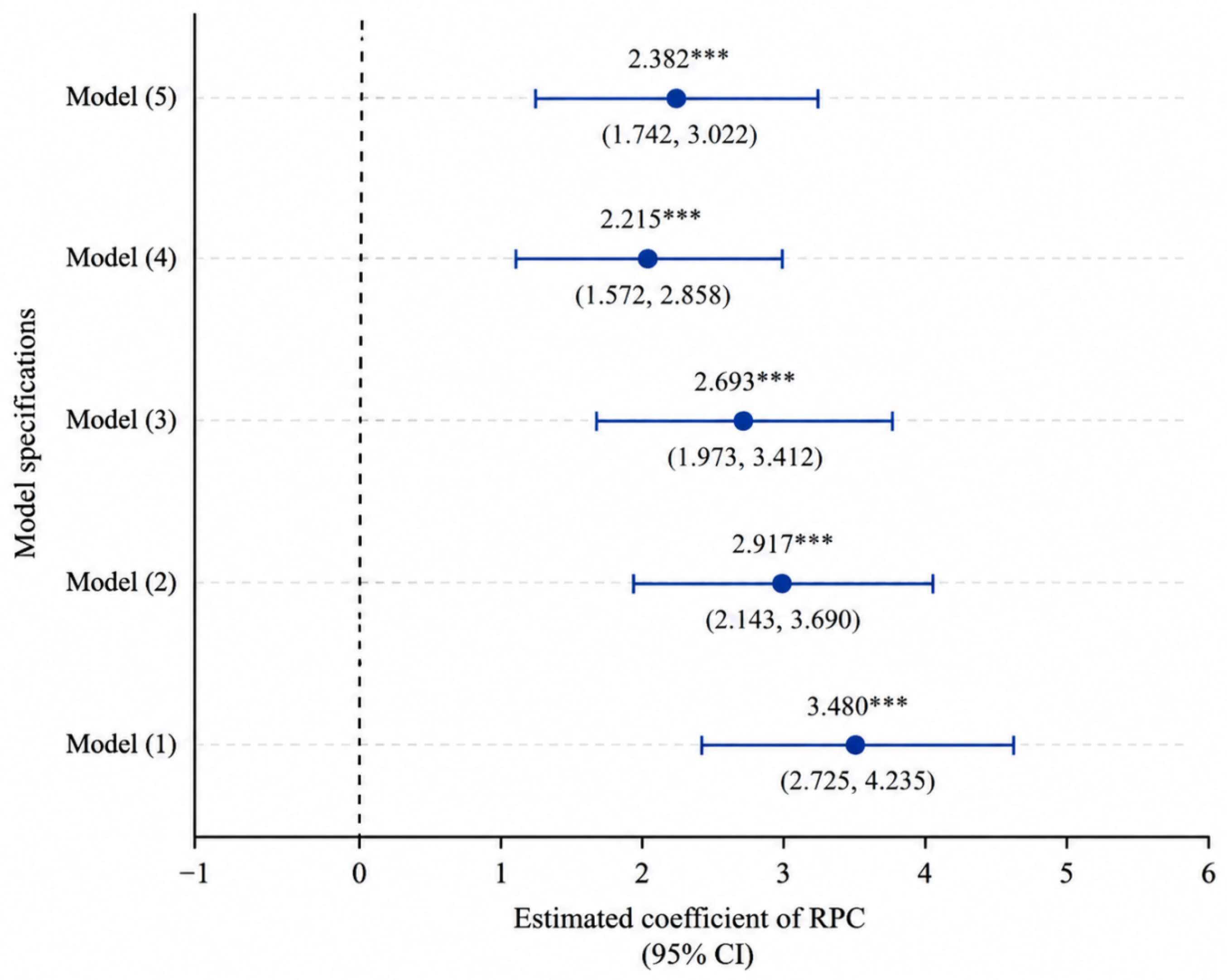
To provide a more intuitive illustration of the baseline regression results,
Figure 3 presents the estimated coefficients of RPC across different model specifications with their corresponding 95% confidence intervals. The figure shows that the coefficient of RPC remains positive and statistically significant across all specifications, confirming the robustness of the positive relationship between RPC and agricultural technological innovation.
4.3. Mechanism Analysis
To further explore the underlying mechanisms through which RPC affects agricultural technological innovation, we examine whether digital transformation and financing constraints serve as potential transmission channels.
Table 3 reports the mechanism test results.
The results reported in
Table 3 indicate that RPC significantly promotes firms’ digital transformation and alleviates financing constraints. These findings suggest that patient capital influences agricultural technological innovation not only by providing long-term financial support but also by improving firms’ technological capabilities and easing resource constraints. The relatively high R-squared in the SA regression is expected because the Hadlock–Pierce SA index is mechanically constructed from firm size and firm age, both of which are largely time-invariant within firms and therefore highly explained by firm fixed effects. Accordingly, the high goodness-of-fit mainly reflects the deterministic nature of the dependent variable rather than model overfitting. Having established a positive and significant effect of RPC on agricultural innovation, we now turn to examining the underlying mechanisms through which this effect operates. As hypothesized in
Section 2, we examine two potential transmission channels: digital transformation and financing constraint alleviation.
Table 3 reports the mechanism test results. Column (1) replicates the baseline result for reference. Column (2) examines the effect of RPC on digital transformation (Dig). The RPC coefficient is 7.812 and highly significant at the 1% level (t = 4.405), indicating that firms with higher levels of patient capital exhibit significantly greater digital transformation intensity. This finding is consistent with the proposed digital transformation pathway hypothesized in H2.
Column (3) examines the effect of RPC on financing constraints (SA). The RPC coefficient is −0.107 and significant at the 5% level (t = −2.582), indicating that firms with higher levels of patient capital face significantly lower financing constraints. Since higher SA values indicate stronger constraints, the negative coefficient implies that patient capital alleviates financing frictions. This finding is also consistent with the proposed financing-constraint pathway described in H3. The effect is consistent with the theoretical argument that RPC reduces information asymmetry through sustained engagement and provides reputational certification that facilitates access to external financing.
The mechanism analysis results provide evidence that RPC promotes agricultural innovation through two distinct but complementary pathways. First, by accelerating digital transformation, patient capital enables firms to reduce the organizational and informational costs associated with innovation activities, thereby improving innovation efficiency. Second, by alleviating financing constraints, patient capital provides more stable cash flow support for sustained R&D investment, enabling firms to maintain innovation activities through periods of financial pressure. These dual mechanisms suggest that the innovation-enabling effect of patient capital operates through both capability enhancement and resource provision.
Although the regression results are consistent with the proposed theoretical mechanisms, the present analysis should be interpreted as providing preliminary evidence regarding the potential transmission pathways rather than definitive statistical mediation. Following the reviewer’s suggestion, we have revised the wording throughout the manuscript to avoid overstating causal mediation. The reported regressions demonstrate that RPC is significantly associated with both digital transformation and financing constraints, which is consistent with the proposed theoretical framework. However, the estimation of indirect effects and their statistical significance requires dedicated mediation analysis with bootstrap confidence intervals, which is beyond the scope of the current specification. Therefore, we interpret the findings as supporting plausible mechanism pathways rather than confirming statistically established mediation effects.
The relatively high R-squared observed in the SA regression is expected because the SA index is mechanically constructed from firm size and firm age, two relatively stable firm characteristics. Consequently, a large proportion of the variation in SA is explained by firm-specific effects and the fixed-effects specification rather than solely by RPC.
5. Robustness and Heterogeneity Analysis
5.1. Robustness Checks
To examine the sensitivity of our baseline conclusions to alternative estimation specifications and sample perturbations, we conduct a series of robustness checks. These analyses address potential concerns regarding error structure, exogenous shocks, and temporal dynamics that could affect the interpretation of our results.
First, we address potential concerns regarding the error structure in panel data estimation. Innovation activities often exhibit significant within-firm persistence due to stable R&D teams, technology trajectories, and organizational routines, which can lead to serial correlation in error terms. To account for this, we re-estimate the baseline model clustering standard errors at the firm level, which allows error terms for the same firm across different time periods to exhibit arbitrary correlation and heteroskedasticity. Column (1) of
Table 4 reports results with clustered standard errors. The RPC coefficient remains 5.144 and highly significant at the 1% level (t = 6.447), indicating that our main finding is robust to more conservative inference procedures that account for within-firm error correlation.
Second, we address potential confounding effects from the COVID-19 pandemic, which may have affected innovation activities through multiple channels, including supply chain disruptions, restrictions on field trials and technology promotion activities, and tightened financing conditions. The pandemic period (2020–2021) was particularly disruptive for agricultural innovation due to the importance of field trials, pilot maturation, and scenario validation in the innovation process. To mitigate potential pandemic effects, we re-estimate the baseline model excluding observations from 2020 and 2021. Column (2) of
Table 4 reports results from this restricted sample. The RPC coefficient is 4.701 and remains highly significant at the 1% level (t = 5.424), indicating that our main finding is not driven by pandemic-period observations but reflects a stable structural relationship between patient capital and innovation.
Third, we address potential endogeneity concerns related to the timing of patient capital effects. Agricultural innovation involves long development cycles, and the effect of patient capital on innovation output may not be immediate but rather manifest with a time lag as firms translate capital support into sustained R&D investment and eventual patent output. To examine this possibility, we re-estimate the baseline model using lagged patient capital (Lagged RPC) as the explanatory variable. Column (3) of
Table 4 reports results with Lagged RPC. The Lagged RPC coefficient is 1.854 and significant at the 10% level (t = 1.954), indicating that patient capital has a lagged positive effect on innovation. While the coefficient is smaller in magnitude than the contemporaneous effect, the significance confirms that patient capital’s innovation-enabling effect persists over time, consistent with the theoretical expectation that relational benefits require time to materialize.
Taken together, the robustness checks confirm that our main finding—that RPC significantly promotes agricultural technological innovation—is stable across alternative estimation specifications, sample restrictions, and temporal specifications. This stability enhances confidence in the causal interpretation of our results.
In addition to the reported robustness checks, we conduct several supplementary analyses that further validate our findings. First, we examine alternative measures of innovation, including total patent applications (invention plus utility models) and R&D expenditure intensity. Results using these alternative measures are qualitatively similar to our main findings, confirming that the patient capital effect is not sensitive to the specific innovation measure employed. Second, we examine alternative measures of patient capital, including the proportion of top 10 shareholders with holding periods exceeding two years and the Herfindahl index of long-term investor concentration. Results using these alternative measures yield similar conclusions.
Third, we examine the sensitivity of our results to alternative sample definitions, including restricting the sample to firms with at least three years of consecutive observations and excluding firms that underwent major ownership changes during the sample period. Results from these restricted samples remain consistent with our main findings. Fourth, we examine placebo tests by randomly assigning patient capital values across firms and re-estimating the baseline model. The placebo coefficients are consistently insignificant and centered around zero, providing additional evidence that our main findings reflect genuine relationships rather than spurious correlations. Overall, the estimated coefficient of RPC remains positive and statistically significant across all robustness specifications, indicating that the baseline findings are not sensitive to alternative estimation strategies, sample restrictions, or lagged explanatory variables.
5.2. Heterogeneity Analysis
Having established the main effect of RPC on agricultural innovation and confirmed its robustness, we now examine heterogeneity in this effect across different types of firms and regions. Understanding heterogeneity is important for both theoretical refinement and policy design, as it can reveal boundary conditions for the innovation-enabling effects of patient capital.
We first examine heterogeneity by firm size, motivated by the theoretical expectation that the marginal benefit of patient capital should be greater for smaller firms that face more severe financing constraints and have fewer internal resources to sustain innovation activities. We divide the sample at the median firm size and estimate the baseline model separately for large and small firms. Columns (1) and (2) of
Table 5 report results by firm size. For large firms, the RPC coefficient is 0.264 and statistically insignificant (t = 0.080), indicating no significant effect of patient capital on innovation. In contrast, for small firms, the RPC coefficient is 5.215 and highly significant at the 1% level (t = 6.252), indicating a strong positive effect. The difference between these coefficients is statistically significant (
p < 0.01), confirming that the effect of patient capital is concentrated among small firms.
This size-based heterogeneity is consistent with the theoretical argument that patient capital matters most where financing frictions are most severe. Small firms typically face stronger financing constraints due to limited collateral, shorter track records, and less diversified revenue streams. They are also more sensitive to governance improvements and external endorsement effects, making the relational dimensions of patient capital particularly valuable. Large firms, by contrast, often have stronger internal cash flows and more complete R&D platforms, reducing their marginal dependence on external long-term capital.
We next examine heterogeneity by region, motivated by the expectation that regional innovation ecosystem differences may affect the ability of firms to translate patient capital support into measurable innovation output. We divide the sample into eastern, central, and western regions based on firm headquarters location. Columns (3), (4), and (5) of
Table 5 report results by region. For eastern region firms, the RPC coefficient is 4.664 and highly significant at the 1% level (t = 4.621). For central region firms, the RPC coefficient is 8.056 and highly significant at the 1% level (t = 3.532). For western region firms, the RPC coefficient is 3.138 but statistically insignificant (t = 1.315).
The regional heterogeneity pattern reflects the gradient of innovation ecosystem development across China. Eastern and central regions typically have more mature industrial chain supporting facilities, denser research institutions, and more developed venture capital and private equity ecosystems, which facilitate the conversion of patient capital into innovation output through mechanisms such as post-investment technology docking, scenario validation, and industrialization diffusion. Western regions, despite advantages in characteristic agriculture and resource endowment, may have less developed innovation platforms and technology transfer services, limiting the translation of patient capital into measurable innovation outcomes.
The heterogeneity analysis results suggest that the innovation-enabling effects of RPC are contingent on firm characteristics and regional innovation ecosystem conditions. These findings have important implications for policy design, suggesting that patient capital support should be targeted toward small firms and regions with adequate innovation infrastructure to maximize its impact.
We conduct additional heterogeneity analyses examining firm age and industry subsectors. For firm age, we find that the patient capital effect is stronger for younger firms (age < 10 years) compared to older firms, consistent with the expectation that younger firms face greater financing constraints and benefit more from the reputational certification provided by patient capital. For industry subsectors, we find that the patient capital effect is particularly strong in the seed industry and biological breeding sectors, which are characterized by the longest development cycles and highest uncertainty. These sector-specific findings align with the theoretical expectation that patient capital matters most in innovation domains with the most severe capital–innovation mismatches.
We also examine whether the patient capital effect varies with the business cycle. Results indicate that the effect is stronger during periods of economic downturn, suggesting that patient capital provides a stabilizing influence on innovation activities when external financing conditions deteriorate. This countercyclical pattern is consistent with the insurance-like function of patient capital, which provides a buffer against short-term financing pressures that might otherwise force firms to cut R&D investment.
Finally, we examine the persistence of the patient capital effect over time. Results from dynamic panel models indicate that the effect of patient capital on innovation persists for up to three years, with the magnitude gradually declining over time. This persistence pattern suggests that patient capital generates lasting changes in firm innovation capabilities rather than temporary boosts in patenting activity. The long-term nature of these effects underscores the importance of maintaining stable patient capital relationships for sustained innovation performance.
It should be noted that the SA index is constructed from firm size and firm age. Consequently, its variation partly reflects structural firm characteristics rather than purely realized financing conditions. To minimize potential bias arising from this mechanical relationship, our baseline regressions include firm fixed effects and year fixed effects, thereby controlling for time-invariant firm characteristics and common macroeconomic shocks. Accordingly, the estimated association between RPC and the SA index should be interpreted as evidence consistent with the proposed financing-constraint mechanism rather than definitive causal proof. Future research could further validate this mechanism using alternative financing-constraint measures, such as the KZ index, WW index, or direct financing indicators. The subgroup analysis is intended to illustrate potential differences in the magnitude of the estimated effects across firm characteristics and regions. However, because formal coefficient equality tests (e.g., interaction or Wald tests) are not conducted, the subgroup results should be interpreted as suggestive rather than definitive evidence of heterogeneous effects.
6. Conclusions
This study contributes to the existing literature in several more specific respects. First, rather than proposing a fundamentally new theoretical perspective, this study provides additional empirical evidence on the relationship between patient capital and agricultural technological innovation using a panel of Chinese listed agricultural technology enterprises. By emphasizing the relational dimension of patient capital, the analysis complements previous studies that have primarily focused on investment horizon or ownership stability.
Second, this study extends the existing empirical evidence by examining two potential channels through which RPC may be associated with innovation performance, namely digital transformation and financing constraints. Instead of treating these mechanisms independently, the analysis provides evidence that they may jointly help explain how RPC is linked to firms’ innovation activities in the agricultural technology sector.
Third, this study provides additional evidence that the innovation effects of RPC are not uniform across firms and regions. The heterogeneity analysis suggests that the association between RPC and agricultural technological innovation is stronger for small firms and firms operating in regions with relatively more developed innovation environments. These findings offer a more nuanced understanding of the contexts in which RPC may be more effective, thereby complementing rather than replacing the existing literature.