“I Am Willing, but Acting Is Hard”: Unpacking the Intention–Behavior Gap in Carbon Inclusivity Mechanisms Using Social Practice and MOA Theory


Abstract
1. Introduction
2. Literature Review
2.1. Theoretical Foundations of the Intention–Behavior Gap
2.2. Integrative Frameworks for CI Mechanisms
2.2.1. MOA Theory: Tripartite Determinants
2.2.2. Social Practice Theory: Three-Element Framework
2.3. Carbon Inclusivity Research Landscape
2.4. Research Positioning and Contributions
3. Methodology
3.1. Data Collection
3.2. Data Analysis Based on Programmatic Grounded Theory
4. The Coding Analysis and Model Construction Based on the Programmatic Grounded Theory
4.1. Open Coding
4.2. Axial Coding
4.3. Selective Coding
4.4. Theoretical Saturation Test
4.5. The Construction of the Comprehensive Theoretical Model
4.6. Sensitivity Test of Coding Results
5. Interpretation of the Comprehensive Theoretical Model
5.1. Pro-Environmental Behavioral Motivation Indirectly Influences Actual Participation Behavior Through the Intention to Participate in CI
5.2. There Exists an “Intention–Behavior” Gap in CI Participation
5.3. Consumer Emotions and Pro-Environmental Behavioral Abilities Are the Internal Contextual Factors That Elucidate the “Intention–Behavior” Gap in CI Participation
5.4. The Dynamic Changes in Social Practice and External Opportunities and Conditions Constitute the External Contextual Factors That Elucidate the “Intention–Behavior” Gap in CI Participation
6. Conclusions and Policy Implications
Author Contributions
Funding
Institutional Review Board Statement
Informed Consent Statement
Data Availability Statement
Conflicts of Interest
References
- Tan, X.P.; Wang, X.Y.; Zaidi, S.H.A. What drives public willingness to participate in the voluntary personal carbon-trading scheme? A case study of Guangzhou Pilot, China. Ecol. Econ. 2019, 165, 106389. [Google Scholar] [CrossRef] [Scilit]
- Zhang, Z.X. China’s carbon market: Development, evaluation, coordination of local and national carbon markets, and common prosperity. J. Clim. Financ. 2022, 1, 100001. [Google Scholar] [CrossRef] [Scilit]
- ElHaffar, G.; Durif, F.; Dubé, L. Towards closing the attitude-intention-behavior gap in green consumption: A narrative review of the literature and an overview of future research directions. J. Clean. Prod. 2020, 275, 122556. [Google Scholar] [CrossRef] [Scilit]
- Sukumaran, L.; Majhi, R. Not all who proclaim to be green are really green: Analysis of intention behavior gap through a systematic review of literature. Manag. Rev. Q. 2025, 75, 1535–1574. [Google Scholar] [CrossRef] [Scilit]
- China International Institute of Low-Carbon Economy, Shandong University of Finance and Economics. 2025 Carbon Inclusion Survey Report: A Study on the Development of Carbon Inclusion Mechanisms in the Yellow River Basin of Shandong Province and National Pilot Areas; China International Institute of Low-Carbon Economy: Jinan, China, 2025. [Google Scholar]
- Wang, T.; Shen, B.; Springer, C.H.; Hou, Y. What prevents us from taking low-carbon actions? A comprehensive review of influencing factors affecting low-carbon behaviors. Energy Res. Soc. Sci. 2021, 71, 101844. [Google Scholar] [CrossRef] [Scilit]
- Starkey, R. Personal carbon trading: A critical survey part 1: Equity. Ecol. Econ. 2012, 73, 7–18. [Google Scholar] [CrossRef] [Scilit]
- Li, C.; Ren, Z.; Wang, L. Research on the driving path of carbon inclusive system to green behavior of the public: Based on procedural grounded theory and multiple intermediary model. Environ. Sci. Pollut. Res. 2023, 30, 80393–80415. [Google Scholar] [CrossRef] [Scilit]
- Kloppenburg, S.; Boekelo, M. Digital platforms and the future of energy provisioning: Promises and perils for the next phase of the energy transition. Energy Res. Soc. Sci. 2019, 49, 68–73. [Google Scholar] [CrossRef] [Scilit]
- Guagnano, G.A.; Stern, P.C.; Dietz, T. Influences on attitude-behavior relationships: A natural experiment with curbside recycling. Environ. Behav. 1995, 27, 699–718. [Google Scholar]
- Shove, E.; Pantzar, M.; Watson, M. The Dynamics of Social Practice: Everyday Life and How It Changes; SAGE Publications: London, UK, 2012. [Google Scholar]
- Morton, A.; Reeves, A.; Bull, R.; Preston, S. Empowering and engaging European building users for energy efficiency. Energy Res. Soc. Sci. 2020, 70, 101772. [Google Scholar] [CrossRef] [Scilit]
- Kollmuss, A.; Agyeman, J. Mind the gap: Why do people act environmentally and what are the barriers to pro-environmental behavior? Environ. Educ. Res. 2002, 8, 239–260. [Google Scholar] [CrossRef] [Scilit]
- Steg, L.; Vlek, C. Encouraging pro-environmental behaviour: An integrative review and research agenda. J. Environ. Psychol. 2009, 29, 309–317. [Google Scholar] [CrossRef] [Scilit]
- Ajzen, I. The theory of planned behavior. Organ. Behav. Hum. Decis. Process. 1991, 50, 179–211. [Google Scholar] [CrossRef] [Scilit]
- Dzene, S.; Eglite, A. Perspective of sustainable food consumption in Latvia. In Proceedings of the 18th International Scientific Conference “Research for Rural Development”, Jelgava, Latvia, 16–18 May 2012. [Google Scholar]
- Westaby, J.D. Behavioral reasoning theory: Identifying new linkages underlying intentions and behavior. Organ. Behav. Hum. Decis. Process. 2005, 98, 97–120. [Google Scholar] [CrossRef] [Scilit]
- Duong, C.D. Big Five personality traits and green consumption: Bridging the attitude-intention-behavior gap. Asia Pac. J. Mark. Logist. 2022, 34, 1123–1144. [Google Scholar] [CrossRef] [Scilit]
- Wang, X.; Wang, Z.; Li, Y. Internet use on closing intention–behavior gap in green consumption: A mediation and moderation theoretical model. Int. J. Environ. Res. Public Health 2023, 20, 365. [Google Scholar] [CrossRef] [Scilit]
- Sweeney, J.C.; Kresling, J.; Webb, D.; Soutar, G.N.; Mazzarol, T. Energy saving behaviours: Development of a practice-based model. Energy Policy 2013, 61, 371–381. [Google Scholar] [CrossRef] [Scilit]
- Tawde, S.; Kamath, R.; ShabbirHusain, R.V. ‘Mind will not mind’–Decoding consumers’ green intention-green purchase behavior gap via moderated mediation effects of implementation intentions and self-efficacy. J. Clean. Prod. 2023, 383, 135506. [Google Scholar] [CrossRef] [Scilit]
- Bolderdijk, J.W.; Knockaert, J.; Steg, E.M.; Verhoef, E.T. When do moral arguments motivate climate action? The moderating role of the perceived sincerity of pro-environmental advocates. J. Environ. Psychol. 2022, 83, 101869. [Google Scholar]
- Sunstein, C.R. Sludging through COVID-19: Behavioral insights for public policy. J. Behav. Public Adm. 2022, 5, 1–10. [Google Scholar]
- Allcott, H. Site selection bias in program evaluation. Q. J. Econ. 2023, 138, 351–397. [Google Scholar]
- Dong, X.; Jiang, B.; Zeng, H.; Long, R. Impact of trust and knowledge in the food chain on motivation-behavior gap in green consumption. J. Retail. Consum. Serv. 2022, 66, 102955. [Google Scholar] [CrossRef] [Scilit]
- Sussman, R.; Gifford, R. Timing matters: Habit formation in digital environmental platforms. Environ. Behav. 2023, 55, 198–224. [Google Scholar]
- Hargreaves, T.; Wilson, C.; Chatterton, T. Understanding Energy Practices: A Multi-Disciplinary Approach to Energy Research and Policy; Routledge: Abingdon, UK, 2018. [Google Scholar]
- Browne, A.L.; Jack, T.; Hitchings, R. The staying power of unsustainable practices: Clothing maintenance and energy demand. J. Consum. Cult. 2023, 23, 45–63. [Google Scholar]
- Fuentes, C.; Fuentes, M. Making green labels matter: The material politics of eco-standards. J. Mater. Cult. 2023, 28, 156–174. [Google Scholar]
- Evans, D. Beyond the bin: The social practice of food waste in households. Sustain. Prod. Consum. 2022, 30, 778–791. [Google Scholar]
- Liu, Z.; Sun, Y.; Chen, J. Theoretical fragmentation in carbon inclusivity research: A systematic review. Environ. Innov. Soc. Transit. 2023, 48, 100789. [Google Scholar]
- Li, C.; Ren, Z.; Wang, L. Interplay of virtual and physical channels in propagating green behavior: A study integrating motivation-opportunity-ability and theory of planned behavior. Environ. Dev. 2024, 50, 100997. [Google Scholar] [CrossRef] [Scilit]
- Weng, S.; Chen, J.; Tao, W.; Song, M. Does incentive-based voluntary emission reduction mechanism improve urban carbon unlocking efficiency? A quasi-natural experiment on carbon inclusion policy. Energy 2025, 318, 134773. [Google Scholar] [CrossRef] [Scilit]
- Zhang, L.; Sun, D.J.; Tao, L.; Ren, J.Z.; Yu, X.; Zhang, Y.Z.; Yang, F.Y.; Zeng, H.Y. Driving the Green and Low-Carbon Economy Through Digital Innovation: Insights from China’s Inclusive Carbon Benefit Mechanism. Green Low-Carbon Econ. 2025. [Google Scholar] [CrossRef] [Scilit]
- Wei, Z.; Cheng, Z.; Wang, K.; Zhou, S. Navigating the personal carbon inclusion scheme: An evolutionary game theory approach to low-carbon behaviors among socio-economic groups. Heliyon 2024, 10, e37021. [Google Scholar] [CrossRef] [Scilit]
- Papachristos, G. Diversity in technology competition: The link between platforms and sociotechnical transitions. Renew. Sustain. Energy Rev. 2017, 73, 291–306. [Google Scholar] [CrossRef] [Scilit]
- Strengers, Y.; Nicholls, L. Aesthetic pleasures and gendered tech-work in the 21st-century smart home. Media Int. Aust. 2018, 166, 70–80. [Google Scholar] [CrossRef] [Scilit]
- Strauss, A.L.; Corbin, J.M. Basics of Qualitative Research: Techniques and Procedures for Developing Grounded Theory, 2nd ed.; SAGE Publications: Thousand Oaks, CA, USA, 1998. [Google Scholar]
- Patton, M.Q. Qualitative Research & Evaluation Methods: Integrating Theory and Practice, 4th ed.; SAGE Publications: Thousand Oaks, CA, USA, 2015. [Google Scholar]
- Saunders, B.; Sim, J.; Kingstone, T.; Baker, S.; Waterfield, J.; Bartlam, B.; Burroughs, H.; Jinks, C. Saturation in qualitative research: Exploring its conceptualization and operationalization. Qual. Quant. 2018, 52, 1893–1907. [Google Scholar] [CrossRef] [Scilit] [PubMed]
- Perera, C.; Auger, P.; Klein, J. Green consumption practices among young environmentalists: A practice theory perspective. J. Bus. Ethics 2018, 152, 843–864. [Google Scholar] [CrossRef] [Scilit]
- Thomas, D.R. Feedback from research participants: Are member checks useful in qualitative research? Qual. Res. Psychol. 2017, 14, 23–41. [Google Scholar] [CrossRef] [Scilit]
- Strauss, A.L.; Corbin, J.M. Grounded Theory in Practice; SAGE Publications: Thousand Oaks, CA, USA, 1997. [Google Scholar]
- Glaser, B.G. Theoretical Sensitivity: Advances in the Methodology of Grounded Theory; Sociology Press: Mill Valley, CA, USA, 1978. [Google Scholar]
- Røpke, I. Theories of practice—New inspiration for ecological economic studies on consumption. Ecol. Econ. 2009, 68, 2490–2497. [Google Scholar] [CrossRef] [Scilit]
- Glaser, B.G.; Strauss, A.L. The Discovery of Grounded Theory: Strategies for Qualitative Research; Transaction Publishers: Piscataway, NJ, USA, 2009. [Google Scholar]
- Birt, L.; Scott, S.; Cavers, D.; Campbell, C.; Walter, F. Member checking: A tool to enhance trustworthiness or merely a nod to validation? Qual. Health Res. 2016, 26, 1802–1811. [Google Scholar]
- Sharma, N.; Lal, M. Facades of morality: The role of moral disengagement in green buying behaviour. Qual. Mark. Res. Int. J. 2020, 23, 217–239. [Google Scholar] [CrossRef] [Scilit]
- Tong, A.; Sainsbury, P.; Craig, J. Consolidated criteria for reporting qualitative research (COREQ): A 32-item checklist for interviews and focus groups. Int. J. Qual. Health Care 2007, 19, 349–357. [Google Scholar] [CrossRef] [Scilit] [PubMed]
- Agag, G.; Brown, A.; Hassanein, A.; Shaalan, A. Decoding travellers’ willingness to pay more for green travel products: Closing the intention-behaviour gap. J. Sustain. Tour. 2020, 28, 1551–1575. [Google Scholar] [CrossRef] [Scilit]
- Liu, A.; Ma, E.; Qu, H.; Ryan, B. Daily green behavior as an antecedent and a moderator for visitors’ pro-environmental behaviors. J. Sustain. Tour. 2020, 28, 1390–1408. [Google Scholar] [CrossRef] [Scilit]
- Miller, L.B.; Rice, R.E. (Mis)matched direct and moderating relationships among pro-environmental attitudes, environmental efficacy, and pro-environmental behaviors across and within 11 countries. PLoS ONE 2024, 19, e0304945. [Google Scholar] [CrossRef] [Scilit]
- Akhtar, S.; Khan, K.U.; Atlas, F.; Irfan, M. Stimulating student’s pro-environmental behavior in higher education institutions: An ability–motivation–opportunity perspective. Environ. Dev. Sustain. 2022, 24, 4128–4149. [Google Scholar] [CrossRef] [Scilit]
- Wei, J.; Chen, H.; Long, R. Is ecological personality always consistent with low-carbon behavioral intention of urban residents? Energy Policy 2016, 98, 343–352. [Google Scholar] [CrossRef] [Scilit]
- Wang, J.M.; Wu, L.C. The categories, dimensions and mechanisms of emotions in the studies of pro-environmental behavior. Adv. Psychol. Sci. 2015, 23, 2153–2166. [Google Scholar] [CrossRef] [Scilit]
- Ding, Z.; Jiang, X.; Liu, Z.; Long, R.; Wang, Q. Factors affecting low-carbon consumption behavior of urban residents: A comprehensive review. Resour. Conserv. Recycl. 2018, 132, 3–15. [Google Scholar] [CrossRef] [Scilit]
- Stern, P.C. New environmental theories: Toward a coherent theory of environmentally significant behavior. J. Soc. Issues 2000, 56, 407–424. [Google Scholar] [CrossRef] [Scilit]
- Klöckner, C.A. A comprehensive model of the psychology of environmental behaviour—A meta-analysis. Glob. Environ. Change 2013, 23, 1028–1038. [Google Scholar] [CrossRef] [Scilit]
- Wei, J.; Zhang, L.L.; Yang, R.R.; Song, M.L. A new perspective to promote sustainable low-carbon consumption: The influence of informational incentive and social influence. J. Environ. Manag. 2023, 327, 116848. [Google Scholar] [CrossRef] [Scilit]


| Research Paradigm | Published Literature | Theoretical Basis | Methodology | Core Findings |
|---|---|---|---|---|
| Quantitative cognitive studies (MOA perspective) | Li et al. (2024) [32]; Weng et al. (2025) [33]; Li et al. (2023) [8]; Zhang et al. (2025) [34]; Wei et al. (2024) [35]; Tan et al. (2019) [1]; Wang et al. (2023) [19]; Liu et al. (2023) [31] | MOA, TPB, evolutionary game theory, incentive economics, policy evaluation framework | Questionnaire regression, quasi-natural experiment, evolutionary game simulation, systematic literature review | Regard residents’ low-carbon participation as intentional, rational decision-making. Identify economic incentives, perceived benefits, and psychological factors as key drivers of participation willingness; assess policy effectiveness of carbon inclusion schemes. |
| Qualitative social practice-oriented studies (Social Practice Theory perspective) | Papachristos (2017) [36]; Kloppenburg & Boekelo (2019) [9]; Shove et al. (2012) [11] | Social Practice Theory, socio-technical transition theory, digital platform practice framework | Qualitative case analysis, critical literature synthesis, comparative sociotechnical analysis | Low-carbon action is embedded, routinised social practice shaped by meanings, materials and competences. Digital platforms and infrastructure reshape everyday energy and consumption practices in low-carbon transitions. |
| Classification | Number of People | Percentage (%) | |
|---|---|---|---|
| Region | Hangzhou | 10 | 23.81 |
| Shanghai | 8 | 19.05 | |
| Beijing | 6 | 14.29 | |
| Guangzhou | 6 | 14.29 | |
| Wuhan | 6 | 14.29 | |
| Jiaxing | 6 | 14.29 | |
| Age | 18–25 years old | 9 | 21.43 |
| 26–35 years old | 9 | 21.43 | |
| 36–45 years old | 10 | 23.81 | |
| 46–60 years old | 12 | 28.57 | |
| 61 years old and above | 2 | 4.76 | |
| Gender | Male | 19 | 45.24 |
| Female | 23 | 54.76 | |
| Type of interview | In-depth individual interview | 18 | 42.86 |
| Focus group interview | 24 | 57.14 | |
| Type of occupation | University students and graduate students | 10 | 23.81 |
| Public officials in the education sector and public institutions | 10 | 23.81 | |
| Corporate employees | 6 | 14.29 | |
| Freelancers and individual business owners | 5 | 11.90 | |
| Retirees | 5 | 11.90 | |
| Practitioners in the environmental protection industry | 6 | 14.29 | |
| Monthly household income | Less than 5000 yuan | 9 | 21.43 |
| 5000 to 15,000 yuan | 15 | 35.71 | |
| 15,000 to 30,000 yuan | 10 | 23.81 | |
| more than 30,000 yuan | 8 | 19.05 |
| Topic | Outline of Contents |
|---|---|
| Interviewee’s Low-Carbon Cognition | What low-carbon behaviors have you engaged in before participating in the CI program? Do you agree with the low-carbon philosophy of the CI program? |
| Situation of Participation in CI Programs | When did you start participating in the CI program? What channels did you use to participate? What types of CI activities have you participated in and how frequently? What factors attracted you to participate in the CI activities? |
| Factors Hindering Continuous Participation in CI Programs | What do you think are the reasons why you can’t consistently participate in the CI program? What difficulties and inconveniences have you encountered during your participation? In your opinion, what aspects of the CI operating mechanism need improvement? What do you think are the reasons why others haven’t participated or don’t often participate in the CI program? |
| Category | Original Statements (Initial Concepts) |
|---|---|
| Intrinsic motivation | A08 Through participating in CI programs, I feel a sense of responsibility as a global citizen, which fills me with pride. (Environmental responsibility) A16 Participating in CI programs turns low-carbon behaviors into visible carbon credits, giving me more motivation to persist. (Expected benefits) A24 Since participating in the CI program, I have received approving looks from my friends around me. (Obtain social recognition) A30 Participating in CI programs highlights a green lifestyle and reflects a certain attitude and way of life. (highlights a green lifestyle) |
| Extrinsic motivation | A08 Subsidies and tax exemptions are significant motivations for my participation in CI programs, as they provide tangible benefits when I purchase energy-efficient products and adopt low-carbon transportation. (The role of policy incentives) A12 The commercial incentives offered by some companies, such as reward points and discounts, have to some extent stimulated my enthusiasm for participation. (The role of commercial incentives) A17 Currently, major brands are introducing various types of electric vehicle models that cater to individualized needs. Moreover, with the reduction in battery costs and the emergence of scale effects, vehicle prices have become more reasonable. (Supply and pricing in the low-carbon market) A20 In my community, low-carbon living has become a widely advocated behavior, and this atmosphere has prompted me to embrace an environmentally friendly lifestyle. (Social norms) A29 In my social circle, low-carbon living has become a pressure that motivates me to actively participate in emission reduction. (Group pressure) |
| Low-carbon knowledge and skills | A22 I am willing to purchase low-carbon products, but they do not have an advantage in terms of performance and quality, and the prices are also high. It’s hard for me to make a decision to buy them, especially since I just graduated and am on a tight budget. (Understanding of low-carbon products) A35 Although I am personally inclined to purchase eco-friendly products, when making a decision, I still need to take my family’s opinions into account. Both my wife and I are environmentally conscious, but since our child is still very young, we tend to lean towards products that are both affordable and of good quality. (Ability to make low-carbon decisions) A10 I usually share energy-saving tips or recommend low-carbon products to my friends. (Ability to disseminate low-carbon information) A26 As I’ve grown older, it’s not easy for me to learn new things. For example, with the new smart thermostat and energy-saving light bulbs installed at home, I just can’t remember how to operate them in the most energy-efficient way. (Low-carbon living skills) |
| Resource and time management skills | A05 I really want to participate in CI programs, but with the elderly in my family needing medical care and my children needing to go to school, there are expenses everywhere. Every time I think about buying environmentally friendly products, I have to give up when I consider our household expenses. (Ability to control economic costs) A21 I’m too busy with work. Things like garbage classification and energy conservation often slip my mind when I’m caught up in work. I want to participate in some low-carbon activities on weekends, but they often get canceled due to work commitments. I feel powerless. (Time management skills) A26 I’m not proficient with smartphones and I’m not very good at using social media. I want to share my experiences of participating in low-carbon activities, but I don’t know how to do it. This has gradually diminished my enthusiasm for participating in CI initiatives, and I feel excluded. (Efficiency of information acquisition and dissemination) |
| Learning and adaptability skills | A02 When I can easily access and understand relevant low-carbon knowledge, I am more motivated to practice low-carbon behaviors and actively participate in CI initiatives. (Ability to acquire low-carbon knowledge) A25 Of course, relevant skills will affect participation enthusiasm! For example, when I register and log in through a CI platform, and use a carbon footprint calculator to track my low-carbon behaviors, I can better appreciate the joy of participating in CI initiatives. (Skills for participating in CI initiatives) A18 When I successfully changed my old, environmentally unfriendly habits, such as choosing to walk or bike instead of driving, I deeply felt the satisfaction of contributing to the Earth. (Ability to change consumption habits and behavioral patterns) |
| Positive anticipated emotions | A10 Every time I see my achievements, such as the amount of carbon reduced and the accumulated carbon credits, I feel proud and satisfied. (Sense of achievement and pride in environmental protection) A15 I am actually quite eagerly anticipating the opportunity to exchange carbon credits for goods or services, as well as cash rewards. (Expectation of obtaining tangible economic benefits) A30 Through participating in CI programs, I have found that I can gain a greater sense of identity and belonging within my social circle. (Social identity and sense of belonging) |
| Negative anticipated emotions | A19 I realized that I don’t know much about CI, and this lack of understanding makes it difficult for me to actively participate. (Lack of basic understanding/knowledge) A04 I hold reservations about the actual effectiveness of CI programs, and this sense of distrust gives me pause, as I worry that participating may not contribute to the environment. (Sense of distrust towards the CI mechanism) A23 Although I am aware of the benefits of participating, when considering the potential economic costs, such as purchasing high-priced low-carbon products, I still hesitate. (Concerns about the economic costs of participating in CI programs) A27 I realize that my lifestyle and consumption patterns have already been formed, and it will require a great effort to change them. (Inertia in lifestyle and consumption patterns) |
| Emotions related to personal values | A09 Using high-end, branded products better reflects my taste, even if they may not be as environmentally friendly. This makes it somewhat difficult for me to choose between them and low-carbon products. (Conspicuous consumption values) A24 I have a special emotional attachment to certain brands, and even though I know there are more environmentally friendly options available, that emotional bond makes it difficult for me to let go. This sometimes leaves me feeling conflicted. (Emotional consumption values) A33 I have always believed that low-carbon consumption requires sacrificing some aspects of quality of life in pursuit of environmental protection. This makes me feel that participating in CI means leading a less comfortable life, which is why I am somewhat resistant. (Cognitive bias towards low-carbon consumption) |
| Policy guidance and support | A01 I feel that participating in CI programs allows me to enjoy the tangible benefits brought by top-level policy support, which further motivates me to actively engage in various low-carbon behaviors. (Top-level policy guidance) A17 I believe that the standard system of CI has a dual impact on me. On the one hand, it enables me to clearly understand my carbon reduction contributions; on the other hand, the standards can sometimes be overly complex or inconsistent across different platforms, which leaves me somewhat confused. (CI standard system) A33 I have found that the current forms and magnitude of policy incentives are insufficient. For instance, the reward amounts are relatively small, or the thresholds for receiving benefits are quite high, which leaves me feeling unmotivated to persist in low-carbon behaviors. (The form or intensity of policy incentives) A28 The process of redeeming rewards is rather cumbersome, and the waiting time is also relatively long, which causes me some inconvenience. (The fulfillment of carbon credit rewards) |
| Construction and Technical Support of CI Platforms | A20 I have found that the functionality of CI platforms is not yet perfect. For example, the calculation method for carbon emissions reduction is not transparent enough, and the variety and quantity of reward options for exchange are relatively limited, which has gradually diminished my enthusiasm for participation. (Construction of CI Platforms) A13 I have found that the digital and intelligent technology support related to CI still needs improvement. For instance, delays or errors sometimes occur during the data collection and processing process, which affects the accurate measurement of emission reductions. (Related digital and intelligent technology support) A09 Some issues existing in the process of CI data standardization and mutual recognition, such as complex operations and lack of transparency in carbon emission measurements, can somewhat diminish my enthusiasm for participation. (Data standardization and mutual recognition) A35 Due to data exchange barriers and privacy concerns, collaboration among multiple departments is difficult, resulting in delays in receiving water, electricity, and gas data on the platform. The delay feedback from the platform will undoubtedly affect the user experience and participation enthusiasm. (Immediate feedback from the platform) A25 To my knowledge, most platforms basically adopt a single interaction mode of “generating carbon credits through low-carbon behaviors and exchanging them for goods.” This model lacks innovation and diversity, making it difficult to retain users in the long term. (Interactivity of the platform) |
| Supply and demand of low-carbon market | A07 The low-carbon products available in the market are quite diversified, such as electric vehicles, energy-efficient appliances, and bamboo furniture. I actively purchase them when economically feasible, as they are beneficial to health after all. (Types and quantities of low-carbon products) A14 Despite the improving quality of electric vehicles nowadays, some brands still face issues such as inadequate range, incompatible charging infrastructure, and insufficient after-sales service. For instance, it is reported that the actual range of some models of WM Motor’s vehicles is significantly lower than the official data. (Quality of low-carbon products) A27 I am willing to contribute to environmental protection, but my wallet is tight. The prices of low-carbon products on the market are still relatively higher compared to traditional products, and my purchasing power cannot keep up. (Purchasing power for low-carbon products) A14 I have had some experience with low-carbon products, such as biodegradable tableware and recyclable clothing. While I find these products environmentally friendly, to be honest, they are not as convenient and comfortable to use as traditional products. (Comfort and convenience of low-carbon products) |
| Social atmosphere | A19 I have observed that my friends around me are all practicing a low-carbon lifestyle, such as using eco-friendly shopping bags, cycling, or walking. I feel that I should also follow suit. (Social norms) A04 I often see public figures sharing their low-carbon lifestyles on social media, and these exemplary demonstrations make me feel that participating in CI initiatives is not only a responsibility but also a fashion trend. (The exemplary demonstration effect) A28 Although I frequently encounter promotions of CI initiatives on social media and in the news, these messages are often fragmented and one-sided, coming solely from official sources, and lacking interaction. (Social dissemination) A32 Although schools and some communities have carried out environmental education, such education often remains superficial, lacking genuine experiential and participatory elements. (Public education) A16 When I share my low-carbon lifestyle on social media, I always receive many likes, which makes me feel proud. (Face culture) |
| The stage of meaning construction | A22 I currently have only a preliminary understanding of CI initiatives and have not yet deeply recognized their profound significance for both individuals and society. (Understanding of the concept of carbon reduction initiatives) A32 Currently, I primarily opt for green modes of transportation such as walking, cycling, taking the bus, using the subway, and driving an electric vehicle to participate in CI initiatives. (Selection of CI Practice Strategies) A23 My understanding and recognition of the significance of “CI” still need to be enhanced. That is to say, my comprehension of the specific value of CI and its role in individual lives and at the societal level is not yet profound. (Recognition of the Value of CI) A22 Although I was initially very interested in CI, believing that it allowed me to contribute to environmental protection while earning rewards, upon actual participation, I found that these initial motivations alone were not sufficient to sustain my commitment. (Initial motivations for participating in CI) |
| The stage of adaptation | A19 I would love to participate in CI, but it’s really challenging. For instance, if I choose to take the bus instead of driving, it means I have to wake up early and spend a lot of time waiting for the bus and transferring, which requires considerable determination. (Behavioral change) A05 Every time I’m squeezed and sweating in a crowded subway or bus, I feel irritated and uneasy, and I can’t help but wonder, ‘Why am I putting myself through this?’ (Emotional distress) A24 Our CI platform has integrated over 20 emission reduction scenarios, and it can record low-carbon behaviors across different domains and award points, which can then be exchanged for coupons and other rewards. However, I find the entire process quite cumbersome. Consumers who are not familiar with the platform’s operation may have to undergo a relatively long adaptation process. (Habit formation) A28 At a promotional event organized by the environmental protection agency, I discovered that there are many other ways to accumulate points more quickly besides energy conservation at home, such as purchasing an electric vehicle, taking public transportation, and sorting garbage. (Feedback and Strategy Adjustment in CI Practices) |
| The stage of stabilizing | A09 Since the launch of the “Three Jin Green Life” mini-program, it has integrated multiple emission reduction scenarios and attracted a lot of participants. Overall, the platform is relatively stable and efficient. For example, taking public transportation and reducing the use of single-use plastic products can earn points on one’s personal carbon account, which can then be redeemed for rewards. (Stability of the CI Mechanism Platform) A14 The CI platform not only provides convenient channels for participation, but more importantly, it conveys a low-carbon lifestyle concept. This helps to create a strong low-carbon cultural atmosphere. (The entrenchment and stability of a low-carbon social culture) A25 Currently, the platform leverages cloud computing, big data, and other technologies to precisely quantify low-carbon behaviors. With just a simple registration, users can now accrue carbon credits by walking, using shared bicycles, driving electric vehicles, and participating in waste sorting, instantly redeemable for rewards. (The maturity of digital technology applications) A30 I feel that traditional reward points don’t motivate me much. It would be great if they could introduce loans or insurance based on carbon credits. (Innovation in CI Mechanisms) A22 As time went by, I began to promote the benefits of low-carbon electricity usage in my social circle and shared my carbon reduction achievements. My friends were also inspired by me. (Individual sharing and dissemination of low-carbon practices) |
| Age and Gender | A04 I think young people generally have a higher acceptance of new technologies. They are more likely to understand and operate mini-programs, and can participate more conveniently. (Age) A12 I feel that women tend to pay more attention to participating in CI initiatives through low-carbon lifestyles. Generally, women are more meticulous and disciplined, and they can persist in taking public transportation, reducing the use of disposable products, and so on. (Gender) A22 Men may be more inclined to participate in CI programs by purchasing low-carbon products. (Gender) |
| Occupation and income | A13 A friend of mine works in IT. Since their company launched a carbon account system, he has not only been recording and sharing low-carbon behaviors but also, through data analysis, discovered that commuting is the main source of employees’ carbon emissions. As a result, he suggested to his leaders the introduction of a remote work policy, which effectively reduced employees’ carbon footprint. (Professional background) A26 I have a high income, but I’m very busy. I found that purchasing high-end green products is also a way to participate in CI program, so I decisively bought an electric vehicle. (Income) A09 My income is not high, but I am willing to do my best for environmental protection. I start from my daily life, such as walking or cycling to and from work every day, turning off lights and saving water and electricity at home. (Income) |
| Educational background | A12 I feel that consumers with higher educational backgrounds are more likely to accept new things and put them into practice. (Educational background) A24 A high school classmate of mine, who holds a PhD in Environmental Science from the United States, initiated a “Challenge for a Green Lifestyle” competition in his community after returning to China. He guided residents to reduce their carbon footprint by walking, cycling, or taking public transportation, and offered both spiritual and material rewards. (Overseas educational background) A24 I have a buddy who works on environmental technology research and development. Not only did he purchase an electric vehicle, but he also developed a mobile app that records low-carbon behaviors in real-time and quickly converts them into carbon credits. (Professional background) |
| Regional differences | A17 In big cities like Shanghai, our community provides smart recycling bins that are not only convenient but also have a transparent reward system, thus effectively promoting waste sorting. (Convenient low-carbon living facilities and transparent reward mechanisms in big cities) A22 Our CI program across the province is doing quite well. We have a clear reward mechanism, incorporate diverse emission reduction scenarios, and can precisely quantify low-carbon behaviors while issuing carbon credits. What’s more impressive is that we can even generate officially certified “emission reduction certificates”. (Diverse emission reduction scenarios and official certification) |
| Family structure and internal interactions | A01 I myself am taking a wait-and-see attitude, but my wife and children are really enjoying the CI program. They record their points through a mini-program and discuss how to exchange them for desired items. Over time, I’ve been influenced by them. (Interactions within the family) A13 We both care about environmental protection, but it’s really hard for us to stick to it. Mainly because we’re too busy with work, our child is still in kindergarten, and we don’t have enough time and energy. Besides, we’re also under quite a lot of financial pressure. (Limitations of young nuclear families) |
| Behavioral intention | A18 After our mini-program was launched, many families downloaded and registered, earning points by recording green behaviors. However, as time went by, some residents found it difficult to keep up. Some were too busy with work, while others might have forgotten, found it troublesome, or deemed the points for certain behaviors too low to bother recording. (The contradiction between intention and behavior) A31 I strongly agree with the idea of low-carbon living, but it’s really hard to stick to it. Even though I know that driving to work increases carbon emissions, I can’t help it sometimes. For instance, when the company calls for an emergency meeting, I can’t just take the bus or transfer through multiple subway lines. (The contradiction between intention and behavior) A29 I am willing to prioritize purchasing green products; however, in actual decision-making, I often end up choosing regular products with higher cost-effectiveness due to reasons such as price, product performance, or lack of green certification. (Imbalance between intention and behavior) |
| Main Categories | The Corresponding Sub-Categories | The Connotation of Relationship |
| Motivation for pro-environmental behavior | Intrinsic motivation | It refers to the intrinsic needs that drive consumers to participate in carbon reduction due to their sense of environmental responsibility, expected benefits, pursuit of social recognition, and desire to demonstrate a green lifestyle, which influence their motivation for pro-environmental behavior. It refers to the external driving force for participating in carbon reduction, which is promoted by policy incentives and commercial incentives, influenced by the supply and prices in the low-carbon market, and shaped by social norms. This external driving force affects individuals’ motivation for pro-environmental behavior. |
| Extrinsic motivation | ||
| Pro-environmental behavioral ability | Low-carbon knowledge and skills | It refers to the sum of consumers’ understanding of CI, their level of low-carbon awareness, and the abilities and skills demonstrated when making low-carbon consumption decisions and practicing a low-carbon lifestyle, which affect their pro-environmental behavioral ability. It refers to the comprehensive ability demonstrated by consumers in terms of economic cost control, time planning, and efficient information acquisition and dissemination, which influences their pro-environmental behavioral ability. It refers to the comprehensive ability demonstrated by consumers in acquiring low-carbon knowledge, mastering skills related to participating in CI, changing behavioral patterns, and embracing new technologies, which influences their pro-environmental behavioral ability. |
| Resource and time management skills | ||
| Learning and adaptability skills | ||
| Consumer emotions | Positive anticipated emotions | It refers to the sense of environmental achievement, economic benefit expectations, social recognition, and sense of belonging that consumers gain from participating in environmentally friendly actions, which constitutes a dimension of consumer emotions. It refers to consumers’ lack of awareness of CI, compounded by distrust in their effectiveness, concerns about economic costs, and inertia in changing established consumption patterns, which constitutes a dimension of consumer emotions. It refers to the intrinsic factors influencing consumer emotions, stemming from conspicuous consumption values, emotional consumption values, and biases in low-carbon cognition. These values jointly act on the consumer decision-making process, constituting a dimension of consumer emotions. |
| Negative anticipated emotions | ||
| Personal value emotions | ||
| External opportunities and conditions | Policy guidance and support | It encompasses the establishment of a CI standard system, specific forms and levels of rewards, as well as the efficiency of reward fulfillment, which constitutes one of the external opportunities and conditions. |
| CI platform construction and technical support | It refers to the construction of a standardized CI platform, utilizing digital and intelligent technology to support data processing and standardization, achieving cross-platform data recognition and real-time feedback, and enhancing platform interactivity, which constitutes one of the external opportunities and conditions. | |
| Supply and demand in the low-carbon market | It refers to the variety, quantity sufficiency, quality reliability of low-carbon products in the market, as well as the purchasing power and feedback evaluations of these products, which constitutes one of the external opportunities and conditions. | |
| Social atmosphere | It refers to the external cultural orientation that promotes participation in CI, shaped by social norms, group pressure, the leading role of public figures, social dissemination, public education, and face culture. This constitutes one of the external opportunities and conditions. | |
| Dynamic changes in social practice | The stage of meaning construction | It refers to the dynamic cognitive process in which consumers, through their recognition of the value of CI, form initial motivations to participate and choose suitable CI practice strategies. This constitutes the first stage of dynamic changes in social practice. It refers to the second process of dynamic changes in social practice, where consumers undergo changes in behavioral patterns, gradually develop environmentally friendly habits, face potential emotional challenges, and continuously adjust their strategies through practical feedback to long-term adapt and sustainably reduce carbon emissions during the process of practicing CI. It refers to the third process of dynamic changes in social practice, where consumers gradually integrate into the CI system and share their participation achievements, the CI mechanism platform gradually stabilizes, governments and enterprises introduce innovative incentive mechanisms, and a low-carbon cultural atmosphere gradually forms across the entire society. |
| The stage of adaptation | ||
| The stage of stabilizing | ||
| Consumer characteristics | Age and Gender | It refers to important demographic characteristics, which are also an important component of consumer characteristics. It refers to important demographic characteristics, which are also an important component of consumer characteristics. It refers to important demographic characteristics, which are also an important component of consumer characteristics. It refers to important demographic characteristics, which are also an important component of consumer characteristics. It refers to important family characteristics, which are also an important component of consumer characteristics. |
| Occupation and income | ||
| Educational background | ||
| Regional differences | ||
| Family structure and internal interactions |
| Core Category | Typical Relational Structure | |
|---|---|---|
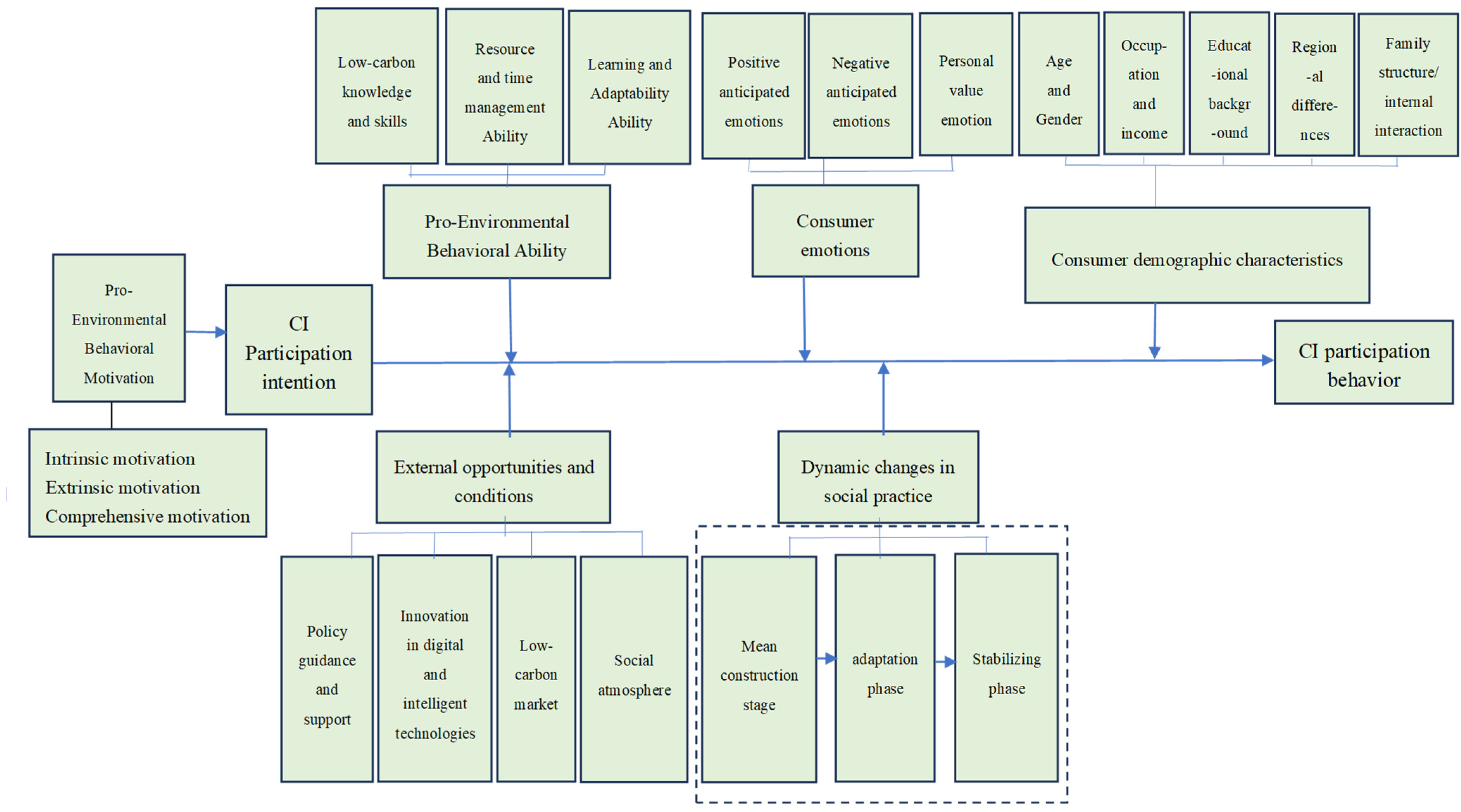
| Factors and mechanisms influencing the ‘intention–behavior’ gap in consumer participation in CI | Pro-environmental behavioral motivation → Participation intention in CI | The transformation of consumers’ pro-environmental behavioral motivation into their intention to participate in CI is a process of internal value identification. Consumers’ pro-environmental behavioral motivation directly determines their participation intention in CI. |
| Participation intention in CI → Participation behavior in CI | The participation intention for CI is the internal factor driving participation behavior in CI. The participate intention in CI directly determines consumers’ participation behavior. | |
Pro-environmental behavioral ability Participation intention in CI–Participation behavior in CI | As an internal contextual factor explaining the “intention–behavior” gap in consumers’ participation in CI, pro-environmental behavioral ability influences the strength and direction of “intention–behavior” relationship in CI participation. | |
Consumer emotions Participation intention in CI–Participation behavior in CI | As an internal contextual factor explaining the “intention–behavior” gap in consumers’ participation in CI, consumer emotions influence the strength and direction of “intention–behavior” relationship in CI participation. | |
Dynamic changes in social practice Participation intention in CI–Participation behavior in CI | As an external contextual factor explaining the “intention–behavior” gap in consumers’ participation in CI, dynamic changes in social practice influence the strength and direction of “intention–behavior” relationship in CI participation. | |
External opportunities and conditions Participation intention in CI–Participation behavior in CI | As an external contextual factor explaining the “intention–behavior” gap in consumers’ participation in CI, external opportunities and conditions influence the strength and direction of “intention–behavior” relationship in CI participation. |
Disclaimer/Publisher’s Note: The statements, opinions and data contained in all publications are solely those of the individual author(s) and contributor(s) and not of MDPI and/or the editor(s). MDPI and/or the editor(s) disclaim responsibility for any injury to people or property resulting from any ideas, methods, instructions or products referred to in the content. |
© 2026 by the authors. Licensee MDPI, Basel, Switzerland. This article is an open access article distributed under the terms and conditions of the Creative Commons Attribution (CC BY) license.
Share and Cite
He, Z.; Sun, H.; Wang, J. “I Am Willing, but Acting Is Hard”: Unpacking the Intention–Behavior Gap in Carbon Inclusivity Mechanisms Using Social Practice and MOA Theory. Sustainability 2026, 18, 8677. https://doi.org/10.3390/su18178677
He Z, Sun H, Wang J. “I Am Willing, but Acting Is Hard”: Unpacking the Intention–Behavior Gap in Carbon Inclusivity Mechanisms Using Social Practice and MOA Theory. Sustainability. 2026; 18(17):8677. https://doi.org/10.3390/su18178677
Chicago/Turabian StyleHe, Zhengxia, Hanhui Sun, and Jianming Wang. 2026. "“I Am Willing, but Acting Is Hard”: Unpacking the Intention–Behavior Gap in Carbon Inclusivity Mechanisms Using Social Practice and MOA Theory" Sustainability 18, no. 17: 8677. https://doi.org/10.3390/su18178677
APA StyleHe, Z., Sun, H., & Wang, J. (2026). “I Am Willing, but Acting Is Hard”: Unpacking the Intention–Behavior Gap in Carbon Inclusivity Mechanisms Using Social Practice and MOA Theory. Sustainability, 18(17), 8677. https://doi.org/10.3390/su18178677