4.2. Endogeneity Tests
Although the benchmark regression controls for a series of variables and two-way fixed effects, the model may still suffer from endogeneity bias due to omitted variables, measurement errors, or reverse causality. To mitigate possible endogeneity (especially reverse causality), we employ two complementary instrumental variable (IV) approaches.
4.2.1. Lagged Aging as an Instrumental Variable
First, we re-estimate the model using an IV approach, taking the second and third lags of the aging indicator as instruments.
Table 3 reports the IV (2SLS) estimation results based on these lagged terms. This choice is justified by the following considerations: the current agricultural industrial structure cannot affect the past age structure of the population, satisfying the exogeneity condition; meanwhile, population age structure is persistent, and past aging levels are highly correlated with current levels, satisfying the relevance condition.
We acknowledge that lagged values of aging may be correlated with long-term provincial characteristics such as economic development trajectories, urbanization patterns, or historical agricultural policies, which could in principle violate the exclusion restriction if these characteristics also affect current APS independently of their effect through aging. To address this concern, we include a rich set of time-varying controls and two-way fixed effects to absorb time-invariant provincial heterogeneity. The identifying assumption, therefore, is that conditional on these controls and fixed effects, the lagged aging variables affect APS only through current aging. This is plausible because the main channel through which past age structure affects current agricultural service demand is via its persistence in determining current labor force composition, rather than through direct historical influences on service markets. Nevertheless, we supplement the lagged-instrument approach with a Bartik-type instrument that relies on a different source of exogenous variation, and the consistency of results across these two strategies strengthens our confidence in the main findings.
As shown in
Table 3, the identification tests for the lagged instruments (Kleibergen–Paap rk LM
p = 0.000, F = 10.247, Hansen J
p > 0.1) indicate that the model is properly identified and the instruments are valid. After controlling for endogeneity, the positive effect of labor aging on agricultural productive services becomes more significant in magnitude and significance level.
However, it should be noted that the Kleibergen–Paap rk Wald F statistic (10.247) is below the Stock–Yogo 10% critical value (19.93), suggesting a potential weak instrument problem. This limitation is addressed by the second IV strategy (Bartik-type instrument) reported in
Section 4.2.2.
4.2.2. Bartik-Type Interaction Instrumental Variable
The Bartik-type instrument is constructed as follows. Let
denote the rural labor aging rate in province i in the base year 2010, and let
denote the national-level rural labor aging rate in year t (2011–2022). The instrument for province i in year t is defined as
The intuition behind this construction is that the national aging trend ( captures time-varying, economy-wide demographic shifts that are exogenous to any single province, while the base-year provincial aging rate ( captures cross-sectional variation that is predetermined and unaffected by subsequent agricultural structural changes. Their product generates exogenous cross-provincial variation in the predicted exposure to the national aging trend.
Relying only on lagged aging has limitations: lagged values may partly reflect long-term regional economic structural differences, weakening exogeneity. To strengthen identification, we construct an interaction instrumental variable following the Bartik [
35] shift-share approach. Specifically, we interact the provincial rural labor aging level in 2010 (the base year) with the national-level rural labor aging trend from 2011 to 2022. Their product captures the heterogeneous impact of the national aging trend across provinces, representing an exogenous, cross-provincial differential shock. On one hand, the base-period demographic structure is predetermined and unaffected by changes in agricultural industrial structure during the sample period (2011–2022), satisfying exogeneity; on the other hand, the national aging trend exhibits common time-series variation across provinces, ensuring sufficient correlation with local economic structural changes.
The exclusion restriction requires that the instrument affects agricultural productive services only through its effect on provincial labor aging, and not through any other channel. We argue that this condition is plausibly satisfied because the base-year aging rate is historically determined and is unlikely to be correlated with subsequent province-specific agricultural policy shocks or service market developments, except through its persistence in current aging levels. National demographic trends are driven by long-term fertility and migration patterns that are exogenous to agricultural service markets. The Hansen J tests reported in
Table 4 (
p > 0.1) do not reject the validity of the overidentifying restrictions, providing empirical support for the exclusion restriction.
The second-stage results further confirm the robustness of the benchmark regression: the coefficient of aging is 0.178, significant at the 1% level. This result corroborates the conclusion from the lagged instrument approach, confirming that after controlling for endogeneity, rural labor aging has a significant positive effect on agricultural productive services.
4.2.3. Summary of Endogeneity Tests
A natural question arises: why do the benchmark fixed-effects estimates (
Table 2) show an insignificant coefficient for aging, whereas the IV estimates (
Table 3 and
Table 4) reveal a significant positive effect? This discrepancy is not a contradiction but may be partly attributable to attenuation bias due to endogeneity in the baseline FE specification. Possible sources of this bias include measurement errors in the aging variable, omitted time-varying confounding factors (e.g., unobserved regional policy shocks or market conditions), or reverse causality from agricultural service development back to labor migration patterns. In such cases, the fixed-effects estimator may be biased toward zero. The IV approach, by isolating the exogenous component of rural aging through shift-share variation (Bartik instrument) and lagged demographic structure, helps to mitigate these potential biases and provides a more reliable estimate of the causal parameter of interest. This is a well-documented phenomenon in the empirical literature: when the treatment variable is measured with error or subject to reverse causation, IV estimates tend to be larger in magnitude than FE estimates once the instruments are valid [
36]. Given that our diagnostic tests (Kleibergen–Paap LM, Hansen J, and Cragg–Donald F) support the validity and relevance of our instruments, we interpret the IV estimates as the preferred causal evidence. The insignificant FE results, in turn, reflect the net balance of two opposing forces—demand-pull and adoption-inhibition—whose effects cancel out in a naive linear specification. This is precisely why a threshold model is needed to uncover the nonlinear structure underlying these two mechanisms.
4.4. Heterogeneity Analysis
To explore regional heterogeneity in the impact of rural labor aging on agricultural productive services, we divide the sample into four regions—eastern, central, western, and northeastern—following the classification of the National Bureau of Statistics of China, taking into account the distinct economic and demographic characteristics of the northeastern region. We also analyze separately based on topographical conditions (plain vs. non-plain areas).
4.4.1. Geographical Location
Table 7 reports the regional regression results. The impact of rural labor aging on agricultural productive services varies across regions: a significant negative effect is found in the northeast, a negative but insignificant effect in the central region, and positive but insignificant effects in the eastern and western regions. These differences reflect that the role of labor aging is moderated by regional factor endowments and development stages, which together determine the balance between the “demand-pull” and “adoption-inhibition” forces.
Specifically, the northeastern region exhibits a significant negative effect (coefficient = −0.127 ***). This provides strong evidence for the “inefficient scale management” trap proposed in this paper. Although the northeast has a nationwide leading foundation for land scale management, it has long suffered from severe out-migration and deep aging. As a result, the capacity of scale-management operators has not simultaneously upgraded, and human capital constraints are particularly prominent. Hence, the “adoption-inhibition” effect far outweighs the “demand-pull” effect, and the large scale of land actually reinforces reliance on traditional, low-level practices, suppressing the overall development of agricultural productive services.
The central region shows a negative but statistically insignificant effect (coefficient = −0.343). As a major grain-producing area, the central region has a relatively homogeneous agricultural production pattern. Labor aging may exacerbate this “structural lock-in”, making it difficult for service demand to diversify toward higher value-added activities. Meanwhile, factor substitution capacity is weaker than in the east but not as extreme as in the northeast, so the two forces largely offset each other, resulting in statistical insignificance.
The eastern region exhibits a positive but insignificant effect (coefficient = 0.083). With a well-developed socialized service system and abundant capital, the eastern region has the strongest factor substitution capacity, enabling it to rapidly fill the gaps created by labor aging and effectively satisfy the “demand-pull” effect. In addition, higher education levels mitigate the “adoption-inhibition” effect to some extent. Consequently, the direct impact of labor aging on agricultural productive services is buffered by these advantageous conditions, appearing statistically insignificant.
The western region also shows a positive but insignificant effect (coefficient = 0.204). Agricultural productive service development in the west is still at an early stage. The “demand-pull” effect of labor aging generates demand for basic services, driving positive growth. However, constraints in technology, capital, and human resources limit the magnitude and speed of this growth, so the overall effect is not significant.
In summary, the regional differences indicate that the direction and significance of the impact of rural labor aging on agricultural productive services depend on regional factor substitution capacity and development stage, exhibiting a distinctly nonlinear pattern.
4.4.2. Topographical Conditions
Table 8 reports that the impact of aging on agricultural productive services differs in direction between plain and non-plain areas.
In plain areas, the effect is negative but insignificant (coefficient = −0.068). Flat terrain creates natural conditions for large-scale mechanization to substitute for labor. However, it also makes the region more prone to the “inefficient scale management” trap. When labor aging intensifies, farmers can simply outsource mechanized tasks as a passive, low-threshold substitution. Yet, lacking pressure to upgrade and constrained by human capital in management, such scale operation often remains at an extensive level, generating insufficient demand for precise, intelligent, and new-type services. Thus, overall, it exerts a slight inhibitory effect on the development of agricultural productive services.
In non-plain areas (hills and mountains), the effect is positive but insignificant (coefficient = 0.087). Large-scale machinery substitution is hindered, which forces two possibilities: first, farmers must seek more refined and diversified services (e.g., small-scale machinery services, specialized plant protection teams) to solve production difficulties; second, local agriculture may shift toward specialty industries (e.g., fruit trees, traditional Chinese medicine) that rely more on local knowledge and experience, creating demand for new services such as marketing and brand building. Therefore, despite many unfavorable conditions, the “demand-pull” effect of labor aging in non-plain areas may stimulate differentiated development momentum for agricultural productive services.
In summary, geographical endowment differences between plain and non-plain areas moderate the intensity and direction of the impact of labor aging on agricultural productive services.
4.4.3. Summary
The above analyses reveal pronounced regional differentiation in the impact of rural labor aging on agricultural productive services. The root cause lies in differences in regional factor substitution capacity, which determine the ultimate transmission direction of the aging shock. In regions with strong factor substitution capacity (e.g., the eastern region), modern factors effectively buffer the negative impact of aging, making the net effect on agricultural productive services near neutral. In regions where factor substitution is physically constrained (e.g., non-plain areas), the “forced-substitution” mechanism may instead foster more resilient and locally distinctive service formats, exhibiting a potentially positive effect.
Therefore, policy design to address the aging challenge must go beyond a “one-size-fits-all” approach and move toward precise diagnosis of the core constraints of different regions, proposing differentiated solutions accordingly.
4.5. Threshold Effect
The insignificant benchmark regression results, combined with the theoretical interplay between the “demand-pull” and “adoption-inhibition” forces, suggest that the impact of rural labor aging is not constant but may exhibit a critical point or “turning point”. When the degree of aging is low, the “demand-pull” effect may dominate; when aging deepens beyond a certain level, the negative “adoption-inhibition” effect may become prominent.
To test this hypothesis, we employ a panel threshold regression model. As shown in
Table 9, the single-threshold model is statistically significant at the 5% level, while the double-threshold model is not. This indicates that the impact of rural labor aging on agricultural productive services is characterized by a single threshold. Therefore, we adopt the single-threshold model for subsequent analysis.
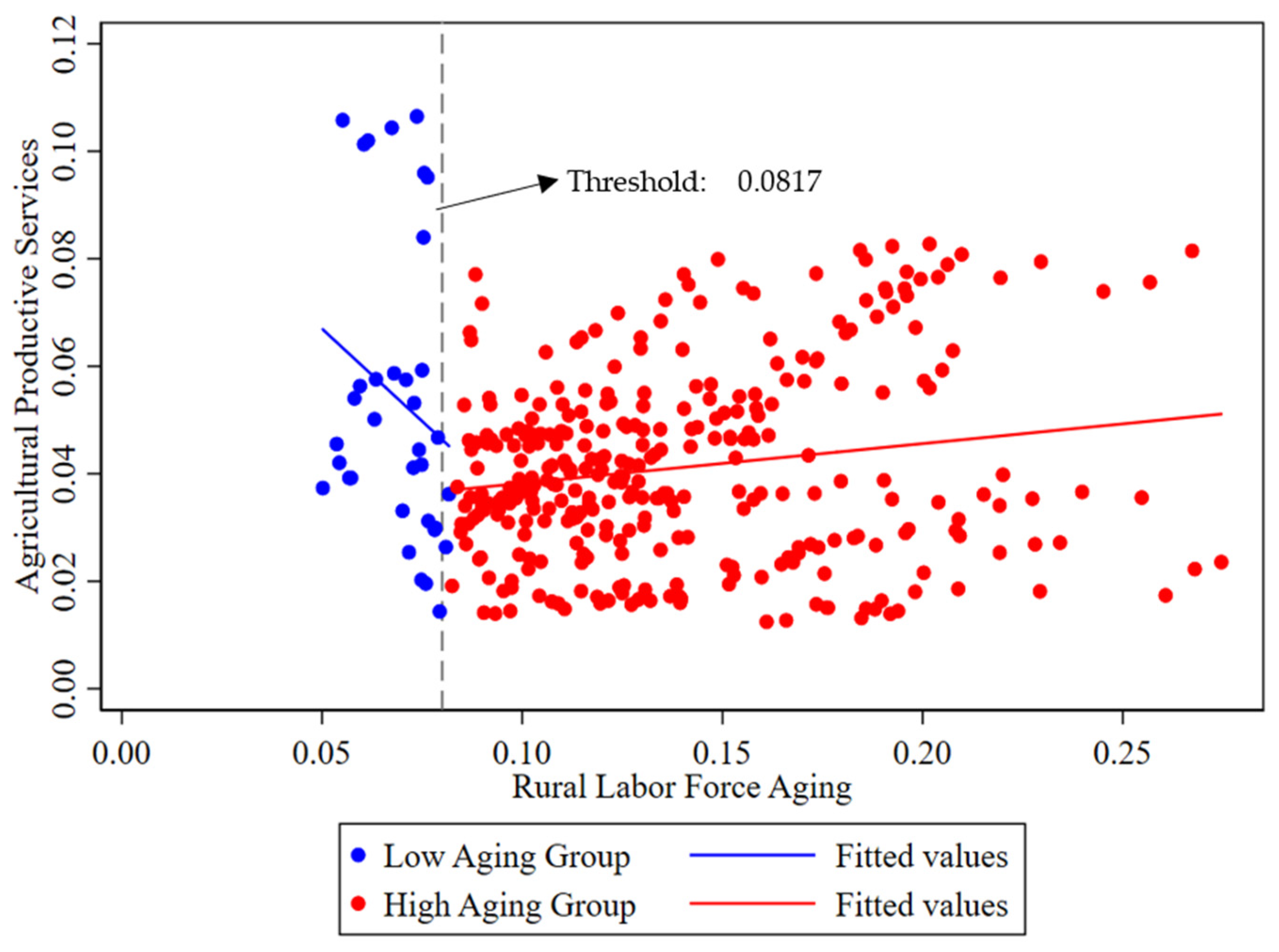
To visualize this nonlinear structure, we split the sample into a “low aging group” (aging rate ≤ 8.17%) and a “high aging group” (aging rate > 8.17%) and plot a scatter diagram.
As shown in
Figure 1, the slopes differ markedly between the two groups. In the low aging group (green dots), the level of agricultural productive services rises significantly with aging, and the fitted line has a relatively steep slope. In the high aging group (red dots), although the level of agricultural productive services also increases with aging, the fitted line is almost flat, indicating that the promoting effect of aging on productive services is substantially weakened.
Table 10 reports the single-threshold regression results. Before the threshold (aging ≤ 8.17%), the coefficient of aging is 0.2112 and significant at the 1% level, indicating that the “demand-pull” effect dominates at this stage. The substitution pressure caused by labor scarcity “forces” farmers to purchase services, acting as a strong catalyst for agricultural productive services. After crossing the threshold (aging > 8.17%), the promoting coefficient declines to 0.0676 (significant at the 5% level). This suggests that in the deep aging stage, the “adoption-inhibition” effect arising from human capital decline becomes prominent, severely weakening and offsetting the earlier “demand-pull” effect. The decline in learning ability, risk preference, and management capacity among older farmers becomes a bottleneck constraining the development of agricultural productive services.
From an economic perspective, the threshold value of 8.17% can be interpreted as a “turning point” in the impact of rural labor aging on agricultural productive services. When the aging level is low, labor scarcity raises labor costs, and older farmers adopt more technology and mechanized equipment to reduce dependence on human labor, promoting the transformation of agriculture toward servitization (a “dividend period”). However, when the aging level exceeds 8.17%, the disadvantages of declining physical strength, knowledge, and learning ability gradually become apparent. The innovation responsiveness of the agricultural sector weakens, and the negative effects of human capital decline gradually offset the substitution effect, leading to a diminishing marginal promoting effect of aging on agricultural productive services.
What does the 8.17% threshold mean in economic terms? In China‘s rural context, an aging rate of 8.17% represents the point at which the marginal benefit of labor substitution through productive services equals the marginal cost imposed by human capital decline. Below this level, the agricultural sector still has a sufficiently large pool of younger, more educated farmers who can effectively operate modern machinery and adopt new service models; the labor shortage created by out-migration generates strong demand for services without being offset by cognitive or behavioral barriers. Above this threshold, however, the proportion of older farmers exceeds a critical mass; the average learning ability, risk tolerance, and adaptive capacity of the agricultural workforce fall below the level required for effective adoption of high-order services. The 8.17% threshold is the point at which the two opposing forces are in balance, and beyond which the adoption-inhibition effect increasingly dominates. This interpretation is consistent with the behavioral economics literature, which suggests that cognitive decline and risk aversion intensify nonlinearly with age, particularly after the mid-50s [
21,
24].
This result suggests that, in the context of a continuously aging rural population, governments should adopt differentiated policies at different stages: in the low-aging stage, strengthen mechanization and technology diffusion; in the high-aging stage, implement agricultural technology extension and labor substitution policies to prevent structural upgrading from stagnating.
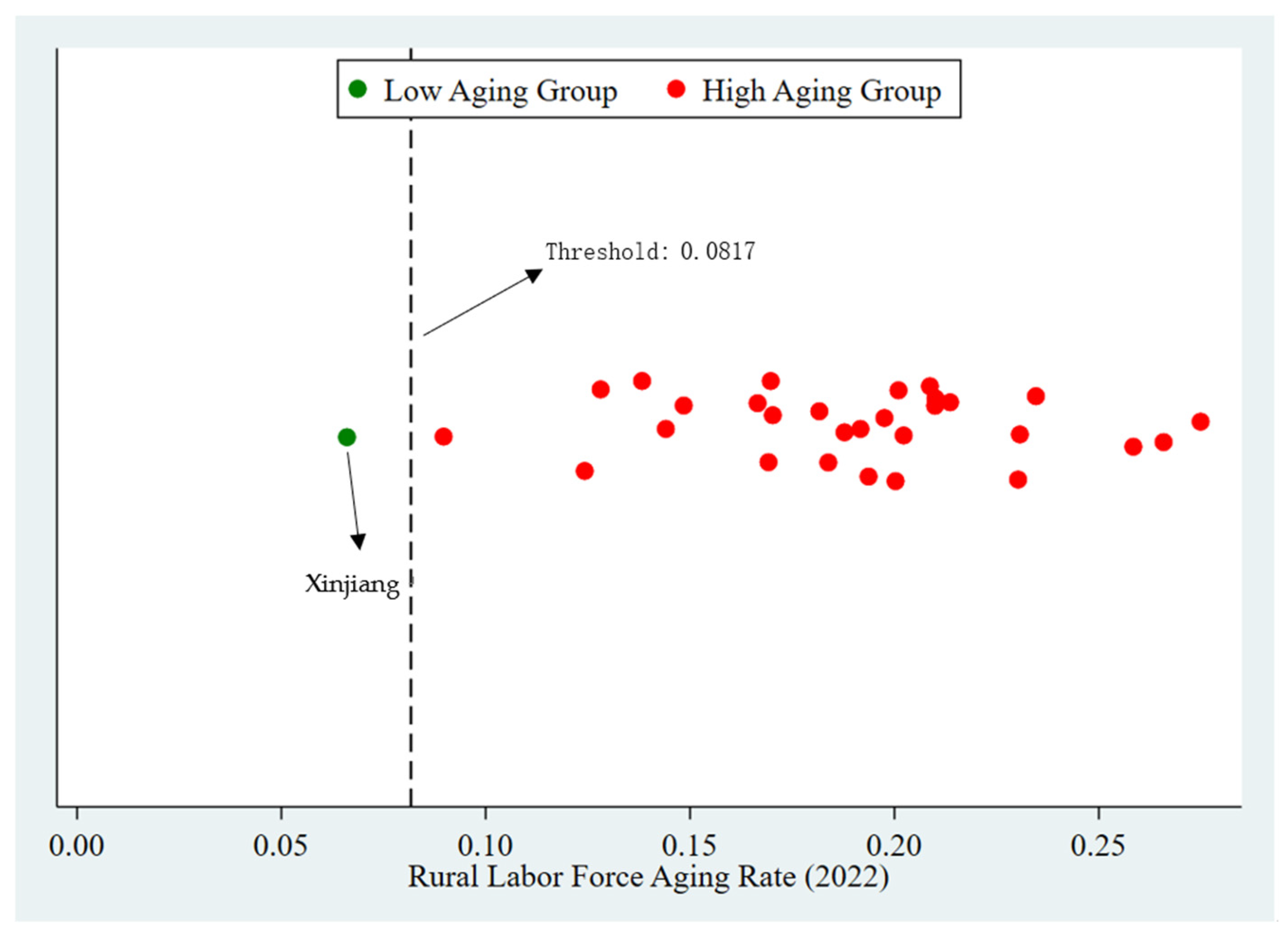
However, as shown in
Figure 2, by 2022, the rural aging level in the vast majority of provinces in our sample had already exceeded this threshold. This indicates that for most rural areas, the “dividend” of agricultural productive services from aging-induced labor scarcity has ended. Greater attention should be paid to addressing the challenges posed by “deep aging”. At this stage, negative effects such as human capital decline and reduced capacity to absorb new technologies dominate. Therefore, the policy focus should shift from the optimistic expectation of “using aging to force upgrading” to a strategy of “breaking the structural lock-in of deep aging”.
What specific micro-mechanisms cause the substantial decline in the promoting effect after crossing the threshold? Attributing it solely to “human capital decline” is insufficient. This paper hypothesizes that it is closely related to changes in land management practices. In the context of deep labor aging, land transfer is accelerating, but without the entry of high-quality management entities, the trap of “inefficient scale management” may emerge. Therefore, the next section will conduct an in-depth analysis of this mechanism.
To assess the stability of the threshold, we re-estimated the threshold model using the old dependency ratio (population aged 65 and above divided by the working-age population) as an alternative measure of rural aging. As reported in
Table 11, the single-threshold model remains statistically significant (
p = 0.018, bootstrap = 1000 replications), while the double-threshold model does not (
p = 0.219). The estimated threshold value under this alternative specification is approximately 0.1062, which is economically comparable to the baseline threshold of 8.17% when converted to the aging rate metric. Critically, the direction of the marginal effect is unchanged: the promoting effect of aging on service development weakens after crossing the threshold. These results confirm that the single-threshold pattern is not an artifact of the specific aging indicator used, but rather a robust empirical regularity.
4.6. Mechanism Test
Table 12 and
Table 13 present the results of the mechanism test. The specific analysis is as follows:
Column (1) shows that rural labor aging has a significant positive total effect on agricultural productive services (coefficient = 0.178, p < 0.01). Column (2) shows that aging has a positive but statistically insignificant effect on cultivated land scale operation (coefficient = 8.468, standard error = 11.733). Column (3) shows that after including the mediator variable, cultivated land scale operation has a significant negative effect on agricultural productive services (coefficient = −0.01, p < 0.05), while the direct effect of aging becomes insignificant (coefficient = 0.068, p > 0.1). The Bootstrap test further confirms that the indirect effect is −0.0072, with a 95% confidence interval of [−0.015, −0.001] (not including zero) and a p-value of 0.058 (marginally significant). This indicates that rural labor aging promotes the expansion of cultivated land scale operation, which in turn inhibits the development of agricultural productive services.
At first glance, the insignificant coefficient of aging on scale operation in column (2) of
Table 12 may appear to challenge the presence of a mediation effect. However, this pattern is a well-recognized phenomenon in the mediation literature, referred to as inconsistent mediation or a suppression effect [
37,
38]. In such cases, the direct effect (aging → APS) and the indirect effect (aging → scale operation → APS) have opposite signs, and their magnitudes are such that the total effect is significant while the X→M path may be insignificant in isolation. This occurs when the mediator acts as a ‘suppressor’ that masks or counteracts part of the direct effect. In our context, labor aging directly promotes APS through the demand-pull channel (positive direct effect), but simultaneously pushes land toward scale operation, which in turn inhibits APS (negative indirect effect). These two opposing forces operate in parallel; the net total effect is positive, but the indirect pathway is negative and significant when tested via bootstrap. The bootstrap method—which does not require the X→M path to be significant in the first step—is now widely recommended as a more robust approach to mediation testing because it directly tests the product of coefficients (a × b) and does not rely on the sequential significance of individual paths [
37,
38,
39]. Therefore, our finding of a significant indirect effect (−0.0072, 95% CI excluding zero) provides valid evidence for the negative mediating role of scale management, even though the X→M coefficient alone does not reach conventional significance levels.
While the bootstrap results provide statistical support for the indirect effect, it should be acknowledged that the direct pathway from aging to scale operation (column 2 of
Table 12) is statistically weak. This implies that, from a substantive perspective, the mediating role of cultivated land scale management should be interpreted with some caution. The indirect effect is significant, but its magnitude is modest (−0.0072), and the marginal significance of the bootstrap estimate (
p = 0.058) suggests that the mediation mechanism, while present, may not be the dominant channel through which aging affects agricultural productive services. Rather, it appears to be one of several mechanisms operating in parallel with the direct demand-pull effect. Future research with more disaggregated data and more direct measures of management efficiency would help to clarify the relative importance of this transmission channel.
Therefore, hypothesis H2 is supported. The above results demonstrate that “cultivated land scale operation” plays a significant negative mediating role in the process through which rural labor aging affects agricultural productive services.
Through the above analysis, it is clear that the impact of rural labor aging on agricultural productive services is not a simple linear relationship. On one hand, the deepening of labor aging increases farmers’ demand for agricultural machinery services, thereby promoting the development of agricultural productive services. On the other hand, older farmers experience declines in learning ability, capacity to adopt new technologies, and ability to cope with market risks. As a result, the land scale operation induced by labor scarcity lacks the corresponding human capital and knowledge structure updates. It is difficult to achieve the transition from “land scale expansion” to “upgrading of agricultural productive services”. Instead, it easily falls into the stage of “inefficient scale management” characterized by extensive management and technological stagnation (i.e., simple concentration of land factors without coordinated upgrading of technology, management, and services), thereby inhibiting the development of agricultural productive services.
Therefore, to unleash the potential of agricultural transformation in the context of rural labor aging, policy efforts should not blindly pursue land scale. Instead, they must focus on breaking the trap of “inefficient scale management” and ensure that land flows to entities capable of achieving the coordinated advancement of land scale operation and service upgrading.