Article

Sustainable Fine Dining: Evidence from Two Studies on Consumer Responses to Michelin Green Star Restaurants


Department of Psychology, Catholic University of the Sacred Heart, 20123 Milan, Italy
*
Author to whom correspondence should be addressed.
Sustainability 2026, 18(15), 8007; https://doi.org/10.3390/su18158007
Submission received: 14 July 2026 / Revised: 1 August 2026 / Accepted: 3 August 2026 / Published: 6 August 2026

Abstract

Michelin Green Star restaurants combine sustainability with high-end dining, yet it remains unclear whether motivation to visit and willingness to pay reflect the same psychological process. Across two studies, we examined differentiated consumer responses to this hybrid context and the role of sustainability communication. Study 1 used survey data from 526 participants and structural equation modeling. Visit intention was positively associated with descriptive norms (β = 0.254), perceived behavioral control (β = 0.356), and positive anticipated emotions (β = 0.302). Green consumer orientation, luxury restaurant hedonism, and perceived sustainability were indirectly associated with intention, mainly through positive anticipated emotions. Willingness to pay showed a narrower pattern, being positively associated with perceived behavioral control (β = 0.171) and luxury restaurant hedonism (β = 0.359), whereas sustainability-related distal antecedents showed no significant direct or indirect associations with this outcome. Study 2 experimentally compared practice-based and experience-based messages among 102 participants. The messages did not differ in their average effects, although intention increased overall following exposure. The interaction between message condition and green consumer orientation predicted post-message positive anticipated emotions (b = 0.447), and the index of moderated mediation through positive anticipated emotions was significant (index = 0.200, 95% bootstrap CI [0.069, 0.418]). Overall, motivational readiness and stated monetary allocation appear to reflect partly distinct processes, while the preliminary experimental findings suggest that communication effects depend on the alignment between communication orientation and consumers’ environmental orientation.

1. Introduction

Sustainability has become an increasingly salient issue in the restaurant industry. Restaurants contribute to environmental and social challenges through food sourcing, energy use, waste production, menu design, and service practices, but they can also become visible sites for promoting more sustainable forms of consumption [1,2,3]. In response to growing environmental concerns, many restaurants have adopted sustainability-oriented practices, giving rise to what the literature has described as green, sustainable, eco-friendly, or environmentally responsible restaurants [1,3]. Recent systematic evidence shows that green restaurant research has expanded substantially over the last decade, reflecting increasing academic and managerial interest in how restaurants can reduce their ecological impact while maintaining attractive dining experiences [3].
Michelin Green Star restaurants provide a particularly informative context in which to examine these issues. Unlike conventional green restaurants, they combine sustainability commitments with fine dining, culinary excellence, and high-end experiential consumption [4,5]. Sustainable gastronomy emphasizes local and seasonal sourcing, waste reduction, environmental responsibility, ethical practices, and relationships with local communities, whereas fine dining is associated with sensory pleasure, craftsmanship, innovation, exclusivity, and memorable experiences [4,5,6,7,8,9]. Michelin Green Star restaurants therefore represent a hybrid consumption context in which responsibility and indulgence coexist. Sustainability may enrich the perceived authenticity, distinctiveness, and meaning of the dining experience, but it may have limited influence when responsible practices are not visible, credible, or personally relevant to consumers [10,11,12].
Research specifically addressing Michelin Green Star restaurants is emerging but remains limited compared with the broader literature on green restaurants, luxury dining, and sustainable hospitality. Existing studies have primarily examined the sustainability characteristics and practices of these restaurants, their contribution to memorable dining experiences, and the ways in which sustainability is communicated [4,5,10,12]. More recent consumer research has moved beyond classical behavioral models by integrating the Theory of Planned Behavior and the Norm Activation Model to explain responsible luxury consumption in Michelin Green Star restaurants [5]. Building on this work, however, two issues remain insufficiently examined.
First, previous research has not explicitly compared consumers’ motivational readiness to visit Michelin Green Star restaurants with the maximum amount they state they would spend on the dining experience. These outcomes may be related, but they are not equivalent. Consumers may be interested in sustainable fine dining without being prepared to allocate substantial financial resources to it, whereas attraction to and familiarity with high-end dining may be particularly relevant to stated expenditure. It therefore remains unclear whether visit intention and maximum stated expenditure share the same psychological antecedents or represent partially differentiated consumer responses.
Study 1 addressed this issue using the TPB as a common proximal framework for examining consumer decision-making. Attitude, social norms, and perceived behavioral control were included to capture consumers’ evaluations, perceived social influence, and perceived feasibility of visiting Michelin Green Star restaurants [13]. Injunctive and descriptive norms were considered separately because perceived social approval and perceptions of others’ behavior represent conceptually distinct sources of normative influence. Past behavior was incorporated as an experiential extension of the TPB and differentiated across previous experience with sustainable restaurants, luxury restaurants, and restaurants combining sustainability and luxury. Positive anticipated emotions were included as an affective extension to capture the satisfaction, pride, and happiness that consumers expected to experience during a future visit [14,15,16].
The model also includes three context-relevant distal predictors operating at different levels of specificity. Green consumer orientation reflects a broad individual orientation toward environmentally responsible consumption. Luxury restaurant hedonism represents a domain-specific attraction to the pleasurable, sensory, and experiential qualities of high-end dining. Perceived sustainability represents a target-specific appraisal of the environmental and social responsibility of Michelin Green Star restaurants. These distal factors may shape consumers’ attitudes and anticipated emotions and may also be directly or indirectly associated with visit intention and maximum stated expenditure. By examining these components within the same framework, Study 1 tested whether cognitive-evaluative, normative, feasibility-related, experiential, affective, sustainability-related, and luxury-dining factors are similarly or differently associated with the two outcomes.
Second, it remains unclear how the hybrid value of sustainable fine dining should be communicated to consumers. Michelin Green Star restaurants implement and communicate sustainability through multiple themes, including local sourcing, seasonality, waste reduction, sustainable supply chains, community initiatives, entrepreneurial values, and third-party recognition [10]. However, research has identified a gap between the sustainability practices that restaurants implement and those they communicate, indicating that responsible practices do not automatically become visible, credible, or valuable to consumers [12]. Communication may emphasize the concrete actions through which restaurants pursue sustainability or translate those actions into the pleasurable, authentic, and memorable qualities of the dining experience [6].
This distinction is consistent with research in health, food, and sustainable consumption communication, which has differentiated informational or instrumental appeals from affective or transformational appeals [17,18,19,20]. These approaches may activate different psychological processes: practice-oriented communication may make sustainability concrete and verifiable, whereas experience-oriented communication may connect it to pleasure, emotional meaning, authenticity, and memorability. Nevertheless, their relative implications for consumer responses to Michelin Green Star restaurants remain insufficiently understood.
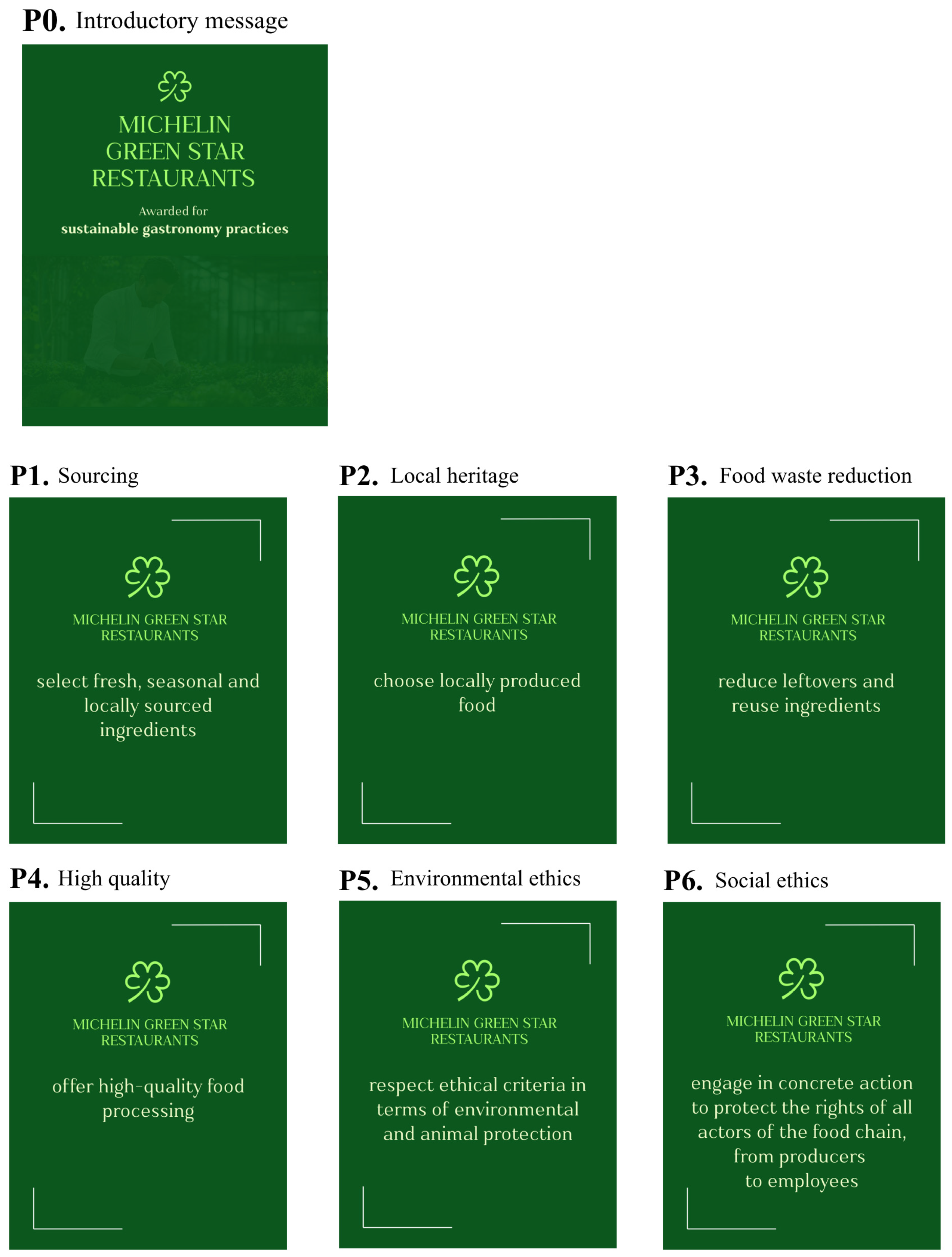
Study 2 therefore complemented Study 1 by experimentally comparing two communication orientations organized around parallel sustainability pillars. A practice-based message foregrounded the environmental and social actions adopted by Michelin Green Star restaurants, whereas an experience-based message emphasized the personal and experiential implications of sustainable fine dining for consumers. The study examined whether the two message conditions were differentially associated with post-message attitude, positive anticipated emotions, and visit intention after accounting for their corresponding pre-message levels.
It also investigated whether these relative associations varied according to green consumer orientation, because explicit sustainability practices may be more personally relevant to strongly environmentally oriented consumers, whereas experiential communication may connect sustainability to pleasure and memorability among consumers for whom environmental considerations are less central.
By combining a correlational study of psychological predictors with an experimental comparison of two communication orientations, the present research contributes to Michelin Green Star and sustainable hospitality research in three ways. First, it provides a consumer-focused examination specifically situated in the Michelin Green Star context, where sustainability commitment, Michelin recognition, and high-end dining coexist. Second, it distinguishes visit intention from maximum stated expenditure and examines whether core TPB mechanisms, different forms of previous dining experience, positive anticipated emotions, and context-specific consumer orientations and restaurant appraisals are similarly or differently associated with these responses. Third, it connects the explanatory framework to sustainability communication by experimentally examining whether practice-based and experience-based messages engage affective and motivational processes differently depending on consumers’ green orientation. The contribution therefore lies not in simply increasing the number of predictors included in an extended TPB, but in clarifying how consumers respond to the coexistence of sustainability and high-end experiential consumption and how this hybrid positioning may be communicated.

2. Study 1: Predictors of Visit Intention and Willingness to Pay for Michelin Green Star Restaurants

2.1. Theoretical Background

Building on the distinction introduced in the preceding section, Study 1 examined whether visit intention and maximum stated expenditure were associated with the same or different psychological components. The framework comprises three theoretically distinct layers: core TPB predictors, experiential and affective extensions, and context-specific distal antecedents. This structure allows us to examine how these components are associated with two related but non-equivalent consumer responses.

2.1.1. Core TPB Predictors and Consumer Outcomes

The TPB conceptualizes behavioral intention as a function of attitude, subjective norm, and perceived behavioral control [14]. It has been widely applied to restaurant-related consumer decisions and is among the most frequently used theoretical frameworks in green restaurant research [3].
Although the TPB primarily explains behavioral intention, consumer research has often examined intention together with willingness to pay when a behavioral choice involves purchasing a product or experience. These outcomes are related but conceptually distinct: visit intention reflects motivational readiness, whereas willingness to pay captures consumers’ economic commitment to a product, service, or attribute [19,21,22,23], assessed in this study as the maximum amount consumers state they would allocate to the described dining experience. Consumers may therefore intend to visit a Michelin Green Star restaurant without being willing to spend a correspondingly high amount [24]. Nevertheless, stronger visit intention may be associated with greater willingness to pay. Accordingly, we hypothesized:
Hypothesis 1 (H1).
Visit intention will be positively associated with willingness to pay for a tasting menu at Michelin Green Star restaurants.
Attitude is a central predictor of consumers’ intentions to visit green restaurants [1,2,25,26,27] and luxury restaurants [7,28]. Prior research on Michelin Green Star restaurants has also found attitude to be positively associated with responsible luxury intention [5]. Attitude may additionally be relevant to willingness to pay, although previous studies have operationalized this outcome differently. Attitudes toward green consumerism have been associated with the price premium consumers are willing to pay for green restaurants [29], while attitude has also been linked to the intention to pay conventional hotel prices for a green hotel [30]. These findings suggest that favorable evaluations of Michelin Green Star restaurants may be associated with both visit intention and willingness to pay. Accordingly, we hypothesized:
Hypothesis 2 (H2).
Attitude towards Michelin Green Star restaurants will be positively associated with consumers’ visit intention (H2a) and willingness to pay (H2b).
Subjective norm is another core TPB component and has been positively associated with consumers’ intentions to visit environmentally responsible restaurants [1,2]. Social-norm research distinguishes between injunctive norms, which refer to perceived social approval or disapproval, and descriptive norms, which refer to perceptions of what other people do [31,32]. Meta-analytic evidence indicates that these forms of normative influence are conceptually distinct and that descriptive norms may contribute to behavioral intention beyond the conventional subjective-norm measures [33,34].
This distinction appears particularly relevant to sustainable food and restaurant choices. Descriptive norms have been associated with both reported and intended selection of sustainable dishes, whereas injunctive norms have not [35]. TPB-based normative measures have also been implicated in willingness to pay more in locally sourced and socially sustainable restaurant contexts [36,37], although these studies did not distinguish between injunctive and descriptive norms. In the context of Michelin Green Star restaurants, consumers may respond both to whether significant others approve of visiting these restaurants and to whether such visits are perceived as occurring within their social environment. Accordingly, we hypothesized:
Hypothesis 3 (H3).
Injunctive norms will be positively associated with consumers’ visit intention (H3a) and willingness to pay for Michelin Green Star restaurants (H3b).
Hypothesis 4 (H4).
Descriptive norms will be positively associated with consumers’ visit intention (H4a) and willingness to pay for Michelin Green Star restaurants (H4b).
Perceived behavioral control refers to the extent to which performing a behavior is considered feasible and within one’s control. In green restaurant contexts, it has been associated with consumers’ intention to dine at environmentally responsible restaurants [1,2,28]. It has also been linked to willingness to pay a premium for locally sourced food in restaurant contexts [36], and included among the TPB components explaining willingness to pay in socially sustainable restaurant contexts [37]. In the present context, financial resources, accessibility, planning, and familiarity with fine-dining conventions may influence both the feasibility of visiting a Michelin Green Star restaurant and the amount consumers are prepared to spend. Accordingly, we hypothesized:
Hypothesis 5 (H5).
Perceived behavioral control will be positively associated with consumers’ visit intention (H5a) and willingness to pay for Michelin Green Star restaurants (H5b).

2.1.2. Experiential and Affective Extensions of the TPB

Beyond its core predictors, the TPB can be extended by including past behavior and positive anticipated emotions, which capture distinct temporal dimensions of decision-making. Past behavior reflects accumulated experience, familiarity, and continuity with previous choices and may predict future behavior beyond attitudes, subjective norms, and perceived behavioral control [38]. Positive anticipated emotions instead capture the expected affective consequences of a future restaurant visit. In the context of Michelin Green Star restaurants, past experience cannot be represented by a single general measure because these restaurants combine sustainability and luxury. Experience with sustainable restaurants reflects familiarity with environmentally responsible dining, experience with luxury restaurants reflects familiarity with premium prices and fine-dining conventions, and experience with sustainable luxury restaurants captures familiarity with the intersection of these domains. Given the limited evidence regarding which type of experience is most relevant, these three forms should be examined separately.
Research Question 1 (RQ1).
Which form(s) of past behavior—past behavior toward green restaurants, luxury restaurants, or green luxury restaurants—are associated with consumers’ visit intention (RQ1a) and willingness to pay for Michelin Green Star restaurants (RQ1b)?
Positive anticipated emotions constitute a further affective extension of the TPB, capturing the feelings individuals expect to experience if they perform a behavior. As prospective affective forecasts rather than current emotional reactions, they may influence decisions by making a future action appear emotionally rewarding [15,39]. This component is particularly relevant in restaurant contexts, where consumers evaluate not only quality, cost, and feasibility, but also how the experience is likely to make them feel. Previous studies support their role in restaurant-related intentions. Anticipated regret has been incorporated into the TPB to explain intentions to choose eco-friendly restaurants [40], while positive anticipated emotions have been associated with the hedonic, utilitarian, and social value of dining out and, indirectly, with dining-out intentions [14]. Similar associations have also been observed across restaurant and food-service channels [41]. In sustainable consumption, positive anticipated emotions may be particularly relevant because they capture the expected emotional reward of acting consistently with environmental goals. Anticipating pride from pro-environmental action may increase behavioral intentions more strongly than anticipating guilt from inaction [16,42]. Consumers considering Michelin Green Star restaurants may therefore evaluate not only the desirability, feasibility, and social approval of the visit, but also the pleasure, satisfaction, pride, or moral reward associated with choosing a prestigious sustainable dining experience. However, to our knowledge, no previous study has examined positive anticipated emotions in this context. The present study therefore considered them as proximal affective predictors of visit intention and willingness to pay.
Hypothesis 6 (H6).
Positive anticipated emotions will be positively associated with consumers’ visit intention (H6a) and willingness to pay for Michelin Green Star restaurants (H6b).

2.1.3. Context-Specific Distal Antecedents

Beyond the core TPB predictors and their experiential and affective extensions, consumers’ responses may also be shaped by context-specific antecedents operating at different levels of specificity. Green consumer orientation is an umbrella construct capturing the extent to which sustainability is salient and self-relevant to consumers, encompassing related concepts such as environmental self-identity, sustainability consciousness, and green consumerism [43,44]. Identity-based and value-congruence perspectives suggest that consumers are more likely to support consumption options consistent with personally important values and self-definitions [45,46]. Consistent with this, hospitality research links internalized environmental dispositions and perceptions of firms’ environmental initiatives to green behavioral intentions, including patronage and willingness to pay [47]. In food-service contexts, green consumerism and green perceived value predict revisit intention [48], while green self-identity has been associated with favorable restaurant image, warm glow, willingness to purchase, and continued revisit intention following service failure [49,50]. Evidence in premium dining remains limited, although sustainability consciousness has been linked to green purchase intention in luxury restaurants [51], whereas willingness to pay appears more conditional on price sensitivity and the communication of environmental value. To our knowledge, no study has examined green consumer orientation in relation to Michelin Green Star recognition. Consumers with a stronger green orientation may perceive these restaurants as self-congruent settings, fostering favorable attitudes, positive anticipated emotions, visit intention, and willingness to pay. Accordingly, green consumer orientation was included as a distal predictor of these outcomes.
Hypothesis 7 (H7).
Green consumer orientation will be positively associated with consumers’ attitudes (H7a), positive anticipated emotions (H7b), visit intention (H7c), and willingness to pay for Michelin Green Star restaurants (H7d). In addition, green orientation will be indirectly associated with visit intention through attitudes and positive anticipated emotions (H7e), indirectly associated with willingness to pay through attitudes and positive anticipated emotions (H7f), and indirectly associated with willingness to pay through visit intention (H7g).
Luxury restaurant hedonism reflects a domain-specific consumer orientation toward the pleasurable, sensory, and experiential qualities of fine dining. Hedonic consumption is driven by emotional, sensory, and imaginative responses to products and services [47]. These motives are particularly salient in luxury contexts, where pleasure, novelty, escapism, and emotional stimulation contribute to perceived value [48]. In the present study, luxury restaurant hedonism was therefore conceptualized as a consumer disposition toward luxury dining rather than as a measure of the perceived luxuriousness of Michelin Green Star restaurants. Hospitality research indicates that customer hedonism is positively associated with satisfaction, perceived value, and behavioral intentions [52]. Meta-analytic evidence further identifies hedonic value as an antecedent of satisfaction and behavioral intentions as a consequence of satisfaction [53]. Service quality, service scape, exclusivity, branding, and personalization have also been identified as antecedents of customer hedonism [54], whereas hedonism, ambiance, escapism, personalization, and convenience contribute to guests’ overall experience in luxury hotels [54]. Luxury restaurant hedonism may be particularly relevant to Michelin Green Star restaurants because these venues combine environmental commitment with the sensory and experiential attributes of high-end dining. Consumers who are more strongly attracted to luxury dining may evaluate these restaurants more favorably, anticipate greater pleasure and emotional reward from visiting them, and report stronger visit intentions and willingness to pay. Luxury restaurant hedonism may also contribute indirectly to these outcomes through attitude and positive anticipated emotions. Accordingly, we hypothesized:
Hypothesis 8 (H8).
Luxury restaurant hedonism will be positively associated with consumers’ attitudes (H8a), positive anticipated emotions (H8b), visit intention (H8c), and willingness to pay for Michelin Green Star restaurants (H8d). In addition, luxury restaurant hedonism will be indirectly associated with visit intention through attitudes and positive anticipated emotions (H8e), indirectly associated with willingness to pay through attitudes and positive anticipated emotions (H8f), and indirectly associated with willingness to pay through visit intention, including serial pathways involving attitudes and positive anticipated emotions (H8g).
At a more target-specific level, consumers’ responses to Michelin Green Star restaurants may depend on the extent to which they perceive these restaurants as socially and environmentally sustainable. Such perceptions may shape both cognitive and affective evaluations. In food-service settings, perceived eco-friendly practices have been found to strengthen green image and, subsequently, customer attitudes [55], while restaurant green practices have been associated with more favorable attitudes, emotional attachment, and satisfaction [25]. Sustainability communication may also produce more positive attitudes when it is consistent with consumers’ own understanding of sustainability [56]. Moreover, recent restaurant research indicates that perceived sustainability-related corporate responsibility positively influences positive anticipated emotions, which subsequently contribute to behavioral intention [57]. Perceived sustainability may also contribute to consumers’ behavioral and economic responses. Perceived product sustainability has been positively associated with purchase intention [58] and with willingness to pay more for luxury products, both directly and through increased consumer desire [59]. Sustainability-related perceptions have also been associated with willingness to pay for food-packaging alternatives [60], while restaurant research documents consumers’ willingness to pay for green dining options [29]. Accordingly, perceived sustainability was examined as a predictor of attitude, positive anticipated emotions, visit intention, and maximum stated willingness to pay.
Hypothesis 9 (H9).
Perceived sustainability of Michelin Green Star restaurants’ sustainability commitment will be positively associated with consumers’ attitudes (H9a), positive anticipated emotions (H9b), visit intention (H9c), and willingness to pay (H9d). In addition, perceived sustainability will be indirectly associated with visit intention through attitudes and positive anticipated emotions (H9e), indirectly associated with willingness to pay through attitudes and positive anticipated emotions (H9f), and indirectly associated with willingness to pay through visit intention, including serial pathways involving attitudes and positive anticipated emotions (H9g).
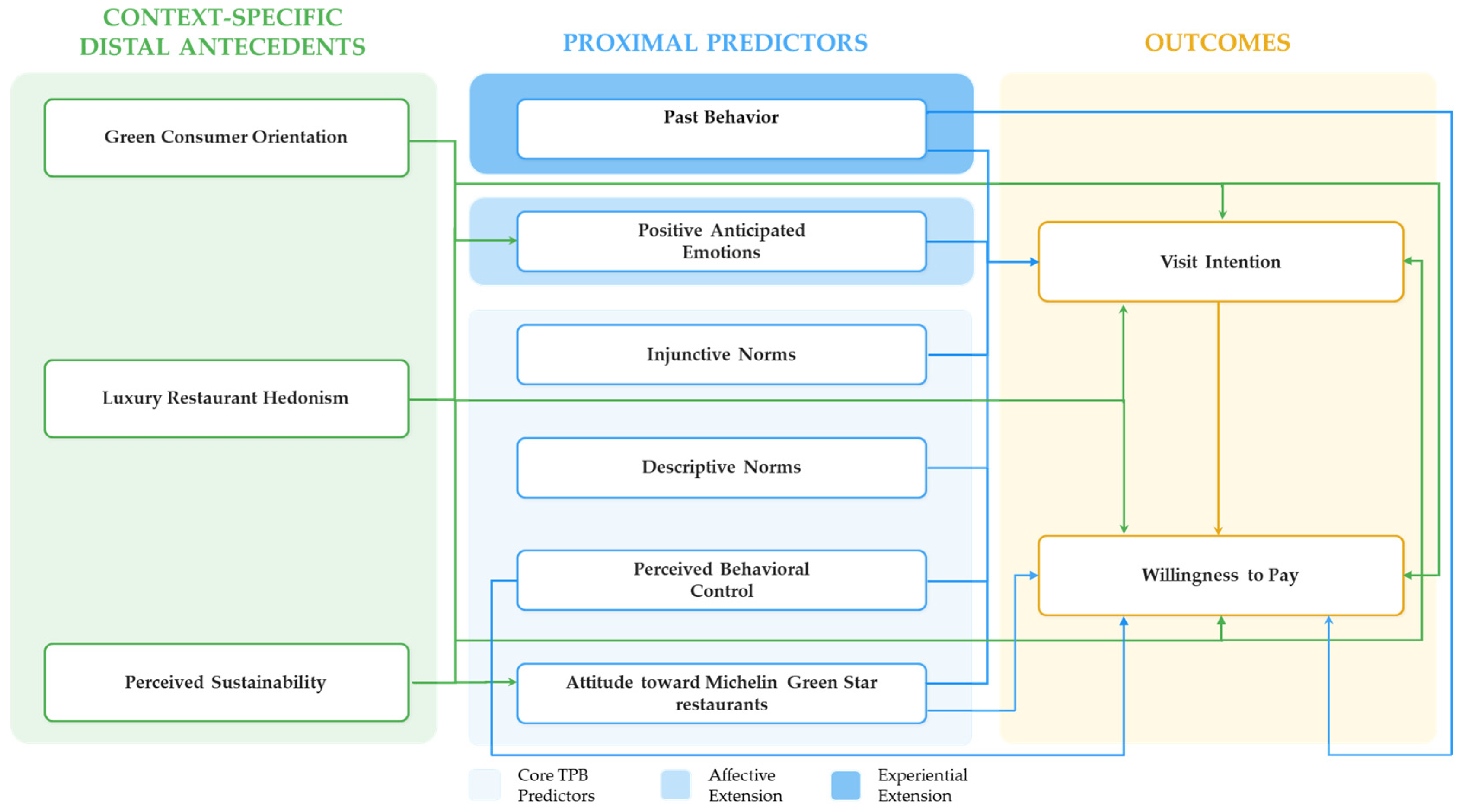
Taken together, these hypotheses outline a model in which proximal TPB predictors, past behavior, positive anticipated emotions, and broader distal factors jointly contribute to visit intention and willingness to pay. The resulting conceptual model is presented in Figure 1.

2.2. Methods

2.2.1. Participants and Procedure

Ethical approval was granted by the Ethics Committee for Research in Psychology (CERPS), Department of Psychology, Catholic University of the Sacred Heart, Milan (14 April 2026, protocol number 31/26).
Participants were recruited via Prolific (Prolific Academic Ltd., London, UK) in May 2026. The study was presented as an online survey on dining-out habits, personal beliefs, and attitudes toward food services. Eligibility was restricted to Italian residents aged 18 years or older. Before accessing the questionnaire, participants received information about the study aims, voluntary participation, anonymity/confidentiality, data processing, and their right to withdraw, and provided informed consent. The survey lasted approximately 9 min, and the average compensation of €10.44 was issued through Prolific following completion and researcher approval.
An a priori power analysis was conducted using Soper’s A priori Sample Size Calculator for Structural Equation Models. The model included 11 latent variables and 36 observed variables, comprising 33 observed dependent variables and three observed exogenous predictors. Assuming α = 0.05, power = 0.80, and a medium anticipated effect size of 0.20, the estimated minimum sample size was 488 for detecting the specified effect and 163 for the model structure. The larger estimate of 488 was therefore adopted as the required minimum.
Eleven respondents failed the attention checks and were excluded from the dataset. The final analytic sample comprised 526 participants, exceeding the recommended minimum and suggesting that the study was adequately powered to estimate the overall SEM under these assumptions.
Sociodemographic information was available for 500 participants. Of these, 254 (50.8%) identified as male, 241 (48.2%) as female, and 5 (1.0%) preferred not to disclose their gender. Most participants were aged 18–34 years (n = 302, 60.4%), followed by those aged 45 years or older (n = 135, 27.0%) and 35–44 years (n = 63, 12.6%).
Household income was reported by 415 participants, whereas 85 (17.0%) declined to provide it. Among respondents, 38 (9.2%) reported an income below €10,000, 68 (16.4%) between €10,000 and €19,999, 81 (19.5%) between €20,000 and €29,999, 64 (15.4%) between €30,000 and €39,999, 45 (10.8%) between €40,000 and €49,999, 53 (12.8%) between €50,000 and €74,999, and 66 (15.9%) €75,000 or more.
Regarding education, 12 participants (2.4%) had completed primary school, 190 (38.0%) held a high school diploma, 16 (3.2%) a technical high school diploma, 128 (25.6%) a bachelor’s degree or equivalent, 138 (27.6%) a master’s degree, and 16 (3.2%) a doctorate or PhD. Sociodemographic information was unavailable for 26 participants.

2.2.2. Measures

A questionnaire comprising different psychological and behavioral measures was administered via Qualtrics (Qualtrics LLC, Provo, UT, USA). The full wording of all items is provided in Appendix A, Table A1.
Attitude toward Michelin Green Star restaurants. Attitudes toward dining at Michelin Green Star restaurants were assessed using a six-item, 6-point semantic differential scale [21], with three affective bipolar adjective pairs and three cognitive adjective pairs.
Social norms. Social norms were assessed with four items [21] measured on a 7-point Likert scale ranging from 1 (strongly disagree) to 7 (strongly agree). The first two items captured injunctive norms, that is, the perception of social approval. The remaining two items were selected to capture complementary forms of descriptive normative information. The item “Most people I know go to restaurants with a Michelin Green Star” assessed a static personal descriptive norm, referring to the current behavior of people known to the respondent. The item “In recent years, more people are starting to dine at restaurants with a Michelin Green Star” assessed a dynamic general descriptive norm, referring to the perceived increase in the prevalence of this behavior over time. Because these two items differ in both their social referent and temporal framing, their unique associations with the study outcomes were also examined separately in a sensitivity analysis.
Perceived behavioral control. To measure perceived behavioral control, participants rated their agreement with three items adapted from [13] on a 7-point Likert scale from 1 (strongly disagree) to 7 (strongly agree).
Past behavior. Past behavioral frequency was assessed using three single-item measures, each asking participants how many times in the last 12 months they had dined at a luxury restaurant, a sustainable restaurant, and a sustainable luxury restaurant, respectively—adapted from [61]. Responses were recorded on a 5-point ordinal scale ranging from “never” to “more than 5 times”.
Positive anticipated emotions. Three items adapted from [21] were employed to measure positive anticipated emotions, on a 7-point Likert scale ranging from 1 (strongly disagree) to 7 (strongly agree).
Green consumer orientation. Green orientation was measured asking participants to express their level of agreement with five items adapted from [29] on a 7-point Likert scale: “I always prefer an environmentally friendly version of a product”; “I engage in pro-environmental behaviors”; “I am concerned about protecting the environment”; “I consider myself an environmentally conscious consumer”; “In my opinion, companies should take measures to protect the environment”.
Luxury restaurant hedonism. Hedonic motivations toward luxury restaurants were captured through five items adapted from [9], measured on a 7-point Likert scale ranging from 1 (strongly disagree) to 7 (strongly agree).
Perceived sustainability. Perceived sustainability of Michelin Green Star restaurants was assessed with four items adapted from [11], on a 7-point Likert scale ranging from 1 (strongly disagree) to 7 (strongly agree).
Visit Intention. Intention to visit Michelin Green Star restaurants was measured with three items (adapted from [62]) on a 7-point Likert scale ranging from 1 (strongly disagree) to 7 (strongly agree).
Willingness to pay. Willingness to pay was measured using a single-item continuous slider scale. Participants were shown three example tasting menus from Michelin Green Star restaurants (meat-based, fish-based, and vegetarian) and informed that the average total cost per person at such restaurants is approximately €150.00. The question read: “What is the maximum price you would be willing to pay for a tasting menu at a Michelin Green Star restaurant (cost per person)?” Responses were recorded on a slider ranging from €0.00 to €300.00, in increments of €1.
Michelin Green Star awareness. Michelin Green Star awareness was assessed using a single dichotomous item asking participants whether they were already aware of the Michelin Green Star before participating in the study (no/yes). This measure captured prior familiarity with the specific restaurant designation and was included as a background covariate in the covariate-adjusted robustness analysis.

2.2.3. Data Analyses

Six nested structural models were estimated using Mplus (Version 8.3; Muthén & Muthén, Los Angeles, CA, USA) to assess the incremental contribution of theoretically relevant predictor blocks. All models retained the same constructs and measurement structure. Mplus default covariances were suppressed using MODEL = NOCOVARIANCES, while the same 49 prespecified covariances were freely estimated through identical WITH statements. All other unspecified covariances and residual covariances were fixed to zero. Consequently, the models differed only in the regression paths freely estimated at each step.
Model 1, the baseline TPB model, included paths from attitude, injunctive norm, descriptive norm, and perceived behavioral control to visit intention and willingness to pay, as well as the path from visit intention to willingness to pay. Model 2 added six paths from the three past-behavior indicators to the two outcomes, and Model 3 added paths from positive anticipated emotions to both outcomes. Models 4–6 sequentially added four paths—from each predictor to attitude, positive anticipated emotions, visit intention, and willingness to pay—for green consumer orientation, luxury restaurant hedonism, and perceived sustainability of Michelin Green Star restaurants, respectively. Models 1–6 contained 163, 169, 171, 175, 179, and 183 freely estimated parameters.
Successive models were compared using robust scaled chi-square difference tests, AIC, BIC, and changes in explained variance across the four endogenous constructs. Because additional freely estimated paths increase model flexibility, chi-square improvements were evaluated alongside AIC and BIC, which penalize model complexity. Changes in explained variance were interpreted descriptively because cumulatively introduced predictor blocks may share explanatory variance and therefore cannot be treated as variance uniquely attributable to each new block. Complete Mplus specifications, including the covariance structure, are provided in Supplementary File S1.
Several supplementary analyses assessed the sensitivity and robustness of the findings. First, because the descriptive-norm factor comprised static and dynamic norms, the primary model was re-estimated by replacing it with two correlated observed predictors entered simultaneously as predictors of visit intention and willingness to pay, while retaining the remaining specification. Second, the full structural model was re-estimated using WLSMV, treating the Likert-type indicators as ordered categorical variables and willingness to pay as continuous, to assess sensitivity to the estimator and indicator treatment. Finally, a covariate-adjusted model included age, household income, and Michelin Green Star awareness as predictors of the endogenous variables. Because missing sociodemographic data reduced the analytic sample, a corresponding unadjusted model was estimated in the same subsample to distinguish the effects of covariate adjustment from those of sample composition.

2.3. Results

2.3.1. Distributional Characteristics of Willingness to Pay

Maximum stated willingness to pay ranged from €0 to €300 (M = €120.29, SD = €46.85; Mdn = €120, IQR = €60, Q1 = €90, Q3 = €150). The distribution was moderately positively skewed (skewness = 0.76, SE = 0.11) and leptokurtic (kurtosis = 1.05, SE = 0.22). Floor and ceiling responses were uncommon: one participant (0.2%) selected €0 and four participants (0.8%) selected €300. Overall, 70.3% of participants reported a value below the €150 reference price, 8.9% selected exactly €150, and 20.8% selected a value above €150. Some response heaping was observed at round amounts, particularly €100 (11.1%) and €150 (8.9%).

2.3.2. Measurement Model

A confirmatory factor analysis was conducted to evaluate the measurement model before testing the structural paths. The model showed an acceptable fit to the data, χ2(427) = 987.75, p < 0.001, RMSEA = 0.050, 90% CI [0.046, 0.054], CFI = 0.939, TLI = 0.929, SRMR = 0.065. Although the chi-square test was significant, as commonly observed in models with large samples and multiple indicators, the approximate fit indices supported the adequacy of the measurement model. One item from the perceived sustainability scale (“In general, I trust that the services of restaurants with a Michelin Green Star are verified by an independent third party.”) was excluded from the final measurement model because it showed a comparatively low standardized loading in the four-item solution (λ = 0.603), while the retained three-item scale showed stronger convergent validity. All standardized factor loadings were statistically significant, p < 0.001. First-order standardized loadings ranged from 0.594 to 0.944. For the second-order attitude factor, the standardized loadings of affective attitude and cognitive attitude were 0.837 and 0.740, respectively. Composite reliability values ranged from 0.674 to 0.920. Most constructs exceeded the conventional 0.70 threshold, with the exception of descriptive norm, which showed a slightly lower composite reliability value (CR = 0.674), while still showing an acceptable AVE (0.508). AVE values ranged from 0.508 to 0.851, supporting convergent validity. In addition, for all constructs, the square root of AVE exceeded the corresponding latent correlations, supporting discriminant validity according to the Fornell–Larcker criterion (Appendix A, Table A2). Full reliability and validity indices are reported in Table A1, and latent correlations are reported in Table 1.
To further examine whether the theoretically specified constructs were empirically distinguishable, the hypothesized measurement model was compared with four alternative specifications using the same sample, observed indicators, and MLR estimator. These alternative models represented attitude as a single first-order factor, combined injunctive and descriptive norms into a single factor, combined attitude and positive anticipated emotions into a single factor, or loaded all indicators onto a single factor. As shown in Table 2, the hypothesized measurement model provided the most favorable overall fit, exhibiting the lowest RMSEA, AIC, and BIC values and the highest CFI and TLI values. Although the unidimensional-attitude model and the model combining attitude and positive anticipated emotions yielded slightly lower SRMR values, both performed substantially worse on the remaining fit indices. Overall, these comparisons supported the empirical distinctiveness of the constructs represented in the hypothesized measurement model.

2.3.3. Hierarchical Structural Models

Fit indices and information criteria for the nested structural models are reported in Table 3; explained variance across the models is reported in Table 4.
Table 3 presents the results of the hierarchical comparison. The deliberately restricted baseline TPB-based model showed inadequate fit, χ2(539) = 1616.21, p < 0.001, RMSEA = 0.062, 90% CI [0.058, 0.065], CFI = 0.891, TLI = 0.873, and SRMR = 0.171. This result indicates that the zero constraints imposed on the additional theoretically plausible structural paths were not supported by the data; it should not be interpreted as evidence of inadequacy in the measurement structure or of the TPB constructs themselves. Model fit improved after progressively freeing the paths from past behaviors, robust Δχ2(6) = 38.16, p < 0.001; positive anticipated emotions, robust Δχ2(2) = 102.97, p < 0.001; green orientation, robust Δχ2(4) = 66.14, p < 0.001; luxury-restaurant hedonism, robust Δχ2(4) = 222.21, p < 0.001; and perceived sustainability of Michelin Green Star restaurants, robust Δχ2(4) = 146.41, p < 0.001. Because freeing additional paths necessarily increases model flexibility and cannot worsen unadjusted chi-square fit, these reductions were not considered in isolation. Instead, the robust scaled chi-square difference tests were evaluated together with AIC and BIC, which penalize model complexity. AIC decreased at each step. BIC increased slightly after the addition of past behaviors but subsequently decreased, reaching its lowest value in the full extended model. The full model showed acceptable fit, χ2(519) = 1148.22, p < 0.001, RMSEA = 0.048, 90% CI [0.044, 0.052], CFI = 0.936, TLI = 0.923, and SRMR = 0.060. Accordingly, Model 6 provided the best overall balance between fit, parsimony, and theoretical completeness and was retained to examine the hypothesized direct and indirect associations. Changes in explained variance across models are reported in Table 4 and interpreted descriptively rather than as the variance uniquely attributable to each successively introduced predictor block.
Table 4 reports the variance explained across the six models. The proportion of variance explained in visit intention did not increase monotonically, changing from 0.729 in Model 1 to 0.718, 0.693, 0.714, 0.735, and 0.739 in Models 2–6, respectively. Thus, the net increase from the baseline to the full model was relatively small (ΔR2 = 0.010). By contrast, the variance explained in willingness to pay increased from 0.128 in Model 1 to 0.167, 0.168, 0.170, 0.247, and 0.250 in Models 2–6, respectively. Attitude and positive anticipated emotions were first regressed on distal predictors in Model 4: their explained variance increased from 0.197 and 0.198, respectively, in Model 4 to 0.504 and 0.652 in Model 6.

2.3.4. Final Structural Model: Direct and Indirect Effects

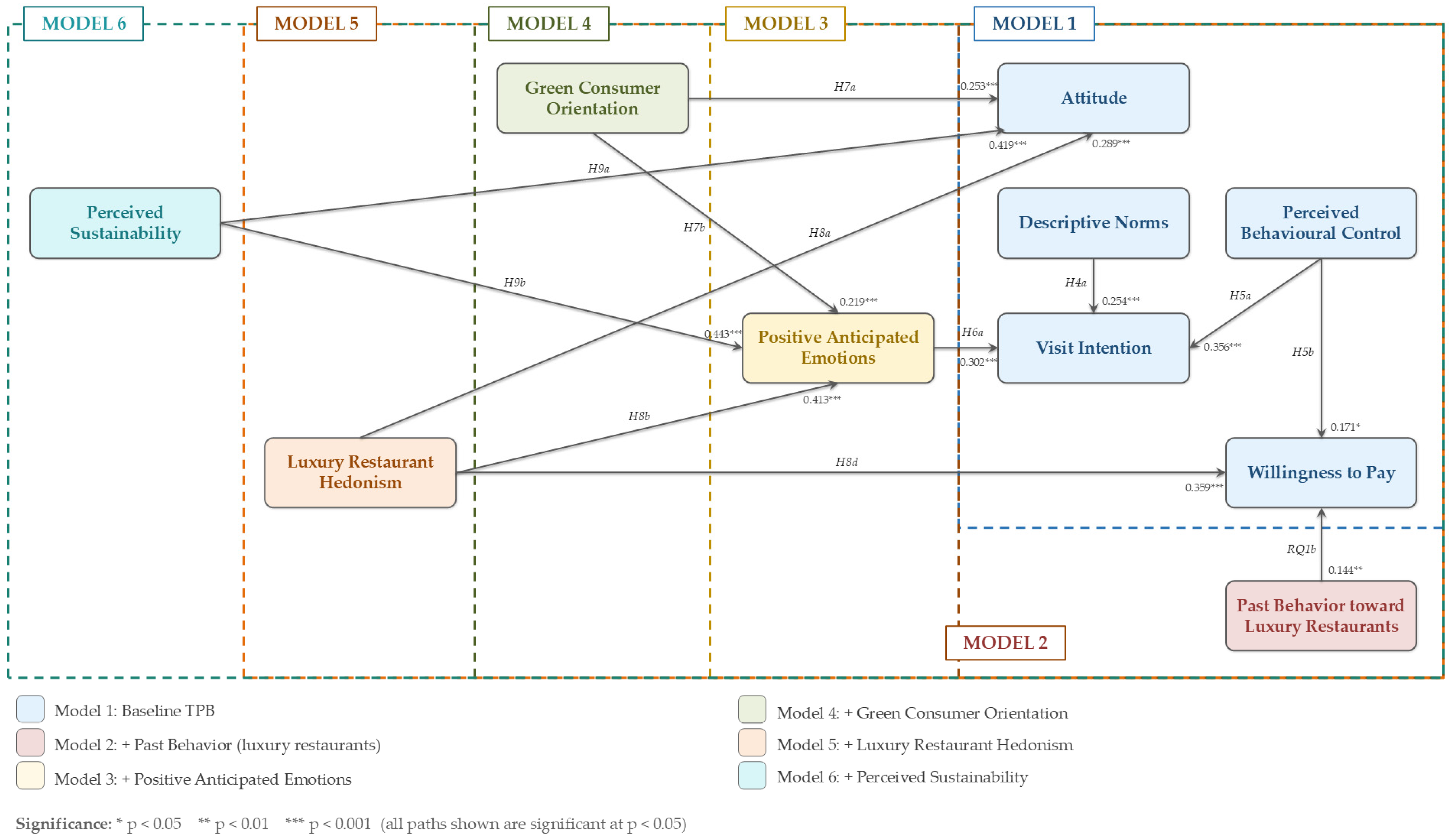
The final Model 6 showed an acceptable fit to the data, χ2(519) = 1148.22, p < 0.001, RMSEA = 0.048, 90% CI [0.044, 0.052], CFI = 0.936, TLI = 0.923, SRMR = 0.060. The model explained 50.4% of the variance in attitude, 65.2% of the variance in positive anticipated emotions, 73.9% of the variance in visit intention, and 25.0% of the variance in willingness to pay. Complete results for all direct effects and bootstrapped indirect effects are reported in Appendix A, Table A3 and Table A4, respectively. Figure 2 summarizes the statistically significant paths in the final structural model.
Visit intention was not significantly associated with willingness to pay, β = 0.017, p = 0.867; therefore, H1 was not supported. Attitude was not significantly associated with visit intention, β = 0.133, p = 0.106, or willingness to pay, β = −0.072, p = 0.506; therefore, H2a and H2b were not supported.
Regarding normative predictors, injunctive norms were not significantly associated with visit intention, β = −0.082, p = 0.123, or willingness to pay, β = −0.032, p = 0.643; thus, H3a and H3b were not supported. Descriptive norms were positively associated with visit intention, β = 0.254, p < 0.001, supporting H4a, but were not significantly associated with willingness to pay, β = 0.082, p = 0.321; therefore, H4b was not supported.
Perceived behavioral control was positively associated with both visit intention, β = 0.356, p < 0.001, and willingness to pay, β = 0.171, p = 0.015, supporting H5a and H5b. Positive anticipated emotions were positively associated with visit intention, β = 0.302, p = 0.001, supporting H6a, but not with willingness to pay, β = −0.042, p = 0.740; therefore, H6b was not supported.
Regarding RQ1, none of the three past-behavior variables was significantly associated with visit intention: past behavior toward green restaurants, β = 0.060, p = 0.083; past behavior toward luxury restaurants, β = 0.056, p = 0.128; and past behavior toward green luxury restaurants, β = −0.002, p = 0.956. By contrast, past behavior toward luxury restaurants was positively associated with willingness to pay, β = 0.144, p = 0.008, whereas past behavior toward green restaurants, β = −0.059, p = 0.213, and past behavior toward green luxury restaurants, β = −0.041, p = 0.504, were not significant. Thus, among the three forms of past behavior examined in RQ1, only previous luxury-restaurant experience was significantly associated with willingness to pay.
Green consumer orientation was positively associated with attitude, β = 0.253, p < 0.001, and positive anticipated emotions, β = 0.219, p < 0.001, supporting H7a and H7b. However, it was not directly associated with visit intention, β = 0.065, p = 0.105, or willingness to pay, β = 0.001, p = 0.989; therefore, H7c and H7d were not supported. The bootstrapped indirect effects showed that green orientation had a significant total indirect association with visit intention, b = 0.156, 95% bootstrap CI [0.078, 0.257], p = 0.001. This total indirect association was accounted for by the pathway involving positive anticipated emotions, b = 0.104, 95% bootstrap CI [0.034, 0.193], p = 0.012, whereas the pathway involving attitude was not significant, b = 0.053, 95% bootstrap CI [−0.009, 0.174], p = 0.278. Thus, H7e was partially supported. By contrast, the total indirect effect of green orientation on willingness to pay was not significant, b = −1.185, 95% bootstrap CI [−4.516, 1.412], p = 0.426. Neither the specific indirect effect through attitude, b = −0.878, 95% bootstrap CI [−5.344, 1.786], p = 0.619, nor the specific indirect effect through positive anticipated emotions, b = −0.440, 95% bootstrap CI [−3.619, 2.566], p = 0.776, was significant. Therefore, H7f and H7g were not supported.
Luxury restaurant hedonism was positively associated with attitude, β = 0.289, p < 0.001, and positive anticipated emotions, β = 0.413, p < 0.001, supporting H8a and H8b. It was not directly associated with visit intention, β = 0.011, p = 0.837, so H8c was not supported. However, it was positively associated with willingness to pay, β = 0.359, p < 0.001, supporting H8d. The bootstrapped indirect effects showed a significant total association of luxury restaurant hedonism with visit intention, b = 0.197, 95% bootstrap CI [0.106, 0.294], p < 0.001. This total indirect association was accounted for by the pathway involving positive anticipated emotions, b = 0.151, 95% bootstrap CI [0.045, 0.261], p = 0.006, whereas the pathway involving attitude was not significant, b = 0.046, 95% bootstrap CI [−0.011, 0.148], p = 0.263. Thus, H8e was partially supported. The total indirect effect of luxury restaurant hedonism on willingness to pay was not significant, b = −1.306, 95% bootstrap CI [−4.869, 1.950], p = 0.445. Neither the specific indirect effect through attitude, b = −0.773, 95% bootstrap CI [−4.505, 1.698], p = 0.615, nor the specific indirect effect through positive anticipated emotions, b = −0.640, 95% bootstrap CI [−5.099, 3.630], p = 0.771, was significant. Therefore, H8f and H8g were not supported.
Perceived sustainability in Michelin Green Star restaurants’ sustainability commitment was positively associated with attitude, β = 0.419, p < 0.001, and positive anticipated emotions, β = 0.443, p < 0.001, supporting H9a and H9b. However, perceived sustainability was not directly associated with visit intention, β = 0.054, p = 0.303, or willingness to pay, β = 0.018, p = 0.792; therefore, H9c and H9d were not supported. The bootstrapped indirect effects showed a significant total indirect association of perceived sustainability with visit intention, b = 0.308, 95% bootstrap CI [0.166, 0.469], p < 0.001. This total indirect association was accounted for by the pathway involving positive anticipated emotions, b = 0.218, 95% bootstrap CI [0.069, 0.381], p = 0.007, whereas the pathway involving attitude was not significant, b = 0.091, 95% bootstrap CI [−0.022, 0.255], p = 0.223. Thus, H9e was partially supported. The total indirect effect of perceived sustainability on willingness to pay was not significant, b = −2.228, 95% bootstrap CI [−7.410, 2.464], p = 0.384. Neither the specific indirect effect through attitude, b = −1.508, 95% bootstrap CI [−7.647, 3.298], p = 0.589, nor the specific indirect effect through positive anticipated emotions, b = −0.923, 95% bootstrap CI [−7.340, 5.229], p = 0.770, was significant. Therefore, H9f and H9g were not supported.

2.3.5. Sensitivity and Robustness Analyses

The model separating the two descriptive-norm indicators showed acceptable fit, χ2(515) = 1201.62, p < 0.001, RMSEA = 0.050, 90% CI [0.047, 0.054], CFI = 0.929, TLI = 0.915, and SRMR = 0.073. The two indicators were positively correlated, r = 0.450, p < 0.001. When entered simultaneously, the static personal descriptive norm was positively associated with visit intention, β = 0.169, p < 0.001, whereas the dynamic general descriptive norm was not, β = 0.058, p = 0.156. Neither the static personal descriptive norm, β = 0.040, p = 0.456, nor the dynamic general descriptive norm, β = 0.030, p = 0.536, was significantly associated with willingness to pay. The remaining structural associations were substantively unchanged. Therefore, the association between the broader descriptive-norm factor and visit intention found in the primary model appeared to be mainly attributable to respondents’ perceptions of the current behavior of people personally known to them.
The WLSMV model also showed satisfactory fit, χ2(519) = 1360.53, p < 0.001, RMSEA = 0.056, 90% CI [0.052, 0.059], CFI = 0.969, TLI = 0.962, and SRMR = 0.041. The findings concerning willingness to pay were closely consistent with the primary MLR estimates. Perceived behavioral control (β = 0.155, p = 0.018), luxury-restaurant hedonism (β = 0.387, p < 0.001), and previous luxury-restaurant behavior (β = 0.144, p = 0.003) remained significant positive predictors, whereas the other associations with willingness to pay remained nonsignificant. The explained variance in willingness to pay was also similar, R2 = 0.259, compared with 0.250 in the primary model. The separate ML analysis using bias-corrected bootstrap confidence intervals yielded the same inferential conclusions for the indirect effects.
The covariate-adjusted model, estimated among the 414 participants with complete covariate data, showed acceptable fit, χ2(588) = 1120.71, p < 0.001, RMSEA = 0.047, 90% CI [0.043, 0.051], CFI = 0.933, TLI = 0.917, and SRMR = 0.063. The central pattern of findings was generally stable. Among the covariates, age was positively associated with attitude (β = 0.162, p = 0.003). Household income was negatively associated with visit intention (β = −0.078, p = 0.034) but positively associated with willingness to pay (β = 0.121, p = 0.011), whereas Michelin Green Star awareness was positively associated with willingness to pay (β = 0.098, p = 0.030). All other covariate paths were nonsignificant. After adjustment, the association between previous luxury-restaurant behavior and willingness to pay was attenuated and no longer statistically significant (β = 0.112, p = 0.075). In the corresponding unadjusted model estimated in the same subsample, this association was somewhat stronger and statistically significant (β = 0.145, p = 0.020). The adjusted model explained 75.4% of the variance in visit intention and 31.4% of the variance in willingness to pay.

2.4. Discussion

Study 1 showed that visit intention and willingness to pay represent partly differentiated consumer responses to Michelin Green Star restaurants. Visit intention was not significantly associated with willingness to pay, indicating that motivational readiness did not translate linearly into the maximum amount participants stated they would spend. The two outcomes also showed different predictor profiles: visit intention was associated with descriptive norms, perceived behavioral control, and positive anticipated emotions, whereas maximum stated expenditure was associated with perceived behavioral control and luxury-restaurant hedonism. The substantially greater variance explained in visit intention further suggests that the psychosocial variables examined here captured motivational readiness more fully than absolute monetary allocation. We return to possible explanations for the nonsignificant association between intention and willingness to pay later in the Discussion. In the next paragraphs, we examine the individual contribution of each model component.
Among the core TPB predictors, attitude was significantly associated with visit intention in the restricted baseline model, together with descriptive norms and perceived behavioral control, whereas injunctive norms were not. However, this model did not achieve adequate overall fit. In the final model, the unique association between attitude and intention became nonsignificant, while descriptive norms and perceived behavioral control remained significant. This attenuation may reflect the variance shared between attitude and the additional predictors, particularly positive anticipated emotions, rather than the absence of a meaningful relationship between attitude and intention. Meta-analytic evidence similarly indicates that anticipated affect explains variance in intention beyond that accounted for by the core TPB predictors and may reduce the unique contribution of attitude once both constructs are included [63]. Thus, favorable evaluations of Michelin Green Star restaurants may remain relevant to visit intention, but their association may be partly captured by the positive emotions consumers anticipate experiencing during the visit. Attitude was also not associated with willingness to pay, suggesting that a favorable evaluation of Michelin Green Star restaurants was insufficient to account for the amount consumers were prepared to allocate.
The different findings for descriptive and injunctive norms are consistent with evidence that these normative components provide distinct forms of social information and that descriptive norms may contribute to intention beyond the standard TPB predictors [33,34]. Injunctive norms were nonsignificant even in the baseline model, whereas descriptive norms remained associated with visit intention in the final model. Similar differences have been found for sustainable food choices and green restaurant intentions [27,35]. The sensitivity analysis further indicated that the association was mainly attributable to the static personal norm rather than to the dynamic general trend. Thus, participants’ intentions appeared to be more closely associated with the perceived behavior of people they knew than with a broader perception that Michelin Green Star dining was becoming more common. Neither normative component was associated with willingness to pay.
Perceived behavioral control was the only core TPB predictor associated with both visit intention and willingness to pay. This finding is consistent with research linking perceived behavioral control to intentions to visit environmentally responsible restaurants [1,2,27] and with research applying the TPB to willingness to pay more in locally sourced restaurant contexts [36]. Michelin Green Star restaurants may require sufficient financial resources, advance booking, travel, planning, and familiarity with fine-dining conventions. Perceived control may therefore function as a practical enabling condition: both readiness to visit and maximum stated expenditure may remain constrained when the experience is not considered feasible.
Past behavior showed a selective pattern. None of the three previous dining behaviors was associated with visit intention once the psychological predictors were considered. Previous luxury-restaurant behavior was associated with willingness to pay in the primary model, whereas previous experience with green and green luxury restaurants was not. However, the association with luxury-restaurant experience became nonsignificant after adjustment for age, household income, and Michelin Green Star awareness. Familiarity with luxury dining may therefore partly overlap with socioeconomic resources and prior knowledge rather than independently accounting for stated expenditure. This interpretation is consistent with evidence that previous restaurant experience may be associated with willingness to pay more for green practices, although the present results indicate that its unique contribution should be interpreted cautiously [64].
Positive anticipated emotions were associated with visit intention but not with willingness to pay. Consumers who expected to feel satisfied, proud, or happy reported stronger intentions to visit. This is consistent with goal-directed accounts in which anticipated emotions influence decisions by representing the expected affective consequences of future actions [15,39]. It also aligns with evidence that anticipated pride can strengthen pro-environmental intentions [16], that anticipated emotions are associated with restaurant intentions through perceived value [14], and that anticipated regret contributes to explaining eco-friendly restaurant choice [40]. Sustainable fine dining may therefore motivate interest when environmental responsibility is combined with expected pleasure, pride, refinement, and memorability. These affective expectations did not, however, account for how much consumers stated they would spend.
The distal antecedents further clarified the motivational-affective pattern associated with visit intention. Green consumer orientation, luxury restaurant hedonism, and perceived sustainability were all associated with attitude and positive anticipated emotions, but their indirect associations with visit intention were accounted for mainly by positive anticipated emotions. Green consumer orientation may make sustainable fine dining more personally relevant and consistent with consumers’ environmental self-definition. This interpretation is consistent with research linking environmental identity to pro-environmental preferences, intentions, and behavior [46,65], including responses to eco-friendly restaurants [49]. Because green consumer orientation is broader than environmental self-identity, however, this literature should be understood as supporting its identity-related component rather than as defining the entire construct.
Luxury restaurant hedonism was associated with positive anticipated emotions and indirectly with visit intention, while also showing a direct association with willingness to pay. This pattern is consistent with the multisensory and emotional nature of hedonic consumption and with evidence that hedonism is associated with favorable evaluations of luxury restaurants and hospitality experiences [9,52,66]. Consumers attracted to luxury dining for its pleasure and experiential value may therefore anticipate a more rewarding Michelin Green Star experience and be prepared to allocate more to it.
Perceived sustainability was associated with attitude and positive anticipated emotions and indirectly with visit intention, but not with willingness to pay. Sustainability perceptions may support favorable evaluations and make the restaurant’s environmental and social commitment more emotionally meaningful. This interpretation aligns with evidence linking perceived green practices to restaurant image and attitudes [55], emotional attachment and satisfaction [25], and positive anticipated emotions and participation intention in restaurant sustainability contexts [57]. Because many responsible practices cannot be directly observed by consumers, perceiving the restaurant as genuinely sustainable may facilitate psychological openness towards the experience without necessarily increasing the maximum amount allocated to it.
The indirect associations of the three distal antecedents should not be interpreted as evidence of causal mediation. Study 1 was cross-sectional, and the proposed ordering cannot establish that green consumer orientation, luxury restaurant hedonism, or perceived sustainability caused changes in positive anticipated emotions or intention. The findings instead indicate that sustainability-related and luxury-related factors converged in their associations with the anticipated emotional appeal of Michelin Green Star restaurants.
By contrast, maximum stated expenditure showed a narrower luxury-feasibility pattern. Green consumer orientation and perceived sustainability were not directly or indirectly associated with this outcome, whereas perceived behavioral control and luxury restaurant hedonism were. Consumers may therefore be genuinely interested in visiting a Michelin Green Star restaurant while selecting a relatively modest maximum price. Monetary judgments may involve additional considerations not fully represented in the present model, including available economic resources, familiarity with restaurant prices, and previous experience with premium dining. Prior restaurant research has linked income and previous experience to willingness to pay for green dining practices, while sustainable-luxury research also indicates that perceived ethicality and quality can contribute to premium valuation [29,64,67]. Because price sensitivity and broader fine-dining spending propensity were not directly assessed, the mechanisms underlying the nonsignificant association between intention and willingness to pay cannot be established conclusively. More generally, visit intention and maximum stated expenditure represent related but distinct consumer judgments. Intending to visit a Michelin Green Star restaurant does not necessarily imply a willingness to allocate a higher amount to the experience. Consumers may perceive the restaurant as attractive, desirable, and feasible to visit while still setting a relatively modest spending limit. Conversely, maximum stated expenditure may depend more strongly on personal budget constraints, price expectations, familiarity with fine-dining costs, and the perceived value of the overall experience. The nonsignificant association between intention and maximum stated expenditure may therefore indicate that interest in visiting does not automatically translate into a willingness to spend more. In addition, monetary judgments may depend on how realistic and personally relevant the prospect of a future visit appears, with psychologically distant or hypothetical scenarios potentially producing more variable estimates [68].
Overall, Study 1 suggests an integrative motivational-affective pattern for visit intention and a narrower luxury-feasibility pattern for willingness to pay. Sustainability-related and luxury-related antecedents converged in their associations with positive anticipated emotions and, through this component, with visit intention. They diverged when the consumer response concerned maximum stated expenditure, which was more closely associated with practical feasibility and attraction to luxury dining.
These findings provided the conceptual basis for Study 2. Positive anticipated emotions were selected as a central proximal response because they were associated with visit intention and accounted for the indirect associations of all three distal antecedents. Luxury restaurant hedonism informed an experience-based communication orientation emphasizing pleasure, authenticity, refinement, and memorability, consistent with evidence that sustainable practices can contribute to memorable experiences in Michelin Green Star restaurants [6]. Perceived sustainability informed a practice-based orientation emphasizing concrete and verifiable sustainability actions, while green consumer orientation provided the rationale for examining message–recipient fit. Study 2 therefore did not experimentally reproduce the structural model tested in Study 1; rather, it extended its theoretical implications to a distinct communication question by examining whether two theoretically grounded communication orientations were differentially associated with baseline-adjusted post-message responses according to consumers’ green orientation.

3. Study 2: Communicating Sustainable Fine Dining: An Experimental Test of Practice-Based and Experience-Based Messages

3.1. Theoretical Background

A growing body of research has shown that sustainability-related communication can rely on different types of persuasive content. In health, food, and sustainable consumption domains, informational appeals, often described as instrumental or rational, and affective appeals, often described as emotional or transformational, have been shown to activate different psychological processes and shape consumer responses in distinct ways [17,18,19,20]. These studies suggest that sustainability-related messages should not be treated as interchangeable, because different contents may emphasize different routes of persuasion. However, whether similar distinctions apply to the promotion of sustainable fine dining remains largely unexplored.
This issue is particularly relevant in the hospitality sector, where sustainability communication does not merely inform consumers about environmental practices, but also contributes to the construction of affective components related to perceived sustainability, authenticity, and perceived value [11,69]. Prior research suggests that sustainability messages are often less effective than expected because they remain too factual, generic, or organization-centered, rather than being translated into personally relevant and emotionally meaningful benefits for consumers [70]. At the same time, in hospitality and tourism contexts, consumers may respond differently to messages that emphasize social or environmental benefits, personal benefits, emotional meanings, or concrete responsible practices [69,71,72]. Thus, the way sustainability is communicated may be as important as the sustainability practices themselves.
In sustainable fine dining, this communication challenge becomes particularly pronounced. Michelin Green Star restaurants are associated with a wide range of sustainability practices, including local sourcing, seasonality, waste reduction, energy efficiency, circular initiatives, responsible supply chains, community engagement, and chef-led values [4,10,73]. However, these practices do not automatically become visible or meaningful to consumers. Unless they are communicated effectively, consumers may fail to recognize their relevance to the quality, authenticity, and overall value of the dining experience [5,6,7].
Indeed, recent research has pointed to a communication gap among Michelin Green Star restaurants. Ref. [10] showed that these restaurants communicate sustainability through multiple themes, including sustainable technologies, diversified culinary offerings, community-focused initiatives, sustainable supply chains, entrepreneurial values, and certifications. Similarly, Ref. [12] highlighted an implementation–communication gap in Italian Michelin Green Star restaurants, showing that, while some visible practices, such as sustainable menus, are frequently communicated, less tangible initiatives, such as energy efficiency and community engagement, remain undercommunicated. These findings suggest that sustainability efforts do not automatically become visible, credible, or valuable to consumers unless they are effectively translated into communication.
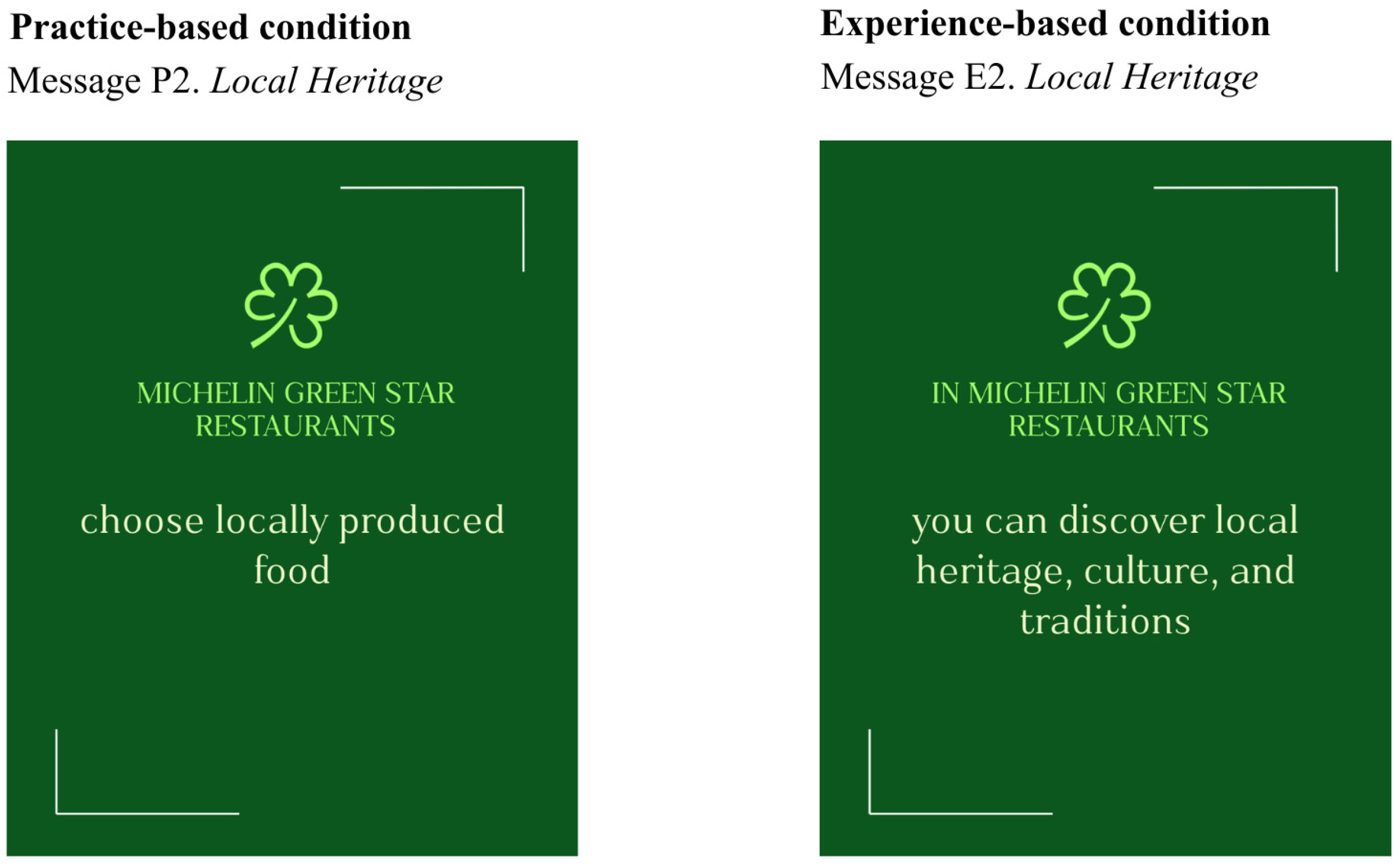
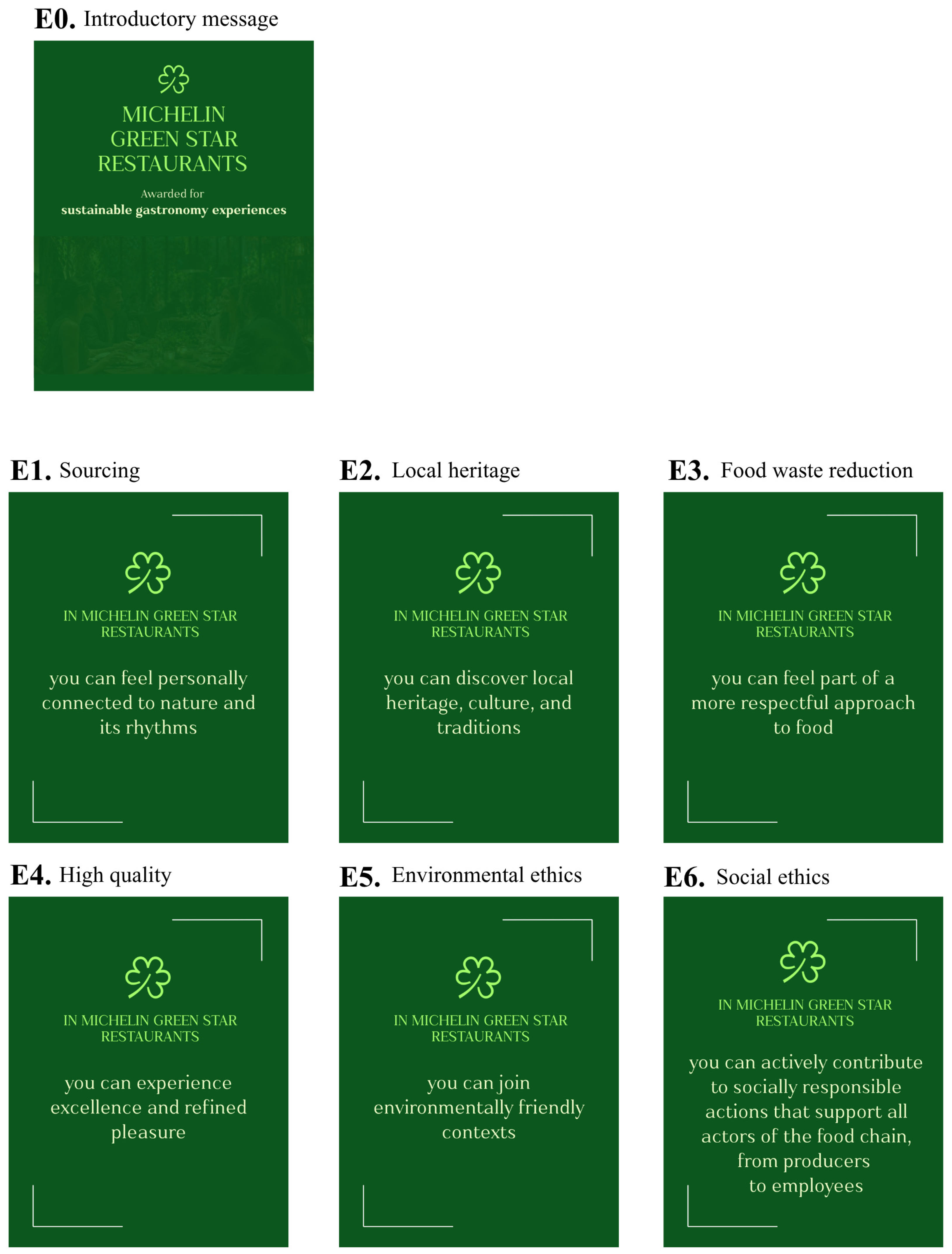
Importantly, sustainable practices should not be viewed solely as technical or operational features. Ref. [6] showed that they can also contribute to memorable customer experiences by enhancing functionality, authenticity, emotionality, engagement, and expressivity. This suggests two distinct communication routes. A practice-based route emphasizes what restaurants do to operate sustainably, through actions such as local sourcing, seasonality, waste reduction, energy efficiency, circular initiatives, and responsible supply-chain management. By making these practices concrete and visible, this type of message may strengthen perceptions of transparency and credibility. An experience-based route instead emphasizes how sustainability enriches the sensory, emotional, authentic, and memorable qualities of the dining experience, linking responsible practices to anticipated pleasure, distinctiveness, and experiential value.
Although conceptually distinct, practice-based and experience-based elements often coexist in real-world sustainability communication. Communication related to Michelin Green Star restaurants may convey both concrete practices, such as responsible sourcing and relationships with local suppliers, and the values and experiential qualities associated with their cuisine [10]. However, it remains unclear whether emphasizing one route rather than the other produces distinct consumer responses. The practice-based condition was designed to foreground the visibility and concreteness of sustainability practices, whereas the experience-based condition was designed to foreground their personal, emotional, and experiential implications.
Study 2 examined attitude and positive anticipated emotions as two proximal psychological responses to message exposure. Attitude was retained because it represents the central evaluative construct in the TPB and a common target of persuasive communication, although it was not significantly associated with visit intention in Study 1. Positive anticipated emotions were included because they emerged as a significant predictor of visit intention in Study 1 and capture the affective rewards consumers expect from the dining experience. Based on previous research showing that sustainability-related messages can promote favorable evaluations, positive affective responses, and behavioral intentions, we expected participants to report increases in attitude, positive anticipated emotions, and visit intention following message exposure.
Hypothesis 10 (H10).
Participants’ attitude (H10a), positive anticipated emotions (H10b), and intention (H10c) will increase from pre- (T1) to post-message (T2) exposure.
We then examined whether changes in these proximal responses were associated with changes in visit intention. Given the positive association between anticipated emotions and visit intention observed in Study 1, and the motivational role attributed to anticipated emotions in goal-directed decision-making, we expected participants reporting greater increases in positive anticipated emotions to also report greater increases in visit intention.
Hypothesis 11 (H11).
Post-message positive anticipated emotions will be positively associated with post-message visit intention after accounting for their pre-message levels.
Because attitude was not significantly associated with visit intention in Study 1, we did not formulate a directional hypothesis regarding the association between post-message and post-message visit intention after accounting for their pre-message levels.
Research Question 2 (RQ2).
Is post-message attitude associated with post-message visit intention after accounting for their pre-message levels?
Finally, although both messages were designed to promote favorable responses toward sustainable fine dining, they emphasized different persuasive routes. We therefore examined whether the experience-based and practice-based messages produced different post-message responses after accounting for participants’ pre-message levels.
Research Question 3 (RQ3).
Do experience-based and practice-based messages differ in their associations with post-message attitude, positive anticipated emotions, and visit intention after accounting for the corresponding pre-message levels?
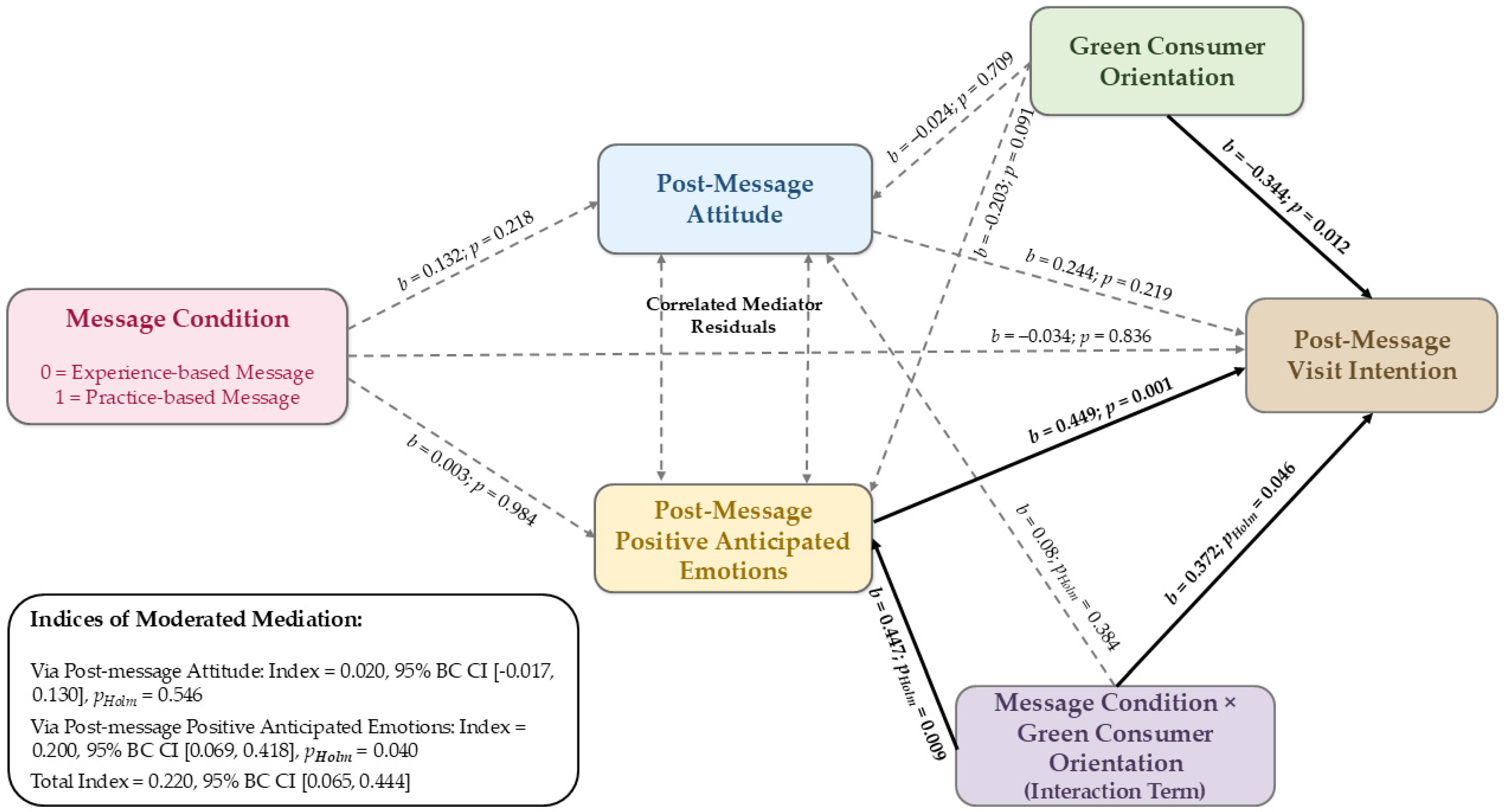
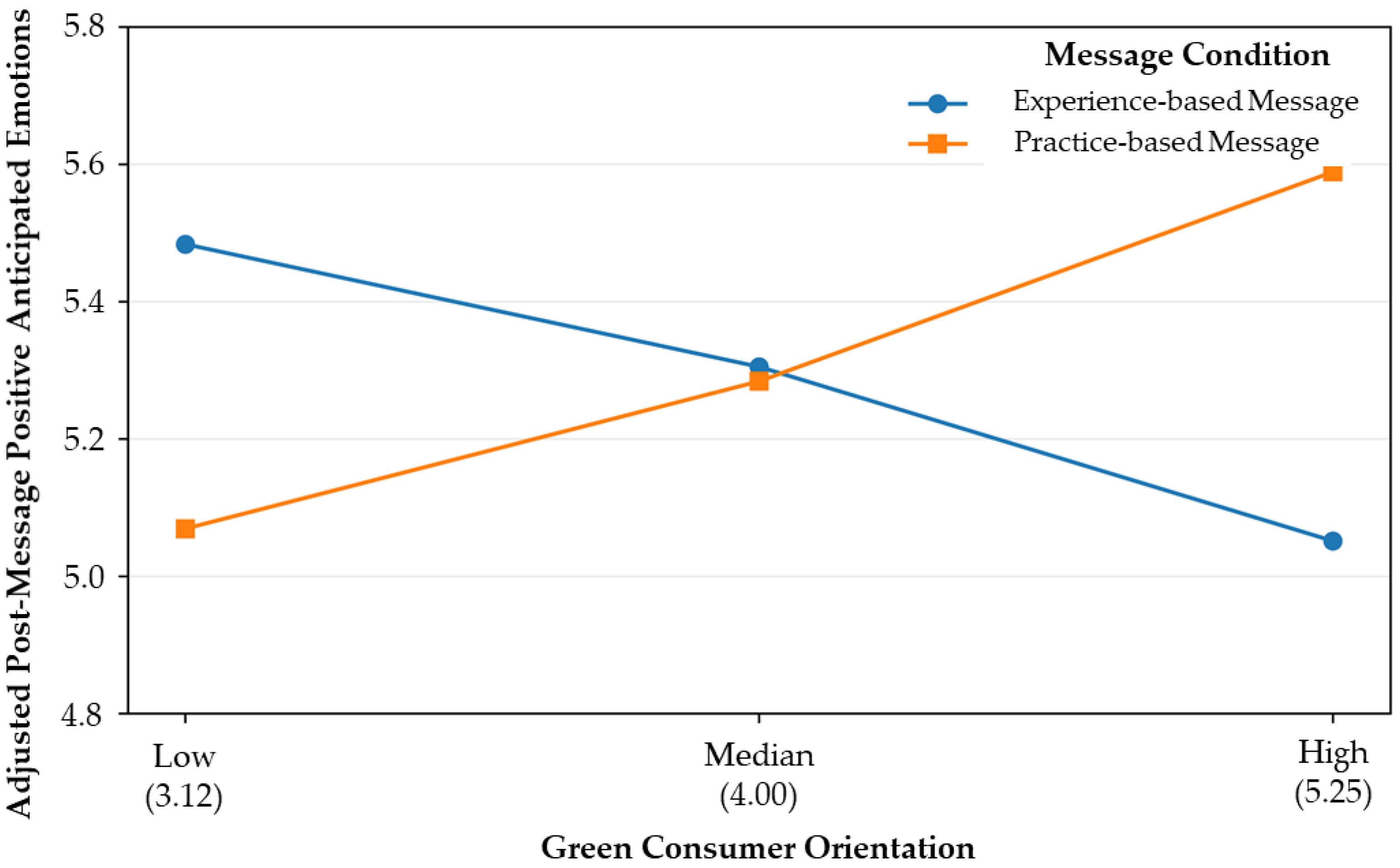
Building on Study 1, Study 2 examined green orientation as a potential moderator of message effectiveness. Identity-based persuasion research suggests that sustainability messages may be more persuasive when their content is congruent with recipients’ self-concept and values [74,75,76,77,78]. A practice-based message may therefore resonate more strongly with consumers high in green orientation because it makes the restaurant’s environmental commitment explicit and verifiable [79]. By contrast, an experience-based message may be more appealing when sustainability is less central to consumers’ self-concept, because it connects responsible dining with pleasure, authenticity, and memorability rather than with environmental obligation [80,81]. However, existing evidence does not clearly establish which communication route should be more effective at different levels of green orientation. We therefore examined whether green consumer orientation moderated the associations of message condition with post-message attitude, positive anticipated emotions, and visit intention, as well as the indirect associations with intention through post-message attitude and positive anticipated emotions, controlling for their pre-message levels.
Research Question 4 (RQ4):
Does green consumer orientation moderate the associations of message with post-message attitude, positive anticipated emotions, and visit intention after accounting for their pre-message levels?
Research Question 5 (RQ5):
Does green consumer orientation moderate the indirect association between message condition and post-message visit intention through post-message attitude and positive anticipated emotions change, after accounting for their pre-message levels?

3.2. Methods

3.2.1. Participants and Procedure

This study was conducted under the same ethical approval as Study 1 (see Section 2.2.1).
Data collection took place in June 2026 through the Prolific platform. The study was advertised as an online survey investigating dining-out habits, personal beliefs, and attitudes toward food services, as well as reactions to communication messages about sustainable fine dining. To be eligible, participants had to be residents of Italy and at least 18 years old. Prior to their involvement, participants were fully informed about the purpose of the study, its voluntary nature, the anonymity and confidentiality of their responses, how their data would be processed, and their right to withdraw at any time. Informed consent was obtained from all participants before they could access the questionnaire. Qualtrics automatically managed the random allocation of participants to the experimental conditions. The survey lasted approximately 11 min, and the average compensation of €12.75 was issued through Prolific following completion and researcher approval.
An a priori power analysis was conducted using G*Power 3.1.9.4 for the time × message condition interaction in the repeated-measures analyses T. Assuming α = 0.05, power = 0.80, a small-to-medium effect size (f = 0.15), a correlation among repeated measures of 0.50, and a nonsphericity correction of ε = 1, the required sample size was N = 90.
No formal a priori power analysis specifically tailored to the moderated mediation model was conducted. Given the complexity of the model and the limited sample size, the moderated mediation findings were interpreted cautiously and require confirmation in a larger independent sample.
Only two respondents were excluded from the analysis for failing attention checks.
The final sample included 102 participants, with 51 participants assigned to the experience-based message condition and 51 participants assigned to the practice-based message condition. Gender information was available for 101 participants: 55 participants identified as male (54.5%), 44 as female (43.6%), and 2 preferred not to answer (2.0%). Age-group information was available for 101 participants: 56 participants were aged 18–34 years (55.4%), 16 were aged 35–44 years (15.8%), and 29 were aged 45 years or older (28.7%). Regarding household income, 23 participants preferred not to answer (22.5%), 8 reported an income below €10,000 (7.8%), 17 reported €10,000–€19,999 (16.7%), 10 reported €20,000–€29,999 (9.8%), 11 reported €30,000–€39,999 (10.8%), 6 reported €40,000–€49,999 (5.9%), 12 reported €50,000–€74,999 (11.8%), and 15 reported €75,000 or more (14.7%). With respect to education level, 1 participant reported primary school as the highest completed level of education (1.0%), 24 reported a high school diploma (23.5%), 4 reported technical high school (3.9%), 36 reported a bachelor’s degree or equivalent (35.3%), 33 reported a master’s degree (32.4%), and 4 reported a doctorate/PhD (3.9%).

3.2.2. Measures

The same measures used in Study 1 were employed for attitudes toward Michelin Green Star restaurants, positive anticipated emotions, intention to visit Michelin Green Star restaurants—assessed both before and after message exposure, and green orientation.
The six-item, 6-point semantic differential scale for attitudes [21] showed good internal consistency, both before message exposure, α = 0.855, and after message exposure α = 0.913. Positive anticipated emotions, assessed with the three items adapted from [21], also showed good internal consistency at both time points, with α = 0.830 pre-exposure and α = 0.886 post-exposure. Intention to visit Michelin Green Star restaurants, measured with the three items adapted from [62], likewise showed good reliability, with α = 0.892 prior to the intervention and α = 0.910 following the intervention. Green orientation, measured with five items adapted from [29], showed acceptable internal consistency (α = 0.785).

3.2.3. Message Intervention

To develop the practice-based and experience-based messages, we drew on two complementary theoretical and empirical sources. Practice-based communication was informed by research on sustainability practices in the food service sector, with particular attention to Michelin Green Star restaurants [4,82], and by official descriptions and criteria provided by the Michelin Guide [83]. Experience-based communication was informed by research on customer experience and sustainable luxury dining [6,10], particularly on how environmental and social commitments can be translated into sensory, emotional, authentic, and memorable consumer experiences [9,11].
This process identified six pillars shared across the two conditions: seasonal and sustainable sourcing, local heritage, food-waste reduction, high quality, pro-environmental ethical standards, and social ethical standards. For each pillar, we developed two messages that retained the same underlying sustainability theme while varying the focal perspective through which it was communicated. In the practice-based condition, the restaurant was presented as the agent implementing a concrete sustainability practice or policy. In the experience-based condition, the consumer was presented as the beneficiary of the personal, sensory, emotional, or social implications of the same sustainability theme.
Accordingly, the manipulation involved a systematic shift in grammatical subject, agency, self-reference, and benefit focus. In the practice-based condition, communication centered on the sustainability actions undertaken by restaurants, whereas in the experience-based condition it centered on the personal and experiential implications of those practices for consumers. These features were part of the operationalization of the two communication orientations. The introductory message in each condition served to present Michelin Green Star restaurants and orient participants to the messages that followed.
The six pillars were operationalized as follows.
-
Pillar 1—Seasonal and Sustainable Sourcing. Seasonal and sustainable sourcing was presented either as the restaurant’s selection of fresh, seasonal, and locally sourced ingredients, or as an opportunity for the consumer to feel connected to nature and its rhythms, drawing on nature connectedness [84].
-
Pillar 2—Local Heritage. Local heritage was communicated either as the use of locally produced food, or as an opportunity to discover local culture and traditions, consistent with place-attachment research [85].
-
Pillar 3—Food-Waste Reduction. Food-waste reduction was described either through the restaurant’s reduction in leftovers and reuse of ingredients, or through the consumer’s participation in a more respectful relationship with food, drawing on self-transcendence values [86].
-
Pillar 4—High Quality. High quality was presented either as a food-processing standard, or as an experience of excellence and refined pleasure, reflecting the compatibility between sustainability and luxury when luxury is grounded in quality [87].
-
Pillar 5—Pro-Environmental Ethical Standards. Pro-environmental ethical standards were communicated either as formal environmental and animal-welfare criteria, or as access to an environmentally aligned context.
-
Pillar 6—Social Ethical Standards. Social ethical standards were presented either as concrete actions protecting actors throughout the food chain, or as an opportunity for consumers to contribute to socially responsible outcomes, consistent with the warm-glow mechanism [88].
The messages were iteratively drafted by two authors. And subsequently reviewed by all authors and two researchers who were not otherwise involved in the study. The review assessed correspondence with the intended sustainability pillar and communication orientation, clarity, approximate length, and visual consistency. Concerns were discussed until agreement was reached on the final wording. The final messages were then used to create seven images for each condition: one introductory image followed by the six sustainability pillars. Qualtrics presented the images sequentially to all participants in the fixed order reported in Table 5. Exposure time was recorded by Qualtrics, and the comparison of reading times between conditions is reported in Section 3.3.1. The messages were designed to be comparable in topic, approximate word count, tone, and visual style within each pillar following the standard message manipulation logic [89].
Full message texts are reported in Table 5, whereas examples of the message illustrations shown to participants are presented in Figure 3. The complete set of images is provided in Appendix B, Figure A1 and Figure A2.
In accordance with MDPI’s guidelines, we acknowledge that generative AI was used to create the illustrations accompanying the introductory messages (images E0 and P0 in Figure A1 and Figure A2, Appendix B), in order to avoid depicting identifiable real individuals or events. For transparency, generative AI was also used to assist in drafting the graphics of two figures. This information is disclosed in the footnote of the respective figures.

3.2.4. Data Analyses

Preliminary analyses were conducted to examine whether the two experimental conditions differed in baseline psychological variables, sociodemographic characteristics, and green consumer orientation. A multivariate general linear model was conducted with message condition as the between-subjects factor and baseline intention, positive anticipated emotions, and attitude as dependent variables. Chi-square tests were conducted to examine whether the two message conditions differed in gender, age group, household income, and education level. A univariate general linear model was also conducted to test whether green consumer orientation differed between the two message conditions.
To test H10 and address RQ2 and RQ3, separate repeated-measures GLMs were conducted for attitude, positive anticipated emotions, and intention. Time was included as the within-subjects factor and message condition as the between-subjects factor. Message condition was coded 0 = experience-based message and 1 = practice-based message.
To test H11 and address RQ4 and RQ5, a baseline-adjusted parallel moderated mediation model was estimated in Mplus using maximum likelihood estimation. Message condition predicted post-message intention through post-message attitude and positive anticipated emotions, with green consumer orientation moderating the paths from message condition to both mediators and to intention. Green consumer orientation was mean-centered, all pre-message measures were included as covariates in each equation, and the mediator residuals were allowed to correlate. Indirect effects and indices of moderated mediation were estimated using 10,000 bootstrap samples with bias-corrected 95% confidence intervals. Conditional effects were examined at the 16th, 50th, and 84th percentiles of the moderator and probed using Johnson–Neyman analyses. Holm corrections were applied separately to the three interaction tests and the two mediator-specific indices. An omnibus Wald test was obtained from an otherwise identical non-bootstrap model, and global fit indices were not interpreted because the observed-variable model was saturated.

3.3. Results

3.3.1. Preliminary Results

Means, standard deviations, and zero-order correlations among the main study variables are reported in Table 6.
Preliminary analyses were conducted to examine whether the two experimental conditions differed in baseline psychological variables, sociodemographic characteristics, and green consumer orientation. Descriptively, participants in the experience-based message condition reported baseline intention of M = 4.22, SD = 1.35, positive anticipated emotions of M = 5.32, SD = 1.11, attitude of M = 4.80, SD = 0.62, and green orientation of M = 4.98, SD = 0.89. Participants in the practice-based message condition reported baseline intention of M = 4.04, SD = 1.75, positive anticipated emotions of M = 5.12, SD = 1.17, attitude of M = 4.75, SD = 0.97, and green orientation of M = 4.63, SD = 1.07.
An independent-samples t-test showed no significant difference between the experience-based and practice-based conditions in the time spent reading the intervention messages. Participants in the experience-based condition spent, on average, 3.87 s per message (SD = 2.65) and 27.05 s across all messages (SD = 18.52), whereas participants in the practice-based condition spent 4.55 s per message (SD = 3.57) and 31.82 s across all messages (SD = 24.96). These differences were not statistically significant, t(100) = −1.10, p = 0.276, d = −0.22.
The multivariate effect of message condition on baseline intention, positive anticipated emotions, and attitude was not significant, Pillai’s trace = 0.010, F(3, 98) = 0.33, p = 0.805, indicating no overall baseline differences between the two conditions. Consistently, univariate tests showed that participants in the experience-based and practice-based message conditions did not differ in baseline intention, F(1, 100) = 0.35, p = 0.556, baseline positive anticipated emotions, F(1, 100) = 0.81, p = 0.371, or baseline attitude, F(1, 100) = 0.09, p = 0.762.
The two message conditions also did not significantly differ in gender distribution, χ2(2, N = 101) = 2.37, p = 0.305. Age-group distribution, based on three age groups, 18–34 years, 35–44 years, and 45 years or older, was also comparable across conditions, χ2(2, N = 101) = 1.19, p = 0.551. No significant differences emerged between the two conditions in household income, χ2(7, N = 102) = 3.07, p = 0.878, or education level, χ2(5, N = 102) = 2.14, p = 0.829.
Finally, the two message conditions did not significantly differ in green consumer orientation, although the effect approached significance, F(1, 100) = 3.29, p = 0.073, R2 = 0.032.
Overall, these preliminary analyses showed no evidence of significant baseline imbalance between the experience-based and practice-based message conditions in psychological variables, sociodemographic characteristics, or green consumer orientation.

3.3.2. Main Results

Means and standard deviations by message condition and time point are reported in Table 7. Separate repeated-measures GLMs were conducted to examine the main effect of time on attitude, positive anticipated emotions, and intention, as well as the time × message condition interaction for each outcome.
For attitude, the main effect of time was not significant, F(1, 100) = 1.13, p = 0.290, ηp2 = 0.011. In the experience-based message condition, attitude remained stable from pre-message exposure, M = 4.80, SD = 0.62, to post-message exposure, M = 4.80, SD = 0.79. In the practice-based message condition, attitude slightly increased from pre-message exposure, M = 4.75, SD = 0.97, to post-message exposure, M = 4.86, SD = 1.04. Therefore, H10a was not supported. The time × message condition interaction was not significant, F(1, 100) = 1.00, p = 0.319, ηp2 = 0.010, indicating that the two message conditions did not differ significantly in their effect on attitude change. Thus, with regard to attitude, RQ3 showed no evidence of differential effectiveness between the experience-based and practice-based messages.
For positive anticipated emotions, the main effect of time was not significant, F(1, 100) = 0.19, p = 0.662, ηp2 = 0.002. In the experience-based message condition, positive anticipated emotions were similar before, M = 5.32, SD = 1.11, and after message exposure, M = 5.33, SD = 1.03. In the practice-based message condition, positive anticipated emotions slightly increased from pre-message exposure, M = 5.12, SD = 1.17, to post-message exposure, M = 5.18, SD = 1.40. Therefore, H10b was not supported. The time × message condition interaction was also not significant, F(1, 100) = 0.08, p = 0.781, ηp2 = 0.001, suggesting that the two message conditions did not differ significantly in their effect on positive anticipated emotions change. Thus, with regard to positive anticipated emotions, RQ3 showed no evidence of differential effectiveness between the two message conditions.
For intention, the main effect of time was significant, F(1, 100) = 4.46, p = 0.037, ηp2 = 0.043, indicating an overall increase in intention from pre-message exposure, M = 4.13, SD = 1.56, to post-message exposure, M = 4.34, SD = 1.62. Intention increased in both the experience-based condition, from M = 4.22, SD = 1.35, to M = 4.39, SD = 1.55 and the practice-based message condition, from M = 4.04, SD = 1.75, to M = 4.28, SD = 1.69. The time × message condition interaction was not significant, F(1, 100) = 0.14, p = 0.713, ηp2 = 0.001, indicating that the increase in intention did not significantly differ between the two message conditions. Thus, with regard to intention, RQ3 again showed no evidence of differential average effectiveness between the experience-based and practice-based messages.
Overall, these analyses showed a significant pre-post increase only in intention, whereas attitude and positive anticipated emotions did not significantly change over time. Because we did not include a no-message or neutral-message control condition, this increase cannot be uniquely attributed to message exposure and is therefore characterized as a pre-post change observed across the two active message conditions. Moreover, no significant time × message condition interactions emerged, indicating that the experience-based and practice-based messages did not produce significantly different average pre-post changes.

3.3.3. Baseline-Adjusted Moderated Mediation

The baseline-adjusted model explained 70.3% of the variance in post-message attitude, 66.6% in positive anticipated emotions, and 75.6% in visit intention. The omnibus Wald test of the three interaction terms was significant, χ2(3) = 14.10, p = 0.003.
The interaction between message condition and green consumer orientation was not associated with post-message attitude, b = 0.080, SE = 0.092, p = 0.384, p_Holm = 0.384, 95% BC bootstrap CI [−0.098, 0.265]. By contrast, the interaction significantly predicted post-message positive anticipated emotions, b = 0.447, SE = 0.149, p = 0.003, p_Holm = 0.009, 95% BC bootstrap CI [0.164, 0.741] (Figure 4). The contrast between the practice-based and experience-based messages was nonsignificant at low, b = −0.414, 95% BC bootstrap CI [−0.880, 0.028], and median green consumer orientation, b = −0.021, 95% BC bootstrap CI [−0.320, 0.280], but was positive at high green consumer orientation, b = 0.537, 95% BC bootstrap CI [0.132, 0.892].
Post-message positive anticipated emotions were positively associated with post-message intention, b = 0.449, SE = 0.134, p = 0.001, 95% BC bootstrap CI [0.190, 0.716], whereas post-message attitude was not, b = 0.244, SE = 0.199, p = 0.219, 95% BC bootstrap CI [−0.162, 0.621]. The message condition × green consumer orientation interaction was also associated with post-message intention, b = 0.372, SE = 0.164, p = 0.023, p_Holm = 0.046, 95% BC bootstrap CI [0.046, 0.694], although none of the conditional direct effects at the three selected moderator values had bootstrap confidence intervals excluding zero.
The index of moderated mediation through positive anticipated emotions was significant, index = 0.200, 95% BC bootstrap CI [0.069, 0.418], p_Holm = 0.040. The conditional indirect association was negative at low green consumer orientation, b = −0.186, 95% BC bootstrap CI [−0.466, −0.007], nonsignificant at the median, b = −0.009, 95% BC bootstrap CI [−0.142, 0.148], and positive at high green consumer orientation, b = 0.241, 95% BC bootstrap CI [0.056, 0.530]. The index through attitude was not significant, index = 0.020, 95% BC bootstrap CI [−0.017, 0.130], p_Holm = 0.546. The total index across both mediators was significant, index = 0.220, 95% BC bootstrap CI [0.065, 0.444].
Johnson–Neyman analyses based on bias-corrected bootstrap confidence intervals indicated that the conditional association between message condition and post-message positive anticipated emotions was significant below a centered green consumer orientation value of −1.06 and above 0.74, but not between these values. No region of significance emerged for post-message attitude. The conditional direct association with post-message intention was significant only at very low values of green consumer orientation, below −2.39, and at very high values, above 1.66, while remaining nonsignificant across the intermediate range. The conditional indirect association through post-message positive anticipated emotions was significant below −0.87 and above 0.65, but not between these values; no region of significance emerged for the indirect association through attitude.
Thus, regarding RQ4, green consumer orientation moderated the associations of message condition with post-message positive anticipated emotions and visit intention, but not with attitude. Regarding RQ5, moderated mediation was supported through positive anticipated emotions, but not through attitude. Specifically, the practice-based message was indirectly associated with stronger intention at high green consumer orientation, whereas the experience-based message showed the more favorable indirect association at low green consumer orientation. The baseline-adjusted moderated mediation model is summarized in Figure 5.

3.4. Discussion

Study 2 compared practice-based and experience-based messages about Michelin Green Star restaurants. Visit intention increased from pre- to post-exposure across both message conditions, whereas attitude and positive anticipated emotions did not change significantly. The two messages did not differ in their average pre-post patterns. Because the study was designed to compare two active communication strategies and did not include a no-message or neutral-message control condition, the overall increase in intention cannot be attributed specifically to message exposure and may reflect repeated measurement, increased familiarity with the Michelin Green Star, or demand effects.
The absence of average differences between the two messages can be interpreted in light of research distinguishing informational or instrumental appeals from affective or experiential appeals [18,19,72,90], which suggests that their relative effectiveness may depend on recipients’ characteristics and self-congruence [74,75]. Comparable identity-contingent reversals have been reported for other sustainability messaging strategies, where audience fit, not message content per se, determined persuasive impact [76,78]. Consistent with this conditional perspective, green consumer orientation moderated the association between message condition and post-message positive anticipated emotions, but not attitude. At high green consumer orientation, the practice-based message was associated with higher positive anticipated emotions than the experience-based message, whereas the contrast was nonsignificant at the selected low and median levels. The interaction was also associated with post-message intention, although none of the conditional direct effects was significant. Thus, neither message was uniformly superior; their relative association with intention emerged primarily through anticipated affect and depended on consumers’ green orientation.
This pattern is consistent with identity-based persuasion research, which suggests that messages may acquire greater personal relevance when their content aligns with recipients’ self-concepts and values [74,75,76,77,78]. Concrete and verifiable practices about sourcing, waste reduction, ethical standards, and responsible supply chains may therefore be more relevant for consumers with a stronger environmental orientation [79]. This is compatible with evidence that identity-congruent messaging strengthens engagement with environmental appeals [76,77]. Those with a weaker green orientation, for whom sustainability is less central to self-definition, may instead respond better when the same practices are reframed around pleasure and distinctiveness rather than environmental duty, connecting sustainability with pleasure, authenticity, refinement, and memorability [80,81]. This is consistent with evidence that luxury consumers reconcile sustainability with indulgence when it enhances rather than constrains the hedonic experience [87].
Importantly, post-message positive anticipated emotions were positively associated with post-message intention after accounting for their baseline levels, whereas post-message attitude was not. This converges with Study 1, in which positive anticipated emotions, rather than attitude, emerged as the proximal component associated with visit intention. Overall, this pattern is consistent with message–recipient fit operating primarily through anticipated affect.
Overall, Study 2 suggests that the relative implications of practice-based and experience-based communication depend less on the average superiority of one message and more on its fit with consumers’ environmental orientation. The evidence is strongest for a conditional indirect association through positive anticipated emotions, not for a direct effect of either message on intention. These findings should nevertheless be interpreted cautiously given the limited sample, the simultaneous post-message assessment of mediator and outcome, and the absence of an independent manipulation check and a no-message control condition.

4. General Discussion

The present research uses Michelin Green Star restaurants as a theoretically informative case for examining how consumers respond to sustainability within high-end consumption contexts. By integrating a correlational model of psychological predictors with an experimental test of sustainability communication, the two studies show that sustainable fine dining is perceived neither as a purely environmental choice nor as a conventional luxury experience. Rather, it represents a hybrid consumption context in which sustainability, pleasure, credibility, social visibility, and perceived feasibility jointly shape consumer responses.
Across the two studies, one central conclusion emerges: interest in Michelin Green Star restaurants is primarily linked to a motivational-affective route. Across both studies, positive anticipated emotions consistently emerged as the central mechanism linking consumer characteristics and communication to visit intention. This convergence suggests that consumers’ responses to sustainable fine dining depend not only on how they evaluate these restaurants, but also on how they expect the experience to make them feel.
Within the scope of this absolute measure, maximum stated expenditure was consistently associated with perceived behavioral control and luxury restaurant hedonism. Previous luxury-restaurant behavior was also associated with maximum stated expenditure in the primary model, but this relationship was attenuated and became nonsignificant after adjustment for age, household income, and Michelin Green Star awareness. Its role should therefore be interpreted cautiously, as it may partly reflect socioeconomic or familiarity-related differences. Moreover, because no otherwise comparable non-Green-Star restaurant was included, these findings should not be interpreted as evidence of a sustainability-related price premium.
This distinction is important because sustainable consumption research often assumes that favorable responses to sustainability should translate into willingness to pay a premium. The present research suggests a more cautious interpretation: sustainability may increase meaning and emotional attractiveness, but economic commitment appears to depend more on consumers’ familiarity with, and appreciation of, luxury dining itself. This distinction also helps clarify the specific nature of Michelin Green Star restaurants. These restaurants combine environmental responsibility with high-end gastronomy, but the two dimensions do not appear to operate in the same way. The sustainability dimension seems especially relevant for making the experience meaningful, credible, and emotionally attractive, whereas the luxury dimension seems especially relevant for economic commitment. Thus, sustainable fine dining may require both routes: an affective sustainability route that motivates interest and a luxury-value pattern associated with higher stated expenditure.
The findings also extend the literature on sustainability communication by showing that the relative implications of the two communication orientations cannot be understood independently of recipient characteristics. Practice-based communication was not generally more effective than experience-based communication, nor was the reverse true. Instead, the baseline-adjusted analysis indicated a crossover pattern in the conditional indirect association with intention through positive anticipated emotions. Practice-based communication showed the more favorable indirect association among consumers with stronger green consumer orientation, whereas experience-based communication showed the more favorable association among consumers with weaker green orientation. The evidence was therefore strongest for message–recipient fit operating through anticipated affect, rather than for a general or direct superiority of either communication strategy. Our findings also speak to recent research on Michelin Green Star restaurants and sustainable hospitality communication. Previous work has shown that Michelin Green Star restaurants adopt and communicate sustainability through multiple themes, including local sourcing, sustainable supply chains, community initiatives, certifications, and chef-driven values [10], but that sustainability practices are not always effectively translated into visible or meaningful communication [12]. The present research suggests that this communication gap is not only a matter of quantity or visibility. Communicating more sustainability information may not be sufficient if the message does not connect with consumers’ motives, emotions, and identities. Sustainable fine-dining communication may need to make practices credible while also translating them into personally relevant experiences.
Overall, the two studies suggest that Michelin Green Star restaurants may be persuasive when sustainability is presented neither as a purely moral attribute nor as a detached luxury signal, but as a credible part of the fine-dining experience. The challenge is therefore not simply to demonstrate that responsible practices exist, but to make those practices psychologically relevant: believable, emotionally rewarding, and coherent with the broader value proposition of sustainable fine dining.

4.1. Limitations

Several limitations should be acknowledged. First, both studies recruited Italian Prolific participants who were relatively young and highly educated; moreover, household income varied widely and was unavailable for some participants. Sociodemographic and economic characteristics may influence restaurant selection, particularly when price, service format, dining occasion, and experiential value are salient [91,92,93]. Age may affect the importance assigned to fine-dining selection criteria [92], while age- and income-related factors have been associated with willingness to pay and other responses to green restaurants [29,64]. Evidence is not entirely consistent, however, as some studies have found limited sociodemographic effects once psychological predictors are considered [27]. The findings should therefore be generalized cautiously, and future research should examine whether the motivational-affective route identified in Study 1 and the message–recipient fit observed in Study 2 hold across more diverse populations and consumer segments.
Second, the outcomes were self-reported and hypothetical and may not correspond to actual behavior [94]. Participants were instructed to report what they would genuinely pay and were informed that a Michelin Green Star tasting menu costs approximately €150. Although floor and ceiling responses were rare, responses clustered at €100 and €150, indicating possible anchoring that cannot be quantified because the reference price did not vary. Moreover, because the study included neither a comparable non-Green-Star restaurant nor a measure of general fine-dining spending propensity, willingness to pay represents maximum stated expenditure for the overall experience rather than a sustainability-specific price premium. The adjusted model included age, household income, and Michelin Green Star awareness, while previous luxury-restaurant behavior was already included as a focal predictor in the primary model. Nevertheless, previous behavior is not equivalent to general fine-dining expenditure propensity, and geographical accessibility and dietary preferences were not measured. Future studies should vary or omit the reference price, compare equivalent Green-Star and non-Green-Star options, assess general luxury-dining expenditure, geographical accessibility, and relevant dietary preferences, and employ behavioral or incentive-compatible outcomes such as reservation interest, menu choice, price acceptance, or actual payment.
Third, Study 1 was cross-sectional, and the focal variables were measured concurrently through self-report. Although the structural ordering was theoretically specified, the data cannot establish temporal or causal relationships among distal predictors, anticipated emotions, visit intention, and willingness to pay. The indirect effects should therefore be interpreted as patterns of association consistent with the proposed model rather than evidence of causal mediation, and reverse or reciprocal relationships remain possible. Although the single-factor model fit considerably worse than the theoretically specified measurement model, this comparison cannot rule out common-method variance [95]. Moreover, the final structural model was not compared with alternative directional specifications or validated in an independent sample. Comparisons with reversed or reciprocal specifications could have provided information about relative model fit, although they would not have established causal priority; their absence nonetheless limits the assessment of structural robustness. Split-sample validation was not performed because it would have produced two subsamples of approximately 263 participants, each well below the a priori minimum of 488 required for estimating the full SEM. The proposed ordering should therefore be examined using longitudinal or experimental designs, compared with theoretically plausible alternative specifications, and replicated in an independent sample. Although Study 2 experimentally manipulated message condition, it did not test the full structural model examined in Study 1.
Some further limitations concern Study 2.
First, in Study 2, the two message conditions addressed the same sustainability pillars but differed in their practice- versus experience-based orientation, operationalized through coordinated differences in grammatical subject, agency, self-reference, and benefit focus. Because these features were manipulated jointly, the observed conditional effect cannot be attributed to any single message feature. Moreover, the messages were not independently pretested; therefore, although their content was designed to reflect the intended communication orientations, participants’ perceptions of this distinction were not directly validated. We did not include a post-exposure manipulation check because the study prioritized participants’ immediate attitudinal, affective, and motivational responses, and explicitly asking them to evaluate the communication focus could have encouraged more analytical processing and influenced the subsequent outcome measures. Nevertheless, future research should independently pretest the messages by assessing perceived practice- versus experience-based orientation and its intended dimensions, including agency, self-reference, and benefit focus. Such pretesting should also determine whether potentially confounding attributes—such as informativeness, valence, credibility, vividness, concreteness, readability, and perceived sustainability—are comparable across conditions.
Second, participants were exposed to the messages only once, with attitudes, positive anticipated emotions, and intentions measured immediately before and after exposure. This design does not indicate whether any effects would persist over time, nor does it reflect the channels through which consumers are more likely to encounter this kind of communication, such as the restaurant’s menu, website, or social media profile [96]. Each message integrated six sustainability pillars (seasonal and sustainable sourcing, local heritage, food waste reduction, high quality, environmental ethics, and social ethics) into the same communication intervention. While this allowed us to cover multiple sustainability themes and dimensions, it prevented isolating the contribution of individual dimensions or determining whether some were more effective under one framing than the other.
Third, Study 2 compared two active message conditions but did not include a neutral-message or no-message control condition. This choice reflected the primary aim of the experiment, which was to compare two theoretically relevant ways of communicating the same sustainability content—practice-based versus experience-based communication—rather than to determine whether sustainability communication about Michelin Green Star restaurants was more effective than no communication. Moreover, a neutral message would not necessarily have been psychologically neutral, as even a minimal description of Michelin Green Star restaurants could have activated participants’ pre-existing associations with sustainability, Michelin recognition, fine dining, luxury, price, quality, or exclusivity. Nevertheless, without an appropriate control condition, the observed pre–post increase in visit intention cannot be attributed specifically to message exposure and may reflect repeated measurement, demand characteristics, or increased familiarity with the Michelin Green Star. Future studies seeking to estimate the absolute effect of sustainability communication should therefore include an appropriate control condition.
Finally, although the sample size was adequate for the prespecified time × message condition comparison, it remained limited for detecting moderated mediation effects. The conditional direct and indirect estimates should therefore be interpreted cautiously and replicated in a larger, independently recruited sample.

4.2. Theoretical Implications

The present findings also have several implications for theory. First, the findings of Study 1 refine existing models of responsible luxury consumption by showing that visit intention and willingness to pay should be treated as distinct consumer outcomes. Previous research has primarily focused on explaining whether consumers intend to engage in responsible luxury dining. In the present study, however, visit intention and willingness to pay showed distinct antecedent structures: intention was shaped by normative, control-related, and affective predictors—including the indirect contribution of green consumer orientation, luxury restaurant hedonism, and perceived sustainability through anticipated emotions—whereas willingness to pay depended more narrowly on perceived behavioral control and luxury hedonism, with no comparable role for sustainability-related predictors. These findings indicate that the factors making Michelin Green Star restaurants attractive and emotionally rewarding do not necessarily determine how much consumers state they would spend. Theoretically, future models of responsible luxury consumption should therefore distinguish the formation of motivational readiness from the formation of monetary valuation.
Second, Study 2 indicates that the conditional association between communication orientations and visit intention operated primarily through positive anticipated emotions rather than attitude. Anticipated-emotion research further suggests that discrete emotions may have distinct, and sometimes opposing, motivational implications. For example, anticipating pride from pro-environmental action has been found to strengthen behavioral intentions more than anticipating guilt from inaction [8], while anticipated regret has been incorporated into the TPB to explain eco-friendly restaurant choice [38]. Future research should therefore distinguish among specific positive emotions, such as pride, joy, and satisfaction, rather than treating positive anticipated emotions as a unitary construct, to clarify which emotional responses underlie the conditional indirect association identified here.
Third, the role of green consumer orientation documented here may not generalize uniformly across dining contexts. Prior research has linked green consumer orientation to consumer responses in a range of settings, including eco-friendly restaurants [49], green restaurants following service failure [50], green hotels [97], and luxury hotels [98], suggesting that its influence may vary depending on the type of restaurant or hospitality setting. It would therefore be useful to investigate green self-identity across these different dining contexts, to clarify whether the identity-based moderation pattern observed in the present work is specific to the prestige and scarcity associated with Michelin Green Star restaurants or extends to sustainable dining settings that differ in price, exclusivity, and everyday accessibility.
Fourth, the identity-congruence mechanism examined here was specific to green orientation, but broader accounts of identity-based persuasion suggest that self-relevant identities in general, not only environmental ones, can shape how favorably a message is received [74,75,76,77,78]. Future studies should therefore also test forms of self-identity that may be relevant to fine dining, such as health identity, which has been shown to predict health-related food intentions and behavior independently of attitude, subjective norms, and perceived behavioral control, including in Italian samples [99,100,101].
Fifth, given the evaluative nature of attitudes [13], and the fact that post-message attitude was not significantly associated with post-message intention in Study 2, it remains unclear whether more knowledge-based processes play an independent role in how consumers respond to sustainability messages of this kind. Further research should examine whether other rational processes contribute to message effects, such as consumers’ knowledge about sustainability in the restaurant domain [102,103] or broader forms of food literacy [104], alongside or independently of the affective pathway identified in the present study.
Sixth, it would also be worthwhile to manipulate descriptive norms, which emerged as a significant proximal predictor in Study 1, to experimentally test their effect on visit intention and willingness to pay for Michelin Green Star restaurants. However, because sustainable fine dining remains a minority behavior, descriptive norm information of this kind may carry limited persuasive weight if it signals that only a few people currently engage in it. Research on dynamic norms suggests that communicating an increasing trend in a behavior, rather than its current prevalence, can be persuasive even when the behavior itself remains uncommon [105]. Thus, a promising avenue for future research is to manipulate dynamic descriptive norms in particular.
Finally, perceived behavioral control was associated with willingness to pay in Study 1, consistent with prior evidence that perceived behavioral control can contribute to willingness-to-pay decisions in sustainable restaurant contexts [36,37]. Because this association was based on correlational data, future studies should manipulate perceived behavioral control as well, for example by varying the perceived ease of accessing or booking a Michelin Green Star restaurant or giving relevant tips and information, in order to test its causal influence on maximum stated willingness to pay.

4.3. Practical Implications

The findings offer several implications for Michelin Green Star restaurants and for sustainable fine-dining communication more broadly. First, sustainability should not be communicated merely as a generic environmental attribute or as a separate technical component of the restaurant experience. Instead, connecting responsible practices with the sensory, emotional, and symbolic value of fine dining may provide additional value. For example, seasonal sourcing can be presented as contributing to freshness and culinary creativity, relationships with local producers as enhancing authenticity and territorial identity, food-waste reduction as reflecting craftsmanship and resourcefulness, and ethical supply-chain standards as supporting the quality and integrity of the overall experience. In this way, sustainability can be made personally meaningful without being framed as a sacrifice or as incompatible with pleasure, refinement, and memorability.
Second, the results provide preliminary support for communication that is differentiated according to consumers’ green orientation rather than uniformly framed. Practice-based messages may be particularly relevant to consumers with a stronger green orientation, who may respond more favorably to concrete and verifiable information about local sourcing, waste reduction, ethical standards, environmental protection, and supply-chain responsibility, and may generate more favorable anticipated emotions. By contrast, experience-based messages may be more useful for consumers with a weaker green orientation by connecting sustainability with pleasure, authenticity, cultural discovery, refinement, and memorability. These communication orientations may therefore be used complementarily across channels. Practice-based information may be particularly suitable for sustainability sections, menus, newsletters, press materials, and restaurant websites, whereas experience-based storytelling may be more appropriate for social media, booking platforms, chef narratives, video content, and visual communication [90]. However, these recommendations concern the broader message configurations tested here, rather than the isolated contribution of any single communication feature, and are based on conditional indirect associations rather than significant conditional direct effects on intention. They should therefore be tested in larger field experiments before informing definitive targeting strategies.
Third, at the restaurant level, sustainability practices should be made visible and credible through specific and verifiable information. Menus may identify seasonal ingredients, local suppliers, sourcing criteria, and selected waste-reduction practices through concise explanations rather than extensive technical descriptions. Restaurant websites may provide dedicated sustainability sections reporting concrete initiatives, supplier relationships, certifications, and progress over time. Front-of-house staff may also explain how selected practices contribute to ingredient quality, culinary innovation, and the dining experience. Because perceived behavioral control was associated with both visit intention and maximum stated expenditure, restaurants should additionally make practical information clear and accessible, including menu options, price ranges, reservation procedures, location, accessibility, and the expected duration of the experience.
Fourth, restaurants should not assume that increasing interest in visiting will automatically translate into a higher maximum expenditure. Sustainability may contribute to the overall value proposition of green restaurants, but the present findings do not establish that it commands a distinct price premium. Visit intention and maximum stated expenditure should therefore be treated as different communication objectives. Affective and experiential appeals may strengthen the attractiveness of a visit, whereas price acceptance may require a broader demonstration of the value of the overall dining experience. Because luxury restaurant hedonism was associated with maximum stated expenditure, restaurants should communicate sustainability alongside culinary quality, creativity, service, exclusivity, craftsmanship, and sensory enjoyment, rather than presenting environmental responsibility alone as a justification for higher prices. More generally, communication strategies should distinguish between generating desire, making the visit appear feasible, and explaining the value underlying the price, as the same message may not achieve all three objectives.
Finally, communication managers should ensure that sustainability information is accurate, coherent across channels, and integrated into the restaurant’s broader positioning. Technical claims should be translated into consumer-relevant meanings without overstating environmental performance. Communication should therefore combine evidence about what the restaurant does with an explanation of why those practices matter for the quality, authenticity, and distinctiveness of the dining experience. This may help strengthen perceived sustainability while preserving the experiential and luxury value of fine dining. The Michelin Guide and other certification organizations may also contribute by making sustainability recognition more transparent and consumer-facing. Restaurant profiles could provide concise explanations of the practices underlying certification, links to verified sustainability information, and standardized descriptions that allow consumers to understand how recognition was awarded. Certification bodies could also offer communication guidelines helping restaurants translate technical sustainability criteria into accessible, credible, and personally meaningful information while reducing the risk of vague or exaggerated claims.

5. Conclusions

The present research shows that consumer responses to Michelin Green Star restaurants are shaped by the hybrid nature of sustainable fine dining, where environmental responsibility intersects with pleasure, credibility, social visibility, and perceived feasibility. Across two studies, visit intention emerged as primarily linked to a motivational-affective route, in which positive anticipated emotions played a central role. At the same time, maximum stated willingness to pay was more closely related to perceived feasibility and luxury-dining orientations. The findings also suggest that sustainability communication should not rely on a single generic message. Although practice-based and experience-based messages did not differ in their average effects, their relative indirect associations with visit intention through positive anticipated emotions varied according to consumers’ green orientation.

Supplementary Materials

The following supporting information can be downloaded at: https://www.mdpi.com/article/10.3390/su18158007/s1, File S1: Complete Mplus input specifications for the six nested structural equation models (M1–M6) estimated in Study 1.

Author Contributions

Conceptualization, V.C. and G.Z.; Methodology, V.C. and G.Z.; Formal analysis, V.C.; Data curation, V.C. and G.Z.; Visualization, V.C.; Writing—original draft preparation, V.C. and G.Z.; Writing—review and editing, V.C., P.C. and G.Z.; Supervision, V.C. and P.C.; Project administration, V.C. All authors have read and agreed to the published version of the manuscript.

Funding

This research received no external funding.

Institutional Review Board Statement

The study was conducted in accordance with the Declaration of Helsinki and approved by the Ethics Committee of the Department of Psychology of the Catholic University of the Sacred Heart (protocol code: 31/26; date of approval: 14 April 2026).

Informed Consent Statement

Informed consent was obtained from all subjects involved in the study.

Data Availability Statement

The original data presented in this study are openly available in the Open Science Framework (OSF) at https://doi.org/10.17605/OSF.IO/WUPXB (accessed on 2 August 2026), reference number wupxb.

Acknowledgments

During the preparation of this manuscript, the authors employed Canva AI 2.0 (Canva Pty Ltd., Sydney, Australia) to generate two illustrative images for the message intervention, and Claude Pro (Sonnet 5; Anthropic PBC, San Francisco, CA, USA) to assist in drafting two figures presenting the results. The authors have reviewed and edited the output and take full responsibility for the content of this publication.

Conflicts of Interest

The authors declare no conflict of interest.

Appendix A

Table A1. Standardized factor loadings, composite reliability, average variance extracted, and discriminant validity indices.
Construct, Dimension, and IndicatorStandardized Loading (λ)CRAVE√AVEMSV
Attitude 0.7680.6240.7900.591
Affective attitude—first-order dimension0.836
Dining at Michelin Green Star restaurants for me is/would be disgusting–tasty0.850
Dining at Michelin Green Star restaurants for me is/would be sad–joyful0.839
Dining at Michelin Green Star restaurants for me is/would be unpleasant–pleasant0.879
Cognitive attitude—first-order dimension0.741
Dining at Michelin Green Star restaurants for me is/would be foolish–wise0.816
Dining at Michelin Green Star restaurants for me is/would be useless–useful0.912
Dining at Michelin Green Star restaurants for me is/would be disadvantageous–advantageous0.810
Injunctive Norm 0.9190.8500.9220.429
People who are important to me would approve if I chose restaurants with a Michelin Green Star0.938
People I know would approve if I chose restaurants with a Michelin Green Star0.906
Descriptive Norm 0.6740.5080.7130.457
Most people I know go to restaurants with a Michelin Green Star0.737
In recent years, more people are starting to dine at restaurants with a Michelin Green Star0.688
Perceived Behavioral Control 0.8360.6320.7950.437
Choosing restaurants with a Michelin Green Star is something I can afford to do whenever I want0.893
Deciding to go to a restaurant with a Michelin Green Star is largely within my control0.672
If I wanted to, I could easily choose a restaurant with a Michelin Green Star0.805
Positive Anticipated Emotions 0.8760.7040.8390.591
In the next six months, if I went to a restaurant with a Michelin Green Star, I would feel satisfied0.874
In the next six months, if I went to a restaurant with a Michelin Green Star, I would feel proud0.756
In the next six months, if I went to a restaurant with a Michelin Green Star, I would be happy0.881
Green Consumer Orientation 0.8720.5810.7620.168
I always prefer an environmentally friendly version of a product0.747
I engage in pro-environmental behaviors0.860
I am concerned about protecting the environment0.776
I consider myself an environmentally conscious consumer0.809
In my opinion, companies should take measures to protect the environment0.591
Luxury Restaurant Hedonism 0.9200.6970.8350.410
A luxury restaurant is/would be truly a joy0.883
Dining in luxury restaurants truly feels like an escape0.798
Time spent dining in luxury restaurants is/would be truly enjoyable0.893
I like/would like to immerse myself in exciting new experiences in luxury restaurants0.871
While dining in luxury restaurants, I feel/would feel a sense of adventure0.716
Perceived Sustainability of Michelin Green Star Restaurants 0.8790.7090.8420.454
Restaurants with a Michelin Green Star are more socially responsible0.765
Michelin Green Star restaurants protect the environment0.877
In general, restaurants with a Michelin Green Star tend to operate in a sustainable manner0.879
Visit Intention 0.9090.7700.8780.457
In the next twelve months, I intend to visit Michelin Green Star restaurants0.927
In the next twelve months, I am planning to visit restaurants with a Michelin Green Star0.878
In the next twelve months, I want to visit restaurants with a Michelin Green Star0.825
Note. Bold = construct name; italics = sub-dimension; standard text = item wording. √AVE = square root of the average variance extracted.
Table A2. Heterotrait–monotrait ratios of correlations.
Construct12345678910
1. Affective
Attitude
2. Cognitive
Attitude
0.672
3. Injunctive Norm0.4280.519
4. Descriptive Norm0.2360.4560.530
5. Perceived
Behavioral
Control
0.1390.3540.3770.547
6. Positive
Anticipated Emotions
0.5950.6670.6510.5110.305
7. Green
Consumer
Orientation
0.3250.3650.3470.2680.1780.417
8. Luxury
Restaurant
Hedonism
0.4350.4380.4460.3610.2920.6440.192
9. Perceived Sustainability0.4760.5260.4620.3470.2460.7000.2790.448
10. Visit Intention0.4000.6280.5210.6900.6300.6990.3750.5180.532
Note. HTMT = heterotrait–monotrait ratio of correlations. Because attitude was specified as a second-order construct, HTMT was assessed separately for its affective and cognitive first-order dimensions. Willingness to pay and past-behavior variables were not included because they were measured using single items. All HTMT values were below the conservative threshold of 0.85, supporting discriminant validity.
Table A3. Direct effects across the six nested structural equation models.
H/RQPathModel 1
β (p)
Model 2
β (p)
Model 3
β (p)
Model 4
β (p)
Model 5
β (p)
Model 6
β (p)
H1Visit intention → Willingness to Pay−0.398 (0.927)0.046 (0.991)0.268 (0.936)0.455 (0.892)0.516 (0.868)0.512 (0.867)
H2aAttitude → Visit Intention1.049 (<0.001)0.958 (<0.001)0.310 (0.070)0.296 (0.092)0.301 (0.087)0.282 (0.118)
H2bAttitude → Willingness to Pay7.632 (0.353)6.488 (0.374)−3.796 (0.614)−3.913 (0.609)−4.480 (0.523)−4.696 (0.511)
H3aInjunctive Norms → Visit Intention−0.116 (0.189)−0.071 (0.402)−0.078 (0.205)−0.089 (0.147)−0.090 (0.139)−0.092 (0.125)
H3bInjunctive Norms → Willingness to Pay−0.899 (0.761)−0.768 (0.783)−1.189 (0.642)−1.032 (0.689)−1.107 (0.636)−1.087 (0.644)
H4aDescriptive Norms → Visit Intention0.533 (0.013)0.491 (0.007)0.360 (0.001)0.347 (0.001)0.339 (<0.001)0.333 (<0.001)
H4bDescriptive Norms → Willingness to Pay3.402 (0.617)6.126 (0.307)3.557 (0.455)3.399 (0.473)3.337 (0.331)3.308 (0.327)
H5aPerceived Behavioral Control → Visit Intention0.351 (<0.001)0.336 (<0.001)0.373 (<0.001)0.367 (<0.001)0.363 (<0.001)0.351 (<0.001)
H5bPerceived Behavioral Control → Willingness to Pay9.128 (0.001)4.972 (0.048)5.705 (0.022)5.722 (0.020)5.151 (0.017)5.151 (0.016)
H6aPositive Anticipated Emotions → Visit Intention0.470 (<0.001)0.465 (<0.001)0.458 (<0.001)0.425 (0.001)
H6bPositive Anticipated Emotions → Willingness to Pay7.973 (0.110)8.251 (0.101)−1.498 (0.778)−1.802 (0.741)
RQ1aPast Behavior toward Green
Restaurants → Visit Intention
0.096 (0.008)0.084 (0.009)0.065 (0.052)0.068 (0.045)0.059 (0.084)
RQ1aPast Behavior toward Luxury
Restaurants → Visit Intention
0.073 (0.176)0.063 (0.180)0.074 (0.117)0.062 (0.198)0.073 (0.130)
RQ1aPast Behavior toward Green Luxury Restaurants → Visit Intention−0.062 (0.415)−0.019 (0.781)−0.008 (0.901)−0.011 (0.863)−0.003 (0.956)
RQ1bPast Behavior toward Green
Restaurants → Willingness to Pay
−2.721 (0.043)−2.992 (0.029)−2.844 (0.050)−1.751 (0.202)−1.759 (0.212)
RQ1bPast Behavior toward Luxury
Restaurants → Willingness to Pay
9.249 (<0.001)9.031 (<0.001)8.913 (<0.001)5.848 (0.009)5.778 (0.009)
RQ1bPast Behavior toward Green Luxury Restaurants → Willingness to Pay−1.652 (0.603)−0.893 (0.779)−0.940 (0.768)−2.080 (0.509)−2.099 (0.507)
H7aGreen Consumer Orientation →
Attitude
0.323 (<0.001)0.251 (<0.001)0.187 (<0.001)
H7bGreen Consumer Orientation →
Positive Anticipated Emotions
0.488 (<0.001)0.348 (<0.001)0.244 (<0.001)
H7cGreen Consumer Orientation → Visit intention0.086 (0.180)0.093 (0.146)0.102 (0.104)
H7dGreen Consumer Orientation →
Willingness to Pay
−1.140 (0.677)−0.143 (0.956)0.036 (0.989)
H8aLuxury Restaurant Hedonism →
Attitude
0.265 (<0.001)0.165 (<0.001)
H8bLuxury Restaurant Hedonism →
Positive Anticipated Emotions
0.513 (<0.001)0.355 (<0.001)
H8cLuxury Restaurant Hedonism → Visit Intention0.013 (0.837)0.013 (0.837)
H8dLuxury Restaurant Hedonism → Willingness to Pay13.175 (<0.001)13.306 (<0.001)
H9aPerceived Sustainability → Attitude0.321 (<0.001)
H9bPerceived Sustainability → Positive Anticipated Emotions0.512 (<0.001)
H9cPerceived Sustainability → Visit Intention0.088 (0.303)
H9dPerceived Sustainability → Willingness to Pay0.905 (0.793)
Table A4. Bootstrapped indirect effects tested in the final structural equation model.
HIndirect Pathbp
H7eGreen Consumer Orientation → Attitude → Visit
Intention
0.0530.278
H7eGreen Consumer Orientation → Positive Anticipated Emotions → Visit Intention0.1040.012
H7eGreen Consumer Orientation Total Indirect Effect → Visit Intention0.1560.001
H7fGreen Consumer Orientation → Attitude → Willingness to Pay−0.8780.619
H7fGreen Consumer Orientation → Positive Anticipated Emotions → Willingness to Pay−0.4400.776
H7gGreen Consumer Orientation → Visit Intention →
Willingness to Pay
0.0520.891
H7gGreen Consumer Orientation → Attitude → Visit
Intention → Willingness to Pay
0.0270.931
H7gGreen Consumer Orientation → Positive Anticipated Emotions → Visit Intention → Willingness to Pay0.0530.886
H7f–H7gGreen Consumer Orientation Total Indirect Effect →
Willingness to Pay
−1.1850.426
H8eLuxury Restaurant Hedonism → Attitude → Visit Intention0.0460.263
H8eLuxury Restaurant Hedonism → Positive
Anticipated Emotions → Visit Intention
0.1510.006
H8eLuxury Restaurant Hedonism Total Indirect Effect → Visit Intention0.197<0.001
H8fLuxury Restaurant Hedonism → Attitude → Willingness to Pay−0.7730.615
H8fLuxury Restaurant Hedonism → Positive
Anticipated Emotions → Willingness to Pay
−0.6400.771
H8gLuxury Restaurant Hedonism → Visit Intention → Willingness to Pay0.0070.977
H8gLuxury Restaurant Hedonism → Attitude → Visit Intention → Willingness to Pay0.0240.929
H8gLuxury Restaurant Hedonism → Positive
Anticipated Emotions → Visit Intention →
Willingness to Pay
0.0770.886
H8f–H8gLuxury Restaurant Hedonism Total Indirect Effect → Willingness to Pay−1.3060.445
H9ePerceived Sustainability Of Michelin Green Star Restaurants’ Sustainability Commitment → Attitude → Visit Intention0.0910.223
H9ePerceived Sustainability of Michelin Green Star Restaurants’ Sustainability Commitment → Positive
Anticipated Emotions → Visit Intention
0.2180.007
H9ePerceived Sustainability of Michelin Green Star Restaurants’ Sustainability Commitment Total Indirect Effect → Visit Intention0.308<0.001
H9fPerceived Sustainability of Michelin Green Star Restaurants’ Sustainability Commitment → Attitude →
Willingness to Pay
−1.5080.589
H9fPerceived Sustainability of Michelin Green Star Restaurants’ Sustainability Commitment → Positive Anticipated Emotions → Willingness to Pay−0.9230.770
H9gPerceived Sustainability of Michelin Green Star Restaurants’ Sustainability Commitment → Visit Intention → Willingness to Pay0.0450.909
H9gPerceived Sustainability of Michelin Green Star Restaurants’ Sustainability Commitment → Attitude → Visit Intention → Willingness to Pay0.0460.926
H9gPerceived Sustainability of Michelin Green Star Restaurants’ Sustainability Commitment → Positive Anticipated Emotions → Visit Intention →
Willingness to Pay
0.1110.884
H9f–H9gPerceived Sustainability of Michelin Green Star Restaurants’ Sustainability Commitment Total Indirect Effect → Willingness to Pay−2.2280.384
Note. b = unstandardized bootstrapped indirect effect. The final model refers to Model 6. The indirect effects on willingness to pay are reported in the metric of the willingness-to-pay outcome.

Appendix B

Figure A1. Practice-based messages shown to participants.
Sustainability 18 08007 g0a1
Figure A2. Experience-based messages shown to participants.
Sustainability 18 08007 g0a2

References

  1. Jang, S.Y.; Chung, J.Y.; Kim, Y.G. Effects of Environmentally Friendly Perceptions on Customers’ Intentions to Visit Environmentally Friendly Restaurants: An Extended Theory of Planned Behavior. Asia Pac. J. Tour. Res. 2015, 20, 599–618. [Google Scholar] [CrossRef]
  2. Tommasetti, A.; Singer, P.; Troisi, O.; Maione, G. Extended Theory of Planned Behavior (ETPB): Investigating Customers’ Perception of Restaurants’ Sustainability by Testing a Structural Equation Model. Sustainability 2018, 10, 2580. [Google Scholar] [CrossRef]
  3. Yong, R.Y.M.; Chua, B.-L.; Fakfare, P.; Han, H. Sustainability à La Carte: A Systematic Review of Green Restaurant Research (2010–2023). J. Travel Tour. Mark. 2024, 41, 508–537. [Google Scholar] [CrossRef]
  4. Huang, Y.; Hall, C.M.; Chen, N. The Sustainability Characteristics of Michelin Green Star Restaurants. J. Foodserv. Bus. Res. 2025, 28, 219–244. [Google Scholar] [CrossRef]
  5. Wang, Z.Q.; Zhang, Y.; Liu, S.F.; Li, Z.X.; Xia, M.L. Integrating the TPB and NAM to Understand Responsible Luxury Consumption in Michelin Green Star Restaurants: A Mixed-Methods Study. J. Hosp. Tour. Insights 2026. Epub ahead of printing. [Google Scholar] [CrossRef]
  6. Bonfanti, A.; Bagnato, G.; Vigolo, V. The Contribution of Sustainable Practices to the Creation of Memorable Customer Experience: Empirical Evidence from Michelin Green Star Restaurants. Int. J. Hosp. Manag. 2025, 126, 104110. [Google Scholar] [CrossRef]
  7. Daries, N.; Cristobal-Fransi, E.; Sánchez-García, J.; Marine-Roig, E. Customers’ Behavioral Intentions When Visiting Upscale Restaurants: Enjoying the Experience or Posturing? Int. J. Gastron. Food Sci. 2024, 35, 100840. [Google Scholar] [CrossRef]
  8. Huang, Y.; Hall, C.M. Locality in the Promoted Sustainability Practices of Michelin-Starred Restaurants. Sustainability 2023, 15, 3672. [Google Scholar] [CrossRef]
  9. Lee, J.H.; Hwang, J. Luxury Marketing: The Influences of Psychological and Demographic Characteristics on Attitudes toward Luxury Restaurants. Int. J. Hosp. Manag. 2011, 30, 658–669. [Google Scholar] [CrossRef]
  10. Olivieri, M.; Testa, G.; Giraldi, L. Communication Strategies in Hospitality: A Study on Michelin Green Star Sustainable Restaurants. Bus. Strategy Environ. 2026, 35, 237–250. [Google Scholar] [CrossRef]
  11. Ponnapureddy, S.; Priskin, J.; Ohnmacht, T.; Vinzenz, F.; Wirth, W. The Influence of Trust Perceptions on German Tourists’ Intention to Book a Sustainable Hotel: A New Approach to Analysing Marketing Information. J. Sustain. Tour. 2017, 25, 970–988. [Google Scholar] [CrossRef]
  12. Vota, V.; Tettamanzi, P. Bridging the Sustainability Communication Gap in Fine Dining: A Mixed-Methods Study of Italian Michelin Green Star Restaurants. Soc. Responsib. J. 2026. Epub ahead of printing. [Google Scholar] [CrossRef]
  13. Ajzen, I. The Theory of Planned Behavior. Organ. Behav. Hum. Decis. Process. 1991, 50, 179–211. [Google Scholar] [CrossRef]
  14. Jiang, Y.; Lau, A.K.W. Effect of Restaurant Consumers’ Anticipated Emotions on Perceived Value and Behavioral Intention in the COVID-19 Context. Front. Psychol. 2022, 13, 1013209. [Google Scholar] [CrossRef] [PubMed]
  15. Perugini, M.; Bagozzi, R.P. The Role of Desires and Anticipated Emotions in Goal-Directed Behaviours: Broadening and Deepening the Theory of Planned Behaviour. Br. J. Soc. Psychol. 2001, 40, 79–98. [Google Scholar] [CrossRef] [PubMed]
  16. Schneider, C.R.; Zaval, L.; Weber, E.U.; Markowitz, E.M. The Influence of Anticipated Pride and Guilt on Pro-Environmental Decision Making. PLoS ONE 2017, 12, e0188781. [Google Scholar] [CrossRef] [PubMed]
  17. Carfora, V.; Caso, D.; Conner, M. The Role of Self-Identity in Predicting Fruit and Vegetable Intake. Appetite 2016, 106, 23–29. [Google Scholar] [CrossRef] [PubMed]
  18. Carfora, V.; Bertolotti, M.; Catellani, P. Informational and Emotional Daily Messages to Reduce Red and Processed Meat Consumption. Appetite 2019, 141, 104331. [Google Scholar] [CrossRef] [PubMed]
  19. Carfora, V.; Catellani, P. Advertising Innovative Sustainable Fashion: Informational, Transformational, or Sustainability Appeal? Sustainability 2022, 14, 16148. [Google Scholar] [CrossRef]
  20. Carfora, V.; Festa, S.; Pompili, S.; Azzena, I.; Guidetti, M.; Scaglioni, G.; Carraro, L.; Lenzi, M.; Scatolon, A.; Cavazza, N.; et al. Regulatory Fit to Enhance User Engagement with an App Promoting Healthy and Sustainable Eating. An Experimental Study to Match Regulatory Concern and Anticipated Emotions. Sustainability 2024, 16, 6388. [Google Scholar] [CrossRef]
  21. Carfora, V.; Morandi, M.; Catellani, P. Predicting and Promoting the Consumption of Plant-Based Meat. Br. Food J. 2022, 124, 4800–4822. [Google Scholar] [CrossRef]
  22. Carfora, V.; Catellani, P. The Multidimensional Food Choice Model: The Case of the Acceptance of Novel Foods Integrating Innovation with Familiarity. Appetite 2026, 221, 108489. [Google Scholar] [CrossRef] [PubMed]
  23. Gaetani, M.; Carfora, V.; Picciafoco, L.; Catellani, P. Testing Motivational Appeals to Promote Legume-Enriched Foods. Nutrients 2026, 18, 552. [Google Scholar] [CrossRef] [PubMed]
  24. Kovacs, I.; Keresztes, E.R. Perceived Consumer Effectiveness and Willingness to Pay for Credence Product Attributes of Sustainable Foods. Sustainability 2022, 14, 4338. [Google Scholar] [CrossRef]
  25. Mai, K.N.; Nhan, D.H.; Nguyen, P.T.M. Empirical Study of Green Practices Fostering Customers’ Willingness to Consume via Customer Behaviors: The Case of Green Restaurants in Ho Chi Minh City of Vietnam. Sustainability 2023, 15, 4263. [Google Scholar] [CrossRef]
  26. Moon, S.-J. Investigating Beliefs, Attitudes, and Intentions Regarding Green Restaurant Patronage: An Application of the Extended Theory of Planned Behavior with Moderating Effects of Gender and Age. Int. J. Hosp. Manag. 2021, 92, 102727. [Google Scholar] [CrossRef]
  27. Shishan, F.; Mahshi, R.; Al Kurdi, B.; Alotoum, F.J.; Alshurideh, M.T. Does the Past Affect the Future? An Analysis of Consumers’ Dining Intentions towards Green Restaurants in the UK. Sustainability 2022, 14, 276. [Google Scholar] [CrossRef]
  28. Chen, A.; Peng, N. Examining Consumers’ Intentions to Dine at Luxury Restaurants While Traveling. Int. J. Hosp. Manag. 2018, 71, 59–67. [Google Scholar] [CrossRef]
  29. Nicolau, J.L.; Guix, M.; Hernandez-Maskivker, G.; Molenkamp, N. Millennials’ Willingness to Pay for Green Restaurants. Int. J. Hosp. Manag. 2020, 90, 102601. [Google Scholar] [CrossRef]
  30. Kim, Y.; Han, H. Intention to Pay Conventional-Hotel Prices at a Green Hotel—A Modification of the Theory of Planned Behavior. J. Sustain. Tour. 2010, 18, 997–1014. [Google Scholar] [CrossRef]
  31. Cialdini, R.B.; Reno, R.R.; Kallgren, C.A. A Focus Theory of Normative Conduct: Recycling the Concept of Norms to Reduce Littering in Public Places. J. Pers. Soc. Psychol. 1990, 58, 1015–1026. [Google Scholar] [CrossRef]
  32. Kallgren, C.A.; Reno, R.R.; Cialdini, R.B. A Focus Theory of Normative Conduct: When Norms Do and Do Not Affect Behavior. Pers. Soc. Psychol. Bull. 2000, 26, 1002–1012. [Google Scholar] [CrossRef]
  33. Manning, M. The Effects of Subjective Norms on Behaviour in the Theory of Planned Behaviour: A Meta-Analysis. Br. J. Soc. Psychol. 2009, 48, 649–705. [Google Scholar] [CrossRef] [PubMed]
  34. Rivis, A.; Sheeran, P. Descriptive Norms as an Additional Predictor in the Theory of Planned Behaviour: A Meta-Analysis. Curr. Psychol. 2003, 22, 218–233. [Google Scholar] [CrossRef]
  35. Salmivaara, L.; Lombardini, C.; Lankoski, L. Examining Social Norms among Other Motives for Sustainable Food Choice: The Promise of Descriptive Norms. J. Clean. Prod. 2021, 311, 127508. [Google Scholar] [CrossRef]
  36. Shin, Y.H.; Im, J.; Jung, S.E.; Severt, K. Locally Sourced Restaurant: Consumers Willingness to Pay. J. Foodserv. Bus. Res. 2018, 21, 68–82. [Google Scholar] [CrossRef]
  37. Mejia, C. Consumers’ Willingness to Pay in Socially Sustainable Restaurants: An Application of the Decent Work Scale. Br. Food J. 2024, 126, 2841–2860. [Google Scholar] [CrossRef]
  38. Ajzen, I. The Theory of Planned Behaviour: Reactions and Reflections. Psychol. Health 2011, 26, 1113–1127. [Google Scholar] [CrossRef] [PubMed]
  39. Baumgartner, H.; Pieters, R.; Bagozzi, R.P. Future-oriented Emotions: Conceptualization and Behavioral Effects. Eur. J. Soc. Psychol. 2008, 38, 685–696. [Google Scholar] [CrossRef]
  40. Kim, Y.J.; Njite, D.; Hancer, M. Anticipated Emotion in Consumers’ Intentions to Select Eco-Friendly Restaurants: Augmenting the Theory of Planned Behavior. Int. J. Hosp. Manag. 2013, 34, 255–262. [Google Scholar] [CrossRef]
  41. Núñez-Fernández, M.; Pérez-Villarreal, H.H.; Mayett-Moreno, Y. Comparing Models with Positive Anticipated Emotions, Food Values, Attitudes and Subjective Norms as Influential Factors in Fast-Food Purchase Intention during the COVID-19 Pandemic in Two Channels: Restaurants and Mobile Apps. Sustainability 2021, 13, 12857. [Google Scholar] [CrossRef]
  42. Pompili, S.; Scaglioni, G.; Guidetti, M.; Festa, S.; Azzena, I.; Lenzi, M.; Carraro, L.; Conner, M.; Carfora, V. Does Anticipated Pride for Goal Achievement or Anticipated Guilt for Goal Failure Influence Meat Reduction? Sustainability 2025, 17, 7231. [Google Scholar] [CrossRef]
  43. Ayoun, S.; Schmitz, S. Green Consumer Orientation in Cosmetic Sector: Construct Definition, Measurement Scale Development, and Validation. Cogent Bus. Manag. 2024, 11, 2316922. [Google Scholar] [CrossRef]
  44. Lopes, J.M.M.; Gomes, S.; Trancoso, T. Navigating the Green Maze: Insights for Businesses on Consumer Decision-Making and the Mediating Role of Their Environmental Concerns. Sustain. Account. Manag. Policy J. 2024, 15, 861–883. [Google Scholar] [CrossRef]
  45. Sparks, P.; Shepherd, R. Self-Identity and the Theory of Planned Behavior: Assesing the Role of Identification with “Green Consumerism”. Soc. Psychol. Q. 1992, 55, 388. [Google Scholar] [CrossRef]
  46. van der Werff, E.; Steg, L.; Keizer, K. The Value of Environmental Self-Identity: The Relationship between Biospheric Values, Environmental Self-Identity and Environmental Preferences, Intentions and Behaviour. J. Environ. Psychol. 2013, 34, 55–63. [Google Scholar] [CrossRef]
  47. Gao, Y.; Mattila, A.S.; Lee, S. A Meta-Analysis of Behavioral Intentions for Environment-Friendly Initiatives in Hospitality Research. Int. J. Hosp. Manag. 2016, 54, 107–115. [Google Scholar] [CrossRef]
  48. Riva, F.; Magrizos, S.; Rubel, M.R.B.; Rizomyliotis, I. Green Consumerism, Green Perceived Value, and Restaurant Revisit Intention: Millennials’ Sustainable Consumption with Moderating Effect of Green Perceived Quality. Bus. Strategy Environ. 2022, 31, 2807–2819. [Google Scholar] [CrossRef]
  49. Mahasuweerachai, P.; Suttikun, C. The Effect of Green Self-Identity on Perceived Image, Warm Glow and Willingness to Purchase: A New Generation’s Perspective towards Eco-Friendly Restaurants. Sustainability 2022, 14, 10539. [Google Scholar] [CrossRef]
  50. Agnihotri, D.; Kulshreshtha, K.; Tripathi, V.; Chaturvedi, P. Does Green Self-Identity Influence the Revisit Intention of Dissatisfied Customers in Green Restaurants? Manag. Environ. Qual. 2023, 34, 535–564. [Google Scholar] [CrossRef]
  51. Ul Islam, J.; Thomas, G.; Albishri, N.A. From Status to Sustainability: How Social Influence and Sustainability Consciousness Drive Green Purchase Intentions in Luxury Restaurants. Acta Psychol. 2024, 251, 104595. [Google Scholar] [CrossRef] [PubMed]
  52. Lim, W.M. The Antecedents and Consequences of Customer Hedonism in Hospitality Services. J. Hosp. Mark. Manag. 2014, 23, 626–651. [Google Scholar] [CrossRef]
  53. Ladeira, W.J.; Santini, F.d.O.; Araujo, C.F.; Sampaio, C.H. A Meta-Analysis of the Antecedents and Consequences of Satisfaction in Tourism and Hospitality. J. Hosp. Mark. Manag. 2016, 25, 975–1009. [Google Scholar] [CrossRef]
  54. Shahid, S.; Paul, J. Examining Guests’ Experience in Luxury Hotels: Evidence from an Emerging Market. J. Mark. Manag. 2022, 38, 1278–1306. [Google Scholar] [CrossRef]
  55. Jeong, E.; Jang, S.; Day, J.; Ha, S. The Impact of Eco-Friendly Practices on Green Image and Customer Attitudes: An Investigation in a Café Setting. Int. J. Hosp. Manag. 2014, 41, 10–20. [Google Scholar] [CrossRef]
  56. Line, N.D.; Hanks, L.; Zhang, L. Sustainability Communication: The Effect of Message Construals on Consumers’ Attitudes towards Green Restaurants. Int. J. Hosp. Manag. 2016, 57, 143–151. [Google Scholar] [CrossRef]
  57. Liao, Y.-J.; Ahn, J. Research Note: The Effects of Perceived Sustainability on Customer Emotions in the Restaurant Context. Int. J. Hosp. Manag. 2025, 129, 104180. [Google Scholar] [CrossRef]
  58. Kim, Y.; Oh, K.W. Effects of Perceived Sustainability Level of Sportswear Product on Purchase Intention: Exploring the Roles of Perceived Skepticism and Perceived Brand Reputation. Sustainability 2020, 12, 8650. [Google Scholar] [CrossRef]
  59. Wang, X.; Sung, B.; Phau, I. Examining the Mediating Role of Consumer Desire for Luxury: Can Perceived Sustainability and Natural Rarity Evoke Willingness to Pay More? J. Int. Consum. Mark. 2024, 36, 301–319. [Google Scholar] [CrossRef]
  60. Herrmann, C.; Rhein, S.; Sträter, K.F. Consumers’ Sustainability-Related Perception of and Willingness-to-Pay for Food Packaging Alternatives. Resour. Conserv. Recycl. 2022, 181, 106219. [Google Scholar] [CrossRef]
  61. Fang, Y.; Gao, Z.; Zhang, X. Is There a Demand for Eco-Labeled Restaurants: Consumer Preference and Willingness to Pay for Eco-Labeled Seafood Restaurants. Aquac. Econ. Manag. 2024, 28, 552–576. [Google Scholar] [CrossRef]
  62. Carfora, V.; Conner, M.; Caso, D.; Catellani, P. Rational and Moral Motives to Reduce Red and Processed Meat Consumption. J. Appl. Soc. Psychol. 2020, 50, 744–755. [Google Scholar] [CrossRef]
  63. Rivis, A.; Sheeran, P.; Armitage, C.J. Expanding the Affective and Normative Components of the Theory of Planned Behavior: A Meta-Analysis of Anticipated Affect and Moral Norms. J. Appl. Soc. Psychol. 2009, 39, 2985–3019. [Google Scholar] [CrossRef]
  64. Namkung, Y.; Jang, S. Are Consumers Willing to Pay More for Green Practices at Restaurants? J. Hosp. Tour. Res. 2017, 41, 329–356. [Google Scholar] [CrossRef]
  65. Udall, A.M.; de Groot, J.I.M.; De Jong, S.B.; Shankar, A. How I See Me—A Meta-Analysis Investigating the Association Between Identities and Pro-Environmental Behaviour. Front. Psychol. 2021, 12, 582421. [Google Scholar] [CrossRef] [PubMed]
  66. Hirschman, E.C.; Holbrook, M.B. Hedonic Consumption: Emerging Concepts, Methods and Propositions. J. Mark. 1982, 46, 92–101. [Google Scholar] [CrossRef]
  67. Zhang, X.; Aw, E.C.; Phau, I. High Cost, High Cause: Understanding Willingness to Pay a Premium Price for Sustainable Luxury. Psychol. Mark. 2026, 43, 1060–1124. [Google Scholar] [CrossRef]
  68. Trope, Y.; Liberman, N. Construal-Level Theory of Psychological Distance. Psychol. Rev. 2010, 117, 440–463. [Google Scholar] [CrossRef] [PubMed]
  69. Tölkes, C. Sustainability Communication in Tourism—A Literature Review. Tour. Manag. Perspect. 2018, 27, 10–21. [Google Scholar] [CrossRef]
  70. Villarino, J.; Font, X. Sustainability Marketing Myopia. J. Vacat. Mark. 2015, 21, 326–335. [Google Scholar] [CrossRef]
  71. Hardeman, G.; Font, X.; Nawijn, J. The Power of Persuasive Communication to Influence Sustainable Holiday Choices: Appealing to Self-Benefits and Norms. Tour. Manag. 2017, 59, 484–493. [Google Scholar] [CrossRef]
  72. Hartmann, P.; Apaolaza-Ibáñez, V.; Forcada Sainz, F.J. Green Branding Effects on Attitude: Functional versus Emotional Positioning Strategies. Mark. Intell. Plan. 2005, 23, 9–29. [Google Scholar] [CrossRef]
  73. Biloslavo, R.; Janković, N. Sustainable Practices in Hospitality: A Case Study of a Slovenian Michelin Green Star Restaurant. Sustainability 2025, 17, 4271. [Google Scholar] [CrossRef]
  74. Aguirre-Rodriguez, A.; Bosnjak, M.; Sirgy, M.J. Moderators of the Self-Congruity Effect on Consumer Decision-Making: A Meta-Analysis. J. Bus. Res. 2012, 65, 1179–1188. [Google Scholar] [CrossRef]
  75. Burnkrant, R.E.; Unnava, H.R. Effects of Self-Referencing on Persuasion. J. Consum. Res. 1995, 22, 17. [Google Scholar] [CrossRef] [PubMed]
  76. Chung, M.; Lapinski, M.K. The Effect of Dynamic Norms Messages and Group Identity on Pro-Environmental Behaviors. Communic. Res. 2024, 51, 439–462. [Google Scholar] [CrossRef]
  77. Salnikova, E.; Strizhakova, Y.; Coulter, R.A. Engaging Consumers with Environmental Sustainability Initiatives: Consumer Global–Local Identity and Global Brand Messaging. J. Mark. Res. 2022, 59, 983–1001. [Google Scholar] [CrossRef]
  78. Troy, C.L.C.; Norman, M.L.P.; Eng, N.; Freeman, J.; Bortree, D.S. Effects of Climate CSA and CSR Messaging: The Moderating Role of Green Consumer Identity. Corp. Commun. Int. J. 2023, 28, 873–892. [Google Scholar] [CrossRef]
  79. Ganz, B.; Grimes, A. How Claim Specificity Can Improve Claim Credibility in Green Advertising. J. Advert. Res. 2018, 58, 476–486. [Google Scholar] [CrossRef]
  80. Athwal, N.; Wells, V.K.; Carrigan, M.; Henninger, C.E. Sustainable Luxury Marketing: A Synthesis and Research Agenda. Int. J. Manag. Rev. 2019, 21, 405–426. [Google Scholar] [CrossRef]
  81. Acuti, D.; Pizzetti, M.; Dolnicar, S. When Sustainability Backfires: A Review on the Unintended Negative Side-effects of Product and Service Sustainability on Consumer Behavior. Psychol. Mark. 2022, 39, 1933–1945. [Google Scholar] [CrossRef]
  82. Pascual, M.; Donaire Benito, J.A. Green Revolution: A Systematic Review of Sustainable Practices in Restaurants. Appl. Food Res. 2025, 5, 101331. [Google Scholar] [CrossRef]
  83. Michelin Guide MICHELIN Green Star. Michelin Guide. Available online: https://guide.michelin.com/qa/en/article/features/what-is-a-michelin-green-star-dubai (accessed on 26 February 2026).
  84. Mayer, F.S.; Frantz, C.M. The Connectedness to Nature Scale: A Measure of Individuals’ Feeling in Community with Nature. J. Environ. Psychol. 2004, 24, 503–515. [Google Scholar] [CrossRef]
  85. Lewicka, M. Place Attachment: How Far Have We Come in the Last 40 Years? J. Environ. Psychol. 2011, 31, 207–230. [Google Scholar] [CrossRef]
  86. Schwartz, S.H. Universals in the Content and Structure of Values: Theoretical Advances and Empirical Tests in 20 Countries. Adv. Exp. Soc. Psychol. 1992, 25, 1–65. [Google Scholar] [CrossRef]
  87. Kapferer, J.-N.; Michaut-Denizeau, A. Is Luxury Compatible with Sustainability? Luxury Consumers’ Viewpoint. J. Brand Manag. 2014, 21, 1–22. [Google Scholar] [CrossRef]
  88. Andreoni, J. Impure Altruism and Donations to Public Goods: A Theory of Warm-Glow Giving. Econ. J. 1990, 100, 464. [Google Scholar] [CrossRef]
  89. Rothman, A.J.; Salovey, P. Shaping Perceptions to Motivate Healthy Behavior: The Role of Message Framing. Psychol. Bull. 1997, 121, 3–19. [Google Scholar] [CrossRef] [PubMed]
  90. Zhang, H.; Sun, J.; Liu, F.; Knight, J.G. Be Rational or Be Emotional: Advertising Appeals, Service Types and Consumer Responses. Eur. J. Mark. 2014, 48, 2105–2126. [Google Scholar] [CrossRef]
  91. Chua, B.-L.; Karim, S.; Lee, S.; Han, H. Customer Restaurant Choice: An Empirical Analysis of Restaurant Types and Eating-Out Occasions. Int. J. Environ. Res. Public Health 2020, 17, 6276. [Google Scholar] [CrossRef] [PubMed]
  92. Harrington, R.J.; Ottenbacher, M.C.; Kendall, K.W. Fine-Dining Restaurant Selection: Direct and Moderating Effects of Customer Attributes. J. Foodserv. Bus. Res. 2011, 14, 272–289. [Google Scholar] [CrossRef]
  93. Kim, E.-J.; Geistfeld, L.V. Consumers’ Restaurant Choice Behavior and the Impact of Socio-Economic and Demographic Factors. J. Foodserv. Bus. Res. 2003, 6, 3–24. [Google Scholar] [CrossRef]
  94. Sheeran, P. Intention—Behavior Relations: A Conceptual and Empirical Review. Eur. Rev. Soc. Psychol. 2002, 12, 1–36. [Google Scholar] [CrossRef]
  95. Podsakoff, P.M.; MacKenzie, S.B.; Lee, J.-Y.; Podsakoff, N.P. Common Method Biases in Behavioral Research: A Critical Review of the Literature and Recommended Remedies. J. Appl. Psychol. 2003, 88, 879–903. [Google Scholar] [CrossRef] [PubMed]
  96. Martínez-Navalón, J.G.; Gelashvili, V.; Debasa, F. The Impact of Restaurant Social Media on Environmental Sustainability: An Empirical Study. Sustainability 2019, 11, 6105. [Google Scholar] [CrossRef]
  97. Fatoki, O. Consumers’ Intention to Stay in Green Hotels in South Africa: The Effect of Altruism and Green Self-Identity. Geoj. Tour. Geosites 2020, 32, 1310–1316. [Google Scholar] [CrossRef]
  98. Jain, S.; Mishra, S.; Shukla, Y.S. A Green Pathway to Luxury Tourists’ Subjective Well-Being: Applying Eudaimonic Identity and Signalling Theories. J. Hosp. Tour. Insights 2025, 8, 3201–3220. [Google Scholar] [CrossRef]
  99. Pierro, A.; Manetti, L.; Livi, S. Self-Identity and the Theory of Planned Behavior in the Prediction of Health Behavior and Leisure Activity. Self Identity 2003, 2, 47–60. [Google Scholar] [CrossRef]
  100. Sparks, P.; Guthrie, C.A. Self-Identity and the Theory of Planned Behavior: A Useful Addition or an Unhelpful Artifice? J. Appl. Soc. Psychol. 1998, 28, 1393–1410. [Google Scholar] [CrossRef]
  101. Strachan, S.M.; Brawley, L.R. Healthy-Eater Identity and Self-Efficacy Predict Healthy Eating Behavior: A Prospective View. J. Health Psychol. 2009, 14, 684–695. [Google Scholar] [CrossRef] [PubMed]
  102. Fryxell, G.E.; Lo, C.W.H. The Influence of Environmental Knowledge and Values on Managerial Behaviours on Behalf of the Environment: An Empirical Examination of Managers in China. J. Bus. Ethics 2003, 46, 45–69. [Google Scholar] [CrossRef]
  103. Zhuang, W.; Luo, X.; Riaz, M.U. On the Factors Influencing Green Purchase Intention: A Meta-Analysis Approach. Front. Psychol. 2021, 12, 644020. [Google Scholar] [CrossRef] [PubMed]
  104. Vidgen, H.A.; Gallegos, D. Defining Food Literacy and Its Components. Appetite 2014, 76, 50–59. [Google Scholar] [CrossRef] [PubMed]
  105. Sparkman, G.; Walton, G.M. Dynamic Norms Promote Sustainable Behavior, Even If It Is Counternormative. Psychol. Sci. 2017, 28, 1663–1674. [Google Scholar] [CrossRef] [PubMed]
Figure 1. Theoretical model predicting visit intentions and willingness to pay for Michelin Green Star restaurants.
Sustainability 18 08007 g001
Figure 2. Statistically significant paths in the final structural model. Note. For transparency, we declare that generative AI was used to assist in the drafting of the path diagram.
Sustainability 18 08007 g002
Figure 3. Message illustrations shown to participants in the two experimental conditions for the Pillar 2—Local Heritage.
Sustainability 18 08007 g003
Figure 4. Interaction between message condition and green consumer orientation in predicting baseline-adjusted post-message positive anticipated emotions.
Sustainability 18 08007 g004
Figure 5. Baseline-adjusted moderated mediation model. Note. Unstandardized coefficients are reported. Message condition was coded: 0 = experience-based message and 1 = practice-based message. All post-message variables were adjusted for pre-message attitude, positive anticipated emotions, and visit intention; covariate paths are omitted for clarity. Solid lines indicate statistically significant paths and dashed lines indicate nonsignificant paths. Holm-adjusted p values are reported for the interaction terms. Bias-corrected confidence intervals for the indices of moderated mediation were based on 10,000 bootstrap samples. For transparency, we declare that generative AI was used to assist in the drafting of the path diagram.
Sustainability 18 08007 g005
Table 1. Latent correlations and square root of average variance extracted.
Construct123456789
Attitude0.790
Injunctive Norm0.5890.923
Descriptive Norm0.4170.5200.713
Perceived Behavioral
Control
0.3030.3800.5690.797
Positive Anticipated
Emotions
0.7690.6550.4820.3070.840
Green Consumer Orientation0.4010.3340.2610.1860.3970.762
Luxury Restaurant
Hedonism
0.5250.4410.3470.3200.6460.1740.836
Perceived Sustainability0.6040.4520.3380.2530.6750.2000.4320.842
Visit Intention0.6100.5190.6770.6610.6690.3760.4950.4300.878
Note. Values on the diagonal in bold are the square roots of the average variance extracted. Values below the diagonal are latent correlations among constructs. Discriminant validity was evaluated using the Fornell–Larcker criterion.
Table 2. Comparison of the hypothesized measurement model with alternative measurement models.
Measurement Modelχ2(df)RMSEA [90% CI]CFITLISRMRAICBIC
Hypothesized Theoretical
Model
987.75 (427)0.050 [0.046, 0.054]0.9390.9290.06546,482.0047,049.28
Unidimensional-Attitude Model1296.75 (428)0.062 [0.058, 0.066]0.9060.8910.05346,848.8047,411.82
Combined
Injunctive–Descriptive Norms
1156.59 (435)0.056 [0.052, 0.060]0.9220.9110.07346,660.5047,193.66
Combined
Attitude–Positive Emotions
1743.82 (436)0.076 [0.072, 0.079]0.8580.8380.06247,351.5247,880.42
Single-Factor
Model
5217.09 (464)0.140 [0.136, 0.143]0.4840.4480.11951,580.6051,990.07
Note. RMSEA = root mean square error of approximation; CI = confidence interval; CFI = comparative fit index; TLI = Tucker–Lewis index; SRMR = standardized root mean square residual; AIC = Akaike information criterion; BIC = Bayesian information criterion.
Table 3. Hierarchical comparison of nested structural equation models.
ModelFree
Parameters
χ2(df)RMSEA [90% CI]CFITLISRMRAICBICRobust Δχ2(Δdf)
M1: Baseline TPB1631616.21 (539)0.062 [0.058, 0.065]0.8910.8730.17156,867.1657,562.40
M2: + Past
Behaviors
1691582.22 (533)0.061 [0.058, 0.065]0.8940.8750.17056,844.8957,565.7338.16 (6) ***
M3: + Positive Anticipated
Emotions
1711559.06 (531)0.061 [0.057, 0.064]0.8960.8770.17156,828.2357,557.60102.97 (2) ***
M4: + Green Consumer
Orientation
1751479.52 (527)0.059 [0.055, 0.062]0.9040.8850.13156,742.8857,489.3166.14 (4) ***
M5: + Luxury-Restaurant
Hedonism
1791264.68 (523)0.052 [0.048, 0.056]0.9250.9100.07556,508.1057,271.59222.21 (4) ***
M6: + Perceived Sustainability1831148.22 (519)0.048 [0.044, 0.052]0.9360.9230.06056,386.4157,166.96146.41 (4) ***
Note. TPB = Theory of Planned Behavior. All models were estimated using MLR and retained the same measurement and prespecified covariance structure. Only the regression paths associated with each successive predictor block were freed. Robust Δχ2 denotes the MLR-scaled chi-square difference test relative to the preceding model. *** p < 0.001.
Table 4. Explained variance across the hierarchical structural models.
ModelAttitude R2 (ΔR2)Positive
Anticipated
Emotions R2 (ΔR2)
Visit
Intention R2 (ΔR2)
WTP R2 (ΔR2)
M1: Baseline TPB-based Model0.729 (—)0.128 (—)
M2: + Past Behaviors0.718 (−0.011)0.167 (+0.039)
M3: + Positive
Anticipated Emotions
0.693 (−0.025)0.168 (+0.001)
M4: + Green Consumer Orientation0.197 (—)0.198 (—)0.714 (+0.021)0.170 (+0.002)
M5: + Luxury-Restaurant Hedonism0.391 (+0.194)0.527 (+0.329)0.735 (+0.021)0.247 (+0.077)
M6: + Perceived
Sustainability
0.504 (+0.113)0.652 (+0.125)0.739 (+0.004)0.250 (+0.003)
Note. TPB = Theory of Planned Behavior; WTP = willingness to pay. ΔR2 indicates the change relative to the preceding model in which R2 was estimated for the same outcome. Dashes indicate that the outcome was not regressed on structural predictors in that model or that no preceding comparable R2 was available. Changes in R2 are descriptive and should not be interpreted as variance uniquely attributable to each successively introduced predictor block.
Table 5. Practice-based and experience-based message texts.
No.Practice-Based MessagesExperience-Based Messages
0Michelin Green Star restaurants are awarded for sustainable gastronomy practicesMichelin Green Star restaurants are awarded for sustainable gastronomy experiences
1Michelin Green Star restaurants select fresh, seasonal and locally sourced ingredientsIn Michelin Green Star restaurants, you can feel personally connected to nature and its rhythms
2Michelin Green Star restaurants choose locally produced foodIn Michelin Green Star restaurants, you can discover local heritage, culture, and traditions
3Michelin Green Star restaurants reduce leftovers and reuse ingredientsIn Michelin Green Star restaurants, you can feel part of a more respectful approach to food
4Michelin Green Star restaurants offer high-quality food processingIn Michelin Green Star restaurants, you can experience excellence and refined pleasure
5Michelin Green Star restaurants respect ethical criteria in terms of environmental and animal protectionIn Michelin Green Star restaurants, you can join environmentally friendly contexts
6Michelin Green Star restaurants engage in concrete action to protect the rights of all actors of the food chain, from producers to employeesIn Michelin Green Star restaurants, you can actively contribute to socially responsible actions that support all actors of the food chain, from producers to employees
Note. No. indicates the presentation order of the messages. Message No. 0 corresponds to the introductory message for each condition.
Table 6. Descriptive statistics and zero-order correlations among the main study variables.
VariableMSD1234567
Attitude at T14.780.81(0.86)
Attitude at T24.830.920.82 **(0.91)
Positive Anticipated emotions T15.221.140.68 **0.65 **(0.83)
Positive Anticipated emotions T25.251.230.67 **0.77 **0.76 **(0.89)
Intention at T14.131.560.53 **0.52 **0.59 **0.57 **(0.89)
Intention at T24.341.620.51 **0.58 **0.50 **0.66 **0.81 **(0.91)
Green Consumer Orientation4.800.990.20 *0.22 *0.33 **0.32 **0.43 **0.30 **(0.79)
Note. Values on the diagonal are Cronbach’s alpha coefficients. * p < 0.05. ** p < 0.01.
Table 7. Descriptive statistics among the main study variables.
VariableExperience-Based
Message
M (SD)
Practice-Based
Message
M (SD)
Attitude at T14.80 (0.62)4.75 (0.97)
Attitude at T24.80 (0.79)4.86 (1.04)
Positive anticipated emotions at T15.32 (1.11)5.12 (1.17)
Positive anticipated emotions at T25.33 (1.03)5.18 (1.40)
Intention at T14.22 (1.35)4.04 (1.75)
Intention at T24.39 (1.55)4.28 (1.69)
Note. N = 51 in each message condition. Higher scores indicate higher levels of the corresponding construct.
Disclaimer/Publisher’s Note: The statements, opinions and data contained in all publications are solely those of the individual author(s) and contributor(s) and not of MDPI and/or the editor(s). MDPI and/or the editor(s) disclaim responsibility for any injury to people or property resulting from any ideas, methods, instructions or products referred to in the content.