1. Introduction
In an increasingly turbulent business environment characterized by technological disruption, geopolitical uncertainty, and frequent external shocks, enhancing corporate resilience has become a key focus for both academics and practitioners. Corporate resilience is defined as an organization’s ability to anticipate, absorb, adapt to, and recover from unexpected shocks while maintaining sustainable development [
1]. As digital technologies such as big data, artificial intelligence, cloud computing and blockchain continue to reshape business operating models, digital transformation has become a key strategic tool for enterprises to enhance their organizational adaptability and long-term competitiveness [
2]. By improving the efficiency of information processing, promoting the integration of resources, and enhancing organizational flexibility, digital transformation enables enterprises to respond more effectively to environmental uncertainties and external crises. Consequently, investigating whether and how digital transformation enhances corporate resilience has become an increasingly important area of research.
Although the literature on digital transformation is growing, several significant research gaps remain. Existing research suggests that digital transformation can significantly enhance a firm’s innovation capacity, operational efficiency, and organizational resilience by improving its digital capabilities and optimizing its resource allocation [
2]. Another series of studies has shown that digital transformation can enhance a company’s environmental, social, and governance (ESG) performance by improving information transparency, optimizing resource allocation, and strengthening stakeholder engagement [
3,
4,
5]. Furthermore, a wealth of evidence suggests that strong ESG performance can enhance corporate resilience by building stakeholder trust, improving governance, alleviating financing pressure and strengthening a company’s ability to withstand external shocks [
6]. However, the relationships among these three factors have been studied in isolation. To date, little research has explored whether ESG performance constitutes a transmission mechanism linking digital transformation and corporate resilience. Addressing this issue would not only help elucidate the value creation process of digital transformation but also deepen our understanding of how sustainable business practices contribute to an organization’s long-term resilience.
From a theoretical perspective, this study draws primarily on resource coordination theory to explain how firms strategically identify, integrate and utilize digital resources to enhance their resilience. Resource coordination theory emphasizes that competitive advantage depends not only on resource ownership but also on a firm’s ability to effectively construct, integrate, and utilize strategic resources [
7]. Digital transformation enables organizations to restructure their resources, optimize the flow of information, and enhance the efficiency of cross-functional collaboration, thereby increasing strategic flexibility in the face of environmental uncertainty. More importantly, digital technologies can also integrate ESG principles into corporate strategic decision-making and operational processes: ESG practices are no longer merely compliance requirements but have become an integral part of corporate resource allocation and stakeholder management. With the help of digital technologies, organizations can more efficiently identify environmental and social risks, improve the quality of governance, strengthen partnerships with stakeholders, and ultimately transform their sustainability capabilities into a source of resilience. Consequently, ESG performance is expected to serve as a complementary mechanism through which digital transformation enhances organizational resilience.
Consequently, this study aims to address two key questions: First, does digital transformation significantly enhance corporate resilience? Second, does ESG performance mediate the relationship between digital transformation and corporate resilience? To answer these questions, this study utilizes panel data on Chinese A-share listed companies from 2016 to 2024 and employs a firm-level fixed-effects model to estimate the relationship between digital transformation and corporate resilience. The empirical analysis is further supplemented by mediation analysis, robustness tests, tests for endogeneity using instrumental variables, heterogeneity analysis, and other supplementary analyses to ensure the reliability of the findings.
This study contributes to the literature in three ways. First, rather than merely examining whether digital transformation enhances corporate resilience, this study explains how digital transformation improves corporate resilience by identifying ESG performance as a complementary transmission mechanism. This finding helps open the “black box” between digital transformation and resilience and extends the findings of previous studies that focused primarily on the direct effects of digital transformation. Second, drawing on resource orchestration theory, this study develops an integrated analytical framework that links digital transformation, ESG performance, and corporate resilience. By emphasizing the dynamic processes of resource acquisition, bundling, and leveraging, this study provides a theoretical explanation of how digital resources are transformed into resilience-enhancing organizational capabilities, thereby enriching the literature on digital transformation and sustainable corporate development. Third, this study investigates the boundary conditions under which digital transformation enhances corporate resilience. Specifically, heterogeneity analyses examine whether the resilience-enhancing effect varies across firms with different technological characteristics, financing constraints and regional institutional environments. Furthermore, an additional analysis explores the consistency between firms’ digital transformation communication and actual digital investment, providing supplementary evidence on the digital transformation implementation process. These findings contribute to a more comprehensive understanding of how digital transformation creates organizational value and offer practical implications for managers and policymakers seeking to strengthen corporate resilience.
The remainder of this paper is structured as follows:
Section 2 reviews the relevant literature and develops the research hypotheses.
Section 3 describes the research design, including the data sources, variable measurements, and empirical models.
Section 4 presents the empirical results, including the baseline regression, mediation analysis, endogeneity tests, and robustness checks.
Section 5 presents heterogeneity analyses to examine whether the effects of digital transformation vary across different types of firms.
Section 6 provides further analysis by investigating the alignment between digital transformation communication and actual investment behaviors.
Section 7 discusses the practical implications of the findings for policymakers and business managers. Finally,
Section 8 concludes the study by summarizing the main findings and discussing the limitations and future research directions.
2. Theoretical Analysis and Research Hypotheses
2.1. The Connotation and Analysis Perspective of Corporate Resilience
Corporate resilience has become an increasingly important research topic in strategic management and sustainable development because it reflects a firm’s ability to withstand, adapt to, and recover from external shocks while maintaining long-term competitiveness. Existing studies generally conceptualize corporate resilience from three perspectives.
The first focuses on performance, viewing resilience as an enterprise’s ability to maintain stable operations and achieve sustainable growth under environmental uncertainty. Representative studies measure resilience using financial performance, organizational growth, operational continuity, and market recovery after crises, emphasizing firms’ capacity to recover from unexpected disruptions while sustaining long-term development [
8]. This perspective highlights resilience as a long-term organizational outcome rather than a short-term crisis response.
The second stream adopts a capability perspective and argues that resilience originates from firms’ ability to dynamically identify environmental changes, integrate heterogeneous resources, and rapidly adjust organizational strategies [
9]. Drawing upon the dynamic capability literature, scholars suggest that resilient firms continuously reconfigure internal and external resources to cope with uncertainty and transform crises into opportunities for innovation and sustainable growth [
10,
11]. From this perspective, resilience is regarded as a dynamic organizational capability developed through continuous learning, resource reconfiguration and strategic adaptation.
The third stream examines resilience from the perspective of digital transformation. The rapid development of digital technologies, including big data, artificial intelligence, cloud computing, and blockchain, has fundamentally reshaped firms’ operational models and decision-making processes. Existing studies have shown that digital transformation improves information processing efficiency, enhances organizational agility, optimizes resource allocation, and strengthens firms’ ability to respond to environmental turbulence [
12,
13,
14]. Consequently, digital transformation has increasingly been recognized as an important strategic approach to enhancing organizational resilience under conditions of growing uncertainty.
Despite these valuable contributions, several research gaps remain in the literature. First, existing studies primarily examine the direct relationship between digital transformation and corporate resilience while paying relatively limited attention to the underlying governance mechanisms through which digital transformation creates resilience. Second, although an expanding body of literature has independently investigated the relationships between digital transformation and ESG performance [
15,
16] and between ESG performance and corporate resilience, few studies have integrated these relationships into a unified analytical framework to explain how digital transformation enhances resilience through sustainable governance practices. Third, previous studies emphasize mainly technological efficiency improvements, whereas the strategic role of ESG as a governance mechanism for transforming digital resources into resilient capabilities has received insufficient attention.
To address these gaps, this study develops an integrated analytical framework that links digital transformation, ESG performance, and corporate resilience from the perspective of resource orchestration theory. Specifically, digital transformation enables firms to restructure and deploy strategic resources more efficiently, whereas ESG performance serves as an important governance mechanism through which these digitally enabled resources are transformed into long-term organizational resilience.
2.2. Resource Orchestration Theory
Resource orchestration theory extends the traditional resource-based view by emphasizing that sustainable competitive advantage depends not only on the possession of valuable resources but also on managers’ ability to continuously structure, bundle, and leverage these resources in response to changing environmental conditions [
17]. Unlike the resource-based view, which focuses primarily on resource ownership, resource orchestration theory highlights the dynamic managerial processes through which heterogeneous resources are integrated and transformed into organizational capabilities [
17].
According to resource orchestration theory, managers enhance organizational performance through three interrelated processes: resource structuring, bundling, and leveraging [
7,
17]. Resource structuring refers to the acquisition, accumulation, and divestment of strategic resources. Resource bundling involves the integration of heterogeneous resources into complementary organizational capabilities. Resource leveraging focuses on deploying these capabilities to exploit market opportunities and respond effectively to environmental uncertainties. These dynamic managerial activities enable firms to continuously renew their competitive advantages in rapidly changing business environments.
Digital transformation provides firms with unprecedented opportunities to orchestrate resources. By applying digital technologies such as artificial intelligence, cloud computing, and big data analytics, enterprises can substantially improve their ability to identify strategic resources, process complex information, and coordinate organizational activities across functional boundaries [
18,
19]. Digital technologies also facilitate real-time information sharing, knowledge integration, and collaborative decision-making, thereby reducing coordination costs and enhancing organizational flexibility. Consequently, firms become more capable of dynamically allocating resources and responding rapidly to external shocks.
ESG practices further complement the resource orchestration process by embedding sustainability considerations into firms’ strategic resource allocation and governance systems [
15,
20]. Rather than functioning merely as a compliance requirement or external reporting mechanism, ESG performance helps enterprises establish stronger stakeholder relationships, improve organizational legitimacy, enhance governance quality, and accumulate valuable social and institutional resources. These governance resources further strengthen firms’ ability to withstand uncertainty and improve their long-term resilience.
Although dynamic capability theory emphasizes firms’ ability to continuously reconfigure resources under environmental uncertainty [
11], resource orchestration theory provides a more comprehensive explanation of how managers actively coordinate and deploy digital resources to generate organizational capabilities. Therefore, this study adopts resource orchestration theory as the primary theoretical foundation while drawing on dynamic capability theory as a complementary perspective to explain the continuous renewal of organizational capabilities in the digital era.
On the basis of this theoretical framework, this study argues that digital transformation enhances corporate resilience through the dynamic orchestration of digital resources and that ESG performance serves as an important governance mechanism that facilitates this transformation process. The following sections develop the corresponding research hypothesis.
2.3. Digital Transformation and Corporate Resilience
Digital transformation has fundamentally reshaped how firms acquire, integrate, and deploy strategic resources in increasingly uncertain business environments [
17]. Rather than merely representing technological upgrading, digital transformation constitutes a strategic organizational process through which firms continuously reorganize heterogeneous resources, improve their decision-making efficiency, and strengthen their adaptive capabilities. From the perspective of resource orchestration theory, the value of digital technologies lies not in the technologies themselves but in managers’ ability to effectively structure, bundle, and leverage digital resources to create sustainable competitive advantages [
17].
First, digital transformation enhances resource structuring by improving a firm’s ability to identify, acquire, and allocate strategic resources. Traditional resource allocation is often constrained by information asymmetry, fragmented organizational structures, and delayed managerial responses. Digital technologies such as big data analytics, cloud computing, and artificial intelligence substantially improve information collection and processing efficiency, enabling managers to perceive market changes more accurately and allocate resources more effectively [
21,
22]. By reducing information costs and strengthening resource transparency, digital transformation enables enterprises to continuously optimize their resource portfolios in response to environmental uncertainties [
18].
Second, digital transformation promotes resource bundling through the integration of heterogeneous organizational resources. Digital platforms facilitate information sharing across departments, strengthen knowledge exchange among employees, and enhance collaboration with external stakeholders [
9,
23]. Consequently, firms can integrate technological, human, financial, and organizational resources into complementary capabilities, thereby improving operational flexibility and organizational learning [
24]. Compared with isolated technological investments, the strategic integration of digital resources enables enterprises to develop stronger adaptive capabilities and improve their ability to respond to unexpected disruptions.
Third, digital transformation strengthens resource leveraging by enabling firms to rapidly deploy their accumulated capabilities in uncertain environments. Digital technologies improve operational coordination, optimize supply chain management, and support real-time strategic decision-making, thereby enhancing firms’ agility in response to external shocks [
25]. As environmental uncertainty increases, enterprises equipped with stronger digital capabilities can mobilize organizational resources more efficiently, adjust production and operational strategies, and maintain business continuity. Consequently, digital transformation enhances firms’ operational efficiency during normal periods and strengthens their resilience in the face of unexpected crises.
These three resource orchestration processes jointly contribute to the development of corporate resilience. Through continuous resource structuring, bundling, and leveraging, enterprises gradually establish stronger adaptive capacity, organizational flexibility, and crisis response capability. In other words, digital transformation enables firms to transform technological resources into dynamic organizational capabilities, allowing them to absorb shocks, recover from disruptions, and achieve sustainable growth in rapidly changing environments. This argument is also consistent with the dynamic capability perspective, which emphasizes that firms continuously renew their organizational capabilities by integrating and reconfiguring internal and external resources under environmental uncertainty [
11].
Existing empirical studies generally support a positive relationship between digital transformation and corporate resilience. For example, Xu et al. argued that digital transformation significantly improves firms’ ability to cope with external uncertainty by enhancing information processing and operational efficiency [
13]. Similarly, Li and Wang reported that digital transformation strengthens enterprise resilience through improvements in organizational adaptability and resource integration [
12]. Zhang further reported that digital transformation contributes to corporate resilience by enhancing firms’ strategic flexibility and long-term competitiveness [
26]. While these studies focus primarily on the direct effect of digital transformation on resilience, they provide important empirical evidence supporting the resource orchestration mechanism proposed herein.
Building upon resource orchestration theory, this study extends the literature by arguing that digital transformation enhances corporate resilience because it enables managers to dynamically orchestrate digital resources into adaptive organizational capabilities. Rather than viewing digital technologies as isolated production factors, this study emphasizes that their value is realized through continuous managerial orchestration and the strategic deployment of heterogeneous resources.
Therefore, the following hypothesis is proposed:
H1. Digital transformation can positively improve corporate resilience.
2.4. Mediating Effect of ESG Performance
Digital transformation not only directly enhances firms’ operational efficiency but also reshapes corporate governance and stakeholder management, thereby creating favourable conditions for improving ESG performance. From the perspective of resource orchestration theory, digital technologies provide enterprises with abundant strategic resources; however, these resources cannot automatically generate organizational resilience. Their value depends on whether managers can effectively orchestrate digital resources to develop sustainable governance capabilities. ESG performance represents an important governance mechanism through which digitally enabled resources are transformed into long-term organizational resilience [
15,
17].
First, digital transformation improves firms’ ability to implement environmental management practices. Digital technologies such as big data analytics, cloud computing, and the Internet of Things enable enterprises to monitor energy consumption, pollutant emissions, and resource utilization in real time, thereby improving environmental information transparency and operational efficiency [
27]. Enhanced digital infrastructure also supports green innovation, cleaner production, and intelligent resource allocation, helping firms reduce environmental risk while improving resource utilization efficiency [
28]. Consequently, digital transformation facilitates the integration of environmental objectives into firms’ strategic decision-making and daily operations, thereby improving environmental performance.
Second, digital transformation strengthens firms’ social responsibility performance by improving communication efficiency and stakeholder engagement. Digital platforms enable enterprises to establish closer interactions with customers, employees, suppliers, investors, and local communities through timely information disclosure and collaboration [
29]. Improved information transparency reduces information asymmetry, strengthens stakeholder trust, and enhances corporate reputation [
20]. Moreover, digital technologies facilitate organizational learning and knowledge sharing, allowing firms to better identify stakeholder expectations and respond more effectively to evolving social demands [
28]. These improvements strengthen firms’ social legitimacy and expand their access to critical external resources.
Third, digital transformation enhances corporate governance quality by improving managerial decision-making and internal control systems [
22]. Digital technologies support real-time information processing, intelligent risk identification, and data-driven strategic decision-making, thereby improving governance efficiency and reducing agency problems [
22,
30]. More transparent governance systems strengthen investor confidence and reduce financing constraints, enabling firms to accumulate valuable organizational resources that improve their ability to cope with future uncertainty [
15].
Improved ESG performance contributes to stronger corporate resilience through multiple channels. High-quality ESG practices enhance stakeholder trust, strengthen organizational legitimacy, and facilitate access to strategic resources from governments, financial institutions, suppliers, customers and investors [
30]. During periods of environmental uncertainty, these governance resources provide enterprises with greater financial flexibility, stronger collaborative networks, and more stable stakeholder support, enabling them to respond more effectively to external shocks and recover more rapidly from crises [
8,
29]. Therefore, ESG performance should not be regarded merely as an outcome of corporate sustainability initiatives; rather, it functions as a strategic governance mechanism that transforms digitally orchestrated resources into long-term resilience capabilities.
Existing empirical evidence also supports this transmission. Previous studies have demonstrated that digital transformation significantly improves firms’ ESG performance by promoting green innovation, information transparency and governance modernization [
28,
31,
32]. ESG performance enhances corporate resilience by strengthening stakeholder relationships, improving resource acquisition capabilities, and reducing operational risk [
7,
15,
16]. However, most existing studies have examined these two relationships separately. By integrating them within the framework of resource orchestration theory, this study explains how digital transformation is translated into stronger corporate resilience through improvements in ESG performance, thereby extending the literature on digital transformation and sustainable corporate governance.
Accordingly, this study proposes that digital transformation enhances corporate resilience not only through direct improvement in organizational capabilities but also indirectly through the optimization of ESG performance.
Therefore, the following hypothesis is proposed:
H2. ESG performance mediates the positive relationship between digital transformation and corporate resilience.
3. Research Design
3.1. Sample Selection and Data Sources
This study takes the period from 2016 to 2024 as the observation interval and focuses on A-share listed companies in the Shanghai and Shenzhen markets to explore the role of digital transformation in shaping their resilience. The China Capital Market Research Institute released the “China ESG Development White Paper.” According to this report, the evolution of the ESG concept in China can be divided into three main periods. The germination and initial formation periods occurred before 2008. From 2008 to September 2015, it gradually transitioned into a pilot exploration period, combining voluntary disclosure with mandatory requirements. After 2015, it entered a period of institutionalization and deepened its regulatory framework. Currently, China’s ESG system is undergoing continuous improvement and comprehensive development. The government, regulators, and exchanges have revised the ESG-related disclosure system and regulatory implementation rules to varying extents. On the basis of existing research, the ESG disclosure data provided by listed companies demonstrate enhanced reliability and breadth. Consequently, ESG ratings are now better positioned to deliver objective assessments of corporate sustainability. To ensure methodological rigor, this study selected the period from 2016 to 2024 as the research period. This approach serves two purposes: First, it mitigates potential distortions from outlier values in earlier years; second, it captures the contemporary effects of corporate ESG performance more accurately.
To maintain data reliability and precision, the following procedures were applied in this study: (1) removal of companies with special treatment (ST) status; (2) exclusion of firms from the financial sector; and (3) elimination of observations containing incomplete information. Additionally, to mitigate the influence of extreme values, all the continuous variables were winsorized at the 1st and 99th percentiles on a two-sided basis. Finally, an unbalanced panel dataset containing 2523 sample companies and 20,910 firm-year observations was created. The difference between the theoretically balanced panel observations (22,707 = 2523 × 9) and the actual observations is attributable mainly to incomplete firm-year observations after the sample selection criteria and data matching procedures are applied. The data were derived primarily from the CSMAR database, and enterprise ESG performance data were obtained from the Huazheng ESG rating database. This study includes corporate resilience as the dependent variable, digital transformation as the independent variable, ESG performance as the mediating variable, and firm-level characteristics (including firm size, firm age, leverage, cash flow, management shareholding, Tobin’s Q, CEO duality, board characteristics, and fixed asset ratio) as control variables. Detailed definitions and measurement methods of all variables are presented in
Table 1.
3.2. Model Design
To examine the effect of digital transformation on corporate resilience, the following empirical model was developed:
where the subscripts i and t indicate the firm and year, respectively. Resi represents corporate resilience, and Dig represents the digital transformation index. Controls include a set of firm-level characteristics, including Size, FirmAge, Lev, Cashflow, Mshare, TobinQ, Dual, Indep, Board, and FIXED. The model incorporates firm- and year-fixed effects. Firm fixed effects (
) control for unobservable time-invariant heterogeneity across firms, whereas year fixed effects (
) capture common macroeconomic shocks and institutional changes over time.
To further explore the transmission channel through which digital transformation affects corporate resilience, this study examines the mediating effect of ESG performance (ESG). Building on Model (1), we incorporated ESG performance as a mediator using the following specifications:
To ensure the reliability of the regression results, several diagnostic tests are conducted. The Modified Wald test and Wooldridge test indicate the presence of heteroscedasticity and serial correlation, respectively. Therefore, all baseline regressions employ firm-level clustered robust standard errors. The mean VIF value is 1.32, indicating that multicollinearity is not a serious concern. The Hausman test supports the adoption of the fixed-effects model. In addition, firm fixed effects and year fixed effects are included to control for unobserved firm-specific characteristics and common time-varying shocks, respectively.
3.3. Variable Description
3.3.1. Dependent Variable
Corporate resilience (Resi) was the dependent variable in this study. Following the resilience framework proposed by Ortiz-de-Mandojana and Bansal [
8], corporate resilience is conceptualized as a multidimensional construct that reflects both long-term growth and financial stability. Recent studies have operationalized this concept by combining growth and volatility indicators into a composite resilience index using the entropy-weighted method [
33].
Specifically, the long-term growth dimension is measured by the cumulative increase in operating revenue over the previous three years, which captures firms’ sustained growth capability. Financial stability is measured by the standard deviation of monthly stock returns within each fiscal year, reflecting firms’ ability to withstand market fluctuations and external shocks. Since stock return volatility is a negative indicator, it is reverse standardized before aggregation, whereas the cumulative increase in operating revenue is treated as a positive indicator. The two standardized indicators were then synthesized into a composite corporate resilience index using the entropy weighting method. Compared with subjective weighting approaches, the entropy weighting method objectively determines the relative contribution of each indicator according to its information entropy, thereby reducing subjective weighting bias and improving measurement objectivity [
33].
3.3.2. Independent Variable
The core predictor in our model is the extent of a firm’s digital transformation (Dig). Various methods exist to measure enterprise digital transformation, and most studies use text analysis to assess it [
34]; that is, keywords are extracted from annual reports to estimate the degree of digital transformation. In addition, some scholars use the proportion of intangible assets as a measurement standard for digital transformation [
35]. This study operationally defines the core variable of digital transformation: drawing on Zhang’s framework [
26], it uses 99 keywords across four dimensions, such as the application of digital technologies, and uses the natural logarithm of their total frequency as a proxy variable. The measurement method for this variable was subsequently changed to assess the reliability of the empirical results.
3.3.3. Mediating Variables
In this study, the average annual ESG rating scores released by the Huazheng database were used as a measurement indicator for corporate ESG performance [
15]. As one of the earliest professional institutions to conduct ESG assessments in China, the Hua Zheng rating system comprehensively covers all A-share listed companies. Its evaluation framework and measurement methods are highly systematic and scientific and can accurately reflect the overall sustainable development level of companies. The rating system uses a nine-level scale, with the highest level “AAA” corresponding to 9 points and the lowest level “C” corresponding to 1 point, with intermediate levels decreasing successively. On the basis of the above considerations, this study selects the rating results from the database as a measure of ESG performance.
3.3.4. Control Variable
On the basis of a summary of the relevant literature [
12,
36,
37], in this study, the control variables are divided into the following two categories, which are related to the company’s production and operation, financial management, situation, and structure. In addition, considering that the measurement index of corporate resilience includes a growth index, to avoid endogenous factors and summarize the existing research, this study does not include a growth index in the range of control variables, thereby avoiding endogenous influence. It includes the asset-liability ratio (Lev), operating cash flow ratio (Cashflow), fixed asset ratio (FIXED), Tobin’s Q value (TobinQ), company size (Size), company age (FirmAge), the management shareholding ratio (Mshare), duality (Dual), the proportion of independent directors (Indep), and the number of directors (Board).
Specifically, larger firms (Size) generally possess more financial, technological, and organizational resources, enabling them to invest more actively in digital transformation and enhancing their resilience against external shocks. Older firms (FirmAge) accumulate organizational experience and learning capabilities, which contribute to crisis response, although organizational inertia may constrain digital transformation. Financial leverage (Lev) reflects a firm’s debt burden and financing constraints, which may reduce investment flexibility and weaken resilience. Cash flow (Cashflow) captures internal financing capability, providing financial support for digital investment and sustainability operations.
Ownership structure, including managerial ownership (Mshare), CEO duality (Dual), board independence (Indep), and board size (Board), affects corporate governance quality, strategic decision-making, and resource allocation efficiency, thereby influencing firms’ willingness and ability to implement digital transformation and ESG practices. Tobin’s Q reflects firms’ growth opportunities and market expectations, which are closely associated with innovation investment and long-term resilience. Finally, the proportion of fixed assets (FIXED) captures firms’ asset structures, as firms with heavier fixed assets generally face greater adjustment costs and lower organizational flexibility during digital transformation.
The variable definitions are shown in
Table 1.
4. Empirical Analysis
4.1. Descriptive Statistics
As shown in
Table 2, the average value of corporate resilience (Resi) is 0.873, with a maximum value of 0.994 and a minimum value of 0.022, indicating considerable variation in corporate resilience among the sampled firms. The mean value is relatively high, and the median (0.891) is slightly higher than the average, suggesting that the distribution of corporate resilience is concentrated at relatively high levels. However, given that Resi is a normalized index, relatively high scores should be interpreted as reflecting higher relative resilience levels within the sample rather than directly indicating that most firms can effectively resolve crises or achieve transformational growth. Overall, the descriptive statistics suggest that listed companies in China exhibit relatively strong resilience characteristics, while substantial heterogeneity exists across firms.
The degree of digital transformation (Dig) varies considerably among firms, with a mean value of 3.345 and a standard deviation of 1.135, indicating differences in the progress of digital transformation across enterprises. The relatively low overall level suggests that many firms still have the potential for further digital development. The mediating variable ESG has a mean value of 4.083, with values ranging from 1 to 8.500, indicating uneven ESG performance among enterprises and an overall moderate level. The other variables fell within reasonable ranges.
4.2. Basic Regression Analysis
Table 3 reports the baseline regression results. Column (1) presents the bivariate relationship between digital transformation and corporate resilience while controlling only for firm and year fixed effects. Column (2) further includes all control variables. The coefficient of digital transformation remains positive and statistically significant after the inclusion of firm-level controls, suggesting that digital transformation significantly enhances corporate resilience. Therefore, H1 is supported.
The positive relationship between digital transformation and corporate resilience is consistent with the theoretical expectation that digital transformation can strengthen firms’ ability to cope with uncertainty and external shocks. By improving information processing efficiency, enhancing operational flexibility, and facilitating organizational adaptation, digital transformation provides firms with stronger capabilities to maintain stable operations and respond effectively to changing environments. The findings of this study further confirm the strategic value of digital transformation from the perspective of corporate resilience.
This study also extends existing research on the consequences of digital transformation. Previous studies have primarily focused on outcomes such as firm performance, innovation capability, and operational efficiency. By examining corporate resilience as the outcome variable, this study broadens the understanding of the strategic implications of digital transformation and highlights its role in strengthening firms’ long-term adaptive capacity under uncertain conditions.
The coefficient of digital transformation is statistically significant but relatively moderate in magnitude. This result is reasonable because corporate resilience represents a comprehensive organizational capability that develops gradually rather than an immediate outcome. Unlike short-term performance indicators, resilience reflects firms’ ability to absorb disruptions, adjust strategies, and recover from adverse conditions over time. Therefore, the influence of digital transformation on corporate resilience may accumulate progressively as firms continuously develop and integrate digital capabilities.
Overall, the baseline regression results provide strong evidence that digital transformation enhances corporate resilience and demonstrate that digital transformation represents an important strategic capability for firms seeking to improve their ability to manage uncertainty and sustain long-term development.
4.3. Mechanism Test
This study further examines whether ESG performance serves as a complementary pathway linking digital transformation and corporate resilience. As reported in
Table 4, the results show that digital transformation significantly improves ESG performance (Column 2), and ESG performance remains positively associated with corporate resilience after controlling for digital transformation (Column 3). These findings suggest that ESG performance represents an additional pathway through which digital transformation contributes to corporate resilience. Therefore, H2 is supported.
The bootstrap analysis further evaluates the indirect effect of ESG performance. The estimated indirect effect of digital transformation through ESG performance is 0.0000344, with a 95% confidence interval ranging from −0.00000358 to 0.0000723. The indirect effect accounts for approximately 2.07% of the total effect, indicating that ESG performance plays a complementary rather than a dominant role in explaining the relationship between digital transformation and corporate resilience.
This result is consistent with the nature of corporate resilience as a multidimensional organizational capability. Although ESG-oriented practices may strengthen firms’ stakeholder relationships, governance quality, and long-term sustainability, they represent only one aspect of the broader capability development process associated with digital transformation. The limited mediation effect suggests that the resilience-enhancing impact of digital transformation extends beyond improvements in ESG performance.
Therefore, the mediation analysis does not imply that ESG performance is the primary reason why digital transformation enhances corporate resilience. Instead, it indicates that ESG provides an additional governance-related channel that complements the broader effects of digital transformation. These findings further clarify the role of ESG in the digital transformation–corporate resilience relationship and provide support for the complementary mechanism proposed in this study.
4.4. Robustness Test
4.4.1. Endogeneity Test
To further alleviate potential endogeneity concerns arising from omitted variables and reverse causality, this study employs the two-stage least squares (2SLS) method with an instrumental variable. Following the logic of the shift-share approach [
38], the instrumental variable is constructed as the leave-one-out industry-year average level of digital transformation, calculated as the average digital transformation level of all other firms operating in the same industry and year, excluding the focal firm. Firms within the same industry generally face similar technological environments and digital development trends, making the industry average highly correlated with a firm’s own digital transformation. Moreover, after excluding the focal firm, the digital transformation of peer firms is unlikely to directly influence the focal firm’s corporate resilience, except through its digital transformation, thereby satisfying the relevance and exclusion requirements of a valid instrumental variable.
Table 5 reports the estimation results. In the first-stage regression, the instrumental variable is positively associated with firms’ digital transformation at the 1% significance level, indicating strong instrument relevance. Furthermore, the Kleibergen–Paap LM statistic rejects the null hypothesis of underidentification, while the Kleibergen–Paap Wald F statistic equals 63.309, substantially exceeding the Stock–Yogo critical value, suggesting that the instrumental variable is not weak. In the second-stage regression, the coefficient of digital transformation remains significantly positive, which is consistent with the baseline regression results. Overall, the findings indicate that the positive effect of digital transformation on corporate resilience remains robust after potential endogeneity concerns are addressed.
4.4.2. Alternative Measure of Corporate Resilience
Under the unstable impact of the external environment, the dynamic capabilities of enterprises are manifested in the coordination of internal resources, the use of existing resources to develop market resources, and the capture of market opportunities; thus, enterprises exhibit a flexible and agile attitude [
10], reflecting, integrating resources in a timely manner, and adjusting strategic deployment to achieve transformation and upgrading [
11], which is consistent with the definition of corporate resilience in this study. To ensure the reliability of the findings, this study draws on the methodology of Li and Wang to measure firms’ dynamic capabilities by integrating three sub-indicators: innovation capability, absorptive capacity and adaptability [
12]. This is used as a proxy for corporate resilience and is denoted as DC. The specific calculation method is described in
Table 6.
The results are presented in column (2) of
Table 7. After the dependent variable is substituted, the regression results are statistically significant at the 1 percent significance level, which demonstrates the robustness of the results.
4.4.3. Alternative Measure of Digital Transformation
To ensure the robustness of the empirical results, this study adopts an alternative measure of corporate digital transformation. Following Jiang et al. (2025) [
39], the proportion of digital-related intangible assets to total intangible assets is used as a proxy for corporate digital transformation. Specifically, digital-related intangible assets, including software systems, information platforms, and other digital technology-related assets, are identified in firms’ financial statement disclosures. The ratio of digital-related intangible assets to total intangible assets is then calculated and denoted as DigA.
The regression results are presented in Column (1) of
Table 7. The estimated coefficient of DigA remains positive and statistically significant, indicating that the positive relationship between digital transformation and corporate resilience persists when an alternative measurement approach is used. These findings further confirm the robustness of the baseline results and provide additional support for Hypothesis H1.
5. Heterogeneity Analysis
Resource orchestration theory suggests that managers enhance organizational performance through three sequential processes: resource structuring, bundling, and leveraging [
17]. Resource structuring emphasizes the acquisition and accumulation of strategic resources, implying that firms must secure sufficient financial support for digital transformation. Therefore, financing constraints reflect a firm’s ability to obtain the resources required for digital investment. Resource bundling focuses on integrating dispersed resources into complementary organizational capabilities, and high-tech firms have inherent advantages in absorbing and integrating digital technologies. Resource leveraging highlights the effective deployment of organizational capabilities to capture market opportunities, suggesting that the level of regional marketization represents the external institutional environment in which firms utilize digital resources. On the basis of this theoretical logic, this study examines the heterogeneous effects of digital transformation from three perspectives: financing constraints, high-tech industry status, and regional marketization.
Table 8 reports the grouped regression results, and
Table 9 presents the results of the interaction effect tests.
With respect to technological characteristics, the coefficient of digital transformation is 0.003 and statistically significant at the 1% level for high-tech firms, whereas it is insignificant for nonhigh-tech firms. Moreover, the interaction term between digital transformation and the high-tech indicator is positive and significant, indicating that the resilience-enhancing effect of digital transformation is significantly stronger for high-tech firms. These findings are consistent with the core logic of resource orchestration theory. High-tech firms generally possess richer digital knowledge bases, stronger absorptive capacities, and greater technological integration capabilities, enabling them to bundle digital resources into organizational capabilities more efficiently. Consequently, digital transformation generates greater resilience. In other words, firms’ ability to absorb and integrate digital technologies constitutes an important microfoundation through which digital transformation enhances corporate resilience.
With respect to financing constraints, the coefficient of digital transformation is 0.003 and significant at the 5% level for firms with low financing constraints, whereas it becomes insignificant for firms with high financing constraints. However, although the interaction coefficient is positive, it is statistically insignificant, suggesting that the difference between the two groups is not sufficiently strong to support significantly heterogeneous effects.
With respect to regional marketization, digital transformation has positive and statistically significant coefficients in both high- and low-marketization regions, whereas the interaction term remains insignificant. These results indicate that the resilience-enhancing effect of digital transformation does not differ systematically across regional institutional environments.
Overall, these findings suggest that the effectiveness of digital transformation depends primarily on firms’ internal capabilities to orchestrate digital resources rather than on external financial conditions or institutional environments. From the perspective of resource orchestration theory, digital technologies enable firms to overcome geographical and institutional constraints, reduce their dependence on traditional physical infrastructure, and improve the efficiency of resource structuring, bundling, and leveraging at relatively low marginal costs. These findings further support the central proposition of resource orchestration theory: sustainable competitive advantage depends less on the quantity of resources owned or the external environment in which firms operate and more on managers’ ability to dynamically orchestrate existing resources through digital technologies. Such an internally driven capability makes digital transformation a broadly applicable strategic tool for enhancing corporate resilience across firms of different types.
6. Further Analysis
During digital transformation, firms may differ in the consistency between their digital strategic communication and actual resource commitment. Existing studies commonly measure digital transformation on the basis of textual analysis of annual reports, where digital-related keywords are identified and their frequencies are calculated to capture firms’ digital transformation attention. However, textual measures mainly reflect firms’ strategic emphasis and communication regarding digital transformation rather than their actual investment and implementation activities. Therefore, examining the alignment between digital transformation rhetoric and practical investment behavior provides additional insights into how firms realize it.
Following the distinction between “talk” and “action” in prior studies [
40], this study further investigates the matching relationship between firms’ digital transformation disclosure and digital investment. Specifically, digital transformation disclosure (talk) is measured by the frequency of digital-related keywords in annual reports, which is consistent with the measurement used in the baseline regression. Digital implementation (action) is measured by firms’ digital investments, which are calculated on the basis of the year-end amounts of digital-related fixed assets and intangible assets disclosed in firms’ financial reports.
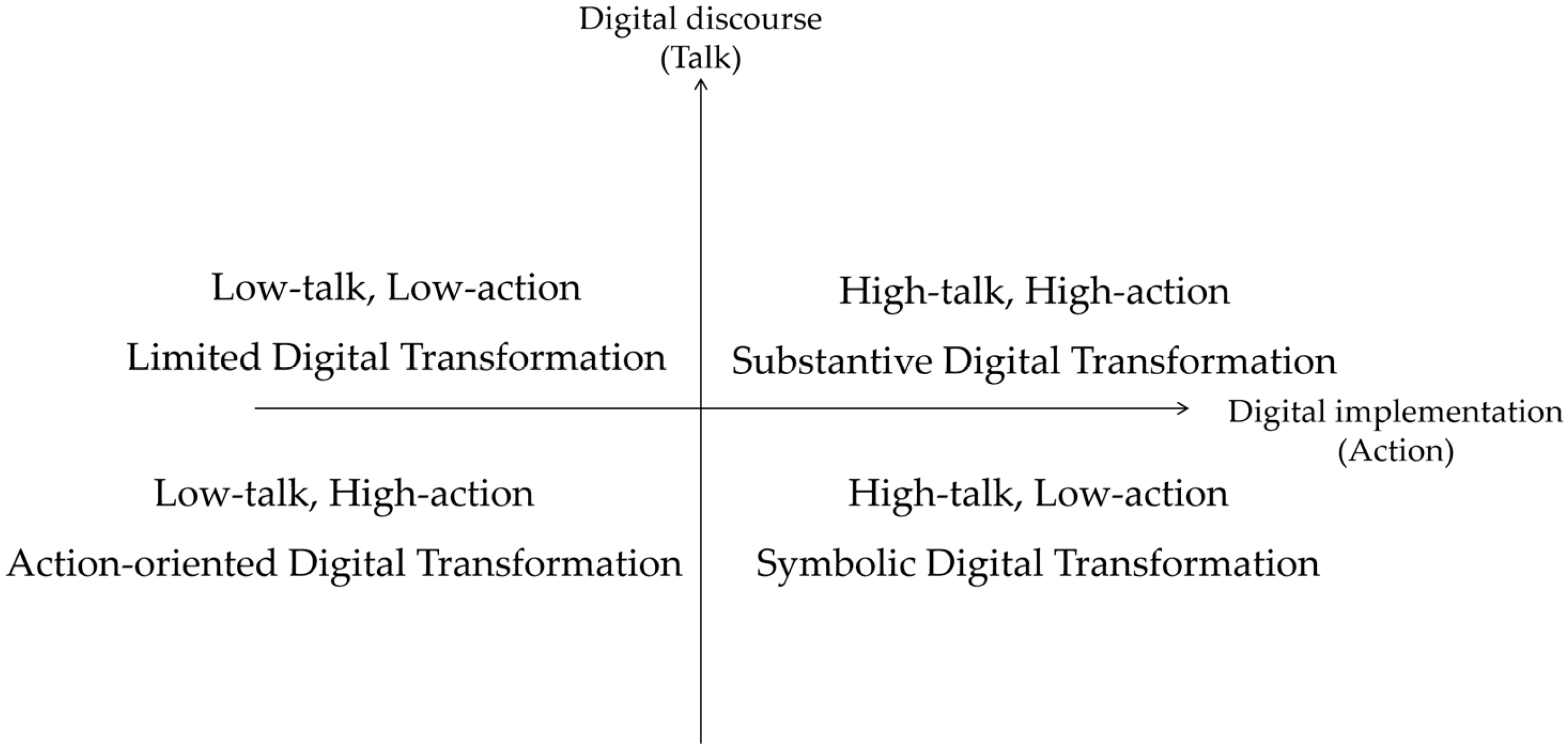
On the basis of the median values of digital disclosure and digital investment, firms are classified into four groups according to their relative levels of digital transformation rhetoric and investment behavior: high-talk–high-action, high-talk–low-action, low-talk–high-action, and low-talk–low-action. The classification framework is shown in
Figure 1.
Among these categories, high-talk–low-action firms represent firms whose digital transformation orientation is relatively prominent in corporate disclosures but whose actual digital investment remains relatively limited. In contrast, high-talk–high-action firms demonstrate greater consistency between digital transformation communications and resource commitments. This classification provides a more comprehensive perspective for understanding the heterogeneous digital transformation patterns among firms.
Table 10 reports the distribution of firms across different digital transformation rhetoric–investment matching categories. The results show that 37.09% of the firms are classified as high-talk–low-action firms, representing the largest group, whereas 12.87% of the firms belong to the high-talk–high-action category. In addition, 7.62% and 42.42% of the firms are categorized as low-talk–high-action and low-talk–low-action firms, respectively. Overall, the distribution indicates that firms differ substantially in terms of the consistency between digital transformation communication and implementation. In particular, the relatively high proportion of high-stalk–low-action firms implies that digital transformation awareness and strategic emphasis may precede actual resource commitment, reflecting the gradual and evolutionary nature of corporate digital transformation.
Table 11 presents the subsample regression results based on the digital transformation rhetoric–investment matching categories. The results show that the coefficient of Dig is positive in both groups, indicating that digital transformation generally contributes to improving the resilience of firms. However, the effect is statistically significant only among other firms, while the coefficient is not significant for high-talk–low-action firms. These findings suggest that the realization of digital transformation benefits may depend partly on the consistency between firms’ digital transformation communication and actual investment behavior. Furthermore, we construct a continuous digital rhetoric–investment gap measure and introduce its interaction term with digital transformation. The interaction coefficient is statistically insignificant, suggesting that the moderating effect of the rhetoric–investment gap on the relationship between digital transformation and firm resilience is not supported.
7. Practical Implications
The findings of this study have several practical implications for policy makers and business managers.
First, policymakers should continue to improve their digital infrastructure and create an institutional environment that facilitates enterprise digital transformation. Public policies should encourage firms to adopt digital technologies by strengthening their digital infrastructure, promoting technological innovation, and supporting them in developing their digital capabilities. Since the empirical results indicate that the resilience-enhancing effect of digital transformation is more pronounced in high-tech firms, policymakers should further improve innovation support systems to facilitate the effective integration of digital technologies into production and management activities.
Second, enterprises should regard digital transformation as a long-term strategic capability rather than merely introducing digital technologies. From the perspective of resource orchestration theory, managers should focus on the effective acquisition, integration, and deployment of digital resources throughout organizational processes, business strategies, and decision-making systems. By continuously orchestrating digital resources into organizational capabilities, firms can improve their adaptability and strengthen their resilience when facing external shocks.
Third, firms should actively promote ESG practices during digital transformation. Rather than treating ESG as a compliance requirement, enterprises should integrate environmental, social, and governance considerations into strategic planning and resource allocation. Digital technologies can improve information transparency, stakeholder engagement, and governance efficiency, allowing ESG performance to complement the resilience-enhancing effect of digital transformation and support firms’ long-term sustainable development.
Finally, enterprises should focus on the consistency between digital transformation communication and implementation. Further analysis indicates that firms differ substantially in the alignment between digital transformation communication and actual digital investment. Although the moderating effect of the rhetoric–investment gap is not statistically significant, the subgroup evidence suggests that substantive digital investment remains important for realizing the potential benefits of digital transformation. Therefore, managers should strengthen the coordination between digital strategies and practical implementation to improve the effectiveness of digital transformation initiatives.
8. Conclusions
8.1. Main Findings
This study investigates the relationship between digital transformation and corporate resilience using a panel of Chinese A-share listed companies from 2016 to 2024. Drawing on resource orchestration theory, this study examines whether ESG performance serves as a complementary transmission mechanism linking digital transformation and corporate resilience. The main findings are summarized as follows:
First, digital transformation significantly enhances corporate resilience. By facilitating information acquisition, improving resource coordination, and strengthening organizational adaptability, digital technologies enable firms to better identify external risks, optimize operational processes, and respond more effectively to unexpected shocks. These findings support the argument of resource orchestration theory that firms can transform digital resources into resilience-enhancing organizational capabilities through effective resource structuring, bundling, and leveraging.
Second, ESG performance partially mediates the relationship between digital transformation and corporate resilience. Digital transformation promotes ESG performance by improving resource allocation efficiency, increasing information transparency, and strengthening stakeholder engagement, which, in turn, contributes to corporate resilience. Although the mediation effect is statistically significant, the results indicate that ESG represents a complementary transmission mechanism rather than the dominant pathway through which digital transformation enhances corporate resilience.
Third, the resilience-enhancing effect of digital transformation is significantly stronger for high-tech firms, whereas no statistically significant heterogeneous effects are observed across firms with different levels of financing constraints or regional marketization. These findings suggest that firms’ technological capabilities play a more important role than external financial or institutional conditions in determining how effectively digital resources are transformed into resilience-enhancing organizational capabilities.
Finally, further analysis reveals considerable variation in the consistency between firms’ digital transformation communication and actual digital investment. Although firms that exhibit relatively greater consistency tend to obtain more significant resilience benefits from digital transformation in the subgroup analysis, the interaction test does not provide statistically significant evidence that the rhetoric–investment gap systematically moderates the relationship between digital transformation and corporate resilience. Therefore, the results should be interpreted cautiously, suggesting that substantive digital implementation may facilitate the realization of digital transformation benefits without constituting a statistically confirmed boundary condition.
8.2. Limitations and Future Research
Despite its findings, this study has several limitations that provide opportunities for future research.
First, this study focuses on Chinese A-share listed companies, and the findings may be influenced by the specific institutional environment and economic conditions in China. Future research could examine whether the relationship between digital transformation and corporate resilience remains consistent across countries, institutional contexts, and types of firms, including small and medium-sized enterprises.
Second, although this study employs multiple robustness checks and addresses potential endogeneity concerns, causal identification remains challenging in observational studies. Future research could adopt more exogenous identification strategies, such as quasi-natural experiments, policy-based shocks, or natural experiments to further strengthen causal inference.
Third, this study examines ESG performance as a complementary transmission mechanism. Future research could investigate additional channels through which digital transformation enhances corporate resilience, such as organizational learning, innovation capability, dynamic capabilities, supply chain collaboration, and digital organizational culture.
Finally, although this study follows the mainstream literature in measuring corporate resilience using firms’ operational stability and growth performance, the concept of resilience in the digital era may extend beyond these traditional dimensions. Future research could develop more comprehensive resilience indicators by incorporating digital resilience-related characteristics, such as digital infrastructure, digital operational capabilities, cybersecurity preparedness, and digital recovery capacity. Moreover, future studies could combine these indicators with richer measures of digital transformation, including digital technology adoption, internal digital capabilities, software and hardware investment, and AI deployment, to provide a more comprehensive understanding of how digital transformation enhances firms’ resilience under different types of external shocks.