Regenerative Agriculture Practices in Poland, Germany, and Belarus: A Comparative Assessment of Their Adoption


Abstract
1. Introduction
2. Materials and Methods
- Concurrent cultivation in various locations“Simultaneous cultivation of different groups of plants in the same season, but in different locations (e.g., cereals, legumes, root crops, herbs).”
- Crop rotation“Changing crops on the same plots each season—crop rotation (e.g., after wheat, rapeseed, then potatoes, then soybeans).”
- Polycultures (mixed crops)“Sowing several species of plants simultaneously on the same plot—so-called polycultures (e.g., oats + lupin, maize + beans + pumpkin).”
- Year-round plant cover“Maintaining plant cover on arable fields throughout the year (living plants or crop residues—leaving stubble, mulching, covering the soil with cover crops)”.
- Catch crops after main harvest“Sowing crops after the main harvest (catch crops/cover crops) (e.g., directly after harvesting maize—mustard or phacelia).”
- Perennial/winter cover with living roots year-round“Using perennial crops or wintering cover crops so that roots remain alive throughout the year (e.g., permanent meadows, fodder plant mixtures, winter rye as a catch crop)”.
- Livestock on fields (during/after crops)“Introducing livestock onto fields during or after crop cultivation”.
- Rotational grazing (frequent moves between paddocks)“Rotational grazing of livestock (e.g., cattle, sheep, or goats are regularly—daily or every few days—moved between small pasture paddocks).”
- Agroforestry (trees/shrubs among crops)“Planting/maintaining trees and shrubs among crops or pastures, so-called agroforestry (e.g., alleys of fruit bushes in arable fields, scattered trees within fields)”.
- Farm design using natural processes“Planning the farm to maximise the use of natural processes (e.g., rainwater harvesting, composting).”
- Reducing synthetic inputs (e.g., mineral fertilisers, pesticides)“Careful minimisation of synthetic fertiliser and pesticide use (e.g., reducing mineral fertiliser doses, avoiding herbicides)”.
- Natural pest control (beneficial insects, biocontrol, traps)“Using natural plant protection methods (e.g., introducing beneficial insects, biological control agents, pest traps)”.
- Organic and natural fertilisers“Using organic fertilisers (e.g., manure, compost, slurry)”.
- Organic fertilisers—smaller doses, higher frequency“Applying organic fertilisers in smaller doses but more frequently (e.g., 20 t/ha of manure every 2 years instead of 40 t/ha every 4 years)”.
- Minimal soil disturbance (non-inversion tillage)“Minimal soil disturbance—shallow tillage or strip-tillage, i.e., without inverting soil layers (e.g., harrowing instead of ploughing).”
- Regular soil pH monitoring & adjustment (liming)“Regular measurement and adjustment of soil pH (liming) to maintain it within the optimal range for the crops being grown”.
- Monitoring soil biology (microbes, earthworms)“Monitoring soil biological activity (e.g., various soil tests indicating microbial vitality, checking earthworm density per m3).”
3. Results
3.1. Respondent and Farm Characteristics
3.2. Comparison of Practice Popularity
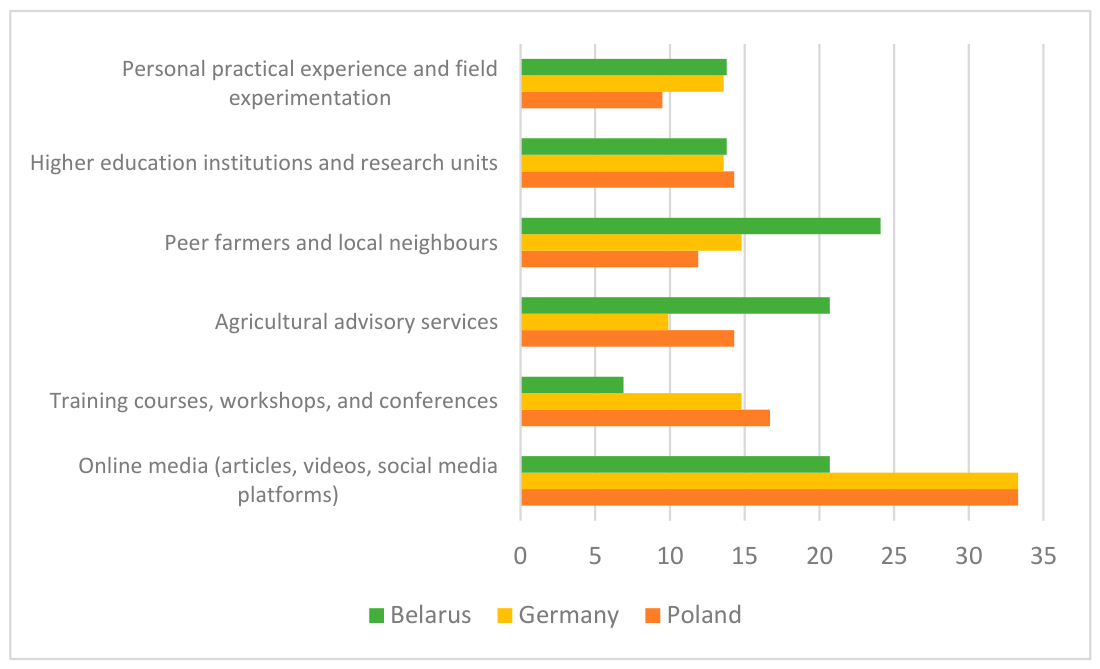
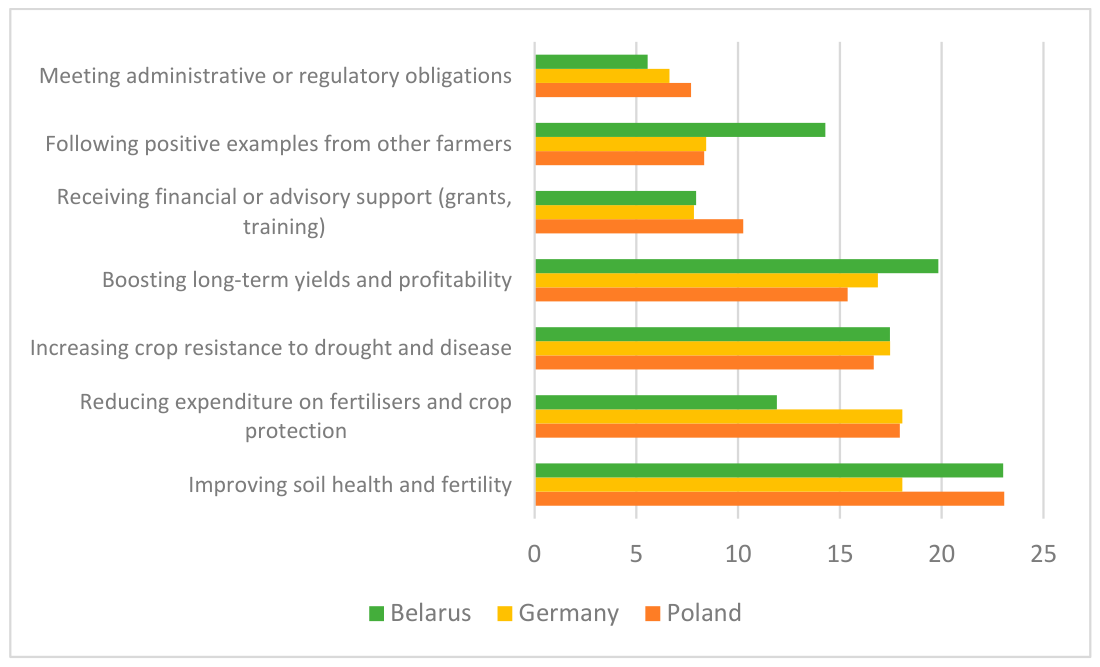
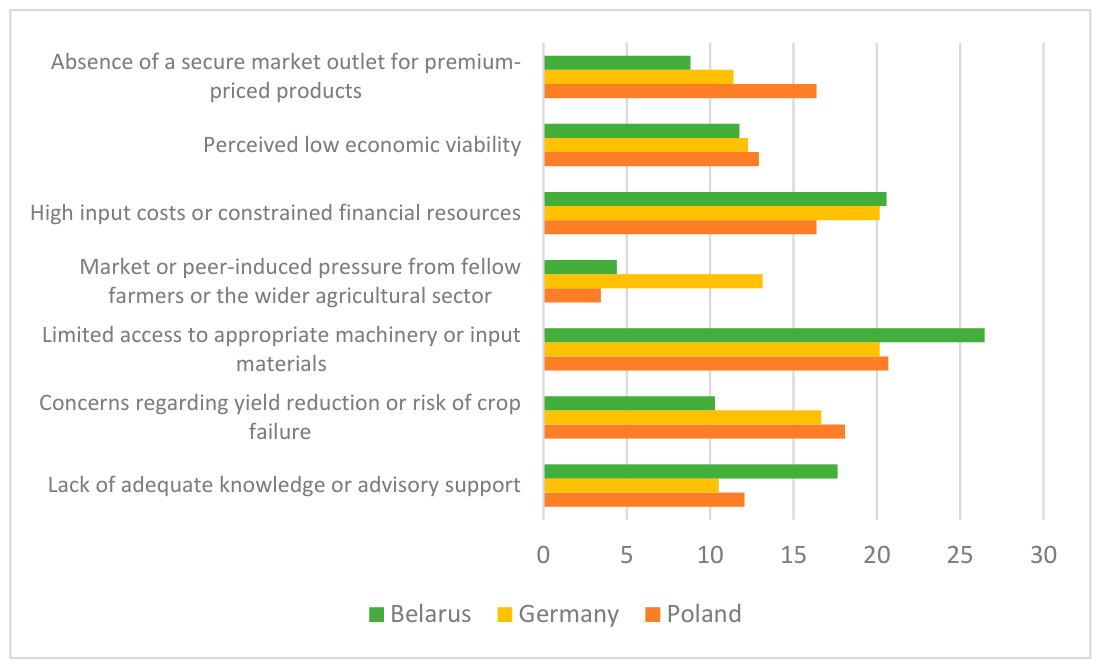
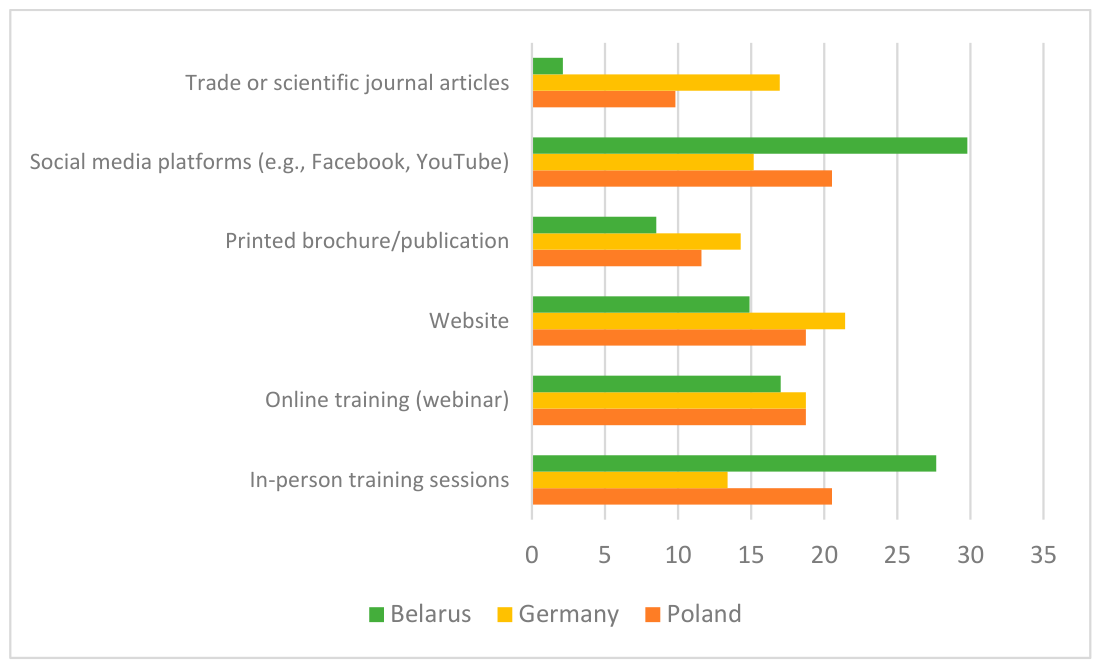
3.3. Sources of Knowledge, Motivations, Limitations and Informational Preferences of Respondents
4. Discussion
4.1. Differences and Similarities in Farmers’ Approaches to Regenerative Agriculture Across Countries
4.2. Adoption of Regenerative Agriculture Practices Across Countries and Their Agronomic Relevance
4.3. Limitations
5. Conclusions
Supplementary Materials
Author Contributions
Funding
Institutional Review Board Statement
Informed Consent Statement
Data Availability Statement
Acknowledgments
Conflicts of Interest
References
- Jordon, M.W.; Willis, K.J.; Bürkner, P.C.; Haddaway, N.R.; Smith, P.; Petrokofsky, G. Temperate Regenerative Agriculture practices increase soil carbon but not crop yield—A meta-analysis. Environ. Res. Lett. 2022, 17, 093001. [Google Scholar] [CrossRef]
- Lal, R. Regenerative agriculture for food and climate. J. Soil Water Conserv. 2020, 75, 123A–124A. [Google Scholar] [CrossRef]
- Zhang, Q.F. From Sustainable Agriculture to Sustainable Agrifood Systems: A Comparative Review of Alternative Models. Sustainability 2024, 16, 9675. [Google Scholar] [CrossRef]
- Schreefel, L.; Schulte, R.P.; De Boer, I.J.M.; Schrijver, A.P.; Van Zanten, H.H.E. Regenerative agriculture–the soil is the base. Glob. Food Secur. 2020, 26, 100404. [Google Scholar] [CrossRef]
- Newton, P.; Civita, N.; Frankel-Goldwater, L.; Bartel, K.; Johns, C. What is regenerative agriculture? A review of scholar and practitioner definitions based on processes and outcomes. Front. Sustain. Food Syst. 2020, 4, 577723. [Google Scholar] [CrossRef]
- LaCanne, C.E.; Lundgren, J.G. Regenerative agriculture: Merging farming and natural resource conservation profitably. PeerJ 2018, 6, e4428. [Google Scholar] [CrossRef] [PubMed]
- Khangura, R.; Ferris, D.; Wagg, C.; Bowyer, J. Regenerative Agriculture—A Literature Review on the Practices and Mechanisms Used to Improve Soil Health. Sustainability 2023, 15, 2338. [Google Scholar] [CrossRef]
- Bilibio, C.; Weber, T.K.D.; Hammer-Weis, M.; Junge, S.M.; Leisch-Waskoenig, S.; Wack, J.; Niether, W.; Gattinger, A.; Finckh, M.R.; Peth, S. Changes in soil mechanical and hydraulic properties through regenerative cultivation measures in long-term and farm experiments in Germany. Soil Tillage Res. 2025, 246, 106345. [Google Scholar] [CrossRef]
- Cagliero, R.; Licciardo, F.; Legnini, M. The evaluation framework in the new CAP 2023–2027: A reflection in the light of lessons learned from rural development. Sustainability 2021, 13, 5528. [Google Scholar] [CrossRef]
- Siemiątkowski, P. Sytuacja Gospodarcza Polski i Wybranych Krajów Europy Środkowowschodniej Dwie Dekady po Przełomie Transformacyjnym. Toruń. Stud. Międzynar. 2012, 1, 15–28. Available online: https://apcz.umk.pl/TSM/article/view/TIS.2012.005/3541 (accessed on 1 June 2026).
- Eurostat. Farms and farmland in the European Union—Statistics Statistics Explained. Available online: https://ec.europa.eu/eurostat/statistics-explained/SEPDF/cache/73319.pdf (accessed on 16 April 2026).
- Herman, E. Changes and challenges in EU agricultural holdings and their impact on rural development. Land 2025, 14, 1080. [Google Scholar] [CrossRef]
- Papko, A. The Quiet Privatisation of Agriculture in Belarus. Undermining the State Control. Wars. Forum Econ. Sociol. 2025, 16, 31. [Google Scholar]
- Farm to Fork Strategy. For a Fair, Healthy and Environmentally-Friendly Food System. Available online: https://food.ec.europa.eu/system/files/2020-05/f2f_action-plan_2020_strategy-info_en.pdf (accessed on 18 April 2026).
- Dessart, F.J.; Barreiro-Hurlé, J.; Van Bavel, R. Behavioural factors affecting the adoption of sustainable farming practices: A policy-oriented review. Eur. Rev. Agric. Econ. 2019, 46, 417–471. [Google Scholar] [CrossRef]
- Prokopy, L.S.; Floress, K.; Arbuckle, J.G.; Church, S.P.; Eanes, F.R.; Gao, Y.; Gramig, B.; Ranjan, P.; Singh, A. Adoption of agricultural conservation practices in the United States: Evidence from 35 years of quantitative literature. J. Soil Water Conserv. 2019, 74, 520–534. [Google Scholar] [CrossRef]
- Grüne Brücken. Available online: https://diezukunftsbauern.de/regenerative-landwirtschaft/gruene-bruecken/ (accessed on 19 June 2026).
- Kathage, J.; Smit, B.; Janssens, B.; Haagsma, W.; Adrados, J.L. How much is policy driving the adoption of cover crops? Evidence from four EU regions. Land Use Policy 2022, 116, 106016. [Google Scholar] [CrossRef] [PubMed]
- Panda, N.; Mohapatra, K.K.; Mohanty, S.; Padhan, K.; Sahoo, S.K.; Dash, P.K.; Sethi, D.; Mishra, A.K. Soil Health: Concepts, Principles and Road Maps for Management in Regenerative Agriculture. J. Mod. Agric. Biotechnol. 2024, 3, 11. [Google Scholar] [CrossRef]
- He, F.; Dong, S.; Yang, J.; Hao, X.; Ma, C.; Shen, H.; Xiao, J.; Li, Y.; Zhang, R.; Shi, H.; et al. Rotational grazing can enhance the soil available nutrients rather than plant diversity to promote ANPP of alpine steppe. Agric. Ecosyst. Environ. 2025, 387, 109617. [Google Scholar] [CrossRef]
- Bulut, S.; Arslan, M. Plant Protection Methods in Organic Farming. Curr. Trends Nat. Sci. 2023, 12, 183–192. [Google Scholar] [CrossRef]
- Nivedha, S.; Marichamy, M.S.; Kanthaswamy, V. Natural Farming: Embracing Regenerative Agriculture for Sustainable Crop Production. J. Exp. Agric. Int. 2024, 46, 855–865. [Google Scholar] [CrossRef]
- Handayani, I.P.; Hale, C. Healthy Soils for Productivity and Sustainable Development in Agriculture. IOP Conf. Ser. Earth Environ. Sci. 2022, 1018, 012038. [Google Scholar] [CrossRef]
- Rehberger, E.; West, P.C.; Spillane, C.; McKeown, P.C. What climate and environmental benefits of regenerative agriculture practices? an evidence review. Environ. Res. Commun. 2023, 5, 052001. [Google Scholar] [CrossRef]
- Hawes, C.; Christie, A.; Banks, G.; Boldrin, D.; Brandt, J.; Iannetta, P.; Swyst, I.; Turner, I. Long-term regenerative practices enhance in-field biodiversity and soil health for sustainable crop yields. Front. Sustain. Food Syst. 2025, 9, 1651686. [Google Scholar] [CrossRef]
- Sharma, P.; Reitz, T.; Singh, S.P.; Worrich, A.; Muehe, E.M. Going beyond improving soil health: Cover plants as contaminant removers in agriculture. Trends Plant Sci. 2025, 30, 539–552. [Google Scholar] [CrossRef] [PubMed]
- Wilson, K.R.; Myers, R.L.; Hendrickson, M.K.; Heaton, E.A. Different Stakeholders’ Conceptualizations and Perspectives of Regenerative Agriculture Reveals More Consensus Than Discord. Sustainability 2022, 14, 15261. [Google Scholar] [CrossRef]
- Giller, K.E.; Hijbeek, R.; Andersson, J.A.; Sumberg, J. Regenerative Agriculture: An agronomic perspective. Outlook Agric. 2021, 50, 13–25. [Google Scholar] [CrossRef] [PubMed]
- Puech, T.; Stark, F. Diversification of an integrated crop-livestock system: Agroecological and food production assessment at farm scale. Agric. Ecosyst. Environ. 2023, 344, 108300. [Google Scholar] [CrossRef]
- Pantera, A.; Mosquera-Losada, M.R.; Herzog, F.; den Herder, M. Agroforestry and the environment. Agroforest. Syst. 2021, 95, 767–774. [Google Scholar] [CrossRef]
- Le, T.H.; Bonari, G.; Sauerwein, M.; Plieninger, T.; Zerbe, S. Traditional agroforestry systems in Europe revisited: A systematic review. Agroforest. Syst. 2025, 99, 236. [Google Scholar] [CrossRef]
- Brown, K.; Schirmer, J.; Upton, P. Can regenerative agriculture support successful adaptation to climate change and improved landscape health through building farmer self-efficacy and wellbeing? Curr. Res. Environ. Sustain. 2022, 4, 100170. [Google Scholar] [CrossRef]
- Keshavarz, M.; Sharafi, H. Scaling up climate-smart regenerative agriculture for the restoration of degraded agroecosystems in developing countries. Sustain. Prod. Consum. 2023, 38, 159–173. [Google Scholar] [CrossRef]
- Smithwick, E.A.H.; Baka, J.; Bird, D.; Blaszczak-Boxe, C.; Cole, C.A.; Fuentes, J.D.; Gergel, S.E.; Glenna, L.L.; Grady, C.; Hunt, C.A.; et al. Regenerative landscape design: An integrative framework to enhance sustainability planning. Ecol. Soc. 2023, 28, 5. [Google Scholar] [CrossRef]
- Cheng, L.; DiTommaso, A.; Kao-Kniffin, J. Opportunities for Microbiome Suppression of Weeds Using Regenerative Agricultural Technologies. Front. Soil Sci. 2022, 2, 838595. [Google Scholar] [CrossRef]
- Jayasinghe, S.L.; Thomas, D.T.; Anderson, J.P.; Chen, C.; Macdonald, B.C.T. Global Application of Regenerative Agriculture: A Review of Definitions and Assessment Approaches. Sustainability 2023, 15, 15941. [Google Scholar] [CrossRef]
- Galli, M.; Feldmann, F.; Vogler, U.K.; Kogel, K.H. Can biocontrol be the game-changer in integrated pest management? A review of definitions, methods and strategies. J. Plant Dis. Prot. 2024, 131, 265–291. [Google Scholar] [CrossRef]
- Pandit, M.A.; Kumar, J.; Gulati, S.; Bhandari, N.; Mehta, P.; Katyal, R.; Rawat, C.D.; Mishra, V.; Kaur, J. Major Biological Control Strategies for Plant Pathogens. Pathogens 2022, 11, 273. [Google Scholar] [CrossRef] [PubMed]
- Franzluebbers, A.J.; Hendrickson, J.R. Should we consider integrated crop–livestock systems for ecosystem services, carbon sequestration, and agricultural resilience to climate change? Agron. J. 2024, 116, 2111–2126. [Google Scholar] [CrossRef]
- Jug, D.; Jug, I.; Brozovi’c, B.; Šeremeši’c, S.; Dolijanovi’c, Ž.; Zsembeli, J.; Ujj, A.; Marjanovic, J.; Smutny, V.; Dušková, S.; et al. Conservation Soil Tillage: Bridging Science and Farmer Expectations—An Overview from Southern to Northern Europe. Agriculture 2025, 15, 260. [Google Scholar] [CrossRef]



| Variable | Belarus (N = 50) | Germany (N = 50) | Poland (N = 50) | Sum (N = 150) |
|---|---|---|---|---|
| Gender | ||||
| Female | 28 (56.0%) | 16 (32.0%) | 17 (34.0%) | 61 (40.7%) |
| Male | 22 (44.0%) | 33 (66.0%) | 31 (62.0%) | 86 (57.3%) |
| Prefer not to say | 0 (0.0%) | 1 (2.0%) | 2 (4.0%) | 3 (2.0%) |
| Experience in agriculture (years) | ||||
| 0–5 | 22 (44.0%) | 11 (22.0%) | 12 (24.0%) | 45 (30.0%) |
| 6–10 | 14 (28.0%) | 12 (24.0%) | 9 (18.0%) | 35 (23.3%) |
| 11–20 | 7 (14.0%) | 14 (28.0%) | 13 (26.0%) | 34 (22.7%) |
| >20 | 7 (14.0%) | 13 (26.0%) | 16 (32.0%) | 36 (24.0%) |
| Possession of agricultural education | ||||
| Yes | 24 (48.0%) | 36 (72.0%) | 36 (72.0%) | 96 (64.0%) |
| No | 26 (52.0%) | 14 (28.0%) | 14 (28.0%) | 54 (36.0%) |
| Familiarity with the term regenerative agriculture | ||||
| Yes | 30 (60.0%) | 32 (64.0%) | 18 (36.0%) | 80 (53.3%) |
| No | 20 (40.0%) | 18 (36.0%) | 32 (64.0%) | 70 (46.7%) |
| Farm area (ha) | ||||
| <10 | 19 (38.0%) | 10 (20.0%) | 12 (24.0%) | 41 (27.3%) |
| 10–50 | 19 (38.0%) | 16 (32.0%) | 25 (50.0%) | 60 (40.0%) |
| 51–100 | 6 (12.0%) | 13 (26.0%) | 9 (18.0%) | 28 (18.7%) |
| >100 | 6 (12.0%) | 11 (22.0%) | 4 (8.0%) | 21 (14.0%) |
| Type of production | ||||
| Crop | 27 (54.0%) | 21 (42.0%) | 23 (46.0%) | 71 (47.3%) |
| Livestock | 6 (12.0%) | 6 (12.0%) | 3 (6.0%) | 15 (10.0%) |
| Mixed | 16 (32.0%) | 22 (44.0%) | 24 (48.0%) | 62 (41.3%) |
| Other | 1 (2.0%) | 1 (2.0%) | 0 (0.0%) | 2 (1.3%) |
| Farm management system | ||||
| Conventional | 35 (70.0%) | 24 (48.0%) | 40 (80.0%) | 99 (66.0%) |
| Other (e.g., organic, biodynamic, regenerative, integrated | 15 (30.0%) | 26 (52.0%) | 10 (20.0%) | 51 (34.0%) |
| Variable | Chi2 Test Results | Standardised Residuals | ||||||
|---|---|---|---|---|---|---|---|---|
| Chi2 | df | p-Value | Cramér’s V | Germany | Poland | Belarus | ||
| Gender | Male | 6.64 | 2 | 0.036 | 0.21 | 1.54 | 1.04 | −2.56 |
| Female | −1.54 | −1.04 | 2.56 | |||||
| Experience in agriculture (years) | 0–5 | 12.05 | 6 | 0.061 | 0.20 | — | ||
| 6–10 | ||||||||
| 11–20 | ||||||||
| >20 | ||||||||
| Possession of agricultural education | Yes | 8.33 | 2 | 0.015 | 0.24 | 1.44 | 1.44 | −2.89 |
| No | −1.44 | −1.44 | 2.89 | |||||
| Familiarity with the term “regenerative agriculture” | Yes | 9.21 | 2 | 0.010 | 0.25 | 1.85 | −3.01 | 1.16 |
| No | −1.85 | 3.01 | −1.16 | |||||
| Farm area | <10 | 11.73 | 6 | 0.068 | 0.20 | — | ||
| 10–50 | ||||||||
| 51–100 | ||||||||
| >100 | ||||||||
| Type of production | Crop | 4.67 | 6 | 0.587 | 0.12 | — | ||
| Livestock | ||||||||
| Mixed | ||||||||
| Other | ||||||||
| Farm management system | Conventional | 11.94 | 2 | 0.003 | 0.28 | −3.29 | 2.56 | 0.73 |
| Other (e.g., organic, biodynamic, regenerative, integrated) | 3.29 | −2.56 | −0.73 | |||||
| Practice No. | Description of the Practice | Mdn (Q1–Q3) | Kruskal–Wallis Test Results | ||||
|---|---|---|---|---|---|---|---|
| Belarus | Germany | Poland | Chi2 | df | p | ||
| 1 | Concurrent cultivation in different locations | 4 (3–5) | 4 (2–5) | 4 (2.25–5) | 0.01 | 2 | 0.995 |
| 2 | Crop rotation | 4 (3–5) | 4 (3–5) | 4 (4–5) | 1.22 | 2 | 0.543 |
| 3 | Polycultures (mixed crops) | 3 (2–4.75) | 2 (1–3.75) | 2 (1–2) | 21.83 | 2 | <0.001 A |
| 4 | Year-round plant cover | 4 (3–4.75) | 3 (2–4) | 3.5 (3–4) | 4.17 | 2 | 0.124 |
| 5 | Catch crops after main harvest | 4 (3–5) | 4 (3–4) | 3 (2.25–4) | 8.64 | 2 | 0.013 B |
| 6 | Perennial/winter cover with living roots year-round | 4 (3–4) | 3 (2–4) | 3 (2–4) | 10.95 | 2 | 0.004 C |
| 7 | Livestock on fields (during/after crops) | 2.5 (1–4) | 3 (1–4) | 1 (1–2.75) | 15.69 | 2 | <0.001 D |
| 8 | Rotational grazing (frequent moves between paddocks) | 2 (1–4) | 2 (1–3) | 1 (0.25–3.75) | 6.13 | 2 | 0.047 E |
| 9 | Agroforestry (trees/shrubs among crops) | 3 (2–3) | 2 (1–3) | 1 (1–2.75) | 16.95 | 2 | <0.001 F |
| 10 | Farm design using natural processes | 4.5 (3–5) | 3 (1.25–3) | 3 (2–4) | 24.78 | 2 | <0.001 G |
| 11 | Reducing synthetic inputs (e.g., mineral fertilisers, pesticides) | 4 (3–5) | 3.5 (2.25–4) | 3 (2–4) | 6.33 | 2 | 0.042 H |
| 12 | Natural pest control (beneficial insects, biocontrol, traps) | 3 (2–4) | 3 (2–4) | 2 (1–2.75) | 20.02 | 2 | <0.001 I |
| 13 | Organic and natural fertilisers | 4 (3–5) | 3 (2–4.75) | 4 (3–5) | 6.27 | 2 | 0.043 J |
| 14 | Organic fertilisers—smaller doses, higher frequency | 3 (2–4) | 2.5 (2–4.75) | 3 (2–4) | 0.7 | 2 | 0.704 |
| 15 | Minimal soil disturbance (non-inversion tillage) | 3 (2–4) | 3 (2–3.75) | 3 (1–3) | 5.12 | 2 | 0.077 |
| 16 | Regular soil pH monitoring & adjustment (liming) | 3 (2–4) | 3 (2–4) | 3 (3–4) | 0.56 | 2 | 0.755 |
| 17 | Monitoring soil biology (microbes, earthworms) | 3 (2–4) | 2 (1–3) | 2 (1–3) | 17.74 | 2 | <0.001 K |
| Practice ID | Sex | Agricultural Education | Familiarity with the Term Regenerative Agriculture | Farm Management System | ||||
|---|---|---|---|---|---|---|---|---|
| Female | Male | Yes | No | Yes | No | Conventional | Unconventional | |
| 1 | 0.834 | 0.975 | 0.617 | 0.883 | 0.337 | 0.004 | 0.772 | 0.450 |
| 2 | 0.545 | 0.739 | 0.785 | 0.127 | 0.439 | <0.001 | 0.283 | 0.936 |
| 3 | 0.012 | 0.009 | <0.001 | 0.026 | 0.006 | 0.168 | <0.001 | 0.175 |
| 4 | 0.216 | 0.634 | 0.067 | 0.613 | 0.298 | 0.008 | 0.146 | 0.484 |
| 5 | 0.388 | 0.013 | 0.001 | 0.792 | 0.503 | 0.021 | 0.102 | 0.138 |
| 6 | 0.004 | 0.217 | 0.033 | 0.050 | 0.007 | 0.090 | 0.004 | 0.083 |
| 7 | 0.197 | 0.001 | 0.026 | 0.002 | 0.166 | <0.001 | 0.004 | 0.188 |
| 8 | 0.695 | 0.007 | 0.131 | 0.011 | 0.014 | 0.030 | 0.005 | 0.302 |
| 9 | 0.479 | <0.001 | <0.001 | 0.075 | 0.019 | 0.054 | 0.002 | 0.075 |
| 10 | 0.005 | <0.001 | 0.001 | 0.149 | <0.001 | 0.008 | 0.001 | 0.019 |
| 11 | 0.887 | 0.016 | 0.080 | 0.317 | 0.790 | 0.066 | 0.032 | 0.625 |
| 12 | 0.533 | 0.001 | 0.001 | 0.044 | 0.780 | 0.012 | 0.002 | 0.508 |
| 13 | 0.153 | 0.114 | 0.081 | 0.507 | 0.014 | 0.089 | 0.002 | 0.022 |
| 14 | 0.988 | 0.220 | 0.713 | 0.696 | 0.075 | 0.415 | 0.348 | 0.714 |
| 15 | 0.505 | 0.083 | 0.288 | 0.192 | 0.073 | 0.594 | 0.089 | 0.967 |
| 16 | 0.417 | 0.457 | 0.966 | 0.672 | 0.003 | 0.607 | 0.677 | 0.309 |
| 17 | 0.197 | 0.001 | 0.001 | 0.089 | <0.001 | <0.001 | 0.002 | 0.048 |
| Number of statistically significant results | 3 | 9 | 8 | 5 | 8 | 9 | 10 | 3 |
Disclaimer/Publisher’s Note: The statements, opinions and data contained in all publications are solely those of the individual author(s) and contributor(s) and not of MDPI and/or the editor(s). MDPI and/or the editor(s) disclaim responsibility for any injury to people or property resulting from any ideas, methods, instructions or products referred to in the content. |
© 2026 by the authors. Licensee MDPI, Basel, Switzerland. This article is an open access article distributed under the terms and conditions of the Creative Commons Attribution (CC BY) license.
Share and Cite
Weiner, M.; Grochowska, J.; Pruszyńska-Wołowik, J.; Bujalski, T. Regenerative Agriculture Practices in Poland, Germany, and Belarus: A Comparative Assessment of Their Adoption. Sustainability 2026, 18, 7973. https://doi.org/10.3390/su18157973
Weiner M, Grochowska J, Pruszyńska-Wołowik J, Bujalski T. Regenerative Agriculture Practices in Poland, Germany, and Belarus: A Comparative Assessment of Their Adoption. Sustainability. 2026; 18(15):7973. https://doi.org/10.3390/su18157973
Chicago/Turabian StyleWeiner, Marcin, Julia Grochowska, Joanna Pruszyńska-Wołowik, and Tomasz Bujalski. 2026. "Regenerative Agriculture Practices in Poland, Germany, and Belarus: A Comparative Assessment of Their Adoption" Sustainability 18, no. 15: 7973. https://doi.org/10.3390/su18157973
APA StyleWeiner, M., Grochowska, J., Pruszyńska-Wołowik, J., & Bujalski, T. (2026). Regenerative Agriculture Practices in Poland, Germany, and Belarus: A Comparative Assessment of Their Adoption. Sustainability, 18(15), 7973. https://doi.org/10.3390/su18157973