1. Introduction
Natural disasters are among the most unpredictable risks facing grain production. They can cause sharp fluctuations in crop yields, reduce grain output, and weaken farmers’ incentives to continue grain cultivation. Their effects also extend beyond agricultural losses. Disaster-hit regions often face slower economic recovery, weaker reconstruction capacity, and greater pressure on sustainable development [
1,
2]. China is highly exposed to natural disasters. The direct economic losses caused by natural disasters reached 345.45 billion yuan in 2023, 401.11 billion yuan in 2024, and 241.62 billion yuan in 2025. Against this background, agricultural insurance has become an important instrument for transferring and sharing disaster-related production risks. It is also a key component of disaster risk management systems in many countries [
3,
4]. International experience suggests that policy-supported agricultural insurance and government premium subsidies can effectively increase farmers’ participation in insurance programs [
5,
6]. In 2018, China introduced pilot programs for full-cost insurance and revenue insurance for the three major grain crops. These programs aimed to raise the level of insurance protection and expand coverage. With sustained policy support, China’s agricultural insurance market has grown rapidly. Premium income increased from only 476 million yuan in 2002 to 148.373 billion yuan in 2024.
In addition to agricultural insurance, low-carbon governance has become another important force shaping modern grain production and its green efficiency in China. In September 2020, China announced its dual-carbon goals: reaching carbon peaking by 2030 and carbon neutrality by 2060. Grain production accounts for about 14% of China’s total carbon emissions. Therefore, the low-carbon transformation of grain cultivation is closely related to the achievement of national emission reduction targets. To control excessive agricultural carbon emissions, the Ministry of Agriculture and Rural Affairs issued the Zero-Growth Action Plan for Fertilizer Use by 2020 in 2015. This policy sought to restrain the overuse of chemical inputs in grain production. The Action Plan for Fertilizer Reduction by 2025, released in 2022, further strengthened agricultural environmental regulation. It marked a shift from controlling fertilizer growth to actively reducing fertilizer use.
Agricultural insurance may affect agroecological outcomes by changing farmers’ input decisions and production strategies. By reducing production risk, insurance can alter how farmers allocate chemical inputs, labor, land, and technology [
7,
8]. One line of research argues that insurance coverage may encourage farmers to use more fertilizers and pesticides as a risk-coping strategy. Under this view, insured farmers may rely on intensive input use to hedge against potential yield losses. Such behavior can aggravate agricultural non-point source pollution and ecological degradation [
9,
10,
11]. A different view reports contrasting evidence [
12,
13]. Zhang et al. (2018) and Yan et al. (2024) emphasize market imperfections and moral hazard in China’s agricultural insurance system [
14,
15]. They find that insured households may reduce input intensity per unit of cultivated land and lower agrochemical expenditure. This adjustment can further lead to a marginal decline in agricultural output [
14,
15].
Based on this research context, this study examines how agricultural insurance affects the ecological efficiency of grain production in China. It also investigates whether carbon emission reduction changes this relationship. Existing studies have not reached a consistent conclusion on this issue. Moreover, limited attention has been paid to the dynamic changes in grain production ecological efficiency under the joint influence of agricultural insurance expansion and carbon emission reduction policies. Using panel data from 31 provincial-level administrative regions in China, this study empirically tests the effect of agricultural insurance development on grain production ecological efficiency. It then examines the moderating role of carbon emission intensity in this relationship. The study also analyzes regional heterogeneity in the links among agricultural insurance, carbon emission intensity, and grain production ecological efficiency. In addition, it compares the differentiated moderating effects of carbon emission intensity across regions.
This study makes three marginal contributions to literature. First, it assesses whether policy-oriented agricultural insurance and agricultural carbon emission reduction can jointly promote green agricultural development. Second, it identifies the moderate role of carbon emission intensity in the relationship between agricultural insurance and grain production ecological efficiency. Third, it conducts a regional heterogeneity analysis to reveal differences in policy effects across regions. The findings provide empirical evidence for designing region-specific policies that support high-quality, green, and low-carbon development of grain agriculture in China.
2. Theoretical Analysis and Research Hypotheses
2.1. How Agricultural Insurance Affects Grain Production Ecological Efficiency
Agricultural insurance reduces risks from natural disasters and yield fluctuations. It changes farmers’ risk attitudes and production decisions. These changes adjust farmers’ input allocation and farming methods, and finally affect the ecological efficiency of grain production. Existing studies summarize two core channels for this influence.
The first channel is large-scale farming. Agricultural insurance cuts farmers’ income risks. Farmers become more willing to expand their planting areas. Large-scale farms use less fertilizer, pesticide and plastic film for each unit of output, and produce fewer unwanted polluting outputs. Zhang et al. (2015) found higher agricultural total factor productivity under carbon limits [
16]. Their results prove that large-scale farming improves resource utilization efficiency [
16].
The second channel is green technology adoption. Agricultural insurance stabilizes farmers’ future income. Farmers are more willing to use environmentally friendly planting technologies. New technologies save production inputs and cut carbon emissions and fertilizer pollution. They push grain production toward low-carbon and clean modes. Zheng and Li (2023) found improved national agricultural green efficiency under carbon control policies [
17]. Their findings offer indirect evidence for this technology path [
17].
However, most past studies discuss the two channels separately. Scholars also hold opposite views on whether agricultural insurance improves ecological efficiency. Some researchers state that insured farmers use more chemical inputs to avoid yield losses, which worsens farm pollution [
9,
10,
11]. Other scholars point out defects and moral risks in China’s agricultural insurance market. They find insured families reduce fertilizer and other chemical inputs per mu after buying insurance [
14,
15]. The same split exists in efficiency research: some papers confirm agricultural insurance raises green productivity [
18,
19], while others find it restrains efficiency growth [
20].
This study holds that large-scale farming and green technology adoption reduce pollution outputs and lift input–output efficiency. Overall, agricultural insurance helps improve grain production ecological efficiency. We put forward the first hypothesis:
Hypothesis 1 (H1). Agricultural insurance development has a clear positive effect on the ecological efficiency of grain production.
2.2. The Moderating Effect of Carbon Emission Intensity
Carbon emission intensity reflects local carbon reduction pressure and strictness of environmental rules. Areas with high carbon emission intensity set tight limits for farmers. These limits include carbon performance assessments and caps on fertilizer and pesticide use. Strict environmental rules raise the cost of high-pollution farming. Agricultural insurance lowers risks of trying new green technologies. The two factors together push farmers to adopt low-carbon planting.
Existing studies draw different conclusions about carbon limits and agricultural productivity. Zhang et al. (2015) found rising agricultural total factor productivity under carbon policies [
16]. Yang (2021) recorded productivity growth in grain farms of Gansu Province with carbon restrictions [
21]. Zheng and Li (2023) found better national agricultural green efficiency under carbon governance [
17]. On the contrary, Zhan et al. (2019) argued agricultural green efficiency falls when carbon costs are counted into production expenses [
22].
These conflicting results show carbon emission intensity is neither completely good nor bad. It works as an external condition and interacts with policies such as agricultural insurance. Based on this logic, we propose the second hypothesis:
Hypothesis 2 (H2). Carbon emission intensity positively moderates the promoting effect of agricultural insurance on grain production ecological efficiency.
2.3. Regional Heterogeneity
Regions across China differ greatly in agricultural development level, farm industry structure and agricultural insurance coverage. Major grain-producing areas have larger farm scales and wider insurance access. Agricultural insurance may bring stronger gains in ecological efficiency in these regions. Western China has fragile farmland, extensive polluting planting methods and underdeveloped agricultural insurance. The impact of agricultural insurance here differs sharply from other regions. We thus raise the third hypothesis:
Hypothesis 3 (H3). The impact of agricultural insurance development on grain production ecological efficiency shows obvious regional heterogeneity.
3. Materials and Methods
3.1. Data Sources
This study takes 31 provincial-level administrative regions of China as the research samples. In consideration of data richness and availability, the balanced panel data covering the period from 2001 to 2021 is selected for empirical analysis. The research period spans the key developmental stages of China’s agricultural insurance system and the progressive implementation of agricultural carbon reduction policies, which can comprehensively reflect the dynamic evolution of grain production ecological efficiency under policy shocks. All research data are derived from the China Statistical Yearbook, China Rural Statistical Yearbook, China Financial Yearbook, China Insurance Yearbook, and provincial statistical yearbooks. The linear interpolation method is adopted to supplement individual missing data values to ensure the integrity and continuity of the research dataset.
3.2. Variable Settings
3.2.1. Dependent Variable
This paper takes the ecological efficiency of grain production (eco) as the explained variable. Referring to the related research of Pan and Ying (2013), the super-efficiency SBM model is used to calculate the numerical value of the ecological efficiency of grain production [
23]. Assume that there are n decision-making units in the system, with
N types of input indicators, M types of expected output indicators, and L types of undesirable output indicators, represented by vectors
x ∈
SN,
ya ∈
SM, and
yb ∈
SL, where
x,
ya and
yb are all matrices.
,
, and
.
The super-efficiency SBM model is constructed as follows:
For the model setting, , and represent the actual values of input factors, desirable outputs, and undesirable outputs of the decision-making unit (DMU) in period , respectively. , and denote the slack variables of inputs, desirable outputs, and undesirable outputs, while refers to the weight of each DMU in period .
Based on the theoretical framework of the super-SBM model, this study constructs a comprehensive indicator system to evaluate grain production ecological efficiency from three dimensions: grain production inputs, desirable outputs, and undesirable outputs. The input indicators include labor force, cultivated land area, chemical fertilizer, pesticide, agricultural film, effective irrigation area, and total agricultural mechanical power. In terms of output indicators, grain yield is selected as the single desirable output, while total agricultural carbon emissions and fertilizer-induced non-point source pollution generated during grain cultivation are adopted as two undesirable core outputs.
Among all input indicators, grains sown area is directly obtained from official statistical yearbooks. For other input indicators, this study follows the method proposed by Zhang et al. (2020) [
24] and calculates grain-specific input values according to the proportion of grains sown area in the total crop-sown area of each province. The undesirable outputs consist of agricultural carbon emissions and fertilizer non-point source pollution. Specifically, the carbon emission coefficients for grain production are derived from existing authoritative studies [
25]: 0.8956 kg/kg for chemical fertilizer, 5.18 kg/kg for agricultural film, 4.9341 kg/kg for pesticides, 0.592 kg/kg for diesel oil, 20.476 kg/hm
2 for irrigation activities, and 312.6 kg/hm
2 for tillage activities (
Table 1).
For the measurement of fertilizer non-point source pollution, chemical fertilizer applications are identified as the primary source of non-point source pollution in grain production. This study employs the unit inventory method proposed by Lai (2004) [
26] for pollution calculation, with relevant pollution discharge coefficients referring to the Second National Pollution Source Census Discharge Coefficient Manual issued by the Ministry of Ecology and Environment of China, which has been widely validated in previous relevant studies.
3.2.2. Explanatory Variables
This study takes agricultural insurance development (LNins) as the core explanatory variable to explore its impact on the ecological efficiency of grain production. Referring to Zhang and Ma (2016), this study adopts provincial agricultural insurance premium income as the proxy indicator to measure the level of agricultural insurance development [
27]. As the most fundamental and intuitive aggregate indicator of agricultural insurance market scale, premium income can comprehensively reflect insurance coverage breadth, the leverage effect of fiscal subsidies, and farmers’ insurance participation enthusiasm. Zhang and Ma (2016) [
27] further elaborate that agricultural insurance is subordinate to property insurance business, and most insurance institutions adopt mixed operational modes. As a result, general financial indicators such as total insurance assets fail to accurately extract and isolate agricultural insurance-specific information. In addition, given the extensive involvement of grassroots administrative authorities in insurance underwriting and claim settlement in China’s agricultural insurance system, the number of insurance practitioners cannot objectively reflect the actual development level of regional agricultural insurance markets. Furthermore, premium income data are officially released by regulatory authorities with unified statistical caliber and high data availability, which are highly applicable for provincial-level panel empirical analysis. Accordingly, this study employs agricultural insurance premium income as the core proxy variable to characterize the development status of agricultural insurance.
3.2.3. Adjusting Variables
To examine whether the impact of agricultural insurance development on grain production ecological efficiency is contingent on regional carbon emission levels, this study introduces carbon emission intensity (ci) as the moderating variable and constructs an interaction model for empirical estimation. Following Shao et al. (2022), carbon emission intensity is measured by the ratio of provincial grain-related carbon emissions to regional per capita GDP [
28]. This indicator captures the carbon emission level associated with per unit economic output and, compared with absolute carbon emission volume, can more accurately reflect the degree of decoupling between regional economic growth and carbon emissions. This study incorporates the interaction term of agricultural insurance development and carbon emission intensity (LNins × LNci) into the baseline model to examine the potential moderating effect of carbon emission intensity on the ecological efficiency effect of agricultural insurance. A significantly positive coefficient of the interaction term indicates that the efficiency-promoting effect of agricultural insurance on grain production ecological efficiency is strengthened in regions with higher carbon emission intensity.
3.2.4. Control Variables
In addition to agricultural insurance development and carbon emission abatement, grain production ecological efficiency is also affected by a series of contextual factors, including the urbanization rate (LNurb), primary industry proportion (LNpro), fiscal support for agriculture (LNfin), farmers’ income level (LNincom), and per capita crop-sown area (LNare).
The urbanization rate reflects the progress of regional urbanization. Accelerating urbanization triggers the migration of agricultural laborers to urban sectors, leading to reduced labor input in grain cultivation, which further generates substantial impacts on grain production ecological efficiency.
The primary industry proportion refers to the ratio of primary industry output to the total regional economic output. A higher proportion indicates that local economic growth is highly dependent on agriculture. In such regions, greater priority is usually given to the economic benefits of grain production while ecological and environmental protection is relatively neglected, thereby restraining the improvement of grain ecological efficiency.
Fiscal support for agriculture is measured by the share of local fiscal expenditures on agriculture, forestry and water conservancy in total fiscal expenditure. A higher level of fiscal support implies stronger governmental attention and policy inclination toward agricultural development. On this basis, farmers can access more subsidies for agricultural insurance and agricultural machinery, as well as improved irrigation infrastructure, jointly shaping the ecological performance of grain production.
Farmers’ income level also serves as a critical influencing factor. Higher household income enables farmers to invest more capital in optimizing agricultural production conditions, such as adopting advanced agricultural machinery and environmentally friendly fertilizers, which effectively promotes the green and efficient development of grain cultivation.
Per capita crop-sown area reflects the scale level of agricultural production. Expanded operation scale facilitates the promotion of agricultural mechanization and the intensive utilization of production factors, which further exert significant influences on the improvement of grain production ecological efficiency.
3.3. Model Specification
Referring to existing studies, this study adopts the stepwise regression coefficient test method for empirical estimation. To eliminate the interference of heteroscedasticity, all variables except grain production ecological efficiency are logarithmically transformed. The econometric models are constructed as follows.
where
and
denote province and year, respectively.
,
,
,
,
,
,
, and
represent the unknown parameters to be estimated, and
is the random error term. Equation (3) examines the baseline impact of agricultural insurance on the ecological efficiency of grain production. Equation (4) further incorporates agricultural carbon emission intensity and the interaction term between agricultural insurance and carbon emission intensity, to identify the joint effects of agricultural insurance and carbon emission intensity on grain production ecological efficiency.
4. Empirical Results and Analysis
4.1. The Changing Trends of Agricultural Insurance Development, Agricultural Carbon Emissions and Grain Production Ecological Efficiency
4.1.1. Agricultural Insurance Development
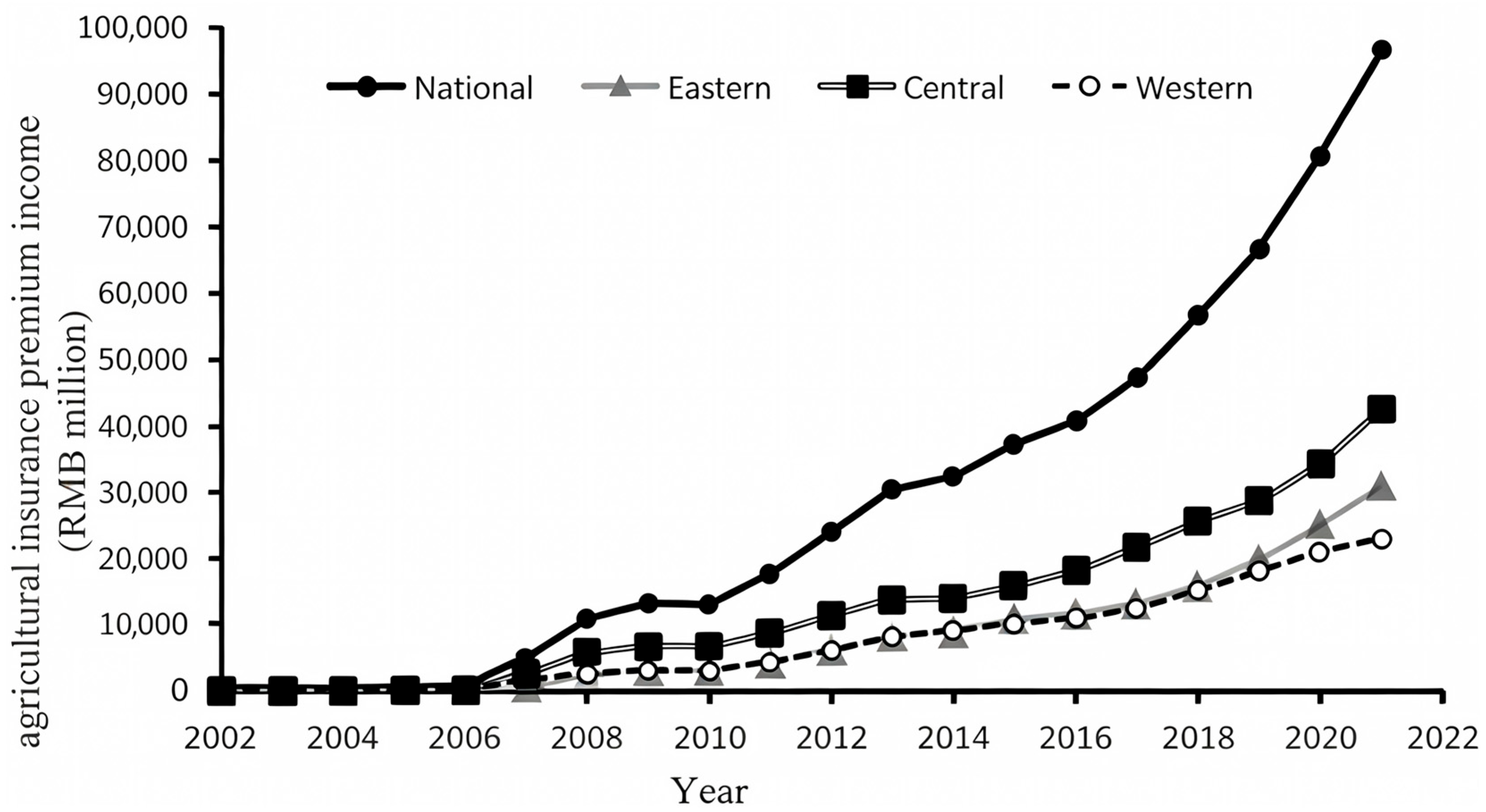
As shown in
Figure 1, China’s agricultural insurance sector achieved rapid development from 2002 to 2022, with agricultural insurance premium income demonstrating a remarkable upward trend. The Chinese government has attached great importance to the popularization of agricultural insurance and provided fiscal subsidies for insurance premiums, which effectively reduces farmers’ premium payment burden. In 2018, the central government launched pilot programs of full-cost insurance and income insurance for three major grain crops to explore more efficient insurance mechanisms. After 2018, agricultural insurance premium income surged at an accelerated pace, and insurance coverage was further expanded nationwide.
From a regional perspective, agricultural insurance premium income in China’s eastern, central and western regions all experienced substantial growth over 2002–2022. The central region exhibited the most striking growth, largely because it serves as China’s primary grain-producing area. The eastern and western regions shared similar growth trajectories in premium income before 2018. However, premium income in the eastern region rose sharply after 2018, attributable to its more developed economy and stronger capacity of local farmers to participate in agricultural insurance.
4.1.2. Carbon Emissions from Grain Production
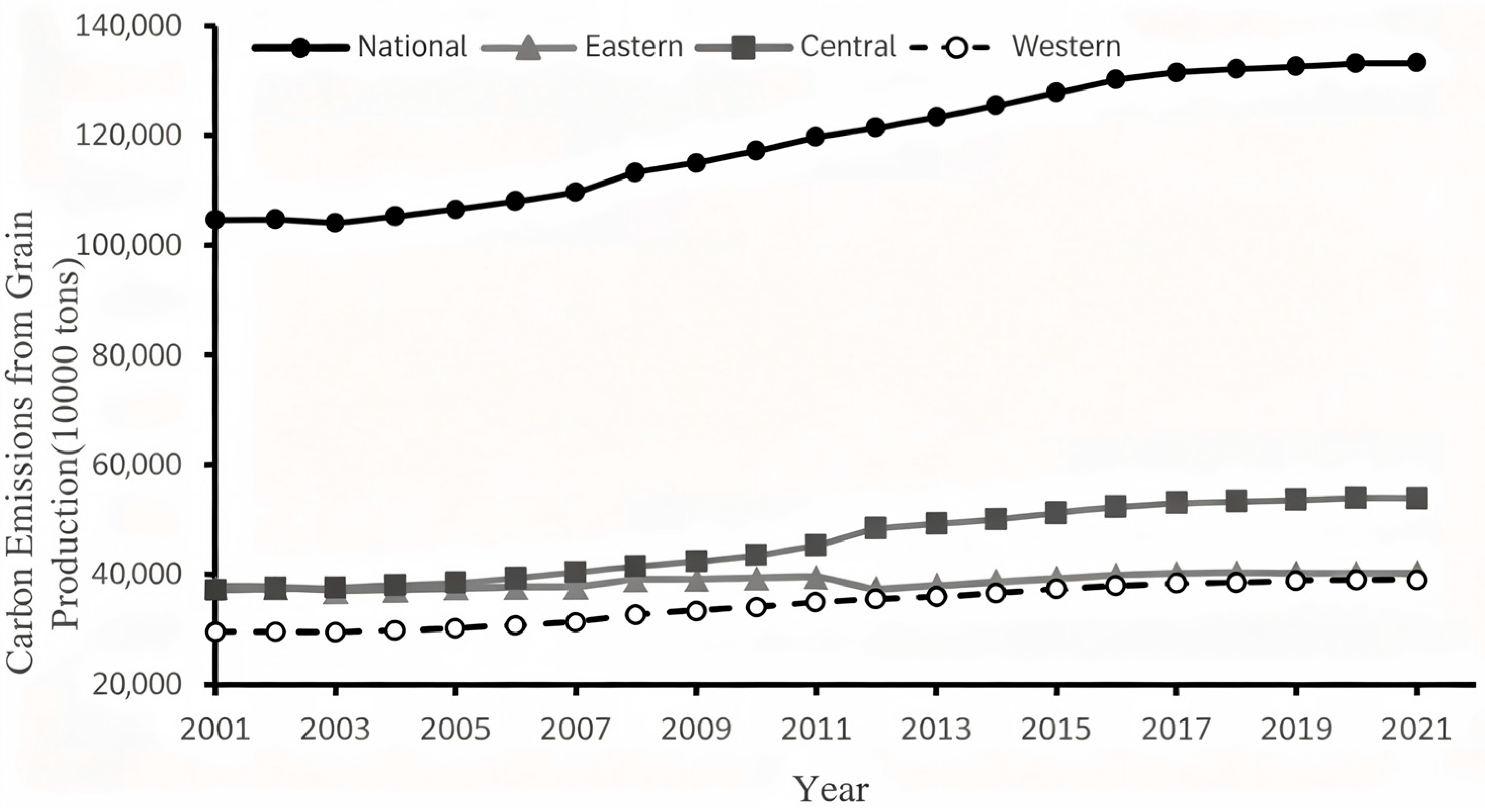
As illustrated in
Figure 2, carbon emissions from grain production in China generally followed a notable upward trajectory. Carbon emissions rose markedly between 2003 and 2016, while the growth momentum gradually slowed after 2017. In 2015, the Chinese government issued the Zero-Growth Action Plan for Fertilizer Use by 2020, which curbed the growth rate of carbon emissions from grain production and led to the decelerating emission growth observed starting in 2017.
From a regional perspective, the evolutionary patterns of grain production carbon emissions across eastern, central and western China displayed evident disparities during 2001–2021. The central region registered the most prominent emission growth, as this area constitutes China’s major grain-producing basin. Carbon emissions in the eastern region dropped substantially after 2011, driven by its advanced industrial economy and shrinking grain output. By contrast, carbon emissions from grain production in western China increased moderately at a gentle pace throughout the research period.
4.1.3. Trends in the Ecological Efficiency of Grain Production
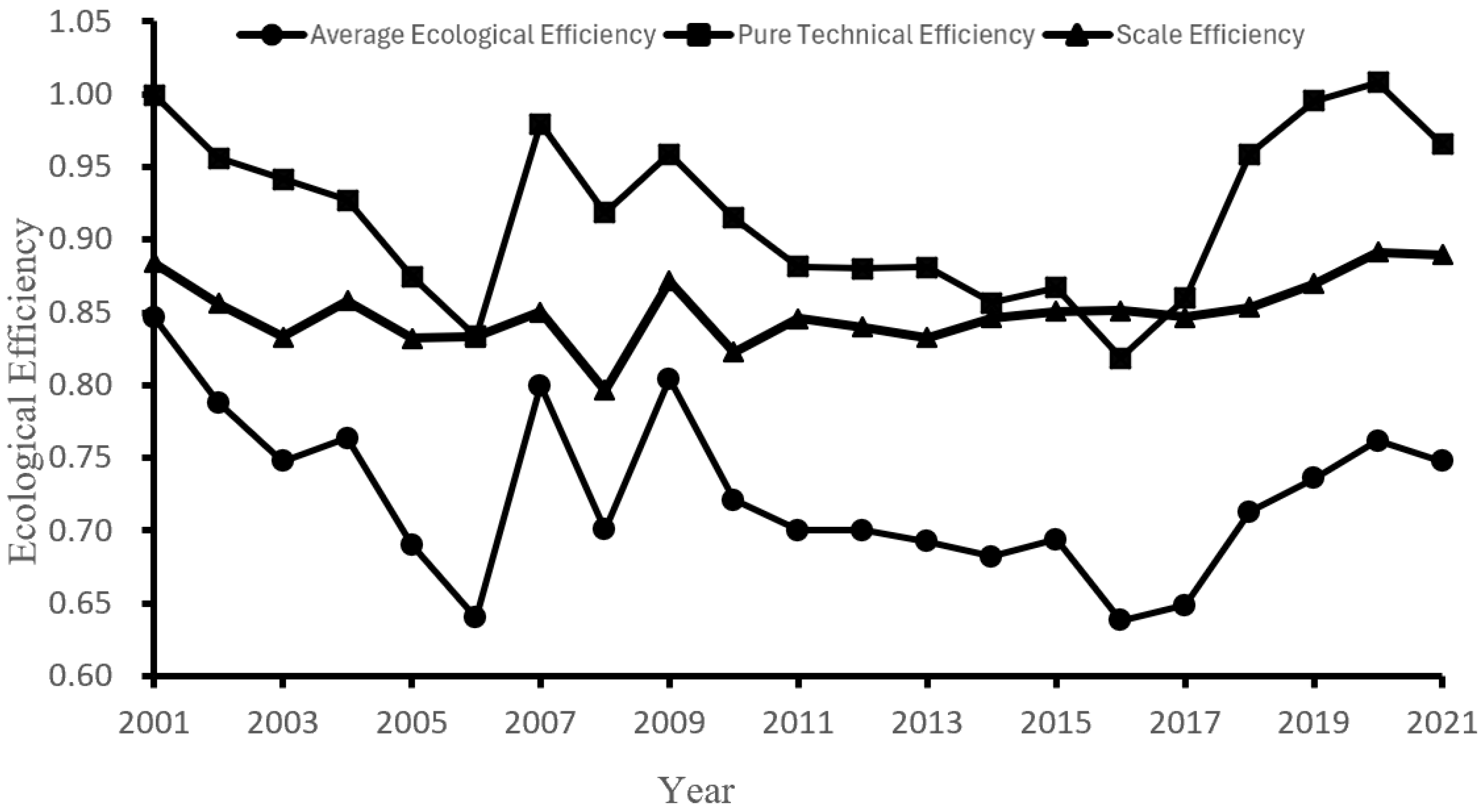
Based on MaxDEA 8.0 software, this study applies the super-efficiency SBM model to measure the ecological efficiency of grain production for 31 provincial-level regions in China over the period 2001–2021. The ecological efficiency discussed in this paper refers to overall technical efficiency. As shown in
Figure 3, the ecological efficiency of grain production in China exhibits obvious fluctuating trends: it declined from 2001 to 2005 and again from 2009 to 2016, before turning upward during 2017–2020, which indicates that the ecological performance of domestic grain production has improved in recent years.
The average ecological efficiency across provinces is driven by multiple complex factors, and its evolutionary trend differs substantially from those of agricultural insurance development and carbon emissions from grain production. Their research reveals that improvements in the ecological efficiency of China’s agricultural production are primarily driven by gains in technical efficiency. In contrast, scale efficiency of grain production changes moderately, implying minor fluctuations in input factors such as grain-sown area nationwide.
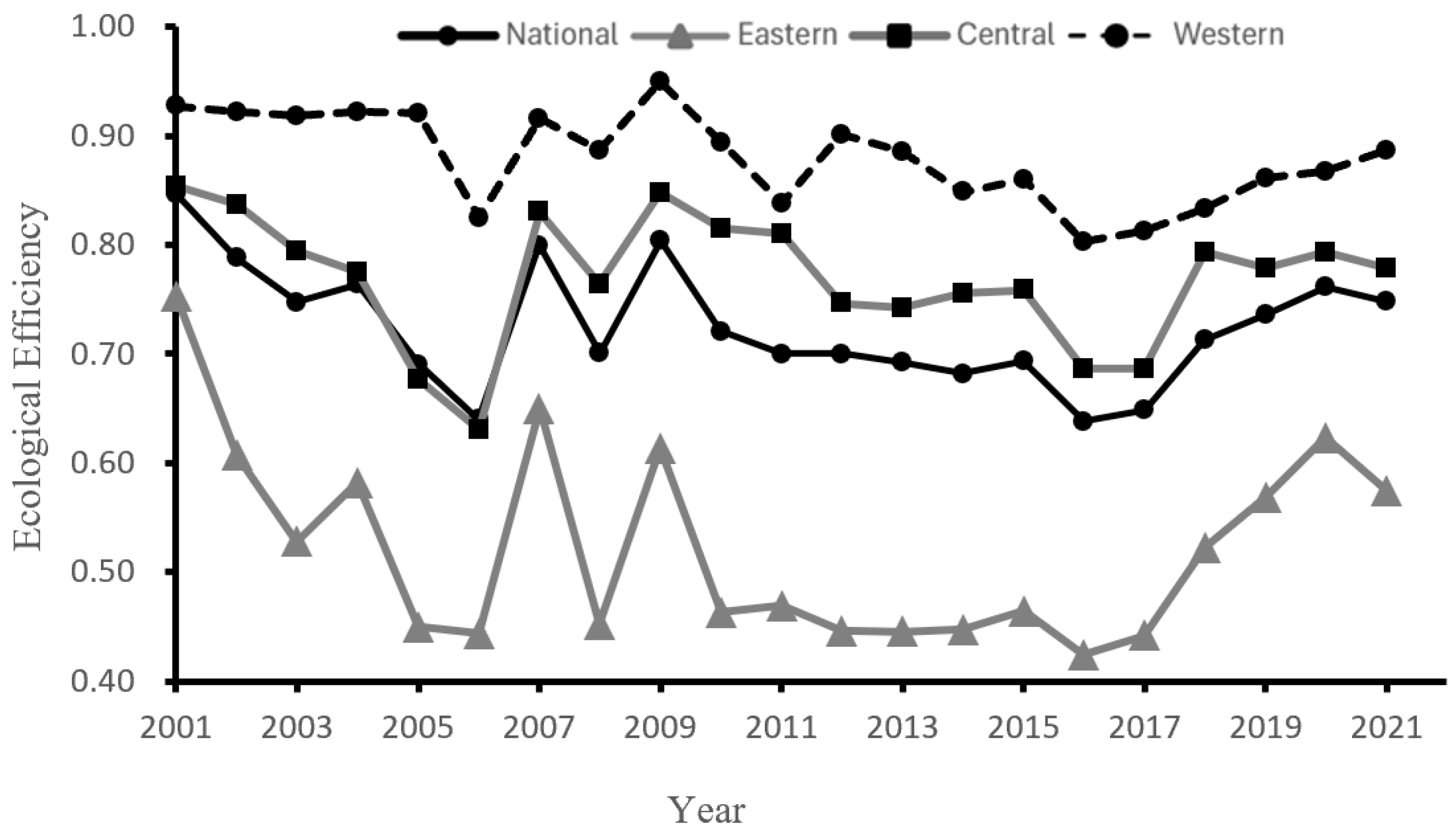
From a regional perspective, grain production ecological efficiency displayed noticeable discrepancies across China’s eastern, central, and western regions during the period 2001–2021. The western regions presented the highest ecological efficiency of grain production, followed by the central regions, while the eastern regions ranked the lowest. Additionally, grain production ecological efficiency in the eastern regions exhibited stronger inter-temporal volatility throughout the sample period.
4.2. Baseline Regression
4.2.1. Analysis of the Impacts of Agricultural Insurance on Grain Production Ecological Efficiency
Stata 15.0 software is adopted to conduct econometric tests. First, the Fisher-ADF panel unit root test is performed to avoid spurious regression. The test results strongly reject the null hypothesis that the panel data contains unit roots for all variables. Next, the Hausman test is carried out to select between the fixed-effects model and the random-effects model. Since the p-value rejects the null hypothesis, the fixed-effects model is adopted in this paper.
As shown in
Table 2, LNins is significantly and positively correlated with eco at the 10% significance level, indicating that agricultural insurance development exerts a prominent positive effect on the ecological efficiency of grain production. This finding suggests that the vigorous promotion of agricultural insurance by the Chinese government reduces operational risks for grain farmers after they take out agricultural insurance policies. Accordingly, grain producers can expand cultivated land scale, cut down inputs of agrochemicals such as pesticides and chemical fertilizers, and adopt environmentally friendly new technologies. These measures curb undesirable outputs in grain cultivation and ultimately improve grain production ecological efficiency.
Among the control variables, LNurb has a significant negative correlation with eco at the 5% significance level, meaning that rising urbanization rates suppress grain production ecological efficiency. A plausible explanation is that urbanization reduces agricultural labor supply and cultivated land area. To sustain grain yields, farmers rely more heavily on chemical fertilizers and pesticides, which undermines ecological efficiency.
LNpro shows a significant positive association with eco at the 5% significance level: regions with a higher share of the primary industry achieve better grain ecological efficiency, which may be tied to local economic development patterns. Generally, areas with a larger primary industry share have relatively lagging economic growth and retain more traditional grain cultivation methods characterized by higher ecological efficiency. LNincom is positively and significantly related to eco at the 5% significance level. Higher farm income allows farmers to invest more resources in optimizing production conditions, such as purchasing advanced agricultural machinery and eco-friendly fertilizers, thereby boosting grain ecological performance. LNare presents a significant positive correlation with eco at the 10% significance level. Larger per capita crop-sown areas reflect a higher degree of agricultural scale operation, which facilitates agricultural mechanization and intensive use of production inputs, further lifting the ecological efficiency of grain production.
To mitigate endogenous bias stemming from potential reverse causality, this study adopts the two-step System GMM estimator for re-estimation. The one-period lag of the dependent variable, eco
t−1, is incorporated into the specification to capture the dynamic adjustment trajectory of grain production eco-efficiency. Meanwhile, the core explanatory variable LNins is treated as endogenous, with its second-to-fourth order lagged values deployed as internal instrumental variables. The corresponding estimation outputs are documented in
Table 2.
Regarding diagnostic statistics, the AR (2) test yields a p-value of 0.191, which verifies the absence of second-order serial correlation within the residual series. The Hansen overidentification test produces a p-value of 0.337, implying that the null hypothesis of joint instrument validity cannot be rejected, thereby validating the rationality of the empirical specification. The regression outputs reveal that the coefficient on ecot−1 is positive and statistically significant, corroborating the pronounced path dependence inherent to grain production eco-efficiency. The estimated coefficient of the core explanatory variable LNins stands at 0.0164. While this coefficient lacks statistical significance (p = 0.268), it retains an identical sign and comparable magnitude relative to the baseline fixed-effects estimate of 0.0101. This evidence indicates that the positive economic impact of agricultural insurance expansion on grain production eco-efficiency remains robust after addressing endogeneity concerns.
Synthesizing the baseline fixed-effects regression and System GMM estimation outcomes, this study draws a tentative conclusion: empirical evidence supports a favorable effect of agricultural insurance development on grain production eco-efficiency. Nevertheless, the magnitude of this facilitative impact remains modest, and its statistical significance diminishes once endogeneity and dynamic feedback effects are accounted for.
4.2.2. Analysis of the Moderating Effect Test of Carbon Emissions
As illustrated in
Table 3, LNci exhibits a significantly negative correlation with eco at the 1% statistical significance level, which implies that carbon emission intensity imposes a prominent adverse impact on grain production eco-efficiency. This finding further reveals that the carbon reduction initiatives implemented by Chinese authorities have effectively transformed grain producers’ cultivation patterns and facilitated the improvement of grain production eco-efficiency.
The coefficient of the interaction term LNins × LNci on eco is significantly positive at the 5% significance level, demonstrating that carbon emission intensity exerts a notable positive moderating effect on the eco-efficiency enhancement effect of agricultural insurance. This result reveals that agricultural insurance exerts a more pronounced eco-efficiency boosting effect in areas featuring high carbon emission intensity.
A plausible underlying mechanism for this outcome can be elaborated as follows. Regions characterized by high carbon emission intensity generally adopt traditional agricultural production modes featuring high input and high energy consumption, which leave substantial room for carbon abatement and energy conservation. The risk-sharing function of agricultural insurance stabilizes farmers’ income expectations, thereby raising their willingness to adopt green farming technologies such as straw returning, organic fertilizer substitution and water-saving irrigation. Accordingly, the facilitating effect of agricultural insurance on eco-efficiency becomes more pronounced in high-carbon-emission regions. Meanwhile, areas with elevated carbon emission intensity are usually prioritized targets of environmental supervision and regulatory constraints. The superimposed effects of agricultural insurance and various environmental subsidies further amplify the auxiliary role of agricultural insurance in advancing the ecological transition of grain agriculture.
4.3. Heterogeneity Analysis
Given the substantial disparities in economic development across China’s sub-regions, this study divides the full sample into eastern, central and western subsamples to further investigate the heterogeneous impacts of agricultural insurance on grain production eco-efficiency from a carbon reduction perspective, with separate econometric estimations conducted for each group. The corresponding results are presented in
Table 4.
Table 4 reveals that agricultural insurance exerts vastly divergent influences on grain production eco-efficiency across regions under the carbon reduction framework.
For the eastern region, the coefficient of LNins stands at 0.0191 and fails to pass the significance test. Nevertheless, the coefficient of the interaction term LNins × LNci is 0.0227 and significantly positive at the 5% level, which indicates that carbon emission intensity positively moderates the eco-efficiency effect of agricultural insurance; this moderating effect is mainly realized through the synergy between agricultural insurance and carbon reduction policies. The coefficient of LNpro is 4.0019 and significantly positive at the 1% level, demonstrating that industrial structure upgrading delivers a pronounced driving effect on eco-efficiency. The eastern region features a small agricultural share and limited agricultural insurance premium scale, making it difficult to precisely identify the direct effect of agricultural insurance and yielding statistically insignificant results for LNins alone. However, the eastern region boasts more advanced economic development, relatively high carbon emission intensity and stringent carbon reduction regulations. The superimposed effects of agricultural insurance and environmental policies jointly materialize the facilitating role of insurance in agricultural ecological transition, which is captured by the significant interaction term.
In the central region, the core variable LNins carries a coefficient of 0.0528, significantly positive at the 1% level, while the interaction term LNins × LNci yields a coefficient of 0.0714, also significant at the 1% level. These findings suggest that agricultural insurance generates the most prominent eco-efficiency promotion effect in central China, and carbon emission intensity serves as a strong positive moderator in this mechanism. The coefficient of LNci is −1.7258 and significantly negative at the 1% level, implying that rising mechanization may be accompanied by higher energy consumption and thereby exert a restraining impact on eco-efficiency. As the core grain-producing zone of China, the central region enjoys wide agricultural insurance coverage, high farmer participation rates and substantial fiscal subsidies. During the transition from traditional to modern agriculture, regional production modes are undergoing critical adjustments with ample room for eco-efficiency improvement. By stabilizing farmers’ income expectations and providing risk coverage, agricultural insurance unlocks farmers’ incentives to adopt green production technologies, hence generating the strongest facilitative effect among the three regions.
For the western region, the coefficient of LNins is −0.0052 and the coefficient of the interaction term LNins × LNci is 0.0060, both statistically insignificant. This outcome indicates that agricultural insurance has not yet produced a meaningful boosting effect on grain production eco-efficiency in western China, nor does carbon emission intensity exert a significant moderating influence. Agricultural insurance development in western China started late, characterized by narrow coverage, low protection levels and relatively low farmer participation, so the risk-sharing function of insurance cannot be fully leveraged. Meanwhile, traditional farming modes still dominate local agricultural production, agricultural infrastructure remains inadequate, and the popularization of green production technologies is still in its infancy. Against this backdrop, agricultural insurance cannot provide effective support for eco-efficiency growth, and its policy effects require further cultivation and realization.
The sub-regional estimation results reveal that the eco-efficiency-promoting effect of agricultural insurance does not emerge uniformly across all regions of China. Instead, it exhibits heterogeneous characteristics closely tied to regional economic development levels, agricultural production structures, and the intensity of policy implementation.
As the primary grain-producing belt, the central region should serve as the core area for advancing green transformation policies of agricultural insurance. The eastern region shall focus on exploiting the synergistic effects between agricultural insurance and carbon reduction policies. For the western region, it is imperative to expand the coverage of agricultural insurance at an accelerated pace, laying a solid foundation for the ecological effects of insurance to take full effect.
4.4. Robustness Test
To verify the robustness of the empirical findings, this paper conducts robustness checks by replacing the core explanatory variable. Following the research design proposed by Zhu et al. (2024) [
29], agricultural insurance density (LNden) is adopted as a substitute for agricultural insurance premium income. As a standard proxy for the development level of agricultural insurance, agricultural insurance density is calculated as total agricultural insurance premium income divided by the number of employees in the primary industry. We re-estimate all econometric models using LNden as the new core explanatory variable, and the regression outputs are presented in
Table 5.
As shown in
Table 5, after the substitution of the core variable, LNden is significantly and positively correlated with eco at the 1% significance level in the baseline regression, which reveals the prominent positive effect of agricultural insurance development on the ecological efficiency of grain production. In the moderating effect model, LNci remains significantly negatively associated with eco at the 1% significance level, demonstrating that carbon emissions intensity exerts an adverse impact on grain production ecological efficiency. The coefficient of the interaction term LNden × LNci on eco is significantly positive at the 5% significance level, which indicates that carbon emission intensity exerts a statistically significant positive moderating effect on the eco-efficiency enhancement effect of agricultural insurance. The econometric results remain largely consistent after replacing the core explanatory variable, which validates the robustness of the conclusions drawn in this study.
In addition, this study implements two alternative robustness checks. First, a time trend variable is incorporated into the baseline specification to account for potential common temporal trends in grain production eco-efficiency. Second, samples of municipalities directly under the Central Government are excluded to eliminate potential bias induced by extreme observations. The corresponding robustness estimation results are displayed in
Table 5.
As shown in
Table 5, after incorporating the time trend variable, the coefficient of LNins equals 0.0110 and is statistically significant at the 10% level. Compared with the baseline regression outcomes, neither the magnitude nor the significance level of the coefficient undergoes substantial changes. This finding indicates that variations in grain production eco-efficiency are not dominated by a universal time trend, and the facilitative effect of agricultural insurance on eco-efficiency persists after stripping out temporal trends. When excluding municipal samples, the coefficient of LNins stands at 0.0126 and remains significant at the 10% level. The coefficient of the interaction term LNins × LNci is 0.0167, significantly positive at the 5% level, while the coefficient of LNci is −0.4505 and significantly negative at the 1% level. All of these estimates align closely with the baseline regression results. This evidence reveals that carbon emission intensity itself imposes a restraining effect on grain production eco-efficiency, yet such adverse impact is mitigated as agricultural insurance expands.
Collectively, after replacing the core explanatory variable, adding time trend variables, and excluding municipality samples, the direction, magnitude, and significance of the coefficient on the core explanatory variable remain substantially unchanged. The positive moderating effect of the interaction term also remains significant. These results indicate that the baseline regression findings are robust.
5. Further Discussion
This study systematically investigates the influence of agricultural insurance development on the ecological efficiency of grain production in China and further examines the moderating effect of agricultural carbon emissions intensity on such causal nexus. The core research significance lies in providing empirical evidence and practical references for balancing grain production security and ecological environmental governance during the advancement of agricultural insurance and low-carbon agricultural transformation. Based on the empirical findings, further targeted discussions are elaborated as follows.
5.1. Measurement of Grain Production Ecological Efficiency
Grain production ecological efficiency comprehensively reflects the green development level of grain cultivation by integrating production inputs, expected economic outputs, and undesirable environmental outputs. Compared with traditional Data Envelopment Analysis (DEA) models, the super-efficiency Slack-Based Measure (super-SBM) model effectively addresses the estimation bias caused by input and output slack variables, thus possessing superior accuracy and applicability in evaluating agricultural green efficiency. Accordingly, this study adopts the super-SBM model to calculate the ecological efficiency of grain production across China’s provinces.
As illustrated in
Figure 3, China’s grain production ecological efficiency exhibited significant fluctuations from 2001 to 2021. Specifically, the efficiency first declined and then rebounded between 2001 and 2009, followed by a gradual downward trend after 2009 and a prominent rapid increase after 2016, indicating a substantial improvement in the ecological performance of China’s grain production system since 2016. Notably, China has achieved steady growth in grain yield alongside continuous improvements in grain ecological efficiency, which can be largely attributed to the government’s emphasis on agricultural ecological protection and the continuous investment in and improvement of the agricultural insurance system.
Furthermore,
Figure 4 presents obvious regional heterogeneity in grain production ecological efficiency. Specifically, the western region ranks the highest, followed by the central region, while the eastern region shows the lowest efficiency level. Such regional discrepancies are primarily driven by unbalanced economic development across China. The eastern region features a developed industrial and service economy, with relatively low policy priority granted to grain production and agricultural ecological improvement. In contrast, the central and western regions are economically underdeveloped, and agriculture constitutes a core pillar of local economic growth. These regions therefore attach greater importance to optimizing input–output efficiency in grain cultivation, ultimately contributing to higher grain production ecological efficiency.
5.2. Influence of Agricultural Insurance on Ecological Efficiency
As reported in
Table 2, agricultural insurance development exerts a significant positive effect on improving grain production ecological efficiency. The efficiency-promoting mechanism of agricultural insurance can be summarized into two core pathways: production incentive effect and behavioral constraint effect.
In terms of the production incentive effect, agricultural insurance provides effective economic compensation for disaster-induced yield losses, stabilizes farmers’ production expectations, and safeguards the security of agricultural investment. Risk dispersion encourages farmers to expand production inputs and scale up cultivation operations, thereby promoting the large-scale and industrialized development of grain production. The formation of agricultural scale economies effectively improves unit grain output efficiency and reduces undesirable environmental outputs, thereby optimizing the overall ecological efficiency of grain production.
In terms of the behavioral constraint effect, insurance coverage stabilizes farmers’ income expectations and discourages excessive and inefficient factor inputs in agricultural production. Specifically, insured farmers tend to reduce the over-application of chemical fertilizers and pesticides, which substantially cuts down carbon emissions and non-point source pollution induced by excessive agrochemical inputs. The continuous fiscal premium subsidy policies implemented by the Chinese government have further strengthened the risk-guarantee function of agricultural insurance, standardized farmers’ production behaviors, and ultimately facilitated the green and efficient development of grain production.
5.3. Impact of the Dual-Carbon Goals on Agricultural Carbon Emissions
As shown in
Figure 2, the growth rate of carbon emissions from China’s grain production has gradually slowed down since 2015. Given the continuous expansion of national grain output during this period, the carbon emission intensity per unit grain yield has achieved a sustained decline, demonstrating notable progress in low-carbon grain transformation.
The proposal of China’s dual-carbon goals in 2015 has triggered systematic reforms in energy utilization and economic operation patterns, profoundly reshaping the low-carbon development trajectory of agricultural production [
30]. In October 2021, the Central Committee of the Communist Party of China and the State Council issued the Opinions on Fully and Accurately Implementing the New Development Philosophy and Promoting Carbon Peaking and Carbon Neutrality, explicitly proposing to accelerate green agricultural development and enhance carbon sequestration and efficiency in agriculture. In November 2025, the supporting document China’s Actions for Carbon Peaking and Carbon Neutrality was released, further emphasizing the necessity of reducing agricultural carbon emissions and improving agricultural carbon sequestration capacity.
To facilitate agricultural carbon abatement, the Chinese government has vigorously promoted the development of new energy industries and digital agricultural technologies, increased scientific and technological investment in grain cultivation, reduced the reliance on fossil energy in traditional agricultural production, and accelerated the transformation toward low-carbon farming modes. In addition, the successive issuance of the Zero-Growth Action Plan for Fertilizer Use by 2020 and the Fertilizer Reduction Action Plan by 2025 has effectively guided farmers to reduce unreasonable chemical fertilizer inputs. Popularized soil testing and formulated fertilization technologies have optimized fertilization methods and increased organic fertilizer application. Meanwhile, the fertilizer reduction policies have constrained the overcapacity of the chemical fertilizer industry, reducing fertilizer consumption among manufacturers, governments, and farmers, and jointly driving the continuous decline of carbon emissions in grain production.
5.4. Test of the Moderating Effect
As presented in
Table 3, LNci bears a significantly negative correlation with eco at the 1% statistical level, while the coefficient of the interaction term LNins × LNci on eco is significantly positive at the 5% level. These outcomes indicate that carbon emission intensity exerts a notable adverse influence on grain production eco-efficiency nationwide, alongside a statistically significant moderating effect.
Table 4 further reveals that the moderating effect of carbon emission intensity holds significance in both eastern and central China. Such regional heterogeneity can be attributed to the unbalanced economic development across the country. The eastern region features advanced economic development, sound digital technology infrastructure, and relatively affluent farming households. Agricultural insurance mitigates farmers’ operational risks; paired with mandatory national carbon reduction regulations, farmers possess sufficient capacity and incentives to transform cultivation modes and improve grain production eco-efficiency.
As China’s core grain-producing heartland, the central region stands at a pivotal stage of transition from traditional to modern agriculture with broader agricultural insurance coverage. By providing risk coverage and stabilizing farmers’ income expectations, agricultural insurance unlocks farmers’ incentives to adopt green farming technologies, thereby amplifying the moderating contribution of insurance to grain production eco-efficiency.
5.5. Research Limitations
This study has several limitations that deserve further improvement. Restricted by the availability of official statistical data, specialized grain production indicator data are not independently published. Consistent with mainstream empirical practices in existing studies, this study calculates grain-specific input indicators based on the proportion of grain-sown area in total crop-sown area for quantitative analysis. In addition, constrained by data limitations, this study failed to test the potential spatial spillover effects between grain production and eco-efficiency. We expect that higher-quality datasets will be available in future research to verify the conclusions of this paper and conduct a more comprehensive analysis of grain production eco-efficiency.
6. Conclusions and Policy Implications
This study adopts panel data covering 31 Chinese provincial-level regions from 2001 to 2021 and accounts for regional heterogeneity. We measure grain production eco-efficiency via the super-efficiency SBM model, estimate the impact of agricultural insurance development on grain eco-efficiency, and identify the moderating effect of carbon emission intensity on the nexus between agricultural insurance expansion and grain production eco-efficiency. The core empirical findings are summarized as follows: (1) Agricultural insurance development significantly improves grain production eco-efficiency. (2) Carbon emission intensity imposes a significant negative impact on grain production eco-efficiency, and national carbon reduction policies effectively facilitate the advancement of grain production eco-efficiency. (3) Carbon emission intensity plays a moderating role in the linkage between agricultural insurance development and grain production eco-efficiency. This moderating effect is statistically significant in eastern and central China yet insignificant in western China.
Drawing on the above conclusions, this study puts forward target policy recommendations.
First, implement differentiated premium subsidy schemes for agricultural insurance. The regional heterogeneity analysis indicates that the eco-efficiency boosting effect of agricultural insurance exhibits obvious gradient disparities across regions. Accordingly, a one-size-fits-all standard for agricultural insurance premium subsidies should be abandoned. For central China, the core grain-producing region, governments ought to further raise insurance protection levels and subsidy ratios. For western China, priority should be given to expanding insurance coverage to establish institutional and market foundations for the ecological functions of agricultural insurance.
Second, construct a regionally differentiated ecological compensation mechanism. On top of existing agricultural insurance premium subsidies, central fiscal authorities could set up special incentive funds for grain production eco-efficiency. Differentiated fiscal rewards shall be allocated according to the magnitude of eco-efficiency improvement across provinces, allowing regions with remarkable efficiency gains to access larger fiscal transfer payments.
Third, advance policy coordination between agricultural insurance and carbon reduction regulations. In regions with high carbon emission intensity, agricultural insurance subsidies can be linked to carbon reduction assessment standards. Insured farmers who adopt green cultivation practices including straw returning, organic fertilizer substitution and water-saving irrigation shall be granted additional premium discounts.
Author Contributions
Conceptualization, R.W.; Methodology, R.W.; Software, R.W. and D.H.; Validation, R.W. and D.H.; Formal analysis, R.W.; Investigation, R.W. and D.H.; Resources, R.W.; Data curation, R.W.; Writing—original draft, R.W.; Writing—review & editing, R.W.; Visualization, R.W.; Supervision, R.W.; Project administration, R.W.; Funding acquisition, R.W. All authors have read and agreed to the published version of the manuscript.
Funding
This research was funded by National Special Research Project for Ph.D. Talents with Special Service grant number BSZX2021-06.
Institutional Review Board Statement
Not applicable.
Informed Consent Statement
Not applicable.
Data Availability Statement
The provincial panel dataset adopted in this research is extracted from open-access databases and publications, including China Statistical Yearbook, China Rural Statistical Yearbook, China Financial Yearbook, China Insurance Yearbook and Statistical Yearbook of each province.
Conflicts of Interest
The authors declare no conflict of interest.
References
- Chen, S.; Yang, X.Y. Construction of Food Security Guarantee System Adapting to Climate Change. J. Nanjing Agric. Univ. Soc. Sci. Ed. 2025, 25, 81–90. [Google Scholar] [CrossRef]
- Montero, J.-M.; Naimy, V.; Abi Farraj, N.; El Khoury, R. Natural Disasters, Stock Price Volatility in the Property-Liability Insurance Market and Sustainability: An Unexplored Link. Socio-Econ. Plan. Sci. 2024, 91, 101791. [Google Scholar] [CrossRef]
- Wang, Z.; Zhang, F.; Liu, S.; Xu, D. Consistency between the Subjective and Objective Flood Risk and Willingness to Purchase Natural Disaster Insurance among Farmers: Evidence from Rural Areas in Southwest China. Environ. Impact Assess. Rev. 2023, 102, 107201. [Google Scholar] [CrossRef]
- Philippi, T.; Schiller, J. Abandoning Disaster Relief and Stimulating Insurance Demand through Premium Subsidies. J. Risk Insur. 2024, 2, 339–382. [Google Scholar] [CrossRef]
- Wang, Z.; Li, J.; Lu, B.; Wang, B.; Zhang, B.; Sun, K.; Fan, M. Effectiveness and Risk of Initial Carbon Quota Allocation Principle under the Uncertainty of the Chinese Electricity Market. China Econ. Rev. 2023, 77, 101892. [Google Scholar] [CrossRef]
- Zhang, W.; Deng, B.; Wei, J.; Wang, S. Policy-Based Agricultural Insurance Empowering High-Quality Agricultural Development in China—From the Dual Perspectives of New Development Concept and Food Security Guarantee. Insur. Stud. 2026, 3, 17–36. [Google Scholar] [CrossRef]
- Xie, S.; Zhang, J.; Li, X.; Xia, X.; Chen, Z. The Effect of Agricultural Insurance Participation on Rural Households’ Economic Resilience to Natural Disasters: Evidence from China. J. Clean. Prod. 2024, 434, 140123. [Google Scholar] [CrossRef]
- Liang, Y.; Wang, Y.; Sun, Y.; Ruan, J. Study on the Influence of Agricultural Scale Management Mode on Production Efficiency Based on Meta-Analysis. Land 2024, 13, 968. [Google Scholar] [CrossRef]
- Regmi, M.; Briggeman, B.; Featherstone, A. Effects of Crop Insurance on Farm Input Use: Evidence from Kansas Farm Data. Agric. Resour. Econ. Rev. 2022, 51, 361–379. [Google Scholar] [CrossRef]
- Zhong, F.N.; Ning, M.X.; Xing, L.; Miao, Q. Research on the Relationship between Agricultural Insurance and Agrochemical Application: Empirical Evidence from Farmers in Manas River Basin, Xinjiang. Q. J. Econ. 2007, 1, 291–308. [Google Scholar]
- Luo, X.M.; Zhang, W.; Tan, Y. Environmental Effects and Green Subsidy Modes of Policy-Based Agricultural Insurance. Rural Econ. 2016, 11, 13–21. [Google Scholar] [CrossRef]
- Han, Y.; Qiu, H.; Feng, S. Does Crop Insurance Reduce Pesticide Usage? Evidence from China. China Econ. Rev. 2021, 69, 101679. [Google Scholar] [CrossRef]
- Dong, Y.; Jia, C.L.; Su, L.F. The Impact of Digital Agricultural Insurance on Farmers’ Fertilizer Reduction Technology Adoption: Evidence from China. China Agric. Econ. Rev. 2025, 17, 379–397. [Google Scholar] [CrossRef]
- Zhang, Z.X.; Mu, Y.Y.; Hou, L.L. Can Participating in Agricultural Insurance Optimize Factor Allocation? Production Effect Analysis with Endogenous Farmers’ Insurance Purchase Behavior. China Rural Econ. 2018, 10, 53–70. [Google Scholar] [CrossRef]
- Yan, F.E.; Yi, F.J.; Zhang, J.Q. Analysis on Fertilizer Reduction Effect of Agricultural Insurance: Re-examination Based on Dual Constraints of Credit and Information. China Rural Econ. 2024, 10, 20–41. [Google Scholar]
- Zhang, L.; Ran, G.H.; Lan, Z.S. Carbon Emission Constraints and Growth & Decomposition of Agricultural Total Factor Productivity. J. South China Agric. Univ. Soc. Sci. Ed. 2015, 14, 22–32. [Google Scholar]
- Zheng, J.; Li, Y.W. Agricultural Insurance, Labor Resource Allocation and Green Economic Efficiency. J. South China Agric. Univ. Soc. Sci. Ed. 2023, 22, 69–81. [Google Scholar]
- Zheng, J.; Ning, T. Agricultural Insurance, Labor Resource Allocation and Agricultural Total Factor Productivity. J. Cent. Univ. Financ. Econ. 2025, 3, 66–82. [Google Scholar]
- Ma, X.Y.; Mu, Y.Y. Evaluation of Grain Production Environmental Technical Efficiency from Carbon Perspective: Based on Super-Efficiency SBM-Undesirable Model. Chin. J. Agric. Resour. Reg. Plan. 2024, 45, 26–35. [Google Scholar]
- Yang, L.; Chen, S.W.; Wei, T.D. Research on Market Distortion Effect and Adaptive Mechanism of Policy-Based Agricultural Insurance. J. Agro-For. Econ. Manag. 2025, 24, 929–938. [Google Scholar]
- Yang, X.J.; Chen, Y.; Gao, R.H. Measurement of Agricultural Environmental Efficiency and Agricultural Total Factor Productivity under Carbon Emission Constraints in Gansu Province. Chin. J. Agric. Resour. Reg. Plan. 2021, 42, 13–20. [Google Scholar]
- Zhan, J.T.; Xu, Y.J.; Ge, J.H. Changes in China’s Agricultural Green Productivity Considering Carbon Emission Costs. Resour. Sci. 2019, 41, 884–896. [Google Scholar] [CrossRef]
- Pan, D.; Ying, R.Y. Evaluation Method and Empirical Study of China’s Agricultural Ecological Efficiency: SBM Model Analysis Based on Undesirable Outputs. Acta Ecol. Sin. 2013, 33, 3837–3845. [Google Scholar]
- Han, H.; Zhang, X. Static and Dynamic Cultivated Land Use Efficiency in China: A Minimum Distance to Strong Efficient Frontier Approach. J. Clean. Prod. 2020, 246, 119002. [Google Scholar] [CrossRef]
- Han, D.; Zhong, Y. Impact of Agricultural Science and Technology Innovation on Grain Production Carbon Emissions: A Case Study of Three Major Grain Functional Zones in China. Sci. Technol. Rev. 2023, 41, 32–42. [Google Scholar] [CrossRef]
- Lai, S.Y.; Du, P.F.; Chen, J.N. Investigation and Assessment of Non-point Source Pollution Based on Unit Analysis. J. Tsinghua Univ. Sci. Technol. 2004, 44, 1184–1187. [Google Scholar] [CrossRef]
- Zhang, Z.R.; Ma, L. An empirical analysis on unbalanced development of provincial policy-based agricultural insurance in China. Financ. Sci. 2016, 7, 20–30. [Google Scholar] [CrossRef]
- Shao, S.; Xu, L.; Zhang, S.Y. Can carbon emission trading facilitate the achievement of the “Dual Carbon” goals? Heterogeneous evidence from the energy supply side and consumption side. J. Lanzhou Univ. Soc. Sci. 2022, 50, 27–40. [Google Scholar] [CrossRef]
- Zhu, S.J.; Yin, M.H.; Yuan, X.Z.; Tian, Y. Does Agricultural Insurance Improve Agricultural Carbon Productivity? Chin. J. Agric. Resour. Reg. Plan. 2024, 45, 42–51. [Google Scholar]
- Li, L.D.; Li, Y.M.; Bai, X.G. Mechanism and Heterogeneity of New Quality Agricultural Productivity Empowering Agricultural Carbon Emission Reduction. Econ. Geogr. 2026, 46, 205–214. [Google Scholar] [CrossRef]
| Disclaimer/Publisher’s Note: The statements, opinions and data contained in all publications are solely those of the individual author(s) and contributor(s) and not of MDPI and/or the editor(s). MDPI and/or the editor(s) disclaim responsibility for any injury to people or property resulting from any ideas, methods, instructions or products referred to in the content. |