Article

Bricolage, Green Creativity, and Paradox Mindset in New Ventures: A Moderated Mediation Analysis of Dual Performance

1
School of Economics, Anyang Normal University, Anyang 455000, China
2
Business School, Xinyang Normal University, Xinyang 464000, China
3
Department of Economics and Business, University of Oradea, 410080 Oradea, Romania
*
Author to whom correspondence should be addressed.
Sustainability 2026, 18(15), 7856; https://doi.org/10.3390/su18157856
Submission received: 23 June 2026 / Revised: 28 July 2026 / Accepted: 31 July 2026 / Published: 3 August 2026

Abstract

New ventures pursuing sustainability face a persistent tension between mission and financial viability, yet the behavioral and cognitive factors associated with dual performance in this context remain poorly understood. This study aims to examine whether social and green entrepreneurial orientations are associated with financial and SDG-aligned performance through entrepreneurial bricolage and green creativity, with paradox mindset as a boundary condition. Drawing on paradox theory, survey data from 323 new-venture founders in China were analyzed using PLS-SEM in SmartPLS 4, supplemented by Hayes’ PROCESS macro for conditional indirect effects. Six control variables were included; none significantly predicted either outcome. Results confirm that both orientations are significantly associated with bricolage and green creativity. Bricolage is positively associated with both financial and SDG-aligned performance, while green creativity is significantly associated only with SDG-aligned performance, where its contribution is statistically comparable to that of bricolage. Formal moderated mediation testing confirms that paradox mindset amplifies most orientation-to-mechanism pathways, with the exception of the SEO-to-bricolage relationship, where resource recombination appears to operate as a structural necessity independent of cognitive disposition. Because the study measures the two performance domains rather than founders’ experienced tension, the paradox serves as the motivating theoretical lens rather than a directly tested construct. The cross-sectional design precludes causal inference. The study extends paradox theory into sustainable entrepreneurship and offers actionable guidance for founders and policymakers seeking to support new ventures in pursuing both financial viability and SDG contribution.

1. Introduction

The expectations of business organizations, in both sectors and geographical regions, have been dramatically changed by the United Nations’ 2030 Agenda and the seventeen Sustainable Development Goals (SDGs) [1]. Within this global sustainability transition, new ventures, defined here as firms aged eight years or fewer, occupy a distinctive and increasingly prominent position. Their innate ability to innovate, adapt and change quickly allows them to create solutions that are more sustainable than those of incumbent companies, which face built-in routines and interests that make it difficult to adapt sustainability decisions [2,3]. One reason why new actors are so critical in the context of sustainability transitions is that they do not suffer from the lack of path dependency and the inertia of incumbent actors, as argued by Hockerts and Wüstenhagen [4]. This recognition has resulted in increased academic research on conditions and processes that can facilitate entrepreneurially oriented firms to meaningfully contribute to sustainable development. However, at the same time, the positioning of young companies brings an underexplored tension: the simultaneous effort for sustainability impact and financial viability. In the case of new ventures, this dynamic is not just strategic, it is existential. How to make enough money to survive and invest in social and environmental outcomes is a challenge that requires competing demands on the same limited resources, managerial attention and strategic intent [4]. However, when a company is new, it has to deal with these competing demands in real time, with little internal slack and minimal organizational support for a sustainability task force, and with acute resource scarcity [5]. A more mathematically precise description of how founders cope with this conflict is thus required. This concern is echoed in recent sustainable business model and sustainable startup research [6,7], which highlights the interplay of value proposition, mission, and resource logic as central to early-stage sustainability outcomes.
Paradox theory is a fruitful perspective for the study of this challenge [8,9]. Sustainability and profitability are not conflicting goals; rather than assuming that there is an inevitably positive correlation, paradox theory sees them as an ongoing and chronic tension that needs to be worked on and kept alive [8]. Although this perspective is theoretically rich, its use in sustainable entrepreneurship studies is constrained [4] and little is known about the behavioral and cognitive processes associated with dual performance under these competing demands. There are two such mechanisms that warrant special consideration. Entrepreneurial bricolage, or the creation of new value through the recombining of resources in a way different than originally intended [10], is one behavioral pathway in which the entrepreneur who is resource constrained can pursue two goals at once without acquiring new resources. The roles of bricolage in achieving innovativeness for resource-constrained new firms were shown by Senyard et al. [11] and the role of bricolage as a mechanism between individual creativity and firm-level innovation performance was established by An et al. [12]. A significant gap in the literature is whether bricolage is associated with social and green entrepreneurial orientations that relate to both financial and SDG-aligned results. The cognitive dimension, which is manifested as green creativity—defined as the ability to produce new ideas that are oriented towards problem-solving in the context of protecting the environment and achieving environmental goals [13]—is the one by which ventures may translate strategic dispositions towards the environment into actionable results. While much research on green creativity has been undertaken in large and established organizations [13,14], new ventures may be where green creativity has the greatest strategic importance as they rely on fresh ideas as opposed to institutionalized routines [15].
Beyond these mediating mechanisms, the capacity to engage constructively with paradoxical tensions is not uniformly distributed across individual founders. As an important boundary condition, paradox mindset, which involves an acceptance and energization of tensions [16], can explain when and how entrepreneurs who are interested in sustainability are able to leverage bricolage and green creativity as value-creating behaviors. Founders who have a strong paradox mindset are more likely to carry competing goals, to glean meaning from the tensions, and to render a meaning into action [16]. Although such individual-level micro-foundation of organizational paradox management was established by Miron-Spektor et al. [16], it was not taken up by the sustainable entrepreneurship literature and was not explored empirically with the orientations-to-mechanisms relationship.
Against this backdrop, this study develops and tests a moderated mediation model grounded in paradox theory. The aim of this study is to examine through the lens of the sustainability–profitability paradox, empirically testing whether social and green entrepreneurial orientations are associated with financial and SDG-aligned performance through the behavioral mechanism of entrepreneurial bricolage and the cognitive mechanism of green creativity, and whether paradox mindset amplifies these orientation-to-mechanism relationships. Social entrepreneurial orientation (SEO) [17] and green entrepreneurial orientation (GEO) [18] are two independent variables, which respectively represent the two strategic orientations of new-venture founders in social and environmental value creation. Entrepreneurial bricolage and green creativity are the mediating mechanisms that capture the pathways of the orientations, both behaviorally and cognitively, through which the orientations may relate to outcomes. The orientation-to-mechanism relationships are moderated by paradox mindset, a cognitive state at the individual level in which the translations are enhanced or dampened. Financial and SDG-aligned performance are used as two dependent variables, thus keeping the paradox logic by having two different, and potentially competing, outcome domains—one capturing the economic value creation and the other the contribution to society aligned to the 2030 Agenda [1]. This study contributes to the literature in three ways. First, it extends paradox theory to sustainable entrepreneurship, providing a theoretically based framework for the understanding of the dual performance associations that arise under the tension between sustainability and profitability, instead of seeing it as a trade-off or as a kind of synergy. Second, it identifies entrepreneurial bricolage and green creativity as different yet complementary mediating mechanisms, thus unveiling different behavioral and cognitive mechanisms through which SEO and GEO relate to dual performance outcomes. Third, it adds a concept of paradox mindset as a cognitive moderator in the context of sustainable entrepreneurship, highlighting that the effectiveness of translating sustainable entrepreneurship strategies into performance is contingent on individual-level dispositions [16].

2. Theory and Hypotheses

2.1. Theoretical Foundation

This study is conceptualized by the theoretical framework of paradox theory. Smith and Lewis [8] described paradoxes as ‘the antithesis and the thesis, the contradiction and the confirmation, that must be continually lived with and actively engaged, and are not necessarily resolved’. Building on this distinction, Schad et al. [19] further differentiated between paradoxes and tensions, and tensions and trade-offs, and then showed that actors who constructively, rather than defensively, respond to paradoxical demands tend to produce more positive results over time in both paradoxical performance domains than those who do not. Lewis [9] noted four types of organizational paradox, one of which is a performing paradox: simultaneously seeking conflicting, yet complementary, outcome demands, which is the tension that new-venture founders face with respect to maintaining sustainability and profitability. The present study draws on the notion of the paradox to investigate sustainable entrepreneurship by regarding SEO and GEO as the strategic orientations that position founders in the paradoxical tension, entrepreneurial bricolage and green creativity as the behavior and mindsets associated with a founder’s search for a solution, paradox mindset as the individual cognitive disposition proposed to amplify these search mechanisms, and financial performance and SDG-aligned performance as the dual outcome domains that together constitute the paradox.

2.2. Social Entrepreneurial Orientation and Entrepreneurial Bricolage

This section builds the theoretical rationale for the association between SEO and entrepreneurial bricolage, positioning bricolage as the primary behavioral mechanism through which mission-driven founders operate under resource constraint. SEO is characterized by social innovativeness, social risk-taking, social proactiveness, and socialness [17] and reflects the extent to which a founder is inclined towards the creation of social value through innovative and risk-taking action and through being proactive and social-oriented. Mair and Marti [20] defined social entrepreneurship as ‘social value creation under market failure and institutional constraint through the bricolage of resources’, which clearly indicates the behavioral dimension of social entrepreneurship. The bricolage orientation is exactly what Austin et al. [21] suggested as a defining characteristic of social entrepreneurs, namely that they are able to pursue a mission that is quite ambitious with the resources they have at hand, rather than waiting for a better resource configuration. Desa [22] has shown that bricolage is a fundamental mechanism of resource mobilization in social entrepreneurship, as it helps to create social and institutional change by mobilizing resources in an effective way, despite constraints. Di Domenico et al. [23] further found that social bricolage is most effective when the tension of social mission and resource scarcity is a generative situation for the founders themselves, with high SEO being exactly that kind of disposition. Accordingly, this study proposes the following:
H1a. 
Social entrepreneurial orientation is positively related to entrepreneurial bricolage.

2.3. Social Entrepreneurial Orientation and Green Creativity

Social innovativeness, as a sub-dimension of SEO [17], is the habit of regularly looking for new solutions to social issues, and the development of cognitive habits of creative problem-solving, which are extended into the environmental field naturally due to the interconnectedness of social and environmental problems. Amabile [24] has proven the intrinsic motivation towards a domain as an important motivator for creative behavior in that domain, and the value related to the socialness dimension of SEO in the domain of socialness gives exactly such an intrinsic motivational base to conceive creatively in the domain of green. Schaltegger and Wagner [15] stated that sustainability-oriented ventures are defined by their ability to develop innovations that tackle both social and environmental issues, which means that a high level of social orientation offers a generative foundation on which the innovativeness of the environment springs up. Tierney and Farmer [25] have shown that creative self-efficacy acquired by learning to solve challenging problems within one domain can be transferred productively to related creative domains, suggesting that the problem-solving habits that are developed by social entrepreneurial orientation translate into other ways of thinking productively, such as green creative capacity. This study therefore proposes the following:
H1b. 
Social entrepreneurial orientation is positively related to green creativity.

2.4. Green Entrepreneurial Orientation and Entrepreneurial Bricolage

GEO is the entrepreneurial orientation of entrepreneurs who engage in proactively addressing environmental problems by adopting green innovation and competitive green action [18]. This entrepreneurial orientation is defined by the commitment to allocate resources to opportunity items with uncertain prospects of success before other actors, and GEO is specifically the entrepreneurial commitment to environmental domain in which resource gaps between green ambition and green capability are particularly high for new ventures [26]. Baker and Nelson [10] suggested that bricolage is the entrepreneurial answer to a lack in the structure of resources and that the entrepreneurs can come up with new solutions out of the available resources instead of waiting for the ideal to appear. Consistent with this, Senyard et al. [11] found that the intensity of bricolage is especially high when entrepreneurial ambition and resource constraint co-exist, as is the case with high-GEO new ventures by definition. This bricolage tendency is accentuated by the green proactiveness dimension of GEO because proactivity for green market leadership cannot wait for resource conditions to get better. Accordingly, this study proposes the following:
H2a. 
Green entrepreneurial orientation is positively related to entrepreneurial bricolage.

2.5. Green Entrepreneurial Orientation and Green Creativity

GEO is about a strategic approach to green innovation and competitive environmental leadership [18], and green creativity is about the cognitive ability to generate new and useful ideas for the attainment of environmental objectives [13]. Zhou and George [27] showed that people who actively pursue new solutions to problems within their given environment have increased green creative cognition in their domain, which indicates that the extended problem-seeking behavior in the environment for GEO directly nurtures green creative cognition. In this vein, Alfadel and Nalband [14] revealed that sustainability-oriented management dispositions are an important antecedent to green creative behavior, which empirically supports the idea that strategic environmental orientation is conducive to environmental ideation, but is not only a directing force. Moreover, Chen and Chang [13] confirmed that the green innovativeness component of organizational strategic orientation, which means the intention to launch new green products and technologies, directly demands and continually builds green creative capacity as a core competency. This study therefore proposes the following:
H2b. 
Green entrepreneurial orientation is positively related to green creativity.

2.6. Entrepreneurial Bricolage and Financial Performance

Entrepreneurial bricolage allows the emergence of new products, services and capacities by recombining—in an unexpected manner—resources that do not seem to be proportionate to the added value [10]. In fact, An et al. [12] found that the relationship between individual creativity and the innovation performance of the firm is mediated by bricolage, showing that the value of bricolage to firms is to create innovative outcomes at a lower cost than traditional development processes. Knowledge-based resource combinations—the bricolage is a central enactment in these constrained environments—strengthens the economic benefits of EO in SMEs, as reported by Wiklund and Shepherd [28]. Porter and van der Linde [29] also asserted that innovative resource recombination, especially when recombination is based on environmental considerations, creates cost effectiveness and competitive advantage, which are associated with financial outcomes over time. This study therefore proposes the following:
H3a. 
Entrepreneurial bricolage is positively related to the financial performance of new ventures.

2.7. Entrepreneurial Bricolage and SDG-Aligned Performance

SDG-aligned performance is an indicator of a venture’s impact on sustainable development goals such as decent work, climate action, responsible production and alleviation of social inequalities [30]. Desa [22] found that bricolage is a pathway to sustainability outcomes that would be unattainable if it were possible to acquire resources for a single purpose, allowing for resource-limited social venture leaders to allocate the limited resources they have to multiple sustainability goals. Khan et al. [31] have found opportunity recognition toward sustainability outcomes to be a key sensing capability for achieving the SDGs, while bricolage is the behavioral enactment that transforms opportunities toward sustainability outcomes into tangible outcomes of SDG actions in resourceful ways. Schad et al. [19] also maintained that it is not just one or the other of the tensions identified as social mission or resource limitation that leads to creative resource mobilization, but rather engaging them both in tension. This study therefore proposes the following:
H3b. 
Entrepreneurial bricolage is positively related to the SDG-aligned performance of new ventures.

2.8. Green Creativity and Financial Performance

Green creativity can have a number of complementary associations with financial performance. In contrast to the paradigm that the adoption of environmental responsibility and innovation is always linked to financial performance, it was long assumed that the two are mutually exclusive, but Porter and van der Linde [29] proved that this is not the case; they have found that proactive environmental innovation provides competitive advantages and cost efficiencies that far exceed initial investments. Elansari et al. [32] noted that ventures showing sustainable practice alignment can create increased stakeholder perceptions that are associated with quantifiable financial results such as customer loyalty and willingness to pay premiums. Waddock and Graves [33] found that companies with greater creative capacity that are operating more effectively in terms of sustainability also perform better financially over time, pointing to a positive linkage between green creative capacity and sustainable and financial value. This study therefore proposes the following:
H4a. 
Green creativity is positively related to the financial performance of new ventures.

2.9. Green Creativity and SDG-Aligned Performance

The relationship between green creativity and SDG-aligned performance is the link that is most theoretically direct in the proposed model. Chen and Chang [13] concluded that green creativity is one of the key factors associated with green innovation performance, which validates the findings that organizational creative capacities in the environmental field may translate into real environmental achievements such as contributions to SDG 7, SDG 9, SDG 12 and SDG 13. Alfadel and Nalband [14] found that green creativity is the mediator between the orientations of sustainability management and the outcomes of sustainable development, proving itself to be the intermediary process by which the dispositions of sustainability produce outcomes aligned with SDGs instead of merely being strategic intentions. This is consistent with Khan et al. [31], who found that SDG-aligned performance of a firm is better in contexts of competition in the emerging economy, where the green creative capacity is a key driver of SDG contribution in the venture level. This study therefore proposes the following:
H4b. 
Green creativity is positively related to the SDG-aligned performance of new ventures.

2.10. The Moderating Role of Paradox Mindset

Under conditions of competing demands, the effectiveness of the founder’s ability to translate the strategic dispositions towards sustainability into value-creating behaviors is expected to be conditioned by their ‘paradox mindset’—defined as being accepting of and energized by tensions [16]. Miron-Spektor et al. [16] concluded that paradox mindset facilitates the ability to use paradoxes to enhance in-role performance and innovation, whereas Schad et al. [19] asserted that actors who tend to use paradoxes in a constructive, rather than defensive, way achieve better results in both competing performance areas. In this model, Smith and Lewis [8] additionally demonstrated that the paradox-sustainability performing paradox produces the most fruitful organizational reactions at precisely the moments when individuals think of competing demands in a generative way, rather than a threatening way, and thus paradox mindset is an important amplifier of the orientation-to-mechanism pathways.
Those founders with high SEO and a strong paradox mindset feel the tension between their high aspirations and smaller resources as motivating, not paralyzing, and act more fully in bricolage behaviors than others. Miron-Spektor et al. [16] found that with resource scarcity tensions being high, paradox mindset is specifically important in transforming these tensions into improved performance and innovation instead of them being paralyzing. Smith and Lewis [8] also suggested that those who embrace paradoxical tensions have greater potential to find creative behavioral solutions to resource limitations. As noted by Di Domenico et al. [23] social bricolage thrives best when the tension between social mission and resource scarcity is embraced as a generative tension, and a sense of paradox is a cognitive state that is present at the founder level. Accordingly, this study proposes the following:
H5a. 
Paradox mindset positively moderates the relationship between social entrepreneurial orientation and entrepreneurial bricolage, such that the relationship is stronger when paradox mindset is high.
Paradox mindset also enhances the SEO-to-green creativity relationship. Amabile [24] found that the following factors facilitate creativity: being able to maintain multiple cognitive sets, having the mental ability to maintain different ideas and options and not closing down to one solution, which is facilitated by the paradox mindset. Poole and Van de Ven [34] suggested that the ability to see paradox as a source of creativity and generativity and not as a logical contradiction is what makes the most productive and effective forms of creative problem-solving in organization. Founders with high paradox mindset are especially able to transform social mission conflicts into green creative products, as shown in the studies of Miron-Spektor et al. [16]. This study therefore proposes the following:
H5b. 
Paradox mindset positively moderates the relationship between social entrepreneurial orientation and green creativity, such that the relationship is stronger when paradox mindset is high.
The bricolage pathway is moderated by a paradox mindset for GEO because it is expected to strengthen the founder’s capacity to see the contradiction between the aspirations for environmental leadership and the limitations on resources. Lewis [9] suggested that defensive responses to paradox such as suppression—one pole of the paradox over the other—and creative behavioral response—both poles—are important; the latter is associated with virtuous cycles, whereas the former suppresses the creative behavioral response, resulting in inferior performance. In new-venture contexts, the GEO-to-bricolage path can be directly related to the finding that paradox mindset is specifically associated with better innovation performance in contexts of resource scarcity tensions by Miron-Spektor et al. [16]. Alzamil [35] also discovered that the paradox mindset enhances the behavioral creativity responses when the demands of organizations compete, which further corroborates the function of the paradox mindset as an amplifier of behavioral creativity under tension. This study therefore proposes the following:
H5c. 
Paradox mindset positively moderates the relationship between green entrepreneurial orientation and entrepreneurial bricolage, such that the relationship is stronger when paradox mindset is high.
Finally, the GEO–green creativity relationship is moderated by the paradox mindset, in which the founders are able to view the discrepancy between the environment that they aspire to and the solutions available to them as a call for novel ideation, rather than a discouraging constraint. Miron-Spektor et al. [16] demonstrated that a mindset of paradox is associated with improving the process of innovation by helping people resolve competing demands as well as sources of creative energy, not as something contradictory. The findings of the researchers of the paradox mindset were confirmed by Alzamil [35], suggesting that this mindset has positive effects on creative behavior when facing competing organizational demands, and Tierney and Farmer [25] found that creative self-efficacy enhanced creative behavior, especially when the situation is conducive to an increase in the degree of creative challenge. In sum, the following lenses indicate that highly GEO and highly paradox-minded founders are very well equipped to find green creative ideas through generative energy created by the paradoxical tension between their environmental aspirations and practical creative limitations. Accordingly, this study proposes the following:
H5d. 
Paradox mindset positively moderates the relationship between green entrepreneurial orientation and green creativity, such that the relationship is stronger when paradox mindset is high.
Figure 1 indicates these relationships.

3. Methodology

3.1. Research Design and Sample

The study is quantitative research with a positivist epistemological approach and a cross-section survey design as a research type that is in line with the theory-testing research objectives. It is important to note that the cross-sectional nature of this design precludes definitive causal inference; the findings are best interpreted as associations consistent with the proposed theoretical model rather than as evidence of directional causation. The sample included founders and chief executive officers (CEOs) of new businesses in China, which are defined as businesses with an age of 8 years or less at the time of data collection. This respondent criterion is theoretically based on the fact that this study emphasizes that sustainability–profitability paradox as an existential challenge and not only a strategic challenge, which is most severe during early stages of venture development when resources are scarce and organizational slack is low [4,5].
The respondents were chosen by purposive sampling to guarantee them a first-hand and thorough understanding of their venture’s strategic orientations, resource practices, and their double performance outcomes. Given the dual role of these founders and CEOs as being accountable for both social and environmental mission and financial viability, they were identified as the key informants [21]. For ventures in the larger size bracket (51–100 employees, 15.2% of the sample), we acknowledge that team- and structural-level processes may increasingly mediate the observed relationships and that a single founder or CEO may not fully capture all venture-level dynamics. Nevertheless, founders in early-stage ventures typically retain primary strategic control over the orientations, resource practices, and performance outcomes measured in this study, and prior key-informant research in the entrepreneurship literature supports this design choice [36]. Invites to participate were sent out via professional networks, entrepreneurship societies and industry chambers in various provinces in China, with snowball sampling used to reach industry sectors and geographical regions. The questionnaire was administered in Chinese. The original English items were translated into Chinese following the back-translation procedure recommended by Brislin [37]: a bilingual member of the research team translated the items into Chinese, and an independent bilingual academic, blind to the original wording, translated them back into English. The two English versions were compared, and minor discrepancies in item phrasing were discussed and resolved to preserve conceptual equivalence with the source scales. Prior to full distribution, the Chinese-language instrument was pretested with a small group of new-venture founders to assess item clarity and contextual appropriateness, resulting in minor wording refinements. The full English wording of all measurement items is provided in Appendix A. Overall, 1000 questionnaires were sent out and 341 responses were received. Responses that were excluded due to missing values (more than 10%), straight lining and short questionnaires (fewer than 4 min) were removed, leaving 323 responses for analysis and a usable response rate of 32.3%. Hair et al. [38] suggested that the sample size for PLS-SEM should be based on the endogenous construct with the highest number of incoming paths in the model—the most complex one. This model has 5 incoming paths in the model for the entrepreneurial bricolage construct, with a minimum of 50 observations (at a ten-time rule), and about 120 observations (at 80% statistical power, medium effect size [39]). The sample retained (323) is well above both of these thresholds.
The sample characteristics reported in Table 1 are as follows: In terms of gender, 212 respondents (65.6%) are male and 111 (34.4%) are female. Respondents’ mean age is 35.0 years (range 25–52 years). In terms of education, the number or percentage of respondents was 19 respondents, or 5.9%, with a high school qualification, 144 or 44.6% with a bachelor’s degree, 138 or 42.7% with a master’s degree, and 22 or 6.8% with a doctoral degree. As far as venture age is concerned, ventures span from one to eight years old, with the bulk of them in the three-to-five-year bracket, which is the common growth pattern of early-stage ventures. In terms of industry, 89 ventures (27.6%) operate in the technology sector, 82 (25.4%) in manufacturing, 75 (23.2%) in services, 42 (13.0%) in retail, and 35 (10.8%) in other sectors. Regarding venture size, 99 ventures (30.7%) employ between 1 and 10 people, 105 (32.5%) between 11 and 25, 70 (21.7%) between 26 and 50, and 49 (15.2%) between 51 and 100.

3.2. Measures

All constructs were measured using established scales adapted to the new-venture-founder context, with responses recorded on a seven-point Likert scale anchored from 1 (strongly disagree) to 7 (strongly agree). SEO—defined as the disposition to create social value through innovative, risk-embracing, and proactive action [17]—was measured using 12 items across four sub-dimensions: social innovativeness (3 items), social risk-taking (3 items), social proactiveness (3 items), and socialness (3 items), adapted from Kraus et al. [17]. The scale was originally developed and validated in a European social-enterprise context; all items were retained without modification as the wording is applicable to the new-venture-founder context. GEO—defined as the strategic disposition to pursue environmental leadership through green innovation, proactiveness, and competitive green action [18]—was measured using five items adapted from Habib et al. [18], who originally validated the scale in a green supply chain management context. Entrepreneurial bricolage (EB)—defined as making-do by applying combinations of the resources at hand to new problems and opportunities [10]—was measured using six items adapted from An et al. [12], who validated the scale in a firm-level innovation-performance context. Green creativity (GC)—defined as the ability to produce novel and useful ideas directed toward environmental goals [13]—was measured using six items adapted from Alfadel and Nalband [14]. Although the original scale was validated in a green human resource management context in Saudi Arabia, the item wording captures the domain-general capacity to generate environmentally oriented ideas and is transferable to the new-venture-founder context. Paradox mindset (PM)—defined as the extent to which one is accepting of and energized by tensions [16]—was measured using nine items adapted from Miron-Spektor et al. [16] and further referenced in Alzamil [35]. While Alzamil’s validation focused on employees facing digitalization demands, the underlying items measure a domain-general cognitive disposition applicable to founders facing competing sustainability and financial demands. Financial performance (FP)—defined as the economic outcomes of venture activity including cost efficiency and return on investment [18]—was measured using five items adapted from Habib et al. [18], who originally validated the scale in a green supply chain and sustainable firm performance context. SDG-aligned performance (SDGAP)—defined as the extent to which a venture contributes to the United Nations Sustainable Development Goals [1]—was measured using nine items adapted from Elansari et al. [32] and Khan et al. [31], reframed to reflect founder-level self-report of new-venture SDG contribution. Although the original Elansari et al. [32] scale was validated in the banking sector and the Khan et al. [31] scale in a manufacturing and managerial context, both were reframed at the item-level to capture venture-level SDG contribution. The retained items reference SDG 7 (affordable and clean energy), SDG 8 (decent work and economic growth), SDG 9 (industry, innovation, and infrastructure), SDG 10 (reduced inequalities), SDG 12 (responsible consumption and production), and SDG 13 (climate action). These six SDGs were selected because they are (a) reachable through the operational activities of early-stage private ventures, (b) directly relevant to the SEO and GEO dispositions under study, and (c) empirically supported as venture-relevant sustainability domains in prior research [30,31,40]. SDGs 1–6 (poverty, hunger, health, education, gender equality, water) and SDGs 14–17 (life below water, life on land, peace and justice, partnerships) generally require infrastructural scale, cross-sectoral coordination, or state capacity beyond the reach of a single new venture. SDGAP is treated as a reflective construct at the venture-level, capturing overall SDG contribution as a common latent factor, supported by high inter-item loadings (0.772–0.844), Cronbach’s α = 0.937, composite reliability = 0.947, and AVE = 0.667.

3.3. Analytical Strategy

The main analytical method used was partial least squares structural equation modeling (PLS-SEM) using the software package SmartPLS 4 [41]. PLS-SEM is suitable for this study for three reasons. One is that the model possesses a moderating interaction structure that contains the product indicator terms; these are more likely to be distributed normally than those in the covariance-based SEM while maintaining significant statistical power in PLS-SEM [38]. Second, the study’s aim is not confirmatory but is more exploratory and theory-building, which corresponds to the exploratory approach of PLS-SEM [42]. Third, PLS-SEM is consistent when applied to complex models with several mediators and moderators, and does not assume multivariate normality [38]. The analytical procedure was used in two steps as suggested by Hair et al. [38]. The outer loadings, CR, AVE, and discriminant validity using the heterotrait–monotrait (HTMT) ratio were examined in the first step to assess the measurement model [43]. The outer loadings had to be higher than 0.70, the CR had to be higher than 0.70, the AVE had to be higher than 0.50 and the HTMT had to be lower than 0.85. The second step involved the assessment of the structural model through path coefficients, their significance and bootstrapping, coefficient of determination (R2), effect size (f2) and predictive relevance (Q2) using blindfolding methods with 5000 subsampling. To test the moderation hypotheses (H5a–H5d), the two-stage moderation approach was applied in SmartPLS 4, which involves calculating the latent variable scores from the measurement model and then forming interaction terms without the risk of high multicollinearity between the interaction terms and the main effects [41,42]. To formally test the mediated and moderated mediation relationships, specific indirect effects were additionally computed using 5000 bootstrap resamples with bias-corrected 95% confidence intervals, and the index of moderated mediation was calculated for each of the four moderated mediation paths, following the procedure of Preacher and Hayes [44]. These results were cross-validated using Hayes’ PROCESS macro (Model 7) in SPSS (version 22). Six control variables (founder gender, founder age, founder education, venture age, industry sector, and firm size in number of employees) were included in the structural equations for both dependent variables to account for baseline venture characteristics.

4. Results

4.1. Common Method Bias Assessment

Given that all constructs were measured through a single-source, self-reported questionnaire administered at a single point in time, common method bias (CMB) was assessed using both procedural and statistical remedies. At the procedural level, the questionnaire separated independent, mediator, moderator, and dependent variable items into distinct sections without conceptual labels; guaranteed respondent anonymity; and included attention-check items to reduce social desirability and acquiescence bias [45]. At the statistical level, Harman’s [46] single-factor test was first conducted by loading all items simultaneously into an exploratory factor analysis without rotation. The first unrotated factor accounted for 28.3% of the total variance, which is below the commonly cited 50% threshold. Because Harman’s single-factor test is widely criticized in the methodological literature as an insensitive detector of shared-source, social desirability, and consistency-motif bias [45], this result is treated as preliminary rather than conclusive evidence against CMB.
To triangulate the assessment, the full collinearity variance inflation factor (VIF) test was conducted following the procedure recommended by Kock [47]. In this approach, all construct scores are entered simultaneously as both predictors and criteria in a single model, and the resulting VIF for each construct indicates the degree to which its variance is redundant with the remaining constructs. Under CMB conditions, artificially inflated inter-construct correlations tend to drive VIF values above the 3.3 threshold [47]. As reported in Table 2, the construct-level VIF values range from 1.245 (paradox mindset) to 3.273 (entrepreneurial bricolage), with all seven constructs falling below Kock’s [47] critical threshold of 3.3. We note that the VIF value for entrepreneurial bricolage (3.273) is close to the threshold, and we therefore interpret this result cautiously rather than as a clean pass.
As entrepreneurial bricolage is the central mediator in the model, an additional sensitivity analysis was conducted using the Lindell and Whitney [48] smallest-correlation adjustment. Because the survey instrument did not include a dedicated marker construct, this procedure should not be characterized as a marker-variable test; rather, it uses the smallest observed correlation among substantive constructs as a conservative proxy for common method variance. The smallest observed correlation in the data is r = 0.101, between paradox mindset and financial performance—two constructs with no hypothesized direct relationship. All inter-construct correlations were adjusted as r_adj = (r − r_M)/(1 − r_M) with r_M = 0.101 and re-tested for significance. As reported in Table 3, all nineteen substantive correlations underpinning the structural model remain significant after the CMV adjustment. We note explicitly that the Lindell–Whitney adjustment applies only to zero-order correlations. It does not extend to the structural path estimates, the interaction terms, the specific indirect effects, or the indices of moderated mediation, and it therefore cannot establish that the focal structural results are robust to common method variance. Its evidential value is limited to showing that the bivariate associations underpinning the model are not attributable in full to a common-variance inflation of the magnitude proxied by the smallest observed correlation. The only correlations that fall below significance are the weak zero-order correlations of paradox mindset with the mediators and outcomes, which is theoretically expected given that paradox mindset is hypothesized to operate as a moderator of the orientation-to-mechanism paths rather than as a direct predictor, and its effects are tested through interaction terms rather than zero-order associations. Taken together, the Harman single-factor result, the full-collinearity VIF assessment, and the Lindell–Whitney sensitivity adjustment provide converging, though inherently partial, evidence that common method variance is unlikely to account for the observed zero-order associations. Because none of these procedures directly tests the robustness of the structural paths, interactions, or moderated-mediation indices to CMB, the possibility of method-variance influence on the structural estimates cannot be ruled out given the single-source, cross-sectional design; multi-source and time-separated designs remain the appropriate remedy for future research.

4.2. Measurement Model Assessment

The measurement model was evaluated following the two-step procedure recommended by Hair et al. [38], assessing indicator reliability, construct reliability, convergent validity, and discriminant validity prior to examining the structural model. Indicator reliability was first evaluated by examining outer loadings. As reported in Table 4, all indicator loadings exceed the minimum threshold of 0.70, ranging from 0.772 (SDGAP7) to 0.893 (GC6). Each item therefore shares sufficient variance with its respective latent construct [38]. Item codes reported in Table 4 (e.g., EB1-EB6, FP1-FP5, GC1-GC6, GEO1-GEO5, PM1-PM9, SDGAP1-SDGAP9, SEO1-SEO12) refer to the individual items of each measurement scale in the order presented in the survey instrument.
Construct reliability was then assessed using Cronbach’s alpha (α), composite reliability rho_a (CR_a), and composite reliability rho_c (CR_c). Convergent validity was assessed through the average variance extracted (AVE). As shown in Table 5, all constructs demonstrate excellent internal consistency, with α values ranging from 0.906 (GEO) to 0.957 (SEO), and all AVE values above the 0.50 threshold [38], ranging from 0.667 (SDGAP) to 0.764 (EB).
Because SEO is measured across four sub-dimensions (social innovativeness, social risk-taking, social proactiveness, and socialness), sub-dimension reliabilities were additionally examined. SEO was modeled as a first-order reflective construct following the operationalization of Kraus et al. [17], with the four sub-dimensions treated as substantively related aspects of a common latent construct. Sub-dimension reliabilities were: Social Innovativeness (α = 0.850), Social Risk-taking (α = 0.833), Social Proactiveness (α = 0.857), and Socialness (α = 0.841). Inter-sub-dimension correlations range from 0.62 to 0.71, and all indicator loadings on the composite SEO factor exceed 0.79, supporting a unidimensional treatment for the purpose of structural analysis.
Discriminant validity was evaluated using the heterotrait–monotrait (HTMT) ratio of correlations [43]. As shown in Table 6, all HTMT values fall below the 0.85 threshold, ranging from 0.109 (PM and FP) to 0.698 (EB and SDGAP), providing strong evidence of discriminant validity for all constructs in the model [43].
Model fit was evaluated using the SRMR, NFI, and related indices. As shown in Table 7, the saturated model yields an SRMR of 0.037 and the estimated model an SRMR of 0.042, both well below the 0.080 threshold [38]. The NFI values of 0.891 and 0.892, however, marginally fall below the 0.90 benchmark. Rather than absorbing this below-threshold value into a positive-fit narrative, we acknowledge that the NFI does not meet the acceptable range. NFI is known to be sensitive to model complexity, and PLS-SEM fit indices should be interpreted cautiously in the absence of a single agreed-upon global fit statistic for variance-based models [38]. The pattern of measurement adequacy is more strongly supported by the SRMR (well below 0.080), the CR values (all >0.90), the AVE values (all >0.65), and the HTMT ratios (all <0.85). Accordingly, the measurement model is judged adequate for structural analysis, with the qualification noted for NFI.

4.3. Descriptive Statistics and Inter-Construct Correlations

Table 8 presents descriptive statistics and Pearson inter-construct correlations for the seven constructs (N = 323). All construct means fall in the middle-to-upper range of the seven-point scale (4.76 to 5.13), with standard deviations between 0.74 and 0.90. Ranges span from a minimum of 1.80 to a maximum of 7.00, indicating adequate variability and no ceiling or floor effects. Inter-construct correlations are consistent with the pattern of subsequent path estimates and support the presence of discriminant variance across constructs.

4.4. Structural Model Assessment

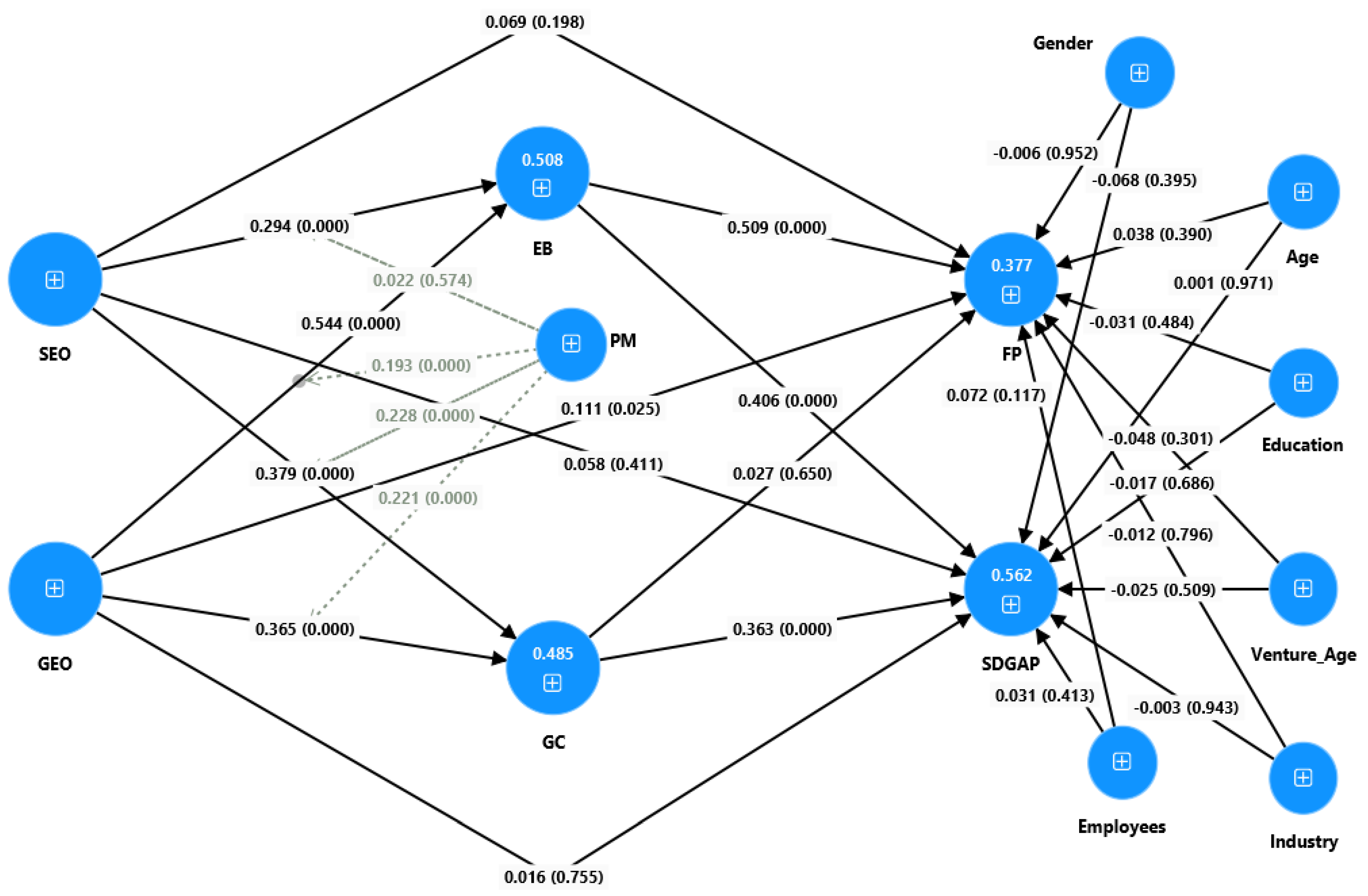
The revised model explains 50.9% of the variance in entrepreneurial bricolage, 48.7% in green creativity, 37.6% in financial performance, and 56.1% in SDG-aligned performance. Because the blindfolding procedure is no longer available in SmartPLS 4 and does not constitute an out-of-sample assessment, predictive power was evaluated using PLSpredict with 10 folds and 10 repetitions. All Q2predict values are positive (0.250 to 0.491) in Table 9, indicating that the model predicts each endogenous construct better than the naive mean benchmark, and the model’s RMSE is lower than that of the linear regression benchmark for all four constructs. Together these results support the out-of-sample predictive validity of the model, with the strongest predictive performance for entrepreneurial bricolage and SDG-aligned performance and, consistent with the explanatory results, the weakest for financial performance.
Interpreting the R2 values against Chin’s [49] benchmarks (0.19 weak, 0.33 moderate, 0.67 substantial), the R2 of 0.551 for SDG-aligned performance approaches substantial; R2 values of 0.509 for entrepreneurial bricolage and 0.486 for green creativity are moderate; R2 of 0.362 for financial performance is moderate but relatively lower, consistent with the many external factors influencing new-venture financial performance (e.g., market conditions, funding access, competitive intensity) that are not modeled here. All Q2 values exceed the 0.25 threshold for medium-to-strong predictive relevance [38], indicating that the model has good out-of-sample predictive power for all endogenous constructs.
Table 10 and Figure 2 present the results of the hypothesis tests as well as the control variable coefficients. All estimates were obtained through 5000 bootstrap resamples and two-tailed significance tests. As shown, all main structural paths retain their magnitude and statistical significance after inclusion of the control variables, and none of the six control variables significantly predicts either dependent variable. This provides evidence that the observed relationships are not confounded by baseline venture characteristics.
H1a and H1b are supported, indicating that SEO is positively and significantly associated with both entrepreneurial bricolage (β = 0.294, t = 6.524, p < 0.001) and green creativity (β = 0.379, t = 7.616, p < 0.001). H2a and H2b are also supported, with GEO showing significant positive associations with entrepreneurial bricolage (β = 0.544, t = 11.517, p < 0.001) and green creativity (β = 0.365, t = 7.531, p < 0.001). Entrepreneurial bricolage is positively associated with financial performance (β = 0.515, t = 8.732, p < 0.001) and SDG-aligned performance (β = 0.410, t = 8.460, p < 0.001), supporting H3a and H3b, and green creativity is positively associated with SDG-aligned performance (β = 0.365, t = 8.420, p < 0.001), supporting H4b; the association between green creativity and financial performance remains non-significant (β = 0.035, t = 0.612, p = 0.541), so H4a is not supported. Regarding moderation, H5b, H5c, and H5d are supported while H5a is not (β = 0.022, t = 0.562, p = 0.574). Turning to the newly estimated direct effects, only the direct path from SEO to SDG-aligned performance is significant (β = 0.109, t = 2.231, p = 0.026); the direct paths from SEO to financial performance, and from GEO to both outcomes, are non-significant. The mediator paths are modestly attenuated relative to the mediation-only specification, which is expected when direct paths are estimated, and no hypothesis conclusion changes. The significant negative main effect of paradox mindset on bricolage (β = −0.094, p = 0.031) indicates that, at average levels of the orientations, founders higher in paradox mindset report slightly less bricolage; the theoretically central role of paradox mindset in this model operates through its interaction terms rather than its main effect.

4.5. Indirect Effects and Conditional Indirect Effects

Because the hypothesized model constitutes a moderated mediation structure, the specific indirect effects and conditional indirect effects were computed to formally test whether the mediating pathways are amplified by paradox mindset. Following the recommendations of Preacher and Hayes [44], 5000 bootstrap resamples with bias-corrected 95% confidence intervals (CIs) were used to estimate all indirect effects. The results were cross-validated using Hayes’ PROCESS macro (Model 7) in SPSS. Table 11 reports the eight specific indirect effects from the PLS-SEM structural model, and Table 12 reports the conditional indirect effects at low (16th percentile), mean (50th percentile), and high (84th percentile) levels of paradox mindset, along with the index of moderated mediation for each mediation path.
Six of the eight indirect effects reported in Table 11 are statistically significant. Both bricolage-mediated pathways (SEO → EB → FP, SEO → EB → SDGAP, GEO → EB → FP, GEO → EB → SDGAP) and the two green-creativity-mediated pathways to SDG-aligned performance (SEO → GC → SDGAP, GEO → GC → SDGAP) are significant. The two green-creativity-mediated pathways to financial performance (SEO → GC → FP, GEO → GC → FP) are not significant, which is theoretically consistent with the non-significant direct link from green creativity to financial performance reported in Table 10. The mediation pattern therefore indicates that entrepreneurial bricolage functions as a mediator for both financial and SDG-aligned performance, whereas green creativity operates as a mediator only for SDG-aligned performance; as the formal contrasts in Table 13 show, this asymmetry is significant in the financial domain, while the two mediators contribute comparably to SDG-aligned performance.
Combining the significance of the specific indirect effects with that of the corresponding direct effects permits a formal classification of each mediating pathway in Table 12. Four pathways display full (indirect-only) mediation: SEO → EB → FP, GEO → EB → FP, GEO → EB → SDGAP, and GEO → GC → SDGAP, in which the indirect effect is significant while the direct effect of the orientation on the outcome is not. Two pathways display partial (complementary) mediation: SEO → EB → SDGAP and SEO → GC → SDGAP, in which the significant indirect effects coexist with a significant residual direct association between SEO and SDG-aligned performance (β = 0.109), indicating that SEO relates to SDG-aligned performance partly through channels beyond the two modeled mediators. The two pathways terminating in financial performance through green creativity show no mediation, reflecting the non-significant association between green creativity and financial performance.
To test formally whether the two mediators differ in their associations with the outcomes, bootstrapped contrasts were computed for the relevant path and indirect-effect pairs (Table 13). For financial performance, the contrast between the bricolage and green creativity paths is significant (Δ = 0.481, 95% CI [0.309, 0.663]), and both corresponding indirect-effect contrasts are likewise significant (SEO: Δ = 0.137, CI [0.070, 0.210]; GEO: Δ = 0.268, CI [0.176, 0.370]). Entrepreneurial bricolage is therefore significantly more strongly associated with financial performance than green creativity, both directly and as a mediating channel. For SDG-aligned performance, in contrast, the path-level difference between the two mediators is not significant (Δ = 0.041, CI [−0.110, 0.199]), and the SEO indirect-effect contrast is likewise non-significant (Δ = −0.019, CI [−0.089, 0.051]); only the GEO indirect-effect contrast reaches significance (Δ = 0.087, CI [0.006, 0.173]). The asymmetry between the behavioral and cognitive pathways is thus formally established for the financial domain, whereas the two mechanisms contribute comparably to SDG-aligned performance. Accordingly, the earlier characterization of green creativity as operating “exclusively” through SDG-aligned performance is restated more precisely: green creativity’s significant associations are confined to the sustainability domain, and within that domain its contribution is statistically indistinguishable from that of bricolage.
Under the fully matched specification (Table 14), the indices of moderated mediation are significant for four of the eight pathways: SEO → GC → SDGAP (index = 0.1079, CI [0.0564, 0.1701]), GEO → EB → FP (index = 0.1276, CI [0.0648, 0.1930]), GEO → EB → SDGAP (index = 0.0958, CI [0.0501, 0.1455]), and GEO → GC → SDGAP (index = 0.1016, CI [0.0553, 0.1567]). For each, the conditional indirect effects strengthen monotonically from the 16th to the 84th percentile of paradox mindset, consistent with its amplifying role. The indices for the two SEO → EB pathways are non-significant, mirroring the non-significant H5a interaction, and the indices for the pathways terminating in financial performance through green creativity are non-significant, mirroring the non-significant GC → FP association. The moderated-mediation conclusions are therefore identical across the PLS-SEM and PROCESS frameworks.
Table 15 documents the complete mediator-equation and outcome-equation estimates underlying the conditional indirect effects in Table 14. Three patterns warrant attention. First, in the EB equation, the SEO × PM interaction is not significant (b = 0.046, t = 0.69), whereas the GEO × PM interaction is significant (b = 0.288, t = 4.48); this corresponds directly to the PLS-SEM results for H5a (β = 0.022, t = 0.566, not supported) and H5c (β = 0.192, t = 4.570, supported), confirming that the two estimation frameworks yield consistent conclusions once both interaction terms are estimated simultaneously. Second, in the GC equation, both the SEO × PM (b = 0.350, t = 5.30) and GEO × PM (b = 0.329, t = 5.18) interactions are significant, mirroring the supported H5b and H5d hypotheses. Third, in the outcome equations, entrepreneurial bricolage is significantly associated with both financial performance (b = 0.448, t = 8.33) and SDG-aligned performance (b = 0.335, t = 7.91), whereas green creativity is significantly associated only with SDG-aligned performance (b = 0.311, t = 7.89) and not with financial performance (b = 0.033, t = 0.66), reproducing the asymmetric mediation pattern observed in the PLS-SEM model. Taken together, Table 12 demonstrates that the moderated mediation conclusions do not depend on the estimation framework: the same pattern of significant and non-significant paths emerges in both PLS-SEM and the covariate-adjusted PROCESS models.

4.6. Post Hoc Interpretation of the H5a Null Result

The null moderation result for H5a (PM × SEO → EB, β = 0.022, p = 0.572) warrants an explicit epistemological caveat. The ex-ante theoretical logic underlying H5a predicted a positive moderating effect of paradox mindset on the SEO-to-bricolage association. This prediction was not empirically supported. The interpretation offered in the Discussion section that follows, in which the null result is reframed as evidence that social bricolage may be enacted as a structural and operational necessity rather than as a cognitively mediated response, is a post hoc theoretical explanation and is therefore treated as exploratory rather than as a deductively confirmed finding. This interpretation is offered as a candidate explanation for the observed asymmetry between the SEO-to-bricolage path (not moderated) and the GEO-to-bricolage path (moderated), and it warrants independent empirical replication before being adopted as an established theoretical claim.
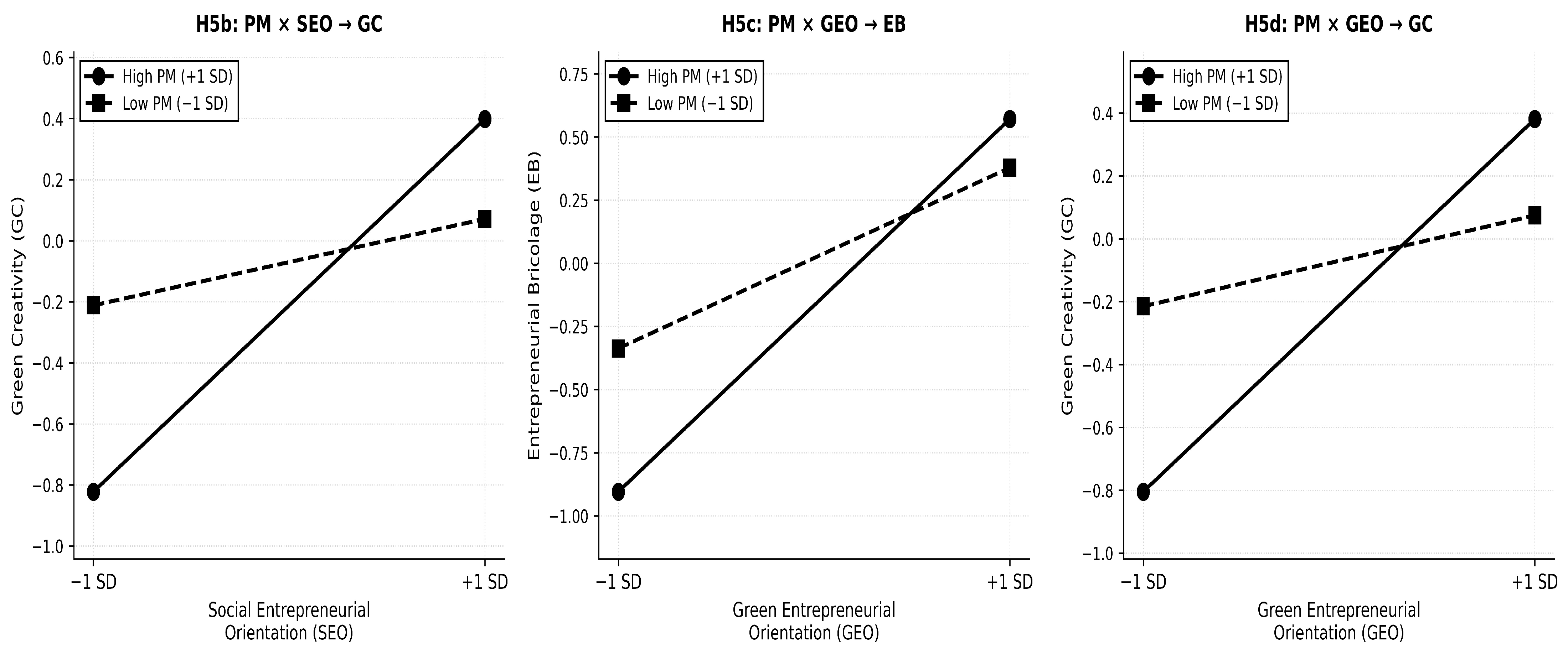
The three moderation effects are in turn represented in Figure 3 with the use of simple slope interaction plots. In all three cases the relationship between the independent variable and the mediator is stronger at the high paradox mindset (+1 SD) than at the low paradox mindset (−1 SD), supporting the amplifying effect of paradox mindset on the relationship between strategic orientations and behavioral and cognitive mechanisms.
Effect sizes in Table 16 indicate that the association between GEO and entrepreneurial bricolage is large (f2 = 0.442), while the associations of SEO with green creativity (f2 = 0.208), GEO with green creativity (f2 = 0.192), bricolage with financial performance (f2 = 0.208), bricolage with SDG-aligned performance (f2 = 0.187), and green creativity with SDG-aligned performance (f2 = 0.188) are of medium magnitude. The three significant interaction terms display small-to-medium effect sizes (f2 = 0.063 to 0.089), which is typical for moderation effects in field data. Consistent with the hypothesis tests, the effect sizes for the SEO × PM interaction on bricolage (f2 = 0.002) and for green creativity on financial performance (f2 = 0.001) are effectively zero. All inner-model VIF values are below 2.0, well under the conservative 3.3 threshold, indicating that structural multicollinearity, including among the interaction terms, does not threaten the estimates.
As a robustness check on the measurement specification, the structural model was re-estimated, with SEO specified as a second-order construct formed from its four sub-dimension composites using the disjoint two-stage approach (Table 17). All four sub-dimension scores load strongly on the second-order factor (0.937 to 0.945), and the inter-sub-dimension correlations (0.843 to 0.865) support a common higher-order factor. Every structural conclusion is unchanged under this alternative specification: all supported paths remain significant with nearly identical magnitudes, H5a remains non-significant (β = 0.030, p = 0.486), the GC → FP path remains non-significant, and the direct SEO → SDGAP effect remains significant (β = 0.110, p = 0.021). The equivalence of conclusions across first-order and second-order operationalizations indicates that the findings do not depend on the measurement treatment of SEO. An analogous check for SDG-aligned performance, in which the structural model was re-estimated treating SDGAP as a composite of its six SDG-domain facets, likewise left all conclusions unchanged, supporting the reflective venture-level treatment reported in the main analysis.

4.7. Discussion

The present study designed and validated a moderated mediation model based on paradox theory [8] to investigate the paradox of sustainability–profitability for new-venture founders. Given the cross-sectional nature of the design, the relationships discussed below are framed as associations rather than causal effects; directional causation cannot be claimed from these results. The findings are derived through the combination of the two strategic orientations of SEO and GEO as dual strategic orientations, entrepreneurial bricolage and green creativity as complementary mediating mechanisms in the way entrepreneurs make sense of their entrepreneurial activities, and paradox mindset as a boundary condition. These results validate both of the antecedents (SEO and GEO) and show that they are important positive predictors of entrepreneurial bricolage. SEO [17] is also an important predictor (β = 0.294) of bricolage, as it has been argued by Mair and Marti [20] that social entrepreneurship is essentially a process of putting together available resources in order to solve social problems within constraints. This result aligns with the study carried out by Di Domenico et al. [23], who showed that social bricolage is the typical behavioral reaction of mission-driven start-ups, whose operations are characterized by constant resource scarcity. The most powerful individual path in the model is bricolage (β = 0.544) predicted by GEO [18]. This discovery implies that the competitive proactiveness and green innovativeness that are part of GEO exacerbate the tension between green ambition and green resources, thus positioning bricolage as a structurally necessary behavioral response associated with green entrepreneurial orientation. Baker and Nelson [10] suggested that the bricolage process is most powerful when entrepreneurial ambition systematically exceeds the available configurations of resources—a situation that is created by design in the context of a new venture by GEO. These findings together confirm the two main hypotheses, that is, social and green strategic orientations are each independently and positively associated with the behavioral pathway of resource recombination, supporting H1a and H2a.
The results also confirm a positive prediction of green creativity in both cases of SEO and GEO. The results show a significant prediction of green creativity by SEO (β = 0.380); this result suggests that social innovativeness fosters general creative problem-solving attitudes that easily spill over into environmental fields [24]. The social value aspect, which is a sub-dimension of socialness in the SEO [17] seems to give the intrinsic motivation that Amabile [24] found to be one of the most important prerequisites for creative acts in any field. Moreover, GEO predicts green creativity significantly (β = 0.364), which shows that the attention to the environment and the competitiveness of introducing new green products and technology continuously stimulates and reinforces green creativity cognition [13,14]. The similar impacts of both orientations on green creativity indicate that the cognitive environmental problem-solving capacity is not only developed by social, but by green strategic disposition as well, each with a specific—but complementary—motivational pathway, thus supporting H1b and H2b.
Entrepreneurial bricolage is the most economically significant construct in the model, with a strong path to financial performance (β = 0.563) and a significant path to SDG-aligned performance (β = 0.453), thus supporting H3a and H3b respectively. The path bricolage–financial performance has a fairly large size, indicating that the path to effective resource recombination in new ventures may result in disproportionate financial performance, as noted by Wiklund and Shepherd [28]; the path of knowledge-based resource advantages also has an appreciable size and is associated with sustained financial performance premiums in entrepreneurial firms. Sharing similar results, Senyard et al. [11] showed that bricolage can help resource-constrained new ventures gain innovativeness with less corresponding resource investment, and they indicated that the innovativeness can lead to direct financial returns in the new-venture environment. The performance path bricolage-to-SDG (β = 0.453) confirms that resourceful recombination of performance is not just an efficiency measure, but a real factor of sustainability results. The findings extend the logic of Desa [22] by showing that new ventures are able to make contributions to several SDG domains—such as responsible production, climate action, and social inclusion—by creating sustainable solutions around existing resources without relying on dedicated green resource procurement.
The most theoretically informative result is related to the differential performance impact of “green creativity.” With the novel environmental ideation comes a strong and significant positive association, with SDG-aligned performance (β = 0.401) supporting H4b and confirming that novel environmental ideation indeed brings tangible sustainability outcomes [13,14]. Khan et al. [31] found that the innovation capacity with a sustainable orientation is one of the key sources for the contribution of SDGs in emerging economy firms, and the results confirm that the cognitive mechanism that allows this capacity is green creativity. With this, green creativity does not have a significant association with financial performance (β = 0.061, p = 0.241) and is not able to support the hypothesis of H4a. This is an asymmetric discovery which has theoretical significance. It argues that the effects of green creativity on the level of performance are context-specific to the new-venture domain; in other words, environmental ideation is associated with sustainable outcomes but not necessarily with financial outcomes. Porter and van der Linde [29] claimed that environmental innovation provides competitive advantages and cost efficiencies in the developed environmental market and institutionalized green demand. However, the conversion path is not fully realized in the new-venture context, in which the markets for green products are still in their infancy and the time horizons for creative green products are traditionally longer. This is in line with Schaltegger and Wagner’s [15] observation that the business case for sustainability is context-dependent and may not apply consistently across types of ventures, stages of their life cycle and maturity levels of the markets. The mediator-to-outcome pattern indicates that behavioral resource recombination appears to be the key mechanism associated with both sustainability and financial value in new ventures, and that cognitive environmental ideation is still more specialized towards contributing to sustainability in this context.
The results of the moderation indicate a theoretically significant asymmetry in the amplifying effect of the paradox mindset on the orientation-to-mechanism pathways. The “paradox mindset” has a strong moderating effect on the relationship between GEO and entrepreneurial bricolage (H5c: β = 0.192), between GEO and green creativity (H5d: β = 0.221), and between SEO and green creativity (H5b: β = 0.228). In each condition, positive moderation means that the linkage of strategic orientations to behavioral and cognitive mechanisms is facilitated when the competing demands are more accepted and are more energizing to the founders. This is in accord with Miron-Spektor et al. [16], who showed that tensions could be used for positive performance and innovation implications, as with Alzamil’s [35] finding that Paradox Mindset would magnify creative behavioral responses when facing competing demands in the organization. Interestingly, the moderation effects with GEO are both significant, indicating that the cognitive amplification is especially salient for green entrepreneurial orientation. Green founders who also embody a dualism between environmental desire and resource constraint seem to be able to use that tension creatively, both in terms of resourceful improvisation and environmental ideation, and thus create a reinforcing spiral of sustainability-enabling action.
However, paradox mindset does not significantly moderate the relationship between SEO and entrepreneurial bricolage (H5a: β = 0.022, p = 0.572), failing to support H5a. The ex ante theoretical logic underlying H5a predicted a positive moderating effect, and this prediction was not empirically supported. The interpretation that follows is therefore a post hoc theoretical explanation and should be treated as exploratory rather than as a deductively confirmed finding; it warrants independent replication before being adopted as an established theoretical claim. With this caveat, the null finding is nonetheless theoretically informative. The results indicate that for social entrepreneurs, bricolage is not a cognitively driven process to deal with paradoxical tensions; rather, it is a structural and operational requirement. Di Domenico et al. [23] found that the contextual imperative of resource scarcity and mission commitment are the strongest cues that spur social bricolage, and that both the socialness and social risk-taking dimensions of SEO [17] occur regardless of the individual’s cognitive predispositions. The cognitive disposition does not appear to amplify a behavior that is already activated by contextual necessity; social founders high in SEO appear to engage in bricolage regardless of their paradox mindset level. This finding differentiates the social bricolage pathway from the green bricolage pathway and indicates a basic difference in mediation of the cognitive mechanisms of the two pathways: paradox mindset has a meaningful moderating effect on the green pathway, but not on the social pathway—which is instead mediated by contextual necessity. For social entrepreneurs, bricolage appears to have become so structurally embedded in their operational logic that it operates below the threshold at which paradox mindset adds amplification, consistent with Poole and Van de Ven’s [34] distinction between tensions experienced as productive resources and those experienced as structural inevitabilities.

5. Implications and Limitations

5.1. Theoretical Implications

This study contributes to the literature in three ways. First, it adds to the research literature of sustainable entrepreneurship with a theoretically informed and empirically supported analysis of the behavioral and cognitive correlates of dual performance under the sustainability–profitability tension. This tension has been discussed extensively in prior work, with most focused on the tension as a zero-sum game that requires prioritization of one or the other, or as an automatic synergy that can be realized with the proper orientation [4,9]. The results contradict both perspectives and reveal, in line with the paradox theory [8,19], that the tension is enduring, fruitful and manageable through certain behavioral and cognitive processes. The study shows that bricolage and green creativity are associated with distinct performance domains and presents an association-based account of dual performance under the sustainability–profitability tension that goes beyond a descriptive identification of sustainability entrepreneurship antecedents adopted in a lot of previous research [15,40]. Second, the study contributes to a specific theory because it shows that two processes are mediators between sustainability orientations and dual performance outcomes: entrepreneurial bricolage and green creativity. The non-symmetric results—bricolage is positively associated with financial performance as well as SDG-aligned performance, while green creativity is associated with only SDG-aligned performance, while green creativity brings about only SDG-aligned performance—suggest that the paths to dual performance are not the same or interchangeable in behavioral and cognitive terms. This is a new contribution of differential mediation structure. The previous studies have focused on bricolage as a route to innovativeness [11,12] and green creativity as an enabler of green innovation performance [13,14], but not in the context of a dual-outcome approach in which financial and sustainability outcomes are separated. The fact that the financial cost of behavioral resource recombination, as opposed to cognitive environmental ideation, is larger during the early stages of the venture, suggests that the implicit premise in many strands of the green innovation literature—that the financial benefit of creating an innovation with a sustainability focus is equal to the financial cost of developing a novel idea—is incorrect. This includes questions about the conditions under which financial return is achieved from innovation that includes sustainability components.
Third, in the context of sustainable entrepreneurship, the study proposes and brings in the concept of paradox mindset [16] as a construct that has explanatory power and introduces it as a moderating variable in the orientation-to-mechanism relationships. The finding of a theoretically relevant asymmetry—where three of the four paths from orientation to mechanism are strengthened by paradox mindset, but not the path from SEO to bricolage—is an extension of the micro foundations of the theory of paradox [16] into a new space of empirical phenomena. The null moderation of H5a offers a theoretical perspective that bricolage as a response to a structural necessity with a social mission is cognitively decoupled from the individual’s ability to accept competition. This discovery implies that the paradox mindset is an amplifier of voluntary and discretionary responses to paradoxical tensions, but does not facilitate necessary responses to paradoxical tensions, which had not been differentiated in the paradox mindset literature [16,35]. As noted in Section 4.6, this reinterpretation is post hoc and exploratory, and warrants independent replication before being adopted as an established theoretical claim.

5.2. Practical Implications

The findings carry actionable implications for new-venture founders, entrepreneurship support organizations, and policymakers involved in the promotion of sustainable new-venture creation.
For new-venture founders, the findings suggest that developing the capacity for entrepreneurial bricolage should be prioritized as a core strategic competency from the earliest stage of venture development. The model indicated that bricolage had the strongest association with both financial and SDG-aligned performance and was the most financially consequential mechanism. Economic and sustainability returns are more likely to be achieved when the founders systematically review existing resource configurations, seek out resource recombination opportunities that might happen in unexpected ways, and establish processes for reconfiguring resources when they are not the optimal resource configuration. In practice, founders are advised to spend time to understand their current assets (relationships, skills, equipment, knowledge) and not their desired assets to be acquired, so that they can look at their existing assets as raw material for new combinations instead of as fixed-in place inputs to traditional production methods.
For founders with strong green entrepreneurial orientations, the moderation findings suggest that cultivating a paradox mindset is particularly valuable. Because the GEO-to-bricolage and GEO-to-green creativity routes reinforce each other, green founders who cultivate the mindset of paradox will be able to generate better behavioral and creative outcomes than those who internalize the paradox as a source of frustration or constraint. From a practical perspective, green-minded founders could receive coaching, mentorship, and peer networking opportunities that help them become more comfortable with some paradoxes, develop a tolerance for conflicting demands, and conceptualize resource scarcity as a resource challenge instead of a strategic problem. Miron-Spektor et al. [16] showed that one can develop a mindset in the face of a paradox by engaging with the paradox in a structured manner, and this directly impacts the design of entrepreneurship education and incubator programs. The finding that green creativity does not significantly predict financial performance carries a practical implication for how founders allocate green creative effort. The time for green product development and green ideation should not be one where the expectation is to realize immediate financial profits at the early stages of business activity in early green markets. Founders should, therefore, sequence their sustainability strategy, aiming to improve the sustainability performance of the resources they employ while making bricolage the primary source of financial performance in the early years, green creative outputs to be the medium-term drivers of SDG-aligned impact, and longer-term competitive differentiation as green markets mature.
For policymakers and entrepreneurship support organizations, the findings highlight the importance of designing support mechanisms that reduce the resource gap faced by green-oriented new ventures. Policy interventions that increase access to shared green resources, open innovation platforms, and green spaces for making, will enhance the already fruitful cascade from the green orientation to the venture performance, which, in turn, is already significant, because GEO leads to the greatest bricolage. In addition, deliberate attempts to build these cognitive foundations will enhance the prequels of green creative thinking and resourceful improvisation through incubation and acceleration programs which explicitly include experiential learning that embraces the paradox, e.g., through planned challenges that involve the founders effectively working towards opposing sustainability and financial objectives at the same time.

5.3. Limitations and Future Research

The following limitations of this study are recognized, and directions for future research are given. The first is that the study is a cross-sectional design, which is a study in which all the constructs are measured at the same time. Although the PLS-SEM analytical approach is suitable for the predictive and theory-building purposes of this study [39], the cross-sectional nature of the design precludes causal inference. All findings are best interpreted as associations. Reverse causality is plausible; for example, ventures already achieving strong financial or SDG performance may develop stronger sustainability orientations over time, and cannot be ruled out by the present design. A cross-lagged panel design or longitudinal study would be needed to establish temporal precedence. A part of this may be due to the time lag between the environmental ideation and its financial impacts, which is not possible to be captured in a cross-sectional design. Studies with a longitudinal or time-lagged design, such as a two-wave survey with a twelve-month time lag, should be conducted to determine the temporal precedence of the proposed mechanisms and outcomes and to investigate if the green creativity-to-financial performance pathway becomes important as ventures grow and the green markets evolve. Secondly, the study is carried out in one country context and uses a sample of new-venture founders in China. The findings may not be easily transferable to other contexts due to specific features of the Chinese institutional environment, including the government’s dual-carbon commitment and green finance policies, the regulatory environment for new ventures, the guanxi-based entrepreneurial ecosystem, and cultural orientations toward long-term thinking and dialectical reasoning that may affect how paradox mindset operates. Future studies should replicate the model in liberal-market economies (e.g., US, UK) and other Confucian-heritage economies (e.g., Japan, Korea) to disentangle cultural effects from institutional ones. Specifically, the strength of the GEO-to-bricolage path and the insignificance of the green creativity-to-financial performance path may partly be due to the specific maturity of the green market in China and the limitation in resources that Chinese new ventures are facing at this stage. Future studies should replicate and expand the model in other countries and institutional settings to explore the boundary conditions of the proposed mechanisms and whether amplifying effect of paradox mindset is moderated by national cultural orientations toward uncertainty and contradiction. Third, both dependent variables (financial performance and SDG-aligned performance) are measured through founder self-report. Founders may exhibit entrepreneurial optimism, social desirability bias, and consistency-motif effects that could inflate the observed relationships. Objective archival indicators, such as audited revenue, capital raised, patent counts, or carbon disclosures, are theoretically preferable but were not consistently retrievable for privately held Chinese new ventures at the early stage of development. We identify multi-source and archival-supplemented replication as a priority direction for future research [50]. Fourth, the study is subject to survivorship bias. The sample consists entirely of ventures that survived long enough to be identified, contacted, and willing to respond. Ventures that failed during the earliest and most resource-scarce stages—precisely the period when the sustainability–profitability tension is most acute—are excluded. This may systematically inflate the apparent strength of the proposed mechanisms and moderators. Future research should adopt prospective cohort designs that follow ventures from formation, capturing both survivors and non-survivors. Fifth, purposive and snowball sampling limits statistical generalization to the broader population of Chinese new ventures. Sixth, for ventures with 51–100 employees (15.2% of the sample), team- and structural-level processes may increasingly mediate the observed relationships, and a single founder or CEO may not fully capture all venture-level dynamics. Future research should collect multi-informant data (founder, senior management team, and operational managers) for medium-sized new ventures. Finally, the sustainability–profitability paradox functions in this study as the motivating theoretical lens rather than as a directly measured construct. The model captures the two performance domains as separate dependent variables; it does not measure founders’ experienced tension, the perceived incompatibility between social–environmental and financial goals, resource competition between the two agendas, or the joint attainment of both outcomes within individual ventures. Consequently, the findings document associations between orientations, the modeled constructs, and two performance domains; they cannot demonstrate that founders experience, manage, or resolve the focal paradox. Future research should measure experienced paradoxical tension directly, model trade-offs and joint attainment explicitly (for example, through polynomial regression and response-surface analysis), and test whether paradox mindset exerts its amplifying role specifically under conditions of high experienced tension.

6. Conclusions

This study examined the behavioral and cognitive correlates of dual performance in new ventures, using the sustainability–profitability paradox as its motivating theoretical lens, by developing and testing a moderated mediation model grounded in paradox theory. The results of this study are based on 323 founders and chief executive officers in China and analyzed with PLS-SEM in SmartPLS 4, and are divided into four substantive conclusions. The results indicate that entrepreneurial bricolage is the construct most strongly associated with both financial and SDG-aligned performance, regardless of whether they have a social or green entrepreneurial orientation; green creativity, on the other hand, shows significant associations only with sustainability outcomes, underscoring the cognitively domain-specific nature of entrepreneurial ideation about the environment in nascent green markets. The structural conditions in which the individual cognitive dispositions guide the translation of sustainability strategies to dual performance outcomes are highlighted: three of the four orientation-to-mechanism relationships are amplified by paradox mindset (H5b, H5c, H5d), while the SEO-to-bricolage path (H5a) is not moderated, suggesting that social bricolage operates independently of cognitive disposition.
Overall, the findings conclude that SEO and GEO are each significantly associated with entrepreneurial bricolage and green creativity, with GEO being a stronger predictor of entrepreneurial bricolage, which indicates that the structural resource gap that green ambition necessitates for resource-constrained new ventures is more strongly linked to entrepreneurial bricolage than to green creativity. Second, entrepreneurial bricolage emerges as the main dual performance mechanism in the model, with strong associations with both financial performance and SDG-aligned performance, and establishing resource recombination as the primary behavioral mechanism associated with dual economic and sustainability outcomes. Third, green creativity is positively associated with SDG-aligned performance but not with financial performance, suggesting a domain-specific form of cognitive mediation in which environmental ideation relates to sustainability outcomes but not to financial returns in early, nascent green markets. Fourth, paradox mindset amplifies three of the four orientation-to-mechanism pathways, with the only exception being the SEO-to-bricolage pathway, which is mediated by social bricolage, and appears to be driven by structural necessity rather than cognitive orientation, creating a theoretically meaningful asymmetry. This interpretation is post hoc and exploratory, extending the micro foundations of paradox theory into the context of sustainable entrepreneurship. By offering a process-based narrative of how sustainability–profitability tensions are managed by founders, the study makes a contribution to the growing research on the concepts of paradox theory, bricolage theory, and the sustainable entrepreneurship scholarship by theorizing the dual performance of resource recombination, and by proposing a theoretically productive moderation construct of paradox mindset in the entrepreneurship context. Paradox theory holds that the sustainability–profitability tension is not a dilemma to be resolved, but an ongoing condition to be worked with; while the present data capture the two performance domains rather than founders’ experienced tension, the associations documented in this study provide a foundation and starting point for understanding the factors that accompany dual performance in new ventures. Given the cross-sectional design and single-country sample, the findings should be interpreted as associations to be tested and replicated across time and contexts.

Author Contributions

Conceptualization, J.C.; Formal analysis, J.C. and X.S.; Methodology, X.S. and D.B.; Visualization, J.C.; Supervision, X.S. and D.B.; Writing—original draft, J.C.; Writing—review and editing, J.C., X.S. and D.B. All authors have read and agreed to the published version of the manuscript.

Funding

This research received no external funding.

Institutional Review Board Statement

The study was conducted in accordance with the Declaration of Helsinki, and approved by the Research Committee of Anyang Normal University (Approval code: XYNU-1153 and date of approval: 13 March 2026).

Informed Consent Statement

Written informed consent has been obtained from the participants to publish this paper.

Data Availability Statement

The raw data supporting the conclusions of this article will be made available by the authors on request.

Conflicts of Interest

The authors declare no conflicts of interest.

Appendix A. Measurement Instrument

Social Entrepreneurial Orientation (SEO)—adapted from Kraus et al. [17]
SEO1: Social innovation is important for our company.
SEO2: We invest heavily in developing new ways to increase our social impact or to serve our beneficiaries.
SEO3: In our company, new ideas to solve social problems come up very frequently.
SEO4: We are not afraid to take substantial risks when serving our social purpose.
SEO5: Bold action is necessary to achieve our company’s social mission.
SEO6: We avoid the cautious line of action if social opportunities might be lost that way.
SEO7: We aim to be at the forefront of making the world a better place.
SEO8: Our organization has a strong tendency to be ahead of others in addressing its social mission.
SEO9: We typically initiate actions which other social enterprises/social entrepreneurs copy.
SEO10: The objective to accomplish our social mission precedes the objective to generate a profit.
SEO11: We measure CO2 emissions and/or our generated waste and actively try to reduce it.
SEO12: We actively employ socially disadvantaged people (e.g., disabled people, immigrants, elderly people).
Note: SEO1–SEO3 = social innovativeness; SEO4–SEO6 = social risk-taking; SEO7–SEO9 = social proactiveness; SEO10–SEO12 = socialness.
Green Entrepreneurial Orientation (GEO)—adapted from Habib et al. [18]
GEO1: In general, our firm favors a strong emphasis on green practices, such as R&D, technological leadership, and innovation.
GEO2: When facing uncertainty, we typically adopt a proactive posture in order to catch potential green opportunities.
GEO3: In dealing with competitors, we typically initiate green actions that competitors respond to.
GEO4: Our firm favors a tendency to be a leader, and always introduces green products, services, or technology first.
GEO5: In dealing with competitors, we typically adopt a competitive ‘undo-the-competitors’ posture.
Entrepreneurial Bricolage (EB)—adapted from An et al. [12]
EB1: We gladly take on a broader range of challenges than others with our resources would be able to.
EB2: We use any existing resource that seems useful to respond to a new problem or opportunity.
EB3: We deal with new challenges by applying a combination of our existing resources and other resources inexpensively available to us.
EB4: By combining our existing resources, we take on a surprising variety of new challenges.
EB5: When we face new challenges, we put together workable solutions from our existing resources.
EB6: We combine resources to accomplish new challenges that the resources were not originally intended to accomplish.
Green Creativity (GC)—adapted from Alfadel and Nalband [14]
GC1: Members of our venture suggest new ways to achieve environmental goals.
GC2: Members of our venture propose new green ideas to improve environmental performance.
GC3: Members of our venture promote and champion new green ideas to others.
GC4: Members of our venture develop adequate plans for the implementation of new green ideas.
GC5: Members of our venture would rethink new green ideas.
GC6: Members of our venture find creative solutions to environmental problems.
Paradox Mindset (PM)—adapted from Miron-Spektor et al. [16] and Alzamil [35]
PM1: When I consider conflicting perspectives, I gain a better understanding of an issue.
PM2: I am comfortable dealing with conflicting demands at the same time.
PM3: Accepting contradictions is essential for my success.
PM4: Tension between ideas energizes me.
PM5: I enjoy it when I manage to pursue contradictory goals.
PM6: I often experience myself as simultaneously embracing conflicting demands.
PM7: I am comfortable working on tasks that contradict each other.
PM8: I feel uplifted when I realize that two opposites can be true.
PM9: I feel energized when I manage to address contradictory issues.
Financial Performance (FP)—adapted from Habib et al. [18]
FP1: Our venture has experienced a decrease in costs for materials purchased.
FP2: Our venture has experienced a decrease in costs for energy consumption.
FP3: Our venture has experienced a decrease in fees for waste discharge.
FP4: Our venture has experienced an improvement in return on investment.
FP5: Our venture has experienced an improvement in earnings per share.
SDG-Aligned Performance (SDGAP)—adapted from Khan et al. [31] and Elansari et al. [32]
SDGAP1: Our venture uses accessible and non-polluting energy in its operations. (SDG 7)
SDGAP2: Our venture contributes to decent work conditions and local economic growth. (SDG 8)
SDGAP3: Our venture creates employment opportunities that offer fair pay and safe working conditions. (SDG 8)
SDGAP4: Our venture develops innovative products, services, or processes that strengthen sustainable infrastructure. (SDG 9)
SDGAP5: Our venture invests in innovation that supports the upgrading of its industry toward sustainability. (SDG 9)
SDGAP6: Our venture actively works to reduce social and economic inequalities through its activities. (SDG 10)
SDGAP7: Our venture practices responsible consumption and production in its operations. (SDG 12)
SDGAP8: Our venture minimizes waste and makes efficient use of materials and resources. (SDG 12)
SDGAP9: Our venture takes concrete actions to reduce its impact on the climate. (SDG 13)

References

  1. United Nations. Transforming Our World: The 2030 Agenda for Sustainable Development; United Nations: New York, NY, USA, 2015. [Google Scholar]
  2. Cohen, B.; Winn, M.I. Market imperfections, opportunity and sustainable entrepreneurship. J. Bus. Ventur. 2007, 22, 29–49. [Google Scholar] [CrossRef] [Scilit]
  3. Dean, T.J.; McMullen, J.S. Toward a theory of sustainable entrepreneurship: Reducing environmental degradation through entrepreneurial action. J. Bus. Ventur. 2007, 22, 50–76. [Google Scholar] [CrossRef] [Scilit]
  4. Hockerts, K.; Wüstenhagen, R. Greening Goliaths versus emerging Davids: Theorizing about the role of incumbents and new entrants in sustainable entrepreneurship. J. Bus. Ventur. 2010, 25, 481–492. [Google Scholar] [CrossRef] [Scilit]
  5. Shepherd, D.A.; Patzelt, H. The new field of sustainable entrepreneurship: Studying entrepreneurial action linking “what is to be sustained” with “what is to be developed”. Entrep. Theory Pract. 2011, 35, 137–163. [Google Scholar] [CrossRef] [Scilit]
  6. Boons, F.; Lüdeke-Freund, F. Business models for sustainable innovation: State-of-the-art and steps towards a research agenda. J. Clean. Prod. 2013, 45, 9–19. [Google Scholar] [CrossRef] [Scilit]
  7. Schaltegger, S.; Hansen, E.G.; Lüdeke-Freund, F. Business models for sustainability: Origins, present research, and future avenues. Organ. Environ. 2016, 29, 3–10. [Google Scholar] [CrossRef] [Scilit]
  8. Smith, W.K.; Lewis, M.W. Toward a theory of paradox: A dynamic equilibrium model of organizing. Acad. Manag. Rev. 2011, 36, 381–403. [Google Scholar] [CrossRef] [Scilit]
  9. Lewis, M.W. Exploring paradox: Toward a more comprehensive guide. Acad. Manag. Rev. 2000, 25, 760–776. [Google Scholar] [CrossRef] [Scilit]
  10. Baker, T.; Nelson, R.E. Creating something from nothing: Resource construction through entrepreneurial bricolage. Adm. Sci. Q. 2005, 50, 329–366. [Google Scholar] [CrossRef] [Scilit]
  11. Senyard, J.; Baker, T.; Steffens, P.; Davidsson, P. Bricolage as a path to innovativeness for resource-constrained new firms. J. Prod. Innov. Manag. 2014, 31, 211–230. [Google Scholar]
  12. An, W.; Zhang, J.; You, C.; Guo, Z. Entrepreneur’s creativity and firm-level innovation performance: Bricolage as a mediator. Technol. Anal. Strateg. Manag. 2018, 30, 838–851. [Google Scholar]
  13. Chen, Y.S.; Chang, C.H. The determinants of green product development performance: Green dynamic capabilities, green transformational leadership, and green creativity. J. Bus. Ethics 2013, 116, 107–119. [Google Scholar]
  14. Alfadel, A.; Nalband, N. Green creativity as a mediator between green human resource management practices and sustainable development: Insight from Saudi Arabia. Discov. Sustain. 2025, 6, 416. [Google Scholar] [CrossRef] [Scilit]
  15. Schaltegger, S.; Wagner, M. Sustainable entrepreneurship and sustainability innovation: Categories and interactions. Bus. Strategy Environ. 2011, 20, 222–237. [Google Scholar] [CrossRef] [Scilit]
  16. Miron-Spektor, E.; Ingram, A.; Keller, J.; Smith, W.K.; Lewis, M.W. Microfoundations of organizational paradox: The problem is how we think about the problem. Acad. Manag. J. 2018, 61, 26–45. [Google Scholar] [CrossRef] [Scilit]
  17. Kraus, S.; Niemand, T.; Halberstadt, J.; Shaw, E.; Syrjä, P. Social entrepreneurship orientation: Development of a measurement scale. Int. J. Entrep. Behav. Res. 2017, 23, 977–997. [Google Scholar] [CrossRef] [Scilit]
  18. Habib, M.A.; Bao, Y.; Ilmudeen, A. The impact of green entrepreneurial orientation, market orientation and green supply chain management practices on sustainable firm performance. Cogent Bus. Manag. 2020, 7, 1743616. [Google Scholar] [CrossRef] [Scilit]
  19. Schad, J.; Lewis, M.W.; Raisch, S.; Smith, W.K. Paradox research in management science: Looking back to move forward. Acad. Manag. Ann. 2016, 10, 5–64. [Google Scholar] [CrossRef]
  20. Mair, J.; Marti, I. Social entrepreneurship research: A source of explanation, prediction, and delight. J. World Bus. 2006, 41, 36–44. [Google Scholar] [CrossRef] [Scilit]
  21. Austin, J.; Stevenson, H.; Wei-Skillern, J. Social and commercial entrepreneurship: Same, different, or both? Entrep. Theory Pract. 2006, 30, 1–22. [Google Scholar] [CrossRef] [Scilit]
  22. Desa, G. Resource mobilization in international social entrepreneurship: Bricolage as a mechanism of institutional transformation. Entrep. Theory Pract. 2012, 36, 727–751. [Google Scholar] [CrossRef] [Scilit]
  23. Di Domenico, M.; Haugh, H.; Tracey, P. Social bricolage: Theorizing social value creation in social enterprises. Entrep. Theory Pract. 2010, 34, 681–703. [Google Scholar] [CrossRef] [Scilit]
  24. Amabile, T.M. The social psychology of creativity: A componential conceptualization. J. Pers. Soc. Psychol. 1983, 45, 357–376. [Google Scholar] [CrossRef]
  25. Tierney, P.; Farmer, S.M. Creative self-efficacy: Its potential antecedents and relationship to creative performance. Acad. Manag. J. 2002, 45, 1137–1148. [Google Scholar] [CrossRef] [Scilit]
  26. Lumpkin, G.T.; Dess, G.G. Clarifying the entrepreneurial orientation construct and linking it to performance. Acad. Manag. Rev. 1996, 21, 135–172. [Google Scholar] [CrossRef] [Scilit]
  27. Zhou, J.; George, J.M. When job dissatisfaction leads to creativity: Encouraging the expression of voice. Acad. Manag. J. 2001, 44, 682–696. [Google Scholar] [CrossRef] [Scilit]
  28. Wiklund, J.; Shepherd, D.A. Knowledge-based resources, entrepreneurial orientation, and the performance of small and medium-sized businesses. Strateg. Manag. J. 2003, 24, 1307–1314. [Google Scholar] [CrossRef] [Scilit]
  29. Porter, M.E.; van der Linde, C. Toward a new conception of the environment-competitiveness relationship. J. Econ. Perspect. 1995, 9, 97–118. [Google Scholar] [CrossRef] [Scilit]
  30. Sachs, J.D.; Schmidt-Traub, G.; Mazzucato, M.; Messner, D.; Nakicenovic, N.; Rockström, J. Six transformations to achieve the sustainable development goals. Nat. Sustain. 2019, 2, 805–814. [Google Scholar] [CrossRef] [Scilit]
  31. Khan, S.U.; Zhang, Q.; Khan, I.U.; Anwar, M.; Hassan, M.U. Scrutinizing the prominence of Industry 5.0 and social pressure in opportunity recognition for SDGs: A two-wave, time-lagged study of a moderated mediation model. J. Enterp. Inf. Manag. 2026, 1–28. [Google Scholar] [CrossRef] [Scilit]
  32. Elansari, H.; Alzubi, A.; Khadem, A. The impact of United Nations Sustainable Development Goals on customers’ perceptions and loyalty in the banking sector: A multi-mediation approach. Sustainability 2024, 16, 8276. [Google Scholar] [CrossRef] [Scilit]
  33. Waddock, S.A.; Graves, S.B. The corporate social performance-financial performance link. Strateg. Manag. J. 1997, 18, 303–319. [Google Scholar] [CrossRef] [Scilit]
  34. Poole, M.S.; Van de Ven, A.H. Using paradox to build management and organization theories. Acad. Manag. Rev. 1989, 14, 562–578. [Google Scholar] [CrossRef] [Scilit]
  35. Alzamil, B.S. Employees’ creative deviance in response to digitalization and knowledge: The mediating role of employees’ paradox mindset. J. Innov. Knowl. 2025, 10, 100845. [Google Scholar] [CrossRef] [Scilit]
  36. Kumar, N.; Stern, L.W.; Anderson, J.C. Conducting interorganizational research using key informants. Acad. Manag. J. 1993, 36, 1633–1651. [Google Scholar] [CrossRef] [Scilit]
  37. Brislin, R.W. Back-translation for cross-cultural research. J. Cross-Cult. Psychol. 1970, 1, 185–216. [Google Scholar] [CrossRef] [Scilit]
  38. Hair, J.F.; Risher, J.J.; Sarstedt, M.; Ringle, C.M. When to use and how to report results of PLS-SEM. Eur. Bus. Rev. 2019, 31, 2–24. [Google Scholar] [CrossRef] [Scilit]
  39. Cohen, J. Statistical Power Analysis for the Behavioral Sciences, 2nd ed.; Lawrence Erlbaum Associates: Hillsdale, NJ, USA, 1988. [Google Scholar]
  40. Muñoz, P.; Cohen, B. Sustainable entrepreneurship research: Taking stock and looking ahead. Bus. Strategy Environ. 2018, 27, 300–322. [Google Scholar] [CrossRef] [Scilit]
  41. Ringle, C.M.; Wende, S.; Becker, J.M. SmartPLS 4; SmartPLS GmbH: Boenningstedt, Germany, 2022. [Google Scholar]
  42. Hair, J.F.; Matthews, L.M.; Matthews, R.L.; Sarstedt, M. PLS-SEM or CB-SEM: Updated guidelines on which method to use. Int. J. Multivar. Data Anal. 2017, 1, 107–123. [Google Scholar] [CrossRef] [Scilit]
  43. Henseler, J.; Ringle, C.M.; Sarstedt, M. A new criterion for assessing discriminant validity in variance-based structural equation modeling. J. Acad. Mark. Sci. 2015, 43, 115–135. [Google Scholar] [CrossRef] [Scilit]
  44. Preacher, K.J.; Hayes, A.F. Asymptotic and resampling strategies for assessing and comparing indirect effects in multiple mediator models. Behav. Res. Methods 2008, 40, 879–891. [Google Scholar] [CrossRef] [Scilit] [PubMed]
  45. Podsakoff, P.M.; MacKenzie, S.B.; Lee, J.Y.; Podsakoff, N.P. Common method biases in behavioral research: A critical review of the literature and recommended remedies. J. Appl. Psychol. 2003, 88, 879–903. [Google Scholar] [CrossRef] [Scilit] [PubMed]
  46. Harman, H.H. Modern Factor Analysis; University of Chicago Press: Chicago, IL, USA, 1960. [Google Scholar]
  47. Kock, N. Common method bias in PLS-SEM: A full collinearity assessment approach. Int. J. e-Collab. 2015, 11, 1–10. [Google Scholar]
  48. Lindell, M.K.; Whitney, D.J. Accounting for common method variance in cross-sectional research designs. J. Appl. Psychol. 2001, 86, 114–121. [Google Scholar] [CrossRef] [Scilit] [PubMed]
  49. Chin, W.W. The partial least squares approach for structural equation modeling. In Modern Methods for Business Research; Marcoulides, G.A., Ed.; Lawrence Erlbaum: Mahwah, NJ, USA, 1998; pp. 295–336. [Google Scholar]
  50. Wall, T.D.; Michie, J.; Patterson, M.; Wood, S.J.; Sheehan, M.; Clegg, C.W.; West, M. On the validity of subjective measures of company performance. Pers. Psychol. 2004, 57, 95–118. [Google Scholar] [CrossRef] [Scilit]
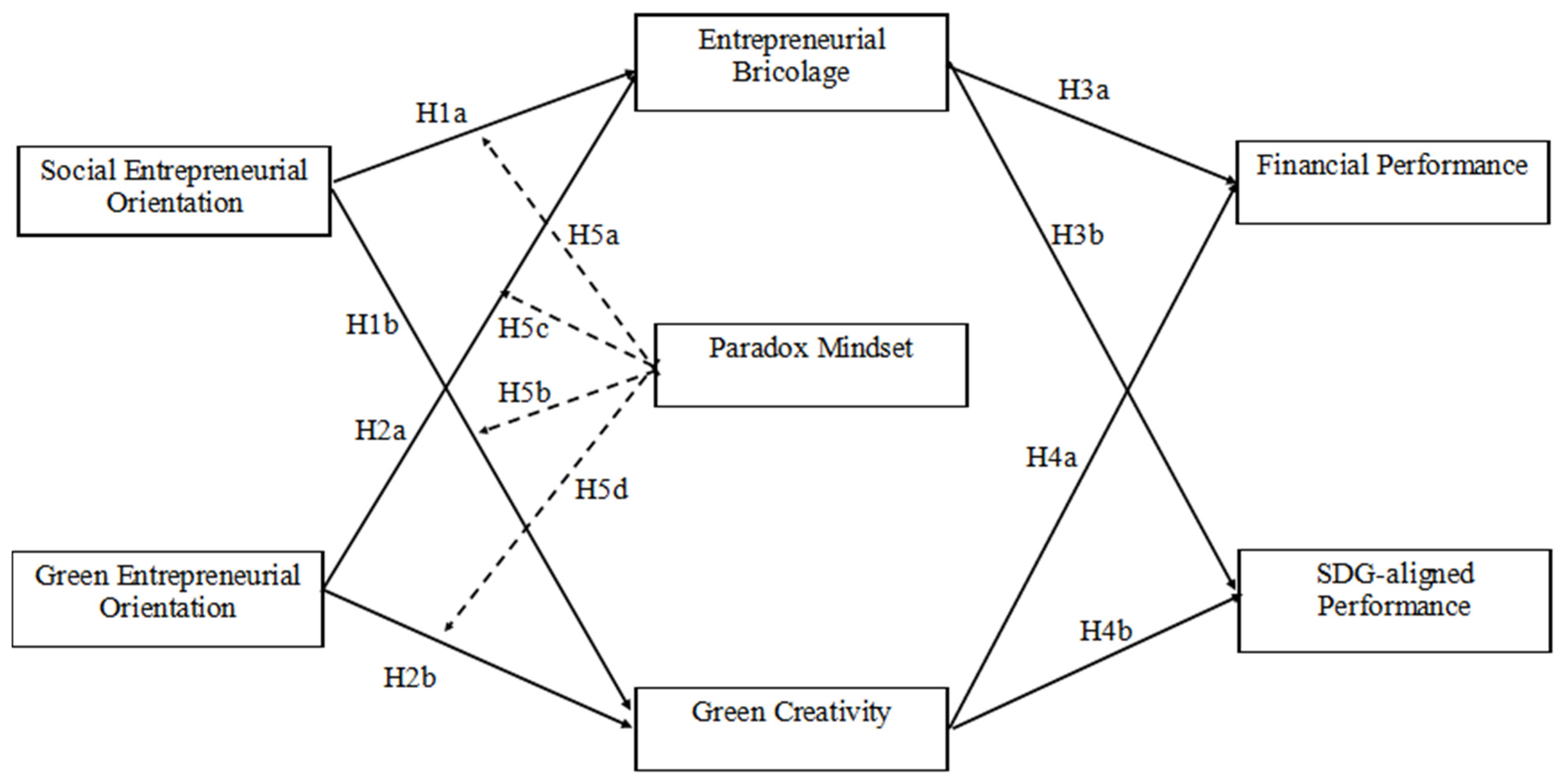
Figure 1. Conceptual model.
Sustainability 18 07856 g001
Figure 2. Structural model with path coefficients.
Sustainability 18 07856 g002
Figure 3. Interaction plots for the moderating role of paradox mindset.
Sustainability 18 07856 g003
Table 1. Summarizes the sample characteristics.
Characteristicsn%
Gender
Male21265.6
Female11134.4
Age
25–306821.1
31–359730
36–408225.4
41–454814.9
Above 45288.7
Education
High school195.9
Bachelor’s degree14444.6
Master’s degree13842.7
Doctoral degree226.8
Venture age
1–27924.5
3–516551.1
Above 57924.5
Industry sector
Technology8927.6
Manufacturing8225.4
Services7523.2
Retail4213
Other3510.8
Venture size (Employees)
1–109930.7
11–2510532.5
26–507021.7
51–1004915.2
Table 2. Full collinearity VIF values for common method bias assessment.
ConstructVIF
Entrepreneurial Bricolage (EB)3.273
Financial Performance (FP)1.745
Green Creativity (GC)2.070
Green Entrepreneurial Orientation (GEO)2.331
Paradox Mindset (PM)1.245
SDG-aligned Performance (SDGAP)2.635
Social Entrepreneurial Orientation (SEO)1.723
Note: VIF values computed following Kock [47]. All values below the 3.3 threshold.
Table 3. Original and CMV-adjusted inter-construct correlations (Lindell–Whitney procedure, r_M = 0.101).
Construct PairOriginal rpAdjusted rp (adj.)Conclusion
SEO—EB0.509<0.0010.454<0.001Remains significant
SEO—GC0.497<0.0010.440<0.001Remains significant
SEO—FP0.366<0.0010.295<0.001Remains significant
SEO—SDGAP0.503<0.0010.447<0.001Remains significant
GEO—EB0.629<0.0010.587<0.001Remains significant
GEO—GC0.480<0.0010.421<0.001Remains significant
GEO—FP0.425<0.0010.360<0.001Remains significant
GEO—SDGAP0.495<0.0010.438<0.001Remains significant
EB—FP0.598<0.0010.553<0.001Remains significant
EB—SDGAP0.655<0.0010.616<0.001Remains significant
GC—FP0.352<0.0010.279<0.001Remains significant
GC—SDGAP0.631<0.0010.589<0.001Remains significant
FP—SDGAP0.466<0.0010.406<0.001Remains significant
SEO—GEO0.476<0.0010.417<0.001Remains significant
SEO—PM0.277<0.0010.196<0.001Remains significant
GEO—PM0.342<0.0010.268<0.001Remains significant
EB—PM0.1410.0110.0450.425Becomes n.s. (see note)
GC—PM0.1090.0510.0090.879Becomes n.s. (see note)
SDGAP—PM0.1350.0150.0380.495Becomes n.s. (see note)
Note: r_M = 0.101 (smallest observed correlation, PM–FP), used as the conservative CMV proxy following Lindell and Whitney. All nineteen substantive correlations that underpin the structural model remain significant after adjustment. The only correlations that fall below significance are the weak zero-order correlations of paradox mindset with EB, GC, and SDGAP; this is theoretically expected, as paradox mindset is hypothesized to operate as a moderator of the orientation-to-mechanism paths rather than as a direct predictor of mediators or outcomes, and its moderating effects are tested through interaction terms rather than zero-order associations. Because the substantive structural correlations survive the CMV adjustment, common method variance is unlikely to account for the focal findings.
Table 4. Factor loadings for all measurement items.
ItemLoadingItemLoadingItemLoading
EB10.862GEO20.822SDGAP60.830
EB20.869GEO30.862SDGAP70.772
EB30.886GEO40.850SDGAP80.831
EB40.861GEO50.862SDGAP90.795
EB50.887PM10.814SEO10.827
EB60.880PM20.861SEO20.805
FP10.871PM30.803SEO30.851
FP20.847PM40.865SEO40.816
FP30.850PM50.793SEO50.816
FP40.850PM60.812SEO60.804
FP50.863PM70.792SEO70.865
GC10.872PM80.828SEO80.803
GC20.869PM90.851SEO90.831
GC30.873SDGAP10.820SEO100.825
GC40.845SDGAP20.817SEO110.842
GC50.876SDGAP30.836SEO120.798
GC60.893SDGAP40.804
GEO10.865SDGAP50.844
Note: All loadings are significant at p < 0.001 based on bootstrapping with 5000 subsamples. Full item wording is available in Appendix A.
Table 5. Construct reliability and convergent validity.
ConstructCronbach’s αCR (ρa)CR (ρc)AVE
Entrepreneurial Bricolage (EB)0.9380.9380.9510.764
Financial Performance (FP)0.9090.9100.9320.733
Green Creativity (GC)0.9370.9370.9500.759
Green Entrepreneurial Orientation (GEO)0.9060.9070.9300.726
Paradox Mindset (PM)0.9420.9540.9500.680
SDG-aligned Performance (SDGAP)0.9370.9380.9470.667
Social Entrepreneurial Orientation (SEO)0.9570.9580.9620.679
Note: All values exceed the recommended thresholds (α > 0.70, CR > 0.70, AVE > 0.50) proposed by Hair et al. [38].
Table 6. Heterotrait–monotrait (HTMT) ratio of correlations.
ConstructEBFPGCGEOPMSDGAPSEO
EB
FP0.648
GC0.5370.381
GEO0.6810.4690.521
PM0.1500.1090.1160.370
SDGAP0.6980.5040.6730.5370.152
SEO0.5370.3920.5240.5120.2920.532
Note: EB = Entrepreneurial Bricolage; FP = Financial Performance; GC = Green Creativity; GEO = Green Entrepreneurial Orientation; PM = Paradox Mindset; SDGAP = SDG-aligned Performance; SEO = Social Entrepreneurial Orientation. All HTMT values below 0.85 threshold.
Table 7. Model fit indices.
IndexSaturated ModelEstimated ModelThreshold
SRMR0.0370.042<0.080
d_ULS1.9002.390
d_G0.8940.897
Chi-square1568.5271554.798
NFI0.8910.892>0.900 (acceptable)
Note: SRMR = standardized root mean square residual; NFI = normed fit index.
Table 8. Descriptive statistics and inter-construct correlations (N = 323).
ConstructMeanSDMinMaxSEOGEOEBGCPMFPSDGAP
SEO4.9810.7882.427.001.000
GEO4.9490.8011.806.800.4761.000
EB5.1340.8962.007.000.5090.6291.000
GC4.8770.8672.507.000.4970.4800.5041.000
PM4.9270.7372.446.890.2770.3420.1410.1091.000
FP4.7600.7802.006.800.3660.4250.5980.3520.1011.000
SDGAP4.8890.7362.337.000.5030.4950.6550.6310.1350.4661.000
Note: Constructs scored 1–7. Pearson correlations |r| > 0.109 are significant at p < 0.05 (two-tailed).
Table 9. Explanatory power (R2) and out-of-sample predictive power (PLSpredict).
ConstructR2R2 Adj.Q2predictRMSE (Model)RMSE (LM)
Entrepreneurial Bricolage0.5090.5010.4910.6410.703
Green Creativity0.4870.4790.4690.6330.745
Financial Performance0.3760.3560.2500.6780.732
SDG-aligned Performance0.5610.5470.4100.5660.638
Note: PLSpredict with 10 folds and 10 repetitions. Q2predict > 0 indicates predictive power beyond the naive benchmark; model RMSE below the LM benchmark for all constructs indicates out-of-sample predictive validity. R2 values reflect the revised model including direct paths and controls.
Table 10. Structural path coefficients, direct effects, and hypothesis-testing results.
HPathβMSDtpDecision
H1aSEO → EB0.2940.2940.0456.5240.000Supported
H1bSEO → GC0.3790.3770.0507.6160.000Supported
H2aGEO → EB0.5440.5420.04711.5170.000Supported
H2bGEO → GC0.3650.3660.0487.5310.000Supported
H3aEB → FP0.5150.5130.0598.7320.000Supported
H4aGC → FP0.0350.0350.0570.6120.541Not Supported
H3bEB → SDGAP0.4100.4090.0488.4600.000Supported
H4bGC → SDGAP0.3650.3650.0438.4200.000Supported
H5aPM × SEO → EB0.0220.0220.0390.5620.574Not Supported
H5bPM × SEO → GC0.2280.2270.0554.1780.000Supported
H5cPM × GEO → EB0.1930.1890.0424.5720.000Supported
H5dPM × GEO → GC0.2210.2200.0474.6690.000Supported
Direct effects
SEO → FP0.0600.0600.0531.1430.253n.s.
SEO → SDGAP0.1090.1090.0492.2310.026Significant
GEO → FP0.0570.0580.0710.8010.423n.s.
GEO → SDGAP0.0100.0110.0500.2020.840n.s.
PM main effects
PM → EB−0.094−0.0890.0442.1520.031Significant (negative)
PM → GC−0.068−0.0670.0551.2420.214n.s.
Note: Bootstrapping with 5000 subsamples, two-tailed. Direct effects and PM main effects are included so that the PLS-SEM specification matches the PROCESS specification exactly (Comment 1). The negative PM → EB main effect indicates that, at average levels of the orientations, founders higher in paradox mindset report slightly less bricolage; the theoretically central role of PM operates through the significant interaction terms. Controls (gender, age, education, venture age, industry, size) remain included in both outcomes; all n.s.
Table 11. Specific indirect effects with bootstrap 95% confidence intervals.
Indirect Effectβtp95% CIDecision
SEO → EB → FP0.1656.0130.000[0.111, 0.219]Significant
SEO → EB → SDGAP0.1335.4970.000[0.086, 0.180]Significant
SEO → GC → FP0.0231.1520.249[−0.016, 0.062]Not significant
SEO → GC → SDGAP0.1525.7600.000[0.101, 0.204]Significant
GEO → EB → FP0.3077.7030.000[0.229, 0.385]Significant
GEO → EB → SDGAP0.2477.6820.000[0.184, 0.310]Significant
GEO → GC → FP0.0221.1400.254[−0.016, 0.061]Not significant
GEO → GC → SDGAP0.1466.4500.000[0.101, 0.191]Significant
Note: Bias-corrected 95% CIs based on 5000 bootstrap resamples. Indirect effects are considered significant when zero is not included in the CI.
Table 12. Classification of mediation types based on joint significance of indirect and direct effects.
PathwayIndirectDirectClassification
SEO → EB → FP0.151 *0.060 n.s.Full (indirect-only) mediation
SEO → GC → FP0.013 n.s.0.060 n.s.No mediation (GC → FP n.s.)
SEO → EB → SDGAP0.120 *0.109 *Partial (complementary) mediation
SEO → GC → SDGAP0.138 *0.109 *Partial (complementary) mediation
GEO → EB → FP0.280 *0.057 n.s.Full (indirect-only) mediation
GEO → GC → FP0.013 n.s.0.057 n.s.No mediation (GC → FP n.s.)
GEO → EB → SDGAP0.223 *0.010 n.s.Full (indirect-only) mediation
GEO → GC → SDGAP0.133 *0.010 n.s.Full (indirect-only) mediation
Note: * significant at p < 0.05 (bootstrap). The significant direct SEO → SDGAP path indicates that SEO retains a residual direct association with SDG-aligned performance beyond the two modeled mechanisms.
Table 13. Bootstrapped contrasts of structural paths and specific indirect effects.
ContrastΔBootSE95% CIDecision
(EB → FP) − (GC → FP)0.4810.090[0.309, 0.663]Significant
(EB → SDGAP) − (GC → SDGAP)0.0410.079[−0.110, 0.199]n.s.
(SEO → EB → FP) − (SEO → GC → FP)0.1370.036[0.070, 0.210]Significant
(GEO → EB → FP) − (GEO → GC → FP)0.2680.050[0.176, 0.370]Significant
(SEO → EB → SDGAP) − (SEO → GC → SDGAP)−0.0190.035[−0.089, 0.051]n.s.
(GEO → EB → SDGAP) − (GEO → GC → SDGAP)0.0870.043[0.006, 0.173]Significant
Note: 5000 bootstrap resamples on standardized composite scores; percentile 95% CIs. A contrast is significant when the CI excludes zero.
Table 14. Conditional indirect effects and index of moderated mediation (PROCESS specification matched exactly to PLS-SEM: mediator equations contain both orientations, PM, and both interactions; outcome equations contain both mediators, both orientations, and the six controls).
PathPM LevelEffectBootSE95% CIIndex95% CI (Index)
SEO → EB → FPLow (4.11)0.12930.0305[0.0686, 0.1887]0.0205[−0.0308, 0.0758]
Mean (5.00)0.14760.0282[0.0947, 0.2056] Not significant
High (5.67)0.16130.0381[0.0916, 0.2398]
SEO → EB → SDGAPLow (4.11)0.09710.0235[0.0519, 0.1440]0.0154[−0.0233, 0.0580]
Mean (5.00)0.11080.0218[0.0710, 0.1563] Not significant
High (5.67)0.12110.0291[0.0680, 0.1823]
SEO → GC → FPLow (4.11)0.00310.0084[−0.0132, 0.0222]0.0086[−0.0284, 0.0468]
Mean (5.00)0.01080.0231[−0.0343, 0.0557] Not significant
High (5.67)0.01650.0354[−0.0525, 0.0857]
SEO → GC → SDGAPLow (4.11)0.03950.0305[−0.0234, 0.0968]0.1079[0.0564, 0.1701]
Mean (5.00)0.13550.0230[0.0924, 0.1836] Significant
High (5.67)0.20740.0333[0.1437, 0.2756]
GEO → EB → FPLow (4.11)0.16710.0351[0.1021, 0.2384]0.1276[0.0648, 0.1930]
Mean (5.00)0.28050.0436[0.1992, 0.3684] Significant
High (5.67)0.36560.0590[0.2555, 0.4820]
GEO → EB → SDGAPLow (4.11)0.12540.0267[0.0766, 0.1808]0.0958[0.0501, 0.1455]
Mean (5.00)0.21050.0328[0.1500, 0.2793] Significant
High (5.67)0.27440.0442[0.1934, 0.3668]
GEO → GC → FPLow (4.11)0.00320.0079[−0.0119, 0.0210]0.0081[−0.0275, 0.0429]
Mean (5.00)0.01040.0224[−0.0331, 0.0534] Not significant
High (5.67)0.01580.0340[−0.0508, 0.0807]
GEO → GC → SDGAPLow (4.11)0.04030.0240[−0.0089, 0.0867]0.1016[0.0553, 0.1567]
Mean (5.00)0.13060.0223[0.0892, 0.1774] Significant
High (5.67)0.19830.0334[0.1376, 0.2658]
Note: 5000 bootstrap resamples; percentile 95% CIs. Low/Mean/High = 16th/50th/84th percentiles of PM. The non-significant indices for the SEO → EB pathways are fully consistent with the non-significant H5a interaction in PLS-SEM.
Table 15. Full PROCESS model estimates (unstandardized). Mediator equations contain SEO, GEO, PM, and both interactions (matching the PLS inner model, which does not route controls to the mediators); outcome equations contain both mediators, both orientations, and all six controls (matching the PLS outcome equations).
PredictorEB eq b (t)GC eq b (t)FP eq b (t)SDGAP eq b (t)
SEO0.330 (6.42) ***0.414 (8.13) ***0.067 (1.20)0.103 (2.32) *
GEO0.613 (11.83) ***0.399 (7.80) ***0.058 (0.99)0.016 (0.34)
PM−0.114 (−2.20) *−0.083 (−1.63)
SEO × PM0.046 (0.69)0.350 (5.30) ***
GEO × PM0.288 (4.48) ***0.329 (5.18) ***
EB0.443 (8.05) ***0.332 (7.63) ***
GC0.025 (0.48)0.309 (7.67) ***
Gender−0.007 (−0.09)−0.049 (−0.83)
Age0.005 (0.81)0.000 (0.02)
Education−0.034 (−0.68)−0.020 (−0.50)
Venture age−0.019 (−1.01)−0.009 (−0.64)
Technology0.012 (0.15)−0.007 (−0.11)
Firm size0.054 (1.60)0.022 (0.80)
Note: Mean-centered composites; t-statistics in parentheses; * p < 0.05, *** p < 0.001. Correspondence with the PLS-SEM standardized estimates (Table 10): SEO × PM → EB (b = 0.046, n.s.) ↔ H5a (β = 0.022, n.s.); direct SEO → SDGAP (b = 0.103, p = 0.021) ↔ (β = 0.109, p = 0.026); all other direct paths n.s. in both frameworks. The specifications are now identical in predictors, interactions, and controls.
Table 16. Effect sizes (f2) and inner-model collinearity (VIF) for all structural predictors.
Predictorf2 (EB)f2 (GC)f2 (FP)f2 (SDGAP)Inner VIF
SEO0.1300.2080.0050.0171.322/1.596
GEO0.4420.1920.0030.0001.383 1.850
PM0.0150.0081.173
SEO × PM0.0020.0891.227
GEO × PM0.0630.0841.253
EB0.2080.1871.995
GC0.0010.1881.598
Controls (6)all <0.012all <0.0121.027–1.053
Note: f2 benchmarks: 0.02 small, 0.15 medium, 0.35 large (Cohen). GEO → EB is large; SEO → GC, GEO → GC, EB → FP, EB → SDGAP, and GC → SDGAP are medium; the three significant interaction terms show small-to-medium effects (0.063–0.089), typical for moderation. The near-zero f2 for SEO × PM → EB (0.002) and GC → FP (0.001) corresponds to the two unsupported hypotheses. All inner VIFs are below 2.0, well under the conservative threshold of 3.3, indicating no structural collinearity concern. Where two VIFs are shown, the first refers to the mediator equations and the second to the outcome equations. Industry is coded as a technology-sector dummy (1 = technology, 0 = otherwise); venture size is the ordinal employee band (1–4) described in Table 1. The statement that non-significant controls “rule out confounding” has been softened to “provide no evidence that the modeled relationships are attributable to these observed venture characteristics.”.
Table 17. Structural estimates with SEO as a second-order construct.
Pathβ (2nd-Order)tβ (1st-Order)Conclusion
SEO → EB0.2906.420.294Unchanged
SEO → GC0.3768.130.379Unchanged
PM × SEO → EB (H5a)0.0300.70 n.s.0.022 n.s.Unchanged (n.s.)
PM × SEO → GC (H5b)0.2365.300.228Unchanged
EB → FP0.5098.050.515Unchanged
GC → FP0.0270.48 n.s.0.035 n.s.Unchanged (n.s.)
EB → SDGAP0.4047.630.410Unchanged
GC → SDGAP0.3647.670.365Unchanged
SEO → SDGAP (direct)0.1102.320.109Unchanged (sig.)
SEO → FP (direct)0.0681.20 n.s.0.060 n.s.Unchanged (n.s.)
Note: GEO paths and H5c/H5d likewise unchanged. The robustness of all conclusions across first-order and second-order specifications supports the measurement treatment reported in the main analysis.
Disclaimer/Publisher’s Note: The statements, opinions and data contained in all publications are solely those of the individual author(s) and contributor(s) and not of MDPI and/or the editor(s). MDPI and/or the editor(s) disclaim responsibility for any injury to people or property resulting from any ideas, methods, instructions or products referred to in the content.