Article

Planet B: A PolySolution for the Planetary PolyCrisis Emergency

Climate Healers, Phoenix, AZ 85048, USA
*
Author to whom correspondence should be addressed.
Sustainability 2026, 18(15), 7832; https://doi.org/10.3390/su18157832
Submission received: 5 May 2026 / Revised: 19 July 2026 / Accepted: 28 July 2026 / Published: 3 August 2026

Abstract

Humanity faces not isolated problems but a PolyCrisis, which is a set of 26 tightly interwoven existential crises spanning ecological collapse, planetary overheating, chronic disease epidemics, institutional fragility and social breakdown. Each crisis amplifies the others through cascading feedback loops, and 16 of these crises possess independently the capacity to cause human extinction or civilizational collapse. We are not entering an emergency, but we are already in a state of emergency. Multiple planetary boundaries have been transgressed, and climate tipping points are being crossed now. Extinction rates match historical great mass extinction events, while our food systems, primarily responsible for over half these crises, simultaneously drive hunger, obesity and chronic diseases. We argue that this PolyCrisis is not the result of isolated failures, but is best understood as the predictable, systemic outcome of Planet A, the prevailing Operating System of our mainstream civilization, characterized by economics of unbounded extraction and hoarding, violence-based and profit-based food systems, short-term thinking, and unlimited growth imperatives on a finite planet. Planet B is our proposed PolySolution framework, a complete alternative Operating System grounded in empirical reality and proven solutions. It integrates animal-free food systems releasing up to 5 billion hectares for rewilding, regenerative economics measuring non-violence and biocapacity, circular economy minimizing waste, technological restraint with democratic governance, seven-generation thinking, and PolyCommunity coordination, collaboration and co-creation of the PolySolution. It calls for the immediate emergency implementation of two planetary-scale MegaSolutions: (a) “Together Around Food”, implementing universal, free access to gourmet whole-food, plant-based vegan meals worldwide, eliminating hunger and accelerating food and health systems transformation, and (b) Cool, halting planetary overheating through agricultural emissions elimination, massive rewilding for carbon sequestration, and comprehensive stabilization of the life-support systems of our planet.

1. Introduction: We Are Already in an Emergency

The dominant narrative of environmental and social policy treats each crisis as a discrete problem amenable to a discrete solution. Climate change is managed by energy policies [1]. Biodiversity loss is managed by conservation policies [2]. Desertification is managed by “Business for Land” initiatives [3]. World hunger is managed by food aid [4]. Chronic disease is managed by healthcare systems [5]. And so on.
This dominant narrative is flawed. We do not face a series of individual crises amenable to discrete solutions. We face a PolyCrisis, which is a tightly interwoven cluster of 26 existential emergencies, each amplifying the others through dense networks of positive feedback loops, shared drivers, and systemic interdependencies [6]. Addressing any one crisis in isolation does not merely fail to resolve the broader emergency, but it often accelerates other crises within the cluster.
This paper presents evidence that:
(1)
the PolyCrisis is already catastrophically advanced;
(2)
it can be substantially attributed to a shared underlying driver, a civilizational Operating System called Planet A, predicated on false myths promoting unlimited extraction, normalized violence, and exponential growth [7];
(3)
a complete alternative Operating System, Planet B, exists and is grounded in empirical evidence and proven solutions [7]; and
(4)
two immediate MegaSolutions, “Together Around Food” and Cool, are proposed as emergency interventions with the potential to:
(a)
substantially mitigate several dimensions of the PolyCrisis; and
(b)
catalyze broader systemic transformation toward the PolySolution.
We write with urgency. The language of “eventual tipping points” and “future risks” no longer reflects scientific consensus [8]. Tipping points are being crossed now [9]. Extinction rates are matching those of the five great mass extinctions in the fossil record [10]. The window for preventing the worst outcomes is not just narrowing, but it is closing. Therefore, urgency is warranted.
In what follows, this paper is divided into eight sections:
Section 2 sets out our methodology: the article’s epistemic status and the three types of claims it advances, the protocol used to construct the 26-crisis taxonomy, and the theoretical traditions the framework draws on.
In Section 3, we examine the 26 distinct dimensions, A–Z of the PolyCrisis, divided into four primary clusters: ecological, personal, institutional and social. We describe several illustrative positive feedback loops that render the whole much greater and more dangerous than the sum of its parts, underscoring why the PolyCrisis must be addressed as a systemic whole and not through discrete interventions.
In Section 4, we describe Planet A, the Operating System generating the PolyCrisis. We identify the set of foundational assumptions, values, institutions and incentive structures that generates these crises as predictable outputs. In particular, we detail how the food-pharma-healthcare system on Planet A is primarily responsible for over half the existential crises of the PolyCrisis.
Throughout this paper, ‘food systems’ refer broadly to the global production and distribution of food; ‘food-pharma-healthcare system’ refers to the interlinked institutional complex spanning agriculture, pharmaceuticals and healthcare delivery; and ‘animal agriculture’ denotes the subsystem of food systems involving the raising and slaughter of animals for food. We use animal agriculture as the principal causal driver discussed in Section 4, situated within the broader food-pharma-healthcare system.
In Section 5, we introduce Planet B, an Operating System founded on empirically grounded principles, implemented around proven solutions, coordinated by communities committed to transformation. We show that every element of Planet B has precedents, evidence bases and already existing implementation models. We describe briefly how Planet B addresses every one of the 26 existential planetary crises of the PolyCrisis.
In Section 6, we explain why two MegaSolutions, “Together Around Food” and Cool, must be implemented worldwide on an emergency basis in response to the urgency of the PolyCrisis. These two MegaSolutions are capable of rapid deployment, have high impact across multiple PolyCrisis dimensions, and have catalytic effects on broader systemic transformation.
In Section 7, we directly engage with several anticipated objections to our framework, critically compare our contribution against existing frameworks, discuss its theoretical and practical implications, and address its limitations and propose future directions that strengthen this work.
Finally, Section 8 concludes our paper, reinforcing the emergency framing and the urgency of collaborative action.

2. Methodology

2.1. Article Type and Epistemic Status of Claims

This paper constitutes an integrative conceptual framework analysis, following the tradition of framework development articles in sustainability science and complex systems literature. It is not a systematic review, a primary empirical study, or a formal modeling exercise. Three types of claims are advanced in what follows, and we flag them here so the reader can assess each on its appropriate terms.
First are empirical claims such as statements summarizing findings from the existing scientific literature on the existence, magnitude, and interdependence of the 26 crisis dimensions. These are supported by citations to primary literature throughout Section 3, Section 4, Section 5 and Section 6 and should be assessed against that evidence. Second are interpretive framework claims in which the Planet A/Planet B conceptual structure is proposed as an organizing lens for understanding the causal architecture of the PolyCrisis. These are theoretical claims, falsifiable and revisable, rather than directly empirical ones. Third, normative and programmatic proposals, such as the seven axioms of Planet B and the two MegaSolutions, rest on both empirical and value-based foundations. The normative commitments to non-violence, intergenerational equity, and ecological integrity are not disguised empirical claims but explicitly chosen values that serve as design constraints for the proposed alternative operating system, Planet B.

2.2. Literature Synthesis and Taxonomy Construction Protocol

The 26-crisis taxonomy presented in Section 3 was constructed through a structured synthesis of the existing interdisciplinary literature rather than a formal systematic review. The literature base screened for candidate crisis dimensions comprised: (a) global assessment reports, principally the IPCC assessment reports and the Planetary Health Check reports; (b) public health and epidemiological literature on chronic disease, mental health, and nutrition; (c) political economy and ecological economics literature on growth, extraction, and distributive outcomes; and (d) systems ecology literature on biodiversity, biogeochemical cycling, and ecosystem function. Candidate dimensions drawn from this base were retained in the taxonomy if they satisfied three criteria: existential scope (does the crisis threaten civilizational or biospheric integrity at scale, rather than a regionally or temporally bounded harm?); documented interaction effects (is there literature evidence of causal or reinforcing linkage to at least one other retained crisis dimension?); and policy relevance (does the dimension admit of an identifiable leverage point addressable by the Planet B framework?).
The independent existential-risk designation (“e”) assigned to 16 of the 26 dimensions (Section 3.5) reflects a fourth, narrower criterion applied only after the three retention criteria above: a dimension was flagged “e” where the cited literature source documents a plausible pathway from that dimension, in isolation, to civilizational collapse or human extinction, rather than to serious but recoverable harm. Mass Extinction (crisis A), for example, is flagged “e” because extinction-rate literature [11] documents biosphere-integrity loss operating on a timescale and scale from which recovery falls outside the range of prior planetary history. Rising Inequality (crisis Z), by contrast, while extensively documented [12] as a driver of instability that amplifies other crises, is not independently flagged “e” because the cited literature documents it as a severity- and resilience-reducing factor rather than as a standalone extinction pathway; Obesity (crisis K) is treated the same way, since it is documented as a major morbidity driver [13] rather than, on its own, a civilizational-collapse pathway.
The Planet A/Planet B framework itself was developed in the authors’ prior work [6,7] and explicitly preceded and guided this synthesis rather than emerging inductively from it, a standard and legitimate mode of framework development analogous to applying an established theoretical lens to a new empirical domain to assess its explanatory coverage. The classification described above was applied by the two authors rather than by an independent multi-rater coding process; we note this openly as a limitation (Section 7.5) rather than implying a rigor the process did not have.

2.3. Theoretical Framework Selection and Positioning

The Planet B/PolyCrisis framework draws on and extends four established theoretical traditions. The PolyCrisis diagnostic is grounded in complex systems and resilience theory [14,15,16], which provides formal tools for modeling feedback loops, thresholds, and phase transitions in socio-ecological systems. Figure 1 and Figure 2 apply these conceptual tools to the crisis interdependencies described in Section 3. The argument that these crises are “predictable outputs” of Planet A’s structural logic draws on critical ecological political economy [17,18], which offers a structural basis for understanding ecological crises as endogenous features of a particular mode of production rather than contingent failures. The Planet B transition framework engages the multi-level perspective on socio-technical transitions [19]. The individual components of Planet B described in Section 5 and Section 6 (GPI/GNH, circular economy, plant-based food systems, Wales’s Future Generations Act) can be understood as niche innovations constituting an emerging alternative regime, while the MegaSolutions function as potential landscape-level shocks capable of accelerating niche-to-regime transitions. The claims regarding 16 crisis dimensions possessing extinction or civilizational collapse potential draw on the existential-risk literature [20,21], which provides the conceptual apparatus for distinguishing recoverable setbacks from catastrophic and irreversible civilizational loss.
No single existing framework was designed to span the full scope of what we are analyzing. The integration of these four traditions is itself a contribution of the paper as the PolyCrisis operates simultaneously across ecological, institutional, personal, and social domains in ways that complex systems theory alone, or political economy alone, or transition studies alone, cannot adequately address (see Table 1). The explicit adoption of these theoretical anchors, and the acknowledgment of what each provides and what each leaves underdeveloped, is developed further in the Discussion (Section 7).

2.4. Use of Generative AI

The figures in this paper were formatted with a GenAI tool (ChatGPT 4.0) and then drawn manually using standard tools and icons. The authors take full responsibility for the correctness of the figures.

3. The Planetary PolyCrisis: 26 Interlocking Emergencies

The term PolyCrisis, popularized in the global risk literature [14,22], describes a systemic situation in which multiple major crises interact such that the whole is much greater and more dangerous than the sum of its parts (see Figure 1).
We identify 26 distinct planetary crises within the current Planetary PolyCrisis, organized into four primary clusters.

3.1. Ecological Crises

  • Mass Extinction (e)—Species disappearing 1000–10,000 times faster than the background rate [11];
  • Chemical/Plastic Pollution (e)—Toxins in every ecosystem, microplastics in every organism [23];
  • Disruption of Nutrient Cycles (e)—Nitrogen and phosphorus cycles catastrophically altered [24];
  • Planetary Overheating (e)—1.4 °C global warming already from pre-industrial levels and increasing fast [25];
  • Ecosystem Collapse (e)—Amazon approaching tipping point, coral reefs dying, and forests fragmenting [26];
  • Freshwater Depletion (e)—Aquifers emptying, rivers drying, and glaciers melting [27];
  • Ocean Acidification—pH dropping 30% since the industrial revolution, threatening marine life [28];

3.2. Personal Crises

H.
Selfishness, Greed, and Apathy—Disconnection from consequences, and normalized separation and exploitation [29];
I.
Chronic Disease Epidemic (e)—Heart disease, diabetes, and cancer killing millions annually [30];
J.
Mental Health Crisis—Depression, anxiety, and suicide rates climbing globally [31];
K.
Obesity Epidemic—40% of adults are overweight, and 13% are obese globally [13];
L.
Excessive Drug/Alcohol Use—Self-medication for unbearable conditions [32];
M.
Maladaptive Worldviews (e)—Human supremacism, mechanistic thinking, and worldviews steeped in false myths [33];

3.3. Institutional Crises

N.
Institutionalized MisEducation (e)—Systems teaching compliance, not critical thinking, and propagating foundational myths in preparation for obsolete economy [34];
O.
Runaway Animal Agriculture (e)—Political capture by an industry that is destroying the life-support systems of our planet [35];
P.
Runaway Commercial Fishing (e)—Commercial fishing is bottom trawling an area the size of South America every year for perpetually dwindling catch [36];
Q.
Endless Growth Economics (e)—GDP focus requiring perpetual expansion on our finite planet [37];
R.
Endless War (e)—Military-industrial complex, resource conflicts, and arms races leading to perpetual war, triggering persistent global conflagrations [38];
S.
Runaway Artificial Intelligence (e)—AI weaponization, development without alignment, and job displacement without support [39];
T.
Runaway Gene Editing (e)—Gene editing without adequate safety protocols or ethical frameworks [40];

3.4. Social Crises

U.
Chronic Malnutrition and Hunger—Widespread malnutrition in human societies, with 800 million deficient in calories, while rich people are deficient in fiber [41];
V.
Colonialism 2.0—Resource extraction and debt traps leading to continued neocolonial exploitation [42];
W.
Slavery 2.0—50 million in forced labor, wage slavery, and prison labor as modern manifestations of human slavery [43];
X.
Public Health Deterioration (e)—Pandemic vulnerability, antibiotic resistance, and chronic diseases stressing the public health system [44];
Y.
Breakdown of Communities—Social isolation and loneliness epidemic are contributing to the fracture of our social fabric [45]; and
Z.
Rising Inequality—Wealth is concentrating in fewer and fewer hands, with upward mobility declining, and the divide widening [12].

3.5. The Interconnection of These Crises

Each crisis amplifies the others through cascading feedback loops, and 16 (marked in the list about with “e”) possess the independent capacity to cause human extinction or civilizational collapse.
Animal agriculture drives ecological crises A–G while contributing to personal crises I–K and social crisis X. Animal agriculture appears to be among the largest addressable drivers across multiple crisis categories, though this paper does not provide a quantitative ranking against other candidate drivers.
Endless Growth Economics (crisis Q) fuels ecological destruction (A–G), requires endless war for resources (R), and creates inequality (Z) and colonialism 2.0 (V), while driving personal disconnection (H, M).
Systematized violence toward animals, ecosystems, and other humans underlie institutional crises (O–T) and reinforce personal crises (H–M).
The PolyCrisis is, therefore, one interconnected system of harm expressing across four domains. Addressing symptoms individually while maintaining underlying protocols ensures continued crisis. This is why we need a systemic transformation.

3.6. Feedback Loops and Cascade Dynamics

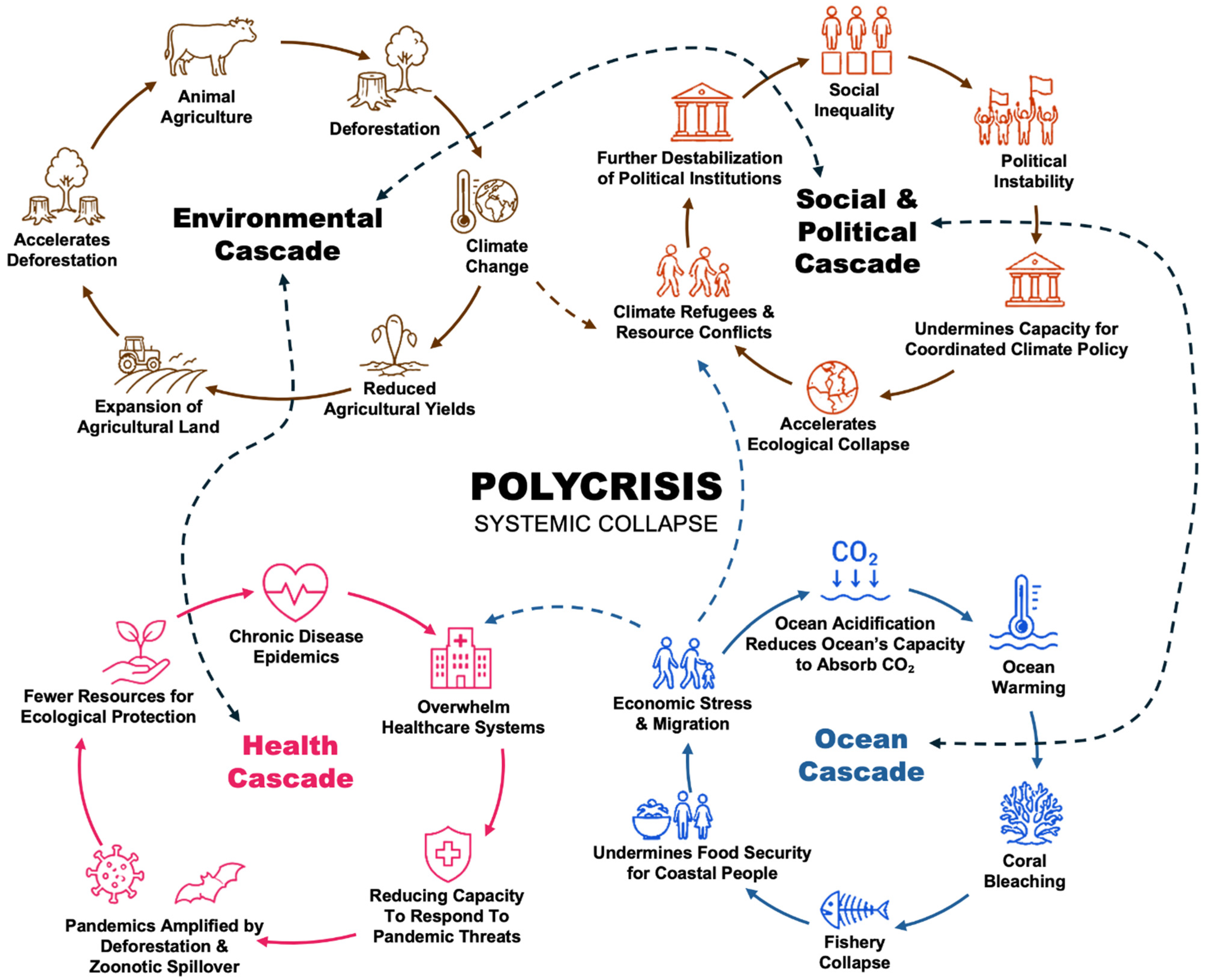
What transforms these 26 crises from a severe but manageable list of challenges into a genuine PolyCrisis is the density and nature of their interconnections. Consider several illustrative feedback loops (see Figure 2):
  • Animal agriculture drives deforestation, which accelerates climate change, which reduces agricultural yields, which drives expansion of agricultural land, which accelerates deforestation.
  • Chronic disease epidemics overwhelm healthcare systems, reducing capacity to respond to pandemic threats, which are themselves amplified by deforestation and zoonotic spillover, while the economic costs of disease burden reduce resources available for ecological protection.
  • Social inequality drives political instability, which undermines capacity for coordinated climate policy, which accelerates ecological collapse, which produces climate refugees and resource conflicts, which further destabilize political institutions.
  • Ocean warming drives coral bleaching and fishery collapse, undermining food security for hundreds of millions of coastal people, generating economic stress, migration, and demand for more agricultural land, while ocean acidification reduces the ocean’s capacity to absorb CO2, accelerating atmospheric warming.
These are not hypothetical futures. They are observable dynamics in the present. The PolyCrisis is not approaching; it is already here.

4. Planet A: The Operating System Generating the PolyCrisis

A systems-level analysis of the PolyCrisis reveals that its diverse manifestations share common structural roots. We proposed the concept of Planet A to describe the civilizational Operating System, which is the set of foundational assumptions, values, institutions, and incentive structures that generates these crises as predictable outputs [7].
Planet A is not a conspiracy or a failure of individual actors. It is an emergent property of a system organized around a particular set of premises. Identifying these premises is essential to understanding why incremental reforms consistently prove to be insufficient.

4.1. The Foundational Myths of Planet A

The concept of Planet A and a set of foundational myths underlying Planet A were introduced in [46] and further refined in [6,7]. A myth is a narrative that contains an element of truth, but misrepresents reality and functions as an unconscious controller that shapes destructive collective behavior reinforced through institutions, without being questioned. Seven foundational myths underlie Planet A (please see [6] for more details):
Myth 1. Protein is only found in animal foods: This is the false narrative that humans need to eat meat, dairy, fish and eggs to get adequate protein in their daily diet.
Myth 2. Calcium is only found in dairy foods: This is the false narrative that humans need to consume dairy products for calcium and strong bones.
Myth 3. Endless growth as the master objective: This is the false narrative that endless economic growth is necessary for prosperity, employment, innovation and social stability.
Myth 4. Consumption and commodification as social logic: This is the false narrative that more consumption always leads to better quality of life and to accomplish that, everything can and should be commodified and converted into something that can be bought and sold.
Myth 5. Human exceptionalism and separation from Nature: This is the false narrative that humans are separate from each other and from nature and superior to all other species in nature.
Myth 6. Mis-specified responsibility for ecological breakdown: This is the false narrative that the ecological crises are all caused by just fossil fuels and if we fix the energy and transportation infrastructure, we will solve all these crises.
Myth 7. Technological solutions for environmental constraints: This is the false narrative that newly invented technologies will solve all environmental problems without requiring changes in consumption, behavior or system structure.

4.2. Growth as the Master Objective

Perhaps the most destructive myth of Planet A is the attempt to sustain exponential material growth within a finite biosphere. The laws of thermodynamics cannot be repealed by economic theory. A growing body of evidence, from the original Limits to Growth modeling [47] through to contemporary Earth system science [48], demonstrates that the material throughput of the global economy has exceeded the regenerative and absorptive capacity of planetary systems.
This is no longer just a theoretical concern. We are beyond approaching planetary limits. We have already transgressed them. Nine planetary boundaries have been identified in the life-support systems of our planet, and as of the most recent assessment, seven have been crossed. These are biosphere integrity, novel entities (synthetic chemicals and plastic pollution), biogeochemical flows (nitrogen and phosphorous cycles), climate change, land-system change, freshwater use, and ocean acidification. Two of these transgressions, biosphere integrity and novel entities, are considered to be high-risk situations, with high risk of destabilizing the life-support systems of our planet due to very strong boundary transgressions [48]. Life-support system destabilization leading to cascading, catastrophic system failures is colloquially known as death, when it occurs on an individual level.

4.3. Economics of Unbounded Extraction and Hoarding

The dominant global economic framework measures success through Gross Domestic Product (GDP) growth, which is the continuous expansion of the monetary value of transactions. This metric is structurally blind to:
(a)
ecological costs, e.g., treating the destruction of a forest as an economic gain when timber is sold;
(b)
social costs, e.g., treating disease treatment as economic growth rather than a sign of systemic failure; and
(c)
distributional outcomes, e.g., registering no difference between growth that raises all boats and growth that concentrates wealth among the already wealthy.
The result is an economy that systematically externalizes costs onto ecosystems, future generations, and the poor, while concentrating benefits among current actors with market power. The ecological economist Herman Daly described this as treating the Earth as a business in liquidation, consuming the principal of “natural capital” while booking it as income [49].
The explicit imperative for continuous growth embedded in mainstream economics, corporate governance structures, and debt-based monetary systems creates a structural incompatibility with ecological sustainability on a finite planet. This is not a design flaw that can be patched, but a foundational feature of the Planet A Operating System.

4.4. Violence-Based and Profit-Based Food-Pharma-Healthcare Systems

Industrial animal agriculture represents, by scale, the largest system of organized violence in human history, with over 90 billion land animals [50] and over a trillion aquatic animals [51] killed annually for food production. This is the equivalent of dropping a Hiroshima bomb on the animal kingdom once every 6 seconds. Beyond the direct ethical dimensions, this system is characterized by structural violence toward ecosystems, workers, communities, and public health [52].
The concentration of enormous numbers of stressed animals in confined industrial settings creates ideal conditions for pathogen evolution and amplification, directly generating pandemic risk [53]. The routine prophylactic use of antibiotics in animal agriculture is the primary driver of antimicrobial resistance, which is one of the most serious and underappreciated dimensions of the PolyCrisis [54]. The land requirements of animal agriculture, needing over 80% of all agricultural land globally, despite producing only 18% of calories or 12% of food by dry weight, represent the primary driver of deforestation and habitat destruction [55].
This food system generates its social legitimacy through cultural normalization, Institutionalized MisEducation propagating false nutritional myths through curriculum omissions and cafeteria food environment as silent curriculum [56], governmental subsidies, and the suppression of alternatives. Its continuation is not natural or inevitable; it is actively maintained by policy choices and regulatory frameworks that represent the growth imperative of Planet A in action.

4.5. Short-Termism and Discount Rates

Planet A’s institutional architecture systematically discounts future outcomes in favor of immediate returns. Financial discount rates, electoral cycles, quarterly earnings reports, and the structure of incentives for decision-makers all create powerful pressure toward decisions that maximize short-term gains at the cost of long-term stability.
This temporal myopia is particularly catastrophic when applied to ecological systems with long feedback cycles, tipping points that trigger irreversible state changes, and assets like biodiversity or stable climate whose value is not captured in market prices. A civilization operating system that does not think beyond the next quarter or the next election cycle is structurally incapable of managing risks that operate on decadal and centennial timescales.

5. Planet B: An Operating System for Implementing the PolySolution

Planet B is a new systems engineering framework for the reorganization of human civilization around empirically grounded principles, implemented through proven solutions, coordinated by communities committed to transformation. Its objective is to meet a modified version of the UN Sustainable Development Goals (dropping SDG #8: Economic Growth and adding SDG #18: Zero Animal Exploitation), while striving for world peace and planetary health [6,7]. Every element of Planet B has precedents, evidence bases, and already existing implementation models. What is required is integration, scaling, and the political will as well as the courageous leadership to implement them.

5.1. The Foundational Axioms of Planet B

In contrast to the unconscious myths governing Planet A, Planet B is designed around conscious axioms that are explicitly chosen, life-affirming principles intended to produce desired outcomes. Its seven foundational axioms are testable, falsifiable, and editable systems engineering tools, not dogma:
Axiom A. Interdependence of all life: The principle that all beings are interconnected within the web of life and human wellbeing is inseparable from the wellbeing of all life.
Axiom B. Nonviolence/Zero animal exploitation: Non-human animals are moral subjects deserving consideration and protection. Ahimsa, that is non-harming, is a hard constraint on system design, closing a primary pathway of ecological degradation and ethical corruption.
Axiom C. Sufficiency over growth: Direct systems towards planetary healing and universal wellbeing rather than aggregate expansion, enabling purpose and meaning beyond consumption.
Axiom D. Honesty and humility as design criteria: Account for true costs without externalization. Acknowledge limits, respecting what we do not know.
Axiom E. Universal provisioning within planetary limits: Ensure clean air, healthy soils, pure water and vitalizing food for all beings within the nine planetary boundaries. Organize provisioning around meeting needs, not maximizing profits.
Axiom F. Distributed, participatory governance: Distribute decision-making power as close as possible to those affected, including representation for all species.
Axiom G. Technology subordinated to life: Deploy science and technology to serve life’s flourishing and not throughput expansion.
These seven axioms are a mutually supporting set, reinforcing and enabling each other. Interdependence (A) required Nonviolence (B). Nonviolence (B) enables Sufficiency (C), which demands Honesty (D). Honesty (D) reveals need for Universal Provisioning (E), which requires Distributed Governance (F). Distributed Governance (F) needs Appropriate Technology (G), which serves Interdependence (A). The circle closes as each axiom supports the others. Together, they form the basis of a coherent operating system designed to produce the desired outcomes of world peace and planetary health.

Positioning Planet B Relative to Established Frameworks

Several established frameworks address overlapping terrain. We distinguish Planet B from each and identify the specific contribution it makes beyond or alongside them.
Planetary Boundaries [48] identifies nine Earth-system boundaries and documents their transgression, providing robust quantitative grounding for nine specific thresholds, grounding that the current paper’s 26-crisis taxonomy does not match in methodological rigor for all dimensions. What Planetary Boundaries does not provide is a transition mechanism or an alternative institutional architecture for operating within those boundaries. Planet B provides that architecture, extending the diagnostic into a design framework. Doughnut Economics [57] redefines the goal of economics as meeting human needs within planetary limits, providing an important conceptual reorientation and measurement approach. Planet B extends this by specifying the full operating system required to achieve that goal, including food systems transformation (the element most substantively absent from Doughnut Economics), governance architecture, normative foundations, and specific emergency interventions, rather than long-term economic redesign alone. Degrowth scholarship [58] provides critical analysis of the growth imperative and proposes its reversal, overlapping substantially with Planet B’s critique of Planet A’s growth myth (Section 4.3). Planet B incorporates degrowth analysis within a broader systems engineering framework that treats the food system transformation, largely absent from mainstream degrowth literature, as the primary high-leverage entry point. The One Health framework [59] recognizes the interdependence of human, animal, and ecosystem health, overlapping with Planet B’s analysis of the food-pharma-healthcare system (Section 4.4). Planet B extends One Health by situating it within a full civilizational operating system analysis connecting it to economic, governance, and ecological dimensions that One Health typically does not address. The multi-level perspective on transitions [19] provides more granular empirical tools for analyzing transition dynamics than Planet B currently does; the MLP literature on incumbent regime resistance, strategic niche management, and landscape pressure would strengthen Planet B’s transition analysis and is identified as a productive avenue for future development.
Planet B’s distinctive contribution relative to these frameworks lies in three features:
(a)
the concentrated causal attribution to the food-pharma-healthcare system and its animal agriculture subsystem as the highest-leverage leverage point across multiple crisis dimensions simultaneously;
(b)
the operating-system framing, which treats civilizational transition as a design problem requiring specification of the full architecture of an alternative rather than reform of individual components; and
(c)
the proposal of two specific, immediately deployable emergency interventions, rather than simply long-term framework adoption, as the appropriate response to a documented planetary emergency.

5.2. Zero Animal Exploitation and Planetary Rewilding

We propose that the transition to animal-free food and material systems is among the highest-leverage interventions available for rapid, large-scale reduction of multiple dimensions of the PolyCrisis, supported by an extensive evidence base regarding its individual components (see Section 6).
A global transition to plant-based food and material systems would:
  • Free approximately 5 billion hectares of land currently used for farmed animal grazing and feed crop production, which comprises an area equivalent to North America and South America combined, for rewilding and ecological restoration;
  • Eliminate the largest driver of planetary overheating [60], with additional substantial cooling opportunities from carbon sequestration through rewilding;
  • Remove a primary driver of antibiotic resistance, pandemic risk, and zoonotic disease emergence [61];
  • Dramatically reduce fresh water use and water pollution from nutrient runoff [62];
  • Eliminate the largest single source of animal suffering; and
  • Substantially reduce rates of cardiovascular disease, type 2 diabetes, obesity, and certain cancers, reducing healthcare system burden [63].
The rewilding of released agricultural land would, over decades, regenerate biodiversity, restore watershed function, stabilize soils, and sequester enormous quantities of carbon. Consider that humanity has eliminated half the trees on the planet over the past 10 K years, from 5–6 trillion down to 3 trillion [64], and the remaining 3 trillion trees alone are storing half as much carbon as the entire atmosphere today [65]. The potential of rewilding to restore climate stability is mathematically defensible.

5.3. Regenerative Economics

Planet B requires an economic framework that measures what actually matters for human wellbeing, ecological health, and the distribution of benefits and costs across both human populations and other species. Several frameworks have emerged that offer viable alternatives to GDP-centric economics.
Doughnut Economics, developed by Kate Raworth [57], defines a safe and just space bounded by social foundations, the minimum conditions for human dignity, and ecological ceilings, the planetary boundaries beyond which the stability of the planet’s life-support systems are compromised. Rather than asking and answering, “how do we maximize growth?”, it asks and answers “how do we meet human needs within planetary boundaries?”
Genuine Progress Indicator (GPI) [66], Gross National Happiness (GNH) [67], and similar frameworks represent operational attempts to reorient economic measurement toward outcomes that reflect actual human and ecological flourishing. Several jurisdictions have adopted such frameworks at national or sub-national levels, providing evidence of implementation feasibility, though their efficacy is currently compromised due to their need for trade with other jurisdictions implementing Planet A protocols.
Planet B’s economic framework specifically incorporates measures of non-violence and biocapacity through the AhimsaCoin economic substrate [6,7], recognizing that an economy built on the destruction of life, whether human, animal, or ecological, is not generating genuine wealth but consuming and destroying it.

5.4. Circular Economy and Material Sufficiency

The linear economy of Planet A with its extract, produce, consume, and discard functions, generates waste at every stage and is dependent on continuous extraction of finite resources. A circular economy redesigns this flow, minimizing waste by design, keeping materials in productive use at the highest possible value, and regenerating natural systems.
The transition to circular economy principles is already generating significant economic value, with analysis suggesting that circular economy approaches could generate $4.5 trillion in economic opportunity globally by 2030 while substantially reducing resource demand and waste generation [68]. The Ellen MacArthur Foundation and others have documented extensive case studies of successful implementation across sectors [69].
Planet B pairs circular economy principles with a commitment to material sufficiency, with the recognition that beyond certain thresholds, additional material consumption does not generate additional wellbeing, and that the global material throughput of the economy must be reduced to sustainable levels. This is not a counsel of impoverishment, as empirical evidence consistently shows that wellbeing is more strongly determined by social connection, security, autonomy, and purpose than by material consumption beyond a threshold [70].

5.5. Technological Restraint and Democratic Governance

Planet B does not reject technology; it insists on democratic governance of technological development and use. The emergence of transformative technologies such as artificial intelligence, synthetic biology, geoengineering, and advanced surveillance without adequate governance frameworks represents a profound risk, potentially compounding existing crises or creating new ones of equal or greater severity.
Technological restraint means applying the precautionary principle to technologies with uncertain but potentially catastrophic risk profiles, ensuring that technological development is directed by democratic rather than purely market processes, distributing the benefits of technology broadly rather than concentrating them, and maintaining human agency and ecological integrity as non-negotiable constraints on technological deployment.
This includes a critical assessment of so-called techno-fix approaches to the PolyCrisis itself, such as carbon capture and storage [71], solar radiation management [72], and lab-grown meat [73], which risk creating moral hazard, reducing urgency for structural change, displacing genuinely effective solutions, and generating newer and greater risks. Such technologies may have roles within a Planet B framework but cannot substitute for structural transformation.

5.6. Seven-Generation Thinking

The Iroquois Confederacy’s principle of considering the impact of decisions on seven generations [74] offers a fundamental reorientation of temporal perspective that Planet B adopts as a structural principle. Seven generations forward is approximately 175 years, a timeframe that encompasses the full consequences of decisions made today about climate, biodiversity, and social organization.
Operationalizing seven-generation thinking requires institutional reform, with constitutional provisions requiring long-term impact assessment, governance structures with explicit mandates for intergenerational equity, and economic accounting that treats long-term ecological and social costs as real costs rather than externalities. Wales, Finland, and other jurisdictions have experimented with “Future Generations Commissioners” and similar mechanisms, offering implementation precedents [75].

5.7. PolyCommunity Coordination, Collaboration, and Co-Creation

We affirm that the PolyCrisis cannot be solved by any single actor, institution, government, or movement. Its resolution requires coordinated action across scales, from household to municipal to national to global, and across sectors, from food systems to economics to governance to technology. We propose the concept of PolyCommunity as the organizational form capable of enabling this coordination.
PolyCommunity is not a single organization but a network of communities, movements, institutions, and individuals committed to the co-creation and implementation of the PolySolution. It operates through principles of subsidiarity so that decisions are made at the most local level capable of addressing them, solidarity so that mutual aid and shared commitment is implemented across communities, and PolyCentric governance with distributed decision-making rather than top-down control.
The co-creation of the PolySolution is itself a form of transformation so that communities developing their own implementations of Planet B principles build the social capital, shared understanding, and institutional capacity that make further transformation possible. This distributed process is not merely instrumental but constitutive of the world we are trying to build.

5.8. How Planet B Addresses the PolyCrisis

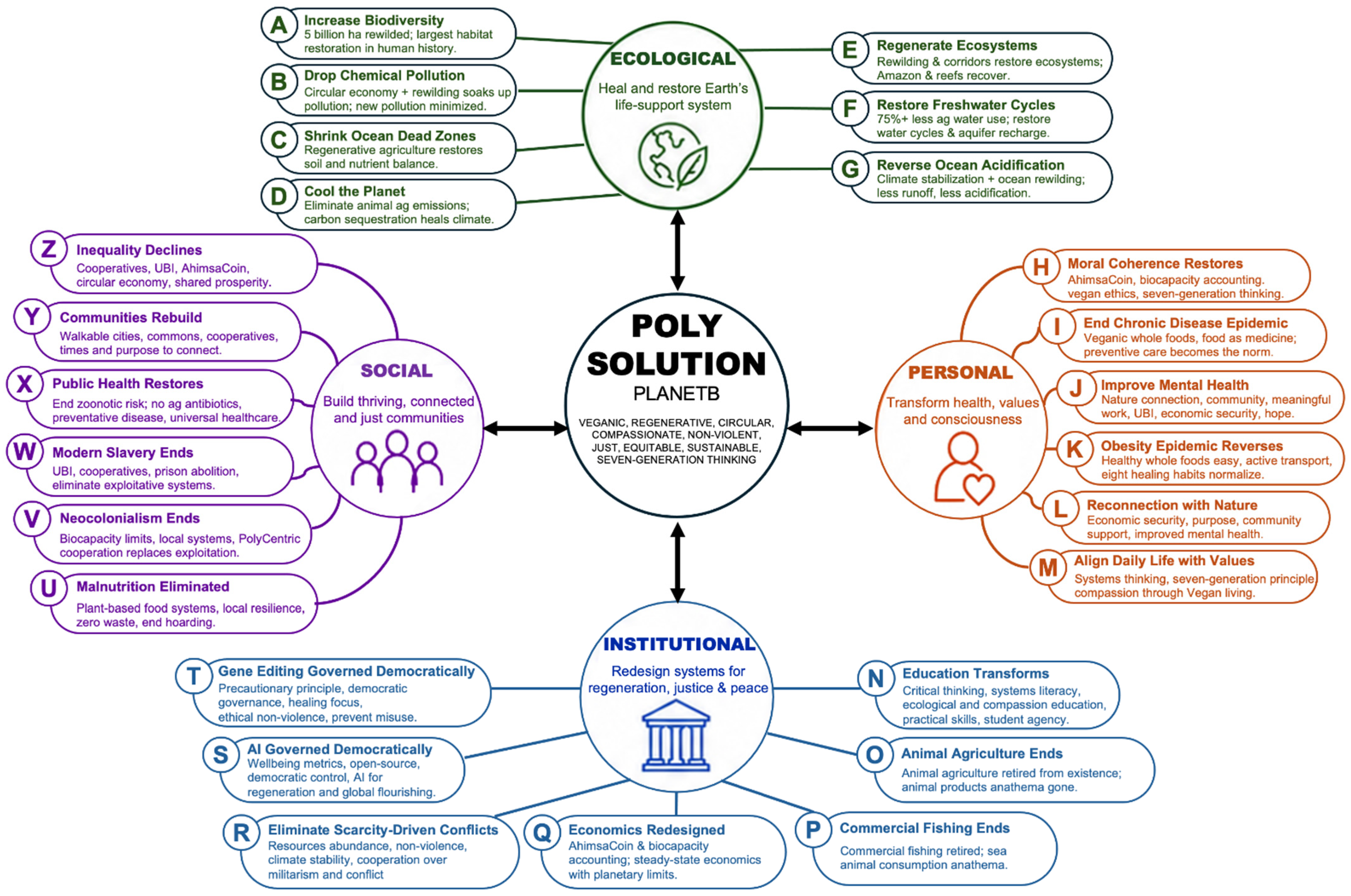
Planet B addresses all 26 dimensions of the PolyCrisis simultaneously, as shown in Figure 3.
The citations in this section are to global non-profit organizations already working on the indicated remedial measures:
  • Increase Biodiversity: An animal-free, veganic food and material production system frees 5 billion hectares for rewilding and ecological restoration. This will be the largest habitat restoration in human history on an area the size of North America and South America combined, connecting fragmented ecosystems with wildlife corridors. Similarly, ocean floor cleanup and rewilding allows marine ecosystem recovery [76].
  • Drop Chemical and Plastic Pollution: Regenerative agriculture minimizes synthetic pesticides and herbicides, while plant foods do not bioaccumulate toxins. Circular economy minimizes waste and extended producer responsibilities make companies manage full lifecycle of their products. The restoration of ecosystems allows an additional 2–3 trillion trees to soak up the existing chemical pollution, while new chemical/plastic pollution is minimized simultaneously [77].
  • Shrink Ocean Dead Zones: Regenerative plant agriculture cycles nutrients through soil organisms, and composting returns nutrients to land instead of concentrating in waste. Cover cropping and crop rotation naturally fix nitrogen and ocean dead zones shrink as agricultural runoff plummets [78].
  • Cool the Planet: Planet B eliminates the direct emissions of greenhouse gases from animal agricultural sources immediately, and carbon sequestration from rewilding accumulates over time, healing the climate. Additional steps are taken to stabilize the life-support systems of the planet as needed [79].
  • Regenerate Ecosystems: Massive rewilding on the 5 billion hectares of land released from animal farming reverses ecosystems collapse, and ecosystems connectivity is restored through wildlife corridors. The pressure on the Amazon rainforest is eliminated and reforestation proceeds. Coral reefs recover as ocean acidification slows and temperature stabilizes and cools [80].
  • Restore Freshwater Cycles: Animal-free food systems reduce agricultural water use by more than 75%. Rewilded lands restore natural water cycles and aquifer recharge. Regenerative agriculture increases soil water retention and reduced irrigation demand allows aquifer recovery [81].
  • Reverse Ocean Acidification: Climate stabilization reduces ongoing CO2 absorption, and ocean rewilding allows marine ecosystems to build resilience. Elimination of agricultural runoff reduces coastal hypoxia and acidification [82].
  • Moral Coherence Restores: AhimsaCoin makes harm visible and measures non-violence, while biocapacity accounting shows the real impact of choices. Vegan living cultivates compassion through daily practice, and seven-generation thinking replaces short-term extraction. Greed becomes culturally stigmatized as harm becomes visible [83].
  • End Chronic Disease Epidemics: Veganic food systems eliminate leading dietary disease drivers, and institutional food transformation makes healthy food the default. Food as medicine becomes the cultural norm and preventive care replaces symptom management. Resources needed for healthcare system plummet as chronic disease rates collapse [84].
  • Improve Mental Health: Alignment of actions with values reduces cognitive dissonance, and community building addresses isolation. Connection to nature through rewilding and green cities, and meaningful work in regenerative systems, replaces soul-crushing extraction. Economic security through UBI and worker cooperatives and hope from visible planetary healing replaces climate grief [85].
  • Obesity Epidemic Reverses: Food system makes fiber-rich, delicious, healthy whole foods freely available. The food environment makes it easy to eat well, and hard to eat poorly. Active transportation replaces car dependency, and the normalization of the eight healing habits addresses the obesity epidemic at its root [86].
  • Reconnection with Nature: Economic security reduces financial stress driving addiction, and meaningful work provides purpose, reducing need for escape. Strong communities provide support reducing isolation, and mental health improvements reduce underlying distress [87].
  • Align Daily Life with Values: Systems thinking reveals interconnection, the seven-generation principle extends time horizon, and education transformation teaches ecological literacy. Daily practice of compassion through vegan living cultivates aligned worldview [88].
  • Education Transforms: Educational systems transformation prioritizes critical thinking and systems literacy with ecological education on biocapacity, planetary boundaries, and interconnection of all life, compassion education on animal sentience, non-violence, and ethical frameworks, practical skills on regenerative agriculture, repair, and circular design. Student agency is encouraged through participation in actual transformation projects, and multiple intelligences are recognized beyond academic testing [89].
  • Animal Agriculture Ends: Under Planet B, animal agriculture has been phased out, and the consumption of animal products has become culturally and institutionally obsolete, analogous to the historical decline of other practices once considered normative [90].
  • Commercial Fishing Ends: Under Planet B, commercial fishing has ceased, and the consumption of sea animals has become culturally and institutionally obsolete, reflecting a broader societal shift away from extractive marine practices [91].
  • Economics Redesigned: AhimsaCoin measures non-violence and regeneration, not growth, while biocapacity accounting enforces planetary limits. Circular economy eliminates waste and growth requirement, while steady-state economics optimize wellbeing within planetary boundaries [92].
  • Eliminate Scarcity Driven Conflicts: Resource abundance through efficiency eliminates scarcity-driven conflicts, and water stress is reduced, removing a major source of conflict. Climate stabilization prevents resource wars and climate migration conflicts. Economic systems are not dependent on military Keynesianism, and non-violence (Ahimsa) as a cultural foundation extends to global relations [93].
  • AI Governed Democratically: AI development is governed by wellbeing metrics, not profit. Democratic control of open-source AI development and deployment ensures benign use, while UBI and economic restructuring address job displacement. AI is used for regenerative design, ecosystem restoration, and healthcare for global flourishing. Alignment with biocapacity limits prevents AI-accelerated extraction, and global collaboration for planetary health restoration ensures AI is not used for military purposes [94].
  • Gene Editing Governed Democratically: Precautionary principle is applied to prove safety before deployment, with democratic governance of genetic technologies. The focus is on healing for disease treatment, and ecosystem restoration, and not for profit. Open-source genetic tools within ethical frameworks, centered on non-violence and seven-generation thinking, prevent misuse [95].
  • Malnutrition Eliminated: Plant-based vegan food systems increase caloric availability and conservation agriculture increases yield on the same land. Local food systems increase security and food waste is eliminated through circular systems. The democratic control of food systems prevents corporate hoarding and speculation [96].
  • Neocolonialism Ends: Reduced resource consumption through circular economy eliminates extraction pressure, and biocapacity accounting makes extraction costs visible and prohibitive. Local food and energy systems reduce dependence on global supply chains, while PolyCentric cooperation replaces hierarchical global institutions [97].
  • Modern Slavery Ends: UBI provides exit option from exploitative work, and worker cooperatives eliminate exploitative ownership. Circular economy reduces labor-intensive extraction, and prison abolition replaces incarceration with restoration [98].
  • Public Health Restores: Planet B eliminates zoonotic disease risk by eliminating animal agriculture, and antibiotic resistance is solved by ending agricultural antibiotic use. Whole-food, plant-based vegan diets prevent chronic diseases, reducing healthcare burden, and universal healthcare becomes affordable as disease rates plummet. Preventive care replaces reactive treatment and health equity is achieved through universal access and declining costs [99].
  • Communities Rebuild: Walkable cities enable daily casual interaction and car-free zones create shared public space. Community ownership through land trusts, and cooperatives builds local bonds and shared resources, such as tool libraries and community gardens, foster connection. Less work through UBI allows time for community participation, and movement building creates purpose-driven communities [100].
  • Inequality Declines: Worker cooperatives distribute ownership democratically, and community land trusts prevent land speculation and concentration. UBI provides an economic floor, and AhimsaCoin rewards wellbeing creation, not wealth extraction. Circular economy eliminates rent-seeking from artificial scarcity [101].
Planet B replaces the outdated, unconscious myths and ad hoc engineering design of Planet A with conscious axioms and systems engineering designed to meet the desired objectives of world peace and planetary health. It refutes the notion that “There Is No Alternative (TINA)” to Planet A.

6. MegaSolutions for Immediate Emergency Implementation

While the full implementation of Planet B is a generational project, the urgency of the PolyCrisis demands immediate emergency intervention. We propose two MegaSolutions capable of rapid deployment, high impact across multiple crisis dimensions, and catalytic effects on broader systemic transformation.

6.1. MegaSolution 1: “Together Around Food”

“Together Around Food (TAF)” is a proposal for the universal provisioning of free, nutritious, gourmet, whole-food, plant-based vegan meals to all people, everywhere, as an immediate and permanent emergency humanitarian and ecological intervention. It operationalizes the selective targeting of UN SDG #2 (Zero Hunger) and SDG #3 (Good Health and Well-Being) with the intent of meeting these goals within the next year or so. Since 195 nations have already signed on to meet the UN SDGs by 2030, the political will for implementing TAF is already there.
The proposal rests on several converging realities:
  • Global hunger affecting 800 million people is not a resource scarcity problem but a distribution and access problem. The world currently produces enough calories to feed every person on Earth almost twice over, though approximately one-third of food produced is wasted [102].
  • Whole-foods, plant-based vegan diets are now among the most extensively evidenced dietary patterns for human health, associated with dramatic reductions in cardiovascular disease, type 2 diabetes, obesity, and several common cancers [103].
  • Plant-based food systems have a fraction of the environmental footprint of animal-based systems across every measured dimension, including greenhouse gas emissions, land use, water use, and pollution [104].
  • Universal food provisioning as a public service has precedents, such as in school lunch programs, food banks, and disaster relief, and the infrastructure for scaling exists or can be rapidly developed [105].
TAF is designed as an emergency intervention that simultaneously addresses multiple PolyCrisis dimensions, including chronic malnutrition, improving population health, reducing food system emissions and ecological impact, and demonstrating the viability of alternative food systems at scale. It creates a direct, embodied experience of Planet B for billions of people, building support for broader transformation.
The economic case is also compelling. The global cost of hunger in productivity losses, healthcare costs, and social instability substantially exceeds the cost of eliminating it. The WHO estimates that every dollar invested in nutrition generates returns of $16 in improved productivity and reduced healthcare costs [106]. The marginal cost of providing nutritious plant-based meals is dramatically lower than the cost of the disease burden and ecological damage generated by current food systems.

Pilot Case Study: Jefferson County, Washington

Design and setting. TAF’s first pilot implementation was an uncontrolled, single-arm community intervention conducted at the Tri-Area Community Center, Chimacum, Jefferson County, Washington State, USA, structured in three phases: Phase 1 (9–20 June 2026), community outreach; Phase 2 (20 June–4 July 2026), 15 consecutive days of free, gourmet, whole-foods, plant-based vegan breakfast, lunch, and dinner open to all community members, paired with nightly presentations, speed-networking sessions, and optional before/after biometric screening; and Phase 3 (beginning 5 July 2026), transition to a permanent community resource, with the pilot documented on film as a case study for replication elsewhere.
Measures. Two categories of outcome were tracked: (i) participation and per-meal operating cost, recorded continuously across the 15 days of Phase 2; and (ii) individual health biometrics (weight, blood pressure, cholesterol, blood sugar), collected on an opt-in basis before and after the 15-day period and reviewed with clinicians from the Rochester Lifestyle Medicine Institute.
Results. Descriptive outcomes are summarized in Table 2. Participation approximately tripled over the course of the 15 days of Phase 2, and per-meal food cost, despite organic ingredients sourced entirely from local retail outlets, was held below $3 [107]. The biometric screening data, though collected, are not yet analyzed at the time of this submission; participating clinicians and community organizers reported observed improvements in participants’ self-reported health and community connectedness, but we report only the descriptive, non-clinical measures here rather than overstate what the data currently support.
Limitations of this evidence. This is a single, uncontrolled, short-duration pilot without a comparison group. The participation and cost trends reported above are descriptive rather than causally attributable to the intervention design, and self-selection into the program, and into biometric screening specifically, likely biases the sample toward already health-motivated participants. We report it as illustrative, proof-of-concept evidence that the TAF model is operationally deployable at community scale and can be delivered at low per-meal cost, not as evidence of the population-level health outcomes the broader MegaSolution proposal anticipates at scale.
Implementation team. The internationally renowned Master Chef Marlene Watson-Tara of the Human Ecology Project led the kitchen team with volunteer chefs from Loving Hut’s global network. Local partners United Earth Networks and PTVeg drew on relationships formed during the Global Earth Repair Convergence in May 2026.

6.2. MegaSolution 2: Cool

Cool is a comprehensive emergency intervention to halt and reverse planetary overheating through three simultaneous pathways: the elimination of agricultural greenhouse gas emissions, massive rewilding for carbon sequestration, and the stabilization of planetary life-support systems currently at risk of cascade failure.

6.2.1. Agricultural Emissions Elimination

The transition to animal-free food systems, as described above, would eliminate the largest single controllable source of greenhouse gas emissions. Unlike energy sector decarbonization, which requires decades of infrastructure transition, the transition to plant-based food systems can proceed rapidly since it does not require new technology, only a shift in what is grown and consumed.
Agricultural methane, which is the most powerful lever we have for reducing planetary overheating [108], would be dramatically reduced. This offers a faster near-term climate stabilization effect than equivalent reductions in CO2 alone, providing critical time for longer-term decarbonization of other sectors.

6.2.2. Rewilding for Carbon Sequestration

The release of 5 billion hectares of land from animal agriculture creates an unprecedented opportunity for natural carbon sequestration through rewilding. Forests, grasslands, wetlands, and other natural ecosystems sequester carbon at significant rates and, critically, do so while simultaneously restoring biodiversity, watershed function, and the other ecosystem services that underpin human civilization.
The Intergovernmental Panel on Climate Change (IPCC) has identified land-based mitigation, including afforestation, reforestation, and improved land management, as essential components of pathways limiting warming to 1.5 °C [109]. The scale of rewilding made possible by food system transformation would represent the largest land-based mitigation opportunity in human history.

6.2.3. Stabilizing Life-Support Systems

Beyond direct emissions and sequestration, Cool targets the stabilization of planetary systems currently approaching or at tipping points. This includes emergency protection and restoration of remaining primary forest ecosystems, with particular urgency for the Amazon, Congo Basin, and Boreal forests, intervention to protect and restore wetland and peatland carbon stocks, and ocean cleanup at a scale sufficient to allow ocean ecosystem recovery.
These interventions are not merely ecological; they are essential infrastructure for a stable human civilization. Stable climate, freshwater supply, fertile soils, and disease regulation are services provided by functioning ecosystems. Their degradation represents an existential threat as direct as any military or economic risk [110].

7. Discussion

7.1. Distinctive Contributions and Critical Positioning

The primary contribution of this paper is integrative rather than empirical: it situates 26 documented crisis dimensions within a single causal–systemic analysis, connects that diagnosis to a coherent alternative operating system specification, and proposes two specific emergency interventions as immediate leverage points. This contribution should be read against, and in some respects in tension with, existing frameworks rather than simply alongside them.
The most direct tension is with the general PolyCrisis literature [14,22], which characterizes the systemic, interacting nature of multiple crises but generally treats the PolyCrisis as irreducibly multi-causal, resistant to attribution to any single concentrated driver. This paper’s central causal claim, that animal agriculture and the broader food-pharma-healthcare system function as the highest-leverage driver across the majority of the 26 dimensions (Section 4.4), counters that tendency. We consider the disproportionate causal weighting defensible given the breadth of independent evidence cited across Section 3 and Section 4 for animal agriculture’s simultaneous contribution to land use, emissions, biodiversity loss, freshwater depletion, antimicrobial resistance, and chronic disease; but this is a stronger and more falsifiable claim than the PolyCrisis literature typically advances, and it has not yet been validated through the kind of quantitative, comparative driver-ranking exercise (Section 7.5) that would settle the disagreement rather than assert one side of it.
A second tension arises with the Planetary Boundaries framework [48], which provides more rigorous, quantitatively validated grounding for its nine boundary conditions than this paper’s 26-crisis taxonomy achieves uniformly across all 26 dimensions Several of the personal and institutional crises identified here, for example Selfishness/Greed/Apathy or Institutionalized MisEducation, rest on a qualitatively different, and weaker, evidentiary footing than a transgressed biogeochemical boundary. We do not think this disqualifies their inclusion, since policy-relevant crisis dimensions are not restricted to those with existing quantitative thresholds, but we flag the resulting heterogeneity in evidentiary rigor across the taxonomy as a genuine limitation rather than treat it as resolved (Section 7.5).
Doughnut Economics [57] provides the most developed existing framework for economic reorientation toward planetary and social boundaries, and Planet B’s economic axioms (Section 5.3) are compatible with, rather than opposed to, that framework; the disagreement is one of scope and priority rather than substance, since Doughnut Economics treats food systems as one of several social foundations, whereas this paper treats food systems, and animal agriculture specifically, as the primary leverage point, a prioritization Doughnut Economics does not itself make or adjudicate. The Multi-Level Perspective (MLP) on socio-technical transitions [19] offers more granular empirical tools for analyzing incumbent-regime resistance and strategic niche management than this paper currently deploys (Section 2.3, Table 1). Where MLP research typically documents gradual, contested niche-to-regime transitions unfolding over decades, this paper’s MegaSolutions (Section 6) are proposed as landscape-level shocks intended to compress that timescale; MLP’s own empirical record offers limited precedent for transitions compressed this far, and we identify integrating MLP’s analytical apparatus, including its account of incumbent-regime resistance, with Planet B’s operating-system framing as a priority for future work rather than a settled synthesis.
The Planet B framework was developed in prior work [6,7] and explicitly preceded and guided this synthesis. The evidence supporting individual components of the animal agriculture–crisis linkage is cited throughout Section 3, Section 4, Section 5 and Section 6 and assessed on its merits. Its integrated causal attribution remains a framework-level hypothesis requiring independent validation, as stated in Section 7.5.

7.2. Theoretical and Practical Implications

In theory, if the concentrated causal attribution argued in Section 4 is correct, it implies a testable proposition for future PolyCrisis modeling: quantitative, network-based models of crisis interdependency (Section 7.5) should show animal agriculture and the broader food-pharma-healthcare system occupying a disproportionate number of high-centrality nodes relative to other candidate drivers such as fossil energy. This is falsifiable in principle using the same network-analytic methods already applied to the general PolyCrisis literature [14], and its confirmation or refutation would independently test this paper’s central claim rather than merely illustrate it. A second theoretical implication concerns the operating-system framing itself (Section 5), which treats civilizational transition as a design problem requiring specification of a complete alternative architecture free of foundational myths, rather than reform of individual components. It invites comparison against MLP-based case studies of partial, component-level transitions.
For national and sub-national governments already committed to the UN SDGs, it implies that food system policy, rather than energy policy alone, merits treatment as a primary lever for simultaneously addressing biodiversity, public health, and emissions targets (Section 4.4 and Section 6.2). For funders and philanthropic institutions, it implies that interventions addressing multiple PolyCrisis dimensions simultaneously, such as the TAF and Cool MegaSolutions (Section 6), may offer a more efficient use of constrained resources than single-issue interventions, though this comparative-efficiency claim has not been tested against alternative resource-allocation strategies and should be treated as a hypothesis for evaluation rather than a demonstrated result. For municipal and community actors, the Jefferson County pilot (Section 6.1: Pilot Case Study: Jefferson County, Washington) implies a specific, replicable near-term action, piloting universal, free, whole-foods, plant-based vegan community meal provision as a low-cost, rapidly deployable intervention, with the caveat that the pilot reported here is a single experiment and does not establish generalizable results.

7.3. Objections and Responses

Several objections to the Planet B framework deserve direct engagement.

7.3.1. “Is This Realistic?”

The more important question is whether the continuation of Planet A is realistic. The empirical evidence reviewed in this paper demonstrates that Planet A is not stable, since it is generating conditions that threaten the collapse of the planetary life-support systems on which human civilization depends. The question is not whether transformation will occur, but whether it will occur through deliberate design or will be attempted after catastrophic failure. The elements of Planet B are not utopian since they are grounded in existing evidence, existing technologies, and existing social movements. What is required is the integration, scaling, political will and courageous leadership.

7.3.2. “Isn’t This Too Radical?”

The PolyCrisis is itself radical as it represents a radical departure from the conditions under which human civilization evolved and developed. Responses adequate to a radical crisis must themselves be commensurate with the scale and nature of the challenge. The incremental reforms proposed within Planet A’s framework have had decades to demonstrate their adequacy and have failed to do so. The evidence reviewed here suggests that radicalism, in the literal sense of going to the root cause, is not optional.

7.3.3. “What About Political Feasibility?”

Political feasibility is not a fixed parameter since it is itself a product of social processes, crises, and movements. The abolition of slavery [111], women’s suffrage [112], and the rapid decarbonization of energy systems [113] in several jurisdictions were all considered politically infeasible until they were not. The PolyCrisis itself is a driver of political feasibility change. As its consequences become more direct and undeniable, the political space for transformative responses expands. Our task is to ensure that the transformative frameworks are developed, communicated, and ready for implementation when that space opens.

7.4. The Role of Emergency Framing

We deliberately use the language of emergency throughout this paper. This framing is sometimes criticized as alarmist or counterproductive. We reject this criticism on both empirical and strategic grounds.
Empirically, the evidence reviewed here supports emergency framing. The crossing of seven planetary boundaries, the activation of climate tipping points, the ongoing mass extinction event that is already rated at high risk of destabilizing the life-support systems of the planet, and the convergence of 26 interlocking crises constitute an emergency by any defensible definition.
Strategically, the recognition of emergency is a prerequisite for emergency-scale mobilization. History demonstrates that societies are capable of rapid, comprehensive transformation when emergency is recognized, as evidenced in World War II mobilization, pandemic response measures, and post-disaster reconstruction. The absence of emergency-scale response to the PolyCrisis reflects in part the success of normalizing narratives that frame ongoing catastrophe as routine. Emergency framing disrupts this normalization.

7.5. Limitations and Future Directions

This paper presents a high-level integrative framework. Several areas require further development:
  • Quantitative modeling of the PolyCrisis feedback network, including analysis of intervention points and potential cascade dynamics in both crisis amplification and solution amplification.
  • Detailed implementation modeling for the ”Together Around Food” and Cool MegaSolutions, including cost analysis, supply chain requirements, and governance frameworks.
  • Case studies of existing Planet B implementations at community, city, and national scales, documenting both successes and challenges.
  • Analysis of transition pathways for sectors and communities currently dependent on Planet A industries, with particular attention to equity and justice dimensions.
  • Development of measurement frameworks appropriate for Planet B economics, including operationalization of non-violence and biocapacity indicators.

8. Conclusions

This paper has presented an integrative conceptual framework, Planet B, which situates 26 interlocking global crises within a single systemic analysis we term the PolyCrisis. Our central contribution is twofold: first, mapping the dense interdependencies among these crises and tracing them to a shared set of structural drivers within the prevailing civilizational Operating System we call Planet A; and second, proposing a coherent alternative Operating System, Planet B, along with two illustrative emergency interventions, “Together Around Food” and Cool, which could plausibly address multiple PolyCrisis dimensions simultaneously.
As outlined in Section 7.5, this framework has important limitations. The 26-crisis taxonomy and the framework mappings presented here are based on a synthesis of the existing literature rather than a formal systematic review, and the claimed leverage of animal agriculture and food system transformation across crisis dimensions, while supported by an extensive body of evidence on individual components, has not yet been validated through integrated quantitative modeling. Similarly, the TAF and Cool MegaSolutions are presented as conceptually promising interventions whose feasibility, cost, and implementation pathways require dedicated modeling and pilot-scale evaluation.
Future work should prioritize quantitative modeling of the PolyCrisis feedback network to identify and rank intervention points, detailed implementation and cost modeling for TAF and Cool, and documentation of case studies from existing community- and city-scale initiatives that embody Planet B principles. Such work would allow the claims advanced here to be tested, refined, and where appropriate, revised.
We offer Planet B as a starting point for this research agenda rather than a finished blueprint. Given the scale and interconnection of the crises described in Section 3, we believe integrative frameworks of this kind have value in guiding where more detailed empirical work might be most productively directed, even as that work remains to be done.

Author Contributions

Conceptualization, S.K.R.; Methodology, S.K.R.; Validation, S.K.R. and J.S.; Formal analysis, S.K.R.; Investigation, S.K.R. and J.S.; Resources, S.K.R.; Data curation, S.K.R.; Writing—original draft, S.K.R.; Writing—review & editing, S.K.R. and J.S.; Visualization, S.K.R. All authors have read and agreed to the published version of the manuscript.

Funding

This research received no external funding.

Institutional Review Board Statement

Not applicable.

Informed Consent Statement

Not applicable.

Data Availability Statement

Data are contained within the article.

Acknowledgments

The authors gratefully acknowledge the Climate Healers core team for their ongoing support and encouragement. We are especially grateful to Amit Gambhir for contributing the figures used in our paper. During the preparation of this manuscript, the authors used ChatGPT 4.0 for the purpose of formatting the figures in the paper. The authors have reviewed and edited the output and take full responsibility for the content of this manuscript.

Conflicts of Interest

The authors declare no conflict of interest.

References

  1. Elkhatat, A.; Al-Muhtaseb, S. Climate Change and Energy Security: A Comparative Analysis of the Role of Energy Policies in Advancing Environmental Sustainability. Energies 2024, 17, 3179. [Google Scholar] [CrossRef]
  2. Langhammer, P.F.; Bull, J.W.; Bicknell, J.E.; Oakley, J.L.; Brown, M.H.; Bruford, M.W.; Butchart, S.H.; Carr, J.A.; Church, D.; Cooney, R.; et al. The Positive Impact of Conservation Action. Science 2024, 384, 453–458. [Google Scholar] [CrossRef] [PubMed]
  3. United Nations. Business for Land; United Nations Convention to Combat Desertification: Bonn, Germany, 2026. [Google Scholar]
  4. Mumah, E.; Hong, Y.; Chen, Y. Exploring the Reality of Global Food Insecurity and Policy Gaps. Humanit. Soc. Sci. Commun. 2025, 12, 1–23. [Google Scholar] [CrossRef]
  5. Airhihenbuwa, C.O.; Tseng, T.-S.; Sutton, V.D.; Price, L. Global Perspectives on Improving Chronic Disease Prevention and Management in Diverse Settings. CDC Prev. Chronic Dis. 2021, 18, E33. [Google Scholar] [CrossRef] [PubMed]
  6. Rao, S.K. A Guide to Planet B: Handbook for Jump-Starting the Greatest Transformation in Human History; Climate Healers: Phoenix, AZ, USA, 2026. [Google Scholar]
  7. Rao, S.K.; Wedderburn-Bisshop, G. Planet B: A Systems Engineering Framework for World Peace and Planetary Health. Challenges 2025, 16, 58. [Google Scholar] [CrossRef]
  8. Kopp, R.E.; Gilmore, E.A.; Shwom, R.L.; Adams, H.; Adler, C.; Oppenheimer, M.; Patwardhan, A.; Russill, C.; Schmidt, D.N.; York, R. ‘Tipping points’ confuse and can distract from urgent climate action. Nat. Clim. Change 2025, 15, 29–36. [Google Scholar] [CrossRef]
  9. Goreau, T.J.F.; Hayes, R.L. Global warming triggers coral reef bleaching tipping point. Ambio 2021, 50, 1137–1140. [Google Scholar] [CrossRef] [PubMed]
  10. Saban, K.E.; Wiens, J.J. Unpacking the Extinction Crisis: Rates, Patterns and Causes of Recent Extinctions in Plants and Animals. Proc. Biol. Sci. 2025, 292, 20251717. [Google Scholar] [CrossRef] [PubMed]
  11. De Vos, J.M.; Joppa, L.N.; Gittleman, J.L.; Stephens, P.R.; Pimm, S.L. Estimating the Normal Background Rate of Species Extinction. Conserv. Biol. 2014, 29, 452–462. [Google Scholar] [CrossRef] [PubMed]
  12. Querishi, Z. Rising Inequality: A Major Issue of Our Time. Int. J. Sci. Res. Soc. Sci. Manag. Stud. 2023, 7, 59–63. [Google Scholar]
  13. Ahmed, S.K.; Mohammed, R.A. Obesity: Prevalence, Causes, Consequences, Management, Preventive Strategies and Future Research Directions. Metab. Open 2025, 27, 100375. [Google Scholar] [CrossRef] [PubMed]
  14. Rakowski, J.J.; Schaan, L.N.; van Klink, R.; Herzon, I.; Arth, A.; Hagedorn, G.; Rode, J.; Creutzig, F.; Pe’er, G. Characterizing the Global Polycrisis: A Systematic Review of Recent Literature. Annu. Rev. Environ. Resour. 2025, 50, 159–183. [Google Scholar] [CrossRef]
  15. Holling, C.S.; Gunderson, L.H. (Eds.) Panarchy: Understanding Transformations in Human and Natural Systems; Island Press: Washington, DC, USA, 2002. [Google Scholar]
  16. Walker, B.; Holling, C.S.; Carpenter, S.R.; Kinzig, A. Resilience, adaptability and transformability in social–ecological systems. Ecol. Soc. 2004, 9, 5. [Google Scholar] [CrossRef]
  17. O’Connor, J. The Second Contradiction of Capitalism. 1988. Available online: https://www.columbia.edu/~lnp3/second_contradiction.htm (accessed on 27 July 2026).
  18. Moore, J.W. Capitalism in the Web of Life: Ecology and the Accumulation of Capital; Verso Books: London, UK, 2015. [Google Scholar]
  19. Geels, F.W. Technological transitions as evolutionary reconfiguration processes: A multi-level perspective and a case-study. Res. Policy 2002, 31, 1257–1274. [Google Scholar] [CrossRef]
  20. Bostrom, N. Existential Risks: Analyzing Human Extinction Scenarios and Related Hazards. J. Evol. Technol. 2002, 9, 1–35. [Google Scholar]
  21. Ord, T. The Precipice—Existential Risk and the Future of Humanity; Bloomsbury Publishing: London, UK, 2020. [Google Scholar]
  22. Klein, L.; Buckle, P.; Nguyen, N.; Preiser, R.; Ison, R. Navigating the Polycrisis—Governing for Transformation: The 2024 Agenda for the Systems Community. Syst. Res. Behav. Sci. 2023, 40, 973–977. [Google Scholar] [CrossRef]
  23. Naidu, R.; Biswas, B.; Willett, I.R.; Cribb, J.; Singh, B.K.; Nathanail, C.P.; Coulon, F.; Semple, K.T.; Jones, K.C.; Barclay, A.; et al. Chemical Pollution: A Growing Peril and Potential Catastrophic Risk to Humanity. Environ. Int. 2021, 156, 106616. [Google Scholar] [CrossRef] [PubMed]
  24. Hayat, S.; Li, P.; Menhas, S.; Liu, W.; Hayat, K. Exploring the Nutrient Nexus in Environmental Systems: Nitrogen and phosphorus cycling, removal, recovery, and management. Environ. Res. 2025, 284, 122162. [Google Scholar] [CrossRef] [PubMed]
  25. Weiss, Z. Global Warming Reaches 1.4C After Third-Hottest Year on Record. Politico. 2026. Available online: https://www.politico.eu/article/global-warming-1-4-celsius-climate-change-copernicus/ (accessed on 27 July 2026).
  26. Flores, B.M.; Montoya, M.; Sakschewski, B.; Nascimento, N.; Staal, A.; Betts, R.; Lapola, D.M.; Esquível-Muelbert, A.; Jakovac, C.; Nobre, C.A.; et al. Critical Transitions in the Amazon Forest System. Nature 2024, 626, 555–564. [Google Scholar] [CrossRef] [PubMed]
  27. Bănăduc, D.; Simić, V.; Cianfaglione, K.; Barinova, S.; Afanasyev, S.; Öktener, A.; McCall, G.; Simić, S.; Curtean-Bănăduc, A. Freshwater as a Sustainable Resource and Generator of Secondary Resources in the 21st Century: Stressors, Threats, Risks, Management and Protection Strategies, and Conservation Approaches. Int. J. Environ. Res. Public Health 2022, 19, 16570. [Google Scholar] [CrossRef] [PubMed]
  28. Jiang, L.-Q.; Carter, B.R.; Feely, R.A.; Lauvset, S.K.; Olsen, A. Surface Ocean pH and Buffer Capacity: Past, Present and Future. Sci. Rep. 2019, 9, 18624. [Google Scholar] [CrossRef] [PubMed]
  29. Dhiman, S. Selfishness, Greed, and Apathy. In Handbook of Engaged Sustainability; Marques, J., Ed.; Springer: Cham, Switzerland, 2018. [Google Scholar]
  30. Holman, H.R. The Relation of the Chronic Disease Epidemic to the Health Care Crisis. ACR Open Rheumatol. 2020, 2, 167–173. [Google Scholar] [CrossRef] [PubMed]
  31. Anderson, A.; Eisenberg, M.D.; Kennedy-Hendricks, A.; Castrucci, B.C.; Galea, S.; Ettman, C.K. Mental Health Crises and Help-seeking Among US Adults in 2024–2025. Health Aff. Sch. 2025, 3, qxaf166. [Google Scholar]
  32. Witkiewitz, K.; Litten, R.Z.; Leggio, L. Advances in the Science and Treatment of Alcohol Use Disorder. Sci. Adv. 2019, 5, eaax4043. [Google Scholar] [CrossRef] [PubMed]
  33. Estrada, D. Human Supremacy as Posthuman Risk. J. Sociotech. Crit. 2020, 1, 1–40. [Google Scholar]
  34. Cleary, A.M.; Robinson, D.H. Institutionalized Misinformation in US Education: Combatting the Overselling of Learning Styles and Underselling of Spaced Effort. J. Soc. Issues 2025, 81, e00005. [Google Scholar] [CrossRef]
  35. Rao, S.K. Animal Agriculture is the Leading Cause of Climate Change: A Position Paper. J. Ecol. Soc. 2021, 32, 155–167. [Google Scholar]
  36. Temple, A.J.; Skerritt, D.J.; Howarth, P.E.C.; Pearce, J.; Mangi, S.C. Illegal, Unregulated and Unreported Fishing Impacts: A Systematic Review of Evidence and Proposed Future Agenda. Mar. Policy 2022, 139, 105033. [Google Scholar] [CrossRef]
  37. Washington, H.; Kopnina, H. The Insanity of Endless Growth. Ecol. Citiz. 2018, 2, 57–63. [Google Scholar]
  38. Guidotti, M.; Leisewitz, A.V.; Ranghieri, M.C. The endless war: The long-term impact on health and environment of armed conflicts. Ann. Proc. Acad. Sci. Bologna Cl. Phys. Sci. 2023, 1, 91–103. [Google Scholar]
  39. Davidson, T. The Danger of Runaway AI. J. Democr. 2023, 34, 132–140. [Google Scholar] [CrossRef]
  40. Badea, A.R.; Feeney, O. Genome Editing Dilemma: Navigating Dual-Use Potential and Charting the Path Forward. Bioeth. Inq. 2025, 22, 101–110. [Google Scholar]
  41. Moramarco, S.; Andreoli, A.; Palombi, L. Tackling Global Malnutrition and Hunger in the Final Push Toward the 2030 Agenda. Nutrients 2025, 17, 3059. [Google Scholar] [CrossRef] [PubMed]
  42. Sanjeev Srivatsan, R. Neo-Colonialism Around the World—Past and Present. IOSR J. Humanit. Soc. Sci. 2020, 25, 54–58. [Google Scholar]
  43. Arun, S.; Olsen, W. Modern Slavery and Exploitative Work Regimes: An Intersectional Approach. Dev. Pract. 2023, 33, 133–144. [Google Scholar] [CrossRef]
  44. Haque, A. Public Health: A Critical Nexus of Social, Environmental, and Behavioral Interactions. Health Interact. 2025, 1, 2443309. [Google Scholar] [CrossRef]
  45. Roberts, J.A.; Young, P.D.; David, M.E. The Epidemic of Loneliness: A 9-Year Longitudinal Study of the Impact of Passive and Active Social Media Use on Loneliness. Personal. Soc. Psychol. Bull. 2026, 52, 1111–1125. [Google Scholar] [CrossRef] [PubMed]
  46. Rao, S.K. There is a Planet B: Implementing the Greatest Transformation in Human History; Climate Healers: Phoenix, AZ, USA, 2025. [Google Scholar]
  47. Meadows, D.H.; Meadows, D.L.; Randers, J.; Behrens, W., III. The Limits to Growth; A Potomac Associates Book: Sterling, VA, USA, 1972. [Google Scholar]
  48. Planetary Boundaries Science (PBScience). Planetary Health Check 2025; Potsdam Institute for Climate Impact Research (PIK): Potsdam, Germany, 2025. [Google Scholar]
  49. Daly, H.E. Beyond Growth: The Economics of Sustainable Development; Beacon Press: Boston, MA, USA, 1996. [Google Scholar]
  50. UN Food and Agriculture Organization. FAOStat Database. 2026. Available online: https://www.fao.org/faostat/en/#home (accessed on 27 July 2026).
  51. Mood, A.; Brooke, P. Estimating the Number of Fish Caught in Global Fishing Each Year. Available online: https://www.reef.org/gafc (accessed on 27 July 2026).
  52. Verkuijl, C.; Smit, J.; Green, J.M.H.; Nordquist, R.E.; Sebo, J.; Hayek, M.N.; Hötzel, M.J. Climate Change, Public Health, and Animal Welfare: Towards a One Health Approach to Reducing Animal Agriculture’s Climate Footprint. Front. Anim. Sci. 2024, 5, 1281450. [Google Scholar] [CrossRef]
  53. Spiehler, A.; Fischer, B. Animal Agriculture, Wet Markets, and COVID-19: A Case Study in Indirect Activism. Food Ethics 2021, 6, 10. [Google Scholar] [CrossRef] [PubMed]
  54. Manyi-Loh, C.; Mamphweli, S.; Meyer, E.; Okoh, A. Antibiotic Use in Agriculture and Its Consequential Resistance in Environmental Sources: Potential Public Health Implications. Molecules 2018, 23, 795. [Google Scholar] [CrossRef] [PubMed]
  55. Smith, P.; Bustamante, M.; Ahammad, H.; Clark, H.; Dong, H.; Elsiddig, E.A.; Haberl, H.; Harper, R.; House, J.; Jafari, M.; et al. Agriculture, Forestry and Other Land Use (AFOLU). In Climate Change 2014: Mitigation of Climate Change: Contribution of Working Group III to the Fifth Assessment Report of the Intergovernmental Panel on Climate Change; Edenhofer, O., Pichs-Madruga, R., Sokona, Y., Farahani, E., Kadner, S., Seyboth, K., Adler, A., Baum, I., Brunner, S., Eickemeier, P., et al., Eds.; Cambridge University Press: Cambridge, UK; New York, NY, USA, 2014. [Google Scholar]
  56. Einbinder, N. Culture: The Missing Link in Sustainable Food Systems. Sustain. Agric. 2026, 4, 14. [Google Scholar] [CrossRef]
  57. Raworth, K. Doughnut Economics: Seven Ways to Think Like a 21st-Century Economist; Chelsea Green Publishing: White River Junction, VT, USA, 2017. [Google Scholar]
  58. Kallis, G.; Paulson, S.; D’Alisa, G.; DeMaria, F. The Case for Degrowth; John Wiley & Sons: Hoboken, NJ, USA, 2020. [Google Scholar]
  59. Couto, R.; Brandespim, D.F. A review of the One Health concept and its application as a tool for policy-makers. Int. J. One Health 2020, 6, 83–89. [Google Scholar] [CrossRef]
  60. Wedderburn-Bisshop, G. Increased transparency in accounting conventions could benefit climate policy. Environ. Res. Lett. 2025, 20, 044048. [Google Scholar] [CrossRef]
  61. Zhang, T.; Nickerson, R.; Zhang, W.; Peng, X.; Shang, Y.; Zhou, Y.; Luo, Q.; Wen, G.; Cheng, Z. The Impacts of Animal Agriculture on One Health—Bacterial Zoonosis, Antimicrobial resistance, and Beyond. One Health 2024, 18, 100748. [Google Scholar] [CrossRef] [PubMed]
  62. Arrien, M.M.; Aldaya, M.M.; Rodriguez, C.I. Livestock and Water Resources: A Comparative Study of Water Footprint in Different Farming Systems. Sustainability 2025, 17, 2251. [Google Scholar] [CrossRef]
  63. Eckart, A.; Bhochhibhoya, A.; Stavitz, J.; Ghimire, P.S.; Mathieson, K. Associations of Animal Source Foods, Cardiovascular Disease History, and Health Behaviors from the National Health and Nutrition Examination Survey: 2013–2016. Glob. Epidemiol. 2023, 5, 100112. [Google Scholar] [CrossRef] [PubMed]
  64. Crowther, T.W.; Glick, H.B.; Covey, K.R.; Bettigole, C.; Maynard, D.S.; Thomas, S.M.; Smith, J.R.; Hintler, G.; Duguid, M.C.; Amatulli, G.; et al. Mapping tree density at a global scale. Nature 2015, 525, 201–205. [Google Scholar] [CrossRef] [PubMed]
  65. UN IPCC. Climate Change 2021: The Physical Science Basis. In Contribution of Working Group I to the Sixth Assessment Report of the Intergovernmental Panel on Climate Change; Masson-Delmotte, V., Zhai, P., Pirani, A., Connors, S.L., Péan, C., Berger, S., Caud, N., Chen, Y., Goldfarb, L., Gomis, M.I., et al., Eds.; Cambridge University Press: Cambridge, UK; New York, NY, USA, 2021. [Google Scholar]
  66. Malinauskaite, L.; Cook, D.; Davíðsdóttir, B. The Genuine Progress Indicator’s Development and Applications –A Systematic Literature Review from 1995 to 2023. Soc. Indic. Res. 2026, 181, 38. [Google Scholar] [CrossRef]
  67. Richardson, J.A. How Does Gross National Happiness Offer an Integrated Perspective Linked with Health, Economics, and Nature? J. Ayurveda Integr. Med. 2023, 14, 100601. [Google Scholar] [CrossRef] [PubMed]
  68. Khan, I.A.; Haq, F.; Kiran, M.; Aziz, T. Circular Economy and Waste Management: Transforming Waste Into Resources for a Sustainable Future. Int. J. Environ. Sci. Technol. 2025, 22, 17327–17346. [Google Scholar] [CrossRef]
  69. Ellen MacArthur Foundation. Towards the circular economy Vol. 1: An economic and business rationale for an accelerated transition. J. Ind. Ecol. 2013, 2, 23–44. [Google Scholar]
  70. Tsurumi, T.; Yamaguchi, R.; Kagohashi, K.; Managi, S. Material and Relational Consumption to Improve Subjective Well-being: Evidence from Rural and Urban Vietnam. J. Clean. Prod. 2021, 310, 127499. [Google Scholar] [CrossRef]
  71. Rasool, M.H.; Hashmi, S.M.A. Carbon Capture and Storage: An Evidence-based Review of its Limitations and Missed Promises. Pet. Res. 2026, 11, 176–205. [Google Scholar] [CrossRef]
  72. Jinnah, S.; Dove, Z. Solar Radiation Management: A History of the Governance and Political Milestones. Environ. Sci. Atmos. 2025, 5, 656–673. [Google Scholar] [CrossRef]
  73. Tavan, M.; Smith, N.W.; McNabb, W.C.; Wood, P. Reassessing the Sustainability Promise of Cultured Meat: A Critical Review with New Data Perspectives. Crit. Rev. Food Sci. Nutr. 2025, 65, 7201–7209. [Google Scholar] [CrossRef] [PubMed]
  74. Law, K.F.; Syropoulos, S.; Young, L.; O’Connor, B.B. Mapping Prescriptive Beliefs on Seventh Generation Stewardship and Increasing the Temporal Scope of Intergenerational Concern. Sci. Rep. 2025, 15, 37618. [Google Scholar] [CrossRef] [PubMed]
  75. Carter, I.; MacKillop, E. Can We Promote Plural Local Pathways to Sustainable Development? Insights From the Implementation of Wales’s Future Generations Act. J. Environ. Policy Plan. 2023, 25, 554–569. [Google Scholar] [CrossRef]
  76. Sadhana Forest. A Forest in the Making. Available online: https://sadhanaforest.org/ (accessed on 27 July 2026).
  77. Trillion Trees.org. Available online: https://trilliontrees.org/ (accessed on 27 July 2026).
  78. UN Food and Agriculture Organization. Conservation Agriculture. Available online: https://www.fao.org/conservation-agriculture/en/ (accessed on 27 July 2026).
  79. Drawdown Project. Available online: https://drawdown.org/ (accessed on 27 July 2026).
  80. E.O. Wilson Foundation. Half-Earth Proposal. Available online: https://eowilsonfoundation.org/what-is-the-half-earth-project/ (accessed on 27 July 2026).
  81. The Freshwater Trust. Available online: https://www.thefreshwatertrust.org/ (accessed on 27 July 2026).
  82. The Ocean Foundation. Available online: https://oceanfdn.org/ (accessed on 27 July 2026).
  83. Global Values Alliance. Available online: https://valuesalliance.net/ (accessed on 27 July 2026).
  84. Physicians Committee for Responsible Medicine. Available online: https://www.pcrm.org/ (accessed on 27 July 2026).
  85. United for Global Mental Health. Available online: https://unitedgmh.org/ (accessed on 27 July 2026).
  86. World Obesity Federation. Available online: https://www.worldobesity.org/ (accessed on 27 July 2026).
  87. Reconnect with Nature. Available online: https://www.reconnectwithnature.org/ (accessed on 27 July 2026).
  88. Compassionate Living. Available online: https://www.compassionate-living.org/ (accessed on 27 July 2026).
  89. Shikshantar Unlearning Journey. Available online: https://shikshantar.org/ (accessed on 27 July 2026).
  90. VeganFTA, Vegan for the Animals. Available online: https://veganfta.com/ (accessed on 27 July 2026).
  91. Fish Feel. Available online: https://fishfeel.org/ (accessed on 27 July 2026).
  92. Doughnut Economics Action Lab. Available online: https://doughnuteconomics.org/ (accessed on 27 July 2026).
  93. The Abundance Project. Available online: https://www.arts.ac.uk/colleges/chelsea-college-of-arts/research-at-chelsea/research-projects/the-abundance-project (accessed on 27 July 2026).
  94. The Center for Effective Philanthropy AI with Purpose. Available online: https://cep.org/report-backpacks/ai-with-purpose-how-foundations-and-nonprofits-are-thinking-about-and-using-artificial-intelligence/?section=intro#intro (accessed on 27 July 2026).
  95. Center for Genetics and Society. Available online: https://www.geneticsandsociety.org/ (accessed on 27 July 2026).
  96. Food Yoga International. Available online: https://ffl.org/ (accessed on 27 July 2026).
  97. Food Empowerment Project. Available online: https://foodispower.org/ (accessed on 27 July 2026).
  98. Income to Support All Foundation. Available online: https://www.itsafoundation.org/ (accessed on 27 July 2026).
  99. Rochester Lifestyle Medicine Institute. Available online: https://www.rochesterlifestylemedicine.org/ (accessed on 27 July 2026).
  100. Institute for Sustainable Urbanization. Available online: https://www.isurban.org/ (accessed on 27 July 2026).
  101. Inequality and Philanthropy. Available online: https://inequality.org/ (accessed on 27 July 2026).
  102. Carvalho, R.; Lucas, M.R.; Marta-Costa, A. Food Waste Reduction: A Systematic Literature Review on Integrating Policies, Consumer Behavior, and Innovation. Sustainability 2025, 17, 3236. [Google Scholar] [CrossRef]
  103. Liang, J.; Wen, Y.; Yin, J.; Zhu, G.; Wang, T. Utilization of Plant-based Foods for Effective Prevention of Chronic Diseases: A Longitudinal Cohort Study. Sci. Food 2024, 8, 113. [Google Scholar] [CrossRef] [PubMed]
  104. Carey, C.N.; Paquette, M.; Sahye-Pudaruth, S.; Dadvar, A.; Dinh, D.; Khodabandehlou, K.; Liang, F.; Mishra, E.; Sidhu, M.; Brown, R.; et al. The Environmental Sustainability of Plant-Based Dietary Patterns: A Scoping Review. J. Nutr. 2023, 153, 857–869. [Google Scholar] [CrossRef] [PubMed]
  105. Andreyeva, T.; Sun, X. Universal School Meals in the US: What Can We Learn from the Community Eligibility Provision? Nutrients 2021, 13, 2634. [Google Scholar] [CrossRef] [PubMed]
  106. World Health Organization. Stronger Focus on Nutrition Within Health Services Could Save 3.7 Million Lives by 2025. 2019. Available online: https://www.who.int/news/item/04-09-2019-stronger-focus-on-nutrition-within-health-services-could-save-3.7-million-lives-by-2025 (accessed on 27 July 2026).
  107. Together Around Food. Available online: https://togetheraround.food (accessed on 27 July 2026).
  108. Stoerk, T.; Rising, J.; Shindell, D.; Dietz, S. Global Methane Action Pays for Itself At Least Six Times Over. Science 2025, 390, 6772. [Google Scholar] [CrossRef] [PubMed]
  109. Roe, S.; Streck, C.; Obersteiner, M.; Frank, S.; Griscom, B.; Drouet, L.; Fricko, O.; Gusti, M.; Harris, N.; Hasegawa, T.; et al. Contribution of the Land Sector to a 1.5 °C World. Nat. Clim. Change 2019, 9, 817–828. [Google Scholar] [CrossRef]
  110. Marcantonio, R.; Field, S. Environmental Vulnerability and Conflict Occurrence are Tightly Related. Commun. Earth Environ. 2025, 6, 316. [Google Scholar] [CrossRef]
  111. Sowle, P. The Abolition of Slavery. Ga. Hist. Q. 1968, 52, 237–255. [Google Scholar]
  112. Teele, D.W. Women’s Suffrage: Causes and Consequences. Annu. Rev. Political Sci. 2025, 28, 477–497. [Google Scholar] [CrossRef]
  113. Sinha, A.; Venkatesh, A.; Jordan, K.; Wade, C.; Eshraghi, H.; de Queiroz, A.R.; Jaramillo, P.; Johnson, J.X. Diverse Decarbonization Pathways Under Near Cost-optimal Futures. Nat. Commun. 2024, 15, 8165. [Google Scholar] [CrossRef] [PubMed]
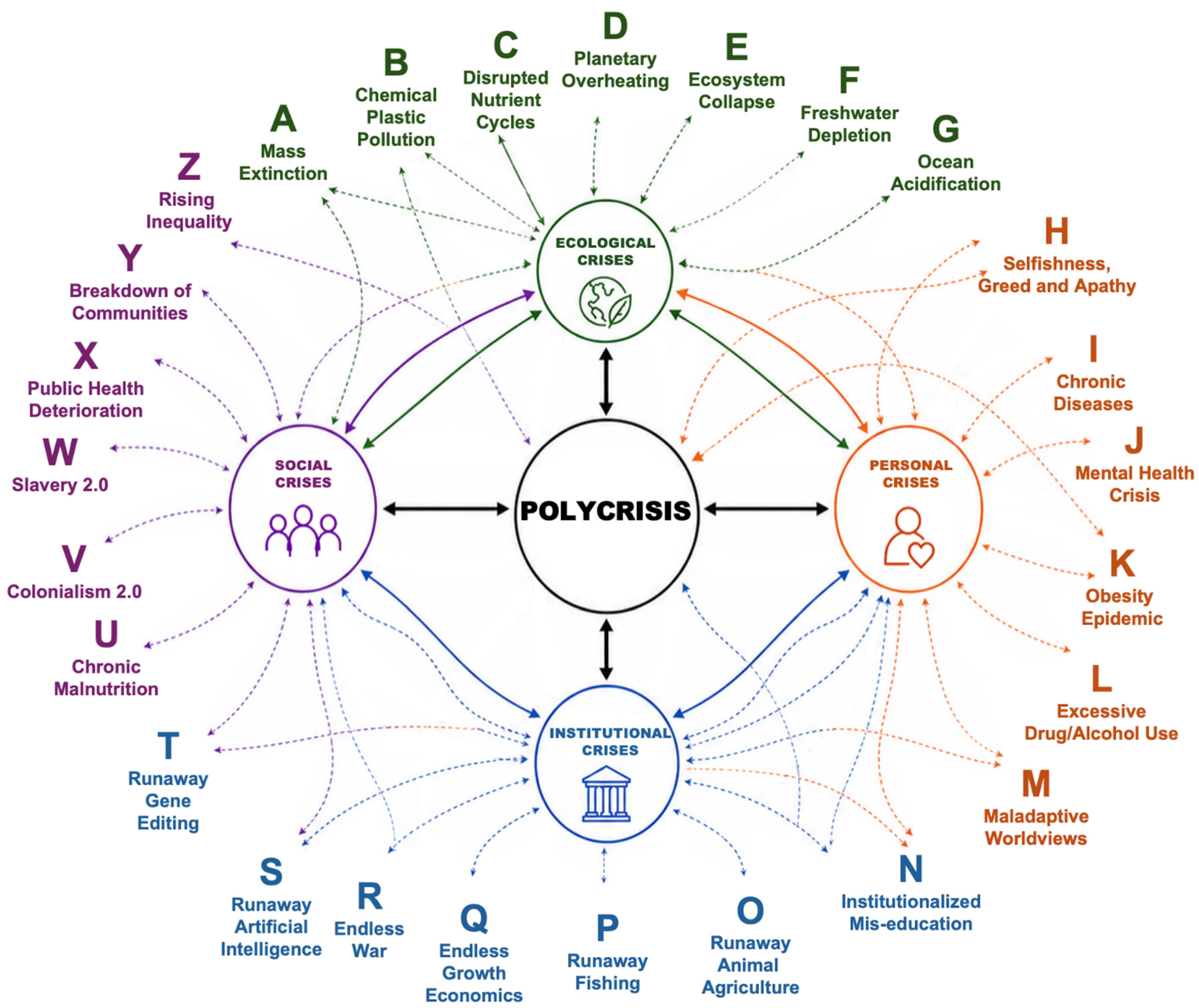
Figure 1. The 26 distinct planetary crises within the current PolyCrisis organized into four primary clusters, along with a partial depiction of their system dependencies.
Sustainability 18 07832 g001
Figure 2. Illustrative example of a set of four (out of thousands) cascading dynamic feedback loops accelerating the criticality of the PolyCrisis, leading to systemic collapse.
Sustainability 18 07832 g002
Figure 3. How the PolySolution can be implemented systematically through a Planet B Operating System.
Sustainability 18 07832 g003
Table 1. Theoretical foundations of the Planet B/PolyCrisis framework.
Theoretical TraditionWhat It Grounds in This PaperContributionWhat It Leaves Unaddressed
Complex systems and resilience theory [14,15,16]The PolyCrisis diagnostic and feedback-loop mapping (Section 3, Figure 1 and Figure 2)Formal tools for modeling feedback loops, thresholds, and phase transitions in socio-ecological systemsDoes not by itself specify a normative alternative or a transition mechanism
Critical ecological political economy [17,18]The claim that PolyCrisis dimensions are “predictable outputs” of Planet A’s structural logic (Section 4)A structural basis for treating ecological crises as endogenous features of a mode of production rather than contingent failuresOffers limited guidance on the specific institutional architecture of an alternative system
Multi-level perspective on socio-technical transitions [19]The framing of Planet B components as niche innovations and the MegaSolutions as landscape-level shocks (Section 5)Positions individual Planet B components within an established transition-dynamics vocabularyDoes not yet provide granular empirical tools for incumbent-regime resistance or strategic niche management (Section 7.5)
Existential-risk literature [20,21]The “e” designation applied to 16 of the 26 crisis dimensions (Section 2.2 and Section 3.5)Conceptual apparatus for distinguishing recoverable setbacks from catastrophic, irreversible civilizational lossDoes not provide a validated quantitative method for ranking existential dimensions against one another
Table 2. TAF pilot descriptive outcomes (Phase 2, 15 days, Jefferson County, WA, June–July 2026).
MeasureReported Outcome
Participation trendApproximately tripled from Day 1 to Day 15 of Phase 2
Per-meal food costUnder $3.00, using organic ingredients sourced from local retail outlets [107]
Biometric screening (weight, blood pressure, cholesterol, blood sugar)Collected opt-in, pre/post, with clinicians from the Rochester Lifestyle Medicine Institute; clinical analysis pending—not yet quantitatively reported
Disclaimer/Publisher’s Note: The statements, opinions and data contained in all publications are solely those of the individual author(s) and contributor(s) and not of MDPI and/or the editor(s). MDPI and/or the editor(s) disclaim responsibility for any injury to people or property resulting from any ideas, methods, instructions or products referred to in the content.