1. Introduction
The transition toward a circular economy and a low-carbon society has intensified the need for manufacturing strategies that improve resource efficiency while reducing environmental impacts. In industrial sectors such as automotive, aerospace, and transportation, lightweight structural design has become one of the most effective approaches for decreasing raw material consumption, fuel demand, and greenhouse gas emissions throughout the product life cycle [
1,
2,
3,
4,
5,
6,
7,
8]. Short-fiber-reinforced polymers (SFRPs) have emerged as key enablers of this transition, offering a high stiffness-to-weight ratio and a significantly lower carbon footprint compared to traditional metallic alloys [
7,
9].
Among SFRPs, PA6.6-GF30 is a promising material for sustainable structural applications owing to its excellent mechanical performance, durability, and the recyclability enabled by its thermoplastic matrix [
3,
10,
11,
12]. However, the mechanical response of PA6.6-GF30 is strongly influenced by the fiber architecture generated during processing. In particular, the heterogeneous skin–core structure developed during injection molding produces orientation-dependent mechanical properties, with significant variations observed as a function of specimen orientation relative to the mold-flow direction [
13,
14,
15,
16,
17]. Achieving a circular economy also requires overcoming the challenges associated with the mechanical recycling of glass-fiber-reinforced thermoplastics, where fiber shortening often leads to a reduction in structural performance [
18]. Nevertheless, recent studies have demonstrated that appropriate in-process recycling strategies can preserve most of the thermomechanical properties of glass-fiber-reinforced PA6.6 [
19], highlighting the importance of optimizing both material processing and component design to maximize resource efficiency. In this context, processing-induced anisotropy may represent a promising eco-design strategy to improve structural efficiency, enhance material utilization, and support the Sustainable Development Goals (SDGs) [
20,
21]. To maximize material efficiency, engineers must be able to design components that use the minimum amount of polymer required to withstand a given load, a concept that lies at the core of eco-design.
A major challenge is exploiting processing-induced fiber architecture as a design variable capable of improving structural performance without increasing material consumption. Manufacturing routes such as injection molding and compression molding induce distinct fiber architecture distributions, which lead to significant variations in fracture toughness [
1,
13,
22]. In injection molding, complex flow patterns create heterogeneous skin–core structures [
14,
15], while compression molding can produce highly aligned architectures [
2,
22]. Without a deep understanding of how these microstructures resist crack propagation under dynamic loading, designers often apply high safety factors, leading to over-engineered parts that consume excess resources [
5,
7].
Although the influence of fiber orientation on the mechanical properties of short-fiber-reinforced thermoplastics has been widely investigated, considerably less attention has been paid to exploiting processing-induced fiber architecture as a design variable for improving fracture toughness and enabling material savings while maintaining constant material composition. Consequently, the potential of processing-induced anisotropy as a practical eco-design strategy for dematerialization remains insufficiently explored.
2. Materials and Methods
2.1. Materials
PA6.6-GF30 was selected for this study due to its widespread use in lightweight structural applications requiring high specific stiffness, excellent impact performance, and good thermal stability [
3,
10,
23]. As a thermoplastic composite, PA6.6-GF30 also offers important advantages from a sustainability perspective, including recyclability and the potential for mechanical reprocessing, making it a suitable candidate for circular-economy strategies and resource-efficient structural design [
9,
12,
24].
The investigated materials were supplied within the framework of the ESIS TC4 Round Robin Programme on Fracture Toughness Testing of Short-Fiber-Reinforced Thermoplastics, which was established to evaluate the reproducibility of fracture toughness measurements using standardized testing procedures. The use of these reference materials provides a high level of experimental consistency and allows the present results to be directly compared with previous investigations conducted within the same international framework.
Within the ESIS TC4 Round Robin Programme, identical standardized reference materials were distributed to participating laboratories for comparative fracture characterization. Consequently, the detailed processing parameters used during their manufacture were not available to the participating laboratories. The present study therefore focuses on the fracture behavior of these standardized reference materials under controlled testing conditions.
Two types of plates with identical polymer matrix and glass-fiber content, manufactured using different processing routes, were investigated to isolate the influence of processing-induced fiber architecture on fracture behavior.
The characteristic fiber architectures associated with compression molding and injection molding are consistent with the well-established microstructural characteristics reported for short-fiber-reinforced PA6.6 systems and have been extensively documented using optical microscopy, scanning electron microscopy, and X-ray micro-computed tomography [
13,
14,
15,
17].
Material A consisted of compression-molded plates (170 × 189 mm) manufactured from previously extruded strands that were carefully aligned before compression molding. During plate fabrication, the strands were arranged parallel to each other, promoting a highly oriented and predominantly unidirectional glass-fiber architecture throughout the plate. This processing route promotes a preferential fiber alignment and provides an appropriate model material for investigating the influence of highly aligned fiber architectures on anisotropic fracture behavior.
Material B consisted of injection-molded plates (150 × 150 mm). In contrast to compression molding, the mold-filling process generates complex flow fields that produce a heterogeneous fiber architecture through the plate thickness. The resulting microstructure is commonly described as a skin–core architecture, characterized by preferential fiber alignment near the mold walls and a more random orientation within the core region [
13,
14,
15]. Consequently, injection-molded specimens generally exhibit a more isotropic macroscopic mechanical response than compression-molded materials.
Since both materials possess the same polymer matrix and glass-fiber content, the observed differences in fracture toughness can be primarily attributed to the distinct processing-induced fiber architectures rather than to differences in material composition. This makes the selected materials particularly suitable for evaluating the relationship between processing routes, fiber architecture, fracture toughness, and resource-efficient structural design.
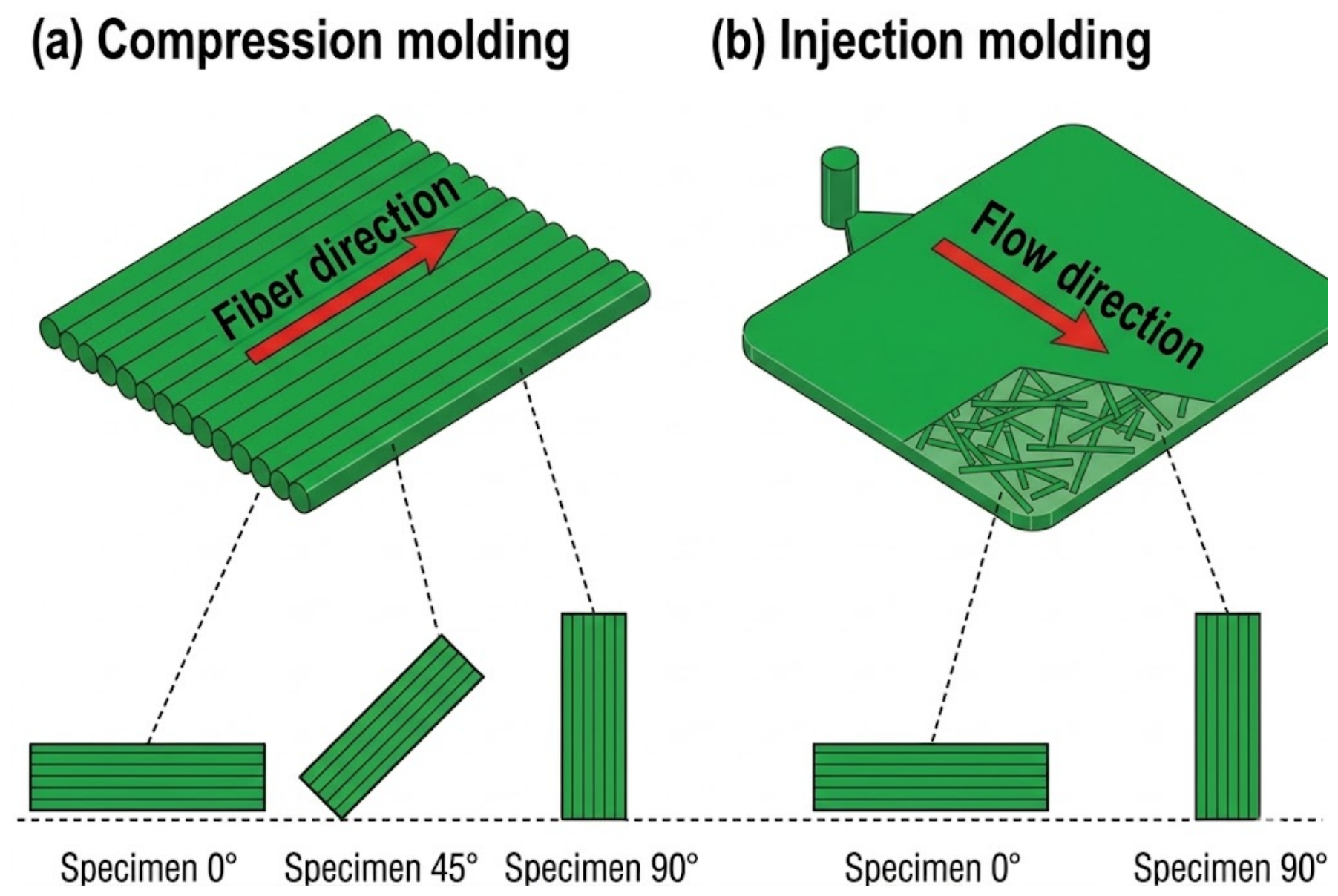
The processing routes, predominant fiber architectures, and specimen extraction orientations are schematically illustrated in
Figure 1.
2.2. Specimen Preparation
Test specimens were machined from the supplied plates according to the Single Edge Notched Bend (SENB) geometry recommended for fracture toughness evaluation under Linear Elastic Fracture Mechanics (LEFM) conditions. The SENB configuration provides a well-defined stress field at the crack tip and has been extensively used for determining fracture toughness in short-fiber-reinforced thermoplastics due to its good reproducibility and suitability for comparative studies [
10,
25].
Specimens were extracted at three different orientations (α = 0°, 45°, and 90°) with respect to the principal fiber orientation in Material A and with respect to the mold-flow direction in Material B. These orientations were selected to investigate the influence of the relative orientation between the predominant fiber alignment, the crack propagation direction, and the applied loading direction on fracture toughness over a broad range of loading configurations. For compression-molded specimens (Material A), the orientation angle (α) was defined with respect to the predominant fiber alignment generated during plate manufacture. Thus, α = 0° corresponds to specimens in which the crack propagation direction was perpendicular to the predominant fiber alignment, while the applied bending load was parallel to the fiber orientation. Conversely, α = 90° corresponds to loading transverse to the predominant fiber alignment. For injection-molded specimens (Material B), α was defined relative to the principal mold-flow direction, which represents the predominant orientation direction near the specimen surface.
Figure 1 illustrates these relationships schematically.
Specimen dimensions complied with the SENB geometry requirements. The specimen thickness (B) ranged from 5.20 to 5.25 mm for Material A and from 4.70 to 4.75 mm for Material B, while the specimen width (W) was approximately 11–13 mm, resulting in crack-length-to-width ratios (a/W) close to 0.5. Maintaining similar specimen geometries for both materials ensured that differences in fracture behavior could be attributed primarily to the processing-induced microstructure rather than to geometrical effects.
Since polyamide 6.6 is sensitive to moisture absorption, all specimens were conditioned before testing to minimize environmental effects on the measured mechanical properties. The specimens were dried at 80 °C for 48 h and subsequently stored under vacuum conditions until immediately before testing. This conditioning procedure, specified by the ESIS TC4 Round Robin Programme for all participating laboratories, reduces moisture-induced plasticization of the polymer matrix and ensures that all fracture tests were performed under comparable material conditions, thereby improving the repeatability, reliability, and interlaboratory comparability of the experimental results. The equilibrium moisture content after conditioning was not experimentally determined, since the objective of the conditioning procedure was to ensure identical moisture history for all specimens rather than to investigate moisture absorption behavior.
2.3. Notch Preparation
The quality of the notch tip plays a critical role in fracture toughness testing because the local stress concentration governs crack initiation under Linear Elastic Fracture Mechanics (LEFM) conditions. Consequently, different notch preparation procedures were investigated in order to evaluate whether the notch sharpening technique influences the measured fracture toughness of PA6.6-GF30.
Three notch preparation methods were investigated. Although all notches were designed to produce equivalent initial crack lengths, each technique provides a different level of control over notch-tip geometry and reproducibility.
Sliding method: Notch sharpening by controlled sliding of a fresh razor blade along the machined notch.
Pressing method: Notch sharpening by applying additional pressure to the razor blade, producing a sharper crack tip than that obtained by the sliding procedure.
Femtolaser method: Notch generation using femtosecond laser pulses (approximately 10−15 s). Owing to the extremely short pulse duration, material removal occurs with minimal thermal diffusion, thereby minimizing heat-affected zones and reducing the risk of microstructural modification adjacent to the crack tip. This technique also minimizes the possibility of local plastic deformation associated with mechanical notch-sharpening methods, resulting in highly reproducible crack-tip geometries. Within the ESIS TC4 Round Robin Programme, femtolaser notches were prepared using a standardized procedure common to all participating laboratories. Consequently, the present study focuses on evaluating the influence of the resulting notch preparation technique on fracture toughness rather than on the laser machining process itself.
Conventional razor-blade methods may introduce slight variations in notch geometry because the sharpening process depends on operator handling. In contrast, femtolaser machining provides highly reproducible notch geometries while minimizing both thermal effects and mechanically induced damage at the crack tip. The comparison of these three notch preparation techniques enables the influence of notch quality on fracture toughness measurements to be systematically assessed while maintaining identical material composition, specimen geometry, and testing conditions.
2.4. Fracture Testing
Fracture toughness tests were performed under dynamic loading conditions using an instrumented Charpy impact testing machine operating at an impact velocity of 1 m·s−1. The instrumented configuration enables continuous acquisition of the impact force as a function of time, providing significantly more information than conventional pendulum impact tests, which are generally limited to the measurement of total absorbed energy. The recorded force–time curves allow the identification of crack initiation and facilitate the subsequent determination of fracture mechanics parameters.
Single Edge Notched Bend (SENB) specimens were tested under three-point bending conditions. The support span was 51.6 mm for the compression-molded specimens (Material A) and 48 mm for the injection-molded specimens (Material B), according to the specimen geometry supplied within the ESIS TC4 Round Robin Programme. All tests were performed under identical experimental conditions in order to ensure a direct comparison between the different processing routes, fiber orientations, and notch preparation methods.
During impact testing, the force signal was continuously monitored using the instrumented acquisition system. To improve signal quality and reduce high-frequency oscillations generated by the striker–specimen contact, an impact-damping system was incorporated into the testing configuration. This damping arrangement significantly reduced mechanical vibrations without altering the fracture process itself, allowing well-defined force–time (F–t) curves to be obtained and improving the accuracy of crack-initiation load determination.
The fracture initiation load (PQ) was identified directly from the instrumented force–time curves following Linear Elastic Fracture Mechanics (LEFM) principles. Particular attention was paid to ensuring that crack initiation corresponded to the first significant deviation from the initial linear elastic response, thereby minimizing uncertainties associated with dynamic oscillations.
Dynamic fracture testing was selected because many engineering components manufactured from short-glass-fiber-reinforced polyamides operate under impact or rapidly applied loading conditions, particularly in automotive, transportation, and structural applications. Consequently, the present testing methodology provides fracture toughness values that are representative of realistic service conditions while enabling the influence of processing-induced fiber architecture on crack-initiation resistance to be systematically evaluated.
2.5. Data Analysis
Fracture parameters were determined according to the principles of LEFM, following the procedures established in ISO 13586 [
26] and ISO 17281 [
27]. The methodology is also consistent with the recommendations of ASTM D5045 for fracture toughness testing of polymeric materials [
28]. The fracture initiation load (P
Q) was identified directly from the instrumented force–time curves obtained during each impact test. This load corresponds to the onset of crack propagation and constitutes the fundamental experimental parameter for determining fracture toughness.
The provisional fracture toughness value (KQ) was calculated for each specimen using the standard LEFM formulation for SENB geometry. The calculation considered the experimentally measured crack-initiation load together with the individual specimen dimensions, including the support span, specimen thickness (B), specimen width (W), initial crack length (a), and the corresponding geometry correction factor. All geometric dimensions were measured individually before testing to ensure the accuracy of the calculated fracture toughness values.
The validity of the fracture toughness measurements was assessed according to the recommendations of ISO 13586 and ISO 17281, which are consistent with the procedures described in ASTM D5045 [
28]. Particular attention was paid to specimen geometry, crack-length-to-width ratio (a/W), and testing conditions to ensure the applicability of LEFM.
Unless otherwise stated, the fracture toughness values reported throughout this work correspond to measurements considered valid under the adopted LEFM acceptance criteria.
A total of 26 instrumented fracture tests were performed. For the compression-molded material (Material A), six specimens were tested at 0°, five at 45°, and seven at 90°. For the injection-molded material (Material B), four specimens were tested at both 0° and 90°. Owing to the specimen distribution established within the ESIS TC4 Round Robin Programme, some notch preparation methods were represented by a single specimen, whereas replicated configurations are reported using mean values and standard deviations.
Because several experimental configurations were represented by a single specimen, inferential statistical analyses (e.g., analysis of variance, ANOVA) were not applicable to the complete dataset. Accordingly, replicated configurations are summarized using mean values and standard deviations, whereas single-specimen configurations are reported as individual measurements.
For each experimental configuration, fracture toughness values were calculated individually and averaged when replicate specimens were available. Experimental variability is represented by the corresponding mean values and standard deviations for replicated configurations.
The experimental design enabled the influence of processing-induced fiber architecture to be isolated from compositional effects. Consequently, the measured differences in fracture toughness can be primarily attributed to the microstructural architecture generated during processing, providing a reliable basis for evaluating the role of processing-induced anisotropy in sustainable structural design and resource-efficient material utilization.
3. Results
3.1. Effect of Processing Route on Fracture Toughness
The fracture behavior of PA6.6-GF30 was found to be strongly influenced by the processing route used to produce the composite plates. Although both Material A (compression molding) and Material B (injection molding) possessed the same polymer matrix and glass-fiber content, significant differences in fracture toughness were observed, demonstrating that the fiber architecture generated during processing plays a dominant role in determining resistance to crack initiation.
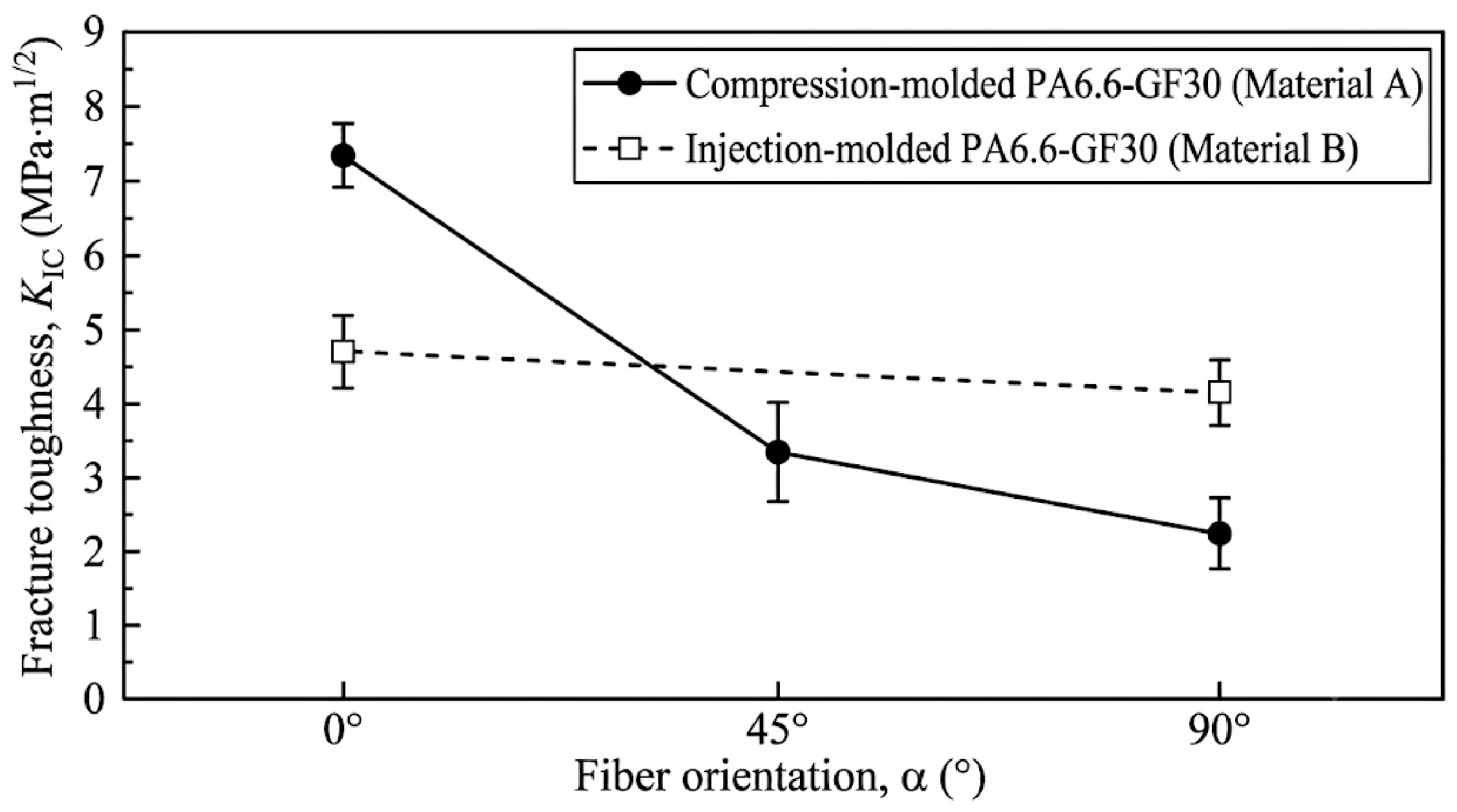
Compression-molded specimens (Material A) exhibited a pronounced anisotropic fracture response. The measured fracture toughness values varied over a wide range depending on the specimen orientation, reaching an average fracture toughness of approximately 7.37 MPa·m1/2 when specimens were tested parallel to the principal fiber orientation (α = 0°) and decreasing to approximately 2.30 MPa·m1/2 when tested perpendicular to the fiber direction (α = 90°). Intermediate values were obtained for specimens extracted at α = 45°, with an average fracture toughness of approximately 3.40 MPa·m1/2. This broad variation demonstrates that the compression-molding process generated a highly oriented fiber architecture whose resistance to crack initiation is strongly dependent on loading direction.
In contrast, injection-molded specimens (Material B) exhibited a considerably narrower range of fracture toughness values. Average KIC values of approximately 4.77 MPa·m1/2 and 4.19 MPa·m1/2 were measured for specimens extracted at α = 0° and α = 90°, respectively. The relatively small difference between these orientations indicates a much lower degree of anisotropy, which is consistent with the heterogeneous skin–core fiber architecture typically produced during the injection molding process.
Overall, the experimental fracture toughness values obtained in this study ranged from approximately 2.30 to 7.37 MPa·m1/2, representing almost a threefold variation despite the identical polymer matrix and glass-fiber content of the investigated materials. These results demonstrate that, for materials with identical polymer matrix and glass-fiber content, the processing route—and the resulting fiber architecture—has a greater influence on fracture toughness than composition alone. Consequently, processing-induced fiber architecture should be considered a key design variable when optimizing the structural efficiency of short-glass-fiber-reinforced thermoplastics.
From a resource-efficiency perspective, these findings suggest that improvements in fracture resistance can be achieved through manufacturing optimization without increasing fiber content or modifying the polymer formulation. By tailoring the fiber architecture during processing, it may be possible to enhance crack-initiation resistance while maintaining identical material composition. These findings provide a mechanical basis for future component-level structural optimization aimed at improving resource efficiency in recyclable short-fiber-reinforced thermoplastic composites.
3.2. Effect of Fiber Orientation
Having established the influence of the processing route on fracture toughness, this section examines the effect of the resulting fiber architecture on fracture toughness. The influence of loading direction relative to the predominant fiber orientation was evaluated by comparing the fracture toughness (K
IC) of specimens extracted at three orientations (α = 0°, 45°, and 90°) from the compression- and injection-molded plates.
Figure 2 illustrates the variation in fracture toughness as a function of specimen orientation for both processing routes.
To facilitate comparison between the two manufacturing routes, the average fracture toughness values obtained from all tested specimens for each orientation are summarized in
Table 1.
The reported standard deviations reflect the variability among specimens tested under the same processing route and orientation.
For Material A, the highest fracture toughness was obtained when the loading direction was parallel to the predominant fiber orientation (α = 0°), reaching an average value of 7.37 MPa·m1/2. As the loading direction deviated from the principal fiber alignment, fracture toughness decreased markedly. At α = 45°, the average KIC was reduced to 3.40 MPa·m1/2, whereas specimens extracted at α = 90° exhibited the lowest average fracture toughness (2.30 MPa·m1/2).
Expressed in relative terms, fracture toughness decreased by approximately 54% between the α = 0° and α = 45° orientations and by nearly 69% between the α = 0° and α = 90° configurations. Consequently, specimens loaded parallel to the predominant fiber orientation exhibited approximately a threefold higher fracture toughness than those tested under transverse loading. These quantitative differences demonstrate the high sensitivity of fracture toughness to loading direction in compression-molded PA6.6-GF30, confirming the strong anisotropy introduced during processing and remaining consistent with previous studies on anisotropic short-fiber-reinforced thermoplastics and fiber-reinforced composites [
1,
2,
10,
11,
29,
30].
A markedly different behavior was observed for the injection-molded material (Material B). In this case, the measured fracture toughness remained within a relatively narrow interval regardless of specimen orientation. Average K
IC values of 4.77 MPa·m
1/2 and 4.19 MPa·m
1/2 were obtained for specimens extracted at α = 0° and α = 90°, respectively, corresponding to a reduction of only approximately 12%. This comparatively uniform response is consistent with the heterogeneous skin–core fiber architecture typically generated during mold filling, which produces a less pronounced macroscopic anisotropy than compression molding [
13,
14,
15].
The comparison between the two processing routes clearly demonstrates that the processing-induced fiber architecture governs the directional dependence of fracture toughness. Whereas compression molding generates a highly anisotropic material capable of achieving very high fracture toughness when the loading direction is aligned with the fibers, injection molding provides a more uniform mechanical response over different loading orientations.
From a structural design perspective, these results indicate that selecting an appropriate manufacturing route according to the expected service loading conditions can improve fracture resistance without modifying either the polymer matrix or the glass-fiber content. Processing-induced fiber architecture therefore represents an effective design parameter for optimizing the structural efficiency of short-glass-fiber-reinforced thermoplastics and supports the development of lightweight, resource-efficient engineering components.
3.3. Effects of Notch Preparation Method
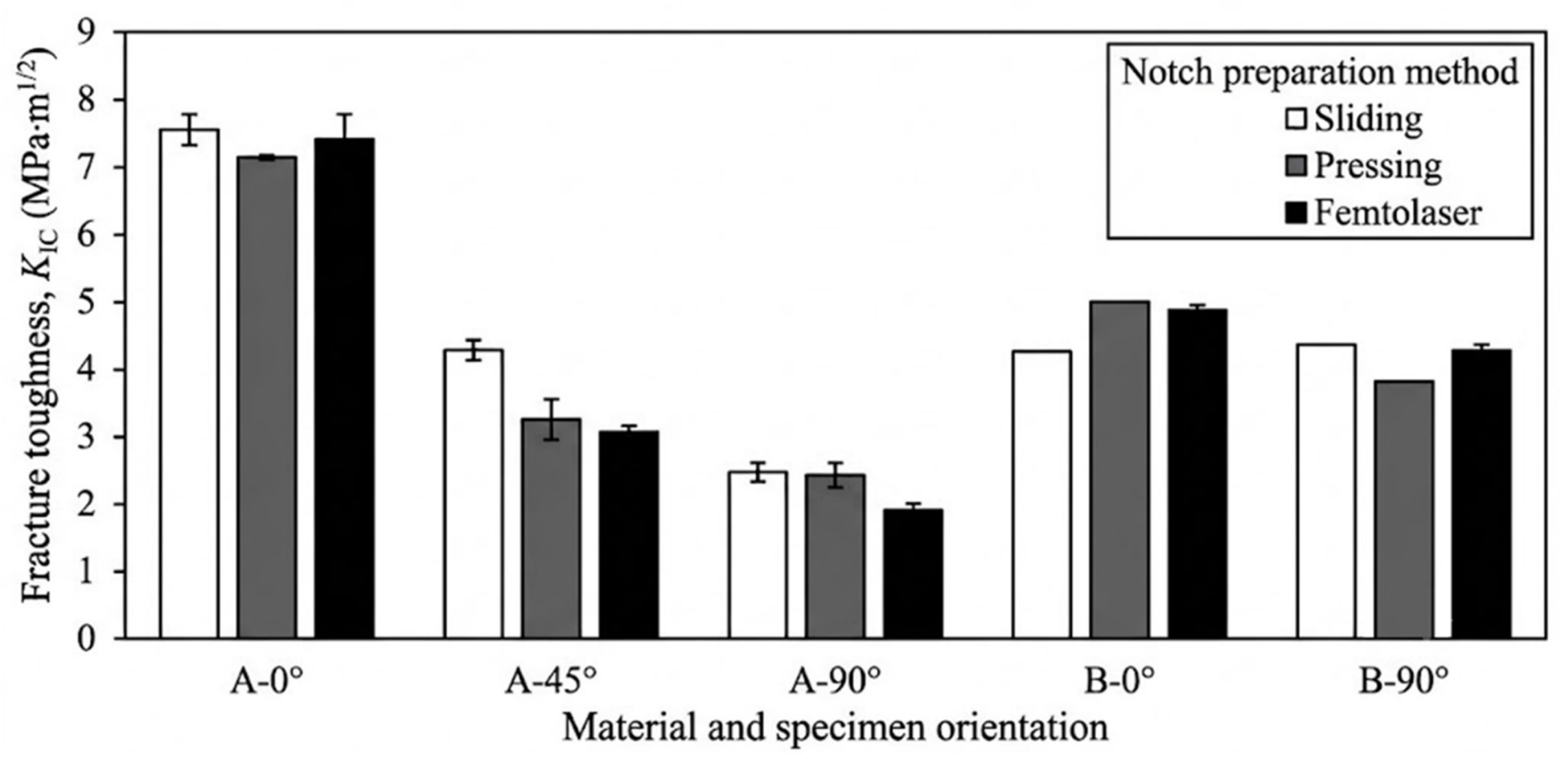
The influence of notch preparation method on the measured fracture toughness was evaluated to assess the robustness and reproducibility of the adopted experimental methodology. Three notch sharpening techniques were investigated: conventional razor-blade sharpening by sliding, razor-blade sharpening by pressing, and femtolaser machining. The corresponding fracture toughness values for each material configuration are presented in
Figure 3, while the statistical summary is provided in
Table 2.
Across all experimental configurations, the influence of notch preparation method on fracture toughness was consistently smaller than the effects associated with manufacturing route and specimen orientation. For the compression-molded material (Material A) tested at α = 0°, the average fracture toughness ranged from 7.15 ± 0.04 to 7.55 ± 0.17 MPa·m1/2, corresponding to a maximum variation of approximately 5% among the three sharpening procedures. Similarly, the injection-molded material (Material B) exhibited fracture toughness values that remained within a relatively narrow interval irrespective of the notch preparation technique employed.
Slightly larger differences were observed for Material A at α = 45° and α = 90°. However, these variations remained substantially smaller than those produced by changing the specimen orientation. Considering the overall experimental averages presented in
Table 1, fracture toughness decreased from 7.37 MPa·m
1/2 for specimens extracted parallel to the predominant fiber orientation (α = 0°) to 2.30 MPa·m
1/2 for specimens extracted perpendicular to the fiber direction (α = 90°), corresponding to an overall reduction of approximately 69%. This comparison emphasizes that the variations associated with notch preparation were minor relative to the processing-induced anisotropy quantified in the previous section.
For the experimental configurations in which replicated specimens were available, the calculated standard deviations remained relatively small, ranging from 0.04 to 0.39 MPa·m
1/2. These low levels of experimental scatter demonstrate good repeatability of the fracture toughness measurements, despite the heterogeneous fiber architecture characteristic of short-fiber-reinforced thermoplastics. The slightly larger deviations observed for some configurations, particularly at α = 45° and α = 90°, may be attributed to the increased variability typically associated with crack propagation through heterogeneous fiber architectures in short-fiber-reinforced thermoplastics [
10,
30].
Although femtolaser machining produced highly reproducible notch geometries while minimizing potential thermal and mechanical disturbances during notch generation, the measured fracture toughness remained comparable to that obtained using the conventional razor-blade techniques. No consistent trend associated with the notch preparation method was observed within the experimental variability of the present study. Instead, fracture toughness was primarily governed by the processing-induced fiber architecture, indicating that notch sharpening had only a secondary influence on the measured values.
Overall, the experimental variability associated with notch preparation was consistently smaller than that induced by the processing route and the resulting fiber architecture. The adopted fracture characterization methodology therefore provides reliable and reproducible measurements, allowing meaningful comparisons between different processing routes. From an engineering perspective, the measured differences in fracture toughness primarily reflect the influence of processing-induced fiber architecture rather than experimental variability associated with notch preparation.
4. Discussion
The present results demonstrate that processing-induced fiber architecture is the primary factor governing the fracture response of PA6.6-GF30 under dynamic loading conditions. Because both investigated materials possessed identical polymer matrix and glass-fiber content, the observed differences can be attributed primarily to the fiber architecture generated during processing rather than to differences in material composition. The following discussion examines the implications of these findings from the perspectives of fracture mechanics, structural design, resource efficiency, and circular economy. Particular attention is given to how processing-induced fiber architecture can be exploited as a design variable to improve fracture performance without increasing material consumption.
4.1. From Fracture Mechanics to Material Efficiency (Dematerialization)
The strong anisotropic response observed in the compression-molded specimens (Material A) can be attributed primarily to the highly aligned fiber architecture generated during processing. As demonstrated by the experimental results summarized in
Section 3, the fracture toughness increased from approximately 2.30 MPa·m
1/2 for specimens tested perpendicular to the predominant fiber alignment (α = 90°) to 7.37 MPa·m
1/2 when the loading direction was parallel to the predominant fiber alignment (α = 0°). This nearly threefold increase in fracture toughness clearly demonstrates the effectiveness of processing-induced fiber architecture in enhancing structural performance. Recent numerical investigations have similarly shown that the anisotropy generated by preferential fiber orientation governs crack deflection and crack propagation trajectories in short-fiber-reinforced composites, reinforcing the role of microstructural architecture in controlling fracture toughness [
10,
29,
31].
From a sustainability perspective, these findings provide a strong rationale for dematerialization strategies. In fracture-driven applications where the principal loading direction is known, aligning the fiber architecture may allow a reduction in the cross-sectional area following appropriate structural optimization. Based on the variation from 2.30 to 7.37 MPa·m
1/2 observed in
Figure 2, the measured increase in fracture toughness suggests that material reductions may be feasible in fracture-controlled components compared with misaligned or quasi-isotropic configurations. A reduction in material volume would be expected to decrease the embodied carbon and associated environmental footprint of the component, given the energy-intensive production of PA6.6 [
8]. Such material savings align with eco-design strategies in which performance is optimized through processing-induced fiber architecture rather than increased resource consumption [
5,
7,
20,
21,
32]. Unlike conventional approaches based on increasing fiber content or introducing new material formulations, the strategy investigated in this work exploits the existing reinforcement more efficiently through processing-induced fiber architecture. The estimated material savings should be considered indicative and dependent on component geometry, loading conditions, and design constraints. Although a full life-cycle assessment (LCA) is beyond the scope of this work, the present results provide quantitative indicators of the potential for material efficiency, which is expected to contribute to reduced environmental impacts.
4.2. Energy Trade-Offs and Manufacturing Choice
The comparison between compression molding and injection molding suggests that manufacturing route selection should not be based exclusively on production efficiency or manufacturing cost. Although injection molding is generally preferred for high-volume production because of its productivity and geometrical flexibility, the present results indicate that compression molding can provide substantially higher fracture toughness whenever the loading direction is well defined. These observations are consistent with recent investigations on short-glass-fiber-reinforced PA6/6.6, which have shown that the skin–core fiber architecture generated during injection molding promotes a more orientation-insensitive mechanical response than the highly aligned architecture produced by compression molding. Furthermore, micro-computed tomography has provided direct experimental evidence of the strong influence of processing-induced fiber architecture on the tensile and impact performance of PA6.6 composites [
16,
17].
Therefore, manufacturing route selection should consider not only production efficiency but also the structural performance required during service. In applications where optimized fiber architecture enables reductions in component mass, the additional processing requirements of a given manufacturing route may be compensated by lower material consumption and improved resource efficiency. Although a complete energy or life-cycle assessment was not performed in the present work, the experimental results demonstrate that processing-induced fiber architecture constitutes an additional design variable when evaluating the sustainability of short-fiber-reinforced thermoplastic components.
4.3. Enabling the Circular Economy: Performance Recovery
Mechanical recycling of PA6.6-GF30 typically leads to fiber shortening, matrix degradation, and a progressive reduction in fracture-related properties [
9,
12,
18]. Nevertheless, recent studies have demonstrated that controlled in-process recycling of glass-fiber-reinforced PA6.6 can preserve most of its thermomechanical performance, provided that the recycled content and processing conditions are properly controlled [
19]. The present results further suggest that optimizing the processing-induced fiber architecture may partially compensate for the reduction in fracture toughness associated with fiber degradation during recycling.
Consequently, processing-route optimization should be considered as a complementary strategy for material recycling. Rather than relying exclusively on improvements in recycling technology or matrix modification, controlling the processing-induced fiber architecture may contribute to extending component lifetime, improving structural efficiency, and increasing the structural value of recycled composite materials. In this context, processing-route optimization should not be regarded as an alternative to recycling, but rather as a complementary strategy for maximizing the engineering value recovered from recycled materials. This combined approach supports circular-economy strategies in which both recycling and processing-induced fiber architecture contribute to improving resource efficiency. Although the present study does not quantify life-cycle environmental impacts, the experimental results indicate that processing optimization may enhance the structural value of recycled thermoplastic composites while reducing the demand for virgin material. It should be noted, however, that recycled PA6.6-GF30 composites were not experimentally investigated in the present study. Therefore, the proposed processing-induced compensation strategy should be regarded as a hypothesis supported by the present experimental findings and requires validation through future experimental studies involving recycled materials.
4.4. Limitations of the Present Study
Although the present study demonstrates the significant influence of processing-induced fiber architecture on fracture toughness, several limitations should be acknowledged. First, the investigation was limited to a single glass-fiber content (30 wt.%) and a single polymer matrix (PA6.6). Different glass-fiber contents, fiber lengths, or thermoplastic matrices may lead to different microstructural architectures and, therefore, different levels of anisotropy.
Second, the present work focused exclusively on dynamic fracture toughness (KIC) under impact loading. Additional investigations under quasi-static, fatigue, creep, or environmentally conditioned loading would provide a more comprehensive understanding of the long-term structural performance of these materials.
In addition, the conclusions regarding the influence of processing-induced fiber architecture are based on the characteristic fiber architectures generated by the investigated processing routes and supported by previous studies. Direct three-dimensional characterization of fiber orientation using techniques such as X-ray micro-computed tomography would provide direct experimental validation of the proposed structure–property relationships and further elucidate the relationship between local fiber architecture and fracture toughness.
Finally, although the sustainability implications discussed in this work are supported by the experimentally measured fracture toughness values reported in this study, no complete life-cycle assessment (LCA) was performed. Future studies combining fracture mechanics, component-level structural optimization, and quantitative LCA methodologies would allow the environmental benefits associated with processing-induced fiber architecture to be quantified more accurately.



 ,
,