1. Introduction
In increasingly turbulent, resource-constrained, and sustainability-oriented business environments, the global economy presents businesses with unprecedented levels of environmental uncertainty [
1], which are primarily driven by technological disruption, geopolitical conflict, market volatility, and institutional complexity [
2]. This situation is even more problematic for SMEs: on one side they play a critical role in achieving sustainable economic development, organizational resilience, and long-term value creation in emerging economies; on the other, they often lack the resources to shape a sustainable growth model, to quickly implement new strategies to survive amid changing environmental conditions [
3]. Strategic flexibility (SF) has emerged as an important organizational capability that can help firms adapt to changing market conditions by changing their strategic posture, the way they configurate their resources, and the ability to successfully adjust to changes in the marketplace [
4]. However, there is still limited understanding of the downstream consequences of the SF construct, including how it affects BMI, CA, and FP within emerging economy contexts [
5].
The innovation of business models has become the primary way for companies to rejuvenate themselves, pursue sustainable goals, and remain competitive [
6]. BMI not only involves new product launches or improving existing processes; it focuses on how a company reimagines the way it creates, delivers, and realizes sustainable value creation and value capture [
7]. Traditional methods of gaining CA have quickly diminished in rapidly changing economic climates [
8]. Therefore, innovation at the business model level will undoubtedly provide a company with an additional strategic instrument for success [
9]. Although interest in innovative business model practices is increasing, there remains limited empirical research on what influences BMI from a company’s strategic capabilities perspective—particularly, how SF affects business model innovation in a long-term sustainable view.
From an academic perspective, the connection between SF and BMI relies on the dynamic capabilities theory (DCT) [
10]. According to this theory, companies are able to create long-term CAs through three processes: (1) identifying opportunities, (2) investing strategically to realize these opportunities, and (3) adapting their resource base to fit these opportunities. The SF capability enables firms to change their strategic commitments and resource allocations [
11]. Therefore, this capability can enable firms to change their business models. However, the empirical literature connecting SF with BMI is still relatively limited because most research is either focused on larger firms or on a narrow set of technological innovations. For this reason, the present study does not aim to introduce a new theoretical paradigm, but rather to empirically examine how established capability-based relationships operate in the specific context of SMEs in an emerging economy.
Moreover, although BMI has been linked to superior competitive edge and performance results [
12], the intermediary processes whereby SF produces performance advantages via BMI and competitive position have not been adequately identified [
13]. Many earlier studies have investigated these constructs independently; hence, the empirical relationships among them have received comparatively less attention when considered within the same analytical model. This is especially important for SMEs since their CAs usually result from agility, niche specialization and relational networks versus economies of scale.
The circumstances of rapidly developing countries heighten the need to research this phenomenon. Companies producing in countries that are less prosperous experience differences in institutional voids, inconsistent regulations, and resource constraints compared to those in more developed countries [
14]. SMEs account for a large share of the Iranian economy and provide a significant source of employment and economic diversification [
15]. However, they operate amid fluctuating macroeconomic conditions, sanctions, and rapid technological change, necessitating flexible strategies to survive. Even so, there is limited empirical research on how SF helps SMEs in Iran develop BMI and achieve a competitive edge. Most previous research studies have been conducted in developed economies, so their findings may only apply to those who are in similar situations.
Three significant gaps remain in the existing literature are addressed in this study. First, the study offers an empirical evaluation of SF as a key precursor to BMI, thereby contributing to the literature on innovation and strategic management. Second, by examining BMI and CA within the same empirical model, this study provides a clearer assessment of the possible pathways through which strategic capabilities are associated with FP outcomes. Third, the study provides an empirical assessment of Iran, an emerging economy, in response to previous calls for increased geographic diversity in the management field. In this sense, the contribution of the paper is best understood as an empirical integration and contextual extension of established theoretical relationships, rather than as a major theoretical unification.
Specifically, this research examines the pathways through which SF affects the innovation of business models, CA, and FP, with an emphasis on SMEs operating in Iran. This study empirically tests a capability–innovation–performance model, expanding the contextual application of dynamic capabilities and deepening our understanding of how SMEs can leverage SF to achieve sustainable FP in uncertain environments. By focusing on Iranian SMEs, the study helps clarify whether relationships commonly examined in developed-country settings also apply in a resource-constrained and institutionally volatile emerging economy.
The study provides both theoretical insights and practical applications contributions. The research contributes to existing literature by establishing a connection between SF and BMI, as well as examining the simultaneous effect these strategies can have on a company’s CA and its ability to perform. Rather than claiming to develop a wholly new theoretical framework, the study positions its contribution as a contextualized empirical examination of capability-based relationships in SMEs operating under emerging-economy constraints. It also provides managers of SMEs with practical recommendations on how they should manage their organization when faced with a volatile or uncertain environment, by emphasizing the importance of flexibility in both their strategic process and responsiveness/adaptability. The methodology section follows, describing the specific approaches and techniques employed in the study. Finally, the results and their implications are thoroughly examined and discussed.
2. Literature Review
2.1. Strategic Flexibility
In today’s fast-changing and sustainability-oriented business environment, SF has become a key organizational competence [
16,
17]. SF enables firms to respond to sustainability-related uncertainties, regulatory pressures, changing stakeholder expectations, and the need to maintain long-term organizational viability. Environmental changes require the reallocation of resources, the reassessment of strategic commitments, and the modification of organizational structure configurations [
11]. Unlike operational flexibility, which focuses on procedural adaptability, SF exists at the strategic decision-making level and has an impact on long-term positioning [
18].
So far, most research on SF has concentrated mainly on two aspects: resource flexibility and coordination flexibility [
19,
20]. Resource flexibility refers to how much a firm’s assets can be redeployed for various purposes, while coordination flexibility is defined as management’s ability to reorganize its strategic processes [
20]. Research indicates that SF is linked to innovation capabilities, export success, organizational resilience, and the capacity to sustain performance over time under uncertain conditions [
21]. However, most existing research has primarily examined how SF directly affects performance or operational results [
22,
23]. Thus, research on the role of SF as a driver of structural innovation, specifically in business model innovation and sustainable value creation, is still under-researched.
Furthermore, most empirical research on SF has focused on developed economies, with limited evidence from emerging markets. Given the increased uncertainties faced by SMEs within emerging markets, it is possible that SF does not only serve as an adaptive capability, but rather becomes transformational for firms in these contexts. In particular, SF may help SMEs strengthen their long-term sustainability by enabling them to adjust their strategies, renew their business models, and respond more effectively to economic, institutional, and environmental pressures.
2.2. Business Model Innovation
BMI is a relatively new term used to describe specific changes in how businesses generate, deliver, and capture value [
24]. In contrast to traditional theories of product and process innovation, which examine innovations within a firm’s existing methods for delivering goods and services to customers, BMI looks at alternative ways for a firm to generate revenue or to improve its relationship with its stakeholders as a whole [
15]. From a sustainability perspective, BMI is particularly relevant because it enables firms to rethink not only how they compete, but also how they create, preserve, and distribute value in the long term.
Interest in BMI as an area for scholarly research has grown significantly over the last ten years [
25]. Several studies have investigated what drives businesses to pursue innovative BMI, including, but not limited to, digital transformation [
26,
27], entrepreneurial orientation [
28], absorptive capacity [
29], and environmental turbulence [
30]. Studies consistently show that firms that employ BMI strategies have an improved ability to adapt to changes in the marketplace and to develop long-term, sustainable CAs [
15,
31]. In this sense, BMI may be understood as a key mechanism through which SMEs translate adaptive capabilities into sustainable growth, organizational resilience, and improved performance.
Despite increased interest in BMI as a concept among researchers, two key issues persist. Firstly, the current literature on antecedent characteristics associated with BMI includes only a limited number of studies that address SF as a higher-order capability supporting BMI. Second, numerous studies have focused solely on how firms with BMI create value for themselves and have not clearly explained how BMI could act as a mediator between a company’s CA and its performance. This is especially relevant from a sustainability perspective, since sustainable performance depends not only on innovation itself, but also on the firm’s ability to transform innovation into durable competitive and organizational outcomes.
The BMI literature is notably fragmented, especially regarding small and medium-sized enterprises. Compared to large companies, SMEs are typically more adaptable and may find it easier to adopt BMI. However, they also face stronger resource constraints and greater vulnerability to market and institutional shocks. Consequently, pinpointing the capabilities that help SMEs pursue BMI is crucial for understanding how they can sustain growth, resilience, and competitiveness over time.
2.3. Competitive Advantage and Firm Performance
A CA describes a company’s capacity to create more value than its competitors in a way that is difficult for others to imitate or replicate [
32]. In an ever changing environment, the CAs gained can be very short lived, or temporary, requiring constant investment to renew them [
33].
Innovation is frequently linked to higher profitability or sales, but the specific processes through which a company transforms its innovative potential into tangible financial or market success are not well understood and therefore lack clarity. CA is a significant part of this process as it creates a viable method for the company to perform better than others in business by implementing new business models that allow it to lower costs, create differentiated products, and provide greater customer service, these are all ways in which competitive position may be improved [
33].
The majority of literature examines the relationship between:
SF → Performance
or
BMI → Performance
Few studies examine these two constructs together through a causal chain that includes CA. The lack of examining these constructs in an integrated manner has limited the ability to achieve theoretical and empirical clarity regarding the relationship between SF, BMI, and FP.
2.4. Prior Empirical Evidence
Previous studies on the relationships among Strategic Flexibility (SF), Business Model Innovation (BMI), Competitive Advantage (CA), and Firm Performance (FP) were reviewed and summarized in order to provide a structured overview of the main empirical and theoretical contributions in the field. The purpose of this section is to identify the main conceptual and empirical gaps that justify the proposed model.
The reviewed literature shows that the four constructs have generally been examined through three partially connected streams. The first stream focuses on SF as an adaptive capability that enables firms to reconfigure resources, adjust strategic choices, and respond to environmental change. The second stream examines BMI as a mechanism through which firms redesign the way they create, deliver, and capture value. The third stream investigates the performance implications of BMI and CA, especially in SMEs and dynamic market environments. More recent studies have connected these debates to sustainability-oriented performance, environmental turbulence, and emerging-economy conditions.
Taken together, this literature suggests that SF, BMI, CA, and FP are theoretically related, but that their relationships have often been examined separately or through partial models. Some studies focus on SF and innovation, others on BMI and performance, and others on CA as a mediating or outcome variable. Recent research has begun to connect these dimensions more explicitly, particularly in SMEs, but evidence remains fragmented across different contexts, methods, and theoretical perspectives. In particular, fewer studies have examined SF, BMI, CA, and FP within the same empirical model in an emerging-economy SME context.
Table 1 provides the summary of the selected conceptual, review-based, and empirical studies that are relevant to the relationships among SF, BMI, CA, and FP. The table has been revised to ensure consistency in citation format, author names, publication years, punctuation, and citation structure. It also includes more recent external literature in order to provide a broader and more updated foundation for the study.
Therefore, the evidence indicates that the literature provides important foundations for the present study but also reveals three main gaps. First, although SF has been widely discussed as an adaptive capability, fewer empirical studies examine its connection with BMI as a mechanism of value reconfiguration. Second, while BMI has often been linked to performance and competitive positioning, recent research suggests that these relationships may be indirect, conditional, or mediated by organizational capabilities and value-capture mechanisms. Third, although SMEs have received increasing attention, there remains a need for more evidence from emerging economies, where firms often face resource constraints, institutional uncertainty, and volatile market conditions. Based on these gaps, the present study examines SF, BMI, CA, and FP within a single empirical model applied to Iranian SMEs. By doing so, it contributes to the literature by integrating established relationships among these constructs while also extending their empirical examination to an emerging-economy context. The study uses existing strategic management, dynamic capabilities, and BMI perspectives to examine how adaptive capabilities and business model renewal are associated with competitive positioning and firm performance. Three main research areas in the literature examine the impacts of BMI on performance.
First, the literature has produced a large number of quantitative studies using surveys to examine how SF relates to financial and non-financial performance. Although there is substantial empirical evidence indicating that SF is positively related to one or more forms of organizational performance, the literature on structural mechanisms, such as BMI, is very limited.
Second, numerous studies have investigated BMI and explored its connection with several types of performance indicators using similar methodological approaches as the studies of SF, but very few of the researchers have concluded that there are actually positive relationships. Although researchers have concluded that there is a positive correlation between BMI and FP, most studies have not considered that CA links the two types of performance.
Third, very few studies have compared BMI and strategic capabilities, and those studies that do have been limited to examining the performance of SMEs and emerging markets.
Collectively, these three categories of research reinforce the bibliometric analysis findings described previously and support the need to develop and empirically test a single integrated capability–innovation–advantage–performance model.
2.5. Bibliometric Overview and Research Gap Identification
This study aims to position itself within the broader research landscape by conducting a structured bibliometric-informed literature mapping of the Scopus database spanning from 2000 to 2025. Scopus was selected because it provides broad coverage of peer-reviewed research in management, strategic management, innovation studies, entrepreneurship, sustainability, and business model research, and because it allows systematic searches by title, abstract, and keywords. The bibliometric component was used to identify the relative development of the main research streams and the degree of overlap among the constructs examined in this study. It was not intended to replace the qualitative literature review, but rather to complement it by showing how the selected constructs—Strategic Flexibility (SF), Business Model Innovation (BMI), Competitive Advantage (CA), and Firm Performance (FP)—have been studied separately and in combination.
To ensure conceptual coherence across the manuscript, the bibliometric mapping, theoretical framework, hypotheses, and empirical model are all aligned around the same four constructs: SF, BMI, CA, and FP. References to broader strategic management, dynamic capabilities, and business model innovation studies are used as theoretical background, but they are not treated as additional constructs in the empirical model. This clarification helps avoid conceptual ambiguity and ensures consistency between the literature review, theoretical framing, and SEM analysis.
The focus was on five interconnected areas: (1) SF, (2) BMI, (3) CA and FP, (4) the intersection of SF and BMI, and (5) the combined examination of SF, BMI, CA, and FP. The search was conducted using the Scopus TITLE-ABS-KEY fields, covering the period 2000–2025. The search strategy was based on the following keyword combinations: “strategic flexibility” for the SF stream; “business model innovation” for the BMI stream; “competitive advantage” AND (“firm performance” OR “company performance”) for the CA–FP stream; “strategic flexibility” AND “business model innovation” for the SF–BMI intersection; and “strategic flexibility” AND “business model innovation” AND “competitive advantage” AND (“firm performance” OR “company performance”) for the combined capability–innovation–advantage–performance model. Where relevant, additional screening terms such as “SME,” “small and medium-sized enterprises,” “emerging economy,” and “emerging markets” were used to assess the contextual relevance of the studies.
The inclusion criteria were as follows: publications had to be written in English; indexed in Scopus; published between 2000 and 2025; and related to strategic flexibility, business model innovation, firm performance, competitive advantage, SMEs, or sustainability-oriented management. The search included journal articles, reviews, and conference papers where relevant to the conceptual mapping. Publications were excluded when the relevant keywords appeared only marginally or with meanings unrelated to the present study, for example when “flexibility” referred exclusively to engineering, production scheduling, information systems architecture, or technical supply-chain operations without a connection to strategic capabilities or business model change. Records were first screened by title, abstract, and keywords. After this screening, the remaining results were used to identify publication counts, temporal trends, and keyword patterns.
The analytical procedure consisted of three steps. First, publication counts were used to compare the relative maturity of each research stream. Second, publication trends over time were examined to assess whether the selected topics had developed as separate or overlapping research areas. Third, keyword patterns were reviewed to identify whether SF, BMI, CA, and FP appeared as closely connected concepts or as partially separate clusters. The keyword analysis was based on author keywords and indexed keywords available in Scopus. The purpose of this analysis was not to conduct a full co-citation or bibliographic coupling analysis, but to provide a transparent mapping of the literature and to support the identification of research gaps.
The research indicates there is extensive and increasing amounts of literature documenting both SF and BMI separately: about 796 publications focused on SF and 1797 publications focused on BMI during the period considered. CA and FP have also attracted a considerable amount of attention, with 1072 total publications. Each of these topics appears to have become a mature and relatively independent research stream.
Nonetheless, it appears that the picture changes when considering the intersection of these areas. SF and BMI together yielded 40 total documents, most of which were produced after 2012. This shows that, while the two areas conceptually fit within the dynamic capabilities perspective, there has not been a significant amount of work toward the intersection of SF and BMI. In other words, although both SF and BMI are well-established constructs, their direct connection remains less frequently examined in empirical research.
More importantly, however, there is limited research that connects all four concepts examined in this study. A more restrictive literature search conducted between 2017 and 2025 on studies combining SF, BMI, CA, and FP yielded only a small number of results (N = 6). This does not mean that the present study introduces a wholly new theoretical model, but rather that the simultaneous empirical examination of these constructs remains comparatively limited, especially in SMEs and emerging-economy contexts. There exists a significant gap between the development of the individual areas of research and the relatively small number of attempts to examine these relationships together. Therefore, there is evidence of fragmentation across the relevant streams of literature.
This divide can be illustrated by the timeline presented. More research has been conducted at a much greater rate in the past several years regarding BMI, while the number of articles published on SF has continued to steadily increase since the beginning of the 21st century. Nevertheless, the amount of research linking these two constructs together to CA and FP remains limited. Therefore, there has yet to be an abundance of empirical research examining the capability–innovation–advantage–performance sequence in a single model.
Keyword analysis indicates that SF and BMI frequently occur close to each other in research clusters, but their association remains weakly connected. Performance-related topics are usually found on the periphery or within emerging themes, rather than as central components of the same empirical model. Overall, prior research has largely examined these concepts separately, rather than examining them together as part of a broader capability–innovation–advantage–performance relationship. This confirms the need for a more coherent empirical assessment of how SF, BMI, CA, and FP are connected, particularly in SMEs operating in emerging economies.
In line with this clarification, the following gaps are formulated only in relation to the constructs used in the empirical model. The study therefore avoids introducing additional theoretical labels or constructs that are not subsequently operationalized in the hypotheses or tested in the SEM model.
The bibliometric-informed mapping raises three critical research gaps:
There is limited empirical research connecting strategic flexibility with business model innovation processes in a way that explicitly examines the role of SF as an antecedent of BMI.
There are few studies that link SF and BMI to outcome variables such as CA and FP, indicating a lack of empirical research on how adaptive strategic capabilities are translated into competitive and performance outcomes.
There are relatively few empirical studies examining the relationships among SF, BMI, CA, and FP in SMEs operating in emerging economies.
Therefore, this study tries to address the above limitations by conducting an empirical test of a capability–innovation–advantage–performance model that links SF to FP through BMI and CA, with specific reference to SMEs in Iran. Rather than claiming to develop a new theoretical paradigm, the study positions itself as a contextual extension and empirical integration of established relationships within the Resource-Based View, the Dynamic Capabilities perspective, and the business model innovation literature.
Overall, this revised formulation strengthens the conceptual alignment between the literature review, theoretical framework, and empirical model. The bibliometric-informed mapping is used only to justify the empirical examination of SF, BMI, CA, and FP, while the theoretical framing remains grounded in the Resource-Based View, the Dynamic Capabilities perspective, and the business model innovation literature.
2.6. Theoretical Framework
2.6.1. Dynamic Capabilities as the Integrative Lens
There has been a rise in the unpredictability of today’s markets, challenging how firms define CA on a traditional, static basis [
51]. The dynamic capability view (DCV) presents an alternative theoretical perspective on how firms can maintain strong performance in rapidly changing environments, contrasting with the resource-based perspective, which highlights the importance of possessing rare, valuable, unique, and non-replaceable resources [
52].
From a DCV viewpoint, CA arises from possessing better resources and the ability to refresh them [
53]. This distinction becomes even more relevant for SMEs operating in unstable, unpredictable environments which require more adaptability [
54]. Consequently, the present study will use a DCV as the theoretical framework for understanding the relationships among SF, BMI, CA, and FP.
2.6.2. SF as a Higher-Order Dynamic Capability
SF is the company’s capability to adapt to changes in its environment through the redeployment of resources, changes in strategic commitments, or changes in strategic direction [
11]. It includes both Resource Flexibility, understood as the ability to redeploy resources, and Coordination Flexibility, understood as the capability to modify strategic approaches and processes.
From the perspective of Dynamic Capabilities, SF is a higher-level capability that enables a company to identify and respond to market changes. However, although SF is a key trait of a successful organization, earlier research has concentrated on its Operational Performance, Supply Chain Performance, and Overall Adaptability rather than its contribution to successful business model transformation.
The earlier bibliometric-informed evidence also demonstrates that SF has developed as an independent stream of research and has been only minimally related to BMI. This disconnect highlights the need to better understand SF not simply as an adaptive mechanism, but also as a capability that may support business model change. In this study, however, SF is not proposed as a new theoretical construct; rather, its role is empirically examined within an established dynamic-capability perspective and applied to SMEs in an emerging-economy context.
2.6.3. BMI as a Value Reconfiguration Mechanism
BMI entails a fundamental change in how a business generates, provides, and obtains value [
44]. BMI fundamentally changes how a company organizes transactions with its stakeholders and conducts its business.
From the perspective of the Dynamic Capabilities View (DCV), BMI can be understood as an outcome of dynamic process capabilities. A company that can sense opportunities and reallocates resources is more likely to redesign its business model than one that cannot. The academic literature to date has not provided sufficient empirical evidence on the specific capabilities that drive BMI. Absorptive capacity and entrepreneurial orientation have both gained traction in recent years. However, SF has been largely neglected as a precursor to BMI in the business performance literature.
Research has identified very few (n = 40) publications addressing the SF/BMI relationship, which is indicative of the lack of empirical research linking the two variables. This lack of empirical attention points to a need for further clarification of how SF enables BMI, especially in SMEs and emerging economies.
2.6.4. From BMI to CA
When a company develops a strategy to generate superior value compared to other businesses, it has CA. In addition, according to this research, CA cannot be easily replicated. In the last few years, organizations have started to rely more on organizational renewal rather than just operating efficiently; therefore, if a firm wants to be successful in a competitive market, it needs to focus on developing its capacity for creating innovative solutions that give rise to new opportunities.
BMI enables firms to achieve CAs in the following ways:
Introducing new value propositions;
Eliminating transaction-related inefficiencies;
Establishing additional ways to generate income;
Representing new methods of engaging customers.
BMI will not automatically produce CA; it provides a mechanism through which structural innovation is converted into performance outcomes. The bibliometric-informed literature mapping indicates that the connection between BMI and CA remains underdeveloped within the literature and in the literature on SMEs.
Based on the above findings, we propose that CA is conceptualized as the strategic outcome of BMI and is an immediate antecedent of performance.
2.6.5. CA and Firm Performance
An organization’s performance ultimately depends on its strategic actions. While numerous researchers have explored the link between innovation and organizational success [
15,
55,
56], the path from innovation to organizational performance often misses the strategic process that an organization employs to create economically productive, innovative activity. According to the dynamic capabilities view (DCV), ongoing performance improvements are made possible by developing capabilities that allow an organization to uphold its competitive edge over time [
57]. This suggests that CA acts as a mediator linking BMI and performance.
The bibliometric-informed mapping shows that very few studies have simultaneously explored SF, BMI, CA, and performance. It also suggests that there is significantly less empirical research on the complete set of relationships among capabilities, innovation, advantage, and performance than expected.
2.7. Hypothesis Development
2.7.1. SF and Business Model Innovation
SF refers to a company’s ability to proactively adjust resource configurations and strategic plans in response to environmental changes. The resource-based view (RBV) and DCV are the theoretical foundations from which this capacity derives; using these views, firms use their SF to sense new opportunities, seize them with timely decision-making, and reconfigure their organizational structure in response [
43].
BMI, by definition, reflects a major change in how a business functions in creating, delivering, and capturing value [
37]. An example of significant modification would be the reconfiguration of value propositions, revenue mechanisms, and activity systems; thus, a business must have the strategic latitude to adjust resource allocation and to reconfigure organizational routines if it is going to succeed with BMI.
SF creates an environment that supports experimentation and reduces the rigidity of strategic commitments made by the business, enhancing managerial responsiveness—these conditions are critical for the successful execution of BMI. Empirical support shows that businesses with higher levels of flexibility have been able to redesign their business models under conditions of environmental turbulence (e.g., Clauss [
41]). As a result:
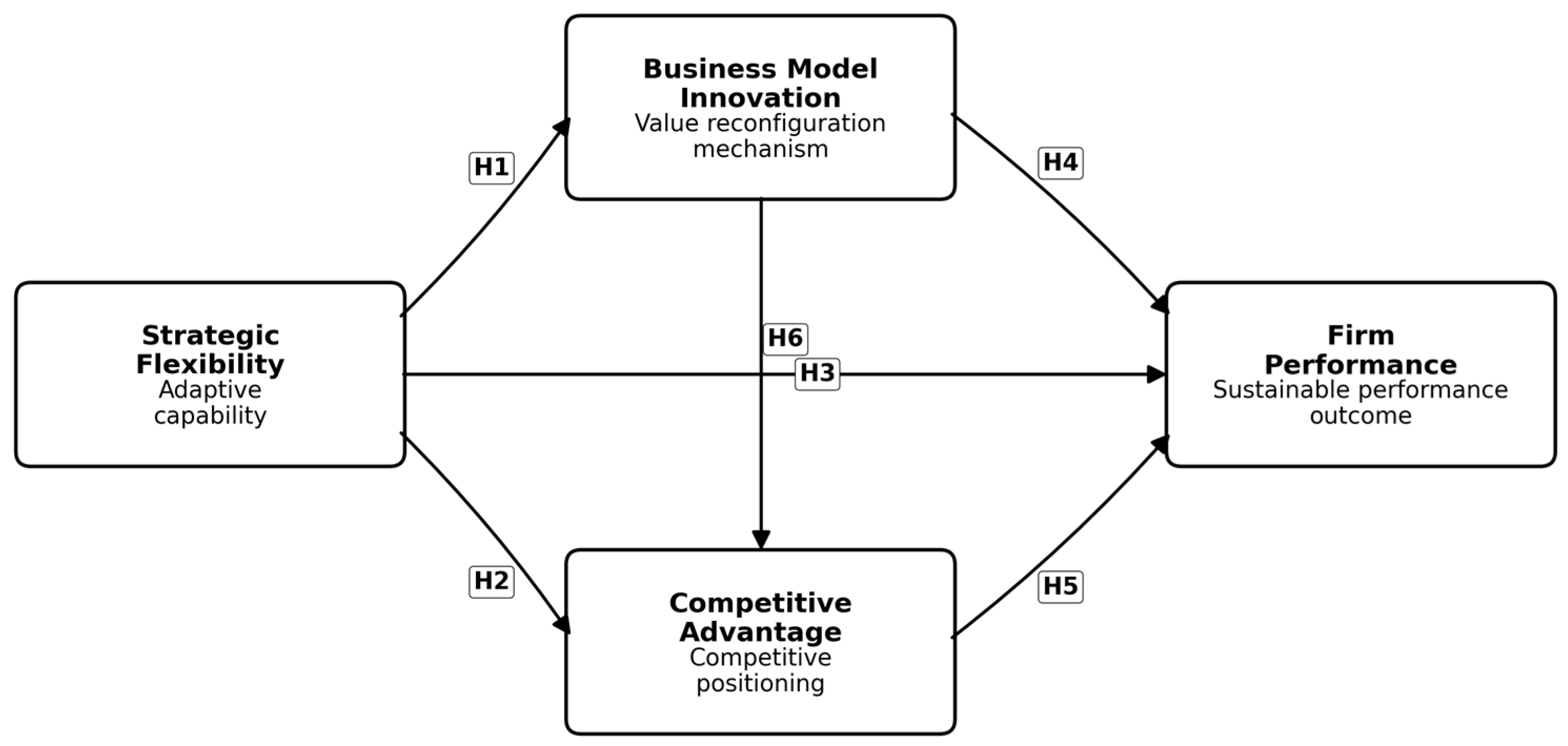
H1. SF has a direct and powerful impact on Business Model Innovation.
2.7.2. SF and CA
Based on the Resource-Based View, a sustainable CA arises from resources that are valuable, rare, difficult to imitate, and non-substitutable. However, in a dynamic market it is not enough for a company to just have valuable resources; it must also be able to reconfigure those valuable resources effectively [
58]. The company’s SF indicates its capacity to reallocate valuable resources to alter its competitive standing or to adapt to environmental changes. [
59]. By being able to adapt quickly and effectively, companies can maintain their differentiation and cost advantages compared to their competitors. Therefore:
H2. SF directly and significantly impacts CA.
2.7.3. BMI and CA
BMI provides a broader conceptual basis upon which to redefine the logic that underpins value creation and, through changing transaction characteristics (content, structure and governance), enables organizations to create new value networks and mechanisms for lock-in [
35]. BMI is frequently a source of differentiation advantage, an improvement in efficiency, or an innovative value proposition that is difficult for competitors to replicate.
In addition to being a source of differentiation advantage, new business models can generate complementarities and create switching costs for the customer, thereby reinforcing the sustainability of an organization’s CA. Several empirical studies have found that BMI has a positive effect upon an organization’s strategic positioning in competitive markets. Hence:
H3. BMI directly and significantly impacts CA.
2.7.4. BMI and Firm Performance
Not only does BMI create an advantage in competition (competitive positioning), it also has an effect about a company’s financial and non-financial performance metrics [
15]. By providing new means for companies to capture value from their customers and improved methods for developing and engaging customers, BMI contributes to increasing revenue and improving operational efficiencies.
Empirical evidence shows that companies which engage in systematic BMI achieve higher rates of growth, profit and market performance than companies with static business models [
38]. Thus:
H4. BMI directly influences Firm Performance in a meaningful way.
2.7.5. CA and Firm Performance
Strategically positioned firms create CA as an intermediate result, which produces superior performance through RBV (resource-based view). Firms that maintain themselves as being differentiated or cost-effective will likely achieve an above-average rate of return on their investment [
60,
61].
When firms provide substantially more value to customers than their competitors, they tend to see increased loyalty, higher margins, and a larger market share. As a result:
H5. Firm Performance is directly affected by CA.
2.7.6. SF and Firm Performance
SF can have a direct impact on FP in addition to its indirect impact via CA and BMI. Firms that are flexible in their operations are more successful at managing risk, responding to crises, and seizing new opportunities. This is consistent with the Dynamic Capabilities View (DCV), wherein Gao et al. [
62] states that the capacity of a company to adapt to change is a source of heterogeneity in performance.
In empirical studies of SF and CA under conditions of uncertainty or environmental change, it has been determined that SF positively correlates with firm performance. As a result, it can be said that:
H6. SF has a direct and substantial influence on the FP.
2.8. Conceptual Model
This study’s conceptual model is based on multiple previous studies [
15,
22,
63];
Figure 1 illustrates visually how Strategic Flexibility (SF) is positioned as the main antecedent and is expected to influence Business Model Innovation (BMI), Competitive Advantage (CA), and Firm Performance (FP). BMI is expected to affect both CA and FP, while CA is expected to influence FP. Overall, the model represents a capability–innovation–advantage–performance sequence through which SMEs may translate strategic adaptability and business model renewal into sustainable performance outcomes.
3. Methodology
3.1. Research Design
An empirical quantitative design was employed to investigate how SF, BMI, CA, and FP interact within Iranian SMEs. This method was selected because it offers several advantages.
Firstly, it allows for a larger sample size, enhancing the generalizability of the findings. Secondly, it facilitates a streamlined analysis process, enabling a comprehensive examination of the key variables. Lastly, a quantitative approach offers a systematic framework for hypothesis testing, helping to produce strong and credible conclusions [
64].
3.2. Data and Sample
This study used convenience sampling to collect data from Iranian SMEs across different sectors. Data were collected in the first quarter of 2025, through face-to-face interactions with SME owners, senior managers, middle managers, and operational managers. This approach was adopted in order to reach respondents directly involved in strategic, organizational, and operational decision-making within their firms.
The use of convenience sampling was considered appropriate given the exploratory and context-specific nature of the study, as well as the practical difficulty of accessing a complete and publicly available sampling frame of Iranian SMEs across sectors. In emerging-economy contexts, firm-level data collection is often constrained by limited access to official business registers, uneven willingness of firms to participate in academic research, and the need to reach respondents who possess direct knowledge of strategic and organizational processes. For this reason, the sampling strategy focused on respondents occupying ownership, senior management, middle management, or operational management roles, as these actors were more likely to provide informed assessments of Strategic Flexibility, Business Model Innovation, Competitive Advantage, and Firm Performance.
A total of 589 questionnaires were administered. Of these, 421 completed responses were received, corresponding to a response rate of 70.40%. After data screening and validation procedures, 391 valid questionnaires were retained for the final analysis. The final sample included respondents from different managerial positions and sectors, including ICT, finance and banking, pharmaceuticals and chemicals, construction, education, and other industries.
Although the final sample covers several sectors and managerial roles, it should not be interpreted as statistically representative of the entire population of Iranian SMEs. The non-probabilistic nature of convenience sampling limits the external validity of the findings and requires caution when generalizing the results beyond the firms included in the study. In addition, response bias may be present because firms and managers willing to participate may differ from non-respondents in terms of openness to innovation, managerial awareness, organizational performance, or willingness to disclose firm-related information. Therefore, the findings should be interpreted as providing empirical evidence on the relationships among SF, BMI, CA, and FP within the sampled Iranian SMEs, rather than as population-level estimates for all Iranian SMEs. Future studies should attempt to replicate the model using probability sampling, larger sector-specific samples, or official SME databases in order to improve representativeness and strengthen external validity.
3.3. Measurement
The measurement instruments adopted in this study were derived from prior empirical research and subsequently adjusted to better reflect the socioeconomic and organizational characteristics of the Iranian context. Since the survey was initially developed in English, the questionnaire was converted into Farsi (Persian) to improve respondents’ understanding and contextual appropriateness. All responses were collected anonymously in order to preserve participants’ confidentiality and encourage unbiased answers. Accordingly, each variable was operationalized using several items: SF was measured using three items derived from Bashir [
22]; BMI was measured using nine items based on Hu et al. [
65]; CA was measured using five items based on Eyasu and Arefayne [
66]; and FP was measured using six items based on Nguyen et al. [
67].
Because all variables were collected from the same respondents through the same questionnaire and at the same point in time, common method bias may represent a potential methodological concern. To reduce this risk procedurally, several steps were adopted during questionnaire design and data collection. First, participation was voluntary and anonymous, which helped reduce social desirability pressures and encouraged respondents to provide more accurate answers. Second, the questionnaire was translated into Farsi in order to improve clarity and reduce misunderstanding of the items. Third, the items were adapted from validated scales used in previous empirical research, thereby reducing ambiguity in measurement. Fourth, respondents were informed that there were no right or wrong answers and that the data would be used only for academic purposes and analyzed in aggregated form.
The questionnaire was organized around the four main constructs included in the conceptual model: Strategic Flexibility, Business Model Innovation, Competitive Advantage, and Firm Performance. Each group of questions was directly connected to the hypotheses tested in the structural model. Strategic Flexibility items were used to assess the firm’s ability to adapt strategic decisions and reconfigure resources in response to environmental changes; these items are related to H1, H2, and H6. Business Model Innovation items measured changes in the way firms create, deliver, and capture value; these items are related to H1, H3, and H4. Competitive Advantage items assessed the firm’s perceived ability to achieve a superior position compared to competitors; these items are related to H2, H3, and H5. Firm Performance items measured perceived organizational outcomes and represent the final dependent construct of the model; these items are related to H4, H5, and H6.
To clarify the relationship between the questionnaire, the constructs, and the hypotheses,
Table 2 summarizes the measurement structure adopted in the study. Further, to enhance transparency and clarity,
Appendix A illustrates
Table A1 and
Table A2 related to the questions and their references, and the statistical information related to each question.
3.4. Data Analysis
To examine the proposed research model, the study relied on confirmatory factor analysis (CFA) and structural equation modeling (SEM). Data analysis was conducted using SPSS version 21 and AMOS version 24. SPSS was used to enter and screen the data, calculate descriptive statistics for each questionnaire item, and assess internal consistency through Cronbach’s alpha. AMOS was used to conduct CFA, path analysis, and SEM, given its suitability for covariance-based testing and for evaluating the relationships proposed in the conceptual model.
Before testing the structural model, item-level descriptive results were examined in order to assess the distribution of responses across the survey questions. This preliminary step helped verify the consistency of the collected data and provided a clearer overview of how respondents evaluated the items related to Strategic Flexibility, Business Model Innovation, Competitive Advantage, and Firm Performance. Each set of items was then linked to its corresponding latent construct and to the hypotheses developed in the study. The model did not include control variables as it specified parsimoniously in order to assess the hypothesized capability–innovation–advantage–performance relationships.
The data analysis was carried out in two phases. In the first phase, CFA was applied to assess the measurement model and to verify the consistency between the observed indicators and the theoretically defined latent constructs. CFA is commonly used for developing and refining measurement tools, checking how well the observed variables align with the proposed model, verifying model fit indices, and assessing the reliability and validity of the constructs [
68].
Reliability was assessed through Cronbach’s alpha and composite reliability, while convergent and discriminant validity were evaluated through factor loadings, average variance extracted, and the HTMT ratio. In addition to evaluating the reliability and validity of the measurement model, Harman’s single-factor test was employed to assess the potential influence of common method variance. In the second phase, SEM was conducted to evaluate the hypothesized relationships among the constructs and to assess the overall model fit. Specifically, the analysis tested the direct effects of Strategic Flexibility on Business Model Innovation, Competitive Advantage, and Firm Performance; the effects of Business Model Innovation on Competitive Advantage and Firm Performance; and the effect of Competitive Advantage on Firm Performance. This analytical procedure allowed us to examine how the questionnaire items, the latent constructs, and the proposed hypotheses were empirically connected within a single structural model.
4. Results
Table 3 presents information about the firms. Out of 391 responses, 68 owners, making up 17.4%, participated in the study. Among the respondents, 112 (28.6%) were senior managers, 121 (30.9%) were mid-level managers, and 90 (23.0%) were operations managers. Data was collected from companies across various industries: 10.2% in ICT, 20.5% in Finance and Banking, 19.9% in Pharmaceuticals and Chemicals, 23.5% in Construction, 15.9% in Education, and 10.0% in other sectors. The distribution by firm size shows that 57 respondents represented SMEs with 20–50 employees, while 101 were associated with firms employing 51–100 workers. A further 104 respondents came from companies with 101–150 employees, 94 from firms with 151–200 employees, and 35 from firms in the 201–250 employee category. Additionally, 181 firms began operations 10 years ago, 116 started between 11 and 20 years ago, and 94 have been operational for over 21 years.
Prior to testing the structural model, Pearson correlation analysis was conducted to examine the bivariate relationships among the study constructs. As shown in
Table 4, all correlations were positive and statistically significant at the 0.01 level. Strategic flexibility exhibited significant positive correlations with business model innovation (
r = 0.506,
p < 0.01), competitive advantage (
r = 0.549,
p < 0.01), and firm performance (
r = 0.580,
p < 0.01). Likewise, business model innovation was positively associated with competitive advantage (
r = 0.494,
p < 0.01) and firm performance (
r = 0.536,
p < 0.01). Competitive advantage also showed a significant positive correlation with firm performance (
r = 0.478,
p < 0.01). These findings provide preliminary support for the hypothesized relationships and indicate that the constructs are associated in the expected directions. Furthermore, none of the correlation coefficients exceeded the commonly accepted threshold of 0.80, suggesting that multicollinearity is unlikely to be a concern.
The measurement model test results confirmed the model’s satisfactory relationship with data (χ2 = 315.790; df = 183; χ2/df = 1.726; RMSEA = 0.043; PNFI = 0.757; GFI = 0.929; AGFI = 0.910; CFI = 0.939; IFI =0.940; TLI = 0.930). The table below presents the factor loading, Cronbach’s α, Composite Reliability (CR), and Average Variance.
Most items have factor loadings that exceed 0.5, which is the recommended threshold value, as indicated in
Table 2 [
69]. The factors for the three items are standardized to a range of 4 to 5. In accordance with Guadagnoli & Velicer [
70], indicators with factor loadings above 0.40 were retained, as this threshold suggests adequate stability within the measurement model. The internal consistency of the constructs was further confirmed by Cronbach’s alpha coefficients exceeding 0.70, in line with conventional reliability criteria [
71]. For short scales or exploratory measures, values ranging between 0.60 and 0.70 are generally considered acceptable. According to Cronbach [
72], and Hajjar [
73]. However, a Cronbach’s alpha score greater than 0.6 has been established as the minimum threshold for determining a measure’s reliability, according to
Table 5, which presents both the CR and AVE for the measurement models. Hair et al. [
69] indicates that a CR above 0.7 is considered to possess good internal consistency. All CRs were noted to be at least 0.7, as shown in
Table 5. According to Fornell and Larcker [
71], if the AVE is below 0.5 but the CR exceeds 0.6, the construct’s convergent validity is acceptable; therefore, it can be classified as acceptable.
Although several constructs exhibited Average Variance Extracted (AVE) values below the recommended threshold of 0.50, the measurement model was retained for both theoretical and methodological reasons. First, all retained indicators demonstrated standardized factor loadings above the minimum acceptable level of 0.40 suggested by Guadagnoli and Velicer [
70], indicating that each item made a meaningful contribution to its underlying construct. Second, all constructs exhibited satisfactory Composite Reliability values well above the recommended threshold of 0.70, indicating adequate internal consistency despite the relatively conservative AVE values [
69]. As noted by Fornell and Larcker [
71], convergent validity may still be considered acceptable when Composite Reliability exceeds 0.60 even if AVE is below 0.50.
Furthermore, the retained indicators were derived from previously validated measurement scales and were preserved to maintain the conceptual comprehensiveness and content validity of each construct. Removing indicators solely to improve statistical indices may artificially inflate model quality while reducing the theoretical representation of multidimensional constructs. Because the observed factor loadings, reliability coefficients, and overall model fit indices collectively supported the adequacy of the measurement model, the original measurement specification was retained.
Since all constructs were measured using a self-reported questionnaire administered to a single respondent from each firm, the possibility of common method variance (CMV) was statistically assessed using Harman’s single-factor test, following the recommendation of Podsakoff et al. [
74]. All measurement items were entered into an unrotated principal component analysis. The results revealed that the first unrotated factor accounted for 29.52% of the total variance, which is substantially below the recommended threshold of 50%. Therefore, common method variance is unlikely to pose a serious threat to the validity of the measurement model or to bias the observed relationships among the study constructs.
In
Table 6, the figures concerning the evaluation of [
75] is provided. Based on [
75] an HTMT value exceeding 0.90 suggests insufficient discriminant validity. As shown in
Table 6, all corresponding values are below this threshold.
Hypothesis testing and structural equation model.
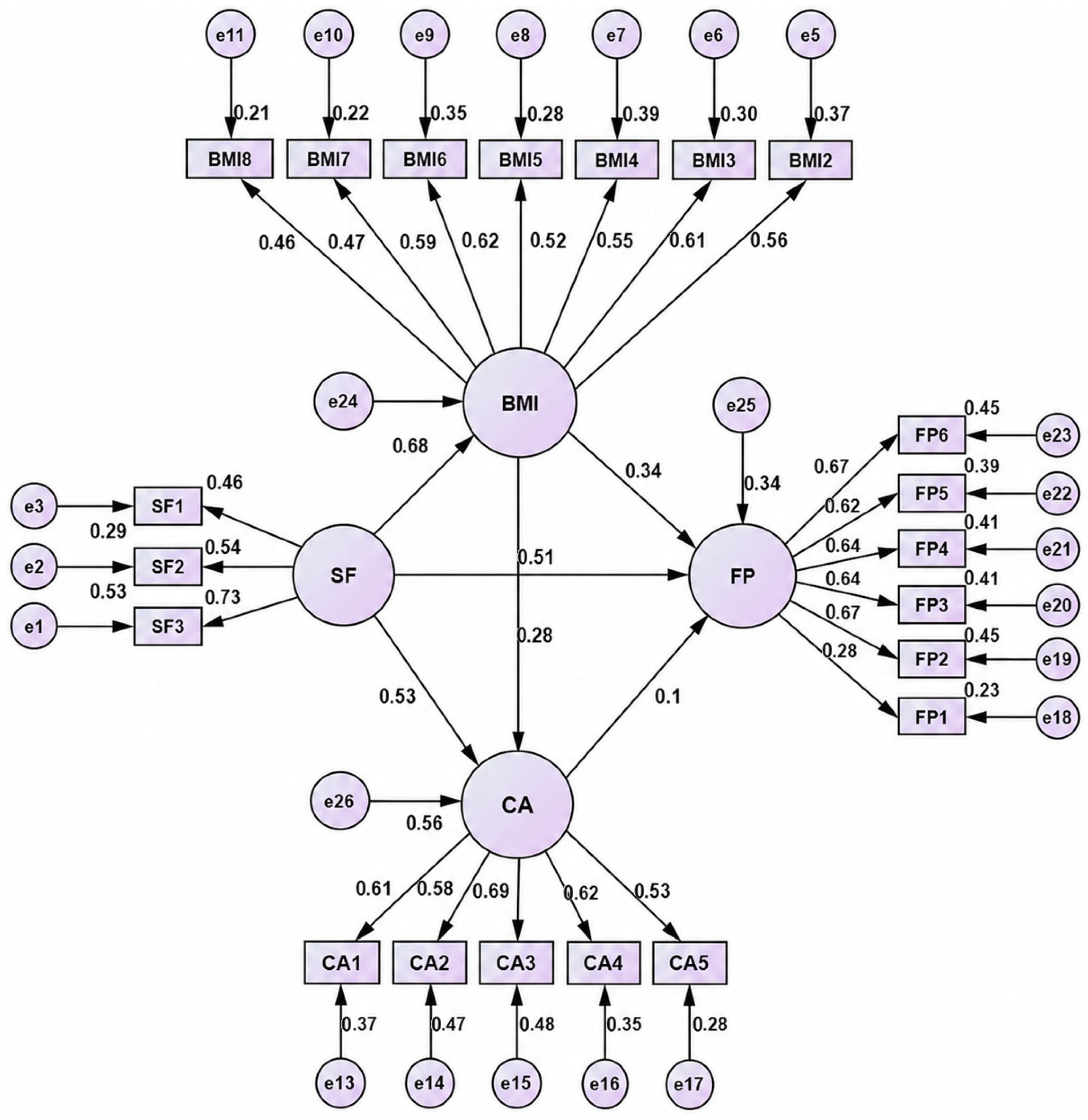
Table 7 and
Figure 2 present the results of the structural equation modeling (SEM).
As shown in
Table 7 and
Figure 2, the research found that economic SF has a strong, direct impact on BMI (β = 0.677;
p < 0.01), supporting Hypothesis 1. Likewise, SF also has a strong direct effect on CA (β = 0.527;
p < 0.01), supporting Hypothesis 1. Furthermore, BMI has a strong, direct effect on firm CA (β = 0.277;
p < 0.01), supporting Hypothesis 3. Also, BMI has a strong, direct impact on FP (β = 0.339;
p < 0.01), supporting Hypothesis 4. However, CA does not directly nor strongly affect FP (β = 0.010;
p > 0.05), meaning that Hypothesis 5 was not supported. Lastly, there is also a direct and strong influence of SF on FP (β = 0.513;
p < 0.01).
In
Table 7, the R-squared value for BMI is 0.459. This means SF accounts for 45.9% of the variability in BMI; therefore, 54.1% of the residual variation in BMI is due to variables beyond the content of this research. The R-squared value for CA is 0.552; thus, SF & BMI combined explain 55.2% of the variability in CA, while 44.8% of the remaining variation is attributable to variables that were not measured in this research. Finally, the R-squared value for FP is 0.625, indicating that SF, BMI, & CA, as a group, account for 62.5% of FP variability; consequently, 37.5% of FP variability can be attributed to variables not measured in this study.
5. Discussion
This study examined the direct and interrelated effects of SF, BMI, CA, and FP within SMEs operating in an emerging economy context. The empirical findings provide support for five of the six proposed hypotheses, indicating that SF, BMI, and CA are connected through a capability–innovation–advantage–performance sequence. However, contrary to theoretical expectations, the data did not support a direct relationship between CA and FP (H5). From a sustainability perspective, these findings are relevant because SMEs are increasingly required to pursue not only short-term performance, but also long-term organizational viability, resilience, responsible value creation, and sustainable growth. In emerging economies, where firms often operate under conditions of resource scarcity, institutional uncertainty, and market volatility, sustainability also concerns the capacity of firms to remain economically viable, socially embedded, and able to adapt their business models to changing economic and institutional conditions.
The results indicate that SF is positively and significantly associated with both BMI (H1) and CA (H2), and that SF also has a significant direct relationship with FP (H6). The Dynamic Capabilities View, as proposed by Teece [
9], holds that companies must adapt and reallocate resources in order to remain competitive in turbulent markets. In this study, SF appears to provide Iranian SMEs with a greater capacity to identify opportunities, adjust resource allocation, and revise strategic choices.
In terms of sustainability, SF can be interpreted as an important capability for adaptation. Flexible firms may be better able to respond to external pressures, manage uncertainty, avoid organizational rigidity, and reconfigure resources in ways that support long-term continuity. This is particularly relevant for SMEs, which generally have fewer financial and technological resources than large firms and therefore need to use existing resources more efficiently. Strategic flexibility may therefore contribute to sustainability by helping SMEs improve resource efficiency and align organizational practices with changing stakeholder, market, and institutional expectations.
This suggests that flexibility is not only a defensive response to uncertainty but can also support innovation at the business model level and improve firms’ ability to adjust to changing competitive conditions. The observed direct relationship between SF and FP indicates that adaptability may be associated with performance-oriented capabilities in unstable and rapidly transforming environments, such as many emerging markets.
The findings also show that BMI is positively and significantly associated with both CA (H3) and FP (H4). These results are consistent with Amit and Zott’s [
37] value creation logic, according to which BMI changes how value is created, delivered, and captured. SMEs can improve differentiation and operational efficiency by restructuring activity systems and revenue-generation mechanisms.
From a sustainability viewpoint, BMI is relevant because it allows firms to reconsider not only how they compete, but also how they create and capture value in more durable ways. Business model innovation can support sustainable growth by helping SMEs improve operational efficiency, reduce resource dependency, strengthen stakeholder relationships, identify new market opportunities, and develop more resilient forms of value generation. In this sense, BMI should not be considered only a tool for improving profitability, but also a mechanism through which SMEs can develop more adaptive business practices.
The findings highlight the role of BMI as a mechanism through which SF may be translated into performance outcomes. Performance improvements appear to depend not only on the possession of resources, but also on how firms use and recombine those resources through their business models. This interpretation is consistent with dynamic capability reasoning, which emphasizes adaptation and reconfiguration rather than static resource accumulation.
This point is relevant for the sustainability orientation of the study. Sustainable performance does not depend only on the quantity of resources available to firms, but also on the way firms use those resources over time. For SMEs, which often operate with limited capital, limited access to finance, and constrained technological capabilities, sustainability depends partly on the ability to innovate within constraints. BMI therefore represents one possible pathway through which SMEs can transform limited resources into long-term value, organizational resilience, and more stable competitive positioning.
Despite the expected positive relationship between CA and FP, Hypothesis 5 was not supported. The SEM results show that the direct path from CA to FP was very small and statistically non-significant (β = 0.010; t = 0.096; p = 0.923). Therefore, the findings do not provide empirical support for a direct CA–FP relationship in the sampled Iranian SMEs. This result should be interpreted cautiously and should not be understood as evidence that competitive advantage is irrelevant for SME performance. Rather, it suggests that, within the present model, CA does not add a direct explanatory contribution to FP once SF and BMI are included.
This finding differs from the conventional expectation derived from the RBV [
58] and competitive positioning theory, according to which firms with stronger competitive positions should be more likely to achieve superior performance. However, previous literature also suggests that the CA–FP relationship may be more complex, particularly in dynamic and uncertain environments. McGrath [
33], for example, argues that competitive advantages may become increasingly transient and may require continuous renewal. Similarly, Teece [
9,
43] emphasizes that firms must not only develop competitive positions, but also capture value through appropriate business models and dynamic capabilities. In this sense, CA may not automatically translate into performance unless it is supported by effective value creation, value capture, and resource reconfiguration mechanisms.
One possible interpretation is that BMI may absorb part of the performance-relevant effect that is usually attributed to CA. In the present model, BMI is positively associated with both CA and FP, suggesting that business model renewal may represent a more direct pathway through which SMEs convert adaptive capabilities into performance outcomes. This interpretation is consistent with studies showing that BMI can influence firm performance through indirect mechanisms, including organizational capabilities, revenue growth, efficiency growth, and competitive positioning [
42,
44]. Therefore, CA may still matter, but its role may be indirect, conditional, or dependent on the firm’s ability to organize value creation and value capture through an innovative business model.
Another possible explanation concerns the specific nature of SMEs operating in emerging-economy contexts. Although SMEs may achieve a competitive position through differentiation, reputation, pricing, or market responsiveness, they may not always have the complementary resources required to transform that position into measurable performance outcomes. Limited access to finance, restricted scale, technological constraints, and weak complementary assets may reduce the extent to which competitive positioning is converted into financial or organizational performance. In this sense, the non-significant CA–FP relationship may indicate that competitive advantage alone is insufficient unless it is accompanied by adaptive capabilities and business model renewal.
The result may also reflect the cross-sectional nature of the study. The effect of CA on FP may require time to become visible, especially when performance is measured through managerial perceptions at a single point in time. Advantages based on differentiation, customer loyalty, reputation, or market positioning may generate performance effects only over a longer period. Therefore, future longitudinal research would be useful to examine whether CA contributes to FP with a time lag.
Finally, while contextual conditions such as institutional uncertainty, macroeconomic instability, sanctions, and market volatility may help explain why CA does not directly predict FP in the Iranian SME context, these factors were not directly measured in this study. For this reason, they should be understood only as possible contextual explanations rather than as empirically established conclusions. Future research should test these mechanisms more directly by including measures of environmental turbulence, institutional uncertainty, access to finance, and objective performance indicators.
Overall, the unsupported H5 relationship does not necessarily contradict RBV; instead, it suggests that, in the context examined, CA may operate indirectly, conditionally, or with a time lag. Competitive advantage remains theoretically important, but its performance implications may depend on how it is connected to SF, BMI, value capture mechanisms, and the structural constraints faced by SMEs in emerging economies.
Thus, the discussion indicates that SF and BMI are relevant for understanding how SMEs can pursue sustainability in uncertain and resource-constrained environments. Strategic flexibility supports adaptation, while business model innovation provides a mechanism for reconfiguring value creation and value capture. In this sense, sustainability emerges as a multidimensional outcome involving economic continuity, organizational resilience, efficient use of resources, stakeholder-oriented value creation, and the capacity to operate under conditions of uncertainty.
6. Conclusions
This research examined how SF, BMI, CA, and FP relate to one another among SMEs operating in an emerging market business environment. Drawing on the RBV and Dynamic Capabilities perspectives, the study empirically tested a capability–innovation–advantage–performance model and explored the role of adaptive strategic capacity in shaping organizational outcomes. The findings suggest that SF is relevant for SMEs because it is associated with BMI, CA, and FP. This indicates that the ability to adjust strategic choices and reconfigure resources can support organizational adaptation and contribute to sustainable performance. BMI also emerges as an important mechanism for translating adaptive capacity into tangible outcomes, since it concerns the ways firms create, deliver, and capture value.
The results are also relevant because CA did not show a direct relationship with FP. This finding suggests that, in the sampled SMEs, competitive positioning may not automatically translate into performance outcomes. Since contextual factors such as institutional volatility, sanctions, market instability, and delayed effects were not directly measured, this result should be interpreted with caution. It nevertheless indicates that CA may need to be supported by adaptive capabilities and business model innovation in order to produce more durable performance effects. In conclusion, this study suggests that, when SMEs face uncertainty, SF and BMI may be more directly associated with sustainable organizational outcomes than competitive positioning alone. The model offers useful evidence on how adaptive capabilities, business model renewal, and competitive positioning interact in SMEs operating in dynamic and resource-constrained markets.
6.1. Theoretical Contributions
This research contributes to strategic management and BMI literature by offering an empirical examination of how SF, BMI, CA, and FP are related in SMEs operating in an emerging economy. Rather than proposing a new theoretical paradigm, the study provides a contextual extension of established relationships within the Resource-Based View, the Dynamic Capabilities perspective, and the business model innovation literature.
The first contribution lies in examining SF, BMI, CA, and FP within the same empirical model. Previous research has often considered these constructs separately or through pairwise relationships. By analyzing them together, this study provides a more context-sensitive understanding of how adaptive strategic capacity is associated with innovation, competitive positioning, and performance outcomes among SMEs.
The second contribution concerns the contextual examination of SF within the Dynamic Capabilities framework. SF is interpreted as an adaptive capability that enables firms to reconfigure resources, revise strategic commitments, and respond to changing environmental conditions. The findings indicate that SF is associated with BMI, CA, and FP, suggesting that strategic flexibility may play a relevant role in SMEs facing uncertainty, resource constraints, and institutional volatility.
Third, the findings support the role of BMI as an empirically relevant pathway connecting internal capabilities to external market outcomes. Consistent with the activity-system perspective of business models developed by Amit and Zott [
37], BMI can be understood as a mechanism through which SMEs reorganize value creation and value capture. In this regard, the study reinforces existing theoretical understanding of BMI without presenting it as a new theoretical mechanism.
Finally, the unsupported CA–FP relationship qualifies the assumption that competitive advantage necessarily leads directly to superior firm performance. The findings suggest that, in emerging-market contexts, the performance implications of CA may be indirect, contingent, or dependent on innovation-related processes. This contributes to the debate on the contextual boundaries of RBV and highlights the importance of considering institutional and market conditions when examining the relationship between capabilities, sustainability, and performance.
By empirically testing the model among SMEs in Iran, this study extends the contextual application of strategic management, dynamic capability, and BMI perspectives beyond developed-country settings. The results therefore support the need for more context-sensitive research on SMEs operating under emerging-economy constraints.
6.2. Managerial Implications
This study provides relevant implications for managers of SMEs seeking to improve long-term sustainability, resilience, and competitiveness, particularly in sectors of the economy affected by high levels of turbulence and institutional pressures.
The first implication is that cultivating SF’s managerial capability is of strategic relevance. Managers need to transition away from rigid, long-term planning approaches toward dynamic, adaptive decision-making processes that enable rapid realignment of resources, reprioritization of strategy, and reorganization of the firm in a rapidly changing context. Establishing flexible structures, decentralizing some decision-making processes, and investing in a culture of learning may help a firm better position itself to respond proactively to uncertainty in the external environment.
The observed relationship from SF to BMI suggests that flexible arrangements should be intentionally used to drive sustainability-oriented innovation by encouraging innovation in both the creation and capture of value. It is also important for companies and SMEs to regularly assess and adjust how they generate revenue, engage customers, structure partnerships, and manage their operations based on the results of this evaluation. Therefore, rather than viewing their business model as being static, SMEs should view it as a flexible vehicle and an ongoing process requiring innovative design.
Third, given the observed relationships involving BMI, CA, and business performance, Managers should focus on transforming business models as a core strategic initiative versus only innovating with products or processes. With structured experimentation, piloting new value propositions, and systematically evaluating alternative revenue sources, businesses may enhance long-term sustainability and profitability.
Fourth, the misalignment between CA and FP can provide useful insights for managers. A manager who achieves cost or difference advantages alone may not automatically generate superior financial outcomes in volatile emerging markets. As there will be little benefit to competitive positioning without value capture mechanisms in place, it is essential for management to embed their competitive strengths into a business model that can scale, is financially viable, and could adapt.
Lastly, results suggest that policymakers and ecosystem actors may help SMEs by promoting adaptive capacity and management training focused on innovation, strategic agility, digital transformation readiness, and business model experimentation to improve the long-term sustainability, resilience, and adaptive capacity of SMEs operating in uncertain and resource-constrained environments.
In summary, the research suggests that in a constantly changing marketplace, the main driver for superior performance is not necessarily the historic position of an enterprise on an industry-related or product-related basis. Rather, continuous evolution through adaptability and renewal of the business model may be more valuable to a manager’s successful results than their ability to maintain the position that they previously held. Thus, managers who view flexibility and innovation as strategic processes may contribute to a greater level of sustainability.
6.3. Limitations and Future Research Directions
While this research provides some important theoretical and practical contributions, it also has several limitations. These limitations suggest areas for further research.
First, given that this research was undertaken using a cross-sectional design, it limits strong causal conclusions from being made and does not track how SF, BMI, CA, and FP change over time. Future studies should use a longitudinal design, especially considering (e.g., Teece [
43]) a Dynamic Capabilities perspective, as this perspective highlights the importance of processes and time-based adaptation. Panel data or time-lagged studies will help researchers understand how the SF construct generates sustainable performance enhancements, over time, in different growth phases of an organization.
This study’s empirical focus on SMEs in the same emerging economy is a second limitation. Although the findings provide meaningful insight into how capabilities are related to performance under conditions of institutional uncertainty, the narrow focus may restrict them from being extended to broader populations. Future studies could use cross-national/region comparisons of SMEs in emerging countries and SMEs in developed countries to determine whether institutional environments influence the relationships obtained in this study. Comparative studies such as these would provide a better understanding of the limits of the Resource-Based View [
58] and the DoC Theory.
In addition, the geographical and cultural context of Iran should be explicitly considered when interpreting the findings. Iranian SMEs operate in a specific emerging-economy environment characterized by institutional constraints, macroeconomic volatility, sanctions, restricted access to international markets, and resource limitations. These conditions may strengthen the importance of Strategic Flexibility and Business Model Innovation as adaptive and sustainability-oriented capabilities. At the same time, cultural and organizational factors, such as managerial decision-making styles, risk perception, trust-based business relations, and the role of informal networks, may shape how SMEs perceive flexibility, innovation, competitive advantage, and performance. Therefore, the results may not be directly generalizable to SMEs operating in developed economies or in emerging economies with different institutional and cultural configurations. For example, studies conducted in European or other developed-country contexts often emphasize innovation ecosystems, digital transformation, stakeholder pressure, and formal institutional support as key drivers of business model innovation and sustainable performance. By contrast, in the Iranian context, adaptive capacity may be more closely connected to firms’ ability to cope with uncertainty, resource scarcity, and external constraints. Future research should therefore compare SMEs across different geographical and cultural settings in order to examine whether the relationships among SF, BMI, CA, and FP are stable across contexts or whether they are moderated by institutional quality, cultural norms, market openness, and sustainability-related policy frameworks.
Thirdly, this study examined only the direct structural relations between the four constructs but did not take into consideration the potential moderating variables affecting this relationship, such as environmental turbulence, intensity of digital transformation, industry dynamism, and the organizational learning culture. Moreover, there are not control variables in the structural model. Although the model was specified parsimoniously in order to focus on the hypothesized relationships among SF, BMI, CA, and FP, firm size, firm age, industry, and respondent position may influence firm performance or condition the strength of the relationships examined. Future studies should include these variables as controls or moderators to assess the robustness of the proposed model across different types of SMEs. Researchers for future studies may consider testing better models through moderated mediation frameworks to understand how these context-dependent contingency factors influence the relative strength and direction of relationships.
As a fourth point, since CA and FP are statistically unrelated, the influence may be indirect (through criteria) or conditional (dependent). Future studies may examine how CA affects performance by using alternative mediating variables, such as innovation ability, absorptive capacity, and/or digital ability; or how far out (at what point) the effect of CA becomes statistically significant.
In the fifth area of concern, it is important to note that this study relied primarily on perceptual surveys, which could introduce common method bias despite the use of statistical controls. In the future, researchers can enhance both robustness and measurement validity by combining subjective measures of managerial perceptions with objective measures of performance (e.g., financial statements, growth rates, market share data).
Future studies could examine the micro-foundations of Strategic Flexibility, including but not limited to leaders’ cognition about their businesses; how a CEO’s risk orientation impacts their decisions; the way organizations make decisions. Understanding how individual-level factors come together at the organizational level to create an organization’s Adaptive Capability will provide a clearer theoretical understanding of these factors and greater practical relevance.
Overall, this study adds value to the understanding of how strategic flexibility and BMI affect performance outcomes in SMEs, but it must be further researched, including longitudinal studies, cross-contextual research, and multi-level research, to provide greater theoretical clarity and increased generalizability.