1. Introduction
With the rest of the world struggling to contain the rising environmental issues, the need to adopt green growth approaches has never been higher. The goal of green growth is to separate economic growth and environmental degradation, whereby long-term ecological sustainability is attained through developments in the most vital sectors, including energy, industry, and finance, among others [
1]. With increasing global pressures to solve climate change, loss of resources, and biodiversity issues amid economic growth rates, the countries in the global arena are becoming subject to mounting pressure. The transition to sustainable development is not only a moral but also an economic need of the G7 countries, which together contribute many percent of the global emissions and the economy. Although there is increased agreement that green growth is essential, there are still major gaps in the comprehension of the nature of interactions between the identified drivers that include energy transition, green innovation, financial inclusion, and the circular economy, to determine the sustainability results on a national and global scale [
2]. The issue of concern is that there are no adequate steps toward integrating these aspects into current policy frameworks, and no extensive research has been done on the overall impact of such combined factors on green growth. This study will bridge this gap by examining the role of the interaction of these powerful drivers on the dynamics of green growth in the G7 countries, and this offers important lessons to the world in terms of sustainability.
The G7 nations of Canada, France, Germany, Italy, Japan, the United Kingdom, and the United States are some of the largest economies of the world that have an immense impact on economic, environmental, and technological patterns all over the world [
3]. These countries are highly industrialized, and as such, they are the biggest contributors of greenhouse gas emissions in the world; their states, however, have the resources, the ability for innovation, and the institutions that will easily spearhead the shift to sustainable development. The G7 has been on the leading edge of global climate negotiations, featuring in the Paris Treaty and UN Sustainable Development Goals (SDGs), which will make them an important stakeholder in the global agenda of green growth [
4]. Nevertheless, regardless of their position as world leaders, every one of the G7 countries has its own problems in terms of economic prosperity and environmental responsibility. Certain countries have achieved major progress in such areas as renewable energy, green innovation, and financial inclusion, whereas there are still those that deal with the problems of high carbon intensity and insufficient use of a circular economy [
5]. This paper chose the G7 countries as a sampling group representing advanced economies, which would give good insights into the ways through which the G7 countries can join forces and counter the tension between economic growth and environmental sustainability [
6]. With the focus on energy transition dynamics, innovation, financial inclusion, and the circular economy, the study of this specific group of countries and their drivers of green growth will be conducted.
The primary objective of the study is to find out how green growth functions in G7 countries by assessing the interaction of the most significant drivers using energy transition, green innovation, financial inclusion, and circular economy. Nevertheless, despite the growing significance of the factors, the overall impact of the factors with regard to G7 green growth has not been fully examined. The proposed study will fill this gap, as it will provide a detailed description of how these variables interact with each other and contribute to the desired results of sustainable development. Specifically, the research problems that the study aims to achieve are as follows: (1) to investigate long-term and short-term effects of energy transition on the green development of the G7 countries; (2) to discover the role of green innovation as the driver of sustainable economic development; (3) to examine the interdependence between financial inclusion and green development and how the access to financial services can impact green technologies and practices; (4) to investigate the effects of the circular economy policy on resource efficiency and environmental sustainability that can have an implication on the green development of the G7 countries and other countries.
The study’s conceptual framework is based on the fact that green growth is a multidimensional phenomenon, which is manifested through a mixture of environmental, economic, and social factors. The central point of this framework is the energy transition, necessitating a change in the present traditional energy systems that rely on fossil fuels to more renewable sources of energy. This is a transition that is essential to the decarbonization of intensity and long-term green growth. Apart from the energy transition, green innovation is significant in promoting technologies that advance economic practices that can be sustainable [
7]. Clean energy innovations, green technologies, and processes that use fewer resources are essential in promoting economic growth, and at the same time, not affecting environmental integrity [
8]. The second critical force is financial inclusion since fair access to financial services will allow investing in green technologies and adopting routines based on sustainable practices, especially in agriculture, manufacturing, and infrastructure [
9]. In addition, the circular economy model lays stress on the necessity to minimize waste, recycle resources, and encourage sustainable consumption patterns [
10]. These four drivers are in a dynamic relationship with each other as the energy transition, green innovation, financial inclusion, and circular economy can and do affect one another. Green innovation may expedite the process of energy transition through the introduction of more efficient and scalable renewable technologies and financial inclusion will allow the mainstream adoption of these novelties through the provision of sufficient capital to invest such innovation [
11]. The circular economy also promotes green growth as the ideas of energy and innovation are applied to achieve efficiency in using the resources of the planet, reducing waste and implementing efficient production processes [
12]. The proposed study examines these complex interactions to better understand their role in promoting sustainable development across the G7 economies.
A number of theoretical views have been utilized to support this study to understand green growth. To begin with, according to the Environmental Kuznets Curve (EKC) theory, a rise in economic growth in the early stage leads to pollution of the environment, but after reaching a certain income, a higher increase in growth could translate to a better environment due to technological advancements and policies (regulations) [
13]. This theory fits into the purpose of green innovation and the energy transition, in which economic growth will be disconnected from environmental degradation as countries can implement cleaner technologies and sustainability in their pursuit. Also, the Sustainability Transition Theory is built around the necessity of systemic change; in other words, green transitions must be implemented through concerted actions by different areas of work, including energy, finance, and innovation [
14]. This theory echoes the systemic change in the production and consumption patterns as promised by the study of the circular economy. Furthermore, the application of green growth policies can be elucidated by the Institutional Theory that focuses on how formal and informal institutions, including governance systems, financial systems, and regulations, influence the development of the policy (e.g., governance systems, financial systems, and regulations) [
15]. Within the scope of the G7 countries, institutional aspects like financial inclusion policies as well as green innovation support reinforcements are also essential in facilitating or impeding sustainable development. Collectively, these theoretical frameworks will shape the study of the interaction between the elements of energy transition, green innovation, financial inclusion, and the interaction of the circular economy to promote green growth in the G7.
Although the green growth literature has developed in recent years, it still shows considerable gaps in the comprehension of the particular interaction between important drivers like energy transition, green innovation, financial inclusion, as well as the circular economy, especially in the G7 countries. Although a number of studies have analyzed these factors individually, there have been minimal investigations on how these variables interrelate, and all tend to have a collective effect on green growth in the highly industrialized countries. Moreover, the literature tends to revolve around the economic or technological concept of sustainability and ignores the wider social and institutional aspects, including the importance of financial inclusivity in the process of access to sustainable technologies. The need to conduct more comprehensive, cross-sectoral research on the problem of green growth is most urgent in the example of the G7 countries; the contradiction between the economy and environmental sustainability in the countries is particularly acute. The objective of the study is to address the above-mentioned issues with the objective of delivering a deeper understanding of how the above interaction between the energy transition, green innovation, financial inclusion, and the circular economy can contribute to a sustainable development of the G7. Through this gap, the study will be able to provide practical information to policymakers, companies, as well as the global community in an attempt to balance economic development and environmental sustainability.
The article gives several new understandings on the existing body of knowledge on green growth. It has to do with first introducing a holistic framework that concurrently examines the energy transition-green innovation-financial inclusion-circular economy nexus, and it represents a more holistic vision of the green growth processes in G7 countries. This study examines how these factors are integrated to influence sustainable development outcomes, which fills a gap in the literature as opposed to other studies that tend to concentrate on the individual driver. One more novelty of the given study is the fact that the interaction term between the concept of a circular economy and the concept of financial inclusion, which creates a concept, is considered. This discussion analyzes the potential of the availability of financial services in quickening the application of circular economy plans, which allow resource optimization and cut down on waste. The study provides new information on the effectiveness of financial inclusion in optimizing the activities of the circular economy by exploring this correlation. As well, the targeted G7 countries are considered a research contribution to the existing knowledge about green growth in developed economies, as the issue of water between economic growth and environmental sustainability can be most acute there. Lastly, through the study, policy and academic discussions have the benefit of gaining insights which can be implemented by governments and other international organizations working on developing better green growth policies and can also gain new ideas on ways institutional and economic processes can be manipulated to ensure the realization of sustainability objectives.
This work has a high policy importance, especially in the G7 countries, where the governments are struggling between the two aspects of economic growth and their pressing environmental issues. The critical aspects of energy transition, green innovation, financial inclusion, and the circular economy will be informed in this study because it enables policymakers to think of the intersectional effects of such in order to produce integrated policies, which will boost green growth. The results will be applied when considering every policy framework employed in accelerating the utilization of renewable energy, sustainable innovation and the creation of more chances at accessing green finance, particularly in regions that will be of paramount use in the achievement of the Sustainable Development Goals (SDGs).
Furthermore, the study of the interaction term between financial inclusion and the circular economy can give practical insights into how the policies of ensuring inclusiveness in financial policies can trigger investment in resource-efficient technologies and sustainable business practices. The lessons of the study are relevant not only to the national policymakers of the G7 but also provide good experience to international bodies and other emerging economies on how specially designed financial and environmental policies can speed up the process of globalization to a sustainable form of development. In conclusion, this study will serve the overall objective of attaining sustainable, inclusive economic development and overcoming the immediate issue of climate change and resource exhaustion.
The paper is structured in the following way:
Section 2 will contain a literature review on principal works that have been performed on green growth, energy transition, green innovation, financial inclusion, and the circular economy.
Section 3 presents the methodology whereby the research design, the extent of research, and the empirical model utilized in examining the interaction factor between the major drivers of green in the G7 countries have been discussed.
Section 4 presents the results, namely descriptive statistics and correlation analysis, together with the results of the econometric models. The results are discussed in
Section 5, with the explanation of the findings being made through the lens of the available research. Policy impacts of the findings are also discussed, and a recommendation is made on how to improve green growth policies. Lastly,
Section 6 ends the paper where its key findings are summarized, discussing the limitations of the study and proposing the routes that future research can take.
2. Literature Review
2.1. Green Growth and Energy Transition
The connection between energy transition and green growth has received significant interest in the literature, as it is generally accepted that sustainable energy systems are at the core of green growth [
16]. The energy transition can be defined as the process of leaving behind the old energy systems that are fossil fuels and transitioning to a more sustainable and renewable source of energy, which will include solar, wind and hydro-power energy sources. As scientific academic sources have shown, a winning energy leap would make economic growth not tied to environmental degradation and carbon emissions, and promote more resource output. In the case of [
16], they note that an efficient energy carrier is among the primary stimuli of green growth, as not only can it mitigate the threats to the environment, but it also enables economic growth. Similarly, ref. [
17] suggests that it would not be a waste of time to use their energy and suggests proposals to invest in clean energy technologies, as a result, pushing businesses into green jobs to generate economic as well as environmental goals.
The multi-purpose of this energy change is in green growth spurring. The example of [
18] who suggest that in a country where there is an investment in renewable energy infrastructure, there is the inclination towards a more stable and long-term economic growth where there is an increase in the attainment of a better energy security and reduced reliance on imported fossil energy. Similarly, ref. [
19] goes on to conclude that the nations with well-developed policies that promote energy transition would have a better opportunity of registering in the long run economic growth. By that, the embracing of renewable power is considered one of the factors that lead to economic growth and sustainability of the environment. Things, however, do not always turn out as suggested by recent research [
20], who points out that the positive aspects of an energy transition are not self-fulfilling. In addition, ref. [
21] notices that despite the significant investments that the countries have made in green energy, others are still struggling to achieve high decoupling between economic growth and carbon emissions, especially in those countries whose economies are highly dependent on traditional industry. In addition, ref. [
22] indicates that the technological and financial barriers that slow down the speed of the process of switching to renewable energy present another hindrance to the expansion of the same process, particularly in the economies in which fossil fuels control the market.
Even though the importance of energy transition towards sustainable development is generally agreed by the literature, several controversies still persist [
23]. One of the biggest issues is the dilemma that exists between economic growth in the short term and survival in the long term. Even researchers such as [
24,
25] deem that the initial costs of switching to energy that may be involved, such as infrastructure operation and technological innovation, may not be easy for countries that desire to see immediate economic growth. Conversely, ref. [
26] believes that renewable energy and energy conservation will lead to long-term economic sustainability as more people will be employed and more innovations will be made, and the energy security level will also rise. In addition, other aspects relate to the success of different policies to facilitate a smooth energy transition. The essential role of governmental policy and policy frameworks is highlighted in a number of studies, with some believing that market-based mechanisms, such as carbon pricing and renewable energy subsidies, are more effective in influencing private sector investment in green technologies and thus slowing down the transition and preventing green growth.
The research contributes to the literature because it examines the model interaction between the energy transition and green growth in the G7 countries, with an issue of the impact of the transition to renewable energy on economic growth and the impact of this on reducing carbon intensity. Compared to the previous study that examines how the energy transition, such as solitude, the current paper factors in the role of other factors, such as green innovation and financial inclusion, which provides a holistic environment of how the transition results in green development in the developed economies. Also, the paper addresses the moderating role of the circular economy in the energy transition, which provides a fresh understanding of the role of circularity in improving energy systems’ sustainability. According to the literature review, the hypothesis is the following:
H1: The more positive the energy transition, the higher the green growth in the G7 countries, and the adoption of renewable energy sources would lead to environmental sustainability and economic development.
2.2. Green Growth and Green Innovation
Green innovation has become one of the main pillars of green growth. Green innovation is the invention and introduction of technologies, processes, and practices that decrease the environmental effects, increase resource efficiency, and improve economic growth [
27]. It is a widely held opinion among scholars that green innovation is one of the primary sources of green growth, since economies can sustain or grow their output and, at the same time, decrease their impact on the environment with green innovation. Secondary, ref. [
28] also managed to prove its point that environmental regulation needs to exist to enhance innovation, leading to increased productivity and competitiveness. Green energy technologies, energy-saving manufacturing processes, and sustainable agriculture practices are technologies that are thought to be paramount to further development not just in the economic aspect but also in environmental development in a green growth scenario. The recent research [
29] also highlights the role of green innovation with regard to transformation to have a more sustainable and resilient economy. Furthermore, ref. [
30] indicates that the innovation capacity of any given country, such as green innovation, has a close connection both with the research and development (R&D) efforts and the availability of skilled labor as well as capital. Moreover, ref. [
27] assert that green innovation is not solely founded on environmental sustainability, but also provides economic opportunities, bearing in mind that it makes available alternative markets and enables the facilitation of technological advances. Nominally, the formation of clean-tech startups has put a new face on business and employment, which is understood as the progression of sustainable development and work.
The literature is consistent in its suggestions that green innovation is not only an environmental ambition but also an important economic policy. Indicatively, ref. [
31] shows that a country that invests in green technologies goes through a two-fold gain, that is, a better environment and increased competitiveness in international markets. Following the theory on innovation, green innovation is conceptualized as a source of creative destruction whereby the old-fashioned, polluting industries are subdued by newer and more acceptable business logics [
32]. Furthermore, ref. [
33] contends that green innovation can be useful in developing new economic opportunities and maintaining sustainable industrial development through, specifically, renewable energy, waste management, and green building. The implementation of green innovation is not without problems, though. Moreover, ref. [
34] also mentions a number of obstacles to green innovation, such as initial expenses, uncertainties in technologies, and unidentified policy promotion. On the same note, ref. [
35] asserts that green investments might not be adequate to meet such challenges to foster the shift to green growth unless the policy frameworks are in place. Also, as it has been observed, some studies indicate that there is a tendency to have green innovation concentrated in the high-income countries, which may create a technology gap between the developed and developing economies and limit the global spread of green technologies [
36].
Some of the issues surrounding the use of green innovation as a driver of green growth still need some arguments, although the idea of the positive correlation between green innovation and green growth is unanimously acceptable. Among the points of controversy is the degree to which green innovation may help in economic development without favorable policies. Others, including [
37], believe that green innovation is not necessarily enough to decouple the revenues of increased economic growth and destruction of nature unless it is coupled with good regulation and the use of money. In contrast to this, there is a fifth view that green innovation can spur massive economic gains without regulation of the same when market-based solutions are feasible in forcing masses to use clean technologies. The other area where there has been controversy is the rate at which green innovation can scale. On the one hand, research indicates that the rates of development in such areas as renewable energy and EVs are rapidly increasing, but on the other hand, some sources indicate that green technologies are approached with numerous obstacles, such as financial limitations, technological stagnation, and the unwillingness of conservative sectors [
38]. This begs the question whether green innovation can ever generate the desired impetus of green growth or whether more disruptive innovations are required to hasten the process.
This paper forms part of the green growth literature because it analyzes how the G7 countries are able to use green innovation to achieve sustainable economic growth. Although the study of the effect of green innovation has been conducted on an individual basis, few studies have investigated the synergy of green innovation and other focal instruments, e.g., energy transition, financial inclusion, and the circular economy. The study will seek to offer a deeper insight into the joint role of these variables in relation to promoting green growth. This research paper can fit that literature by examining how those high-income nations with their developed technological infrastructure and financial capability can use green innovation to achieve sustainable growth by considering the G7 countries. Moreover, the research contributes to the literature as it investigates the way financial inclusion can moderate the acquisition of green innovation and provides new findings on how financial access can affect the implementation of sustainable innovation. The hypothesis that will be presented based on the literature review will be as follows:
H2: Green innovation has positive relations with the growth of green activities in the G7 countries, whereby greater innovation leads to growth in the economies as well as the environment.
2.3. Green Growth and Circular Economy
The concept of the circular economy (CE) has become an essential part of the green economic development policies, introducing a disruptive means of economic operation. The circular economy is based on the principle that, instead of having the typical take-make-dispose paradigm, it is better to save on waste, re-use resources, and recycle products in a closed-loop system. It is partially accepted by scholars that the implementation of the principles of a circular economy can play a significant role in green growth by boosting resource use and decreasing the environmental impact of production and consumption. Moreover, ref. [
39] suggests that a circular economy would be able to enhance economic growth and at the same time safeguard the environment. The circular economy will facilitate sustainable utilization of resources and the minimization of waste by reducing the use of raw materials that will be extracted and refining the efficient utilization of the resources. The circular economy is a necessary measure to decouple economic development from environmental degradation, especially in sectors such as manufacturing, construction, and electronics.
Introduction of the principles of the circular economy in the models of green growth has gained international coverage in the literature. In addition, ref. [
40] highlights the contribution of the circular economy to the global issue related to the lack of resources. In its emphasis on resource efficiency, CE can minimize the effects on the environment without diminishing, or in fact, enhancing the economic output. According to the World Economic Forum, the circular economy of business models not only has environmentally positive impacts, but it also presents new market opportunities, particularly in areas like waste management and renewable energy. Circular economy practices are also a prospective cost-saving opportunity in terms of growth in sustainability of the supply chain and product design innovation in the business environment in relation to green growth. Additionally, the circular economy will align with the aspect of green growth through encouraging sustainable production and consumption systems. Equally, ref. [
41] attest that the transition to circular economy practices can result in job creation and development of new industries, including technologies of recycling and the management of materials sustainably, hence providing economic growth and sustainability of the environment. Sometimes, however, the shift towards a circular economy does not pass smoothly. Additionally, ref. [
42] observe that new obstacles, including the lack of infrastructure, consumer unawareness, and inaccurate regulations, may prevent the general acceptance of the circular practices. In this work, they emphasize the idea that although certain countries with a high level of income have managed to introduce circular practices, a large number of developing countries still have considerable challenges in switching to circular economy models. In addition, ref. [
43] also suggests that such a circular economy necessitates systemic transformations within industries that include a change in both business models and consumer behaviors, which may be challenging to scale.
Although the idea of the circular economy is widely supported, there are a number of debates. A major argument is the question of the economic viability of circular models. On the one hand, the advantages of the circular economy will kick-start economic growth through the creation of new businesses and decreased costs; however, on the other hand, critics believe that this implementation process can be quite expensive and complicated, especially when it comes to businesses focusing on linear models. Moreover, ref. [
44] claim that the complete adoption of a circular economy can be opposed by businesses that are used to traditional, linear supply chains, particularly in industries with a steep initial investment, i.e., manufacturing and energy. The other aspect of debate is the quantifiability and efficiency of the circular economy in ensuring the realization of green growth. Although the idea has become mainstream, not everyone is convinced about the magnitude to which some of its practices can bring a considerable difference to the sustainability of the entire process, which is the aim. As an example, ref. [
45] claims that circular economy plans cannot mitigate the effect of waste and resource efficiency, but are not enough to deal with the trend of consumption and the rising demands of growing economies on the environment. There are those critics who claim that even a more drastic change in the production and consumption system is required in order to be truly environmentally sustainable.
The study provides an understanding of the interaction between the circular economy and other important agents of green growth, including energy transition and green innovation. Although the current body of work gives attention to circular economy practices independently, this paper seeks to discuss how the methods, when combined together with other sustainability-oriented mechanisms, can enhance more comprehensive green development in the G7 nations. The study provides insight into how inclusion-friendly policies can stimulate the transition to a more circular economy, highlighting the correlation between financial inclusion and the circular economy. Moreover, this paper adds a fresh lens to the importance of the circular economy in the promotion of green growth by looking into the relationship between the two environmental and economic variables in developed economies. Based on the literature and the discussions conducted before, the following hypothesis is proposed:
H3: There is a positive relationship between adopting circular economy practices and green growth in the G7 countries, and the stronger the level of circularity, the better the economic growth and the sustainability of the environment.
2.4. Green Growth and Financial Inclusion
Recent years have shown a growing interest in the contribution that financial inclusion has to offer to green growth due to the acknowledgment of access to financial services as a key factor in achieving sustainable development. Financial inclusion is the provision and accessibility of formal financial products, including money saving, money and credit, insurance and money transfer, to all types of people in the community, especially the marginalized and the poor segment. It has been agreed in the literature that financial inclusion can be critical in supporting the shift to a more sustainable and green economy. Green finance, where investments are made in environmentally sustainable projects and technologies, greatly depends on the availability of financial resources. According to [
46], one of the methods of easing this is through augmented financial inclusion, where individuals and businesses may be able to invest in green technologies, greater resource utilization, and move to renewable energy sources. This, on the other hand, can contribute to the accomplishment of the green growth concept where economic growth occurs without impacting environmental integrity.
In addition, the concept of financial inclusion is considered to be the means of combating the issue of social inequality, which is directly interrelated with the concept of sustainable development. Furthermore, ref. [
47] suggest that using inclusive financial systems, communities can be empowered to exercise environmental sustainability, therefore fostering socioeconomic development, as well as relieving poverty, coupled with guaranteeing green growth in response to green growth agendas. Entrepreneurship and a transition to green industries, coupled with an active promotion of green ways among households and small businesses, may be encouraged by an increase in credit accessibility, insurance accessibility, and financial education. According to the recent study, emphasis was placed on the intersectoral interactions between green growth and financial inclusion, more so in the developing economies, but in more advanced economies, e.g., G7 countries. In addition, ref. [
48] supports financial inclusion in the financing of green projects by providing the financial power required to support sustainable investments. Moreover, ref. [
49] assumes that financial inclusion will go hand in hand with promoting green innovation and transitioning to a green economy, especially in the fields of renewable energy, controlling waste and green agriculture. Inclusive financial systems play a tremendous role in unlocking the potential of green growth in that they enable the funding of green technologies, which small businesses or low-income people cannot afford because they cannot finance the transactions through any formal financial systems.
Additionally, ref. [
34] describes that financial inclusion can be adopted to encourage the implementation of green technologies in other industries. Investments in clean technologies and energy-efficient innovations can also be achieved through financial inclusion, especially in spheres where the highly expensive nature of the innovations is one of the key obstacles that hinder the development of new studies. The other argument [
50] provides is that financial inclusion, gained through microfinance and through green bonds, can help spread sustainability practices to a grassroots level; another one is that green growth is an inclusive and big-tent process. However, despite the impossibility of overemphasizing the relationship between financial inclusion and green growth, the authors of certain studies are also much more worried about the excessive optimism regarding the assumptions. Financial inclusion may not serve well to foster the concept of green growth, but nevertheless it may be incorporated in sustainable development unless the financial systems are properly laid to enable promotion of green investments or the consumer has been informed on the significance of sustainable finance. In conjunction with that, ref. [
51] observes that the impacts that financial tastes produce on green growth can be alleviated by external factors such as regulatory obstacles, inefficient financial products and ineffective environmental awareness.
The definition of financial inclusion in green growth is an issue of discussion. Most researchers have put forward the optimistic effects of inclusionary financial systems on sustainable development, but some others think that financial inclusion would fail to promote significant green growth. Indicatively, ref. [
52] asserts that the availability of finance is not an immediate guarantee of sustainable investments, especially when the monetary securities being offered in the market are not being made with environmental sustainability considerations. It also seems to imply, as indicated in [
53], that although money inclusion can be used to promote green investments, the dedication of financial institutions to green finance, coupled with the regulatory environment, is the determining factor in the success or failure of the level of green growth that can be realized. Financial inclusion can also show different performance, based on the development level of a given country, the quality of institutions, and the financial infrastructure that the country has. There exist additional contradictions in the argument of the role that microfinance plays in ensuring green growth. Although there are also studies that note that microfinance can act as an important instrument to empower the low-income population with skills to practice green activities, ref. [
54] argues that microfinance is not always effective in the promotion of green practices, particularly when the products that they can provide to those interested in investing in green activities are ineffective. Green microfinance initiatives have to be closely designed to target the local needs of communities in terms of environmental and financial issues in such instances.
Beyond access to financial services, the social dimension of green growth has increasingly been recognized as a critical determinant of successful sustainability transitions. Green growth is not solely a technological or economic process but also depends on public acceptance, social inclusion, institutional trust, and perceptions of fairness during the transition toward low-carbon development. In advanced economies, particularly the G7 countries, societal support influences the implementation of climate policies, renewable energy deployment, carbon pricing, and investments in sustainable infrastructure. Policies perceived as socially equitable are more likely to gain long-term political legitimacy and public support, whereas transitions associated with unequal distribution of costs or benefits may face resistance despite their environmental effectiveness. Accordingly, financial inclusion should be viewed as one component of a broader framework of social inclusion that facilitates equitable participation in green transformation while strengthening public confidence in sustainability policies.
The present research paper is significant because it will address the impact of financial inclusion on green growth directly, in the case of the G7 countries. Although existing studies have investigated the concept of financial inclusion as a contributor to economic development, a limited number of studies have been done on its contribution to green growth in highly industrialized countries. The study is valuable as it examines the relationships between financial inclusion and energy transition and green innovation as well, providing a new idea of how green technologies and practices can be adopted faster in developed economies when financial policies are inclusive. Also, this research examined the importance of financial inclusion in promoting green growth, which can be used by policymakers to maximize the level of green finance by increasing access to financial services. The hypothesis that will be tested based on the literature review is the following:
H4: Green growth in the G7 countries is positively connected with a higher degree of financial inclusion, and enhanced access to financial services allows embracing sustainable technologies and practices.
2.5. Green Growth and Carbon Intensity
The correlation between carbon intensity and green growth is the focus of the debate on sustainable development; in the case of developed countries such as the G7 countries, whose balance in terms of carbon emissions and green growth is paramount. Carbon intensity is the emissions of carbon dioxide (CO
2) produced per unit of economic output, which is typically expressed as the customary CO2 emissions per unit of GDP (gross domestic product). The generally accepted point of view on carbon reduction is that carbon intensity is as basic an element of green growth as it indicates the process of decoupling economic growth and ecological destruction. In this regard, as it is implied in [
55] the intensity of carbon has to be decreased in such a way that even the economies are capable of continuing to grow without exacerbating climate change any further. A change towards low-carbon options, such as renewable energy, electric cars, and processes that use less energy, is generally rated as one of the significant methods of reducing carbon intensity and enhancing green development.
Moreover, ref. [
56] note that energy-saving initiatives and the use of renewable sources of energy are relevant steps towards reducing carbon intensity and long-term achievement of sustainable green growth. In addition, carbon intensity can be addressed through cleaner production technologies, and this will lead to the height of competitiveness and a sustainable environment, a factor which justifies the perspective that reduction of carbon emissions should not come at the expense of the economy. The recent work has added to the role that carbon intensity has played in the green growth discourse since the majority hold the view that the reduction in carbon intensity is a major factor in reducing poverty in relation to sustainable economic growth. In addition, ref. [
57] adds that the most significant step towards reducing the intensity of carbon use in industrialized countries is the increase in the utilization of renewable energy, together with energy efficiency using technology. They are also supported by the International Energy Agency, stating that effective energy transmission, which is attained by adopting clean energy technologies, is necessary to mitigate carbon intensity and to contribute to green development in the world. Nevertheless, research also focuses on the issue of the complexity of the cutback of carbon intensity in economic growth. Indicatively, ref. [
58] explains the process of decoupling economic growth from carbon emissions as not being an easy task, particularly for economies that have so many carbon-dependent industries. Although energy efficiency and renewable transition are of utmost importance, carbon intensity decrease might be permeated by technological constraints, investment expenses, and gaps in policy. Despite the significance of carbon intensity as an environmental performance metric, it does not have the capacity to encompass the extended environmental and social implications of economic operations.
Recent carbon footprint research has increasingly emphasized that production-based carbon indicators alone may underestimate the environmental responsibilities of advanced economies because international trade redistributes emissions across global supply chains. Consumption-based carbon accounting provides a complementary perspective by allocating emissions according to final consumption rather than production, thereby capturing carbon embodied in imported goods and revealing potential carbon leakage between trading partners [
59]. Studies published in Carbon Footprint demonstrate that many developed economies have reduced domestic production emissions while simultaneously increasing their reliance on carbon-intensive imports, highlighting the importance of considering both production- and consumption-based environmental indicators when evaluating sustainability performance. Likewise, emerging evidence suggests that circular economy strategies, including resource efficiency, recycling, product life extension, and sustainable consumption, can substantially reduce consumption-based carbon footprints by lowering material extraction and embodied emissions throughout product life cycles [
60]. These findings complement the present study by providing a broader conceptual context for interpreting carbon intensity as one dimension of environmental sustainability while recognizing that comprehensive green growth policies should simultaneously address production efficiency, responsible consumption, and international carbon transfers.
Although there is universal acceptance that green growth would require a cut in carbon intensity, a number of controversies still exist in the literature. Among the most discussed arguments is the issue of carbon intensity reduction efficiency, where no serious climate policies are in place. Some researchers, like [
61], claim that technological innovations and forces of the market significantly contribute to carbon intensity reduction, whereas others believe these measures should be regulated by carbon pricing, renewable energy subsidies, and carbon emission targets, etc., to encourage people to adopt low-carbon technologies. On the same note, ref. [
62] observes that the absence of such policies means that carbon intensity cutting might take a long period, even in nations capable of accessing newer technologies. There is also a contradiction regarding the relation of carbon intensity and economic growth. Green growth adherents argue that economic growth can be maximized at the same time as carbon intensity is decreasing; however, others believe that large-scale decrease of carbon intensity may hamper the completion of economic growth, especially in the power-intensive sectors. Additionally, ref. [
4] posit that even though the economies can be made less carbon-intensive due to technological progress, the necessary transformations can undermine the current economic frameworks and cause momentary growth delays. Additionally, ref. [
63] notes that carbon reductions in the economy do not have a uniform effect on growth based on structural factors of the economy, such as the dependency of certain sectors of the economy on carbon-intensive inputs and the accessibility of green technologies.
This paper is a pioneering work to analyze the correlation between carbon intensity and green growth under the G7 institutions, and how green endurance and economic growth can be achieved by lowering the intensity of carbon emissions through the use of energy transition and green innovation. Although the available literature highlights the significance of carbon intensity declines in reaching green growth, the study is more integrated as it focuses on energy transition, green innovation, and financial inclusion as a combination in bringing about decoupling between economic growth and environmental damage. This study will shed new light on the interactions between the various policy-enabling aspects of sustainable development in the G7 countries by understanding the interplay between carbon-reducing measures and other contributors of green growth, including the circular economy and financial inclusion. Based on the literature obtained, the next hypothesis is developed:
H5: Green growth in the G7 countries is positively related to carbon intensity reduction, where low carbon intensity is both a factor in the environmental sustainability and economic growth of the countries.
2.6. Research Gap
Although the literature has shown that the individual drivers of green growth, such as energy conversion, green innovation, financial inclusion, and the circular economy, have been addressed, a lot remains to be understood about how these individual factors lead to sustainable development in developed economies, more so the G7 countries. In most cases, studies conducted previously dwell on the effect of these variables individually without bringing into consideration the synergies or trade-offs between them. As an example, a significant part of energy transition literature focuses on its contribution to declining carbon emissions and to green growth, yet little has been conducted to analyze how the transition interacts with green innovation or financial inclusion to lead to more extensive sustainability results. On the same note, although it is undeniable that financial inclusion is one of the most important facilitators of economic development, it has not been discussed extensively how it has contributed to green growth by investing in green technologies. In addition, despite a great body of research on the circular economy, especially its effect on resource efficiency and waste reduction, there is limited research concerning the combination of the circular economy with other sustainability drivers, including energy transition and financial inclusion. The circular economy has been characterized as an independent phenomenon that requires minimal consideration of its engagement with the rest of the economic and environmental policies to promote green growth. Moreover, a large part of the literature on carbon intensity research concentrates on its reduction as a standby variable of sustainability without addressing the extent to which it is externally affected by green innovation, financial inclusion, and the circular economy.
Such a gap is of special concern to the G7 countries, where a more detailed strategy toward green growth is needed that will unite all these drivers. Since the G7 nations are at the forefront in terms of world economic and environmental policy, the interactions between energy change, green innovation, financial empowerment, and the circular economy are extremely important to comprehend and to inform a greater number of agreeable development actions and policies. With this gap plugged, this research is expected to come up with a more comprehensive idea of green growth in developed economies and some insights on how these collective drivers can be exploited to attain a state of sustainability.
3. Methodology
The research design of the proposed study will be a model that tests the dynamic relationship between green drivers of green growth, such as energy transition, green innovation, financial inclusion, and the circular economy, in the G7 countries framework. The model takes into consideration both short-run and long-run relationships between these variables and their overall effect on green growth. The specification of the model is as follows:
The equation of country i at time t equals the Green Growth Index (GG), which was used to measure sustainable economic growth considering the impact of the environment and economics, indicating that sustainability has a range of between 0 and 100. The denotes the Energy Transition Index (ETI) that is used to quantify the country in the transition to a sustainable energy system, with a range of 0 to 100. refers to green innovation, proxied by the number of patents on technological changes in line with the focus on sustainability. is the financial inclusion variable, which follows the percentage of the population that can access financial services, i.e., banking, loans, and insurance. is the Circular Economy Index (CEI), which is a performance measurement based on efficiency in resources and reduction in waste (a range between 0 and 100). The interaction term captures the effect of access to financial services on the application of strategies of the circular economy.
The
represents country-specific fixed effects, i.e., captures the unobserved country-to-country heterogeneity that can affect country growth rates but is constant with time. The inclusion of
is given that this dynamic nature of green growth is considered, and the past values of green growth affect the current ones.
is the error term, which is supposed to be identically distributed and independent. The model is supposed to reflect the short-term and long-term impact of energy transition, green innovation, financial inclusion, and the practices involved in green economy impacts on green growth. The model also considers cross-country and cross-temporal differences with the dynamic panel data approach, as well as the possibility of endogeneity problems caused by reverse causality biases or omitted variables. This method offers a comprehensive conceptual framework to understand why these key drivers are intertwined and how they have contributed together towards sustainability in G7 economies. To further verify the robustness of the composite index, an additional sensitivity analysis was performed by reconstructing the Green Growth Index using a Principal Component Analysis (PCA)-based weighting scheme. The corresponding results are reported in
Appendix A and demonstrate that the main empirical conclusions are robust to the alternative weighting procedure.
Moreover, the information that was utilized in this research is based on the years 2000 to 2022 and on the G7 countries of Canada, France, Germany, Italy, Japan, the United Kingdom, and the United States. The findings are analyzed on an annual basis and on the basis of globally reputable databases, such as the World Bank, the World Economic Forum, the OECD, the Ellen MacArthur Foundation, and other organizations important in this case. It has mainly concentrated on the interactions between green growth and some critical drivers that include energy transition, green innovation, financial inclusion, and the circular economy. The key variables that are used in the model are the following:
Green Growth (GG) is calculated with the aid of a composite index that represents sustainable economic development by combining consideration of economic performance and environmental efficiency. The index is compiled based on the following common practice in the green growth literature: four indicators based on the World Bank data on its World Development Indicators: GDP per capita (2015, constant 2015 US$), the use of renewable energy as a share of total final energy consumption, CO2 emissions per capita, and the intensity of primary energy use. All indicators are normalized via the min-max transformation over the complete panel period, so that they can compare the different countries over time. The indicators that reflect positive sustainability performance, that is, GDP per capita and renewable energy consumption, are normalized directly, whereas environmental pressure indicators, CO2 emissions per capita, and energy intensity are normalized at opposite ends such that the greater the values, the better the sustainability performance.
The Green Growth index is then calculated as an equalized average of the normalized indicators, but rescaled to 0–100, with higher values showing better performance on green growth. The equal-weighting approach was adopted to ensure methodological transparency, ease of interpretation, and consistency with composite indicator construction commonly applied in sustainability research when no universally accepted theoretical or empirical basis exists for assigning differential weights. Since each component of the Green Growth Index represents a distinct dimension of sustainable development—economic performance (GDP per capita), environmental quality (CO2 emissions per capita), resource efficiency (energy intensity), and clean energy transition (renewable energy consumption)—equal weighting avoids imposing subjective priorities among dimensions. Moreover, the four indicators exhibit limited conceptual overlap and collectively capture complementary aspects of green growth rather than duplicating the same construct. Nevertheless, alternative weighting approaches, such as principal component analysis (PCA), entropy weighting, or benefit-of-the-doubt methods, may provide useful robustness checks and are recommended for future research.
The Energy Transition Index is a measure of how far into the sustainable energy system a country is making progress, and this involves the use of renewable sources of energy, energy conservation, and also a decline in carbon emissions. The index is between 0 and 100, with higher scores reflecting a higher level of energy transition. The World Economic Forum makes this available in its data. The number of environmental technology patents and environmentally friendly innovations generated in a country is also used to proxy green innovation. This variable reflects the technological progress and innovations, which minimize environmental impacts, increase the efficiency of the use of resources, and facilitate the shift to the green economy. It is gauged in the total number of granted patents as well as an index of eco-friendly innovation activities. This variable is based on data available in the OECD. The Circular Economy Index is an index that measures the performance of a country in putting into practice the circular economy, which puts priority on waste minimization, reusing resources, and ensuring sustainable consumption patterns within the economy. The index runs between 0 and 100, with a high index indicating higher efficiency in its resources and waste reduction. The Ellen MacArthur Foundation offers this information.
More so, financial inclusion means financial services offered to the population, including banking, loans, and insurance, being available and accessible. It is calculated as a fraction of the population that can access formal financial services. The indicator is relevant in knowing how the availability of finance can facilitate green investments, using green technologies and sustainable development, in general. This variable uses the information in the Global Financial Inclusion Database of the World Bank as the source. Carbon intensity can be described as a proportion of carbon dioxide (CO
2) released per unit of GDP, the cost of the economic activity in terms of the environment. It is expressed in metric tons of CO
2/ USD (PPP) of GDP. When that carbon intensity is low, then there are low carbon emissions in comparison to the economic output, and that is a key indicator of sustainable economic growth. This information is derived from the World Development Indicators of the World Bank. The Circular Economy and Financial Inclusion interaction term investigates the role of increasing access to financial services in improving the uptake of circular economy strategies. The interaction is quantified with the help of an index between 0 and 100. It shows the interactions between financial inclusion and the practice of the circular economy, where higher numbers mean a greater involvement of access to financial resources to enable resource-efficient practices. The Circular Economy Index (CEI) and Financial Inclusion (FI) percentages are multiplied to get the interaction term.
Table 1 lists the variables, sources of data, and definitions of variables.
Data for all variables are yearly, which ensures that time periods used in the G7 countries are similar. The choice of the variables is because they are relevant to the goals of the study, and they do reflect the most important drivers of green growth. The analysis uses the problem of panel data analysis, which implies the ability to monitor both cross-sectional (country-specific) and temporal (time-series) variability, and to obtain a global picture of the interaction between these factors and their impact on green growth in advanced economies. Moreover, the empirical specification focuses on the principal drivers identified in the theoretical framework, namely energy transition, green innovation, circular economy, financial inclusion, and carbon intensity. Although additional macroeconomic factors such as trade openness, foreign direct investment, urbanization, government environmental expenditure, and institutional quality may also influence green growth, including an excessive number of regressors in a relatively small macro-panel could reduce estimation efficiency and increase model complexity. Moreover, country-specific fixed effects together with the CS-ARDL framework help mitigate the influence of time-invariant omitted factors and unobserved heterogeneity. Therefore, the model adopts a parsimonious specification consistent with its theoretical objectives.
Considering the type of data (cross-sectional (G7 countries) and time-series (2000–2022)) used, the given study uses a dynamic panel data model to represent the short-term and long-term relationship between the variables. The dynamic panel model comes in handy due to the fact that it takes into consideration the possibility of endogeneity of the explanatory variables, the impact of the past values of the dependent variable (green growth), and disparity among countries. In doing the analysis, the researcher determines the stationarity of the panel data by CIPS (Cross-sectional IPS) and CADF (Cross-sectional Augmented Dickey–Fuller) tests. The latter unit root tests are necessary in regard to determining whether there are long-term trending causes and effects of the variables and whether or not there is a need to differ to get stationarity within the variables. The variables that are not stationary can result in spurious regression, and hence testing for the unit root is an important step towards testing the robustness of the model.
The Westerlund Cointegration Test is utilized in the research in order to investigate or determine the existence of long-run equilibrium relationships between the variables. The test is a panel-specific test that can be used to test cointegration when cross-sectional dependence exists. The cointegration would imply that the variables would have a long-term relationship that is essential in the interpretation of the dynamic panel model results [
64]. In the case of cointegration, this should warrant the application of a long-term model like CS-ARDL. The short-term and long-term correlations are estimated by the CS-ARDL model, which assumes the association of key drivers of green growth [
65]. It is an excellent model that fits panel data with cross-sectional dependence and heterogeneous slopes across countries. It supports a combination of both short-term (with lagged independent variables) and equilibrium relationships. The CS-ARDL model takes into consideration other possible cross-country spillover effects where the green growth policies of one country can affect the performance of other countries in the G7 [
66]. Prior to estimation, the optimal lag structure was selected using the Akaike Information Criterion (AIC) to ensure a parsimonious dynamic specification suitable for the sample size. Diagnostic tests were subsequently performed to assess residual properties and panel characteristics. As reported in
Table A1, no evidence of residual serial correlation or heteroskedasticity was detected, whereas significant cross-sectional dependence and slope heterogeneity were observed. These findings support the use of the CS-ARDL estimator, which is specifically designed to accommodate such characteristics, while AMG and CCEMG estimators were additionally employed to verify the robustness of the estimated long-run relationships.
In order to prove the strength of the results, two other methods have been employed in the study: the AMG estimator is applied to assess the possibility of heterogeneity of the slope coefficients among the countries [
37]. This estimator offers a more adaptable method since the short-term and long-term impacts can change in preference to each nation state, and it will be more applicable in the examination of G7 nations, which have considerable variations in green development. The CCEMG estimator is used to overcome the problem of the unobserved common factors that might exist simultaneously in all countries [
35]. This estimator assists in the capture of cross-sectional dependence of the data, and the outcomes are not influenced by the omission of global influences. Moreover, the paper adopts this method of fixed-effects regression to manage the unobservable heterogeneity that might impact green growth but does not change across time. The fixed-effects model enables investigating the correlation between the explanatory variables and green growth, and taking into consideration the time-invariant country-specific factors, including institutional factors, economic structure, and technological capacity. The Driscoll-Kraay standard errors are used to address the fact that heteroskedasticity and autocorrelation may exist in the obtained panel data; thus, they offer more robust standard errors and lead to a less fallible statistical conclusion. In the meantime,
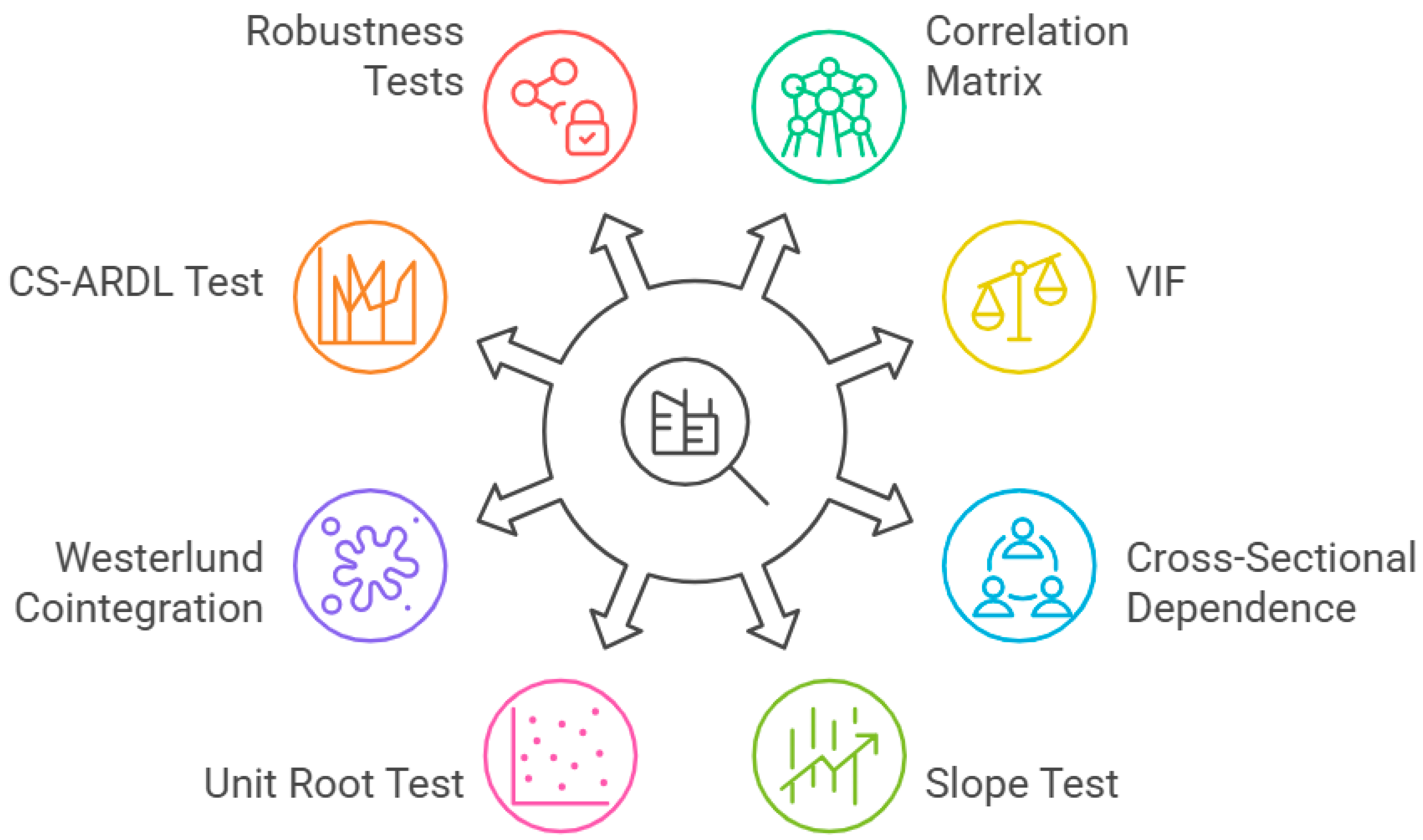
Figure 1 displays the order of diagnostic and robustness tests used in the empirical analysis. It shows how the correlation structure, multicollinearity (VIF), cross-sectional dependence, slope heterogeneity, unit root properties, and long-run cointegration can be assessed by the Westerlund approach and subsequently estimated and demonstrated to be robust by the CS-ARDL framework approach.
After estimating the econometric models, the findings will be interpreted to comprehend the effects of the interaction between the transition of energy, green innovation, and financial inclusion on achieving green growth in the G7 nations and the circular economy. The results will be explained against the background of the literature and discussed with references to the policy implications of the promotion of sustainable development. Specifically, the research will provide its findings on how the integration of these drivers may contribute to increasing green growth and will recommend practical suggestions to the governments of the G7 countries and the international organizations. Such an approach to the methodology assures a valuable and in-depth study of green growth dynamics and the use of the latest econometric methods to answer the most crucial questions in research and develop further insights into sustainable growth policies in developed economies. All the analysis are performed using Stata software version 18.
4. Results
As shown by the descriptive statistics (
Table 2) of the G7 countries, although there is improvement in green growth, there is a high degree of variance between the nations. Green growth is rated on average at 45–85, meaning there is an opportunity to transform it. The energy transition index indicates that there is a large disparity in terms of the level of development of countries as far as renewable energy and energy efficiency are concerned, but the overall mean is comparatively large. Green innovation, according to environmental patents, varies quite a bit, with the countries in the technological sector being way ahead. Circular Economy Index (CEI) presents an average level of adoption of resource efficiency practices, but additional efforts can be made. Generally, financial inclusion is high in the G7; however, the figures show that access may be more comprehensive in some areas. Carbon intensity has been lowered on average; however, some countries still have to do more to minimize emissions per unit of GDP. The table indicates the successes and gaps in the green growth endeavors, implying that additional specific interventions are required to enhance the sustainability of all the G7 nations.
Furthermore,
Table A2 confirms the statistical adequacy of the empirical specification. The absence of serial correlation and heteroskedasticity indicates that the residuals satisfy the underlying model assumptions. Conversely, the significant Pesaran CD and Pesaran–Yamagata tests reveal the presence of cross-sectional dependence and heterogeneous slope coefficients across G7 economies, thereby validating the adoption of second-generation panel estimators, particularly the CS-ARDL model, together with AMG and CCEMG as robustness checks.
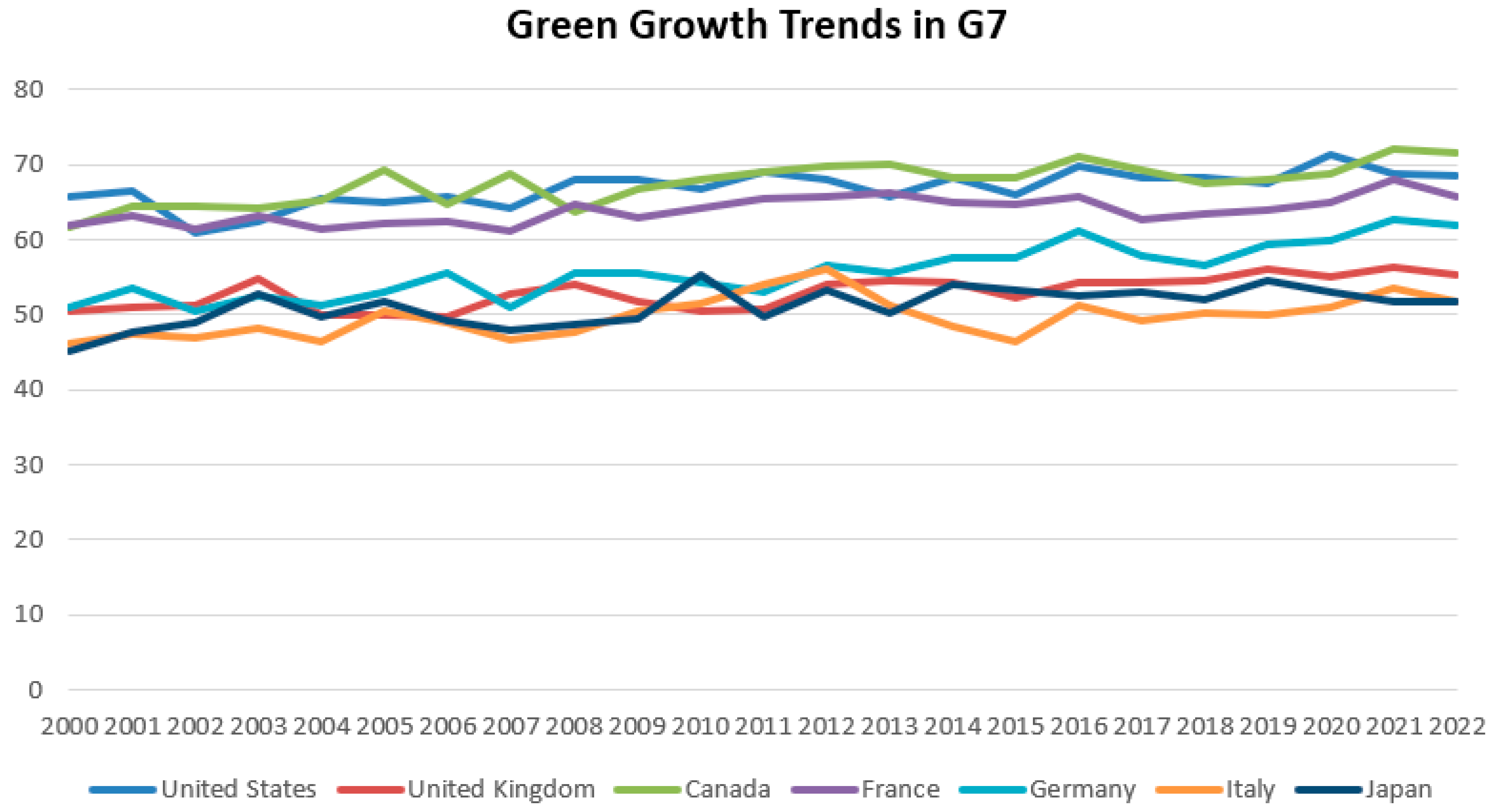
In addition, as depicted in
Figure 2, Green Growth has changed over the G7 economies between 2000 and 2022. Altogether, the graph demonstrates an overall positive but very slow growth performance in green growth by all the countries, but with evident cross-country variations and shocks. Canada and the United States outperform the rest of the countries with higher ranks on green growth, indicating their closer tie between the expansion of their economy and the importance of the environment during the sample period. France and Germany are next in line, with their tendencies being rather steady and showing positive dynamics, which are likely to indicate gradual gains in energy efficiency, renewable energy combination, and environmental control. Within the framework of contrast, Italy and Japan also have lower but steadily rising and more provocative year-to-year volatility, suggesting a slower and less effective conversion toward greener growth channels. The United Kingdom performs on average, with high and low performance intervals that are interlaced with minor setbacks. Combined, the figure points to the convergence yet disaggregated pattern of green growth in G7 countries that indicates that even though all the economies have progressed toward utilizing a more environmentally friendly growth, the rate of change and the uniformity of that change across the national context vary significantly.
According to the correlation table (
Table 3), the strong positive relationships in Green Growth (GG) and Energy Transition (ETI), Green Innovation (GI), Circular Economy (CEI), and Financial Inclusion (FI) suggest that the development in these spheres correlates with increased green growth. There is a negative relationship between Green Growth and Carbon Intensity (CI), as the lower the emissions, the more sustainable the result. It has been determined that there are high correlations between Energy Transition and Green Innovation, Circular Economy, and Financial Inclusion, which highlights the interdependence of the variables. The correlation between Circular Economy and Financial Inclusion is positive, which indicates the importance of financial access in the implementation of sustainable practices. All in all, these findings imply that green growth depends on energy transition, innovation, and the presence of a circular economy, as well as on financial inclusion, and low-carbon intensity is needed to help it become sustainable.
Based on the correlation table in
Table 3,
Table 4 below gives an evaluation of the Multicollinearity Factor (VIF) of the explanatory variables in the model. VIF is used to indicate the extent of inflated variance of a regression coefficient and inflation caused by collinearity with the other variables. The values of VIF, in this instance, are all significantly lower than the critical figure of 10, and this indicates that the problem of multicollinearity is not a major concern in the data set. The highest VIF is 2.3 for Carbon Intensity (CI), which is reasonable to confirm that the variables present in the model are independent enough of each other. Based on this, these findings indicate that the correlations between variables, including that of Green Growth and Energy Transition, among others, can be approximated fairly well and that multicollinearity is not problematic with regard to estimating the regression outcomes.
Table 5 demonstrates the Cross-sectional Dependence (CSD) test findings of the major variables to be employed in the research, which shows that cross-sectional dependence exists among all the variables. The Breusch Pagan LM, Pesaran CD, and Bias-corrected LM tests indicate a high level of cross-sectional dependence, which is demonstrated by small
p-values of all the variables. This implies that the error terms among the G7 countries are correlated; thus, there is a need to account for cross-sectional dependence in the panel data analysis process in order to have a robust model estimation.
Table 6 presents the results that both the Delta (Δ) statistic (6.09,
p-value = 0.001) and the Adjusted Delta (Δadj) statistic (8.67,
p-value = 0.003) are statistically significant at the 1% level; hence, the null hypothesis of slope homogeneity is rejected. This also implies that the relationship between the dependent and independent variables is not constant across the G7 countries, implying that there is much heterogeneity of slope. In turn, this finding reveals that the analysis of the panel data should consider varying slopes.
Table 7 shows the findings of the CIPS and CADF unit root tests of the variables under study, following
Table 6. According to CIPS (Level) and CIPS (1st Diff) outcomes, all of the variables such as Green Growth (GG), Energy Transition Index (ETI), Green Innovation (GI), Circular Economy Index (CEI), Financial Inclusion (FI) and Carbon Intensity (CI) are non- stationary at the levels since the values of CIPS (Level) are lower than the critical values (3.80). But stationarity is achieved upon first difference in all the variables, which is pointed out by the CIPS (1st Diff) values, which are significant at the 1% level (denoted by ***). On the same note, CADF (Level) results indicate that the variables are non-stationary at their levels, and after a 1st difference, all the variables are stationary as indicated in the CADF (1st Diff) values. All variables are integrated to order 1 and indicated as I(1), which proves that they are non-stationary at the level but stationary upon first differentiation. The analysis will rely heavily on these results since they enabled the application of such methods as cointegration tests and the CS-ARDL model to continue addressing the long-term association between the variables.
Table 8 below shows the results of the Westerlund Co-integration Test on the study variables following
Table 7. The Gt and Pt statistics with
p-values of 0.000 *** demonstrate that the variables are cointegrated as they are significant at the 1 percent level. This is an indicator that the relationship between the variables is a long-term equilibrium. On the other hand, the statistics of the Ga and Pa do not show any significant data (
p-values of 0.105 and 0.080, respectively), which suggests that the null hypothesis of no cointegration cannot be rejected with regard to these tests. Altogether, the findings prove the presence of cointegration, meaning that both variables change in the long run, and it is worth using methods that can reflect the terms of the short-term and the long-term effect, like the CS-ARDL model.
The CS-ARDL model (
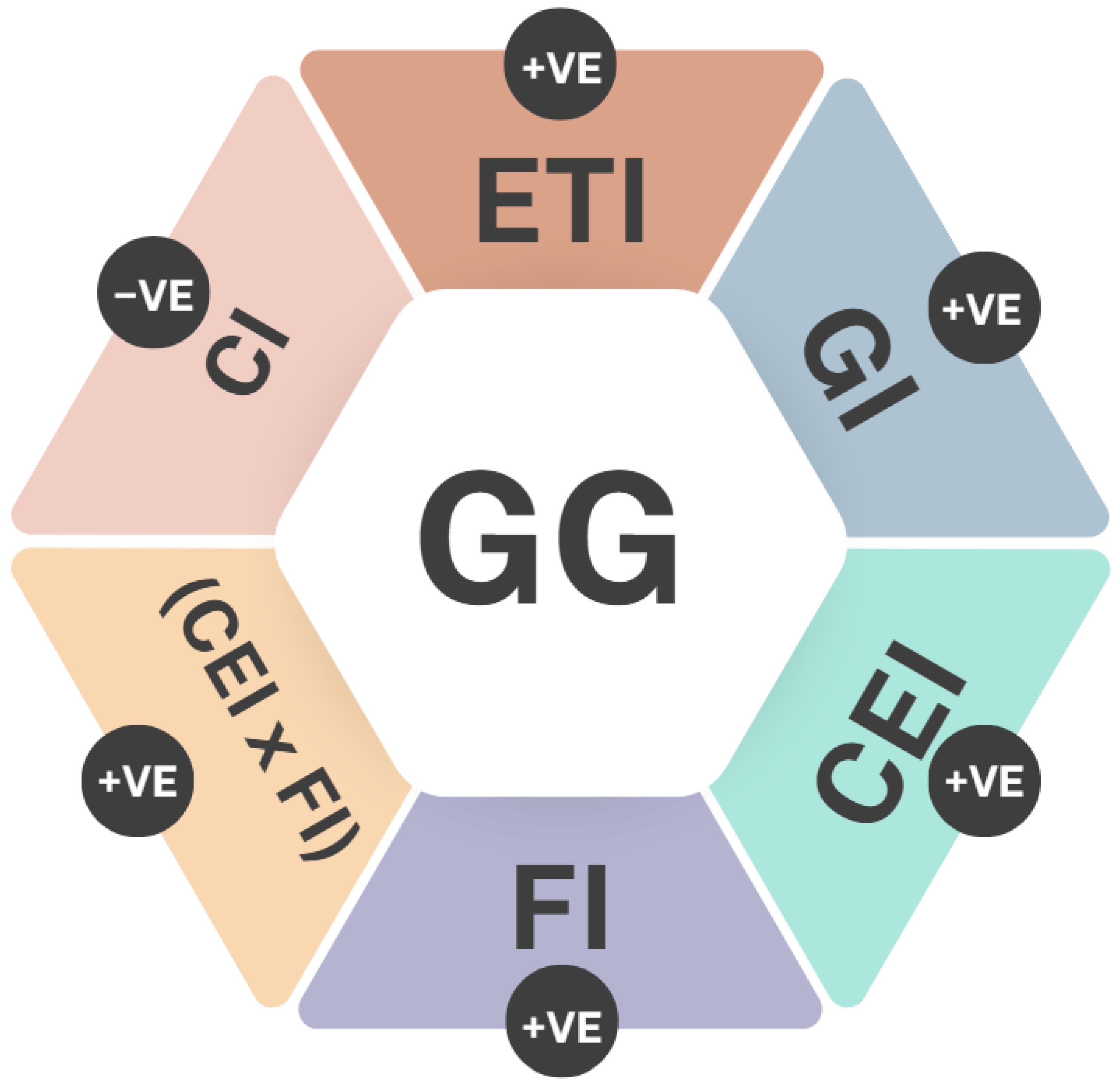
Table 9) outcomes point out the major leaders of green growth in the G7 countries, both short- and long-term dynamics. The Energy Transition Index (ETI) has a large positive impact on green growth with a coefficient of 0.45, showing that conversion to renewable energy and energy efficiency has a large positive contribution to sustainable economic growth. The environmental patents (as a measure of Green Innovation (GI)) are also important and have a long-run coefficient of 0.28, which indicates the significance of technological gains in promoting green growth. This has been facilitated by the Circular Economy Index (CEI), with a coefficient of 0.25 that has a less significant effect but makes a positive contribution in resource efficiency and waste reduction. One of the key parameters is Financial Inclusion (FI), whose long-run coefficient is 0.40, as found to enable investments in green technologies and practices and ensure sustainable development. Conversely, the long-term relationship between Carbon Intensity (CI) and green growth is negative, and the coefficient is −0.20. This indicates that attempts to curb carbon emissions are crucial in delivering sustainability in the long run, since decoupling of growth from environmental degradation is paramount in green growth. Moreover, the interaction term (CEI × FI) indicates that financial inclusion enhances the positive impacts of circular economy practices on green growth with a coefficient of 0.12 in the long run, which indicates the provision of consistent enhancement between financial access and the implementation of sustainable production and consumption practices.
The coefficients indicate that, in the short term, there is a generally positive, although weaker, impact of these variables on green growth. The Energy Transition Index and Green Innovation are the positive changes that are currently occurring, although the effects in the short-term basis are fewer than those on a long-term basis. Equally, the Index of Circular Economy and Financial Inclusion present positive short-term growth opportunities for green growth, whereas the Carbon Intensity depicts a negative short-run effect, thus showing that growth may be hampered by cutting down on carbon emissions, which benefits in the long run. The relationship between Circular Economy and Financial Inclusion under the short run is also positive, meaning that access to finances can build into the adoption of circular economy strategies, even in the short run. Moreover, the Error Correction Term (ECT) of −0.45 is statistically significant, meaning that the system adjusts toward its long-run equilibrium at a rate of approximately 45% per annum, exhibiting a very rapid response to any change in the dynamics of green growth. This represents the need to have a holistic and integrated vision of green growth, in which energy transition, green innovation, financial inclusion, and circular economy activities can make each other work in concert, leading to sustainable development. The results imply that the policymakers in the G7 countries have to take into consideration these variables to ensure that the policies of green growth are comprehensive and integrated in such a manner that the vision of long-term sustainability becomes a reality. In addition,
Figure 3 shows the results of the study.
The findings on the robustness checks of AMG, CCEMG, and Driscoll-Kraay estimators (
Table 10) give a good and consistent indication of the important determinants of a country in the G7 that can be the key to observing green growth. The coefficients of the Energy Transition Index (ETI) also have a significant positive correlation with green growth in all three approaches, with the coefficients between 0.38 and 0.42, which proves that the energy transition, such as the transition toward renewable energy sources and energy efficiency, is an important long-term determinant of sustainable growth. On the same note, the usefulness of technological development and innovations that are environmentally friendly, with coefficients ranging between 0.26 and 0.30, suggests that technological innovation in clean technologies is essential in sustainability and aids in creating green growth. Despite the fact that the effect is not as strong, with coefficients of between 0.19 and 0.22, the Circular Economy Index (CEI) does contribute positively to green growth, thus indicating that resource efficiency and using waste reduction practices are less influential than energy transition and innovation. Financial Inclusion (FI) has continuously been in positive correlation with green growth, ranging between 0.31 and 0.35, indicating the significance of access to financial services as a facilitator to promote green investments, especially in areas such as renewable energy and sustainable technologies. On the other hand, carbon intensity (CI) shows a negative connection with the growth in green investment (coefficients between −0.17 and −0.20), which supports the pursuit of sustainable development since it severed the linkage between economic growth and environmental degradation. The Interaction Term (CEI × FI) is also consistently positive, and the coefficients are between 0.08 and 0.10, indicating that the overall effect of financial inclusion and circular economy practices on green growth is a significant contribution.
These results are strong based on the consistency in the various methods of estimation, where AMG, CCEMG, and Driscoll-Kraay standard errors have similar coefficient signs and values. These strong estimators were used in order to make sure that the findings are not model-specific and to capture any possible heterogeneity, cross-sectional dependence, and autocorrelation in the panel data. The standard error of the coefficients is also small, which might also indicate the accuracy of the estimates and hence increases the validity of the results. All in all, these findings present strong arguments in support of the idea that energy transition and green innovation, financial inclusion, and carbon intensity reduction are the key factors to promote green growth, and the interaction between the practices of the circular economy and financial inclusion is instrumental in supporting sustainability in developed economies.
5. Discussion
The obtained empirical findings through the CS-ARDL model give a valuable idea about the nature of drivers of green growth in the G7 countries. These results are commendable in terms of the comprehension of the interaction between different factors, including energy transition, green innovation, and financial inclusion, as well as the reduction of carbon intensity, to form sustainable economic development. These findings can be compared to the theoretical framework according to which the study was conducted; the interlocked nature of the energy systems, innovation, access to finances, and the efficiency of the environment were among its primary assumptions. These results are further expounded in connection with the theoretical framework, research questions and hypotheses of the study and correlated with the broader literature and implications they have for sustainable development.
The CS-ARDL model results are highly empirically supported regarding the dominating powers of green growth in the G7 countries. This close relationship between the positive correlation of the Energy Transition Index (ETI) and green growth, where its coefficient value is 0.38 to 0.42, reveals that the transformation towards renewable energy sources and more efficient energy sources is the process to promote long-term sustainability. This is similar to the available literature that puts more emphasis on energy transitions to decouple economic growth and environmental degradation [
67]. Similarly, a positive and significant relationship between Green Innovation (GI) and green growth (coefficients of 0.26–0.30) also proves that technological development and clean innovations contribute to sustainable economic growth [
36].
On the other hand, the Carbon Intensity (CI) variable is empirically negatively related to green growth, which implies that the decline of carbon emissions per unit of GDP is an essential element of the process of achieving sustainable growth. These interrelations between the coefficients of −0.17 to −0.20, being empirical evidence, suggest that the growth and emissions decoupling attempts are beneficial to future sustainability [
68]. In addition, the indicators of positive relationships with green growth include the Circular Economy Index (CEI) and Financial Inclusion (FI), whose coefficients are 0.22 to 0.26 and 0.31 to 0.35, respectively. These findings underscore the value of having resource efficiency, preventing waste practices, and increased access to financial services towards sustainable economic growth, and these are in tandem with the principles of the green economy.
The positive contribution of financial inclusion also has broader social implications beyond improving access to green investment opportunities. In the context of the G7 economies, inclusive financial systems can strengthen social participation in sustainability transitions by enabling households and businesses to engage in renewable energy adoption, green entrepreneurship, and environmentally responsible consumption. Although the present study focuses primarily on economic and environmental dimensions, the findings are consistent with the view that socially inclusive policy frameworks improve public acceptance of green transition strategies. Since successful implementation of green growth policies ultimately depends on political legitimacy and societal support, future policy design should integrate financial inclusion with broader measures aimed at ensuring socially just and inclusive transitions.
The theoretical basis of the current research is very much based on the Environmental Kuznets Curve (EKC) theory, according to which the growth of the economy may result in the deterioration of the environment; however, as countries reach higher incomes, they can enhance environmental performance due to new technology and regulations. This theory can be supported with the positive impact of energy transition and green innovation in the long-term view, since progressive economies will be able to invest in cleaner technologies that will allow them to grow economically as well as to preserve nature. Also, Sustainability Transition Theory focuses on systemic changes towards sustainability throughout sectors [
69], which is manifested in the results of the study that financial inclusion and the practice of the circular economy play an important role in green growth in the G7 countries. This research is also consistent with the Institutional Theory, according to which institutional structures, such as financial systems and governance structures, are crucial in determining the results of sustainable development [
70]. This theory is evidenced by the positive correlation between financial inclusion and green growth, since more access to financial services will facilitate investment in green technologies and sustainable methods.
The outcome of the present research has strong connections with a number of Sustainable Development Goals (SDGs). The advantageous impact of energy transition (SDG 7: Affordable and Clean Energy) and green innovation (SDG 9: Industry, Innovation and Infrastructure) remains in favor of the search for clean and renewable energy sources and works on the creation of eco-friendly technology. Furthermore, the correlation between carbon intensity and green growth is negative, which is consistent with SDG 13: Climate Action, which focuses on the reduction of carbon emissions in order to limit the development of climate change. The overall contribution of financial inclusion (SDG 8: Decent Work and Economic Growth) and circular economy (SDG 12: Responsible Consumption and Production) once again makes the necessity of inclusive financial systems and sustainable use of resources in attaining long-term green growth even more obvious.
The findings of the research can respond to the major research questions to show that the interplay between energy transition, green innovation, financial inclusion, and the practices of a circular economy is a driver of green growth in the G7 countries. In particular, it can be stated that the main forces of long-term green growth are energy transition and green innovation, which justify the hypothesis that these two factors play a key role in ensuring sustainability. The research also shows that financial inclusion and the concept of the circular economy, although having a minor impact, still have a significant impact on the sustainable development of the economy. The second question of how green growth in terms of decoupling economic activity and environmental degradation is achieved is also answered by the negative relationship with carbon intensity.
The empirical findings provide strong support for the proposed hypotheses. Hypothesis 1, which posited that energy transition positively influences green growth, is supported by the positive and statistically significant coefficient of the Energy Transition Index. Likewise, Hypothesis 2 confirms the positive contribution of green innovation to sustainable economic development. The findings further support Hypothesis 4, indicating that greater financial inclusion facilitates green growth by improving access to financial resources for sustainable investments. Finally, Hypothesis 5 is supported by the negative and statistically significant coefficient of carbon intensity, confirming that lower carbon emissions per unit of economic output are associated with higher levels of green growth.
These outcomes are in line with the movements of cleaner energy adoption in the G7 nations, where green innovation, technological advancement, and compulsive resource savings are the key needs of sustainability programs. The G7 nations are developed countries equipped with a lot of financial and technological potential that position them in the role of spearheading the shift towards sustainable development. It appears that due to the existence of effective institutional frameworks, financial access, or even practices favoring renewable energy and innovations in these nations, these factors explain why such variables are significantly correlated with green growth during the research period (2000–2022).
In addition, the findings go hand in hand with the growing appreciation of the role of financial inclusivity and the practice of the circular economy in enhancing green growth, specifically in the case of developed economies, where market solutions and the advances of technologies are of paramount importance. Nevertheless, the relative lack of strength of circular economy practices in the short term can be explained by the cumulative impossibility of scaling the identified practices to the industries, even though they could be beneficial in the long run.
This study contributes to the available literature because it provides a thorough discussion of the interaction between energy transition, green innovation, financial inclusion, and practices related to the circular economy in promoting green growth. Whereas all earlier studies have been conducted separately on these variables, this study offers a new insight by exploring their interactive differences in the G7 countries. Also, the paper adds to the Sustainability Transition Theory by showing how the issue of energy transition and green innovation can be increased by financial inclusion and circular economy practices. Such findings are in line with research findings reported by other researchers like [
71], who stress the importance of innovation, access to finance, and system-level changes in propelling sustainability. Moreover, the paper contributes to the body of studies on the Environmental Kuznets Curve (EKC) by depicting how modern economies can decouple environmental degradation from economic growth with the help of energy transition and the use of technological innovations.
Findings of this paper shed light on the significance of a complex approach to realizing green growth in the G7 countries, and the use of energy transition, green innovation, financial inclusion, and carbon intensity reduction as the determining elements. These results can add to the literature in terms of providing more coherent insights into how these elements interact to promote sustainability, and they have a profound implication for policymakers who strive to balance economic development and environmental sustainability. The study, through offering solid empirical evidence, promotes the current transformation to a greener and more inclusive global economy.
6. Conclusions and Policy Recommendations
The study has been critical in the understanding of the dynamics of green growth within the G7 countries and, more so, the relationships between the transition of energy, green innovation, financial inclusion and the practices of the circular economy. The results show that these factors, besides being individually important, also accompany each other to produce sustainable economic development.
As it has been proven in the analysis, the energy transition, in particular the shift to renewable energy sources and more energy efficiency, is essential in enhancing growth, particularly green growth, in the long term. Similarly, environmentally friendly practices and alternative clean technologies such as green innovation prove to be one of the driving forces of sustainable economic development. Financial inclusion also helps in green growth, in which one gets access to key resources to adopt sustainable technologies and practices, which are pivotal in bridging financial disparities to green investments. Though the short-term effect of the circular economy is not as strong, it is positive and leads to greater efficiency in the consumption of resources and reduced wastage that is part of the overall effect of sustainability.
Moreover, the paper highlights the significance of diminishing carbon intensity as a significant element in decoupling economic developments and environmental deteriorations. This will confirm that sustainable development requires the reduction in the intensity of emissions over a given unit of GDP, because of the negative correlation existing between the variables. These findings are also aligned with a number of theoretical frameworks, such as the Environmental Kuznets Curve, Sustainability Transition Theory, and Institutional Theory, and could serve as a solid conceptual base for the findings. The combination of these aspects makes the study an addition to the current understanding of how energy, innovation, finance, and practices in a circle can be effectively combined to achieve green growth in developed economies. Finally, it is possible to note that this study shows that all efforts in energy transition and technological development, financial inclusion, and circular economy behaviors are necessary in the G7 countries to achieve long-term sustainability.
Furthermore, as a way of ensuring increased green growth in the G7 countries, policymakers are required to engage in an integrated strategy, which involves energy transition, green innovation, financial inclusion, and circular economy practices. This study has revealed the following policy recommendations:
The governments must focus on policies that can facilitate the replacement of renewable sources of energy and energy-efficient technologies. They involve investing more in clean energy infrastructure, increasing research and development of green technologies, and providing incentives to industries to move in the direction of using renewable energy solutions. Subsidies for renewable energy, a tax on carbon and grid modernization must be strengthened to be able to provide a stable and sustainable transition process to low-carbon energy systems.
To promote economic growth and minimize environmental impact, green innovation should be encouraged. Policymakers ought to promote the progress of green technologies by making specific investments in R&D, establishing innovation centers, and giving incentives such as the commercialization of green inventions. The implementation of innovation in such areas as clean energy, electric vehicles, and sustainable manufacturing could become possible by the means of the partnerships between governments and pivotal corporations. Moreover, improvement of cooperation between research organizations, industry leaders, and governments might contribute to closing the distance between new solution suggestions and their application.
Increased availability of financial services is important in ensuring green growth. Policymakers must make the financial systems inclusive so that the different sections of society, especially the low-income communities, have an opportunity to invest in sustainable practices and technologies. This will involve offering low-interest loans to green technologies, offering insurance products to renewable energy projects, and also accessing green bonds. The financial institutions must also be made to develop products that underpin environmentally sustainable investments so that the concept of green finance becomes available to businesses and households in all sectors.
Green growth strategies should largely comprise the adoption of circular economy principles. Governments can facilitate this shift by putting in place policies that will make resources efficient, minimize waste, and reduce consumption in a sustainable manner. These involve the introduction of extended producer responsibility (EPR) laws, encouraging companies to use circular business models, and recycling and reuse programs. Sustainable infrastructural investments should be made, which include waste management systems and eco-design systems, so that the full benefits of the circular economy can be realized.
Policy-makers ought to see the win-win aspect of making financial inclusion go hand in hand with the consumption of the circular economy. They can engage in recycling, waste management, and sustainable consumption by making the underserved populations have access to financial resources so that they can have access to these circles. Circular practices can be further enhanced with the help of financial products that are tailored to a circular economy, like green loans and microfinance for sustainable businesses. Business models, as well as community-based sustainability initiatives, can be further incentivized by government interventions, which encourage the incorporation of financial services into the community as part of the circular economy.
Stable and transparent regulation frameworks are critical in the promotion of green growth over the long run. Policymakers need to come up with clear policies that will guarantee these investors who are interested in green technologies and circular practices. This also covers the adoption of holistic climate policies that coincide with the Paris Agreement and other global commitments towards sustainability. The regulatory structures must be in such a way that the process of a green economy is not only inclusive, but also fair in its policies that look at the social and economic aspects of sustainability.
Through such policies and measures, the G7 nations will become the global leaders in the area of sustainable development, green growth, and the contribution to attaining the main Sustainable Development Goals (SDGs). The transformation of energy transition and green innovation, financial inclusion, and the practice of the circular economy will not only guarantee environmental sustainability but also promote economic resiliency and inclusivity.
Although this study provides important insights into the determinants of green growth in the G7 economies, several limitations should be acknowledged. First, the analysis is based on annual panel data covering 2000–2022 and therefore may not fully capture the effects of major structural breaks or policy shifts, such as the Paris Agreement or post-pandemic recovery measures. Second, the empirical model assumes linear relationships among the variables, whereas potential nonlinearities and threshold effects may exist, particularly for technological innovation and financial inclusion. Third, the study focuses exclusively on the G7 economies, limiting the generalizability of the findings to other developed or emerging economies with different institutional and economic contexts. Fourth, although financial inclusion captures one aspect of social inclusiveness, broader dimensions such as public acceptance, institutional trust, social equity, and distributive fairness during the green transition are not explicitly considered. In addition, the Green Growth Index is constructed using equal weights to ensure transparency and comparability; however, alternative weighting approaches, such as principal component analysis (PCA) or entropy weighting, may yield different results. Furthermore, the relatively small macro-panel dimension (N = 7) may reduce estimation efficiency despite the suitability of the CS-ARDL framework for panels characterized by cross-sectional dependence and heterogeneous slopes. To mitigate this concern, a parsimonious lag specification was adopted, and the findings were validated using AMG and CCEMG estimators, which produced qualitatively consistent results. Finally, the model does not explicitly incorporate several potentially relevant control variables, including trade openness, foreign direct investment, urbanization, government environmental expenditure, and institutional quality, which may represent additional channels influencing green growth. Future research should address these limitations by extending the temporal and geographical coverage, incorporating nonlinear modeling approaches, broader social and institutional indicators, alternative index-construction methods, additional control variables, and larger international samples to further strengthen the robustness and generalizability of the findings.