The Symbiotic Mandate: On the Urgency of a Mutually Uplifting Synergy Between Artificial Intelligence and Sustainability


Abstract
1. Introduction: The Crisis of the Tenable and the Thermodynamics of Intelligence
1.1. Nature and Scope of This Article
1.2. The Three-Era Transition
1.3. Warranted Versus Unwarranted Scale
1.4. Waste Management In Sensu Lato
- Digital Waste: The entropy of redundant, low-utility computation cycles [2]—measurable as the ratio of useful task-relevant FLOPs to total FLOPs expended.
- Cognitive Waste: The misallocation of human and machine potential toward extractive or trivial tasks [19]—manifested when human expertise is diverted from knowledge creation to the curation and cleaning of datasets for models of marginal utility.
1.5. The Mutually Uplifting Synergy
1.6. Contributions to Sustainability
2. Waste Management In Sensu Lato: A Taxonomic Expansion
2.1. Formal Definition of Sustainability In Sensu Lato
2.2. The Physiology of Failure: The Runner and the Drunkard
- The Exhausted Runner (ecological waste): A runner who starts at a pace exceeding their energy reserves will collapse before the finish line. Analytically, training a single large NLP model emits carbon equivalent to the lifetime emissions of five automobiles [7], and the projected water footprint of U.S. AI servers between 2024 and 2030 ranges from 731 to 1125 million cubic meters [11]—resources that are neither infinite nor renewable on any relevant timescale.
- The Algorithmic Drunkard (digital waste): An algorithm that consumes inputs greedily, with no regard for computational complexity [29], becomes a liability to itself and to society. The global data center industry already rivals mid-sized nations in electricity consumption [12,30], and this consumption is driven substantially by inference workloads that could be served by far smaller models without measurable performance degradation [17,18].
2.3. The ENIAC Moment: A Historical Parallel of Infancy
2.4. The DeepSeek Proof of Concept: Parsimony Vindicated in Real Time
2.5. Historical Transitions Toward Algorithmic Parsimony
2.6. The Virtue of Algorithmic Parsimony
“Tout ce qui se conçoit bien s’énonce clairement, et les mots pour le dire arrivent aisément.”—Nicolas Boileau, L’Art poétique (1674)
2.7. AI, Epistemology, and the Sustainability of Scientific Understanding
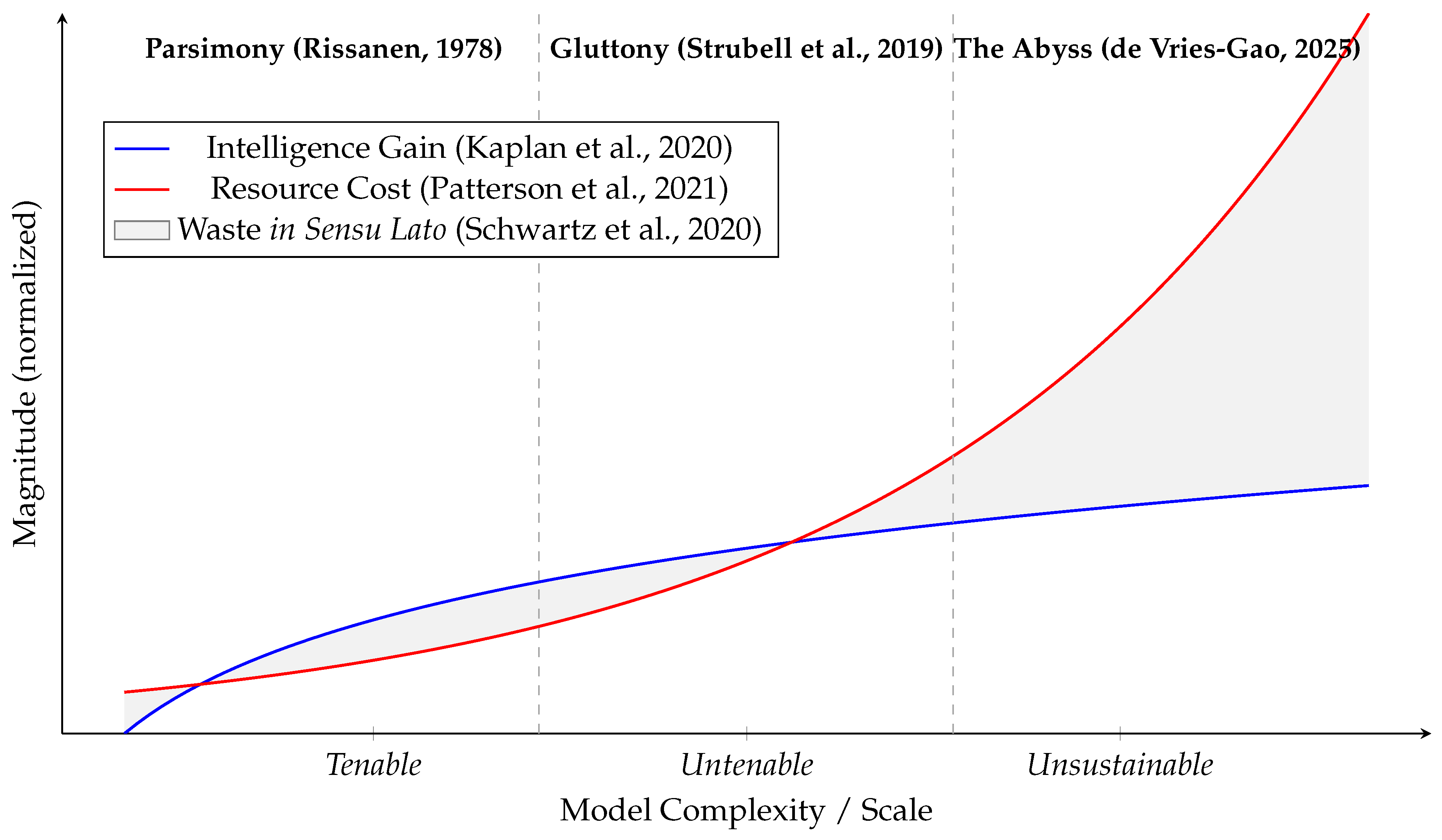
3. The Intelligence–Cost Divergence: Empirical Grounding and Visualization
3.1. Quantitative Synthesis of Published Evidence
3.2. Visualization of the Divergence
4. The Interplay: Regulatory Mandates and the Infrastructure Crisis
4.1. The Outcry of Data Centers
- Grid Instability: Global data center electricity consumption reached approximately 460 terawatt-hours in 2022—equivalent to the national consumption of France [12]. In regions such as Northern Virginia and Ireland, data centers now exceed 20% of total domestic electricity capacity in some locales [46].
4.2. Adherence to 2026 International Standards
- 1.
- ISO/IEC 42001 [23]: Mandates “System Impact Assessments”, including explicit environmental cost–benefit analyses before deployment.
- 2.
- 3.
4.3. From Compliance to Synergy
5. The Synergy: Toward a Mutually Uplifting AI–Sustainability Framework
5.1. AI as the ‘Planetary Operating System’
- Precision Environmental Monitoring: AI-coupled hyperspectral imaging is achieving unprecedented rates of global methane leak identification, allowing real-time mitigation [13].
- Precision Agriculture: AI-driven methods achieve gains of 25% in yield, 28% in fertilizer reduction, and 35% in nitrogen runoff reduction [49].
- Optimizing the Circular Economy: AI-driven robotics achieve high accuracy in waste sorting, transforming landfills into “urban mines” for rare-earth minerals [3].
- Smart Grid Balancing: Agentic AI systems stabilize volatile renewable energy loads in real-time [3].
5.2. Operationalizing the Intelligence-per-Joule Index
5.3. Safe and Sustainable: A Dual Mandate
6. The Alchemy of AI: From Leaden Brute Force to Golden Parsimony
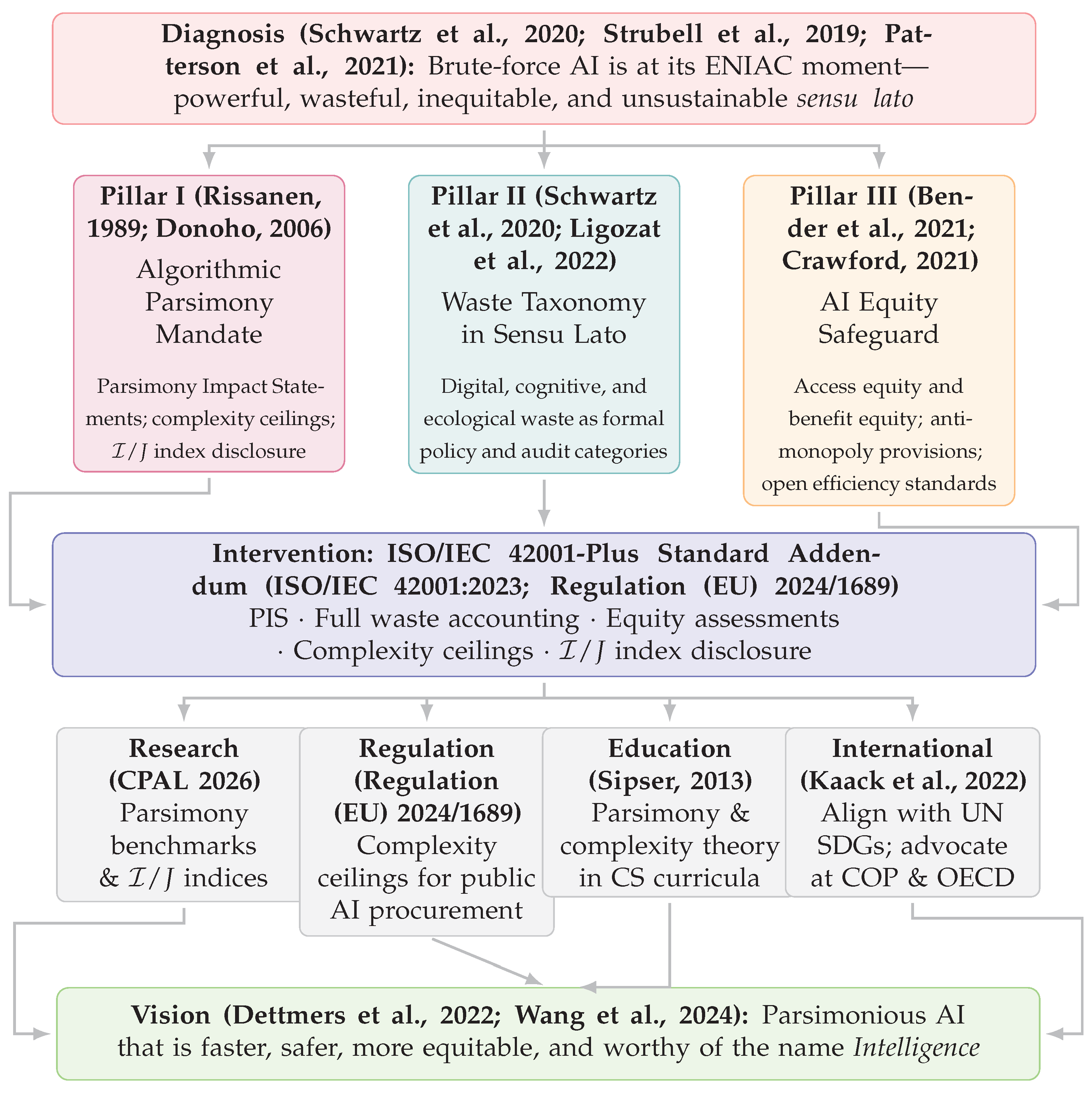
7. The Symbiotic Policy Covenant: A Framework for Actionable Intervention
7.1. Preamble: From Diagnosis to Prescription
7.2. Pillar I: The Algorithmic Parsimony Mandate
- 1.
- Parsimony Impact Statements (PISs): Any organization seeking regulatory approval or public funding for an AI system above a defined compute threshold (expressed in FLOPs, consistent with EU AI Act thresholds [24]) must file a PIS documenting: (a) the proposed parameter count and training compute; (b) the alternatives at lower complexity considered and rejected; (c) the estimated ratio for the primary intended task; and (d) a justification for whether this constitutes warranted or unwarranted scale.
- 2.
- Complexity Ceilings in Public Procurement: Public sector agencies procuring AI solutions must impose complexity ceilings expressed in parameters, FLOPs per inference, and energy-per-decision ratios [37].
- 3.
- Index Disclosure: Publication of the index should be mandatory for any system claiming “state-of-the-art” status in academic or commercial communications.
7.3. Pillar II: Waste Taxonomy In Sensu Lato as Policy Language
- Cognitive Waste should be addressed through national AI workforce strategies, ensuring that human expertise is directed toward knowledge creation rather than data curation for unwarranted-scale systems [19].
7.4. Pillar III: The AI Equity Safeguard
- 1.
- Access Inequity: The unequal distribution of computational infrastructure, whereby frontier AI capabilities are accessible only to a small number of hyperscale providers [20,32]. This is addressed through anti-monopoly provisions in AI governance and investment in distributed, energy-efficient computing facilities.
- 2.
- Benefit Inequity: The unequal distribution of gains from AI deployment, whereby productivity and economic gains accrue disproportionately to those who own the infrastructure, while environmental and social costs are diffused across populations who bear them without consent [19]. This is addressed through mandatory equity impact assessments as a condition of certification, and through requirements that open efficiency standards be published alongside any publicly subsidized model.
7.5. The Intervention: ISO/IEC 42001-Plus and Implementation Considerations
7.6. The Four Action Levers
- Education [29]. Restore parsimony and computational complexity theory to centrality in CS and AI curricula. The next generation of engineers must be equipped to recognize and resist the temptations of unwarranted scale.
8. Conclusions: The Symbiotic Mandate
Funding
Institutional Review Board Statement
Informed Consent Statement
Data Availability Statement
Acknowledgments
Conflicts of Interest
References
- van Wynsberghe, A. Sustainable AI: AI for sustainability and the sustainability of AI. Ai Ethics 2021, 1, 213–218. [Google Scholar] [CrossRef]
- Schwartz, R.; Dodge, J.; Smith, N.A.; Etzioni, O. Green AI. Commun. Acm 2020, 63, 54–63. [Google Scholar] [CrossRef]
- Kaack, L.H.; Donti, P.L.; Strubell, E.; Kamiya, G.; Creutzig, F.; Rolnick, D. Aligning artificial intelligence with climate change mitigation. Nat. Clim. Chang. 2022, 12, 518–527. [Google Scholar] [CrossRef]
- Rissanen, J. Modeling by shortest data description. Automatica 1978, 14, 465–471. [Google Scholar] [CrossRef]
- Rissanen, J. Stochastic Complexity in Statistical Inquiry; World Scientific: Singapore, 1989. [Google Scholar]
- Fokoué, E. On the Optimal Machine Learning Algorithm Selection for Classification Tasks. J. Stat. Theory Pract. 2011, 5, 523–540. [Google Scholar] [CrossRef]
- Strubell, E.; Ganesh, A.; McCallum, A. Energy and Policy Considerations for Deep Learning in NLP. In Proceedings of the 57th Annual Meeting of the Association for Computational Linguistics; Association for Computational Linguistics: Florence, Italy, 2019; pp. 3645–3650. [Google Scholar] [CrossRef]
- Patterson, D.; Gonzalez, J.; Le, Q.; Liang, C.; Munguia, L.M.; Rothchild, D.; So, D.R.; Texier, M.; Dean, J. Carbon emissions and large neural network training. arXiv 2021, arXiv:2104.10350. [Google Scholar]
- Bellman, R. Dynamic Programming; Princeton University Press: Princeton, NJ, USA, 1957. [Google Scholar]
- Mytton, D. Data centre water consumption. npj Clean Water 2021, 4, 11. [Google Scholar] [CrossRef]
- Xiao, T.; You, F. Environmental impact and net-zero pathways for sustainable artificial intelligence servers in the USA. Nat. Sustain. 2025, 8, 1541–1553. [Google Scholar] [CrossRef]
- International Energy Agency. Energy and AI Report 2025; International Energy Agency: Paris, France, 2025. [Google Scholar]
- Rolnick, D.; Donti, P.L.; Kaack, L.H.; Kochanski, K.; Lacoste, A.; Sankaran, K.; Ross, A.S.; Milojevic-Dupont, N.; Jaques, N.; Waldman-Brown, A.; et al. Tackling climate change with machine learning. ACM Comput. Surv. 2022, 55, 1–96. [Google Scholar] [CrossRef]
- Jumper, J.; Evans, R.; Pritzel, A.; Green, T.; Figurnov, M.; Ronneberger, O.; Tunyasuvunakool, K.; Bates, R.; Žídek, A.; Potapenko, A.; et al. Highly accurate protein structure prediction with AlphaFold. Nature 2021, 596, 583–589. [Google Scholar] [CrossRef] [PubMed]
- Kaplan, J.; McCandlish, S.; Henighan, T.; Brown, T.B.; Chess, B.; Child, R.; Gray, S.; Radford, A.; Wu, J.; Amodei, D. Scaling laws for neural language models. arXiv 2020, arXiv:2001.08361. [Google Scholar]
- Wei, J.; Tay, Y.; Bommasani, R.; Raffel, C.; Zoph, B.; Borgeaud, S.; Yogatama, D.; Bosma, M.; Zhou, D.; Metzler, D.; et al. Emergent abilities of large language models. arXiv 2022, arXiv:2206.07682. [Google Scholar]
- Dettmers, T.; Lewis, M.; Belkada, Y.; Zettlemoyer, L. GPT3.int8(): 8-bit matrix multiplication for transformers at scale. Adv. Neural Inf. Process. Syst. 2022, 35, 30318–30332. [Google Scholar] [CrossRef]
- Wang, Y.; Zhang, Y.; Wang, Y.; Yin, N.; Kwok, J.; Yang, Q. Beyond scaleup: Knowledge-aware parsimony learning from deep networks. arXiv 2024, arXiv:2407.00478. [Google Scholar]
- Bender, E.M.; Gebru, T.; McMillan-Major, A.; Shmitchell, S. On the Dangers of Stochastic Parrots: Can Language Models Be Too Big? In Proceedings of the 2021 ACM Conference on Fairness, Accountability, and Transparency (FAccT); Association for Computing Machinery: New York, NY, USA, 2021; pp. 610–623. [Google Scholar] [CrossRef]
- Crawford, K. Atlas of AI: Power, Politics, and the Planetary Costs of Artificial Intelligence; Yale University Press: New Haven, CT, USA, 2021. [Google Scholar]
- Ligozat, A.L.; Lefèvre, J.; Bugeau, A.; Combaz, J. Unraveling the hidden environmental impacts of AI solutions for environment life cycle assessment of AI solutions. Sustainability 2022, 14, 5172. [Google Scholar] [CrossRef]
- Donoho, D.L. Compressed sensing. IEEE Trans. Inf. Theory 2006, 52, 1289–1306. [Google Scholar] [CrossRef]
- ISO/IEC 42001:2023; Information Technology—Artificial Intelligence—Management System. International Organization for Standardization; International Electrotechnical Commission: Geneva, Switzerland, 2023.
- European Parliament and Council of the European Union. Regulation (EU) 2024/1689 of the European Parliament and of the Council Laying Down Harmonised Rules on Artificial Intelligence (Artificial Intelligence Act); European Parliament and Council of the European Union: Brussels, Belgium, 2024. [Google Scholar]
- International Telecommunication Union. ITU-T L.1801: Methodology for Assessing the Environmental Impact of Artificial Intelligence; ITU: Geneva, Switzerland, 2026. [Google Scholar]
- Haigh, T.; Priestley, M.; Rope, C. ENIAC in Action: Making and Remaking the Modern Computer; MIT Press: Cambridge, MA, USA, 2016. [Google Scholar]
- DeepSeek-AI. DeepSeek-V3 Technical Report. arXiv 2024, arXiv:2412.19437. [Google Scholar]
- Cover, T.M.; Thomas, J.A. Elements of Information Theory, 2nd ed.; Wiley-Interscience: Hoboken, NJ, USA, 2006. [Google Scholar]
- Sipser, M. Introduction to the Theory of Computation, 3rd ed.; Cengage Learning: Stamford, CT, USA, 2013. [Google Scholar]
- Masanet, E.; Shehabi, A.; Lei, N.; Smith, S.; Koomey, J. Recalibrating global data center energy-use estimates. Science 2020, 367, 984–986. [Google Scholar] [CrossRef] [PubMed]
- Riordan, M.; Hoddeson, L. Crystal Fire: The Invention of the Transistor and the Birth of the Information Age; W.W. Norton: New York, NY, USA, 1997. [Google Scholar]
- Thompson, N.; Ge, Y.; Ferguson, A. On the origin of algorithmic progress in AI. arXiv 2025, arXiv:2511.21622. [Google Scholar]
- Proceedings of the CPAL 2026: Third Conference on Parsimony and Learning; ELLIS Institute Tübingen, in conjunction with Max Planck Institute for Intelligent Systems: Tübingen, Germany, 2026.
- DeepSeek-AI. DeepSeek-R1: Incentivizing Reasoning Capability in LLMs via Reinforcement Learning. arXiv 2025, arXiv:2501.12948. [Google Scholar]
- Chowdhery, A.; Narang, S.; Devlin, J.; Bosma, M.; Mishra, G.; Roberts, A.; Barham, P.; Chung, H.W.; Sutton, C.; Gehrmann, S.; et al. PaLM: Scaling language modeling with pathways. J. Mach. Learn. Res. 2023, 24, 11324–11436. [Google Scholar]
- OpenAI. GPT-4 Technical Report; OpenAI: San Francisco, CA, USA, 2023. [Google Scholar]
- Luccioni, A.S.; Viguier, S.; Ligozat, A.L. Estimating the carbon footprint of BLOOM, a 176B parameter language model. J. Mach. Learn. Res. 2023, 24, 253. [Google Scholar]
- DeepSeek-AI. DeepSeek-V2: A Strong, Economical, and Efficient Mixture-of-Experts Language Model. arXiv 2024, arXiv:2405.04434. [Google Scholar]
- Financial Times. Nvidia Loses $589 Billion in Market Value After DeepSeek Shock; in Market Value After DeepSeek Shock; Financial Times: London, UK, 2025. [Google Scholar]
- Brin, S.; Page, L. The anatomy of a large-scale hypertextual Web search engine. Comput. Netw. Isdn Syst. 1998, 30, 107–117. [Google Scholar] [CrossRef]
- Akaike, H. A new look at the statistical model identification. IEEE Trans. Autom. Control 1974, 19, 716–723. [Google Scholar] [CrossRef]
- Schwarz, G. Estimating the dimension of a model. Ann. Stat. 1978, 6, 461–464. [Google Scholar] [CrossRef]
- Ferraz-Caetano, J. The Artificial Intelligence Explanatory Trade-Off on the Logic of Discovery in Chemistry. Philosophies 2023, 8, 17. [Google Scholar] [CrossRef]
- Reyes, R.L.; Regala, J.D. Reimagining the Philosophy of Experimentation in Chemistry Education: Embracing AI as a Tool for Scientific Inquiry. Sci. Educ. 2025, 35, 709–754. [Google Scholar] [CrossRef]
- de Vries-Gao, A. The carbon and water footprints of data centers and what this could mean for artificial intelligence. Patterns 2026, 7, 101430. [Google Scholar] [CrossRef] [PubMed]
- Lincoln Institute of Land Policy. Data Drain: The Land and Water Impacts of the AI Boom. Land Lines Magazine, 17 October 2025. [CrossRef]
- Environmental and Energy Study Institute. Data Centers and Water Consumption; Environmental and Energy Study Institute: Washington, DC, USA, 2025. [Google Scholar]
- Ebert, K.; Alder, N.; Herbrich, R.; Hacker, P. AI, climate, and regulation: From data centers to the AI act. arXiv 2024, arXiv:2410.06681. [Google Scholar]
- Okechukwu Paul-Chima, U. Implementing artificial intelligence and machine learning algorithms for optimized crop management: A systematic review on data-driven approach to enhancing resource use and agricultural sustainability. Cogent Food Agric. 2025, 11, 2569982. [Google Scholar] [CrossRef]
- Landauer, R. Irreversibility and heat generation in the computing process. IBM J. Res. Dev. 1961, 5, 183–191. [Google Scholar] [CrossRef]
- Hardy, G.H. A Mathematician’s Apology; Cambridge University Press: Cambridge, UK, 1940. [Google Scholar]
- Fisher, R.A. Statistical Methods for Research Workers; Oliver and Boyd: Edinburgh, UK, 1925. [Google Scholar]



| Model | Params (Billions) | Train Energy (MWh) | Train CO2e (Metric Tons) | Rel. Perf. (Normalized) | Heuristic (Higher = Better) |
|---|---|---|---|---|---|
| BERT [7] | 0.11 | 1.5 | 0.65 | 1.00 | 1.00 |
| GPT-2 [8] | 1.5 | 8.0 | 3.46 | 1.35 | 0.24 |
| GPT-3 [8] | 175 | 1287 | 552 | 1.78 | 0.005 |
| PaLM [35] | 540 | 3421 | 1470 | 1.91 | 0.002 |
| LLaMA-2-7B [17] | 7 | 36 | 15 | 1.62 | 0.16 |
| GPT-4 est. [36] | ≈1000 | ≈25,000 | ≈10,750 | 2.10 | 0.0003 |
| DeepSeek-V3 (MoE) [27] | 37 active/671 total | ≈5570 | ≈2400 est. | 2.08 | 0.11 |
| Era/Entity | The “Greedy” Resource | The Successor | The Paradigm Shift |
|---|---|---|---|
| ENIAC [26] | Vacuum tubes/bulk power | The transistor [31] | Solid-state elegance; same compute, orders less resource. |
| The Concorde | Massive fuel burn (supersonic) | Efficient long-haul jets | Fuel-per-passenger over raw speed; viability over spectacle. |
| Whale oil | Perishable bio-resource | Kerosene/electricity | Transition to abundant, scalable, non-perishable energy. |
| AltaVista | Brute-force indexing | Google PageRank [40] | Leveraging graph structure as “fuel”; insight over index size. |
| Brute Force LLMs [7] | dense parameters | Sparse/parsimonious AI [17,22] | From memorization to structured understanding [5]. |
| DeepSeek-V3/R1 [27,34] | Dense parameter scaling | MoE sparse activation (37B of 671B active) | Frontier performance at order-of-magnitude lower compute; parsimony vindicated at scale. |
Disclaimer/Publisher’s Note: The statements, opinions and data contained in all publications are solely those of the individual author(s) and contributor(s) and not of MDPI and/or the editor(s). MDPI and/or the editor(s) disclaim responsibility for any injury to people or property resulting from any ideas, methods, instructions or products referred to in the content. |
© 2026 by the author. Licensee MDPI, Basel, Switzerland. This article is an open access article distributed under the terms and conditions of the Creative Commons Attribution (CC BY) license.
Share and Cite
Fokoué, E. The Symbiotic Mandate: On the Urgency of a Mutually Uplifting Synergy Between Artificial Intelligence and Sustainability. Sustainability 2026, 18, 7545. https://doi.org/10.3390/su18157545
Fokoué E. The Symbiotic Mandate: On the Urgency of a Mutually Uplifting Synergy Between Artificial Intelligence and Sustainability. Sustainability. 2026; 18(15):7545. https://doi.org/10.3390/su18157545
Chicago/Turabian StyleFokoué, Ernest. 2026. "The Symbiotic Mandate: On the Urgency of a Mutually Uplifting Synergy Between Artificial Intelligence and Sustainability" Sustainability 18, no. 15: 7545. https://doi.org/10.3390/su18157545
APA StyleFokoué, E. (2026). The Symbiotic Mandate: On the Urgency of a Mutually Uplifting Synergy Between Artificial Intelligence and Sustainability. Sustainability, 18(15), 7545. https://doi.org/10.3390/su18157545