1. Introduction
In Sub-Saharan Africa (SSA), the economic subsistence, development, and growth of communities largely depended on agricultural activities and livestock farming [
1]. Indeed, the agricultural sector mainly contributes to the Gross Domestic Product (GDP) of Sub-Saharan Africa (SSA) [
2,
3]. It represents a major source of employment, income, and livelihoods for the population, particularly in rural areas, and it plays a pivotal role in fostering the health and wellbeing of people in this region [
4,
5].
Notwithstanding its centrality, the development and enhancement of the agricultural sector in SSA often remains a passively acknowledged
potential—rather than a goal to actively achieve. This could, however, be due to multiple reasons and constraints, interconnected and overlapping [
6], which should be identified by using a transdisciplinary approach that simultaneously encompasses the role of several socio-economic, social, psychological, environmental, gender-specific, geographical, and demographic factors, and that allows the development of tailored strategies, actions, and tools accordingly.
Among others, financial constraints (e.g., lack of grants, funding, credit, inequities in access to inputs and insurance services), inadequate infrastructure, the lack of climate change mitigation and adaptation policies and tools, and public health issues represent key factors hindering the development of the agricultural sector in SSA [
7,
8].
This scenario is exacerbated by the pervasive gender imbalance featuring SSA [
9,
10]. Indeed, despite constituting a significant proportion of the agricultural labor force and actively contributing to agriculture and rural enterprises, research highlighted that women still encounter a higher degree of challenges and constraints than men [
8,
9,
10,
11,
12]. The prevailing social norms, patriarchal beliefs, and the attribution of not only farm work but also—and predominantly—of family duties, unpaid care, and domestic work to women are identified as key causes of unequal/limited access by women farmers to resources and services. Additionally, high inequality in terms of land rights and access to credit further hinders women’s engagement in the agricultural market. This is particularly true among smallholder farmers [
8,
9,
10,
11,
12], whose contribution to the agricultural sector is frequently undervalued and underpaid [
13].
On the other hand, all the challenges and issues listed above—regardless of gender specificities—are considered not only factors hindering one country’s development. Indeed, they are classified in the literature under the category of “push” factors that strongly influence both the desire to migrate and the actual migration of people [
14,
15], the latter being intimately and strongly connected to the issues of economic and human development [
16].
From this perspective, a pivotal aspect to be targeted when examining the factors potentially influencing progress in SSA is the debated
nexus between migration and development/economic growth [
7,
16,
17,
18], mainly when also considering the phenomenon of “brain-drain,” which deprives local communities of the youngest and/or of the most qualified workforce, precisely at a time when agricultural innovation and technological advancements are most needed to enhance food security and climate resilience [
8]. This phenomenon becomes even more complex when considering stress-induced and involuntary migration [
19], in which people perceive they are forced to migrate due to political instability, economic challenges, or civil conflict, but also to achieve personal and professional goals.
Nevertheless, this condition is not irreversible. Higher education institutions (HEIs) can indeed play a pivotal role in driving change by proposing tailored curricula and resources that are able to promote hard and soft skills and by taking charge of the overall wellbeing of their community. This is also accomplished by fostering sustainable development at the local level and co-development at the international level. Indeed, HEIs cannot address these challenges alone. In this sense, universities should adopt a “Whole of Society Approach” (WSA), thus creating or strengthening ties—at the local and the international levels—with other HEIs, workers and future workers (farmers, students, alumni), key actors of the private and public job markets, relevant stakeholders, and policymakers. In this way, indeed, the development and enhancement of the agricultural sector in SSA can be turned from pure potential to a shared target to be actively achieved.
Within this portrait, in light of the abovementioned challenges featuring SSA, the potential pivotal role of HEIs in promoting change, and the unpostponable need to target the Sustainable Development Goals established globally, an international project has been developed and implemented, namely the MASSTER project (Manag-ing(South)Africa-and-Senegal-Sustainability-Targets-through-Economic-diversification-of-Rural-areas).
This paper aims to provide an overview of the project by illustrating its theoretical framework, methodology, and main results. Specifically, within the MASSTER project, higher educational institutions (HEIs) and organizations from two SSA countries (Senegal and South Africa) and Europe (Germany, Italy, Serbia, France) have collaborated to jointly work on the nexus between migration, agriculture and development in Sub-Saharan Africa by co-creating evidence-based training, tools, and actions to foster development and co-development while targeting several Sustainable Development Goals (SDGs), namely Zero-hunger, Good-Health-and-Wellbeing, Gender-Equality, Quality-education, Decent-work-and-economic-growth, Responsible-consumption-and-production, all within the frame of Partnership-for-the-Goals.
The MASSTER Project
The MASSTER project is a transnational cooperation project underpinned by the central idea of enhancing the capacities of HEIs in Senegal and South Africa, thereby empowering them to become central players in sustainable development and co-development. In doing so, the MASSTER project has been developed to achieve a greater, comprehensive, and dialectical understanding of the nexus between migration and progress. The goal is to improve the development and quality of life of key actors involved in the agricultural sector in SSA by strengthening skills and resources able to create further prospects for young people, farmers, and future farmers in SSA.
Specifically, the primary objectives of the MASSTER project are as follows:
To provide South African and Senegalese HEIs and extension service providers with training of trainers, enabling them to deliver joint training sessions on newly developed courses for farmers and students;
To analyze factors significantly associated with migration intention (in farmers and students), to develop effective migration management mechanisms within the agriculture and migration nexus by devising the most relevant resources, tools, and training programs for managing migration effectively and reducing the brain-drain phenomenon;
To support African HEIs in building cooperation, development, and co-development at local and international levels, also by implementing the Whole of the Society Approach (WSA).
A particular focus is given to the aim of addressing gender specificities. The MASSTER project indeed follows the principle of gender equality and equity, and the prohibition of all discrimination based on gender, and is in alignment with the Gender Equality Strategy for the Continental Education Strategy for Africa 2016–2025 directions and indicators. From this perspective, the project aims to ensure gender mainstreaming by integrating a gender perspective into the contents of different activities, starting from the initial phases of the project (inception). This is also due to the above-mentioned evidence on potential gender imbalance in the agricultural sector [
8,
10,
11,
12].
To be able to achieve the MASSTER project’s objectives, a multidimensional and transdisciplinary approach has been adopted, starting from the empirical data collected through a tailored survey addressing several socio-economic, social, psychological, environmental, gender-specific, and geographical factors simultaneously. The information derived was then used to develop project activities and tools. Accordingly, the project consortium consisted of 13 partners, combining multidisciplinary expertise in different fields: agriculture, economics, education, psychology, and sociology.
Within this portrait, the present work aims to provide a methodological example of how sustainability is put into practice based on empirical data obtained from an analysis of the actual needs of the target population (specifically students and farmers, but also staff at higher education institutions in Senegal and South Africa). This has, in fact, led to the development of tangible and practical tools—presented in this paper—that can go well beyond research implications, as they can be used to target sustainability goals effectively.
2. Materials and Methods
2.1. Overall Methodology
The MASSTER project is a 36-month (1 December 2023–30 11 November 2026) transnational cooperation project, co-funded by the European Commission and the European Education and Culture Executive Agency (EACEA) under the Erasmus + Capacity Building in Higher Education (CBHE) program.
The theoretical framework underpinning the MASSTER project is both theory-based and evidence-based. Specifically, following a comprehensive review of research, reports, and documents on the topic from the point of view of the different scientific fields involved, namely agriculture, economics, education, psychology, and sociology, the project structure and methodology were preliminarily established, to be refined and customized already from the first phase of the project (inception). This was mainly done by using data collected in Senegal and South Africa through National Surveys targeting farmers and students enrolled in agricultural courses (bottom-up approach). However, not only were the emerging data deeply discussed within the consortium, but also HEI staff, local and international experts and stakeholders have been involved during the lifetime of the project. This collaborative effort has ensured the co-creation of the outcomes.
All the other project activities have been directly influenced by the inception phase and the National Survey data. Within this phase, indeed, preparatory work was carried out. This included the preliminary analysis of factors linked to migration and brain-drain, and agricultural field-specific factors (e.g., willingness to diversify; perceived collaboration among farmers and students), assessment of challenges and needs, and training needs from the target population, and analysis of HEIs’ constraints, along with analysis of existing procedures, resources, and tracking mechanisms of students’ and graduates’ career development.
Afterwards, a crucial objective stemming from the inception phase was to develop and accredit tailored and evidence-based training courses, particularly targeting farmers and students with migration potential. In order to achieve this objective, the initial focus was placed on enhancing the knowledge and skills of partner HEI staff and extension service staff in the co-development and delivery of these courses. Accordingly, Training of Trainers courses (ToT) were delivered and tailored courses (along with training materials and toolkits) were co-created, accredited, and delivered to farmers and students. In particular, specific training resources were developed and implemented, focusing on four domains, namely agritourism development, farm management and income generation, climate change resilience, and food value chain.
In parallel, migration management/brain-drain prevention mechanisms and the Whole Society Approach (WSA) were targeted, and several resources and tools were co-created. Specifically, the MASSTER methodology integrated the development of open educational resources with advanced management systems. On the one hand, the project has resulted in the creation of Massive Open Online Courses (MOOCs) focused on critical thinking and empowerment. On the other hand, a student and alumni tracking procedure equipped with an early warning mechanism for brain-drain (brain-drain early warning mechanism) has been implemented. This system, supported by specific software, such as VAAVE (
https://www.vaave.com/offerings/ (accessed on 15 July 2026)) or LiveAlumni (
https://www.linkedin.com/company/livealumni/ (accessed on 15 July 2026)), was developed to allow HEI staff to promptly identify those students and alumni at risk of involuntary migration and intervene with tailored activities (e.g., mentoring, psychological support, and career guidance).
Furthermore, the MASSTER project methodology was also underpinned by the Theory of Change [
20], which involves monitoring processes and outcomes to understand cultural aspects and support communication between different community actors. Central to this approach is the “Whole Society Approach” (WSA), which aims to strengthen links between HEIs, farmers, the job market from the private/public sectors, and local authorities to co-produce innovative and land-relevant solutions.
2.2. Inception: Evidence-Based Approach—Methodology and Tools
The primary objective of the first project phase was to equip partner institutions with the necessary implementation tools, knowledge, skills, and attitudes, as well as with updated data collected in Senegal and South Africa to inform the subsequent steps of the project. In doing so, an empirical study was developed. Specifically, the research was designed as a cross-sectional and multi-national study, reported by using the STROBE checklist for observational studies (STrengthening the Reporting of OBservational studies in Epidemiology [STROBE];
https://www.strobe-statement.org/checklists/, accessed on 15 July 2026). This ensured complete and adequate reporting. National Surveys—in English and French versions—were developed by members of the Dynamic Psychology Laboratory of the University of Naples Federico II (Italy) in collaboration with those project partners responsible for data collection in South Africa and Senegal. This was done to establish a final and shared version of the survey to transpose onto the Qualtrics (
https://www.qualtrics.com/ (accessed on 15 July 2026)) online platform, providing specific survey links for each partner institution to be used and distributed to farmers and students, respectively. The surveys only differ across partners in terms of Ethical Committee information, research team contact, and support services information. The surveys were then made available online using the Qualtrics platform and were widely disseminated by the six project partners to farmers/students. The data collection process was further supported by extension services. The data was collected over the period from March 2024 to July 2024. The participants were asked to participate by one of the authors of the present study via both institutional channels (e.g., academic mailing lists) and informal channels (e.g., social media groups). They were provided with the Qualtrics link and were also given all the relevant information about the research project.
The procedure was performed in accordance with the 1964 Helsinki Declaration and its later amendments or comparable ethical standards. The target population (farmers and students) were provided with all the information about the project aims, their rights to participate (to not participate or to withdraw from the survey), and about the privacy policy (e.g., the treatment and the confidentiality of their data). It was clarified that participation in the project was on a voluntary basis. The project was approved by the Ethical Committee of the University of Naples Federico II (the Ethical Committee of Psychological Research; IRB 5/2024; date of approval 29 February 2024), and then by each HEI involved.
To be included, participants need to meet the following inclusion criteria: (a) being farmers or students enrolled in agricultural courses; (b) being ≥18 years old; (c) working and/or studying in South Africa or in Senegal; (d) being able to type and read (written) English or French.
The questionnaire comprised a section on background information (socio-demographic and farm-related information), along with validated measures for the assessment of individual characteristics (personality traits, coping strategies, motives, locus of control), migration-related factors (perceived social mobility, perceived threats from foreign talent, country’ economic future, ability to migrate and migration intention), and perceived wellbeing (life satisfaction and psychological health). The survey also comprised single items for the assessment of farmers’ willingness and perceived actual possibility to diversify (i.e., cultivating/breeding different varieties of crops/livestock), perception of levels of reciprocity and positive aspects/advantages in collaboration among students and farmers. Open-ended questions for the identification of perceived sources of pressure/constraints as a farmer and as a student and tailored needs were also included. Specifically, beyond socio-demographic and farm-related information, the following factors, along with measurement tools, were explored:
Individual characteristics:
Personality Traits (i.e.,
Conscientiousness, Agreeableness, Openness, Neuroticism, Extraversion personality traits, assessed by the Big Five Inventory-Short Form [
21,
22]),
Coping Strategies (i.e., adaptive strategies adopted to deal with stress, namely
Active Problem-solving,
Planning,
Positive Refraining,
Acceptance,
Humor,
Seek of Emotional Support,
Seek of Instrumental Support,
Venting,
Self-Blame,
Self-Distraction,
Denial,
Substance Use,
Behavioral Disengagement,
Turning to Religion, assessed by the Brief COPE Inventory [
23,
24]),
Locus of Control (i.e., perception of control over own actions and life from internal or from external forces, assessed by the Locus of Control Scale [
25]), and
Motives (i.e., two agentic moves/drive in life, namely
Achievement and
Power, and two communal/relational motives/drive in life, namely
Intimacy and
Affiliation, assessed by the Unified Motive Scale [
26]).
Migration-related factors: perceived
Ability to Migrate,
Social Mobility, perceived
Threats From Foreign Talent,
Country’s Economic Future, and
Migration Intention currently and in the next five years (assessed by items and scales adapted from Chan-Hoong et al. [
27]).
Wellbeing: perceived
Life Satisfaction (assessed by the Satisfaction with Life Scale [
28,
29]) and
Psychological Health conditions (assessed by the Symptom-Checklist-K-9; SCL-K-9 [
30]).
Single items were also developed for the assessment of
Willingness and
Ability to Diversify, as well as for perceived
reciprocity in collaboration between farmers and students (adapted from Buunk et al. [
31]). Reliability coefficients (Cronbach’s α values reported for those subscales consisting of an adequate number of items to calculate unbiased reliability coefficients) ranged from 0.686, for
Life Satisfaction—English version, to 0.905 for
Migration Intention—English version, revealing adequate to excellent internal consistency (
Supplementary Table S1). Open-ended questions for identifying specific
Sources of Pressures, Needs and
Training Needs of farmers and students were also included in the questionnaire.
Specifically, for the inception phase, the following research questions were developed and empirically tested:
Research Question 1 (RQ1): To what extent do male and female farmers report being willing and able to diversify?
Research Question 2 (RQ2): Do individual characteristics and perceived wellbeing distinguish male and female farmers who are willing to diversify from those who are not?
Research Question 3 (RQ3): To what extent do farmers and students perceive reciprocity in collaboration?
Research Question 4 (RQ4): To what extent do farmers and students perceive positive aspects/advantages in collaboration on specific tasks?
Research Question 5 (RQ5): To what extent are farmers and students willing to move/migrate?
Research Question 6 (RQ6): Are individual characteristics, migration-related factors and perceived wellbeing associated with participants’ migration intention?
Regarding the analytical procedure, all the statistical analyses were carried out by using SPSS (Version 29), which is a software platform for advanced statistical analysis and machine learning algorithms. Preliminary to data analyses, to judge the normality of data, the distribution of study variables was explored by calculating Skewness and Kurtosis values; i.e., Skewness ±2 and Kurtosis ±7 were considered to be a violation of normality [
32,
33,
34,
35]. Descriptive statistics as well as t-tests and ANOVAs (for continuous variables;
t-values, F-values, and η
2 reported) and Cross-tabulations and χ
2 analysis (Chi-Square values for dichotomous variables) were computed. Correlational analyses (Spearman’s correlations) were also undertaken to explore bivariate associations between study variables. Therefore, to explore factors significantly associated with migration intention, Hierarchical Multiple Linear Regression analyses were carried out, stratified by Country of belonging (South Africa/Senegal). Gender, Age, Migration Background, and Income were used as control variables. Moreover, for diagnosing multicollinearity, the Variance Inflation Factor (VIF) and tolerance values were calculated. VIF < 5 and tolerance > 0.40 were used as cut-off points to identify multicollinearity issues [
36,
37]. Statistical significance was achieved for
p-values equal to or below 0.05.
2.3. Migration Management—Methodology and Tools
Based on findings from the National Surveys, the development of an effective migration management framework within South Africa and Senegal—implemented through greater higher educational institution (HEI) involvement in the community within the agricultural/rural development and migration/mobility nexus—represented one of the core aspects of the MASSTER project.
Within this goal, the HEIs in South Africa and in Senegal collaborated with both each other’s and with European partners to develop tailored, theory-based and evidence-based tools aiming at better managing migration flows (i.e., international migration, within the African continent, and within each of the targeted countries), also by strengthening collaborations and cooperation at the international, national and local levels (i.e., signature of Memoranda of Cooperation and development of a tailored toolkit on university–local community cooperation in migration management and local development), by enhancing resources of the target population (i.e., development of a Massive Open Online Course [MOOC]), and by attempting to reduce the brain-drain phenomenon (i.e., development of a student and alumni tracker with brain-drain early warning mechanism tool).
In order to achieve these results, findings from the inception phase (i.e., multiple factors significantly associated with migration intention) were mainly used. Furthermore, literature review activities and a set of webinars and workshops (in-person/hybrid/online meetings) were conducted to define and redefine the contents, software options, and procedures, by analyzing the appropriate models, needs, and constraints at 6 partner HEIs.
Specifically considering the development of the student and alumni tracker with brain-drain early warning mechanism tool, a dedicated framework was developed for HEIs to be used to support and enhance migration management and reduce the brain-drain phenomenon. This was done by considering the target population of students and alumni.
3. Results
3.1. Inception—National Surveys: Main Results
3.1.1. Preliminary Data
With respect to the National Surveys, overall, 737 farmers and 1.013 students enrolled in agricultural courses completed the questionnaire. For the English survey, which was distributed in South Africa, 1.247 participants of the target populations accessed the survey while 964 provided informed consent and filled out the survey. Specifically, 478 farmers accessed the Qualtrics survey and 389 agreed to participate and provided written informed consent. Of those, 380 farmers completed the questionnaire and were included in the final dataset (Response Rate = 79.5%). Considering students, 769 students from South Africa accessed the survey. Of those, 584 students agreed to participate and provided written informed consent and were included in the final dataset (Response Rate = 75.94%).
For the French survey, which was distributed in Senegal, overall, 834 participants of the target populations accessed the survey and 786 provided the informed consent and filled out the survey. Specifically, 368 farmers accessed the Qualtrics survey and 357 agreed to participate, provided written informed consent, and completed the questionnaire, so they were included in the final dataset (Response Rate = 97.01%). Considering students, 466 of them accessed the Qualtrics survey and 429 agreed to participate and provided written informed consent and were included in the final dataset (Response Rate = 92.06%). Surveys including some missing data were also retained—given the terms of the informed consent (freedom to not respond to any questions and the voluntary basis of the participation) and the value of not losing meaningful information for need analysis. All the analyses were run separately for each research question tested by using valid responses only, and the response rates were reported accordingly. Moreover, considering the normality diagnostic, Skewness and Kurtosis values (Skewness ±2 and Kurtosis ±7) indicated that all the data were approximately normally distributed, with the exception of the variable “Coping Substance Use” among farmers from South Africa (Skewness = 3.1; Kurtosis = 9.6).
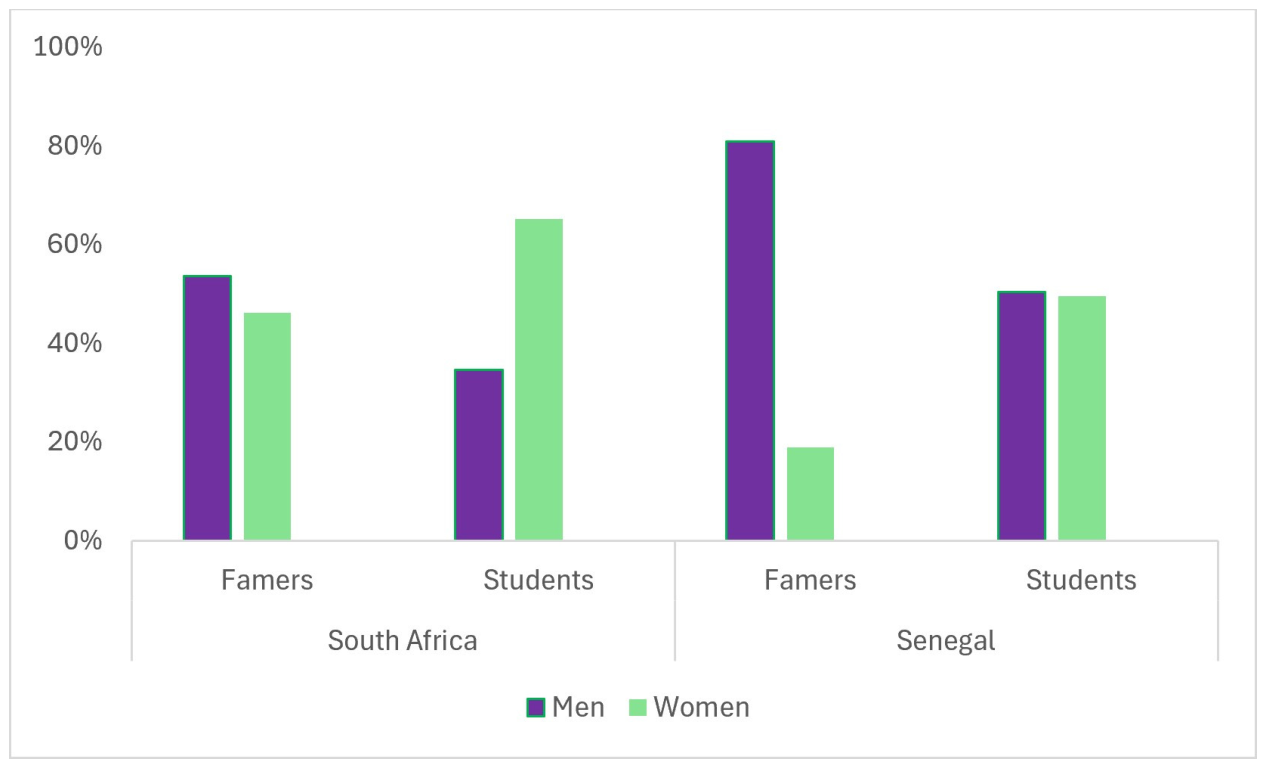
With respect to the findings on socio-demographic characteristics, and, in particular, with respect to gender distribution (
Figure 1), the data suggested that women constitute a significant proportion of the agricultural labor force in South Africa (Farmers Women = 46.2%; Men = 53.5%) while they do so to a lesser extent in Senegal (Farmers Women = 18.9%; Men = 80.8%). However, data on the educational context suggested that women will potentially play a more active role in the future if considering the great number of women students enrolled in agricultural courses not only in South Africa (Student Women 65.2%) but also in Senegal (Student Women 49.5%).
Moreover, preliminary data from background information revealed that 30–40% of the sampled farmers and students in both countries live in a low/extremely low economic condition (Monthly Income: <2000 R in South Africa; <50.000 XOF in Senegal). Furthermore, about one half of students and farmers in our study declared to work (or to own/be the owner’s relative) on a small farm, yet both country-related and gender-related specificities were found. Indeed, overall participants from South Africa were mainly women and younger, owning/working on bigger commercial farms, whereas participants from Senegal were mainly men and older, owning/working on smaller/non-commercial farms. Specifically, farm size reported by participants in South Africa ranged (in hectares, ha) from 0.01 to 8600, while in Senegal it ranged from 0.01 to 14. Moreover, women in Senegal reported to work on farms that are smaller in size than men (Men: Mean ha = 1.31; Women: Mean ha = 0.93).
3.1.2. Diversification: Willingness, Ability, and Gender-Specific Profiles
In order to assess the feasibility of promoting diversification and innovative practices that could foster sustainable development, farmers were asked whether they had ever considered the possibility of diversifying and how easy it would be for them to cultivate/breed different varieties of crops/livestock. Moreover, the psychological profiles distinguishing farmers willing to diversify from those less willing to do so were explored, with the aim of achieving tailored information useful to be included in training and courses to support them effectively.
Overall, 269 out of 380 farmers in South Africa (Response Rate = 70.79%) and 105 out of 357 farmers in Senegal (Response Rate = 29.41%) responded to questions on diversification along with questionnaires on individual characteristics (personality traits, coping strategies, locus of control, motives) and on perceived wellbeing (psychological health conditions and life satisfaction).
Responding to
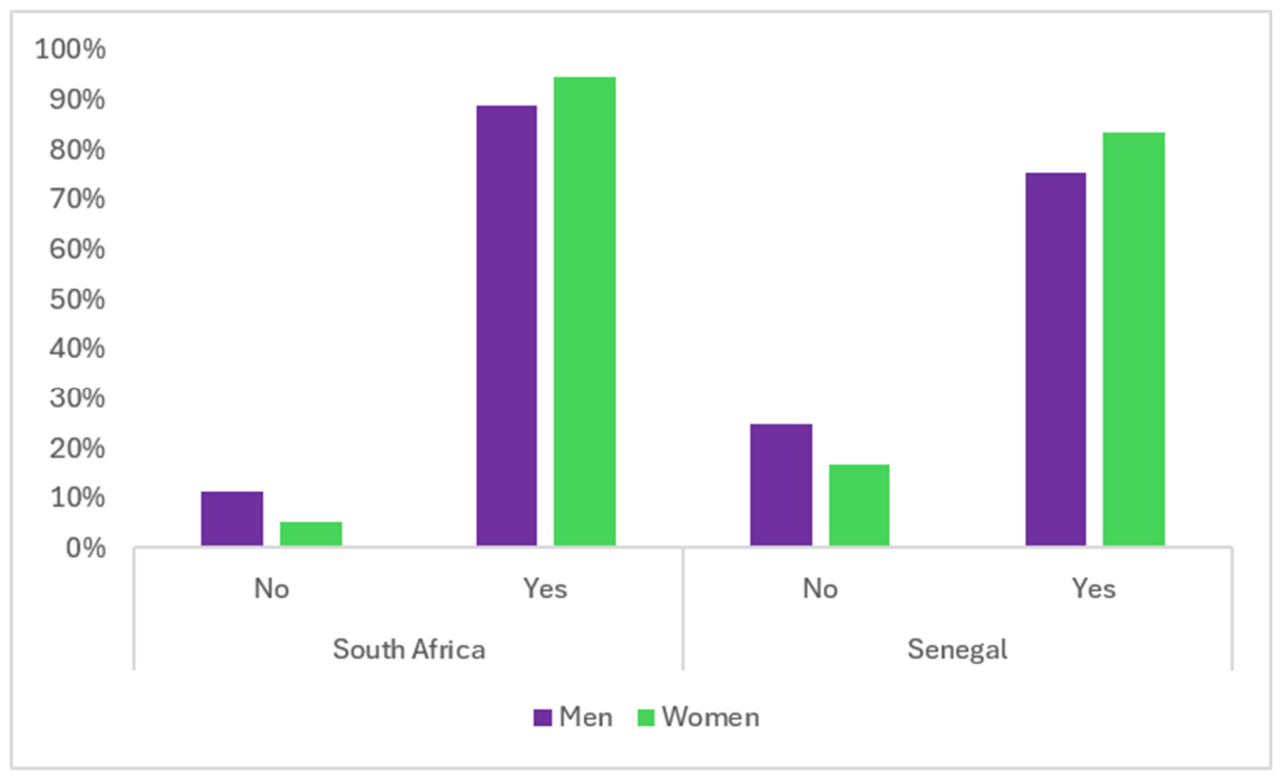
Research Question 1 (RQ1; To what extent do male and female farmers report being willing and able to diversify?), the data revealed that the majority of the sampled farmers—and mainly women—in South Africa (Men: 88.7%; Women: 94.7%) and Senegal (Men: 75.3%; Women: 83.3%) have considered the possibility to diversify (
Figure 2). However, data also revealed that 23.9% of surveyed farmers in South Africa and up to 58.7% in Senegal believed that cultivating/breeding a different variety of crops/livestock would not be easy for them (reporting it was “somewhat hard” to “very hard”), requiring tailored training and interventions. Moreover, although not statistically significant, gender differences were found considering the questions on diversification, with the sampled women farmers responding that cultivating/breeding a different variety of crops/livestock could be “very hard” to a greater extent than the sampled men.
Moreover, in order to inform the development of tailored courses, resources, and actions to promote diversification, in line with the transdisciplinary nature of the project, the psychological profiles of farmers according to their willingness to diversify by gender were investigated (
Table 1 for South Africa and
Table 2 for Senegal; full data in
Supplementary Tables S2 and S3).
In particular, the data allowed us to respond to Research Question 2 (RQ2; Do individual characteristics and perceived wellbeing distinguish male and female farmers who are willing to diversify from those who are not?), also highlighting gender- and country-related specificities.
In South Africa, the data suggested that surveyed men displaying a specific motivational profile (more driven by the need for achievement), with a more active adjustment profile and an internal locus of control (perceived personal agency over their own life and actions), were more likely to be willing to diversify. Differently, the data suggested that surveyed women displaying a higher adoption of specific coping strategies to deal with stress (strategies used to regulate the negative emotions associated with a situation) and those displaying a specific motivational profile (less driven in life by the need to care and boost relationships) were more likely to be willing to diversify. This latter data is somewhat in line with the idea that women may encounter greater hinderances to active engagement in the agricultural sector due to the attribution of not only farm work but also—and predominantly—to family care.
In Senegal, the personality profile emerged from men suggested that those more responsible, organized and hard-working with a high sense of agency were more likely to be willing to diversify. Moreover, both men and women able to take risks, less prone to accept and adapt to situations without actively acting, less dependent on others, and with higher perceived psychological health conditions were more likely to consider diversifying.
3.1.3. Cooperation Between Farmers and Students
In order to involve key actors able to actively contribute to development and co-development in the agricultural sector, namely, farmers and students, as well as to further customize training and resources according to their needs, challenges and areas for improvement, cooperation dynamics among them were investigated.
Overall, 266 farmers (
Response Rate = 70.0%) and 440 students in South Africa (
Response Rate = 75.3%), and 353 farmers (
Response Rate = 98.9%) and 345 students in Senegal (
Response Rate = 80.4%) responded to questions on reciprocity in collaboration.
Table 3 illustrates responses provided by farmers and students on perceived reciprocity in collaborations (
Table 3).
Specifically, responding to Research Question 3 (RQ3; To what extent do farmers and students perceive reciprocity in collaboration?), the data provided a differentiated picture between South Africa and Senegal, which may be useful to recognize and address. Indeed, in South Africa, cooperation appears to be more consolidated overall: 53.0% of farmers and 60.7% of students stated that both parties provide the same level of collaborative support, thus indicating a prevailing perception of reciprocity. This finding suggested that, in its current state, cooperation is already active and perceived as real by the majority. However, it should also be noticed that—although limited—a share of participants believe that they receive more than they provide while around one fifth reports a marked lack of reciprocity.
In Senegal, the situation appears more nuanced. In the context of the present study, indeed, on the one hand, about 39.4% of farmers and 40.0% of students perceived reciprocity in the collaboration; on the other hand, a very high share stated that they provide far more support than they receive, with 39.9% of farmers and 39.7% of students reporting a strong imbalance.
Reciprocity is, therefore, perceived to a lesser extent from participants in Senegal than from those in South Africa. In other words, cooperation appears more fragile, less balanced, and more exposed to the risk of misalignment between expectations, contributions, and perceived benefits in Senegal, requiring tailored interventions.
Therefore, overall, these findings revealed that, despite the clear signs of reciprocity and recognition of the value of collaboration, cooperation should be further strengthened, especially in such cases where the relationship between what is offered and what is received is not perceived as balanced.
However, when exploring collaboration from a different perspective, namely not only considering perceived reciprocity, but also exploring the recognition of the concrete value of cooperation and assessing potential areas of support and potential improvement (to be targeted with courses), the picture becomes clearer. Specifically, in order to respond to
Research Question 4 (RQ4; To what extent do farmers and students perceive positive aspects/advantages in collaboration on specific tasks?), tailored questions were asked to farmers (“Do you believe that students on your farm can be useful to”) and students (“Do you believe that your current competencies and knowledge allow you to support farmers to”) to assess perceived positive aspects/advantages in collaboration on specific tasks. Overall, 275 farmers (
Response Rate = 72.4%) and 422 students in South Africa (
Response Rate = 72.3%), and 354 farmers (
Response Rate = 99.2%) and 338 students in Senegal (
Response Rate = 78.8%) responded to questions on perceived positive aspects/advantages in collaboration on specific tasks. However, given that responses were not mandatory and that this was not a statistically validated measurement tool, only for this scale, nonresponse missing data were retained (
Supplementary Table S4 illustrates the exact number of valid responses for each item).
The responses from farmers and students in South Africa and Senegal are summarized in
Table 4.
Specifically, the data revealed that both in South Africa and in Senegal, the sampled students and farmers seem to be in full accordance with acknowledging the advantages of their collaboration, with farmers even more responsive than students about the important value of reciprocity.
Specifically, the majority of farmers participating in the survey (both from South Africa and Senegal) believed that students could support them in their work (in South Africa from 79.2% “to deal with the drought problem on the farm” up to 90.9% “to help to carry out the work on the farm”; in Senegal from 78% “to help to improve on agribusiness development and finance” up to 91% “to help to improve sustainable agricultural production”).
In the same direction, students participating in the survey believed that they could support farmers effectively, in particular:
In South Africa, “To help to improve sustainable agriculture production (88.9%)” and “To use new techniques (about 83.8%)”;
In Senegal “To help to improve sustainable agriculture production (96%)”, “To improve on post-harvest management and to improve food safety standards (about 92%)”, “To help to understand how to diversify the production on the farm (91.9%)”, and “To use new Technologies and techniques (about 90%)”.
These data, along with those emerged by analyzing open-ended questions on sources of pressures, needs and training needs reported by farmers (South Africa
Response Rate = 98.2%; Senegal
Response Rate = 99.4%) and students (South Africa
Response Rate = 68.5%; Senegal
Response Rate = 75.1%), were used to define courses and to customize curricula by targeting those tasks students perceived to be less able to address and/or in which farmers perceive students less skilled/helpful in their work (
Table 5).
3.1.4. Migration–Agriculture/Rural Development Nexus: Context, Ability and Factors Linked to Intention to Move/Migrate
This section will illustrate data on migration-specific factors, by examining migration intention (currently and in the next five years, along with preferred destination) reported by farmers and students from South Africa and Senegal participating in the survey. Further factors, such as specific background information (e.g., migration background), as well as perceived job insecurity, threats from foreign talent, country’s economic future, and ability to migrate were also explored. Moreover, potential factors associated with the intention to move/migrate were also explored and summarized. Overall, 274 farmers (Response Rate = 72.1%) and 446 students in South Africa (Response Rate = 76.4%), and 110 farmers (Response Rate = 30.8%) and 337 students in Senegal (Response Rate = 78.6%) responded to questions on migration.
Firstly, responding to
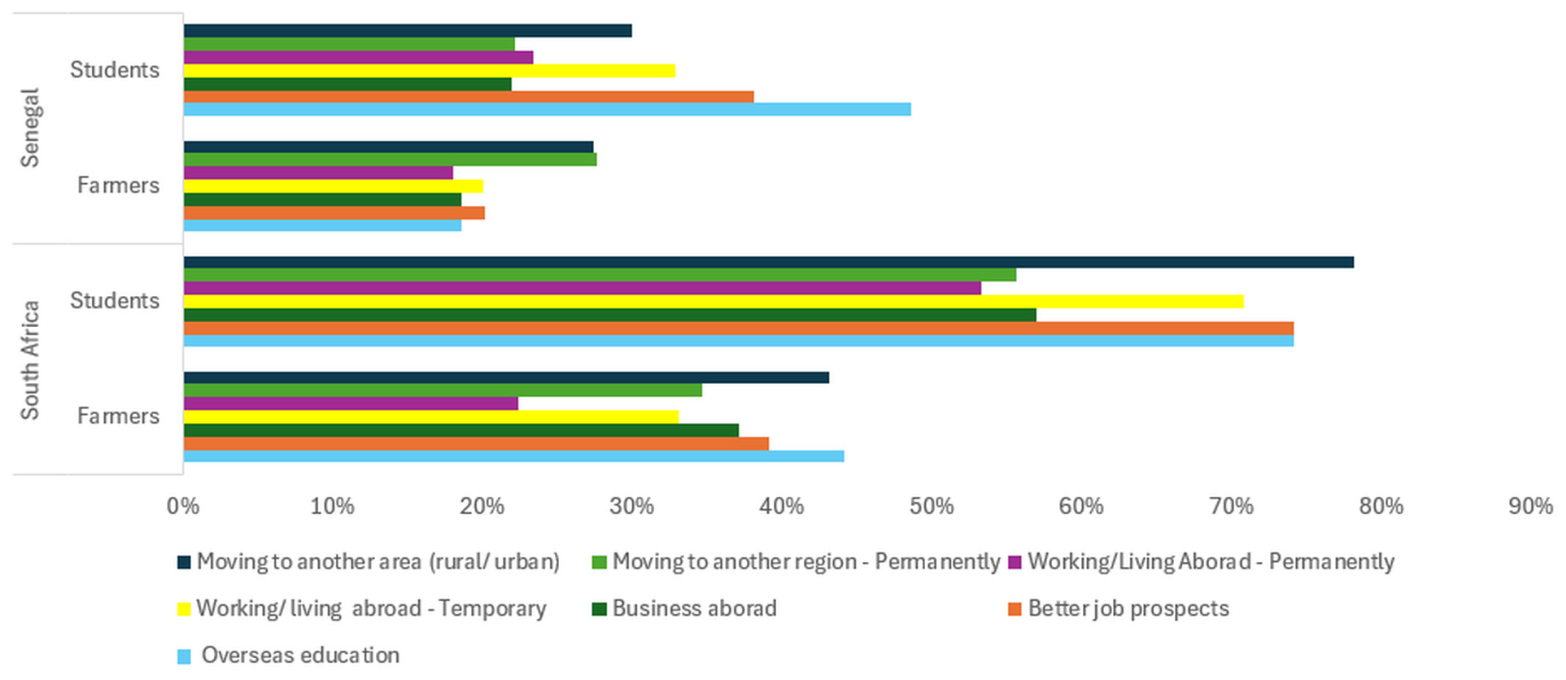
Research Question 5 (RQ5; To what extent are farmers and students willing to move/migrate?), data revealed that whereas sampled students were more likely to consider moving/migrating, more than 50% of farmers in both countries declared they have only rarely or never reflected upon this possibility (
Figure 3). However, data also suggested that both farmers and students were less likely to consider the possibility to live abroad permanently.
With respect to country specificities, data revealed that sampled students in South Africa declared to be more willing to move/migrate internally to a greater extent than in Senegal, mainly to live in another area (rural/urban, 78.1%). The main reasons to migrate shared by students in both countries—even if with different percentages—were to pursue an overseas education (South Africa 74.1%; Senegal 48.6%) and to search for better opportunities abroad (South Africa 74.1%; Senegal 38.1%).
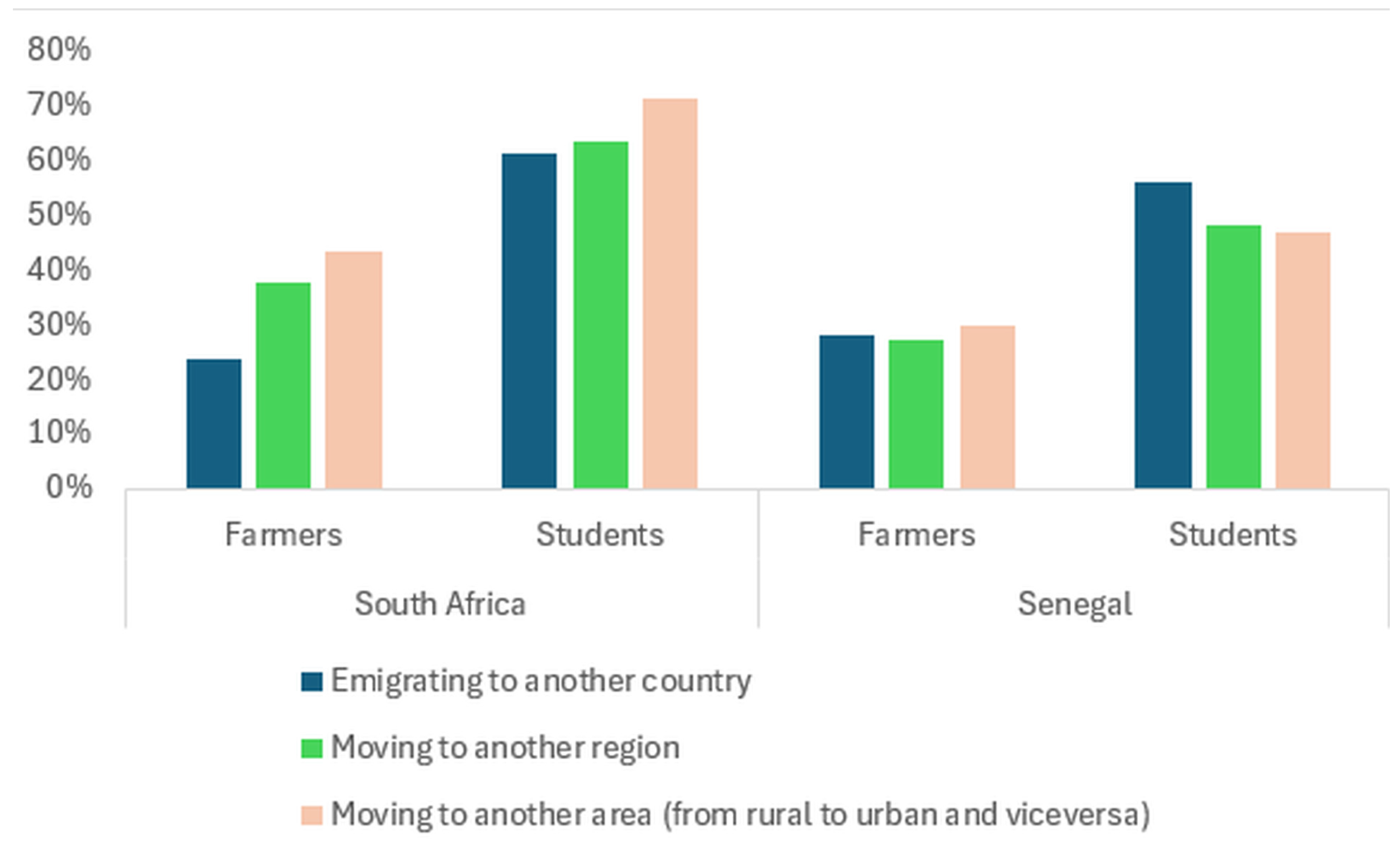
Then, when asked about their intention to move/migrate in the next five years (
Figure 4), this is more frequently reported by surveyed farmers (43.2%) and students (71.2%) in South Africa than in Senegal (farmers: 29.9%; students: 46.9%).
Considering the preferred destination to migrate/move to, the data revealed that participants (both farmers and students) from South Africa declared they would move to another province/city within South Africa. The preferred destination notably differed between students and farmers. Indeed, farmers preferred to move from urban to rural areas/farm areas, followed by the United States and abroad, searching for a place for better job opportunities and agricultural purposes, as well as to Germany. Students also wished to move to Germany, the United States, or anywhere they could achieve their goals.
Differently, this choice in Senegal appears to be influenced by the language spoken in the country of destination. Indeed, both farmers and students from Senegal declared they would move to Canada and France, along with the United States.
With respect to the other migration-related factors examined, key findings from participants are summarized as follows:
Migration background: Most farmers and students in both countries declared they had never moved from the place they were born;
Perceived Ability to Migrate: In South Africa, both farmers and students believed that they could easily move, and this is particularly true among students. This possibility is given by their educational qualification, and to a lesser extent by their social/family networks. Differently, in Senegal, both farmers and students believed that they could not easily move/migrate, and this is particularly true among farmers. Only for students, they reported that their educational qualification could allow them to move/migrate if they wish to do so;
Perceived Social Mobility: Overall, both farmers and students declared that they preferred to improve their wellbeing by staying in their country; this is particularly true among farmers in South Africa and among students in Senegal;
Perceived Threats from foreign talents and Country’s Economic Future: In South Africa the majority of farmers and students perceived job insecurity and instability due to the migration flows and seem to be unsure about changes in the condition in the next ten years. Differently, in Senegal, about one-half of farmers and students perceived job insecurity and instability due to the migration flows yet the majority seem to be confident about changes in the condition in the next ten years, so that everyone in Senegal will have sufficient jobs and opportunities.
Afterwards, responding to
Research Question 6 (RQ6; Are individual characteristics, migration-related factors and perceived wellbeing associated with participants’ migration intention?), the data from hierarchical multiple regression analyses revealed both shared and country-specific factors associated with migration intention among the study participants (
Table 6).
Specifically, the following common factors were identified as being associated with Migration Intention across countries: an external locus of control (i.e., people believing that their own life is determined by fate/chance), a higher self-reported ability to migrate, and higher psychological disease represented risk factors associated with higher migration intention. Conversely, perceived social mobility (i.e., the perceived possibility of improving their own life within their country) was identified as a key protective factor across countries.
Considering country-specific risk and protective factors, the data revealed the following:
- -
For participants in South Africa, a specific risk profile, namely featuring people who were emotionally dysregulated (a personality trait of neuroticism), adopting passive adaptive strategies (denial coping), and mainly driven by the need for caring interpersonal relationships (affiliation motive), was associated with increased migration intention. Conversely, higher levels of the personality trait of conscientiousness and the adoption of active adaptive strategies (seeking instrumental support coping) were found to be significantly associated with lower migration intention.
- -
For participants in Senegal, the adoption of passive adaptive strategies (humor coping) was associated with increased migration intention, while higher levels of cooperation and agreeableness, the adoption of adaptive strategies centered on religious coping, and perceived life satisfaction were found to be significantly associated with lower migration intention. Moreover, interestingly, although it should represent a protective factor, the optimistic idea that in Senegal, there will be opportunities in the future was found to be associated with higher migration intention.
In summary, by applying a bottom-up approach based on the direct involvement of end users—farmers and students—the data from National Surveys allowed to collect unique data on challenges and real needs of the target population, so to plan and customize the next phases of the project and define research implications in terms of the training, resources, and tools to be developed.
3.2. Project Results: Accredited Training
Within the MASSTER project, each of the HEIs from Senegal and South Africa developed, co-created and delivered non-degree training courses covering the following four areas:
Agritourism development;
Farm development and income generation;
Farm management and climate change resilience;
Food value chain: production and procession, and income generation.
Therefore, in total, 24 original courses were designed and developed to actively contribute to several Sustainable Development Goals (SDGs), namely Zero-hunger, Gender-Equality, Quality-education, Decent-work-and-economic-growth, and Responsible-consumption-and-production. These training courses were also built upon the findings of the National Survey (see, for example, data on gender specificities; needs and constraints; ability and willingness to diversify). However, the process of course design entailed the direct involvement and participation of extension service providers and farmers. Specifically, following the design of the courses and the development of the materials, HEIs organized peer-review workshops with farmers (both women and men) and with extension service providers. The purpose was to analyze and discuss the contents and to collect qualitative feedback from trainers and the final beneficiaries.
3.3. Project Results: Toolkits
Still considering the objective of increasing awareness, knowledge, hard and soft skills of HEI staff, extension services and the target population, another key result of the MASSTER project was the creation of three tailored toolkits, which were strategically designed—once again—to actively contribute to the achievement of specific Sustainable Development Goals (Zero-hunger, Good-Health-and-Wellbeing, Gender-Equality, Quality-education, Decent-work-and-economic-growth, Responsible-consumption-and-production) and provided both in English and in French versions, namely:
1. Toolkit on Training of Trainers (ToT): This toolkit, titled Empowering educators series: training of trainers in African context aimed to provide a practical methodology and guidance for designing and delivering effective adult education training. Tailored to the SSA context, the toolkit aimed to equip educators, facilitators, and trainers with the tools, approaches, and frameworks needed to develop and implement their own adult learning programs, fostering self-reliance, contextual relevance, and the quality of adult education practices.
2. Toolkit on Whole of Society Approach—implementation toolkit in agriculture and rural development Continuing Professional Development (CPD): This toolkit, titled Rooted Voices, Rising Power: Empowering Communities to Shape Their Future, aimed to offer practical guidance, methods, and adaptable tools to enable HEIs and their partners to become proactive drivers of change in their regions. By embracing transdisciplinarity and co-creation, the toolkit empowers actors to jointly address root causes of migration, design income-generating training for farmers and students, and enhance the relevance of educational curricula in agriculture, food security, and rural development. Drawing on the diverse experiences of partner institutions in South Africa and Senegal, the toolkit reflects the MASSTER project’s conviction that sustainable transformation in SSA agriculture cannot be engineered with a top-down approach. Instead, it must be cultivated through dialog, capacity-building, and shared responsibility across all sectors of society.
The toolkit is designed to equip stakeholders with the knowledge and tools to implement the Whole of Society Approach, thereby contributing to a broader paradigm shift—one in which agriculture becomes a source not only of sustenance but also of dignity, resilience, and opportunity for communities across the region. The toolkit has been developed for teaching and management staff at higher education institutions, as well as for extension service providers in two African partner countries, namely Senegal and South Africa. In addition to these primary beneficiaries, secondary beneficiaries include farmers and farming communities, students in agriculture, local governments and municipal authorities, Civil Society Organizations (CSOs) and Non-Governmental Organizations (NGOs), policymakers and developmental agencies, youth networks and rural entrepreneurs.
3. Toolkit on university–local community cooperation in migration management and local development: This toolkit, titled Higher Education and Community: Building a Shared View for Managing Migration and Promoting Development and Co-Development, aimed to raise awareness of migration dynamics, so promoting mobility, exchange and cooperation within the local context of Senegal and South Africa, boosting international partnership and co-development, while, at the same time, combating the phenomenon of brain-drain. Indeed, understanding migration dynamics requires an evidence-based and community-oriented approach that supports development and sustainable growth by strengthening the connection between HEIs and local actors (stakeholders, policymakers, the job market).
Therefore, by navigating this toolkit, the reader—as one of the key actors involved—will be able to: (a) assess and understand migration and brain-drain at both local and international levels, by familiarizing with the relevant, up-to-date taxonomy and key actors and stakeholders involved; (b) access the most up-to-date international data and scientific research on migration and brain-drain, as well as local data useful for defining targeted actions; (c) understand how to effectively measure and monitor migration flows and the key factors involved; (d) acquire active and common strategies to manage migration and reduce brain-drain; and (e) acquire knowledge and awareness of active collaboration networks at local and international levels, to expand them and promote further actions for development and co-development.
3.4. Project Results: Student and Alumni Tracker Procedure with Brain-Drain Early Warning Mechanism
The development of an effective migration management framework within South Africa and Senegal—implemented through HEIs’ greater involvement in community development and Whole of Society Approach within the agricultural/rural development and migration/mobility nexus—represented one of the key objectives of the MASSTER project.
In this perspective, within the project, the MASSTER student and alumni tracker with brain-drain warning mechanism was co-created. This is an operational and technological procedure developed to support HEIs in South Africa and Senegal in migration management and reduce the phenomenon of brain-drain. In line with the Sustainable Development Goals of Good-Health-and-Wellbeing, Gender-Equality, Quality-education, and Decent-work-and-economic-growth, the central objective of this mechanism is the timely identification of students and alumni who are at high risk of migration, especially involuntary migration, thereby enabling institutions to intervene through personalized support strategies and actions.
The tools used to measure and monitor university brain-drain consisted of an integrated system combining multidimensional surveys and dedicated software platforms for tracking students and graduates.
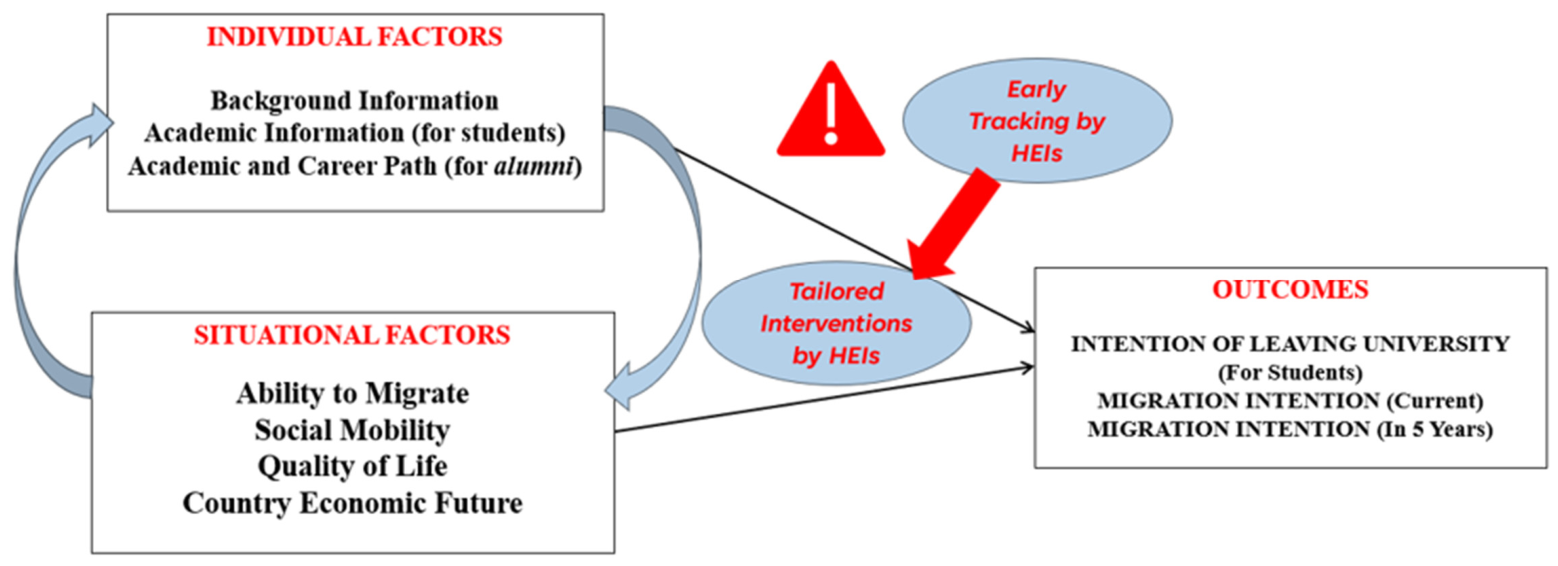
Specifically, through the implementation of the MASSTER student and alumni tracker procedure with brain-drain early warning mechanism, HEIs are able to develop a network with students and alumni to collect and monitor the following information:
Individual Factors (background information, Academic Information, Academic and Career Path);
Situational Factors (perceived levels of Ability to Migrate, Social Mobility, Quality of Life, Country Economic Future);
Outcomes (Migration Intention—currently and in the next 5 years—and leaving intention [for students]).
This will enable HEIs to identify students and
alumni who may be at risk and to timely provide tailored support interventions. The development of the framework (
Figure 5) was both theory-based and evidence-based. Specifically, the framework was developed based on data from the National Survey as well as on relevant models, measurement tools, and research for understanding complex phenomena such as migration dynamics and brain-drain [
18,
27,
38,
39,
40].
Moreover, it is important to highlight that—within the MASSTER Student and Alumni Tracker Procedure and Brain-Drain Early Warning Mechanism—data for tracking students/alumni were collected in accordance with the World Association’s Declaration of Helsinki, ensuring the ethical use of student and alumni data (e.g., consideration of transparency of use, clear reasons for use, options to contact HEI staff to remove own data, staff and students’ awareness of use of data, information on who has access to the data and appropriate possible actions derived from data analyses, including the possibility to be contacted by HEI staff to receive tailored counseling and support). Consequently, when enrolled, all students and alumni were asked to provide written informed consent.
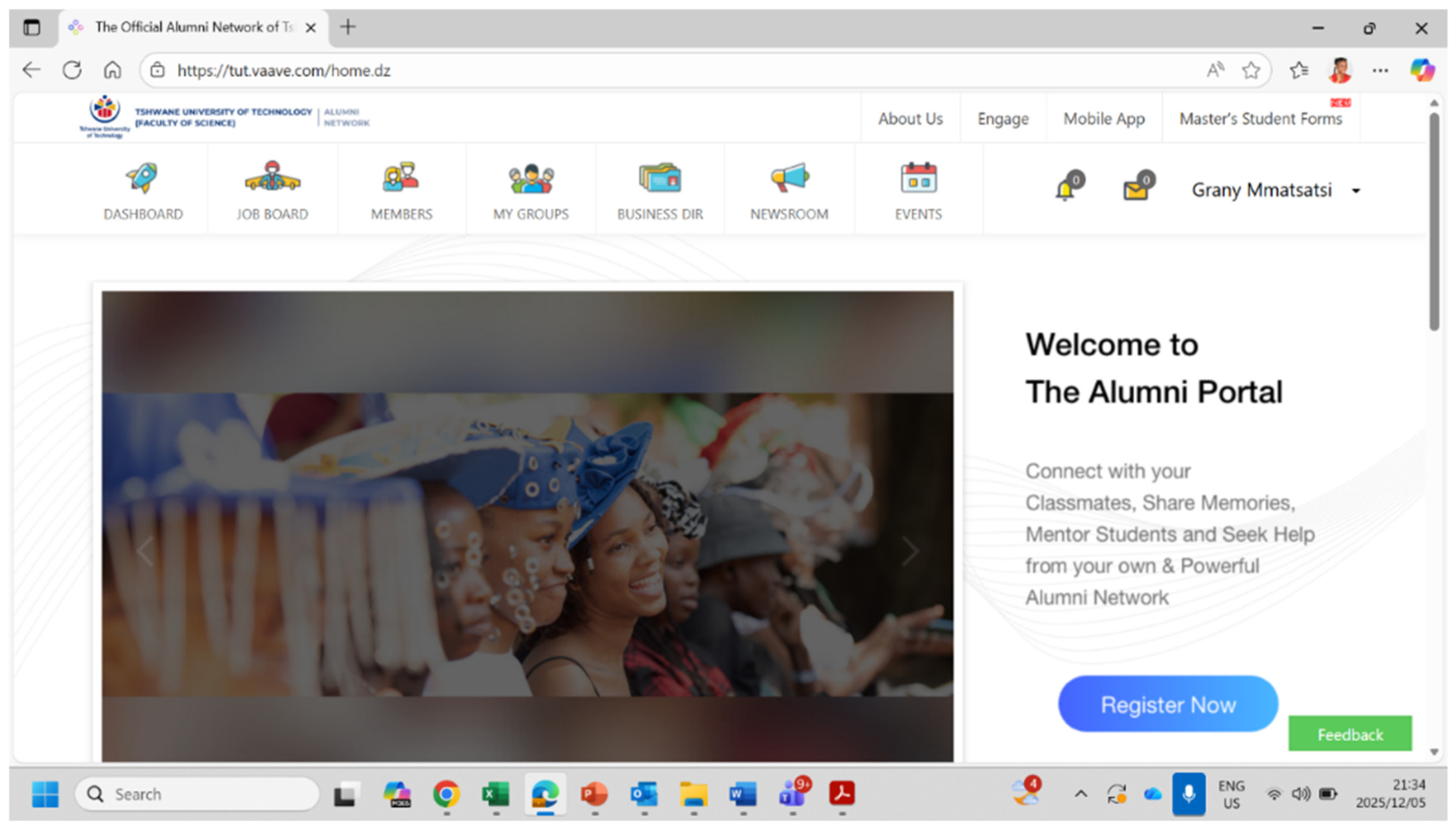
Tshwane University of Technology (TUT) procured the VAAVE alumni tracking software to monitor agricultural students and alumni across departments such as Crop Sciences, Animal Sciences, Horticulture and Nature Conservation. The procedure begins with students registering on VAAVE using their emails and completing a baseline profile that captures personal information, academic programs, skills, and career interests. Graduating students are transitioned automatically into the alumni category, while others are invited through email and social media.
Alumni update their profiles with employment status, location, sector, further studies, and mobility information. The system sends automated reminders every six months to ensure continuous updates. The data is validated by institutional teams to maintain accuracy. VAAVE also supports communication through announcements, newsletters, events, and mentorship tools, helping maintain long-term engagement.
The MASSTER project team developed a questionnaire (
https://sciencealumni.tut.ac.za/page/Masters-Student-Forms.dz, accessed on 11 February 2026) that served as the primary tool for the identification of early indications of potential migration among students and graduates. VAAVE will also monitor key indicators such as long-term relocation outside the province or South Africa, reduced engagement in TUT activities, prolonged unemployment, movement into unrelated sectors, and responses captured through the questionnaire.
The system will automatically flag individuals who meet any of these risk criteria and include them in quarterly analytic reports. Once an alumnus or student has been flagged, the TUT will conduct follow-up communication, including verification surveys and dissemination of information on local career and research opportunities. These interventions will help the project proactively support graduate retention, strengthen ongoing engagement, and inform future strategies to mitigate the potential loss of skilled individuals (brain-drain) within the agricultural sector.
The analytical reports and the early warning mechanism form the operational heart of the tracking procedure developed within the MASSTER project. These tools allow partner universities to move from passive monitoring to proactive intervention to combat brain-drain. As previously highlighted, the mechanism has been designed to identify early signs of a potential migration intention or dropout. It is based on the integration between the MASSTER questionnaire and behavioral data collected by the tracking software. The platform is designed to generate regular reports and dashboards for monitoring academic progress, employment outcomes, and alumni participation. The system is configured to automatically generate a report (flag) when a user meets certain risk criteria:
Questionnaire responses: Scores indicating high “Migratory Capacity” or strong short/medium-term “Migratory Intention.”
Prolonged unemployment: Individuals who cannot find employment in the local agricultural sector for a long period.
Shift to unrelated sectors: Alumni working in sectors other than agriculture/rural, reporting a loss of skills for the area.
Long-term relocation: Transfer of residence out of the province or country of origin.
Reduced engagement: For students, less participation in university activities or an expressed desire to drop out (leaving intention).
The data collected and the related automatic reports are channeled into analytical reports, which are generated every three months. These documents enable HEI staff to: (a) view dashboards and charts on graduates’ employment and geographic trends; (b) have an up-to-date list of “at-risk” individuals who require immediate support; and (c) evaluate the effectiveness of curricula with respect to rural labor market trends.
This data provides academic departments with the ability to activate follow-up communication in order to:
Favor Guidance and Mentoring: Provision of targeted information on local career opportunities, research grants and calls for rural agribusiness development.
Provide Psychological Support: Counseling interventions to address job insecurity or personal pressures that drive involuntary migration.
Facilitate Networking: Facilitate contact with business incubators and local professional networks to promote talent retention in the local area.
3.5. Project Results: MOOC on Critical Thinking and Empowerment in Rural SSA Communities
The Massive Open Online Course (MOOC) on Critical Thinking and Empowerment in Rural SSA Communities, which was co-developed and implemented within the MASSTER project, aims to support SSA learners across different educational levels and backgrounds to enhance critical thinking and promote empowerment. This is by fostering learners’ open-mindedness, analytical skills, decision-making capacity, and the ability to engage constructively within their own communities (actively promoting the achievement of the Sustainable Development Goals of Good-Health-and-Wellbeing, Gender-Equality, Quality-education, and Decent-work-and-economic-growth).
The MOOC comprises three modules, namely: Module 1 (Introduction)—Why Another Course on Critical Thinking?; Module 2—Case Studies on the Project’s Objectives and Goals; and Module 3—Empowerment of Sub-Saharan African Communities.
All the modules are based on audiovisual educational contents and provide real-world case studies along with interactive self-assessment tools, thus making the learners active players in their education process.
The MOOC is open and freely available for university students and for adult learners, with contents provided in both English and French versions, on the WBMoodle platform (
https://www.masster-project.de/mooc-1, accessed on 18 May 2026).
4. Discussion
This paper aimed to provide an overview of the MASSTER project, a transdisciplinary and transnational cooperation project, in which higher educational institutions (HEIs) and organizations from Senegal and South Africa collaborated with European partners to become central players in sustainable development and co-development by addressing the nexus between migration, agriculture, and development in Sub-Saharan Africa.
Specifically, within this paper, the MASSTER project’s theoretical framework and methodology, along with the main results and outcomes, have been illustrated. Firstly, the results of the preliminary phase of the National Surveys provided key insights for the development of the project’s actions and tools. From this perspective, one of the primary objectives of the project was to empower farmers and students. Our data from the National Surveys confirmed their willingness to be supported (e.g., data revealing that the majority of farmers—and mainly women—have considered the possibility of diversifying, yet they report hindrances in doing so). However, the data also highlighted farmers’ and students’ specific risks and needs, which fully aligned with research on the topic. Findings, indeed, suggested that financial constraints, inadequate infrastructures, the lack of climate change mitigation and adaptation policies and tools, and public issues represented key risk factors hindering the development of the agricultural sector in SSA [
7,
8].
On the other side, overall, the data from the National Survey also confirmed the presence of gender specificities (e.g., women working in smaller farms, gender-specific profiles in diversification), that have been carefully addressed through the development of curricula and tools which were gender-sensitive, thus actively contributing to counteracting the pervasive gender imbalance featuring the agricultural labor SSA [
8,
9,
10,
11,
12].
Moreover, with respect to migration management, the empirical data collected—stratified by country—allowed to deepen and extend the understanding of “push and pull” factors associated with migration potential [
14,
15,
16], providing original evidence supporting the role of
individual characteristics (personality traits, coping strategies, locus of control, motives),
migration-related factors (perceived ability to migrate, social mobility, country’s economic future, threats from foreign talents) and perceived
wellbeing (psychological disease, life satisfaction) as significantly associated with migration intention, yet also highlighting communalities and specificities across Senegal and South Africa to be taken into account.
However, altogether, the inception phase enabled the creation of evidence-based training, tools, and actions to foster development and co-development. The first tangible tools were: the accredited courses (agritourism development; farm development and income generation; farm management and climate change resilience; food value chain: production and procession, and income generation); the toolkits (1. Empowering educators series: training of trainers in African context; 2. Rooted Voices, Rising Power: Empowering Communities to Shape Their Future; and 3. Higher Education and Community: Building a Shared View for Managing Migration and Promoting Development and Co-Development); and the Massive Open Online Course (MOOC) on Critical Thinking and Empowerment in Rural SSA Communities.
From this perspective, by providing practical, freely available, and interactive resources (in both English and French) the MASSTER project sought to respond to the need to develop updated tailored and evidence-based curricula, training and tools fostering both hard and soft skills [
41,
42,
43,
44,
45] and enriching the knowledge and the practical competences of HEI staff, students and farmers—in line with a
Lifelong Learning Perspective. Moreover, these resources may represent examples of how to concretely foster the bond between HEIs, the target population, the job market, and the local community [
41,
42,
43,
44,
45]. Indeed, by adopting these resources, HEI staff will be better equipped to support students, while the latter will be better prepared for the job market and more rooted in the local context.
In the same direction, the development of the
student and alumni tracker procedure with brain-drain early warning mechanism should be considered of particular interest at the local and international levels. Indeed, the possibility to detect and predict migration intentions, particularly among students, could allow governments and institutions to anticipate the current and potential flows, and, accordingly, to manage them effectively, for example, by developing tailored actions/policies and by allocating resources differently [
46]. From this perspective, within the so-called
Migration Era, in which the number of international migrants and mobile students is constantly increasing [
47], assessing migration potential is pivotal in order to quantify the phenomenon as well as to deepen the complex process going from intention to migrate to deciding to do so [
48,
49]. Identifying, at an early stage, students and workers who intend to leave their country—particularly those who feel compelled (involuntary migration [
19]) to do so in order to achieve their personal and professional goals—can, in fact, help promote concrete actions capable of reducing the brain-drain and contributing to their country’s development through the full utilization of local human resources. In this regard, according to the MASSTER project aims and scope, managing a student/worker with migration potential is based on a proactive and multidimensional approach. This aims at transforming migration from an involuntary act into a conscious choice, or better yet, possibly turning intention to migrate into “mobility” projects (short-term work/study experiences abroad). The aim is to maintain rootedness and life planning in the country of origin, thus contributing to development and co-development at local and international levels [
50,
51,
52].
Nonetheless, despite the project’s value, some limitations should be addressed. Considering the National Survey, findings should be interpreted with caution due to several limitations. Firstly, the study was conducted with a convenience sample of farmers and students recruited by HEI staff involved in the project (from Senegal and South Africa), having online access and participating voluntarily, thus increasing the risk of selection bias and limiting the generalizability of the research results. In particular, the convenience sampling and low response rates in some subgroups sensibly limited the generalizability of our findings. Further research is therefore needed—developed on larger/nationally representative samples, allowing paper-and-pencil participation, and designed as comparative studies including participants from other countries—to boost and generalize these results. Also, the data was collected by only one source (self-report measures), thus limiting the possibility of further deepening participants’ nuances of experience and increasing the risk of answers influenced by social desirability bias. Therefore, future projects could also be designed to include a wider range of sources of data (e.g., focus groups). Moreover, in our survey, we have predominantly used short-scale and single-item questions in order to increase the participation of farmers and students while trying to reduce the rate of missing data. However, this has limited the possibility of calculating and reporting reliability coefficients (e.g., Cronbach’s α/McDonald’s ω) of measures, which are strongly penalized/severely biased for short scales and, therefore, should not be reported. Instead, test–retest coefficients of short-scale measures to establish temporal stability should be evaluated. Nevertheless, given the cross-sectional design of our study, it was not possible to calculate test–retest reliability for any of our measures. From this perspective, the cross-sectional survey is a clear limitation to be acknowledged. Indeed, despite this design being considered appropriate for a project inception phase and for exploring our research questions, no inferences concerning the temporal associations between predictors and outcomes can be made, and causality cannot be established. Furthermore, considering the overall work, the MASSTER project’s toolkits, MOOCs, tracking systems, and training courses are only described, and their effectiveness is not empirically evaluated. Therefore, future projects could be designed with a longitudinal design to further explore the relationships that have emerged in regression analyses, to test the effectiveness, impact or learning outcomes of the developed tools, as well as to provide further evidence on the psychometric properties of the measures used in the present study (e.g., by exploring test–retest reliability).
However, despite these limitations, the MASSTER project can have a relevant impact at local and international levels, providing evidence-based tools to be used by HEIs, stakeholders/policymakers, and the scientific community to actively foster development and co-development.
5. Conclusions
In conclusion, the present work sought to provide a comprehensive overview of the methodology and the primary outcomes of a transdisciplinary project titled MASSTER (Managing South Africa and Senegal Sustainability Targets through Economic Diversification of Rural Areas). The central objective of this project was to address the nexus between migration, agriculture and development in Sub-Saharan Africa. To this end, evidence-based training, tools and actions to foster development and co-development were co-created and illustrated in the present paper.
Beyond the interest in disseminating the project’s results to enhance its international impact, this work has several theoretical and practical implications. In particular, from a methodological perspective, the paper provided HEIs, professionals, and researchers from different fields with a transdisciplinary theoretical framework and a valid replicable methodology useful for assessing and monitoring the actual risks, resources and needs of key actors of the agricultural sector (farmers and future farmers), thus promoting migration management and preventing the brain-drain phenomenon effectively.
From a practical point of view, the work provided tangible and evidence-based training and resources to promote wellbeing, economic and agricultural development and co-development, while addressing the needs of the target population and valuing human capital. Indeed, the MASSTER project specifically sought to actively sustain the targeting of several Sustainable Development Goals (SDGs), namely Zero-hunger, Good-Health-and-Wellbeing, Gender-Equality, Quality-education, Decent-work-and-economic-growth, Responsible-consumption-and-production, all within the frame of Partnership-for-the-Goals.
Moreover, the work may encourage the development of projects, research, and partnerships aligned with the MASSTER project objectives, promoting dialog, exchange, collaboration, and co-development. Furthermore, in terms of policy implications, the paper provides the scientific community, stakeholders, and policymakers with up-to-date data and useful information regarding the context of Sub-Saharan Africa, promoting not only knowledge and awareness but also offering practical tools applicable in other contexts. The methodology and results obtained so far within the MASSTER project, in fact, have the potential to achieve key national and international objectives and priorities, drive significant scientific and social outcomes, and ensure measurability and concrete monitoring of the effects of the actions and interventions undertaken.
Rather than being a passively acknowledged potential, the development and enhancement of the agricultural sector in SSA represent key goals that should be prioritized and can be achieved by adopting a transdisciplinary approach and promoting the active engagement of all relevant actors at local and international levels.



 ,
,