Article

Aligning Digitalization and Circular Economy Policies Towards a Zero-Waste Construction Sector: A Comparative Analysis of the EU, UK, and China


by
M. De La Cruz
1,*,
Elena López Gunn
1,2,
Aikaterina Karanafti
3 and
Ines Diez Ortiz
4
1
Icatalist S.L., 28232 Madrid, Spain
2
Elcano Royal Institute, 28006 Madrid, Spain
3
Laboratory of Building Construction and Building Physics, Civil Engineering Department, Aristotle University of Thessaloniki, P.O. Box 429, 54124 Thessaloniki, Greece
4
Construction Materials Laboratory/Lab Services, Tecnalia Research & Innovation, 48160 Biscay, Spain
*
Author to whom correspondence should be addressed.
Sustainability 2026, 18(14), 7473; https://doi.org/10.3390/su18147473
Submission received: 11 June 2026 / Revised: 12 July 2026 / Accepted: 16 July 2026 / Published: 22 July 2026

Abstract

The construction sector accounts for over 30% of global material extraction and up to 40% of solid waste, making Construction and Demolition Waste (CDW) a major sustainability challenge. This study applies the Digital Circularity Alignment Model (DCAM), supported by evidence from the RECONMATIC project, to compare policy and technological transition pathways toward circular construction in the European Union, the United Kingdom, and China. The analysis examines interactions between regulatory instruments and digital infrastructures, including Building Information Modelling (BIM) and Digital Product Passports. Results reveal a global shift toward mandatory lifecycle transparency, where digital tools function as compliance infrastructures. Crucially, the comparative review identifies distinct governance drivers: EU supranational regulation, UK procurement-driven frameworks, and Chinese state-led macroeconomic planning. Despite these differences in governance approaches, progress remains constrained by fragmented data ecosystems, limited interoperability, and uneven institutional capacity. The findings show that the principal barrier to scaling circularity is not technological availability but the misalignment between policy frameworks, data standards, and implementation mechanisms. Achieving a zero-waste construction sector by 2050 therefore requires interoperable data ecosystems and stronger policy–technology alignment.

1. Introduction

The construction sector is one of the most resource-intensive industries globally, operating predominantly under a linear “take–make–dispose” model [1,2]. In the European Union (EU), it accounts for over 50% of material extraction and approximately 35% of total waste, primarily in the form of Construction and Demolition Waste (CDW) [3,4]. Similar patterns are observed in the United Kingdom (UK), where CDW represents 62% of total waste [5], and in China, where CDW accounts for approximately 30–40% of total waste due to rapid urbanization and increasing material flows, despite historically lower recycling efficiencies [2].
In response, policy frameworks such as the EU Waste Framework Directive and related national strategies have introduced ambitious circular economy (CE) targets. However, implementation remains largely constrained to partial recovery practices such as downcycling and backfilling, which fail to preserve material value and structural utility [2,6]. This persistent gap highlights that current circular economy strategies remain insufficient to achieve systemic resource decoupling.
To address these limitations, the construction sector is undergoing a “Twin Transition”, defined as the convergence of circular economy principles with digital transformation processes aimed at enabling lifecycle-based resource management [1,7]. Within this paradigm, technologies such as Building Information Modelling (BIM), Digital Twins, Internet of Things (IoT), and Digital Product Passports (DPPs) are increasingly positioned as key enablers of material traceability and lifecycle transparency [1,8].
However, despite rapid technological development and increasing policy ambition, the transition toward Digital Circularity remains structurally constrained. Fragmented supply chains, uneven digital maturity, and, critically, the absence of interoperable data standards continue to limit scalability and cross-sector integration [8,9]. Importantly, this fragmentation is not purely technical but reflects deeper governance and institutional misalignments across regulatory systems, standardization bodies, and market actors [10,11].
Recent literature increasingly recognizes that the main bottleneck is no longer the availability of digital technologies, but their effective integration into governance and data infrastructures capable of supporting lifecycle-based regulation and decision-making [12]. However, existing studies often examine policy frameworks, digital technologies, and implementation challenges in isolation, lacking a unified analytical perspective that connects these dimensions across different governance scales and regional contexts. While recent literature increasingly recognizes the “Twin Transition”—defined as the concurrent implementation of circular economy principles and digital transformation technologies [7,10]—the practical policy integration and on-the-ground implementation of these two domains often remain fragmented [6]. Moreover, the current body of knowledge remains fragmented, with many studies addressing specific environmental or technical issues while providing limited insight into how governance structures, information flows, and compliance mechanisms interact across macro-, meso-, and micro-levels [6,11]. This fragmentation constrains a systemic understanding of the Twin Transition and reveals a critical knowledge gap regarding the alignment of policy, digital infrastructures, and institutional capacities required to enable circular construction at scale.
To address this gap, this study applies the Digital Circularity Alignment Model (DCAM), which integrates macro-level governance structures, meso-level digital infrastructures, and micro-level implementation mechanisms into a unified analytical framework [1]. Using comparative policy mapping from the Horizon Europe RECONMATIC project, the study examines how circular economy policies in the European Union, the United Kingdom, and China are translated into digital compliance infrastructures through technologies such as BIM, Digital Product Passports, and IoT systems.
By doing so, the paper explicitly reframes interoperability not as a technical limitation, but as a systemic governance constraint that determines the scalability of the Twin Transition. In this context, digital technologies are conceptualized not merely as innovation tools, but as emerging regulatory infrastructures that operationalize lifecycle accountability and material traceability.
The study pursues three main objectives:
  • To analyze how different governance models (EU, UK, China) structure the integration of circular economy and digital transformation.
  • To examine the role of digital infrastructures in enabling lifecycle transparency and regulatory compliance.
  • To identify systemic barriers—particularly interoperability—that constrain the scalability of Digital Circularity.
The paper contributes to literature in three ways. First, it operationalizes the DCAM as a comparative analytical framework linking governance, technology, and implementation across scales. Second, it demonstrates the transition of digital tools from voluntary innovations to compliance infrastructures embedded in policy systems. Third, it identifies interoperability as a central systemic barrier and reframes it as a governance-level coordination problem rather than a purely technical issue.
The remainder of the paper is structured as follows: Section 2 presents the theoretical framework and methodology; Section 3 analyses macro-level governance systems; Section 4 examines enabling technologies and standardization; Section 5 evaluates micro-level implementation through lifecycle assessment tools; and Section 6 and Section 7 provide conclusions and discussion.

2. Materials and Methods

2.1. Theoretical Foundations for Digital Circularity

The transition toward a zero-waste construction sector requires navigating the “Twin Transition”, defined as the integration of green and digital transformations to decouple economic growth from resource use [7]. To systematically analyze the interaction between regulatory frameworks and technological adoption, this study applies and extends the Digital Circularity Alignment Model (DCAM).
The DCAM was originally conceptualized by Lindblad (2026) specifically for timber-based construction, focusing on material-specific strategies [1]. However, the present study demonstrates its original contribution by explicitly adapting and scaling the DCAM to serve as a cross-regional, macro-policy analytical framework. Rather than applying it to a single material, this research operationalizes the four DCAM layers to code and comparatively evaluate 22 distinct regulatory and standardization instruments.
The theoretical grounding of the DCAM avoids pure technological determinism by bridging the Resource-Based View (RBV) at the micro/firm level with sociotechnical transitions theory at the macro level [1]. Within this extended operationalization, the four layers interact continuously and recursively. Institutional Enablers (Layer 4) exert macro-level regulatory pressures that shape the adoption of Circular Business Models (Layer 3) and Circular Strategies (Layer 2), which in turn dictate the functional requirements of the Digital Infrastructure (Layer 1) [1]. Conversely, the emergence of mature digital tools (e.g., Digital Product Passports) acts as a sociotechnical catalyst, enabling policymakers to mandate stricter circularity requirements. By mapping our policy data onto this framework, the study reveals how digital capabilities and institutional conditions co-evolve to enable circular outcomes.
However, the effectiveness of these digital tools depends on their alignment with organizational and institutional structures [3]. To capture these dynamics, the analysis incorporates Institutional Theory and a multi-level perspective—macro (policy and regulation), meso (supply chain), and micro (organizational practices)—to assess how coercive, normative, and mimetic pressures shape digital adoption and circular procurement [11].
In addition, implementation challenges are examined across urban, building, and material scales, mapping technical and spatial barriers along the RIBA Plan of Work, from early design to end-of-life (EoL) deconstruction [12].

2.2. Policy Assessment and Project Methodology

This study employs a structured comparative methodology combining policy analysis, indicator-based evaluation, and the mapping of sociotechnical barriers and enablers. The empirical and analytical basis is anchored in the RECONMATIC project, specifically a “Report summarizing the contribution of the project to sustainability policies and standards including the path to zero waste”, which constitutes the central foundation for the comparative policy analysis.
The data collection process consisted of a systematic desk review of 22 policy instruments, including legal documents, national strategies, governmental reports, and technical standards across the European Union (12 instruments), the United Kingdom (5 instruments), and China (5 instruments). To ensure a rigorous selection of the 22 policy instruments, specific inclusion and exclusion criteria were applied. Inclusion criteria required that the documents: (1) be legally binding regulations, official national strategies, or formal standardization frameworks (e.g., EN ISO standards) currently active or recently adopted (e.g., EU Regulation 2024/3110); (2) explicitly address the construction sector, built environment, or Construction and Demolition Waste (CDW) management; and (3) include specific mandates or guidelines regarding digital technologies (e.g., BIM, DPPs, IoT) or circular procurement mechanisms. Exclusion criteria filtered out general macroeconomic or environmental policies that lacked specific provisions for the construction sector, as well as outdated regulatory frameworks that have been superseded by recent legislative updates.
The selection ensured representation of distinct governance models, including supranational regulatory and harmonized standardization frameworks in the EU (e.g., Construction Products Regulation, Digital Product Passports, and EN ISO standards), procurement-driven implementation strategies in the UK (e.g., The Construction Playbook and TIP 2030), and centralized macroeconomic planning instruments in China (e.g., the 14th Five-Year Plan and green procurement mandates).
The coding procedure followed a two-step deductive approach. First, qualitative data were extracted from the 22 documents into a standardized analytical template, capturing textual evidence regarding policy scope, strategic objectives, degree of digital integration, regulatory barriers, and alignment with RECONMATIC solutions (particularly CDW traceability and BIM adoption). Second, this extracted data was systematically mapped onto the core dimensions of the DCAM framework (macro, meso, micro) and translated into comparative ordinal scales (Low to High).
To operationalize these subjective categories within the comparative assessment (see Table 1), a qualitative coding rubric was established for variables such as “Data interoperability maturity” and “Implementation maturity”. The ordinal scale was defined as follows:
  • High: Implementation or interoperability is legally mandated, supported by harmonized technical standards (e.g., EN ISO 19659), and systematically enforced across the market.
  • Medium: Digital and circular practices are strongly encouraged or enforced primarily through public procurement (e.g., UK Construction Playbook), but lack universal regulatory mandates for the private sector, resulting in supply chain fragmentation.
  • Low: Initiatives exist primarily at the pilot scale, or the ecosystem is characterized by regional fragmentation with limited cross-platform standardization or enforcement.

Table 1. Comparative Assessment of Governance, Policy, and Digital Circularity Dimensions in the EU, UK, and China Using the Digital Circularity Alignment Model (DCAM).
Dimension *European UnionUnited KingdomChina
1. Governance model (Contribution 1: DCAM application)Supranational regulatory framework driven by the European Green Deal and Circular Economy Action Plan. Strong legal harmonization across Member States.Market- and procurement-driven governance. Central role of public sector demand via Construction Playbook.Centralized top-down governance via Five-Year Plans and national directives. Strong state coordination.
2. Policy orientation toward circularityMandatory circularity targets (CEAP, CPR, ESPR). Strong regulatory compliance focus.Strategic circular economy strategy combined with flexible implementation tools.Quantitative resource efficiency and CDW targets embedded in national planning.
3. Digital transformation approach (Contribution 2: policy–technology link)High regulatory push for Digital Product Passports (DPP), BIM integration and EN ISO standards.Strong BIM mandate in public procurement; moderate formalization of Digital Product data systems.Rapid deployment of smart construction systems (BIM, IoT, big data) via state-led pilots.
4. Role of digital technologiesTransition from voluntary tools to mandatory compliance infrastructure (DPP, CPR).Digital tools primarily embedded in procurement requirements (BIM, whole-life carbon tools).Digital tools used as enforcement and monitoring instruments for national policy goals.
5. Data interoperability maturity (Contribution 3: systemic barrier)Medium–High. Fragmentation across Member States but strong push for harmonized standards (EN ISO 19650 [13], ESPR).Medium. Fragmented supply chains but strong BIM standardization in public sector.Low–Medium. Strong digital infrastructure but limited interoperability between regional systems.
6. Standardization frameworkEN ISO 19650, EN 15804, EN 15978, Level(s), emerging DPP standards. [13,14,15]BIM standards embedded in Construction Playbook; less formalized product data standards.National technical standards evolving; limited alignment with international ontologies.
7. Digital circularity implementation maturityHigh policy maturity, medium implementation gap.Medium policy maturity, medium-high implementation in public sector.High deployment scale, but uneven implementation quality.
8. Green Public Procurement (GPP) roleStrong integration into EU taxonomy and procurement directives.Central instrument (Construction Playbook, public works requirements).Expanding use of state procurement to enforce green building materials and BIM adoption.
9. Main systemic barrierInteroperability between datasets, regulatory complexity across Member States.Fragmented supply chain digital maturity and SME constraints.Regional fragmentation and limited cross-platform data standardization.
* Dimension linked to DCAM/contribution.
A detailed breakdown of this coding process, including the full list of the 22 analyzed instruments and the analytical template, is provided in the Appendix A—Policy Analysis and Coding Matrix. This approach allows for the identification of alignment patterns, implementation gaps, and structural divergences across regions.
The policy analysis is complemented by insights from systematic literature reviews identifying recurring technical, organizational, and regulatory barriers to Digital Circularity [1,8]. Key challenges include the lack of standardized data protocols, uneven digital maturity across stakeholders, high implementation costs, and resistance to technological change [8].
Finally, the methodological framework incorporates Life Cycle Assessment (LCA) as a validation tool for environmental performance, emphasizing the importance of standardized functional units and robust End-of-Life (EoL) modelling (e.g., Module D in EN 15804) to ensure consistent evaluation of material reuse and secondary resource streams [4].

3. The Institutional Context: Governance Policies and Regulations (Macro Level)

At the macro level of the DCAM framework, institutional enablers such as legislation, regulatory mandates, and public procurement define the conditions for the Twin Transition. Despite differing governance models, the European Union, the United Kingdom, and China show a converging trajectory toward lifecycle transparency and digital traceability.

3.1. The European Union: Supranational Regulation and the Digital Mandate

The EU advances circularity through binding supranational regulation aligned with the European Green Deal and the Circular Economy Action Plan (CEAP) [6,16]. A key instrument is the revised Construction Products Regulation (CPR—Regulation EU 2024/3110), which introduces environmental and performance requirements supported by the Digital Product Passport (DPP) [10,17]. The DPP enables standardized lifecycle data and improves traceability across supply chains [10].
The EU Protocol for Construction and Demolition Waste Management mandates pre-demolition and pre-renovation audits to identify reusable materials and hazardous substances [18].

3.2. The United Kingdom: Procurement-Driven Circularity and Market Instruments

The UK relies primarily on procurement-led governance to drive circularity. The Circular Economy Strategy targets construction as a priority sector due to its high waste generation [18,19]. The Construction Playbook mandates whole-life carbon assessments and BIM integration in public projects [3,18].
At regional level, the London Plan enforces Whole Lifecycle Carbon (WLC) assessments and Circular Economy Statements, while industry bodies such as UKGBC support implementation through guidance on circular design and material passports [20].

3.3. China: Macro-Economic Planning and Digital-Green Integration

China enforces circularity through strong industrial and resource-efficiency policies, leveraging its new five-year plans to establish solid waste systems for CDW. This approach is operationalized through systematic matrices and quantitative indicators aimed at achieving waste-free goals [6,21]. This is reinforced by the ongoing development of solid waste product systems and strong industrial decarbonization policies, which are currently being set up to improve construction waste management [21].
Complementary policies and municipal initiatives promote digitalization through city-wide smart waste management systems and big data tracking platforms [21]. However, implementation remains uneven due to regional disparities and limited interoperability across systems.

3.4. Cross-Regional Comparative Analysis of Digital Circularity

Table 1 compares the EU, UK, and China across DCAM dimensions, highlighting governance models, policy orientation, digital strategies, standardization, and interoperability.
Key results:
  • Governance convergence with structural divergence:
EU (regulatory), UK (procurement-driven), China (centralized planning), but all converge toward lifecycle accountability.
  • Digital tools as compliance infrastructure:
BIM, DPPs, and IoT are transitioning from voluntary tools to regulatory enforcement mechanisms.
  • Interoperability as main bottleneck:
Identified across all regions as the key systemic constraint for limiting scalability.
  • Policy–implementation gap:
High policy ambition contrasts with uneven operational capacity across regions.
  • Procurement as primary lever:
GPP emerges as the most effective mechanism to translate policy into market action.
Overall, results indicate a global convergence toward mandatory digitalized lifecycle governance, constrained primarily by interoperability and implementation capacity.

4. Enabling Technologies and Technical Standardization (Meso Level)

At the meso level, results indicate that Digital Circularity depends on the convergence of standardization frameworks and interoperable digital infrastructures that enable lifecycle data continuity.
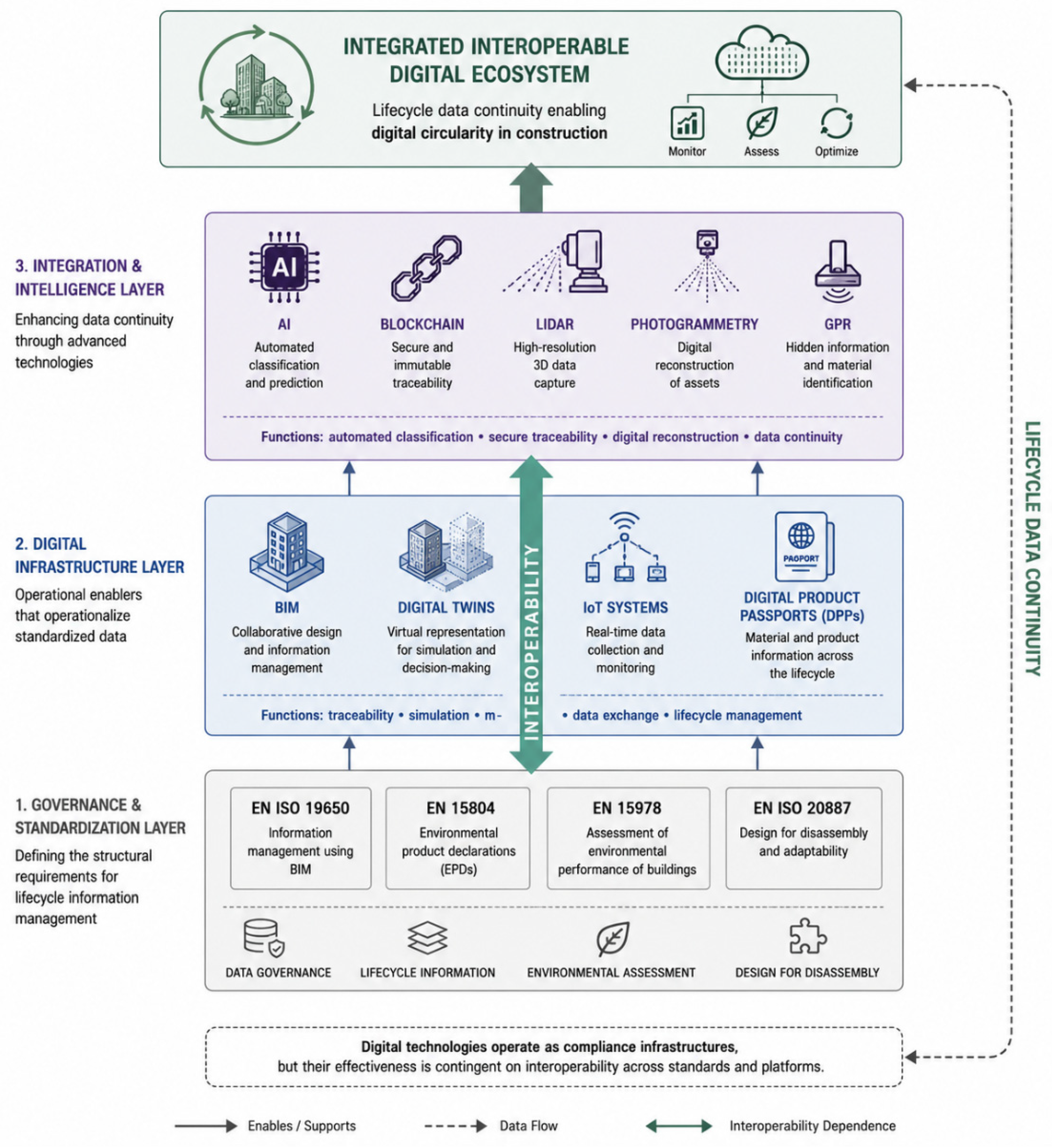
Figure 1 illustrates the multilayer interoperability architecture identified in this study, where standards establish the governance structure for lifecycle information, digital infrastructures operationalize data exchange, and emerging technologies enhance integration, traceability, and automated decision-making across the construction lifecycle.

4.1. Standardization as Data Governance Architecture

As illustrated in Figure 1, standardization frameworks such as EN ISO 19650, EN 15804, EN 15978, and EN ISO 20887 constitute the foundational governance layer for lifecycle information management, design for disassembly, and environmental assessment [13,14,15,22]. Together, these standards enable a standardized representation of material and building data across project phases, supporting consistency and interoperability throughout the construction lifecycle [4,7].

4.2. Digital Infrastructures as Operational Enablers

Figure 1 shows how BIM, Digital Twins, IoT systems, and Digital Product Passports (DPPs) operate as interoperable infrastructures enabling lifecycle data exchange. Their role is not isolated but integrated, supporting traceability, simulation, and lifecycle monitoring across construction stages [1,10].

4.3. Emerging Integration Layer

The integration layer presented in Figure 1 demonstrates how AI, blockchain, and scanning technologies (LiDAR, photogrammetry, GPR) enhance data continuity by enabling automated classification, secure traceability, and digital reconstruction of existing assets. Collectively, these technologies shift construction from fragmented datasets to integrated digital ecosystems [7,23].
Digital technologies operate as compliance infrastructures, but their effectiveness is contingent on interoperability across standards and platforms.
For instance, in practical applications, drone-based imaging and LiDAR scanning are increasingly utilized to generate accurate 3D point clouds of existing structures during pre-demolition audits. Once these digital reconstructions are generated, Artificial Intelligence (AI) and machine learning algorithms are applied to automate the identification, classification, and quality grading of reusable components, such as reclaimed timber or structural elements [7]. Similarly, blockchain technology is being practically explored to ensure the immutable security and traceability of these salvaged materials as they are registered into Digital Product Passports [10].

5. Sustainable Impact Evaluation: Integrating Pre-Demolition Audits, LCA, and LCC (Micro Level)

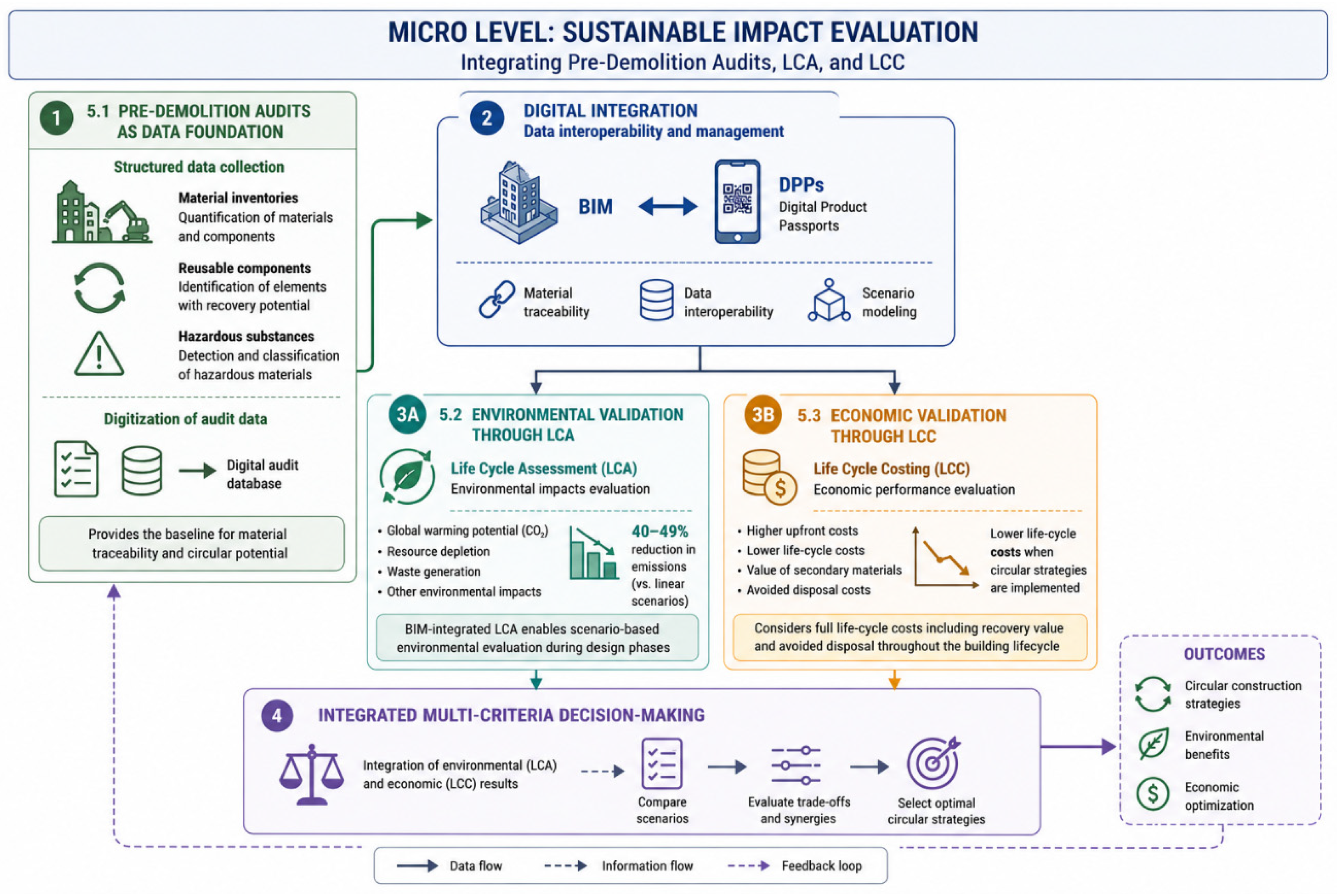
The effective implementation of the enabling technologies and interoperable data standards discussed in the previous section (e.g., BIM, DPPs) provides the essential data infrastructure required to accurately measure circular performance. Without this digital foundation, quantifying the true impact of circular strategies remains highly challenging. At the micro level, results demonstrate that this circular performance is operationalized through the integration of pre-demolition audits, Life Cycle Assessment (LCA), and Life Cycle Costing (LCC), enabling combined environmental and economic validation. Figure 2 illustrates the integrated sustainability assessment workflow identified in this study, where digitized audit data supports interoperable BIM-based evaluation processes for circular decision-making.

5.1. Pre-Demolition Audits as Data Foundation

As illustrated in Figure 2, pre-demolition and pre-renovation audits provide structured material inventories that enable identification of reusable components and hazardous substances [24]. When digitized, these audits feed BIM and DPP systems, forming the basis for material traceability and secondary markets [24].

5.2. Environmental Validation Through LCA

The environmental assessment branch presented in Figure 2 highlights the role of BIM-integrated LCA in supporting the evaluation of circular construction scenarios. To provide environmental validation for these scenarios, a review of recent literature demonstrates the significant environmental benefits associated with CDW recovery. For example, the systematic review conducted by Tighnavard Balasbaneh et al. (2025) [2] reports emission reductions ranging from 40% to 49% when transitioning from conventional linear demolition to circular practices. Specifically, these figures synthesize findings demonstrating that reusing materials such as steel, gypsum, wood, and concrete from previous buildings can save up to 40% of GHG emissions, while maximizing the reuse of existing building stock components can yield reductions of up to 49% [2]. Nevertheless, inconsistencies in the definition of functional units and recycling assumptions continue to limit the comparability of results across studies. In this context, BIM-integrated LCA helps address these limitations by enabling more consistent environmental assessments during the early design phases [7].

5.3. Economic Validation Through LCC

As shown in Figure 2, LCC results indicate that circular strategies present higher upfront costs but lower lifecycle costs when secondary material value and avoided disposal are considered [2,6]. The integration of BIM, LCA, and LCC supports multi-criteria decision-making for circular construction strategies [7].

6. Discussion

6.1. Systemic Convergence and Structural Divergence in Twin Transition

The findings reveal a clear global convergence toward the institutionalization of the Twin Transition, where circular economy principles and digital transformation are increasingly embedded within construction governance frameworks. Across the European Union, the United Kingdom, and China, regulatory systems are progressively aligning toward lifecycle transparency, material traceability, and digitalized environmental accountability [6,10].
However, this convergence masks substantial structural divergence in implementation pathways. While the EU relies on regulatory harmonization through policies, standards, and circular economy directives, the UK emphasizes procurement-driven adoption, where public procurement frameworks and industry-led initiatives accelerate the integration of BIM and circular practices. In contrast, China applies a centralized governance model based on national planning strategies and large-scale implementation programs aimed at rapidly scaling digital and circular construction practices [6]. These differences indicate that Digital Circularity is not a uniform transition but a path-dependent process shaped by institutional structures, governance traditions, and policy priorities.

6.2. The Policy-Implementation Gap and Institutional Capacity Constraints

A key insight of this study is the persistent gap between regulatory ambition and operational capacity. Despite increasingly advanced policy frameworks, implementation remains uneven across all regions.
The EU faces fragmentation due to the complexity of multi-level governance, where overlapping responsibilities across supranational, national, and local institutions hinder coherent implementation of circular policies. The UK is constrained by supply chain heterogeneity and uneven SME readiness, limiting the consistent uptake of digital and circular practices. Meanwhile, China exhibits regional disparities in enforcement capacity and digital interoperability, reflecting uneven implementation across provinces despite strong central policy direction. These findings suggest that policy design alone is insufficient to ensure an effective circular transition. Instead, institutional capacity emerges as a key determinant of success, as it enables coordination across governance levels and ensures coherent implementation. Digital readiness is critical, as it underpins the adoption and interoperability of BIM-based and data-driven circular practices. Finally, supply chain coordination is essential because circular construction depends on multi-actor integration, material traceability, and aligned procurement systems.

6.3. Interoperability as a Systemic Constraint of Digital Circularity

Across all regions, interoperability emerges as a critical systemic barrier limiting the scalability of Digital Circularity, as consistently identified in BIM interoperability research. Despite advances in standardization such as EN ISO 19650 in the EU, BIM adoption within procurement-driven frameworks in the UK, and large-scale digital infrastructure initiatives in China, the literature shows that interoperability challenges persist due to fragmented data structures, heterogeneous workflows, and inconsistent semantic definitions across systems. In particular, IFC-based exchanges—while widely adopted as an open standard—still exhibit significant semantic gaps and limitations in supporting full lifecycle data continuity, often requiring manual or semi-automated data mapping between applications [25,26]. Recent reviews further emphasize that these limitations are not purely technical but stem from structural misalignments between BIM object-based representations and other domain-specific data models, such as lifecycle, operational, and environmental systems [27]. As a result, interoperability remains constrained by the absence of fully unified data schemas and by persistent heterogeneity in software ecosystems and governance structures, which collectively hinder seamless system integration across stakeholders and project phases [25,27].
Importantly, this study reframes interoperability not as a technical limitation—such as software incompatibility or IFC schema translation—but as systematic governance and coordination problem. Viewed through the lens of institutional theory and sociotechnical transitions, interoperability acts as the key mediating condition between macro-level regulation, where behavior is shaped by coercive pressures (e.g., government regulations and mandates) and normative pressures (e.g., professional standards and industry expectations) [11]. While macro-level policies apply coercive pressure by mandating digital traceability, their successful operationalization depends on normative alignment across highly fragmented supply chains [11]. Without standardized data ontologies, shared liability frameworks, and collaborative procurement models, stakeholders lack the institutional scaffolding required to exchange sensitive lifecycle data. Therefore, the lack of interoperability represents a failure in multi-actor governance and institutional coordination rather than a simple deficit in digital infrastructure.

6.4. Digital Technologies as Compliance Infrastructures and the Role of DCAM

The analysis demonstrates a functional shift in the role of digital technologies in construction. BIM, Digital Twins, IoT, and Digital Product Passports are increasingly transitioning from voluntary innovation tools to mandatory compliance infrastructures embedded in regulatory systems.
This transformation is evident across governance models: regulatory embedding in the EU, procurement enforcement in the UK, and state-led monitoring in China. However, their effectiveness depends on interoperability and institutional alignment.
The application of the Digital Circularity Alignment Model (DCAM) confirms its usefulness as an integrative framework linking governance structures, digital infrastructures, and operational implementation. DCAM enables the identification of systemic alignment patterns and highlights interoperability as the central constraint of the Twin Transition.
Although this study provides a comprehensive comparative analysis of Digital Circularity policies, several methodological limitations must be acknowledged. First, there is an uneven distribution of the analyzed policy instruments across the studied regions, with 12 instruments from the European Union compared to 5 each from the United Kingdom and China. This discrepancy reflects the EU’s highly formalized legislative approach but may affect the comparative symmetry of the analysis. Second, the research design is strictly document-based, relying on the analysis of regulatory texts and technical standards without incorporating primary stakeholder input—such as industry surveys or expert interviews—to empirically validate on-the-ground implementation challenges. Third, the empirical foundation for the policy mapping depends heavily on secondary data extracted from the Horizon Europe RECONMATIC project, which guided the initial selection and scope of the instruments. Finally, given the rapid evolution of the “Twin Transition”, the temporal scope of the analyzed documents captures the regulatory landscape as of early 2026; therefore, forthcoming legislative updates and delegated acts may further alter the compliance requirements described in this study.

7. Conclusions and Strategic Recommendations

7.1. Synthesis of the Twin Transition

The transition toward a zero-waste construction sector by 2050 depends on the effective integration of circular economy principles and digital technologies within the framework of the Twin Transition [7]. The comparative analysis of the European Union, the United Kingdom, and China reveals a growing convergence toward lifecycle transparency, material traceability, and resource efficiency, with circularity increasingly embedded within regulatory frameworks rather than treated as a voluntary objective.
Despite this convergence, significant implementation gaps remain. The DCAM-based analysis and RECONMATIC policy mapping highlight persistent barriers, including fragmented data ecosystems, limited interoperability, uneven institutional capacity, and inconsistencies between regulatory objectives and operational practices [12]. These challenges point to a structural misalignment between policy ambition and implementation readiness across the construction value chain.
In this context, digital technologies such as BIM, Digital Twins, Artificial Intelligence, and Digital Product Passports are evolving from innovation tools into compliance infrastructures capable of operationalizing circularity objectives. Their effectiveness, however, depends on the alignment of governance frameworks, data standards, and organizational capacity.
Ultimately, the original scientific contribution of this study lies not merely in synthesizing existing circular economy policies, but in successfully scaling the DCAM framework to conduct a macro-policy cross-regional analysis. Crucially, this research advances the current body of knowledge by redefining interoperability as a systemic governance and institutional coordination failure, moving beyond the traditional view of digitalization as a purely technical deficit.

7.2. Strategic Recommendations for Policymakers and Standardization Bodies

To overcome the identified barriers and accelerate the transition toward Digital Circularity, three priority actions emerge:
  • Mandate interoperable data standards
Interoperability remains the principal barrier to scaling circular practices across the construction sector [12]. Policymakers and standardization bodies should promote open and harmonized data environments while supporting the development of federated architectures capable of enabling seamless information exchange throughout the building lifecycle.
  • Leverage Green Public Procurement (GPP) as a transition accelerator
Public procurement can play a decisive role in translating policy objectives into market transformation. Drawing from our comparative findings, the EU could accelerate its Green Public Procurement (GPP) by adopting mechanisms similar to the UK’s ‘Construction Playbook’, which successfully mandates whole-life carbon assessments and BIM integration in public projects to drive market demand. Requiring digital traceability mechanisms and minimum thresholds for secondary material use in public projects would stimulate demand for circular solutions, reduce investment uncertainty, and encourage broader industry adoption.
  • Enable inclusive transition pathways for SMEs
Given the predominance of SMEs in the construction sector, implementation strategies should be phased and supported through targeted financial incentives, simplified digital tools, and practical guidance. Informed by China’s centralized planning approach, specifically the ‘Zero Waste Cities’ pilot programs, the EU and UK could enhance SME support strategies by providing state-backed, interoperable digital infrastructures and clear top-down funding mechanisms. Such measures are essential to avoid disproportionate compliance burdens and ensure an equitable transition.

7.3. Implications for Industry and Future Research

For industry stakeholders, achieving Digital Circularity requires not only technological adoption but also organizational change. Overcoming skills gaps, fragmented workflows, and resistance to new practices will require sustained investment in digital competencies, data management, and circular construction processes.
Future research should focus on large-scale empirical validation of the proposed framework. Priorities include assessing the environmental and economic performance of circular business models, developing predictive decision-support tools based on Artificial Intelligence and Digital Twins, and evaluating the governance implications of emerging data infrastructures [10].
Overall, the findings demonstrate that the transition toward a zero-waste construction sector is no longer constrained by the lack of technological solutions or policy ambition, but by the challenge of aligning them effectively. Interoperable data frameworks, coordinated governance, and digitally enabled compliance mechanisms therefore constitute the critical conditions for scaling circularity in the built environment. Without such alignment, the Twin Transition risks remaining a conceptual aspiration rather than becoming an operational pathway toward a resilient and resource-efficient construction sector [7,12].

Author Contributions

Conceptualization, M.D.L.C.; methodology, M.D.L.C.; validation, E.L.G., A.K. and I.D.O.; formal analysis M.D.L.C., A.K. and I.D.O.; investigation, M.D.L.C.; writing—original draft preparation, M.D.L.C. and E.L.G.; writing—review and editing, A.K. and I.D.O.; visualization, M.D.L.C. and E.L.G.; supervision, E.L.G. All authors have read and agreed to the published version of the manuscript.

Funding

This work was supported by the RECONMATIC project, funded by the European Union under Grant Agreement No. 101058580 and by UK Research and Innovation (UKRI) under the UK government’s Horizon Europe funding guarantee scheme supporting UK participation in Horizon Europe.

Institutional Review Board Statement

Not applicable.

Informed Consent Statement

Not applicable.

Data Availability Statement

All policy, regulatory, and standardization instruments analyzed in this study are publicly available and can be accessed through the official governmental and legislative databases of the European Union, the United Kingdom, and China. The analytical coding matrix used to evaluate these instruments is provided in Appendix A of this manuscript, enabling the reproducibility of the analysis.

Acknowledgments

The authors gratefully acknowledge the valuable contributions, policy insights, and constructive collaboration of all project partners, which greatly supported the development of this research.

Conflicts of Interest

Authors M. De La Cruz and Elena López Gunn are employed by Icatalist S.L., and author Inés Díez Ortiz is employed by Tecnalia Research & Innovation. This study was conducted as part of the Horizon Europe project RECONMATIC. The authors declare that their institutional affiliations did not influence the study design, data collection, analysis, interpretation of the results, writing of the manuscript, or the decision to publish the results. The authors declare no conflicts of interest.

Abbreviations

The following abbreviations are used in this manuscript:
AIArtificial Intelligence
EUEuropean Union
CDWConstruction and Demolition Waste
UKUnited Kingdom
CECircular Economy
BIMBuilding Information Modelling
IoTInternet of Things
DPPDigital Product Passport
DCAMDigital Circularity Alignment Model
RBVResource-Based View
EoLEnd of Life
LCALife Cycle Assessment
LiDARLight Detection and Ranging
CEAPCircular Economy Action Plan
CPRConstruction Products Regulation
WLCWhole Lifecycle Carbon
GPPGreen Public Procurement
LCCLife Cycle Costing
GPRGround Penetrating Radar
SMESmall and Medium-sized Enterprises

Appendix A. Policy Analysis and Coding Matrix

Table A1. Standardized analytical template and coding matrix for the 22 selected policy and standardization instruments across the EU, UK, and China.
RegionPolicy InstrumentInstrument TypeDCAM LayerKey Coding Evidence & Mandatory Assessment
EUThe European Green DealStrategic Policy RoadmapMacroEvidence: Sets the overarching goal of climate neutrality by 2050 and decoupling economic growth from resource use.
Assessment: Rated Medium-High for strategic maturity. Strong political drive, but practical implementation faces data fragmentation across Member States.
EUCircular Economy Action Plan (CEAP)Strategic Policy/Action PlanMacroEvidence: Identifies construction as a priority, resource-intensive value chain. Calls for integrated digital and material traceability solutions.
Assessment: Rated Medium. High strategic value, but relies on subsequent binding legislation for enforcement.
EURevised Construction Products Regulation (CPR—Regulation EU 2024/3110)Supranational RegulationMacro/MesoEvidence: Harmonizes rules for marketing construction products. Mandates the use of Digital Product Passports (DPP) to enable standardized lifecycle data.
Assessment: Rated High for digital transformation approach due to mandatory regulatory compliance.
EUDigital Product Passport (DPP—ESPR)Regulatory MechanismMesoEvidence: Requires structured, machine-readable data regarding a product’s origin, composition, environmental impact, and recyclability.
Assessment: Rated Medium-High for interoperability goals, but current implementation maturity is Medium due to pending technical standards.
EUEU Protocol for Construction and Demolition Waste ManagementPolicy Guideline/ProtocolMacro/MesoEvidence: Mandates pre-demolition and pre-renovation audits to identify reusable materials and hazardous substances.
Assessment: Rated Medium. Strong theoretical impact, but limited by fragmented enforcement and auditing practices across Member States.
EUEU Taxonomy Regulation (2020/852)Binding RegulationMacro/MesoEvidence: Emphasizes resource efficiency and circularity for sustainable investments, requiring digital data for compliance tracking.
Assessment: Rated Medium-High. Strong financial leverage, but constrained by complex reporting criteria.
EUWaste Framework Directive (2008/98/EC)DirectiveMacroEvidence: Establishes the waste hierarchy and mandates a 70% recovery target for Construction and Demolition Waste (CDW).
Assessment: Rated Medium for implementation maturity due to lack of harmonized data standards for CDW traceability.
EULevel(s)Voluntary Assessment FrameworkMeso/MicroEvidence: Provides a common EU framework of core sustainability indicators across the building lifecycle.
Assessment: Rated Medium. Tool is robust but currently voluntary, leading to limited uptake without regulatory mandates.
EUEN ISO 19650 (BIM)Technical StandardMeso/MicroEvidence: Standardizes processes for information management using BIM, establishing Common Data Environments (CDEs).
Assessment: Rated Medium-High for interoperability, acting as the foundational data governance architecture.
EUEN ISO 20887:2020Technical StandardMicroEvidence: Provides principles for Design for Disassembly (DfD) and adaptability.
Assessment: Rated Low-Medium for implementation. Lacks regulatory mandates, resulting in limited uptake in mainstream design.
EUEN 15804Harmonised Technical StandardMicroEvidence: Defines core rules for Environmental Product Declarations (EPDs), particularly Module D for end-of-life benefits.
Assessment: Rated Medium-High. Widely adopted, but methodology struggles with dynamic reuse scenarios.
EUEN 15978:2011Technical StandardMicroEvidence: Provides calculation methods for the environmental performance of buildings (LCA) over their lifecycle.
Assessment: Rated Medium. High theoretical utility but faces barriers regarding data on reuse potential.
UKCircular Economy Strategy/Resources and Waste StrategyNational StrategyMacroEvidence: Targets construction as a priority sector due to its high waste generation, aiming to slash waste and boost circularity.
Assessment: Rated Medium. Sets national goals but depends on market-oriented instruments for operationalization.
UKThe Construction PlaybookProcurement GuidelineMacro/MesoEvidence: Mandates whole-life carbon assessments and BIM integration specifically in public projects. Uses public demand to drive adoption.
Assessment: Rated Medium for overall interoperability, but Medium-High implementation maturity within the public sector.
UKThe London PlanRegional Policy/RegulationMacroEvidence: Enforces Whole Lifecycle Carbon (WLC) assessments and Circular Economy Statements at the regional level.
Assessment: Rated Medium for interoperability due to regionalized implementation and reliance on local planning requirements.
UKTransforming Infrastructure Performance (TIP): Roadmap to 2030National StrategyMacro/MesoEvidence: Promotes system-level thinking and accelerates the adoption of Digital Twins, BIM, and AI aligned with circular approaches.
Assessment: Rated Medium. Strong data-driven approach, but hindered by supply chain fragmentation and SME constraints.
UKBuild Back Greener: Net Zero StrategyNational StrategyMacroEvidence: Sets 2050 net-zero goals focusing on decarbonizing buildings and CDW reduction.
Assessment: Rated Medium. High-level goals established, but risks fragmentation across devolved administrations.
China14th Five-Year Plan for the Development of the Circular EconomyNational Macroeconomic PlanMacroEvidence: Establishes quantitative resource efficiency targets and solid waste systems for CDW.
Assessment: Rated High for deployment scale due to centralized top-down governance, though enforcement varies regionally.
China“Zero Waste Cities” ProgramNational/Municipal Pilot ProgramMacro/MesoEvidence: Implements macroeconomic CE objectives through large-scale pilot programs and city-wide tracking systems.
Assessment: Rated Low-Medium for data interoperability due to limited cross-platform standardization between regional/provincial systems.
ChinaAction Plan for Promoting the Production and Application of Green Building Materials (2022)National Action PlanMesoEvidence: Promotes low-carbon materials, prefabrication, and lifecycle-based performance assessment.
Assessment: Rated Medium. Drives lifecycle performance but suffers from fragmented certification systems.
ChinaNotice on Supporting Green Construction via Government Procurement (2025)Regulatory PolicyMacro/MesoEvidence: Integrates sustainability, digitalization (BIM), and circularity criteria into public procurement to enforce compliance.
Assessment: Rated Medium. High potential via state procurement, but limited by local authorities’ technical capacity.
ChinaLaw on the Prevention and Control of Environmental Pollution by Solid WastesNational LawMacroEvidence: Mandates traceability, accountability, and technological innovation in waste management.
Assessment: Rated Medium. Legally binding, but faces uneven enforcement and limited integration of digital tracking technologies.

References

  1. Lindblad, F. Digital Circularity in construction: A systematic review and conceptual framework with a timber focus. Int. J. Sustain. Eng. 2026, 19, 2619254. [Google Scholar] [CrossRef]
  2. Tighnavard Balasbaneh, A.; Sher, W.; Li, J.; Ashour, A. Systematic Review of Construction Waste Management Scenarios: Informing Life Cycle Sustainability Analysis. Circ. Econ. Sustain. 2025, 5, 529–553. [Google Scholar] [CrossRef]
  3. Mubasher, M.; Rawat, A.; Witt, E.; Ilomets, S. Green Transition Risks in the Construction Sector: A Qualitative Analysis of European Green Deal Policy Documents. Sustainability 2026, 18, 822. [Google Scholar] [CrossRef]
  4. Bayram, B.; Greiff, K. Life cycle assessment on construction and demolition waste recycling: A systematic review analyzing three important quality aspects. Int. J. Life Cycle Assess. 2023, 28, 967–989. [Google Scholar] [CrossRef]
  5. Ferriz-Papi, J.A.; Wadee, A.; Kiani, K. Adoption of Circular Economy Within the UK Construction Industry: Particular Analysis of One of the UK top-5 Contractor Companies. Circ. Econ. Sustain. 2025, 5, 5873–5902. [Google Scholar] [CrossRef]
  6. Kayaçetin, N.C.; Aslanoğlu, R.; Piccardo, C.; Afacan, Y.; Masera, G.; Li, Q.; Biraghi, C.A.; Pittau, F.; Saelens, D.; Soebarto, V.; et al. Ten questions concerning circularity in the built environment. Build. Environ. 2026, 292, 114291. [Google Scholar] [CrossRef]
  7. Askar, R.; Karaca, F.; Salles, A.; Lukyanenko, A.; Cervantes Puma, G.C.; Tavares, V.; Khaidarova, A.; Nadaždi, A.; Pineda-Martos, R.; Díaz-Cabrera, J.M.; et al. Driving the Built Environment Twin Transition: Synergising Circular Economy and Digital Tools. In Circular Economy Design and Management in the Built Environment; Bragança, L., Griffiths, P., Askar, R., Salles, A., Ungureanu, V., Tsikaloudaki, K., Bajare, D., Zsembinszki, G., Cvetkovska, M., Eds.; Springer Tracts in Civil Engineering; Springer: Cham, Switzerland, 2025; pp. 459–505. [Google Scholar] [CrossRef]
  8. Thirumal, S.; Udawatta, N.; Karunasena, G.; Al-Ameri, R. Barriers to Adopting Digital Technologies to Implement Circular Economy Practices in the Construction Industry: A Systematic Literature Review. Sustainability 2024, 16, 3185. [Google Scholar] [CrossRef]
  9. Burgess, M.; Wilson, C.; Fan, Y.V. Adoption drivers and barriers of Building Information Modelling (BIM) in Europe. Energy Build. 2026, 355, 116953. [Google Scholar] [CrossRef]
  10. Zhang, Z.; Gu, J.; Li, R.; Lian, W.; Ma, C.; Tian, J. Bridging digital and green transitions: A literature review of Digital Product Passport systems. Renew. Sustain. Energy Rev. 2026, 228, 116600. [Google Scholar] [CrossRef]
  11. Kelly, S.; Kalaitzi, D.; Robertson, A.; Polychronakis, Y. Systematic literature review of the factors of information sharing that enable circular procurement in the construction industry. Clean. Prod. Lett. 2026, 10, 100134. [Google Scholar] [CrossRef]
  12. Marchesi, M.; Salles, A.; Buzatu, R.; Karaca, F.; De Simone, M.; Fohl, F.; Karacor, E.; Yiatros, S.; Tsoka, S.; Puma, G.C.C.; et al. Technical Barriers and Challenges to Circular Strategies Implementation. In Shaping Circular Transitions in the Built Environment; Bragança, L., Cvetkovska, M., Ungureanu, V., Tsikaloudaki, K., Marchesi, M., Andabaka, A., Borg, R.P., Cervantes, C., Eds.; Springer Tracts in Civil Engineering; Springer: Cham, Switzerland, 2026; pp. 3–122. [Google Scholar] [CrossRef]
  13. EN ISO 19650-1:2018; Organization and Digitization of Information about Buildings and Civil Engineering Works, Including Building Information Modelling (BIM)—Information Management Using Building Information Modelling—Part 1: Concepts and Principles. European Committee for Standardization (CEN): Brussels, Belgium, 2018.
  14. EN 15804:2012+A2:2019; Sustainability of Construction Works—Environmental Product Declarations—Core Rules for the Product Category of Construction Products. European Committee for Standardization (CEN): Brussels, Belgium, 2019.
  15. EN 15978:2011; Sustainability of Construction Works—Assessment of Environmental Performance of Buildings—Calculation Method. European Committee for Standardization (CEN): Brussels, Belgium, 2011.
  16. Lamperti Tornaghi, M. Circular Economy Policies and Regulations at the European Level; Springer Science and Business Media Deutschland GmbH: Berlin, Germany, 2026. [Google Scholar]
  17. European Parliament and Council. Regulation (EU) 2024/3110 of the European Parliament and of the Council Laying down Harmonised Conditions for the Marketing of Construction Products. Off. J. Eur. Union 2024. Available online: https://eur-lex.europa.eu/legal-content/EN/TXT/?uri=CELEX:32024R3110 (accessed on 12 January 2026). [CrossRef]
  18. BIM Associates; UK Government. UK Government’s BIM Standards and Guidelines 2025: Shaping the Future of Construction; British Standards Institution (BSI): London, UK, 2025. [Google Scholar]
  19. Department for Environment, Food and Rural Affairs; Welsh Government; Scottish Government; Department of Agriculture, Environment and Rural Affairs. Circular Economy Package Policy Statement. GOV.UK; 30 July 2020. Available online: https://www.gov.uk/government/publications/circular-economy-package-policy-statement/circular-economy-package-policy-statement (accessed on 12 January 2026).
  20. Holland Circular Hotspot. Circular Construction in the Chinese Cities of Shanghai, Shenzhen and Nanjing. 2022. Available online: https://hollandcircularhotspot.nl/china-construction/ (accessed on 12 January 2026).
  21. Banihashemi, S.; Meskin, S.; Sheikhkhoshkar, M.; Mohandes, S.R.; Hajirasouli, A.; LeNguyen, K. Circular economy in construction: The digital transformation perspective. Clean. Eng. Technol. 2024, 18, 100715. [Google Scholar] [CrossRef]
  22. EN ISO 20887; Sustainability in Buildings and Civil Engineering Works—Design for Disassembly and Adaptability—Principles, Requirements and Guidance. European Committee for Standardization (CEN): Brussels, Belgium, 2020.
  23. European Commission; Publications Office of the European Union. EU Construction and Demolition Waste Management Protocol, Including Guidelines for the Pre-Demolition and Pre-Renovation Waste Audits of Construction Works; Publications Office of the European Union: Luxembourg, 2024. [CrossRef]
  24. Yu, Y.; Kim, S.; Jeon, H.; Koo, B. A systematic review of the trends and advances in IFC schema extensions for BIM interoperability. Appl. Sci. 2023, 13, 12560. [Google Scholar] [CrossRef]
  25. Eastman, C.; Teicholz, P.; Sacks, R.; Liston, K. BIM Handbook: A Guide to Building Information Modeling for Owners, Designers, Engineers, Contractors, and Facility Managers, 3rd ed.; Wiley: Hoboken, NJ, USA, 2018. [Google Scholar]
  26. Borrmann, A.; König, M.; Koch, C.; Beetz, J. (Eds.) Building Information Modeling: Technology Foundations and Industry Practice; Springer: Berlin/Heidelberg, Germany, 2018. [Google Scholar]
  27. Chatsuwan, M.; Moriwaki, A.; Ichinose, M.; Alkhalaf, H. BIM–FM interoperability through open standards: A critical literature review. Architecture 2025, 5, 74. [Google Scholar] [CrossRef]
Figure 1. Conceptual framework of the study, adapting the Digital Circularity Alignment Model (DCAM) for cross-regional policy analysis. Solid arrows represent direct regulatory mandates and coercive institutional pressures (top-down), while dashed lines indicate recursive feedback loops, technological enablers, and normative alignment across the supply chain (bottom-up). Source: Authors own elaboration.
Sustainability 18 07473 g001
Figure 2. Integrated sustainability assessment workflow connecting macro-level digital policies to micro-level execution. Solid arrows illustrate the sequential flow of data from pre-demolition audits into BIM-integrated Life Cycle Assessment (LCA) and Life Cycle Costing (LCC) environments. Dashed lines represent required data interoperability linkages and continuous feedback loops across the project lifecycle. Source: Authors’ own elaboration.
Sustainability 18 07473 g002
Disclaimer/Publisher’s Note: The statements, opinions and data contained in all publications are solely those of the individual author(s) and contributor(s) and not of MDPI and/or the editor(s). MDPI and/or the editor(s) disclaim responsibility for any injury to people or property resulting from any ideas, methods, instructions or products referred to in the content.