Determinants of Purchase Intention Toward Beverages with Eco-Friendly Packaging: An Extended TPB-S-O-R Approach in Vietnam



Abstract
1. Introduction
2. Conceptual Framework
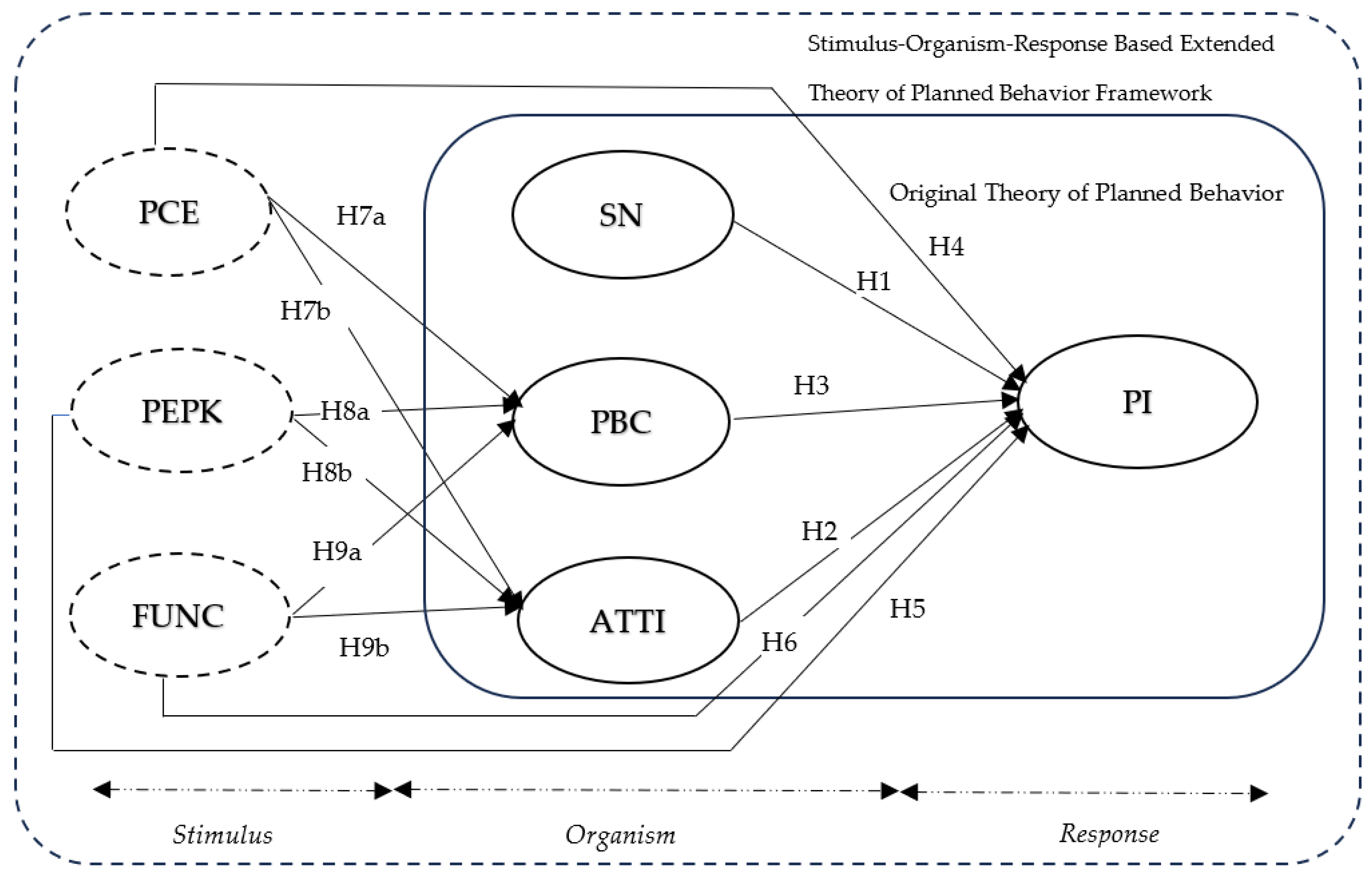
2.1. Integration of the Theory of Planned Behaviour and Stimulus–Organism–Response Framework
2.2. Research Questions
2.3. Hypothesis Development
3. Materials and Methods
3.1. Data Collection
3.2. Measures
3.3. Data Analysis
4. Results
4.1. Familiarity with Eco-Friendly Logos on Beverage Packaging
4.2. Access to the Different Types of Environmentally Friendly Packaging
4.3. Willingness to Purchase Beverages with Recycled Packaging
4.4. Factors Affecting the Intention to Purchase Environmentally Friendly Packaged Beverages
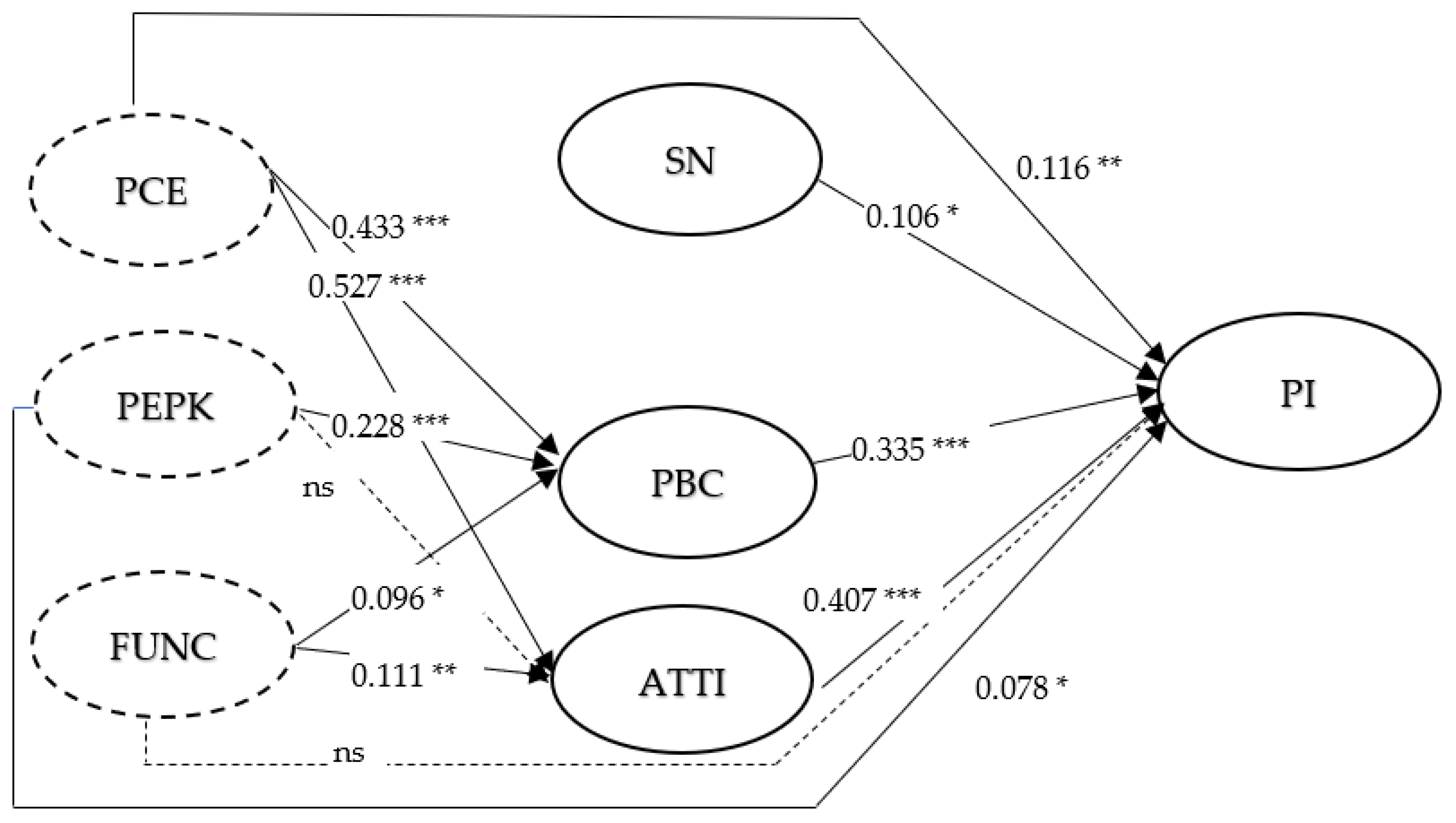
4.4.1. Direct Effects
4.4.2. Mediating Effects
5. Discussion
6. Conclusions
Author Contributions
Funding
Institutional Review Board Statement
Informed Consent Statement
Data Availability Statement
Conflicts of Interest
References
- Kumar, B.; Manrai, A.K.; Manrai, L.A. Purchasing behaviour for environmentally sustainable products: A conceptual framework and empirical study. J. Retail. Consum. Serv. 2017, 34, 1–9. [Google Scholar] [CrossRef]
- Nahar, L.; Habibi, E.; Gavril, G.L.; Abdelfattah, G.M.M.; Wrona, M.; Nerín, C.; Guo, M.; Sarker, S.D. Towards sustainable food packaging using natural compounds: A review of current research update. Food Bioprod. Process. 2025, 150, 260–274. [Google Scholar] [CrossRef]
- Zhou, G.; Gu, Y.; Wu, Y.; Gong, Y.; Mu, X.; Han, H.; Chang, T. A systematic review of the deposit-refund system for beverage packaging: Operating mode, key parameter and development trend. J. Clean. Prod. 2020, 251, 119660. [Google Scholar] [CrossRef]
- Santi, R.; Garrone, P.; Iannantuoni, M.; Del Curto, B. Sustainable food packaging: An integrative framework. Sustainability 2022, 14, 8045. [Google Scholar] [CrossRef]
- Kumar, V.; Sonika; Ram, D.K.; Sahu, G.; Sahu, N.K.; Verma, S.K. Sustainable modifications in food packaging: A comprehensive review of biodegradable material revolutions. Appl. Food Res. 2025, 5, 101385. [Google Scholar] [CrossRef]
- Filippini, M.; Srinivasan, S. Adoption of environmental standards and a lack of awareness: Evidence from the food and beverage industry in Vietnam. Environ. Econ. Policy Stud. 2022, 24, 307–340. [Google Scholar] [CrossRef]
- World Bank. Vietnam: Plastic Pollution Diagnostics. East Asia and Pacific Region, Marine Plastics Series. Available online: https://hdl.handle.net/10986/37693 (accessed on 25 June 2026).
- VietnamPlus. Vietnam Could Cut 77,000 Tonnes of Packaging Waste Annually with Deposit Return System: Study. Available online: https://en.vietnamplus.vn/vietnam-could-cut-77000-tonnes-of-packaging-waste-annually-with-deposit-return-system-study-post321183.vnp (accessed on 25 June 2026).
- Zupo, R.; Castellana, F.; De Nucci, S.; Dibello, V.; Lozupone, M.; Giannelli, G.; De Pergola, G.; Panza, F.; Sardone, R.; Boeing, H. Beverages consumption and oral health in the aging population: A systematic review. Front. Nutr. 2021, 8, 762383. [Google Scholar] [CrossRef] [PubMed]
- Fox, J. Vietnam’s F&B Industry: Market Trends and Consumer Preferences. Available online: https://www.vietnam-briefing.com/news/vietnams-food-and-beverage-industry-market-trends-demographics-consumer-preferences.html/ (accessed on 15 March 2026).
- Credence Research. Vietnam Food and Beverages Market Size, Share and Forecast 2032. Available online: https://www.credenceresearch.com/report/vietnam-food-and-beverages-market (accessed on 1 May 2026).
- B&Company. Vietnam Healthy Drink Market: Some Key Updates in 2025. Available online: https://b-company.jp/vietnam-healthy-drink-market-some-key-updates-in-2025/ (accessed on 1 May 2026).
- Nguyen, N.M.; Tang, H.K.; Dibley, M.J.; Alam, A. Sugar-sweetened beverage consumption and overweight and obesity in adolescents in Ho Chi Minh City, Vietnam: A population-based analysis. Pediatr. Int. 2022, 64, e14886. [Google Scholar] [CrossRef] [PubMed]
- Reuters. Vietnam Parliament Approves Hiking Tax on Alcoholic Drinks to 90% by 2031. Available online: https://www.reuters.com/world/asia-pacific/vietnam-parliament-approves-hiking-tax-alcoholic-drinks-90-by-2031-2025-06-14/ (accessed on 1 May 2026).
- Loučanová, E.; Kalamárová, M.; Parobek, J. The innovative approaches to packaging—Comparison analysis of intelligent and active packaging perceptions in Slovakia. Stud. Univ. Vasile Goldis Arad Econ. Ser. 2017, 27, 33–44. [Google Scholar] [CrossRef]
- Dominic, C.A.S.; Östlund, S.; Buffington, J.; Masoud, M.M. Towards a conceptual sustainable packaging development model: A corrugated box case study. Packag. Technol. Sci. 2015, 28, 397–413. [Google Scholar] [CrossRef]
- Herbes, C.; Beuthner, C.; Ramme, I. Consumer attitudes towards biobased packaging—A cross-cultural comparative study. J. Clean. Prod. 2018, 194, 203–218. [Google Scholar] [CrossRef]
- Nguyen, A.T.; Parker, L.; Brennan, L.; Lockrey, S. A consumer definition of eco-friendly packaging. J. Clean. Prod. 2020, 252, 119792. [Google Scholar] [CrossRef]
- Van Birgelen, M.; Semeijn, J.; Keicher, M. Packaging and proenvironmental consumption behavior: Investigating purchase and disposal decisions for beverages. Environ. Behav. 2009, 41, 125–146. [Google Scholar] [CrossRef]
- Alamri, M.S.; Qasem, A.A.A.; Mohamed, A.A.; Hussain, S.; Ibraheem, M.A.; Shamlan, G.; Alqah, H.A.; Qasha, A.S. Food packaging’s materials: A food safety perspective. Saudi J. Biol. Sci. 2021, 28, 4490–4499. [Google Scholar] [CrossRef] [PubMed]
- Phelan, A.; Meissner, K.; Humphrey, J.; Ross, H. Plastic pollution and packaging: Corporate commitments and actions from the food and beverage sector. J. Clean. Prod. 2022, 331, 129827. [Google Scholar] [CrossRef]
- Liu, P.; Teng, M.; Han, C. How does environmental knowledge translate into pro-environmental behaviors? The mediating role of environmental attitudes and behavioral intentions. Sci. Total Environ. 2020, 728, 138126. [Google Scholar] [CrossRef] [PubMed]
- Tusholihah, A. Consumer’s purchase intention towards sustainable fashion products: Effect of perceived consumer effectiveness and attitude. J. Apl. Bisnis Manaj. 2025, 11, 56–68. [Google Scholar] [CrossRef]
- Mehrabian, A.; Russell, J.A. An Approach to Environmental Psychology; MIT Press: Cambridge, MA, USA, 1974. [Google Scholar]
- Duc, T. Vietnam’s Beverage Sector to Grow Strongly: Kantar World Panel. Available online: https://theinvestor.vn/vietnams-beverage-sector-to-grow-strongly-kantar-world-panel-d2813.html (accessed on 10 January 2026).
- Ahmed, N.; Li, C.; Khan, A.; Qalati, S.A.; Naz, S.; Rana, F. Purchase intention toward organic food among young consumers using theory of planned behavior: Role of environmental concerns and environmental awareness. J. Environ. Plan. Manag. 2021, 64, 796–822. [Google Scholar] [CrossRef]
- Saut, M.; Saing, T. Factors affecting consumer purchase intention towards environmentally friendly products: A case of generation Z studying at universities in Phnom Penh. SN Bus. Econ. 2021, 1, 83. [Google Scholar] [CrossRef]
- Ajzen, I. The theory of planned behavior. Organ. Behav. Hum. Decis. Process. 1991, 50, 179–211. [Google Scholar] [CrossRef]
- Ajzen, I. Attitudes, Personality and Behaviour, 2nd ed.; Open University Press: Maidenhead, UK, 2005. [Google Scholar]
- Wu, L.; Zhu, Y.; Zhai, J. Understanding waste management behavior among university students in China: Environmental knowledge, personal norms, and the theory of planned behavior. Front. Psychol. 2022, 12, 771723. [Google Scholar] [CrossRef] [PubMed]
- Kamalanon, P.; Chen, J.S.; Le, T.T.Y. “Why do we buy green products?” An extended theory of the planned behavior model for green product purchase behavior. Sustainability 2022, 14, 689. [Google Scholar] [CrossRef]
- Wongsaichia, S.; Naruetharadhol, P.; Schrank, J.; Phoomsom, P.; Sirisoonthonkul, K.; Paiyasen, V.; Srichaingwang, S.; Ketkaew, C. Influences of green eating behaviors underlying the extended theory of planned behavior: A study of market segmentation and purchase intention. Sustainability 2022, 14, 8050. [Google Scholar] [CrossRef]
- Oliver, M.O.; Jestratijevic, I.; Uanhoro, J.; Knight, D.K. Investigation of a consumer’s purchase intentions and behaviors towards environmentally friendly grocery packaging. Sustainability 2023, 15, 8789. [Google Scholar] [CrossRef]
- Petkowicz, A.C.; Pelegrini, T.; Bodah, B.W.; Rotini, C.D.; Moro, L.D.; Neckel, A.; Spanhol, C.P.; Araújo, E.G.; Pauli, J.; Mores, G.V. Purchasing intention of products with sustainable packaging. Sustainability 2024, 16, 2914. [Google Scholar] [CrossRef]
- Lavuri, R. Extending the theory of planned behavior: Factors fostering millennials’ intention to purchase eco-sustainable products in an emerging market. J. Environ. Plan. Manag. 2022, 65, 1507–1529. [Google Scholar] [CrossRef]
- Prakash, G.; Pathak, P. Intention to buy eco-friendly packaged products among young consumers of India: A study on developing nation. J. Clean. Prod. 2017, 141, 385–393. [Google Scholar] [CrossRef]
- Moorthy, K.; Kamarudin, A.A.; Xin, L.; Hui, L.M.; Way, L.T.; Fang, P.S.; Carmen, W. Green packaging purchase behaviour: A study on Malaysian consumers. Environ. Dev. Sustain. 2021, 23, 15391–15412. [Google Scholar] [CrossRef]
- Kumar, A.; Prakash, G.; Kumar, G. Does environmentally responsible purchase intention matter for consumers? A predictive sustainable model developed through an empirical study. J. Retail. Consum. Serv. 2021, 58, 102270. [Google Scholar] [CrossRef]
- Heo, J.; Muralidharan, S. What triggers young millennials to purchase eco-friendly products? The interrelationships among knowledge, perceived consumer effectiveness, and environmental concern. J. Mark. Commun. 2019, 25, 421–437. [Google Scholar] [CrossRef]
- Choi, S.; Kim, Y. Antecedents of green purchase behavior: An examination of collectivism, environmental concern, and PCE. Adv. Consum. Res. 2005, 32, 592–599. [Google Scholar]
- Rajendran, S.D.; Wahab, S.N.; Singh, M.K.P. Malaysian consumers’ preference for green packaging. Int. J. Soc. Syst. Sci. 2019, 11, 312–331. [Google Scholar] [CrossRef]
- Ajzen, I. Perceived behavioral control, self-efficacy, locus of control, and the theory of planned behavior. J. Appl. Soc. Psychol. 2002, 32, 665–683. [Google Scholar] [CrossRef]
- Ellen, P.S.; Wiener, J.L.; Cobb-Walgren, C. The role of perceived consumer effectiveness in motivating environmentally conscious behaviors. J. Public Policy Mark. 1991, 10, 102–117. [Google Scholar] [CrossRef]
- Aitken, R.; Watkins, L.; Williams, J.; Kean, A. The positive role of labelling on consumers’ perceived behavioural control and intention to purchase organic food. J. Clean. Prod. 2020, 255, 120334. [Google Scholar] [CrossRef]
- Mostafa, M.M. Gender differences in Egyptian consumers’ green purchase behaviour: The effects of environmental knowledge, concern and attitude. Int. J. Consum. Stud. 2007, 31, 220–229. [Google Scholar] [CrossRef]
- Kassaye, W.W.; Verma, D. Balancing traditional packaging functions with the new “green” marketing imperatives. SAM Adv. Manag. J. 1992, 57, 15–21. [Google Scholar]
- Baccarella, C.V.; Maier, L.; Voigt, K.-I. How consumption-supportive packaging functionality influences consumers’ purchase intentions: The mediating role of perceived product meaningfulness. Eur. J. Mark. 2021, 55, 2239–2268. [Google Scholar] [CrossRef]
- General Statistics Office of Vietnam (GSO). Statistical Yearbook of Vietnam 2020; Statistical Publishing House: Hanoi, Vietnam, 2020. [Google Scholar]
- Fishbein, M.; Ajzen, I. Belief, Attitude, Intention and Behaviour: An Introduction to Theory and Research; Addison-Wesley: Reading, MA, USA, 1975. [Google Scholar]
- Nolan, J.M.; Schultz, P.W.; Cialdini, R.B.; Goldstein, N.J.; Griskevicius, V. Normative social influence is underdetected. Pers. Soc. Psychol. Bull. 2008, 34, 913–923. [Google Scholar] [CrossRef] [PubMed]
- Jaiswal, D.; Kant, R. Green purchasing behaviour: A conceptual framework and empirical investigation of Indian consumers. J. Retail. Consum. Serv. 2018, 41, 60–69. [Google Scholar] [CrossRef]
- Fenta, Y.; Singh, M.; Gautam, R.K. Antecedents of consumers’ green product purchase intention: An insight from Ethiopia. Cogent Bus. Manag. 2024, 11, 2361865. [Google Scholar] [CrossRef]
- Rettie, R.; Brewer, C. The verbal and visual components of package design. J. Prod. Brand Manag. 2000, 9, 56–70. [Google Scholar] [CrossRef]
- Bai, L.; Wang, M.; Gong, S. Understanding the antecedents of organic food purchases: The important roles of beliefs, subjective norms, and identity expressiveness. Sustainability 2019, 11, 3045. [Google Scholar] [CrossRef]
- MacKenzie, S.B.; Lutz, R.J.; Belch, G.E. The role of attitude toward the ad as a mediator of advertising effectiveness: A test of competing explanations. J. Mark. Res. 1986, 23, 130–143. [Google Scholar] [CrossRef]
- Michaelidou, N.; Hassan, L.M. The role of health consciousness, food safety concern and ethical identity on attitudes and intentions towards organic food. Int. J. Consum. Stud. 2008, 32, 163–170. [Google Scholar] [CrossRef]
- StataCorp. Stata Statistical Software: Release 15; StataCorp LLC: College Station, TX, USA, 2017; Available online: https://www.scirp.org/reference/ReferencesPapers?ReferenceID=2629339 (accessed on 20 May 2026).
- MacKenzie, S.B.; Podsakoff, P.M. Common method bias in marketing: Causes, mechanisms, and procedural remedies. J. Retail. 2012, 88, 542–555. [Google Scholar] [CrossRef]
- Podsakoff, P.M.; MacKenzie, S.B.; Lee, J.Y.; Podsakoff, N.P. Common method biases in behavioral research: A critical review of the literature and recommended remedies. J. Appl. Psychol. 2003, 88, 879–903. [Google Scholar] [CrossRef] [PubMed]
- Hair, J.F.; Risher, J.J.; Sarstedt, M.; Ringle, C.M. When to use and how to report the results of PLS-SEM. Eur. Bus. Rev. 2019, 31, 2–24. [Google Scholar] [CrossRef]
- Hair, J.F.; Black, W.C.; Babin, B.J.; Anderson, R.E. Multivariate Data Analysis: A Global Perspective, 7th ed.; Pearson Education Limited: Harlow, UK, 2010. [Google Scholar]
- Fornell, C.; Larcker, D.F. Evaluating structural equation models with unobservable variables and measurement error. J. Mark. Res. 1981, 18, 39–50. [Google Scholar] [CrossRef]
- MacKinnon, D.P.; Fairchild, A.J.; Fritz, M.S. Mediation analysis. Annu. Rev. Psychol. 2007, 58, 593–614. [Google Scholar] [CrossRef] [PubMed]
- Sobel, M.E. Asymptotic confidence intervals for indirect effects in structural equation models. Sociol. Methodol. 1982, 13, 290–312. [Google Scholar] [CrossRef]
- Preacher, K.J.; Hayes, A.F. Asymptotic and resampling strategies for assessing and comparing indirect effects in multiple mediator models. Behav. Res. Methods 2008, 40, 879–891. [Google Scholar] [CrossRef] [PubMed]
- EN 13432:2000. CEN/TC 261; Packaging; Requirements for Packaging Recoverable through Composting and Biodegradation. Test Scheme and Evaluation Criteria for the Final Acceptance: EN 13432:2000. European Committee for Standardization: Brussels, Belgium, 2000.
- Tabachnick, B.G.; Fidell, L.S. Using Multivariate Statistics, 5th ed.; Pearson: Boston, MA, USA, 2007. [Google Scholar]
- Bravo, A.; Vieira, D. Modelling the purchase of green packaged products: The significant impact of the West–East cultural context. Sustainability 2024, 16, 1206. [Google Scholar] [CrossRef]
- Zheng, Q.; Wen, X.; Xiu, X.; Chen, Q. Income quality and organic food purchase intention: The chain mediating role of environmental value, perceived consumer effectiveness. Sage Open 2023, 13, 21582440231218974. [Google Scholar] [CrossRef]
- Ruangkanjanases, A.; You, J.J.; Chien, S.W.; Ma, Y.; Chen, S.C.; Chao, L.C. Elucidating the effect of antecedents on consumers’ green purchase intention: An extension of the theory of planned behavior. Front. Psychol. 2020, 11, 1433. [Google Scholar] [CrossRef] [PubMed]



| Items | Sample (Percent) | Study-Area Population Statistics (Percent) |
|---|---|---|
| Gender | ||
| Male | 42.3 | 49.9 a |
| Female | 57.7 | 50.1 a |
| Age | ||
| ≤40 | 54.3 | 54.7 a |
| >40 | 45.7 | 45.3 a |
| Education | ||
| High school and lower | 42.3 | 45.9 a |
| Above high school | 57.7 | 54.1 a |
| Household monthly income | ||
| Up to 5 million VND | 49.5 | - |
| >5 million VND | 50.5 | - |
| Factor | Item Description | Sources | |
|---|---|---|---|
| Subjective norm (SN) | SN1 | People in my circle of friends encourage and highly value my decision to purchase beverages with environmentally friendly packaging | [19,49,50] |
| SN2 | My family encourages and highly values my decision to purchase beverages with environmentally friendly packaging | ||
| SN3 | People in my community encourage and highly value my decision to purchase beverages with environmentally friendly packaging | ||
| Perceived behavioural control (PBC) | PBC1 | If I want, I can buy beverages with environmentally friendly packaging instead of those with conventional ones | [42] |
| PBC2 | I think it is possible (easy) to buy beverages with environmentally friendly packaging | ||
| PBC3 | I can consider and control the purchase of beverages with environmentally friendly packaging | ||
| Please indicate how you feel while purchasing beverages with environmentally friendly packaging? | |||
| Attitude toward behaviour (ATTI) | ATTI1 | Extremely negative → Extremely positive | [54] |
| ATTI2 | Extremely unpleasant → Extremely pleasant | ||
| ATTI3 | Strongly against → Strongly for | ||
| Perceived consumer effectiveness (PCE) | PCE1 | I believe that choosing beverages with environmentally friendly packaging can have a positive effect on environmental protection | [43,51] |
| PCE2 | Individual consumers’ choices of environmentally friendly beverage packaging can help reduce environmental problems | ||
| PCE3 | I believe that purchasing beverages with environmentally friendly packaging can contribute to conserving natural resources | ||
| Perceived Environmental Packaging Knowledge (PEPK) | PEPK1 | I am very knowledgeable about environmentally friendly beverage packaging | [45,51,52] |
| PEPK2 | I know how to select beverage products with packaging that reduces environmental waste | ||
| PEPK3 | I understand the environmental phrases, labels, and symbols on beverage packaging | ||
| Function (FUNC) | FUNC1 | I think that beverage packaging with environmentally friendly materials can protect the product inside like the ones with conventional materials | [46,53] |
| FUNC2 | I think beverage packaging with environmentally friendly materials is safe for human health and consumption | ||
| FUNC3 | I think beverage packaging with environmentally friendly materials can convey the message of product and attract consumers’ attention like conventional packaging materials. | ||
| Purchase intention (PI) | It is […] that I will purchase beverages with environmentally friendly packaging. | [55,56] | |
| PI1 | Unlikely → Likely | ||
| PI2 | Improbable → Probable | ||
| PI3 | Impossible → Possible |
| Logo Description | Not at All Familiar | Slightly Familiar | Moderately Familiar | Familiar | Extremely Familiar | |
|---|---|---|---|---|---|---|
| Recycling logo |  | 3.2 | 5.7 | 13.5 | 27.6 | 50.1 |
| Plastic recycling/PET symbol |  | 7.6 | 15.2 | 28.4 | 23.8 | 25.1 |
| Garbage disposal/Tidyman logo |  | 0.4 | 1.1 | 7.4 | 13.1 | 78.1 |
| Forest Stewardship Council (FSC) logo |  | 14.7 | 23.2 | 30.3 | 19.6 | 12.2 |
| Green Dot logo |  | 15.6 | 23.6 | 28.8 | 18.7 | 13.3 |
| Compostable packaging logo |  | 16.0 | 22.3 | 27.8 | 21.3 | 12.6 |
| Packaging Material Type 1 | Mean | Standard Deviation |
|---|---|---|
| Biodegradable plastic | 5.44 | 2.67 |
| Paper and cardboard | 5.65 | 2.57 |
| Metal | 4.52 | 2.86 |
| Glass | 4.14 | 2.94 |
| Ceramics and other materials | 3.25 | 3.09 |
| Degree of Recycling (or Packaging Material Circulation) | % |
|---|---|
| 0% recycled, all packaging materials are made from completely new materials | 8.6 |
| 25% recycled, or 25% of packaging materials are made from recycled materials | 18.1 |
| 50% recycled, or 50% of packaging materials are made from recycled materials | 36.3 |
| 75% recycled, or 75% of packaging materials are made from recycled materials | 19.6 |
| 100% recycled, the entire packaging materials are made from recycled materials | 17.3 |
| Items | Factor Loading | |||||
|---|---|---|---|---|---|---|
| 1 | 2 | 3 | 4 | 5 | 6 | |
| FUNC1 | 0.917 | |||||
| FUNC2 | 0.907 | |||||
| FUNC3 | 0.897 | |||||
| ATT1 | 0.908 | |||||
| ATT3 | 0.863 | |||||
| ATT2 | 0.858 | |||||
| PBC2 | 0.891 | |||||
| PBC1 | 0.859 | |||||
| PBC3 | 0.857 | |||||
| PCE1 | 0.821 | |||||
| PCE3 | 0.807 | |||||
| PCE2 | 0.750 | |||||
| SN2 | 0.804 | |||||
| SN3 | 0.781 | |||||
| SN1 | 0.773 | |||||
| PEPK2 | 0.858 | |||||
| PEPK1 | 0.845 | |||||
| PEPK3 | 0.777 | |||||
| Standardised Factor Loading | SE | p-Value | Cronbach’s Alpha | CR | AVE | |
|---|---|---|---|---|---|---|
| Subjective norm | 0.866 | 0.866 | 0.683 | |||
| SN1 | 0.890 | 0.020 | <0.001 | |||
| SN2 | 0.775 | 0.027 | <0.001 | |||
| SN3 | 0.811 | 0.023 | <0.001 | |||
| Perceived behavioural control | 0.918 | 0.918 | 0.789 | |||
| PBC1 | 0.911 | 0.017 | <0.001 | |||
| PBC2 | 0.881 | 0.020 | <0.001 | |||
| PBC3 | 0.872 | 0.023 | <0.001 | |||
| Attitude toward behaviour | 0.919 | 0.919 | 0.792 | |||
| ATTI1 | 0.896 | 0.026 | <0.001 | |||
| ATTI2 | 0.867 | 0.023 | <0.001 | |||
| ATTI3 | 0.906 | 0.018 | <0.001 | |||
| Perceived environmental packaging knowledge | 0.875 | 0.877 | 0.705 | |||
| PEPK1 | 0.886 | 0.018 | <0.001 | |||
| PEPK2 | 0.919 | 0.021 | <0.001 | |||
| PEPK3 | 0.675 | 0.036 | <0.001 | |||
| Perceived consumer effectiveness | 0.862 | 0.871 | 0.695 | |||
| PCE1 | 0.769 | 0.030 | <0.001 | |||
| PCE2 | 0.849 | 0.022 | <0.001 | |||
| PCE3 | 0.896 | 0.017 | <0.001 | |||
| Packaging function | 0.957 | 0.958 | 0.883 | |||
| FUNC1 | 0.944 | 0.009 | <0.001 | |||
| FUNC2 | 0.948 | 0.008 | <0.001 | |||
| FUNC3 | 0.927 | 0.013 | <0.001 | |||
| Purchase intention | 0.889 | 0.892 | 0.733 | |||
| PI1 | 0.813 | 0.030 | <0.001 | |||
| PI2 | 0.884 | 0.023 | <0.001 | |||
| PI3 | 0.870 | 0.020 | <0.001 | |||
| Hypothesis | Path | Path Coefficient | SE | z-Value | p-Value | 95% CI | Result |
|---|---|---|---|---|---|---|---|
| H1 | SN → PI | 0.106 * | 0.0567 | 1.88 | 0.060 | [−0.0046; 0.2175] | Marginally Supported |
| H2 | ATTI → PI | 0.407 *** | 0.0434 | 9.36 | 0.000 | [0.3217; 0.4920] | Supported |
| H3 | PBC→ PI | 0.335 *** | 0.0448 | 7.48 | 0.000 | [0.2475; 0.4233] | Supported |
| H4 | PCE → PI | 0.116 ** | 0.0585 | 1.99 | 0.047 | [0.0017; 0.2310] | Supported |
| H5 | PEPK → PI | 0.078 * | 0.0401 | 1.95 | 0.051 | [−0.0002; 0.1568] | Marginally Supported |
| H6 | FUNC → PI | 0.034 | 0.0418 | 0.81 | 0.417 | [−0.0480; 0.1160] | Not supported |
| H7a | PCE → PBC | 0.433 *** | 0.0515 | 8.42 | 0.000 | [0.3325; 0.5343] | Supported |
| H7b | PCE → ATTI | 0.527 *** | 0.0497 | 10.61 | 0.000 | [0.4300; 0.6249] | Supported |
| H8a | PEPK → PBC | 0.228 *** | 0.0436 | 5.22 | 0.000 | [0.1422; 0.3133] | Supported |
| H8b | PEPK → ATTI | −0.002 | 0.0446 | −0.04 | 0.969 | [−0.0892; 0.0857] | Not supported |
| H9a | FUNC → PBC | 0.096 * | 0.0517 | 1.85 | 0.064 | [−0.0055; 0.1971] | Marginally Supported |
| H9b | FUNC → ATTI | 0.111 ** | 0.0518 | 2.14 | 0.033 | [0.0092; 0.2122] | Supported |
| Path | Coefficient | SE | p-Value | Bootstrap 95% CI | ||
|---|---|---|---|---|---|---|
| Lower Limit | Upper Limit | |||||
| H10a | PCE → PBC → PI | 0.1710 *** | 0.0325 | 0.000 | 0.1074 | 0.2347 |
| H10b | PCE → ATTI → PI | 0.2525 *** | 0.0398 | 0.000 | 0.1745 | 0.3305 |
| H11a | PEPK → PBC → PI | 0.0731 *** | 0.0175 | 0.000 | 0.0387 | 0.1075 |
| H11b | PEPK → ATTI → PI | −0.0007 | 0.0174 | 0.969 | −0.0347 | 0.0334 |
| H12a | FUNC → PBC → PI | 0.0242 * | 0.0136 | 0.074 | −0.0024 | 0.0507 |
| H12b | FUNC → ATTI → PI | 0.0339 ** | 0.0164 | 0.039 | 0.0017 | 0.0661 |
Disclaimer/Publisher’s Note: The statements, opinions and data contained in all publications are solely those of the individual author(s) and contributor(s) and not of MDPI and/or the editor(s). MDPI and/or the editor(s) disclaim responsibility for any injury to people or property resulting from any ideas, methods, instructions or products referred to in the content. |
© 2026 by the authors. Licensee MDPI, Basel, Switzerland. This article is an open access article distributed under the terms and conditions of the Creative Commons Attribution (CC BY) license.
Share and Cite
Tinh, B.D.; My, N.H.D.; Minh, D.D.; Hung, P.X.; Phan, N.T. Determinants of Purchase Intention Toward Beverages with Eco-Friendly Packaging: An Extended TPB-S-O-R Approach in Vietnam. Sustainability 2026, 18, 7265. https://doi.org/10.3390/su18147265
Tinh BD, My NHD, Minh DD, Hung PX, Phan NT. Determinants of Purchase Intention Toward Beverages with Eco-Friendly Packaging: An Extended TPB-S-O-R Approach in Vietnam. Sustainability. 2026; 18(14):7265. https://doi.org/10.3390/su18147265
Chicago/Turabian StyleTinh, Bui Duc, Nguyen Hoang Diem My, Dao Duy Minh, Pham Xuan Hung, and Nguyen Thai Phan. 2026. "Determinants of Purchase Intention Toward Beverages with Eco-Friendly Packaging: An Extended TPB-S-O-R Approach in Vietnam" Sustainability 18, no. 14: 7265. https://doi.org/10.3390/su18147265
APA StyleTinh, B. D., My, N. H. D., Minh, D. D., Hung, P. X., & Phan, N. T. (2026). Determinants of Purchase Intention Toward Beverages with Eco-Friendly Packaging: An Extended TPB-S-O-R Approach in Vietnam. Sustainability, 18(14), 7265. https://doi.org/10.3390/su18147265